World Food Books' programme is largely produced on Kulin Nation land. We acknowledge the Wurundjeri people of the Kulin Nation as the first and continuing custodians of this land, and pay respect to their Elders past, present, and emerging.
World Food Books is an arts and special interests bookshop in Naarm / Melbourne. Founded in 2010, World Food Books is devoted to the presentation of a rotating, hand-selection of international art, design, literary and counterculture publications with an emphasis on the anti-traditional, the experimental, the avant-garde, the heretic, the marginal.
Presenting new titles alongside rare and out-of-print books, catalogues and journals spanning the fields of modern and contemporary art, design, photography, illustration, film, literature, poetry, cultural theory, philosophy, sexuality, popular and underground culture in its many radical forms, World Food Books wishes to encourage adventurous, thoughtful and open-minded reading, looking, writing, and exchange of publishing and ideas, both current and historical.
As well as our bookshop, located in Melbourne's historical Nicholas Building, all of our inventory is available internationally via our online mail-order service.
World Food Books semi-regularly co-ordinates "Occasions", a programme of exhibits and events at the bookshop and in partnership with other hosts (such as museums and art galleries) that develop out of the activities, relationships and content of the bookshop itself.
World Food Books
The Nicholas Building
37 Swanston Street
Room 5, Level 6
Melbourne 3000
Australia
SHOP HOURS:
Thu–Fri 12–6, Sat 12–5
WEB-SHOP OPEN 24/7
World Food Books
Postal Address:
PO Box 435
Flinders Lane
Victoria 8009
Australia
Art
Theory / Essay
Architecture / Interior
Graphic Design / Typography
Photography
Fashion
Eros
LGBTQ+
Fiction / Poetry
Weird / Speculative / Science Fiction / Horror
Transgressive / Visceral / Abject
Symbolism / Decadence / Fin de siècle
Film / Video
Painting
Sculpture / Installation
Performance / Dance / Theater
Drawing
Sound / Music
Curatorial
Group Shows / Collections
Periodicals
Out-of-print / Rare
Posters / Ephemera / Discs
Signed Books
World Food Books Gift Voucher
World Food Book Bag
Australian Art
Australian Fiction
Australian Science Fiction / Speculative Fiction
Australian Poetry
Australian Photography
Japanese Photography
Conceptual Art
Minimal Art
Dada
'Pataphysics / Oulipo
Fluxus
Concrete Poetry
Pop Art
Surrealism
Arte Povera
Arte Informale / Haute Pâte / Tachism
Nouveau Réalisme / Zero / Kinetic
Situationism / Lettrism
Collage / Mail Art / Xerox Art
Art Brut / Folk / Visionary / Fantastic
Illustration / Graphic Art / Bandes Dessinées
Furniture
Italian Radical Design / Postmodernism
Textiles
Ceramics / Glass
Counterculture
Protest / Revolt
Philosophy
Psychoanalysis
Anthropology
Anarchism
Socialism / Anarchism / Communism / Capitalism
Literary Theory / Semiotics / Language
Feminism / Women's Studies
Gender Studies / Sexuality
Anthropology
Fetishism / BDSM
Drugs / Psychedelia
Crime / Violence
Animal Rights / Veganism
Occult / Esoterica
Ecology / Earth / Alternative Living
Whole Earth / Crafts
All prices in AUD (Australian dollars)
Pick-Ups
Pick-up orders can be collected in our bookshop during opening hours after order date. Please collect any Pick-up orders within 2 weeks of ordering as we have limited storage space. Orders will be released back into stock if not collected within this time. No refunds can be made for pick-ups left un-collected. If you cannot make it in to the bookshop in this time-frame, please choose postage option.
Return Policy
All sales are final. We do accept returns (for refund or exchange) for items received in error. All our orders are packed with special care using heavy-duty padding and cardboard book-mailers or bubble mailers (for smaller books), using reinforcement where required. We cannot take responsibility for any lost, stolen or damaged parcels.
Insurance
Should you wish to insure your package, please email us directly after placing your order and we can organise this at a small extra expense. Although all standard/express tracked packages are very safe and dependable, we cannot take responsibility for any lost, stolen or damaged parcels. We recommend insurance on valuable orders.
Interested in selling your old books, catalogues, journals, magazines, comics, fanzines, ephemera? We are always looking for interesting, unusual and out-of-print books to buy. We only buy books in our fields of interest and specialty, and that we feel we can resell.
We base these prices on desirability, market value, in-print prices, condition and our current stock levels. We offer cash, store credit, and can take stock on consignment. All
about 25% of the price we expect to get when we sell them, or 30% in store credit. We base these prices on desirability, market value, in-print prices, condition and our current stock levels.
Sell your books any day of the week. You can drop them off and return later. If you have a lot of books, we can visit your Sydney home.
We buy books that we feel we can resell. We offer about 25 % of the price we expect to get when we sell them, or 30% in store credit. We base these prices on desirability, market value, in-print prices, condition and our current stock levels.
Philadelphia Wireman
03 August - 01 September, 2018
World Food Books is proud to announce our next Occasion, the first presentation of sculptures by Philadelphia Wireman in Australia.
The Philadelphia Wireman sculptures were found abandoned in an alley off Philadelphia’s South Street on trash night in 1982. Their discovery in a rapidly-changing neighbourhood undergoing extensive renovation, compounded with the failure of all attempts to locate the artist, suggests that the works may have been discarded after the maker’s death. Dubbed the "Philadelphia Wireman" during the first exhibition of this work, in 1985, the maker’s name, age, ethnicity, and even gender remain uncertain. The entire collection totals approximately 1200 pieces, all intricately bound together with tightly-wound heavy-gauge wire (along with a few small, abstract marker drawings, reminiscent both of Mark Tobey and J.B. Murry). The dense construction of the work, despite a modest range of scale and materials, is singularly obsessive and disciplined in design: a wire armature or exoskeleton firmly binds a bricolage of found objects including plastic, glass, food packaging, umbrella parts, tape, rubber, batteries, pens, leather, reflectors, nuts and bolts, nails, foil, coins, toys, watches, eyeglasses, tools, and jewellery.
Heavy with associations—anthropomorphic, zoomorphic, and socio-cultural responses to wrapped detritus—the totemic sculptures by Philadelphia Wireman have been discussed in the context of work created to fulfil the shamanistic needs of alternative religions in American culture. Curators, collectors, and critics have variously compared certain pieces to sculpture from Classical antiquity, Native American medicine bundles, African-American memory jugs, and African fetish objects. Reflecting the artist’s prolific and incredibly focused scavenging impulse, and despite—or perhaps enhanced by—their anonymity, these enigmatic objects function as urban artefacts and arbiters of power, though their origin and purpose is unknown. Philadelphia Wireman, whatever their identity, possessed an astonishing ability to isolate and communicate the concepts of power and energy through the selection and transformation of ordinary materials. Over the course of the past two decades, this collection has come to be regarded as an important discovery in the field of self-taught art and vernacular art.
Presented in collaboration with Fleisher-Ollman Gallery, Philadelphia, and Robert Heald, Wellington.
Susan Te Kahurangi King
02 February - 10 March, 2018
Susan Te Kahurangi King (24 February 1951 - ) has been a confident and prolific artist since she was a young child, drawing with readily available materials - pencils, ballpoint pens and felt-tip markers, on whatever paper is at hand. Between the ages of four and six Susan slowly ceased verbal communication. Her grandparents William and Myrtle Murphy had developed a special bond with Susan so they took on caring responsibilities for extended periods. Myrtle began informally archiving her work, carefully collecting and storing the drawings and compiling scrapbooks. No drawing was insignificant; every scrap of paper was kept. The King family are now the custodians of a vast collection containing over 7000 individual works, from tiny scraps of paper through to 5 meter long rolls.
The scrapbooks and diaries reveal Myrtle to be a woman of great patience and compassion, seeking to understand a child who was not always behaving as expected. She encouraged Susan to be observant, to explore her environment and absorb all the sights and sounds. Myrtle would show Susan’s drawings to friends and people in her community that she had dealings with, such as shopkeepers and postal workers, but this was not simply a case of a grandmother’s bias. She recognised that Susan had developed a sophisticated and unique visual language and sincerely believed that her art deserved serious attention.
This was an unorthodox attitude for the time. To provide some context, Jean Dubuffet coined the term Art Brut in 1945 to describe work created by self-taught artists – specifically residents of psychiatric institutions and those he considered to be visionaries or eccentrics. In 1972 Roger Cardinal extended this concept by adopting the term Outsider Art to describe work made by non-academically trained artists operating outside of mainstream art networks through choice or circumstance. Susan was born in Te Aroha, New Zealand in 1951, far from the artistic hubs of Paris and London that Dubuffet and Cardinal operated in. That Myrtle fêted Susan as a self-taught artist who deserved to be taken seriously shows how progressive her attitudes were.
Susan’s parents Doug and Dawn were also progressive. Over the years they had consulted numerous health practitioners about Susan’s condition, as the medical establishment could not provide an explanation as to why she had lapsed into silence. Dawn educated herself in the field of homeopathy and went on to treat all twelve of her children using these principles – basing prescriptions on her observations of their physical, mental and emotional state.
Doug was a linguist with an interest in philosophy who devoted what little spare time he had to studying Maori language and culture. To some extent their willingness to explore the fringes of the mainstream made them outsiders too but it was their commitment to living with integrity and their respect for individuality that ensured Susan’s creativity was always encouraged.
Even though Susan’s family supported her artistic pursuits, some staff in schools and hospitals saw it as an impediment to her assimilation into the community and discouraged it in a variety of ways. Her family was not always aware of this and therefore did not fully understand why Susan stopped drawing in the early 1990s. However, rather than dwell on the challenges that Susan faced in pursuit of her artistic practice, they prefer to highlight her achievements. In 2008 Susan began drawing again in earnest, after an almost 20 year interruption, and her work is now shown in galleries around the world.
Susan grew up without television and has been heavily influenced by the comics she read as a child. She is absolutely fearless in the appropriation of recognizable characters, such as Donald Duck and Mickey Mouse, in her work. She twists their limbs, contorts their faces, compresses them together, blends them into complex patterned backgrounds - always imbuing them with an incredible energy. Although Susan often used pop culture characters in her work they are not naive or childlike. These are drawings by a brilliant self-taught artist who has been creating exceptional work for decades without an audience in mind.
Mladen Stilinović
"Various Works 1986 - 1999"
02 February 16 - September 10, 2016
Various works 1986 - 1999, from two houses, from the collections of John Nixon, Sue Cramer, Kerrie Poliness, Peter Haffenden and Phoebe Haffenden.
Including: Geometry of Cakes (various shelves), 1993; Poor People’s Law (black and white plate), 1993; White Absence (glasses, ruler, set square, silver spoon, silver ladel with skin photograph and wooden cubes), 1990-1996; Exploitation of the Dead (grey and red star painting, wooden painting, black spoon with red table, red plate), 1984-1990; Money and Zeros (zero tie, paintings made for friends in Australia (Sue, John, Kerrie), numbers painting), 1991-1992; Words - Slogans (various t-shirts) - “they talk about the death of art...help! someone is trying to kill me”, “my sweet little lamb”, “work is a disease - Karl Marx”; Various artist books, catalogues, monographs, videos; Poster from exhibition Insulting Anarchy; "Circular" Croatian - Australian edition; Artist book by Vlado Martek (Dostoyevsky); more.
Thanks to Mladen Stilinović and Branka Stipančić.
Jonathan Walker
Always Will Need To Wear Winter Shirt Blue + Ochre Small Check Pattern
21 August - 21 September, 2015
Untitled
I am not a great reader of poetry but I always return to the work of Melbourne poet, Vincent Buckley (1925- 1988). Perhaps I find his most tantalising piece to be not a finished poem but a fragment left on a scrap of paper discovered on his desk after the poet’s death.
The poetry gathers like oil
In the word-core, and spreads
It has its music meet,
Its music is in movement.
This fragment is more the shell left behind from a volatile thought than a finished poem. I find the last two lines honest but awkward whereas the first two lines work like an arrow. Most likely he could not find a resolution so it was left. Still, in its present form, it remains an eloquent testimony to the ultimate failure of a medium to express mobile thought and sensation, in Buckley’s case, through verbal language. It’s an important matter because this is something all artists have to deal with regardless of the medium.
I have never written a poem, however, I am forever copying fragments from books on paper scraps in a vain effort to fix certain notions in my head. At first, they function as bookmarks that are sometimes returned to when I open the book. But before long, as they accumulate, they fall out littering the table interspersed with A4 photocopies, bills, books and medications.
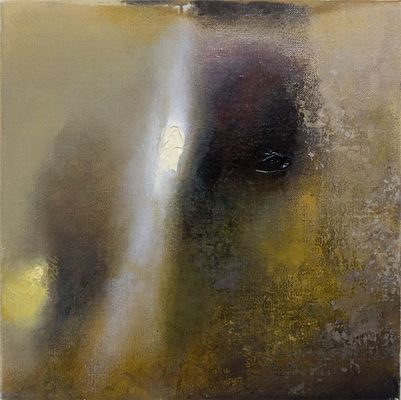
To return to Buckley’s fragment, the first two lines very much evoke how I paint nowadays. As you age, detail diminishes and patches of light become more luminous and float. I feel the most honest way of dealing with this is by smearing the oil paint on the canvas with the fingers and working close-up, blind. Only if the patches coalesce into an approaching image can the work gain a life.
-
Jonathan Walker was born in Melbourne, Australia and brought up on a dairy farm in Gippsland. In the 1970’s he studied painting at RMIT and won the Harold Wright Scholarship to the British Museum, London. During the 1980’s he exhibited at Pinacotheca Gallery, Richmond and had work shown at the NGV and Heidi City Art Gallery. Over the same period he designed the cover for the “Epigenesi” LP by Giancarlo Toniutti, Italy and conducted a mail exchange work with Achim Wollscheid, Germany. The work with artists through the post resulted in an article published in the bicentenary issue of Art and Australia 1988. He showed in artist run spaces such as WestSpace in the 90’s and 2000’s, and until 2012, taught painting at Victoria University, which is where we (Colleen Ahern and Lisa Radford) as organisers of the exhibition, among many others, had the privilege of being his student.
Walker’s knowledge was imparted to students through the careful selection of music, literature, and artists found in books that he himself had ordered for the library. Walker’s strategy was the generosity of sharing his vast knowledge with references specific to each student and their context.
Walker’s paintings share a similar focus and intimacy.
This exhibition presents a small selection of recent paintings alongside a publication that includes Walker’s writing. Observational and analytical, Walker’s work is a type of material notation — the time of day, colour and how it is blended, the both specific and fleeting location of a reflection on lino or the question of whether a chair leg should be included in a painting.
Please join us on Friday August 21 between 6-8pm to celebrate the opening of the exhibition.
Curated by Colleen Ahern and Lisa Radford.
B. Wurtz
Curated by Nic Tammens
March 26 - April 4, 2015
B.Wurtz works from a basement studio in his home on Manhattan’s Lower East Side.
This local fact is attested to by the plastic shopping bags and newsprint circulars that appear in his work. As formal objects, they don’t make loud claims about their origins but nonetheless transmit street addresses and places of business from the bottom of this long thin island. Like plenty of artists, Wurtz is affected by what is local and what is consumed. His work is underpinned by this ethic. It often speaks from a neighborhood or reads like the contents of a hamper:
“BLACK PLUMS $1.29 lb.”
“Food Bazaar”
“USDA Whole Pork Shoulder Picnic 99c lb.”
“RITE AID Pharmacy, with us it’s personal.”
“H. Brickman & Sons.”
“Sweet Yams 59c lb."
Most of the work in this exhibition was made while the artist was in residence at Dieu Donne, a workshop dedicated to paper craft in Midtown. Here Wurtz fabricated assemblages with paper and objects that are relatively lightweight, with the intention that they would be easily transportable to Australia. This consideration isn’t absolute in Wurtz’s work, but was prescriptive for making the current exhibition light and cheap. Packed in two boxes, these works were sent from a USPS post office on the Lower East Side and delivered to North Melbourne by Australia Post.
Wurtz appears courtesy of Metro Pictures, New York.
Thanks to Rob Halverson, Joshua Petherick, Sari de Mallory, Matt Hinkley, Helen Johnson, Fayen d'Evie, Ask Kilmartin, Lisa Radon, Ellena Savage, Yale Union, and "Elizabeth".
John Nixon
"Archive"
December 15 - January 20, 2014
The presentation of John Nixon's archive offered a rare showcase of this extensive collection of the artist's own publications, catalogues, posters, ephemera, editions and more, from the mid 1980s onwards, alongside a selection of his artworks.
Organized by John Nixon, Joshua Petherick and Matt Hinkley.
<a href=http://wfb.public-office.info/artist/john-nixon>All titles by John Nixon
"Habitat"
at Minerva, Sydney (organised by Joshua Petherick and Matt Hinkley)
November 15 - December 20, 2014
Lupo Borgonovo, Janet Burchill & Jennifer McCamley,
Lewis Fidock, HR Giger, Piero Gilardi, Veit Laurent Kurz,
Cinzia Ruggeri, Michael E. Smith, Lucie Stahl, Daniel Weil, Wols
Press Release:
“...It contained seven objects. The slender fluted bone, surely formed for flight, surely from the wing of some large bird. Three archaic circuitboards, faced with mazes of gold. A smooth white sphere of baked clay. An age-blackened fragment of lace. A fingerlength segment of what she assumed was bone from a human wrist, grayish white, inset smoothly with the silicon shaft of a small instrument that must once have ridden flush with the surface of the skin - but the thing’s face was seared and blackened.”
William Gibson, “Count Zero”, 1986
"Autumn Projects Archive"
Curated by Liza Vasiliou
March 6 - March 15, 2014
World Food Books, in conjunction with the Virgin Australia Melbourne Fashion Festival 2014, presented the Autumn Projects archive, consisting of a selection of early examples in Australian fashion with a particular interest in collecting designers and labels from the period beginning in the 1980’s, who significantly influenced the discourse of Australian Fashion.
Curated by Liza Vasiliou, the exhibition provided a unique opportunity to view pieces by designers Anthea Crawford, Barbara Vandenberg, Geoff Liddell and labels CR Australia, Covers, Jag along with early experimental collage pieces by Prue Acton and Sally Browne’s ‘Fragments’ collection, suspended throughout the functioning World Food Books shop in Melbourne.
H.B. Peace
presented by CENTRE FOR STYLE
November 14, 2013
"Hey Blinky, you say chic, I say same"
Anon 2013
H.B. Peace is a clothing collaboration between great friends Blake Barns and Hugh Egan Westland. Their pieces explore the divergences between 'character’ and ‘personality’ in garments....etc
Special Thanks to Joshua Petherick and Matt Hinkley of WFB and Gillian Mears
and a Very Special Thank you to Audrey Thomas Hayes for her shoe collaboration.
Janet Burchill & Jennifer McCamley
"Aesthetic Suicide"
May 10 - June 8, 2013
The first of our occasional exhibitions in the World Food Books office/shop space in Melbourne, "Aesthetic Suicide" presented a body of new and older works together by artists Janet Burchill & Jennifer McCamley, including videos, prints, a wall work, and publications.
During shop open hours videos played every hour, on the hour.
2024, English
Softcover, 88 pages, 17.8 x 11.4 cm
Published by
Wakefield Press / Cambridge
$32.00 - In stock -
Foreword by René Daumal
Translated by Terry Bradford
When published in 1928, Vulturnus represented a new direction in Léon-Paul Fargue’s writing: a shift from the lyrical post-Symbolist melancholy of his early poetry to something more grandiose, dynamic, and cosmic. A long prose poem, for lack of a better term, but one that weaves together philosophical dialogue, metaphysical meditation, and mournful reminiscence delivered in a language that spirals into scientific terminology and Rabelaisian neologism.
Jolted into a nightmare aboard a long-distance train journey, the author finds himself alone yet not alone, his mind pinned like an insect, as he sets off on a journey that takes him from his hometown to other existences, accompanied by the fanfare of the planets and two companions—Pierre Pellegrin and Joseph Aussudre—who guide him as Virgil did Dante, though not through hell, but to a sketched-out terrestrial paradise in quest of a moment of eternity: a syphilis of the ether, “one foot godward, two steps brute.”
This first English translation finally introduces an essential yet underrecognized twentieth-century voice and includes an essay on the text by René Daumal, who declares that “Vulturnus suffocates me with its obviousness … I see behind Fargue the great frame of Doctor Faustroll.”
“Vulturnus is an astonishing book.”—Paul Valéry
“A rollicking interplanetary poem.”—Eugene Jolas
Léon-Paul Fargue (1876–1947) was the archetypal poet of Paris, with ties to everyone from Alfred Jarry and Erik Satie to Colette and Maurice Ravel. His work was admired by Rilke, Joyce, and Walter Benjamin. Though his work spanned and was sometimes associated with various literary movements, a bridge of sorts from symbolism to surrealism (though he was opposed to the latter), he kept to his own path throughout his life: a night wanderer who turned his perambulations through Paris into a unique poetry and prose.
“The greatest living poet in France.”—Walter Benjamin
“One of our greatest poets.”—Rainer Maria Rilke
“Fargue taught us to sublimate the life of everyday and make the highest poetry out of it.”—Max Jacob
2024, English
Softcover, 220 pages, 20.32 x 12.7 cm
Published by
Contra Mundum Press / New York
$45.00 - Out of stock
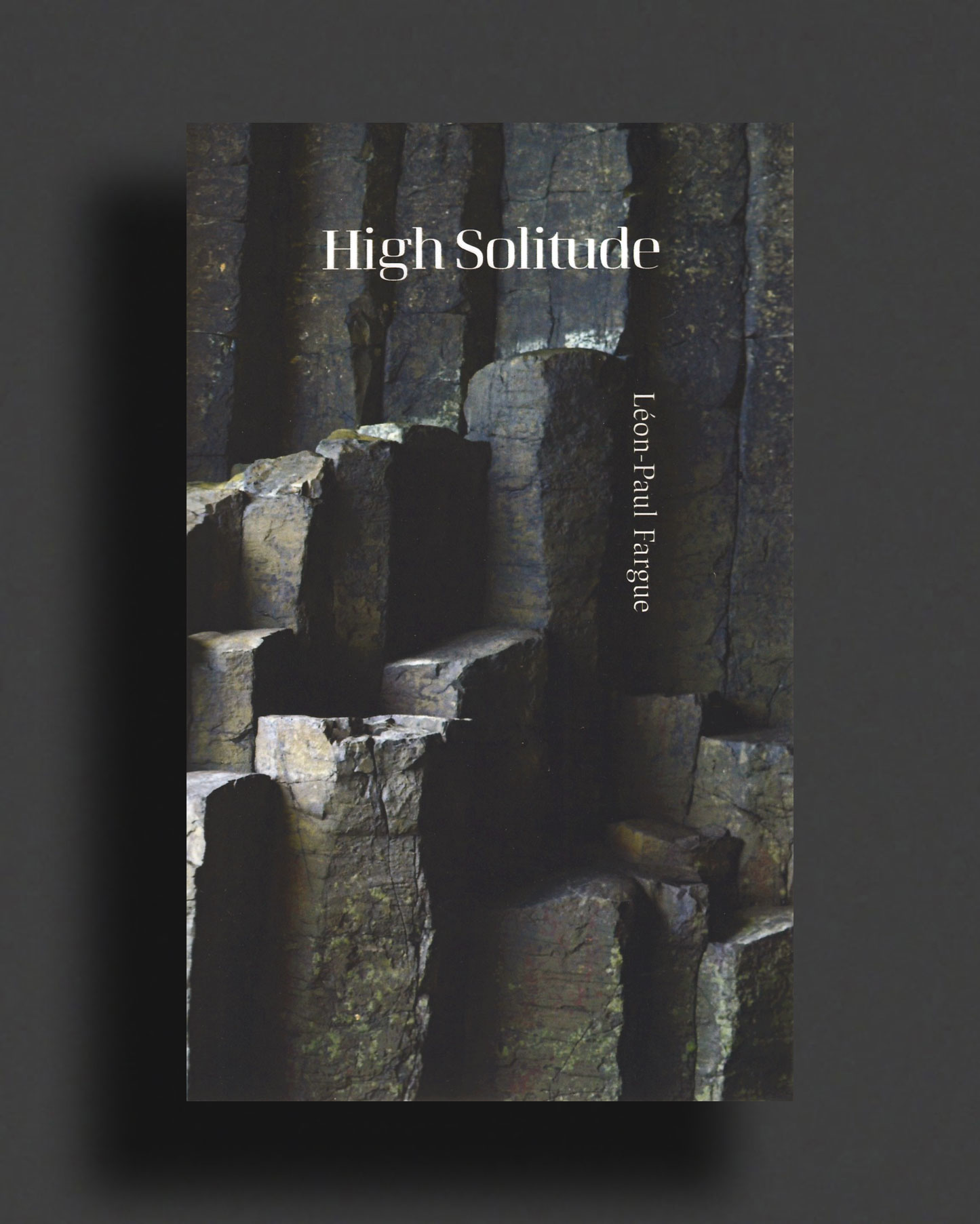
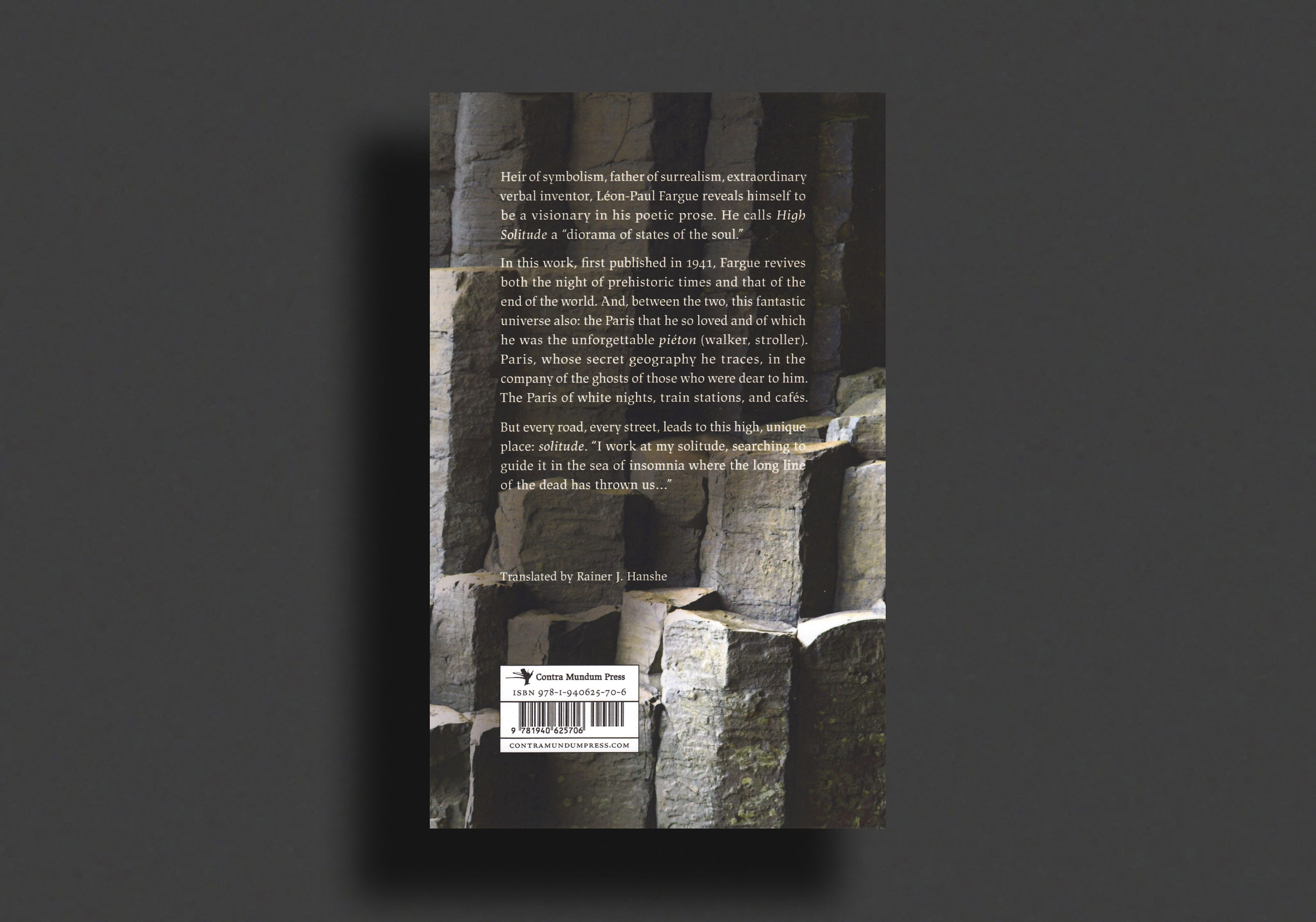
Heir of symbolism, father of surrealism, extraordinary verbal inventor, L on-Paul Fargue reveals himself to be a visionary in his prose poems. He calls High Solitude a "diorama of states of the soul."
In this work, originally published in 1941, Léon-Paul Fargue revives both the night of prehistoric times and that of the end of the world. And, between the two, this fantastic universe also: the Paris that he so loved and of which he was the unforgettable Pi ton. Paris, whose secret geography he traces, in the company of the ghosts of those who were dear to him. The Paris of white nights, stations, and cafes.
But every road, every street, leads to this high, unique place: solitude. "I work at my solitude, searching to guide it in the sea of insomnia where the long line of the dead has thrown us..."
"Fargue taught us to sublimate everyday life and make the highest poetry out of it."—Max Jacob
"Fargue transforms reality and incites it to undergo perilous metamorphoses, and eventually drives it some way toward the abyss. That is the danger of an art devoted to metaphor: it calls everything into question; but that is also its merit, and in the lament for the life of another era which Fargue readily, too readily, intones, it is right that we should hear the wrong note, the unheard of note, which intrudes into it like the cracked echo of an enigma."—Maurice Blanchot
"There is an unknown demon within Fargue that seems to drive him to the most audacious comparisons, in which he makes use of animals, cathedrals, or monsters to castigate the moral squalor of his day. It is a matter of pure poetry, an agility of spirit that leads him ceaselessly to find resemblances or associations for everything his eyes fall on."—André Beucler
LÉON-PAUL FARGUE (1876-1947) was a writer of poems, novels, and essays. He was a member of Les Apaches, an artist's group formed by Ravel and others, and a close friend of Alfred Jarry. Walter Benjamin considered Fargue the greatest poet in twentieth-century France and the two met in the 30s, with Fargue touring the philosopher around the arcades and other parts of Paris. Fargue was considered the great walker of the city of lights and recounted his perambulations in D'après Paris (1931) and Le Piéton de Paris (1939). Other books of his include Haute solitude (1941) and Déjeuners de soleil (1942).
Rainer J. Hanshe was born in Tehran, Iran, raised in New York, and has resided in Europe and elsewhere. He is the author of the novels The Acolytes and The Abdication, as well as of the hybrid entity Shattering the Muses (2016), a collaboration with visual artist Federico Gori, Closing Melodies (2023), a phantomatic encounter between Nietzsche & Van Gogh, and Dionysos Speed (2024). His translations include Baudelaire's My Heart Laid Bare (2017; 2020), Belgium Stripped Bare (2019), and Paris Spleen (2021), Évelyne Grossman's The Creativity of the Crisis, Antonin Artaud's Journey to Mexico: Revolutionary Messages, and Léon-Paul Fargue's High Solitude. as well as longer and shorter works by other authors.His newest work, Humanimality, is forthcoming in 2025. Beyond Sense, a vatic exploration of the aphasiac disintegration of Hölderlin, Baudelaire, Nietzsche, and Artaud, is due out in 2026. He is at work on a new book entitled Burn Poet Burn.
2011, English
Softcover, 228 pages, 20.5 x 15 cm
Published by
Exact Change / Boston
$34.00 - Out of stock
Translated and with an introduction by Simon Watson Taylor.
Paris Peasant (1926) is one of the central works of Surrealism, yet Exact Change's edition is the first U.S. publication of Simon Watson Taylor's authoritative translation, completed after consultations with the author.
Unconventional in form--Aragon consciously avoided recognizable narration or character development--Paris Peasant is, in the author's words, “a mythology of the modern.” The book uses the city of Paris as a stage or framework, and Aragon interweaves his text with images of related ephemera: café menus, maps, inscriptions on monuments and newspaper clippings. A detailed description of a Parisian arcade (nineteenth-century precursor to the mini-mall) and another of the Buttes-Chaumont park, are among the great set pieces within Aragon's swirling prose of philosophy, dream and satire.
André Breton wrote of this work: “no one could have been a more astute detector of the unwonted in all its forms; no one else could have been carried away by such intoxicating reveries about a sort of secret life of the city. . . .”
2001, English
Softcover, 103 pages, 14 x 20.4 cm
Published by
City Lights Books / San Francisco
$28.00 - Out of stock
"The caress of the eye over the skin is so utterly, so extraordinarily gentle, and the sensation is so bizarre that it has something of a rooster's horrible crowing." - G.B.
A masterpiece of transgressive, surrealist erotica, Bataille's first novel, published under the pseudonym 'Lord Auch', is still his most notorious work. Called a "metaphysician of evil, Bataille wrote the 1928 novella "Story of the Eye (French: L'histoire de l'œil) as a psychoanalytical task. In this explicit erotic fantasy, the young male narrator and his lovers Simone and Marcelle embark on a sexual quest involving sadism, torture, orgies, madness and defilement, culminating in a final act of transgression. Shocking and sacrilegious, Story of the Eye is the fullest expression of Bataille's obsession with the closeness of sex, violence and death. Yet it is also hallucinogenic in its power, and is one of the erotic classics of the twentieth century.
Georges Bataille (1897-1962), French essayist and novelist, was born in Billom, France. He converted to Catholicism, then later to Marxism, and was interested in psychoanalysis and mysticism, forming a secret society dedicated to glorifying human sacrifice. Leading a simple life as the curator of a municipal library, Bataille was involved on the fringes of Surrealism, founding the Surrealist magazine Documents in 1929, and editing the literary review Critique from 1946 until his death.
1982, English
Hardcover (w. dust jacket), 154 pages, 23.5 x 16 cm
1st Edition, Out of print title / used / very good
Published by
Syracuse University Press / New York
$50.00 - Out of stock
First hardcover edition.
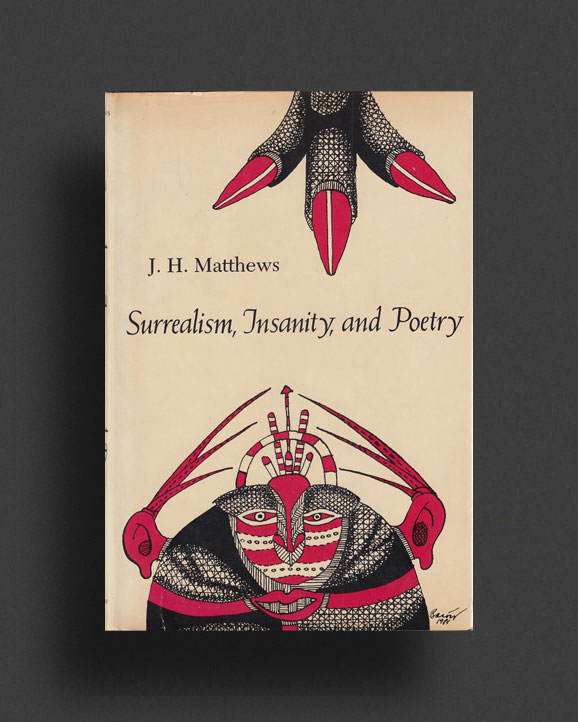
"In this groundbreaking, original study, J. H. Matthews, "clearly the chief scholarly explicator of surrealism today," according to Contemporary Literature, shows how the surrealists' goals and the imaginative freedom of mind are fused and diffused in the poet's creative world. Hallucination, game-playing, experimental research, and the irrational which nurtures new ways of poetical expression are all interwoven.
Out of their eagerness to share the benefits they ascribed to mental disturbance surrealists developed an approach to poetic technique which capitalized on the free association of the unconscious mind without undermining the sanity of the poets themselves.
Matthews discusses early surrealist interest in psychosis, hysteria, and insanity. This interest underlies such major works as André Breton's Nadja and Breton's and Paul Eluard's The Immaculate Conception. It is in the latter text that the issue of insanity and its relationship to poetic activity is most clearly revealed as essential to the surrealist enterprise. Also included here are chapters on insanity's poetic simulation and possession.
Matthews' work is important to anyone interested in poetry, the unconscious, and the history of twentieth-century ideas, as well as to scholars of surrealism.
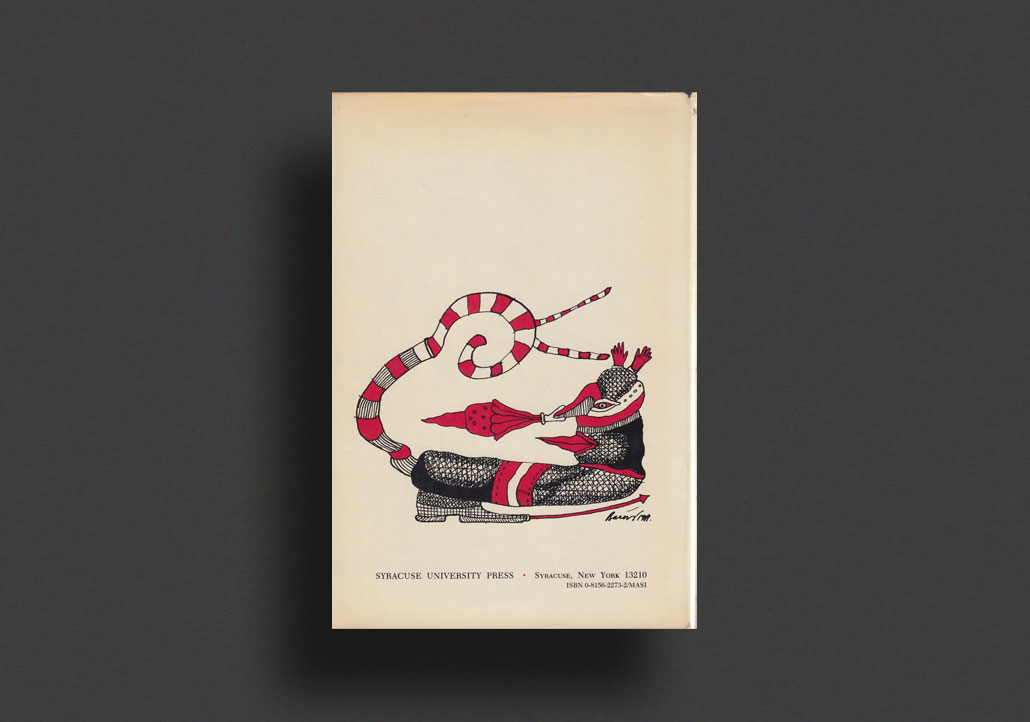
Karol Baron, a Czech surrealist artist, has provided six original drawings especially for this book."—Dust jacket.
J. H. Matthews is a member of the committee appointed by the French government's Centre National de la Recherche scientifique to establish a center in Paris for documenting world-wide surrealism. He is American correspondent for Edda and Gradiva (Brussels), Phases (Paris), and Sud (Marseilles), magazines devoted to vanguard poetry and art. In 1977 the University of Wales conferred upon him its D. Litt., in recognition of his work on surrealism.
Born in Swansea, Wales, J. H. Matthews has been Professor of French at Syracuse University and editor of Symposium: A Quarterly Journal in Modern Foreign Literatures since 1965. He has edited a selection of stories by Guy de Maupassant (1959) as well as two special issues of La Revue des Lettres Modernes, and is the author of Les deux Zola (1957) and The Inner Dream: Céline as Novelist (1978) and numerous articles on nineteenth-and twentieth-century French literature.
His interest in surrealism has led him to write Péret's Score/Vingt Poèmes de Benjamin Péret
(1965); An Introduction to Surrealism (1965); An Anthology of French Surrealist Poetry (1966); Surrealism and the Novel (1966); André Breton (1967); Surrealist Poetry in France (1969); Surrealism and Film (1971); Theatre in Dada and Surrealism (1974); Benjamin Péret (1975); and The Custom-House of Desire: A Half-Century of Surrealist Short Stories (1975). He is also the author of Toward the Poetics of Surrealism (1976); Le thé-âtre de Raymond Roussel: une énigme (1977); The Imagery of Surrealism (1977); and Surrealism and American Feature Films (1979).
VG copy in VG dust jacket with light tanning/age.
2013, English
Hardcover, 176 pages, 17.4 x 19.6 cm
Published by
Atlas Press / London
$46.00 - In stock -
Mystery, the marvellous, the city of Paris transmuted by love, and Sanglot the Corsair’s pursuit of the siren Louise Lame: these are the essential ingredients of this masterpiece of early Surrealism. It was originally published in 1924 to immediate and lasting acclaim — except from the public authorities who immediately censored whole sections (here restored).
How describe a novel of such virtuosity and bravura, which never behaves as one would expect? Characters appear and vanish according to whim and desire, they walk underwater, nonchalantly accept astounding coincidences. It’s a hymn to the erotic, an adventure story illumined by the shades of Sade, Lautréamont and Jack the Ripper, a dream at once violent and tender, in fact the perfect embodiment of the Surrealist spirit: joyful, despairing, and effortlessly scandalous.
Desnos was one of the earliest members of the Paris Surrealist group. His remarkable talents first emerged during the “Period of Sleeping Fits”, when the group was investigating unconscious and trance states. Able to put himself in trance at will, he would pour out sonnets, prophecies, enigmatic drawings. “Desnos more than any of us got closest to the Surrealist truth,” wrote Breton in their first manifesto.
An active member of the Resistance, Desnos died of typhus two weeks after his liberation from the Nazi concentration camp at Terezin.
Translated and introduced by Terry Hale.
2022, English
Hardcover, 352 pages, 20.3 x 14 cm
Published by
The Visible Press / London
$65.00 - In stock -
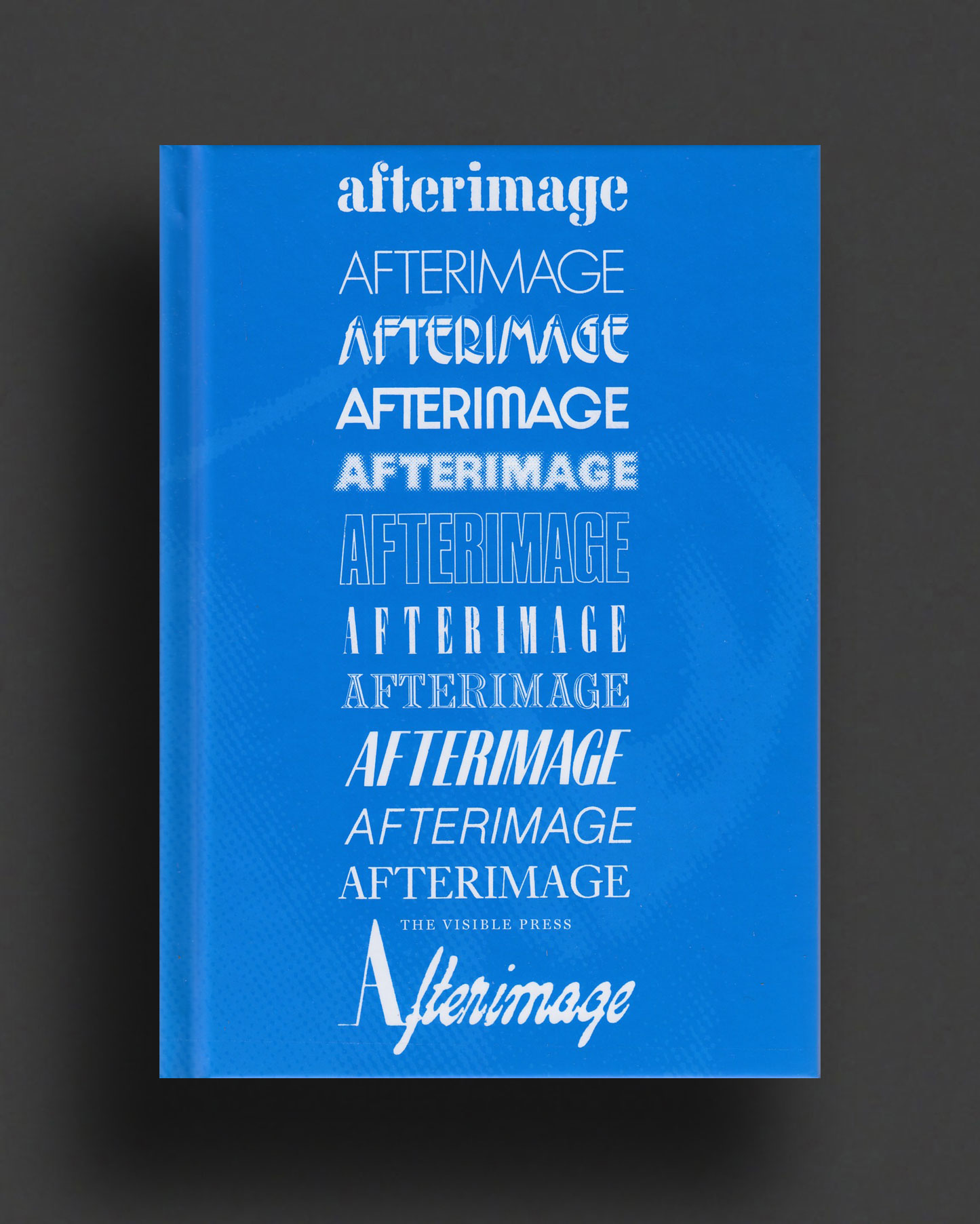
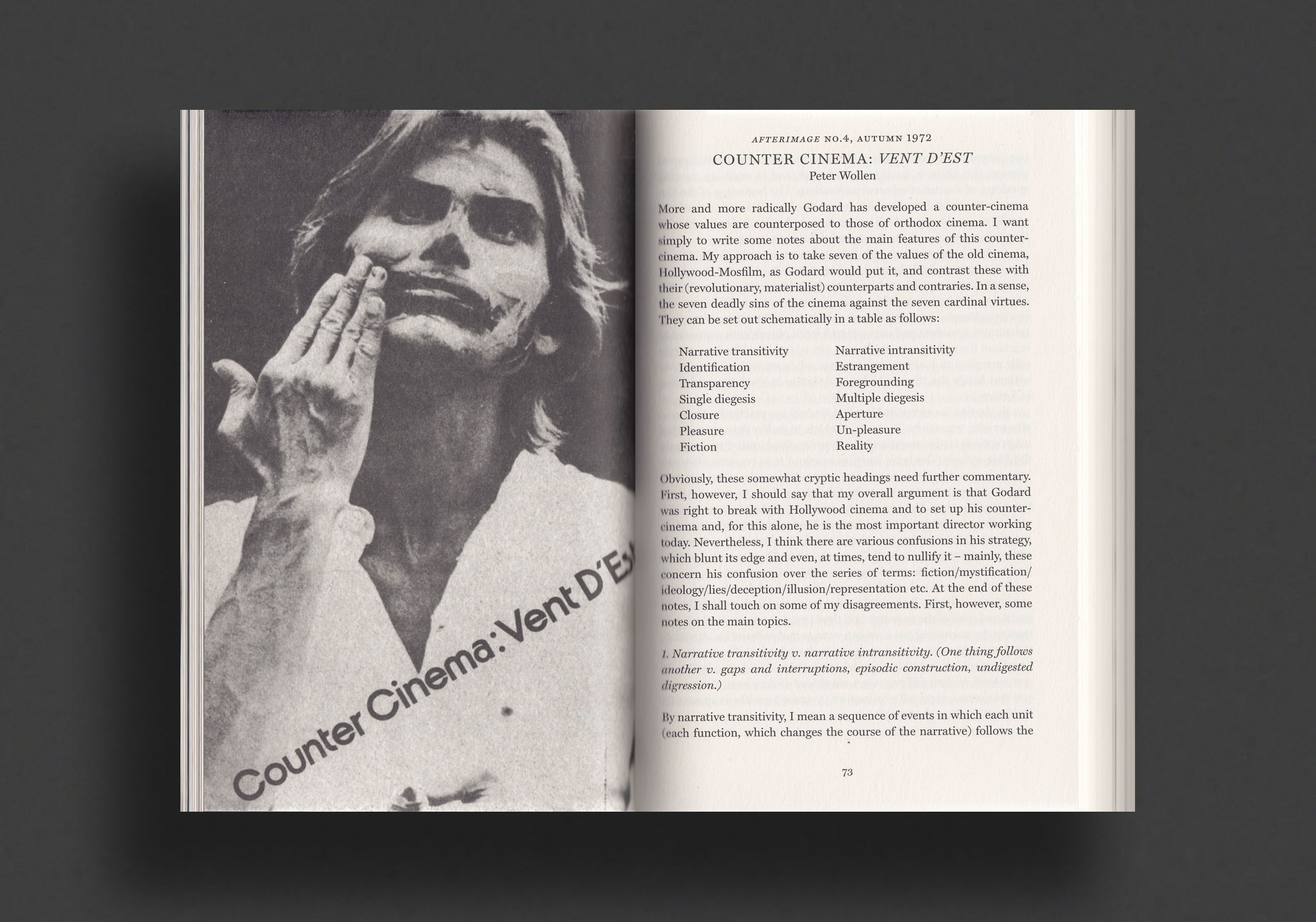
The independent British film journal Afterimage published thirteen issues between 1970 and 1987. International in scope, it surveyed the many forms of radical cinema during an extraordinary period of film history. Having emerged in the wake of post-1968 cultural and political change, Afterimage charted contemporary developments with special issues on themes such as the avant-garde, Latin American cinema and visionary animation, and also looked back at early film pioneers. It published many of the leading critics of the period and vitally provided a forum for filmmakers’ writings and manifestos.
This indispensable collection includes texts by scholars Noël Burch, Roger Cardinal, B. Ruby Rich and Peter Wollen, filmmakers Jean Epstein, Jean-Luc Godard, Derek Jarman and Jan Švankmajer, plus extended interviews with Hollis Frampton and Raúl Ruiz, and more.
The Afterimage Reader is edited by Mark Webber and features new contributions from two of the journal’s editors, Simon Field and Ian Christie.
2004, English
Softcover, 200 pages, 21.6 x 14 cm
Published by
Stanford University Press / Palo Alto
$48.00 - Out of stock
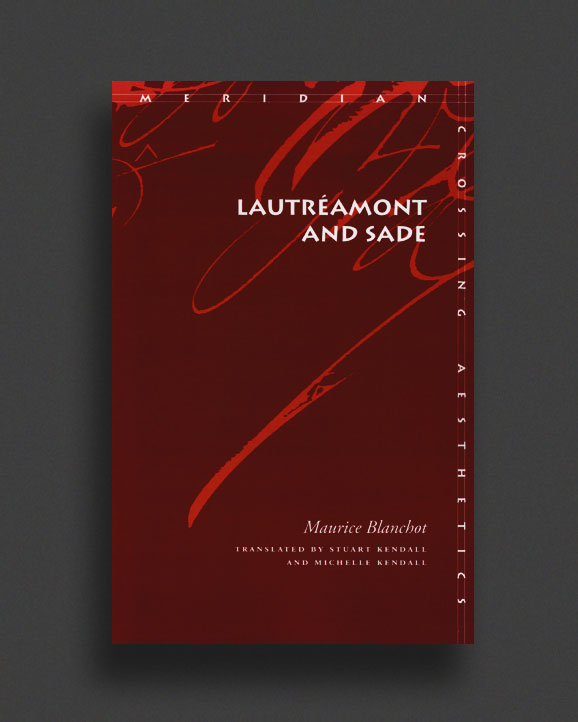
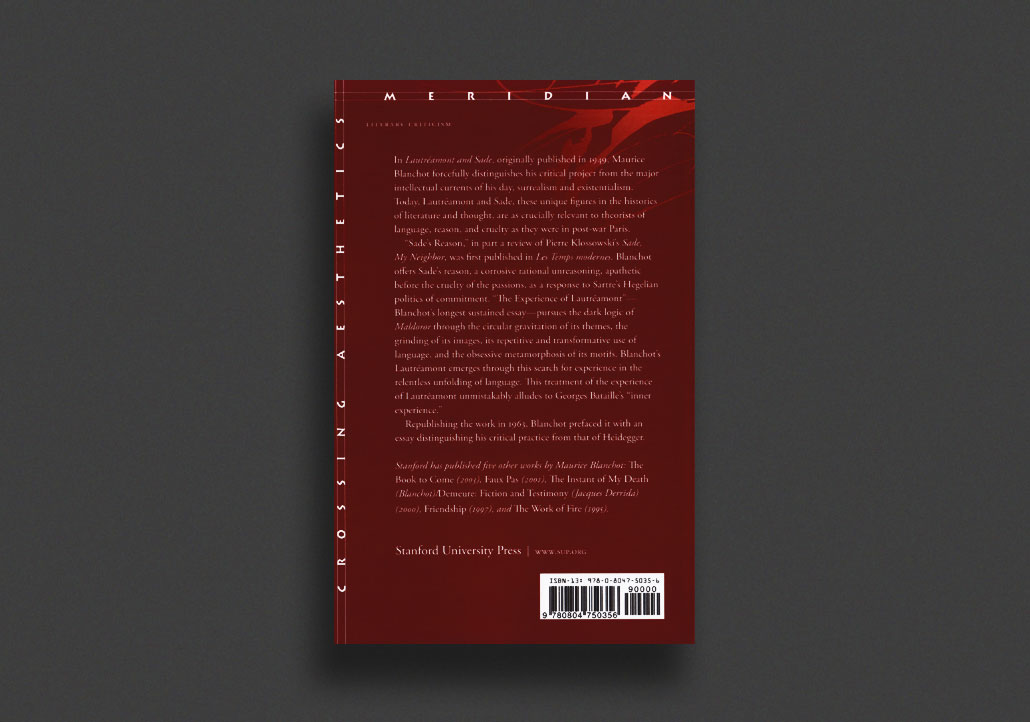
In Lautréamont and Sade, originally published in 1949, Maurice Blanchot forcefully distinguishes his critical project from the major intellectual currents of his day, surrealism and existentialism. Today, Lautreamont and Sade, these unique figures in the histories of literature and thought, are as crucially relevant to theorists of language, reason, and cruelty as they were in post-war Paris.
"Sade's Reason," in part a review of Pierre Klossowski's Sade, My Neighbor, was first published in Les Temps modernes. Blanchot offers Sade's reason, a corrosive rational unreasoning, apathetic before the cruelty of the passions, as a response to Sartre's Hegelian politics of commitment.
"The Experience of Lautreamont," Blanchot's longest sustained essay, pursues the dark logic of Maldoror through the circular gravitation of its themes, the grinding of its images, its repetitive and transformative use of language, and the obsessive metamorphosis of its motifs. Blanchot's Lautreamont emerges through this search for experience in the relentless unfolding of language. This treatment of the experience of Lautreamont unmistakably alludes to Georges Bataille's "inner experience."
Republishing the work in 1963, Blanchot prefaced it with an essay distinguishing his critical practice from that of Heidegger.
Maurice Blanchot (1907-2003) was a French writer, philosopher, and literary theorist. His work had a strong influence on later post-structuralist theorists such as Jacques Derrida. He is one of the most enigmatic and influential figures in modern French writing yet no interview, no biographical sketch, and hardly any photographs have ever been published of him.
1979 / 2004, Japanese
Softcover, 76 pages, 29.7 x 29.7 cm
Out of print title / used / very good
Published by
Treville / Tokyo
Pan-Exotica / Tokyo
$80.00 - Out of stock
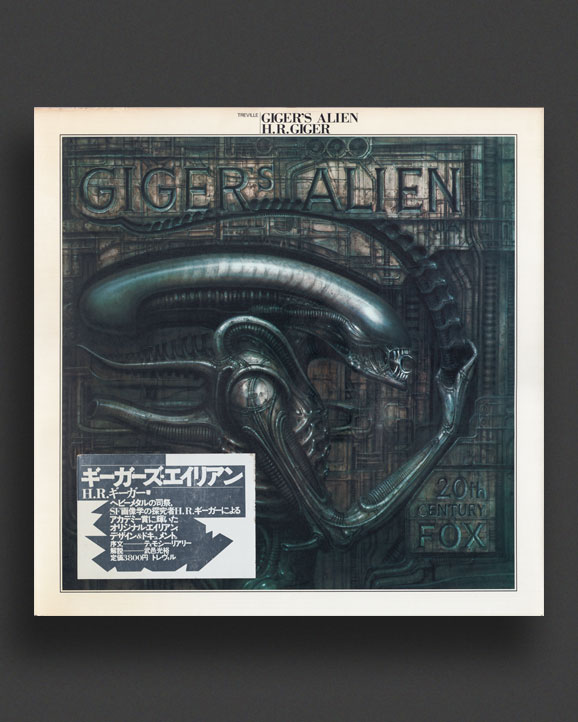
Japanese edition of the classic 1979 "Giger's Alien", a visually stunning and wonderfully insightful book for any fan of the art of H.R. Giger, Ridley Scott and Dan O'Bannon's Alien film or in the production of science-fiction/horror/special effects in any way. A must.
"Giger's Alien provides a complete record of the months and months of painstaking work that resulted in two hours of terrifying celluloid. Sketches, original paintings, photographs of scenery and the Alien under construction and scenes from the film are linked by Giger's detailed diary of his thoughts and actions at the time".
Very Good copy in VG original dust jacket of this title. 2004 edition.
1996, Englis / French
Softcover, 176 pages, 21.5 x 13.5 cm
1st Edition, Out of print title / used / fine
Published by
Anvil Press Poetry / London
$30.00 - Out of stock
Out-of-print 1976 Anvil Press Poetry collection of poetry by Guillaume Apollinaire (1880—1918), one of the foremost poets of the early 20th century, as well as one of the most impassioned defenders of Cubism and forefather of Surrealism. In bi-lingual French-English.
Apollinaire's poetry reflects the heady years of artistic and intellectual ferment before the First World War. The most dynamic modernist French poet, he is remembered as much for his more traditional lyric poems as for the typographical experiments of his 'calligrammes'. Apollinaire championed the Cubist painters, and his poetry is a literary counterpart to their innovative work. Subtle and complex, yet often direct, his poetry is still fresh, sharp and memorable.
Oliver Bernard's selection provides a representative cross-section of his poetry, while concentrating on his most famous collection, Alcools (1913). This is a revised and expanded edition of his 1965 Penguin selection, of which Edward Lucie-Smith wrote, "If the value of really inspired translation needs any stressing, Oliver Bernard's Apollinaire is there to prove the case. The French poet and his English interpreter are wonderfully well-matched." Christopher Ricks commented in the New Statesman that "Oliver Bernard's translations from Apollinaire are immediately engaging in their vividness and humour."
GUILLAUME APOLLINAIRE was born in Rome in 1880. Educated in Monaco and Nice, he became a French citizen only in 1916, after service in the artillery and infantry. He was badly wounded in the head in 1916, and died during the Paris flu epidemic in 1918. As prose writer and art critic as well as poet, Apollinaire was the moving spirit of French modernism.
OLIVER BERNARD has published three collections of poetry, most recently Poems (Samizdat, 1983) and Five Peace Poems (Five Seasons Press, 1985). His edition of Rimbaud's poetry is published by Penguin. He has lived in Norfolk for the past twenty years.
Fine copy.
1997, English
Softcover, 170 pages, 21.5 x 13.5 cm
1st Edition, Out of print title / used / good
Published by
Creation Books / London
Velvet Publications / London
$35.00 - Out of stock
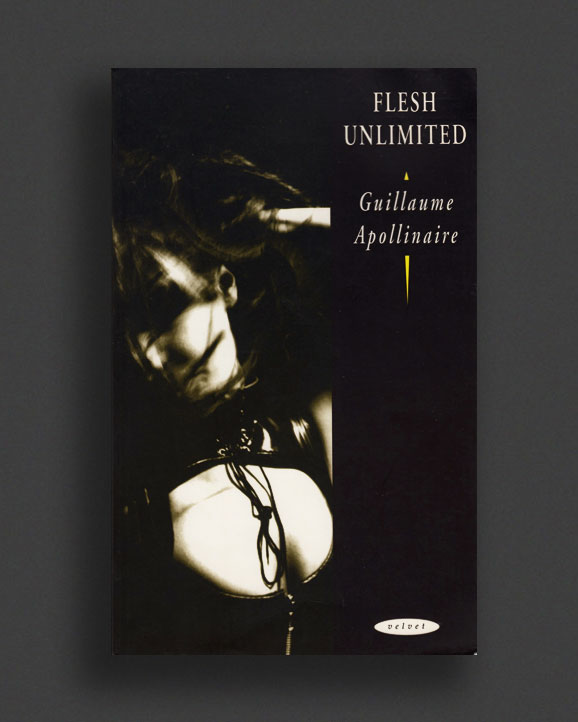
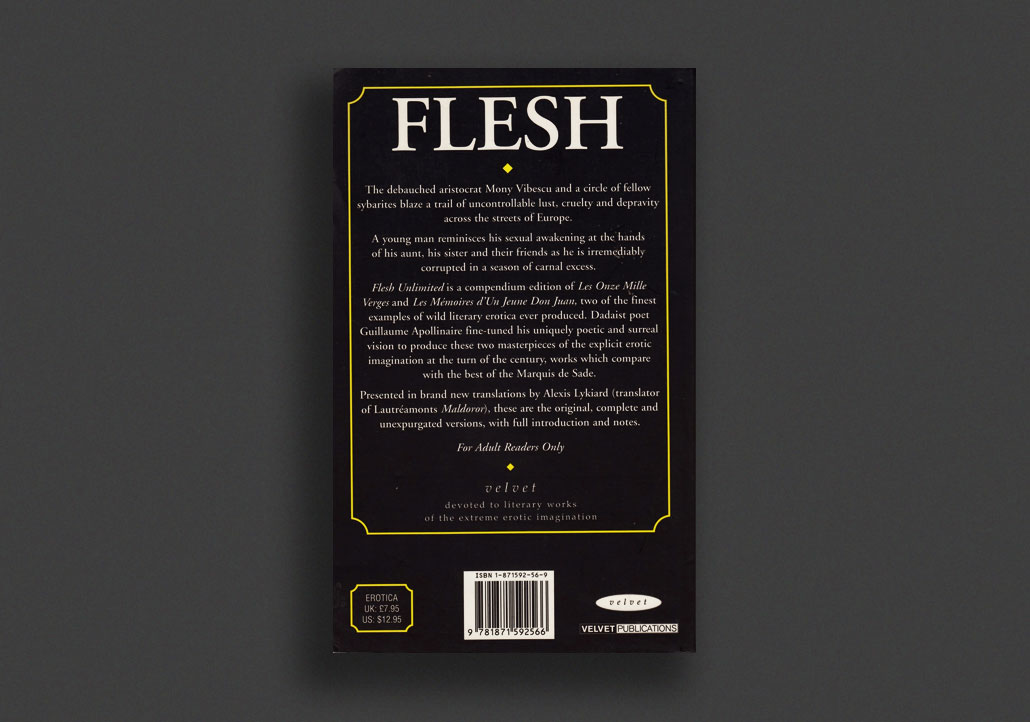
1997 Velvet edition of this compendium of two erotic novellas by Dadaist Guillaume Apollinaire, Les Onze Mille Verges and Les Memoires d'Un Jeune Don Juan. Presented in brand new translations by Alexis Lykiard (translator of Lautreamont's Maldoror), these are the original, complete and unexpurgated versions, with full introduction and notes.
The debauched aristocrat Mony Vibescu and a circle of fellow sybarites blaze a trail of uncontrollable lust, cruelty and depravity across the streets of Europe. A young man reminisces his sexual awakening at the hands of his aunt, his sister and their friends as he is irremediably corrupted in a season of carnal excess. Flesh Unlimited is a compendium edition of Les Onze Mille Verges and Les Memoires d'Un Jeune Don Juan, two of the finest examples of wild literary erotica ever produced. Dadaist poet Guillaume Apollinaire fine-tuned his uniquely poetic and surreal vision to produce these two masterpieces of the explicit erotic imagination at the turn of the century, works which compare with the best of the Marquis de Sade.
Good copy with some light wear and rippling to one corner of block.
2025, English
Softcover, 228 pages, 20 x 14 cm
Published by
Twisted Spoon Press / Prague
$42.00 - In stock -
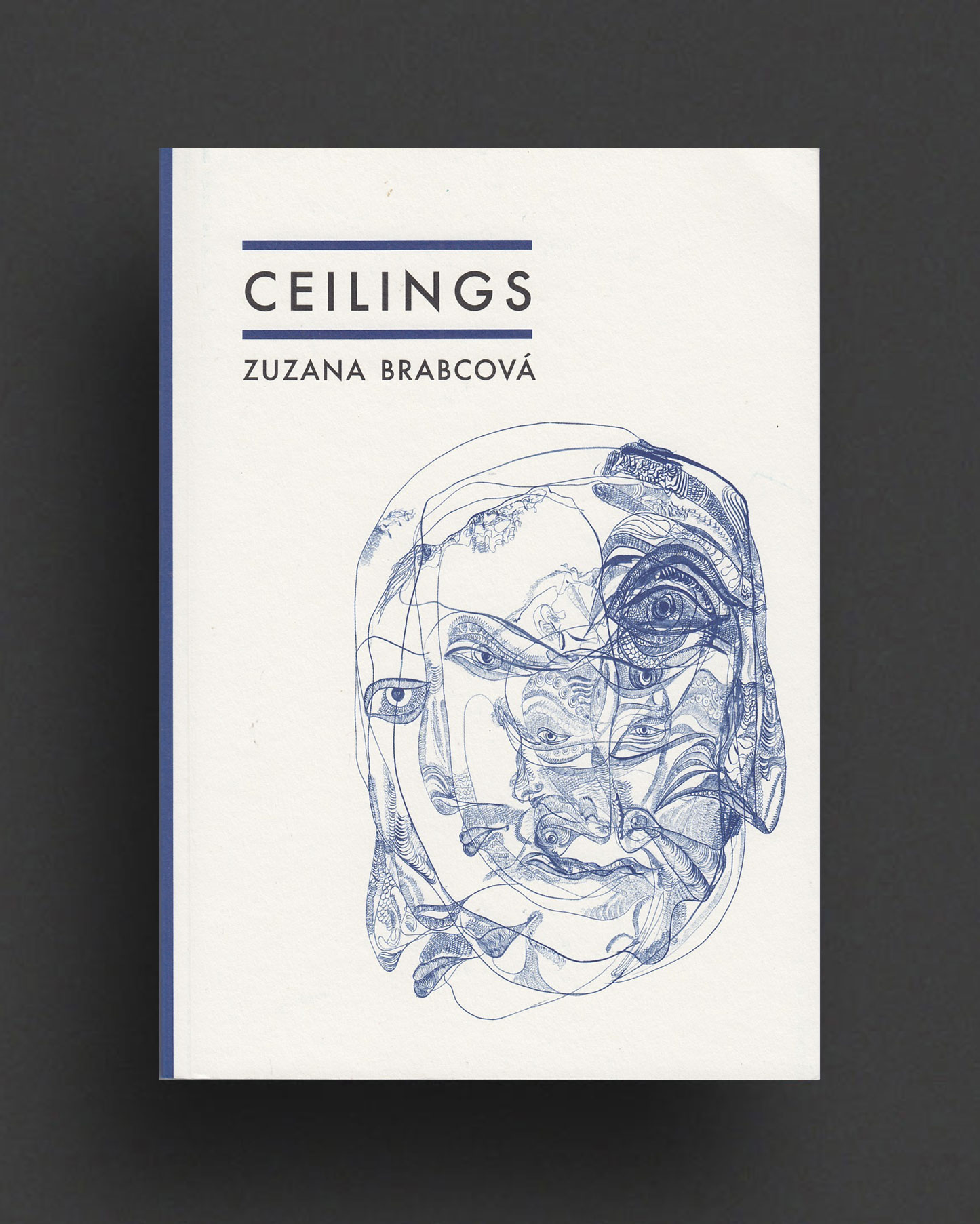
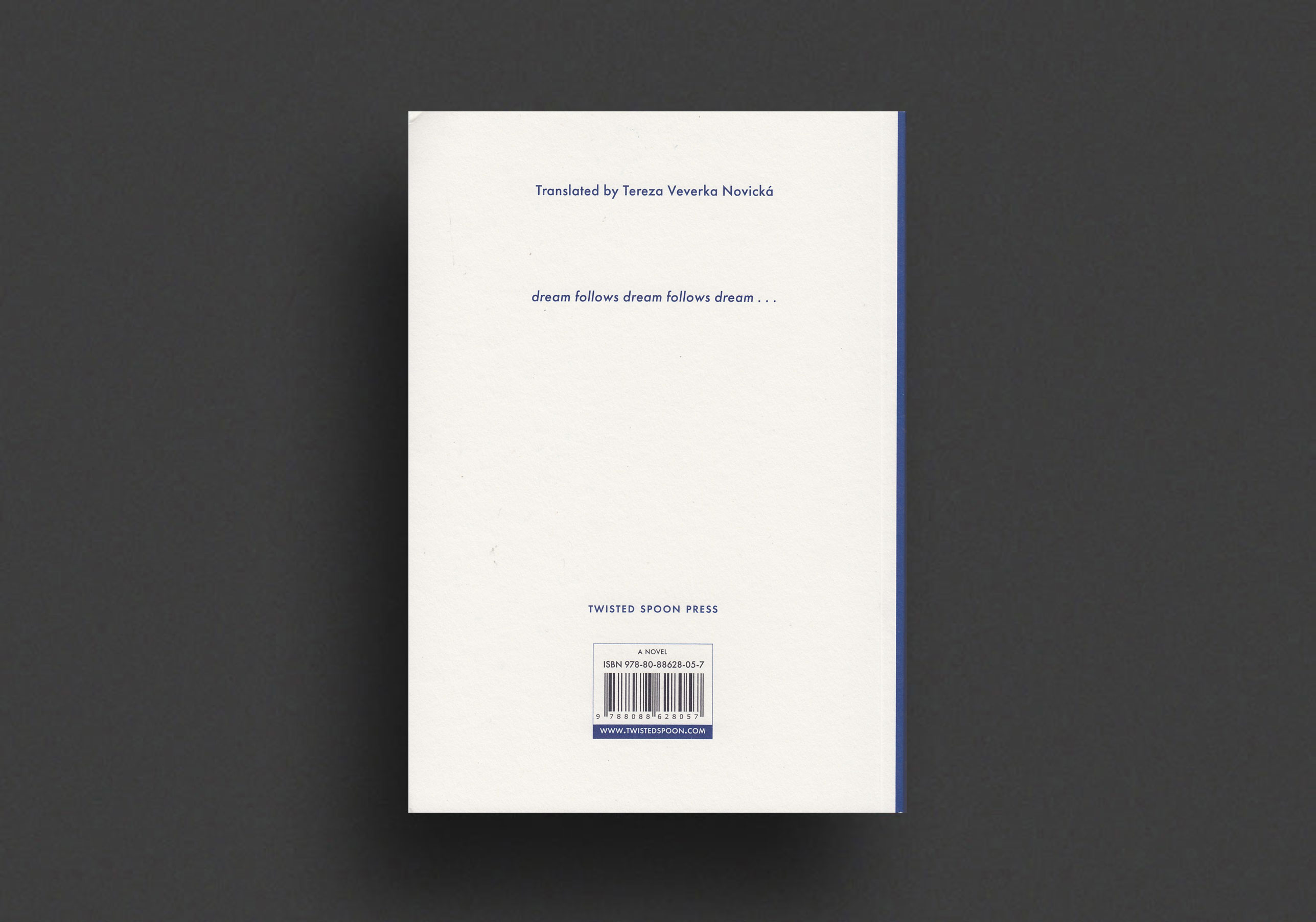
translated from the Czech by Tereza Novická
frontispiece by Rybka Ivanko Brabcová
cover by Unica Zürn
Kin to the work of Leonora Carrington and Unica Zürn, Ceilings is a polyphonic novel that takes place in a mental hospital in Prague where the "narrator" is undergoing detox treatment for substance abuse. As the borders blur between inner experience and the outer world, between reality and dream, as the walls and ceilings hemming in the desire for freedom fantastically break open as if into the unknown and gender fluidly shifts between brother and sister, who are one and the same, Brabcová’s flights of imagination portray how difficult it is to “come out of oneself” and to engage with the other in a multifarious world that demands it of us, no matter how ambivalently.
Magnesia Litera Prose Book of the Year for 2013
"The prose is hypnotic and often very beautiful, but the narrative is fragmented; that, of course, is deliberate, to replicate the state of Ema’s mind as she undergoes her detox, with her mental state often spiralling out of control. The surreal imagery, the shifts of location, the fluidity of her identity are all brilliantly rendered by Brabcova, and the result is an exhilarating and sometimes dizzying work which leaves you a bit stunned."—Kaggsy's Bookish Ramblings
"Ceilings is a crazy, delirious read, one that explores the complexities of being human and ruminates on how we assemble ourselves from what has happened to us, whowe know, what we would like to happen and who we would like to meet."—Rupert Loydell, International Times
"The ceiling that forms the horizon of someone lying in a hospital bed becomes a metaphor for the mingling of the past with the present, of phantasmagoria with the real. It is the very ceiling of reality, with a hole yawning with hallucinatory visions and memories, passage through which only leads to the next, ultimate ceiling of the self."—iLiteratura.cz
"Zuzana Brabcová's novel is a literary event, an extreme work, exceptional in its concision and poetry."—Petr A. Bílek Respekt
1997, Japanese
Hardcover (w. dust jacket and obi), 104 pages, 29.7 x 21 cm
1st Edition, Out of print title / used / very good
Published by
Treville / Tokyo
$190.00 - Out of stock
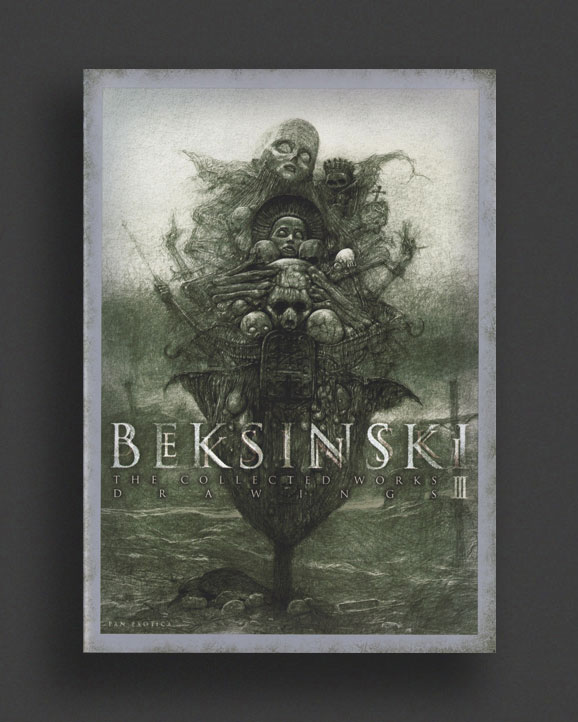
"Beksinski's powerfully unique paintings are such as I have never before seen" — H.R. Giger
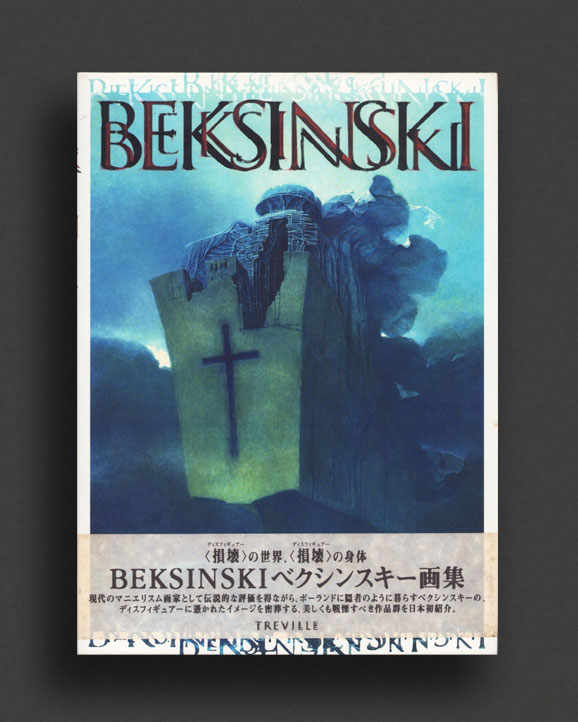
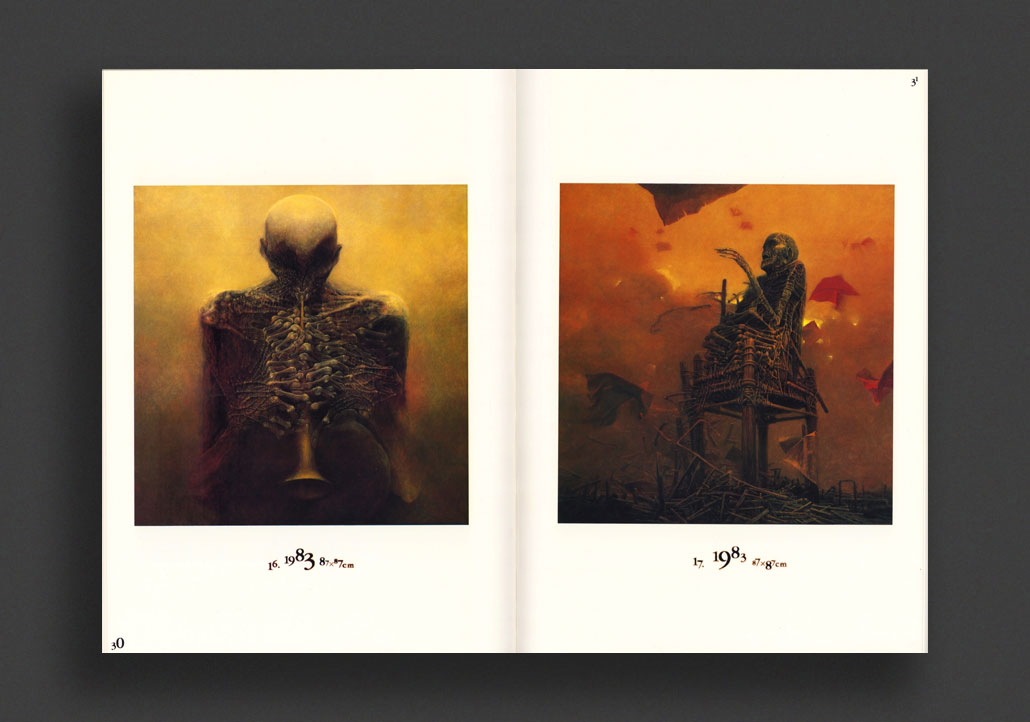
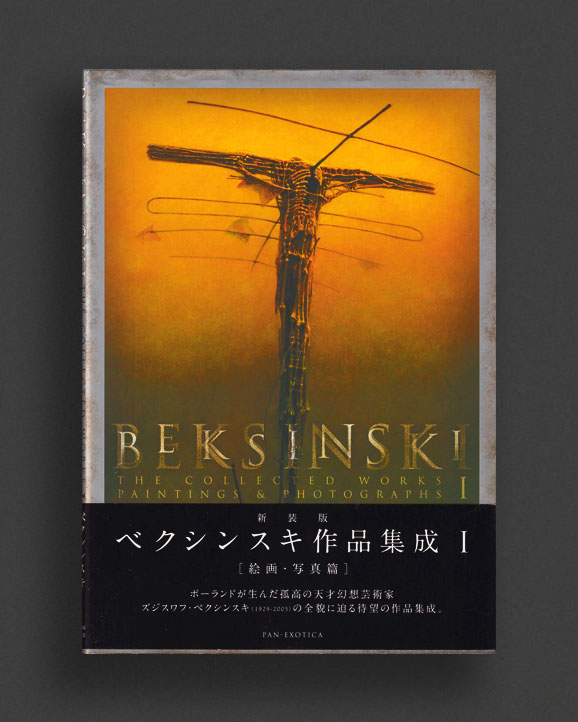
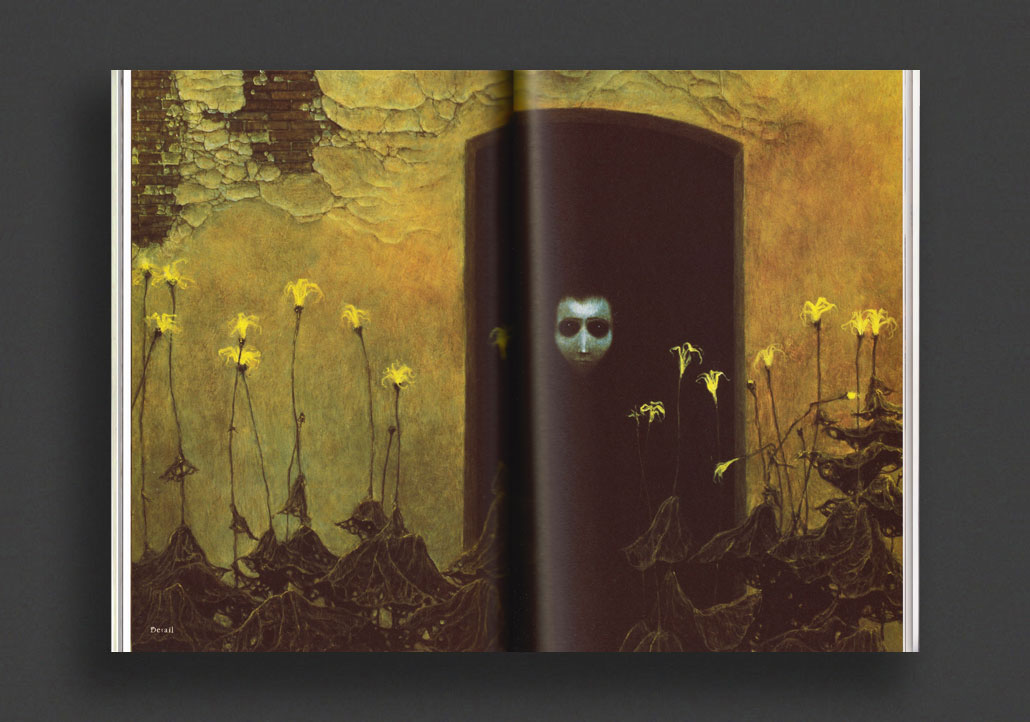
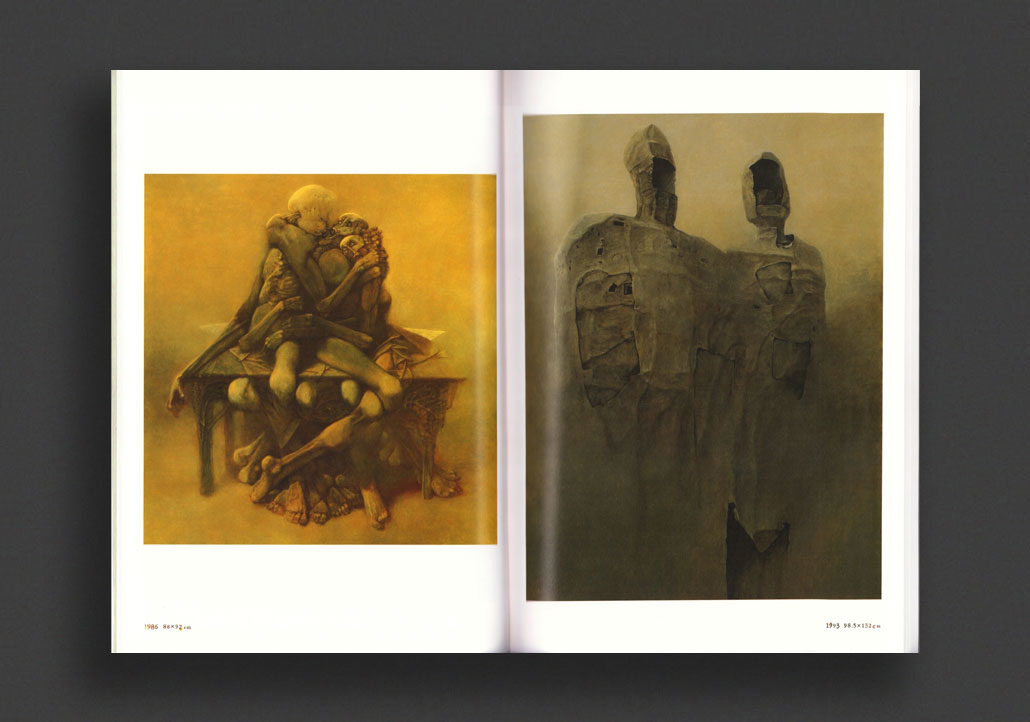
First Edition of the collected works of Zdzisław Beksiński, published originally in hardcover in 1997 by Editions Treville in Tokyo.
"Death, putrefaction, destruction. A time-space continuum that converts everything into eternal ruins
that are dominated by inexplicable loneliness and fear, causing the spirit of eroticism to echo hollowly across his canvases." This is an anthology of the Polish master of introvert fantasy. Chronology of paintings reproduced in colour with bio, exhibition history and essay (in Japanese).
Zdzisław Beksiński (1929 – 2005) was a Polish painter, photographer and sculptor. Beksiński had no formal training as an artist. Born in Sanok, he studied architecture in Kraków and worked as a construction site supervisor before turning to his passion for art, sculpting with construction site materials for his medium. His early photography would be a precursor to his paintings, often referred to as dystopian surrealism. Beksiński claimed, "I wish to paint in such a manner as if I were photographing dreams". Beksiński undertook painting with a passion, working intensely whilst listening to classical music and quickly becoming a leading figure in contemporary Polish art. In the late 1960s, Beksiński entered what he himself called his "fantastic period", which lasted up to the mid-1980s, during which he created his famed images of desolate, surrealistic landscapes with intricate depictions of anxious, abstracted figures and architecture in states of decay, mutation and decomposition. Although Beksiński's art was often dark, he himself was known to be a pleasant person with a keen sense of humour. Modest and somewhat shy, he avoided public events such as the openings of his own exhibitions and almost never visited museums or exhibitions in general. He always credited music as his main source of inspiration. Beksiński avoided concrete analysis of the content of his work, saying "I cannot conceive of a sensible statement on painting". Beksiński was stabbed to death at his Warsaw apartment in February 2005 by a 19-year-old acquaintance from Wołomin, reportedly because he refused to lend the teenager money.
"In the medieval tradition, Beksinski seems to believe art to be a forewarning about the fragility of the flesh – whatever pleasures we know are doomed to perish – thus, his paintings manage to evoke at once the process of decay and the ongoing struggle for life. They hold within them a secret poetry, stained with blood and rust." — Guillermo del Toro, Mexican film director
Very Good copy with VG dust jacket and Obi, with only light age/wear.
2017, English / Japanese
Softcover (w. dust jacket and obi), 21 x 30 cm
1st Edition, Out of print title / used / very good
Published by
Treville / Tokyo
$130.00 - Out of stock
"Beksinski's powerfully unique paintings are such as I have never before seen" — H.R. Giger
Comprehensive collection Zdzisław Beksiński's apocalyptic fantastic paintings and photographs, many never published before with many full-bleed painting details, issued in Japan as part of Treville's series of volumes on the Polish master of introvert fantasy. Profusely illustrated in colour and b/w, accompanied by texts in English and Japanese. This is the first volume in the series.
Zdzisław Beksiński (1929 – 2005) was a Polish painter, photographer and sculptor. Beksiński had no formal training as an artist. Born in Sanok, he studied architecture in Kraków and worked as a construction site supervisor before turning to his passion for art, sculpting with construction site materials for his medium. His early photography would be a precursor to his paintings, often referred to as dystopian surrealism. Beksiński claimed, "I wish to paint in such a manner as if I were photographing dreams". Beksiński undertook painting with a passion, working intensely whilst listening to classical music and quickly becoming a leading figure in contemporary Polish art. In the late 1960s, Beksiński entered what he himself called his "fantastic period", which lasted up to the mid-1980s, during which he created his famed images of desolate, surrealistic landscapes with intricate depictions of anxious, abstracted figures and architecture in states of decay, mutation and decomposition. Although Beksiński's art was often dark, he himself was known to be a pleasant person with a keen sense of humour. Modest and somewhat shy, he avoided public events such as the openings of his own exhibitions and almost never visited museums or exhibitions in general. He always credited music as his main source of inspiration. Beksiński avoided concrete analysis of the content of his work, saying "I cannot conceive of a sensible statement on painting". Beksiński was stabbed to death at his Warsaw apartment in February 2005 by a 19-year-old acquaintance from Wołomin, reportedly because he refused to lend the teenager money.
"In the medieval tradition, Beksinski seems to believe art to be a forewarning about the fragility of the flesh – whatever pleasures we know are doomed to perish – thus, his paintings manage to evoke at once the process of decay and the ongoing struggle for life. They hold within them a secret poetry, stained with blood and rust." — Guillermo del Toro, Mexican film director
As New copy of the first 2017 edition.
2022, English / Japanese
Softcover (w. dust jacket), 21 x 30 cm
1st Edition, Out of print title / used / fine
Published by
Treville / Tokyo
$120.00 - In stock -
"Beksinski's powerfully unique paintings are such as I have never before seen" — H.R. Giger
Comprehensive collection Zdzisław Beksiński's apocalyptic fantastic paintings, sculptures and reliefs, mostly never published before, issued in Japan as part of Treville's series of volumes on the Polish master of introvert fantasy. Profusely illustrated in colour and b/w, accompanied by texts in English and Japanese.
Zdzisław Beksiński (1929 – 2005) was a Polish painter, photographer and sculptor. Beksiński had no formal training as an artist. Born in Sanok, he studied architecture in Kraków and worked as a construction site supervisor before turning to his passion for art, sculpting with construction site materials for his medium. His early photography would be a precursor to his paintings, often referred to as dystopian surrealism. Beksiński claimed, "I wish to paint in such a manner as if I were photographing dreams". Beksiński undertook painting with a passion, working intensely whilst listening to classical music and quickly becoming a leading figure in contemporary Polish art. In the late 1960s, Beksiński entered what he himself called his "fantastic period", which lasted up to the mid-1980s, during which he created his famed images of desolate, surrealistic landscapes with intricate depictions of anxious, abstracted figures and architecture in states of decay, mutation and decomposition. Although Beksiński's art was often dark, he himself was known to be a pleasant person with a keen sense of humour. Modest and somewhat shy, he avoided public events such as the openings of his own exhibitions and almost never visited museums or exhibitions in general. He always credited music as his main source of inspiration. Beksiński avoided concrete analysis of the content of his work, saying "I cannot conceive of a sensible statement on painting". Beksiński was stabbed to death at his Warsaw apartment in February 2005 by a 19-year-old acquaintance from Wołomin, reportedly because he refused to lend the teenager money.
"In the medieval tradition, Beksinski seems to believe art to be a forewarning about the fragility of the flesh – whatever pleasures we know are doomed to perish – thus, his paintings manage to evoke at once the process of decay and the ongoing struggle for life. They hold within them a secret poetry, stained with blood and rust." — Guillermo del Toro, Mexican film director
As New copy of the revised 2020 edition.
2017, English / Japanese
Softcover (w. dust jacket), 21 x 30 cm
1st Edition, Out of print title / used / fine
Published by
Treville / Tokyo
$120.00 - Out of stock
"Beksinski's powerfully unique paintings are such as I have never before seen" — H.R. Giger
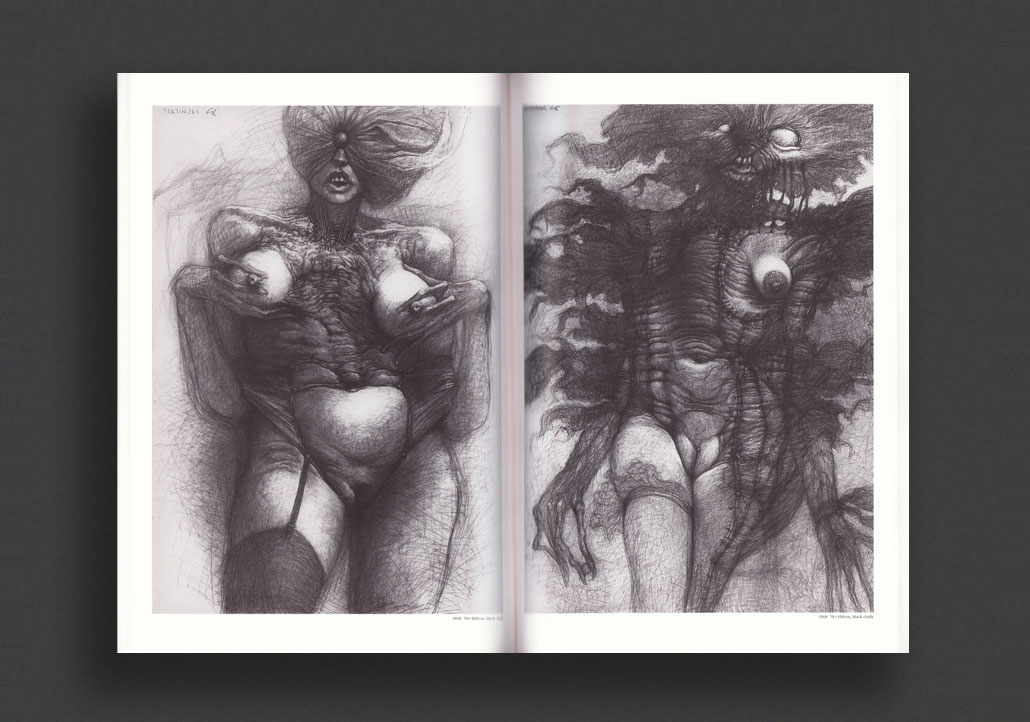
Comprehensive collection Zdzisław Beksiński's sadomasochistic, biomorphic drawings from the 1960s—1970s, mostly never published before, issued in Japan as part of Treville's series of volumes on the Polish master of introvert fantasy. 140 works accompanied by interviews with Beksinski, essays and other texts in English and Japanese.
Zdzisław Beksiński (1929 – 2005) was a Polish painter, photographer and sculptor. Beksiński had no formal training as an artist. Born in Sanok, he studied architecture in Kraków and worked as a construction site supervisor before turning to his passion for art, sculpting with construction site materials for his medium. His early photography would be a precursor to his paintings, often referred to as dystopian surrealism. Beksiński claimed, "I wish to paint in such a manner as if I were photographing dreams". Beksiński undertook painting with a passion, working intensely whilst listening to classical music and quickly becoming a leading figure in contemporary Polish art. In the late 1960s, Beksiński entered what he himself called his "fantastic period", which lasted up to the mid-1980s, during which he created his famed images of desolate, surrealistic landscapes with intricate depictions of anxious, abstracted figures and architecture in states of decay, mutation and decomposition. Although Beksiński's art was often dark, he himself was known to be a pleasant person with a keen sense of humour. Modest and somewhat shy, he avoided public events such as the openings of his own exhibitions and almost never visited museums or exhibitions in general. He always credited music as his main source of inspiration. Beksiński avoided concrete analysis of the content of his work, saying "I cannot conceive of a sensible statement on painting". Beksiński was stabbed to death at his Warsaw apartment in February 2005 by a 19-year-old acquaintance from Wołomin, reportedly because he refused to lend the teenager money.
"In the medieval tradition, Beksinski seems to believe art to be a forewarning about the fragility of the flesh – whatever pleasures we know are doomed to perish – thus, his paintings manage to evoke at once the process of decay and the ongoing struggle for life. They hold within them a secret poetry, stained with blood and rust." — Guillermo del Toro, Mexican film director
As New copy of the revised 2017 edition.
1974, English
Softcover, 335 pages, 22.5 x 16 cm
1st Edition, Out of print title / used / very good
Published by
Random House / New York
$85.00 - Out of stock
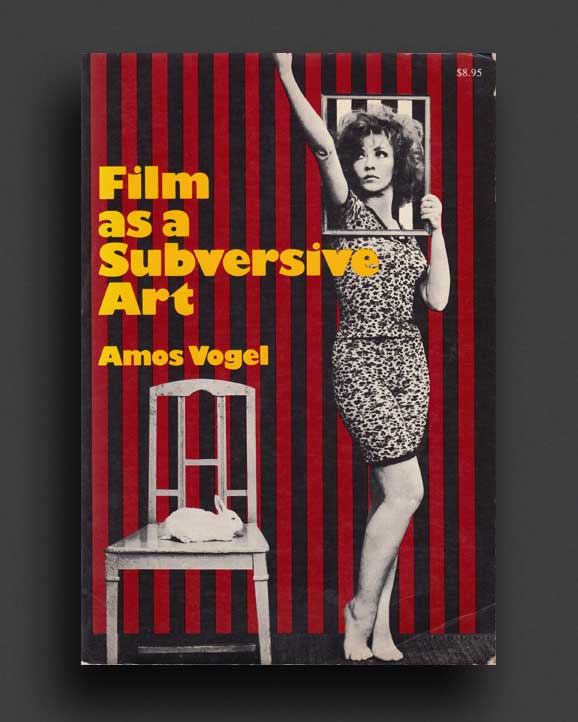
The first edition of Amos Vogel's seminal book, Film as a Subversive Art, one of the greatest books on cinema, published in 1974. Reprinted in 2005 by D.A.P./C.T. Editions, that edition also quickly went out of print and this landmark book has not been available since. According to Vogel--founder of Cinema 16, North America's legendary film society--the book details the "accelerating worldwide trend toward a more liberated cinema, in which subjects and forms hitherto considered unthinkable or forbidden are boldly explored."
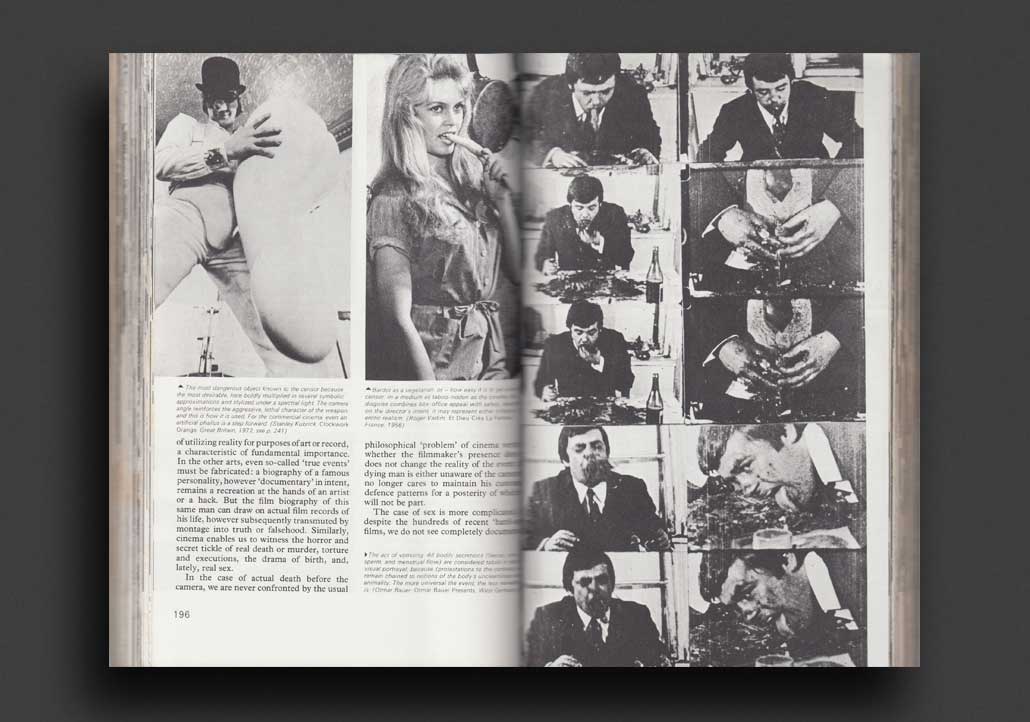
So ahead of his time was Vogel that the ideas that he penned some 30 years ago for this classic volume are still relevant today. Accompanied by over 300 rare film stills, Film as a Subversive Art analyzes how aesthetic, sexual and ideological subversives use one of the most powerful art forms of our day to exchange or manipulate our conscious and unconscious, demystify visual taboos, destroy dated cinematic forms, and undermine existing value systems and institutions. This subversion of form, as well as of content, is placed within the context of the contemporary world view of science, philosophy, and modern art, and is illuminated by a detailed examination of over 500 films, including many banned, rarely seen, or never released works.
Includes Luis Buñuel, Dusan Makavejev, Luis Buñuel, Stan Brakhage, Bruce Connor, Roman Polanski, Vera Chytilova, Alfred Hitchcock, Carolee Schneemann, Peter Watkins, Tony Conrad, Jonas Mekas, Andrei Tarkovsky, Marcel Duchamp, Robert Bresson, Luchino Visconti, Chris Marker, Federico Fellini, Rainer Werner Fassbinder, Kate Millett, John Cassavettes, Shuji Terayama, William Klein, Russ Meyers, Louis Malle, Woody Allen, Yoko Ono, Michelangelo Antonioni, Agnes Varda, Walerian Borowczyk, Andy Warhol, Ingmar Bergman, Jacques Rivette, Sergei M. Eisenstein, Ingmar Bergman, Lindsay Anderson, Roberto Rossellini, Marguerite Duras, Charlie Chaplin, Paul Morrissey, Joseph Losey, Otto Muehl, Hans Richter, Fritz Lang, Jean Genet, Kenneth Anger, Maya Deren, Jean-Luc Godard, Frans Zwartjes, Arrabal, Jack Smith, Stan Vanderbeek, Werner Herzog, Morgan Fisher, Jean Renior, Michael Snow, Robert Frank, Jan Svankmajer, Sam Peckinpah, Paul Sharits, Akira Kurosawa, Yoko Ono, Orson Welles, Frederick Wiseman, Ken Jacobs, Martin Scorcese, Jean Cocteau, Manuel Octavio Gomez, Stanley Kubrick, Norman McLaren, Albert Maysles and David Maysles, to name only a few of the hundreds of film-makers whose works are featured in this essential film book.
VG copy, single crease to front cover edge, not other real damages, well preserved throughout. Image only a sample.
1988, English
Hardcover (w. dust jacket), 348 pages, 29.5 x 24.5 cm
1st Edition, Out of print title / used / fine
Published by
Abbeville Press / New York
National Museum of American Art / Washington
$180.00 - In stock -
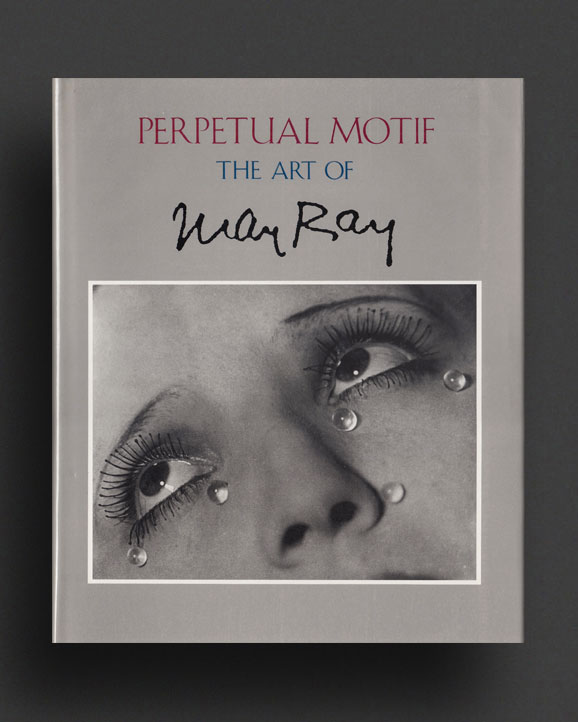
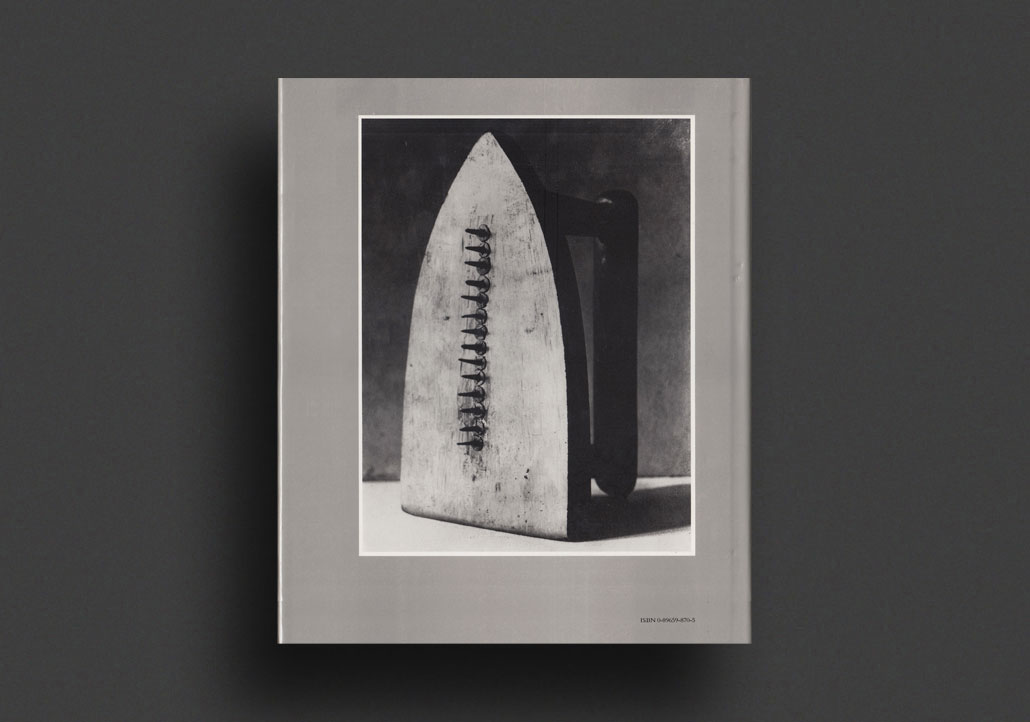
First 1988 hardcover edition of "Perpetual Motif: The Art of Man Ray", the most extensive retrospective of Man Ray's art ever published in the English language, re-printed many times.
Amid the exuberant chaos of the Paris art scene between the world wars, among the jarring factions of Dadaists, Surrealists, Futurists, and miscellaneous others, Philadelphia-born Man Ray was universally admired yet - it seemed - stubbornly mysterious. Although he looms large in today's standard art histories as a figure of unmistakable importance, few people have seen more than a selection of his remarkable photographs or a handful of his enigmatic "objects". Indeed, surprisingly little is known about this extraordinary and innovative creator of paintings, collages, drawings, films, aesthetic theory, and autobiography - as well as photographs and objects.
"Perpetual Motif: The Art of Man Ray" was acclaimed as "the first major book on this mysterious and eclectic artist and his work" (The Bloomsbury Review). It not only examines all aspects of the artist's production in all its forms, but also discusses Man Ray's multifarious connections with the artistic and political radicals of pre-World War I New York, the underground avant-garde as well as the haute monde of Paris between the wars, and the emigre society of Hollywood after World War 11.
Illustrated with nearly 300 of the artist's works in full colour and duotone (many published for the first time)"Perpetual Motif" brings together a host of authors who have distinguished themselves as specialists in the many fields of Man Ray's endeavours. Each has contributed an enlightening essay on one of the many facets in the career of this multifaceted artist.
Features an introduction by Merry Foresta and essays by Francis Naumann, Billy Kluver and Julie Martin, Elizabeth Hutton Turner, Sandra S. Phillips, Stephen C. Foster, and Roger Shattuck.
VG—NF copy in VG—NF dust jacket.
2017, English
Softcover, 232 pages, 14 x 17.5 cm
Published by
Dorothy Project / St. Louis
$38.00 - In stock -
"Her delirious fantasy reveals to us a little of the secret magic of her paintings" - Luis Buñuel
Surrealist writer and painter Leonora Carrington (1917-2011) was a master of the macabre, of gorgeous tableaus, biting satire, roguish comedy, and brilliant, effortless flights of the imagination. Nowhere are these qualities more ingeniously brought together than in the works of short fiction she wrote throughout her life.
Published to coincide with the centennial of her birth, THE COMPLETE STORIES OF LEONORA CARRINGTON collects for the first time all of her stories, including several never before seen in print. With a startling range of styles, subjects, and even languages (several of the stories are translated from French or Spanish), THE COMPLETE STORIES captures the genius and irrepressible spirit of an amazing artist's life.
2017, English
Softcover, 112 pages, 12.8 x 20.4 cm
Published by
The New York Review of Books / New York
$32.00 - Out of stock
A stunning work of memoir and an unforgettable depiction of the brilliance and madness by one of Surrealism’s most compelling figures
In 1937 Leonora Carrington—later to become one of the twentieth century’s great painters of the weird, the alarming, and the wild—was a nineteen-year-old art student in London, beautiful and unapologetically rebellious. At a dinner party, she met the artist Max Ernst. The two fell in love and soon departed to live and paint together in a farmhouse in Provence.
In 1940, the invading German army arrested Ernst and sent him to a concentration camp. Carrington suffered a psychotic break. She wept for hours. Her stomach became “the mirror of the earth”—of all worlds in a hostile universe—and she tried to purify the evil by compulsively vomiting. As the Germans neared the south of France, a friend persuaded Carrington to flee to Spain. Facing the approach “of robots, of thoughtless, fleshless beings,” she packed a suitcase that bore on a brass plate the word Revelation.
This was only the beginning of a journey into madness that was to end with Carrington confined in a mental institution, overwhelmed not only by her own terrible imaginings but by her doctor’s sadistic course of treatment. In Down Below she describes her ordeal—in which the agonizing and the marvelous were equally combined—with a startling, almost impersonal precision and without a trace of self-pity. Like Daniel Paul Schreber’s Memoirs of My Nervous Illness, Down Below brings the hallucinatory logic of madness home.
1979, German
Softcover, 419 pages, 28 x 22 cm
1st Edition, Out of print title / used / very good
Published by
Kunsthaus Zürich / Zürich
Bentelli Verlag / Bern
$90.00 $60.00 - In stock -
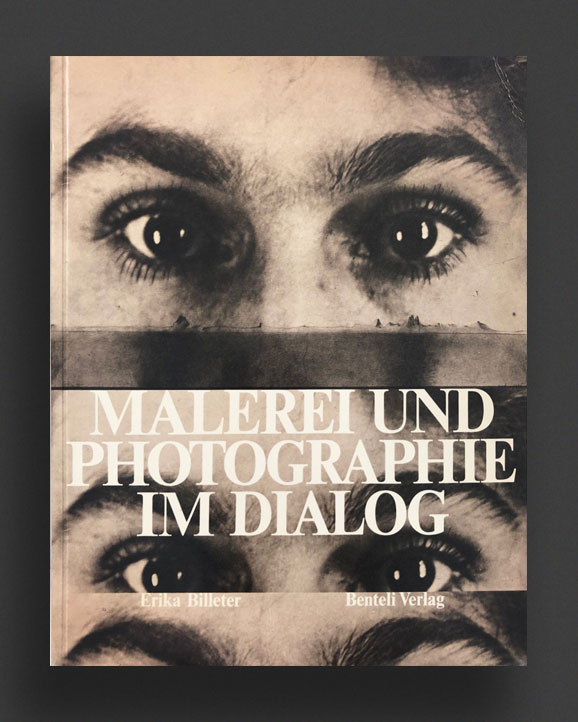
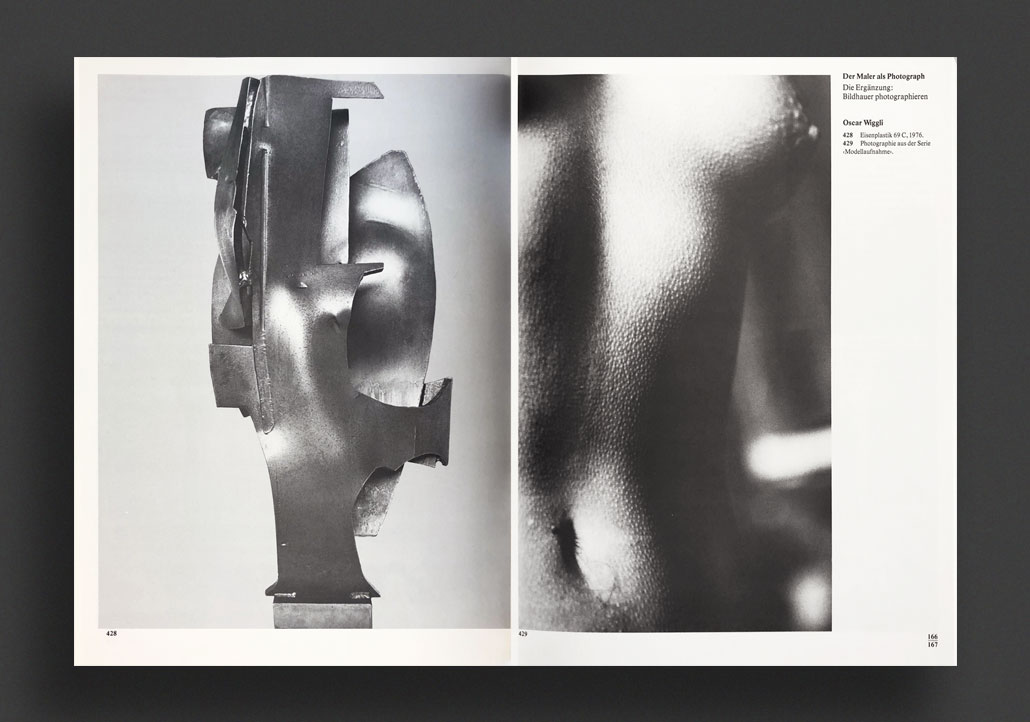
Wonderful over-sized catalogue published on the occasion of the exhibition Malerei und Photographie im Dialog / Painting and Photography in Dialogue, Kunsthaus Zürich, May 13 to July 24, 1977. Profusely illustrated, this heavy volume documents this historical survey of the relationship between photography and painting from 1840 to the present (late 1970s); with a full catalogue of works, artists' biographies, bibliography. Edited by Erika Billeter with texts throughout by art historian Josef A. Schmoll. Includes the work of Edvard Munch, Urs Lüthi, Wols, Vito Acconci, John Baldessari, Eadweard Muybridge, Hannah Höch, Raoul Hausmann, Hans-Peter Feldmann, Oskar Schlemmer, Francis Bacon, Hilla and Bernd Becher, Les Levine, Constant Puyo, Clarence Hudson White, Jan Groover, Jochen Gerz, Duane Michels, Mario Merz, Giulio Paolini, Ruth Francken, Theo Von Doesburg, Kurt Schwitters, Ferdinand Hodler, Herbert Bayer, Marcel Duchamp, Gertrude Käsebier, Edward Steichen, Alighiero Boetti, Klaus Rinke, Giuseppe Penone, Pierre Bonnard, Paul Klee, Gerhard Richter, Monika Baumgartl, Yves Klein, Wolf Vostell, Heinrich Kühn, Georges Mathieu, Peter Roehr, Sarkis, Jiro Takamatsu, Michael Heizer, Umberto Boccioni, Hans Bellmer, William Wegman, Raoul Ubac, Margrit Jäggli, André Kertész, Jiri Kolar, Kasimir Malevich, Henri de Toulouse-Lautrec, Dennis Oppenheim, Christian Boltanski, Dan Graham, Jan Dibbets, Jürgen Klauke, Bruce Nauman, Jean Tinguely, Vettor Pisani, Max Ernst, Joseph Cornell, Allen Kaprow, Arnulf Rainer, Mieczyslaw Berman, Jim Dine, George Brecht, Man Ray, Paul Wunderlich, Karin Székessy, Tom Wesselmann, Chuck Close, Eugène Delacroix, Duane Hanson, Heinrich Zille, Félix Vallotton, Carl Durheim, Gilbert and George, Joseph Beuys, Thomas Eakins, Robert Rauschenberg, Édouard Vuillard, Carlo Carrà, Alphonse Mucha, Les Krims, Albert Steiner, Giorgio de Chirico, Keiji Uematsu, Ernst Ludwig Kirchner, Heinrich Zille, Franco Fontana, Richard Long, Ben Shahn, Edmund Kesting, László Moholy-Nagy, Anton Stankowski, Paul Nash, Rene Magritte, Paul T. Frankl, John Heartfield, El Lissitzky, Georges Hugnet, Gordon Matta-Clark....
Very Good copy, crease to top cover corner.
1996, Japanese / French
Softcover, 150 pages, 28 x 22.5 cm
1st Edition, Out of print title / used / very good
Published by
Asahi Shimbun / Japan
Brain Trust Inc. / Tokyo
$30.00 - In stock -
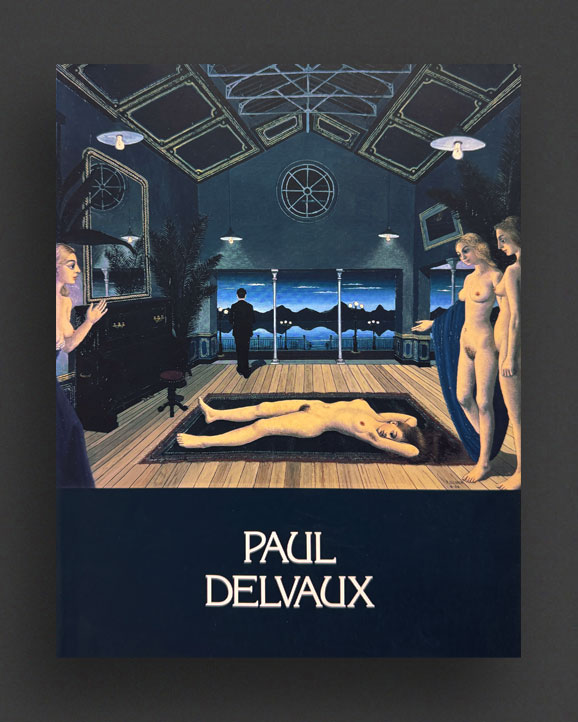
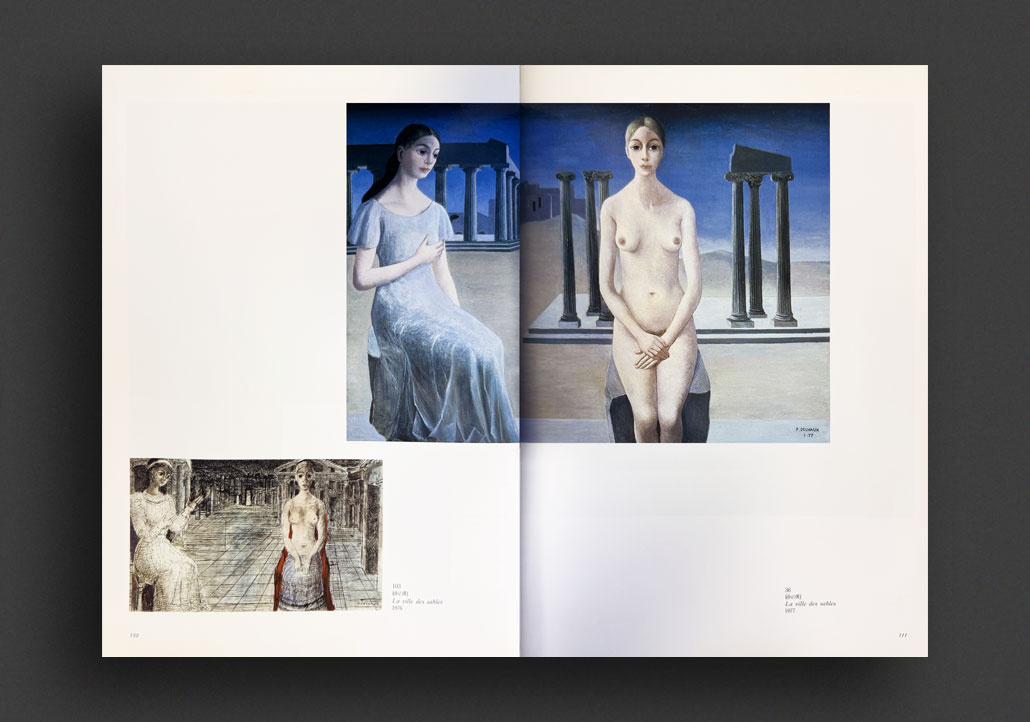
Japanese catalogue on Belgian painter Paul Delvaux (1897—1994), published by a major Japanese touring exhibition of Delvaux's work organised by Brain Trust Inc., Tokyo. Extensively illustrated with colour and b/w reproductions of paintings, drawings, prints, accompanied by texts from Charles Van Deun, Natascha Van Deun, Yoshio Yoshimura, Haruyuki Takase, full catalogue of works, illustrated biography, and more.
Paul Delvaux (1897—1994) was a Belgian painter noted for his dream-like scenes of women, classical architecture, trains and train stations, and skeletons, often in combination. He is often considered a surrealist, although he only briefly identified with the Surrealist movement. He was influenced by the works of Giorgio de Chirico and René Magritte, but developed his own fantastical subjects and hyper-realistic styling, combining the detailed classical beauty of academic painting with the bizarre juxtapositions of surrealism. Throughout his long career, Delvaux explored "Nude and skeleton, the clothed and the unclothed, male and female, desire and horror, eroticism and death – Delvaux's major anxieties in fact, and the greater themes of his later work [...]".
VG copy.
1974, Japanese
Hardcover (cloth-bound w. original illustrated card box and dust jacket) 160 pages, 21 x 21.6
1st Edition, Out of print title / used / very good
$140.00 - In stock -
Stunning boxed first printing of the Japanese edition of "Surrealist Drawings" by František Šmejkal, printed and bound in cloth-covers in Japan in 1973. A beautiful clothbound hardcover folio of drawings by artists affiliated with Surrealism. What makes this lovely collection special is the inclusion of many of the Czech Surrealists, and a generally broad European scope of artists. Czech art historian František Šmejkal has collated a wonderful selection of works on paper by Toyen, Jindřich Štyrský, Wolfgang Paalen, Giorgio de Chirico, Hans Bellmer, Alfred Kubin, Francis Picabia, Jacques Hérold, Yves Tanguy, Man Ray, Josef Istler, Max Ernst, André Breton, František Muzika, Paul Delvaux, Wilfredo Lam, Richard Oelze, Mikuláš Medek, Joan Miró, Josef Sima, Kurt Seligmann, Odilon Redon, Andre Masson, Max Walter Svanberg, Salvador Dali, Arshile Gorky, Victor Brauner, Rene Magritte, and many more.
Very Good copy in original slipcase and plastic jacket over cloth. Almost Fine, but with corner bumping to top.
1992, English
Softcover, 280 pages, 20.5 x 15 cm
Published by
Exact Change / Boston
$38.00 - Out of stock
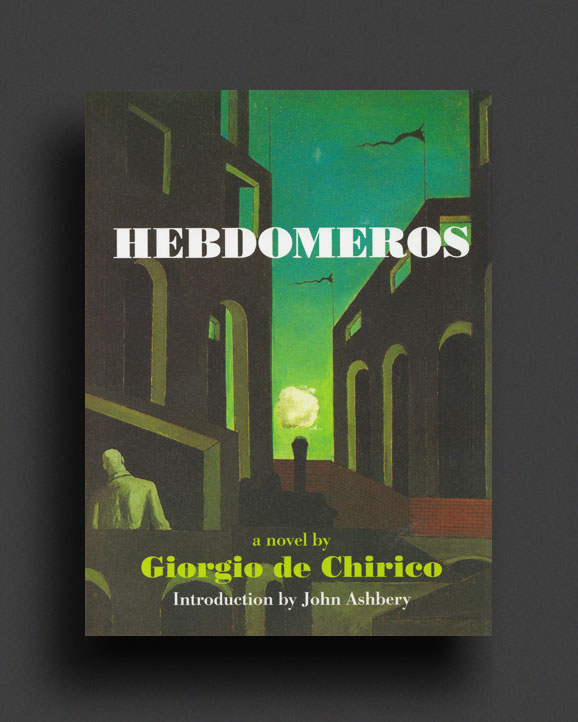
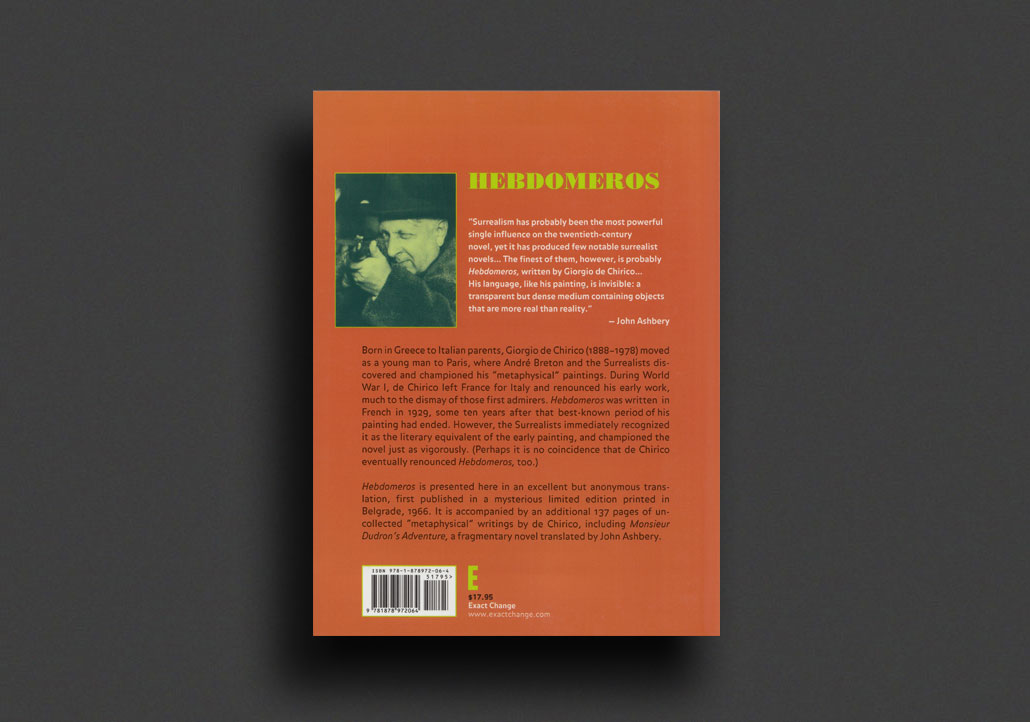
The artist Giorgio de Chirico's novel, Hebdomeros is a dream-like book of situations and landscapes reminiscent of his paintings. In his introduction John Ashbery calls the book "the finest work of Surrealist fiction", noting that de Chirico "invented for the occasion a new style and a new kind of novel... his long run-on sentences, stitched together with semi-colons, allow a cinematic freedom of narration... his language, like his painting, is invisible: a transparent but dense medium containing objects that are more real than reality." Hebdomeros is accompanied by an appendix of previously untranslated or uncollected writings, including M. Dudron's Adventure, a second, fragmentary novel translated by John Ashbery.