World Food Books' programme is largely produced on Kulin Nation land. We acknowledge the Wurundjeri people of the Kulin Nation as the first and continuing custodians of this land, and pay respect to their Elders past, present, and emerging.
World Food Books is an arts and special interests bookshop in Naarm / Melbourne. Founded in 2010, World Food Books is devoted to the presentation of a rotating, hand-selection of international art, design, literary and counterculture publications with an emphasis on the anti-traditional, the experimental, the avant-garde, the heretic, the marginal.
Presenting new titles alongside rare and out-of-print books, catalogues and journals spanning the fields of modern and contemporary art, design, photography, illustration, film, literature, poetry, cultural theory, philosophy, sexuality, popular and underground culture in its many radical forms, World Food Books wishes to encourage adventurous, thoughtful and open-minded reading, looking, writing, and exchange of publishing and ideas, both current and historical.
As well as our bookshop, located in Melbourne's historical Nicholas Building, all of our inventory is available internationally via our online mail-order service.
World Food Books semi-regularly co-ordinates "Occasions", a programme of exhibits and events at the bookshop and in partnership with other hosts (such as museums and art galleries) that develop out of the activities, relationships and content of the bookshop itself.
World Food Books
The Nicholas Building
37 Swanston Street
Room 5, Level 6
Melbourne 3000
Australia
SHOP HOURS:
Thu–Fri 12–6, Sat 12–5
WEB-SHOP OPEN 24/7
World Food Books
Postal Address:
PO Box 435
Flinders Lane
Victoria 8009
Australia
Art
Theory / Essay
Architecture / Interior
Graphic Design / Typography
Photography
Fashion
Eros
LGBTQ+
Fiction / Poetry
Weird / Speculative / Science Fiction / Horror
Transgressive / Visceral / Abject
Symbolism / Decadence / Fin de siècle
Film / Video
Painting
Sculpture / Installation
Performance / Dance / Theater
Drawing
Sound / Music
Curatorial
Group Shows / Collections
Periodicals
Out-of-print / Rare
Posters / Ephemera / Discs
Signed Books
World Food Books Gift Voucher
World Food Book Bag
Australian Art
Australian Fiction
Australian Science Fiction / Speculative Fiction
Australian Poetry
Australian Photography
Japanese Photography
Conceptual Art
Minimal Art
Dada
'Pataphysics / Oulipo
Fluxus
Concrete Poetry
Pop Art
Surrealism
Arte Povera
Arte Informale / Haute Pâte / Tachism
Nouveau Réalisme / Zero / Kinetic
Situationism / Lettrism
Collage / Mail Art / Xerox Art
Art Brut / Folk / Visionary / Fantastic
Illustration / Graphic Art / Bandes Dessinées
Furniture
Italian Radical Design / Postmodernism
Textiles
Ceramics / Glass
Counterculture
Protest / Revolt
Philosophy
Psychoanalysis
Anthropology
Anarchism
Socialism / Anarchism / Communism / Capitalism
Literary Theory / Semiotics / Language
Feminism / Women's Studies
Gender Studies / Sexuality
Anthropology
Fetishism / BDSM
Drugs / Psychedelia
Crime / Violence
Animal Rights / Veganism
Occult / Esoterica
Ecology / Earth / Alternative Living
Whole Earth / Crafts
All prices in AUD (Australian dollars)
Pick-Ups
Pick-up orders can be collected in our bookshop during opening hours after order date. Please collect any Pick-up orders within 2 weeks of ordering as we have limited storage space. Orders will be released back into stock if not collected within this time. No refunds can be made for pick-ups left un-collected. If you cannot make it in to the bookshop in this time-frame, please choose postage option.
Return Policy
All sales are final. We do accept returns (for refund or exchange) for items received in error. All our orders are packed with special care using heavy-duty padding and cardboard book-mailers or bubble mailers (for smaller books), using reinforcement where required. We cannot take responsibility for any lost, stolen or damaged parcels.
Insurance
Should you wish to insure your package, please email us directly after placing your order and we can organise this at a small extra expense. Although all standard/express tracked packages are very safe and dependable, we cannot take responsibility for any lost, stolen or damaged parcels. We recommend insurance on valuable orders.
Interested in selling your old books, catalogues, journals, magazines, comics, fanzines, ephemera? We are always looking for interesting, unusual and out-of-print books to buy. We only buy books in our fields of interest and specialty, and that we feel we can resell.
We base these prices on desirability, market value, in-print prices, condition and our current stock levels. We offer cash, store credit, and can take stock on consignment. All
about 25% of the price we expect to get when we sell them, or 30% in store credit. We base these prices on desirability, market value, in-print prices, condition and our current stock levels.
Sell your books any day of the week. You can drop them off and return later. If you have a lot of books, we can visit your Sydney home.
We buy books that we feel we can resell. We offer about 25 % of the price we expect to get when we sell them, or 30% in store credit. We base these prices on desirability, market value, in-print prices, condition and our current stock levels.
Philadelphia Wireman
03 August - 01 September, 2018
World Food Books is proud to announce our next Occasion, the first presentation of sculptures by Philadelphia Wireman in Australia.
The Philadelphia Wireman sculptures were found abandoned in an alley off Philadelphia’s South Street on trash night in 1982. Their discovery in a rapidly-changing neighbourhood undergoing extensive renovation, compounded with the failure of all attempts to locate the artist, suggests that the works may have been discarded after the maker’s death. Dubbed the "Philadelphia Wireman" during the first exhibition of this work, in 1985, the maker’s name, age, ethnicity, and even gender remain uncertain. The entire collection totals approximately 1200 pieces, all intricately bound together with tightly-wound heavy-gauge wire (along with a few small, abstract marker drawings, reminiscent both of Mark Tobey and J.B. Murry). The dense construction of the work, despite a modest range of scale and materials, is singularly obsessive and disciplined in design: a wire armature or exoskeleton firmly binds a bricolage of found objects including plastic, glass, food packaging, umbrella parts, tape, rubber, batteries, pens, leather, reflectors, nuts and bolts, nails, foil, coins, toys, watches, eyeglasses, tools, and jewellery.
Heavy with associations—anthropomorphic, zoomorphic, and socio-cultural responses to wrapped detritus—the totemic sculptures by Philadelphia Wireman have been discussed in the context of work created to fulfil the shamanistic needs of alternative religions in American culture. Curators, collectors, and critics have variously compared certain pieces to sculpture from Classical antiquity, Native American medicine bundles, African-American memory jugs, and African fetish objects. Reflecting the artist’s prolific and incredibly focused scavenging impulse, and despite—or perhaps enhanced by—their anonymity, these enigmatic objects function as urban artefacts and arbiters of power, though their origin and purpose is unknown. Philadelphia Wireman, whatever their identity, possessed an astonishing ability to isolate and communicate the concepts of power and energy through the selection and transformation of ordinary materials. Over the course of the past two decades, this collection has come to be regarded as an important discovery in the field of self-taught art and vernacular art.
Presented in collaboration with Fleisher-Ollman Gallery, Philadelphia, and Robert Heald, Wellington.
Susan Te Kahurangi King
02 February - 10 March, 2018
Susan Te Kahurangi King (24 February 1951 - ) has been a confident and prolific artist since she was a young child, drawing with readily available materials - pencils, ballpoint pens and felt-tip markers, on whatever paper is at hand. Between the ages of four and six Susan slowly ceased verbal communication. Her grandparents William and Myrtle Murphy had developed a special bond with Susan so they took on caring responsibilities for extended periods. Myrtle began informally archiving her work, carefully collecting and storing the drawings and compiling scrapbooks. No drawing was insignificant; every scrap of paper was kept. The King family are now the custodians of a vast collection containing over 7000 individual works, from tiny scraps of paper through to 5 meter long rolls.
The scrapbooks and diaries reveal Myrtle to be a woman of great patience and compassion, seeking to understand a child who was not always behaving as expected. She encouraged Susan to be observant, to explore her environment and absorb all the sights and sounds. Myrtle would show Susan’s drawings to friends and people in her community that she had dealings with, such as shopkeepers and postal workers, but this was not simply a case of a grandmother’s bias. She recognised that Susan had developed a sophisticated and unique visual language and sincerely believed that her art deserved serious attention.
This was an unorthodox attitude for the time. To provide some context, Jean Dubuffet coined the term Art Brut in 1945 to describe work created by self-taught artists – specifically residents of psychiatric institutions and those he considered to be visionaries or eccentrics. In 1972 Roger Cardinal extended this concept by adopting the term Outsider Art to describe work made by non-academically trained artists operating outside of mainstream art networks through choice or circumstance. Susan was born in Te Aroha, New Zealand in 1951, far from the artistic hubs of Paris and London that Dubuffet and Cardinal operated in. That Myrtle fêted Susan as a self-taught artist who deserved to be taken seriously shows how progressive her attitudes were.
Susan’s parents Doug and Dawn were also progressive. Over the years they had consulted numerous health practitioners about Susan’s condition, as the medical establishment could not provide an explanation as to why she had lapsed into silence. Dawn educated herself in the field of homeopathy and went on to treat all twelve of her children using these principles – basing prescriptions on her observations of their physical, mental and emotional state.
Doug was a linguist with an interest in philosophy who devoted what little spare time he had to studying Maori language and culture. To some extent their willingness to explore the fringes of the mainstream made them outsiders too but it was their commitment to living with integrity and their respect for individuality that ensured Susan’s creativity was always encouraged.
Even though Susan’s family supported her artistic pursuits, some staff in schools and hospitals saw it as an impediment to her assimilation into the community and discouraged it in a variety of ways. Her family was not always aware of this and therefore did not fully understand why Susan stopped drawing in the early 1990s. However, rather than dwell on the challenges that Susan faced in pursuit of her artistic practice, they prefer to highlight her achievements. In 2008 Susan began drawing again in earnest, after an almost 20 year interruption, and her work is now shown in galleries around the world.
Susan grew up without television and has been heavily influenced by the comics she read as a child. She is absolutely fearless in the appropriation of recognizable characters, such as Donald Duck and Mickey Mouse, in her work. She twists their limbs, contorts their faces, compresses them together, blends them into complex patterned backgrounds - always imbuing them with an incredible energy. Although Susan often used pop culture characters in her work they are not naive or childlike. These are drawings by a brilliant self-taught artist who has been creating exceptional work for decades without an audience in mind.
Mladen Stilinović
"Various Works 1986 - 1999"
02 February 16 - September 10, 2016
Various works 1986 - 1999, from two houses, from the collections of John Nixon, Sue Cramer, Kerrie Poliness, Peter Haffenden and Phoebe Haffenden.
Including: Geometry of Cakes (various shelves), 1993; Poor People’s Law (black and white plate), 1993; White Absence (glasses, ruler, set square, silver spoon, silver ladel with skin photograph and wooden cubes), 1990-1996; Exploitation of the Dead (grey and red star painting, wooden painting, black spoon with red table, red plate), 1984-1990; Money and Zeros (zero tie, paintings made for friends in Australia (Sue, John, Kerrie), numbers painting), 1991-1992; Words - Slogans (various t-shirts) - “they talk about the death of art...help! someone is trying to kill me”, “my sweet little lamb”, “work is a disease - Karl Marx”; Various artist books, catalogues, monographs, videos; Poster from exhibition Insulting Anarchy; "Circular" Croatian - Australian edition; Artist book by Vlado Martek (Dostoyevsky); more.
Thanks to Mladen Stilinović and Branka Stipančić.
Jonathan Walker
Always Will Need To Wear Winter Shirt Blue + Ochre Small Check Pattern
21 August - 21 September, 2015
Untitled
I am not a great reader of poetry but I always return to the work of Melbourne poet, Vincent Buckley (1925- 1988). Perhaps I find his most tantalising piece to be not a finished poem but a fragment left on a scrap of paper discovered on his desk after the poet’s death.
The poetry gathers like oil
In the word-core, and spreads
It has its music meet,
Its music is in movement.
This fragment is more the shell left behind from a volatile thought than a finished poem. I find the last two lines honest but awkward whereas the first two lines work like an arrow. Most likely he could not find a resolution so it was left. Still, in its present form, it remains an eloquent testimony to the ultimate failure of a medium to express mobile thought and sensation, in Buckley’s case, through verbal language. It’s an important matter because this is something all artists have to deal with regardless of the medium.
I have never written a poem, however, I am forever copying fragments from books on paper scraps in a vain effort to fix certain notions in my head. At first, they function as bookmarks that are sometimes returned to when I open the book. But before long, as they accumulate, they fall out littering the table interspersed with A4 photocopies, bills, books and medications.
To return to Buckley’s fragment, the first two lines very much evoke how I paint nowadays. As you age, detail diminishes and patches of light become more luminous and float. I feel the most honest way of dealing with this is by smearing the oil paint on the canvas with the fingers and working close-up, blind. Only if the patches coalesce into an approaching image can the work gain a life.
-
Jonathan Walker was born in Melbourne, Australia and brought up on a dairy farm in Gippsland. In the 1970’s he studied painting at RMIT and won the Harold Wright Scholarship to the British Museum, London. During the 1980’s he exhibited at Pinacotheca Gallery, Richmond and had work shown at the NGV and Heidi City Art Gallery. Over the same period he designed the cover for the “Epigenesi” LP by Giancarlo Toniutti, Italy and conducted a mail exchange work with Achim Wollscheid, Germany. The work with artists through the post resulted in an article published in the bicentenary issue of Art and Australia 1988. He showed in artist run spaces such as WestSpace in the 90’s and 2000’s, and until 2012, taught painting at Victoria University, which is where we (Colleen Ahern and Lisa Radford) as organisers of the exhibition, among many others, had the privilege of being his student.
Walker’s knowledge was imparted to students through the careful selection of music, literature, and artists found in books that he himself had ordered for the library. Walker’s strategy was the generosity of sharing his vast knowledge with references specific to each student and their context.
Walker’s paintings share a similar focus and intimacy.
This exhibition presents a small selection of recent paintings alongside a publication that includes Walker’s writing. Observational and analytical, Walker’s work is a type of material notation — the time of day, colour and how it is blended, the both specific and fleeting location of a reflection on lino or the question of whether a chair leg should be included in a painting.
Please join us on Friday August 21 between 6-8pm to celebrate the opening of the exhibition.
Curated by Colleen Ahern and Lisa Radford.
B. Wurtz
Curated by Nic Tammens
March 26 - April 4, 2015
B.Wurtz works from a basement studio in his home on Manhattan’s Lower East Side.
This local fact is attested to by the plastic shopping bags and newsprint circulars that appear in his work. As formal objects, they don’t make loud claims about their origins but nonetheless transmit street addresses and places of business from the bottom of this long thin island. Like plenty of artists, Wurtz is affected by what is local and what is consumed. His work is underpinned by this ethic. It often speaks from a neighborhood or reads like the contents of a hamper:
“BLACK PLUMS $1.29 lb.”
“Food Bazaar”
“USDA Whole Pork Shoulder Picnic 99c lb.”
“RITE AID Pharmacy, with us it’s personal.”
“H. Brickman & Sons.”
“Sweet Yams 59c lb."
Most of the work in this exhibition was made while the artist was in residence at Dieu Donne, a workshop dedicated to paper craft in Midtown. Here Wurtz fabricated assemblages with paper and objects that are relatively lightweight, with the intention that they would be easily transportable to Australia. This consideration isn’t absolute in Wurtz’s work, but was prescriptive for making the current exhibition light and cheap. Packed in two boxes, these works were sent from a USPS post office on the Lower East Side and delivered to North Melbourne by Australia Post.
Wurtz appears courtesy of Metro Pictures, New York.
Thanks to Rob Halverson, Joshua Petherick, Sari de Mallory, Matt Hinkley, Helen Johnson, Fayen d'Evie, Ask Kilmartin, Lisa Radon, Ellena Savage, Yale Union, and "Elizabeth".
John Nixon
"Archive"
December 15 - January 20, 2014
The presentation of John Nixon's archive offered a rare showcase of this extensive collection of the artist's own publications, catalogues, posters, ephemera, editions and more, from the mid 1980s onwards, alongside a selection of his artworks.
Organized by John Nixon, Joshua Petherick and Matt Hinkley.
<a href=http://wfb.public-office.info/artist/john-nixon>All titles by John Nixon
"Habitat"
at Minerva, Sydney (organised by Joshua Petherick and Matt Hinkley)
November 15 - December 20, 2014
Lupo Borgonovo, Janet Burchill & Jennifer McCamley,
Lewis Fidock, HR Giger, Piero Gilardi, Veit Laurent Kurz,
Cinzia Ruggeri, Michael E. Smith, Lucie Stahl, Daniel Weil, Wols
Press Release:
“...It contained seven objects. The slender fluted bone, surely formed for flight, surely from the wing of some large bird. Three archaic circuitboards, faced with mazes of gold. A smooth white sphere of baked clay. An age-blackened fragment of lace. A fingerlength segment of what she assumed was bone from a human wrist, grayish white, inset smoothly with the silicon shaft of a small instrument that must once have ridden flush with the surface of the skin - but the thing’s face was seared and blackened.”
William Gibson, “Count Zero”, 1986
"Autumn Projects Archive"
Curated by Liza Vasiliou
March 6 - March 15, 2014
World Food Books, in conjunction with the Virgin Australia Melbourne Fashion Festival 2014, presented the Autumn Projects archive, consisting of a selection of early examples in Australian fashion with a particular interest in collecting designers and labels from the period beginning in the 1980’s, who significantly influenced the discourse of Australian Fashion.
Curated by Liza Vasiliou, the exhibition provided a unique opportunity to view pieces by designers Anthea Crawford, Barbara Vandenberg, Geoff Liddell and labels CR Australia, Covers, Jag along with early experimental collage pieces by Prue Acton and Sally Browne’s ‘Fragments’ collection, suspended throughout the functioning World Food Books shop in Melbourne.
H.B. Peace
presented by CENTRE FOR STYLE
November 14, 2013
"Hey Blinky, you say chic, I say same"
Anon 2013
H.B. Peace is a clothing collaboration between great friends Blake Barns and Hugh Egan Westland. Their pieces explore the divergences between 'character’ and ‘personality’ in garments....etc
Special Thanks to Joshua Petherick and Matt Hinkley of WFB and Gillian Mears
and a Very Special Thank you to Audrey Thomas Hayes for her shoe collaboration.
Janet Burchill & Jennifer McCamley
"Aesthetic Suicide"
May 10 - June 8, 2013
The first of our occasional exhibitions in the World Food Books office/shop space in Melbourne, "Aesthetic Suicide" presented a body of new and older works together by artists Janet Burchill & Jennifer McCamley, including videos, prints, a wall work, and publications.
During shop open hours videos played every hour, on the hour.
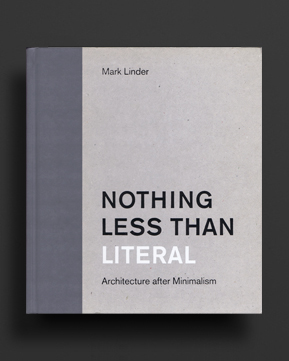
2005, English
Hardcover, 294 pages, 21 x 23.5 cm
1st Edition, Out of print title / used / good
Published by
The MIT Press / Massachusetts
$59.00 $25.00 - Out of stock
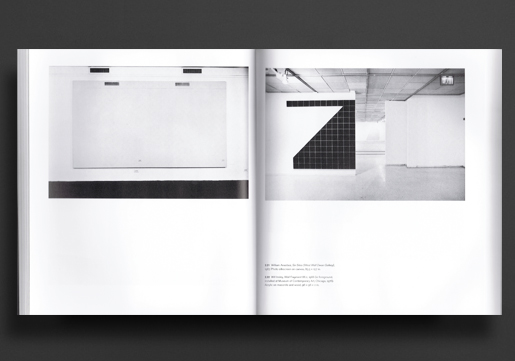
In Nothing Less than Literal, Mark Linder shows how minimalist art of the 1960s was infiltrated by architecture, resulting in a reconfiguration of the disciplines of both art and architecture. Linder traces the exchange of concepts and techniques between architecture and art through a reading of the work of critics Clement Greenberg, Colin Rowe, Michael Fried, and the artist-writer Robert Smithson, and then locates a recuperation of "the architecture of minimalism" in the contemporary work of John Hejduk and Frank Gehry.
"Literal" was not only a term used by Fried to attack minimalism; it was a key term for Greenberg as well, and in both cases their use of that term coincides with discussions of the architectural qualities of art. Linder gives us the first thorough examination of the role that architectural concepts, techniques of representation, and practices played in the emergence of minimalism. Beginning with a comparison of the "postcubist" writings of Clement Greenberg and Colin Rowe, he reveals surprising affinities in their critical formulations of pictorialism -- including the use by both of an analogy between cubist collage and architectural space. This is followed by an account of the sharp differences between Michael Fried and Robert Smithson; Linder contrasts the sublimation of space and refusal of architecture in Fried's concept of the "radically abstract" with Smithson's explicit embrace of architectural thinking and his complex concepts of space. Finally, Linder looks at particular instances in the work of two architects who, through collaboration with artists, engaged the legacy of literalism -- John Hejduk's Wall House and Frank Gehry's decade-long fascination with the figure of the fish. Linder shows how the "productive impropriety" of transdisciplinary borrowing in the discourses surrounding minimalism serves as a counterexample to the prevalent perception of "disciplines" as conservative and institutionalizing.
Out of print hardcover first edition. This copy was part of a run that had the page block glued into the covers backwards.
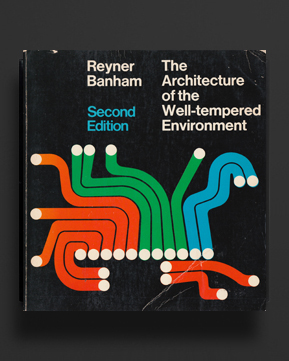
1984, English
Softcover, 320 pages, 18 x 18.2 cm
Out of print title / used / good
Published by
University of Chicago Press / Chicago
$40.00 - Out of stock
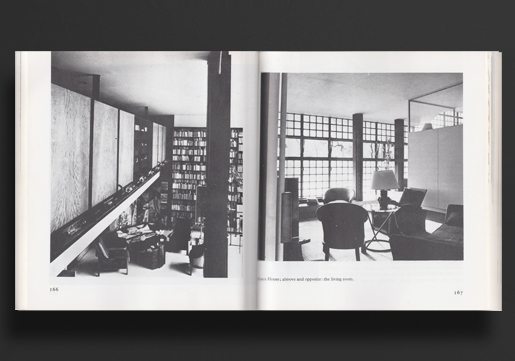
Reyner Banham was a pioneer in arguing that technology, human needs, and environmental concerns must be considered an integral part of architecture. No historian before him had so systematically explored the impact of environmental engineering on the design of buildings and on the minds of architects. In this revision of his classic work, Banham has added considerable new material on the use of energy, particularly solar energy, in human environments. Included in the new material are discussions of Indian pueblos and solar architecture, the Centre Pompidou and other high-tech buildings, and the environmental wisdom of many current architectural vernaculars.
2002, English
Softcover, 152 pages,
1st Edition, Out of print title / used / very good
Published by
Craftsman House / St Leonards
$38.00 - Out of stock
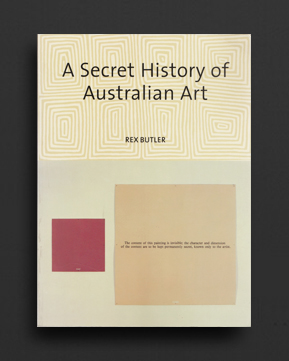
In April 2000, the Australian art critic Rex Butler was invited to present a series of lectures to students and members of the public at Metro Arts, Brisbane. Now out of print, Rex Butler's "The Secret of Australian Art" compiles these lectures, offering insight into what a critic does and introduces issues of interest in contemporary Australian art, such themes as the problem of irony in post-modern art, the relation of art to everyday life and recent post-colonial approaches in Australian art history and Aboriginal art, illustrated with case studies.
Full contents:
Lecture 1. Camp: The rise and fall of the smile; The case of Michael Stevenson
Lecture 2. The Real: 'Every Day', the task of mourning; The case of Dale Frank; The case of Richard Dunn
Lecture 3. Abstraction: The anamorphic monochrome; The case of John Nixon
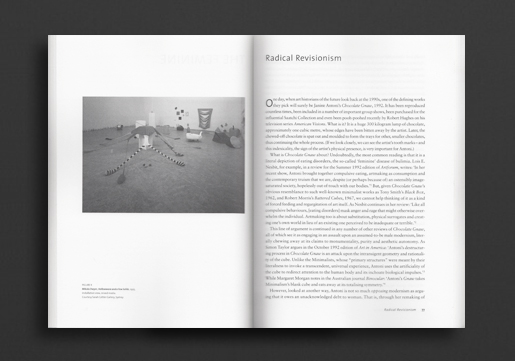
Lecture 4. The Feminine: Radical revisionism; The case of Merilyn Fairskye
Lecture 5. Post-Colonialism: Australian art history and revisionism; The case of Augustus Earle
Lecture 6. Aboriginality: 'Bright Shadows': art, aboriginality and aura; The case of Kathleen Petyarre.
Includes bibliographical references and index.
Professor Rex Butler is an art historian, writer and Professor (Art History & Theory) at Monash University. His research interests include contemporary Australian art and art criticism; Post-war American art; and Postmodernism. Rex Butler is currently editing a collection entitled 'Radical Revisionism' on Australian post-colonial art and two volumes of Slavoj Zizek's selected writings. He is the author six books including, What is Appropriation? (1996); Jean Baudrillard: The Defence of the Real (1999); A Secret History of Australian Art (2002); and Borges' Short Stories: A Reader's Guide (2010).
2016, French
Hardcover (w. wrap and dust-jacket), 192 pages, 24 x 31 cm
Published by
Mamco / Genève
$79.00 - Out of stock
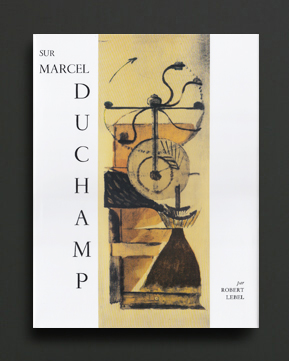
Robert Lebel (1901-1986) was a poet, novelist, essayist, art historian, and painting expert. He took part in the Surrealists' activities and wrote Marcel Duchamp's first monograph in 1959. This book is a facsimile of the original edition in French of Sur Marcel Duchamp Robert Lebel published in 1959 in Paris by Trianon Press. This historical book by Robert Lebel - the first to be published on Marcel Duchamp - is an introduction to the work and personality of a single artist but also a reconsideration of the situation of the painter in contemporary society and a thorough analysis of mobile creative activity. It is supplemented by texts by Marcel Duchamp, André Breton and HP Roché, a bibliography and a catalog raisonné of all the works of Duchamp and is profusely illustrated throughout with images in black and white and inserted, die-cut colour plates. The layout of this book was itself even created and designed by Marcel Duchamp himself and is beautifully reproduced and printed here on paper stocks and using production methods that reflect the qualities of the original book.
2017, English
Softcover, 464 pages, 17 x 24 cm
Published by
Canadian Centre for Architecture / Canada
Sternberg Press / Berlin
$50.00 - Out of stock
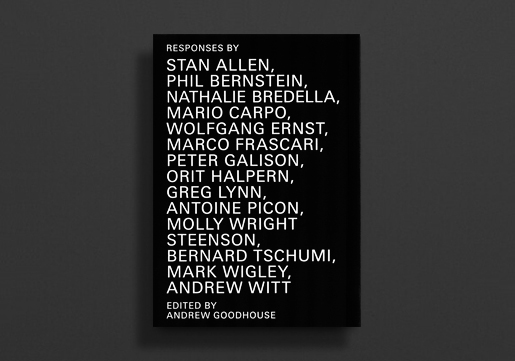
Contributions by Stan Allen, Phil Bernstein, Nathalie Bredella, Mario Carpo, Wolfgang Ernst, Marco Frascari, Peter Galison, Orit Halpern, Greg Lynn, Antoine Picon, Molly Wright Steenson, Bernard Tschumi, Mark Wigley, Andrew Witt
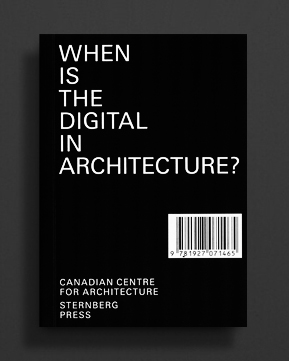
When is the digital in architecture? What are the conditions that led architects to integrate digital tools into their practices? Over the course of its research program Archaeology of the Digital, the CCA has collected the archival records of twenty-five projects realized between the late 1980s and the early 2000s in order to understand this period as a point of origin for the digital. But if we take care to identify the digital as a condition that is made possible by the conceptual foundations of digital media and not necessarily by digital media itself, the boundaries of the digital moment—when it began and under what circumstances—become less clear.
There are eight million stories of the origins of the digital in architecture, and this book brings together fourteen of them. The arguments address specific changes in ways of thinking about architecture, building, and cities, as well as the shifts in technology that resulted from these changes, marking both a capstone of Archaeology of the Digital and the start of an investigation into other beginnings of the digital in architecture.
But it’s not just about articulating a variety of responses. Asking a question like “When is the digital in architecture?” can produce millions of stories in response and millions of digressions and redirections that narrow in focus and change geographies, producing a Tristram Shandy of the digital as the CCA continues to build its digital archive and make it increasingly accessible to researchers. If this novel of digressions is distributed across future research projects and extended with studies of new archival material, so much the better for the reader, in our opinion.
Copublished with Canadian Centre for Architecture (CCA)
Design by Katja Gretzinger
2016, English
Softcover, 256 pages, 16.5 x 22 cm
Published by
Sternberg Press / Berlin
The Academy of Fine Arts / Vienna
$40.00 - Out of stock
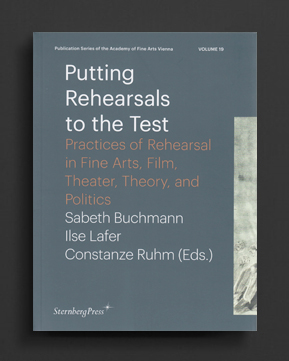
Sabeth Buchmann, Ilse Lafer, Constanze Ruhm (Eds.)
Putting Rehearsals to the Test
Practices of Rehearsal in Fine Arts, Film, Theater, Theory, and Politics
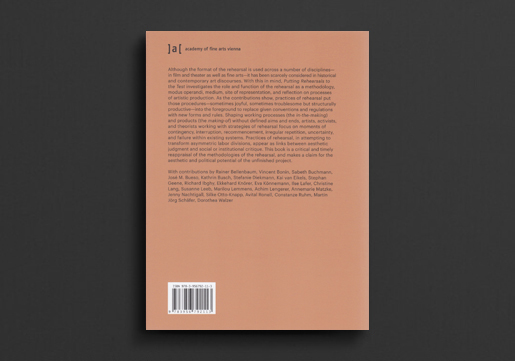
Contributions by Rainer Bellenbaum, Vincent Bonin, Sabeth Buchmann, José M. Bueso, Kathrin Busch, Stefanie Diekmann, Kai van Eikels, Stephan Geene, Richard Ibghy, Ekkehard Knörer, Eva Könnemann, Ilse Lafer, Christine Lang, Susanne Leeb, Marilou Lemmens, Achim Lengerer, Annemarie Matzke, Jenny Nachtigall, Silke Otto-Knapp, Avital Ronell, Constanze Ruhm, Martin Jörg Schäfer, Dorothea Walzer
Although the format of the rehearsal is used across a number of disciplines—film and theater as well as fine arts—it has been scarcely considered in historical and contemporary art discourses. With this in mind, Putting Rehearsals to the Test investigates the role and function of the rehearsal as a methodology, modus operandi, medium, site of representation, and reflection on processes of artistic production. As the contributions in this book show, practices of rehearsal put those procedures—sometimes joyful, sometimes troublesome but structurally productive—into the foreground to replace given conventions and regulations with new forms and rules. Shaping working processes (the in-the-making) and products (the making-of) without defined aims and ends, artists, activists, and theorists working with strategies of rehearsal focus on moments of contingency, interruption, recommencement, irregular repetition, uncertainty, and failure within existing systems. Practices of rehearsal, in attempting to transform asymmetric labor divisions, appear as links between aesthetic judgment and social or institutional critique. This book is a critical and timely reappraisal of the methodologies of the rehearsal, and makes a claim for the aesthetic and political potential in the unfinished project.
Publication Series of the Academy of Fine Arts Vienna, vol. 19
Design by Surface
2017, English
Softcover, 480 pages, 12.5 x 20.6 cm
Published by
Spector Books / Leipzig
$50.00 - Out of stock
"Jonas Mekas' diaries have an aching honesty, puckish humor and quiet nobility of character. Many readers curious about the early years of this seminal avant-garde filmmaker will discover here a much more universal story: that of the emigrant who can never go back, and whose solitariness in the New World is emblematic of the human condition." - Phillip Lopate
"I was enormously moved by it." - Allen Ginsberg
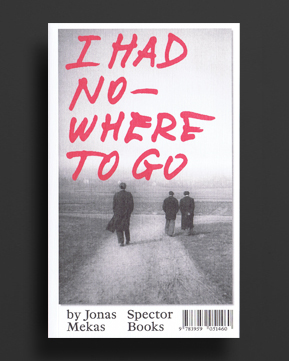
Legendary filmmaker Jonas Mekas actually came to filmmaking relatively late in life, and his path to New York was a difficult one. In 1944, Mekas and his younger brother Adolfas had to flee Lithuania. They were interned for eight months in a labor camp in Elmshorn. Even after the war ended, Mekas was prevented from returning to his native Lithuania by the Soviet occupation. Classed as a "displaced person," he lived in DP camps in Wiesbaden and Kassel for years. It was only at the end of 1949 that Jonas and Aldolfas Mekas finally found their way to New York City.
A new edition of Mekas' acclaimed memoir, first published by Black Thistle Press in 1991, I Had Nowhere to Go tells the story of the artist's survival in the camps and his first years as a young Lithuanian immigrant in New York City. Mekas' memoir--the inspiration for a 2016 biopic by Douglas Gordon--tells the story of how an individual life can move through the larger 20th-century narratives of war and exile and tentatively put down new roots. In the words of Phillip Lopate, "This is a lyrical, essential spiritual anthropology."
Jonas Mekas (born 1922) lives and works in New York. Filmmaker, writer and poet, he is a cofounder of Anthology Film Archives, one of the world's largest and most important repositories of avant-garde film. An influential figure in New American Cinema and New York underground culture, he worked with Andy Warhol, George Maciunas, John Lennon and many others. Mekas' work has been exhibited in museums and festivals worldwide.
2016, English
Softcover, 456 pages, 16 x 21.5 cm
Published by
Spector Books / Leipzig
$59.00 - Out of stock
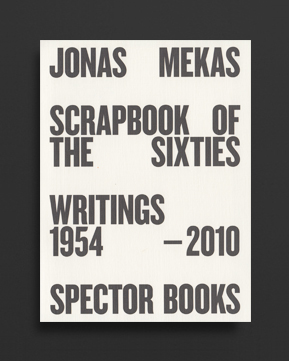
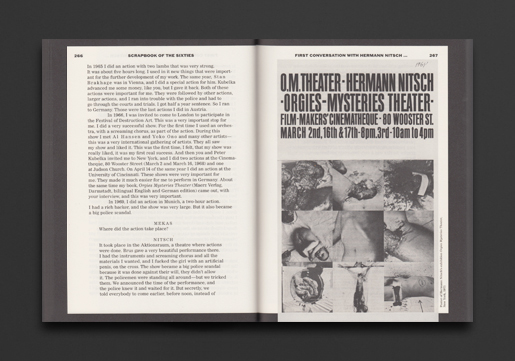
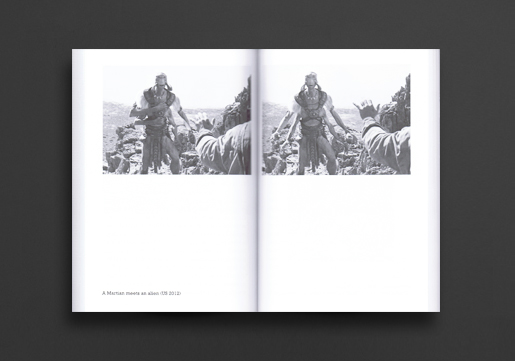
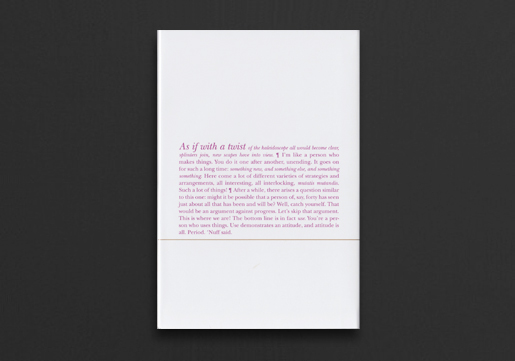
Scrapbook of the Sixties is a collection of published and unpublished texts by Jonas Mekas, filmmaker, writer, poet, and cofounder of the Anthology Film Archives in New York. Born in Lithuania, he came to Brooklyn via Germany in 1949 and began shooting his first films there. Mekas developed a form of film diary in which he recorded moments of his daily life. He became the barometer of the New York art scene and a pioneer of American avant-garde cinema. Every week, starting in 1958, he published his legendary “Movie Journal” column in The Village Voice, writing on a range of subjects that were by no means restricted to the world of film. He conducted numerous interviews with artists like Andy Warhol, Susan Sontag, John Lennon & Yoko Ono, Erick Hawkins, and Nam June Paik. Some of these will now appear for the first time in his Scrapbook of the Sixties. Mekas’s writings reveal him as a thoughtful diarist and an unparalleled chronicler of the times—a practice that he has continued now for over fifty years.
Jonas Mekas (*1922, Semeniškiai / Lithuania), lives and works in New York. Film-maker, writer, poet and co-founder of the Anthology Film Archives one of the world’s largest and most important repositories of avant-garde film. Mekas’s work has been exhibited in museums and festivals worldwide.
2017, English
Softcover, 160 pages, 10.5 x 15 cm
Published by
Spector Books / Leipzig
$28.00 - Out of stock
A visionary assemblage of historical, present-day and speculative material on space colonies, inspired by the culture of the Whole Earth Catalog.
At the beginning of the 1970s, American physicist Gerard K. O'Neill developed the first ideas for colonizing space. Shortly thereafter, Stewart Brand, cyber-communard and editor of the Whole Earth Catalog, took up these ideas and published the book Space Colonies in 1977. Space Colonies, an edition of Brand's CoEvolution Quarterly, funded by the proceeds of the Whole Earth Catalog, took up the question of whether space might be colonized by the year 2000. Artist Fabian Reimann takes up Brand and O'Neill's particular strain of techno-utopianism in Space Colonies: A Galactic Freeman's Journal. In his photo-essay Reimann assembles historical, present-day and speculative material, combining these with fictional and factual stories to create a composite of different images of the world. With global ecological disaster an even more pressing issue than it was in 1977, and the colonization of space still touted by some as a last-ditch resort, Reimann looks back at the dreams and nightmares of the 1970s with a sophisticated visual humor. Fabian Reimann (born 1975) is an artist working in Leipzig and, since 2004, the editor of the "ego-zine" Freeman's Journal. His Another Earth Catalog, which refers back to Stewart Brand's Whole Earth Catalog, was published by Spector Books in 2012. Reimann works with sculpture, photography, collage, painting and text in extended research projects that blend history and science, and fact and fiction
2017, English
Softcover, 248 pages, 21 x 24 cm
Published by
The MIT Press / Massachusetts
$59.00 - Out of stock
It may be time to forget the art world--or at least to recognize that a certain historical notion of the art world is in eclipse. Today, the art world spins on its axis so quickly that its maps can no longer be read; its borders blur. In Forgetting the Art World, Pamela Lee connects the current state of this world to globalization and its attendant controversies. Contemporary art has responded to globalization with images of movement and migration, borders and multitudes, but Lee looks beyond iconography to view globalization as a world process. Rather than think about the “global art world” as a socioeconomic phenomenon, or in terms of the imagery it stages and sponsors, Lee considers “the work of art’s world” as a medium through which globalization takes place. She argues that the work of art is itself both object and agent of globalization.
Lee explores the ways that art actualizes, iterates, or enables the processes of globalization, offering close readings of works by artists who have come to prominence in the last two decades. She examines the “just in time” managerial ethos of Takahashi Murakami; the production of ethereal spaces in Andreas Gursky’s images of contemporary markets and manufacture; the logic of immanent cause dramatized in Thomas Hirschhorn’s mixed-media displays; and the “pseudo-collectivism” in the contemporary practice of the Atlas Group, the Raqs Media Collective, and others.
To speak of “the work of art’s world,” Lee says, is to point to both the work of art’s mattering and its materialization, to understand the activity performed by the object as utterly continuous with the world it at once inhabits and creates.
About the Author
Pamela M. Lee is Professor of Art History at Stanford University and the author of Object to Be Destroyed: The Work of Gordon Matta-Clark and Chronophobia: On Time in the Art of the 1960s, both published by the MIT Press.
Endorsements
“Pamela Lee makes a major contribution to our understanding of art’s globalization through her brilliant exploration of ‘worlds’ as a medium and ‘worlding’ as a process by which unruly networks of financial, political, and spectacular forces are crystallized as works of art.”
—David Joselit, Carnegie Professor, History of Art, Yale University
“For those who want to chart the difference between the world and world markets, for those nostalgic for genuinely intellectual depth in art criticism, and for those wanting to understand the outer, digital limits of art, this book will be your guide. Forgetting the Art World sets a new stage—a picture theory for art practice.”
—Molly Nesbit, Professor of Art History, Vassar College
“Pamela Lee presents an exciting, highly original discussion of what constitutes an art world at the beginning of the twenty-first century. Forgetting the Art World examines not only the processes sustaining the reciprocal relationship between globalization and contemporary art, but also what the art world needs to forget in order to assume its current condition. The analysis is timely and provocative, and will be essential reading for anyone concerned with contemporary art.”
—Alexander Alberro, author of Conceptual Art and the Politics of Publicity
2008, English
Hardcover (w. dust jacket), 96 pages, 12.7 x 18.6 cm
Published by
The Leopard Press / New York
$39.00 - Out of stock
Published as a catalogue for Seth Price's 2008 exhibition at Friedrich Petzel Gallery, "How to Disappear in America" alludes to 1960s countercultural handbooks providing instructions for dropping out of mainstream society. Price's book, which consists exclusively of information found on the internet, includes advice for using current technology and focuses on the practical concerns of evading capture by law enforcement.
Seth Price was born in 1973 in East Jerusalem, Palestine. He received a BA from Brown University in 1997, where he studied modern culture and media. In 2012 he began to work as an artist, and his first one-person exhibition was in 2004; major exhibitions of his work have since been presented around the world. His writings are widely anthologized and taught, and
1983, English
Softcover, 58 pages
Out of print title / used / good
Published by
Feminism and Nonviolence Study Group / UK
$15.00 - In stock -
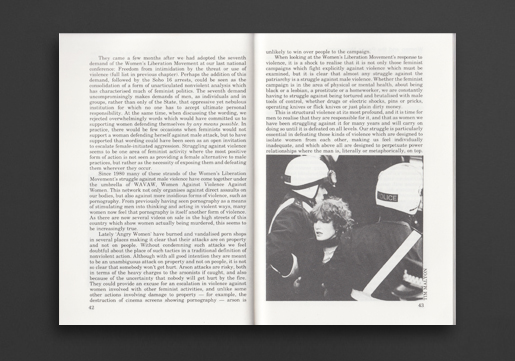
Written and published by the Feminism and Nonviolence Study Group in Devon, UK, in 1983, in cooperation with War Resisters' International.
(Excerpt)
"It has become clear to us that resistance to war and to the use of nuclear weapons is impossible without resistance to sexism, to racism, to imperialism and to violence as an everyday pervasive reality. There is a profound relationship between the fact that individual women are commonly attacked and beaten up and that a nuclear war threatens the entire world.
We've written this pamphlet in the belief that many basic ideas are held in common by feminists and by those advocating nonviolence. We also feel that the current peace movement does not take adequate account of the ideas and experiences of feminism. For example, women's actions are still perceived as divisive by many people. At the same time, certain women's actions for peace can tend to perpetuate our subordination by portraying women as natural peacemakers and not as powerful activists for change. This works against our liberation rather than for it.
Both feminism and nonviolence express the belief that the world we know is not as it should be and this can be changed. They are, to a large extent, responses to those immensely powerful forces which would destroy us. In order to appreciate the radical challenge and depths of feminism and nonviolence we have to look at exactly what they are in response to. [...]"
CONTENTS
Introduction
Chapter One: The World We Live In
Women and War
Going to the Roots
Structures of Oppression
Chapter Two: Breaking the Chains
Nonviolence
Feminism
Feminist Nonviolence
Chapter Three: Claiming Our Lives
Refusing to be Victims
Women Act Against Violence
Women and the Peace Movement
Chapter Four: A Time to Come
2017, English
Softcover, 64 pages, 12 x 19 cm
Published by
Sternberg Press / Berlin
$28.00 $15.00 - In stock -
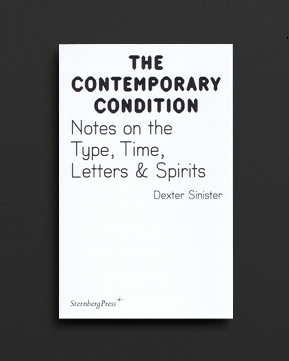
Three interconnected palimpsest essays recount (1) the backstory of a “meta” font recently updated by Dexter Sinister and used to typeset the Contemporary Condition book series, (2) a broad history of the rationalization of letterforms that considers the same typeface from “a higher point of disinterest,” and (3) a pending proposal for a sundial designed to operate in parallel physical and digital realms. Along the way they contemplate the ambiguous nature of our shared idea of time itself.
The Contemporary Condition series edited by Geoff Cox and Jacob Lund, Volume 06
Copublished by Sternberg Press, Aarhus University and ARoS Art Museum
Design by Dexter Sinister
2017, English
Softcover, 48 pages, 12 x 19 cm
Published by
Sternberg Press / Berlin
$28.00 $15.00 - In stock -
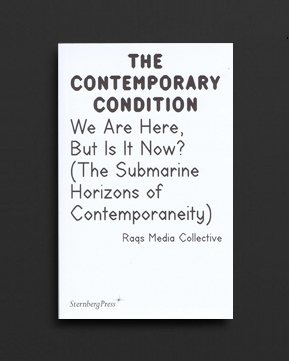
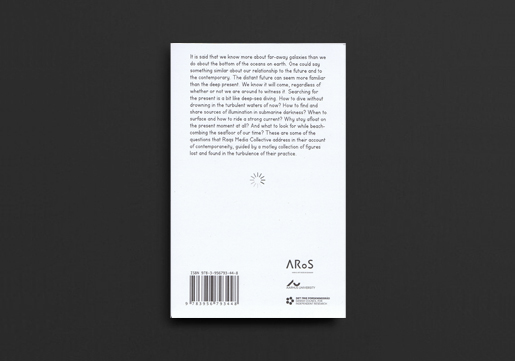
It is said that we know more about far-away galaxies than we do about the bottom of the oceans on earth. One could say something similar about our relationship to the future and to the contemporary. The distant future can seem more familiar than the deep present. We know it will come, regardless of whether or not we are around to witness it. Searching for the present is a bit like deep sea diving. How to dive without drowning in the turbulent waters of now? How to find and share sources of illumination in submarine darkness? When to surface and how to ride a strong current? Why stay afloat on the present moment at all? And what to look for while beachcombing the sea-floor of our time? These are some of the questions that Raqs Media Collective address in their account of contemporaneity, guided by a motley collection of figures lost and found in the turbulence of their practice.
The Contemporary Condition series edited by Geoff Cox and Jacob Lund, Volume 05
Copublished by Sternberg Press, Aarhus University and ARoS Art Museum
Design by Dexter Sinister
2017, English
Softcover, 48 pages, 12 x 19 cm
Published by
Sternberg Press / Berlin
$28.00 $15.00 - In stock -
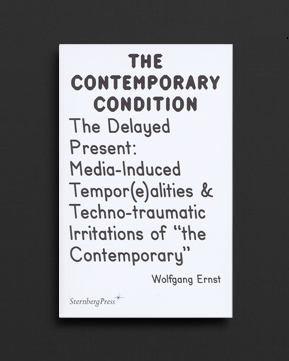
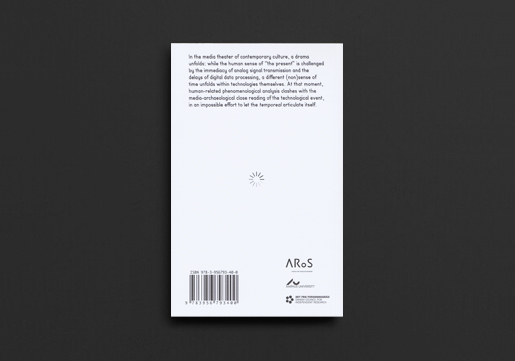
In the media theatre of contemporary culture, a drama unfolds: While the human sense of “the present” is challenged by the immediacy of analog signal transmission and the delays of digital data processing, a different (non-)sense of time unfolds within technologies themselves. At that moment, human-related phenomenological analysis clashes with the media-archaeological close reading of the technological event, in an impossible effort to let the temporeal articulate itself.
The Contemporary Condition series edited by Geoff Cox and Jacob Lund, Volume 04
Copublished Sternberg Press, Aarhus University and ARoS Art Museum
Design by Dexter Sinister
2017, English
Hardcover, 208 pages, 20 x 25.8 cm
Published by
Sternberg Press / Berlin
Carpenter Center for the Visual Arts / Cambridge
$45.00 - Out of stock
Edited by James Voorhies
Contributions by Martin Beck, Keller Easterling, James Goggin, Alex Kitnick, James Voorhies
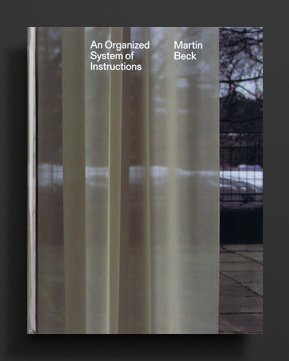
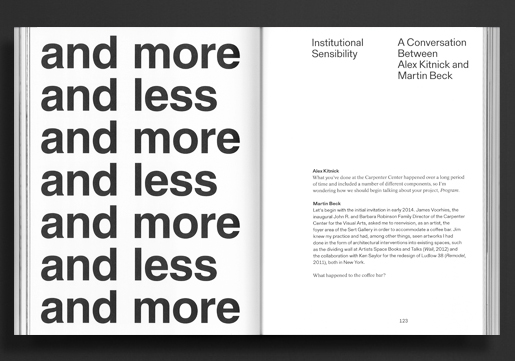
Martin Beck’s exhibition “Program” at the Carpenter Center for the Visual Arts comprised a sequence of interventions, installations, events, and displays that drew on the exhibition histories and academic pursuits of the famed 1963 Le Corbusier building at Harvard University. The sequence of explorative strategies—each node of which Beck considered an “episode”—lent particular attention to the founding aspirations of the Carpenter Center, which sought to cultivate its position as simultaneously an iconic modernist building, school, and exhibition venue. Beck performed and critically reflected on the kinds of activity an institution uses to build, organize, and engage with its audiences, and, in the case of the Carpenter Center, how it performed a kind of exhibition of education in both its pedagogical framework and its public outreach. From its physical infrastructure to its communication strategies, from its foundational curricular principles to visitor tallies, from building usage to welcome rituals, “Program,” which transpired over two years, examined institutional behaviors that collectively form institutional identity and integrate audiences into a cohesive program of public address.
This book, An Organized System of Instructions, is both a document of “Program” and an extension of the exhibition, which ran from October 24, 2014, to October 2016.
Copublished with Carpenter Center for the Visual Arts
Design by James Goggin, Practise
English, 2017
Hardcover, 194 pages, 11 x 18 cm
Published by
Sternberg Press / Berlin
$59.00 $15.00 - Out of stock
Contributions by Naomi Beckwith, Clare Davies, Aïcha Diallo, Gabriele Genge, Thelma Golden, Gugulective, Elsa Guily, EJ Hill, Euridice Kala, Basia Lewandowska Cummings, Youssef Limoud, Misheck Masamvu, Walther Mignolo, Patrick Mudekereza, Senga Nengudi, Gabi Ngcobo, An Paenhuysen, Thiago de Paula Souza, Adriana Quiñones León, Luciane Ramos-Silva, Tabita Rezaire, Magnus Rosengarten, Sidney Santiago Kuanza, Helen Sebidi, Lucélia Sergio, Olufemi Terry, Wana Udobang
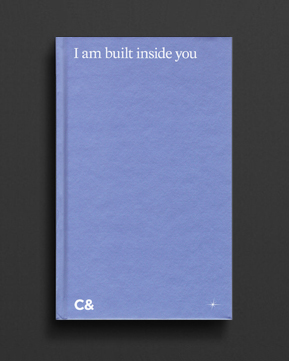
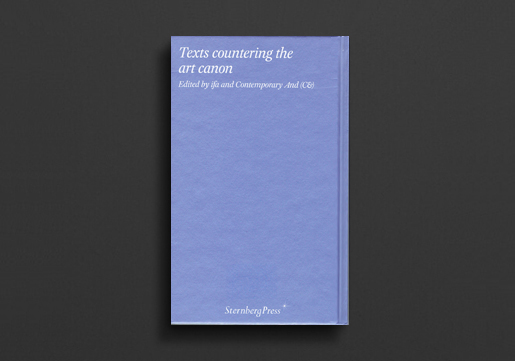
Over the past four years, the art magazine Contemporary And (C&) has called attention to exhibitions, artists, and curators from diverse African perspectives while boosting new areas of debate. I am built inside you, C&’s first book, is a compilation of eighteen pieces published since the magazine was launched in 2013. The point of departure is a conversation with the great South African artist Helen Sebidi that took place on the occasion of the 32rd São Paulo Biennial in 2016. The volume collects significant pieces from the C& archive that expand upon and contextualize Sebidi’s concepts of home, history, and spirituality. Included as well are interviews with emerging South African artist Tabita Rezaire; Senga Nengudi, artist and core member of the African-American avant-garde in 1970s and ’80s Los Angeles; Thelma Golden, legendary director of the Studio Museum in Harlem; and pathbreaking academic Walter Mignolo.
Copublished with Contemporary And (C&), ifa Institut für Auslandsbeziehungen
Design by Studio Matthias Görlich
2017, English
Softcover, (w. dust jacket), 156 pages, 10.5 x 15 cm
Published by
Sternberg Press / Berlin
$25.00 - Out of stock
Edited by Nikolaus Hirsch, Markus Miessen
Featuring artwork by Omer Fast
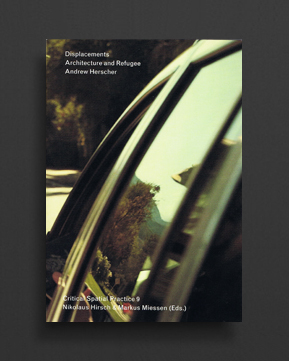
In architectural history, just as in global politics, refugees have tended to exist as mere human surplus; histories of architecture, then, have usually reproduced the nation-state’s exclusion of refugees as people out of place. Andrew Herscher’s Displacements: Architecture and Refugee, the ninth book in the Critical Spatial Practice series, examines some of the usually disavowed but arguably decisive intersections of mass-population displacement and architecture—an art and technology of population placement—through the twentieth century and into the present. Posing the refugee as the preeminent collective political subject of our time, Displacements attempts to open up an architectural history of the refugee that could refract on the history of architecture and the history of the refugee alike.
Andrew Herscher is an Associate Professor at the University of Michigan with appointments in the Taubman College of Architecture and Urban Planning, Department of Slavic Languages and Literatures, and Department of Art History. His publications include Violence Taking Place: The Architecture of the Kosovo Conflict (Stanford University Press, 2010), The Unreal Estate Guide to Detroit (University of Michigan Press, 2012), and, coedited with Anooradha Iyer Siddiqi, Spatial Violence (Routledge, 2016).
Design by Zak Group
2016, English
Hardcover (w. dust jacket), 528 pages, 17.8 x 22.9 cm
Published by
The MIT Press / Massachusetts
$79.00 - Out of stock
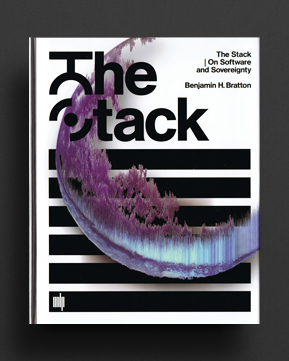
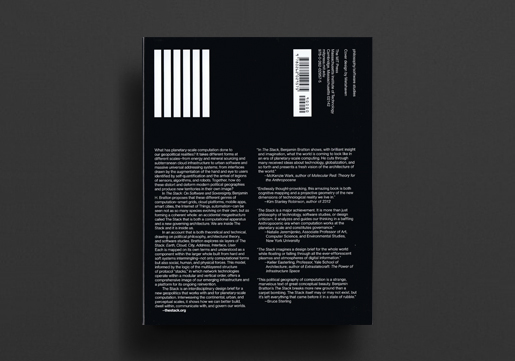
What has planetary-scale computation done to our geopolitical realities? It takes different forms at different scales—from energy and mineral sourcing and subterranean cloud infrastructure to urban software and massive universal addressing systems; from interfaces drawn by the augmentation of the hand and eye to users identified by self—quantification and the arrival of legions of sensors, algorithms, and robots. Together, how do these distort and deform modern political geographies and produce new territories in their own image?
In The Stack, Benjamin Bratton proposes that these different genres of computation—smart grids, cloud platforms, mobile apps, smart cities, the Internet of Things, automation—can be seen not as so many species evolving on their own, but as forming a coherent whole: an accidental megastructure called The Stack that is both a computational apparatus and a new governing architecture. We are inside The Stack and it is inside of us.
In an account that is both theoretical and technical, drawing on political philosophy, architectural theory, and software studies, Bratton explores six layers of The Stack: Earth, Cloud, City, Address, Interface, User. Each is mapped on its own terms and understood as a component within the larger whole built from hard and soft systems intermingling—not only computational forms but also social, human, and physical forces. This model, informed by the logic of the multilayered structure of protocol “stacks,” in which network technologies operate within a modular and vertical order, offers a comprehensive image of our emerging infrastructure and a platform for its ongoing reinvention.
The Stack is an interdisciplinary design brief for a new geopolitics that works with and for planetary-scale computation. Interweaving the continental, urban, and perceptual scales, it shows how we can better build, dwell within, communicate with, and govern our worlds.
thestack.org
About the Author
Benjamin H. Bratton is a theorist whose work spans philosophy, computer science, and design. He is Associate Professor of Visual Arts and Director of the Center for Design and Geopolitics at the University of California, San Diego. He is also Visiting Professor of Critical Studies at SCI-Arc (the Southern California Institute of Architecture) and Professor of Digital Design at the European Graduate School in Saas-Fee, Switzerland.
Endorsements
“In The Stack, Benjamin Bratton shows, with brilliant insight and imagination, what the world is coming to look like in an era of planetary-scale computing. He cuts through many received ideas about technology, globalization, and so forth and presents a fresh vision of the architecture of the world.”
—McKenzie Wark, author of Molecular Red: Theory for the Anthropocene
“Endlessly thought-provoking, this amazing book is both cognitive mapping and a projective geometry of the new dimensions of technological reality we live in.”
—Kim Stanley Robinson, author of 2312
“The Stack is a major achievement. It is more than just philosophy of technology, software studies, or design criticism; it analyzes and guides our thinking in a baffling Anthropocenic era when computation works at the planetary scale and constitutes governance.”
—Natalie Jeremijenko, Associate Professor of Art, Computer Science, and Environmental Studies, New York University
“The Stack imagines a design brief for the whole world while floating or falling through all the ever-efflorescent plasmas and atmospheres of digital information.”
—Keller Easterling, Professor, Yale School of Architecture; author of Extrastatecraft: The Power of Infrastructure Space
“This political geography of computation is a strange, marvelous text of great conceptual beauty. Benjamin Bratton’s The Stack breaks more new ground than a carpet bombing. The Stack itself may or may not exist, but it’s left everything that came before it in a state of rubble.”
—Bruce Sterling
2017, English
Softcover, 72 pages, 17 x 24 cm
Published by
Art Against Art / Berlin
$18.00 - In stock -
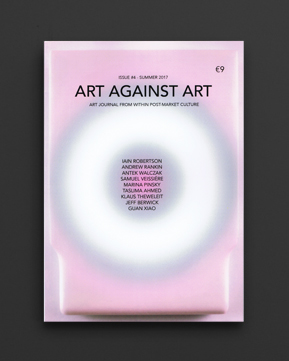
EDITORIAL
The art market is being kept alive with constant stimulus in the form of Venice-Basel-Kassel-Athens-Frieze-TEFAF. As the series of electric shocks continue, the art market is still in a period of reconfiguration trying to find longevity in the new. Whereas the art fair format inherently lacks culture – merely being a market place/forum for where exchange takes place – the biennial format has become too broad to create lasting cultural meaning; therefore the art market must look elsewhere for metrics of value. But if it only finds mirrors of its own logic (the free market itself), it will do nothing more than to accelerate the process upon which it has been organizing itself.
Definitions of culture have traditionally meant that the market can reflect on them too to prevent it from being flippant and volatile. The free market functions anchorless and incomprehensible without definitions – landmines of bubbles created without any meta signifier or even private collections and museums springing up that hang on the whim of the collector/personality/entrepreneur rather than frames of reference that create wider cultural value.
Contemporary art will only be able to reach the appreciation and longevity of modern art when...
CONTENTS
Editorial
Iain Robertson – What Drives the Value of Art?
Taslima Ahmed – Burning Man and the New Face of Art
Interview with Klaus Theweleit – No One Wins, It’s a War of Men - The Need for Cyborgs with Enhanced Human Potentials
Image Spread by Guan Xiao
Andrew Rankin – The Dangerous Art of Yukio Mishima
Antek Walczak – Boredom Year Point Oh
Image spread by Jeff Berwick
Samuel Veissière – Is the Self a Tulpa?
Artist edition by Marina Pinsky
1981, English
Softcover (staple-bound), 38 pages, 15 x 21 cm
1st Edition, Out of print title / Used*,
Published by
Brickburner Press / Queensland
$20.00 - Out of stock
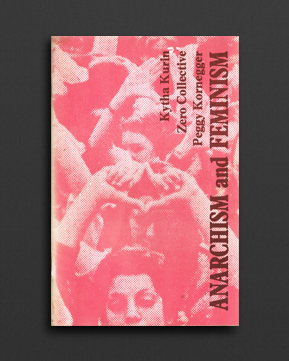
Three important essays from Anarchist-Feminists theorists/writers Peggy Kornegger, Zero Collective, and Kytha Kurin, dating 1975-1980, published in 1981 by Backburner Press in Australia.
Originally appearing in the Anarchist journals Second Wave, Zero and Open Road, this publication contains "Anarchism: The Feminist Connection" by Peggy Kornegger, "Anarchism/Feminism" by Zero Collective, and "Anarcha-Feminism: Why the Hyphen?" by Kytha Kurin.
1980, English
Softcover (staple-bound), 72 pages, 15 x 21 cm
1st Edition, Out of print title / Used*,
Published by
Dark Star / London
$35.00 - Out of stock
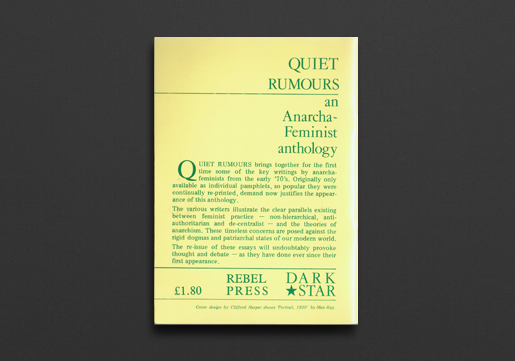
Feminist anthology 4 QUIET RUMOURS brings together for the first time some of the key writings by anarcha-feminists from the early ’70’s. Originally only available as individual pamphlets, so popular they were continually re-printed, demand now justifies the appearance of this anthology. The various writers illustrate the clear parallels existing between feminist practice ― non-hierarchical, anti- authoritarian and de-centralist ― and the theories of anarchism. These timeless concerns are posed against the rigid dogmas and patriarchal states of our modern world. The re-issue of these essays will undoubtably provoke thought and debate - as they have done ever since their first appearance.
Texts by Black Rose Anarcho-Feminists, Lynne Farrow, Peggy Kornegger, Marian Leighton, Voltairine de Cleyre, Carol Ehrlich.
1980, English
Softcover (staple-bound), 34 pages, 15 x 21 cm
1st Edition, Out of print title / Used*,
Published by
Brickburner Press / Queensland
$20.00 - Out of stock
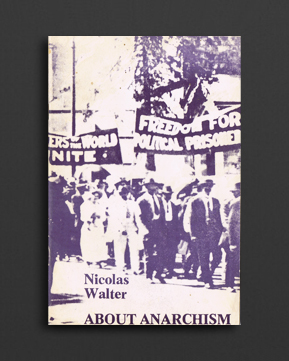
"This introduction to anarchism was first published in June 1969 as the hundredth issue of the monthly magazine Anarchy, and was immediately reprinted as a separate pamphlet. It was reprinted again in 1971, and it has also been translated into Danish, Dutch, French, German, Greek, Italian (twice), Japanese, Spanish (twice), and Yiddish (in Argentina). This new edition is unchanged except for the addition of this paragraph, of a new penultimate paragraph in the section on “The individual and society”, and of a new postscript at the end." - Brickburner Press, January 1977
1980 Australian reprint of Nicolas Walter's seminal essay "About Anarchism". Nicolas Hardy Walter was a British anarchist and atheist writer, speaker and activist. He was a member of the Committee of 100 and Spies for Peace, and wrote on topics of anarchism and humanism.
Contents: WHAT ANARCHISTS BELIEVE; HOW ANARCHISTS DIFFER; WHAT ANARCHISTS WANT; WHAT ANARCHISTS DO
1996, English
Softcover (staple-bound), 18 pages, 15 x 21 cm
1st Edition, Out of print title / Used*,
Published by
Free Labour / Brunswick
$15.00 - Out of stock
"I am an Anarchist not because I believe Anarchism is the final goal, but because there is no such thing as a final goal." - Rudolf Rocker
"Rudolf Rocker (1873 - 1958) was a German anarchist who was forced into exile in 1892. He settled in Britain in 1895 and, though himself not Jewish, was active in the Jewish movement until he was interned and later deported during World War 1. He was active back in Germany until the rise of Hitler forced him into exile again, and he spent the rest of his life in the USA. Anarchism: Its Aims and Purposes is the first chapter of Rudolf Rocker's libertarian classic Anarchosyndicalism, originally published in 1938 by Martin Secker and Warbug. Anarchosyndicalism has been reprinted several times since and appears in a revised and abridged version as Anarchism and Anarcho-Syndicalism. An attempt has been made within the text of this pamphlet to soften the gender-specific language, a product, apparently, of pre-feminist times. Where possible, the original text has been left unaltered. Where this has been impossible, substitute ”man," "his" or ”him" for the word appearing in the brackets to return to the original text."
Reprinted in 1996 by Brunswick's Free Labour Press, this