World Food Books' programme is largely produced on Kulin Nation land. We acknowledge the Wurundjeri people of the Kulin Nation as the first and continuing custodians of this land, and pay respect to their Elders past, present, and emerging.
World Food Books is an arts and special interests bookshop in Naarm / Melbourne. Founded in 2010, World Food Books is devoted to the presentation of a rotating, hand-selection of international art, design, literary and counterculture publications with an emphasis on the anti-traditional, the experimental, the avant-garde, the heretic, the marginal.
Presenting new titles alongside rare and out-of-print books, catalogues and journals spanning the fields of modern and contemporary art, design, photography, illustration, film, literature, poetry, cultural theory, philosophy, sexuality, popular and underground culture in its many radical forms, World Food Books wishes to encourage adventurous, thoughtful and open-minded reading, looking, writing, and exchange of publishing and ideas, both current and historical.
As well as our bookshop, located in Melbourne's historical Nicholas Building, all of our inventory is available internationally via our online mail-order service.
World Food Books semi-regularly co-ordinates "Occasions", a programme of exhibits and events at the bookshop and in partnership with other hosts (such as museums and art galleries) that develop out of the activities, relationships and content of the bookshop itself.
World Food Books
The Nicholas Building
37 Swanston Street
Room 5, Level 6
Melbourne 3000
Australia
SHOP HOURS:
Thu–Fri 12–6, Sat 12–5
WEB-SHOP OPEN 24/7
World Food Books
Postal Address:
PO Box 435
Flinders Lane
Victoria 8009
Australia
Art
Theory / Essay
Architecture / Interior
Graphic Design / Typography
Photography
Fashion
Eros
LGBTQ+
Fiction / Poetry
Weird / Speculative / Science Fiction / Horror
Transgressive / Visceral / Abject
Symbolism / Decadence / Fin de siècle
Film / Video
Painting
Sculpture / Installation
Performance / Dance / Theater
Drawing
Sound / Music
Curatorial
Group Shows / Collections
Periodicals
Out-of-print / Rare
Posters / Ephemera / Discs
Signed Books
World Food Books Gift Voucher
World Food Book Bag
Australian Art
Australian Fiction
Australian Science Fiction / Speculative Fiction
Australian Poetry
Australian Photography
Japanese Photography
Conceptual Art
Minimal Art
Dada
'Pataphysics / Oulipo
Fluxus
Concrete Poetry
Pop Art
Surrealism
Arte Povera
Arte Informale / Haute Pâte / Tachism
Nouveau Réalisme / Zero / Kinetic
Situationism / Lettrism
Collage / Mail Art / Xerox Art
Art Brut / Folk / Visionary / Fantastic
Illustration / Graphic Art / Bandes Dessinées
Furniture
Italian Radical Design / Postmodernism
Textiles
Ceramics / Glass
Counterculture
Protest / Revolt
Philosophy
Psychoanalysis
Anthropology
Anarchism
Socialism / Anarchism / Communism / Capitalism
Literary Theory / Semiotics / Language
Feminism / Women's Studies
Gender Studies / Sexuality
Anthropology
Fetishism / BDSM
Drugs / Psychedelia
Crime / Violence
Animal Rights / Veganism
Occult / Esoterica
Ecology / Earth / Alternative Living
Whole Earth / Crafts
All prices in AUD (Australian dollars)
Pick-Ups
Pick-up orders can be collected in our bookshop during opening hours after order date. Please collect any Pick-up orders within 2 weeks of ordering as we have limited storage space. Orders will be released back into stock if not collected within this time. No refunds can be made for pick-ups left un-collected. If you cannot make it in to the bookshop in this time-frame, please choose postage option.
Return Policy
All sales are final. We do accept returns (for refund or exchange) for items received in error. All our orders are packed with special care using heavy-duty padding and cardboard book-mailers or bubble mailers (for smaller books), using reinforcement where required. We cannot take responsibility for any lost, stolen or damaged parcels.
Insurance
Should you wish to insure your package, please email us directly after placing your order and we can organise this at a small extra expense. Although all standard/express tracked packages are very safe and dependable, we cannot take responsibility for any lost, stolen or damaged parcels. We recommend insurance on valuable orders.
Interested in selling your old books, catalogues, journals, magazines, comics, fanzines, ephemera? We are always looking for interesting, unusual and out-of-print books to buy. We only buy books in our fields of interest and specialty, and that we feel we can resell.
We base these prices on desirability, market value, in-print prices, condition and our current stock levels. We offer cash, store credit, and can take stock on consignment. All
about 25% of the price we expect to get when we sell them, or 30% in store credit. We base these prices on desirability, market value, in-print prices, condition and our current stock levels.
Sell your books any day of the week. You can drop them off and return later. If you have a lot of books, we can visit your Sydney home.
We buy books that we feel we can resell. We offer about 25 % of the price we expect to get when we sell them, or 30% in store credit. We base these prices on desirability, market value, in-print prices, condition and our current stock levels.
Philadelphia Wireman
03 August - 01 September, 2018
World Food Books is proud to announce our next Occasion, the first presentation of sculptures by Philadelphia Wireman in Australia.
The Philadelphia Wireman sculptures were found abandoned in an alley off Philadelphia’s South Street on trash night in 1982. Their discovery in a rapidly-changing neighbourhood undergoing extensive renovation, compounded with the failure of all attempts to locate the artist, suggests that the works may have been discarded after the maker’s death. Dubbed the "Philadelphia Wireman" during the first exhibition of this work, in 1985, the maker’s name, age, ethnicity, and even gender remain uncertain. The entire collection totals approximately 1200 pieces, all intricately bound together with tightly-wound heavy-gauge wire (along with a few small, abstract marker drawings, reminiscent both of Mark Tobey and J.B. Murry). The dense construction of the work, despite a modest range of scale and materials, is singularly obsessive and disciplined in design: a wire armature or exoskeleton firmly binds a bricolage of found objects including plastic, glass, food packaging, umbrella parts, tape, rubber, batteries, pens, leather, reflectors, nuts and bolts, nails, foil, coins, toys, watches, eyeglasses, tools, and jewellery.
Heavy with associations—anthropomorphic, zoomorphic, and socio-cultural responses to wrapped detritus—the totemic sculptures by Philadelphia Wireman have been discussed in the context of work created to fulfil the shamanistic needs of alternative religions in American culture. Curators, collectors, and critics have variously compared certain pieces to sculpture from Classical antiquity, Native American medicine bundles, African-American memory jugs, and African fetish objects. Reflecting the artist’s prolific and incredibly focused scavenging impulse, and despite—or perhaps enhanced by—their anonymity, these enigmatic objects function as urban artefacts and arbiters of power, though their origin and purpose is unknown. Philadelphia Wireman, whatever their identity, possessed an astonishing ability to isolate and communicate the concepts of power and energy through the selection and transformation of ordinary materials. Over the course of the past two decades, this collection has come to be regarded as an important discovery in the field of self-taught art and vernacular art.
Presented in collaboration with Fleisher-Ollman Gallery, Philadelphia, and Robert Heald, Wellington.
Susan Te Kahurangi King
02 February - 10 March, 2018
Susan Te Kahurangi King (24 February 1951 - ) has been a confident and prolific artist since she was a young child, drawing with readily available materials - pencils, ballpoint pens and felt-tip markers, on whatever paper is at hand. Between the ages of four and six Susan slowly ceased verbal communication. Her grandparents William and Myrtle Murphy had developed a special bond with Susan so they took on caring responsibilities for extended periods. Myrtle began informally archiving her work, carefully collecting and storing the drawings and compiling scrapbooks. No drawing was insignificant; every scrap of paper was kept. The King family are now the custodians of a vast collection containing over 7000 individual works, from tiny scraps of paper through to 5 meter long rolls.
The scrapbooks and diaries reveal Myrtle to be a woman of great patience and compassion, seeking to understand a child who was not always behaving as expected. She encouraged Susan to be observant, to explore her environment and absorb all the sights and sounds. Myrtle would show Susan’s drawings to friends and people in her community that she had dealings with, such as shopkeepers and postal workers, but this was not simply a case of a grandmother’s bias. She recognised that Susan had developed a sophisticated and unique visual language and sincerely believed that her art deserved serious attention.
This was an unorthodox attitude for the time. To provide some context, Jean Dubuffet coined the term Art Brut in 1945 to describe work created by self-taught artists – specifically residents of psychiatric institutions and those he considered to be visionaries or eccentrics. In 1972 Roger Cardinal extended this concept by adopting the term Outsider Art to describe work made by non-academically trained artists operating outside of mainstream art networks through choice or circumstance. Susan was born in Te Aroha, New Zealand in 1951, far from the artistic hubs of Paris and London that Dubuffet and Cardinal operated in. That Myrtle fêted Susan as a self-taught artist who deserved to be taken seriously shows how progressive her attitudes were.
Susan’s parents Doug and Dawn were also progressive. Over the years they had consulted numerous health practitioners about Susan’s condition, as the medical establishment could not provide an explanation as to why she had lapsed into silence. Dawn educated herself in the field of homeopathy and went on to treat all twelve of her children using these principles – basing prescriptions on her observations of their physical, mental and emotional state.
Doug was a linguist with an interest in philosophy who devoted what little spare time he had to studying Maori language and culture. To some extent their willingness to explore the fringes of the mainstream made them outsiders too but it was their commitment to living with integrity and their respect for individuality that ensured Susan’s creativity was always encouraged.
Even though Susan’s family supported her artistic pursuits, some staff in schools and hospitals saw it as an impediment to her assimilation into the community and discouraged it in a variety of ways. Her family was not always aware of this and therefore did not fully understand why Susan stopped drawing in the early 1990s. However, rather than dwell on the challenges that Susan faced in pursuit of her artistic practice, they prefer to highlight her achievements. In 2008 Susan began drawing again in earnest, after an almost 20 year interruption, and her work is now shown in galleries around the world.
Susan grew up without television and has been heavily influenced by the comics she read as a child. She is absolutely fearless in the appropriation of recognizable characters, such as Donald Duck and Mickey Mouse, in her work. She twists their limbs, contorts their faces, compresses them together, blends them into complex patterned backgrounds - always imbuing them with an incredible energy. Although Susan often used pop culture characters in her work they are not naive or childlike. These are drawings by a brilliant self-taught artist who has been creating exceptional work for decades without an audience in mind.
Mladen Stilinović
"Various Works 1986 - 1999"
02 February 16 - September 10, 2016
Various works 1986 - 1999, from two houses, from the collections of John Nixon, Sue Cramer, Kerrie Poliness, Peter Haffenden and Phoebe Haffenden.
Including: Geometry of Cakes (various shelves), 1993; Poor People’s Law (black and white plate), 1993; White Absence (glasses, ruler, set square, silver spoon, silver ladel with skin photograph and wooden cubes), 1990-1996; Exploitation of the Dead (grey and red star painting, wooden painting, black spoon with red table, red plate), 1984-1990; Money and Zeros (zero tie, paintings made for friends in Australia (Sue, John, Kerrie), numbers painting), 1991-1992; Words - Slogans (various t-shirts) - “they talk about the death of art...help! someone is trying to kill me”, “my sweet little lamb”, “work is a disease - Karl Marx”; Various artist books, catalogues, monographs, videos; Poster from exhibition Insulting Anarchy; "Circular" Croatian - Australian edition; Artist book by Vlado Martek (Dostoyevsky); more.
Thanks to Mladen Stilinović and Branka Stipančić.
Jonathan Walker
Always Will Need To Wear Winter Shirt Blue + Ochre Small Check Pattern
21 August - 21 September, 2015
Untitled
I am not a great reader of poetry but I always return to the work of Melbourne poet, Vincent Buckley (1925- 1988). Perhaps I find his most tantalising piece to be not a finished poem but a fragment left on a scrap of paper discovered on his desk after the poet’s death.
The poetry gathers like oil
In the word-core, and spreads
It has its music meet,
Its music is in movement.
This fragment is more the shell left behind from a volatile thought than a finished poem. I find the last two lines honest but awkward whereas the first two lines work like an arrow. Most likely he could not find a resolution so it was left. Still, in its present form, it remains an eloquent testimony to the ultimate failure of a medium to express mobile thought and sensation, in Buckley’s case, through verbal language. It’s an important matter because this is something all artists have to deal with regardless of the medium.
I have never written a poem, however, I am forever copying fragments from books on paper scraps in a vain effort to fix certain notions in my head. At first, they function as bookmarks that are sometimes returned to when I open the book. But before long, as they accumulate, they fall out littering the table interspersed with A4 photocopies, bills, books and medications.
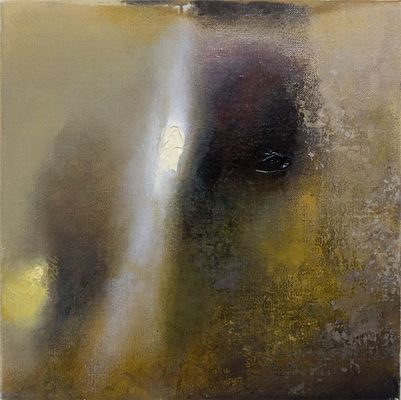
To return to Buckley’s fragment, the first two lines very much evoke how I paint nowadays. As you age, detail diminishes and patches of light become more luminous and float. I feel the most honest way of dealing with this is by smearing the oil paint on the canvas with the fingers and working close-up, blind. Only if the patches coalesce into an approaching image can the work gain a life.
-
Jonathan Walker was born in Melbourne, Australia and brought up on a dairy farm in Gippsland. In the 1970’s he studied painting at RMIT and won the Harold Wright Scholarship to the British Museum, London. During the 1980’s he exhibited at Pinacotheca Gallery, Richmond and had work shown at the NGV and Heidi City Art Gallery. Over the same period he designed the cover for the “Epigenesi” LP by Giancarlo Toniutti, Italy and conducted a mail exchange work with Achim Wollscheid, Germany. The work with artists through the post resulted in an article published in the bicentenary issue of Art and Australia 1988. He showed in artist run spaces such as WestSpace in the 90’s and 2000’s, and until 2012, taught painting at Victoria University, which is where we (Colleen Ahern and Lisa Radford) as organisers of the exhibition, among many others, had the privilege of being his student.
Walker’s knowledge was imparted to students through the careful selection of music, literature, and artists found in books that he himself had ordered for the library. Walker’s strategy was the generosity of sharing his vast knowledge with references specific to each student and their context.
Walker’s paintings share a similar focus and intimacy.
This exhibition presents a small selection of recent paintings alongside a publication that includes Walker’s writing. Observational and analytical, Walker’s work is a type of material notation — the time of day, colour and how it is blended, the both specific and fleeting location of a reflection on lino or the question of whether a chair leg should be included in a painting.
Please join us on Friday August 21 between 6-8pm to celebrate the opening of the exhibition.
Curated by Colleen Ahern and Lisa Radford.
B. Wurtz
Curated by Nic Tammens
March 26 - April 4, 2015
B.Wurtz works from a basement studio in his home on Manhattan’s Lower East Side.
This local fact is attested to by the plastic shopping bags and newsprint circulars that appear in his work. As formal objects, they don’t make loud claims about their origins but nonetheless transmit street addresses and places of business from the bottom of this long thin island. Like plenty of artists, Wurtz is affected by what is local and what is consumed. His work is underpinned by this ethic. It often speaks from a neighborhood or reads like the contents of a hamper:
“BLACK PLUMS $1.29 lb.”
“Food Bazaar”
“USDA Whole Pork Shoulder Picnic 99c lb.”
“RITE AID Pharmacy, with us it’s personal.”
“H. Brickman & Sons.”
“Sweet Yams 59c lb."
Most of the work in this exhibition was made while the artist was in residence at Dieu Donne, a workshop dedicated to paper craft in Midtown. Here Wurtz fabricated assemblages with paper and objects that are relatively lightweight, with the intention that they would be easily transportable to Australia. This consideration isn’t absolute in Wurtz’s work, but was prescriptive for making the current exhibition light and cheap. Packed in two boxes, these works were sent from a USPS post office on the Lower East Side and delivered to North Melbourne by Australia Post.
Wurtz appears courtesy of Metro Pictures, New York.
Thanks to Rob Halverson, Joshua Petherick, Sari de Mallory, Matt Hinkley, Helen Johnson, Fayen d'Evie, Ask Kilmartin, Lisa Radon, Ellena Savage, Yale Union, and "Elizabeth".
John Nixon
"Archive"
December 15 - January 20, 2014
The presentation of John Nixon's archive offered a rare showcase of this extensive collection of the artist's own publications, catalogues, posters, ephemera, editions and more, from the mid 1980s onwards, alongside a selection of his artworks.
Organized by John Nixon, Joshua Petherick and Matt Hinkley.
<a href=http://wfb.public-office.info/artist/john-nixon>All titles by John Nixon
"Habitat"
at Minerva, Sydney (organised by Joshua Petherick and Matt Hinkley)
November 15 - December 20, 2014
Lupo Borgonovo, Janet Burchill & Jennifer McCamley,
Lewis Fidock, HR Giger, Piero Gilardi, Veit Laurent Kurz,
Cinzia Ruggeri, Michael E. Smith, Lucie Stahl, Daniel Weil, Wols
Press Release:
“...It contained seven objects. The slender fluted bone, surely formed for flight, surely from the wing of some large bird. Three archaic circuitboards, faced with mazes of gold. A smooth white sphere of baked clay. An age-blackened fragment of lace. A fingerlength segment of what she assumed was bone from a human wrist, grayish white, inset smoothly with the silicon shaft of a small instrument that must once have ridden flush with the surface of the skin - but the thing’s face was seared and blackened.”
William Gibson, “Count Zero”, 1986
"Autumn Projects Archive"
Curated by Liza Vasiliou
March 6 - March 15, 2014
World Food Books, in conjunction with the Virgin Australia Melbourne Fashion Festival 2014, presented the Autumn Projects archive, consisting of a selection of early examples in Australian fashion with a particular interest in collecting designers and labels from the period beginning in the 1980’s, who significantly influenced the discourse of Australian Fashion.
Curated by Liza Vasiliou, the exhibition provided a unique opportunity to view pieces by designers Anthea Crawford, Barbara Vandenberg, Geoff Liddell and labels CR Australia, Covers, Jag along with early experimental collage pieces by Prue Acton and Sally Browne’s ‘Fragments’ collection, suspended throughout the functioning World Food Books shop in Melbourne.
H.B. Peace
presented by CENTRE FOR STYLE
November 14, 2013
"Hey Blinky, you say chic, I say same"
Anon 2013
H.B. Peace is a clothing collaboration between great friends Blake Barns and Hugh Egan Westland. Their pieces explore the divergences between 'character’ and ‘personality’ in garments....etc
Special Thanks to Joshua Petherick and Matt Hinkley of WFB and Gillian Mears
and a Very Special Thank you to Audrey Thomas Hayes for her shoe collaboration.
Janet Burchill & Jennifer McCamley
"Aesthetic Suicide"
May 10 - June 8, 2013
The first of our occasional exhibitions in the World Food Books office/shop space in Melbourne, "Aesthetic Suicide" presented a body of new and older works together by artists Janet Burchill & Jennifer McCamley, including videos, prints, a wall work, and publications.
During shop open hours videos played every hour, on the hour.
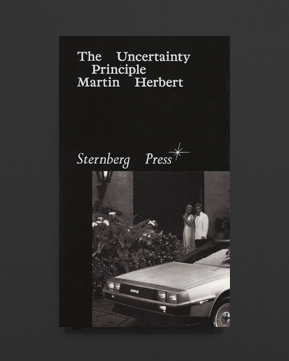
2014, English
Softcover, 184 pages, 38 b/w ills., 13 x 21 cm
Published by
Sternberg Press / Berlin
$54.00 - Out of stock
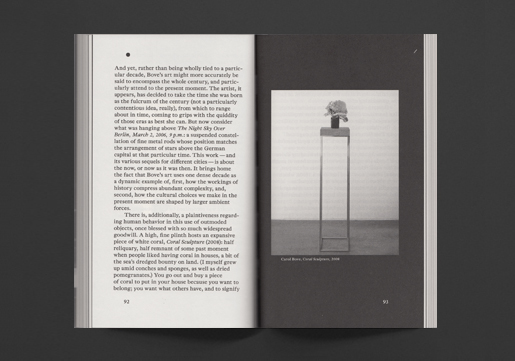
Within the realm of science, the uncertainty principle speaks of the fundamental limits of knowledge and measurement vis-à-vis the external world, and how the very act of seeing alters what is seen. Martin Herbert’s The Uncertainty Principle is a collection of essays that reveals layers of unknowing and open-endedness within a diversity of contemporary art practices since the 1970s. If a work of art is always completed by the viewer, as Marcel Duchamp put it, then the works considered here equate completion with construction. In navigating us through a succession of artists’ approaches, Herbert also discloses how constructed experiences of “not knowing” can lead to deep engagements with a range of specific issues and themes: from history to politics, from epistemology to mortality.
Martin Herbert is a writer and critic living in Tunbridge Wells, UK, and Berlin. He is associate editor of ArtReview and a regular contributor to Artforum, frieze, and Art Monthly, and has lectured in art schools internationally. His monograph Mark Wallinger, a comprehensive study of the British artist’s career, was published in 2011.
Design by Sam de Groot
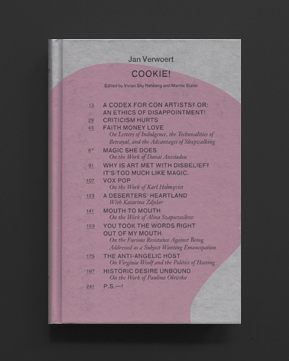
2014, English
Hardcover, 252 pages, 12 x 18 cm,
Published by
Piet Zwart Institute / Rotterdam
Sternberg Press / Berlin
$30.00 - Out of stock
This new volume brings together a selection of Jan Verwoert's most recent writings.
COOKIE! is a sequel to Verwoert’s Tell Me What You Want, What You Really, Really Want (edited by Vanessa Ohlraun, 2010), and third in a series of books published with the Piet Zwart Institute.
If we don’t merely reduce art to clever code play in the arenas of representation, how do we speak about what is at stake? In response to this question, Verwoert addresses the forces at the heart of the tragicomedy that making, showing, and critiquing art implicates us in. He honors the basic joys of turning one thing into another, and the miracles of rhythm and rhyme that characterize the residual level of mimetic magic in art. In this key, the unverifiable is practiced daily: bodies are remade, feelings transfigured. As Alina Szapocznikow wrote, the mouth chews and out comes sculpture. Verwoert’s COOKIE! renders visible the endless emotional labor of setting the stage (for others), poses the thorny question of whether there could ever be a labor union for con-artists (like us), and gestures toward an ethics of disappointment to battle false expectations and as a way to come to terms with the fact that, no matter how you look at it, criticism hurts.
Edited by Vivian Sky Rehberg and Marnie Slater
Copublished with Piet Zwart Institute, Willem de Kooning Academy Design by Nienke Terpsma
2014, English
Softcover, 372 pages (25 b/w ills.), 12 x 19 cm
Published by
Sternberg Press / Berlin
$33.00 - Out of stock
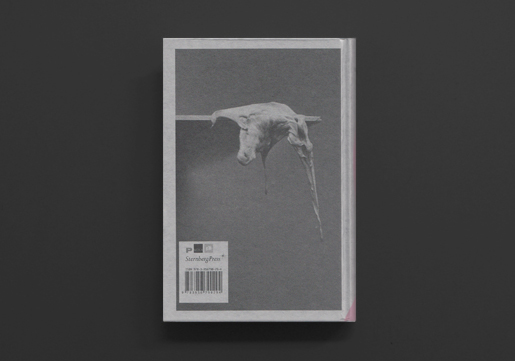
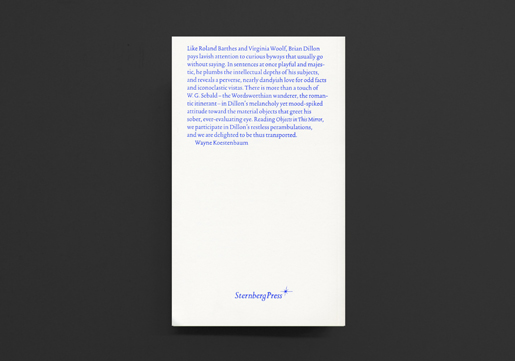
“Like Roland Barthes and Virginia Woolf, Brian Dillon pays lavish attention to curious byways that usually go without saying. In sentences at once playful and majestic, he plumbs the intellectual depths of his subjects, and reveals a perverse, nearly dandyish love for odd facts and iconoclastic vistas. There is more than a touch of W. G. Sebald—the Wordsworthian wanderer, the romantic itinerant—in Dillon’s melancholy yet mood-spiked attitude toward the material objects that greet his sober, ever-evaluating eye. Reading Objects in This Mirror, we participate in Dillon’s restless perambulations, and we are delighted to be thus transported.”
—Wayne Koestenbaum
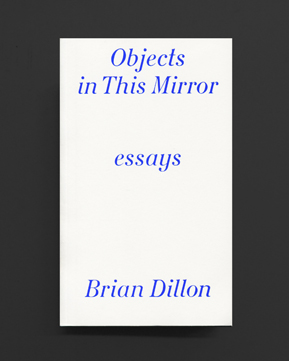
Objects in This Mirror is a collection of essays on contemporary art, literature, landscape, aesthetics, and cultural history. Beginning with a polemical and personal defense of generalism and curiosity, Brian Dillon explores the variety of themes it is possible today to corral within the rubric of the critical essay. These pieces engage with the work of such artists as Tacita Dean, Gerard Byrne, Andy Warhol, and Sophie Calle; with the ruinous territories that haunt the work of Robert Smithson and Derek Jarman; with the ambiguous figures of the charlatan, the vandal, the hypochondriac, and the dandy. Taking seriously the playful remit of the essay as form, Dillon treats of compelling obscurities: gesture manuals of the nineteenth century, the history of antidepressant marketing, the search for a cure to the common cold. Whether his topic is the nature of slapstick, his love of the writings of Roland Barthes, or the genre of the essay itself, he is as much concerned with the form of criticism today as with its varied and digressive subjects.
Design by John Morgan Studio
2013, English / French
Softcover, 257 pages, 240 x 175 mm
Published by
May Revue / Paris
$27.00 - In stock -
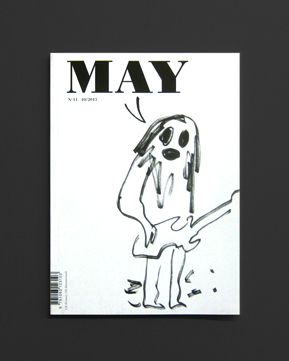
Newest issue of Paris' MAY Revue, and already out of print.
May #11 features:
An Introduction to a Juridical Legal Analysis of Contemporary Art — Judith Ickowicz
The Reappearances of Cady Noland and the Theatre of Law — Judith Ickowicz, Elvan Zabunyan, David Perreau
A Revolution “First-Hand”: Seth Siegelaub’s Journey to Portugal in May 1975 — Sara Martinetti
Zero Dark Thirty: The Aesthetics of Narcissism — Maija Timonen
Friend of the Devil. On Michael Krebber, “The ridiculized snails” at CAPC, Bordeaux — Mark von Schlegell
Reviews
On Martin Kippenberger, “Sehr Gut | Very Good” at Hamburger Bahnhof, Berlin — Jay Chung
Life, like networking, is a group show. On Tanja Widmann, “eine von euch” at Grazer Kunstverein, Graz, Badischer Kunstverein, Karlsruhe, Saprophyt, Vienne, tranzitdisplay, Prague — Tonio Kröner
Another image, a different song. On Mathias Poledna at Secession, Vienna — Benjamin Hirte
Get Rid of Capitalism. On Bernadette Corporation, “2000 Wasted Years” at ICA, London — Josefine Wikström
Participation, Penetration, and Phoniness. On Tobias Kaspar, “Life and Lies” at Galerie Marcelle Alix, Paris — Andrea Legiehn
On “The Issues of Our Time” at Castillo/Corrales, Paris — Seyoung Yoon
“Living in Your Head”. On “When Attitudes Become Form: Bern 1969/Venice 2013” at Prada Foundation, Venice — Elvan Zabunyan
About MAY Revue:
Conceived as a collective space in which to develop thoughts and confront positions on artistic production, May magazine examines, quaterly, contemporary art practice and theory in direct engagement with the issues, contexts and strategies that construct these two fields. An approach that could be summed up as critique at work – or as critique actively performed in text and art forms alike.
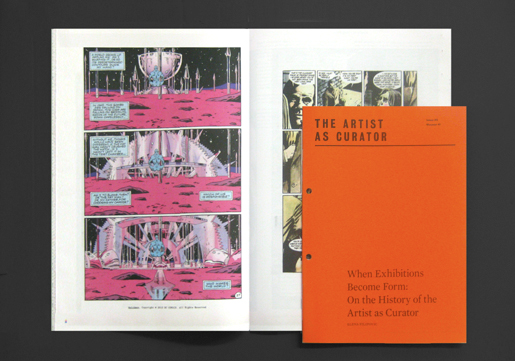
Featuring essays, interviews, art works and reviews by artists, writers and diverse practitioners of the arts, the magazine also intends to address the economy of the production of knowledge – the starting point of this reflection being the space of indistinction between information and advertisement typical of our time. This implies a dialogue with forms of critique produced in other fields.
2009, English
Softcover, 116 pages, 21.5 x 17 cm
Published by
IMA / Brisbane
Whale & Star Press / Florida
$15.00 - Out of stock
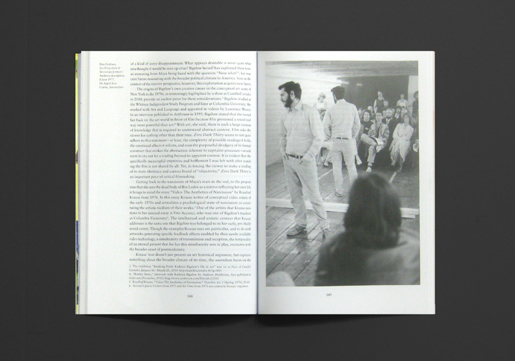
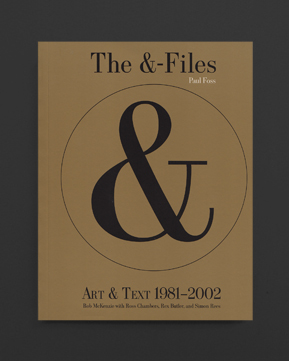
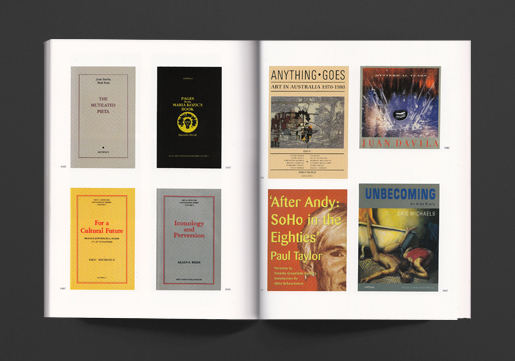
Modeled after the famed TV sci-fi series The X-Files, The &-Files gathers together a covert body of documents following the long and often controversial career of Art & Text, one of the landmark contemporary art magazines of the 1980s and 1990s. Founded in Melbourne, Australia, in 1981 by Paul Taylor (1957–92), who soon moved to New York City to make his mark as an art critic, the magazine went on to become one of a handful of international art magazines that succeeded in capturing the turmoil and passing brilliance of that period of postmodernism.
Perceived through the eyes and ears of its longtime publisher and editor Paul Foss, The &-Files is comprised of an open letter, a lengthy interview, two questionnaires, and other commentaries and bibliographies, offering a unique insider account of the extraordinary advantages and pitfalls of publishing an art magazine.
Paul Foss is the publishing editor of the art magazines Art & Text (Melbourne, Sydney, Los Angeles, 1981–2002) and artUS (Los Angeles, 2003-ongoing). He is a renowned translator, anthologist, and author, whose publications include Island in the Stream: Myths of Place in Australian Culture.
Robert McKenzie is an Australian artist currently based in New York.
Rex Butler teaches art history at the University of Queensland, Brisbane. His published work includes Jean Baudrillard: The Defense of the Real.
Ross Chambers is Distinguished University Professor Emeritus of French and Comparative Literature at the University of Michigan. His many books include Facing It: AIDS Diaries and the Death of the Author.
Simon Rees is a former curator at the Govett-Brewster Art Gallery, New Plymouth, New Zealand, and is currently curator at the Contemporary Art Center in Vilnius, Lithuania.
2013, English/Italian
Softcover (newspaper), 37 x 26 cm
Published by
Mousse Publishing / Milan
$18.00 $10.00 - Out of stock
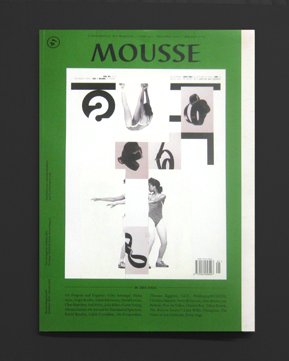
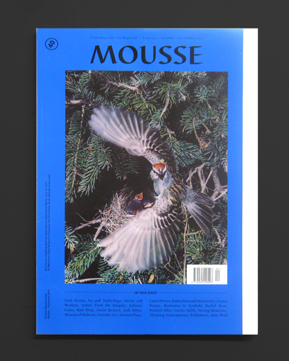
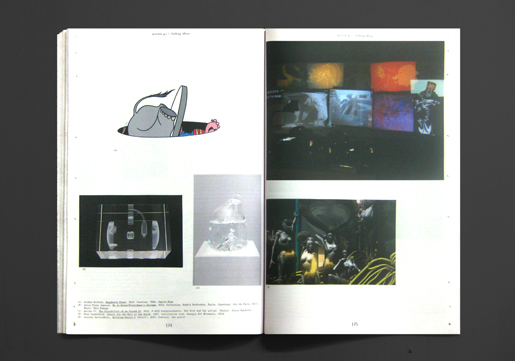
Mousse #41, December 2013:TALKING ABOUT - What do you need me for? by Vivian Sky Rehberg; ALAN MOORE - A for Alan Moore by Hans Ulrich Obrist; TALKING ABOUT - Pots on Video by Nick Currie; ON PURPOSE AND URGENCY - Introduction by Joao Ribas; ON PURPOSE AND URGENCY - I will revisit my lost loves, and playmates masterless! by Chus Martínez; ON PURPOSE AND URGENCY - Digital Landfills by Cory Arcangel; ON PURPOSE AND URGENCY - Found Wanting by Angie Keefer; ON PURPOSE AND URGENCY - The Writing of Banality by Akram Zaatari; ON PURPOSE AND URGENCY - Transformative Energies by Defne Ayas; ON PURPOSE AND URGENCY - Compatability Mode by Seth Price; ON PURPOSE AND URGENCY - An Actual Subversion by David Levine; ON PURPOSE AND URGENCY- Too Big to Fail by Adam Kleinman; ON PURPOSE AND URGENCY - Law as Art by Carey Young; TALKING ABOUT - Mass Effect by Lauren Cornell & Ed Halter; STEVE MCQUEEN - Shackled Past by Jens Hoffmann; CHARLES RAY - A Sculptural Differential by Zachary Cahill; LUKE WILLIS THOMPSON - Out of the Gallery by Sophie von Olfers; TABOR ROBAK - I Love Screens by Cecilia Alemani; GCC - Gulf Committee Complex by Kevin McGarry; CALEB CONSIDINE -Mute Paintings by Alex Kitnick; THOMAS EGGERER - A Fragile Artificiality by John Kelsey; NEW YORK - KEVIN BEASLEY - Shaking the Museum by Jenny Schlenzka; LONDON - CHRISTINA MACKIE - A Constant Drift by Rhea Dall; LOS ANGELES - JON PESTONI Jon Pestoni: With Flying Colors by Andrew Berardini; TALKING ABOUT - The Blurring of You and Me by Jennifer Allen; HOBBYPOPMUSEUM Gesamtkunstspiel by Catherine Wood; DENA YAGO - Life on Heat Island by Isla Leaver-Yap, and much more...
2013, English
460 individual cards in wrapper, 15.25 × 10.15 cm
Published by
New Documents / New York
$38.00 - Out of stock
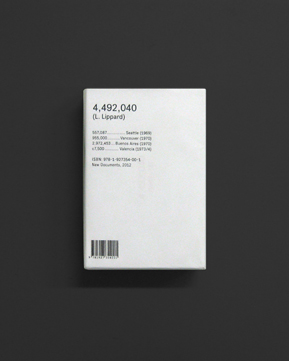
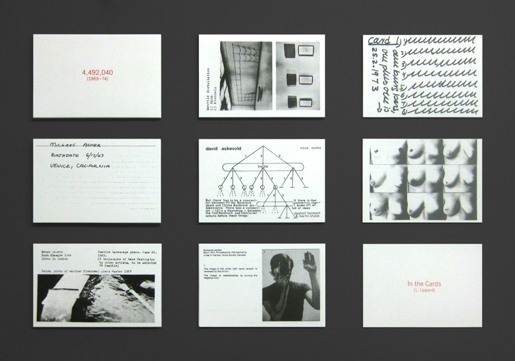
Between 1969 and 1974, the influential curator Lucy Lippard (born 1937) curated four decisive Conceptual art exhibitions, and in doing so reinvented the exhibition catalogue. 4,492,040 is a facsimile reprint of the extremely scarce and hugely important catalogues produced for these hugely important “numbers shows” - 557,087 (the Seattle Art Museum), 955,000 (the Vancouver Art Gallery), 7,500 (the California Institute of Art) and 2,972,453 (the Centro de Arte y Comunicación). Titled after the populations of the cities in which the shows were held, each catalogue was an envelope of loose note cards containing statements, documentation and conceptual works by each artist, to be rearranged, filed or discarded at will. If Lippard described Conceptual art as the dematerialization of the art object, these catalogues effectively announced the dematerialization of the art exhibition. (One reviewer claimed Lippard had been the artist, and that her medium had been other artists.) 4,492,040 includes such iconic figures as Vito Acconci, Carl Andre, Siah Armajani, Terry Atkinson, John Baldessari, Michael Baldwin, Robert Barry, Rick Barthelme, Daniel Buren, Rosemarie Castoro, Hanne Darboven, Walter de Maria, Jan Dibbets, Christos Dikeakos, Eleanor Antin, Dan Graham, Hans Haacke, Eva Hesse, Douglas Huebler, On Kawara, Edward Kienholz Sol LeWitt, Roelof Louw, Duane Lundon, Bruce McLean, Robert Morris, N.E. Thing Co., Bruce Nauman, Adrian Piper, Allen Ruppersberg, Ed Ruscha, Richard Serra, Robert Smithson, Jeff Wall and Lawrence Weiner.
2013, English
Softcover, 328 pages, 15 x 21 cm
Published by
Valiz / Amsterdam
$38.00 - Out of stock
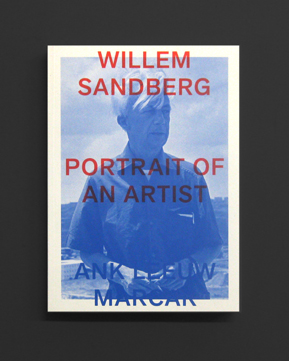
After the Second World War, Willem Sandberg (NL, 1897–1984) transformed the Amsterdam Stedelijk museum into a dynamic centre for modern and innovative art and culture. He did this with exceptional creativity and in close collaboration with artists and architects.
Sandberg had distinct ideas about heading up a museum for modern and contemporary art, about the importance of art, about dealing with artists and about his work as typographic designer, but also about social responsibility and community.This book is based on interviews with Sandberg (from 1971 and 1981) and offers first-hand insight into questions such as: what does the task of museum director entail; how does art criticism work; what is the essence of being an artist; what does the ideal museum architecture look like; and what is the role of art and the museum in society?
His involvement in setting up various museums, such as Beaubourg/Centre Pompidou testifies to his ideas. He also discusses his experiences in the resistance during the Second World War and his unique personal life style. Many of Sandberg’s ideas about these issues are still intriguing and provocative. They can give new impulse to the ongoing discussion and place it into an historical perspective.
In addition, a striking picture is drawn of the period with fascinating stories about artists such as Piet Mondrian, Picasso and Alexander Calder, and architects such as Gerrit Rietveld, Le Corbusier and Mies van der Rohe. Sandberg’s cosmopolitan spirit and his many foreign contacts made him into an internationally renowned pivotal figure in culture.
Thanks to this English translation of the revised text, plus photographic material and typographic work by Sandberg, a broad international public can now get to know those ideas which have still not lost any of their significance and relevance.
Graphic Design: Rutger de Vries/Werkplaats Typografie
supported by: Gerrit Rietveld Academie, Sandberg Institute
2013, English
Softcover, 178 pages, 16.6 x 22.5 cm
Published by
Royal Institute of Art / Stockholm
Sternberg Press / Berlin
$29.00 - In stock -
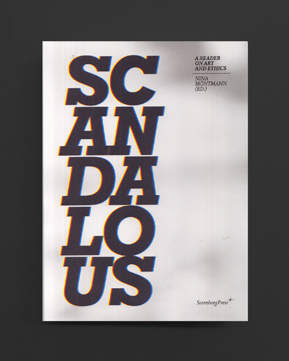
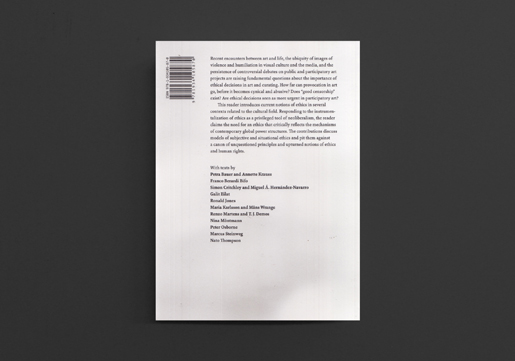
Texts by Petra Bauer and Annette Krauss, Franco Bifo Berardi, Galit Eilat, Ronald Jones, Maria Karlsson and Måns Wrange, Nina Möntmann, Peter Osborne, Marcus Steinweg, Nato Thompson; conversations between Simon Critchley and Miguel Á. Hernández-Navarro, Renzo Martens and T. J. Demos
Recent encounters between art and real life, the ubiquity of images of violence and humiliation in visual culture and the media, and the persistence of controversial debates on public and participatory art projects are raising fundamental questions about the importance of ethical decisions in art and curating. How far can provocation in art go, before it becomes cynical and abusive? Does “good censorship” exist? Are ethical decisions seen as more urgent in participatory art?
This reader introduces current notions of ethics in several contexts related to the cultural field. Responding to the instrumentalization of ethics as a privileged tool of neoliberalism, the reader claims the need for an ethics that critically reflects the mechanisms of contemporary global power structures. The contributions discuss models of subjective and situational ethics and pit them against a canon of unquestioned principles and upturned notions of ethics and human rights.
Copublished with the Royal Institute of Art, Stockholm
Design by Torsten Jahnke and Jens Reitemeyer, Hotmelt My Heart
2013, English
Softcover, 136 pages (30 color ills), 12 x 18 cm
Published by
Sternberg Press / Berlin
$26.00 - Out of stock
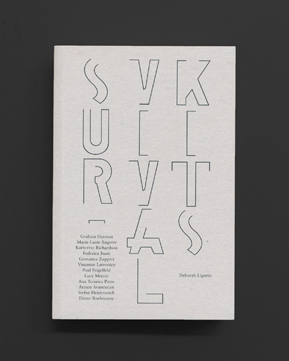
Contributions by Marie-Luise Angerer, Armen Avanessian, Federica Bueti, Paul Feigelfeld, Graham Harman, Stefan Heidenreich, Vincenzo Latronico, Lucy Mercer, Katherine Richardson, Dieter Roelstraete, Ana Teixeira Pinto, Giovanna Zapperi
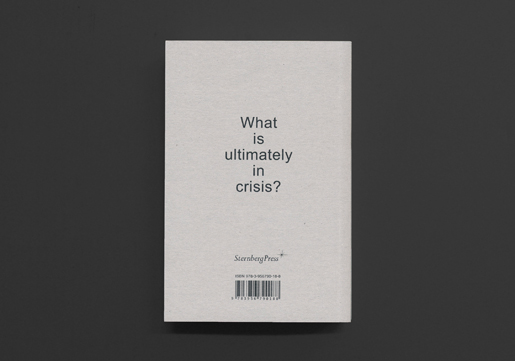
For years now our lives have been shaped by a crisis impacting both our economy and our personal lives. But what is ultimately in crisis? Survival Kits offers twelve perspectives on this issue—from fields as diverse as philosophy, politics, media theory, environmental activism, feminism, post-human theory, literature, geopolitics, art, and economics.
These theoretical investigations originated with artist Deborah Ligorio’s research. The book takes its title from an eponymous series of sculptures and video interviews describing situations of emergency, vulnerability, and struggle experienced by a living or a fictional person, which propose inventive tools for adaptation or resistance. A selection from this series is featured in the publication.
Design by Studio Manuel Raeder
2013, English
Softcover, 243 pages, 15 x 21.5 cm
Published by
Sternberg Press / Berlin
$29.00 - Out of stock
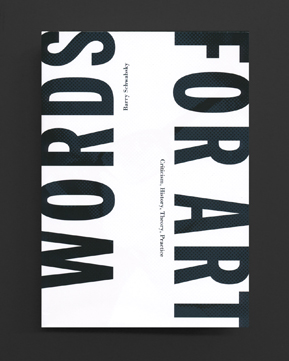
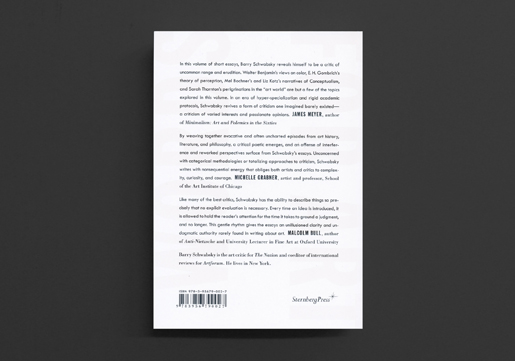
In this volume of short essays, Barry Schwabsky reveals himself to be a critic of uncommon range and erudition. Walter Benjamin’s views on color, E. H. Gombrich’s theory of perception, Mel Bochner’s and Liz Kotz’s narratives of Conceptualism, and Sarah Thornton’s peregrinations in the “art world” are but a few of the topics explored in this volume. In an era of hyper-specialization and rigid academic protocols, Schwabsky revives a form of criticism one imagined barely existed— a criticism of varied interests and passionate opinions.
—James Meyer, author of Minimalism: Art and Polemics in the Sixties
By weaving together evocative and often uncharted episodes from art history, literature, and philosophy, a critical poetic emerges, and an offense of interference and reworked perspectives surfaces from Schwabsky’s essays. Unconcerned with categorical methodologies or totalizing approaches to criticism, Schwabsky writes with nonsequential energy that obliges both artists and critics to complexity, curiosity, and courage.
—Michelle Grabner, artist and professor, School of the Art Institute of Chicago
Like many of the best critics, Schwabsky has the ability to describe things so precisely that no explicit evaluation is necessary. Every time an idea is introduced, it is allowed to hold the reader’s attention for the time it takes to ground a judgment, and no longer. This gentle rhythm gives the essays an unillusioned clarity and undogmatic authority rarely found in writing about art.
—Malcolm Bull, author of Anti-Nietzsche and University Lecturer in Fine Art at Oxford University
Design by Quemadura
2013, English
Softcover, 222 pages, 19 x 12 cm
Published by
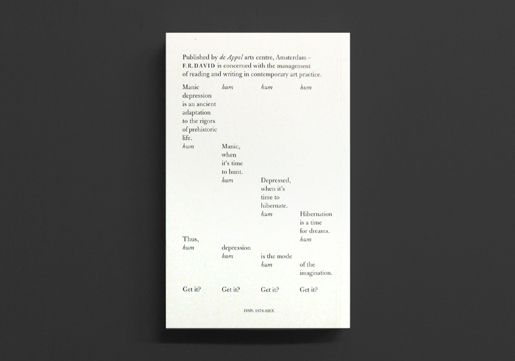
De Appel / Amsterdam
$20.00 - Out of stock
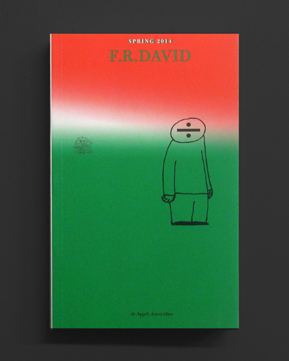
The eleventh edition of this reader about contemporary art practice is comparative, by way of sharing and splitting, with the goal of understanding the rhetoric that surrounds how we describe ourselves in both a fictional and professional sense. Included are a range of essays, poetry, analyses, diagrams and conversations that illustrate various perspectives on self-perception. With contributions by Abra Ancliffe, Robert Ashley, Ricardo Basbaum, Michael Gazzaniga, Ken Jacobs, Shane Krepakevich, John Latham, Ezra Pound, Kendra Sullivan, Sergei Tret'iakov, Marina Vishmidt, Rebecca Wilcox and Sarah Rose, and several more.
2013, English
Softcover, 128 pages, 17 x 21 cm
Published by
MUMA / Victoria
$20.00 - Out of stock
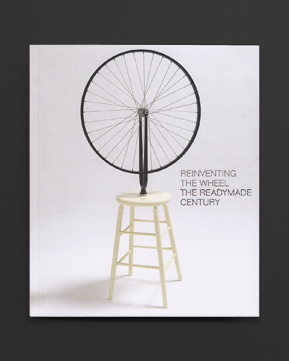
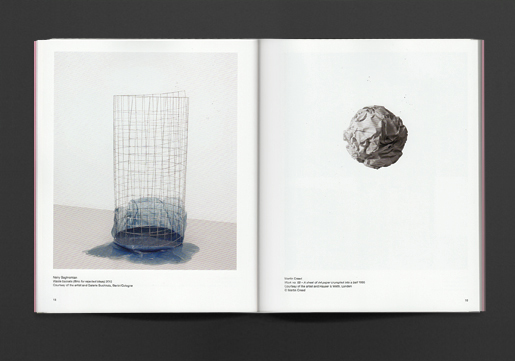
Publication to accompany the exhibition "Reinventing The Wheel: The Readymade Century", 3 October – 14 December 2013, Monash University Museum of Art, Victoria, Australia.
Arguably the most influential development in art of the twentieth century, the use of the readymade was set in motion 100 years ago with Marcel Duchamp’s Bicycle Wheel. Giving birth to an entire artistic language, Duchamp’s conversion of an unadorned, everyday object into a figure of high art completely inverted how people considered artistic practice. Suddenly, art was capable of being everywhere and in everything. It was a revolutionary moment in modern art, and the ripples from this epochal shift still resonate today.
Reinventing the Wheel: the Readymade Century pays tribute to this seminal work and traces the subsequent elaboration of neo-dada practices, with a particular focus upon everyday and vernacular contexts; the mysterious and libidinous potential of sculptural objects; institutional critique and nominal modes of artistic value; pop, minimalism and industrial manufacture. These discursive contexts will also provide a foundation to explore more recent tendencies related to unmonumental and social sculpture, post-fordism and other concerns, particularly among contemporary Australian artists.
Bringing together works by over 50 artists – from Duchamp and Man Ray to Andy Warhol and Martin Creed, along with some of Australia’s leading practitioners – this is a one-of-a-kind salute to an idea that continues to define the very nature of contemporary art.
Artists:
Carl Andre, Hany Armanious, Nairy Baghramian, Ian Burn, John Cage, Christo & Jeanne-Claude, Tony Cragg, Michael Craig-Martin, Martin Creed, Aleks Danko, Julian Dashper, Simon Denny, Marcel Duchamp, Sylvie Fleury, Ceal Floyer, Claire Fontaine, Gilbert & George, Félix González-Torres, Agatha Gothe-Snape, Greatest Hits, Matthew Griffin, Richard Hamilton, David Hammons, Matt Hinkley, Lou Hubbard, Barry Humphries, Jeff Koons, Joseph Kosuth, Louise Lawler, Klara Lidén, Andrew Liversidge, James Lynch, Robert MacPherson, Rob McKenzie, Callum Morton, John Nixon, Meret Oppenheim, Joshua Petherick, Kain Picken, Rosslynd Piggott, Man Ray, Scott Redford, Stuart Ringholt, Peter Saville, Charlie Sofo, Haim Steinbach, Ricky Swallow, Masato Takasaka, Peter Tyndall, Alex Vivian, Danh Vo, Andy Warhol, and Heimo Zobernig.
Curatorial team:
Max Delany (former MUMA director), Charlotte Day, Francis E. Parker, and Patrice Sharkey.With texts by Rex Butler, Charlotte Day, Francis Parker, Patrice Sharkey, and a never before published text by Thierry de Duve.
2013, English
Softcover, 104 pages, 17 x 20 cm
Published by
MUMA / Victoria
$20.00 - In stock -
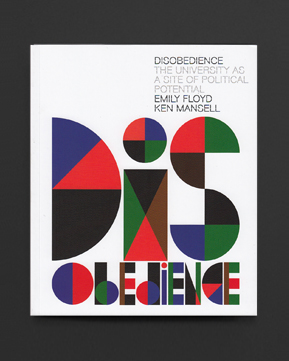
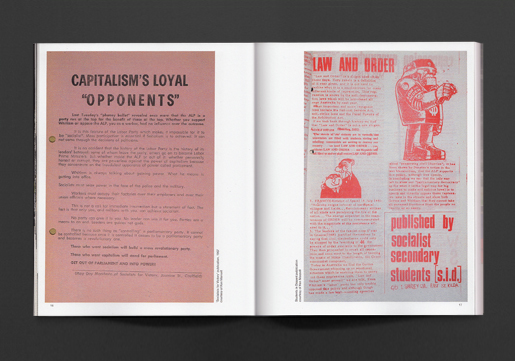
This major new publication, "Disobedience: The University as a Site of Political Potential", on the work of Australian artist Emily Floyd, has been produced on the occasion of her public sculpture commission at Monash University, "This Place Will Always Be Open" (4 October 2012 - April 2013, Ian Potter Sculpture Court, Caulfield campus).
As the inaugural annual sculpture commission in the Ian Potter Sculpture Court, "Emily Floyd: This Place Will Always Be Open" explores the role and legacy of the university campus – and museum – as a site of political potential. Drawing its title and conceptual framework from the experimental student struggles at Monash University during the 1960s and ’70s, and incorporating a series of activities, events, debates, workshops and publications, Floyd’s work serves as a space for social encounter – reinvoking a utopian spirit that is open, inclusive, free, provisional and generative.
Publication Texts: Charlotte Day, Foreword; Ken Mansell, 'The yeast is red: A history of the bakery, off-campus centre of the Monash Labor Club 1968-1971'
2010, English
Softcover, 176 pages, 15 x 21 cm
1st Edition, Out of print title / As New,
Published by
Artspace / Sydney
Te Tuhi Centre for the Arts / Auckland
$18.00 - Out of stock
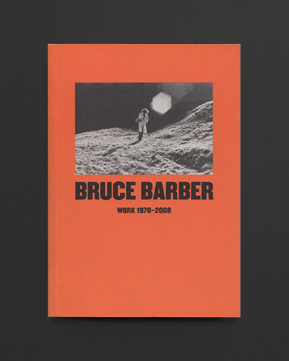
Bruce Barber: Work 1970 - 2008
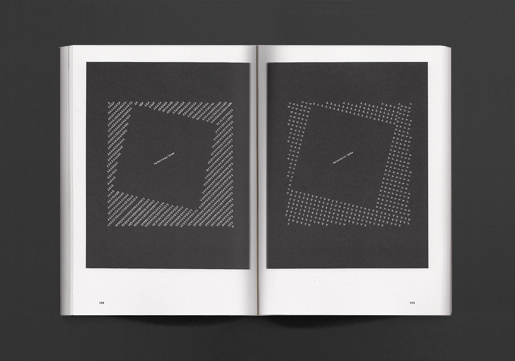
Developing out of major survey exhibitions at Artspace Visual Arts Centre (Australia) and Te Tuhi Centre for the Arts (New Zealand), this book surveys almost four decades of work by Canada-based artist Bruce Barber. Ranging across performance, installation, film, video and photography, Barber's practice has long been consistently situational and propositional, resulting in works that engage and question social and political regimes of power. Edited by Stephen Cleland and Blair French, this book features extensive documentation of Barber's work between 1970 and 2008 along with contributions by Bruce Barber, Christina Barton, Brad Buckley, Emma Bugden, Mark A. Cheetham, Alex Gawronski, Marc James Léger and Laura Preston.
2013, English
Softcover, 456 pages (115 color and 30 b/w ills.),15.5 x 22 cm
Published by
Sternberg Press / Berlin
$40.00 - In stock -
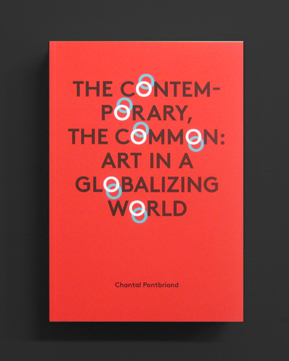
The essays in this collection were written in the first decade of the new millennium by the critic, editor, and curator Chantal Pontbriand. Pontbriand examines themes of being-in-common in today’s world and their relation to the development of art practices. As these practices are implemented, other ways of seeing, understanding, and making appear. Contemporaneity functions as a flow, a space-time being that cannot be fixated. The body is in the forefront—a thermometer of the world lived in and with, marked by dynamics of change and sharing.
The work of Claire Fontaine, Douglas Gordon and Philippe Parreno, Ion Grigorescu, Carsten Höller, Mike Kelley, Sigalit Landau, Rabih Mroué, Yvonne Rainer, Rirkrit Tiravanija, and Jeff Wall, among other artists, is examined in this book, together with Pontbriand’s insights into the seminal issues stirring the field of contemporary art.
Design by Agnès Dahan
2013, English
Softcover, 260 pages (17 b/w ills.), 13.5 x 20.4 cm
Published by
Sternberg Press / Berlin
$29.00 - Out of stock
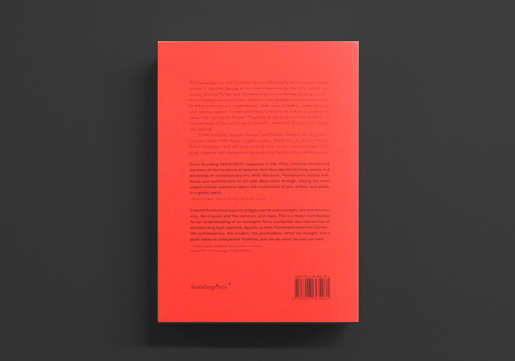
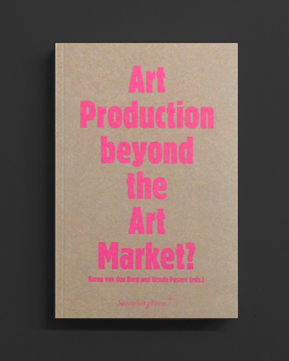
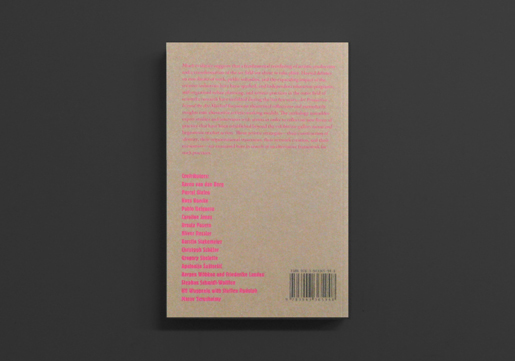
Edited by Karen van den Berg, Ursula Pasero
Texts by Karen van den Berg, Pascal Gielen, Ursula Pasero, John Roberts, Stephan Schmidt-Wulffen, Kerstin Stakemeier, Hergen Wöbken and Friederike Landau, Ulf Wuggenig and Steffen Rudolph, Merav Yerushalmy; interviews with Hans Haacke, Pablo Helguera, Caroline Jones, Oliver Ressler, Christoph Schäfer, Gregory Sholette, Apolonija Šušteršič
Much evidence suggests that a fundamental reordering of artistic production and a transformation of the art field are about to take place. Heated debates have been sparked over new forms of work, public subsidies, and the expanding impact of the creative industries. Independent education programs, self-organized urban planning, artistic practices in the outer field of scientific research, and similar initiatives have unfolded over the last few years. This publication addresses this wide field, focusing on theoretical reflections and exemplary insights into alternative artistic working models. The anthology assembles expert studies and artists’ interviews, in order to reflect on new forms of practices that have been established beyond the exhibition-gallery nexus and hegemonic market activity. These strategies in particular are investigated concerning their selfimages, organizational structures, networks, and economies—and the potential for usurpation.
Design by Leaky Studio
2013, English/German
Softcover, 328 pages, 17 x 24 cm
Published by
Sternberg Press / Berlin
$38.00 - Out of stock
Edited by Brigitte Oetker and Nicolaus Schafhausen
Interviews with Saâdane Afif, Thomas Bayrle, Michael Beutler, Monica Bonvicini, Mike Bouchet, Ulla von Brandenburg, Angela Bulloch, Andrea Büttner, Keren Cytter, Simon Denny, Thea Djordjadze, Ólafur Elíasson, Harun Farocki, Dani Gal, Katharina Grosse, Eberhard Havekost, Florian Hecker, Christian Jankowski, Susanne Kriemann, Antje Majewski, Olaf Metzel, Carsten Nicolai, Olaf Nicolai, Marcel Odenbach, Silke Otto-Knapp, Willem de Rooij, Cornelia Schleime, Michael Stevenson, Hito Steyerl, Haegue Yang, Tobias Zielony
The 60th Jahresring takes the form of a compilation of artist interviews and offers a snapshot of a highly active art scene that stretches from Berlin, as a new international center for art. Nicolaus Schafhausen put a series of questions to thirty-one art practitioners, less geared toward the artists’ respective praxis and more toward the conditions under which it arises.
Art’s presence in the field of new media has never been more pronounced; access to media images and Internet-based possibilities for research have significantly altered contemporary art production. The art market too has changed, gaining influence in the field of contemporary art as even art institutions take a different approach today than they did twenty years ago.
The focus in these interviews is on the respective self-positioning by the artists in an era shaped by such far-reaching changes. What emerges are temporally fixed positions within an activity that is, for the most large part, associated with precarious working conditions and the logistics of the market more than ever before. This book offers insight into this “other” dimension of an artist’s existence and registers attention economy as a central component of contemporary art production.
Design by Tobias Donat
2010, English
Softcover, 132 pp. (b&w ill.), 21.7 x 16.5 cm.
Published by
Overduin and Kite / Los Angeles
$20.00 - Out of stock
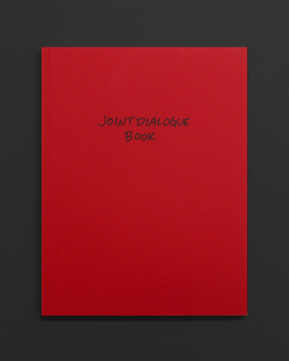
Catalogue produced on the occasion of "Joint Dialogue - Lozano/Graham/Kaltenbach" curated by Sarah Lehrer-Graiwer at Overduin and Kite, Los Angeles, January 31st-March 13th, 2010.
“Joint Dialogue” investigates the intersecting material histories of Lozano, Graham and Kaltenbach at the end of the 1960s in New York. It’s about close personal relationships between artists and the way ideas are traded down forking paths of influence to become variously manifest, suppressed, and rerouted in art. It’s about three related but divergent models of how being an artist dictates an extreme experience of consciousness, one in which the self is constantly lost and refound, or, as Lozano put it, a total revolution simultaneously personal and public. It’s about a transformative time in these artists’ overlapping practices that is reflective of the explosive historical period of rapid experimentation in conceptual art. It’s about real stakes- and the profundity of humor. It’s about trying to process the still astounding after-effects of Lozano’s absent body through the presence of Graham’s and Kaltenbach’s.
Motivated by Lozano’s Dialogue Piece (1969), in which stoned socializing and conversations about ideas were prioritized over art making, the structure of “Joint Dialogue” is split into two dialogues linked by Lozano, the joint. In one room, the juxtaposition of eight related and contemporaneous works establishes a conversation about drugs, sex, and money between Graham and Lozano, who were intimate friends during the time these works were made. A dialogue between Lozano and Kaltenbach, another close friend, takes place in a second room where several related works from the late 60s are joined by two never before seen time capsules by Kaltenbach and two previously unknown pieces by Lozano, remembered here by Kaltenbach.
“Joint Dialogue” is an ongoing project of personal investigation and investment for the curator who privately documents the many discoveries made throughout. The project continues to feed back great quantities of info.
Lee Lozano, Dan Graham and Stephen Kaltenbach lived and worked near each other in New York City during the late 1960s. Kaltenbach left for California in 1970. Lozano dropped out of the scene around 1972. Graham continues to live and work in New York.
Sarah Lehrer-Graiwer is a writer and curator who lives and works in Los Angeles. She is the publisher of the journal Pep-Talk.
Catalogue features texts by Sarah Lehrer-Graiwer, Dan Graham, and Stephen Kaltenbach.
2013, English / Italian
Softcover (newspaper), 37 x 26 cm
Published by
Mousse / Milan
$18.00 - Out of stock
TALKING ABOUT - Museum of Malware by John Menick
LAURA POITRAS - Primary Documents by Lauren Cornell
TALKING ABOUT - The Resistance to Symbols by Jennifer Allen
TALKING ABOUT - Outside In by Chris Wiley
TALKING ABOUT - Outside Art. After Venice by Dieter Roelstraete
MATT WOLF - Dreaming Documentary by Stuart Comer
TALKING ABOUT - Excuse My Dust by Jennifer Bornstein
TALKING ABOUT - Thinking Contemporary Exhibitions by Terry Smith and Jens Hoffmann
RACHEL ROSE - A State of Constant Becoming by Laura McLean-Ferris
ADRIANO COSTA - Materials Love to Find Me... by Gigiotto Del Vecchio
GAVIN KENYON - Sculptural Bondage by Cecilia Alemani
TALKING ABOUT - After Effects: Art and Technology, Then and Now by João Ribas
LUCIEN SMITH - History Repeating by Chelsea Haines
PARIS - MATI DIOP - Provoking Colours by Filipa Ramos
LOS ANGELES - SCOLI ACOSTA - Percussive Paintings and Quixotic Cadences: The Travels and Travails of Scoli Acosta by Andrew Berardini
LONDON - RICHARD SIDES - Social Spaces by Pavel S. Pys´
NEW YORK - JOSH KLINE - New Objects of Common Pictures by Christopher Y. Lew
ARIANA REINES - ABRACADABRA by Stuart Shave
VANESSA PLACE - The Frictionless Witness or Us, Keeping Us Real by Quinn Latimer
TALKING ABOUT - Artists and Workers by Julian Myers-Szupinska
TALKING ABOUT - May Your Children Turn Their Faces from You by Doug Ashford
and much more...
2013, English
Softcover, 148 pages, 15.5 x 24 cm
Published by
Mousse Publishing / Milan
$35.00 - Out of stock
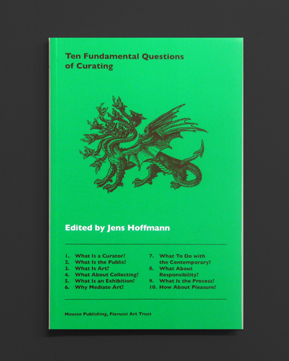
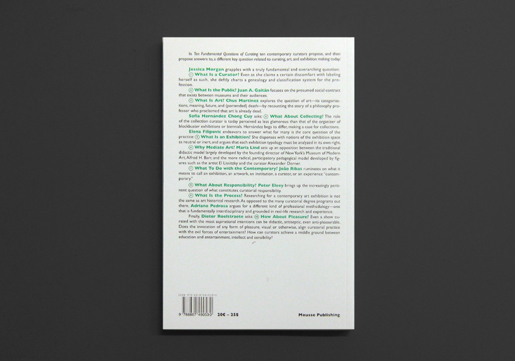
In Ten Fundamental Questions of Curating ten distinguished contemporary curators—Jessica Morgan, Juan A. Gaitán, Chus Martínez, Sofía Hernández Chong Cuy, Elena Filipovic, Maria Lind, João Ribas, Peter Eleey, Adriano Pedrosa and Dieter Roelstraete—pose and then propose answers to a series of key questions related to curating, art and exhibition making today: What Is a Curator? What Is the Public? What Is Art? What About Collecting? What Is an Exhibition? Why Mediate Art? What To Do with the Contemporary? What About Responsibility? What Is the Process? How About Pleasure?
The book, which began as a series of ten commissioned essays for Mousse magazine written over a period of two years, in 2011 to 2012, contains a text by Jens Hoffmann—Deputy Director and Head of Exhibitions and Public Programs of the Jewish Museum in New York and editor of the publication—and Milovan Farronato, Director of the Fiorucci Art Trust.
Ten Fundamental Questions of Curating is a project published by Mousse in collaboration with the Fiorucci Art Trust.
2013, English
Softcover, 148 pages + booklet, 17 x 24.5 cm
Published by
Fillip / Vancouver
$20.00 $5.00 - In stock -
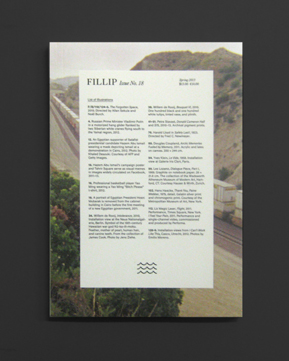
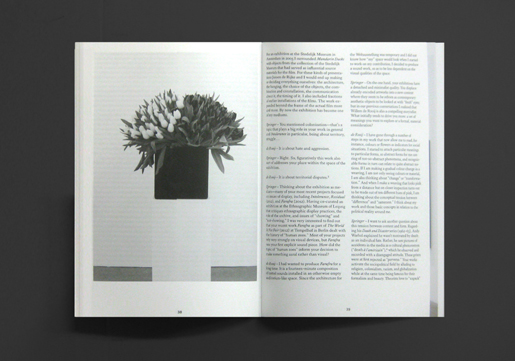
Fillip 18, Spring 2013
features: Martha Langford, Sven Lütticken, Hassan Khan, Chris Sharp, Bassam El Baroni, Matthew Buckingham, David Harvey, and Petra Stavast.
Also includes a booklet of images from Charlotte Cheetham's Slide Shows: A Landscape of Contemporary Independent & Art Publishing.
2012, English
Softcover, 220 x 293 mm
Published by
Kaleidoscope Press / Milan
$18.00 - Out of stock
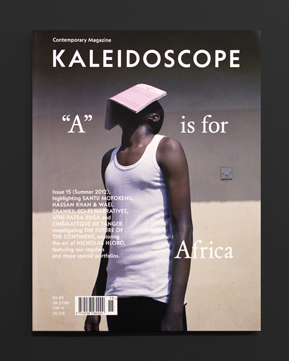
"A" is for Africa
HIGHLIGHTS Santu Mofokeng by Philippe Pirotte; Hassan Khan and Wael Shawky by Shahira Issa; Sci-Fi Narratives by Nav Haq and Al Cameron; Athi-Patra Ruga by Linda Stupart; Cinémathèque de Tanger by Omar Berrada.
MAIN THEME – The Future of The Continent, Continent of the Future. Part A) Art by Nana Oforiatta-Ayim; Part B) Cinema by Olufemi Terry and Frances Bodomo; Part C) Music by Benjamin Lebrave; Part D) Urban Planning by Antoni Folkers.
MONO – Nicholas Hlobo Interview by Sean O’Toole; Essay by Tracy Murinik; Focus by Liese van der Watt.
REGULARS Futura: Lynette Yiadom-Boakye by Hans Ulrich Obrist; Panorama: From Nigeria to Ethiopia by Emmanuel Iduma; On Exhibitions: “African Negro Art” by Paola Nicolin; Souvenir d’Italie: Massimo Grimaldi by Luca Cerizza; Producers: Elvira Dyangani Ose by Carson Chan.
KALEIDOSCOPE is an international quarterly of contemporary art and culture. Distributed worldwide on a seasonal basis, it offers a timely guide to the present (but also to the past and possible futures) with an interdisciplinary and unconventional approach.
2013, English / German
Softcover, 23 x 30 cm
Published by
Frieze / London
$22.00 - Out of stock
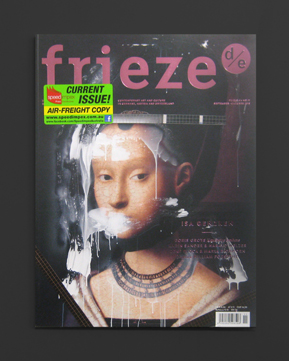
Frieze d/e #11 features:
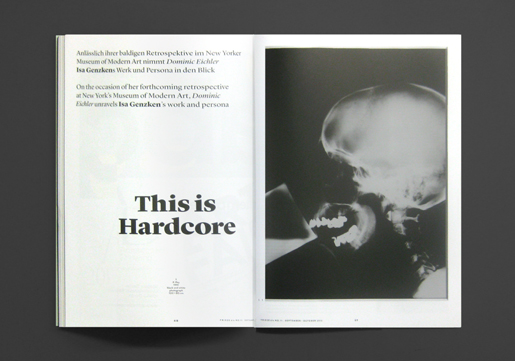
This is Hardcore: On the occasion of her forthcoming retrospective at New York’s Museum of Modern Art, Dominic Eichler unravels Isa Genzken’s work and persona by Dominic Eichler
Kandinsky's Bauhaus: While teaching at the Bauhaus, Wassily Kandinsky deepened his theory of art as a visual rhetoric conveying specific emotions – ideas that would later influence the design of prison cells in Spain by Boris Groys
Variations on a Theme: Gallerist, collector, curator and director René Block talks to artist Maria Eichhorn about ambition in art, the unexplored diversity of Fluxus and the importance of music in a career spanning 50 years by Maria Eichhorn
Still Moving: In her collages, photographs, artist books and paintings, Özlem Altin explores the body at rest and the inanimate in action by Sara Stern
Roman Schramm: The show of showing by Kolja Reichert
Natalie Czech: Filling in the Blanks by Christy Lange
Kaspar Müller: Picture a hat... by Aoife Rosenmeyer
plus:
Why have art collaborations become so annoying? by Jan Kedves
Helga Wretman’s Fitness for Artists TV revives the surprisingly long history of art and exercise by Jörg Scheller
The quasi-documentaries of Viennese filmmakers Tizza Covi and Rainer Frimmel by Bert Rebhandl
Artist Tobias Madison presents his selection of favourite publications by Tobias Madison
Ulf Poschardt’s love letter to the Porsche 911 by Thomas Hübener
Biennale di Venezia by Kirsty Bell
Biennale di Venezia by Dominikus Müller
Door Between Either And Or - Part 1 - Kunstverein München by Pablo Larios
Some End of Things - Museum für Gegenwartskunst by Laura McLean-Ferris
Her Story(s) - Bonner Kunstverein by Elvia Wilk
Henri Chopin, Guy de Cointet & Channa Horwitz - Kunsthalle Düsseldorf by Noemi Smolik
Shows On Show - How are historic exhibitions re-exhibited? by Jörg Heiser
Urs Fischer, Sanya Kantarovsky, Ursula Mayer, Keichii Tanaami, and much more.....