World Food Books' programme is largely produced on Kulin Nation land. We acknowledge the Wurundjeri people of the Kulin Nation as the first and continuing custodians of this land, and pay respect to their Elders past, present, and emerging.
World Food Books is an arts and special interests bookshop in Naarm / Melbourne. Founded in 2010, World Food Books is devoted to the presentation of a rotating, hand-selection of international art, design, literary and counterculture publications with an emphasis on the anti-traditional, the experimental, the avant-garde, the heretic, the marginal.
Presenting new titles alongside rare and out-of-print books, catalogues and journals spanning the fields of modern and contemporary art, design, photography, illustration, film, literature, poetry, cultural theory, philosophy, sexuality, popular and underground culture in its many radical forms, World Food Books wishes to encourage adventurous, thoughtful and open-minded reading, looking, writing, and exchange of publishing and ideas, both current and historical.
As well as our bookshop, located in Melbourne's historical Nicholas Building, all of our inventory is available internationally via our online mail-order service.
World Food Books semi-regularly co-ordinates "Occasions", a programme of exhibits and events at the bookshop and in partnership with other hosts (such as museums and art galleries) that develop out of the activities, relationships and content of the bookshop itself.
World Food Books
The Nicholas Building
37 Swanston Street
Room 5, Level 6
Melbourne 3000
Australia
SHOP HOURS:
Thu–Fri 12–6, Sat 12–5
WEB-SHOP OPEN 24/7
World Food Books
Postal Address:
PO Box 435
Flinders Lane
Victoria 8009
Australia
Art
Theory / Essay
Architecture / Interior
Graphic Design / Typography
Photography
Fashion
Eros
LGBTQ+
Fiction / Poetry
Weird / Speculative / Science Fiction / Horror
Transgressive / Visceral / Abject
Symbolism / Decadence / Fin de siècle
Film / Video
Painting
Sculpture / Installation
Performance / Dance / Theater
Drawing
Sound / Music
Curatorial
Group Shows / Collections
Periodicals
Out-of-print / Rare
Posters / Ephemera / Discs
Signed Books
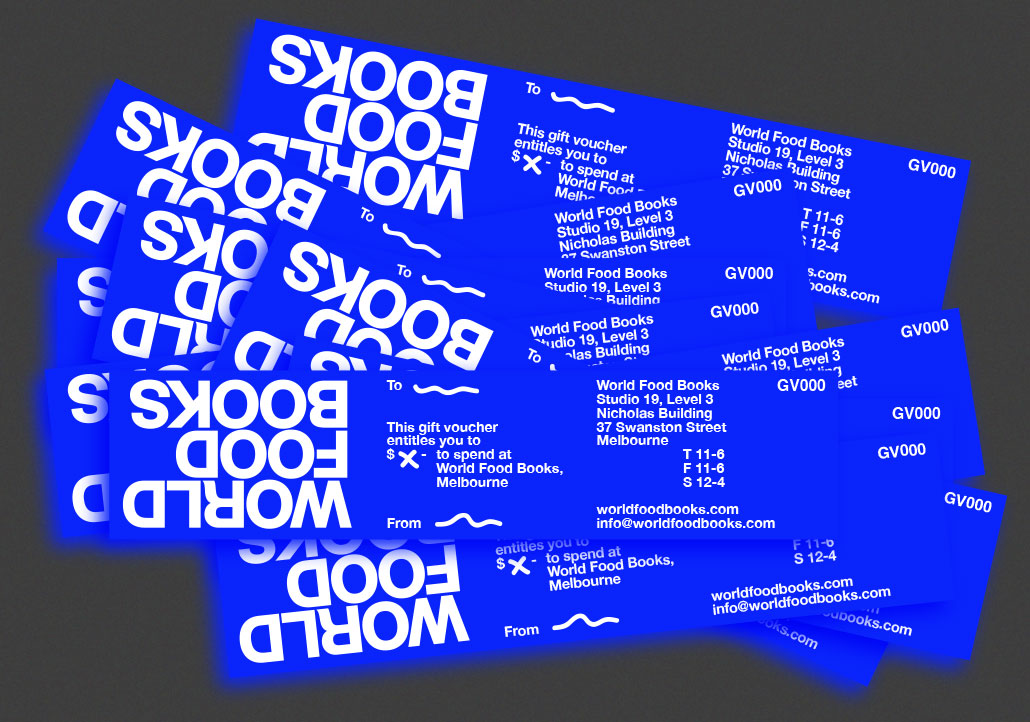
World Food Books Gift Voucher
World Food Book Bag
Australian Art
Australian Fiction
Australian Science Fiction / Speculative Fiction
Australian Poetry
Australian Photography
Japanese Photography
Conceptual Art
Minimal Art
Dada
'Pataphysics / Oulipo
Fluxus
Concrete Poetry
Pop Art
Surrealism
Arte Povera
Arte Informale / Haute Pâte / Tachism
Nouveau Réalisme / Zero / Kinetic
Situationism / Lettrism
Collage / Mail Art / Xerox Art
Art Brut / Folk / Visionary / Fantastic
Illustration / Graphic Art / Bandes Dessinées
Furniture
Italian Radical Design / Postmodernism
Textiles
Ceramics / Glass
Counterculture
Protest / Revolt
Philosophy
Psychoanalysis
Anthropology
Anarchism
Socialism / Anarchism / Communism / Capitalism
Literary Theory / Semiotics / Language
Feminism / Women's Studies
Gender Studies / Sexuality
Anthropology
Fetishism / BDSM
Drugs / Psychedelia
Crime / Violence
Animal Rights / Veganism
Occult / Esoterica
Ecology / Earth / Alternative Living
Whole Earth / Crafts
All prices in AUD (Australian dollars)
Pick-Ups
Pick-up orders can be collected in our bookshop during opening hours after order date. Please collect any Pick-up orders within 2 weeks of ordering as we have limited storage space. Orders will be released back into stock if not collected within this time. No refunds can be made for pick-ups left un-collected. If you cannot make it in to the bookshop in this time-frame, please choose postage option.
Return Policy
All sales are final. We do accept returns (for refund or exchange) for items received in error. All our orders are packed with special care using heavy-duty padding and cardboard book-mailers or bubble mailers (for smaller books), using reinforcement where required. We cannot take responsibility for any lost, stolen or damaged parcels.
Insurance
Should you wish to insure your package, please email us directly after placing your order and we can organise this at a small extra expense. Although all standard/express tracked packages are very safe and dependable, we cannot take responsibility for any lost, stolen or damaged parcels. We recommend insurance on valuable orders.
Interested in selling your old books, catalogues, journals, magazines, comics, fanzines, ephemera? We are always looking for interesting, unusual and out-of-print books to buy. We only buy books in our fields of interest and specialty, and that we feel we can resell.
We base these prices on desirability, market value, in-print prices, condition and our current stock levels. We offer cash, store credit, and can take stock on consignment. All
about 25% of the price we expect to get when we sell them, or 30% in store credit. We base these prices on desirability, market value, in-print prices, condition and our current stock levels.
Sell your books any day of the week. You can drop them off and return later. If you have a lot of books, we can visit your Sydney home.
We buy books that we feel we can resell. We offer about 25 % of the price we expect to get when we sell them, or 30% in store credit. We base these prices on desirability, market value, in-print prices, condition and our current stock levels.
Philadelphia Wireman
03 August - 01 September, 2018
World Food Books is proud to announce our next Occasion, the first presentation of sculptures by Philadelphia Wireman in Australia.
The Philadelphia Wireman sculptures were found abandoned in an alley off Philadelphia’s South Street on trash night in 1982. Their discovery in a rapidly-changing neighbourhood undergoing extensive renovation, compounded with the failure of all attempts to locate the artist, suggests that the works may have been discarded after the maker’s death. Dubbed the "Philadelphia Wireman" during the first exhibition of this work, in 1985, the maker’s name, age, ethnicity, and even gender remain uncertain. The entire collection totals approximately 1200 pieces, all intricately bound together with tightly-wound heavy-gauge wire (along with a few small, abstract marker drawings, reminiscent both of Mark Tobey and J.B. Murry). The dense construction of the work, despite a modest range of scale and materials, is singularly obsessive and disciplined in design: a wire armature or exoskeleton firmly binds a bricolage of found objects including plastic, glass, food packaging, umbrella parts, tape, rubber, batteries, pens, leather, reflectors, nuts and bolts, nails, foil, coins, toys, watches, eyeglasses, tools, and jewellery.
Heavy with associations—anthropomorphic, zoomorphic, and socio-cultural responses to wrapped detritus—the totemic sculptures by Philadelphia Wireman have been discussed in the context of work created to fulfil the shamanistic needs of alternative religions in American culture. Curators, collectors, and critics have variously compared certain pieces to sculpture from Classical antiquity, Native American medicine bundles, African-American memory jugs, and African fetish objects. Reflecting the artist’s prolific and incredibly focused scavenging impulse, and despite—or perhaps enhanced by—their anonymity, these enigmatic objects function as urban artefacts and arbiters of power, though their origin and purpose is unknown. Philadelphia Wireman, whatever their identity, possessed an astonishing ability to isolate and communicate the concepts of power and energy through the selection and transformation of ordinary materials. Over the course of the past two decades, this collection has come to be regarded as an important discovery in the field of self-taught art and vernacular art.
Presented in collaboration with Fleisher-Ollman Gallery, Philadelphia, and Robert Heald, Wellington.
Susan Te Kahurangi King
02 February - 10 March, 2018
Susan Te Kahurangi King (24 February 1951 - ) has been a confident and prolific artist since she was a young child, drawing with readily available materials - pencils, ballpoint pens and felt-tip markers, on whatever paper is at hand. Between the ages of four and six Susan slowly ceased verbal communication. Her grandparents William and Myrtle Murphy had developed a special bond with Susan so they took on caring responsibilities for extended periods. Myrtle began informally archiving her work, carefully collecting and storing the drawings and compiling scrapbooks. No drawing was insignificant; every scrap of paper was kept. The King family are now the custodians of a vast collection containing over 7000 individual works, from tiny scraps of paper through to 5 meter long rolls.
The scrapbooks and diaries reveal Myrtle to be a woman of great patience and compassion, seeking to understand a child who was not always behaving as expected. She encouraged Susan to be observant, to explore her environment and absorb all the sights and sounds. Myrtle would show Susan’s drawings to friends and people in her community that she had dealings with, such as shopkeepers and postal workers, but this was not simply a case of a grandmother’s bias. She recognised that Susan had developed a sophisticated and unique visual language and sincerely believed that her art deserved serious attention.
This was an unorthodox attitude for the time. To provide some context, Jean Dubuffet coined the term Art Brut in 1945 to describe work created by self-taught artists – specifically residents of psychiatric institutions and those he considered to be visionaries or eccentrics. In 1972 Roger Cardinal extended this concept by adopting the term Outsider Art to describe work made by non-academically trained artists operating outside of mainstream art networks through choice or circumstance. Susan was born in Te Aroha, New Zealand in 1951, far from the artistic hubs of Paris and London that Dubuffet and Cardinal operated in. That Myrtle fêted Susan as a self-taught artist who deserved to be taken seriously shows how progressive her attitudes were.
Susan’s parents Doug and Dawn were also progressive. Over the years they had consulted numerous health practitioners about Susan’s condition, as the medical establishment could not provide an explanation as to why she had lapsed into silence. Dawn educated herself in the field of homeopathy and went on to treat all twelve of her children using these principles – basing prescriptions on her observations of their physical, mental and emotional state.
Doug was a linguist with an interest in philosophy who devoted what little spare time he had to studying Maori language and culture. To some extent their willingness to explore the fringes of the mainstream made them outsiders too but it was their commitment to living with integrity and their respect for individuality that ensured Susan’s creativity was always encouraged.
Even though Susan’s family supported her artistic pursuits, some staff in schools and hospitals saw it as an impediment to her assimilation into the community and discouraged it in a variety of ways. Her family was not always aware of this and therefore did not fully understand why Susan stopped drawing in the early 1990s. However, rather than dwell on the challenges that Susan faced in pursuit of her artistic practice, they prefer to highlight her achievements. In 2008 Susan began drawing again in earnest, after an almost 20 year interruption, and her work is now shown in galleries around the world.
Susan grew up without television and has been heavily influenced by the comics she read as a child. She is absolutely fearless in the appropriation of recognizable characters, such as Donald Duck and Mickey Mouse, in her work. She twists their limbs, contorts their faces, compresses them together, blends them into complex patterned backgrounds - always imbuing them with an incredible energy. Although Susan often used pop culture characters in her work they are not naive or childlike. These are drawings by a brilliant self-taught artist who has been creating exceptional work for decades without an audience in mind.
Mladen Stilinović
"Various Works 1986 - 1999"
02 February 16 - September 10, 2016
Various works 1986 - 1999, from two houses, from the collections of John Nixon, Sue Cramer, Kerrie Poliness, Peter Haffenden and Phoebe Haffenden.
Including: Geometry of Cakes (various shelves), 1993; Poor People’s Law (black and white plate), 1993; White Absence (glasses, ruler, set square, silver spoon, silver ladel with skin photograph and wooden cubes), 1990-1996; Exploitation of the Dead (grey and red star painting, wooden painting, black spoon with red table, red plate), 1984-1990; Money and Zeros (zero tie, paintings made for friends in Australia (Sue, John, Kerrie), numbers painting), 1991-1992; Words - Slogans (various t-shirts) - “they talk about the death of art...help! someone is trying to kill me”, “my sweet little lamb”, “work is a disease - Karl Marx”; Various artist books, catalogues, monographs, videos; Poster from exhibition Insulting Anarchy; "Circular" Croatian - Australian edition; Artist book by Vlado Martek (Dostoyevsky); more.
Thanks to Mladen Stilinović and Branka Stipančić.
Jonathan Walker
Always Will Need To Wear Winter Shirt Blue + Ochre Small Check Pattern
21 August - 21 September, 2015
Untitled
I am not a great reader of poetry but I always return to the work of Melbourne poet, Vincent Buckley (1925- 1988). Perhaps I find his most tantalising piece to be not a finished poem but a fragment left on a scrap of paper discovered on his desk after the poet’s death.
The poetry gathers like oil
In the word-core, and spreads
It has its music meet,
Its music is in movement.
This fragment is more the shell left behind from a volatile thought than a finished poem. I find the last two lines honest but awkward whereas the first two lines work like an arrow. Most likely he could not find a resolution so it was left. Still, in its present form, it remains an eloquent testimony to the ultimate failure of a medium to express mobile thought and sensation, in Buckley’s case, through verbal language. It’s an important matter because this is something all artists have to deal with regardless of the medium.
I have never written a poem, however, I am forever copying fragments from books on paper scraps in a vain effort to fix certain notions in my head. At first, they function as bookmarks that are sometimes returned to when I open the book. But before long, as they accumulate, they fall out littering the table interspersed with A4 photocopies, bills, books and medications.
To return to Buckley’s fragment, the first two lines very much evoke how I paint nowadays. As you age, detail diminishes and patches of light become more luminous and float. I feel the most honest way of dealing with this is by smearing the oil paint on the canvas with the fingers and working close-up, blind. Only if the patches coalesce into an approaching image can the work gain a life.
-
Jonathan Walker was born in Melbourne, Australia and brought up on a dairy farm in Gippsland. In the 1970’s he studied painting at RMIT and won the Harold Wright Scholarship to the British Museum, London. During the 1980’s he exhibited at Pinacotheca Gallery, Richmond and had work shown at the NGV and Heidi City Art Gallery. Over the same period he designed the cover for the “Epigenesi” LP by Giancarlo Toniutti, Italy and conducted a mail exchange work with Achim Wollscheid, Germany. The work with artists through the post resulted in an article published in the bicentenary issue of Art and Australia 1988. He showed in artist run spaces such as WestSpace in the 90’s and 2000’s, and until 2012, taught painting at Victoria University, which is where we (Colleen Ahern and Lisa Radford) as organisers of the exhibition, among many others, had the privilege of being his student.
Walker’s knowledge was imparted to students through the careful selection of music, literature, and artists found in books that he himself had ordered for the library. Walker’s strategy was the generosity of sharing his vast knowledge with references specific to each student and their context.
Walker’s paintings share a similar focus and intimacy.
This exhibition presents a small selection of recent paintings alongside a publication that includes Walker’s writing. Observational and analytical, Walker’s work is a type of material notation — the time of day, colour and how it is blended, the both specific and fleeting location of a reflection on lino or the question of whether a chair leg should be included in a painting.
Please join us on Friday August 21 between 6-8pm to celebrate the opening of the exhibition.
Curated by Colleen Ahern and Lisa Radford.
B. Wurtz
Curated by Nic Tammens
March 26 - April 4, 2015
B.Wurtz works from a basement studio in his home on Manhattan’s Lower East Side.
This local fact is attested to by the plastic shopping bags and newsprint circulars that appear in his work. As formal objects, they don’t make loud claims about their origins but nonetheless transmit street addresses and places of business from the bottom of this long thin island. Like plenty of artists, Wurtz is affected by what is local and what is consumed. His work is underpinned by this ethic. It often speaks from a neighborhood or reads like the contents of a hamper:
“BLACK PLUMS $1.29 lb.”
“Food Bazaar”
“USDA Whole Pork Shoulder Picnic 99c lb.”
“RITE AID Pharmacy, with us it’s personal.”
“H. Brickman & Sons.”
“Sweet Yams 59c lb."
Most of the work in this exhibition was made while the artist was in residence at Dieu Donne, a workshop dedicated to paper craft in Midtown. Here Wurtz fabricated assemblages with paper and objects that are relatively lightweight, with the intention that they would be easily transportable to Australia. This consideration isn’t absolute in Wurtz’s work, but was prescriptive for making the current exhibition light and cheap. Packed in two boxes, these works were sent from a USPS post office on the Lower East Side and delivered to North Melbourne by Australia Post.
Wurtz appears courtesy of Metro Pictures, New York.
Thanks to Rob Halverson, Joshua Petherick, Sari de Mallory, Matt Hinkley, Helen Johnson, Fayen d'Evie, Ask Kilmartin, Lisa Radon, Ellena Savage, Yale Union, and "Elizabeth".
John Nixon
"Archive"
December 15 - January 20, 2014
The presentation of John Nixon's archive offered a rare showcase of this extensive collection of the artist's own publications, catalogues, posters, ephemera, editions and more, from the mid 1980s onwards, alongside a selection of his artworks.
Organized by John Nixon, Joshua Petherick and Matt Hinkley.
<a href=http://wfb.public-office.info/artist/john-nixon>All titles by John Nixon
"Habitat"
at Minerva, Sydney (organised by Joshua Petherick and Matt Hinkley)
November 15 - December 20, 2014
Lupo Borgonovo, Janet Burchill & Jennifer McCamley,
Lewis Fidock, HR Giger, Piero Gilardi, Veit Laurent Kurz,
Cinzia Ruggeri, Michael E. Smith, Lucie Stahl, Daniel Weil, Wols
Press Release:
“...It contained seven objects. The slender fluted bone, surely formed for flight, surely from the wing of some large bird. Three archaic circuitboards, faced with mazes of gold. A smooth white sphere of baked clay. An age-blackened fragment of lace. A fingerlength segment of what she assumed was bone from a human wrist, grayish white, inset smoothly with the silicon shaft of a small instrument that must once have ridden flush with the surface of the skin - but the thing’s face was seared and blackened.”
William Gibson, “Count Zero”, 1986
"Autumn Projects Archive"
Curated by Liza Vasiliou
March 6 - March 15, 2014
World Food Books, in conjunction with the Virgin Australia Melbourne Fashion Festival 2014, presented the Autumn Projects archive, consisting of a selection of early examples in Australian fashion with a particular interest in collecting designers and labels from the period beginning in the 1980’s, who significantly influenced the discourse of Australian Fashion.
Curated by Liza Vasiliou, the exhibition provided a unique opportunity to view pieces by designers Anthea Crawford, Barbara Vandenberg, Geoff Liddell and labels CR Australia, Covers, Jag along with early experimental collage pieces by Prue Acton and Sally Browne’s ‘Fragments’ collection, suspended throughout the functioning World Food Books shop in Melbourne.
H.B. Peace
presented by CENTRE FOR STYLE
November 14, 2013
"Hey Blinky, you say chic, I say same"
Anon 2013
H.B. Peace is a clothing collaboration between great friends Blake Barns and Hugh Egan Westland. Their pieces explore the divergences between 'character’ and ‘personality’ in garments....etc
Special Thanks to Joshua Petherick and Matt Hinkley of WFB and Gillian Mears
and a Very Special Thank you to Audrey Thomas Hayes for her shoe collaboration.
Janet Burchill & Jennifer McCamley
"Aesthetic Suicide"
May 10 - June 8, 2013
The first of our occasional exhibitions in the World Food Books office/shop space in Melbourne, "Aesthetic Suicide" presented a body of new and older works together by artists Janet Burchill & Jennifer McCamley, including videos, prints, a wall work, and publications.
During shop open hours videos played every hour, on the hour.
$.00 - Out of stock
The eternal clean out! New items weekly.
https://worldfoodbooks.com/category/sale
Published by World Food Books / Melbourne
$20.00 - In stock -
A World Food Books gift voucher is redeemable in our Melbourne bookshop or via our webshop (here). An e-voucher (printable pdf) will be sent to your purchase email address (please notify us if you wish to have the voucher sent to an alternate address and wish us to fill in the receiver's details on the card).
Gift vouchers can be purchased in increments of $20 (Australian Dollars) and the total amount can simply be added to by increasing the quantity in your shopping cart. eg. A quantity of 5 gift vouchers will result in an item total of $100 - a $100 gift voucher. Simply click "ADD TO CART" 5 times, or update your quantity in the shopping cart.
If you wish to purchase multiple, separate gift vouchers in one go, please just email us and we can personally prepare and email you a payment request.
Please note: Please select Pick-Up on gift voucher purchse to avoid any postage charges. Accidental postage charges will be refunded right away!
Thank you.
For any questions, please don't hesitate to email: [email protected]
1971, French
Softcover (w. glassine obi-strip), 96 pages, 23 x 18 cm
1st Edition, Out of print title / used / very good
Published by
L'Arc / Marseille
$55.00 - In stock -
Special 1971 volume of French literary/arts journal L'Arc devoted entirely to the work of French philosopher and author Georges Bataille (1897—1962) whose influential works spanning philosophy, literature, sociology, anthropology, and history of art, which included essays, novels, and poetry, exploring such subjects as eroticism, mysticism, surrealism, and transgression. Featuring contributions by André Masson, Henri Ronse, Michel Leiris, Rodolphe Gasché, François Cuzin, Alexandre Kojève, François Perroux, Jean-Michel Rey, Jean Pfeiffer, Gilbert Lascault, Denis Hollier.
Very Good copy complete with publisher's original glassine obi-strip that prints the contributors in red.
1976, English
Softcover, 134 pages, 21.5 x 15 cm
1st Edition, Out of print title / used / very good
Published by
Semiotext(e) / Los Angeles
$190.00 - Out of stock
Rare copy of the Georges Bataille issue of the original Semiotext(e) journal, published and edited by Sylvère Lotringer between 1974—1985, with later book-length issues appearing in the 1990s. Devoted entirely to the work of French philosopher and author Georges Bataille (1897—1962) whose influential works spanning philosophy, literature, sociology, anthropology, and history of art, which included essays, novels, and poetry, exploring such subjects as eroticism, mysticism, surrealism, and transgression. Edited by Lotringer and John Rajchman, featuring texts by Bataille, Jacques Derrida, Denis Hollier, Ann Smock and Phyllis Zuckerman, Charles Larmore, Peter B. Kussel, Lee Hildreth...
Founded in 1974, Semiotext(e) began as a journal that emerged from a semiotics reading group led by Sylvère Lotringer at the Columbia University philosophy department. Initially, the magazine was devoted to readings of thinkers like Nietzsche and Saussure. In 1978, Lotringer and his collaborators published a special issue, Schizo-Culture, in the wake of a conference of the same name he had organized two years before at Columbia University. The magazine brought together artists and thinkers such as Gilles Deleuze, Kathy Acker, John Cage, Michel Foucault, Jack Smith, Martine Barrat and Lee Breuer. Schizo-Culture brought out connections between high theory and underground culture that had not yet been made, and forged the "high/low" aesthetic that remains central to the Semiotext(e) project.
Very Good copy with light tanning/wear to raw stocks.
1992, English
Softcover, 200 pages, 22 x 14 cm
1st UK Edition, Out of print title / used / fine
Published by
The MIT Press / Massachusetts
October Books / New York
$45.00 - In stock -
"Hollier has not only written a series of interlocking essays which manage to roam representatively over and under the six thousand pages of Bataille, a polygraphic author of the most bewildering complexity, but he has taken the master's method to heart and has written not a book about Bataille
but a book through him: he has turned Bataille on and even against Bataille. The result is a superb, even a supreme critical work."—Richard Howard, Professor of Creative Writing, University of Houston
Over the past 30 years the writings of Georges Bataille have had a profound influence on French intellectual thought, informing the work of Foucault, Derrida, and Barthes, among others. Against Architecture offers the first serious interpretation of this challenging thinker, spelling out the profoundly original and radical nature of Bataille's work.
Denis Hollier is Professor of French at Yale University.
An OCTOBER Book.
Very Good—NF copy. First 1992 ed. 2nd print. Not a digital reprint.
2005, English / German
Softcover (w. folded poster dust-jacket), 192 pages, 22.5 x 27 cm
1st Edition, Out of print title / used / very good
Published by
Walther König / Köln
$320.00 - In stock -
Rare 2006 edition (w. original fold-out dust-jacket poster) of Rosemarie Trockel's Post Menopause catalogue (raisonné), published on the occasion of the major 2005—2006 exhibition Rosemarie Trockel: Menopause, at the Museum Ludwig, Köln, and MAXXI-Museo nazionale delle arti del XXI secolo, Rome.
This wonderful, major survey disappeared from print very fast, quickly becoming a valuable item in the mid-2000s. A catalogue raisonné of sorts, collecting Rosemarie Trockel's work from 1980—2005 (sculpture, wool works, drawings, publications, garments, photography, video — including many very rarely seen objects), Post Menopause remains one the best, most comprehensive, and Trockel-esque books produced on one of Germany's most important and influential conceptual artists. Not surprisingly, since Post Menopause was realised in close collaboration between Trockel herself with Museum Ludwig curator Barbara Engelbach, and designed by her regular design collaborator, and sometimes muse, the great graphic designer Yvonne Quirmbach. Extensive chronological cataloguing of all works, biography, bibliography, and bilingual (English and German) essays by Brigid Doherty, Silvia Eiblmayr, Barbara Engelbach, Kasper König, and Gregory Williams.
A highly recommended and invaluable resource on the artist.
Rosemarie Trockel (*1952) is widely regarded as one of the most important and influential conceptual artists in Germany. Her sculptures, collages, ceramics, knitted works, drawings and photographs are noted for their subtle social critique and range of subversive, aesthetic strategies—including the reinterpretation of “feminine” techniques, the ironic shifting of cultural codes, a delight in paradox, and a refusal to conform to the commercial and institutional ideologies of the art system.
VG/VG.
2006, English
Softcover, 336 pages, 26 x 21.5 cm
1st Edition, Out of print title / used / very good
Published by
Center for Curatorial Studies Bard College / New York
$280.00 - In stock -
First edition of this very special, now very rare catalogue published in 2006 on the occasion of the major survey exhibition Witness To Her Art, featuring the work of Adrian Piper, Mona Hatoum, Cady Noland, Jenny Holzer, Kara Walker, Daniela Rossell and the seminal magazine Eau de Cologne, published by gallerist Monika Sprüth between 1985 and 1989. Profusely illustrated throughout with artworks by all artists, reproductions of important artist publications, installation views, and many works by other related artists, alongside texts by Adrian Piper, Kara Walker, Daniela Rossell, Mona Hatoum, Cady Noland, Jenny Holzer, Monika Sprüth, Rhea Anastas, Michael Brenson, Norton Batkin, Johanna Burton, Aruna D’Souza, Pamela Franks, Janet Kraynak, David Levi Strauss, Cuauhtémoc Medina, Ann Reynolds, Hamza Walker, and many more.
Publisher's blurb:
"This radical new study aims to change the way that some of the most influential artists of the past 40 years are seen—all of them women. Emphasizing questions of autonomy, critical intelligence and artistic intention, "Witness to Her Art" presents works by Adrian Piper, Mona Hatoum, Cady Noland, Jenny Holzer, Kara Walker, Daniela Rossell and "Eau de Cologne," a magazine published by gallerist Monika Sprüth. The artworks are accompanied by original writings by the artists, contemporaneous criticism and newly commissioned essays by Pamela Franks, Aruna D'Souza, Johanna Burton, David Levi Strauss, Hamza Walker and Cuauhtémoc Medina. The ambitious works presented and interpreted herein invite us to consider the impact of the feminist revolution across generations while rendering obsolete any stigma associated with shows or catalogues limited to women artists. Taking its lead from Conceptualism, feminism, and from its included artists, "Witness to Her Art" reaches for art history's capacity as a medium of world-making."
Highly recommended. Very Good copy with light edge wear/rounding to stiff overlay boards.
1992, English
Softcover (french-folds), 144 pages, 28 x 22 cm
1st Edition, Out of print title / used / good
Published by
FAE Musee d'Art Contemporaine Pully / Lausanne
$160.00 - In stock -
First 1992 English edition of the legendary Post Human exhibition catalogue, published on the occasion of the touring exhibition curated by Jeffrey Deitch, June 1992—October 1993. Post Human brought together the work of leading young international artists confronting a new artificial “real” world; a new figuration. The participating artists examine the media’s obsession with the “virtual reality” of the body beautiful through works that reveal the neuroses that plague contemporary society. In Deitch's words, this lavishly designed catalogue "explores the implications of genetic engineering, plastic surgery, mind expansion, and other forms of body alteration, to ask whether our society is developing a new model of the human being. It poses the question of whether our society is creating a new kind of post-human person that replaces previous constructions of the self. Images from the new technological and consumer culture and the new, conceptually oriented figurative art of thirty-six young artists will endeavor to give us a glimpse of the coming post-human world."
Featuring the work of Dennis Adams, Janine Antoni, John M Armleder, Stephan Balkenhol, Matthew Barney, Ashley Bickerton, Taro Chiezo, Clegg & Guttmann, Wim Delvoye, Suzan Etkin, Fischli / Weiss, Slyvie Fleury, Robert Gober, Felix Gonzalez-Torres, Damien Hirst, Martin Honert, Mike Kelley, Karen Kilimnik, Martin Kippenberger, Jeff Koons, George Lappas, Annette Lemieux, Christian Marclay, Paul McCarthy, Yasumasa Morimura, Kodai Nakahara, Cady Noland, Daniel Oates, Pruitt & Early, Charles Ray, Thomas Ruff, Cindy Sherman, Kiki Smith, Pia Stadtbäumer, Meyer Vaisman, Jeff Wall.
"Post Human was virtually a manifesto trumpeting a new art for a new breed of human. As Deitch’s text explained in the fragmented mottos that punctuated the billboard-style graphics of Dan Friedman’s catalogue design, “It is becoming routine for people to try to alter their appearance, their behavior, and their consciousness beyond what was once thought possible.” And we go on to read, “With the embrace of artificiality, Realism as we used to know it may no longer be possible.” The glossy color plates spoke volumes, whether the illustrations came from art or from “life.” The catalogue was to become something of a cult item that triggered the imaginations of many younger artists. Here was a permanent anthology of the “posthumanity” that surrounds us not only in galleries but on television, in magazines, even in real life, where the friendly androids among us chatter on about Botox and face-lifts. In the catalogue pages, one could see, for instance, four photos of Jane Fonda in four completely different but equally synthetic guises; Pat Buchanan being made up by a cosmetician for a TV appearance; computer morphs of once- human faces; before-and-after bellies and buttocks; and dead center, a profile view of Michael Jackson, clearly the sun god of this new solar system, who would later be deified by Jeff Koons.
This pure plastic environment, whether peopled by Ivana Trump or Barbie, set the stage for the artists in the show, whose works played perfectly in this parallel universe that was quickly replacing that old-fashioned thing called Nature. The result was a complete reshuffling of the contemporary-art deck, with an international mix of thirty-six artists (singles and pairs) that embraced Thomas Ruff and Jeff Wall, Clegg & Gutmann and Pruitt/Early, Damien Hirst and Cindy Sherman, Matthew Barney and Yasumasa Morimura, Charles Ray and Martin Kippenberger. A new dynasty had installed itself, and this ruling class demanded fitting ancestry."—Robert Rosenblum, Artforum (October 2004)
"Looked at from the point of view of being difficult cultural issues to a broader public than usual, the project Post Human could not have come about at a better time. (…) Deitch’s central thesis—that the voluntary manipulation of the human body through surgery, cosmetics and exercise, combined with recent technologies allowing us to simulate the experience of reality, have produced a culture in which the body no longer serves as a cohesive, organic reference point—fits well in an age in which pop starts, politicians and even artists themselves seem to delight in changing their physical identities to suit their purposes. No longer the domain of privacy and difference, the body has become a public crossroads where the merging of real and artificial, organic and synthetic, and even good and evil, is taking place right before our very (ahem) eyes."—Dan Cameron, Frieze (September–October 1992)
Good—Very Good copy of the sought after English language edition (the catalogue was produced in five languages) some wear to extremities, light light knocking/creasing to boards and spine, but overall a handsome copy.
1994, English / German
Softcover, 72 pages, 15.5 x 24 cm
1st Edition, Out of print title / used / fine
Published by
Cantz Verlag / Berlin
$65.00 - Out of stock
Excellent, long out-of-print Rosemarie Trockel book, published in 1994 on the occasion of an exhibition at MAK Vienna. Designed by the artist herself, this publication focuses primarily on her video works of the nineties. Rosemarie Trockel began working with the medium of film in 1993, pursuing the line of development that had begun with her sculptures and objects. Her videos are concerned with people and animals, as in the slow-motion video entitled Out of the kitchen into the fire (1993), in which a female nude viewed from the rear lays an egg filled with black ink. Bizarre constellations and sequences reveal a certain irony in these works. Rosemarie Trockel's precise observations of natural processes, her use of materials, which she alters, reinterprets and places in unusual and surprising contexts, make her a very interesting contemporary artist. Rather than producing new "images" herself, she has the capacity to generate new images in the mind of the viewer.
As New copy.
1981, English
Softcover (staple-bound), 48 pages, 21 x 15 cm
1st Edition, Out of print title / used / very good
Published by
Goethe-Institut / Münich
$30.00 - In stock -
Rare English paperback documentary film programme, "From Weimar to Hitler", published by the
Goethe-Institut, Münich, in 1981. An illustrated essay on films that deal with the history of the late phase and crisis of the Weimar Republic and the rise of National Socialism electioneering and documentary films and Germany's tradition of agitprop film. Film stills throughout texts by editor Hans Mommsen, translated to English by Peter Green.
Very Good copy.
1973, English
Softcover, 188 pages, 19 x 12 cm
1st Edition, Out of print title / used / good
Published by
Ucrainca Research Institute / Toronto
$70.00 - In stock -
"We must remember that Fascism did not start with Babi Yar and does not end with it. Fascism begins with disrespect of the individual and ends with the destruction of the individual, with the destruction of peoples — but not necessarily with the same type of destruction as in Babi Yar ..."—Ivan Dzyuba, from a speech at Babi Yar
Rare first, only 1973 edition, published by the UCRAINCA Research Institute, Toronto. For This was I Born: The Human Conditions in USSR Slave Labor Camps collects the writings and pleas of inmates of Soviet concentration camps living under Russian slave labour, chilling photographs, testimonies, poems, readings, petitions, drawings, letters of appeal, hopes and promises as well as a section of photographs of imprisoned Ukrainian resistance leaders and other documents, compiled and edited by Yuri R. Shymko. Profusely illustrated in b/w.
"Let this publication be a flame of hope to these men, since the wall of indifference is beginning to crack and the dams of tyranny cannot hold any longer the growing forces of resistance and dissent.
Humanity must awaken to the distressed condition of these men before it is too late. Auschwitz, Treblinka and Dachau — symbols of human atrocities, have not been eliminated. They flourish today as never before in the USSR. Fascism and Nazism is not dead. It is still alive in the vast expanses of Eastern Europe and Siberia. It lives in the hearts, the minds and the laws of those who wear the diplomatic masks of hu-manity, yet safeguard a system that has been equalled only by Hitler."—from the introduction
Good copy with small patch of moisture damage to front top corner, light creasing and general wear to boards. No spine creasing. Good—VG interior throughout.
1967, English
Softcover, 282 pages, 18 x 11 cm
1st Edition, Out of print title / used / good
Published by
Penguin Books / London
$15.00 - In stock -
Yevgeny Zamyatin, who died in exile in Paris in 1937, is principally known as the writer who anticipated Huxley and Orwell with his nightmarish novel of totalitarian Utopia, We. Now these fifteen superb stories reveal his many-faceted genius, placing him with Isaac Babel and Bulgakov among the great Russian literary talents of the century.
Ribald, poetic and deceptively simple, each story in this book is a complex weaving of the loves, aspirations and tragedies of a people for whom the violence of change is incomprehensible. Comrade Churyagin has the Floor brilliantly encompasses the Revolution in an illiterate peasant's account of how 'the dawn of an entirely class-conscious day' came to his village. A Provincial Tale brings to life the brutal, primitive, yet lyrical Russia that was about to be submerged by history. The Flood, the tale of a woman's tempestuous rebellion against her infertility, has the beauty and symmetry of a tragic ballad.
The cover shows a detail of Moscow Inn' by
B. M. Kustodiev, in the State Tretyakov Gallery, Moscow (photo Novosti Press Agency, London)
For copyright reasons this edition is not for sale in the U.S.A. or Canada
1988, English
Softcover, 232 pages, 23 x 15 cm
1st Edition, Out of print title / used / very good
Published by
Review of Existential Psychology and Psychiatry / Seattle
$50.00 - In stock -
Rare first 1988 edition published by the Review of Existential Psychology and Psychiatry in Seattle.
Heidegger & Psychology contains an essay by the Swiss psychiatrist Medard Boss interpreting Heidegger's only recurring dream and revealing Heidegger's many trips to Zurich to teach Boss' psychiatry students. It also includes eight original essays by noted Heidegger scholars, as well as a bibliography on Heidegger and the Behavioral Sciences.
VG copy with some light wear/age.
1998, English
Softcover, 344 pages, 23 x 15 cm
1st Edition, Out of print title / used / fine
Published by
Stanford University Press / Palo Alto
$50.00 - In stock -
“Psychoanalysis may be said to have been born in the twentieth century,” Freud said late in his career, “but it did not drop from the skies ready-made.” And in his speculative theories of modernism, Bruno Latour argued that “no science can exit from the network of its practice.” Deploying Latour’s model of scientific theory production, this book argues that the historical emergence of psychoanalysis depended on nineteenth-century scientific practices: laboratory experimentation, medical transmission of research findings along collegial or social networks, and medical representation of illness—including case studies, amphitheatrical demonstration of cases, hospital records of symptoms, and laboratory graphology and photography of patients.
The author shows how hysteria enabled Freud to appropriate medical and scientific concepts from neurology, sexology, gynecology, psychiatry, and existing rest cures and psychotherapies. His new model eschewed physiological determinism, linking unconscious ideation with counterwill and reproduced memory, psychosexual experience, and affect-laden images of object relations (usually with family members).
Constructing around himself a psychoanalytic circle and establishing training institutions, Freud translated this new psycho-physical body and hybrid subjectivity to other research sites. Just as in the 1890’s he had used the figure of the hysteric to mobilize theory production, by the 1920’s he had replaced the hysteric with a modernized figure, the homosexual. Freud used autobiography, summary, and outline to stabilize his concepts and control the dissemination of his new science. Psychoanalysis had successfully created new scientific “plausible bridges” between psyche and soma, nature and the social, to produce a modern theory of hybrid subjectivity that was rooted in yet conceptually separated from the body.
Very Good copy.
1993, English
Softcover, 254 pages, 23.5 x 15.65 cm
1st Edition, Out of print title / used / very good
Published by
Indiana University Press / Indiana
$20.00 - In stock -
This book calls for a distinction between dangerous, elitist, hierarchizing myths such as Heidegger's and salutary, liberative, empowering myths that foster the humility of justice. A readable chronological consideration of Heidegger's texts that assesses his achievement as a thinker, while pointing to the sources of his political and ethical failure. Caputo addresses the religious significance of Heidegger's thought.
JOHN D. CAPUTO is David R. Cook Professor of Philosophy at Villanova University. His publications include Radical Hermeneutics: Repetition, Deconstruction, and the Hermeneutic Project and Heidegger and Aquinas: An Essay on Overcoming Metaphysics.
Very Good copy.
2025, English
Hardcover (clothbound), 176 pages, 24.2 x 31.8 cm
Published by
La Fábrica / Madrid
$110.00 - Out of stock
Goya’s The Disasters of War: A Timeless Cry Against Atrocity
Based on the original 1863 edition, this presentation of Goya’s 80 etchings decries the consequences of war through his bleak, gruesome and unflinching imagery.
Following his tenure as court painter for the Spanish royal family, Francisco de Goya’s art took on darker subjects and a more expressive style, especially during the Peninsular War (1808–14). Much can be gleaned from the fraught and visceral work of this period, including his series of etchings known as The Disasters of War.
Concerned about the state of the world as much as his own failing health, Goya spent 10 years on what he personally titled Fatal Consequences of Spain’s Bloody War with Bonaparte, and Other Emphatic Caprices. Starvation, sickness, looting, assault, torture, execution—each image confronts the shattered lives of everyday soldiers and civilians, accompanied by brief, ambiguous captions such as “Y no hay remedio” (“And there is no remedy”) and “Yo lo vi” (“This I saw”).
This clothbound book faithfully reproduces the first edition of the complete set of 80 works which was published in 1863, 35 years after Goya’s death. It features exquisite printing quality on paper that closely resembles the texture of the original engravings, in a similar format and scale. War is still a condition of human existence today; Goya’s etchings are timeless for their vehement denunciation of its atrocities committed by all combatants, regardless of their national affiliations.
Born in Fuendetodos, Spain, Francisco de Goya (1746–1828) trained in Zaragoza and later moved to Madrid. In 1789 he was appointed as a court painter by Charles IV. Considered “the last of the Old Masters and the first of the moderns,” his art blended elements of Romanticism with a deeply personal and often critical vision of society.
2026, English
Softcover, 92 pages, 19.8 x 12.9 cm
Published by
Silver Press / London
$27.00 - In stock -
Legendary author Ursula K. Le Guin was lauded by millions for her groundbreaking science fiction novels, but she began as a poet. In this clarifying and sublime collection – completed shortly before her death in 2018 – Le Guin is unflinching in the face of mortality, and full of wonder for the mysteries beyond. Redolent of the lush natural beauty of the Pacific Northwest, with rich sounds playfully echoing myth and nursery rhyme, Le Guin bookends a long, and prolific career.
Ursula K. Le Guin began writing poetry before writing across many genres for her whole life. This elegiac collection of poems, completed shortly before her death in 2018, reflects on the soul, mortality and the mysteries beyond. 'So Far So Good' walks between the knowable and the unknown with characteristic insight and courage.
2026, English
Softcover, 258 pages, 19 x 12 cm
Published by
Index Press / Melbourne
$40.00 - In stock -
Described as “the most important British philosopher” of our time, Nick Land is an enigmatic figure shrouded in controversy, rumour, and myth. Too heretical for the academic establishment, Land has had a meteoric impact on contemporary philosophy, politics, and culture. His striking insights and singular prose have left their mark on leading philosophers such as Mark Fisher and Ray Brassier, inspired artists like Kode9 and Jake and Dinos Chapman, and even shaped the mindset of Silicon Valley kingmakers like Marc Andreessen. His prophetic thought has helped give rise to major philosophical and cultural movements, from speculative realism and cyberfeminism to accelerationism and neoreaction.
Unknown Lands is the essential introduction to Land’s radical and often cryptic philosophy, providing a comprehensive decoding of his labyrinthine writings. The book takes us through his earliest inventive readings of Schopenhauer, Nietzsche, Freud, and Bataille, which he wields to critique the likes of Kant, Heidegger, and Derrida for repressing the brute fact of our mortality. It goes right up to his seminal remixing of Deleuze and Guattari, cybernetics, and cyberpunk in his account of capitalism’s race towards human extinction at the advent of the technological singularity.
Making sense of ideas that have long circulated in cult obscurity, Unknown Lands presents perhaps the most apocalyptically nihilistic and yet powerfully ecstatic vision of the world. It is unlikely to leave readers’ preconceptions—or sanity—fully intact.
“Few people can write about Nick Land in a way that doesn’t betray the principles of Land’s own thought. Vincent Lê is one of them. Unknown Lands refuses the sterility, distance, and moral condescension of academic writing on Land while maintaining a depth of philosophical engagement that is depressingly absent in the thriving industry of online commentaries.”—Amy Ireland, co-author of Cute Accelerationism and The Xenofeminist Manifesto
“A superbly lucid, philosophically grounded study that will be of value to both students and advanced researchers, presenting Nick Land as among the most rigorous and relentlessly corrosive thinkers of the posthuman. When other continental thinkers imagined they were challenging ‘humanism’ with their anthropotechnics and all-too-human cyborgs, Vincent Lê shows that Land was the one who first called it for the radically inhuman trajectory of our technological condition.”—David Roden, author of Posthuman Life, Xenoerotics, and Snuff Memories
“Vincent Lê has pulled off the almost impossible. He has produced an unheretical account of the most ‘heretical’ philosopher since Nietzsche. What he says here—and what you will read—is calm, measured, and assured. It tells us where the Nick Land of today came from. If anyone is going to judge Land and speak either for or against him, they need to read this book first.”—Rex Butler, author of Deleuze and Guattari’s “What is Philosophy?”: A Reader’s Guide, Slavoj Žižek: Live Theory, and Jean Baudrillard: The Defence of the Real
Design by Alexandra Margetic
1990, English
Softcover, 214 pages, 21 x 14 cm
1st Edition, Out of print title / used / very good
Published by
Indiana University Press / Indiana
$25.00 - In stock -
In Echoes John Sallis mobilizes the figure of echo, used by Heidegger to characterize originary thinking, as the motif around which to organize a radical reading of Heidegger's most important texts. Itself subject to the very displacements produced by those writings, Sallis's reading draws various strands of Heidegger's texts to the point where each engages its issue in the most radical way. This graceful essay focuses on the shifts and turns that come into play at these limits and that effectively transform the Heideggerian project. Among his themes are the determination of thinking at the end of philosophy; originary, ecstatic time as the meaning of Being; the sense of the sensible; the involvement of imagination in the question of fundamental ontology; death as radical alterity; the sacrifice of understanding in thinking the political; the reconstitution of mimesis in art; and the translation of ecstasy. By taking up the engagement of Heidegger's texts with these issues and drawing that engagement to its limit, Echoes undertakes to broach a thinking after Heidegger.
JOHN SALLIS is W. Alton Jones Professor of Philosophy at Vanderbilt University. His previous books include Phenomenology and the Return to Beginnings, Being and Logos, The Gathering of Rea-son, Delimitations, and Spacings. Sallis is founding editor of the journal Research in Phenomenology.
Good—Very Good copy with light wear, crease to back cover.
2012, English
Hardcover (w. dust jacket), 198 pages, 22.5 x15 cm
Published by
Indiana University Press / Indiana
$65.00 - In stock -
This volume consists of two lecture series given by Heidegger in the 1940s and 1950s. The lectures given in Bremen constitute the first public lectures Heidegger delivered after World War II, when he was officially banned from teaching. Here, Heidegger openly resumes thinking that deeply engaged him with Hölderlin's poetry and themes developed in his earlier works. In the Freiburg lectures Heidegger ponders thought itself and freely engages with the German idealists and Greek thinkers who had provoked him in the past. Andrew J. Mitchell's translation allows English-speaking readers to explore important connections with Heidegger's earlier works on language, logic, and reality.
2017, English
Paperback, 128 pages, 17 x 25 cm
Published by
Bergen Kunsthall / Norway
Dancing Fox Press
$65.00 - In stock -
This latest book by New York–based artist Moyra Davey is based on two related projects, Les Goddesses (2011) and Hemlock Forest (2016), which each take form through text, photography, and film. Layering introspection and personal narratives with meditations on the lives and works of other writers, filmmakers, and artists—ranging from 18th-century feminist writer and activist Mary Wollstonecraft to Chantal Akerman, Karl Ove Knausgård, and Davey’s own five sisters—the artist explores such themes as compulsion, artistic production, family, and life and its passing.
Edited by Karen Kelly and Barbara Schroeder.
Texts by Moyra Davey and an introduction by Aveek Sen.
Design by Filiep Tacq.
2026, English
Softcover, 189 pages. 19.6 x 13.1 cm
Published by
Peninsula Press / UK
$35.00 - In stock -
'The Waterfront Journals' is a road trip through the sensuous, perilous landscape of alternative America – a series of fictional monologues that ventriloquise the real people Wojnarowicz met on his travels while he was sleeping rough. We meet these hustlers, runaways and dreamers in unassuming locations – in truck stops, bus stations and parks. Their stories are disturbing, often shocking; but they're told with an honesty and a hallucinatory intensity that demands to be heard. Published for the first time in the UK, this electrifying collection confirms that David Wojnarowicz was not only one of millennial America’s most necessary and visionary artists, but also among its most humane and urgent literary chroniclers.
David Wojnarowicz was a writer, artist, AIDS activist and anticensorship advocate. He wrote five books, and his paintings are exhibited in MoMA and the Whitney Museum of American Art. He died from AIDS in 1992.
A visceral and carnivalesque mosaic of life at the fringes.A totally crucial book by one of the 20th century’s greatest artists and writers.' – Maggie Nelson
2025, English
Hardcover, 208 pages, 28 x 24 cm
Published by
Skira / Milan
$95.00 - In stock -
Edited by Antonio Sergio Bessa
One of David Wojnarowicz's few incursions into photography is a testimony of urban, social and political change in New York in the late 1970s.
In 1978 and 1979, David Wojnarowicz took a series of photographs of a man wearing a paper mask bearing the visage of Arthur Rimbaud, the French poet equally known for his fervid verse and dramatic life. Rimbaud was the instantiation, and perhaps the inventor, of the idea of the young gay hustler of genius.
Presenting a selection of photographs by Wojnarowicz, this amply illustrated volume features an introductory essay by Antonio Sergio Bessa contextualizing the series within a foundation of other works across literature, photography and performance. Nicholas Martin explores Wojnarowicz's practice in the context of the rise of the punk movement in downtown Manhattan in the late 1970s. Craig Dworkin explores Rimbaud's years as a runaway youth in Paris during the Commune, and his acquaintances with the city's bohemia. Marguerite Van Cook contributes an essay about her experiences with the London and New York music and art scenes throughout the 1970s and 1980s. Phillip Aarons offers a personal account of his engagement as a collector of Wojnarowicz's work. The book also features an interview with photographer Allen Frame, who produced several performances of Wojnarowicz's monologues in the early 1980s in New York's Lower East Side, Berlin and Brooklyn.
Painter, photographer, writer, filmmaker, performance artist, songwriter and activist David Wojnarowicz was born in Red Bank, New Jersey, in 1954 and died from AIDS-related illness in New York in 1992. He authored a few books, most famously Close to the Knives. Wojnarowicz attained national prominence as a writer and advocate for AIDS awareness and for his stance against censorship.
2024, English
Softcover, 72 pages, 17.27 x 10.92 cm
Published by
Wakefield Press / Cambridge
$29.00 - In stock -
Introduction by Jean-Luc Nancy
Translated by Stéphanie Boulard and Timothy Lavenz
In 1902, Hugo von Hofmannsthal’s “Lord Chandos Letter” articulated a deep crisis of faith in language; having “lost completely the ability to think or speak of anything coherently,” the titular character abandons literature in favor of silence. In The Answer to Lord Chandos, a text the author spent forty-one years meticulously crafting, Pascal Quignard passionately challenges this withdrawal and urges us not to forsake the power of poetry. By uniting us with the tremendous cry at nature’s birth, literature rejuvenates our connection to the universe and transcends the strictures of acquired speech. In this exhilarating exhortation, which meditates on Emily Brontë, Handel, Rembrandt, and the legend of Bluebeard, Quignard inspires us to resurrect the ecstatic eruption of nature through the written word.
In an introduction to this first English edition, French philosopher Jean-Luc Nancy illuminates the core question animating this debate, which has resonated within literature since its inception: Can poetry give access to the real? Quignard’s resounding answer offers a testament to the immense value of literary expression.
Pascal Quignard (b. 1948) is the French author of over sixty books of fiction, essays, and his own genre of fragmented philosophical reflection: an amalgamation of personal journal, historical narrative, and poetic theory. His books in English include The Hatred of Music, All the World’s Mornings, Sex and Terror, and The Sexual Night, as well as the multiple volumes of his ongoing book project The Last Kingdom, which to date includes The Roving Shadows, The Silent Crossing, Abysses, The Fount of Time, and Dying of Thinking.
Jean-Luc Nancy (1940–2021) was a French philosopher. The subject of a monograph by Jacques Derrida, his long career saw a wide range of books on various thinkers, art, film, and the ideas of community, justice, and freedom. Nearly all his major works have been translated into English, including The Inoperative Community, The Birth to Presence, The Experience of Freedom, The Gravity of Thought, and Being Singular Plural.