World Food Books' programme is largely produced on Kulin Nation land. We acknowledge the Wurundjeri people of the Kulin Nation as the first and continuing custodians of this land, and pay respect to their Elders past, present, and emerging.
World Food Books is an arts and special interests bookshop in Naarm / Melbourne. Founded in 2010, World Food Books is devoted to the presentation of a rotating, hand-selection of international art, design, literary and counterculture publications with an emphasis on the anti-traditional, the experimental, the avant-garde, the heretic, the marginal.
Presenting new titles alongside rare and out-of-print books, catalogues and journals spanning the fields of modern and contemporary art, design, photography, illustration, film, literature, poetry, cultural theory, philosophy, sexuality, popular and underground culture in its many radical forms, World Food Books wishes to encourage adventurous, thoughtful and open-minded reading, looking, writing, and exchange of publishing and ideas, both current and historical.
As well as our bookshop, located in Melbourne's historical Nicholas Building, all of our inventory is available internationally via our online mail-order service.
World Food Books semi-regularly co-ordinates "Occasions", a programme of exhibits and events at the bookshop and in partnership with other hosts (such as museums and art galleries) that develop out of the activities, relationships and content of the bookshop itself.
World Food Books
The Nicholas Building
37 Swanston Street
Room 5, Level 6
Melbourne 3000
Australia
SHOP HOURS:
Thu–Fri 12–6, Sat 12–5
WEB-SHOP OPEN 24/7
World Food Books
Postal Address:
PO Box 435
Flinders Lane
Victoria 8009
Australia
Art
Theory / Essay
Architecture / Interior
Graphic Design / Typography
Photography
Fashion
Eros
LGBTQ+
Fiction / Poetry
Weird / Speculative / Science Fiction / Horror
Transgressive / Visceral / Abject
Symbolism / Decadence / Fin de siècle
Film / Video
Painting
Sculpture / Installation
Performance / Dance / Theater
Drawing
Sound / Music
Curatorial
Group Shows / Collections
Periodicals
Out-of-print / Rare
Posters / Ephemera / Discs
Signed Books
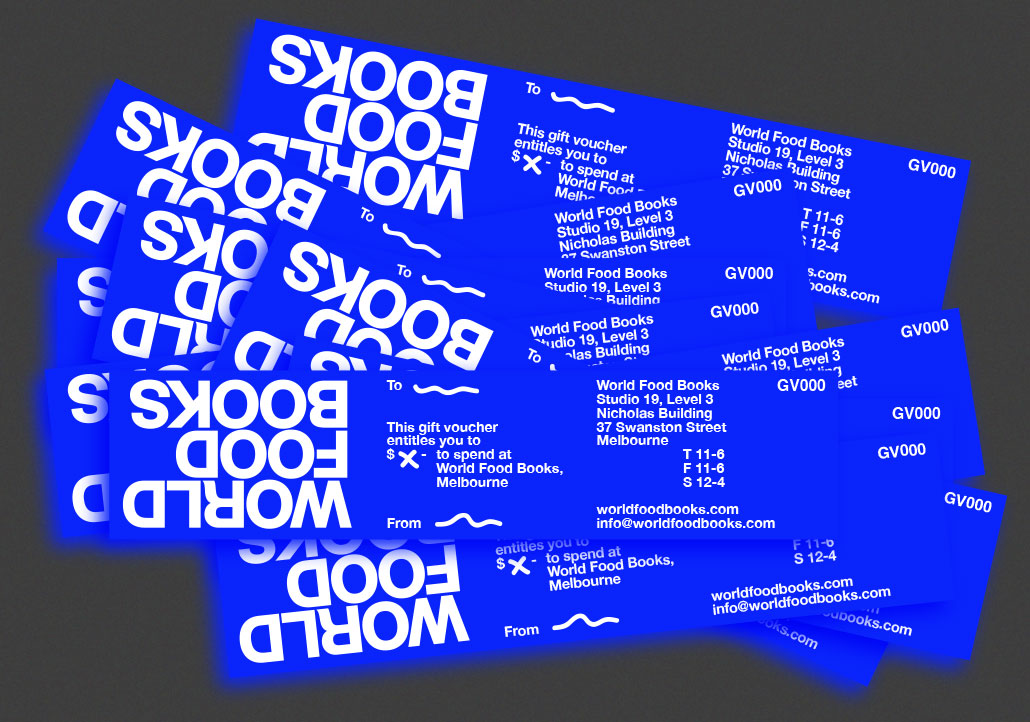
World Food Books Gift Voucher
World Food Book Bag
Australian Art
Australian Fiction
Australian Science Fiction / Speculative Fiction
Australian Poetry
Australian Photography
Japanese Photography
Conceptual Art
Minimal Art
Dada
'Pataphysics / Oulipo
Fluxus
Concrete Poetry
Pop Art
Surrealism
Arte Povera
Arte Informale / Haute Pâte / Tachism
Nouveau Réalisme / Zero / Kinetic
Situationism / Lettrism
Collage / Mail Art / Xerox Art
Art Brut / Folk / Visionary / Fantastic
Illustration / Graphic Art / Bandes Dessinées
Furniture
Italian Radical Design / Postmodernism
Textiles
Ceramics / Glass
Counterculture
Protest / Revolt
Philosophy
Psychoanalysis
Anthropology
Anarchism
Socialism / Anarchism / Communism / Capitalism
Literary Theory / Semiotics / Language
Feminism / Women's Studies
Gender Studies / Sexuality
Anthropology
Fetishism / BDSM
Drugs / Psychedelia
Crime / Violence
Animal Rights / Veganism
Occult / Esoterica
Ecology / Earth / Alternative Living
Whole Earth / Crafts
All prices in AUD (Australian dollars)
Pick-Ups
Pick-up orders can be collected in our bookshop during opening hours after order date. Please collect any Pick-up orders within 2 weeks of ordering as we have limited storage space. Orders will be released back into stock if not collected within this time. No refunds can be made for pick-ups left un-collected. If you cannot make it in to the bookshop in this time-frame, please choose postage option.
Return Policy
All sales are final. We do accept returns (for refund or exchange) for items received in error. All our orders are packed with special care using heavy-duty padding and cardboard book-mailers or bubble mailers (for smaller books), using reinforcement where required. We cannot take responsibility for any lost, stolen or damaged parcels.
Insurance
Should you wish to insure your package, please email us directly after placing your order and we can organise this at a small extra expense. Although all standard/express tracked packages are very safe and dependable, we cannot take responsibility for any lost, stolen or damaged parcels. We recommend insurance on valuable orders.
Interested in selling your old books, catalogues, journals, magazines, comics, fanzines, ephemera? We are always looking for interesting, unusual and out-of-print books to buy. We only buy books in our fields of interest and specialty, and that we feel we can resell.
We base these prices on desirability, market value, in-print prices, condition and our current stock levels. We offer cash, store credit, and can take stock on consignment. All
about 25% of the price we expect to get when we sell them, or 30% in store credit. We base these prices on desirability, market value, in-print prices, condition and our current stock levels.
Sell your books any day of the week. You can drop them off and return later. If you have a lot of books, we can visit your Sydney home.
We buy books that we feel we can resell. We offer about 25 % of the price we expect to get when we sell them, or 30% in store credit. We base these prices on desirability, market value, in-print prices, condition and our current stock levels.
Philadelphia Wireman
03 August - 01 September, 2018
World Food Books is proud to announce our next Occasion, the first presentation of sculptures by Philadelphia Wireman in Australia.
The Philadelphia Wireman sculptures were found abandoned in an alley off Philadelphia’s South Street on trash night in 1982. Their discovery in a rapidly-changing neighbourhood undergoing extensive renovation, compounded with the failure of all attempts to locate the artist, suggests that the works may have been discarded after the maker’s death. Dubbed the "Philadelphia Wireman" during the first exhibition of this work, in 1985, the maker’s name, age, ethnicity, and even gender remain uncertain. The entire collection totals approximately 1200 pieces, all intricately bound together with tightly-wound heavy-gauge wire (along with a few small, abstract marker drawings, reminiscent both of Mark Tobey and J.B. Murry). The dense construction of the work, despite a modest range of scale and materials, is singularly obsessive and disciplined in design: a wire armature or exoskeleton firmly binds a bricolage of found objects including plastic, glass, food packaging, umbrella parts, tape, rubber, batteries, pens, leather, reflectors, nuts and bolts, nails, foil, coins, toys, watches, eyeglasses, tools, and jewellery.
Heavy with associations—anthropomorphic, zoomorphic, and socio-cultural responses to wrapped detritus—the totemic sculptures by Philadelphia Wireman have been discussed in the context of work created to fulfil the shamanistic needs of alternative religions in American culture. Curators, collectors, and critics have variously compared certain pieces to sculpture from Classical antiquity, Native American medicine bundles, African-American memory jugs, and African fetish objects. Reflecting the artist’s prolific and incredibly focused scavenging impulse, and despite—or perhaps enhanced by—their anonymity, these enigmatic objects function as urban artefacts and arbiters of power, though their origin and purpose is unknown. Philadelphia Wireman, whatever their identity, possessed an astonishing ability to isolate and communicate the concepts of power and energy through the selection and transformation of ordinary materials. Over the course of the past two decades, this collection has come to be regarded as an important discovery in the field of self-taught art and vernacular art.
Presented in collaboration with Fleisher-Ollman Gallery, Philadelphia, and Robert Heald, Wellington.
Susan Te Kahurangi King
02 February - 10 March, 2018
Susan Te Kahurangi King (24 February 1951 - ) has been a confident and prolific artist since she was a young child, drawing with readily available materials - pencils, ballpoint pens and felt-tip markers, on whatever paper is at hand. Between the ages of four and six Susan slowly ceased verbal communication. Her grandparents William and Myrtle Murphy had developed a special bond with Susan so they took on caring responsibilities for extended periods. Myrtle began informally archiving her work, carefully collecting and storing the drawings and compiling scrapbooks. No drawing was insignificant; every scrap of paper was kept. The King family are now the custodians of a vast collection containing over 7000 individual works, from tiny scraps of paper through to 5 meter long rolls.
The scrapbooks and diaries reveal Myrtle to be a woman of great patience and compassion, seeking to understand a child who was not always behaving as expected. She encouraged Susan to be observant, to explore her environment and absorb all the sights and sounds. Myrtle would show Susan’s drawings to friends and people in her community that she had dealings with, such as shopkeepers and postal workers, but this was not simply a case of a grandmother’s bias. She recognised that Susan had developed a sophisticated and unique visual language and sincerely believed that her art deserved serious attention.
This was an unorthodox attitude for the time. To provide some context, Jean Dubuffet coined the term Art Brut in 1945 to describe work created by self-taught artists – specifically residents of psychiatric institutions and those he considered to be visionaries or eccentrics. In 1972 Roger Cardinal extended this concept by adopting the term Outsider Art to describe work made by non-academically trained artists operating outside of mainstream art networks through choice or circumstance. Susan was born in Te Aroha, New Zealand in 1951, far from the artistic hubs of Paris and London that Dubuffet and Cardinal operated in. That Myrtle fêted Susan as a self-taught artist who deserved to be taken seriously shows how progressive her attitudes were.
Susan’s parents Doug and Dawn were also progressive. Over the years they had consulted numerous health practitioners about Susan’s condition, as the medical establishment could not provide an explanation as to why she had lapsed into silence. Dawn educated herself in the field of homeopathy and went on to treat all twelve of her children using these principles – basing prescriptions on her observations of their physical, mental and emotional state.
Doug was a linguist with an interest in philosophy who devoted what little spare time he had to studying Maori language and culture. To some extent their willingness to explore the fringes of the mainstream made them outsiders too but it was their commitment to living with integrity and their respect for individuality that ensured Susan’s creativity was always encouraged.
Even though Susan’s family supported her artistic pursuits, some staff in schools and hospitals saw it as an impediment to her assimilation into the community and discouraged it in a variety of ways. Her family was not always aware of this and therefore did not fully understand why Susan stopped drawing in the early 1990s. However, rather than dwell on the challenges that Susan faced in pursuit of her artistic practice, they prefer to highlight her achievements. In 2008 Susan began drawing again in earnest, after an almost 20 year interruption, and her work is now shown in galleries around the world.
Susan grew up without television and has been heavily influenced by the comics she read as a child. She is absolutely fearless in the appropriation of recognizable characters, such as Donald Duck and Mickey Mouse, in her work. She twists their limbs, contorts their faces, compresses them together, blends them into complex patterned backgrounds - always imbuing them with an incredible energy. Although Susan often used pop culture characters in her work they are not naive or childlike. These are drawings by a brilliant self-taught artist who has been creating exceptional work for decades without an audience in mind.
Mladen Stilinović
"Various Works 1986 - 1999"
02 February 16 - September 10, 2016
Various works 1986 - 1999, from two houses, from the collections of John Nixon, Sue Cramer, Kerrie Poliness, Peter Haffenden and Phoebe Haffenden.
Including: Geometry of Cakes (various shelves), 1993; Poor People’s Law (black and white plate), 1993; White Absence (glasses, ruler, set square, silver spoon, silver ladel with skin photograph and wooden cubes), 1990-1996; Exploitation of the Dead (grey and red star painting, wooden painting, black spoon with red table, red plate), 1984-1990; Money and Zeros (zero tie, paintings made for friends in Australia (Sue, John, Kerrie), numbers painting), 1991-1992; Words - Slogans (various t-shirts) - “they talk about the death of art...help! someone is trying to kill me”, “my sweet little lamb”, “work is a disease - Karl Marx”; Various artist books, catalogues, monographs, videos; Poster from exhibition Insulting Anarchy; "Circular" Croatian - Australian edition; Artist book by Vlado Martek (Dostoyevsky); more.
Thanks to Mladen Stilinović and Branka Stipančić.
Jonathan Walker
Always Will Need To Wear Winter Shirt Blue + Ochre Small Check Pattern
21 August - 21 September, 2015
Untitled
I am not a great reader of poetry but I always return to the work of Melbourne poet, Vincent Buckley (1925- 1988). Perhaps I find his most tantalising piece to be not a finished poem but a fragment left on a scrap of paper discovered on his desk after the poet’s death.
The poetry gathers like oil
In the word-core, and spreads
It has its music meet,
Its music is in movement.
This fragment is more the shell left behind from a volatile thought than a finished poem. I find the last two lines honest but awkward whereas the first two lines work like an arrow. Most likely he could not find a resolution so it was left. Still, in its present form, it remains an eloquent testimony to the ultimate failure of a medium to express mobile thought and sensation, in Buckley’s case, through verbal language. It’s an important matter because this is something all artists have to deal with regardless of the medium.
I have never written a poem, however, I am forever copying fragments from books on paper scraps in a vain effort to fix certain notions in my head. At first, they function as bookmarks that are sometimes returned to when I open the book. But before long, as they accumulate, they fall out littering the table interspersed with A4 photocopies, bills, books and medications.
To return to Buckley’s fragment, the first two lines very much evoke how I paint nowadays. As you age, detail diminishes and patches of light become more luminous and float. I feel the most honest way of dealing with this is by smearing the oil paint on the canvas with the fingers and working close-up, blind. Only if the patches coalesce into an approaching image can the work gain a life.
-
Jonathan Walker was born in Melbourne, Australia and brought up on a dairy farm in Gippsland. In the 1970’s he studied painting at RMIT and won the Harold Wright Scholarship to the British Museum, London. During the 1980’s he exhibited at Pinacotheca Gallery, Richmond and had work shown at the NGV and Heidi City Art Gallery. Over the same period he designed the cover for the “Epigenesi” LP by Giancarlo Toniutti, Italy and conducted a mail exchange work with Achim Wollscheid, Germany. The work with artists through the post resulted in an article published in the bicentenary issue of Art and Australia 1988. He showed in artist run spaces such as WestSpace in the 90’s and 2000’s, and until 2012, taught painting at Victoria University, which is where we (Colleen Ahern and Lisa Radford) as organisers of the exhibition, among many others, had the privilege of being his student.
Walker’s knowledge was imparted to students through the careful selection of music, literature, and artists found in books that he himself had ordered for the library. Walker’s strategy was the generosity of sharing his vast knowledge with references specific to each student and their context.
Walker’s paintings share a similar focus and intimacy.
This exhibition presents a small selection of recent paintings alongside a publication that includes Walker’s writing. Observational and analytical, Walker’s work is a type of material notation — the time of day, colour and how it is blended, the both specific and fleeting location of a reflection on lino or the question of whether a chair leg should be included in a painting.
Please join us on Friday August 21 between 6-8pm to celebrate the opening of the exhibition.
Curated by Colleen Ahern and Lisa Radford.
B. Wurtz
Curated by Nic Tammens
March 26 - April 4, 2015
B.Wurtz works from a basement studio in his home on Manhattan’s Lower East Side.
This local fact is attested to by the plastic shopping bags and newsprint circulars that appear in his work. As formal objects, they don’t make loud claims about their origins but nonetheless transmit street addresses and places of business from the bottom of this long thin island. Like plenty of artists, Wurtz is affected by what is local and what is consumed. His work is underpinned by this ethic. It often speaks from a neighborhood or reads like the contents of a hamper:
“BLACK PLUMS $1.29 lb.”
“Food Bazaar”
“USDA Whole Pork Shoulder Picnic 99c lb.”
“RITE AID Pharmacy, with us it’s personal.”
“H. Brickman & Sons.”
“Sweet Yams 59c lb."
Most of the work in this exhibition was made while the artist was in residence at Dieu Donne, a workshop dedicated to paper craft in Midtown. Here Wurtz fabricated assemblages with paper and objects that are relatively lightweight, with the intention that they would be easily transportable to Australia. This consideration isn’t absolute in Wurtz’s work, but was prescriptive for making the current exhibition light and cheap. Packed in two boxes, these works were sent from a USPS post office on the Lower East Side and delivered to North Melbourne by Australia Post.
Wurtz appears courtesy of Metro Pictures, New York.
Thanks to Rob Halverson, Joshua Petherick, Sari de Mallory, Matt Hinkley, Helen Johnson, Fayen d'Evie, Ask Kilmartin, Lisa Radon, Ellena Savage, Yale Union, and "Elizabeth".
John Nixon
"Archive"
December 15 - January 20, 2014
The presentation of John Nixon's archive offered a rare showcase of this extensive collection of the artist's own publications, catalogues, posters, ephemera, editions and more, from the mid 1980s onwards, alongside a selection of his artworks.
Organized by John Nixon, Joshua Petherick and Matt Hinkley.
<a href=http://wfb.public-office.info/artist/john-nixon>All titles by John Nixon
"Habitat"
at Minerva, Sydney (organised by Joshua Petherick and Matt Hinkley)
November 15 - December 20, 2014
Lupo Borgonovo, Janet Burchill & Jennifer McCamley,
Lewis Fidock, HR Giger, Piero Gilardi, Veit Laurent Kurz,
Cinzia Ruggeri, Michael E. Smith, Lucie Stahl, Daniel Weil, Wols
Press Release:
“...It contained seven objects. The slender fluted bone, surely formed for flight, surely from the wing of some large bird. Three archaic circuitboards, faced with mazes of gold. A smooth white sphere of baked clay. An age-blackened fragment of lace. A fingerlength segment of what she assumed was bone from a human wrist, grayish white, inset smoothly with the silicon shaft of a small instrument that must once have ridden flush with the surface of the skin - but the thing’s face was seared and blackened.”
William Gibson, “Count Zero”, 1986
"Autumn Projects Archive"
Curated by Liza Vasiliou
March 6 - March 15, 2014
World Food Books, in conjunction with the Virgin Australia Melbourne Fashion Festival 2014, presented the Autumn Projects archive, consisting of a selection of early examples in Australian fashion with a particular interest in collecting designers and labels from the period beginning in the 1980’s, who significantly influenced the discourse of Australian Fashion.
Curated by Liza Vasiliou, the exhibition provided a unique opportunity to view pieces by designers Anthea Crawford, Barbara Vandenberg, Geoff Liddell and labels CR Australia, Covers, Jag along with early experimental collage pieces by Prue Acton and Sally Browne’s ‘Fragments’ collection, suspended throughout the functioning World Food Books shop in Melbourne.
H.B. Peace
presented by CENTRE FOR STYLE
November 14, 2013
"Hey Blinky, you say chic, I say same"
Anon 2013
H.B. Peace is a clothing collaboration between great friends Blake Barns and Hugh Egan Westland. Their pieces explore the divergences between 'character’ and ‘personality’ in garments....etc
Special Thanks to Joshua Petherick and Matt Hinkley of WFB and Gillian Mears
and a Very Special Thank you to Audrey Thomas Hayes for her shoe collaboration.
Janet Burchill & Jennifer McCamley
"Aesthetic Suicide"
May 10 - June 8, 2013
The first of our occasional exhibitions in the World Food Books office/shop space in Melbourne, "Aesthetic Suicide" presented a body of new and older works together by artists Janet Burchill & Jennifer McCamley, including videos, prints, a wall work, and publications.
During shop open hours videos played every hour, on the hour.
$.00 - Out of stock
The eternal clean out! New items weekly.
https://worldfoodbooks.com/category/sale
Published by World Food Books / Melbourne
$20.00 - In stock -
A World Food Books gift voucher is redeemable in our Melbourne bookshop or via our webshop (here). An e-voucher (printable pdf) will be sent to your purchase email address (please notify us if you wish to have the voucher sent to an alternate address and wish us to fill in the receiver's details on the card).
Gift vouchers can be purchased in increments of $20 (Australian Dollars) and the total amount can simply be added to by increasing the quantity in your shopping cart. eg. A quantity of 5 gift vouchers will result in an item total of $100 - a $100 gift voucher. Simply click "ADD TO CART" 5 times, or update your quantity in the shopping cart.
If you wish to purchase multiple, separate gift vouchers in one go, please just email us and we can personally prepare and email you a payment request.
Please note: Please select Pick-Up on gift voucher purchse to avoid any postage charges. Accidental postage charges will be refunded right away!
Thank you.
For any questions, please don't hesitate to email: [email protected]
2018, English / Japanese
Softcover (w. dust jacket in hard slipcase), unpaginated, 31 x 21.5 cm
1st Edition, Out of print title / used / very good
Published by
Tokyo Kirarasha / Tokyo
$500.00 - In stock -
Rare first 2018 slipcased edition of Japanese corpse photographer Tsurisaki Kiyotaka's THE DEAD.
Since 1994, Japanese photographer, film director, and writer Kiyotaka Tsurisaki has become known for prolifically photographing dead bodies. Countless shocking and gruesome images of the dead fill the pages of this book, which is certainly not for the faint of heart. Many of these people met with violent ends, whether by vehicle crash, homicide, or suicide. Tsurisaki also brings the viewer into morgues and forensics labs, where the macabre work of embalming and autopsy is unapologetically documented. He has travelled to Thailand, Colombia, Mexico, Russia, and Palestine, as well as other lawless or war-torn parts of the world, to photograph human corpses.
Texts in English and Japanese.
Explicit material!
Near Fine–Fine copy in Very Good slipcase with light wear, one corner knock to back that does no effect the book at all. Very well preserved.
1984, Japanese / English
Slipcase, corrugated envelope, 64 looseleaf plates, 29.7 x 21 cm
Stamped and numbered,
1st Edition, Out of print title / used / very good
Published by
B-Sellers / Japan
$350.00 - In stock -
Very rare first stunning printing of Scene of Death, a rare 1984 death photo collection, published by B-Sellers in Japan only, compiled by Noriaki Nakagawa, Hitomi Komukai, and Yoichi Shihata. An elaborate and beautiful print production of the macabre. Housed in an illustrated slipcase within a stamped, button-and-tie-bound corrugated envelope, 64 looseleaf monochrome photographic plates reproduce images from "Atlas der Gerichtsmedizin", an absolutely fascinating collection by Weiman / Prokop, first published in 1963. Atlas der Gerichtsmedizin was originally a serious German scientific reference book for criminal investigators and those in the medical field — a photo scrapbook of thousands of images of graphic human death scenes — suffocation and strangulation, drowning and death by water, death by burning and electrocution, crimes of passion, abuse and neglect, and more. In turn, this visual opus became a bible of reference imagery to a wave of musicians, artists and authors during the industrial avant-garde, from Throbbing Gristle to Paul Buck to Atrax Morgue. This meticulous and unique Japanese offering further influenced many Japanese artists in the 1980s—1990's. Later re-printed in 1994.
Stamped and numbed first printing.
"We believe the scenes of death is, in one sense, the most erotic of human nature. It is at the time of death that man no longer can attempt to control his inner self and therefore the real self appears vividly. Here we have opened the doors to a topic that is usually not only hidden but also shut out of the minds of man. Please share our excitement and take a glance into the world of hidden eroticism"—Scene of Death blurb.
VG—NF copy in VG—NF slipcase, all plates still wrapped in seldom preserved internal obi strip. Some wear/rusting to envelope buttons.
2025, English
Hardcover (w. dust jacket and obi), 184 pages, 30 x 23 cm
Published by
Apartamento / Barcelona
$140.00 - In stock -
Between 1999 and 2006, before fast fashion and social media changed the world forever, Kyoichi Tsuzuki published 87 instalments of his Happy Victims series in the fashion magazine Ryuko Tsushin. In cramped quarters across Tokyo, these anonymous disciples joyously detailed the ritual and the sacrifice of their brand-name obsessions. A Buddhist monk with a Comme des Garçons shopping habit, an Alexander McQueen collector listening to neighbours through paper-thin walls—photographed at home, their collections before them, Kyoichi’s anti-heroes exist in parallel to the fashion universe of fame, fantasy, and glamour. Happy Victims was first published in book form in 2008. Long out of print, this edition follows Apartamento’s reissue of Kyoichi’s earlier seminal work, Tokyo Style. The new hardcover design comes with an updated foreword by the author, Japanese photographer Kyoichi Tsuzuki, and an introduction by Isabella Burley of Climax Books.
While the cover and belly band have been completely reworked, in collaboration with designer Han Gao, the book’s interior maintains a simple, documental format: one happy victim per spread, Kyoichi’s photos supplemented by a short commentary on the individual and his or her daily schedule. Not typically members of the leisure class, the goths, Lolitas, and stringent Margiela fans must also go to work and find time to care for their clothes.
About Kyoichi Tsuzuki
A Tokyo native, Kyoichi Tsuzuki is an award-winning photographer and a former editor at such iconic publications as Popeye and Brutus. He received the 1996 Ihei Kimura Award for his first photography exhibition, Roadside Japan, and has since shown work at the White Cube Gallery, London, MUDAM Luxembourg, Galerie Da-End, and more. Kyoichi is also the author of Tokyo Style, a cult classic reissued by Apartamento in 2024.
About Isabella Burley
Isabella Burley founded Climax Books in London in 2020 as a home for rare editions, adding a New York outpost in 2024. At 17, she started on the shop floor of Dover Street Market with Comme des Garçons, then later served as editor-in-chief for Dazed & Confused from 2015 to 2021. Additional appointments include Helmut Lang and Acne Studios.
2018, English
Softcover, 320 pages, 21.5 x 28.5 cm
Published by
Koenig Books / London
$80.00 - In stock -
The legendary independent London bookstore Better Books on the Charing Cross Road was the hub for Allen Ginsberg, William S. Burroughs, Alexander Trocchi, John Latham, Jeff Nuttall, Bob Cobbing, Barry Miles, Gustav Metzger, and countless others, for their ideas and approaches to art, film, literature, and activism. With its unique range of books, offbeat events, poetry readings, film screenings, and happenings, Better Books became the hot spot of London’s 1960s counter-culture scene.
This book is the first to examine this special historic moment, combining previously unpublished texts, documents, and photographs with the voices of the protagonists who authored this revolution.
With Essays by Rozemin Keshvani and Barry Miles and contributions by Philip Cohen, Stephen Dwoskin, John Hopkins, Graham Keen, Bruce Lacey, Gustav Metzger, Jeff Nuttall, Frank Popper, Criton Tomazos, and Islwyn Watkins.
1992, English
Softcover (french-folds), 144 pages, 28 x 22 cm
1st Edition, Out of print title / used / very good
Published by
FAE Musee d'Art Contemporaine Pully / Lausanne
$160.00 - In stock -
First 1992 English edition of the legendary Post Human exhibition catalogue, published on the occasion of the touring exhibition curated by Jeffrey Deitch, June 1992—October 1993. Post Human brought together the work of leading young international artists confronting a new artificial “real” world; a new figuration. The participating artists examine the media’s obsession with the “virtual reality” of the body beautiful through works that reveal the neuroses that plague contemporary society. In Deitch's words, this lavishly designed catalogue "explores the implications of genetic engineering, plastic surgery, mind expansion, and other forms of body alteration, to ask whether our society is developing a new model of the human being. It poses the question of whether our society is creating a new kind of post-human person that replaces previous constructions of the self. Images from the new technological and consumer culture and the new, conceptually oriented figurative art of thirty-six young artists will endeavor to give us a glimpse of the coming post-human world."
Featuring the work of Dennis Adams, Janine Antoni, John M Armleder, Stephan Balkenhol, Matthew Barney, Ashley Bickerton, Taro Chiezo, Clegg & Guttmann, Wim Delvoye, Suzan Etkin, Fischli / Weiss, Slyvie Fleury, Robert Gober, Felix Gonzalez-Torres, Damien Hirst, Martin Honert, Mike Kelley, Karen Kilimnik, Martin Kippenberger, Jeff Koons, George Lappas, Annette Lemieux, Christian Marclay, Paul McCarthy, Yasumasa Morimura, Kodai Nakahara, Cady Noland, Daniel Oates, Pruitt & Early, Charles Ray, Thomas Ruff, Cindy Sherman, Kiki Smith, Pia Stadtbäumer, Meyer Vaisman, Jeff Wall.
"Post Human was virtually a manifesto trumpeting a new art for a new breed of human. As Deitch’s text explained in the fragmented mottos that punctuated the billboard-style graphics of Dan Friedman’s catalogue design, “It is becoming routine for people to try to alter their appearance, their behavior, and their consciousness beyond what was once thought possible.” And we go on to read, “With the embrace of artificiality, Realism as we used to know it may no longer be possible.” The glossy color plates spoke volumes, whether the illustrations came from art or from “life.” The catalogue was to become something of a cult item that triggered the imaginations of many younger artists. Here was a permanent anthology of the “posthumanity” that surrounds us not only in galleries but on television, in magazines, even in real life, where the friendly androids among us chatter on about Botox and face-lifts. In the catalogue pages, one could see, for instance, four photos of Jane Fonda in four completely different but equally synthetic guises; Pat Buchanan being made up by a cosmetician for a TV appearance; computer morphs of once- human faces; before-and-after bellies and buttocks; and dead center, a profile view of Michael Jackson, clearly the sun god of this new solar system, who would later be deified by Jeff Koons.
This pure plastic environment, whether peopled by Ivana Trump or Barbie, set the stage for the artists in the show, whose works played perfectly in this parallel universe that was quickly replacing that old-fashioned thing called Nature. The result was a complete reshuffling of the contemporary-art deck, with an international mix of thirty-six artists (singles and pairs) that embraced Thomas Ruff and Jeff Wall, Clegg & Gutmann and Pruitt/Early, Damien Hirst and Cindy Sherman, Matthew Barney and Yasumasa Morimura, Charles Ray and Martin Kippenberger. A new dynasty had installed itself, and this ruling class demanded fitting ancestry."—Robert Rosenblum, Artforum (October 2004)
"Looked at from the point of view of being difficult cultural issues to a broader public than usual, the project Post Human could not have come about at a better time. (…) Deitch’s central thesis—that the voluntary manipulation of the human body through surgery, cosmetics and exercise, combined with recent technologies allowing us to simulate the experience of reality, have produced a culture in which the body no longer serves as a cohesive, organic reference point—fits well in an age in which pop starts, politicians and even artists themselves seem to delight in changing their physical identities to suit their purposes. No longer the domain of privacy and difference, the body has become a public crossroads where the merging of real and artificial, organic and synthetic, and even good and evil, is taking place right before our very (ahem) eyes."—Dan Cameron, Frieze (September–October 1992)
Very Good copy.
2019, English / German
Softcover, 436 pages, 17 x 23.5 cm
Published by
Walther König / Köln
Ludwig Forum / Aachen
$85.00 - In stock -
The Invention of the Neue Wilde aims to put a new perspective on the phenomena of the so-called ‘Neue Wilde’ (new Fauves), which was a term used in Germany for neo-expressionism: a movement which saw the re-emergence of expressive painting in the late 1970s and 1980s. Its most famous protagonists include Martin Kippenberger, Werner Büttner, Salome and Walter Dahn.
Instead of focusing on the production of paintings by those involved – and a corresponding catalogue of these paintings – it is much more interested in the emergence of the painting boom out of potent interplay between artists, gallerists, collectors and art historians. Here the focus is especially on personal backgrounds and the context in which painters worked.
The argument shows that the artistic practices of the ‘Neuen Wilden’ had little to do with a generalised ‘return’ to panel painting and thus to a traditional concept of art. Painting was in fact embedded in an extended network of artistic production, which was particularly characterised by a destabilisation in the division between high and popular culture as well as by various media, genres and collaborative forms of praxis.
Hitherto neglected photographic and documentary material as well as artists’ posters, records, newspapers, video works and artists’ books testify to the artists’ experimental bent on one hand, their proximity to self-organised, subcultural phenomenon, such as the punk or new wave scenes of the 1980s on the other. On this basis, the much-described ‘return’ to painting can be exposed as a hugely simplified narrative, while sketching out a complex image of the situation around 1980.
Artists: Hans Peter Adamski, Peter Bömmels, Werner Büttner, Luciano Castelli, Walter Dahn, Jiÿí Georg Dokoupil, Rainer Fetting, G. L. Gabriel-Thieler, Anne Jud, Martin Kippenberger, Helmut Middendorf, Christa Näher, Hilka Nordhausen, Markus Oehlen, Brigitta Rohrbach, Salomé, Bettina Semmer, Bettina Sefkow, Claudia Skoda, Rolf von Bergmann, Bernd Zimmer, and others.
Includes texts by Thomas Bayrle, Andreas Beitin, Werner Büttner, Diedrich Diederichsen, Catherine Dossin, Brigitte Franzen, Ramona Heinlein, Christian Höller, Katrin Köpper
Published on the occasion of the exhibition, The Invention of the Neue Wilde: Painting and Subculture around 1980 at Ludwig Forum für Internationale Kunst, Aachen (12 October 2018 –10 March 2019).
English and German text.
2013, Japanese
Softcover, 212 pages, 28.2 x 21 cm
1st Edition, Out of print title / used / very good
Published by
Amana / Japan
$150.00 - In stock -
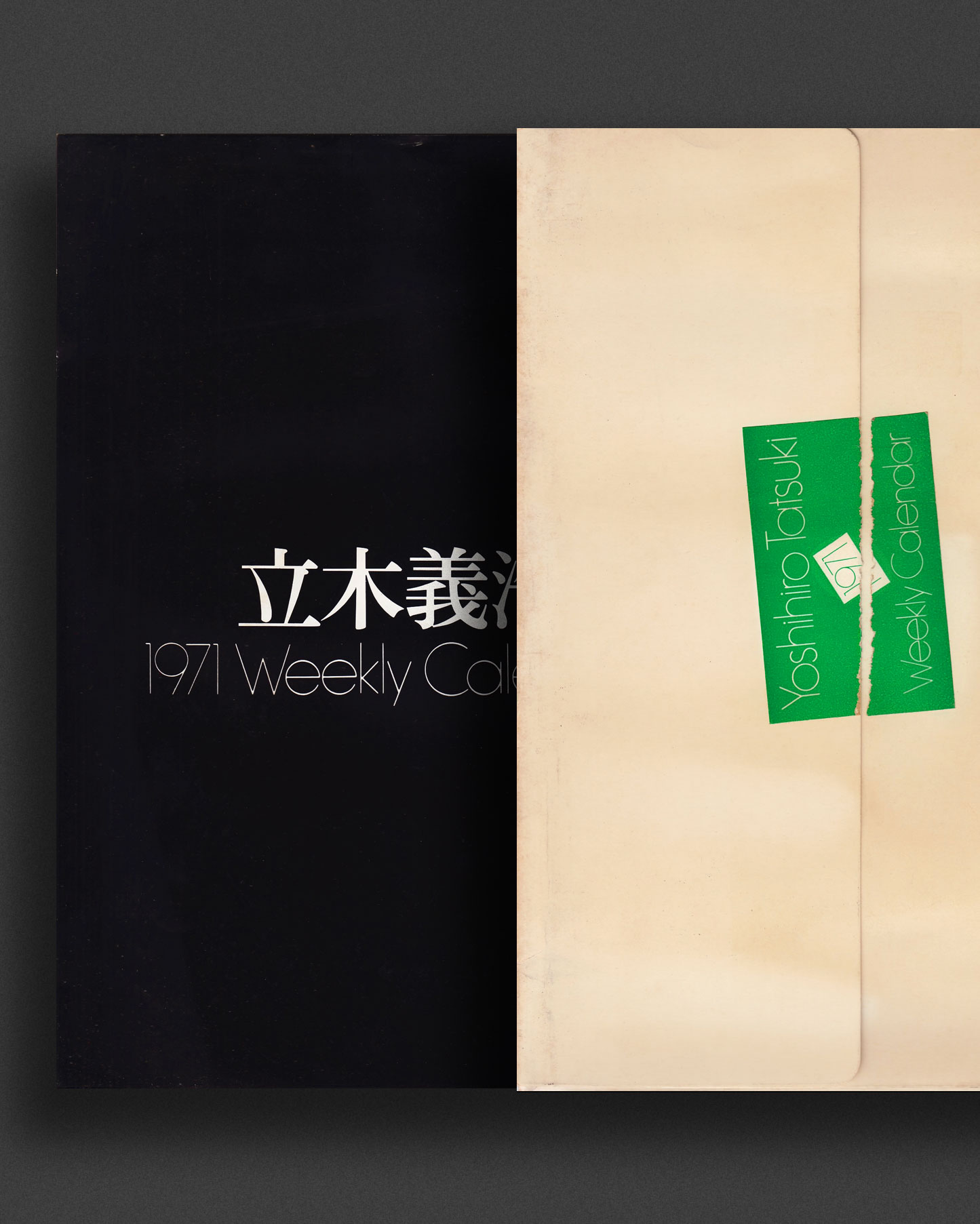
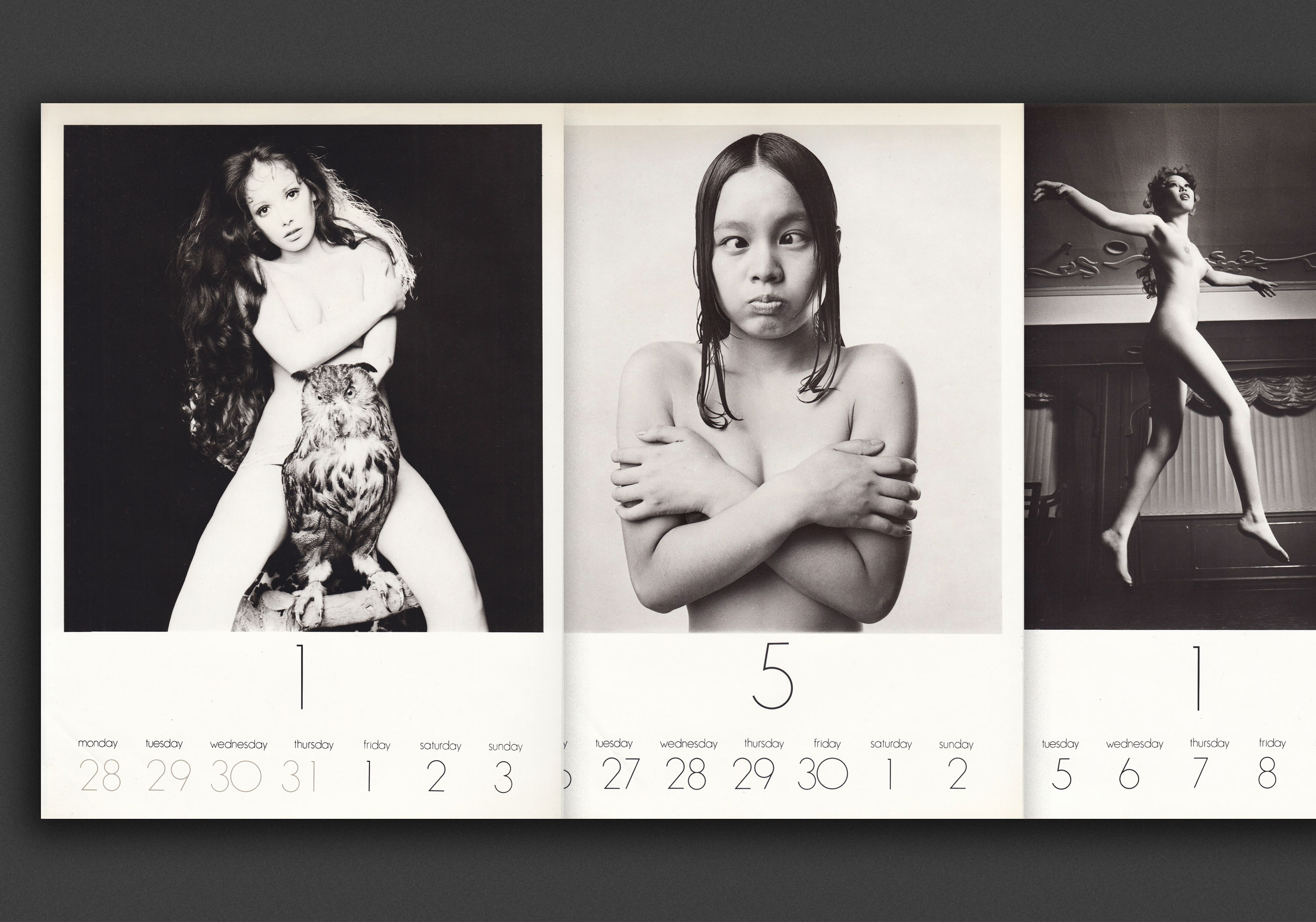
First edition of this wonderful collection of Japanese photographers that captured 1970s Tokyo, now out-of-print. In the world of fine art photography, post-war Japanese photography is continuing to gather attention. Many Japanese photographers were active specifically during the large cultural and political development of the 70s as the country experienced rapid economic growth. At the time, new styles of expression with a strong focus on the individual viewpoint were beginning to develop, which were distinct to the social documentary photography prior to that. This also coincided with the development of photography within the fashion and advertising field, reflecting a period where the works of many unique photographers and styles began to grow. A careful selection of 160 bodies of works by 9 prominent photographers of the time, each individually portraying the excitement and rapid growth which symbolised the era. Taiji Arita, Eikoh Hosie, Daido Moriyama, Masatoshi Naito, Hajime Sawatari, Issei Suda, Yoshihiro Tatsuki, Shuji Terayama, Katsumi Watanabe.
Very Good copy with good dust jacket.
2013, English / Japanese
Hardcover, 352 pages, 26.5 x 20 cm
1st Edition, Out of print title / used / fine
Published by
Yomiuri Shimbun / Tokyo
$140.00 - In stock -
From establishing one of the earliest frameworks for modern interactive multimedia art or Total Art (Gesaumtkunstwerk) to playing a pioneering role in the development of musique concrète in Japan, the seminal post-war Japanese avant-garde collective Jikken Kōbō (Experimental Workshop) blurred the lines between sonic arts, photography, stage lighting, costume design, poetry and experimental choreography.
Wonderful and comprehensive 2013 hardcover catalogue devoted entirely to the wide scope of Jikken Kōbō (Experimental Workshop), one of the first avant-garde artist collectives active in postwar Japan. Founded in Tokyo in 1951 by a group of composers, visual artists, musicians, choreographers, poets, critics and technicians including Toru Takemitsu, Kazuo Fukushima, Joji Yuasa, Hiroyoshi Suzuki, Keijiro Sato, Takahiro Sonoda, Ririko Hayashi, Hikaru Hayashi and Toshi Ichiyanagi, art critic Shūzō Takiguchi, and many others working in various media. Active between 1951–1958, the group was founded against the backdrop of the Hiroshima and Nagasaki bombs and in a time of post-war austerity. Jikken Kōbō organized its own exhibitions of group members' works, which were influenced by Western avant-garde art and showed a strong interest in new technology. However, they are best known for their collaborative "presentations" (happyōkai 発表会): theatrical or musical performances where each member contributed their individual works to create a multimedia production. Their multi-layered installations embraced sound recording, photography and film, together with artist-designed sets, specially composed music and dance, shattering distinction between mediums. Many of the group’s fourteen members were self-taught, and as a result distanced themselves from the traditional artistic culture in Japan. Co-founder Katsuhiro Yamaguchi described them as Bauhaus without the building.
This profusely illustrated book brings together the works, photographic documentation, costume designs, compositions, publications, writings, and all manner of material relating to the the group for the first time with extensive chronology and catalogue, with all accompanying texts in bi–lingual English and Japanese.
Exhibition ticket stub laid–in.
Very Good–Near Fine copy of this long out–of–print book, with only light wear to boards.
1995 / 1996, English
Softcover, 306 pages, 21 x 13.5 cm
1st Edition, Out of print title / used / average
Published by
Serpent's Tail / London
$25.00 - In stock -
Rare first edition of the classic account of ambient music by English musician, author, curator, and professor, David Toop. David Toop's extraordinary work of sonic history travels from the rainforests of Amazonas to virtual Las Vegas, from David Lynch's house, high in the Hollywood Hills to the megalopolis of Tokyo via the work of (and interviews with) artists as diverse as Brian Eno, Sun Ra, Erik Satie, Aphex Twin, Lee Perry, Ryuichi Sakamoto, Kate Bush, Kraftwerk and Brian Wilson. Beginning in 1889 at the Paris exposition when Debussy first heard Javanese music performed, Ocean of Sound channels the competing instincts of 20th century music into an exhilarating, path-breaking account of ambient sound, from new rhythmic and tonal influences to the sounds of war, machines, and the new digital revolution.
"A meditation on the development of modern music, there's no single term that is adequate to describe what Toop has accomplished here ... mixing interviews, criticism, history, and memory, Toop moves seamlessly between sounds, styles, genres, and eras"—Pitchfork's '60 Favourite Music Books'
Average—poor copy, tanned block, cover crease and water rippling to back cover/back section. Study copy.
2015, English
Hardcover, 352 pages, 28.5 x 21 cm
1st Edition, Out of print title / used / fine
Published by
Prestel / Munich
$65.00 - In stock -
This hardcover retrospective publication brings together key works from all phases of Hanne Darboven's career. It highlights the outstanding and wide-ranging output of this key conceptual artist in its entire temporal and stylistic breadth, featuring works in which the artist focuses on political events, German history and her personal. Context and shows the extensive work series exploring themes from cultural history, music, literature, and (natural) science. Beside the serial calculations on paper the book also presents parts of the artist's studio in Hamburg. The so-called music room, a quasi-encyclopedic archive, grants insight for the first time into the intellectual cosmos of the artist and her practice of compilation, composition and notation.
Includes 350 colour images.
Texts by Elke Bippus, Thomas Ebers, Okwui Enwezor, Zdenek Felix, Wolfgang Marx, Miriam Schoofs, and Rein Wolfs.
Selected solo exhibitions by Hanne Darboven include Kunsthalle Bern (1969); Westfälischer Kunstverein, Muenster (1971); Kunstmuseum Basel (1974); Deichtorhallen Hamburg (1991); Stedelijk Van Abbemuseum, Eindhoven and Musée d’Art moderne de la Ville de Paris (both 1986); Dia Center for the Arts, New York (1996); Staatsgalerie Stuttgart (1997); Hamburger Kunsthalle, Berlin (1999 and 2006); Deutsche Guggenheim, Berlin (2006); Museo Nacional Centro de Arte Reina Sofía, Madrid (2014); Bundeskunsthalle, Bonn and Haus der Kunst, Munich (both 2015); Deichtorhallen, Sammlung Falckenberg, Hamburg and Hamburger Bahnhof – Museum für Gegenwart, Berlin (both 2017), and Museum Küppersmühle für Moderne Kunst, Duisburg (2020).
Selected group shows include documenta, Kassel (1972, 1977, 1982, 2002); Musée d’Art Moderne de la Ville de Paris (1970, 1981, 1989, 2000, 2006); Solomon R. Guggenheim Museum, New York (1971, 1983); Museum of Modern Art, New York (1976, 2005, 2006, 2007, 2009, 2014, 2017, 2018); National Museum of Art, Osaka (1989); National Gallery of Victoria, Melbourne (1991); The National Gallery of Art, Washington D.C. (1994); Museum of Contemporary Art, Los Angeles (1996); Haus der Kunst, Munich (1997, 2003, 2008); Museum für Moderne Kunst MMK, Frankfurt (2000, 2010); Centre Pompidou, Paris (2002); Hamburger Kunsthalle (2013, 2016); Kunstmuseum Basel (2014); Institute of Contemporary Art, Miami (2017); Westbund Art Museum, Shanghai (2019); Pinakothek der Moderne, Munich (2020); Kunstmuseum Bonn, Bonn (2021), and Hamburger Kunsthalle, Hamburg (2022). She represented the Federal Republic of Germany at the 1982 Venice Biennale (along with Gotthard Graubner and Wolfgang Laib).
Near Fine copy.
1922, French
Hardcover (half calf binding, marbled decorated boards), 204 pages w. original covers, 31 x 24 cm
Edition of 55, hand–numbered,
1st Edition, Out of print title / used / very good
Published by
G. Van Oest / Bruxelles
$900.00 - In stock -
From the rarest deluxe edition of only 55 numbered copies made, printed on beautiful Arches à la cuve paper, originally containing 2 original etchings. This exquisite 1922 monograph on painter and printmaker, James Ensor (1860–1949), undisputedly the greatest Belgian modernist and one of the most important books on the artist. The exceptionally innovative Ensor lived in Ostend for most of his life, was associated with the artistic group Les XX, and was an important influence on expressionism and surrealism. This highly collectible early, comprehensive study provides an intimate look at Ensor's philosophy, serving as a primary source for understanding early 20th-century critical consensus on his bizarre and macabre Symbolist themes. Published in 1922 by G. van Oest, Brussels in this deluxe first edition of 55 numbered copies on Arches à la cuve paper, and a further limited edition of 550 numbered copies on Lafuma pure rag paper, this extensive 200+ page work includes 79 full-page plate reproductions in heliotype (including 2 full–colour plates protected by vellum) and a further 50 illustrations in the text, plus frontispiece (portrait). A valuable volume handsomely preserved in book–binders marble–covered hardboards with solid black half calf leather binding with five raised bands, complete with original covers (front and back). Printed by J.-E. Buschmann in Antwerp.
The deluxe edition is colophoned and hand-numbered from I to LV (1 to 55).
This copy is number 21 of 55 (XXI of LV).
Does not include the 2 drypoint etchings, likely removed for framing by original owner.
VG copy. Interiors and all contents are very well preserved, light shelf edge wear to boards/binding.
2026, English
Softcover, 176 pages, 17.7 x 11.6 cm
Published by
Semiotext(e) / Los Angeles
$35.00 - In stock -
A call to imagine a less deadly future, written in the shadow of genocide and "ferocious optimism."
After Gaza, it is time to recognize that the attempt to humanize history has failed, and that there will not be a second try. It is time to recognize that the experiment called "civilization" has failed... The abyss is wide open and we cannot help but see it. We must gaze into the abyss, we must gauge the breadth and depth of the abyss. We must draw a map of the abyss, while precipitously falling into it.
"Thinking after Gaza" means recognizing the collapse of universal reason and democracy, the humanistic values that were the famed—and fragile—promise of modernity. But it also means searching for ways to escape the grim future awaiting those born in this disenchanted century: this century that promises to be the last, in which thought has lost all political power and the survival instinct struggles to withstand the ferocity of techno-military extermination machines. To the generation born in the twilight of Western civilization, we owe this last act of thinking, so as to imagine the desertion of our barbaric present, along pathways that have yet to be illuminated.
The latest essay by renowned Italian autonomist theorist Franco "Bifo" Berardi, Thinking After Gaza is a reflection on the multivalent consequences—political, philosophical, civilizational—of the current genocide in Gaza and the West Bank. Bearing sober witness to the conditions on the ground in the Occupied Territories, while tracking the "ferocious optimism" that has replaced Enlightenment ideals, this book is addressed not only to activists but also to pacifist philosophers, historians, and theologians.
2025, English
Hardcover (w. dust jacket), 364 pages, 23 x 15.2 cm
Published by
Star Regulus Press / Finland
$65.00 - In stock -
“Reads like a novel—but it’s true.”—Prof. Massimo Introvigne (Center for Studies on New Religions; author of Satanism: A Social History)
In 1937, a British-Belgian occultist arrived in Berlin to brief Heinrich Himmler on a secret society called the Green Dragon. Tracing his unbelievable claims, Chasing the Green Dragon dives into the interwar Parisian occult underground, where intelligence operators and esotericists mingled in the temple of the Polaires, Masonic lodges, and Maria de Naglowska’s Luciferian salons, sometimes with fatal results.
A highly intellectual but eccentric scholar, Gaston de Mengel worked with René Guénon, the Cambodian Prince Iukanthor, and possibly with the French secret service – without realising it.
Based on a wealth of obscure sources, including new archival finds, the stranger-than-fiction story of Gaston de Mengel is a unique account of little-known cultural currents that gave birth to numerous post-war conspiracy theories and Nazi Mysteries – and Umberto Eco’s Foucault’s Pendulum.
“Fascinating… a valuable piece of research”—Prof. Richard Spence, author of Secret Agent 666: Aleister Crowley, British Intelligence and the Occult
“Admirably researched and illustrated… Vil must be commended for his efforts”—Fortean Times
“Chasing the Green Dragon compares with few other books in its depth of research and ability to make connections in little known strata of occult history. The figure of Gaston de Mengel, hitherto little more than a name to researchers, focuses a vast imaginal complex of “unknown superiors” running the world, and all the paranoia and pretension that goes with it. Truly an alternative history of the first half of the twentieth century!”—Prof. Joscelyn Godwin, author of Arktos, Music and the Occult, The Theosophical Enlightenment, Athanasius Kircher’s Theatre of the World, The Golden Thread, Upstate Cauldron, and others.
Ike Vil (MA) is a writer, translator, musician – hence the dodgy moniker – and a private scholar, who has spent his life studying secret, wondrous things. He will probably tell more if you buy him a beer.
2025, English
Hardcover (w. dust jacket), 198 pages, 23 x 15.2 cm
Published by
Star Regulus Press / Finland
$55.00 - In stock -
Unknown classic of Nazi Occultism, finally in English!
Translated and annotated by Ike Vil
“An amusing and entertaining tale… very well illustrated and put together” Fortean Times (5/5)
In 1935, Yrjö von Grönhagen, a 24-year old Finnish student at Sorbonne, Paris, decided to walk across Europe back to his native country. By a strange twist of fate, the following summer he would lead an ethnological expedition to Karelian woods in search of the lost magic of Aryans.
Appointed as the head of Finnish department of Ahnenerbe, a scholarly institution that was destined to become the greatest in the world, von Grönhagen witnessed “intuitive” mystics clash with classical archaeologists; lodging with the eccentric SS-Gruppenführer Karl-Maria “Weisthor” Wiligut, dubbed “Himmler’s Lord of the Runes” and “The Secret King of Germany,” he saw shady occultists come and go; and with Professor Höhne, he found the skull of Heinrich the Fowler, believed by Himmler to be his former incarnation.
Originally published in Finnish in 1948, Himmler’s Secret Society provides a unique first-hand account so-called Nazi Occultism as experienced by contemporaries who witnessed it first hand.
With dozens of original photographs, biographies, and notes
Yrjö von Grönhagen (born 1911 in St Petersburg, Russia, died 2003 in Helsinki, Finland) was a Finnish author, journalist, and folklorist. He was active in Ordo Sancti Constanti Magni, a Christian chivalric organisation.
2007 / 2026, English
Softcover, 139 pafes, 21 x 14 cm
Published by
Grove Press / New York
$34.00 - In stock -
“The last literary outlaw in mainstream American fiction.”—Bret Easton Ellis
“Extraordinary . . . One of the few new American writers with a completely distinctive voice.”—Edmund White
Winner of the Ferro–Grumley Award for LGBTQ Fiction
From “the most dangerous writer in America” (Village Voice), Dennis Cooper’s Closer is the controversial first novel in the award-winning George Miles Cycle—a haunting exploration of 1980s middle America, alienation, and the very limits of experience, now featuring an introduction by cultural critic Lynne Tillman
Dennis Cooper is the author of the George Miles Cycle of five novels, of which Closer is the first. He is also the author of My Loose Thread, The Sluts, God Jr., and The Marbled Swarm. Cooper’s other works include story collections, poetry, and the essay collection Smothered in Hugs. He divides his time between Los Angeles and Paris.
Physically beautiful and strangely passive, George Miles becomes the object of his fellow students’ passions. One after another, his teenage friends rifle through George, ransacking him for love, secrets, or anything else they can plausibly extract.
Closer follows the subterranean connections that drag George into the arms of men like John, an artist who drains his portraits of humanity in order to find what lies beneath; Alex, fascinated by splatter films and pornography; and Steve, an underground entrepreneur who turns his parents garage into a nightclub. Boys and men pass George from hand to hand, fascinated by the nightmarish intensity of his detachment, but soon he will be confronted by desires he may find harder to endure.
An unflinching dissection of the horrors of middle America, Closer lays bare a world where pain is an undeniable reality, the inevitable companion of truth, and a test of our commitment to life. Nearly four decades since its original publication, Dennis Cooper’s brutally frank and provocative cult classic remains unmatched, continuing to push the limits of our minds and sharpen our understanding of the life around us.
“A story about how desire can persist to the brink of self-destruction and beyond. . . . A work of considerable courage.”—Thomas R. Edwards, New York Review of Books
“Bleak and brilliant. There can be no doubt about the power and originality of Cooper’s writing. Sheer force of style raises Closer to the level of (at least) a minor classic.”—John Ash, Washington Post Book World
“Closer translates the moments and feelings for which we don’t really have a vocabulary. Cooper taps the ineffable, the murky underside of sexual and human relationships.”—Lynne Tillman
“An incredibly beautiful and daring book. Cooper’s language is at first intense, nearly minimal, then suddenly, it ascends into vision.”—Kathy Acker
2026, English
Softcover (bound by elastic band), 128 pages, 21 x 14.8 cm
Published by
UTS Gallery / Sydney
$30.00 - In stock -
Published on the occasion of the exhibition “No Place for mannequins: Remaking the fashion archive" (UTS Gallery, 2026), An index of wearing and reading fashion archives gathers and presents a collection of artist responses on how to make or unmake an archive.
With introductory essays by curators Todd Robinson and Ricarda Bigolin, the volume collects material and written assemblages of creative and research-based processes, including photographs, sketches, references, and citations, along with garments and accessories from participating artist's personal wardrobes, into an index of living traces.
Contributors: Ricarda Bigolin, D and K, Femke de Vries, Tim Hardy, Alix Higgins, Hansol Kim, Library of Unruly Fashion Practices, Kyra Mancktelow, Marco Marino, Todd Robinson, XEROXED, and Justine Woods.
Copy Editors: Stella Rosa McDonald and Alice Rezende
Design: Zenobia Ahmed
2 colour risographed covers, bound by elastic band.
2025, English
Hardcover (clothbound), 376 pages, 28 x 20 cm
$95.00 - In stock -
This is the most comprehensive book ever published on one of the most extraordinary figures in post-war American art: Forrest Bess, who described himself as a painter and fisherman and whose biomorphic abstractions cannot be assigned to any movement. Starting in the 1940s, he lived in isolation in Texas and created small paintings that reflect his visionary experiences between wakefulness and sleep. Bess combined his art with an intense exploration of mythology, psychology, and sexology. Believing that immortality could be achieved through the union of the masculine and feminine, he underwent medical procedures. His unconventional works received posthumous recognition in international exhibitions and influenced many contemporary artists such as Amy Sillman, Richard Hawkins or James Benning.
Lavishly illustrated throughout, the work of Forrest Bess is accompanied by texts (in English and German) by Tomma Abts, Dieter Schwarz, Amy Sillman and Moritz Wesseler.
Forrest Bess, born in 1911 in Bay City, Texas, where he also died in 1977, led an extremely secluded existence in the first half of the 1940s on the Gulf of Mexico, where alongside catching and selling fishing bait he dedicated himself to painting. During this time, Bess began to systematically encapsulate in painting “visions” that appeared to him on the threshold between wakefulness and sleep. For Bess, subconscious human experiences manifested themselves in these abstract and highly symbolic images. He pursed their exploration like a piece of obsessive research that he articulated in countless records and intensive correspondence without ever unravelling the mystery of his creativity.
2025, English
Softcover, 272 pages, 20.8 x 14.9 cm
Published by
Urbanomic / Cornwall
$55.00 - In stock -
An interdisciplinary, cross-cultural collection that decenters familiar narratives to provide a fresh perspective on what artificial intelligence is today, and what it might become.
Historians, media theorists, science-fiction writers, philosophers, and artists from China and elsewhere reexamine the nation's intense engagement with AI, moving beyond the clichés that still dominate contemporary debate.
Today, visions of the contested future of AI veer between common planetary goals and a new Cold War, as culturally-specific models of intelligence, speculative traditions, and thought experiments come up against the emergence of novel forms of cognition that cannot be reduced to any historical cultural tradition.
This uniquely positioned volume provides expert insight into this tension, using China as a touchstone for rethinking "artificiality" and "intelligence" as sites of difference in a way that is already present in the difficulty of precisely translating the Chinese term 人工智能. Tracking the history of Chinese AI from the pre-Cultural Revolution to the post-Deng Xiaoping eras right up to contemporary debates surrounding facial recognition, the writers in this collection draw on a mixture of speculative thought experiments and cutting-edge use cases to offer singular views on topics including AI and Chinese philosophy, AI ethics and policymaking, the development of computational models in early Chinese cybernetics, and the aesthetics of Sinofuturism.
Spanning borders between different worlds, histories, futures, and foundational models, Machine Decision is Not Final is not only a timely reappraisal of the stakes of AI development, but a tool for constructing more global imaginaries for the future of AI.
Contributors
Blaise Aguera y Arcas, Bo An, Benjamin Bratton, Shuang Frost, Vince Garton, Steve Goodman, Yvette Granata, Anna Greenspan, Amy Ireland, Xia Jia, Bogna Konior, Vincent Le, Lawrence Lek, Lukas Likavcan, Suzanne Livingston, Iris Long, Bingchun Meng, Reza Negarestani, Chen Quifan, Gabriele de Seta, Hongzhe Wang, Wang Xin, Mi You
1991, English
Softcover, 144 pages, 20.5 x 14 cm
Published by
Northwestern University Press / Evanston
$62.00 - In stock -
1991 edition. Translated by Alphonso Lingis.
Enlightenment ideals of a society rooted in liberationist reason and morality were trampled in the wake of the savagery of the Second World War. That era's union of cold technology and ancient hatreds gave rise to a dark, alternative reason--an ethic that was value-free and indifferent with regard to virtue and vice, freedom, and slavery. In a world where "the unthinkable" had become reality, it is small wonder that theorists would turn to the writings of a man whose eighteenth-century imagination preceded twentieth-century history in its unbridled exploration of viciousness, perversion, and monstrosity: the Marquis de Sade.
Klossowski was one of the first philosophers in postwar Europe to ask whether Sade's reason, although aberrant and perverted to evil passions, could be taken seriously. Klossowski's seminal work inspired virtually all subsequent study of Sadean thought, including that of de Beauvoir, Deleuze, Derrida, Bataille, Blanchot, Paulhan, and Lacan.
2026, English
Softcover, 344 pages, 25.4 x 17.78 cm
Published by
Semiotext(e) / Los Angeles
$46.00 - In stock -
A landmark anthology of Francesc Tosquelles's intellectual, clinical, and political writings, many available in English translation for the first time.
Edited by Joana Maso, translated by Robert Hurley and Mara Faye Lethem
Often consigned to legend, the life of Francesc Tosquelles reads as an adventure story of clinical, political, and collective experimentation around healing institutions. Joining the Saint-Alban-sur-Limagnole psychiatric hospital in Nazi-occupied France, Tosquelles invented what would become “institutional psychotherapy” with poets, film critics, photographers, and psychiatrists including Jean Oury, Agnès Masson, Frantz Fanon, Tristan Tzara, and Paul Éluard.
This first anthology of Tosquelles’s writings shines a light on his forgotten history, from his engagement as a psychiatrist during the Spanish Civil War alongside anti-Franquist and anti-Stalinist communists, to his progressive return to Catalonia following his role in the “cultural revolution” of “institutional psychotherapy” in France. Through translations of texts never before available in English, Tosquelles’s powerful voice reminds us how important politicized relations to institutions are in our times of sick institutions, scapegoating of strangers, and globalized war.
2009, English
Softcover, 197 pages, 20.9 x 13.1 cm
Published by
New Directions / New York
$30.00 - In stock -
On a crowded bus at midday, Raymond Queneau observes one man accusing another of jostling him deliberately. When a seat is vacated, the first man appropriates it. Later, in another part of town, Queneau sees the man being advised by a friend to sew another button on his overcoat. Exercises in Style retells this unexceptional tale ninety-nine times, employing the sonnet and the alexandrine, “Ze Frrench” and “Cockney.” An “Abusive” chapter heartily deplores the events; “Opera English” lends them grandeur. In 1947, when Exercises in Style first appeared in French, it led to Queneau’s election to the highly prestigious Académie des Goncourt. He once told Barbara Wright that of all of his books, this was the one he most wished to see translated. He rendered her his “heartiest congratulations,” adding: “I have always thought that nothing is untranslatable. Here is new proof. And it is accomplished with all the intended humor. It has not only linguistic knowledge and ingenuity, it also has that.”
Raymond Queneau was a French novelist, poet, critic, editor and co-founder and president of Oulipo, notable for his wit and cynical humour. Born in Le Havre in 1903, Queneau went to Paris when he was 17. In 1924 Queneau met and briefly joined the Surrealists, but never fully shared their penchants for automatic writing or ultra-left politics. Like many surrealists, he entered psychoanalysis—however, not in order to stimulate his creative abilities, but for personal reasons, as with Leiris, Bataille, and Crevel. Now, seeing Queneau's work in retrospect, it seems inevitable. The Surrealists tried to achieve a sort of pure expression from the unconscious, without mediation of the author's self-aware "persona." Queneau's texts, on the contrary, are quite deliberate products of the author's conscious mind, of his memory, and his intentionality. Although Queneau's novels give an impression of enormous spontaneity, they were in fact painstakingly conceived in every small detail.
2005, English / Japanese
Hardcover (w. dust jacket), unpaginated, 37 x 23.5 cm
Ed. of 1000,
1st Edition, Out of print title / used / fine
Published by
AaT Room / Tokyo
$200.00 - In stock -
First edition, first printing of Nobuyoshi Araki's "Shiki In", published in an edition of 1000 copies in 2005 in this lavish hardcover edition, marking the beginning of publications by Araki which featured his erotic painted photo works. Confronting issues of censorship within Japanese society and faced with prosecution due to the graphic nature of his imagery, Araki, although always having confronted the comfort zones of his viewers, began to blot out and scrape over the genitals in his photographic images substituting the exposed area with expressive hand-scribbled lines of black, using more and more frequently bright and vibrant colours. This application of colours within Shiki In (published in 2005) brilliantly captures this now established part of his repertoire. Included within the pages are 128 images; portraits of his models bound in Kinbaku, vibrantly transformed with the painted brush strokes of Araki's hand. This self censorship of his works added a transformative element to his photographs, presenting them as a visual response on both the laws of censorship, as well as referencing the sexual imagery based on Japanese traditions alongside Araki's own visual motifs of color, used to portray all that is living and the use of monochrome to connote notions of death.
"I wanted to molest women who had become monochrome, it made me want to paint color on prints".
Afterword by Toshiharu Ito.
Near Fine copy in NF dust jacket.