World Food Books' programme is largely produced on Kulin Nation land. We acknowledge the Wurundjeri people of the Kulin Nation as the first and continuing custodians of this land, and pay respect to their Elders past, present, and emerging.
World Food Books is an arts and special interests bookshop in Naarm / Melbourne. Founded in 2010, World Food Books is devoted to the presentation of a rotating, hand-selection of international art, design, literary and counterculture publications with an emphasis on the anti-traditional, the experimental, the avant-garde, the heretic, the marginal.
Presenting new titles alongside rare and out-of-print books, catalogues and journals spanning the fields of modern and contemporary art, design, photography, illustration, film, literature, poetry, cultural theory, philosophy, sexuality, popular and underground culture in its many radical forms, World Food Books wishes to encourage adventurous, thoughtful and open-minded reading, looking, writing, and exchange of publishing and ideas, both current and historical.
As well as our bookshop, located in Melbourne's historical Nicholas Building, all of our inventory is available internationally via our online mail-order service.
World Food Books semi-regularly co-ordinates "Occasions", a programme of exhibits and events at the bookshop and in partnership with other hosts (such as museums and art galleries) that develop out of the activities, relationships and content of the bookshop itself.
World Food Books
The Nicholas Building
37 Swanston Street
Room 5, Level 6
Melbourne 3000
Australia
SHOP HOURS:
Thu–Fri 12–6, Sat 12–5
WEB-SHOP OPEN 24/7
World Food Books
Postal Address:
PO Box 435
Flinders Lane
Victoria 8009
Australia
Art
Theory / Essay
Architecture / Interior
Graphic Design / Typography
Photography
Fashion
Eros
LGBTQ+
Fiction / Poetry
Weird / Speculative / Science Fiction / Horror
Transgressive / Visceral / Abject
Symbolism / Decadence / Fin de siècle
Film / Video
Painting
Sculpture / Installation
Performance / Dance / Theater
Drawing
Sound / Music
Curatorial
Group Shows / Collections
Periodicals
Out-of-print / Rare
Posters / Ephemera / Discs
Signed Books
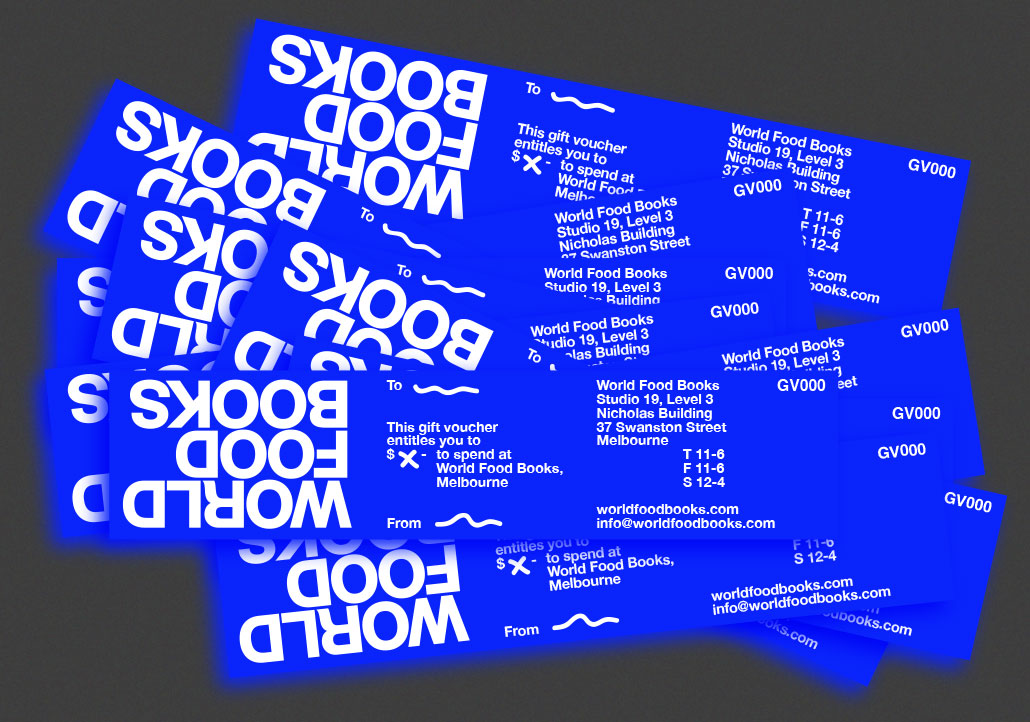
World Food Books Gift Voucher
World Food Book Bag
Australian Art
Australian Fiction
Australian Science Fiction / Speculative Fiction
Australian Poetry
Australian Photography
Japanese Photography
Conceptual Art
Minimal Art
Dada
'Pataphysics / Oulipo
Fluxus
Concrete Poetry
Pop Art
Surrealism
Arte Povera
Arte Informale / Haute Pâte / Tachism
Nouveau Réalisme / Zero / Kinetic
Situationism / Lettrism
Collage / Mail Art / Xerox Art
Art Brut / Folk / Visionary / Fantastic
Illustration / Graphic Art / Bandes Dessinées
Furniture
Italian Radical Design / Postmodernism
Textiles
Ceramics / Glass
Counterculture
Protest / Revolt
Philosophy
Psychoanalysis
Anthropology
Anarchism
Socialism / Anarchism / Communism / Capitalism
Literary Theory / Semiotics / Language
Feminism / Women's Studies
Gender Studies / Sexuality
Anthropology
Fetishism / BDSM
Drugs / Psychedelia
Crime / Violence
Animal Rights / Veganism
Occult / Esoterica
Ecology / Earth / Alternative Living
Whole Earth / Crafts
All prices in AUD (Australian dollars)
Pick-Ups
Pick-up orders can be collected in our bookshop during opening hours after order date. Please collect any Pick-up orders within 2 weeks of ordering as we have limited storage space. Orders will be released back into stock if not collected within this time. No refunds can be made for pick-ups left un-collected. If you cannot make it in to the bookshop in this time-frame, please choose postage option.
Return Policy
All sales are final. We do accept returns (for refund or exchange) for items received in error. All our orders are packed with special care using heavy-duty padding and cardboard book-mailers or bubble mailers (for smaller books), using reinforcement where required. We cannot take responsibility for any lost, stolen or damaged parcels.
Insurance
Should you wish to insure your package, please email us directly after placing your order and we can organise this at a small extra expense. Although all standard/express tracked packages are very safe and dependable, we cannot take responsibility for any lost, stolen or damaged parcels. We recommend insurance on valuable orders.
Interested in selling your old books, catalogues, journals, magazines, comics, fanzines, ephemera? We are always looking for interesting, unusual and out-of-print books to buy. We only buy books in our fields of interest and specialty, and that we feel we can resell.
We base these prices on desirability, market value, in-print prices, condition and our current stock levels. We offer cash, store credit, and can take stock on consignment. All
about 25% of the price we expect to get when we sell them, or 30% in store credit. We base these prices on desirability, market value, in-print prices, condition and our current stock levels.
Sell your books any day of the week. You can drop them off and return later. If you have a lot of books, we can visit your Sydney home.
We buy books that we feel we can resell. We offer about 25 % of the price we expect to get when we sell them, or 30% in store credit. We base these prices on desirability, market value, in-print prices, condition and our current stock levels.
Philadelphia Wireman
03 August - 01 September, 2018
World Food Books is proud to announce our next Occasion, the first presentation of sculptures by Philadelphia Wireman in Australia.
The Philadelphia Wireman sculptures were found abandoned in an alley off Philadelphia’s South Street on trash night in 1982. Their discovery in a rapidly-changing neighbourhood undergoing extensive renovation, compounded with the failure of all attempts to locate the artist, suggests that the works may have been discarded after the maker’s death. Dubbed the "Philadelphia Wireman" during the first exhibition of this work, in 1985, the maker’s name, age, ethnicity, and even gender remain uncertain. The entire collection totals approximately 1200 pieces, all intricately bound together with tightly-wound heavy-gauge wire (along with a few small, abstract marker drawings, reminiscent both of Mark Tobey and J.B. Murry). The dense construction of the work, despite a modest range of scale and materials, is singularly obsessive and disciplined in design: a wire armature or exoskeleton firmly binds a bricolage of found objects including plastic, glass, food packaging, umbrella parts, tape, rubber, batteries, pens, leather, reflectors, nuts and bolts, nails, foil, coins, toys, watches, eyeglasses, tools, and jewellery.
Heavy with associations—anthropomorphic, zoomorphic, and socio-cultural responses to wrapped detritus—the totemic sculptures by Philadelphia Wireman have been discussed in the context of work created to fulfil the shamanistic needs of alternative religions in American culture. Curators, collectors, and critics have variously compared certain pieces to sculpture from Classical antiquity, Native American medicine bundles, African-American memory jugs, and African fetish objects. Reflecting the artist’s prolific and incredibly focused scavenging impulse, and despite—or perhaps enhanced by—their anonymity, these enigmatic objects function as urban artefacts and arbiters of power, though their origin and purpose is unknown. Philadelphia Wireman, whatever their identity, possessed an astonishing ability to isolate and communicate the concepts of power and energy through the selection and transformation of ordinary materials. Over the course of the past two decades, this collection has come to be regarded as an important discovery in the field of self-taught art and vernacular art.
Presented in collaboration with Fleisher-Ollman Gallery, Philadelphia, and Robert Heald, Wellington.
Susan Te Kahurangi King
02 February - 10 March, 2018
Susan Te Kahurangi King (24 February 1951 - ) has been a confident and prolific artist since she was a young child, drawing with readily available materials - pencils, ballpoint pens and felt-tip markers, on whatever paper is at hand. Between the ages of four and six Susan slowly ceased verbal communication. Her grandparents William and Myrtle Murphy had developed a special bond with Susan so they took on caring responsibilities for extended periods. Myrtle began informally archiving her work, carefully collecting and storing the drawings and compiling scrapbooks. No drawing was insignificant; every scrap of paper was kept. The King family are now the custodians of a vast collection containing over 7000 individual works, from tiny scraps of paper through to 5 meter long rolls.
The scrapbooks and diaries reveal Myrtle to be a woman of great patience and compassion, seeking to understand a child who was not always behaving as expected. She encouraged Susan to be observant, to explore her environment and absorb all the sights and sounds. Myrtle would show Susan’s drawings to friends and people in her community that she had dealings with, such as shopkeepers and postal workers, but this was not simply a case of a grandmother’s bias. She recognised that Susan had developed a sophisticated and unique visual language and sincerely believed that her art deserved serious attention.
This was an unorthodox attitude for the time. To provide some context, Jean Dubuffet coined the term Art Brut in 1945 to describe work created by self-taught artists – specifically residents of psychiatric institutions and those he considered to be visionaries or eccentrics. In 1972 Roger Cardinal extended this concept by adopting the term Outsider Art to describe work made by non-academically trained artists operating outside of mainstream art networks through choice or circumstance. Susan was born in Te Aroha, New Zealand in 1951, far from the artistic hubs of Paris and London that Dubuffet and Cardinal operated in. That Myrtle fêted Susan as a self-taught artist who deserved to be taken seriously shows how progressive her attitudes were.
Susan’s parents Doug and Dawn were also progressive. Over the years they had consulted numerous health practitioners about Susan’s condition, as the medical establishment could not provide an explanation as to why she had lapsed into silence. Dawn educated herself in the field of homeopathy and went on to treat all twelve of her children using these principles – basing prescriptions on her observations of their physical, mental and emotional state.
Doug was a linguist with an interest in philosophy who devoted what little spare time he had to studying Maori language and culture. To some extent their willingness to explore the fringes of the mainstream made them outsiders too but it was their commitment to living with integrity and their respect for individuality that ensured Susan’s creativity was always encouraged.
Even though Susan’s family supported her artistic pursuits, some staff in schools and hospitals saw it as an impediment to her assimilation into the community and discouraged it in a variety of ways. Her family was not always aware of this and therefore did not fully understand why Susan stopped drawing in the early 1990s. However, rather than dwell on the challenges that Susan faced in pursuit of her artistic practice, they prefer to highlight her achievements. In 2008 Susan began drawing again in earnest, after an almost 20 year interruption, and her work is now shown in galleries around the world.
Susan grew up without television and has been heavily influenced by the comics she read as a child. She is absolutely fearless in the appropriation of recognizable characters, such as Donald Duck and Mickey Mouse, in her work. She twists their limbs, contorts their faces, compresses them together, blends them into complex patterned backgrounds - always imbuing them with an incredible energy. Although Susan often used pop culture characters in her work they are not naive or childlike. These are drawings by a brilliant self-taught artist who has been creating exceptional work for decades without an audience in mind.
Mladen Stilinović
"Various Works 1986 - 1999"
02 February 16 - September 10, 2016
Various works 1986 - 1999, from two houses, from the collections of John Nixon, Sue Cramer, Kerrie Poliness, Peter Haffenden and Phoebe Haffenden.
Including: Geometry of Cakes (various shelves), 1993; Poor People’s Law (black and white plate), 1993; White Absence (glasses, ruler, set square, silver spoon, silver ladel with skin photograph and wooden cubes), 1990-1996; Exploitation of the Dead (grey and red star painting, wooden painting, black spoon with red table, red plate), 1984-1990; Money and Zeros (zero tie, paintings made for friends in Australia (Sue, John, Kerrie), numbers painting), 1991-1992; Words - Slogans (various t-shirts) - “they talk about the death of art...help! someone is trying to kill me”, “my sweet little lamb”, “work is a disease - Karl Marx”; Various artist books, catalogues, monographs, videos; Poster from exhibition Insulting Anarchy; "Circular" Croatian - Australian edition; Artist book by Vlado Martek (Dostoyevsky); more.
Thanks to Mladen Stilinović and Branka Stipančić.
Jonathan Walker
Always Will Need To Wear Winter Shirt Blue + Ochre Small Check Pattern
21 August - 21 September, 2015
Untitled
I am not a great reader of poetry but I always return to the work of Melbourne poet, Vincent Buckley (1925- 1988). Perhaps I find his most tantalising piece to be not a finished poem but a fragment left on a scrap of paper discovered on his desk after the poet’s death.
The poetry gathers like oil
In the word-core, and spreads
It has its music meet,
Its music is in movement.
This fragment is more the shell left behind from a volatile thought than a finished poem. I find the last two lines honest but awkward whereas the first two lines work like an arrow. Most likely he could not find a resolution so it was left. Still, in its present form, it remains an eloquent testimony to the ultimate failure of a medium to express mobile thought and sensation, in Buckley’s case, through verbal language. It’s an important matter because this is something all artists have to deal with regardless of the medium.
I have never written a poem, however, I am forever copying fragments from books on paper scraps in a vain effort to fix certain notions in my head. At first, they function as bookmarks that are sometimes returned to when I open the book. But before long, as they accumulate, they fall out littering the table interspersed with A4 photocopies, bills, books and medications.
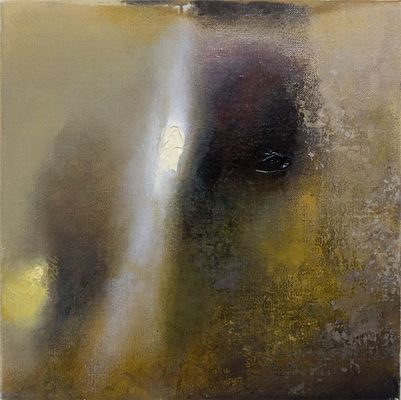
To return to Buckley’s fragment, the first two lines very much evoke how I paint nowadays. As you age, detail diminishes and patches of light become more luminous and float. I feel the most honest way of dealing with this is by smearing the oil paint on the canvas with the fingers and working close-up, blind. Only if the patches coalesce into an approaching image can the work gain a life.
-
Jonathan Walker was born in Melbourne, Australia and brought up on a dairy farm in Gippsland. In the 1970’s he studied painting at RMIT and won the Harold Wright Scholarship to the British Museum, London. During the 1980’s he exhibited at Pinacotheca Gallery, Richmond and had work shown at the NGV and Heidi City Art Gallery. Over the same period he designed the cover for the “Epigenesi” LP by Giancarlo Toniutti, Italy and conducted a mail exchange work with Achim Wollscheid, Germany. The work with artists through the post resulted in an article published in the bicentenary issue of Art and Australia 1988. He showed in artist run spaces such as WestSpace in the 90’s and 2000’s, and until 2012, taught painting at Victoria University, which is where we (Colleen Ahern and Lisa Radford) as organisers of the exhibition, among many others, had the privilege of being his student.
Walker’s knowledge was imparted to students through the careful selection of music, literature, and artists found in books that he himself had ordered for the library. Walker’s strategy was the generosity of sharing his vast knowledge with references specific to each student and their context.
Walker’s paintings share a similar focus and intimacy.
This exhibition presents a small selection of recent paintings alongside a publication that includes Walker’s writing. Observational and analytical, Walker’s work is a type of material notation — the time of day, colour and how it is blended, the both specific and fleeting location of a reflection on lino or the question of whether a chair leg should be included in a painting.
Please join us on Friday August 21 between 6-8pm to celebrate the opening of the exhibition.
Curated by Colleen Ahern and Lisa Radford.
B. Wurtz
Curated by Nic Tammens
March 26 - April 4, 2015
B.Wurtz works from a basement studio in his home on Manhattan’s Lower East Side.
This local fact is attested to by the plastic shopping bags and newsprint circulars that appear in his work. As formal objects, they don’t make loud claims about their origins but nonetheless transmit street addresses and places of business from the bottom of this long thin island. Like plenty of artists, Wurtz is affected by what is local and what is consumed. His work is underpinned by this ethic. It often speaks from a neighborhood or reads like the contents of a hamper:
“BLACK PLUMS $1.29 lb.”
“Food Bazaar”
“USDA Whole Pork Shoulder Picnic 99c lb.”
“RITE AID Pharmacy, with us it’s personal.”
“H. Brickman & Sons.”
“Sweet Yams 59c lb."
Most of the work in this exhibition was made while the artist was in residence at Dieu Donne, a workshop dedicated to paper craft in Midtown. Here Wurtz fabricated assemblages with paper and objects that are relatively lightweight, with the intention that they would be easily transportable to Australia. This consideration isn’t absolute in Wurtz’s work, but was prescriptive for making the current exhibition light and cheap. Packed in two boxes, these works were sent from a USPS post office on the Lower East Side and delivered to North Melbourne by Australia Post.
Wurtz appears courtesy of Metro Pictures, New York.
Thanks to Rob Halverson, Joshua Petherick, Sari de Mallory, Matt Hinkley, Helen Johnson, Fayen d'Evie, Ask Kilmartin, Lisa Radon, Ellena Savage, Yale Union, and "Elizabeth".
John Nixon
"Archive"
December 15 - January 20, 2014
The presentation of John Nixon's archive offered a rare showcase of this extensive collection of the artist's own publications, catalogues, posters, ephemera, editions and more, from the mid 1980s onwards, alongside a selection of his artworks.
Organized by John Nixon, Joshua Petherick and Matt Hinkley.
<a href=http://wfb.public-office.info/artist/john-nixon>All titles by John Nixon
"Habitat"
at Minerva, Sydney (organised by Joshua Petherick and Matt Hinkley)
November 15 - December 20, 2014
Lupo Borgonovo, Janet Burchill & Jennifer McCamley,
Lewis Fidock, HR Giger, Piero Gilardi, Veit Laurent Kurz,
Cinzia Ruggeri, Michael E. Smith, Lucie Stahl, Daniel Weil, Wols
Press Release:
“...It contained seven objects. The slender fluted bone, surely formed for flight, surely from the wing of some large bird. Three archaic circuitboards, faced with mazes of gold. A smooth white sphere of baked clay. An age-blackened fragment of lace. A fingerlength segment of what she assumed was bone from a human wrist, grayish white, inset smoothly with the silicon shaft of a small instrument that must once have ridden flush with the surface of the skin - but the thing’s face was seared and blackened.”
William Gibson, “Count Zero”, 1986
"Autumn Projects Archive"
Curated by Liza Vasiliou
March 6 - March 15, 2014
World Food Books, in conjunction with the Virgin Australia Melbourne Fashion Festival 2014, presented the Autumn Projects archive, consisting of a selection of early examples in Australian fashion with a particular interest in collecting designers and labels from the period beginning in the 1980’s, who significantly influenced the discourse of Australian Fashion.
Curated by Liza Vasiliou, the exhibition provided a unique opportunity to view pieces by designers Anthea Crawford, Barbara Vandenberg, Geoff Liddell and labels CR Australia, Covers, Jag along with early experimental collage pieces by Prue Acton and Sally Browne’s ‘Fragments’ collection, suspended throughout the functioning World Food Books shop in Melbourne.
H.B. Peace
presented by CENTRE FOR STYLE
November 14, 2013
"Hey Blinky, you say chic, I say same"
Anon 2013
H.B. Peace is a clothing collaboration between great friends Blake Barns and Hugh Egan Westland. Their pieces explore the divergences between 'character’ and ‘personality’ in garments....etc
Special Thanks to Joshua Petherick and Matt Hinkley of WFB and Gillian Mears
and a Very Special Thank you to Audrey Thomas Hayes for her shoe collaboration.
Janet Burchill & Jennifer McCamley
"Aesthetic Suicide"
May 10 - June 8, 2013
The first of our occasional exhibitions in the World Food Books office/shop space in Melbourne, "Aesthetic Suicide" presented a body of new and older works together by artists Janet Burchill & Jennifer McCamley, including videos, prints, a wall work, and publications.
During shop open hours videos played every hour, on the hour.
$.00 - Out of stock
The eternal clean out! New items weekly.
https://worldfoodbooks.com/category/sale
Published by World Food Books / Melbourne
$20.00 - In stock -
A World Food Books gift voucher is redeemable in our Melbourne bookshop or via our webshop (here). An e-voucher (printable pdf) will be sent to your purchase email address (please notify us if you wish to have the voucher sent to an alternate address and wish us to fill in the receiver's details on the card).
Gift vouchers can be purchased in increments of $20 (Australian Dollars) and the total amount can simply be added to by increasing the quantity in your shopping cart. eg. A quantity of 5 gift vouchers will result in an item total of $100 - a $100 gift voucher. Simply click "ADD TO CART" 5 times, or update your quantity in the shopping cart.
If you wish to purchase multiple, separate gift vouchers in one go, please just email us and we can personally prepare and email you a payment request.
Please note: Please select Pick-Up on gift voucher purchse to avoid any postage charges. Accidental postage charges will be refunded right away!
Thank you.
For any questions, please don't hesitate to email: [email protected]
2005, English
Hardcover (w. dust jacket), 504 pages, 26 x 30 cm
1st Edition, Out of print title / used / very good
Published by
Scalo Publishers / Zürich
Art Gallery of New South Wales / Sydney
$350.00 - Out of stock
First edition of the major 500-plus page, highly collectible mid-career survey book on Australian photographer Bill Henson, "Mnemosyne", published by Scalo in Zürich on the occasion of the artist’s retrospective at the Art Gallery of New South Wales, Sydney in 2005, which toured to the National Gallery of Victoria, Melbourne, that same year. This comprehensive hardcover volume lavishly reproduces all of Henson's major bodies of work to date, alongside essays by Judy Annear, Jennie Boddington, Edmund Capon, Dennis Cooper, Peter Craven, Isobel Crombie, John Forbes, Michael Heyward, Alwynne Mackie, David Malouf, Bernice Murphy, Peter Schjeldahl, and an interview with Bill Henson by Sebastian Smee.
"Sometimes, but very rarely these days, one can announce a real discovery in contemporary photography — a book that will emphatically place its author on the international map on the same level as such giants of photography as Robert Frank and Nan Goldin. After the international success of Lux et Nox Scalo is proud and excited to announce the definitive mid-life retrospective book on Australian artist Bill Henson. The book combines all groups of work that Henson has created up to the present: from his early Ballet pictures (1974), to his body and nude portraits (1977–1986), from his photographs of street-crowds (1979–1982) to his Baroque Triptychs (1983–84), from his fantastic combinations of pictures taken in the Australian Suburbs and Egypt (1985/86) to his Los Angeles and New York nightscapes (1987–88), from his famous cut-out collages shown at the centenary Venice Biennale in 1995, to the portraits of adolescents and his magical color compositions for the Paris Opera (1990/91), and, most recently, a haunting selection of his images of children adrift in the wilderness of night (1997-2004), many of these appearing for the first time. Bill Henson is a continent in photography to be discovered. This book will be one of Scalo’s major contributions to the understanding of contemporary photography. Published on the occasion of the artist’s retrospective at the Art Gallery of New South Wales, Sydney, opening January 2005 and touring to the National Gallery of Victoria, Melbourne in April." — publisher's blurb
Very Good copy with minor edge and dust jacket wear from light handing/storage.
1993, English / Japanese
Hardcover, 74 pages, 19.5 x 13 cm
1st Edition, Out of print title / used / very good
Published by
Treville / Tokyo
$90.00 - In stock -
Scarce first 1993 hardcover edition, first printing of emmurée, a stunning photo book by Japanese doll artist Yuriko Yamayoshi, whose hauntingly beautiful ball-jointed dolls are photographed by Masaaki Toyoura with an afterword by the dollmaker herself (in Japanese). Beautifully designed and brilliantly shot in sepia and melancholic muted tones, Toyoura depicts Yamayoshi's distressed, angelic dolls in macabre scenarios and poses — forlorn fantasies in shadow. The finest book of Yamayoshi's gothic creations.
Very Good copy, light corner wear to covers, otherwise Near Fine.
1995, English
Hardcover (w. dust jacket), 112 pages, 29.5 x 23.5 cm
1st UK Edition, Out of print title / used / fine
Published by
Scalo Publishers / Zürich
$200.00 - Out of stock
First 1995 English language hardcover edition.
New York, Winter 1993, Merry Alpern was visiting one of her friends and was stunned by the discovery that the back room of his apartment had a view of the bathroom window of a private lap-dance club.
Naked bodies, strippers fixing up their hair, clients pulling out dollar bills from their pockets, and more... By capturing the peepshow unfolding behind a bathroom window, the American photographer has created a beautiful and disturbing series which explores the relationships between women and men in a male-dominated world.
Design by Hans Werner Holzwarth.
Fine copy in NF dust jacket, preserved under archival mylar wrap.
2020, English
Softcover, 296 pages, 25.5 x 17.8 cm
Published by
Princeton University Press / New York
$80.00 - In stock -
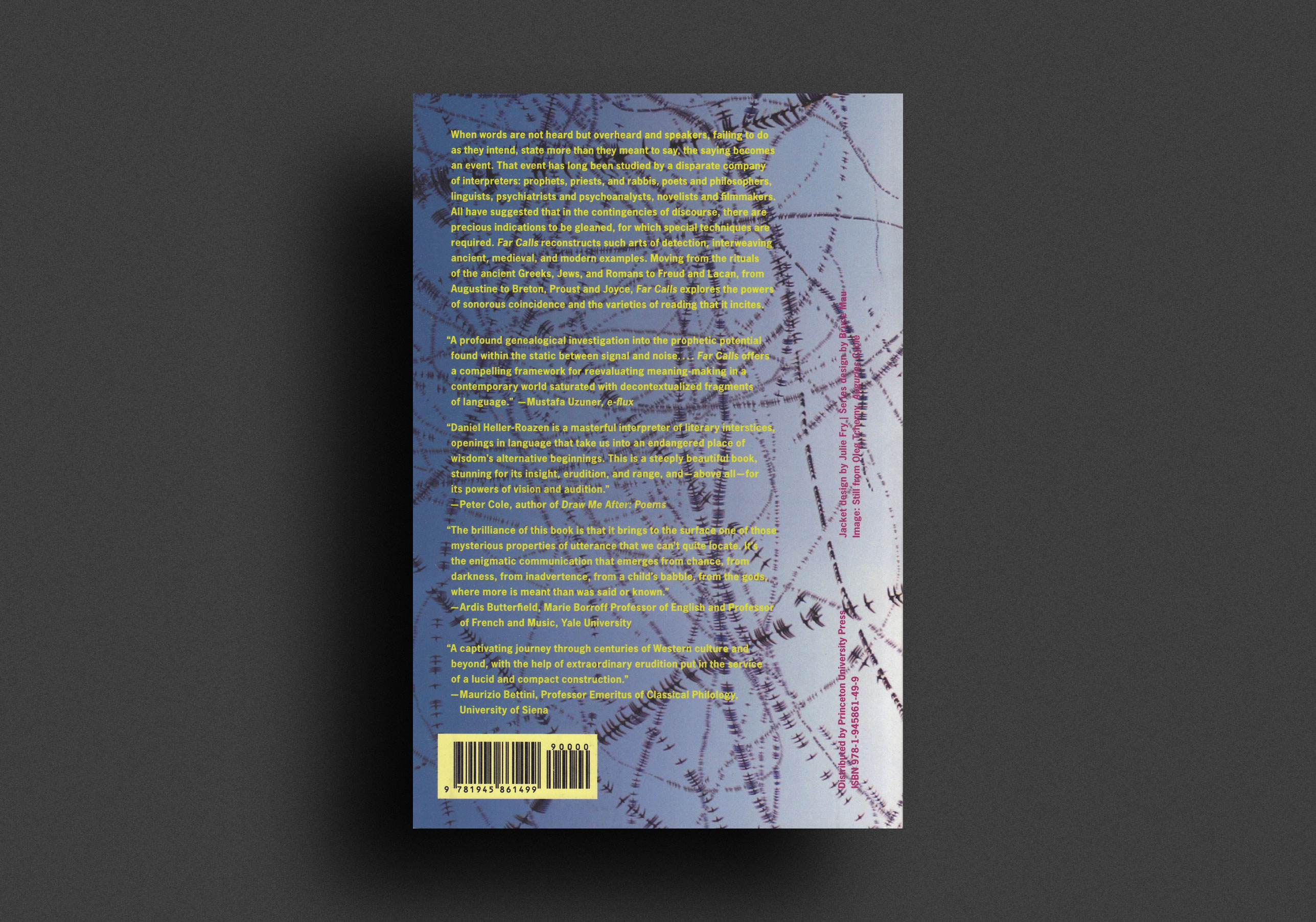
How the notorious author of The 120 Days of Sodom inspired the surrealists and other avant-garde artists, writers, and filmmakers.
The writings of the Marquis de Sade (1740–1814) present a libertine philosophy of sexual excess and human suffering that refuses to make any concession to law, religion, or public decency. In this groundbreaking cultural history, Alyce Mahon traces how artists of the twentieth century turned to Sade to explore political, sexual, and psychological terror, adapting his imagery of the excessively sexual and terrorized body as a means of liberation from systems of power.
Mahon shows how avant-garde artists, writers, dramatists, and filmmakers drew on Sade’s “philosophy in the bedroom” to challenge oppressive regimes and their restrictive codes and conventions of gender and sexuality. She provides close analyses of early illustrated editions of Sade’s works and looks at drawings, paintings, and photographs by leading surrealists such as André Masson, Leonor Fini, and Man Ray. She explains how Sade’s ideas were reflected in the writings of Guillaume Apollinaire and the fiction of Anne Desclos, who wrote her erotic novel, Story of O, as a love letter to critic Jean Paulhan, an admirer of Sade. Mahon explores how Sade influenced the happenings of Jean-Jacques Lebel, the theater of Peter Brook, the cinema of Pier Paolo Pasolini, and the multimedia art of Paul Chan. She also discusses responses to Sade by feminist theorists such as Simone de Beauvoir, Susan Sontag, and Angela Carter.
Beautifully illustrated, The Marquis de Sade and the Avant-Garde demonstrates that Sade inspired generations of artists to imagine new utopian visions of living, push the boundaries of the body and the body politic, and portray the unthinkable in their art.
Alyce Mahon is Professor of Modern and Contemporary Art and a Fellow of Trinity College at the University of Cambridge, England. Born in Galway in the west of Ireland, she studied Modern English and History of Art at Trinity College Dublin and then took her doctoral degree at the Courtauld Institute of Art, University of London (1999), prior to being appointed at the University of Cambridge in 2000. She specialises in Surrealism, feminist art practice, and contemporary art and politics in her publications and work as curator. Recent exhibitions she has curated include the first major retrospective of American Surrealist 'Dorothea Tanning' for the Reina Sofia Madrid and Tate Modern London (2018-19) and 'SADE: Freedom or Evil' for the CCCB (2023).
2019, English
Softcover, 204 pages, 91.5 x 13.5 cm
Published by
Twisted Spoon Press / Prague
$35.00 - In stock -
Philosopher, novelist, essayist, eccentric, no other Czech author has had a greater impact on underground culture than Ladislav Klíma (1878-1928). Mentor to artists as varied as Bohumil Hrabal and the Plastic People of the Universe, Klíma’s philosophy was radically subjectivist, and he felt it should be lived rather than merely spoken or written about. With Nietzsche as his paragon, he embarked upon a lifelong pursuit to become God, or Absolute Will, elucidating this quest in many letters, aphorisms, and essays. Yet among Klíma's fictional texts, the apotheosis of his philosophy is The Sufferings of Prince Sternenhoch, his most acclaimed novel. Ostensibly a series of journal entries, the tale chronicles the descent into madness of Prince Sternenhoch, the German Empire’s foremost aristocrat and favorite of Kaiser “Willy.” Having become the “lowliest worm” at the hands of his estranged wife, Helga, the Queen of Hells, Sternenhoch eventually attains an ultimate state of blissmand salvation through the most grotesque perversions. Klíma explores here the paradoxical nature of pure spirituality with a humor that is as dark as it is obscene. This volume also includes his notorious text “My Autobiography.”
translated from the Czech by Carleton Bulkin
illustrations by Jan Konůpek
afterword by Josef Zumr
2023, English
Softcover, 198 pages, 20.4 x 12.7 cm
Published by
Snuggly Books / UK
$40.00 - In stock -
René Crevel (1900-1935), a bisexual communist who suffered from tuberculosis, was one of the most important surrealist authors, a true genius, and possibly the best writer of surrealist fiction, and no other of his works of fiction is more surreal than Are You All Crazy?-originally published in 1929 and here presented for the first time in English in a superb translation by Sue Boswell. In this feverish, full-speed-ahead novel of out-and-out madness, we meet a redhead who gives birth to a blue child, hear the naughty song of the pigtail-pullers, visit the Sexual Institute of Dr Optimus Cerf-Mayer, attend an eonism séance, and witness a fifty-kilo rat disembowelling a fakir.
Are You All crazy? is a subversive masterpiece and a work of deep psychological interest, which, although puzzling in the utmost in its excesses of satirical bravado, certainly must be acknowledged to be one of the great European novels.
2025, English / French
Softcover, 192 pages, 27.5 x 23 cm
Published by
Five Continents Editions / Milan
$78.00 - In stock -
Texts by Anic Zanzi, Flavie Beuvin, Vânia Vaz De Freitas
Laure Pigeon (1882-1965) is one of the leading figures in Art Brut (Outsider Art), along with Aloïse Corbaz and Adolf Wölfli. The Collection de l’Art Brut in Lausanne probably possesses her entire oeuvre, amounting to over 400 works, including writings, notebooks, small-scale drawings and an extensive series of large compositions in blue ink. These are all part of the corpus of works acquired by Jean Dubuffet, the historic collection around which the museum was founded.
In 1978, the Collection de l’Art Brut held the first and only monographic exhibition dedicated to this artist. A new exhibition in 2025 has now been devoted to her exclusively. It offers a representative selection of her striking graphic work, spanning a period of thirty years.
Like Madge Gill, Jeanne Tripier, Augustin Lesage and Raphaël Lonné, Laure Pigeon too was a member of the spiritualist fraternity – men and women who feel “selected” to receive messages from the hereafter and claim the deceased are responsible for their creations. The spiritualist’s hand is therefore guided and merely executes what the spirits dictate. The catalogue, in French and English, includes essays by several authors and a large number of colour illustrations.
Anic Zanzi has been a curator at the Collection de l’Art Brut since 2003. An art historian with a degree in Public Relations, she is in charge of editing the various works published by the institution and organises exhibitions, such as People (2016), Henriette Zéphir (2017), Ernst Kolb (2018), Carlo Zinelli, recto verso (2019) and Michel Nedjar (2023), as well as two Art Brut biennials, Véhicules (2013) and Croyances (2022).
Flavie Beuvin is a visual artist with a degree in Art and Aesthetics. Her art and theoretical work focus on the echoes between the creating body and the body of the work. The concept of “vegetality”, which she developed as part of her academic research and published by Presses Universitaires du Septentrion as Végétalité, Art Brut et féminins, lies at the heart of her aesthetics. She is also extremely keen on drawing, combining it with various other media, such as embroidery and collage.
Vânia Vaz De Freitas holds a BA in Conservation-Restoration from the Haute École Arc in Neuchâtel. She is currently pursuing a master’s degree in Museum Studies at the University of Neuchâtel. She has gained experience in preventive conservation through periods spent in various other institutions, notably the Cinémathèque suisse research centre and Maison d’Ailleurs. Vânia also spent time at the Collection de l’Art Brut from 2023 to 2024, working mainly on Laure Pigeon’s oeuvre.
Exhibition: Collection de l’Art Brut, Lausanne, October 10, 2025 — February 1, 2026
2025, English
Hardcover (w. dust jacket), 136 pages, 19.6 x 11.6 cm
Published by
No Place Press / US
$45.00 - In stock -
Artists Reba Maybury and Lucy McKenzie dissect power and desire in a provocative conversation that probes the material erotic, appropriation, and sex.
Introduction by Fredi Fischli and Niels Olsen
Afterword by Susan Finlay
In Pervert or Detective?, artists Reba Maybury and Lucy McKenzie dissect power, desire, and subversion in a provocative conversation. Maybury, who integrates her work as a political dominatrix into her artistic practice, manipulates dynamics of control, compelling her male submissives to create art under her direction, only to claim it as her own. Through confession and humiliation, she dismantles notions of authorship, masculinity, and labor. McKenzie, known for her intricate trompe l’oeil paintings and conceptual installations, similarly blurs boundaries—between art and commerce, and authenticity and illusion. Her work challenges power structures and exposes the unstable nature of representation.
Maybury and McKenzie, through an expansive discussion with French art critic Marie Canet, interrogate the logic of seduction and domination, pushing against rigid binaries to probe the material erotic, appropriation, and transformation. With an introduction by curators Fredi Fischli and Niels Olsen, an afterword by writer Susan Finlay, and extensive reading and viewing lists, Pervert or Detective? offers a compelling exchange between artists committed to unsettling the familiar and redefining artistic agency.
1997, English
Softcover, 250 pages, 22.5 x 14.5 cm
Published by
University of Nebraska Press / Lincoln
$49.00 - In stock -
Simone Weil, the French philosopher, political activist, and religious mystic, was little known when she died young in 1943. Four years later the philosopher-farmer Gustave Thibon compiled La pesanteur et la grace from the notebooks she left in his keeping. In 1952 this English translation accelerated the fame and influence of Simone Weil. The striking aphorisms in "Gravity and Grace" reflect the religious philosophy of Weil's last years. Written at the onset of World War II, when her health was deteriorating and her left-wing social activism was giving way to spiritual introspection, this masterwork makes clear why critics have called Simone Weil "a great soul who might have become a saint" and "the Outsider as saint, in an age of alienation."
"In these private reflections, at once pregnant and precise, and all springing out of painful depths of experience, mental pride is transmuted into spiritual insight."—Manchester Guardian
"A book of Pascalian pensees, touching on many phases of the intellectual and spiritual worlds. Written in prose which is as unadorned as a geometry theorem, it bears clear personal traces of the young genius who was half icy intellectual, half mystic."—New York Times
2024, English
Softcover, 106 pages, 22.86 x 15.24 cm
Published by
Incunabula / USA
Incunabula / US
$34.00 - In stock -
The Dead Man, (originally published as Le Mort), is Georges Bataille's classic tale of devotion, depravity and damnation. It follows Marie, who, after witnessing the sudden death of her lover, wanders naked and grieving through the night streets of a French town, sinking ever deeper into depravity as she seeks to escape the agony of loss... The Solar Anus (L'anus Solaire) is a short surrealist text, written by Bataille in 1927. It deals with death, decay, disasters, impotence, ennui and excrement, and contains references to the sun - which brings life to the Earth, and death to those exposed to its unrestrained energies.
This edition contains R J Dent's brand-new modern English translation of both texts, and afterword by Bataille, and an introduction by R J Dent with Jack Sargeant. It is illustrated throughout with photographs by Alexandria Bryan.
2026, English
Softcover, 92 pages, 20.5 x 13.5 cm
Published by
Semiotext(e) / Los Angeles
$34.00 - In stock -
Translated by Jeffrey Zuckerman
An account of flawed justice, based on the true story of a murder in a housing project outside Paris.
He is guilty, yes. He is guilty of having yielded, of not allowing himself to be crushed. He is guilty of not having been reasonable, of not having stayed in his place, the one that was his. To have disturbed the order of things…
Ten stab wounds. An old woman in a pool of blood. A nineteen-year-old neighbor now a murderer.
Since publishing her first novel in 2018, Constance Debré’s work has exposed the flaws in the social order with dizzying passion and intelligence. Her first-person trilogy—Playboy, Love Me Tender, and Name—describes the trajectory of leaving a comfortable bourgeois life as mother and wife employed as a criminal justice attorney to become a writer and lesbian. Her books radically challenge all received ideas of the couple, motherhood, family, and inheritance.
In Offenses, Debré trains her sights on a single case of inevitably flawed justice that, like hundreds of others like it, reveals the enmeshed culpabilities of the perpetrator, the victim, the place, and the past. In a housing project adjacent to Paris, an unemployed teenager kills his elderly neighbor in order to pay off a drug debt of €450. Writing with impassioned detachment, Debré uses forensic detail to explore the ambient senselessness behind this senseless crime.
There is a geography, Debré writes. We live in a vertical world, you don’t see. A world made of worlds. Not side by side but set concentrically and upon one another. A bit like Middle Age representations of the universe, a bit like Dante’s circles of hell. Each world only communicating with the worlds directly in contact with it and none of the others.
In Offenses, Debré scathingly describes the misery of poverty and the absence of any horizon beyond.
2026, English
Hardcover (w. dust jacket), 480 pages, 24 x 16 cm
Published by
Farrar Straus & Giroux / New York
$62.00 - In stock -
US hardcover edition.
"As official narratives everywhere strain and crack, Peter and Paul—and Durbin—offer a desperately needed alternative way of seeing and being."—Benjamin Moser, author of Susan Sontag: Her Life and Work, winner of the Pulitzer Prize
"A deeply original book, saturated with melancholy longing for a historical moment (past and future) when art and love could come together with a synchronized, quicksilver suddenness. Andrew Durbin creates a spellbinding sense of wistful cinematic duration in his twinned account of these two incandescent iconoclasts."—Wayne Koestenbaum
"[Andrew Durbin] has made of these lives and these times a jam-packed poem in prose. It's like a trip with these guys, without pulling tight at the ending, just death."—Eileen Myles, author of A "Working Life"
The cinematic, never-before-told story of two intimately entangled artists who redefined queer art.
When Paul Thek met Peter Hujar in the winter of 1956 in Coral Gables, Florida, a slow-simmering connection began to burn. Thek, twenty-three and living in Miami, was handsome and itching to make it as a painter; in the twenty-two-year-old Hujar, a shy, sensual photographer, he'd found a kindred spirit. By 1960, they were dating and living in New York, beginning decades of sex, love, competition, and reconciliation—an entanglement that changed American art forever.
Surrounded by a robust creative scene populated by Susan Sontag, Andy Warhol, Fran Lebowitz, John Waters, and David Wojnarowicz, Thek and Hujar's profoundly influential careers, from the early 1960s through the late 1980s, differed as much as the men themselves. The unpredictable and often overlooked Thek crafted visceral installations and sculptures, while Hujar, celebrated and sociable, took penetrating portraits of his world, queer and otherwise. Yet even at their most estranged, and even after their deaths from AIDS, both men were united by a pursuit of liberation—from artistic and sexual limits, from anything short of changing the world.
Andrew Durbin's The Wonderful World That Almost Was unravels, for the first time, the intertwined stories and work of two boundaryburning, paradigm-tilting, never more relevant American artists. Weaving together deft art criticism with moving portraits of both men's inner lives, and assembled with exhaustive research, Durbin's book is an ode to a lost but still-living world—and two men who defined it.
2025, English
Softcover, 192 pages, 30.5 x 23 cm
Published by
Primary Information / New York
$69.00 - In stock -
Stay away from nothing shines a spotlight on the deep relationship between Paul Thek and Peter Hujar through the artists’ letters and photographs. Beginning in 1956 and spanning two decades, the publication opens a window into their intimate, complex, and beautiful lives, starting with a sequence of images by Hujar that showcases the two of them in innocent moments of pensive and haunting play in Coral Gables and beyond.
These early portraits of their budding relationship are followed by Thek’s first letter to Hujar in 1962, written while the artist is in the Philadelphia harbor aboard a containership bound for Europe. In the letter, Thek is brimming with joy and new discoveries and exclaims that the world “seems bigger and more gloriously strange than ever before in my entire life.” The two eventually meet in Rome, where they both begin to evolve into the icons we know them as today, and the remaining letters trace Thek’s travels and adventures, romantic dalliances, work, and financial ups and downs through 1975. More than fifty letters and postcards, along with drawings and other ephemera, are reproduced in Stay away from nothing and their poetic, quotidian, and melancholic tone provide a rare glimpse into Thek and Hujar’s relationship as it waivers with seduction, glamor, tumult, and mischievousness.
Throughout this period, Hujar was photographing Thek in his now iconic style, capturing him in Italy, in various studios, and on the beaches of Fire Island. Included are the artist’s now-classic images of Thek in the catacombs in Palermo, as well as his studio portraits of the artist creating The Tomb. Among these well-known works are dozens of other photographs, many unpublished until now, including candid portraits of Thek, as well as images of the two artists goofing around or posing for passport photos. Collectively, these images demonstrate not only the complex emotional interiority of Thek but the tender, dark, and hopeful connection between the two artists, lovers, and friends.
An afterword is provided by Andrew Durbin, author of A Wonderful World that Almost Was, a biography of Peter Hujar and Paul Thek.
2019, English
Softcover, 600 pages, 11.4 x 17.8 cm
Published by
Urbanomic / Cornwall
Sequence Press / New York
$55.00 - In stock -
A fragmentary catalogue of poetic derangements that reveals the ways in which mania communicates with an extreme will to annihilation
What kind of circumstances provoke an obsessive focus on the most minute object or activity? And what causes such mania to blossom into the lethal conviction that everything must be annihilated? There is no turning away from the imperative to study this riddle in all its mystifying complexity and its disturbing contemporary resonance-to trace the obscure passage between a lone state of delirium and the will to world-erasure..
A fragmentary catalogue of the thousand-and-one varieties of manic disposition (augomania, dromomania, catoptromania, colossomania...), Omnicide enters the chaotic imaginations of the most significant poetic talents of the Middle East in order to instigate a new discourse on obsession, entrancement, excess, and delirium. Placing these voices into direct conversation, Jason Bahbak Mohaghegh excavates an elaborate network of subterranean ideas and interpretive chambers, byways, and burrows by which mania communicates with fatality. Like secret passages leading from one of the multitudinous details of a bustling Persian miniature to the blank burning immanence of the desert, each is a contorted yet effective channel connecting some attractive universe (of adoration, worship, or astonishment) to the instinct for all-engulfing oblivion (through hatred, envy, indifference, rage, or forgetting).
A captivating fractal of conceptual prisms in half-storytelling, half-theoretical prose, a rhythmic, poetic, insidious work that commands submission, Omnicide absorbs the reader into unfamiliar and estranging landscapes whose every subtle euphoric aspect threatens to become an irresistible invitation to the end of all things.
2023, English
Softcover, 570 pages, 11.4 x 17.8 cm
Published by
Urbanomic / Cornwall
$55.00 - In stock -
An infernal catalogue of manic visionaries, inspired by the poetry of the Middle East.
In a new work in which conceptual elaboration, storytelling, and poetics are fused in the infernal heat of the desert, the cycle of Omnicide is closed with a philosophy of doom, deception, and the game, plunging headlong into the inevitable, the fatal, and the infinite.
A series of controlled combustions fuelled by fragments drawn from the poetry and literature of the Middle-East, Omnicide II introduces us to a new cast of manic visionaries, from the Selemaniac to the Crystallomaniac, the Bibliomaniac to the Aeromaniac. In his relentless cataloguing of the myriad figures and portents of omnicidal doom, Jason Bahbak Mohaghegh resumes the offensive of those writers, artists, and thinkers for whom the fiercest creative incandescence is only kindled in the shadow of certain doom.
Amid war cries and lullabies, mages, wolves and pelicans, sabres and crystals, drones and soul-stealers, in settings ranging from the opium den to the Qatari luxury hotels, with his unique style and methodology, his dizzying breadth of references, and his implacable will to follow the most deranging lines of thought and evoke the most startling images, Mohaghegh draws the reader into territories disturbing and unfamiliar, atmospheres delicate and grotesque, moods morbid yet life-affirming, in a book that evokes fever and exudes dead calm.
The utterly absorbing music of this writing both lulls and disquiets-a contemporary Necronomicon, an inexhaustible treasury of recipes for disaster, catastrophe, ruination and destruction, all in the name of the most intense creation.
Jason Bahbak Mohaghegh is Associate Professor of Comparative Literature at Babson College. His focus is on tracking experimental thought in the so-called Middle East and the West, with particular attention to exploring concepts of chaos, violence, illusion, silence, sectarianism, madness, disappearance, and apocalyptic writing. He is the author of The Chaotic Imagination (2010); Inflictions (2012); The Radical Unspoken (2013); Insurgent, Poet, Mystic, Sectarian (2015); Omnicide- Mania, Fatality, and the Future-In-Delirium (Urbanomic/Sequence Press, 2019); and Night- A Philosophy of the After-Dark (2020).
2024, English
Softcover, 208 pages, 20.32 x 13.18 cm
Published by
The New York Review of Books / New York
$36.00 - In stock -
In this delightful, cinema-inspired daydream of a novel, an identity-shifting protagonist uses the everyday inspirations of his life to catapult himself into the realm of imagination, blurring the boundaries between reality and fantasy.
The Skin of Dreams is a novel of waking dreams. Even as he lives his life, Jacques L'Aum ne, its hero, daydreams a hundred other possible lives. A few lines on a page, a chance encounter, a remark overheard in passing, any of these are enough to kick things into gear and send him off outside of himself to become a boxer, a general, a bishop, or a lord. He lives alongside his life with diligence and steadfastness; and the passage from real to dream is so natural for him that he no longer knows precisely which him he is. Eventually he becomes an actor in Hollywood, and the basis of countless dreams for others. This Jacques L'Aum ne, like the characters who surround him, has the same sort of haunting and fluid consistency as someone that we might dream of in our beds at night. And reverie, here, is born through the tale's humor, which is as gentle as it is cruel, as well as by way of a writing technique that is itself drawn from one of Queneau's great loves, the cinema.
Raymond Queneau (1903—1976) was a French novelist, poet, critic, editor and co-founder and president of Oulipo, notable for his wit and cynical humour. Born in the French town of Le Havre and educated at the Sorbonne, he then performed his military service in Morocco. An early association with the Surrealists ended in 1929, and after completing a scholarly study of literary madmen of the nineteenth century for which he was unable to find a publisher, Queneau turned to fiction, writing his first novel, Le Chiendent (Witch Grass), in Greece in the summer of 1932. Influenced by James Joyce and Lewis Carroll, Queneau sought to reinvigorate French literature, grown feeble through formalism, with a strong dose of language as really spoken. He further encouraged innovation by founding, with the mathematician François Le Lionnais, the famous group OULIPO (Ouvroir de Littérature Potentielle), which investigated literary composition based on the application of strict formal or mathematical procedures (members of the group included Italo Calvino, Georges Perec, and Harry Mathews). Queneau’s many books, which typically blur the boundaries between fiction, poetry, and the essay, include Pierrot mon ami, The Sunday of Life, Zazie in the Metro (made into a movie by Louis Malle), and Exercises in Style; under the name of Sally Mara, he published We Always Treat Women Too Well, a brilliant comic spoof on the excesses of smutty popular novels. Queneau was the editor of the Encyclopédie de la Pléiade as well as a fine poet, whose lyric “Si tu t’imagines” was a hit for the celebrated postwar chanteuse Juliette Gréco.
1996, English
Softcover, 354 pages, 25.4 x 20.4 cm
1st Edition, Out of print title / used / very good
Published by
Cambridge University Press / Cambridge
$55.00 - Out of stock
First 1996 edition.
This book examines the evolution of Dalí's art during the 1920s and 1930s when he was associated first with the Catalan avant-garde and then with the Surrealist group in Paris. During this period, Dalí's painting style changed radically, a phenomenon which has never been fully accounted for in the extensive literature on this subject. Haim Finkelstein demonstrates that Dalí's writing, in which he explicated theoretical systems such as Paranoia-Criticism and other ideas adopted from Freud, were important for the active and critical role that they played in his development as an artist and often controversial figure. His 1996 study examines these writings in detail as the foundation for the evolution of Dalí's unique artistic vision.
' … this exuberant, well-focused study charts the metamorphosis of an unsure, neurotic Catalan painter into a dynamic, neurotic internationally famous (ex)-Surrealist.' Art Newspaper
'… certainly one of the better books on Dalí I have encountered … the text is an excellent exposition of what was within Dalí's horizon of expectations almost moment by moment. In this respect, the book is exemplary, going well beyond the tendency towards generalisation apparent in almost every other book-length work on the artist.' British Journal of Aesthetics
VG copy, light wear to extremities.
1990, English
Softcover (staple bound), 36 pages, 21 x 15 cm
1st Edition, Out of print title / used / very good
Published by
The FFM Association / Paris
$45.00 - In stock -
Rare copy of Fantasy Film Memory Presents "Shockers" issue no. 2 of the film digest / fanzine, published in France in October 1990, and devoted entirely to "The Poet of the Macabre", Italy's giallo gore master Lucio Fulci (1927—1996). This English text book is packed with glossy colour and b/w film stills, lobby cards, posters, and on-set photos and other visual documents, not to mention loads of spectacular Fulci mania, accompanying texts and information compiled by Jean-Claude Michel. A must for any fan. The "Shockers" series was published in 4 issues between 1990—1991.
Very Good copy.
2021, English
Hardcover (clothbound), 640 pages, 23 x 18.5 cm
Published by
Karma / New York
$145.00 - In stock -
A handsome and hefty clothbound compendium of Lozano’s explorations of gender through drawing,
this 640-page volume comprises drawings from a critical six-year period in the development of American painter and conceptual artist Lee Lozano’s (1930-99) practice. Her daring, facetious sketches investigate issues of gender and the body through the erogenous anthropomorphization of tools.
Lee Lozano: Drawings 1958-64 includes two newly commissioned essays by Helen Molesworth and Tamar Garb. “What I love about Lozano—besides the crazy, ham-fisted quality of her drawn line, pictures made with pencils that appear to have been held with a fist—is how her demonstration of the word 'connection' is not bound to any of the anodyne ways we currently use it,” writes Molesworth. “There’s nothing about 'listening' or 'building community' or 'empathy' in any of these drawings. For Lozano, connection is fraught and hairy. Connection is dangerous.”
1990, French
Softcover, 232 pages, 27 x 24 cm
1st Edition, Out of print title / used / very good
Published by
Centre Georges Pompidou / Paris
Musée Picasso / Antibes
$70.00 - Out of stock
One of the best and most comprehensive books on the great Swiss artist, Daniel Spoerri, beautifully put together to accompany a travelling exhibition of his work in 1990/1991 in Paris, Antibes, Wien, München, Genève, Solothurn. Profusely illustrated with Spoerri's incredible artistic history of installations, performances, studio photos, editions, and other activities across important associations with Fluxus, Nouveau réalisme and Eat Art; works across sculpture, assemblage, action, and relief, including a great number of his iconic "snare works". Includes an exhibition history, bibliography and essays (in French). Highly recommended book, long out-of-print.
Daniel Spoerri (b. 1930) is a Swiss artist and writer born in Romania. Spoerri is best known for his "snare-pictures". In 1960, Spoerri made his first "snare-picture": "objects found in chance positions, in order or disorder (on tables, in boxes, drawers, etc.) are fixed (‘snared’) as they are. Only the plane is changed: since the result is called a picture, what was horizontal becomes vertical. Example: remains of a meal are fixed to the table at which the meal was consumed and the table hung on the wall." His first "snare-picture", Kichka's Breakfast was created from his girlfriend's leftover breakfast. The piece is now in the collection in the Museum of Modern Art in New York. One snare-picture, made in 1964, consists of the remains of a meal eaten by Marcel Duchamp. He also is widely acclaimed for his book, Topographie Anécdotée* du Hasard (An Anecdoted Topography of Chance), a literary analog to his snare-pictures, in which he mapped all the objects located on his table at a particular moment, describing each with his personal recollections evoked by the object, with illustrations by the great Roland Topor. In the 1950s he was active in dance, studying classical dance with Olga Preobrajenska and in 1954 becoming the lead dancer at the State Opera of Bern, Switzerland. He later staged several avant-garde plays including Ionesco's The Bald Soprano and Picasso's surrealist Desire Trapped by the Tail. During that period he met a number of Surrealist artists, including Meret Oppenheim, Jean Tinguely, Marcel Duchamp and Man Ray, and also a number of artists subsequently associated with the Fluxus movement, including Robert Filliou, Dieter Roth and Emmett Williams. Closely associated with the Fluxus art movement, a movement "characterized by a strongly Dadaist attitude, [whose] participants were a divergent group of individualists whose most common theme was their delight in spontaneity and humor." It has been said that his Anecdoted Topography of Chance "seems perfectly to embody aspects of its spirit." Spoerri was also one of the original signers of the manifesto creating the Nouveau réalisme (New Realism) art movement, which involved artists such as Yves Klein, Arman, Martial Raysse, Pierre Restany, Niki de Saint Phalle, César, Jean Tinguely, Mimmo Rotella, Gérard Deschamps, and the Ultra-Lettrists, Francois Dufrêne, Raymond Hains, Jacques de la Villeglé, an avant garde endeavor begun in 1960. His use of everyday life as the main subject-matter of his art reflects his involvement in the New Realism movement. A major theme of Spoerri's artwork is food, and he has called this aspect of his work "Eat Art." This is seen not only in his snare-pictures of eaten meals, but in restaurant performance pieces, for which he cooks for guests and art-critics take on the role of waiters, playing on the idea of the critic bringing the art to the consumers and giving them an understanding of the work.
Very Good, preserved copy.
2025, English / Japanese
Softcover (w. obi), 488 pages, 21 x 14.8 cm
Published by
Lock Books / UK
$95.00 - In stock -
Our Feature Presentation curates an assortment of pages scanned from over 70 vintage Japanese cinema pamphlets, known as 映画パンフレット (Eiga panfuretto) ranging from 1950-2000.
Sold during a film’s run, these pamphlets typically included interviews with the cast and director, production notes, behind-the-scenes details and film stills. During the boom of Japanese cinema and imported Hollywood films in the 1950s, such programs became standard for most major releases and collectible items among cinephiles.
Ranging from Bresson to Fulci, The Evil Dead to The Virgin Suicides, each page highlights the unique and vibrant design of these pamphlets, showcasing rare film stills and production imagery.
1972, Japanese
Softcover, 140 pages, 25.5 x 18 cm
1st Edition, Out of print title / used / good
Published by
Hōen Shobō / Tokyo
$80.00 - Out of stock
Very rare inaugural issue of BLACK NIGHT, July 1972, the only issue published by Hōen Shobō before being published by Seifū Shobō. Another short-lived wonder of the golden era of SM publishing. With the title of SM Special Feature - "Tales of Rope Bondage", this first issue was edited by the legendary editor/designer/illustrator Akira Suei, frequent collaborator with Nobuyoshi Araki. In this larger B5 magazine format, BLACK NIGHT boasts beautifully printed, rich, saturated colour and gravure b/w photo features of young Japanese women in bondage, amazing erotic art galleries and heavily illustrated erotic stories spanning many different paper stocks. Features artwork by Jun Kazama, Kohinata Kazumu (Kimata Kiyoshi), a leading SM illustrator born in the Meiji era, Akira Suei, Yōko Kozuma, Haruo Shinozaki, Yukio Koaki, Kinji Miyagawa, Yoshio Kanzai, Fujikawa Miki, Kurohyosake, photography by Yutaka Okawa, Shotaro Ichitani, Kaoruko Saotome, Jiro Kusaka, and more, Models are Mari Kuga, Maya Kitami, Reiko Igawa, Yamada Ai, Hitomi Aran, Katsuko Seto, Hamana Mimi and many more. A rare publication from the golden era of Japanese SM publishing, erotic fantasy illustration and Pink film.
Good—Very Good copy, tightly bound, some tanning, mild wear, some creases to back cover.