World Food Books' programme is largely produced on Kulin Nation land. We acknowledge the Wurundjeri people of the Kulin Nation as the first and continuing custodians of this land, and pay respect to their Elders past, present, and emerging.
World Food Books is an arts and special interests bookshop in Naarm / Melbourne. Founded in 2010, World Food Books is devoted to the presentation of a rotating, hand-selection of international art, design, literary and counterculture publications with an emphasis on the anti-traditional, the experimental, the avant-garde, the heretic, the marginal.
Presenting new titles alongside rare and out-of-print books, catalogues and journals spanning the fields of modern and contemporary art, design, photography, illustration, film, literature, poetry, cultural theory, philosophy, sexuality, popular and underground culture in its many radical forms, World Food Books wishes to encourage adventurous, thoughtful and open-minded reading, looking, writing, and exchange of publishing and ideas, both current and historical.
As well as our bookshop, located in Melbourne's historical Nicholas Building, all of our inventory is available internationally via our online mail-order service.
World Food Books semi-regularly co-ordinates "Occasions", a programme of exhibits and events at the bookshop and in partnership with other hosts (such as museums and art galleries) that develop out of the activities, relationships and content of the bookshop itself.
World Food Books
The Nicholas Building
37 Swanston Street
Room 5, Level 6
Melbourne 3000
Australia
SHOP HOURS:
Thu–Fri 12–6, Sat 12–5
WEB-SHOP OPEN 24/7
World Food Books
Postal Address:
PO Box 435
Flinders Lane
Victoria 8009
Australia
Art
Theory / Essay
Architecture / Interior
Graphic Design / Typography
Photography
Fashion
Eros
LGBTQ+
Fiction / Poetry
Weird / Speculative / Science Fiction / Horror
Transgressive / Visceral / Abject
Symbolism / Decadence / Fin de siècle
Film / Video
Painting
Sculpture / Installation
Performance / Dance / Theater
Drawing
Sound / Music
Curatorial
Group Shows / Collections
Periodicals
Out-of-print / Rare
Posters / Ephemera / Discs
Signed Books
World Food Books Gift Voucher
World Food Book Bag
Australian Art
Australian Fiction
Australian Science Fiction / Speculative Fiction
Australian Poetry
Australian Photography
Japanese Photography
Conceptual Art
Minimal Art
Dada
'Pataphysics / Oulipo
Fluxus
Concrete Poetry
Pop Art
Surrealism
Arte Povera
Arte Informale / Haute Pâte / Tachism
Nouveau Réalisme / Zero / Kinetic
Situationism / Lettrism
Collage / Mail Art / Xerox Art
Art Brut / Folk / Visionary / Fantastic
Illustration / Graphic Art / Bandes Dessinées
Furniture
Italian Radical Design / Postmodernism
Textiles
Ceramics / Glass
Counterculture
Protest / Revolt
Philosophy
Psychoanalysis
Anthropology
Anarchism
Socialism / Anarchism / Communism / Capitalism
Literary Theory / Semiotics / Language
Feminism / Women's Studies
Gender Studies / Sexuality
Anthropology
Fetishism / BDSM
Drugs / Psychedelia
Crime / Violence
Animal Rights / Veganism
Occult / Esoterica
Ecology / Earth / Alternative Living
Whole Earth / Crafts
All prices in AUD (Australian dollars)
Pick-Ups
Pick-up orders can be collected in our bookshop during opening hours after order date. Please collect any Pick-up orders within 2 weeks of ordering as we have limited storage space. Orders will be released back into stock if not collected within this time. No refunds can be made for pick-ups left un-collected. If you cannot make it in to the bookshop in this time-frame, please choose postage option.
Return Policy
All sales are final. We do accept returns (for refund or exchange) for items received in error. All our orders are packed with special care using heavy-duty padding and cardboard book-mailers or bubble mailers (for smaller books), using reinforcement where required. We cannot take responsibility for any lost, stolen or damaged parcels.
Insurance
Should you wish to insure your package, please email us directly after placing your order and we can organise this at a small extra expense. Although all standard/express tracked packages are very safe and dependable, we cannot take responsibility for any lost, stolen or damaged parcels. We recommend insurance on valuable orders.
Interested in selling your old books, catalogues, journals, magazines, comics, fanzines, ephemera? We are always looking for interesting, unusual and out-of-print books to buy. We only buy books in our fields of interest and specialty, and that we feel we can resell.
We base these prices on desirability, market value, in-print prices, condition and our current stock levels. We offer cash, store credit, and can take stock on consignment. All
about 25% of the price we expect to get when we sell them, or 30% in store credit. We base these prices on desirability, market value, in-print prices, condition and our current stock levels.
Sell your books any day of the week. You can drop them off and return later. If you have a lot of books, we can visit your Sydney home.
We buy books that we feel we can resell. We offer about 25 % of the price we expect to get when we sell them, or 30% in store credit. We base these prices on desirability, market value, in-print prices, condition and our current stock levels.
Philadelphia Wireman
03 August - 01 September, 2018
World Food Books is proud to announce our next Occasion, the first presentation of sculptures by Philadelphia Wireman in Australia.
The Philadelphia Wireman sculptures were found abandoned in an alley off Philadelphia’s South Street on trash night in 1982. Their discovery in a rapidly-changing neighbourhood undergoing extensive renovation, compounded with the failure of all attempts to locate the artist, suggests that the works may have been discarded after the maker’s death. Dubbed the "Philadelphia Wireman" during the first exhibition of this work, in 1985, the maker’s name, age, ethnicity, and even gender remain uncertain. The entire collection totals approximately 1200 pieces, all intricately bound together with tightly-wound heavy-gauge wire (along with a few small, abstract marker drawings, reminiscent both of Mark Tobey and J.B. Murry). The dense construction of the work, despite a modest range of scale and materials, is singularly obsessive and disciplined in design: a wire armature or exoskeleton firmly binds a bricolage of found objects including plastic, glass, food packaging, umbrella parts, tape, rubber, batteries, pens, leather, reflectors, nuts and bolts, nails, foil, coins, toys, watches, eyeglasses, tools, and jewellery.
Heavy with associations—anthropomorphic, zoomorphic, and socio-cultural responses to wrapped detritus—the totemic sculptures by Philadelphia Wireman have been discussed in the context of work created to fulfil the shamanistic needs of alternative religions in American culture. Curators, collectors, and critics have variously compared certain pieces to sculpture from Classical antiquity, Native American medicine bundles, African-American memory jugs, and African fetish objects. Reflecting the artist’s prolific and incredibly focused scavenging impulse, and despite—or perhaps enhanced by—their anonymity, these enigmatic objects function as urban artefacts and arbiters of power, though their origin and purpose is unknown. Philadelphia Wireman, whatever their identity, possessed an astonishing ability to isolate and communicate the concepts of power and energy through the selection and transformation of ordinary materials. Over the course of the past two decades, this collection has come to be regarded as an important discovery in the field of self-taught art and vernacular art.
Presented in collaboration with Fleisher-Ollman Gallery, Philadelphia, and Robert Heald, Wellington.
Susan Te Kahurangi King
02 February - 10 March, 2018
Susan Te Kahurangi King (24 February 1951 - ) has been a confident and prolific artist since she was a young child, drawing with readily available materials - pencils, ballpoint pens and felt-tip markers, on whatever paper is at hand. Between the ages of four and six Susan slowly ceased verbal communication. Her grandparents William and Myrtle Murphy had developed a special bond with Susan so they took on caring responsibilities for extended periods. Myrtle began informally archiving her work, carefully collecting and storing the drawings and compiling scrapbooks. No drawing was insignificant; every scrap of paper was kept. The King family are now the custodians of a vast collection containing over 7000 individual works, from tiny scraps of paper through to 5 meter long rolls.
The scrapbooks and diaries reveal Myrtle to be a woman of great patience and compassion, seeking to understand a child who was not always behaving as expected. She encouraged Susan to be observant, to explore her environment and absorb all the sights and sounds. Myrtle would show Susan’s drawings to friends and people in her community that she had dealings with, such as shopkeepers and postal workers, but this was not simply a case of a grandmother’s bias. She recognised that Susan had developed a sophisticated and unique visual language and sincerely believed that her art deserved serious attention.
This was an unorthodox attitude for the time. To provide some context, Jean Dubuffet coined the term Art Brut in 1945 to describe work created by self-taught artists – specifically residents of psychiatric institutions and those he considered to be visionaries or eccentrics. In 1972 Roger Cardinal extended this concept by adopting the term Outsider Art to describe work made by non-academically trained artists operating outside of mainstream art networks through choice or circumstance. Susan was born in Te Aroha, New Zealand in 1951, far from the artistic hubs of Paris and London that Dubuffet and Cardinal operated in. That Myrtle fêted Susan as a self-taught artist who deserved to be taken seriously shows how progressive her attitudes were.
Susan’s parents Doug and Dawn were also progressive. Over the years they had consulted numerous health practitioners about Susan’s condition, as the medical establishment could not provide an explanation as to why she had lapsed into silence. Dawn educated herself in the field of homeopathy and went on to treat all twelve of her children using these principles – basing prescriptions on her observations of their physical, mental and emotional state.
Doug was a linguist with an interest in philosophy who devoted what little spare time he had to studying Maori language and culture. To some extent their willingness to explore the fringes of the mainstream made them outsiders too but it was their commitment to living with integrity and their respect for individuality that ensured Susan’s creativity was always encouraged.
Even though Susan’s family supported her artistic pursuits, some staff in schools and hospitals saw it as an impediment to her assimilation into the community and discouraged it in a variety of ways. Her family was not always aware of this and therefore did not fully understand why Susan stopped drawing in the early 1990s. However, rather than dwell on the challenges that Susan faced in pursuit of her artistic practice, they prefer to highlight her achievements. In 2008 Susan began drawing again in earnest, after an almost 20 year interruption, and her work is now shown in galleries around the world.
Susan grew up without television and has been heavily influenced by the comics she read as a child. She is absolutely fearless in the appropriation of recognizable characters, such as Donald Duck and Mickey Mouse, in her work. She twists their limbs, contorts their faces, compresses them together, blends them into complex patterned backgrounds - always imbuing them with an incredible energy. Although Susan often used pop culture characters in her work they are not naive or childlike. These are drawings by a brilliant self-taught artist who has been creating exceptional work for decades without an audience in mind.
Mladen Stilinović
"Various Works 1986 - 1999"
02 February 16 - September 10, 2016
Various works 1986 - 1999, from two houses, from the collections of John Nixon, Sue Cramer, Kerrie Poliness, Peter Haffenden and Phoebe Haffenden.
Including: Geometry of Cakes (various shelves), 1993; Poor People’s Law (black and white plate), 1993; White Absence (glasses, ruler, set square, silver spoon, silver ladel with skin photograph and wooden cubes), 1990-1996; Exploitation of the Dead (grey and red star painting, wooden painting, black spoon with red table, red plate), 1984-1990; Money and Zeros (zero tie, paintings made for friends in Australia (Sue, John, Kerrie), numbers painting), 1991-1992; Words - Slogans (various t-shirts) - “they talk about the death of art...help! someone is trying to kill me”, “my sweet little lamb”, “work is a disease - Karl Marx”; Various artist books, catalogues, monographs, videos; Poster from exhibition Insulting Anarchy; "Circular" Croatian - Australian edition; Artist book by Vlado Martek (Dostoyevsky); more.
Thanks to Mladen Stilinović and Branka Stipančić.
Jonathan Walker
Always Will Need To Wear Winter Shirt Blue + Ochre Small Check Pattern
21 August - 21 September, 2015
Untitled
I am not a great reader of poetry but I always return to the work of Melbourne poet, Vincent Buckley (1925- 1988). Perhaps I find his most tantalising piece to be not a finished poem but a fragment left on a scrap of paper discovered on his desk after the poet’s death.
The poetry gathers like oil
In the word-core, and spreads
It has its music meet,
Its music is in movement.
This fragment is more the shell left behind from a volatile thought than a finished poem. I find the last two lines honest but awkward whereas the first two lines work like an arrow. Most likely he could not find a resolution so it was left. Still, in its present form, it remains an eloquent testimony to the ultimate failure of a medium to express mobile thought and sensation, in Buckley’s case, through verbal language. It’s an important matter because this is something all artists have to deal with regardless of the medium.
I have never written a poem, however, I am forever copying fragments from books on paper scraps in a vain effort to fix certain notions in my head. At first, they function as bookmarks that are sometimes returned to when I open the book. But before long, as they accumulate, they fall out littering the table interspersed with A4 photocopies, bills, books and medications.
To return to Buckley’s fragment, the first two lines very much evoke how I paint nowadays. As you age, detail diminishes and patches of light become more luminous and float. I feel the most honest way of dealing with this is by smearing the oil paint on the canvas with the fingers and working close-up, blind. Only if the patches coalesce into an approaching image can the work gain a life.
-
Jonathan Walker was born in Melbourne, Australia and brought up on a dairy farm in Gippsland. In the 1970’s he studied painting at RMIT and won the Harold Wright Scholarship to the British Museum, London. During the 1980’s he exhibited at Pinacotheca Gallery, Richmond and had work shown at the NGV and Heidi City Art Gallery. Over the same period he designed the cover for the “Epigenesi” LP by Giancarlo Toniutti, Italy and conducted a mail exchange work with Achim Wollscheid, Germany. The work with artists through the post resulted in an article published in the bicentenary issue of Art and Australia 1988. He showed in artist run spaces such as WestSpace in the 90’s and 2000’s, and until 2012, taught painting at Victoria University, which is where we (Colleen Ahern and Lisa Radford) as organisers of the exhibition, among many others, had the privilege of being his student.
Walker’s knowledge was imparted to students through the careful selection of music, literature, and artists found in books that he himself had ordered for the library. Walker’s strategy was the generosity of sharing his vast knowledge with references specific to each student and their context.
Walker’s paintings share a similar focus and intimacy.
This exhibition presents a small selection of recent paintings alongside a publication that includes Walker’s writing. Observational and analytical, Walker’s work is a type of material notation — the time of day, colour and how it is blended, the both specific and fleeting location of a reflection on lino or the question of whether a chair leg should be included in a painting.
Please join us on Friday August 21 between 6-8pm to celebrate the opening of the exhibition.
Curated by Colleen Ahern and Lisa Radford.
B. Wurtz
Curated by Nic Tammens
March 26 - April 4, 2015
B.Wurtz works from a basement studio in his home on Manhattan’s Lower East Side.
This local fact is attested to by the plastic shopping bags and newsprint circulars that appear in his work. As formal objects, they don’t make loud claims about their origins but nonetheless transmit street addresses and places of business from the bottom of this long thin island. Like plenty of artists, Wurtz is affected by what is local and what is consumed. His work is underpinned by this ethic. It often speaks from a neighborhood or reads like the contents of a hamper:
“BLACK PLUMS $1.29 lb.”
“Food Bazaar”
“USDA Whole Pork Shoulder Picnic 99c lb.”
“RITE AID Pharmacy, with us it’s personal.”
“H. Brickman & Sons.”
“Sweet Yams 59c lb."
Most of the work in this exhibition was made while the artist was in residence at Dieu Donne, a workshop dedicated to paper craft in Midtown. Here Wurtz fabricated assemblages with paper and objects that are relatively lightweight, with the intention that they would be easily transportable to Australia. This consideration isn’t absolute in Wurtz’s work, but was prescriptive for making the current exhibition light and cheap. Packed in two boxes, these works were sent from a USPS post office on the Lower East Side and delivered to North Melbourne by Australia Post.
Wurtz appears courtesy of Metro Pictures, New York.
Thanks to Rob Halverson, Joshua Petherick, Sari de Mallory, Matt Hinkley, Helen Johnson, Fayen d'Evie, Ask Kilmartin, Lisa Radon, Ellena Savage, Yale Union, and "Elizabeth".
John Nixon
"Archive"
December 15 - January 20, 2014
The presentation of John Nixon's archive offered a rare showcase of this extensive collection of the artist's own publications, catalogues, posters, ephemera, editions and more, from the mid 1980s onwards, alongside a selection of his artworks.
Organized by John Nixon, Joshua Petherick and Matt Hinkley.
<a href=http://wfb.public-office.info/artist/john-nixon>All titles by John Nixon
"Habitat"
at Minerva, Sydney (organised by Joshua Petherick and Matt Hinkley)
November 15 - December 20, 2014
Lupo Borgonovo, Janet Burchill & Jennifer McCamley,
Lewis Fidock, HR Giger, Piero Gilardi, Veit Laurent Kurz,
Cinzia Ruggeri, Michael E. Smith, Lucie Stahl, Daniel Weil, Wols
Press Release:
“...It contained seven objects. The slender fluted bone, surely formed for flight, surely from the wing of some large bird. Three archaic circuitboards, faced with mazes of gold. A smooth white sphere of baked clay. An age-blackened fragment of lace. A fingerlength segment of what she assumed was bone from a human wrist, grayish white, inset smoothly with the silicon shaft of a small instrument that must once have ridden flush with the surface of the skin - but the thing’s face was seared and blackened.”
William Gibson, “Count Zero”, 1986
"Autumn Projects Archive"
Curated by Liza Vasiliou
March 6 - March 15, 2014
World Food Books, in conjunction with the Virgin Australia Melbourne Fashion Festival 2014, presented the Autumn Projects archive, consisting of a selection of early examples in Australian fashion with a particular interest in collecting designers and labels from the period beginning in the 1980’s, who significantly influenced the discourse of Australian Fashion.
Curated by Liza Vasiliou, the exhibition provided a unique opportunity to view pieces by designers Anthea Crawford, Barbara Vandenberg, Geoff Liddell and labels CR Australia, Covers, Jag along with early experimental collage pieces by Prue Acton and Sally Browne’s ‘Fragments’ collection, suspended throughout the functioning World Food Books shop in Melbourne.
H.B. Peace
presented by CENTRE FOR STYLE
November 14, 2013
"Hey Blinky, you say chic, I say same"
Anon 2013
H.B. Peace is a clothing collaboration between great friends Blake Barns and Hugh Egan Westland. Their pieces explore the divergences between 'character’ and ‘personality’ in garments....etc
Special Thanks to Joshua Petherick and Matt Hinkley of WFB and Gillian Mears
and a Very Special Thank you to Audrey Thomas Hayes for her shoe collaboration.
Janet Burchill & Jennifer McCamley
"Aesthetic Suicide"
May 10 - June 8, 2013
The first of our occasional exhibitions in the World Food Books office/shop space in Melbourne, "Aesthetic Suicide" presented a body of new and older works together by artists Janet Burchill & Jennifer McCamley, including videos, prints, a wall work, and publications.
During shop open hours videos played every hour, on the hour.
2015, English
Hardcover, 28 pages, 29.7 x 26 cm
Ed. of 5,
1st Edition, Out of print title / as new
Published by
M.33 / Melbourne
$300.00 - Out of stock
Immolation is a book of photographs by Yanni Florence of people on fire. Not in flames running down the street screaming, but quietly burning. There is smoke coming from a man seen from behind as he waits to cross the road at the traffic lights. It looks like he is on fire. Self-combusting. Slowly burning up from the inside. He and others in this book are giving off smoke signals. The book is a studied selection of nineteen photographs from hundreds of photographs that were taken to decipher these signals.
This is a copy of the very rare special edition of only 5 copies: over-sized hardbound photographic inkjet prints on cotton rag paper, 297 x 260 cm, numbered and signed by Florence.
Yanni Florence is an Australian based photographer and award-winning book designer. He has been involved in the design and publishing of numerous publications in the art world for public art museums, cultural institutions, private collectors and artists. He was cofounder of the seminal publication Pataphysics Magazine, which he now runs as guest posts on his blog of mainly vernacular photography that he collects. Other books of Yanni’s photographs include Self-conscious (Skoob 2009), Animal Life (M.33, 2014), Street Porn (M.33, 2014) and Southland (M.33, 2014).
1966, German
Softcover (staple-bound), 22 pages, 20.5 x 20.5 cm
1st Edition, Out of print title / used / very good
Published by
Self-published / Berlin
$35.00 - Out of stock
Very early self-published catalogue on the work of German artist Lambert Maria Wintersberger (1941-2013), published around 1966. Illustrated throughout with Wintersberger's paintings in colour and b/w reproductions, alongside portrait, exhibition history and essays by Manfred de la Motte and Heinz Ohff.
Very Good copy.
Born 1941 in Munich, Germany, Wintersberger studied at the Academy of Fine Arts in Florence, Italy from 1961 to 1964. Beginning in the early 1960’s, he worked as an independent artist and was associated with Germany’s “Neue Wilde” painters, which included such artists as Baselitz, Penck, and Hödicke. From 1974 to 1979, he taught at the Academy of Art in Düsseldorf. He exhibited extensively throughout his native Germany and Europe, including the Ulmer Museum, the Museum of Modern Art in Paris, and the Leoppold-Hoesch-Museum in Düren. In 1987 he spent a year living and working at an artist’s colony in Omaha, Nebraska. Wintersberger and his wife Dolores lived in Alsace, France for many years. The artist died in 2013.
2020, English
Hardcover (w. dust jacket), 106 pages, 20.5 x 25.2 cm
Published by
The Renaissance Society / Chicago
$79.00 - Out of stock
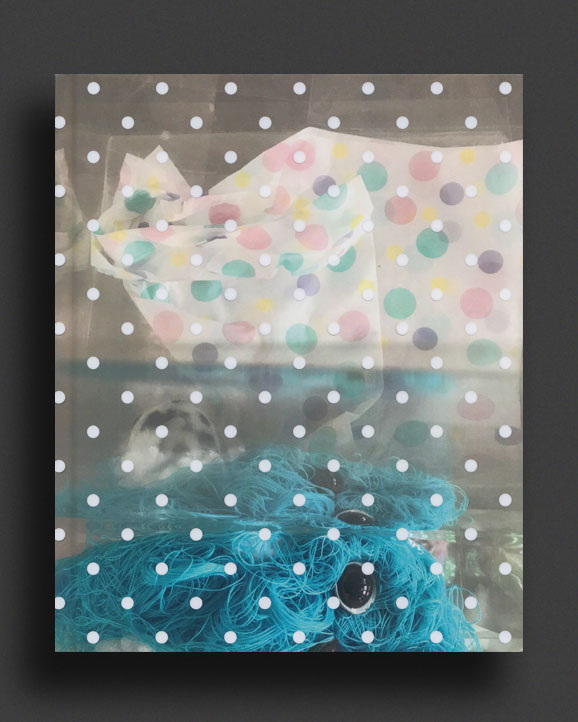
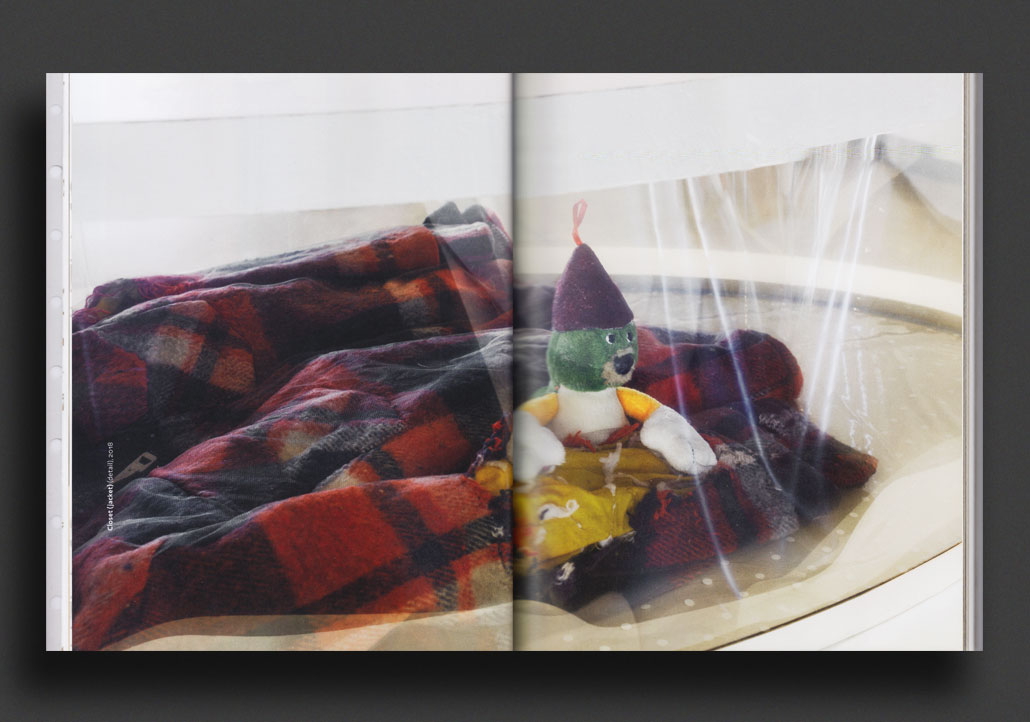
In 2019, the Renaissance Society at the University of Chicago and the Carpenter Center for the Visual Arts at Harvard University co-organized an exhibition of a newly commissioned body of work by the Canadian artist Liz Magor. The accompanying publication, Liz Magor: BLOWOUT, is the artist’s first US catalog in ten years, and it features thorough photographic documentation of the new work, commissioned texts by Sheila Heti and Mitch Speed, and a conversation between the artist and curators Solveig Øvstebø and Dan Byers.
For more than four decades, Liz Magor’s practice has quietly dramatized the relationships that develop among objects, and she describes this body of work as “a collection of tiny and intense narratives.” Each written contribution responds in its own way to Magor’s new installations, which feature altered stuffed toys, bits of paper, and rat skins—sculptural “agents”—suspended in transparent Mylar box forms, and thirty pairs of secondhand shoes each displayed within its own box amidst elaborate embellishments.
2014, English
Softcover (2 volume set), 784 pages, 17.8 x 22.9 cm
Published by
Nightboat Books / New York
$75.00 - Out of stock
The first retrospective collection of 50 years of writing by our leading Arab-American innovative writer.
This landmark two-volume edition follows Adnan’s work from the infernal elegies of the 1960s to the ethereal meditations of her later poems, to form a portrait of an extraordinarily impassioned and prescient life. Ranging between essay, fiction, poetry, memoir, feminist manifesto, and philosophical treatise, while often challenging the conventions of genre, Adnan’s works give voice to the violence and revelation of the last six decades as it has centered, in part, within the geopolitics of the Arab world, and in particular the author’s native Beirut. Among the key works reproduced in their entirety are Sitt Marie Rose (1978); The Arab Apocalypse (1980); Journey to Mount Tamalpais (1986); and Of Cities & Women (1993).
Love, for Adnan, is our only way to endure upheaval. It is not sentimental love. It is an ethics that seeks to preserve what we have rather than see it destroyed. It is a particular bravery, too. “Love in all its forms is the most important matter that we will ever face, but also the most dangerous, the most unpredictable, the most maddening,” Adnan writes.“But it is also the only salvation I know of.” - Andrew Durbin, novelist and Editor in Chief of Frieze Magazine
2020, English
Softcover, 120 pages, 12.7 x 20.4 cm
Published by
AK Press / Edinburgh
$28.00 - Out of stock
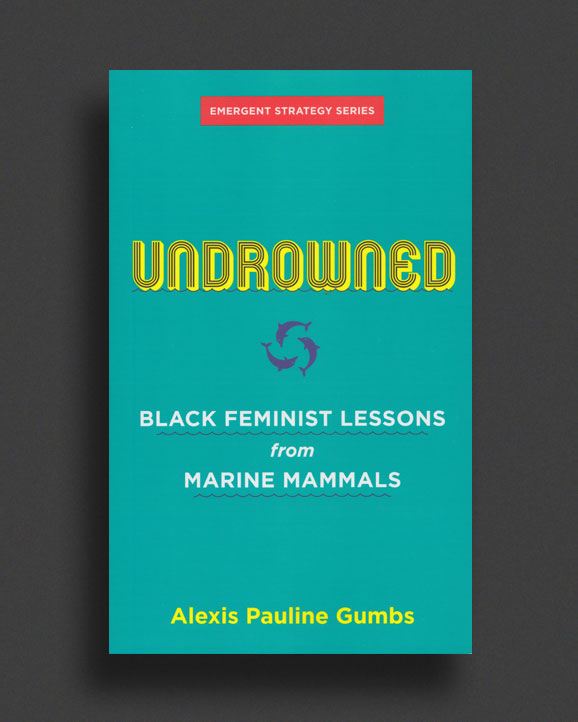
Undrowned is a book-length meditation for the entire human species, based on the subversive and transformative lessons of marine mammals. Alexis Pauline Gumbs has spent hundreds of hours watching our aquatic cousins. She has found them to be queer, fierce, protective of each other, complex, shaped by conflict, and struggling to survive the extractive and militarized conditions humans have imposed on the ocean. Employing a brilliant mix of poetic sensibility, naturalist observation, and Black feminist insights, she translates their submerged wisdom to reveal what they might teach us. The result is a powerful work of creative nonfiction that produces not a specific agenda but an unfolding space for wonder and questioning.
Part of the "Emergent Strategy" series, the book is divided into eighty short meditations, each grouped into “movements” with names like “Listen,” “Breath,” “Stay Black,” and “Go Deep.” A graceful use of metaphor and natural models in the service of social justice, it explores themes that range from the ways that echolocation might inform our understandings of visionary action to the similar ways that humans and marine mammals do—or might—adapt within our increasingly dire circumstances. Gumbs’s narrative moves seamlessly between dolphins born in captivity and Black political prisoners giving birth behind bars, between the migratory patterns of dolphins and the Atlantic slave trade. [publisher's note]
2020, English
Softcover, 296 pages, 15.2 x 22.9 cm
Published by
Nightboat Books / New York
$42.00 - Out of stock
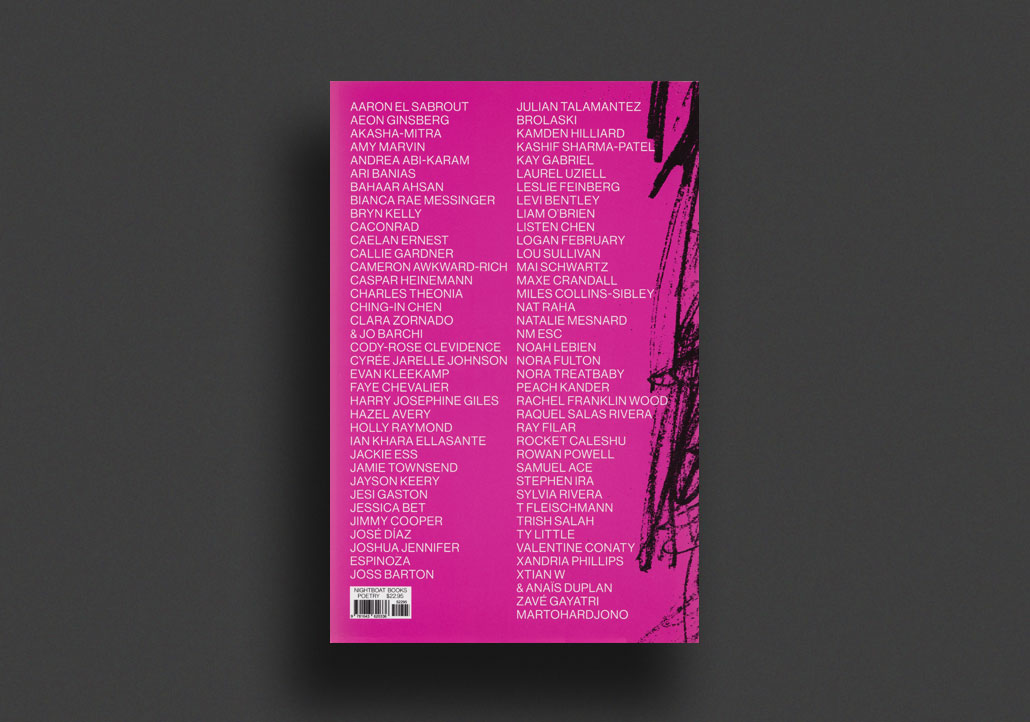
Editors Andrea Abi-Karam and Kay Gabriel offer We Want it All: An Anthology of Radical Trans Poetics as an experiment into how far literature, written from an identitarian standpoint, can go as a fellow traveler with social movements and revolutionary demands. Writing in dialogue with emancipatory political movements, the intergenerational writers assembled here imagine an altogether overturned world in poems that pursue the particular and multiple trans relationships to desire, embodiment, housing, sex, ecology, history, pop culture, and the working day.
features the work of : Aaron El Sabrout, Julian Talamantez Brolaski, Aeon Ginsberg, Akasha-Mitra, Kamden Hilliard, Amy Marvin, Kashif Sharma-Patel, Andrea Abi-Karam, Kay Gabriel, Ari Banias, Laurel Uziell, Bahaar Ahsan, Leslie Feinberg, Bianca Rae Messinger, Levi Bentley, Bryn Kelly, Liam O'brien, Caconrad, Listen Chen, Caelan Ernest Logan February Callie Gardner Lou Sullivan Cameron Awkward-Rich Mai Schwartz, Caspar Heinemann, Maxe Crandall, Charles Theonia, Miles Collins-Sibley, Ching-In Chen, Nat Raha, Clara Zornado & Jo Barchi, Natalie Mesnard, Nm Esc, Cody-Rose Clevidence, Noah Lebien, Cyree Jarelle Johnson, Nora Fulton, Evan Kleekamp, Nora Treatbaby, Faye Chevalier, Peach Kander, Harry Josephine Giles, Rachel Franklin Wood, Hazel Avery, Raquel Salas Rivera, Holly Raymond, Ray Filar, Ian Khara Ellasante, Rocket Caleshu, Jackie Ess Rowan Powell Jamie Townsend Samuel Ace Jayson Keery Stephen Ira Jesi Gaston, Sylvia Rivera, Jessica Bet, T Fleischmann, Jimmy Cooper, Trish Salah, José Díaz, Ty Little, Joshua Jennifer, Valentine Conaty, Espinoza, Xandria Phillips, Joss Barton, Xtian W & Anais Duplan, Zavé Martohardjono
1990, English / Spanish
Softcover, 152 pages, 29.5 x 24 cm
1st Edition, Out of print title / used / very good
Published by
Fundación Caja de Pensiones / Madrid
$200.00 - Out of stock
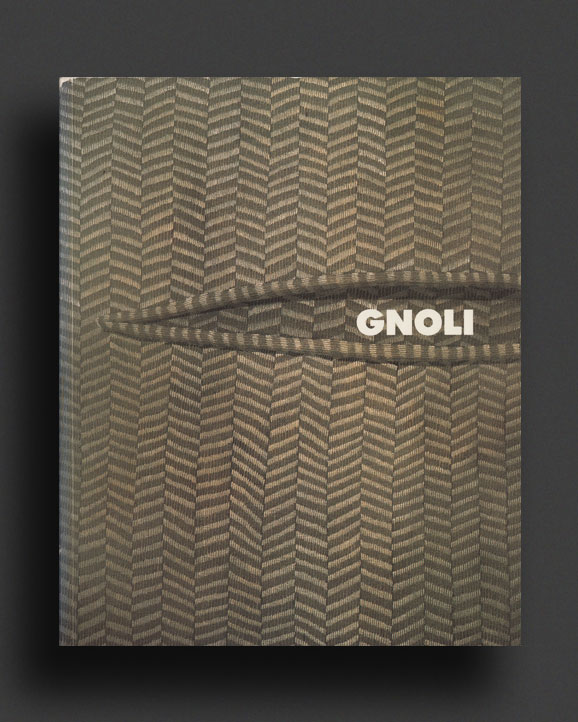
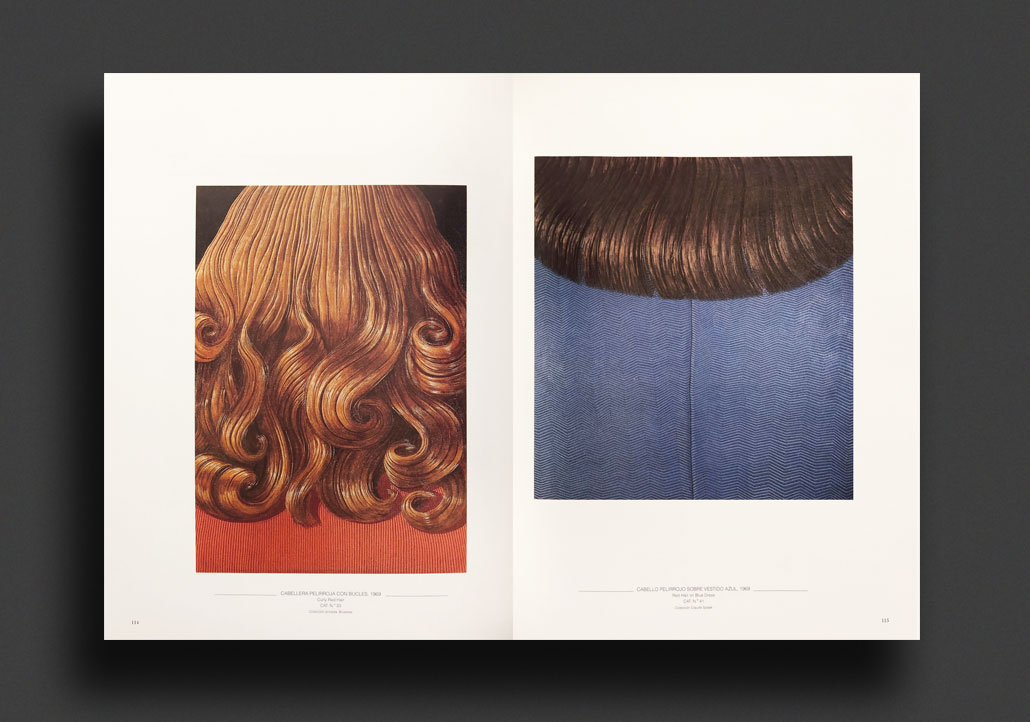
First edition of this rare and most comprehensive catalogue on the work of Italian artist Domenico Gnoli, published on the occasion of a major survey in Madrid at Fundación Caja de Pensiones in 1990. Profusely illustrated throughout with Gnoli's paintings, drawings and sculptures. Illustrated texts in English and Spanish by French author André Pieyre de Mandiargues, Italian critic Renato Barilli and painter Yannick Vu, along with an illustrated biography, exhibition history and full list of Gnoli's works.
Domenico Gnoli (1933 - 1970) was an Italian painter and stage designer, born in Rome. He studied stage design at the Accademia di Belle Arti, and began a short stint
Domenico Gnoli (1933–1970) is a unique and difficult figure to place. He died young, at 36, and lived fast, hanging with a glamorous crowd and marrying twice. He began as a stage designer in Rome, for which he was well received. He was also a successful illustrator, spending the better part of his life in New York City, illustrating for magazines such as Sports Illustrated, and Fortune, where he found favour with art director Leo Lionni in the 1960s. He was also a painter. His paintings exhibited internationally, characteristically zooming in on some crisp fragment of a domestic interior or sartorial flourish: a perfectly made bed, with a serenely patterned spread, or the top of a man’s head, hair meticulously parted. "Gnoli’s paintings are neither Pop nor Surrealist, though they have trace elements of both within them. Their realism is clear enough, and traditional, but the too-closeness of Gnoli’s gaze gives one the sense that abstraction is eating reality up from within."
Very Good copy.
2020, English
Softcover, 248 pages, 31 x 24 cm
Published by
Koenig Books / London
CCA / Montreal
$85.00 - Out of stock
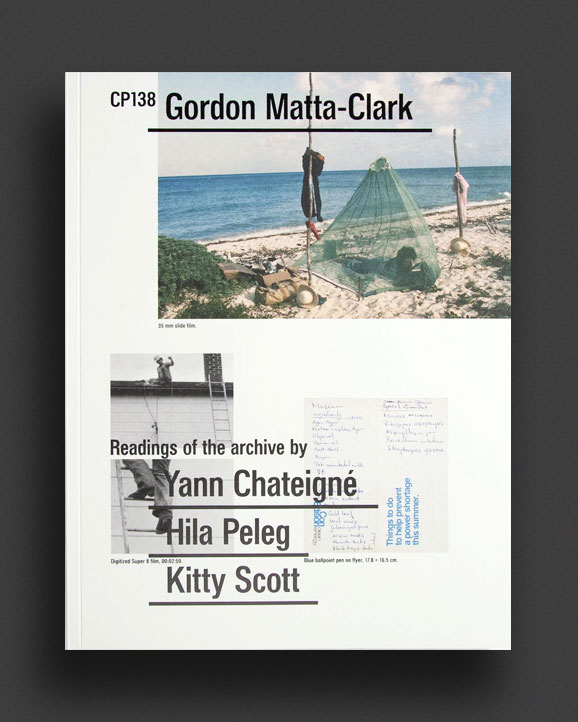
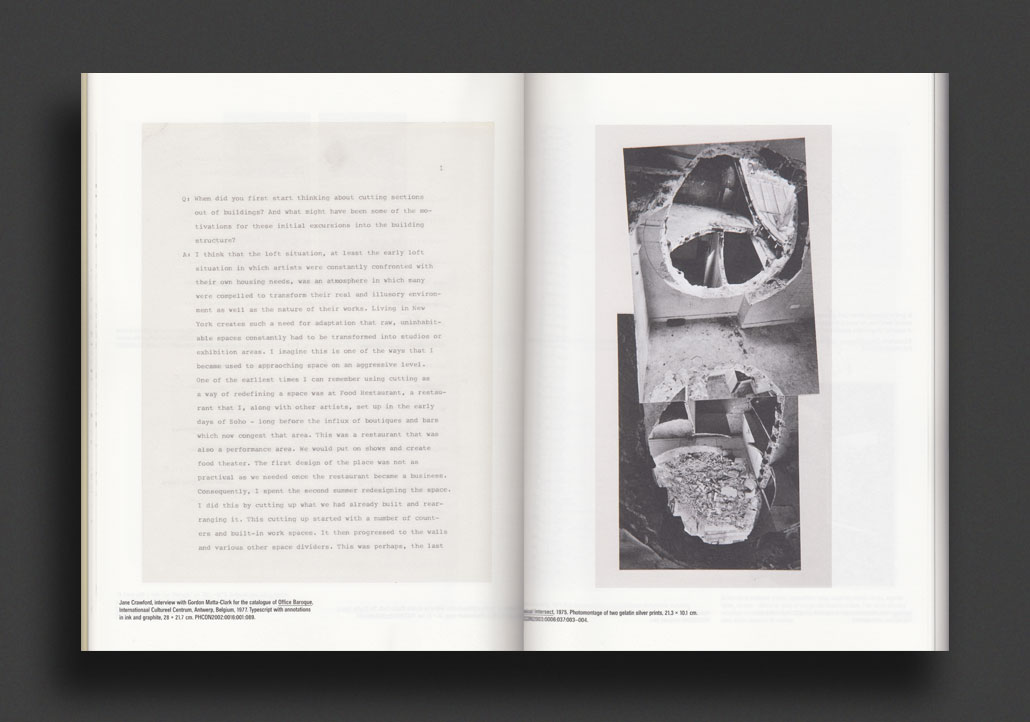
Gordon Matta-Clark was born in 1943 in New York, son of American artist Anne Clark, and Chilean Surrealist painter Roberto Matta. He entered the architecture program at Cornell University in 1962 but left in 1963 and spent the following year in Paris living with his father and studying French Literature. He returned to Cornell 1964-1968, he did not, however, practice as a conventional architect; he worked on what he referred to as "Anarchitecture." In mid-1969, Matta-Clark moved to New York City and his architectural "Cuttings", as well as his large corpus of drawings made him a prominent figure among his colleagues, including close friends and collaborators such as Jan Dibbetts and Robert Smithson. His influence as "artist's artist" on future generations cannot be overstated. Matta-Clark died at the age of 35. Many of his works are destroyed.
In 2011, the Estate of Gordon Matta-Clark handed over the entire archive – his library, manuscripts, films, correspondence, drawings, notes and works of art - to the Canadian Centre for Architecture in Montreal, where it now has been published annotated and edited in an exemplary way in this incredible volume. Only with this publication will his work become fully visible.
This book unpacks the comprehensive Gordon Matta-Clark collection at the CCA (CP138), opening it up to provisional readings from different points of view. Yann Chateigné reorganizes Matta-Clark’s library into areas of inquiry, from alchemy to psychoanalysis, as a framework for gathering traces—written and drawn—of his thinking. Hila Peleg reassembles hours of discarded film footage, challenging the notion of documentation and returning to view the physical and social contexts—the relational space—of Matta-Clark’s interventions. And from hundreds of travel photographs, Kitty Scott constructs a panorama of Matta-Clark’s visual notes on the world around him—a foil to his artworks. In foregrounding seemingly incidental parts of the collection, these studies manifest an exploratory way of working with archives, by which selecting, presenting, and writing are processes of ongoing research. Rather than synthesize, CP138 Gordon Matta-Clark: Readings of the archive by Yann Chateigné, Hila Peleg, and Kitty Scott extends the scope of what constitutes Matta-Clark’s body of work and thus the physical and intellectual terrain within which to situate it.
2021, English
Hardcover (w. dust jacket), 176 pages, 14 x 21 cm
Published by
Verso / London
$34.00 - Out of stock
Everyone is a designer. But while many practitioners may be looking for solutions or ideological certainties, Easterling argues that solutions are mistakes and ideologies are unreliable markers. Instead, Medium Design speaks to anyone looking for alternative approaches to the world's unresponsive or intractable dilemmas-from climate cataclysm to inequality to concentrations of authoritarian power. Such an approach joins many disciplines in considering not only separate objects, ideas and events but also the space between them.
In case studies dealing with everything from automation and migration to explosive urban growth and atmospheric changes, Medium Design looks not to new innovations but rather to sophisticated relationships between emergent and incumbent technologies. It does not try to eliminate problems but put them together into productive combinations. And it offers forms of activism for modulating power and temperament in organization of all kinds.
Reviews
“Easterling is one of our most provocative theorists of infrastructures and the critical actions that might make them better. Here she gives us ways to remix, radically, their ingredients. Who else could parse the ‘canine mind’ of the canny designer and city-dweller to show that we already know how to break the deadlock formed by binaries and manipulative media loops? Read this immensely engaging book to find a new toolkit for infiltrating, occupying, and recasting the mediated and material world.” – Caroline A. Jones, Professor in the Department of Architecture, MIT
2020, English
Softcover, 172 pages, 14 x 19 cm
Published by
Light Cone Editions / Paris
$40.00 - Out of stock
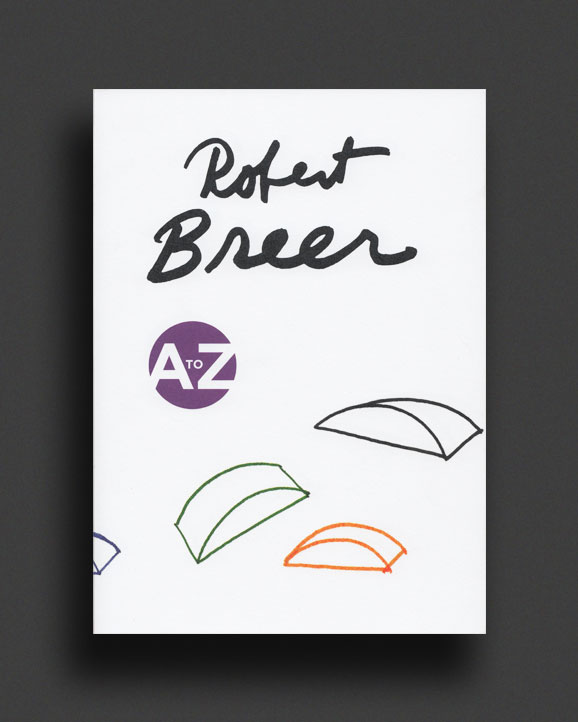
This new publication, Robert Breer A to Z, published by Light Cone Editions, is a self-portrait of Robert Breer. His life and work are presented as an imaginary lexicon, a form which he always admired as being emblematic of the joyous, unexpected, and chaotic nature of life itself.
Drawn from interviews, personal letters and public statements from 1957 to 2009, Robert Breer A to Z brings into a single volume the artist’s reflections on his films and his multiple forays into painting, drawing and kinetic sculpture.
Robert Breer has spent fifty years building up a totally atypical body of work which plays with different genres and abolishes the notions of space and time. Starting off as a painter, he then deconstructed his neoplastic works and ended up with kinetic objects. He dealt next with the thresholds of awareness and perception, both as a sculptor and a filmmaker. His films are composed of a jumble of images that pass at great speed, while his Floats move almost imperceptibly, in accordance with an unpredictable logic. Robert Breer developed his light yet rigorous style while associating with the New York underground in the Pop years. Continuing his subtle exploration of movement, his work still today causes the space of reality -irrevocably unstable- to waver.
Published under the direction of Scott Hammen with an introduction by Simon Rees, Robert Breer A to Z is co-published by Light Cone Editions and the Govett-Brewster Art Gallery.
2020, English
Hardcover (cloth), 264 pages, 29.2 x 25 cm
Published by
Museum of Fine Arts / Boston
$100.00 - Out of stock
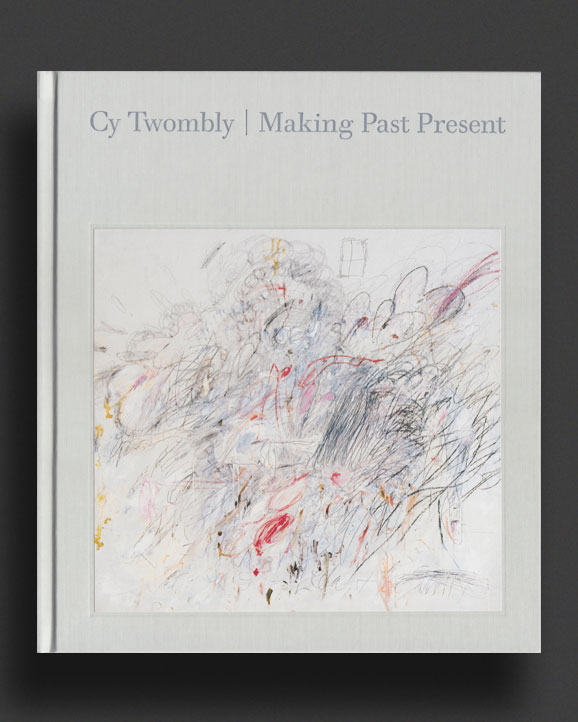
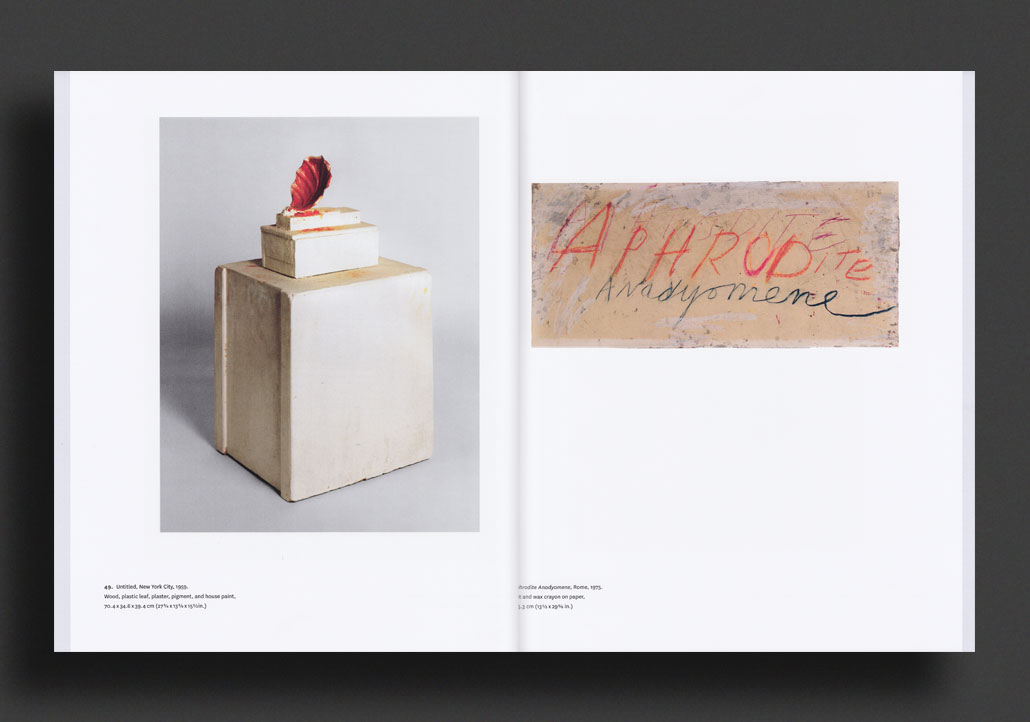
Luscious reproductions of more than 50 of Twombly's paintings, drawings and little-known sculptures, along with classical works of art, tell the story of an American abstractionist’s poetical dialogue with antiquity.
Cy Twombly's first visit to Italy as a young man ignited a lifelong passion for classical culture that is everywhere present in his art. Painted canvases, works on paper and small-scale sculptures reveal the historical soul of Twombly's abstract compositions. Taking on myths and heroes as personal guides, he created a psychologically complex dialogue with the visual and literary art of antiquity.
This sumptuously illustrated publication reproduces a carefully chosen selection of the artist's paintings, drawings and sculptures alongside works of classical antiquity, including a number from his personal collection. Illuminating essays by leading scholars and writers, including Anne Carson, Jennifer R. Gross, Brooke Holmes and Mary Jacobus, explore the often enigmatic engagement of Twombly's art with the world of the past.
Edited with text by Christine Kondoleon, Kate Nesin. Text by Anne Carson, Jennifer R. Gross, Brooke Holmes, Mary Jacobus.
Cy Twombly (1928-2011) was born in Lexington, Virginia, and lived and worked in New York in the early 1950s and at Black Mountain College in North Carolina. After traveling around North Africa, Spain and Italy, he settled in Rome, where he remained for the rest of his life.
2019, English
Hardcover, 288 pages, 21 x 26 cm
Published by
Hirmer / Münich
$80.00 - Out of stock
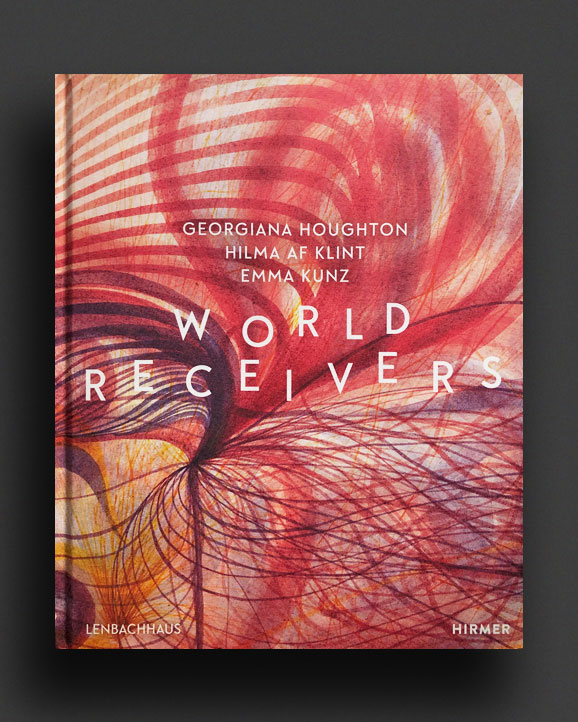
Abstract paintings were being produced even before Kandinsky. Completely independently from each other, Georgiana Houghton (1814 - 1884) in England, Hilma af Klint (1862 - 1944) in Sweden and Emma Kunz (1892 - 1963) in Switzerland each developed an individual abstract pictorial language. What they had in common was a desire to make visible the laws of nature, the intellect and the supernatural. In 2019 their works were presented side by side for the first time in an exhibition and this beautiful hardcover publication documents this occasion.
The three women artists all found their artistic language within the context of the spiritual movements of their times: Houghton in spiritism, af Klint in theosophy and Kunz in naturopathy. Their artworks bear witness to a “mediumistic” praxis: Houghton and af Klint were inspired by higher beings to paint, while Kunz developed her drawings with the help of a pendulum. In addition, the volume shows stills by Harry Smith and James and John Whitney, who – inspired by various occult movements – made experimental films during the 1940s.
2019, English
Softcover, 128 pages, 11 x 18 cm
Published by
Sternberg Press / Berlin
$44.00 $15.00 - Out of stock
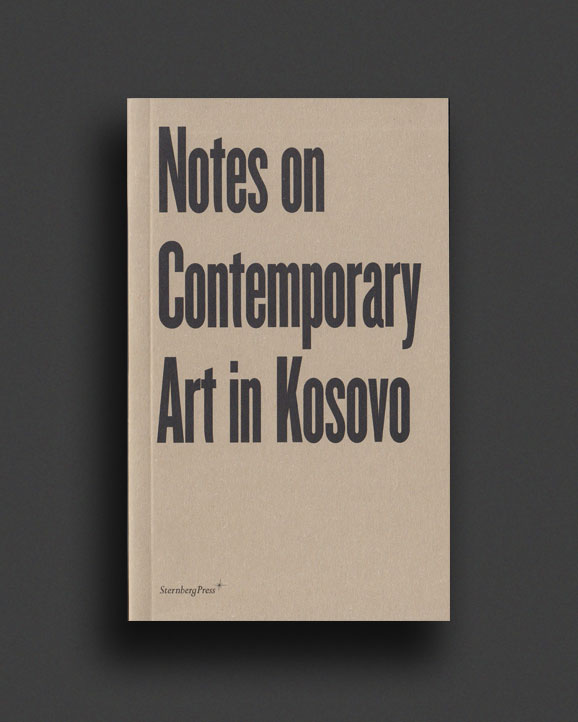
This publication collects writings on the art scene of Kosovo over the past twenty years. In the 1990s Kosovars felt—as many other countries in the Balkan region did—the urgency to shape their own scene: in a search for identity, for nation building, in continuing or ending political conflicts, by trying to find a language to grasp recent social and political developments, or simply by continuing their practice in new, unstable times. This collection of writings and interviews offers insight into these processes through various perspectives (from curators, artists, and philosophers) on the latest artistic developments, and fosters reflection on how a local, prospering scene continuously raises new questions and addresses undiscovered topics hand in hand with the region’s historical struggles and current challenges in being the youngest state in Europe.
Notes on Contemporary Art in Kosovo is published in the context of the tranzit.at Glossary Series, which aims to encourage reflection on new approaches to creating common knowledge that are more in sync with our time than the prevalent epistemological models. The series focuses on changing global conditions—and on the fact that we require more equality in creating knowledge under these conditions—and the need to redefine artistic geographies so that they can attune themselves to this new situation.
Contributions by Sezgin Boynik, Charles Esche, Alush Gashi, HAVEIT, Astrit Ismaili, Shkëlzen Maliqi, Cathrin Mayer, Miran Mohar, Edi Muka, Vanessa Joan Müller, Kathrin Rhomberg, Vesa Sahatçiu, Dardan Zhegrova
A tranzit.at book
Design by Bardhi Haliti
2018, English / French
Softcover, 128 pages, 21 x 29.7 cm
Published by
WIELS / Brussels
Sternberg Press / Berlin
$69.00 $10.00 - Out of stock
This book is the fourth volume in Vincent Meessen’s publication series Prospectus and published following the artist’s solo exhibitions “Sire, je suis de l’ôtre pays” at WIELS, Brussels, in 2016, and “Omar en mai” at Centre Pompidou, Paris, 2018. The book is structured around the four major installations that made up these shows, and are placed in parallel with newly commissioned essays by scholars Pedro Monaville, Stefano Collicelli Cagol, and Ruth Baumeister, and a conversation between Tom McDonough and Vincent Meessen.
At the heart of these contributions are the untold histories and unexpected topicality of the Situationist International, modernity’s last international avant-garde, which reconsidered so radically the relationships between art, politics, and everyday life. Previously unpublished texts and reprints by Guy Debord, Lungela Diangani, and Omar Blondin Diop explore the Situationist International’s influence in sub-Saharan African countries such as the Democratic Republic of Congo and Senegal.
Installation views of the exhibitions show furthermore how Meessen uses original documents in order to re-evaluate their political potential in the present. As such, the book generously reflects on the artist’s discursive, collaborative, and para-curatorial activity of the past four years.
Edited by Vincent Meessen
Texts by Ruth Baumeister, Stefano Collicelli Cagol, Pedro Monaville; conversation by Tom McDonough
1995, Japanese
Softcover (w. dust jacket), 250 pages, 21 x 14 cm
1st Edition, Out of print title / used / fine
Published by
PARCO / Tokyo
$30.00 $15.00 - Out of stock
First edition of Street Fashion 1945-1995, a compendium of Japanese Youth street photography spanning 50 years, published on the occasion of an exhibition at the mighty PARCO gallery in Tokyo in 1995. Illustrated throughout in colour and b/w with texts in Japanese.
A modern department store dedicated to cutting edge fashion, Parco were also instrumental in exhibiting, publishing and promoting Japanese and international graphic artists and new pop culture throughout the 1960s-1990s.
Fine copy.
2021, English
Softcover, 168 pages, 13.7 x 20.3 cm
Published by
Semiotext(e) / Los Angeles
$28.00 - Out of stock
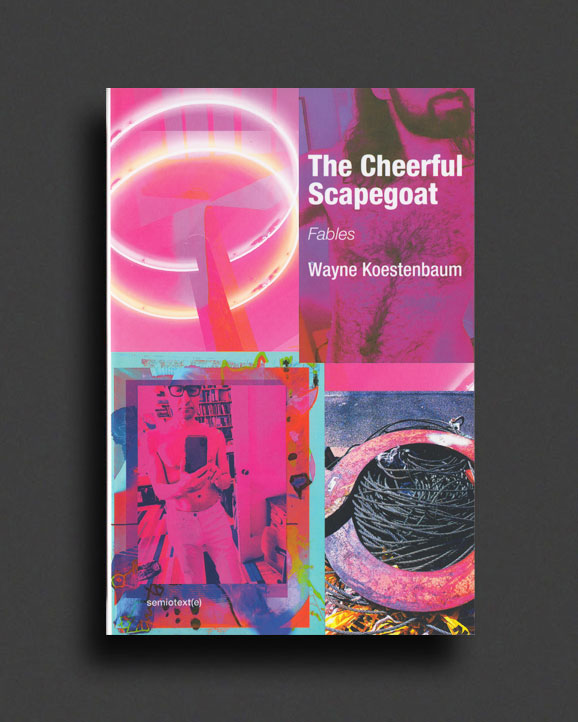
Wayne Koestenbaum's first book of short fiction: a collection of whimsical, surreal, baroque, ribald, and heartbreaking fables.
In his first book of short fiction—a collection of whimsical, surreal, baroque, ribald, and heartbreaking fables—Wayne Koestenbaum takes the gloom and melancholy of our own terrifying political moment and finds subversive solace by overturning the customary protocols of tale-telling. Characters and narrators wander into strange locales; the difference between action and thinking, between reality and dream, grows moot in a heightened yet burlesque manner. The activities in The Cheerful Scapegoat are a cross between a comedy of manners and a Sadean orgy. Language has its own desires: figures of speech carry an erotic charge that straddles the line between slapstick and vertigo. Punishment hangs over every dialogue—but in the fable-world of The Cheerful Scapegoat, abjection comes with an undertaste of contentment. The tchotchkes of queer culture—codes and signifiers—get scrambled together and then blown up into an improbable soufflé.
Koestenbaum's fables travel in circles, slipping away from their original point and leading the reader to a paradisiacal suspension of fixed categories. Intensified sentences and curlicue narratives scheme together mesmerically to convince the reader to abandon old ways of thinking and to take on a commitment to the polymorphous, the wandering, the tangential. Koestenbaum's fables--emergency bulletins uttered in a perverse vernacular of syntactic pirouettes—alert us to the necessity of pushing language into new contortions of exactitude and ecstatic excess.
Wayne Koestenbaum derails the sexual and gender conventions of the genre of the mystical-and-mythical-style fable using trans and queer speculative porn-fiction and lyrical criticism. Narratively exquisite and fiercely irreverent, his fables construct a brilliant one-of-a-kind mind-body-game where literature becomes a sort of “operation” in the unconscious infrastructure of our desire. Strikingly original, tender, radical, funny, unforgettable. — Paul B. Preciadoauthor of An Apartment on Uranus and Testo Junkie
Wayne Koestenbaum—poet, critic, novelist, artist, performer—has published nineteen books, including The Queen's Throat, which was praised by Susan Sontag as "a brilliant book" and was a National Book Critics Circle Award finalist. Formerly Associate Professor of English at Yale and Visiting Professor in the Yale School of Art's painting department, he is Distinguished Professor of English, French, and Comparative Literature at the CUNY Graduate Center in New York City.
2013, English / German
Hardcover, 660 pages, 13 × 23.5 cm
Published by
Edition Patrick Frey / Zürich
$199.00 - Out of stock
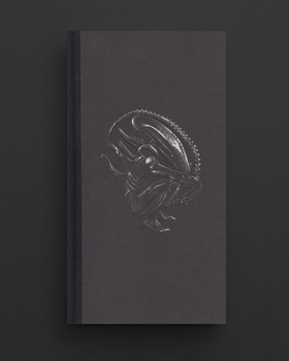
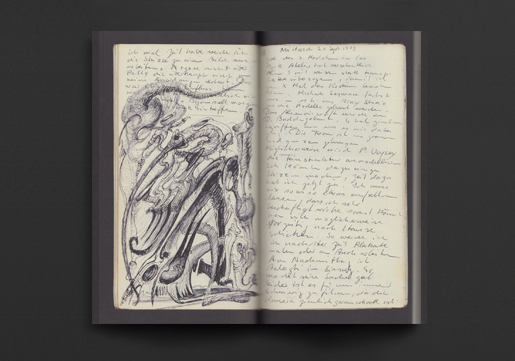
HR Giger worked in the Shepperton Studios near London from February to November 1978, creating the figures and sets for the film Alien (1979) directed by Ridley Scott. The film became an international success, earning Giger an Oscar. In the transcribed Alien Diaries, published here for the first time as a facsimile, HR Giger describes his work in the studios. He writes, sketches, and takes photographs with his Polaroid SX70. With brutal honesty, sarcasm and occasional despair, Giger describes what it is like working for the film industry and how he struggles against all odds — be it the stinginess of producers or the sluggishness of his staff — to see his designs become reality. The Alien Diaries (in German transcription with an English translation) show a little-known personal side of the artist HR Giger and offer an unusual, detailed glimpse into the making of a movie classic through the eyes of a Swiss artist. The book contains almost completely unpublished material, including drawings, Polaroids showing the monster coming to life, and several still shots from the plentiful film material that Giger took in Shepperton.
1999, English
Hardcover (w. slipcase and glassine dust jacket), 102 pages, 23.5 x 29 cm
1st Edition, Out of print title / used / very good
Published by
Stromboli / Paris
$350.00 - Out of stock
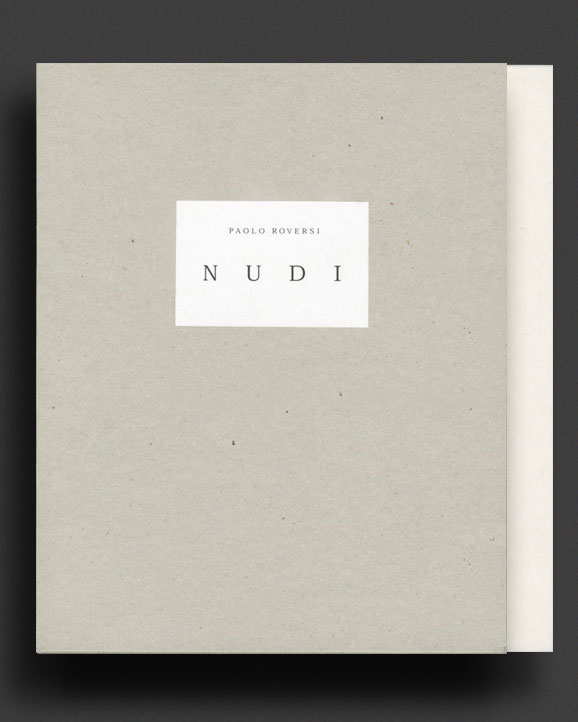
First edition of this beautifully produced volume by famed Italian fashion photographer Poalo Roversi (b. 1947). This, Roversi's first book, collects 46 delicate almost monochromatic full body nudes of international fashion models. Taken by Roversi in his Paris studio over a period of ten years, beginning in the early 1980s, and using a large-format Polaroid film, the series is a gorgeous example of Roversi's minimal and tender, "more subtraction than addition" photographic style.
At the invitation of Peter Knapp, the legendary Art Director of Elle magazine, Roversi visited Paris in November 1973 and has never left. In Paris, Roversi started working as a reporter for the Huppert Agency but little by little, through his friends, he began to approach fashion photography. The photographers who really interested him then were reporters. At that moment he didn't know much about fashion or fashion photography. His work became celebrated through the pages of Elle, Vogue, and Marie Claire, and work with designers such Christian Dior, Yves Saint Laurent, Comme des Garcons and Valentino.
Fine copy in VG original glassine dust jacket in VG publisher's original card slipcase
2013, English / Japanese
Softcover (w. obi-strip), 230 pages, 21 x 30 cm
1st Edition, Out of print title / as new
Published by
Street Editorial Office / Tokyo
$160.00 - Out of stock
Maison Martin Margiela was founded in Paris by Martin Margiela and Jenny Meirens in 1988. The first Martin Margiela collection of ready-to-wear for women was presented in October 1988 for Spring/Summer 1989. Since then Maison Martin Margiela has presented two collections a year and has taken part in many exhibitions on its work around the world. STREET magazine was founded in Tokyo by Shoichi Aoki and Noriko Kojima in 1985. It has been published monthly ever since. Each issue features photographs of people, chosen for what they are wearing, by Shoichi Aoki, taken in the streets of the world's fashion capitals. In 1995 STREET approached Maison Martin Margiela inviting it to publish a special edition of STREET dedicated to its work. Maison Martin Margiela was solely responsible for the choice of images and layout and used mostly unpublished photographs from its archives to explore and illuminate its past collections and presentations. The Maison Martin Margiela STREET special, Volume 1 first appeared on news stands in japan in October 1995 and covered every Martin Margiela collection from Spring/Summer 1989 up to Autumn/Winter 1995-1996. The success of volume 1 sparked the continuation of the story with the publication of volume 2 in February 1999. Volume 2 covers all Martin Margiela collections for women up to Spring/Summer 1999 as well as the first presentation of 10, a wardrobe for men and 6, basic garments for women for Summer 1999 and Maison Martin Margiela's participation in three exhibitions held in Brussels, Florence and Rotterdam. Both volumes now long out-of-print and collectible, this 2013 book edition combines volumes 1 & 2, beautifully reprinting the entirety of their contents.
The first and still the best behind-the-scenes visual document of the world of Maison Martin Margiela, including the first 20 collections, events, exhibitions, studios, ephemera, garment details, and much more - very page magnificent. Profusely illustrated throughout in colour and black and white with photographs by Martin Margiela, Paolo Roversi, Anders Edstrom, Mark Borthwick, Raf Coolen, Tatsuya Kitayama, Ronald Stoops, Barbara Katz, Roman Singer, Marina Faust, and many others.
Pristine copy, As New w. obi-strip.
2019, English
Softcover, 448 pages, 15 x 21cm
Published by
Koenig Books / London
Serpentine Gallery / London
$85.00 $50.00 - Out of stock
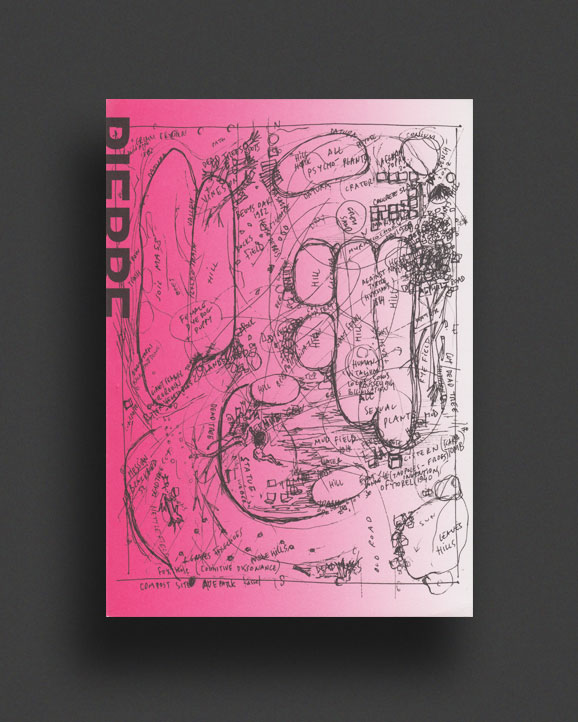
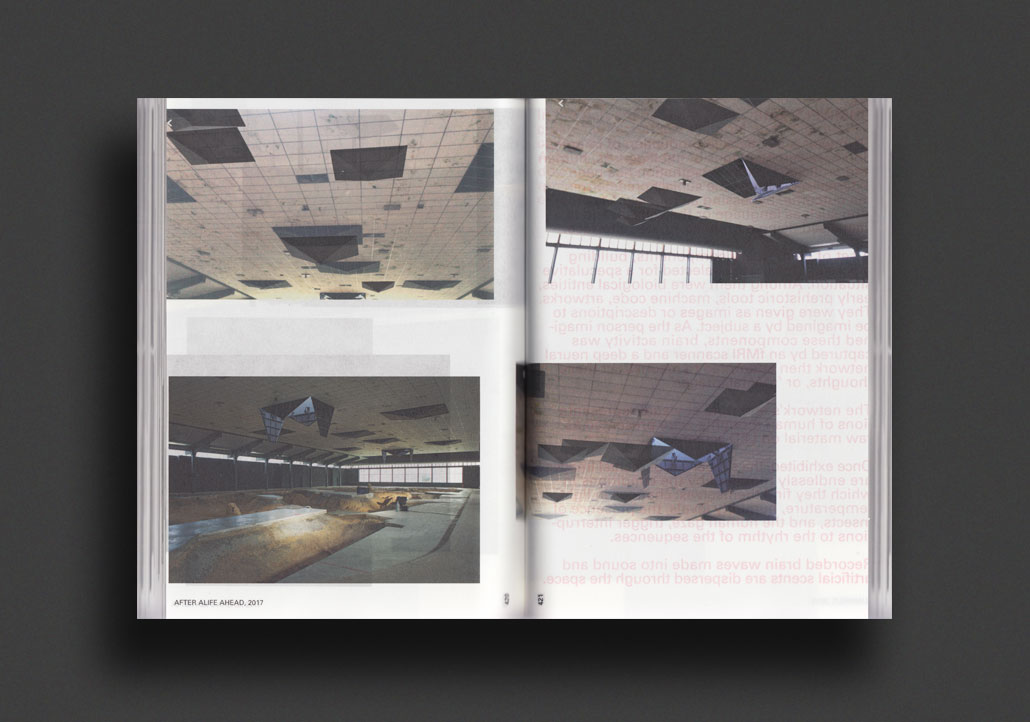
This already out-of-print major survey on renowned French artist Pierre Huyghe (born 1962) chronicles seminal works from the last decade, including his iconic Documenta 13 project "Untilled." An interview between Huyghe and Hans Ulrich Obrist and an essay by Dorothea von Hantelmann accompany drawings, diagrams, photographs, film stills and more.
As New with light cover wear (hence reduced price)
2021, English
Softcover, 128 pages, 15 x 23 cm
Published by
Sound American / New York
$35.00 - Out of stock
Sound American's 25th issue, the Folk Issue, celebrates and explores the intersections of experimental and folk music. Guest edited by Sarah Hennies and Anna Roberts-Gevalt–two of America's most forward-looking practitioners in experimental and folk music, respectively–this issue takes on questions of musical community and what it means to work inside and outside of its traditions.
The issue features writing by Ana Alonso-Minutti on La Llorona, Drew Daniel on Throbbing Gristle, Henry Flynt on his own violin practice, Suzanne Kite in conversation with Scott Benisiinaabandan, John McCowen interviewing Sean Meehan, Kurt Newman and Martin Arnold, Ian Nagoski on bird call impresario Charles Kellogg, and Anna Roberts-Gevalt's moving COVID diary and conversation with Meredith Monk and Peggy Seeger. This issue’s Exquisite Corpse is by vocalist and composer Amirtha Kidambi.
Produced in an edition of 500.
2020, English
Softcover, 116 pages, 15 x 23 cm
Published by
Sound American / New York
$36.00 - Out of stock
A quarterly journal founded in 2012 by Nate Wooley, providing in-depth interviews and essays, 'Sound American' starts from a simple desire to open the doors of experimental music to a wider audience. Their latest issue celebrates interstellar icon and generative force of nature, Sun Ra. Sun Ra (1914–1993) is an African-American experimental jazz pianist and composer. A prolific artist, he recorded over 100 albums with his band, the Sun Ra Arkestra.
Contributors include Taylor Ho Bynum, John Corbett, Naima Lowe, Luke Stewart with Thomas Stanley, and Ken Vandermark. The issue also features supplemental writing from Jessie Cox on Marshall Allen, Reg Bloor on Glenn Branca, Chris Pitsiokos on Miles Davis's On The Corner, Peter Margasak on Derek Bailey's On The Edge series, and a conversation between Audra Wolowiec and Freya Powell. The issue closes with the first exquisite corpse of the new season: a phenomenal text work by Camae Ayewa (Moor Mother).
2018, English
Softcover, 286 pages, 17 x 23 cm
Published by
Valiz / Amsterdam
$56.00 - Out of stock
Edited by Ernst van Alphen, ‘Failed Images’ attempts to understand the divergence between photography and the reality it portrays, analysing the various ways the photograph transforms that which exists before the camera. Because the photographic medium enables very different practices, which in turn results in many kinds of images, it must also be examined from a perspective outside of the dominant approach to the medium, generally called the “snapshot”. This book therefore explores the photographic image by focusing on practices which refuse this conventional approach, namely staged, blurred, under- and overexposed, and archival photography.
2020, English
Softcover, 204 pages, 10.5 x 17 cm
Published by
Lenz Press / Milan
$36.00 - Out of stock
When she started writing the Corona Tales, Chus Martínez had been weighing how people and the media were addressing the outbreak of the virus as an unprecedented disaster. One possible contribution, as curator and writer, would be to write a short story a day and post it on an Instagram account that many could access…
Martínez grew up with her grandparents till she was four, and so did her cousin, while both their parents migrated to a big city—hers to Barcelona, his to Basel—to work. The grandparents' childhood was marked by extreme poverty: the Spanish flu left the grandfather orphan of both parents; the grandmother's family, from the same small village in the north west coast of Spain, was also forced to encourage their children to help and work for money. These circumstances were reflected by them—with no trace of sorrow or bitterness. The recovery was so slow that the author's mother could not afford to attend school and it was only when she married that she and her father enrolled a night course. The stories about these two generations, posted daily, from Basel, around 7pm, offered a chance for gathering, if just virtually, demanding to identify vulnerabilities, how the COVID-19 crisis was being generalized, and how to research ways of doing. Accompanied for the first time in this book by new imagery, they provide tools for reflecting in the past and present tense.
“The effort to smile in the face of devastating circumstances is a sign of generosity that is embedded in our cultural codes. So, what could I do to entertain? Would they smile with the sweet embarrassment of reading stories on an open instagram account?” (Chus Martínez)
Chus Martínez (born 1972 in Ponteceso, Spain) has a background in philosophy and art history. Currently she is the Head of the Institute of Art of the FHNW Academy of Arts and Design in Basel, Switzerland. Before she was the Chief Curator at El Museo Del Barrio (2012-2014), New York. She was dOCUMENTA (13) Head of Department, and Member of Core Agent Group. Previously she was Chief Curator at MACBA, Barcelona (2008-2011), Director of the Frankfurter Kunstverein (2005-2008) and Artistic Director of Sala Rekalde, Bilbao (2002-2005).
For the 56th Biennale di Venezia (2015), Martínez curated the National Pavilion of Catalonia with the filmmaker Albert Serra; for the 51st Biennale di Venezia (2005) she also curated the Cyprus National Pavilion; in 2014/2015 served as alliance of the 14th edition of the Istambul Biennial; in 2008 served as a Curatorial Advisor for the Carnegie International and in 2010 for the 29th Bienal de São Paulo. During her tenure as Director of the Frankfurter Kunstverein she curated solo exhibitions of Wilhelm Sasnal among others; and a series of group exhibitions including “Pensée Sauvage” and “The Great Game To Come”. She was also the founder of the Deutsche Börse Residency Program for international artists, art writers and curators. While at MACBA Martínez curated the Thomas Bayrle retrospective, an Otolith Group monographic show, and an exhibition devoted to television, “Are you ready for TV?” In 2008 Martínez was the curator of the Deimantas Narkevičius retrospective exhibition, “The Unanimous Life” at the Museo de Arte Reina Sofia, Madrid, which traveled to major European museums.
Martínez lectures and writes regularly including numerous catalogue texts and critical essays, and is a regular contributor to Artforum, Mousse and Spike, among other international journals.