World Food Books' programme is largely produced on Kulin Nation land. We acknowledge the Wurundjeri people of the Kulin Nation as the first and continuing custodians of this land, and pay respect to their Elders past, present, and emerging.
World Food Books is an arts and special interests bookshop in Naarm / Melbourne. Founded in 2010, World Food Books is devoted to the presentation of a rotating, hand-selection of international art, design, literary and counterculture publications with an emphasis on the anti-traditional, the experimental, the avant-garde, the heretic, the marginal.
Presenting new titles alongside rare and out-of-print books, catalogues and journals spanning the fields of modern and contemporary art, design, photography, illustration, film, literature, poetry, cultural theory, philosophy, sexuality, popular and underground culture in its many radical forms, World Food Books wishes to encourage adventurous, thoughtful and open-minded reading, looking, writing, and exchange of publishing and ideas, both current and historical.
As well as our bookshop, located in Melbourne's historical Nicholas Building, all of our inventory is available internationally via our online mail-order service.
World Food Books semi-regularly co-ordinates "Occasions", a programme of exhibits and events at the bookshop and in partnership with other hosts (such as museums and art galleries) that develop out of the activities, relationships and content of the bookshop itself.
World Food Books
The Nicholas Building
37 Swanston Street
Room 5, Level 6
Melbourne 3000
Australia
SHOP HOURS:
Thu–Fri 12–6, Sat 12–5
WEB-SHOP OPEN 24/7
World Food Books
Postal Address:
PO Box 435
Flinders Lane
Victoria 8009
Australia
Art
Theory / Essay
Architecture / Interior
Graphic Design / Typography
Photography
Fashion
Eros
LGBTQ+
Fiction / Poetry
Weird / Speculative / Science Fiction / Horror
Transgressive / Visceral / Abject
Symbolism / Decadence / Fin de siècle
Film / Video
Painting
Sculpture / Installation
Performance / Dance / Theater
Drawing
Sound / Music
Curatorial
Group Shows / Collections
Periodicals
Out-of-print / Rare
Posters / Ephemera / Discs
Signed Books
World Food Books Gift Voucher
World Food Book Bag
Australian Art
Australian Fiction
Australian Science Fiction / Speculative Fiction
Australian Poetry
Australian Photography
Japanese Photography
Conceptual Art
Minimal Art
Dada
'Pataphysics / Oulipo
Fluxus
Concrete Poetry
Pop Art
Surrealism
Arte Povera
Arte Informale / Haute Pâte / Tachism
Nouveau Réalisme / Zero / Kinetic
Situationism / Lettrism
Collage / Mail Art / Xerox Art
Art Brut / Folk / Visionary / Fantastic
Illustration / Graphic Art / Bandes Dessinées
Furniture
Italian Radical Design / Postmodernism
Textiles
Ceramics / Glass
Counterculture
Protest / Revolt
Philosophy
Psychoanalysis
Anthropology
Anarchism
Socialism / Anarchism / Communism / Capitalism
Literary Theory / Semiotics / Language
Feminism / Women's Studies
Gender Studies / Sexuality
Anthropology
Fetishism / BDSM
Drugs / Psychedelia
Crime / Violence
Animal Rights / Veganism
Occult / Esoterica
Ecology / Earth / Alternative Living
Whole Earth / Crafts
All prices in AUD (Australian dollars)
Pick-Ups
Pick-up orders can be collected in our bookshop during opening hours after order date. Please collect any Pick-up orders within 2 weeks of ordering as we have limited storage space. Orders will be released back into stock if not collected within this time. No refunds can be made for pick-ups left un-collected. If you cannot make it in to the bookshop in this time-frame, please choose postage option.
Return Policy
All sales are final. We do accept returns (for refund or exchange) for items received in error. All our orders are packed with special care using heavy-duty padding and cardboard book-mailers or bubble mailers (for smaller books), using reinforcement where required. We cannot take responsibility for any lost, stolen or damaged parcels.
Insurance
Should you wish to insure your package, please email us directly after placing your order and we can organise this at a small extra expense. Although all standard/express tracked packages are very safe and dependable, we cannot take responsibility for any lost, stolen or damaged parcels. We recommend insurance on valuable orders.
Interested in selling your old books, catalogues, journals, magazines, comics, fanzines, ephemera? We are always looking for interesting, unusual and out-of-print books to buy. We only buy books in our fields of interest and specialty, and that we feel we can resell.
We base these prices on desirability, market value, in-print prices, condition and our current stock levels. We offer cash, store credit, and can take stock on consignment. All
about 25% of the price we expect to get when we sell them, or 30% in store credit. We base these prices on desirability, market value, in-print prices, condition and our current stock levels.
Sell your books any day of the week. You can drop them off and return later. If you have a lot of books, we can visit your Sydney home.
We buy books that we feel we can resell. We offer about 25 % of the price we expect to get when we sell them, or 30% in store credit. We base these prices on desirability, market value, in-print prices, condition and our current stock levels.
Philadelphia Wireman
03 August - 01 September, 2018
World Food Books is proud to announce our next Occasion, the first presentation of sculptures by Philadelphia Wireman in Australia.
The Philadelphia Wireman sculptures were found abandoned in an alley off Philadelphia’s South Street on trash night in 1982. Their discovery in a rapidly-changing neighbourhood undergoing extensive renovation, compounded with the failure of all attempts to locate the artist, suggests that the works may have been discarded after the maker’s death. Dubbed the "Philadelphia Wireman" during the first exhibition of this work, in 1985, the maker’s name, age, ethnicity, and even gender remain uncertain. The entire collection totals approximately 1200 pieces, all intricately bound together with tightly-wound heavy-gauge wire (along with a few small, abstract marker drawings, reminiscent both of Mark Tobey and J.B. Murry). The dense construction of the work, despite a modest range of scale and materials, is singularly obsessive and disciplined in design: a wire armature or exoskeleton firmly binds a bricolage of found objects including plastic, glass, food packaging, umbrella parts, tape, rubber, batteries, pens, leather, reflectors, nuts and bolts, nails, foil, coins, toys, watches, eyeglasses, tools, and jewellery.
Heavy with associations—anthropomorphic, zoomorphic, and socio-cultural responses to wrapped detritus—the totemic sculptures by Philadelphia Wireman have been discussed in the context of work created to fulfil the shamanistic needs of alternative religions in American culture. Curators, collectors, and critics have variously compared certain pieces to sculpture from Classical antiquity, Native American medicine bundles, African-American memory jugs, and African fetish objects. Reflecting the artist’s prolific and incredibly focused scavenging impulse, and despite—or perhaps enhanced by—their anonymity, these enigmatic objects function as urban artefacts and arbiters of power, though their origin and purpose is unknown. Philadelphia Wireman, whatever their identity, possessed an astonishing ability to isolate and communicate the concepts of power and energy through the selection and transformation of ordinary materials. Over the course of the past two decades, this collection has come to be regarded as an important discovery in the field of self-taught art and vernacular art.
Presented in collaboration with Fleisher-Ollman Gallery, Philadelphia, and Robert Heald, Wellington.
Susan Te Kahurangi King
02 February - 10 March, 2018
Susan Te Kahurangi King (24 February 1951 - ) has been a confident and prolific artist since she was a young child, drawing with readily available materials - pencils, ballpoint pens and felt-tip markers, on whatever paper is at hand. Between the ages of four and six Susan slowly ceased verbal communication. Her grandparents William and Myrtle Murphy had developed a special bond with Susan so they took on caring responsibilities for extended periods. Myrtle began informally archiving her work, carefully collecting and storing the drawings and compiling scrapbooks. No drawing was insignificant; every scrap of paper was kept. The King family are now the custodians of a vast collection containing over 7000 individual works, from tiny scraps of paper through to 5 meter long rolls.
The scrapbooks and diaries reveal Myrtle to be a woman of great patience and compassion, seeking to understand a child who was not always behaving as expected. She encouraged Susan to be observant, to explore her environment and absorb all the sights and sounds. Myrtle would show Susan’s drawings to friends and people in her community that she had dealings with, such as shopkeepers and postal workers, but this was not simply a case of a grandmother’s bias. She recognised that Susan had developed a sophisticated and unique visual language and sincerely believed that her art deserved serious attention.
This was an unorthodox attitude for the time. To provide some context, Jean Dubuffet coined the term Art Brut in 1945 to describe work created by self-taught artists – specifically residents of psychiatric institutions and those he considered to be visionaries or eccentrics. In 1972 Roger Cardinal extended this concept by adopting the term Outsider Art to describe work made by non-academically trained artists operating outside of mainstream art networks through choice or circumstance. Susan was born in Te Aroha, New Zealand in 1951, far from the artistic hubs of Paris and London that Dubuffet and Cardinal operated in. That Myrtle fêted Susan as a self-taught artist who deserved to be taken seriously shows how progressive her attitudes were.
Susan’s parents Doug and Dawn were also progressive. Over the years they had consulted numerous health practitioners about Susan’s condition, as the medical establishment could not provide an explanation as to why she had lapsed into silence. Dawn educated herself in the field of homeopathy and went on to treat all twelve of her children using these principles – basing prescriptions on her observations of their physical, mental and emotional state.
Doug was a linguist with an interest in philosophy who devoted what little spare time he had to studying Maori language and culture. To some extent their willingness to explore the fringes of the mainstream made them outsiders too but it was their commitment to living with integrity and their respect for individuality that ensured Susan’s creativity was always encouraged.
Even though Susan’s family supported her artistic pursuits, some staff in schools and hospitals saw it as an impediment to her assimilation into the community and discouraged it in a variety of ways. Her family was not always aware of this and therefore did not fully understand why Susan stopped drawing in the early 1990s. However, rather than dwell on the challenges that Susan faced in pursuit of her artistic practice, they prefer to highlight her achievements. In 2008 Susan began drawing again in earnest, after an almost 20 year interruption, and her work is now shown in galleries around the world.
Susan grew up without television and has been heavily influenced by the comics she read as a child. She is absolutely fearless in the appropriation of recognizable characters, such as Donald Duck and Mickey Mouse, in her work. She twists their limbs, contorts their faces, compresses them together, blends them into complex patterned backgrounds - always imbuing them with an incredible energy. Although Susan often used pop culture characters in her work they are not naive or childlike. These are drawings by a brilliant self-taught artist who has been creating exceptional work for decades without an audience in mind.
Mladen Stilinović
"Various Works 1986 - 1999"
02 February 16 - September 10, 2016
Various works 1986 - 1999, from two houses, from the collections of John Nixon, Sue Cramer, Kerrie Poliness, Peter Haffenden and Phoebe Haffenden.
Including: Geometry of Cakes (various shelves), 1993; Poor People’s Law (black and white plate), 1993; White Absence (glasses, ruler, set square, silver spoon, silver ladel with skin photograph and wooden cubes), 1990-1996; Exploitation of the Dead (grey and red star painting, wooden painting, black spoon with red table, red plate), 1984-1990; Money and Zeros (zero tie, paintings made for friends in Australia (Sue, John, Kerrie), numbers painting), 1991-1992; Words - Slogans (various t-shirts) - “they talk about the death of art...help! someone is trying to kill me”, “my sweet little lamb”, “work is a disease - Karl Marx”; Various artist books, catalogues, monographs, videos; Poster from exhibition Insulting Anarchy; "Circular" Croatian - Australian edition; Artist book by Vlado Martek (Dostoyevsky); more.
Thanks to Mladen Stilinović and Branka Stipančić.
Jonathan Walker
Always Will Need To Wear Winter Shirt Blue + Ochre Small Check Pattern
21 August - 21 September, 2015
Untitled
I am not a great reader of poetry but I always return to the work of Melbourne poet, Vincent Buckley (1925- 1988). Perhaps I find his most tantalising piece to be not a finished poem but a fragment left on a scrap of paper discovered on his desk after the poet’s death.
The poetry gathers like oil
In the word-core, and spreads
It has its music meet,
Its music is in movement.
This fragment is more the shell left behind from a volatile thought than a finished poem. I find the last two lines honest but awkward whereas the first two lines work like an arrow. Most likely he could not find a resolution so it was left. Still, in its present form, it remains an eloquent testimony to the ultimate failure of a medium to express mobile thought and sensation, in Buckley’s case, through verbal language. It’s an important matter because this is something all artists have to deal with regardless of the medium.
I have never written a poem, however, I am forever copying fragments from books on paper scraps in a vain effort to fix certain notions in my head. At first, they function as bookmarks that are sometimes returned to when I open the book. But before long, as they accumulate, they fall out littering the table interspersed with A4 photocopies, bills, books and medications.
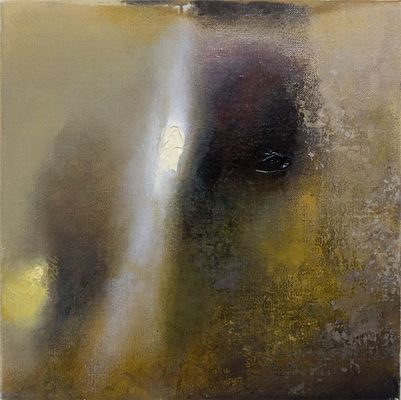
To return to Buckley’s fragment, the first two lines very much evoke how I paint nowadays. As you age, detail diminishes and patches of light become more luminous and float. I feel the most honest way of dealing with this is by smearing the oil paint on the canvas with the fingers and working close-up, blind. Only if the patches coalesce into an approaching image can the work gain a life.
-
Jonathan Walker was born in Melbourne, Australia and brought up on a dairy farm in Gippsland. In the 1970’s he studied painting at RMIT and won the Harold Wright Scholarship to the British Museum, London. During the 1980’s he exhibited at Pinacotheca Gallery, Richmond and had work shown at the NGV and Heidi City Art Gallery. Over the same period he designed the cover for the “Epigenesi” LP by Giancarlo Toniutti, Italy and conducted a mail exchange work with Achim Wollscheid, Germany. The work with artists through the post resulted in an article published in the bicentenary issue of Art and Australia 1988. He showed in artist run spaces such as WestSpace in the 90’s and 2000’s, and until 2012, taught painting at Victoria University, which is where we (Colleen Ahern and Lisa Radford) as organisers of the exhibition, among many others, had the privilege of being his student.
Walker’s knowledge was imparted to students through the careful selection of music, literature, and artists found in books that he himself had ordered for the library. Walker’s strategy was the generosity of sharing his vast knowledge with references specific to each student and their context.
Walker’s paintings share a similar focus and intimacy.
This exhibition presents a small selection of recent paintings alongside a publication that includes Walker’s writing. Observational and analytical, Walker’s work is a type of material notation — the time of day, colour and how it is blended, the both specific and fleeting location of a reflection on lino or the question of whether a chair leg should be included in a painting.
Please join us on Friday August 21 between 6-8pm to celebrate the opening of the exhibition.
Curated by Colleen Ahern and Lisa Radford.
B. Wurtz
Curated by Nic Tammens
March 26 - April 4, 2015
B.Wurtz works from a basement studio in his home on Manhattan’s Lower East Side.
This local fact is attested to by the plastic shopping bags and newsprint circulars that appear in his work. As formal objects, they don’t make loud claims about their origins but nonetheless transmit street addresses and places of business from the bottom of this long thin island. Like plenty of artists, Wurtz is affected by what is local and what is consumed. His work is underpinned by this ethic. It often speaks from a neighborhood or reads like the contents of a hamper:
“BLACK PLUMS $1.29 lb.”
“Food Bazaar”
“USDA Whole Pork Shoulder Picnic 99c lb.”
“RITE AID Pharmacy, with us it’s personal.”
“H. Brickman & Sons.”
“Sweet Yams 59c lb."
Most of the work in this exhibition was made while the artist was in residence at Dieu Donne, a workshop dedicated to paper craft in Midtown. Here Wurtz fabricated assemblages with paper and objects that are relatively lightweight, with the intention that they would be easily transportable to Australia. This consideration isn’t absolute in Wurtz’s work, but was prescriptive for making the current exhibition light and cheap. Packed in two boxes, these works were sent from a USPS post office on the Lower East Side and delivered to North Melbourne by Australia Post.
Wurtz appears courtesy of Metro Pictures, New York.
Thanks to Rob Halverson, Joshua Petherick, Sari de Mallory, Matt Hinkley, Helen Johnson, Fayen d'Evie, Ask Kilmartin, Lisa Radon, Ellena Savage, Yale Union, and "Elizabeth".
John Nixon
"Archive"
December 15 - January 20, 2014
The presentation of John Nixon's archive offered a rare showcase of this extensive collection of the artist's own publications, catalogues, posters, ephemera, editions and more, from the mid 1980s onwards, alongside a selection of his artworks.
Organized by John Nixon, Joshua Petherick and Matt Hinkley.
<a href=http://wfb.public-office.info/artist/john-nixon>All titles by John Nixon
"Habitat"
at Minerva, Sydney (organised by Joshua Petherick and Matt Hinkley)
November 15 - December 20, 2014
Lupo Borgonovo, Janet Burchill & Jennifer McCamley,
Lewis Fidock, HR Giger, Piero Gilardi, Veit Laurent Kurz,
Cinzia Ruggeri, Michael E. Smith, Lucie Stahl, Daniel Weil, Wols
Press Release:
“...It contained seven objects. The slender fluted bone, surely formed for flight, surely from the wing of some large bird. Three archaic circuitboards, faced with mazes of gold. A smooth white sphere of baked clay. An age-blackened fragment of lace. A fingerlength segment of what she assumed was bone from a human wrist, grayish white, inset smoothly with the silicon shaft of a small instrument that must once have ridden flush with the surface of the skin - but the thing’s face was seared and blackened.”
William Gibson, “Count Zero”, 1986
"Autumn Projects Archive"
Curated by Liza Vasiliou
March 6 - March 15, 2014
World Food Books, in conjunction with the Virgin Australia Melbourne Fashion Festival 2014, presented the Autumn Projects archive, consisting of a selection of early examples in Australian fashion with a particular interest in collecting designers and labels from the period beginning in the 1980’s, who significantly influenced the discourse of Australian Fashion.
Curated by Liza Vasiliou, the exhibition provided a unique opportunity to view pieces by designers Anthea Crawford, Barbara Vandenberg, Geoff Liddell and labels CR Australia, Covers, Jag along with early experimental collage pieces by Prue Acton and Sally Browne’s ‘Fragments’ collection, suspended throughout the functioning World Food Books shop in Melbourne.
H.B. Peace
presented by CENTRE FOR STYLE
November 14, 2013
"Hey Blinky, you say chic, I say same"
Anon 2013
H.B. Peace is a clothing collaboration between great friends Blake Barns and Hugh Egan Westland. Their pieces explore the divergences between 'character’ and ‘personality’ in garments....etc
Special Thanks to Joshua Petherick and Matt Hinkley of WFB and Gillian Mears
and a Very Special Thank you to Audrey Thomas Hayes for her shoe collaboration.
Janet Burchill & Jennifer McCamley
"Aesthetic Suicide"
May 10 - June 8, 2013
The first of our occasional exhibitions in the World Food Books office/shop space in Melbourne, "Aesthetic Suicide" presented a body of new and older works together by artists Janet Burchill & Jennifer McCamley, including videos, prints, a wall work, and publications.
During shop open hours videos played every hour, on the hour.
1980, English
Softcover, 24 pages, 28 x 22 cm
1st Edition, Out of print title / used / good
Published by
Cassina / Italy
$120.00 - Out of stock
Wonderful and very rare original catalogue pubished by Cassina in 1980 to promote legendary Italian designer Gaetano Pesce's iconic furniture pieces "Tramonto a New York" sofa, "Sansone" table, "Dalila" chair, and "Sit Down" armchair. Illustrated across 24 colour pages, including fold-outs, including specs and details on each piece. A very collectible archival piece of ephemera from Cassina.
Gaetano Pesce was born in Italy in 1939 and studied architecture at the University of Venice. After graduating in 1965, he moved between London, Padova, Helsinki, and Paris, before settling in New York in 1980. From the beginning, Pesce’s practice has straddled the boundaries between art, design, urban planning, and architecture, always using his work as a vehicle to communicate his perspective on the world today. With resin, foam, and plastics as his signature materials, Pesce has designed for companies such as Cassina, B&B Italia, and Vitra. His architectural work includes the Organic Building of Osaka, the Children’s House for Parc de la Villette, the Gallery Mourmons in Belgium, and the TBWA\Chiat\Day office in New York. Pesce has served as a visiting lecturer and professor at many prestigious institutions in America and abroad, principally the Cooper Union in New York. He is currently a faculty member at the Institut d'Architecture et d'Etude Urbaines in Strasbourg.
Good copy with some light bending.
2011, English
Softcover, 208 pages, 20.3 x 25.4 cm
1st Edition, Out of print title / used / fine
Published by
Verlag fur moderne Kunst / Nuremberg
$100.00 - Out of stock
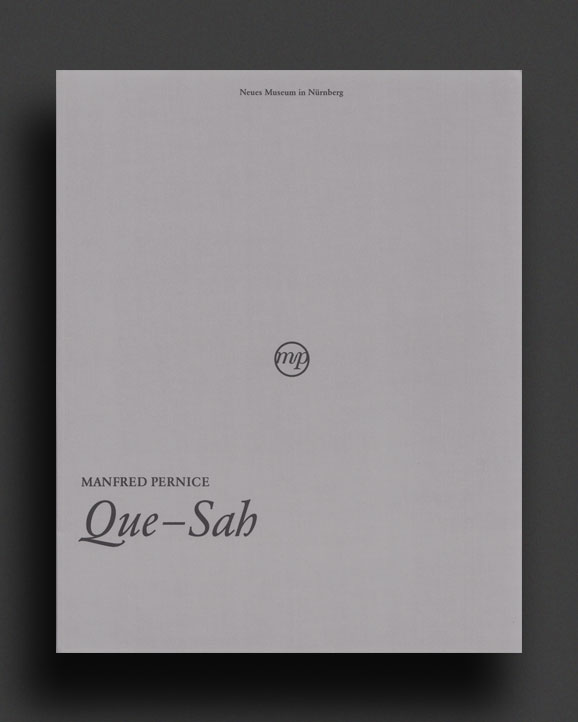
Wonderful, now out-of-print book produced on the most comprehensive survey exhibition to date of work by Berlin-based artist Manfred Pernice, held at the Neue Museum in Nuremberg in 2011, incorporating existing and new works in relation to one another. Profusely illustrated, this definitive publication documents the artist's work to date via essays and a comprehensive illustrated biography.
With his installation-based work, Manfred Pernice (born 1963) belongs to a new generation of German artists who have established international reputations. His sculptures are constructed from conventional building materials such as particle board, blockboard, iron rods and concrete. The formal vocabulary of Pernice’s works often consists of details of real architecture, ranging from tile-covered surfaces and closed structural forms to very specific architectural design solutions such as the Fiat car factory in Turin with its rooftop test track. Functional components such as containers, walled enclosures, mounts or supports also serve as models for his sculptural objects. Pernice often combines these architecturally oriented works with pieces of furniture, models, drawings, photographs or texts to create expansive and evocative installations.
The exhibition title – Que-Sah – refers to one volume of the Brockhaus encyclopaedia, where alphabetical arrangement is used to give systematic order to the extremely varied lexical contents. On this subject Pernice has commented that, “Like the first entry in this volume (Quebec conferences) and the last one (Saho, stock farmers of northern Ethiopia), all the other conceptual phenomena that lie between them are also potential areas of artistic exploration.”
Text by Angelika Nollert, Jennifer Allen, Sabeth Buchmann, Jan Verwoert, Melitta Kliege.
1977, English
Softcover, 36 pages, 25.5 x 18 cm
1st Edition, Out of print title / used / very good
Published by
California Comics / San Jose
$65.00 - Out of stock
First edition of issue 3 of the great and short-lived (1974-1977) California Comics, published by Bob Sidebottom, who owned the legendary San Jose underground comic book shop, Comic Collector Shop, through the 1960s-1980s. This issue features excellent cover art by the great Ed Watson and a full-colour centerfold by Richard Corben, alongside further contributions from Ed Watson, Barney Steel, T-Bird, Bill Loudin, and others. Includes a continuation of Bob Sidebottom and Bill Loudin's comprehensive underground publishing checklist, "Comixography, The Comix Index". One of the great American underground comics.
Very Good copy.
2020, English
Softcover, 192 pages, 13.2 x 20.3 cm
Published by
New Directions / New York
$34.00 - Out of stock
In these essays, the acclaimed artist, photographer, writer, and filmmaker Moyra Davey often begins with a daily encounter--with a photograph, a memory, or a passage from a book--and links that subject to others, drawing fascinating and unlikely connections, until you can almost feel the texture of her thinking. While thinking and writing, she weaves together disparate writers and artists--Mary Wollstonecraft, Jean Genet, Virginia Woolf, Janet Malcolm, Chantal Akerman, and Roland Barthes, among many others--in a way that is both elliptical and direct, clearheaded and personal, prismatic and self-examining, layering narratives to reveal the thorny but nourishing relationship between art and life.
2001, English
Softcover, 345 pages, 15.2 x 22.8 cm
Published by
Seven Stories Press / New York
$46.00 - Out of stock
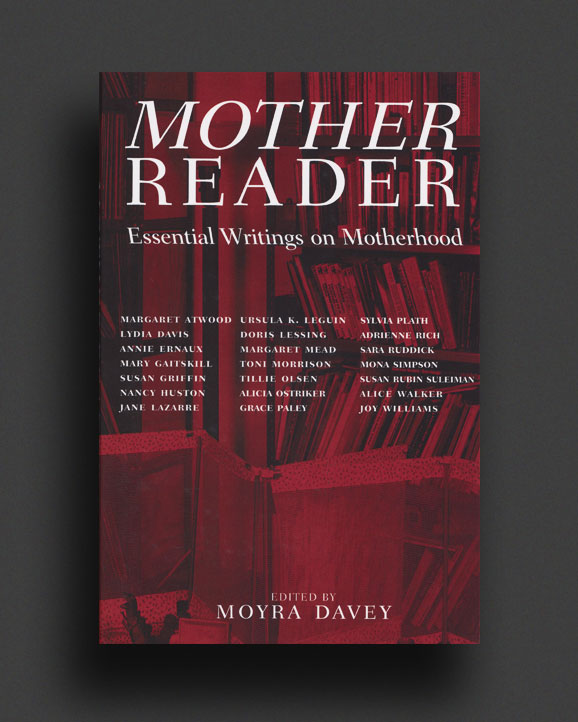
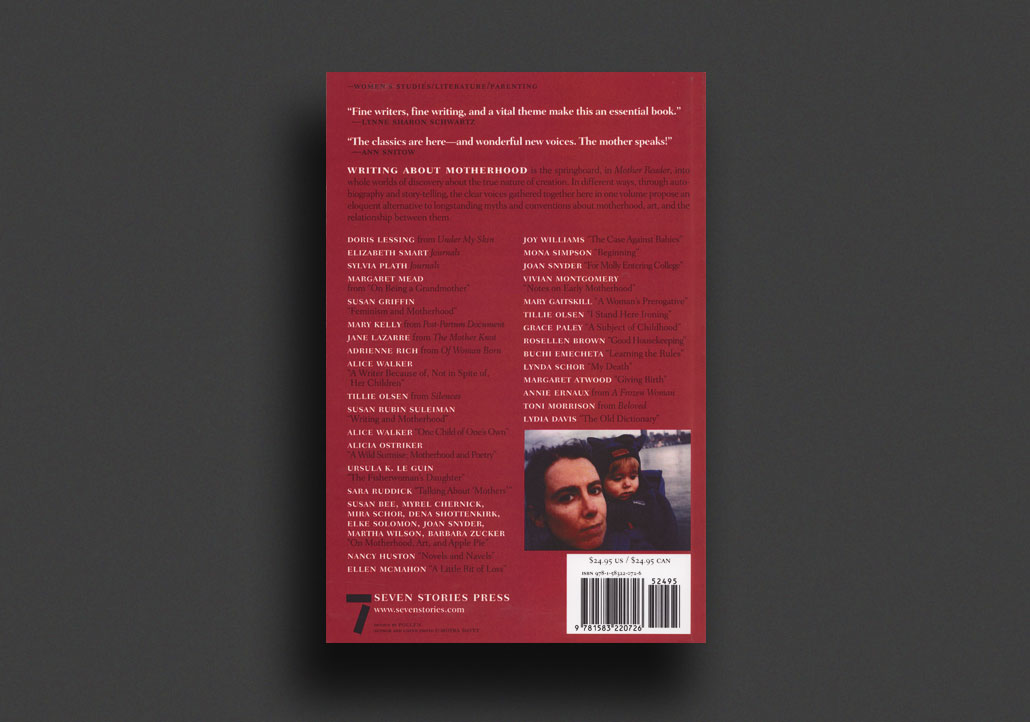
The intersection of motherhood and creative life is explored in these writings on mothering that turn the spotlight from the child to the mother herself. Here, in memoirs, testimonials, diaries, essays, and fiction, mothers describe first-hand the changes brought to their lives by pregnancy, childbirth, and mothering.
Many of the writers articulate difficult and socially unsanctioned maternal anger and ambivalence. In Mother Reader, motherhood is scrutinized for all its painful and illuminating subtleties, and addressed with unconventional wisdom and candor. What emerges is a sense of a community of writers speaking to and about each other out of a common experience, and a compilation of extraordinary literature never before assembled in a single volume.
Contributors include Margaret Atwood, Lydia Davis, Annie Ernaux, Mary Gaitskill, Susan Griffin, Nancy Huston, Jane Lazarre, Ursula K. LeGuin, Margaret Mead, Toni Morrison, Tillie Olsen, Alicia Ostriker, Grace Paley, Sylvia Plath, Adrienne Rich, Sara Ruddick, Mona Simpson, Susan Rubin Suleiman, Alice Walker, Joy William and many more.
2021, English
Softcover, 224 pages, 14 x 21cm
Published by
Primary Information / New York
$40.00 - Out of stock
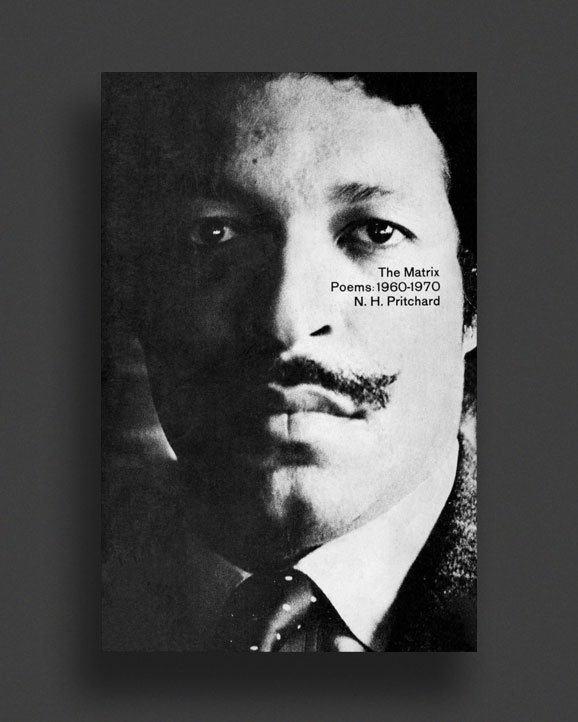
The Matrix by Norman H. Pritchard (1939–1996) gathers a selection of the Concrete and Black Arts poet’s work from 1960 to 1970. The seventy-one poems collected here might be regarded, as Charles Bernstein has written, as “sound” poems, being tethered not only to the literature of the Black Arts Movement but also to jazz culture and urban life in New York. Drawing as much from the visual arts and concrete poetry as from sound-based experimentation and music, Pritchard utilized the simple tools of spacing and typography to create syncopations, vibrations, and musical rhythms. What emerges is nothing less than a self-contained system of mimetic codes that challenge modernist modes of perception and representation. Formally innovative and anticipating what Michael Riffaterre would come to call the semiotics of “ungrammaticalities,” the book is a syntactical and visual experience in repetition, stutters, and structure.
Norman Henry Pritchard was born in New York City in 1939 and studied at New York University and Columbia University. His work has been published in two collections: The Matrix Poems: 1960–1970 (1970) and Eecchhooeess (1971). His poetry was featured in the journals Umbra and The East Village Other, performed on the jazz poetry compilation New Jazz Poets (1967), and anthologized in The New Black Poetry (1969) and In a Time of Revolution: Poems from Our Third World (1969). Pritchard taught poetry at the New School for Social Research and was a poet-in-residence at Friends Seminary. He died in eastern Pennsylvania on February 8, 1996.
“Here’s a truth to which the black experiment is especially foregiven: “words are ancillary to content.” The converse is also true, indicating mutual aid and mutual trouble. When words and content get together, there’s enough room in the vast, infinitesimal blur not in between them for poetry to make its dispersive, displacing way. Norman H. Pritchard loves that non-Euclidean neighborhood. He keeps bullet time there, after hours, in a club, which is an open cell, called The Matrix. Welcome to this “huge/entering” of concrete breath—unprecedented, unsurpassed.” — Fred Moten
2021, English
Hardcover, 64 pages, 14.7 x 20.8 cm
Published by
DABA / New York
$48.00 - Out of stock
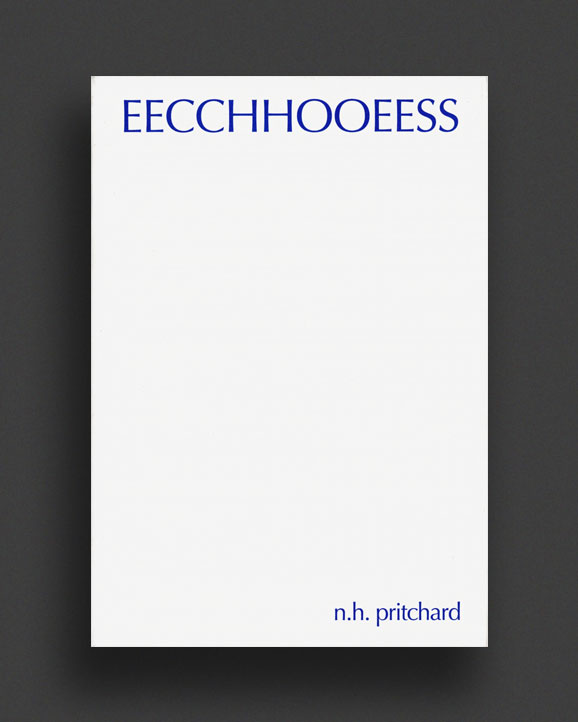
An exacting facsimile of Umbra protagonist Norman H. Pritchard's long-rare 1971 collection of visually kinetic poetry
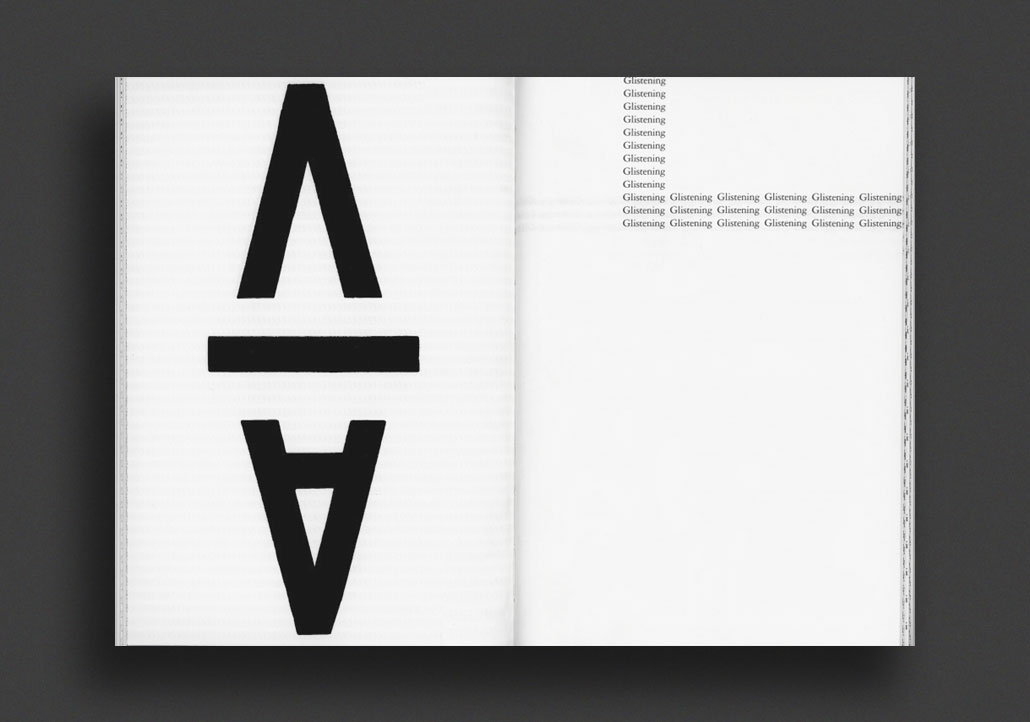
American poet Norman H. Pritchard's second and final book, EECCHHOOEESS was originally published in 1971 by New York University Press. Pritchard's writing is visually and typographically unconventional. His methodical arrangements of letters and words disrupt optical flows and lexical cohesion, modulating the speeds of reading and looking by splitting, spacing and splicing linguistic objects. His manipulation of text and codex resembles that of concrete poetry and conceptual writing, traditions from which literary history has mostly excluded him. Pritchard also worked with sound, and his dynamic readings--documented, among few other places, on the album New Jazz Poets (Folkways Records, 1967)--make themselves heard on the page.
EECCHHOOEESS exemplifies Pritchard's formal and conceptual sensibilities, and provides an entryway into the work of a poet whose scant writings have only recently achieved wider recognition. DABA's publication of EECCHHOOEESS is unabridged and closely reproduces the design of the original 1971 volume.
Norman H. Pritchard (1939-96) was affiliated with the Umbra group, a predecessor to the Black Arts Movement. He taught writing at the New School for Social Research and published two books: The Matrix: Poems 1960-1970 (Doubleday, 1970) and EECCHHOOEESS (New York University Press, 1971). His work was anthologized in publications including The New Black Poetry (1969), In a Time of Revolution: Poems from Our Third World (1969), Dices or Black Bones: Black Voices of the Seventies (1970), Ishmael Reed's 19 Necromancers from Now (1970), Text-Sound Texts (1980) and others.
2021, English
Softcover, 136 pages, 15 x 22.6 cm
Published by
The Drawing Center / New York
$44.00 - Out of stock
The first book dedicated to these pivotal early works on paper, David Hammons: Body Prints, 1968-1979 brings together the monoprints and collages in which the artist used the body as both a drawing tool and printing plate to explore performative, unconventional forms of image making. Hammons created the body prints by greasing his own body--or that of another person--with substances including margarine and baby oil, pressing or rolling body parts against paper, and sprinkling the surface with charcoal and powdered pigment. The resulting impressions are intimately direct indexes of faces, skin, and hair that exist somewhere between spectral portraits and physical traces. Hammons' body prints represent the origin of his artistic language, one that has developed over a long and continuing career and that emphasizes both the artifacts and subjects of contemporary Black life in the United States.
More than a half century after they were made, these early works on paper exemplify Hammons' celebration of the sacredness of objects touched or made by the Black body, and his biting critique of racial oppression. The 32 body prints highlighted in this volume introduce the major themes of a 50-year career that has become central to the history of postwar American art. The book features a conversation between curator and activist Linda Goode Bryant and artist Senga Nengudi, as well as a photo essay by photographer Bruce W. Talamon, who documented Hammons at work in his Los Angeles studio in 1974.
Born in 1943 in Springfield, Illinois, David Hammons moved to Los Angeles in 1963 at the age of 20 and began making his body prints several years later. He studied at Otis Art Institute with Charles White and became part of a younger generation of Black avant-garde artists loosely associated with the Black Arts Movement. He moved to New York in 1978.
2014, English
Hardcover (w. dust jacket), 240 pages, 13.8 x 20.5 cm
Published by
Verso / London
$44.00 - Out of stock
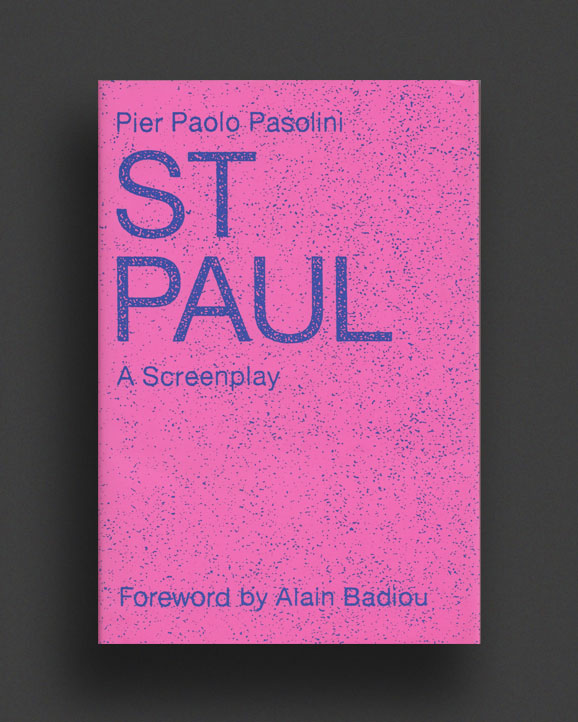
Presented here for the first time in English is a remarkable screenplay about the apostle Paul by Pier Paolo Pasolini, legendary filmmaker, novelist, poet, and radical intellectual activist. Written between the appearance of his renowned film Teorema and the shocking, controversial Salò, or the 120 Days of Sodom, St Paul was deemed too risky for investors. At once a political intervention and cinematic breakthrough, the script forces a revolutionary transformation on the contemporary legacy of Paul. In Pasolini's kaleidoscope, we encounter fascistic movements, resistance fighters, and faltering revolutions, each of which reflects on aspects of the Pauline teachings. From Jerusalem to Wall Street and Greenwich Village, from the rise of SS troops to the death of Martin Luther King, Jr, here— as Alain Badiou writes in the foreword—"Paul's text crosses all these circumstances intact, as if it had foreseen them all."
This is a key addition to the growing debate around St Paul and to the proliferation of literature centred on the current turn to religion in philosophy and critical theory, which embraces contemporary figures such as Alain Badiou, Slavoj Žižek and Giorgio Agamben.
Translated by Elizabeth A. Castelli
Preface by Alain Badiou
Introduction by Ward Blanton
2021, English
Softcover, 52 pages, 15 x 21cm
Published by
Primary Information / New York
$32.00 - Out of stock
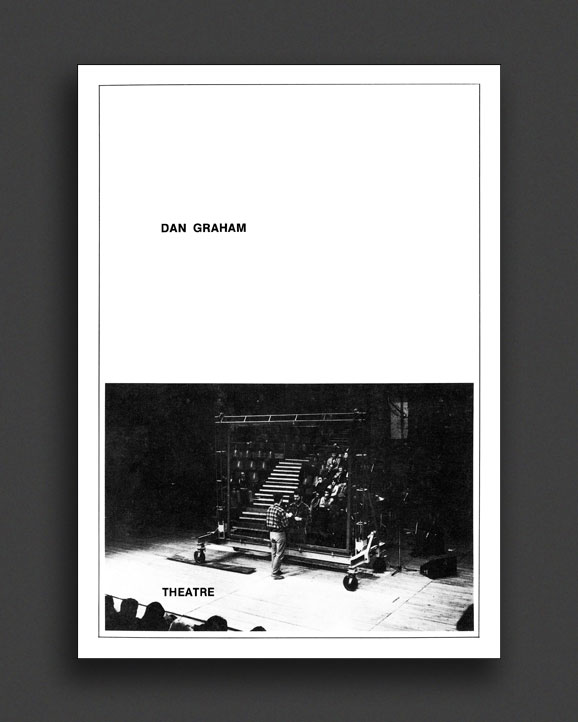
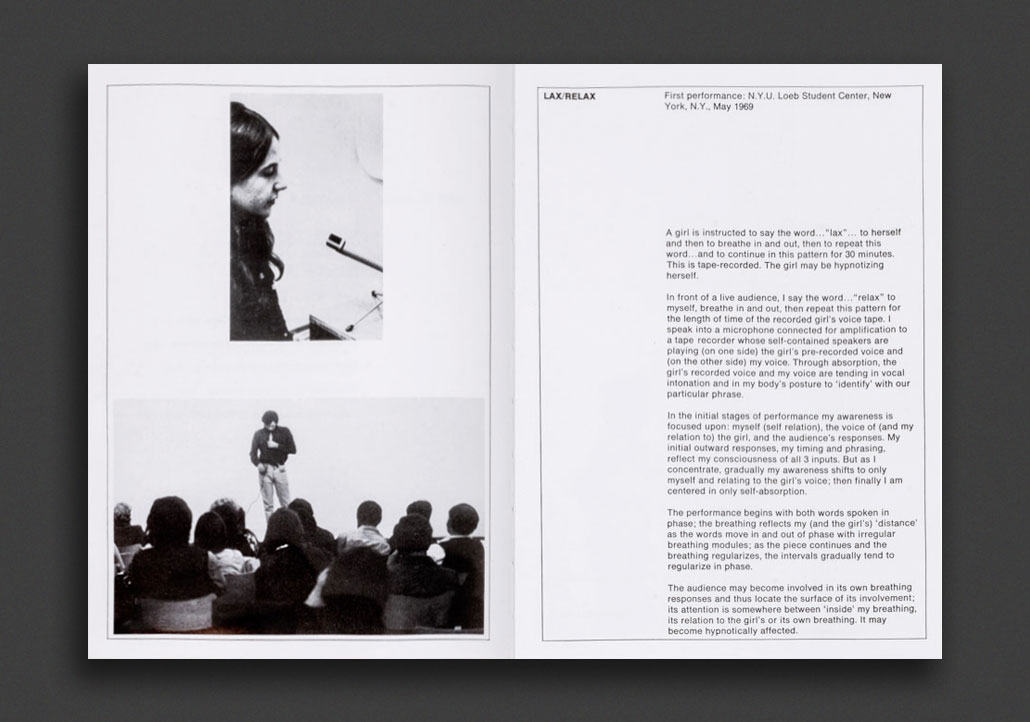
Theatre is an artist book that documents seven early performances by Dan Graham taking place from 1969 to 1977 with notes, transcripts, or photographs for each work. Originally published in 1978, and produced here in facsimile form, the publication focuses on several key works that interrogate or undermine the psychological and social space created by, or between, individuals inside the performance venue.
Like most of Graham’s work, they also serve as a critique of cultural norms, with many of the performances utilizing quotidian, social acts that are amplified over time. For example, in Lax/Relax (1969), Graham’s subversion of West Coast new ageism, the artist chants “relax” in sync with a recording of a woman saying “lax” in a meditative manner, which implicates the audience into a group breathing exercise or hypnosis over the course of 30 minutes.
Throughout the ’70s, the artist engaged in a series of works that subverted the prescribed roles of the audience and performer by creating conditions in which each simultaneously functions as both (creating a type of feedback loop). Remarking on another work form this period, Graham once stated, “It begins with Minimal Art, but it’s about spectators observing themselves as they’re observed by other people.”* This paradigm is extended even further in Performer/Audience Sequence (1975) and Performer/Audience Mirror (1977), in which the artist performs by describing the audience as well as himself, creating conditions whereby the audience is performing for the artist as well as themselves.
Like (1971), Past Future Split Attention (1972), and Identification Projection (1977) are also featured in the publication.
Dan Graham (b. 1942) is an artist based in New York. Since the 1960s, he has produced a wide range of work and writing that engages in a highly analytical discourse on the historical, social, and ideological functions of contemporary cultural systems. Architecture, popular music, video, and television are among the focuses of his investigations, which he articulates through essays, performances, installations, videotapes, and architectural/sculptural designs.
Managing Editor: James Hoff
Managing Designer: Rick Myers
2010, English
Hardcover (illustrated box edition), 192 leporello pages, 15.2 x 23.9 cm
Published by
New Directions / New York
$79.00 - Out of stock
Nox is an epitaph in the form of a book, a facsimile of a handmade book Anne Carson wrote and created after the death of her brother. The poem describes coming to terms with his loss through the lens of her translation of Poem 101 by Catullus "for his brother who died in the Troad." Nox is a work of poetry, but arrives as a fascinating and unique physical object. Carson pasted old letters, family photos, collages and sketches on pages. The poems, typed on a computer, were added to this illustrated "book" creating a visual and reading experience so amazing as to open up our concept of poetry.
Anne Carson (b. 1950) is a Canadian poet, essayist, professor of Classics, and translator. Carson has gained both critical accolades and a wide readership over the course of her “unclassifiable” publishing career. In addition to her many highly-regarded translations of classical writers such as Sappho and Euripides, and her triptych rendering of An Oresteia (2009), she has published poems, essays, libretti, prose criticism, and verse novels that often cross genres. Known for her supreme erudition, her poetry can also be heart-breaking and she regularly writes on love, desire, sexual longing and despair. Her honors and awards are many, including fellowships from the Guggenheim Foundation, the MacArthur Foundation, and the American Academy in Berlin. She has also received the Lannan Literary Award, the Pushcart Prize, and the Griffin Poetry Prize.
2020, English
Softcover, 240 pages, 15.1 x 21.1 cm
Published by
The MIT Press / Massachusetts
Whitechapel / London
$38.00 - Out of stock
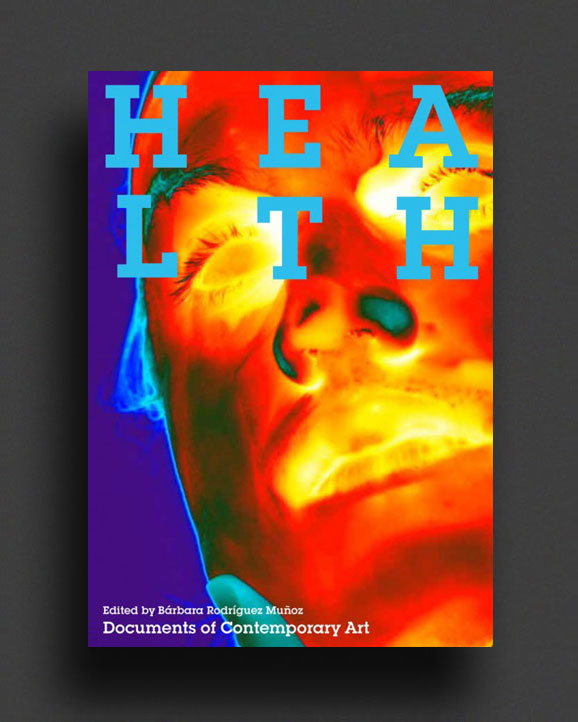
Part of the acclaimed Documents of Contemporary Art series of anthologies which collect writing on major themes and ideas in contemporary art.
The ethical, aesthetic and political significance of practices, positions and theories connected to health in contemporary art.
In an era of fitness programs, increasing antidepressant usage, nutrition counseling and health-management apps, wellness is one of the defining issues of contemporary life, dictating every intimate aspect of our lives. Historically, art has been entwined with the values of medicine, beauty, and the productive body that have defined western scientific paradigms; contemporary artists are increasingly confronting and reshaping these ideologies, critically tackling illness and impairment in their practice while challenging ableist institutional dynamics. In this volume, artists, curators, writers, and thinkers engage with the ways the vulnerability of our bodies reveals structural aspects of our societies.
At a moment at which epidemics and global warming menace all forms of life, we see clearly how health intersects with sexuality, ethnicity, gender, class, and coloniality. By reclaiming other realities, beyond a state of health as a norm, this book questions the myths, stigmas, and cultural attitudes that shape normative perceptions, revealing the interdependence of our entangled existences. The book includes four newly commissioned texts: by artists Mahmoud Khaled and Patrick Staff, by curator Clare Barlow on disability in the museum, and by curator Portia Malatjie on the work of Dineo Seshee Bopape. It also features two texts on the current COVID-19 pandemic, by Anne Boyer and Filipa Ramos.
Artists surveyed include :
Oreet Ashery, Lucy Beech, Dineo Seshee Bopape, Lorenza Böttner, Canaries & Taraneh Fazeli, Grupo Chaclacayo, Anne Charlotte Robertson, Patricia Domínguez, Dora García, Felix González-Torres, Luke Fowler, Alice Hattrick, Tamar Guimarães, Joseph Grigely, Gran Fury, Johanna Hedva, Mahmoud Khaled, Mujeres Creando, Carolyn Lazard, Simone Leigh, Park McArthur, Pedro Neves Marques, Tabita Rezaire, Jo Spence, Patrick Staff, Christine Sun Kim, Pedro Reyes, David Wojnarowicz
Writers include :
Aimar Arriola & Nanci Garín, Clare Barlow, Khairani Barokka, Dodie Bellamy, Anne Boyer, Rizvana Bradley, Eli Clare, Taraneh Fazeli, Theodore (ted) Kerr & Alexandra Juhasz, Eve Kosofsky Sedgwick, R.D. Laing, Miguel A. López, Catalina Lozano, Audre Lorde, Portia Malatjie, Margarida Mendes, Peter Pál Pelbart, Naomi Pearce, Maria Puig de la Bellacasa, Filipa Ramos, Susan Sontag, Paul B. Preciado, Mary Walling Blackburn, Simon Watney & Sunil Gupta
Copublish by MIT Press with Whitechapel Gallery, London
2020, English
Softcover, 240 pages, 14.9 x 21 cm
Published by
The MIT Press / Massachusetts
Whitechapel / London
$38.00 - In stock -
Part of the acclaimed Documents of Contemporary Art series of anthologies which collect writing on major themes and ideas in contemporary art.
The first major anthology to focus on relationships between science fiction and contemporary art, with topics ranging from accelerating technological change to global urbanization.
Over the past two decades, artists and writers have increasingly used science fiction as a lens through which to search for fragments of truth emerging from the past or the future. The proliferation of science fiction in contemporary art practice and discourse reflects an increased understanding of how this narrative field continues to grow in relevance. This book is the first major anthology to focus on relationships between science fiction and contemporary art, and offers an essential read for all those exploring this vital genre.
Organizing its contributions according to four distinct approaches—"estrangement,” “futures,” “posthumanism,” and “ecologies”—this unique collection gathers key examples of the influence of science fiction in recent cultural development. It considers topics that include the integration and acceleration of technological change, global urbanization and concepts of futurity, the boundaries of social structures and nonhuman life, and the threatening evidence of climate change.
Artists surveyed include :
Laylah Ali, Pawel Althamer, Ama Josephine Budge, Lee Bul, Ellen Gallagher, Dominique Gonzalez-Foerster, Eduardo Kac, Patrick Keiller, Josh Kline, Lawrence Lek, Anne Lislegaard, Mariko Mori, Wangechi Mutu, The Otolith Group, Suzanne Treister
Writers include :
Peio Aguirre, Margaret Atwood, J.G. Ballard, Jean Baudrillard, Franco 'Bifo' Berardi, Rosi Braidotti, Rachel Carson, Dawn Chan, T.J. Demos, Donna J. Haraway, N. Katherine Hayles, Wanuri Kahiu, Tom McCarthy, David Musgrave, Alondra Nelson, Kim Stanley Robinson, Darko Suvin
1975, French
Softcover, 170 pages, 27 x 21cm
1st Edition, Out of print title / used / good
Published by
Galeries Nationales du Grand-Palais / Paris
$55.00 - Out of stock
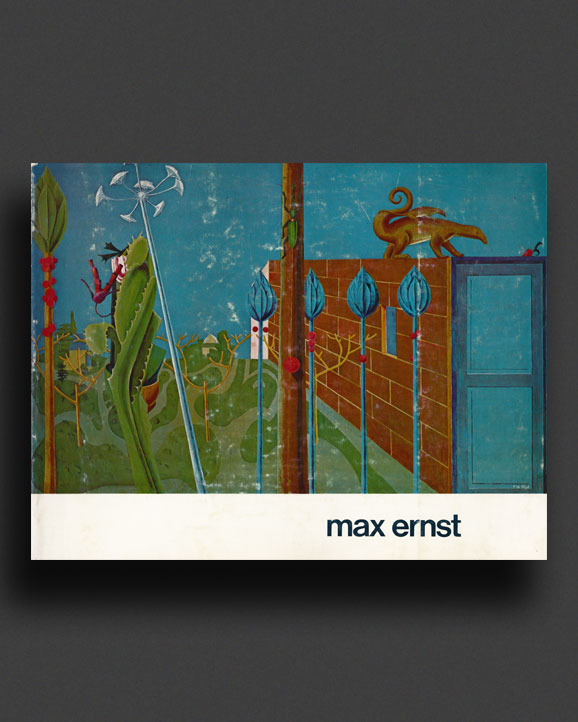
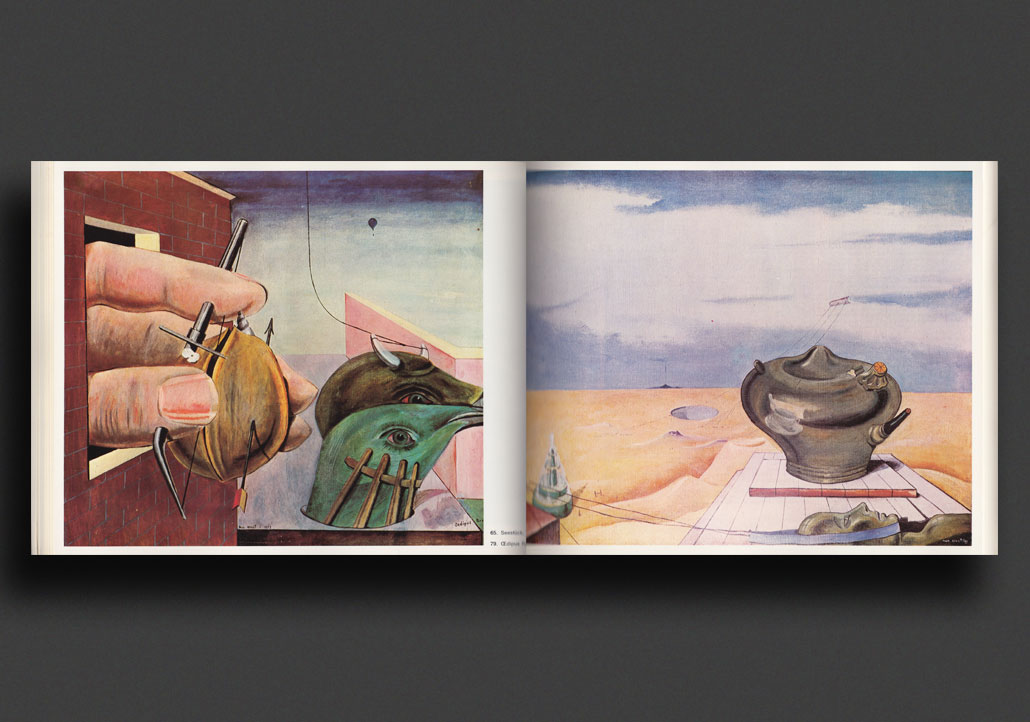
First printing of this comprehensive and profusely illustrated catalogue produced to accompany the survey major exhibition of the work of German artist Max Ernst, at Galeries Nationales du Grand-Palais, in Paris in 1975.
Designed in landscape form, this curious and very generous catalogue is illustrated throughout with colour and black and white reproductions of Ernst's paintings, drawings, sculptures, collages, frottage, graphics, etchings, etc., running chronologically and featuring columns of autobiographical testimonies and theoretical writings of Max Ernst, memories of friends, poetry, reflections, and correspondences with other artists, their dedicated artworks/portraits, writings by critics, writers or other artists (Tristan Tzara, Hans Bellmer, Robert Motherwell, Hans Arp, Paul Eluard, Patrick Waldberg, Benjamin Péret, André Breton, Louis Aragon, Robert Lebel, Dorothea Tanning, Hans Richter, Georges Bataille, Herny Miler, and many others), etc. set in parallel, relating to reproductions of his work, social photographs, and other imagery. Also features a bibliography, list of works, and texts by Werner Spies and others. Still one of the best catalogues on the artist. All texts are in their original French.
Max Ernst (2 April 1891 – 1 April 1976) was a German painter, sculptor, graphic artist, and poet. A prolific artist, Ernst was a primary pioneer of the Dada movement and Surrealism.
Rubbed covers otherwise Very Good throughout.
1983, French / English
Hardcover (clothbound, w. dust jacket), 192 pages, 30.4 x 21.3 cm
Published by
Philippe Sers Éditeur / Paris
$420.00 - Out of stock
Man Ray "Objets de Mon Affection" is the original and only Catalogue Raisonné of Man Ray's sculptures and objects.
"The Object of my affection
Is to change complexion
From Pink, to rosey red...
"In whatever form it is finally presented: by a drawing, by a painting, by a photograph, or by the object itself in its original dimensions, it is designed to amuse, bewilder, annoy or to inspire reflection, but not to arouse admiration for any technical exellcence usually sought in other works of art." (Hollywood, September, 1944) - Man Ray
Wonderful first printing of this truly magnificent and very collectable Man Ray book. "Objets de Mon Affection" was first published in 1983 by Philippe Sers Éditeur, Paris. The book is page after page of Man Ray's objects, sculptures, assemblages, readymades. Amongst the well-known objects in here are countless reproductions of never before published sculptural works. This book includes a Catalogue Raisonné of Man Rays magnificent, poetic, humorous and provocative objects, alongside hand-written captions, reflections/anecdotes by Man Ray in English and French, and accompanying texts (in French) by Jean-Hubert Martin, Rosalind Krauss, and Brigitte Hermann. Also includes photography of exhibitions held by Man Ray, as well as domestic displays and studios documentation of his many objects. A really fantastic book, all wrapped up in bright pink cloth covers and dust-jacket - recommended to any fan of Man Ray's work.
2021, English
Softcover, 88 pages, 20 x 15 cm
Edition of 225,
Published by
Tutto / Naarm—Melbourne
$40.00 - In stock -
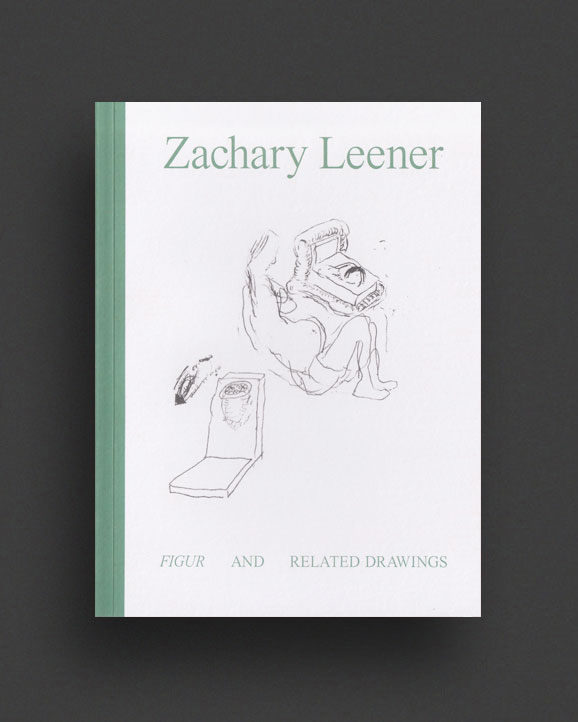
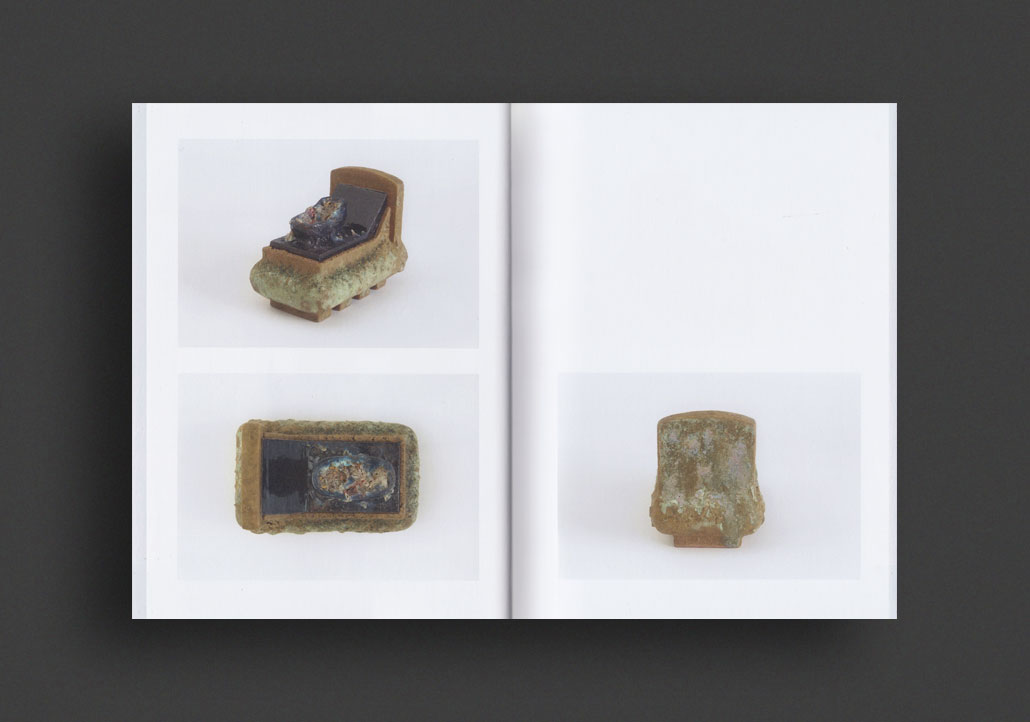
Figur And Related Drawings surveys the 2021 exhibition at Parker Gallery, Los Angeles by Zachary Leener (b. 1981). The publication includes an essay by Sarah Lehrer-Graiwer and candid photos of the Figur objects and previously unseen adjunct drawings by Leener.
Edition of 225
1970 / 1991, Japanese
Softcover (w. dust jacket), 100 pages, 26 x 18 cm
Out of print title / used / fine
Published by
Iwasaki Art Co. / Japan
$45.00 - Out of stock
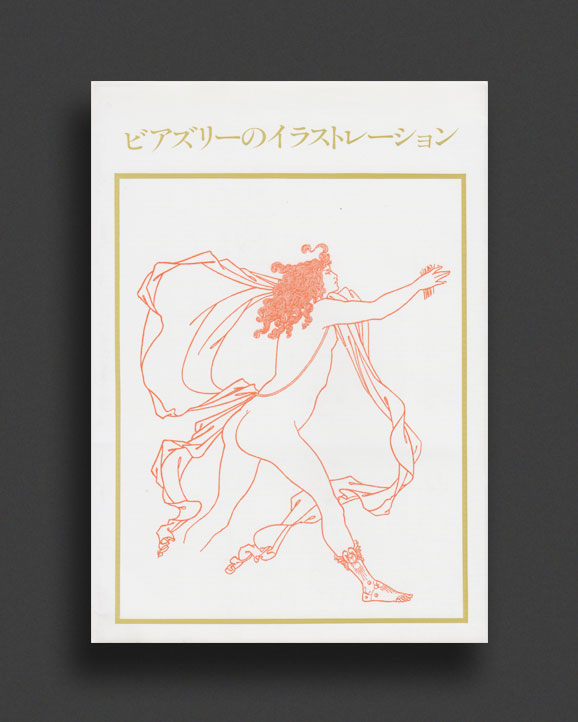
Lovely Japanese monograph on the work of Aubrey Beardsley, first published in 1970 and here in facsimile printed by Iwasaki Art Co. in 1991. Profusely illustrated throughout with 155 works, illustrated biography, biography and list of works. Texts by Tadayuki Omori.
Aubrey Vincent Beardsley (1872 – 1898) was an English illustrator and author. His black ink drawings were influenced by Japanese woodcuts, and emphasized the grotesque, the decadent, and the erotic. He was leading figure in the aesthetic movement, the British counterpart of Decadence and Symbolism. He produced extensive illustrations for books and magazines such as The Studio, The Yellow Book, and The Savoy. Beardsley was a public as well as private eccentric. He said "I have one aim—the grotesque. If I am not grotesque, I am nothing." Oscar Wilde said Beardsley had "a face like a silver hatchet, and grass green hair." Wilde's irreverent wit and work reflected the decadence of his era and his influence was enormous, despite his early death from tuberculosis at age 25. His influence is clearly visible in the work of the French Symbolists, the Poster Art Movement of the 1890s, the work of many later-period Art Nouveau artists such as Papé and Clarke and 20th fantasy illustration.
Fine crisp copy in Very Good original dust jacket.
2012, English
Hardcover, 240 pages, 29 x 23 cm
1st Edition, Out of print title / used / very good
Published by
The Monacelli Press / New York
Museo Nacional Centro De Arte Reina Sofia / Madrid
$180.00 - Out of stock
First edition of the scarce English-language edition of this stunning and long out-of-print hardcover Rosemarie Trockel catalogue, published in 2012 by The Monacelli Press on the occasion of the touring exhibition "A Cosmos" curated by Lynne Cooke, former Deputy Director and Chief Curator, Museo Centro de Arte Reina Sofía, in collaboration with Rosemarie Trockel.
The German artist Rosemarie Trockel (b. 1952) has gained international renown for a multifaceted practice encompassing painting, sculpture, video, and drawing. Issues including a concern with natural history, the creative expression of diverse species, and the representation and role of women in contemporary culture fuel her work. A Cosmosa world shaped by Trockels ideas and affinitiesis presented in this volume, companion to a major exhibition, which places her in the company of others whom she regards as kindred spirits. Juxtaposing her work with objects that range across eras and cultures, borrowed from the fields of art history, botany, craft, and outsider art, this exceptional ensemble illuminates Trockel's highly influential practice of the past thirty years.
Profusely illustrated throughout with all works and installations, includes the work of artists James Castle, Morton Bartlett, Judith Scott, Manuel Montalvo, Günter Weseler, Ruth Francken, and more. Includes essays by Lynne Cooke, Dore Ashton, Suzanne Hudson, and Anne M. Wagner.
Very Good copy. Highly recommended.
2007, English
Softcover (spray-painted), 96 pages, 30 x 20.5 cm
1st Edition, Out of print title / used / very good
Published by
Peres Projects / Los Angeles
$100.00 $20.00 - Out of stock
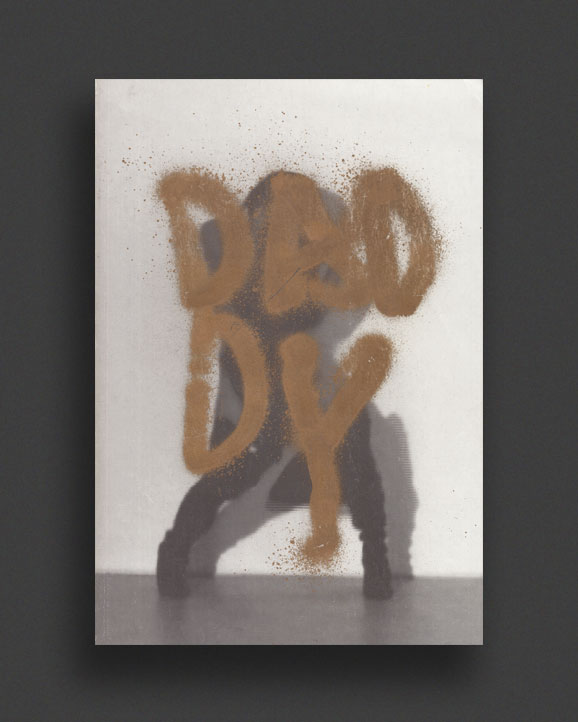
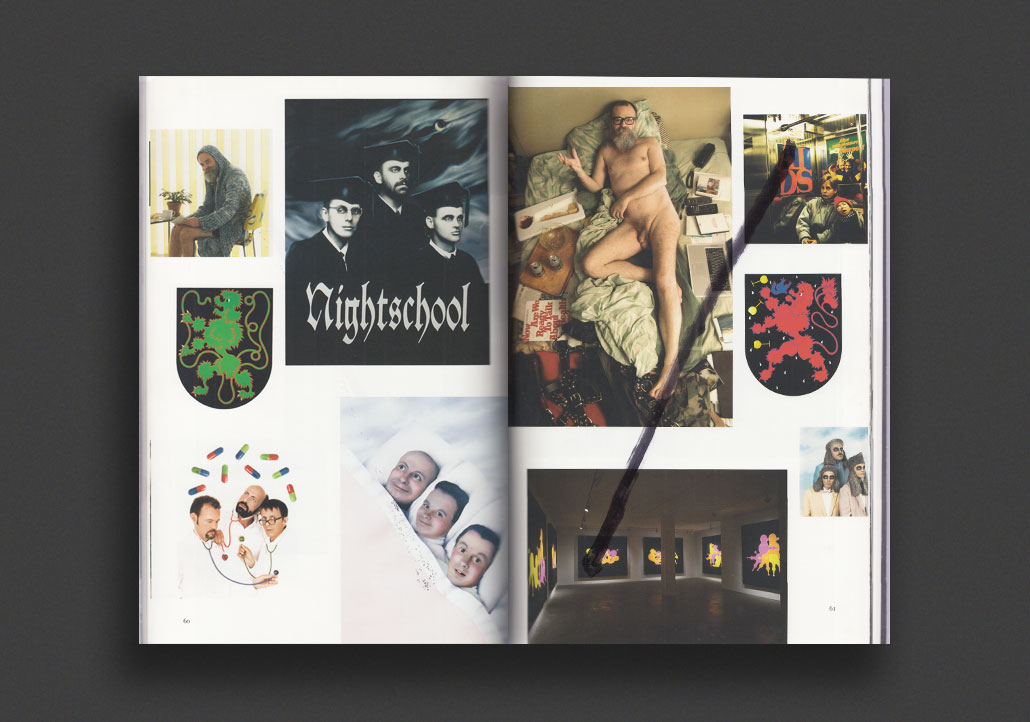
First, limited edition first issue of Daddy Magazine, brings together texts by Bruce LaBruce and Richard Lidinsky interviewing AA Bronson, with artwork by Terence Koh, John Kleckner, Dean Sameshima, assume vivid astro focus, Agnes Martin, Sol Lewitt, Nate Lowman, Bruce Nauman, Matt Greene, Dan Colen, Yves Klein, Joe Bradley, Bruce LaBruce, General Idea, Erik Hanson, Rodney Werden, Matthias Herrmann and AA Bronson. This issue is a special edition by American artist Terrence Koh with each cover painted in gold by the artist and (almost) every page methodically crossed out with a large black sharpie marker. Long out of print.
Very Good copy with some cover wear.
2006, Japanese / English
Newspaper (folded, unbound with numbered obi and publisher's sleeve), 48 pages, 54 x 40cm
1st Edition, Out of print title / used / fine
Published by
Tokyo: Artbeat / Tokyo
$60.00 - Out of stock
Tomoo Gokita & Masayuki Shioda's Grey Scale / Dogoo Hair, published in newspaper format (folded and unbound) by Tokyo: Artbeat in 2006 in a numbered limited edition of 1000 copies. Only available in Japan and now long out-of-print.
Tomoo Gokita is a Tokyo-based painter and leading Japanese contemporary artist on the international art scene. His deeply psychological grayscale monochrome abstract and figurative paintings and drawings present cultural archetypes with warped and concealed features in front of ambiguous backdrops. He describes himself as a lingerie wrestler or hardcore layouter. Also, he sometimes work as DJ.
Masayuki Shioda (b. 1973) is a Tokyo based artist. He began working as a photographer, primarily in the music scene, in the late 1990s. In 2000, his solo exhibition “NPEAKER” was held and in 2002, his first photo book of the same title was published. From April 2009 to March 2010, he also organized a monthly group exhibition titled “35MINUTESMEN” in Araiyakushi, Tokyo. His major publications include LIFE HUNTER (2005) and ANIMAL SPORTS PUZZLE (2008). He has also published a number of books through his own publishing imprint FLASH BOOKS. In 2019, he published “YAKITORI TELLER”, a work documenting Juergen Teller’s stay in Japan, in the inaugural issue of the magazine Moder-n.
Fine - As New copy numbered obi and publisher's sleeve.
2007, Japanese / English
Newspaper (folded, unbound with numbered obi and publisher's sleeve), 48 pages, 54 x 40cm
1st Edition, Out of print title / used / fine
Published by
Tokyo: Artbeat / Tokyo
$60.00 - Out of stock
Peter Sutherland's HISTORY OF EARTH, published in newspaper format (folded and unbound) by Tokyo: Artbeat in 2007 in a numbered limited edition of 1000 copies. Only available in Japan and now long out-of-print.
Peter Sutherland (b. 1976) is an New York City based photographer, who takes pictures, makes films and plays soccer.
Fine - As New copy numbered obi and publisher's sleeve.
2021, English
Hard slipcase containing ten volumes, each 16 pages, signed and numbered box, 30.5 x 21.5 cm
Ed. of 25, signed and numbered,
Published by
Self-Published / Melbourne
$90.00 - Out of stock
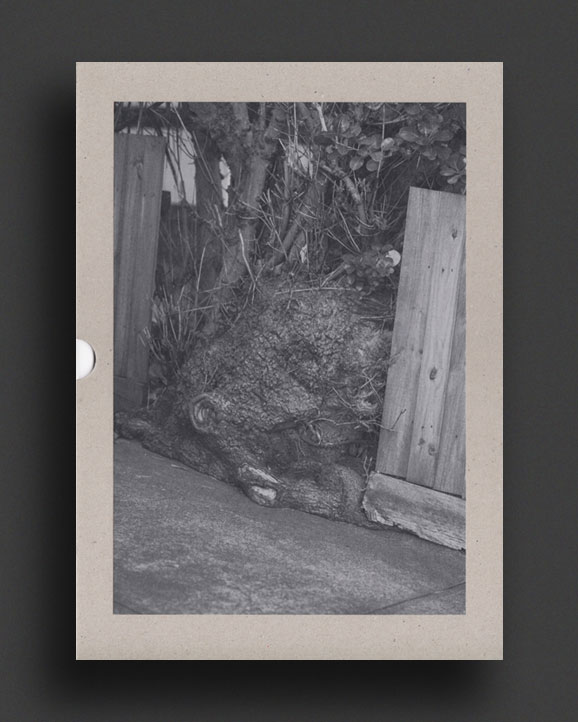
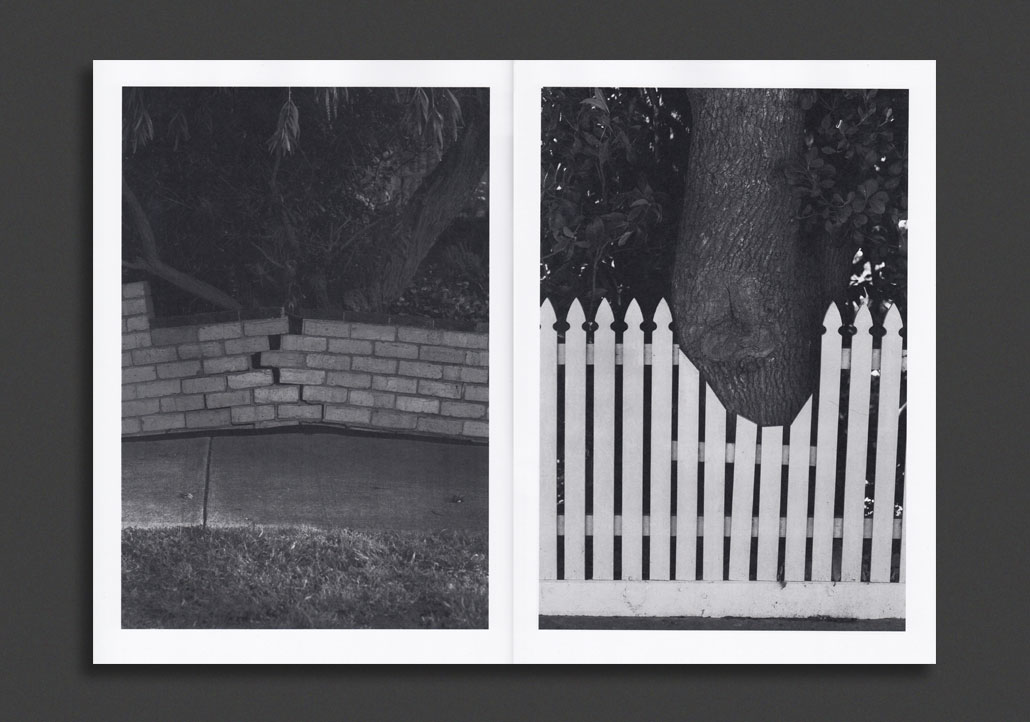
Slipcase edition of Trees and Fences, published as a limited edition artist zine, in ten volumes, each 16 pages, 16 photographs per volume, 160 photographs in total. This complete slipcase edition collects all ten volumes in a limited edition of 25 copies, each box numbered and signed by the artist.
Highly recommended!
Yanni Florence (b. 1965, Melbourne, Australia) co-founded, edited and designed the seminal art publication Pataphysics Magazine (1989). He completed a Bachelor of Architecture at Royal Melbourne Institute of Technology (1997). Yanni has been making and publishing photographs since 1990. His monographs comprise thoughtfully nuanced and sequenced selections of images. Yanni’s work has been included in several group exhibitions, including Melbourne Now in 2013. His first solo exhibition, Tram Windows, was held at ReadingRoom in 2019.
There are seven published books of his photographs: Self Conscious (2009), Southland (2014), Animal Life (2014), Street Porn (2014), Immolation (2015), HE IS IN THE CITY (2017) and Tram Windows (2019).
2014, English
Hardcover, 56 pages, 29 x 21 cm
Ed. of 50,
Published by
M.33 / Melbourne
$35.00 - In stock -
Forty six photographs by Yanni Florence that in the city light and streets captures the animal figure and print in fashion and the bodies that inhabit it. Accompanying essay by Archeologist Grey Deftereos. Hard back bound book with animal print end papers.
“All this pertains to the perception that appearance reflects upon the wearer, their state of mind, their perception of self and how they are choosing to present themselves to others. Clothes are like sentences in a language and what they communicate is a large part of the performance of self within a larger syntax. With animal prints the wearer conflates the aspects of the totem with the self, or the self they are at that time performing. They, in a sense, become the embodiment of the animal, or at least that reading is there for others to make. Wearing animal prints is also, tacitly, a kind of animism, the belief that the spirit of animals and living beings are present throughout all time within inanimate objects. Some aspect of wearing animal prints is the conflation of the self with characteristics of the animals portrayed, and most often – aside say, from the portrayal of kittens, (but then again) - this is sexual.” Greg Deftereos, How to Wear Animal Prints.
Published by M.33 (Melbourne) in a signed edition of 50 copies.
2015, English
Hardcover, 28 pages, 29.7 x 26 cm
Ed. of 5,
1st Edition, Out of print title / as new
Published by
M.33 / Melbourne
$300.00 - Out of stock
Immolation is a book of photographs by Yanni Florence of people on fire. Not in flames running down the street screaming, but quietly burning. There is smoke coming from a man seen from behind as he waits to cross the road at the traffic lights. It looks like he is on fire. Self-combusting. Slowly burning up from the inside. He and others in this book are giving off smoke signals. The book is a studied selection of nineteen photographs from hundreds of photographs that were taken to decipher these signals.
This is a copy of the very rare special edition of only 5 copies: over-sized hardbound photographic inkjet prints on cotton rag paper, 297 x 260 cm, numbered and signed by Florence.
Yanni Florence is an Australian based photographer and award-winning book designer. He has been involved in the design and publishing of numerous publications in the art world for public art museums, cultural institutions, private collectors and artists. He was cofounder of the seminal publication Pataphysics Magazine, which he now runs as guest posts on his blog of mainly vernacular photography that he collects. Other books of Yanni’s photographs include Self-conscious (Skoob 2009), Animal Life (M.33, 2014), Street Porn (M.33, 2014) and Southland (M.33, 2014).