World Food Books' programme is largely produced on Kulin Nation land. We acknowledge the Wurundjeri people of the Kulin Nation as the first and continuing custodians of this land, and pay respect to their Elders past, present, and emerging.
World Food Books is an arts and special interests bookshop in Naarm / Melbourne. Founded in 2010, World Food Books is devoted to the presentation of a rotating, hand-selection of international art, design, literary and counterculture publications with an emphasis on the anti-traditional, the experimental, the avant-garde, the heretic, the marginal.
Presenting new titles alongside rare and out-of-print books, catalogues and journals spanning the fields of modern and contemporary art, design, photography, illustration, film, literature, poetry, cultural theory, philosophy, sexuality, popular and underground culture in its many radical forms, World Food Books wishes to encourage adventurous, thoughtful and open-minded reading, looking, writing, and exchange of publishing and ideas, both current and historical.
As well as our bookshop, located in Melbourne's historical Nicholas Building, all of our inventory is available internationally via our online mail-order service.
World Food Books semi-regularly co-ordinates "Occasions", a programme of exhibits and events at the bookshop and in partnership with other hosts (such as museums and art galleries) that develop out of the activities, relationships and content of the bookshop itself.
World Food Books
The Nicholas Building
37 Swanston Street
Room 5, Level 6
Melbourne 3000
Australia
SHOP HOURS:
Thu–Fri 12–6, Sat 12–5
WEB-SHOP OPEN 24/7
World Food Books
Postal Address:
PO Box 435
Flinders Lane
Victoria 8009
Australia
Art
Theory / Essay
Architecture / Interior
Graphic Design / Typography
Photography
Fashion
Eros
LGBTQ+
Fiction / Poetry
Weird / Speculative / Science Fiction / Horror
Transgressive / Visceral / Abject
Symbolism / Decadence / Fin de siècle
Film / Video
Painting
Sculpture / Installation
Performance / Dance / Theater
Drawing
Sound / Music
Curatorial
Group Shows / Collections
Periodicals
Out-of-print / Rare
Posters / Ephemera / Discs
Signed Books
World Food Books Gift Voucher
World Food Book Bag
Australian Art
Australian Fiction
Australian Science Fiction / Speculative Fiction
Australian Poetry
Australian Photography
Japanese Photography
Conceptual Art
Minimal Art
Dada
'Pataphysics / Oulipo
Fluxus
Concrete Poetry
Pop Art
Surrealism
Arte Povera
Arte Informale / Haute Pâte / Tachism
Nouveau Réalisme / Zero / Kinetic
Situationism / Lettrism
Collage / Mail Art / Xerox Art
Art Brut / Folk / Visionary / Fantastic
Illustration / Graphic Art / Bandes Dessinées
Furniture
Italian Radical Design / Postmodernism
Textiles
Ceramics / Glass
Counterculture
Protest / Revolt
Philosophy
Psychoanalysis
Anthropology
Anarchism
Socialism / Anarchism / Communism / Capitalism
Literary Theory / Semiotics / Language
Feminism / Women's Studies
Gender Studies / Sexuality
Anthropology
Fetishism / BDSM
Drugs / Psychedelia
Crime / Violence
Animal Rights / Veganism
Occult / Esoterica
Ecology / Earth / Alternative Living
Whole Earth / Crafts
All prices in AUD (Australian dollars)
Pick-Ups
Pick-up orders can be collected in our bookshop during opening hours after order date. Please collect any Pick-up orders within 2 weeks of ordering as we have limited storage space. Orders will be released back into stock if not collected within this time. No refunds can be made for pick-ups left un-collected. If you cannot make it in to the bookshop in this time-frame, please choose postage option.
Return Policy
All sales are final. We do accept returns (for refund or exchange) for items received in error. All our orders are packed with special care using heavy-duty padding and cardboard book-mailers or bubble mailers (for smaller books), using reinforcement where required. We cannot take responsibility for any lost, stolen or damaged parcels.
Insurance
Should you wish to insure your package, please email us directly after placing your order and we can organise this at a small extra expense. Although all standard/express tracked packages are very safe and dependable, we cannot take responsibility for any lost, stolen or damaged parcels. We recommend insurance on valuable orders.
Interested in selling your old books, catalogues, journals, magazines, comics, fanzines, ephemera? We are always looking for interesting, unusual and out-of-print books to buy. We only buy books in our fields of interest and specialty, and that we feel we can resell.
We base these prices on desirability, market value, in-print prices, condition and our current stock levels. We offer cash, store credit, and can take stock on consignment. All
about 25% of the price we expect to get when we sell them, or 30% in store credit. We base these prices on desirability, market value, in-print prices, condition and our current stock levels.
Sell your books any day of the week. You can drop them off and return later. If you have a lot of books, we can visit your Sydney home.
We buy books that we feel we can resell. We offer about 25 % of the price we expect to get when we sell them, or 30% in store credit. We base these prices on desirability, market value, in-print prices, condition and our current stock levels.
Philadelphia Wireman
03 August - 01 September, 2018
World Food Books is proud to announce our next Occasion, the first presentation of sculptures by Philadelphia Wireman in Australia.
The Philadelphia Wireman sculptures were found abandoned in an alley off Philadelphia’s South Street on trash night in 1982. Their discovery in a rapidly-changing neighbourhood undergoing extensive renovation, compounded with the failure of all attempts to locate the artist, suggests that the works may have been discarded after the maker’s death. Dubbed the "Philadelphia Wireman" during the first exhibition of this work, in 1985, the maker’s name, age, ethnicity, and even gender remain uncertain. The entire collection totals approximately 1200 pieces, all intricately bound together with tightly-wound heavy-gauge wire (along with a few small, abstract marker drawings, reminiscent both of Mark Tobey and J.B. Murry). The dense construction of the work, despite a modest range of scale and materials, is singularly obsessive and disciplined in design: a wire armature or exoskeleton firmly binds a bricolage of found objects including plastic, glass, food packaging, umbrella parts, tape, rubber, batteries, pens, leather, reflectors, nuts and bolts, nails, foil, coins, toys, watches, eyeglasses, tools, and jewellery.
Heavy with associations—anthropomorphic, zoomorphic, and socio-cultural responses to wrapped detritus—the totemic sculptures by Philadelphia Wireman have been discussed in the context of work created to fulfil the shamanistic needs of alternative religions in American culture. Curators, collectors, and critics have variously compared certain pieces to sculpture from Classical antiquity, Native American medicine bundles, African-American memory jugs, and African fetish objects. Reflecting the artist’s prolific and incredibly focused scavenging impulse, and despite—or perhaps enhanced by—their anonymity, these enigmatic objects function as urban artefacts and arbiters of power, though their origin and purpose is unknown. Philadelphia Wireman, whatever their identity, possessed an astonishing ability to isolate and communicate the concepts of power and energy through the selection and transformation of ordinary materials. Over the course of the past two decades, this collection has come to be regarded as an important discovery in the field of self-taught art and vernacular art.
Presented in collaboration with Fleisher-Ollman Gallery, Philadelphia, and Robert Heald, Wellington.
Susan Te Kahurangi King
02 February - 10 March, 2018
Susan Te Kahurangi King (24 February 1951 - ) has been a confident and prolific artist since she was a young child, drawing with readily available materials - pencils, ballpoint pens and felt-tip markers, on whatever paper is at hand. Between the ages of four and six Susan slowly ceased verbal communication. Her grandparents William and Myrtle Murphy had developed a special bond with Susan so they took on caring responsibilities for extended periods. Myrtle began informally archiving her work, carefully collecting and storing the drawings and compiling scrapbooks. No drawing was insignificant; every scrap of paper was kept. The King family are now the custodians of a vast collection containing over 7000 individual works, from tiny scraps of paper through to 5 meter long rolls.
The scrapbooks and diaries reveal Myrtle to be a woman of great patience and compassion, seeking to understand a child who was not always behaving as expected. She encouraged Susan to be observant, to explore her environment and absorb all the sights and sounds. Myrtle would show Susan’s drawings to friends and people in her community that she had dealings with, such as shopkeepers and postal workers, but this was not simply a case of a grandmother’s bias. She recognised that Susan had developed a sophisticated and unique visual language and sincerely believed that her art deserved serious attention.
This was an unorthodox attitude for the time. To provide some context, Jean Dubuffet coined the term Art Brut in 1945 to describe work created by self-taught artists – specifically residents of psychiatric institutions and those he considered to be visionaries or eccentrics. In 1972 Roger Cardinal extended this concept by adopting the term Outsider Art to describe work made by non-academically trained artists operating outside of mainstream art networks through choice or circumstance. Susan was born in Te Aroha, New Zealand in 1951, far from the artistic hubs of Paris and London that Dubuffet and Cardinal operated in. That Myrtle fêted Susan as a self-taught artist who deserved to be taken seriously shows how progressive her attitudes were.
Susan’s parents Doug and Dawn were also progressive. Over the years they had consulted numerous health practitioners about Susan’s condition, as the medical establishment could not provide an explanation as to why she had lapsed into silence. Dawn educated herself in the field of homeopathy and went on to treat all twelve of her children using these principles – basing prescriptions on her observations of their physical, mental and emotional state.
Doug was a linguist with an interest in philosophy who devoted what little spare time he had to studying Maori language and culture. To some extent their willingness to explore the fringes of the mainstream made them outsiders too but it was their commitment to living with integrity and their respect for individuality that ensured Susan’s creativity was always encouraged.
Even though Susan’s family supported her artistic pursuits, some staff in schools and hospitals saw it as an impediment to her assimilation into the community and discouraged it in a variety of ways. Her family was not always aware of this and therefore did not fully understand why Susan stopped drawing in the early 1990s. However, rather than dwell on the challenges that Susan faced in pursuit of her artistic practice, they prefer to highlight her achievements. In 2008 Susan began drawing again in earnest, after an almost 20 year interruption, and her work is now shown in galleries around the world.
Susan grew up without television and has been heavily influenced by the comics she read as a child. She is absolutely fearless in the appropriation of recognizable characters, such as Donald Duck and Mickey Mouse, in her work. She twists their limbs, contorts their faces, compresses them together, blends them into complex patterned backgrounds - always imbuing them with an incredible energy. Although Susan often used pop culture characters in her work they are not naive or childlike. These are drawings by a brilliant self-taught artist who has been creating exceptional work for decades without an audience in mind.
Mladen Stilinović
"Various Works 1986 - 1999"
02 February 16 - September 10, 2016
Various works 1986 - 1999, from two houses, from the collections of John Nixon, Sue Cramer, Kerrie Poliness, Peter Haffenden and Phoebe Haffenden.
Including: Geometry of Cakes (various shelves), 1993; Poor People’s Law (black and white plate), 1993; White Absence (glasses, ruler, set square, silver spoon, silver ladel with skin photograph and wooden cubes), 1990-1996; Exploitation of the Dead (grey and red star painting, wooden painting, black spoon with red table, red plate), 1984-1990; Money and Zeros (zero tie, paintings made for friends in Australia (Sue, John, Kerrie), numbers painting), 1991-1992; Words - Slogans (various t-shirts) - “they talk about the death of art...help! someone is trying to kill me”, “my sweet little lamb”, “work is a disease - Karl Marx”; Various artist books, catalogues, monographs, videos; Poster from exhibition Insulting Anarchy; "Circular" Croatian - Australian edition; Artist book by Vlado Martek (Dostoyevsky); more.
Thanks to Mladen Stilinović and Branka Stipančić.
Jonathan Walker
Always Will Need To Wear Winter Shirt Blue + Ochre Small Check Pattern
21 August - 21 September, 2015
Untitled
I am not a great reader of poetry but I always return to the work of Melbourne poet, Vincent Buckley (1925- 1988). Perhaps I find his most tantalising piece to be not a finished poem but a fragment left on a scrap of paper discovered on his desk after the poet’s death.
The poetry gathers like oil
In the word-core, and spreads
It has its music meet,
Its music is in movement.
This fragment is more the shell left behind from a volatile thought than a finished poem. I find the last two lines honest but awkward whereas the first two lines work like an arrow. Most likely he could not find a resolution so it was left. Still, in its present form, it remains an eloquent testimony to the ultimate failure of a medium to express mobile thought and sensation, in Buckley’s case, through verbal language. It’s an important matter because this is something all artists have to deal with regardless of the medium.
I have never written a poem, however, I am forever copying fragments from books on paper scraps in a vain effort to fix certain notions in my head. At first, they function as bookmarks that are sometimes returned to when I open the book. But before long, as they accumulate, they fall out littering the table interspersed with A4 photocopies, bills, books and medications.
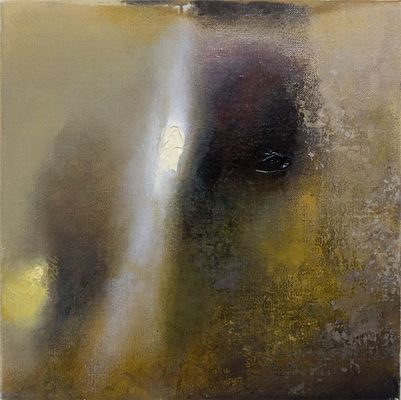
To return to Buckley’s fragment, the first two lines very much evoke how I paint nowadays. As you age, detail diminishes and patches of light become more luminous and float. I feel the most honest way of dealing with this is by smearing the oil paint on the canvas with the fingers and working close-up, blind. Only if the patches coalesce into an approaching image can the work gain a life.
-
Jonathan Walker was born in Melbourne, Australia and brought up on a dairy farm in Gippsland. In the 1970’s he studied painting at RMIT and won the Harold Wright Scholarship to the British Museum, London. During the 1980’s he exhibited at Pinacotheca Gallery, Richmond and had work shown at the NGV and Heidi City Art Gallery. Over the same period he designed the cover for the “Epigenesi” LP by Giancarlo Toniutti, Italy and conducted a mail exchange work with Achim Wollscheid, Germany. The work with artists through the post resulted in an article published in the bicentenary issue of Art and Australia 1988. He showed in artist run spaces such as WestSpace in the 90’s and 2000’s, and until 2012, taught painting at Victoria University, which is where we (Colleen Ahern and Lisa Radford) as organisers of the exhibition, among many others, had the privilege of being his student.
Walker’s knowledge was imparted to students through the careful selection of music, literature, and artists found in books that he himself had ordered for the library. Walker’s strategy was the generosity of sharing his vast knowledge with references specific to each student and their context.
Walker’s paintings share a similar focus and intimacy.
This exhibition presents a small selection of recent paintings alongside a publication that includes Walker’s writing. Observational and analytical, Walker’s work is a type of material notation — the time of day, colour and how it is blended, the both specific and fleeting location of a reflection on lino or the question of whether a chair leg should be included in a painting.
Please join us on Friday August 21 between 6-8pm to celebrate the opening of the exhibition.
Curated by Colleen Ahern and Lisa Radford.
B. Wurtz
Curated by Nic Tammens
March 26 - April 4, 2015
B.Wurtz works from a basement studio in his home on Manhattan’s Lower East Side.
This local fact is attested to by the plastic shopping bags and newsprint circulars that appear in his work. As formal objects, they don’t make loud claims about their origins but nonetheless transmit street addresses and places of business from the bottom of this long thin island. Like plenty of artists, Wurtz is affected by what is local and what is consumed. His work is underpinned by this ethic. It often speaks from a neighborhood or reads like the contents of a hamper:
“BLACK PLUMS $1.29 lb.”
“Food Bazaar”
“USDA Whole Pork Shoulder Picnic 99c lb.”
“RITE AID Pharmacy, with us it’s personal.”
“H. Brickman & Sons.”
“Sweet Yams 59c lb."
Most of the work in this exhibition was made while the artist was in residence at Dieu Donne, a workshop dedicated to paper craft in Midtown. Here Wurtz fabricated assemblages with paper and objects that are relatively lightweight, with the intention that they would be easily transportable to Australia. This consideration isn’t absolute in Wurtz’s work, but was prescriptive for making the current exhibition light and cheap. Packed in two boxes, these works were sent from a USPS post office on the Lower East Side and delivered to North Melbourne by Australia Post.
Wurtz appears courtesy of Metro Pictures, New York.
Thanks to Rob Halverson, Joshua Petherick, Sari de Mallory, Matt Hinkley, Helen Johnson, Fayen d'Evie, Ask Kilmartin, Lisa Radon, Ellena Savage, Yale Union, and "Elizabeth".
John Nixon
"Archive"
December 15 - January 20, 2014
The presentation of John Nixon's archive offered a rare showcase of this extensive collection of the artist's own publications, catalogues, posters, ephemera, editions and more, from the mid 1980s onwards, alongside a selection of his artworks.
Organized by John Nixon, Joshua Petherick and Matt Hinkley.
<a href=http://wfb.public-office.info/artist/john-nixon>All titles by John Nixon
"Habitat"
at Minerva, Sydney (organised by Joshua Petherick and Matt Hinkley)
November 15 - December 20, 2014
Lupo Borgonovo, Janet Burchill & Jennifer McCamley,
Lewis Fidock, HR Giger, Piero Gilardi, Veit Laurent Kurz,
Cinzia Ruggeri, Michael E. Smith, Lucie Stahl, Daniel Weil, Wols
Press Release:
“...It contained seven objects. The slender fluted bone, surely formed for flight, surely from the wing of some large bird. Three archaic circuitboards, faced with mazes of gold. A smooth white sphere of baked clay. An age-blackened fragment of lace. A fingerlength segment of what she assumed was bone from a human wrist, grayish white, inset smoothly with the silicon shaft of a small instrument that must once have ridden flush with the surface of the skin - but the thing’s face was seared and blackened.”
William Gibson, “Count Zero”, 1986
"Autumn Projects Archive"
Curated by Liza Vasiliou
March 6 - March 15, 2014
World Food Books, in conjunction with the Virgin Australia Melbourne Fashion Festival 2014, presented the Autumn Projects archive, consisting of a selection of early examples in Australian fashion with a particular interest in collecting designers and labels from the period beginning in the 1980’s, who significantly influenced the discourse of Australian Fashion.
Curated by Liza Vasiliou, the exhibition provided a unique opportunity to view pieces by designers Anthea Crawford, Barbara Vandenberg, Geoff Liddell and labels CR Australia, Covers, Jag along with early experimental collage pieces by Prue Acton and Sally Browne’s ‘Fragments’ collection, suspended throughout the functioning World Food Books shop in Melbourne.
H.B. Peace
presented by CENTRE FOR STYLE
November 14, 2013
"Hey Blinky, you say chic, I say same"
Anon 2013
H.B. Peace is a clothing collaboration between great friends Blake Barns and Hugh Egan Westland. Their pieces explore the divergences between 'character’ and ‘personality’ in garments....etc
Special Thanks to Joshua Petherick and Matt Hinkley of WFB and Gillian Mears
and a Very Special Thank you to Audrey Thomas Hayes for her shoe collaboration.
Janet Burchill & Jennifer McCamley
"Aesthetic Suicide"
May 10 - June 8, 2013
The first of our occasional exhibitions in the World Food Books office/shop space in Melbourne, "Aesthetic Suicide" presented a body of new and older works together by artists Janet Burchill & Jennifer McCamley, including videos, prints, a wall work, and publications.
During shop open hours videos played every hour, on the hour.
2020, English
Softcover, 323 pages, 15.2 x 22.6 cm
Published by
Tin House Books / US
$44.00 - Out of stock
Deadpan, epic and searingly charismatic, A Sand Book chronicles climate change and climate grief, gun violence and bystanderism, state violence and complicity, mourning and ecstasy, sex and love, and the transcendent shock of prophecy, tracking new dimensions of consciousness for our strange and desperate times.
"Mind-blowing." —Kim Gordon
A Sand Book is a poetry collection in twelve parts, a travel guide that migrates from wildfires to hurricanes, tweety bird to the president, lust to aridity, desertification to prophecy, and mother to daughter. It explores the negative space of what is happening to language and to consciousness in our strange and desperate times. From Hurricane Sandy to the murder of Sandra Bland to the massacre at Sandy Hook, from the sand in the gizzards of birds to the desertified mountains of Haiti, from Attar’s “Conference of the Birds” to Chaucer’s “Parliament of Fowls” to Twitter, A Sand Book is about change and quantification, the relationship between catastrophe and cultural transmission. It moves among houses of worship and grocery stores, flitters between geological upheaval and the weird weather of the Internet. In her long-awaited follow-up to Mercury, Reines has written her most ambitious work to date, but also her most visceral and satisfying.
“Her writing is queer and raunchy, raw and occult, seemingly never pulling away from her deepest vulnerabilities. Yet Reines simultaneously maintains a feeling of epic poetry, of ancient intention.” —Diana Arterian, The New York Times
“Ariana Reines is a go-for-broke artist who honors her traditions by being like no one else . . . Her voice—which is always more than hers alone—is a dialectic between the very ancient and the bleeding edge.”—Ben Lerner, Bomb Magazine
“I applaud Ariana’s desire to be disrespectful, lewd, broken, narcissistic—all the unforgivable female crimes which if instead were committed by humans would just be called ‘hot.’”—Eileen Myles
1997, English
Softcover, 104 pages, 24 x 30.5 cm
1st Edition, Out of print title / used / very good
Published by
NGV (National Gallery of Victoria) / Victoria
$50.00 - Out of stock
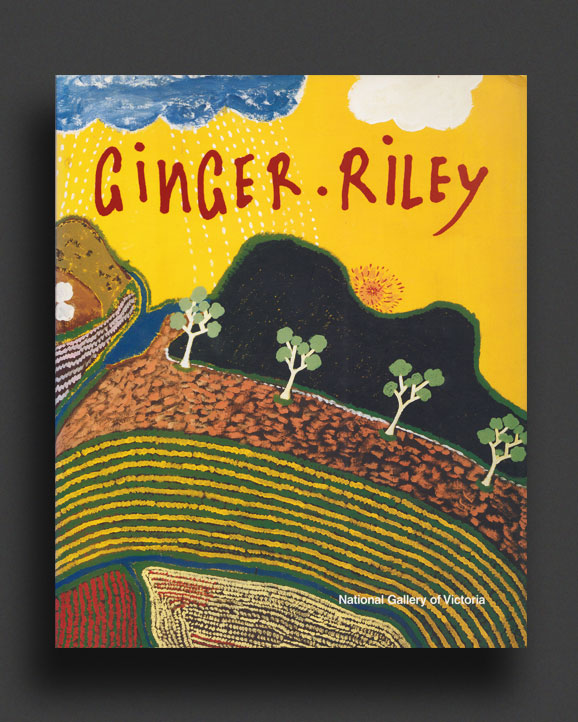
Major catalogue on the extraordinary work of Ginger Riley Munduwalawala, published on the occasion of a retrospective of his work at the National Gallery of Victoria, Melbourne, in 1997. Profusely illustrated throughout in vivid colour, accompanied by texts by curator Judith Ryan, biography and bibliography. Ginger's own specially created alphabet of letters have been used throughout to create the headings of each section.
Ginger Riley Munduwalawala (circa 1936 – 1 September 2002) was one of Australia's most well-known contemporary artists, one whose distinctive pictorial style and adventurous sense of colour sets him apart from other Aboriginal and Torres Strait Islander artists of his generation. He was born in the Limmen Bight area of the Gulf of Carpentaria coast. His first language was Marra, now a critically endangered language. Riley became an artist during the 1950s as a result of his encounter with Albert Namatjira. He painted his mother’s country, focusing on the weather-worn rock formations known as the Four Archers near the mouth of the Limmen Bight River in south-east Arnhem Land. Using bright, luminous and often contrasting colours and strong flattened forms, Riley depicted this landscape and its ancestral beings: Garimala the snake, who created the Four Archers; Ngak Ngak the white-breasted sea-eagle and guardian figure; the ceremonial shark’s liver tree; the Four Archers themselves; and the Limmen Bight River. Riley’s extraordinary creativity allowed him to reinvent this subject matter again and again, expressing in his work his vision of physical geography, creation knowledge and ancestral sites. His strong sense of place enabled this overview, and he painted, he has said, as if he was, ‘ … on a cloud, on top of the world, looking down … From the top I can see country right down to where I come from.’
Very Good copy, tanning to spine.
1984, English
Softcover, 148 pages, 21.5 x 15 cm
1st Edition, Out of print title / used / very good
Published by
Pluto Press / London-Sydney
$100.00 - Out of stock
First Edition.
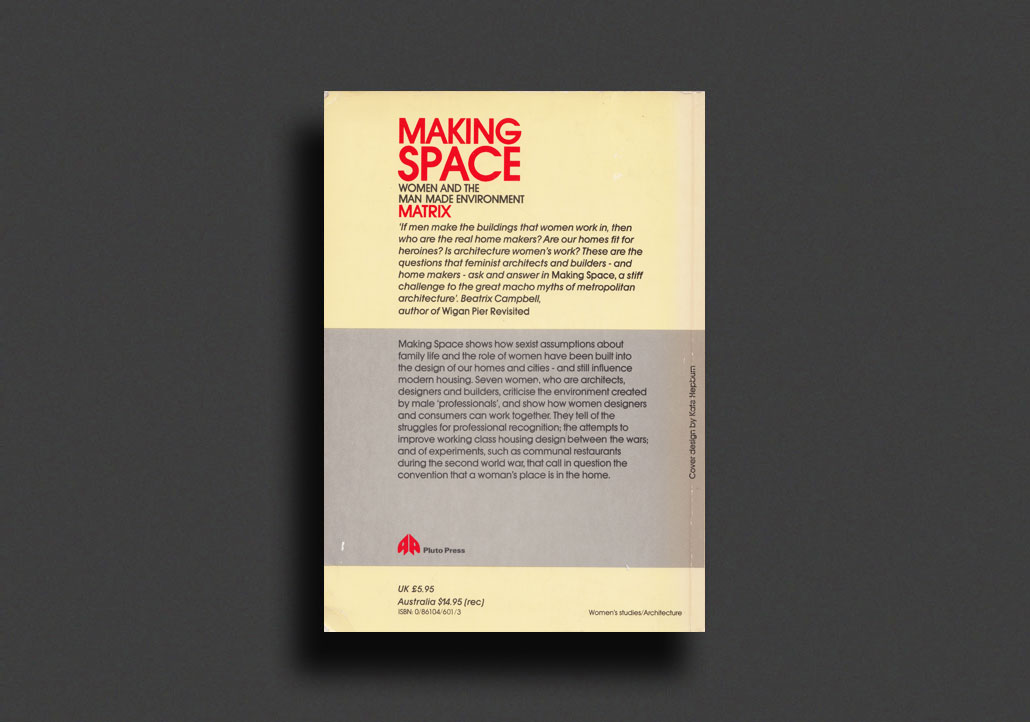
'If men make the buildings that women work in, then who are the real home makers? Are our homes fit for heroines? Is architecture women's work? These are the questions that feminist architects and builders - and home makers - ask and answer in Making Space, a stiff challenge to the great macho myths of metropolitan architecture' - Beatrix Campbell, author of Wigan Pier Revisited
Making Space shows how sexist assumptions about family life and the role of women have been built into the design of our homes and cities - and still influence modern housing. Seven women, who are architects, designers and builders, criticise the environment created by male 'professionals', and show how women designers and consumers can work together. They tell of the struggles for professional recognition; the attempts to improve working class housing design between the wars; and of experiments, such as communal restaurants during the second world war, that call in question the convention that a woman's place is in the home.
"The authors of this book belong to a group of feminist designers collectively known as Matrix. We are women who share a concern about the way buildings and cities work for women. We work as architects, teachers in higher education, researchers, mothers, a builder, a journalist and a housing manager. Working together on this book was for most of us a first chance to develop ideas about buildings with other women; and we have learnt a lot from each other.
In our paid jobs some of us have chosen to work with women; others work with men. Most of us live with men, three of us have children and about half of us live in collective households. We did not set out to be a consciousness-raising group, but have brought individual experience of the women's movement to a group whose common ground is involvement with buildings.
Many of us were members of the New Architecture Movement in the late 1970s. NAM was a mixed group of socialist architects together with some students, teachers and builders. It was concerned to make architects more accountable to those who use buildings and questioned the relationship between user and architect, and to a lesser extent (but important for some of us) that between architect and builder. A feminist discussion group emerged and organised a conference in March 1979 called 'Women and Space'. The conference attracted about 200 women, and some men from a variety of backgrounds. Though interest in the subject was evidently great, there was very little published work then available. This gave some of us the idea of meeting regularly and eventually to produce a book. [...]" (from preface)
2017, English
Softcover, 576 pages, 23 x 17 cm
Ed. of 200,
Published by
Negative Press / Melbourne
$80.00 - In stock -
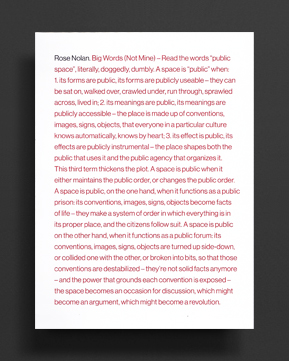
This monumental artists’ book returns Vito Acconci’s text, that inspired Nolan’s large scale installation of 282 painted hessian pennants 'Big Words (Not Mine) Read the words “public space”…', 2013, back to the codex form of the book. With Acconci’s text broken into strings of letters, the book interrogates the relationship between documentation and representation and explores Nolan’s continued interest in materials, process and seriality.
Design: Warren Taylor
Photography: Garry Sommerfeld
Published in an edition of 200 copies
1993, French
Softcover, 144 pages, 12 x 17 cm
1st Edition, Out of print title / used / very good
Published by
Editions Yellow Now / Belgium
$50.00 - Out of stock
First edition of the 1993 French photo-book of Jean-Luc Godard's "Bande à part" (Band of Outsiders, 1964), published in Belgium and written by Barthélemy Amengual, the Algerian born film critic, essayist, historian, educator, and film club host who settled in Paris in 1968 where he would write for the film periodicals Cahiers du Cinéma, Positif, French Screen, Young Cinema, CinémAction and more.
Alongside profuse photographic documentation through beautiful film stills, this landscape book compiles Amengual's accounts and commentary of this iconic genre-defying milestone of French New Wave cinema, conversations with director Jean-Luc Godard and cinematographer Raoul Coutard, filmography, bibliography, and more. An ingenious and unconventional study by one of the greatest names in French criticism.
"Four years after Breathless, Jean-Luc Godard reimagined the gangster film even more radically with Band of Outsiders (Bande à part). In it, two restless young men (Sami Frey and Claude Brasseur) enlist the object of both of their fancies (Anna Karina) to help them commit a robbery—in her own home. This audacious and wildly entertaining French New Wave gem is at once sentimental and insouciant, effervescently romantic and melancholy, and it features some of Godard’s most memorable set pieces, including the headlong race through the Louvre and the unshakably cool Madison dance sequence."
1999, English
Softcover, 120 pages, 15.2 x 22.9 cm
Published by
New Directions / New York
$34.00 - Out of stock
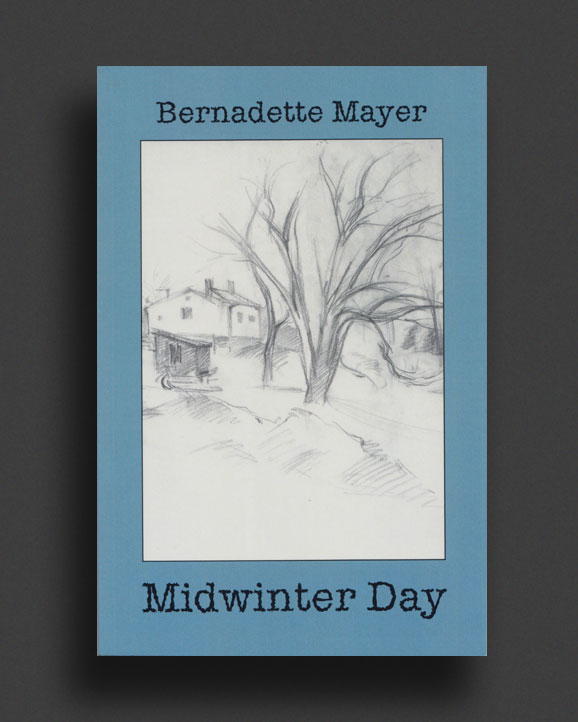
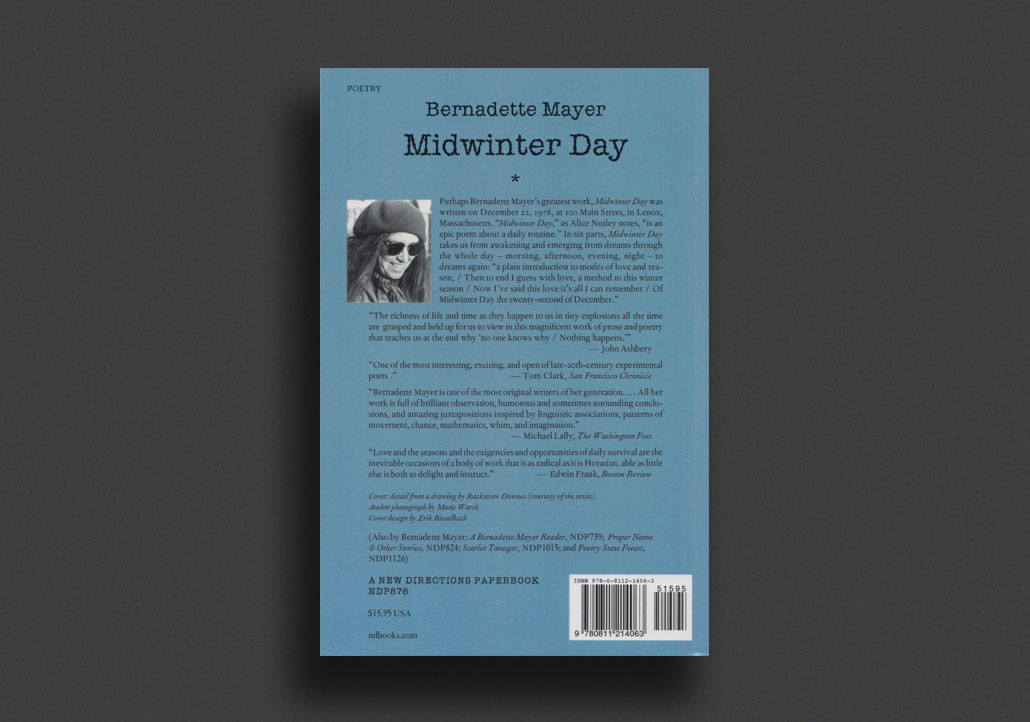
"Midwinter Day," as Alice Notley noted, "is an epic poem about a daily routine." A poem in six parts, Midwinter Day takes us from awakening and emerging from dreams through the whole day-morning, afternoon, evening, night-to dreams again: ." . . a plain introduction to modes of love and reason/Then to end I guess with love, a method to this winter season/Now I've said this love it's all I can remember/Of Midwinter Day the twenty-second of December//Welcome sun, at last with thy softer light/That takes the bite from winter weather/And weaves the random cloth of life together/And drives away the long black night!"
2019, English
Softcover, 392 pages, 20.3 x 25.4 cm
Published by
Wave / Washington
$46.00 - Out of stock
Edited by Ben Lerner
A rich array of materials coalesce here into a vibrant portrait, in text and image, of two extraordinary artists and collaborators. For nearly sixty years, the Waldrops have influenced multiple generations of writers through their own poetry and fiction, translations, teaching, and their press, Burning Deck, which published some of the most influential authors of late-twentieth-century avant-garde literature. This collection seeks to illustrate the many ways in which the Waldrops have expanded the possibilities of bookcraft, art, community, and literature.
2018, English
Softcover, 160 pages, 19.8 x 12.9 cm
Published by
Ignota / UK
$34.00 $15.00 - Out of stock
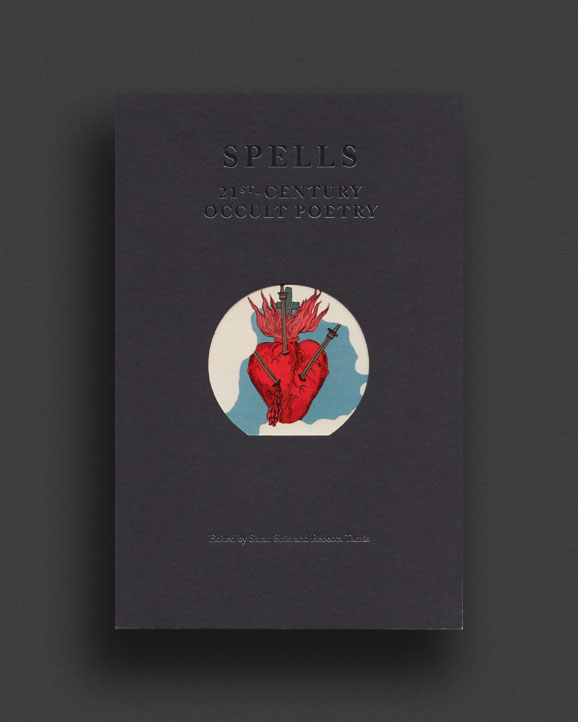
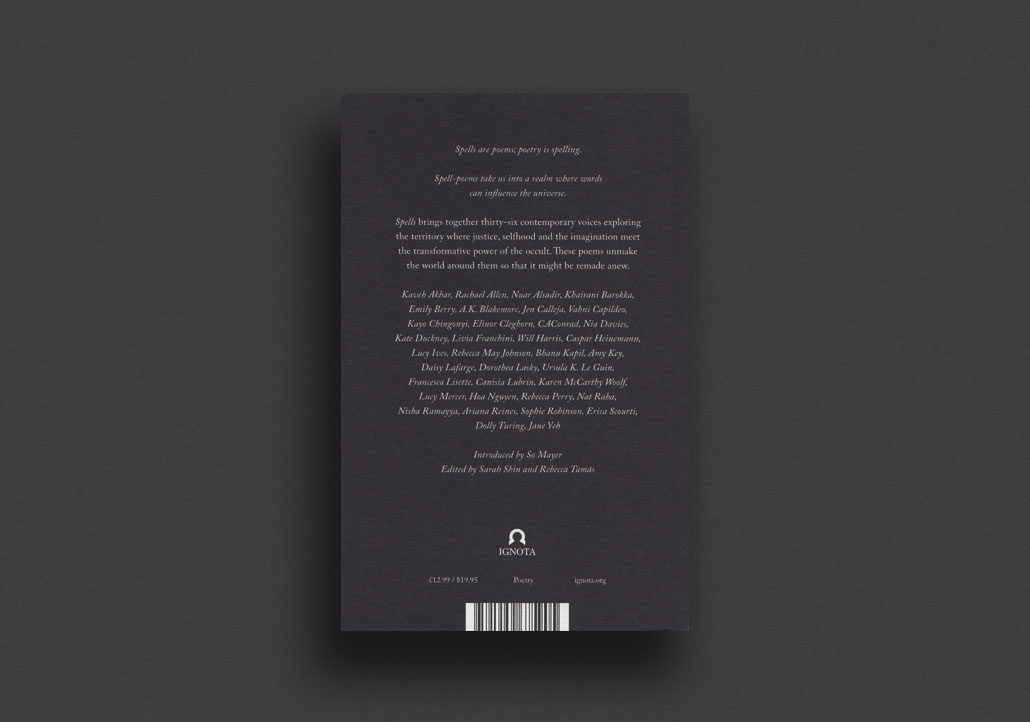
Spells are poems; poetry is spelling.
Spell-poems take us into a realm where words can influence the universe.
Spells brings together thirty-six contemporary voices exploring the territory where justice, selfhood and the imagination meet the transformative power of the occult. These poems unmake the world around them, so that it might be remade anew.
Kaveh Akbar, Rachael Allen, Nuar Alsadir, Khairani Barokka, Emily Berry, A.K. Blakemore, Jen Calleja, Vahni Capildeo, Kayo Chingonyi, Elinor Cleghorn, CAConrad, Nia Davies, Kate Duckney, Livia Franchini, Will Harris, Caspar Heinemann, Lucy Ives, Rebecca May Johnson, Bhanu Kapil, Amy Key, Daisy Lafarge, Dorothea Lasky, Ursula K. Le Guin, Francesca Lisette, Canisia Lubrin, Karen McCarthy Woolf, Lucy Mercer, Hoa Nguyen, Rebecca Perry, Nat Raha, Nisha Ramayya, Ariana Reines, Sophie Robinson, Erica Scourti, Dolly Turing, Jane Yeh.
Edited by Sarah Shin and Rebecca Tamas
As New with corner wear (hence price reduction)
2016, English
Softcover, 224 pages, 13.3 x 20.3 cm
Published by
University of Minnesota Press / Minnesota
$40.00 - Out of stock
Electrifying, provocative, and controversial when first published thirty years ago, Donna Haraway's "Cyborg Manifesto" is even more relevant today, when the divisions that she so eloquently challenges--of human and machine but also of gender, class, race, ethnicity, sexuality, and location--are increasingly complex. The subsequent "Companion Species Manifesto," which further questions the human-nonhuman disjunction, is no less urgently needed in our time of environmental crisis and profound polarization.
Manifestly Haraway brings together these momentous manifestos to expose the continuity and ramifying force of Haraway's thought, whose significance emerges with engaging immediacy in a sustained conversation between the author and her long-term friend and colleague Cary Wolfe. Reading cyborgs and companion species through and with each other, Haraway and Wolfe join in a wide-ranging exchange on the history and meaning of the manifestos in the context of biopolitics, feminism, Marxism, human-nonhuman relationships, making kin, literary tropes, material semiotics, the negative way of knowing, secular Catholicism, and more.
The conversation ends by revealing the early stages of Haraway's "Chthulucene Manifesto," in tension with the teleologies of the doleful Anthropocene and the exterminationist Capitalocene. Deeply dedicated to a diverse and robust earthly flourishing, Manifestly Haraway promises to reignite needed discussion in and out of the academy about biologies, technologies, histories, and still possible futures.
2020, English
Hardcover, 272 pages, 21.7 x 28 cm
Published by
Hatje Cantz / Berlin
Moderna Museet / Malmö
$100.00 - Out of stock
Rewriting the History of Abstract Painting.
Once considered an outsider artist, after her show at the Guggenheim Museum was seen by more than half a million visitors, Hilma af Klint firmly established her place in art history. She has also been the subject of documentary films and biographies. In 2013, Iris Müller-Westermann organized the first retrospective exhibition of af Klint’s work. Now she presents us with the latest information and research in an extensive survey show, which she curated together with Milena Høgsberg, at the Moderna Museet in Malmö. Of crucial importance is the issue of spirituality in af Klint’s painting—how the artist managed to translate both the material and the immaterial world into a pictorial vision. The accompanying exhibition catalogue investigates, from a variety of perspectives, the question of how this trailblazing abstract artist linked her painting to a higher consciousness. Essays by art historians, a quantum physicist, a spiritual teacher, and an historian of theosophy and esotericism, among others, provide insights into a world beyond the visible which fascinates us now even more than ever.
HILMA AF KLINT (1862–1944) studied painting at the Royal Academy of Fine Arts in Stockholm. She turned to abstraction in the wake of her profound exploration of spirituality and theosophy. She is regarded as a pioneer of abstract art.
Edited by Iris Müller-Westermann, Milena Hoegsberg, text(s) by Ernst Peter Fischer, Ylva Hillström, Milena Hoegsberg, Anne Sophie Joergensen, Caroline Levander, Hedvig Martin, Iris Müller-Westermann, Tim Rudboeg, graphic design by Patric Leo
2015, English
3 leporello books in slipcase, 24 photographs, 21 x 15 cm
1st Edition, Out of print title / as new
Published by
The Fondazione Querini Stampalia / Venice
$180.00 - Out of stock
Wonderful first, only edition of this special catalogue of work by Italian photographer Luigi Ghirri, published on the occasion of an exhibition at the Carlo Scarpa designed Fondazione Querini Stampalia in 2015, organised by Italian collector Roberto Lombardi. Comprises of a collection of three double-sided leporello photographic books of 8 Ghirri photographs, each photo 21 x 15 cm, totalling 24 works, housed in a cardboard slipcase and only available via the exhibition. The exhibition established the Ghirri Fund at the Fondazione. The cycle is conceived as an "artist's book": a story, devoid of protagonists, of the landscape of the Po Valley between Veneto, Emilia and Lombardy in which, retracing the photographed places, the author does not respect the topographical location, but follows a itinerary all immersed in the associative memory: melancholy, imprecision of memory, a sense of suspension and enchantment are the feelings that animate this journey.
Luigi Ghirri (1943–92) was a celebrated Italian artist and photographer known for his color photographs of landscape and architecture. He published his first photography book, Kodachrome, in 1978, and continued to utilize a conceptual framework to interrogate the line between fiction and reality.
The Fondazione Querini Stampalia is a cultural institution in Venice, Italy, founded in 1869 at the behest of Conte Giovanni (Count John), the last descendant of the Venetian Querini Stampalia family. Architect Carlo Scarpa designed interior, exterior, and garden elements and spaces on the ground floor of the historic building.
As New.
2019, English
Softcover, 240 pages, 17 cm x 24 cm
Published by
Valiz / Amsterdam
$55.00 - Out of stock
Art is a form of thinking and dialoguing; it is an unusual source of knowledge. In this publication the reader is introduced to Art-Based Learning, a method that enables the spectator to explore these dialogues, and ‘converse’ with art works. Art-Based Learning can refer both to learning about art as a source and learning about art as a means, e.g. the way art can generate insight into the significance of learning itself. The method offers the possibility to seek fresh correlations in a dialogue with the art work.
The author uses three triptychs to demonstrate, step by step, how relevant questions can produce a different perception and understanding, and how works of art, as ‘speaking objects’, can produce new experiences or new knowledge.
In the Shadow of the Art Work is intended for students and teachers of art, art history, drama and cinema, literature, philosophy, anthropology, theology and interdisciplinary studies. The developed method is also highly suited to Artistic Research at academies of art, music, film and dance.
Jeroen Lutters is an art and culture analyst and educational designer. His critical educational theory concentrates on the central role of the arts and humanities in the contemporary curriculum, the need for artist educators as wandering teachers, the theory and practice of art-based learning, and the development of twenty-first‑century educational landscapes.
2018, English
Softcover, 222 pages, 17 x 24 cm
Published by
Valiz / Amsterdam
$55.00 - Out of stock
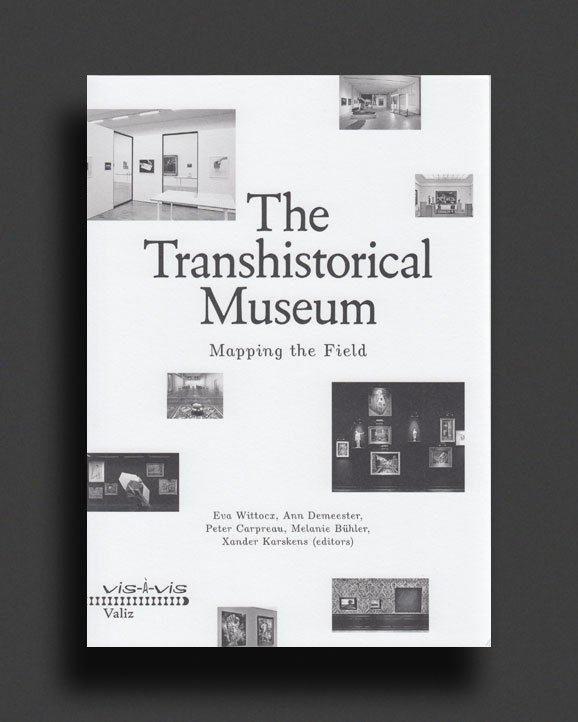
In the 21st century we have witnessed a significant expansion in the field of transhistorical exhibition practice. A range of curatorial efforts have emerged in which objects and artefacts from various periods and art historical and cultural contexts are combined in display, in an effort to question and expand traditional museological notions such as chronology, context, and category. Such experiments in transcending art historical boundaries can result in fresh insights into the workings of entrenched historical presumptions, providing a space to reassess interpretations of individual objects. With contributions by Mieke Bal, Hendrik Folkerts, Nicola Setari, Maria Iñigo Clavo, and others.
2015, English
Softcover, 256 pages, 17 x 24 cm
Published by
Valiz / Amsterdam
$50.00 - Out of stock
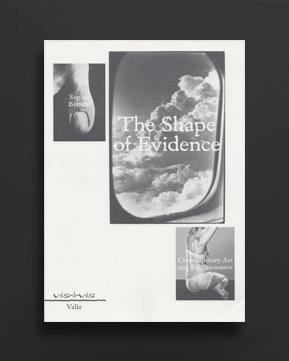
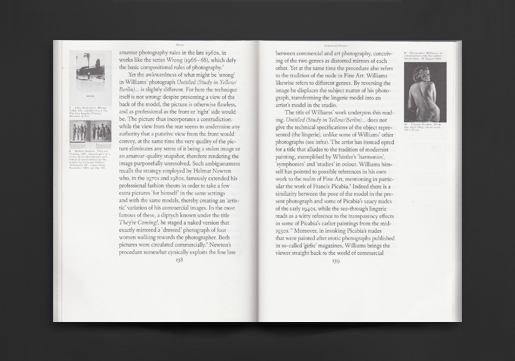
The Shape of Evidence examines the role and use of visual documents in contemporary art, looking at artworks in which the document is valued not only as a source of information but also as a distinctive visual and critical form. It contends that for artists who use film, photography or written sources, adopting formats derived from specific professional, industrial, scientific of or commercial contexts, the document offers a way to develop a critical reflection around issues of representation, knowledge production, art and its history.
It addresses several issues that are key both in art and in general culture today: the role of the museum and the archive, the role of documents and the trust that is placed in them, the circulation of such images and the historical genealogies that can be drawn in relation to images. Its uniqueness, however, also derives from its method: it is based on a close reading of a select number of works of art (e.g. Christopher Williams, Fiona Tan, Jean-Luc Moulène), which makes it approachable and engaging with the reader.
Moreover it applies an interdisciplinary perspective: while being about contemporary art it discusses objects and ideas drawn from a wide spectrum of areas including literature, history, photography history, scientific representation, surrealism, conceptual art, commercial photography and so forth.
The Shape of Evidence invites viewers to reflect upon the production and interpretation of seemingly straightforward images, and proposes that some artists can show us through their practice how to turn these deceptively simple images inside out.
Sophie Berrebi (1973) is a writer, art historian and occasional curator, born in Paris and living in Amsterdam. Her writing has appeared in frieze, Afterall, Metropolis M, and Art and Research, among other publications. She received her PhD from the Courtauld Institute of Art, University of London, and has been based at the University of Amsterdam since 2003 where she teaches art history and theory, mainly in the areas of photography and contemporary art.
2018, English
Softcover, 288 pages, 16 x 23 cm
Published by
Valiz / Amsterdam
$55.00 - Out of stock
Now out-of-print, last copies.
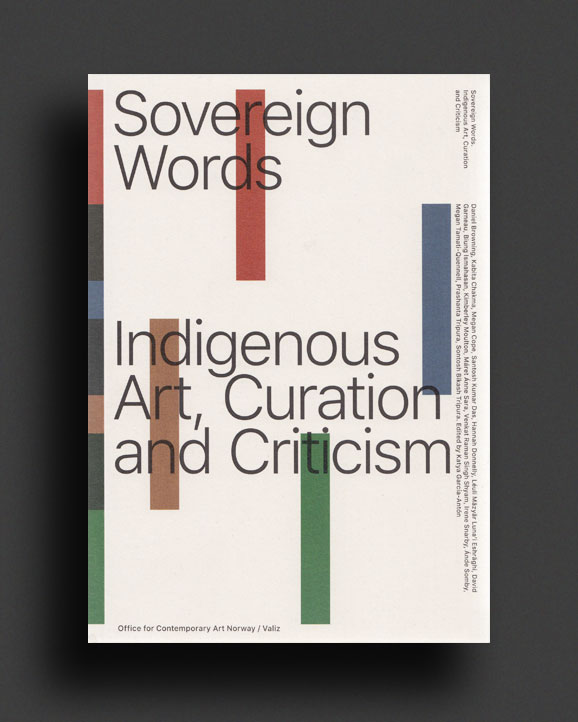
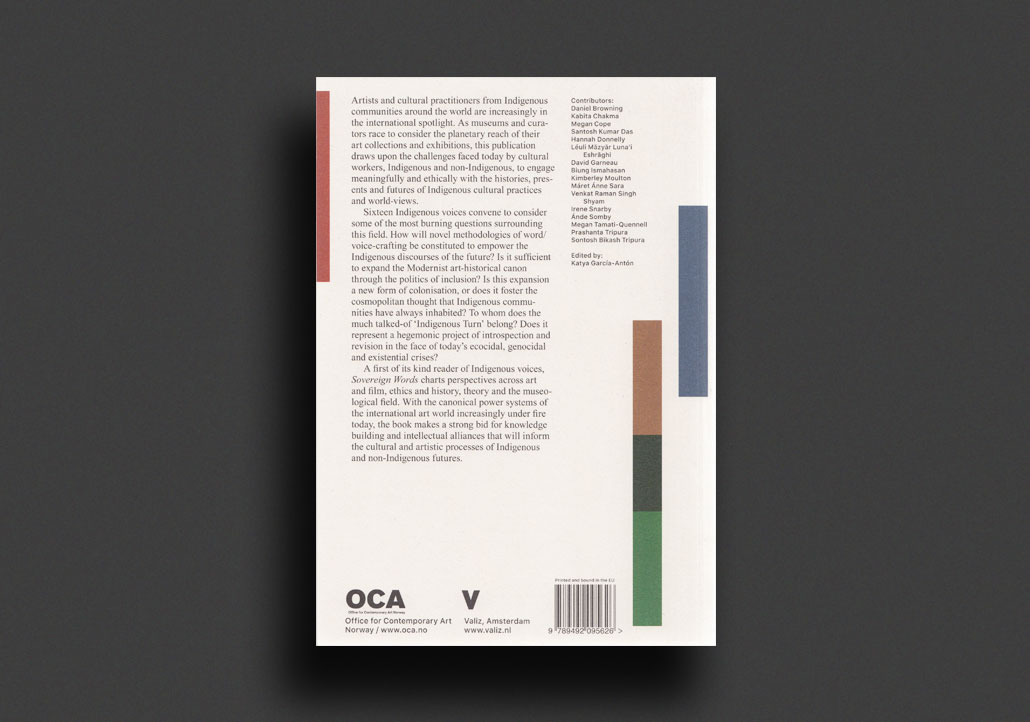
Artists and cultural practitioners from indigenous communities around the world are increasingly in the international spotlight. As museums and curators consider the global reach of their collections and exhibitions, this publication draws upon the challenges faced by cultural workers today, both indigenous and non-indigenous, to engage meaningfully and ethically with the histories, presents, and future of indigenous cultural practices and world views. Through sixteen indigenous voices the book charts perspectives across art and film, ethics and history, theory and museology.
Editor: Katya García-Antón
Contributors: Daniel Browning, Kabita Chakma, Megan Cope, Santosh Kumar Das, Hannah Donnelly, Léuli Māzyār Luna’i Eshrāghi, David Garneau, Biung Ismahasan, Kimberley Moulton, Máret Ánne Sara, Venkat Raman Singh Shyam, Irene Snarby, Ánde Somby, Megan Tamati-Quennell, Prashanta Tripura, Sontosh Bikash Tripura, and the OCA contributors: Liv Brissach, Katya García-Antón, Drew Snyder, Nikhil Vettukattil
1998, English
Softcover, 28 pages, 21 x 28 cm
1st Edition, Out of print title / as new
Published by
The Renaissance Society / Chicago
$45.00 - Out of stock
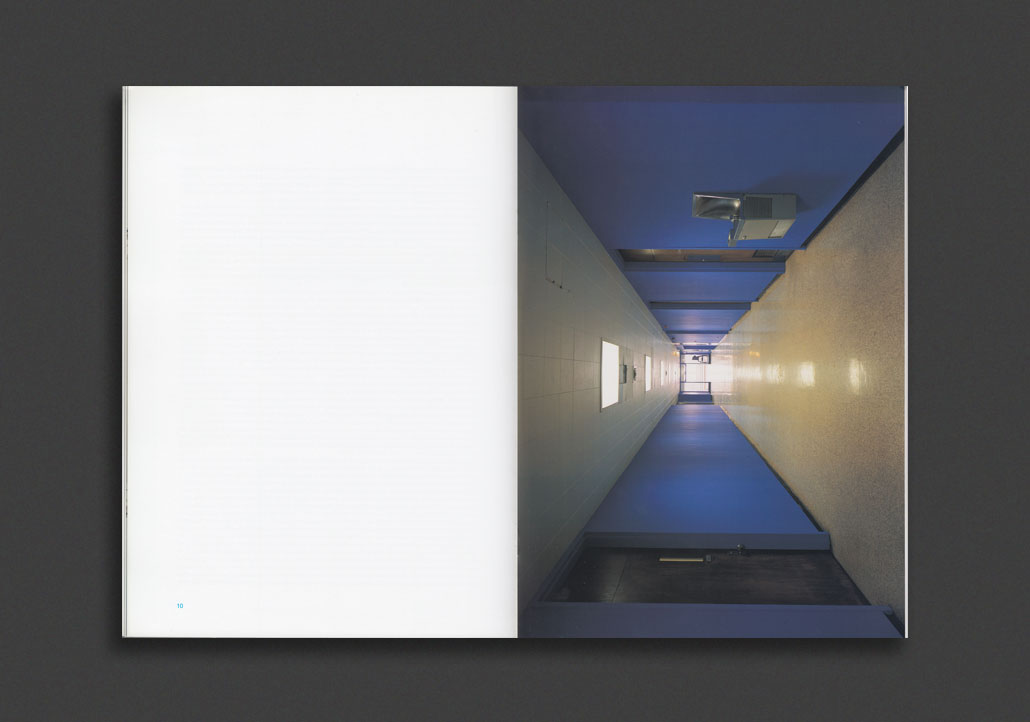
Catalogue published on the occasion of Heimo Zobernig's solo exhibition at Renaissance Society in 1996. Austrian Heimo Zobernig's work intervenes, rearranges, recontextualizes, and down-right makes fun of the architecture of museum/gallery spaces so as to demystify its illusory potential and reinscribe it with self-referentiality. Zobernig is among several significant contemporary artists such as Michael Asher, General Idea, and Daniel Buren who have made it their mission to critique sites of modern art.
In Zobernig's 1996 installation, the gallery walls from the Society's preceding exhibition were laid flat on the floor-a neat-handed figure/ground reversal turning support into sculpture. In another provocative turn, Zobernig brought the outside in to this altered gallery space via video - he had himself filmed cavorting around the Renaissance Society hallway naked in front of walls that were painted video back-drop blue; this image was then super-imposed on footage shot while driving around Chicago. This informative and engaging book, designed by Zobernig, serves as a valuable pictorial document, and an insightful critical analysis of this important work. Walker's essay speaks to the challenge Zobernig's art poses for art history and the implications of that challenge for the future of art. In addition, the catalog features a transcript of the panel discussion: Planned Obsolescence, in which a group of critics, curators and architectural historians gathered to discuss how Zobernig's practice differs from, or further informs, practices that have made an art out of calling for an end of art.
1989, English
Softcover (double fold-out card), 210 x 297
1st Edition, Out of print title / used / fine
Published by
200 Gertrude Street / Melbourne
$15.00 $5.00 - In stock -
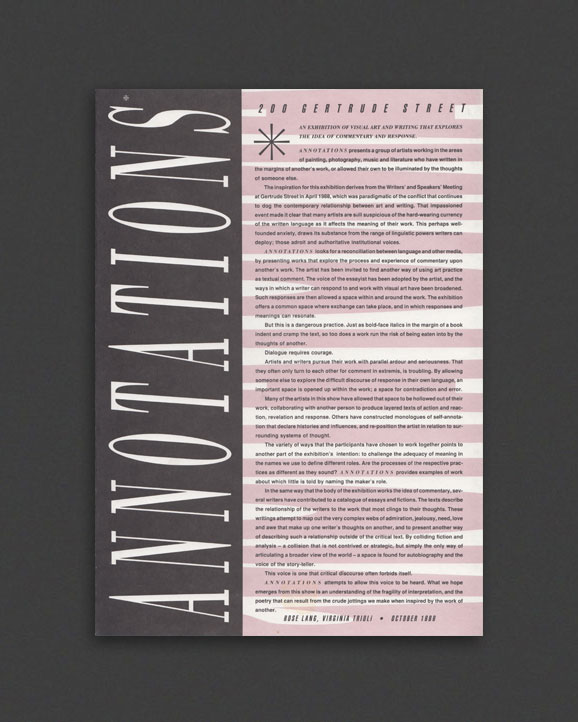
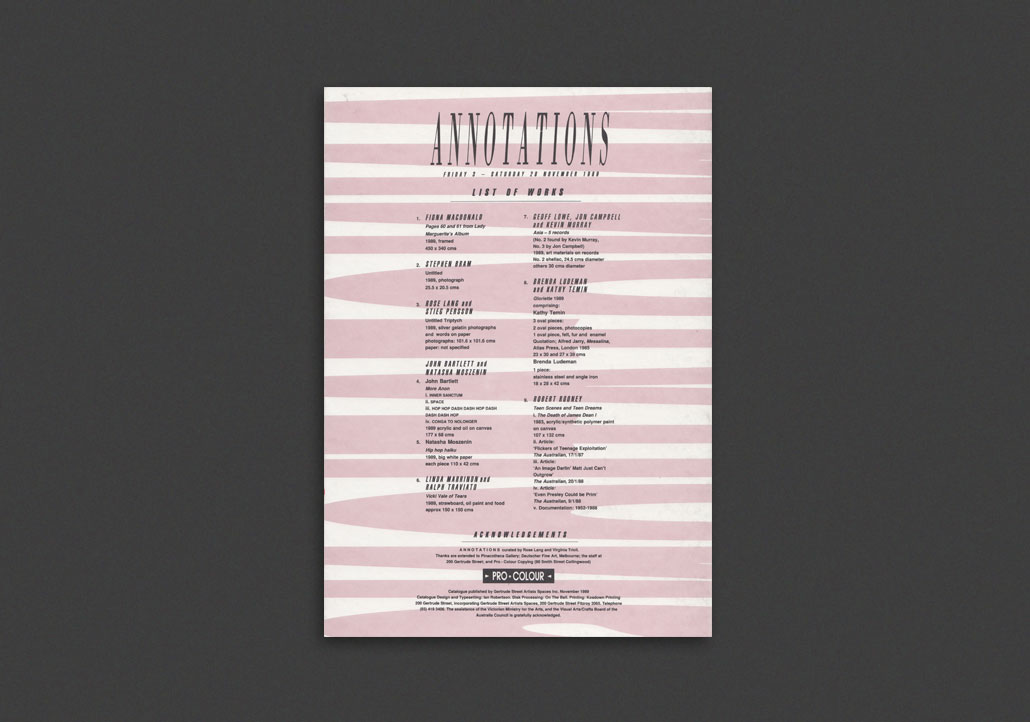
Scarce catalogue published on the occasion of the exhibition Annotations, curated by Rose Lang and Verginia Trioli, at 200 Gertrude Street in 1989. "An exhibition of visual art and writing that explores the idea of commentary and response." Introductory text by Lang and Trioli Lasica followed by texts by Butcher Joe Nangan, Stephen Muecke, Kevin Murray, Peter Lawrence, and a catalogue of exhibited works by Fiona Macdonald, Stephen Bram, Rose Lang And Stieg Persson, John Bartlett and Natasha Moszenin, Linda Marrinon and Ralph Traviato, Geoff Lowe, Jon Campbell and Kevin Murray, Brenda Ludeman and Kathy Temin, Robert Rooney.
Fine copy.
1988, English
Softcover (single fold-out card), 210 x 297
1st Edition, Out of print title / used / fine
Published by
200 Gertrude Street / Melbourne
$10.00 - Out of stock
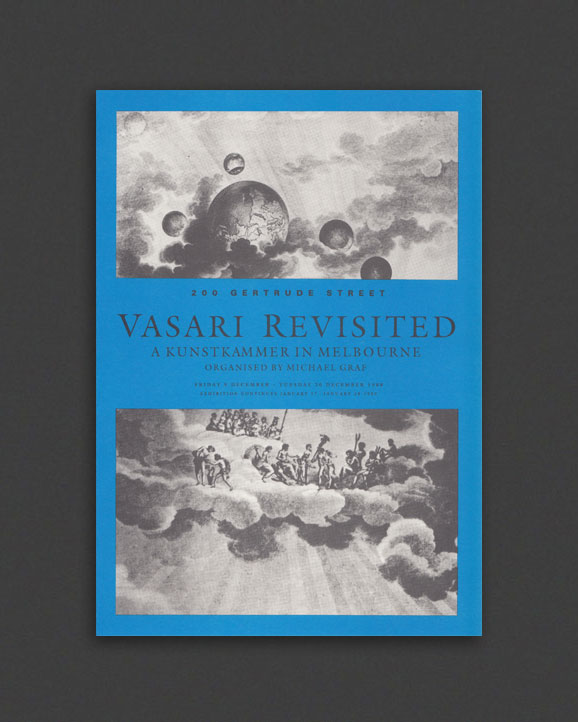
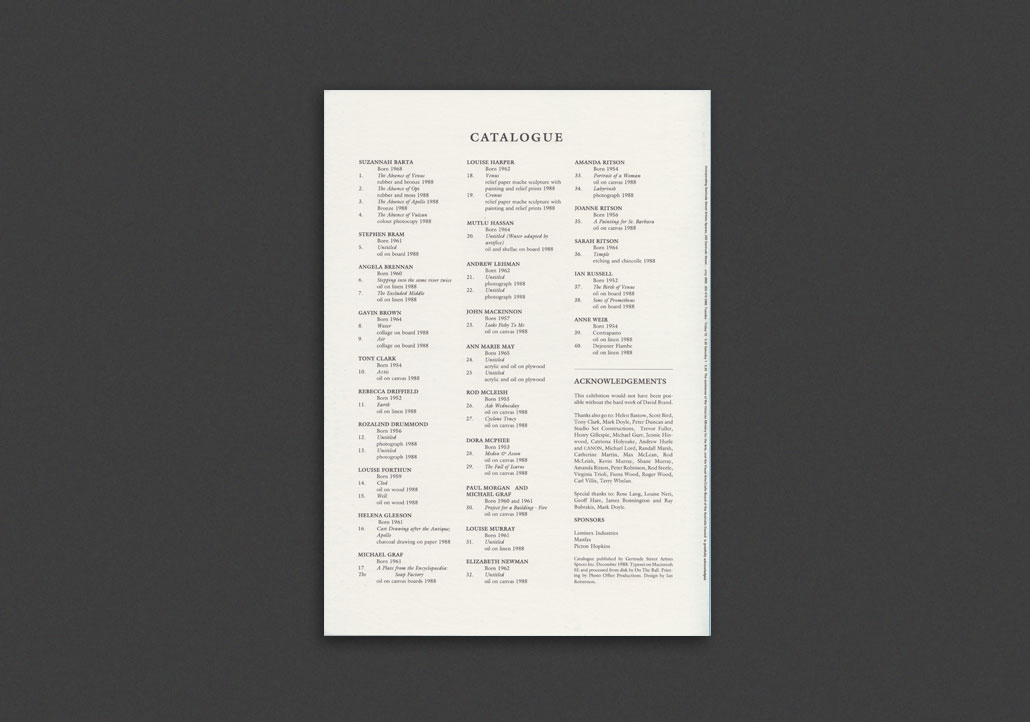
Scarce catalogue published on the occasion of the exhibition Vasari Revisited: A Kunstkammer In Melbourne, organised by Michael Graf, at 200 Gertrude Street in 1988-89. Graf's Australian recreation of Studiolo of Francesco I in the Gertrude gallery! Illustrated text by Michael Graf throughout alongside a catalogue of exhibited works by Suzannah Barta, Stephen Bram, Angela Brennan, Gavin Brown, Tony Clark, Rebecca Driffield, Rozalind Drummond, Louise Forthun, Helena Gleeson, Michael Graf, Louise Harper, Matlu Hassan, Andrew Lehman, John Mackinnon, Anne-Marie May, Rob Mcleish, Dora Mcphee, Paul Morgan, Louise Murray, Elizabeth Newman, Amanda Ritson, Joanne Ritson, Sarah Ritson, Ian Russell, Anne Weir
Fine copy.
1989, English
Softcover (single fold-out card), 210 x 297
1st Edition, Out of print title / used / fine
Published by
200 Gertrude Street / Melbourne
$10.00 - Out of stock
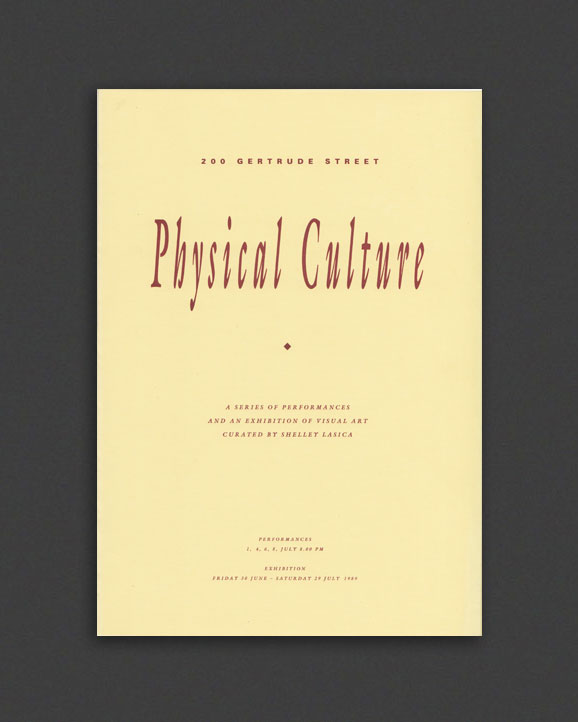
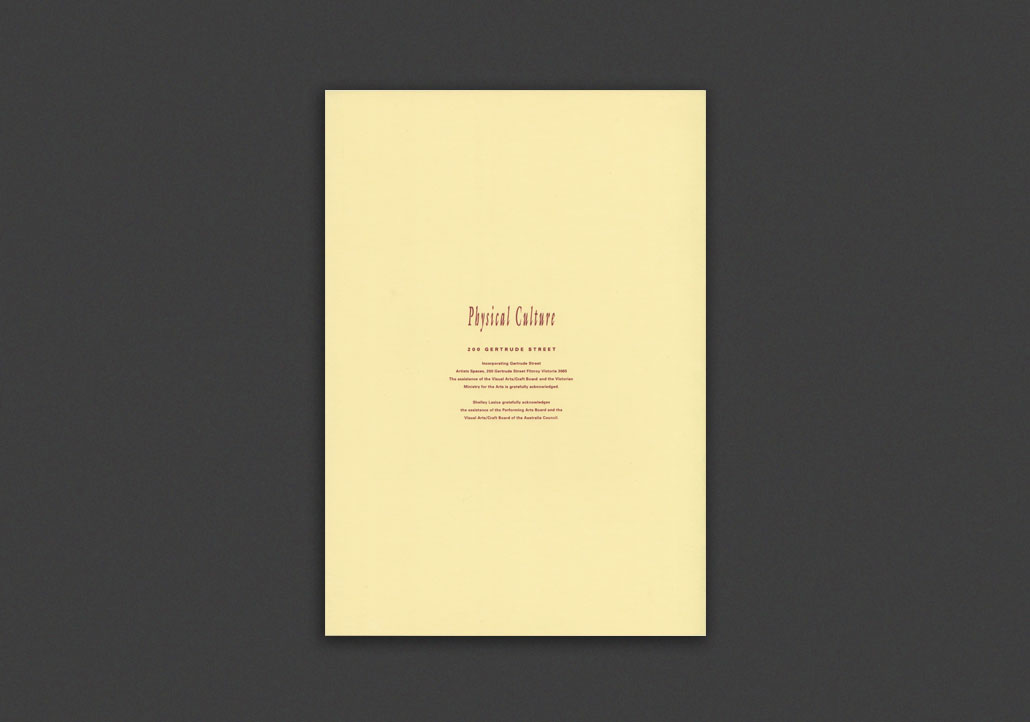
Scarce catalogue published on the occasion of the exhibition Physical Culture: A Series Of Performances And An Exhibition Of Visual Culture, curated by Shelley Lasica, at 200 Gertrude Street in 1989. Introductory text by Lasica alongside a full list of performance and exhibited works by Stephen Bram, Elizabeth Newman, Louise Forthun, Mutlu Hassan, Melbourne Research Group, John De Silentio and Aleks Danko, Rosslynd Piggott, Shiralee Saul, Trevor Patrick, Teresa Blake and Dan Wilton, Jacqui Rutten, Sarah Ritson, Andrew Browne, Richard Todd.
Fine copy.
1995, English
Softcover, 32 pages, 23 x 27 cm
1st Edition, Out of print title / used / fine
Published by
The Renaissance Society / Chicago
$50.00 - Out of stock
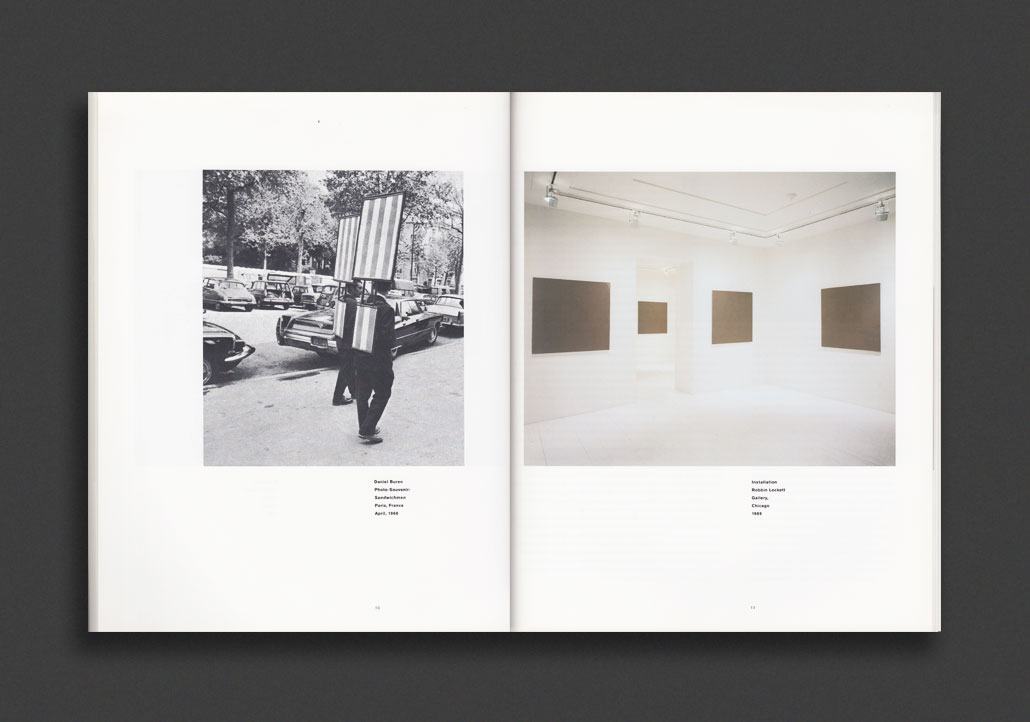
Scarce catalogue, and first monograph on the work of Gaylen Gerber, published on the occasion of an exhibition of Gerber's work at The Renaissance Society in 1992, marking the culmination of a ten-year period in which Gerber persistently painted the same opaque, monochromatic still-life over and over, in a bold artistic assertion that seeing is not believing but simply perceiving. This catalogue documents the artist's installations of these paintings at various international exhibitions, including Documenta 9 in 1992, and Robbin Lockett Gallery in Chicago in 1988. At the Society's exhibition, Gerber hung a single row of his paintings abutted end to end on a wall crossing the entire gallery space.
Jan Avgiko's catalog essay, written in close tandem with Gerber, is a brilliant investigation of the role perceptual aesthetic theories play in the modernist and postmodernist monochrome.
Very Good-Fine copy.
1984, English
Softcover, 218 pages, 29.5 x 21 cm
Published by
NGV (National Gallery of Victoria) / Victoria
$40.00 - Out of stock
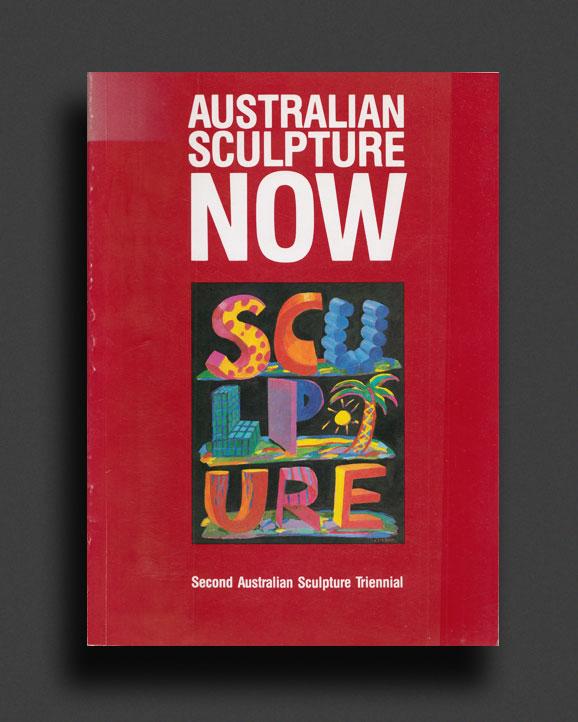
The great catalogue published to accompany Australian Sculpture Now, The Second Australian Sculpture Triennial, held at the National Gallery of Victoria, 6 November 1984 - 28 January 1985. This generous publication on Australian sculpture in the mid 1980s, edited by Graeme Sturgeon, presents the work of 70 Australian sculptors through heavily illustrated spreads, biographies and exhibition histories, alongside accompanying illustrated essays. An important document in the history of Australian sculpture, including the work of many great artists seldom seen in print nor exhibition elsewhere.
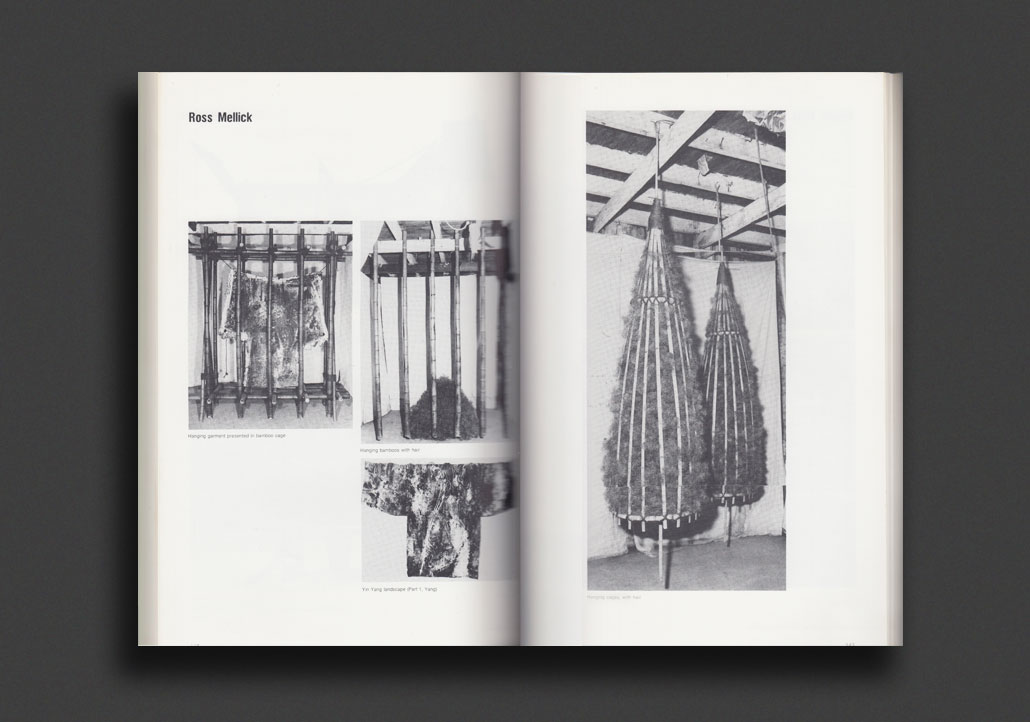
Artists included : Chris Beecroft, Joan Brassil, Ian Bracegirdle, Rodney Broad, Martine Canneel, Cheo Chai-Hiang, Peter D. Cole, Chris Constable, Peter Corlett, Augustine dall'Ava, John Davis, John Elliott, Stuart Elliott, Martin Everett, Anne Ferguson, Rosealie Gascoigne, Karen Genoff, Richard Goodwin, David Hamilton, Nigel Helyer, Paul Hopmeier, Maurie Hughes, David Jensz, Bob Jenyns, Stephen Killick, Inge King, Jan King, Robert Klippel, Andrew Kinghorn, Lou Lambert, John Landry, Cliford Last, Michael Legrand, Ian McKay, Adrian Mauriks, Rosemary Madigan, Hilarie Mais, Akio Makigawa, Maggie May, Ross Mellick, Wendy Mills, Lyn Moore, Kevin Mortensen, Roder Noakes, Kevin Norton, Fiona Orr, Lenton Parr, Jill Peck, Lutz Presser, Anthony Pryor, Ari Purhonen, Loretta Quinn, Tom Risley, Ron Robertson-Swann, Guiseppe Romeo, Peter J. Rosman, Paul Selwood, Judy Silver, Michael Snape, Jo Steele, Richard Stringer, Wendy Teakel, Mark Thompson, Tony Trembath, Maggie Turner, Ken Unsworth, Trevor Weekes, David Wilson, Pam Wragg.
1990, French
Softcover (staple-bound), 20 pages, 28 x 22 cm
1st Edition, Out of print title / used / very good
Published by
CAPC / Bordeaux
$15.00 - Out of stock
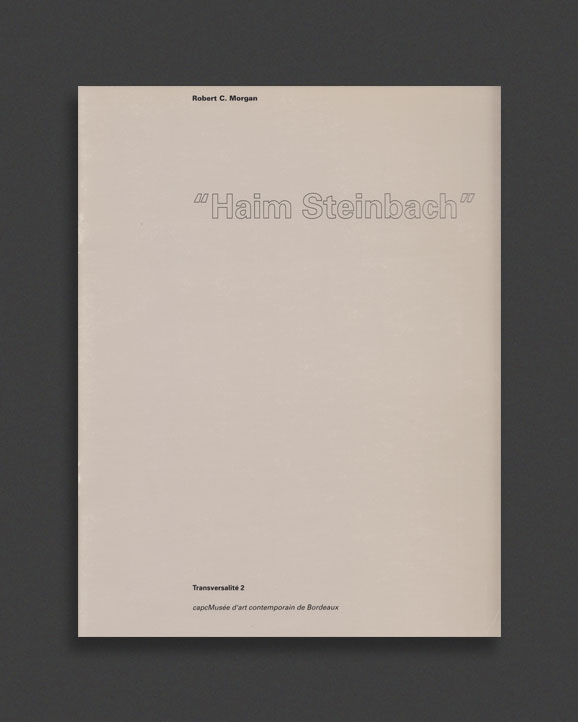
Scarce staple-bound catalogue published in 1990 on the occasion of a major solo exhibition of Israeli-American artist Haim Steinbach (born Rehovot, Palestine, 1944) at capc Musée d'art contemporain, Bordeaux. Stiff card covers with essay (in Frnech) throughout (one illustrated) by American art critic, art historian, curator, poet, and artist, Robert C. Morgan.
Very Good condition. Light shelf wear.
2020, English
Hardcover, 224 pages, 21 x 26 cm
1st Edition, Out of print title / as new
Published by
Dent De Leone / London
$200.00 - Out of stock
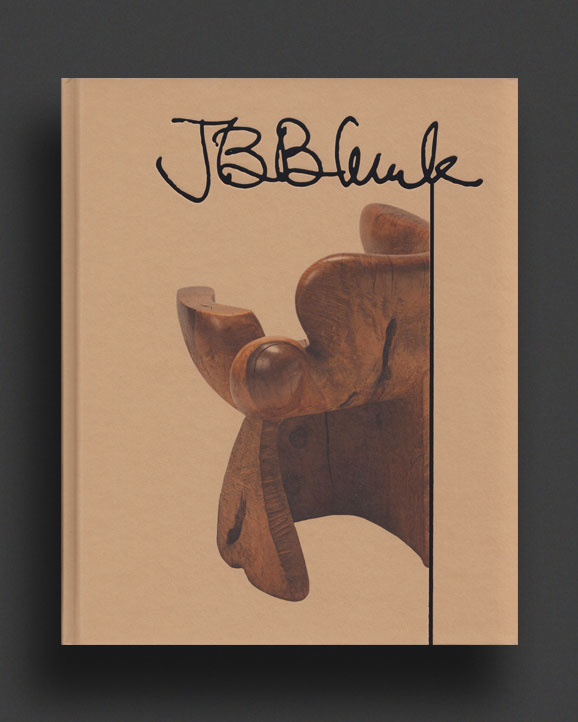
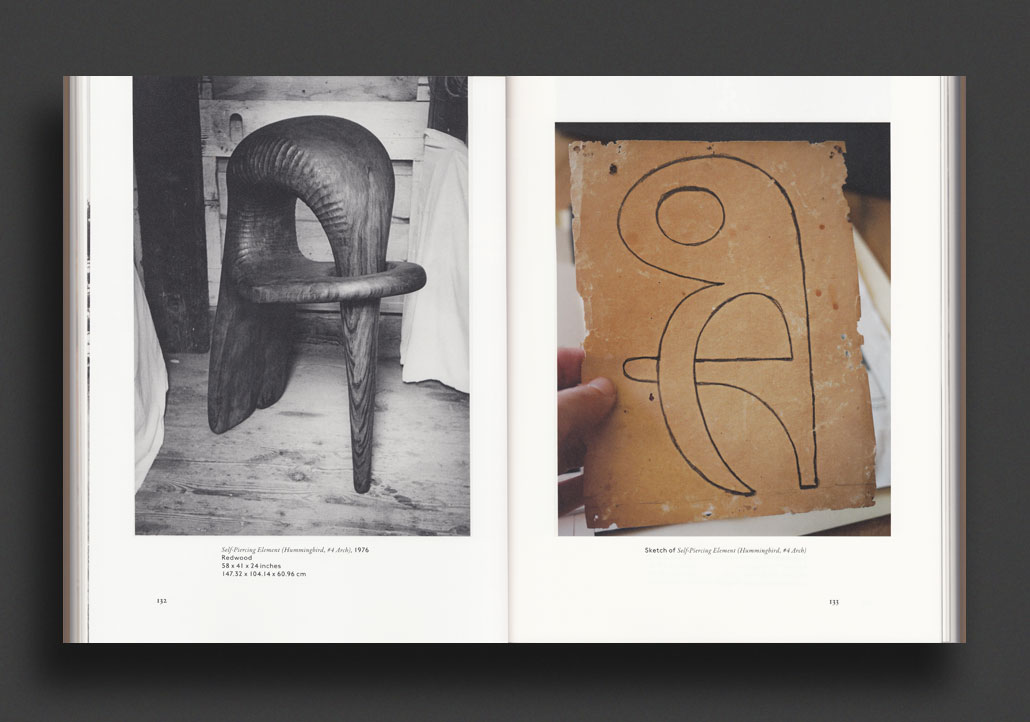
The first long-awaited (and quickly out-of-print) monograph to explore the entire oeuvre of the great American sculptor JB Blunk, with previously unseen examples of his work in stone, clay, painting and jewelry. The design beautifully combines archival images of Blunk's work in situ, and his studio, with color plates of newly photographed pieces. In an essay, Lucy R. Lippard discusses Blunk's reverence for ancient art and places, while Smithsonian Curator of Ceramics Louise Allison Cort details Blunk's formative years in Japan. Glenn Adamson, Senior Scholar at the Yale Center for British Art, contributes an essay that explores the essence of Blunk himself along with his artwork. Blunk maintained a Midwestern sensibility of hard work and plainspokenness throughout his career, with little regard for the distinction between art, craft and design. Rather, he was guided by the materials with which he worked to create large sculptural pieces that seem to exude their own powerful energy unique to organic matter. Born in Kansas, James Blain Blunk (1926-2002) was a California-based sculptor who worked primarily with wood and clay. Following a period in Japan, where he met sculptor Isamu Noguchi and served apprenticeships with Japanese potter Kitaoji Rosanjin (1883–1959) and Bizen potter and Living National Treasure Kaneshige Toyo (1896–1967), Blunk being the first American to apprentice into the line of descent of that country's great unglazed stoneware ceramic tradition, Blunk went on to settle near the Marin County town of Inverness, California, where he built his own studio, and developed a lifelong friendship with the painter Gordon Onslow Ford (1912–2003), one of the last surviving members of the 1930s Paris surrealist group. In addition to woodwork and ceramics, Blunk also worked with jewelry, painting, furniture-building, bronze and stonework.
Edited by Mariah Nielson and Åbäke, the book features essays by Lucy Lippard, Glenn Adamson, Fariba Bogzaran and Louise Allison Cort. Designed by Åbäke.
First edition, As New (still in wrap)
2014, English
Hardcover, 330 pages, 26 x 24 cm
Published by
Steidl / Göttingen
Fundación Mapfre / Madrid
$120.00 - Out of stock
This comprehensive book accompanies the first large retrospective exhibition of Lewis Baltz’s work following his passing in 2014. Lewis Baltz explores the artist’s oeuvre as a complex whole of interrelated series, from his first “Prototypes” and “The Tract Houses” to “Park City,” “San Quentin Point,” and “Candlestick Point” through to “New Sites of Technology” and “Venezia Marghera,” all published by Steidl. The book simultaneously locates Baltz’s work in the context of photography and contemporary art since the 1970s, to fully examine his significant influence and legacy.
Baltz is one of the most prominent representatives of the New Topographics movement, which was seminal to the development of conceptual photography. His photo series document the impact of industrial civilization on the landscape, focusing on places outside the bounds of canonical reception: urban wastelands, abandoned industrial sites, warehouses. His photographs uncover the correspondences between everyday spatial forms and the more advanced forms found in art. Baltz’s strategies reflect a deep knowledge of the history of photography and present the photographer as a teacher of seeing who visualizes the world in reductive, often ironic, gestures.