World Food Books' programme is largely produced on Kulin Nation land. We acknowledge the Wurundjeri people of the Kulin Nation as the first and continuing custodians of this land, and pay respect to their Elders past, present, and emerging.
World Food Books is an arts and special interests bookshop in Naarm / Melbourne. Founded in 2010, World Food Books is devoted to the presentation of a rotating, hand-selection of international art, design, literary and counterculture publications with an emphasis on the anti-traditional, the experimental, the avant-garde, the heretic, the marginal.
Presenting new titles alongside rare and out-of-print books, catalogues and journals spanning the fields of modern and contemporary art, design, photography, illustration, film, literature, poetry, cultural theory, philosophy, sexuality, popular and underground culture in its many radical forms, World Food Books wishes to encourage adventurous, thoughtful and open-minded reading, looking, writing, and exchange of publishing and ideas, both current and historical.
As well as our bookshop, located in Melbourne's historical Nicholas Building, all of our inventory is available internationally via our online mail-order service.
World Food Books semi-regularly co-ordinates "Occasions", a programme of exhibits and events at the bookshop and in partnership with other hosts (such as museums and art galleries) that develop out of the activities, relationships and content of the bookshop itself.
World Food Books
The Nicholas Building
37 Swanston Street
Room 5, Level 6
Melbourne 3000
Australia
SHOP HOURS:
Thu–Fri 12–6, Sat 12–5
WEB-SHOP OPEN 24/7
World Food Books
Postal Address:
PO Box 435
Flinders Lane
Victoria 8009
Australia
Art
Theory / Essay
Architecture / Interior
Graphic Design / Typography
Photography
Fashion
Eros
LGBTQ+
Fiction / Poetry
Weird / Speculative / Science Fiction / Horror
Transgressive / Visceral / Abject
Symbolism / Decadence / Fin de siècle
Film / Video
Painting
Sculpture / Installation
Performance / Dance / Theater
Drawing
Sound / Music
Curatorial
Group Shows / Collections
Periodicals
Out-of-print / Rare
Posters / Ephemera / Discs
Signed Books
World Food Books Gift Voucher
World Food Book Bag
Australian Art
Australian Fiction
Australian Science Fiction / Speculative Fiction
Australian Poetry
Australian Photography
Japanese Photography
Conceptual Art
Minimal Art
Dada
'Pataphysics / Oulipo
Fluxus
Concrete Poetry
Pop Art
Surrealism
Arte Povera
Arte Informale / Haute Pâte / Tachism
Nouveau Réalisme / Zero / Kinetic
Situationism / Lettrism
Collage / Mail Art / Xerox Art
Art Brut / Folk / Visionary / Fantastic
Illustration / Graphic Art / Bandes Dessinées
Furniture
Italian Radical Design / Postmodernism
Textiles
Ceramics / Glass
Counterculture
Protest / Revolt
Philosophy
Psychoanalysis
Anthropology
Anarchism
Socialism / Anarchism / Communism / Capitalism
Literary Theory / Semiotics / Language
Feminism / Women's Studies
Gender Studies / Sexuality
Anthropology
Fetishism / BDSM
Drugs / Psychedelia
Crime / Violence
Animal Rights / Veganism
Occult / Esoterica
Ecology / Earth / Alternative Living
Whole Earth / Crafts
All prices in AUD (Australian dollars)
Pick-Ups
Pick-up orders can be collected in our bookshop during opening hours after order date. Please collect any Pick-up orders within 2 weeks of ordering as we have limited storage space. Orders will be released back into stock if not collected within this time. No refunds can be made for pick-ups left un-collected. If you cannot make it in to the bookshop in this time-frame, please choose postage option.
Return Policy
All sales are final. We do accept returns (for refund or exchange) for items received in error. All our orders are packed with special care using heavy-duty padding and cardboard book-mailers or bubble mailers (for smaller books), using reinforcement where required. We cannot take responsibility for any lost, stolen or damaged parcels.
Insurance
Should you wish to insure your package, please email us directly after placing your order and we can organise this at a small extra expense. Although all standard/express tracked packages are very safe and dependable, we cannot take responsibility for any lost, stolen or damaged parcels. We recommend insurance on valuable orders.
Interested in selling your old books, catalogues, journals, magazines, comics, fanzines, ephemera? We are always looking for interesting, unusual and out-of-print books to buy. We only buy books in our fields of interest and specialty, and that we feel we can resell.
We base these prices on desirability, market value, in-print prices, condition and our current stock levels. We offer cash, store credit, and can take stock on consignment. All
about 25% of the price we expect to get when we sell them, or 30% in store credit. We base these prices on desirability, market value, in-print prices, condition and our current stock levels.
Sell your books any day of the week. You can drop them off and return later. If you have a lot of books, we can visit your Sydney home.
We buy books that we feel we can resell. We offer about 25 % of the price we expect to get when we sell them, or 30% in store credit. We base these prices on desirability, market value, in-print prices, condition and our current stock levels.
Philadelphia Wireman
03 August - 01 September, 2018
World Food Books is proud to announce our next Occasion, the first presentation of sculptures by Philadelphia Wireman in Australia.
The Philadelphia Wireman sculptures were found abandoned in an alley off Philadelphia’s South Street on trash night in 1982. Their discovery in a rapidly-changing neighbourhood undergoing extensive renovation, compounded with the failure of all attempts to locate the artist, suggests that the works may have been discarded after the maker’s death. Dubbed the "Philadelphia Wireman" during the first exhibition of this work, in 1985, the maker’s name, age, ethnicity, and even gender remain uncertain. The entire collection totals approximately 1200 pieces, all intricately bound together with tightly-wound heavy-gauge wire (along with a few small, abstract marker drawings, reminiscent both of Mark Tobey and J.B. Murry). The dense construction of the work, despite a modest range of scale and materials, is singularly obsessive and disciplined in design: a wire armature or exoskeleton firmly binds a bricolage of found objects including plastic, glass, food packaging, umbrella parts, tape, rubber, batteries, pens, leather, reflectors, nuts and bolts, nails, foil, coins, toys, watches, eyeglasses, tools, and jewellery.
Heavy with associations—anthropomorphic, zoomorphic, and socio-cultural responses to wrapped detritus—the totemic sculptures by Philadelphia Wireman have been discussed in the context of work created to fulfil the shamanistic needs of alternative religions in American culture. Curators, collectors, and critics have variously compared certain pieces to sculpture from Classical antiquity, Native American medicine bundles, African-American memory jugs, and African fetish objects. Reflecting the artist’s prolific and incredibly focused scavenging impulse, and despite—or perhaps enhanced by—their anonymity, these enigmatic objects function as urban artefacts and arbiters of power, though their origin and purpose is unknown. Philadelphia Wireman, whatever their identity, possessed an astonishing ability to isolate and communicate the concepts of power and energy through the selection and transformation of ordinary materials. Over the course of the past two decades, this collection has come to be regarded as an important discovery in the field of self-taught art and vernacular art.
Presented in collaboration with Fleisher-Ollman Gallery, Philadelphia, and Robert Heald, Wellington.
Susan Te Kahurangi King
02 February - 10 March, 2018
Susan Te Kahurangi King (24 February 1951 - ) has been a confident and prolific artist since she was a young child, drawing with readily available materials - pencils, ballpoint pens and felt-tip markers, on whatever paper is at hand. Between the ages of four and six Susan slowly ceased verbal communication. Her grandparents William and Myrtle Murphy had developed a special bond with Susan so they took on caring responsibilities for extended periods. Myrtle began informally archiving her work, carefully collecting and storing the drawings and compiling scrapbooks. No drawing was insignificant; every scrap of paper was kept. The King family are now the custodians of a vast collection containing over 7000 individual works, from tiny scraps of paper through to 5 meter long rolls.
The scrapbooks and diaries reveal Myrtle to be a woman of great patience and compassion, seeking to understand a child who was not always behaving as expected. She encouraged Susan to be observant, to explore her environment and absorb all the sights and sounds. Myrtle would show Susan’s drawings to friends and people in her community that she had dealings with, such as shopkeepers and postal workers, but this was not simply a case of a grandmother’s bias. She recognised that Susan had developed a sophisticated and unique visual language and sincerely believed that her art deserved serious attention.
This was an unorthodox attitude for the time. To provide some context, Jean Dubuffet coined the term Art Brut in 1945 to describe work created by self-taught artists – specifically residents of psychiatric institutions and those he considered to be visionaries or eccentrics. In 1972 Roger Cardinal extended this concept by adopting the term Outsider Art to describe work made by non-academically trained artists operating outside of mainstream art networks through choice or circumstance. Susan was born in Te Aroha, New Zealand in 1951, far from the artistic hubs of Paris and London that Dubuffet and Cardinal operated in. That Myrtle fêted Susan as a self-taught artist who deserved to be taken seriously shows how progressive her attitudes were.
Susan’s parents Doug and Dawn were also progressive. Over the years they had consulted numerous health practitioners about Susan’s condition, as the medical establishment could not provide an explanation as to why she had lapsed into silence. Dawn educated herself in the field of homeopathy and went on to treat all twelve of her children using these principles – basing prescriptions on her observations of their physical, mental and emotional state.
Doug was a linguist with an interest in philosophy who devoted what little spare time he had to studying Maori language and culture. To some extent their willingness to explore the fringes of the mainstream made them outsiders too but it was their commitment to living with integrity and their respect for individuality that ensured Susan’s creativity was always encouraged.
Even though Susan’s family supported her artistic pursuits, some staff in schools and hospitals saw it as an impediment to her assimilation into the community and discouraged it in a variety of ways. Her family was not always aware of this and therefore did not fully understand why Susan stopped drawing in the early 1990s. However, rather than dwell on the challenges that Susan faced in pursuit of her artistic practice, they prefer to highlight her achievements. In 2008 Susan began drawing again in earnest, after an almost 20 year interruption, and her work is now shown in galleries around the world.
Susan grew up without television and has been heavily influenced by the comics she read as a child. She is absolutely fearless in the appropriation of recognizable characters, such as Donald Duck and Mickey Mouse, in her work. She twists their limbs, contorts their faces, compresses them together, blends them into complex patterned backgrounds - always imbuing them with an incredible energy. Although Susan often used pop culture characters in her work they are not naive or childlike. These are drawings by a brilliant self-taught artist who has been creating exceptional work for decades without an audience in mind.
Mladen Stilinović
"Various Works 1986 - 1999"
02 February 16 - September 10, 2016
Various works 1986 - 1999, from two houses, from the collections of John Nixon, Sue Cramer, Kerrie Poliness, Peter Haffenden and Phoebe Haffenden.
Including: Geometry of Cakes (various shelves), 1993; Poor People’s Law (black and white plate), 1993; White Absence (glasses, ruler, set square, silver spoon, silver ladel with skin photograph and wooden cubes), 1990-1996; Exploitation of the Dead (grey and red star painting, wooden painting, black spoon with red table, red plate), 1984-1990; Money and Zeros (zero tie, paintings made for friends in Australia (Sue, John, Kerrie), numbers painting), 1991-1992; Words - Slogans (various t-shirts) - “they talk about the death of art...help! someone is trying to kill me”, “my sweet little lamb”, “work is a disease - Karl Marx”; Various artist books, catalogues, monographs, videos; Poster from exhibition Insulting Anarchy; "Circular" Croatian - Australian edition; Artist book by Vlado Martek (Dostoyevsky); more.
Thanks to Mladen Stilinović and Branka Stipančić.
Jonathan Walker
Always Will Need To Wear Winter Shirt Blue + Ochre Small Check Pattern
21 August - 21 September, 2015
Untitled
I am not a great reader of poetry but I always return to the work of Melbourne poet, Vincent Buckley (1925- 1988). Perhaps I find his most tantalising piece to be not a finished poem but a fragment left on a scrap of paper discovered on his desk after the poet’s death.
The poetry gathers like oil
In the word-core, and spreads
It has its music meet,
Its music is in movement.
This fragment is more the shell left behind from a volatile thought than a finished poem. I find the last two lines honest but awkward whereas the first two lines work like an arrow. Most likely he could not find a resolution so it was left. Still, in its present form, it remains an eloquent testimony to the ultimate failure of a medium to express mobile thought and sensation, in Buckley’s case, through verbal language. It’s an important matter because this is something all artists have to deal with regardless of the medium.
I have never written a poem, however, I am forever copying fragments from books on paper scraps in a vain effort to fix certain notions in my head. At first, they function as bookmarks that are sometimes returned to when I open the book. But before long, as they accumulate, they fall out littering the table interspersed with A4 photocopies, bills, books and medications.
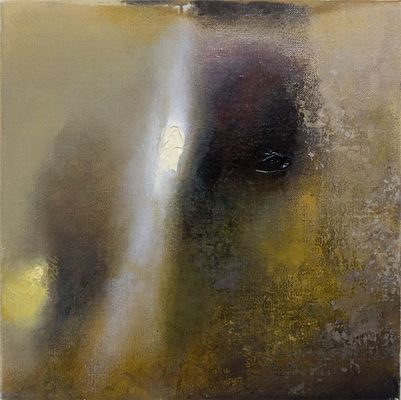
To return to Buckley’s fragment, the first two lines very much evoke how I paint nowadays. As you age, detail diminishes and patches of light become more luminous and float. I feel the most honest way of dealing with this is by smearing the oil paint on the canvas with the fingers and working close-up, blind. Only if the patches coalesce into an approaching image can the work gain a life.
-
Jonathan Walker was born in Melbourne, Australia and brought up on a dairy farm in Gippsland. In the 1970’s he studied painting at RMIT and won the Harold Wright Scholarship to the British Museum, London. During the 1980’s he exhibited at Pinacotheca Gallery, Richmond and had work shown at the NGV and Heidi City Art Gallery. Over the same period he designed the cover for the “Epigenesi” LP by Giancarlo Toniutti, Italy and conducted a mail exchange work with Achim Wollscheid, Germany. The work with artists through the post resulted in an article published in the bicentenary issue of Art and Australia 1988. He showed in artist run spaces such as WestSpace in the 90’s and 2000’s, and until 2012, taught painting at Victoria University, which is where we (Colleen Ahern and Lisa Radford) as organisers of the exhibition, among many others, had the privilege of being his student.
Walker’s knowledge was imparted to students through the careful selection of music, literature, and artists found in books that he himself had ordered for the library. Walker’s strategy was the generosity of sharing his vast knowledge with references specific to each student and their context.
Walker’s paintings share a similar focus and intimacy.
This exhibition presents a small selection of recent paintings alongside a publication that includes Walker’s writing. Observational and analytical, Walker’s work is a type of material notation — the time of day, colour and how it is blended, the both specific and fleeting location of a reflection on lino or the question of whether a chair leg should be included in a painting.
Please join us on Friday August 21 between 6-8pm to celebrate the opening of the exhibition.
Curated by Colleen Ahern and Lisa Radford.
B. Wurtz
Curated by Nic Tammens
March 26 - April 4, 2015
B.Wurtz works from a basement studio in his home on Manhattan’s Lower East Side.
This local fact is attested to by the plastic shopping bags and newsprint circulars that appear in his work. As formal objects, they don’t make loud claims about their origins but nonetheless transmit street addresses and places of business from the bottom of this long thin island. Like plenty of artists, Wurtz is affected by what is local and what is consumed. His work is underpinned by this ethic. It often speaks from a neighborhood or reads like the contents of a hamper:
“BLACK PLUMS $1.29 lb.”
“Food Bazaar”
“USDA Whole Pork Shoulder Picnic 99c lb.”
“RITE AID Pharmacy, with us it’s personal.”
“H. Brickman & Sons.”
“Sweet Yams 59c lb."
Most of the work in this exhibition was made while the artist was in residence at Dieu Donne, a workshop dedicated to paper craft in Midtown. Here Wurtz fabricated assemblages with paper and objects that are relatively lightweight, with the intention that they would be easily transportable to Australia. This consideration isn’t absolute in Wurtz’s work, but was prescriptive for making the current exhibition light and cheap. Packed in two boxes, these works were sent from a USPS post office on the Lower East Side and delivered to North Melbourne by Australia Post.
Wurtz appears courtesy of Metro Pictures, New York.
Thanks to Rob Halverson, Joshua Petherick, Sari de Mallory, Matt Hinkley, Helen Johnson, Fayen d'Evie, Ask Kilmartin, Lisa Radon, Ellena Savage, Yale Union, and "Elizabeth".
John Nixon
"Archive"
December 15 - January 20, 2014
The presentation of John Nixon's archive offered a rare showcase of this extensive collection of the artist's own publications, catalogues, posters, ephemera, editions and more, from the mid 1980s onwards, alongside a selection of his artworks.
Organized by John Nixon, Joshua Petherick and Matt Hinkley.
<a href=http://wfb.public-office.info/artist/john-nixon>All titles by John Nixon
"Habitat"
at Minerva, Sydney (organised by Joshua Petherick and Matt Hinkley)
November 15 - December 20, 2014
Lupo Borgonovo, Janet Burchill & Jennifer McCamley,
Lewis Fidock, HR Giger, Piero Gilardi, Veit Laurent Kurz,
Cinzia Ruggeri, Michael E. Smith, Lucie Stahl, Daniel Weil, Wols
Press Release:
“...It contained seven objects. The slender fluted bone, surely formed for flight, surely from the wing of some large bird. Three archaic circuitboards, faced with mazes of gold. A smooth white sphere of baked clay. An age-blackened fragment of lace. A fingerlength segment of what she assumed was bone from a human wrist, grayish white, inset smoothly with the silicon shaft of a small instrument that must once have ridden flush with the surface of the skin - but the thing’s face was seared and blackened.”
William Gibson, “Count Zero”, 1986
"Autumn Projects Archive"
Curated by Liza Vasiliou
March 6 - March 15, 2014
World Food Books, in conjunction with the Virgin Australia Melbourne Fashion Festival 2014, presented the Autumn Projects archive, consisting of a selection of early examples in Australian fashion with a particular interest in collecting designers and labels from the period beginning in the 1980’s, who significantly influenced the discourse of Australian Fashion.
Curated by Liza Vasiliou, the exhibition provided a unique opportunity to view pieces by designers Anthea Crawford, Barbara Vandenberg, Geoff Liddell and labels CR Australia, Covers, Jag along with early experimental collage pieces by Prue Acton and Sally Browne’s ‘Fragments’ collection, suspended throughout the functioning World Food Books shop in Melbourne.
H.B. Peace
presented by CENTRE FOR STYLE
November 14, 2013
"Hey Blinky, you say chic, I say same"
Anon 2013
H.B. Peace is a clothing collaboration between great friends Blake Barns and Hugh Egan Westland. Their pieces explore the divergences between 'character’ and ‘personality’ in garments....etc
Special Thanks to Joshua Petherick and Matt Hinkley of WFB and Gillian Mears
and a Very Special Thank you to Audrey Thomas Hayes for her shoe collaboration.
Janet Burchill & Jennifer McCamley
"Aesthetic Suicide"
May 10 - June 8, 2013
The first of our occasional exhibitions in the World Food Books office/shop space in Melbourne, "Aesthetic Suicide" presented a body of new and older works together by artists Janet Burchill & Jennifer McCamley, including videos, prints, a wall work, and publications.
During shop open hours videos played every hour, on the hour.
English
Softcover, 208 pages, 13.5 x 19.8 cm
Published by
Harper Collins / New York
$32.00 - Out of stock
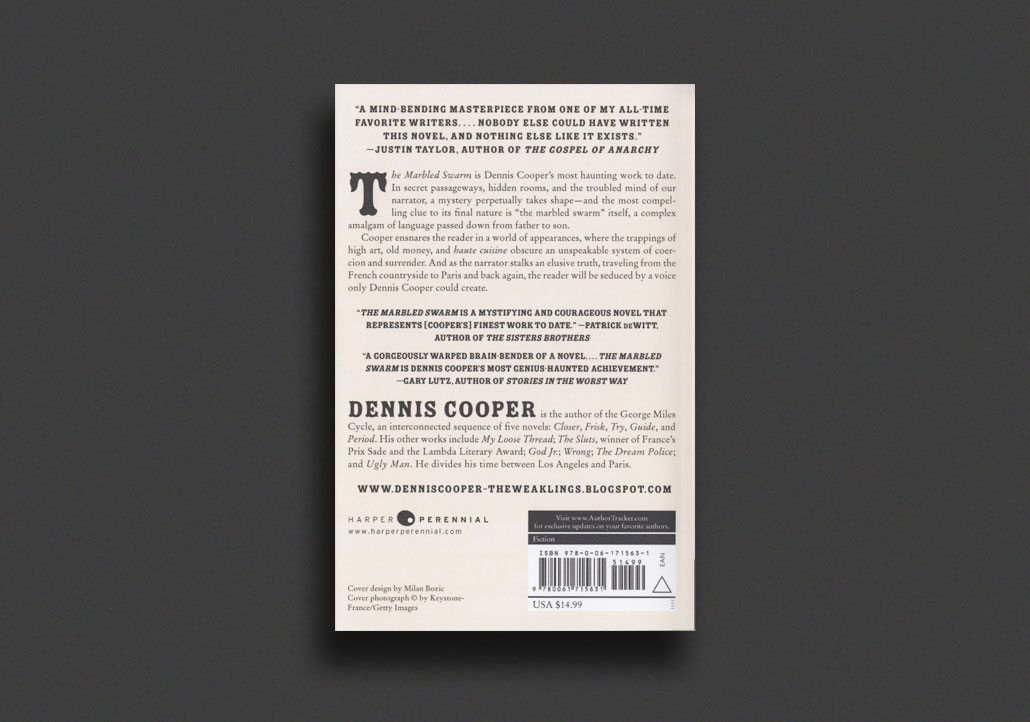
From literary cult hero Dennis Cooper comes his most haunting work to date.
"An American master.... Cooper is the most important transgressive literary artist since Burroughs." — Salon
In secret passageways, hidden rooms, and the troubled mind of our narrator, a mystery perpetually takes shape--and the most compelling clue to its final nature is "the marbled swarm" itself, a complex amalgam of language passed down from father to son.
Cooper ensnares the reader in a world of appearances, where the trappings of high art, old money, and haute cuisine obscure an unspeakable system of coercion and surrender. And as the narrator stalks an elusive truth, traveling from the French countryside to Paris and back again, the reader will be seduced by a voice only Dennis Cooper could create.
Dennis Cooper (born 1953) is an American novelist, poet, critic, editor and performance artist who grew up in the Southern California. In 1976, he founded Little Caesar Magazine and Press, which he ran until 1982. In 1985, he moved to Amsterdam for two and a half years, where he began his ten year long project, The George Miles Cycle, an interconnected sequence of five novels that includes Closer, Frisk, Try, Guide, and Period. His post-George Miles Cycle novels include My Loose Thread, The Sluts and God, Jr. Other works include the short-story collections Wrong and Ugly Man, poetry collections The Dream Police and The Weaklings, as well as the recent Smothered in Hugs: Essays, Interviews, Feedback, and Obituaries.
Dennis Cooper currently spends his time between Los Angeles and Paris.
2018, English
Softcover, 128 pages, 11.4 x 17.8 cm
Published by
Wakefield Press / Cambridge
$33.00 - Out of stock
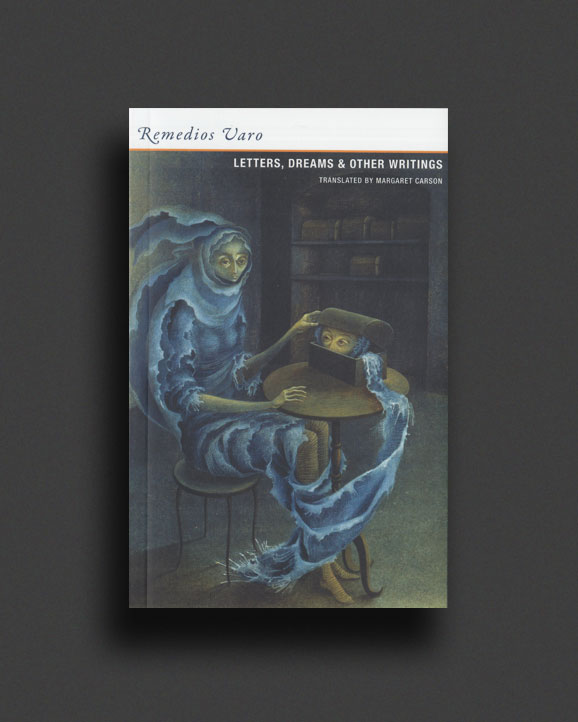
While the reputation of Remedios Varo (1908-63) the surrealist painter is now well established, Remedios Varo the writer has yet to be fully discovered. This volume brings together the painter's collected writings and includes an unpublished interview, letters to friends and acquaintances, dream accounts, notes for unrealised projects, a project for a theatre piece, whimsical recipes for controlled dreaming, exercises in surrealist automatic writing and prose poem commentaries on her paintings.
Remedios Varo Uranga (1908 – 1963) was a Spanish surrealist artist. Born in Anglès (north of Catalonia), Spain in 1908, she studied at the Real Academia de Bellas Artes de San Fernando, Madrid. Varo spent her formative years between France and Barcelona and was greatly influenced by the surrealist movement. The summer of 1935 marked Varo's formal invitation into Surrealism when French surrealist Marcel Jean arrived in Barcelona. While still married to her first husband Gerardo Lizarraga, Varo met her second partner, the French surrealist poet Benjamin Péret, in Barcelona. During the Spanish Civil War she fled to Paris with Péret leaving Lizarraga behind (1937). It was through Peret that Remedios Varo met André Breton and the Surrealist circle, which included Leonora Carrington, Dora Maar, Roberto Matta, Wolfgang Paalen, and Max Ernst among others. Shortly after arriving in France, Varo took part in the International Surrealist exhibitions in Paris and in Amsterdam in 1938. She was forced into exile from Paris during the German occupation of France and moved to Mexico City at the end of 1941 when the Mexican president, Lázaro Cardenas, made it a policy to welcome Spanish and European refugees. In Mexico, she met native artists such as Frida Kahlo and Diego Rivera, but her strongest ties were to other exiles and expatriates, notably the English painter Leonora Carrington and the French pilot and adventurer, Jean Nicolle. However, because Mexican muralism still dominated the country's art scene, surrealism was not generally well received. She worked as an assistant to Marc Chagall with the design of the costumes for the production of the ballet Aleko, which premiered in Mexico City in 1942. In 1947, Péret returned to Paris, and Varo traveled to Venezuela, living there for two years. She returned to Mexico and began her third and last important relationship with Austrian refugee Walter Gruen, who had endured concentration camps before escaping Europe. Gruen believed fiercely in Varo, and he gave her the economic and emotional support that allowed her to fully concentrate on her painting. In 1955, Varo had her first solo exhibition at the Galería Diana in Mexico City. Buyers were put on waiting lists for her work. Even Diego Rivera was supportive. In 1960, her representative, Juan Martín, opened his own gallery and showed her work there, and opened a second in 1962. Only a year after that opening, at the height of her career, she died from a heart attack in Mexico City. Her work is well known in Mexico, but not as commonly known throughout the rest of the world.
2012, English
Softcover, 72 pages, 15 x 25 cm
Published by
Getty Trust Publications / Los Angeles
$56.00 - In stock -
Annette Leddy and Donna Conwell
Introduction by Dawn Ades
“Farewell to Surrealism” is the title of a 1943 essay by Austrian artist-critic Wolfgang Paalen published in the inaugural issue of the journal Dyn. The journal was founded by Paalen and an international group of writers and artists taking refuge in Mexico City during World War II, including Wolfgang Paalen, Alice Rahon, and Eva Sulzer. Several of them had been part of André Breton’s Parisian surrealist circle in the 1930s. When they arrived in Mexico, they were still proponents of surrealism. Two years later, however, this group had broken with Breton and set out to define a new direction for art. Their vision coalesced in the pages of Dyn.
While recent scholarship has treated individual artists in the circle, this study is the first to examine the new aesthetic found in Dyn itself. Transformed by the mysterious pre-Columbian artifacts, distressed by the failure of political ideology, and inspired by scientific discoveries of the day, these artists played a critical but under-recognized role in the transition from surrealism to abstract expressionism. This catalogue accompanied an exhibition of the same name on view at the Getty Research Institute October 2, 2012 to February 17, 2013.
Annette Leddy is a senior cataloguer and a consulting curator at the Getty Research Institute. Donna Conwell is an associate curator at Montalvo Arts Center in Saratoga, California. Dawn Ades is a semi-retired professor at the University of Essex.
2019, English
Softcover, 278 pages, 16 x 24 cm
Published by
Koenig Books / London
$90.00 - In stock -
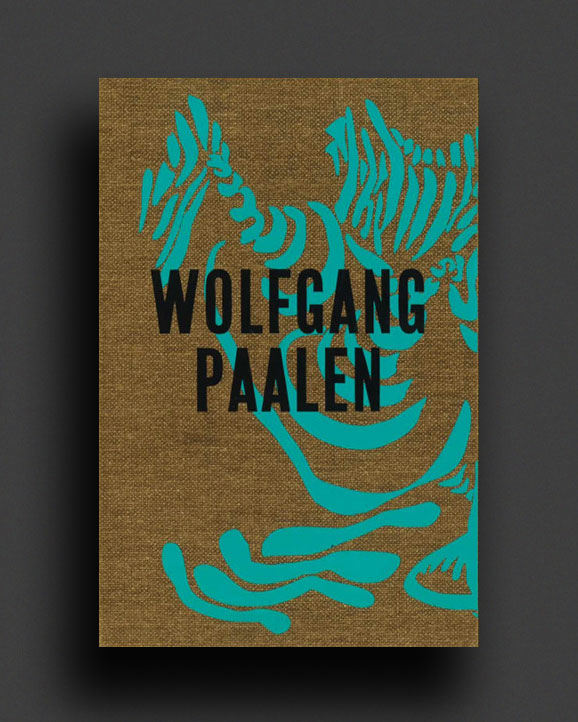
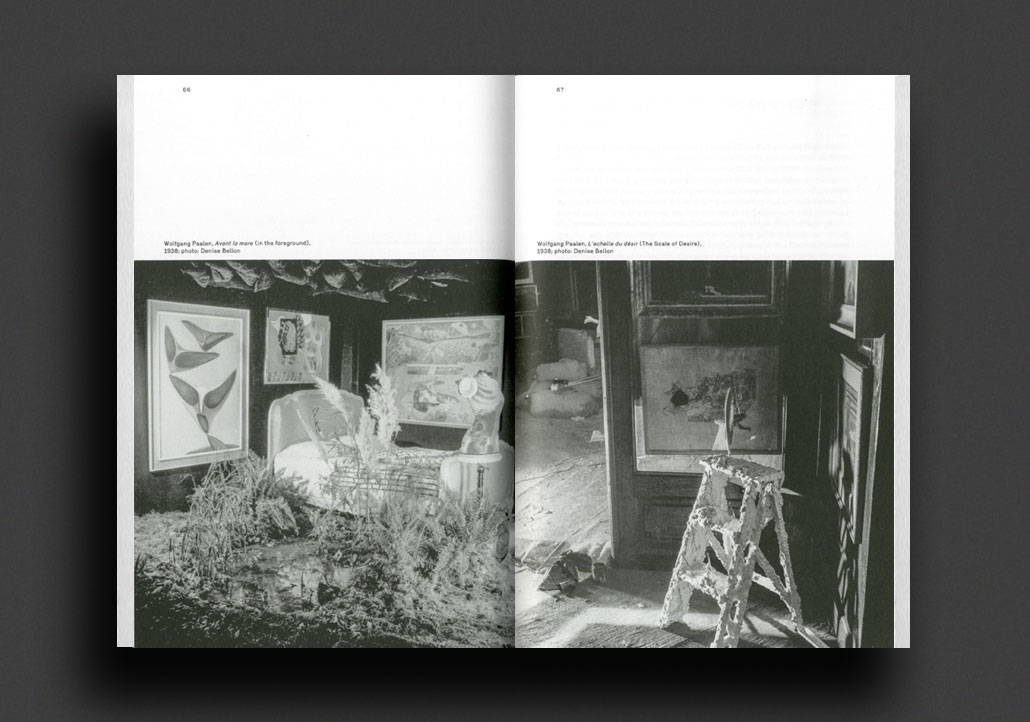
The extraordinary artist and intellectual Wolfgang Paalen (1905-1959) moved too fast for art history, which is only now beginning to catch up with his many accomplishments. Born in Vienna, he moved to Paris in 1929, where he affiliated with the Surrealists. The artist’s original contribution to Surrealism were his so-called ‘Fumage pictures’. In these he painted hallucinatory motifs using candle smoke, some of which he continued associatively with oil paint, others he left in their own right. A member of the Abstraction-Création group in the mid 1930s, Paalen’s pictures and texts provided both support and inspiration for young representatives of American Abstract Expressionist painting such as Jackson Pollock, Barnett Newman and Mark Rothko. He went into exile in Mexico in 1939 (at the invitation of Frida Kahlo), where he promoted the surrealist cause and edited the influential art magazine DYN. After the war he moved to San Francisco, forming the Dynaton Group with Gordon Onslow Ford and Lee Mullican.
This beautiful catalogue is dedicated to all of the artist’s creative periods. His long-standing interest in collecting and researching the indigenous art of British Columbia and Mexico as well as his literary work are also illuminated in more detail. Includes texts by Dawn Ades, Colin Browne, Timur Alexander ElRafie, Markus Hallensleben, Christian Kloyber, Andreas Neufert, Stella Rollig, Franz Smola.
Published on the occasion of the exhibition, Wolfgang Paalen (1905–1959): An Austrian Surrealist in Paris and Mexico at Belvedere, Vienna (4 October 2019 – 19 January 2020).
2018, English
Hardcover, 372 pages, 29.7 x 24.9 cm
Published by
Walther König / Köln
$120.00 - In stock -
This extensive, over-sized hardcover catalogue offers a systematic and chronological overview of the multifaceted oeuvre of German artist, Jutta Koether. It goes back to her beginnings in the context of Neo Expressionism in Cologne in the early and mid-1980s, and her subsequent exploration of the colour red as an expressive device – presenting a response to the cliché of male painters. After moving to New York in the early 1990s, Koether began making breathtakingly intense and colourful large-scale paintings that layer motifs from pop culture, literature and art history in dense painterly gestures. In the early 2000s, the artist’s approach became increasingly involved with performance and music, culminating in inky black canvases and assemblage paintings incorporating devotional objects from Punk and ‘noise culture’. The final chapter of this retrospective is dedicated to Koetherʼs eccentric turn to history painting and her latest appropriations from art historyʼs visual memory.
Published on the occasion of the exhibition, Jutta Koether: Tour de Madame at Museum Brandhorst, Munich (18 May – 21 Oct 2018), and at Mudam Luxembourg, 2019.
1980-1990, Japanese
Softcover (staple-bound), 36 pages, 12.5 cm x 18 cm
1st Edition, Out of print title / used / very good
Published by
Fiction Inc. / Tokyo
$55.00 - Out of stock
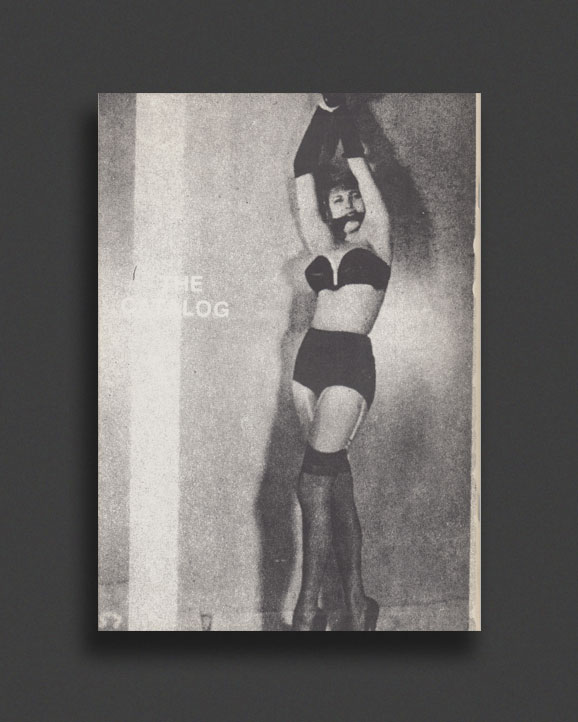
"The Catalog" published sometime in Japan in the 1980s-1990s by Fiction, Inc., a specialty shop and distributor/publisher of fetish and erotic books in Tokyo in the 1980-90s. This lovely catalogue-fanzine is mostly comprised of full-page reproductions sampling a cross-section of content from catalogue publications including the work of John Willie, Bill Ward, Guido Crepax, Eric Stanton, Eneg, Carlo, Simone Devon, Sally Roberts, Irving Claw, Betty Page, and periodicals such as Glamour International, Stiletto, Rigorosa Disciplina, Sweet Gwen, Bizarre Comix, Bizarre Classix, Bizarre Photo Treasures, Best of Bizarre, and much more... Very heavily illustrated throughout with erotic photography and artwork, all catalogue text in Japanese, map to Fiction, Inc. shop.
Very Good, light tanning. Well preserved.
2020, English
Hardcover, 224 pages, 24.8 x 30.5 cm
Published by
Rizzoli / New York
$118.00 - Out of stock
An in-depth look at these two American artists, who explored issues of sexuality and feminism in the 1960s and 1970s in their sculpture and photography.
This major hardcover book, produced to accompany an exhibition, offers the first opportunity to appreciate the resonances between the studio practices of Eva Hesse and Hannah Wilke. Both artists found themselves drawn to unconventional materials, such as latex, plastics, erasers, and laundry lint, which they used to make work that was viscerally related to the body. They shared an interest in repetition to amplify the absurdity of their work. These repeated forms--whether Hesse's spiraling breast or Wilke's labial fold--sought to confront the phallo-centricism of twentieth-century sculpture with a texture that might capture a more intimate, psychologically charged experience. Eleanor Nairne, the curator of the exhibition, writes the lead essay, followed by texts by Jo Applin and Anne Wagner. An extensive chronology by Amy Tobin includes primary-source materials, which bring a new history of how both artists' work sits in relation to the wider New York scene. Also included are excerpts of both artists' writing.
About The Author
Eleanor Nairne is an art historian and curator at Barbican Art Gallery. Her recent exhibitions include Basquiat: Boom for Real (2017) and Imran Qureshi: Where the Shadows Are So Deep (2016). Jo Applin is the head of the history of art department at the Courtauld Institute of Art. Anne Wagner is Chair Emerita at the University of California, Berkeley. Amy Tobin is a lecturer in the department of history of art at the University of Cambridge and curator at Kettle's Yard.
2020, English
Metallic offset printed poster in hand-numbered sleeve, 59.4 x 84.1 cm (folded)
Ed. of 500.,
Published by
Self-Published / Melbourne
$10.00 - In stock -
Publication produced on the occasion the the exhibition ...(illegible)... at MADA Gallery, Monash University, 25 July – 24 August 2019, curated by Andrew Atchison and featuring the work of Briony Galligan, Mathew Jones, Paul McKenzie, John Meade, Fiona Macdonald and Scott Redford.
"...(illegible)... is an exhibition that explores queer abstraction as a contemporary conceptual methodology. The term 'queer abstraction' describes the potential of an artwork to communicate something of lived queer experience(s) through seemingly non-referential, abstract visual language. This position makes space for a critique of the notion that artworks should present as explicitly, legibly queer according to signs or qualities allocated to the art-historical category of Queer Art."
The exhibition will be curated by Andrew Atchison and will include artists Briony Galligan, Mathew Jones, Paul McKenzie, John Meade, Fiona Macdonald and Scott Redford.
In an individually numbered edition of 500, this fold-out A1 poster catalogue, printed in metallic ink and designed by Paul Mylecharane at Public Office, features documentation of the exhibition alongside curator's essay.
1971, Japanese / English
Softcover, 184 pages, 22.5 cm x 28 cm
1st Edition, Out of print title / Used*,
1st Edition, Out of print title / used / very good
Published by
A.D.A Edita / Tokyo
$120.00 - Out of stock
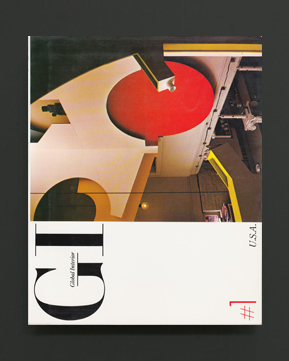
Rare first issue from 1971 of this now classic 1970's architectural series, the great GI (Global Interior) from Tokyo, Japan.
One of the finest interior architecture journal series ever published, GI "The Series of Global Interior" came from the producers of the highly esteemed GA (Global Architecture), GA Document, GA Houses, etc. architectural publications.GI was produced throughout the 1970's in a total of ten volumes. Each large volume highlighted a selection of architectural projects by renowned international architects, some volumes focusing on a specific architect entirely, and highlighted their work for houses and domestic spaces.
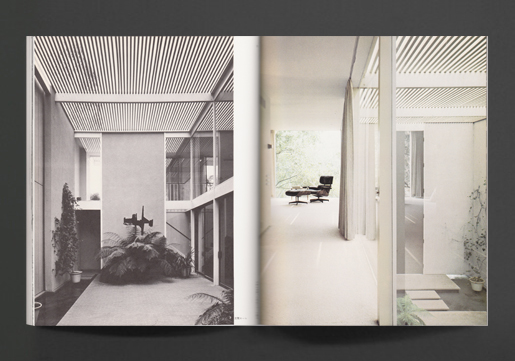
Beautiful architectural photography of house interiors, exteriors and room details of living spaces, along with texts (mostly in Japanese) and floorplans/elevation drawings make up the profiles on each featured building or environment. The visual generosity of these handsomely designed and printed journals (each more a book than a magazine) make them a treasure for any architecture or interior design enthusiast or collector.
Edited and Presented by Yukio Futagawa
GI Global Interior #1
Houses in U.S.A.
1971
Contents include:
MLTW/Moore and Turnbull (Caygill House, McComber Houses, Hines House, Reid House, Sea Ranch Condominium); Joseph Esherick (Bermak House, Cary House);
John Lautner (Malin House); Edward A. Killingsworth (Case Study House No.25);
Craig Ellwood (Rosen House, Daphne House); Charles Eames (Eames House); Herbert Greene (Greene House); Bruce Goff (Price House); Eero Saarinen
(Miller House); Crites and McConnell (Crites House A, Crites House B); Charles W. Moore (Moore House); Edward L. Barnes (Country House); John M. Johansen (Taylor House); Richard Meier (Smith House, Saltzman House); Paul Rudolph (Hirsch house); Marcel Breuer (Gagarin House, Stillman House); Robert Venturi (Mrs. Venturi House)...
Very Good copy (light wear).
2019, English
Softcover, 80 pages, 12.7 x 17.5 cm
Published by
Tender Buttons Press / US
$34.00 - Out of stock
17th Anniversary Edition of Dodie Bellamy’s Cunt-Ups. With an Introduction by Sophie Robinson. Dodie Bellamy's Cunt-Ups - first published in 2001 and recipient of the Firecracker Award for Innovative Poetry-- was immediately a controversial and celebrated work. Using the "cut-up" method of William S. Burroughs, Cunt-Ups is a work of sex magick, based on source texts from old lovers and Jeffery Dahmer transcriptions. The resulting spell queers everything around it. Enjoy!
1993, Japanese
Softcover (w. dust jacket and obi-strip), 150 pages, 26 x 19.5 cm
1st Edition, Out of print title / used / very good
Published by
Heibonsha Limited Publishers / Tokyo
$100.00 - Out of stock
Wonderful first edition of this 1993 photobook of Nobuyoshi Araki's cat photographs, captured in black-and-white throughout the streets of Tokyo. Lovely design with mostly full-page reproductions throughout on various gloss and raw paper stocks.
Nobuyoshi Araki is a prolific Japanese photographer who has produced thousands of photographs over the course of his career. He became famous for “Un Voyage Sentimental” (1971), a series of photos depicting both banal and deeply intimate scenes of his wife and lifelong muse, essayist Aoki Yoko (whom the artist credits for making him a photographer), during their honeymoon. To date the 75 year old has produced 450 photo books and counting. With a repertoire that knows no boundaries, Araki's diaristic style of photography has captured the world around him (his cat Ciro, the people and landscapes of Japan and his travels, flowers, family), though it is Araki’s intensely sexual imagery that has elicited particular controversy and fascination throughout his career. Similarly to Helmut Newton, Araki has often addressed subversive themes — such as bondage in the Japanese style Kinbaku — in his provocative depictions of female nudes. He typically works in black-and-white photography, and his hallmark style is deliberately casual. “Rather than shooting something that looks like a professional photograph, I want my work to feel intimate, like someone in the subject’s inner circle shot them,” he says. Pushing against the world of commercialised photography, he is celebrated for his history of self-publishing and distributing his work, beginning with his Xerox Photo Albums of 1970. Amongst many others, Araki has collaborated with American photographer Nan Goldin and Icelandic musician Björk.
Very Good in peach gloss wraps with original illustrated dustjacket (light wear) and publisher's obi-strip.
2014, Japanese / French
Softcover, 240 pages, 25 x 25 cm
Published by
Asahi Shimbun / Japan
$70.00 - Out of stock
Major monographic catalogue on the work of Balthus, published in 2014 for the great travelling retrospective exhibition in Japan, "The Last Master of the 20th Century".
Starting with pages reproducing Balthus' 40 plates for "Mitsou: Quarante Images par Baltusz", a book published in 1921 by Rotapfel-Verlag of Erlenbach-Zürich and Leipzig that included a preface by Rainer Maria Rilke, this entire catalogue is lavishly illustrated with colour reproductions of over 100 paintings and drawings from every stage of his career, including some never before published, alongside the artist's belongings works.
Along with the many reproductions of Balthus' works, each accompanied by texts and details, the book includes a chronology, bibliography, list of exhibitions, photographic portraits and pictures of Balthus' studio and works in progress throughout the years. The book takes an in-depth look at the life of this great European painter, with many essays in Japanese and French.
Throughout his career, Balthus rejected the usual conventions of the art world. He insisted that his paintings should be seen and not read about, and he resisted any attempts made to build a biographical profile. A telegram sent to the Tate Gallery as it prepared for its 1968 retrospective of his works read: "NO BIOGRAPHICAL DETAILS. BEGIN: BALTHUS IS A PAINTER OF WHOM NOTHING IS KNOWN. NOW LET US LOOK AT THE PICTURES. REGARDS. B."
Balthus (February 29, 1908 – February 18, 2001), was a Polish-French modern artist born in Paris to Polish expatriate parents. His given name was Balthasar Klossowski - his sobriquet "Balthus" was based on his childhood nickname, alternately spelled Baltus, Baltusz, Balthusz or Balthus. His father, Erich Klossowski, was an art historian who wrote a noted monograph on Daumier. His older brother was the philosopher and artist Pierre Klossowski. An unusual figure in the history of twentieth century painting, Balthus both traveled among and drew upon the work of other major artists of his time, while at the same time following a unique individual trajectory. He was mentored by, friends of, and/or even collaborated with seminal creative figures from different eras, including Antonin Artaud, André Breton, and Rainer Maria Rilke, while cultivating his own highly refined style of dreamlike, classically-informed painting. The scenes he usually depicted were very ordinary bourgeois interiors or outdoor settings, which nonetheless managed to reveal the heightened inner states of his subjects as well as the states of mind of those who might be viewing them.
"I always feel the desire to look for the extraordinary in ordinary things; to suggest, not to impose, to leave always with a slight touch of mystery in my paintings." - Balthus
1983 / 1986 Ed., English
Softcover, 96 pages, 20.5 x 22 cm
Out of print title / used / very good
Published by
Currey O'Neil / Melbourne
$150.00 - In stock -
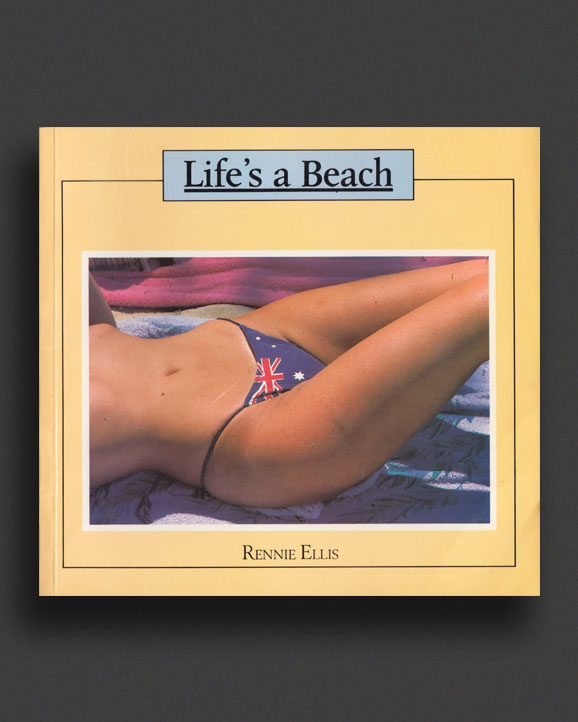
Award winning Australian photographer Rennie Ellis' cult classic photo-book, "Life's A Beach", first published in Melbourne in 1983. Steeped in beach lore since his early days as a lifesaver and surfer, Ellis put together this vivid collection of quintessential images of Australian beach life with great affection and insight. These early 1980's photographs shimmer with summer light and a graceful, infectious sensuality - the greatest photographic collection of Australian beach culture put to paper.
"On the beach we chuck away our clothes, our status and our inhibitions and engage in rituals of sun-worship and baptism. It's a retreat to our primal needs." Rennie Ellis
No other photographer has documented Australian society in such depth and with such insight into the human condition as Rennie Ellis. Active from the 1970s until his death in 2003, Rennie Ellis' non-judgmental approach was his 'access-to-all-areas' pass. Ellis used his camera as a key to open the doors to the social arenas of the rich and famous and to enter the underbelly of the nightclubs, bearing witness to the indulgences and excesses. In today's post-Henson era, these captured moments offer an intimate access to an Australia tantalisingly, but sadly, now almost out of reach.
As New copy except for light creasing to covers. Otherwise a perfectly kept unread deadstock copy.
2015, English / Arabic
Hardcover, 328 pages, 11 x 17 cm
Published by
Surpllus / Melbourne
$30.00 - Out of stock
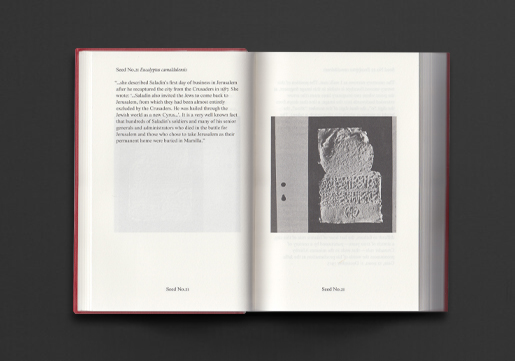
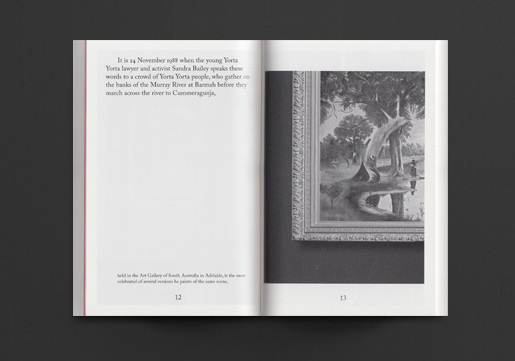
Tom Nicholson's bilingual artist's book begins with the remarkable and dominating presence of Australian eucalyptus trees in the Ma'man Allah/Mamilia cemetery in Jerusalem, Palestine's oldest and most important Islamic cemetery. These river red gums are famous in Australia for their connection to Barmah, a landmark of anti-colonial resistance. Comparative Monument is an attempt to articulate the historical links and echoes between Jerusalem and Australia. Drawing on the symbolic importance of trees in Israel and Palestine, and in Australian commemorative traditions, it is also an attempt to rethink the nature and possibilities of the monument itself, and the linkages to drawing and walking.
Designed by Ziga Testen and James Oates
2015, English
Softcover, 224 pages, 11 x 16.5 cm
Published by
Surpllus / Melbourne
$20.00 - Out of stock
This artist book is a collaborative work by Wiradjuri/Kamilaroi Sydney-based artist Jonathan Jones and Melbourne-based artist Tom Nicholson. Based in part on the centrality of the Murray-Darling river system to both projects, this book links the flow of the river to acts of reading and looking, and implicates the visual legacies of Australia's colonial past in acts of imagination towards new forms and legacies.
2011, English
Softcover, 84 pages, 200 x 170 mm
Published by
Monash University Museum of Art / Melbourne
$20.00 $10.00 - Out of stock
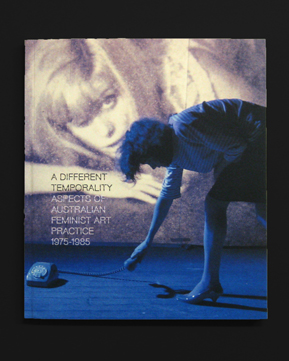
Catalogue for the exhibition A Different Temporality which brought together feminist approaches to temporality in the visual arts, with a focus on late 1970s and early 1980s Australia. Rather than an encyclopaedic summation of feminist practice at that time, selected works reflected prevalent debates and modes of practice; with a focus upon the dematerialisation of the art object, the role of film theory, and the adoption of diaristic and durational modes of practice, including performance, photography and film.
Includes a major new contribution to the scholarship on Australian feminist art history from Dr Kyla McFarlane as well as important reviews and supporting texts from the 1970s and 80s, including notably, a previously unpublished interview conducted by Janet Burchill and Jennifer McCamley with the American conceptual artist, feminist, educator, and writer, Mary Kelly, in 1982.
2014, English / German
Softcover, 208 pages, 22 x 28 cm
Published by
Sternberg Press / Berlin
$95.00 $25.00 - Out of stock
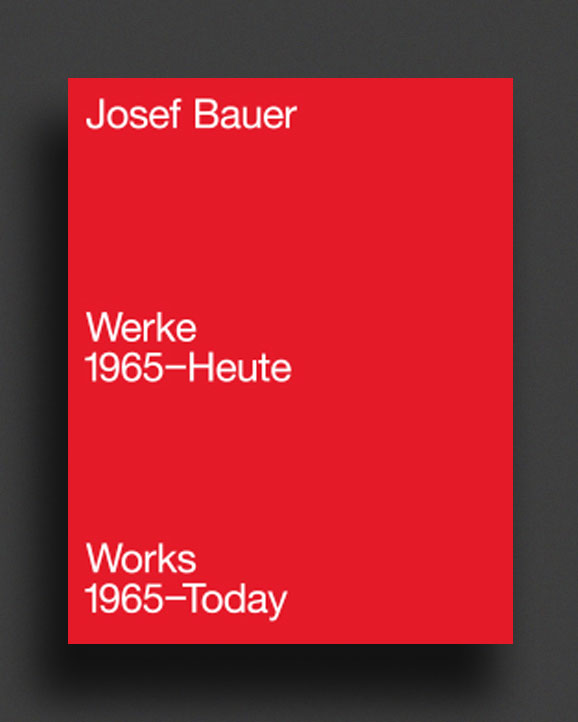
We rarely encounter letters or colors outside of their communicative or decorative functions. Yet detached from the flat surfaces they normally adorn, they become sculptural objects that collapse the divide between language and bodies.
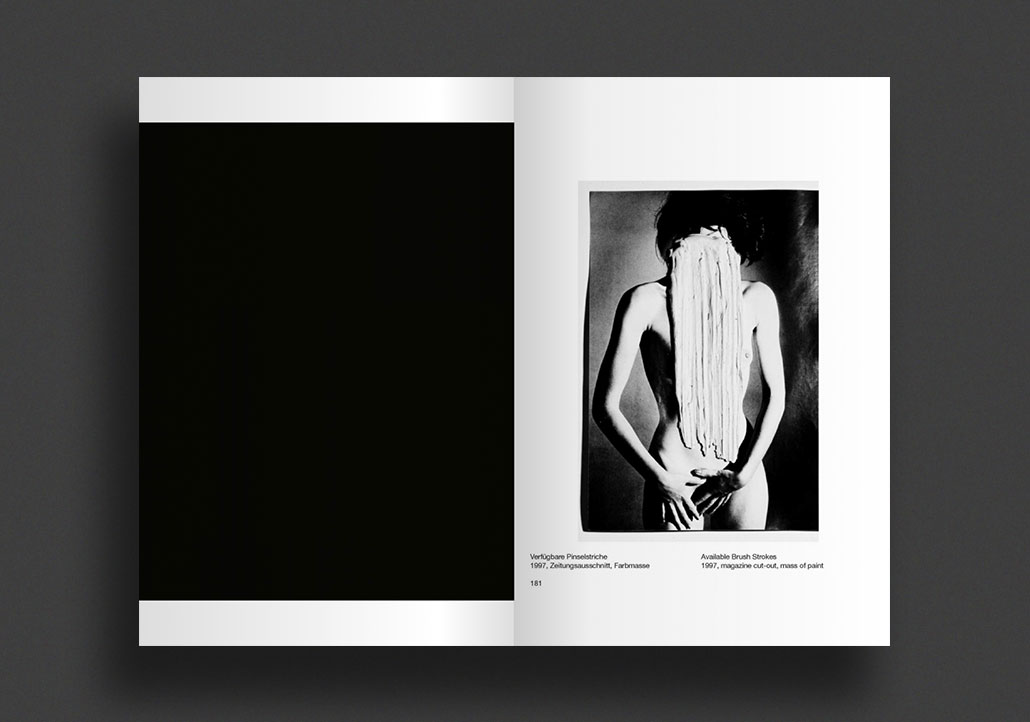
Works 1965–Today stems from a retrospective held at the Grazer Kunstverein showcasing Josef Bauer’s experiments with language, color, and their spatial contexts nearly forty years after his last exhibition in Graz. His practice combines sculpture, installation, painting, and performance to disturb our perception of words and colors as mere “carriers” of meaning. By removing their two-dimensional context, letters become objects that communicate directly with our bodies in an unfiltered and urgent language called “tactile poetry.”
In addition to over one hundred career-spanning works by Bauer, this volume brings together critical commentary from a variety of experts. In his introduction, Krist Gruijthuijsen illuminates Bauer’s “tactile poetry” as a radical embodiment of ’60s Concrete poetry. In an essay from 1974, Austrian philosopher Thomas Zaunschirm explores Bauer’s formal bid to transcend the representational relation of language to images. Situating Bauer’s practice in a historical context, Bettina Steinbrügge throws light on the reception and development of his works. The book also includes a unique visual rejoinder by artist Hans-Peter Feldmann. Works 1965–Today is a vital introduction to this—until now—underrepresented master of letters and their contours.
Edited By Krist Gruijthuijsen
Contributions By Hans-Peter Feldmann, Krist Gruijthuijsen, Bettina Steinbrügge, Thomas Zaunschirm
1983, English
Softcover, 100 pages, 25 x 21 cm
1st Edition, Out of print title / Used*,
Published by
Art Gallery of South Australia / Adelaide
$48.00 $20.00 - Out of stock
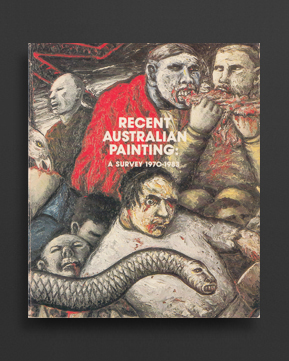
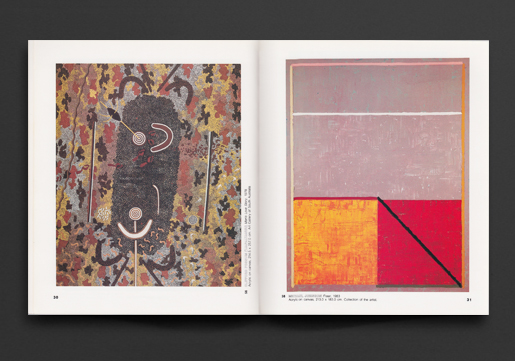
Catalogue published on the occasion of the exhibition "Recent Australian Painting - A Survey 1970-1983" curated by Ron Radford in 1983, at the Art Gallery of South Australia, Adelaide.
"The exhibition RECENT AUSTRALIAN PAINTING: A Survey 1970-1983 is the first survey exhibition ever staged covering the whole period. It documents the major artists of the period and the overlapping movements or styles which can generally be labelled as Minimalism, Abstract Expressionism, Lyrical Abstraction, Neo Realism, Political Art, Ocker Funk, Popism and New Image Painting."
Features the work of Arthur Boyd, Mike Brown, Robert Hunter, Jenny Watson, Paddy Carrol Tjungurrayi, Dini Nolan Tjampitjinpa, Robert Rooney, Juan Davila, Clifford Possum Tjapaltjarri, Robert Macpherson, John Nixon, Dale Frank, Fred Williams, Annette Bezor, Brett Whiteley, Dick Watkins, John Brack, Gunter Christmann, Gareth Sansom, Uta Uta Tjangala, and many others through full colour and black and white reproductions of works, plus biographies and texts.
2016, English
Softcover (w. dust jacket, poster and postcard), 246 pages, 17 x 24 cm
Published by
IMA / Brisbane
KW Institute for Contemporary Art / Berlin
MUMA / Victoria
Sternberg Press / Berlin
$46.00 - Out of stock
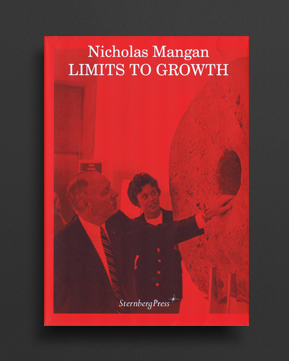
Edited by Aileen Burns, Charlotte Day, Krist Gruijthuijsen, Johan Lundh
Texts by Max Andrews and Mariana Cánepa Luna (Latitudes), Helen Hughes, Ana Teixeira Pinto
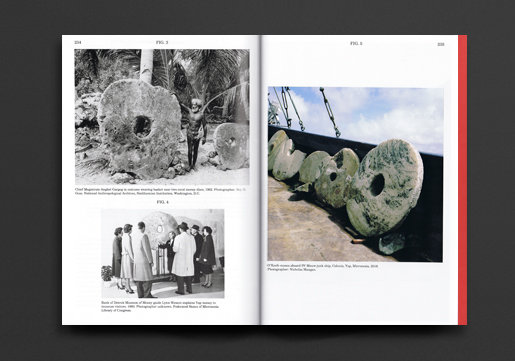
This publication accompanies Australian multidisciplinary artist Nicholas Mangan’s survey exhibition “Limits to Growth.” The exhibition and book bring together four of Mangan’s most significant works of the past seven years, alongside a new commission. The works in the show tackle narratives from his own geographical region—Asia Pacific, in which his home country of Australia plays a colonial role—and weaves them into a bigger picture to take into account the global economy, resource extraction, and the ultimate power of the sun. Featuring an in-depth series of conversations between the artist and the Barcelona-based curatorial collective Latitudes, and essays by Ana Teixeira Pinto and Helen Hughes, this publication is richly illustrated with documentation of Mangan’s artworks and historical source material.
Copublished with the Institute of Modern Art, Brisbane; KW Institute for Contemporary Art, Berlin; and Monash University Museum of Art, Melbourne
Design by Žiga Testen
2017, English
Softcover, 196 pages, 14.5 x 20 cm
Published by
Sternberg Press / Berlin
$65.00 $30.00 - Out of stock
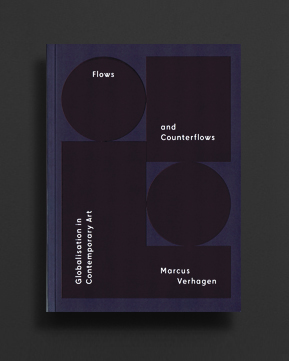
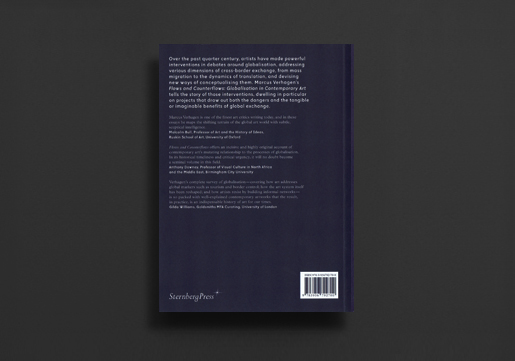
Over the past quarter century, artists have made powerful interventions in debates around globalisation, addressing various dimensions of cross-border exchange, from mass migration to the dynamics of translation, and devising new ways of conceptualising them. Marcus Verhagen’s Flows and Counterflows: Globalisation in Contemporary Art tells the story of those interventions, dwelling in particular on projects that draw out both the dangers and the tangible or imaginable benefits of global exchange.
"Marcus Verhagen is one of the finest art critics writing today, and in these essays he maps the shifting terrain of the global art world with subtle, sceptical intelligence."
—Malcolm Bull, Professor of Art and the History of Ideas, Ruskin School of Art, University of Oxford
"Flows and Counterflows offers an incisive and highly original account of contemporary art’s mutating relationship to the processes of globalisation. In its historical timeliness and critical urgency, it will no doubt become a seminal volume in this field."
—Anthony Downey, Professor of Visual Culture in North Africa and the Middle East, Birmingham City University
"Verhagen’s complete survey of globalisation—covering how art addresses global markers such as tourism and border control; how the art system itself has been reshaped; and how artists resist by building informal networks—is so packed with well-explained contemporary artworks that the result, in practice, is an indispensable history of art for our times."
—Gilda Williams, Goldsmiths MFA Curating, University of London
Design by A Practice for Everyday Life
2017, English
Hardcover (clothbound), 138 pages, 16.7 x 23 cm
Published by
Nanaimo Art Gallery / Canada
Sternberg Press / Berlin
$65.00 $10.00 - Out of stock
Edited by Jesse Birch with Will Holder
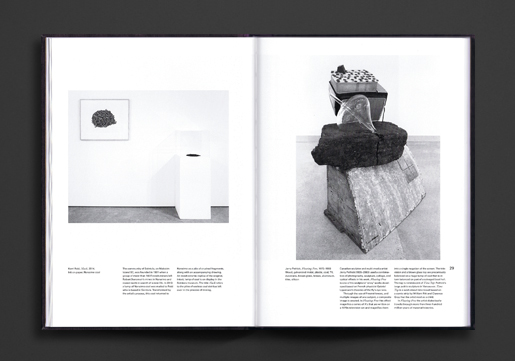
Texts by Jesse Birch, Lynne Bowen, Peter Culley, Antonio Graydon, Sarah Ogan Gunning, Franz Kafka, George Orwell, Michael Taussig; together with artworks by Stephanie Aitken, Raymond Boisjoly, Edward Burtynsky, Peter Culley, Jeremy Deller and Mike Figgis, Gray Metal, Devon Knowles, Yuanchen Liu, William Notman & Son, Jerry Pethick, Mimi Pickering, Kerri Reid, Scott Rogers
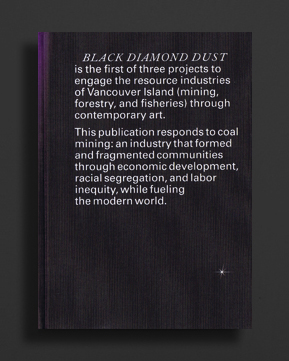
This publication expands a 2014 multisite contemporary art exhibition that took place in Nanaimo, British Columbia, a small city on the eastern edge of Vancouver Island. The title refers to coal mining, an industry that has formed and fragmented communities through economic development, racial segregation, and labor inequity, while fueling the modern world. In this book, forgotten or under-acknowledged histories are investigated and discussed along with cultural forms that surround the practices of international coal mining. Contemporary artworks, poetry, essays, literature, folk songs, and archival images come together to extract meaning from this fossilized black carbon that continues to power our cities.
Black Diamond Dust is the first of three projects to engage the resource industries of Vancouver Island (coal mining, forestry, and fisheries) through contemporary art.
Copublished with Nanaimo Art Gallery, Canada
Design by Will Holder
2016, English
Hardcover, 192 pages, 17 x 24 cm
Published by
Sternberg Press / Berlin
Carpenter Center for the Visual Arts / Cambridge
$79.00 $25.00 - Out of stock
Contributions by Martin Beck, Nina Beier, Silvia Benedito, Ulla von Brandenburg, Katarina Burin, Simon Dybbroe Møller, Jonas Ekeberg, Alex Farquharson, Fernanda Fragateiro, Simon Fujiwara, James Goggin, Tone Hansen, Owen Hatherley, Henriette Huldisch, Damon Krukowski, Le Corbusier, Maria Lind, Markus Miessen, Eline Mugaas, Elise Storsveen, Gloria Sutton, James Voorhies, Naomi Yang, Amy Yoes
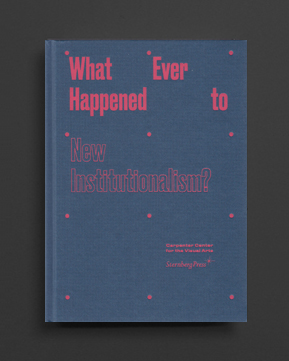
New Institutionalism, a mode of curating that originated in Europe in the 1990s, evolved from the legacy of international curator Harald Szeemann, the relational art advanced by French critic and theorist Nicolas Bourriaud, and other influential factors of the time. New Institutionalism’s dispersed and varied approaches to curating sought to reconfigure the art institution from within, reshaping it into an active, democratic, open, and egalitarian public sphere. These approaches posed other possibilities and futures for institutions and exhibitions, challenging the consensual conception, production, and distribution of art. Practitioners engaged the art institution with renewed confidence by imbuing it with the potential for new aesthetic experiences and different relationships among artists, institutions, and spectators beyond engrained modernist ideologies. Working in these new modes, the art institution could become a site of fluidity, unpredictability, and risk.
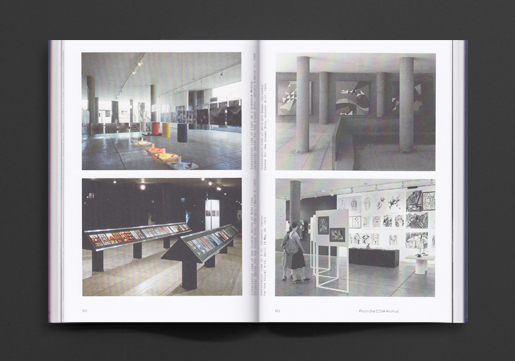
What Ever Happened to New Institutionalism? reflects upon the aspirations of these curatorial strategies and assesses their critical efficacy today within the landscape of contemporary art and globalized culture. The first in a series of readers examining changing characteristics of art institutions, this publication thinks through New Institutionalism by bringing together facsimiles of seminal texts, new critical essays, a history of trends and practices, and commissioned artist projects and contributions. These are complemented by documentation from the inaugural year of programming at the Carpenter Center for the Visual Arts at Harvard University focused on reimagining CCVA as a twenty-first-century institution.
Copublished with Carpenter Center for the Visual Arts
Design by James Goggin, Practise
2015, English
Softcover, 130 pages, 11.5 x 17.7 cm
Published by
Badlands Unlimited / New York
$32.00 $15.00 - Out of stock
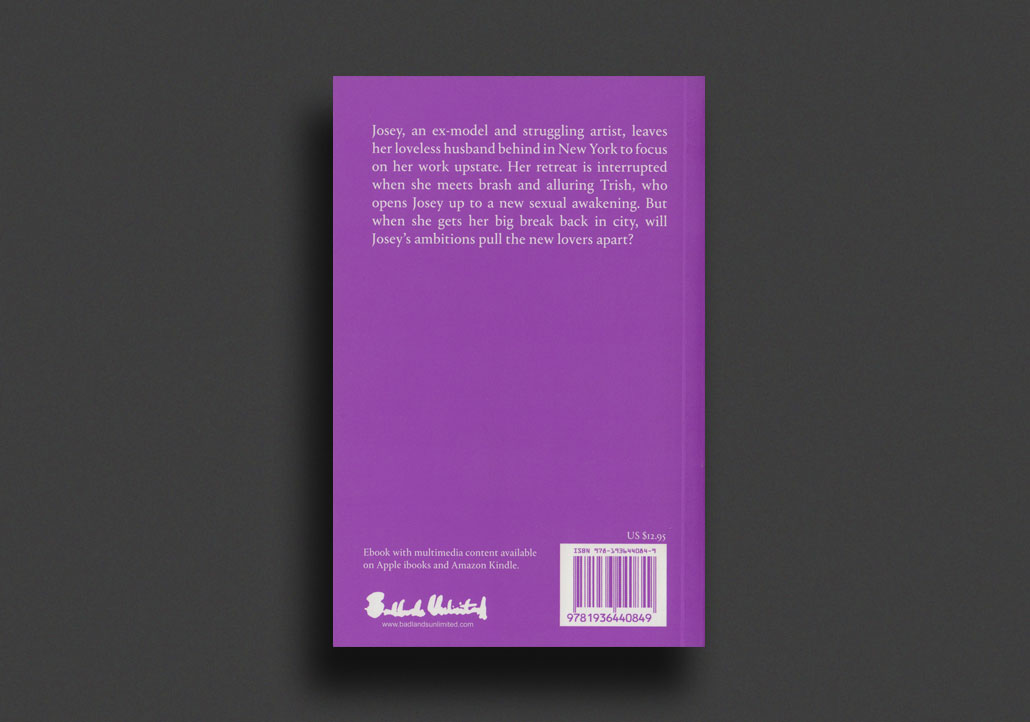
Josey, an ex-model and struggling artist, leaves her loveless husband behind in New York to focus on her work upstate. Her retreat is interrupted when she meets brash and alluring Trish, who opens Josey up to a new sexual awakening. But when she gets her big break back in city, will Josey’s ambitions pull the new lovers apart?
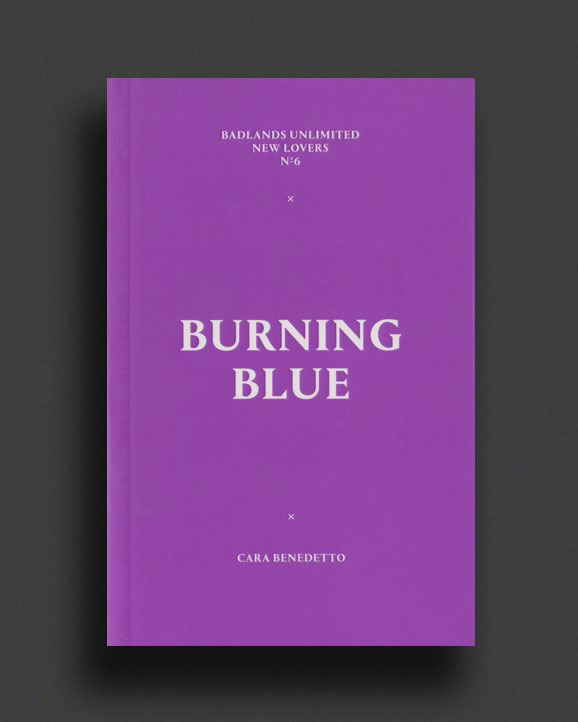
Burning Blue by Cara Benedetto is one of the New Lovers, a series of short erotic fiction published by Badlands Unlimited. Inspired by Maurice Girodias’ legendary Olympia Press, New Lovers features the raw and uncut writings of authors new to the erotic romance genre. Each story has its own unique take on relationships, intimacy, and sex, as well as the complexities that bedevil contemporary life and culture today.
Each novella in the New Lovers series is an independent story of about 12,000 – 18,000 words in length. Burning Blue is a subtly blossoming examination of what happens when two very different women at totally different points in their lives come together and shake each other to the core.
The design of New Lovers pays homage to the classic covers of the books published by Olympia Press. The “soft-touch” lamination and embossed lettering on the front covers of the paperback editions make these novellas a precious edition to any library. Both paperback and ebook editions feature special color endpaper artworks by Mira Dancy.
2015, English
Softcover, 104 pages, 11.5 x 17.7 cm
Published by
Badlands Unlimited / New York
$32.00 $10.00 - Out of stock
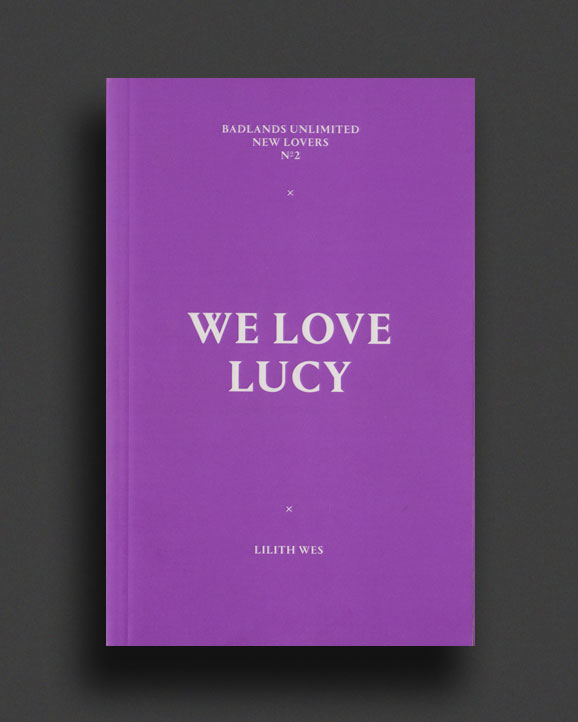
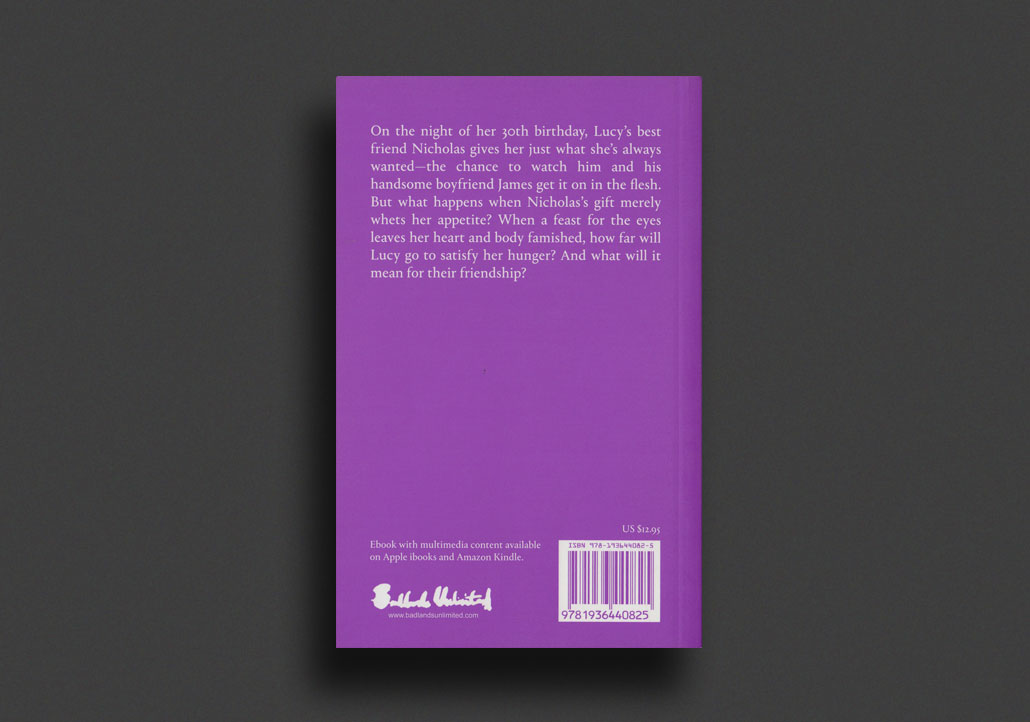
On the night of her 30th birthday, Lucy’s best friend Nicholas gives her just what she’s always wanted – the chance to watch him and his handsome boyfriend James get it on in the flesh. But what happens when Nicholas’ gift merely whets her appetite. When a feast for the eyes leaves her heart and body famished, how far will Lucy go to satisfy her hunger? And what will it mean for their friendship?
We Love Lucy by Lilith Wes is the second book of New Lovers, a series of short erotic fiction published by Badlands Unlimited. Inspired by Maurice Girodias’ legendary Olympia Press, New Lovers features the raw and uncut writings of authors new to the erotic romance genre. Each story has its own unique take on relationships, intimacy, and sex, as well as the complexities that bedevil contemporary life and culture today.
Each novella in the New Lovers series is an independent story of about 12,000 – 18,000 words in length. We Love Lucy is a sensual exploration of friendship, love, and how fluid pleasure is, in whatever orientation or direction.
The design of New Lovers pays homage to the classic covers of the books published by Olympia Press. The “soft-touch” lamination and embossed lettering on the front covers of the paperback editions make these novellas a precious edition to any library. Both paperback and ebook editions feature special color endpaper artworks by Paul Chan.