World Food Books' programme is largely produced on Kulin Nation land. We acknowledge the Wurundjeri people of the Kulin Nation as the first and continuing custodians of this land, and pay respect to their Elders past, present, and emerging.
World Food Books is an arts and special interests bookshop in Naarm / Melbourne. Founded in 2010, World Food Books is devoted to the presentation of a rotating, hand-selection of international art, design, literary and counterculture publications with an emphasis on the anti-traditional, the experimental, the avant-garde, the heretic, the marginal.
Presenting new titles alongside rare and out-of-print books, catalogues and journals spanning the fields of modern and contemporary art, design, photography, illustration, film, literature, poetry, cultural theory, philosophy, sexuality, popular and underground culture in its many radical forms, World Food Books wishes to encourage adventurous, thoughtful and open-minded reading, looking, writing, and exchange of publishing and ideas, both current and historical.
As well as our bookshop, located in Melbourne's historical Nicholas Building, all of our inventory is available internationally via our online mail-order service.
World Food Books semi-regularly co-ordinates "Occasions", a programme of exhibits and events at the bookshop and in partnership with other hosts (such as museums and art galleries) that develop out of the activities, relationships and content of the bookshop itself.
World Food Books
The Nicholas Building
37 Swanston Street
Room 5, Level 6
Melbourne 3000
Australia
SHOP HOURS:
Thu–Fri 12–6, Sat 12–5
WEB-SHOP OPEN 24/7
World Food Books
Postal Address:
PO Box 435
Flinders Lane
Victoria 8009
Australia
Art
Theory / Essay
Architecture / Interior
Graphic Design / Typography
Photography
Fashion
Eros
LGBTQ+
Fiction / Poetry
Weird / Speculative / Science Fiction / Horror
Transgressive / Visceral / Abject
Symbolism / Decadence / Fin de siècle
Film / Video
Painting
Sculpture / Installation
Performance / Dance / Theater
Drawing
Sound / Music
Curatorial
Group Shows / Collections
Periodicals
Out-of-print / Rare
Posters / Ephemera / Discs
Signed Books
World Food Books Gift Voucher
World Food Book Bag
Australian Art
Australian Fiction
Australian Science Fiction / Speculative Fiction
Australian Poetry
Australian Photography
Japanese Photography
Conceptual Art
Minimal Art
Dada
'Pataphysics / Oulipo
Fluxus
Concrete Poetry
Pop Art
Surrealism
Arte Povera
Arte Informale / Haute Pâte / Tachism
Nouveau Réalisme / Zero / Kinetic
Situationism / Lettrism
Collage / Mail Art / Xerox Art
Art Brut / Folk / Visionary / Fantastic
Illustration / Graphic Art / Bandes Dessinées
Furniture
Italian Radical Design / Postmodernism
Textiles
Ceramics / Glass
Counterculture
Protest / Revolt
Philosophy
Psychoanalysis
Anthropology
Anarchism
Socialism / Anarchism / Communism / Capitalism
Literary Theory / Semiotics / Language
Feminism / Women's Studies
Gender Studies / Sexuality
Anthropology
Fetishism / BDSM
Drugs / Psychedelia
Crime / Violence
Animal Rights / Veganism
Occult / Esoterica
Ecology / Earth / Alternative Living
Whole Earth / Crafts
All prices in AUD (Australian dollars)
Pick-Ups
Pick-up orders can be collected in our bookshop during opening hours after order date. Please collect any Pick-up orders within 2 weeks of ordering as we have limited storage space. Orders will be released back into stock if not collected within this time. No refunds can be made for pick-ups left un-collected. If you cannot make it in to the bookshop in this time-frame, please choose postage option.
Return Policy
All sales are final. We do accept returns (for refund or exchange) for items received in error. All our orders are packed with special care using heavy-duty padding and cardboard book-mailers or bubble mailers (for smaller books), using reinforcement where required. We cannot take responsibility for any lost, stolen or damaged parcels.
Insurance
Should you wish to insure your package, please email us directly after placing your order and we can organise this at a small extra expense. Although all standard/express tracked packages are very safe and dependable, we cannot take responsibility for any lost, stolen or damaged parcels. We recommend insurance on valuable orders.
Interested in selling your old books, catalogues, journals, magazines, comics, fanzines, ephemera? We are always looking for interesting, unusual and out-of-print books to buy. We only buy books in our fields of interest and specialty, and that we feel we can resell.
We base these prices on desirability, market value, in-print prices, condition and our current stock levels. We offer cash, store credit, and can take stock on consignment. All
about 25% of the price we expect to get when we sell them, or 30% in store credit. We base these prices on desirability, market value, in-print prices, condition and our current stock levels.
Sell your books any day of the week. You can drop them off and return later. If you have a lot of books, we can visit your Sydney home.
We buy books that we feel we can resell. We offer about 25 % of the price we expect to get when we sell them, or 30% in store credit. We base these prices on desirability, market value, in-print prices, condition and our current stock levels.
Philadelphia Wireman
03 August - 01 September, 2018
World Food Books is proud to announce our next Occasion, the first presentation of sculptures by Philadelphia Wireman in Australia.
The Philadelphia Wireman sculptures were found abandoned in an alley off Philadelphia’s South Street on trash night in 1982. Their discovery in a rapidly-changing neighbourhood undergoing extensive renovation, compounded with the failure of all attempts to locate the artist, suggests that the works may have been discarded after the maker’s death. Dubbed the "Philadelphia Wireman" during the first exhibition of this work, in 1985, the maker’s name, age, ethnicity, and even gender remain uncertain. The entire collection totals approximately 1200 pieces, all intricately bound together with tightly-wound heavy-gauge wire (along with a few small, abstract marker drawings, reminiscent both of Mark Tobey and J.B. Murry). The dense construction of the work, despite a modest range of scale and materials, is singularly obsessive and disciplined in design: a wire armature or exoskeleton firmly binds a bricolage of found objects including plastic, glass, food packaging, umbrella parts, tape, rubber, batteries, pens, leather, reflectors, nuts and bolts, nails, foil, coins, toys, watches, eyeglasses, tools, and jewellery.
Heavy with associations—anthropomorphic, zoomorphic, and socio-cultural responses to wrapped detritus—the totemic sculptures by Philadelphia Wireman have been discussed in the context of work created to fulfil the shamanistic needs of alternative religions in American culture. Curators, collectors, and critics have variously compared certain pieces to sculpture from Classical antiquity, Native American medicine bundles, African-American memory jugs, and African fetish objects. Reflecting the artist’s prolific and incredibly focused scavenging impulse, and despite—or perhaps enhanced by—their anonymity, these enigmatic objects function as urban artefacts and arbiters of power, though their origin and purpose is unknown. Philadelphia Wireman, whatever their identity, possessed an astonishing ability to isolate and communicate the concepts of power and energy through the selection and transformation of ordinary materials. Over the course of the past two decades, this collection has come to be regarded as an important discovery in the field of self-taught art and vernacular art.
Presented in collaboration with Fleisher-Ollman Gallery, Philadelphia, and Robert Heald, Wellington.
Susan Te Kahurangi King
02 February - 10 March, 2018
Susan Te Kahurangi King (24 February 1951 - ) has been a confident and prolific artist since she was a young child, drawing with readily available materials - pencils, ballpoint pens and felt-tip markers, on whatever paper is at hand. Between the ages of four and six Susan slowly ceased verbal communication. Her grandparents William and Myrtle Murphy had developed a special bond with Susan so they took on caring responsibilities for extended periods. Myrtle began informally archiving her work, carefully collecting and storing the drawings and compiling scrapbooks. No drawing was insignificant; every scrap of paper was kept. The King family are now the custodians of a vast collection containing over 7000 individual works, from tiny scraps of paper through to 5 meter long rolls.
The scrapbooks and diaries reveal Myrtle to be a woman of great patience and compassion, seeking to understand a child who was not always behaving as expected. She encouraged Susan to be observant, to explore her environment and absorb all the sights and sounds. Myrtle would show Susan’s drawings to friends and people in her community that she had dealings with, such as shopkeepers and postal workers, but this was not simply a case of a grandmother’s bias. She recognised that Susan had developed a sophisticated and unique visual language and sincerely believed that her art deserved serious attention.
This was an unorthodox attitude for the time. To provide some context, Jean Dubuffet coined the term Art Brut in 1945 to describe work created by self-taught artists – specifically residents of psychiatric institutions and those he considered to be visionaries or eccentrics. In 1972 Roger Cardinal extended this concept by adopting the term Outsider Art to describe work made by non-academically trained artists operating outside of mainstream art networks through choice or circumstance. Susan was born in Te Aroha, New Zealand in 1951, far from the artistic hubs of Paris and London that Dubuffet and Cardinal operated in. That Myrtle fêted Susan as a self-taught artist who deserved to be taken seriously shows how progressive her attitudes were.
Susan’s parents Doug and Dawn were also progressive. Over the years they had consulted numerous health practitioners about Susan’s condition, as the medical establishment could not provide an explanation as to why she had lapsed into silence. Dawn educated herself in the field of homeopathy and went on to treat all twelve of her children using these principles – basing prescriptions on her observations of their physical, mental and emotional state.
Doug was a linguist with an interest in philosophy who devoted what little spare time he had to studying Maori language and culture. To some extent their willingness to explore the fringes of the mainstream made them outsiders too but it was their commitment to living with integrity and their respect for individuality that ensured Susan’s creativity was always encouraged.
Even though Susan’s family supported her artistic pursuits, some staff in schools and hospitals saw it as an impediment to her assimilation into the community and discouraged it in a variety of ways. Her family was not always aware of this and therefore did not fully understand why Susan stopped drawing in the early 1990s. However, rather than dwell on the challenges that Susan faced in pursuit of her artistic practice, they prefer to highlight her achievements. In 2008 Susan began drawing again in earnest, after an almost 20 year interruption, and her work is now shown in galleries around the world.
Susan grew up without television and has been heavily influenced by the comics she read as a child. She is absolutely fearless in the appropriation of recognizable characters, such as Donald Duck and Mickey Mouse, in her work. She twists their limbs, contorts their faces, compresses them together, blends them into complex patterned backgrounds - always imbuing them with an incredible energy. Although Susan often used pop culture characters in her work they are not naive or childlike. These are drawings by a brilliant self-taught artist who has been creating exceptional work for decades without an audience in mind.
Mladen Stilinović
"Various Works 1986 - 1999"
02 February 16 - September 10, 2016
Various works 1986 - 1999, from two houses, from the collections of John Nixon, Sue Cramer, Kerrie Poliness, Peter Haffenden and Phoebe Haffenden.
Including: Geometry of Cakes (various shelves), 1993; Poor People’s Law (black and white plate), 1993; White Absence (glasses, ruler, set square, silver spoon, silver ladel with skin photograph and wooden cubes), 1990-1996; Exploitation of the Dead (grey and red star painting, wooden painting, black spoon with red table, red plate), 1984-1990; Money and Zeros (zero tie, paintings made for friends in Australia (Sue, John, Kerrie), numbers painting), 1991-1992; Words - Slogans (various t-shirts) - “they talk about the death of art...help! someone is trying to kill me”, “my sweet little lamb”, “work is a disease - Karl Marx”; Various artist books, catalogues, monographs, videos; Poster from exhibition Insulting Anarchy; "Circular" Croatian - Australian edition; Artist book by Vlado Martek (Dostoyevsky); more.
Thanks to Mladen Stilinović and Branka Stipančić.
Jonathan Walker
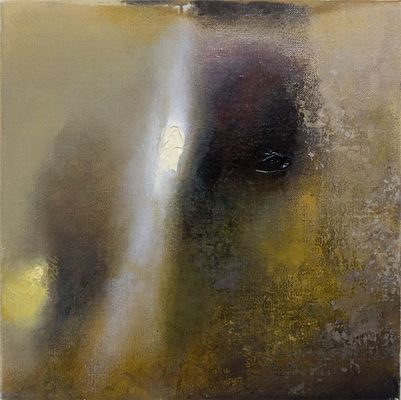
Always Will Need To Wear Winter Shirt Blue + Ochre Small Check Pattern
21 August - 21 September, 2015
Untitled
I am not a great reader of poetry but I always return to the work of Melbourne poet, Vincent Buckley (1925- 1988). Perhaps I find his most tantalising piece to be not a finished poem but a fragment left on a scrap of paper discovered on his desk after the poet’s death.
The poetry gathers like oil
In the word-core, and spreads
It has its music meet,
Its music is in movement.
This fragment is more the shell left behind from a volatile thought than a finished poem. I find the last two lines honest but awkward whereas the first two lines work like an arrow. Most likely he could not find a resolution so it was left. Still, in its present form, it remains an eloquent testimony to the ultimate failure of a medium to express mobile thought and sensation, in Buckley’s case, through verbal language. It’s an important matter because this is something all artists have to deal with regardless of the medium.
I have never written a poem, however, I am forever copying fragments from books on paper scraps in a vain effort to fix certain notions in my head. At first, they function as bookmarks that are sometimes returned to when I open the book. But before long, as they accumulate, they fall out littering the table interspersed with A4 photocopies, bills, books and medications.
To return to Buckley’s fragment, the first two lines very much evoke how I paint nowadays. As you age, detail diminishes and patches of light become more luminous and float. I feel the most honest way of dealing with this is by smearing the oil paint on the canvas with the fingers and working close-up, blind. Only if the patches coalesce into an approaching image can the work gain a life.
-
Jonathan Walker was born in Melbourne, Australia and brought up on a dairy farm in Gippsland. In the 1970’s he studied painting at RMIT and won the Harold Wright Scholarship to the British Museum, London. During the 1980’s he exhibited at Pinacotheca Gallery, Richmond and had work shown at the NGV and Heidi City Art Gallery. Over the same period he designed the cover for the “Epigenesi” LP by Giancarlo Toniutti, Italy and conducted a mail exchange work with Achim Wollscheid, Germany. The work with artists through the post resulted in an article published in the bicentenary issue of Art and Australia 1988. He showed in artist run spaces such as WestSpace in the 90’s and 2000’s, and until 2012, taught painting at Victoria University, which is where we (Colleen Ahern and Lisa Radford) as organisers of the exhibition, among many others, had the privilege of being his student.
Walker’s knowledge was imparted to students through the careful selection of music, literature, and artists found in books that he himself had ordered for the library. Walker’s strategy was the generosity of sharing his vast knowledge with references specific to each student and their context.
Walker’s paintings share a similar focus and intimacy.
This exhibition presents a small selection of recent paintings alongside a publication that includes Walker’s writing. Observational and analytical, Walker’s work is a type of material notation — the time of day, colour and how it is blended, the both specific and fleeting location of a reflection on lino or the question of whether a chair leg should be included in a painting.
Please join us on Friday August 21 between 6-8pm to celebrate the opening of the exhibition.
Curated by Colleen Ahern and Lisa Radford.
B. Wurtz
Curated by Nic Tammens
March 26 - April 4, 2015
B.Wurtz works from a basement studio in his home on Manhattan’s Lower East Side.
This local fact is attested to by the plastic shopping bags and newsprint circulars that appear in his work. As formal objects, they don’t make loud claims about their origins but nonetheless transmit street addresses and places of business from the bottom of this long thin island. Like plenty of artists, Wurtz is affected by what is local and what is consumed. His work is underpinned by this ethic. It often speaks from a neighborhood or reads like the contents of a hamper:
“BLACK PLUMS $1.29 lb.”
“Food Bazaar”
“USDA Whole Pork Shoulder Picnic 99c lb.”
“RITE AID Pharmacy, with us it’s personal.”
“H. Brickman & Sons.”
“Sweet Yams 59c lb."
Most of the work in this exhibition was made while the artist was in residence at Dieu Donne, a workshop dedicated to paper craft in Midtown. Here Wurtz fabricated assemblages with paper and objects that are relatively lightweight, with the intention that they would be easily transportable to Australia. This consideration isn’t absolute in Wurtz’s work, but was prescriptive for making the current exhibition light and cheap. Packed in two boxes, these works were sent from a USPS post office on the Lower East Side and delivered to North Melbourne by Australia Post.
Wurtz appears courtesy of Metro Pictures, New York.
Thanks to Rob Halverson, Joshua Petherick, Sari de Mallory, Matt Hinkley, Helen Johnson, Fayen d'Evie, Ask Kilmartin, Lisa Radon, Ellena Savage, Yale Union, and "Elizabeth".
John Nixon
"Archive"
December 15 - January 20, 2014
The presentation of John Nixon's archive offered a rare showcase of this extensive collection of the artist's own publications, catalogues, posters, ephemera, editions and more, from the mid 1980s onwards, alongside a selection of his artworks.
Organized by John Nixon, Joshua Petherick and Matt Hinkley.
<a href=http://wfb.public-office.info/artist/john-nixon>All titles by John Nixon
"Habitat"
at Minerva, Sydney (organised by Joshua Petherick and Matt Hinkley)
November 15 - December 20, 2014
Lupo Borgonovo, Janet Burchill & Jennifer McCamley,
Lewis Fidock, HR Giger, Piero Gilardi, Veit Laurent Kurz,
Cinzia Ruggeri, Michael E. Smith, Lucie Stahl, Daniel Weil, Wols
Press Release:
“...It contained seven objects. The slender fluted bone, surely formed for flight, surely from the wing of some large bird. Three archaic circuitboards, faced with mazes of gold. A smooth white sphere of baked clay. An age-blackened fragment of lace. A fingerlength segment of what she assumed was bone from a human wrist, grayish white, inset smoothly with the silicon shaft of a small instrument that must once have ridden flush with the surface of the skin - but the thing’s face was seared and blackened.”
William Gibson, “Count Zero”, 1986
"Autumn Projects Archive"
Curated by Liza Vasiliou
March 6 - March 15, 2014
World Food Books, in conjunction with the Virgin Australia Melbourne Fashion Festival 2014, presented the Autumn Projects archive, consisting of a selection of early examples in Australian fashion with a particular interest in collecting designers and labels from the period beginning in the 1980’s, who significantly influenced the discourse of Australian Fashion.
Curated by Liza Vasiliou, the exhibition provided a unique opportunity to view pieces by designers Anthea Crawford, Barbara Vandenberg, Geoff Liddell and labels CR Australia, Covers, Jag along with early experimental collage pieces by Prue Acton and Sally Browne’s ‘Fragments’ collection, suspended throughout the functioning World Food Books shop in Melbourne.
H.B. Peace
presented by CENTRE FOR STYLE
November 14, 2013
"Hey Blinky, you say chic, I say same"
Anon 2013
H.B. Peace is a clothing collaboration between great friends Blake Barns and Hugh Egan Westland. Their pieces explore the divergences between 'character’ and ‘personality’ in garments....etc
Special Thanks to Joshua Petherick and Matt Hinkley of WFB and Gillian Mears
and a Very Special Thank you to Audrey Thomas Hayes for her shoe collaboration.
Janet Burchill & Jennifer McCamley
"Aesthetic Suicide"
May 10 - June 8, 2013
The first of our occasional exhibitions in the World Food Books office/shop space in Melbourne, "Aesthetic Suicide" presented a body of new and older works together by artists Janet Burchill & Jennifer McCamley, including videos, prints, a wall work, and publications.
During shop open hours videos played every hour, on the hour.
2014, English
Die-cut softcover, 368 pages, (1,000 color ill.), 20 x 29.5 cm
Published by
Sternberg Press / Berlin
$130.00 $60.00 - Out of stock
Edited by Quinn Latimer and Adam Szymczyk
Since his arrival in New York in 1969, the French artist Michel Auder (b. 1945, Soissons, France) has authored more than five hundred video works that chart five decades of the medium’s history. Employing new video formats as they become available, many of which have quickly fallen into obsolescence, Auder has prolifically produced short and feature films as well as video installations and photography that transgress genres, gleaning the fields of art history, literature, commercial television, and experimental cinema. At once poetic and critical, cruel and confessional, Auder’s casually virtuosic oeuvre continues to disrupt traditional perceptual habits of moviegoers and art audiences alike, subverting notions of filmic narrative and process.
This new monograph includes “Twenty Film-Poems for M. Auder,” a series of mini-essays on selected videos by Quinn Latimer, an American poet and critic based in Basel, as well as “Portrait of the Marauder,” an extensive interview with the artist by Adam Szymczyk, director of Kunsthalle Basel. The book which also includes a catalogue raisonné of Auder’s video works, was designed by Julia Born, a Swiss graphic designer who lives and works in Berlin.
This book was conceived on the occasion of the exhibitions “Stories, Myths, Ironies, and Other Songs: Conceived, Directed, Edited, and Produced by M. Auder,” on view at Kunsthalle Basel, June 9–August 25, 2013, and curated by Adam Szymczyk; and “Michel Auder: Selected Works,” on view at Portikus, Frankfurt am Main, October 31–November 17, 2013, and curated by Sophie von Olfers.
Design by Julia Born
2014, English
softcover, 306 pages, 10.5 x 15 cm
Published by
Sternberg Press / Berlin
$45.00 $10.00 - In stock -
Contributions by Can Altay, Ayreen Anastas and Rene Gabri, Ricardo Basbaum, Céline Condorelli, Cooperativa Crater Invertido, Mark Fisher and Nina Möntmann, Daniel Foucard, Rebecca Gordon-Nesbitt, Elaine W. Ho, Annette Krauss, Mattin, Andrea Phillips, Marion von Osten, Dimitrina Sevova, Simon Sheikh, Steven Ten Thije
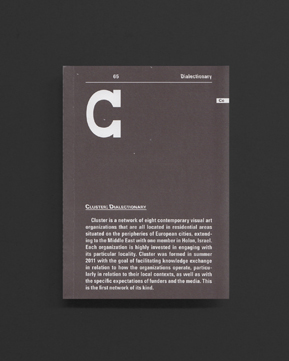
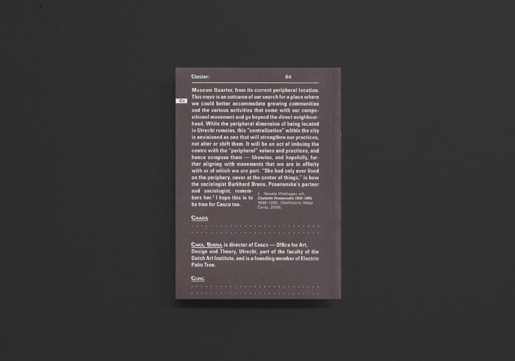
Cluster is a network of eight contemporary visual arts organizations that are each located in residential areas situated on the peripheries of European cities, extending to the Middle East with one member in Holon, Israel. Each organization is focused on commissioning, producing, and presenting contemporary art, and the nature of the work is often experimental, process-driven, involves research, is based on working with international and local artists, and often engages with diverse publics on a local level.
Compiled after a series of meetings in each organization over a period of two years, Cluster: Dialectionary aims to find new ways to position this work and the work of contemporary visual arts organizations more broadly, particularly in relation to wider social, political, and cultural concerns.
The book includes essays by Andrea Phillips, Mark Fisher and Nina Möntmann, Marion von Osten, and Cluster members. These are accompanied by a series of keywords that are drawn from the practices and experiences of the people who work at, visit, and live with the organizations. They have both been produced within the contexts of the projects that gave rise to them, as well as written especially for the publication. The contributors include Can Altay, Ayreen Anastas and Rene Gabri, Pierre Bal Blanc, Alexandre Baudelot, Ferran Barenblit, Ricardo Basbaum, Binna Choi, Céline Condorelli, Cooperativa Crater Invertido, Eyal Danon, Julien Duc-Maugé, Udi Edelman, Mark Fisher and Nina Möntmann, Daniel Foucard, Dora Garcia, Rebecca Gordon-Nesbitt, Elaine W. HO, Annette Krauss, Bojana Kunst, Maria Lind, Pablo Martinez, Mattin, Sanne Oorthuizen, Marion von Osten, Emily Pethick, Natasa Petresin-Bachelez, Andrea Phillips, Tadej Pogacar, Dimitrina Sevova, Simon Sheikh, Louise Shelley, Steven Ten Thije, Mathilde Villeneuve, and Jason Waite.
The members of Cluster are: CAC Brétigny, Brétigny-sur-Orge; Casco – Office for Art, Design and Theory, Utrecht; CA2M Centro de Arte Dos de Mayo, Móstoles, Madrid; The Israeli Center for Digital Art, Holon; Les Laboratoires d’Aubervilliers, Paris; P74 Center and Gallery, Ljubljana; The Showroom, London; and Tensta konsthall, Stockholm.
Design by Åbäke
2017, English
Softcover, 152 pages, 15.2 x 22.9 cm
Published by
The MIT Press / Massachusetts
$44.00 $10.00 - Out of stock
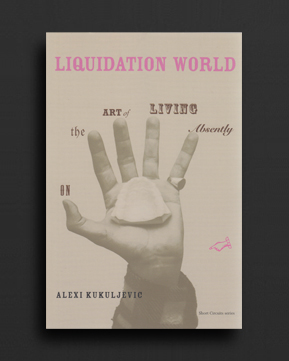
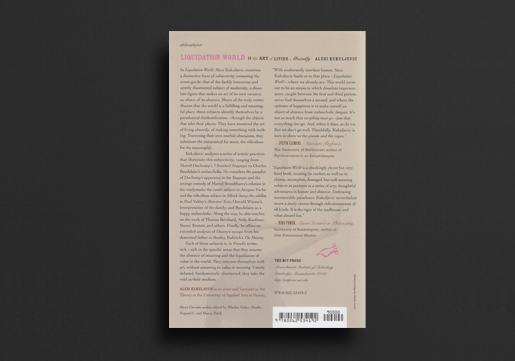
In Liquidation World, Alexi Kukuljevic examines a distinctive form of subjectivity animating the avant-garde: that of the darkly humorous and utterly disoriented subject of modernity, a dissolute figure that makes an art of its own vacancy, an object of its absence. Shorn of the truly rotten illusion that the world is a fulfilling and meaningful place, these subjects identify themselves by a paradoxical disidentification—through the objects that take their places. They have mastered the art of living absently, of making something with nothing. Traversing their own morbid obsessions, they substitute the nonsensical for sense, the ridiculous for the meaningful.
Kukuljevic analyzes a series of artistic practices that illuminate this subjectivity, ranging from Marcel Duchamp’s Three Standard Stoppages to Charles Baudelaire’s melancholia. He considers the paradox of Duchamp’s apparatus in the Stoppages and the strange comedy of Marcel Broodthaers’s relation to the readymade; the comic subject in Jacques Vaché and the ridiculous subject in Alfred Jarry; the nihilist in Paul Valéry’s Monsieur Teste; Oswald Wiener’s interpretation of the dandy; and Charles Baudelaire as a happy melancholic. Along the way, he also touches on the work of Thomas Bernhard, Andy Kaufman, Buster Keaton, and others. Finally, he offers an extended analysis of Danny’s escape from his demented father in Stanley Kubrick’s The Shining.
Each of these subjects is, in Freud’s terms, sick—sick in the specific sense that they assume the absence of meaning and the liquidation of value in the world. They concern themselves with art, without assuming its value or meaning. Utterly debased, fundamentally disoriented, they take the void as their medium.
Alexi Kukuljevic is an artist and Lecturer in Art Theory at the University of Applied Arts in Vienna.
“With exuberantly mordant humor, Alexi Kukuljevic leads us to that place—Liquidation World—where we already are. This world turns out to be an atopia in which dissolute impersonators, caught between the first and third person, never find themselves a second, and where the epitome of happiness is to make oneself an object of absence from melancholic despair. It’s not so much that everything must go—just that everything does go. And, when it does, so do we. But we don’t go well. Thankfully, Kukuljevic is here to show us the pistols and the ropes.”
—Justin Clemens, Associate Professor, The University of Melbourne; author of Psychoanalysis is an Antiphilosophy
“Liquidation World is a shockingly clever but very kind book, treating its readers as well as its clumsy, incomplete, damaged, but well-meaning subjects as partners in a series of arty, thoughtful adventures in humor and absence. Embracing innumerable paradoxes, Kukuljevic nevertheless steers a steely course through ridiculousnesses of all kinds. It is the rigor of the madhouse, and what absurd fun.”
—Nina Power, Senior Lecturer in Philosophy, University of Roehampton; author of One Dimensional Woman
2018, English
Softcover, 268 pages, 11.7 x 18.7 cm
Published by
Sternberg Press / Berlin
Ujazdowski Castle Centre for Contemporary Art / Warsaw
$49.00 $10.00 - Out of stock
“I am dead. Homicide, assassination, accident, suicide, the detectives have come up with nothing. The labels in my clothes, my fingerprints, my shoe size, everything has been unstitched, erased, wiped away, blanched, bleached, and consigned to oblivion. As the only clue, in a secret pocket sewn into my trousers, the detectives found a flimsy slip of paper torn from the pages of a book. On that folded bit of paper just two words, Tamam Shud, ‘this is the end.’ Experts, antiquarians, and opium smokers have been consulted, and all agree that these are the last two words in the Rubaiyat, an ancient collection of esoteric poems written by a Persian poet named Omar Khayyam. What the hell do I have to do with poetry, Persia, and hidden pockets? I can’t even sew on a button. My identity is still unknown and not even I remember much. This is why I have decided to investigate my own death.”
The Tamam Shud narrative emerged through a series of episodic performances and an exhibition by Alex Cecchetti at the Ujazdowski Castle Centre for Contemporary Art, Warsaw. For two years the writing process and the artistic process were interwoven, feeding each other as they evolved. The art project and the artist’s novel are linked together as much as the life of the victim is connected to the piece of paper found in his pocket.
2010, English
Softcover, 112 pages, 19.2 x 26 cm
Edition of 50,
1st Edition, Out of print title / as new
Published by
Surpllus / Melbourne
$25.00 $15.00 - Out of stock
Brad Haylock’s From Zero Form to Absolute Commodity (ZF/AC) is the artist’s book form of an ongoing project of the same name. Much of Haylock’s work interrogates the commodification of critical and avant garde practices, both contemporary and historical — in this work, Suprematism is brought into dialogue with Vogue Living (a Malevich for every home!). The book comprises a series of partially redacted found images, printed using one-colour Risography throughout. ZF/AC was produced on the occasion of the exhibition Just what is it that makes today’s interiors so seductive, so alluring?, at Light Projects, Melbourne, 18 September – 10 October 2010.
Risograph printed in an edition of 50 copies. Long out of print.
1969, German
Softcover (stapled), 41 pages, 21 x 20.5 cm
1st edition, Out of print title / used*,
Published by
Felix Handschin Galerie / Basel
$40.00 $20.00 - Out of stock
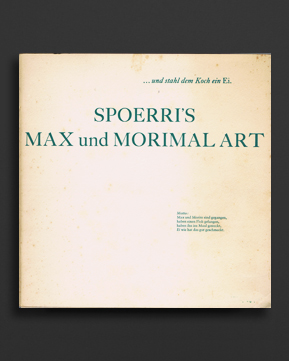
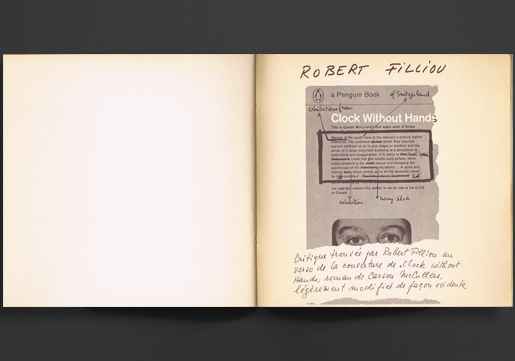
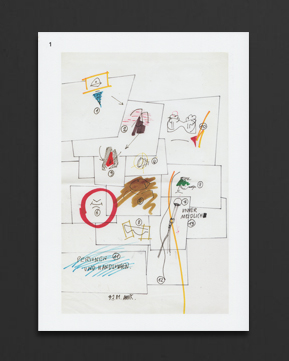
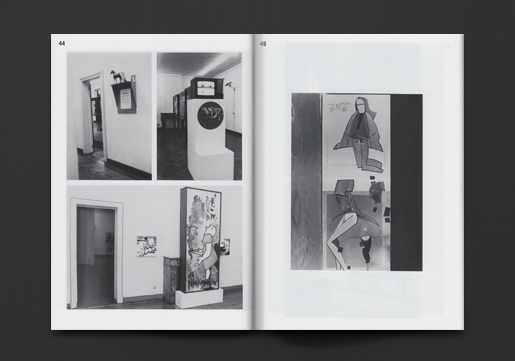
Quite a rare Daniel Spoerri catalogue published for the exhibition of the same name (Spoerri's Max and Morimal Art ...und stahl dem Koch ein Ei (And stole an egg from the cook)) at Felix Handschin Galerie, Basel, 1969. No works by Spoerri are shown in this catalog, instead, very much in Spoerri's character, he has friends and colleagues (artists, poets, collectors) contribute the contents: letters, texts, drawings by Ben Vautier, Robert Filliou, George Brecht, Bernhard luginbühl, Arturo Schwarz, Wolfgang Hahn, Klaus Honnef, Ingeborg Lüscher, Jürg Federspiel, Andre Thomkins, Carlo Schröter, Hanspeter Ricklin etc. Introduction by Spoerri. Texts in German.
Daniel Spoerri (born 27 March 1930 in Galați) is a Swiss artist and writer born in Romania. Spoerri is best known for his “snare-pictures,” a type of assemblage or object art, in which he captures a group of objects, such as the remains of meals eaten by individuals, including the plates, silverware and glasses, all of which are fixed to the table or board, which is then displayed on a wall. He also is widely acclaimed for his book, Topographie Anécdotée* du Hasard (An Anecdoted Topography of Chance), a literary analog to his snare-pictures, in which he mapped all the objects located on his table at a particular moment, describing each with his personal recollections evoked by the object, with illustrations by the great Roland Topor. In the 1950s he was active in dance, studying classical dance with Olga Preobrajenska and in 1954 becoming the lead dancer at the State Opera of Bern, Switzerland. He later staged several avant-garde plays including Ionesco’s The Bald Soprano and Picasso’s surrealist Desire Trapped by the Tail. During that period he met a number of Surrealist artists, including Meret Oppenheim, Jean Tinguely, Marcel Duchamp and Man Ray, and also a number of artists subsequently associated with the Fluxus movement, including Robert Filliou, Dieter Roth and Emmett Williams. Closely associated with the Fluxus art movement, a movement “characterized by a strongly Dadaist attitude, [whose] participants were a divergent group of individualists whose most common theme was their delight in spontaneity and humor.” It has been said that his Anecdoted Topography of Chance “seems perfectly to embody aspects of its spirit.” Spoerri was also one of the original signers of the manifesto creating the Nouveau réalisme (New Realism) art movement, which involved artists such as Yves Klein, Arman, Martial Raysse, Pierre Restany, Niki de Saint Phalle, César, Jean Tinguely, Mimmo Rotella, Gérard Deschamps, and the Ultra-Lettrists, Francois Dufrêne, Raymond Hains, Jacques de la Villeglé, an avant garde endeavor begun in 1960. His use of everyday life as the main subject-matter of his art reflects his involvement in the New Realism movement.
A major theme of Spoerri’s artwork is food, and he has called this aspect of his work “Eat Art.” This is seen not only in his snare-pictures of eaten meals, but in a variety of other contexts. For example, in 1961 he sold in an art-gallery in Copenhagen store-bought canned food which he had signed and rubber-stamped “Attention: Work of Art.” In 1963, he enacted a sort of performance art called Restaurant de la Galerie J in Paris, for which he cooked on several evenings. Art-critics took over the role of waiters, playing on the idea of the critic bringing the art to the consumers and giving them an understanding of the work. On June 18, 1968, Spoerri opened the Restaurant Spoerri in Düsseldorf, and on September 18, 1970, he opened the Eat-Art-Gallery upstairs.He also published in 1970 a diary of his life on the Greek island of Symi, in which he included numerous recipes of the dishes he ate there. Originally titled A Gastronomic Itinerary, it was later republished under the title Mythology & Meatballs.
2011, English
Softcover, 88 pages (3-colour Riso printing), 22 x 19 cm
Ed. of 500,
1st Edition, Out of print title / as new
Published by
KLTB / New York
$100.00 - In stock -
The Vestiarium Scoticum was originally published in a small edition in 1842 by brothers John Sobieski Stuart and Charles Edward Stuart, who had ingratiated themselves into Scottish society by claiming to be descendants of Bonnie Prince Charlie. The tartans featured were purportedly taken from a document from 1721 which itself was a copy of an orginal manuscript dating back to the 16th century. This was presented as historical proof of the connection between tartans and family clans, a link that previously had no record. The brothers claims were later found to be totally untrue — the Stuarts had in fact designed many of the supposedly ancient designs themselves, tartans now claimed as authentic by manufacturers and families alike.
The tartans contained within this book compiled by British artist Nick Relph were sourced from digital versions uploaded to the Vestarium Scoticum Wikipedia page in 2007 by someone calling themselves Celtus. At the time of printing, Celtus is no longer active on Wikimedia Commons (the branch of Wikipedia that handles media files) and as such is considered a 'retired editor'.
Printed on a Risograph, this edition supplements the subtractive process colors Cyan, Magenta, Yellow and Key (Black) typically used in printing with Red, Green and Blue — the components of the additive color model, the partitive mixing of the computer screen and the dominant colors of the tartans herein.
Printed and bound by Knust/Extrapool in Nijmegen, The Netherlands and Published by KLTB, Brooklyn, in an edition of 500.
Available with Red, Green or Blue covers.
2011, English
Softcover, 88 pages (3-colour Riso printing), 22 x 19 cm
Ed. of 500,
1st Edition, Out of print title / as new
Published by
KLTB / New York
$80.00 - Out of stock
The Vestiarium Scoticum was originally published in a small edition in 1842 by brothers John Sobieski Stuart and Charles Edward Stuart, who had ingratiated themselves into Scottish society by claiming to be descendants of Bonnie Prince Charlie. The tartans featured were purportedly taken from a document from 1721 which itself was a copy of an orginal manuscript dating back to the 16th century. This was presented as historical proof of the connection between tartans and family clans, a link that previously had no record. The brothers claims were later found to be totally untrue — the Stuarts had in fact designed many of the supposedly ancient designs themselves, tartans now claimed as authentic by manufacturers and families alike.
The tartans contained within this book compiled by British artist Nick Relph were sourced from digital versions uploaded to the Vestarium Scoticum Wikipedia page in 2007 by someone calling themselves Celtus. At the time of printing, Celtus is no longer active on Wikimedia Commons (the branch of Wikipedia that handles media files) and as such is considered a 'retired editor'.
Printed on a Risograph, this edition supplements the subtractive process colors Cyan, Magenta, Yellow and Key (Black) typically used in printing with Red, Green and Blue — the components of the additive color model, the partitive mixing of the computer screen and the dominant colors of the tartans herein.
Printed and bound by Knust/Extrapool in Nijmegen, The Netherlands and Published by KLTB, Brooklyn, in an edition of 500.
Available with Red, Green or Blue covers.
2011, English
Softcover, 88 pages (3-colour Riso printing), 22 x 19 cm
Ed. of 500,
1st Edition, Out of print title / as new
Published by
KLTB / New York
$80.00 - Out of stock
The Vestiarium Scoticum was originally published in a small edition in 1842 by brothers John Sobieski Stuart and Charles Edward Stuart, who had ingratiated themselves into Scottish society by claiming to be descendants of Bonnie Prince Charlie. The tartans featured were purportedly taken from a document from 1721 which itself was a copy of an orginal manuscript dating back to the 16th century. This was presented as historical proof of the connection between tartans and family clans, a link that previously had no record. The brothers claims were later found to be totally untrue — the Stuarts had in fact designed many of the supposedly ancient designs themselves, tartans now claimed as authentic by manufacturers and families alike.
The tartans contained within this book compiled by British artist Nick Relph were sourced from digital versions uploaded to the Vestarium Scoticum Wikipedia page in 2007 by someone calling themselves Celtus. At the time of printing, Celtus is no longer active on Wikimedia Commons (the branch of Wikipedia that handles media files) and as such is considered a 'retired editor'.
Printed on a Risograph, this edition supplements the subtractive process colors Cyan, Magenta, Yellow and Key (Black) typically used in printing with Red, Green and Blue — the components of the additive color model, the partitive mixing of the computer screen and the dominant colors of the tartans herein.
Printed and bound by Knust/Extrapool in Nijmegen, The Netherlands and Published by KLTB, Brooklyn, in an edition of 500.
Available with Red, Green or Blue covers.
2016, English
Softcover, 226 pages, 19 x 27 cm
Published by
Mousse / Milan
$53.00 $30.00 - Out of stock
Edited by Bettina Steinbrügge.
Texts by by Lucy Chinen, Nora N. Khan, Venus Lau, Katja Novitskova, Tobias Peper, Bettina Steinbrügge, Agatha Wara
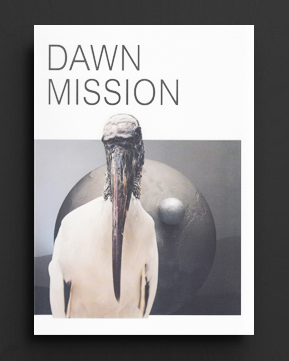
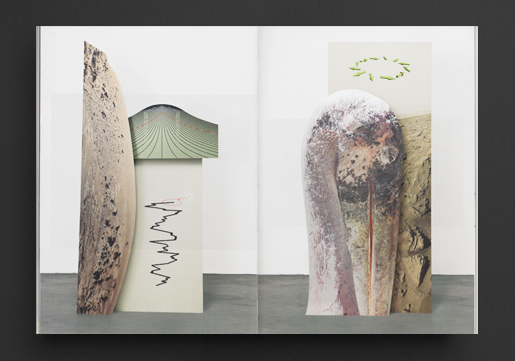
For her works, Katja Novitskova adapts images from online sources, referring to realities that lie beyond the capacities of the human eye but have long entered our lives as visual artifacts. Today, almost all aspects of human (and increasingly nonhuman) lives are registered or modeled by software on an environmental scale. Data collection and processing have transcended the limits of our planet and become the primary tools for navigating Earth and beyond. The artist book Dawn Mission explores this radically new articulation of the role of the image and how constant mediation gains an ecological dimension.
Published in conjunction with the exhibition Katja Novitskova - Dawn Mission at Kunstverein in Hamburg. April 23–July 3, 2016.
2017, English
Softcover, 144 pages, 17 x 24 cm
Published by
Sternberg Press / Berlin
Center for Contemporary Arts / Estonia
$39.00 $10.00 - Out of stock
Edited by Kati Ilves, Katja Novitskova
Texts by Kati Ilves, Nora Khan, Jaak Tomberg, Toke Lykkeberg, Venus Lau
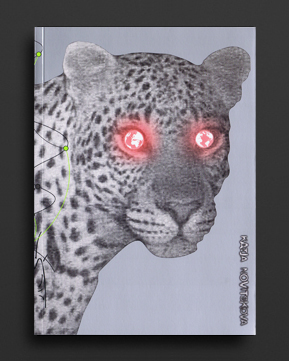
Today almost all aspects of human—and increasingly nonhuman—lives are being modeled by software. Transcending the limits of our planet, data collection has become a fundamental tool with which to map the earth and beyond. Katja Novitskova’s catalogue If Only You Could See What I’ve Seen with Your Eyes, published for the Estonian Pavilion at the 57th Venice Biennale, addresses emerging potentialities between visual culture, big-data-driven processes, and ecology. Rather than commenting on the observable moment, Novitskova transforms these visual manifestations of data into immersive environments that serve as glimpses of a world yet to come.
Copublished with the Center for Contemporary Arts, Estonia
Design by Ott Metusala
2014, English
Softcover, 188 pages, 16.5 x 22 cm
Published by
Sternberg Press / Berlin
$64.00 $15.00 - Out of stock
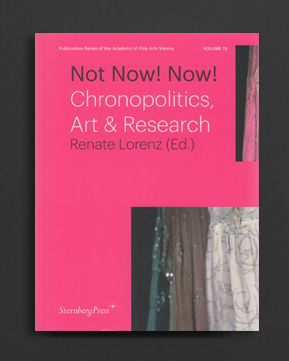
With contributions by Nana Adusei-Poku, Jamika Ajalon, Ingrid Cogne, Mathias Danbolt, Yasmine Eid-Sabbagh, Elizabeth Freeman, Mara Lee Gerdén, Sharon Hayes, Ana Hoffner, Yva Jung, Renate Lorenz, Suzana Milevska, Andrea Ray
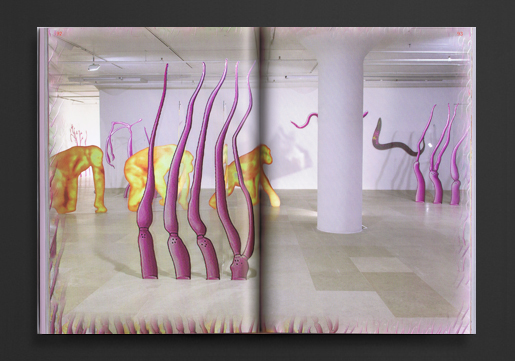
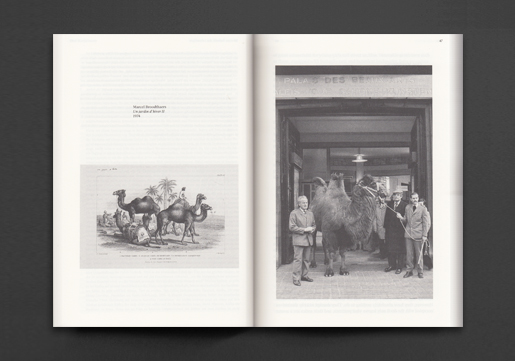
Not Now! Now! engages with the politics of time in art: historical narratives and memory, the unforeseen rhythms of time, and the challenge of visualizing time. The book connects the postcolonial and queer debate around chronopolitics with artistic strategies that introduce breaks, stutter time, use citations and anachronisms, and introduce deferrals and collapses between time and meaning.
They thus challenge orderly and rigid temporal concepts and their effects on bodies and the social. Contributions by art theorists, artists, and artistic researchers highlight how temporal norms organize our biographies and intimate relations, as well as the handling of capital or the continuation of colonial relations. The book instead suggests to focus on a particular non/moment in time: the not-now/now. It indicates a possible break in the temporal order, a meaningful gap between “not now!” and “now!” Or: the past and the future (“not now!”) uncannily but promisingly showing up “now!”
Publication Series of the Academy of Fine Arts Vienna, vol. 15
Design by Surface
2015, English / German
Softcover, 288 pages, 17 x 24 cm
Published by
Sternberg Press / Berlin
$85.00 $20.00 - Out of stock
Texts by Alain Badiou, Karen Barad, Gregory Bateson, Bruce Chatwin, Gilles Deleuze, John Dewey, John Dupré, Sergei Eisenstein, Félix Guattari, Donna Haraway, Alexandre Kojève, Osip Mandelstam, Cord Riechelmann
The question of life has always been one of modernity’s main preoccupations, but it was the advent of the camera—with its ability to record moving creatures—that initiated a new phase in the human investigation of animal behavior. In the world of contemporary art, animals now occupy center stage. Artworks such as Joseph Beuys’s I Like America and America Likes Me (1974), a weeklong performance in New York during which the artist lived with a coyote, and Rosemarie Trockel and Carsten Höller’s Haus für Schweine und Menschen at documenta X (1997), demonstrate the idea that culture, self-consciousness, and language do not exclusively belong to man. Drawing on key texts by Sergei Eisenstein, Gilles Deleuze, Félix Guattari, and Donna Haraway, and analyzing works by Pierre Huyghe, Christoph Keller, and Helen Marten, this volume brings together theory and art, showing how both turned to animals to find new ways of problematizing “life.”
The Jahresring series is edited by Brigitte Oetker and published on behalf of Kulturkreis der deutschen Wirtschaft im BDI e.V.
Design by Surface
2018, English
Softcover, 192 pages, 12.5 x 19 cm
Published by
Sternberg Press / Berlin
$30.00 - Out of stock
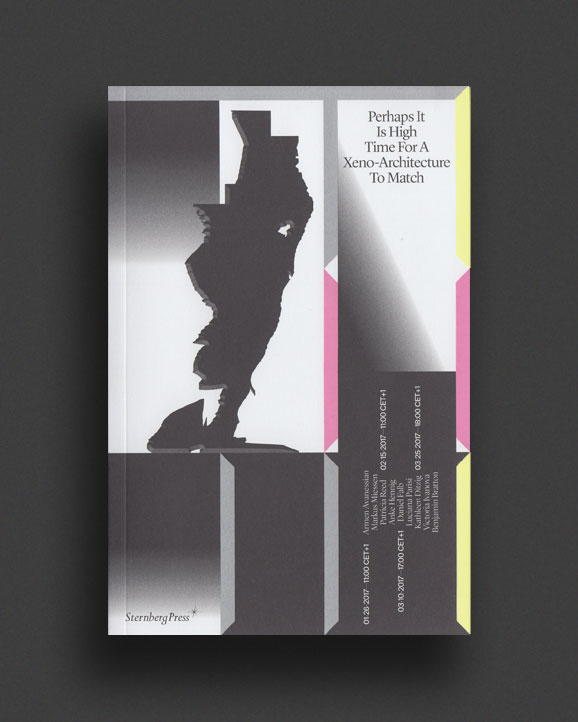
Perhaps It Is High Time for a Xeno-architecture to Match
Contributions by Armen Avanessian, Benjamin H. Bratton, Kathleen Ditzig, Daniel Falb, Anke Henning, Victoria Ivanova, Markus Miessen, Luciana Parisi, Patricia Reed
“Xeno” speaks to the turn away from “what is” toward “what could be”: the (as yet) unknown, the alien—having been employed in recent years through such speculative-political approaches as xenofeminism and xenopoetics. Perhaps It Is Time for a Xeno-architecture to Match documents a conversation series from January to March 2017 that explored what an intervention of the xeno might bring to bear on contemporary and future (infra)structure.
This book aims to unpack the prefix, probing what it entails—not merely rhetorically but also as a means of practice, in an attempt to bring the ideas it contains more concretely into the domain of architecture. It proposes to link the more philosophical discussions on the notion of xeno with questions of instrumentalization and governance that are necessarily involved in the praxis of architecture. And it relates the significance of legal architecture and technologically driven transformation in the metaphysics of law back to the agenda of xeno-architecture. By researching how architects, artists, thinkers, and activists operating in the spatial field might endorse a process of “alienation” to confront global issues, this project attempts to re-radicalize spatial practice.
Design by Metahaven
2018, English
Softcover, 304 pages, 14 x 21 cm
Published by
Valiz / Amsterdam
$43.00 $20.00 - Out of stock
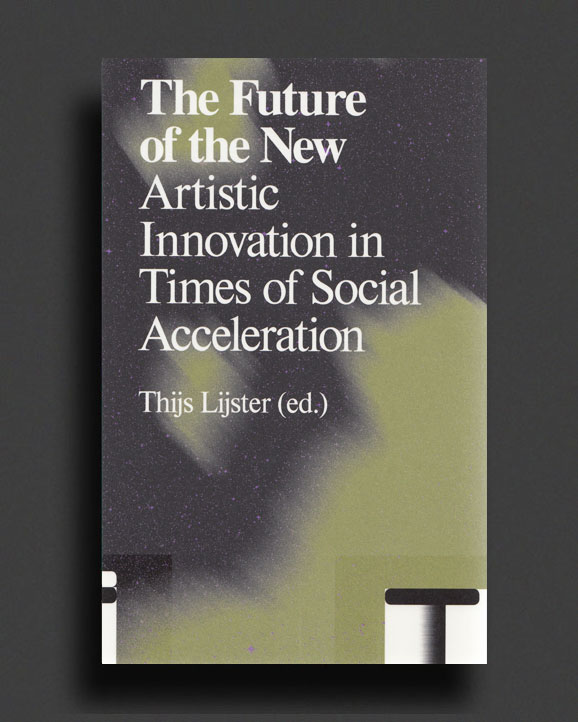
In 'The Future of the New' artists, theorists, and professionals working the art field reflect on the role of the arts in a world that is speeding up and changing through joint forces of globalization, digitization, commodification, and financialization. Can artistic innovation still function as a source of critique? How do artists, theorists, and art organizations deal with the changing role of and discourse on innovation? Should we look for alternative ways to innovate, or should we change our discourse and look for other (new!) ways to talk about the new?
Editor: Thijs Lijster
Contributors: Lietje Bauwens, Franco 'Bifo' Berardi, Robin Celikates, Wouter de Raeve, Elena Esposito, Boris Groys, Alice Haddad, Akiem Helmling, Bojana Kunst, Thijs Lijster, Suhail Malik, Benjamin Noys, Hartmut Rosa, Nick Srnicek Carolyn F. Strauss, Rolando Vázquez, Alex Williams
Design: Metahaven
1981, English
Softcover, 208 pages, 27.5 x 21.5 cm
1st Edition, Out of print title / used / average
Published by
SFMOMA / San Francisco
$50.00 $20.00 - Out of stock
Scarce and important exhibition catalogue published in conjunction with the survey exhibition held at the San Francisco Museum of Modern Art, December 21, 1979 - February 10, 1980. Edited by Suzanne Foley, this important publication traces a decade of conceptual art activity in the Bay Area, encompassing the artists, activities, spaces, performances, and periodicals, accompanied by texts and a chronology by Constance Lewallen. Includes the work of 21 artists including Lynn Hershman, Terry Fox, Paul Kos, Jim Melchert, Bonnie Sherk, Ant Farm, Tom Marioni, Howard Fried, Linda Montano, Peter D'Agostino and many other individuals and organizations. Documents the spaces Richmond Art Center, University of California at Davis, University Art Museum at Berkeley, Reese Palley Gallery, Museum of Conceptual Art, 80 Langton Street, The Floating Museum, Site, La Mamelle, and many more.
Good withdrawn ex-library copy with some associated markings and plastic covering. Some tanning and wear.
2017, English
Softcover, 206 pages, 21.5 x 28 cm
Published by
Sequence Press / New York
Sternberg Press / Berlin
$65.00 $25.00 - In stock -
Edited by Katherine Pickard, Tim Saltarelli
Contributions by John Kelsey, David Lewis, Jaleh Mansoor, Javier Sánchez Martínez, Laura Owens, Sean Paul
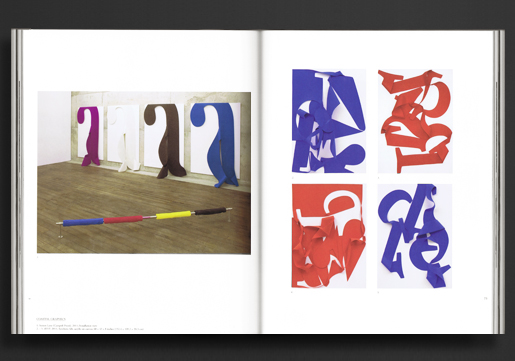
Blake Rayne’s approach to painting stems from the duplicity of words like script, folder, application, dissolve, and screen. These operative terms situate his work between forms of linguistic description and the history of reflexive material practices in art. He begins from an orientation that considers the terms painter and painting as fictions with no stable material definition. Rather, they are shaped by always-evolving social, institutional, and physical relations.
Published in conjunction with Rayne’s first survey exhibition “Cabin of the Accused” (Blaffer Art Museum, Houston, October 22, 2016–March 18, 2017), Tense and Spaced Out spans Rayne’s work over the last decade, featuring long-form essays by Sean Paul, Jaleh Mansoor, Javier Sánchez Martínez, and John Kelsey, and shorter statements by Laura Owens and David Lewis. Not confined to the role of mere catalogue, however, the publication also includes documentation of the exhibition by a group of local high-school students and a magazine dedicated to Rayne’s 2013 book-object Almanac.
Copublished with Sequence Press and Blaffer Art Museum
Design by Geoff Kaplan
2015, English
Softcover, 108 pages, 21 x 29.7 cm
Published by
Roma / Amsterdam
$37.00 $25.00 - In stock -
Collection of graphic and textual work by Anne-Mie Van Kerckhoven, dating from the seventies up till 2015. Compiled and designed by Julie Peeters, enriched with translations of facsimile material and a large amount of personal comments from the artist on the selected work. Published in conjunction with the exhibition Serving Compressed Energy with Vacuum in Kunstverein München from 25 April - 14 June 2015.
Anne-Mie van Kerckhoven (also known as AMVK) was born in Antwerp and lives in Antwerp and Berlin. She studied graphic design at the Fine Arts Academy in Antwerp and has been prolific in her output of drawings and other works on paper and synthetic material, as well as short videos, since the early eighties. Anne-Mie van Kerckhoven has been fascinated for a long time with the representation in the mass media of images of women, of interiors, of the kinetic powers of any kind of language. She investigates supra-moral connections in contemporary society s.a. between sex and technology. Her work connects different knowledge systems, explores the areas of the unconscious, and looks at moral aberrations or the obscene from a female point of view. In the nineties, hand-made paper works gave way to computer graphics, while text has always featured alongside images, underlining the message of Van Kerckhoven’s proud, sometimes exhibitionist female figures like song-lyrics. Music plays an important role in Van Kerchkoven’s creative production in parallel to her visual output, and she and Danny Devos have stood as a key pair of the Antwerp experimental music scene under the band name Club Moral (1981–now). Since 1982 she is represented by Zeno X Gallery in Antwerp, Belgium. And since 1999 also by Galerie Barbara Thumm in Berlin.
Since 2005 she is working on a conceptual and pictorial trialogue between the mystic Marguerite Porete, the hermetic Giordano Bruno and the philosopher Herbert Marcuse.
In 2015 she will be the subject of two major solo shows at Kunstverein München and Castillo/Corrales, Paris c/o Yale Union, Portland.
2018, English
Softcover, 179 pages, 22 x 28 cm
Published by
A+A / Melbourne
$35.00 $20.00 - Out of stock
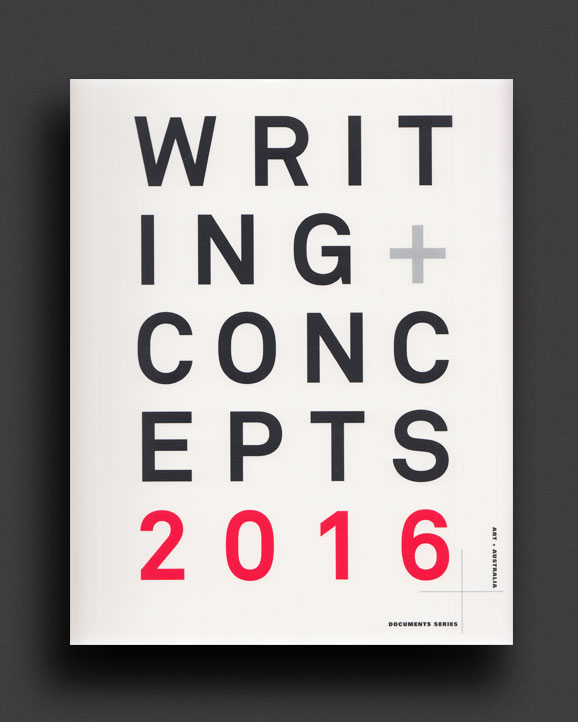
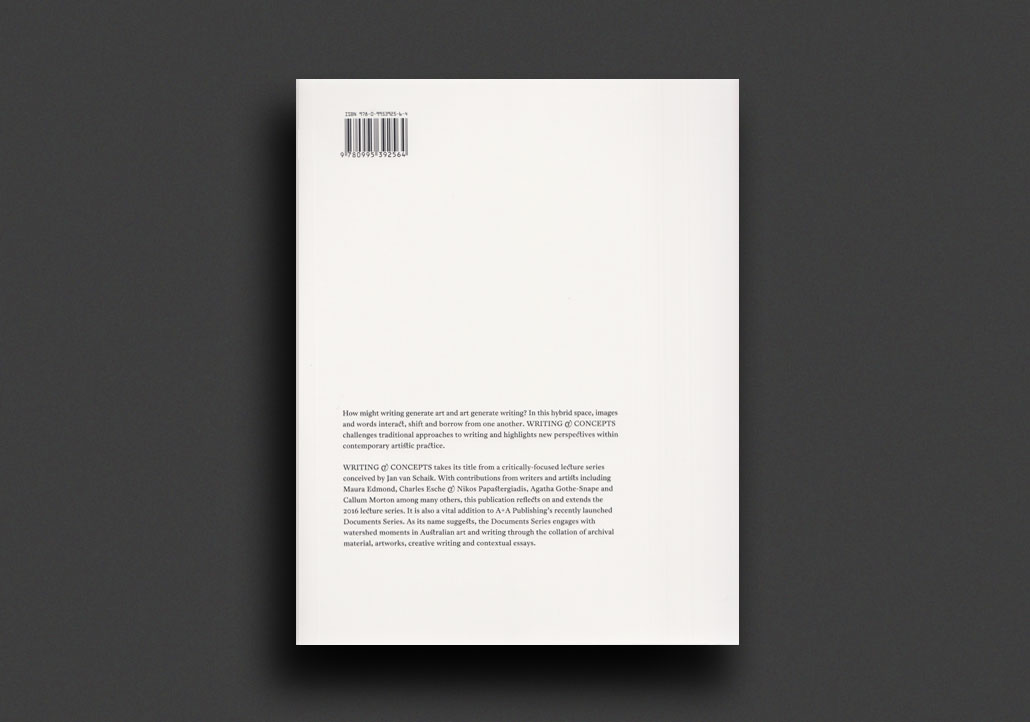
WRITING & CONCEPTS follows a public lecture series reflecting on the relationship between the process of writing and the development of social, political and philosophical questions within contemporary arts and cultural practice. This publication will contribute to the discourse around how we read and write art history in Australia.
WRITING & CONCEPTS offers contributors the opportunity to reflect on, and develop, the nature of their practice by promoting writing as a tool of reflection and inquiry and is designed to explore the potential of writing as both a process and an outcome. The group of contributors is made up of practitioners for whom the written form is their primary professional output and practitioners whose work manifests as creative works, exhibitions or events within the domain of contemporary art.
Contributers : Leon van Schaik, Hannah Bertram, Robert Nelson, Nikos Pantazopoulos, Kelly Fliedner, Jessie Bullivant, Esther Anatolitis, Susan Jacobs, Phip Murray, Lisa Radford, Maura Edmond, Helen Johnson, Pia Ednie-Brown, Tom Nicholson, Callum Morton, Agatha Gothe-Snape & Brian Fuata, Helen Grogan, Justin Clemens, Emile Zile, Lou Hubbard, Nella Themelios & Ricarda Bigolin, Nikos Papastergiadis
Editor: Edward Colless
Authors: Jan van Schaik, Grace McQuilten, Caitlin Patane
A+A Publishing, Art + Australia’s small book imprint, has been established to provide a new platform for critical writing around contemporary art and culture and to consider new ways of writing and reading art history. Publications out of A+A Publishing are specifically conceived to to provoke debate about significant moments in the development of art in this country and to bring aspects of Australian visual culture to light, for both local and international audiences.
2011, English/German
Softcover, 112 pages, 21 x 16 cm
Edition of 500,
Published by
Künsterhaus Bethanien / Berlin
$20.00 - In stock -
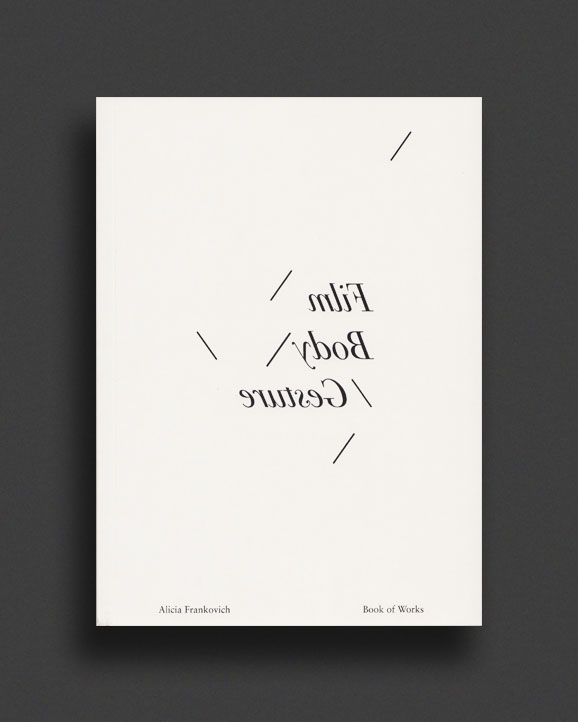
Published by the Künstlerhaus Bethanien following Alicia Frankovich's 12 month Berlin residency, Film/Body/Gesture: Book of Works is the first major survey of New Zealand-born artist Alicia Frankovich. Many works (predominantly in performance, sculpture and film) are illustrated throughout, alongside a text by Dominic Eichler and an interview by Francesca Boenzi, both in German and English.
Designed by Alicia Frankovich and Bijan Dawallu and published in an edition of 500.
2014, English
Hardcover, 155 pages, 18 x 23 cm
Published by
IMA / Brisbane
MUMA / Victoria
$25.00 - In stock -
First major monograph on the work of Australian artist Stuart Ringholt, published by Monash University Museum of Art and The Institute of Modern Art.
As part of his diverse artistic practice, Stuart Ringholt leads audiences on naturist gallery tours, anger workshops, and participatory performances that invoke embarrassment, fear, laughter, and love. He also makes videos, absurdist sculptures, painted mirrors, and collages.
Ringholt has had solo exhibitions at institutions such as Monash University Museum of Art, Melbourne; the Australian Centre for Contemporary Art, Melbourne; and Club Laundromat, New York. His major group exhibitions include Melbourne Now, National Gallery of Victoria, Melbourne (2014); The Last Laugh, apexart, New York (2013); and dOCUMENTA 13, Kassel, Germany (2013). He is currently a PhD candidate at Monash University and is represented by Milani Gallery, Brisbane.
Kraft features contributions by Amelia Barikin, Aileen Burns, Carolyn Christov-Bakargiev, Charlotte Day Robert Leonard, Johan Lundh, and Stuart Ringholt.
2018, English
Softcover, 216 pages, 19 x 12 cm
Published by
IMA / Brisbane
$30.00 - Out of stock
Rex Butler is one of Australia’s most significant critics. Double Displacement provides a comprehensive survey of Butler’s texts on art from Queensland. Collecting pieces on major contemporary artists such as Gordon Bennett, Tracey Moffatt, and Richard Bell, as well as reflection on historical figures like Ian Fairweather, the volume also contains a series of extended reviews of key events such as the Asia Pacific Triennial in which Butler attempts to come to terms with what, if anything, defines contemporary art. Ranging from newspaper reviews to densely argued philosophical investigations, the texts collected in Double Displacement are essential reading for anyone interested in the last three decades of Australian art.
Introduction by Helen Hughes and Francis Plagne.
2005, English
Softcover, 308 pages, 25 x 21 cm
Published by
IMA / Brisbane
$45.00 - In stock -
Radical Revisionism is a sequel to What Is Appropriation?, also selected and edited by Rex Butler. Radical Revisionism gathers important recent writings on Australian art. These writings are ‘revisionist’ insofar as they seek to bring a series of present-day perspectives to the study of art of the past: feminism, post-colonialism, the overturning of the legal doctrine of terra nullius. Radical Revisionism asks: What is the proper role for art history? Is it merely to chronicle the truth of the past, or is it to actively intervene in the events it records? These questions obviously bear a relationship to the ‘history wars’ that raged throughout the 1990s in Australia. The anthology concludes by asking whether there can in fact be a history of ‘Australian’ art in which white and indigenous artists come together. It proposes that the twenty-first century will be characterised by a certain ‘unAustralian’ history of Australian art.
Radical Revisionism features a substantial introduction by Rex Butler and essays by Leonard Bell, Peter Beilharz, Tim Bonyhady, Kate Briggs, Keith Broadfoot, Ian Burn, Paul Carter, Brenda L. Croft, Mary Eagle,
Ross Gibson, Anne Gray, Richard Haese, Jeanette Hoorn, Joan Kerr, John Lechte, Nigel Lendon, Chris McAuliffe, Ian McLean, Charles Merewether, Catriona Moore, Djon Mundine, Ian North, Juliette Peers, Toni Ross, Bernard Smith, Virginia Spate, Ann Stephen, and Nicholas Thomas.
2001, English
Softcover (w. French flaps), 256 pages, 21.2 x 32 cm
1st Edition, Out of print title / used / very good
Published by
Holzwarth / Berlin
$350.00 $150.00 - Out of stock
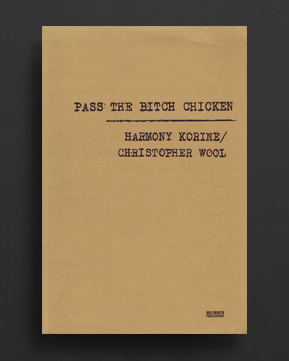
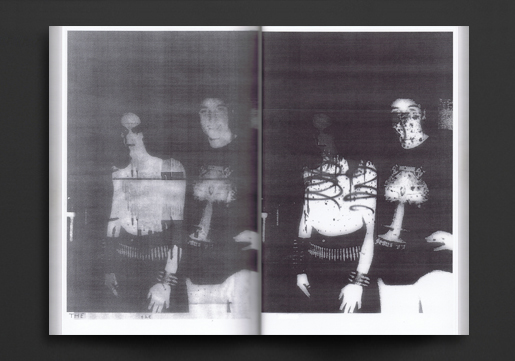
First, collectible edition. The result of a collaboration between the filmmaker Harmony Korine and the painter Christopher Wool, this series of experimental images tests the limits of the pictorial and the abstract, pushing the boundaries of visual and textual narrative to extremes. Korine’s photographs form the basis of an intense process of layering, drawing, overprinting and photocopying as each image is passed back and forth between the artists until the images are reduced to ghostly shadows beneath a barrage of scumbled dot-screens, random patterning and symbolic blurs and drips. Gradually the fragmented, distorted images serially mutate, attacked by a combination of mechanical and human processes, yet despite the violence exerted upon it, a vestige of narrative always survives.
Harmony Korine was born in Bolinas, California in 1974. At 19, he wrote the screenplay for Kids, directed by Larry Clark, and later wrote and directed Gummo, which won awards at the Venice and Rotterdam film festivals, and Julian Donkey-Boy, which won an award for best art direction at the Gijon International Film Festival in Spain. He is the author of the novel A Crack Up at the Race Riots.
Christopher Wool was born and brought up in Chicago. In the early 1970s he moved to New York, where he studied painting intermittently and worked as an assistant to the artist Joel Shapiro. His first show was at the Cable Gallery, New York, in 1984. Since then he has exhibited internationally, including the 1989 Whitney Biennial, Documenta9, Birth of the Cool, the Museum of Contemporary Art in Los Angeles, Kunsthalle Basel and the Secession Gallery in Vienna.
Very Good - Fine.