World Food Books' programme is largely produced on Kulin Nation land. We acknowledge the Wurundjeri people of the Kulin Nation as the first and continuing custodians of this land, and pay respect to their Elders past, present, and emerging.
World Food Books is an arts and special interests bookshop in Naarm / Melbourne. Founded in 2010, World Food Books is devoted to the presentation of a rotating, hand-selection of international art, design, literary and counterculture publications with an emphasis on the anti-traditional, the experimental, the avant-garde, the heretic, the marginal.
Presenting new titles alongside rare and out-of-print books, catalogues and journals spanning the fields of modern and contemporary art, design, photography, illustration, film, literature, poetry, cultural theory, philosophy, sexuality, popular and underground culture in its many radical forms, World Food Books wishes to encourage adventurous, thoughtful and open-minded reading, looking, writing, and exchange of publishing and ideas, both current and historical.
As well as our bookshop, located in Melbourne's historical Nicholas Building, all of our inventory is available internationally via our online mail-order service.
World Food Books semi-regularly co-ordinates "Occasions", a programme of exhibits and events at the bookshop and in partnership with other hosts (such as museums and art galleries) that develop out of the activities, relationships and content of the bookshop itself.
World Food Books
The Nicholas Building
37 Swanston Street
Room 5, Level 6
Melbourne 3000
Australia
SHOP HOURS:
Thu–Fri 12–6, Sat 12–5
WEB-SHOP OPEN 24/7
World Food Books
Postal Address:
PO Box 435
Flinders Lane
Victoria 8009
Australia
Art
Theory / Essay
Architecture / Interior
Graphic Design / Typography
Photography
Fashion
Eros
LGBTQ+
Fiction / Poetry
Weird / Speculative / Science Fiction / Horror
Transgressive / Visceral / Abject
Symbolism / Decadence / Fin de siècle
Film / Video
Painting
Sculpture / Installation
Performance / Dance / Theater
Drawing
Sound / Music
Curatorial
Group Shows / Collections
Periodicals
Out-of-print / Rare
Posters / Ephemera / Discs
Signed Books
World Food Books Gift Voucher
World Food Book Bag
Australian Art
Australian Fiction
Australian Science Fiction / Speculative Fiction
Australian Poetry
Australian Photography
Japanese Photography
Conceptual Art
Minimal Art
Dada
'Pataphysics / Oulipo
Fluxus
Concrete Poetry
Pop Art
Surrealism
Arte Povera
Arte Informale / Haute Pâte / Tachism
Nouveau Réalisme / Zero / Kinetic
Situationism / Lettrism
Collage / Mail Art / Xerox Art
Art Brut / Folk / Visionary / Fantastic
Illustration / Graphic Art / Bandes Dessinées
Furniture
Italian Radical Design / Postmodernism
Textiles
Ceramics / Glass
Counterculture
Protest / Revolt
Philosophy
Psychoanalysis
Anthropology
Anarchism
Socialism / Anarchism / Communism / Capitalism
Literary Theory / Semiotics / Language
Feminism / Women's Studies
Gender Studies / Sexuality
Anthropology
Fetishism / BDSM
Drugs / Psychedelia
Crime / Violence
Animal Rights / Veganism
Occult / Esoterica
Ecology / Earth / Alternative Living
Whole Earth / Crafts
All prices in AUD (Australian dollars)
Pick-Ups
Pick-up orders can be collected in our bookshop during opening hours after order date. Please collect any Pick-up orders within 2 weeks of ordering as we have limited storage space. Orders will be released back into stock if not collected within this time. No refunds can be made for pick-ups left un-collected. If you cannot make it in to the bookshop in this time-frame, please choose postage option.
Return Policy
All sales are final. We do accept returns (for refund or exchange) for items received in error. All our orders are packed with special care using heavy-duty padding and cardboard book-mailers or bubble mailers (for smaller books), using reinforcement where required. We cannot take responsibility for any lost, stolen or damaged parcels.
Insurance
Should you wish to insure your package, please email us directly after placing your order and we can organise this at a small extra expense. Although all standard/express tracked packages are very safe and dependable, we cannot take responsibility for any lost, stolen or damaged parcels. We recommend insurance on valuable orders.
Interested in selling your old books, catalogues, journals, magazines, comics, fanzines, ephemera? We are always looking for interesting, unusual and out-of-print books to buy. We only buy books in our fields of interest and specialty, and that we feel we can resell.
We base these prices on desirability, market value, in-print prices, condition and our current stock levels. We offer cash, store credit, and can take stock on consignment. All
about 25% of the price we expect to get when we sell them, or 30% in store credit. We base these prices on desirability, market value, in-print prices, condition and our current stock levels.
Sell your books any day of the week. You can drop them off and return later. If you have a lot of books, we can visit your Sydney home.
We buy books that we feel we can resell. We offer about 25 % of the price we expect to get when we sell them, or 30% in store credit. We base these prices on desirability, market value, in-print prices, condition and our current stock levels.
Philadelphia Wireman
03 August - 01 September, 2018
World Food Books is proud to announce our next Occasion, the first presentation of sculptures by Philadelphia Wireman in Australia.
The Philadelphia Wireman sculptures were found abandoned in an alley off Philadelphia’s South Street on trash night in 1982. Their discovery in a rapidly-changing neighbourhood undergoing extensive renovation, compounded with the failure of all attempts to locate the artist, suggests that the works may have been discarded after the maker’s death. Dubbed the "Philadelphia Wireman" during the first exhibition of this work, in 1985, the maker’s name, age, ethnicity, and even gender remain uncertain. The entire collection totals approximately 1200 pieces, all intricately bound together with tightly-wound heavy-gauge wire (along with a few small, abstract marker drawings, reminiscent both of Mark Tobey and J.B. Murry). The dense construction of the work, despite a modest range of scale and materials, is singularly obsessive and disciplined in design: a wire armature or exoskeleton firmly binds a bricolage of found objects including plastic, glass, food packaging, umbrella parts, tape, rubber, batteries, pens, leather, reflectors, nuts and bolts, nails, foil, coins, toys, watches, eyeglasses, tools, and jewellery.
Heavy with associations—anthropomorphic, zoomorphic, and socio-cultural responses to wrapped detritus—the totemic sculptures by Philadelphia Wireman have been discussed in the context of work created to fulfil the shamanistic needs of alternative religions in American culture. Curators, collectors, and critics have variously compared certain pieces to sculpture from Classical antiquity, Native American medicine bundles, African-American memory jugs, and African fetish objects. Reflecting the artist’s prolific and incredibly focused scavenging impulse, and despite—or perhaps enhanced by—their anonymity, these enigmatic objects function as urban artefacts and arbiters of power, though their origin and purpose is unknown. Philadelphia Wireman, whatever their identity, possessed an astonishing ability to isolate and communicate the concepts of power and energy through the selection and transformation of ordinary materials. Over the course of the past two decades, this collection has come to be regarded as an important discovery in the field of self-taught art and vernacular art.
Presented in collaboration with Fleisher-Ollman Gallery, Philadelphia, and Robert Heald, Wellington.
Susan Te Kahurangi King
02 February - 10 March, 2018
Susan Te Kahurangi King (24 February 1951 - ) has been a confident and prolific artist since she was a young child, drawing with readily available materials - pencils, ballpoint pens and felt-tip markers, on whatever paper is at hand. Between the ages of four and six Susan slowly ceased verbal communication. Her grandparents William and Myrtle Murphy had developed a special bond with Susan so they took on caring responsibilities for extended periods. Myrtle began informally archiving her work, carefully collecting and storing the drawings and compiling scrapbooks. No drawing was insignificant; every scrap of paper was kept. The King family are now the custodians of a vast collection containing over 7000 individual works, from tiny scraps of paper through to 5 meter long rolls.
The scrapbooks and diaries reveal Myrtle to be a woman of great patience and compassion, seeking to understand a child who was not always behaving as expected. She encouraged Susan to be observant, to explore her environment and absorb all the sights and sounds. Myrtle would show Susan’s drawings to friends and people in her community that she had dealings with, such as shopkeepers and postal workers, but this was not simply a case of a grandmother’s bias. She recognised that Susan had developed a sophisticated and unique visual language and sincerely believed that her art deserved serious attention.
This was an unorthodox attitude for the time. To provide some context, Jean Dubuffet coined the term Art Brut in 1945 to describe work created by self-taught artists – specifically residents of psychiatric institutions and those he considered to be visionaries or eccentrics. In 1972 Roger Cardinal extended this concept by adopting the term Outsider Art to describe work made by non-academically trained artists operating outside of mainstream art networks through choice or circumstance. Susan was born in Te Aroha, New Zealand in 1951, far from the artistic hubs of Paris and London that Dubuffet and Cardinal operated in. That Myrtle fêted Susan as a self-taught artist who deserved to be taken seriously shows how progressive her attitudes were.
Susan’s parents Doug and Dawn were also progressive. Over the years they had consulted numerous health practitioners about Susan’s condition, as the medical establishment could not provide an explanation as to why she had lapsed into silence. Dawn educated herself in the field of homeopathy and went on to treat all twelve of her children using these principles – basing prescriptions on her observations of their physical, mental and emotional state.
Doug was a linguist with an interest in philosophy who devoted what little spare time he had to studying Maori language and culture. To some extent their willingness to explore the fringes of the mainstream made them outsiders too but it was their commitment to living with integrity and their respect for individuality that ensured Susan’s creativity was always encouraged.
Even though Susan’s family supported her artistic pursuits, some staff in schools and hospitals saw it as an impediment to her assimilation into the community and discouraged it in a variety of ways. Her family was not always aware of this and therefore did not fully understand why Susan stopped drawing in the early 1990s. However, rather than dwell on the challenges that Susan faced in pursuit of her artistic practice, they prefer to highlight her achievements. In 2008 Susan began drawing again in earnest, after an almost 20 year interruption, and her work is now shown in galleries around the world.
Susan grew up without television and has been heavily influenced by the comics she read as a child. She is absolutely fearless in the appropriation of recognizable characters, such as Donald Duck and Mickey Mouse, in her work. She twists their limbs, contorts their faces, compresses them together, blends them into complex patterned backgrounds - always imbuing them with an incredible energy. Although Susan often used pop culture characters in her work they are not naive or childlike. These are drawings by a brilliant self-taught artist who has been creating exceptional work for decades without an audience in mind.
Mladen Stilinović
"Various Works 1986 - 1999"
02 February 16 - September 10, 2016
Various works 1986 - 1999, from two houses, from the collections of John Nixon, Sue Cramer, Kerrie Poliness, Peter Haffenden and Phoebe Haffenden.
Including: Geometry of Cakes (various shelves), 1993; Poor People’s Law (black and white plate), 1993; White Absence (glasses, ruler, set square, silver spoon, silver ladel with skin photograph and wooden cubes), 1990-1996; Exploitation of the Dead (grey and red star painting, wooden painting, black spoon with red table, red plate), 1984-1990; Money and Zeros (zero tie, paintings made for friends in Australia (Sue, John, Kerrie), numbers painting), 1991-1992; Words - Slogans (various t-shirts) - “they talk about the death of art...help! someone is trying to kill me”, “my sweet little lamb”, “work is a disease - Karl Marx”; Various artist books, catalogues, monographs, videos; Poster from exhibition Insulting Anarchy; "Circular" Croatian - Australian edition; Artist book by Vlado Martek (Dostoyevsky); more.
Thanks to Mladen Stilinović and Branka Stipančić.
Jonathan Walker
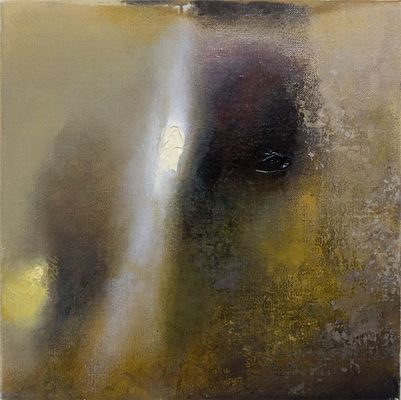
Always Will Need To Wear Winter Shirt Blue + Ochre Small Check Pattern
21 August - 21 September, 2015
Untitled
I am not a great reader of poetry but I always return to the work of Melbourne poet, Vincent Buckley (1925- 1988). Perhaps I find his most tantalising piece to be not a finished poem but a fragment left on a scrap of paper discovered on his desk after the poet’s death.
The poetry gathers like oil
In the word-core, and spreads
It has its music meet,
Its music is in movement.
This fragment is more the shell left behind from a volatile thought than a finished poem. I find the last two lines honest but awkward whereas the first two lines work like an arrow. Most likely he could not find a resolution so it was left. Still, in its present form, it remains an eloquent testimony to the ultimate failure of a medium to express mobile thought and sensation, in Buckley’s case, through verbal language. It’s an important matter because this is something all artists have to deal with regardless of the medium.
I have never written a poem, however, I am forever copying fragments from books on paper scraps in a vain effort to fix certain notions in my head. At first, they function as bookmarks that are sometimes returned to when I open the book. But before long, as they accumulate, they fall out littering the table interspersed with A4 photocopies, bills, books and medications.
To return to Buckley’s fragment, the first two lines very much evoke how I paint nowadays. As you age, detail diminishes and patches of light become more luminous and float. I feel the most honest way of dealing with this is by smearing the oil paint on the canvas with the fingers and working close-up, blind. Only if the patches coalesce into an approaching image can the work gain a life.
-
Jonathan Walker was born in Melbourne, Australia and brought up on a dairy farm in Gippsland. In the 1970’s he studied painting at RMIT and won the Harold Wright Scholarship to the British Museum, London. During the 1980’s he exhibited at Pinacotheca Gallery, Richmond and had work shown at the NGV and Heidi City Art Gallery. Over the same period he designed the cover for the “Epigenesi” LP by Giancarlo Toniutti, Italy and conducted a mail exchange work with Achim Wollscheid, Germany. The work with artists through the post resulted in an article published in the bicentenary issue of Art and Australia 1988. He showed in artist run spaces such as WestSpace in the 90’s and 2000’s, and until 2012, taught painting at Victoria University, which is where we (Colleen Ahern and Lisa Radford) as organisers of the exhibition, among many others, had the privilege of being his student.
Walker’s knowledge was imparted to students through the careful selection of music, literature, and artists found in books that he himself had ordered for the library. Walker’s strategy was the generosity of sharing his vast knowledge with references specific to each student and their context.
Walker’s paintings share a similar focus and intimacy.
This exhibition presents a small selection of recent paintings alongside a publication that includes Walker’s writing. Observational and analytical, Walker’s work is a type of material notation — the time of day, colour and how it is blended, the both specific and fleeting location of a reflection on lino or the question of whether a chair leg should be included in a painting.
Please join us on Friday August 21 between 6-8pm to celebrate the opening of the exhibition.
Curated by Colleen Ahern and Lisa Radford.
B. Wurtz
Curated by Nic Tammens
March 26 - April 4, 2015
B.Wurtz works from a basement studio in his home on Manhattan’s Lower East Side.
This local fact is attested to by the plastic shopping bags and newsprint circulars that appear in his work. As formal objects, they don’t make loud claims about their origins but nonetheless transmit street addresses and places of business from the bottom of this long thin island. Like plenty of artists, Wurtz is affected by what is local and what is consumed. His work is underpinned by this ethic. It often speaks from a neighborhood or reads like the contents of a hamper:
“BLACK PLUMS $1.29 lb.”
“Food Bazaar”
“USDA Whole Pork Shoulder Picnic 99c lb.”
“RITE AID Pharmacy, with us it’s personal.”
“H. Brickman & Sons.”
“Sweet Yams 59c lb."
Most of the work in this exhibition was made while the artist was in residence at Dieu Donne, a workshop dedicated to paper craft in Midtown. Here Wurtz fabricated assemblages with paper and objects that are relatively lightweight, with the intention that they would be easily transportable to Australia. This consideration isn’t absolute in Wurtz’s work, but was prescriptive for making the current exhibition light and cheap. Packed in two boxes, these works were sent from a USPS post office on the Lower East Side and delivered to North Melbourne by Australia Post.
Wurtz appears courtesy of Metro Pictures, New York.
Thanks to Rob Halverson, Joshua Petherick, Sari de Mallory, Matt Hinkley, Helen Johnson, Fayen d'Evie, Ask Kilmartin, Lisa Radon, Ellena Savage, Yale Union, and "Elizabeth".
John Nixon
"Archive"
December 15 - January 20, 2014
The presentation of John Nixon's archive offered a rare showcase of this extensive collection of the artist's own publications, catalogues, posters, ephemera, editions and more, from the mid 1980s onwards, alongside a selection of his artworks.
Organized by John Nixon, Joshua Petherick and Matt Hinkley.
<a href=http://wfb.public-office.info/artist/john-nixon>All titles by John Nixon
"Habitat"
at Minerva, Sydney (organised by Joshua Petherick and Matt Hinkley)
November 15 - December 20, 2014
Lupo Borgonovo, Janet Burchill & Jennifer McCamley,
Lewis Fidock, HR Giger, Piero Gilardi, Veit Laurent Kurz,
Cinzia Ruggeri, Michael E. Smith, Lucie Stahl, Daniel Weil, Wols
Press Release:
“...It contained seven objects. The slender fluted bone, surely formed for flight, surely from the wing of some large bird. Three archaic circuitboards, faced with mazes of gold. A smooth white sphere of baked clay. An age-blackened fragment of lace. A fingerlength segment of what she assumed was bone from a human wrist, grayish white, inset smoothly with the silicon shaft of a small instrument that must once have ridden flush with the surface of the skin - but the thing’s face was seared and blackened.”
William Gibson, “Count Zero”, 1986
"Autumn Projects Archive"
Curated by Liza Vasiliou
March 6 - March 15, 2014
World Food Books, in conjunction with the Virgin Australia Melbourne Fashion Festival 2014, presented the Autumn Projects archive, consisting of a selection of early examples in Australian fashion with a particular interest in collecting designers and labels from the period beginning in the 1980’s, who significantly influenced the discourse of Australian Fashion.
Curated by Liza Vasiliou, the exhibition provided a unique opportunity to view pieces by designers Anthea Crawford, Barbara Vandenberg, Geoff Liddell and labels CR Australia, Covers, Jag along with early experimental collage pieces by Prue Acton and Sally Browne’s ‘Fragments’ collection, suspended throughout the functioning World Food Books shop in Melbourne.
H.B. Peace
presented by CENTRE FOR STYLE
November 14, 2013
"Hey Blinky, you say chic, I say same"
Anon 2013
H.B. Peace is a clothing collaboration between great friends Blake Barns and Hugh Egan Westland. Their pieces explore the divergences between 'character’ and ‘personality’ in garments....etc
Special Thanks to Joshua Petherick and Matt Hinkley of WFB and Gillian Mears
and a Very Special Thank you to Audrey Thomas Hayes for her shoe collaboration.
Janet Burchill & Jennifer McCamley
"Aesthetic Suicide"
May 10 - June 8, 2013
The first of our occasional exhibitions in the World Food Books office/shop space in Melbourne, "Aesthetic Suicide" presented a body of new and older works together by artists Janet Burchill & Jennifer McCamley, including videos, prints, a wall work, and publications.
During shop open hours videos played every hour, on the hour.
1990, English
Softcover, 32 pages, 21 x 29.5 cm
1st Edition, Out of print title / used / very good
Published by
University of Melbourne / Melbourne
$25.00 - Out of stock
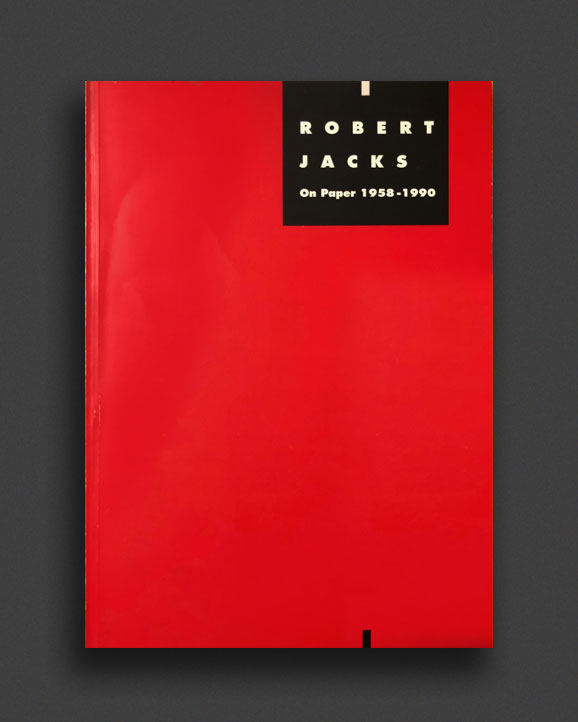
Published by the University of Melbourne in 1990, this catalogue celebrates Australian artist Robert Jacks's commitment to abstraction as well as his works' "authority and formal quality, suggestive colours and sensitivity". Forward by Frances Lindsay, expansive text by Simeon Kronenberg, written in 1989. Illustrated throughout (in colour and b&w) with Jacks' many works on paper using pencil, watercolour, gouache, collage, cut paper, stamps and ink. Includes biography and exhibition history.
Robert Jacks (born 1943) is an Australian painter, sculptor and printmaker.
In 1966 he had his first solo exhibition at Gallery A, Melbourne from which a work was purchased for the collection of the National Gallery of Victoria. In 1968, he participated in ‘The Field’ an extremely influential exhibition at the new National Gallery of Victoria, which effectively launched colour field abstraction in Australia.
"I think my work has always been minimal and abstract because when I was being taught sculpture, it was expressed in abstract terms. Form in space, mass and volume - that sort of thing. Painting, for me, is an extension of sculptural ideas."
2019, English
Hardcover (w. dust jacket), 340 pages, 17.8 x 24 cm
Published by
The MIT Press / Massachusetts
$76.00 $69.00 - Out of stock
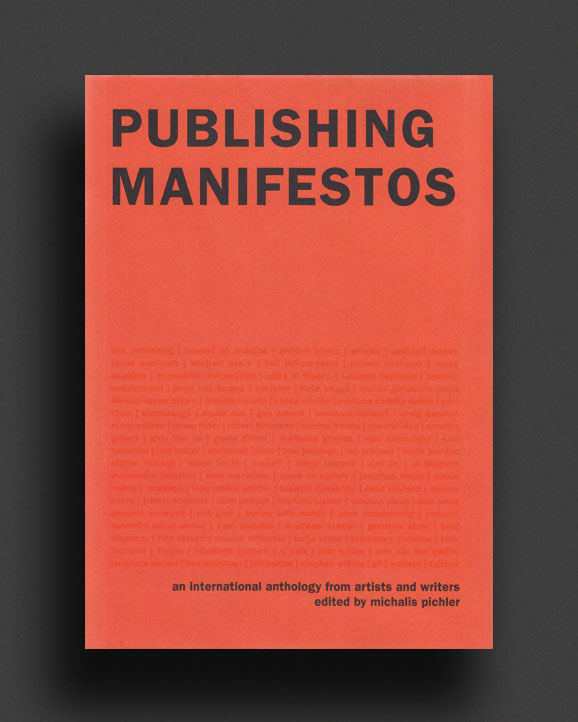
Independent publishing, art publishing, publishing as artistic practice, publishing counterculture, and the zine, DIY, and POD scenes have proliferated over the last two decades. So too have art book fairs, an increasingly important venue-or even medium-for art. Art publishing experienced a similar boom in the 1960s and 1970s, in response to the culture's "linguistic turn." Today, art publishing confronts the internet and the avalanche of language and images that it enables. The printed book offers artists both visibility and tangibility. Publishing Manifestos gathers texts by artists, authors, editors, publishers, designers, zinesters, and activists to explore this rapidly expanding terrain for art practice.
The book begins in the last century, with texts by Gertrude Stein, El Lissitsky, Oswald de Andrade, and Jorge-Luis Borges. But the bulk of the contributions are from the twenty-first century, with an emphasis on diversity, including contributions from Tauba Auerbach, Mariana Castillo Deball, Ntone Edjabe, Girls Like Us, Karl Holmqvist, Temporary Services, and zubaan. Some contributors take on new forms of production and distribution; others examine the political potential of publishing and the power of collectivity inherent in bookmaking. They explore among other topics, artists' books, appropriation, conceptual writing, non-Western communities, queer identities, and post-digital publishing. Many texts are reproduced in facsimile-including a handwritten "speculative, future-forward newspaper" from South Africa. Some are proclamatory mission statements, others are polemical self-positioning; some are playful, others explicitly push the boundaries. All help lay the conceptual foundations of a growing field of practice and theory.
Contributors
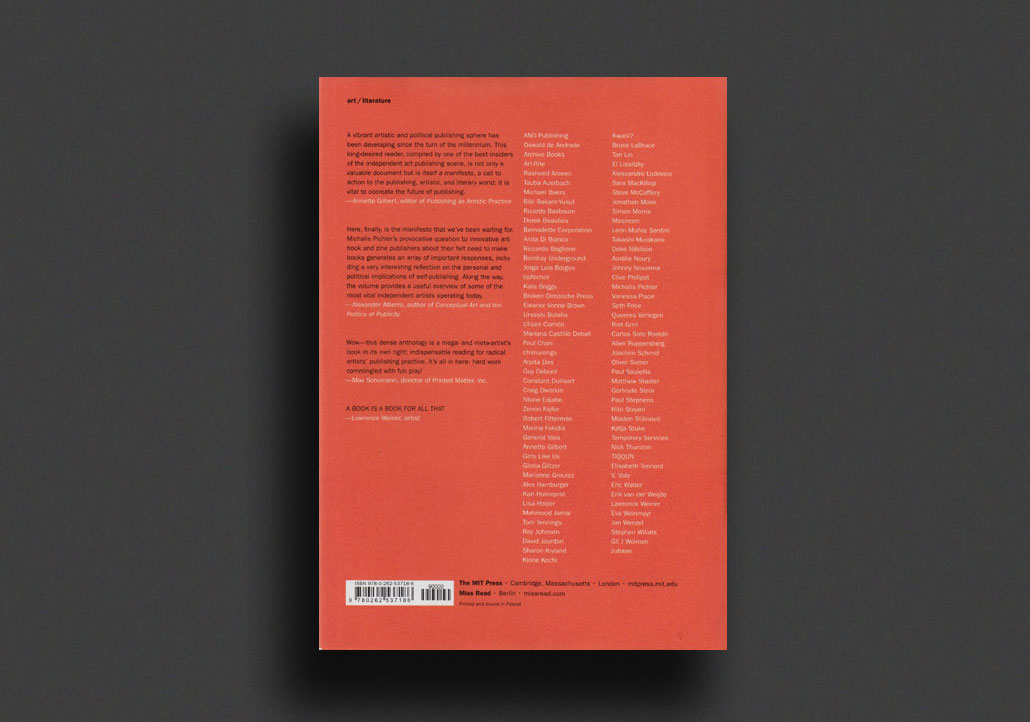
AND Publishing, Oswald de Andrade, Archive Books, Art-Rite, Rasheed Araeen, Tauba Auerbach, Michael Baers, Bibi Bakare-Yusuf, Ricardo Basbaum, Derek Beaulieu, Bernadette Corporation, Riccardo Boglione, Bombay Underground, Jorge Luis Borges, bpNichol, Kate Briggs, Broken Dimanche Press, Eleanor Vonne Brown, Urvashi Butalia, Ulises Carrion, Mariana Castillo Deball, Paul Chan, Chimurenga, Arpita Das, Anita Di Bianco, Guy Debord, Constant Dullaart, Craig Dworkin, Ntone Edjabe, Zenon Fajfer, Marina Fokidis, General Idea, Annette Gilbert, Girls Like Us, Gloria Glitzer, Marianne Groulez, Alex Hamburger, Karl Holmqvist, Lisa Holzer, Mahmood Jamal, Tom Jennings, Ray Johnson, David Jourdan, Sharon Kivland, Kione Kochi, Kwani?, Bruce LaBruce, Tan Lin, El Lissitzky, Alessandro Ludovico, Sara MacKillop, Steve McCaffery, Jonathan Monk, Simon Morris, Mosireen, Leon Munoz Santini, Takashi Murakami, Deke Nihilson, Aurelie Noury, Johnny Noxzema, Clive Phillpot, Michalis Pichler, Seth Price, Riot Grrrl, Carlos Soto Roman, Allen Ruppersberg, Joachim Schmid, Oliver Sieber, Paul Soulellis, Matthew Stadler, Gertrude Stein, Paul Stephens, Hito Steyerl, Mladen Stilinovic, Katja Stuke, Temporary Services, Nick Thurston, TIQQUN, Elisabeth Tonnard, V. Vale, Eric Watier, Erik van der Weijde, Lawrence Weiner, Eva Weinmayr, Jan Wenzel, Stephen Willats, Gil J Wolman, zubaan
Copublished with Miss Read: The Berlin Art Book Fair
2017, English
Softcover, 248 pages, 13.6 x 20.5 cm
Published by
Sternberg Press / Berlin
$54.00 - Out of stock
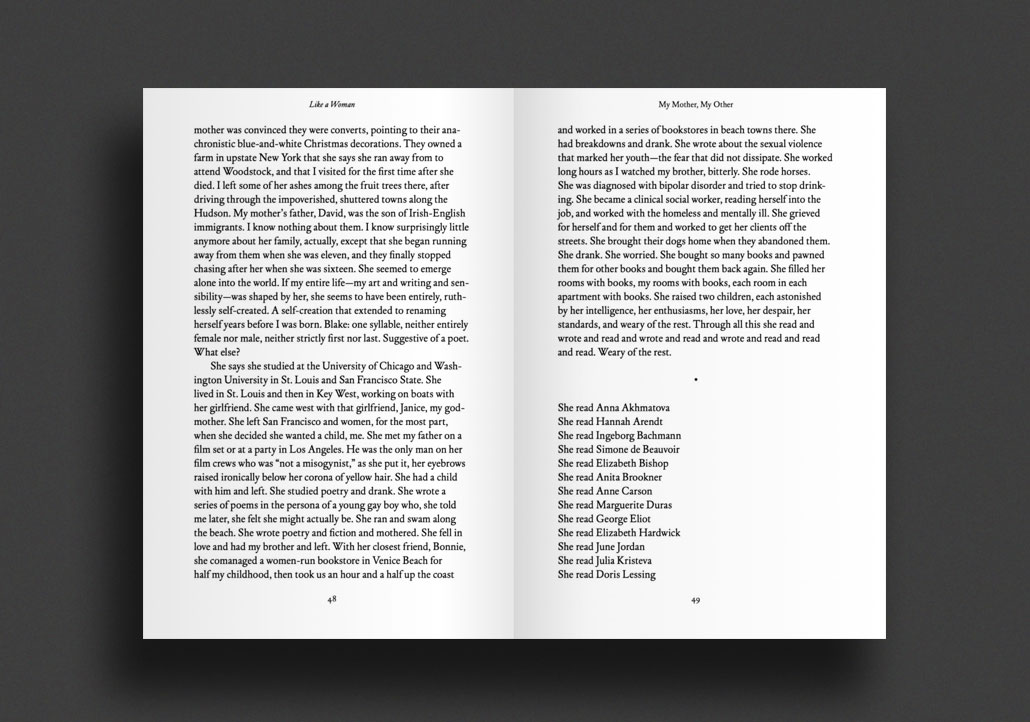
Quinn Latimer’s arresting writings find expression in literature and theory as well as contemporary art and its history. Moving from Southern California to central and southern Europe, crossing geographies and genres, her texts record specters and realities of culture, migration, and displacement, compounding the vagaries of rhetoric and poetics with those of personal history and criticism.
Composed in the space between the page and live performance, Latimer’s recent essays and poems collected here examine issues of genealogy and influence, the poverty and privilege of place, architecture’s relationship to language, and feminist economies of writing, reading, and art making. Shifting between written language and live address, between the needs of the internal and the external voice, Like a Woman retrieves the refrain, the litany, and the chorus, exploring their serial ecstasies and political possibilities.
Quinn Latimer is a poet and critic from California. Her writings and readings have been featured widely, including at Chisenhale Gallery, London; REDCAT, Los Angeles; and Qalandiya International, Ramallah/Jerusalem. Her books include Stories, Myths, Ironies, and Other Songs: Conceived, Directed, Edited, and Produced by M. Auder, coedited with Adam Szymczyk (Sternberg Press, 2014); Sarah Lucas: Describe This Distance (Mousse Publishing, 2013); Film as a Form of Writing, with Akram Zaatari (WIELS/Motto Books, 2013); and Rumored Animals (Dream Horse Press, 2012).
Latimer is editor in chief of publications for documenta 14.
Design by Sam de Groot
2018, English
Softcover, 383 pages, 11.5 x 17.5 cm
Published by
Sternberg Press / Berlin
Kunsthalle Wien / Vienna
$76.00 $59.00 - Out of stock
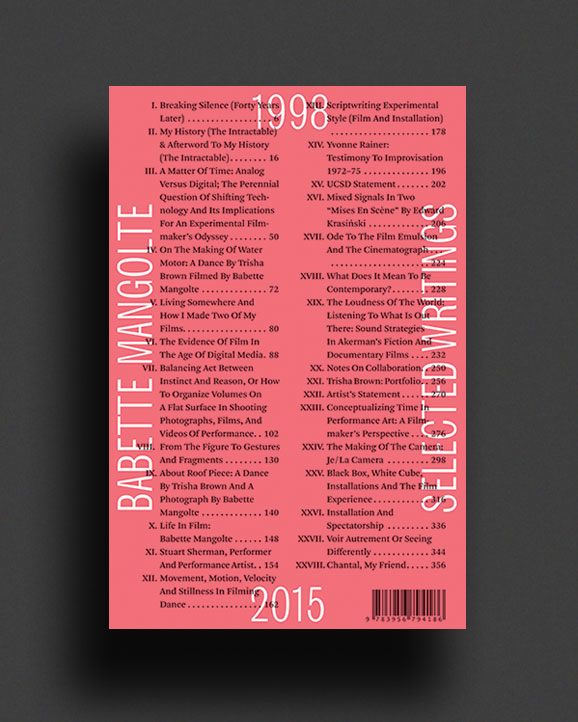
A single black-and white photograph taken by Babette Mangolte has come to epitomize New York's downtown art scene of the 1970s. The dancers performing Trisha Brown’s Roof Piece characterize perfectly the wild spirit of the time. Choreographed as an echo of movement unfolding across SoHo’s rooftops, the dancers mimed the chimneys, water towers, and fire escapes which surrounded them across that skyline. Influenced early on by Dziga Vertov’s Man with a Movie Camera and the work of Stan Brakhage and Jonas Mekas, Mangolte began studies in 1964 at the renowned École nationale de la photographie et de la cinematographie in Paris, one of the school’s first female students. In 1970, having become disillusioned with the film scene in France, Mangolte moved to New York and became involved in the avant-garde film and dance milieus of the Kitchen and the Anthology Film Archives.
Selected Writings, 1998–2015 is a collection of texts by Mangolte in which she reflects on her practice as a photographer and filmmaker and her collaborative work with filmmakers, artists, dancers, and choreographers. She provides insights into the techniques and methods she created as well as her relationships with notable collaborators such as Marina Abramović, Chantal Akerman, Trisha Brown, and Yvonne Rainer.
Copublished with Kunsthalle Wien on occasion of the exhibition “Babette Mangolte: I = Eye”
Edited by Luca Lo Pinto
Design by Enrico Bravi
2010, English
Hardcover, 312 pages, 12 x 18 cm
1st Edition, Out of print title / as new
Published by
Piet Zwart Institute / Rotterdam
Sternberg Press / Berlin
$180.00 - Out of stock
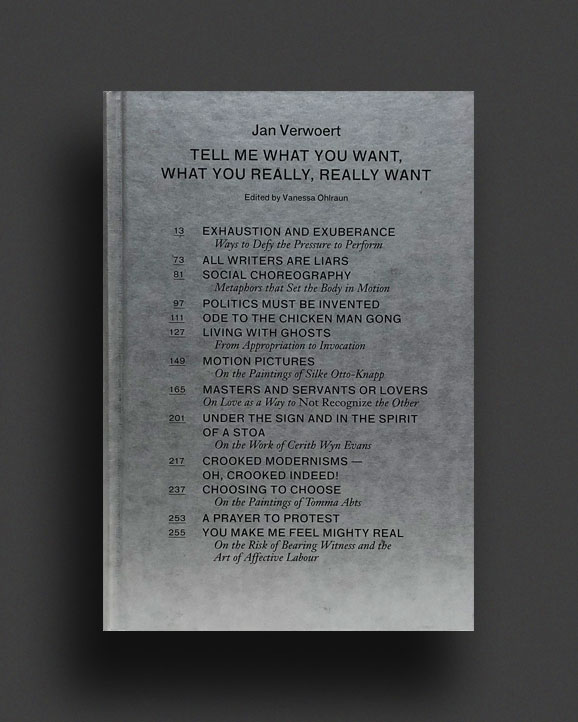
Quickly out-of-print and never reprinted, Tell Me What You Want, What You Really, Really Want is the first sought-after collection of writings by art critic Jan Verwoert. Published in collaboration with Piet Zwart Institute, Willem de Kooning Academy in Rotterdam, the book galvanizes central themes Verwoert has been developing in pursuit of a language to describe art’s transformative potential in conceptual, performative, and emotional terms. He analyzes the power of public gestures to constitute communities as well as the pressure to perform that governs the sphere of creative labor, in order to show how particular artists perform gestures and invoke community differently. Exploring the emotional power games that shape social relations, Verwoert looks for an alternative ethos of action and feeling, asking: How can a modernist approach to artistic form as a means of social critique be expanded to fully avow its subliminal affective undercurrents, and produce a pleasurably crooked form of criticality in art and writing?
“If we perceive the pressure to perform to be innately linked to the regimentation of options, to imagine the ethos of a resistant practice implies an exploration of the conditions, situations, and potentialites that lie beyond the option menus and the exclusivity of the yes and no. In artistic practice this dedication to imagining other ways to perform and other ways to enjoy consumption means claiming the imagination and the aesthetic experience as a field of collective agency where workable forms of resistance can be devised.”
First edition, As New.
2012, English
Softcover, 200 pages (27 b/w ill.), 10.8 x 17.8 cm
Published by
Sternberg Press / Berlin
$36.00 - Out of stock
In Hito Steyerl’s writing we begin to see how, even if the hopes and desires for coherent collective political projects have been displaced onto images and screens, it is precisely here that we must look frankly at the technology that seals them in. The Wretched of the Screen collects a number of Steyerl’s landmark essays from recent years in which she has steadily developed her very own politics of the image. Twisting the politics of representation around the representation of politics, these essays uncover a rich trove of information in the formal shifts and aberrant distortions of accelerated capitalism, of the art system as a vast mine of labor extraction and passionate commitment, of occupation and internship, of structural and literal violence, enchantment and fun, of hysterical, uncontrollable flight through the wreckage of postcolonial and modernist discourses and their unanticipated openings.
With a foreword by Franco ''Bifo'' Berardi
2019, English
Softcover, 256 pages, 13.7 x 20.3 cm
Published by
Semiotext(e) / Los Angeles
$44.00 - Out of stock
Essays and stories on fashion, art, and culture in the New York of the 2010s.
We were supposed to meet Rose McGowan at Café d'Alsace after the party, but she cancelled at the last minute. I saw on Twitter that she had been hit with a drug possession charge, which she insisted was a scheme to keep her Weinstein dirt quiet. I hadn't even read her Weinstein story… I still wanted to know that the articles were being published, and in large quantities, but reading stories of abuse and humiliation was as stupefying as a hangover. I didn't feel empowered; I only felt more hopeless. I wanted to watch the patriarchy go up in flames, but I wasn't excited about what was being pitched to replace it. If we got all of it out in the open, what would we have left? My fear was that guilt would destroy the classics and there'd be no one left to fuck. All movies would be as low-budget and as puritanical as the stuff they play on Lifetime, all of New York would look like a Target ad, every book or article would be a cathartic tell-all, and I'd be sexually frustrated but too ashamed to hook up with assholes, or even to watch porn.—from Sleeveless
Eve Babitz meets Roland Barthes in Sleeveless, Natasha Stagg's follow up to Surveys, her 2016 novel about internet fame. Composed of essays and stories commissioned by fashion, art, and culture magazines, Sleeveless is a scathing and sensitive report from New York in the 2010s. During those years, Stagg worked as an editor for V magazine and as a consultant, creating copy for fashion brands. Through these jobs, she met and interviewed countless industry luminaries, celebrities, and artists, and learned about the quickly evolving strategies of branding. In Sleeveless, she exposes the mechanics of personal identity and its monetization that propelled the narrator of Surveys from a mall job in Tucson to international travel and internet fame.
Natasha Stagg writes in a direct, clean, unapologetic style that is cynical in all the right ways, and sentimental in all the right ways, too. She's a trustworthy and perhaps indispensable reporter on this mediated condition we're living through. Stagg treads the line between truth and fiction (mostly hanging out on the “truth” side of the fence) with a pissed-off sang-froid that may be a great model for other writers of her generation. Her essays about sex are major necessary news. She knows how decadent—and not in a happy way—our “moment” is. And how it is time for voices like Natasha's. - Wayne Kostenbaum
Stagg is a canary in the cultural coalmine of a city whose intellectual and bohemian postures have begun to feel as false as they are drained of any real agency. What are these fumes? As New York melts into iPhone screens, it seems that literature can still get high on the poison of its own smoking remains. - John Kelsey, co-founder of the gallery Reena Spaulings Fine Art and a member of the artists collective Bernadette Corporation
2014, English
Softcover, 49 pages, 29 x 29 cm
Edition of 500,
Published by
Dépendance / Brussels
$65.00 - Out of stock
Large format catalogue published by Dépendance, Brussels, on the occasion of Merlin Carpenter's solo exhibition "POLICE", in 2013. Monochromatic Police-blue printing throughout, illustrating Carpenter's paintings, installation, ephemera, and other various photographs, alongside a text by Peter Wächtler and poem by Carpenter entitled "GLOBOCOP ROLE".
Designed by Non-Format.
Published in an edition of 500 copies.
2017, English / German
Softcover, 144 pages, 24.5 x 28.5 cm
Published by
Sternberg Press / Berlin
$72.00 $59.00 - Out of stock
Edited by Kunsthalle Bern
Texts by Valérie Knoll, Sam Lewitt
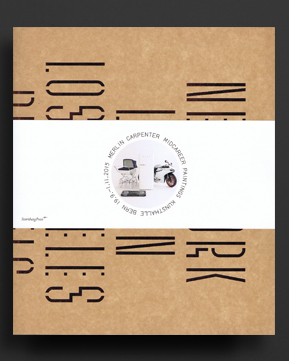
Merlin Carpenter’s 2015 exhibition “MIDCAREER PAINTINGS” filled the Kunsthalle Bern’s seven rooms with twenty-two transit blankets hung on the wall, pulled like canvas around identically scaled stretcher frames. The transit blankets are the kind used to pack fragile goods. Inexpensive and disposable, they are manufactured from recycled materials, compressed into an insulating sheet used to preserve prized surfaces and materials more valuable than themselves. Each work in the show was post-dated to 2016, despite the exhibition’s opening date in September of the previous year. The works were titled after one of the Shepperton-based artist’s seven galleries, and were prominently displayed as “not for sale.”
The transit-blanket works are documented in the second half of this publication, the cover of which is embossed with each location of Carpenter’s seven galleries—New York, London, Los Angeles, Brussels, Berlin, Miami, Lisboa/Porto. The first half is composed of a black-and-white image feed, resembling collaged photocopies, of photos of the show’s installation, related gallery shows, and billboards advertising the show that displayed classic mid-to-late century consumer goods.
In addition, texts by Kunsthalle Bern director Valérie Knoll and artist Sam Lewitt examine the materiality of Carpenter’s works, the particular mix of playfulness and earnestness in his artistic output, and how the “paintings” thematize the limbo of the “midcareer” artist as well as the circulation of the artwork as a commodity that signifies material wealth or value.
Design by Non-Format
2018, English
Softcover, 212 pages, 13 x 19 cm
Published by
Strange Attractor / London
$47.00 - In stock -
A lost poet of the decadent era, Lionel Johnson is the shadow man of the 1890s, an enigma "pale as wasted golden hair." History has all but forgotten Johnson, except as a footnote to the lives of more celebrated characters like W. B. Yeats and Oscar Wilde.
Johnson should have been one of the great poets of the age but was already drinking eau-de-cologne for kicks while a teenager at Winchester College. His attraction to absinthe damaged his fragile health and cast him forever into a waking dream of haunted rooms and spectral poetry. A habitual insomniac, he haunted medieval burial grounds after dark, jotting down the epitaphs of the gone-too-young, as if anticipating his own early demise at the age of 35 -- falling from a bar stool in a Fleet Street pub.
It was rumoured that Johnson performed "strange religious rites" in his rooms at Oxford and experimented with hashish in the company of fellow poet Ernest Dowson. Moving to London, he fell in with Simeon Solomon, Oscar Wilde, and Aubrey Beardsley, and would contribute to the leading decadent publications of the day, including The Chameleon, The Yellow Book, and The Savoy.
Like a glimmering of a votive candle in one of Johnson's dream churches, Incurable sheds new light on one of the most gifted, if reclusive, poets of the fin de siècle. Containing a detailed biography, illustrations, rare and unusual material including previously unseen letters, poetry, and essays, Incurable pays tribute to this enchanting and eccentric poet while providing fresh insight into an era that continues to fascinate.
1982, English / French
Softcover, 284 pages, 13.2 x 20.3 cm
Published by
New Directions / New York
$40.00 - Out of stock
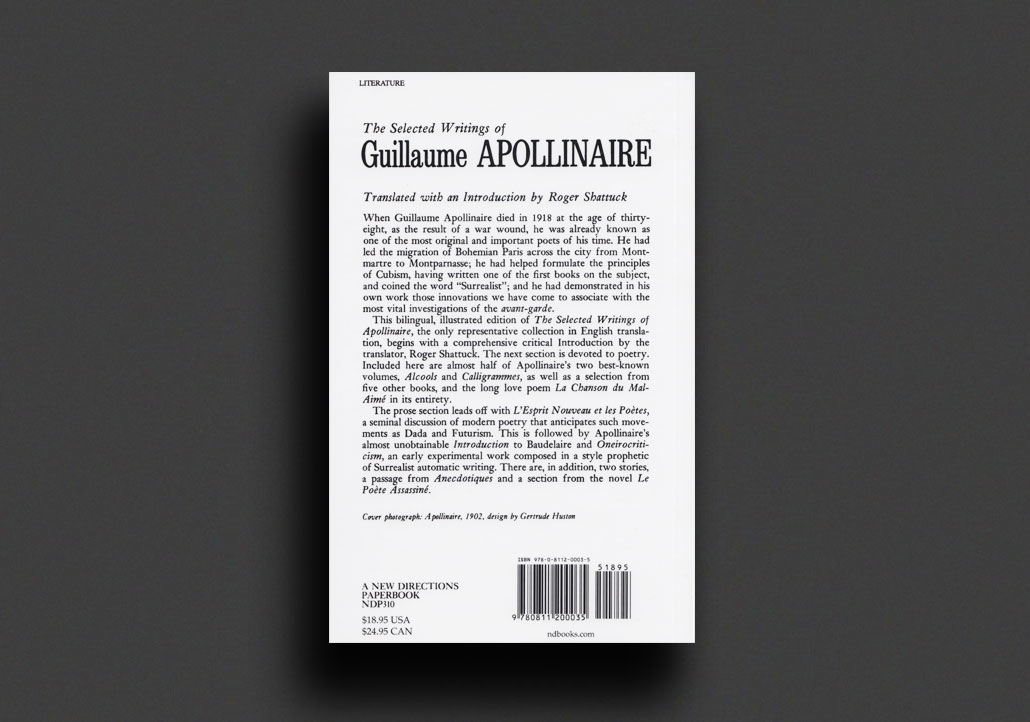
When Guillaume Apollinaire died in 1918 at the age of thirty-eight, as the result of a war wound, he was already known as one of the most original and important poets of his time. He had led the migration of Bohemian Paris across the city from Montmartre to Montparnasse; he had helped formulate the principles of Cubism, having written one of the first books on the subject, and coined the word "Surrealist"; and he had demonstrated in his own work those innovations we have come to associate with the most vital investigations of the avant-garde.
This bilingual, illustrated edition of The Selected Writings of Apollinaire, the only representative collection in English translation, begins with a comprehensive critical Introduction by the translator, Roger Shattuck. The next section is devoted to poetry. Included here are almost half of Apollinaire's two best-known volumes, Alcools and Calligrammes, as well as a selection from five other books, and the long love poem La Chanson du Mal-Aimé in its entirety. The prose section leads off with "L'Esprit Nouveau et les Poetes", a seminal discussion of modern poetry that anticipates such movements as Dada and Futurism. This is followed by Apollinaire's almost unobtainable "Introduction to Baudelaire and Oneirocriticism", an early experimental work composed in a style prophetic of Surrealist automatic writing. There are, in addition, two stories, a passage from Anecdotiques, and a section from the novel Le Poete Assassiné.
1957 / Revised Reprint, English
Softcover, 228 pages, 13.2 x 20.3 cm
Published by
New Directions / New York
$32.00 - Out of stock
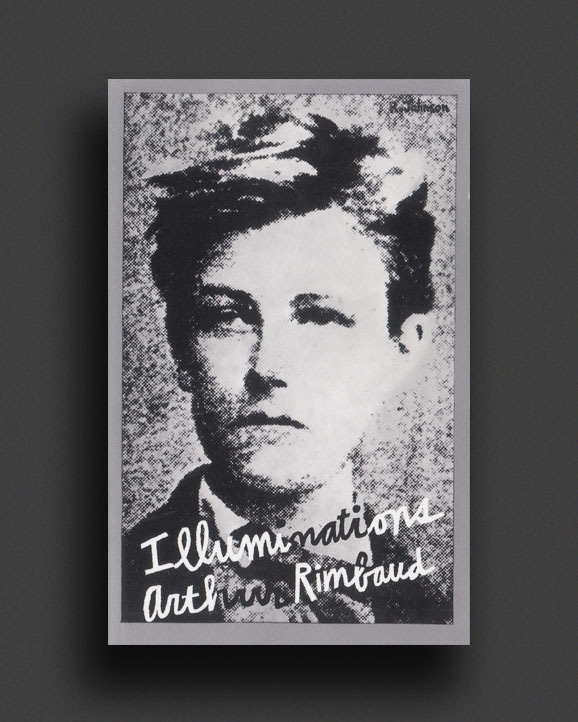
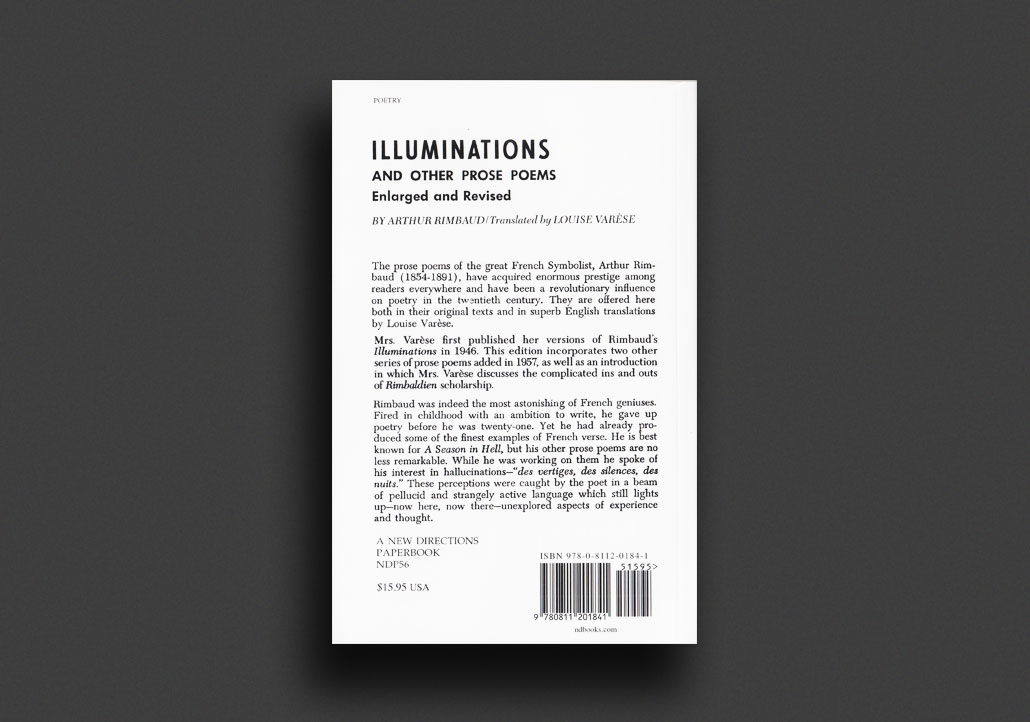
The prose poems of the great French Symbolist, Arthur Rimbaud (1854-1891), have acquired enormous prestige among readers everywhere and have been a revolutionary influence on poetry in the twentieth century. They are offered here both in their original texts and in superb English translations by Louise Varèse. Mrs. Varèse first published her versions of Rimbaud's Illuminations in 1946. Since then she has revised her work and has included two poems which in the interim have been reclassified as part of Illuminations. This edition also contains two other series of prose poems, which include two poems only recently discovered in France, together with an introduction in which Miss Varèse discusses the complicated ins and outs of Rimbaldien scholarship and the special qualities of Rimbaud's writing.
Rimbaud was indeed the most astonishing of French geniuses. Fired in childhood with an ambition to write, he gave up poetry before he was twenty-one. Yet he had already produced some of the finest examples of French verse. He is best known for A Season in Hell, but his other prose poems are no less remarkable. While he was working on them he spoke of his interest in hallucinations--"des vertiges, des silences, des nuits." These perceptions were caught by the poet in a beam of pellucid, and strangely active language which still lights up--now here, now there--unexplored aspects of experience and thought.
2003, English
Softcover, 140 pages (b/w ill.), 21 by 29.8 cm
Published by
Self-Published
$30.00 - In stock -
Publication of artist pages curated by Stephen Bram & Justin Andrews, including the work of;
Justin Andrews
Stephen Bram
Daniel Gottin
Melinda Harper
Monika Kapfer
Karin Lind
Hermann Maier Neustadt
John Nixon
Rose Nolan
Karim Noureldin
Kerrie Poliness
Sandra Selig
Carmen Soraya
Ralf Werner
Ian Whittlesea
2004, English
Softcover, 104 pages (b/w ill.), 21 by 29.8 cm
Published by
Self-Published
$30.00 - In stock -
Publication of artist pages curated by Stephen Bram & Justin Andrews, including the work of;
Florian Balze
Renate Buser
Tom Fruchtl
Esther Hiepler
Kyle Jenkins
Gerard Kodde
W.J.M. Kok
Gerold Miller
Jan van der Ploeg
Masato Takasaka
Kees Visser
Albert Weis
2019, English
Softcover, 448 pages, 10.8 x 17.6 cm
Published by
Onomatopee / Eindhoven
$39.00 - Out of stock
Permanent Recession: a Handbook on Art, Labour and Circumstance is an enquiry into the capitals and currencies of experimental, radical and artist-run initiatives in Australia. Edited by Channon Goodwin, director of Melbourne's Bus Projects, the book excavates a shared history of independent practice stretching back to the 1980s, situating new research within a rich continuum of debate about the Australian artmaking context.
Part research, part advocacy document, part literature review, part reader, part position paper, Permanent Recession is a living contribution to current thought. As a handbook, it is a compilation of useful information in a compact and handy form. It should be used!
Authors include: Esther Anatolitis, Peter Anderson, Hana Pera Aoake, Dr Marnie Badham, Terri Bird, Andrew Brooks, Andy Butler, Colleen Chen, Clare Cooper, Dr David Corbet, Dr Ben Eltham, Dr Léuli Eshrāghi, Channon Goodwin, Sarah Gory. Tristen Harwood, Dr Mark Jackson, Dr Kate MacNeill, Dr Anne Marsh, Lucie McIntosh, Georgie Meagher, Dr Jacqueline Millner, Bernice Murphy, Spiros Panigirakis, Dr Lisa Radford, Macushla Robinson, Dr Francis Russell, Catherine Ryan, Kate Scardifield, Dr Pip Shea, Talia Smith, Philipa Veitch, Amelia Wallin, Pip Wallis, Amelia Winata, Katie Winten and Tian Zhang. Graphic design by Paul Mylecharane and Kim Mumm Hansen of Public Office.
2008, English
Softcover, 66 pages, 21 x 21 cm
Published by
Griffith University / Brisbane
$32.00 - Out of stock
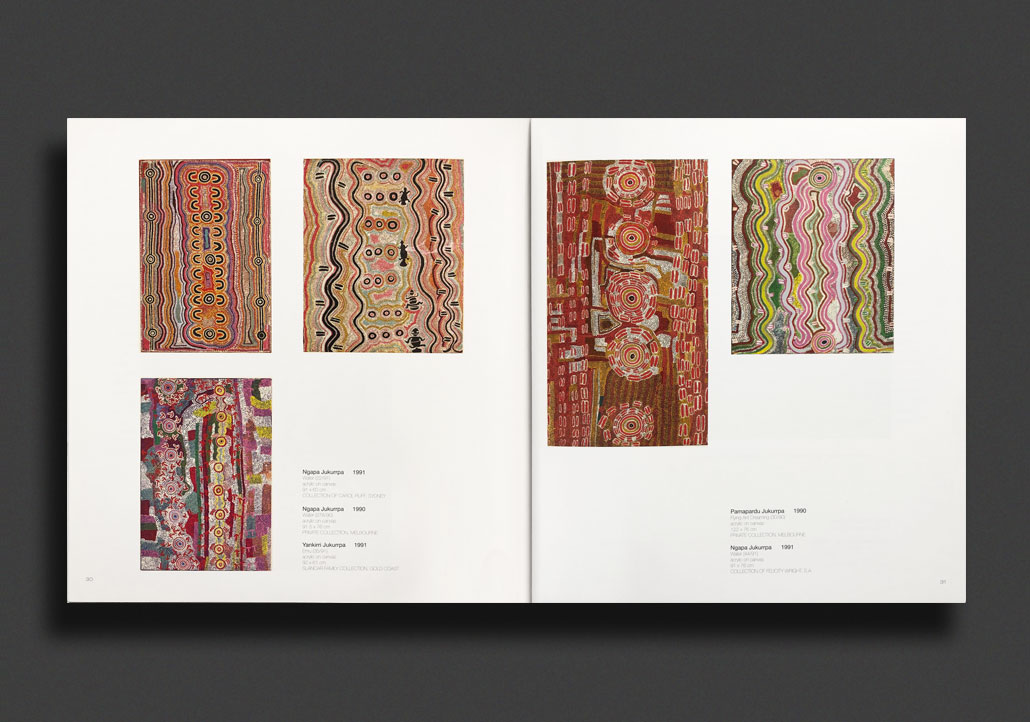
Publication celebrating Warlpiri legend, Darby Jampijinpa Ross (1905-2005) from Yuendumu. Published by Griffith Artworks in partnership with Warlukurlangu Artists to accompany an exhibition curated by SP Wright. Illustrated throughout with Darby Jampijinpa Ross's paintings, alongside a biography and texts by SP Wright and Liam Campbell.
A senior and respected figure both in Warlpiri ceremonial life and in the art movement at Yuendumu. Darby Jampijinpa Ross was born at Ngarilyikirlangu, north of the present day site of Yuendumu, in about 1910. His main totems are Emu and Bandicoot, and he usually paints Ngapa (Water), Yankirri (Emu) and Wardilyka (Bush Turkey) Dreamings, though he has also painted the Pamapardu (Flying Ant) Dreaming which passes close to Yuendumu travelling west. Darby’s family has responsibility for the Dreaming as it crosses Warlpiri country. Darby has been an active member of the painting group at Yuendumu since the early years as one of the group of senior men of the Yuendumu community who painted the 27 doors of the Yuendumu School with their Dreamings. Since the Yuendumu painting company’s first Araluen Centre exhibition in October 1985, his works have been included in numerous exhibitions of Warlukurlangu Artists in Perth, Adelaide, Melbourne, Sydney, Darwin, Alice Springs and the Gold Coast. Like most artists of the Western Desert – or anywhere else, Darby Ross has progressively refined his approach to and execution of his subject matter, yet his paintings have retained their distinctive early style of loose exuberant paintwork and complex, richly textured surfaces, sometimes strongly reminiscent of cave paintings from the Western Desert area. Darby’s work has been included in the Dreamings:Art of Aboriginal Australia exhibition which toured North America in 1988-9, the Mythscapes exhibition at the National Gallery of Victoria in 1989 and many other important national and international exhibitions since.
1968?, English
Softcover (staple-bound), 48 pages, 24 x 18.5 cm
Out of print title / used / good
Published by
Bootleg / Australia
$120.00 - Out of stock
Super scarce Australian bootleg version of Zap Comix #2, featuring the work of Robert Crumb, Rick Griffin, Victor Moscoso, and S. Clay Wilson! Legend has it somewhere in the late 1960s/1970s first editions of US underground comix (such as Zap Comix, Freak Brothers, Bijou Funnies, Young Lust, Mean Bitch Thrills, Slow Death, Skull, etc.) were cheaply bootlegged here in Australia to give a broader distribution to titles that were not traveling this far across the waters (possibly by the late, great Bob Gould of Gould's Book Arcade or ex-pat comic collector Pat Woolley...). These are interesting publications in their unusual formats and colour variations from the authentic originals, mostly single colour reproductions on soft newsprint stock. With the cover prices also blanked out, they are crude, immediate and exquisite creations that seem to perfectly embody the spirit of underground press. These are some of the most unique and little-known variations on these classic underground comix out there.
Officially published by Apex Novelties, Zap Comix was an underground comix series and one of the most iconic of the late 1960s counterculture. While a few small-circulation self-published satirical comic books had been printed prior to this, Zap became the model for the "comix" movement that snowballed after its release. Premiering in early 1968 as a showcase for the work of Robert Crumb, Zap was unlike any comic book sensibility that had been seen before. The first issue of Zap was sold on the streets of Haight-Ashbury out of a baby stroller pushed by Crumb's wife Dana on the first day. In years to come, the comic's sales would be most closely linked with alternative venues such as head shops. After the success of the first issue, Crumb opened the pages of Zap to several other artists, including S. Clay Wilson, Robert Williams, "Spain" Rodriguez, Gilbert Shelton, and two artists with reputations as psychedelic poster designers, Victor Moscoso and Rick Griffin. This stable of artists, along with Crumb, remained mostly constant throughout the history of Zap.
Good considering. Some colouring added to the covers by previous owner with a red and green marker, decent spine and corner wear, damage to back cover, but all the more character for it! Interior is nicely kept. Features non-cropped "Head First" comic.
1970?, English
Softcover (staple-bound), 26 pages, 25 x 17 cm
Out of print title / used / good
Published by
Bootleg / Australia
$50.00 - Out of stock
Super scarce Australian bootleg version of Young Lust #1, featuring the work of Bill Griffith, Jay Kinney, Art Spiegelman, and more! Legend has it somewhere in the late 1960s/1970s first editions of US underground comix (such as Zap Comix, Freak Brothers, Bijou Funnies, Young Lust, Mean Bitch Thrills, Slow Death, Skull, etc.) were cheaply bootlegged here in Australia to give a broader distribution to titles that were not traveling this far across the waters (possibly by the late, great Bob Gould of Gould's Book Arcade or ex-pat comic collector Pat Woolley...). These are interesting publications in their unusual formats and colour variations from the authentic originals, mostly single colour reproductions on soft newsprint stock. With the cover prices also blanked out, they are crude, immediate and exquisite creations that seem to perfectly embody the spirit of underground press. These are some of the most unique and little-known variations on these classic underground comix out there.
Officially published by Print Mint, Young Lust was an underground comix anthology published sporadically from 1970 to 1993. The title, which parodied 1950s romance comics such as Young Love, was noted for its explicit depictions of sex. Unlike many other sex-fueled underground comix, Young Lust was generally not perceived as misogynistic. Founding editors Bill Griffith and Jay Kinney gradually morphed the title into a satire of societal mores. According to Kinney, Young Lust "became one of the top three best-selling underground comix, along with Zap Comix and The Fabulous Furry Freak Brothers." Young Lust featured an all-star lineup of underground, and later alternative, cartoonists. Besides Griffith and Kinney, other frequent contributors included Justin Green, Roger Brand, Spain Rodriguez, Diane Noomin, Kim Deitch, Paul Mavrides, Michael McMillan, Ned Sonntag, Phoebe Gloeckner, and Harry S. Robins. In later years, the title was a showcase for female cartoonists like Gloeckner, M. K. Brown, Carol Lay, and Jennifer Camper; as well as rising alt-comics creators like Daniel Clowes, Charles Burns, Terry LaBan, and Lloyd Dangle.
Good considering. Decent creasing, tanning and general wear, but all the more character for it!
1970, Japanese
Staple-bound, 32 pages, 21 x 15 cm
1st Edition, Out of print title / used / very good
Published by
The Japan Rolling Stones Fan Club / Tokyo
$65.00 - Out of stock
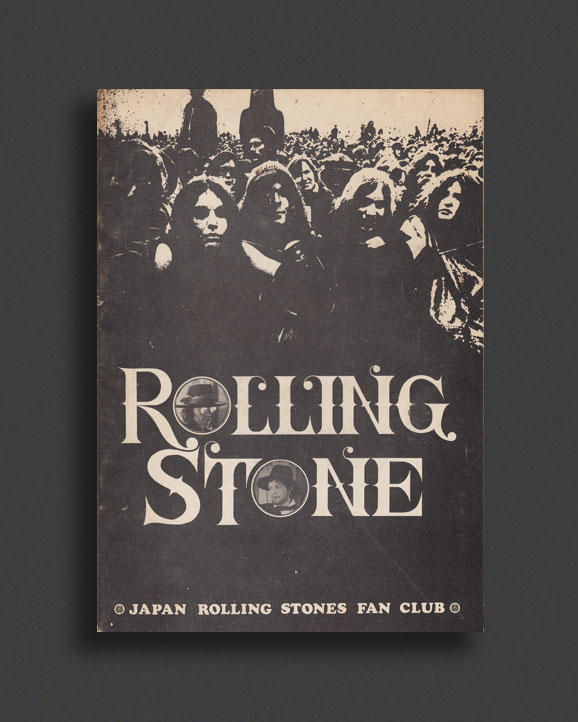
Very rare first issue of "ROLLING STONE" - not the American magazine but the Japan Rolling Stones fan club fanzine, published in 1970. Illustrated throughout with black and white photographs of the Stones, their audience, lyrics in Japanese, interviews, news, fan-mail, and fan drawings. A lovely piece of scarce Stones memorabilia.
Very Good copy with tanning and light wear.
2014, English / Dutch
Softcover (w. staple bound insert), 288 pages, 24 x 28 cm
Published by
WIELS / Brussels
$93.00 - Out of stock
This dense and comprehensive catalogue for a retrospective exhibition of the work of Walter Swennen at WIELS Contemporary Art Centre offers a detailed look at the Belgian artist’s oeuvre, delving into its humorous interaction between pictorial practice and poetical communication. With sources of inspiration ranging from comic strips and children’s drawings to ads and world literature, Swennen shows a preference for subtle forms of rebellion, deviation and questioning authorship and originality. Besides documentation of numerous works, the book includes a selection of the artist’s published texts, plus essays by Caroline Dumalin and Quinn Latimer, among others.
2014, English
Softcover, 280 pages, 12 x 18 cm
Published by
Xavier Hufkens / Brussels
$44.00 - Out of stock
Walter Swennen started his artistic life as a poet, but switched to painting as his primary means of expression in the early 1980s. Although his oeuvre varies greatly in scale, style, and materials, it can be seen as an ongoing exploration into the nature, potentialities, and limitations of painting, the fundamental question of what subject matter to choose, and how to depict it. Swennen is recognised for his experimental and associative approach to painting, in which meanings perpetually float and shift across images that recall a familiar place or situation – a place where something has happened.
This compact but dense catalogue published by Xavier Hufkens, Brussels, is filled with Swennen's wonderful works on paper. Published on the occasion of an exhibition of Works on Paper in 2014-2015 at the gallery.
2017, English / German / Portuguese
Softcover, 152 pages, 28 x 21.5 cm
Published by
Koenig Books / London
Kunsthalle Bern / Bern
Serralves Museum of Contemporary Art / Porto
$42.00 - Out of stock
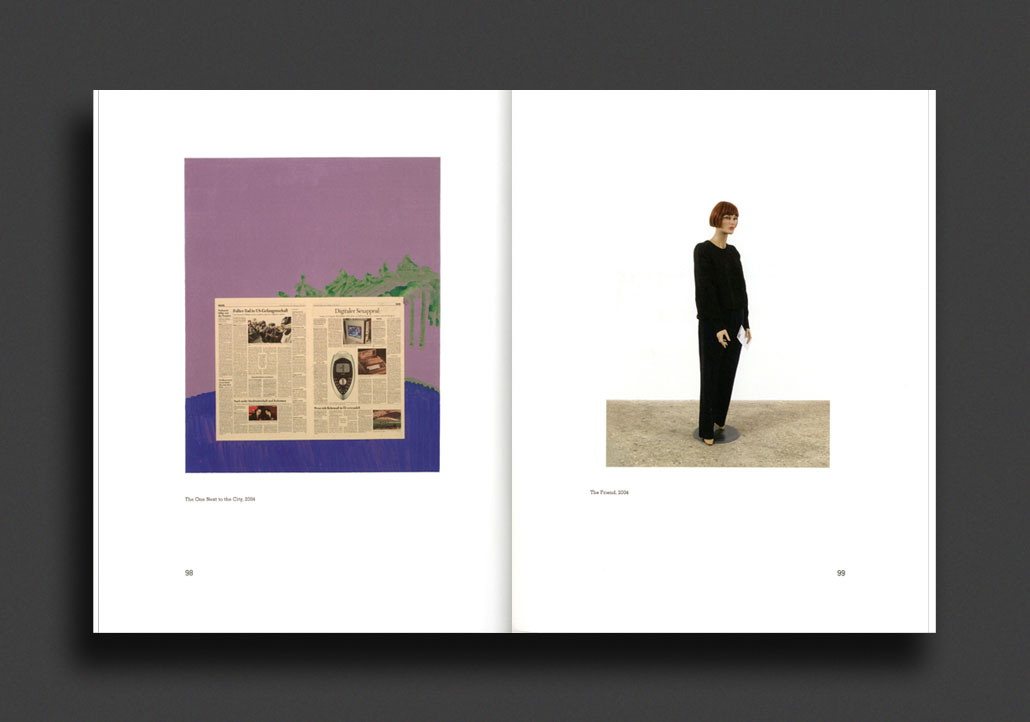
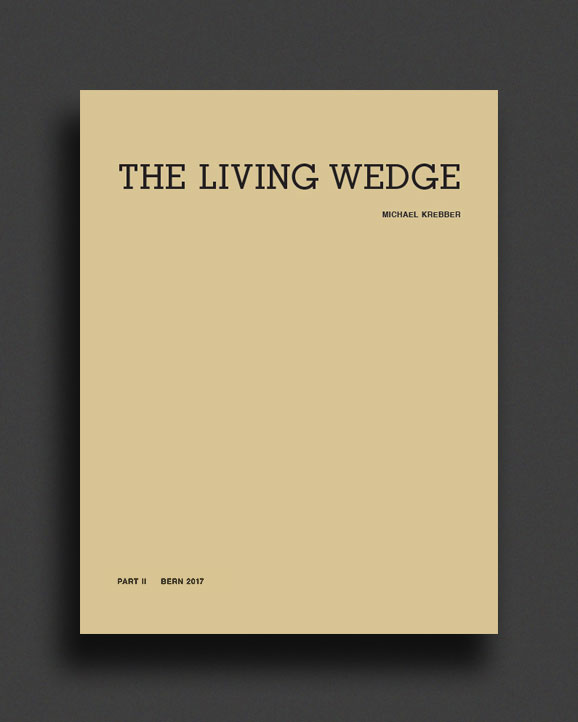
Exploring the continual exhaustion, withdrawal, engagement and renewal of painting, the work of Michael Krebber is a central reference in conversations about the mediumʼs continued relevance.
The large selection of paintings, drawings and sculptures featured in this two-volume publication showcases Krebber’s practice over the last three decades.
Stations in a recursive cycle of starts, fits and restarts, scattered in a variety of motifs and gestures, by turns emphatic, arresting or ironic together they trace the artistʼs approach to painting, its expressive language as well as its critical function.
Volume 1 of 2.
Published on the occasion of the exhibition, Michael Krebber: The Living Wedge at Fundação De Serralves, Porto, Portugal (15 October 2016 – 15 January 2017) and at Kunsthalle Bern, Switzerland (18 February – 30 April 2017).
English, German and Portuguese text.
2017, English / German / Portuguese
Softcover, 160 pages, 28 x 21.5 cm
Published by
Koenig Books / London
Kunsthalle Bern / Bern
Serralves Museum of Contemporary Art / Porto
$42.00 - Out of stock
Exploring the continual exhaustion, withdrawal, engagement and renewal of painting, the work of Michael Krebber is a central reference in conversations about the mediumʼs continued relevance.
The large selection of paintings, drawings and sculptures featured in this two-volume publication showcases Krebberʼs practice over the last three decades.
Stations in a recursive cycle of starts, fits and restarts, scattered in a variety of motifs and gestures, by turns emphatic, arresting or ironic together they trace the artistʼs approach to painting, its expressive language as well as its critical function.
Volume 2 of 2
Published on the occasion of the exhibition, Michael Krebber: The Living Wedge at Fundação De Serralves, Porto, Portugal (15 October 2016 – 15 January 2017) and at Kunsthalle Bern, Switzerland (18 February – 30 April 2017).
English, German and Portuguese text.
2008, English / German
Softcover, 89 pages, 17.7 x 12.9 cm
Ed. of 1000,
Published by
Galerie Buchholz / Köln
$34.00 - Out of stock
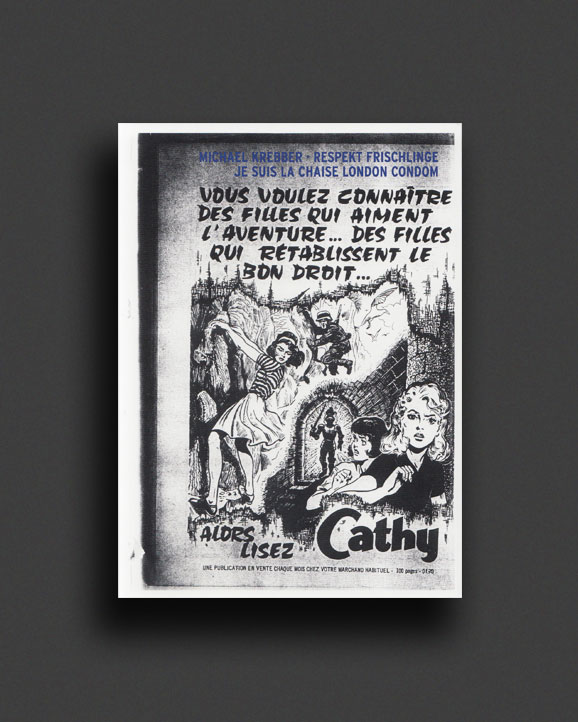
This publication documents German artist Michael Krebber's "Puberty in Painting" painting series from 2008. The paintings were exhibited over three separate galleries, in three different cities: Galerie Buchholz, Cologne; Galerie Chantal Crousel, Paris; Maureen Paley, London.
Designed by Michael Krebber and Yvonne Quirmbach in a limited edition of 1000.