World Food Books' programme is largely produced on Kulin Nation land. We acknowledge the Wurundjeri people of the Kulin Nation as the first and continuing custodians of this land, and pay respect to their Elders past, present, and emerging.
World Food Books is an arts and special interests bookshop in Naarm / Melbourne. Founded in 2010, World Food Books is devoted to the presentation of a rotating, hand-selection of international art, design, literary and counterculture publications with an emphasis on the anti-traditional, the experimental, the avant-garde, the heretic, the marginal.
Presenting new titles alongside rare and out-of-print books, catalogues and journals spanning the fields of modern and contemporary art, design, photography, illustration, film, literature, poetry, cultural theory, philosophy, sexuality, popular and underground culture in its many radical forms, World Food Books wishes to encourage adventurous, thoughtful and open-minded reading, looking, writing, and exchange of publishing and ideas, both current and historical.
As well as our bookshop, located in Melbourne's historical Nicholas Building, all of our inventory is available internationally via our online mail-order service.
World Food Books semi-regularly co-ordinates "Occasions", a programme of exhibits and events at the bookshop and in partnership with other hosts (such as museums and art galleries) that develop out of the activities, relationships and content of the bookshop itself.
World Food Books
The Nicholas Building
37 Swanston Street
Room 5, Level 6
Melbourne 3000
Australia
SHOP HOURS:
Thu–Fri 12–6, Sat 12–5
WEB-SHOP OPEN 24/7
World Food Books
Postal Address:
PO Box 435
Flinders Lane
Victoria 8009
Australia
Art
Theory / Essay
Architecture / Interior
Graphic Design / Typography
Photography
Fashion
Eros
LGBTQ+
Fiction / Poetry
Weird / Speculative / Science Fiction / Horror
Transgressive / Visceral / Abject
Symbolism / Decadence / Fin de siècle
Film / Video
Painting
Sculpture / Installation
Performance / Dance / Theater
Drawing
Sound / Music
Curatorial
Group Shows / Collections
Periodicals
Out-of-print / Rare
Posters / Ephemera / Discs
Signed Books
World Food Books Gift Voucher
World Food Book Bag
Australian Art
Australian Fiction
Australian Science Fiction / Speculative Fiction
Australian Poetry
Australian Photography
Japanese Photography
Conceptual Art
Minimal Art
Dada
'Pataphysics / Oulipo
Fluxus
Concrete Poetry
Pop Art
Surrealism
Arte Povera
Arte Informale / Haute Pâte / Tachism
Nouveau Réalisme / Zero / Kinetic
Situationism / Lettrism
Collage / Mail Art / Xerox Art
Art Brut / Folk / Visionary / Fantastic
Illustration / Graphic Art / Bandes Dessinées
Furniture
Italian Radical Design / Postmodernism
Textiles
Ceramics / Glass
Counterculture
Protest / Revolt
Philosophy
Psychoanalysis
Anthropology
Anarchism
Socialism / Anarchism / Communism / Capitalism
Literary Theory / Semiotics / Language
Feminism / Women's Studies
Gender Studies / Sexuality
Anthropology
Fetishism / BDSM
Drugs / Psychedelia
Crime / Violence
Animal Rights / Veganism
Occult / Esoterica
Ecology / Earth / Alternative Living
Whole Earth / Crafts
All prices in AUD (Australian dollars)
Pick-Ups
Pick-up orders can be collected in our bookshop during opening hours after order date. Please collect any Pick-up orders within 2 weeks of ordering as we have limited storage space. Orders will be released back into stock if not collected within this time. No refunds can be made for pick-ups left un-collected. If you cannot make it in to the bookshop in this time-frame, please choose postage option.
Return Policy
All sales are final. We do accept returns (for refund or exchange) for items received in error. All our orders are packed with special care using heavy-duty padding and cardboard book-mailers or bubble mailers (for smaller books), using reinforcement where required. We cannot take responsibility for any lost, stolen or damaged parcels.
Insurance
Should you wish to insure your package, please email us directly after placing your order and we can organise this at a small extra expense. Although all standard/express tracked packages are very safe and dependable, we cannot take responsibility for any lost, stolen or damaged parcels. We recommend insurance on valuable orders.
Interested in selling your old books, catalogues, journals, magazines, comics, fanzines, ephemera? We are always looking for interesting, unusual and out-of-print books to buy. We only buy books in our fields of interest and specialty, and that we feel we can resell.
We base these prices on desirability, market value, in-print prices, condition and our current stock levels. We offer cash, store credit, and can take stock on consignment. All
about 25% of the price we expect to get when we sell them, or 30% in store credit. We base these prices on desirability, market value, in-print prices, condition and our current stock levels.
Sell your books any day of the week. You can drop them off and return later. If you have a lot of books, we can visit your Sydney home.
We buy books that we feel we can resell. We offer about 25 % of the price we expect to get when we sell them, or 30% in store credit. We base these prices on desirability, market value, in-print prices, condition and our current stock levels.
Philadelphia Wireman
03 August - 01 September, 2018
World Food Books is proud to announce our next Occasion, the first presentation of sculptures by Philadelphia Wireman in Australia.
The Philadelphia Wireman sculptures were found abandoned in an alley off Philadelphia’s South Street on trash night in 1982. Their discovery in a rapidly-changing neighbourhood undergoing extensive renovation, compounded with the failure of all attempts to locate the artist, suggests that the works may have been discarded after the maker’s death. Dubbed the "Philadelphia Wireman" during the first exhibition of this work, in 1985, the maker’s name, age, ethnicity, and even gender remain uncertain. The entire collection totals approximately 1200 pieces, all intricately bound together with tightly-wound heavy-gauge wire (along with a few small, abstract marker drawings, reminiscent both of Mark Tobey and J.B. Murry). The dense construction of the work, despite a modest range of scale and materials, is singularly obsessive and disciplined in design: a wire armature or exoskeleton firmly binds a bricolage of found objects including plastic, glass, food packaging, umbrella parts, tape, rubber, batteries, pens, leather, reflectors, nuts and bolts, nails, foil, coins, toys, watches, eyeglasses, tools, and jewellery.
Heavy with associations—anthropomorphic, zoomorphic, and socio-cultural responses to wrapped detritus—the totemic sculptures by Philadelphia Wireman have been discussed in the context of work created to fulfil the shamanistic needs of alternative religions in American culture. Curators, collectors, and critics have variously compared certain pieces to sculpture from Classical antiquity, Native American medicine bundles, African-American memory jugs, and African fetish objects. Reflecting the artist’s prolific and incredibly focused scavenging impulse, and despite—or perhaps enhanced by—their anonymity, these enigmatic objects function as urban artefacts and arbiters of power, though their origin and purpose is unknown. Philadelphia Wireman, whatever their identity, possessed an astonishing ability to isolate and communicate the concepts of power and energy through the selection and transformation of ordinary materials. Over the course of the past two decades, this collection has come to be regarded as an important discovery in the field of self-taught art and vernacular art.
Presented in collaboration with Fleisher-Ollman Gallery, Philadelphia, and Robert Heald, Wellington.
Susan Te Kahurangi King
02 February - 10 March, 2018
Susan Te Kahurangi King (24 February 1951 - ) has been a confident and prolific artist since she was a young child, drawing with readily available materials - pencils, ballpoint pens and felt-tip markers, on whatever paper is at hand. Between the ages of four and six Susan slowly ceased verbal communication. Her grandparents William and Myrtle Murphy had developed a special bond with Susan so they took on caring responsibilities for extended periods. Myrtle began informally archiving her work, carefully collecting and storing the drawings and compiling scrapbooks. No drawing was insignificant; every scrap of paper was kept. The King family are now the custodians of a vast collection containing over 7000 individual works, from tiny scraps of paper through to 5 meter long rolls.
The scrapbooks and diaries reveal Myrtle to be a woman of great patience and compassion, seeking to understand a child who was not always behaving as expected. She encouraged Susan to be observant, to explore her environment and absorb all the sights and sounds. Myrtle would show Susan’s drawings to friends and people in her community that she had dealings with, such as shopkeepers and postal workers, but this was not simply a case of a grandmother’s bias. She recognised that Susan had developed a sophisticated and unique visual language and sincerely believed that her art deserved serious attention.
This was an unorthodox attitude for the time. To provide some context, Jean Dubuffet coined the term Art Brut in 1945 to describe work created by self-taught artists – specifically residents of psychiatric institutions and those he considered to be visionaries or eccentrics. In 1972 Roger Cardinal extended this concept by adopting the term Outsider Art to describe work made by non-academically trained artists operating outside of mainstream art networks through choice or circumstance. Susan was born in Te Aroha, New Zealand in 1951, far from the artistic hubs of Paris and London that Dubuffet and Cardinal operated in. That Myrtle fêted Susan as a self-taught artist who deserved to be taken seriously shows how progressive her attitudes were.
Susan’s parents Doug and Dawn were also progressive. Over the years they had consulted numerous health practitioners about Susan’s condition, as the medical establishment could not provide an explanation as to why she had lapsed into silence. Dawn educated herself in the field of homeopathy and went on to treat all twelve of her children using these principles – basing prescriptions on her observations of their physical, mental and emotional state.
Doug was a linguist with an interest in philosophy who devoted what little spare time he had to studying Maori language and culture. To some extent their willingness to explore the fringes of the mainstream made them outsiders too but it was their commitment to living with integrity and their respect for individuality that ensured Susan’s creativity was always encouraged.
Even though Susan’s family supported her artistic pursuits, some staff in schools and hospitals saw it as an impediment to her assimilation into the community and discouraged it in a variety of ways. Her family was not always aware of this and therefore did not fully understand why Susan stopped drawing in the early 1990s. However, rather than dwell on the challenges that Susan faced in pursuit of her artistic practice, they prefer to highlight her achievements. In 2008 Susan began drawing again in earnest, after an almost 20 year interruption, and her work is now shown in galleries around the world.
Susan grew up without television and has been heavily influenced by the comics she read as a child. She is absolutely fearless in the appropriation of recognizable characters, such as Donald Duck and Mickey Mouse, in her work. She twists their limbs, contorts their faces, compresses them together, blends them into complex patterned backgrounds - always imbuing them with an incredible energy. Although Susan often used pop culture characters in her work they are not naive or childlike. These are drawings by a brilliant self-taught artist who has been creating exceptional work for decades without an audience in mind.
Mladen Stilinović
"Various Works 1986 - 1999"
02 February 16 - September 10, 2016
Various works 1986 - 1999, from two houses, from the collections of John Nixon, Sue Cramer, Kerrie Poliness, Peter Haffenden and Phoebe Haffenden.
Including: Geometry of Cakes (various shelves), 1993; Poor People’s Law (black and white plate), 1993; White Absence (glasses, ruler, set square, silver spoon, silver ladel with skin photograph and wooden cubes), 1990-1996; Exploitation of the Dead (grey and red star painting, wooden painting, black spoon with red table, red plate), 1984-1990; Money and Zeros (zero tie, paintings made for friends in Australia (Sue, John, Kerrie), numbers painting), 1991-1992; Words - Slogans (various t-shirts) - “they talk about the death of art...help! someone is trying to kill me”, “my sweet little lamb”, “work is a disease - Karl Marx”; Various artist books, catalogues, monographs, videos; Poster from exhibition Insulting Anarchy; "Circular" Croatian - Australian edition; Artist book by Vlado Martek (Dostoyevsky); more.
Thanks to Mladen Stilinović and Branka Stipančić.
Jonathan Walker
Always Will Need To Wear Winter Shirt Blue + Ochre Small Check Pattern
21 August - 21 September, 2015
Untitled
I am not a great reader of poetry but I always return to the work of Melbourne poet, Vincent Buckley (1925- 1988). Perhaps I find his most tantalising piece to be not a finished poem but a fragment left on a scrap of paper discovered on his desk after the poet’s death.
The poetry gathers like oil
In the word-core, and spreads
It has its music meet,
Its music is in movement.
This fragment is more the shell left behind from a volatile thought than a finished poem. I find the last two lines honest but awkward whereas the first two lines work like an arrow. Most likely he could not find a resolution so it was left. Still, in its present form, it remains an eloquent testimony to the ultimate failure of a medium to express mobile thought and sensation, in Buckley’s case, through verbal language. It’s an important matter because this is something all artists have to deal with regardless of the medium.
I have never written a poem, however, I am forever copying fragments from books on paper scraps in a vain effort to fix certain notions in my head. At first, they function as bookmarks that are sometimes returned to when I open the book. But before long, as they accumulate, they fall out littering the table interspersed with A4 photocopies, bills, books and medications.
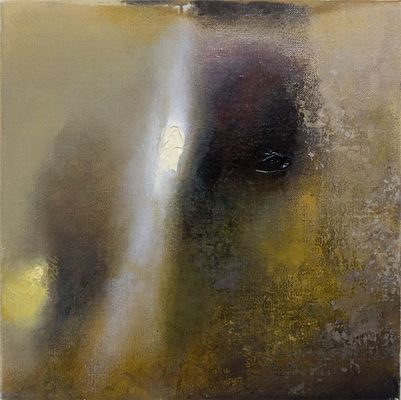
To return to Buckley’s fragment, the first two lines very much evoke how I paint nowadays. As you age, detail diminishes and patches of light become more luminous and float. I feel the most honest way of dealing with this is by smearing the oil paint on the canvas with the fingers and working close-up, blind. Only if the patches coalesce into an approaching image can the work gain a life.
-
Jonathan Walker was born in Melbourne, Australia and brought up on a dairy farm in Gippsland. In the 1970’s he studied painting at RMIT and won the Harold Wright Scholarship to the British Museum, London. During the 1980’s he exhibited at Pinacotheca Gallery, Richmond and had work shown at the NGV and Heidi City Art Gallery. Over the same period he designed the cover for the “Epigenesi” LP by Giancarlo Toniutti, Italy and conducted a mail exchange work with Achim Wollscheid, Germany. The work with artists through the post resulted in an article published in the bicentenary issue of Art and Australia 1988. He showed in artist run spaces such as WestSpace in the 90’s and 2000’s, and until 2012, taught painting at Victoria University, which is where we (Colleen Ahern and Lisa Radford) as organisers of the exhibition, among many others, had the privilege of being his student.
Walker’s knowledge was imparted to students through the careful selection of music, literature, and artists found in books that he himself had ordered for the library. Walker’s strategy was the generosity of sharing his vast knowledge with references specific to each student and their context.
Walker’s paintings share a similar focus and intimacy.
This exhibition presents a small selection of recent paintings alongside a publication that includes Walker’s writing. Observational and analytical, Walker’s work is a type of material notation — the time of day, colour and how it is blended, the both specific and fleeting location of a reflection on lino or the question of whether a chair leg should be included in a painting.
Please join us on Friday August 21 between 6-8pm to celebrate the opening of the exhibition.
Curated by Colleen Ahern and Lisa Radford.
B. Wurtz
Curated by Nic Tammens
March 26 - April 4, 2015
B.Wurtz works from a basement studio in his home on Manhattan’s Lower East Side.
This local fact is attested to by the plastic shopping bags and newsprint circulars that appear in his work. As formal objects, they don’t make loud claims about their origins but nonetheless transmit street addresses and places of business from the bottom of this long thin island. Like plenty of artists, Wurtz is affected by what is local and what is consumed. His work is underpinned by this ethic. It often speaks from a neighborhood or reads like the contents of a hamper:
“BLACK PLUMS $1.29 lb.”
“Food Bazaar”
“USDA Whole Pork Shoulder Picnic 99c lb.”
“RITE AID Pharmacy, with us it’s personal.”
“H. Brickman & Sons.”
“Sweet Yams 59c lb."
Most of the work in this exhibition was made while the artist was in residence at Dieu Donne, a workshop dedicated to paper craft in Midtown. Here Wurtz fabricated assemblages with paper and objects that are relatively lightweight, with the intention that they would be easily transportable to Australia. This consideration isn’t absolute in Wurtz’s work, but was prescriptive for making the current exhibition light and cheap. Packed in two boxes, these works were sent from a USPS post office on the Lower East Side and delivered to North Melbourne by Australia Post.
Wurtz appears courtesy of Metro Pictures, New York.
Thanks to Rob Halverson, Joshua Petherick, Sari de Mallory, Matt Hinkley, Helen Johnson, Fayen d'Evie, Ask Kilmartin, Lisa Radon, Ellena Savage, Yale Union, and "Elizabeth".
John Nixon
"Archive"
December 15 - January 20, 2014
The presentation of John Nixon's archive offered a rare showcase of this extensive collection of the artist's own publications, catalogues, posters, ephemera, editions and more, from the mid 1980s onwards, alongside a selection of his artworks.
Organized by John Nixon, Joshua Petherick and Matt Hinkley.
<a href=http://wfb.public-office.info/artist/john-nixon>All titles by John Nixon
"Habitat"
at Minerva, Sydney (organised by Joshua Petherick and Matt Hinkley)
November 15 - December 20, 2014
Lupo Borgonovo, Janet Burchill & Jennifer McCamley,
Lewis Fidock, HR Giger, Piero Gilardi, Veit Laurent Kurz,
Cinzia Ruggeri, Michael E. Smith, Lucie Stahl, Daniel Weil, Wols
Press Release:
“...It contained seven objects. The slender fluted bone, surely formed for flight, surely from the wing of some large bird. Three archaic circuitboards, faced with mazes of gold. A smooth white sphere of baked clay. An age-blackened fragment of lace. A fingerlength segment of what she assumed was bone from a human wrist, grayish white, inset smoothly with the silicon shaft of a small instrument that must once have ridden flush with the surface of the skin - but the thing’s face was seared and blackened.”
William Gibson, “Count Zero”, 1986
"Autumn Projects Archive"
Curated by Liza Vasiliou
March 6 - March 15, 2014
World Food Books, in conjunction with the Virgin Australia Melbourne Fashion Festival 2014, presented the Autumn Projects archive, consisting of a selection of early examples in Australian fashion with a particular interest in collecting designers and labels from the period beginning in the 1980’s, who significantly influenced the discourse of Australian Fashion.
Curated by Liza Vasiliou, the exhibition provided a unique opportunity to view pieces by designers Anthea Crawford, Barbara Vandenberg, Geoff Liddell and labels CR Australia, Covers, Jag along with early experimental collage pieces by Prue Acton and Sally Browne’s ‘Fragments’ collection, suspended throughout the functioning World Food Books shop in Melbourne.
H.B. Peace
presented by CENTRE FOR STYLE
November 14, 2013
"Hey Blinky, you say chic, I say same"
Anon 2013
H.B. Peace is a clothing collaboration between great friends Blake Barns and Hugh Egan Westland. Their pieces explore the divergences between 'character’ and ‘personality’ in garments....etc
Special Thanks to Joshua Petherick and Matt Hinkley of WFB and Gillian Mears
and a Very Special Thank you to Audrey Thomas Hayes for her shoe collaboration.
Janet Burchill & Jennifer McCamley
"Aesthetic Suicide"
May 10 - June 8, 2013
The first of our occasional exhibitions in the World Food Books office/shop space in Melbourne, "Aesthetic Suicide" presented a body of new and older works together by artists Janet Burchill & Jennifer McCamley, including videos, prints, a wall work, and publications.
During shop open hours videos played every hour, on the hour.
2019, English
Softcover, 104 pages, 20 x 27 cm
Published by
Roma / Amsterdam
$32.00 - Out of stock
As with Batia Suter’s previous projects, ‘Cloud Service’ is primarily interested in the visual dialogue that emerges with the simple act of placing images in new relations to one another. Drawing from her vast personal library of natural history reference books, encyclopaedias, and other flea market finds, Suter assembles a mix of “non-art” images, adapted and reoriented in intuitive and often profound ways. The set of appropriated images comprising this book is a monographic index of clouds and cloud-suggestive forms. Placed in the right sequence, these images resonate in new and complex ways, manipulate each other, and take on new depths of meaning with a sort of synaptic leap.
2019, English
Softcover, 144 pages, 13.2 x 20.3 cm
Published by
New Directions / New York
$32.00 - Out of stock
An essential selection of the poetry of one of the most important twentieth-century creative movements.
Black Mountain College had an explosive influence on American poetry, music, art, craft, dance, and thought; it’s hard to imagine any other institution that was so utopian, rebellious, and experimental. Founded with the mission of creating rounded, complete people by balancing the arts and manual labor within a democratic, nonhierarchical structure, Black Mountain was a crucible of revolutionary literature. Although this artistic haven only existed from 1933 to 1956, Black Mountain helped inspire some of the most radical and significant midcentury American poets.
This anthology begins with the well-known Black Mountain Poets— Charles Olson, Robert Creeley, Robert Duncan and Denise Levertov—but also includes the artist Josef Albers and the musician John Cage, as well as the often overlooked women associated with the college, M. C. Richards and Hilda Morley.
2005, English / Japanese
Softcover (w. printed acetate dust jacket various inserts), 115 pages, 30 x 22.5
1st Edition, Out of print title / used / very good
Published by
Pie Books / Tokyo
$190.00 - Out of stock
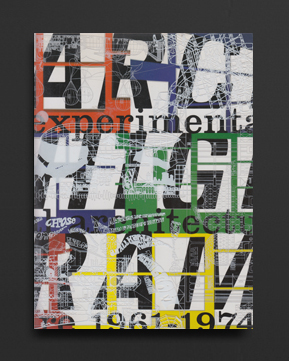
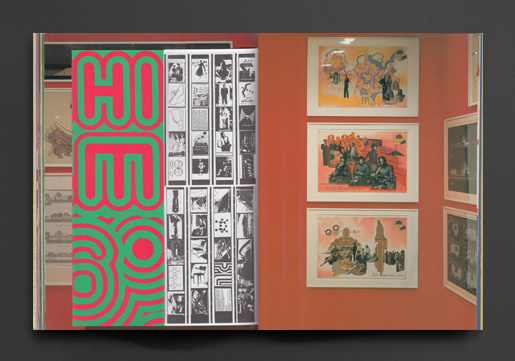
The exceptional, lavish and quickly out-of-print Japanese Archigram book, published in 2005 to accompany a major retrospective exhibition that presented the Archigram archives, "Archigram: Experimental Architecture 1961-1974" at Contemporary Art Gallery Art Tower Mito. This first and only printing comes wrapped in a thick, transparent printed acetate dust-jacket and presents page after page of full-bleed colour photographic documentation of this exhibition (installations, drawings, collages, paintings, models, ephemera), punctuated with incredible facsimile inserts sampling Archigram's many influential publications from the 1960s and 1970s, enclosed in printed envelopes and fold-out spreads spanning different paper-stocks and formats across the book.
The Exhibition focused on the innovative concepts and visionary projects of Archigram, an avant-garde architectural group formed in the 1960s - based at the Architectural Association, London - that was neofuturistic, anti-heroic and pro-consumerist, drawing inspiration from technology in order to create a new reality that was solely expressed through hypothetical projects, including "Capsule Homes" (1964), "Plug-In City" (1964), "Walking City" (1964), "Instant City" (1968), "Cushicle" (1969)...
The main members of the group were Peter Cook, Warren Chalk, Ron Herron, Dennis Crompton, Michael Webb and David Greene. Designer Theo Crosby was the "hidden hand" behind the group. Especially active between 1961 and 1974, the group anticipated the global inter-relatedness of culture and technology and thus had an immediate influence on architectural discussions worldwide - the significance of their work continues to be felt today. Their radical re-definitions of domestic architecture and urban planning, as well as an aesthetic that transcends practical function, had wide-felt repercussions on contemporary British art of the 1960s and the subsequent avant-garde in architecture at that time in Europe, Japan, and America. Their work inspired two like-minded Italian collectives, Archizoom and Superstudio and Renzo Piano and Richard Rogers' Centre Pompidou (1972-76) in Paris, as well as buildings by Japanese "metabolist" architects such as Kenzo Tange's Shizuoka Press and Broadcasting Center (1965-70) in Tokyo. Archigram responded to comic books and pop music, space travel and moon landing, science fiction and the exciting new technologies of the sixties and seventies, their inspirations came from architects and artists such as Buckminster Fuller, Bruno Taut, and Friedrich Kiesler. As a result, they created radical alternatives to cities, houses and other architectural archetypes, communicating their ideas through Archigram magazine as well as though traditional architectural renderings, gallery exhibitions, multi-media installations, and collage. Their unique style of rendering often emphasized concepts over architectural forms, and had an enormous influence on modern architectural drawing techniques as well as the conceptualization of architectural ideas.
Texts in English and Japanese, including essays, profiles of Archigram members, and an interview with Peter Cook.
Very Good condition of this densely-layered and impressive book that reflects the Archigram ethos superbly.
2018, English
Hardcover (w. dust jacket), 250 pages, 22.9 x 30.5 cm
Published by
Yale University Press / New Haven
$125.00 $60.00 - Out of stock
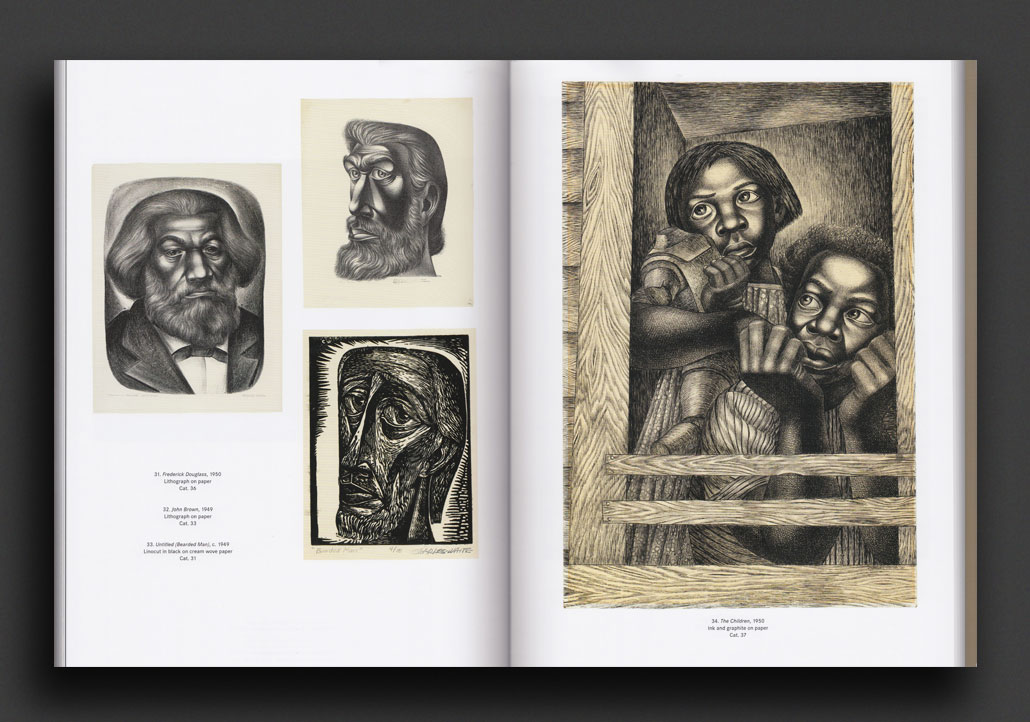
A revelatory reassessment of one of the most influential American artists of the 20th century
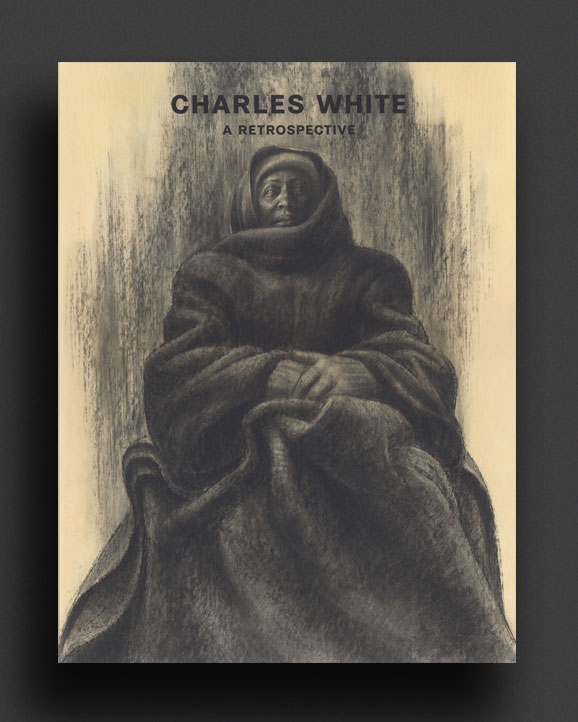
Charles White (1918-1979) is best known for bold, large-scale paintings and drawings of African Americans, meticulously executed works that depict human relationships and socioeconomic struggles with a remarkable sensitivity. This comprehensive study offers a much-needed reexamination of the artist's career and legacy. With handsome reproductions of White's finest paintings, drawings, and prints, the volume introduces his work to contemporary audiences, reclaims his place in the art-historical narrative, and stresses the continuing relevance of his insistent dedication to producing positive social change through art.
Tracing White's career from his emergence in Chicago to his mature practice as an artist, activist, and educator in New York and Los Angeles, leading experts provide insights into White's creative process, his work as a photographer, his political activism and interest in history, the relationship between his art and his teaching, and the importance of feminism in his work. A preface by Kerry James Marshall addresses White's significance as a mentor to an entire generation of practitioners and underlines the importance of this largely overlooked artist.
Edited by Esther Adler
Preface by Kerry James Marshall
Contributions by Ilene Susan Fort, Mark Pascale, Sarah Kelly Oehler, Deborah Willis, Kellie Jones
1973, English
Softcover, 128 pages, 21 x 13.5 cm
1st Edition, Out of print title / used / good
Published by
The Crossing Press / New York
$50.00 - Out of stock
First edition of "The Male Muse : A Gay Anthology", of one of the first openly gay poetry anthologies, edited by Ian Young and published in New York in 1973.
"... until 1972 an anthology of contemporary poetry seemed impossible to carry out not because the writing was't there, but because the aura of taboo was still strong enough to prevent all but a few writers from contributing. But suddenly, in 1972, the growing impetus of the homophile/gay liberation movement began to be felt by the rest of society both gay and straight, and Pride became not just a slogan but a reality for a significant number of homosexual men and women." - from the Introduction by Ian Young
Features the work of Robert Duncan, Allen Ginsberg, Thom Gunn, Robert Adamson, James Kirkup, William Barber, Zdzislaw Kurlowicz, Oswell Blakeston, E.A. Lacey, Perry Brass, John Lehmann, Jim Chapson, James Liddy, Paul Mariah, Kirby Congdon, Paul Maurice, James Mitchell, Jim Eggeling, Edward Mycue, Sal Farinella, Harold Norse, Edward Field, Robert Peters, John Gill, Ralph Pomeroy, Michael Radcliffe, Paul Goodman, Jay Socin, Walter Griffin, Richard Tagett, Burton Weiss, Michael Higgins, Brian Hill, John Wieners, Christopher Isherwood, Tennessee Williams, Graham Jackson, Jonathan Williams, Ronald Johnson, Ian Young.
Ian Young (born January 5, 1945) is an English-Canadian poet, editor, literary critic, and historian. An alumnus of the University of Toronto, he founded Canada's first gay publishing company, Catalyst Press, in 1970. His work has appeared in Canadian Notes & Queries, The Gay & Lesbian Review Worldwide, Rites and Continuum, as well as in more than fifty anthologies. He was a regular columnist for The Body Politic from 1975 to 1985 and for Torso between 1991 and 2008. Young is best known for his work as editor of the anthology The Gay Muse and the bibliography The Male Homosexual in Literature. He was interested in ceremonial magic during the 1980s and was a founding member of the Hermetic Order of the Silver Sword.
Good of the first edition. Tightly bound with tanning and cover wear/marks.
1981, English
Softcover, 190 pages, 21.5 x 14 cm
1st Edition, Out of print title / used / good
Published by
Little Caesar Press / Los Angeles
$70.00 - Out of stock
Special final issue of Dennis Cooper's Little Caesar Magazine, published in 1981 and edited by Ian Young, that presents a unique collection of essays on "overlooked" or "underrated" 20th Century writers, compiled and authored by a long list of contributors. Selected writers include Willard Motley, Phil Andros, Lorine Niedecker, Mikhail Bulgakov, Phyllis Paul, Mary Butts, John Cowper Powys, Robert M. Coates, James Schuyler, John Glassco, Edward Lewis Wallant, Emilie Glen, Denton Welch, Alfred Starr Hamilton, Glenway Wescott, Barbara Holland, Donald Windham, Bob Kaufman, Gamel Woolsey, A.M. Klein and others chosen by Maurice Kenny, Steve Abbott, E.A. Lacey, Eric Bentley, Michael Lally, Oswell Blakeston, Irving Layton, Glen Cavaliero, Robert Peters, Merritt Clifton, James Purdy, Kirby Congdon, Jerry Rosco, Dan Diamond, George Steiner, Edmund White, Allen Ginsberg, George Whitmore, Richard Hall, Jonathan Williams, Kenneth Hopkins, Ian Young, and Joseph Kadlec.
American writer Dennis Cooper started Little Caesar Magazine in 1976 as a literary journal with an anarchist, punk rock spirit. From its humble beginnings as a skinny, low-tech zine dominated by poetry, it grew into a book sized magazine featuring poetry, fiction, portfolios of art and photography, essays, special theme issues, and interviews with a wide range of writers, artists, and pop culture figures (ranging from teen idol Leif Garrett to musicians like Johnny Rotten and Gram Parsons to porn director Toby Ross, to name but a few). In 1978, Cooper started Little Caesar Press, which wound up publishing 24 books of poetry and fiction by young and established contemporary authors (Joe Brainard, Amy Gerstler, Eileen Myles, Peter Schjeldahl, Elaine Equi, Ronald Koertge, Gerard Malanga, Tom Clark, et. al.), as well as the first and only English language translation of Arthur Rimbaud's final work, "Travels in Abyssinia".
By the time the magazine ceased production after twelve issues in 1982, its contributors included such people as Andy Warhol, Lou Reed, Nico, Debbie Harry, Brian Eno, and many others.
These days, issues of Little Caesar are highly sought after collector's items.
Good copy with tanning and some light staining to covers, otherwise solid and clean throughout.
2019, English
Hardcover (w. dust jacket), 296 pages, 17.8 x 22.9 cm
Published by
The MIT Press / Massachusetts
$85.00 $70.00 - Out of stock
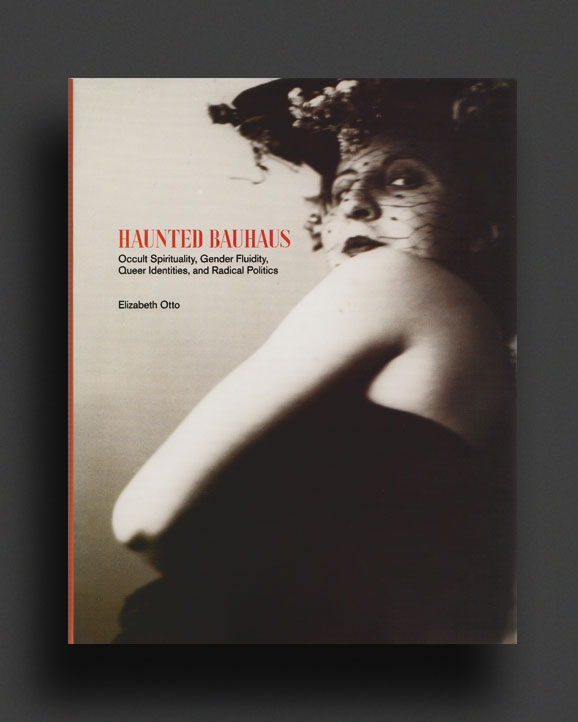
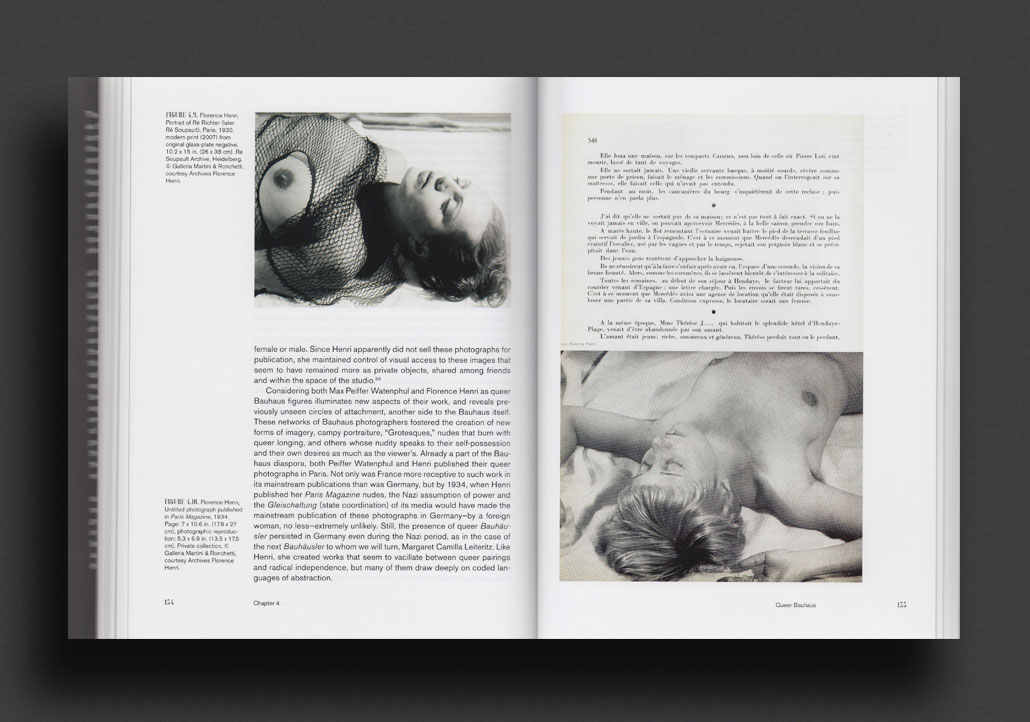
The Bauhaus (1919–1933) is widely regarded as the twentieth century's most influential art, architecture, and design school, celebrated as the archetypal movement of rational modernism and famous for bringing functional and elegant design to the masses. In Haunted Bauhaus, art historian Elizabeth Otto liberates Bauhaus history, uncovering a movement that is vastly more diverse and paradoxical than previously assumed. Otto traces the surprising trajectories of the school's engagement with occult spirituality, gender fluidity, queer identities, and radical politics. The Bauhaus, she shows us, is haunted by these untold stories.
The Bauhaus is most often associated with a handful of famous artists, architects, and designers—notably Paul Klee, Walter Gropius, László Moholy-Nagy, and Marcel Breuer. Otto enlarges this narrow focus by reclaiming the historically marginalized lives and accomplishments of many of the more than 1,200 Bauhaus teachers and students (the so-called Bauhäusler), arguing that they are central to our understanding of this movement. Otto reveals Bauhaus members' spiritual experimentation, expressed in double-exposed “spirit photographs” and enacted in breathing exercises and nude gymnastics; their explorations of the dark sides of masculinity and emerging female identities; the “queer hauntology” of certain Bauhaus works; and the role of radical politics on both the left and the right—during the school's Communist period, when some of the Bauhäusler put their skills to work for the revolution, and, later, into the service of the Nazis.
With Haunted Bauhaus, Otto not only expands our knowledge of a foundational movement of modern art, architecture, and design, she also provides the first sustained investigation of the irrational and the unconventional currents swirling behind the Bauhaus's signature sleek surfaces and austere structures. This is a fresh, wild ride through the Bauhaus you thought you knew.
1994 / 2015, English
Softcover, 288 pages, 13.7 x 20.8 cm
Published by
Ecco Press / New York
$35.00 - Out of stock
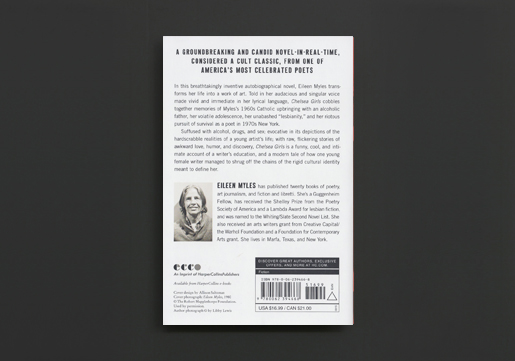
A groundbreaking and candid novel-in-real-time, considered a cult classic, from one of America's most celebrated poetsIn this breathtakingly inventive autobiographical novel, Eileen Myles transforms her life into a work of art. Told in her audacious and singular voice made vivid and immediate in her lyrical language, Chelsea Girls cobbles together memories of Myles's 1960s Catholic upbringing with an alcoholic father, her volatile adolescence, her unabashed "lesbianity," and her riotous pursuit of survival as a poet in 1970s New York.
Suffused with alcohol, drugs, and sex; evocative in its depictions of the hardscrabble realities of a young artist's life; with raw, flickering stories of awkward love, humor, and discovery, Chelsea Girls is a funny, cool, and intimate account of a writer's education, and a modern tale of how one young female writer managed to shrug off the chains of the rigid cultural identity meant to define her.
2018, English
Softcover, 400 pages, 19.7 × 13 cm
Published by
Urbanomic / Cornwall
$64.00 - In stock -
An existential odyssey weaving together lived experience and theoretical insight, this startling autobiographical hyperfiction surveys and dissects a world where everything connects and global technological delirium is the norm.
The mediascapes of late capitalism reconfigure erotic responses and trigger primal aggression; under constant surveillance, we occupy simulations of ourselves, private estates on a hyperconnected globe; fictions reprogram reality, memories are rewritten by the future…
Fleeing the excesses of ’90s cyberculture, a young researcher sets out to systematically analyse the obsessively reiterated themes of a writer who prophesied the disorienting future we now inhabit. The story of his failure is as disturbingly psychotropic as those of his magus—J.G. Ballard, prophet of the post-postmodern, voluptuary of the car crash, surgeon of the pathological virtualities pulsing beneath the surface of reality.
Plagued by obsessive fears, defeated by the tedium of academia, yet still certain that everything connects to Ballard, his academic thesis collapses into a series of delirious travelogues, deranged speculations and tormented meditations on time, memory, and loss. Abandoning literary interpretation and renouncing all scholarly distance, he finally accepts the deep assignment that has run throughout his entire life, and embarks on a rogue fieldwork project: Applied Ballardianism, a new discipline and a new ideal for living. Only the darkest impulses, the most morbid obsessions, and the most apocalyptic paranoia, can uncover the technological mutations of inner space.
An existential odyssey inextricably weaving together lived experience and theoretical insight, this startling autobiographical hyperfiction surveys and dissects a world where everything connects and global technological delirium is the norm—a world become unmistakably Ballardian.
A brilliantly written genre mashup […] a wonderfully original mix of cultural theory, literary exegesis, travelogue and psychopathological memoir.
–PD Smith, The Guardian
A curious, unsettling text, full of weird obsessions and mysterious drives. Gleefully, on page after page, it tears up the conventions of literary criticism, autobiography, and fiction and spits them out the other side.
–Robert Barry, The Quietus
An intensely worked and engaged encounter. I admired the persistence, “honesty”, and elective madness. The storms carried me through, all the way.
–Iain Sinclair
Applied Ballardianism is an astonishing book, part fictionalized hallucinatory memoir, part essential Ballard primer, all written in the style of the great man himself. Whether you’re new to JG Ballard or a lifelong fan, this is a thrilling read, cut through with equal parts black humor, cultural insight, and existential horror.
–Tim Maughan, author of Paintwork and Infinite Detail
In Applied Ballardianism, Simon Sellars has invented a genre all his own. But what is it, exactly? Postmodern autopathography? Rough Guide to the Desert of the Real? Notes toward a mental breakdown? The missing link between Ballard and Virilio, psychogeography and edgeland studies, Mad Max and Videodrome? One thing is certain: Applied Ballardianism is the only book you’ll need when you’re marooned on a concrete island, barricaded in a high rise that’s descending into anarchy, or cast away on some Enewetak of the unconscious.
–Mark Dery, author of I Must Not Think Bad Thoughts: Drive-By Essays on American Dread, American Dreams
At first, Simon Sellars appears to be a character in a JG Ballard novel. Then Ballard appears to be a character in a Simon Sellars novel. Then not just the characters but the whole setting and ambience appear to be at once Ballardian and Sellarsian. Then you finish the book and you seem to be a character in a novel the two of them conspired to write. And your perception of the world is never the same again.
–McKenzie Wark, author of A Hacker Manifesto, Gamer Theory, and Telesthesia
This is a book of critical epistemology, of questioning what it is we know, what it is we can know, about and through literary texts. The refracted fluorescence of our own critical passions and compulsions visits us outlandishly, like lights in the sky.
–Brendan Gillott, Minor Literatures
Simon Sellars is a writer and editor based in Melbourne, Australia.
2018, English
Softcover, 824 pages, 15.6 x 23.4 cm
Published by
Repeater Books / London
$56.00 - Out of stock
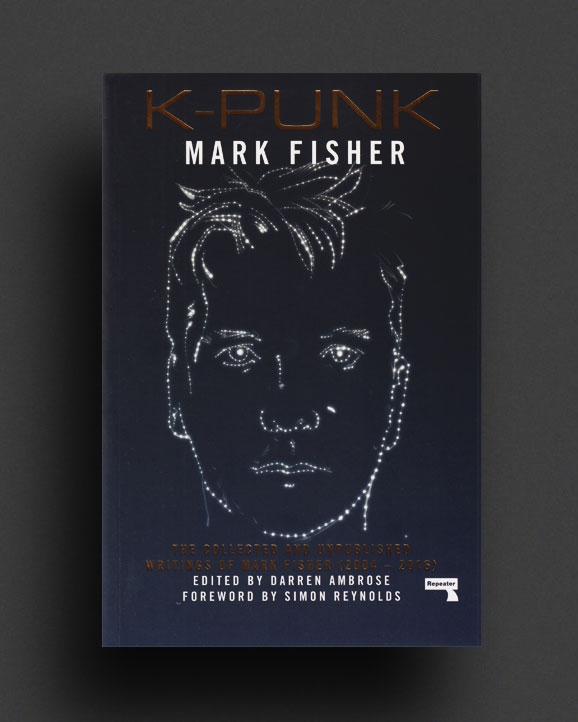
Edited by Darren Ambrose and with a foreword by Simon Reynolds, this comprehensive 800+ collection brings together the work of acclaimed blogger, writer, political activist and lecturer Mark Fisher (aka k-punk). Covering the period 2004 - 2016, the collection will include some of the best writings from his seminal blog k-punk; a selection of his brilliantly insightful film, television and music reviews; his key writings on politics, activism, precarity, hauntology, mental health and popular modernism for numerous websites and magazines; his final unfinished introduction to his planned work on "Acid Communism"; and a number of important interviews from the last decade.
Mark Fisher (11 July 1968 – 13 January 2017), also known as "k-punk", was a British writer, critic, cultural theorist, and teacher based in the Department of Visual Cultures at Goldsmiths, University of London. He initially achieved acclaim for his blogging as k-punk in the early 2000s, and was known for his writing on radical politics, music, and popular culture.
Fisher published several books, including the unexpected success Capitalist Realism: Is There No Alternative? (2009), and contributed to publications such as The Wire, Fact, New Statesman and Sight & Sound. He was also the co-founder of Zero Books, and later Repeater Books. He died in January 2017, shortly before the publication of his latest book The Weird and the Eerie (2017).
2020, English
Softcover, 44 pages, 23 x 15.5 cm
Published by
Sahara Books / France
$29.00 - Out of stock
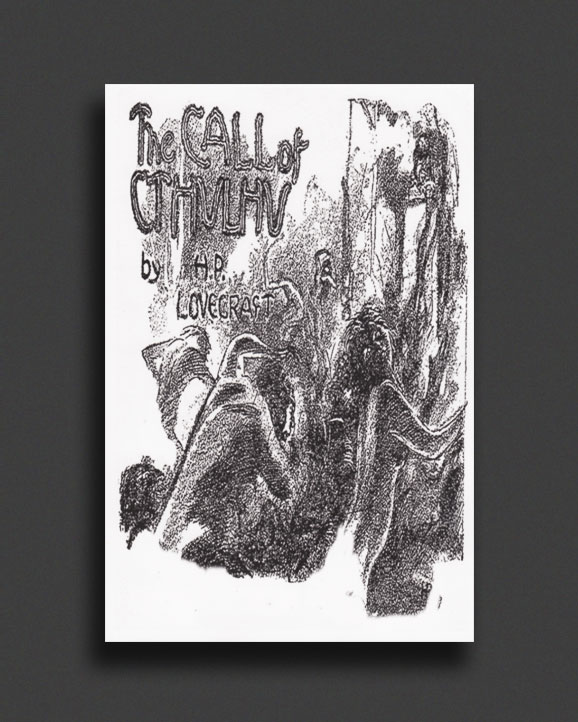
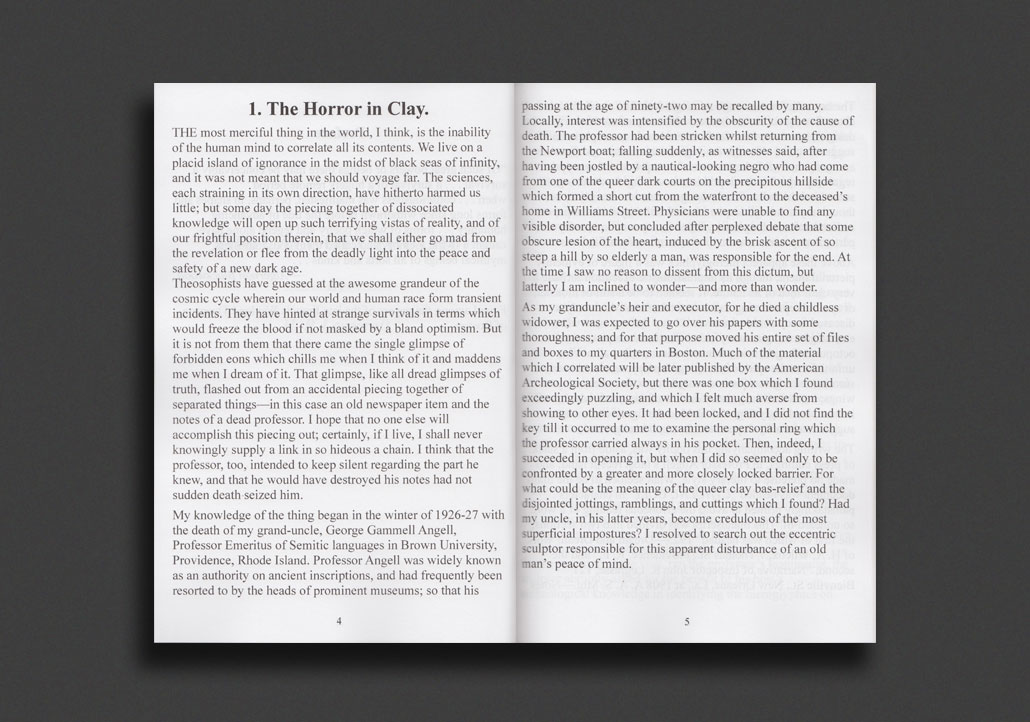
"The Call of Cthulhu" is a short story by American writer H. P. Lovecraft. Written in the summer of 1926, it was first published in the pulp magazine Weird Tales, in February 1928. This is an unabridged reprint of this original 1928 version.
Howard Phillips Lovecraft (August 20, 1890 – March 15, 1937) was an American writer, who achieved posthumous fame through his influential works of horror fiction. He was virtually unknown and published only in pulp magazines before he died in poverty, but he is now regarded as one of the most significant 20th-century authors of horror and weird fiction.
Lovecraft was born in Providence, Rhode Island, where he spent most of his life. Among his most celebrated tales are "The Rats in the Walls", "The Call of Cthulhu", At the Mountains of Madness, The Shadow over Innsmouth, and The Shadow Out of Time, all canonical to the Cthulhu Mythos. Lovecraft was never able to support himself from earnings as an author and editor. He saw commercial success increasingly elude him in this latter period, partly because he lacked the confidence and drive to promote himself. He subsisted in progressively strained circumstances in his last years; an inheritance was completely spent by the time he died, at age 46.
In 1962 Colin Wilson, in his survey of anti-realist trends in fiction The Strength to Dream, cited Lovecraft as one of the pioneers of the "assault on rationality" and included him with M. R. James, H. G. Wells, Aldous Huxley, Tolkien and others as one of the builders of mythicised realities over against the failing project of literary realism. Subsequently, Lovecraft began to acquire the status of a cult writer in the counterculture of the 1960s, and reprints of his work proliferated. Philosopher Graham Harman, seeing Lovecraft as having a unique—though implicit—anti-reductionalist ontology, writes: "No other writer is so perplexed by the gap between objects and the power of language to describe them, or between objects and the qualities they possess." Harman said of leading figures at the initial speculative realism conference (which included philosophers Quentin Meillassoux, Ray Brassier, and Iain Hamilton Grant) that, though they shared no philosophical heroes, all were enthusiastic readers of Lovecraft. Speculative realists, Mark Fisher and other contemporary philosophers, took Lovecraft seriously, mainly because Lovecraft's weird reality as presented in his novels, had nothing to do with the Gothic's insistence in the supernatural, but presented another reality incomprehensible to the human mind, but nonetheless real. According to scholar S. T. Joshi: "There is never an entity in Lovecraft that is not in some fashion material".
2020, English
Hardcover, 368 pages, 17 x 24 cm
Published by
Thames and Hudson / London
Museo Nacional del Prado / Madrid
$50.00 - Out of stock
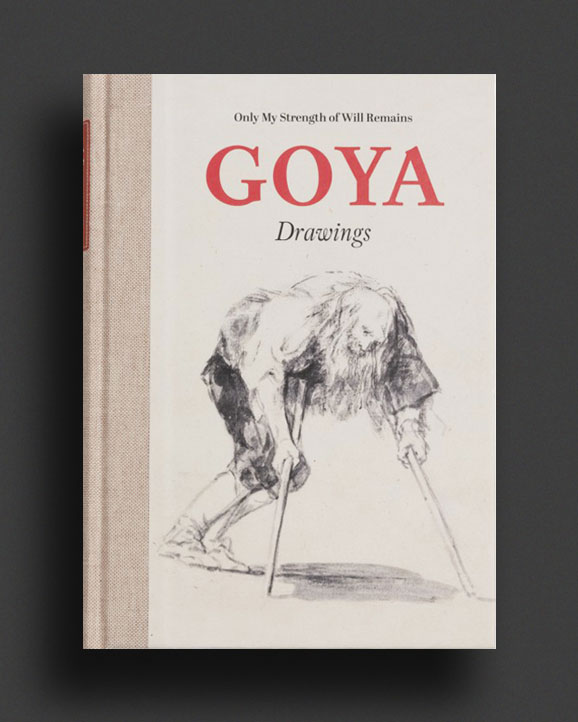
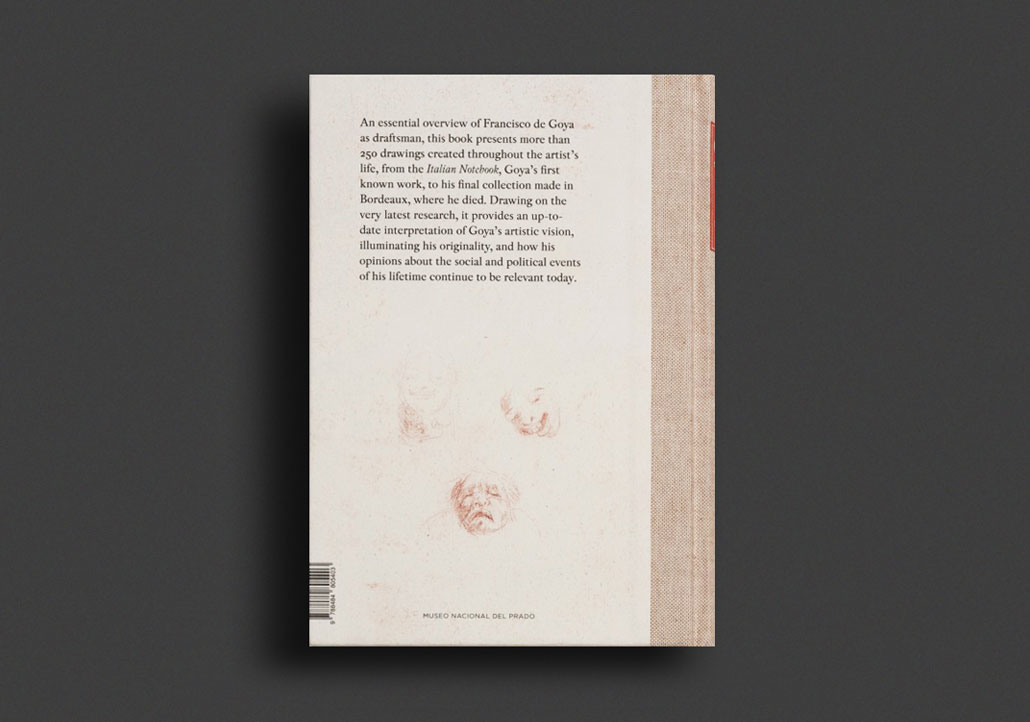
Drawings by Francisco de Goya presents the fruits of the research undertaken for the publication of a new catalogue raisonné of Goya’s drawings, a subject to which the Museo del Prado has always devoted particular attention and which is one of the keystones of its collection. Since the publication of Gassier’s catalogue in 1973 the number of drawings attributed to Goya has changed, giving rise to the need for a new catalogue raisonné which updates the enormous body of information accumulated over the course of two centuries of literature on this subject.
This book brings together more than 100 drawings by Goya from the Prado’s own collections and from public and private ones around the world. It is presented as a chronological survey of his work that includes drawings from throughout his career, ranging from the Italian Sketchbook to the Bordeaux Albums. It also offers an up-to-date vision of the ideas that recurrently appear in Goya’s work, revealing the ongoing and long-lasting relevance of his thinking.
2010, English
Softcover, 197 pages, 15 x 23 cm
Published by
Solar Books / US
$44.00 - Out of stock
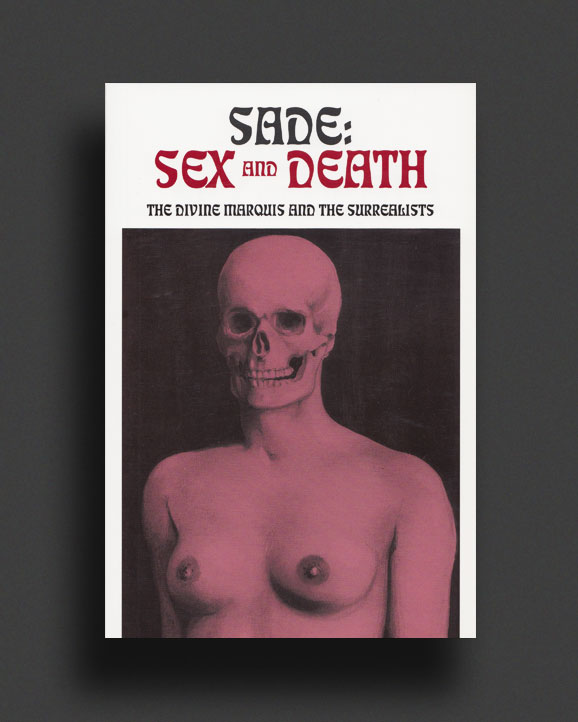
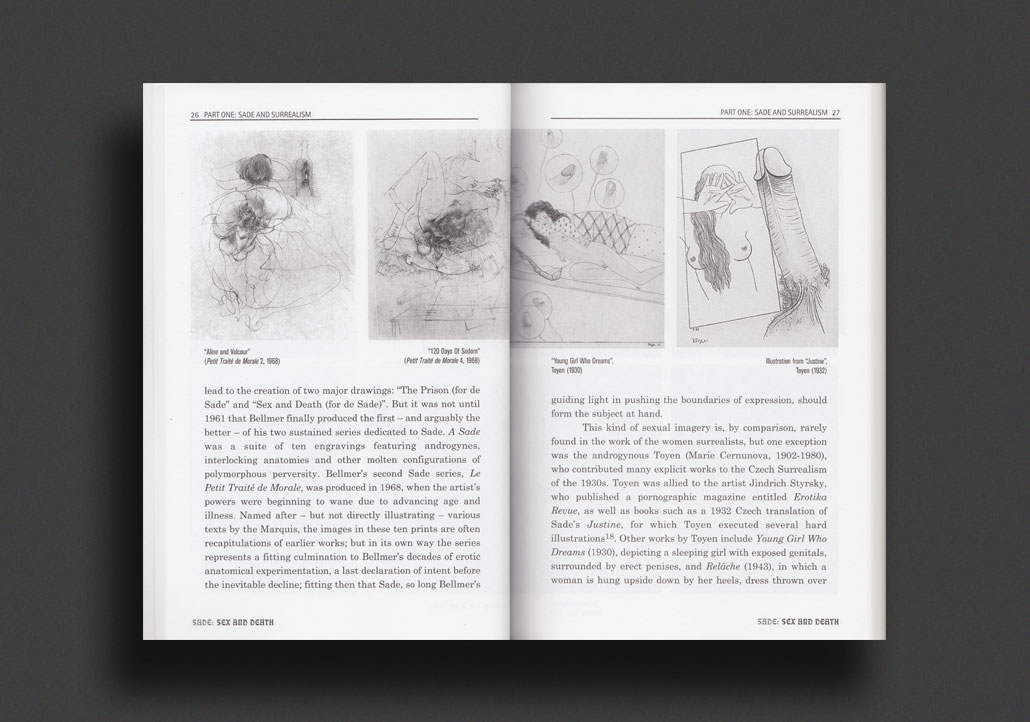
The Marquis de Sade (1740–1814), best known for his violent, erotic novels, such as 120 Days of Sodom and Justine, was also one of the key inspirational figures identified by André Breton in his Surrealist Manifestos. De Sade’s importance to the Surrealists and their close affiliates is reflected in the sheer volume of art and writing dedicated to, or inspired by, his life, philosophy, and writings. Sade: Sex and Death documents this body of Surrealist work, including many key texts and bizarre and erotic images never before assembled in one volume.
Included in Sade are more than fifty rarely seen transgressive illustrations by some of the most famous names associated with Surrealism, including Dalí, Hans Bellmer, Magritte, André Masson, and Man Ray. The book also features analytical texts by writers of the period such as Bataille, Breton, Bunuel, Eluard, and Klossowski. Also included is the first-ever English translation of “The Divine Marquis” by Guillaume Apollinaire, which was the first modernist appraisal of Sade and remains one of the best concise biographies of its subject, and “Sade and the Roman Noir” by scholar Maurice Heine, in which Heine posits Sade as inventor of the gothic novel. Putting the works in context is an extensive history by editor Candice Black that details the relationship between the Surrealists and Sade.
2020, English
Hardcover, 832 pages, 24 x 16.2 cm
Published by
Allen Lane / UK
$60.00 - Out of stock
'In this long-awaited, brilliant biography, Benjamin Moser shows us how to read Susan Sontag – and, by extension, her times – in the present, and reveals the extends and limits of her genius. His psychologically nuanced critical study is written with sangfroid and compassion.' Chris Kraus
The definitive portrait of one of the twentieth century's most towering figures: her writing and her radical thought, her public activism and her private face.
Susan Sontag was our last great literary star. Her brilliant mind, political activism and striking image made her an emblem of the seductions – and the dangers – of the twentieth-century world. Her writing on art and politics, feminism and her homosexuality, celebrity and style, medicine and drugs, Fascism and Freudianism, Communism and Americanism, reflected the conflicted meanings of a most conflicted word: modernity. Drawing on hundreds of interviews, featuring nearly one hundred images, never seen before – Sontag is the first book based on the writer's restricted archives. It is an indelible portrait of one of the twentieth century's greatest thinkers, who lived one of the century's most romantic – and most anguished – lives.
1968, French
Softcover, 16 pages, 27 x 18 cm
Edition of 1500,
1st Edition, Out of print title / used / fine
Published by
Galerie Cogeime / Brussels
$80.00 - Out of stock
Rare early catalogue from 1968, printed in an edition of 1500 copies on the occasion of Alina Szapocznikow's solo exhibition at Galerie Cogeime, Brussels (12 November to 3 December 1968).
Illustrated throughout in black and white, with texts by Pierre Restany and Giuseppe Marchiori and biography of the artist. Beautifully designed by the great Roman Cieślewicz.
Alina Szapocznikow (May 16, 1926 – March 2, 1973), was a Polish sculptor who began working during the postwar period in a classical figurative style, but radically reconceptualized sculpture as an imprint not only of memory but of her own body. Though her career effectively spanned less than two decades (cut short by the artist's premature death in 1973 aged 47), Szapocznikow left behind a legacy of provocative objects that evoke Surrealism, Nouveau Realisme and Pop art. Her tinted polyester casts of body parts, often transformed into everyday objects like lamps or ashtrays; her poured polyurethane forms; and her elaborately constructed sculptures, which at times incorporated photographs, clothing or car parts, all remain as wonderfully idiosyncratic and culturally resonant today as when they were first made.
1976, English
Hardcover (w. dust jacket), 72 pages, 24 x 30 cm
1st Edition, Out of print title / used / very good
Published by
Editions Filipacchi / Paris
$120.00 - Out of stock
First 1976 hardcover English-edition of the great Editions Filipacchi monograph on artist Dorothea Tanning. Profusely illustrated with Tanning's incredible paintings in colour and b/w, accompanied by photography, biography and texts in English by author Gilles Plazy.
Dorothea Tanning (1910–2012) was born in the United States in the town of Galesburg, Illinois to Swedish émigré parents. Largely self-taught as an artist, Tanning moved to New York in 1935 where she began working as a freelance illustrator, creating advertisement designs for Macy’s department store and other clients. In 1936 she visited the ground-breaking MoMA exhibition Fantastic Art, Dada, Surrealism. Surrealism had a profound effect on her. Travelling to France in July 1939, she found a country on the brink of war and Paris empty of the artists with whom she had hoped to be acquainted. Refugees from Nazi occupied France, she would meet the surrealists back in New York through her first art dealer, Julien Levy. Late in 1942 Max Ernst visited her studio, saw a painting, (Birthday), and stayed to play chess. In a double wedding with artist Man Ray and dancer Juliet P. Browner, Tanning and Ernst married in October 1946. They would have 34 years together, moving to the town of Sedona, Arizona, to build a house set within a group of huge red rocks in the Verde Valley. Sedona captivated Tanning’s imagination. Here she would continue to write and paint her enigmatic versions of life on the inside, looking out. By 1956 Max and Dorothea had moved to France. Around 1955 Tanning’s paintings moved away from meticulously rendered figurative dreamscapes, increasingly employing confident gestural flow and movement in the wake of her work as a costume and stage designer for the ballets of the Russian choreographer George Blanchine – Night Shadow (1946), The Witch (1950) and Bayou (1952). In the late 1960s Tanning’s practice shifted once again, moving from drawing, design and painting to three-dimensional sculptural works fashioned from soft textiles and found items. When Ernst died in Paris in 1976, Tanning was bereft. ‘There is no light in the studio,’ she wrote, ‘nothing moves and the colored jokes are fading fast. The disorder is grievous. (Is the heart condemned to break each day?)'. In 1979 Tanning began her return to New York, where she gave full rein to her long felt compulsion to write. Her published works include two memoirs, Birthday and Between Lives, a collection of poems, A Table of Content, and a novel, Chasm. Tanning died in New York on 21 January 2012, aged 101.
1966, French
Hardcover (w. dust jacket), 160 pages, 26.5 x 21.8 cm
1st Edition, Out of print title / used / very good
Published by
Jean-Jacques Pauvert / Paris
$70.00 - Out of stock
First 1966 hardcover edition of this early comprehensive French monograph on artist Dorothea Tanning, published by Jean-Jacques Pauvert in Paris. Profusely illustrated with Tanning's incredible paintings in colour and b/w, accompanied by extensive texts (in French) by poet and critic Alain Bosquet.
Dorothea Tanning (1910–2012) was born in the United States in the town of Galesburg, Illinois to Swedish émigré parents. Largely self-taught as an artist, Tanning moved to New York in 1935 where she began working as a freelance illustrator, creating advertisement designs for Macy’s department store and other clients. In 1936 she visited the ground-breaking MoMA exhibition Fantastic Art, Dada, Surrealism. Surrealism had a profound effect on her. Travelling to France in July 1939, she found a country on the brink of war and Paris empty of the artists with whom she had hoped to be acquainted. Refugees from Nazi occupied France, she would meet the surrealists back in New York through her first art dealer, Julien Levy. Late in 1942 Max Ernst visited her studio, saw a painting, (Birthday), and stayed to play chess. In a double wedding with artist Man Ray and dancer Juliet P. Browner, Tanning and Ernst married in October 1946. They would have 34 years together, moving to the town of Sedona, Arizona, to build a house set within a group of huge red rocks in the Verde Valley. Sedona captivated Tanning’s imagination. Here she would continue to write and paint her enigmatic versions of life on the inside, looking out. By 1956 Max and Dorothea had moved to France. Around 1955 Tanning’s paintings moved away from meticulously rendered figurative dreamscapes, increasingly employing confident gestural flow and movement in the wake of her work as a costume and stage designer for the ballets of the Russian choreographer George Blanchine – Night Shadow (1946), The Witch (1950) and Bayou (1952). In the late 1960s Tanning’s practice shifted once again, moving from drawing, design and painting to three-dimensional sculptural works fashioned from soft textiles and found items. When Ernst died in Paris in 1976, Tanning was bereft. ‘There is no light in the studio,’ she wrote, ‘nothing moves and the colored jokes are fading fast. The disorder is grievous. (Is the heart condemned to break each day?)'. In 1979 Tanning began her return to New York, where she gave full rein to her long felt compulsion to write. Her published works include two memoirs, Birthday and Between Lives, a collection of poems, A Table of Content, and a novel, Chasm. Tanning died in New York on 21 January 2012, aged 101.
1990, Japanese
Softcover (w. dust jacket), 160 pages, 21 x 14.8 cm
1st Edition, Out of print title / as new
Published by
Bell Comics / Tokyo
Tokyo Sanseisha / Tokyo
$25.00 - Out of stock
First edition from 1990, Trouble Action is a vintage manga / hentai comic book from Japanese illustrator Kazusa Shima, published by Tokyo Sanseisha (Bell Comics edition). An illustrated affair of sexual deviancy collected across multiple fantasy stories, in colour and b/w, wrapped in original illustrated dust jacket.
As New.
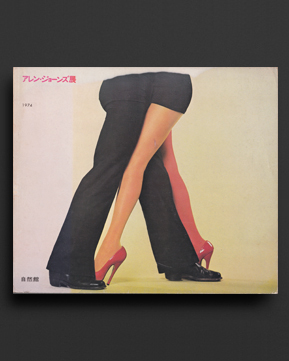
1974, Japanese
Softcover, 80 pages, 22 x 26 cm
1st edition, Out of print title / used*,
Published by
Seibu / Tokyo
Shizenkan / Tokyo
$120.00 - Out of stock
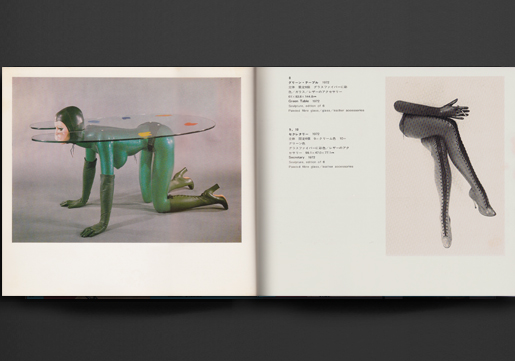
One of the finest, rarely seen books on Allen Jones, published in Japan in 1974 on the occasion of a Japanese exhibition in that travelled across Tokyo (at Seibu) and Nagoya (at Meitetsu), the same year. Densely packed, this book is profusely illustrated in colour and black and white with Jones' drawings, painting, sculptures, designs, posters, prints, book editions, lithographic set editions, photographs of the artist's studio (by Tim Street-Porter and Yoshio Marumoto), an interview, biography, and bibliography.
Edited by Allen Jones and Yoshio Marumoto.
1970, Japanese / English
Softcover, 96 pages, 32.5 × 25.5 cm
1st Edition, Out of print title / used / very good
Published by
Interior Publishing Co. Ltd. / Tokyo
$70.00 - Out of stock
One of Japan's finest magazines for interior design and home furnishings, edited by Moriyama Kazuhiko.
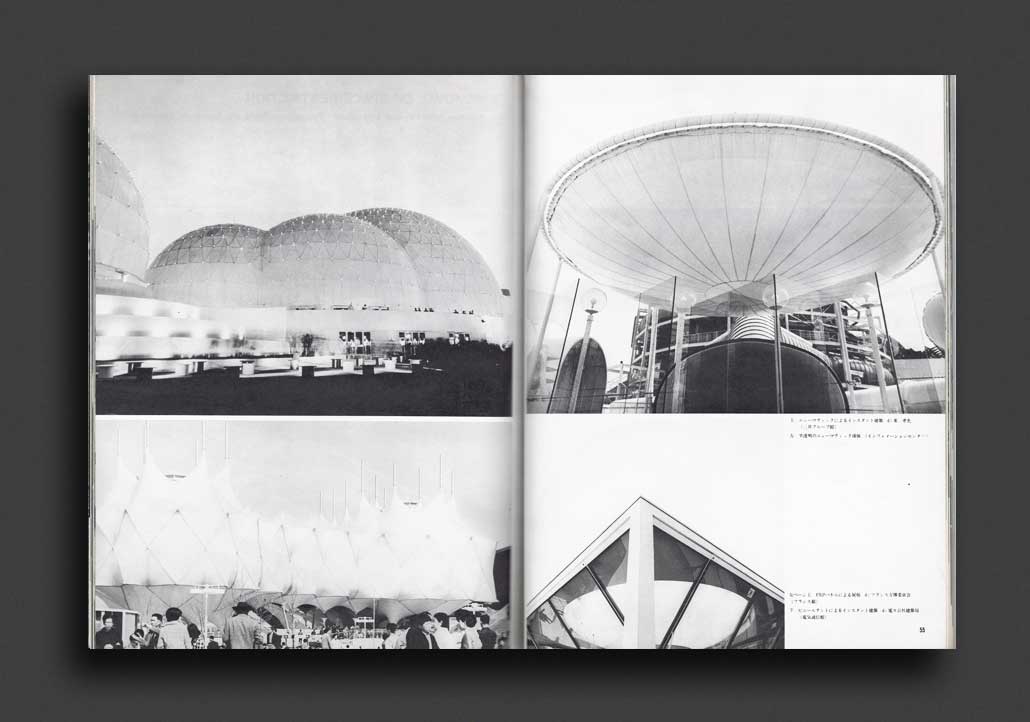
JAPAN INTERIOR DESIGN presented a monthly comprehensive view of traditional, contemporary, and contemplated environmental designs and pure art forms both Japanese and foreign, through pictures and critical reviews. English captions and summaries of major articles are provided each issue.
SPECIAL FEATURE of this issue is "NEW SPATIAL EXPERIMENTS AT EXPO '70"
Also,
1970, Japanese / English
Softcover, 96 pages, 32.5 × 25.5 cm
1st Edition, Out of print title / used / very good
Published by
Interior Publishing Co. Ltd. / Tokyo
$70.00 - Out of stock
One of Japan's finest magazines for interior design and home furnishings, edited by Moriyama Kazuhiko.
JAPAN INTERIOR DESIGN presented a monthly comprehensive view of traditional, contemporary, and contemplated environmental designs and pure art forms both Japanese and foreign, through pictures and critical reviews. English captions and summaries of major articles are provided each issue.
CONTENTS :
SPECIAL FEATURE - NEW SPATIAL EXPERIMENTS FOR INTERIOR DESIGN
Plus,
1970, English
Hardcover (w.dust jacket), 120 pages, 17 x 11.8 cm
1st Edition, Out of print title / used / very good
Published by
Sperone Editore / Torino
$450.00 - Out of stock
Very scarce, wonderful early artist's book by Douglas Huebler, edited by Germano Celant and Pierluigi Pero and published in Turin by Sperone Editore, 1970.
"A fountain located in the Giardino of Sambuy, Italy, was documented by 61 photographs made according to 8 different systems in 'time'."- January 1970, Douglas Huebler
Considered a founder of Conceptual Art, Douglas Huebler's interests and influences ranged from language and mathematics to avant-garde literature and Existentialism. Having abandoned painting and sculpture by the late 1960s, he is primarily known for his work that combined short written statements (usually containing a description of a structure or system) with other materials, such as photography, drawings, and maps. Durata/Duration demonstrates Huebler's early interest in aspects of time and location.
Good-Very Good copy with light tanning/wear, fragile binding.
2008, English
Softcover, 80 pages
Published by
IMA / Brisbane
$20.00 - Out of stock
Catalogue published to accompany the survey exhibition Diena Georgetti: The Humanity of Abstract Painting 1988-2008 at the IMA Brisbane, 2008.
"The work of Diena Georgetti is enigmatic and elusive. The artist achieved considerable critical acclaim when her blackboard paintings were first shown in 1989 at Brisbane’s Institute of Modern Art, and subsequently at the 1992 Biennale of Sydney. Soon after, her work took an abrupt turn, as she followed up with a series of orientalist paintings, marked by their modest scale, allegorical possibility, and psychological intensity. More recently, she has been producing works co-opting early modernist styles to new ends. Georgetti grew up in Brisbane, where she continues to live and work, with a decade spent in Melbourne from 1989 to 2000. Her work has been exhibited regularly inAustralia and New Zealand. Few people however, have had the opportunity to see the scope of her work, to follow the subtle shifts in her project. In 1993 Judith Pascale wrote that Georgetti’s art was better understood by friends and colleagues than art world professionals, and this still largely holds true. But we hope this may be addressed by our exhibition, Diena Georgetti: The Humanity of Abstract Painting 1988-2008, which surveys two decades of work allowing us to take stock of its breadth and development and to
grant the artist overdue recognition."
As New. All copies had bad binding.
2010, English
Softcover, 40 pages, 21 x 29.5 cm
1st Edition, Out of print title / used / very good
Published by
Douglas Stewart Fine Books / Melbourne
$10.00 - Out of stock
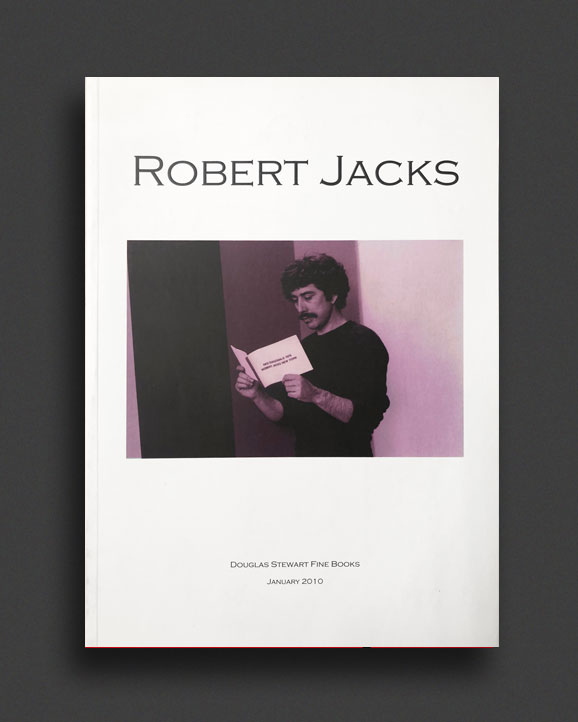
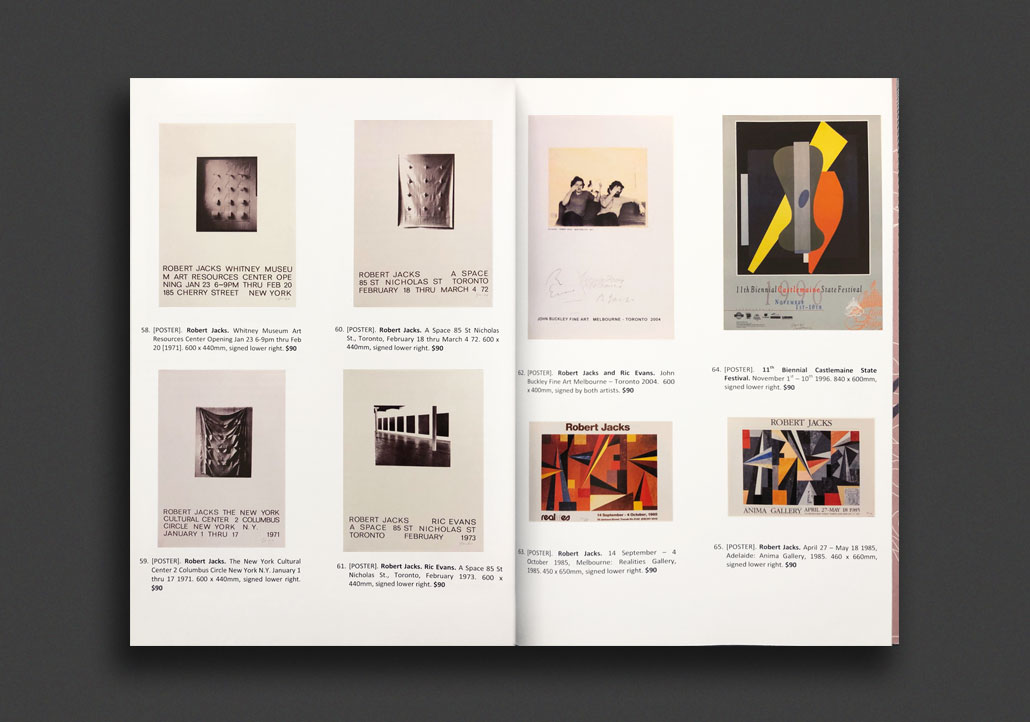
Published by Douglas Stewart Fine Books in 2010, this publication catalogues, as the title suggests, Australian artist Robert Jacks's archive of books, printed works, folios and ephemera - a central component of his practice. Compiled entirely from the artist’s collection and spanning 1969 – 2009, it forms an authoritative, fully illustrated listing of publications and works from the prolific Australian artist.
Robert Jacks (born 1943) is an Australian painter, sculptor and printmaker.
In 1966 he had his first solo exhibition at Gallery A, Melbourne from which a work was purchased for the collection of the National Gallery of Victoria. In 1968, he participated in ‘The Field’ an extremely influential exhibition at the new National Gallery of Victoria, which effectively launched colour field abstraction in Australia.
"I think my work has always been minimal and abstract because when I was being taught sculpture, it was expressed in abstract terms. Form in space, mass and volume - that sort of thing. Painting, for me, is an extension of sculptural ideas."