World Food Books' programme is largely produced on Kulin Nation land. We acknowledge the Wurundjeri people of the Kulin Nation as the first and continuing custodians of this land, and pay respect to their Elders past, present, and emerging.
World Food Books is an arts and special interests bookshop in Naarm / Melbourne. Founded in 2010, World Food Books is devoted to the presentation of a rotating, hand-selection of international art, design, literary and counterculture publications with an emphasis on the anti-traditional, the experimental, the avant-garde, the heretic, the marginal.
Presenting new titles alongside rare and out-of-print books, catalogues and journals spanning the fields of modern and contemporary art, design, photography, illustration, film, literature, poetry, cultural theory, philosophy, sexuality, popular and underground culture in its many radical forms, World Food Books wishes to encourage adventurous, thoughtful and open-minded reading, looking, writing, and exchange of publishing and ideas, both current and historical.
As well as our bookshop, located in Melbourne's historical Nicholas Building, all of our inventory is available internationally via our online mail-order service.
World Food Books semi-regularly co-ordinates "Occasions", a programme of exhibits and events at the bookshop and in partnership with other hosts (such as museums and art galleries) that develop out of the activities, relationships and content of the bookshop itself.
World Food Books
The Nicholas Building
37 Swanston Street
Room 5, Level 6
Melbourne 3000
Australia
SHOP HOURS:
Thu–Fri 12–6, Sat 12–5
WEB-SHOP OPEN 24/7
World Food Books
Postal Address:
PO Box 435
Flinders Lane
Victoria 8009
Australia
Art
Theory / Essay
Architecture / Interior
Graphic Design / Typography
Photography
Fashion
Eros
LGBTQ+
Fiction / Poetry
Weird / Speculative / Science Fiction / Horror
Transgressive / Visceral / Abject
Symbolism / Decadence / Fin de siècle
Film / Video
Painting
Sculpture / Installation
Performance / Dance / Theater
Drawing
Sound / Music
Curatorial
Group Shows / Collections
Periodicals
Out-of-print / Rare
Posters / Ephemera / Discs
Signed Books
World Food Books Gift Voucher
World Food Book Bag
Australian Art
Australian Fiction
Australian Science Fiction / Speculative Fiction
Australian Poetry
Australian Photography
Japanese Photography
Conceptual Art
Minimal Art
Dada
'Pataphysics / Oulipo
Fluxus
Concrete Poetry
Pop Art
Surrealism
Arte Povera
Arte Informale / Haute Pâte / Tachism
Nouveau Réalisme / Zero / Kinetic
Situationism / Lettrism
Collage / Mail Art / Xerox Art
Art Brut / Folk / Visionary / Fantastic
Illustration / Graphic Art / Bandes Dessinées
Furniture
Italian Radical Design / Postmodernism
Textiles
Ceramics / Glass
Counterculture
Protest / Revolt
Philosophy
Psychoanalysis
Anthropology
Anarchism
Socialism / Anarchism / Communism / Capitalism
Literary Theory / Semiotics / Language
Feminism / Women's Studies
Gender Studies / Sexuality
Anthropology
Fetishism / BDSM
Drugs / Psychedelia
Crime / Violence
Animal Rights / Veganism
Occult / Esoterica
Ecology / Earth / Alternative Living
Whole Earth / Crafts
All prices in AUD (Australian dollars)
Pick-Ups
Pick-up orders can be collected in our bookshop during opening hours after order date. Please collect any Pick-up orders within 2 weeks of ordering as we have limited storage space. Orders will be released back into stock if not collected within this time. No refunds can be made for pick-ups left un-collected. If you cannot make it in to the bookshop in this time-frame, please choose postage option.
Return Policy
All sales are final. We do accept returns (for refund or exchange) for items received in error. All our orders are packed with special care using heavy-duty padding and cardboard book-mailers or bubble mailers (for smaller books), using reinforcement where required. We cannot take responsibility for any lost, stolen or damaged parcels.
Insurance
Should you wish to insure your package, please email us directly after placing your order and we can organise this at a small extra expense. Although all standard/express tracked packages are very safe and dependable, we cannot take responsibility for any lost, stolen or damaged parcels. We recommend insurance on valuable orders.
Interested in selling your old books, catalogues, journals, magazines, comics, fanzines, ephemera? We are always looking for interesting, unusual and out-of-print books to buy. We only buy books in our fields of interest and specialty, and that we feel we can resell.
We base these prices on desirability, market value, in-print prices, condition and our current stock levels. We offer cash, store credit, and can take stock on consignment. All
about 25% of the price we expect to get when we sell them, or 30% in store credit. We base these prices on desirability, market value, in-print prices, condition and our current stock levels.
Sell your books any day of the week. You can drop them off and return later. If you have a lot of books, we can visit your Sydney home.
We buy books that we feel we can resell. We offer about 25 % of the price we expect to get when we sell them, or 30% in store credit. We base these prices on desirability, market value, in-print prices, condition and our current stock levels.
Philadelphia Wireman
03 August - 01 September, 2018
World Food Books is proud to announce our next Occasion, the first presentation of sculptures by Philadelphia Wireman in Australia.
The Philadelphia Wireman sculptures were found abandoned in an alley off Philadelphia’s South Street on trash night in 1982. Their discovery in a rapidly-changing neighbourhood undergoing extensive renovation, compounded with the failure of all attempts to locate the artist, suggests that the works may have been discarded after the maker’s death. Dubbed the "Philadelphia Wireman" during the first exhibition of this work, in 1985, the maker’s name, age, ethnicity, and even gender remain uncertain. The entire collection totals approximately 1200 pieces, all intricately bound together with tightly-wound heavy-gauge wire (along with a few small, abstract marker drawings, reminiscent both of Mark Tobey and J.B. Murry). The dense construction of the work, despite a modest range of scale and materials, is singularly obsessive and disciplined in design: a wire armature or exoskeleton firmly binds a bricolage of found objects including plastic, glass, food packaging, umbrella parts, tape, rubber, batteries, pens, leather, reflectors, nuts and bolts, nails, foil, coins, toys, watches, eyeglasses, tools, and jewellery.
Heavy with associations—anthropomorphic, zoomorphic, and socio-cultural responses to wrapped detritus—the totemic sculptures by Philadelphia Wireman have been discussed in the context of work created to fulfil the shamanistic needs of alternative religions in American culture. Curators, collectors, and critics have variously compared certain pieces to sculpture from Classical antiquity, Native American medicine bundles, African-American memory jugs, and African fetish objects. Reflecting the artist’s prolific and incredibly focused scavenging impulse, and despite—or perhaps enhanced by—their anonymity, these enigmatic objects function as urban artefacts and arbiters of power, though their origin and purpose is unknown. Philadelphia Wireman, whatever their identity, possessed an astonishing ability to isolate and communicate the concepts of power and energy through the selection and transformation of ordinary materials. Over the course of the past two decades, this collection has come to be regarded as an important discovery in the field of self-taught art and vernacular art.
Presented in collaboration with Fleisher-Ollman Gallery, Philadelphia, and Robert Heald, Wellington.
Susan Te Kahurangi King
02 February - 10 March, 2018
Susan Te Kahurangi King (24 February 1951 - ) has been a confident and prolific artist since she was a young child, drawing with readily available materials - pencils, ballpoint pens and felt-tip markers, on whatever paper is at hand. Between the ages of four and six Susan slowly ceased verbal communication. Her grandparents William and Myrtle Murphy had developed a special bond with Susan so they took on caring responsibilities for extended periods. Myrtle began informally archiving her work, carefully collecting and storing the drawings and compiling scrapbooks. No drawing was insignificant; every scrap of paper was kept. The King family are now the custodians of a vast collection containing over 7000 individual works, from tiny scraps of paper through to 5 meter long rolls.
The scrapbooks and diaries reveal Myrtle to be a woman of great patience and compassion, seeking to understand a child who was not always behaving as expected. She encouraged Susan to be observant, to explore her environment and absorb all the sights and sounds. Myrtle would show Susan’s drawings to friends and people in her community that she had dealings with, such as shopkeepers and postal workers, but this was not simply a case of a grandmother’s bias. She recognised that Susan had developed a sophisticated and unique visual language and sincerely believed that her art deserved serious attention.
This was an unorthodox attitude for the time. To provide some context, Jean Dubuffet coined the term Art Brut in 1945 to describe work created by self-taught artists – specifically residents of psychiatric institutions and those he considered to be visionaries or eccentrics. In 1972 Roger Cardinal extended this concept by adopting the term Outsider Art to describe work made by non-academically trained artists operating outside of mainstream art networks through choice or circumstance. Susan was born in Te Aroha, New Zealand in 1951, far from the artistic hubs of Paris and London that Dubuffet and Cardinal operated in. That Myrtle fêted Susan as a self-taught artist who deserved to be taken seriously shows how progressive her attitudes were.
Susan’s parents Doug and Dawn were also progressive. Over the years they had consulted numerous health practitioners about Susan’s condition, as the medical establishment could not provide an explanation as to why she had lapsed into silence. Dawn educated herself in the field of homeopathy and went on to treat all twelve of her children using these principles – basing prescriptions on her observations of their physical, mental and emotional state.
Doug was a linguist with an interest in philosophy who devoted what little spare time he had to studying Maori language and culture. To some extent their willingness to explore the fringes of the mainstream made them outsiders too but it was their commitment to living with integrity and their respect for individuality that ensured Susan’s creativity was always encouraged.
Even though Susan’s family supported her artistic pursuits, some staff in schools and hospitals saw it as an impediment to her assimilation into the community and discouraged it in a variety of ways. Her family was not always aware of this and therefore did not fully understand why Susan stopped drawing in the early 1990s. However, rather than dwell on the challenges that Susan faced in pursuit of her artistic practice, they prefer to highlight her achievements. In 2008 Susan began drawing again in earnest, after an almost 20 year interruption, and her work is now shown in galleries around the world.
Susan grew up without television and has been heavily influenced by the comics she read as a child. She is absolutely fearless in the appropriation of recognizable characters, such as Donald Duck and Mickey Mouse, in her work. She twists their limbs, contorts their faces, compresses them together, blends them into complex patterned backgrounds - always imbuing them with an incredible energy. Although Susan often used pop culture characters in her work they are not naive or childlike. These are drawings by a brilliant self-taught artist who has been creating exceptional work for decades without an audience in mind.
Mladen Stilinović
"Various Works 1986 - 1999"
02 February 16 - September 10, 2016
Various works 1986 - 1999, from two houses, from the collections of John Nixon, Sue Cramer, Kerrie Poliness, Peter Haffenden and Phoebe Haffenden.
Including: Geometry of Cakes (various shelves), 1993; Poor People’s Law (black and white plate), 1993; White Absence (glasses, ruler, set square, silver spoon, silver ladel with skin photograph and wooden cubes), 1990-1996; Exploitation of the Dead (grey and red star painting, wooden painting, black spoon with red table, red plate), 1984-1990; Money and Zeros (zero tie, paintings made for friends in Australia (Sue, John, Kerrie), numbers painting), 1991-1992; Words - Slogans (various t-shirts) - “they talk about the death of art...help! someone is trying to kill me”, “my sweet little lamb”, “work is a disease - Karl Marx”; Various artist books, catalogues, monographs, videos; Poster from exhibition Insulting Anarchy; "Circular" Croatian - Australian edition; Artist book by Vlado Martek (Dostoyevsky); more.
Thanks to Mladen Stilinović and Branka Stipančić.
Jonathan Walker
Always Will Need To Wear Winter Shirt Blue + Ochre Small Check Pattern
21 August - 21 September, 2015
Untitled
I am not a great reader of poetry but I always return to the work of Melbourne poet, Vincent Buckley (1925- 1988). Perhaps I find his most tantalising piece to be not a finished poem but a fragment left on a scrap of paper discovered on his desk after the poet’s death.
The poetry gathers like oil
In the word-core, and spreads
It has its music meet,
Its music is in movement.
This fragment is more the shell left behind from a volatile thought than a finished poem. I find the last two lines honest but awkward whereas the first two lines work like an arrow. Most likely he could not find a resolution so it was left. Still, in its present form, it remains an eloquent testimony to the ultimate failure of a medium to express mobile thought and sensation, in Buckley’s case, through verbal language. It’s an important matter because this is something all artists have to deal with regardless of the medium.
I have never written a poem, however, I am forever copying fragments from books on paper scraps in a vain effort to fix certain notions in my head. At first, they function as bookmarks that are sometimes returned to when I open the book. But before long, as they accumulate, they fall out littering the table interspersed with A4 photocopies, bills, books and medications.
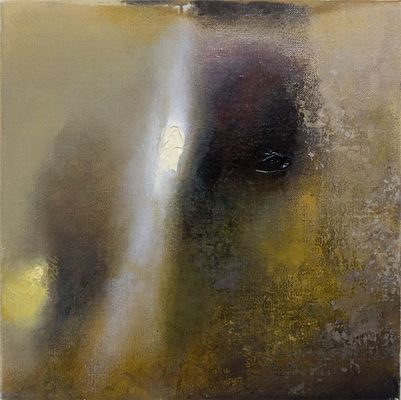
To return to Buckley’s fragment, the first two lines very much evoke how I paint nowadays. As you age, detail diminishes and patches of light become more luminous and float. I feel the most honest way of dealing with this is by smearing the oil paint on the canvas with the fingers and working close-up, blind. Only if the patches coalesce into an approaching image can the work gain a life.
-
Jonathan Walker was born in Melbourne, Australia and brought up on a dairy farm in Gippsland. In the 1970’s he studied painting at RMIT and won the Harold Wright Scholarship to the British Museum, London. During the 1980’s he exhibited at Pinacotheca Gallery, Richmond and had work shown at the NGV and Heidi City Art Gallery. Over the same period he designed the cover for the “Epigenesi” LP by Giancarlo Toniutti, Italy and conducted a mail exchange work with Achim Wollscheid, Germany. The work with artists through the post resulted in an article published in the bicentenary issue of Art and Australia 1988. He showed in artist run spaces such as WestSpace in the 90’s and 2000’s, and until 2012, taught painting at Victoria University, which is where we (Colleen Ahern and Lisa Radford) as organisers of the exhibition, among many others, had the privilege of being his student.
Walker’s knowledge was imparted to students through the careful selection of music, literature, and artists found in books that he himself had ordered for the library. Walker’s strategy was the generosity of sharing his vast knowledge with references specific to each student and their context.
Walker’s paintings share a similar focus and intimacy.
This exhibition presents a small selection of recent paintings alongside a publication that includes Walker’s writing. Observational and analytical, Walker’s work is a type of material notation — the time of day, colour and how it is blended, the both specific and fleeting location of a reflection on lino or the question of whether a chair leg should be included in a painting.
Please join us on Friday August 21 between 6-8pm to celebrate the opening of the exhibition.
Curated by Colleen Ahern and Lisa Radford.
B. Wurtz
Curated by Nic Tammens
March 26 - April 4, 2015
B.Wurtz works from a basement studio in his home on Manhattan’s Lower East Side.
This local fact is attested to by the plastic shopping bags and newsprint circulars that appear in his work. As formal objects, they don’t make loud claims about their origins but nonetheless transmit street addresses and places of business from the bottom of this long thin island. Like plenty of artists, Wurtz is affected by what is local and what is consumed. His work is underpinned by this ethic. It often speaks from a neighborhood or reads like the contents of a hamper:
“BLACK PLUMS $1.29 lb.”
“Food Bazaar”
“USDA Whole Pork Shoulder Picnic 99c lb.”
“RITE AID Pharmacy, with us it’s personal.”
“H. Brickman & Sons.”
“Sweet Yams 59c lb."
Most of the work in this exhibition was made while the artist was in residence at Dieu Donne, a workshop dedicated to paper craft in Midtown. Here Wurtz fabricated assemblages with paper and objects that are relatively lightweight, with the intention that they would be easily transportable to Australia. This consideration isn’t absolute in Wurtz’s work, but was prescriptive for making the current exhibition light and cheap. Packed in two boxes, these works were sent from a USPS post office on the Lower East Side and delivered to North Melbourne by Australia Post.
Wurtz appears courtesy of Metro Pictures, New York.
Thanks to Rob Halverson, Joshua Petherick, Sari de Mallory, Matt Hinkley, Helen Johnson, Fayen d'Evie, Ask Kilmartin, Lisa Radon, Ellena Savage, Yale Union, and "Elizabeth".
John Nixon
"Archive"
December 15 - January 20, 2014
The presentation of John Nixon's archive offered a rare showcase of this extensive collection of the artist's own publications, catalogues, posters, ephemera, editions and more, from the mid 1980s onwards, alongside a selection of his artworks.
Organized by John Nixon, Joshua Petherick and Matt Hinkley.
<a href=http://wfb.public-office.info/artist/john-nixon>All titles by John Nixon
"Habitat"
at Minerva, Sydney (organised by Joshua Petherick and Matt Hinkley)
November 15 - December 20, 2014
Lupo Borgonovo, Janet Burchill & Jennifer McCamley,
Lewis Fidock, HR Giger, Piero Gilardi, Veit Laurent Kurz,
Cinzia Ruggeri, Michael E. Smith, Lucie Stahl, Daniel Weil, Wols
Press Release:
“...It contained seven objects. The slender fluted bone, surely formed for flight, surely from the wing of some large bird. Three archaic circuitboards, faced with mazes of gold. A smooth white sphere of baked clay. An age-blackened fragment of lace. A fingerlength segment of what she assumed was bone from a human wrist, grayish white, inset smoothly with the silicon shaft of a small instrument that must once have ridden flush with the surface of the skin - but the thing’s face was seared and blackened.”
William Gibson, “Count Zero”, 1986
"Autumn Projects Archive"
Curated by Liza Vasiliou
March 6 - March 15, 2014
World Food Books, in conjunction with the Virgin Australia Melbourne Fashion Festival 2014, presented the Autumn Projects archive, consisting of a selection of early examples in Australian fashion with a particular interest in collecting designers and labels from the period beginning in the 1980’s, who significantly influenced the discourse of Australian Fashion.
Curated by Liza Vasiliou, the exhibition provided a unique opportunity to view pieces by designers Anthea Crawford, Barbara Vandenberg, Geoff Liddell and labels CR Australia, Covers, Jag along with early experimental collage pieces by Prue Acton and Sally Browne’s ‘Fragments’ collection, suspended throughout the functioning World Food Books shop in Melbourne.
H.B. Peace
presented by CENTRE FOR STYLE
November 14, 2013
"Hey Blinky, you say chic, I say same"
Anon 2013
H.B. Peace is a clothing collaboration between great friends Blake Barns and Hugh Egan Westland. Their pieces explore the divergences between 'character’ and ‘personality’ in garments....etc
Special Thanks to Joshua Petherick and Matt Hinkley of WFB and Gillian Mears
and a Very Special Thank you to Audrey Thomas Hayes for her shoe collaboration.
Janet Burchill & Jennifer McCamley
"Aesthetic Suicide"
May 10 - June 8, 2013
The first of our occasional exhibitions in the World Food Books office/shop space in Melbourne, "Aesthetic Suicide" presented a body of new and older works together by artists Janet Burchill & Jennifer McCamley, including videos, prints, a wall work, and publications.
During shop open hours videos played every hour, on the hour.
1974, English
Softcover (w. dust jacket), 88 pages, 19 x 24 cm
1st Edition, Out of print title / used / very good
Published by
New York University Press / New York
The Press of the Nova Scotia College of Art and Design / Halifax
$150.00 - Out of stock
Rare first edition copy of the highly influential Steve Reich book of texts,"Writings About Music", first published in 1974 by The Press of the Nova Scotia College of Art and Design.
In the mid-1960s, American composer Steve Reich radically renewed the musical landscape, along with La Monte Young, Terry Riley, and Philip Glass, to pioneer what became minimal music. These early Reich works, characterised by a relentless pulse and static harmony, focused single-mindedly on the process of gradual rhythmic change. Throughout his career, Reich has continued to reinvigorate the music world, drawing from a wide array of classical, popular, sacred, and non-western idioms. His works reflect the steady evolution of an original musical mind.
In 1974 Reich published the book Writings About Music, containing essays on his philosophy, aesthetics, and musical projects written between 1963 and 1974. The book features, amongst many other texts and studies, Reich's 1968 essay "Music as a Gradual Process," widely considered one of the most influential pieces of music theory in the second half of the 20th century.
Very Good copy in original dust jacket. Light wear and tanning.
1973, English
Hardcover (w. dust jacket), 144 pages, 32 x 24cm
1st US Edition, Out of print title / used / good
Published by
George Braziller / New York
$80.00 - Out of stock
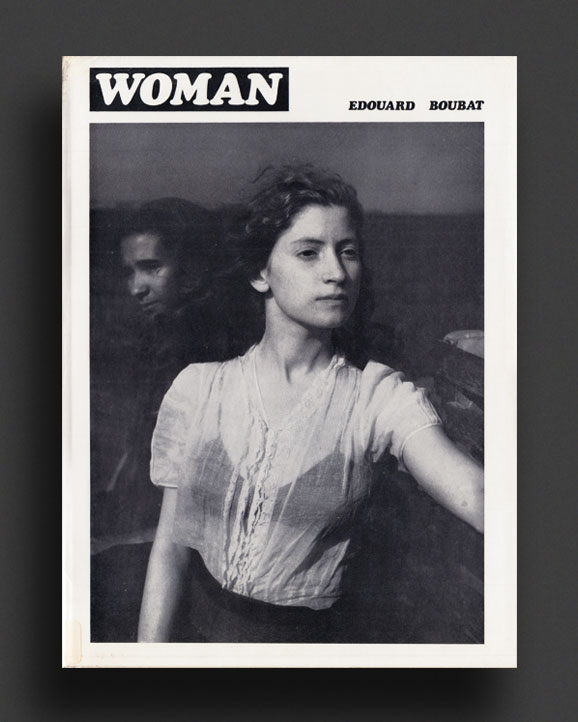
First hardcover edition of Édouard Boubat's "Woman" photo-book, published by George Braziller, New York in 1973. Entirely comprised of black and white photography of women from all over the world, taken by Boubat in his travels as a photojournalist through France, Mexico, Africa, Portugal, the USA, India, and more. A gorgeous collection.
Édouard Boubat (b. Paris, 1923–1999) was a French photojournalist and art photographer. Born in Montmartre, Paris, Boubat studied typography and graphic arts at the École Estienne and worked for a printing company before becoming a photographer. In 1943 he was subjected to service du travail obligatoire, forced labour of French people in Nazi Germany, and witnessed the horrors of World War II. He took his first photograph after the war in 1946 and was awarded the Kodak Prize the following year. He travelled the world for the French magazine Réalités, where his colleague was Jean-Philippe Charbonnier, and later worked as a freelance photographer. French poet Jacques Prévert called him a "peace correspondent" as he was humanist, apolitical and photographed uplifting subjects.
Good copy with good dust jacket, preserved under mylar wrap. Light ex-library markings and one loose page. General light wear, bumping.
1992, Japanese
Hardcover printed box, portfolio of 24 prints, 25.5 x 36.5 cm
1st Edition, Out of print title / used / very good
Published by
Nippon Geijutsu Shuppan (NGS) / Japan
$400.00 - Out of stock
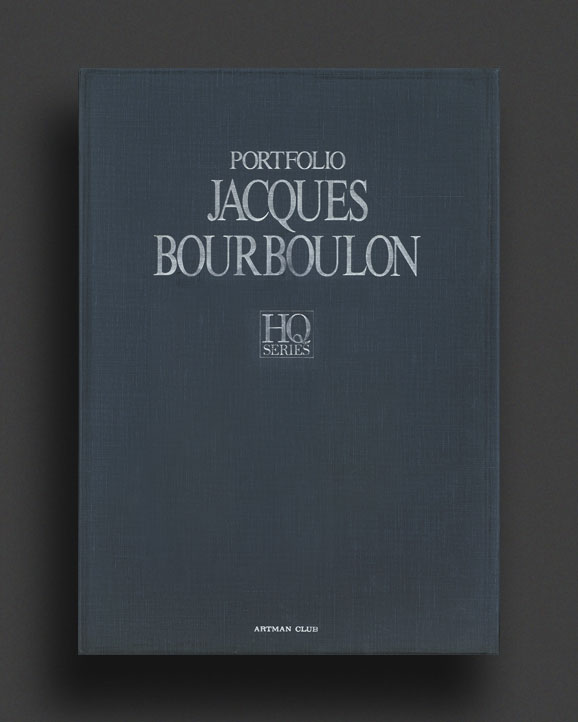
Stunning and very collectible Japanese boxed-edition photographic portfolio of work by French photographer Jacques Bourboulon, published in the early 1990s by Nippon Geijutsu Shuppan (NGS) as part of their HQ Series. A collection of 24 large prints of Bourboulon's photographs capturing the beauty of his young amateur models in nature. Photographed on Bourboulon's island home of Ibiza in the 1970s-80s, a refuge for hippies, artists and other free spirits from all over the world, his photographs are a testament to the freedom and experimentation of this time, and to the beauty, and natural simplicity of the island environment itself.
Jacques Bourboulon (born 8 December 1946) is a French photographer, specializing in nude photography. In 1967 he started as a fashion photographer, publishing in Vogue and working for the fashion designers Dior, Féraud, and Carven. In the mid-1970s he sought the freedom and innocence of a natural landscape and switched to nude photography, never again to work with professional models or studios. His most famed pictures portray girls and women on the Spanish island of Ibiza, where he lived from 1976-1986, playing on the juxtaposition of blue sky, white walls, and sun-tanned skin. Bourboulon's pictures were shot with a Pentax camera and focus on bright light and sharp contrasts. His images become iconic through the pages of PHOTO magazine, Club, High Society, and calendars for Pentax and BASF. Bourboulon's photography books sold over 400,000 copies.
Very Good copy, beautifully preserved.
2019, English
Softcover, 144 pages, 16 x 24 cm
Published by
Kunsthalle Zürich / Zürich
Bergen Kunsthall / Norway
Sternberg Press / Berlin
$52.00 - Out of stock
Jolly Rogers is a collection of Peter Wächtler's latest short texts, written in preparation of his two solo exhibitions at Bergen Kunsthall and Kunsthalle Zürich (both 2019), and combined with a nearly complete collection of the artist's drawings and prints from recent years.
The texts operate like vignettes to a larger story, and the images as unreliable illustrations to the narrative. However, the larger story never really is revealed. Each individual text, each single work, articulates itself by means of an intense focus. It is as if we were suspended in a continual zooming motion, as if the artist and author wanted to tell and show it all. But alas, such is life under the microscope: always larger-than-life, but at the wrong scale at a time driven by individual interests, self-optimization, and egos that stage themselves simultaneously as victims and disruptors.
Peter Wächtler works in a variety of media: bronze, ceramics, drawings and video. But in many ways “stories” could be described as his main artistic material. His works often evoke a narration, with animals or human figures in animated states. They are made in ways that use and adapt elements of fiction and folklore, relating to specific traditions and common tales, and materialize the ways of telling a story as much as the story itself.
Born 1979 in Hannover, Peter Wächtler lives and works in Brussels and Berlin.
1981, Japanese
Softcover (staple-bound), 8 pages, 18 x 26 cm
1st Edition, Out of print title / Used*,
Published by
Ginza Jiyugaoka Gallery / Tokyo
$100.00 - Out of stock
Very rare Japanese catalogue of Lucio Fontana's work published on the occasion of an exhibition at Ginza Jiyugaoka Gallery in Tokyo, May 20 - July 25, 1981, reproducing bronze, terracotta, aluminium and wood works from Fontana's Concetti spaziale - NATURA 1959-1960.
2017, English
Softcover, 207 pages, 20 x 13 cm
Published by
Manchester University Press / Manchester
$39.00 - Out of stock
By Marion Schmid
Chantal Akerman is widely acclaimed as one of cinema's boldest visionaries.
A towering figure in women's and feminist film-making, she produced a diverse and intensely personal body of work ranging from minimalist portraits of the everyday to exuberant romantic comedies, and from documentaries and musicals to installation art. This book traces the director's career at the crossroads between experimental and mainstream cinema, contextualising her work within the American avant-garde of the 1970s, European anti-naturalism, feminism and the post-modern aesthetics.
While offering an in-depth analysis of her multi-faceted film style, it also stresses the social and ethical dimension of her work, especially as regards her representation of marginal groups and her exploration of exilic and diasporic identities. Particular attention is given to the inscription of the Holocaust and of Jewish memory in her films.
From Manchester University Press' French Film Directors series, edited by Diana Holmes and Robert Ingram.
1998, Japanese
Hardcover (w. dust jacket), 72 pages, 22. 5 x 23 cm
1st Edition, Out of print title / used / very good
Published by
Iwanami Shoten / Japan
$80.00 - In stock -
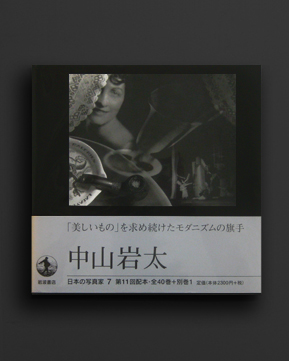
#7 in the Photographers of Japan series, dedicated to Iwata Nakayama (1895–1949).
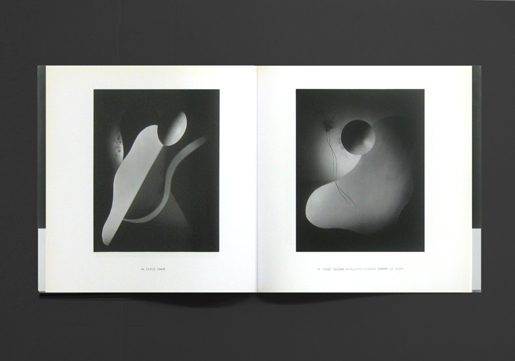
Iwata Nakayama (1895–1949) was a pioneer of Japanese avant-garde photography. For a period he set up his own studio in New York before moving to Paris where he came to know Man Ray and László Moholy-Nagy. He returned to Japan in 1927 and began to work as a professional photographer in Kobe. He founded Ashiya Camera Club in 1930 with Hanaya Kanbei and other photographers in the Kobe area. In 1932, he, Yasuzō Nojima and Nobuo Ina published their monthly magazine Kōga (光画). This magazine was a critical turning point of Japanese artistic photography. From 1930 to 1942 the members of the ACC were some of the most influential modernist photographers in Japan practicing radical design concepts they labeled “Shinko Shashin” or new photography movement.
Very Good with light tanning to spine to original dust jacket.
1998, Japanese
Hardcover (w. dust jacket), 72 pages, 22. 5 x 23 cm
1st Edition, Out of print title / used / very good
Published by
Iwanami Shoten / Japan
$80.00 - In stock -
#4 in the Photographers of Japan series, dedicated to Yasuzō Nojima.
Yasuzō Nojima (1889 – 1964) is well known for his contributions to both Japanese and world photography as an artist and publisher. He was instrumental in raising photography’s status as a fine art in Japan in the 1930s, his work ranging from kaiga shugi shashin (pictorial photography) to shinkō shashin (new photography) of the early twentieth century. Nojima’s earliest works were gum-dichromate prints characterized by a density and heaviness echoing that of pictorialism, based in his subtle sensitivity. In the 1930s, his style takes a drastic turn under the influence of new trends in German photography, shifting toward daringly cropped gelatin silver prints in pursuit of a form of expression that is unique to the medium. The photography magazine Kōga (Light Pictures; 1932–33), which he co-founded with fellow photographers Nakayama Iwata (1895–1949) and Kimura Ihei (1901–1974), was principally funded by Nojima and played an extremely important role in the subsequent development of shinkō shashin by introducing theories and a new photographic aesthetic to Japan, one that concentrated on the technical and aesthetic qualities of photography in its own right rather than as an imitation of paintings, providing a much-needed outlet for a younger generation of photographers. Nojima’s later still lifes and nudes, though still soft, were striking in their simple and direct forms. He is particularly well known for his unidealized nudes of "ordinary" Japanese women executed in both pictorialist and modernist styles.
Very Good in original dust jacket.
1997, Japanese
Hardcover (w. dust jacket and obi strip), 72 pages, 22. 5 x 23 cm
1st Edition, Out of print title / used / very good
Published by
Iwanami Shoten / Japan
$80.00 - Out of stock
#3 in the Photographers of Japan series, dedicated to Shinzō Fukuhara (1883–1948) and Rosō Fukuhara (1892–1946).
Often called the father of Japanese modern photography, Shinzo Fukuhara – a traveler, a businessman, an aesthete, a theorist, is an author of nostalgic, melancholy pictures and considered a pioneer of Japanese art photography and a true renaissance man. Trained as a scientist and pharmacologist in Japan and the U.S. (Columbia University), he was the first CEO of Shiseido Company, Ltd and a pioneer in modern cosmetic marketing and design. In 1912 he traveled to Europe visiting England, Italy, Germany and France, where he settled in Paris. There he joined a group of young Japanese artists and while there took over 2000 photographs of the city (later published as “Paris et la Seine” in 1922). In 1923 Shinzo Fukuhara published his groundbreaking book “Hikari to Sono Kaicho” (Light with its Harmony) which proposed applying the Japanese aesthetic of haiku poetry to photography. Shizo's contributions to creating and promoting photography as an art form cannot be overstated. In 1921 he and his brother Roso Fukuhara established the Shashin Geijutsu-sha, a group of art photographers dedicated to pictorialism. This group mounted exhibitions at the prestigious Shiseido Gallery and published the journal Shashin Geijutsu. His brother Roso Fukuhara was also an accomplished photographer. Despite never having his photography published, he is considered a major contributor to the Japanese pictorialist photographic tradition with his strikingly modern approach, breaking from the past to create experimental photographic juxtapositions and printing methods. In 1924 Shinzo and Roso founded the Nihon Shashin-kai (Japan Photographic Society). In his essay, “The History and Theory of Photography”, Kotaro Iizawa writing about the Fukuhara brothers wrote, “Even amid such exquisite settings as a vast field, tall mountains, or a city street, one must be in a place where the light is just right, or one does not have the material for a photograph.” These words, stated by Shinzo Fukuhara, keep alive the photos and the memories of the Fukuhara brothers even today.”
Very Good-Fine copy in original dust jacket and obi strip.
1998, Japanese
Hardcover (w. dust jacket), 72 pages, 22. 5 x 23 cm
1st Edition, Out of print title / used / very good
Published by
Iwanami Shoten / Japan
$80.00 - Out of stock
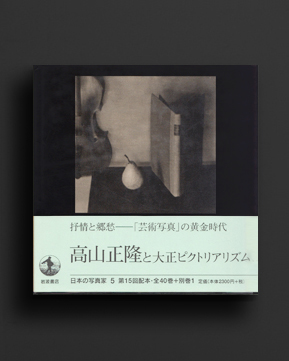
#5 in the Photographers of Japan series, dedicated to Masataka Takayama and the Pictorialists of the Taisho Era.
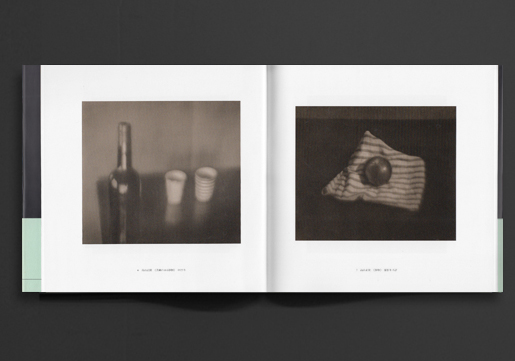
Masataka Takayama (1895 - 1981) was one of the most prominent Japanese photographers in the first half of the twentieth century. As an amateur photographer in Tokyo, he published many of his works in the magazine Geijutsu Shashin Kenkyū (芸術写真研究), beginning in the 1920s. He remained an active photographer even after World War II. He was talented at pictorialist (art) photography and took many photographs using a soft focus lens and deformation and "wipe-out" techniques. Takayama usually used a "vest-pocket" Kodak camera (a very compact folding model taking 127 film) with a single-element lens (a tangyoku lens in Japanese). These cameras (and Japanese derivatives such as the Rokuoh-sha Pearlette and Minolta Vest) were popular in Japan at the time for snapshot use, and called ves-tan (ベス単, in Japanese pronunciation besutan) cameras; "ves" coming from "vest" and "tan" from tangyoku. Takayama's works are thus said to belong to the "ves-tan" (besutan) school.
Extremely active during an important and often largely ignored period of Japanese photography - that of the Taisho Era, during the reign of Emperor Taisho (1912-26). The era is considered the time of the liberal movement known as the "Taisho democracy" in Japan; it is usually distinguished from the preceding chaotic Meiji period, which gave birth to Modern Japan, and the following militarism-driven first part of the Shōwa period. The Taisho era was considered Japan's "Jazz Age" and saw the peak of the pictorialists movement and art photography.
This book in the great Photographers of Japan series looks at not only the work of Masataka Takayama, but of the leading Pictorialists of the Taisho Era.
Very Good in original dust jacket and publisher's obi-strip.
2005, English
Hardcover, 224 pages, 28.5 x 19.5 cm
1st Edition, Out of print title / as new
Published by
Walther König / Köln
Gladstone Gallery / New York
$70.00 - Out of stock
First, only hardcover edition of this now out-of-print artist's book by Prince.
"Second House is the second house that I've done over. Second House I bought. Two years ago. Its on eighty acres in Upstate New York, up behind the Catskills, in the town where I live. (...) it kind of floated in the grass. All the pictures in Second House are right around the house, in the yard, out back, across the street, next door, up the road, in the woods, on the property, not far from the house, within a mile of the house, as the crow flies. All the people in the book are neighbors, or friends from NYC who came up for a visit. All the artworks in the book are in the house now or were in the house not too long ago." (Richard Prince)
Prince's upstate New York Second House makes a home, literally, for the increasingly physical work of an artist once best known for his studio photographs of magazines. The Second House documents his ranch-style gallery, the long grass around it, and the 1973 Plymouth Barracuda parked in the yard, and commemorates the Guggenheim's purchase of the site, which they pledge to open to the public for ten years. This artist's book was published for an exhibition at Gladstone Gallery, New York (April 30 - June 18, 2005).
Fine copy.
1986, French
Softcover, 112 pages, 18.5 x 16 cm
1st Edition, Out of print title / used / good
Published by
Rivages / Paris
$80.00 - Out of stock
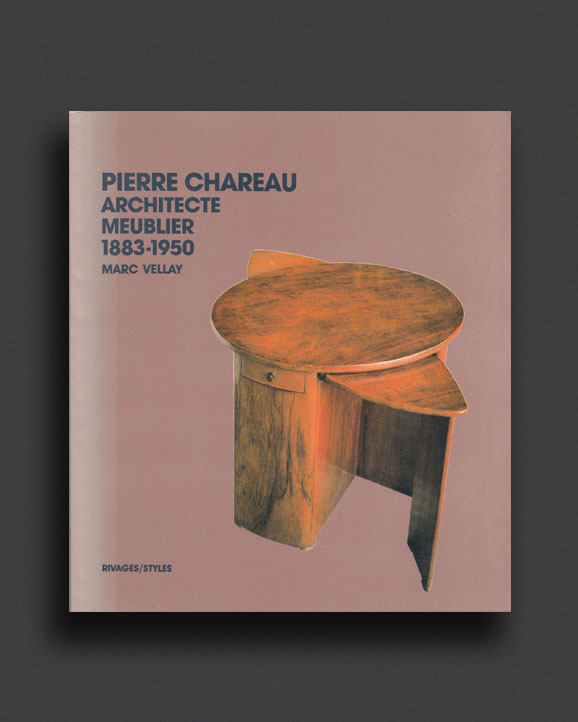
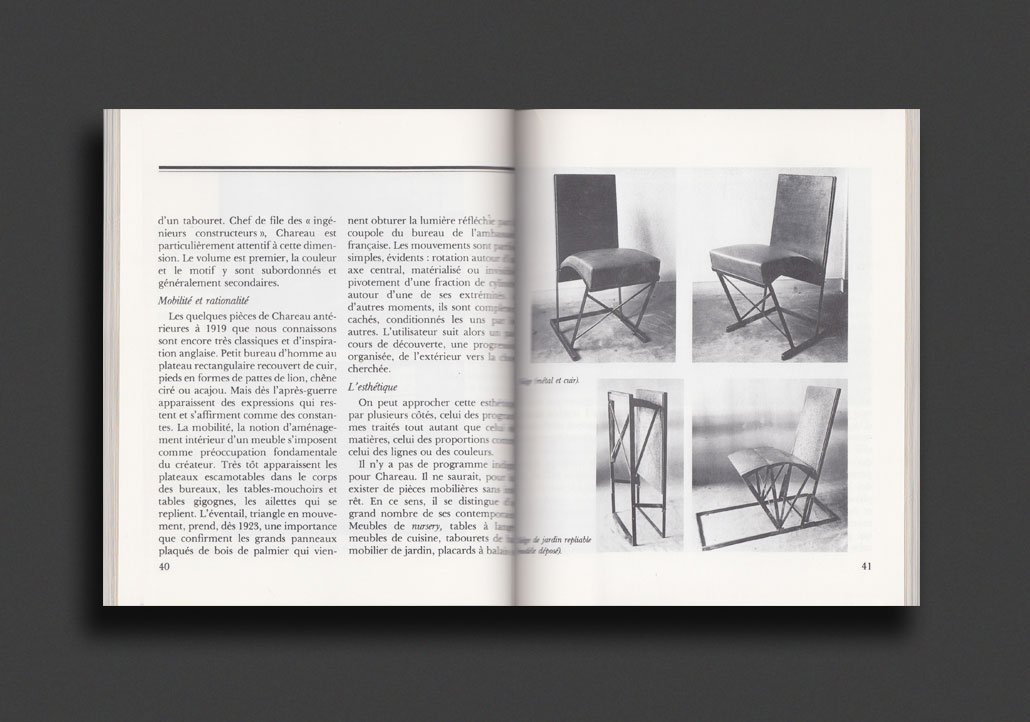
First French edition of Pierre Chareau - Architecte Meublier 1883-1950, published by Rivages, Paris, 1986. Authored by Marc Vellay, this monographic title surveys and discusses the extraordinary work of French architect and designer Pierre Chareau (1883-1950), a pivotal figure in modernism, known for his innovative concepts and radical use of new materials. Chareau linked architecture, fine arts, and style; designed furniture for avant-garde films and chic homes; formed an important art collection including artists such as Picasso and Mondrian. Heavily illustrated throughout with examples of Chareau's furniture, architecture, interiors, fabrics, wallpapers, along with biographical imagery and bibliography.
Tanning to spine edge/cover wear, otherwise very good, tight, clean copy throughout.
2018, English
Hardcover, 448 pages, 21 x 27.5 cm
Published by
La Fábrica / Madrid
$90.00 - Out of stock
Text by Emmanuel Guigon, Androula Michael, Claustre Rafart i Planas, Laurence Bertrand Dorléac, Jean-Paul Morel, Cécile Godefroy, Marie-Laure Bernadac, Jèssica Jaques Pi, Christine Piot, Peter Read, Coline Zellal, Émilie Bouvard.
Food frequently surfaces as a motif in the art of Pablo Picasso (1881–1973), and Picasso's Kitchen presents the many forms that the culinary takes in his work. Adopting as its guiding principle the conceit that "cooking is a subtle revelation of Picasso's art," this handsomely designed volume, with its card-stock cover bearing a tipped-in portrait of the artist, reproduces works alongside photographs of the artist working in his grand studio and the friends and lovers with whom he surrounded himself.
Some of the book's sections examine individual artworks such as Picasso's interpretation of Manet's Déjeuner sur l'herbe or his playful ceramic works, while other sections visit the bohemian cafes and restaurants of Paris and Barcelona where Picasso and other avant-garde artists of the period ate and drank, through menus, photographs, prints and paintings, searching for how these places slipped into the artists' work in ways both overt and subtle. Another section draws on archival material from Picasso's writings on food.
Perfect for the cook, art lover or both, this book vividly conveys how this theme greatly enhances our enjoyment and understanding of Picasso's oeuvre.
1958, English
Hardcover (w. dust jacket), 174 pages, 28 x 20.5 cm
1st Edition, Out of print title / used / good
Published by
The Ridge Press / New York
$65.00 - Out of stock
Hardcover first edition of "The Private World of Pablo Picasso", published by The Ridge Press, New York, in 1958. The greatest photo book on the intimate life of Picasso, by David Douglas Duncan. "From the moment they met—Picasso was in the bathtub—David Douglas Duncan began recording the story. Picasso clowning with children, working late into the night, bringing out of his closets forgotten works painted 60 years before. Duncan, the great photographer, author of This Is War, master of adventure, watched—and recorded more than 10,000 photographs, taken every waking moment of the day and night. Over 300 of the best are here. A human document, a living art show—with the viewer as the privileged private audience."
Good copy in Good dust jacket. Scarcer in the hardcover format. Some wear, edge tanning and age spotting to hard cover.
2012, English
Softcover w/ red dust jacket, 176 pages, 21 x 27 cm
Ed. of 1000,
1st Edition, Out of print title / used / very good
$140.00 - Out of stock
First long out-of-print edition of Matt Connors "A Bell is a Cup", in red cover.
A Bell is a Cup has been published by Rainoff to coincide with the exhibition Impressionism by Matt Connors, held at MoMA PS1. Alongside texts by Peter Eleey, Michel Leiris, Gertrude Stein and Jack Spicer, the publication presents the first comprehensive gathering of Connors' work to date. In his essay, Eleey writes that Connors' paintings "bear traces of one another, but they also sometimes prop each other up or lean into each other, as if to physically reinforce, in painterly terms, Jack Spicer’s ideas about the interdependence of poems. 'There is really no single poem,' Spicer came to believe; he argued that 'poems should echo and re-echo against each other.'"
As New with light shelf wear and tanning to spine.
2019, English
Softcover, 272 pages, 12.5 x 19.5 cm
Published by
Sternberg Press / Berlin
$59.00 - Out of stock
Texts by Defne Ayas, Ute Meta Bauer, Nicolas Bourriaud, Carolyn Christov-Bakargiev, Joshua Decter, Clémentine Deliss, Irmgard Emmelhainz, Boris Groys, Hou Hanru, María Belén Sáez De Ibarra, Maria Lind, Pi Li, Steven Henry Madoff, Antonia Majaca, Gabi Ngcobo, Hans Ulrich Obrist, Jack Persekian With Alison Carmel Ramer, Terry Smith, Nato Thompson, Mick Wilson, Brian Kuan Wood, Tirdad Zolghadr
With the global rise of a politics of shock driven by authoritarian regimes that subvert the rule of law and civil liberties, what paths to resistance, sanctuary, and change can cultural institutions offer? What about activism in curatorial practice? In this book, more than twenty leading curators and thinkers about contemporary art present powerful case studies, historical analyses, and theoretical perspectives that address the dynamics of activism, protest, and advocacy. What unfolds in these pages is a vast range of ideas—a tool kit for cultural producers everywhere to engage audiences and face the fierce political challenges of today and tomorrow.
What about Activism? is based on the summit “Curatorial Activism and the Politics of Shock,” which took place at the School of Visual Arts, New York. Along with expanded versions of the talks given at the conference, the book includes a transcript of a roundtable discussion moderated by Steven Henry Madoff and Brian Kuan Wood among the speakers and students in the MA Curatorial Practice program at SVA.
2017, English
Softcover, 196 pages, 13 x 21 cm
Published by
Sternberg Press / Berlin
$59.00 $35.00 - Out of stock
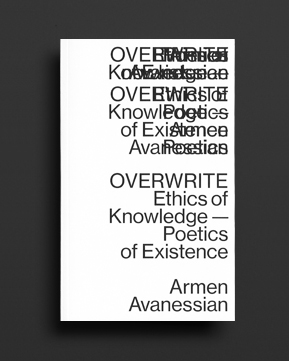
Since the early 1800s, the institution of the university has promoted creativity, critical thinking, and independent research. The more it has yielded to the pressures of the economy, however, the more it has betrayed its ideals. This, in short, is the common critique of the plight of the academy. But the inverse might be true: the depression, feelings of insufficiency, and permanent pressure to innovate experienced by academics might be symptoms of these original ideals, which, along with artistic production and the regime of aesthetics, has shaped the spirit of neoliberal capitalism.
Philosopher and political theorist Armen Avanessian argues that the ethical dimension of knowledge can produce a new reality. Can the speculative poetics of collaborative writing, he asks, free us from the dominant regime of the academy and, by extension, the art world? And how does this independence differ from the principle of self-fulfillment on which the ideal of the university and current conceptions of artistic research are based?
Overwrite: Ethics of Knowledge—Poetics of Existence is about the desire to write differently to situate oneself in the world differently. It is a book about the truth that is produced when a subject takes responsibility for its thinking, its experiences, its conflicts; when a subject rewrites and overwrites itself to become an other, and transforms the world in the process.
Translated by Nils F. Schott
Design by HelloMe
2017, English
Softcover, 128 pages, 13.2 x 18 cm
Published by
Sternberg Press / Berlin
$57.00 $30.00 - Out of stock
Strange how many déjà vus you have here.
How might we conceive of comradeship with a present that is increasingly predetermined by algorithms and governed by techno-politics? Armen Avanessian chronicles his stay in Miami as an experiment in writing about our times of individual optimization and digitization. An inventory of the self in the second person—and a philosopher’s reflections in the infinity pool of the art world—this book reckons with a new time complex as well as the aesthetics and infrastructures of the contemporary. Can we advance from conditions of financial feudalism and climate change to a progressive poetics of the digital? The city of tropical noir becomes a case study for a geopolitics and economics of the future—Miami vision, Miami vacation, Miami fiction, Miamification.
“A philosophical-autobiographical laboratory, this book tests ways of thinking and writing beyond run-of-the-mill academic talk. Avanessian doesn’t visit the library; he flies to Miami and goes swimming. Moving between the beach and his desk, he pens seventeen philosophical diary entries in which the hot topics of the day are tackled associatively and with tremendous precision: Trump, big data, capitalism, surveillance, immigration, Facebook, Twitter, etc.”
—Georg Dickmann, Spike
“Avanessian’s reflections, somewhere between diary and soliloquy, essay and travelogue, always take their starting point from the concrete, the phenomenological—for example, the flickering screens in the airplane cabin or the social networks that are first to appear on your computer screen in the morning. Digital profiles and algorithms raise one of the book’s defining themes on the first day: our temporality. In the 'geological science fiction' of Miami, the time complex finds its place.”
—Tom Wohlfarth, Der Freitag
“Avanessian has coined the time-philosophical metaphor of a future that is now 'from the future.' Not only preemptive personalization, but also preemptive policing, preemptive war as well as the war on terror, and the preemptive operations of the financial markets shape our future by anticipating it. And not only has the future largely fallen into the hands of reactionary political agendas and particular economic interests, but as the recursive and poetic character of these players' actions is passed off as the prognosis of a predestined future, our consciousness is clouded against a real existing future openness. The future has been 'automated' and thus distorted.
The political impulse of Miamification is to insist again and again on the recursive and poetic character of the future; to wrest ourselves of the present deterioration of twitter trances and live logs; and to take up the fight for the future in the future, that is, in the mode of preemption.”
—Daniel Falb, Textem
Translated by Nicholas Grindell
Design by HelloMe
1995, Japanese
Softcover, 66 pages, 18 x 13 cm
1st Edition, Out of print title / used / fine
Published by
Dela Corporation Inc. / Tokyo
$50.00 - Out of stock
Very scarce Japanese photo book for the film "Je t'aime moi non plus", a feature film written, directed, and musically scored in 1976 by Serge Gainsbourg, starring Jane Birkin, Hugues Quester and Joe Dallesandro, and featuring a cameo by Gérard Depardieu. Published in 1995 to accompany a small travelling Japanese exhibition of photographs from the film, this booklet reproduces many iconic images from the film in black and white and colour, alongside cast biographies, filmography, chronology, behind the scenes photographs, and much more.
Fine, almost As New copy, only some tanning to gloss edges.
2008, English
Softcover (bound with cloth tape), 120 pages, 21 x 29.7 cm
Published by
Self-Published
$200.00 - Out of stock
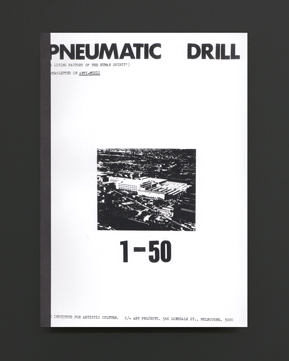
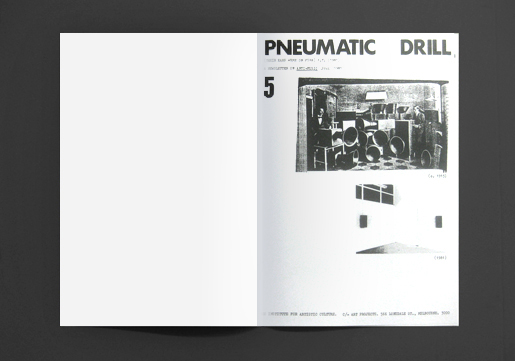
Pneumatic Drill was a one page magazine issued on an occasional basis from April 1981 - October 1983. Founded, edited and published by John Nixon.
This re-issue collection self-published by John Nixon in a limited edition in 2008 combines every issue of Pneumatic Drill into bound book format.
Out-of-print.
2014, English
Softcover, 372 pages (colour & b/w ill.), 27 x 21 cm
1st Edition, Out of print title / as new
Published by
Walther König / Köln
$160.00 - Out of stock
In the 1970s, Christopher Williams emerged as a key figure in the first wave of American West Coast conceptual artists, which included John Baldessari and Douglas Huebler.
Williams' work is a critical investigation of the medium of photography and more broadly the vicissitudes of industrial culture, in particular its structures of representation and classification. Using the process of reproduction as a point of entry, he manipulates the conventions of advertising, the superficiality of surface, and ultimately the history of Modernism.
This unique artist’s book is available in three editions, each with different ISBNs and different colour covers: red, yellow and green. It reproduces a carefully curated selection of the artist’s painstakingly constructed photographs and features striking graphic design in the near-complete absence of language, with no essay, captions, or even a title page. With the exception of differing cover photographs, the content of each edition is identical.
Published to coincide with Williams’ first major survey exhibition, The Production Line of Happiness at The Art Institute of Chicago, and then at The Museum of Modern Art, New York – both in 2014. The exhibition travels to Whitechapel Gallery, London in 2015.
YELLOW edition. All editions are out-of-print.
2015, English
Softcover, 100 pages, 20 x 24 cm
1st Edition, Out of print title / as new
Published by
Mousse Publishing / Milan
$90.00 - Out of stock
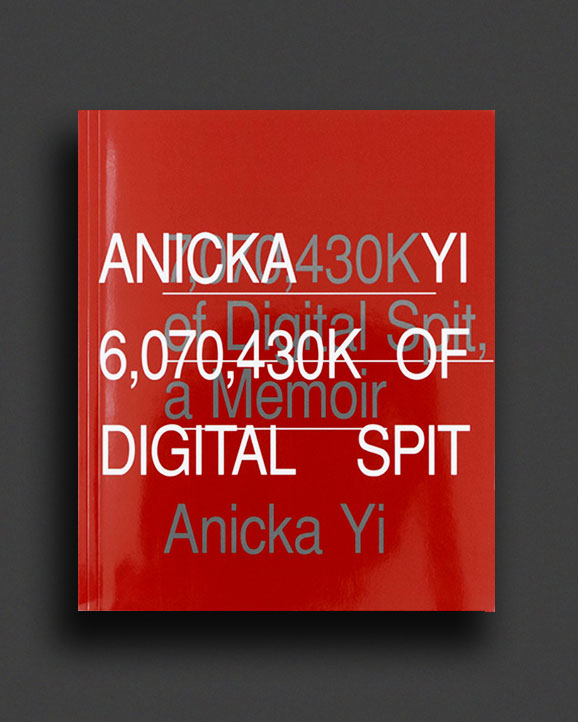
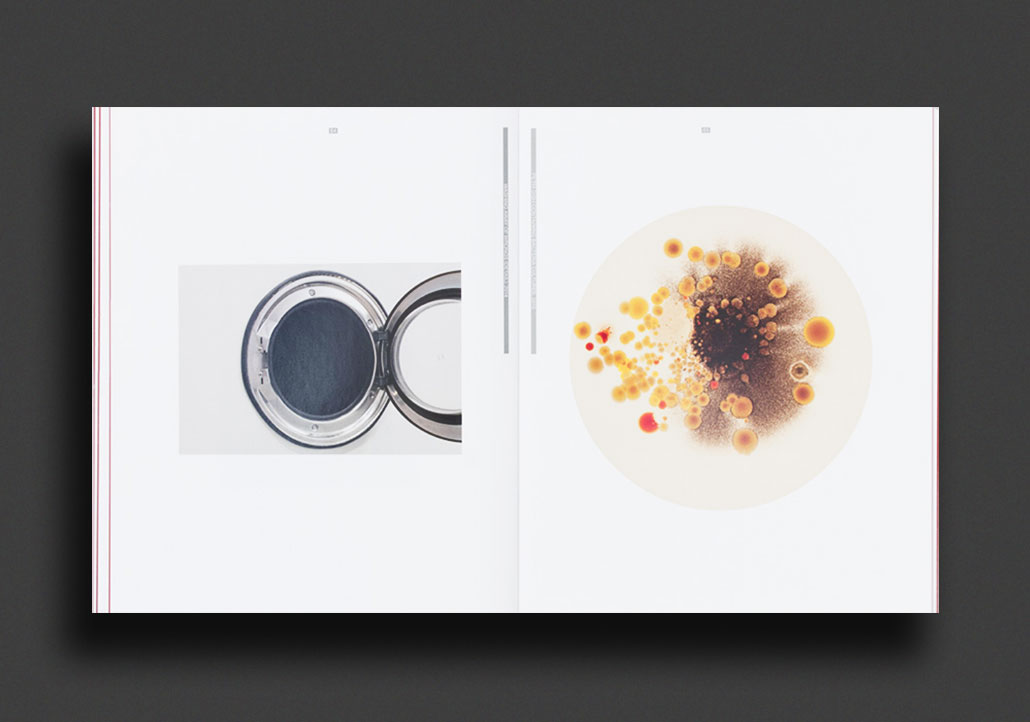
First edition of the out-of-print first monograph on artist Anicka Yi. Yi (b.1971, Seoul, Korea) has embedded tempura-fried flowers, acrylic paint, and vinyl tubing in glycerin soap and resin; floated a cow’s stomach in hair gel inside a transparent Longchamp handbag; and created a perfume from the bacteria of 100 women. Intertwining the seemingly permanent and the perishable, Yi’s work reorders the chemical and cultural forces that privilege containment over leakage, apathy over empathy, and elevate sight above all other senses. Published in conjunction with the exhibition “Anicka Yi: 6,070,430K of Digital Spit” at the MIT List Visual Arts Center, the book includes an exchange between Caroline A. Jones and Yi on scent, ethnicity, and symbiotic microorganisms; an essay by Johanna Burton on networks and extravisual means; and an essay by Alise Upitis on the irreducible ambiguity of Yi’s work. Anicka Yi: 6,070,430K of Digital Spit is the artist’s first monograph. Designed by Eric Wrenn.
As New copy.
1972, English
Hardcover, 160 pages, 29 x 21 cm
Out of print title / used / very good
Published by
Jack Pollard / NSW
$65.00 - Out of stock
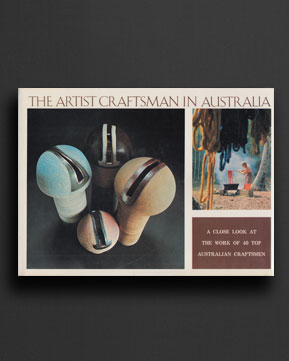
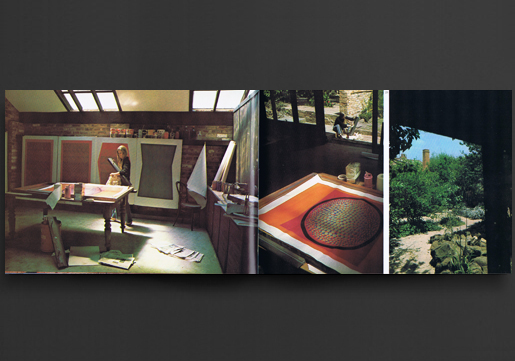
The great "Aspects of Sensibility" book from 1972, art directed and designed by textile artist-designer Fay Bottrell.
'Aspects of Sensibility' profiles 38 prominent designers, studio potters, textile artists, weavers, decorative artists, working in Australia in the 1960s and early '70s through full-bleed landscape spreads of photography by Wesley Stacey, capturing their working environments, details of their work and studios, and text reflections of these artists on their work.
Features Graham Bennett, Lillian Bosch, Douglas Annand, Sandra Leveson, Ken Leveson, Ian Sprague, Kat Bish, Bruce Arthur, Bernard Sahm, Janet Brereton, Kevin Brereton, Jutta Feddersen, Les Blakebrough, Rosalie Gascoigne, Elizabeth Vercoe, Albert Steen, Fay Bottrell, Pru Medlin, Mirka Mora, Peter Travis, Marea Gazzard, Helge Larsen, Darani Lewers, Milton Moon, Isabel Davies, Joan Campbell, Peter Rushforth, Mona Hessing, Hiroe Swen, John Mason, Ewa Pachucka, Victor Greenaway, Heather Dorrough, John Gilbert, Verlie Just, Silver Harris, Col Levy, Vivienne Pengilley, Weatherhead and Stitt.
A very unique and personal book reflecting on the lives of Australian artists and designers working in the early 1970s.
Very good copy, light wear, with Very good dust-jacket, 1974 edition with blue hardcovers.
2017, English
Softcover, 296 pages, 17 x 25 cm
Published by
Occasional Papers / London
$42.00 $25.00 - In stock -
This second print run of About Graphic Design (initially printed in 2012) features a comprehensive selection of writings by renowned graphic designer, graphic design theorist and historian Richard Hollis, this densely illustrated book includes a wide array of interviews, essays, letters, articles and lectures. It covers virtually everything regarding the field and history of graphic design, from Soviet revolutionary posters and designers in Nazi Germany to Penguin book covers, New 'New' Typography, Max Bill and Nicolete Gray. Various texts on Robin Fior, Theo Ballmer, Uwe Loesch and Pierre Faucheux, among many others, add depth to this very thoroughly researched story of graphic design.