World Food Books' programme is largely produced on Kulin Nation land. We acknowledge the Wurundjeri people of the Kulin Nation as the first and continuing custodians of this land, and pay respect to their Elders past, present, and emerging.
World Food Books is an arts and special interests bookshop in Naarm / Melbourne. Founded in 2010, World Food Books is devoted to the presentation of a rotating, hand-selection of international art, design, literary and counterculture publications with an emphasis on the anti-traditional, the experimental, the avant-garde, the heretic, the marginal.
Presenting new titles alongside rare and out-of-print books, catalogues and journals spanning the fields of modern and contemporary art, design, photography, illustration, film, literature, poetry, cultural theory, philosophy, sexuality, popular and underground culture in its many radical forms, World Food Books wishes to encourage adventurous, thoughtful and open-minded reading, looking, writing, and exchange of publishing and ideas, both current and historical.
As well as our bookshop, located in Melbourne's historical Nicholas Building, all of our inventory is available internationally via our online mail-order service.
World Food Books semi-regularly co-ordinates "Occasions", a programme of exhibits and events at the bookshop and in partnership with other hosts (such as museums and art galleries) that develop out of the activities, relationships and content of the bookshop itself.
World Food Books
The Nicholas Building
37 Swanston Street
Room 5, Level 6
Melbourne 3000
Australia
SHOP HOURS:
Thu–Fri 12–6, Sat 12–5
WEB-SHOP OPEN 24/7
World Food Books
Postal Address:
PO Box 435
Flinders Lane
Victoria 8009
Australia
Art
Theory / Essay
Architecture / Interior
Graphic Design / Typography
Photography
Fashion
Eros
LGBTQ+
Fiction / Poetry
Weird / Speculative / Science Fiction / Horror
Transgressive / Visceral / Abject
Symbolism / Decadence / Fin de siècle
Film / Video
Painting
Sculpture / Installation
Performance / Dance / Theater
Drawing
Sound / Music
Curatorial
Group Shows / Collections
Periodicals
Out-of-print / Rare
Posters / Ephemera / Discs
Signed Books
World Food Books Gift Voucher
World Food Book Bag
Australian Art
Australian Fiction
Australian Science Fiction / Speculative Fiction
Australian Poetry
Australian Photography
Japanese Photography
Conceptual Art
Minimal Art
Dada
'Pataphysics / Oulipo
Fluxus
Concrete Poetry
Pop Art
Surrealism
Arte Povera
Arte Informale / Haute Pâte / Tachism
Nouveau Réalisme / Zero / Kinetic
Situationism / Lettrism
Collage / Mail Art / Xerox Art
Art Brut / Folk / Visionary / Fantastic
Illustration / Graphic Art / Bandes Dessinées
Furniture
Italian Radical Design / Postmodernism
Textiles
Ceramics / Glass
Counterculture
Protest / Revolt
Philosophy
Psychoanalysis
Anthropology
Anarchism
Socialism / Anarchism / Communism / Capitalism
Literary Theory / Semiotics / Language
Feminism / Women's Studies
Gender Studies / Sexuality
Anthropology
Fetishism / BDSM
Drugs / Psychedelia
Crime / Violence
Animal Rights / Veganism
Occult / Esoterica
Ecology / Earth / Alternative Living
Whole Earth / Crafts
All prices in AUD (Australian dollars)
Pick-Ups
Pick-up orders can be collected in our bookshop during opening hours after order date. Please collect any Pick-up orders within 2 weeks of ordering as we have limited storage space. Orders will be released back into stock if not collected within this time. No refunds can be made for pick-ups left un-collected. If you cannot make it in to the bookshop in this time-frame, please choose postage option.
Return Policy
All sales are final. We do accept returns (for refund or exchange) for items received in error. All our orders are packed with special care using heavy-duty padding and cardboard book-mailers or bubble mailers (for smaller books), using reinforcement where required. We cannot take responsibility for any lost, stolen or damaged parcels.
Insurance
Should you wish to insure your package, please email us directly after placing your order and we can organise this at a small extra expense. Although all standard/express tracked packages are very safe and dependable, we cannot take responsibility for any lost, stolen or damaged parcels. We recommend insurance on valuable orders.
Interested in selling your old books, catalogues, journals, magazines, comics, fanzines, ephemera? We are always looking for interesting, unusual and out-of-print books to buy. We only buy books in our fields of interest and specialty, and that we feel we can resell.
We base these prices on desirability, market value, in-print prices, condition and our current stock levels. We offer cash, store credit, and can take stock on consignment. All
about 25% of the price we expect to get when we sell them, or 30% in store credit. We base these prices on desirability, market value, in-print prices, condition and our current stock levels.
Sell your books any day of the week. You can drop them off and return later. If you have a lot of books, we can visit your Sydney home.
We buy books that we feel we can resell. We offer about 25 % of the price we expect to get when we sell them, or 30% in store credit. We base these prices on desirability, market value, in-print prices, condition and our current stock levels.
Philadelphia Wireman
03 August - 01 September, 2018
World Food Books is proud to announce our next Occasion, the first presentation of sculptures by Philadelphia Wireman in Australia.
The Philadelphia Wireman sculptures were found abandoned in an alley off Philadelphia’s South Street on trash night in 1982. Their discovery in a rapidly-changing neighbourhood undergoing extensive renovation, compounded with the failure of all attempts to locate the artist, suggests that the works may have been discarded after the maker’s death. Dubbed the "Philadelphia Wireman" during the first exhibition of this work, in 1985, the maker’s name, age, ethnicity, and even gender remain uncertain. The entire collection totals approximately 1200 pieces, all intricately bound together with tightly-wound heavy-gauge wire (along with a few small, abstract marker drawings, reminiscent both of Mark Tobey and J.B. Murry). The dense construction of the work, despite a modest range of scale and materials, is singularly obsessive and disciplined in design: a wire armature or exoskeleton firmly binds a bricolage of found objects including plastic, glass, food packaging, umbrella parts, tape, rubber, batteries, pens, leather, reflectors, nuts and bolts, nails, foil, coins, toys, watches, eyeglasses, tools, and jewellery.
Heavy with associations—anthropomorphic, zoomorphic, and socio-cultural responses to wrapped detritus—the totemic sculptures by Philadelphia Wireman have been discussed in the context of work created to fulfil the shamanistic needs of alternative religions in American culture. Curators, collectors, and critics have variously compared certain pieces to sculpture from Classical antiquity, Native American medicine bundles, African-American memory jugs, and African fetish objects. Reflecting the artist’s prolific and incredibly focused scavenging impulse, and despite—or perhaps enhanced by—their anonymity, these enigmatic objects function as urban artefacts and arbiters of power, though their origin and purpose is unknown. Philadelphia Wireman, whatever their identity, possessed an astonishing ability to isolate and communicate the concepts of power and energy through the selection and transformation of ordinary materials. Over the course of the past two decades, this collection has come to be regarded as an important discovery in the field of self-taught art and vernacular art.
Presented in collaboration with Fleisher-Ollman Gallery, Philadelphia, and Robert Heald, Wellington.
Susan Te Kahurangi King
02 February - 10 March, 2018
Susan Te Kahurangi King (24 February 1951 - ) has been a confident and prolific artist since she was a young child, drawing with readily available materials - pencils, ballpoint pens and felt-tip markers, on whatever paper is at hand. Between the ages of four and six Susan slowly ceased verbal communication. Her grandparents William and Myrtle Murphy had developed a special bond with Susan so they took on caring responsibilities for extended periods. Myrtle began informally archiving her work, carefully collecting and storing the drawings and compiling scrapbooks. No drawing was insignificant; every scrap of paper was kept. The King family are now the custodians of a vast collection containing over 7000 individual works, from tiny scraps of paper through to 5 meter long rolls.
The scrapbooks and diaries reveal Myrtle to be a woman of great patience and compassion, seeking to understand a child who was not always behaving as expected. She encouraged Susan to be observant, to explore her environment and absorb all the sights and sounds. Myrtle would show Susan’s drawings to friends and people in her community that she had dealings with, such as shopkeepers and postal workers, but this was not simply a case of a grandmother’s bias. She recognised that Susan had developed a sophisticated and unique visual language and sincerely believed that her art deserved serious attention.
This was an unorthodox attitude for the time. To provide some context, Jean Dubuffet coined the term Art Brut in 1945 to describe work created by self-taught artists – specifically residents of psychiatric institutions and those he considered to be visionaries or eccentrics. In 1972 Roger Cardinal extended this concept by adopting the term Outsider Art to describe work made by non-academically trained artists operating outside of mainstream art networks through choice or circumstance. Susan was born in Te Aroha, New Zealand in 1951, far from the artistic hubs of Paris and London that Dubuffet and Cardinal operated in. That Myrtle fêted Susan as a self-taught artist who deserved to be taken seriously shows how progressive her attitudes were.
Susan’s parents Doug and Dawn were also progressive. Over the years they had consulted numerous health practitioners about Susan’s condition, as the medical establishment could not provide an explanation as to why she had lapsed into silence. Dawn educated herself in the field of homeopathy and went on to treat all twelve of her children using these principles – basing prescriptions on her observations of their physical, mental and emotional state.
Doug was a linguist with an interest in philosophy who devoted what little spare time he had to studying Maori language and culture. To some extent their willingness to explore the fringes of the mainstream made them outsiders too but it was their commitment to living with integrity and their respect for individuality that ensured Susan’s creativity was always encouraged.
Even though Susan’s family supported her artistic pursuits, some staff in schools and hospitals saw it as an impediment to her assimilation into the community and discouraged it in a variety of ways. Her family was not always aware of this and therefore did not fully understand why Susan stopped drawing in the early 1990s. However, rather than dwell on the challenges that Susan faced in pursuit of her artistic practice, they prefer to highlight her achievements. In 2008 Susan began drawing again in earnest, after an almost 20 year interruption, and her work is now shown in galleries around the world.
Susan grew up without television and has been heavily influenced by the comics she read as a child. She is absolutely fearless in the appropriation of recognizable characters, such as Donald Duck and Mickey Mouse, in her work. She twists their limbs, contorts their faces, compresses them together, blends them into complex patterned backgrounds - always imbuing them with an incredible energy. Although Susan often used pop culture characters in her work they are not naive or childlike. These are drawings by a brilliant self-taught artist who has been creating exceptional work for decades without an audience in mind.
Mladen Stilinović
"Various Works 1986 - 1999"
02 February 16 - September 10, 2016
Various works 1986 - 1999, from two houses, from the collections of John Nixon, Sue Cramer, Kerrie Poliness, Peter Haffenden and Phoebe Haffenden.
Including: Geometry of Cakes (various shelves), 1993; Poor People’s Law (black and white plate), 1993; White Absence (glasses, ruler, set square, silver spoon, silver ladel with skin photograph and wooden cubes), 1990-1996; Exploitation of the Dead (grey and red star painting, wooden painting, black spoon with red table, red plate), 1984-1990; Money and Zeros (zero tie, paintings made for friends in Australia (Sue, John, Kerrie), numbers painting), 1991-1992; Words - Slogans (various t-shirts) - “they talk about the death of art...help! someone is trying to kill me”, “my sweet little lamb”, “work is a disease - Karl Marx”; Various artist books, catalogues, monographs, videos; Poster from exhibition Insulting Anarchy; "Circular" Croatian - Australian edition; Artist book by Vlado Martek (Dostoyevsky); more.
Thanks to Mladen Stilinović and Branka Stipančić.
Jonathan Walker
Always Will Need To Wear Winter Shirt Blue + Ochre Small Check Pattern
21 August - 21 September, 2015
Untitled
I am not a great reader of poetry but I always return to the work of Melbourne poet, Vincent Buckley (1925- 1988). Perhaps I find his most tantalising piece to be not a finished poem but a fragment left on a scrap of paper discovered on his desk after the poet’s death.
The poetry gathers like oil
In the word-core, and spreads
It has its music meet,
Its music is in movement.
This fragment is more the shell left behind from a volatile thought than a finished poem. I find the last two lines honest but awkward whereas the first two lines work like an arrow. Most likely he could not find a resolution so it was left. Still, in its present form, it remains an eloquent testimony to the ultimate failure of a medium to express mobile thought and sensation, in Buckley’s case, through verbal language. It’s an important matter because this is something all artists have to deal with regardless of the medium.
I have never written a poem, however, I am forever copying fragments from books on paper scraps in a vain effort to fix certain notions in my head. At first, they function as bookmarks that are sometimes returned to when I open the book. But before long, as they accumulate, they fall out littering the table interspersed with A4 photocopies, bills, books and medications.
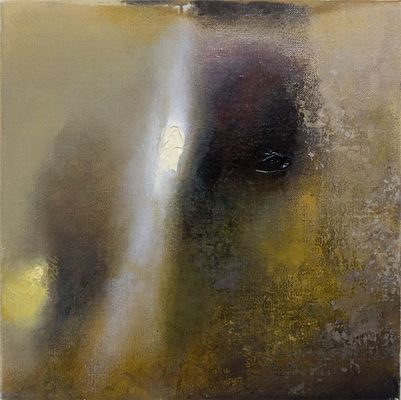
To return to Buckley’s fragment, the first two lines very much evoke how I paint nowadays. As you age, detail diminishes and patches of light become more luminous and float. I feel the most honest way of dealing with this is by smearing the oil paint on the canvas with the fingers and working close-up, blind. Only if the patches coalesce into an approaching image can the work gain a life.
-
Jonathan Walker was born in Melbourne, Australia and brought up on a dairy farm in Gippsland. In the 1970’s he studied painting at RMIT and won the Harold Wright Scholarship to the British Museum, London. During the 1980’s he exhibited at Pinacotheca Gallery, Richmond and had work shown at the NGV and Heidi City Art Gallery. Over the same period he designed the cover for the “Epigenesi” LP by Giancarlo Toniutti, Italy and conducted a mail exchange work with Achim Wollscheid, Germany. The work with artists through the post resulted in an article published in the bicentenary issue of Art and Australia 1988. He showed in artist run spaces such as WestSpace in the 90’s and 2000’s, and until 2012, taught painting at Victoria University, which is where we (Colleen Ahern and Lisa Radford) as organisers of the exhibition, among many others, had the privilege of being his student.
Walker’s knowledge was imparted to students through the careful selection of music, literature, and artists found in books that he himself had ordered for the library. Walker’s strategy was the generosity of sharing his vast knowledge with references specific to each student and their context.
Walker’s paintings share a similar focus and intimacy.
This exhibition presents a small selection of recent paintings alongside a publication that includes Walker’s writing. Observational and analytical, Walker’s work is a type of material notation — the time of day, colour and how it is blended, the both specific and fleeting location of a reflection on lino or the question of whether a chair leg should be included in a painting.
Please join us on Friday August 21 between 6-8pm to celebrate the opening of the exhibition.
Curated by Colleen Ahern and Lisa Radford.
B. Wurtz
Curated by Nic Tammens
March 26 - April 4, 2015
B.Wurtz works from a basement studio in his home on Manhattan’s Lower East Side.
This local fact is attested to by the plastic shopping bags and newsprint circulars that appear in his work. As formal objects, they don’t make loud claims about their origins but nonetheless transmit street addresses and places of business from the bottom of this long thin island. Like plenty of artists, Wurtz is affected by what is local and what is consumed. His work is underpinned by this ethic. It often speaks from a neighborhood or reads like the contents of a hamper:
“BLACK PLUMS $1.29 lb.”
“Food Bazaar”
“USDA Whole Pork Shoulder Picnic 99c lb.”
“RITE AID Pharmacy, with us it’s personal.”
“H. Brickman & Sons.”
“Sweet Yams 59c lb."
Most of the work in this exhibition was made while the artist was in residence at Dieu Donne, a workshop dedicated to paper craft in Midtown. Here Wurtz fabricated assemblages with paper and objects that are relatively lightweight, with the intention that they would be easily transportable to Australia. This consideration isn’t absolute in Wurtz’s work, but was prescriptive for making the current exhibition light and cheap. Packed in two boxes, these works were sent from a USPS post office on the Lower East Side and delivered to North Melbourne by Australia Post.
Wurtz appears courtesy of Metro Pictures, New York.
Thanks to Rob Halverson, Joshua Petherick, Sari de Mallory, Matt Hinkley, Helen Johnson, Fayen d'Evie, Ask Kilmartin, Lisa Radon, Ellena Savage, Yale Union, and "Elizabeth".
John Nixon
"Archive"
December 15 - January 20, 2014
The presentation of John Nixon's archive offered a rare showcase of this extensive collection of the artist's own publications, catalogues, posters, ephemera, editions and more, from the mid 1980s onwards, alongside a selection of his artworks.
Organized by John Nixon, Joshua Petherick and Matt Hinkley.
<a href=http://wfb.public-office.info/artist/john-nixon>All titles by John Nixon
"Habitat"
at Minerva, Sydney (organised by Joshua Petherick and Matt Hinkley)
November 15 - December 20, 2014
Lupo Borgonovo, Janet Burchill & Jennifer McCamley,
Lewis Fidock, HR Giger, Piero Gilardi, Veit Laurent Kurz,
Cinzia Ruggeri, Michael E. Smith, Lucie Stahl, Daniel Weil, Wols
Press Release:
“...It contained seven objects. The slender fluted bone, surely formed for flight, surely from the wing of some large bird. Three archaic circuitboards, faced with mazes of gold. A smooth white sphere of baked clay. An age-blackened fragment of lace. A fingerlength segment of what she assumed was bone from a human wrist, grayish white, inset smoothly with the silicon shaft of a small instrument that must once have ridden flush with the surface of the skin - but the thing’s face was seared and blackened.”
William Gibson, “Count Zero”, 1986
"Autumn Projects Archive"
Curated by Liza Vasiliou
March 6 - March 15, 2014
World Food Books, in conjunction with the Virgin Australia Melbourne Fashion Festival 2014, presented the Autumn Projects archive, consisting of a selection of early examples in Australian fashion with a particular interest in collecting designers and labels from the period beginning in the 1980’s, who significantly influenced the discourse of Australian Fashion.
Curated by Liza Vasiliou, the exhibition provided a unique opportunity to view pieces by designers Anthea Crawford, Barbara Vandenberg, Geoff Liddell and labels CR Australia, Covers, Jag along with early experimental collage pieces by Prue Acton and Sally Browne’s ‘Fragments’ collection, suspended throughout the functioning World Food Books shop in Melbourne.
H.B. Peace
presented by CENTRE FOR STYLE
November 14, 2013
"Hey Blinky, you say chic, I say same"
Anon 2013
H.B. Peace is a clothing collaboration between great friends Blake Barns and Hugh Egan Westland. Their pieces explore the divergences between 'character’ and ‘personality’ in garments....etc
Special Thanks to Joshua Petherick and Matt Hinkley of WFB and Gillian Mears
and a Very Special Thank you to Audrey Thomas Hayes for her shoe collaboration.
Janet Burchill & Jennifer McCamley
"Aesthetic Suicide"
May 10 - June 8, 2013
The first of our occasional exhibitions in the World Food Books office/shop space in Melbourne, "Aesthetic Suicide" presented a body of new and older works together by artists Janet Burchill & Jennifer McCamley, including videos, prints, a wall work, and publications.
During shop open hours videos played every hour, on the hour.
2019, English
Softcover, 96 pages, 17.8 x 11.4 cm
Published by
Wakefield Press / Cambridge
$28.00 - In stock -
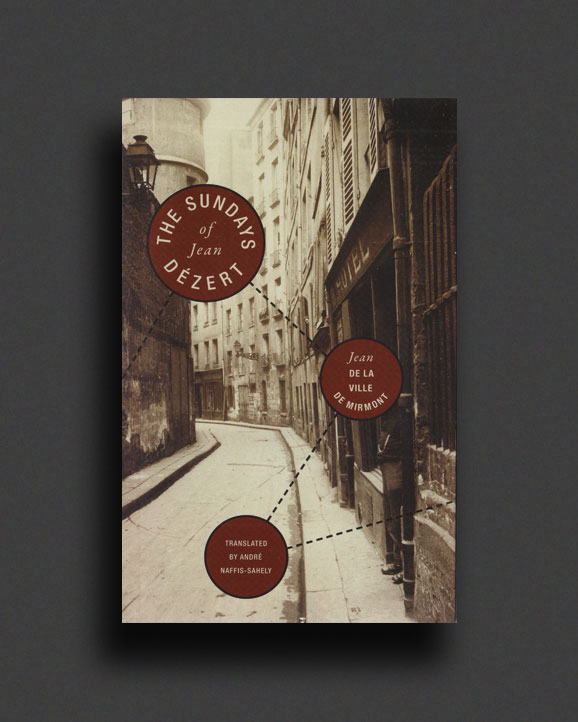
Translated, with an introduction, by André Naffis-Sahely
“He thought of life as a waiting room for third-class travelers. From the moment he purchased his ticket, there was nothing left for him to do but watch men pass him by on the platform. An employee would let him know when the train would depart; but he was still clueless as to its final destination.”
Before his death at the age of 27, Jean de La Ville de Mirmont left behind one undisputed classic, self-published a few months before he would meet his fate on the front lines of World War I: an understated, humorous tale of urban alienation that outlines the crushing mediocrity of bureaucratic existence.
Jean Dézert is a young man living in a low-ceiling flat on the Rue du Bac, an office worker employed by the ministry who rounds out his regimented life with snippets of Eastern philosophy, strolls through the city, counting streetlamps—and strangely consumerist efforts at injecting some content into his life by structuring his Sundays through a rigorous use of advertising flyers that take him from saunas to vegetarian restaurants to lectures on sexual hygiene. Eventually his urban divagations lead him, as most lives do, to a romantic dalliance: with a young lady at the Jardin des Plantes. In his mortal boredom, his modernist engagement with the banality of the everyday, and his almost heroic resignation to mediocrity, Jean Dézert emerges as something of a French counterpart to Herman Melville's own rebel bureaucrat, Bartleby the Scrivener. Save that when it comes to being an existential rebel, Jean Dézert goes even further in his will to prefer not to...
“Had he lived, what would we have meant to one another? Would he have had a literary destiny? For the twenty-something de La Ville, just as for the forty-year-old Charles Péguy, the war was quite simply a relief. Yes, it was the most horrible war the world had ever seen, where millions of young men murdered one another, but they also saw it as their destiny’s final terminus, a means to suddenly give their dead-end, onerous lives some heroic meaning.”—François Mauriac
“Jean Dézert is like a brother to me, because of his ability to escape despair by means of emptiness.”—Michel Houellebecq
Jean de La Ville de Mirmont (1886–1914) died at the age of 27 on the WWI battlefront by a shell explosion. He left behind a collection of poetry that would be published posthumously, a collection of short stories, and the novella for which he is remembered, The Sundays of Jean Dézert.
2019, English / German
Softcover, 164 pages, 14.8 × 21 cm
Published by
Mousse / Milan
$33.00 - Out of stock
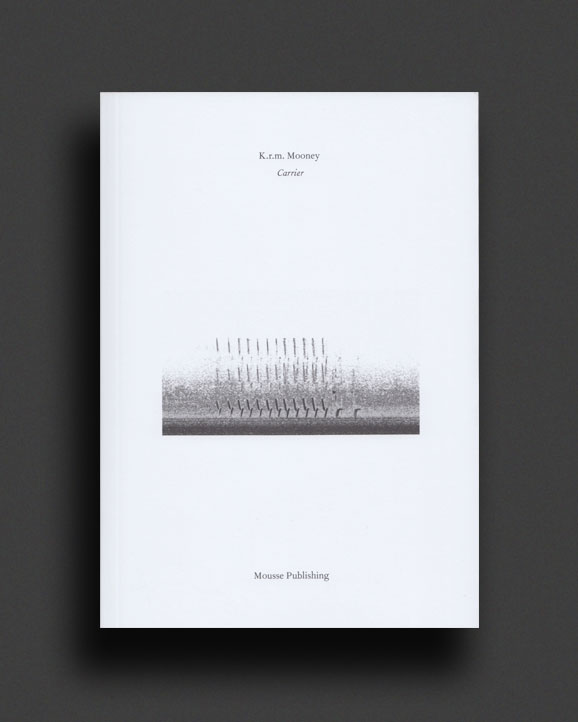
The work of K.R.M. Mooney inhabits an intermediary position between autonomous, abstract sculpture and context-specific projects. With carefully placed objects and spatial interventions they dissolve clear boundaries between interior and exterior, initiating a more comprehensive perception of objects, bodies and space that is always co-produced with the relational, environmental and embodied. K.R.M. Mooney, Carrier is published on occasion of the artists’ solo exhibition at Kunstverein Braunschweig’s Remise. It includes an introduction by Christina Lehnert, an interview between K.r.m. Mooney and McIntyre Parker, a statement by Nele Kaczmarek and a poem by Susanne M. Winterling.
2019, English
Hardcover (gilt green leatherette), 112 pages, 13.3 x 19 cm
Published by
No Place Press / US
$62.00 - Out of stock
How Silicon Valley, the dark net, and digital culture have affected our relationship to knowledge, history, language, aesthetics, reading, and truth.
In October 2013, twenty-nine-year-old Ross William Ulbricht was arrested at the Glen Park Public Branch Library in San Francisco, accused of being the "Dread Pirate Roberts" and mastermind of a dark net drug marketplace known as Silk Road. Ulbricht was an ardent libertarian who believed Silk Road-described by the New York Times as "the largest, most sophisticated criminal enterprise the internet has ever seen"-was battling the forces of big government. He was convicted two years later of money laundering, computer hacking, and conspiracy to traffic narcotics and sentenced to life in prison.
Art historian Pamela Lee reads this event as a fairy tale of disruption rather than an isolated episode in the history of the dark net, Silicon Valley, and the relationship between public libraries and digital culture. Lee argues that the notion of "disruptive" technology in contemporary culture has radically affected our relationship to knowledge, history, language, aesthetics, reading, and truth. Against the backdrop of her account of Ulbricht and his exploits, Lee provides original readings of five women artists-Gretchen Bender, Cecile B. Evans, Josephine Pryde, Carissa Rodriguez, and Martine Syms-who weigh in, either explicitly or inadvertently, on the nature of contemporary media and technology. Written as a work of experimental art criticism, The Glen Park Library is both a homage to the Bay Area and an excoriation of the ethos of Silicon Valley. As with all fairy tales, the book's ultimate subjects are much greater, however, and Lee casts a critical eye on collisions between privacy and publicity, knowledge and information, and the past and future that are enabled by the technocratic worldview.
Foreward by Foreword by Michelle Kuo
1983, Japanese
Hardcover (clothbound w. dustjacket), 151 pages, 20.5 x 30 cm
1st Edition, Out of print title / used / very good
Published by
Orion Press / Tokyo
$160.00 - Out of stock
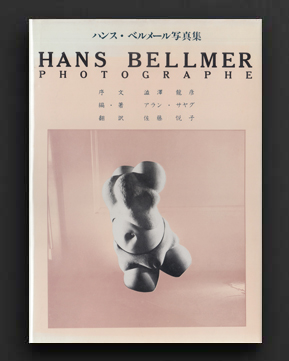
Rare, exquisitely designed and produced book dedicated entirely to the photography of the German artist Hans Bellmer (13 March 1902 – 23 February 1975), best known for the life-sized pubescent female dolls he produced in the mid-1930s. "Bellmer was born in the city of Kattowitz, then part of the German Empire (now Katowice, Poland). Up until 1926, he'd been working as a draftsman for his own advertising company. He initiated his doll project to oppose the fascism of the Nazi Party by declaring that he would make no work that would support the new German state. Represented by mutated forms and unconventional poses, his dolls were directed specifically at the cult of the perfect body then prominent in Germany. Bellmer was influenced in his choice of art form by reading the published letters of Oskar Kokoschka (Der Fetisch, 1925)."
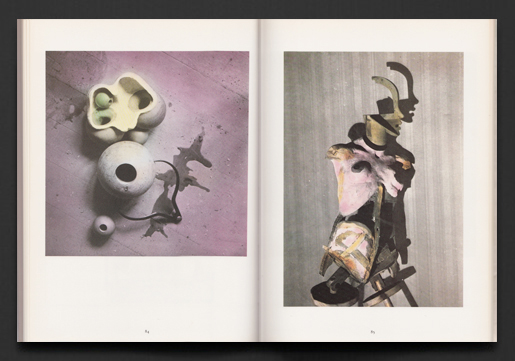
Produced in French by Editions Filipacchi, Centre Georges Pompidou, and Musee National D'art Moderne in Paris in 1983, this very scarce Japanese printing (produced and printed in Japan that same year) features a different cover, with translations to the Japanese language of the introductory essay and texts. Densely illustrated with amazing and beautifully printed colour and black and white photography of Bellmer's dolls, many studies of the female nude, and photography of objects and sculptural assemblages, this book is a wonderful volume capturing an important Surrealist visionary of our time through his stunning photography.
Very good copy in dust-jacket, age tanning to edges/cover.
2016, English
Softcover, 98 pages, 13.7 x 20.3 cm
Published by
The MIT Press / Massachusetts
$29.00 - Out of stock
A lucid and wide-ranging meditation on why photography is unique among the picture-making arts.
Photography matters, writes Jerry Thompson, because of how it works-not only as an artistic medium but also as a way of knowing. With this provocative observation, Thompson begins a wide-ranging and lucid meditation on why photography is unique among the picture-making arts. He constructs an argument that moves with natural logic from Thomas Pynchon (and why we read him for his vision and not his command of miscellaneous facts) to Jonathan Swift to Plato to Emily Dickinson (who wrote "Tell all the Truth but tell it slant") to detailed readings of photographs by Eugene Atget, Garry Winogrand, Marcia Due, Walker Evans, and Robert Frank. Forcefully and persuasively, he argues for photography as a medium whose business is not constructing fantasies pleasing to the eye or imagination, but describing the world in the toughest and deepest way.
2018, English
Softcover, 240 pages, 15.2 x 20.3 cm
Published by
Exact Change / Boston
$32.00 - Out of stock
“Everything in the world exists to end up as a book.”
French poet Stéphane Mallarmé (1842–98) was modernism’s great champion of the book as both a conceptual and material entity. A colossal influence on literature from Huysmans to Ashbery, art from Manet to Broodthaers, music from Debussy to Boulez and philosophy from Blanchot to Rancière, Mallarmé spent more than 30 years on a legendary, ultimately unfinished project he called simply Le Livre.
The Book was Mallarmé’s dream of a total artwork, a book to encompass all books. His collected drafts and notes toward it, published first posthumously in French in 1957, are alternately mystic, lyrical and banal: many concern the dimensions, page count and cost of printing this ideal book. Often cited, frequently quoted, but rarely encountered in its entirety, The Book has remained as much myth as text.
Sylvia Gorelick has undertaken the first complete translation of The Book into English. This fresh translation is not only between languages, but from its original handwritten manuscript — now in the collection of Houghton Library, Harvard University — to the typographic page. The result is a strikingly visual poem about its own construction.
1951, English
Hardcover, 312 pages, 18.5 x 12 cm
1st US Edition, Out of print title / used / good
Published by
New Directions / New York
$35.00 - Out of stock
First hardcover edition of The Poems of Mallarmé, published by New Directions, New York, 1951. "The order of the contents in this volume would be very mystifying to scholars without the following explanation: It was the first purpose of this New Classics edition to restore to print Roger Fry's excellent translations of some of Mallarme's poems (originally published in London in 1936 by Messers Chatto & Windus) and the perceptive commentaries of his French friend and collaborator Charles Mauron." - from the Publisher's Note (1951)
Stéphane Mallarmé (1842 – 1898), pen name of Étienne Mallarmé, was a French poet and critic. He was a major French symbolist poet, and his work anticipated and inspired several revolutionary artistic schools of the early 20th century, such as Cubism, Futurism, Dadaism, and Surrealism.
Good ex-library copy missing dust jacket. Cloth with some marks.
1980, English
Hardcover (w. dust jacket), 78 pages, 31 x 23.5 cm
1st Edition, Out of print title / used / very good
Published by
Abbey Library / London
$25.00 - Out of stock
First hardcover edition of Abbey Library's monograph on Andrea Mantegna, printed in Romania and published in 1980. Opening illustrated text by Romanian literary critic Alexandru Balaci (translated by Leon Levitchi), followed by "Chronology and Cordances" and bibliography. The remainder of the book is made up of colour plates illustrating Mantegna's paintings.
Andrea Mantegna (UK: /mænˈtɛnjə/, US: /mɑːnˈteɪnjə/,[2][3] Italian: [anˈdrɛːa manˈteɲɲa]; c. 1431 – September 13, 1506) was an Italian painter, a student of Roman archeology, and son-in-law of Jacopo Bellini. Like other artists of the time, Mantegna experimented with perspective, e.g. by lowering the horizon in order to create a sense of greater monumentality. His flinty, metallic landscapes and somewhat stony figures give evidence of a fundamentally sculptural approach to painting. He also led a workshop that was the leading producer of prints in Venice before 1500.
2008, English
Hardcover (cloth bound w. ribbon), 60 pages, 18.5 x 12.5 cm
Published by
Griffith University / Brisbane
$25.00 - Out of stock
Jenny Watson's Material Evidence : Works on fabric 1981 - 2005 was produced to accompany an international touring exhibition in 2009-10. Illustrated throughout with her works, alongside contributions by Holly Arden, Chris Handran, Sally Brand and Rosemary Hawker.
Jenny Watson is a major figure in contemporary art whose work continues to command an international audience engages by its freshness, gentle humour and eloquence. Her unconventional approach to painting combines colour, text, figures and recurring motifs, to create a meaningful narrative. The combination of images and text encourages the viewer to draw their own conclusions from the disparate pairings Watson offers.
Published by Griffith Artworks and supported by Queensland Arts.
1995, English
Softcover, 118 pages, 26 x 21 cm
1st Edition, Out of print title / used / very good
Published by
NGV (National Gallery of Victoria) / Victoria
$30.00 - Out of stock
First edition of the the retrospective catalogue of Australian artist Mike Brown, published in 1995 by the National Gallery of Victoria, Melbourne. Tracing Brown's entire oeuvre from 1958-1991, 'from modernism to an alternative framework of the postmodern', with illustrations throughout accompanying texts by Mike Brown, Richard Haese, and Charles Nodrum.
Mike Brown (1938-1997) was a significant late 20th century contemporary Australian artist. One of the founders of the Annandale Imitation Realists of the early 1960s, now recognised as a key event in the development of anti-formalist art in Australia. Brown was a unique leader of alternative avant guard art in Australia, railing against elite art cliques. In 1965 Brown became the only Australian artist ever to be prosecuted for obscenity and scandals would continue even after his death in 1997. During his lifetime, Brown produced a multiplicity of work including naïve landscapes, pattern based abstraction, pop and text paintings, found object assemblages, graffiti, performance.
Very Good copy with VG dust jacket.
2019, English
Softcover, 304 pages, 23 × 30 cm
Published by
Discipline / Melbourne
$20.00 - Out of stock
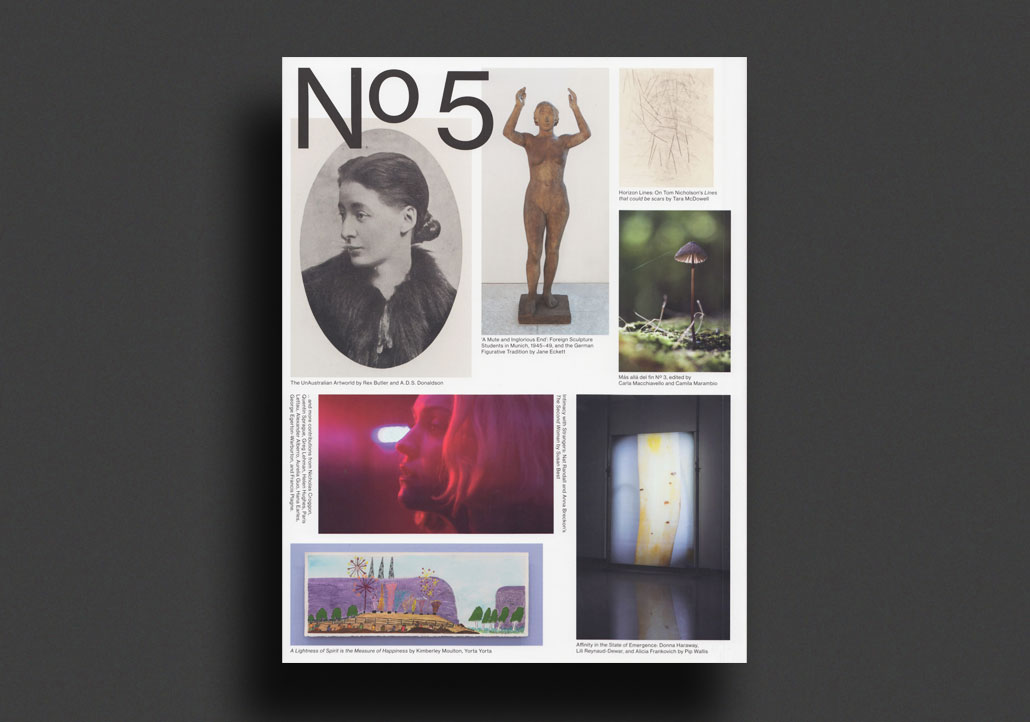
Edited by Helen Hughes and David Homewood (Discipline Nº 5); Carla Macchiavello and Camila Marambio (Más allá del fin Nº 3).
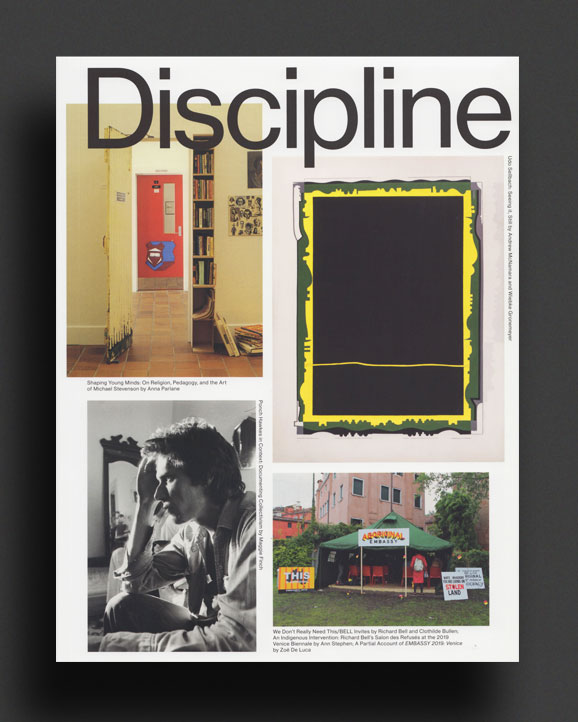
Discipline, Más allá del fin (translating to ‘discipline beyond the end’)—represents an effort to map a South–South relationship between Chile and Australia, and even more specifically, between its southernmost island tips: Tierra del Fuego and Tasmania. For centuries, the Northern imagination conceived of these places as the very personification of distance itself, whereas the editors of Más allá del fin refer to Tierra del Fuego as ‘the centre of the known universe’. In addition to publishing a range of essays on modern and contemporary art, this joint issue recentres and forges new connections between Southern perspectives, generating a dynamic and relational art history of the contemporary.
Designed by Robert Milne.
Discipline is a publisher and contemporary art journal edited by Nicholas Croggon, David Homewood, and Helen Hughes. Alongside artist pages and interviews, it publishes research essays about contemporary Australian art, and histories and theories of contemporary art as a global industry or phenomenon. For each issue a guest editor, from somewhere else in the world, is invited to contribute a guest edited section. Guest editors since 2011 are: Vivian Ziherl; Maria Fusco; Raimundas Malašauskas; Ferdiansyah Thajib, KUNCI Cultural Studies Center; and Carla Macchiavello and Camila Marambio, Ensayos.
1976, Czech
Hardcover,
Out of print title / used / good
Published by
Albatros / Prague
$28.00 - Out of stock
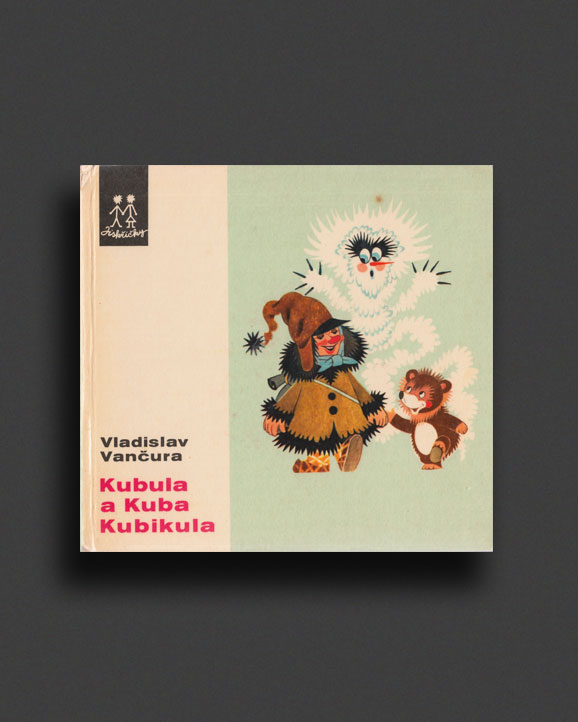
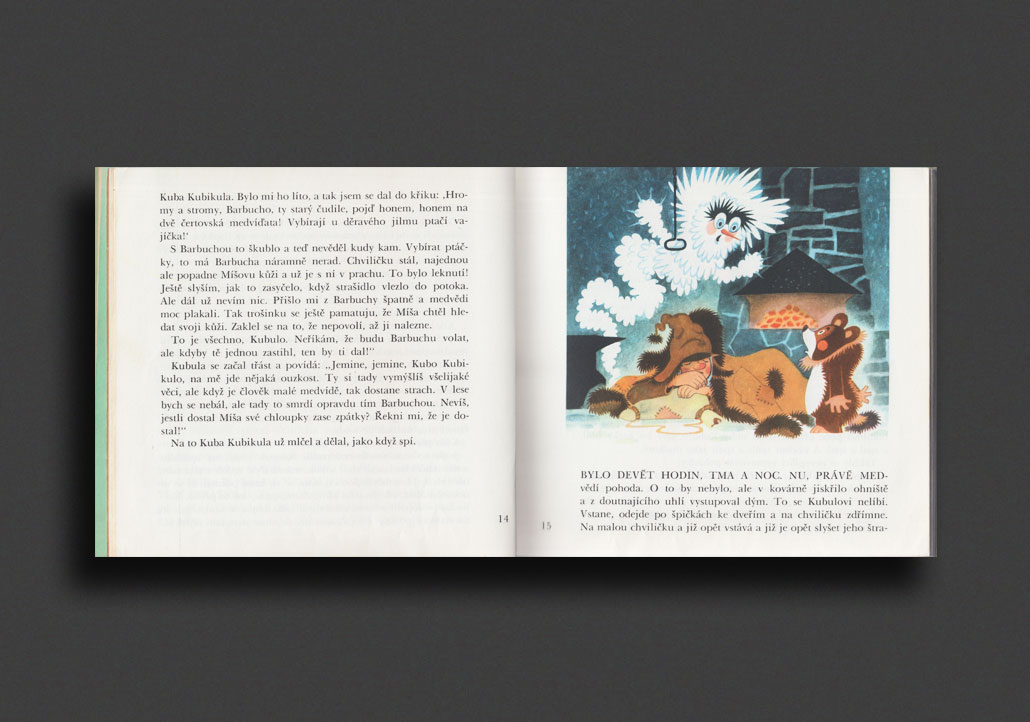
1976 hardcover edition of Kubula a Kuba Kubikula, the only fairy tale ever written by Vladislav Vančura, one of the most important Czech writers of the 20th century, and here illustrated by the great Czech animator Zdeněk Miler and published by Albatros in Prague. Kubula a Kuba Kubikula is a classic of Czech children's literature. First published in 1931, it has not lost any of his charm, individuality and wit. It is the story of the adventures of an unlikely trio - a boy, Kuba Kubikula, his naughty bear cub Kubula, and the bugbear (or bogeyman) Barbucha, who wander the winter countryside doing odd jobs to earn their keep.
Vladislav Vančura (1891 – 1942) was an important Bohemian (Czech) writer active in the 20th century, who was killed by the Nazis. He was also active as a film director, playwright and screenwriter.
Zdeněk Miler (1921 – 2011) was a Czech animator and illustrator best known for his Mole (Krtek or Krteček in original) character and its adventures spanning approximately 50 films.
1977, Czech
Softcover, 32 pages,
1st Edition, Out of print title / used / very good
Published by
National Gallery / Prague
$40.00 - Out of stock
Lovely Czech catalogue from 1977 published on the occasion of an exhibition of the work of master animator, puppeteer and illustrator Jiří Trnka (1912-1969), held at the Národní Galerie, Praha (Prague National Gallery). Profusely illustrated throughout with examples of Trnka's puppets, drawings, and paintings.
Very Good copy.
Jiří Trnka (11912 – 1969) was a Czech puppet-maker, illustrator, motion-picture animator and film director. In addition to his extensive career as an illustrator, especially of children's books, he is best known for his work in animation with puppets, which began in 1946. Most of his movies were intended for adults and many were adaptations of literary works. Because of his prolific influence in animation, he was called "the Walt Disney of Eastern Europe", despite the great differences between their works. Throughout his life, he illustrated 130 works of literature, most of them for children, for which he received the international Hans Christian Andersen Medal for illustrators in 1968. Especially famous are his illustrations for the tales of the Brothers Grimm, as well as many collections of folktales from Czech authors such as Jiří Horák and Jan Páleníček. Of his many animated works, Trnka considered his greatest work to be his last film, the short Ruka (The Hand, 1965). In the words of animation historian Giannalberto Bendazzi, Ruka is "a kind of hymn to the creative freedom raging." In short, it is about a sculptor visited by a huge hand, which seeks the completion of a sculpture of itself. By rejecting the imposition, the artist is constantly pursued by the hand, ending with induced suicide and the hand officiating at his funeral. Ruka is considered a protest against the conditions imposed by the Czechoslovak communist state to artistic creation, and even some have seen in it an anticipation of the so-called Prague Spring. Although the film initially had no problems with censorship, after his death copies were confiscated and banned from public display in Czechoslovakia for two decades.
1980, French
Hardcover (w. dust jacket), 220 pages, 25.5 x 32 cm
1st Edition, Out of print title / used / very good
Published by
Le Sphinx / Paris
$140.00 - Out of stock
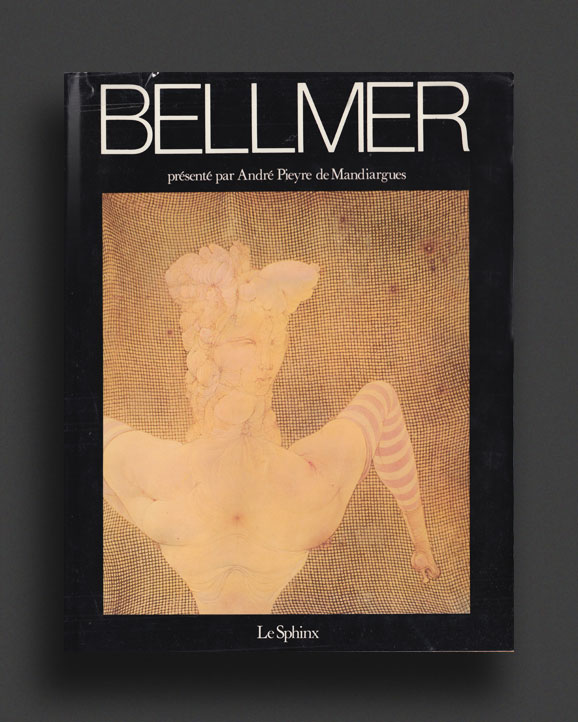
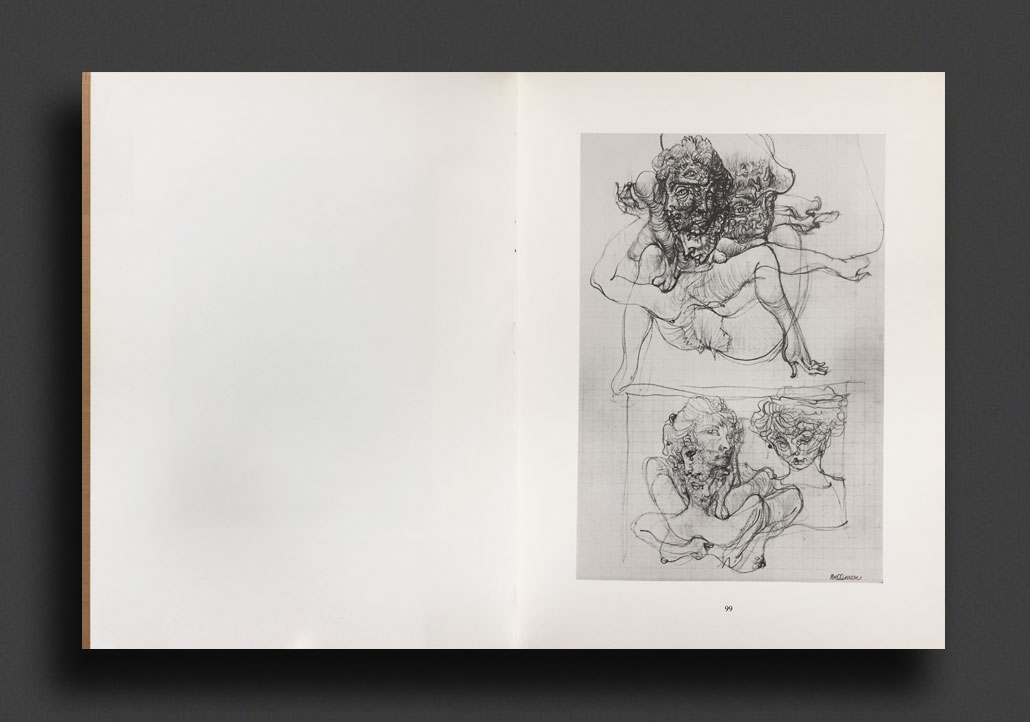
First 1980 hardcover edition of Le Trésor Cruel de Hans Bellmer, published by Le Sphinx, Paris. With texts by French author André Pieyre de Mandiargues and Hans Bellmer himself, this volume is made up of countless drawings and paintings of the Surrealist visionary, including many preliminary sketches for well-known graphics, and many seldom seen pieces. A beautiful collection on various stocks and reproduced in both colour and b/w. All texts in French.
German artist Hans Bellmer (13 March 1902 – 23 February 1975), was best known for the life-sized pubescent female dolls he produced in the mid-1930s. "Bellmer was born in the city of Kattowitz, then part of the German Empire (now Katowice, Poland). Up until 1926, he'd been working as a draftsman for his own advertising company. He initiated his doll project to oppose the fascism of the Nazi Party by declaring that he would make no work that would support the new German state. Represented by mutated forms and unconventional poses, his dolls were directed specifically at the cult of the perfect body then prominent in Germany. Bellmer was influenced in his choice of art form by reading the published letters of Oskar Kokoschka (Der Fetisch, 1925)."
Very Good in Good-VG dust jacket (small closed repair and some wear). Minimal previous library stamps. Perfectly preserved interior and binding.
2016, English
Hardcover (cloth-bound), 192 pages, 24 x 17 cm
1st Edition, Out of print title / used / fine
Published by
Walther König / Köln
$340.00 - Out of stock
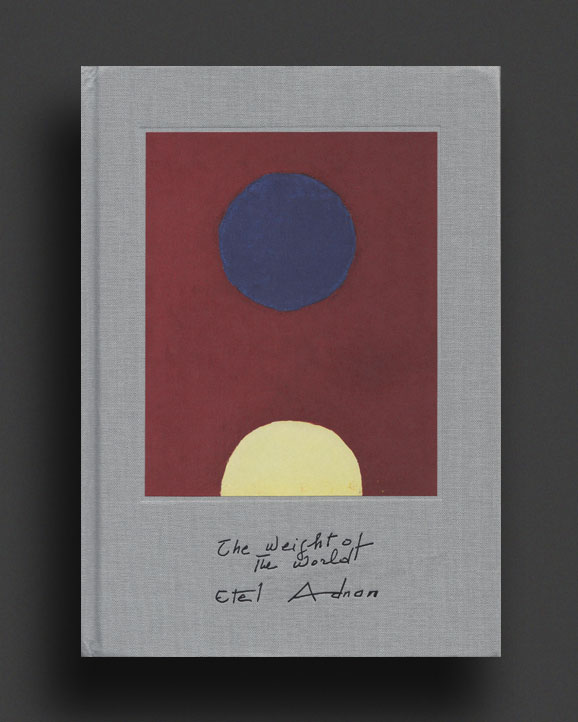
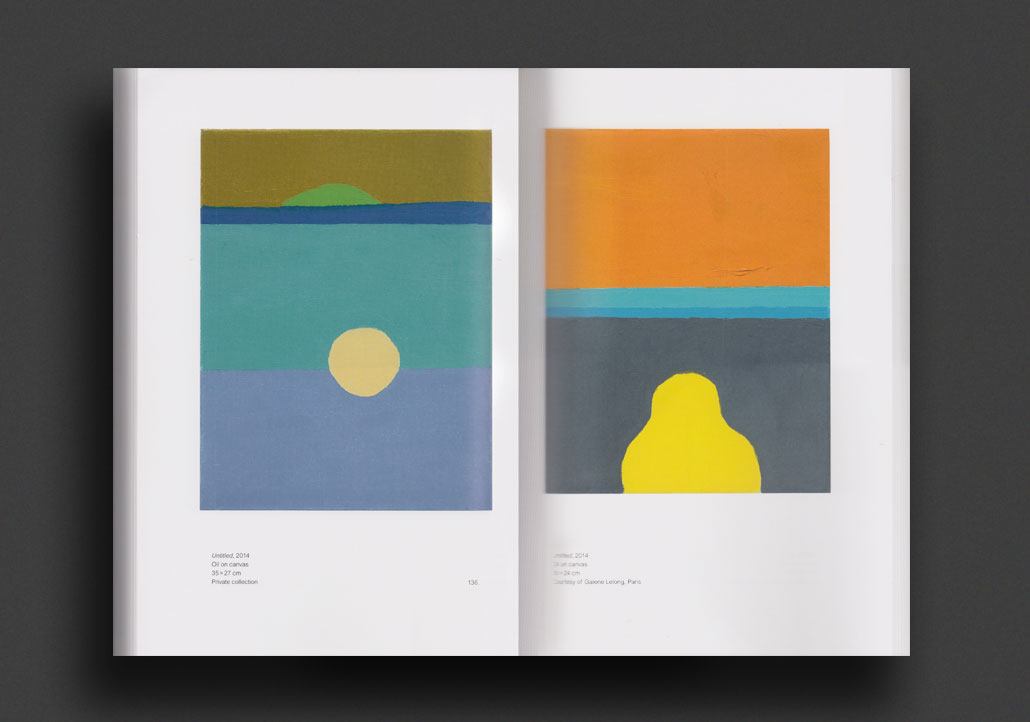
First edition of the instantly out-of-print, highly sought after first hardcover monograph on Etel Adnan, edited by Hans Ulrich Obrist and Julia Peyton-Jones and published on on occasion of the exhibition Etel Adnan: The Weight of the World at Serpentine Sackler Gallery, London, 2 June – 11 September 2016. Heavy illustrated important reference on the artist.
Painter, essayist and poet Etel Adnan (born 1925 in Beirut) works in various media, from painting, drawing, poetry, film and tapestry. After studying at the Sorbonne and then Harvard, in the late 1950s, Adnan taught philosophy at the University of California and started to paint. Her early works were largely abstract compositions she was interested in the immediate beauty of colour. These earliest paintings were suggestive of landscapes and included forms that referenced specific places. In the 1970s she moved to the area near Mount Tamalpais in California, which became the central subject matter of numerous paintings and poems. From the 1960s until the present, Adnan has also made tapestries, inspired by the Persian rugs of her childhood. Over the course of the 1960s, she moved away from purely abstract forms and discovered ‘leporellos’ (accordion-folded sketchbooks) in which she could mix drawing with writing and poetry. Her writing contains multiple references and responses to the politics and violence in the world around her. From her earliest poem in English, which addressed the Vietnam War, to her award-winning 1978 novel, Sitt Marie-Rose, she explores the political and personal dimensions of violence and articulates her experience of exile from familiar landscapes and languages.
Adnan’s artworks feature in numerous collections, including Centre Pompidou, Paris; and the British Museum, London.
First edition, fine copy with light corner bumping.
2019, English
Softcover, 424 pages, 13.7 x 20.3 cm
Published by
Semiotext(e) / Los Angeles
The MIT Press / Massachusetts
$48.00 - Out of stock
Since its first publication by Semiotext(e) in 1992, David Rattray's How I Became One of the Invisible has functioned as a kind of secret history and guidebook to a poetic and mystical tradition running through Western civilization from Pythagoras to In Nomine music to Hoelderlin and Antonin Artaud. Rattray not only excavated this tradition, he embodied and lived it. He studied at Harvard and the Sorbonne but remained a poet, outside the academy. His stories "Van" and "The Angel" chronicle his travels in southern Mexico with his friend, the poet Van Buskirk, and his adventures after graduating from Dartmouth in the mid-1950s. Eclipsed by the more mediagenic Beat writers during his lifetime, Rattray has become a powerful influence on contemporary artists and writers.
"In order to become one of the invisible, it is necessary to throw oneself into the arms of God... Some of us stayed for weeks, some for months, some forever." - from How I Became One of the Invisible
Living in Paris, Rattray became the first English translator of Antonin Artaud, and he understood Artaud's incisive scholarship and technological prophecies as few others would. As he writes of his translations in How I Became One of the Invisible, "You have to identify with the man or the woman. If you don't, then you shouldn't be translating it. Why would you translate something that you didn't think had an important message for other people? I translated Artaud because I wanted to turn my friends on and pass a message that had relevance to our lives. Not to get a grant, or be hired by an English department."
Compiled and edited by Chris Kraus in the months before his untimely death at age 57, How I Became One of the Invisible is the only volume of Rattray's prose. This new edition includes five additional pieces, two of them previously unpublished.
Cover photograph by Ira Cohen.
2019, English
Softcover, 215 pages, 17.5 x 24 cm
Published by
The Renaissance Society / Chicago
University of Chicago Press / Chicago
$77.00 - Out of stock
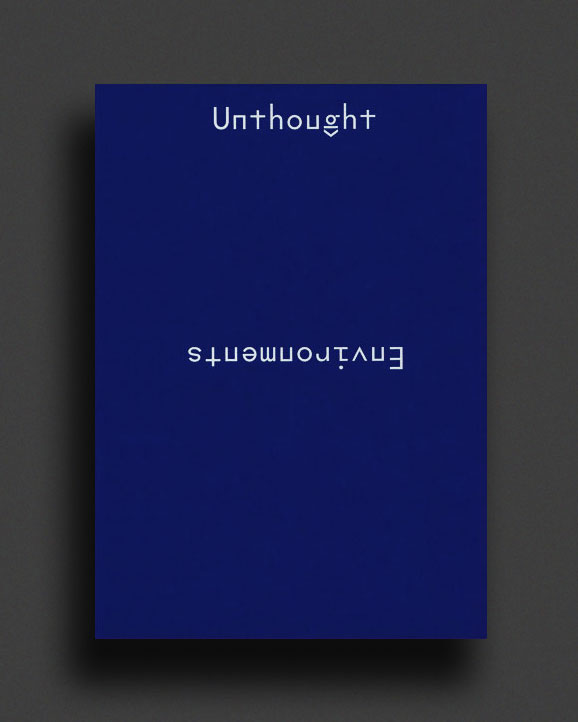
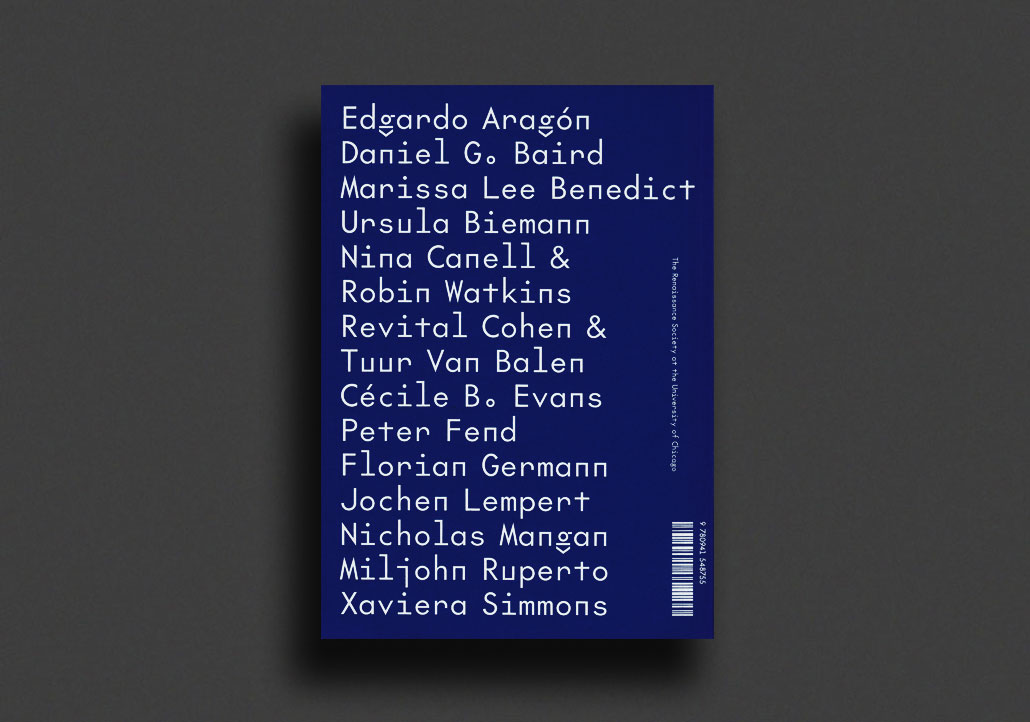
Unthought Environments brings together art influenced by the forces that are integral to our daily lives, yet are easily forgotten or overlooked, such as the ancient elements of air, fire, water, and earth; weather systems; geopolitics; and the hidden physical components of our virtual world. Informed by media studies, ecology, and philosophy, these multi-media artworks explore the elemental sphere as it intersects with the human-made.
This exhibition catalog brings together images from the exhibition (Unthought Environments, February 17–April 8, 2018, The Renaissance Society at The University of Chicago) alongside texts that engage directly with the works as well as the larger issues that drive them. Essays by Karsten Lund, John Durham Peters, Keller Easterling, Ina Blom, Marissa Lee Benedict, Revital Cohen and Tuur Van Balen, and Peter Fend are included, as well as a conversation with Lund, Nicholas Mangan, Robin Watkins, and Nina Canell.
Artists included : Daniel G. Baird, Marissa Lee Benedict, Nina Canell & Robin Watkins, Revital Cohen & Tuur Van Balen, Cécile B. Evans, Peter Fend, Florian Germann, Jochen Lempert, Nicholas Mangan, Miljohn Ruperto, Xaviera Simmons
2018, English
Softcover, 256 pages, 18 x 25 cm
Published by
Silvana / Milan
$95.00 - Out of stock
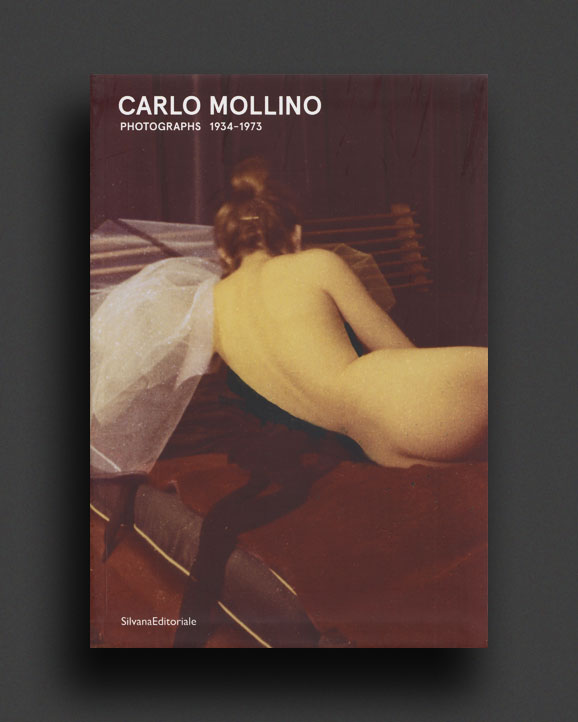
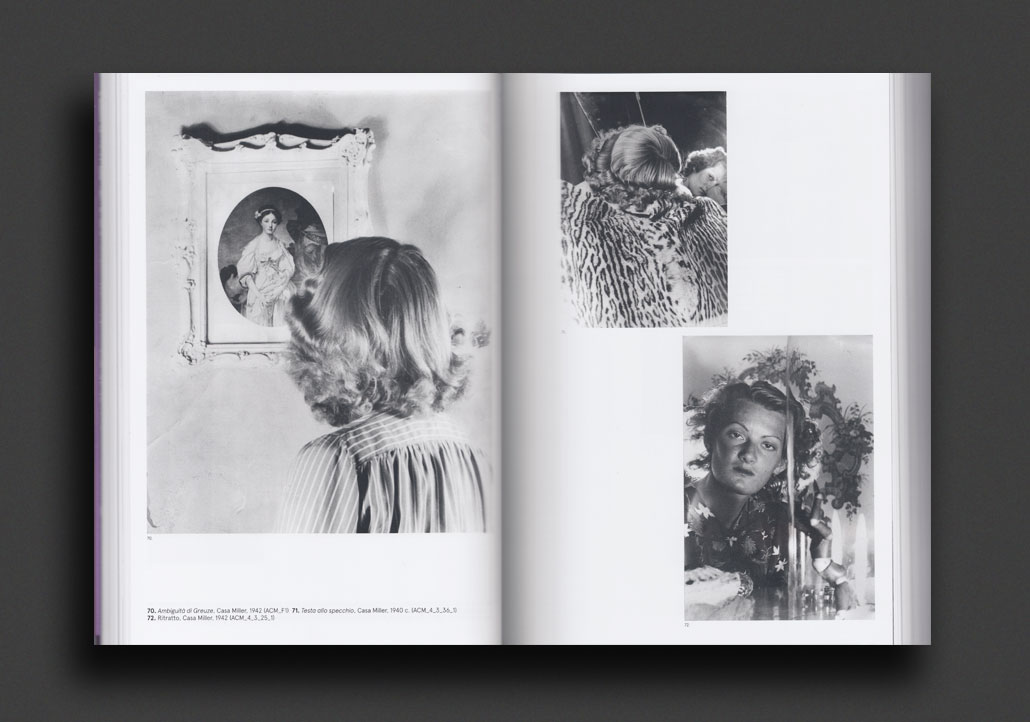
Carlo Mollino: Photographs 1934–1973 is a long-overdue survey of Mollino's full body of photographic work, published to accompany the largest and most complete exhibition ever staged of Mollino's photography. With more than 450 illustrations (some never before seen), this publication surveys Mollino's decades-long exploration of the medium, from his first architectural pictures to the erotic Polaroids of his later years, and contextualizes his work within the history of the discipline.
Mollino used photography as both a means of expression and an essential instrument for the documentation of his work and his daily life, producing works that were both classical and experimental, public and private. He was also an eloquent champion of photography as an art form, publishing Message from the Darkroom in 1949—a legendary photobook that was part history of photography, part technical manual and gloriously lavish for both functions.
Among the most celebrated architects of the 20th century, Carlo Mollino (1905–73) was also a designer, photographer, writer, skier, racing driver and stunt pilot. He studied mechanical engineering, art history and architecture before beginning to work in the architectural practice of his father, Eugenio Mollino, in Turin. Mollino's architectural work in Turin—from his first great building, the headquarters of the Turin Equestrian Association (1937), to his architectural masterpiece, the city's Teatro Regio (1965)—bookends a career marked by elegant, organic modernism and a drive toward fantasy and experimentation.
Edited with text by Francesco Zanot.
Text by Enrica Bodrato, Erik Viskil, Fulvio Ferrari.
2019, English
Hardcover, 252 pages, 16 x 24 cm
Published by
Park Books / Zürich
$60.00 - Out of stock
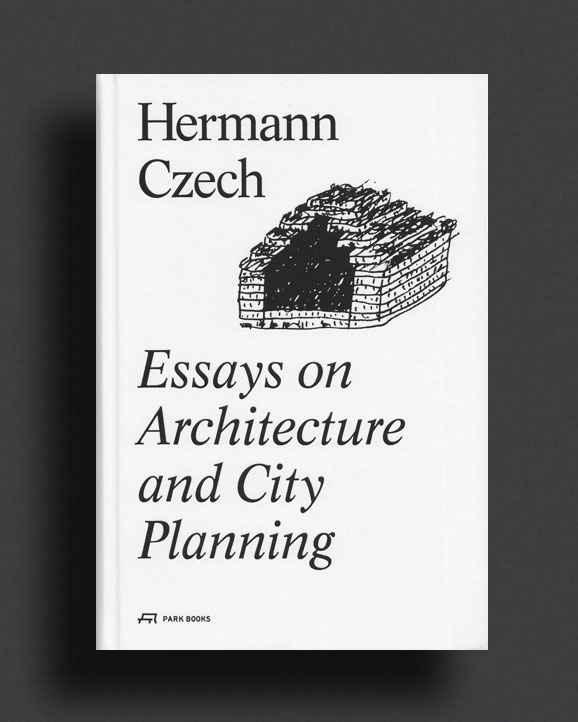
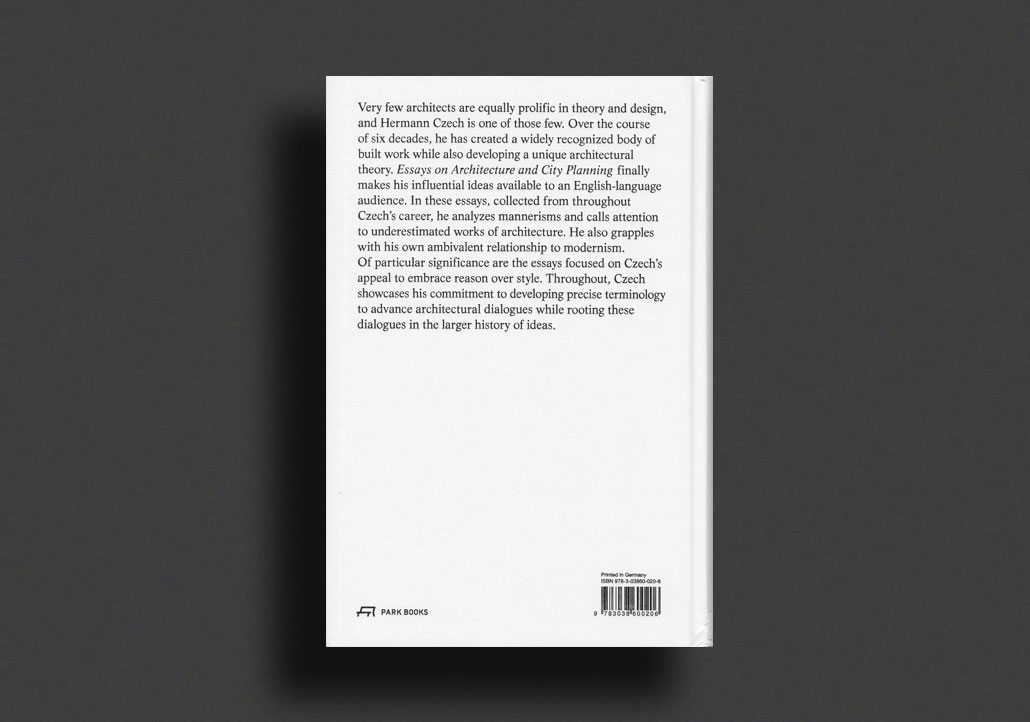
"Architecture is not life. Architecture is background . Everything else is not architecture. "- Hermann Czech, 1971
Very few architects are equally prolific in theory and design, and Austrian Hermann Czech is one of those few. Over the course of six decades, he has created a widely recognized body of built work while also developing a unique architectural theory based on his knowledge of philosophy and architectural history. Essays on Architecture and City Planning makes his influential ideas finally available to an English-language audience.
In these essays, collected from throughout Czech's career, he analyzes mannerism and calls attention to underestimated works of architecture. He also delves into his own ambivalent relationship to modernism. Of particular significance are the essays focused on Czech's appeal to embrace reason over style. In addition, Czech reveals his engagement with the work of Hegel, Kant, Wittgenstein, and Adorno as applied to architectural topics. Throughout, Czech showcases his commitment to developing precise terminology to advance architectural dialogues while rooting these dialogues in the larger history of ideas.
Foreword by Eve Blue.
Edited by Elise Feiersinger
2013, English
Softcover, 176 pages, 14 x 20.3 cm
Published by
Park Books / Zürich
$57.00 - Out of stock
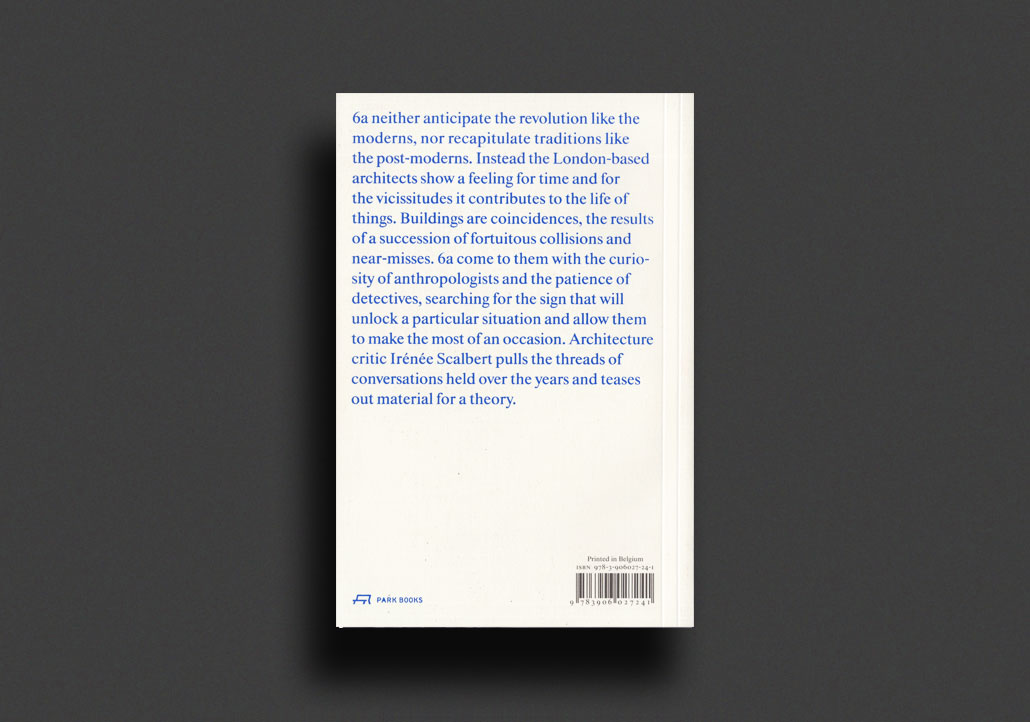
In this book on the London based studio 6a architects, architecture critic Irenee Scalbert looks at the role of narrative, history, appropriation and craft in the work of Tom Emerson and Stephanie Macdonald. The book traces an architectural approach avoiding style, signature, theory and even concept in favour of metis, an ancient form of intelligence combining 'flair, wisdom, forethought, subtlety of mind, deception, resourcefulness, vigilance, opportunism, varied skills, and experience.' Structured around notions of situation, intervention, making, comedy, bricolage, chance and anthropology, the text is mirrored in a visual essay of archive photographs, artworks, film stills and recent projects by the practice.
1979, English / Polish
Hardcover (w. dust jacket), 216 pages, 27.5 x 26 cm
1st Edition, Out of print title / used / very good
Published by
Krajowa Agencja Wydawnicza / Warsaw
$100.00 - Out of stock
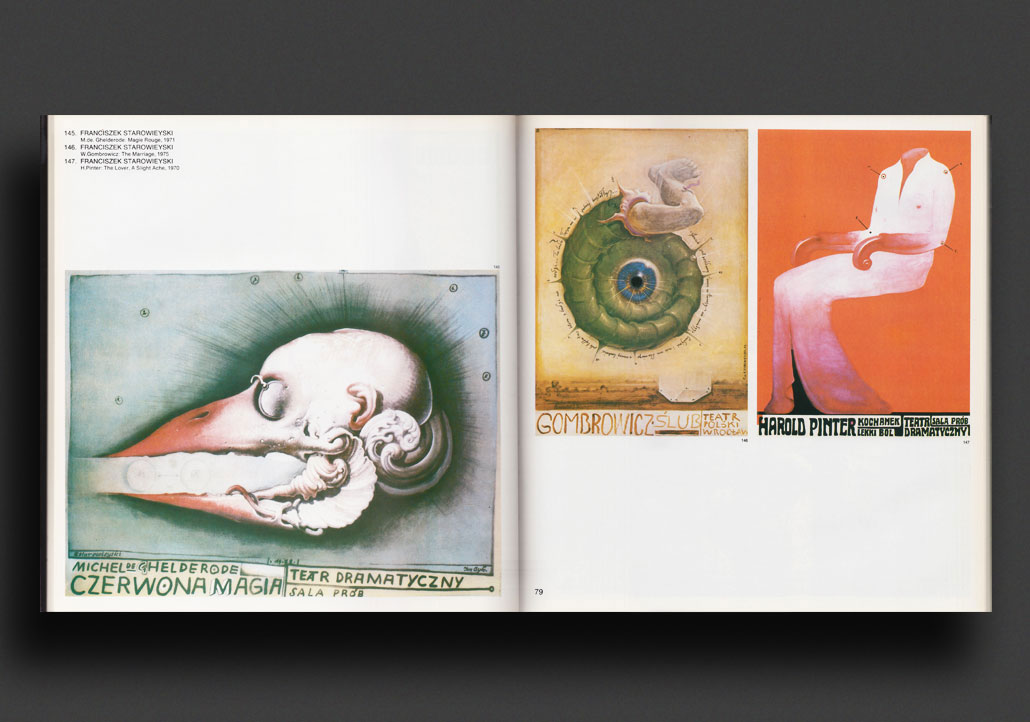
First scarce edition of this wonderful hardcover volume, published in 1979 by Krajowa Agencja Wydawnicza in Warsaw. Beautifully designed by one of the leading graphic artists in the field of Polish posters, Hubert Hilscher, this 200+ page book remains the finest document dedicated to the "Plakat Polski" (Polish Poster) of the 1970s - an exceptional period for the medium. Lavishly illustrated throughout in colour and b&w with over 400 of the best examples spanning 1970-1978, the book opens with an introduction in both Polish and English, English captions throughout, and includes detailed artist and work indexes in the back. Includes Political and Social Posters, Theatre and Concert Posters, Film Posters, Exhibition and Commercial Posters, Tourist and Sports Posters, and Circus Posters. This stunning book is a must for anyone interested in the subject, or graphic design and illustration from this period in general.
Features the work of Maciej Urbaniec, Franciszek Starowieyski, Józef Mroszczak, Leszek Hołdanowicz, Karol Śliwka, Romuald Socha, Elzbieta Procka, Jan Młodożeniec, Włodzimierz Terechowicz, Wiktor Górka, Roman Cieślewicz, Jerzy Czerniawski, René Mulas, Maria Ihnatowicz, Jan Lenica, Janusz Grabiański, Mieczysław Wasilewski, Hubert Hilscher, Jan Kotarbinski, Waldemar Świerzy, Tomasz Rumiński, Jerzy Treliński, Roman Rosyk, Tadeusz Piskorski, Andrzej Krajewski, Danuta Żukowska, Jan Jaromir Aleksiun, Marcin Mroszczak, Jan Sawka, Henryk Tomaszewski, Doroty Kabiesz, Tomasz Jura, Jerzy Flisak, Marek Freudenreich, Marian Stachurski, Witold Janowski, and many more.
Beginning in the 1950s and through the 1980s, the Polish School of Posters combined the aesthetics of painting with the succinctness and simple metaphor of the poster. It developed characteristics such as painterly gesture, linear quality, and vibrant colours, as well as a sense of individual personality, humour, and fantasy. It was in this way that the Polish poster was able to make the distinction between designer and artist less apparent. Posters of the Polish Poster School significantly influenced the international development of graphic design in poster art. Their major contribution is in their use of the power of suggestion through allusion. Using strong and vivid colours from folk art, they combine printed slogans, often hand-lettered, with popular symbols, to create a concise inventive metaphor. As a hybrid of words and images, these posters created a certain aesthetic tension that projected the art form in this period on European design. In addition to aesthetic aspects, these posters were able to reveal the artist's emotional involvement with the subject. They did not solely exist as an objective presentation, rather they were also the artist's interpretation and commentary on the subject and on society.
To this day, "Plakat Polski" remain as influential as ever on the world of graphic design, typography, illustration and even painting, and are widely collected and exhibited around the world.
Very Good copy.
2019, English
Hardcover (w. dust jacket), 248 pages, 17.8 x 22.9 cm
Published by
The MIT Press / Massachusetts
$74.00 $35.00 - Out of stock
How the poet Robert Duncan and the artist Jess made the household part of their separate and collaborative creative practice.
“I'm a householder,” the poet Robert Duncan once explained. “My whole idea of being able to work was to have a household.” In this book, Tara McDowell examines the household (physical and conceptual) that Duncan established with the artist Jess, beginning in 1951 when the two men exchanged marriage vows, and ending with Duncan's death in 1988. For Duncan and Jess, the household—rather than the studio, gallery, or collective—provided the support structure for their art. Indeed, McDowell argues convincingly, their work was coextensive with their household. The material surroundings of their house in San Francisco and the daily rhythms of their domestic lives became part of their creative practice.
Duncan wrote poetry that is romantic, ornate, and obscure; Jess (born Burgess Franklin Collins) created multi-imaged, complex collages and assemblages. McDowell explores their life and work—reading Duncan and Jess with and against each other, in alignment and misalignment. She examines their illustrated book Caesar's Gate, a collaborative effort that led them to reject collaboration; considers each man's lifelong preoccupation with an unfinished project, Jess's Narkissos and Duncan's The H.D. Book; and discusses their “origin myths” and self-made genealogies, describing them as a form of witness in the face of the calamities of the twentieth century.
Duncan and Jess made the household a necessary precondition for their art making. Doing so, they reclaimed and rehabilitated the domestic—from which gay couples were traditionally excluded—for their own uses. The household permitted them to reimagine the world. McDowell's portrait of a couple expands to encompass broader issues, urgent in midcentury America and still resonant today: belonging and kinship, alienation, and catastrophe.
Tara McDowell is Associate Professor and Director of Curatorial Practice at Monash University in Melbourne, Australia. She has worked as a curator at the CCA Wattis Institute for Contemporary Arts, San Francisco Museum of Modern Art, and Massachusetts Museum of Contemporary Art.
2011, Italian
Softcover, 12 x 24 cm
1st Edition, Out of print title / used / very good
Published by
De Luca Editori D'arte / Rome
$160.00 - Out of stock
First and only edition of this highly collectable catalogue raisonné of sculpture by Italian artist Pino Pascali, issued by De Luca Editori D'arte in Rome in 2011, and very quickly out-of-print.
Pino Pascali (b. Bari, 1935—1968), in the late 1950s, whilst working as a set designer, graphic designer, scriptwriter, and creative writer for television advertising, met fellow Arte Povera artist Jannis Kounellis. In 1965, Pascali first exhibited his “fake sculptures,” a series of shaped-canvases that first appear to be solid sculptures but are actually paintings presenting abstract forms that suggest animals, plants and landscapes. During his brief activity as a sculptor at the height of Pop Art, Pascali, considered a key artist of the Arte Povera movement, produced no more than 149 works, many of which are true icons of twentieth-century Italian art. The day of his untimely death at the age of 32, following a tragic motorcycle accident on 11 September 1968, coincided with the moment of his greatest public recognition (his presentation at the Venice Biennale and the posthumous awarding of the Sculpture Grand Prix). His short, enigmatic career has served as an important, almost mythological, contribution to post-war European art.
Housed in heavy linen slipcase, this oversized clothbound hardcover book collects Pascali's sculptural output, profusely illustrated throughout with photographs of Pascali's works and installaions, alongside texts in Italian and fully illustrated catalogue raisonné in colour and black and white. A real treasure!
Edited by Marco Tonelli.
Scientific Committee: Vittorio Brandi Rubiu and Fabio Sargentini.
Very Good copy in Very Good slipcase.
2019, English
Softcover, 360 pages, 11cm x 18 cm
Published by
O.oo Risograph & Design
$82.00 - Out of stock
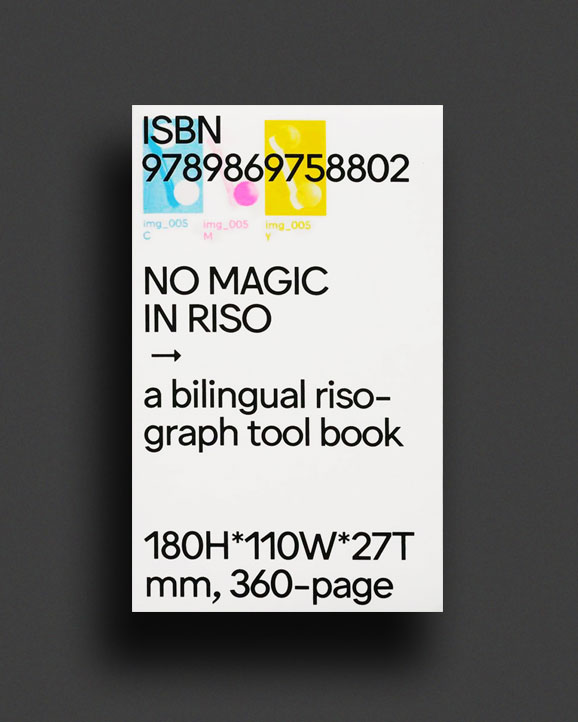
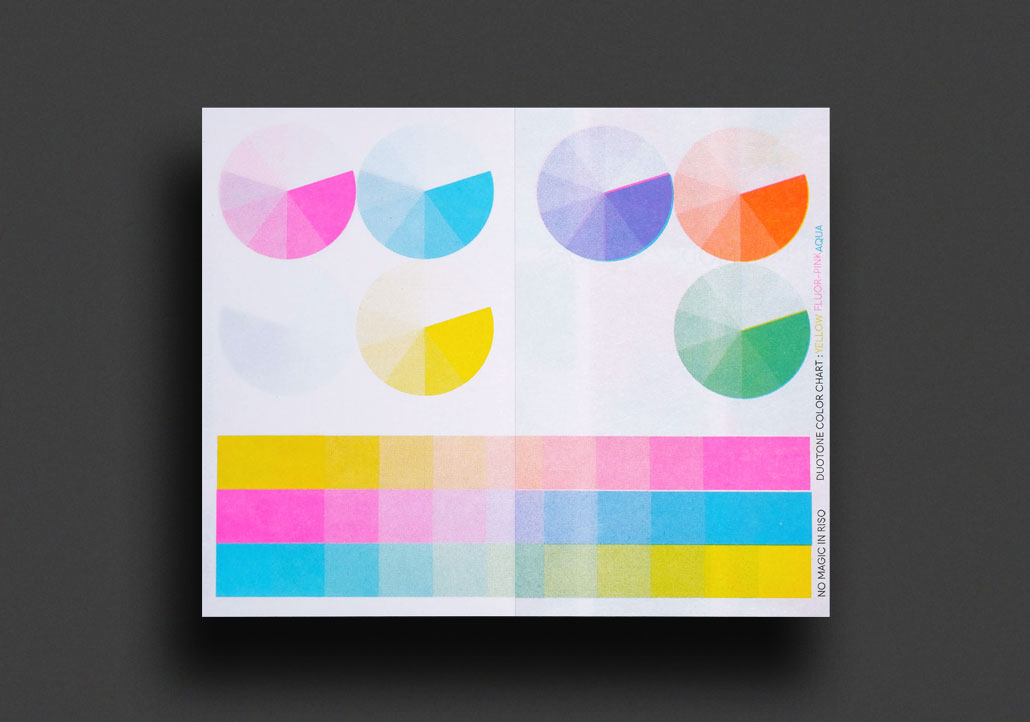
It took 850 days, 74 tubes of soy ink, 15 colors, 660 masters, 690,000 sheets of paper, 3 fans, 2 riso printers, and 4 people to complete a book – a 360 page book that only talks about 1 thing. The thing that is always the most fascinating is “Process”. The processes and experiences that did not have the chance to appear in the pages of this book can only be quantified, converted, and recorded into words.
Risograph is a brand of digital duplicators that are designed mainly for high-volume photocopying and printing. The process creates micro-imperfections in printing, similar to spontaneity, or even comparable to how improvisation in jazz can lead to an unexpected but pleasant result. The result of two years of research by O.OO, a graphic design studio based in Taipei, the main focus of this publication is colour separation and experimentation with images. The studio does not claim the colour separation methods described here to be absolute or the “right” way, but offer resources in hopes that they can provide helpful advice in practice while on the path to professionalism in this field.
Published in an edition of 1000.