World Food Books' programme is largely produced on Kulin Nation land. We acknowledge the Wurundjeri people of the Kulin Nation as the first and continuing custodians of this land, and pay respect to their Elders past, present, and emerging.
World Food Books is an arts and special interests bookshop in Naarm / Melbourne. Founded in 2010, World Food Books is devoted to the presentation of a rotating, hand-selection of international art, design, literary and counterculture publications with an emphasis on the anti-traditional, the experimental, the avant-garde, the heretic, the marginal.
Presenting new titles alongside rare and out-of-print books, catalogues and journals spanning the fields of modern and contemporary art, design, photography, illustration, film, literature, poetry, cultural theory, philosophy, sexuality, popular and underground culture in its many radical forms, World Food Books wishes to encourage adventurous, thoughtful and open-minded reading, looking, writing, and exchange of publishing and ideas, both current and historical.
As well as our bookshop, located in Melbourne's historical Nicholas Building, all of our inventory is available internationally via our online mail-order service.
World Food Books semi-regularly co-ordinates "Occasions", a programme of exhibits and events at the bookshop and in partnership with other hosts (such as museums and art galleries) that develop out of the activities, relationships and content of the bookshop itself.
World Food Books
The Nicholas Building
37 Swanston Street
Room 5, Level 6
Melbourne 3000
Australia
SHOP HOURS:
Thu–Fri 12–6, Sat 12–5
WEB-SHOP OPEN 24/7
World Food Books
Postal Address:
PO Box 435
Flinders Lane
Victoria 8009
Australia
Art
Theory / Essay
Architecture / Interior
Graphic Design / Typography
Photography
Fashion
Eros
LGBTQ+
Fiction / Poetry
Weird / Speculative / Science Fiction / Horror
Transgressive / Visceral / Abject
Symbolism / Decadence / Fin de siècle
Film / Video
Painting
Sculpture / Installation
Performance / Dance / Theater
Drawing
Sound / Music
Curatorial
Group Shows / Collections
Periodicals
Out-of-print / Rare
Posters / Ephemera / Discs
Signed Books
World Food Books Gift Voucher
World Food Book Bag
Australian Art
Australian Fiction
Australian Science Fiction / Speculative Fiction
Australian Poetry
Australian Photography
Japanese Photography
Conceptual Art
Minimal Art
Dada
'Pataphysics / Oulipo
Fluxus
Concrete Poetry
Pop Art
Surrealism
Arte Povera
Arte Informale / Haute Pâte / Tachism
Nouveau Réalisme / Zero / Kinetic
Situationism / Lettrism
Collage / Mail Art / Xerox Art
Art Brut / Folk / Visionary / Fantastic
Illustration / Graphic Art / Bandes Dessinées
Furniture
Italian Radical Design / Postmodernism
Textiles
Ceramics / Glass
Counterculture
Protest / Revolt
Philosophy
Psychoanalysis
Anthropology
Anarchism
Socialism / Anarchism / Communism / Capitalism
Literary Theory / Semiotics / Language
Feminism / Women's Studies
Gender Studies / Sexuality
Anthropology
Fetishism / BDSM
Drugs / Psychedelia
Crime / Violence
Animal Rights / Veganism
Occult / Esoterica
Ecology / Earth / Alternative Living
Whole Earth / Crafts
All prices in AUD (Australian dollars)
Pick-Ups
Pick-up orders can be collected in our bookshop during opening hours after order date. Please collect any Pick-up orders within 2 weeks of ordering as we have limited storage space. Orders will be released back into stock if not collected within this time. No refunds can be made for pick-ups left un-collected. If you cannot make it in to the bookshop in this time-frame, please choose postage option.
Return Policy
All sales are final. We do accept returns (for refund or exchange) for items received in error. All our orders are packed with special care using heavy-duty padding and cardboard book-mailers or bubble mailers (for smaller books), using reinforcement where required. We cannot take responsibility for any lost, stolen or damaged parcels.
Insurance
Should you wish to insure your package, please email us directly after placing your order and we can organise this at a small extra expense. Although all standard/express tracked packages are very safe and dependable, we cannot take responsibility for any lost, stolen or damaged parcels. We recommend insurance on valuable orders.
Interested in selling your old books, catalogues, journals, magazines, comics, fanzines, ephemera? We are always looking for interesting, unusual and out-of-print books to buy. We only buy books in our fields of interest and specialty, and that we feel we can resell.
We base these prices on desirability, market value, in-print prices, condition and our current stock levels. We offer cash, store credit, and can take stock on consignment. All
about 25% of the price we expect to get when we sell them, or 30% in store credit. We base these prices on desirability, market value, in-print prices, condition and our current stock levels.
Sell your books any day of the week. You can drop them off and return later. If you have a lot of books, we can visit your Sydney home.
We buy books that we feel we can resell. We offer about 25 % of the price we expect to get when we sell them, or 30% in store credit. We base these prices on desirability, market value, in-print prices, condition and our current stock levels.
Philadelphia Wireman
03 August - 01 September, 2018
World Food Books is proud to announce our next Occasion, the first presentation of sculptures by Philadelphia Wireman in Australia.
The Philadelphia Wireman sculptures were found abandoned in an alley off Philadelphia’s South Street on trash night in 1982. Their discovery in a rapidly-changing neighbourhood undergoing extensive renovation, compounded with the failure of all attempts to locate the artist, suggests that the works may have been discarded after the maker’s death. Dubbed the "Philadelphia Wireman" during the first exhibition of this work, in 1985, the maker’s name, age, ethnicity, and even gender remain uncertain. The entire collection totals approximately 1200 pieces, all intricately bound together with tightly-wound heavy-gauge wire (along with a few small, abstract marker drawings, reminiscent both of Mark Tobey and J.B. Murry). The dense construction of the work, despite a modest range of scale and materials, is singularly obsessive and disciplined in design: a wire armature or exoskeleton firmly binds a bricolage of found objects including plastic, glass, food packaging, umbrella parts, tape, rubber, batteries, pens, leather, reflectors, nuts and bolts, nails, foil, coins, toys, watches, eyeglasses, tools, and jewellery.
Heavy with associations—anthropomorphic, zoomorphic, and socio-cultural responses to wrapped detritus—the totemic sculptures by Philadelphia Wireman have been discussed in the context of work created to fulfil the shamanistic needs of alternative religions in American culture. Curators, collectors, and critics have variously compared certain pieces to sculpture from Classical antiquity, Native American medicine bundles, African-American memory jugs, and African fetish objects. Reflecting the artist’s prolific and incredibly focused scavenging impulse, and despite—or perhaps enhanced by—their anonymity, these enigmatic objects function as urban artefacts and arbiters of power, though their origin and purpose is unknown. Philadelphia Wireman, whatever their identity, possessed an astonishing ability to isolate and communicate the concepts of power and energy through the selection and transformation of ordinary materials. Over the course of the past two decades, this collection has come to be regarded as an important discovery in the field of self-taught art and vernacular art.
Presented in collaboration with Fleisher-Ollman Gallery, Philadelphia, and Robert Heald, Wellington.
Susan Te Kahurangi King
02 February - 10 March, 2018
Susan Te Kahurangi King (24 February 1951 - ) has been a confident and prolific artist since she was a young child, drawing with readily available materials - pencils, ballpoint pens and felt-tip markers, on whatever paper is at hand. Between the ages of four and six Susan slowly ceased verbal communication. Her grandparents William and Myrtle Murphy had developed a special bond with Susan so they took on caring responsibilities for extended periods. Myrtle began informally archiving her work, carefully collecting and storing the drawings and compiling scrapbooks. No drawing was insignificant; every scrap of paper was kept. The King family are now the custodians of a vast collection containing over 7000 individual works, from tiny scraps of paper through to 5 meter long rolls.
The scrapbooks and diaries reveal Myrtle to be a woman of great patience and compassion, seeking to understand a child who was not always behaving as expected. She encouraged Susan to be observant, to explore her environment and absorb all the sights and sounds. Myrtle would show Susan’s drawings to friends and people in her community that she had dealings with, such as shopkeepers and postal workers, but this was not simply a case of a grandmother’s bias. She recognised that Susan had developed a sophisticated and unique visual language and sincerely believed that her art deserved serious attention.
This was an unorthodox attitude for the time. To provide some context, Jean Dubuffet coined the term Art Brut in 1945 to describe work created by self-taught artists – specifically residents of psychiatric institutions and those he considered to be visionaries or eccentrics. In 1972 Roger Cardinal extended this concept by adopting the term Outsider Art to describe work made by non-academically trained artists operating outside of mainstream art networks through choice or circumstance. Susan was born in Te Aroha, New Zealand in 1951, far from the artistic hubs of Paris and London that Dubuffet and Cardinal operated in. That Myrtle fêted Susan as a self-taught artist who deserved to be taken seriously shows how progressive her attitudes were.
Susan’s parents Doug and Dawn were also progressive. Over the years they had consulted numerous health practitioners about Susan’s condition, as the medical establishment could not provide an explanation as to why she had lapsed into silence. Dawn educated herself in the field of homeopathy and went on to treat all twelve of her children using these principles – basing prescriptions on her observations of their physical, mental and emotional state.
Doug was a linguist with an interest in philosophy who devoted what little spare time he had to studying Maori language and culture. To some extent their willingness to explore the fringes of the mainstream made them outsiders too but it was their commitment to living with integrity and their respect for individuality that ensured Susan’s creativity was always encouraged.
Even though Susan’s family supported her artistic pursuits, some staff in schools and hospitals saw it as an impediment to her assimilation into the community and discouraged it in a variety of ways. Her family was not always aware of this and therefore did not fully understand why Susan stopped drawing in the early 1990s. However, rather than dwell on the challenges that Susan faced in pursuit of her artistic practice, they prefer to highlight her achievements. In 2008 Susan began drawing again in earnest, after an almost 20 year interruption, and her work is now shown in galleries around the world.
Susan grew up without television and has been heavily influenced by the comics she read as a child. She is absolutely fearless in the appropriation of recognizable characters, such as Donald Duck and Mickey Mouse, in her work. She twists their limbs, contorts their faces, compresses them together, blends them into complex patterned backgrounds - always imbuing them with an incredible energy. Although Susan often used pop culture characters in her work they are not naive or childlike. These are drawings by a brilliant self-taught artist who has been creating exceptional work for decades without an audience in mind.
Mladen Stilinović
"Various Works 1986 - 1999"
02 February 16 - September 10, 2016
Various works 1986 - 1999, from two houses, from the collections of John Nixon, Sue Cramer, Kerrie Poliness, Peter Haffenden and Phoebe Haffenden.
Including: Geometry of Cakes (various shelves), 1993; Poor People’s Law (black and white plate), 1993; White Absence (glasses, ruler, set square, silver spoon, silver ladel with skin photograph and wooden cubes), 1990-1996; Exploitation of the Dead (grey and red star painting, wooden painting, black spoon with red table, red plate), 1984-1990; Money and Zeros (zero tie, paintings made for friends in Australia (Sue, John, Kerrie), numbers painting), 1991-1992; Words - Slogans (various t-shirts) - “they talk about the death of art...help! someone is trying to kill me”, “my sweet little lamb”, “work is a disease - Karl Marx”; Various artist books, catalogues, monographs, videos; Poster from exhibition Insulting Anarchy; "Circular" Croatian - Australian edition; Artist book by Vlado Martek (Dostoyevsky); more.
Thanks to Mladen Stilinović and Branka Stipančić.
Jonathan Walker
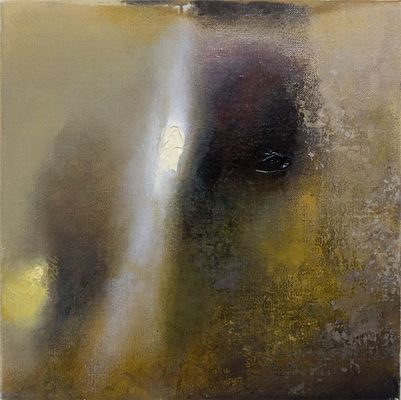
Always Will Need To Wear Winter Shirt Blue + Ochre Small Check Pattern
21 August - 21 September, 2015
Untitled
I am not a great reader of poetry but I always return to the work of Melbourne poet, Vincent Buckley (1925- 1988). Perhaps I find his most tantalising piece to be not a finished poem but a fragment left on a scrap of paper discovered on his desk after the poet’s death.
The poetry gathers like oil
In the word-core, and spreads
It has its music meet,
Its music is in movement.
This fragment is more the shell left behind from a volatile thought than a finished poem. I find the last two lines honest but awkward whereas the first two lines work like an arrow. Most likely he could not find a resolution so it was left. Still, in its present form, it remains an eloquent testimony to the ultimate failure of a medium to express mobile thought and sensation, in Buckley’s case, through verbal language. It’s an important matter because this is something all artists have to deal with regardless of the medium.
I have never written a poem, however, I am forever copying fragments from books on paper scraps in a vain effort to fix certain notions in my head. At first, they function as bookmarks that are sometimes returned to when I open the book. But before long, as they accumulate, they fall out littering the table interspersed with A4 photocopies, bills, books and medications.
To return to Buckley’s fragment, the first two lines very much evoke how I paint nowadays. As you age, detail diminishes and patches of light become more luminous and float. I feel the most honest way of dealing with this is by smearing the oil paint on the canvas with the fingers and working close-up, blind. Only if the patches coalesce into an approaching image can the work gain a life.
-
Jonathan Walker was born in Melbourne, Australia and brought up on a dairy farm in Gippsland. In the 1970’s he studied painting at RMIT and won the Harold Wright Scholarship to the British Museum, London. During the 1980’s he exhibited at Pinacotheca Gallery, Richmond and had work shown at the NGV and Heidi City Art Gallery. Over the same period he designed the cover for the “Epigenesi” LP by Giancarlo Toniutti, Italy and conducted a mail exchange work with Achim Wollscheid, Germany. The work with artists through the post resulted in an article published in the bicentenary issue of Art and Australia 1988. He showed in artist run spaces such as WestSpace in the 90’s and 2000’s, and until 2012, taught painting at Victoria University, which is where we (Colleen Ahern and Lisa Radford) as organisers of the exhibition, among many others, had the privilege of being his student.
Walker’s knowledge was imparted to students through the careful selection of music, literature, and artists found in books that he himself had ordered for the library. Walker’s strategy was the generosity of sharing his vast knowledge with references specific to each student and their context.
Walker’s paintings share a similar focus and intimacy.
This exhibition presents a small selection of recent paintings alongside a publication that includes Walker’s writing. Observational and analytical, Walker’s work is a type of material notation — the time of day, colour and how it is blended, the both specific and fleeting location of a reflection on lino or the question of whether a chair leg should be included in a painting.
Please join us on Friday August 21 between 6-8pm to celebrate the opening of the exhibition.
Curated by Colleen Ahern and Lisa Radford.
B. Wurtz
Curated by Nic Tammens
March 26 - April 4, 2015
B.Wurtz works from a basement studio in his home on Manhattan’s Lower East Side.
This local fact is attested to by the plastic shopping bags and newsprint circulars that appear in his work. As formal objects, they don’t make loud claims about their origins but nonetheless transmit street addresses and places of business from the bottom of this long thin island. Like plenty of artists, Wurtz is affected by what is local and what is consumed. His work is underpinned by this ethic. It often speaks from a neighborhood or reads like the contents of a hamper:
“BLACK PLUMS $1.29 lb.”
“Food Bazaar”
“USDA Whole Pork Shoulder Picnic 99c lb.”
“RITE AID Pharmacy, with us it’s personal.”
“H. Brickman & Sons.”
“Sweet Yams 59c lb."
Most of the work in this exhibition was made while the artist was in residence at Dieu Donne, a workshop dedicated to paper craft in Midtown. Here Wurtz fabricated assemblages with paper and objects that are relatively lightweight, with the intention that they would be easily transportable to Australia. This consideration isn’t absolute in Wurtz’s work, but was prescriptive for making the current exhibition light and cheap. Packed in two boxes, these works were sent from a USPS post office on the Lower East Side and delivered to North Melbourne by Australia Post.
Wurtz appears courtesy of Metro Pictures, New York.
Thanks to Rob Halverson, Joshua Petherick, Sari de Mallory, Matt Hinkley, Helen Johnson, Fayen d'Evie, Ask Kilmartin, Lisa Radon, Ellena Savage, Yale Union, and "Elizabeth".
John Nixon
"Archive"
December 15 - January 20, 2014
The presentation of John Nixon's archive offered a rare showcase of this extensive collection of the artist's own publications, catalogues, posters, ephemera, editions and more, from the mid 1980s onwards, alongside a selection of his artworks.
Organized by John Nixon, Joshua Petherick and Matt Hinkley.
<a href=http://wfb.public-office.info/artist/john-nixon>All titles by John Nixon
"Habitat"
at Minerva, Sydney (organised by Joshua Petherick and Matt Hinkley)
November 15 - December 20, 2014
Lupo Borgonovo, Janet Burchill & Jennifer McCamley,
Lewis Fidock, HR Giger, Piero Gilardi, Veit Laurent Kurz,
Cinzia Ruggeri, Michael E. Smith, Lucie Stahl, Daniel Weil, Wols
Press Release:
“...It contained seven objects. The slender fluted bone, surely formed for flight, surely from the wing of some large bird. Three archaic circuitboards, faced with mazes of gold. A smooth white sphere of baked clay. An age-blackened fragment of lace. A fingerlength segment of what she assumed was bone from a human wrist, grayish white, inset smoothly with the silicon shaft of a small instrument that must once have ridden flush with the surface of the skin - but the thing’s face was seared and blackened.”
William Gibson, “Count Zero”, 1986
"Autumn Projects Archive"
Curated by Liza Vasiliou
March 6 - March 15, 2014
World Food Books, in conjunction with the Virgin Australia Melbourne Fashion Festival 2014, presented the Autumn Projects archive, consisting of a selection of early examples in Australian fashion with a particular interest in collecting designers and labels from the period beginning in the 1980’s, who significantly influenced the discourse of Australian Fashion.
Curated by Liza Vasiliou, the exhibition provided a unique opportunity to view pieces by designers Anthea Crawford, Barbara Vandenberg, Geoff Liddell and labels CR Australia, Covers, Jag along with early experimental collage pieces by Prue Acton and Sally Browne’s ‘Fragments’ collection, suspended throughout the functioning World Food Books shop in Melbourne.
H.B. Peace
presented by CENTRE FOR STYLE
November 14, 2013
"Hey Blinky, you say chic, I say same"
Anon 2013
H.B. Peace is a clothing collaboration between great friends Blake Barns and Hugh Egan Westland. Their pieces explore the divergences between 'character’ and ‘personality’ in garments....etc
Special Thanks to Joshua Petherick and Matt Hinkley of WFB and Gillian Mears
and a Very Special Thank you to Audrey Thomas Hayes for her shoe collaboration.
Janet Burchill & Jennifer McCamley
"Aesthetic Suicide"
May 10 - June 8, 2013
The first of our occasional exhibitions in the World Food Books office/shop space in Melbourne, "Aesthetic Suicide" presented a body of new and older works together by artists Janet Burchill & Jennifer McCamley, including videos, prints, a wall work, and publications.
During shop open hours videos played every hour, on the hour.
1985, English
Hardcover (w. dust jacket), 184 pages, 30.5 x 23.9
1st Edition, Out of print title / used / very good
Published by
American Showcase / New York
$120.00 - Out of stock
Wonderful hardcover first edition copy of the great Herb Lubalin monograph, "Art Director, Graphic Designer and Typographer", published in 1985 by American Showcase, New York, printed in Japan.
This exceptional book still stands as the most comprehensive overview of the work of American graphic designer and art director Herb Lublin, with over 360 illustrations and anecdotes that encompass the wealth of output from a true pioneer in the world of design.
Internationally recognised in association with the typeface Avant Garde, which he created for the first of a series of culture-shocking magazines (Avant Garde, Eros and Fact) that he created with editor Ralph Ginzburg, Lubalin was a constant boundary breaker on both a visual and social level. Part of the founding team of the International Typeface Corporation (ITC) and the principal of Herb Lubalin, Inc it was hard to escape the reach of Herb during the 1960s and 70s. His constant search for something new and a passion for inventiveness made him one of the most successful art directors of the 20th century. A graduate of the Cooper Union in New York he spent time as a visiting professor there as well as designed a logo for them. Constantly working and achieving much success throughout his career, at the age of 59 he proclaimed "I have just completed my internship."
"The magnitude of Herb Lubalin's achievements will be felt for a long time to come ... I think he was probably the greatest graphic designer ever." — Lou Dorsfman
A very good first edition hardcover copy with original dust-jacket protected with mylar wrap. A must for any graphic design/typography collection.
2016, English
Softcover, 208 pages, 24.5cm×16.5cm
Ed. of 2000,
1st Edition, Out of print title / as new
Published by
Unit Editions / London
$90.00 - Out of stock
Herb Lubalin claimed not to be a great typographer. ‘In fact,’ he said, ‘I’m terrible, because I don’t follow the rules.’ This new book proves the opposite. On every page it features Lubalin’s typographic genius (logos, layouts, lettering and typefaces), and places him at the forefront of 20th century typographic innovation.
He even had names for what he did: he described it as ‘graphic expressionism’ or ‘conceptual typography’. Using his ability to adapt, merge and create new typographic forms, he was able to enhance and amplify meaning in ways that hadn’t been seen before.
Having published two books celebrating the genius of Herb Lubalin as a graphic designer working in many spheres, this new volume concentrates solely on Lubalin’s typography.
It comes with new texts, new design, new photography, and lots of previously unpublished material.
Edited by Adrian Shaughnessy & Tony Brook
Edition of 2000
Out-of-print
1960, English / Italian / French / German
Hardcover, 244 pages, 230 x 22 cm
1st Edition, Out of print title / used / good
Published by
Editrice L'Ufficio Moderno / Milan
$120.00 - Out of stock
1959-60 edition of the very collectable "Pubblicita in Italia" published by Editrice L'Ufficio Moderno in Milan. The editors for this year's annual included Bruno Munari and Antonio Boggeri. Profusely illustrated throughout in colour and b/w with hundreds of illustrations of late 1950's Italian design. Essay by Italian poet Vittorio Sereni. Text in English, Italian, French and German.
Pubblicita in Italia was an over-sized, hardcover annual that formed a comprehensive survey of contemporary advertising graphics and commercial design from Italy throughout the 1950-1980s, showcasing posters, shop windows, exhibition design, logos/trade-marks, packaging, book and record design, catalogues and brochures, television and film graphics, and so much more. Comparable to the "GRAPHIS" annuals, but exclusively Italian design, making these editions not only more scarce but the content seldom seen outside Italy in the period or anywhere since.
Good copy, with light ex-library markings not affecting content. Tanning/light wear to cloth. Without dust jacket.
1974, English / Italian / French / German
Hardcover (w. dust jacket), 300 pages, 230 x 22 cm
Out of print title / used / very good
Published by
Editrice L'Ufficio Moderno / Milan
$160.00 - Out of stock
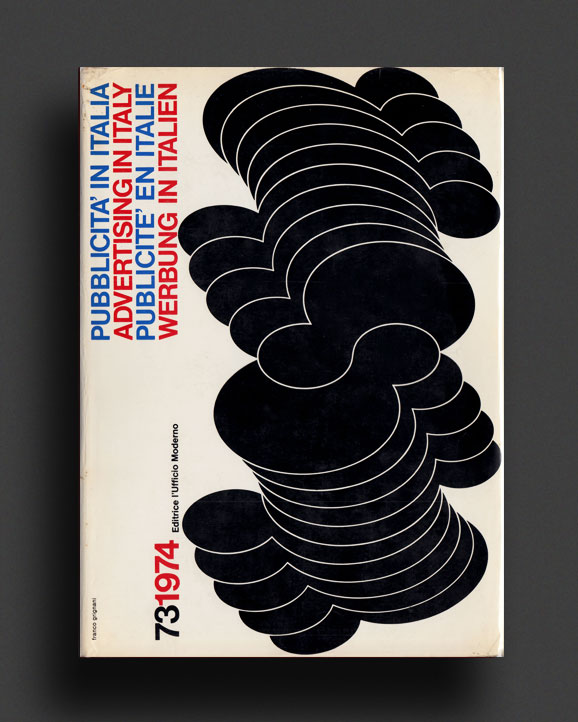
1973-74 edition of the very collectable "Pubblicita in Italia" published by Editrice L'Ufficio Moderno in Milan. Cover art and forward by Italian design and architect Franco Grignani. Profusely illustrated throughout in colour and b/w with hundreds of illustrations of late 1970's Italian design. Text in English, Italian, French and German.
Pubblicita in Italia was an over-sized, hardcover annual that formed a comprehensive survey of contemporary advertising graphics and commercial design from Italy throughout the 1950-1980s, showcasing posters, shop windows, exhibition design, logos/trade-marks, packaging, book and record design, catalogues and brochures, television and film graphics, and so much more. Comparable to the "GRAPHIS" annuals, but exclusively Italian design, making these editions not only more scarce but the content seldom seen outside Italy in the period.
Very Good copy, with Good dust jacket preserved under mylar wrap.
1975, English / Italian / French / German
Hardcover, 300 pages, 230 x 22 cm
1st Edition, Out of print title / used / very good
Published by
Editrice L'Ufficio Moderno / Milan
$160.00 - Out of stock
1974-75 edition of the very collectable "Pubblicita in Italia" published by Editrice L'Ufficio Moderno in Milan. Introduction by Guido Montana. Profusely illustrated throughout in colour and b/w with hundreds of illustrations of mid 1970's Italian design. Text in English, Italian, French and German.
Pubblicita in Italia was an over-sized, hardcover annual that formed a comprehensive survey of contemporary advertising graphics and commercial design from Italy throughout the 1950-1980s, showcasing posters, shop windows, exhibition design, logos/trade-marks, packaging, book and record design, catalogues and brochures, television and film graphics, and so much more. Comparable to the "GRAPHIS" annuals, but exclusively Italian design, making these editions not only more scarce but the content seldom seen outside Italy in the period.
Very Good copy but missing jacket.
1982, English / Italian / French / German
Hardcover (w. dust jakcet), 300 pages, 230 x 22 cm
1st Edition, Out of print title / used / very good
Published by
Editrice L'Ufficio Moderno / Milan
$140.00 - Out of stock
1981-82 edition of the very collectable "Pubblicita in Italia" published by Editrice L'Ufficio Moderno in Milan. Cover art by Italian design and architect Franco Grignani and forward by Italian designer Armando Testa. Profusely illustrated throughout in colour and b/w with hundreds of illustrations of early 1980's Italian design. Text in English, Italian, French and German.
Pubblicita in Italia was an over-sized, hardcover annual that formed a comprehensive survey of contemporary advertising graphics and commercial design from Italy throughout the 1950-1980s, showcasing posters, shop windows, exhibition design, logos/trade-marks, packaging, book and record design, catalogues and brochures, television and film graphics, and so much more. Comparable to the "GRAPHIS" annuals, but exclusively Italian design, making these editions not only more scarce but the content seldom seen outside Italy in the period.
Very Good copy, with Good dust jacket preserved under mylar wrap.
1968, German
Softcover, 42 pages, 23.5 x 13.5 cm
1st Edition, Out of print title / used / very good
Published by
Städtisches Museum / Leverkusen
$45.00 - Out of stock
Wonderful early Gernot Bubenik catalogue published on the occasion of a solo exhibition in 1968 at Städtisches Museum Schloß Morsbroich, Leverkusen. With German texts by Bubenik, Rolf Wedewer, and Rolf Gunter Dienst, a biography of the artist, and full list of artworks on brown recycled stocks and illustrations of Bubenik's fantastic airbrush paintings throughout in vivid colour on gloss stock. Original gallery price-list inserted.
Gernot Bubenik (b. 1942) is a painter and printer whose work revolves around subjects of art, science and ecology. Bubenik became famous in the 60s with his airbrushed, metal graphic boards of idiosyncratic motifs of organic pop geometry and science fiction, receiving the German Critics' Award in 1967 and in 1968 the prize of the Graphic Biennale Tokyo. Since 1980 he has been producing body prints, coluor actions and light trails, and has maintained a workshop for ecology utilising worm compost to create colour actions with compostable colour masses. Between 1991 and 1995 he held a lectureship in experimental screenprinting at the Hochschule für Bildende Kunst Berlin, resulting in the development of a non-toxic, compostable screen printing ink and a child-friendly working technique for manual screen printing. From 1992 to 2005 he worked on the realization of the cultural youth project "Art and Ecology" in cooperation with the Kulturbüro Kreuzberg, with the participation of about 3000 children and adolescents.
Very Good copy.
2019, English
Softcover, 160 pages, 21.5 x 14 cm
Published by
Rowman & Littlefield / London
$36.00 $20.00 - Out of stock
From the Insolubilia: New Work in Contemporary Philosophy series edited by A.J. Bartlett, Justin Clemens and Jon Roffe
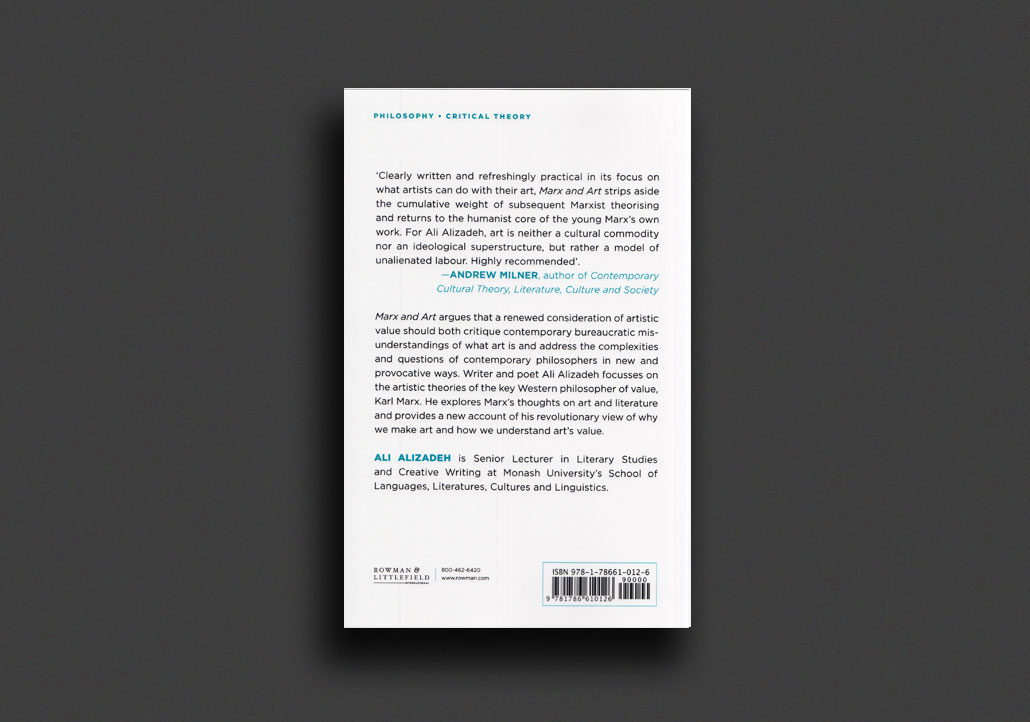
This book argues that a renewed consideration of artistic value should both critique contemporary bureaucratic misunderstandings of what art is and address the complexities and questions of contemporary philosophers in new and provocative ways. Writer and poet Ali Alizadeh focusses on the artistic theories of the key Western philosopher of value, Karl Marx. He explores Marx’s thoughts on art and literature and provides a new account of his revolutionary view of why we make art and how we understand art’s value.
By returning to Marx’s writings, from his juvenile poetry and earliest journalism to his final publications, Alizadeh proposes a theory which not only challenges many tenets of contemporary Marxist literary or cultural theory, but one which also presents us with a profound, coherent and stimulating theory of art that defines, values and demonstrates artistic practice. By mapping Marx’s intellectual development from the ideals of a young Hegelian to the polemics of a seasoned internationalist communist he shows that Marx never lost sight of art as a key aspect of human activity
Ali Alizadeh is a Senior Lecturer in Literary Studies and Creative Writing at Monash University’s School of Languages, Literatures, Cultures and Linguistics. His books include collections of poems, Towards the End, Ashes in the Air and Eyes in Times of War; novels, The Last Days of Jeanne d’Arc, Transactions and The New Angel; and a work of literary non-fiction, Iran, My Grandfather. This is his first philosophical monograph.
1974, English
Softcover, 60 pages, 18.5 x 17.5 cm
1st Edition, Out of print title / used / very good
Published by
Art Gallery of New South Wales / Sydney
NGV (National Gallery of Victoria) / Victoria
Trustees of the Art Gallery of New South Wales / NSW
$28.00 - Out of stock
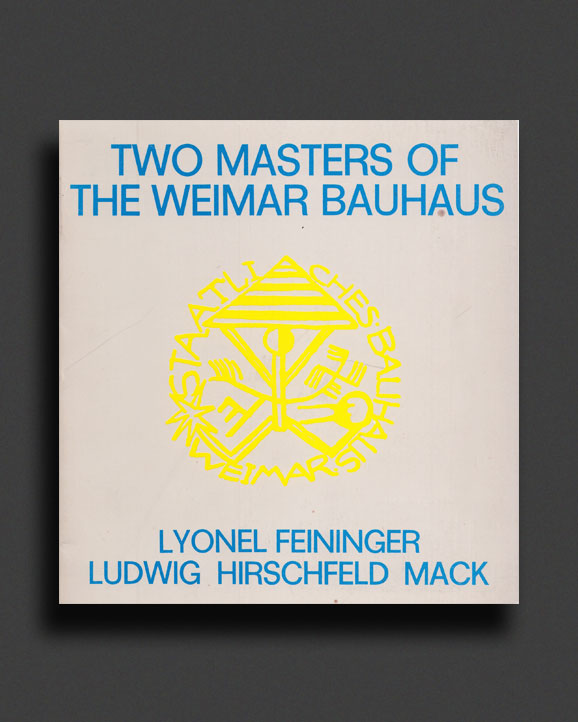
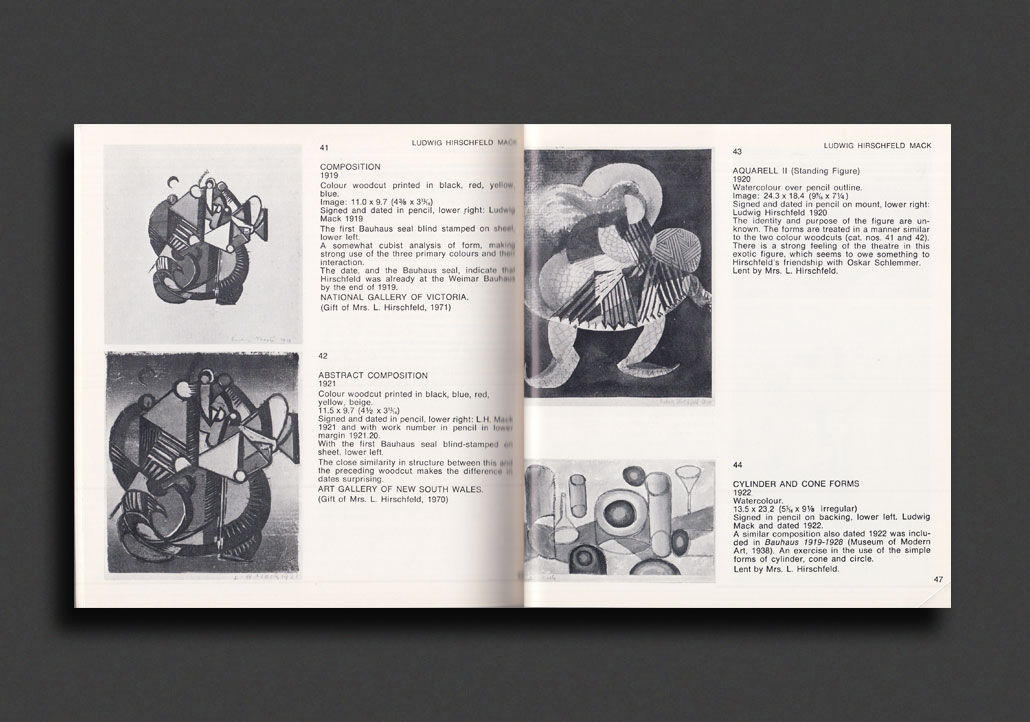
Scarce exhibition catalogue published on the occasion of the exhibition "Two masters of the Weimar Bauhaus: Lyonel Feininger, Ludwig Hirschfeld-Mack", held at the AGNSW and NGV in 1974, and published by the Trustees of the Art Gallery of New South Wales. Compiled, designed and introduced by organiser Nicholas Draffin, with additional text by Lyonel Feininger. Illustrated throughout with examples of works in colour and bw by both Lyonel Feininger and Ludwig Hirschfeld-Mack, with detailed captions in English, including collections. Also features a brief bibliography.
Lyonel Charles Feininger (1871–1956) was a German-American painter, and a leading exponent of Expressionism. He also worked as a successful caricaturist and comic strip artist, working regularly for magazines and newspapers in the USA and Germany. He was born and grew up in New York City, traveling to Germany at 16 to study. At the age of 36, he started to work as a fine artist. He was a member of the Berliner Sezession in 1909, and he was associated with German expressionist groups: Die Brücke, the Novembergruppe, Gruppe 1919, the Blaue Reiter circle and Die Blaue Vier (The Blue Four). When Walter Gropius founded the Bauhaus in Germany in 1919, Feininger was his first faculty appointment, and became the master artist in charge of the printmaking workshop. He taught at the Bauhaus for several years. He also produced a large body of photographic works between 1928 and the mid 1950s, but he kept these primarily within his circle of friends. He was also a pianist and composer, with several piano compositions and fugues for organ extant.
Ludwig Hirschfeld Mack (1893-1965) was a German/Australian artist. His formative education was 1912–1914 at Debschitz art school in Munich. He studied at the Bauhaus from 1919 - 1924 and remained working there until 1926 where, along with Kurt Schwerdtfege, he further developed the Farblichtspiele ('coloured-light-plays'), which used a projection device to produced moving colours on a transparent screen accompanied by music composed by Hirschfeld Mack. It is now regarded as an early form of multimedia. Music and colour theory remained lifelong interests, informing his art work in a number of media, and it was the inspiration for his well-respected and influential teaching.
Good copy with two internal library stickers not affecting contents.
2019, English
Hardcover, 200 pages, 15.2 x 21.6 cm
Published by
Hauser & Wirth / Zurich
$82.00 $35.00 - Out of stock
In the 1980s, Ursula Hauser began quietly building what’s become one of the world’s most impressive private collections of modern and contemporary art—acquiring works from visionary artists such as Louise Bourgeois, Carol Rama, Alina Szapocznikow, Franz West, Eva Hesse, Francis Picabia, Lee Lozano, and many others—and in 1992, she co-founded one of today’s most important galleries, Hauser & Wirth. This book presents the first-ever extensive and intimate account of her life and art collection.
To define the works found in Ursula’s collection is a matter of identity, one that is fused to her personal trajectory—from her early years in eastern Switzerland, where she was born in 1939, to becoming a mother, helming her father’s intrepid electronics business, and starting an art gallery with her daughter and son-in-law. Family has always been the steady axis around which Ursula’s life orbits; for her, the artists she collects belong to that same magnetic locus. To understand Ursula Hauser’s collection is to know the collector and chart the course of late twentieth-century and early twenty-first-century art.
Edited by Laura Bechter and Michaela Unterdörfer
2019, English
Hardcover, 216 pages, 27.5 x 20.1 cm
Published by
Hauser & Wirth / Zurich
$95.00 $20.00 - Out of stock
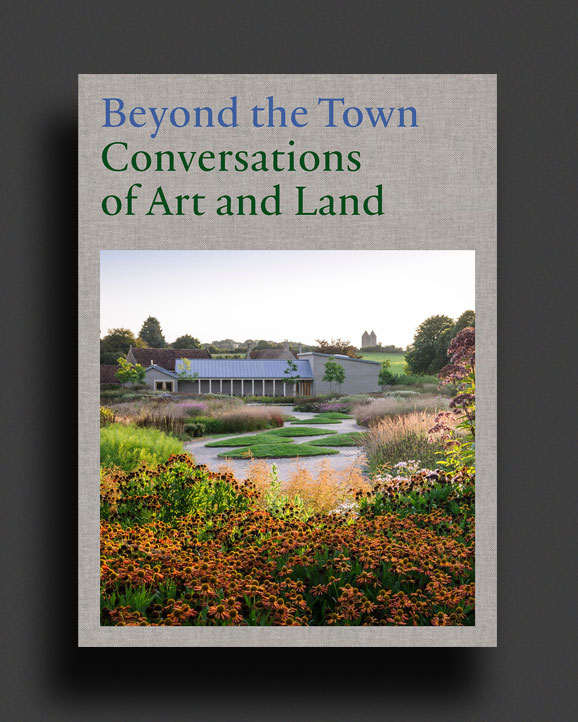
When Iwan and Manuela Wirth first encountered Durslade Farm on the outskirts of Bruton, an agrarian town located in Somerset, England, they saw more than verdant grounds and a derelict farmstead: they saw a refuge and a vision of home. In time, this vision expanded, materializing in the 2014 opening of Hauser & Wirth Somerset, an international contemporary art center for artists, locals, and visitors from near and far – a place full of energy, people, and ideas that remains a retreat, a sanctuary.
‘Beyond the Town: Conversations of Art and Land’ offers a chorus of essays, interviews, and artworks that detail Durslade Farm’s history and its 21st-century renaissance. The multiplicity of these voices and themes convey the farm’s physical and conceptual terrains, weaving together the story of Durslade’s transformation and its local community.
1990, Serbian
Softcover, 188 pages
1st Edition, Out of print title / used / fine
Published by
Museum of Contemporary Art / Belgrade
$80.00 - Out of stock
Long out of print, this is the only monograph on the wonderful work of Serbian surrealist Vane Bor (Stevan Živadinović), published as a comprehensive catalogue to accompany the retrospective exhibition of his work held at the Museum of Contemporary Art in Belgrade, 1990. Profusely illustrated throughout with Bor's collages, paintings, photograms, and photographs, alongside texts and poems by himself and contributors. Also a full biography, personal photographs, exhibition history, bibliography, etc. Texts in Serbian.
Vane Bor (Stevan Živadinović) (1908, Bor – 1993, Oxford) was one of the most important members of the Serbian surrealist movement. He is the creator of a number of collages, photograms, photographs, theoretical texts, paintings and poems. He was born in the mining village of Bor, from which he took his pseudonym. In 1926, as a law student in Paris, Vane Bor socialized with surrealists, and a year later his first collages and photo-montages were created. While his collages reflected playfulness and wit, reduced material and the atmosphere of insecurity in his photo-montages captured a multilayered aura of dreams and memories. Many of his works reflected interest in avant-garde film, while Bor himself considered photo-montages a form of static film. His work was published in important articles in L'Impossible and Revue du Cinéma, and in 1930 Bor co-signed the Surrealist Manifesto. Jean-Paul Dreyfus in the Parisian journal “Revue du cinéma" dedicated his critique of Fritz Lang's film to Bor. Bor's photographs, just like his photograms created during 1928 – 1936, were characterized by interplays and simulations of movement and the passage of time. These achievements were made through careful editing, rather than the automatism that was characteristic of Surrealism, often using fragments of broken glass. At the beginning of the thirties Bor worked for the magazine "Surrealism Here and Now" and in 1932 with Ristic published the book Anti-wall . A year later the Parisien journal “Le surréalisme au service de la Revolution” published Bor's private letter addressed to Salvador Dali, whom Bor met in 1931. During the thirties he published articles on psychoanalysis and film in the magazines "Danas / Today" and "Politika / Politics". As a doctor of science Bor was appointed lecturer at the Law Faculty in Subotica. In 1936 he filmed a documentary about Belgrade. During the period between 1938 – 1941 Bor worked as an assistant professor at the Law Faculty in Belgrade. In 1944 Bor left the country illegally and moved to London where he created a cycle of collages. During the sixties in London, Bor created a series of surrealist paintings from non-painterly materials. 1966 Becomes a member of the Free Painters and Sculptors Association in London. In 1984 he became a member of Oxford University Geological Society and the University Anthropological Society. Vane's archive, four crates of books, photographs, writings and other works, was halved, lost by the carelessness of a cleaner in a 1986 London warehouse. In 1990 the Museum of Contemporary Art in Belgrade organised a retrospective exhibition of his work. He died in Oxford on May 6, 1993.
Fine copy.
1970, Japanese
Softcover, 100 pages, 26 x 36.5 cm
1st Edition, Out of print title / used / good
Published by
Mainichi Newspapers / Tokyo
$180.00 - In stock -
"One of the most important Japanese photobooks ever published" - Kaneko & Vartanian, "Japanese Photobooks of the 1960s and 70s".
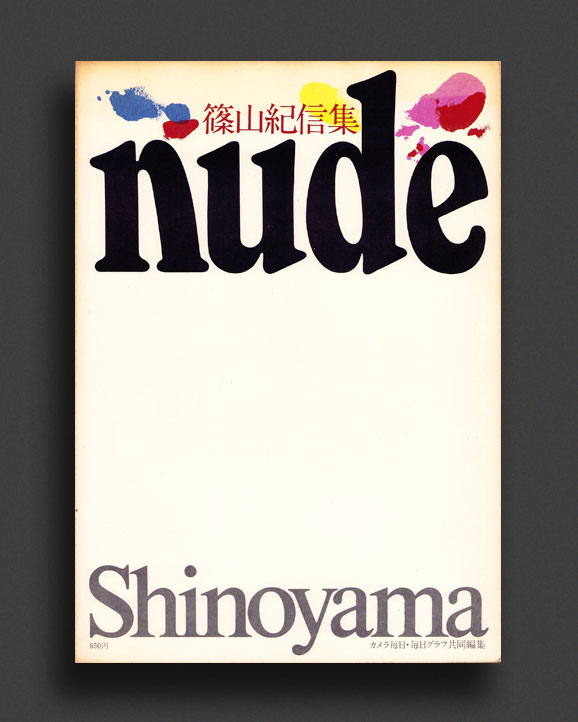
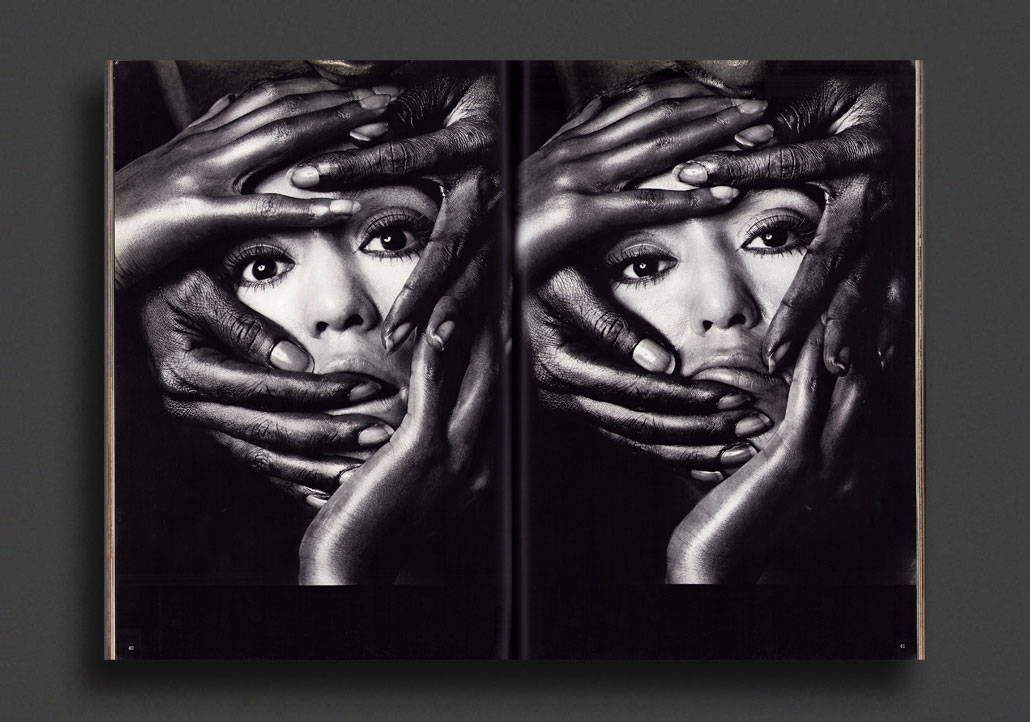
A first edition of this psychedelic masterpiece photo book by the extraordinary Japanese photographer Kishin Shinoyama (b. 1940, Tokyo), well known in the west for photographing the covers for John Lennon and Yoko Ono's albums, Double Fantasy and Milk and Honey. This over-sized book collects an iconic group of Shinoyama's radical early nude photographs including "Death Valley", "Twin", "Brown Lily", "Maki & Sinatra", "Phantom" and "Tokyo Fairy". In 1970, his exhibition NUDE - Kishin Shinoyama, which focused around his work in Death Valley, drew great attention and praise for its challenging images of the female form. Beautifully reproduced here for the first time in 1970, Shinoyama's Nude continues to be one of the most influential photo books published. AN in credible successor to Kishin's 28 Girls (1968), the artist took his ideas to an ambitious extreme in "Nude", traversing a great variety of themes, subjects, techniques and land(body)scapes that do-away with the conventions of glamour in favour of the wild expressionism of nature to create some of the most grand, psychological and psychedelic nude photography ever seen.
Good copy (general light wear/tanning to edges from age, light foxing to inner blank endpapers, general handling wear from large size)
1945, Italian
Hardcover (w. dust jacket), 230 pages, 30 x 23 cm
1st Edition, Out of print title / used / good
Published by
Edizioni del Milione / Milan
$100.00 - In stock -
First 1945 hardcover edition of the first complete monographic study on the work of Carlo Carrà by Guglielmo Pacchioni, published by Edizioni del Milione in Milan. The book's initial print run was entirely destroyed in the 1943 Milan air raids. Already fully printed and ready to pass to the binder in the Esperia, even the zincs of the black plates were destroyed. With only the four-colour processes remaining the book had to be completely rebuilt in the most difficult years of the war, coming to light in December 1945 in this expanded first surviving edition. Guglielmo Pacchioni organised the book as an illustrated catalogue to accompany an exhibition of Carrà on the initiative of the Center of Action for the Arts, at Pinacoteca di Brera, Milan in 1942, and then expanded it into this critical revision of his entire pictorial activity. Here Carlo Carrà has been studied and framed in Italian and European painting of the last fifty years and has found in Guglielmo Pacchioni his first historian, who examines the developments of the artist in an organic way and with scientific rigour. Opening with 35 pages of text, supplemented by 2 pages of biographical information and 14 pages of bibliography; followed by a catalogue of important works. Profusely illustrated with 75 colour and bw plates of Carrà's paintings, as well as reproducing 15 two-colour designs of the artist to round out this generous volume of Carrà's most important works.
Carlo Carrà (1881-1966) was an Italian painter and a leading figure of the Futurist movement that flourished in Italy during the beginning of the 20th century. Born in Piedmont, Carrà worked as a decorator and muralist after moving to Milan in 1895, where he later met Umberto Boccioni and Luigi Russolo. Like them, he experimented with Divisionism, but was dissatisfied with current trends in painting, and in 1910 signed the ‘Manifesto of the Futurist Painters’ and the ‘Technical Manifesto of Futurist Painting’. Carrà's painting has also had periods of direct association with Cubism and Metaphysical painting, paving the way for the consciously naïve figurative style he went on to develop. During the mid-1920s he adopted a naturalistic approach to landscape painting that he explored for the remainder of his career. In addition to his many paintings, Carrà published a number of poetic books concerning painting, and for many years was the art critic of the influential Milanese newspaper L’Ambrosiano. He taught for many years in the city of Milan.
Good copy throughout with some tanning and scattered light age spotting generally not affecting contents. Tightly bound and very scarce copy with original colour plated dust jacket, preserved under mylar wrap.
1954, English / French / German
Hardcover, 240 pages, 30 x 25 cm
1st Edition, Out of print title / used / good
Published by
William Heinemann / London
$75.00 - Out of stock
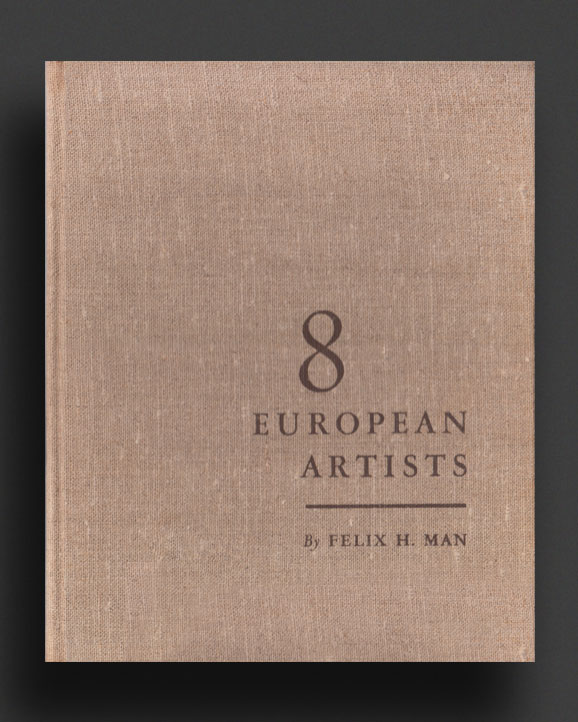
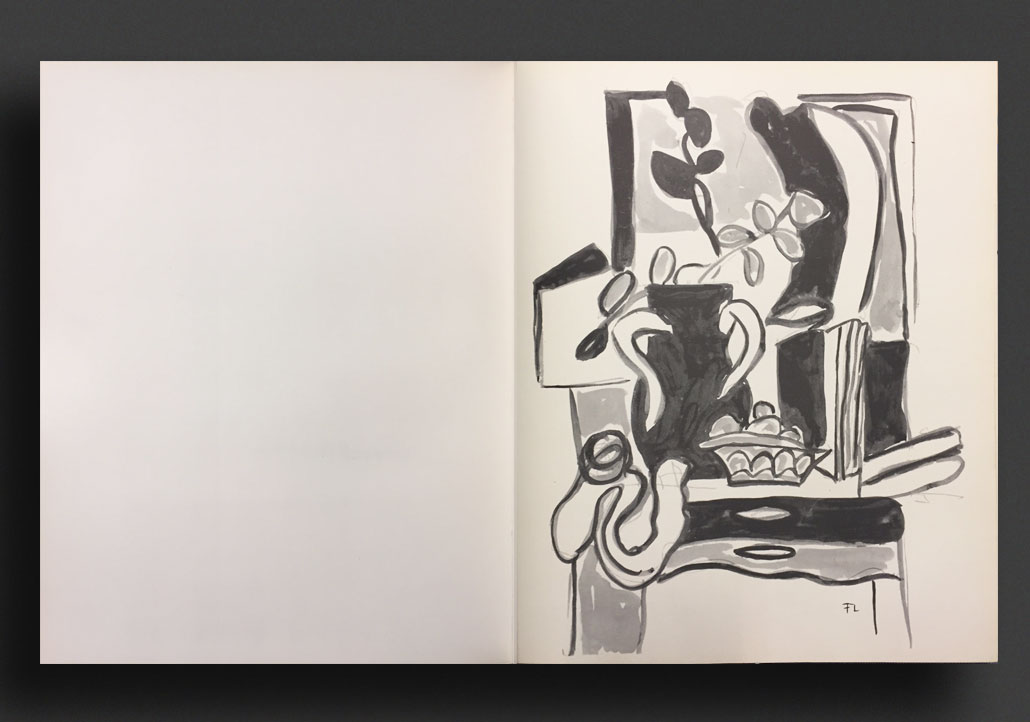
First buckram-bound edition of the oversized 8 European Artists published in 1954 by William Heinemann, London, Sydney, Toronto. Felix H. Man's photo documentary on eight masters of Modern Art: Georges Braque, Marc Chagall, Le Corbusier, Henri Matisse, Henry Moore, Pablo Picasso, Graham Sutherland. Each artist is represented through generous chapters made up of varying paper stocks of vivid kodachrome photographs 9colour and b/w) of the artist's at work in their studios, original contributions from each artist in the form of a drawing and a handwritten text reproduced in facsimile with translations, and a chronological biography. Photographs, foreword and book design by Felix H. Man; introductions by Graham Greene and Jean Cassou. Texts in English, French, German.
Hans Felix Sigismund Baumann aka Felix H. Man (1893 – 1985) was a leading pioneer photojournalist and later an art collector.
Good-VG oversized buckram bound edition, light ageing/buckling, otherwise tight and clean throughout.
2009, Czech
Softcover (w. dust jacket), 54 pages, 24 x 19 cm
1st Edition, Out of print title / used / very good
Published by
Galerie výtvarného umění v Náchodě / Brode
$65.00 - Out of stock
Lovely, scarce, limited edition Jana Švábová catalogue published in 2009 by Galerie výtvarného umění v Náchodě, seemingly the only publication on the artist's work.
Jana Švábová (1939-2017) was a self-taught Czech painter, actress, and life partner of Czech sculptor Mojmír Preclík (1931-2001). Since the late 1970s, they lived in a wooden house with a plum grove in the village of Kryštofovo Údolí, their natural sanctuary for twenty years where they both worked and raised their daughter. Since the 1970s she had been exhibiting, occasionally illustrating, most often poetry and fairy tales. Švábová's soft, enigmatic abstractions of washed-out ink, watercolour, and dry pastel, sometimes tinted with coffee or wine, are intimately rendered through human touch, exploring phenomena, inner and outer life, in the form of symbols, colour, and line, moving dream-like between drawing and painting. "On paper, a stage, with abstract artistic scenery, something is born between the beginning, the story, the feeling of destiny, the end - a vale of life experiences, memories, inspirations, feelings, thoughts and visual clues (sun, gate, bird, pebbles, conch, chair, ladder, musical instrument, fence, etc.) emotionally rendered in pastel." In her later life she became ill and ceased to make work, forgetting that she had ever been a painter.
Illustrated throughout in colour with works spanning the 1980s-2009, with photographic portrait, biography, exhibition list and accompanying texts in Czech.
Very Good, VG dust jacket.
2007, English
Hardcover, 115 pages, 21.8 x 30 cm
1st Edition, Out of print title / used / good
Published by
JRP Ringier / Zürich
$100.00 - Out of stock
Quickly out of print and collectable, this book is the first complete edition of the actions, installations and interventions (1976–2005) of Jiří Kovanda. The design of the book replicates the A4 pages, with photographs and typewritten texts attached, which the artist used in the 1970s and 1980s as his exhibition documentation.
Kovanda’s ephemeral activities in the 1970s and 1980s focused on the discovery of new types of relationships, which the artist adopted with his friends as well as with anonymous passers-by in the streets. Kovanda’s interventions and installations from the 1980s constitute ironic reactions to American minimalism. The artist ‘installed’ them in peripheral locations of the public space, during the period of so-called real socialism. The book treats Kovanda’s performance-intervention work up to 2005.
Along with the complete documentation, there is an attempt to situate, in a discursive manner, Kovanda’s work in the history of conceptualism. The book includes three interviews: Hans Ulrich Obrist’s interview with Jiří Kovanda; the Czech theorist and art historian Jiří Ševčík’s interview with the editor-in-chief of the magazine Springerin Georg Schöllhammer; and Vít Havránek’s epistolary interviews with Pawel Polit and Igor Zabel.
Good copy, tightly bound and clean throughout, but cover cloth has nice ex-studio wear (colourful paint and pencil markings - see image).
1968, Czech
Softcover, 26 x 21 cm
1st Edition, Out of print title / used / very good
Published by
Gruner + Jahr / Hamburg
$55.00 - Out of stock
First Czech 1968 edition of the second "Světová Výstava Fotografie" (World Photography Exhibition) book, organized by Dr. Karl Pawek and Stern Magazine. This lovely international photo collection published by Gruner + Jahr, Hamburg and printed in Germany, collates 522 beautiful gravure photographs from 85 countries by 236 photographers on the theme of Žena (Woman).
Text in Czech.
VG copy with some light cover wear.
1992, Czech
Softcover (staple-bound), 26 pages, 20 x 20 cm
1st Edition, Out of print title / used / very good
Published by
Galerie Moderního Umění / Roudnice nad Labem
$65.00 - Out of stock
Rare catalogue of Václav Tikal's work published to accompany an exhibition held at the Gallery of Modern Art in Roudnice nad Labem in 1992. Edited with text in Czech by Miloš Saxl with 15 reproductions of Tikal's paintings and drawings (b/w), exhibition history and list of works. Very good copy.
Václav Tikal (1906 – 1965) Václav Tikal is among the leading representatives of postwar Czech Surrealism. Partly a self-taught Sunday painter, Tikal entered the art scene quite late. In 1937 he became a pupil of Jakub Obrovský at the Prague Academy of Fine Arts until its closure during the war. Tikal was determined by the metaphysical painting by Giorgio de Chirico and the work of the Surrealists, his own lyrical landscapes reflecting the devastation of the war with motifs such as twisted and fragmented body parts and architecture. He was a central figure in the Czech Surrealist movements, and later affiliated with Group Ra. He also co-founded Phases in 1964.
2019, English
Softcover magazine in folder w. poster, 20 x 20 cm
Ed. of 1500,
Published by
Primary Information / New York
$48.00 - Out of stock
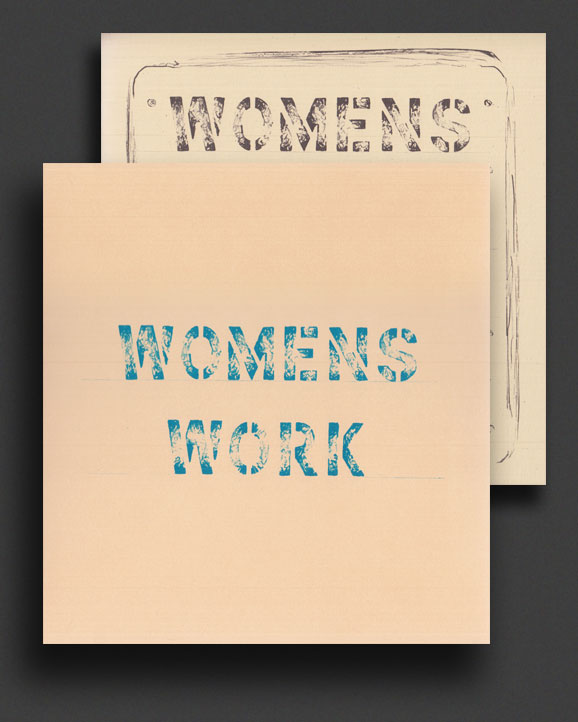
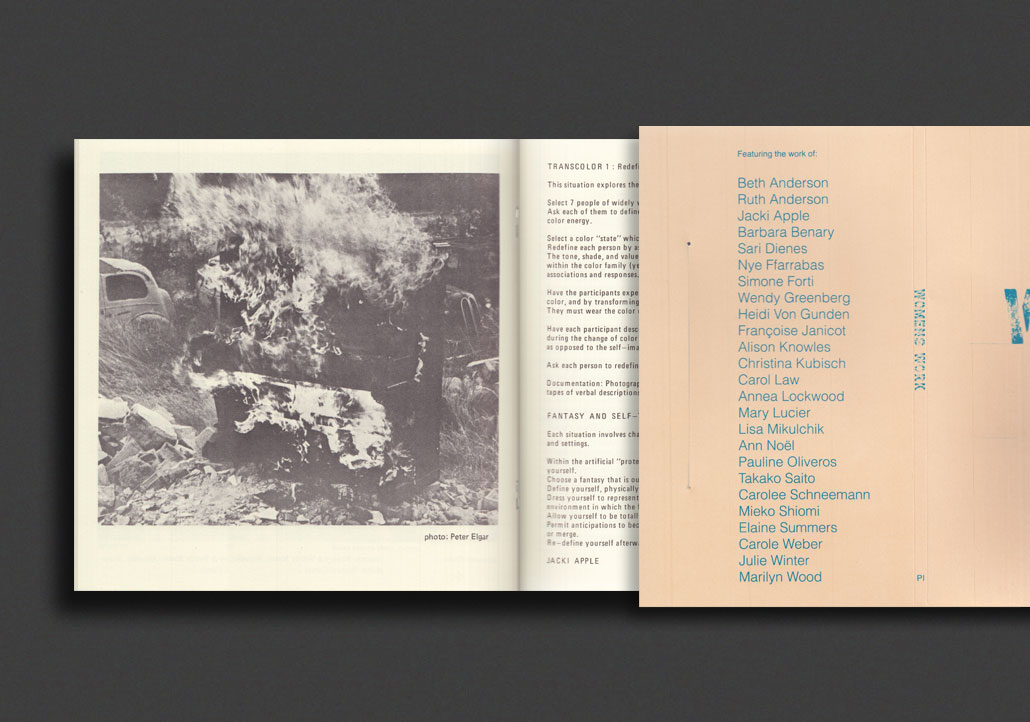
Originally published in the mid-1970s, Womens Work was a magazine that sought to highlight the overlooked work of female artists working at the cusp of the visual arts, music, and performance. The magazine was edited by Alison Knowles and Annea Lockwood and featured text-based and instructional performance scores by the following 25 artists, composers, and choreographers:
Beth Anderon, Ruth Anderson, Jacki Apple, Barbara Benary, Sari Dienes, Nye Ffarrabas (participating as Bici Forbes), Simone Forti, Wendy Greenberg, Heidi Von Gunden, Françoise Janicot, Alison Knowles, Christina Kubisch, Carol Law, Annea Lockwood (also included as Anna Lockwood), Mary Lucier, Lisa Mikulchik, Ann Noël (included as Ann Williams), Pauline Oliveros, Takako Saito, Carolee Schneemann, Mieko Shiomi, Elaine Summers, Carole Weber, Julie Winter, and Marilyn Wood.
The magazine was designed by Alison Knowles, who deliberately chose off-white paper and brown inks as a contrast to the sterile, white-paged publications prevalent at the time. The works contained in the magazine range in scope and take on a multitude of forms, employing both typed and written text, often with visual elements such as diagrams, drawings, and photographic images. The editors were and remain adamant that the work should be performed; that they not remain static as an artifact.
We wanted to publish work which other people could pick up and do: that aspect of it was really important…this was not anecdotal, this was not archival material, it was live material. You look at a score, you do it. – Annea Lockwood
The first issue, published in 1975, took the form of a saddle-stitched magazine and the second, published in 1978, took the form of a fold-out poster. This facsimile edition reproduces both and houses them in a custom self-folding box. Womens Work is produced in an edition of 1,500 copies.
Alison Knowles (b. 1933) is a conceptual artist known for intermedia works in text, graphics, sound, installations, transvironments, performances, paperworks and publishing. She is a founding member of Fluxus, the experimental avant-garde group formally launched in 1962. Her most recent retrospective was at the Carnegie Museum of Art in 2016. In 2019 she debuted in Havana, Cuba.
Annea Lockwood (b. 1939) is an artist and composer whose lifelong fascination with timbre and new sound sources is reflected in her multidisciplinary work, which has incorporated chamber music, performance, electronic and environmental sound, and visual art. Recent works include commissions for the Bang on a Can All-Stars, Thomas Buckner and the S.E.M. Ensemble, and the Merce Cunningham Dance Company. She is a recipient of the 2007 Henry Cowell Award.
2019, English
3 Softcover Vols. (in slipcase w. 3 tipped-in photos, signed by artist), 424 pages, 30 x 24 cm
Published by
MACK / London
$149.00 - Out of stock
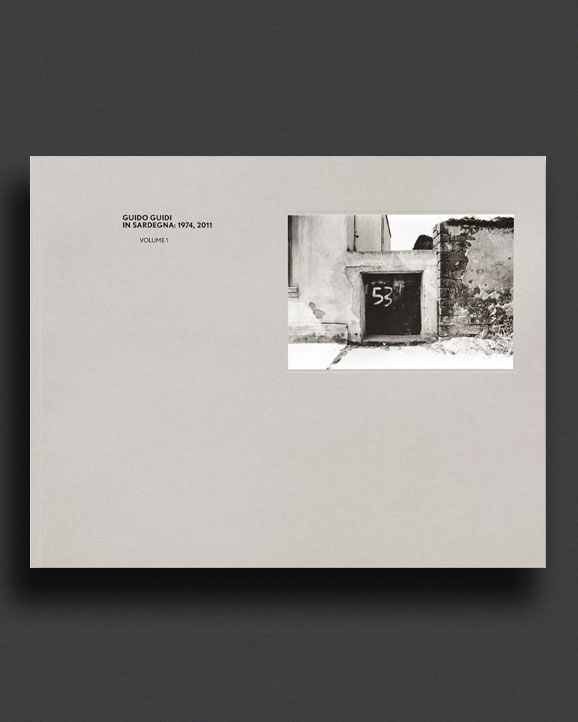
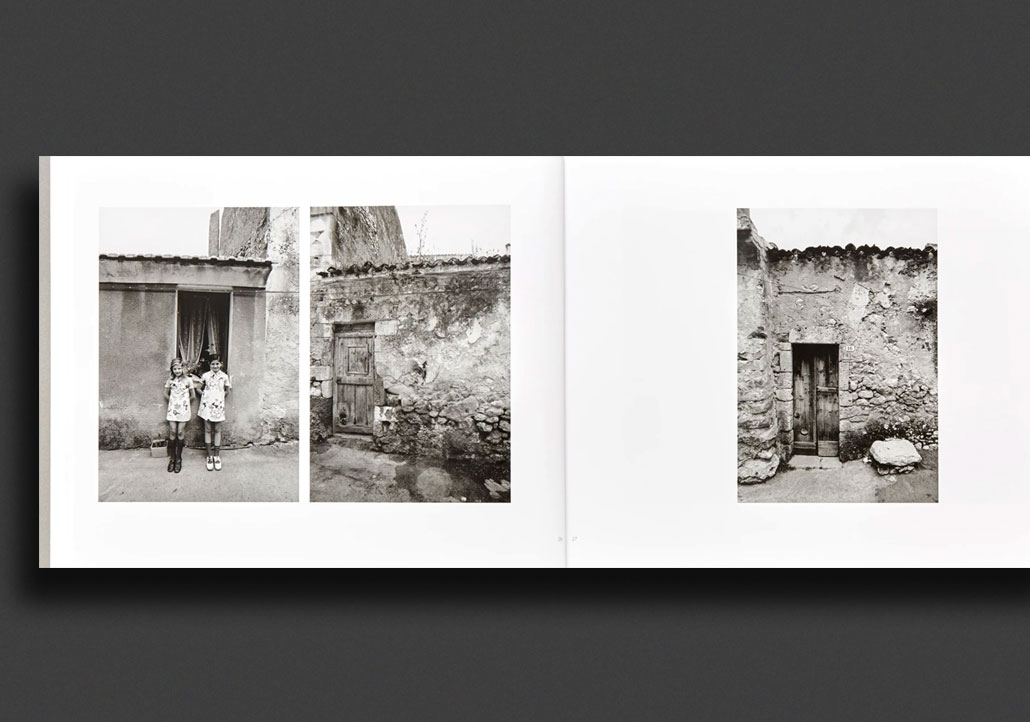
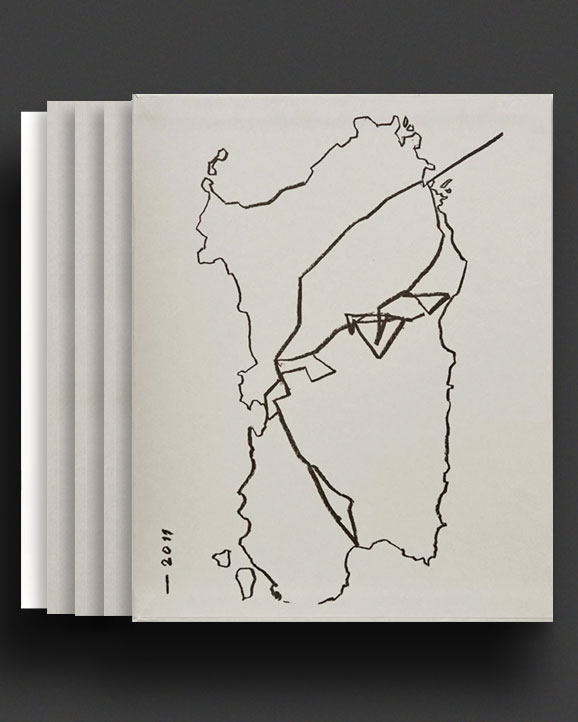
These three volumes encompass the complete evolution of the work of the renowned Italian photographer, Guido Guidi. Made in Sardinia on two trips separated by forty years, the two books not only mark the stylistic development in the work of Guidi but also the historical shifts and changes on the remote island.
The first trip was on Guidi’s honeymoon in 1974, and with a Nikon F and a FIAT 127 he made a series of black and white photographs which reflect the social and political climate of Sardinia in the post-sixties era. The second visit, in 2011, involved 3 cameras – a Hasselblad, a Deardorff 8x10 and a digital Canon – and the now well-known Guidi palette of tender, almost resigned colour.
Co-published by Mack the MAN Museum, Nuoro, Sardinia
Signed by Guidi, 3 paperback volumes, each with a tipped in photograph, housed in a slipcase. Includes a bilingual booklet.
2019, English
Softcover, 224 pages, 16.5 x 23.4 cm
Published by
City Gallery / Wellington
Melbourne University Law School / Melbourne
Liquid Architecture / Melbourne
$30.00 - Out of stock
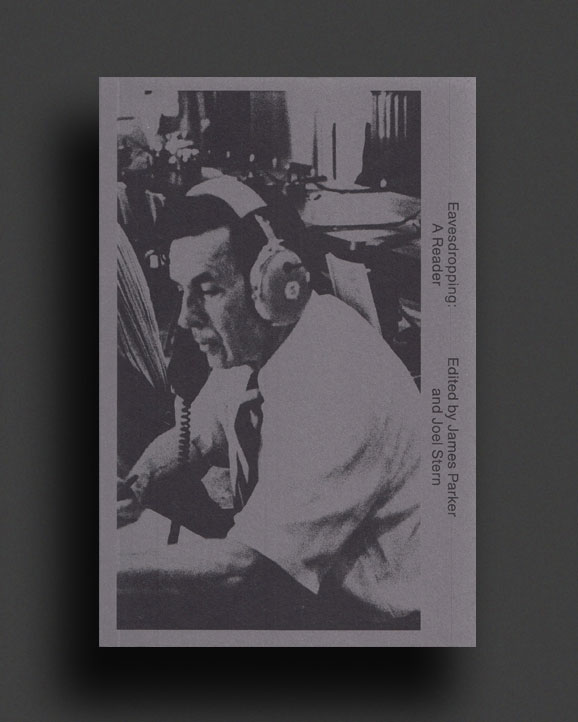
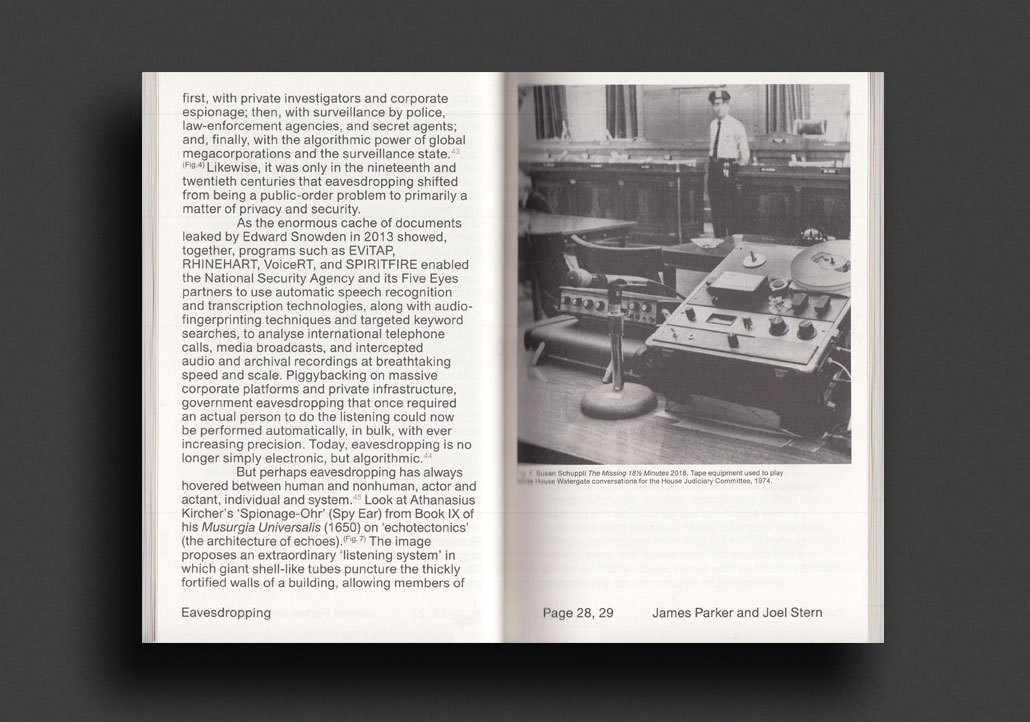
The earliest references to eavesdropping are found in law books. According to William Blackstone's Commentaries on the Laws of England (1769), 'eavesdroppers, or such as listen under walls or windows, or the eaves of a house, to hearken after discourse, and thereupon to frame slanderous and mischievous tales, are a common nuisance and presentable at the court-leet'. Today, however, eavesdropping is not only legal, it's ubiquitous – unavoidable. What was once a minor public-order offence has become one of the key political and legal problems of our time, as the Snowden revelations made clear.
Eavesdropping addresses the capture and control of our sonic world by state and corporate interests, alongside strategies of resistance. For editors James Parker (Melbourne Law School) and Joel Stern (Liquid Architecture), eavesdropping isn't necessarily malicious. We cannot help but hear too much, more than we mean to. Eavesdropping is a condition of social life. And the question is not whether to eavesdrop, therefore, but how.
Featuring contributions from Norie Neumark, Lawrence Abu Hamdan, Susan Schuppli, Sean Dockray, Joel Spring, Fayen d'Evie and Jen Bervin, Samson Young, Manus Recording Project Collective.
2018, English
Softcover, 192 pages, 11.4 x 17.8 cm
Published by
Wakefield Press / Cambridge
$32.00 - Out of stock
Imaginary Lives remains, over 120 years since its original publication in French, one of the secret keys to modern literature: under-recognised, yet a decisive influence on such writers as Apollinaire, Borges, Jarry, Artaud, Bolano and Echenoz. These 22 portraits present figures drawn from the margins of history, from Empedocles the “Supposed God” and Clodia the “Licentious Matron” to the pirate Captain Kidd and the Scottish murderers Messrs. Drawing from historical influences such as Plutarch and Diogenes Laërtius, and authors more contemporary to him such as Thomas De Quincey and Walter Pater, Schwob established the genre of fictional biography with this collection: a form of narrative that championed the specificity of the individual over the generality of history, and the memorable detail of a vice over the forgettable banality of a virtue.
Mayer André Marcel Schwob, known as Marcel Schwob (23 August 1867 – 26 February 1905), was a Jewish French symbolist writer best known for his short stories and his literary influence on authors such as Jorge Luis Borges and Roberto Bolaño. He has been called a "precursor of Surrealism". In addition to over a hundred short stories, he wrote journalistic articles, essays, biographies, literary reviews and analysis, translations and plays. He was extremely well known and respected during his life and notably befriended a great numbers of intellectuals and artists of the time.
2017, English
Softcover, 176 pages, 11.4 x 17.8 cm
Published by
Wakefield Press / Cambridge
$33.00 - Out of stock
Translated with introduction by Kit Schluter.
First published in French in 1892 and never before translated fully into English, The King in the Golden Mask gathers together twenty-one of Marcel Schwob’s cruelest and most erudite tales. Melding the fantastic with historical fiction, these stories swarm around moments of unexplained violence both historical and imaginary, often blending the two through Schwob’s collaging of primary source documents into fiction. Brimming with murder, suicide, royal leprosy, and medieval witchcraft, this collection describes for us historically attested clergymen furtively attending medieval sabbaths, Protestant galley slaves laboring under the persecution of Louis XIV, a ten-year-old French viscountess seeking vengeance for her unwilled espousal to a money-grubbing French lord, and dice-tumbling sons of Florentine noblemen wandering Europe at the height of the 1374 plague. These writings are of such hallucinatory detail and linguistic specificity that the reader is left wondering whether they aren’t newly unearthed historical documents. To read Schwob is to encounter human history in its most scintillating and ebullient form as it comes into contact with his unparalleled imagination.
Marcel Schwob (1867–1905) was a scholar of startling breadth and an incomparable storyteller. A secret influence on generations of writers, from Guillaume Apollinaire and Jorge Luis Borges to Roberto Bolaño, Schwob was as versed in the street slang of medieval thieves as he was in the poetry of Walt Whitman. His allegiances were to Rabelais and François Villon, Robert Louis Stevenson and Edgar Allan Poe. Paul Valéry and Alfred Jarry both dedicated their first books to him, and in doing so paid tribute to the author who could evoke both the intellect of Leonardo da Vinci and the anarchy of Ubu Roi. He was also the uncle of Lucy Schwob, better remembered today as the Surrealist photographer Claude Cahun.