World Food Books' programme is largely produced on Kulin Nation land. We acknowledge the Wurundjeri people of the Kulin Nation as the first and continuing custodians of this land, and pay respect to their Elders past, present, and emerging.
World Food Books is an arts and special interests bookshop in Naarm / Melbourne. Founded in 2010, World Food Books is devoted to the presentation of a rotating, hand-selection of international art, design, literary and counterculture publications with an emphasis on the anti-traditional, the experimental, the avant-garde, the heretic, the marginal.
Presenting new titles alongside rare and out-of-print books, catalogues and journals spanning the fields of modern and contemporary art, design, photography, illustration, film, literature, poetry, cultural theory, philosophy, sexuality, popular and underground culture in its many radical forms, World Food Books wishes to encourage adventurous, thoughtful and open-minded reading, looking, writing, and exchange of publishing and ideas, both current and historical.
As well as our bookshop, located in Melbourne's historical Nicholas Building, all of our inventory is available internationally via our online mail-order service.
World Food Books semi-regularly co-ordinates "Occasions", a programme of exhibits and events at the bookshop and in partnership with other hosts (such as museums and art galleries) that develop out of the activities, relationships and content of the bookshop itself.
World Food Books
The Nicholas Building
37 Swanston Street
Room 5, Level 6
Melbourne 3000
Australia
SHOP HOURS:
Thu–Fri 12–6, Sat 12–5
WEB-SHOP OPEN 24/7
World Food Books
Postal Address:
PO Box 435
Flinders Lane
Victoria 8009
Australia
Art
Theory / Essay
Architecture / Interior
Graphic Design / Typography
Photography
Fashion
Eros
LGBTQ+
Fiction / Poetry
Weird / Speculative / Science Fiction / Horror
Transgressive / Visceral / Abject
Symbolism / Decadence / Fin de siècle
Film / Video
Painting
Sculpture / Installation
Performance / Dance / Theater
Drawing
Sound / Music
Curatorial
Group Shows / Collections
Periodicals
Out-of-print / Rare
Posters / Ephemera / Discs
Signed Books
World Food Books Gift Voucher
World Food Book Bag
Australian Art
Australian Fiction
Australian Science Fiction / Speculative Fiction
Australian Poetry
Australian Photography
Japanese Photography
Conceptual Art
Minimal Art
Dada
'Pataphysics / Oulipo
Fluxus
Concrete Poetry
Pop Art
Surrealism
Arte Povera
Arte Informale / Haute Pâte / Tachism
Nouveau Réalisme / Zero / Kinetic
Situationism / Lettrism
Collage / Mail Art / Xerox Art
Art Brut / Folk / Visionary / Fantastic
Illustration / Graphic Art / Bandes Dessinées
Furniture
Italian Radical Design / Postmodernism
Textiles
Ceramics / Glass
Counterculture
Protest / Revolt
Philosophy
Psychoanalysis
Anthropology
Anarchism
Socialism / Anarchism / Communism / Capitalism
Literary Theory / Semiotics / Language
Feminism / Women's Studies
Gender Studies / Sexuality
Anthropology
Fetishism / BDSM
Drugs / Psychedelia
Crime / Violence
Animal Rights / Veganism
Occult / Esoterica
Ecology / Earth / Alternative Living
Whole Earth / Crafts
All prices in AUD (Australian dollars)
Pick-Ups
Pick-up orders can be collected in our bookshop during opening hours after order date. Please collect any Pick-up orders within 2 weeks of ordering as we have limited storage space. Orders will be released back into stock if not collected within this time. No refunds can be made for pick-ups left un-collected. If you cannot make it in to the bookshop in this time-frame, please choose postage option.
Return Policy
All sales are final. We do accept returns (for refund or exchange) for items received in error. All our orders are packed with special care using heavy-duty padding and cardboard book-mailers or bubble mailers (for smaller books), using reinforcement where required. We cannot take responsibility for any lost, stolen or damaged parcels.
Insurance
Should you wish to insure your package, please email us directly after placing your order and we can organise this at a small extra expense. Although all standard/express tracked packages are very safe and dependable, we cannot take responsibility for any lost, stolen or damaged parcels. We recommend insurance on valuable orders.
Interested in selling your old books, catalogues, journals, magazines, comics, fanzines, ephemera? We are always looking for interesting, unusual and out-of-print books to buy. We only buy books in our fields of interest and specialty, and that we feel we can resell.
We base these prices on desirability, market value, in-print prices, condition and our current stock levels. We offer cash, store credit, and can take stock on consignment. All
about 25% of the price we expect to get when we sell them, or 30% in store credit. We base these prices on desirability, market value, in-print prices, condition and our current stock levels.
Sell your books any day of the week. You can drop them off and return later. If you have a lot of books, we can visit your Sydney home.
We buy books that we feel we can resell. We offer about 25 % of the price we expect to get when we sell them, or 30% in store credit. We base these prices on desirability, market value, in-print prices, condition and our current stock levels.
Philadelphia Wireman
03 August - 01 September, 2018
World Food Books is proud to announce our next Occasion, the first presentation of sculptures by Philadelphia Wireman in Australia.
The Philadelphia Wireman sculptures were found abandoned in an alley off Philadelphia’s South Street on trash night in 1982. Their discovery in a rapidly-changing neighbourhood undergoing extensive renovation, compounded with the failure of all attempts to locate the artist, suggests that the works may have been discarded after the maker’s death. Dubbed the "Philadelphia Wireman" during the first exhibition of this work, in 1985, the maker’s name, age, ethnicity, and even gender remain uncertain. The entire collection totals approximately 1200 pieces, all intricately bound together with tightly-wound heavy-gauge wire (along with a few small, abstract marker drawings, reminiscent both of Mark Tobey and J.B. Murry). The dense construction of the work, despite a modest range of scale and materials, is singularly obsessive and disciplined in design: a wire armature or exoskeleton firmly binds a bricolage of found objects including plastic, glass, food packaging, umbrella parts, tape, rubber, batteries, pens, leather, reflectors, nuts and bolts, nails, foil, coins, toys, watches, eyeglasses, tools, and jewellery.
Heavy with associations—anthropomorphic, zoomorphic, and socio-cultural responses to wrapped detritus—the totemic sculptures by Philadelphia Wireman have been discussed in the context of work created to fulfil the shamanistic needs of alternative religions in American culture. Curators, collectors, and critics have variously compared certain pieces to sculpture from Classical antiquity, Native American medicine bundles, African-American memory jugs, and African fetish objects. Reflecting the artist’s prolific and incredibly focused scavenging impulse, and despite—or perhaps enhanced by—their anonymity, these enigmatic objects function as urban artefacts and arbiters of power, though their origin and purpose is unknown. Philadelphia Wireman, whatever their identity, possessed an astonishing ability to isolate and communicate the concepts of power and energy through the selection and transformation of ordinary materials. Over the course of the past two decades, this collection has come to be regarded as an important discovery in the field of self-taught art and vernacular art.
Presented in collaboration with Fleisher-Ollman Gallery, Philadelphia, and Robert Heald, Wellington.
Susan Te Kahurangi King
02 February - 10 March, 2018
Susan Te Kahurangi King (24 February 1951 - ) has been a confident and prolific artist since she was a young child, drawing with readily available materials - pencils, ballpoint pens and felt-tip markers, on whatever paper is at hand. Between the ages of four and six Susan slowly ceased verbal communication. Her grandparents William and Myrtle Murphy had developed a special bond with Susan so they took on caring responsibilities for extended periods. Myrtle began informally archiving her work, carefully collecting and storing the drawings and compiling scrapbooks. No drawing was insignificant; every scrap of paper was kept. The King family are now the custodians of a vast collection containing over 7000 individual works, from tiny scraps of paper through to 5 meter long rolls.
The scrapbooks and diaries reveal Myrtle to be a woman of great patience and compassion, seeking to understand a child who was not always behaving as expected. She encouraged Susan to be observant, to explore her environment and absorb all the sights and sounds. Myrtle would show Susan’s drawings to friends and people in her community that she had dealings with, such as shopkeepers and postal workers, but this was not simply a case of a grandmother’s bias. She recognised that Susan had developed a sophisticated and unique visual language and sincerely believed that her art deserved serious attention.
This was an unorthodox attitude for the time. To provide some context, Jean Dubuffet coined the term Art Brut in 1945 to describe work created by self-taught artists – specifically residents of psychiatric institutions and those he considered to be visionaries or eccentrics. In 1972 Roger Cardinal extended this concept by adopting the term Outsider Art to describe work made by non-academically trained artists operating outside of mainstream art networks through choice or circumstance. Susan was born in Te Aroha, New Zealand in 1951, far from the artistic hubs of Paris and London that Dubuffet and Cardinal operated in. That Myrtle fêted Susan as a self-taught artist who deserved to be taken seriously shows how progressive her attitudes were.
Susan’s parents Doug and Dawn were also progressive. Over the years they had consulted numerous health practitioners about Susan’s condition, as the medical establishment could not provide an explanation as to why she had lapsed into silence. Dawn educated herself in the field of homeopathy and went on to treat all twelve of her children using these principles – basing prescriptions on her observations of their physical, mental and emotional state.
Doug was a linguist with an interest in philosophy who devoted what little spare time he had to studying Maori language and culture. To some extent their willingness to explore the fringes of the mainstream made them outsiders too but it was their commitment to living with integrity and their respect for individuality that ensured Susan’s creativity was always encouraged.
Even though Susan’s family supported her artistic pursuits, some staff in schools and hospitals saw it as an impediment to her assimilation into the community and discouraged it in a variety of ways. Her family was not always aware of this and therefore did not fully understand why Susan stopped drawing in the early 1990s. However, rather than dwell on the challenges that Susan faced in pursuit of her artistic practice, they prefer to highlight her achievements. In 2008 Susan began drawing again in earnest, after an almost 20 year interruption, and her work is now shown in galleries around the world.
Susan grew up without television and has been heavily influenced by the comics she read as a child. She is absolutely fearless in the appropriation of recognizable characters, such as Donald Duck and Mickey Mouse, in her work. She twists their limbs, contorts their faces, compresses them together, blends them into complex patterned backgrounds - always imbuing them with an incredible energy. Although Susan often used pop culture characters in her work they are not naive or childlike. These are drawings by a brilliant self-taught artist who has been creating exceptional work for decades without an audience in mind.
Mladen Stilinović
"Various Works 1986 - 1999"
02 February 16 - September 10, 2016
Various works 1986 - 1999, from two houses, from the collections of John Nixon, Sue Cramer, Kerrie Poliness, Peter Haffenden and Phoebe Haffenden.
Including: Geometry of Cakes (various shelves), 1993; Poor People’s Law (black and white plate), 1993; White Absence (glasses, ruler, set square, silver spoon, silver ladel with skin photograph and wooden cubes), 1990-1996; Exploitation of the Dead (grey and red star painting, wooden painting, black spoon with red table, red plate), 1984-1990; Money and Zeros (zero tie, paintings made for friends in Australia (Sue, John, Kerrie), numbers painting), 1991-1992; Words - Slogans (various t-shirts) - “they talk about the death of art...help! someone is trying to kill me”, “my sweet little lamb”, “work is a disease - Karl Marx”; Various artist books, catalogues, monographs, videos; Poster from exhibition Insulting Anarchy; "Circular" Croatian - Australian edition; Artist book by Vlado Martek (Dostoyevsky); more.
Thanks to Mladen Stilinović and Branka Stipančić.
Jonathan Walker
Always Will Need To Wear Winter Shirt Blue + Ochre Small Check Pattern
21 August - 21 September, 2015
Untitled
I am not a great reader of poetry but I always return to the work of Melbourne poet, Vincent Buckley (1925- 1988). Perhaps I find his most tantalising piece to be not a finished poem but a fragment left on a scrap of paper discovered on his desk after the poet’s death.
The poetry gathers like oil
In the word-core, and spreads
It has its music meet,
Its music is in movement.
This fragment is more the shell left behind from a volatile thought than a finished poem. I find the last two lines honest but awkward whereas the first two lines work like an arrow. Most likely he could not find a resolution so it was left. Still, in its present form, it remains an eloquent testimony to the ultimate failure of a medium to express mobile thought and sensation, in Buckley’s case, through verbal language. It’s an important matter because this is something all artists have to deal with regardless of the medium.
I have never written a poem, however, I am forever copying fragments from books on paper scraps in a vain effort to fix certain notions in my head. At first, they function as bookmarks that are sometimes returned to when I open the book. But before long, as they accumulate, they fall out littering the table interspersed with A4 photocopies, bills, books and medications.
To return to Buckley’s fragment, the first two lines very much evoke how I paint nowadays. As you age, detail diminishes and patches of light become more luminous and float. I feel the most honest way of dealing with this is by smearing the oil paint on the canvas with the fingers and working close-up, blind. Only if the patches coalesce into an approaching image can the work gain a life.
-
Jonathan Walker was born in Melbourne, Australia and brought up on a dairy farm in Gippsland. In the 1970’s he studied painting at RMIT and won the Harold Wright Scholarship to the British Museum, London. During the 1980’s he exhibited at Pinacotheca Gallery, Richmond and had work shown at the NGV and Heidi City Art Gallery. Over the same period he designed the cover for the “Epigenesi” LP by Giancarlo Toniutti, Italy and conducted a mail exchange work with Achim Wollscheid, Germany. The work with artists through the post resulted in an article published in the bicentenary issue of Art and Australia 1988. He showed in artist run spaces such as WestSpace in the 90’s and 2000’s, and until 2012, taught painting at Victoria University, which is where we (Colleen Ahern and Lisa Radford) as organisers of the exhibition, among many others, had the privilege of being his student.
Walker’s knowledge was imparted to students through the careful selection of music, literature, and artists found in books that he himself had ordered for the library. Walker’s strategy was the generosity of sharing his vast knowledge with references specific to each student and their context.
Walker’s paintings share a similar focus and intimacy.
This exhibition presents a small selection of recent paintings alongside a publication that includes Walker’s writing. Observational and analytical, Walker’s work is a type of material notation — the time of day, colour and how it is blended, the both specific and fleeting location of a reflection on lino or the question of whether a chair leg should be included in a painting.
Please join us on Friday August 21 between 6-8pm to celebrate the opening of the exhibition.
Curated by Colleen Ahern and Lisa Radford.
B. Wurtz
Curated by Nic Tammens
March 26 - April 4, 2015
B.Wurtz works from a basement studio in his home on Manhattan’s Lower East Side.
This local fact is attested to by the plastic shopping bags and newsprint circulars that appear in his work. As formal objects, they don’t make loud claims about their origins but nonetheless transmit street addresses and places of business from the bottom of this long thin island. Like plenty of artists, Wurtz is affected by what is local and what is consumed. His work is underpinned by this ethic. It often speaks from a neighborhood or reads like the contents of a hamper:
“BLACK PLUMS $1.29 lb.”
“Food Bazaar”
“USDA Whole Pork Shoulder Picnic 99c lb.”
“RITE AID Pharmacy, with us it’s personal.”
“H. Brickman & Sons.”
“Sweet Yams 59c lb."
Most of the work in this exhibition was made while the artist was in residence at Dieu Donne, a workshop dedicated to paper craft in Midtown. Here Wurtz fabricated assemblages with paper and objects that are relatively lightweight, with the intention that they would be easily transportable to Australia. This consideration isn’t absolute in Wurtz’s work, but was prescriptive for making the current exhibition light and cheap. Packed in two boxes, these works were sent from a USPS post office on the Lower East Side and delivered to North Melbourne by Australia Post.
Wurtz appears courtesy of Metro Pictures, New York.
Thanks to Rob Halverson, Joshua Petherick, Sari de Mallory, Matt Hinkley, Helen Johnson, Fayen d'Evie, Ask Kilmartin, Lisa Radon, Ellena Savage, Yale Union, and "Elizabeth".
John Nixon
"Archive"
December 15 - January 20, 2014
The presentation of John Nixon's archive offered a rare showcase of this extensive collection of the artist's own publications, catalogues, posters, ephemera, editions and more, from the mid 1980s onwards, alongside a selection of his artworks.
Organized by John Nixon, Joshua Petherick and Matt Hinkley.
<a href=http://wfb.public-office.info/artist/john-nixon>All titles by John Nixon
"Habitat"
at Minerva, Sydney (organised by Joshua Petherick and Matt Hinkley)
November 15 - December 20, 2014
Lupo Borgonovo, Janet Burchill & Jennifer McCamley,
Lewis Fidock, HR Giger, Piero Gilardi, Veit Laurent Kurz,
Cinzia Ruggeri, Michael E. Smith, Lucie Stahl, Daniel Weil, Wols
Press Release:
“...It contained seven objects. The slender fluted bone, surely formed for flight, surely from the wing of some large bird. Three archaic circuitboards, faced with mazes of gold. A smooth white sphere of baked clay. An age-blackened fragment of lace. A fingerlength segment of what she assumed was bone from a human wrist, grayish white, inset smoothly with the silicon shaft of a small instrument that must once have ridden flush with the surface of the skin - but the thing’s face was seared and blackened.”
William Gibson, “Count Zero”, 1986
"Autumn Projects Archive"
Curated by Liza Vasiliou
March 6 - March 15, 2014
World Food Books, in conjunction with the Virgin Australia Melbourne Fashion Festival 2014, presented the Autumn Projects archive, consisting of a selection of early examples in Australian fashion with a particular interest in collecting designers and labels from the period beginning in the 1980’s, who significantly influenced the discourse of Australian Fashion.
Curated by Liza Vasiliou, the exhibition provided a unique opportunity to view pieces by designers Anthea Crawford, Barbara Vandenberg, Geoff Liddell and labels CR Australia, Covers, Jag along with early experimental collage pieces by Prue Acton and Sally Browne’s ‘Fragments’ collection, suspended throughout the functioning World Food Books shop in Melbourne.
H.B. Peace
presented by CENTRE FOR STYLE
November 14, 2013
"Hey Blinky, you say chic, I say same"
Anon 2013
H.B. Peace is a clothing collaboration between great friends Blake Barns and Hugh Egan Westland. Their pieces explore the divergences between 'character’ and ‘personality’ in garments....etc
Special Thanks to Joshua Petherick and Matt Hinkley of WFB and Gillian Mears
and a Very Special Thank you to Audrey Thomas Hayes for her shoe collaboration.
Janet Burchill & Jennifer McCamley
"Aesthetic Suicide"
May 10 - June 8, 2013
The first of our occasional exhibitions in the World Food Books office/shop space in Melbourne, "Aesthetic Suicide" presented a body of new and older works together by artists Janet Burchill & Jennifer McCamley, including videos, prints, a wall work, and publications.
During shop open hours videos played every hour, on the hour.
1989, English
Softcover, 134 pages, 21 x 27 cm
1st Edition, Out of print title / As New,
Published by
IMA / Brisbane
$80.00 - Out of stock
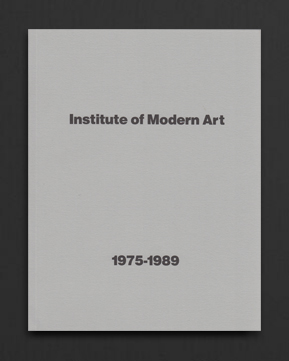
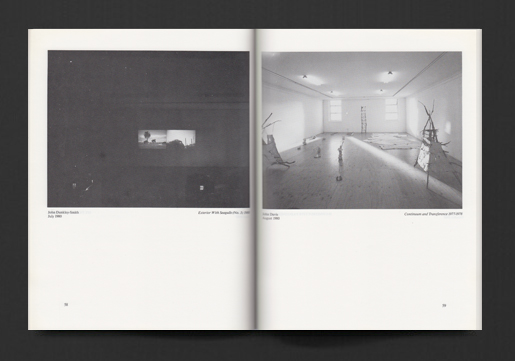
Institute of Modern Art 1975-1989 - A Documentary History, was edited by Bob Lingard, Sue Cramer in Brisbane in 1989, and takes an in-depth look at the history of a very important period of one of Australia's oldest contemporary art spaces. Through essays by Bob Lingard and Peter Anderson, exhibition photography, a full list of exhibitions, catalogues and bulletins, this publication retrospectively showcases the directorship years of Robert Jadin de Fronenteau, John Buckley, John Nixon, Barbara Campbell, Peter Cripps and Sue Cramer, exhibiting John Olsen, Robert MacPherson, Ian Hamilton, Sidney Nolan, John Baldessari, Peter Cripps, Gunter Christmann, David Hockney, Diane Arbus, Jenny Watson, Chuck Close, Joseph Kosuth, Paul Sharits, Mike Parr, Arthur Boyd, Robert Jacks, John Davis, Mario Merz, Peter Tyndall, Hilary Boscott, Imants Tillers, John Nixon, Elizabeth Gower, Janet Burchill, Tony Clark, Dale Frank, Henri Chopin, Scott Redford, Tim Johnson, Robert Mapplethorpe, Vivienne Shark Lewitt, Fiona McDonald, Fiona Hall, Joanna Flynn, Jan Nelson, Joanna Ritson, Robert Hunter, Stephen Roach,Dominique Gonzalez-Foerster, Lehan Ramsey, Hiram To, John Dunkley-Smith, Stieg Persson, Merilyn Fairskye, Linda Marrinon, Bill Henson, Fritz Rahman, Melinda Harper, Geoff Lowe, Lindy Lee, Eugene Carchesio, Diena Georgetti, Maria Kozic, Lyndal Jones, amongst many others!
"This publication documents the history of the Institute of Modern Art, Brisbane from its inception in 1975 until the present day (1989). In doing so, it provides a partial record, both visual and verbal, of the life of one particular institution and an insight into a fifteen year history of exhibition-making within contemporary art. There can be no doubt that “Contemporary Art Spaces” (previously institutions such as the IMA were known as “alternative spaces”) have a crucial and unique role in supporting and developing contemporary art and curatorial practices within Australia. As the photographs of exhibitions, and the essays in this publication show, the Institute has played a significant role over its fifteen years as a venue not only for the exhibition of art that is being made in Brisbane itself, but also that of artists working elsewhere in Australia and overseas. It is worth remembering too that the Institute is the second oldest of the Contemporary Art Spaces in Australia. With this in mind, the Institute’s archive, from which this publication has been drawn, becomes a valuable resource in the study of recent art. The photographs published here ofier a visual record of individual works by many contemporary artists, a number of which may not have been published elsewhere. It is hoped therefore, that this publication might fruitfully be regarded as a source book from which more detailed projects of research can be undertaken. It is impossible in one publication to cover all of the activities and personalities, ideas, debates and discussions that have made up the life of the gallery. Alongside the exhibition program, the Institute has generated forums, lectures, film screenings and publications as an important part of its activities..."
SUE CRAMER DIRECTOR, June 1989
2019, English
Softcover, 424 pages. 21 x 15 cm
Published by
Telephone Publishing / Melbourne
$40.00 - Out of stock
A Constructed World is the collective project of Geoff Lowe and Jacqueline Riva, founded in 1993 in Australia. This bilingual English/French book presents their complete writings on contemporary art and culture from 2001 to 2018. In fourty plus texts A Constructed World discuss the subject matter of their work, other artists work and subjects that seemed prescient and in need of discussion at the time. For ten years they produced Artfan magazine, their first foray into publishing, followed by the web magazine SPEECH, and also the publications of Speech and What Archive. They have developed ongoing working relationships with curators that have expand into durational modes of presentation concerned with not-knowing as a shared space, transmission, translation and satisfaction without delay. During their first survey exhibition, at the Australian Centre for Contemporary Art in Melbourne, they proposed the series Change Forums, inviting more than thirty guest speakers to discuss the topics — Collectivity, Losers and Failure, Publishing Without Publishers, The Changing Audience For Contemporary Art and Politics and Art.
2019, English
Softcover, 4 pages, 21 x 29.7 cm
Published by
Hedge School / Melbourne
$4.00 - In stock -
A baptism of sun gazing and demonic pop, HS001 is the inaugural issue of irregular newsletter, Hedge School. This issue includes The Masked Romancer’s hyperstitional love story, drawings by Marc Matchak, and Thomas Moran’s reflections on that ‘zone of indistinction’ where God and Ariana Grande collapse into one.
2019, English
Glass encrusted slipcase, artist's work on paper, 4 pages (HS001), 21 x 29.7 cm
Ed. of 3,
Published by
Hedge School / Melbourne
$150.00 - Out of stock
First artist edition to accompany Hedge School Issue One, published in April 2019. In an edition of only three, Darcy Wedd’s artist edition comprises glass encrusted slipcases with a work on paper and copy of the issue inside. A baptism of sun gazing and demonic pop, HS001 is the inaugural issue of irregular newsletter, Hedge School. This issue includes The Masked Romancer’s hyperstitional love story, drawings by Marc Matchak, and Thomas Moran’s reflections on that ‘zone of indistinction’ where God and Ariana Grande collapse into one.
1986, Engish
Softcover, 239 pages, 23 x 31 cm
1st Edition, Out of print title / Used*,
Published by
Hudson Hills Press / New York
MOCA / Los Angeles
$200.00 - Out of stock
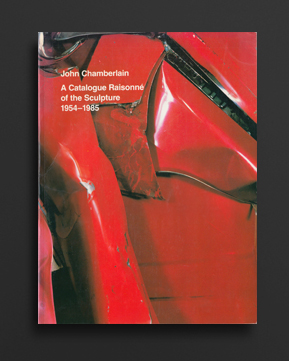
John Chamberlain - A Catalogue Raisonne of the Sculpture 1954-1985, first edition, published in 1986 by Hudson Hills Press, New York, and MOCA, L.A.
For some thirty years, John Chamberlain has cajoled, crushed, melted, and embraced the detritus of American consumerism to create, casually and forcefully, sculptures whose provocative beauty is as visually brilliant as it is formally intelligent. Employing means as ordinary as his materials, he has reinvented casting and modeling and liberated them from expressive, technical, and aesthetic restraints. Moving out of both the Cubist-Constructivist gridlock and the Surrealist symbolism that together threatened to trap so much sculpture of the 1950s, Chamberlain found a way to add the dimension of volume to the urgent spontaneity and procedural clarity so crucial to the Abstract Expressionist painters. Engaging chance and intuition, he transgressed lavishly the prohibition of color in sculpture, employing hues that ranged from the virginal to the lurid as major protagonists of sculptural structure.
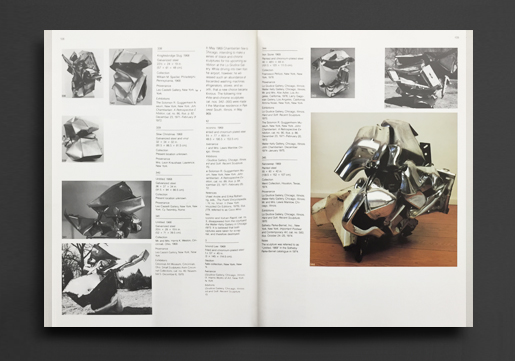
This heavy and comprehensive volume presents a catalogue raisonne of Chamberlain's sculptural output in this period, with numerous examples of his crushed automobile, welded metal, foil, foam and polymer works, amongst others. Densely illustrated with images of all of his sculptural works in black and white and colour (some 800 photographed works!), alongside text by Julie Sylvester with an essay by Klaus Kertess.
Still probably the best and most exhaustive book on the modern sculptor's work.
2016, English
Hardcover, 360 pages, 17.8 x 25.4 cm
Published by
The MIT Press / Massachusetts
$75.00 - Out of stock
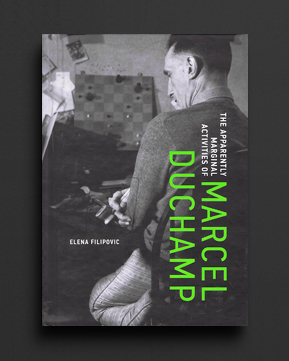
This groundbreaking and richly illustrated book tells a new story of the twentieth century’s most influential artist, recounted not so much through his artwork as through his “non-art” work. Marcel Duchamp is largely understood in critical and popular discourse in terms of the objects he produced, whether readymade or meticulously fabricated. Elena Filipovic asks us instead to understand Duchamp’s art through activities not normally seen as artistic—from exhibition making and art dealing to administrating and publicizing. These were no occasional pursuits; Filipovic argues that for Duchamp, these fugitive tasks were a veritable lifework.
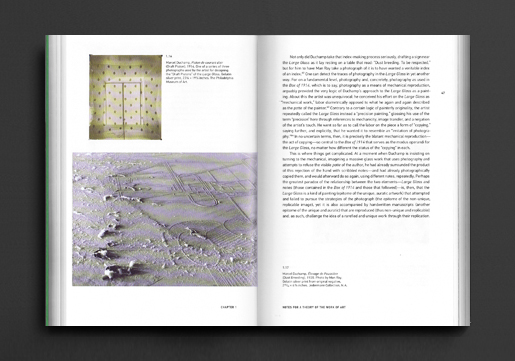
Drawing on many rarely seen images, Filipovic traces a variety of practices and projects undertaken by Duchamp from 1913 to 1969, from his invention of the readymade to the release of his last, posthumous work. She examines Duchamp’s note writing, archiving, and quasi-photographic activities, which resulted in the Box of 1914 and the Green Box; his art dealing, marketing, and curating that culminated in experimental exhibitions for the Surrealists and his miniature museum, The Boîte-en-valise; and his administrative efforts and clandestine maneuvering in order to posthumously embed his Étant donnés into a museum. Demonstrating how those activities reflect the artist’s questioning of reproduction and originality, as well as photography and the exhibition, Filipovic proposes that Duchamp’s “non-art” labor, and in particular his curatorial strategies, more than merely accompanied his more famous artworks; in a certain sense, they made them.
Through Duchamp’s elusive but vital activities he revised the idea of what a modern artist could be. With this fascinating book, Filipovic in turn revises the very idea of Duchamp.
About the Author
Elena Filipovic, an art historian, is Director and Chief Curator of the Kunsthalle Basel. Among her curatorial projects is the traveling retrospective “Marcel Duchamp: A Work That Is Not a Work ‘of Art'” (2008-2009).
Endorsements:
“In the 1970s Lucy Lippard remarked that Duchamp was already too much written about. How, then, is one to contribute effectively to the Duchamp literature today, given that it has become all the more voluminous since? In The Apparently Marginal Activities of Marcel Duchamp Elena Filipovic finds a way, and does so with great intelligence. She claims, rightly, that the dominant readings of Duchamp have led to an occlusion of the ‘fugitive actions’ undertaken by Duchamp vis-à-vis the institution of art, and it is there that she locates her incisive study—specifically on ‘his role as administrator, archivist, art advisor, curator, publicist, reproduction maker, and salesman.’ Rather than see these activities as ancillary to his life as an artist, Filipovic locates them, brilliantly, at its center; they are indeed only ‘apparently marginal.’ This is just the book to reanimate discourse around Duchamp.”
—Hal Foster, Townsend Martin Class of 1917 Professor, Princeton University, author of Compulsive Beauty and Prosthetic Gods
“When an artist becomes a curator today, the exhibition is often treated like an extension of the artist’s medium. A century ago when Duchamp, having ceased to consider himself a professional artist, undertook to help out his friends by designing their exhibitions, did he think like a modernist fixated on medium specificity? This is the classic question that lies behind Elena Filipovic’s careful research in the archives. In light of her new syntheses, she rewrites the question to read: just how did Duchamp open up new possibilities for curators? The answer: the medium was not his message. Duchamp worked without professing, in a series of small, nonretinal steps; he avoided creating a single, prototypical model. He left behind a panorama of new ideas. Filipovic has collected them into a book that curators will come to regard as a resource.”
—Molly Nesbit, Professor of Art History, Vassar College, author of Their Common Sense
“In 1959, Marcel Duchamp referred to himself as ‘a non-artist.’ Exactly what he meant by this has never been fully explained until now, a lacuna in the vast literature on this artist that finally has been filled by Elena Filipovic’s marvelous new book, the first to deal with the various activities that preoccupied Duchamp when he wasn’t making art, particularly in the realm of curating (not only his own work, but that of his fellow artists in various exhibitions that he oversaw). Filipovic argues that these activities occur with such frequency and consistency in Duchamp’s life that they must be considered an integral component of his creative endeavors. The result is an entirely new way to look at the work of this important and highly influential artist.”
—Francis M. Naumann, author of The Recurrent, Haunting Ghost
“Yes, another Duchamp book. The one we least expected, but perhaps the one that we now need the most. Elena Filipovic’s brilliant book locates a ‘curatorial’ logic at the heart of Duchamp’s (deeply fascinating, often confusing, and impossibly disparate) activities. But more crucial even than its tracing of a long-ignored curatorial modernism, this book will in turn challenge what it might mean to curate today, at precisely the moment curators increasingly claim an artistic dimension for their own work.”
—George Baker, Professor of Art History, UCLA, author of The Artwork Caught by the Tail
1979, Japanese / English
Softcover, 96 pages, 32.5 × 25.5 cm
1st Edition, Out of print title / Used,
Published by
Interior Publishing Co. Ltd. / Tokyo
$70.00 - Out of stock
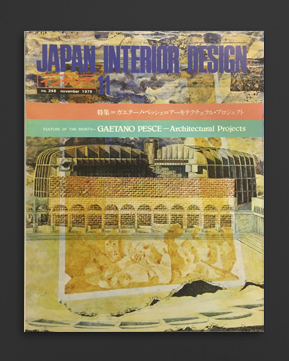
JAPAN INTERIOR DESIGN
No.248, November 1979
One of Japan’s finest magazines for interior design and home furnishings, edited by Moriyama Kazuhiko.
JAPAN INTERIOR DESIGN presents a monthly comprehensive view of traditional, contemporary, and contemplated environmental designs and pure art forms both Japanese and foreign, through pictures and critical reviews. English captions and summaries of major articles are provided.
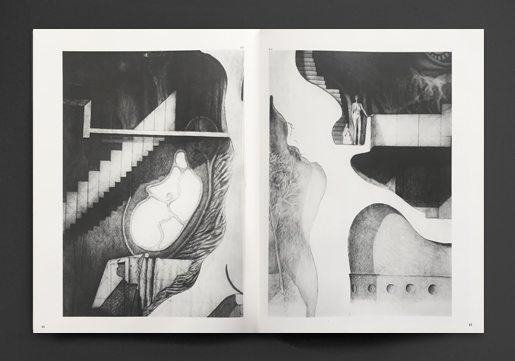
Very rare, this issue includes a huge feature on the Architectural Projects of Italian designer GAETANO PESCE, including "Project for the Pahlavi National Library Competition, 1977"; "House Studio for a Trade-Unionist, 1978"; "Hommage to Italy of the Years 1970, 1978"; "Project for a Skyscraper in Manhattan, 1978" plus essays by Martin Dodman, Ryoji Suzuki, Gaetano Pesce.
Also includes "Glass Surface" by Shoei Yoh essay: Takenobu Igarashi; Shop Interior Designed by Kanji Ueki; Coffee Shop "AZALEA" design: Super Potato; Restaurant Terrace "JOY FULL" design: office HS, Hidenori Seguchi; Series - Product Design of the Month Kitchenware "COOK-PAL" design: Michio Hanyu, Monopro; Ikebukuro Shopping Park—Street with Optical Design Clock design: Jun Kusakari, Hideo Mori essay: Shinya Izumi; New Wallpaper from Fujie Textile design: Hiroshi Awatsuji, Hideo Mori; Series-Reconsideration of Modern Japanese Design — 6 essay: Hiroaki Arima, Takahiko Kaneko, and much more.
1982, English
Softcover, 88 pages, 24 x 22 cm
1st Edition, Out of print title / used / very good
Published by
Electa / Milan
$35.00 - Out of stock
Scarce exhibition catalogue published in 1982 by Electra International, Milano, to accompany Padiglione d'Arte Contemporanea, 'a thorough example of what Italian artistic research has produced in recent years' curated by Luigi Ballerini. Featuring the work of Alighiero Boetti, Italo Bressan, Pietro Coletta, Dadamaino, Alberto Garutti, Marco Gastini, Paolo Icaro, Jannis Kounellis, Vittorio Matino, Eliseo Mattiacci, Mario Merz, Maurizio Mochetti, Hidetoshi Nagasawa, Claudio Olivieri, Giulio Paolini, Claudio Parmiggiani, Sergio Sermidi, Giuseppe Spagnulo, Gilberto Zorio, the exhibition was staged at the Power Gallery, University of Sydney, and the University Art Museum, University of Queensland. Profusely illustrated throughout with accompanying texts in English, biographical notes and bibliography.
Very Good copy.
1990, Engish
Softcover (w. printed vellum dust jacket), 96 pages, 28 x 28 cm
Ed. of 2500 copies,
1st Edition, Out of print title / used / very good
Published by
Grey Art Gallery & Study Center / New York
$100.00 - Out of stock
First edition 1990 Peter Hujar monographic catalogue published to accompany the exhibition at the Grey Art Gallery at New York University in Greenwich Village from January 17 to February 24, 1990, curated by Thomas Sokolowski. Profusely illustrated throughout with Hujar's photographic works, accompanied by an essay by Stephen Koch and extensive interviews with Hujar by Fran Lebowitz and Vince Aletti. Includes biographical sketch, exhibition history and checklist with exhibited 130 works, wrapped in printed vellum dust jacket.
Peter Hujar (1934–1987) is best known for his powerful and piercing portraits of personalities, famous and behind the scenes, animals, and wrecked cars. Ranging from glamorous studio portraits to the dark
still portraits from the catacombs of Palermo, Italy, shot in 1963, when he was there with his lover at the time, the artist Paul Thek. Hujar’s work is known for the texture and poignancy with which he explores decay, sexuality, death, and the life we share in common. As Nan Goldin writes, “Looking at his photographs of nude men, even of a naked baby boy, is the closest I ever came to experience what it is to inhabit male flesh. His photographs of animals have that same rare empathy, they are like highly personal portraits.” Hujar’s celebrity was, is, and always will be associated with a downtown bohemia that flourished in New York between the late nineteen-sixties and the onset of the aids plague. Tall and handsome, volatile, epically promiscuous, and chronically broke, he had a starry constellation of close friends, including Andy Warhol, Susan Sontag and lover/friend David Wojnarowicz. That period left no image more memorable and subtly profound than Hujar’s of the transgender performer and Warhol’s Factory regular Candy Darling, made in 1973, in the hospital bed where she was dying of lymphoma. One of the major American photographers of the late twentieth century, Hujar's work has been the subject of major retrospectives at the Stedelijk Museum in Amsterdam, the Fotomuseum in Winterthur, Switzerland, PS1 New York, Institute of Contemporary Arts, London, Fundación Mapfre Barcelona, Fotomuseum The Hague, The Morgan Library & Museum, and Berkeley Art Museum, amongst others.
Very Good copy with Very Good dust jacket. Binding becoming brittle with time.
2017, English / German
Hardcover, 128 pages, 18 x 26 cm
Published by
Walther König / Köln
$59.00 - Out of stock
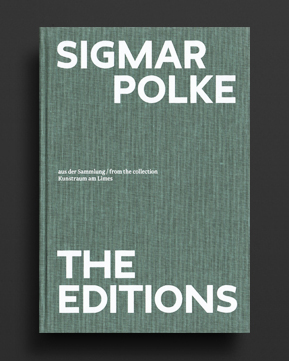
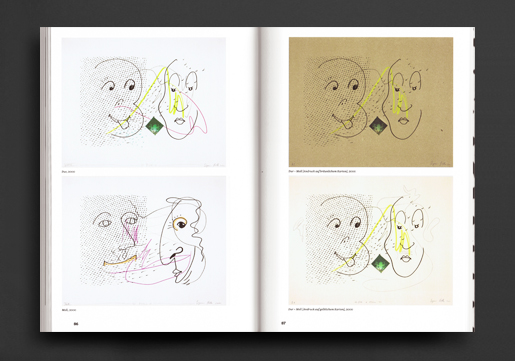
Editioned work holds a special place within Sigmar Polkeʼs artistic oeuvre. To him it represented another possibility for conducting intensive and excessive variations on his experiments, enabling an endless discourse between himself and the world.
Like an alchemist, he expected different techniques to serve his creative ego, thus his editions comprise objects, books, folders, photography, photocopies, collages and numerous prints.
This catalogue contains all of the artistʼs editions, a total of around 200 works.
Accompanies the exhibition Sigmar Polke – The Editions, 28 Apr – 27 Aug 2017, The Collectors Room, Berlin. Curated by Tereza de Arruda.
German and English text.
2010, English / German
Softcover, 32 pages, 21.5 x 10.5 cm
Published by
Neuer Aachener Kunstverein / Aachen
$14.00 - Out of stock
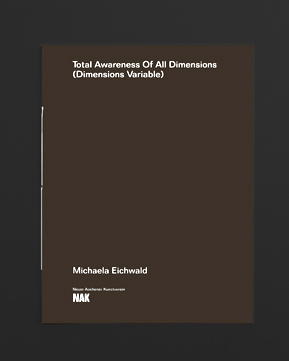
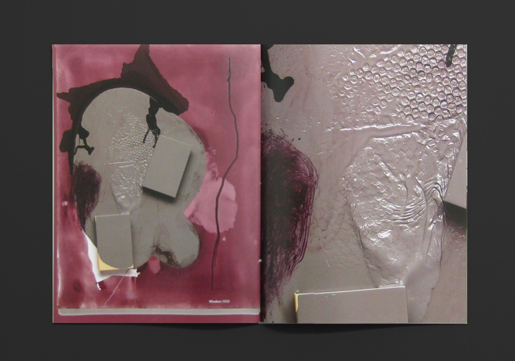
Catalogue to accompany Michaela Eichwald's solo exhibiton "Total Awareness Of All Dimensions (Dimensions Variable)" at NAK (Neuer Aachener Kunstverein, Aachen) in 2009.
Michaela Eichwald (born 1967) is a German painter based in Berlin. Her work mostly consists of abstract paintings using mixed media (including acrylic and oil paints, spray paint, wax, lacquer, paper) on different surfaces (pleather, fabrics). Art critic Christopher Knight described her influences as, "Abstract Expressionism, Japanese Gutai and 1980s Neo-Expressionism, both German and American." Eichwald's paintings have been shown at the Museum of Modern Art, Museum Brandhorst, the Rennes Biennial, Reena Spaulings Fine Art, Maureen Paley's gallery, and other art galleries.
1974, English
Softcover, 286 pages, 18 x 11 cm
Out of print title / used / good
Published by
Corgi / London
$28.00 - Out of stock
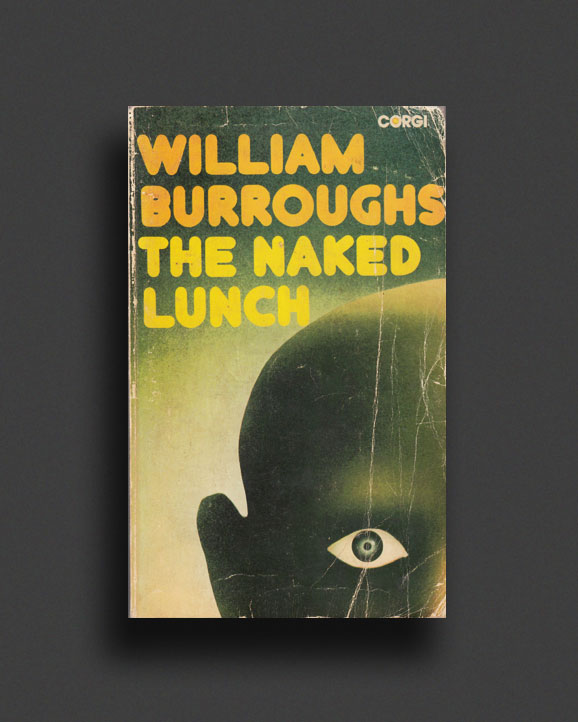
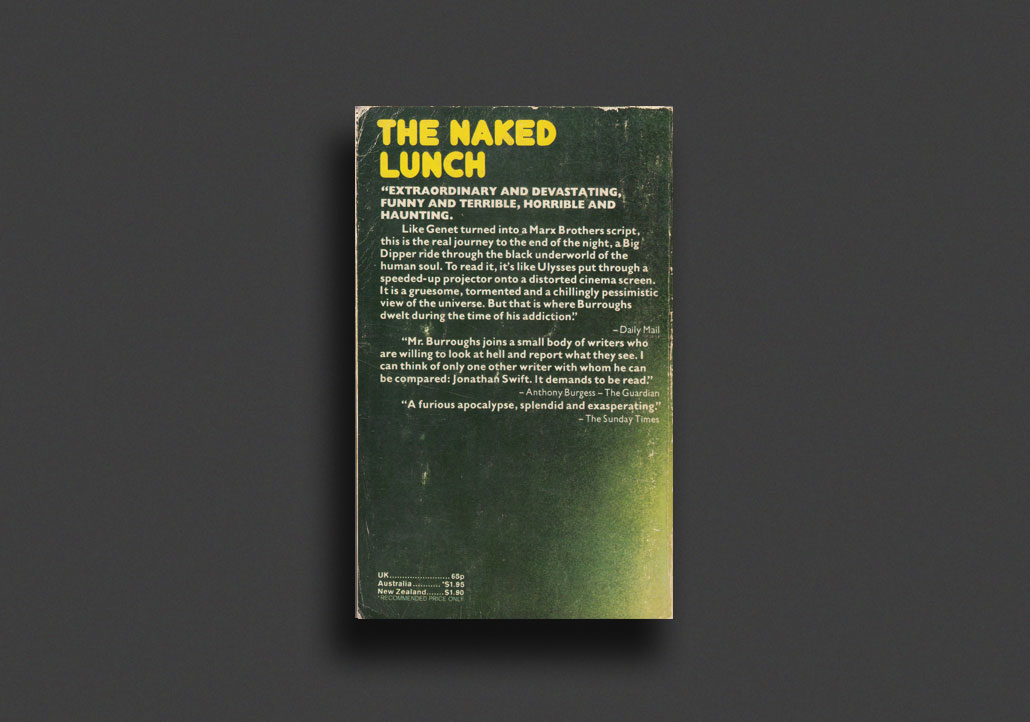
The 1974 Corgi paperback edition of William S. Burroughs' (The) Naked Lunch, originally published in 1959 by Olympia Press in Paris. Considered Burroughs' seminal work, The Naked Lunch was extremely controversial in both its subject matter and its use of obscene language, and the book was banned in Boston and Los Angeles in the United States, and several European publishers were harassed. The book is structured as a series of loosely connected vignettes. Burroughs stated that the chapters are intended to be read in any order. The reader follows the narration of Junkie, William Lee, who takes on various aliases, from the U.S. to Mexico, eventually to Tangier and the dreamlike Interzone. The vignettes (which Burroughs called "routines") are drawn from Burroughs' own experiences in these places and his addiction to drugs (heroin, morphine, and while in Tangier, majoun [a strong hashish confection] as well as a German opioid, brand name Eukodol, of which he wrote frequently). The novel was included in Time magazine's "100 Best English-language Novels from 1923 to 2005". In 1991, David Cronenberg directed a film of the same name based on the novel and other Burroughs writings.
Average - Good copy with wear and creasing to covers, tanned pages.
1968, English
Softcover (staple-bound, card covers), 16 pages, 21 x 15 cm
1st Edition, Out of print title / used / good
Published by
Art Council / Britain
$20.00 - Out of stock
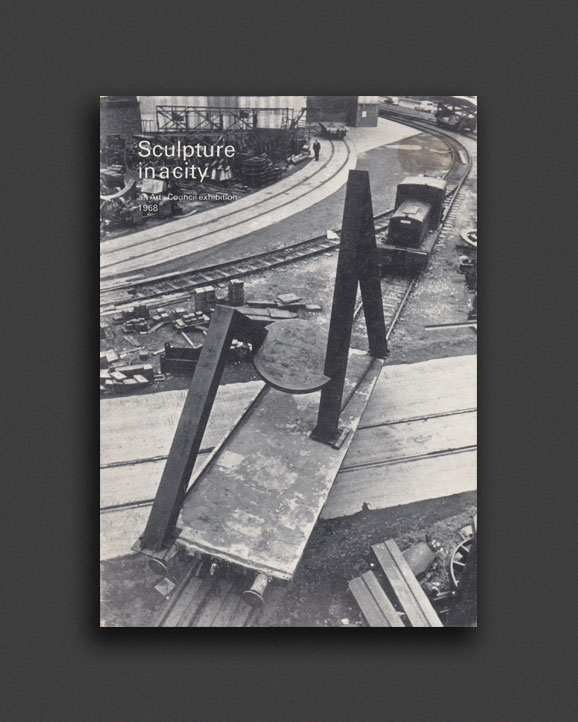
Lovely scarce British publication from 1968 featuring the sculptural work of Anthony Caro, David Hall, Kim Lim, Ron Robertson-Swann, Bernard Schottlander, Brian Wall, and Derrick Woodham, published by the Arts Council on the occasion of an exhibition at the Birmingham Post & Mail Building, Liverpool Goree Piazza, and Southhampton Civic Centre. Includes b/w images along with critical quotes, biographies, and quotes by the artists.
Good copy with bending to bottom rear cover and wear to rear cover. Otherwise Good throughout.
1965, French
Hardcover (w. dust jacket, cloth-bound), 116 pages, 28 x 23 cm
1st Edition, Out of print title / used / very good
Published by
Éditions Denoël / Paris
$70.00 - Out of stock
First edition of Les Dessins Magiques de Victor Brauner, published in France in 1965 and dedicated entirely to the drawings of Romanian Surrealist artist Victor Brauner. Known as the "avant-God of Surrealism", which he predated by 15 years, this book illustrates Brauner's lifelong interest in magic and the occult through a wonderful collection of his bizarre line drawings, alongside commentary by the French art historian Sarane Alexandrian. Numbered edition 2410.
Victor Brauner (1903-1966) was a Romanian Surrealist painter and sculptor, and one of the most important members of the Romanian avant-garde. Born on June 15, 1903 in Piatra Neam?, Romania, he studied at the National School of Fine Arts in Bucharest from 1916 to 1918. Soon after, he began painting landscapes and, as he put it, went through all the "Dadaist, Abstractionist, Expressionist" idioms. Brauner helped found the Dadaist review 75 HP in Bucharest. In Bucharest in 1929 Brauner was associated with the Dadaist and Surrealist review UNU. Brauner settled in Paris in 1930 and became a friend of his compatriot Constantin Brancusi. Then he met Yves Tanguy, who introduced him to the Surrealists by 1933. André Breton wrote an enthusiastic introduction to the catalogue for Brauner’s first Parisian solo show at the Galerie Pierre in 1934. The exhibition was not well-received, and in 1935 Brauner returned to Bucharest, where he remained until 1938. That year he moved to Paris, lived briefly with Tanguy, and painted a number of works featuring distorted human figures with mutilated eyes. Some of these paintings, dated as early as 1931, proved gruesomely prophetic when he lost his own eye in a in violent argument between Oscar Domínguez and Esteban Francés in 1938. At the outset of World War II Brauner fled to the South of France, where he maintained contact with other Surrealists in Marseilles. Later he sought refuge in Switzerland; unable to obtain suitable materials there, he improvised an encaustic from candle wax and developed a graffito technique. Brauner returned to Paris in 1945. He was included in the Exposition internationale du surréalisme at the Galerie Maeght in Paris in 1947. His postwar painting incorporated forms and symbols based on Tarot cards, Egyptian hieroglyphics, and antique Mexican codices. In the fifties Brauner traveled to Normandy and Italy, and his work was shown at the Venice Biennale in 1954 and in 1966. He died in Paris on March 12, 1966. The artist is buried in the famed Montmartre cemetery, where his epitaph reads: “Painting is life, the real life, my life.”
Very Good ex-library copy w. light stamping and plastic covered dust jacket. Clean and tight throughout.
2010, English
Softcover, 312 pages, 15.2 x 22.9 cm
Published by
Semiotext(e) / Los Angeles
$40.00 - Out of stock
Previously unpublished plays and writings by one of today's foremost satirical authors.
Before publishing his celebrated first novel, Horse Crazy, in 1987, Gary Indiana wrote and directed twelve plays for an informal company whose performers included the painter Bill Rice, composer Evan Lurie, the poet George-Therese Dickenson, writer and film actress Cookie Mueller, Warhol superstar and painter Viva, writer Victoria Pedersen, singer/actress Sharon Niesp, photographer Allen Frame, the legendary Taylor Mead, novelist Larry Mitchell, and others. Performed at the Mudd Club, Club 57, The Performing Garage, and Bill Rice's E. 3rd Street studio, Indiana's plays offered a kind of community theater for New York's underground.
This volume presents highlights of that repertoire, including Alligator Girls Go to College, The Roman Polanski Story, and Indiana's script for Michel Auder's videofilm A Coupla White Faggots Sitting Around Talking, accompanied by archival performance photographs and selections from Indiana's contemporaneous journals and poems. These hilarious, incisive writings and scripts evoke a vivid and accurate portrait of writers and artists in the lower Manhattan of the 1980s—arguably America's last avant-garde—and anticipates Indiana's impressive subsequent literary career.
2019, English
Softcover, 240 pages, 13.7 x 20.3 cm
Published by
Semiotext(e) / Los Angeles
$38.00 - In stock -
How the brutalities of working life are transformed into exhaustion, shame, and self-doubt: a writer's account of her experience working in an Amazon fulfillment center.
No longer able to live on the proceeds of her freelance writing and translating income, German novelist Heike Geissler takes a seasonal job at Amazon Order Fulfillment in Leipzig. But the job, intended as a stopgap measure, quickly becomes a descent into humiliation, and Geissler soon begins to internalize the dynamics and nature of the post-capitalist labor market and precarious work. Driven to work at Amazon by financial necessity rather than journalistic ambition, Heike Geissler has nonetheless written the first and only literary account of corporate flex-time employment that offers “freedom” to workers who have become an expendable resource. Shifting between the first and the second person, Seasonal Associate is a nuanced expose of the psychic damage that is an essential working condition with mega-corporations. Geissler has written a twenty-first-century account of how the brutalities of working life are transformed into exhaustion, shame, and self-doubt.
Afterword by Kevin Vennemann
Translated by Katy Derbyshire
"...chillingly effective, not least for its accumulation of details, which seem both aggressively banal and freighted with an excess of symbolic meaning....The ubiquitous linguistic debasement and corporate doublespeak is made strange and new again, the small humiliations and injustices pile up along with their psychological and social consequences." - Harper's Magazine
2018, English
Siftcover, 128 pages, 13.7 x 20.3 cm
Published by
Semiotext(e) / Los Angeles
$33.00 - Out of stock
Published in French in 1972, Jean-Jacques Schuhl's Dusty Pink became a cult classic. This is its first translation, capturing a subjective stroll through an underground, glamorous Paris.
"finally there are the rolling stones who call for all these at the same time among them and around them: the policeman, the cross-dresser, the dancer, Frankenstein, the dandy, the robot" — from Dusty Pink
Written with the hope of achieving a “dreary distant banality,” Jean-Jacques Schuhl's first novel is a subjective stroll through an underground, glamorous Paris, a city that slips into the background but never disappears, hovering on the verge of its own suppression. An elegiac and luminous cut-up, Dusty Pink brings together race wire results, editions of France-Soir, the lyrics to well-known British songs, scripts from famous old films, pharmaceutical leaflets, fashion ads, and strips and scraps of culture in which the avant-garde and academicism blur in an overview of the cultural scene. This world of atmospheres, portraits, and dazzling associations of ideas creates a plane of shimmering surfaces.
Jean-Jacques Schuhl
Cult author Jean-Jacques Shuhl won the Prix Goncourt in 2000 for his novel Ingrid Caven, which sold over 235,000 copies in France. It was his first book since Dusty Pink was published in 1972.
2015, English
Softcover, 256 pages, 20 x 13 cm
Published by
Manchester University Press / Manchester
$36.00 - Out of stock
By Douglas Morrey and Alison Smith
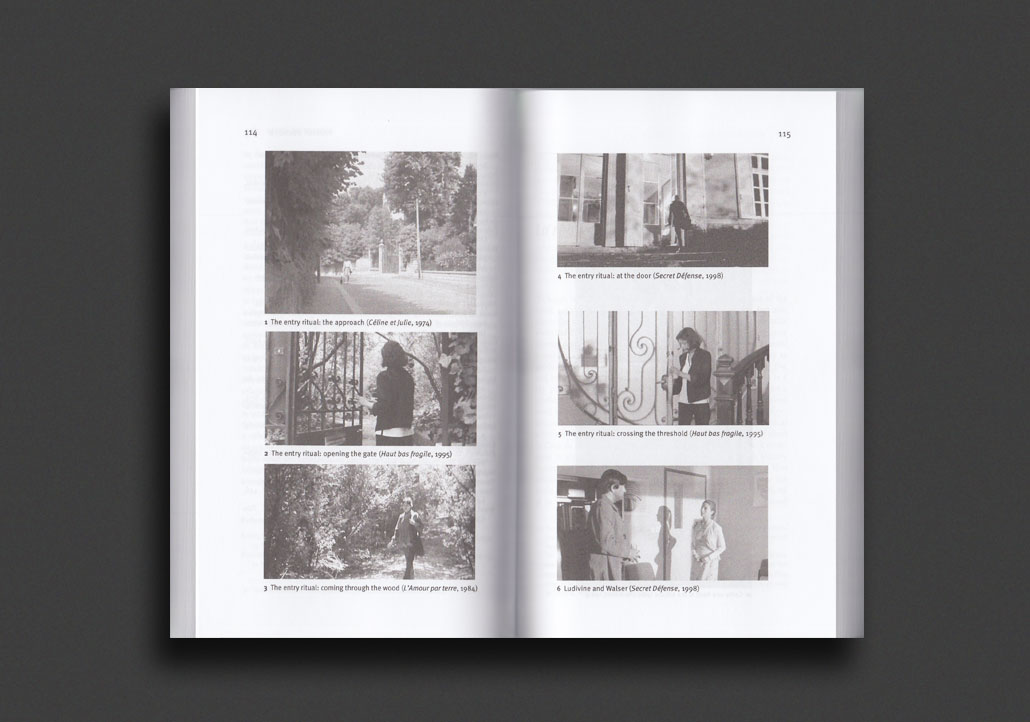
Jacques Rivette is perhaps the best-kept secret of French cinema. A founding figure in the New Wave, and at the centre of the Cahiers du cinéma team, he developed into one of the most unusual and adventurous French directors of the last sixty years, yet his work remains little-known in comparison with his contemporaries, and this study is the first in English to look at the full span of his career. Starting with his decisively influential film criticism of the 1950s, it moves from the New Wave through the complex, experimental films of the 1970s to the challenging, playful dramas which ensured his visibility during the following two decades, and ends in the present, including Rivette's most recent films, Histoire de Marie et Julien (2003) and Ne touchez pas la hache (2007).
The book takes a thematic approach, offering detailed discussion of key elements of Rivette's film world, including games, conspiracy and jealousy, as well as a study of what Rivette's cinema adds to our understanding of key theoretical concepts in Film Studies such as narrative, space and adaptation.
From Manchester University Press' French Film Directors series, edited by Diana Holmes and Robert Ingram.
2016, English
Softcover, 176 pages, 20 x 13 cm
Published by
Manchester University Press / Manchester
$36.00 - Out of stock
By John Phillips.
Placing Robbe-Grillet's filmic oeuvre in the related contexts of both his novelistic work and the different historical and cultural periods in which his films were made, from the early 1960s to the present, the book traces lines of influence and continuity throughout his work, which is shown to exhibit a consistent preoccupation with an identifiable body of themes, motifs and structures. Close readings of all the films are skilfully combined with a thematic approach, ranging across the entire filmic corpus. The book also contains chapters on cinematography and technique.
Alain Robbe-Grillet (1922 – 2008) was a French writer and filmmaker. He was one of the figures most associated with the Nouveau Roman (new novel) trend of the 1960s, along with Nathalie Sarraute, Michel Butor and Claude Simon. Robbe-Grillet's career as a creator of fiction was not restricted to the writing of novels. For him, creating fiction in the form of films was of equal importance. His film career began when Alain Resnais chose to collaborate with him on his 1961 film Last Year at Marienbad. Robbe-Grillet then went on to launch a career as a writer-director of an award-winning series of cerebral and often sexually provocative feature films which explored similar themes to those in his literary work (e.g. Voyeurism, The Body as Text, The 'Double'), including L'Immortelle (The Immortal One) (1962); Trans-Europ-Express (1966); L'homme qui ment/Muž, ktorý luže (The Man Who Lies) (1968); L'Eden et après/Eden a potom (Eden and After) (1970); Glissements progressifs du plaisir (Progressive Slidings towards Pleasure) (1974); Le jeu avec le feu (Playing with Fire) (1975); La belle captive (The Beautiful Captive) (1983); and more.
Now available in paperback, this lucid, comprehensive and fascinating study shows Robbe-Grillet's contribution to the evolution of the cinematic art both in France and internationally to have been considerably more important than previously acknowledged.
From Manchester University Press' French Film Directors series, edited by Diana Holmes and Robert Ingram.
1973, English
Softcover, 128 pages, 21 x 13.5 cm
1st Edition, Out of print title / used / very good
Published by
The Crossing Press / New York
$65.00 - Out of stock
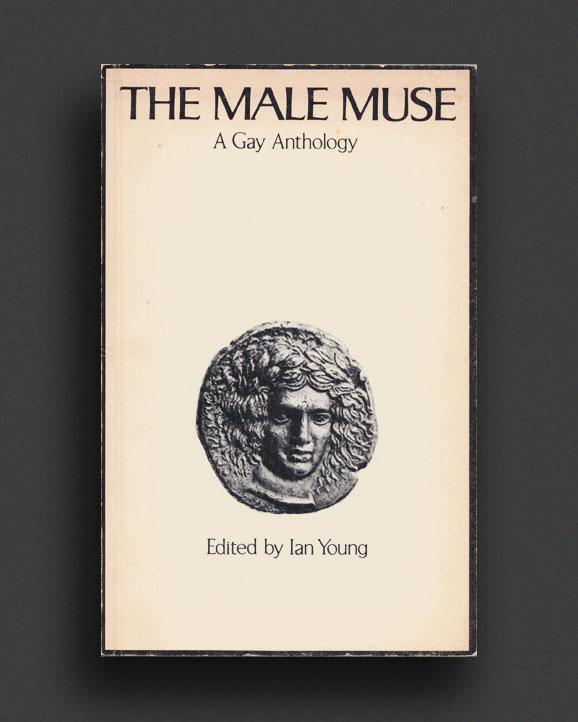
First edition of "The Male Muse : A Gay Anthology", of one of the first openly gay poetry anthologies, edited by Ian Young and published in New York in 1973.
"... until 1972 an anthology of contemporary poetry seemed impossible to carry out not because the writing was't there, but because the aura of taboo was still strong enough to prevent all but a few writers from contributing. But suddenly, in 1972, the growing impetus of the homophile/gay liberation movement began to be felt by the rest of society both gay and straight, and Pride became not just a slogan but a reality for a significant number of homosexual men and women." - from the Introduction by Ian Young
Features the work of Robert Duncan, Allen Ginsberg, Thom Gunn, Robert Adamson, James Kirkup, William Barber, Zdzislaw Kurlowicz, Oswell Blakeston, E.A. Lacey, Perry Brass, John Lehmann, Jim Chapson, James Liddy, Paul Mariah, Kirby Congdon, Paul Maurice, James Mitchell, Jim Eggeling, Edward Mycue, Sal Farinella, Harold Norse, Edward Field, Robert Peters, John Gill, Ralph Pomeroy, Michael Radcliffe, Paul Goodman, Jay Socin, Walter Griffin, Richard Tagett, Burton Weiss, Michael Higgins, Brian Hill, John Wieners, Christopher Isherwood, Tennessee Williams, Graham Jackson, Jonathan Williams, Ronald Johnson, Ian Young.
Ian Young (born January 5, 1945) is an English-Canadian poet, editor, literary critic, and historian. An alumnus of the University of Toronto, he founded Canada's first gay publishing company, Catalyst Press, in 1970. His work has appeared in Canadian Notes & Queries, The Gay & Lesbian Review Worldwide, Rites and Continuum, as well as in more than fifty anthologies. He was a regular columnist for The Body Politic from 1975 to 1985 and for Torso between 1991 and 2008. Young is best known for his work as editor of the anthology The Gay Muse and the bibliography The Male Homosexual in Literature. He was interested in ceremonial magic during the 1980s and was a founding member of the Hermetic Order of the Silver Sword.
Good-Very Good copy of the first edition.
1978, English
Softcover (staple-bound), 60 pages, 21.5 x 14 cm
1st Edition, Out of print title / used / good
Published by
Little Caesar Press / Los Angeles
$180.00 - Out of stock
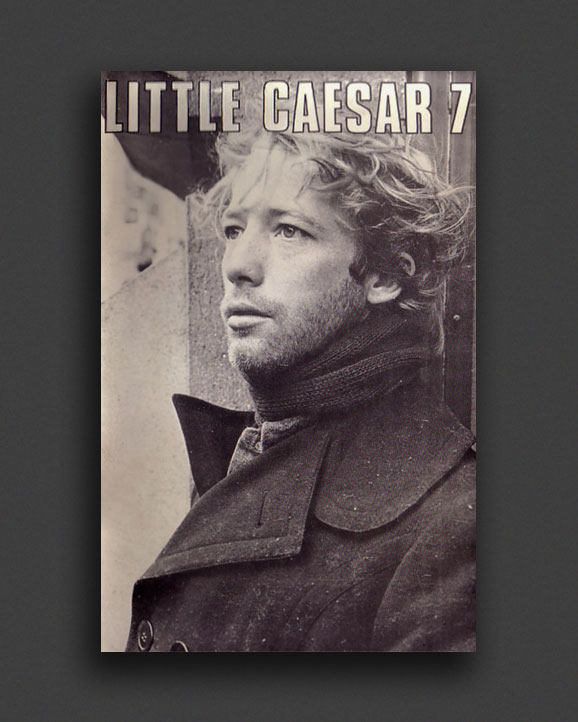
Little Caesar 7 - punk magazine October 1978, Dennis Cooper, editor. Gerard Malanga, photographer. Interviews, poetry, lyrics. Lou Reed, Nico, Andy Warhol, David Ignatow, Robert Bly and other subjects.
Ifyou have questions about condition, shipping or multiple item purchases, please contact us! We are eager to work with you! All items are on hand and individually photographed and described.
Very scarce issue 7 of Dennis Cooper's Little Caesar Magazine, published in 1978 and edited by Cooper with photography by Gerard Malanga. Features poetry, interviews, and lyrics by Nico, Lou Reed, Andy Warhol, David Ignatow, Gerard Malanga, Tom Meyer, Robert Bly and more.
American writer Dennis Cooper started Little Caesar Magazine in 1976 as a literary journal with an anarchist, punk rock spirit. From its humble beginnings as a skinny, low-tech zine dominated by poetry, it grew into a book sized magazine featuring poetry, fiction, portfolios of art and photography, essays, special theme issues, and interviews with a wide range of writers, artists, and pop culture figures (ranging from teen idol Leif Garrett to musicians like Johnny Rotten and Gram Parsons to porn director Toby Ross, to name but a few). In 1978, Cooper started Little Caesar Press, which wound up publishing 24 books of poetry and fiction by young and established contemporary authors (Joe Brainard, Amy Gerstler, Eileen Myles, Peter Schjeldahl, Elaine Equi, Ronald Koertge, Gerard Malanga, Tom Clark, et. al.), as well as the first and only English language translation of Arthur Rimbaud's final work, "Travels in Abyssinia".
By the time the magazine ceased production after twelve issues in 1982, its contributors included such people as Andy Warhol, Lou Reed, Nico, Debbie Harry, Brian Eno, and many others.
These days, issues of Little Caesar are highly sought after collector's items.
Good copy with tanning and light wear.
1985, English
Softcover, 96 pages, 20.5 x 22 cm
1st Edition, Out of print title / used / good
Published by
Currey O'Neil / Melbourne
$80.00 - Out of stock
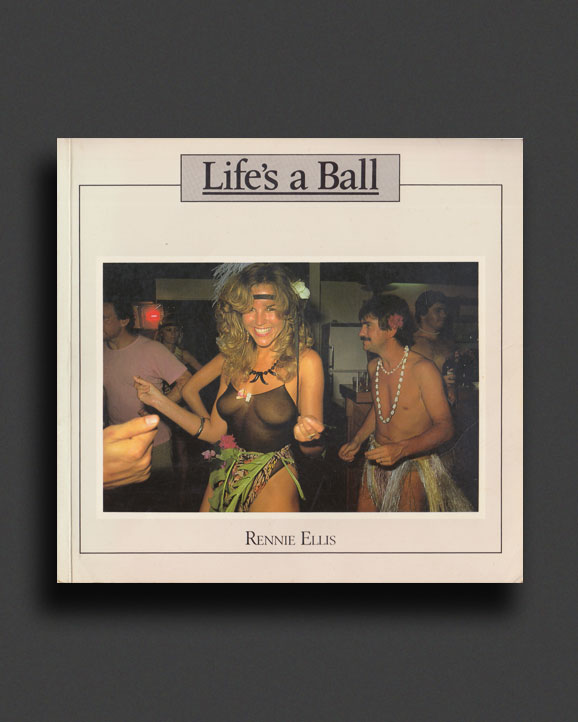
First edition of award winning Australian photographer Rennie Ellis' cult classic photo-book, "Life's A Ball", published in Melbourne in 1985, shortly after his "Life's a Beach" and "Life's a Beer". A book entirely dedicated to the ecstatic and delirious world of (mostly) Melbourne parties in the 1980s. "You will probably see more flesh than you can stand in this paean of pulchritude, this fanfare of fun, this roll call of rort, this ... ah well, this collection from an apparently inexhaustible supply of eye-popping pictures". As always, a joyous time-capsule of Australian society and culture.
No other photographer has documented Australian society in such depth and with such insight into the human condition as Rennie Ellis. Active from the 1970s until his death in 2003, Rennie Ellis' non-judgmental approach was his 'access-to-all-areas' pass. Ellis used his camera as a key to open the doors to the social arenas of the rich and famous and to enter the underbelly of the nightclubs, bearing witness to the indulgences and excesses. In today's post-Henson era, these captured moments offer an intimate access to an Australia tantalisingly, but sadly, now almost out of reach.
Good copy with some spotting to title pages, light wear to covers.
1994, Japanese / French
Softcover (staple-bound), 22 pages, 21 x 27.5 cm
1st Edition, Out of print title / used / very good
Published by
Gallery Itsutsuji / Tokyo
$40.00 - Out of stock
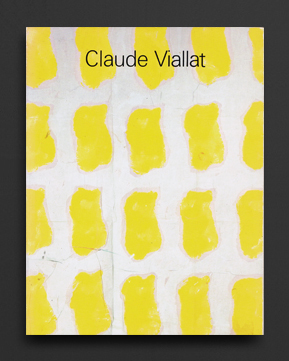
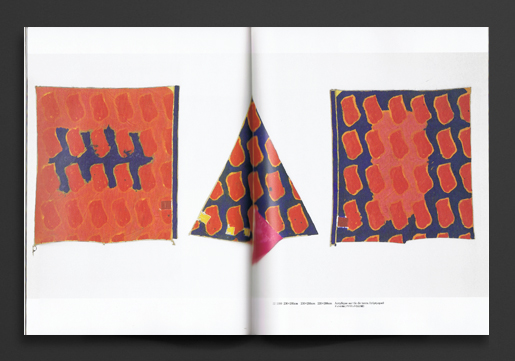
Claude Viallat catalogue published in Japan on the occasion of a solo exhibition held at Gallery Itsutsuji in September-October, 1994. This special survey exhibition presents Viallat's (a founding member of Support/Surfaces) sculptural pieces -- dipped and painted assemblages of rope, canvas, driftwood, etc. -- spanning 1973 to 1993; objects that have developed in harmony with his systematic abstraction of one shape affixed to canvas without stretchers. Across a series of colour installation spreads, each wall is documented with a tables illustrating and detailing each work exhibitied, along with a biography and further texts (in Japanese).
Claude Viallat is a French artist born in Nîmes who, in 1955, joined the École des Beaux-Arts (Fine Arts School) in Montpellier, where he met André-Pierre Arnal, Vincent Bioulès, Daniel Dezeuze, Toni Grand, François Rouan, and Henriette Pous, whom he married in 1962. As soon as 1963, he was attracted to abstraction. He was appointed as a teacher in the École des Arts Décoratifs (Decorative Arts School) of Nice in 1964 and decided to create a new formal language questioning the conventions of classical painting. He then started working systematically with one shape affixed on canvas without stretchers. His first personal exhibition took place at Nice’s Galerie A in 1966. In 1967, he was appointed as a teacher in the École des Beaux-Arts (School of Fine Arts) in Limoges, where he met Raoul Hausmann. In the late 1960s he was central to the formation of Support/Surfaces, perhaps the most under-recognized French art movement of the twentieth century, Supports/Surfaces emerged amid the intellectual and political upheaval of 1960s France, on the cusp of modernity and postmodernity. Steeped in the philosophy of Derrida, Lacan and Barthes, and inspired in their political militancy by figures such as Marx, Freud and Mao, 15 artists from the South of France converged around a shared ideological and artistic goal: the dismantling and demystifying of the painting as object, both physically and philosophically. Artists such as Louis Cane, Daniel Dezeuze, Bernard Pagès, Patrick Saytour, Claude Viallat, André-Pierre Arnal and Noël Dolla explored the physicality of the painting’s stretchers and canvases, deconstructing it so as to question and reaffirm the medium and its implications.
Very Good copy.
1992, Japanese
Softcover, 42 pages, 21 x 27.5 cm
1st Edition, Out of print title / used / good
Published by
Gallery Itsutsuji / Tokyo
$40.00 - Out of stock
Claude Viallat catalogue published in Japan on the occasion of his parallel solo exhibitions held at Gallery Itsutsuji and Sagacho Exhibit Space, Tokyo, in April-May, 1992, following his systematic abstraction with one shape affixed on canvas without stretchers. Illustrated throughout in colour and black and white with installation shots of each exhibit, plus reproductions of each painting exhibited, along with a biography and further texts (in Japanese).
Claude Viallat is a French artist born in Nîmes who, in 1955, joined the École des Beaux-Arts (Fine Arts School) in Montpellier, where he met André-Pierre Arnal, Vincent Bioulès, Daniel Dezeuze, Toni Grand, François Rouan, and Henriette Pous, whom he married in 1962. As soon as 1963, he was attracted to abstraction. He was appointed as a teacher in the École des Arts Décoratifs (Decorative Arts School) of Nice in 1964 and decided to create a new formal language questioning the conventions of classical painting. He then started working systematically with one shape affixed on canvas without stretchers. His first personal exhibition took place at Nice’s Galerie A in 1966. In 1967, he was appointed as a teacher in the École des Beaux-Arts (School of Fine Arts) in Limoges, where he met Raoul Hausmann. In the late 1960s he was central to the formation of Support/Surfaces, perhaps the most under-recognized French art movement of the twentieth century, Supports/Surfaces emerged amid the intellectual and political upheaval of 1960s France, on the cusp of modernity and postmodernity. Steeped in the philosophy of Derrida, Lacan and Barthes, and inspired in their political militancy by figures such as Marx, Freud and Mao, 15 artists from the South of France converged around a shared ideological and artistic goal: the dismantling and demystifying of the painting as object, both physically and philosophically. Artists such as Louis Cane, Daniel Dezeuze, Bernard Pagès, Patrick Saytour, Claude Viallat, André-Pierre Arnal and Noël Dolla explored the physicality of the painting’s stretchers and canvases, deconstructing it so as to question and reaffirm the medium and its implications.