World Food Books' programme is largely produced on Kulin Nation land. We acknowledge the Wurundjeri people of the Kulin Nation as the first and continuing custodians of this land, and pay respect to their Elders past, present, and emerging.
World Food Books is an arts and special interests bookshop in Naarm / Melbourne. Founded in 2010, World Food Books is devoted to the presentation of a rotating, hand-selection of international art, design, literary and counterculture publications with an emphasis on the anti-traditional, the experimental, the avant-garde, the heretic, the marginal.
Presenting new titles alongside rare and out-of-print books, catalogues and journals spanning the fields of modern and contemporary art, design, photography, illustration, film, literature, poetry, cultural theory, philosophy, sexuality, popular and underground culture in its many radical forms, World Food Books wishes to encourage adventurous, thoughtful and open-minded reading, looking, writing, and exchange of publishing and ideas, both current and historical.
As well as our bookshop, located in Melbourne's historical Nicholas Building, all of our inventory is available internationally via our online mail-order service.
World Food Books semi-regularly co-ordinates "Occasions", a programme of exhibits and events at the bookshop and in partnership with other hosts (such as museums and art galleries) that develop out of the activities, relationships and content of the bookshop itself.
World Food Books
The Nicholas Building
37 Swanston Street
Room 5, Level 6
Melbourne 3000
Australia
SHOP HOURS:
Thu–Fri 12–6, Sat 12–5
WEB-SHOP OPEN 24/7
World Food Books
Postal Address:
PO Box 435
Flinders Lane
Victoria 8009
Australia
Art
Theory / Essay
Architecture / Interior
Graphic Design / Typography
Photography
Fashion
Eros
LGBTQ+
Fiction / Poetry
Weird / Speculative / Science Fiction / Horror
Transgressive / Visceral / Abject
Symbolism / Decadence / Fin de siècle
Film / Video
Painting
Sculpture / Installation
Performance / Dance / Theater
Drawing
Sound / Music
Curatorial
Group Shows / Collections
Periodicals
Out-of-print / Rare
Posters / Ephemera / Discs
Signed Books
World Food Books Gift Voucher
World Food Book Bag
Australian Art
Australian Fiction
Australian Science Fiction / Speculative Fiction
Australian Poetry
Australian Photography
Japanese Photography
Conceptual Art
Minimal Art
Dada
'Pataphysics / Oulipo
Fluxus
Concrete Poetry
Pop Art
Surrealism
Arte Povera
Arte Informale / Haute Pâte / Tachism
Nouveau Réalisme / Zero / Kinetic
Situationism / Lettrism
Collage / Mail Art / Xerox Art
Art Brut / Folk / Visionary / Fantastic
Illustration / Graphic Art / Bandes Dessinées
Furniture
Italian Radical Design / Postmodernism
Textiles
Ceramics / Glass
Counterculture
Protest / Revolt
Philosophy
Psychoanalysis
Anthropology
Anarchism
Socialism / Anarchism / Communism / Capitalism
Literary Theory / Semiotics / Language
Feminism / Women's Studies
Gender Studies / Sexuality
Anthropology
Fetishism / BDSM
Drugs / Psychedelia
Crime / Violence
Animal Rights / Veganism
Occult / Esoterica
Ecology / Earth / Alternative Living
Whole Earth / Crafts
All prices in AUD (Australian dollars)
Pick-Ups
Pick-up orders can be collected in our bookshop during opening hours after order date. Please collect any Pick-up orders within 2 weeks of ordering as we have limited storage space. Orders will be released back into stock if not collected within this time. No refunds can be made for pick-ups left un-collected. If you cannot make it in to the bookshop in this time-frame, please choose postage option.
Return Policy
All sales are final. We do accept returns (for refund or exchange) for items received in error. All our orders are packed with special care using heavy-duty padding and cardboard book-mailers or bubble mailers (for smaller books), using reinforcement where required. We cannot take responsibility for any lost, stolen or damaged parcels.
Insurance
Should you wish to insure your package, please email us directly after placing your order and we can organise this at a small extra expense. Although all standard/express tracked packages are very safe and dependable, we cannot take responsibility for any lost, stolen or damaged parcels. We recommend insurance on valuable orders.
Interested in selling your old books, catalogues, journals, magazines, comics, fanzines, ephemera? We are always looking for interesting, unusual and out-of-print books to buy. We only buy books in our fields of interest and specialty, and that we feel we can resell.
We base these prices on desirability, market value, in-print prices, condition and our current stock levels. We offer cash, store credit, and can take stock on consignment. All
about 25% of the price we expect to get when we sell them, or 30% in store credit. We base these prices on desirability, market value, in-print prices, condition and our current stock levels.
Sell your books any day of the week. You can drop them off and return later. If you have a lot of books, we can visit your Sydney home.
We buy books that we feel we can resell. We offer about 25 % of the price we expect to get when we sell them, or 30% in store credit. We base these prices on desirability, market value, in-print prices, condition and our current stock levels.
Philadelphia Wireman
03 August - 01 September, 2018
World Food Books is proud to announce our next Occasion, the first presentation of sculptures by Philadelphia Wireman in Australia.
The Philadelphia Wireman sculptures were found abandoned in an alley off Philadelphia’s South Street on trash night in 1982. Their discovery in a rapidly-changing neighbourhood undergoing extensive renovation, compounded with the failure of all attempts to locate the artist, suggests that the works may have been discarded after the maker’s death. Dubbed the "Philadelphia Wireman" during the first exhibition of this work, in 1985, the maker’s name, age, ethnicity, and even gender remain uncertain. The entire collection totals approximately 1200 pieces, all intricately bound together with tightly-wound heavy-gauge wire (along with a few small, abstract marker drawings, reminiscent both of Mark Tobey and J.B. Murry). The dense construction of the work, despite a modest range of scale and materials, is singularly obsessive and disciplined in design: a wire armature or exoskeleton firmly binds a bricolage of found objects including plastic, glass, food packaging, umbrella parts, tape, rubber, batteries, pens, leather, reflectors, nuts and bolts, nails, foil, coins, toys, watches, eyeglasses, tools, and jewellery.
Heavy with associations—anthropomorphic, zoomorphic, and socio-cultural responses to wrapped detritus—the totemic sculptures by Philadelphia Wireman have been discussed in the context of work created to fulfil the shamanistic needs of alternative religions in American culture. Curators, collectors, and critics have variously compared certain pieces to sculpture from Classical antiquity, Native American medicine bundles, African-American memory jugs, and African fetish objects. Reflecting the artist’s prolific and incredibly focused scavenging impulse, and despite—or perhaps enhanced by—their anonymity, these enigmatic objects function as urban artefacts and arbiters of power, though their origin and purpose is unknown. Philadelphia Wireman, whatever their identity, possessed an astonishing ability to isolate and communicate the concepts of power and energy through the selection and transformation of ordinary materials. Over the course of the past two decades, this collection has come to be regarded as an important discovery in the field of self-taught art and vernacular art.
Presented in collaboration with Fleisher-Ollman Gallery, Philadelphia, and Robert Heald, Wellington.
Susan Te Kahurangi King
02 February - 10 March, 2018
Susan Te Kahurangi King (24 February 1951 - ) has been a confident and prolific artist since she was a young child, drawing with readily available materials - pencils, ballpoint pens and felt-tip markers, on whatever paper is at hand. Between the ages of four and six Susan slowly ceased verbal communication. Her grandparents William and Myrtle Murphy had developed a special bond with Susan so they took on caring responsibilities for extended periods. Myrtle began informally archiving her work, carefully collecting and storing the drawings and compiling scrapbooks. No drawing was insignificant; every scrap of paper was kept. The King family are now the custodians of a vast collection containing over 7000 individual works, from tiny scraps of paper through to 5 meter long rolls.
The scrapbooks and diaries reveal Myrtle to be a woman of great patience and compassion, seeking to understand a child who was not always behaving as expected. She encouraged Susan to be observant, to explore her environment and absorb all the sights and sounds. Myrtle would show Susan’s drawings to friends and people in her community that she had dealings with, such as shopkeepers and postal workers, but this was not simply a case of a grandmother’s bias. She recognised that Susan had developed a sophisticated and unique visual language and sincerely believed that her art deserved serious attention.
This was an unorthodox attitude for the time. To provide some context, Jean Dubuffet coined the term Art Brut in 1945 to describe work created by self-taught artists – specifically residents of psychiatric institutions and those he considered to be visionaries or eccentrics. In 1972 Roger Cardinal extended this concept by adopting the term Outsider Art to describe work made by non-academically trained artists operating outside of mainstream art networks through choice or circumstance. Susan was born in Te Aroha, New Zealand in 1951, far from the artistic hubs of Paris and London that Dubuffet and Cardinal operated in. That Myrtle fêted Susan as a self-taught artist who deserved to be taken seriously shows how progressive her attitudes were.
Susan’s parents Doug and Dawn were also progressive. Over the years they had consulted numerous health practitioners about Susan’s condition, as the medical establishment could not provide an explanation as to why she had lapsed into silence. Dawn educated herself in the field of homeopathy and went on to treat all twelve of her children using these principles – basing prescriptions on her observations of their physical, mental and emotional state.
Doug was a linguist with an interest in philosophy who devoted what little spare time he had to studying Maori language and culture. To some extent their willingness to explore the fringes of the mainstream made them outsiders too but it was their commitment to living with integrity and their respect for individuality that ensured Susan’s creativity was always encouraged.
Even though Susan’s family supported her artistic pursuits, some staff in schools and hospitals saw it as an impediment to her assimilation into the community and discouraged it in a variety of ways. Her family was not always aware of this and therefore did not fully understand why Susan stopped drawing in the early 1990s. However, rather than dwell on the challenges that Susan faced in pursuit of her artistic practice, they prefer to highlight her achievements. In 2008 Susan began drawing again in earnest, after an almost 20 year interruption, and her work is now shown in galleries around the world.
Susan grew up without television and has been heavily influenced by the comics she read as a child. She is absolutely fearless in the appropriation of recognizable characters, such as Donald Duck and Mickey Mouse, in her work. She twists their limbs, contorts their faces, compresses them together, blends them into complex patterned backgrounds - always imbuing them with an incredible energy. Although Susan often used pop culture characters in her work they are not naive or childlike. These are drawings by a brilliant self-taught artist who has been creating exceptional work for decades without an audience in mind.
Mladen Stilinović
"Various Works 1986 - 1999"
02 February 16 - September 10, 2016
Various works 1986 - 1999, from two houses, from the collections of John Nixon, Sue Cramer, Kerrie Poliness, Peter Haffenden and Phoebe Haffenden.
Including: Geometry of Cakes (various shelves), 1993; Poor People’s Law (black and white plate), 1993; White Absence (glasses, ruler, set square, silver spoon, silver ladel with skin photograph and wooden cubes), 1990-1996; Exploitation of the Dead (grey and red star painting, wooden painting, black spoon with red table, red plate), 1984-1990; Money and Zeros (zero tie, paintings made for friends in Australia (Sue, John, Kerrie), numbers painting), 1991-1992; Words - Slogans (various t-shirts) - “they talk about the death of art...help! someone is trying to kill me”, “my sweet little lamb”, “work is a disease - Karl Marx”; Various artist books, catalogues, monographs, videos; Poster from exhibition Insulting Anarchy; "Circular" Croatian - Australian edition; Artist book by Vlado Martek (Dostoyevsky); more.
Thanks to Mladen Stilinović and Branka Stipančić.
Jonathan Walker
Always Will Need To Wear Winter Shirt Blue + Ochre Small Check Pattern
21 August - 21 September, 2015
Untitled
I am not a great reader of poetry but I always return to the work of Melbourne poet, Vincent Buckley (1925- 1988). Perhaps I find his most tantalising piece to be not a finished poem but a fragment left on a scrap of paper discovered on his desk after the poet’s death.
The poetry gathers like oil
In the word-core, and spreads
It has its music meet,
Its music is in movement.
This fragment is more the shell left behind from a volatile thought than a finished poem. I find the last two lines honest but awkward whereas the first two lines work like an arrow. Most likely he could not find a resolution so it was left. Still, in its present form, it remains an eloquent testimony to the ultimate failure of a medium to express mobile thought and sensation, in Buckley’s case, through verbal language. It’s an important matter because this is something all artists have to deal with regardless of the medium.
I have never written a poem, however, I am forever copying fragments from books on paper scraps in a vain effort to fix certain notions in my head. At first, they function as bookmarks that are sometimes returned to when I open the book. But before long, as they accumulate, they fall out littering the table interspersed with A4 photocopies, bills, books and medications.
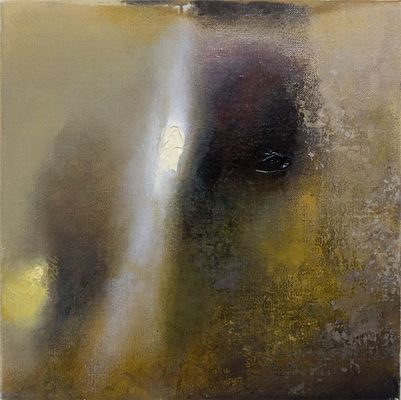
To return to Buckley’s fragment, the first two lines very much evoke how I paint nowadays. As you age, detail diminishes and patches of light become more luminous and float. I feel the most honest way of dealing with this is by smearing the oil paint on the canvas with the fingers and working close-up, blind. Only if the patches coalesce into an approaching image can the work gain a life.
-
Jonathan Walker was born in Melbourne, Australia and brought up on a dairy farm in Gippsland. In the 1970’s he studied painting at RMIT and won the Harold Wright Scholarship to the British Museum, London. During the 1980’s he exhibited at Pinacotheca Gallery, Richmond and had work shown at the NGV and Heidi City Art Gallery. Over the same period he designed the cover for the “Epigenesi” LP by Giancarlo Toniutti, Italy and conducted a mail exchange work with Achim Wollscheid, Germany. The work with artists through the post resulted in an article published in the bicentenary issue of Art and Australia 1988. He showed in artist run spaces such as WestSpace in the 90’s and 2000’s, and until 2012, taught painting at Victoria University, which is where we (Colleen Ahern and Lisa Radford) as organisers of the exhibition, among many others, had the privilege of being his student.
Walker’s knowledge was imparted to students through the careful selection of music, literature, and artists found in books that he himself had ordered for the library. Walker’s strategy was the generosity of sharing his vast knowledge with references specific to each student and their context.
Walker’s paintings share a similar focus and intimacy.
This exhibition presents a small selection of recent paintings alongside a publication that includes Walker’s writing. Observational and analytical, Walker’s work is a type of material notation — the time of day, colour and how it is blended, the both specific and fleeting location of a reflection on lino or the question of whether a chair leg should be included in a painting.
Please join us on Friday August 21 between 6-8pm to celebrate the opening of the exhibition.
Curated by Colleen Ahern and Lisa Radford.
B. Wurtz
Curated by Nic Tammens
March 26 - April 4, 2015
B.Wurtz works from a basement studio in his home on Manhattan’s Lower East Side.
This local fact is attested to by the plastic shopping bags and newsprint circulars that appear in his work. As formal objects, they don’t make loud claims about their origins but nonetheless transmit street addresses and places of business from the bottom of this long thin island. Like plenty of artists, Wurtz is affected by what is local and what is consumed. His work is underpinned by this ethic. It often speaks from a neighborhood or reads like the contents of a hamper:
“BLACK PLUMS $1.29 lb.”
“Food Bazaar”
“USDA Whole Pork Shoulder Picnic 99c lb.”
“RITE AID Pharmacy, with us it’s personal.”
“H. Brickman & Sons.”
“Sweet Yams 59c lb."
Most of the work in this exhibition was made while the artist was in residence at Dieu Donne, a workshop dedicated to paper craft in Midtown. Here Wurtz fabricated assemblages with paper and objects that are relatively lightweight, with the intention that they would be easily transportable to Australia. This consideration isn’t absolute in Wurtz’s work, but was prescriptive for making the current exhibition light and cheap. Packed in two boxes, these works were sent from a USPS post office on the Lower East Side and delivered to North Melbourne by Australia Post.
Wurtz appears courtesy of Metro Pictures, New York.
Thanks to Rob Halverson, Joshua Petherick, Sari de Mallory, Matt Hinkley, Helen Johnson, Fayen d'Evie, Ask Kilmartin, Lisa Radon, Ellena Savage, Yale Union, and "Elizabeth".
John Nixon
"Archive"
December 15 - January 20, 2014
The presentation of John Nixon's archive offered a rare showcase of this extensive collection of the artist's own publications, catalogues, posters, ephemera, editions and more, from the mid 1980s onwards, alongside a selection of his artworks.
Organized by John Nixon, Joshua Petherick and Matt Hinkley.
<a href=http://wfb.public-office.info/artist/john-nixon>All titles by John Nixon
"Habitat"
at Minerva, Sydney (organised by Joshua Petherick and Matt Hinkley)
November 15 - December 20, 2014
Lupo Borgonovo, Janet Burchill & Jennifer McCamley,
Lewis Fidock, HR Giger, Piero Gilardi, Veit Laurent Kurz,
Cinzia Ruggeri, Michael E. Smith, Lucie Stahl, Daniel Weil, Wols
Press Release:
“...It contained seven objects. The slender fluted bone, surely formed for flight, surely from the wing of some large bird. Three archaic circuitboards, faced with mazes of gold. A smooth white sphere of baked clay. An age-blackened fragment of lace. A fingerlength segment of what she assumed was bone from a human wrist, grayish white, inset smoothly with the silicon shaft of a small instrument that must once have ridden flush with the surface of the skin - but the thing’s face was seared and blackened.”
William Gibson, “Count Zero”, 1986
"Autumn Projects Archive"
Curated by Liza Vasiliou
March 6 - March 15, 2014
World Food Books, in conjunction with the Virgin Australia Melbourne Fashion Festival 2014, presented the Autumn Projects archive, consisting of a selection of early examples in Australian fashion with a particular interest in collecting designers and labels from the period beginning in the 1980’s, who significantly influenced the discourse of Australian Fashion.
Curated by Liza Vasiliou, the exhibition provided a unique opportunity to view pieces by designers Anthea Crawford, Barbara Vandenberg, Geoff Liddell and labels CR Australia, Covers, Jag along with early experimental collage pieces by Prue Acton and Sally Browne’s ‘Fragments’ collection, suspended throughout the functioning World Food Books shop in Melbourne.
H.B. Peace
presented by CENTRE FOR STYLE
November 14, 2013
"Hey Blinky, you say chic, I say same"
Anon 2013
H.B. Peace is a clothing collaboration between great friends Blake Barns and Hugh Egan Westland. Their pieces explore the divergences between 'character’ and ‘personality’ in garments....etc
Special Thanks to Joshua Petherick and Matt Hinkley of WFB and Gillian Mears
and a Very Special Thank you to Audrey Thomas Hayes for her shoe collaboration.
Janet Burchill & Jennifer McCamley
"Aesthetic Suicide"
May 10 - June 8, 2013
The first of our occasional exhibitions in the World Food Books office/shop space in Melbourne, "Aesthetic Suicide" presented a body of new and older works together by artists Janet Burchill & Jennifer McCamley, including videos, prints, a wall work, and publications.
During shop open hours videos played every hour, on the hour.
1967, English
Hardcover (w. dust jacket), 32 pages, 28 x 23.5 cm
Out of print title / used / fine
Published by
Pantheon / New York
$38.00 - Out of stock
Winter is coming, and all the mice are gathering food ... except for Frederick.
Leo Lionni’s Caldecott Honor–winning story about a little mouse who gathers something unusual for the long winter has been cherished by generations of readers.
Leo Lionni (May 5, 1910 – October 11, 1999) was an author and illustrator of children's books. Born in the Netherlands, he moved to Italy and lived there before moving to the United States in 1939, where he worked as an art director for several advertising agencies, and then for Fortune magazine. He returned to Italy in 1962 and started writing and illustrating children's books. Leo Lionni wrote and illustrated more than 40 highly acclaimed children’s books. He received the 1984 American Institute of Graphic Arts Gold Medal and was a four-time Caldecott Honor Winner.
Fine early hardcover edition with Fine dust jacket.
1995, English
Softcover, 200 pages, 28 x 23 cm
Ed. of 1000,
1st Edition, Out of print title / used / very good
Published by
Witte de With / Rotterdam
D.A.P. / New York
$140.00 - Out of stock
English language edition of the rare first major monographic catalogue on Paul Thek, published in conjunction with a major retrospective exhibition staged at Witte de With, Center for Contemporary Art, Rotterdam, June 3 - October 8, 1995. The exhibition went on to Berlin, Barcelona, Zürich, Marseille, accompanied by this important book on the history of one of America's great artists.
Lavishly illustrated throughout with Thek's notebooks, sculptures, installations, paintings, drawings, photographs, writings, and much more, accompanied by important historical texts by Ann Wilson, Anke Bangma, Harald Szeemann (interview with Thek), Richard Flood, Marietta Franke, Holland Cotter, Roland Groenenboom, and Rebecca Quaytman. Includes a selected bibliography.
Printed in an edition of 1000. Scarce in the English edition.
2013, English
Hardcover, 288 pages, 17 x 24 cm
Published by
Yale University Press / New Haven
$58.00 - Out of stock
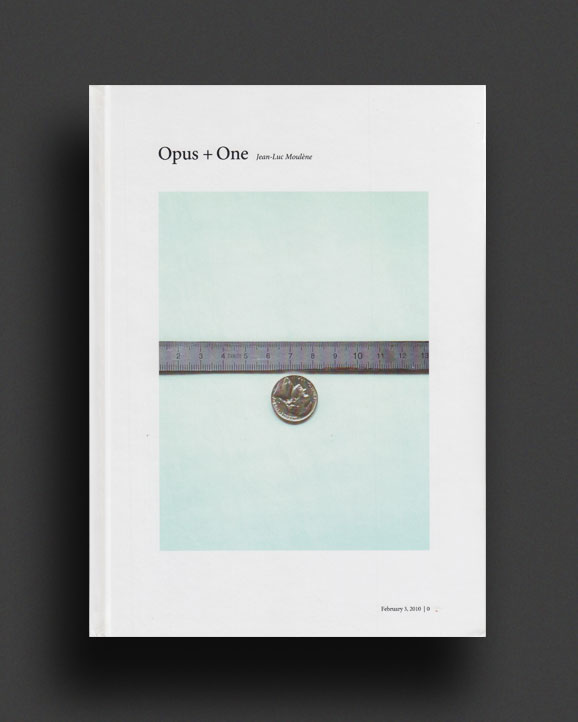
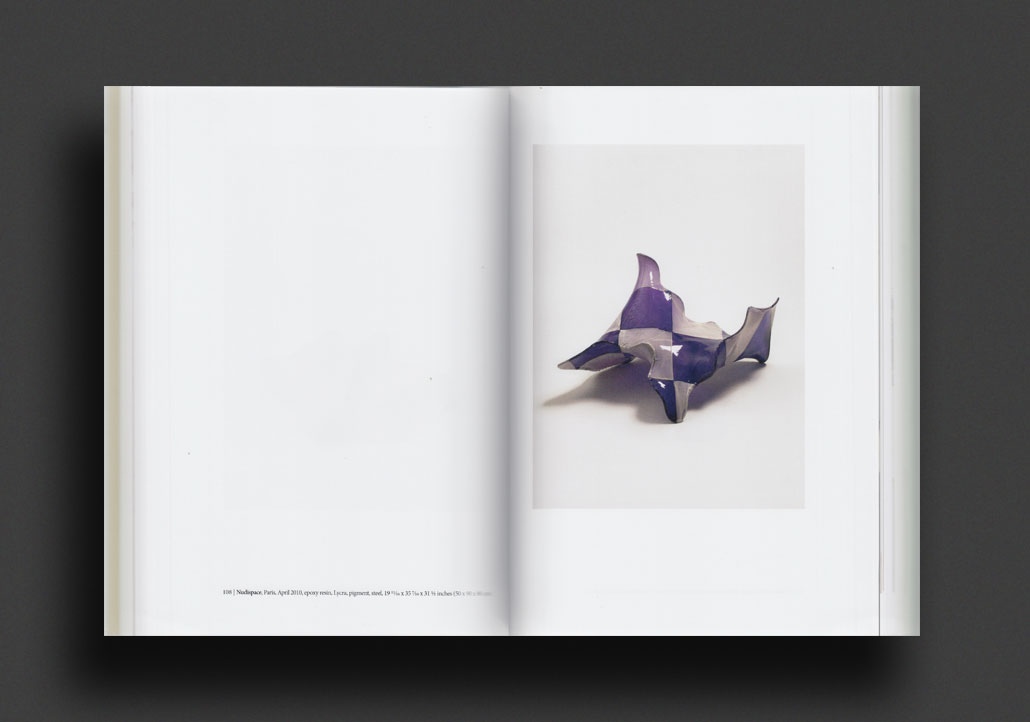
Since the late 1980s, Jean-Luc Moulène (b. 1955) has developed a body of work informed by a critical investigation of artistic authorship, addressing such issues as autonomy, immanence, and anarchic politics. Although he is best known for his enigmatic and seductive large-format photographs, Moulene has maintained a parallel exploration of materials and objects-manufactured and found, industrial and organic, intimate and imposing-that he has collectively titled Opus. This book, the first critical study of Moulene's work, brings together leading scholars to examine the artist's diverse aesthetic strategies and interests in the relationships between social and political arenas and systems and orders, including geometry, mathematics, social sciences, and human behavior. Featured essays also examine Moulene's theoretical and playful inquiries into the plasticity of materials and the ways we see and understand both still and moving images.
2017, English
Hardcover, 258 pages, 20 x 25.5 cm
Published by
Park Books / Zürich
$75.00 - Out of stock
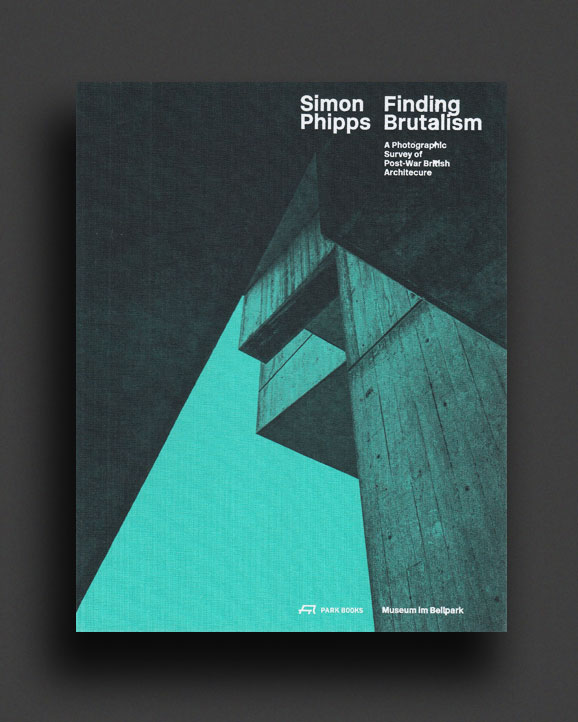
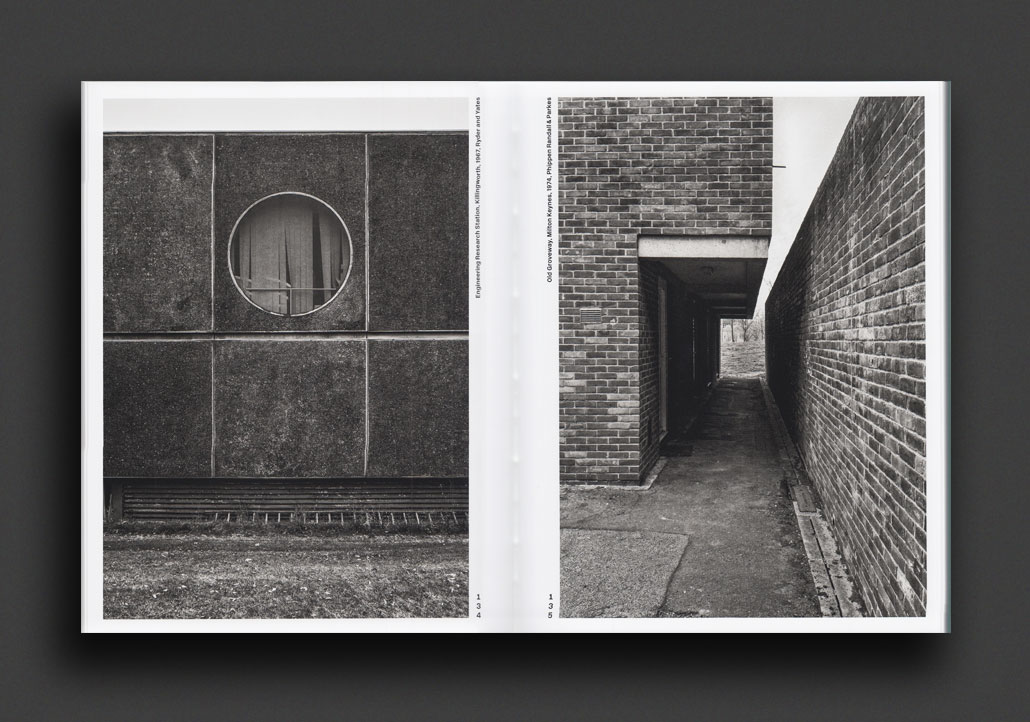
For more than thirty years, photographer Simon Phipps has carried out a project to document the brutalist buildings of Great Britain, amassing an extraordinary collection of photographs and historic documents that make clear the enormous contribution of architects to the transformation of the country in the postwar period. Finding Brutalism brings together 150 of these photographs. The buildings pictured date from the 1950s to the 1980s, and are striking for how they juxtapose buildings and architectural fragments, evoking the distinct atmosphere of brutalism. Rounding out the book is an essay that situates brutalism within the context of British architecture and recognizes Phipps's own contribution to its reception.
Great Britain underwent a massive rebuilding effort in the aftermath of World War II, with a wealth of new construction that reached virtually all parts of the country and ranged from public and private housing to schools and universities, churches, museums, galleries, commercial buildings, and even entire new towns. Architects took the opportunity to experiment with innovative layouts and new materials and techniques, resulting in radical new forms and buildings of outstanding quality, which we now associate with brutalism.
Published to accompany a recent exhibition at the Museum im Bellpark near Lucerne, Switzerland, Finding Brutalism is a remarkable achievement of preservation that will appeal to anyone interested in the history of architecture, and the illustrated and detailed catalogue of featured buildings makes it a perfect travel book as well.
Edited by Hilar Stadler and Andreas Hertach. Photographs by Simon Phipps. With contributions by Catherine Ince and Owen Hatherley, and a conversation with Kate Macintosh by Stephen Parnell
2015, English
Softcover, 216 pages, 127 x 197 cm
Published by
Fitzcarraldo Editions / London
$30.00 - Out of stock
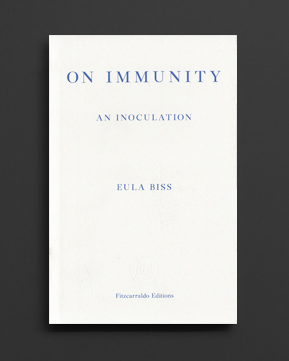
In this bold, fascinating book, Eula Biss addresses a chronic condition of fear - fear of the government, the medical establishment, and what may be in your children's air, food, mattresses, medicines, and vaccines. Reflecting on her own experience as a new mother, Biss investigates the metaphors and myths surrounding our conception of immunity and its implications for the individual and the social body. She extends a conversation with other mothers to meditations on Voltaire's Candide, Bram Stoker's Dracula, Rachel Carson's Silent Spring, Susan Sontag's AIDS and Its Metaphors, and beyond. On Immunity is an inoculation against our fear and a moving account of how we are all interconnected - our bodies and our fates.
Eula Biss is the author of The Balloonists and Notes from No Man's Land: American Essays, which received the Graywolf Press Nonfiction Prize and the National Book Critics Circle Award in Criticism. Her essays have appeared in The Best American Nonrequired Reading and The Best Creative Nonfiction, as well as in the Believer and Harper's. Her writing has been supported by fellowships from the Guggenheim Foundation, the Howard Foundation, and the National Endowment for the Arts. Biss holds a BA from Hampshire College and an MFA in nonfictionwriting from the University of Iowa. She teaches at Northwestern University and lives in Chicago.
2017, English
Softcover, 152 pages, 12.7 x 19.5 cm
Published by
Fitzcarraldo Editions / London
$30.00 - Out of stock
Imagine a type of writing so hard to define its very name means a trial, effort or attempt. An ancient form with an eye on the future, a genre poised between tradition and experiment. The essay wants above all to wander, but also to arrive at symmetry and wholeness; it nurses competing urges to integrity and disarray, perfection and fragmentation, confession and invention.
How to write about essays and essayists while staying true to these contradictions? Essayism is a personal, critical and polemical book about the genre, its history and contemporary possibilities. It’s an example of what it describes: an essay that is curious and digressive, exacting yet evasive, a form that would instruct, seduce and mystify in equal measure. Among the essayists to whom he pays tribute – from Virginia Woolf to Georges Perec, Joan Didion to Sir Thomas Browne – Brian Dillon discovers a path back into his own life as a reader, and out of melancholia to a new sense of writing as adventure.
Brian Dillon was born in Dublin in 1969. His books include Essayism, The Great Explosion (shortlisted for the Ondaatje Prize), Objects in This Mirror: Essays, I Am Sitting in a Room, Sanctuary, Tormented Hope: Nine Hypochondriac Lives (shortlisted for the Wellcome Book Prize) and In the Dark Room, which won the Irish Book Award for non-fiction. His writing has appeared in the Guardian, New York Times, London Review of Books, Times Literary Supplement, Bookforum, frieze and Artforum. He is UK editor of Cabinet magazine, and teaches at the Royal College of Art, London.
1968, English
Softcover, 124 pages, 20 x 14 cm
1st Edition, Out of print title / used / good
Published by
Lorrimer / London
$40.00 - In stock -
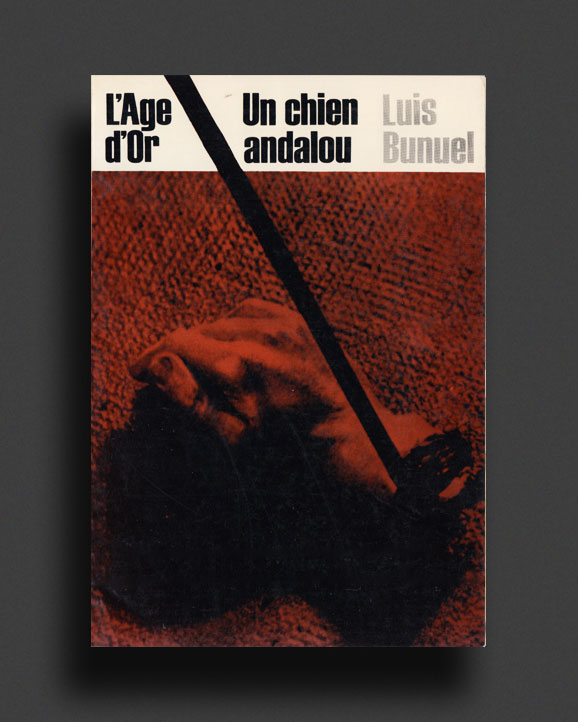
First edition of the Luis Buñuel volume of Classic Film Scripts, dedicated entirely to his masterpieces "Un chien andalou" and "l'Age d'or" (both co-scripted by Salvador Dali). Illustrated throughout with stills from these iconic surrealist films, accompanied by their full scripts translated from French by Marianne Alexandre. Surrealist cinema, as epitomised by Un Chien Andalou and L'Age D'Or, was a knife through the very heart of the establishment - a scorpionic, scatological black joke galvanised by the irrational, the uncanny and the spectre of de Sade.
Luis Buñuel Portolés was a Spanish filmmaker who worked in Spain, Mexico and France. When Luis Buñuel died at age 83, his obituary in the New York Times called him "an iconoclast, moralist, and revolutionary who was a leader of avant-garde surrealism in his youth and a dominant international movie director half a century later". His first picture made in the silent era was called "the most famous short film ever made" by critic Roger Ebert, and his last film made 48 years later won him Best Director awards from the National Board of Review and the National Society of Film Critics. Often associated with the surrealist movement of the 1920s, Buñuel created films from the 1920s through the 1970s. His work spans two continents, three languages, and an array of genres, including experimental film, documentary, melodrama, satire, musical, erotica, comedy, romance, costume dramas, fantasy, crime film, adventure, and western. Despite this variety, filmmaker John Huston believed that, regardless of genre, a Buñuel film is so distinctive as to be instantly recognizable, or, as Ingmar Bergman put it, "Buñuel nearly always made Buñuel films".
2014, English
Softcover, 296 pages, 15.2 x 22.9 cm
Published by
Columbia University Press / New York
$58.00 - Out of stock
Maya Deren (1917–1961) was a Russian-born American filmmaker, theorist, poet, and photographer working at the forefront of the American avant-garde in the 1940s and 1950s. Influenced by Jean Cocteau and Marcel Duchamp, she is best known for her seminal film Meshes of the Afternoon (1943), a dream-like experiment with time and symbol, looped narrative and provocative imagery, setting the stage for the twentieth-century's groundbreaking aesthetic movements and films.
Maya Deren: Incomplete Control assesses both the filmmaker's completed work and her numerous unfinished projects, arguing Deren's overarching aesthetic is founded on principles of incompletion, contingency, and openness. Combining the contrasting approaches of documentary, experimental, and creative film, Deren created a wholly original experience for film audiences that disrupted the subjectivity of cinema, its standards of continuity, and its dubious facility with promoting categories of realism. This critical retrospective reflects on the development of Deren's career and the productive tensions she initiated that continue to energize film.
This book is a thorough review of Maya Deren's total oeuvre, offering a study of one of our most important filmmakers who has been more overlooked than one might expect. Further study of Deren from a distinct point of view, as Keller offers, is a vital contribution. (Bill Nichols, film critic and editor of Maya Deren and the American Avant-Garde)
Keller's truly excellent book considers both Deren's theoretical writings and cinematic work and places them within the context of her life and the difficulties she faced as an experimental artist (frequently unfunded and living on the edge). This volume fills a gap in scholarship on Deren with clear and elegant writing. (Lucy Fischer, University of Pittsburgh)
Maya Deren: Incomplete Control is a tour de force of historical and critical scholarship that explores new primary research material from Maya Deren's voluminous and complex archive to assert the significance of incompletion and process as central to Deren's artistic and intellectual production. Keller's clear, erudite prose offers brilliant new readings of Deren's extant films, including canonical works like Meshes of the Afternoon, and comprehensively explores Deren's incomplete projects―films, research projects, writings―to draw out Deren's radical imaginings of art and culture. (Michael Zryd, York University)
A required resource for serious examination of Deren's groundbreaking films.... Keller's smoothly organized, cleanly written text is perhaps the most comprehensive single volume on Deren's work.... Essential. (Choice)
A must-read for scholars of experimental cinema, women filmmakers, and Maya Deren. (Film Criticism)
About the Author
Sarah Keller is assistant professor of Art and cinema studies at the University of Massachusetts–Boston. She is coeditor, with Jason Paul, of Jean Epstein: Critical Essays and New Translations.
2016, English
Softcover, 304 pages, 16 x 24 cm
Published by
Sternberg Press / Berlin
$40.00 - Out of stock
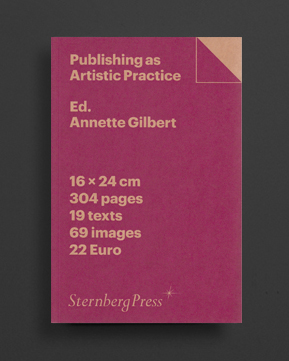
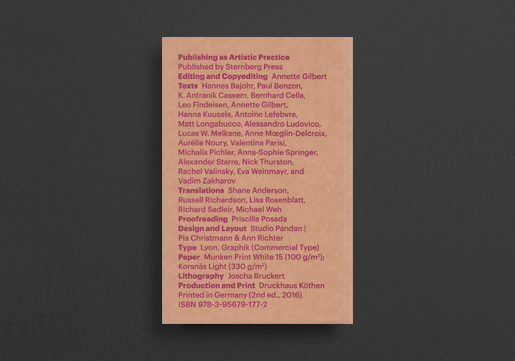
Texts by Hannes Bajohr, Paul Benzon, K. Antranik Cassem, Bernhard Cella, Annette Gilbert, Hanna Kuusela, Antoine Lefebvre, Matt Longabucco, Alessandro Ludovico, Lucas W. Melkane, Anne Moeglin-Delcroix, Aurélie Noury, Valentina Parisi, Michalis Pichler, Anna-Sophie Springer, Alexander Starre, Nick Thurston, Rachel Valinsky, Eva Weinmayr, Vadim Zakharov
What does it mean to publish today? In the face of a changing media landscape, institutional upheavals, and discursive shifts in the legal, artistic, and political fields, concepts of ownership, authorship, work, accessibility, and publicity are being renegotiated. The field of publishing not only stands at the intersection of these developments but is also introducing new ruptures. How the traditional publishing framework has been cast adrift, and which opportunities are surfacing in its stead, is discussed here by artists, publishers, and scholars through the examination of recent publishing concepts emerging from the experimental literature and art scene, where publishing is often part of an encompassing artistic practice. The number and diversity of projects among the artists, writers, and publishers concerned with these matters show that it is time to move the question of publishing from the margin to the center of aesthetic and academic discourse.
Design by Studio Pandan | Pia Christmann & Ann Richter
1989, English / Japanese
Softcover, 36 pages, 28 x 21.5 cm
Ed. of 1000 copies,
1st Edition, Out of print title / used / very good
Published by
Kohji Ogura Gallery / Nagoya
Lisson Gallery / London
$80.00 - Out of stock
Scarce Japanese Anish Kapoor catalogue published on the occasion of an exhibition at Kohji Ogura Gallery, Nagoya, Japan in co-operation with Lisson Gallery, London, 9th September – 14th October 1989. Published in an edition of 1000 copies, this collectable catalogue is illustrated throughout in colour with Kapoor's sculptural installations, alongside an essay by Pier Luigi Tazzi (in English and Japanese), biography and portrait.
Anish Kapoor (b. Mumbai, India in 1954 and lives and works in London) is one of the most influential sculptors of his generation. Perhaps most famous for public sculptures that are both adventures in form and feats of engineering, Kapoor manoeuvres between vastly different scales, across numerous series of work. Immense PVC skins, stretched or deflated; concave or convex mirrors whose reflections attract and swallow the viewer; recesses carved in stone and pigmented so as to disappear: these voids and protrusions summon up deep-felt metaphysical polarities of presence and absence, concealment and revelation. Forms turn themselves inside out, womb-like, and materials are not painted but impregnated with colour, as if to negate the idea of an outer surface, inviting the viewer to the inner reaches of the imagination. Kapoor’s geometric forms from the early 1980s, for example, rise up from the floor and appear to be made of pure pigment, while the viscous, blood-red wax sculptures from the last ten years – kinetic and self-generating – ravage their own surfaces and explode the quiet of the gallery environment. There are resonances with mythologies of the ancient world – Indian, Egyptian, Greek and Roman – and with modern times.
Very Good with only pinch on back cover, not affecting the rest of publication. Fine otherwise.
1993, English
Softcover, 176 pages, 25.5 x 23 cm
1st Edition, Out of print title / used / very good
Published by
Walker Art Centre / Minneapolis
$20.00 - Out of stock
Major monograph published by the Walker Art Centre, Minneapolis in 1993. Profusely illustrated throughout with essays by Peter Boswell, Andrzej Turowski, Patricia C. Phillips and Dick Hebdige, this extensive catalogue gives a wonderful overview of Wodiczko's unique and controversial oeuvre, traversing industrial design, sculpture, performance, photography, architecture, urban planning, social theory and critical writing, Wodiczko asks: what is public space?; who controls it? how is it used? what is its social role?.
Krzysztof Wodiczko (born April 16, 1943) is a Polish artist known for his large-scale slide and video projections on architectural facades and monuments. He has realized more than 80 such public projections in Australia, Austria, Canada, England, Germany, Holland, Ireland, Israel, Italy, Japan, Mexico, Poland, Spain, Switzerland, and the United States. War, conflict, trauma, memory, and communication in the public sphere are some of the major themes of his work. His practice, known as Interrogative Design, combines art and technology as a critical design practice in order to highlight marginal social communities and add legitimacy to cultural issues that are often given little design attention. He lives and works in New York City and teaches in Cambridge, Massachusetts, where he is currently professor in residence of art and the public domain for the Harvard Graduate School of Design (GSD). Wodiczko was formerly director of the Interrogative Design Group at the Massachusetts Institute of Technology (MIT) where he was a professor in the Visual Arts Program since 1991. He also teaches as Visiting Professor in the Psychology Department at the Warsaw School of Social Psychology.
Very Good copy.
1989, German
Softcover (staple-bound), 40 pages, 21 x 29.5 cm
Ed. of 700,
1st Edition, Out of print title / used / very good
Published by
Michael Werner / Köln
$38.00 - Out of stock
Markus Lüpertz catalogue published by Michael Werner in Köln, 1989. Features a wrap cover designed by Lüpertz himself, 16 tipped-in colour plates of his catalogued paintings, installation views, and a text by Margitta Buchert (German). Published in an edition of 700 copies.
Very Good copy.
1974, English / Spanish / French / German / Italian
Hardcover (w. dust jacket), 114 pages, 24 x 30.5 cm
Signed by Artist,
1st Edition, Out of print title / used / very good
Published by
Artes de México / México
$440.00 - Out of stock
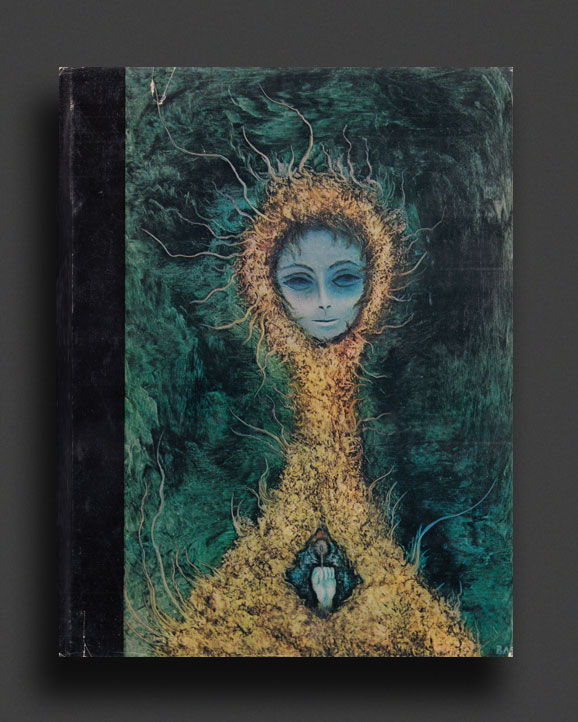
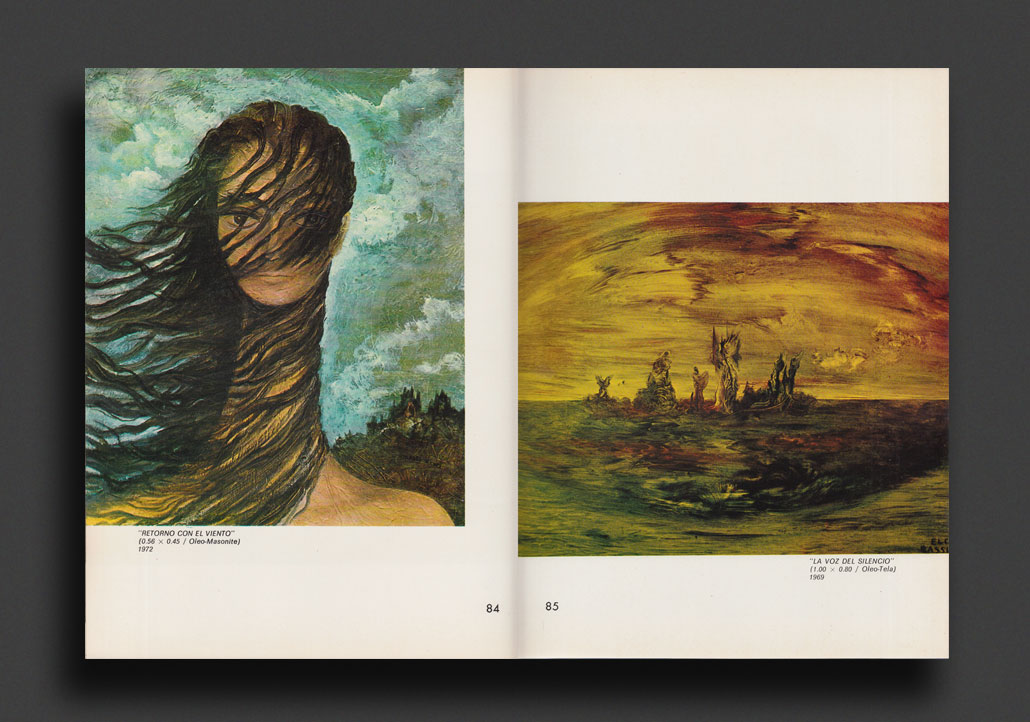
Very rare Mexican hardcover major monograph on the work of self-taught Mexican surrealist painter Sofía Bassi, published in 1974 by Artes de México. This copy exceptionally special with inscription and signature on the title page by the artist herself. Profusely illustrated throughout with Bassi's visionary oil paintings, accompanied by texts from Salvador Elizondo and literary quotes (Apollinaire, etc.). Texts in English, Spanish, French, German, and Italian, including biography, exhibition history, press, and portrait. A wonderful book on this fantastic, little-known Mexican painter.
Sofía Bassi (1913 – 1998) was a self taught Mexican painter and writer noted for her surrealist work as well as her personal life, which included five years in prison for murder of Count Cesare D’Aqequarone, the husband of her daughter Claire, an incident that she stated was an accident, although rumors stated that her daughter was the one that shot Bassi's husband. Bassi maintained an active career despite incarceration, painting her first mural in prison in Acapulco in 1969, with the assistance of Alberto Gironella, José Luis Cuevas, Rafael Coronel and Francisco Corzas. Not belonging to any particular art movement, Jean Michel Cropsal in 1972 called her work “magical impressionism,” but it is more often classified as a style of Surrealism. Bassi described art as an elixir that she wants to drink until the end of her career, to keep from dying. She painted anthropomorphic landscapes and beings representing lost continents and cities. Later in her life she worked as a member of the World Human Rights Committee based in New York City. In 1991, she received a medal from the Mexican government for her work with the elderly. She lived in Lomas de Chapultepec, painting and writing up until her death. These last few years were spent living with her daughter Claire. They had few visitors and enjoyed each other's company while Sofia painted. She often used Claire as a model for her works. About twelve years before her death, she designed and painted a fiberglass “egg-sarcophagus” to be used for her funeral. She considered the egg as a sign of fertility and rebirth, an image of such appears in a painting she did for NASA.
Very Good copy with wear and chipping to dust jacket edges. Signed copy!
1956 / 1960, English
Hardcover, 25 x 20.5 cm
Out of print title / used / good
Published by
Harcourt
Brace & World
Inc. / New York
$45.00 - Out of stock
Library-bound early edition (roughly 1960) hardcover copy of Ann and Paul Rand's first children's book, awarded the New York Times Best Illustrated Children's Book in 1956. Paul Rand (1914-1996) was an American commercial artist who, together with his wife Ann, between 1956 and 1970, produced four picture books together combining rhythmic verse with illustrations exhibiting Paul's keen interest in Swiss Style graphic design. Paul Rand (born Peretz Rosenbaum; August 15, 1914 – November 26, 1996) was an American art director and graphic designer, best known for his corporate logo designs, including the logos for IBM, UPS, Enron, Morningstar, Inc., Westinghouse, ABC, and NeXT. He was one of the first American commercial artists to embrace and practice the Swiss Style of graphic design. Rand was a professor emeritus of graphic design at Yale University in New Haven, Connecticut where he taught from 1956 to 1969, and from 1974 to 1985. He was inducted into the New York Art Directors Club Hall of Fame in 1972.
This lovely scarce early edition was printed when the merger between Harcourt Brace and World Publishing occurred, and is a much earlier printing than the more common Harcourt Brace Jovanovich 1970s reprint.
Good copy but in library-binding (hardcover), w. associated stamps and cards. Otherwise a Very Good copy throughout. No dust jacket.
1992, Japanese
Softcover, 225 pages, 24 x 25 cm
1st Edition, Out of print title / used / very good
Published by
The Japan Association of Art Museums / Tokyo
$90.00 - Out of stock
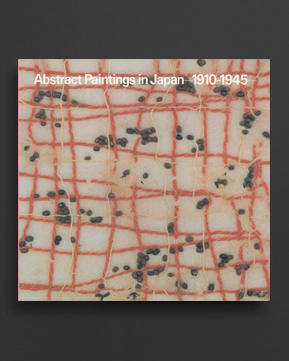
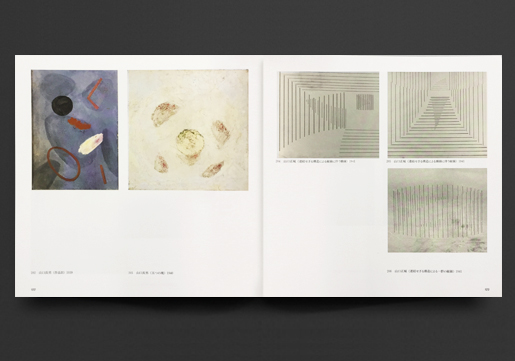
Incredible comprehensive monograph surveying Abstract Painting in Japan 1910-1945, published on the occasion of the first (and possibly only) major travelling exhibition on the subject. Travelling across six of Japan's major museums in 1992, this book of paintings is what we are left with - 225 pages profusely illustrated throughout with paintings from across Japan's avant garde, including stunning examples of leading figures and those less seen beyond this survey. Designed and compiled in great detail, this historical book provides profiles on all of the artists, a history of abstraction in painting in Japan, a breakdown and profile of all major movements and styles of the period, a chronology, detailed list of works, accompanying texts and much more, all primarily in Japanese with a preface and afterword by Masayoshi Honma also in English.
Preface:
"There has been a growing interest in the prewar avant-garde an created from the Taisho period to the early Showa period in recent years. While research works on “abstract art” have been individualiy carried out by various museums and researchers, there has been no opportunity for comprehensive exhibitions and presentations of abstract paintings. In organizing this exhibition, participating museums and the Japan Association of Art Museums established a research committee, “Abstract Paintings in Japan: 1910-1945", and made investigations throughout the country. This exhibition aims at providing a whole picture of Japan’s “abstract paintings” on the basis of the result of the varied studies done to the present. We hope that the exhibition puts together these studies systematically and offers a clue to future researches. “Abstract art” is still unfamiliar to the general public. We would be very glad it this exhibition, which displays abstract works chronologically from their introduction into Japan, could help people understand how to appreciate “abstraction”, which the avant-garde art movement of the early twentieth century had achieved. We are deeply grateful to the museums and private collectors that lent their treasured works for making this exhibition possible, as well as to many others for their corporation. We are also deeply thankful to Kao Corporation for its support and assistance. - April 1992, Organizer"
Very Good - Fine Copy.
1988, English / Russian
Softcover, 280 pages, 28.5 x 22.5 cm
1st Edition, Out of print title / used / good
Published by
Ministry of Culture / USSR
Stedlijk Museum / Amsterdam
$35.00 - Out of stock
Major monographic catalogue published in 1988 for a travelling exhibition, Kazimir Malevich 1878-1935, at the Russian Museum, Leningrad; Tretiakov Gallery, Moscow; Stedlijk Museum, Amsterdam. Profusely illustrated throughout in colour and monochrome this comprehensive retrospective of Malevich's work brings together for the first time the collections of his work held by Russia and The Netherlands. His paintings, graphic works, stage designs, book illustrations and ceramics are all discussed and illustrated, with many accompanying essays in English and Dutch.
Good copy w. cover wear. Clean and tight throughout.
1971, English
Softcover, 210 pages, 23 x 25 cm
1st UK Edition, Out of print title / used / good
Published by
Mathews Miller Dunbar / London
$70.00 - Out of stock
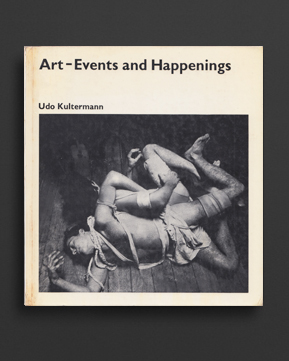
First English edition from 1971, Udo Kultermann's "Art-Events and Happenings", published by Mathews Miller Dunbar of London, translated by John William Gabriel. A deep reflection on an important part of Art's development throughout the 1960s - the turn to action through performance and conceptual art - surveying happenings, protests, theatre, ritual, land art and much more, and featuring a vast collection of black and white photographic illustrations of the work of Allan Kaprow, Ann Halprin, Yvonne Rainer, Merce Cunningham, Otto Mühl, Oyvind Fahlstrom, Piero Gilardi, Charlotte Moorman, Franz Erhard Walther, Joseph Beuys, Tetsumi Kudo, Lygia Clark, Carolee Schneemann, Stan Brakhage, John Cage, Hermann Nitsch, Günther Brus, Dennis Oppenheim, Jean-Jacques Lebel, Andy Warhol, Jan Dibbets, Carl Andre, Barry La Va, Rafael Ferrer, Marinus Boezum, Nam June Paik, Wolf Vostell, Milan Knizak, Jackson Pollock, Saburo Murakami, Atsuko Tanaka, Claes Oldenburg, Piero Manzoni, Peter Hutchinson, Christo, Robert Morris, and many more.
Very good copy (some tanning, previous owners name to first page)
1981, English
Softcover, 76 pages, 18.5 x 24 cm
Out of print title / used / good
Published by
Art & Text / Prahran
$50.00 - Out of stock
ART & TEXT 1
Autumn 1981
Edited by Paul Taylor
CONTENTS :
Editorial: On Criticism
The lk and Australian Aborigines by Peter Brook
The Mirror Without A Memory by Giorgio Colombo
Australian 'New Wave' and the 'Second Degree' by Paul Taylor
SPECIAL SECTION:
Artists in Society
Collaboration : Artists Working Collectively by Janine Burke
Modernism and Morality by Suzi Gablik
The 'Sixties Crisis and Aftermath by Ian Burn
Book Reviews:
'A Fable of Modern Art' by Dore Ashton by Memory Holloway
Subculture: The Meaning of Style by Dick Hebdige by Philip Brophy
Art & Text, one of the landmark contemporary art magazines of the 1980s and 1990s. Founded in Melbourne, Australia, in 1981 by Paul Taylor (1957–92), who soon moved to New York City to make his mark as an art critic, the magazine went on to become one of a handful of international art magazines that succeeded in capturing the turmoil and passing brilliance of that period of postmodernism.
Very Good - general wear/tanning. Spotting/toning to cover.
1981, English
Softcover (w. John Nixon insert), 68 pages, 18.5 x 24 cm
1st Edition, Out of print title / used / very good
Published by
Art & Text / Prahran
$60.00 - Out of stock
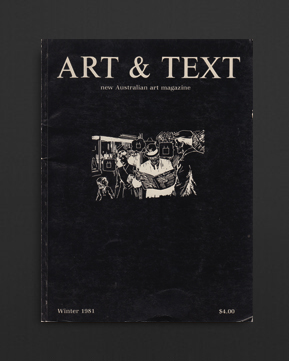
ART & TEXT 2
Winter 1981
Edited by Paul Taylor
CONTENTS:
"On Some Alternatives to the Code in the Age of Hyperreality: the Hermit and the City—Dweller" by John Young and Terry Blake
"The Desire of Maria Kozic" by Adrian Martin
"David Wilson’s New Sculpture" by Patrick McCaughey
"Modernism and Realism: Some Orientations" by Terry Smith
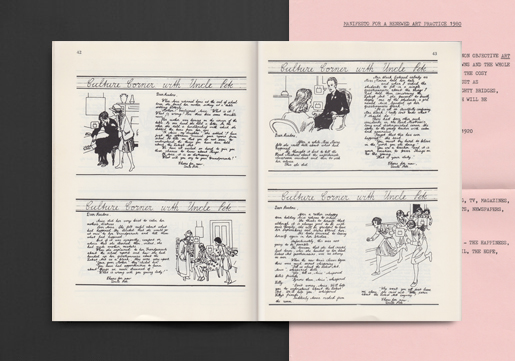
"Culture Corner" by Peter Tyndall
Manifestos:
"Manifesto for a future Sculpture Triennial" by Judy Annear
"Manifesto for a Renewed Art Practice 1980" by John Nixon
Book Reviews:
"About Looking by John Berger" by Ian North
"The Shock of the New: Art and the Century of Change by Robert Hughes" by David Bromfield
"The Years of Hope: Australian Art and Criticism 1959 — 1968 by Gary Catalano" by Noel Hutchison
note: this is a rare copy that still contains the insert manifesto "Manifesto for a Renewed Art Practice 1980" by John Nixon
Art & Text, one of the landmark contemporary art magazines of the 1980s and 1990s. Founded in Melbourne, Australia, in 1981 by Paul Taylor (1957–92), who soon moved to New York City to make his mark as an art critic, the magazine went on to become one of a handful of international art magazines that succeeded in capturing the turmoil and passing brilliance of that period of postmodernism.
Very Good - general wear/tanning. Includes Nixon's inserted manifesto.
1981, English
Softcover, 72 pages, 17.5 x 24 cm
1st Edition, Out of print title / used / very good
Published by
Art & Text / Prahran
$45.00 - Out of stock
ART & TEXT 4
Summer 1981
Edited by Paul Taylor
CONTENTS:
"The Decentred Unicorn (A Mild Perversion)" by Margaret Grafton
"Spider Woman in Australia" by Juan Davila
"Spider Woman in Playing With Fire!" by Juan Davila
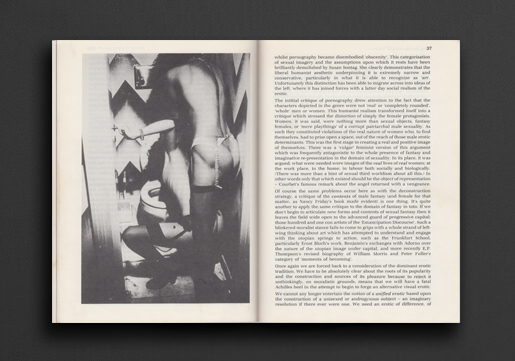
"The Re―education of Desire: Some Thoughts on Current Erotic Visual Practice" by Mick Carter
"What can we do with the Art Class?" by Donald Brook
"Slave Guitars (formerly Slave Guitars of the Art Cult)" by Peter Tyndall
"Gays and Film" (edited by Richard Dyer) by Dave Sargent
"Women, Sex and Pornography by Beatrice Faust; The History of Sexuality Part 1 by Michel Foucault" by Judy Annear
"Three Facts by Imants Tillers" by John Young
"Index to numbers 1 ― 4"
Art & Text, one of the landmark contemporary art magazines of the 1980s and 1990s. Founded in Melbourne, Australia, in 1981 by Paul Taylor (1957–92), who soon moved to New York City to make his mark as an art critic, the magazine went on to become one of a handful of international art magazines that succeeded in capturing the turmoil and passing brilliance of that period of postmodernism.
Very Good - general wear/tanning.
1983, English
Softcover, 104 pages, 17.5 x 24 cm
1st Edition, Out of print title / used / very good
Published by
Art & Text / Prahran
$45.00 - Out of stock
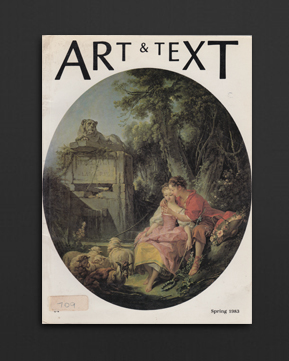
ART & TEXT 11
Spring 1983
Edited by Paul Taylor
Blurb by Malcolm McLaren
CONTENTS:
"The Precession of Simulacra" by Jean Baudrillard (translated by Paul Foss and Paul Patton
"Kristeva, Bakhtin and Carnival" by Kateryna Arthur
"Performance Art As Politicised Epistemology" by Thomas Huhn
"Anything Still" by John Young
"Duck Rock" by Andrew Preston
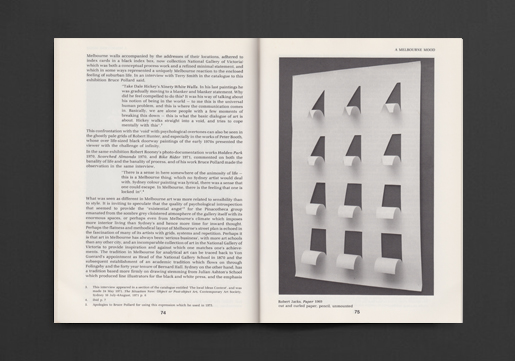
"A Melbourne Mood" by Frances Lindsay
"Made by →↑→" by Mary Eagle
"Horrality" by Philip Brophy
Art & Text, one of the landmark contemporary art magazines of the 1980s and 1990s. Founded in Melbourne, Australia, in 1981 by Paul Taylor (1957–92), who soon moved to New York City to make his mark as an art critic, the magazine went on to become one of a handful of international art magazines that succeeded in capturing the turmoil and passing brilliance of that period of postmodernism.
Very Good - general wear/tanning.
1987, English
Softcover, 144 pages, 17.5 x 24 cm
Out of print title / used / very good
Published by
Art & Text / Prahran
$40.00 - Out of stock
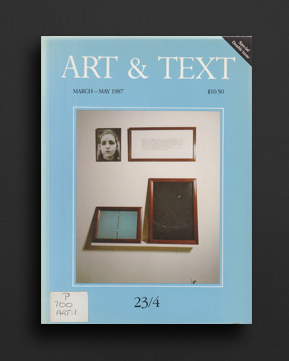
ART & TEXT 23/4
March - May 1987
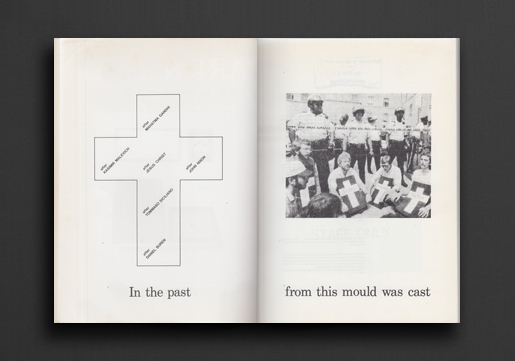
"After THE EVENT, a special double issue of Art & Text on "culturecidal" aspects of appropria-
tion and (post) modernity, with Juan Davila, Laleen Jayamanne and Geeta Kapur, and Eric
Michaels - plus Yvonne Rainer discusses The Man Who Envied Women, Peter Tyndall sket-
ches the 1986 Sydney Biennale, Imants Tillers plays Bicentennial in the Park, Paul Carter takes
a gondola through Gondwanaland, Sophie Calle and Jean Baudrillard follow perfect strangers,
Allen S. Weiss mocks the Sun King dazed in anamorphic gardens, and Danielle Duval chases
Borges and others through the labyrinth of Australian "picturing".
Edited by Paul Foss
Art & Text, one of the landmark contemporary art magazines of the 1980s and 1990s. Founded in Melbourne, Australia, in 1981 by Paul Taylor (1957–92), who soon moved to New York City to make his mark as an art critic, the magazine went on to become one of a handful of international art magazines that succeeded in capturing the turmoil and passing brilliance of that period of postmodernism.
Very Good - general wear/tanning. Ex-library sticker to cover and stamp inside.
2018, English
Hardcover, 264 pages, 23.5 x 16 cm
Published by
The MIT Press / Massachusetts
e-flux / New York
$75.00 - Out of stock
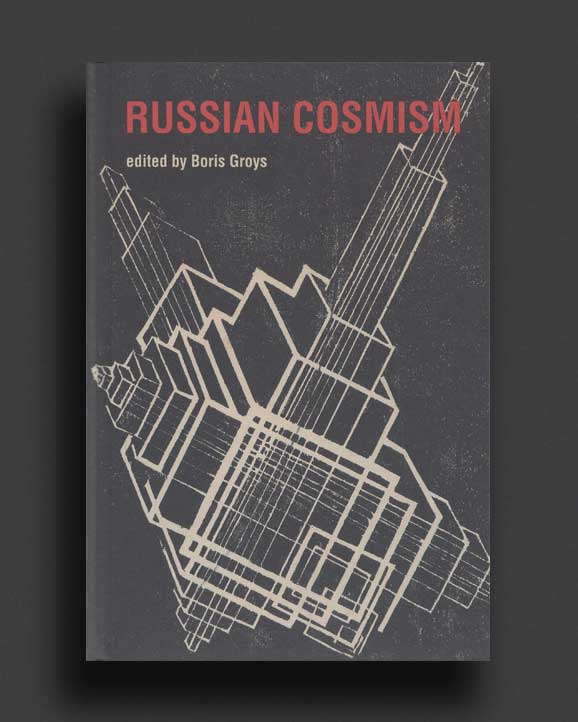
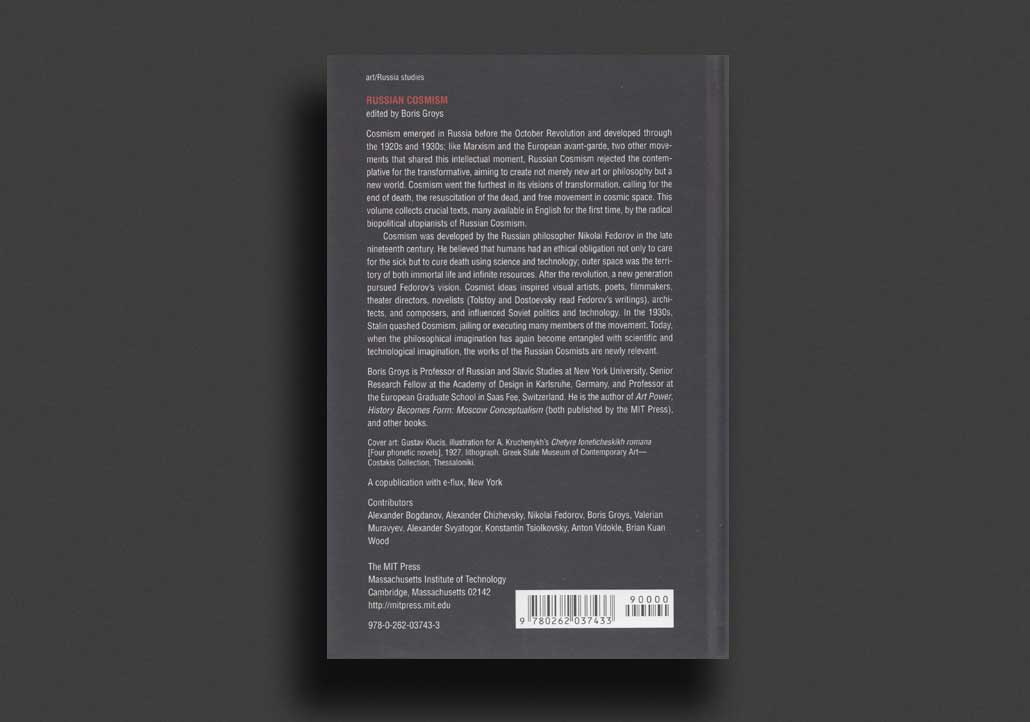
Cosmism emerged in Russia before the October Revolution and developed through the 1920s and 1930s; like Marxism and the European avant-garde, two other movements that shared this intellectual moment, Russian Cosmism rejected the contemplative for the transformative, aiming to create not merely new art or philosophy but a new world. Cosmism went the furthest in its visions of transformation, calling for the end of death, the resuscitation of the dead, and free movement in cosmic space. This volume collects crucial texts, many available in English for the first time, by the radical biopolitical utopianists of Russian Cosmism.
Cosmism was developed by the Russian philosopher Nikolai Fedorov in the late nineteenth century; he believed that humans had an ethical obligation not only to care for the sick but to cure death using science and technology; outer space was the territory of both immortal life and infinite resources. After the revolution, a new generation pursued Fedorov’s vision. Cosmist ideas inspired visual artists, poets, filmmakers, theater directors, novelists (Tolstoy and Dostoevsky read Fedorov’s writings), architects, and composers, and influenced Soviet politics and technology. In the 1930s, Stalin quashed Cosmism, jailing or executing many members of the movement. Today, when the philosophical imagination has again become entangled with scientific and technological imagination, the works of the Russian Cosmists seem newly relevant.
Contributors
Alexander Bogdanov, Alexander Chizhevsky, Nikolai Fedorov, Boris Groys, Valerian Muravyev, Alexander Svyatogor, Konstantin Tsiolkovsky, Anton Vidokle, Brian Kuan Wood
A copublication with e-flux, New York
About the Editor
Boris Groys is Professor of Russian and Slavic Studies at New York University, Senior Research Fellow at the Academy of Design in Karlsruhe, Germany, and Professor at the European Graduate School in Saas Fee, Switzerland. He is the author of Art Power, History Becomes Form: Moscow Conceptualism (both published by the MIT Press), and other books.
2012, English/Dutch
Hardcover (cloth-bound), 536 pages, 17 x 24 cm
Published by
Roma / Amsterdam
$83.00 - Out of stock
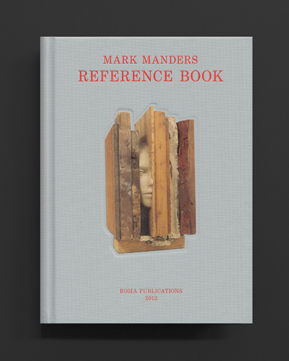
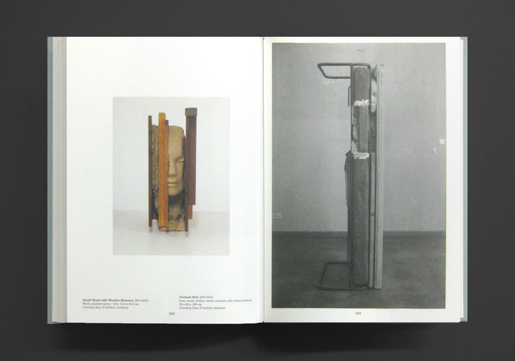
The great Roma Publications compiled (almost) encyclopedic book which covers Dutch artist Mark Manders' entire oeuvre from the late 1980s until the present. It contains facsimiles of the artist's publications and a focus on a large number of recent, never-published works. Well over 500 pages wrapped in hardcovers.