World Food Books' programme is largely produced on Kulin Nation land. We acknowledge the Wurundjeri people of the Kulin Nation as the first and continuing custodians of this land, and pay respect to their Elders past, present, and emerging.
World Food Books is an arts and special interests bookshop in Naarm / Melbourne. Founded in 2010, World Food Books is devoted to the presentation of a rotating, hand-selection of international art, design, literary and counterculture publications with an emphasis on the anti-traditional, the experimental, the avant-garde, the heretic, the marginal.
Presenting new titles alongside rare and out-of-print books, catalogues and journals spanning the fields of modern and contemporary art, design, photography, illustration, film, literature, poetry, cultural theory, philosophy, sexuality, popular and underground culture in its many radical forms, World Food Books wishes to encourage adventurous, thoughtful and open-minded reading, looking, writing, and exchange of publishing and ideas, both current and historical.
As well as our bookshop, located in Melbourne's historical Nicholas Building, all of our inventory is available internationally via our online mail-order service.
World Food Books semi-regularly co-ordinates "Occasions", a programme of exhibits and events at the bookshop and in partnership with other hosts (such as museums and art galleries) that develop out of the activities, relationships and content of the bookshop itself.
World Food Books
The Nicholas Building
37 Swanston Street
Room 5, Level 6
Melbourne 3000
Australia
SHOP HOURS:
Thu–Fri 12–6, Sat 12–5
WEB-SHOP OPEN 24/7
World Food Books
Postal Address:
PO Box 435
Flinders Lane
Victoria 8009
Australia
Art
Theory / Essay
Architecture / Interior
Graphic Design / Typography
Photography
Fashion
Eros
LGBTQ+
Fiction / Poetry
Weird / Speculative / Science Fiction / Horror
Transgressive / Visceral / Abject
Symbolism / Decadence / Fin de siècle
Film / Video
Painting
Sculpture / Installation
Performance / Dance / Theater
Drawing
Sound / Music
Curatorial
Group Shows / Collections
Periodicals
Out-of-print / Rare
Posters / Ephemera / Discs
Signed Books
World Food Books Gift Voucher
World Food Book Bag
Australian Art
Australian Fiction
Australian Science Fiction / Speculative Fiction
Australian Poetry
Australian Photography
Japanese Photography
Conceptual Art
Minimal Art
Dada
'Pataphysics / Oulipo
Fluxus
Concrete Poetry
Pop Art
Surrealism
Arte Povera
Arte Informale / Haute Pâte / Tachism
Nouveau Réalisme / Zero / Kinetic
Situationism / Lettrism
Collage / Mail Art / Xerox Art
Art Brut / Folk / Visionary / Fantastic
Illustration / Graphic Art / Bandes Dessinées
Furniture
Italian Radical Design / Postmodernism
Textiles
Ceramics / Glass
Counterculture
Protest / Revolt
Philosophy
Psychoanalysis
Anthropology
Anarchism
Socialism / Anarchism / Communism / Capitalism
Literary Theory / Semiotics / Language
Feminism / Women's Studies
Gender Studies / Sexuality
Anthropology
Fetishism / BDSM
Drugs / Psychedelia
Crime / Violence
Animal Rights / Veganism
Occult / Esoterica
Ecology / Earth / Alternative Living
Whole Earth / Crafts
All prices in AUD (Australian dollars)
Pick-Ups
Pick-up orders can be collected in our bookshop during opening hours after order date. Please collect any Pick-up orders within 2 weeks of ordering as we have limited storage space. Orders will be released back into stock if not collected within this time. No refunds can be made for pick-ups left un-collected. If you cannot make it in to the bookshop in this time-frame, please choose postage option.
Return Policy
All sales are final. We do accept returns (for refund or exchange) for items received in error. All our orders are packed with special care using heavy-duty padding and cardboard book-mailers or bubble mailers (for smaller books), using reinforcement where required. We cannot take responsibility for any lost, stolen or damaged parcels.
Insurance
Should you wish to insure your package, please email us directly after placing your order and we can organise this at a small extra expense. Although all standard/express tracked packages are very safe and dependable, we cannot take responsibility for any lost, stolen or damaged parcels. We recommend insurance on valuable orders.
Interested in selling your old books, catalogues, journals, magazines, comics, fanzines, ephemera? We are always looking for interesting, unusual and out-of-print books to buy. We only buy books in our fields of interest and specialty, and that we feel we can resell.
We base these prices on desirability, market value, in-print prices, condition and our current stock levels. We offer cash, store credit, and can take stock on consignment. All
about 25% of the price we expect to get when we sell them, or 30% in store credit. We base these prices on desirability, market value, in-print prices, condition and our current stock levels.
Sell your books any day of the week. You can drop them off and return later. If you have a lot of books, we can visit your Sydney home.
We buy books that we feel we can resell. We offer about 25 % of the price we expect to get when we sell them, or 30% in store credit. We base these prices on desirability, market value, in-print prices, condition and our current stock levels.
Philadelphia Wireman
03 August - 01 September, 2018
World Food Books is proud to announce our next Occasion, the first presentation of sculptures by Philadelphia Wireman in Australia.
The Philadelphia Wireman sculptures were found abandoned in an alley off Philadelphia’s South Street on trash night in 1982. Their discovery in a rapidly-changing neighbourhood undergoing extensive renovation, compounded with the failure of all attempts to locate the artist, suggests that the works may have been discarded after the maker’s death. Dubbed the "Philadelphia Wireman" during the first exhibition of this work, in 1985, the maker’s name, age, ethnicity, and even gender remain uncertain. The entire collection totals approximately 1200 pieces, all intricately bound together with tightly-wound heavy-gauge wire (along with a few small, abstract marker drawings, reminiscent both of Mark Tobey and J.B. Murry). The dense construction of the work, despite a modest range of scale and materials, is singularly obsessive and disciplined in design: a wire armature or exoskeleton firmly binds a bricolage of found objects including plastic, glass, food packaging, umbrella parts, tape, rubber, batteries, pens, leather, reflectors, nuts and bolts, nails, foil, coins, toys, watches, eyeglasses, tools, and jewellery.
Heavy with associations—anthropomorphic, zoomorphic, and socio-cultural responses to wrapped detritus—the totemic sculptures by Philadelphia Wireman have been discussed in the context of work created to fulfil the shamanistic needs of alternative religions in American culture. Curators, collectors, and critics have variously compared certain pieces to sculpture from Classical antiquity, Native American medicine bundles, African-American memory jugs, and African fetish objects. Reflecting the artist’s prolific and incredibly focused scavenging impulse, and despite—or perhaps enhanced by—their anonymity, these enigmatic objects function as urban artefacts and arbiters of power, though their origin and purpose is unknown. Philadelphia Wireman, whatever their identity, possessed an astonishing ability to isolate and communicate the concepts of power and energy through the selection and transformation of ordinary materials. Over the course of the past two decades, this collection has come to be regarded as an important discovery in the field of self-taught art and vernacular art.
Presented in collaboration with Fleisher-Ollman Gallery, Philadelphia, and Robert Heald, Wellington.
Susan Te Kahurangi King
02 February - 10 March, 2018
Susan Te Kahurangi King (24 February 1951 - ) has been a confident and prolific artist since she was a young child, drawing with readily available materials - pencils, ballpoint pens and felt-tip markers, on whatever paper is at hand. Between the ages of four and six Susan slowly ceased verbal communication. Her grandparents William and Myrtle Murphy had developed a special bond with Susan so they took on caring responsibilities for extended periods. Myrtle began informally archiving her work, carefully collecting and storing the drawings and compiling scrapbooks. No drawing was insignificant; every scrap of paper was kept. The King family are now the custodians of a vast collection containing over 7000 individual works, from tiny scraps of paper through to 5 meter long rolls.
The scrapbooks and diaries reveal Myrtle to be a woman of great patience and compassion, seeking to understand a child who was not always behaving as expected. She encouraged Susan to be observant, to explore her environment and absorb all the sights and sounds. Myrtle would show Susan’s drawings to friends and people in her community that she had dealings with, such as shopkeepers and postal workers, but this was not simply a case of a grandmother’s bias. She recognised that Susan had developed a sophisticated and unique visual language and sincerely believed that her art deserved serious attention.
This was an unorthodox attitude for the time. To provide some context, Jean Dubuffet coined the term Art Brut in 1945 to describe work created by self-taught artists – specifically residents of psychiatric institutions and those he considered to be visionaries or eccentrics. In 1972 Roger Cardinal extended this concept by adopting the term Outsider Art to describe work made by non-academically trained artists operating outside of mainstream art networks through choice or circumstance. Susan was born in Te Aroha, New Zealand in 1951, far from the artistic hubs of Paris and London that Dubuffet and Cardinal operated in. That Myrtle fêted Susan as a self-taught artist who deserved to be taken seriously shows how progressive her attitudes were.
Susan’s parents Doug and Dawn were also progressive. Over the years they had consulted numerous health practitioners about Susan’s condition, as the medical establishment could not provide an explanation as to why she had lapsed into silence. Dawn educated herself in the field of homeopathy and went on to treat all twelve of her children using these principles – basing prescriptions on her observations of their physical, mental and emotional state.
Doug was a linguist with an interest in philosophy who devoted what little spare time he had to studying Maori language and culture. To some extent their willingness to explore the fringes of the mainstream made them outsiders too but it was their commitment to living with integrity and their respect for individuality that ensured Susan’s creativity was always encouraged.
Even though Susan’s family supported her artistic pursuits, some staff in schools and hospitals saw it as an impediment to her assimilation into the community and discouraged it in a variety of ways. Her family was not always aware of this and therefore did not fully understand why Susan stopped drawing in the early 1990s. However, rather than dwell on the challenges that Susan faced in pursuit of her artistic practice, they prefer to highlight her achievements. In 2008 Susan began drawing again in earnest, after an almost 20 year interruption, and her work is now shown in galleries around the world.
Susan grew up without television and has been heavily influenced by the comics she read as a child. She is absolutely fearless in the appropriation of recognizable characters, such as Donald Duck and Mickey Mouse, in her work. She twists their limbs, contorts their faces, compresses them together, blends them into complex patterned backgrounds - always imbuing them with an incredible energy. Although Susan often used pop culture characters in her work they are not naive or childlike. These are drawings by a brilliant self-taught artist who has been creating exceptional work for decades without an audience in mind.
Mladen Stilinović
"Various Works 1986 - 1999"
02 February 16 - September 10, 2016
Various works 1986 - 1999, from two houses, from the collections of John Nixon, Sue Cramer, Kerrie Poliness, Peter Haffenden and Phoebe Haffenden.
Including: Geometry of Cakes (various shelves), 1993; Poor People’s Law (black and white plate), 1993; White Absence (glasses, ruler, set square, silver spoon, silver ladel with skin photograph and wooden cubes), 1990-1996; Exploitation of the Dead (grey and red star painting, wooden painting, black spoon with red table, red plate), 1984-1990; Money and Zeros (zero tie, paintings made for friends in Australia (Sue, John, Kerrie), numbers painting), 1991-1992; Words - Slogans (various t-shirts) - “they talk about the death of art...help! someone is trying to kill me”, “my sweet little lamb”, “work is a disease - Karl Marx”; Various artist books, catalogues, monographs, videos; Poster from exhibition Insulting Anarchy; "Circular" Croatian - Australian edition; Artist book by Vlado Martek (Dostoyevsky); more.
Thanks to Mladen Stilinović and Branka Stipančić.
Jonathan Walker
Always Will Need To Wear Winter Shirt Blue + Ochre Small Check Pattern
21 August - 21 September, 2015
Untitled
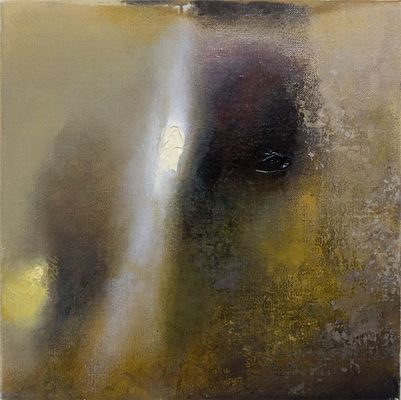
I am not a great reader of poetry but I always return to the work of Melbourne poet, Vincent Buckley (1925- 1988). Perhaps I find his most tantalising piece to be not a finished poem but a fragment left on a scrap of paper discovered on his desk after the poet’s death.
The poetry gathers like oil
In the word-core, and spreads
It has its music meet,
Its music is in movement.
This fragment is more the shell left behind from a volatile thought than a finished poem. I find the last two lines honest but awkward whereas the first two lines work like an arrow. Most likely he could not find a resolution so it was left. Still, in its present form, it remains an eloquent testimony to the ultimate failure of a medium to express mobile thought and sensation, in Buckley’s case, through verbal language. It’s an important matter because this is something all artists have to deal with regardless of the medium.
I have never written a poem, however, I am forever copying fragments from books on paper scraps in a vain effort to fix certain notions in my head. At first, they function as bookmarks that are sometimes returned to when I open the book. But before long, as they accumulate, they fall out littering the table interspersed with A4 photocopies, bills, books and medications.
To return to Buckley’s fragment, the first two lines very much evoke how I paint nowadays. As you age, detail diminishes and patches of light become more luminous and float. I feel the most honest way of dealing with this is by smearing the oil paint on the canvas with the fingers and working close-up, blind. Only if the patches coalesce into an approaching image can the work gain a life.
-
Jonathan Walker was born in Melbourne, Australia and brought up on a dairy farm in Gippsland. In the 1970’s he studied painting at RMIT and won the Harold Wright Scholarship to the British Museum, London. During the 1980’s he exhibited at Pinacotheca Gallery, Richmond and had work shown at the NGV and Heidi City Art Gallery. Over the same period he designed the cover for the “Epigenesi” LP by Giancarlo Toniutti, Italy and conducted a mail exchange work with Achim Wollscheid, Germany. The work with artists through the post resulted in an article published in the bicentenary issue of Art and Australia 1988. He showed in artist run spaces such as WestSpace in the 90’s and 2000’s, and until 2012, taught painting at Victoria University, which is where we (Colleen Ahern and Lisa Radford) as organisers of the exhibition, among many others, had the privilege of being his student.
Walker’s knowledge was imparted to students through the careful selection of music, literature, and artists found in books that he himself had ordered for the library. Walker’s strategy was the generosity of sharing his vast knowledge with references specific to each student and their context.
Walker’s paintings share a similar focus and intimacy.
This exhibition presents a small selection of recent paintings alongside a publication that includes Walker’s writing. Observational and analytical, Walker’s work is a type of material notation — the time of day, colour and how it is blended, the both specific and fleeting location of a reflection on lino or the question of whether a chair leg should be included in a painting.
Please join us on Friday August 21 between 6-8pm to celebrate the opening of the exhibition.
Curated by Colleen Ahern and Lisa Radford.
B. Wurtz
Curated by Nic Tammens
March 26 - April 4, 2015
B.Wurtz works from a basement studio in his home on Manhattan’s Lower East Side.
This local fact is attested to by the plastic shopping bags and newsprint circulars that appear in his work. As formal objects, they don’t make loud claims about their origins but nonetheless transmit street addresses and places of business from the bottom of this long thin island. Like plenty of artists, Wurtz is affected by what is local and what is consumed. His work is underpinned by this ethic. It often speaks from a neighborhood or reads like the contents of a hamper:
“BLACK PLUMS $1.29 lb.”
“Food Bazaar”
“USDA Whole Pork Shoulder Picnic 99c lb.”
“RITE AID Pharmacy, with us it’s personal.”
“H. Brickman & Sons.”
“Sweet Yams 59c lb."
Most of the work in this exhibition was made while the artist was in residence at Dieu Donne, a workshop dedicated to paper craft in Midtown. Here Wurtz fabricated assemblages with paper and objects that are relatively lightweight, with the intention that they would be easily transportable to Australia. This consideration isn’t absolute in Wurtz’s work, but was prescriptive for making the current exhibition light and cheap. Packed in two boxes, these works were sent from a USPS post office on the Lower East Side and delivered to North Melbourne by Australia Post.
Wurtz appears courtesy of Metro Pictures, New York.
Thanks to Rob Halverson, Joshua Petherick, Sari de Mallory, Matt Hinkley, Helen Johnson, Fayen d'Evie, Ask Kilmartin, Lisa Radon, Ellena Savage, Yale Union, and "Elizabeth".
John Nixon
"Archive"
December 15 - January 20, 2014
The presentation of John Nixon's archive offered a rare showcase of this extensive collection of the artist's own publications, catalogues, posters, ephemera, editions and more, from the mid 1980s onwards, alongside a selection of his artworks.
Organized by John Nixon, Joshua Petherick and Matt Hinkley.
<a href=http://wfb.public-office.info/artist/john-nixon>All titles by John Nixon
"Habitat"
at Minerva, Sydney (organised by Joshua Petherick and Matt Hinkley)
November 15 - December 20, 2014
Lupo Borgonovo, Janet Burchill & Jennifer McCamley,
Lewis Fidock, HR Giger, Piero Gilardi, Veit Laurent Kurz,
Cinzia Ruggeri, Michael E. Smith, Lucie Stahl, Daniel Weil, Wols
Press Release:
“...It contained seven objects. The slender fluted bone, surely formed for flight, surely from the wing of some large bird. Three archaic circuitboards, faced with mazes of gold. A smooth white sphere of baked clay. An age-blackened fragment of lace. A fingerlength segment of what she assumed was bone from a human wrist, grayish white, inset smoothly with the silicon shaft of a small instrument that must once have ridden flush with the surface of the skin - but the thing’s face was seared and blackened.”
William Gibson, “Count Zero”, 1986
"Autumn Projects Archive"
Curated by Liza Vasiliou
March 6 - March 15, 2014
World Food Books, in conjunction with the Virgin Australia Melbourne Fashion Festival 2014, presented the Autumn Projects archive, consisting of a selection of early examples in Australian fashion with a particular interest in collecting designers and labels from the period beginning in the 1980’s, who significantly influenced the discourse of Australian Fashion.
Curated by Liza Vasiliou, the exhibition provided a unique opportunity to view pieces by designers Anthea Crawford, Barbara Vandenberg, Geoff Liddell and labels CR Australia, Covers, Jag along with early experimental collage pieces by Prue Acton and Sally Browne’s ‘Fragments’ collection, suspended throughout the functioning World Food Books shop in Melbourne.
H.B. Peace
presented by CENTRE FOR STYLE
November 14, 2013
"Hey Blinky, you say chic, I say same"
Anon 2013
H.B. Peace is a clothing collaboration between great friends Blake Barns and Hugh Egan Westland. Their pieces explore the divergences between 'character’ and ‘personality’ in garments....etc
Special Thanks to Joshua Petherick and Matt Hinkley of WFB and Gillian Mears
and a Very Special Thank you to Audrey Thomas Hayes for her shoe collaboration.
Janet Burchill & Jennifer McCamley
"Aesthetic Suicide"
May 10 - June 8, 2013
The first of our occasional exhibitions in the World Food Books office/shop space in Melbourne, "Aesthetic Suicide" presented a body of new and older works together by artists Janet Burchill & Jennifer McCamley, including videos, prints, a wall work, and publications.
During shop open hours videos played every hour, on the hour.
1972, English
Hardcover (w. dust jacket), 122 pages, 31 x 26 cm
1st Edition, Out of print title / used / very good
Published by
Quadrangle Books / New York
$120.00 - Out of stock
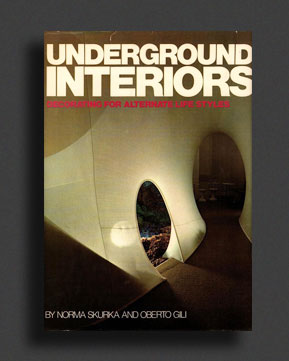
At the start of the 1970's, at the very beginning of renowned photographer Oberto Gili's professional career (Architectural Digest, Vogue, House & Garden, Town & Country), he moved to Milan to work for L’Esperto, a publishing company...
"... to shoot and produce a book that was to be called 'Crazy, Mad, Outrageous Interiors'. I traveled around the world for a year working on this book. L’Esperto dropped the project, but Norma Skurka, The New York Times interiors editor those days, took over and Quadrangle Books published the book in 1972. It was called 'Underground Interiors'."
First hardcover edition of this cult classic interior design book - the only one of its kind. This lavishly illustrated book features the deluxe photography of eclectic and inspired domestic settings from all over the world c. early 1970s: "Surrealist Interiors", "Environments", "Radical Chic", "Pop Culture", "Space Age Habitations"... An incredible piece of interior design history.
Includes the living spaces of Karl Lagerfeld, Derek Jarman, Zandra Rhodes, Marina Lante della Rovere, Nanda Vigo, Alan Buchsbaum, Julie Christie, to name only a handful.
"Not just another book on interior decoration with look-alike rooms, Underground Interiors is a fantastic mind-expanding experience into contemporary life styles."
Good ex-library copy with good dust jacket. Some stamping, light wear to jacket/page edges.
1972, English
Hardcover (clothbound w. dustjacket), 110 pages, 20.5 x 30 cm
1st Edition, Out of print title / used / very good
Published by
Academy Editions / London
$140.00 - Out of stock
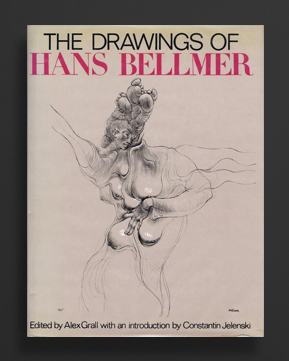
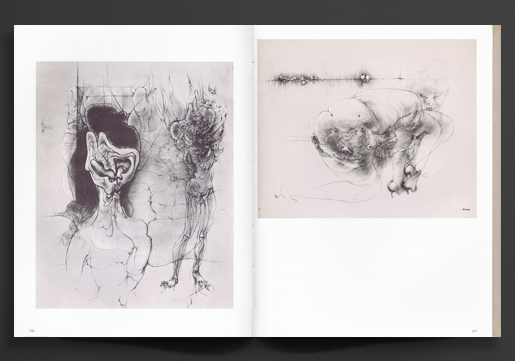
Beautifully produced, scarce hardcover monographic volume dedicated entirely to reproductions of Surrealist visionary Hans Bellmer's incredible drawings. This is the first English edition, published by Academy Editions London in 1972 following the 1966 French edition. With an introduction by Constantin Jelenski. A stunning book.
German artist Hans Bellmer (13 March 1902 – 23 February 1975), was best known for the life-sized pubescent female dolls he produced in the mid-1930s. "Bellmer was born in the city of Kattowitz, then part of the German Empire (now Katowice, Poland). Up until 1926, he'd been working as a draftsman for his own advertising company. He initiated his doll project to oppose the fascism of the Nazi Party by declaring that he would make no work that would support the new German state. Represented by mutated forms and unconventional poses, his dolls were directed specifically at the cult of the perfect body then prominent in Germany. Bellmer was influenced in his choice of art form by reading the published letters of Oskar Kokoschka (Der Fetisch, 1925)."
Very Good in original dust jacket, light tanning/wear to jacket. Small notation to front endpaper.
2018, English
Softcover, 280 pages
Published by
Archive Books / Berlin
Casco / Utrecht
If I Can’t Dance / Amsterdam
$42.00 - Out of stock
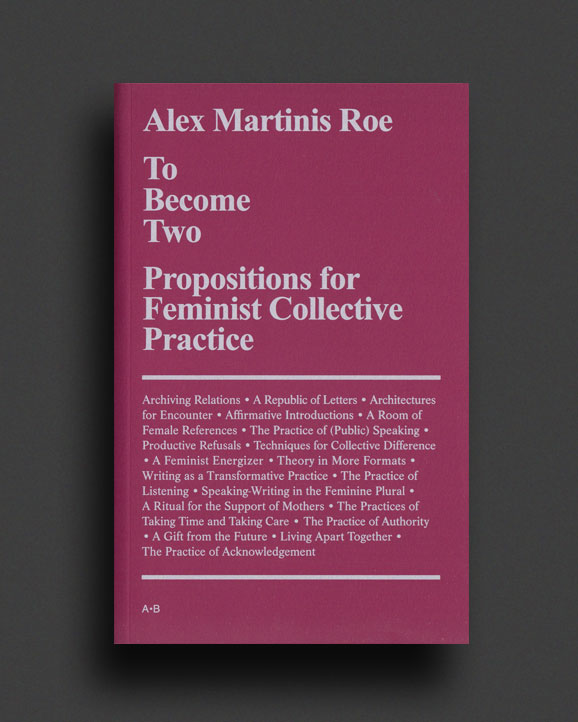
To Become Two: Propositions for Feminist Collective Practice offers a narrative of artist Alex Martinis Roe’s research into a genealogy of feminist political practices in Europe and Australia from the seventies until today. These practices include those of the Milan Women’s Bookstore co-operative; Psychanalyse et Politique, Paris; Gender Studies (formerly Women’s Studies) at Utrecht University; a network in Sydney including people involved in the Sydney Filmmakers Co-operative, Feminist Film Workers, Working Papers Collective, and the Department of General Philosophy at Sydney University; and Duoda – Women’s Research Centre and Ca la Dona, a women’s documentation centre and encounter space in Barcelona. Drawing from their practices and experiences, Martinis Roe’s research forms a proposal for a transgenerational approach to feminist politics. This is further developed as a practical handbook of twenty new propositions for feminist collective practice, which were formed in collaboration with a network of contributors through experiments with these historical practices.
2019, English / German
Softcover, 240 pages, 23 x 16.5 cm
Published by
Texte Zur Kunst / Berlin
$32.00 $15.00 - Out of stock
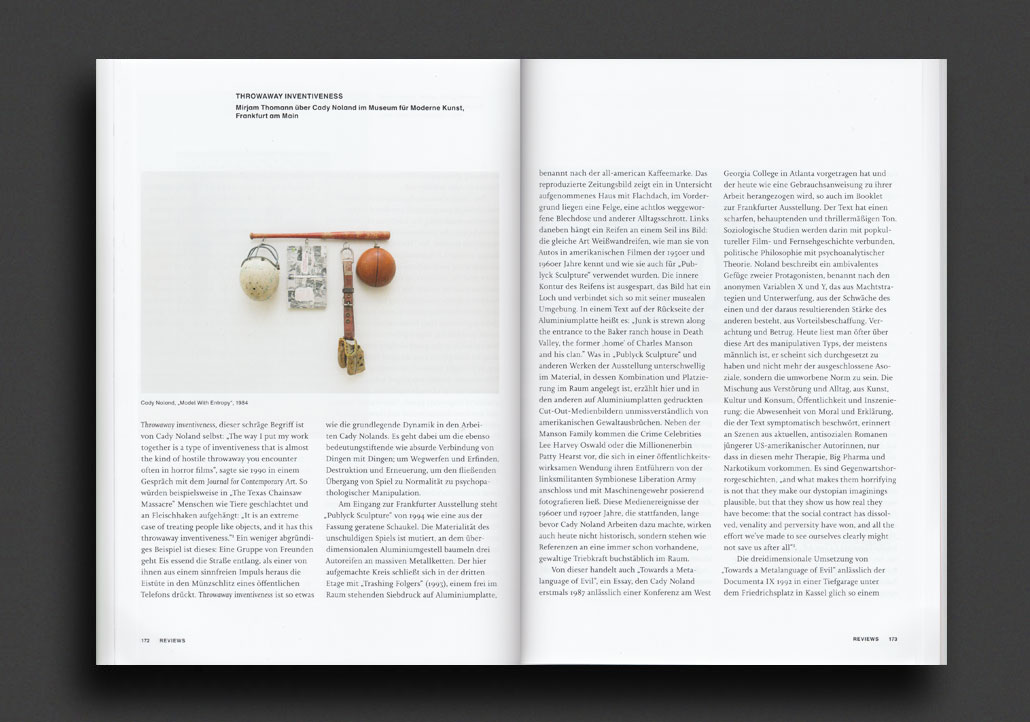
For the latest issue no. 113, TEXTE ZUR KUNST investigates the structures within the arts and cultural spheres where racism and discrimination are practiced, performed, and reproduced. This special issue concentrates specifically on the context of Germany, and includes discussions and texts from artists and theorists throughout the country who have dedicated special attention to current and ongoing political and social crises; specifically the challenges these crises pose for the language and terms of art criticism. How can criticism mount an appropriate response to the discrimination and injustices that pervade all levels of society?
ISSUE NO. 113 / MARCH 2019 "DISKRIMINIERUNG/DISCRIMINATION"
TABLE OF CONTENTS
PREFACE
SABETH BUCHMANN AND ISABELLE GRAW - THE CRITIQUE OF ART CRITICISM
COMMON GROUND / Colin Lang in Conversation with Julia Grosse, Suza Husse, and Max Czollek
ÇIĞDEM INAN
NON-RECOGNITION / The Other Side of the Critique of Racism
VIOLENT MEDIATIONS / Jenny Nachtigall in Conversation with Hannah Black
NAMING RACISM / Sven Beckstette in Conversation with Veronika Fuechtner and Oliver Hardt
HELMUT DRAXLER - THE ART OF DISCRIMINATION
ROTATION
INTENTIONALE BEGEGNUNGEN / Hanna Magauer über Christian Kravagnas „Transmoderne. Eine Kunstgeschichte des Kontakts“
SITUIERTE SENSIBILITÄT! / Michaela Ott über „Sensibilität der Gegenwart“ von Burkhard Liebsch (Hg.)
LIEBE ARBEIT KINO
PARTICLE ACCELERATOR / Daniel Horn on the Biennale de l’Image en Mouvement, Geneva
REVIEWS
COURS, CAMARADE / Tom McDonough on “The Most Dangerous Game” at Haus der Kulturen der Welt, Berlin
BAUHAUS IM GLOBALEN SÜDEN / Tobi Maier über „bauhaus imaginista: Learning From“ im SESC Pompéia, São Paulo
FULLY IMMERSED / Megan R. Luke on Heidi Bucher at Parasol unit foundation for contemporary art, London
DOPPELBELASTUNG / Sophie Goltz über „Medea muckt auf. Radikale Künstlerinnen hinter dem Eisernen Vorhang“ in der Kunsthalle im Lipsiusbau, Dresden
AUDIENZ BEIM MALERFÜRSTEN / Ulrich Pfisterer über Jörg Immendorff im Haus der Kunst, München
SITUATIONAL AWARENESS / SOFTCORE INSURRECTION / Kari Rittenbach on Tobias Kaspar at the Kunsthalle Bern
THROWAWAY INVENTIVENESS / Mirjam Thomann über Cady Noland im Museum für Moderne Kunst, Frankfurt am Main
REBEL REBEL / Saim Demircan on Sarah Lucas at the New Museum, New York
AUFGELADENE FRACHT / Nadja Abt über Ulrike Müller im Kunstverein für die Rheinlande und Westfalen, Düsseldorf
EVENTUALLY, EVERYTHING BECOMES LIQUID / Luisa Lorenza Corna on Metahaven at the Institute of Contemporary Arts, London
EVENING JOE / Robert Müller über Ed Ruscha in der Secession, Wien
CIRCUMSTANCES OF SOCIAL WORK / Eric Golo Stone on Laurie Parsons at the Museum Abteiberg, Mönchengladbach
AT LAST, WARHOL COMES OUT OF THE CLOSET / Jonathan D. Katz on Andy Warhol at the Whitney Museum of American Art
OBITUARY
ROBERT MORRIS (1931−2018)
FERDINAND KRIWET (1942–2018)
LOTHAR BAUMGARTEN (1944–2018)
EDITION
ARTURO HERRERA
ALICJA KWADE
1977, German
Heavy card slipcase (4 vols.), 323 pages; 357 pages; 378 pages; 40 pages; 21 x 29.5 cm
1st Edition, Out of print title / used / good
Published by
Paul Dierich / Kassel
$100.00 - Out of stock
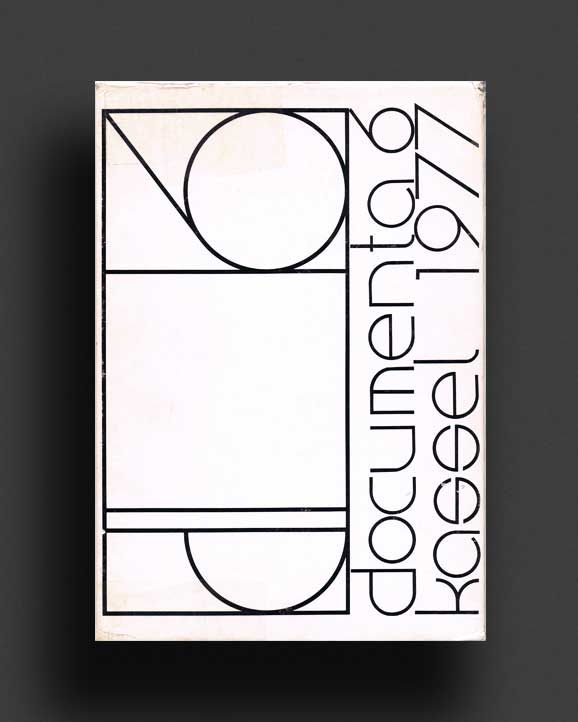
Complete 3 volume boxset exhibition catalogue published in conjunction with Documenta 6, the sixth edition of documenta, a quinquennial contemporary art exhibition. It was held between 24 June and 2 October 1977 in Kassel, Germany, and the artistic director was Manfred Schneckenburger. The title of the exhibition was: Internationale Ausstellung – international exhibition.
Box contains volume 1: painting - sculpture - performance (320 pages) / volume 2: photography - film - video (357 pages) / volume 3: drawings - utopian design - books (376 pages + show) / special edition of exhibition information booklet (40 pages + show); essays by Lothar Romain, Bazon Brock, Karl Oskar Blase, Klaus Honnef, Evelyn Weiss, Manfred Schneckenburger, Arnold Bode, Wieland Schmied, and Lothar Lang.
Artists featured throughout include Francis Bacon, Jennifer Bartlett, Georg Baselitz, Gerd Baukhage, Enzo Cacciola, Louis Cane, Chuck Close, Ulrich Erben, Winfred Gaul, Raimund Girke, Kuno Gonschior, Camille Graeser, Gotthard Graubner, Nancy Graves, Alan Green, Richard Hamilton, Heijo Hangen, Bernhard Heisig, Michael Heizer, Edgar Hofschen, Jasper Johns, Willem de Kooning, Attila Kovács, László Lakner, Roy Lichtenstein, Markus Lüpertz, Wolfgang Mattheuer, Gerhard Merz, Rune Mields, Carmengloria Morales, Malcolm Morley, Claudio Olivieri, Roman Opalka, Palermo, A.R. Penck, Lucio Pozzi, Hans-Peter Reuter, Gerhard Richter, Claude Rutault, Willi Sitte, Frank Stella, Werner Tübke, Bernar Venet, Andy Warhol, Reindert Wepko van de Wint, Gianfranco Zappetini, Jerry Zeniuk, Bernhard and Hilla Becher, Bernhard Johannes Blume, Christian Boltanski, Bettina Brand, Heinz Breloh, James Collins, Zdenek Felix, Reinhold Hohl, Gabrielle Honnef-Harling, Erich Kuby, Werner Lippert, Bernd Lohse, Felix H. Mann, Hilmar Pabel, Georg Reinhardt, Liselotte Strelow, Ann Wilde, Jürgen Wilde, Peter Ackermann, Michael von Biel, Fernando Botero, Miguel Condé, Renato Guttoso, Horst Janssen, Giacomo Manzù, Pablo Picasso, Wolfgang Schmitz, Rudolf Schoofs, André Thomkins, Bodo Baumgarten, Blythe Bohnen, Pinchas Cohen Gan, Rupprecht Geiger, Hetum Gruber, Eva Hesse, Sol LeWitt, Nino Malfatti, Bob Ryman, Jan Schoonhoven, Lee U-Fan, Rainer Werner Fassbinder, Martin Scorsese, Stanley Kubrick.
Texts in German.
Also includes an exhibition guide booklet in the same format as the 3 main catalogue volumes.
Good copy throughout with general tanning and age wear to box and books, some knocking and tape-mended cracking to the box binding corners and edging.
2017, English
Softcover, 15 x 21 cm
Published by
Pilot Press / London
$28.00 - Out of stock
What does it mean to be lonely? 31 artists, poets, performers and writers consider the queer experience of loneliness, with contributors including Olivia Laing, Colby Keller, Marc Hundley, Monique Mouton,
Timothy Thornton, Alice Goodman, Charlie Porter and David Hoyle.
Not Here is the debut publication from Pilot Press, and the first in their popular Queer anthology trilogy, founded in London by Richard Dodwell to shed new light on contemporary queer lives.
2018, English
Softcover, 15 x 21 cm
Published by
Pilot Press / London
$28.00 - Out of stock
What is joy? Is joy possible in the world today? If so, how do queer people imagine or experience it?
Over 30 writers, artists and performers consider queer joy with contributors including Eileen Myles, Wayne Koestenbaum, Hilton Als, AA Bronson, Timothy Thornton, Sophie Robinson, Eley Williams and Honey Dijon.
Over there, a queer anthology of joy is the second in Queer anthology from Pilot Press, founded in London by Richard Dodwell to shed new light on contemporary queer lives.
2013, English
Softcover (staple-bound), 12 pages, 26.5 x 20 cm
1st Edition, Out of print title / used / very good
Published by
Charles Nodrum / Melbourne
$48.00 - Out of stock
Scarce catalogue of the great Australian sculptor Norma Redpath, published on the occasion of a posthumous exhibition at Charles Nodrum Gallery, Melbourne, in 2013. Illustrated throughout in colour with selections of the exhibited "Works from the Studio" spanning the 1940s to the 1960s, including many of her most beautiful bronze sculptures, along with works in soapstone, marble, wood, drawings and paintings. An accompanying essay "Progression in space: works from the Norma Redpath studio", by art historian Jane Eckett, runs throughout, with an introduction by gallerist Charles Nodrum.
Norma Redpath (1928 – 2013) was a prominent Australian artist. Born in Melbourne, she became a member of the Victorian Sculptors' Society (VSS) whilst still a student at RMIT. In 1953 she, along with Inge King, Julius Kane and Clifford Last, founded the 'Group of Four' and in 1961 she joined the artists grouping 'Centre Five' (among others Inge King, Julius Kane, Clifford Last, Lenton Parr, Vincas Jomantas and Teisutis Zikaras), who broke with the VSS and organised private exhibitions. During the fifties, she traveled to Europe and studied in Italy from 1956 to 1958 at the Universita per Stranieri in Perugia and she lived in Rome. Her love for Italy and Italian art would not release her. In 1958 she returned to Australia, but in 1962 she won a scholarship from the Accademia di Belle Arti di Brera in Milan, where she would later settle. In 1963, Redpath was given her first solo exhibition in Australia at Max Hutchinson’s Gallery A in Melbourne. Known as the Little Bauhaus, the gallery, under the management of artist/designer Clement Meadmore, championed non-figurative art and industrial design. The show was composed of 12 bronzetti (small scale bronzes) which she had made during her time in Milan. After the critical and financial success of the Gallery A show she was awarded several major commissions in Australia during the 1960s and 1970s, including the Treasury Fountain in Canberra. In 1970 Norma Redpath was appointed an Officer of the Order of the British Empire for services to contemporary sculpture. Redpath shared her time between Melbourne and Italy, returning permanently to Melbourne in 1985.
Very Good copy.
1977, English
Softcover (silver foil cover w. original plastic sleeve), 94 pages, 20.3 x 26.9 cm
1st Edition, Out of print title / used / very good
Published by
E P Dutton / New York
$150.00 - Out of stock
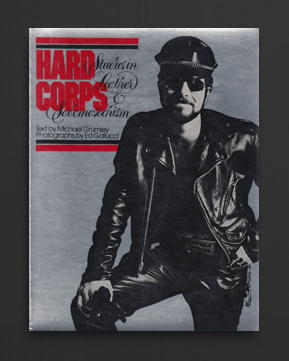
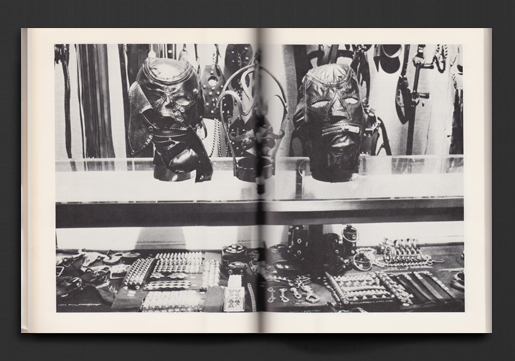
A now sought-after piece of published history, "Hard Corps : Studies in Leather and Sadomasochism", was published in 1977. This famous photographic book takes a personal look inside the world of SM in the 1970s, with thoughtful and revealing texts by Michael Grumley that follow the encounters and stories of SMs many varied practitioners, alongside the photography of Ed Gallucci (who shot for the hugely influential US Rock magazine Crawdaddy!, as well as Rolling Stone, Penthouse, Esquire and Playboy).
First edition copy in it's printed foil cover in plastic sleeve. Very Good copy - light wear to sleeve from age.
1970, English
Softcover, 27.5 x 21 cm, 70 pages
1st Edition, Out of print title / used / very good
Published by
Larnook Teachers College / Armadale
$45.00 - In stock -
Wonderful 1970 yearbook from Larnook Teachers College. Larnook Domestic Arts Teachers' College at the Larnook mansion, in Armadale, was founded in 1950 and later became Larnook Teachers College, specialising in the domestic arts. Filled with columns, illustrations, collages, photography, articles and questionnaires, these spirited and incredibly witty annual school magazines rallied the voices of educators and students/future educators around the changing role of women in society, the politics of the time, and challenging attitudes towards education and Home Economics in early 1970s Australia. Includes articles such as "How to Be Poor", "Floral Art or Science", "Consume or Be Consumed", "Nuclear Stranglehold", a large number of theatre reviews, abstract artworks, needlecraft, design, poetry, and the results of a group discussion covering Australia's involvement in Vietnam, government policy, voting age, censorship, marijuana, abortion, homosexuality, plus much much more. A wonderful time capsule.
"GAIL: I think we should do an editorial about the role of women.
ANNA: Well I really think it should be on education and its . . .
SUZANNE: Why not have it about attitudes to authority, surely this is a big issue today.
FELICITY: That's chronic! Personal values are the big issue today.
GAIL: We've got to have an editorial about the role of women today because it's women we'll
be teaching. Look, the family's declining, more married women are going out to work, women are asserting their independence and demanding to be treated as human beings. So, it's obvious, we must teach them how to avoid stagnating at home, nursing their neuroses.
FELICITY: Oh, come off it, can't you see you're just enforcing and imposing your own values. This limits the individual's ability to develop her own values. What we should be doing is presenting a series of alternatives from which students can choose. Don't you think education should involve students working out their personal values from a variety which you present?
ANNA: No, no, no. This is not the purpose of education. A teacher must make valued judgements. It's hypocritical just to present students with a cold set of alternatives. If the teacher is too frightened to make her values known, students become confused and unconvinced. Teachers can't help showing what their values are. They are obvious from the way they dress, talk and generally carry on.
SUZANNE: No, you're all wrong, because you're setting the teacher up as an infallible authority, and I don't think he should be. Too many people today have an unquestioning attitude to authority and this leads to apathy and the trouble with apathy is that people can be manipulated too easily.
GAlL: Listen, we've got right off the track . . ." - editor's introduction.
Printed at the Port Phillip Press.
Very Good copy.
1972, English
Softcover, 27.5 x 21 cm, 54 pages
1st Edition, Out of print title / used / very good
Published by
Larnook Teachers College / Armadale
$45.00 - In stock -
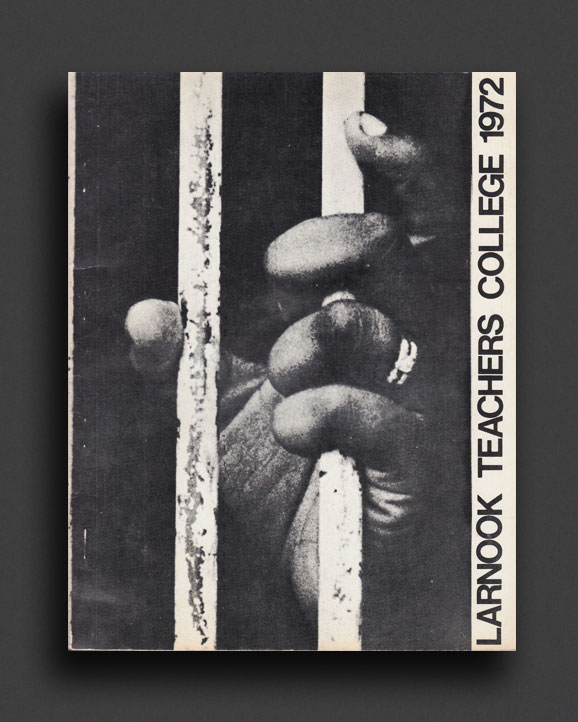
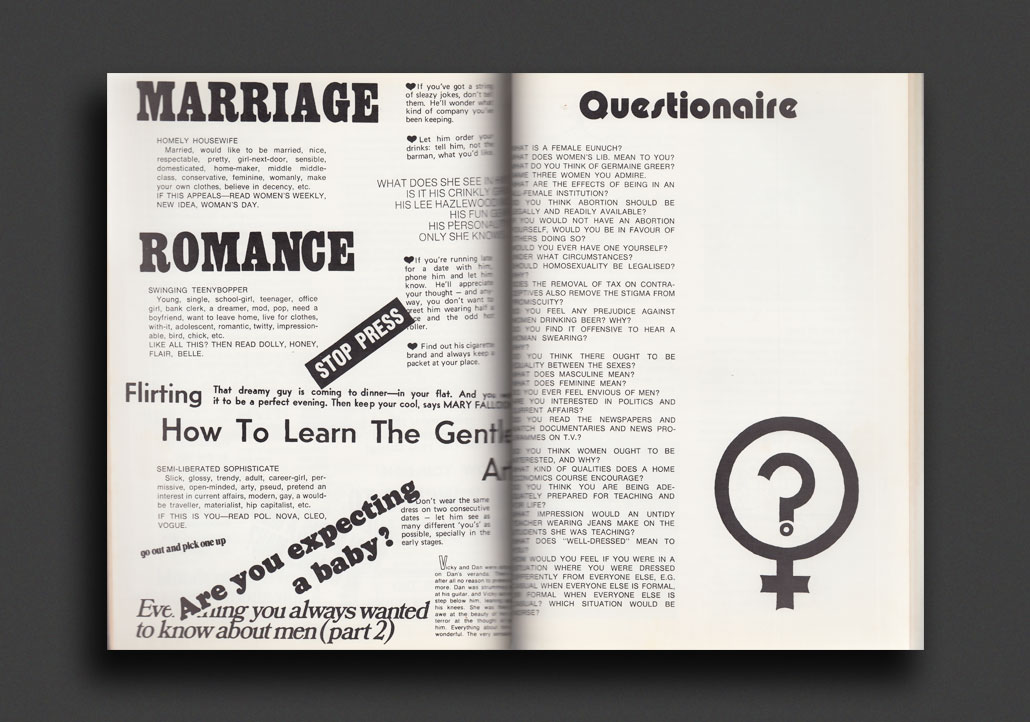
Wonderful 1972 yearbook from Larnook Teachers College. Larnook Domestic Arts Teachers' College at the Larnook mansion, in Armadale, was founded in 1950 and later became Larnook Teachers College, specialising in the domestic arts. Filled with columns, illustrations, collages, photography, articles and questionnaires, these spirited and incredibly witty annual school magazines rallied the voices of educators and students/future educators around the changing role of women in society, the politics of the time, and challenging attitudes towards education and Home Economics in early 1970s Australia. Includes an article by a student about entering the "Miss Australia Quest", an article on the depiction of women in women's magazines in Australia (Dolly, New Idea, Woman's Day, etc.), a multiple answer questionnaire (covering topics of femininity/masculinity, abortion, the female eunuch, women drinking beer, homosexuality, women swearing, etc.), "For Better"/"For Worse" (a discussion about marriage), much much more. A wonderful time capsule.
"Women are now thinking about themselves and questioning their roles-the results of this questioning have yet to be seen but big changes in our whole society are sure to result. To try and examine some of these issues we have provided a theme to our magazine - The Role of Women Today. Our aim has been merely to explore (not to provide answers) some of the things which interest us, as as women, as future teachers and Home Economics students." - from editor's introduction.
Printed at the Port Phillip Press.
Very Good copy.
1971, German
Softcover, 464 pages, 29.7 x 21 cm
1st Edition, Out of print title / used / very good
Published by
DuMont / Köln
$85.00 - Out of stock
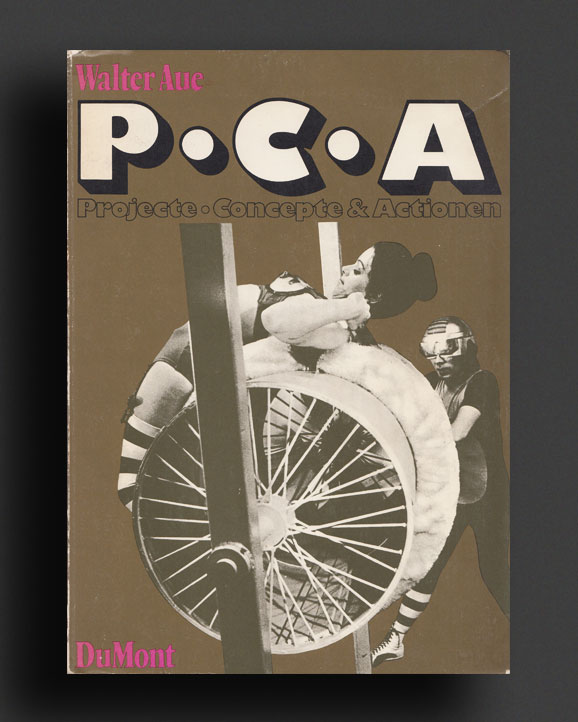
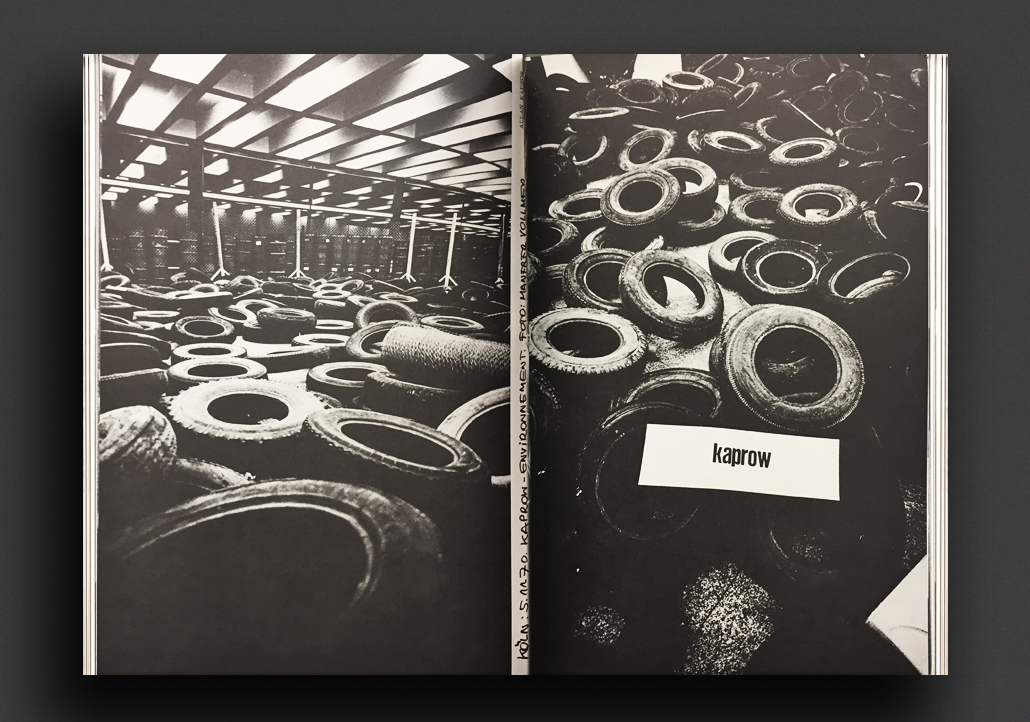
Huge, densely-illustrated volume compiled by German publisher/editor/essayist/curator Walter Aue, who worked closely with conceptual and performance artists in the 1960s-1970s. Laid-out by Aue himself, the book feels like a very natural scrap-book compendium of artist contributions, reproducing artworks, documentation of happenings, texts, photographs, diagrams, collages, news-clippings, instructions, etc. across over 450 pages, with Aue's type-written opening essay and cataloguing throughout. Features the most notable conceptual, actionist and performance artists of the period, spanning Fluxus, Arte Povera, radical architecture, Nouveau Realisme, etc. including Dieter Rot, Joseph Beuys, Robert Smithson, Pino Pascali, Stanley Brouwn, Jannis Kounellis, Klaus Rinke, Ben Vautier, Al Hansen, Walter Pichler, Hilla and Bernhard Becher, Giuseppe Penone, Ettore Sottsass, Gilbert and George, Walter De Maria, Wolf Vostell, Hans Hollein, Imi Knoebel, Barry Flanagan, Allan Kaprow, Carolee Schneemann, Hamish Fulton, Christo, Elfriede Jelinek, Dennis Oppenheim, Urs Lüthi, Sigmar Polke, Gerhard Rühm, Blink Palermo, Lawrence Weiner, Ed Ruscha, HA Schult, Hermann Nitsch, James Lee Byars, Jan Dibbets, Jochen Gerz, Mauricio Kagel, Nam June Paik, Otto Mühl, Arnulf Rainer, Jan Voss, George Brecht, Robert Filliou, Franz Erhard Walther, Timm Ulrichs, Daniel Spoerri, Erich Reusch, Paul Pechter, Rainer Giese, Jörg Immendorff, Henning Christiansen, Gilberto Zorio, Panamarenko, Joseph Kosuth, Dan Graham, Dick Higgins, Ian Baxter, Mel Bochner, Haus-Rucker-Co, Markus Raetz, Sottsass, Nam June Paik, Hans Haacke, Tetsumi Kudo, Bruce Mclean, On Kawara, and so many more.
Depending on the artist, texts are in English, German, Dutch, etc. Opening essay in German.
Very Good, light wear/tear to top spine.
1970s, Italian
Softcover (ringbound), 48 pages, 21.5 x 30.5 cm
1st Edition, Out of print title / used / very good
Published by
Tecno / Italy
$65.00 - Out of stock
Very scarce ring-bound trade catalogue from the Italian furniture company Tecno, founded by architect and designer Osvaldo Borsani and his brother Fulgenzio. Borsani designed most of Tecno's iconic pieces, like the working system Graphis, the D70 sofa, the P40 lounge-chair and the small tables T1 and T2.
This boldly designed and illustrated catalogue reproduces many of Borsani's pieces for Tecno, alongside technical drawings and information. A lovely collector's item.
Osvaldo Borsani (Varedo 1911- Milano 1985) began work at an early age in the family business of making furniture. In 1933 he participated in the fifth Triennale of Milan with the design for the “Minimal House”, which was awarded the silver medal. In the post-war period he formed friendships with numerous artists like Lucio Fontana, Agenore Fabbri, Aligi Sassu, Roberto Crippa, Fausto Melotti, and Arnaldo Pomodoro, together with whom he realized important works of art in furnishing and interior architecture. In 1953, along with his brother Fulgenzio, he founded Tecno, a lifelong project in living design production, and considered an integral Italian furniture house.
Very Good copy, light surface wear.
2017, English
Printed card box containing publications and 2 posters
Published by
Ugly Duckling Presse / New York
$125.00 - Out of stock
Introduction by Sophie Seita. Translations by Elizabeth Zuba.
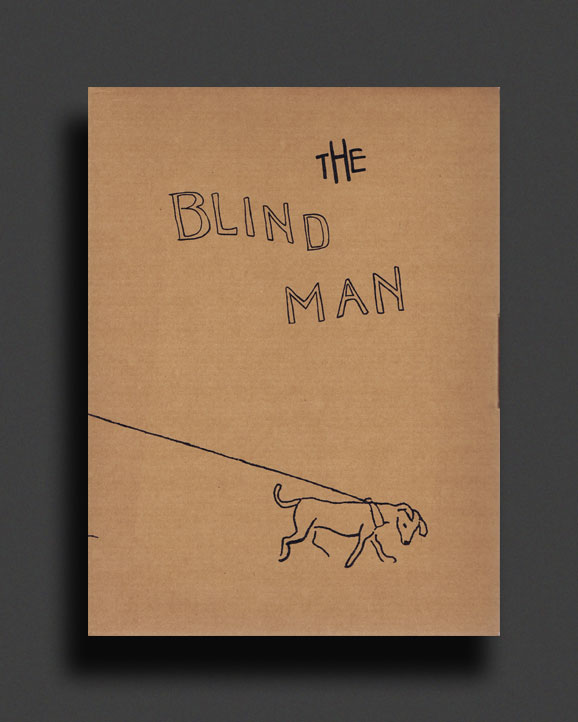
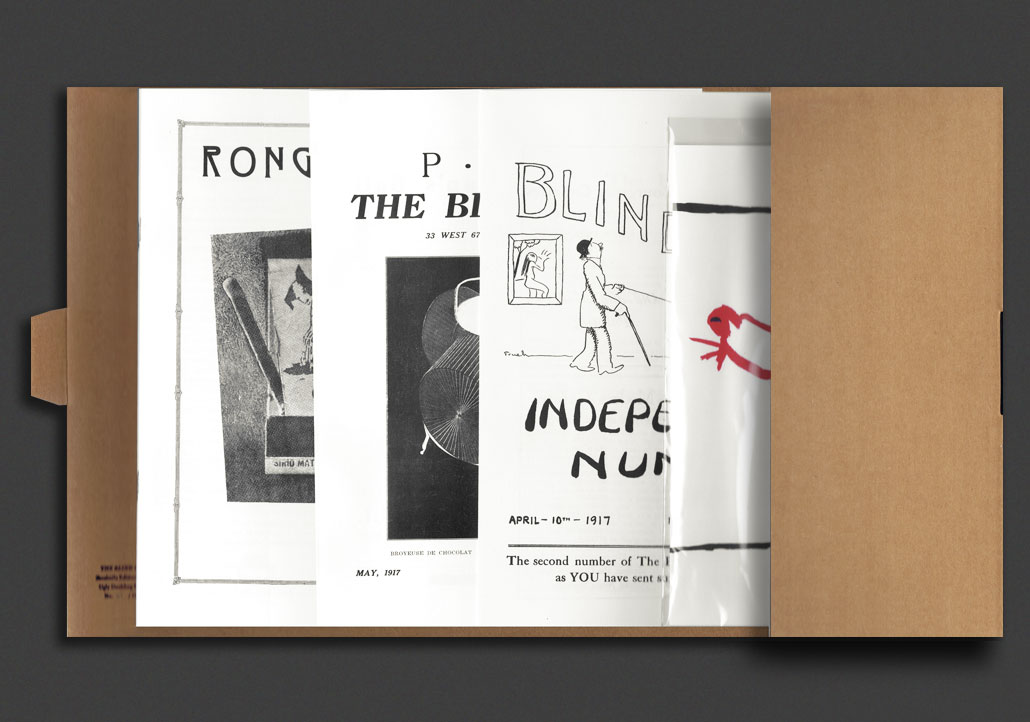
The Blind Man was a key magazine of the early 20th century, the product of a rich network of proto-Dada, modernist and other avant-garde New York salons and publications that introduced audiences to Dada in the US.
Produced by Marcel Duchamp, Beatrice Wood and Henri-Pierre Roché, only two issues of the Blind Man ever appeared, but these included a who’s who of the New York and Paris avant-gardes: Mina Loy, Walter Conrad Arensberg, Francis Picabia, Gabrielle Buffet, Allen Norton, Clara Tice, Alfred Stieglitz, Charles Demuth, Charles Duncan, Erik Satie, Carl Van Vechten and Louise Norton all appeared in its pages.
Allegedly, the fate of the Blind Man was decided in a chess game between Roché and Picabia (who was about to put out his own Dada publication, 391). And the magazine went out with a bang-its final issue has gone down in art history for featuring Stieglitz’s iconic photograph of Duchamp’s "Fountain" and a defense of that work, seen now as perhaps the most important artwork of the 20th century.
The Blind Man: New York Dada, 1917 brings back the magazine in a facsimile reprint, along with reproductions of the Ridgefield Gazook and the poster for the Blind Man’s Ball designed by Beatrice Wood, all packaged together in a handsome boxed set.
1979, French
Softcover, 192 pages, 20.5 x 15 cm
Out of print title / used / good
Published by
Editions PAC / Paris
$90.00 - Out of stock
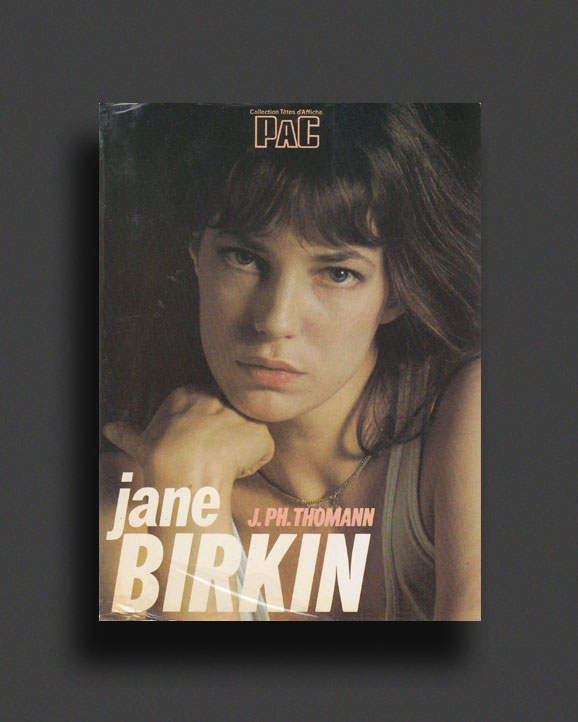
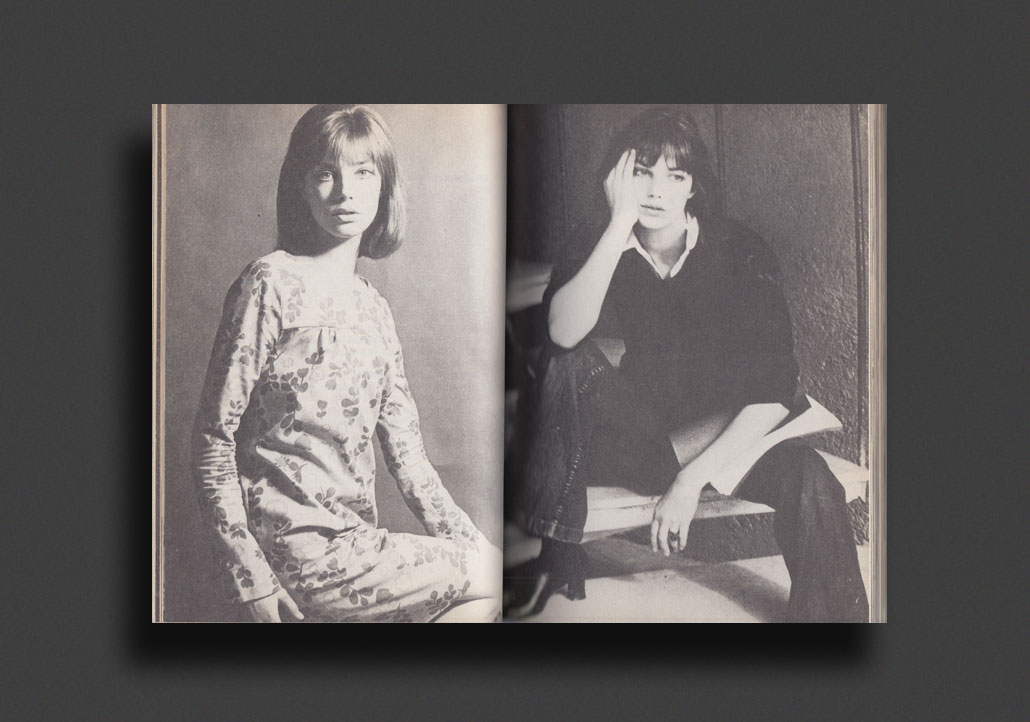
One of the earliest and scarcest books dedicated to the great French actress and singer, Jane Birkin. Written by Jean-Philippe Thomann and published in 1979, this heavily illustrated volume forms an early biography of her personal life and an important document capturing her diverse and challenging career as actress (working with Alain Resnais, Agnès Varda, Jean-Luc Godard, Michelangelo Antonioni, Jacques Doillon, Serge Gainsbourg, Jacques Rivette, to name a few), model, singer, and her work in theatre. Photographs, film stills, magazine covers, film posters and record jackets are accompanied by hand-written notes by Birkin, a filmography, discography and much more.
Very good copy with light wear and light peeling to cover laminate. Crisp copy throughout.
2002, English / Japanese
Hardcover (w. dust jacket and obi-strip), 240 pages, 20 x 26 cm
Published by
Toto / Tokyo
$100.00 - Out of stock
"Serenity is the great and true antidote against anguish and fear, and today, more than ever, it is the architect's duty to make of it a permanent guest in the home, no matter how sumptuous or humble. Throughout my work I have always strived to achieve serenity, but one must be on guard not to destroy it by the use of an indiscriminate palette. - Luis Barragán
Barragán's houses evoke glamour and simplicity, modernity and nostalgia, respect for tradition and revolutionary turns. The influence of his childhood home, a former Mexican hacienda, is clear and yet contrasted with his bold use of colours. Five of his house designs are lavishly pictured here, both inside and out, across nearly 550 images bound in hardcover and printed in Japan. Accessible short descriptions in English and Japanese are included with each photograph. Accompanied by an extended essay by Yutaka Saito.
Luis Ramiro Barragán Morfín (March 9, 1902 – November 22, 1988) was a Mexican architect and engineer. His work has massively influenced contemporary architects visually and conceptually, and his buildings are frequently visited and studied by international students and professors of architecture to this day. Barragán won the Pritzker Prize, the highest award in architecture, in 1980, and his personal home, the Luis Barragán House and Studio, was declared a UNESCO World Heritage Site in 2004. It is considered one of the most internationally transcendent works of contemporary architecture.
2013, English
Softcover, 224 pages, 15.2 x 22.9 cm
$45.00 - Out of stock
Essays, an interview, and a roundtable discussion on the work of one of the most influential American artists of the postwar period.
This October Files volume gathers essays, an interview, and a roundtable discussion on the work of Robert Morris, one of the most influential American artists of the postwar period. It includes a little-known text on dance by Morris himself and a never-before-anthologized but influential catalog essay by Annette Michelson. Often associated with minimalism, Morris (b. 1931) also created important works that involved dance, process art, and conceptualism. The texts in this volume focus on Morris's early work and include an examination of a 1971 Tate retrospective by Jon Bird, an interview with the artist by Benjamin Buchloh, a conversation from a 1994 issue of October about resistance to 1960s art, and an essay by this volume's editor, Julia Bryan-Wilson, on the labor involved in installing the massive works in Morris's 1970 solo exhibition at the Whitney. Spanning 1965 to 2009, these writings map the evolution of critical thought on Morris over more than four decades.
October Files is a series of inexpensive paperback books edited by the editors of October journal. Each book addresses a body of work by an artist of the postwar period who has altered our understanding of art in significant ways and prompted a critical literature that is sophisticated and sustained. Each book in this series traces not only the development of an important oeuvre but also the construction of the critical discourse inspired by it. Series Editors are George Baker, Yve-Alain Bois, Benjamin H. D. Buchloh and Leah Dickerman.
Tote Book Bag, 100% cotton canvas, 38 (h) x 37 (w) cm
Published by
World Food Books / Melbourne
$25.00 - Out of stock
Back in stock! The World Food Book bag - tote edition. Available in single colour-way of blue/white and made from 100% cotton canvas with nylon flex printing.
39 (h) x 37 (w) cm
2018, English
Softcover, 112 pages, 21.5 x 13 cm
Published by
Paper Monument / New York
$34.00 - Out of stock
In light of recent political shifts across the globe, have you sensed a change in the position of the art institution vis-à-vis political activism?
Can an art institution go from being an object of critique to a site for organizing? How? Should the art institution play this kind of role? What other roles can or should it play?
What other institutions, curators, or publics do you look to in formulating your own institution’s position?
Recent controversies over curatorial choices have foregrounded the different ways in which institutions envision their audience(s). In your experience, is this process changing? How should it proceed?
How can an institution address the dichotomy between art as cultural entertainment and art as political inquiry? What is the role of the curator in mediating this? How does this compare to the artist’s role?
How can art institutions be better?
With contributions by: Regine Basha, Chloë Bass, Dena Beard, Zachary Cahill, Ken Chen, Lori Cole, Anne Ellegood, Anthony Elms, Deborah Fisher, Zanna Gilbert, Namita Gupta Wiggers, Larissa Harris, Pablo Helguera, Megan Heuer, Kemi Ilesanmi, Mary Jane Jacob, Alhena Katsof, Kristan Kennedy, Alex Klein, Jordan Martins, Amanda Parmer, Risa Puleo, Laura Raicovich, Sara Reisman, Chris Reitz, Nicolás Rodríguez Melo, Stephen Squibb, Elizabeth Thomas, Gilbert Vicario, and Anuradha Vikram
2016, English
Softcover, 544 pages, 21.5 x 15 cm
Published by
Paper Monument / New York
$49.00 - Out of stock
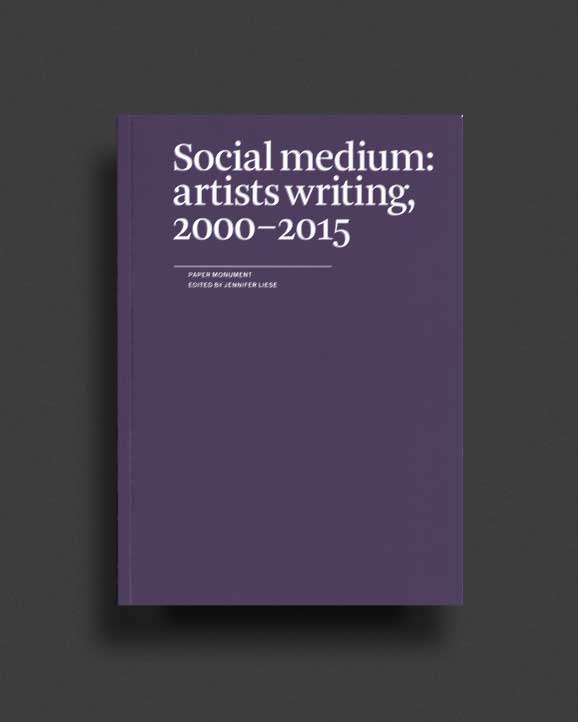
edited by Jennifer Liese
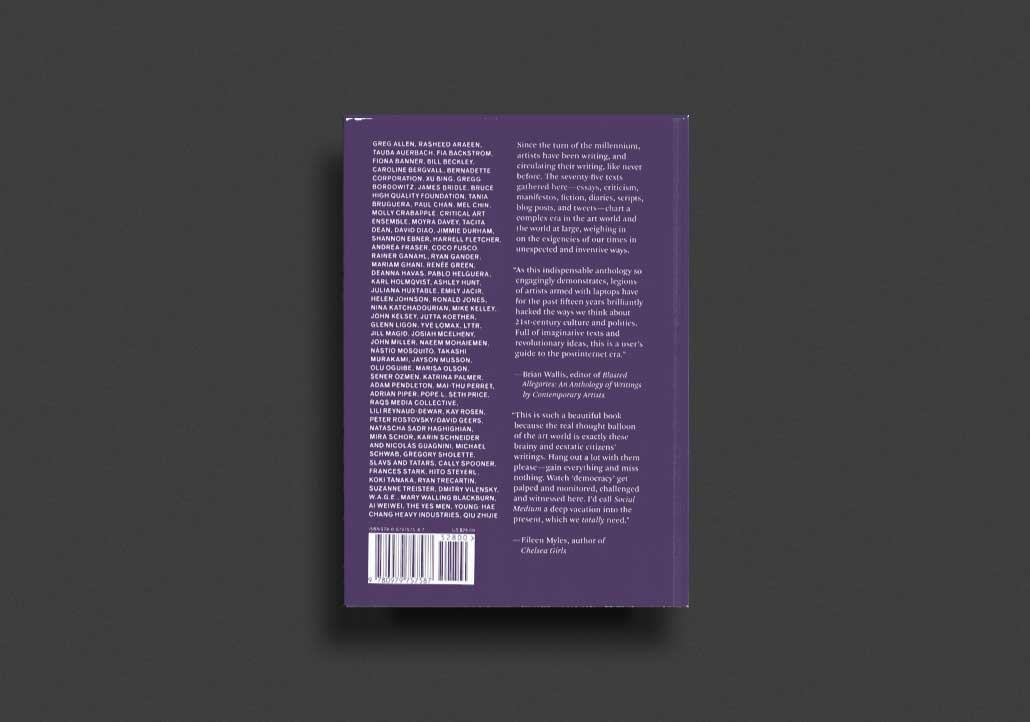
Since the turn of the millennium, artists have been writing, and circulating their writing, like never before. The seventy-five texts gathered here — essays, criticism, manifestos, fiction, diaries, scripts, blog posts, and tweets — chart a complex era in the art world and the world at large, weighing in on the exigencies of our times in unexpected and inventive ways.
With Contributions By:
Greg Allen, Rasheed Araeen, Tauba Auerbach, Fia Backström, Fiona Banner, Bill Beckley, Caroline Bergvall, Bernadette Corporation, Xu Bing, Gregg Bordowitz, James Bridle, Bruce High Quality Foundation, Tania Bruguera, Paul Chan, Mel Chin, Molly Crabapple, Critical Art Ensemble, Moyra Davey, Tacita Dean, David Diao, Jimmie Durham, Shannon Ebner, Harrell Fletcher, Andrea Fraser, Coco Fusco, Rainer Ganahl, Ryan Gander, Mariam Ghani, Renée Green, Deanna Havas, Pablo Helguera, Karl Holmqvist, Ashley Hunt, Juliana Huxtable, Emily Jacir, Helen Johnson, Ronald Jones, Nina Katchadourian, Mike Kelley, John Kelsey, Jutta Koether, Glenn Ligon, Yve Lomax, LTTR, Jill Magid, Josiah Mcelheny, John Miller, Naeem Mohaiemen, Nástio Mosquito, Takashi Murakami, Jayson Musson, Olu Oguibe, Marisa Olson, Şener Özmen, Katrina Palmer, Adam Pendleton, Mai-Thu Perret, Adrian Piper, Pope.L, Seth Price, Raqs Media Collective, Lili Reynaud-Dewar, Kay Rosen, Peter Rostovsky/David Geers, Natascha Sadr Haghighian, Mira Schor, Karin Schneider and Nicolás Guagnini, Michael Schwab, Gregory Sholette, Slavs And Tatars, Cally Spooner, Frances Stark, Hito Steyerl, Koki Tanaka, Ryan Trecartin, Suzanne Treister, Dmitry Vilensky, W.A.G.E., Mary Walling Blackburn, Ai Weiwei, The Yes Men, Young-Hae Chang Heavy Industries, and Qiu Zhijie
Praise for Social Medium:
"A thoroughly engrossing read ... entertaining as well as intellectually stimulating."
—Oliver Basciano, ArtReview
"The distinct textures of these individual voices together produce a larger portrait – not of a collective, but of art with a capital A: something far from prescription or cohesion, unable to be contained, requiring the work and words of many."
— Jennifer Krasinski, Frieze
“As this indispensable anthology so engagingly demonstrates, legions of artists armed with laptops have for the past fifteen years brilliantly hacked the ways we think about 21st-century culture and politics. Full of imaginative texts and revolutionary ideas, this is a user’s guide to the postinternet era.”
—Brian Wallis, editor of Blasted Allegories: An Anthology of Writings by Contemporary Artists
“This is such a beautiful book because the real thought balloon of the art world is exactly these brainy and ecstatic citizens’ writings. Hang out a lot with them please — gain everything and miss nothing. Watch ‘democracy’ get palped and monitored, challenged and witnessed here. I’d call Social Medium a deep vacation into the present, which we totally need.”
— Eileen Myles, author of Chelsea Girls
2002, Japanese
Softcover, 29.4 x 21 cm
1st Edition, Out of print title / used / very good
Published by
relax / Tokyo
$25.00 $10.00 - Out of stock
October 2002 issue of 'Relax' magazine from Tokyo, with cover artwork by and feature on British designer Fergus Purcell (Silas/Palace/Tonite/Aries.) This issue features a large article on the London scene around Slam City Skates, a legendary skate shop/label at Rough Trade, including profiles on Heroin Skateboards, The Idler, Silas and their affiliated artists/designers, and much more, French Caribbean comedian and singer Henri Salvador, United Arrows, fashion designer Takeo Kikuchi, artwork by Mark Gonzalez, and much more.
Before the term Hype Beast existed there was Relax magazine, a trailblazing Japanese style magazine that primarily ran throughout the late 1990s and early 2000s. It embodied and informed everything "Shibuya", in more interesting times. Times of X-Large, Alife, Beams, United Arrows, Girl Skateboards, and MoWax. But alongside the latest from Bape, Lego or Sofia Coppola one might also find in-depth articles on anything from concrete poetry, steel drumming, teashops, zen music or dogparks. Globetrotting, unearthing, scene-reporting and profiling on an exhaustive monthly basis, Relax quickly became an important reference source for trends in graphic design, urban fashion, music, and lifestyle, both in and out of Japan.
Very Good - fine copy.
2004, Japanese
Softcover, 29.4 x 21 cm
1st Edition, Out of print title / used / fine
Published by
relax / Tokyo
$35.00 $15.00 - Out of stock
March 2004 issue of 'Relax' magazine from Tokyo, with cover artwork by Japanese photographer Kishin Shinoyama. This issue features a large photo feature by Kishin Shinoyama followed by a long conversation with the photographer and bibliography of his photobooks, artwork by cartoonist James Jarvis, and much more.
Before the term Hype Beast existed there was Relax magazine, a trailblazing Japanese style magazine that primarily ran throughout the late 1990s and early 2000s. It embodied and informed everything "Shibuya", in more interesting times. Times of X-Large, Alife, Beams, United Arrows, Girl Skateboards, and MoWax. But alongside the latest from Bape, Lego or Sofia Coppola one might also find in-depth articles on anything from concrete poetry, steel drumming, teashops, zen music or dogparks. Globetrotting, unearthing, scene-reporting and profiling on an exhaustive monthly basis, Relax quickly became an important reference source for trends in graphic design, urban fashion, music, and lifestyle, both in and out of Japan.
Very Good - fine copy.
2003, Japanese
Softcover, 29.4 x 21 cm
1st Edition, Out of print title / used / very good
Published by
relax / Tokyo
$25.00 $10.00 - Out of stock
November 2003 issue of 'Relax' magazine from Tokyo, with cover artwork by designer Geoff McFetridge. This issue features a huge photo-feature w. interviews, discography of Bristol's The Wild Bunch (Sound System) and offshoots inc. Massive Attack, photoshoot of pro US skateboarders, Dan Wolfe's videos for Element and Real skateboards, Brazil, Sumo, flowers, artwork by cartoonist James Jarvis, and much more.
Before the term Hype Beast existed there was Relax magazine, a trailblazing Japanese style magazine that primarily ran throughout the late 1990s and early 2000s. It embodied and informed everything "Shibuya", in more interesting times. Times of X-Large, Alife, Beams, United Arrows, Girl Skateboards, and MoWax. But alongside the latest from Bape, Lego or Sofia Coppola one might also find in-depth articles on anything from concrete poetry, steel drumming, teashops, zen music or dogparks. Globetrotting, unearthing, scene-reporting and profiling on an exhaustive monthly basis, Relax quickly became an important reference source for trends in graphic design, urban fashion, music, and lifestyle, both in and out of Japan.
Very Good - fine copy.
1989, Japanese
Softcover, 96 pages, 25.5 x 18 cm
1st Edition, Out of print title / used / fine
Published by
Art Vivant / Tokyo
$90.00 - Out of stock
Issue 32 (1989) of Japan's great Art Vivant quarterly journal. This very special issue dedicated entirely to the work of Spanish surrealist artist Remedios Varo (1908 – 1963). Heavily illustrated throughout with colour and black and white reproductions of Varo's paintings, also essays in Japanese, portraits, biography, and much more.
Very scarce and Fine copy of this collectible issue.
Remedios Varo Uranga (1908 – 1963) was a Spanish surrealist artist. Born in Anglès (north of Catalonia), Spain in 1908, she studied at the Real Academia de Bellas Artes de San Fernando, Madrid. Varo spent her formative years between France and Barcelona and was greatly influenced by the surrealist movement. The summer of 1935 marked Varo's formal invitation into Surrealism when French surrealist Marcel Jean arrived in Barcelona. While still married to her first husband Gerardo Lizarraga, Varo met her second partner, the French surrealist poet Benjamin Péret, in Barcelona. During the Spanish Civil War she fled to Paris with Péret leaving Lizarraga behind (1937). It was through Peret that Remedios Varo met André Breton and the Surrealist circle, which included Leonora Carrington, Dora Maar, Roberto Matta, Wolfgang Paalen, and Max Ernst among others. Shortly after arriving in France, Varo took part in the International Surrealist exhibitions in Paris and in Amsterdam in 1938. She was forced into exile from Paris during the German occupation of France and moved to Mexico City at the end of 1941 when the Mexican president, Lázaro Cardenas, made it a policy to welcome Spanish and European refugees. In Mexico, she met native artists such as Frida Kahlo and Diego Rivera, but her strongest ties were to other exiles and expatriates, notably the English painter Leonora Carrington and the French pilot and adventurer, Jean Nicolle. However, because Mexican muralism still dominated the country's art scene, surrealism was not generally well received. She worked as an assistant to Marc Chagall with the design of the costumes for the production of the ballet Aleko, which premiered in Mexico City in 1942. In 1947, Péret returned to Paris, and Varo traveled to Venezuela, living there for two years. She returned to Mexico and began her third and last important relationship with Austrian refugee Walter Gruen, who had endured concentration camps before escaping Europe. Gruen believed fiercely in Varo, and he gave her the economic and emotional support that allowed her to fully concentrate on her painting. In 1955, Varo had her first solo exhibition at the Galería Diana in Mexico City. Buyers were put on waiting lists for her work. Even Diego Rivera was supportive. In 1960, her representative, Juan Martín, opened his own gallery and showed her work there, and opened a second in 1962. Only a year after that opening, at the height of her career, she died from a heart attack in Mexico City. Her work is well known in Mexico, but not as commonly known throughout the rest of the world.