World Food Books' programme is largely produced on Kulin Nation land. We acknowledge the Wurundjeri people of the Kulin Nation as the first and continuing custodians of this land, and pay respect to their Elders past, present, and emerging.
World Food Books is an arts and special interests bookshop in Naarm / Melbourne. Founded in 2010, World Food Books is devoted to the presentation of a rotating, hand-selection of international art, design, literary and counterculture publications with an emphasis on the anti-traditional, the experimental, the avant-garde, the heretic, the marginal.
Presenting new titles alongside rare and out-of-print books, catalogues and journals spanning the fields of modern and contemporary art, design, photography, illustration, film, literature, poetry, cultural theory, philosophy, sexuality, popular and underground culture in its many radical forms, World Food Books wishes to encourage adventurous, thoughtful and open-minded reading, looking, writing, and exchange of publishing and ideas, both current and historical.
As well as our bookshop, located in Melbourne's historical Nicholas Building, all of our inventory is available internationally via our online mail-order service.
World Food Books semi-regularly co-ordinates "Occasions", a programme of exhibits and events at the bookshop and in partnership with other hosts (such as museums and art galleries) that develop out of the activities, relationships and content of the bookshop itself.
World Food Books
The Nicholas Building
37 Swanston Street
Room 5, Level 6
Melbourne 3000
Australia
SHOP HOURS:
Thu–Fri 12–6, Sat 12–5
WEB-SHOP OPEN 24/7
World Food Books
Postal Address:
PO Box 435
Flinders Lane
Victoria 8009
Australia
Art
Theory / Essay
Architecture / Interior
Graphic Design / Typography
Photography
Fashion
Eros
LGBTQ+
Fiction / Poetry
Weird / Speculative / Science Fiction / Horror
Transgressive / Visceral / Abject
Symbolism / Decadence / Fin de siècle
Film / Video
Painting
Sculpture / Installation
Performance / Dance / Theater
Drawing
Sound / Music
Curatorial
Group Shows / Collections
Periodicals
Out-of-print / Rare
Posters / Ephemera / Discs
Signed Books
World Food Books Gift Voucher
World Food Book Bag
Australian Art
Australian Fiction
Australian Science Fiction / Speculative Fiction
Australian Poetry
Australian Photography
Japanese Photography
Conceptual Art
Minimal Art
Dada
'Pataphysics / Oulipo
Fluxus
Concrete Poetry
Pop Art
Surrealism
Arte Povera
Arte Informale / Haute Pâte / Tachism
Nouveau Réalisme / Zero / Kinetic
Situationism / Lettrism
Collage / Mail Art / Xerox Art
Art Brut / Folk / Visionary / Fantastic
Illustration / Graphic Art / Bandes Dessinées
Furniture
Italian Radical Design / Postmodernism
Textiles
Ceramics / Glass
Counterculture
Protest / Revolt
Philosophy
Psychoanalysis
Anthropology
Anarchism
Socialism / Anarchism / Communism / Capitalism
Literary Theory / Semiotics / Language
Feminism / Women's Studies
Gender Studies / Sexuality
Anthropology
Fetishism / BDSM
Drugs / Psychedelia
Crime / Violence
Animal Rights / Veganism
Occult / Esoterica
Ecology / Earth / Alternative Living
Whole Earth / Crafts
All prices in AUD (Australian dollars)
Pick-Ups
Pick-up orders can be collected in our bookshop during opening hours after order date. Please collect any Pick-up orders within 2 weeks of ordering as we have limited storage space. Orders will be released back into stock if not collected within this time. No refunds can be made for pick-ups left un-collected. If you cannot make it in to the bookshop in this time-frame, please choose postage option.
Return Policy
All sales are final. We do accept returns (for refund or exchange) for items received in error. All our orders are packed with special care using heavy-duty padding and cardboard book-mailers or bubble mailers (for smaller books), using reinforcement where required. We cannot take responsibility for any lost, stolen or damaged parcels.
Insurance
Should you wish to insure your package, please email us directly after placing your order and we can organise this at a small extra expense. Although all standard/express tracked packages are very safe and dependable, we cannot take responsibility for any lost, stolen or damaged parcels. We recommend insurance on valuable orders.
Interested in selling your old books, catalogues, journals, magazines, comics, fanzines, ephemera? We are always looking for interesting, unusual and out-of-print books to buy. We only buy books in our fields of interest and specialty, and that we feel we can resell.
We base these prices on desirability, market value, in-print prices, condition and our current stock levels. We offer cash, store credit, and can take stock on consignment. All
about 25% of the price we expect to get when we sell them, or 30% in store credit. We base these prices on desirability, market value, in-print prices, condition and our current stock levels.
Sell your books any day of the week. You can drop them off and return later. If you have a lot of books, we can visit your Sydney home.
We buy books that we feel we can resell. We offer about 25 % of the price we expect to get when we sell them, or 30% in store credit. We base these prices on desirability, market value, in-print prices, condition and our current stock levels.
Philadelphia Wireman
03 August - 01 September, 2018
World Food Books is proud to announce our next Occasion, the first presentation of sculptures by Philadelphia Wireman in Australia.
The Philadelphia Wireman sculptures were found abandoned in an alley off Philadelphia’s South Street on trash night in 1982. Their discovery in a rapidly-changing neighbourhood undergoing extensive renovation, compounded with the failure of all attempts to locate the artist, suggests that the works may have been discarded after the maker’s death. Dubbed the "Philadelphia Wireman" during the first exhibition of this work, in 1985, the maker’s name, age, ethnicity, and even gender remain uncertain. The entire collection totals approximately 1200 pieces, all intricately bound together with tightly-wound heavy-gauge wire (along with a few small, abstract marker drawings, reminiscent both of Mark Tobey and J.B. Murry). The dense construction of the work, despite a modest range of scale and materials, is singularly obsessive and disciplined in design: a wire armature or exoskeleton firmly binds a bricolage of found objects including plastic, glass, food packaging, umbrella parts, tape, rubber, batteries, pens, leather, reflectors, nuts and bolts, nails, foil, coins, toys, watches, eyeglasses, tools, and jewellery.
Heavy with associations—anthropomorphic, zoomorphic, and socio-cultural responses to wrapped detritus—the totemic sculptures by Philadelphia Wireman have been discussed in the context of work created to fulfil the shamanistic needs of alternative religions in American culture. Curators, collectors, and critics have variously compared certain pieces to sculpture from Classical antiquity, Native American medicine bundles, African-American memory jugs, and African fetish objects. Reflecting the artist’s prolific and incredibly focused scavenging impulse, and despite—or perhaps enhanced by—their anonymity, these enigmatic objects function as urban artefacts and arbiters of power, though their origin and purpose is unknown. Philadelphia Wireman, whatever their identity, possessed an astonishing ability to isolate and communicate the concepts of power and energy through the selection and transformation of ordinary materials. Over the course of the past two decades, this collection has come to be regarded as an important discovery in the field of self-taught art and vernacular art.
Presented in collaboration with Fleisher-Ollman Gallery, Philadelphia, and Robert Heald, Wellington.
Susan Te Kahurangi King
02 February - 10 March, 2018
Susan Te Kahurangi King (24 February 1951 - ) has been a confident and prolific artist since she was a young child, drawing with readily available materials - pencils, ballpoint pens and felt-tip markers, on whatever paper is at hand. Between the ages of four and six Susan slowly ceased verbal communication. Her grandparents William and Myrtle Murphy had developed a special bond with Susan so they took on caring responsibilities for extended periods. Myrtle began informally archiving her work, carefully collecting and storing the drawings and compiling scrapbooks. No drawing was insignificant; every scrap of paper was kept. The King family are now the custodians of a vast collection containing over 7000 individual works, from tiny scraps of paper through to 5 meter long rolls.
The scrapbooks and diaries reveal Myrtle to be a woman of great patience and compassion, seeking to understand a child who was not always behaving as expected. She encouraged Susan to be observant, to explore her environment and absorb all the sights and sounds. Myrtle would show Susan’s drawings to friends and people in her community that she had dealings with, such as shopkeepers and postal workers, but this was not simply a case of a grandmother’s bias. She recognised that Susan had developed a sophisticated and unique visual language and sincerely believed that her art deserved serious attention.
This was an unorthodox attitude for the time. To provide some context, Jean Dubuffet coined the term Art Brut in 1945 to describe work created by self-taught artists – specifically residents of psychiatric institutions and those he considered to be visionaries or eccentrics. In 1972 Roger Cardinal extended this concept by adopting the term Outsider Art to describe work made by non-academically trained artists operating outside of mainstream art networks through choice or circumstance. Susan was born in Te Aroha, New Zealand in 1951, far from the artistic hubs of Paris and London that Dubuffet and Cardinal operated in. That Myrtle fêted Susan as a self-taught artist who deserved to be taken seriously shows how progressive her attitudes were.
Susan’s parents Doug and Dawn were also progressive. Over the years they had consulted numerous health practitioners about Susan’s condition, as the medical establishment could not provide an explanation as to why she had lapsed into silence. Dawn educated herself in the field of homeopathy and went on to treat all twelve of her children using these principles – basing prescriptions on her observations of their physical, mental and emotional state.
Doug was a linguist with an interest in philosophy who devoted what little spare time he had to studying Maori language and culture. To some extent their willingness to explore the fringes of the mainstream made them outsiders too but it was their commitment to living with integrity and their respect for individuality that ensured Susan’s creativity was always encouraged.
Even though Susan’s family supported her artistic pursuits, some staff in schools and hospitals saw it as an impediment to her assimilation into the community and discouraged it in a variety of ways. Her family was not always aware of this and therefore did not fully understand why Susan stopped drawing in the early 1990s. However, rather than dwell on the challenges that Susan faced in pursuit of her artistic practice, they prefer to highlight her achievements. In 2008 Susan began drawing again in earnest, after an almost 20 year interruption, and her work is now shown in galleries around the world.
Susan grew up without television and has been heavily influenced by the comics she read as a child. She is absolutely fearless in the appropriation of recognizable characters, such as Donald Duck and Mickey Mouse, in her work. She twists their limbs, contorts their faces, compresses them together, blends them into complex patterned backgrounds - always imbuing them with an incredible energy. Although Susan often used pop culture characters in her work they are not naive or childlike. These are drawings by a brilliant self-taught artist who has been creating exceptional work for decades without an audience in mind.
Mladen Stilinović
"Various Works 1986 - 1999"
02 February 16 - September 10, 2016
Various works 1986 - 1999, from two houses, from the collections of John Nixon, Sue Cramer, Kerrie Poliness, Peter Haffenden and Phoebe Haffenden.
Including: Geometry of Cakes (various shelves), 1993; Poor People’s Law (black and white plate), 1993; White Absence (glasses, ruler, set square, silver spoon, silver ladel with skin photograph and wooden cubes), 1990-1996; Exploitation of the Dead (grey and red star painting, wooden painting, black spoon with red table, red plate), 1984-1990; Money and Zeros (zero tie, paintings made for friends in Australia (Sue, John, Kerrie), numbers painting), 1991-1992; Words - Slogans (various t-shirts) - “they talk about the death of art...help! someone is trying to kill me”, “my sweet little lamb”, “work is a disease - Karl Marx”; Various artist books, catalogues, monographs, videos; Poster from exhibition Insulting Anarchy; "Circular" Croatian - Australian edition; Artist book by Vlado Martek (Dostoyevsky); more.
Thanks to Mladen Stilinović and Branka Stipančić.
Jonathan Walker
Always Will Need To Wear Winter Shirt Blue + Ochre Small Check Pattern
21 August - 21 September, 2015
Untitled
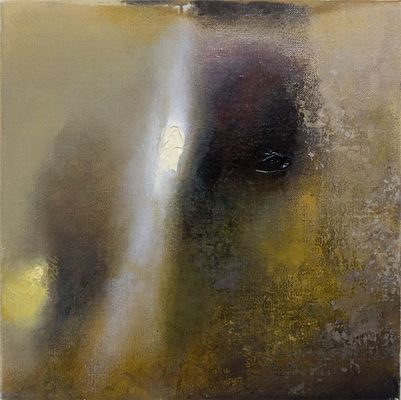
I am not a great reader of poetry but I always return to the work of Melbourne poet, Vincent Buckley (1925- 1988). Perhaps I find his most tantalising piece to be not a finished poem but a fragment left on a scrap of paper discovered on his desk after the poet’s death.
The poetry gathers like oil
In the word-core, and spreads
It has its music meet,
Its music is in movement.
This fragment is more the shell left behind from a volatile thought than a finished poem. I find the last two lines honest but awkward whereas the first two lines work like an arrow. Most likely he could not find a resolution so it was left. Still, in its present form, it remains an eloquent testimony to the ultimate failure of a medium to express mobile thought and sensation, in Buckley’s case, through verbal language. It’s an important matter because this is something all artists have to deal with regardless of the medium.
I have never written a poem, however, I am forever copying fragments from books on paper scraps in a vain effort to fix certain notions in my head. At first, they function as bookmarks that are sometimes returned to when I open the book. But before long, as they accumulate, they fall out littering the table interspersed with A4 photocopies, bills, books and medications.
To return to Buckley’s fragment, the first two lines very much evoke how I paint nowadays. As you age, detail diminishes and patches of light become more luminous and float. I feel the most honest way of dealing with this is by smearing the oil paint on the canvas with the fingers and working close-up, blind. Only if the patches coalesce into an approaching image can the work gain a life.
-
Jonathan Walker was born in Melbourne, Australia and brought up on a dairy farm in Gippsland. In the 1970’s he studied painting at RMIT and won the Harold Wright Scholarship to the British Museum, London. During the 1980’s he exhibited at Pinacotheca Gallery, Richmond and had work shown at the NGV and Heidi City Art Gallery. Over the same period he designed the cover for the “Epigenesi” LP by Giancarlo Toniutti, Italy and conducted a mail exchange work with Achim Wollscheid, Germany. The work with artists through the post resulted in an article published in the bicentenary issue of Art and Australia 1988. He showed in artist run spaces such as WestSpace in the 90’s and 2000’s, and until 2012, taught painting at Victoria University, which is where we (Colleen Ahern and Lisa Radford) as organisers of the exhibition, among many others, had the privilege of being his student.
Walker’s knowledge was imparted to students through the careful selection of music, literature, and artists found in books that he himself had ordered for the library. Walker’s strategy was the generosity of sharing his vast knowledge with references specific to each student and their context.
Walker’s paintings share a similar focus and intimacy.
This exhibition presents a small selection of recent paintings alongside a publication that includes Walker’s writing. Observational and analytical, Walker’s work is a type of material notation — the time of day, colour and how it is blended, the both specific and fleeting location of a reflection on lino or the question of whether a chair leg should be included in a painting.
Please join us on Friday August 21 between 6-8pm to celebrate the opening of the exhibition.
Curated by Colleen Ahern and Lisa Radford.
B. Wurtz
Curated by Nic Tammens
March 26 - April 4, 2015
B.Wurtz works from a basement studio in his home on Manhattan’s Lower East Side.
This local fact is attested to by the plastic shopping bags and newsprint circulars that appear in his work. As formal objects, they don’t make loud claims about their origins but nonetheless transmit street addresses and places of business from the bottom of this long thin island. Like plenty of artists, Wurtz is affected by what is local and what is consumed. His work is underpinned by this ethic. It often speaks from a neighborhood or reads like the contents of a hamper:
“BLACK PLUMS $1.29 lb.”
“Food Bazaar”
“USDA Whole Pork Shoulder Picnic 99c lb.”
“RITE AID Pharmacy, with us it’s personal.”
“H. Brickman & Sons.”
“Sweet Yams 59c lb."
Most of the work in this exhibition was made while the artist was in residence at Dieu Donne, a workshop dedicated to paper craft in Midtown. Here Wurtz fabricated assemblages with paper and objects that are relatively lightweight, with the intention that they would be easily transportable to Australia. This consideration isn’t absolute in Wurtz’s work, but was prescriptive for making the current exhibition light and cheap. Packed in two boxes, these works were sent from a USPS post office on the Lower East Side and delivered to North Melbourne by Australia Post.
Wurtz appears courtesy of Metro Pictures, New York.
Thanks to Rob Halverson, Joshua Petherick, Sari de Mallory, Matt Hinkley, Helen Johnson, Fayen d'Evie, Ask Kilmartin, Lisa Radon, Ellena Savage, Yale Union, and "Elizabeth".
John Nixon
"Archive"
December 15 - January 20, 2014
The presentation of John Nixon's archive offered a rare showcase of this extensive collection of the artist's own publications, catalogues, posters, ephemera, editions and more, from the mid 1980s onwards, alongside a selection of his artworks.
Organized by John Nixon, Joshua Petherick and Matt Hinkley.
<a href=http://wfb.public-office.info/artist/john-nixon>All titles by John Nixon
"Habitat"
at Minerva, Sydney (organised by Joshua Petherick and Matt Hinkley)
November 15 - December 20, 2014
Lupo Borgonovo, Janet Burchill & Jennifer McCamley,
Lewis Fidock, HR Giger, Piero Gilardi, Veit Laurent Kurz,
Cinzia Ruggeri, Michael E. Smith, Lucie Stahl, Daniel Weil, Wols
Press Release:
“...It contained seven objects. The slender fluted bone, surely formed for flight, surely from the wing of some large bird. Three archaic circuitboards, faced with mazes of gold. A smooth white sphere of baked clay. An age-blackened fragment of lace. A fingerlength segment of what she assumed was bone from a human wrist, grayish white, inset smoothly with the silicon shaft of a small instrument that must once have ridden flush with the surface of the skin - but the thing’s face was seared and blackened.”
William Gibson, “Count Zero”, 1986
"Autumn Projects Archive"
Curated by Liza Vasiliou
March 6 - March 15, 2014
World Food Books, in conjunction with the Virgin Australia Melbourne Fashion Festival 2014, presented the Autumn Projects archive, consisting of a selection of early examples in Australian fashion with a particular interest in collecting designers and labels from the period beginning in the 1980’s, who significantly influenced the discourse of Australian Fashion.
Curated by Liza Vasiliou, the exhibition provided a unique opportunity to view pieces by designers Anthea Crawford, Barbara Vandenberg, Geoff Liddell and labels CR Australia, Covers, Jag along with early experimental collage pieces by Prue Acton and Sally Browne’s ‘Fragments’ collection, suspended throughout the functioning World Food Books shop in Melbourne.
H.B. Peace
presented by CENTRE FOR STYLE
November 14, 2013
"Hey Blinky, you say chic, I say same"
Anon 2013
H.B. Peace is a clothing collaboration between great friends Blake Barns and Hugh Egan Westland. Their pieces explore the divergences between 'character’ and ‘personality’ in garments....etc
Special Thanks to Joshua Petherick and Matt Hinkley of WFB and Gillian Mears
and a Very Special Thank you to Audrey Thomas Hayes for her shoe collaboration.
Janet Burchill & Jennifer McCamley
"Aesthetic Suicide"
May 10 - June 8, 2013
The first of our occasional exhibitions in the World Food Books office/shop space in Melbourne, "Aesthetic Suicide" presented a body of new and older works together by artists Janet Burchill & Jennifer McCamley, including videos, prints, a wall work, and publications.
During shop open hours videos played every hour, on the hour.
1989, Japanese
Softcover, 96 pages, 25.5 x 18 cm
1st Edition, Out of print title / used / fine
Published by
Art Vivant / Tokyo
$90.00 - Out of stock
Issue 32 (1989) of Japan's great Art Vivant quarterly journal. This very special issue dedicated entirely to the work of Spanish surrealist artist Remedios Varo (1908 – 1963). Heavily illustrated throughout with colour and black and white reproductions of Varo's paintings, also essays in Japanese, portraits, biography, and much more.
Very scarce and Fine copy of this collectible issue.
Remedios Varo Uranga (1908 – 1963) was a Spanish surrealist artist. Born in Anglès (north of Catalonia), Spain in 1908, she studied at the Real Academia de Bellas Artes de San Fernando, Madrid. Varo spent her formative years between France and Barcelona and was greatly influenced by the surrealist movement. The summer of 1935 marked Varo's formal invitation into Surrealism when French surrealist Marcel Jean arrived in Barcelona. While still married to her first husband Gerardo Lizarraga, Varo met her second partner, the French surrealist poet Benjamin Péret, in Barcelona. During the Spanish Civil War she fled to Paris with Péret leaving Lizarraga behind (1937). It was through Peret that Remedios Varo met André Breton and the Surrealist circle, which included Leonora Carrington, Dora Maar, Roberto Matta, Wolfgang Paalen, and Max Ernst among others. Shortly after arriving in France, Varo took part in the International Surrealist exhibitions in Paris and in Amsterdam in 1938. She was forced into exile from Paris during the German occupation of France and moved to Mexico City at the end of 1941 when the Mexican president, Lázaro Cardenas, made it a policy to welcome Spanish and European refugees. In Mexico, she met native artists such as Frida Kahlo and Diego Rivera, but her strongest ties were to other exiles and expatriates, notably the English painter Leonora Carrington and the French pilot and adventurer, Jean Nicolle. However, because Mexican muralism still dominated the country's art scene, surrealism was not generally well received. She worked as an assistant to Marc Chagall with the design of the costumes for the production of the ballet Aleko, which premiered in Mexico City in 1942. In 1947, Péret returned to Paris, and Varo traveled to Venezuela, living there for two years. She returned to Mexico and began her third and last important relationship with Austrian refugee Walter Gruen, who had endured concentration camps before escaping Europe. Gruen believed fiercely in Varo, and he gave her the economic and emotional support that allowed her to fully concentrate on her painting. In 1955, Varo had her first solo exhibition at the Galería Diana in Mexico City. Buyers were put on waiting lists for her work. Even Diego Rivera was supportive. In 1960, her representative, Juan Martín, opened his own gallery and showed her work there, and opened a second in 1962. Only a year after that opening, at the height of her career, she died from a heart attack in Mexico City. Her work is well known in Mexico, but not as commonly known throughout the rest of the world.
2002, Japanese
Softcover, 29.4 x 21 cm
1st Edition, Out of print title / used / fine
Published by
relax / Tokyo
$45.00 - Out of stock
July 2002 issue of 'Relax' magazine from Tokyo, with cover artwork by artist Rammellzee. This issue features a large feature on the "Gothic Futurism" of Rammellzee, also features on artist Margaret Kilgallen, Moschino, re-visiting David Lynch's Mulholland Drive, artwork by Mark Gonzalez, and much more.
Before the term Hype Beast existed there was Relax magazine, a trailblazing Japanese style magazine that primarily ran throughout the late 1990s and early 2000s. It embodied and informed everything "Shibuya", in more interesting times. Times of X-Large, Alife, Beams, United Arrows, Girl Skateboards, and MoWax. But alongside the latest from Bape, Lego or Sofia Coppola one might also find in-depth articles on anything from concrete poetry, steel drumming, teashops, zen music or dogparks. Globetrotting, unearthing, scene-reporting and profiling on an exhaustive monthly basis, Relax quickly became an important reference source for trends in graphic design, urban fashion, music, and lifestyle, both in and out of Japan.
Very Good - fine copy w/ inserted poster.
2002, Japanese
Softcover, 29.4 x 21 cm
1st Edition, Out of print title / used / fine
Published by
relax / Tokyo
$25.00 $15.00 - Out of stock
August 2002 issue of 'Relax' magazine from Tokyo, with cover artwork by manga artists Fujiko Fujio (Hiroshi Fujimoto and Motoo Abiko.) This issue features a photo report of Hawaii by Takashi Homma, Hawaiian records, a huge feature on Fujiko Fujio with many drawings, character developments, studio and office behind-the-scenes, illustrated history of published comics, products, fold-out poster, and much more, Wes Anderson, artwork by Mark Gonzalez, and much more.
Before the term Hype Beast existed there was Relax magazine, a trailblazing Japanese style magazine that primarily ran throughout the late 1990s and early 2000s. It embodied and informed everything "Shibuya", in more interesting times. Times of X-Large, Alife, Beams, United Arrows, Girl Skateboards, and MoWax. But alongside the latest from Bape, Lego or Sofia Coppola one might also find in-depth articles on anything from concrete poetry, steel drumming, teashops, zen music or dogparks. Globetrotting, unearthing, scene-reporting and profiling on an exhaustive monthly basis, Relax quickly became an important reference source for trends in graphic design, urban fashion, music, and lifestyle, both in and out of Japan.
Very Good - fine copy w/ inserted poster.
2001, Japanese
Softcover, 29.4 x 21 cm
1st Edition, Out of print title / used / very good
Published by
relax / Tokyo
$25.00 $15.00 - Out of stock
June 2001 issue of 'Relax' magazine from Tokyo, with cover artwork by artist/skateboarder Mark Gonzalez. This issue features a lengthy photo report from the West Coast (LA and SF) including profiles/interviews around Girl Skateboards, Chocolate, Stüssy, New Image Art Gallery, artists Ed Templeton, Chris Johanson, Barry McGee, etc. young skaters from SF, and more, Bape, a huge article on Japanese toy makers and collectors, including Kubrick, Medicom Toy, Bounty Hunter, Nigo, etc., James Jarvos, more artwork by Mark Gonzalez, and much more. Includes a still sealed edition from Fourstar Clothing (Girl).
Before the term Hype Beast existed there was Relax magazine, a trailblazing Japanese style magazine that primarily ran throughout the late 1990s and early 2000s. It embodied and informed everything "Shibuya", in more interesting times. Times of X-Large, Alife, Beams, United Arrows, Girl Skateboards, and MoWax. But alongside the latest from Bape, Lego or Sofia Coppola one might also find in-depth articles on anything from concrete poetry, steel drumming, teashops, zen music or dogparks. Globetrotting, unearthing, scene-reporting and profiling on an exhaustive monthly basis, Relax quickly became an important reference source for trends in graphic design, urban fashion, music, and lifestyle, both in and out of Japan.
Very Good copy w/ insert.
2003, Japanese
Softcover, 29.4 x 21 cm
1st Edition, Out of print title / used / very good
Published by
relax / Tokyo
$25.00 $15.00 - Out of stock
May 2003 issue of 'Relax' magazine from Tokyo, with cover feature on artist Barry McGee. This issue also features photo report from Okinawa, Bape, New Groove, artwork by James Jarvis, and much more.
Before the term Hype Beast existed there was Relax magazine, a trailblazing Japanese style magazine that primarily ran throughout the late 1990s and early 2000s. It embodied and informed everything "Shibuya", in more interesting times. Times of X-Large, Alife, Beams, United Arrows, Girl Skateboards, and MoWax. But alongside the latest from Bape, Lego or Sofia Coppola one might also find in-depth articles on anything from concrete poetry, steel drumming, teashops, zen music or dogparks. Globetrotting, unearthing, scene-reporting and profiling on an exhaustive monthly basis, Relax quickly became an important reference source for trends in graphic design, urban fashion, music, and lifestyle, both in and out of Japan.
Very Good - fine copy.
2002, Japanese
Softcover, 29.4 x 21 cm
1st Edition, Out of print title / used / very good
Published by
relax / Tokyo
$25.00 $15.00 - Out of stock
September 2002 issue of 'Relax' magazine from Tokyo, with cover feature on artist Chris Johanson. This issue also features photo report from the Danish commune Christiania, Misaki Ito/Bernhard Willhelm, Technics turntables, poet/artist Katué Kitasono and VOU, artwork by Mark Gonzalez, and much more.
Before the term Hype Beast existed there was Relax magazine, a trailblazing Japanese style magazine that primarily ran throughout the late 1990s and early 2000s. It embodied and informed everything "Shibuya", in more interesting times. Times of X-Large, Alife, Beams, United Arrows, Girl Skateboards, and MoWax. But alongside the latest from Bape, Lego or Sofia Coppola one might also find in-depth articles on anything from concrete poetry, steel drumming, teashops, zen music or dogparks. Globetrotting, unearthing, scene-reporting and profiling on an exhaustive monthly basis, Relax quickly became an important reference source for trends in graphic design, urban fashion, music, and lifestyle, both in and out of Japan.
Very Good copy, light cover wear.
1974, English
Softcover, 104 pages, 30.5 x 24 cm
1st Edition, Out of print title / used / very good
Published by
Studio International / London
$50.00 - In stock -
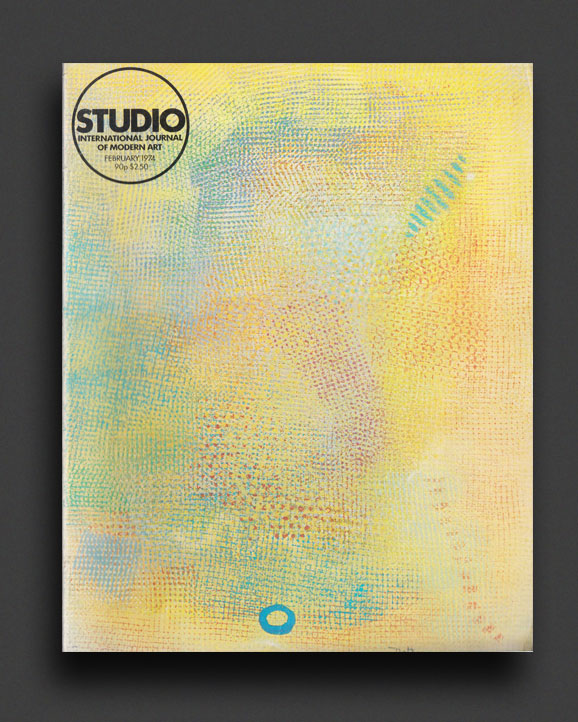
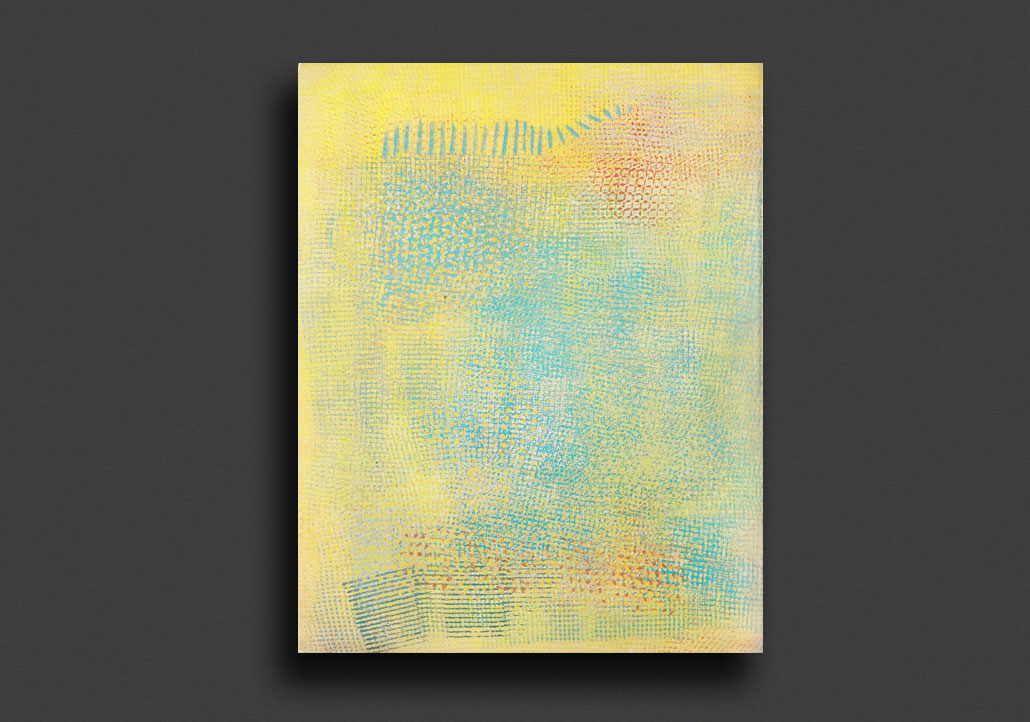
February 1974 issue of Studio International with specially designed covers by Robert Natkin. Includes articles : "The situation of the artist in Yugoslavia since 1945" by Cyril Barrett, "'Art-Language' at the Lisson Gallery" by Paul Wood, "Ivan Karp on Marcel Duchamp / an interview with Moira Roth", "Definition and theory 'Of the current avant garde / materialist / structural film" by Peter Gidal, "Edvard Munch: scene, symbol and allegory" by Frank Whitford, "Profile : Hans Haacke", "The shape of colour" by Patrick Heron, and the first of a three-part major article series on the work of Robert Ryman titles "Unfinished 1 (Materials)" by Barbara Reise. Reviews section. Correspondence. Much more.
An issue from the great Peter Townsend as editor years.
As editor of Studio International magazine from the mid-1960s to the mid-1970s, Peter Townsend oversaw its transformation from a mainstream Britain-centric publication into a vanguard journal chronicling some of the most radical artistic endeavours in the UK and internationally.
Robert Natkin (November 7, 1930 – April 20, 2010) was an American born abstract painter whose work is associated with Abstract expressionism, Colour field painting, and Lyrical Abstraction.
Very Good copy, with light general wear.
1974, English
Softcover, 152 pages, 30.5 x 24 cm
1st Edition, Out of print title / used / good
Published by
Studio International /
Studio International / London
$100.00 - Out of stock
The special "Belgian Issue" of Studio International, with famous front and back covers designed by Marcel Broodthaers, with text by Broodthaers on page 114 ("Wiertz Museum"). Also includes a long and rich essay entitled "'Incredible' Belgium : Impressions" by Barbara Reise, focussing on the years 1973-1974 and reviews the important events that marked the contemporary art scene in galleries or private collections, plus articles on Pol Bury and André Balthazar's "The Daily Bul" by André Balthazar, "Museums, Collectors, Policies" by Karl Geirlandt, "Some Notes on Hyper-realists" by Karl Geirlandt and Jean-Pierre van Tieghem, Panamarenko by Irmaline Lebeer, "Construction and Structure in Form and Colour" by Phil Mertens, "Aspects of the Avant-Garde in Belgium" by Michael Baudson and Yves Gevaert, and much more. Artist pages by Younger Belgian Artists: Paul De Gobert, Guy Mees, Maurice Roquet, Malcolm Lauder, Krokus, Jan Dries, Group Cap. Belgian comics. Reviews section.
A now very collectable issue from the great Peter Townsend as editor years.
As editor of Studio International magazine from the mid-1960s to the mid-1970s, Peter Townsend oversaw its transformation from a mainstream Britain-centric publication into a vanguard journal chronicling some of the most radical artistic endeavours in the UK and internationally.
Marcel Broodthaers (28 January 1924 – 28 January 1976) was a Belgian a polymorphic artist, poet, visual artist, filmmaker, photographer, who anticipated the reflection on the relationship between the artwork, the museum and the public.
Good copy, but with previous owner inscription on cover and decent age/rubbing to covers.
1959, Italian
Softcover (staple-bound), 14 pages, 24 x 17 cm
1st Edition, Out of print title / used / average
Published by
Galleria NUMERO / Firenze
$30.00 - In stock -
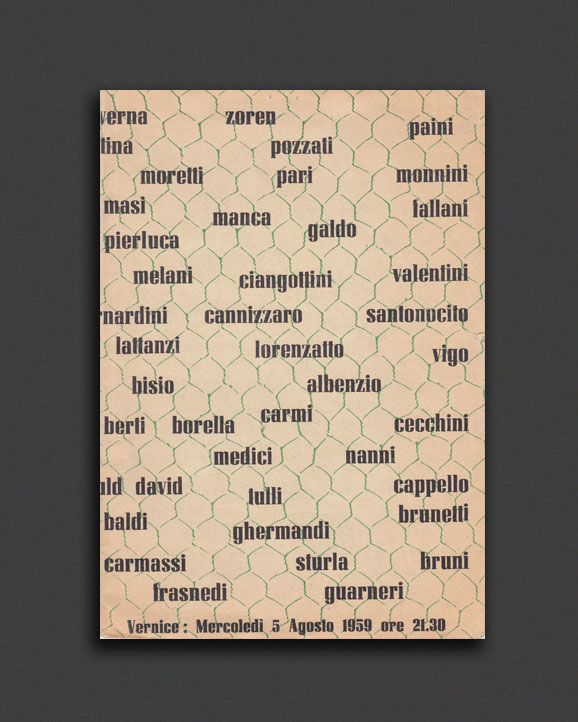
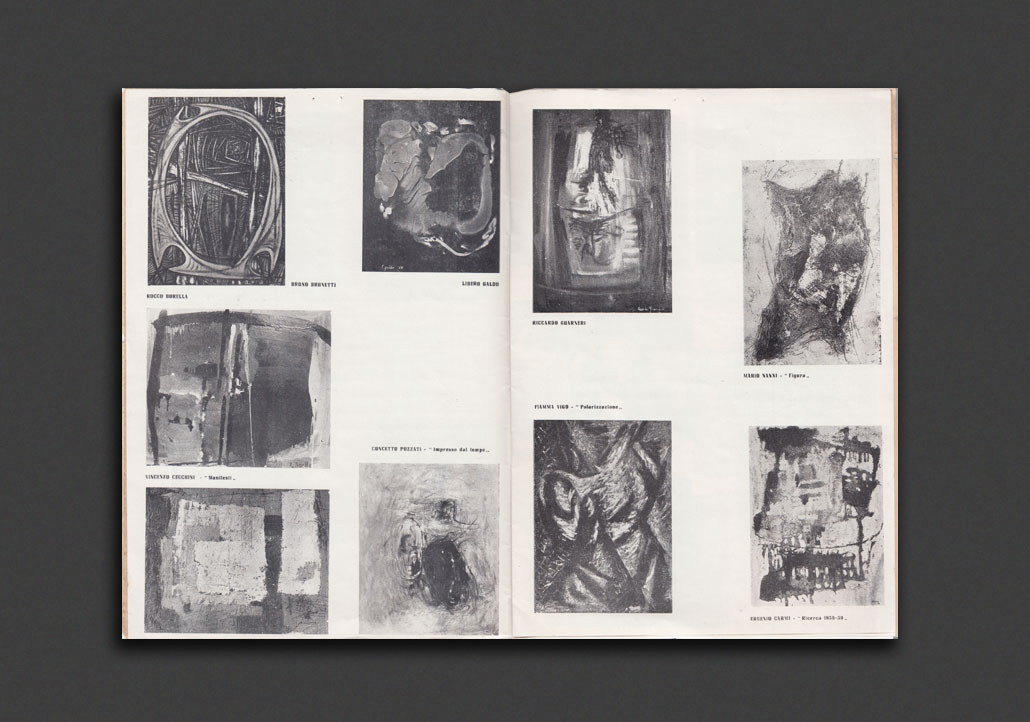
"40 Astrattisti" (catalogo 239° mostra) published by Galleria NUMERO in Florence in 1959. Beautifully printed on various stocks, slim staple-bound catalogue with b/w illustrations of a selection of the exhibiting artists. Titti Albenzio, Vinicio Berti, Iria Bernardini, Lanfranco Baldi, Silvio Bisio, Rocco Borella, Bruno Brunetti, Bruno Bruni, Carmelo Cappello, Eugenio Carmi, Corrado Carmassi, Mario Fallani, Alfonso Frasnedi, Quinto Ghermandi, Libero Galdo, Luciano Lattanzi, Paolo Masi, Osvaldo Medici, Fernando Melani, Alvaro Monnini, Alberto Moretti, Roberto Pattina, Concetto Pozzati, Luiso Sturla, Wladimiro Tulli, Fiamma Vigo, and many more.
Galleria NUMERO was founded in 1951 by gallerist, editor, collector, and painter Fiamma Vigo, who also founded the publication "Numero - Arte e Letteratura" together with architect Alberto Sartoris in 1949, dedicated to new Italian and foreign artistic avant-gardes. Galleria NUMERO was a decidedly nonconformist art gallery, promoting beyond all frontiers the most innovative and least represented art, Abstract Art. Driven by a strong pioneering spirit, Vigo was committed to the exhibiting and cataloguing of lesser-known artists close to Abstractionism and Informalism, and in the organisation of exhibitions in Italy and abroad, to raise awareness of the group of artists of "Numero", a group of which she is a part. She also dedicated herself to the promotion and promotion of female artists, very unusual for those times: she organized personal and collective exhibitions by Adriana Pincherle, Daphne Maugham Casorati, Paola Levi Montalcini, Simonetta Vigevani Jung, Giulia Napoleone, Carla Accardi, etc.
Good copy with back cover detaching from from spine due to age and brittle stock.
2018, English / Korean
Softcover, 380 pages, 21 x 26 cm
Published by
National Museum of Modern and Contemporary Art / Seoul
$105.00 - Out of stock
Published in conjunction with an exhibition at the National Museum of Modern and Contemporary Art in Seoul, this volume delves into the groundbreaking activities of E.A.T., a non-profit organisation that began actively promoting and exploring the union of art and technology in 1966. The brainchild of artists Robert Rauschenberg and Robert Whitman and engineers Billy Klüver and Fred Waldhauer, it aimed to expand the social role of artists and counteract feelings of alienation brought on by rapid technological advancement. The group hoped to inspire new directions for research, and also to serve as a catalyst in fostering technologies more attuned to the needs of the individual.
Profusely illustrated throughout with photographic documentation and archival material.
1979, English
Softcover, 96 pages, 25.5 x 21 cm
1st Edition, Out of print title / used / very good
Published by
Macmillan / Melbourne
$65.00 - Out of stock
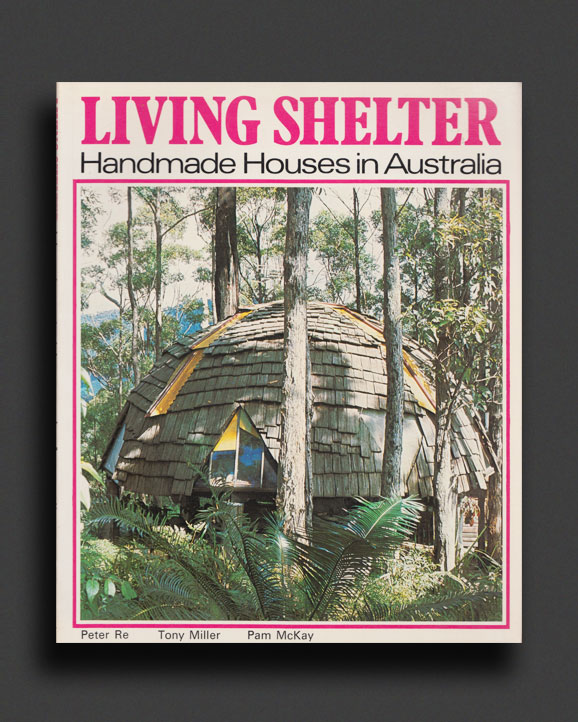
Published in Melbourne in 1979, this visionary book engages with the attitudes and principles of the alternative architecture movement. Compiled by Peter Re, Tony Miller & Pam McKay, 'Living Shelter' testifies to the owner-builders' creativity and to inspire "those who feel oppressed by the cultural values that dominate contemporary [Australia's] attitudes to shelter." An intimate and inspiring book in a landscape that has sadly only gotten more oppressive with time. Colour photography captures shingle domes, rainforest shelters, treetop studios, huts, and mudbrick abodes across Australia, and the people who have shaped their own living conditions from the ground up.
Very Good copy.
1983, French
Hardcover, 84 pages, 27 x 25 cm
1st Edition, Out of print title / used / very good
Published by
Contrejour / Paris
$100.00 - Out of stock
First edition of French photographer Claude Nori's classic self-titled 1983 monograph, published by Contrejour. Beautiful hardcover edition illustrated throughout with Nori's atmospheric photos that "bear the imprint of a fascinated, passionate observer and storyteller. Claude Nori succeeds masterfully in capturing that mixture of Mediterranean lifestyle and carefree holiday spirit that awakens memories and longings in us all."
Born in 1949 in Toulouse to parents who emigrated from Italy, Claude Nori discovered photography during the May ’68 events at a time when he thought he would become a director.
In 1974, he left Toulouse for Paris and there established Contrejour: a newspaper, an editing house, and a gallery in Montparnasse. It quickly became the spot for meetings and promotion of new forms of photography. Contrejour has been publishing artist’s books by photographers such as: Luigi Ghirri, Guy le Querrec, Bernard Plossu, Sebastiao Salgado, Pierre and Gilles, Edouard Boubat, Robert Doisneau, and Willy Ronis.
In 1984, he co-founded the magazine Camera International. He is a Mediterranean photographer, par excellence. He’s given us many books, among them Vacances a l’Italienne (“Italian Holidays”) and Stromboli.
2019, English
Softcover (hand-finished, staple-bound), 30 pages, 17 x 12.5 cm
Ed. of 280 copies,
Published by
EVA.C / London
$36.00 - Out of stock
Comprised of amateur S&M images from a single series produced by an anonymous photographer, Kane is the first book to be published by EVA.C, a London-based imprint run by Emma Capps and Anna Howard. Little else is known about the images, but each is marked with handwritten text which simply reads 'Kane'.
Beautifully printed in a limited run of only 280 hand-bound copies, discreetly wrapped in raw foiled card covers housed within tinted glassine paper sleeves.
2018, English
Softcover, 68 pages, 13.5 x 21 cm
Published by
Sternberg Press / Berlin
Harvard University Graduate School of Design / Cambridge
$32.00 - Out of stock
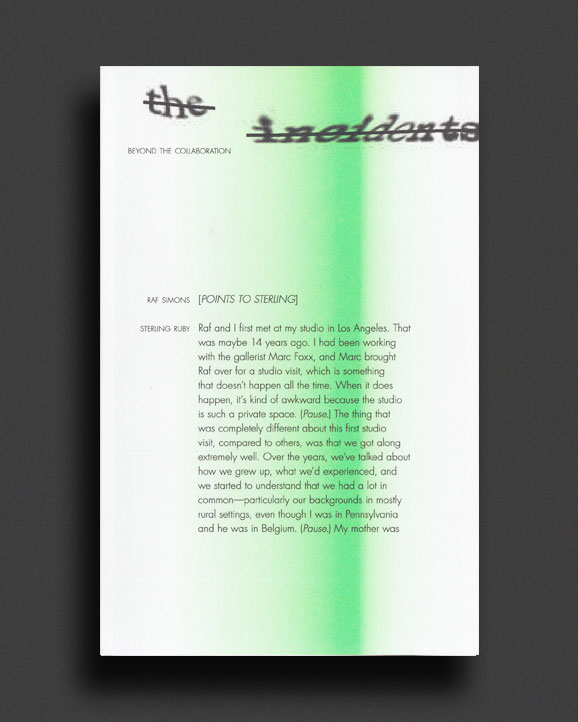
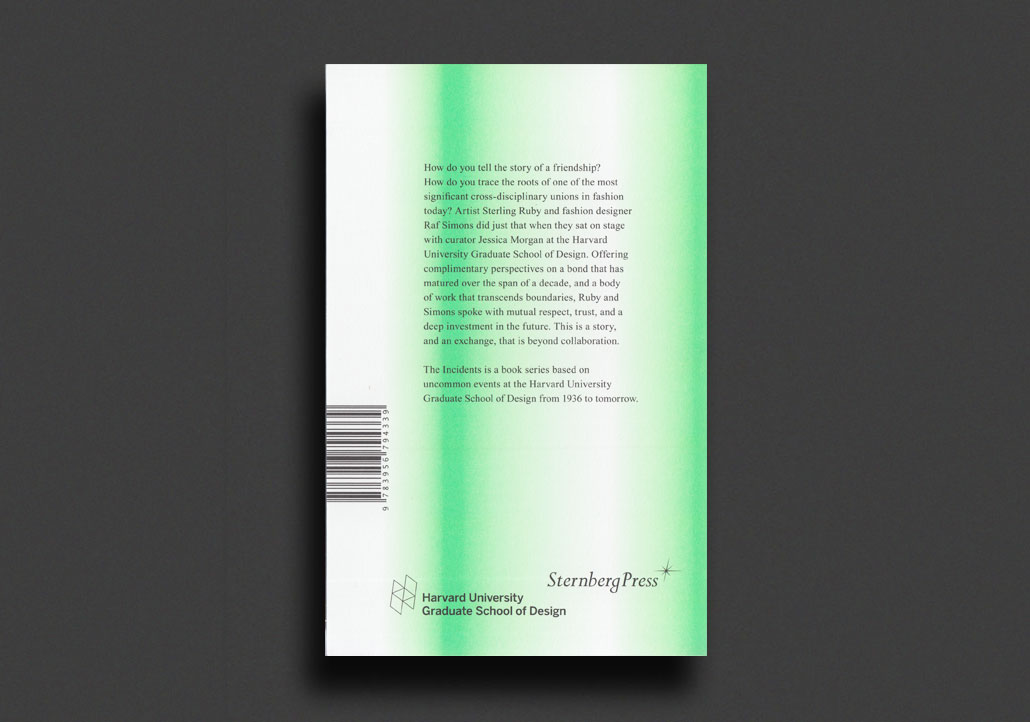
How do you tell the story of a friendship? How do you trace the roots of one of the most significant cross-disciplinary unions in fashion today? Artist Sterling Ruby and fashion designer Raf Simons did just that when they sat on stage with curator Jessica Morgan at the Harvard University Graduate School of Design. Offering complimentary perspectives on a bond that has matured over the span of a decade, and a body of work that transcends boundaries, Ruby and Simons spoke with mutual respect, trust, and a deep investment in the future. This is a story, and an exchange, that is beyond collaboration.
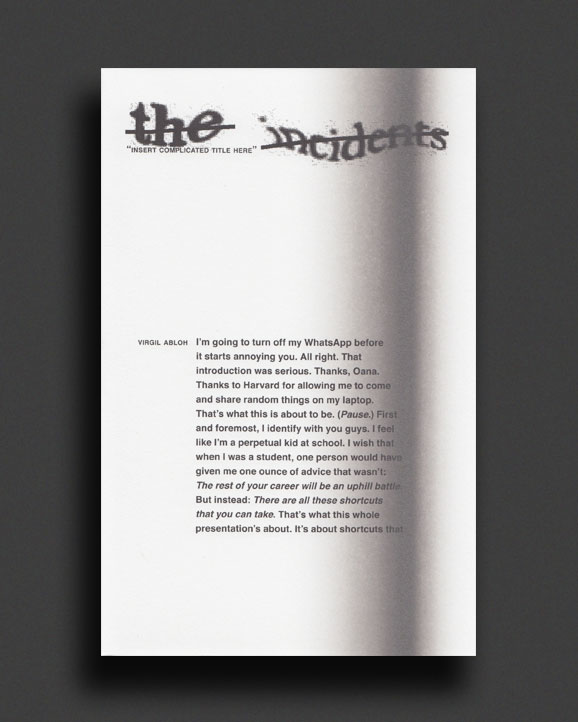
The Incidents is a book series based on uncommon events at the Harvard University Graduate School of Design from 1936 to tomorrow.
Edited by Jennifer Sigler, Leah Whitman-Salkin
Contribution by Jessica Morgan. Copublished with the Harvard University Graduate School of Design
Book series designed by Åbäke
2018, English
Softcover, 96 pages, 13.5 x 21 cm
Published by
Sternberg Press / Berlin
Harvard University Graduate School of Design / Cambridge
$24.00 - Out of stock
Edited by Jennifer Sigler and Leah Whitman-Salkin
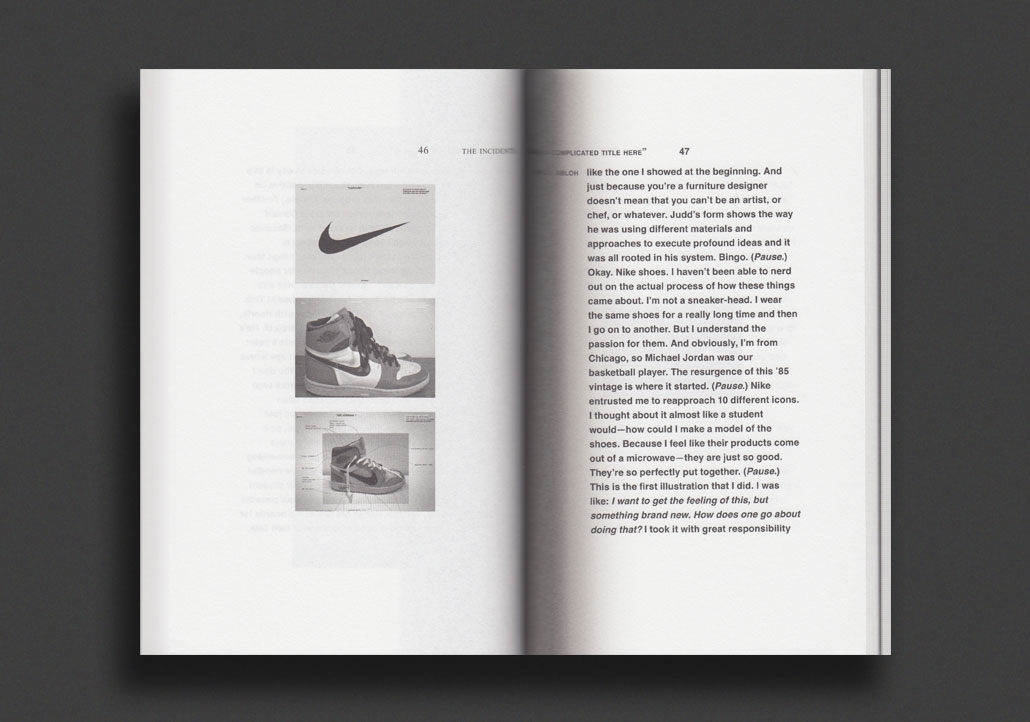
“What’s my DNA?” Virgil Abloh asks to an overflowing auditorium at the Harvard University Graduate School of Design. Abloh goes on to provide his audience with a “cheat code”—advice he wishes he had received as a student. He then unpacks a series of “shortcuts” for cultivating a “personal design language.” Trained as an architect and engineer, Abloh has translated the tools and techniques of his student days into the world of fashion, product design, and music. His label, Off-White, works in seeming contradictions, marrying streetwear with couture, collaborating with brands like Nike, Ikea, and the Red Cross; musicians like Lil Uzi Vert and Rihanna; and “mentors” like Rem Koolhaas. Impervious to hurdles (“They literally don’t exist.”), Abloh takes us behind the scenes of his design process, sharing the essentials of editing, problem-solving, and storytelling. He paints a picture of his DNA, and then flips the question: What’s your DNA?
Born in Rockford, Illinois, in 1980, Virgil Abloh is an artist, architect, engineer, creative director, and designer. After earning a degree in civil engineering from the University of Wisconsin–Madison, he completed a master’s degree in architecture at the Illinois Institute of Technology. It was there that he learned not only about design principles but also about the concept of collaborative working.
Virgil Abloh’s brand Off-White c/o Virgil Abloh™ was started in 2012 as an artwork titled PYREX VISION. In 2013, the brand premiered a seasonal men’s and women’s fashion label and moved into the production of furniture. Abloh has also curated exhibitions of his work, and in 2019 will have a retrospective at the Museum of Contemporary Art in Chicago. In 2018, Abloh was named artistic director of Louis Vuitton’s menswear collection.
The Incidents is a series of publications based on events that occured at the Harvard University Graduate School of Design between 1936 and tomorrow.
Copublished with the Harvard University Graduate School of Design
Book series designed by Åbäke
2019, English
Softcover, 304 pages, 26 x 19 cm
Published by
MUMA / Victoria
Perimeter Editions / Melbourne
$49.00 - Out of stock
A Centre for Everything (AUS), Asia Art Archive (HK), Chimurenga (SA), Lucas Ihlein (AUS), Annette Krauss & Casco Art Institute (NLD), Alex Martinis Roe (AUS), Kym Maxwell (AUS) and The Mulka Project (AUS).
Knowledge subjectivises us – it makes us who and what we are. It informs our evolving sense of self and our place in the world. One of the most powerful things about art is the multiplicity of knowledge to which it can lead us. The major exhibition and book Shapes of Knowledge – the most extensive survey of its kind in Australia – broaches notions of research, teaching and the laboratory in relation to art practice, referencing contemporary art’s ‘educational turn’ as a point of departure. Responding to its surroundings within Australia’s largest tertiary institution, Shapes of Knowledge surveys eight important socio-pedagogic, knowledge-making art projects from Australia, Asia, Europe and Africa, alongside a series of newly commissioned and historical texts that challenge the conventions of knowledge and reveal how art can be transformed by learning. Shapes of Knowledge is about what we know and how we know – a schema for teaching, learning and art that is open and ongoing.
2018, English
Softcover, 572 pages, 27.5cm x 19.5 cm
Published by
Many of Them
$55.00 - In stock -
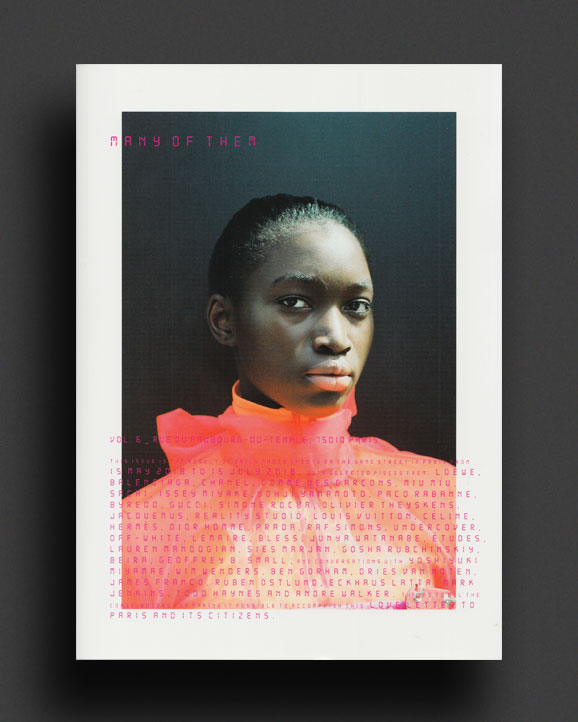
Many of Them is a contemporary culture magazine focusing on art, cinema and fashion. Published twice a year, its aim is to offer a space for discussion where creators can share their perspectives on their fields and the problems they face in their everyday practices.
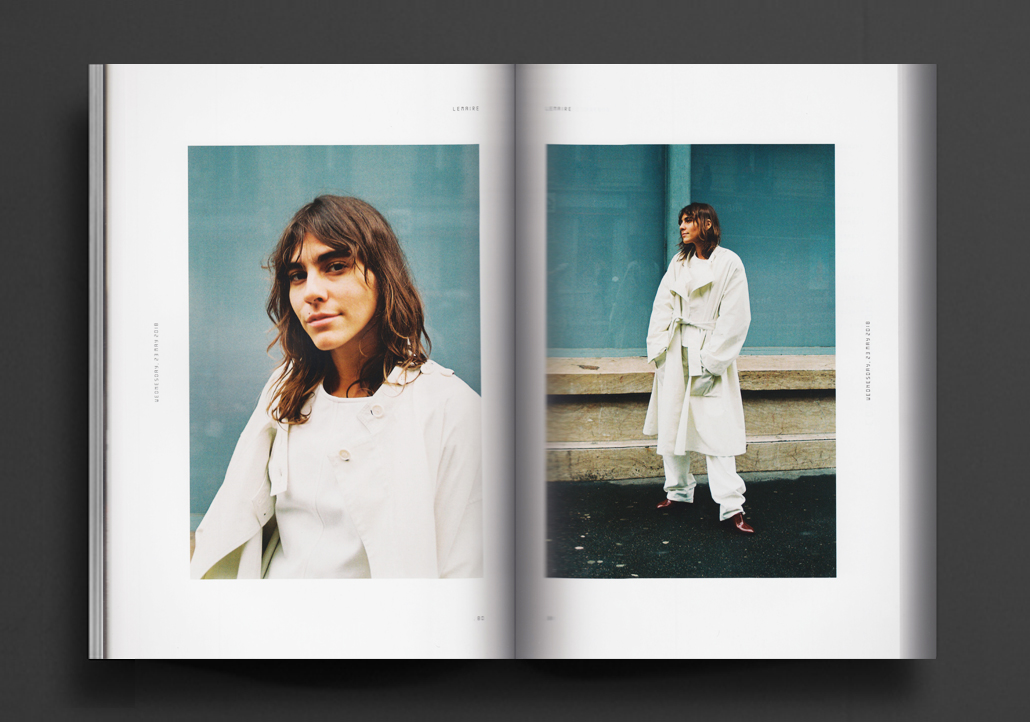
This issue is the result of daily photo shoots on the same street of Paris from 15 May 2018 to 15 July 2018, with selected pieces from: LOEWE, BALENCIAGA, CHANEL, COMME DES GARÇONS, MIU MIU, SACAI, ISSEY MIYAKE, YOHJI YAMAMOTO, PACO RABANNE, BYREDO, GUCCI, SIMONEROCHA, OLIVIER THEYSKENS, JACQUEMUS, REALITY STUDIO, LOUIS VUITTON, CÉLINE , HERMÈS, DIOR HOMME, PRADA, RAF SIMONS, UNDERCOVER, OFF-WHITE, LEMAIRE, BLESS, JUNYA WATANABE, ÉTUDES, LAUREN MANOOGIAN, SIES MARJAN, GOSHA RUBCHINSKIY, BEIRA, GEOFFREY B. SMALL; and conversations with YOSHIYUKI MIYAMAE, WIM WENDERS, BEN GORHAM, DRIES VAN NOTEN, JAMES FRANCO, RUBEN ÖSTLUND, ECKHAUS LATTA, MARK JENKINS, TODD HAYNES AND ANDRE WALKER. "Thanks to all the contributors for making it possible to accomplish this love letter to Paris and its citizens."
1966, English
Softcover (stapled), 10 pages (colour & b/w ill.), 15.5 x 22 cm
1st Edition, Out of print title / used / very good
Published by
Galerie 20 / Amsterdam
$120.00 - Out of stock
Very rare first edition catalogue from 1966 to accompany the exhibition of Japanese artist Tetsumi Kudo, "Quiet Event" at Galerie 20, Amsterdam.
About Tetsumi Kudo:
Not only did Tetsumi Kudo (1935-1990) – one of the most innovative artists in Japan in the 1950s and in France in the '60s and '70s – explore the existential possibilities for humanity in an increasingly polluted and consumption-driven world, issues critical in today's artistic practice and political debate; but in the two years since our last show and the major retrospective organized by the Walker Art Center, the wide-ranging and profound influence of his ideas and aesthetic has become increasingly clear. Mike Kelley wrote for the Walker catalog; Paul McCarthy has included Kudo in his lectures since 1968 and highlighted him as an influence in his intellectual autobiography Low Life Slow Life. Takashi Murakami, in seeing the last exhibition, has simply called Kudo, "the father of us all."
Very Good copy.
2019, English
Softcover, 104 pages, 14.6 x 21 cm
Published by
Urbanomic / Cornwall
$28.00 - Out of stock
Contributors: Antoine Bousquet, Shane Brighton, James Der Derian, Mark Fisher, John Gerrard, Mark Hansen, Stepan Kment, Eivind Røssaak, Anne-Françoise Schmid, McKenzie Wark, Eyal Weizman
This collection of wide-ranging interventions and discussions on the status of the moving image in an age of advanced simulation explores the contemporary links between power, simulation, and warfare.
Today, technological simulation has become an integral part of military training and operations; and at the same time, media spectacle—often enabled by the same technologies—has become integrated with military power. Trained in virtual environments, army personnel are increasingly enhanced by augmented reality technologies that bring combat into conformity with its simulation. Equally, the seductions of media and entertainment have become crucial weapons for ‘information dominance’. At the same time as the infosphere demands that war takes on the properties of a game, hyper-realistic videogames evolved from military technology become a kind of virtual distributed training camp, as the lines between simulation and action, combatant and civilian, become blurred.
Based on a round table discussion prompted by the work of artist John Gerrard, Simulation, Exercise, Operations assembles thinkers from philosophy, media, and military theory to examine the powers of simulation in the contemporary world.
2019, English
Softcover, 144 pages, 14.6 x 21 cm
Published by
Urbanomic / Cornwall
$28.00 - Out of stock
Contributors: Amanda Beech, Ray Brassier, Mark Fisher, Robin Mackay, Benedict Singleton, Nick Srnicek, James Trafford, Tom Trevatt, Alex Williams, Ben Woodard
An examination of the new technological mediations between the human sensorium and the planetary media network and of the aesthetic as an enabler of new modes of knowledge.
This series of interventions on the ramifications of Speculative Realism for aesthetics ranges from contemporary art's relation to the aesthetic, to accelerationism and abstraction, logic and design.
From varied perspectives of philosophy, art, and design, participants examine the new technological mediations between the human sensorium and the massive planetary media network within which it now exists and consider how the aesthetic enables new modes of knowledge by processing sensory data through symbolic formalisms and technological devices.
Speculative Aesthetics anticipates the possibility of a theory and practice no longer invested in the otherworldly promise of the aesthetic, but acknowledging the real force and traction of images in the world today, experimentally employing techniques of modelling, formalisation, and presentation so as to simultaneously engineer new domains of experience and map them through a reconfigured aesthetics that is inseparable from its sociotechnical conditions.
2015, English
Softcover, 332 pages, 14.8 x 21 cm
Published by
Urbanomic / Cornwall
$48.00 - Out of stock
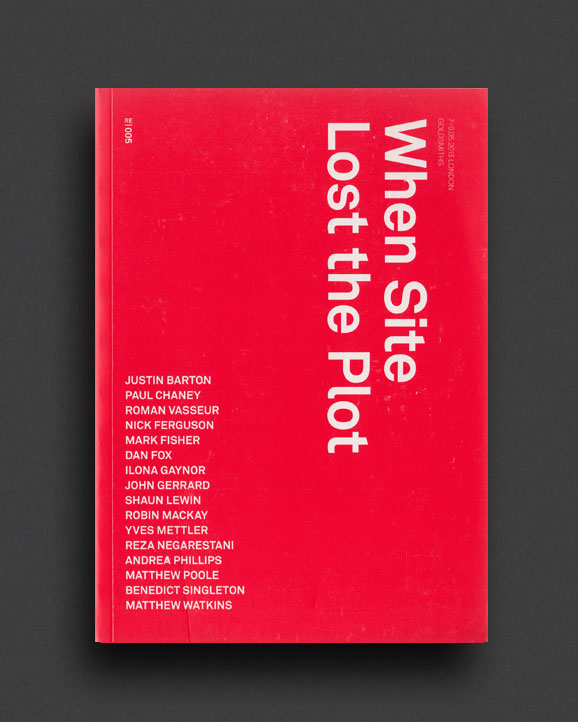
The critical concept of site-specificity once seemed to harbour the potential for disruption. But site-specific work has become increasingly assimilated into the capitalist logic of regeneration and value creation. The materialist critique of the art object has been shortcircuited by the franchised idiosyncrasies of international nomad flaneurs. Meanwhile, on a planet whose entire surface is mapped and apped, the concept of "site" itself becomes ever more problematic.How can we do justice to the particularity of local sites while unearthing their material conditions? What do a contemporary "geo-philosophy" and the historical legacy of site-specific art have to offer each other? Can we develop methods for the controlled unpacking of the local into the global, avoiding trivial reconciliations between local sites and their global conditions? When Site Lost the Plot charts some of the ways in which site continues to be a concern for contemporary practice; and introduces the concept of "plot" as an alternative, richer way in which to approach these questions.Alongside artists discussing their practice and their approach to site and plot, contributors from various disciplines introduce concepts from cartography, mathematics, film, fiction, design, and philosophy that may help us to think otherwise the relation between local and global, between specific sites and their material conditions.
Publication supported by the Graduate School, Goldsmiths University of London.
CONTENTS
INTRODUCTION
Site
ROMAN VASSEUR - Site and Materiality
YVES METTLER - Europe Squared
NICK FERGUSON - Speedscaping
JOHN GERRARD - Remote-Control Site (Interview)
ANDREA PHILLIPS - Making the Public
MATTHEW POOLE - Specificities of Sitedness
Plot
BENEDICT SINGLETON - The Long Con
ILONA GAYNOR - Chaos and Black Carpets
PAUL CHANEY - Fieldwork
SHAUN LEWIN - A Brief History of Transcendence in Maps
REZA NEGARESTANI - Where is the Concept?
ROBIN MACKAY - The Barker Topos
Unplace
JUSTIN BARTON AND MARK FISHER - On Vanishing Land
JUSTIN BARTON AND MARK FISHER - Outsights (Interview)
DAN FOX - Silent Running
Notes on Contributors
2011 / 2015, English
Softcover, 78 pages, 14.8 x 21 cm
Published by
Urbanomic / Cornwall
$28.00 - Out of stock
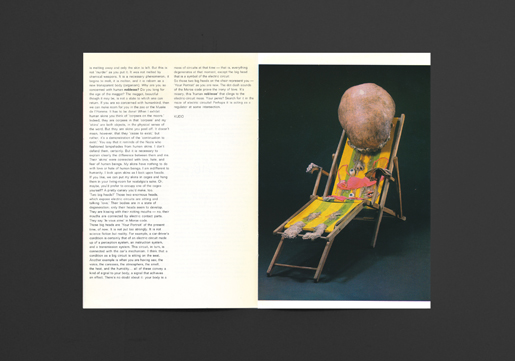
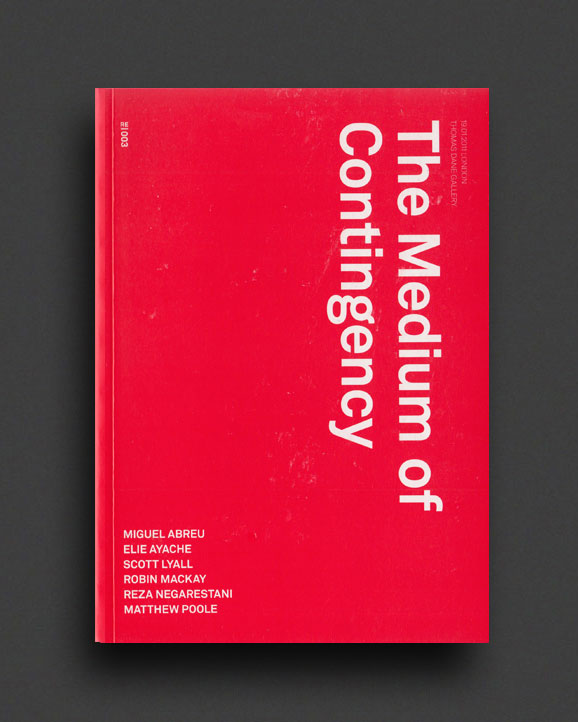
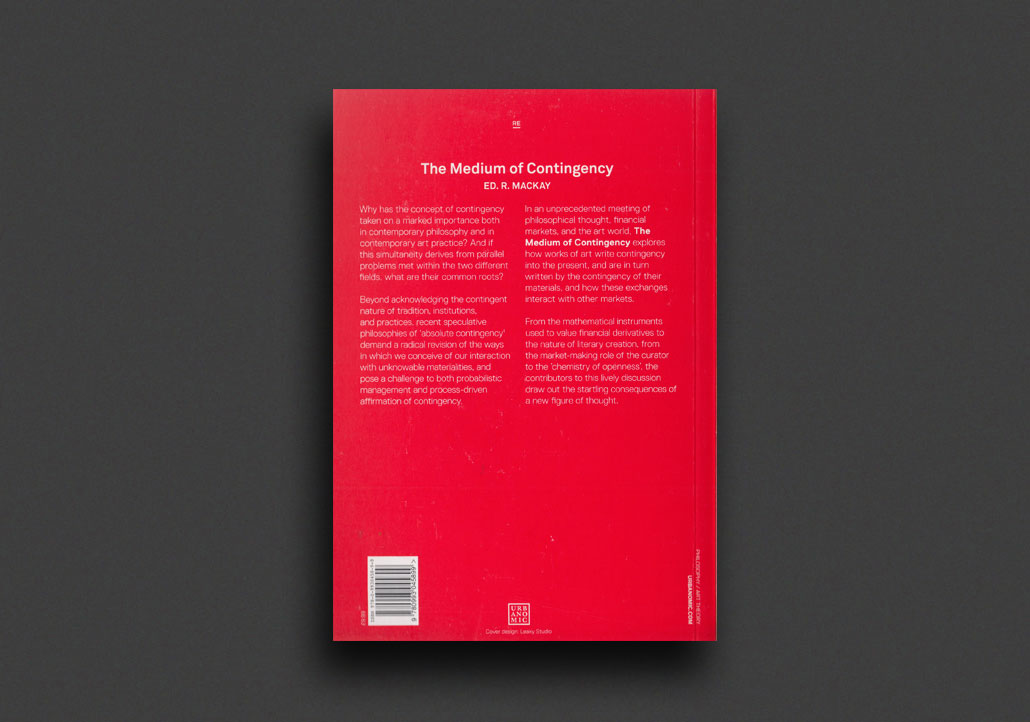
Why has the concept of contingency taken on a marked importance both in contemporary philosophy and in contemporary art practice? And if this simultaneity derives from parallel problems met within the two different fields, what are their common roots? Beyond acknowledging the contingent nature of tradition, institutions, and practices, recent speculative philosophies of 'absolute contingency' demand a radical revision of the ways in which we conceive of our interaction with unknowable materialities, and pose a challenge to both probabilistic management and process-driven affirmation of contingency.The book documents the event held at Thomas Dane Gallery in February of 2011 that coincided with the show entitled New York to London and Back. The show featured work by Kristen Alvanson, Hans Bellmer, Liz Deschenes, Thomas Eggerer, Rachel Harrison, Gareth James, Alison Knowles, Sam Lewitt, Scott Lyall, R. H. Quaytman, Eileen Quinlan, Raha Raissnia, Jimmy Raskin, Blake Rayne, Pamela Rosenkranz, Pieter Schoolwerth, Amy Sillman and Cheyney Thompson.
In an unprecedented overlapping of the contexts of philosophical, financial, and art worlds, The Medium of Contingency event brought together in discussion Robin Mackay, Reza Negarestani, Elie Ayache, Matthew Poole, Miguel Abreu and Scott Lyall. This publication includes presentations by each of the participants and an edited transcript of the discussion.
Contents
ROBIN MACKAY - Introduction: Three Figures of Contingency
REZA NEGARESTANI - Contingency and Complicity
ELIE AYACHE - In The Middle of The Event
MATTHEW POOLE - Art, Human Capital, and the Medium of Contingency
MIGUEL ABREU, ELIE AYACHE, SCOTT LYALL, ROBIN MACKAY, REZA NEGARESTANI, MATTHEW POOLE - Discussion
NOTES ON CONTRIBUTORS
NEW YORK TO LONDON AND BACK: LIST OF WORKS
2019, English
Softcover,
Ed. of 500,
Published by
Periodico / Zürich
$30.00 - In stock -
PERIODICO #3
Periodico is an independent magazine from Zürich, edited by Marc Asekhame and Teo Schifferli.
ISSUE 003 12 18
In this issue of Periodico, Mitchell Anderson looks at a history of Cindy Crawford Pepsi ads, 67 Anna-Sophie Berger reviews Norm Macdonald’s Net flix special, Anna Khachiyan considers Playboy’s backflip on nudity and Daniel Horn discusses New Models. Also featured is Kaspar Müller’s 2018 advertisement for the Swiss drop manufacturer Ricola and a suite of photographs of a work by the artist, commissioned for archival documentation in 2011. A comic strip by Bernhard Hegglin recounts a dream had on May 25th, 2018. With Chantal Kirby and Matthew Linde, Periodico produced a photoshoot of the Paul Poiret replica dresses featured in Linde’s curatorial project Passageways, recently shown at Kunsthalle Bern; as well as a series of scenographic images from the exhibition 陰府 (Shady Mansion) by Amy Lien and Enzo Camacho, recently shown at Kunstverein Freiburg.
Published in an edition 500 copies.
2019, English
Softcover, 120 pages, 14.6 x 21 cm
Published by
Urbanomic / Cornwall
$28.00 - Out of stock
Contributions by Éric Alliez, Maurizio Lazzarato, Amanda Beech, Robin Mackay, Christine Wertheim, Brian Evenson, Reza Negarestani, Joshua Johnson, Patricia Reed
A multidisciplinary collection of essays reflecting on Cold War cultural tropes in film, fiction, and contemporary art, and the models of knowledge that they imply.
If the term "Cold World" describes a world of infinite complexity, algorithmic capital, and the technological sublime, in many ways the dread experienced during the Cold War, when clear oppositions were laid out between nation states, is echoed in the hall of mirrors of Cold World globalization, where our collective consciousness is overtaken by a flood of difference, uncertainty, and the dread of the incomputability of this alien yet constructed world.
But what is the crime scene of the Cold World? How is it to be decrypted? Where are its discontinuities, what is the nature of its violence? This is to say, what is our place in this alien world and how do we even compute the "we" that we describe ourselves to be?
Given the existential uncertainty unleashed for those who lived through the Cold War, but whose repercussions are in many ways amplified, relayed, and replayed in a new form for those who must now survive what has been called the "Cold World"-that of technological subjectivation, political malaise, cultural dysphoria, and ecological crisis-this terrain comprises an experiential and experimental horizon that prompts many to pose, and to stage in myriad forms, a fundamental question: "What will we of make of ourselves?"
Cold War/Cold World documents a research project in progress that attempts to evaluate and respond to this fundamental shock to the system, examining attempts to render knowable, representable, or figurable the looming threats of both Cold War and Cold World-the common denominator being a distressed attempt to inquire into the dynamics of a real that seems in excess over understanding and the means of politics traditionally conceived; and a concomitant temptation to abandon any intelligent collective engagement in favour of a pragmatics that limits itself to wrestling with local contingencies, or an aesthetics mesmerised by a global sublime.
Edited by Robin MacKay and Amanda Beech
Contributions by Brian Evenson , Contributions by Joshua Johnson , Contributions by Patricia Reed