World Food Books' programme is largely produced on Kulin Nation land. We acknowledge the Wurundjeri people of the Kulin Nation as the first and continuing custodians of this land, and pay respect to their Elders past, present, and emerging.
World Food Books is an arts and special interests bookshop in Naarm / Melbourne. Founded in 2010, World Food Books is devoted to the presentation of a rotating, hand-selection of international art, design, literary and counterculture publications with an emphasis on the anti-traditional, the experimental, the avant-garde, the heretic, the marginal.
Presenting new titles alongside rare and out-of-print books, catalogues and journals spanning the fields of modern and contemporary art, design, photography, illustration, film, literature, poetry, cultural theory, philosophy, sexuality, popular and underground culture in its many radical forms, World Food Books wishes to encourage adventurous, thoughtful and open-minded reading, looking, writing, and exchange of publishing and ideas, both current and historical.
As well as our bookshop, located in Melbourne's historical Nicholas Building, all of our inventory is available internationally via our online mail-order service.
World Food Books semi-regularly co-ordinates "Occasions", a programme of exhibits and events at the bookshop and in partnership with other hosts (such as museums and art galleries) that develop out of the activities, relationships and content of the bookshop itself.
World Food Books
The Nicholas Building
37 Swanston Street
Room 5, Level 6
Melbourne 3000
Australia
SHOP HOURS:
Thu–Fri 12–6, Sat 12–5
WEB-SHOP OPEN 24/7
World Food Books
Postal Address:
PO Box 435
Flinders Lane
Victoria 8009
Australia
Art
Theory / Essay
Architecture / Interior
Graphic Design / Typography
Photography
Fashion
Eros
LGBTQ+
Fiction / Poetry
Weird / Speculative / Science Fiction / Horror
Transgressive / Visceral / Abject
Symbolism / Decadence / Fin de siècle
Film / Video
Painting
Sculpture / Installation
Performance / Dance / Theater
Drawing
Sound / Music
Curatorial
Group Shows / Collections
Periodicals
Out-of-print / Rare
Posters / Ephemera / Discs
Signed Books
World Food Books Gift Voucher
World Food Book Bag
Australian Art
Australian Fiction
Australian Science Fiction / Speculative Fiction
Australian Poetry
Australian Photography
Japanese Photography
Conceptual Art
Minimal Art
Dada
'Pataphysics / Oulipo
Fluxus
Concrete Poetry
Pop Art
Surrealism

Arte Povera
Arte Informale / Haute Pâte / Tachism
Nouveau Réalisme / Zero / Kinetic
Situationism / Lettrism
Collage / Mail Art / Xerox Art
Art Brut / Folk / Visionary / Fantastic
Illustration / Graphic Art / Bandes Dessinées
Furniture
Italian Radical Design / Postmodernism
Textiles
Ceramics / Glass
Counterculture
Protest / Revolt
Philosophy
Psychoanalysis
Anthropology
Anarchism
Socialism / Anarchism / Communism / Capitalism
Literary Theory / Semiotics / Language
Feminism / Women's Studies
Gender Studies / Sexuality
Anthropology
Fetishism / BDSM
Drugs / Psychedelia
Crime / Violence
Animal Rights / Veganism
Occult / Esoterica
Ecology / Earth / Alternative Living
Whole Earth / Crafts
All prices in AUD (Australian dollars)
Pick-Ups
Pick-up orders can be collected in our bookshop during opening hours after order date. Please collect any Pick-up orders within 2 weeks of ordering as we have limited storage space. Orders will be released back into stock if not collected within this time. No refunds can be made for pick-ups left un-collected. If you cannot make it in to the bookshop in this time-frame, please choose postage option.
Return Policy
All sales are final. We do accept returns (for refund or exchange) for items received in error. All our orders are packed with special care using heavy-duty padding and cardboard book-mailers or bubble mailers (for smaller books), using reinforcement where required. We cannot take responsibility for any lost, stolen or damaged parcels.
Insurance
Should you wish to insure your package, please email us directly after placing your order and we can organise this at a small extra expense. Although all standard/express tracked packages are very safe and dependable, we cannot take responsibility for any lost, stolen or damaged parcels. We recommend insurance on valuable orders.
Interested in selling your old books, catalogues, journals, magazines, comics, fanzines, ephemera? We are always looking for interesting, unusual and out-of-print books to buy. We only buy books in our fields of interest and specialty, and that we feel we can resell.
We base these prices on desirability, market value, in-print prices, condition and our current stock levels. We offer cash, store credit, and can take stock on consignment. All
about 25% of the price we expect to get when we sell them, or 30% in store credit. We base these prices on desirability, market value, in-print prices, condition and our current stock levels.
Sell your books any day of the week. You can drop them off and return later. If you have a lot of books, we can visit your Sydney home.
We buy books that we feel we can resell. We offer about 25 % of the price we expect to get when we sell them, or 30% in store credit. We base these prices on desirability, market value, in-print prices, condition and our current stock levels.
Philadelphia Wireman
03 August - 01 September, 2018
World Food Books is proud to announce our next Occasion, the first presentation of sculptures by Philadelphia Wireman in Australia.
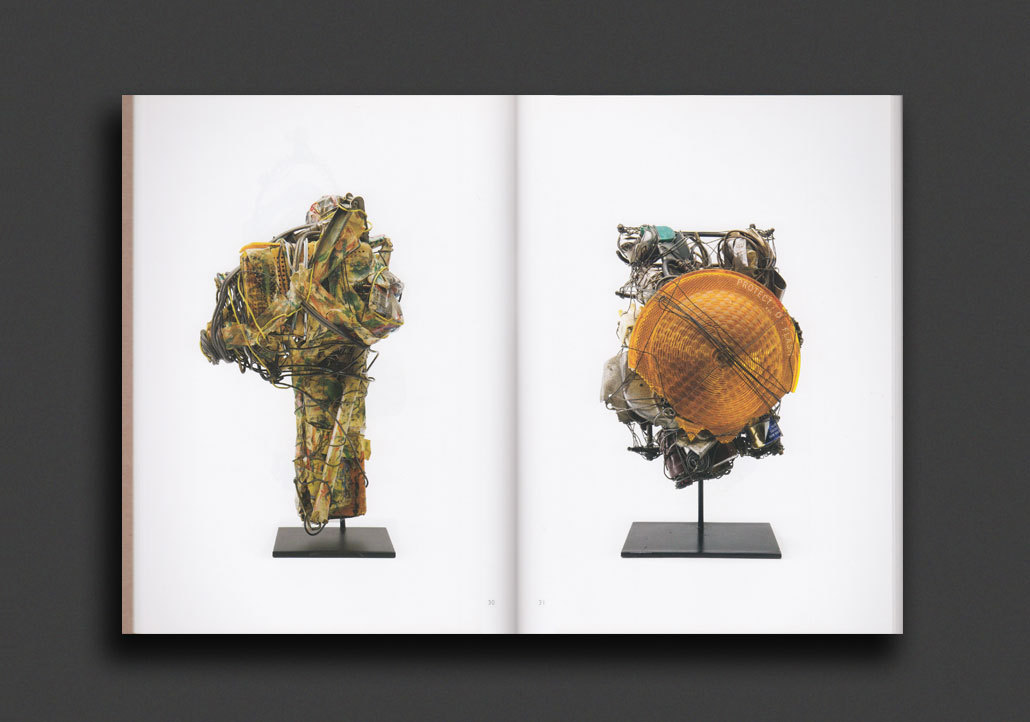
The Philadelphia Wireman sculptures were found abandoned in an alley off Philadelphia’s South Street on trash night in 1982. Their discovery in a rapidly-changing neighbourhood undergoing extensive renovation, compounded with the failure of all attempts to locate the artist, suggests that the works may have been discarded after the maker’s death. Dubbed the "Philadelphia Wireman" during the first exhibition of this work, in 1985, the maker’s name, age, ethnicity, and even gender remain uncertain. The entire collection totals approximately 1200 pieces, all intricately bound together with tightly-wound heavy-gauge wire (along with a few small, abstract marker drawings, reminiscent both of Mark Tobey and J.B. Murry). The dense construction of the work, despite a modest range of scale and materials, is singularly obsessive and disciplined in design: a wire armature or exoskeleton firmly binds a bricolage of found objects including plastic, glass, food packaging, umbrella parts, tape, rubber, batteries, pens, leather, reflectors, nuts and bolts, nails, foil, coins, toys, watches, eyeglasses, tools, and jewellery.
Heavy with associations—anthropomorphic, zoomorphic, and socio-cultural responses to wrapped detritus—the totemic sculptures by Philadelphia Wireman have been discussed in the context of work created to fulfil the shamanistic needs of alternative religions in American culture. Curators, collectors, and critics have variously compared certain pieces to sculpture from Classical antiquity, Native American medicine bundles, African-American memory jugs, and African fetish objects. Reflecting the artist’s prolific and incredibly focused scavenging impulse, and despite—or perhaps enhanced by—their anonymity, these enigmatic objects function as urban artefacts and arbiters of power, though their origin and purpose is unknown. Philadelphia Wireman, whatever their identity, possessed an astonishing ability to isolate and communicate the concepts of power and energy through the selection and transformation of ordinary materials. Over the course of the past two decades, this collection has come to be regarded as an important discovery in the field of self-taught art and vernacular art.
Presented in collaboration with Fleisher-Ollman Gallery, Philadelphia, and Robert Heald, Wellington.
Susan Te Kahurangi King
02 February - 10 March, 2018
Susan Te Kahurangi King (24 February 1951 - ) has been a confident and prolific artist since she was a young child, drawing with readily available materials - pencils, ballpoint pens and felt-tip markers, on whatever paper is at hand. Between the ages of four and six Susan slowly ceased verbal communication. Her grandparents William and Myrtle Murphy had developed a special bond with Susan so they took on caring responsibilities for extended periods. Myrtle began informally archiving her work, carefully collecting and storing the drawings and compiling scrapbooks. No drawing was insignificant; every scrap of paper was kept. The King family are now the custodians of a vast collection containing over 7000 individual works, from tiny scraps of paper through to 5 meter long rolls.
The scrapbooks and diaries reveal Myrtle to be a woman of great patience and compassion, seeking to understand a child who was not always behaving as expected. She encouraged Susan to be observant, to explore her environment and absorb all the sights and sounds. Myrtle would show Susan’s drawings to friends and people in her community that she had dealings with, such as shopkeepers and postal workers, but this was not simply a case of a grandmother’s bias. She recognised that Susan had developed a sophisticated and unique visual language and sincerely believed that her art deserved serious attention.
This was an unorthodox attitude for the time. To provide some context, Jean Dubuffet coined the term Art Brut in 1945 to describe work created by self-taught artists – specifically residents of psychiatric institutions and those he considered to be visionaries or eccentrics. In 1972 Roger Cardinal extended this concept by adopting the term Outsider Art to describe work made by non-academically trained artists operating outside of mainstream art networks through choice or circumstance. Susan was born in Te Aroha, New Zealand in 1951, far from the artistic hubs of Paris and London that Dubuffet and Cardinal operated in. That Myrtle fêted Susan as a self-taught artist who deserved to be taken seriously shows how progressive her attitudes were.
Susan’s parents Doug and Dawn were also progressive. Over the years they had consulted numerous health practitioners about Susan’s condition, as the medical establishment could not provide an explanation as to why she had lapsed into silence. Dawn educated herself in the field of homeopathy and went on to treat all twelve of her children using these principles – basing prescriptions on her observations of their physical, mental and emotional state.
Doug was a linguist with an interest in philosophy who devoted what little spare time he had to studying Maori language and culture. To some extent their willingness to explore the fringes of the mainstream made them outsiders too but it was their commitment to living with integrity and their respect for individuality that ensured Susan’s creativity was always encouraged.
Even though Susan’s family supported her artistic pursuits, some staff in schools and hospitals saw it as an impediment to her assimilation into the community and discouraged it in a variety of ways. Her family was not always aware of this and therefore did not fully understand why Susan stopped drawing in the early 1990s. However, rather than dwell on the challenges that Susan faced in pursuit of her artistic practice, they prefer to highlight her achievements. In 2008 Susan began drawing again in earnest, after an almost 20 year interruption, and her work is now shown in galleries around the world.
Susan grew up without television and has been heavily influenced by the comics she read as a child. She is absolutely fearless in the appropriation of recognizable characters, such as Donald Duck and Mickey Mouse, in her work. She twists their limbs, contorts their faces, compresses them together, blends them into complex patterned backgrounds - always imbuing them with an incredible energy. Although Susan often used pop culture characters in her work they are not naive or childlike. These are drawings by a brilliant self-taught artist who has been creating exceptional work for decades without an audience in mind.
Mladen Stilinović
"Various Works 1986 - 1999"
02 February 16 - September 10, 2016
Various works 1986 - 1999, from two houses, from the collections of John Nixon, Sue Cramer, Kerrie Poliness, Peter Haffenden and Phoebe Haffenden.
Including: Geometry of Cakes (various shelves), 1993; Poor People’s Law (black and white plate), 1993; White Absence (glasses, ruler, set square, silver spoon, silver ladel with skin photograph and wooden cubes), 1990-1996; Exploitation of the Dead (grey and red star painting, wooden painting, black spoon with red table, red plate), 1984-1990; Money and Zeros (zero tie, paintings made for friends in Australia (Sue, John, Kerrie), numbers painting), 1991-1992; Words - Slogans (various t-shirts) - “they talk about the death of art...help! someone is trying to kill me”, “my sweet little lamb”, “work is a disease - Karl Marx”; Various artist books, catalogues, monographs, videos; Poster from exhibition Insulting Anarchy; "Circular" Croatian - Australian edition; Artist book by Vlado Martek (Dostoyevsky); more.
Thanks to Mladen Stilinović and Branka Stipančić.
Jonathan Walker
Always Will Need To Wear Winter Shirt Blue + Ochre Small Check Pattern
21 August - 21 September, 2015
Untitled
I am not a great reader of poetry but I always return to the work of Melbourne poet, Vincent Buckley (1925- 1988). Perhaps I find his most tantalising piece to be not a finished poem but a fragment left on a scrap of paper discovered on his desk after the poet’s death.
The poetry gathers like oil
In the word-core, and spreads
It has its music meet,
Its music is in movement.
This fragment is more the shell left behind from a volatile thought than a finished poem. I find the last two lines honest but awkward whereas the first two lines work like an arrow. Most likely he could not find a resolution so it was left. Still, in its present form, it remains an eloquent testimony to the ultimate failure of a medium to express mobile thought and sensation, in Buckley’s case, through verbal language. It’s an important matter because this is something all artists have to deal with regardless of the medium.
I have never written a poem, however, I am forever copying fragments from books on paper scraps in a vain effort to fix certain notions in my head. At first, they function as bookmarks that are sometimes returned to when I open the book. But before long, as they accumulate, they fall out littering the table interspersed with A4 photocopies, bills, books and medications.
To return to Buckley’s fragment, the first two lines very much evoke how I paint nowadays. As you age, detail diminishes and patches of light become more luminous and float. I feel the most honest way of dealing with this is by smearing the oil paint on the canvas with the fingers and working close-up, blind. Only if the patches coalesce into an approaching image can the work gain a life.
-
Jonathan Walker was born in Melbourne, Australia and brought up on a dairy farm in Gippsland. In the 1970’s he studied painting at RMIT and won the Harold Wright Scholarship to the British Museum, London. During the 1980’s he exhibited at Pinacotheca Gallery, Richmond and had work shown at the NGV and Heidi City Art Gallery. Over the same period he designed the cover for the “Epigenesi” LP by Giancarlo Toniutti, Italy and conducted a mail exchange work with Achim Wollscheid, Germany. The work with artists through the post resulted in an article published in the bicentenary issue of Art and Australia 1988. He showed in artist run spaces such as WestSpace in the 90’s and 2000’s, and until 2012, taught painting at Victoria University, which is where we (Colleen Ahern and Lisa Radford) as organisers of the exhibition, among many others, had the privilege of being his student.
Walker’s knowledge was imparted to students through the careful selection of music, literature, and artists found in books that he himself had ordered for the library. Walker’s strategy was the generosity of sharing his vast knowledge with references specific to each student and their context.
Walker’s paintings share a similar focus and intimacy.
This exhibition presents a small selection of recent paintings alongside a publication that includes Walker’s writing. Observational and analytical, Walker’s work is a type of material notation — the time of day, colour and how it is blended, the both specific and fleeting location of a reflection on lino or the question of whether a chair leg should be included in a painting.
Please join us on Friday August 21 between 6-8pm to celebrate the opening of the exhibition.
Curated by Colleen Ahern and Lisa Radford.
B. Wurtz
Curated by Nic Tammens
March 26 - April 4, 2015
B.Wurtz works from a basement studio in his home on Manhattan’s Lower East Side.
This local fact is attested to by the plastic shopping bags and newsprint circulars that appear in his work. As formal objects, they don’t make loud claims about their origins but nonetheless transmit street addresses and places of business from the bottom of this long thin island. Like plenty of artists, Wurtz is affected by what is local and what is consumed. His work is underpinned by this ethic. It often speaks from a neighborhood or reads like the contents of a hamper:
“BLACK PLUMS $1.29 lb.”
“Food Bazaar”
“USDA Whole Pork Shoulder Picnic 99c lb.”
“RITE AID Pharmacy, with us it’s personal.”
“H. Brickman & Sons.”
“Sweet Yams 59c lb."
Most of the work in this exhibition was made while the artist was in residence at Dieu Donne, a workshop dedicated to paper craft in Midtown. Here Wurtz fabricated assemblages with paper and objects that are relatively lightweight, with the intention that they would be easily transportable to Australia. This consideration isn’t absolute in Wurtz’s work, but was prescriptive for making the current exhibition light and cheap. Packed in two boxes, these works were sent from a USPS post office on the Lower East Side and delivered to North Melbourne by Australia Post.
Wurtz appears courtesy of Metro Pictures, New York.
Thanks to Rob Halverson, Joshua Petherick, Sari de Mallory, Matt Hinkley, Helen Johnson, Fayen d'Evie, Ask Kilmartin, Lisa Radon, Ellena Savage, Yale Union, and "Elizabeth".
John Nixon
"Archive"
December 15 - January 20, 2014
The presentation of John Nixon's archive offered a rare showcase of this extensive collection of the artist's own publications, catalogues, posters, ephemera, editions and more, from the mid 1980s onwards, alongside a selection of his artworks.
Organized by John Nixon, Joshua Petherick and Matt Hinkley.
<a href=http://wfb.public-office.info/artist/john-nixon>All titles by John Nixon
"Habitat"
at Minerva, Sydney (organised by Joshua Petherick and Matt Hinkley)
November 15 - December 20, 2014
Lupo Borgonovo, Janet Burchill & Jennifer McCamley,
Lewis Fidock, HR Giger, Piero Gilardi, Veit Laurent Kurz,
Cinzia Ruggeri, Michael E. Smith, Lucie Stahl, Daniel Weil, Wols
Press Release:
“...It contained seven objects. The slender fluted bone, surely formed for flight, surely from the wing of some large bird. Three archaic circuitboards, faced with mazes of gold. A smooth white sphere of baked clay. An age-blackened fragment of lace. A fingerlength segment of what she assumed was bone from a human wrist, grayish white, inset smoothly with the silicon shaft of a small instrument that must once have ridden flush with the surface of the skin - but the thing’s face was seared and blackened.”
William Gibson, “Count Zero”, 1986
"Autumn Projects Archive"
Curated by Liza Vasiliou
March 6 - March 15, 2014
World Food Books, in conjunction with the Virgin Australia Melbourne Fashion Festival 2014, presented the Autumn Projects archive, consisting of a selection of early examples in Australian fashion with a particular interest in collecting designers and labels from the period beginning in the 1980’s, who significantly influenced the discourse of Australian Fashion.
Curated by Liza Vasiliou, the exhibition provided a unique opportunity to view pieces by designers Anthea Crawford, Barbara Vandenberg, Geoff Liddell and labels CR Australia, Covers, Jag along with early experimental collage pieces by Prue Acton and Sally Browne’s ‘Fragments’ collection, suspended throughout the functioning World Food Books shop in Melbourne.
H.B. Peace
presented by CENTRE FOR STYLE
November 14, 2013
"Hey Blinky, you say chic, I say same"
Anon 2013
H.B. Peace is a clothing collaboration between great friends Blake Barns and Hugh Egan Westland. Their pieces explore the divergences between 'character’ and ‘personality’ in garments....etc
Special Thanks to Joshua Petherick and Matt Hinkley of WFB and Gillian Mears
and a Very Special Thank you to Audrey Thomas Hayes for her shoe collaboration.
Janet Burchill & Jennifer McCamley
"Aesthetic Suicide"
May 10 - June 8, 2013
The first of our occasional exhibitions in the World Food Books office/shop space in Melbourne, "Aesthetic Suicide" presented a body of new and older works together by artists Janet Burchill & Jennifer McCamley, including videos, prints, a wall work, and publications.
During shop open hours videos played every hour, on the hour.
2003, English
Softcover, 27 × 20 cm
1st Edition, Out of print title / used*,
Published by
Purple Institute / Paris
$80.00 - Out of stock
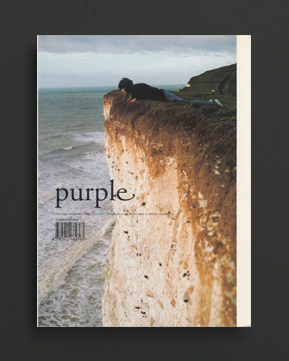
PURPLE Number 15, Spring-Summer 2003.
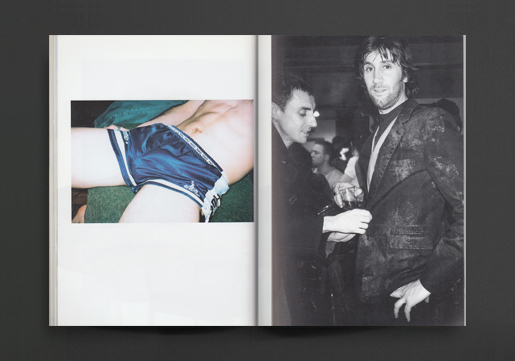
A rare early issue of the iconic Purple magazine, edited by Elein Fleiss and Olivier Zahm, this wonderful early edition features work by: Jeff Rain, Bruce Benderson, Nick Tosches, Dike Blair, Jens Hoffman, Miltos Manetas, Wolfgang Tillmans, Pierre Leguillon, Dominique Gonzalez-Foerster, Desiree Heiss amd Ines Kaag, Kelley Walker, Robert Wright, Yukinori Maeda, Oscar van den Boogbaard, Rita Ackermann, Laetitia Benat, Mark Borthwick, Giasco Bertoli, Cécile Bortoletti, Lizzie Bougatsos, Anders Edström, Richard Kern, Justine Kurtland, Emmanuelle Mafille, Terry Richardson, Henry Roy, Masafumi Sanai, Chikashi Suzuki, Bless, and many many more.
In 1992 Olivier Zahm and his partner Elein Fleiss printed the first issue of Purple Prose, a Parisian literary art zine that over the years has evolved into Purple Fashion Magazine and Purple. Soon after the birth of Purple Prose, Zahm and Fleiss created spin-off publications like les cahiers purple, Purple Sexe, Purple Fiction, and of course, Purple Fashion. Zahm aimed at fusing together his two worlds, fashion and art, in creating Purple.
2018, English
Softcover, 40 pages, 20.5 x 13 cm
Published by
Self-Published
$16.00 - Out of stock
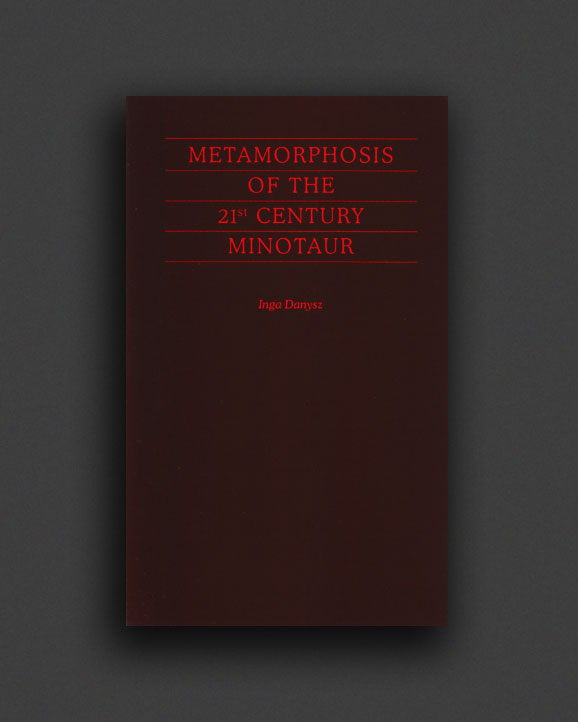
Metamorphosis of the 21st Century Minotaur is a short story by artist Inga Danysz. It explores the tourism industry, individualism and disillusionment.The Minotaur of the 21st century thus functions as a metaphor for the outsider, the artist, who has difficulties with his contradictory way of life, accompanied by illustrations based on theories of hyperrealism.
Design by Marcus Alasovic
2018, English
Hardcover (cloth), 80 pages, 30.5 x 24.5 cm
Published by
Kerber Verlag / Berlin
$50.00 $20.00 - Out of stock
New artist monograph published by Kerber Verlag on the occasion of Inga Danysz' (born 1990) solo exhibition at Kunstverein Reutlingen in 2017.
Without being themselves nostalgic, Danysz’ works reflect on notions of memory, loss, and migration. Danysz is interested in how forms can be re-purposed, how utility is translated, and in the processes of repetition and the sense of tension that originates thereafter how repetition and cohesion are counteracted by amnesia or obsolescence — or, in the words of one of her series, the condition of Fallen Utopias. (…)
Illustrated with work and installation views throughout, alongside contributions by Carla Donauer, Pablo Larios, Christian Malycha, and Sylwia Serafinowicz. Design by Studio Michael Satter and Marcus Alasovic.
2017, English
Softcover, 80 pages (plus insert), 12 x 19 cm
Published by
Ani Schulze and Inga Danysz / Frankfurt am Main
$19.00 - Out of stock
How to find answers for the questions about possibilities for living together in the present and future? The current social and political crisis is stirring up the liberal society, as do the global developments that affect our daily lives, demanding new categories of critical thinking and action. These changes also call for new ideas of co- habitation that are slowly replacing traditional notions of social constellations and ways of living. Furthermore new forms of social interactions are evolving, and new models of partnership are being established. That give the necessary call for new and more contemporary relationship concepts. The changing conditions of the private and political, the society and the individual demonstrate how social structures manifest themselves in our everyday lives and social situations. It also exposes a certain dependency that has taken place. How can opportunities for self-determination be provided? The fragile conditions of living together in terms of individual and social dimensions begin to crumble. The idea of the 'house' as a private sphere, separated from the world of production needs an experimental approach and a radical re- organisation towards new concepts for living, and towards more generic spaces. How to deal with the tension-ridden relationships between housing, architecture and social reality? Is it about time to minimise individual space and maximise collective space? Personal happiness and well-being can originate and find their expression in spaces that are not isolated from the 'outside' anymore, which in return require a collective structured decision making process. - Melissa Canbaz, 2017
Published by Ani Schulze and Inga Danysz, with contributions by Olga Pedan, Melissa Canbaz, Carla Donauer, Sebastian Muehl, Inga Danysz & Ani Schulze
Graphic Design by Philipp Moeller & Benjamin Franzki, Frankfurt am Main
CONTRIBUTORS
Melissa Canbaz (1986, Hannover, Germany) is a writer and curator based in Berlin. She graduated from the Masters of Research programme at the Glasgow School of Art (2013). Canbaz is a regular contributor to various publications, as well as artist’s books and catalogues. She is also editor of the interview magazine mono.kultur.
Inga Danysz (1990, Warsaw, Poland) is an artist based in Amsterdam and Frankfurt am Main. She studied at Cooper Union, New York and graduated from the Städelschule in Frankfurt am Main (2015). She is currently an artist-in-residence at De Ateliers, Amsterdam (2015-17) and was awarded the Columbus Advancement Prize for Contemporary Art (2016).
Carla Donauer (1981, Frankfurt am Main, Germany) is an independent curator, writer and art historian based in Cologne, where she is currently hosting the exhibition project HOSPITALITY. She was interim director of the Neuer Aachener Kunstverein (2013) and curator at the Kölnischer Kunstverein (2014-15).
Sebastian Mühl (1981, Zwickau, Germany) studied philosophy and Media and Fine Arts at the Academy of Visual Arts Leipzig (2005-12). He is currently finishing his PhD on notions of utopia in contemporary art practices at the Hochschule für Gestaltung Offenbach. Mühl is research assistant at HfG Offenbach where he works for the German Society for Aesthetics.
Olga Pedan (1988, Kharkov, Ukraine) is a Swedish artist based in Germany. She graduated from the Städelschule, Frankfurt am Main (2014). Her work spans various media, ranging from painting and costume making to installation, video and photography.
Ani Schulze (1982, Frankenberg, Germany) studied at the Städelschule, Frankfurt am Main, the Glasgow School of Art, Kunstakademie Düsseldorf and Kunstakademie Karlsruhe. She was selected for the Schloss Ringenberg Stipendium (2017) and completed residencies at AIR Antwerpen (2016), CEAAC, Strasbourg (2015) and at Fondazione Bevilaqua La Masa, Venice (2013).
2016, English
Softcover, 226 pages, 17 x 24 cm
Published by
Mao Museum of Architecture and Design / Ljubljana
$67.00 - Out of stock
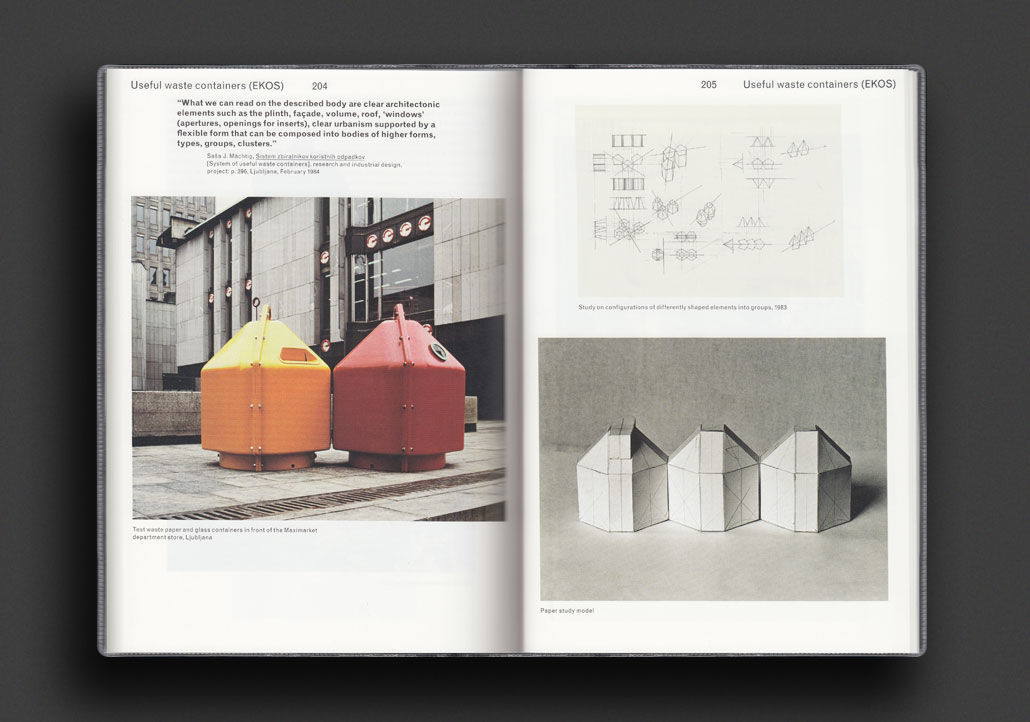
The only monograph on the great Saša J. Mächtig, and now out of print.
Saša J. Mächtig is one of the most prominent creative forces in Slovenian industrial design. His best-known and most influential work is Kiosk K67, whose modular design and complex system of elements represents the very essence both of his larger design philosophy and practice. Mächtig’s approach is systemic, with individual products and design strategies consistently conceived as part of a wider system that can develop, grow and change. According to him, urban space should not be furnished with individual, self-sufficient objects, but should instead offer open systems of flexible structures to create active areas that facilitate daily rituals, exchange of information and the participation of all. The publication reflects Mächtig’s systemic thought, interdisciplinary work, concept designs and end products, while showcasing the process of creation, from first concepts and project variations to extensive research, testing in public space and marketing campaigns.
Edited by Maja Vardjan.
1972, English
Hardcover (w. dust jacket), 210 pages, 32 x 24 cm
Out of print title / used / very good
Published by
Collins / London
$90.00 - Out of stock
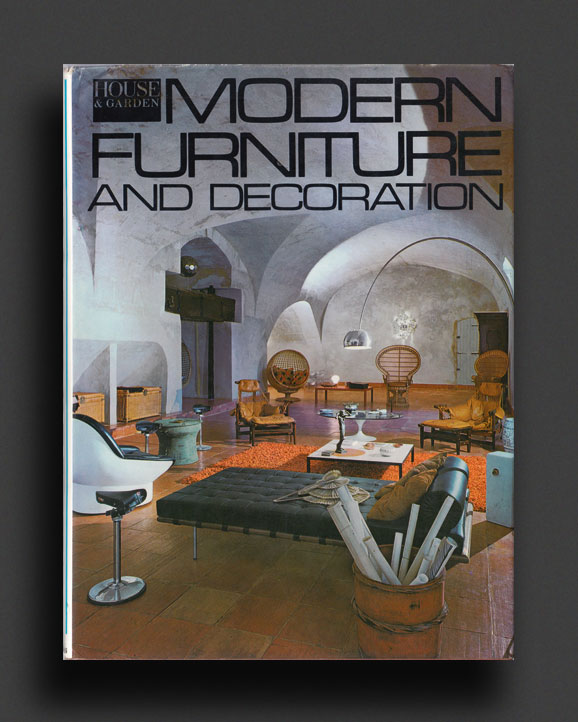
One of the great books on 1960s-70s interior design, Modern Furniture and Decoration, edited by Robert Hartling and published by Collins and Condé Nast in 1971/1972, presents over 200 pages of over-sized, colour-saturated photographs from around the world by the leading interior photographers of the period, bound into one heavy hard-covered volume. One of the must for any design library.
From the dust jacket:
"The contemporary revolution in interior design has a very tolerant philosophy. It accepts with delight unusual combinations of periods, motifs, products, colours, notions. An eighteenth-century commode, an Art Nouveau lampshade, a rare Benin head, a mass-production poster - any one of them is equally likely to be placed in a room alongside a Breuer tubular chair, an Italian lamp, or a Saarinen table."
Features the work of Joe Colombo, Oliver Mourgue, Alvar Aalto, George Nelson, Marcel Breuer, Le Corbusier, Ralph Erskine, Robin Day, Verner Panton, Pierre Paulin, Gae Aulenti, Billy Baldwin, Warren Platner, Mies van der Rohe, Eero Saarinen, Karl Largerfeld, Charles Eames, Kartell, Achille Castiglioni, Vico Magistretti, Barnett Newman, Kenneth Noland, Alexander Liberman, Morris Louis, Thonet, Georg Jensen, Eero Aarnio, Cy Twombly, Erwin and Estelle Laverne, Mario Bellini, Ristomatti Ratia, Anthony Caro, Jules Olitski, David Smith, Cassina, Mark Rothko, Marimekko, Terence Conran, and many more, spanning living and workspaces.
Very Good copy in Good dust jacket, preserved in plastic wrap.
2017, English
Softcover, 120 pages, 25 x 18 cm
1st Edition, Out of print title / used / very good
Published by
Koenig Books / London
$120.00 - Out of stock
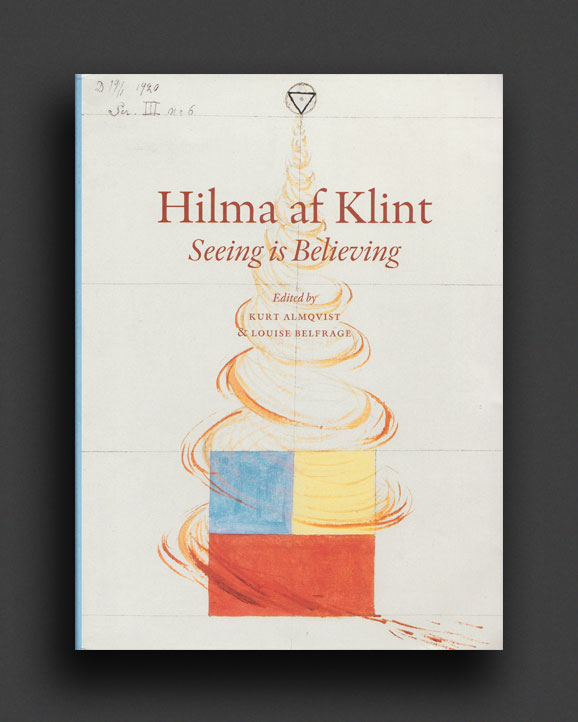
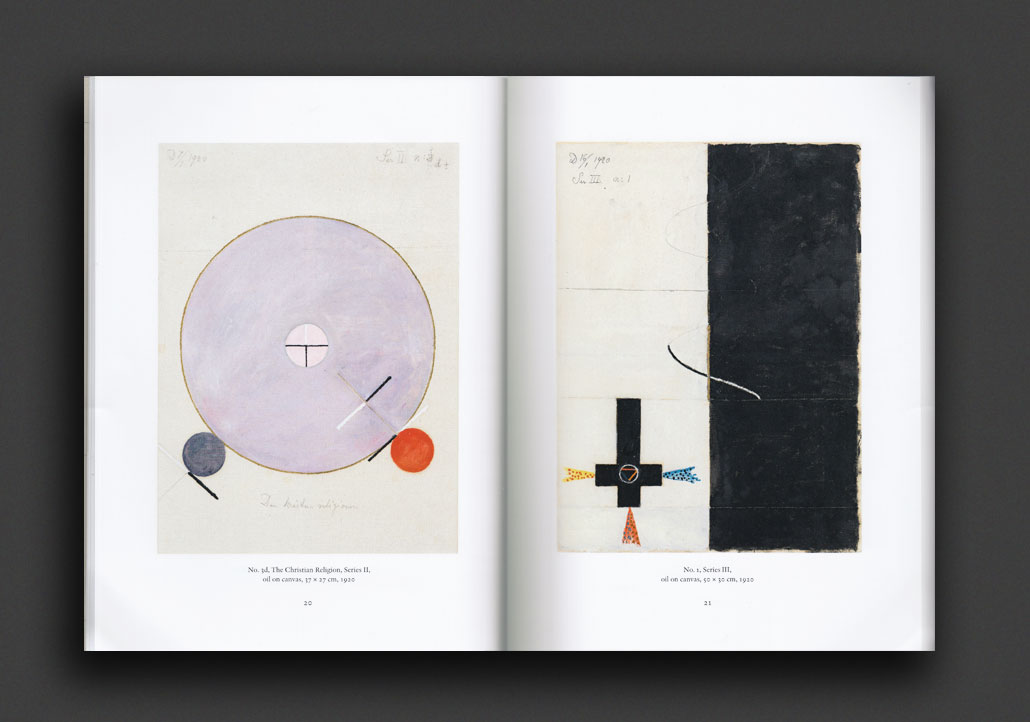
Now out of print and very collectable, this unique volume contains the last abstract images series made by Hilma af Klint in the 1920ʼs which are previously unpublished in their entirety. These images are followed by ground breaking essays which shed new light on the pioneering abstract artist af Klint and her importance for artists today. These images are complemented by essays based on lectures delivered during the exhibition Hilma af Klint: Painting the Unseen, at London’s Serpentine Galleries in 2016. Briony Fer, David Lomas, Branden Joseph, Hans Ulrich Obrist and Daniel Birnbaum shed new light on af Klint and her importance for artists today, also addressing the need for a broader conception of art history that her work proposes.
Hilma af Klint (1862 – 1944) was a Swedish artist and mystic whose paintings were amongst the first abstract art. A considerable body of her abstract work predates the first purely abstract compositions by Kandinsky. She belonged to a group called "The Five", a circle of women who shared her belief in the importance of trying to make contact with the so-called "High Masters" – often by way of séances. Her paintings, which sometimes resemble diagrams, were a visual representation of complex spiritual ideas.
2004, English
Softcover, 328 pages, 15 x 22.5 cm
Published by
Semiotext(e) / Los Angeles
$39.00 - Out of stock
A fascinating anthology of texts and interviews written over 20 years by renowned French philosopher Gilles Deleuze.
"One day, perhaps, this century will be Deleuzian," Michel Foucault once wrote. This book anthologizes 40 texts and interviews written over 20 years by renowned French philosopher Gilles Deleuze, who died in 1995. The early texts, from 1953-1966 (on Rousseau, Kafka, Jarry, etc.), belong to literary criticism and announce Deleuze's last book, Critique and Clinic (1993). But philosophy clearly predominates in the rest of the book, with sharp appraisals of the thinkers he always felt indebted to: Spinoza, Bergson. More surprising is his acknowledgement of Jean-Paul Sartre as his master. "The new themes, a certain new style, a new aggressive and polemical way of raising questions," he wrote, "come from Sartre." But the figure of Nietzsche remains by far the most seminal, and the presence throughout of his friends and close collaborators, Felix Guattari and Michel Foucault. The book stops shortly after the publication of Anti-Oedipus, and presents a kind of genealogy of Deleuze's thought as well as his attempt to leave philosophy and connect it to the outside -- but, he cautions, as a philosopher.
Translated by Mike Taormina
Edited by David Lapoujade
2015, English
Softcover, 384 pages, 15 x 23 cm
Published by
Semiotext(e) / Los Angeles
$48.00 - Out of stock
Introduction by Gilles Deleuze
Translated by Ames Hodges
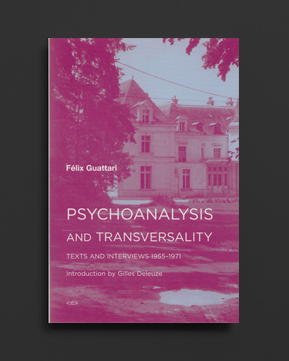
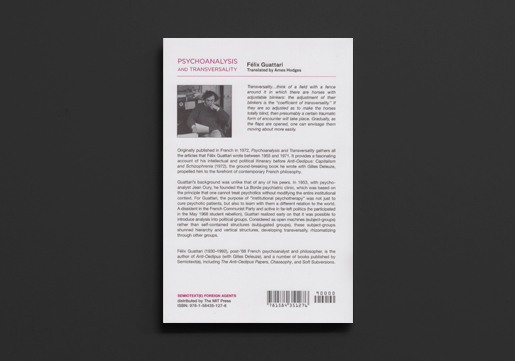
Originally published in French in 1972, Psychoanalysis and Transversality gathers all the articles that Félix Guattari wrote between 1955 and 1971. It provides a fascinating account of his intellectual and political itinerary before Anti-Oedipus: Capitalism and Schizophrenia (1972), the ground-breaking book he wrote with Gilles Deleuze, propelled him to the forefront of contemporary French philosophy.
Guattari’s background was unlike that of any of his peers. In 1953, with psychoanalyst Jean Oury, he founded the La Borde psychiatric clinic, which was based on the principle that one cannot treat psychotics without modifying the entire institutional context. For Guattari, the purpose of “institutional psychotherapy” was not just to cure psychotic patients, but also to learn with them a different relation to the world. A dissident in the French Communist Party and active in far-left politics (he participated in the May 1968 student rebellion), Guattari realized early on that it was possible to introduce analysis into political groups. Considered as open machines (subject-groups) rather than self-contained structures (subjugated groups), these subject-groups shunned hierarchy and vertical structures, developing transversally, rhizomatizing through other groups.
Psychoanalysis and Transversality collects twenty-four essays by Guattari, including his foundational 1964 article on transversality, and a superb introduction by Gilles Deleuze, “Three Group-Related Problems.”
About the Author
Félix Guattari (1930–1992), post-‘68 French psychoanalyst and philosopher, is the author of Anti-Oedipus (with Gilles Deleuze), and a number of books published by Semiotext(e), including The Anti-Oedipus Papers, Chaosophy, and Soft Subversions.
2018, English
Hardcover (w. dust jacket), 231 pages, 23 x 15.5 cm
Published by
Semiotext(e) / Los Angeles
$46.00 - Out of stock
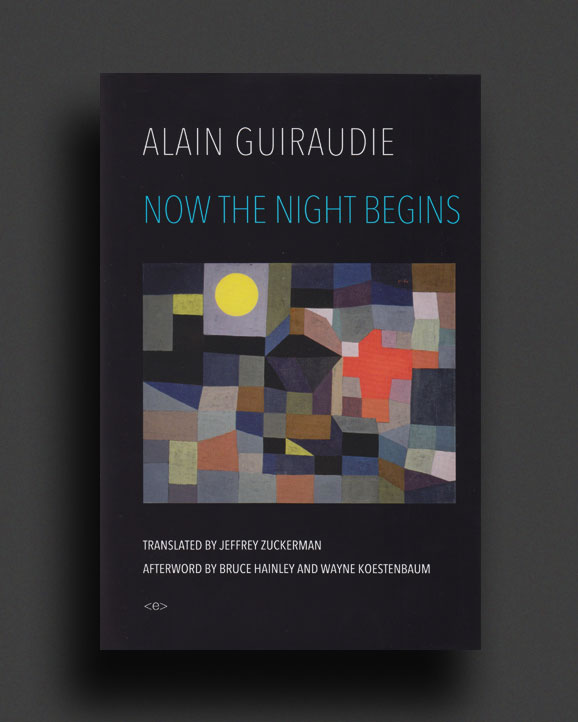
A novel that is a meditation on friendship, love, obsession, power, and abuse, by turns hyperrealist and phantasmagoric, recalling the work of Sade and Bataille.
Afterword by Bruce Hainley and Wayne Koestenbaum
Translated by Jeffrey Zuckerman
And he leaves. I'm not happy, I'm pretty upset at myself, I wasn't satisfied with him but I wouldn't have been any better without him. I sit on the couch and think. I'm not actually thinking, it's already been thought, I have to call Grampa... I need to hear his voice. I miss him.—from Now the Night Begins
At the tail end of summer vacation, Gilles Heurtebise drifts between lazy afternoons, swimming, cruising the shores of a nearby lake, and absentmindedly hooking up with old lovers. He has yet to achieve material or romantic stability. He is forty, facing a precarious future with unformed fears and regrets. The one thing that seems solid is Grampa, the ninety-year-old patriarch of a family Gilles has befriended. Gilles grows obsessed by the old man, and a strange sexual bond grows between the two. When the police get involved, and Gilles is witness to a murder, the banality of interhuman violence is brought to a paroxysmal climax.
The winner of France's prestigious Prix Sade, Now the Night Begins is a meditation on friendship, love, power, and abuse in a world where social relations have radically disintegrated. Interwoven with swaths of Occitan, the language of troubadours and love, and by turns hyperrealist and phantasmagoric, the novel recalls Georges Bataille's dark surrealism and the unvarnished violence of Bret Easton Ellis. It proves Alain Guiraudie's status as the preeminent writer of the vulnerability underlying our contemporary malaise.
“The genial perversity of Alain Guiraudie's Now the Night Begins is something rare and fascinatingly energized, a metaphysical and moral slapstick that points to the arbitrariness of all authority and the fluidity of all desires. In its way, the most elegant, certainly the most hilarious brief for anarchy that anyone has written in a long time.”—Gary Indiana
“Raw, sexual, and scatological, Alain Guiraudie's novel evokes Sade and Bataille.”—Elisabeth Philippe
2012, English
Softcover, 486 pages, 17 x 23 cm
Published by
The MIT Press / Massachusetts
$70.00 - Out of stock
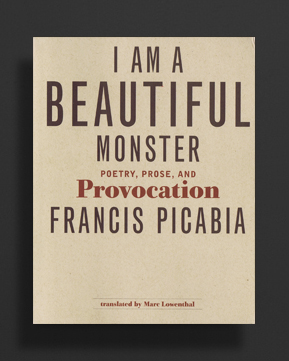
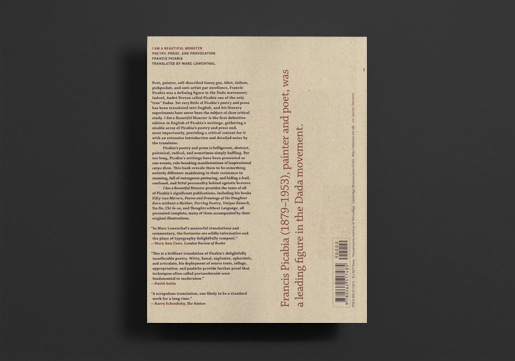
Poet, painter, self-described funny guy, idiot, failure, pickpocket, and anti-artist par excellence, Francis Picabia was a defining figure in the Dada movement; indeed, Andre Breton called Picabia one of the only "true" Dadas. Yet very little of Picabia's poetry and prose has been translated into English, and his literary experiments have never been the subject of close critical study. I Am a Beautiful Monster is the first definitive edition in English of Picabia's writings, gathering a sizable array of Picabia's poetry and prose and, most importantly, providing a critical context for it with an extensive introduction and detailed notes by the translator. Picabia's poetry and prose is belligerent, abstract, polemical, radical, and sometimes simply baffling. For too long, Picabia's writings have been presented as raw events, rule-breaking manifestations of inspirational carpe diem. This book reveals them to be something entirely different: maddening in their resistance to meaning, full of outrageous posturing, and hiding a frail, confused, and fitful personality behind egoistic bravura.
I Am a Beautiful Monster provides the texts of of Picabia's significant publications, all presented complete, many of them accompanied by their original illustrations.
1971, English
Softcover, 160 pages, 18.5 x 12.5 cm
1st Edition, Out of print title / used / good
Published by
Studio Vista / London
E P Dutton / New York
$48.00 - Out of stock
"In 1961 a fashionable commercial artist named Andy Warhol created an artistic furor in New York with his deadpan versions of the Campbell’s Soup can. Since then he has become the most talked about but least understood artist of the late 20th century. Warhol made acceptable the use of industrial techniques in the creation of paintings obsessed with modern clichés—car crashes, Coke bottles, sex symbols such as Marilyn Monroe and Liz Taylor. At the same time, his films—Blowjob, Sleep, Chelsea Girls, Lonesome Cowboys—forced us to look at the object/subject, transformed the bizarre into the banal, and remade the form and content of cinematic experiment and production."
First edition, published in 1971 by the mighty Studio Vista (and out of print since 1980), Peter Gidal’s Andy Warhol was the first book written on Warhol’s films and paintings, a concise and astute analysis of an artistic revolution. "Idol of the jet set," "trend-maker," superstar, Warhol was taken at more than face value in Gidal’s unconventional and insightful exploration. Decades later, Andy Warhol remains a seminal text, essential for a serious understanding of the artist and the work. Still the best thing written on Andy Warhol, according to art historian Benjamin Buchloh. Illustrated with over 100 b/w photographs, many of which caused great censorship problems at the time of distribution.
1978, English
Softcover, 342 pages, 23 x 15 cm
Published by
University of Chicago Press / Chicago
$55.00 - Out of stock
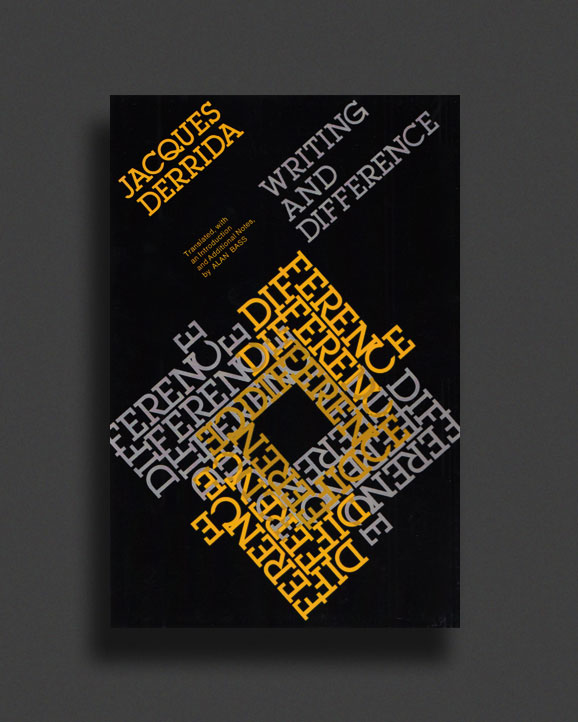
First published in 1967, Writing and Difference, a collection of Jacques Derrida’s essays written between 1959 and 1966, has become a landmark of contemporary French thought. In it we find Derrida at work on his systematic deconstruction of Western metaphysics. The book’s first half, which includes the celebrated essay on Descartes and Foucault, shows the development of Derrida’s method of deconstruction. In these essays, Derrida demonstrates the traditional nature of some purportedly nontraditional currents of modern thought—one of his main targets being the way in which "structuralism" unwittingly repeats metaphysical concepts in its use of linguistic models.
The second half of the book contains some of Derrida’s most compelling analyses of why and how metaphysical thinking must exclude writing from its conception of language, finally showing metaphysics to be constituted by this exclusion. These essays on Artaud, Freud, Bataille, Hegel, and Lévi-Strauss have served as introductions to Derrida’s notions of writing and différence—the untranslatable formulation of a nonmetaphysical "concept" that does not exclude writing—for almost a generation of students of literature, philosophy, and psychoanalysis.
Writing and Difference reveals the unacknowledged program that makes thought itself possible. In analyzing the contradictions inherent in this program, Derrida foes on to develop new ways of thinking, reading, and writing,—new ways based on the most complete and rigorous understanding of the old ways. Scholars and students from all disciplines will find Writing and Difference an excellent introduction to perhaps the most challenging of contemporary French thinkers—challenging because Derrida questions thought as we know it.
1969, English
Softcover, 192 pages, 20 x 14 cm
Out of print title / used / very good
Published by
Pantheon / New York
$25.00 - Out of stock
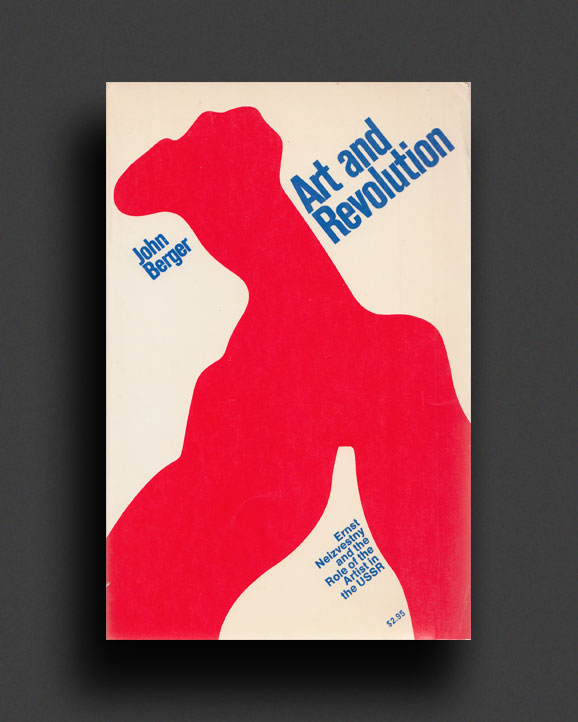
In this prescient and beautifully written book, Booker Prize-winning author John Berger examines the life and work of Ernst Neizvestny, a Russian sculptor whose exclusion from the ranks of officially approved Soviet artists left him laboring in enforced obscurity to realize his monumental and very public vision of art. But Berger’s impassioned account goes well beyond the specific dilemma of the pre-glasnot Russian artist to illuminate the very meaning of revolutionary art. In his struggle against official orthodoxy–which involved a face-to-face confrontation with Khruschev himself–Neizvestny was fighting not for a merely personal or aesthetic vision, but for a recognition of the true social role of art. His sculptures earn a place in the world by reflecting the courage of a whole people, by commemorating, in an age of mass suffering, the resistance and endurance of millions.
“Berger is probably our most perceptive commentator on art…. A civilized and stimulating companion no matter what subject happens to cross his mind.”–Philadelphia Inquirer
John Peter Berger (1926 – 2017) was an English art critic, novelist, painter and poet. He is well known for his novels and stories as well as for his works of nonfiction, including several volumes of art criticism. His first novel, A Painter of Our Time, was published in 1958, and since then his books have included Ways of Seeing, the fiction trilogy Into Their Labours, and the novel G., which won the Booker Prize in 1972. In 1962 he left Britain permanently and moved to a small village in the French Alps. He died in 2017.
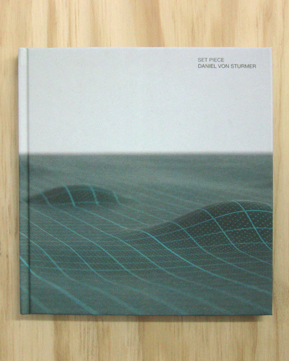
2011, English
Hardcover, 56 pages, 210 x 210mm
Published by
Self-Published
$15.00 $5.00 - Out of stock
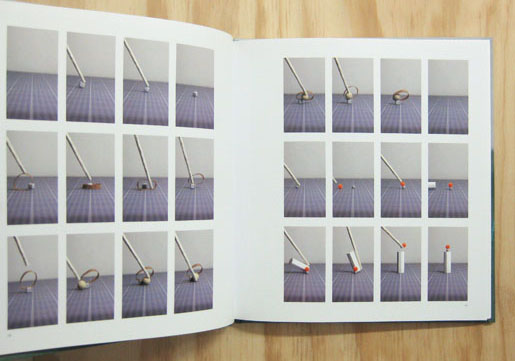
Published on the occasion of Daniel von Sturmer's exhibition, Set Piece at Site Gallery, Sheffield, September 2009
Design by Yanni Florence
1981, English / French / French
Hardcover, 120 pages, 27 x 22.5 cm
1st Edition, Out of print title / used / average
Published by
Argos Press / Köln
$45.00 $25.00 - Out of stock
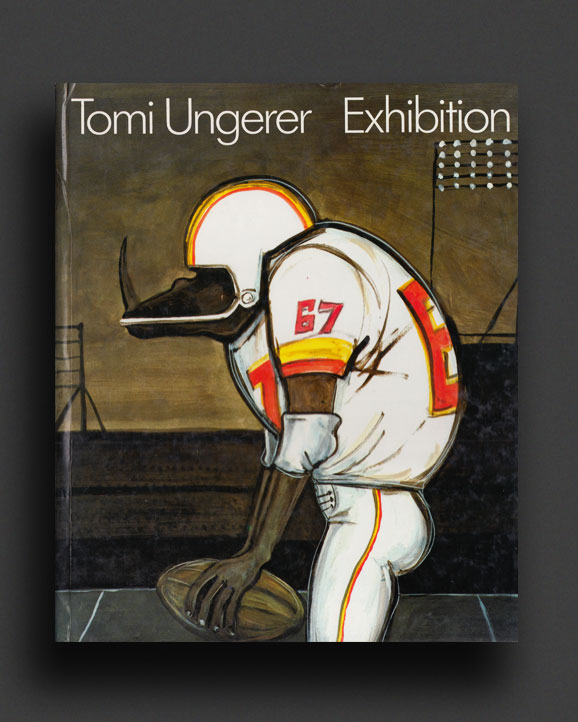
First hardcover edition of the monographic catalogue "Exhibition", published to accompany an important retrospective exhibition arranged by the Museum of the City of Strasbourg (his home town) in cooperation with the Musée des Arts Décoratifs, Paris, showcasing of over 400 artworks produced by author and artist Tomi Ungerer between 1956 and 1981 - from his famous protest poster designs and award-winning children's book illustrations to personal painting studies, rarely seen assemblage sculptures and erotica. Profusely illustrated across 120 pages, many of the artworks here are reproduced for the first time. As well as the visual content, this valuable resource contains a complete illustrated biography of Ungerer, full list of exhibited works with details, extensive bibliography of his press articles, interviews, published books, and much more, forming an important reference for Ungerer fan or collector. Catalogue texts by Christine Hamm and Sylvie Erb. All texts in English, French and German.
Tomi Ungerer (born 28 November 1931) is an award winning French illustrator and a writer in three languages. He has published over 140 books ranging from much loved children's books to controversial adult work and from the fantastic to the autobiographical. He is known for sharp social satire and witty aphorisms. He is renowned for his iconic Advertising campaigns and political posters against the Vietnam War and Racial Injustice which were representative of the burgeoning political consciousness in New York in the 1960’s. His political engagement has continued to this day in campaigns against Racism and Fascism, for Nuclear disarmament, Ecology and numerous Humanitarian causes.
1980, French / German
Softcover, 140 pages, 19 x 15.5 cm
Out of print title / used / very good
Published by
Diogenes / Zürich
$30.00 - Out of stock
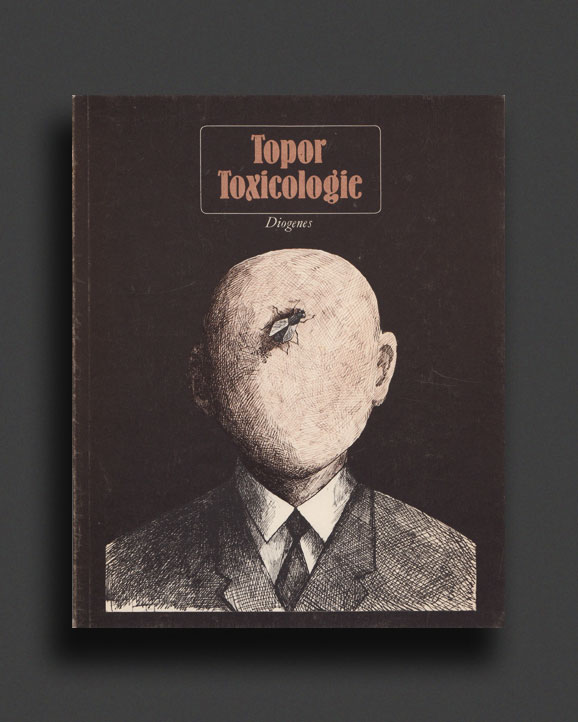
“Toxicologie” by the great French illustrator, author, humorist, satirist, play-write, actor, poet, painter, performer, sculptor, Roland Topor (1938–1997) was first published in 1970 and forms one of the classic collections of the absurdist, surrealistic illustrations he is so well known for.
Preface by fellow Mouvement Panique member Fernando Arrabal and postface by French poet Jacques Prévert.
1980 softcover edition published by Diogenes in Zürich.
Roland Topor was one of the most unique and versatile French artists of the second half of the 20th century, working prolifically as a provocative and spirited illustrator, author, humorist, satirist, play-write, actor, poet, painter, performer, sculptor, and much more. Son of a Parisian painter and sculptor of Polish-Jewish descent, in 1941, Topor's father was arrested and sent to camp Pithiviers. Two years later, the family moved to Savoy, where they baptised their son to hide his real identity. After the war, he studied art at the Institute of Beaux-Arts in Paris. He discovered surrealism, Hieronymus Bosch and the scatological plays of Alfred Jarry, which would influence his work and his attitude to life in general.
In 1958, he published his first work in magazines such as Bizarre and later Elle. Three years later, he joined the anarchic group of artists who created the controversial magazine Hara-Kiri, publishing his surreal juxtapositions of people, animals, plants and objects. Topor seldom used words in his illustrations, leaving all power to the visual. In February 1962, Topor, Alejandro Jodorowsky, Olivier O. Olivier, Jacques Sternberg, Christian Zeimert, Abel Ogier and Fernando Arrabal founded the "Mouvement Panique" ("Panic Movement"). This collective focused on creating absurd and bewildering performances to reject the commercialization of surrealism. The founders created many provocative and surreal works in the next decade before Jodorowsky dissolved the movement in 1973. However, Topor continued making scandalous plays afterwards, including 'Le Bébé de Monsieur Laurent' (1975) and 'Vinci avait raison' (1976).
In print, Topor's history is legendary. In 1964 Topor published his debut novel 'Le Locataire Chimérique' ('The Tenant', 1964), a psychological horror story about a man moving in an apartment where he is gradually pestered into madness by the other inhabitants. The work was adapted to film in 1976 by Roman Polanski and both the book as well as the picture are cult classics to this day. His 1980s pamphlet '100 Bonnes Raisons Pour Me Suicider' ('100 Good Reasons To Commit Suicide') is another example of his taste for black comedy. The most unique and unusual book in Topor's oeuvre must be 'Souvenir' (1972), a kind-of Fluxus obscurity featuring a text with all the sentences scratched out to the point of being unreadable. When the artist was interviewed on Dutch television by Adriaan van Dis to read some extracts from it Topor accepted the request by holding his hand in front of his mouth and mumble through it. In 1966 Topor illustrated 'Topographie Anécdotée du Hasard' (Anecdoted Topography of Chance) by Swiss assemblage artist Daniel Spoerri. Following a rambling conversation with his friend Robert Filliou in 1961, Daniel Spoerri one day mapped the objects lying at random on the table in his room, adding a rigorously scientific description of each. These objects subsequently evoked associations, memories and anecdotes from both the original author and his friends Filliou, Emmett Williams, Dieter Roth and Roland Topor. Considered a "quasi-autobiographical tour de force", incredible book was published in 1966 by the Something Else Press in New York City. Topor added sketches of each object. Acknowledged as one of the most important and entertaining artists’ books of the postwar period, An Anecdoted Topography of Chance is a unique collaborative work by four artists associated with the Fluxus and Nouveau Réalisme movements.
Topor also had an interest in film. He designed the posters of movies such as 'L'Ibis Rouge' (1975), 'Ai no borei' ('The Empire of Passion', 1978) and 'Die Blechtrommel' ('The Tin Drum', 1979). His drawings can also be seen during the opening titles of Fernando Arrabal's experimental film 'Viva La Muerte' (1971) and during the magic lantern sequence in Federico Fellini's 'Il Casanova di Fellini' (1976). He also worked as an actor, appearing in Dusan Makavejev's 'Sweet Movie' (1974) and as Dracula's assistant Renfield in Werner Herzog's horror remake of 'Nosferatu' (1979). The latter film has also immortalized his notorious hysterical and chilling laugh.
Together with René Laloux, he created the animated shorts 'Les Temps Morts' (1964) and 'Les Escargots' ('The Snails', 1965) and the full length animated feature 'La Planète Sauvage' ('Fantastic Planet', 1973). The latter work was based on Stefan Wul's science fiction novel 'Oms en Série' and takes place on a surreal planet where gigantic blue aliens treat humans as pets. 'La Planète Sauvage' won the special jury prize at the Festival of Cannes and has achieved cult status over the years.
Topor was a frequent guest in the philosophical radio show 'Des Papous dans la tête' (1984) at France Culture. Together with his good friend and playwright Jean-Michel Ribes, he wrote scripts for the satirical TV sketch series 'Merci Bernard' (1982-1984) on France 3 and 'Palace' (1988-1989) on Canal +. They wrote the theatrical play 'Batailles' (1983) about people of different social classes stranded on a raft, which was a satirical allegory of capitalism. Another collaborative project was the comedy film 'La Galette du Roi' (1985). In 1975 he recorded an album with his Belgian friend Freddy De Vree called 'Panic (The Golden Years)'. It features Topor being interviewed by De Vree on the Flemish public radio channel BRT 3. Apart from talking he also recites some nonsensical songs, including the Dutch nursery rhyme 'Iene miene mutte' and the tongue twister 'De kat krabt de krullen van de trap.' Topor also wrote two songs, 'Je m'aime' and 'Monte dans mon ambulance', which were set to music by François d'Aime and recorded by Japanese singer Megumi Satsu in 1980.
In the 1980s, Topor published in Le Petit Psikopat Illustré, an alternative review, and also teamed up with Belgian film director Henri Xhonneux to create the cult children's series 'Téléchat', a news show featuring anthropomorphic animals and objects and marionets presenting news. The program received various awards, including the 1984 award for best French broadcast for children and adolescents at the Festival of Cannes. It was also nominated for an Emmy in 1985.
Topor and Xhonneux joined forces again in 1989 to create the film 'Marquis', which was loosely based on the life and work of the notorious Marquis de Sade. The actors performed in animal masks and De Sade's penis was made into a separate puppet with a human face and the ability to talk. Due to the unusualness of its execution it became a cult favorite.
Very good copy with light wear.
2018, English
Softcover, 350 pages, 15 x 22 cm
Published by
Trapart / Stockholm
$63.00 - Out of stock
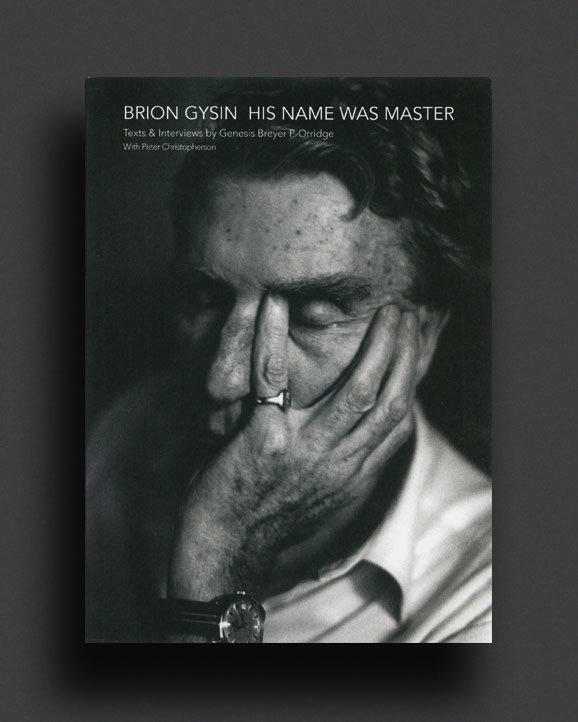
Texts and Interviews by Genesis Breyer P-Orridge, with Peter Christopherson. Edited with notes by Andrew M. McKenzie. Introductions by Genesis Breyer P-Orridge & Carl Abrahamsson.
Brion Gysin (1916–86) has been an incredibly influential artist and iconoclast: his development of the “cut-up” technique with William S. Burroughs has inspired generations of writers, artists and musicians. Gysin was also a skilled networker and revered expat: together with his friend Paul Bowles, he more or less constructed the post-beatnik romanticism for life and magic in Morocco, and was also a protagonist in an international gay culture with inspirational reaches in both America and Europe. Not surprisingly, Gysin has become something of a cult figure.
One of the artists he inspired is Genesis Breyer P-Orridge, who collaborated with both Gysin and Burroughs in the 1970s, during his work with Throbbing Gristle and COUM Transmissions. The interviews made by P-Orridge have since become part of a New Wave/Industrial mythos. This volume presents them in their entirety alongside three texts on Gysin by P-Orridge, plus an introduction. This book is an exclusive insight into the mind of a man P-Orridge describes as “a kind of Leonardo da Vinci of the last century,” and a fantastic complement to existing biographies and monographs.
2011, English
Softcover, 79 pages, 16 x 22.5 cm
Published by
Fleisher/Ollman / Philadelphia
$49.00 - Out of stock
The only monograph ever produced on the work of Philadelphia Wireman, published by Fleisher/Ollman in Philadelphia in 2011.
In the late 1970s a stockpile of over a thousand distinctive wire sculptures were found in cardboard boxes on the street in a slowly-gentrifying neighborhood in South Philadelphia. The works consist of different gauges of wire wrapped around everyday found objects and materials such as food packaging, umbrella parts, tape, batteries, pens, nuts and bolts, nails, foil, coins, toys, watches, eyeglasses, tools, and jewelry. The maker, who remains unidentified, possessed an astonishing ability to isolate and communicate the concepts of power and energy through his selection and transformation of these ordinary materials. The pieces are often compared to African fetish objects and other ritualized, vernacular traditions, but resonate equally with historical and contemporary art practices. The collection has come to be regarded as an important discovery in the field of self-taught art.
This fully illustrated catalogue includes a foreword by John Ollman, an essay by Brendan Greaves, and was designed by Purtill Family Business with cover typography by artist and designer Paul Elliman.
1966, English
Hardcover, 40 pages, 20 x 21 cm
1st Edition, Out of print title / used / good
Published by
Crown / New York
$30.00 - In stock -
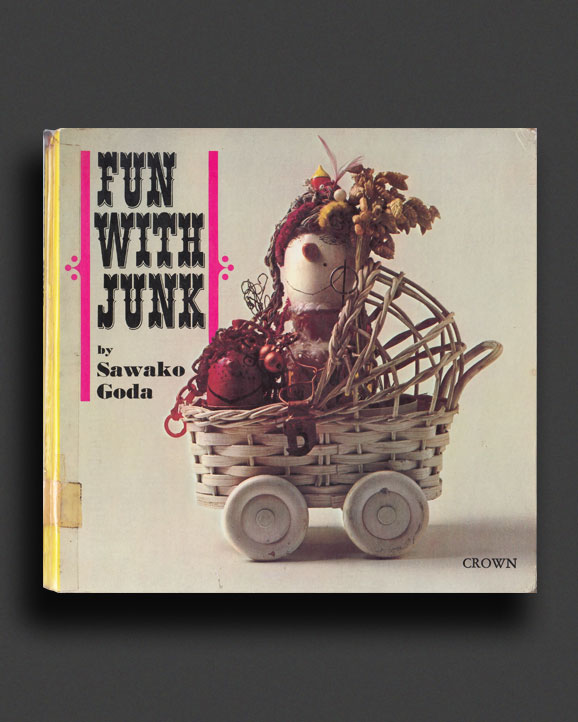
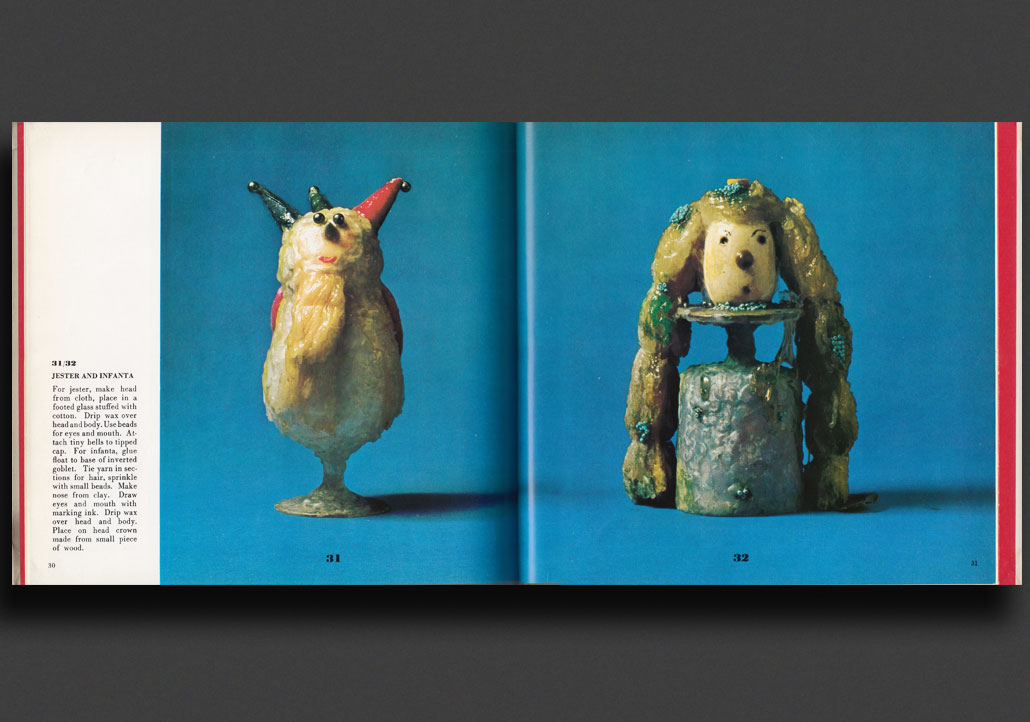
Published in 1966, "Fun with Junk" is a curious masterpiece in the world of craft books. As the blurb reads, "Here is a book which falls into none of the usual categories".
Lavishly photographed in saturated colour by Yoshikatsu Saeki, the book is entirely made up of the unique miniature creations of Japanese artist Sawako Goda, "making funny figures out of odds and ends." Sawako Goda (1940 - 2016), was a Japanese multidisciplinary artist who rose to prominence on the Japanese art scene in the 1960s, associated with the avant-garde and surrealist groups of the time. Since her exhibition debut as a sculptor in 1965, Sawako Goda has worked across painting, illustration, photography, and sculpture, as well as worked on theatre design and films with Juro Kara and Shuji Terayama, and penned numerous essays and reviews on the work of artists such as Shuji Terayama, Yukio Ninagawa, Shimon Yotsuya and Kaneko Kuniyoshi.
First edition hardcover copy, ex-libris markings and stamps.
2018, English
Softcover, 64 pages, 25.5 x 19.5 cm
Published by
Perimeter Editions / Melbourne
$35.00 - Out of stock
The Cavern is the debut artist book by Melbourne-based painter Travis MacDonald. Drawing on key works from the last three years, the book forwards MacDonald's quietly idiosyncratic take on the more traditional genres of figuration and landscape painting, revealing a sensitivity and wit that extends to both his surroundings and that of art history.
At once dreamlike in its atmosphere and palette, and dry in its humour, The Cavern speaks not so much to a wider historical narrative, but to fragments of time within it. These works read as untethered; anomalies and oddities (some subtle, some silly) punctuate and reanimate otherwise nondescript, potentially nostalgic scenes. A stretched limousine slips its way along an arched country bridge; a round-shouldered boy sits mutely at the family piano as we await the first strike of the ivories; a girl rides sidesaddle on a white horse (she wears a full-face motorcycle helmet).
From his Cavern, MacDonald offers a contemplative and ever-so slightly incongruous vantage on the world as we thought we knew it.
Travis MacDonald was born in Bunnythorpe, New Zealand, and currently lives and works in Melbourne. He completed a Bachelor of Fine Art at the Victorian College of the Arts in 2011 and has been exhibiting since 2009. He has been awarded the Gary Grossbard Drawing Prize and the Lionel Gell Foundation Scholarship. More recently, MacDonald’s work was exhibited in Painting. More Painting at the Australian Centre for Contemporary Art, Melbourne, and he held his first major solo exhibition Homesick Mascot at Niagara Galleries, Melbourne, in December 2016, followed by a solo exhibition as part of the Melbourne Art Fair, in August 2018. He is represented by Niagara Galleries, Melbourne.
2018, English
Softcover, 64 pages, 25.5 x 20 cm
Published by
ICA / London
Artspace / Sydney
$25.00 - Out of stock
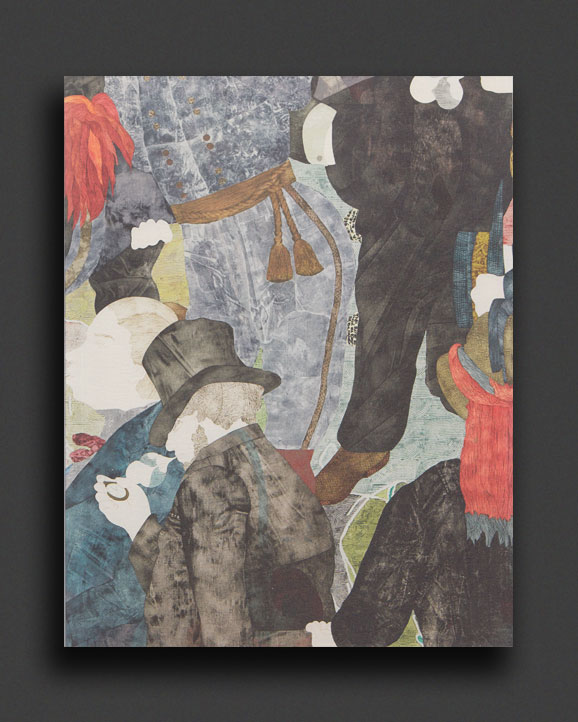
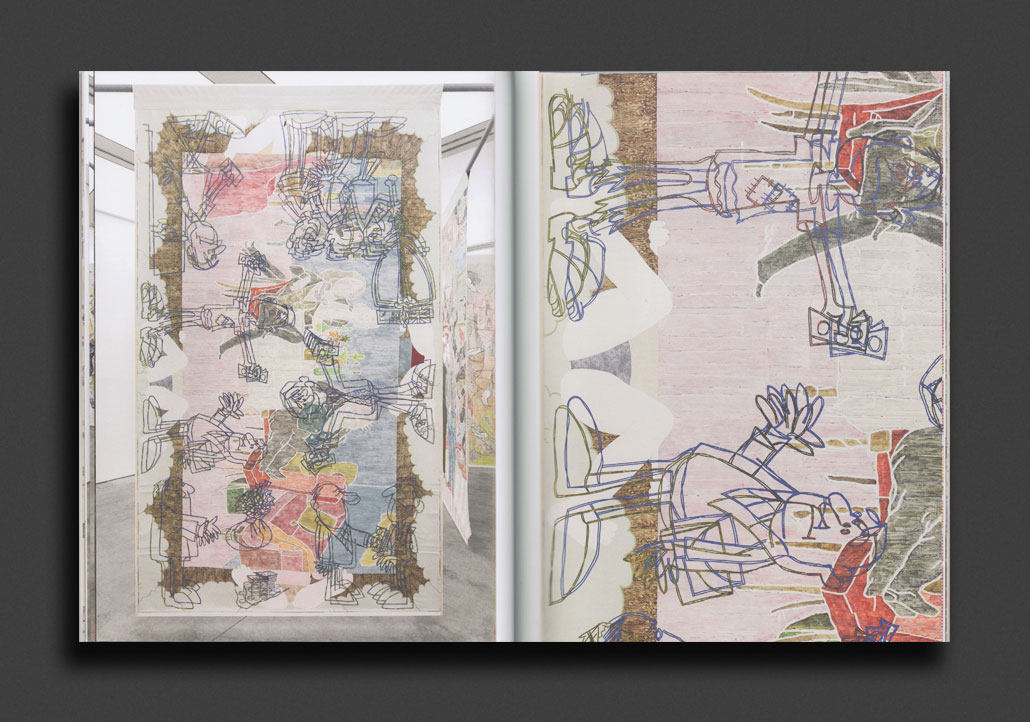
Warm Ties accompanies the solo exhibition of Australian artist Helen Johnson in collaboration with ICA London and Artspace Sydney. Johnson weaves and overlays historical and contemporary signifiers creating points of tension and reflection through the medium of painting. In this exhibition, the complex colonial relationship between Australia and Britain is dealt with on the level of the body, using large-scale paintings that have become purposefully disassembled installations throughout the space. Profusely illustrated in colour with work, installation and detail documentation, accompanied by texts by Stephen Gilchrist and Helen Hughes.
2015, English
Softcover, 100 pages, 19.5 x 13 cm
Published by
3-Ply / Victoria
Minerva / Sydney
$28.00 - Out of stock
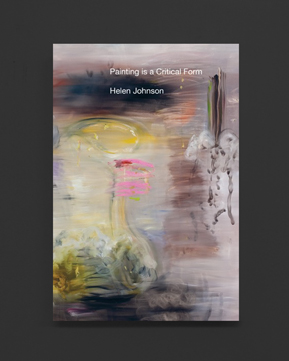
Within this book, Helen Johnson considers the operations of painting today, proposing means by which painting, as an aesthetic practice, might continue to make a critical address. She describes the book thus, “Being a painter in a post-medium specific context does not mean approaching painting as some sort of anachronistic refuge, or thinking that the modernist project of the specific medium can be rehabilitated, or even continue to be flogged. As a site for the production of meaning, painting is a rich field of loadings, neuroses and suggestiveness that can mesh with aesthetic qualities to make a charged conceptual space. Focusing on works by Juan Davila and Martin Kippenberger, this book proposes an extended understanding of how painting can operate aesthetically, grounded in Immanuel Kant’s formulation of aesthetic experience as implicitly connected to critical reflection. Kant’s Critique of Aesthetic Judgement constitutes the basis of a mobilisation of aesthetics for the reading of painting beyond formalism, embracing aesthetic criticality as an open position of refusal, rather than the dogmatic pursuit of a rational conclusion.”
2018, English
Softcover (w. french flaps), 260 pages, 22.8 x 14 cm
Published by
MACK / London
$49.00 - Out of stock
Victor Burgin is one of the most influential artists and writers working today. He came to prominence as a key figure in the Conceptual Art movement of the late 1960s. After turning to photography in his artistic practice he produced a series of groundbreaking theoretical essays that drew on semiotics, psychoanalysis and feminism in order to think through the ideological role of photographs in the production of beliefs and values, and in the understanding of memory, history, subjectivity and space. This collection brings together for the first time Victor Burgin’s writings related specifically to the camera, following the shifts and nuances in his thinking over nearly five decades. Moreover, it allows us to chart the evolution of what the camera was and is, and how its affects are to be understood.