World Food Books' programme is largely produced on Kulin Nation land. We acknowledge the Wurundjeri people of the Kulin Nation as the first and continuing custodians of this land, and pay respect to their Elders past, present, and emerging.
World Food Books is an arts and special interests bookshop in Naarm / Melbourne. Founded in 2010, World Food Books is devoted to the presentation of a rotating, hand-selection of international art, design, literary and counterculture publications with an emphasis on the anti-traditional, the experimental, the avant-garde, the heretic, the marginal.
Presenting new titles alongside rare and out-of-print books, catalogues and journals spanning the fields of modern and contemporary art, design, photography, illustration, film, literature, poetry, cultural theory, philosophy, sexuality, popular and underground culture in its many radical forms, World Food Books wishes to encourage adventurous, thoughtful and open-minded reading, looking, writing, and exchange of publishing and ideas, both current and historical.
As well as our bookshop, located in Melbourne's historical Nicholas Building, all of our inventory is available internationally via our online mail-order service.
World Food Books semi-regularly co-ordinates "Occasions", a programme of exhibits and events at the bookshop and in partnership with other hosts (such as museums and art galleries) that develop out of the activities, relationships and content of the bookshop itself.
World Food Books
The Nicholas Building
37 Swanston Street
Room 5, Level 6
Melbourne 3000
Australia
SHOP HOURS:
Thu–Fri 12–6, Sat 12–5
WEB-SHOP OPEN 24/7
World Food Books
Postal Address:
PO Box 435
Flinders Lane
Victoria 8009
Australia
Art
Theory / Essay
Architecture / Interior
Graphic Design / Typography
Photography
Fashion
Eros
LGBTQ+
Fiction / Poetry
Weird / Speculative / Science Fiction / Horror
Transgressive / Visceral / Abject
Symbolism / Decadence / Fin de siècle
Film / Video
Painting
Sculpture / Installation
Performance / Dance / Theater
Drawing
Sound / Music
Curatorial
Group Shows / Collections
Periodicals
Out-of-print / Rare
Posters / Ephemera / Discs
Signed Books
World Food Books Gift Voucher
World Food Book Bag
Australian Art
Australian Fiction
Australian Science Fiction / Speculative Fiction
Australian Poetry
Australian Photography
Japanese Photography
Conceptual Art
Minimal Art
Dada
'Pataphysics / Oulipo
Fluxus
Concrete Poetry
Pop Art
Surrealism
Arte Povera
Arte Informale / Haute Pâte / Tachism
Nouveau Réalisme / Zero / Kinetic
Situationism / Lettrism
Collage / Mail Art / Xerox Art
Art Brut / Folk / Visionary / Fantastic
Illustration / Graphic Art / Bandes Dessinées
Furniture
Italian Radical Design / Postmodernism
Textiles
Ceramics / Glass
Counterculture
Protest / Revolt
Philosophy
Psychoanalysis
Anthropology
Anarchism
Socialism / Anarchism / Communism / Capitalism
Literary Theory / Semiotics / Language
Feminism / Women's Studies
Gender Studies / Sexuality
Anthropology
Fetishism / BDSM
Drugs / Psychedelia
Crime / Violence
Animal Rights / Veganism
Occult / Esoterica
Ecology / Earth / Alternative Living
Whole Earth / Crafts
All prices in AUD (Australian dollars)
Pick-Ups
Pick-up orders can be collected in our bookshop during opening hours after order date. Please collect any Pick-up orders within 2 weeks of ordering as we have limited storage space. Orders will be released back into stock if not collected within this time. No refunds can be made for pick-ups left un-collected. If you cannot make it in to the bookshop in this time-frame, please choose postage option.
Return Policy
All sales are final. We do accept returns (for refund or exchange) for items received in error. All our orders are packed with special care using heavy-duty padding and cardboard book-mailers or bubble mailers (for smaller books), using reinforcement where required. We cannot take responsibility for any lost, stolen or damaged parcels.
Insurance
Should you wish to insure your package, please email us directly after placing your order and we can organise this at a small extra expense. Although all standard/express tracked packages are very safe and dependable, we cannot take responsibility for any lost, stolen or damaged parcels. We recommend insurance on valuable orders.
Interested in selling your old books, catalogues, journals, magazines, comics, fanzines, ephemera? We are always looking for interesting, unusual and out-of-print books to buy. We only buy books in our fields of interest and specialty, and that we feel we can resell.
We base these prices on desirability, market value, in-print prices, condition and our current stock levels. We offer cash, store credit, and can take stock on consignment. All
about 25% of the price we expect to get when we sell them, or 30% in store credit. We base these prices on desirability, market value, in-print prices, condition and our current stock levels.
Sell your books any day of the week. You can drop them off and return later. If you have a lot of books, we can visit your Sydney home.
We buy books that we feel we can resell. We offer about 25 % of the price we expect to get when we sell them, or 30% in store credit. We base these prices on desirability, market value, in-print prices, condition and our current stock levels.
Philadelphia Wireman
03 August - 01 September, 2018
World Food Books is proud to announce our next Occasion, the first presentation of sculptures by Philadelphia Wireman in Australia.
The Philadelphia Wireman sculptures were found abandoned in an alley off Philadelphia’s South Street on trash night in 1982. Their discovery in a rapidly-changing neighbourhood undergoing extensive renovation, compounded with the failure of all attempts to locate the artist, suggests that the works may have been discarded after the maker’s death. Dubbed the "Philadelphia Wireman" during the first exhibition of this work, in 1985, the maker’s name, age, ethnicity, and even gender remain uncertain. The entire collection totals approximately 1200 pieces, all intricately bound together with tightly-wound heavy-gauge wire (along with a few small, abstract marker drawings, reminiscent both of Mark Tobey and J.B. Murry). The dense construction of the work, despite a modest range of scale and materials, is singularly obsessive and disciplined in design: a wire armature or exoskeleton firmly binds a bricolage of found objects including plastic, glass, food packaging, umbrella parts, tape, rubber, batteries, pens, leather, reflectors, nuts and bolts, nails, foil, coins, toys, watches, eyeglasses, tools, and jewellery.
Heavy with associations—anthropomorphic, zoomorphic, and socio-cultural responses to wrapped detritus—the totemic sculptures by Philadelphia Wireman have been discussed in the context of work created to fulfil the shamanistic needs of alternative religions in American culture. Curators, collectors, and critics have variously compared certain pieces to sculpture from Classical antiquity, Native American medicine bundles, African-American memory jugs, and African fetish objects. Reflecting the artist’s prolific and incredibly focused scavenging impulse, and despite—or perhaps enhanced by—their anonymity, these enigmatic objects function as urban artefacts and arbiters of power, though their origin and purpose is unknown. Philadelphia Wireman, whatever their identity, possessed an astonishing ability to isolate and communicate the concepts of power and energy through the selection and transformation of ordinary materials. Over the course of the past two decades, this collection has come to be regarded as an important discovery in the field of self-taught art and vernacular art.
Presented in collaboration with Fleisher-Ollman Gallery, Philadelphia, and Robert Heald, Wellington.
Susan Te Kahurangi King
02 February - 10 March, 2018
Susan Te Kahurangi King (24 February 1951 - ) has been a confident and prolific artist since she was a young child, drawing with readily available materials - pencils, ballpoint pens and felt-tip markers, on whatever paper is at hand. Between the ages of four and six Susan slowly ceased verbal communication. Her grandparents William and Myrtle Murphy had developed a special bond with Susan so they took on caring responsibilities for extended periods. Myrtle began informally archiving her work, carefully collecting and storing the drawings and compiling scrapbooks. No drawing was insignificant; every scrap of paper was kept. The King family are now the custodians of a vast collection containing over 7000 individual works, from tiny scraps of paper through to 5 meter long rolls.
The scrapbooks and diaries reveal Myrtle to be a woman of great patience and compassion, seeking to understand a child who was not always behaving as expected. She encouraged Susan to be observant, to explore her environment and absorb all the sights and sounds. Myrtle would show Susan’s drawings to friends and people in her community that she had dealings with, such as shopkeepers and postal workers, but this was not simply a case of a grandmother’s bias. She recognised that Susan had developed a sophisticated and unique visual language and sincerely believed that her art deserved serious attention.
This was an unorthodox attitude for the time. To provide some context, Jean Dubuffet coined the term Art Brut in 1945 to describe work created by self-taught artists – specifically residents of psychiatric institutions and those he considered to be visionaries or eccentrics. In 1972 Roger Cardinal extended this concept by adopting the term Outsider Art to describe work made by non-academically trained artists operating outside of mainstream art networks through choice or circumstance. Susan was born in Te Aroha, New Zealand in 1951, far from the artistic hubs of Paris and London that Dubuffet and Cardinal operated in. That Myrtle fêted Susan as a self-taught artist who deserved to be taken seriously shows how progressive her attitudes were.
Susan’s parents Doug and Dawn were also progressive. Over the years they had consulted numerous health practitioners about Susan’s condition, as the medical establishment could not provide an explanation as to why she had lapsed into silence. Dawn educated herself in the field of homeopathy and went on to treat all twelve of her children using these principles – basing prescriptions on her observations of their physical, mental and emotional state.
Doug was a linguist with an interest in philosophy who devoted what little spare time he had to studying Maori language and culture. To some extent their willingness to explore the fringes of the mainstream made them outsiders too but it was their commitment to living with integrity and their respect for individuality that ensured Susan’s creativity was always encouraged.
Even though Susan’s family supported her artistic pursuits, some staff in schools and hospitals saw it as an impediment to her assimilation into the community and discouraged it in a variety of ways. Her family was not always aware of this and therefore did not fully understand why Susan stopped drawing in the early 1990s. However, rather than dwell on the challenges that Susan faced in pursuit of her artistic practice, they prefer to highlight her achievements. In 2008 Susan began drawing again in earnest, after an almost 20 year interruption, and her work is now shown in galleries around the world.
Susan grew up without television and has been heavily influenced by the comics she read as a child. She is absolutely fearless in the appropriation of recognizable characters, such as Donald Duck and Mickey Mouse, in her work. She twists their limbs, contorts their faces, compresses them together, blends them into complex patterned backgrounds - always imbuing them with an incredible energy. Although Susan often used pop culture characters in her work they are not naive or childlike. These are drawings by a brilliant self-taught artist who has been creating exceptional work for decades without an audience in mind.
Mladen Stilinović
"Various Works 1986 - 1999"
02 February 16 - September 10, 2016
Various works 1986 - 1999, from two houses, from the collections of John Nixon, Sue Cramer, Kerrie Poliness, Peter Haffenden and Phoebe Haffenden.
Including: Geometry of Cakes (various shelves), 1993; Poor People’s Law (black and white plate), 1993; White Absence (glasses, ruler, set square, silver spoon, silver ladel with skin photograph and wooden cubes), 1990-1996; Exploitation of the Dead (grey and red star painting, wooden painting, black spoon with red table, red plate), 1984-1990; Money and Zeros (zero tie, paintings made for friends in Australia (Sue, John, Kerrie), numbers painting), 1991-1992; Words - Slogans (various t-shirts) - “they talk about the death of art...help! someone is trying to kill me”, “my sweet little lamb”, “work is a disease - Karl Marx”; Various artist books, catalogues, monographs, videos; Poster from exhibition Insulting Anarchy; "Circular" Croatian - Australian edition; Artist book by Vlado Martek (Dostoyevsky); more.
Thanks to Mladen Stilinović and Branka Stipančić.
Jonathan Walker
Always Will Need To Wear Winter Shirt Blue + Ochre Small Check Pattern
21 August - 21 September, 2015
Untitled
I am not a great reader of poetry but I always return to the work of Melbourne poet, Vincent Buckley (1925- 1988). Perhaps I find his most tantalising piece to be not a finished poem but a fragment left on a scrap of paper discovered on his desk after the poet’s death.
The poetry gathers like oil
In the word-core, and spreads
It has its music meet,
Its music is in movement.
This fragment is more the shell left behind from a volatile thought than a finished poem. I find the last two lines honest but awkward whereas the first two lines work like an arrow. Most likely he could not find a resolution so it was left. Still, in its present form, it remains an eloquent testimony to the ultimate failure of a medium to express mobile thought and sensation, in Buckley’s case, through verbal language. It’s an important matter because this is something all artists have to deal with regardless of the medium.
I have never written a poem, however, I am forever copying fragments from books on paper scraps in a vain effort to fix certain notions in my head. At first, they function as bookmarks that are sometimes returned to when I open the book. But before long, as they accumulate, they fall out littering the table interspersed with A4 photocopies, bills, books and medications.
To return to Buckley’s fragment, the first two lines very much evoke how I paint nowadays. As you age, detail diminishes and patches of light become more luminous and float. I feel the most honest way of dealing with this is by smearing the oil paint on the canvas with the fingers and working close-up, blind. Only if the patches coalesce into an approaching image can the work gain a life.
-
Jonathan Walker was born in Melbourne, Australia and brought up on a dairy farm in Gippsland. In the 1970’s he studied painting at RMIT and won the Harold Wright Scholarship to the British Museum, London. During the 1980’s he exhibited at Pinacotheca Gallery, Richmond and had work shown at the NGV and Heidi City Art Gallery. Over the same period he designed the cover for the “Epigenesi” LP by Giancarlo Toniutti, Italy and conducted a mail exchange work with Achim Wollscheid, Germany. The work with artists through the post resulted in an article published in the bicentenary issue of Art and Australia 1988. He showed in artist run spaces such as WestSpace in the 90’s and 2000’s, and until 2012, taught painting at Victoria University, which is where we (Colleen Ahern and Lisa Radford) as organisers of the exhibition, among many others, had the privilege of being his student.
Walker’s knowledge was imparted to students through the careful selection of music, literature, and artists found in books that he himself had ordered for the library. Walker’s strategy was the generosity of sharing his vast knowledge with references specific to each student and their context.
Walker’s paintings share a similar focus and intimacy.
This exhibition presents a small selection of recent paintings alongside a publication that includes Walker’s writing. Observational and analytical, Walker’s work is a type of material notation — the time of day, colour and how it is blended, the both specific and fleeting location of a reflection on lino or the question of whether a chair leg should be included in a painting.
Please join us on Friday August 21 between 6-8pm to celebrate the opening of the exhibition.
Curated by Colleen Ahern and Lisa Radford.
B. Wurtz
Curated by Nic Tammens
March 26 - April 4, 2015
B.Wurtz works from a basement studio in his home on Manhattan’s Lower East Side.
This local fact is attested to by the plastic shopping bags and newsprint circulars that appear in his work. As formal objects, they don’t make loud claims about their origins but nonetheless transmit street addresses and places of business from the bottom of this long thin island. Like plenty of artists, Wurtz is affected by what is local and what is consumed. His work is underpinned by this ethic. It often speaks from a neighborhood or reads like the contents of a hamper:
“BLACK PLUMS $1.29 lb.”
“Food Bazaar”
“USDA Whole Pork Shoulder Picnic 99c lb.”
“RITE AID Pharmacy, with us it’s personal.”
“H. Brickman & Sons.”
“Sweet Yams 59c lb."
Most of the work in this exhibition was made while the artist was in residence at Dieu Donne, a workshop dedicated to paper craft in Midtown. Here Wurtz fabricated assemblages with paper and objects that are relatively lightweight, with the intention that they would be easily transportable to Australia. This consideration isn’t absolute in Wurtz’s work, but was prescriptive for making the current exhibition light and cheap. Packed in two boxes, these works were sent from a USPS post office on the Lower East Side and delivered to North Melbourne by Australia Post.
Wurtz appears courtesy of Metro Pictures, New York.
Thanks to Rob Halverson, Joshua Petherick, Sari de Mallory, Matt Hinkley, Helen Johnson, Fayen d'Evie, Ask Kilmartin, Lisa Radon, Ellena Savage, Yale Union, and "Elizabeth".
John Nixon
"Archive"
December 15 - January 20, 2014
The presentation of John Nixon's archive offered a rare showcase of this extensive collection of the artist's own publications, catalogues, posters, ephemera, editions and more, from the mid 1980s onwards, alongside a selection of his artworks.
Organized by John Nixon, Joshua Petherick and Matt Hinkley.
<a href=http://wfb.public-office.info/artist/john-nixon>All titles by John Nixon
"Habitat"
at Minerva, Sydney (organised by Joshua Petherick and Matt Hinkley)
November 15 - December 20, 2014
Lupo Borgonovo, Janet Burchill & Jennifer McCamley,
Lewis Fidock, HR Giger, Piero Gilardi, Veit Laurent Kurz,
Cinzia Ruggeri, Michael E. Smith, Lucie Stahl, Daniel Weil, Wols
Press Release:
“...It contained seven objects. The slender fluted bone, surely formed for flight, surely from the wing of some large bird. Three archaic circuitboards, faced with mazes of gold. A smooth white sphere of baked clay. An age-blackened fragment of lace. A fingerlength segment of what she assumed was bone from a human wrist, grayish white, inset smoothly with the silicon shaft of a small instrument that must once have ridden flush with the surface of the skin - but the thing’s face was seared and blackened.”
William Gibson, “Count Zero”, 1986
"Autumn Projects Archive"
Curated by Liza Vasiliou
March 6 - March 15, 2014
World Food Books, in conjunction with the Virgin Australia Melbourne Fashion Festival 2014, presented the Autumn Projects archive, consisting of a selection of early examples in Australian fashion with a particular interest in collecting designers and labels from the period beginning in the 1980’s, who significantly influenced the discourse of Australian Fashion.
Curated by Liza Vasiliou, the exhibition provided a unique opportunity to view pieces by designers Anthea Crawford, Barbara Vandenberg, Geoff Liddell and labels CR Australia, Covers, Jag along with early experimental collage pieces by Prue Acton and Sally Browne’s ‘Fragments’ collection, suspended throughout the functioning World Food Books shop in Melbourne.
H.B. Peace
presented by CENTRE FOR STYLE
November 14, 2013
"Hey Blinky, you say chic, I say same"
Anon 2013
H.B. Peace is a clothing collaboration between great friends Blake Barns and Hugh Egan Westland. Their pieces explore the divergences between 'character’ and ‘personality’ in garments....etc
Special Thanks to Joshua Petherick and Matt Hinkley of WFB and Gillian Mears
and a Very Special Thank you to Audrey Thomas Hayes for her shoe collaboration.
Janet Burchill & Jennifer McCamley
"Aesthetic Suicide"
May 10 - June 8, 2013
The first of our occasional exhibitions in the World Food Books office/shop space in Melbourne, "Aesthetic Suicide" presented a body of new and older works together by artists Janet Burchill & Jennifer McCamley, including videos, prints, a wall work, and publications.
During shop open hours videos played every hour, on the hour.
2017, English
Softcover, 352 pages, 14.11 x 21.1 cm
Published by
Sternberg Press / Berlin
$54.00 $15.00 - Out of stock
Edited by Ryan Bishop, Kristoffer Gansing, Jussi Parikka, Elvia Wilk
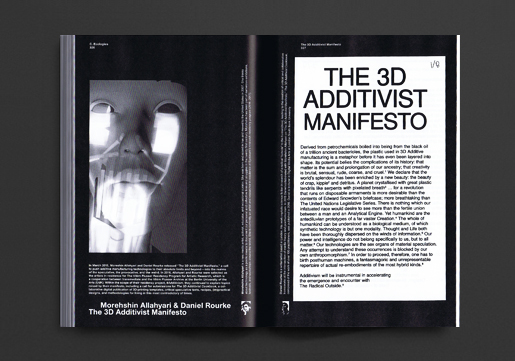
Contributions by Morehshin Allahyari and Daniel Rourke, Jamie Allen and David Gauthier, Clemens Apprich and Ned Rossiter, Tatiana Bazzichelli, Benjamin Bratton, Florian Cramer, Dieter Daniels, Geoffroy de Lagasnerie, Daphne Dragona, Keller Easterling, Olga Goriunova, Louis Henderson, Geraldine Juarez, Olia Lialina, Alessandro Ludovico, Rosa Menkman, Julian Oliver and Danja Vasiliev, Erica Scourti, Cornelia Sollfrank, Telekommunisten (Baruch Gottlieb and Dmytri Kleiner), Tiziana Terranova, YoHa (Graham Harwood and Matsuko Yokokoji)
This collection of art and theory analyzes today’s post-digital conditions for critical media practices—across and beyond the analog and the digital, the human and the nonhuman. The contributions also look across and beyond the field of media art, staking out new paths for understanding and working in the transversal territories between theory, technology, and art. The concept of the post-digital is a way to critically take account of, contextualize, and shift the coordinates of new technologies as part of contemporary culture. The post-digital condition is not merely a theoretical issue but also a situation that affects conceptual and practice-based work.
The program of the transmediale festival in Berlin, celebrating its thirtieth year in 2017, has reflected these changes, and this book gathers new contributions from leading international theorists and artists of media and art who have taken part in the festival program over its past five editions. Divided into the thematic sections “Imaginaries,” “Interventions,” and “Ecologies,” this book is not a document of the festival itself, it is rather a stand-alone exploration of the ongoing themes of transmediale in a book format.
The reader is developed as a collaboration between transmediale and Winchester School of Art, University of Southampton.
Copublished with transmediale e.V.
Design by the Laboratory of Manuel Bürger (Stefanie Ackermann, Manuel Bürger)
2014, English
Softcover, 112 pages, 20.5 x 26.5 cm
Published by
Mousse Publishing / Milan
The Common Guild / Glasgow
$30.00 $20.00 - Out of stock
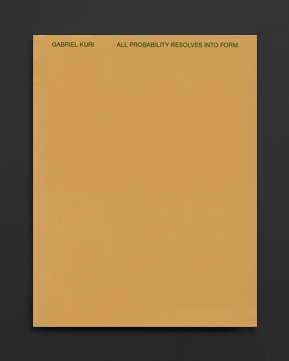
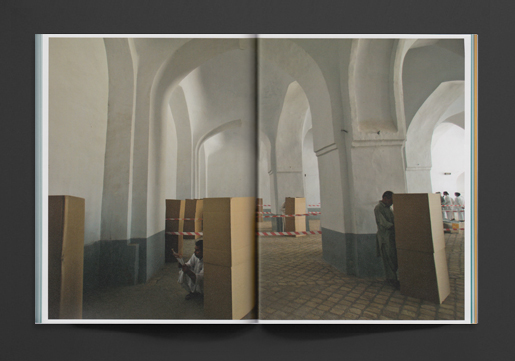
Gabriel Kuri is known for his investigation into the manifestation of form and material. An ongoing interest of the artist is the structure of improvised disaster shelters and polling stations, highlighting our material relationship with aid, politics and economics, and questioning the possibilities of sculpture.
This limited edition publication—co-published with The Common Guild, Glasgow, on the occasion of a solo exhibition by Kuri—comprises a collection of found images of these structures, which both resemble and inform the artist’s sculptural practice.
Taking its title from David Hume’s work A Treatise of Human Nature(1739) in which he wrote that “all knowledge resolves itself into probability,” Kuri has twisted the phrase to suggest that the very idea of a future event tends to result in a material form.
2016, English
Softcover, 168 pages, 19.5 x 26 cm
Published by
Sternberg Press / Berlin
$54.00 $10.00 - Out of stock
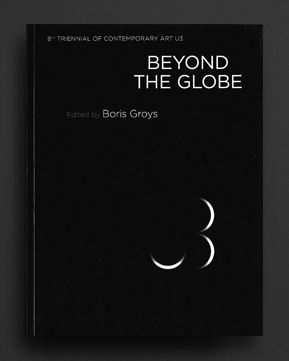
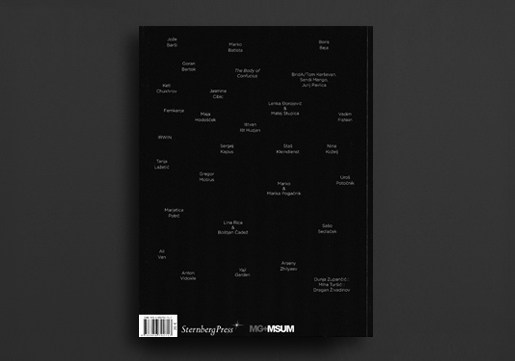
Texts by Zdenka Badovinac, Jože Barši, Boris Beja, Goran Bertok, Irena Borić, Blaž Božič, BridA (Tom Kerševan, Sendi Mango, Jurij Pavlica), Chang Tsong-Zung and Gao Shiming, Keti Chukhrov, Jasmina Cibic, Femkanje (Bojana S. Knežević, Katarina Petrović), Vadim Fishkin, Boris Groys, Ida Hiršenfelder, Maja Hodošček, IRWIN, Sergej Kapus, Staš Kleindienst, Nina Koželj, Tanja Lažetić, Gregor Mobius, Lívia Páldi, Marko & Marika Pogačnik, Uroš Potočnik, Marjetica Potrč, Tatjana Pregl Kobe, Lina Rica & Boštjan Čadež, Sašo Sedlaček, Miha Turšič, Ali Van, Anton Vidokle, Arseny Zhilyaev, Dragan Živadinov, Dunja Zupančič
In our cultural imagination, the cosmos is a harmonious, utopian universe, but it is also uncontrollable, even unknown, and the source of a specifically modern fear or uneasiness—one that could be described as “cosmic anxiety.” It’s no accident that mass culture today is obsessed with visions of asteroids coming out of space, causing the destruction of the earth. At the same time, space is the last frontier—the final chance for a genuine human endeavor. This catalogue presents many possibilities for the artistic exploration of the topic at hand: the connection between artistic and scientific imagination, the cosmos as analysis of sci-fi culture, perspectives of corporeal immortality, and the critique of contemporary technology.
Copublished with Moderna galerija, Ljubljana
Design by Novi kolektivizem
2013, English/German
Softcover, 320 pages (81 b/w ills.), 17 x 24 cm
Published by
Sternberg Press / Berlin
$79.00 $20.00 - Out of stock
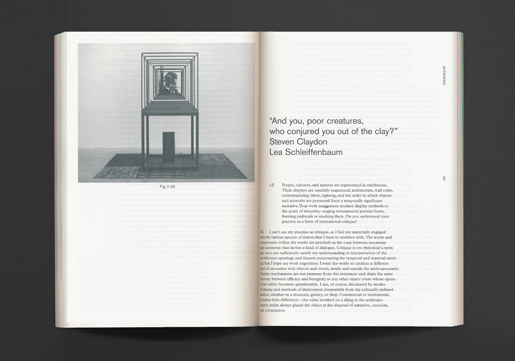
Introduction by Petra Reichensperger; essays by Anke te Heesen, Kirsten Maar, Markus Miessen, Ursula Panhans-Bühler, Jan Verwoert, Choy Lee Weng; interviews by Dóra Maurer/ Cassandra Edlefsen Lasch, Channa Horwitz/Petra Reichensperger, Yael Davids/Adam Szymczyk, Brian O'Doherty/Dominikus Müller, Carl Michael von Hausswolff/Thibaut de Ruyter, Karl Holmqvist/Dominikus Müller, Daniel Knorr/Katharina Groth, Jaroslaw Kozlowski/Petra Stegmann, Hans Schabus/Kathrin Rhomberg, Steven Claydon/Lea Schleiffenbaum, Karin Sander/Anne Schreiber, Martin Germann/Petra Reichensperger/Renate Wagner
This publication explores themes of the exhibition through its terms—not, however, to confine into isolated conceptual categories, but to interconnect. These terms characterize exhibiting and emphasize a “between-ness.” Examining a term lays bare its ruptures, shifts, or recreations, as well as social, societal, and cultural changes that have the power to structure through historical conjecture.
Almost fifty terms relevant to the making and discussion of exhibitions today have been compiled in Terms of Exhibiting (from A to Z), contributed by Liam Gillick, Manfred Hermes, Wojciech Kosma, Clemens von Wedemeyer, Tobias Vogt, Jochen Volz, and June Yap, among others. Six essays investigate key terms raised by the three-part exhibition series “Terms of Exhibiting, Producing, and Performing” at Kunsthaus Dresden in 2012. Jan Verwoert reflects on the division of labor in artistic production, while Anke te Heesen presents a survey of the museum, collection, and exhibition. Markus Miessen discusses the advantages of curating institutions and inventing structures rather than merely implementing or appropriating them. The book also includes essays by Kirsten Maar, Ursula Panhans-Bühler, and Lee Weng-Choy. Each of the twelve conversations with various artists places one term under scrutiny within the context of their own artistic interests and practices—with reference to the term presence, Daniel Knorr explains the significance of materialization for his own creative process, while Brian O’Doherty discusses invention in relation to his practice. Each term generates further insight and reflection into each individual art practice.
Including glossaries written by Friedrich von Borries, Hans-Christian Dany, Stefanie Diekmann, Anna-Catharina Gebbers, Liam Gillick, Manfred Hermes, Ulrike Jordan, Vera Knolle, Wojciech Kosma, Verena Kuni, Pablo Larios, Oona Lochner, Fiona McGovern, Andrea Meyer, Ana Ofak, Christian Rattemeyer, Petra Reichensperger, Dietmar Rübel, Thibaut de Ruyter, Jörn Schafaff, Lea Schleiffenbaum, Anne Schreiber, Nora Sdun, Vera Tollmann, Clemens von Wedemeyer, Tobias Vogt, Jochen Volz, Renate Wagner, Friederike Wappler, June Yap
2014, English
Softcover, 102 pages, 19 x 23 cm
Published by
Extra City Kunsthal / Antwerp
GAK / Bremen
Roma / Amsterdam
$50.00 $20.00 - Out of stock
This Koenraad Dedobbeleer artist book is published in conjunction with exhibitions held in 2014 at Extra City Kunsthal, Antwerp, and GAK, Bremen. Its initial spark originated in the framework of the 'Up Close and Personal' exhibition at Cultuurcentrum Mechelen in 2013. The premises of that venue’s classical, museum-style exhibition halls serve as a container for an imaginative show. This publication lists the complete catalogue for that undertaking, with photographs and reproductions of the numerous and highly diverse works. It opens with an essay by Ad Reinhardt, “Angkor and Art” (1961), and concludes with a bibliography of works and installation diagram of the gallery spaces.
2018, English
Softcover, 244 pages, 15 x 23 cm
Published by
Aspen Art Museum / Aspen
$55.00 - Out of stock
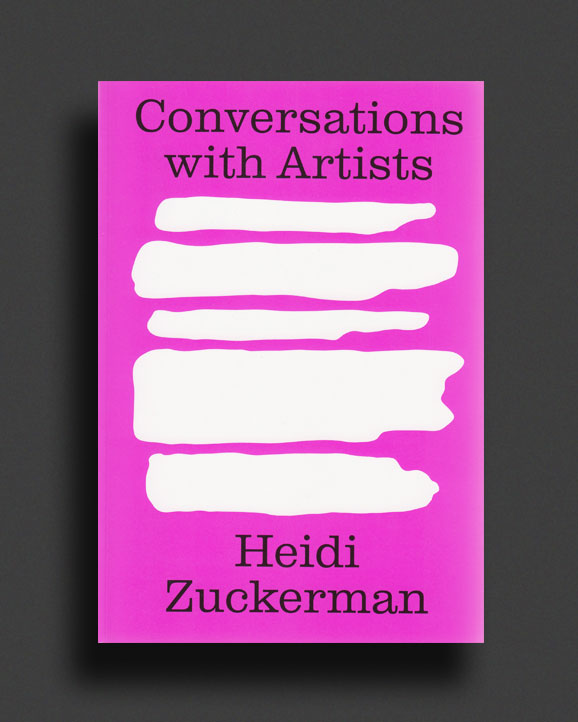
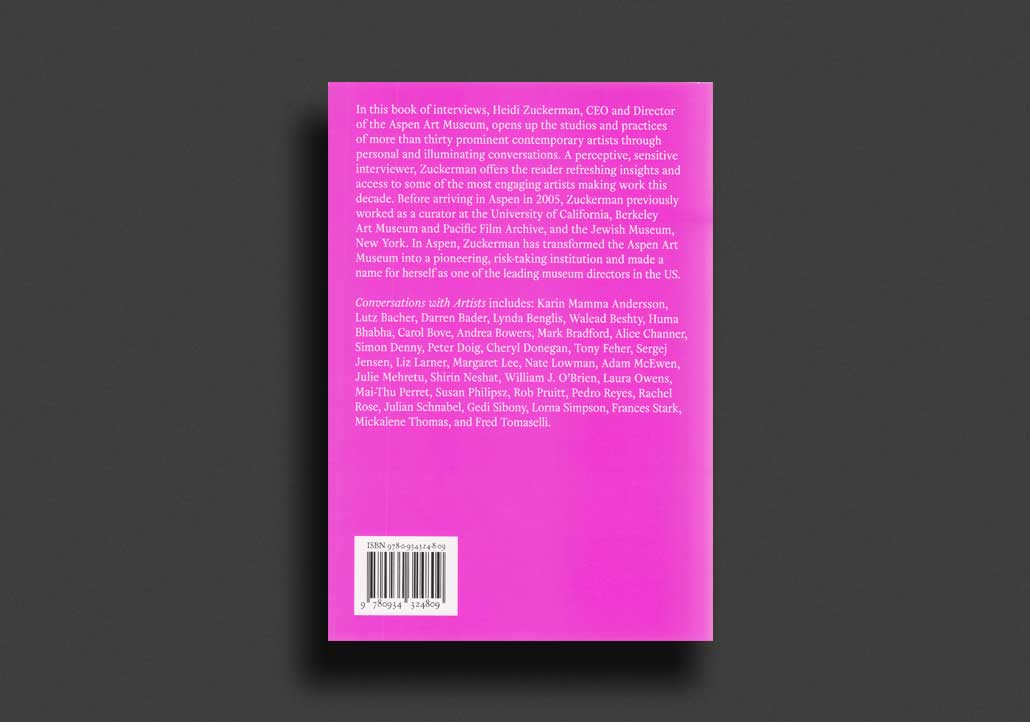
A perceptive, sensitive interviewer, Zuckerman offers the reader refreshing insights and access to some of the most engaging artists making work this decade. The range of artists appearing in Conversations with Artists testifies to Zuckerman’s wide-ranging interests: artists featured include Lutz Bacher, Darren Bader, Walead Beshty, Andrea Bowers, Mark Bradford, Alice Channer, Cheryl Donegan, Tony Feher, Sergej Jensen, Liz Larner, Adam McEwen, William J. O’Brien, Rob Pruitt and Pedro Reyes.
English / German
Hardcover, 96 pages, 22 x 28 cm
Published by
Distanz / Berlin
$55.00 - Out of stock
dasselbe anders/immer dasselbe [the same thing another way/always the same thing]: that is the title of Charlotte Posenenske (1930–1985) and Peter Roehr’s (1944–1968) joint exhibition at the Kunsthaus, Wiesbaden. Both artists, who contributed to documenta, did not achieve fame until after their early deaths. Against the zeitgeist of 1967, both recognized that repetition constituted the law of natural, industrial, and social processes, and found in it the guiding principle of their art. They worked in series, stripping their productions of subjective qualities and liquidating the traditional status of the artist as the creator of unique objects on which the commercial art world is based. “Less is more:” that was true for both artists, whose works are now widely acknowledged as representative of a radical late-modern critique of commercialism. Their art, which was rarely shown during their lifetime, is now included in the collections of leading museums in Germany and abroad. The exhibition of Posenenske’s work is accompanied by a program of events featuring Michael Reiter’s Swinging Geometry and Martina Wolf’s Moving Images.
2018, English
Softcover, 280 pages, 27.9 x 21.5 cm
Published by
Walther König / Köln
$48.00 - Out of stock
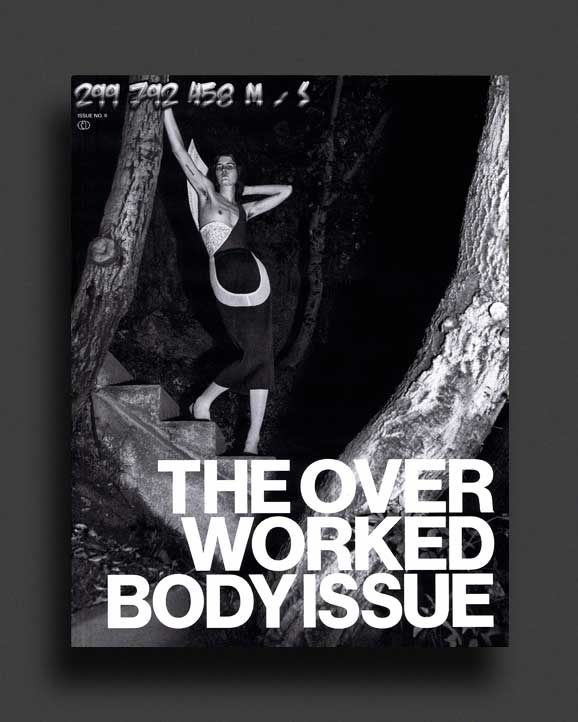
299 792 458 m/s is a magazine created in 2016 by German artist David Lieske and photographer Rob Kulisek.
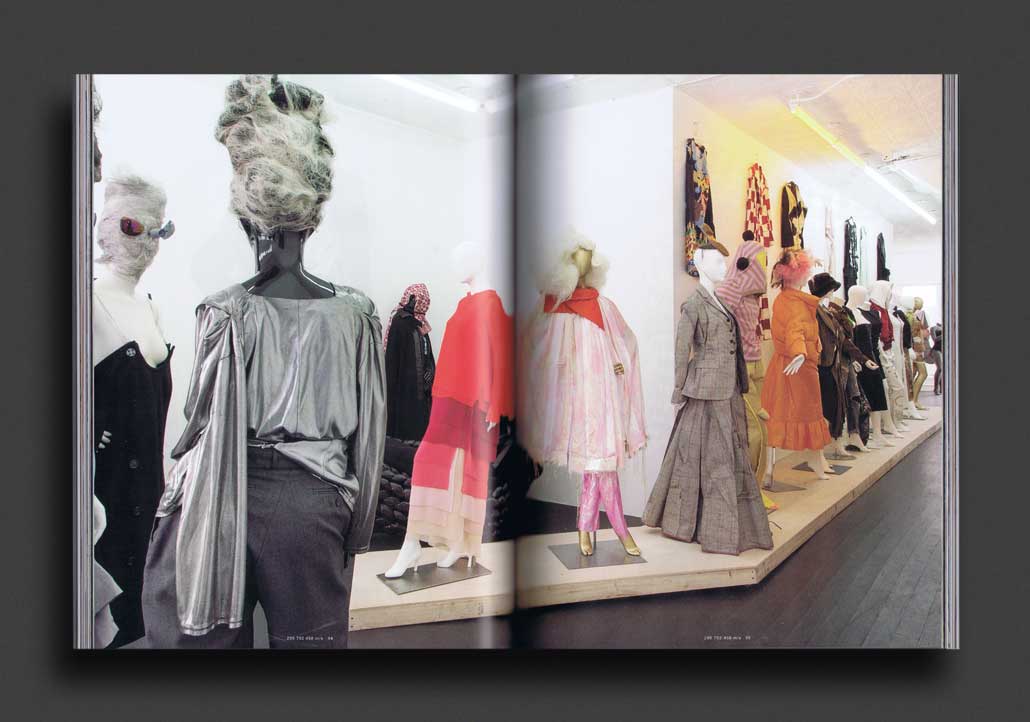
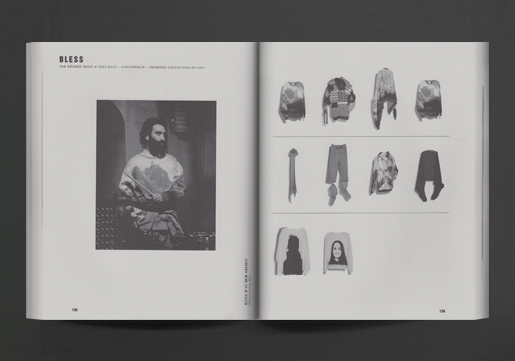
Issue 2 "The Overworked Body" is co-edited by curator Matthew Linde and functions not just as fashion magazine and artist's book but also as a catalogue for the eponymous exhibition at Mathew Gallery, New York (2017) titled "The Overworked Body: An Anthology of 2000's Dress", organised by Linde. The exhibition and associated "Overworked Runway" show (all documented extensively in full-colour here) includes works by 20471120, A.F. Vandevorst, Adeline André, Alexander McQueen for Target, Andrea Ayala Closa, Andrew Groves, Anke Loh, Ann-Sofie Back, Annalisa Dunn, Arkadius, As Four, Benjamin Cho, Bernadette Corporation, Bernhard Willhelm, BLESS, Carol Christian Poell, Christophe Coppens, Comme des Garçons, Cosmic Wonder, Dorothée Perret, Dutch Magazine, FINAL HOME, Helmut Lang, Hideki Seo, House of Holland, Hussein Chalayan, Imitation of Christ, Isaac Mizrahi for Target, Issey Miyake, Jean Paul Gaultier, Junya Watanabe, KEUPR/van BENTM, Kim Jones, Koji Arai, Kostas Murkudis, Lutz Huelle, Maison Martin Margiela, Maison Martin Margiela and Marina Faust, Miguel Adrover, Number (N)ine, Organization for Returning Fashion Interest, Proenza Schouler for Target, Purple Fashion, Rodarte for Target, Shelley Fox, Sophia Kokosalaki, Stephen Jones, Susan Cianciolo, Tao, Telfar, Undercover, Victoria Bartlett (previously VPL), Viktor & Rolf, Viktor & Rolf for H&M, Walter van Beirendonck, Wendy & Jim, Yohji Yamamoto, and ____fabrics interseason.
Full contents:
2018, English
Softcover, 78 pages, 18 x 25.5 cm
Ed. of 600,
Published by
Periodico / Zürich
$30.00 - Out of stock
Periodico is a new independent magazine from Zürich, edited by Marc Asekhame and Teo Schifferli.
ISSUE 002 12 17
Contents:
Editorial
Marc Asekhame in conversation with Matthew Hanson
Heji Shin
Middle of the Day - John Miller interviewed by Ilya Lipkin
COSTUME - Anthony Symonds in conversation with Calla Henkel and Max Pitegoff
RITORNELLO! - Emanuel Rossetti
Proposals for Future Covers
Printed in an edition of 600 copies.
1994, English / Japanese
Softcover, 158 pages, 23 x 29 cm
1st Edition, Out of print title / used / very good
Published by
Marugame Genichiro-Inokuma Museum of Contemporary Art / Tokyo
$100.00 - Out of stock
First edition Japanese book on Hockney's Californian work, published in 1994 on the occasion of a major travelling exhibition in Japan. Profusely illustrated in colour throughout with Hockey's iconic paintings and drawings - his Showers, Pools, Interiors, Drives, and Portraits from California. Includes texts in English and Japanese, biography and bibliography.
Good copy with light tanning to cover and page edges.
1969, Japanese
Hardcover (w. dust jacket), 96 pages, 20 x 26.5 cm
Out of print title / used / good
Published by
Bijutsu Shuppan-sha / Japan
$80.00 - Out of stock
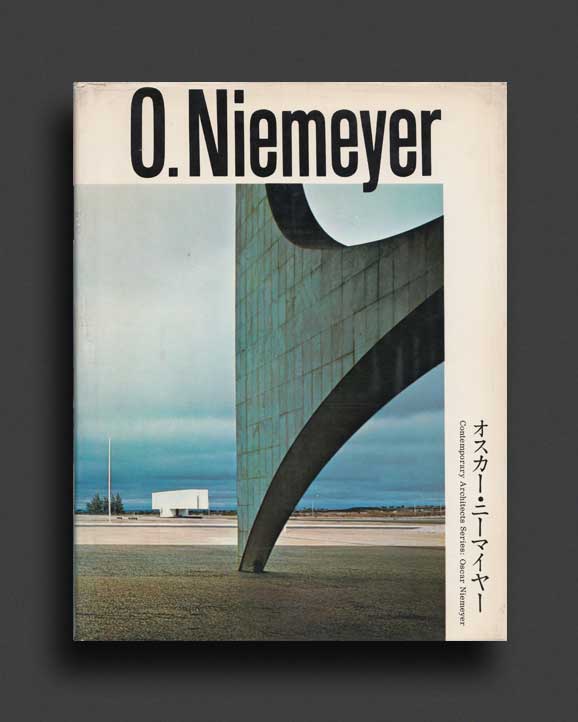
Original first hardcover edition Oscar Niemeyer monograph from the great "Contemporary Architects Series", published by Bijutsu Shippon-sha, Tokyo and printed in Japan in 1969. Profusely illustrated throughout in colour and black and white with photographs of Niemeyer's buildings and interiors, captured beautifully by renowned Japanese architectural photographer Yukio Futagawa, alongside Neutra's plans and drawings. Texts in Japanese.
Oscar Ribeiro de Almeida Niemeyer Soares Filho (1907 – 2012), known as Oscar Niemeyer, was a Brazilian architect considered to be one of the key figures in the development of modern architecture.
Good hardcover copy with original dust-jacket. Only light marking/tanning/wear from age.
1969, Japanese
Hardcover (w. dust jacket), 96 pages, 20 x 26.5 cm
Out of print title / used / good
Published by
Bijutsu Shuppan-sha / Japan
$80.00 - Out of stock
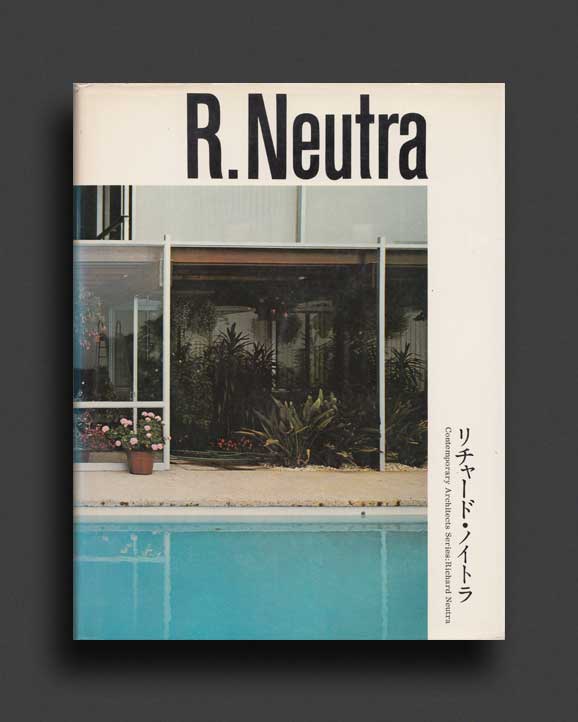
Original first hardcover edition Richard Neutra monograph from the great "Contemporary Architects Series", published by Bijutsu Shippon-sha, Tokyo and printed in Japan in 1969. Profusely illustrated throughout in colour and black and white with photographs of Neutra's buildings and interiors, captured beautifully by renowned Japanese architectural photographer Yukio Futagawa, alongside Neutra's plans and drawings. Texts in Japanese.
Richard Joseph Neutra (1892 – 1970) was an Austrian-American architect. Living and building for the majority of his career in Southern California, he came to be considered among the most important modernist architects.
Good hardcover copy with original dust-jacket. Only light marking/tanning/wear from age.
2015, English
Softcover, 128 pages (colour ill.), 24 x 16 cm
Published by
Walther König / Köln
$38.00 - Out of stock
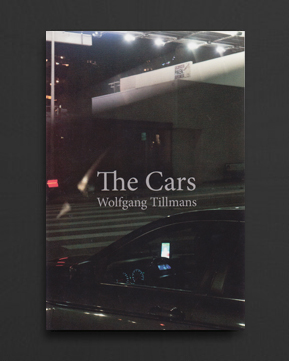
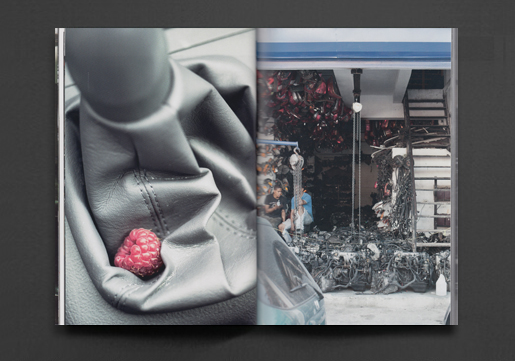
This book looks at a cross section of what cars ʻactuallyʼ look like in a global sampling and how they interact with the environment around them.
‘I wanted to show how cars appear in typical street view, which is rarely the subject of photographs. Cars are usually avoided in photography - one waits until a car has exited a view. The ordinary presence of cars is rarely worthy of representation.
Itʼs always the special car, or the extreme traffic jam or, of course, the exciting crash that is being pictured. The Cars pays tribute to the shapes and forms we look at every day. How much time we spend with them, sitting inside them, the endless hours we stare at a dashboard. Even if we donʼt own a car ourselves, their presence is unavoidable. Cars are everywhere. Their sheer number is the most crazy thing about them.
They appear in our lives with excessive omnipresence. In their volume cars intrude upon public space, and the way they occupy streets and open areas is rarely challenged. Virtually wherever there are people, there are cars and they are visually intermingling in whatever we see.
We are looking at the world from a car and cars are in the foreground, the background or in between of what is in our view. Where they are, they add a tone, a note, a presence, a noise to the setting theyʼre in...’
— Wolfgang Tillmans
1986, English / Japanese
Softcover, 260 pages, 22.5 x 29.5 cm
1st Edition, Out of print title / used / very good
Published by
A+U Publishing / Tokyo
$120.00 - Out of stock
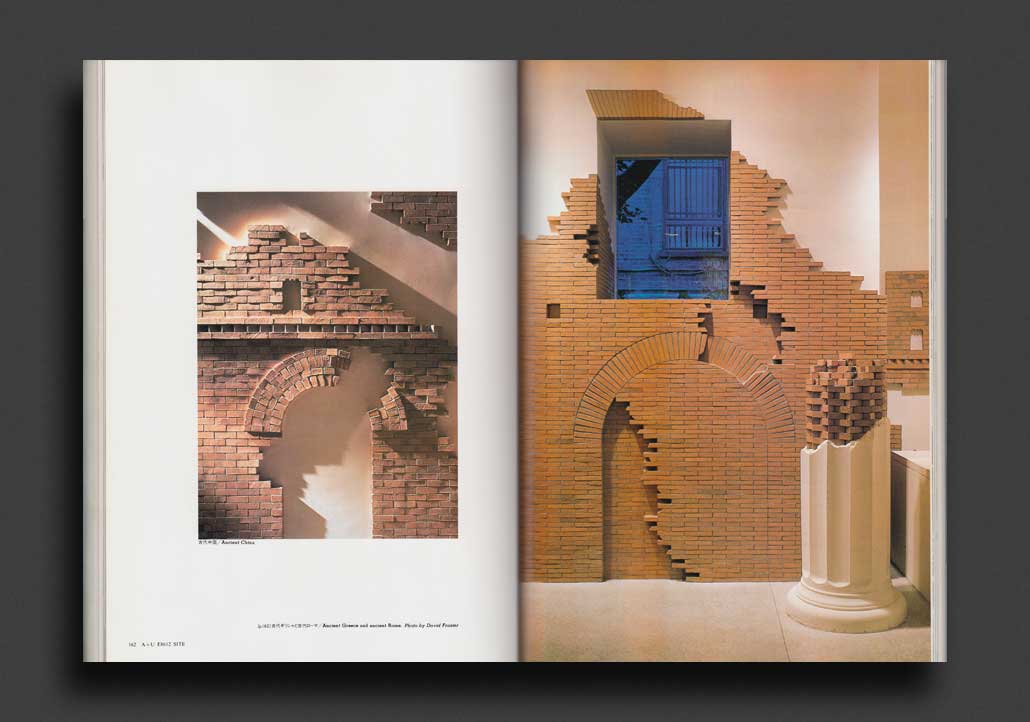
The great SITE Extra Edition of a+u (Architecture and Urbanism) published in Tokyo in 1986 and long out of print.
This publication makes for probably the most generous monograph ever published on SITE, a multidisciplinary architecture and environmental art organization chartered in New York in 1970 for the purpose of exploring new concepts for the urban/suburban visual environmental.
Commonly aligned with radical architecture, anti-architecture or arch-art, SITE have described their philosophical position as "De-Architecture". Pierre Restany presented SITE as "a paradigm of humour & disorder, the perfect antidote against post-modernist, rationalist & structuralist conventions".
Lavishly illustrated with photography, sketches and plan drawings across 232 pages, this dense book profiles SITE's entire history of work ("Fifty Five Works and Projects") including architectural buildings, showrooms, galleries/museums, store/restaurant designs, interiors, environmental designs, parking lots, exhibition designs, commemorative products; and accompanied by essays by Herbert Muschamp, James Wines, Itsuo Sakane, Japanese designer Shigeo Fukuda, Japanese architect Kazumasa Yamashita, an introduction, a biography of SITE's Principals (Alison Sky, Michelle Stone, James Wines) and a list of works.
A must for anyone interested in the work of SITE. This has become an important reference and archive of their entire history.
1985, English / Japanese
Softcover, 260 pages, 22.5 x 29.5 cm
1st Edition, Out of print title / used / very good
Published by
a+u / Tokyo
$100.00 - Out of stock
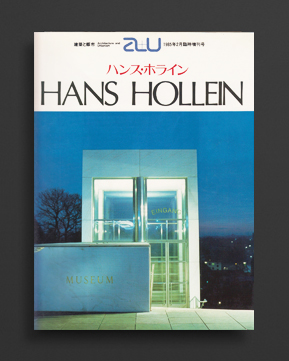
The great Hans Hollein Extra Edition of a+u (Architecture and Urbanism) published in Tokyo in 1985 and long out of print.
This publication makes for probably the most generous monograph ever published on Hans Hollein, Austrian architect and designer and key figure of postmodern architecture (30 March 1934 – 24 April 2014).
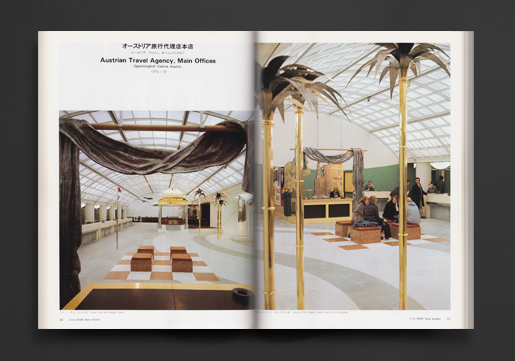
Lavishly illustrated with photography, sketches and plan drawings across 260 pages, this dense book profiles his realised architectural buildings (including the incredible Retti Candle Shop, Austrian Travel Agencies, Schullin Jewelry Shops, Perchtoldsdorf Town Hall, Munincipal Museum Abteiberg Monchengladbach, amongst many more); miscellaneous realised works (including his many furniture and object designs for Herman Miller, Memphis, Poltronova, Alessi, Wittmann) and interiors, exhibition and stage designs (for the Milan Triennale, Venice Biennale and many more); his unrealised projects (all visualised through plans and photography of Hollein's architectural models), and accompanied by essays from Kenneth Frampton and Joseph Rykwert, an introduction, a biography and a list of works.
A must for anyone interested in the breadth of this great designer's work through the 1960s-1980s.
1981, English / French / German
Hardcover, 236 pages, 24 x 24 cm
Out of print title / used / fine
Published by
The Graphis Press / Zürich
$70.00 - Out of stock
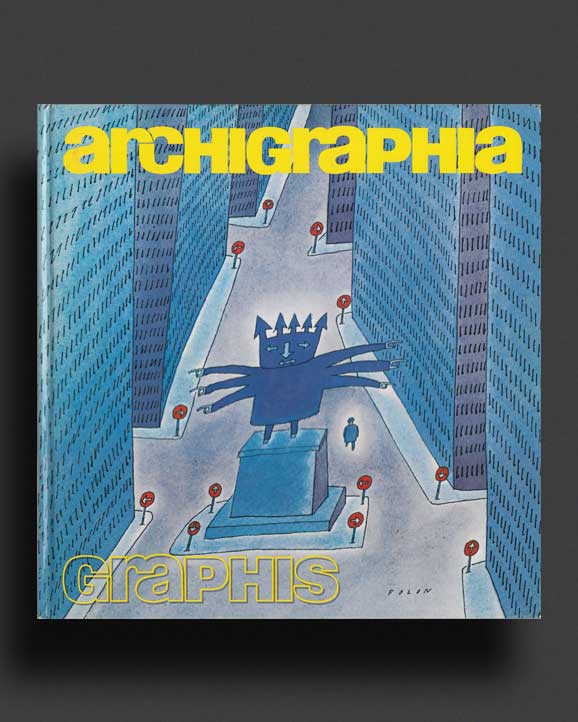
The great "Archigraphia : Architectural and Environmental Graphics", published in 1981 (first in 1978) by the legendary Graphis Press, Zürich. Bound in the iconic Jean-Michel Folon illustrated hardcover this landmark volume from the great Graphis "square books series", edited by Swiss graphic designer Walter Herdeg, forms an extensive international reference of architectural and environmental graphic design projects with chapters on: Traffic and Highway Signage, Pictograms, Visual Guidance Systems, Buildings and Shop Fronts, Supergraphics and Vehicle Graphics with Editor's foreword, chapter introductions, project profiles and a designer/artist/subject/architect index.
Profusely illustrated throughout with 823 b/w and colour examples, and, as per usual for Graphis publications, is handsomely designed and heavily researched, with all texts in English, German and French.
Essays by T. Geismar and P. Kneebone, Jock Kinneir, John Follis, Reinhart Braun, Klaus Herdeg and Stanley Mason.
Features the work of : Shigeo Fukuda, Herb Lubalin, Massimo Vignelli / Vignelli Associates, Design Research Unit, Saul Bass and Associates, Milton Glaser, Wim Crouwel, Masaru Katsumi, Les Mason, Paul Rand, Yoshiro Yamashita, John Follis, Chermayeff & Geismar, Lou Dorfsman, SITE, Georges Huel, William Golden, Gae Aulenti, Renzo Piano, Kenzo Tange, William Turnball, and so many others.
Walter Herdeg was a Swiss graphic designer, noted for his travel posters and work with Graphis Magazine, who was awarded an AIGA medal in 1986.
Very good copy with some wear and previous owners name on front blank page.
1969, English / Japanese
Hardcover (w. dust jacket), 120 pages, 19 x 27 cm
1st Edition, Out of print title / used / good
Published by
Bijutsu Shuppan-sha / Japan
$60.00 - Out of stock
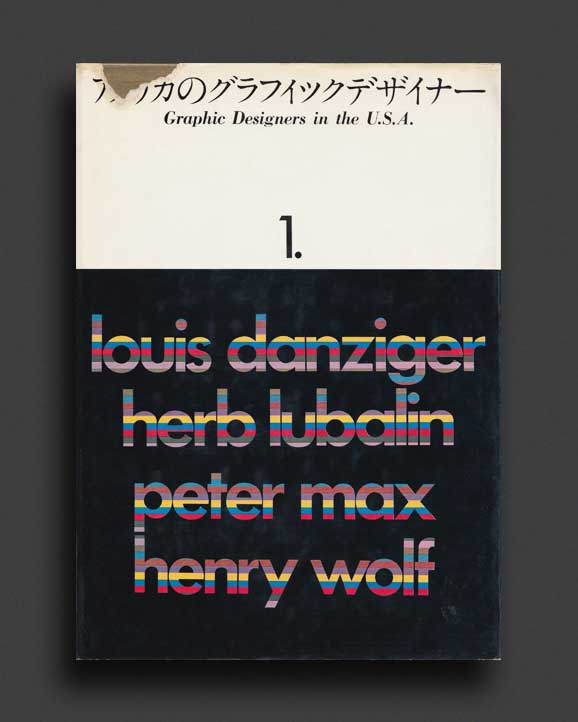
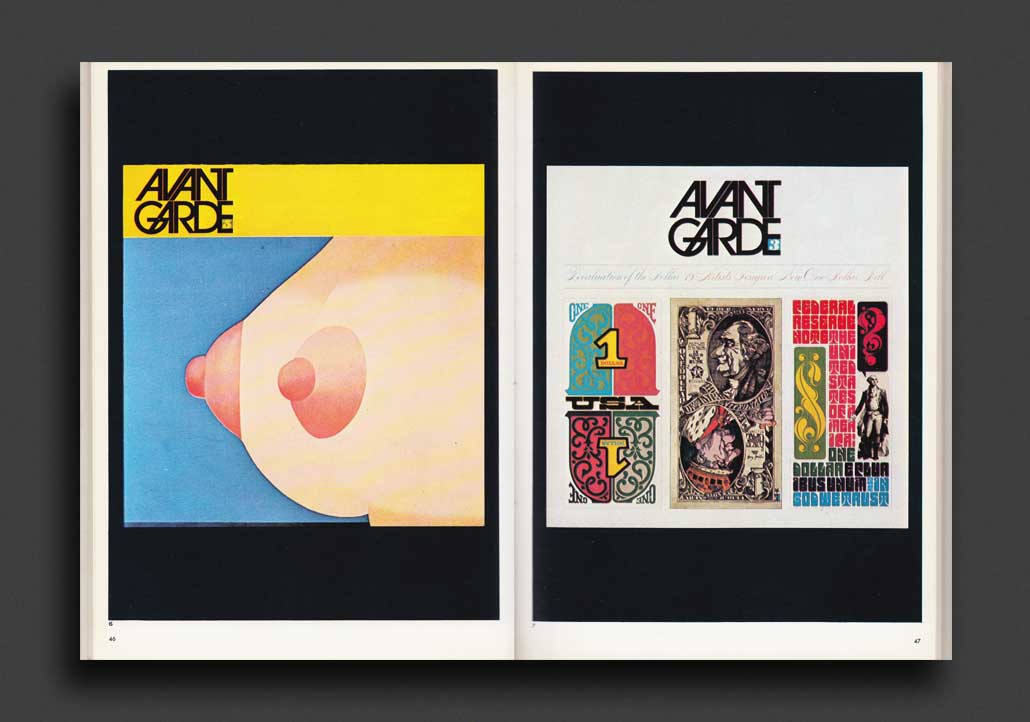
Volume 1 of the great 1969 hardcover series "Graphic Designers in the U.S.A.", art directed by Gan Hosoya. Each of these collectable books showcase four leading American graphic designers (of the total 12 across 3 books) practicing in the 1960s through a large selection of their works beautifully reproduced in full-colour and black and white (120 pages and 163 illustrations). Volume 1 showcases Louis Danziger, Herb Lubalin, Peter Max, and Henry Wolf. Each designer profile is introduced with an English text about their work. Some other texts in Japanese, but almost entirely a visual document.
First edition in original dust-jacket, embossed metallic cloth boards, some wear and chipping to jacket, book very good. Designed and printed in Japan.
1987, Japanese
Softcover (french-flaps), 32 pages, 28 x 22 cm
1st Edition, Out of print title / used / fine
Published by
M. Gallery / Tokyo
$160.00 - Out of stock
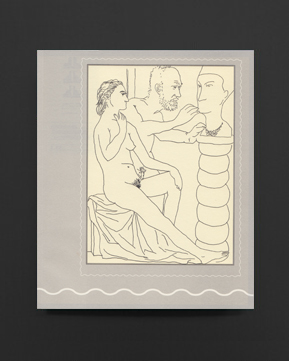
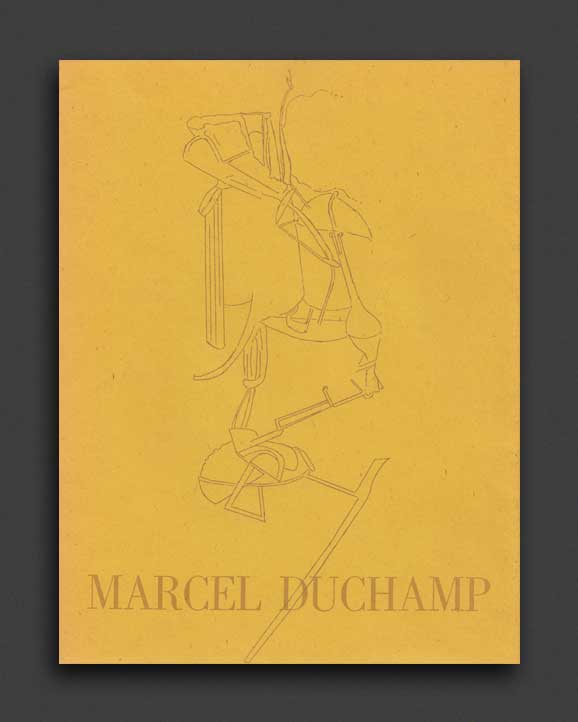
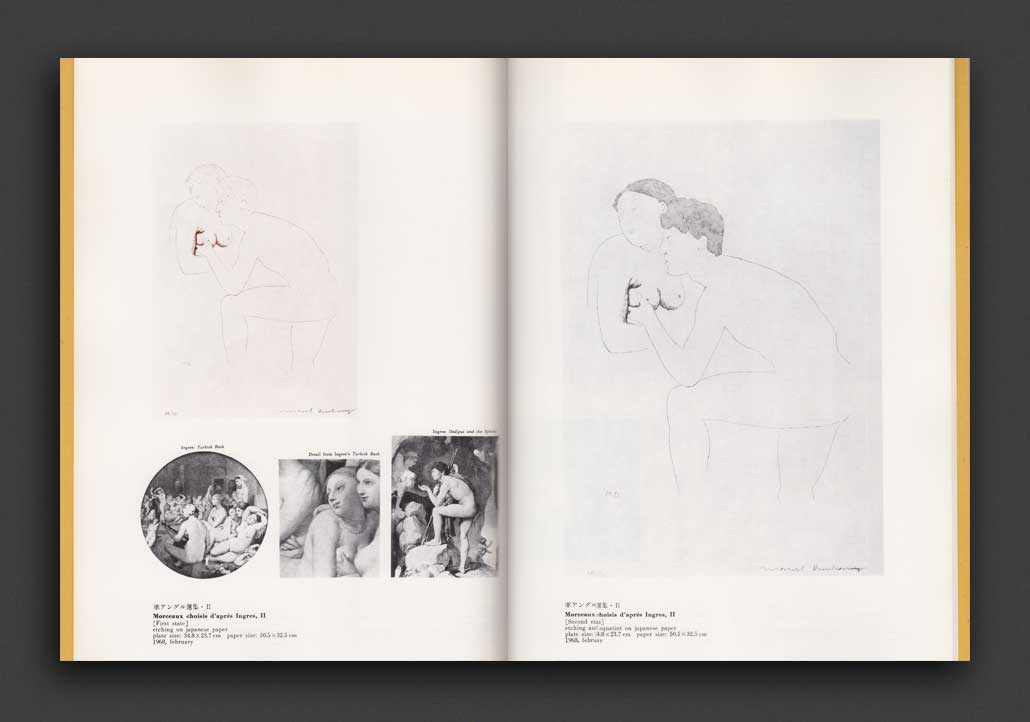
Perfect copy of this very rare Japanese publication on Marcel Duchamp. Published to accompany an exhibition of Duchamp's work in Tokyo entitled "Etchings", 6 April-2 May, 1987, "Two Series of Etchings : The Lovers, Large Glass and Related Works" beautifully reproduces 35 etchings dating 1965 (Large Glass and Related Works) - 1967/68 (Lovers), complete with full details, captions and reference images.
Introductory text by Yoshiaki Tono and 1965 portrait of Duchamp by Ugo Mulas. Exhibition brochure inserted along with other ephemera.
Duchamp insisted that art should be at the service of the mind, as opposed to a particular skill or material, and he brought to his art an interest in traditionally non-art subject matter, such as linguistics, mathematics and game theory.
1947, English
Softcover (staple-bound), 24.5 x 18.5 cm, 64 pages
1st Edition, Out of print title / used / good
Published by
Victorian Artists Society / Melbourne
$25.00 - Out of stock
The Australian Artist was founded in 1947 by Richard Haughton James, aka Jimmy James, a legendary figure in the history of Australian design and art, and published quarterly by The Victorian Artists Society in East Melbourne. It was available for three shillings and sixpence.
This issue (Volume One, Part Two: Personality in Art) is filled with articles such as "The Anatomy of Vulgarity" by Clive Turnbull; "Art and Sanity" by Alice Barber; "Sculpture Shown at The Victorian Artists Society"; "The Art of Children" by Frances Derham; and a feature on Pablo Picasso by Paul Haefleiger, alongside many other commentaries, illustrations (Pablo Picasso, Jacques Lipchitz, Rembrandt, Rodin, Georges Rouault, Cassandre, Aubrey Beardsley, Honoré Daumier, etc.) advice, "Food for Thought" and advertisements from late 1940s Melbourne.
General age wear, foxing and tanning to book edges and corners, otherwise bright and clean throughout.
1947, English
Softcover (staple-bound), 24.5 x 18.5 cm, 60 pages
1st Edition, Out of print title / used / good
Published by
Victorian Artists Society / Melbourne
$25.00 - Out of stock
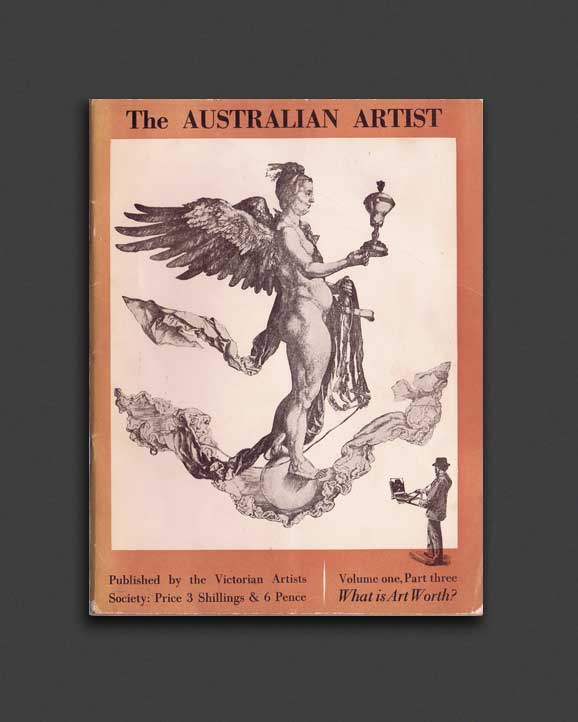
The Australian Artist was founded in 1947 by Richard Haughton James, aka Jimmy James, a legendary figure in the history of Australian design and art, and published quarterly by The Victorian Artists Society in East Melbourne. It was available for three shillings and sixpence.
This issue (Volume One, Part Three: What is Art Worth?) is filled with articles such as editorial texts "What Is Art Worth?", "What Is Art Training Worth?", "Why be a Sculptor", "The Fact About The Commercial Artist", "The Teaching of Arts in Victorian Schools", a feature on Henry Moore by Douglas Glass; Tom Roberts in retrospect; "Wood Engravings" by Imrie Reiner, alongside many other commentaries, illustrations (Albrecht Durer, Douglas Annand, Pierre Bonnard, George Grosz, Erwin Fabian, Georges Roualt, Henry Moore, Tom Roberts, Russell Drysdale, etc.), advice, "Food for Thought" and advertisements from late 1940s Melbourne.
General age wear, foxing and tanning to book edges and corners, otherwise bright and clean
2010, French
Softcover, 296 pages, 19.5 x 24 cm
1st Edition, Out of print title / used / very good
Published by
Purple Institute / Paris
$80.00 - Out of stock
Rare copy of the first and only issue of "Les Cahiers Purple".
As the extension of Purple Journal, and the diversion away from Purple Fashion, "Les Cahiers Purple" has the subtlety, sophistication and poetry expected from editor-in-chief Elein Fleiss. Through a diary-like feel, the publication captured the world through the lenses and words of a diverse array of collaborators and contributors from the worlds of fashion, photography, art, literature, poetry, design and much more.
Contributors included: Judith Affolter, Leonor Antunes, Jean-Christophe Bailly, Arnold Barkus, Laetitia Benat, Amit Berlowitz, Guillaume Besnier, Dike Blair, BLESS, Marcel Cohen, Sonia Collins, Cosmic Wonder Light Source, Geoffrey Cruickshank-Hagenbuckle, Tacida Dean, Gérard Duguet-Grasser, Pablo Durán, Anders Edström, Laura Erber, Fabrics Interseason, Oscar Faria, Mark Fishman, Elein Fleiss, Anne Frémy, Danièle Gibrat, Aki Goto, Pablo Guerra, Yannick Haenel, Nakako Hayashi, Michiko Hayashi, Takashi Homma, Kyotaro, Béatrice Leca, Yukari Miyagi, Valérie Mréjen, Raphaël Nadjari, Federico Nicolao, Paulo Nozolino, Gaëlle Obiégly, Jeff Rian, Daniel Riera, Dieter Roelstraete, Tatiana Roque, Henry Roy, Stephen Sprott, Yuriika Suzuki, Sergio Taborda, Itai Tamir, Guillermo Ueno, Antek Walzcak, Szymon Zaleski, Zucca, and more.
contents:
Cahier 01 Marcel Cohen, 10 textes
Cahier 02 Vivre au Japon
Cahier 03 France
Cahier 04 Esprits
Cahier 05 Comunal Argea
Cahier 06 Lisboa
Cahier 07 Caractères
Cahier 08 Vêtements d'hiver
Cahier 09 New York Now and Then
Cahier 10 Buenos Aires, les personnes préférées de Guillermo Ueno
Cahier 11 Idoles
Cahier 12 Aventures
Cahier 13 Szymon Zaleski, La tragédie sémite
Cahier 14 Rio de Janeiro
Cahier 15 Créatures
2004, Japanese / English
Hardcover, (w. dustjacket), 121 pages, 22.5 x 29.7 cm
Published by
Idea / Tokyo
$85.00 - Out of stock
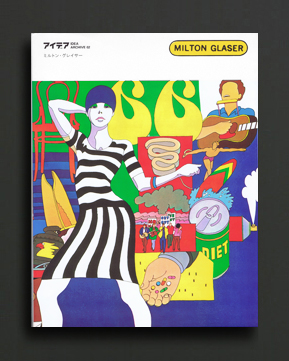
Milton Glaser is one of the world's most renowned designers and illustrators from the United States of the later half of the 20th century. In 1954, he co-founded Push Pin Studios, founded New York Magazine with Clay Felker, and established Milton Glaser, Inc. in 1974. His artwork has been featured in exhibits, and placed in permanent collections in many museums worldwide. Throughout his long career, Glaser has become widely celebrated for his many posters, paperback covers, magazines illustrations, record jackets and architectural designs. His logo “I ♥ NY,” as well as posters for Bob Dylan and other artists, have become some of the most recognised and appropriated graphics of our times. This book is a compilation of Glaser’s 60s graphic design work.
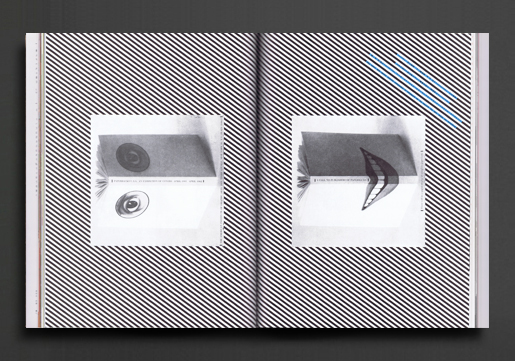
Originally published by Japan's great Idea Magazine as a special edition in 1968, this book is a hardcover re-print of this volume dedicated entirely to Glaser's work. In addition to contributions by three of Japan's greatest graphic designers Ikko Tanaka, Hiromu Hara, and Kiyoshi Awazu, an interview with Milton Glaser himself is included in the book. The art direction and layout by Tadanori Yokoo fully convey the atmosphere of the time and work of Glaser.
The 51th volume of Pushpin Graphic Magazine, which was dedicated to Georges Melies well-known for his movie “A Trip to the Moon,” is inserted as a supplement.
1972, English
Hardcover, 160 pages, 29 x 21 cm
1st Edition, Out of print title / used / very good
Published by
Jack Pollard / NSW
$48.00 - Out of stock
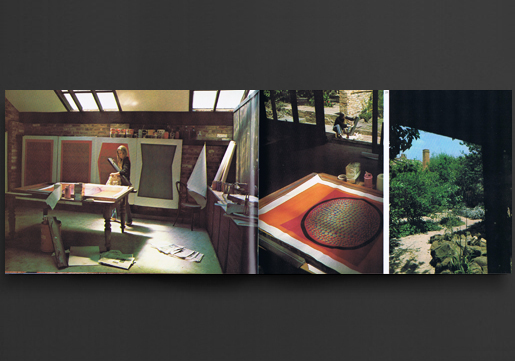
First edition of the great hardcover 1972 book art directed and designed by textile artist-designer Fay Bottrell.
'Aspects of Sensibility' profiles 38 prominent designers, studio potters, textile artists, weavers, decorative artists, working in Australia in the 1960s and early '70s through full-bleed landscape spreads of photography by Wesley Stacey, capturing their working environments, details of their work and studios, and text reflections of these artists on their work.
Features Graham Bennett, Lillian Bosch, Douglas Annand, Sandra Leveson, Ken Leveson, Ian Sprague, Kat Bish, Bruce Arthur, Bernard Sahm, Janet Brereton, Kevin Brereton, Jutta Feddersen, Les Blakebrough, Rosalie Gascoigne, Elizabeth Vercoe, Albert Steen, Fay Bottrell, Pru Medlin, Mirka Mora, Peter Travis, Marea Gazzard, Helge Larsen, Darani Lewers, Milton Moon, Isabel Davies, Joan Campbell, Peter Rushforth, Mona Hessing, Hiroe Swen, John Mason, Ewa Pachucka, Victor Greenaway, Heather Dorrough, John Gilbert, Verlie Just, Silver Harris, Col Levy, Vivienne Pengilley, Weatherhead and Stitt.
A very unique and personal book reflecting on the lives of Australian artists and designers working in the early 1970s.
Very good copy, light wear, without dust-jacket.
1993, French / Japanese
Softcover (French folds), 128 pages, 23 x 29 cm
1st Edition, Out of print title / used / very good
Published by
Tokyo Station Gallery / Tokyo
$70.00 - Out of stock
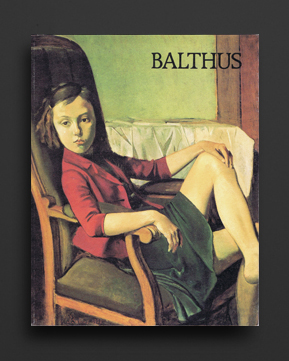
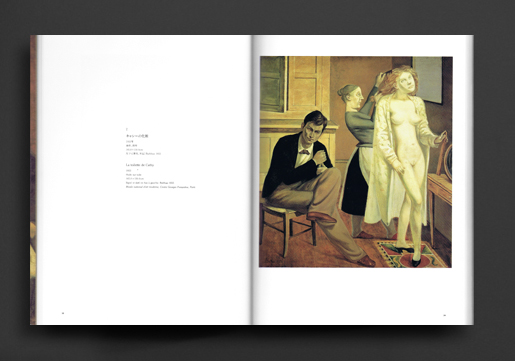
Scarce monographic catalogue on Balthus, published in Japan in 1993 for an exhibition at the Tokyo Station Gallery. Profusely illustrated in colour and black and white with Balthus' paintings and drawings dating from 1932-1987. Includes text by Jean Leymarie (in French and Japanese), list of exhibitions, biography, bibliography, list of works, portraits of Balthus by Irving Penn, Cecil Beaton, etc.
Throughout his career, Balthus rejected the usual conventions of the art world. He insisted that his paintings should be seen and not read about, and he resisted any attempts made to build a biographical profile. A telegram sent to the Tate Gallery as it prepared for its 1968 retrospective of his works read: "NO BIOGRAPHICAL DETAILS. BEGIN: BALTHUS IS A PAINTER OF WHOM NOTHING IS KNOWN. NOW LET US LOOK AT THE PICTURES. REGARDS. B."
Balthus (February 29, 1908 – February 18, 2001), was a Polish-French modern artist born in Paris to Polish expatriate parents. His given name was Balthasar Klossowski - his sobriquet "Balthus" was based on his childhood nickname, alternately spelled Baltus, Baltusz, Balthusz or Balthus. His father, Erich Klossowski, was an art historian who wrote a noted monograph on Daumier. His older brother was the philosopher and artist Pierre Klossowski. An unusual figure in the history of twentieth century painting, Balthus both traveled among and drew upon the work of other major artists of his time, while at the same time following a unique individual trajectory. He was mentored by, friends of, and/or even collaborated with seminal creative figures from different eras, including Antonin Artaud, André Breton, and Rainer Maria Rilke, while cultivating his own highly refined style of dreamlike, classically-informed painting. The scenes he usually depicted were very ordinary bourgeois interiors or outdoor settings, which nonetheless managed to reveal the heightened inner states of his subjects as well as the states of mind of those who might be viewing them.
"I always feel the desire to look for the extraordinary in ordinary things; to suggest, not to impose, to leave always with a slight touch of mystery in my paintings." - Balthus