World Food Books' programme is largely produced on Kulin Nation land. We acknowledge the Wurundjeri people of the Kulin Nation as the first and continuing custodians of this land, and pay respect to their Elders past, present, and emerging.
World Food Books is an arts and special interests bookshop in Naarm / Melbourne. Founded in 2010, World Food Books is devoted to the presentation of a rotating, hand-selection of international art, design, literary and counterculture publications with an emphasis on the anti-traditional, the experimental, the avant-garde, the heretic, the marginal.
Presenting new titles alongside rare and out-of-print books, catalogues and journals spanning the fields of modern and contemporary art, design, photography, illustration, film, literature, poetry, cultural theory, philosophy, sexuality, popular and underground culture in its many radical forms, World Food Books wishes to encourage adventurous, thoughtful and open-minded reading, looking, writing, and exchange of publishing and ideas, both current and historical.
As well as our bookshop, located in Melbourne's historical Nicholas Building, all of our inventory is available internationally via our online mail-order service.
World Food Books semi-regularly co-ordinates "Occasions", a programme of exhibits and events at the bookshop and in partnership with other hosts (such as museums and art galleries) that develop out of the activities, relationships and content of the bookshop itself.
World Food Books
The Nicholas Building
37 Swanston Street
Room 5, Level 6
Melbourne 3000
Australia
SHOP HOURS:
Thu–Fri 12–6, Sat 12–5
WEB-SHOP OPEN 24/7
World Food Books
Postal Address:
PO Box 435
Flinders Lane
Victoria 8009
Australia
Art
Theory / Essay
Architecture / Interior
Graphic Design / Typography
Photography
Fashion
Eros
LGBTQ+
Fiction / Poetry
Weird / Speculative / Science Fiction / Horror
Transgressive / Visceral / Abject
Symbolism / Decadence / Fin de siècle
Film / Video
Painting
Sculpture / Installation
Performance / Dance / Theater
Drawing
Sound / Music
Curatorial
Group Shows / Collections
Periodicals
Out-of-print / Rare
Posters / Ephemera / Discs
Signed Books
World Food Books Gift Voucher
World Food Book Bag
Australian Art
Australian Fiction
Australian Science Fiction / Speculative Fiction
Australian Poetry
Australian Photography
Japanese Photography
Conceptual Art
Minimal Art
Dada
'Pataphysics / Oulipo
Fluxus
Concrete Poetry
Pop Art
Surrealism
Arte Povera
Arte Informale / Haute Pâte / Tachism
Nouveau Réalisme / Zero / Kinetic
Situationism / Lettrism
Collage / Mail Art / Xerox Art
Art Brut / Folk / Visionary / Fantastic
Illustration / Graphic Art / Bandes Dessinées
Furniture
Italian Radical Design / Postmodernism
Textiles
Ceramics / Glass
Counterculture
Protest / Revolt
Philosophy
Psychoanalysis
Anthropology
Anarchism
Socialism / Anarchism / Communism / Capitalism
Literary Theory / Semiotics / Language
Feminism / Women's Studies
Gender Studies / Sexuality
Anthropology
Fetishism / BDSM
Drugs / Psychedelia
Crime / Violence
Animal Rights / Veganism
Occult / Esoterica
Ecology / Earth / Alternative Living
Whole Earth / Crafts
All prices in AUD (Australian dollars)
Pick-Ups
Pick-up orders can be collected in our bookshop during opening hours after order date. Please collect any Pick-up orders within 2 weeks of ordering as we have limited storage space. Orders will be released back into stock if not collected within this time. No refunds can be made for pick-ups left un-collected. If you cannot make it in to the bookshop in this time-frame, please choose postage option.
Return Policy
All sales are final. We do accept returns (for refund or exchange) for items received in error. All our orders are packed with special care using heavy-duty padding and cardboard book-mailers or bubble mailers (for smaller books), using reinforcement where required. We cannot take responsibility for any lost, stolen or damaged parcels.
Insurance
Should you wish to insure your package, please email us directly after placing your order and we can organise this at a small extra expense. Although all standard/express tracked packages are very safe and dependable, we cannot take responsibility for any lost, stolen or damaged parcels. We recommend insurance on valuable orders.
Interested in selling your old books, catalogues, journals, magazines, comics, fanzines, ephemera? We are always looking for interesting, unusual and out-of-print books to buy. We only buy books in our fields of interest and specialty, and that we feel we can resell.
We base these prices on desirability, market value, in-print prices, condition and our current stock levels. We offer cash, store credit, and can take stock on consignment. All
about 25% of the price we expect to get when we sell them, or 30% in store credit. We base these prices on desirability, market value, in-print prices, condition and our current stock levels.
Sell your books any day of the week. You can drop them off and return later. If you have a lot of books, we can visit your Sydney home.
We buy books that we feel we can resell. We offer about 25 % of the price we expect to get when we sell them, or 30% in store credit. We base these prices on desirability, market value, in-print prices, condition and our current stock levels.
Philadelphia Wireman
03 August - 01 September, 2018
World Food Books is proud to announce our next Occasion, the first presentation of sculptures by Philadelphia Wireman in Australia.
The Philadelphia Wireman sculptures were found abandoned in an alley off Philadelphia’s South Street on trash night in 1982. Their discovery in a rapidly-changing neighbourhood undergoing extensive renovation, compounded with the failure of all attempts to locate the artist, suggests that the works may have been discarded after the maker’s death. Dubbed the "Philadelphia Wireman" during the first exhibition of this work, in 1985, the maker’s name, age, ethnicity, and even gender remain uncertain. The entire collection totals approximately 1200 pieces, all intricately bound together with tightly-wound heavy-gauge wire (along with a few small, abstract marker drawings, reminiscent both of Mark Tobey and J.B. Murry). The dense construction of the work, despite a modest range of scale and materials, is singularly obsessive and disciplined in design: a wire armature or exoskeleton firmly binds a bricolage of found objects including plastic, glass, food packaging, umbrella parts, tape, rubber, batteries, pens, leather, reflectors, nuts and bolts, nails, foil, coins, toys, watches, eyeglasses, tools, and jewellery.
Heavy with associations—anthropomorphic, zoomorphic, and socio-cultural responses to wrapped detritus—the totemic sculptures by Philadelphia Wireman have been discussed in the context of work created to fulfil the shamanistic needs of alternative religions in American culture. Curators, collectors, and critics have variously compared certain pieces to sculpture from Classical antiquity, Native American medicine bundles, African-American memory jugs, and African fetish objects. Reflecting the artist’s prolific and incredibly focused scavenging impulse, and despite—or perhaps enhanced by—their anonymity, these enigmatic objects function as urban artefacts and arbiters of power, though their origin and purpose is unknown. Philadelphia Wireman, whatever their identity, possessed an astonishing ability to isolate and communicate the concepts of power and energy through the selection and transformation of ordinary materials. Over the course of the past two decades, this collection has come to be regarded as an important discovery in the field of self-taught art and vernacular art.
Presented in collaboration with Fleisher-Ollman Gallery, Philadelphia, and Robert Heald, Wellington.
Susan Te Kahurangi King
02 February - 10 March, 2018
Susan Te Kahurangi King (24 February 1951 - ) has been a confident and prolific artist since she was a young child, drawing with readily available materials - pencils, ballpoint pens and felt-tip markers, on whatever paper is at hand. Between the ages of four and six Susan slowly ceased verbal communication. Her grandparents William and Myrtle Murphy had developed a special bond with Susan so they took on caring responsibilities for extended periods. Myrtle began informally archiving her work, carefully collecting and storing the drawings and compiling scrapbooks. No drawing was insignificant; every scrap of paper was kept. The King family are now the custodians of a vast collection containing over 7000 individual works, from tiny scraps of paper through to 5 meter long rolls.
The scrapbooks and diaries reveal Myrtle to be a woman of great patience and compassion, seeking to understand a child who was not always behaving as expected. She encouraged Susan to be observant, to explore her environment and absorb all the sights and sounds. Myrtle would show Susan’s drawings to friends and people in her community that she had dealings with, such as shopkeepers and postal workers, but this was not simply a case of a grandmother’s bias. She recognised that Susan had developed a sophisticated and unique visual language and sincerely believed that her art deserved serious attention.
This was an unorthodox attitude for the time. To provide some context, Jean Dubuffet coined the term Art Brut in 1945 to describe work created by self-taught artists – specifically residents of psychiatric institutions and those he considered to be visionaries or eccentrics. In 1972 Roger Cardinal extended this concept by adopting the term Outsider Art to describe work made by non-academically trained artists operating outside of mainstream art networks through choice or circumstance. Susan was born in Te Aroha, New Zealand in 1951, far from the artistic hubs of Paris and London that Dubuffet and Cardinal operated in. That Myrtle fêted Susan as a self-taught artist who deserved to be taken seriously shows how progressive her attitudes were.
Susan’s parents Doug and Dawn were also progressive. Over the years they had consulted numerous health practitioners about Susan’s condition, as the medical establishment could not provide an explanation as to why she had lapsed into silence. Dawn educated herself in the field of homeopathy and went on to treat all twelve of her children using these principles – basing prescriptions on her observations of their physical, mental and emotional state.
Doug was a linguist with an interest in philosophy who devoted what little spare time he had to studying Maori language and culture. To some extent their willingness to explore the fringes of the mainstream made them outsiders too but it was their commitment to living with integrity and their respect for individuality that ensured Susan’s creativity was always encouraged.
Even though Susan’s family supported her artistic pursuits, some staff in schools and hospitals saw it as an impediment to her assimilation into the community and discouraged it in a variety of ways. Her family was not always aware of this and therefore did not fully understand why Susan stopped drawing in the early 1990s. However, rather than dwell on the challenges that Susan faced in pursuit of her artistic practice, they prefer to highlight her achievements. In 2008 Susan began drawing again in earnest, after an almost 20 year interruption, and her work is now shown in galleries around the world.
Susan grew up without television and has been heavily influenced by the comics she read as a child. She is absolutely fearless in the appropriation of recognizable characters, such as Donald Duck and Mickey Mouse, in her work. She twists their limbs, contorts their faces, compresses them together, blends them into complex patterned backgrounds - always imbuing them with an incredible energy. Although Susan often used pop culture characters in her work they are not naive or childlike. These are drawings by a brilliant self-taught artist who has been creating exceptional work for decades without an audience in mind.
Mladen Stilinović
"Various Works 1986 - 1999"
02 February 16 - September 10, 2016
Various works 1986 - 1999, from two houses, from the collections of John Nixon, Sue Cramer, Kerrie Poliness, Peter Haffenden and Phoebe Haffenden.
Including: Geometry of Cakes (various shelves), 1993; Poor People’s Law (black and white plate), 1993; White Absence (glasses, ruler, set square, silver spoon, silver ladel with skin photograph and wooden cubes), 1990-1996; Exploitation of the Dead (grey and red star painting, wooden painting, black spoon with red table, red plate), 1984-1990; Money and Zeros (zero tie, paintings made for friends in Australia (Sue, John, Kerrie), numbers painting), 1991-1992; Words - Slogans (various t-shirts) - “they talk about the death of art...help! someone is trying to kill me”, “my sweet little lamb”, “work is a disease - Karl Marx”; Various artist books, catalogues, monographs, videos; Poster from exhibition Insulting Anarchy; "Circular" Croatian - Australian edition; Artist book by Vlado Martek (Dostoyevsky); more.
Thanks to Mladen Stilinović and Branka Stipančić.
Jonathan Walker
Always Will Need To Wear Winter Shirt Blue + Ochre Small Check Pattern
21 August - 21 September, 2015
Untitled
I am not a great reader of poetry but I always return to the work of Melbourne poet, Vincent Buckley (1925- 1988). Perhaps I find his most tantalising piece to be not a finished poem but a fragment left on a scrap of paper discovered on his desk after the poet’s death.
The poetry gathers like oil
In the word-core, and spreads
It has its music meet,
Its music is in movement.
This fragment is more the shell left behind from a volatile thought than a finished poem. I find the last two lines honest but awkward whereas the first two lines work like an arrow. Most likely he could not find a resolution so it was left. Still, in its present form, it remains an eloquent testimony to the ultimate failure of a medium to express mobile thought and sensation, in Buckley’s case, through verbal language. It’s an important matter because this is something all artists have to deal with regardless of the medium.
I have never written a poem, however, I am forever copying fragments from books on paper scraps in a vain effort to fix certain notions in my head. At first, they function as bookmarks that are sometimes returned to when I open the book. But before long, as they accumulate, they fall out littering the table interspersed with A4 photocopies, bills, books and medications.
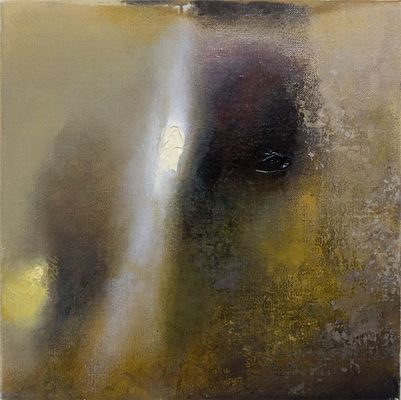
To return to Buckley’s fragment, the first two lines very much evoke how I paint nowadays. As you age, detail diminishes and patches of light become more luminous and float. I feel the most honest way of dealing with this is by smearing the oil paint on the canvas with the fingers and working close-up, blind. Only if the patches coalesce into an approaching image can the work gain a life.
-
Jonathan Walker was born in Melbourne, Australia and brought up on a dairy farm in Gippsland. In the 1970’s he studied painting at RMIT and won the Harold Wright Scholarship to the British Museum, London. During the 1980’s he exhibited at Pinacotheca Gallery, Richmond and had work shown at the NGV and Heidi City Art Gallery. Over the same period he designed the cover for the “Epigenesi” LP by Giancarlo Toniutti, Italy and conducted a mail exchange work with Achim Wollscheid, Germany. The work with artists through the post resulted in an article published in the bicentenary issue of Art and Australia 1988. He showed in artist run spaces such as WestSpace in the 90’s and 2000’s, and until 2012, taught painting at Victoria University, which is where we (Colleen Ahern and Lisa Radford) as organisers of the exhibition, among many others, had the privilege of being his student.
Walker’s knowledge was imparted to students through the careful selection of music, literature, and artists found in books that he himself had ordered for the library. Walker’s strategy was the generosity of sharing his vast knowledge with references specific to each student and their context.
Walker’s paintings share a similar focus and intimacy.
This exhibition presents a small selection of recent paintings alongside a publication that includes Walker’s writing. Observational and analytical, Walker’s work is a type of material notation — the time of day, colour and how it is blended, the both specific and fleeting location of a reflection on lino or the question of whether a chair leg should be included in a painting.
Please join us on Friday August 21 between 6-8pm to celebrate the opening of the exhibition.
Curated by Colleen Ahern and Lisa Radford.
B. Wurtz
Curated by Nic Tammens
March 26 - April 4, 2015
B.Wurtz works from a basement studio in his home on Manhattan’s Lower East Side.
This local fact is attested to by the plastic shopping bags and newsprint circulars that appear in his work. As formal objects, they don’t make loud claims about their origins but nonetheless transmit street addresses and places of business from the bottom of this long thin island. Like plenty of artists, Wurtz is affected by what is local and what is consumed. His work is underpinned by this ethic. It often speaks from a neighborhood or reads like the contents of a hamper:
“BLACK PLUMS $1.29 lb.”
“Food Bazaar”
“USDA Whole Pork Shoulder Picnic 99c lb.”
“RITE AID Pharmacy, with us it’s personal.”
“H. Brickman & Sons.”
“Sweet Yams 59c lb."
Most of the work in this exhibition was made while the artist was in residence at Dieu Donne, a workshop dedicated to paper craft in Midtown. Here Wurtz fabricated assemblages with paper and objects that are relatively lightweight, with the intention that they would be easily transportable to Australia. This consideration isn’t absolute in Wurtz’s work, but was prescriptive for making the current exhibition light and cheap. Packed in two boxes, these works were sent from a USPS post office on the Lower East Side and delivered to North Melbourne by Australia Post.
Wurtz appears courtesy of Metro Pictures, New York.
Thanks to Rob Halverson, Joshua Petherick, Sari de Mallory, Matt Hinkley, Helen Johnson, Fayen d'Evie, Ask Kilmartin, Lisa Radon, Ellena Savage, Yale Union, and "Elizabeth".
John Nixon
"Archive"
December 15 - January 20, 2014
The presentation of John Nixon's archive offered a rare showcase of this extensive collection of the artist's own publications, catalogues, posters, ephemera, editions and more, from the mid 1980s onwards, alongside a selection of his artworks.
Organized by John Nixon, Joshua Petherick and Matt Hinkley.
<a href=http://wfb.public-office.info/artist/john-nixon>All titles by John Nixon
"Habitat"
at Minerva, Sydney (organised by Joshua Petherick and Matt Hinkley)
November 15 - December 20, 2014
Lupo Borgonovo, Janet Burchill & Jennifer McCamley,
Lewis Fidock, HR Giger, Piero Gilardi, Veit Laurent Kurz,
Cinzia Ruggeri, Michael E. Smith, Lucie Stahl, Daniel Weil, Wols
Press Release:
“...It contained seven objects. The slender fluted bone, surely formed for flight, surely from the wing of some large bird. Three archaic circuitboards, faced with mazes of gold. A smooth white sphere of baked clay. An age-blackened fragment of lace. A fingerlength segment of what she assumed was bone from a human wrist, grayish white, inset smoothly with the silicon shaft of a small instrument that must once have ridden flush with the surface of the skin - but the thing’s face was seared and blackened.”
William Gibson, “Count Zero”, 1986
"Autumn Projects Archive"
Curated by Liza Vasiliou
March 6 - March 15, 2014
World Food Books, in conjunction with the Virgin Australia Melbourne Fashion Festival 2014, presented the Autumn Projects archive, consisting of a selection of early examples in Australian fashion with a particular interest in collecting designers and labels from the period beginning in the 1980’s, who significantly influenced the discourse of Australian Fashion.
Curated by Liza Vasiliou, the exhibition provided a unique opportunity to view pieces by designers Anthea Crawford, Barbara Vandenberg, Geoff Liddell and labels CR Australia, Covers, Jag along with early experimental collage pieces by Prue Acton and Sally Browne’s ‘Fragments’ collection, suspended throughout the functioning World Food Books shop in Melbourne.
H.B. Peace
presented by CENTRE FOR STYLE
November 14, 2013
"Hey Blinky, you say chic, I say same"
Anon 2013
H.B. Peace is a clothing collaboration between great friends Blake Barns and Hugh Egan Westland. Their pieces explore the divergences between 'character’ and ‘personality’ in garments....etc
Special Thanks to Joshua Petherick and Matt Hinkley of WFB and Gillian Mears
and a Very Special Thank you to Audrey Thomas Hayes for her shoe collaboration.
Janet Burchill & Jennifer McCamley
"Aesthetic Suicide"
May 10 - June 8, 2013
The first of our occasional exhibitions in the World Food Books office/shop space in Melbourne, "Aesthetic Suicide" presented a body of new and older works together by artists Janet Burchill & Jennifer McCamley, including videos, prints, a wall work, and publications.
During shop open hours videos played every hour, on the hour.
1979, English
Softcover, 64 pages, 28 × 36 cm
1st Edition, Out of print title / used / good
Published by
Art Official Inc. / Toronto
$75.00 - Out of stock
FILE Megazine (published 1972–1989) was a quarterly, then irregularly published art and culture magazine, written, edited and published primarily by members of General Idea (AA Bronson, Felix Partz, Jorge Zontal).
The visual design and identity of FILE Megazine was a deliberate appropriation of LIFE Magazine. FILE's initial logo was the white block letters on red rectangle of the LIFE logo, with the letters re-arranged. This corresponded with the group's desire that the magazine be a “parasite within the world of magazine distribution”. The familiarity of the format would entice a broad range of unsuspecting readers outside the art- or mail-art worlds (including LIFE readers) to pick it up from newsstands. Initially the magazine served a dual purpose. It was a record and site of activity for the international mail/correspondence-art movement - the first mail-art project in magazine format. It was also the mouthpiece of General Idea, with editorials for each issue written by the group, elaborating on the group's core conceptual principles. The writing style of these editorials is noteworthy for its heavily ironic use of language, a parody of advertising copy, laced with double-entendres. Over the years the focus of FILE Megazine broadened to include the wider arts, culture and entertainment world, as General Idea's founders moved increasingly among the New York downtown circles of the 70s and 80s.
This "TRANSGRESSIONS" issue (edited by General Idea and Rodney Werden) includes Kathy Acker, Guy Hocquenghem, David Byrne, Jean Genet, Pier Paolo Pasolini, Colin Campbell, Francesco Clemente, The Clichettes, Robert Mapplethorpe, Martha and the Muffins, and others. Features the famous Nazi Milk Glass cover by General Idea.
General Idea was a collective of three Canadian artists, Felix Partz, Jorge Zontal and AA Bronson, who were active from 1967 to 1994. As pioneers of early conceptual and media-based art, their collaboration became a model for artist-initiated activities and continues to be a prominent influence on subsequent generations of artists. General Idea's work inhabited and subverted forms of popular and media culture, including boutiques, television talk shows, trade fair pavilions, mass media, beauty pageants and publishing (they published the highly acclaimed FILE magazine). From 1987 through 1994 their work addressed the AIDS crisis, creating numerous public works and making some of their most iconic works of art. After publishing FILE Megazine for two years and amassing a large collection of artists books and multiples, General Idea founded Art Metropole in 1974, a non-profit space dedicated to contemporary art in multiple format: artists books, multiples, video, audio and electronic media. Both Partz and Zontal died of AIDS in 1994. Bronson continues to work and exhibit as an independent artist, and was the director of Printed Matter, Inc in New York between 2006 and 2011. The General Idea Archive now resides at the Library of the National Gallery of Canada.
Note: this issue has a few photographs of male and female genitals hand censored (with black marker) in a feature by Jim Dawson. Quite likely by the international distributor or Japanese vendor who originally sold this title. A common practice in Japan for imported publications at the time.
Good copy throughout, general wear for age/size.
2018, English
Paperback, 120 pages, 13 x 20 cm
Published by
Badlands Unlimited / New York
$35.00 - Out of stock
Preface by Kate Horsfield. Introduction by Lynne Tillman. Interview by Lyn Blumenthal.
In 1984, the art critic, theorist and gay activist Craig Owens (1950–90) gave a wide-ranging interview with Lyn Blumenthal and Kate Horsfield for their extraordinary video series On Art and Artists. At once personal, political and forward-thinking, Owens recounts his experiences with Rosalind Krauss and the founding of the journal October, the "Pictures Generation" artists and critics, and his evolving understanding of the art market, and how it impacts the thinking around art itself.
Along the way, he talks about his journey from a small town in Western Pennsylvania to the Off-Broadway theater world of New York in the '70s, and offers insights into his struggles grappling with the aesthetic and political contradictions haunting contemporary art then—as much as now. The interview, newly edited and updated, is published here for the first time and tells the intimate story of one of the most compelling minds in art theory and criticism. Novelist Lynne Tillman provides an introduction.
2017, English
Softcover, 296 pages, 22.9 x 22 cm
Published by
Semiotext(e) / Los Angeles
The MIT Press / Massachusetts
$39.00 - Out of stock
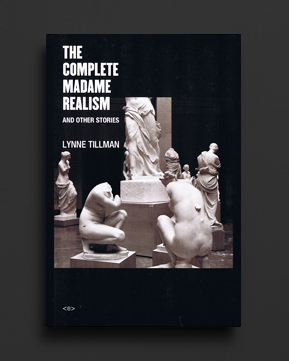
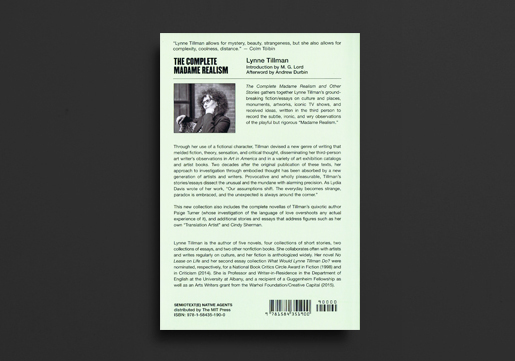
The Complete Madame Realism and Other Stories gathers together Lynne Tillman’s groundbreaking fiction/essays on culture and places, monuments, artworks, iconic TV shows, and received ideas, written in the third person to record the subtle, ironic, and wry observations of the playful but stern “Madame Realism.”
Through her use of a fictional character, Tillman devised a new genre of writing that melded fiction and theory, sensation, and critical thought, disseminating her third-person art writer’s observations in such magazines as Art in America and in a variety of art exhibition catalogs and artist books. Two decades after the original publication of these texts, her approach to investigation through embodied thought has been wholly absorbed by a new generation of artists and writers. Provocative and wholly pleasurable, Tillman’s stories/essays dissect the mundane with alarming precision. As Lydia Davis wrote of her work, “Our assumptions shift. The every day becomes strange, paradox is embraced, and the unexpected is always around the corner.”
This new collection also includes the complete stories of Tillman’s other persona, the quixotic author Paige Turner (whose investigation of the language of love overshoots any actual experience of it), and additional stories and essays that address figures such as the “Translation Artist” and Cindy Sherman.
About the Author
Lynne Tillman is the author of five novels, four collections of short stories, two collection of essays and two other nonfiction books. She collaborates often with artists and writes regularly on culture, and her fiction is anthologized widely. Her novel No Lease on Life and her second essay collection What Would Lynne Tillman Do? were nominated, respectively, for a National Book Critics Circle Award in Fiction (1998) and in Criticism (2014). She is Professor and Writer-in-Residence in the Department of English at the University at Albany, a recipient of a Guggenheim Fellowship as well as an Arts Writers grant from the Warhol Foundation/Creative Capital (2015).
1985, English
Softcover, 96 pages, 30 x 21 cm
1st Edition, Out of print title / used / very good
Published by
Art Gallery of New South Wales / Sydney
$100.00 - Out of stock
Very scarce catalogue and unique valuable resource published to accompany the exhibition "Working Art: A Survey of Art in The Australian Labour Movement in The 1980's", curated by Australian conceptual artist, curator and writer Ian Burn for the Art Gallery of New South Wales in 1985. Designed by Michael Davies of the Art Workers Union (AWU), this heavily illustrated (in colour and black and white) catalogue surveys the Banners, Posters, Graphics, Photographs, and Media of the Australian Labour movement during the 1980's, as well as a detailed "Historical Sketch" written and compiled by Ian Burn and Sandy Kirby that illustrates the rich history of the Arts in Australian unionism and communities. Alongside the many exhibited prints and textiles, there is photo documentation throughout of marches, performances, artist's at work, historical exhibitions, plus reproductions of newsletters, newspapers, cartoons, announcements, along with further accompanying introductory texts and a bibliography.
Includes inserted Trade Union Information Kit "Art and Working Life : The Victorian Trades Hall Council Arts Workshop" booklet that takes an illustrated look at the activities of the VTHC Workshop in the 1980s. A perfect accompaniment to this catalogue. Also, errata slip enclosed from the NSW catalogue.
Ian Burn (1939-1993) was an Australian conceptual artist, curator and writer who spent the first part of his career working in London and New York. It was here that he began working with Art & Language, a collaborative group who produced the publication Art-Language and whose members included artists Roger Cutforth, Joseph Kosuth and Mel Ramsden. Returning to Australia in 1977 Burn became involved in the Art Workers Union (AWU), a political and social platform that championed artists’ rights and helped change the landscape and expectations under which artists worked in Australia. From 1980 onwards, together with artist and social activist Ian Millis, he worked on a number of initiatives to further the cause of the labour movement, including Union Media Services and the Art and Working Life program. Burn died by accidental drowning in 1993.
A great copy of an important resource on Australia's cultural, industrial and political history, and also an important publication by Ian Burn.
Light general reading/handling creasing to oblong pages, otherwise tight and clean throughout. Previous owner's name penned to title page.
2017, English
Softcover, 312 pages, 21 x 15.5 cm
Published by
Mousse / Milan
LOOP / Barcelona
$58.00 - Out of stock
Edited by Eugeni Bonet
With texts by Stephen Beck, AA Bronson, Peter Campus, Peter d’Agostino, Douglas Davis, Jon Dovey, Juan Downey, Jean-Paul Fargier, Hermine Freed, Frank Gillette, David Hall, Takahiko Iimura, Les Levine, Mary Lucier, Muntadas, Nam June Paik, Ulrike Rosenbach, Martha Rosler, Paul Ryan, Francesc Torres, Woody Vasulka & Scott Nygren, Bill Viola, and Peter Weibel
Writings by artists have always played a crucial role in art theory. For the practitioners, they are a way to illustrate and explain their own ideas around their trajectory and working methods, identify trends they feel close to, articulate a broader reflection on a given medium, and perhaps challenge preconceived ideas. Just as film theory has incorporated essays, manifestos, and other written thoughts by filmmakers into a body of work that also includes the voices of critics studying the “new cinematic object,” this publication gathers together a number of artists’ writings—which were previously scattered in different publications—in order to revisit and reevaluate the early days of video art (up to 1990, a not entirely arbitrary time span). It adds a critical layer to LOOP Barcelona’s 15th edition, Winding the Clock Back: A Contemporary Archaeology of Video.
This title is now out of print.
2017, English
Softcover, 104 pages, 22 x 29 cm
Published by
Mousse / Milan
Sculpture Centre / New York
Kölnischer Kunstverein / Köln
$57.00 - Out of stock
This publication accompanies two distinct exhibitions presenting the work of American artist Sam Anderson. The first opened in May 2017 at SculptureCenter in New York City and the second opened later in July at the Kölnischer Kunstverein in Cologne. This catalogue is a co-production between both museums on the occasion of these two exhibitions, and it brings together a selection of images and texts related to both shows. The overlapping exhibitions were the first solo museum presentations of Anderson’s work and each highlighted different aspects of her practice. Her exhibition at SculptureCenter comprised new commissions while her exhibition at Kölnischer Kunstverein brought together existing works spanning several years. Working on the two shows simultaneously allowed for Anderson to consider her practice through new and existing objects and installations, while articulating particular narratives and connections between her works. This book presents a wide range of objects and concerns running throughout the two exhibitions.
Edited by Ruba Katrib and Moritz Wesseler
Texts by Ruba Katrib and Moritz Wesseler
Conversation between Sam Anderson and Lia Gangitano
2017, English
Softcover, 152 pages, 16 x 24 cm
Published by
Mousse / Milan
$54.00 - Out of stock
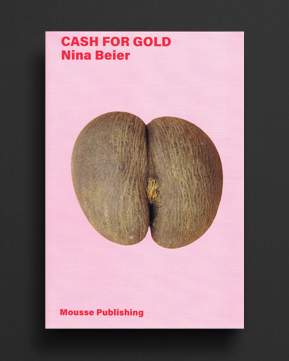
Cash for Gold is the most comprehensive monograph on the work of Nina Beier, copublished with the Kunstverein in Hamburg, in conjunction with Kunsthaus Glarus. Nina Beier’s art presents a particular challenge to critics, Alexander Scrimgeour outlines in the introduction to this catalogue— indeed, an anthology of eight different essays: a textual bounty that proved necessary. The conventional functions of the art writer: interpretation, judgement, critique, contextualisation, etc., stand in an uneasy relationship, not to say opposition, to the explorations of openness, assignations of value, and unspoken cultural codes in her work. The development of this catalogue, and the fact that it does not coalesce into a single, authoritative voice, can perhaps best be seen as a reflection of the work itself, and what makes or lets it carry meaning for different people in different ways. For all the specificity of its materials and forms, it draws its energy from the emotional valence of culturally embedded desires, pressures, norms and glitches within what Rosalind Krauss called, after Fredric Jameson, “the total saturation of cultural space by the image.” The sprawl and partiality of this catalogue is itself a mirror of a crisis of representation that is itself the ground occupied by the images, confused objects, and art-historical references in Beier’s work to date.
Bettina Steinbrügge, Alexander Scrimgeour, eds.
Texts by Karen Archey, Laura McLean-Ferris, John Miller, Post Brothers, Dieter Roelstraete, Chris Sharp, Bettina Steinbrügge, Alexander Scrimgeour, Ana Texeira Pinto
2017, English / German
Softcover, 232 pages, 22 x 14 cm
Published by
KW Institute for Contemporary Art / Berlin
Koenig Books / London
$32.00 - In stock -
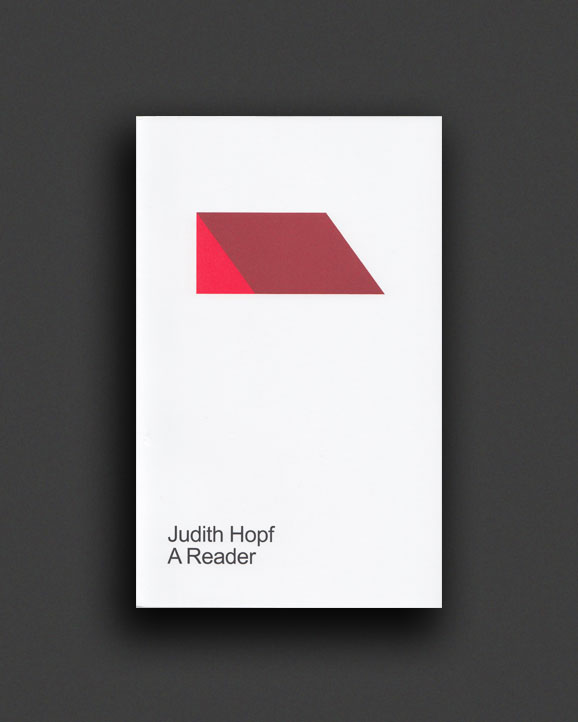
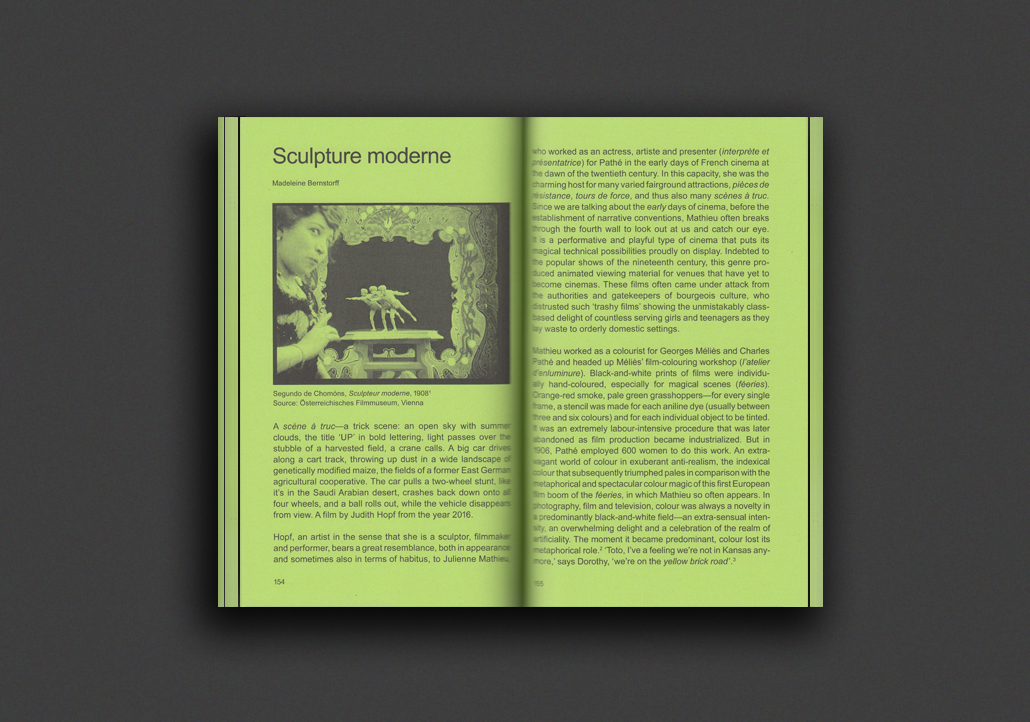
I think it can only be because of memory-of-knowing-how that we made it through the grey days in cities in general–and through the greyness of Berlin in particular–that we made it through again and again. Because the streets switched directions too, rushing towards us a whole lot faster. Bicycles became utterly useless. Just looking at them knocked the air out of their tyres. What's more, ticket prices increased and coins no longer fit in the slots of vending machines. [Judith Hopf, Stepping Stairs]
With texts by Kathy Acker, Madeleine Bernstorff, Sabeth Buchmann, Maurin Dietrich, Anna Gritz, John Hejduk, Judith Hopf, Monika Rinck, Avital Ronell, Annette Wehrmann
2017, German, English
Softcover (in printed slipcase), 140 pages, 21 x 27.9 cm
Published by
Mousse Publishing / Milan
$58.00 - Out of stock
"Up" presents a significant sampling of German artist Judith Hopf's work in video, sculpture and installation. Hopf -- with both humour and pensive seriousness -- has consistently addressed the paradoxes of high-minded attitudes toward art-making and the faith in technology, professionalism and efficiency.
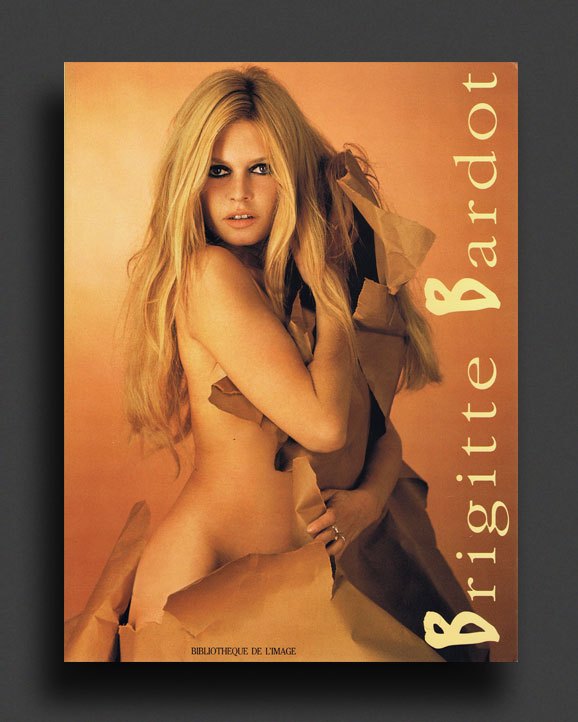
1994, French
Softcover (French folds), 96 pages, 24 x 32 cm
1st Edition, Out of print title / used / fine
Published by
Bibliotheque de L'Image / Paris
$60.00 - Out of stock
First edition of this oversized photo-book dedicated to French actress, singer, dancer, fashion model, and animal rights activist, Brigitte Bardot. Spanning her entire career, this book features the colour and black and white photography of Don Honeyman, Kicia, Tabard, Philippe Halsman, Sam Levin, Studio Harcourt, E. Quinn, Willy Rizzo, De Sazo, Peter Basch, Roger Corbeau, Gihslain Dussart, Jim Gray, Sueva Gray, Sueva Vigeveno, Jean Claude Sauer, alongside film stills and commentary and text extracts (in French) by Marcel Achard, Roland Barthes, Simone De Beauvoir, Jean Cocteau, Nina Companez, Cournot, Marguerite Duras, Raymond Durgnat, Serge Gainsbourg, Sam Levin, Claude Mauriac, Frédéric Mitterand, Otto Preminger, Olga Hortig Primuz, Françoise Sagan, François Truffaut, and more.
Brigitte Bardot was an aspiring ballerina in her early life. She started her acting career in 1952. She achieved international recognition in 1957 after starring in the controversial film And God Created Woman. Bardot caught the attention of French intellectuals. She was the subject of Simone de Beauvoir's 1959 essay, The Lolita Syndrome, which described Bardot as a "locomotive of women's history" and built upon existentialist themes to declare her the first and most liberated woman of post-war France. She later starred in Jean-Luc Godard's 1963 film Le Mépris. For her role in Louis Malle's 1965 film Viva Maria! Bardot was nominated for a BAFTA Award for Best Foreign Actress. Bardot retired from the entertainment industry in 1973 to dedicate herself to animal rights activism. During her career in show business, she starred in 47 films, performed in several musical shows and recorded over 60 songs. She was awarded the Legion of Honour in 1985 but refused to accept it.
Fine, almost As New copy.
2007, English
Softcover, 224 pages, 20 x 13 cm
Published by
Manchester University Press / Manchester
$36.00 - Out of stock
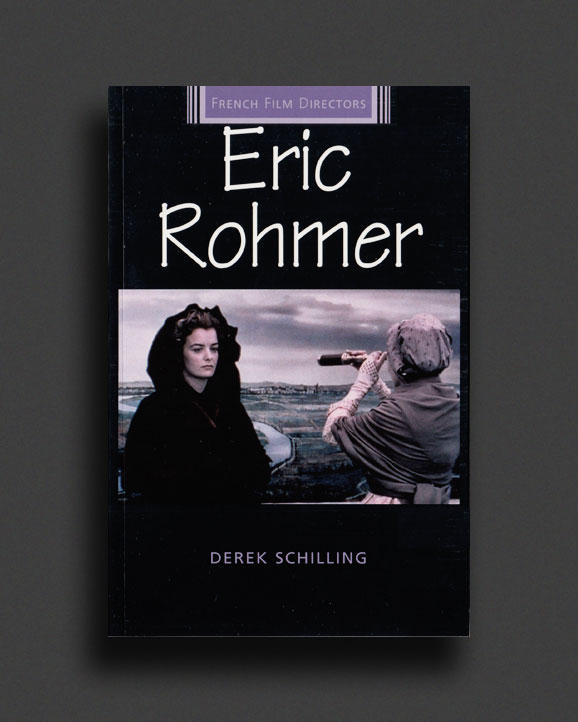
By Derek Schilling
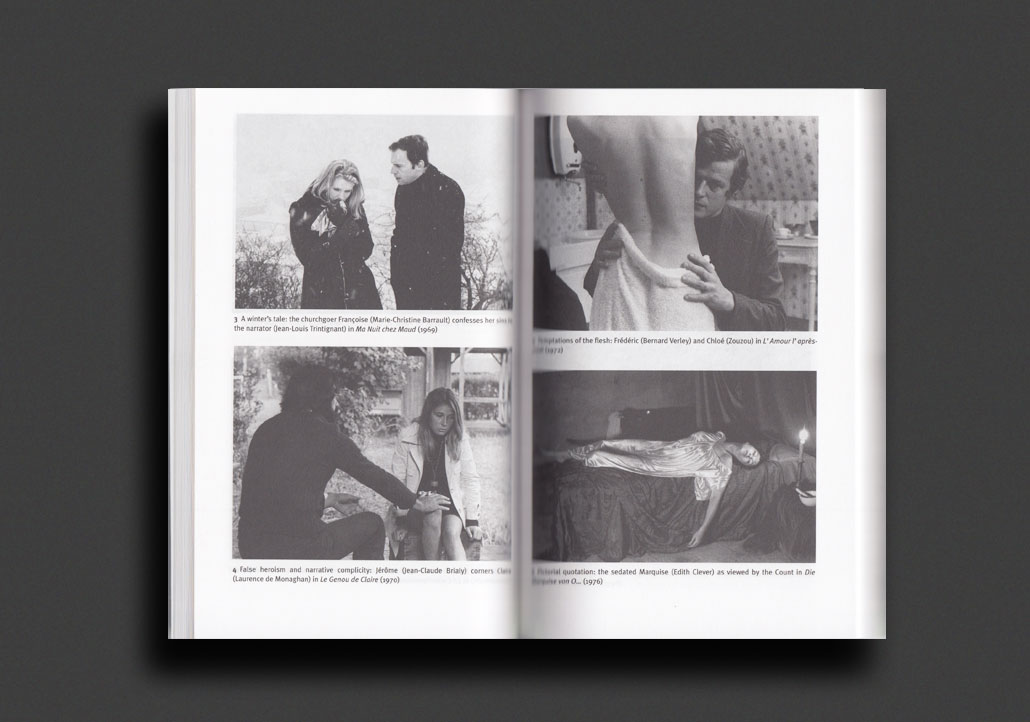
Few filmmakers have taken the principle of the 'talking picture' so far as Eric Rohmer, the internationally reknowned director of the Moral Tales, Comedies and Proverbs, and Tales of the Four Seasons cycles. Occasionally dismissed as precious or overly literary, Rohmer's features may leave the impression that there is more to listen to than to look at. Yet as the secretive director (b. Maurice Schérer in 1920) points out, dialogue is no less engaging than the best gunfights, and if his characters prefer discussing love to making it, they are no less the 'heroes' of the stories they tell.
Charges of political conservatism aside, the author of My Night at Maud's, Summer and such period films as Perceval and the all-digital The Lady and the Duke emerges - like Hitchcock before him - as a singular inventor of cinematic forms. This critical overview, which contains an extensive bibliography and a filmography, will appeal to students of Film Studies, French Studies, and enthusiasts.
From Manchester University Press' French Film Directors series, edited by Diana Holmes and Robert Ingram.
1970, German
Hardcover (w. dust jacket), 194 pages (inc. fold-outs and wax pages), 24 x 25 cm
1st Edition, Out of print title / used / very good
Published by
Praesentverlag / Gütersloh
$85.00 - Out of stock
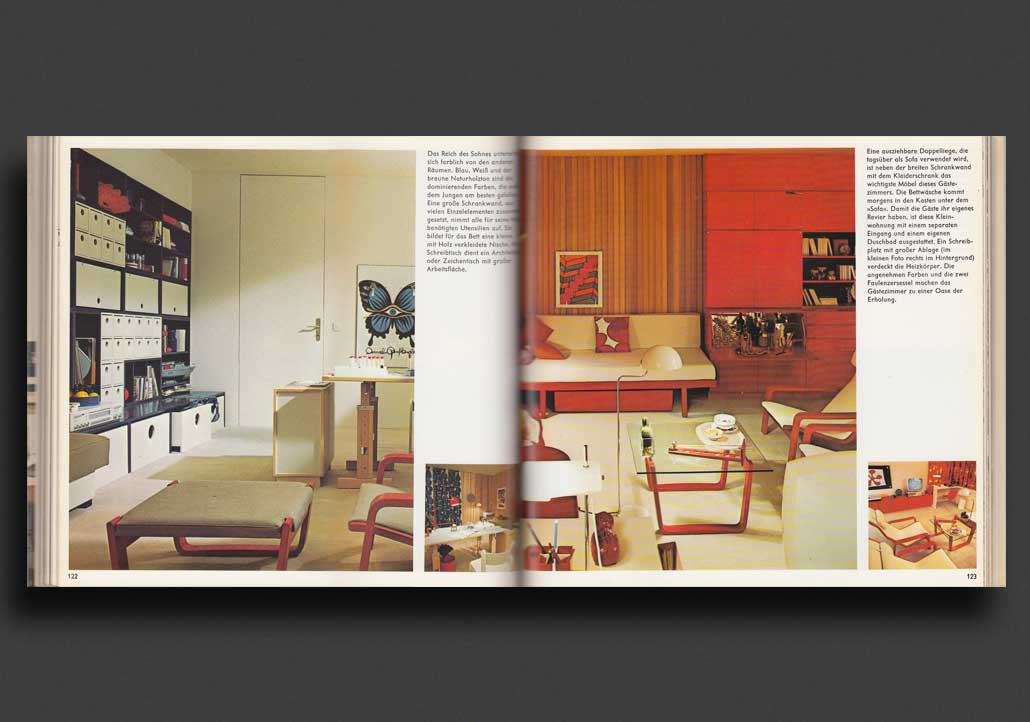
"Designed Living"
This unique interior design book / directory, published in 1970 by Asko Finnlandmöbel, prepared examples for a series of house settings (such as various apartment types, penthouses, bungalows, villas, etc.), each space co-ordinated entirely through furniture, light, textiles and craft objects as total domestic environments to showcase the products carried by Asko Finnlandmöbel, including their incredible catalogue of leading Finnish modern furniture/objects by Eero Aarnio, Ilmari Lappalainen, Olli Borg, Tapio Wirkkala, etc. alongside textiles by Marimekko, lighting by Artemide and others. Each environment is heavily documented across lavish saturated photographic spreads, profiles, texts by Hans Otto von Hirschfeld, fold-outs and floor plans printed on tracing stock.
A stunning book. First edition, Very Good hardcover w. original dust jacket protected under plastic wrap. Great copy.
The Finnish design company Asko was founded in 1918 by the cabinetmaker Aukusti Avonius, quickly growing into one of the largest Finnish furniture and home appliance manufacturers and has also been very successful in exporting Finnish designs worldwide. In the post-war years, Asko was responsible for making some of the most famous Finnish designs of the Modern era. After the Second World War, Asko secured his place in design history by hiring Olli Borg as chief designer and winning other leading Finnish design talents for collaborations. Ilmari Tapiovaara designed the Asko Fanett chair (1955), the Crinolette chair (1958) and the Aslak chair (1958). In 1958, Tapio Wirkkala created Asko's beautifully laminated coffee table with a characteristic leaf motif. Ilmari Lappalainen was responsible for the Pulkka Lounge (1963) and Stefan Lindfors developed the Draco chair (1972). These and other Asko pieces have become iconic design objects sought after by collectors. However, Asko's most famous collaboration was with Finnish designer Eero Aarnio, who used his molded fiberglass (later polypropylene) chairs to push the boundaries of contemporary furniture design. These included the Ball Chair (1963), the VSOP Chair (1966), the Pastil Pod Chair (1968) and the Tomato Chair (1972).
2017, English
Softcover (spiral-bound), 196 pages, 7.6 x 12.7 cm
Published by
Karma / New York
$48.00 - In stock -
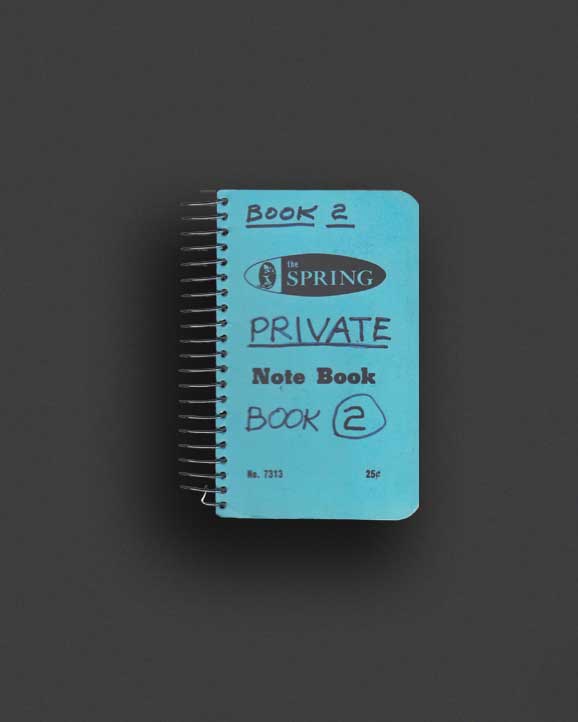
A prolific writer and documenter of both her art and her relationships, the public and private, Lee Lozano (1930-99) kept a series of personal journals from 1968 to 1972 while living in New York's SoHo neighbourhood. Eleven of these private books survive. Private Book 2 is the second in a series of 11 pocket-sized books, which are printed as facsimiles with spiral binding.The notebooks contain notes on her work, detailed interactions with artist friends and commentary on the alienations of gender politics, as well as philosophical queries into art's role in society and humourous asides from daily life. In the decade before her infamous "dropout piece" -- culminating in a move to Dallas where she would remain until her death -- Lozano returned to these notebooks, editing the entries, sometimes blacking out entire pages. Private Book 2 is the second in a series of 11 pocket-sized books, which are printed as facsimiles with spiral binding.
2009, English
Hardcover, 512 pages (60 b&w ills), 178 x 229 mm
Published by
The MIT Press / Massachusetts
$105.00 $80.00 - Out of stock
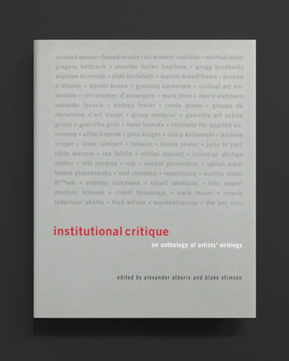
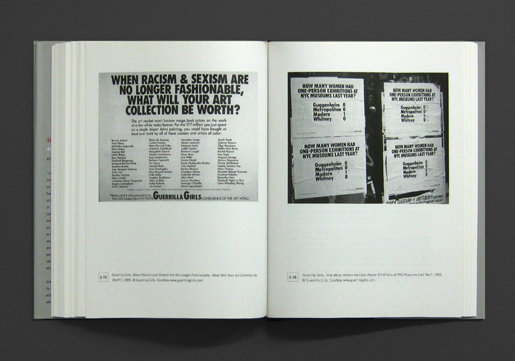
"Institutional critique" is an artistic practice that reflects critically on its own housing in galleries and museums and on the concept and social function of art itself. Such concerns have always been a part of modern art but took on new urgency at the end of the 1960s, when--driven by the social upheaval of the time and enabled by the tools and techniques of conceptual art--institutional critique emerged as a genre. This anthology traces the development of institutional critique as an artistic concern from the 1960s to the present by gathering writings and representative art projects of artists from across Europe and throughout the Americas who developed and extended the genre. The texts and artworks included are notable for the range of perspectives and positions they reflect and for their influence in pushing the boundaries of what is meant by institutional critique. Like Alberro and Stimson's Conceptual Art: A Critical Anthology this volume will shed new light on its subject through its critical and historical framing. Even readers already familiar with institutional critique will come away from this book with a greater and often redirected understanding of its significance.Artists represented include Wieslaw Borowski, Daniel Buren, Marcel Broodthaers, Groupe de Recherche d'Art Visuel, Hans Haacke, Robert Smithson, John Knight, Graciela Carnevale, Osvaldo Mateo Boglione, Guerilla Art Action Group, Art Workers' Coalition, Mierle Laderman Ukeles, Michael Asher, Mel Ramsden, Adrian Piper, The Guerrilla Girls, Laibach, Silvia Kolbowski, Andrea Fraser, Fred Wilson, Mark Dion, Maria Eichhorn, Critical Art Ensemble, Bureau d'Etudes, WochenKlausur, The Yes Men, Hito Steyerl, Andreas Siekmann.
2018, English / German
Softcover, 240 pages, 23 x 16.5 cm
Published by
Texte Zur Kunst / Berlin
$32.00 - Out of stock
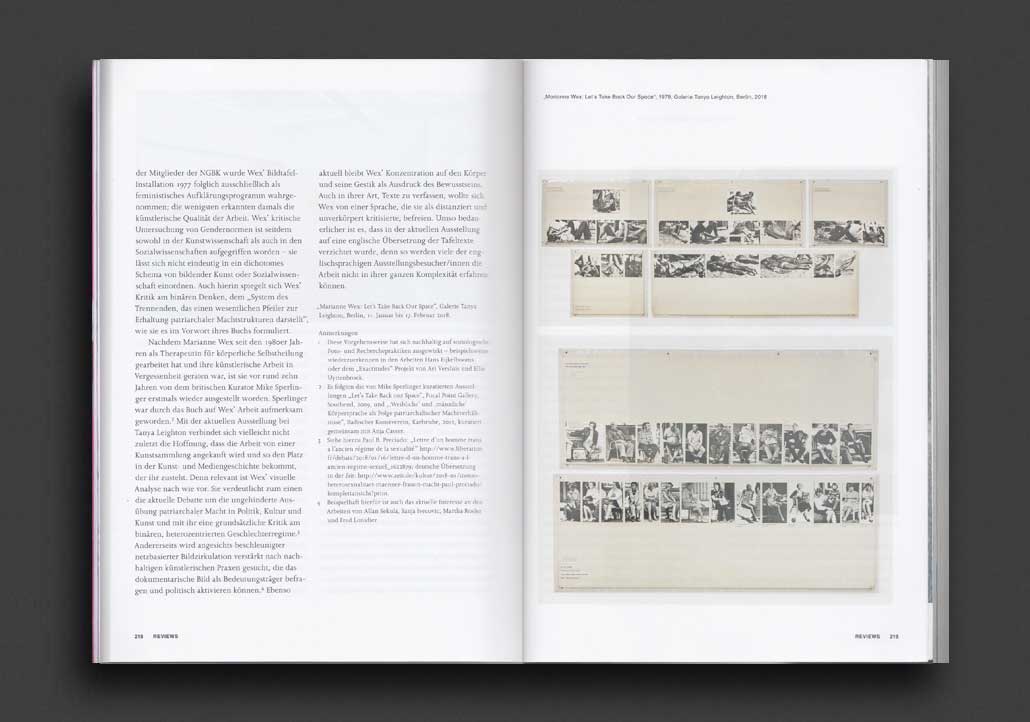
The March issue of Texte zur Kunst considers art’s relation to rules — or rather, the exceptions to them that art and its agents seem to claim. How can we speak of rules in the context of art, where transgressions are lauded even while traditional hierarchies (class, gender, race, sexuality) continue to assert their influence? And would we demand anything less of art than the promise of disobedience, rule breaking both in terms of formal restrictions and normative regulations? Therefore, in this issue we ask: by what rules does the art world play, and how are transgressions made visible/invisible therein?
ISSUE NO. 109 / MARCH 2018 "ART WITHOUT RULES?“
Table Of Contents
1946, English
Softcover, 140 pages, 18 x 11 cm
1st Edition, Out of print title / used / good
Published by
Penguin Books / London
$18.00 - Out of stock
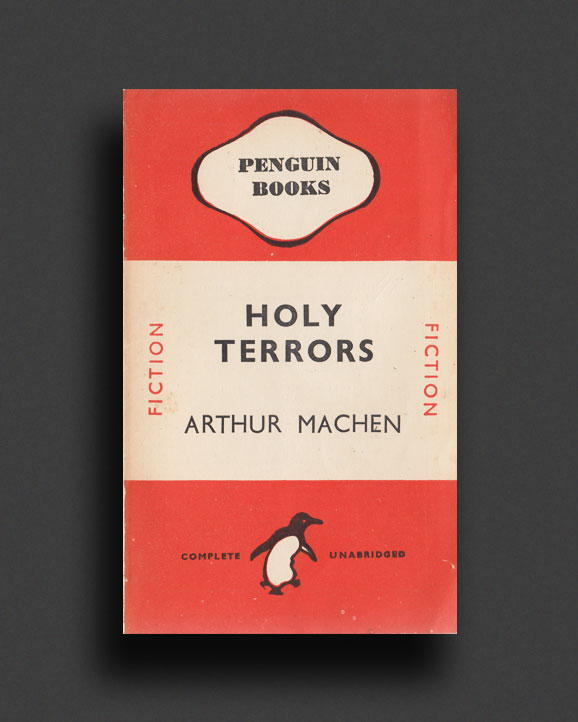
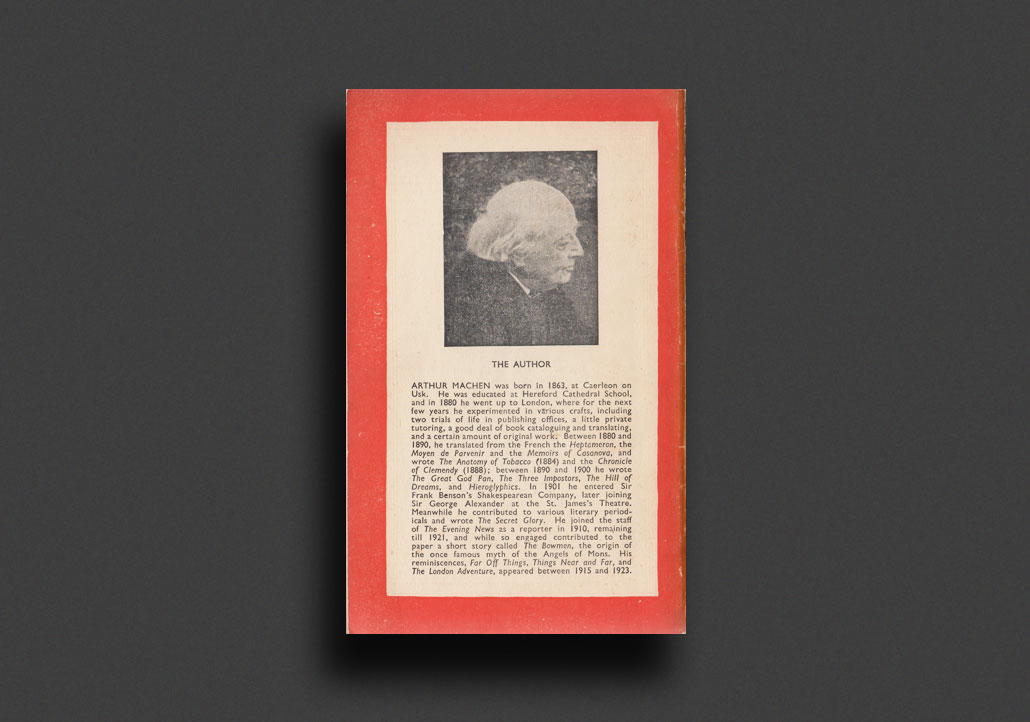
The "Holy Terrors" short stories collection of fiction by the great Arthur Machen, published by Penguin, London, in 1946. Arthur Machen is perhaps best known for his shorter supernatural and horror fiction. He first achieved notoriety in the Decadent 1890s with his story 'The Great God Pan', and 'The Bowmen' was the origin of the 'Angels of Mons' myth during the First World War. "Holy Terrors" is a classic paperback collection of Arthur Machen's short stories containing: The Bright Boy, The Tree of life, Opening The Door, The Marriage of Panurge, The Holy Things, Psychology, The Turians, The Rose Garden, The Ceremony, The Soldiers' Rest, The Happy Children, The Cosy Room, Munitions of War, The Great Return.
Arthur Machen (1863 – 1947) was a Welsh author and mystic of the 1890s and early 20th century. He is best known for his influential supernatural, fantasy, and horror fiction. His novella The Great God Pan (1890; 1894) has garnered a reputation as a classic of horror, with Stephen King describing it as "Maybe the best [horror story] in the English language."
Good copy, general light wear.
1969, Italian
Hardcover (w. dust jacket), 96 pages, 31 x 24.5 cm
1st Edition, Out of print title / used / very good
Published by
Sadea Sansoni / Florence
$55.00 - Out of stock
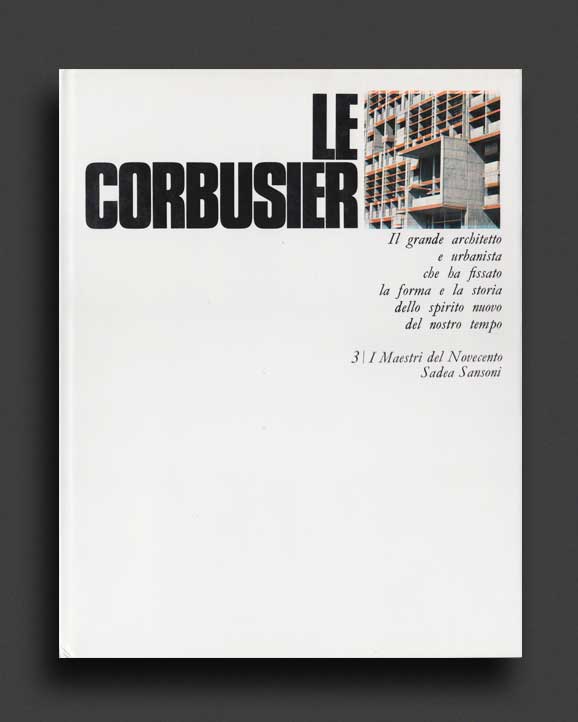
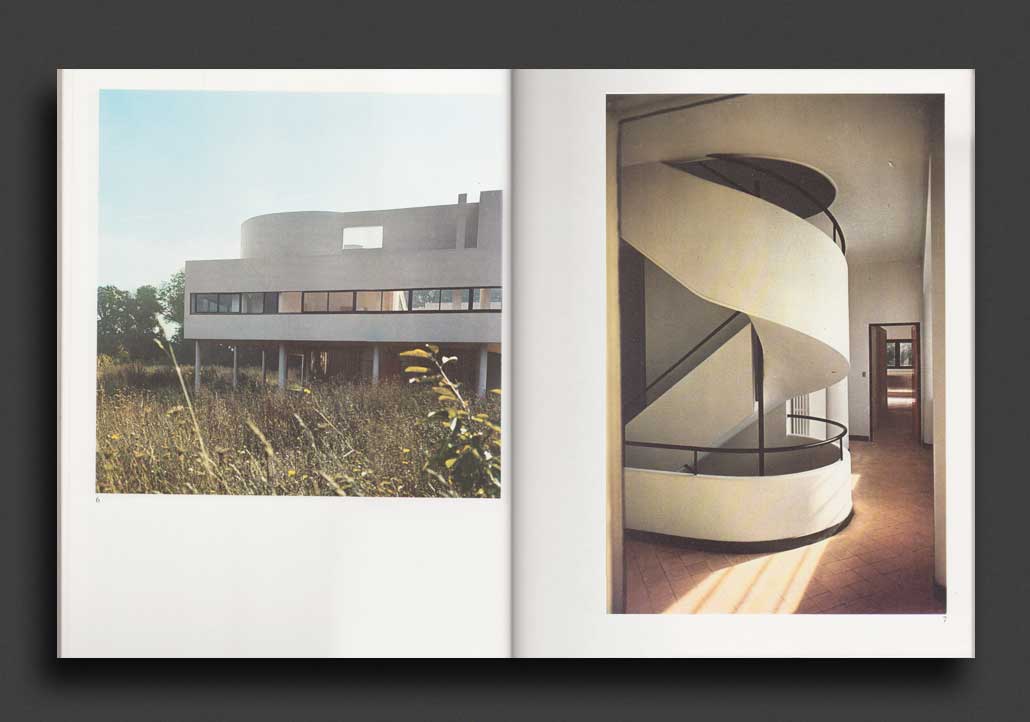
First edition of this handsome over-sized hardcover monograph on Le Corbusier, published by Sadea Sansoni, Florence, in 1969. Profusely illustrated in colour with large reproductions of Le Corbusier's major architectural projects, alongside a historical text by author Carlo Cresti with many reference illustrations and Le Corbusier's drawings and architectural plans throughout the essay in black and white.
Very Good-Near Fine copy in original dust jacket. Well preserved first edition.
2018, English
Hardcover, 176 pages, 31 x 24 cm
Published by
Raven Row / London
Walther König / Köln
$68.00 - Out of stock
This is the first monograph on K. P. Brehmer to appear in English and the first major publication on the artist since the Museum Friedericianum Kassel catalogue in 1998.
Part of Capitalist Realism – the initiative centred around Galerie René Block in Berlin in the mid to late 1960s, that included fellow artists Sigmar Polke and Gerhard Richter – KP Brehmer is increasingly recognised as a key figure in postwar German art in his own right.
Richly illustrated with previously unpublished archival images as well as more recent exhibition photographs, the texts by leading specialists (Jürgen Becker, René Block, KP Brehmer, Mark Fisher, Doreen Mende, Alex Sainsbury, Kerstin Stakemeier) focus on his practice during the 1960s and 1970s when he was developing his unique graphic representations of capital which anticipate todayʼs ubquitious data visualisation systems.
2018, English
Softcover, 240 pages, 22.5 x 28.5 cm
Published by
Walther König / Köln
$45.00 - Out of stock
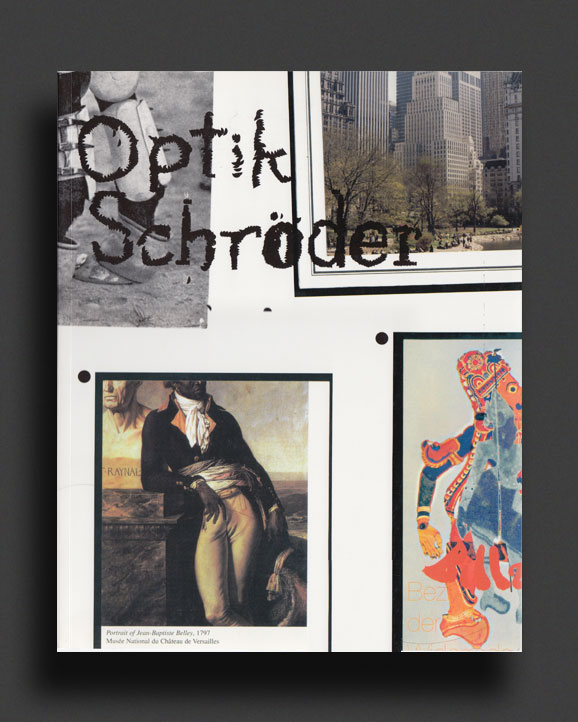
Curated by Karola Kraus, the exhibition Optik Schröder II presents a representative selection from the collection of Alexander Schröder to date. This includes important works by Kai Althoff, Tom Burr, Bernadette Corporation, Claire Fontaine, Gelitin, Isa Genzken, Anne Imhof, Sergej Jensen, Pierre Klossowski, Manfred Pernice, Martha Rosler, and Reena Spaulings, and is one of the most important German private collections of contemporary art.
These works illustrate some of the key conceptual trends and positions in the development of Western art in the past three decades, including references to social issues, queer lifestyles, the critique of institutions and the economy, critical investigation of public spaces and architecture, poetry, and contemporary forms of critical painting. The prominently represented artists’ collectives exemplify endeavors to challenge and transform the traditional roles and systems of the artist, of art production, and of the sale of art.
This comprehensive overview shows a collection built up consistently since the mid-1990s and based on close proximity to the artists and sensitivity for new developments. The collection illustrates an exemplary philosophy of collecting focusing on the nature of the contemporary, on curiosity, expertise, humor, independence, and outstanding aesthetic judgement.
Participating Artists:
Kai Althoff, Lutz Bacher, Cosima von Bonin, KP Brehmer, Tom Burr, Merlin Carpenter, Marc Camille Chaimowicz, Anne Collier, Bernadette Corporation, Lukas Duwenhögger, Jana Euler, Cerith Wyn Evans, Claire Fontaine, Gelitin, Isa Genzken, Ull Hohn, Karl Holmqvist, Alex Hubbard, Peter Hujar, Anne Imhof, Sergej Jensen, Martin Kippenberger, Pierre Klossowski, John Knight, Michael Krebber, Mark Leckey, Klara Lidén, Lucy McKenzie, Christian Philipp Müller, Henrik Olesen, Paulina Olowska, Dietrich Orth, Manfred Pernice, Josephine Pryde, Martha Rosler, Cameron Rowland, Andreas Slominski, Reena Spaulings, Katja Strunz, Philippe Thomas, Danh Vo, Peter Wächtler
Designed by Studio Manuel Raeder.
2006, English / German
Softcover, 240 pages, 220 x 270 mm
Published by
Walther König / Köln
$75.00 - Out of stock
Catalogue from Optik Schröder, Werke aus der Sammlung Schröder, 2006 exhibition at Kunstverein Braunschweig.
Now out-of-print, this comprehensive book surveys the private art collection of gallerist Alexander Schröder, built up since the mid-1990s and featuring important artworks by Andreas Hofer, Andreas Slominski, Cerith Wyn Evans, Christian Flamm, Christian Philipp Müller, Clegg & Guttmann,Cosima von Bonin, Diedrich Orth, Guillaume Bijl, Henrik Olesen, Isa Genzken, Jan Timme, Jochen Klein, Josephine Pryde, Kai Althoff, Katharina Wulff, Katja Strunz, Keith Farquhar, Lucy McKenzie, Lukas Duwenhögger, Manfred Pernice, Mark Handforth, Martha Rosler, Michael Krebber, Paulina Olowska, Reena Spauling, Sergej jensen, Sharon Lockhart, Stephan Dillemuth, Thilo Heinzmann, Tom Burr, Torsten Slama, Ull Hohn, Marc Camille Chaimowicz, Enrico David, Mark Leckey ...
Profusely illustrated throughout with texts by Dominic Eichler, Isabelle Graw, and Karola Grasslin.
Designed by Manuel Raeder.
2017, English
Hardcover, 304 pages, 24.5 x 30.5 cm
Published by
Hatje Cantz / Berlin
Foundation Beyeler / Basel
$130.00 - Out of stock
In his creative artistic work, Wolfgang Tillmans revolutionised the medium of photography and opened it up towards other media. This catalogue is published on the occasion of an extensive exhibition of Tillmans's oeuvre at the Fondation Beyeler in Basel and arranges and groups his works in a fresh way.Beginning in the early nineties, Tillmans documented the people and situations in his immediate surroundings in scenes from London, New York, or Berlin, creating the portrait of a new generation in a style-defining manner. Since the late nineties he has been creating a greater number of cameraless, abstract images that develop from his direct work with and on photographic paper, some of which acquire a sculptural, object-like character. He has also been developing innovative, anti-hierarchical installations of his photographs in space in exhibition contexts.
2015, English / German
Softcover, 382 pages, 29.2 x 26.7 cm
Published by
Hatje Cantz / Berlin
$90.00 - Out of stock
The enormous paperback version of Wolfgang Tillmans' "Abstract Pictures".
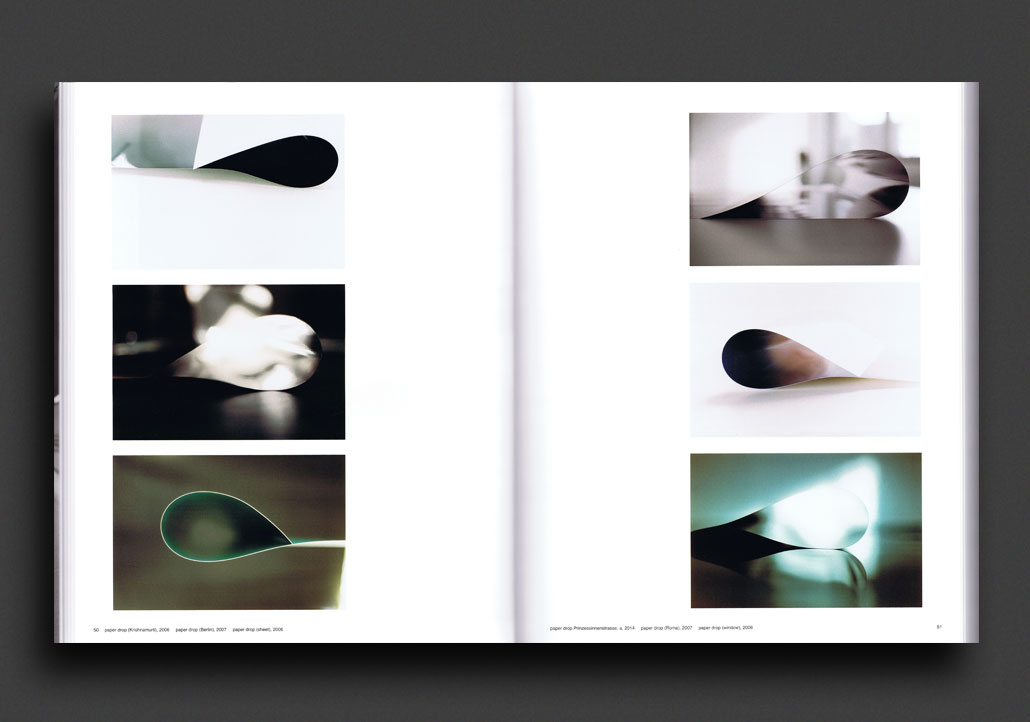
From the start, Wolfgang Tillmans's abstract photographs played a decisive role in his gentle subversion of photographic hierarchies and his seductive emphasis on the materiality of photographic objects in his presentation of them. In the past decade he has pursued this tack, making wholly non-representational photographs that explore processes of exposure. From the delicate veils of color in the Blushes and Freischwimmer series, and the sculptural paper drops made of folded or rolled-up photographic paper, to the colorfully compelling works of the Lighter series, the printed object itself, divorced from its reproductive function, is always the point. “For me, the abstract picture is already objective because it's a concrete object and represents itself,” Tillmans says; “the paper on which the picture is printed is for me an object, there is no separating the picture from that which carries it. That's why I like to show photographs sometimes framed and sometimes not, just taped to the wall.”
Designed by the photographer, and with 275 color reproductions of these works, Abstract Pictures impressively demonstrates how fruitfully Tillmans has mined this terrain.
Text by Dominic Eichler
2018, English
Softcover, 308 pages, 16.5 x 22 cm
Published by
Sternberg Press / Berlin
The Academy of Fine Arts / Vienna
$40.00 - Out of stock
With contributions by Ilya Budraitskis, Maira Enesi Caixeta, C.A.S.I.T.A., Yuderkys Espinosa Miñoso, Miguel González Cabezas, Marina Gržinić, Juan Guardiola, Çetin Gürer, Neda Hosseinyar, Njideka Stephanie Iroh, Adla Isanović, Fieke Jansen, Tjaša Kancler, Zoltán Kékesi, Betül Seyma Küpeli, Gergana Mineva, Musawenkosi Ndlovu, Stanimir Panayotov, Suvendrini Perera, Jelena Petrović, Khaled Ramadan, Rubia Salgado, Marika Schmiedt, Joshua Simon, Aneta Stojnić, Shirley Anne Tate, Göksun Yazıcı, Hiroshi Yoshioka
Border Thinking: Disassembling Histories of Racialized Violence aims to question and provide answers to current border issues in Europe. Central to this investigation is a refugee crisis that is primarily a crisis of global Western capitalism and its components: modernization, nationalism, structural racism, dispossession, and social, political, and economic violence.
In this volume, these notions and conditions are connected with the concept of borders, which seems to have disappeared as a function of the global neoliberal economy but is palpably reappearing again and again through deportations, segregations, and war. How can we think about these relations in an open way, beyond borders? Is it possible to develop border thinking for a radical transformation, as a means to revolutionize the state of things? To do this, we must reconsider what is possible for the social and the political as well as for art and culture.
Publication Series of the Academy of Fine Arts Vienna, vol. 21
Design by Surface
2017, English
Hardcover (clothbound), 248 pages, 18.5 x 26.5 cm
Published by
Sternberg Press / Berlin
LUMA Foundation / Zürich
Center for Curatorial Studies Bard College / New York
$74.00 $20.00 - Out of stock
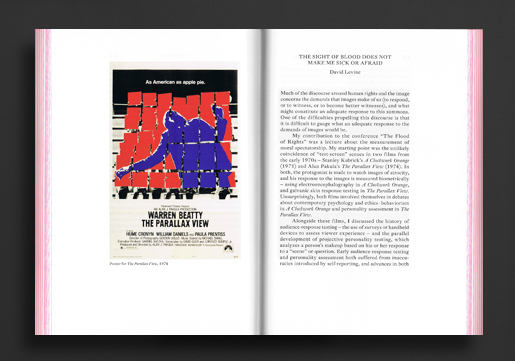
Contributions by Amanda Beech, Rony Brauman, David Campbell, Olivia Custer, Rosalyn Deutsche, Thomas Keenan, Eric Kluitenberg, David Levine, Suhail Malik, Sohrab Mohebbi, Sharon Sliwinski, Hito Steyerl, Bernard Stiegler, Tirdad Zolghadr
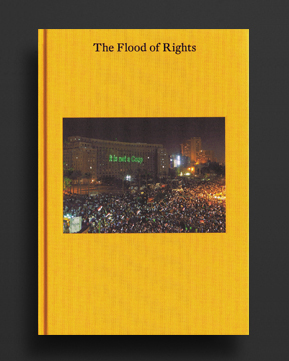
It is difficult to imagine making claims for human rights without using images. For better or worse, images of protest, evidence, and assertion are the lingua franca of struggles for justice today. And they seem to come in a flood, more and more, day and night. But through which channels does the torrent pass? The Flood of Rights examines the pathways through which these images and ideas circulate—routes that do not merely enable, but actually shape human-rights claims and their conceptual background. What are the technologies and languages that structure the global distribution of humanism and universalism, and how do they leave their mark on these ideas themselves? Which narratives and imageries have proven easier to export and import, and whose interests are at stake in the configurations in question?
The Flood of Rights draws on a conference of the same name, organized by the LUMA Foundation and Center for Curatorial Studies at Bard College, which took place in Arles, France, in 2013.
Copublished with the LUMA Foundation and the Center for Curatorial Studies at Bard College, New York
Design by Zak Group