World Food Books' programme is largely produced on Kulin Nation land. We acknowledge the Wurundjeri people of the Kulin Nation as the first and continuing custodians of this land, and pay respect to their Elders past, present, and emerging.
World Food Books is an arts and special interests bookshop in Naarm / Melbourne. Founded in 2010, World Food Books is devoted to the presentation of a rotating, hand-selection of international art, design, literary and counterculture publications with an emphasis on the anti-traditional, the experimental, the avant-garde, the heretic, the marginal.
Presenting new titles alongside rare and out-of-print books, catalogues and journals spanning the fields of modern and contemporary art, design, photography, illustration, film, literature, poetry, cultural theory, philosophy, sexuality, popular and underground culture in its many radical forms, World Food Books wishes to encourage adventurous, thoughtful and open-minded reading, looking, writing, and exchange of publishing and ideas, both current and historical.
As well as our bookshop, located in Melbourne's historical Nicholas Building, all of our inventory is available internationally via our online mail-order service.
World Food Books semi-regularly co-ordinates "Occasions", a programme of exhibits and events at the bookshop and in partnership with other hosts (such as museums and art galleries) that develop out of the activities, relationships and content of the bookshop itself.
World Food Books
The Nicholas Building
37 Swanston Street
Room 5, Level 6
Melbourne 3000
Australia
SHOP HOURS:
Thu–Fri 12–6, Sat 12–5
WEB-SHOP OPEN 24/7
World Food Books
Postal Address:
PO Box 435
Flinders Lane
Victoria 8009
Australia
Art
Theory / Essay
Architecture / Interior
Graphic Design / Typography
Photography
Fashion
Eros
LGBTQ+
Fiction / Poetry
Weird / Speculative / Science Fiction / Horror
Transgressive / Visceral / Abject
Symbolism / Decadence / Fin de siècle
Film / Video
Painting
Sculpture / Installation
Performance / Dance / Theater
Drawing
Sound / Music
Curatorial
Group Shows / Collections
Periodicals
Out-of-print / Rare
Posters / Ephemera / Discs
Signed Books
World Food Books Gift Voucher
World Food Book Bag
Australian Art
Australian Fiction
Australian Science Fiction / Speculative Fiction
Australian Poetry
Australian Photography
Japanese Photography
Conceptual Art
Minimal Art
Dada
'Pataphysics / Oulipo
Fluxus
Concrete Poetry
Pop Art
Surrealism
Arte Povera
Arte Informale / Haute Pâte / Tachism
Nouveau Réalisme / Zero / Kinetic
Situationism / Lettrism
Collage / Mail Art / Xerox Art
Art Brut / Folk / Visionary / Fantastic
Illustration / Graphic Art / Bandes Dessinées
Furniture
Italian Radical Design / Postmodernism
Textiles
Ceramics / Glass
Counterculture
Protest / Revolt
Philosophy
Psychoanalysis
Anthropology
Anarchism
Socialism / Anarchism / Communism / Capitalism
Literary Theory / Semiotics / Language
Feminism / Women's Studies
Gender Studies / Sexuality
Anthropology
Fetishism / BDSM
Drugs / Psychedelia
Crime / Violence
Animal Rights / Veganism
Occult / Esoterica
Ecology / Earth / Alternative Living
Whole Earth / Crafts
All prices in AUD (Australian dollars)
Pick-Ups
Pick-up orders can be collected in our bookshop during opening hours after order date. Please collect any Pick-up orders within 2 weeks of ordering as we have limited storage space. Orders will be released back into stock if not collected within this time. No refunds can be made for pick-ups left un-collected. If you cannot make it in to the bookshop in this time-frame, please choose postage option.
Return Policy
All sales are final. We do accept returns (for refund or exchange) for items received in error. All our orders are packed with special care using heavy-duty padding and cardboard book-mailers or bubble mailers (for smaller books), using reinforcement where required. We cannot take responsibility for any lost, stolen or damaged parcels.
Insurance
Should you wish to insure your package, please email us directly after placing your order and we can organise this at a small extra expense. Although all standard/express tracked packages are very safe and dependable, we cannot take responsibility for any lost, stolen or damaged parcels. We recommend insurance on valuable orders.
Interested in selling your old books, catalogues, journals, magazines, comics, fanzines, ephemera? We are always looking for interesting, unusual and out-of-print books to buy. We only buy books in our fields of interest and specialty, and that we feel we can resell.
We base these prices on desirability, market value, in-print prices, condition and our current stock levels. We offer cash, store credit, and can take stock on consignment. All
about 25% of the price we expect to get when we sell them, or 30% in store credit. We base these prices on desirability, market value, in-print prices, condition and our current stock levels.
Sell your books any day of the week. You can drop them off and return later. If you have a lot of books, we can visit your Sydney home.
We buy books that we feel we can resell. We offer about 25 % of the price we expect to get when we sell them, or 30% in store credit. We base these prices on desirability, market value, in-print prices, condition and our current stock levels.
Philadelphia Wireman
03 August - 01 September, 2018
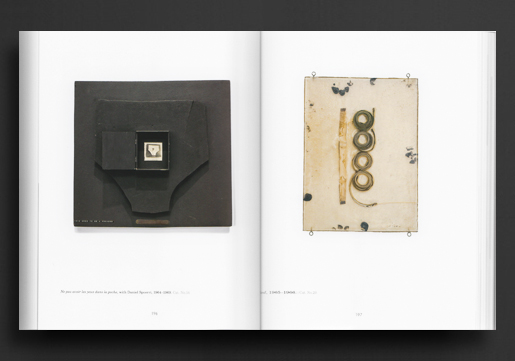
World Food Books is proud to announce our next Occasion, the first presentation of sculptures by Philadelphia Wireman in Australia.
The Philadelphia Wireman sculptures were found abandoned in an alley off Philadelphia’s South Street on trash night in 1982. Their discovery in a rapidly-changing neighbourhood undergoing extensive renovation, compounded with the failure of all attempts to locate the artist, suggests that the works may have been discarded after the maker’s death. Dubbed the "Philadelphia Wireman" during the first exhibition of this work, in 1985, the maker’s name, age, ethnicity, and even gender remain uncertain. The entire collection totals approximately 1200 pieces, all intricately bound together with tightly-wound heavy-gauge wire (along with a few small, abstract marker drawings, reminiscent both of Mark Tobey and J.B. Murry). The dense construction of the work, despite a modest range of scale and materials, is singularly obsessive and disciplined in design: a wire armature or exoskeleton firmly binds a bricolage of found objects including plastic, glass, food packaging, umbrella parts, tape, rubber, batteries, pens, leather, reflectors, nuts and bolts, nails, foil, coins, toys, watches, eyeglasses, tools, and jewellery.
Heavy with associations—anthropomorphic, zoomorphic, and socio-cultural responses to wrapped detritus—the totemic sculptures by Philadelphia Wireman have been discussed in the context of work created to fulfil the shamanistic needs of alternative religions in American culture. Curators, collectors, and critics have variously compared certain pieces to sculpture from Classical antiquity, Native American medicine bundles, African-American memory jugs, and African fetish objects. Reflecting the artist’s prolific and incredibly focused scavenging impulse, and despite—or perhaps enhanced by—their anonymity, these enigmatic objects function as urban artefacts and arbiters of power, though their origin and purpose is unknown. Philadelphia Wireman, whatever their identity, possessed an astonishing ability to isolate and communicate the concepts of power and energy through the selection and transformation of ordinary materials. Over the course of the past two decades, this collection has come to be regarded as an important discovery in the field of self-taught art and vernacular art.
Presented in collaboration with Fleisher-Ollman Gallery, Philadelphia, and Robert Heald, Wellington.
Susan Te Kahurangi King
02 February - 10 March, 2018
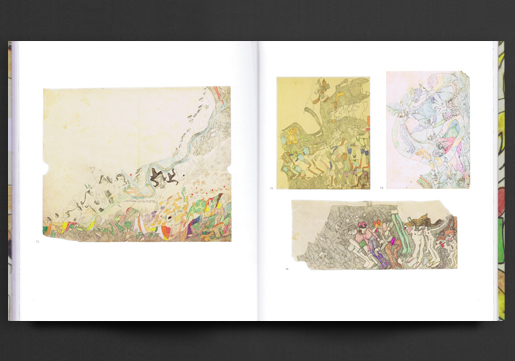
Susan Te Kahurangi King (24 February 1951 - ) has been a confident and prolific artist since she was a young child, drawing with readily available materials - pencils, ballpoint pens and felt-tip markers, on whatever paper is at hand. Between the ages of four and six Susan slowly ceased verbal communication. Her grandparents William and Myrtle Murphy had developed a special bond with Susan so they took on caring responsibilities for extended periods. Myrtle began informally archiving her work, carefully collecting and storing the drawings and compiling scrapbooks. No drawing was insignificant; every scrap of paper was kept. The King family are now the custodians of a vast collection containing over 7000 individual works, from tiny scraps of paper through to 5 meter long rolls.
The scrapbooks and diaries reveal Myrtle to be a woman of great patience and compassion, seeking to understand a child who was not always behaving as expected. She encouraged Susan to be observant, to explore her environment and absorb all the sights and sounds. Myrtle would show Susan’s drawings to friends and people in her community that she had dealings with, such as shopkeepers and postal workers, but this was not simply a case of a grandmother’s bias. She recognised that Susan had developed a sophisticated and unique visual language and sincerely believed that her art deserved serious attention.
This was an unorthodox attitude for the time. To provide some context, Jean Dubuffet coined the term Art Brut in 1945 to describe work created by self-taught artists – specifically residents of psychiatric institutions and those he considered to be visionaries or eccentrics. In 1972 Roger Cardinal extended this concept by adopting the term Outsider Art to describe work made by non-academically trained artists operating outside of mainstream art networks through choice or circumstance. Susan was born in Te Aroha, New Zealand in 1951, far from the artistic hubs of Paris and London that Dubuffet and Cardinal operated in. That Myrtle fêted Susan as a self-taught artist who deserved to be taken seriously shows how progressive her attitudes were.
Susan’s parents Doug and Dawn were also progressive. Over the years they had consulted numerous health practitioners about Susan’s condition, as the medical establishment could not provide an explanation as to why she had lapsed into silence. Dawn educated herself in the field of homeopathy and went on to treat all twelve of her children using these principles – basing prescriptions on her observations of their physical, mental and emotional state.
Doug was a linguist with an interest in philosophy who devoted what little spare time he had to studying Maori language and culture. To some extent their willingness to explore the fringes of the mainstream made them outsiders too but it was their commitment to living with integrity and their respect for individuality that ensured Susan’s creativity was always encouraged.
Even though Susan’s family supported her artistic pursuits, some staff in schools and hospitals saw it as an impediment to her assimilation into the community and discouraged it in a variety of ways. Her family was not always aware of this and therefore did not fully understand why Susan stopped drawing in the early 1990s. However, rather than dwell on the challenges that Susan faced in pursuit of her artistic practice, they prefer to highlight her achievements. In 2008 Susan began drawing again in earnest, after an almost 20 year interruption, and her work is now shown in galleries around the world.
Susan grew up without television and has been heavily influenced by the comics she read as a child. She is absolutely fearless in the appropriation of recognizable characters, such as Donald Duck and Mickey Mouse, in her work. She twists their limbs, contorts their faces, compresses them together, blends them into complex patterned backgrounds - always imbuing them with an incredible energy. Although Susan often used pop culture characters in her work they are not naive or childlike. These are drawings by a brilliant self-taught artist who has been creating exceptional work for decades without an audience in mind.
Mladen Stilinović
"Various Works 1986 - 1999"
02 February 16 - September 10, 2016
Various works 1986 - 1999, from two houses, from the collections of John Nixon, Sue Cramer, Kerrie Poliness, Peter Haffenden and Phoebe Haffenden.
Including: Geometry of Cakes (various shelves), 1993; Poor People’s Law (black and white plate), 1993; White Absence (glasses, ruler, set square, silver spoon, silver ladel with skin photograph and wooden cubes), 1990-1996; Exploitation of the Dead (grey and red star painting, wooden painting, black spoon with red table, red plate), 1984-1990; Money and Zeros (zero tie, paintings made for friends in Australia (Sue, John, Kerrie), numbers painting), 1991-1992; Words - Slogans (various t-shirts) - “they talk about the death of art...help! someone is trying to kill me”, “my sweet little lamb”, “work is a disease - Karl Marx”; Various artist books, catalogues, monographs, videos; Poster from exhibition Insulting Anarchy; "Circular" Croatian - Australian edition; Artist book by Vlado Martek (Dostoyevsky); more.
Thanks to Mladen Stilinović and Branka Stipančić.
Jonathan Walker
Always Will Need To Wear Winter Shirt Blue + Ochre Small Check Pattern
21 August - 21 September, 2015
Untitled
I am not a great reader of poetry but I always return to the work of Melbourne poet, Vincent Buckley (1925- 1988). Perhaps I find his most tantalising piece to be not a finished poem but a fragment left on a scrap of paper discovered on his desk after the poet’s death.
The poetry gathers like oil
In the word-core, and spreads
It has its music meet,
Its music is in movement.
This fragment is more the shell left behind from a volatile thought than a finished poem. I find the last two lines honest but awkward whereas the first two lines work like an arrow. Most likely he could not find a resolution so it was left. Still, in its present form, it remains an eloquent testimony to the ultimate failure of a medium to express mobile thought and sensation, in Buckley’s case, through verbal language. It’s an important matter because this is something all artists have to deal with regardless of the medium.
I have never written a poem, however, I am forever copying fragments from books on paper scraps in a vain effort to fix certain notions in my head. At first, they function as bookmarks that are sometimes returned to when I open the book. But before long, as they accumulate, they fall out littering the table interspersed with A4 photocopies, bills, books and medications.
To return to Buckley’s fragment, the first two lines very much evoke how I paint nowadays. As you age, detail diminishes and patches of light become more luminous and float. I feel the most honest way of dealing with this is by smearing the oil paint on the canvas with the fingers and working close-up, blind. Only if the patches coalesce into an approaching image can the work gain a life.
-
Jonathan Walker was born in Melbourne, Australia and brought up on a dairy farm in Gippsland. In the 1970’s he studied painting at RMIT and won the Harold Wright Scholarship to the British Museum, London. During the 1980’s he exhibited at Pinacotheca Gallery, Richmond and had work shown at the NGV and Heidi City Art Gallery. Over the same period he designed the cover for the “Epigenesi” LP by Giancarlo Toniutti, Italy and conducted a mail exchange work with Achim Wollscheid, Germany. The work with artists through the post resulted in an article published in the bicentenary issue of Art and Australia 1988. He showed in artist run spaces such as WestSpace in the 90’s and 2000’s, and until 2012, taught painting at Victoria University, which is where we (Colleen Ahern and Lisa Radford) as organisers of the exhibition, among many others, had the privilege of being his student.
Walker’s knowledge was imparted to students through the careful selection of music, literature, and artists found in books that he himself had ordered for the library. Walker’s strategy was the generosity of sharing his vast knowledge with references specific to each student and their context.
Walker’s paintings share a similar focus and intimacy.
This exhibition presents a small selection of recent paintings alongside a publication that includes Walker’s writing. Observational and analytical, Walker’s work is a type of material notation — the time of day, colour and how it is blended, the both specific and fleeting location of a reflection on lino or the question of whether a chair leg should be included in a painting.
Please join us on Friday August 21 between 6-8pm to celebrate the opening of the exhibition.
Curated by Colleen Ahern and Lisa Radford.
B. Wurtz
Curated by Nic Tammens
March 26 - April 4, 2015
B.Wurtz works from a basement studio in his home on Manhattan’s Lower East Side.
This local fact is attested to by the plastic shopping bags and newsprint circulars that appear in his work. As formal objects, they don’t make loud claims about their origins but nonetheless transmit street addresses and places of business from the bottom of this long thin island. Like plenty of artists, Wurtz is affected by what is local and what is consumed. His work is underpinned by this ethic. It often speaks from a neighborhood or reads like the contents of a hamper:
“BLACK PLUMS $1.29 lb.”
“Food Bazaar”
“USDA Whole Pork Shoulder Picnic 99c lb.”
“RITE AID Pharmacy, with us it’s personal.”
“H. Brickman & Sons.”
“Sweet Yams 59c lb."
Most of the work in this exhibition was made while the artist was in residence at Dieu Donne, a workshop dedicated to paper craft in Midtown. Here Wurtz fabricated assemblages with paper and objects that are relatively lightweight, with the intention that they would be easily transportable to Australia. This consideration isn’t absolute in Wurtz’s work, but was prescriptive for making the current exhibition light and cheap. Packed in two boxes, these works were sent from a USPS post office on the Lower East Side and delivered to North Melbourne by Australia Post.
Wurtz appears courtesy of Metro Pictures, New York.
Thanks to Rob Halverson, Joshua Petherick, Sari de Mallory, Matt Hinkley, Helen Johnson, Fayen d'Evie, Ask Kilmartin, Lisa Radon, Ellena Savage, Yale Union, and "Elizabeth".
John Nixon
"Archive"
December 15 - January 20, 2014
The presentation of John Nixon's archive offered a rare showcase of this extensive collection of the artist's own publications, catalogues, posters, ephemera, editions and more, from the mid 1980s onwards, alongside a selection of his artworks.
Organized by John Nixon, Joshua Petherick and Matt Hinkley.
<a href=http://wfb.public-office.info/artist/john-nixon>All titles by John Nixon
"Habitat"
at Minerva, Sydney (organised by Joshua Petherick and Matt Hinkley)
November 15 - December 20, 2014
Lupo Borgonovo, Janet Burchill & Jennifer McCamley,
Lewis Fidock, HR Giger, Piero Gilardi, Veit Laurent Kurz,
Cinzia Ruggeri, Michael E. Smith, Lucie Stahl, Daniel Weil, Wols
Press Release:
“...It contained seven objects. The slender fluted bone, surely formed for flight, surely from the wing of some large bird. Three archaic circuitboards, faced with mazes of gold. A smooth white sphere of baked clay. An age-blackened fragment of lace. A fingerlength segment of what she assumed was bone from a human wrist, grayish white, inset smoothly with the silicon shaft of a small instrument that must once have ridden flush with the surface of the skin - but the thing’s face was seared and blackened.”
William Gibson, “Count Zero”, 1986
"Autumn Projects Archive"
Curated by Liza Vasiliou
March 6 - March 15, 2014
World Food Books, in conjunction with the Virgin Australia Melbourne Fashion Festival 2014, presented the Autumn Projects archive, consisting of a selection of early examples in Australian fashion with a particular interest in collecting designers and labels from the period beginning in the 1980’s, who significantly influenced the discourse of Australian Fashion.
Curated by Liza Vasiliou, the exhibition provided a unique opportunity to view pieces by designers Anthea Crawford, Barbara Vandenberg, Geoff Liddell and labels CR Australia, Covers, Jag along with early experimental collage pieces by Prue Acton and Sally Browne’s ‘Fragments’ collection, suspended throughout the functioning World Food Books shop in Melbourne.
H.B. Peace
presented by CENTRE FOR STYLE
November 14, 2013
"Hey Blinky, you say chic, I say same"
Anon 2013
H.B. Peace is a clothing collaboration between great friends Blake Barns and Hugh Egan Westland. Their pieces explore the divergences between 'character’ and ‘personality’ in garments....etc
Special Thanks to Joshua Petherick and Matt Hinkley of WFB and Gillian Mears
and a Very Special Thank you to Audrey Thomas Hayes for her shoe collaboration.
Janet Burchill & Jennifer McCamley
"Aesthetic Suicide"
May 10 - June 8, 2013
The first of our occasional exhibitions in the World Food Books office/shop space in Melbourne, "Aesthetic Suicide" presented a body of new and older works together by artists Janet Burchill & Jennifer McCamley, including videos, prints, a wall work, and publications.
During shop open hours videos played every hour, on the hour.
1969, Japanese
Hardcover (w. dust jacket), 144 pages, 19 x 27 cm
1st Edition, Out of print title / Used*,
Published by
Bijutsu Shuppan-sha / Japan
$70.00 - Out of stock
Volume 3 of the great 1969 hardcover series "Twelve Persons in Graphic Design Today", art directed by Gan Hosoya. Each of these collectable books showcase four Japanese graphic designers (of the total 12 across 3 books) practicing in the 1960s through a large selection of their works beautifully reproduced in full-colour and black and white. Volume 3 showcases Yoshitaro Isaka, Toshihiro Katayama, Tsunehisa Kimura and Tadanori Yokoo. Texts in Japanese, but almost entirely a visual document.
First edition in original dust-jacket, protected by plastic wraps.
1970, German
Hardcover, 140 pages, 16 x 20.5 cm
1st Edition, Out of print title / used / very good
Published by
Zero Press / Frankfurt
$90.00 - Out of stock
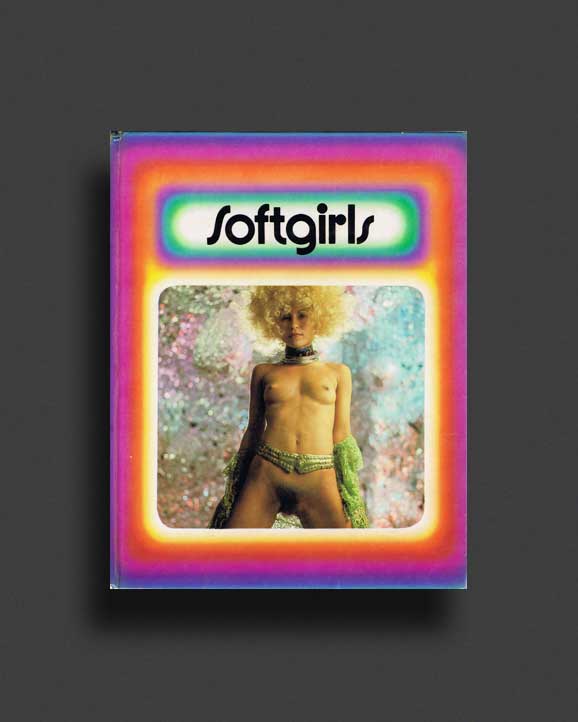
First edition of this cult erotica photobook, published in 1970 by Zero Press in Frankfurt.
Colour photography throughout by the great German designer and photographer Gunter Rambow, interspersed with text by pseudonymous authors Bettina Von Heuenstein and Jan Lue Verrou (a pseudonym of German poet Paulus Böhmer).
A very unique and playful book that combines rich, saturated sexual imagery with poetry and narratives, ushering pulp erotica into the era of the hippy underground press. Features German "1968 generation" actress / singer / icon, Rosemarie Heinikel (Rosy Rosy).
Gunter Rambow (born 1938) is well honoured German designer and photographer. His poetic and strikingly powerful visual language emerged in the 1960s, during a time of protest and creative experimentation. He has created numerous iconic and ground-breaking photo books and poster series. In his posters he tackles the social and political problems of his time, making no secret of his ideological bearings: to the left. His theatre posters contain caustic comments on the plays, interpreted in the topical context of everyday life. Rambow’s use of documentary-style photography actualises the often abstract ideas behind his designs. It has become a defining feature of his work: to confront the imagery of myths and fantasy with the problems and contradictions of contemporary society.
Paulus Böhmer (pseudonym : Jan Lue Verrou, born 1936) is a German writer. An outsider of contemporary German-language literature, he is representative of the rhythmic-epic long poem, which seeks to create an intoxicating effect on the reader with its juxtaposition of elements that seem at first sight to be incompatible.
Rosemarie Heinikel (born 1946) is a German actress, singer and author. As Rosy Rosy, she was an icon of the 1968 left-wing movement in Germany. Inspired by the spirit, later grouped under the term "The 68 Movement" - which also included the women's movement - she embodied liberated, feminine sexuality and creative self-realization. Alongside Uschi Obermaier, she is Germany's most famous communard. As a singer, she worked with the group Guru Guru. She recorded her first single in 1968 with Irmin Schmidt (later of Can). Conny Plank in Cologne produced her second in 1974. Since 1971 she works as a writer, directer (for children's films) and broadcaster. In 1983 she published the erotic poetry book "The Hungry Wolf".
1999, Japanese
Softcover (2 volumes in slipcase), 154 + 194 pages, 21 x 29 cm
1st edition, Out of print title / used*,
Published by
Museum of Contemporary Art / Tokyo
$140.00 - Out of stock
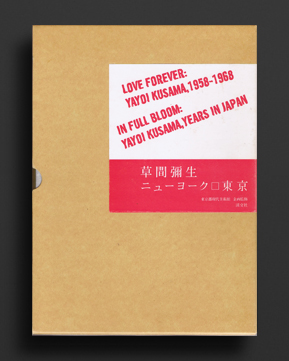
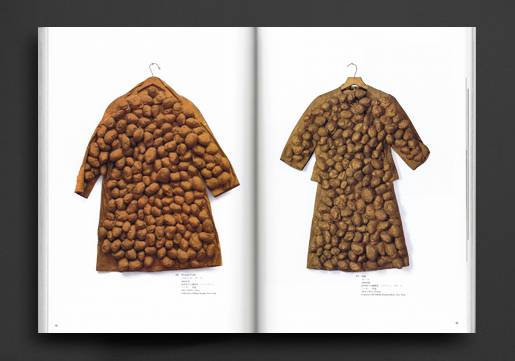
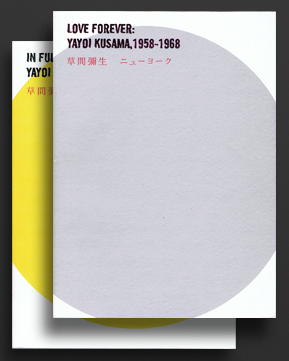
The original two-volume Japanese slipcase edition, published in conjunction with the exhibition "Love Forever: Yayoi Kusama, 1958-1968" which travelled between Japan and the US in 1999. This edition was available for the Museum of Contemporary Art Tokyo staging of the exhibition, and has been long out of print. Both volumes here are lavishly illustrated throughout with colour photographs of Yayoi Kusama's history of work - the first book ("Love Forever: Yayoi Kusama, 1958-1968") being a catalogue for the exhibition, featuring essays and documentation of the works in the exhibit spanning the years 1958-1968, including her New York happenings, whilst the second book ("In Full Bloom: Yayoi Kusama, Years in Japan") illuminates many rarely seen works outside of Japan. Accompanied by texts, an interview and an exhibition history, this book is broken into the sections 1945-1959, 1970-1999 and is densely illustrated with colour documentation of her work created in Japan. Together chronicling Kusama's life of creating work across painting, collage, soft sculpture, performance art, and environmental installations, of which most exhibit her thematic interest in psychedelic colours, repetition, and pattern, this comprehensive and collectable publication illustrates an extremely influential artist's life of work. Based in conceptual art, Kusama's work shows attributes of Feminism, Minimalism, Surrealism, Art Brut, Pop Art, Nouvelle Tendence (Op, Kinetic, etc.) and Abstract Expressionism, and is infused with autobiographical, psychological, and sexual content. Kusama is truly uncategorizable, and is celebrated as one of the most important living artists to come out of Japan, and an important voice of the avant-garde.
2012, English
Softcover, 280 pages, 18.4 x 23.4 cm
Published by
The MIT Press / Massachusetts
$85.00 $45.00 - Out of stock
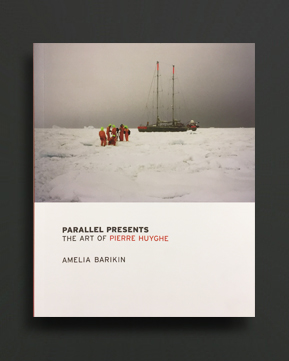
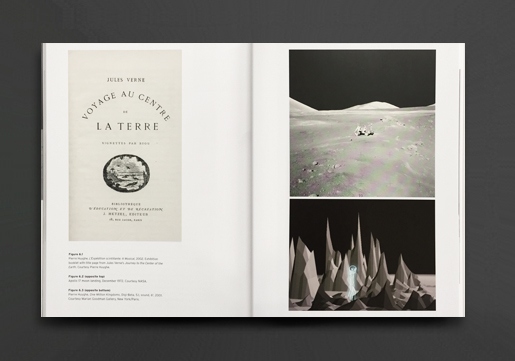
Over the past two decades, French artist Pierre Huyghe has produced an extraordinary body of work in constant dialogue with temporality. Investigating the possibility of a hypothetical mode of timekeeping -- "parallel presents" -- Huyghe has researched the architecture of the incomplete, directed a puppet opera, founded a temporary school, established a pirate television station, staged celebrations, scripted scenarios, and journeyed to Antarctica in search of a mythological penguin. In this first book-length art historical examination of Huyghe and his work, Amelia Barikin traces the artist's continual negotiation with the time codes of contemporary society. Barikin finds in Huyghe's projects an alternate way of thinking about history -- a "topological historicity" that deprograms (or reprograms) temporal formats. Barikin offers pioneering analyses of Huyghe's lesser-known early works as well as sustained readings of later, critically acclaimed projects, including No Ghost Just a Shell (2000), L'Expedition scintillante (2002), and A Journey That Wasn't (2005). She emphasizes Huyghe's concepts of "freed time" and "the open present," in which anything might happen. Bringing together an eclectic array of subjects and characters -- from moon walking to situationist practices, from Snow White to Gilles Deleuze -- Parallel Presents offers a highly original account of the driving forces behind Huyghe's work.
2002, English / Japanese
Hardcover (w. hard illustrated box), 360 pages, 15.5 x 21.5 cm
1st Edition, Out of print title / As New,
Published by
The Shikoku Shimbun / Kagawa
$90.00 - Out of stock
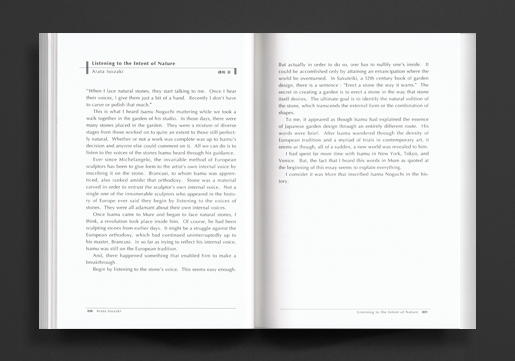
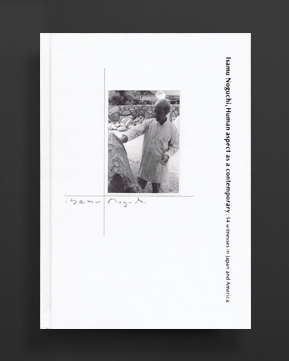
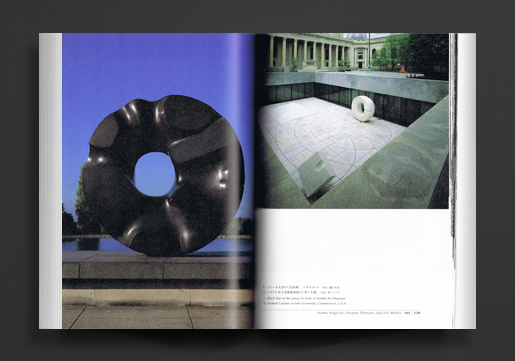
Beautiful first edition, in rare illustrated hard slipcase, of this handsome hardcover volume of essays on Isamu Noguchi. This series of essays, personal reflections and accounts by 54 friends and colleagues of Noguchi's, including Yoshi Taniguchi (architect), Issey Miyake (fashion designer), Arata Isozaki (architect), Tadao Ando (architect), Ikko Tanaka (graphic designer), Thomas Messer (director of the Solomon R. Guggenheim Foundation), Kenzo Tange (architect), and many others, was published to commemorate the opening of the Isamu Noguchi Garden Museum in Japan. First half of the book sees all essays in English, followed by a pictorial section of colour photographs of Noguchi at work, his sculptures and the Noguchi Garden, taken by famed Japanese photographers Shigeo Anzai, Yukio Futagawa, Kishin Shinoyama and others. The book closes with all essays repeated in Japanese. Also includes a map of Isamu Noguchi works across Japan, a biography, chronology, and blurbs on all contributing essayists, all in English and also Japanese.
A precise and very personal publication, and in this scarce hard-case edition, art directed by friend and celebrated Japanese graphic designer Ikko Tanaka, as one of his last ever design projects.
A must for any enthusiast of Noguchi's work.
Isamu Noguchi (November 17, 1904 – December 30, 1988) prominent Japanese American artist and landscape architect whose artistic career spanned six decades, from the 1920s onward. One of the greatest 20th-century sculptors, Noguchi is known for his sculpture and public works, creating innovative parks, plazas, playgrounds, fountains, gardens, and stage sets as well as sculpture of stone, metal, wood, and clay, and several mass-produced lamps and furniture pieces, some of which are still manufactured and sold.
In 1947, Noguchi began a collaboration with the Herman Miller company, when he joined with George Nelson, Paul László and Charles Eames to produce a catalog containing what is often considered to be the most influential body of modern furniture ever produced, including the iconic Noguchi table which remains in production today.
2013, English
Softcover, 160 pages, 153 x 23 cm
Published by
October Books / New York
The MIT Press / Massachusetts
$45.00 - Out of stock
Edited by Helen Molesworth
With Taylor Walsh
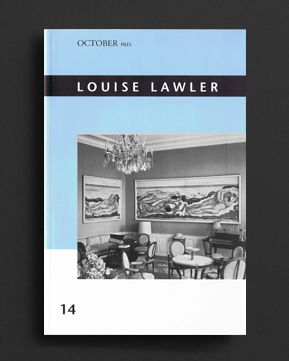
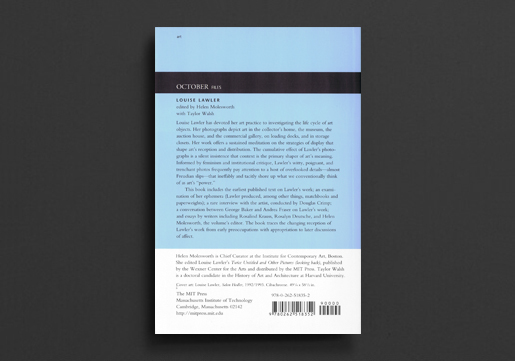
Louise Lawler has devoted her art practice to investigating the life cycle of art objects. Her photographs depict art in the collector’s home, the museum, the auction house, and the commercial gallery, on loading docks, and in storage closets. Her work offers a sustained meditation on the strategies of display that shape art’s reception and distribution. The cumulative effect of Lawler’s photographs is a silent insistence that context is the primary shaper of art’s meaning. Informed by feminism and institutional critique, Lawler’s witty, poignant, and trenchant photos frequently pay attention to a host of overlooked details—almost Freudian slips—that ineffably and tacitly shore up what we conventionally think of as art’s “power.”
This book includes the earliest published text on Lawler’s work; an examination of her ephemera (Lawler produced, among other things, matchbooks and paperweights); a rare interview with the artist, conducted by Douglas Crimp; a conversation between George Baker and Andrea Fraser on Lawler’s work; and essays by writers including Rosalind Krauss, Rosalyn Deutsche, and Helen Molesworth, the volume’s editor. The book traces the changing reception of Lawler’s work from early preoccupations with appropriation to later discussions of affect.
About the Editor
Helen Molesworth is Chief Curator at the Institute for Contemporary Art, Boston. She edited Louise Lawler’s Twice Untitled and Other Pictures (looking back), published by the Wexner Center for the Arts and distributed by the MIT Press.
2018, English
Hardcover (w. dust jacket), 312 pages, 13.7 x 20.3 cm
Published by
The MIT Press / Massachusetts
$55.00 - Out of stock
Edited by Jeremy Gilbert
Translated by Arianna Bove, Jeremy Gilbert, Andrew Goffey, Mark Hayward, Jason Read and Alberto Toscano
In Experimental Politics, Maurizio Lazzarato examines the conditions of work, employment, and unemployment in neoliberalism’s flexible and precarious labor market. This is the first book of Lazzarato’s in English that fully exemplifies the unique synthesis of sociology, activist research, and theoretical innovation that has generated his best-known concepts, such as “immaterial labor.” The book (published in France in 2009) is also groundbreaking in the way it brings Foucault, Deleuze, and Guattari to bear on the analysis of concrete political situations and real social struggles, while making a significant theoretical contribution in its own right.
Lazzarato draws on the experiences of casual workers in the French entertainment industry during a dispute over the reorganization (“reform”) of their unemployment insurance in 2004 and 2005. He sees this conflict as the first testing ground of a political program of social reconstruction. The payment of unemployment insurance would become the principal instrument for control over the mobility and behavior of the workers. The flexible and precarious workforce of the entertainment industry prefigured what the entire workforce in contemporary societies is in the process of becoming: in Foucault’s words, a “floating population” in “security societies.” Lazzarato argues further that parallel to economic impoverishment, neoliberalism has produced an impoverishment of subjectivity—a reduction in existential intensity. A substantial introduction by Jeremy Gilbert situates Lazzarato’s analysis in a broader context.
About the Author
Maurizio Lazzarato is a sociologist and philosopher in Paris. He is the author of Governing by Debt and Signs and Machines: Capitalism and the Production of Subjectivity, both published by Semiotext(e).
2016, English
Hardcover (w. dustjacket), 112 pages, 23 x 28 cm
Published by
ICA / Miami
$68.00 - Out of stock
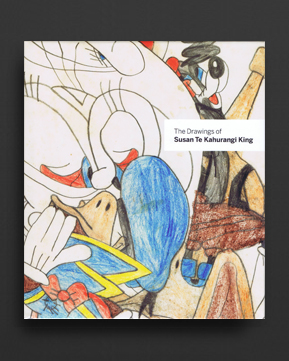
The only book in print on the self-taught New Zealand artist who stopped speaking at age 4; drew prolifically for decades; stopped drawing for several more; and then started again in 2008. Recently discovered, these are masterpieces of 20th-century drawing.
Like many so-called outsider artists, Susan Te Kahurangi King (born 1951) has an origin story--from an early age, she communicated solely through her art. The Drawings of Susan Te Kahurangi King reveals the various periods of the New Zealand artist’s work from that foundational moment: from her childhood drawings, to her notebooks, to her mature work of the 1970s and ’80s up until the point, sometime in the 1980s, when King stopped drawing. Also included is work made since 2008, when King returned to art, showing the artist’s recent moves beyond representation.
King’s surreal, cartoonish work triumphs in dialogue with contemporary painting and drawing, echoing the comic-inspired work of such painters as Nicole Eisenman, Laura Owens and Joyce Pensato--work that similarly draws from the poles of an unfettered vision, on the one hand, and common pop culture iconography on the other. Yet in King’s work we see the unfiltered manifestation of a self-taught artist, whose work is always art and communication simultaneously. In addition to offering a biographical overview of King’s life, this catalogue tracks the evolution of her oeuvre and provides contextualization of her art.
Edited with text by Tina Kukielski. Foreword by Alex Gartenfeld. Text by Gary Panter, Amy Sillman, Chris Byrne, Petita Cole, Rachel King.
2010, English
Hardcover (cloth-bound), 192 pages, 23.5 x 28.6 cm
Published by
Yale University Press / New Haven
$79.00 - Out of stock
Edited by Lynne Cooke, Karen Kelly, and Barbara Schröder. Texts by Benjamin H.D. Buchloh, Lynne Cooke, Suzanne Hudson, Susanne Küper, and James Lawrence
The first retrospective in the U.S. to feature German artist Blinky Palermo (1943–1977) includes more than 60 works, most of which have never before been shown in North America. This beautifully illustrated volume spans the breadth of Palermo’s brief but significant career and explores each phase, beginning with objects and paintings created shortly after he graduated from Joseph Beuys’s class at the Düsseldorf Art Academy in the early 1960s and culminating with paintings he produced during his last years in both Germany and New York City.
Palermo’s oeuvre is customarily divided into four principal groupings: the Objects; the Cloth Pictures (Stoffbilder), the in situ Wall Paintings and Drawings, and the late Metal Pictures, including the epic To the People of New York City (1976), now in the collection of Dia Art Foundation. Blinky Palermo also addresses the artist’s works on paper, including watercolors, sketches, preparatory studies, and prints that he made throughout his career.
Essays by distinguished authors position the artist’s work in relation to postwar American art and culture, which he greatly revered. Topics include the influence of the American milieu on the Metal Pictures; space and time in the Wall Drawings and Paintings; and the insights into Palermo’s concerns and process afforded by his works on paper. The most comprehensive volume on Palermo’s career to date, this important book offers a rare opportunity to explore in-depth the work of a remarkably innovative artist, pointing to Palermo’s relevance and influence on a new generation of artists.
Palermo
(Blinky) Palermo (1943–1977) was born Peter Schwarze in Leipzig. In 1962, he entered the Kunstakademie Düsseldorf, where he studied with Bruno Goller and then with Joseph Beuys and, in 1964, appropriated the name Blinky Palermo from the American boxing promoter-cum-mafioso Frank “Blinky” Palermo, famous for managing heavyweight champion Sonny Liston. Over the course of his short life, Palermo participated in more than seventy exhibitions worldwide, including Documenta in 1972 and the Venice Biennale in 1975. He has had posthumous retrospectives at the Kunstmuseum Winterthur, Switzerland (1984); Kunstmuseum Bonn (1993); Museu d’Art Contemporani de Barcelona (MACBA) (2002); Kunsthalle Düsseldorf (2007); and Dia:Beacon and the Center for Curatorial Studies at Bard College, Annandale-on-Hudson, New York (CCS Bard) (2011).
2011, English
Softcover, 11.2 x 17.8 cm, 128 pages (26 b/w ill.)
$46.00 $15.00 - Out of stock
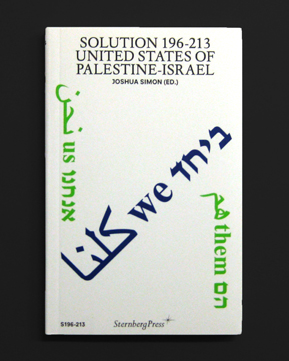
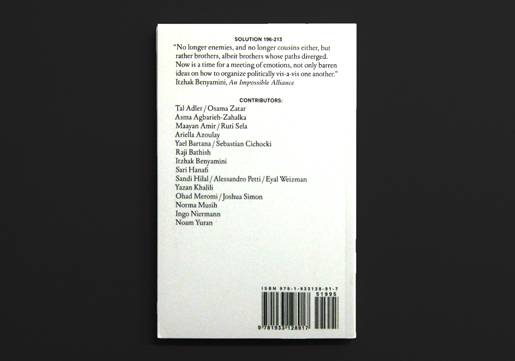
With contributions by Tal Adler/Osama Zatar, Asma Agbarieh-Zahalka, Maayan Amir/Ruti Sela, Ariella Azoulay, Yael Bartana/Sebastian Cichocki, Raji Bathish, Itzhak Benyamini, Sari Hanafi, Sandi Hilal/Alessandro Petti/Eyal Weizman, Yazan Khalili, Ohad Meromi/Joshua Simon, Norma Musih, Ingo Niermann, Noam Yuran
Solution 196–213: United States of Palestine-Israel is an anthology of texts proposing a doable solution for the region. With contributors based in Ramallah and Tel Aviv-Jaffa, Beirut and Jerusalem, New York and Bethlehem, Nazareth and Warsaw, the book offers solutions that will make life better, and proposes ways to do it.
“Solution” is a tricky term especially in relation to the ongoing newspeak of the last two decades in Palestine-Israel. In their contributions for this book, Sandi Hilal, Alessandro Petti, and Eyal Weizman suggest revisiting the term “decolonization,” “in order to maintain a distance from the current political terms of a ‘solution’ to the Palestinian conflict and its respective borders. The one-, two- and now three-state solutions seem equally entrapped in a ‘topdown’ perspective, each with its own self-referential logic.”
Unlike previous books in the Solution series, this book invited several writers from the region to suggest specific and doable solutions for today. This is mainly since it seems absurd to present a one-man master plan for Palestine-Israel. In many senses, such master plans (whether they take a colonial, Zionist or other meta-narrative lead) have been the mold of the problem in the region for at least the last 150 years.
The idea is therefore to rethink the different antagonisms that structure our ways of resistance and compliance: to rethink Semitism and 1948, rethink identity and territory, rethink resistance and memory, rethink democracy and state, rethink Zionism and decolonization, rethink refugee and property, rethink religion and solution.
Solution Series edited by Ingo Niermann
Design by Z.A.K.
1979, English / Catalan / Spanish / French
Hardcover (w. dust jacket), 143 pages, 21 x 21 cm
1st Edition, Out of print title / used / very good
Published by
Ediciones Polígrafa / Barcelona
$48.00 - Out of stock
First edition of this great hard cover monograph on self-taught Cuban surrealist painter, Jorge Camacho. Heavy illustrated throughout with his stunning drawings and paintings, including a series of illustrations inspired by Satie's Gnossiennes. Includes writings by Camacho and Carlos Franquai in English, Catalan, Spanish, French; a chronology, list of works and bibliography. Hard linen covers in original illustrated dust jacket.
Born in 1934 in Havana (Cuba), in 1952, Jorge Camacho abandons his law studies and begins painting, driven by an inner strength that still remains for him mysterious. Camacho's first major influence was the Wilfredo Lam exhibit at the University of Havana in 1955. In Mexico, in 1959, he meets the painter Jose Luis Cuevas, with whom he begins a long journey to the sources of pre-Columbian cultures (Teotihuacan, Olmec, Maya, Aztec) that defines a new direction in his painting. He had two exhibitions in Havana, in 1955 and 1958, before moving to Paris in 1959. Once in Paris, Camacho immediately adopted Surrealism and in 1960 had a show at Galerie Raymond Cordier. Camacho met surrealist poet André Breton during an exhibit of works by Toyen in 1961- his meeting with Breton truly tied him to the Surrealist movement. This exhibit also served as the setting for a 1962 event with the surrealist group, where he created an antireligious tribute to Oscar Panizza that featured aggressive paintings, including L'Immaculée conception des Papes. André Breton wrote a preface to Camacho's 1964 exhibition at the Galerie Mathias Fels, describing his work as a painting of cruelty. Camacho's works, with their claw-like forms laden with ossuaries, borrowed their harsh themes from novels by Sade and Bataille. The rich influence of Central and South America truly sets Camacho's painting apart from the European Surrealists, his paintings haunted by the ibijau, a bird he observed on a trip to Venezuela (Camacho was fascinated with ornithology), the landscapes of Peru, and the magical and hermetic societies throughout ancient Latin America.
Camacho lived in Paris from 1975 until his death in 2011.
1975, English
Hardcover (cloth-bound w. dust jacket), 192 pages, 22 x 28.5 cm
Out of print title / used / good
Published by
Studio Vista / London
$40.00 - Out of stock
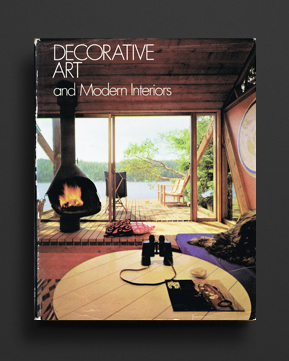
Volume 65 (1975/76) of Decorative Art and Modern Interiors, one of the finest book series from Studio Vista (UK)/William Morrow and Co (US).
Each handsomely designed volume showcases a selection of the finest examples of new architecture, interior design, environmental design, textiles, furniture and product design. Each volume including profiles on highlighted architectural projects that are documented through beautiful colour and b&w photography, desciptive texts, and axonometric, plan and section drawings, plus "Trends in Furnishings and in the Decorative Arts", which gives fine examples of new design in furniture, lighting, glassware, textiles, etc.
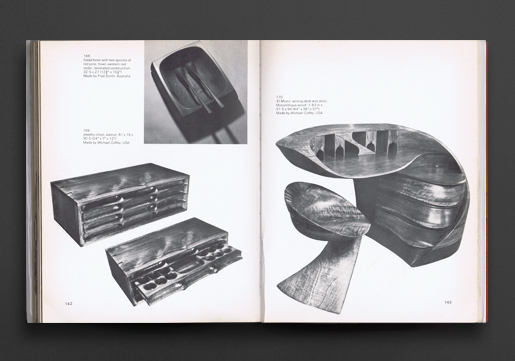
Volume 65 (1975/76) includes a special section on wood-working (with work by Wendell Castle, Michael Coffey, Peter Danko, John Makepeace, John Cederquist, and more), plus furniture and objects by Enzo Mari, Mario Bellini, Bruno Munari, Joe Colombo, Sergio Mazza, Gigi Sabadin, Jørgen Gammelgaard, Stig Lindberg, Peter Opsvik, Yuki Odawara, Eero Aarnio, Tias Eckhoff, Arne Jacobsen, Pierre Paulin, plus profiles on A Hall of Wedding Ceremonies in Nagoya, Japan; The Home of the Architect in Cambridge, England; An Extension to a Cottage in Buckinghamshire, England; Home on the Outskirts of London, England; A Furniture Showroom in Kyoto, Japan; The ‘Disk Union’ Record Shop in Tokyo, Japan; The 'Shu—Pub' Shoeshop in Tokyo, Japan; The Vacation House of the Architect (Wendell Lovett) on Crane Island, USA; The Home of the Architect (Shoei Yoh) in Fukuoka, Japan; St Birgitta Convent Church in Vadstena, Sweden; The Evangelical Church in Savona, Italy; An Art Collector's Home in Zurich, Switzerland; A Retirement Home in Waiblingen, West Germany; J. C. Decaux Publicité Headquarters at Plaisir, France; A Studio in London NW, England; Alexander Boutique in Rome, Italy; The Frey House in Bellevue, USA (Wendell Lovett); The Country Home of the Designer in Indiana, USA; An Air France Travel Office in Paris, France; A Vacation House at Harbor Springs, Michigan, USA; plus an introduction by Editor Maria Schofield translated from English to additional Spanish and Japanese.
plus much more.
An invaluable series of books on architecture, interior and product design from the 1960s-1980s.
1974, Japanese / English
Softcover, 130 pages, 29.3 × 22 cm
1st Edition, Out of print title / used / very good
Published by
Kajima Institute Publishing / Tokyo
$80.00 - Out of stock
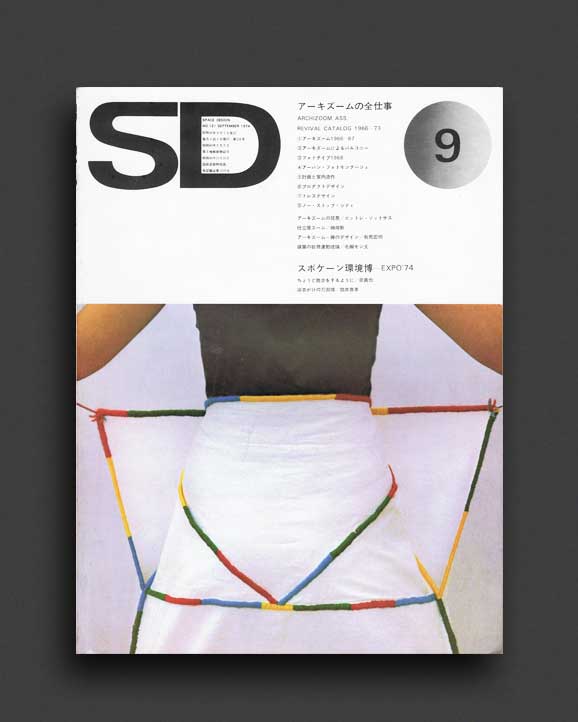
SD no. 121, 1974
Special Issue: Archizoom Associati
Important issue of Tokyo's SD in the printed history of Italian radical design, presenting an in-depth feature on the group Archizoom Associati, introduced by Japanese architect Arata Isozaki (translated to English), with text in Japanese by Ettore Sottsass Jr.
Contents include:
Works of Archizoom :
Archizoom Associati Revival Catalog 1966-73
This issue also features a special section on the Spokane Expo '74, Hans Poelzig, Environmental Recycling, Tuscany, Children's Playgrounds, and more.
SD (Space Design): A monthly journal on Art and Architecture, was founded in Japan in 1965; a comprehensive monthly magazine on architecture, urban problems and fine arts which was unique in the world and quickly became a leading, highly-esteemed journal of international modern design. Issues are now a much sought-after archival resource.
1985, English / Japanese
Hardcover (w. dust jacket), 162 pages, 30 × 23 cm
Out of print title / used / very good
Published by
Kajima Press / Tokyo
$100.00 - Out of stock
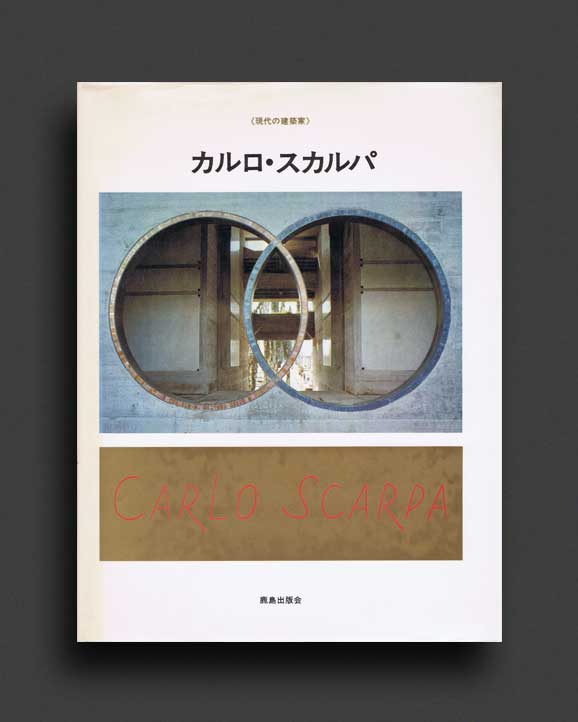
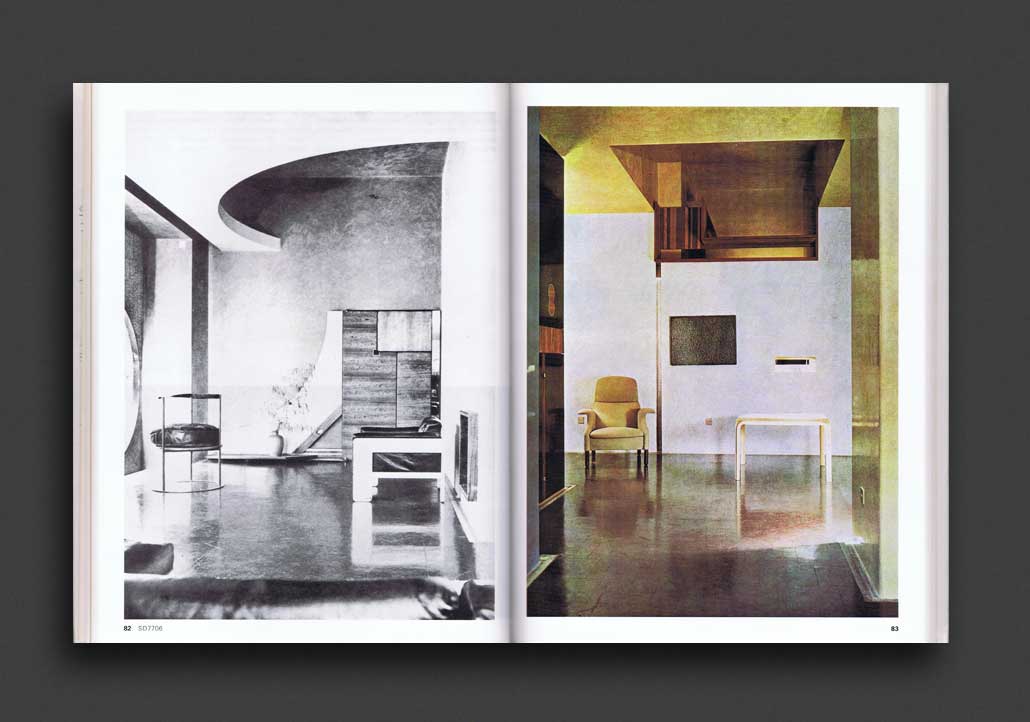
Hardcover book edition of the special monographic publication from SD (Space Design) on the work of Italian architect Carlo Scarpa, published first in magazine form in 1977 in Japan.
This scarce 1985 book edition collects the entire contents, covering much of Scarpa's internationally-renowned, major works across public and residential architecture (including Brion-Vega cemetery, Venice Biennale pavilion, Veritti House, Olivetti showrooms, Taddei House, Vicenza Municipal Theatre, Villa Palazzetto, Masieri Memorial, Museum of Treviso, Venice University of Architecture, Antoniana bank Monsechiche branch and so much more), exhibition design, furniture, glassware and more, profusely illustrated with beautiful colour and black and white photographs, along with Scarpa's drawings and plans, a chronology and bibliography. Also features a discussion between Japanese architect, Arata Isozaki and assistant professor of Tokyo University, Tadashi Yokoyama, translated into English for this edition.
A special volume for anyone interested in the work of Carlo Scarpa. First hardcover edition w. dust jacket, all in fantastic condition.
Carlo Scarpa (2 June 1906 – 28 November 1978), was an Italian architect, influenced by the materials, landscape, and the history of Venetian culture, and Japan. Scarpa translated his interests in history, regionalism, invention, and the techniques of the artist and craftsman into ingenious glass, furniture and building design. His architecture is deeply sensitive to the changes of time, from seasons to history, rooted in a sensuous material imagination.
SD (Space Design): A monthly journal on Art and Architecture, was founded in Japan in 1965; a comprehensive monthly magazine on architecture, urban problems and fine arts which was unique in the world and quickly became a leading, highly-esteemed journal of international modern design. Issues are now a much sought-after archival resource.
2013, Japanese
Softcover (w. dust jacket and obi-strip), 192 pages, 15 x 22.2 cm
Published by
Pie Books / Tokyo
$65.00 - Out of stock
Fujiwo Ishimoto is a Japanese texitile and ceramic designer who has been living in Helsinki, Finland for over 40 years. He first worked for the company Decembre, set up by Ristomatti Ratia, son of Marimekko's founders Armi and Viljo Ratia. Ishimoto switched over to Marimekko in 1974. His highly personal style gave Marimekko a boost during the 1970s and 1980s with more mature and abstract designs than the playful 1960s styles which first had made Marimekko famous. Inspired by traditional Asian art and culture but also by Finnish traditions and nature, Ishimoto has continued to reinvent himself. In total, he has made over 300 designs for Marimekko. Besides his work for Marimekko, he also creates unique ceramic works in the Arabia Art Department since 1989. In recognition of Ishimoto's nearly four decades of meritorious work in Finland and his valuable contribution to promoting awareness of Finnish design abroad (especially in his native Japan), he received the Pro Finlandia Medal awarded by the President of Finland in 2011.
This book was published for his exhibition in Tokyo in December 2012. Most of the contents are his textile and ceramic works but the photographs of his relative places and interviews are included. This is a title for designers, textile or ceramic lovers, and those who are interested in Finnish designs. Even those who do not know Ishimoto will enjoy and be inspired by the book.
2017, English
Softcover, 320 pages, 24 × 19 cm
Published by
Mousse / Milan
Editions Lebeer Hossmann / Brussels
M HKA / Antwerp
$75.00 - Out of stock
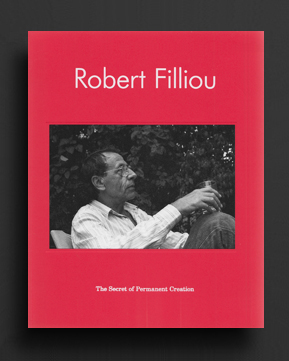
Foreword by Anders Kreuger, essay by Irmeline Lebeer, translated transcript of conversation between Robert Filliou and Irmeline Lebeer
“The absolute secret of permanent creation: not deciding, not choosing, not wanting, not owning, aware of self, wide awake. SITTING QUIETLY DOING NOTHING.” — Robert Filliou.
Published to document the recent Filliou retrospective at M HKA, the Museum of Contemporary Art Antwerp, this book centres on the transcript of an extensive conversation between the French artist and the Brussels-based art critic Irmeline Lebeer, recorded on seven cassette tapes in August 1976 in Flayosc in Southern France. This conversation is structured as an abécédaire and touches on a variety of topics to do with Filliou’s art and thinking, from amitié (friendship) to zen. It was supposed to become an extensive monograph but was never published until now.
Robert Filliou: The Secret of Permanent Creation gives today’s reader direct insight into the mind and the practice of this extraordinary artist, whose influence on subsequent generations cannot be overestimated. Now, in the second decade of the twenty-first century, is the time to realise that Robert Filliou was one of the greatest artists of the twentieth century, apart from being a significant playwright and poet. This book helps contemporary readers grasp his significance. It contains many black-and-white illustrations and colour plates of nearly all the 192 works in the exhibition at M HKA.
Designed by Sara De Bondt
Copublished with M HKA, Antwerp, and Editions Lebeer Hossmann, Brussels
2012, English
Softcover, 80 pages (18 b/w ill.), 21.5 x 28 cm
Published by
Sternberg Press / Berlin
$25.00 - Out of stock
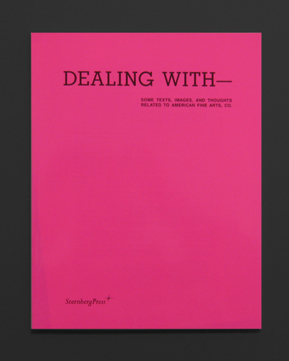
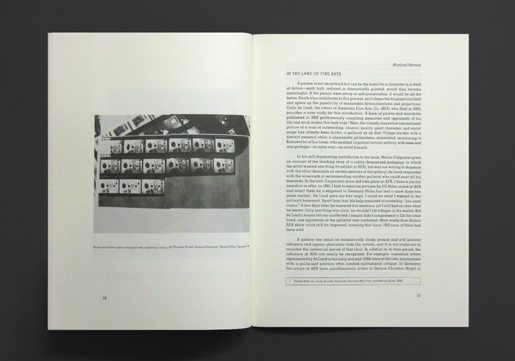
With contributions by Andrea Fraser, Manfred Hermes, Karl Holmqvist and Tobias Kaspar, Isla Leaver-Yap, Jackie McAllister, James Meyer and Christian Philipp Müller, Magnus Schäfer, Axel John Wieder, Phillip Zach; a conversation between Colin de Land, Josef Strau, and Stephan Dillemuth; and an introduction by Hannes Loichinger and Magnus Schäfer
The New York gallery American Fine Arts, Co.—whose name today is largely synonymous with that of its gallerist, Colin de Land (1955–2003)—represents a gallery practice in which a decided deviation from conventional models overlaps with successful activities within the framework of the art market. Today, American Fine Arts, Co. and de Land figure as uncontested projection screens for the desire for independence from or bohemian resistance against the dictate of the market. Particularly in retrospect, a consistent image of the gallery is not discernible. Faced with the obvious risk of romanticization, it appears all the more important to pursue an understanding of how American Fine Arts, Co. functioned as a gallery.
This book was published on the occasion of the exhibition “Dealing with—Some Books, Visuals, and Works Related to American Fine Arts, Co.” at Halle für Kunst Lüneburg and Kunstraum of Leuphana University of Lüneburg (May 28–July 7, 2011), which was developed by Valérie Knoll, Hannes Loichinger, Julia Moritz, and Magnus Schäfer.
Design by HIT
2016, 42 pages, 27 x 21 cm
Ed. of 800,
Published by
Daniel Buchholz Galerie / Köln
$40.00 - Out of stock
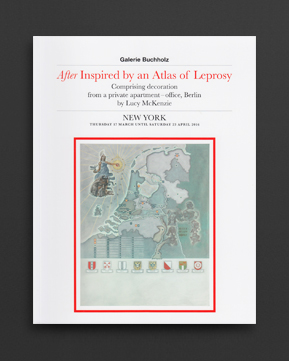
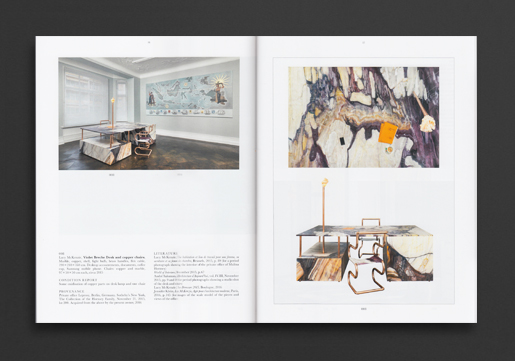
This artist's book is published on the occasion of two exhibitions by Lucy McKenzie, one at Daniel Buchholz galerie in Berlin and the other at the newly opened Daniel Buchholz gallery in New York. The book takes the form of an inventory from an estate sale. It lists all items and describes them with faux provenances and sources. These objects and items are the sculptural and painterly artworks of the exhibitions, rich and intricate in Lucy McKenzie's attention to trompe l'oeil detailing and art/decor/cultural/historical references.
Lucy McKenzie is a Scottish artist, based in Brussels. She is represented by Galerie Daniel Buchholz, Cologne; Cabinet, London and Galerie Micheline Szwajcer, Brussels.
1976, English
Hardcover (w. dust jacket in cardboard slipcase), 231 pages, 29.5 x 28 cm
1st US Edition, Out of print title / used / very good
Published by
Harry N. Abrams / New York
$85.00 - Out of stock
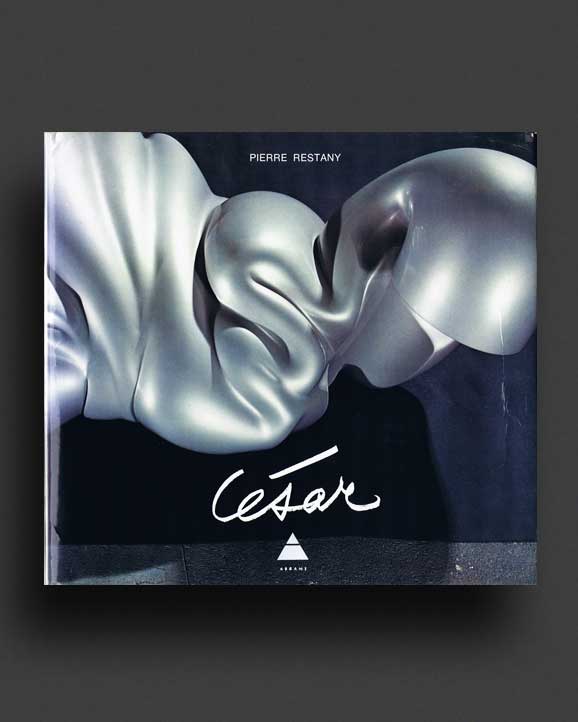
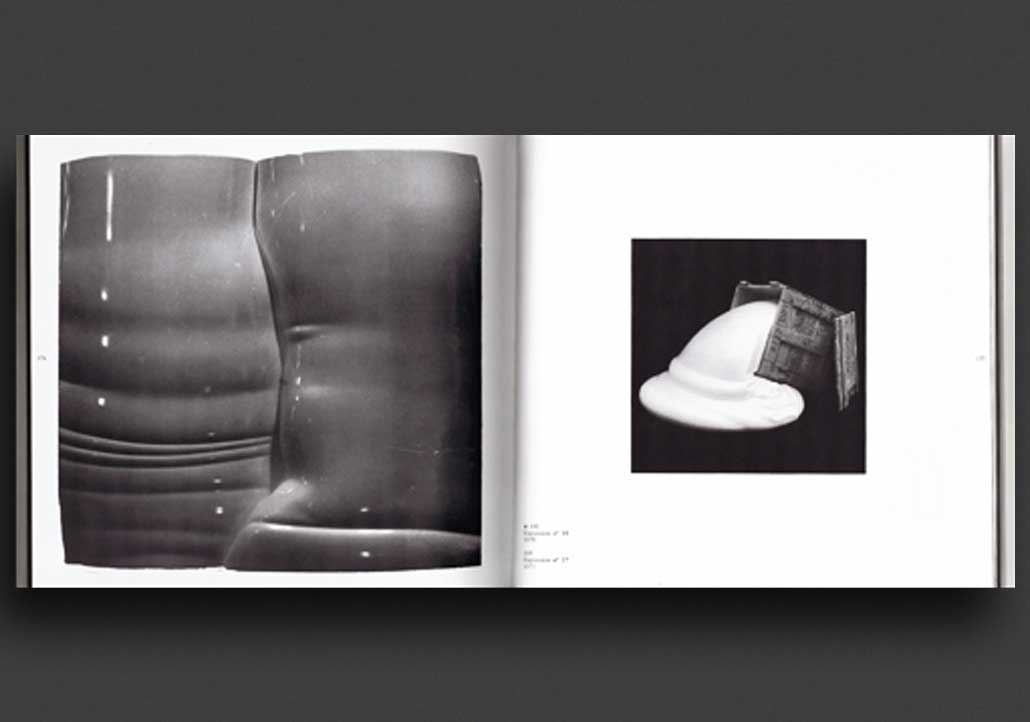
The stunning 1976 cloth-hardcover César monograph - English edition. With text by the great Pierre Restany and large beautifully printed illustrations of over 200 of César's sculptural works in colour and black and white, including a wealth of his incredible Compressions and Expansions, along with a list of all works, biography, bibliography. Designed by Peter Knapp and Walter Rospert and printed in France. This is the 1976 English edition with dustjacket, and original cardboard slipcase, and still the nicest book on this great artist.
César Baldaccini (1 January 1921 in Marseille - 6 December 1998 in Paris), usually called César, was a noted French sculptor. César was at the forefront of the Nouveau Réalisme movement with his radical compressions (compacted automobiles, discarded metal, or rubbish), expansions (polyurethane foam sculptures), and fantastic representations of animals and insects in bronze. His sculptural vision has heavy influenced the work of many for generations since.
2017, English / German
Softcover, 248 pages, 23 x 16.5 cm
Published by
Texte Zur Kunst / Berlin
$30.00 - In stock -
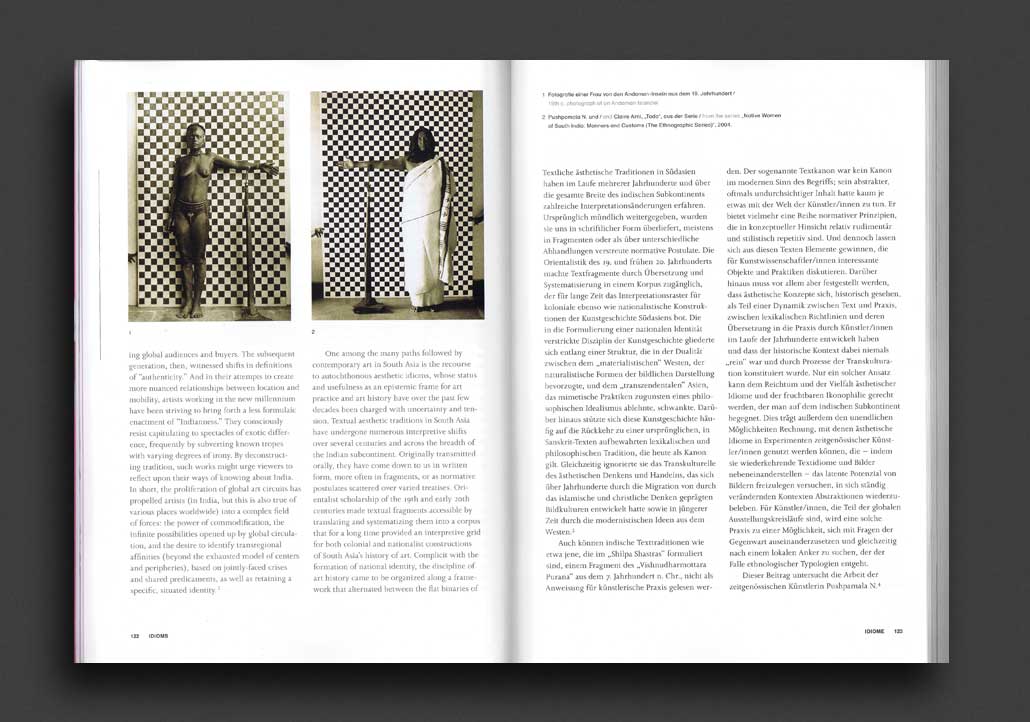
In art historical and art critical texts, the concept of “idiom” – an expression or mode of speaking that cannot be translated – is frequently used, even if it is rarely spoken of as such. TZK issue 108 explores how the idea of “idiom” might allow us to coherently engage with art's disparate materialist and iconographic connections at a time when the vitality of historical Western-centric cannons are fading (see: Documenta 14) and the traditional relations within and among artistic systems are ever less self-evident. The "Idiom" issue of TZK asks: What languages does art speak?
ISSUE NO. 108 / DECEMBER 2017 "IDIOM - LANGUAGES OF ART“
Table Of Contents
Preface
Susanne Leeb - Idioms: The Minor "A"s Of Art
Artist's Choice
Mirjam Thomann - Chapter 3: Women And Space
Anja Kirschner - In A Manner Of Speaking
Michael Dean
Linda Stupart - Didacticore: An Artist's Statement
Bouchra Khalili - Mother Tongue
Lawrence Abu Hamdan - Hear, Hear
Giovanna Zapperi - Body Of Evidence, Gestures Of Dysfunction / Technology As Practice In The Work Of Natascha Sadr Haghighian
Yvonne Volkart - From Trash To Waste / On Art's Media Geology
Monica Juneja - To Enter The Image / The Performative Self As Idiom*
Dieter Lesage - Research And Form / On "Artistic Research" And Its Aesthetic
Sven Lütticken - Modernist Memories / On The Conteporaneity of Günther Frg
Bildstrecke
Philipp Gufler
Maybe Devotion Is The Only Thing I Can Offer You
New Development
Once More With Feeling / Philipp Wüschner Über Das Symposium „Image Testimonies – Witnessing In Times Of Social Media“
Cloudism / Library Stack On Blockchain Archives And Library Futures
Liebe Arbeit Kino
Lauf, Genosse! / Madeleine Bernstorff Über „Cours, Cours, Camarade, Le Vieux Monde Est Derrière Toi. Das Kino Von Med Hondo“ Im Kino Arsenal, Berlin
Glück Auf! / Esther Buss Über Ben Russells „Good Luck“, 70. Locarno Festival
Reviews
Handlungsräume / Sophie Goltz Über „Radical Women“ Im Hammer Museum, Los Angeles
The Downward Spiral / Steven Warwick On “Trigger: Gender As A Tool And A Weapon” At The New Museum, New York
„Überlast“ Und Emanzipation – „Ich Weiss Nicht, Ob Mein Stand Es Erlaubt.“ / Isabel Mehl Über „Klassensprachen“ Im District Berlin
Katie Serva On “The Overworked Body: An Anthology Of 2000s Dress” At Ludlow 38 And Mathew Gallery, New York
Beiläufig Grundsätzlich / Bert Rebhandl Über Harun Farocki Im Neuen Berliner Kunstverein
Rien Ne Va Plus / Nuit Banai On Ericka Beckman At Secession, Vienna
Familienausstellung / Inka Meißner Über Verena Dengler In Der Kunsthalle Bern
Do You Like To Read? / Christian Berger Über „Hanne Darboven. Korrespondenzen“ Im Hamburger Bahnhof – Museum Für Gegenwart, Berlin
After Hours / Andrew Durbin On Thomas Eggerer At Petzel Gallery, New York
Remembering The Future / Bennett Simpson On William Leavitt At Honor Fraser, Los Angeles
Garten, Werkstatt, Oper – Alexander Kluge In Ausstellungen / Rainer Bellenbaum Über Alexander Kluge In Der Fondazione Prada, Venedig, Und Im Württembergischen Kunstverein Stuttgart
Getting Real / Helena Vilalta On Lee Lozano At Museo Reina Sofía, Madrid
Queere Subjektivität Und (Anti-)Koloniale Begehren / Jenny Nachtigall Über „Odarodle – Sittengeschichte Eines Naturmysteriums, 1535–2017“ Im Schwulen Museum, Berlin
Herrschaftszeichen Noch Mal! / Clemens Krümmel Über Michael Dreyer Im Badischen Kunstverein, Karlsruhe
Nachruf
Karl Otto Götz (1914–2017)
Edition
Candida Höfer
Ed Ruscha
2017, English
Hardcover, 408 pages, 23.3 x 27.3 cm
Published by
Hammer / Los Angeles
Prestel / Munich
$96.00 - Out of stock
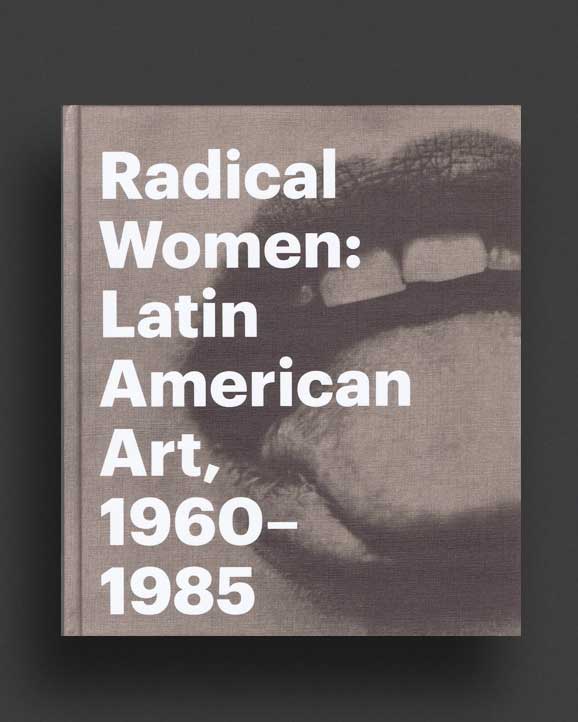
This stunning reappraisal offers long overdue recognition to the enormous contribution to the field of contemporary art of women artists in Latin America and those of Latino and Chicano heritage working during a pivotal time in history. Amidst the tumult and revolution that characterized the latter half of the 20th century in Latin America and the US, women artists were staking their claim in nearly every field. This wide ranging volume examines the work of more than 100 female artists with nearly 300 works in the fields of painting, sculpture, photography, video, performance art, and other experimental media. A series of thematic essays, arranged by country, address the cultural and political contexts in which these radical artists worked, while other essays address key issues such as feminism, art history, and the political body. Drawing its design and feel from the radical underground pamphlets, catalogs, and posters of the era, this is the first examination of a highly influential period in 20th-century art history.
About the editor:
CECILIA FAJARDO-HILL is an independent British-Venezuelan art historian and curator of modern and contemporary art, currently based in Southern California. ANDREA GIUNTA is a Buenos Aires-based writer, curator, Professor of Art History at the University of Buenos Aires, and Principal Researcher at CONICET, Argentina. She is also a visiting scholar at the University of Texas in Austin.
2017, English
Softcover, 144 pages, 11.5 x 18 cm
Published by
Sternberg Press / Berlin
A.P.E (Art Projects Era)
Kestner Gesellschaft / Hannover
$30.00 - Out of stock
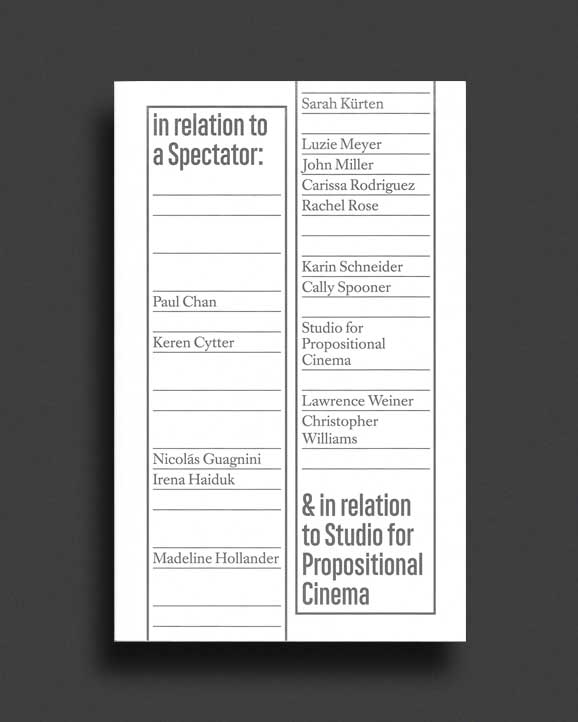
Contributions by Paul Chan, Keren Cytter, Nicolás Gaugnini, Irena Haiduk, Madeline Hollander, Sarah Kürten, Jordan Lord with Carissa Rodriguez, Luzie Meyer, John Miller, Rachel Rose, Karin Schneider, Cally Spooner, Studio for Propositional Cinema, Lawrence Weiner, Christopher Williams
A compendium of essays, scripts, poems, and proposals by various artists, in relation to a Spectator: was compiled by Studio for Propositional Cinema for their eponymous exhibition at the Kestner Gesellschaft in Hannover. In the opening text, Studio for Propositional Cinema—an artist collective founded in Düsseldorf in 2013—sets the context for the book’s investigations into notions of the script, staging, and the conditions of the exhibition itself. Other contributions include Keren Cytter’s rules and declarations for engaging life; Irena Haiduk and John Miller’s ruminations on the nature of the image and of the cinematic, respectively; a series of missives to Kevin Spacey from Cally Spooner; and an “open letter” by Christopher Williams detailing the labor and material conditions that have furnished the walls on which his exhibitions have hung.
This book is part of an ensemble of structures related to the nature of presentation in the Kestner Gesellschaft exhibition. Visually connected in their ultra-gloss white surfaces, they are meant to be seen as intertwined sites for the display of objects, the reproduction of images, the staging of performances, and the transmission language through talks and conversations.
Copublished with Kestner Gesellschaft and A.P.E. (Art Projects Era)
Design by Ronnie Fueglister
2017, English
Hardcover (w. dust jacket), 448 pages, 171 x 241 cm
Published by
The MIT Press / Massachusetts
New Museum / New York
$79.00 - Out of stock
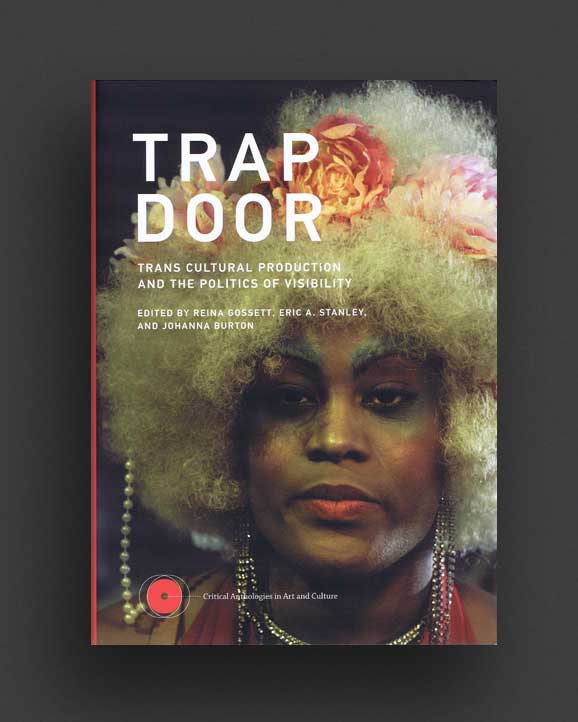
The increasing representation of trans identity throughout art and popular culture in recent years has been nothing if not paradoxical. Trans visibility is touted as a sign of a liberal society, but it has coincided with a political moment marked both by heightened violence against trans people (especially trans women of color) and by the suppression of trans rights under civil law. Trap Door grapples with these contradictions.
The essays, conversations, and dossiers gathered here delve into themes as wide-ranging yet interconnected as beauty, performativity, activism, and police brutality. Collectively, they attest to how trans people are frequently offered “doors”—entrances to visibility and recognition—that are actually “traps,” accommodating trans bodies and communities only insofar as they cooperate with dominant norms. The volume speculates about a third term, perhaps uniquely suited for our time: the trapdoor, neither entrance nor exit, but a secret passageway leading elsewhere. Trap Door begins a conversation that extends through and beyond trans culture, showing how these issues have relevance for anyone invested in the ethics of visual culture.
Contributors
Lexi Adsit, Sara Ahmed, Nicole Archer, Kai Lumumba Barrow, Johanna Burton, micha cárdenas, Mel Y. Chen, Grace Dunham, Treva Ellison, Sydney Freeland, Che Gossett, Reina Gossett, Stamatina Gregory, Miss Major Griffin-Gracy, Robert Hamblin, Eva Hayward, Juliana Huxtable, Yve Laris Cohen, Abram J. Lewis, Heather Love, Park McArthur, CeCe McDonald, Toshio Meronek, Fred Moten, Tavia Nyong’o, Morgan M. Page, Roy Pérez, Dean Spade, Eric A. Stanley, Jeannine Tang, Wu Tsang, Jeanne Vaccaro, Chris E. Vargas, Geo Wyeth, Kalaniopua Young, Constantina Zavitsanos
About the Editors
Reina Gossett is an artist, activist, and 2017 Activist in Residence at the Barnard Center for Research on Women. She directed The Personal Things (2016) and, with Sasha Wortzel, wrote, directed, and produced Happy Birthday, Marsha! (2017), a short film about legendary performer and activist Marsha P. Johnson.
Eric A. Stanley is Assistant Professor in the Department of Gender and Sexuality Studies at the University of California, Riverside, editor of Captive Genders: Trans Embodiment and the Prison Industrial Complex, and, with Chris E. Vargas, director of the films Homotopia (2006) and Criminal Queers (2016).
Johanna Burton is Director and Curator of Education and Public Engagement at the New Museum in New York and the series editor for the Critical Anthologies in Art and Culture.
2017, English
Softcover, 254 pages, 12 x 19 cm
Published by
Uh Books / Amsterdam
$20.00 - Out of stock
Each issue of ‘F.R. David’ features a wide array of artists and writers and a unique theme. This fourteenth release features “The Labor of the Inhuman” by Reza Negarestani, “Vaster than Empires and More Slow” by Ursula K. Le Guin, poems by Ralph Hotere, and “The Companion Species Manifesto” by Donna Haraway. Further, Zoe Todd investigates indigenous relationships to fish in Canada, while Ayesha Siddiqi writes about the growth of online communities for marginalised groups, plus contributions by Aurelia Armstrong, Kosen Ohtsubo, Ian White, Eileen Myles, Marcel Broodthaers, Witold Gombrowicz, Ian McCammon, Noam Chomsky, Gilles Deleuze, and more.