World Food Books' programme is largely produced on Kulin Nation land. We acknowledge the Wurundjeri people of the Kulin Nation as the first and continuing custodians of this land, and pay respect to their Elders past, present, and emerging.
World Food Books is an arts and special interests bookshop in Naarm / Melbourne. Founded in 2010, World Food Books is devoted to the presentation of a rotating, hand-selection of international art, design, literary and counterculture publications with an emphasis on the anti-traditional, the experimental, the avant-garde, the heretic, the marginal.
Presenting new titles alongside rare and out-of-print books, catalogues and journals spanning the fields of modern and contemporary art, design, photography, illustration, film, literature, poetry, cultural theory, philosophy, sexuality, popular and underground culture in its many radical forms, World Food Books wishes to encourage adventurous, thoughtful and open-minded reading, looking, writing, and exchange of publishing and ideas, both current and historical.
As well as our bookshop, located in Melbourne's historical Nicholas Building, all of our inventory is available internationally via our online mail-order service.
World Food Books semi-regularly co-ordinates "Occasions", a programme of exhibits and events at the bookshop and in partnership with other hosts (such as museums and art galleries) that develop out of the activities, relationships and content of the bookshop itself.
World Food Books
The Nicholas Building
37 Swanston Street
Room 5, Level 6
Melbourne 3000
Australia
SHOP HOURS:
Thu–Fri 12–6, Sat 12–5
WEB-SHOP OPEN 24/7
World Food Books
Postal Address:
PO Box 435
Flinders Lane
Victoria 8009
Australia
Art
Theory / Essay
Architecture / Interior
Graphic Design / Typography
Photography
Fashion
Eros
LGBTQ+
Fiction / Poetry
Weird / Speculative / Science Fiction / Horror
Transgressive / Visceral / Abject
Symbolism / Decadence / Fin de siècle
Film / Video
Painting
Sculpture / Installation
Performance / Dance / Theater
Drawing
Sound / Music
Curatorial
Group Shows / Collections
Periodicals
Out-of-print / Rare
Posters / Ephemera / Discs
Signed Books
World Food Books Gift Voucher
World Food Book Bag
Australian Art
Australian Fiction
Australian Science Fiction / Speculative Fiction
Australian Poetry
Australian Photography
Japanese Photography
Conceptual Art
Minimal Art
Dada
'Pataphysics / Oulipo
Fluxus
Concrete Poetry
Pop Art
Surrealism
Arte Povera
Arte Informale / Haute Pâte / Tachism
Nouveau Réalisme / Zero / Kinetic
Situationism / Lettrism
Collage / Mail Art / Xerox Art
Art Brut / Folk / Visionary / Fantastic
Illustration / Graphic Art / Bandes Dessinées
Furniture
Italian Radical Design / Postmodernism
Textiles
Ceramics / Glass
Counterculture
Protest / Revolt
Philosophy
Psychoanalysis
Anthropology
Anarchism
Socialism / Anarchism / Communism / Capitalism
Literary Theory / Semiotics / Language
Feminism / Women's Studies
Gender Studies / Sexuality
Anthropology
Fetishism / BDSM
Drugs / Psychedelia
Crime / Violence
Animal Rights / Veganism
Occult / Esoterica
Ecology / Earth / Alternative Living
Whole Earth / Crafts
All prices in AUD (Australian dollars)
Pick-Ups
Pick-up orders can be collected in our bookshop during opening hours after order date. Please collect any Pick-up orders within 2 weeks of ordering as we have limited storage space. Orders will be released back into stock if not collected within this time. No refunds can be made for pick-ups left un-collected. If you cannot make it in to the bookshop in this time-frame, please choose postage option.
Return Policy
All sales are final. We do accept returns (for refund or exchange) for items received in error. All our orders are packed with special care using heavy-duty padding and cardboard book-mailers or bubble mailers (for smaller books), using reinforcement where required. We cannot take responsibility for any lost, stolen or damaged parcels.
Insurance
Should you wish to insure your package, please email us directly after placing your order and we can organise this at a small extra expense. Although all standard/express tracked packages are very safe and dependable, we cannot take responsibility for any lost, stolen or damaged parcels. We recommend insurance on valuable orders.
Interested in selling your old books, catalogues, journals, magazines, comics, fanzines, ephemera? We are always looking for interesting, unusual and out-of-print books to buy. We only buy books in our fields of interest and specialty, and that we feel we can resell.
We base these prices on desirability, market value, in-print prices, condition and our current stock levels. We offer cash, store credit, and can take stock on consignment. All
about 25% of the price we expect to get when we sell them, or 30% in store credit. We base these prices on desirability, market value, in-print prices, condition and our current stock levels.
Sell your books any day of the week. You can drop them off and return later. If you have a lot of books, we can visit your Sydney home.
We buy books that we feel we can resell. We offer about 25 % of the price we expect to get when we sell them, or 30% in store credit. We base these prices on desirability, market value, in-print prices, condition and our current stock levels.
Philadelphia Wireman
03 August - 01 September, 2018
World Food Books is proud to announce our next Occasion, the first presentation of sculptures by Philadelphia Wireman in Australia.
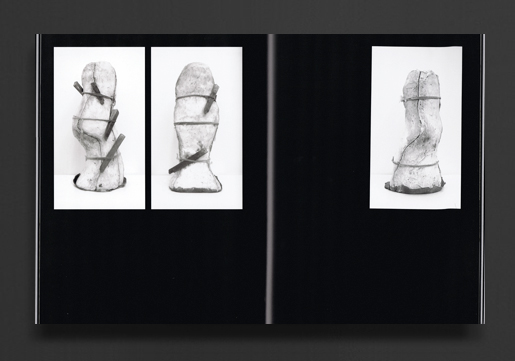
The Philadelphia Wireman sculptures were found abandoned in an alley off Philadelphia’s South Street on trash night in 1982. Their discovery in a rapidly-changing neighbourhood undergoing extensive renovation, compounded with the failure of all attempts to locate the artist, suggests that the works may have been discarded after the maker’s death. Dubbed the "Philadelphia Wireman" during the first exhibition of this work, in 1985, the maker’s name, age, ethnicity, and even gender remain uncertain. The entire collection totals approximately 1200 pieces, all intricately bound together with tightly-wound heavy-gauge wire (along with a few small, abstract marker drawings, reminiscent both of Mark Tobey and J.B. Murry). The dense construction of the work, despite a modest range of scale and materials, is singularly obsessive and disciplined in design: a wire armature or exoskeleton firmly binds a bricolage of found objects including plastic, glass, food packaging, umbrella parts, tape, rubber, batteries, pens, leather, reflectors, nuts and bolts, nails, foil, coins, toys, watches, eyeglasses, tools, and jewellery.
Heavy with associations—anthropomorphic, zoomorphic, and socio-cultural responses to wrapped detritus—the totemic sculptures by Philadelphia Wireman have been discussed in the context of work created to fulfil the shamanistic needs of alternative religions in American culture. Curators, collectors, and critics have variously compared certain pieces to sculpture from Classical antiquity, Native American medicine bundles, African-American memory jugs, and African fetish objects. Reflecting the artist’s prolific and incredibly focused scavenging impulse, and despite—or perhaps enhanced by—their anonymity, these enigmatic objects function as urban artefacts and arbiters of power, though their origin and purpose is unknown. Philadelphia Wireman, whatever their identity, possessed an astonishing ability to isolate and communicate the concepts of power and energy through the selection and transformation of ordinary materials. Over the course of the past two decades, this collection has come to be regarded as an important discovery in the field of self-taught art and vernacular art.
Presented in collaboration with Fleisher-Ollman Gallery, Philadelphia, and Robert Heald, Wellington.
Susan Te Kahurangi King
02 February - 10 March, 2018
Susan Te Kahurangi King (24 February 1951 - ) has been a confident and prolific artist since she was a young child, drawing with readily available materials - pencils, ballpoint pens and felt-tip markers, on whatever paper is at hand. Between the ages of four and six Susan slowly ceased verbal communication. Her grandparents William and Myrtle Murphy had developed a special bond with Susan so they took on caring responsibilities for extended periods. Myrtle began informally archiving her work, carefully collecting and storing the drawings and compiling scrapbooks. No drawing was insignificant; every scrap of paper was kept. The King family are now the custodians of a vast collection containing over 7000 individual works, from tiny scraps of paper through to 5 meter long rolls.
The scrapbooks and diaries reveal Myrtle to be a woman of great patience and compassion, seeking to understand a child who was not always behaving as expected. She encouraged Susan to be observant, to explore her environment and absorb all the sights and sounds. Myrtle would show Susan’s drawings to friends and people in her community that she had dealings with, such as shopkeepers and postal workers, but this was not simply a case of a grandmother’s bias. She recognised that Susan had developed a sophisticated and unique visual language and sincerely believed that her art deserved serious attention.
This was an unorthodox attitude for the time. To provide some context, Jean Dubuffet coined the term Art Brut in 1945 to describe work created by self-taught artists – specifically residents of psychiatric institutions and those he considered to be visionaries or eccentrics. In 1972 Roger Cardinal extended this concept by adopting the term Outsider Art to describe work made by non-academically trained artists operating outside of mainstream art networks through choice or circumstance. Susan was born in Te Aroha, New Zealand in 1951, far from the artistic hubs of Paris and London that Dubuffet and Cardinal operated in. That Myrtle fêted Susan as a self-taught artist who deserved to be taken seriously shows how progressive her attitudes were.
Susan’s parents Doug and Dawn were also progressive. Over the years they had consulted numerous health practitioners about Susan’s condition, as the medical establishment could not provide an explanation as to why she had lapsed into silence. Dawn educated herself in the field of homeopathy and went on to treat all twelve of her children using these principles – basing prescriptions on her observations of their physical, mental and emotional state.
Doug was a linguist with an interest in philosophy who devoted what little spare time he had to studying Maori language and culture. To some extent their willingness to explore the fringes of the mainstream made them outsiders too but it was their commitment to living with integrity and their respect for individuality that ensured Susan’s creativity was always encouraged.
Even though Susan’s family supported her artistic pursuits, some staff in schools and hospitals saw it as an impediment to her assimilation into the community and discouraged it in a variety of ways. Her family was not always aware of this and therefore did not fully understand why Susan stopped drawing in the early 1990s. However, rather than dwell on the challenges that Susan faced in pursuit of her artistic practice, they prefer to highlight her achievements. In 2008 Susan began drawing again in earnest, after an almost 20 year interruption, and her work is now shown in galleries around the world.
Susan grew up without television and has been heavily influenced by the comics she read as a child. She is absolutely fearless in the appropriation of recognizable characters, such as Donald Duck and Mickey Mouse, in her work. She twists their limbs, contorts their faces, compresses them together, blends them into complex patterned backgrounds - always imbuing them with an incredible energy. Although Susan often used pop culture characters in her work they are not naive or childlike. These are drawings by a brilliant self-taught artist who has been creating exceptional work for decades without an audience in mind.
Mladen Stilinović
"Various Works 1986 - 1999"
02 February 16 - September 10, 2016
Various works 1986 - 1999, from two houses, from the collections of John Nixon, Sue Cramer, Kerrie Poliness, Peter Haffenden and Phoebe Haffenden.
Including: Geometry of Cakes (various shelves), 1993; Poor People’s Law (black and white plate), 1993; White Absence (glasses, ruler, set square, silver spoon, silver ladel with skin photograph and wooden cubes), 1990-1996; Exploitation of the Dead (grey and red star painting, wooden painting, black spoon with red table, red plate), 1984-1990; Money and Zeros (zero tie, paintings made for friends in Australia (Sue, John, Kerrie), numbers painting), 1991-1992; Words - Slogans (various t-shirts) - “they talk about the death of art...help! someone is trying to kill me”, “my sweet little lamb”, “work is a disease - Karl Marx”; Various artist books, catalogues, monographs, videos; Poster from exhibition Insulting Anarchy; "Circular" Croatian - Australian edition; Artist book by Vlado Martek (Dostoyevsky); more.
Thanks to Mladen Stilinović and Branka Stipančić.
Jonathan Walker
Always Will Need To Wear Winter Shirt Blue + Ochre Small Check Pattern
21 August - 21 September, 2015
Untitled
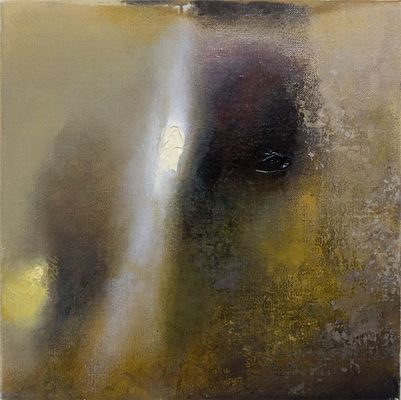
I am not a great reader of poetry but I always return to the work of Melbourne poet, Vincent Buckley (1925- 1988). Perhaps I find his most tantalising piece to be not a finished poem but a fragment left on a scrap of paper discovered on his desk after the poet’s death.
The poetry gathers like oil
In the word-core, and spreads
It has its music meet,
Its music is in movement.
This fragment is more the shell left behind from a volatile thought than a finished poem. I find the last two lines honest but awkward whereas the first two lines work like an arrow. Most likely he could not find a resolution so it was left. Still, in its present form, it remains an eloquent testimony to the ultimate failure of a medium to express mobile thought and sensation, in Buckley’s case, through verbal language. It’s an important matter because this is something all artists have to deal with regardless of the medium.
I have never written a poem, however, I am forever copying fragments from books on paper scraps in a vain effort to fix certain notions in my head. At first, they function as bookmarks that are sometimes returned to when I open the book. But before long, as they accumulate, they fall out littering the table interspersed with A4 photocopies, bills, books and medications.
To return to Buckley’s fragment, the first two lines very much evoke how I paint nowadays. As you age, detail diminishes and patches of light become more luminous and float. I feel the most honest way of dealing with this is by smearing the oil paint on the canvas with the fingers and working close-up, blind. Only if the patches coalesce into an approaching image can the work gain a life.
-
Jonathan Walker was born in Melbourne, Australia and brought up on a dairy farm in Gippsland. In the 1970’s he studied painting at RMIT and won the Harold Wright Scholarship to the British Museum, London. During the 1980’s he exhibited at Pinacotheca Gallery, Richmond and had work shown at the NGV and Heidi City Art Gallery. Over the same period he designed the cover for the “Epigenesi” LP by Giancarlo Toniutti, Italy and conducted a mail exchange work with Achim Wollscheid, Germany. The work with artists through the post resulted in an article published in the bicentenary issue of Art and Australia 1988. He showed in artist run spaces such as WestSpace in the 90’s and 2000’s, and until 2012, taught painting at Victoria University, which is where we (Colleen Ahern and Lisa Radford) as organisers of the exhibition, among many others, had the privilege of being his student.
Walker’s knowledge was imparted to students through the careful selection of music, literature, and artists found in books that he himself had ordered for the library. Walker’s strategy was the generosity of sharing his vast knowledge with references specific to each student and their context.
Walker’s paintings share a similar focus and intimacy.
This exhibition presents a small selection of recent paintings alongside a publication that includes Walker’s writing. Observational and analytical, Walker’s work is a type of material notation — the time of day, colour and how it is blended, the both specific and fleeting location of a reflection on lino or the question of whether a chair leg should be included in a painting.
Please join us on Friday August 21 between 6-8pm to celebrate the opening of the exhibition.
Curated by Colleen Ahern and Lisa Radford.
B. Wurtz
Curated by Nic Tammens
March 26 - April 4, 2015
B.Wurtz works from a basement studio in his home on Manhattan’s Lower East Side.
This local fact is attested to by the plastic shopping bags and newsprint circulars that appear in his work. As formal objects, they don’t make loud claims about their origins but nonetheless transmit street addresses and places of business from the bottom of this long thin island. Like plenty of artists, Wurtz is affected by what is local and what is consumed. His work is underpinned by this ethic. It often speaks from a neighborhood or reads like the contents of a hamper:
“BLACK PLUMS $1.29 lb.”
“Food Bazaar”
“USDA Whole Pork Shoulder Picnic 99c lb.”
“RITE AID Pharmacy, with us it’s personal.”
“H. Brickman & Sons.”
“Sweet Yams 59c lb."
Most of the work in this exhibition was made while the artist was in residence at Dieu Donne, a workshop dedicated to paper craft in Midtown. Here Wurtz fabricated assemblages with paper and objects that are relatively lightweight, with the intention that they would be easily transportable to Australia. This consideration isn’t absolute in Wurtz’s work, but was prescriptive for making the current exhibition light and cheap. Packed in two boxes, these works were sent from a USPS post office on the Lower East Side and delivered to North Melbourne by Australia Post.
Wurtz appears courtesy of Metro Pictures, New York.
Thanks to Rob Halverson, Joshua Petherick, Sari de Mallory, Matt Hinkley, Helen Johnson, Fayen d'Evie, Ask Kilmartin, Lisa Radon, Ellena Savage, Yale Union, and "Elizabeth".
John Nixon
"Archive"
December 15 - January 20, 2014
The presentation of John Nixon's archive offered a rare showcase of this extensive collection of the artist's own publications, catalogues, posters, ephemera, editions and more, from the mid 1980s onwards, alongside a selection of his artworks.
Organized by John Nixon, Joshua Petherick and Matt Hinkley.
<a href=http://wfb.public-office.info/artist/john-nixon>All titles by John Nixon
"Habitat"
at Minerva, Sydney (organised by Joshua Petherick and Matt Hinkley)
November 15 - December 20, 2014
Lupo Borgonovo, Janet Burchill & Jennifer McCamley,
Lewis Fidock, HR Giger, Piero Gilardi, Veit Laurent Kurz,
Cinzia Ruggeri, Michael E. Smith, Lucie Stahl, Daniel Weil, Wols
Press Release:
“...It contained seven objects. The slender fluted bone, surely formed for flight, surely from the wing of some large bird. Three archaic circuitboards, faced with mazes of gold. A smooth white sphere of baked clay. An age-blackened fragment of lace. A fingerlength segment of what she assumed was bone from a human wrist, grayish white, inset smoothly with the silicon shaft of a small instrument that must once have ridden flush with the surface of the skin - but the thing’s face was seared and blackened.”
William Gibson, “Count Zero”, 1986
"Autumn Projects Archive"
Curated by Liza Vasiliou
March 6 - March 15, 2014
World Food Books, in conjunction with the Virgin Australia Melbourne Fashion Festival 2014, presented the Autumn Projects archive, consisting of a selection of early examples in Australian fashion with a particular interest in collecting designers and labels from the period beginning in the 1980’s, who significantly influenced the discourse of Australian Fashion.
Curated by Liza Vasiliou, the exhibition provided a unique opportunity to view pieces by designers Anthea Crawford, Barbara Vandenberg, Geoff Liddell and labels CR Australia, Covers, Jag along with early experimental collage pieces by Prue Acton and Sally Browne’s ‘Fragments’ collection, suspended throughout the functioning World Food Books shop in Melbourne.
H.B. Peace
presented by CENTRE FOR STYLE
November 14, 2013
"Hey Blinky, you say chic, I say same"
Anon 2013
H.B. Peace is a clothing collaboration between great friends Blake Barns and Hugh Egan Westland. Their pieces explore the divergences between 'character’ and ‘personality’ in garments....etc
Special Thanks to Joshua Petherick and Matt Hinkley of WFB and Gillian Mears
and a Very Special Thank you to Audrey Thomas Hayes for her shoe collaboration.
Janet Burchill & Jennifer McCamley
"Aesthetic Suicide"
May 10 - June 8, 2013
The first of our occasional exhibitions in the World Food Books office/shop space in Melbourne, "Aesthetic Suicide" presented a body of new and older works together by artists Janet Burchill & Jennifer McCamley, including videos, prints, a wall work, and publications.
During shop open hours videos played every hour, on the hour.
2017, English
Paperback, 125 pages, 21.6 x 28 cm
Published by
Light Industry / New York
$75.00 - Out of stock
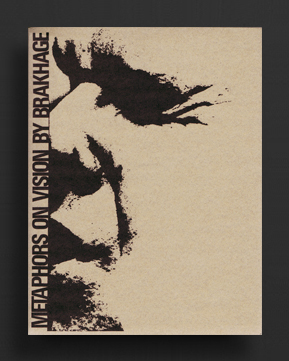
Originally published in 1963 by Jonas Mekas as a special issue of Film Culture, and designed by George Maciunas, Metaphors on Vision stands as the major theoretical statement by one of avant-garde cinema's most influential figures, a treatise on mythopoeia and the nature of visual experience written in a style as idiosyncratic as his art. Long out of print, the volume is now available in this definitive edition. Featuring Brakhage's complete text in its distinctive original layout, as well as annotations by scholar P. Adams Sitney.
2017, English
Hardback, 268 pages, 21.7 x 29.6 cm
Edition of 500
Published by
Julia Davis / Melbourne
$60.00 - Out of stock
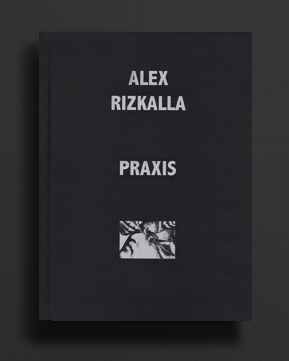
Alex Rizkalla: Praxis is a visual archive of Melbourne artist Alex Rizkalla's early paintings, object based installations, large scale projections, collaborations and artist run projects. It is a visual record of Rizkalla's works from 1989 to 2016 and is the culmination of a dialogue with him before his death in September 2016. Edited by Julie Davies.It contains three new essays; Justin Clemens has written on his last work in 'Language of Illness', Elvis Richardson on his collaborative practice with Julie Davies in 'Fruits of our Labour' and a reflection on the philosophical impetus of his work by Robert Schubert in 'Eulogy/Post Eulogy'. The book also includes 15 past catalogue essays and fragments from several of his exhibitions, including the Echigo Tsumari Art Triennial in Japan. The book is designed by Yanni Florence and Julie Davies. Alex Rizkalla has contributed enormously to the development of contemporary art in Melbourne through his individual and collaborative practices. This book is a valuable chance to reflect on the role that he played within the cultural community.
1986, English / Japanese
Hardcover (w. dust jacket), 252 pages, 30.5 x 24 cm
1st Edition, Out of print title / used / very good
Published by
Rikuyo-Sha / Tokyo
$80.00 - Out of stock
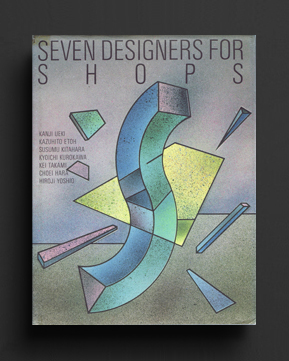
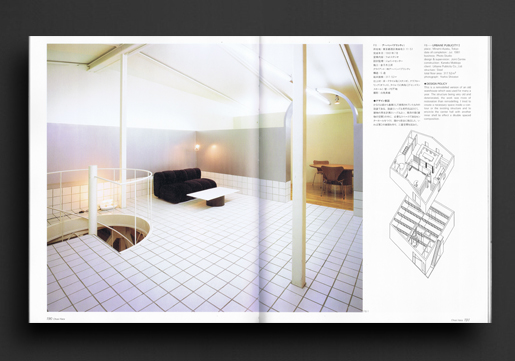
First edition of this fantastic, heavy collection of work by seven of Japan's leading commercial space designers of the 1980s : Kanji Ueki, Kazuhito Etoh, Susumu Kitahara, Kyoichi Kurokawa, Kei Takami, Choei Hara, and Hiroji Yoshio. Each section is made up of lavish photography of each designer's realised projects across boutiques, discotheques, coffee shops, restaurants, shopping plazas, etc. together with architectural plans, blurbs outlining each project, clients/job details and credits, etc. Each designer also has a photographic profile, biography and history. An incredible and wonderfully designed book full of interiors unlike any other - printed in Japan.
2017, English
Softcover, 104 pages, 20.8 x 27.5 cm
Published by
JRP Ringier / Zürich
Migros Museum für Gegenwartskunst / Zürich
$80.00 - In stock -
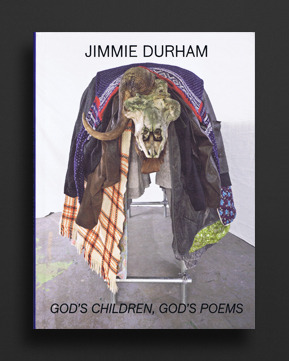
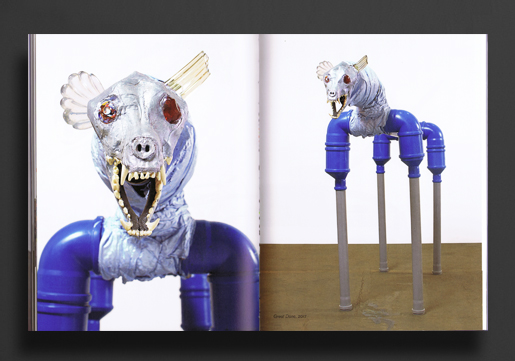
American-born artist, performer, poet, essayist and activist Jimmie Durham (born 1940) is one of the most influential voices of the contemporary art world, reflecting on encounters between the human being, technology and nature from different cultural perspectives. With an oeuvre spanning sculpture, drawing, collage, printmaking, painting, photography, video, performance and poetry, Durham became internationally famous in the 1980s for his sculptures made from materials such as wood, stone and the bones and skulls of animals, incorporating Native American elements into contemporary art. This monograph, conceived in close collaboration with the artist, features a text by Durham, with contributions by curator and art historian of the Cree Indians Heritage Richard W. Hill, and Migros Museum Director Heike Munder.
2017, English / German
Softcover, 480 pages, 21 x 30 cm
Published by
Spector Books / Leipzig
$42.00 - Out of stock
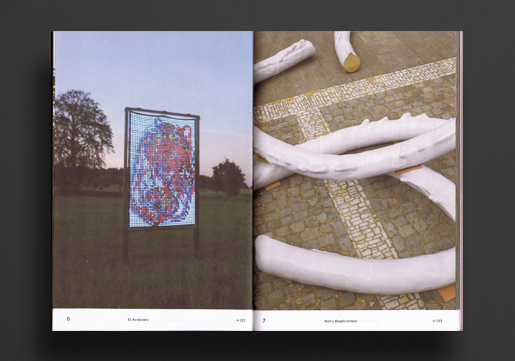
For forty years, the Sculpture Project Münster has been an important event for contemporary art. Held every ten years, its curatorial direction has been in the hands of Kasper King since its inception in 1977. In 2017, it was in close cooperation with Britta Peters and Marianne Wagner. For the exhibition, international artists are invited to develop site-related works for the urban space. The fifth edition of the Sculpture Project features around thirty new artistic positions moving between sculpture, installation, and performative art. This publication produced in conjunction with the exhibition contains seven essays, an extensive series of images, and short texts provide information about the projects.
Edited with text by Kasper König, Britta Peters, Marianne Wagner. Text by Inke Arns, Claire Doherty, Mit Sanyal, Mark von Schlegell, Gerhard Vinken, Raluca Voinea.
Includes the work of : Ei Arakawa, Aram Bartholl, Nairy Baghramian, Cosima von Bonin, Andreas Bunte,
Gerard Byrne, Camp (with Shaina Anand and Ashok Sukumaran), Michael Dean, Jeremy Deller, Nicole Eisenman, Ayşe Erkmen, Lara Favaretto, Hreinn Fridfinnsson, Monika Gintersdorfer and Knut Klaßen, Pierre Huyghe, John Knight, Xavier Le Roy with Scarlet Yu, Justin Matherly, Sany (Samuel Nyholm), Christian Odzuck, Emeka Ogboh, Peles Empire with Barbara Wolff and Katharina Stöver, Alexandra Pirici, Mika Rottenberg, Gregor Schneider, Thomas Schütte, Nora Schultz, Michael Smith, Hito Steyerl, Koki Tanaka, Oscar Tuazon, Joelle Tuerlinckx, Cerith Wyn Evans, Herve Youmbi, Barbara Wagner and Benjamin de Burca
2017, English / German
Softcover, 248 pages, 23 x 16.5 cm
Published by
Texte Zur Kunst / Berlin
$32.00 - Out of stock
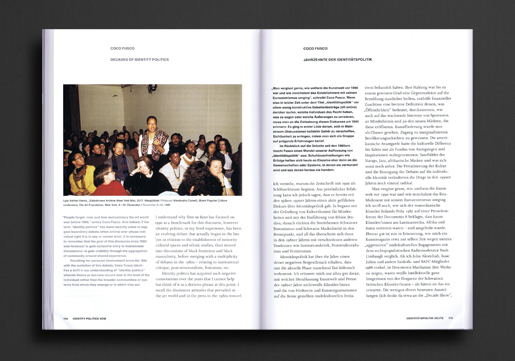
"Identity politics" has always been beleaguered territory. Yet recently the debate around “identity" has intensified and (with Trump) even developed new fronts. This issue examines the present state of identity politics in the West, finding the commodification of identity in mass culture (as in the art market) to be a leading influence. We also recognize a divide between, on the one hand, non-dominant communities cohering around identity so as to become visible together; and on the other hand, individuals aiming to stand out as special or "unique" by dint of membership in various non-dominant groups. Such ambiguity, in the face of current leadership (see issue cover) lends only all the more urgency, we feel, for a serious engagement with “identity” vis-a-vis “politics” now.
ISSUE NO. 107 / SEPTEMBER 2017 "IDENTITY POLITICS NOW"
Table Of Contents
Preface
True And False Victims / Sarah Schulman In Conversation With Caroline Busta and Anke Dyes (Texte Zur Kunst)
People Politics
Gabi Ngcobo & Yvette Mutumba, Klaus Biesenbach, Egija Inzule On "People Politics"
Monique Roelofs / Identity And Its Public Platforms: A String Of Promises Entwined With Threats
Andreas Reckwitz / Performative Authenticity: The Subject In The Late Modern Society Of Singularities
What Would Winning Look Like? / Bini Adamczak In Conversation With Anke Dyes (Texte Zur Kunst)
Coco Fusco / Decades Of Identity Politics
Bildstrecke
Sandra Mujinga
Rotation
Das Falsche Buch Zur Richtigen Zeit / Floris Biskamp Über „Beißreflexe“ Von Patsy L’amour Lalove
Apocalypse, A Lover’s Discourse / Jeff Nagy On “Life” By Hannah Black and Juliana Huxtable
Das Unbewusste Ist Strukturiert Wie Eine Ware / Helmut Draxler Und Kerstin Stakemeier Über „The Capitalist Unconscious“ Von Samo Tomšic
Zwischen Warten Und Wandern / Christiane Voss Über „Siegfried Kracauer. Eine Biografie“ Von Jörg Später
Liebe Arbeit Kino
Ghost In Chanel / Tobias Madison On Olivier Assayas’s Film “Personal Shopper”
Lippenbekenntnisse / Fiona Mcgovern Über Kerstin Honeit Im Videoraum Der Berlinischen Galerie
Grand Tour
Documenta 14 - Skulptur Projekte Münster - 57Th Biennale Di Venezia
Aus Fehlern Lernen / Sabeth Buchmann Und Ilse Lafer Über Die Documenta 14 In Athen
Incorrect History / Tom Mcdonough On Naeem Mohaiemen’s “Two Meetings And A Funeral” At Documenta 14, Kassel
Public Sculpture Pokéstop / Amy Lien And Enzo Camacho On Skulptur Projekte Münster 2017
Aufhören, Wenn’s Am Schönsten Ist / Eva Ehninger Über Die Skulptur Projekte Münster
The Stuck Hourglass / Venus Lau On The 57Th Venice Biennale
Crowd Kontrolle / Judith Rodenbeck On Anne Imhof’s “Faust” For The German Pavilion, 57Th Venice Biennale
Reviews
Negative Chic / Ken Okiishi On Rei Kawakubo/Comme Des Garçons At The Metropolitan Museum Of Art, New York
Zünftig In Die Zukunft / Beate Söntgen Über „Otto Freundlich: Kosmischer Kommunismus“ Im Museum Ludwig, Köln
The Man In The Mirror / Sarah Morris On Merlin Carpenter At Galerie Neu, Berlin
Verdeckte Arbeit / Gertrud Koch Über Sarah Morris Bei Capitain Petzel, Berlin
Marilyn And The Museum With Walls / Kevin Lotery On Rachel Harrison At Greene Naftali, New York
Unterwerfung Durch Architektur / Anna Voswinkel Über Peggy Buth Im Museum Folkwang Essen
Democracy Of Sound / Zoë Alexandra Harris On “Free Music Production/Fmp: The Living Music” At Haus Der Kunst, Munich
Tausend Snapchat-Rimbauds / Hans-Christian Dany Über Seth Price Im Stedelijk Museum, Amsterdam
Trocadero Drift / John Kelsey on Michel Houellebecq At Venus Over Manhattan, New York
Resident Aliens / Ella Plevin On Monira Al Qadiri At Gasworks, London
Blickwechsel-Begehren / Ines Kleesattel Über Birgit Megerle Im Kunsthaus Glarus
Containers Of The Virtual / Lars Bang Larsen On Hans-Christian Lotz At Christian Andersen, Copenhagen
Geschwätzige Zeiten / Tobias Teutenberg Über „After The Fact. Propaganda Im 21. Jahrhundert“ In Der Städtischen Galerie Im Lenbachhausund Kunstbau München
The Interdependence Of Feelings And Debates / Yuki Higashino On Martin Beck At Mumok, Vienna
Nachruf
Werner Hamacher (1948–2017)
Edition
Josh Kline
Juergen Teller
2017, English
Softcover, 48 pages, 20.95 x 13.3 cm
ed. of 750 copies,
Published by
Primary Information / New York
$23.00 - Out of stock
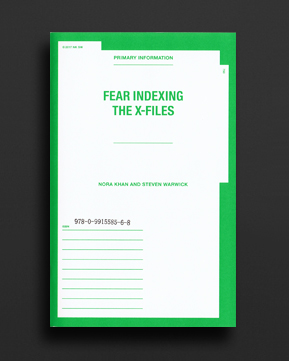
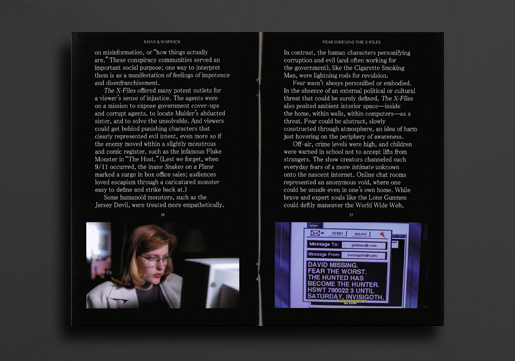
For Fear Indexing The X-Files, Nora Khan and Steven Warwick combed through the first 9 seasons of The X-Files television series—which ran from 1992 to 2002—gathering and indexing the fears that occurred as themes throughout the show. The authors employ a documentary-style commentary to narrate how the show posited fear as an inherent quality of domestic life.
The original run of the series aired in the period nestled between the end of the Cold War and the start of the War on Terror—a time in which enemies of the state shifted, with aliens replacing Communism, and a fear of ghosts and the paranormal prefacing our current climate of Islamophobia. Throughout the show, deregulated neoliberalism continually hovers, like an invisible man in the room.
Khan and Warwick take this index and link it to the rise of the World Wide Web and the global internet, which emerged in the same era. As the show developed, its characters became more adept at using the internet, as did its fans, many of whom visited chat rooms and dedicated forums to discuss episode content, speculate on theories, and come up with urban legends of their own. This behavior provides a through line to the present, as conspiracy theories discussed on those vanguard message boards eerily echo today’s fake news stories perpetuated by the alt-right.
Nora Khan is a New York City-based writer of criticism and fiction. She focuses on issues within digital art, the philosophy of technology, electronic music, and artificial intelligence, and her work has appeared in places like 4Columns, Art in America, Spike Art Magazine, California Sunday, The Village Voice, Rhizome, POSTmatter, and After Us. Khan is a 2016 Thoma Foundation Arts Writing Fellow in Digital Art, a 2017 Eyebeam Research Resident, and a contributing editor at Rhizome. She frequently collaborates with artists, including Katja Novitskova, Yuri Pattison, and Jeremy Shaw, writing essays commissioned by Sternberg Press, Mousse, Chisenhale Gallery, and König Galerie.
Steven Warwick is an artist, musician, and writer based in Berlin. He has exhibited and performed throughout the United States and Europe at venues including Exile Galerie, ICA London, the Modern Institute, MoMA/PS1, MUTEK, the Schinkel Pavillon, the New Theater Berlin, and Unsound Festival. His writings have appeared in Texte zur Kunst, Spike, Urbanomic, Electronic Beats, and The Wire. Warwick records for the label PAN under his name and also as Heatsick.
2017, English
Softcover, 116 pages, 22.8 x 15.2 cm
ed. of 1000,
Published by
Primary Information / New York
$35.00 - Out of stock
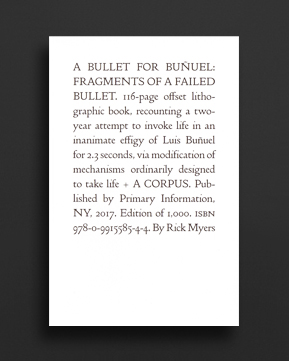
A Bullet for Buñuel: Fragments of a Failed Bullet documents Rick Myers’ attempt to complete a project begun by the late filmmaker Luis Buñuel: to create a bullet possessing such a weak charge that it would simply bounce off the filmmaker’s shirt when fired at him. Consulting with the estate and sources ranging from online forums for bullet makers to a ballistics lab associated with the United States Secret Service, Myers sought to make the bullet and fire it at a shirt that had been worn by Buñuel. While trying to bring this absurdist endeavor to completion, the artist was met with a colorful cast of characters and failures at almost every turn.
A Bullet for Buñuel has taken many forms—a video work, a multiple, and a performative lecture—all of which are represented in this publication. Myers’ writing, research, correspondence, and photographs are also included in the book, which synthesizes years of work into a singular meditation on the poetics of failure.
Rick Myers is a Manchester-born artist and publisher living in Massachusetts. Myers works in a variety of media including video, installation, and drawing in addition to producing artists’ books and editions. He has recently had solo exhibitions at The Poetry Library at Southbank Centre and The Book Library at The Courtauld Institute of Art, London; Printed Matter, New York; and White Columns, New York.
2016, English
Softcover (w. dust jacket), 96 pages, 21 x 26 cm
Published by
True Belief / Melbourne
$40.00 $2.00 - In stock -
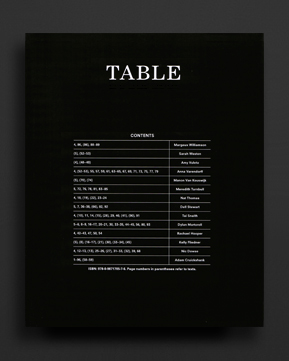
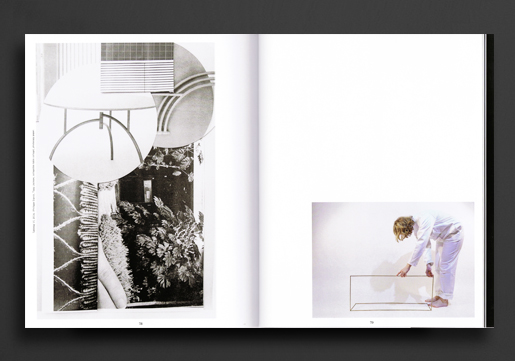
Table is a Melbourne publication edited by Dell Stewart and published by True Belief, collecting texts, artworks, photography and other contributions from Margaux Williamson, Sarah Weston, Amy Vuleta, Anna Varendorff, Manon Van Kouswijk, Meredith Turnbull, Nat Thomas, Dell Stewart, Tai Snaith, Dylan Martorell, Rachael Hooper, Kelly Fliedner, Nic Dowse, and Adam Cruickshank.
As New, some shelf wear.
2017, English
Softcover (over-sized), 144 pages, 25 x 37 cm
Published by
Encens / Paris
$58.00 $15.00 - Out of stock
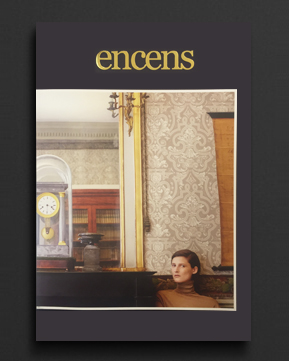
encens is a fashion magazine from France, presenting a very selective number of designers, edited by Samuel Drira and Sybille Walter.
encens 38 "A Matter of Fact" (2017) features Bless, Helmut Lang, Nehera, Chanel, Jean-Paul Gaultier, Bill Gibb, Maryse Gaspard, Joan Juliet Buck, Marie Piovesan, Claudia Huidobro, Camille Bidault Waddington, Loc Boyle, Ellen von Unwerth, Comme des Garçons, Peter Lindbergh, Barbara Bloom, Francesco Brigida, Serge Lutens, Yohji Yamamoto, Juun J, Lutz Huelle, Pierre Cardin, Y/Project, Celine, Lemaire, Saint Laurent, Vivienne Westwood, Ralph Lauren, Lucio Vanotti, Hed Mayner, Dusan, Marithe & Françoise Girbaud, Vetements, Hermes, Dries Van Noten, Vetements x Brioni, Veronique Leroy, Issey Miyake Plantation, Uma Wang, Ann Demeulemeester, Heider Ackermann, Azzadine Alaia, Luc Delahaye, Paul Nougé, Pavel Büchler, Nina Chua, Xanti Schawinsky, and many more.
Cover by Francesco Brigida.
1965, English
Hardcover (cloth), 292 pages,
1st Edition, Out of print title / used / very good
Published by
Reinhold
New York
$110.00 - Out of stock
Stunning, large-format, cloth-covered first edition of "Trademarks and Symbols of the World" by Japanese designer/art director Yusaku Kamekura, published by Reinhold in 1965.
Opening with a preface by Paul Rand, this huge book includes 763 designs (many uncommon and undocumented elsewhere) designed between 1955-1965, including work by Saul Bass, Max Bill, Wim Crouwel, Robert Brownjohn, Otl Aicher, Ivan Chermayeff, Karl Gerstner, Max Huber, Lester Beall, John Buckland Wright, Chermayeff & Geismar, John Buckland Wright, Raymond Loewy, Paul Klee, and hundreds more. Lavishly designed (with the graphic entries arranged in a rhythm Kamekura hoped would create "a visual essay in an international language") and beautifully printed in Japan in b/w and colour. Largely wordless, the book places emphasis on the international visual language of the symbol. Includes detailed design credits as well as a full index of all designers and client featured. A beautiful production.
Born in the Niigata prefecture in Japan and a student of the Institute of New Architecture and Industrial Arts, Yusaku Kamekura started his design career at the publishing company Nippon Kaupapu, combining the influences of the Bauhaus with insight to his traditional heritage, his work was recognized for its colourfully minimalist approach.
He co-founded the Nippon Design Centre in 1960 with Ikko Tanaka and as its director succeeded in bringing together graphic designers and industry at a period when Japanese business was deeply influenced by Western ideas. He designed posters, books, magazines, corporate symbols, logos, street signs and packaging. His work is distinguished by its dynamic composition, technical expertise and visual inventiveness, making full use of photography, colour and geometric elements. Outside Japan, his best-known designs are his posters for the 1964 Tokyo Olympic Games and for Expo ‘70 in Osaka. , which won several national and international design awards.
2017, English
Softcover, 270 pages, 15.2 x 22.9 cm
Published by
The MIT Press / Massachusetts
$55.00 - Out of stock
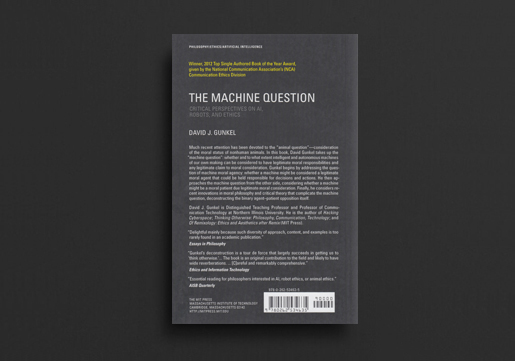
One of the enduring concerns of moral philosophy is deciding who or what is deserving of ethical consideration. Much recent attention has been devoted to the "animal question"—consideration of the moral status of nonhuman animals. In this book, David Gunkel takes up the "machine question": whether and to what extent intelligent and autonomous machines of our own making can be considered to have legitimate moral responsibilities and any legitimate claim to moral consideration.
The machine question poses a fundamental challenge to moral thinking, questioning the traditional philosophical conceptualization of technology as a tool or instrument to be used by human agents. Gunkel begins by addressing the question of machine moral agency: whether a machine might be considered a legitimate moral agent that could be held responsible for decisions and actions. He then approaches the machine question from the other side, considering whether a machine might be a moral patient due legitimate moral consideration. Finally, Gunkel considers some recent innovations in moral philosophy and critical theory that complicate the machine question, deconstructing the binary agent–patient opposition itself.
Technological advances may prompt us to wonder if the science fiction of computers and robots whose actions affect their human companions (think of HAL in 2001: A Space Odyssey) could become science fact. Gunkel’s argument promises to influence future considerations of ethics, ourselves, and the other entities who inhabit this world.
About the Author
David J. Gunkel is Distinguished Teaching Professor and Professor of Communication Technology at Northern Illinois University. He is the author of Hacking Cyberspace, Thinking Otherwise: Philosophy, Communication, Technology and Of Remixology: Ethics and Aesthetics After Remix (MIT Press).
2017, English
Hardcover, 288 pages, 16.5 x 23.8 cm
Published by
The MIT Press / Massachusetts
$69.00 - Out of stock
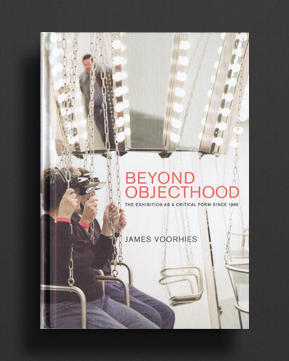
In 1968, Robert Smithson reacted to Michael Fried's influential essay "Art and Objecthood" with a series of works called non-sites. While Fried described the spectator's connection with a work of art as a momentary visual engagement, Smithson's non-sites asked spectators to do something more: to take time looking, walking, seeing, reading, and thinking about the combination of objects, images, and texts installed in a gallery. In Beyond Objecthood, James Voorhies traces a genealogy of spectatorship through the rise of the exhibition as a critical form -- and artistic medium. Artists like Smithson, Group Material, and Michael Asher sought to reconfigure and expand the exhibition and the museum into something more active, open, and democratic, by inviting spectators into new and unexpected encounters with works of art and institutions. This practice was sharply critical of the ingrained characteristics long associated with art institutions and conventional exhibition-making; and yet, Voorhies finds, over time the critique has been diluted by efforts of the very institutions that now gravitate to the "participatory." Beyond Objecthood focuses on innovative figures, artworks, and institutions that pioneered the exhibition as a critical form, tracing its evolution through the activities of curator Harald Szeemann, relational art, and New Institutionalism. Voorhies examines recent artistic and curatorial work by Liam Gillick, Thomas Hirschhorn, Carsten Holler, Maria Lind, Apolonija Sustersic, and others, at such institutions as Documenta, e-flux, Manifesta, and Office for Contemporary Art Norway, and he considers the continued potential of the exhibition as a critical form in a time when the differences between art and entertainment increasingly blur.
James Voorhies is a curator and art historian of modern and contemporary art. He is Dean of Fine Arts and Associate Professor at California College of the Arts in San Francisco.
1989, English / French
Softcover, 56 pages, 28 x 22 cm
1st Edition, Out of print title / used / very good
Published by
CAPC / Bordeaux
$35.00 - Out of stock
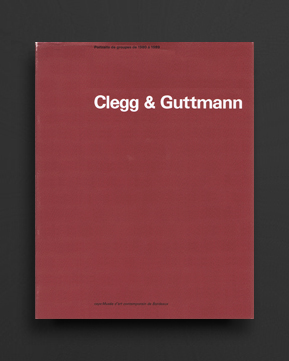
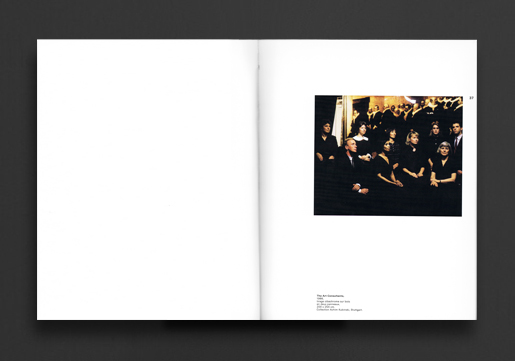
Great Clegg & Guttmann catalogue published on the occasion of a solo exhibition at Capc Musée d'art contemporain, 10 march - 23 april 1989. Heavily illustrated in colour throughout with fine examples of Clegg & Guttmann's portraits (many across large landscape fold-out spreads), their work is here accompanied by an essay by Regis Durand and wrapped in a brick-red french fold cover. First edition.
The artist duo Clegg & Guttmann (both born in 1957, in Dublin and Jerusalem), went to New York in 1978 to study at the School of Visual Arts under Joseph Kosuth. Both have been working together since 1980 across the fields of photography, cinema and installation with a notion of art that can be understood as a “social communicative” process, whereby they not only engage with specific urban spaces, but the structure of publicity itself. This aspect of the work became more evident when the work was expanded to include "Social Sculptures" (installations and sculptures that actively draw the recipient into the process) as well as "Spontaneous Operas" (process-oriented events).
Nevertheless their photographic portraits from the early 1980’s, are arguably their most significant artistic medium. The single portraits, the photographs of couples, and corporate group portraits belong up to this day to the most important artistic contributions within this genre.
Clegg & Guttmann investigate the modalities of portraiture; questions such as how do the commissioned portraits with all their constructed poses, positions, gestures, sceneries and accessories contribute to the construction of the language of power while the generic portraits continue the tradition of the comédie humaine.
1968, English
Softcover, 160 pages, 273 x 206 cm
Out of print title / used*,
Published by
Corgi / London
$65.00 - Out of stock
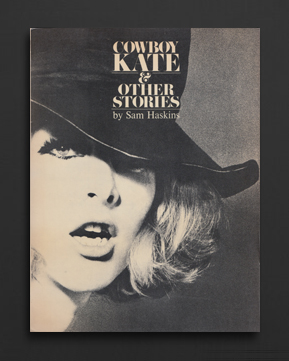
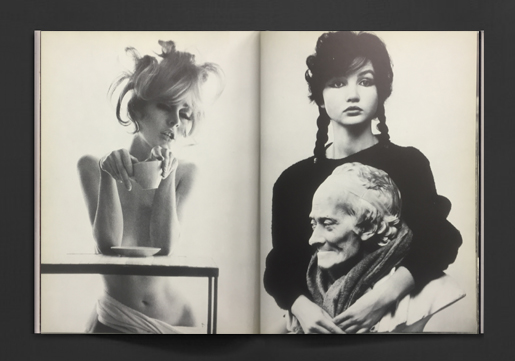
When photographer Sam Haskins published this, his most famous book, "Cowboy Kate and Other Stories", in 1964, it was a pioneering work of printed photography, blending an extended visual narrative, subtly erotic nudity with an artful use of black-and-white tones and photographic grain as a medium for expression and image design. Together with his first book "Five Girls" (1962), "Cowboy Kate and Other Stories" explored a fresh approach to photographing the nude female figure and contained important first explorations with black-and-white printing, cropping and book design. A landmark, iconic book of the 1960s, it sold roughly a million copies worldwide and won the Prix Nadar in France in 1964. It continues to influence contemporary photographers, film makers, fashion designers and make-up artists today and in 2005 the International Center of Photography in New York included the book in their exhibition The Open Book: A History of the Photographic Book from 1878 to the Present.
This is an early English reprint from 1968.
Sam Haskins was a British photographer, born and raised in South Africa. He started his photographic career in Johannesburg and moved to London in 1968 where he worked as a commercial photographer. Haskins is best known for his contribution to nude photography, in-camera image montage, and his books, the most influential of which were Five Girls (1962), Cowboy Kate (1964) and Haskins Posters (1973). Haskins moved to Australia in the early 2000s where he remained until his passing in 2009.
1988, English
Hardcover (w. dust jacket), 96 pages (47 Color & 350 b&w ill.), 250 x 280 mm
1st Edition, Out of print title / used*,
Published by
Harry N. Abrams / New York
$40.00 - Out of stock
What is a chair? More than 300 designers, architects, and furniture makers from around the world attempted to answer that question when they submitted chairs to an exhibition sponsored by The Architectural League of New York in 1986. Made from all manners of materials--steel, fabric, wood, plastic, aluminum, fiberglass--and running from serious solitary utilitarian seats to whimsical models, the range and variety of the designer's answers, all 397 of them illustrated here, are truly stunning.
Opening with American critic and philosopher Arthur C. Danto's essay "The Seat of the Sole", this handsomely designed volume, printed and bound in Japan, features an incredible photographic survey of eclectic chairs from the early 1980s. Amongst them appears Mario Bellini, Enzo Mari, Phillipe Starck, Vignelli designs, Michael Graves, Herman Miller, Ward Bennett, Stomu Miyazaki, Alan Buchsbaum, Knoll, Michele De Lucchi, Marco Zanini, Robert Venturi and Denise Scott Brown, Emilio Ambasz, Kazuo Kawasaki, Richard Meier, Herbert and Jutta Ohl, Simon Desanta, Vitra Seating, Shigeru Uchida, Giancarlo Piretti, Thonet Industries, Memphis Milano, Hartmut Lohmeyer, to name but a few.
1978, English
Hardcover (w. dust jacket), 286 pages, 26 x 26 cm
1st Edition, Out of print title / Used*,
$40.00 - Out of stock
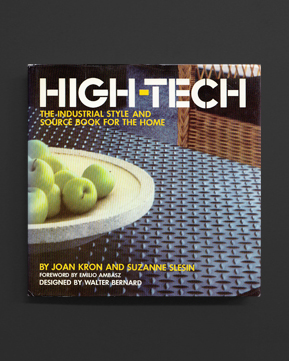
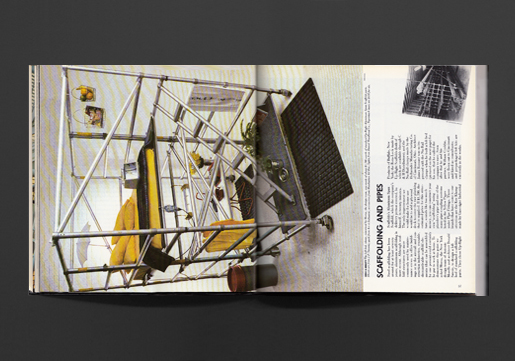
"HIGH-TECH: The Industrial Style and Source Book for the Home" is, as the title suggests, THE resource book on HIGH-TECH. Published in 1978, this is the first printing of this amazing and influential design book. "How to outfit your home with paraphernalia originally developed for factories, battleships, dry cleaners, laboratories, Chinese restaurants, and hundreds of other commercial and industrial uses." "Gym lockers in the bedroom, factory lamps over the dining table, detection mirrors over the dressing table, movers' pads for upholstery, Con Ed guardrails for towel racks, I beams for end tables, steno chairs for dining chairs, supermarket doors swinging into the kitchen, warehouse shelving in the living room, scaffolding beds, test tubes for bud vases -- something exciting is happening in home furnishings and it's called high-tech. If you haven't heard about it yet, you will soon. And its meaning will soon become as familiar as art deco or art nouveau. A play on the words "high-style" and "technology", "high-tech" is a term being used in archtectural circles to describe an increasing number of residences and public buildings with a nuts-and-bolts-exposed-pipes technological look or to describe residences made of prefabricated components more commonly used to build warehouses or factories. Authors Joan Kron and Suzanne Slesin, two infuential home-furnishings reporters, have expanded this definition to include a parallel trend in interior design -- the use of commonplace commercial and industrial equipment in the home. HIGH-TECH is a breakthrough book about a revolution in design that is sweeping the country -- in fact, the world. It is the first in-depth look at the industrial aesthetic as applied to architecture and home furnishings."
Richly illustrated across 286 pages that showcase applications of industrical and technological components to residential interiors and home furnishing, the contents include: "THE INDUSTRIAL AESTHETIC"; "STRUCTURAL ELEMENTS"; "SYSTEMS"; "STORAGE"; "FURNITURE"; "MATERIALS"; "LIGHTING"; "THE WORKS"; "FINISHING TOUCHES", covering everything from Display Systems, Mezzanines and Greenhouses, to Embossed Metals, Laboratory Glass and Food Preparation devices.
Includes the work of Sir Joseph Paxton, George Fred Keck, Pierre Chareau, Charles and Ray Eames, Michael Hopkins, Helmut Schulitz, Peter de Bretteville, Ward Bennett, Joseph Paul D'Urso, Richard Rogers, Renzo Piano, Michael Schnaible, Michael Graves, to name but a few. Edited by Joan Kron and Suzanne Slesin, both influential American reporters on home furnishings with The New York Time, Esquire, Industrial Design, Abitare, and Domus, amongst others. Introduction by Emilio Ambasz, prize-winning architect and designer, and curator of design at the Museum of Modern Art. Design by Walter Bernard, who was art director of Time magazine and New York magazine.
Printed in Italy.
This is the first printing of this book from 1978.
1987, English
Hardcover (w. dustjacket), 456 pages, 22.3 x 17.5 cm
1st Edition, Out of print title / used / very good
Published by
October Books / New York
The MIT Press / Massachusetts
$95.00 - Out of stock
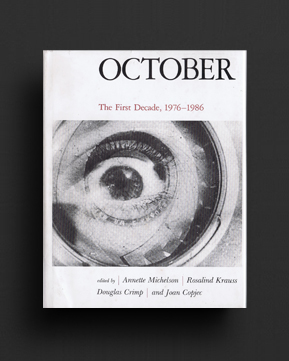
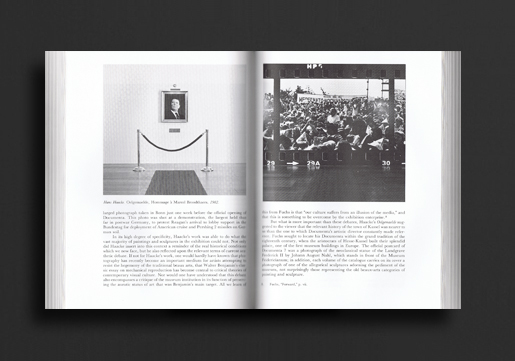
First edition of the heavy "OCTOBER: The First Decade, 1976 - 1986", which brings together a selection of some of the most important and representative texts, many from issues long out of print, that have appeared in one of the foremost journals in art criticism and theory - October.
Contributors include Rosalind Krauss, Sergei Eisenstein, Peter Handke, Georges Didi-Huberman, Mary Ann Doane, and Hans Haacke. Their essays are organized under the categories of "the index, historical materialism, the critique of institutions, psychoanalysis, rhetoric, and the body." -- publisher's statement.
Texts by Annette Michelson, Rosalind Krauss, Douglas Crimp, Joan Copjec, Nadar, Georges Didi-Huberman, Roger Caillois, Benjamin H.D. Buchloh, Sergei Einstein, Maria-Antonietta Macciocchi, Rosalyn Deutsche, Cara Gendel Ryan, Yve-Alain Bois, Daniel Buren, Louise Lawler, Christopher Philips, Homi Bhabha, Mary Ann Doane, Joel Fineman, Babette Mangolte, Peter Handke, Anette Michelson, Georges Bataille, Hollis Frampton, Robert Morris, Hans Haacke, and Trisha Brown.
"October is among the most advanced journals of the 1970s and 1980s in the fields of art theory, criticism, history, and practice. [Its editors] are intimately familiar with the cultural and political avant-garde of Europe and the U.S. and are able to attract its best thinkers.... Few, if any, journals could receive a higher recommendation."—Choice
1968, English / Italian / French / German
Hardcover (cloth), 206 pages, 31.7 × 21.7 cm
1st Edition, Out of print title / used / good
Published by
Carlo Bestetti / Italy
$100.00 - Out of stock
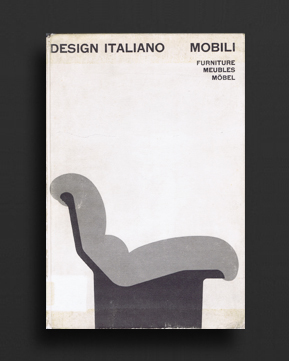
Stunning, scarce hardcover book designed by Bruno Munari and published in 1968. First, only edition.
DESIGN ITALIANO : MOBILI, FURNITURE, MEUBLES, MOBEL handsomely compiles the work of modern Italian furniture designers of the 1960's, including Mario Bellini, Angelo Mangiarotti, Archizoom, Ettore Sottsass, Joe Colombo, Gae Aulenti, Tobia Scarpa, Bruno Munari, Kazuhide Takahama, Gio Ponti, and many more, all laid out with Munari's impeccable approach to composition and texture, echoing the object designs themselves.
All text in four languages: English, Italian, French, German.
Bruno Munari (1907-1997) was a leading Italian graphic designer, illustrator, painter, sculptor, photographer, exhibition designer, and industrial designer.
*Condition - Average-Good (cover and spine worn with some chipping and tanning, with ex-library stamping and cards to endpapers, otherwise internally a very good copy throughout)
2016, English
Hardcover, 192 pages, 30. 5 x 23.5 cm
Out of print title / as new
Published by
Koenig Books / London
Studio Voltaire / London
$120.00 - Out of stock
Now out of print.
Kantarovsky’s practice encompasses painting, drawing, sculpture and occasionally film. His signature works often have thinly applied, wiped, or scraped layers of paint, and feature narrative scenes populated by isolated, sinewy figures. His paintings frequently include indirect sociopolitical commentary and a critical look at the idea of the suffering artistic genius. The publication, his first monograph will feature a selection of recent works alongside his Studio Voltaire commission, Apricot Juice. A collaboration between Kantarovsky and Lithuanian-born performance artist leva Misevičiūtė, Apricot Juice was devised around two distinct parts – a language and movement based performance by Misevičiūtė and a group of five largescale paintings by Kantarovsky. The point of departure for the collaborative project was Mikhail Bulgakov’s enigmatic masterpiece novel The Master and Margarita, a narrative woven around a visit by the Devil to the aggressively atheist Soviet Union.
2017, English
Softcover, 176 pages, 12.9 x 19.8 cm
Published by
Penguin Books / London
$25.00 - Out of stock
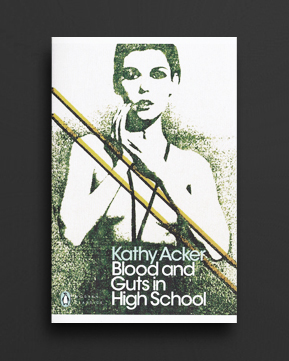
'Acker gives her work the power to mirror the reader's soul' - William S. Burroughs
'Kathy Acker's writing is virtuoso, maddening, crazy, so sexy, so painful, and beaten out of a wild heart that nothing can tame. Acker is a landmark writer' - Jeanette Winterson
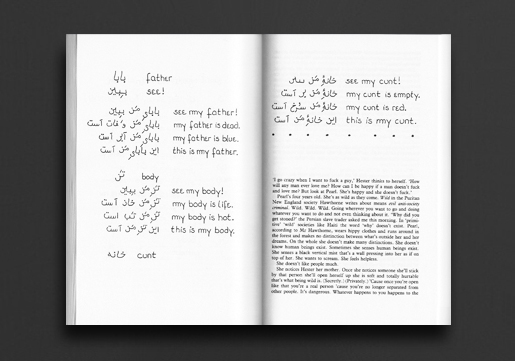
This is the story of Janey, who lived in a locked room, where she found a scrap of paper and began to write down her life. It's a story of lust, sex, pain, youth, punk, anarchy, gangs, the city, feminism, America, Jean Genet and the prisons we create for ourselves. A heady, surreal mash-up of coming-of-age tale, prose, poetry, plagiarism and illustration, Kathy Acker's breakthrough 1984 novel caused huge controversy and made her an avant-garde literary icon.Published to coincide with the 20th anniversary of Kathy Acker's untimely death, Blood and Guts in High School is published for the first time in Penguin Classics, acknowledging the profound impact she has had on our culture, and alongside the authors her work pulsates with the influence of: William S. Burroughs, Cervantes and Charles Dickens, among others.
2016, English
Softcover, 288 pages, 13 x 20 cm
Published by
Serpent's Tail / London
$32.00 - Out of stock
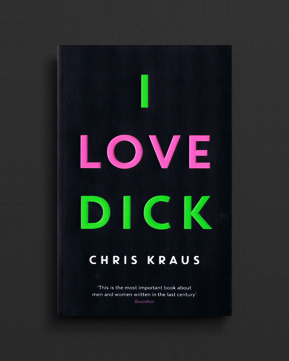
New 2016 edition of Chris Kraus' "I Love Dick" (1997, Semiotext(e))
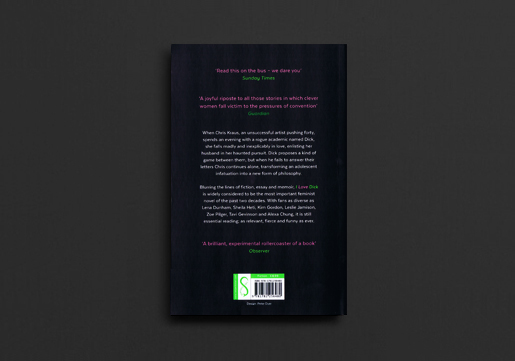
When Chris Kraus, an unsuccessful artist pushing 40, spends an evening with a rogue academic named Dick, she falls madly and inexplicably in love, enlisting her husband in her haunted pursuit. Dick proposes a kind of game between them, but when he fails to answer their letters Chris continues alone, transforming an adolescent infatuation into a new form of philosophy. Blurring the lines of fiction, essay and memoir, Chris Kraus's novel was a literary sensation when it was first published in 1997. Widely considered to be the most important feminist novel of the past two decades, I Love Dick is still essential reading; as relevant, fierce and funny as ever.
2017, English / German
Softcover, 144 pages, 21 x 28.2 cm
Published by
Künstlerhaus Graz / Graz
Sternberg Press / Berlin
$38.00 - Out of stock
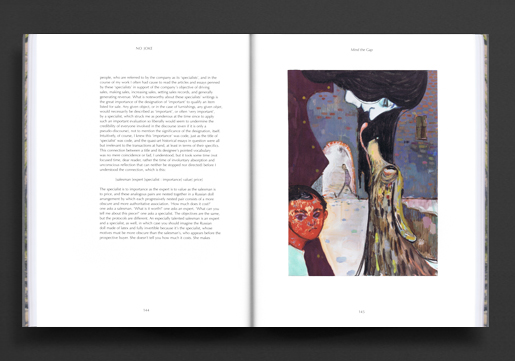
Edited by Sandro Droschl, Künstlerhaus, Halle für Kunst & Medien, Graz
Texts by Kerstin Stakemeier, Helmut Draxler
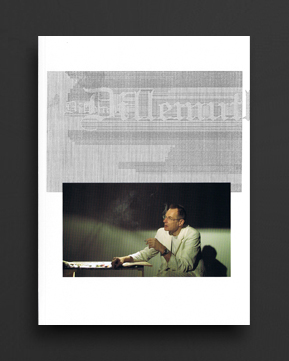
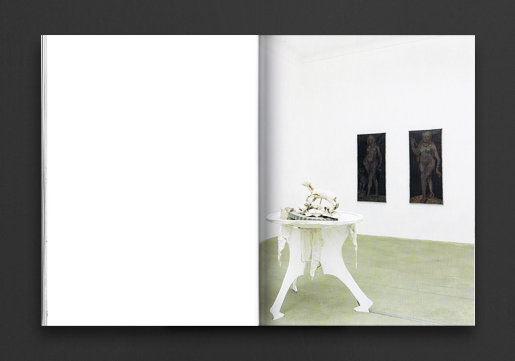
This catalogue illustrates Stephan Dillemuth’s elaborate solo show at the Künstlerhaus, Halle für Kunst & Medien, Graz, through installation photographs as well as texts by art historian Kerstin Stakemeier and theorist Helmut Draxler. The exhibition presented newly conceived works alongside works from the 1980s exhibited for the first time. Dillemuth’s paintings, sculptures, video projections, and assemblages are brought together as a theatrical social group. Plaster-cast limbs appear unexpectedly from the ceiling, enmeshed within clock cogs or combined with boars’ heads, cattle ears, and deer feet. Dillemuth’s Bayernbilder (1979) were inspired by sentimental and trivial postcard motifs from Bavarian spa towns. In Schönheitsgalerie (1985), featuring over fifty works, Dillemuth explores questions of representation. His gallery turns against the idea of external beauty and how it is represented in art. The paintings, like the faces, develop a life of their own through the process of painting, which makes it possible to see a new kind of “beauty.” Works that Dillemuth produced in the late 1980s in Chicago, exhibited for the first time, resemble disco decorations, and glitter in the light of a video projection. Is disco a “theater of cruelty”—an ecstatic place where all images, whether ugly or beautiful, mean or seductive, are transcendent?
Addressing the question of the role of the artist in society, Dillemuth challenges the contemporary imperative that artists, as exemplars of individuality, are required to have a distinct authorial identity. Despite a history of working collaboratively and prioritizing artistic research, at the Künstlerhaus Dillemuth exposes himself as a solo artist, reconstructing the history of his work from the margins of group life that has taken shape in the midst of it. Here he reveals the consistency of the farce of his ego, the heroic yet bad-mannered delinquent artist subject. Dillemuth presents his aging body for all to see, playing with the boundaries between inside and outside, institution and alternative, and life and form.
Design by Martin Schmidl
2017, English
Softcover, 280 pages, 17 x 24 cm
Published by
Fundació Antoni Tàpies / Barcelona
Thyssen-Bornemisza Art Contemporary / Vienna
Sternberg Press / Berlin
$49.00 - Out of stock
Edited by Daniela Zyman, Cory Scozzari
Contributions by Nabil Ahmed, Keller Easterling, Carles Guerra Rojas, Celina Jeffery, Laleh Khalili, Rosa Lleó, Gabriele Mackert, Jegan Vincent de Paul, Allan Sekula, Sally Stein, Daniela Zyman
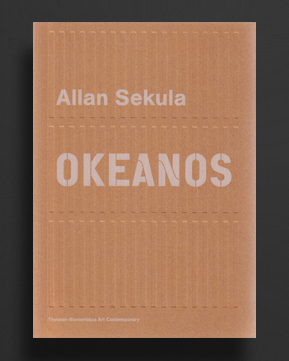
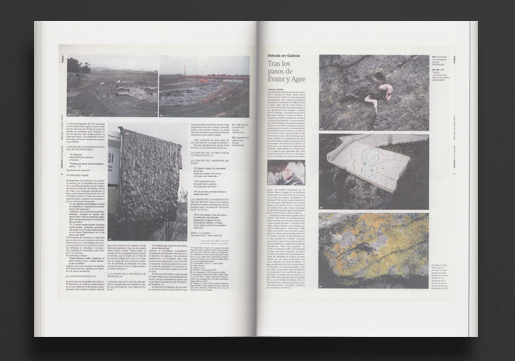
This publication intersperses essays from scholars, historians, and thinkers with a selection of Allan Sekula’s seminal texts and excerpts from his private notebooks. The title is a reference to Okeanos—son of Gaia, the Greek goddess of the earth—who ruled over the oceans and water. Made and written across the decades, Sekula’s sketches and texts focus on maritime space and the material, economic, and ecological implications of globalization. In projects such as his magnum opus Fish Story (1989–95), or films like Lottery of the Sea (2006) and The Forgotten Space (2010), Sekula provided a view from and of the sea. This publication expands on these oceanic themes, seeking to honor the scope and complexity of the late artist-theorist’s work, and situate his ideas in current political, social, and environmental discourses.
The book is divided thematically: the section “Containerization” focuses on the sea as a site of infrastructural complication; Sekula’s work Black Tide / Marea negra (2002–3) is also revisited, which explores environmental violence and contamination as well as their social implications; a selection from Sekula’s personal drawings are accompanied by an essay by photo historian Sally Stein; various essays readdress Sekula’s legacy in the age of the Anthropocene; and a number of case studies by contemporary artists, writers, and thinkers examine ideas that overlap with Sekula’s and expand on his interests.
Design by Kristin Metho