World Food Books' programme is largely produced on Kulin Nation land. We acknowledge the Wurundjeri people of the Kulin Nation as the first and continuing custodians of this land, and pay respect to their Elders past, present, and emerging.
World Food Books is an arts and special interests bookshop in Naarm / Melbourne. Founded in 2010, World Food Books is devoted to the presentation of a rotating, hand-selection of international art, design, literary and counterculture publications with an emphasis on the anti-traditional, the experimental, the avant-garde, the heretic, the marginal.
Presenting new titles alongside rare and out-of-print books, catalogues and journals spanning the fields of modern and contemporary art, design, photography, illustration, film, literature, poetry, cultural theory, philosophy, sexuality, popular and underground culture in its many radical forms, World Food Books wishes to encourage adventurous, thoughtful and open-minded reading, looking, writing, and exchange of publishing and ideas, both current and historical.
As well as our bookshop, located in Melbourne's historical Nicholas Building, all of our inventory is available internationally via our online mail-order service.
World Food Books semi-regularly co-ordinates "Occasions", a programme of exhibits and events at the bookshop and in partnership with other hosts (such as museums and art galleries) that develop out of the activities, relationships and content of the bookshop itself.
World Food Books
The Nicholas Building
37 Swanston Street
Room 5, Level 6
Melbourne 3000
Australia
SHOP HOURS:
Thu–Fri 12–6, Sat 12–5
WEB-SHOP OPEN 24/7
World Food Books
Postal Address:
PO Box 435
Flinders Lane
Victoria 8009
Australia
Art
Theory / Essay
Architecture / Interior
Graphic Design / Typography
Photography
Fashion
Eros
LGBTQ+
Fiction / Poetry
Weird / Speculative / Science Fiction / Horror
Transgressive / Visceral / Abject
Symbolism / Decadence / Fin de siècle
Film / Video
Painting
Sculpture / Installation
Performance / Dance / Theater
Drawing
Sound / Music
Curatorial
Group Shows / Collections
Periodicals
Out-of-print / Rare
Posters / Ephemera / Discs
Signed Books
World Food Books Gift Voucher
World Food Book Bag
Australian Art
Australian Fiction
Australian Science Fiction / Speculative Fiction
Australian Poetry
Australian Photography
Japanese Photography
Conceptual Art
Minimal Art
Dada
'Pataphysics / Oulipo
Fluxus
Concrete Poetry
Pop Art
Surrealism
Arte Povera
Arte Informale / Haute Pâte / Tachism
Nouveau Réalisme / Zero / Kinetic
Situationism / Lettrism
Collage / Mail Art / Xerox Art
Art Brut / Folk / Visionary / Fantastic
Illustration / Graphic Art / Bandes Dessinées
Furniture
Italian Radical Design / Postmodernism
Textiles
Ceramics / Glass
Counterculture
Protest / Revolt
Philosophy
Psychoanalysis
Anthropology
Anarchism
Socialism / Anarchism / Communism / Capitalism
Literary Theory / Semiotics / Language
Feminism / Women's Studies
Gender Studies / Sexuality
Anthropology
Fetishism / BDSM
Drugs / Psychedelia
Crime / Violence
Animal Rights / Veganism
Occult / Esoterica
Ecology / Earth / Alternative Living
Whole Earth / Crafts
All prices in AUD (Australian dollars)
Pick-Ups
Pick-up orders can be collected in our bookshop during opening hours after order date. Please collect any Pick-up orders within 2 weeks of ordering as we have limited storage space. Orders will be released back into stock if not collected within this time. No refunds can be made for pick-ups left un-collected. If you cannot make it in to the bookshop in this time-frame, please choose postage option.
Return Policy
All sales are final. We do accept returns (for refund or exchange) for items received in error. All our orders are packed with special care using heavy-duty padding and cardboard book-mailers or bubble mailers (for smaller books), using reinforcement where required. We cannot take responsibility for any lost, stolen or damaged parcels.
Insurance
Should you wish to insure your package, please email us directly after placing your order and we can organise this at a small extra expense. Although all standard/express tracked packages are very safe and dependable, we cannot take responsibility for any lost, stolen or damaged parcels. We recommend insurance on valuable orders.
Interested in selling your old books, catalogues, journals, magazines, comics, fanzines, ephemera? We are always looking for interesting, unusual and out-of-print books to buy. We only buy books in our fields of interest and specialty, and that we feel we can resell.
We base these prices on desirability, market value, in-print prices, condition and our current stock levels. We offer cash, store credit, and can take stock on consignment. All
about 25% of the price we expect to get when we sell them, or 30% in store credit. We base these prices on desirability, market value, in-print prices, condition and our current stock levels.
Sell your books any day of the week. You can drop them off and return later. If you have a lot of books, we can visit your Sydney home.
We buy books that we feel we can resell. We offer about 25 % of the price we expect to get when we sell them, or 30% in store credit. We base these prices on desirability, market value, in-print prices, condition and our current stock levels.
Philadelphia Wireman
03 August - 01 September, 2018
World Food Books is proud to announce our next Occasion, the first presentation of sculptures by Philadelphia Wireman in Australia.
The Philadelphia Wireman sculptures were found abandoned in an alley off Philadelphia’s South Street on trash night in 1982. Their discovery in a rapidly-changing neighbourhood undergoing extensive renovation, compounded with the failure of all attempts to locate the artist, suggests that the works may have been discarded after the maker’s death. Dubbed the "Philadelphia Wireman" during the first exhibition of this work, in 1985, the maker’s name, age, ethnicity, and even gender remain uncertain. The entire collection totals approximately 1200 pieces, all intricately bound together with tightly-wound heavy-gauge wire (along with a few small, abstract marker drawings, reminiscent both of Mark Tobey and J.B. Murry). The dense construction of the work, despite a modest range of scale and materials, is singularly obsessive and disciplined in design: a wire armature or exoskeleton firmly binds a bricolage of found objects including plastic, glass, food packaging, umbrella parts, tape, rubber, batteries, pens, leather, reflectors, nuts and bolts, nails, foil, coins, toys, watches, eyeglasses, tools, and jewellery.
Heavy with associations—anthropomorphic, zoomorphic, and socio-cultural responses to wrapped detritus—the totemic sculptures by Philadelphia Wireman have been discussed in the context of work created to fulfil the shamanistic needs of alternative religions in American culture. Curators, collectors, and critics have variously compared certain pieces to sculpture from Classical antiquity, Native American medicine bundles, African-American memory jugs, and African fetish objects. Reflecting the artist’s prolific and incredibly focused scavenging impulse, and despite—or perhaps enhanced by—their anonymity, these enigmatic objects function as urban artefacts and arbiters of power, though their origin and purpose is unknown. Philadelphia Wireman, whatever their identity, possessed an astonishing ability to isolate and communicate the concepts of power and energy through the selection and transformation of ordinary materials. Over the course of the past two decades, this collection has come to be regarded as an important discovery in the field of self-taught art and vernacular art.
Presented in collaboration with Fleisher-Ollman Gallery, Philadelphia, and Robert Heald, Wellington.
Susan Te Kahurangi King
02 February - 10 March, 2018
Susan Te Kahurangi King (24 February 1951 - ) has been a confident and prolific artist since she was a young child, drawing with readily available materials - pencils, ballpoint pens and felt-tip markers, on whatever paper is at hand. Between the ages of four and six Susan slowly ceased verbal communication. Her grandparents William and Myrtle Murphy had developed a special bond with Susan so they took on caring responsibilities for extended periods. Myrtle began informally archiving her work, carefully collecting and storing the drawings and compiling scrapbooks. No drawing was insignificant; every scrap of paper was kept. The King family are now the custodians of a vast collection containing over 7000 individual works, from tiny scraps of paper through to 5 meter long rolls.
The scrapbooks and diaries reveal Myrtle to be a woman of great patience and compassion, seeking to understand a child who was not always behaving as expected. She encouraged Susan to be observant, to explore her environment and absorb all the sights and sounds. Myrtle would show Susan’s drawings to friends and people in her community that she had dealings with, such as shopkeepers and postal workers, but this was not simply a case of a grandmother’s bias. She recognised that Susan had developed a sophisticated and unique visual language and sincerely believed that her art deserved serious attention.
This was an unorthodox attitude for the time. To provide some context, Jean Dubuffet coined the term Art Brut in 1945 to describe work created by self-taught artists – specifically residents of psychiatric institutions and those he considered to be visionaries or eccentrics. In 1972 Roger Cardinal extended this concept by adopting the term Outsider Art to describe work made by non-academically trained artists operating outside of mainstream art networks through choice or circumstance. Susan was born in Te Aroha, New Zealand in 1951, far from the artistic hubs of Paris and London that Dubuffet and Cardinal operated in. That Myrtle fêted Susan as a self-taught artist who deserved to be taken seriously shows how progressive her attitudes were.
Susan’s parents Doug and Dawn were also progressive. Over the years they had consulted numerous health practitioners about Susan’s condition, as the medical establishment could not provide an explanation as to why she had lapsed into silence. Dawn educated herself in the field of homeopathy and went on to treat all twelve of her children using these principles – basing prescriptions on her observations of their physical, mental and emotional state.
Doug was a linguist with an interest in philosophy who devoted what little spare time he had to studying Maori language and culture. To some extent their willingness to explore the fringes of the mainstream made them outsiders too but it was their commitment to living with integrity and their respect for individuality that ensured Susan’s creativity was always encouraged.
Even though Susan’s family supported her artistic pursuits, some staff in schools and hospitals saw it as an impediment to her assimilation into the community and discouraged it in a variety of ways. Her family was not always aware of this and therefore did not fully understand why Susan stopped drawing in the early 1990s. However, rather than dwell on the challenges that Susan faced in pursuit of her artistic practice, they prefer to highlight her achievements. In 2008 Susan began drawing again in earnest, after an almost 20 year interruption, and her work is now shown in galleries around the world.
Susan grew up without television and has been heavily influenced by the comics she read as a child. She is absolutely fearless in the appropriation of recognizable characters, such as Donald Duck and Mickey Mouse, in her work. She twists their limbs, contorts their faces, compresses them together, blends them into complex patterned backgrounds - always imbuing them with an incredible energy. Although Susan often used pop culture characters in her work they are not naive or childlike. These are drawings by a brilliant self-taught artist who has been creating exceptional work for decades without an audience in mind.
Mladen Stilinović
"Various Works 1986 - 1999"
02 February 16 - September 10, 2016
Various works 1986 - 1999, from two houses, from the collections of John Nixon, Sue Cramer, Kerrie Poliness, Peter Haffenden and Phoebe Haffenden.
Including: Geometry of Cakes (various shelves), 1993; Poor People’s Law (black and white plate), 1993; White Absence (glasses, ruler, set square, silver spoon, silver ladel with skin photograph and wooden cubes), 1990-1996; Exploitation of the Dead (grey and red star painting, wooden painting, black spoon with red table, red plate), 1984-1990; Money and Zeros (zero tie, paintings made for friends in Australia (Sue, John, Kerrie), numbers painting), 1991-1992; Words - Slogans (various t-shirts) - “they talk about the death of art...help! someone is trying to kill me”, “my sweet little lamb”, “work is a disease - Karl Marx”; Various artist books, catalogues, monographs, videos; Poster from exhibition Insulting Anarchy; "Circular" Croatian - Australian edition; Artist book by Vlado Martek (Dostoyevsky); more.
Thanks to Mladen Stilinović and Branka Stipančić.
Jonathan Walker
Always Will Need To Wear Winter Shirt Blue + Ochre Small Check Pattern
21 August - 21 September, 2015
Untitled
I am not a great reader of poetry but I always return to the work of Melbourne poet, Vincent Buckley (1925- 1988). Perhaps I find his most tantalising piece to be not a finished poem but a fragment left on a scrap of paper discovered on his desk after the poet’s death.
The poetry gathers like oil
In the word-core, and spreads
It has its music meet,
Its music is in movement.
This fragment is more the shell left behind from a volatile thought than a finished poem. I find the last two lines honest but awkward whereas the first two lines work like an arrow. Most likely he could not find a resolution so it was left. Still, in its present form, it remains an eloquent testimony to the ultimate failure of a medium to express mobile thought and sensation, in Buckley’s case, through verbal language. It’s an important matter because this is something all artists have to deal with regardless of the medium.
I have never written a poem, however, I am forever copying fragments from books on paper scraps in a vain effort to fix certain notions in my head. At first, they function as bookmarks that are sometimes returned to when I open the book. But before long, as they accumulate, they fall out littering the table interspersed with A4 photocopies, bills, books and medications.
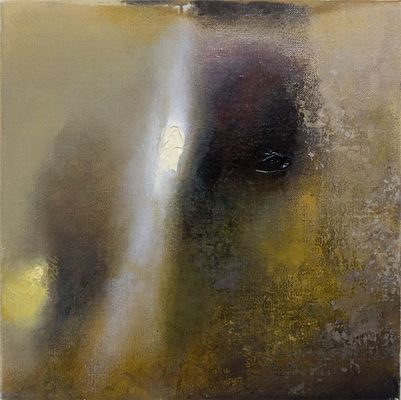
To return to Buckley’s fragment, the first two lines very much evoke how I paint nowadays. As you age, detail diminishes and patches of light become more luminous and float. I feel the most honest way of dealing with this is by smearing the oil paint on the canvas with the fingers and working close-up, blind. Only if the patches coalesce into an approaching image can the work gain a life.
-
Jonathan Walker was born in Melbourne, Australia and brought up on a dairy farm in Gippsland. In the 1970’s he studied painting at RMIT and won the Harold Wright Scholarship to the British Museum, London. During the 1980’s he exhibited at Pinacotheca Gallery, Richmond and had work shown at the NGV and Heidi City Art Gallery. Over the same period he designed the cover for the “Epigenesi” LP by Giancarlo Toniutti, Italy and conducted a mail exchange work with Achim Wollscheid, Germany. The work with artists through the post resulted in an article published in the bicentenary issue of Art and Australia 1988. He showed in artist run spaces such as WestSpace in the 90’s and 2000’s, and until 2012, taught painting at Victoria University, which is where we (Colleen Ahern and Lisa Radford) as organisers of the exhibition, among many others, had the privilege of being his student.
Walker’s knowledge was imparted to students through the careful selection of music, literature, and artists found in books that he himself had ordered for the library. Walker’s strategy was the generosity of sharing his vast knowledge with references specific to each student and their context.
Walker’s paintings share a similar focus and intimacy.
This exhibition presents a small selection of recent paintings alongside a publication that includes Walker’s writing. Observational and analytical, Walker’s work is a type of material notation — the time of day, colour and how it is blended, the both specific and fleeting location of a reflection on lino or the question of whether a chair leg should be included in a painting.
Please join us on Friday August 21 between 6-8pm to celebrate the opening of the exhibition.
Curated by Colleen Ahern and Lisa Radford.
B. Wurtz
Curated by Nic Tammens
March 26 - April 4, 2015
B.Wurtz works from a basement studio in his home on Manhattan’s Lower East Side.
This local fact is attested to by the plastic shopping bags and newsprint circulars that appear in his work. As formal objects, they don’t make loud claims about their origins but nonetheless transmit street addresses and places of business from the bottom of this long thin island. Like plenty of artists, Wurtz is affected by what is local and what is consumed. His work is underpinned by this ethic. It often speaks from a neighborhood or reads like the contents of a hamper:
“BLACK PLUMS $1.29 lb.”
“Food Bazaar”
“USDA Whole Pork Shoulder Picnic 99c lb.”
“RITE AID Pharmacy, with us it’s personal.”
“H. Brickman & Sons.”
“Sweet Yams 59c lb."
Most of the work in this exhibition was made while the artist was in residence at Dieu Donne, a workshop dedicated to paper craft in Midtown. Here Wurtz fabricated assemblages with paper and objects that are relatively lightweight, with the intention that they would be easily transportable to Australia. This consideration isn’t absolute in Wurtz’s work, but was prescriptive for making the current exhibition light and cheap. Packed in two boxes, these works were sent from a USPS post office on the Lower East Side and delivered to North Melbourne by Australia Post.
Wurtz appears courtesy of Metro Pictures, New York.
Thanks to Rob Halverson, Joshua Petherick, Sari de Mallory, Matt Hinkley, Helen Johnson, Fayen d'Evie, Ask Kilmartin, Lisa Radon, Ellena Savage, Yale Union, and "Elizabeth".
John Nixon
"Archive"
December 15 - January 20, 2014
The presentation of John Nixon's archive offered a rare showcase of this extensive collection of the artist's own publications, catalogues, posters, ephemera, editions and more, from the mid 1980s onwards, alongside a selection of his artworks.
Organized by John Nixon, Joshua Petherick and Matt Hinkley.
<a href=http://wfb.public-office.info/artist/john-nixon>All titles by John Nixon
"Habitat"
at Minerva, Sydney (organised by Joshua Petherick and Matt Hinkley)
November 15 - December 20, 2014
Lupo Borgonovo, Janet Burchill & Jennifer McCamley,
Lewis Fidock, HR Giger, Piero Gilardi, Veit Laurent Kurz,
Cinzia Ruggeri, Michael E. Smith, Lucie Stahl, Daniel Weil, Wols
Press Release:
“...It contained seven objects. The slender fluted bone, surely formed for flight, surely from the wing of some large bird. Three archaic circuitboards, faced with mazes of gold. A smooth white sphere of baked clay. An age-blackened fragment of lace. A fingerlength segment of what she assumed was bone from a human wrist, grayish white, inset smoothly with the silicon shaft of a small instrument that must once have ridden flush with the surface of the skin - but the thing’s face was seared and blackened.”
William Gibson, “Count Zero”, 1986
"Autumn Projects Archive"
Curated by Liza Vasiliou
March 6 - March 15, 2014
World Food Books, in conjunction with the Virgin Australia Melbourne Fashion Festival 2014, presented the Autumn Projects archive, consisting of a selection of early examples in Australian fashion with a particular interest in collecting designers and labels from the period beginning in the 1980’s, who significantly influenced the discourse of Australian Fashion.
Curated by Liza Vasiliou, the exhibition provided a unique opportunity to view pieces by designers Anthea Crawford, Barbara Vandenberg, Geoff Liddell and labels CR Australia, Covers, Jag along with early experimental collage pieces by Prue Acton and Sally Browne’s ‘Fragments’ collection, suspended throughout the functioning World Food Books shop in Melbourne.
H.B. Peace
presented by CENTRE FOR STYLE
November 14, 2013
"Hey Blinky, you say chic, I say same"
Anon 2013
H.B. Peace is a clothing collaboration between great friends Blake Barns and Hugh Egan Westland. Their pieces explore the divergences between 'character’ and ‘personality’ in garments....etc
Special Thanks to Joshua Petherick and Matt Hinkley of WFB and Gillian Mears
and a Very Special Thank you to Audrey Thomas Hayes for her shoe collaboration.
Janet Burchill & Jennifer McCamley
"Aesthetic Suicide"
May 10 - June 8, 2013
The first of our occasional exhibitions in the World Food Books office/shop space in Melbourne, "Aesthetic Suicide" presented a body of new and older works together by artists Janet Burchill & Jennifer McCamley, including videos, prints, a wall work, and publications.
During shop open hours videos played every hour, on the hour.
1980, English
Softcover, 102 pages, 22 x 26 cm
1st Edition, Out of print title / used*,
Published by
Knopf / New York
$70.00 - Out of stock
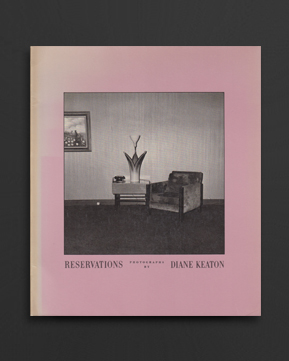
Reservations, published in 1980, is the first photographic book by Diane Keaton. Well known to most as an accomplished actress, she has a great and knowledgable interest in design and photography and since the 1980s she has published a number of collections of esoteric photography and is highly-regarded for her curatorial and editorial projects within the field.
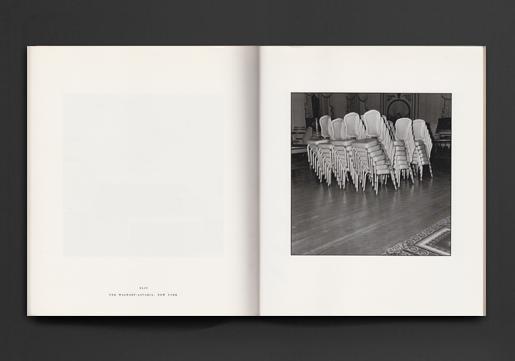
The first book of her personal photography, Reservations is a beautiful and surprising collection of images taken by Keaton in the late 1970's of lobbies and dining halls in what are mostly now long-lost luxury hotels in Miami Beach, New York City, Los Angeles, Palm Springs. This stunning series at once capture the strong, simultaneous sense of potential and still emptiness that haunts the transient, often flamboyant, yet profoundly melancholic, surroundings of the sojourner.
Daine explains, “In 1980, Knopf agreed to publish a book of my photographs of hotel lobbies, called “Reservations.” I finally had an excuse to roam around the United States with my Rolleiflex shooting the interiors of old hotels. Along the way I began collecting books like “The Family of Man.” “Diane Arbus: An Aperture Monograph.” Garry Winogrand’s “Figments From the Real World” and Lee Friedlander’s 1976 “The American Monument.”… ”
First edition.
2016, English
Softcover, 170 pages, 24 x 30 cm
Published by
Bergen Kunsthall / Norway
ICA / London
Kestner Gesellschaft / Hannover
Sternberg Press / Berlin
$46.00 - Out of stock
Edited by Mason Leaver-Yap, James Richards
Contributions by Ed Atkins, Dan Fox, Fatima Hellberg, Chris McCormack, Steve Reinke
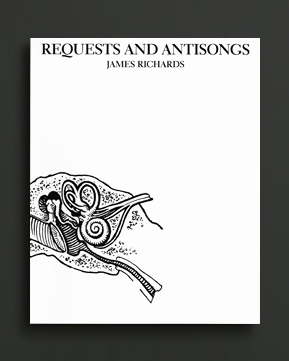
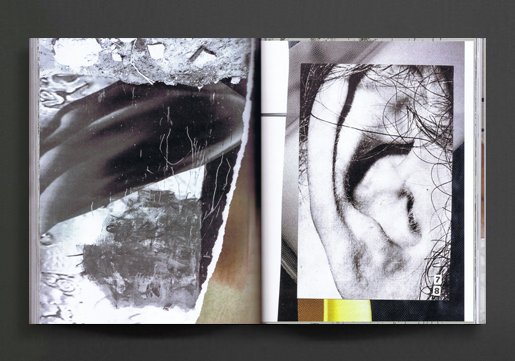
Requests and Antisongs is an artist’s book to accompany a sequence of exhibitions by James Richards held at Bergen Kunsthall, Norway; Institute of Contemporary Arts, London; and the Kestner Gesellschaft, Hanover. The book contains a series of visual essays by the artist, documentation of recent exhibitions, as well as essays by Dan Fox, Ed Atkins, Steve Reinke, Chris McCormack, and Fatima Hellberg.
In Richards’s work, images and sounds are merged into highly affective videos that combine footage from a wide range of sources to form elegant compositions. His recent projects separate these elements out again, allowing space for multichannel audio installations that combine sound in a way that is physical and spatial. The video works convene materials according to the silent rhythms and movements of the footage they contain—footage from newscasts, medical documentaries, and French erotica as well as the institutions’ own archives of video documentation—composing a lyrical meditation on the body as a site for the flow of material and sensation.
This book, the most significant publication on Richards’s work to date, is an extension of the shows, transposing the strategies of his exhibition making into the rhythm of printed matter. The artist has developed a new series of collages specially for the book, comprising promiscuous relations and dissonant juxtapositions between photographic documentation of the works in the exhibitions, the artist’s personal photographs, and found images.
Copublished with Bergen Kunsthall; Institute of Contemporary Arts, London; Kestner Gesellschaft, Hannover
Design by HIT, Berlin
2016, English
Softcover, 216 pages, 23 x 16.5 cm
Published by
Walther König / Köln
$44.00 - Out of stock
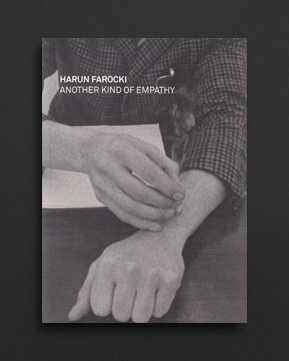
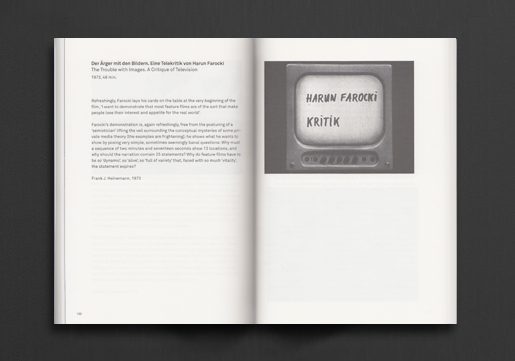
Another Kind of Empathy echoes a short essay by Harun Farocki published in 2008. In it the author set out a new approach to his film practice. He proposed a mixture of Eindringen (to penetrate) and Mitfühlen (to sympathize) as a way of leaving behind the de-romanticized attitudes of the past.
Einfühlung (Empathy) is included in this publication along with several other essays and references to his films and installations from 1966 to 2013. The extent of the material gathered in this book is a fair guide to an epic figure.
Farocki’s long and complex career is reflected in two exhibitions: What is at Stake, at IVAM Institut Valencià dʼArt Modern (20 January – 22 May 2016); and Empathy, at Fundació Antoni Tàpies, Barcelona (2 June – 16 October 2016). This catalogue is published on the occasion of both exhibitions.
2016, English
Softcover, 48 pages, 12 x 19 cm
Published by
Sternberg Press / Berlin
$28.00 $15.00 - Out of stock
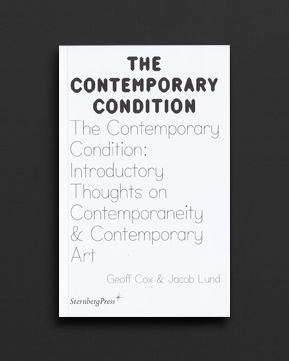
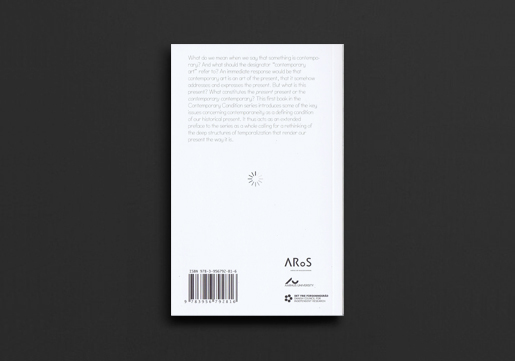
What do we mean when we say that something is contemporary? And what should the designator “contemporary art” refer to? An immediate response would be that contemporary art is an art of the present, that it somehow addresses and expresses the present. But what is this present? What constitutes the present present or the contemporary contemporary? This first book in the Contemporary Condition series introduces some of the key issues concerning contemporaneity as a defining condition of our historical present. It thus acts as an extended preface to the series as a whole, calling for a rethinking of the deep structures of temporalization that render our present the way it is.
The aim of the Contemporary Condition book series is to question the formation of subjectivity and concept of temporality in the world now. It begins from the assumption that art, with its ability to investigate the present and make meaning from it, can lead to an understanding of wider developments within culture and society. Addressing a perceived gap in existing literature on the subject, the series focuses on three broad strands: the issue of temporality, the role of contemporary media and computational technologies, and how artistic practice makes epistemic claims.
The Contemporary Condition series edited by Geoff Cox and Jacob Lund, Volume 01
Copublished with Aarhus University and ARoS Art Museum
Design by Dexter Sinister
2016, English
Softcover, 88 pages, 12 x 19 cm
Published by
Sternberg Press / Berlin
$29.00 $15.00 - Out of stock
Can we speak of composition when we are in a state of unfathomable decomposition? Art being made today defies coherent categorization, and the world presents itself, day after day, as spinning into confused chaos, structural disintegration, and violent disorder. Revising his well-known histories of contemporary art, Terry Smith argues that we must respond to the compelling need for coeval composition at a time defined by the contemporaneity of divisive difference. This book traces how—despite many obstacles—visual artists across the globe are rising to this challenge.
The second volume of the Contemporary Condition series continues the investigation into contemporaneity as a defining condition of our historical present. The series aims to question the formation of subjectivity and concept of temporality in the world now. It begins from the assumption that art, with its ability to investigate the present and make meaning from it, can lead to an understanding of wider developments within culture and society. Addressing a perceived gap in existing literature on the subject, the series focuses on three broad strands: the issue of temporality, the role of contemporary media and computational technologies, and how artistic practice makes epistemic claims.
The Contemporary Condition series edited by Geoff Cox and Jacob Lund, Volume 02
Copublished with Aarhus University and ARoS Art Museum
Design by Dexter Sinister
2016, English
Softcover, 48 pages, 12 x 19 cm
Published by
Sternberg Press / Berlin
$26.00 $15.00 - Out of stock
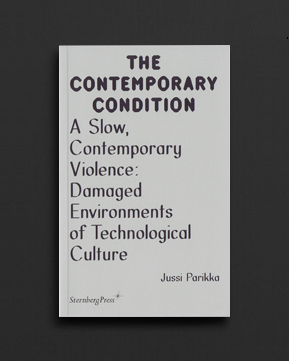
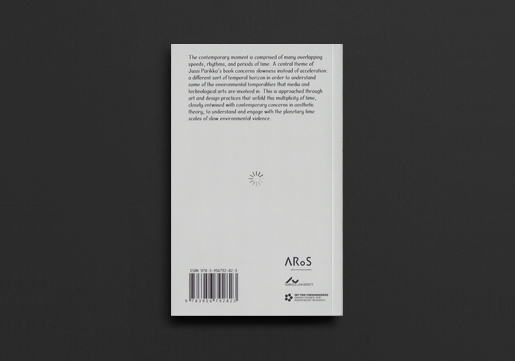
The contemporary moment is comprised of many overlapping speeds, rhythms, and periods of time. A central theme of Jussi Parikka’s book concerns slowness instead of acceleration: a different sort of a temporal horizon in order to understand some of the environmental temporalities that media and technological arts are involved in. This is approached through art and design practices that unfold this multiplicity of time, closely entwined with contemporary concerns in aesthetic theory, to understand and engage with the planetary time scales of slow environmental violence.
The third volume of the Contemporary Condition series continues the investigation into contemporaneity as a defining condition of our historical present. The series aims to question the formation of subjectivity and concept of temporality in the world now. It begins from the assumption that art, with its ability to investigate the present and make meaning from it, can lead to an understanding of wider developments within culture and society. Addressing a perceived gap in existing literature on the subject, the series focuses on three broad strands: the issue of temporality, the role of contemporary media and computational technologies, and how artistic practice makes epistemic claims.
The Contemporary Condition series edited by Geoff Cox and Jacob Lund, Volume 03
Copublished with Aarhus University and ARoS Art Museum
Design by Dexter Sinister
2012, English / Japanese
Softcover, 24 pages, 21 x 30 cm
Published by
Blind Gallery / Tokyo
$43.00 - Out of stock
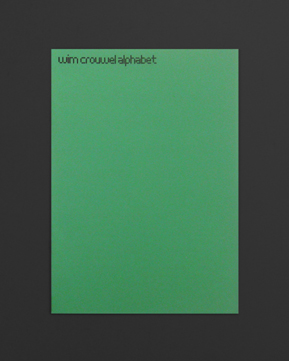
This monograph of Dutch graphic designer and typographer Wim Crouwel highlights the posters he made between 1958-1971. Often produced for exhibitions of modern art at the Van Abbemuseum, Eindhoven, or the Stedelijk Museum, Amsterdam, the posters feature bold fields of colour and clear typography, both signatures of his style. The publication reproduces numerous posters, all of them in full colour, and includes a biography timeline of the artist as well.
Yusuke Nakajima (Ed.)
2013, Japanese / English
Softcover, 160 pages ( colour & bw ill.), 16 x 22 cm
Published by
Roma / Amsterdam
$52.00 - Out of stock
Comprising scores of photographs from inside the studio of the prolific Dutch graphic designer and educator Karel Martens, this book is a testament to the personal and experimental nature of his work. Although he can be placed in the tradition of Dutch modernism, Martens seems to maintain a certain distance from contemporary developments. The shelves of books and stacks of papers seen in these images are evocative of both his professional practice and work as an artist, which more recently entails making relief prints from found industrial artefacts. A fascinating and intimate creative portrait of this design community mentor, with texts by David Senior and Martens himself.
2016, English / French
Softcover, 150 pages, 240 x 175 mm
Published by
May Revue / Paris
$29.00 $10.00 - In stock -
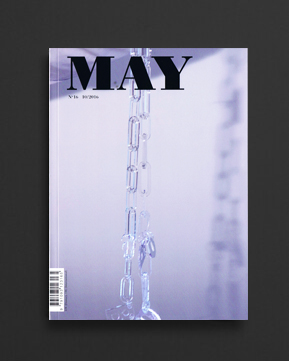
May no.16 focuses on recent feminist debates actualizing the history of Italian feminist collectives of the 1970s and 1980s. The issue is a continuation of the issue 4 of May, which reprinted and translated a selection of texts from the time. The issue’s touchstone is the work of writer and co-founder of Rivolta Femminile, Carla Lonzi. Throughout her life, Lonzi refused the power of a masculine creativity that exploits the reproductive, supportive activity of women. The texts assembled in May no.16 bring that refusal to contemporary light.
Weed and the Practice of Liberty
Claire Fontaine
The Paradox of Self-Abolition: a Mapping Exercice
Marina Vishmidt
Presence and Absence
Melissa Gordon
Narrative Without End
Anna De Filippi
An Exercise in the Practice of affidamento
Alex Martinis Roe
On Marinella Pirelli’s Films
Lucia Aspesi
Human Strike Between Foreignness and Responsibility
Claire Fontaine
Introduction to Double Bind
Rhea Anastas
Visual Insert
LGG$B
Citadelle. On Marie Angeletti at Édouard Montassut, Paris
Jacob Stewart-Halevy
On Mathieu K. Abonnenc, Lotte Arndt, Catalina lozano (eds), Colonial Collect and Affect, Crawling Doubles
Emmanuelle Chérel
A World Exactly Like This One. On Credits by Hannah Black
Jack Gross
Get Some Rest Pam, or Jason Bourne comes of age. On Paul Greengrass’ film, Jason Bourne
Maija Timonen
Aggregation or Mere Dislocation. On the 9th Berlin Biennale and “Painting 2.0: Expression in the information Age,” mumok, Vienna
Kari Rittenbach
Short Story
Jeanne Graff
Limited Edition
Hans-Christian Lotz
About MAY Revue:
Conceived as a collective space in which to develop thoughts and confront positions on artistic production, May magazine examines, quaterly, contemporary art practice and theory in direct engagement with the issues, contexts and strategies that construct these two fields. An approach that could be summed up as critique at work – or as critique actively performed in text and art forms alike.
Featuring essays, interviews, art works and reviews by artists, writers and diverse practitioners of the arts, the magazine also intends to address the economy of the production of knowledge – the starting point of this reflection being the space of indistinction between information and advertisement typical of our time. This implies a dialogue with forms of critique produced in other fields.
2016, English / German
Softcover, 96 pages, 24 x 17 cm
Published by
Haus der Kunst / Munich
Walther König / Köln
$29.00 - Out of stock
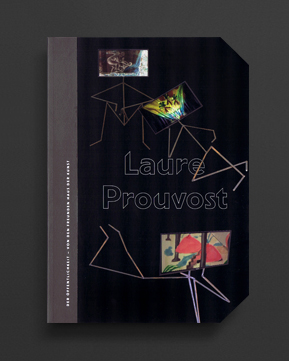
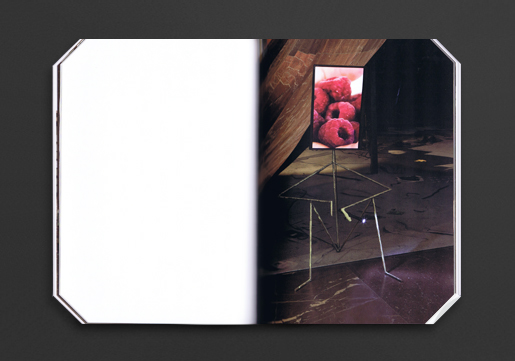
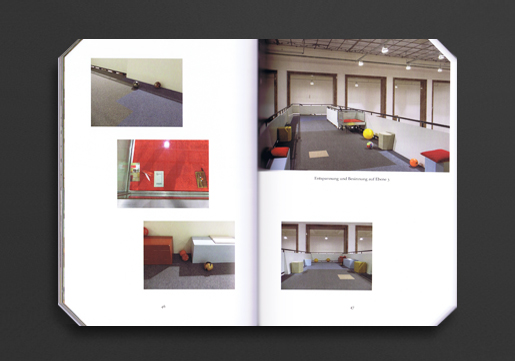
For the spacious central hall in the Haus der Kunst, Laure Prouvost creates an installation that includes sculptural and cinematic elements. In this work, Prouvost refers to both architecture and the House of Art as an institution, rich in imagery and inimitable humor.
This catalog is the fourth volume in the series "The Public - from the Friends House of Art", which annually documents artistic commission work for the middle hall of the House of Art.
2016, English / German
Softcover, 96 pages, 24 x 17 cm
Published by
Haus der Kunst / Munich
Walther König / Köln
$29.00 - Out of stock
This book documents Perniceʼs installation Tutti IV, where the artist placed his architectural sculpture in the middle of the room. A spiral staircase led up to the sculpture’s roof. From there, via a second staircase, the visitor reaches a bridge, which spans the Middle Hall and from which visitors can continually view the room from new perspectives.
Published after the installation at Haus der Kunst, Munich in 2013/2014.
2016, English
Softcover (over-sized), 136 pages, 25 x 37 cm
$58.00 $15.00 - Out of stock
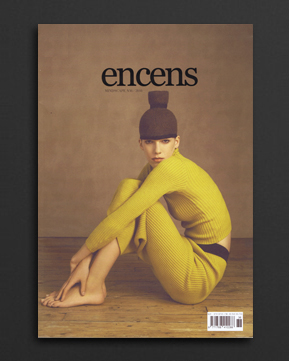
encens is a fashion magazine from France, presenting a very selective number of designers, edited by Samuel Drira and Sybille Walter.
encens 36 "Mindscape" (Spring/Summer 2016) features Susan Sontag, Serge Lutens, Isabelle Weingarten, Cartier, Comme des Garçons, Annie Leibovitz, Nehera, Giorgio Armani, Hed Mayner, Angelo Flaccavento, James Benning, Carol Bove, Uma Wang, Veronique Branquinho, Issey Miyake, Carlo Scarpa, Lene Berg, Lutz Huelle, Givenchy, Dries Van Noten, Sonia Rykiel, Azzadine Alaia, Yohji Yamamoto, Willie Christie, Axl Jensen, Chanel, Celine, Lemaire, Veronique Leroy, Dior Homme, Maison Martin Margiela, Vivienne Westwood, Linda Loppa, Bless, Juun J., Christopher Williams, Friedrich Kiesler, Pierre Cardin, Hermes, and many more.
2016, English
Hardcover, 252 pages, 26 x 20 cm
Published by
Koenig Books / London
NTU Contre for Contemporary Art Singapore / Singapore
$55.00 - Out of stock
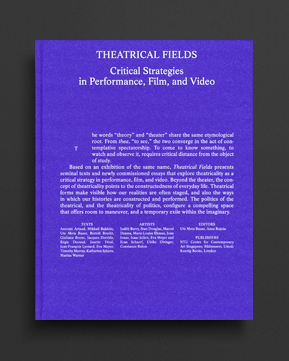
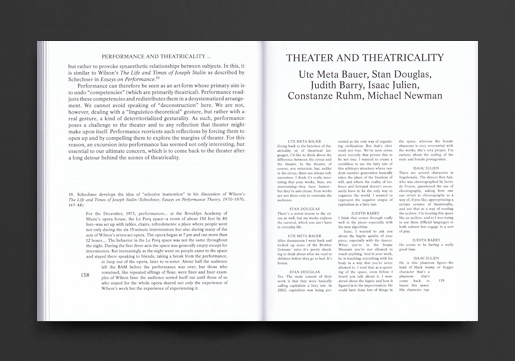
Theatrical Fields brings together a selection of seminal texts, commissioned essays and exhibition materials that explore the political potential of ʻtheatricalityʼ.
This reader stems from a long-term curatorial research examining the deep-rooted connection between theatre and theory, juxtaposing artists and theoreticians from different generations and backgrounds who share a communal interest in the ʻtheatricalityʼ as a methodology to address questions of ideology, gender, power and resistance.
In this conception, ʻtheatricalityʼ does not refer strictly only to the theatre and the theatrical arts; rather, it also points to the constructedness of everyday life. Theatrical forms make visible how our realities are staged, and also how our histories are constructed and performed.
This reader has been conceived and edited by renowned curator, Ute Meta Bauer – Artistic Director of the 3rd Berlin Biennale for Contemporary Art, Berlin (2004); Co-Curator of documenta 11 (2001/2002); Professor and Dean of the School of Fine Art at the Royal College of Art, London (2012/2013); and since 2005 she has been an Associate Professor at MIT, Cambridge, United States.
Includes texts by: Antonin Artaud, Mikhail Bakhtin, Ute Meta Bauer, Bertolt Brecht, Giuliana Bruno, Jacques Derrida, Regis Durand, Josette Féral, Jean-François Lyotard, Eva Meyer, Timothy Murray, Katarina Pierre, Katharina Sykora, Marina Warner
2016, English
Hardcover, 1012 pages, 30 x 24 cm
Published by
Self Service / Paris
$45.00 - Out of stock
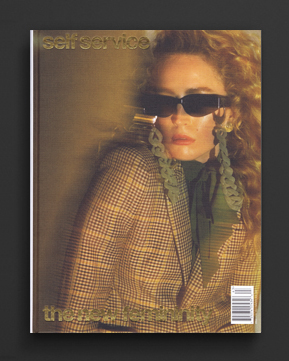
Self Service No. 45 Fall / Winter 2016: The New Femininity
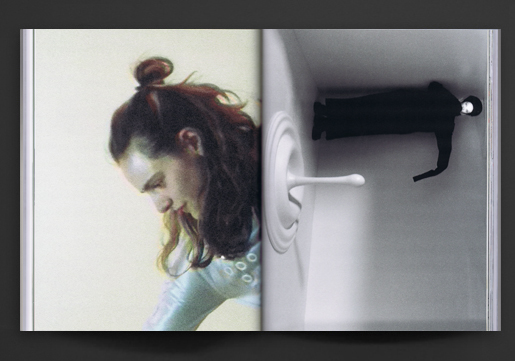
Features : Luna Bijl photographed by David Sims, Raquel Zimmermann by Inez and Vinoodh, Rianne van Rompaey and Edie Campbell by Cass Bird, The House of Vetements, Juergen Teller, Alasdair McLellan, Anna Ewers by Terry Richardson, and Charlotte Rampling by Ezra Petronio. With model mothers Amber Valetta, Mini Anden and Heidi Mount and their children. Dialogs with Charlotte Rampling, Emmanuelle Seigner, Emily Weiss, and Melanie Ward, among many others. Edie Campbell and Harriet Quick write about what is femininity, and much more.
Self Service magazine is a fashion and cultural biannual magazine. The magazine features the preeminent players in the fashion world, with innovative editorials photographed by the world’s best photographers and stylists.
Note: Due to the size/weight of this volume, your order will possibly incur additional postage costs. We will contact you with the best shipping advice upon your order, or alternatively, please email us in advance. Thank you for understanding.
1991/1992, English / German
Softcover, 144 pages, 30 x 23 cm
1st Edition, Out of print title / As New,
Published by
Prestel / Munich
$80.00 - Out of stock
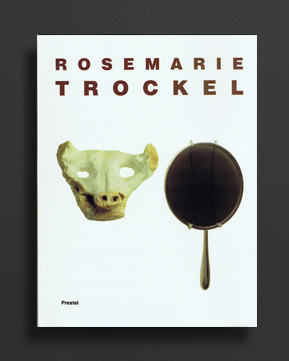
Major 1990s monograph on the German artist Rosemarie Trockel published by Prestel in conjunction with the exhibition Rosemarie Trockel, curated by Sidra Stich and Elisabeth Sussman, and co-organized by the Institute of Contemporary Art, Boston and the University Art Museum, Berkeley.
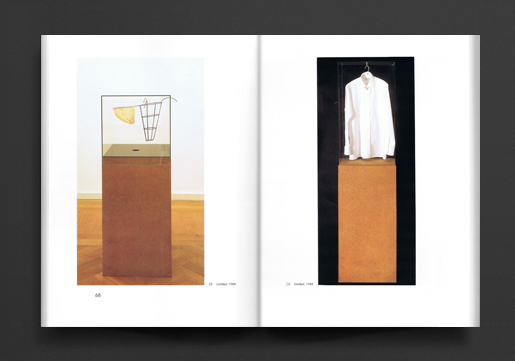
Profusely illustrated throughout with colour photographs of her incredible, diverse array of sculptural, wool, drawing, collage, textile works. Rosemarie Trockel illuminates the theme "woman" from the different angles of ideology, eroticism and culture and connects it with questions from a broader thematic area - history, memory, nationalism, religion, evolution in a visually penetrating and intellectually provocative way. Edited by Sidra Stich, with texts by Sidra Stich and Elisabeth Sussman.
Long out of print, new copy.
2016, English
Softcover, 144 pages, 21 x 29.7 cm
Published by
Kunsthalle Wien / Vienna
Sternberg Press / Berlin
$32.00 - In stock -
Texts by Giorgio Agamben, Claire Fontaine, Gilles Deleuze, Julius Gavroche, Paul Lafargue, Vanessa Joan Müller, Cristina Ricupero, Tereza Stejskalová, Enrique Vila-Matas
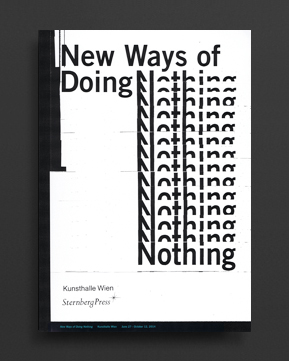
“New Ways of Doing Nothing,” a group exhibition that took place at Kunsthalle Wien in 2014, devoted itself to artistic production that opposes activity and instead gives an affirmative slant to forms of doing nothing or refraining—a major influence being the titular character of Hermann Melville’s “Bartleby the Scriviner: A Story of Wall Street.” The book presents the displayed works and artists, but also continues the process that led to the exhibition. Included along with a conversation between the curators is a text collage of reprints and excerpts that introduces those artists and thinkers who, in the words of Bartleby, “prefer not to.”
Featuring work by Robert Breer, Alejandro Cesarco, Étienne Chambaud, Claire Fontaine, Natalie Czech, Oskar Dawicki, Edith Dekyndt, Mathias Delplanque, Heinrich Dunst, Gardar Eide Einarsson, Marina Faust, Ryan Gander, Lasse Schmidt Hansen, Julia Hohenwarter, Karl Holmqvist, Sofia Hultén, Jiří Kovanda, Rivane Neuenschwander, Georges Perec / Bernard Queysanne, Superflex, Mario García Torres
Vanessa Joan Müller, Cristina Ricupero, Nicolaus Schafhausen (Eds.)
Copublished with Kunsthalle Wien
Design by Anna Haas
1974, English
Hardcover (w. dust jacket), 208 pages, 25 x 21cm
1st Edition, Out of print title / used*,
Published by
Pall Mall Press / London
$90.00 - Out of stock
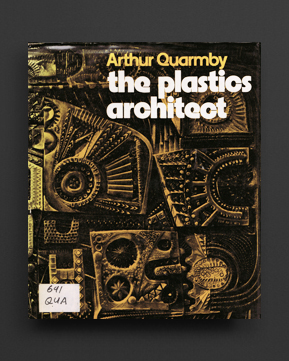
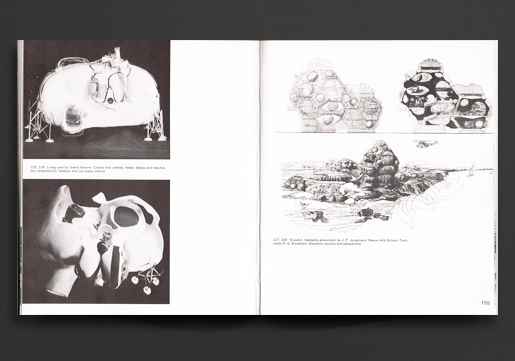
Scarce title, "The Plastics Architect" by Arthur Quarmby was published in 1974 by Pall Mall Press, London.
This richly illustrated and heavily researched volume is broken up into chapters: Materials History; Materials, Fabrication Technology, Historical Applications; Spatial Enclosures; Component Construction; Sculptural Applications; Prospective Work. Throughout the examples of international developments in the use of plastics in architecture, included is the work of Archigram, Aldo Rossi, Donatella Mazzoleni, Reyner Banham, Paolo Soleri, Masayuki Kurokawa, Frei Otto, Jean Prouvé, Haus-Rucker-Co, Gernot Nalbach, Christo, Alberto Longoni, R. Buckminster Fuller, Wolfgang Döring, Jean Manéval, Pascal Häusermann, Claude Häusermann, Yutaka Murata, Renzo Piano, Kenzo Tange, Rudolf Doernach, Jean-Louis Chanéac, John Zerning, David Greene, and many many others. Arthur Quarmby's own incredible architectural projects are here in abundance as well.
"This book includes a history of the discovery of different types of plastics, and a valuable chapter on materials technology which investigates the molecular structure of different plastics materials and indicates the extent of their applicability. As a basic understanding of the structure and properties of plastic materials is necessary to the designer, so a knowledge of the principal manufacturing processes is essential if designs are to be produced which are capable of being put into production [...] This stimulating work will be essential for anyone interested in plastics, architecture and the future environment."
2016, English
Softcover, 240 pages, 145 x 210 mm
Published by
The MIT Press / Massachusetts
Whitechapel / London
$52.00 - Out of stock
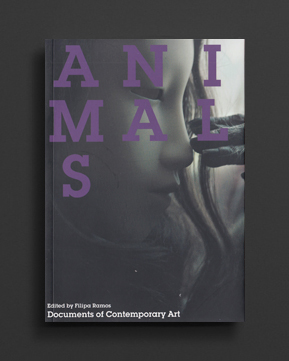
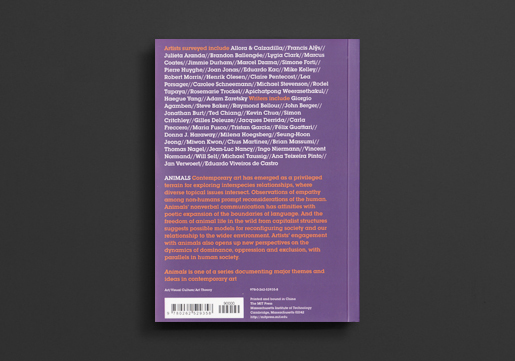
Animals have become the focus of much recent art, informing numerous works and projects featured at major exhibitions including dOCUMENTA (13) (2013), the 10th Shanghai Biennale (2014), and the 56th Venice Biennale (2015). Contemporary art has emerged as a privileged terrain for exploring interspecies relationships, providing the conditions for diverse disciplines and theoretical positions to engage with animal behavior and consciousness.
This interest in animal nature reflects a number of current issues. Observations of empathy among nonhumans prompt reconsiderations of the human. The nonverbal communication of animals has been compared with poetic expansion of the boundaries of language. And the freedom of animal life in the wild from capitalist subordination is seen as a potential model for reconfiguring society and our relationship to the wider environment. Artists’ engagement with animals also opens up new perspectives on the dynamics of dominance, oppression, and exclusion, with parallels in human society. Animal nature is at the heart of debates on the Anthropocene era and the ecological concerns of scientists, thinkers, and artists alike. Centered on contemporary artworks, this anthology attests to the trans-disciplinary nature of this subject, with art as one of the principal points of convergence.
Artists surveyed include
Allora & Calzadilla, Francis Alÿs, Julieta Aranda, Brandon Ballengée, Joseph Beuys, Marcel Broodthaers, Lygia Clark, Marcus Coates, Jimmie Durham, Marcel Dzama, Simone Forti, Pierre Huyghe, Natalie Jeremijenko, Joan Jonas, Eduardo Kac, Mike Kelley, Henri Michaux, Robert Morris, Henrik Olesen, Lea Porsager, Julia Reodica, Carolee Schneemann, Michael Stevenson, Rodel Tapaya, Rosemarie Trockel, Apichatpong Weerasethakul, Haegue Yang, Adam Zaretsky
Writers include
Giorgio Agamben, Steve Baker, Raymond Bellour, Walter Benjamin, John Berger, Jonathan Burt, Ted Chiang, Simon Critchley, Gilles Deleuze, Jacques Derrida, David Elliott, Carla Freccero, Maria Fusco, Tristan García, Félix Guattari, Donna J. Haraway, Seung-Hoon Jeong, Miwon Kwon, Chus Martinez, Brian Massumi, Thomas Nagel, Jean-Luc Nancy, Ingo Niermann, Vincent Normand, Ana Teixeira Pinto, Will Self, Jan Verwoert, Eduardo Viveiros de Castro
About the Editor
Filipa Ramos is editor-in-chief of art-agenda and a Lecturer in Experimental Film at Kingston University and Moving Image at Central Saint Martins, London. She is the author of Lost and Found: Crisis of Memory in Contemporary Art (2009).
2016, English
Softcover, 240 pages, 145 x 210 mm
Published by
The MIT Press / Massachusetts
Whitechapel / London
$52.00 - Out of stock
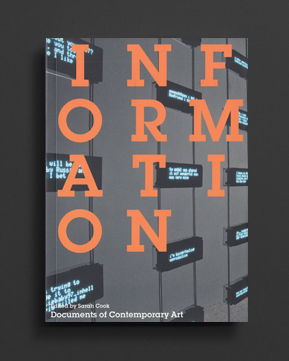
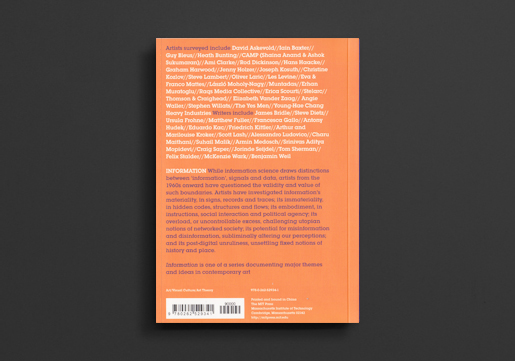
This anthology provides the first art-historical reassessment of information-based art in relation to data structures and exhibition curation. It examines such landmark exhibitions as “Information” at The Museum of Modern Art, New York, in 1970, and the equally influential “Les Immatériaux,” initiated by the philosopher Jean-François Lyotard at the Centre Pompidou, Paris, in 1984. It reexamines work by artists of the 1960s to early 1980s, from Les Levine and N. E. Thing Co. to General Idea and Jenny Holzer, whose prescient grasp of information’s significance resonates today. It also reinscribes into the narrative of art history technologically critical artworks that for years have circulated within new media festivals rather than in galleries.
While information science draws distinctions between “information,” signals, and data, artists from the 1960s to the present have questioned the validity and value of such boundaries. Artists have investigated information’s materiality, in signs, records, and traces; its immateriality, in hidden codes, structures, and flows; its embodiment, in instructions, social interaction, and political agency; its overload, or uncontrollable excess, challenging utopian notions of networked society; its potential for misinformation and disinformation, subliminally altering our perceptions; and its post-digital unruliness, unsettling fixed notions of history and place.
Artists surveyed include
David Askevold, Iain Baxter, Guy Bleus, Heath Bunting, CAMP (Shaina Anand & Ashok Sukumaran), Ami Clarke, Richard Cochrane, Rod Dickinson, Hans Haacke, Graham Harwood, Jenny Holzer, Joseph Kosuth, Christine Kozlov, Steve Lambert and the Yes Men, Oliver Laric, Les Levine, László Moholy-Nagy, Muntadas, Erhan Muratoglu, Raqs Media Collective, Erica Scourti, Stelarc, Thomson & Craighead, Angie Waller, Stephen Willats, Young-Hae Chang Heavy Industries, Elizabeth Vander Zaag
Writers include
James Bridle, Matthew Fuller, Francesca Gallo, Antony Hudek, Eduardo Kac, Friedrich Kittler, Arthur and Marielouise Kroker, Scott Lash, Alessandro Ludovico, Jean-François Lyotard, Charu Maithani, Suhail Malik, Armin Medosch, Srinivas Aditya Mopidevi, Craig Saper, Jorinde Seijdel, Tom Sherman, Felix Stalder, McKenzie Wark, Benjamin Weil
About the Editor
Sarah Cook is a curator and researcher working at the intersection of art, digital and electronic media, and science. She is the coauthor (with Beryl Graham) of Rethinking Curating: Art After New Media (MIT Press), and in 2004 cocurated the touring exhibition, “Database Imaginary.” She is Dundee Fellow at Duncan of Jordanstone College of Art and Design, University of Dundee.
1989, English
Hardcover (w. dust jacket), 200 pages, 28.7 x 22.5 cm
1st Edition, Out of print title / used*,
Published by
Art Direction Book Co. / New York
$35.00 - Out of stock
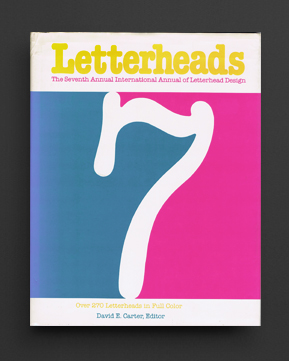
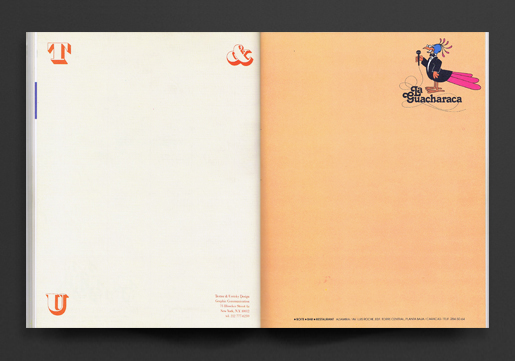
Letterheads 7 (The Seventh Annual International Annual of Letterhead Design) edited by David E. Carter continues this great series of letterhead design collections published each year by Art Direction Book Co. in New York. Letterheads 7 presents over 270 full-page letterheads in full-colour in the one heavy volume. A great series of books for anyone interested in type design, logo design, and identity graphics.
1977, English
Hardcover (w. dust jacket), 700 pages, 21 x 26 cm
1st Edition, Out of print title / used*,
Published by
Watson Guptill Publications / New York
$68.00 - Out of stock
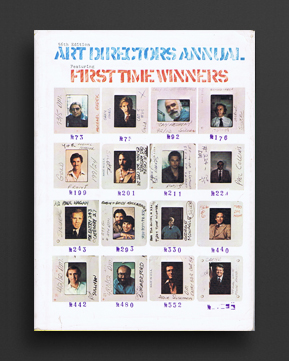
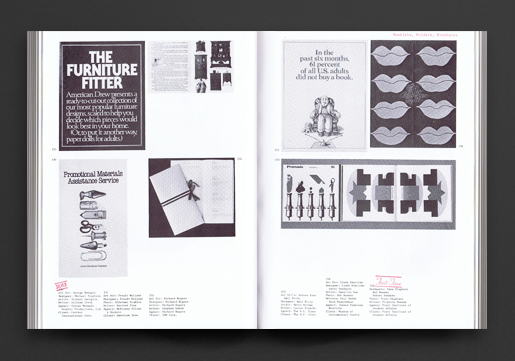
The 56th Annual of Advertising, Editorial, and Television Art and Design. Art Director: Lawence Miller.
This wonderfully designed, huge volume is full of colour and b&w photos and illustrations that present the best of 1977. Contents: The Gold Awards, Newspaper Advertising, Newspaper Editorial, Magazine Advertising, Magazine Editorial, Promotion and Graphic Design, Posters, Books and Jackets, Art and Illustration, Photography, Television. As well as the 1200 entries densely illustrated across the pages of this book, there are feature articles on Saul Bass, Herb Lubalin, and Bradbury Thompson, who were named to the Hall of Fame in 1977. A smart and visually generous series for anyone interested in graphic, editorial, type design and illustration from the 1970s.
1978, English
Out of print title / Used*
Published by
Collier Books / New York
$35.00 - Out of stock
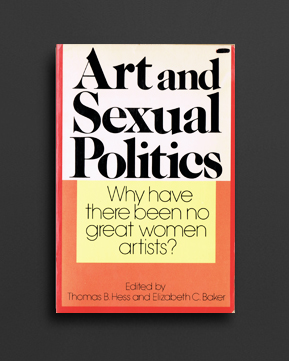
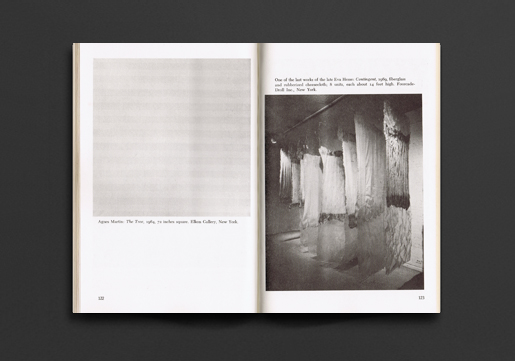
Book edition of Linda Nochlin's famous essay "Why Have There Been No Great Women Artists?", that first appeared in the January 1971 issue of ARTnews, together with the follow-up essay "GREAT WOMEN ARTISTS" by Thomas B. Hess. Together these texts are followed by a collection of ten essay replies to "Why Have There Been No Great Women Artists?", including "Dialogue" by Elaine de Kooning with Rosalyn Drexler; "The Hermaphrodite" by Bridget Riley; "Do Your Work" by Louise Nevelson; "Women without Pathos" by Eleanor Antin; "The Double-Bind" by Suzi Gablik; "Healthy Self-Love" by Sylvia Stone; "Moving Out, Moving Up" by Marjorie Strider; "Social Conditions Can Change" by Lynda Benglis; "Artists Transgress All Boundaries" by Rosemarie Castoro; "SEXUAL ART-POLITICS" by Elizabeth C. Baker; and "IN THE UNIVERSITY" by Lee Hall. Five sections of the book are made up of exemplary art works by Agnes Martin, Eva Hesse, Mary Bauermeister, Lee Hall, Nancy Graves, Dorothea Rockburne, Lee Bontecou, Jo Baer, Niki de St. Phalle, Kiki Kogelnik, Deborah Remington, Joan Snyder, Louise Nevelson, Lynda Benglis, Eleanor Antin, Sylvia Stone, Suzi Gablik, Joan Mitchell, Bridget Riley, Sylvia Sleigh, Jean Follett, Charmion Von Wiegand, Louise Bourgeois, Marcia Marcus,Marisol, Louisa Matthiasdottir, Chryssa, Mary Frank, Perle Fine, Elaine de Kooning, Roslyn Drexler, and many more.
1970, English
Softcover, 352 pages, 21 x 14 cm
Out of print title / Used*,
Published by
Studio Vista / London
$25.00 - Out of stock
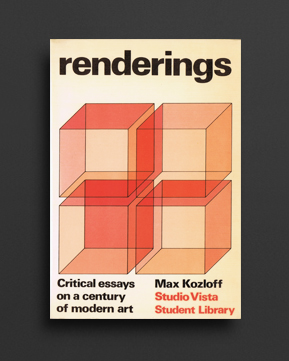
"Renderings : Critical Essays on a Century of Modern Art" is a collection of forty-three essays, originally published in The Nation, Artforum, Art International and elsewhere, organized in six sections, "Revisitations Within the Modern Tradition"; "American Art and the Generation of the Second World War"; "Essays in Modern Sculpture"; "Current Art: Options and Responses"; "Sketches in the Aesthetics of Photography" and "The Methodology of Criticism". Illustrated sections reproduce selected works by the many artists featured throughout the texts collected here, including Gustave Courbet, Claes Oldenburg, Edward Kienholz, Robert Rauschenberg, Jasper Johns, Toulouse-Lautrec, Jackson Pollock, Pablo Picasso, David Smith, Rene Magritte, Mark Rothko, Camille Pissarro, Henri Matisse, Frank Stella, Robert Motherwell, Édouard Manet, Pierre Bonnard, Alberto Giacometti, Joseph Cornell, Medardo Rosso, Francis Bacon,Julio Gozalez, John Chamberlain, Ronald Bladen, Jacques Henri Lartigue, Larry Poons, Diane Arbus, Marcel Duchamp, and many others.
Max Kozloff (born 1933) is an American Art Historian, art critic of modern art and photographer. He has been art editor at The Nation, and Executive Editor of Artforum. His essay, "American Painting During the Cold War" is of particular importance to the criticism on American Abstract Expressionism.
2016, English
Softcover, 124 pages, 13 x 19 cm
Published by
Künstlerhaus Graz / Graz
Sternberg Press / Berlin
$44.00 $15.00 - Out of stock
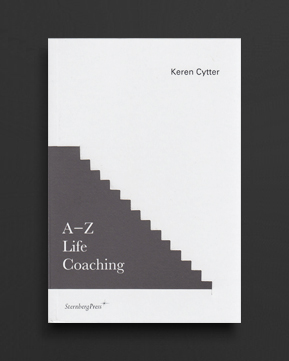
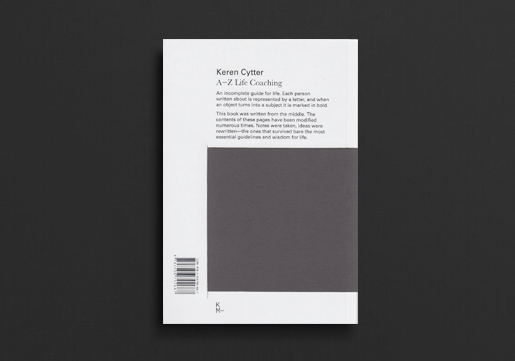
An incomplete guide for life. Each person written about is represented by a letter, and when an object turns into a subject it is marked in bold.
The form of life coaching described in this book won’t lead the reader to social recognition or financial success. If one of the two occurs after reading this text, it is a coincidence. This book aims to expose the owners of an innocent heart to reality’s true structures and to utilize them for spiritual growth so their soul and body evaporate into the abstract.
This book was written from the middle. The contents of these pages have been modified numerous times. Notes were taken, ideas were rewritten—the ones that survived bare the most essential guidelines and wisdom for life.
Copublished with Künstlerhaus, Halle für Kunst & Medien, Graz
Design by Vasilis Marmatakis