World Food Books' programme is largely produced on Kulin Nation land. We acknowledge the Wurundjeri people of the Kulin Nation as the first and continuing custodians of this land, and pay respect to their Elders past, present, and emerging.
World Food Books is an arts and special interests bookshop in Naarm / Melbourne. Founded in 2010, World Food Books is devoted to the presentation of a rotating, hand-selection of international art, design, literary and counterculture publications with an emphasis on the anti-traditional, the experimental, the avant-garde, the heretic, the marginal.
Presenting new titles alongside rare and out-of-print books, catalogues and journals spanning the fields of modern and contemporary art, design, photography, illustration, film, literature, poetry, cultural theory, philosophy, sexuality, popular and underground culture in its many radical forms, World Food Books wishes to encourage adventurous, thoughtful and open-minded reading, looking, writing, and exchange of publishing and ideas, both current and historical.
As well as our bookshop, located in Melbourne's historical Nicholas Building, all of our inventory is available internationally via our online mail-order service.
World Food Books semi-regularly co-ordinates "Occasions", a programme of exhibits and events at the bookshop and in partnership with other hosts (such as museums and art galleries) that develop out of the activities, relationships and content of the bookshop itself.
World Food Books
The Nicholas Building
37 Swanston Street
Room 5, Level 6
Melbourne 3000
Australia
SHOP HOURS:
Thu–Fri 12–6, Sat 12–5
WEB-SHOP OPEN 24/7
World Food Books
Postal Address:
PO Box 435
Flinders Lane
Victoria 8009
Australia
Art
Theory / Essay
Architecture / Interior
Graphic Design / Typography
Photography
Fashion
Eros
LGBTQ+
Fiction / Poetry
Weird / Speculative / Science Fiction / Horror
Transgressive / Visceral / Abject
Symbolism / Decadence / Fin de siècle
Film / Video
Painting
Sculpture / Installation
Performance / Dance / Theater
Drawing
Sound / Music
Curatorial
Group Shows / Collections
Periodicals
Out-of-print / Rare
Posters / Ephemera / Discs
Signed Books
World Food Books Gift Voucher
World Food Book Bag
Australian Art
Australian Fiction
Australian Science Fiction / Speculative Fiction
Australian Poetry
Australian Photography
Japanese Photography
Conceptual Art
Minimal Art
Dada
'Pataphysics / Oulipo
Fluxus
Concrete Poetry
Pop Art
Surrealism
Arte Povera
Arte Informale / Haute Pâte / Tachism
Nouveau Réalisme / Zero / Kinetic
Situationism / Lettrism
Collage / Mail Art / Xerox Art
Art Brut / Folk / Visionary / Fantastic
Illustration / Graphic Art / Bandes Dessinées
Furniture
Italian Radical Design / Postmodernism
Textiles
Ceramics / Glass
Counterculture
Protest / Revolt
Philosophy
Psychoanalysis
Anthropology
Anarchism
Socialism / Anarchism / Communism / Capitalism
Literary Theory / Semiotics / Language
Feminism / Women's Studies
Gender Studies / Sexuality
Anthropology
Fetishism / BDSM
Drugs / Psychedelia
Crime / Violence
Animal Rights / Veganism
Occult / Esoterica
Ecology / Earth / Alternative Living
Whole Earth / Crafts
All prices in AUD (Australian dollars)
Pick-Ups
Pick-up orders can be collected in our bookshop during opening hours after order date. Please collect any Pick-up orders within 2 weeks of ordering as we have limited storage space. Orders will be released back into stock if not collected within this time. No refunds can be made for pick-ups left un-collected. If you cannot make it in to the bookshop in this time-frame, please choose postage option.
Return Policy
All sales are final. We do accept returns (for refund or exchange) for items received in error. All our orders are packed with special care using heavy-duty padding and cardboard book-mailers or bubble mailers (for smaller books), using reinforcement where required. We cannot take responsibility for any lost, stolen or damaged parcels.
Insurance
Should you wish to insure your package, please email us directly after placing your order and we can organise this at a small extra expense. Although all standard/express tracked packages are very safe and dependable, we cannot take responsibility for any lost, stolen or damaged parcels. We recommend insurance on valuable orders.
Interested in selling your old books, catalogues, journals, magazines, comics, fanzines, ephemera? We are always looking for interesting, unusual and out-of-print books to buy. We only buy books in our fields of interest and specialty, and that we feel we can resell.
We base these prices on desirability, market value, in-print prices, condition and our current stock levels. We offer cash, store credit, and can take stock on consignment. All
about 25% of the price we expect to get when we sell them, or 30% in store credit. We base these prices on desirability, market value, in-print prices, condition and our current stock levels.
Sell your books any day of the week. You can drop them off and return later. If you have a lot of books, we can visit your Sydney home.
We buy books that we feel we can resell. We offer about 25 % of the price we expect to get when we sell them, or 30% in store credit. We base these prices on desirability, market value, in-print prices, condition and our current stock levels.
Philadelphia Wireman
03 August - 01 September, 2018
World Food Books is proud to announce our next Occasion, the first presentation of sculptures by Philadelphia Wireman in Australia.
The Philadelphia Wireman sculptures were found abandoned in an alley off Philadelphia’s South Street on trash night in 1982. Their discovery in a rapidly-changing neighbourhood undergoing extensive renovation, compounded with the failure of all attempts to locate the artist, suggests that the works may have been discarded after the maker’s death. Dubbed the "Philadelphia Wireman" during the first exhibition of this work, in 1985, the maker’s name, age, ethnicity, and even gender remain uncertain. The entire collection totals approximately 1200 pieces, all intricately bound together with tightly-wound heavy-gauge wire (along with a few small, abstract marker drawings, reminiscent both of Mark Tobey and J.B. Murry). The dense construction of the work, despite a modest range of scale and materials, is singularly obsessive and disciplined in design: a wire armature or exoskeleton firmly binds a bricolage of found objects including plastic, glass, food packaging, umbrella parts, tape, rubber, batteries, pens, leather, reflectors, nuts and bolts, nails, foil, coins, toys, watches, eyeglasses, tools, and jewellery.
Heavy with associations—anthropomorphic, zoomorphic, and socio-cultural responses to wrapped detritus—the totemic sculptures by Philadelphia Wireman have been discussed in the context of work created to fulfil the shamanistic needs of alternative religions in American culture. Curators, collectors, and critics have variously compared certain pieces to sculpture from Classical antiquity, Native American medicine bundles, African-American memory jugs, and African fetish objects. Reflecting the artist’s prolific and incredibly focused scavenging impulse, and despite—or perhaps enhanced by—their anonymity, these enigmatic objects function as urban artefacts and arbiters of power, though their origin and purpose is unknown. Philadelphia Wireman, whatever their identity, possessed an astonishing ability to isolate and communicate the concepts of power and energy through the selection and transformation of ordinary materials. Over the course of the past two decades, this collection has come to be regarded as an important discovery in the field of self-taught art and vernacular art.
Presented in collaboration with Fleisher-Ollman Gallery, Philadelphia, and Robert Heald, Wellington.
Susan Te Kahurangi King
02 February - 10 March, 2018
Susan Te Kahurangi King (24 February 1951 - ) has been a confident and prolific artist since she was a young child, drawing with readily available materials - pencils, ballpoint pens and felt-tip markers, on whatever paper is at hand. Between the ages of four and six Susan slowly ceased verbal communication. Her grandparents William and Myrtle Murphy had developed a special bond with Susan so they took on caring responsibilities for extended periods. Myrtle began informally archiving her work, carefully collecting and storing the drawings and compiling scrapbooks. No drawing was insignificant; every scrap of paper was kept. The King family are now the custodians of a vast collection containing over 7000 individual works, from tiny scraps of paper through to 5 meter long rolls.
The scrapbooks and diaries reveal Myrtle to be a woman of great patience and compassion, seeking to understand a child who was not always behaving as expected. She encouraged Susan to be observant, to explore her environment and absorb all the sights and sounds. Myrtle would show Susan’s drawings to friends and people in her community that she had dealings with, such as shopkeepers and postal workers, but this was not simply a case of a grandmother’s bias. She recognised that Susan had developed a sophisticated and unique visual language and sincerely believed that her art deserved serious attention.
This was an unorthodox attitude for the time. To provide some context, Jean Dubuffet coined the term Art Brut in 1945 to describe work created by self-taught artists – specifically residents of psychiatric institutions and those he considered to be visionaries or eccentrics. In 1972 Roger Cardinal extended this concept by adopting the term Outsider Art to describe work made by non-academically trained artists operating outside of mainstream art networks through choice or circumstance. Susan was born in Te Aroha, New Zealand in 1951, far from the artistic hubs of Paris and London that Dubuffet and Cardinal operated in. That Myrtle fêted Susan as a self-taught artist who deserved to be taken seriously shows how progressive her attitudes were.
Susan’s parents Doug and Dawn were also progressive. Over the years they had consulted numerous health practitioners about Susan’s condition, as the medical establishment could not provide an explanation as to why she had lapsed into silence. Dawn educated herself in the field of homeopathy and went on to treat all twelve of her children using these principles – basing prescriptions on her observations of their physical, mental and emotional state.
Doug was a linguist with an interest in philosophy who devoted what little spare time he had to studying Maori language and culture. To some extent their willingness to explore the fringes of the mainstream made them outsiders too but it was their commitment to living with integrity and their respect for individuality that ensured Susan’s creativity was always encouraged.
Even though Susan’s family supported her artistic pursuits, some staff in schools and hospitals saw it as an impediment to her assimilation into the community and discouraged it in a variety of ways. Her family was not always aware of this and therefore did not fully understand why Susan stopped drawing in the early 1990s. However, rather than dwell on the challenges that Susan faced in pursuit of her artistic practice, they prefer to highlight her achievements. In 2008 Susan began drawing again in earnest, after an almost 20 year interruption, and her work is now shown in galleries around the world.
Susan grew up without television and has been heavily influenced by the comics she read as a child. She is absolutely fearless in the appropriation of recognizable characters, such as Donald Duck and Mickey Mouse, in her work. She twists their limbs, contorts their faces, compresses them together, blends them into complex patterned backgrounds - always imbuing them with an incredible energy. Although Susan often used pop culture characters in her work they are not naive or childlike. These are drawings by a brilliant self-taught artist who has been creating exceptional work for decades without an audience in mind.
Mladen Stilinović
"Various Works 1986 - 1999"
02 February 16 - September 10, 2016
Various works 1986 - 1999, from two houses, from the collections of John Nixon, Sue Cramer, Kerrie Poliness, Peter Haffenden and Phoebe Haffenden.
Including: Geometry of Cakes (various shelves), 1993; Poor People’s Law (black and white plate), 1993; White Absence (glasses, ruler, set square, silver spoon, silver ladel with skin photograph and wooden cubes), 1990-1996; Exploitation of the Dead (grey and red star painting, wooden painting, black spoon with red table, red plate), 1984-1990; Money and Zeros (zero tie, paintings made for friends in Australia (Sue, John, Kerrie), numbers painting), 1991-1992; Words - Slogans (various t-shirts) - “they talk about the death of art...help! someone is trying to kill me”, “my sweet little lamb”, “work is a disease - Karl Marx”; Various artist books, catalogues, monographs, videos; Poster from exhibition Insulting Anarchy; "Circular" Croatian - Australian edition; Artist book by Vlado Martek (Dostoyevsky); more.
Thanks to Mladen Stilinović and Branka Stipančić.
Jonathan Walker
Always Will Need To Wear Winter Shirt Blue + Ochre Small Check Pattern
21 August - 21 September, 2015
Untitled
I am not a great reader of poetry but I always return to the work of Melbourne poet, Vincent Buckley (1925- 1988). Perhaps I find his most tantalising piece to be not a finished poem but a fragment left on a scrap of paper discovered on his desk after the poet’s death.
The poetry gathers like oil
In the word-core, and spreads
It has its music meet,
Its music is in movement.
This fragment is more the shell left behind from a volatile thought than a finished poem. I find the last two lines honest but awkward whereas the first two lines work like an arrow. Most likely he could not find a resolution so it was left. Still, in its present form, it remains an eloquent testimony to the ultimate failure of a medium to express mobile thought and sensation, in Buckley’s case, through verbal language. It’s an important matter because this is something all artists have to deal with regardless of the medium.
I have never written a poem, however, I am forever copying fragments from books on paper scraps in a vain effort to fix certain notions in my head. At first, they function as bookmarks that are sometimes returned to when I open the book. But before long, as they accumulate, they fall out littering the table interspersed with A4 photocopies, bills, books and medications.
To return to Buckley’s fragment, the first two lines very much evoke how I paint nowadays. As you age, detail diminishes and patches of light become more luminous and float. I feel the most honest way of dealing with this is by smearing the oil paint on the canvas with the fingers and working close-up, blind. Only if the patches coalesce into an approaching image can the work gain a life.
-
Jonathan Walker was born in Melbourne, Australia and brought up on a dairy farm in Gippsland. In the 1970’s he studied painting at RMIT and won the Harold Wright Scholarship to the British Museum, London. During the 1980’s he exhibited at Pinacotheca Gallery, Richmond and had work shown at the NGV and Heidi City Art Gallery. Over the same period he designed the cover for the “Epigenesi” LP by Giancarlo Toniutti, Italy and conducted a mail exchange work with Achim Wollscheid, Germany. The work with artists through the post resulted in an article published in the bicentenary issue of Art and Australia 1988. He showed in artist run spaces such as WestSpace in the 90’s and 2000’s, and until 2012, taught painting at Victoria University, which is where we (Colleen Ahern and Lisa Radford) as organisers of the exhibition, among many others, had the privilege of being his student.
Walker’s knowledge was imparted to students through the careful selection of music, literature, and artists found in books that he himself had ordered for the library. Walker’s strategy was the generosity of sharing his vast knowledge with references specific to each student and their context.
Walker’s paintings share a similar focus and intimacy.
This exhibition presents a small selection of recent paintings alongside a publication that includes Walker’s writing. Observational and analytical, Walker’s work is a type of material notation — the time of day, colour and how it is blended, the both specific and fleeting location of a reflection on lino or the question of whether a chair leg should be included in a painting.
Please join us on Friday August 21 between 6-8pm to celebrate the opening of the exhibition.
Curated by Colleen Ahern and Lisa Radford.
B. Wurtz
Curated by Nic Tammens
March 26 - April 4, 2015
B.Wurtz works from a basement studio in his home on Manhattan’s Lower East Side.
This local fact is attested to by the plastic shopping bags and newsprint circulars that appear in his work. As formal objects, they don’t make loud claims about their origins but nonetheless transmit street addresses and places of business from the bottom of this long thin island. Like plenty of artists, Wurtz is affected by what is local and what is consumed. His work is underpinned by this ethic. It often speaks from a neighborhood or reads like the contents of a hamper:
“BLACK PLUMS $1.29 lb.”
“Food Bazaar”
“USDA Whole Pork Shoulder Picnic 99c lb.”
“RITE AID Pharmacy, with us it’s personal.”
“H. Brickman & Sons.”
“Sweet Yams 59c lb."
Most of the work in this exhibition was made while the artist was in residence at Dieu Donne, a workshop dedicated to paper craft in Midtown. Here Wurtz fabricated assemblages with paper and objects that are relatively lightweight, with the intention that they would be easily transportable to Australia. This consideration isn’t absolute in Wurtz’s work, but was prescriptive for making the current exhibition light and cheap. Packed in two boxes, these works were sent from a USPS post office on the Lower East Side and delivered to North Melbourne by Australia Post.
Wurtz appears courtesy of Metro Pictures, New York.
Thanks to Rob Halverson, Joshua Petherick, Sari de Mallory, Matt Hinkley, Helen Johnson, Fayen d'Evie, Ask Kilmartin, Lisa Radon, Ellena Savage, Yale Union, and "Elizabeth".
John Nixon
"Archive"
December 15 - January 20, 2014
The presentation of John Nixon's archive offered a rare showcase of this extensive collection of the artist's own publications, catalogues, posters, ephemera, editions and more, from the mid 1980s onwards, alongside a selection of his artworks.
Organized by John Nixon, Joshua Petherick and Matt Hinkley.
<a href=http://wfb.public-office.info/artist/john-nixon>All titles by John Nixon
"Habitat"
at Minerva, Sydney (organised by Joshua Petherick and Matt Hinkley)
November 15 - December 20, 2014
Lupo Borgonovo, Janet Burchill & Jennifer McCamley,
Lewis Fidock, HR Giger, Piero Gilardi, Veit Laurent Kurz,
Cinzia Ruggeri, Michael E. Smith, Lucie Stahl, Daniel Weil, Wols
Press Release:
“...It contained seven objects. The slender fluted bone, surely formed for flight, surely from the wing of some large bird. Three archaic circuitboards, faced with mazes of gold. A smooth white sphere of baked clay. An age-blackened fragment of lace. A fingerlength segment of what she assumed was bone from a human wrist, grayish white, inset smoothly with the silicon shaft of a small instrument that must once have ridden flush with the surface of the skin - but the thing’s face was seared and blackened.”
William Gibson, “Count Zero”, 1986
"Autumn Projects Archive"
Curated by Liza Vasiliou
March 6 - March 15, 2014
World Food Books, in conjunction with the Virgin Australia Melbourne Fashion Festival 2014, presented the Autumn Projects archive, consisting of a selection of early examples in Australian fashion with a particular interest in collecting designers and labels from the period beginning in the 1980’s, who significantly influenced the discourse of Australian Fashion.
Curated by Liza Vasiliou, the exhibition provided a unique opportunity to view pieces by designers Anthea Crawford, Barbara Vandenberg, Geoff Liddell and labels CR Australia, Covers, Jag along with early experimental collage pieces by Prue Acton and Sally Browne’s ‘Fragments’ collection, suspended throughout the functioning World Food Books shop in Melbourne.
H.B. Peace
presented by CENTRE FOR STYLE
November 14, 2013
"Hey Blinky, you say chic, I say same"
Anon 2013
H.B. Peace is a clothing collaboration between great friends Blake Barns and Hugh Egan Westland. Their pieces explore the divergences between 'character’ and ‘personality’ in garments....etc
Special Thanks to Joshua Petherick and Matt Hinkley of WFB and Gillian Mears
and a Very Special Thank you to Audrey Thomas Hayes for her shoe collaboration.
Janet Burchill & Jennifer McCamley
"Aesthetic Suicide"
May 10 - June 8, 2013
The first of our occasional exhibitions in the World Food Books office/shop space in Melbourne, "Aesthetic Suicide" presented a body of new and older works together by artists Janet Burchill & Jennifer McCamley, including videos, prints, a wall work, and publications.
During shop open hours videos played every hour, on the hour.
2016, English
Softcover, 174 pages, 13.5 x 21 cm
Published by
Harvard University Graduate School of Design / Cambridge
Sternberg Press / Berlin
$30.00 - Out of stock
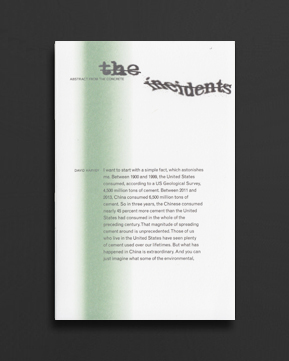
Marxist geographer David Harvey opened his lecture with a fact: between 2011 and 2013 China consumed 50 percent more cement than the United States had in the entire twentieth century. In Abstract from the Concrete, he asks why. Spiraling outward—geographically and materially—Harvey travels from the building industry in China to the foreclosed housing market in the United States to the automobile industry in São Paolo and back again. The why emerges as a direct result of “anti-value,” of capital in crisis—intrinsic, he contends, to capital and capital cities today.
Featuring an interview with David Harvey by Mariano Gomez Luque and Daniel Ibañez
The Incidents is a series of publications based on events that occured at the Harvard University Graduate School of Design between 1936 and tomorrow.
The Incidents Series is copublished with the Harvard University Graduate School of Design
Design by Åbäke
2016, English
Softcover, 56 pages, 9.6 x 14.8 cm
Published by
Sternberg Press / Berlin
$12.00 - Out of stock
Francis McKee
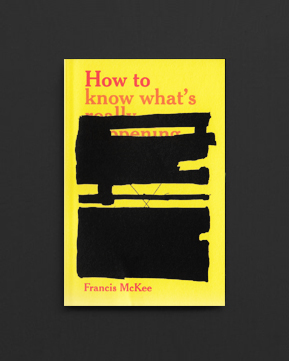
How to Know What’s Really Happening
Edited by Mai Abu ElDahab, Maha Maamoun, Ala Younis
In this post-truth era, how does one navigate the endless information available and choose a viable narrative of reality? In How to Know What’s Really Happening Glasgow-based writer and curator Francis McKee looks at various techniques for determining verity, from those of spy agencies and whistle-blowers to mystics and scientists.
This is the third book in the Kayfa ta series, a publishing initiative of artists Maha Maamoun and Ala Younis. Each book in the series is a monographic essay commissioned in the style of how-to manuals that situate themselves in the space between the technical and the reflective, the everyday and the speculative, the instructional and the intuitive, and the factual and the fictional.
Copublished with Kayfa ta and Mophradat
Design by Julie Peeters
2016, English
Softcover, 352 pages, 20 x 28.7 cm
Published by
Bergen Kunsthall / Norway
Le Consortium / Dijon
Sternberg Press / Berlin
$120.00 $70.00 - Out of stock
Edited by Martin Clark, Anne Pontégnie, Steinar Sekkingstad
Texts by Ina Blom, Martin Clark, Anne Pontégnie, Steinar Sekkingstad
Fredrik Værslev’s work navigates between different painterly traditions, and demonstrates the possibilities and relevance of the medium today. He treats his paintings as objects, often created through more or less laborious, serial, or deterministic processes where time itself, as well as various external factors, become active cocreators in the making of the work. In several series, he has left his paintings outdoors for long periods of time, allowing the weather and external wear to complete the work. Other works employ apparently clichéd techniques, motifs, or art-historical quotations (i.e., dripping and splattering). More recently, Værslev has been working with a tool used for marking painted lines on roads and sports fields.
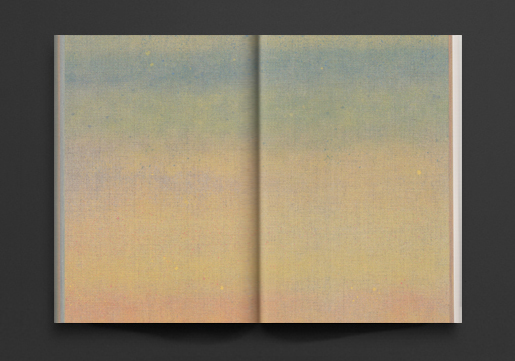
Published in conjunction with Fredrik Værselv’s exhibition “All Around Amateur” at the Bergen Kunsthall and Le Consortium, Dijon, this publication, comes in two different versions, with each book comprising 320 one-to-one digital images scanned from eight of Værslev’s new “sunset” paintings. Each canvas produces a total of eighty scanned images, which are reproduced in the book sequentially, left to right, top to bottom. The full-bleed scans in each “volume,” together, reproduce an entire wall of paintings from the exhibition. The paintings, based on photographs of sunsets taken by Værslev on his iPhone from airplane windows, evoke the work of art-historical figures such as J. M. W. Turner, Mark Rothko, and Edvard Munch.
The catalogue also includes newly commissioned texts by Ina Blom, Martin Clark, and Steinar Sekkingstad as well as an interview with artist Anne Pontégnie.
Copublished with Bergen Kunsthall, and Le Consortium, Dijon
Design by Fraser Muggeridge Studio
2007, English
Softcover, 16.5 x 24.1 cm, 152 pages (27 color ill.)
Published by
Art in General / New York
Sternberg Press / Berlin
$32.00 - Out of stock
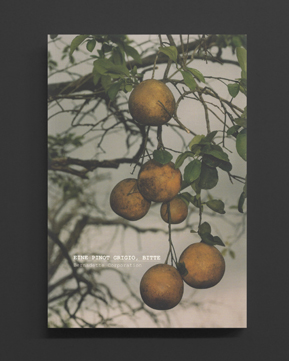
“For this book Bernadette Corporation uses screenplay formatting software and the screenplay form with no intention to produce a film or communicate anything. ... the hack is used as a starting point for a literature, with hack tools in a hack medium. EINE PINOT GRIGIO, BITTE to remind you of the necessity to understand that all creativity is equal.” Bernadette Corporation
A novel-in-disguise, Eine Pinot Grigio, Bitte is a dark foray into capitalism gone awry. Set against a backdrop of decadent zombies, the screenplay follows John Delp and Aude as they shoot a movie in the cities of Paris, Berlin, and Mexico City. With its wild and messy sense for the absurd, Eine Pinot Grigio, Bitte unravels that conventional Hollywood repertoire of screenwriting all to better recycle both fiction and the real.
Eine Pinot Grigio, Bitte is followed by “Pedestrian Memoranda,” a series of notes on Bernadette Corporation's temporary underground film studio, operated from 2005–2007 in Paris, Berlin, and Mexico City.
Bernadette Corporation has previously worked under the guise of an eponymous underground fashion label, published a fashion magazine called Made in USA, produced video-films, including the 2003 documentary Get Rid of Yourself, collectively authored the novel Reena Spaulings (Semiotext[e] 2004), as well as exhibited at the 2006 Whitney Biennial, the Witte de With museum, and the Centre Pompidou.
Co-published by Art in General, New York
2016, English
Softcover (w. dustjacket), 166 pages, 19 x 25.5 cm
Published by
Sternberg Press / Berlin
$54.00 $15.00 - Out of stock
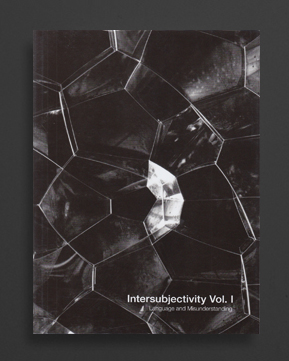
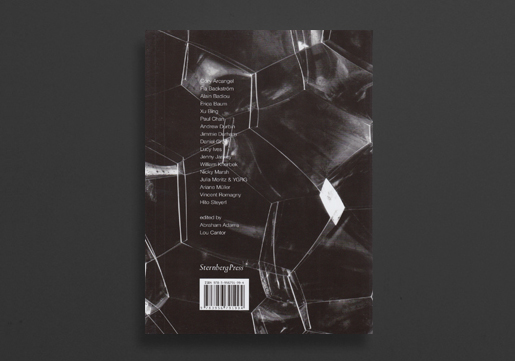
Intersubjectivity Vol. 1
Language and Misunderstanding
With contributions by Cory Arcangel, Fia Backström, Alain Badiou, Erica Baum, Xu Bing, Paul Chan, Andrew Durbin, Jimmie Durham, Daniel Grúň, Lucy Ives, Jenny Jaskey, William Kherbek, Nicky Marsh, Julia Moritz & YGRG, Ariane Müller, Vincent Romagny, Hito Steyerl
Intersubjectivity, a two-volume collection of essays, is concerned with a new account of our ideas of what subjects are, and what is means for them to meet. The project explores these concepts in the context of the interaction of non-sentient beings, attempting to move beyond anthropomorphic theories of objectivity and materiality, as well as subjects whose boundaries resist definition. Intersubjectivity takes up the complementary problems of nondiscursive language and nonlinguistic discourse, in an attempt to locate the distinctions and respective abilities of philosophy as a particular kind of art and art as a particular kind of philosophy.
The first volume, Language and Misunderstanding, addresses concretism and its discontents. The essays and performance texts herein argue for an expanded consideration of concretism in contemporary practices oriented toward the embodiment of language, in works that challenge the privileging of the body of the word over the body of the artist. Thus Cory Arcangel, Fia Backström, Erica Baum, Paul Chan, Jimmie Durham, and Hito Steyerl all contribute works that in different ways insist on the somatic nature of writing; Andrew Durbin, and Ariane Müller, and Vincent Romagny address the drift of meaning across material; Lucy Ives, Daniel Grúň, and the Young Girl Reading Group are skeptical of dogmas of authorship and identity; Alain Badiou asks when modern art will end; and Abraham Adams polemicizes against the loss of the body in the concrete work. With an introduction by Lou Cantor.
Design by BOKA Bożena Kalinowska
1986, Japanese / English
Softcover, 170 pages, 22 x 29.5 cm
1st Edition, Out of print title / used*,
Published by
Kajima Institute Publishing / Tokyo
$70.00 - Out of stock
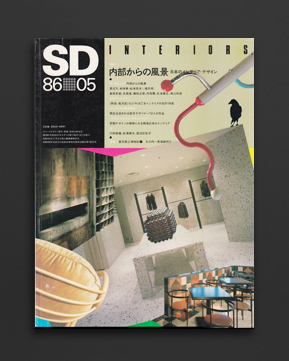
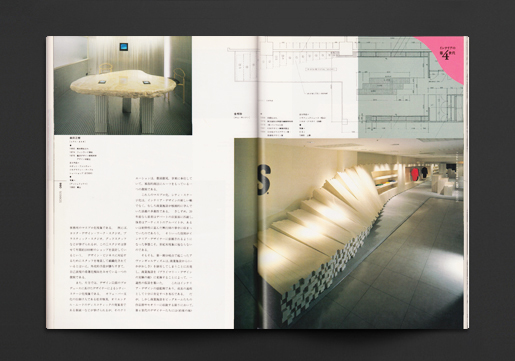
SD (Space Design): A monthly journal on Art and Architecture.
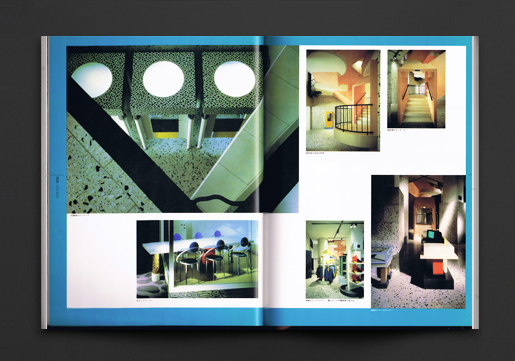
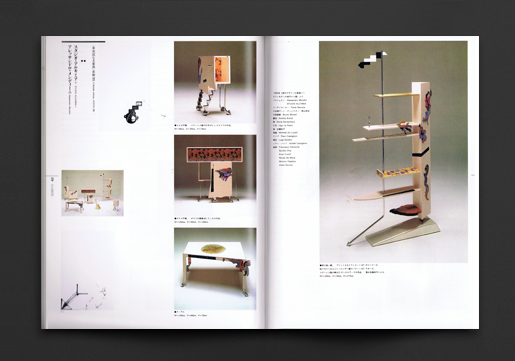
“SD” (Space Design) was founded in Japan in 1965; a comprehensive monthly magazine on architecture, urban problems and fine arts which was unique in the world and quickly became a leading, highly-esteemed journal of international modern design.
SD no. 260, May 1986
SPECIAL FEATURE: JAPANESE INTERIORS
Includes Susumu Kitahara, Riki Watanabe, Shiro Kuramata, Masanori Umeda, Takashi Sakaizawa, Shigeru Uchida, Takashi Sugimoto, Archizoom, Memphis, Masanori Umeda, Le Corbusier, Sottsass Associates, Ettore Sottsass, Alessandro Mendini, Alchimia and much more.
SD is one of the finest journals dedicated to new design (architecture, furniture, interior, environmental, industrial...), becoming a collector's item and much sought-after archival resource.
1987, Japanese / English
Softcover, 170 pages, 22 x 29.5 cm
1st Edition, Out of print title / used*,
Published by
Kajima Institute Publishing / Tokyo
$70.00 - Out of stock
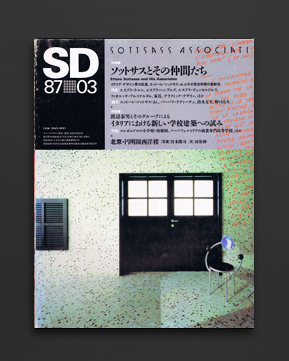
SD (Space Design): A monthly journal on Art and Architecture.
“SD” (Space Design) was founded in Japan in 1965; a comprehensive monthly magazine on architecture, urban problems and fine arts which was unique in the world and quickly became a leading, highly-esteemed journal of international modern design.
SD no. 260, May 1986
SPECIAL FEATURE: SOTTSASS ASSOCIATES
Includes Susumu Kitahara, Riki Watanabe, Shiro Kuramata, Masanori Umeda, Takashi Sakaizawa, Shigeru Uchida, Takashi Sugimoto, Archizoom, Memphis, Masanori Umeda, Le Corbusier, Sottsass Associates, Ettore Sottsass, Alessandro Mendini, Alchimia and much more.
SD is one of the finest journals dedicated to new design (architecture, furniture, interior, environmental, industrial...), becoming a collector's item and much sought-after archival resource.
1985, Japanese / English
Softcover, 170 pages, 22 x 29.5 cm
1st Edition, Out of print title / used*,
Published by
Kajima Institute Publishing / Tokyo
$60.00 - Out of stock
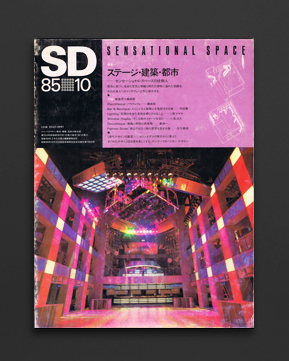
SD (Space Design): A monthly journal on Art and Architecture.
“SD” (Space Design) was founded in Japan in 1965; a comprehensive monthly magazine on architecture, urban problems and fine arts which was unique in the world and quickly became a leading, highly-esteemed journal of international modern design.
SD (Space Design) no. 253, 1985
SPECIAL FEATURE: SENSATIONAL SPACE
Features profiles on the dynamic interiors of shopping malls, fashion boutiques, discotheques and much more. Includes a feature on Alchimia.
SD is one of the finest journals dedicated to new design (architecture, furniture, interior, environmental, industrial...), becoming a collector's item and much sought-after archival resource.
1977, English
Softcover, 74 pages, 15 x 20 cm
1st Edition, Out of print title / Used*,
Published by
Fischer Fine Art Limited / London
$25.00 - Out of stock
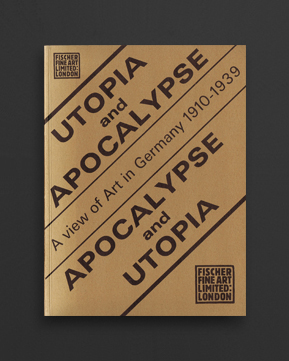
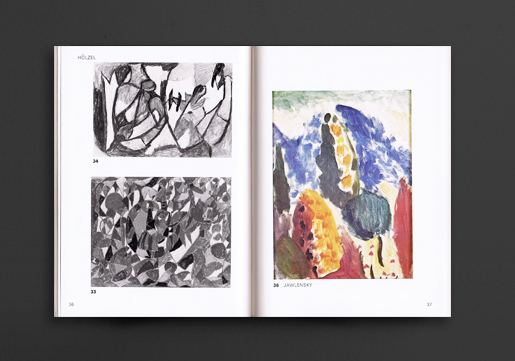
Fantastic little catalogue produced on the occasion of the exhibition "Apocalypse and Utopia" at Fischer Fine Art Limited, London, March - May 1977.
Features the work of Karl Arnold, Ernst Barlach, Willi Baumeister, Herbert Bayer, Max Backmann, Heinrich Campendonck, Otto Dix, Lyonel Feininger, Georg Grosz, Erich Heckel, Hannah Höch, Adolf Hölzel, Johannes Itten, Alexei Von Jawlensky, Wassily Kandinsky, Ernst Ludwig Kirchner, Paul Klee, Oskar Kokoschka, Georg Kolbe, Käthe Kollwitz, August Macke, Franz Marc, Ludwig Meidner, Laszlo Moholy-Nagy, Otto Müller, Emil Nolde, Max Hermann Pechstein, Christian Rohlfs, Oskar Schlemmer, Karl Schmidt0Rottluff, Kurt Schwitters, Arthur Segal, Hans Walter.
"The idea for this exhibition arose when we were fortunate enough to be offered the famous Hess Guest Book. Around this nucleus we have planned a view of art in Germany between 1910 and 1939. With the generous help of many collectors and galleries we have been able to illustrate the varied aspects of this complex and important period of German art."
The Guest Book was a two volume book-set that spanned the years 1907-1956. They were the guest books of the home of Industrialist Alfred Hess and Thekla Hess, who were great lovers and collectors of art. Their home in Erfurt regularly gathered together leading figures of the art, music and literature worlds, and their guest books collected the inscriptions, autographs, drawings and watercolours of these times.
"The Guest Book is a remarkable, unique document of the most innovative period of 20th-century German art and forms a reference source of the greatest importance."
With an introduction by professor and author Norbert Lynton, the first part of this catalogue reproduces works from The Guest Book, and the second full-colour and black and white reproductions of works in the exhibition of 1977. Includes a full catalogue of the works.
1997, Japanese
Softcover, 280 pages, 19 x 26 cm
1st Edition, out of print title / Used*,
Published by
Tama Art University / Japan
$50.00 - Out of stock
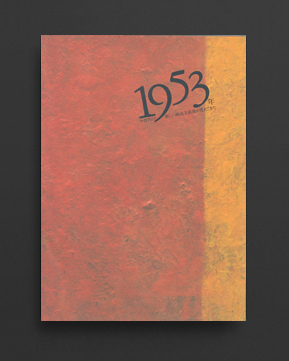
Scarce 1st edition of this heavy book published on the occasion of the exhibition "1953 : Shedding Light on Art" at Meguro Museum of Art Tokyo, June 8 - July 21, 1996, an exhibition that looked deeply into the important transitional years of the early 1950s post-war Japanese and the climate of new modern design, architecture and the society that surrounded it. Giving birth to a new avant-garde in Japan, including Mono-ha, Gutai, Jikken Kobo (Experimental Workshop) and other avant-garde movements, this books covers the vast array of artistic activity taking place in Japan in this period, across painting, sculpture, performance, design, architecture, photography, crafts, and more. Illustrated throughout in colour and black and white. All texts in Japanese.
Includes inserted exhibition stub.
2014, English
Softcover, 97 pages, 15 x 23 cm
Published by
The Drawing Center / New York
$38.00 - Out of stock
Featuring a forward Brett Littman and essays by Gregory Burke, Tyler Cahn, and Len Lye.
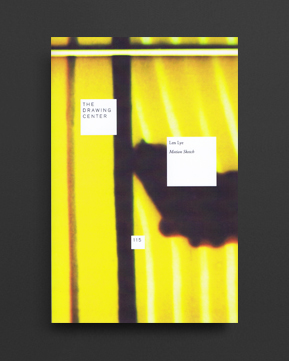
Len Lye (1901–1980) is arguably one of the twentieth century’s most original artists; a one-man art movement spanning several countries and multiple media over a lifetime and beyond. As a New Zealander practising in London during the pre-war years, and then a key figure in the post-war New York avant-garde art scene, Lye mapped a unique course through Modernism.
This publication was produced on the occasion of a Len Lye exhibition at The Drawing Centre in New York in 2014.
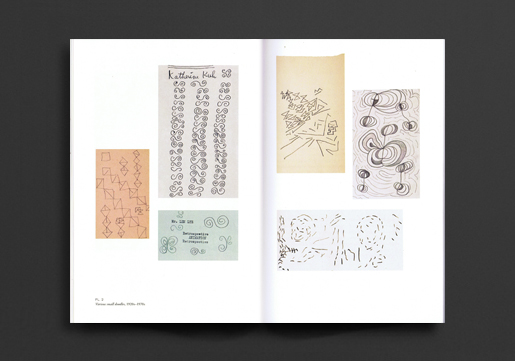
"Len Lye’s career was marked by a lifelong fascination with movement and an aspiration to compose motion; the movement of the drawing hand was an important touchstone for his works in various media. In New York Lye is now well known for his animated experimental films. In the 1920s, however, Lye began to make what he termed “motion sketches”; abstract drawings that attempted to render the movement of his subjects, rather than their appearance. Motion Sketch reintroduces scholars and audiences in New York to Lye’s multidimensional practice specifically in relation to drawing. Describing his drawing practice in his own carefree prose, Lye said that doodling “cultivates a vacuous seaweed-pod state of kelp as a skull which is attached to a pencil betwixt the arm and the fingers held doodling in turn ‘twixt you and the paper in a rather bemused, empty, harmonious state of an attitude, eyes periphering said paper.” Lye’s kinesthetic approach to drawing—related to Surrealist automatism and anticipating aspects of Abstract Expressionism—also informed his practice in painting, photography, film and sculpture. Not limited to works on paper; the exhibition will instead reveal how Lye’s concept of "doodling" underpinned his approach to much of his work.
The exhibtion will include a selection of paintings, drawings, and photograms, never before seen in the United States. In The Drawing Center’s Lab gallery, an extensive film program will be presented on video, including such landmark films as Tusalava, 1929; A Colour Box, 1935; andFree Radicals, 1957/1979.
Len Lye: Motion Sketch is curated by Gregory Burke, Executive Director/CEO of both the Mendel Art Gallery and Remai Art Gallery of Saskatchewan and Co-Curator of the Montreal Biennale, 2014; and Tyler Cann, Associate Curator of Contemporary Art at the Columbus Museum of Art. This exhibition is presented by The Drawing Center in collaboration with the Govett-Brewster Art Gallery (New Plymouth, New Zealand) and draws primarily from the Len Lye Foundation Collection."
2014, English
Hardcover, 135 pages, 15 x 25 cm
1st edition, 1000 copies, Out of print title / As New,
Published by
Mousse Publishing / Milan
Museum of Contemporary Art / Denver
$40.00 $20.00 - Out of stock
Edited by Nora Burnett Abrams.
Texts by Michael Ned Holte, Sarah Robaio Sheridan, and Nora Burnett Abrams
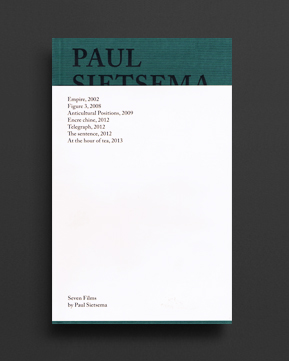
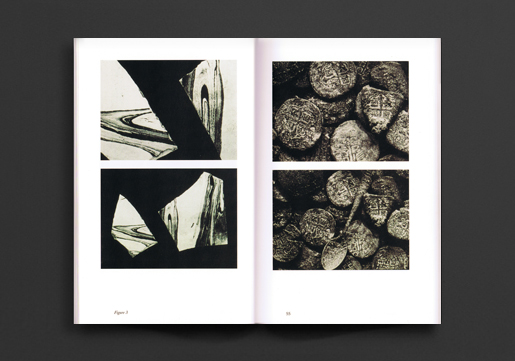
Published in conjunction with Sietsema’s show at Museum of Contemporary Art Denver, Seven Films by Paul Sietsema is the first publication devoted to the artist’s films. In the words of Sarah Robayo Sheridan, “Paul Sietsema compounds organic and artificial detritus in all his artwork, scavenging in history’s wake to identify specific tools of cultural production and foraging for concepts of art promulgated in the words of artists and attitudes of critics. He mines film as a vestige, the medium of the mechanical age, pressing and squeezing its very obsolescence through a contemporary sieve. In so doing, the artist hovers in the switchover between a bodily inscription in the image and a fundamental reconstitution of sight and representation in the matrix of the virtual. Where body stops and image starts is a divide collapsing through a series of innovations and accidents that go back as far as the people of Pompeii trapped in an emulsion that marked their death, but which paradoxically carried forward their image into eternity.”
First edition of 1000 copies, now out of print.
1975, English
Softcover (staple-bound), 40 pages, 25 x 25 cm
1st edition, Out of print title / used*,
Published by
Whitney Museum of American Art / New York
$60.00 - Out of stock
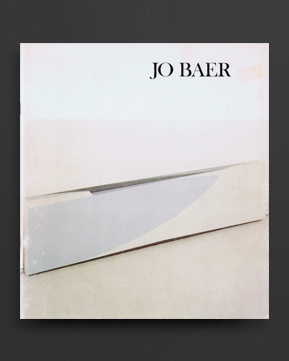
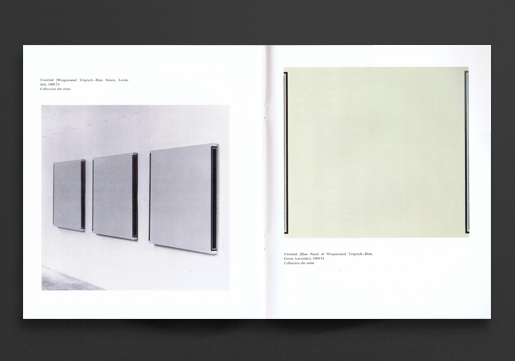
Rare Jo Baer catalogue from 1975, published to accompany a major mid-career retrospective of Jo Baer's work at the Whitney Museum of American Art, New York, May 1-July 13, 1975. Features colour and black and white reproductions of many of Baer's work, along with text by Barbara Haskell.
Jo Baer was born in Seattle, Washington in 1929. After completing graduate work in psychology at the New School for Social Research in New York, she began her career as an artist in Los Angeles in 1953. Seven years later, she returned to New York where she became a key participant in the Minimalist art movement. Her paintings were included with works by Donald Judd, Dan Flavin, Robert Morris, and Sol Lewitt in many of the first Minimalist art exhibitions in New York in the early 1960s.
Her unswerving commitment to painting as a radical art form brought her a one-person exhibition as early as 1966 at the Fischbach Gallery in New York. In 1975, the Whitney Museum of American Art in New York held a mid-career retrospective of her work. In 1999, the Stedelijk Museum in Amsterdam exhibited a large retrospective of her work. Recently the DIA Center for the Arts in New York also held a major exhibition of over 25 minimalist paintings and prints that she completed from 1960 to 1975.
In search of a more substantive art, Baer exiled herself from the New York art world with a move to Ireland in 1975. By 1983, she took a stance against abstract art as an avant-garde form with a polemical article in Art in America. Since 1984, she has lived and worked in Amsterdam. Baer continues to develop the formal content of her paintings in a quasi-figurative manner that she considers radical figuration — without pre-eminence of image or space.
1980, English
Softcover, 128 pages, 28 x 21.5 cm
Out of print title / used*,
Published by
Cornell Paperbacks / London
Phaidon / London
$38.00 $15.00 - Out of stock
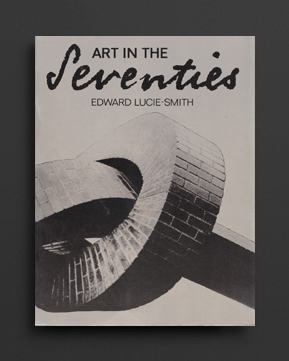
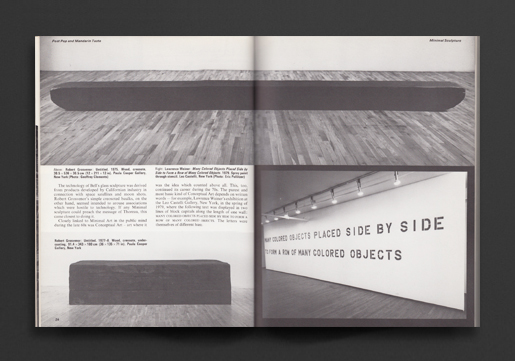
"Edward Lucie-Smith, a critic and historian of art who is deeply immersed in the works and trends of the seventies here provides the first general survey of the decade. In a volume alive with visual images that are often surprising and sometimes disturbing, he analyzes the development both of old forms and of new ones, and provides a coherent framework for the general reader."
Contents: The Popular Arts; Post Pop and Mandarin Taste; Abstract Painting; Illusionary Art; Figurative Painting; Fetish Art and Happenings; Political Art; Art as Environment and Architecture; High-Tech and the Third World, plus a biographical list of the artists featured and a "further reading" list.
Includes the work of: Stephen Willats, Lawrence Weiner, Brice Marden, Robert Mapplethorpe, Vito Acconci, Jo Baer, Joseph Beuys, Lynda Benglis, Bob Law, Philip King, Alan Kessler, On Kawara, Douglas Huebler, John Kacere, Richard Long, Robert Mangold, Philip Guston, Hans Haacke, Nancy Grossman, Robert Grosvenor, Nancy Graves, Walter de Maria, U-Fan, Claude Viallet, Nancy Spero, Peter Saul, Robert Ryman, James Rosenquist, Joel Shapiro, Sylvia Sleigh, Robert Stackhouse, Paul Thek, Giulio Paolini, Nam June Paik, Bruce Nauman, Roman Opalka, Dennis Oppenheim, Tony Cragg, Judy Chicago, Larry Bell, Daniel Buren, Chuck Close, and many more.
2016, English
Softcover, 408 pages,17 x 23 cm
Published by
Karma / New York
$56.00 - Out of stock
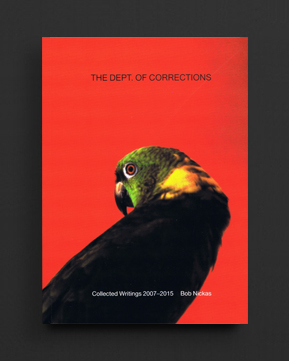
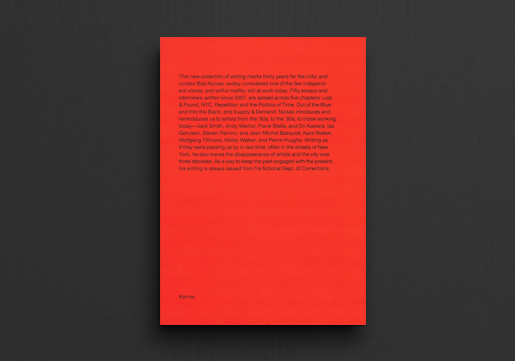
This volume is comprised of years of recent writing by the influential New York–based critic and curator Bob Nickas, widely considered one of the few independent voices still at work today. The 50 essays and interviews, written since 2007, are spread across five chapters, touching on encounters with artists from the 1960s to the ’80s to the present – among them, Jack Smith, Andy Warhol, Frank Stella, On Kawara, Isa Genzken, Steven Parrino, Jean-Michel Basquiat, Kara Walker, Wolfgang Tillmans, Kelley Walker and Pierre Huyghe.
2000, English
Softcover, 176 pages, 15 x 21 cm
Published by
Les Presses Du Reel / Paris
$19.00 - Out of stock
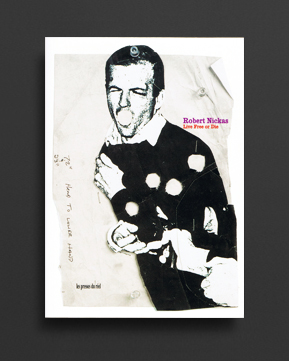
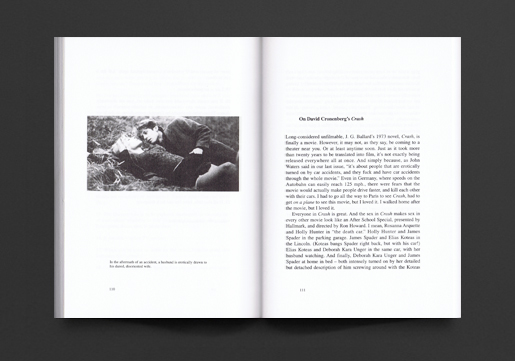
Robert Nickas is a critic, freelance curator, and editor of the Index magazine (New York). He is also one of the free spirits who were nurtured by the libertarian punk slogan "do it yourself". In this collection, covering twenty years of activity, Nickas combines humour with intellectual rigor, as well as a reliable historical memory to broach works of personalities as diverse as Maurizio Cattelan, Felix Gonzalez-Torres, Cady Noland, John Miller, Haim Steinbach or Andy Warhol, by way of David Cronenberg, Melvins, Père Ubu and numerous others, also slipping in untimely observations on the alleged death of painting, the "Golden 80s" of New York art world, and the role of the exhibition curator.
Working independently, Robert Nickas has realized more than forty exhibitions for galleries and museums since 1984. He recently co-curated the Biennale of Lyon in France (with the Consortium team), is an editor of Artforum, and a Guest Curator at P.S.1 in New York.
His writings and interviews have appeared in Afterall and Sound Collector, as well as in numerous catalogues and monographs - Felix Gonzalez-Torres, On Kawara, Olivier Mosset, Cady Noland, Andy Wharol.
1979, English
Softcover, 95 pages,
1st edition, Out of print title / used*,
Published by
W W Norton & Co / New York
$50.00 - Out of stock
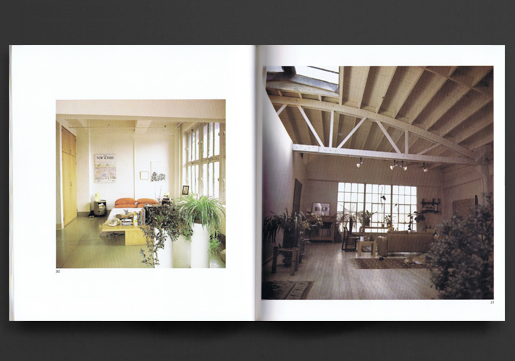
First edition of the rather sought after interiors book from 1979 dedicated entirely to lofts. Cover to cover full-colour imagery of diverse and inspired lofts for living and working in the late 1970's.
1979, English
Softcover (staple bound), 48 pages, 22 x 27 cm
1st Edition, Out of print title / Used*,
Published by
Watters Gallery / Sydney
$80.00 - Out of stock
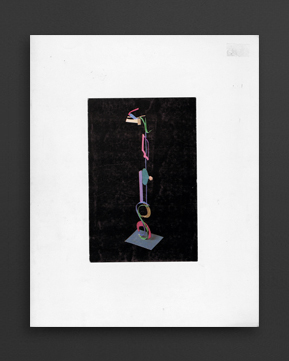
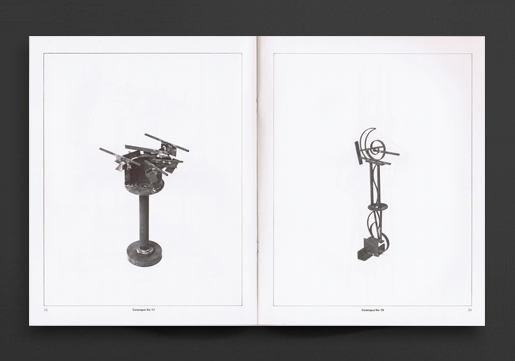
Rare catalogue published in 1979 on the occasion of an exhibition by the great Australian sculptor Robert Klippel, at Watters Gallery, Sydney. Features reproductions of 43 of Kippels sculptures produced in the 1970s, alongside a biography and essay staple-bound in a card cover with full-colour plate glued to the front. A great publication!
Robert Klippel (19 June 1920 – 19 June 2001) was an Australian constructivist sculptor and teacher. Klippel was based in Sydney and his work commonly utilized an extraordinary diversity of junk materials: wood, stone, plastic toy kits, wooden pattern parts, typewriter machinery, industrial piping and machine parts, as well as bronze, silver, oils, photography, collage and paper. He is also notable for the great diversity of scale of his work, from intricate whimsical structures in metal to the large wooden assemblages of the 1980s. His mature work was usually untitled, being distinguished by simple number sequences.
For a period Klippel lived abroad, leaving Australia in 1947 to study at the Slade School of Fine Art where he remained for six months. He lived and painted at The Abbey Arts Centre in New Barnet, London, along with artists Leonard French, James Gleeson, Peter Benjamin Graham, Douglas Green, Stacha Halpern, Grahame King and Inge King. In November 1948, Klippel, Gleeson and the young Lucian Freud exhibited together in London. André Breton, the originator of Surrealism, arranged for Klippel's work to be exhibited in Paris the following year. During his time in London, he began a series of drawings and filled his notebooks with analytical diagrams of organic and mechanical objects, everything from screws and cogs to insects and shells, and making detailed drawings of the anthropomorphic forms used by artists such as Henry Moore and Pablo Picasso. Whereas Moore had related the human figure to the forms of nature, Klippel set out to relate the forms of nature to the shapes and forms of machinery in an industrial society. He made the statement that he wished "to seek the inter-relationship between the cogwheel and the bud." Klippel returned to working prolifically in Australia from 1950 onwards. In 1964, art critic Robert Hughes called Klippel "one of the few Australian sculptors worthy of international attention".
Throughout his career he produced some 1,300 pieces of sculpture and approximately 5,000 drawings.
2014, English
Hardcover, 256 pages (colour ill.), 28.5 x 21.5 cm
Published by
Walther König / Köln
$79.00 - Out of stock
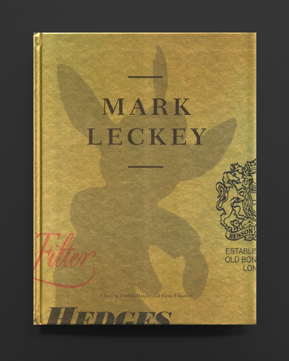
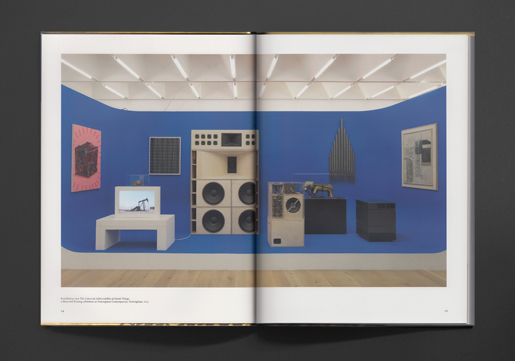
Mark Leckey: On Pleasure Bent is the first comprehensive monograph on the British artist’s work.
Tracing in reverse chronology the connections between his recent production – including videos, sculptures, installations, and lecture performances – and his earliest works from the mid and late 1990s, this publication reveals the persistent centrality of popular culture, music, and technology to Leckey’s influential oeuvre.
All the artist’s scripts to date appear together for the first time in this lavishly illustrated volume.
Published to coincide with the exhibition Mark Leckey: Lending Enchantment to Vulgar Materials at WIELS Contemporary Art Centre,
Brussels, 25 September – 15 January 2014–15.
This exhibition was made in collaboration with the Museo d’Arte Contemporanea Donnaregina-Madre, Naples and Kunsthalle Basel.
2012, English
Softcover, 108 pages (ill. throughout), 22 x 26.5 cm
Published by
Exitstencil Press / London
$55.00 - Out of stock
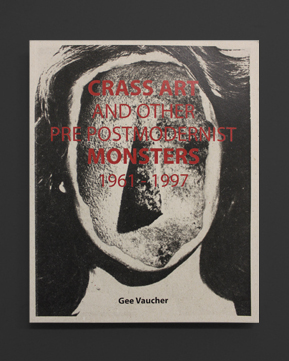
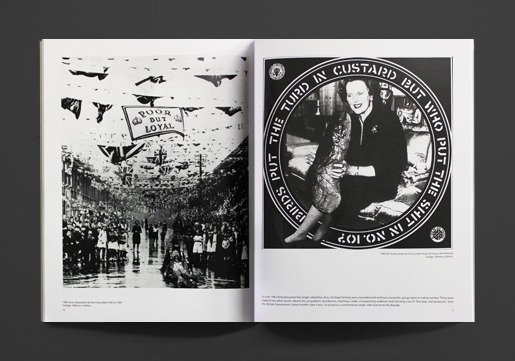
THE comprehensive book on the graphic art of the legendary punk-provocateur Gee Vaucher, from 1961-1997. This is the new, revised and expanded edition from 2012 by Exitstencil Press, London. Not only are much of the more salient works from her years making artwork for Anarcho-punk band Crass collected here, but also a wealth of additional material, including Vaucher's graphic work as a freelance artist in New York before her Crass years, extending the volume approximately 10 more pages compared to the original Exitstencil Press/AK Press edition of 1999.
Forward:
It's great that Gee Vaucher's work has been collected together in this book and that we can witness the brave journey she has travelled as an artist and activist. By its nature, her work has previously appeared in unexpected places, giving a shock of truth. That's been a large part of its power. Gee is a prime example of what Walter Benjamin called 'the author as producer'. The subversion within the content of her work has been developed through subverting and creating new outlets. Through magazines, newspapers and especially through Crass, her work has mainly entered into the world not through the gallery, but as part of a publication, a voice connected to other voices who have said 'No' to the great lie of mass media. Her work is in the tool-box with all the other examples of cultural strength that aims to put a spanner in the works. It hasn't been an easy journey, because Gee was not only inventing an image, but finding a context for that image, a context that, like her images, develops a world view against the grain. It's like inventing a word and then having to invent the punctuation and sentence structure in which to place it. Gee's work lives beyond the time it was made and its specific references. It is beautifully constructed whether in gouache, collage, pastel or any other medium. The exquisite technical perfection of the gouache work gives a hyper-reality to their searing critique of everyday life in the West. The anger that fuels the work has become more 'inward' as time progresses. It is as if her work is now trying to reach inside bodies to find a social truth from the interior of our physical being. Her art tears through the lies that are now the official discourse of a different reality. Through connection and dislocation she makes a plea for us to look again at the flood of images with which we are constantly bombarded, and to fight our way through them to other possible worlds. The title of the book is apt. Gee's work is pre postmodernist in its humanity and its belief that art can deal with social morality. In that sense, through all the horror and pain depicted, there is an optimism, a suggestion that an alternative is possible. Wheras a lot of postmodernism seems to be a passive acceptance of the status quo, Gee never does a postmodernist shrug in the face of the real. She pulls us apart and puts us together in such a way as to shake us up and wake us up. May she go on ringing those alarm bells.
"In his foreword Peter Kennard describes Vaucher as 'a voice connected to other voices who have said "NO" to the great lie of mass media'. Her work is as shocking now as when it was first created: an unadorned depiction of rape in war, collaged studies of gender-contradictory nudes, a sustained and passionate anti-militarism. Her work does not aim to please but to invite study. This is a body of work with modernity, gravitas and bite." -- Hilary Bichovsky, Red Pepper Magazine "Artists often lament the loss of quality when their work is reproduced. The work of a purely-graphic artist is invariably enhanced by the printing process. In its original form, Gee Vaucher's work is intricate and tactile, and while the imagery is sometimes almost overwhelming, the primary concerns are those of the painterdealing with form and space. Mere newsprint would hardly seem able to do justice to its subtle tones. When work is printed, the space becomes more simple and the graphic images take on a different life. The visual concerns are those of delivery, and the message is clear. Painstakingly executed and almost private paintings are transformed into powerful illustrations by the brilliance of Gee Vaucher's vision. While the stenches of corruption and injustice do linger, it is an honourable thing to point or even lift a finger." -- Ian Dury, 1997
Gee Vaucher is a visual artist who was born in 1945 in Dagenham, East London. Her work with Anarcho-punk band Crass was seminal to the 'protest art' of the 1980s. Vaucher has always seen her work as a tool for social change. In her collection of early works (1960-1997) Crass Art and Other Pre Post-Modernist Monsters, Vaucher can be seen to have expressed her strong anarcho-pacifist and feminist views in her paintings and collage. Vaucher also uses surrealist styles and methods.
2016, English
Softcover, 32 pages, 21 x 29 cm
Published by
Russian Glue Press / Melbourne
$12.00 - Out of stock
Russian Glue Press presents its third photographic publication "Blue Fried Lucifer" by Melbourne based photo collage artist, Thomas Miller.
An unnamed mortuary temple contains three masked humanoids, preparing for a spectacle of subliminal levitation they sit naked in unison, surrounding an azure coloured boiling hot cauldron. All consume an equal quantity of opiate based psilocybin brew and draw blood from their hands in seance awaiting the overwhelming and bizarre blue light of Goro Kralth lucifer.
1988, English
Softcover, 156 pages, 25 x 30.5 cm
1st Edition, Out of print title / used / good
Published by
Hirshhorn Museum / Washington
$50.00 $20.00 - In stock -
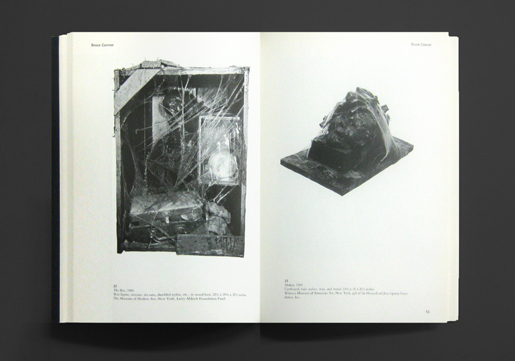
Catalogue for the 1988 exhibition at the Hirshhorn Museum, featuring Wallace Berman, Clyde Connell, Bruce Conner, Oyvind Fahlstrom, Robert Helm, Alfred Jensen, Jess, Luis Jimenez and Peter Saul.
2016, English
Softcover, 152 pages, 184 x 12 cm
Published by
California College of the Arts / Oakland
Koenig Books / London
The Banff Centre / Canada
$32.00 - Out of stock
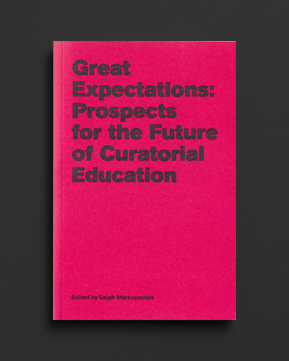
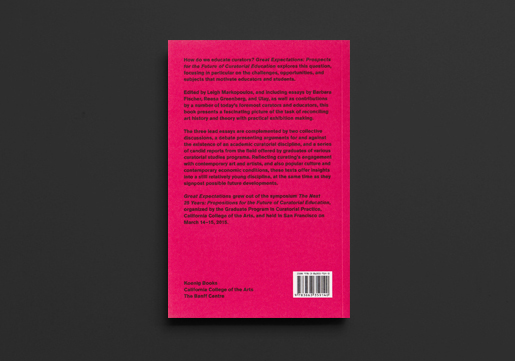
How do we educate curators? Great Expectations: Prospects for the Future of Curatorial Education explores this question, focusing in particular on the challenges, opportunities, and subjects that motivate educators and students.
Great Expectations grew out of the symposium The Next 25 Years: Propositions for the Future of Curatorial Education, organized by the Graduate Program in Curatorial Practice, California College of the Arts, and held in San Francisco on March 14–15, 2015.
With contributions by: Mark Beasley, María del Carmen Carrión, Rebecca Coates, Maeve Connolly, Barbara Fischer, Reesa Greenberg, Kit Hammonds, Matthew Higgs, Sinéad Hogan, Anthony Huberman, Mami Kataoka, Salwa Mikdadi, Julian Myers-Szupinska, Estelle Nabeyrat, Nontobeko Ntombela, Kris Paulsen, Kristina Lee Podesva, Peta Rake, Grace Samboh, Kitty Scott, Ulay
2016, English
Softcover, 212 pages, 12.7 x 20.3 cm
Ed. of 70,
Published by
3-Ply / Victoria
$35.00 - Out of stock
124,908 by Tara McDowell, with photography by Daro Sulakauri, experiments with how to document exhibitions in an embodied way. It deals with an exhibition that unfolded throughout the postindustrial city of Rustavi in the Republic of Georgia, in conjunction with the 2nd Tbilisi Triennial. The exhibition was titled for Rustavi’s population – 124,908 – and featured works by Xin Cheng, Leone Contini, Eliza Dyball, Clementine Edwards, George Egerton-Warburton, Cevdet Erek, Debris Facility, Emma Fitts, Amy Franceschini, Helen Grogan, Susan Jacobs, Ash Kilmartin, Ieva Misevičiūtė, Virginia Overell, and Kateřina Šedá. Echoing the model of Lucy R. Lippard’s numbers exhibitions from the early 1970s, Tara McDowell and assistant curator Nicholas Tammens invited artists to propose temporary artworks, which were installed in the city center, factory square, museum, theaters, pyramid and zoo, working with local artists, students, and Rustavi residents.
The images within the publication 124,908 were taken by photojournalist Daro Sulakauri over a single day (October 3, 2015) of the exhibition. The fragmented text that intersperses this image narrative reflects the fractured, time-skipping nature of the project’s composition. Lucy R. Lippard has reacted to the project as the “best understood account” of her numbers exhibitions, but 124,908 could also be characterised as facing the impossibilities of re-curation.
Design by Žiga Testen