World Food Books' programme is largely produced on Kulin Nation land. We acknowledge the Wurundjeri people of the Kulin Nation as the first and continuing custodians of this land, and pay respect to their Elders past, present, and emerging.
World Food Books is an arts and special interests bookshop in Naarm / Melbourne. Founded in 2010, World Food Books is devoted to the presentation of a rotating, hand-selection of international art, design, literary and counterculture publications with an emphasis on the anti-traditional, the experimental, the avant-garde, the heretic, the marginal.
Presenting new titles alongside rare and out-of-print books, catalogues and journals spanning the fields of modern and contemporary art, design, photography, illustration, film, literature, poetry, cultural theory, philosophy, sexuality, popular and underground culture in its many radical forms, World Food Books wishes to encourage adventurous, thoughtful and open-minded reading, looking, writing, and exchange of publishing and ideas, both current and historical.
As well as our bookshop, located in Melbourne's historical Nicholas Building, all of our inventory is available internationally via our online mail-order service.
World Food Books semi-regularly co-ordinates "Occasions", a programme of exhibits and events at the bookshop and in partnership with other hosts (such as museums and art galleries) that develop out of the activities, relationships and content of the bookshop itself.
World Food Books
The Nicholas Building
37 Swanston Street
Room 5, Level 6
Melbourne 3000
Australia
SHOP HOURS:
Thu–Fri 12–6, Sat 12–5
WEB-SHOP OPEN 24/7
World Food Books
Postal Address:
PO Box 435
Flinders Lane
Victoria 8009
Australia
Art
Theory / Essay
Architecture / Interior
Graphic Design / Typography
Photography
Fashion
Eros
LGBTQ+
Fiction / Poetry
Weird / Speculative / Science Fiction / Horror
Transgressive / Visceral / Abject
Symbolism / Decadence / Fin de siècle
Film / Video
Painting
Sculpture / Installation
Performance / Dance / Theater
Drawing
Sound / Music
Curatorial
Group Shows / Collections
Periodicals
Out-of-print / Rare
Posters / Ephemera / Discs
Signed Books
World Food Books Gift Voucher
World Food Book Bag
Australian Art
Australian Fiction
Australian Science Fiction / Speculative Fiction
Australian Poetry
Australian Photography
Japanese Photography
Conceptual Art
Minimal Art
Dada
'Pataphysics / Oulipo
Fluxus
Concrete Poetry
Pop Art
Surrealism
Arte Povera
Arte Informale / Haute Pâte / Tachism
Nouveau Réalisme / Zero / Kinetic
Situationism / Lettrism
Collage / Mail Art / Xerox Art
Art Brut / Folk / Visionary / Fantastic
Illustration / Graphic Art / Bandes Dessinées
Furniture
Italian Radical Design / Postmodernism
Textiles
Ceramics / Glass
Counterculture
Protest / Revolt
Philosophy
Psychoanalysis
Anthropology
Anarchism
Socialism / Anarchism / Communism / Capitalism
Literary Theory / Semiotics / Language
Feminism / Women's Studies
Gender Studies / Sexuality
Anthropology
Fetishism / BDSM
Drugs / Psychedelia
Crime / Violence
Animal Rights / Veganism
Occult / Esoterica
Ecology / Earth / Alternative Living
Whole Earth / Crafts
All prices in AUD (Australian dollars)
Pick-Ups
Pick-up orders can be collected in our bookshop during opening hours after order date. Please collect any Pick-up orders within 2 weeks of ordering as we have limited storage space. Orders will be released back into stock if not collected within this time. No refunds can be made for pick-ups left un-collected. If you cannot make it in to the bookshop in this time-frame, please choose postage option.
Return Policy
All sales are final. We do accept returns (for refund or exchange) for items received in error. All our orders are packed with special care using heavy-duty padding and cardboard book-mailers or bubble mailers (for smaller books), using reinforcement where required. We cannot take responsibility for any lost, stolen or damaged parcels.
Insurance
Should you wish to insure your package, please email us directly after placing your order and we can organise this at a small extra expense. Although all standard/express tracked packages are very safe and dependable, we cannot take responsibility for any lost, stolen or damaged parcels. We recommend insurance on valuable orders.
Interested in selling your old books, catalogues, journals, magazines, comics, fanzines, ephemera? We are always looking for interesting, unusual and out-of-print books to buy. We only buy books in our fields of interest and specialty, and that we feel we can resell.
We base these prices on desirability, market value, in-print prices, condition and our current stock levels. We offer cash, store credit, and can take stock on consignment. All
about 25% of the price we expect to get when we sell them, or 30% in store credit. We base these prices on desirability, market value, in-print prices, condition and our current stock levels.
Sell your books any day of the week. You can drop them off and return later. If you have a lot of books, we can visit your Sydney home.
We buy books that we feel we can resell. We offer about 25 % of the price we expect to get when we sell them, or 30% in store credit. We base these prices on desirability, market value, in-print prices, condition and our current stock levels.
Philadelphia Wireman
03 August - 01 September, 2018
World Food Books is proud to announce our next Occasion, the first presentation of sculptures by Philadelphia Wireman in Australia.
The Philadelphia Wireman sculptures were found abandoned in an alley off Philadelphia’s South Street on trash night in 1982. Their discovery in a rapidly-changing neighbourhood undergoing extensive renovation, compounded with the failure of all attempts to locate the artist, suggests that the works may have been discarded after the maker’s death. Dubbed the "Philadelphia Wireman" during the first exhibition of this work, in 1985, the maker’s name, age, ethnicity, and even gender remain uncertain. The entire collection totals approximately 1200 pieces, all intricately bound together with tightly-wound heavy-gauge wire (along with a few small, abstract marker drawings, reminiscent both of Mark Tobey and J.B. Murry). The dense construction of the work, despite a modest range of scale and materials, is singularly obsessive and disciplined in design: a wire armature or exoskeleton firmly binds a bricolage of found objects including plastic, glass, food packaging, umbrella parts, tape, rubber, batteries, pens, leather, reflectors, nuts and bolts, nails, foil, coins, toys, watches, eyeglasses, tools, and jewellery.
Heavy with associations—anthropomorphic, zoomorphic, and socio-cultural responses to wrapped detritus—the totemic sculptures by Philadelphia Wireman have been discussed in the context of work created to fulfil the shamanistic needs of alternative religions in American culture. Curators, collectors, and critics have variously compared certain pieces to sculpture from Classical antiquity, Native American medicine bundles, African-American memory jugs, and African fetish objects. Reflecting the artist’s prolific and incredibly focused scavenging impulse, and despite—or perhaps enhanced by—their anonymity, these enigmatic objects function as urban artefacts and arbiters of power, though their origin and purpose is unknown. Philadelphia Wireman, whatever their identity, possessed an astonishing ability to isolate and communicate the concepts of power and energy through the selection and transformation of ordinary materials. Over the course of the past two decades, this collection has come to be regarded as an important discovery in the field of self-taught art and vernacular art.
Presented in collaboration with Fleisher-Ollman Gallery, Philadelphia, and Robert Heald, Wellington.
Susan Te Kahurangi King
02 February - 10 March, 2018
Susan Te Kahurangi King (24 February 1951 - ) has been a confident and prolific artist since she was a young child, drawing with readily available materials - pencils, ballpoint pens and felt-tip markers, on whatever paper is at hand. Between the ages of four and six Susan slowly ceased verbal communication. Her grandparents William and Myrtle Murphy had developed a special bond with Susan so they took on caring responsibilities for extended periods. Myrtle began informally archiving her work, carefully collecting and storing the drawings and compiling scrapbooks. No drawing was insignificant; every scrap of paper was kept. The King family are now the custodians of a vast collection containing over 7000 individual works, from tiny scraps of paper through to 5 meter long rolls.
The scrapbooks and diaries reveal Myrtle to be a woman of great patience and compassion, seeking to understand a child who was not always behaving as expected. She encouraged Susan to be observant, to explore her environment and absorb all the sights and sounds. Myrtle would show Susan’s drawings to friends and people in her community that she had dealings with, such as shopkeepers and postal workers, but this was not simply a case of a grandmother’s bias. She recognised that Susan had developed a sophisticated and unique visual language and sincerely believed that her art deserved serious attention.
This was an unorthodox attitude for the time. To provide some context, Jean Dubuffet coined the term Art Brut in 1945 to describe work created by self-taught artists – specifically residents of psychiatric institutions and those he considered to be visionaries or eccentrics. In 1972 Roger Cardinal extended this concept by adopting the term Outsider Art to describe work made by non-academically trained artists operating outside of mainstream art networks through choice or circumstance. Susan was born in Te Aroha, New Zealand in 1951, far from the artistic hubs of Paris and London that Dubuffet and Cardinal operated in. That Myrtle fêted Susan as a self-taught artist who deserved to be taken seriously shows how progressive her attitudes were.
Susan’s parents Doug and Dawn were also progressive. Over the years they had consulted numerous health practitioners about Susan’s condition, as the medical establishment could not provide an explanation as to why she had lapsed into silence. Dawn educated herself in the field of homeopathy and went on to treat all twelve of her children using these principles – basing prescriptions on her observations of their physical, mental and emotional state.
Doug was a linguist with an interest in philosophy who devoted what little spare time he had to studying Maori language and culture. To some extent their willingness to explore the fringes of the mainstream made them outsiders too but it was their commitment to living with integrity and their respect for individuality that ensured Susan’s creativity was always encouraged.
Even though Susan’s family supported her artistic pursuits, some staff in schools and hospitals saw it as an impediment to her assimilation into the community and discouraged it in a variety of ways. Her family was not always aware of this and therefore did not fully understand why Susan stopped drawing in the early 1990s. However, rather than dwell on the challenges that Susan faced in pursuit of her artistic practice, they prefer to highlight her achievements. In 2008 Susan began drawing again in earnest, after an almost 20 year interruption, and her work is now shown in galleries around the world.
Susan grew up without television and has been heavily influenced by the comics she read as a child. She is absolutely fearless in the appropriation of recognizable characters, such as Donald Duck and Mickey Mouse, in her work. She twists their limbs, contorts their faces, compresses them together, blends them into complex patterned backgrounds - always imbuing them with an incredible energy. Although Susan often used pop culture characters in her work they are not naive or childlike. These are drawings by a brilliant self-taught artist who has been creating exceptional work for decades without an audience in mind.
Mladen Stilinović
"Various Works 1986 - 1999"
02 February 16 - September 10, 2016
Various works 1986 - 1999, from two houses, from the collections of John Nixon, Sue Cramer, Kerrie Poliness, Peter Haffenden and Phoebe Haffenden.
Including: Geometry of Cakes (various shelves), 1993; Poor People’s Law (black and white plate), 1993; White Absence (glasses, ruler, set square, silver spoon, silver ladel with skin photograph and wooden cubes), 1990-1996; Exploitation of the Dead (grey and red star painting, wooden painting, black spoon with red table, red plate), 1984-1990; Money and Zeros (zero tie, paintings made for friends in Australia (Sue, John, Kerrie), numbers painting), 1991-1992; Words - Slogans (various t-shirts) - “they talk about the death of art...help! someone is trying to kill me”, “my sweet little lamb”, “work is a disease - Karl Marx”; Various artist books, catalogues, monographs, videos; Poster from exhibition Insulting Anarchy; "Circular" Croatian - Australian edition; Artist book by Vlado Martek (Dostoyevsky); more.
Thanks to Mladen Stilinović and Branka Stipančić.
Jonathan Walker
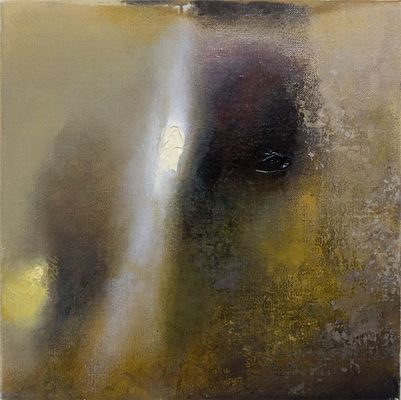
Always Will Need To Wear Winter Shirt Blue + Ochre Small Check Pattern
21 August - 21 September, 2015
Untitled
I am not a great reader of poetry but I always return to the work of Melbourne poet, Vincent Buckley (1925- 1988). Perhaps I find his most tantalising piece to be not a finished poem but a fragment left on a scrap of paper discovered on his desk after the poet’s death.
The poetry gathers like oil
In the word-core, and spreads
It has its music meet,
Its music is in movement.
This fragment is more the shell left behind from a volatile thought than a finished poem. I find the last two lines honest but awkward whereas the first two lines work like an arrow. Most likely he could not find a resolution so it was left. Still, in its present form, it remains an eloquent testimony to the ultimate failure of a medium to express mobile thought and sensation, in Buckley’s case, through verbal language. It’s an important matter because this is something all artists have to deal with regardless of the medium.
I have never written a poem, however, I am forever copying fragments from books on paper scraps in a vain effort to fix certain notions in my head. At first, they function as bookmarks that are sometimes returned to when I open the book. But before long, as they accumulate, they fall out littering the table interspersed with A4 photocopies, bills, books and medications.
To return to Buckley’s fragment, the first two lines very much evoke how I paint nowadays. As you age, detail diminishes and patches of light become more luminous and float. I feel the most honest way of dealing with this is by smearing the oil paint on the canvas with the fingers and working close-up, blind. Only if the patches coalesce into an approaching image can the work gain a life.
-
Jonathan Walker was born in Melbourne, Australia and brought up on a dairy farm in Gippsland. In the 1970’s he studied painting at RMIT and won the Harold Wright Scholarship to the British Museum, London. During the 1980’s he exhibited at Pinacotheca Gallery, Richmond and had work shown at the NGV and Heidi City Art Gallery. Over the same period he designed the cover for the “Epigenesi” LP by Giancarlo Toniutti, Italy and conducted a mail exchange work with Achim Wollscheid, Germany. The work with artists through the post resulted in an article published in the bicentenary issue of Art and Australia 1988. He showed in artist run spaces such as WestSpace in the 90’s and 2000’s, and until 2012, taught painting at Victoria University, which is where we (Colleen Ahern and Lisa Radford) as organisers of the exhibition, among many others, had the privilege of being his student.
Walker’s knowledge was imparted to students through the careful selection of music, literature, and artists found in books that he himself had ordered for the library. Walker’s strategy was the generosity of sharing his vast knowledge with references specific to each student and their context.
Walker’s paintings share a similar focus and intimacy.
This exhibition presents a small selection of recent paintings alongside a publication that includes Walker’s writing. Observational and analytical, Walker’s work is a type of material notation — the time of day, colour and how it is blended, the both specific and fleeting location of a reflection on lino or the question of whether a chair leg should be included in a painting.
Please join us on Friday August 21 between 6-8pm to celebrate the opening of the exhibition.
Curated by Colleen Ahern and Lisa Radford.
B. Wurtz
Curated by Nic Tammens
March 26 - April 4, 2015
B.Wurtz works from a basement studio in his home on Manhattan’s Lower East Side.
This local fact is attested to by the plastic shopping bags and newsprint circulars that appear in his work. As formal objects, they don’t make loud claims about their origins but nonetheless transmit street addresses and places of business from the bottom of this long thin island. Like plenty of artists, Wurtz is affected by what is local and what is consumed. His work is underpinned by this ethic. It often speaks from a neighborhood or reads like the contents of a hamper:
“BLACK PLUMS $1.29 lb.”
“Food Bazaar”
“USDA Whole Pork Shoulder Picnic 99c lb.”
“RITE AID Pharmacy, with us it’s personal.”
“H. Brickman & Sons.”
“Sweet Yams 59c lb."
Most of the work in this exhibition was made while the artist was in residence at Dieu Donne, a workshop dedicated to paper craft in Midtown. Here Wurtz fabricated assemblages with paper and objects that are relatively lightweight, with the intention that they would be easily transportable to Australia. This consideration isn’t absolute in Wurtz’s work, but was prescriptive for making the current exhibition light and cheap. Packed in two boxes, these works were sent from a USPS post office on the Lower East Side and delivered to North Melbourne by Australia Post.
Wurtz appears courtesy of Metro Pictures, New York.
Thanks to Rob Halverson, Joshua Petherick, Sari de Mallory, Matt Hinkley, Helen Johnson, Fayen d'Evie, Ask Kilmartin, Lisa Radon, Ellena Savage, Yale Union, and "Elizabeth".
John Nixon
"Archive"
December 15 - January 20, 2014
The presentation of John Nixon's archive offered a rare showcase of this extensive collection of the artist's own publications, catalogues, posters, ephemera, editions and more, from the mid 1980s onwards, alongside a selection of his artworks.
Organized by John Nixon, Joshua Petherick and Matt Hinkley.
<a href=http://wfb.public-office.info/artist/john-nixon>All titles by John Nixon
"Habitat"
at Minerva, Sydney (organised by Joshua Petherick and Matt Hinkley)
November 15 - December 20, 2014
Lupo Borgonovo, Janet Burchill & Jennifer McCamley,
Lewis Fidock, HR Giger, Piero Gilardi, Veit Laurent Kurz,
Cinzia Ruggeri, Michael E. Smith, Lucie Stahl, Daniel Weil, Wols
Press Release:
“...It contained seven objects. The slender fluted bone, surely formed for flight, surely from the wing of some large bird. Three archaic circuitboards, faced with mazes of gold. A smooth white sphere of baked clay. An age-blackened fragment of lace. A fingerlength segment of what she assumed was bone from a human wrist, grayish white, inset smoothly with the silicon shaft of a small instrument that must once have ridden flush with the surface of the skin - but the thing’s face was seared and blackened.”
William Gibson, “Count Zero”, 1986
"Autumn Projects Archive"
Curated by Liza Vasiliou
March 6 - March 15, 2014
World Food Books, in conjunction with the Virgin Australia Melbourne Fashion Festival 2014, presented the Autumn Projects archive, consisting of a selection of early examples in Australian fashion with a particular interest in collecting designers and labels from the period beginning in the 1980’s, who significantly influenced the discourse of Australian Fashion.
Curated by Liza Vasiliou, the exhibition provided a unique opportunity to view pieces by designers Anthea Crawford, Barbara Vandenberg, Geoff Liddell and labels CR Australia, Covers, Jag along with early experimental collage pieces by Prue Acton and Sally Browne’s ‘Fragments’ collection, suspended throughout the functioning World Food Books shop in Melbourne.
H.B. Peace
presented by CENTRE FOR STYLE
November 14, 2013
"Hey Blinky, you say chic, I say same"
Anon 2013
H.B. Peace is a clothing collaboration between great friends Blake Barns and Hugh Egan Westland. Their pieces explore the divergences between 'character’ and ‘personality’ in garments....etc
Special Thanks to Joshua Petherick and Matt Hinkley of WFB and Gillian Mears
and a Very Special Thank you to Audrey Thomas Hayes for her shoe collaboration.
Janet Burchill & Jennifer McCamley
"Aesthetic Suicide"
May 10 - June 8, 2013
The first of our occasional exhibitions in the World Food Books office/shop space in Melbourne, "Aesthetic Suicide" presented a body of new and older works together by artists Janet Burchill & Jennifer McCamley, including videos, prints, a wall work, and publications.
During shop open hours videos played every hour, on the hour.
2016, English
Softcover, 24 pages, 21 x 29.7 cm
Ed. of 2000,
Published by
Endless Lonely Planet / Melbourne
$0.00 - Out of stock
Endless Lonely Planet 5, published on the occasion of the 4th/5th Melbourne Artist Facilitated Biennial held at Tarrawarra Museum of Art as part of TARRAWARRA BIENNIAL 2016: ENDLESS CIRCULATION (19 August - 6 November 2016) curated with Discipline. Exhibition and publication features the work of Christopher L G Hill, Nick Selenitsch, Lou Hubbard, Lewis Fidock, Endless Lonely Planet, Liam Osborne, Lisa Radford, Elizabeth Newman, Nicholas Tammens, Kate Meakin, George Egerton-Warburton, James Deutsher, Zac Segbedzi, Aurelia Guo, Rudi Williams, Alex Vivian, Lucina Lane, Lauren Burrow, Counterfeitnessfirst, Virginia Overell, Joshua Petherick, Laurel Doody, Tahi Moore, elp3 Vine, and more...
Free in the shop.
Free on request with any order (include in your order and shipping cost will be credited back)
If ordered alone, shipping charges apply.
2016, English / French
Softcover, 168 pages, 240 x 175 mm
Published by
May Revue / Paris
$29.00 - Out of stock
MAY #15
"FASHION"
contents include:
Preface — MAY
Crisis Fashion — DANIEL HORN
DIS and That — MIKAEL BRKIC & DIS
Vetements – Fall / Winter 2016. Panel Discussion — LOU STOPPARD & SAHIL BABBAR, AUDE FELLAY, AYA NOEL, PRIYESH PATEL, VILDE SORUM
The Modern Naked King — TAQUE HIRAKAWA
Interview with Women’s History Museum — ADA O’HIGGINS
Maison Artists Space. Interview with Stefan Kalmár — MAY
Roundtable — BLESS & ANJA ARONOWSKY CRONBERG, HEINZ PETER KNES
THE STREET — TOBIAS KASPAR & TOBI MAIER
Jesus as Readymade. Interview with Kaspar Müller — PETER FISCHLI
REVIEWS
La mode retrouvée. On the Wardrobe of the Countess Greffulhe at Palais Galliera, Paris — HANNAH ADKINS
Post-Hummannerism. On “Inhuman” at Fridericianum Museum, Kassel — JAKOB SCHILLINGER
Magma — ERIC BELL
Finely Crafted Stool. On Mathieu Malouf at Jenny’s, Los Angeles — GEORGE EGERTON-WABURTON
Wolfpack. On the film “The Wolfpack” by Crystal Moselle — JULIA MORITZ
About MAY Revue:
Conceived as a collective space in which to develop thoughts and confront positions on artistic production, May magazine examines, quaterly, contemporary art practice and theory in direct engagement with the issues, contexts and strategies that construct these two fields. An approach that could be summed up as critique at work – or as critique actively performed in text and art forms alike.
Featuring essays, interviews, art works and reviews by artists, writers and diverse practitioners of the arts, the magazine also intends to address the economy of the production of knowledge – the starting point of this reflection being the space of indistinction between information and advertisement typical of our time. This implies a dialogue with forms of critique produced in other fields.
2016, English
Hardcover, 80 pages, 25 x 32.5 cm
Published by
Kunsthalle Wien / Vienna
Sternberg Press / Berlin
Witte de With / Rotterdam
$64.00 $20.00 - Out of stock
Edited by Luca Lo Pinto, Samuel Saelemakers
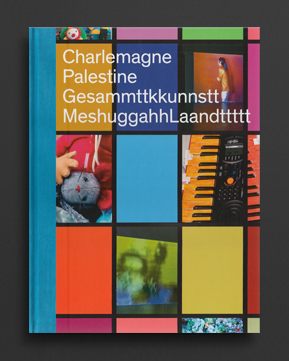
Contributions by Defne Ayas & Nicolaus Schafhausen, Luca Lo Pinto, Charlemagne Palestine, Samuel Saelemakers, Jay Sanders
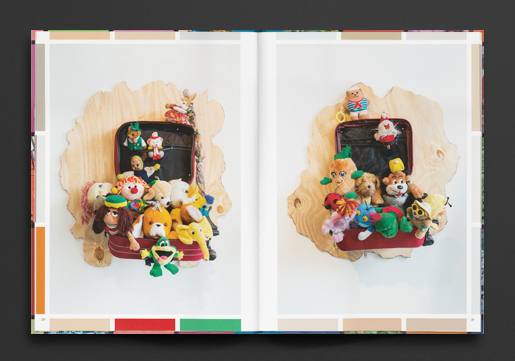
Charlemagne Palestine works from a highly personal universe of ritual, intoxication, and shamanism. Over the last four decades the artist has created an extensive body of experimental musical compositions, bodily performances, and, in later years, visual artworks inhabited by stuffed animals. To Palestine, teddy bears figure as powerful shamanic totems, which he fondly calls “divinities.”
Central to “GesammttkkunnsttMeshuggahhLaandtttt,” Palestine’s solo exhibition at Kunsthalle Wien and Witte de With Center for Contemporary Art, is a grand piano as the sounding heart, and a new large-scale version of God-Bear Museum Model, a proposal for a new kind of museum where music and performance find a home just as easily as a painting would. Also part of the exhibition are Palestine’s extraordinary music and sound annotations, and a vast collection of works on paper, which aim to translate sound into image.
This catalogue visually documents this exhibition and features an interview between Charlemagne Palestine and Luca Lo Pinto, curator at Kunsthalle Wien, as well as an essay on Palestine’s work by Jay Sanders, curator of performance at the Whitney Museum of American Art.
Copublished with Kunsthalle Wien and Witte de With
Design by Izet Sheshivari
2016, English / German
Softcover, 162 pages, 24 x 34 cm
Published by
Bielefelder Kunstverein / Germany
Kunstverein Nürnberg – Albrecht Dürer Gesellschaft
Sternberg Press / Berlin
$74.00 $25.00 - Out of stock
Edited by Simone Neuenschwander, Thomas Thiel
With contributions by Emmanuel Alloa, Neïl Beloufa, Clare Birchall, Juliette Blightman, Ryan Gander, Calla Henkel and Max Pitegoff, David Horvitz, Metahaven, Simone Neuenschwander, Katja Novitskova, Yuri Pattison, Manfred Schneider, Thomas Thiel
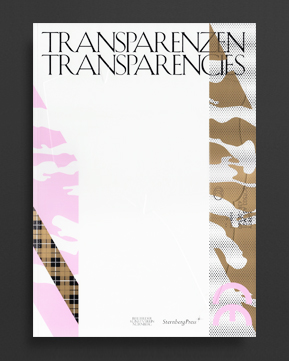
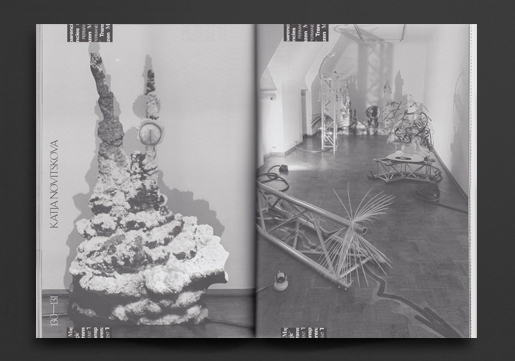
The globalized world seems at once transparent and opaque. The exhibition project “Transparencies” examined the cultural facets and atmospheres of these (non-)transparencies. The two-part, joint exhibition project in Bielefeld and Nuremberg was dedicated to developments in “transparent society,” asking how these are reflected in the current work by contemporary artists. The paradigm of transparency and the ambivalence of the term was addressed by participating artists in multiple, diverse ways. This book documents both exhibitions and outlines all of the contributions to this substantial project. Conceptually designed by Metahaven, it contains artistic statements and scientific essays that encourage an ongoing discussion of the subject.
Copublished with Bielefelder Kunstverein and Kunstverein Nürnberg – Albrecht Dürer Gesellschaft
Design by Metahaven
2016, English
Softcover, 108 pages, 11.5 x 19 cm
Published by
Sternberg Press / Berlin
$26.00 - Out of stock
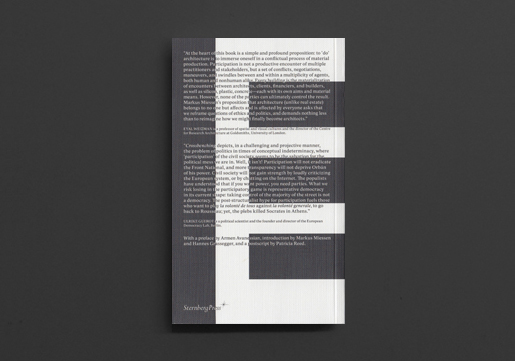
With a preface by Armen Avanessian, an introduction by Hannes Grassegger and Markus Miessen, and a postscript by Patricia Reed
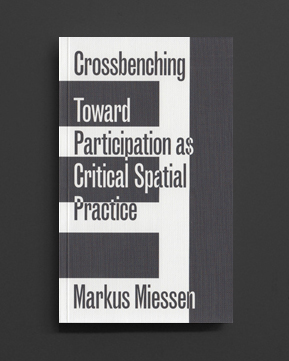
“At the heart of this book is a simple and profound proposition: to ‘do' architecture is to immerse oneself in a conflictual process of material production—participation is not a productive encounter of multiple practitioners and stakeholders, but a set of conflicts, negotiations, maneuvers, and swindles between and within a multiplicity of agents, human and nonhuman alike—equally including architects, clients, financiers, and builders, say, but also silicon, plastic, concrete, each with its conflicting aims and different material means to achieve them. Every building is thus the materialization of such encounter. So, despite the hubris of the field, none of the parties to such an encounter can ultimately control that the result—architecture (unlike real estate), according to Miessen, belongs to no one but affects and is affected by everyone—and this proposition asks that we reframe questions of ethics and politics. They can no longer be the property of an individual but a collective set of interrelations—it is through such profound departure from the terms of architecture that Miessen’s new book demands nothing less than to reimagine how we might finally become citizens.”
—Eyal Weizman, Professor of Spatial and Visual Cultures, Director of the Centre for Research Architecture, Goldsmiths, University of London
“Miessen’s new book depicts in a challenging and projective manner the problem of politics in times of conceptual indeterminacy, where ‘participation’ of the civil society seems to become the salvation for the political mess we are in, especially in Europe. Well, it is not! ‘Participation’ will not eradicate the Front National, and more transparency will not deprive Orbán of his power. Civil society will not gain power by criticizing or demonstrating loudly against the European system or chatting on the Internet. The populists have understood that if you want power, you need parties. What we risk to lose in that participatory game is representative democracy in its current shape and for no good: the majority of the street is no democracy. The post-structuralist hype for participation fuels into the mills of those who want to play la volonté de tous against la volonté generale, to go back to Rousseau: yet, the plebs killed Socrates in Athens.“
—Ulrike Guerot, political scientist, founder and director, European Democracy Lab, Berlin
Design by Zak Group
2016, English
Softcover, 176 pages, 11.8 x 16.5 cm
Published by
Dexter Sinister / New York
Sternberg Press / Berlin
The Serving Library / New York
$25.00 - Out of stock
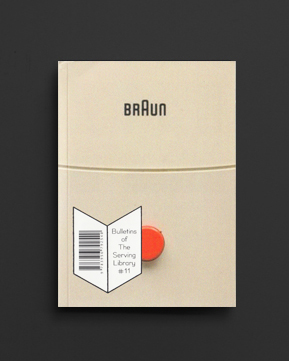
Bulletins of The Serving Library #11 (Summer 2016)
Edited by Stuart Bertolotti-Bailey, Angie Keefer, David Reinfurt
Contributions by Muhammad Ali, Lucas Benjamin, Stuart Bertolotti-Bailey, Dexter Sinister, Umberto Eco, Emily Gephart, James Langdon, Tamara Shopsin, Amy Sillman, T. E. White
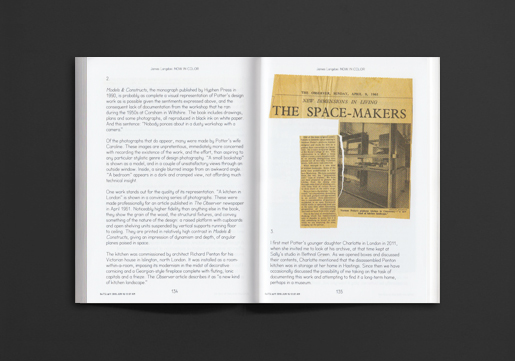
Released to inaugurate The Serving Library’s new red, gold, and green space in Liverpool, this issue is both printed in and concerned with color. It includes Emily Gephart’s account of the Spectra Poetry Hoax of 1916, a truncated phone call from Dexter Sinister to Laszlo Moholy-Nagy, the late, great Muhammad Ali discussing skin color in a 1971 TV interview, reflections on the history of Chroma-key green by Lucas Benjamin, a personal history of paint and painting by Amy Sillman, and further contributions by T. E. White, Umberto Eco, Stuart Bertolotti-Bailey, Tamara Shopsin, and James Langdon.
Published by The Serving Library, New York
2016, English
Softcover, 176 pages, 17 x 24 cm
Published by
CAHF—Contemporary Art Heritage Flanders / Ghent
Sternberg Press / Berlin
$35.00 - Out of stock
Els Silvrants-Barclay, Pieternel Vermoortel (Eds.)Cave 1—Territories
With contributions by Beirut, Clémentine Deliss, Kersten Geers, Jef Geys, Anders Kreuger, Maarten Liefooghe, Jens Maier-Rothe, Doris Maninger, Winke Noppen, Louise Osieka, Jasper Rigole, Marije Sennema, Els Silvrants-Barclay, 3Maarten Van Den Driessche, Richard Venlet, Pieternel Vermoortel
Cave is a series of publications featuring commissioned and republished explorations, anecdotes, research, documents, case studies, essays, and scenarios on how to think and practice contemporary collecting. The first issue of Cave looks into the territory of the public collection considering it both a semantic ground for institutional collecting as well as political and cultural infrastructure.
Artists, scholars, and other thinkers address the role of museums and collections for identity-making and territorial representation, the increasing invisibility of the collection, productive and problematic processes of inclusion and exclusion, and what seems to be a general distrust towards history in the contemporary art museum. As such they speculate on radical yet tangible strategies for the activation and sedimentation of the collection in the contemporary art museum from the point of view of its architecture, scale, locality, history, organizational model, display, research, and collecting methodologies.
Published with CAHF—Contemporary Art Heritage Flanders
Design by Atelier Dreibholz
2015, English
Softcover, 72 pages, 11 x 19 cm
Published by
Sternberg Press / Berlin
$22.00 - Out of stock
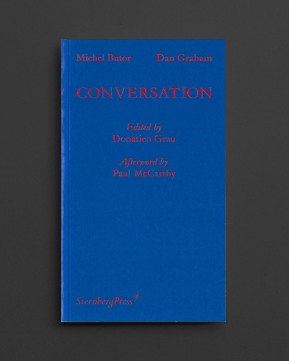
Edited by Donatien Grau
Afterword by Paul McCarthy
One day I went to interview Dan Graham about the legendary John Daniels Gallery in New York, which he ran from 1964 to ’65. Right after I arrived, Dan started talking to me about Michel Butor and his fascination with the writer’s work back in the 1960s. I merely asked: “And did you ever meet him?” Dan answered: “No. Some people wanted to introduce us, but it never happened.” I asked: “And would you like to meet him?” And he said, with his very own smile: “Of course I would.”
—From the editor’s preface
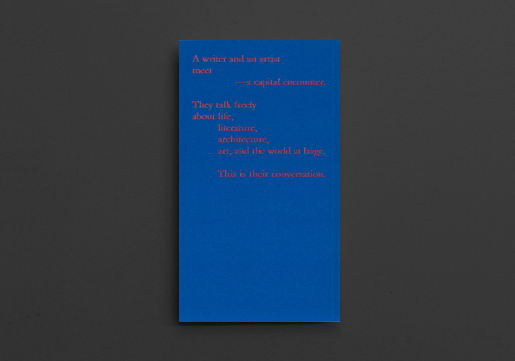
In the fall of 2013, Dan Graham and Mieko Meguro traveled with Donatien Grau to a town in the French Alps to meet Michel Butor, one of the foremost innovators of postwar literature. This is their conversation.
Michel Butor is a writer. He redefined the genre of the novel, notably with Second Thoughts (1957), further developing new forms with Mobile (1962) and other fundamental works.
Dan Graham is an artist. A major retrospective of his work was held in 2009 at the Museum of Contemporary Art, Los Angeles; Whitney Museum, New York; and Walker Art Center, Minneapolis.
Design by Thomas Bizzarri & Alain Rodriguez
1984, German
Softcover, 183 pages (colour & b/w ill.), 27 x 21 cm
1st edition, Out of print title / used*,
Published by
Frölich & Kaufmann / Berlin
$85.00 - Out of stock
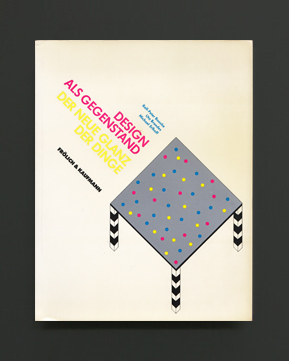
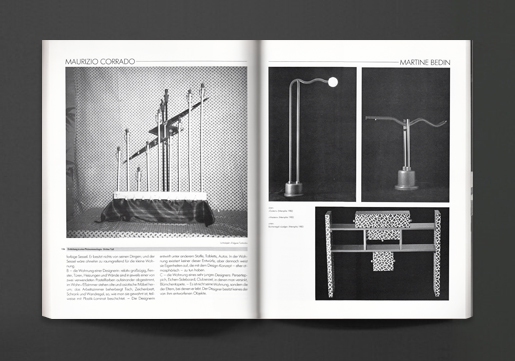
First edition of Design Als Gegenstand (Design as an object), published only in Germany to showcase many of the leading contemporary/radical designers of the early 1980s, visually documenting many incredible and seldom seen works of furniture, industrial objects, electronics, exhibition design, textiles, etc. through object and installation photography, alongside reproductions of design sketches and German texts.
Includes the work of Adolfo Natalini, Thomas S. Bley, Daniele Puppa, Franco Raggi, One Off, Studio Alchimia, Sacha Ketoff, Piero Castiglioni, Winfried Scheuer, Lux, Rouli Lecatsa, Borek Sipek, Paolo Deganello, Lapo Binazzi, Florian Borkenhagen · Harald Krischer, Javier Mariscal, Andrea Branzi, Studio Dada, David Palterer, Ettore Sottsas Jr, Bepi Maggiori, Marco Zanuso Jr., Antonia Astori De Ponti, Denys Santachiara, Juma Francisco, Michele De Luchhi, Nemo, Paola Navone, Jasper Morrison, Zak Ark, Maurizio Corrado, Martine Bedin, Daniel Weil, Totem, Bellefast, Claus Böhmler, Rainer Krause, George James Sowden, Tom Lynham & Lee Curtis, Nathalie Du Pasquier, Jörg Ratzlaff, Dirk Staubert, Matteo Thun.
Very Good copy in VG dust jacket.
1961, German
Softcover, 56 pages, 17 x 19 cm
1st Edition, Out of print title / Used*,
Published by
Goetheanum Freie Hochschule für Geisteswissenschaften / Dornach
$45.00 - Out of stock
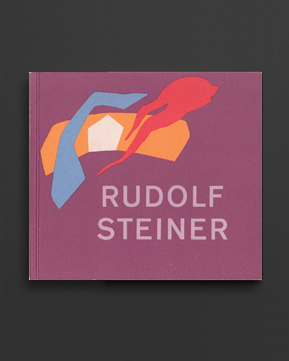
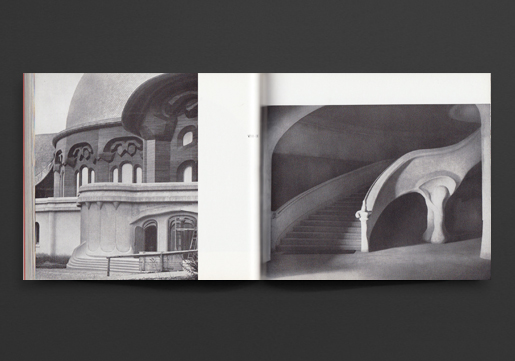
Handsome catalogue produced to accompany an exhibition on the work of Rudolf Steiner in 1961 at the Goetheanum Freie Hochschule für Geisteswissenschaften (Goetheanum School of Spiritual Science) in Dornach Switzerland, the first cultural centre and artistic home designed by Steiner and built in 1913 for the Anthroposophical Society (founded by Steiner) to house performances of plays, exhibitions, conferences - a house for all of the arts.
Through beautiful photographic reproductions, this little publication presents a glimpse into Steiner's visionary work across architecture, sculpture, design and painting around the creation of this incredible building, alongside texts in German.
Rudolf Joseph Lorenz Steiner (1861 – 1925) was an Austrian philosopher, social reformer, architect and esotericist. Steiner gained initial recognition at the end of the nineteenth century as a literary critic and published philosophical works including The Philosophy of Freedom. At the beginning of the twentieth century he founded an esoteric spiritual movement, anthroposophy, with roots in German idealist philosophy and theosophy; other influences include Goethean science and Rosicrucianism.
In the first, more philosophically oriented phase of this movement, Steiner attempted to find a synthesis between science and spirituality. His philosophical work of these years, which he termed "spiritual science", sought to apply the clarity of thinking characteristic of Western philosophy to spiritual questions, differentiating this approach from what he considered to be vaguer approaches to mysticism. In a second phase, beginning around 1907, he began working collaboratively in a variety of artistic media, including drama, the movement arts (developing a new artistic form, eurythmy) and architecture, culminating in the building of the Goetheanum, a cultural centre to house all the arts. In the third phase of his work, beginning after World War I, Steiner worked to establish various practical endeavors, including Waldorf education, biodynamic agriculture, andanthroposophical medicine.
Steiner advocated a form of ethical individualism, to which he later brought a more explicitly spiritual approach. He based his epistemology on Johann Wolfgang Goethe's world view, in which "Thinking… is no more and no less an organ of perception than the eye or ear. Just as the eye perceives colours and the ear sounds, so thinking perceives ideas. "A consistent thread that runs from his earliest philosophical phase through his later spiritual orientation is the goal of demonstrating that there are no essential limits to human knowledge.
2014, English
Softcover, 180 pages, 19.5 x 27.5 cm
Published by
Bom Dia Boa Tarde Boa Noite / Berlin
$30.00 $10.00 - Out of stock
With texts by Kythzia Barrera, Maria Gaida, Moosje M. Goosen, Pablo Katchadjian, Paula López Caballero, Federico Navarrete Linares, Victoria Novelo Oppenheim, Sandra Rozental, Carlos Sandoval, Adam T. Sellen, Anna Szaflarski
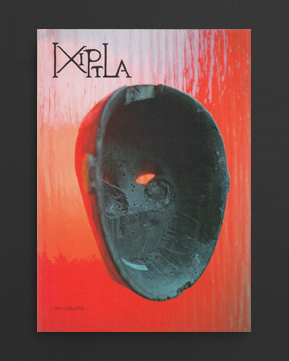
The Nahua concept of ixiptla derives from the particle xip, meaning “skin,” coverage or shell. A natural outer layer of tissue that covers the body of a person or animal, the skin can be separated from the body to produce garments, containers for holding liquids or parchment as a writing surface.
Originally a Nahua word, ixiptla has been understood as image, delegate, character, and representative. Ixiptla could be a container, but also could be the actualization of power infused into an object or person. In Nahua culture, it took the form of a statue, a vision, or a victim who turned into a god destined to be sacrificed. Without having to visually appear the same, multiple ixiptlas of the same god could exist simultaneously. The distinction between essence and material, and between original and copy vanishes.
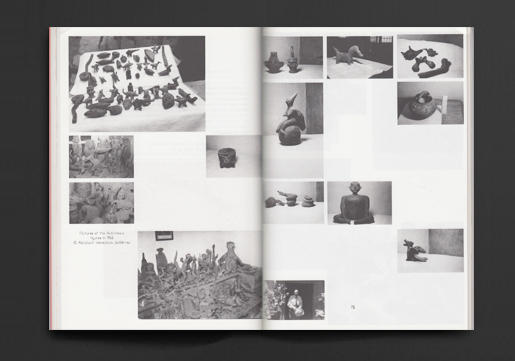
This edition of Ixiptla is focused on the trajectory of objects collected and produced by archeologists - plaster molds, facsimiles, drawings, photographs, and scale models -, in an attempt to capture and replicate material evidences left by time; these objects emerge from a specific moment in time, producing a doppelgänger of the original milieu, which then takes its own course. For this first issue, a group of anthropologists, archaeologists, artists, and writers have been invited to reflect on the role of the model, the copy, and reproduction in their areas of research and practice.
Ixiptla is a new biannual journal about trajectories of Anthropology, it has been initiated by the artist Mariana Castillo Deball.
The first issue is published on the occasion of Expedite Expression, 8th Berlin Biennale for Contemporary Art, Berlin, 2014.
1999, Japanese
Hardcover (w. dust jacket), 72 pages (b/w ill.), 22. 5 x 23 cm
1st Edition, Out of print title / Used*,
Published by
Iwanami Shoten / Japan
$80.00 - Out of stock
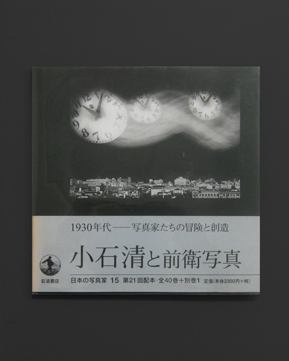
#15 in the Photographers of Japan series, dedicated to Kiyoshi Koishi and the Avant-garde photographers
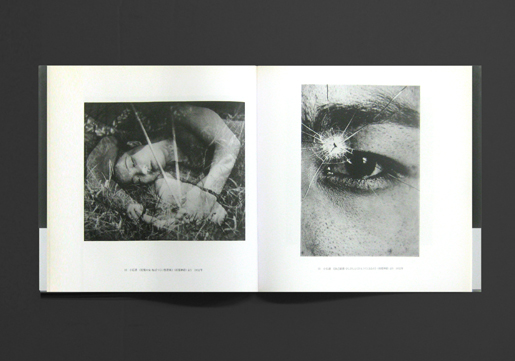
Kiyoshi Koishi (1908 - 1957) was one of the most prominent Japanese photographers in the first half of the 20th century. In 1933 he published the monograph Shoka Shinkei (初夏神経, "Early Summer Nerves"), one of the most important works for Japanese modernist photography (Shinkō Shashin, 新興写真). In this work, he used many photographic techniques such as photomontage and photograms and succeeded in creating surrealistic images.
From 1938, he worked for the Japanese government in the magazine Shashin Shūhō (写真週報, "Photo Weekly"). And he became a war photographer of the Second Sino-Japanese War.
1989, English
Softcover (w. original plastic box), 320 pages, 36.5 x 25 cm
1st edition, Out of print title / used*,
Published by
Robundo / Japan
$260.00 - Out of stock
The very rare, first edition of this comprehensive, visually vibrant book on the design of the pioneering Californian fashion company, ESPRIT, published in 1989 in Japan.
In original plastic box.
In 1968, American environmentalist, adventure film-maker, conservationist and founder of The North Face outdoor clothing company, Douglas Tompkins, his wife Susie, and her friend Jane Tise began selling girls' dresses out of the back of a VW bus; in 1971, they incorporated the booming business under the name "Plain Jane" which later became ESPRIT, one of the hottest and most successful clothing companies of the 1970's, 1980's and 1990's.
From the early days running out of the Tompkins’ apartment in San Francisco, Douglas Tompkins titled himself "image director", overseeing all aspects of the company's image, from store design to catalog layout, while Susie served as design director. All facets of design were of primary importance to ESPRIT and the vision of the Tompkins'. In 1984 the role of art director was taken up by Japanese designer Tamotsu Yagi, who created the iconic "ESPRIT'S GRAPHIC WORK 1984-1986" book in 1987. In 1989, the Japanese art publisher Robundo published “Esprit, the Comprehensive Design Principle," which documented the all-encompassing design principles that Tompkins had created for the brand. From the iconic logo design by John Casado (who aslo designed the first Apple Macintosh Computer logo and album covers for the Doobie Brothers) to the ESPRIT store and office interiors by Ettore Sottsass (of Memphis Design Group and Sottsass Associates) to the fashion campaign photography of Oliviero Toscani (also well-known for his controversial campaigns for Benetton, work for Fiorucci and as co-founder of Colors magazine) this wonderfully designed (by Tamotsu Yagi, ESPRIT's art director of the era), over-sized book contains hundreds of photographs and graphics documenting the ESPRIT identity and character. A perfect survey of commercial design, the colourful pages include product packaging, clothing, pop accessories, fashion photography, advertisements, various identity and event collateral (party announcements, posters, flyers, business cards), apparel print graphics, and a huge section on the interior architecture and retail environment design across their many flagship stores, cafes and offices, largely designed by Ettore Sottsass and Sottsass Associates.
A visually dazzling book and a wonderful, rare piece of commercial design history.
First edition, 1989.
Due to the weight of this volume, your order will possibly incur additional postage costs. We will contact you with the best shipping advice upon your order, or alternatively, please email us in advance. Thank you for understanding.
1970, Italian
Hardcover (w. dustjacket)
1st Edition, Out of print title / Used*,
Published by
Gorlich Editore / Milan
$100.00 - Out of stock
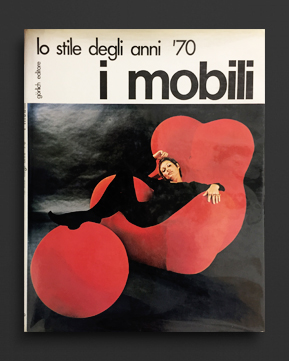
"Lo Stile Degli Anni '70 : I Mobili" published by Gorlich Editore in Milan in 1970, walks you through the furnished interiors of modern 1970's Italian style (space, pop, plastic and practical), with typically lavish arrangements and photography in saturated colour and duotones. Featuring the designs and productions of Gaetano Pesce, Archizoom, Ettore Sottsass, Castelli, Kartell, Olivetti, Poltronova, Arflex, Brionvega, Massimo Vignelli, plus so many more.
A wonderful first edition of this rare Italian title, with Gaetano Pesce's "UP" cover, for anyone interested in Italian furniture and 1970's design.
2016, English / French
Softcover, 480 pages, 17x 24 cm
Published by
Archive Books / Berlin
$40.00 - Out of stock
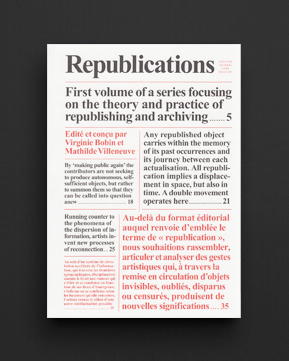
Republications is the first volume of Archive Journal’s hors-séries. Each issue of the series is commissioned to authors whose research is close to the editorial line of the journal. For the inaugural issue Archive’s editors have invited curators and art critics Virginie Bobin and Mathilde Villeneuve. Taking as a starting point the notion of republication, the contents of this volume have been compiled through a collective process over the course of multiple editorial meetings in Berlin, Aubervilliers and Paris between 2011 and 2012.
Edited by Mathilde Villeneuve and Virginie Bobin
Contributions by Mathieu Kleyebe Abonnenc, Lene Berg, Pauline Boudry & Renate Lorenz, Christophe Bruno, Foundland, Jeff Guess, Alexis Guillier, Rémy Héritier, franck leibovici, Sohrab Mohebbi, Julien Prévieux, Sally Price, Anna Théodoridès, Vassilis Salpistis & Marie Voignier
2015, English
Softcover, 304 pages, 12 × 20 cm
Published by
Archive Books / Berlin
$35.00 - Out of stock
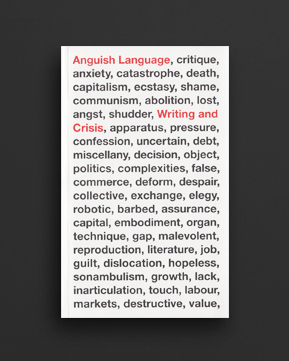
Anguish Language approaches language as a core aspect of the present social crisis. The project engages in solidarity with forms of self-publishing, poetry, criticism, experimental writing and declamation that have arisen in the wake of the 2007-8 financial crisis, considering language among and through the social struggles responding to its consequences.
Edited by John Cunningham, Anthony Iles, Mira Mattar and Marina Vishmidt
Designed by Archive Appendix
Essays by John Cunningham, Sean Bonney, Anthony Iles, Wealth of Negations, Mira Mattar, Anguish Language Copenhagen Group, Danny Hayward, Pier Paolo Pasolini...
2015, English
Softcover, 240 pages, 13 x 20 cm
Published by
Archive Books / Berlin
$40.00 - Out of stock
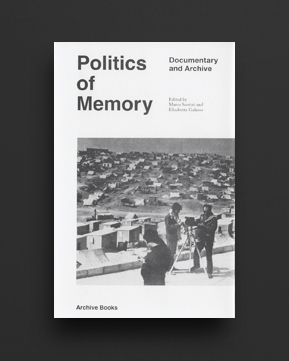
The anthology Politics of Memory aims to investigate the document as such, as an objective trace left by events, as material proof or the creation of reality – the strategies with which they transform a state of memory into state memory, those by means of which a historical removal is enacted, those, ultimately, in which there is an attempt to challenge permanent or temporary amnesia, opening up to the future. The artists and filmmakers contributing to this publication represent the most advanced area on an international scale of a research that inaugurates a new relationship between artistic practices and the documentary.
The artists’ contributions have been collected within the context of a cycle of conferences held between 2010 and 2013 and are re-presented here in a format aimed at highlighting their connections and common research perspectives. To this end, the volume is articulated in four sections and does not follow the chronological order of the conferences. The first section is dedicated to archival practices, the second to the memory of conflicts, the third to the documentary dispositive and the last to the representation of migration as a social practice and as the enactment of breaching boundaries.
Edited by Marco Scotini and Elisabetta Galasso
Contributions by John Akomfrah, Eric Baudelaire, Ursula Biemann, Harun Farocki, Yervant Gianikian and Angela Ricci Lucchi, Khaled Jarrar, Lamia Joreige, Gintaras Makarevičius, Angela Melitopoulos, Deimantas Narkevičius, Lisl Ponger, Florian Schneider, Eyal Sivan, Hito Steyerl, Jean-Marie Teno, Trinh T. Minh-ha, Wendelien van Oldenborgh, Clemens von Wedemeyer, Mohanad Yaqubi and Reem Shilleh
2015, English
Softcover, 212 pages, 15.5 x 23 cm
Published by
Archive Books / Berlin
$44.00 - Out of stock
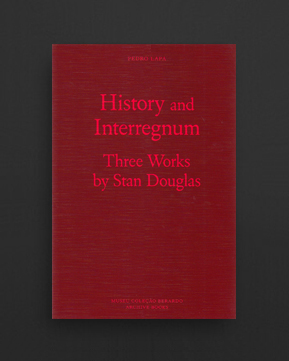
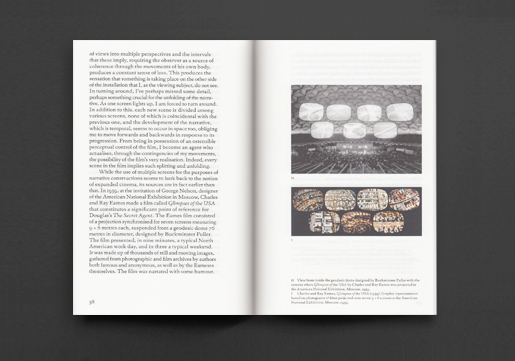
The Museu Coleção Berardo in collaboration with Archive Books is publishing the book History and Interregnum. Three Works by Stan Douglas to mark the exhibition, featuring an extensive essay by Pedro Lapa, the artistic directorof the museum and the curator of this exhibition, which takes an in-depth look at the “trilogy” made up of Disco Angola (2012), Luanda-Kinshasa (2013) and The Secret Agent (2015). The book, which is replete with illustrations of these three works as well as two series of photographs showing their production, also includes the final version of the script for The Secret Agent by Stan Douglas himself.
Edited by Pedro Lapa
Texts by Stan Douglas and Pedro Lapa
Editorial coordination by Nuno Ferreira de Carvalho
Graphic design by Raquel Pinto
2015, English
Softcover, 280 pages 14.8 x 21 cm
Published by
Archive Books / Berlin
$46.00 - Out of stock
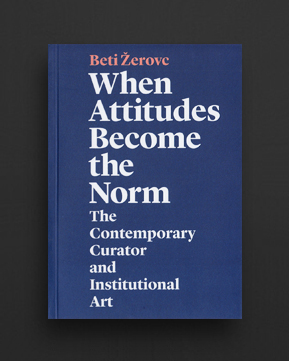
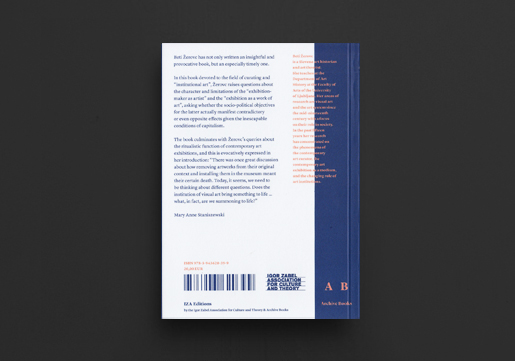
In this book devoted to the field of curating and “institutional art”, Žerovc raises questions about the character and limitations of the “exhibition-maker as artist” and the “exhibition as a work of art”, asking whether the socio-political objectives for the latter actually manifest contradictory or even opposite effects given the inescapable conditions of capitalism. The book culminates with Žerovc’s queries about the ritualistic function of contemporary art exhibitions, and this is evocatively expressed in her introduction: “There was once great discussion about how removing artworks from their original context and installing them in the museum meant their certain death. Today, it seems, we need to be thinking about different questions. Does the institution of visual art bring something to life … what, in fact, are we summoning to life?” (Mary Anne Staniszewski)
Pierre Restany, Zoran Kržišnik, Harald Szeemann, Daniel Buren, Charles Esche, Beautiful Freedom, Walter Benjamin, Mary Anne Staniszewski
2014, English
Softcover, 600 pages, 13 x 20 cm
Published by
Academy of Arts of the World / Cologne
Archive Books / Berlin
$58.00 - Out of stock
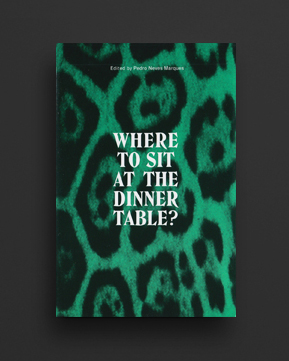
To eat a frog, the missionary Jesuit priest, the enemy tribe, the whole history of colonial domination in South America, is to serve your ancestor at a dinner table, without nostalgia, for what you are digesting is your future as a human— and that includes a frog-future as well.
In the sixteenth century, the image of Amerindian anthropophagy was at the center of disputes on the meaning of humanity. In the early twentieth century, it was again rediscovered by the Brazilian avant-garde associated with the imprint Revista de Antropofagia. Antropofagia is a cosmopolitical philosophy, a cannibal metaphysics extending well beyond a pacifying, multicultural view of appropriation. Eating another human is to cross the ontological boundaries imposed by Western modernity, capitalist labor, the Cartesian-Freudian self. Nature and culture are in the perspective of the hunter and the hunted. To become prey is the movement of humanity.
‘The Forest and The School: Where to sit at the dinner table?’ is co-published by Archive Books and the Academy of Arts of the World in Cologne. Edited by the writer and visual artist Pedro Neves Marques, this publication is a thorough anthology on Brazilian Antropofagia. It presents Antropofagia not simply as an aesthetic movement, based on acculturation or an hybridity exemplary of the tropics, but as a full scope South American cosmopolitics, defined by predation and the immanence of the enemy, by an humanity unbound from species, and a aimed at leisure.
The first half of the book, “The Forest and The School” gathers texts from sixteenth century chronicles on cannibalism, the Brazilian avantgarde, Tropicália, and the anthropology of Pierre Clastres, Bruno Latour, Eduardo Viveiros de Castro, as well as of Davi Kopenawa. The second half ‘Where to sit at the dinner table?’ collects recent texts and new commissions relating Antropofagia to multinaturalist perspectivism, the declaration of the Rights of Nature, or the centrality of the indigenous in current political struggles.
Edited by Pedro Neves Marques
Texts by Hans Staden, Jean de Léry,Michel de Montaigne, James Frazer, Manuela Carneiro da Cunha, Alfred Jarry, Oswald de Andrade, Antônio de Alcântara Machado, Oswald Costa, Freuderico, Japy-Mirim Poronominare, Garcia de Rezende, Raul Bopp, Flávio de Carvalho,Glauber Rocha, Joaquim Pedro de Andrade, Hélio Oiticica, Hélène Clastres, Pierre Clastres, Félix Guattari, Eduardo Viveiros de Castro, Bruno Latour, Davi Kopenawa and Bruce Albert, Tânia Stolze Lima, Alexandre Nodari, Jean Tible, Paulo Tavares, Giuseppe Cocco, Suely Rolnik
Designed by Nuno da Luz
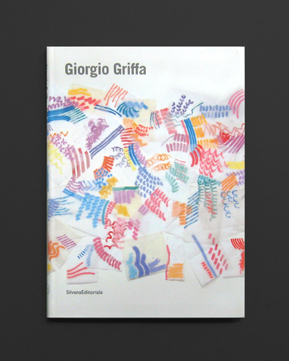
2008, Italian / English
Hardcover, 64 pages (colour & b/w ill.), 17 x 24cm
Published by
Silvana / Milan
$35.00 - Out of stock
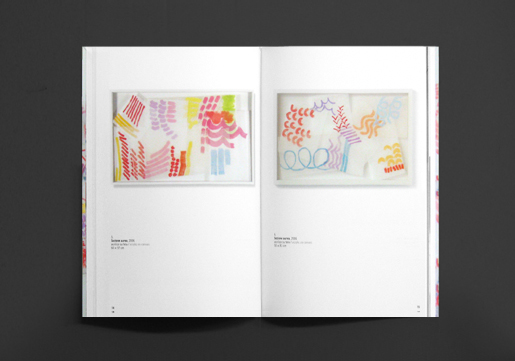
Giorgio Griffa (born in Turin, March 29, 1936) is an extraordinary Italian abstract painter living and working in Turin, associated with the Arte Povera generation.
2012, English
Paperback, 440 pages, 17 x 24 cm
Published by
Primary Information / New York
$65.00 - Out of stock
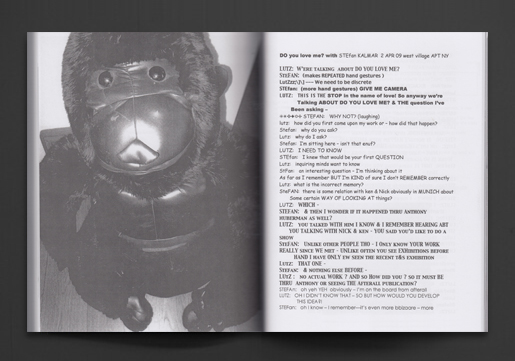
Lutz Bacher is known for diverse conceptual works that span photography, video, sculpture and installation. ‘Do You Love Me?’ is a print extension of Bacher’s video work of the same name, in which she interviews colleagues, friends and family about Bacher “the person” and Bacher “the artist”. The interviews span fifteen years, tracing her evolving career and relationships. Although the artist is always the starting point, these exchanges often reveal more about their subjects than Bacher herself. The publication takes the form of transcripts interwoven with images of artwork from the 1970s to the present, and also includes personal photos, correspondence and ephemera.
2016, English
Hardcover, 400 pages, 20.5 x 24 cm
Published by
Prestel / Munich
$100.00 - Out of stock
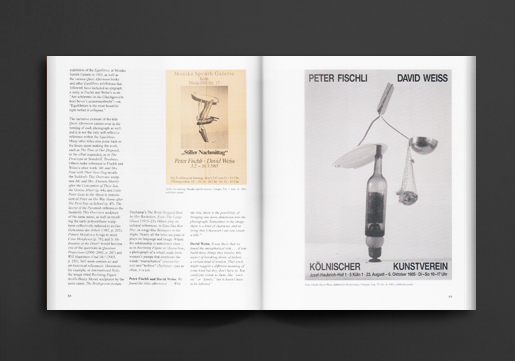
Heavy, definitive volume on the history of work by Peter Fischli and David Weiss, with texts and contributions by Ann Goldstein, Isabelle Graw, Anne Wheeler, and John Kelsey.
Throughout the course of their collaboration, Peter Fischli and David Weiss celebrated the sheer triviality of everyday existence, observing the world with bemused detachment. As this book shows, their often humorous work offers a sustained reflection on the intertwined strands of leisure, productivity and playful absurdity that shape our lives. With its deliberately mundane subject matter and quotidian source material, their work explores the poetics of banality in a wide range of mediums, including photography, videos, slide projections, films, books, sculptures and multimedia installations. This retrospective volume features an in-depth, illustrated survey of the artists' long history of collaboration, from the early Sausage Series (1979)-staged vignettes created in miniature using deli meats and various household items-to their last work, the large-scale public installation Rock on Top of Another Rock (2010-13), augmented by archival images, notes on process and interview excerpts culled from the artists' Zurich-based archives.A series of probing essays on their practice and thematic concerns rounds out this definitive account of Fischli and Weiss's vital contribution to contemporary art.
2016, English
Softcover, 382 pages, 24 x 17 cm
Published by
Distanz / Berlin
$50.00 - Out of stock
The Present in Drag is published as a companion volume to the 9th Berlin Biennale for Contemporary Art, which was curated by New York collective DIS. Providing information on the works shown in the exhibition, it also includes contributions by Roe Ethridge, Simon und Daniel Fujiwara, Boris Groys, Katja Novitskova, Chus Martinez, Bjarne Melgaard, Sean Patrick Monahan, Sabine Reitmaier, McKenzie Wark, and others.
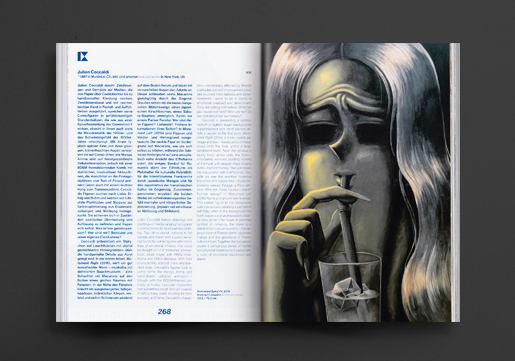
The 9th Berlin Biennale for Contemporary Art features the work and contributions of: 69, Antoni Abad, Halil Altindere, Ei Arakawa (in collaboration with Dan Poston, Stefan Tcherepnin), Korakrit Arunanondchai/Alex Gvojic, atelier le balto, Armen Avanessian/Alexander Martos (in collaboration with Christopher Roth), åyr, Will Benedict, Julien Ceccaldi, Centre for Style
(in collaboration with Anna-Sophie Berger; Burkhard Beschow & Anne Fellner; Max Brand; Rare Candy with Alden Epp, Spencer Lai, Natasha Madden, Misty Pollen, Ander Rennick & Amber Wright; Susan Cianciolo; Marlie Mul; Liam Osborne; H.B. Peace & Kate Meakin; Joshua Petherick; Lin May Saeed; Eirik Sæther), Brody Condon, CUSS Group (in collaboration with ANGEL-HO, FAKA, Megan Mace, NTU), Kathleen Daniel, Debora Delmar Corp., Simon Denny with Linda Kantchev, Cécile B. Evans, Nicolás Fernández, Lizzie Fitch/Ryan Trecartin, Simon Fujiwara, GCC, GUAN Xiao, Calla Henkel/Max Pitegoff, Camille Henrot, Yngve Holen, Alexa Karolinski/Ingo Niermann, Kartenrecht, Josh Kline, Korpys/Löffler, Nik Kosmas, M/L Artspace, Shawn Maximo, Ashland Mines, Katja Novitskova, Trevor Paglen/Jacob Appelbaum, Juan Sebastián Peláez, Adrian Piper, Alexandra Pirici, Josephine Pryde, Puppies Puppies, Babak Radboy, Jon Rafman, Timur Si-Qin, Lucie Stahl, Hito Steyerl, TELFAR, Christopher Kulendran Thomas, Wu Tsang, Anna Uddenberg, Amalia Ulman, Anne de Vries, Abu Hajar, Halil Altindere, Math Bass, Lizzi Bougatsos & Brian DeGraw, Elysia Crampton, Lizzie Fitch/Ryan Trecartin, Isa Genzken, Juliana Huxtable, Kelela, Nguzunguzu, PATRICIA (Patricia Satterwhite, Jacolby Satterwhite, Nick Weiss), Adrian Piper, Fatima Al Qadiri, Carles Santos, Hito Steyerl, Total Freedom, Amalia Ulman, Antoni Abad, åyr/Rem Koolhaas/Hans Ulrich Obrist, Kathleen Daniel, Cécile B. Evans and Andrew Snyder-Beattie, Oleg Fonaryov and Oleksiy Radynski, Simon & Daniel Fujiwara, GCC, Boris Groys, Rob Horning, Izabella Kaminska and Simon Denny, Chus Martínez, Meredith Meredith, Sean Monahan, New Scenario, Ingo Niermann, Alexandra Pirici, Puppies Puppies, Sean Raspet, Natasha Stagg, Amalia Ulman, Sencer Vardarman, Eduardo Viveiros de Castro and Déborah Danowski in conversation with Michelle Sommer and Daniel Steegmann Mangrané, McKenzie Wark, Will Benedict, Dora Budor, Cao Fei, Roe Ethridge, Hood by Air, Bjarne Melgaard, Simon Dybbroe Møller, Zanele Muholi, Johannes Paul Raether, Torbjørn Rødland, Akeem Smith, Martine Syms, Stewart Uoo, Nina Cristante, Sabine Gottfried, Nik Kosmas, Lesley Moon, Helga Wretman, Frank Benson, Asger Carlsen, DIS, Casey Jane Ellison, Roe Ethridge, Avena Gallagher, Saemundur Thor Helgason, Tilman Hornig, Benjamin Alexander Huseby, Chris Kraus, Bjarne Melgaard, Jason Nocito, Babak Radboy, Sean Raspet, Sabine Reitmaier, Aaron David Ross, Andrew Norman Wilson, Anonymous, Anonymous, Anonymous and others.