World Food Books' programme is largely produced on Kulin Nation land. We acknowledge the Wurundjeri people of the Kulin Nation as the first and continuing custodians of this land, and pay respect to their Elders past, present, and emerging.
World Food Books is an arts and special interests bookshop in Naarm / Melbourne. Founded in 2010, World Food Books is devoted to the presentation of a rotating, hand-selection of international art, design, literary and counterculture publications with an emphasis on the anti-traditional, the experimental, the avant-garde, the heretic, the marginal.
Presenting new titles alongside rare and out-of-print books, catalogues and journals spanning the fields of modern and contemporary art, design, photography, illustration, film, literature, poetry, cultural theory, philosophy, sexuality, popular and underground culture in its many radical forms, World Food Books wishes to encourage adventurous, thoughtful and open-minded reading, looking, writing, and exchange of publishing and ideas, both current and historical.
As well as our bookshop, located in Melbourne's historical Nicholas Building, all of our inventory is available internationally via our online mail-order service.
World Food Books semi-regularly co-ordinates "Occasions", a programme of exhibits and events at the bookshop and in partnership with other hosts (such as museums and art galleries) that develop out of the activities, relationships and content of the bookshop itself.
World Food Books
The Nicholas Building
37 Swanston Street
Room 5, Level 6
Melbourne 3000
Australia
SHOP HOURS:
Thu–Fri 12–6, Sat 12–5
WEB-SHOP OPEN 24/7
World Food Books
Postal Address:
PO Box 435
Flinders Lane
Victoria 8009
Australia
Art
Theory / Essay
Architecture / Interior
Graphic Design / Typography
Photography
Fashion
Eros
LGBTQ+
Fiction / Poetry
Weird / Speculative / Science Fiction / Horror
Transgressive / Visceral / Abject
Symbolism / Decadence / Fin de siècle
Film / Video
Painting
Sculpture / Installation
Performance / Dance / Theater
Drawing
Sound / Music
Curatorial
Group Shows / Collections
Periodicals
Out-of-print / Rare
Posters / Ephemera / Discs
Signed Books
World Food Books Gift Voucher
World Food Book Bag
Australian Art
Australian Fiction
Australian Science Fiction / Speculative Fiction
Australian Poetry
Australian Photography
Japanese Photography
Conceptual Art
Minimal Art
Dada
'Pataphysics / Oulipo
Fluxus
Concrete Poetry
Pop Art
Surrealism
Arte Povera
Arte Informale / Haute Pâte / Tachism
Nouveau Réalisme / Zero / Kinetic
Situationism / Lettrism
Collage / Mail Art / Xerox Art
Art Brut / Folk / Visionary / Fantastic
Illustration / Graphic Art / Bandes Dessinées
Furniture
Italian Radical Design / Postmodernism
Textiles
Ceramics / Glass
Counterculture
Protest / Revolt
Philosophy
Psychoanalysis
Anthropology
Anarchism
Socialism / Anarchism / Communism / Capitalism
Literary Theory / Semiotics / Language
Feminism / Women's Studies
Gender Studies / Sexuality
Anthropology
Fetishism / BDSM
Drugs / Psychedelia
Crime / Violence
Animal Rights / Veganism
Occult / Esoterica
Ecology / Earth / Alternative Living
Whole Earth / Crafts
All prices in AUD (Australian dollars)
Pick-Ups
Pick-up orders can be collected in our bookshop during opening hours after order date. Please collect any Pick-up orders within 2 weeks of ordering as we have limited storage space. Orders will be released back into stock if not collected within this time. No refunds can be made for pick-ups left un-collected. If you cannot make it in to the bookshop in this time-frame, please choose postage option.
Return Policy
All sales are final. We do accept returns (for refund or exchange) for items received in error. All our orders are packed with special care using heavy-duty padding and cardboard book-mailers or bubble mailers (for smaller books), using reinforcement where required. We cannot take responsibility for any lost, stolen or damaged parcels.
Insurance
Should you wish to insure your package, please email us directly after placing your order and we can organise this at a small extra expense. Although all standard/express tracked packages are very safe and dependable, we cannot take responsibility for any lost, stolen or damaged parcels. We recommend insurance on valuable orders.
Interested in selling your old books, catalogues, journals, magazines, comics, fanzines, ephemera? We are always looking for interesting, unusual and out-of-print books to buy. We only buy books in our fields of interest and specialty, and that we feel we can resell.
We base these prices on desirability, market value, in-print prices, condition and our current stock levels. We offer cash, store credit, and can take stock on consignment. All
about 25% of the price we expect to get when we sell them, or 30% in store credit. We base these prices on desirability, market value, in-print prices, condition and our current stock levels.
Sell your books any day of the week. You can drop them off and return later. If you have a lot of books, we can visit your Sydney home.
We buy books that we feel we can resell. We offer about 25 % of the price we expect to get when we sell them, or 30% in store credit. We base these prices on desirability, market value, in-print prices, condition and our current stock levels.
Philadelphia Wireman
03 August - 01 September, 2018
World Food Books is proud to announce our next Occasion, the first presentation of sculptures by Philadelphia Wireman in Australia.
The Philadelphia Wireman sculptures were found abandoned in an alley off Philadelphia’s South Street on trash night in 1982. Their discovery in a rapidly-changing neighbourhood undergoing extensive renovation, compounded with the failure of all attempts to locate the artist, suggests that the works may have been discarded after the maker’s death. Dubbed the "Philadelphia Wireman" during the first exhibition of this work, in 1985, the maker’s name, age, ethnicity, and even gender remain uncertain. The entire collection totals approximately 1200 pieces, all intricately bound together with tightly-wound heavy-gauge wire (along with a few small, abstract marker drawings, reminiscent both of Mark Tobey and J.B. Murry). The dense construction of the work, despite a modest range of scale and materials, is singularly obsessive and disciplined in design: a wire armature or exoskeleton firmly binds a bricolage of found objects including plastic, glass, food packaging, umbrella parts, tape, rubber, batteries, pens, leather, reflectors, nuts and bolts, nails, foil, coins, toys, watches, eyeglasses, tools, and jewellery.
Heavy with associations—anthropomorphic, zoomorphic, and socio-cultural responses to wrapped detritus—the totemic sculptures by Philadelphia Wireman have been discussed in the context of work created to fulfil the shamanistic needs of alternative religions in American culture. Curators, collectors, and critics have variously compared certain pieces to sculpture from Classical antiquity, Native American medicine bundles, African-American memory jugs, and African fetish objects. Reflecting the artist’s prolific and incredibly focused scavenging impulse, and despite—or perhaps enhanced by—their anonymity, these enigmatic objects function as urban artefacts and arbiters of power, though their origin and purpose is unknown. Philadelphia Wireman, whatever their identity, possessed an astonishing ability to isolate and communicate the concepts of power and energy through the selection and transformation of ordinary materials. Over the course of the past two decades, this collection has come to be regarded as an important discovery in the field of self-taught art and vernacular art.
Presented in collaboration with Fleisher-Ollman Gallery, Philadelphia, and Robert Heald, Wellington.
Susan Te Kahurangi King
02 February - 10 March, 2018
Susan Te Kahurangi King (24 February 1951 - ) has been a confident and prolific artist since she was a young child, drawing with readily available materials - pencils, ballpoint pens and felt-tip markers, on whatever paper is at hand. Between the ages of four and six Susan slowly ceased verbal communication. Her grandparents William and Myrtle Murphy had developed a special bond with Susan so they took on caring responsibilities for extended periods. Myrtle began informally archiving her work, carefully collecting and storing the drawings and compiling scrapbooks. No drawing was insignificant; every scrap of paper was kept. The King family are now the custodians of a vast collection containing over 7000 individual works, from tiny scraps of paper through to 5 meter long rolls.
The scrapbooks and diaries reveal Myrtle to be a woman of great patience and compassion, seeking to understand a child who was not always behaving as expected. She encouraged Susan to be observant, to explore her environment and absorb all the sights and sounds. Myrtle would show Susan’s drawings to friends and people in her community that she had dealings with, such as shopkeepers and postal workers, but this was not simply a case of a grandmother’s bias. She recognised that Susan had developed a sophisticated and unique visual language and sincerely believed that her art deserved serious attention.
This was an unorthodox attitude for the time. To provide some context, Jean Dubuffet coined the term Art Brut in 1945 to describe work created by self-taught artists – specifically residents of psychiatric institutions and those he considered to be visionaries or eccentrics. In 1972 Roger Cardinal extended this concept by adopting the term Outsider Art to describe work made by non-academically trained artists operating outside of mainstream art networks through choice or circumstance. Susan was born in Te Aroha, New Zealand in 1951, far from the artistic hubs of Paris and London that Dubuffet and Cardinal operated in. That Myrtle fêted Susan as a self-taught artist who deserved to be taken seriously shows how progressive her attitudes were.
Susan’s parents Doug and Dawn were also progressive. Over the years they had consulted numerous health practitioners about Susan’s condition, as the medical establishment could not provide an explanation as to why she had lapsed into silence. Dawn educated herself in the field of homeopathy and went on to treat all twelve of her children using these principles – basing prescriptions on her observations of their physical, mental and emotional state.
Doug was a linguist with an interest in philosophy who devoted what little spare time he had to studying Maori language and culture. To some extent their willingness to explore the fringes of the mainstream made them outsiders too but it was their commitment to living with integrity and their respect for individuality that ensured Susan’s creativity was always encouraged.
Even though Susan’s family supported her artistic pursuits, some staff in schools and hospitals saw it as an impediment to her assimilation into the community and discouraged it in a variety of ways. Her family was not always aware of this and therefore did not fully understand why Susan stopped drawing in the early 1990s. However, rather than dwell on the challenges that Susan faced in pursuit of her artistic practice, they prefer to highlight her achievements. In 2008 Susan began drawing again in earnest, after an almost 20 year interruption, and her work is now shown in galleries around the world.
Susan grew up without television and has been heavily influenced by the comics she read as a child. She is absolutely fearless in the appropriation of recognizable characters, such as Donald Duck and Mickey Mouse, in her work. She twists their limbs, contorts their faces, compresses them together, blends them into complex patterned backgrounds - always imbuing them with an incredible energy. Although Susan often used pop culture characters in her work they are not naive or childlike. These are drawings by a brilliant self-taught artist who has been creating exceptional work for decades without an audience in mind.
Mladen Stilinović
"Various Works 1986 - 1999"
02 February 16 - September 10, 2016
Various works 1986 - 1999, from two houses, from the collections of John Nixon, Sue Cramer, Kerrie Poliness, Peter Haffenden and Phoebe Haffenden.
Including: Geometry of Cakes (various shelves), 1993; Poor People’s Law (black and white plate), 1993; White Absence (glasses, ruler, set square, silver spoon, silver ladel with skin photograph and wooden cubes), 1990-1996; Exploitation of the Dead (grey and red star painting, wooden painting, black spoon with red table, red plate), 1984-1990; Money and Zeros (zero tie, paintings made for friends in Australia (Sue, John, Kerrie), numbers painting), 1991-1992; Words - Slogans (various t-shirts) - “they talk about the death of art...help! someone is trying to kill me”, “my sweet little lamb”, “work is a disease - Karl Marx”; Various artist books, catalogues, monographs, videos; Poster from exhibition Insulting Anarchy; "Circular" Croatian - Australian edition; Artist book by Vlado Martek (Dostoyevsky); more.
Thanks to Mladen Stilinović and Branka Stipančić.
Jonathan Walker
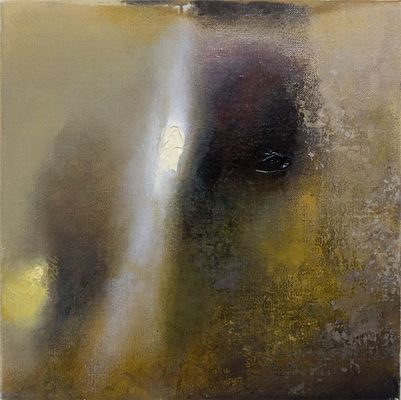
Always Will Need To Wear Winter Shirt Blue + Ochre Small Check Pattern
21 August - 21 September, 2015
Untitled
I am not a great reader of poetry but I always return to the work of Melbourne poet, Vincent Buckley (1925- 1988). Perhaps I find his most tantalising piece to be not a finished poem but a fragment left on a scrap of paper discovered on his desk after the poet’s death.
The poetry gathers like oil
In the word-core, and spreads
It has its music meet,
Its music is in movement.
This fragment is more the shell left behind from a volatile thought than a finished poem. I find the last two lines honest but awkward whereas the first two lines work like an arrow. Most likely he could not find a resolution so it was left. Still, in its present form, it remains an eloquent testimony to the ultimate failure of a medium to express mobile thought and sensation, in Buckley’s case, through verbal language. It’s an important matter because this is something all artists have to deal with regardless of the medium.
I have never written a poem, however, I am forever copying fragments from books on paper scraps in a vain effort to fix certain notions in my head. At first, they function as bookmarks that are sometimes returned to when I open the book. But before long, as they accumulate, they fall out littering the table interspersed with A4 photocopies, bills, books and medications.
To return to Buckley’s fragment, the first two lines very much evoke how I paint nowadays. As you age, detail diminishes and patches of light become more luminous and float. I feel the most honest way of dealing with this is by smearing the oil paint on the canvas with the fingers and working close-up, blind. Only if the patches coalesce into an approaching image can the work gain a life.
-
Jonathan Walker was born in Melbourne, Australia and brought up on a dairy farm in Gippsland. In the 1970’s he studied painting at RMIT and won the Harold Wright Scholarship to the British Museum, London. During the 1980’s he exhibited at Pinacotheca Gallery, Richmond and had work shown at the NGV and Heidi City Art Gallery. Over the same period he designed the cover for the “Epigenesi” LP by Giancarlo Toniutti, Italy and conducted a mail exchange work with Achim Wollscheid, Germany. The work with artists through the post resulted in an article published in the bicentenary issue of Art and Australia 1988. He showed in artist run spaces such as WestSpace in the 90’s and 2000’s, and until 2012, taught painting at Victoria University, which is where we (Colleen Ahern and Lisa Radford) as organisers of the exhibition, among many others, had the privilege of being his student.
Walker’s knowledge was imparted to students through the careful selection of music, literature, and artists found in books that he himself had ordered for the library. Walker’s strategy was the generosity of sharing his vast knowledge with references specific to each student and their context.
Walker’s paintings share a similar focus and intimacy.
This exhibition presents a small selection of recent paintings alongside a publication that includes Walker’s writing. Observational and analytical, Walker’s work is a type of material notation — the time of day, colour and how it is blended, the both specific and fleeting location of a reflection on lino or the question of whether a chair leg should be included in a painting.
Please join us on Friday August 21 between 6-8pm to celebrate the opening of the exhibition.
Curated by Colleen Ahern and Lisa Radford.
B. Wurtz
Curated by Nic Tammens
March 26 - April 4, 2015
B.Wurtz works from a basement studio in his home on Manhattan’s Lower East Side.
This local fact is attested to by the plastic shopping bags and newsprint circulars that appear in his work. As formal objects, they don’t make loud claims about their origins but nonetheless transmit street addresses and places of business from the bottom of this long thin island. Like plenty of artists, Wurtz is affected by what is local and what is consumed. His work is underpinned by this ethic. It often speaks from a neighborhood or reads like the contents of a hamper:
“BLACK PLUMS $1.29 lb.”
“Food Bazaar”
“USDA Whole Pork Shoulder Picnic 99c lb.”
“RITE AID Pharmacy, with us it’s personal.”
“H. Brickman & Sons.”
“Sweet Yams 59c lb."
Most of the work in this exhibition was made while the artist was in residence at Dieu Donne, a workshop dedicated to paper craft in Midtown. Here Wurtz fabricated assemblages with paper and objects that are relatively lightweight, with the intention that they would be easily transportable to Australia. This consideration isn’t absolute in Wurtz’s work, but was prescriptive for making the current exhibition light and cheap. Packed in two boxes, these works were sent from a USPS post office on the Lower East Side and delivered to North Melbourne by Australia Post.
Wurtz appears courtesy of Metro Pictures, New York.
Thanks to Rob Halverson, Joshua Petherick, Sari de Mallory, Matt Hinkley, Helen Johnson, Fayen d'Evie, Ask Kilmartin, Lisa Radon, Ellena Savage, Yale Union, and "Elizabeth".
John Nixon
"Archive"
December 15 - January 20, 2014
The presentation of John Nixon's archive offered a rare showcase of this extensive collection of the artist's own publications, catalogues, posters, ephemera, editions and more, from the mid 1980s onwards, alongside a selection of his artworks.
Organized by John Nixon, Joshua Petherick and Matt Hinkley.
<a href=http://wfb.public-office.info/artist/john-nixon>All titles by John Nixon
"Habitat"
at Minerva, Sydney (organised by Joshua Petherick and Matt Hinkley)
November 15 - December 20, 2014
Lupo Borgonovo, Janet Burchill & Jennifer McCamley,
Lewis Fidock, HR Giger, Piero Gilardi, Veit Laurent Kurz,
Cinzia Ruggeri, Michael E. Smith, Lucie Stahl, Daniel Weil, Wols
Press Release:
“...It contained seven objects. The slender fluted bone, surely formed for flight, surely from the wing of some large bird. Three archaic circuitboards, faced with mazes of gold. A smooth white sphere of baked clay. An age-blackened fragment of lace. A fingerlength segment of what she assumed was bone from a human wrist, grayish white, inset smoothly with the silicon shaft of a small instrument that must once have ridden flush with the surface of the skin - but the thing’s face was seared and blackened.”
William Gibson, “Count Zero”, 1986
"Autumn Projects Archive"
Curated by Liza Vasiliou
March 6 - March 15, 2014
World Food Books, in conjunction with the Virgin Australia Melbourne Fashion Festival 2014, presented the Autumn Projects archive, consisting of a selection of early examples in Australian fashion with a particular interest in collecting designers and labels from the period beginning in the 1980’s, who significantly influenced the discourse of Australian Fashion.
Curated by Liza Vasiliou, the exhibition provided a unique opportunity to view pieces by designers Anthea Crawford, Barbara Vandenberg, Geoff Liddell and labels CR Australia, Covers, Jag along with early experimental collage pieces by Prue Acton and Sally Browne’s ‘Fragments’ collection, suspended throughout the functioning World Food Books shop in Melbourne.
H.B. Peace
presented by CENTRE FOR STYLE
November 14, 2013
"Hey Blinky, you say chic, I say same"
Anon 2013
H.B. Peace is a clothing collaboration between great friends Blake Barns and Hugh Egan Westland. Their pieces explore the divergences between 'character’ and ‘personality’ in garments....etc
Special Thanks to Joshua Petherick and Matt Hinkley of WFB and Gillian Mears
and a Very Special Thank you to Audrey Thomas Hayes for her shoe collaboration.
Janet Burchill & Jennifer McCamley
"Aesthetic Suicide"
May 10 - June 8, 2013
The first of our occasional exhibitions in the World Food Books office/shop space in Melbourne, "Aesthetic Suicide" presented a body of new and older works together by artists Janet Burchill & Jennifer McCamley, including videos, prints, a wall work, and publications.
During shop open hours videos played every hour, on the hour.
1979, English / Dutch
Softcover (stapled), 44 pages (colour & b/w ill.), 21 x 27.5 cm
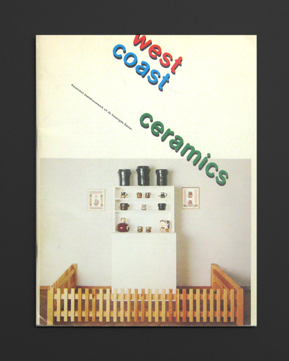
1st edition, Out of print title / used*,
Published by
Stedelijk Museum / Amsterdam
$50.00 - Out of stock
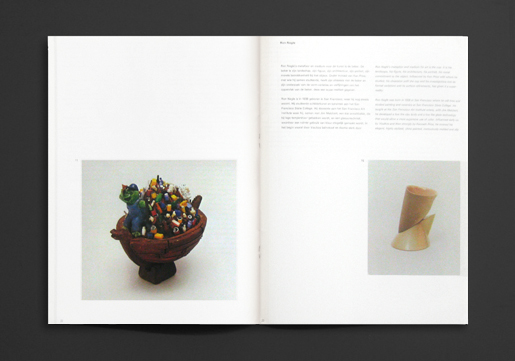
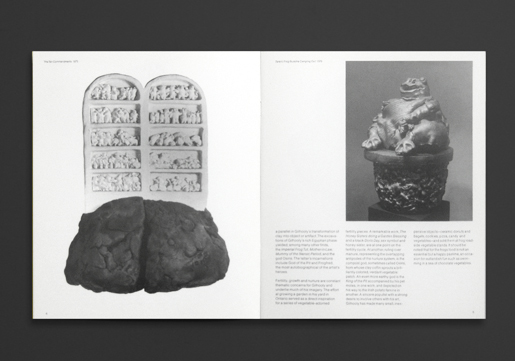
Catalogue for "West Coast Ceramics", the 1979 exhibition held at the Stedelijk Museum, Amsterdam. Artists include; Ken Price, Robert Arneson, David Gilhooly, Richard Shaw, Ron Nagle and Peter Voulkos.
Catalogue design: Wim Crouwel, Arlette Brouwers, Total Design
1976, English
Softcover (stapled), 12 pages (b/w ill.), 30.5 x 24.5 cm
1st edition, Out of print title / As new,
Published by
Museum of Contemporary Art / Chicago
$30.00 $5.00 - In stock -
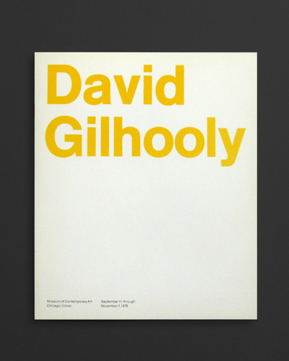
Catalogue for David Gilhooly's 1976 exhibition at the Museum of Contemporary Art,Chicago.
Whimsical and irreverent, Gilhooly was internationally acclaimed for his imaginative ceramic works of animals, food and other subjects. He started his career in 1962 as an assistant to sculptor Robert Arneson, who ran the freewheeling TB-9 ceramics studio at UC Davis. Arneson and his students were iconoclasts who created works that poked fun at high culture and made them leaders in the Bay Area funk art movement.
Although he sculpted creatures ranging from anteaters to zebras, Gilhooly made his popular reputation with an amusing amphibian. He created green frogs — first as unusual handles for drinking cups and then as full-size residents of Frog World, a universe of figures with full histories and mythologies.
1976, German
Softcover (plastic screw-bound), 48 pages, 34 x 27 cm
Out of print title / Used*,
Published by
März Verlag / Frankfurt
$150.00 - Out of stock
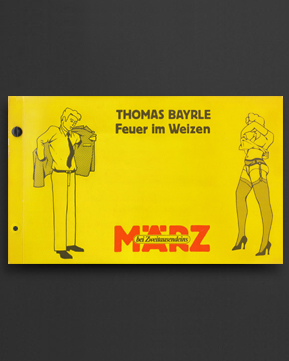
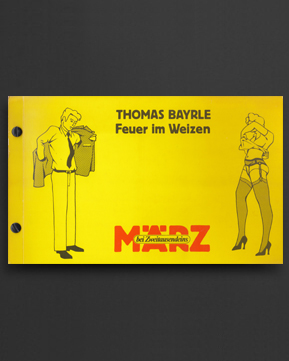
The incredible Thomas Bayrle artists' book, "Feuer im Weizen" (Fire in Wheat).
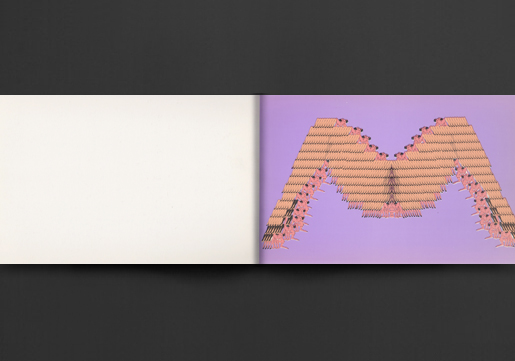
First published in 1970 in a different format, this second edition, published by the infamous März Verlag of Frankfurt, is a stack of beautifully, vividly offset printed landscape card pages bound together with black plastic screws. Each page is a work from Bayrle's famous "Feuer im Weizen" series of 1970, a series of what Bayrle refers to as superforms, images made of many smaller images of themselves. These particular serial repetitive patterns comprise of various formations of copulating couples - de-robing and in various sexual positions, all printed in bright pop colours.
Thomas Bayrle is a German painter , graphic designer and video artist who emerged as an important figure in European Pop Art of the 1960s and '70s. One of the most inventive artists, Bayrles works are usually based on a graphic rationale. Starting from traditional techniques, he was one of the first German artists who produced computer generated and animated art. An essential aesthetic element of his work is the principle of seriality. In the US tradition of Andy Warhol or Roy Lichtenstein , as well as the German artist Sigmar Polke is Bayrle by often takes its visual themes from the world of consumer goods. With the reflection on a world of commodities as accumulation of multipliable, repeatable shapes and pictograms Bayrle not only provides a commentary on society, but refers to his own artistic means.
A most desired edition of Bayrle's great books.
1976, German
Softcover (plastic screw-bound), 48 pages, 34 x 27 cm
Signed / Out of print title / Used*,
Published by
März Verlag / Frankfurt
$200.00 - Out of stock
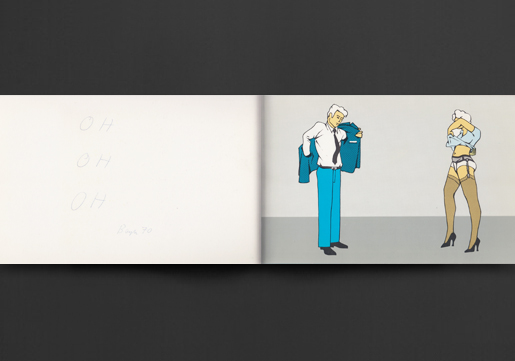
Artist signed copy of the incredible Thomas Bayrle artists' book, "Feuer im Weizen" (Fire in Wheat). Appropriately signed by Thomas Bayrle with "OH OH OH" penned into the first endpaper, with "Bayrle 1970".
First published in 1970 in a different format, this second edition, published by the infamous März Verlag of Frankfurt, is a stack of beautifully, vividly offset printed landscape card pages bound together with black plastic screws. Each page is a work from Bayrle's famous "Feuer im Weizen" series of 1970, a series of what Bayrle refers to as superforms, images made of many smaller images of themselves. These particular serial repetitive patterns comprise of various formations of copulating couples - de-robing and in various sexual positions, all printed in bright pop colours.
Thomas Bayrle is a German painter , graphic designer and video artist who emerged as an important figure in European Pop Art of the 1960s and '70s. One of the most inventive artists, Bayrles works are usually based on a graphic rationale. Starting from traditional techniques, he was one of the first German artists who produced computer generated and animated art. An essential aesthetic element of his work is the principle of seriality. In the US tradition of Andy Warhol or Roy Lichtenstein , as well as the German artist Sigmar Polke is Bayrle by often takes its visual themes from the world of consumer goods. With the reflection on a world of commodities as accumulation of multipliable, repeatable shapes and pictograms Bayrle not only provides a commentary on society, but refers to his own artistic means.
A most desired edition of Bayrle's great books.
2014, English
Softcover, 206 pages, 14 x 21 cm
Published by
Verso / London
$35.00 - Out of stock
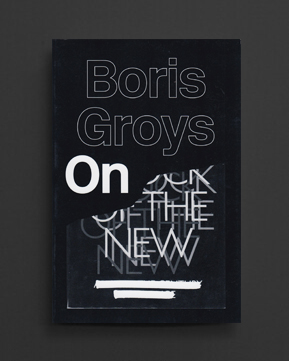
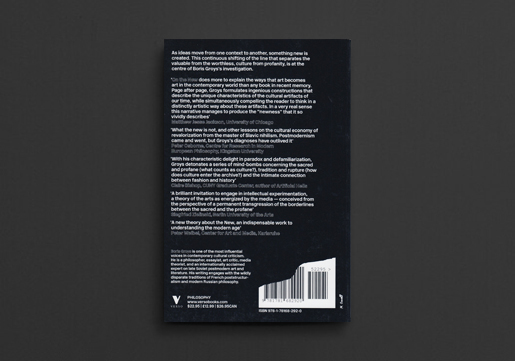
"On the New" looks at the economies of exchange and valuation that drive modern culture's key sites: the intellectual marketplace and the archive. As ideas move from one context to another, newness is created. This continuous shifting of the line that separates the valuable from the worthless, culture from profanity, is at the center of 's investigation which aims to map the uncharted territory of what constitutes artistic innovation and what processes underpin its recognition and appropriation.
1984, English
Softcover, 14 pages, 17.8 x 23.7 cm
1st Edition, Out of print title / Used*,
Published by
University Art Gallery / Melbourne
$35.00 - Out of stock
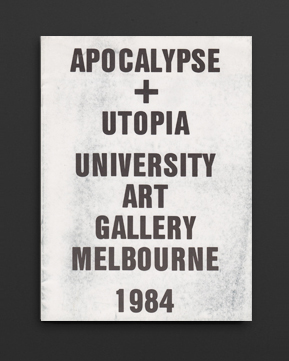
WE ARE AT AN EXHIBITION OF PAINTINGS. THE GALLERY HAS BECOME THE CAVE. IT IS A TIME OF THE APOCALYPSE + UTOPIA. THE ARTISTS HAVE 'HEWN THEIR PAINTINGS INTO THE WHITENESS OF THE WALLS'. IT IS ONCE AGAIN A PRIMITIVE SOCIETY. THE PICTURES TELL THEIR OWN STORIES.
Published on the occasion of the exhibition "Apocalypse + Utopia" at University Art Gallery, Melbourne, Feb 23 - April 8, 1984, curated by artist John Nixon and featuring the work of Gunter Christmann, Geoff Lowe, Dick Watkins and Jenny Watson.
2016, English
Softcover, 448 pages, 24 x 29.7 cm
Published by
Walker Art Centre / Minneapolis
$95.00 - Out of stock
Published by Walker Art Center
Edited with text by Andrew Blauvelt. Text by Greg Castillo, Esther Choi, Alison Clarke, Hugh Dubberly, Ross Elfline, Craig Peariso, Tina Rivers Ryan, Catharine Rossi, Simon Sadler, Felicity Scott, Lorraine Wild with David Karwan. Interviews by Adam Gildar, Susan Snodgrass, Elizabeth Glass.
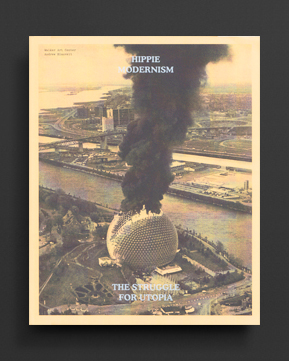
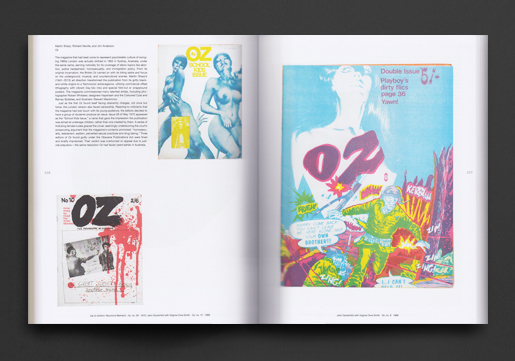
"Hippie Modernism" examines the art, architecture and design of the counterculture of the 1960s and early 1970s. The catalogue surveys the radical experiments that challenged societal norms while proposing new kinds of technological, ecological and political utopia. It includes the counter-design proposals of Victor Papanek and the anti-design polemics of Global Tools; the radical architectural visions of Archigram, Superstudio, Haus-Rucker-Co and ONYX; the installations of Ken Isaacs, Joan Hills, Mark Boyle, Hélio Oiticica and Neville D'Almeida; the experimental films of Jordan Belson, Bruce Conner and John Whitney; posters and prints by Emory Douglas, Corita Kent and Victor Moscoso; documentation of performances by the Diggers and the Cockettes; publications such as "Oz" and "The Whole Earth Catalog"; books by Marshall McLuhan and Buckminster Fuller; and much more. While the turbulent social history of the 1960s is well known, its cultural production remains comparatively under-examined. In this substantial volume, scholars explore a range of practices such as radical architectural and anti-design movements emerging in Europe and North America; the print revolution in the graphic design of books, posters and magazines; and new forms of cultural practice that merged street theater and radical politics. Through a profusion of illustrations, interviews with figures including: Gerd Stern of USCO; Ken Isaacs; Gunther Zamp Kelp of Haus-Rucker-Co; Ron Williams and Woody Rainey of ONYX; Franco Raggi of Global Tools; Tony Martin; Clark Richert and Richard Kallweit of Drop City; as well as new scholarly writings, this book explores the conjunction of the countercultural ethos and the modernist desire to fuse art and life.
Huge, generous and vividly illustrated volume!
2013, English
Hardcover, 400 pages, 25.4 x 30.6 cm
Published by
Prestel / Munich
Stedelijk Museum / Amsterdam
$140.00 - Out of stock
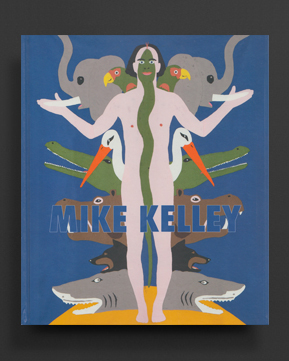
From the mid-1970s, Mike Kelley assembled an incredibly diverse and often controversial body of work. A multi-disciplinary impresario, he created works on paper, paintings, sculpture, video, installation, and performance art that managed to be at once shocking yet humorous, and complex yet accessible. This companion volume to the much-anticipated 2013 exhibition at the Stedelijk Museum (Amsterdam) brings a fresh understanding to the artist's work by seeking to address the more poetic aspects of Kelley's work through Eva Meyer-Hermann's unique curatorial approach. Here she presents individual works in new combinations that cross the boundaries of chronology, bodies of work, and former artistic project groups. Identifying themes such as architecture, language, identity, Informe, power, modernisms, nostalgia, and religion, the book represents ideas that have informed Kelley's work throughout his career. As a result, the overarching lines of his oeuvre become visible and accessible. This book features essays (by John C. Welchman, Eva Meyer-Hermann, Branden W. Joseph, and George Baker), a fully annotated plate section of abundant full-colour images of Kelley's history of work, and a newly researched and revised biography and bibliography of Kelley's work.
The publication promises to be the definitive work on the artist.
A huge publication! Extra shipping charges may apply.
1988, English
Softcover, 95 pages, 24.5 x 26 cm
1st English edition, Out of print title / used*,
Published by
Chronicle Books / San Francisco
$90.00 - Out of stock
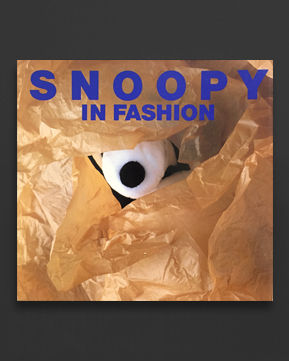
First English edition of SNOOPY IN FASHION, published in 1988!
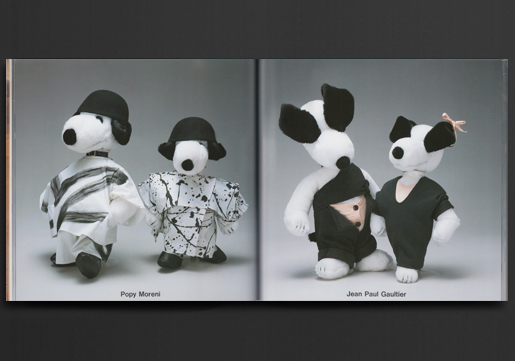
In the early 1980s Art Director Connie Boucher contacted a long list of the world's most progressive and famous fashion designers of the time, asking each of them to create an original one-of-a-kind designer outfit for Snoopy and his beagle sister Belle. The response was tremendous, with the world-famous designers loving the idea of dressing these world-famous dogs. Boucher's unique concept grew into a fabulous collection of specially designed haute couture modelled exclusively by Snoopy and Belle in an exhibition mounted by museums, galleries, and large department stores in Europe, Asia, Australia, and the United States. The skill and genius of many of the world’s greatest designers breathed tremendous life, verve, and excitement into Connie’s concept, forming SNOOPY IN FASHION in 1984.
For the book, first published in Japan in 1984, photographer Taishi Hirokawa has studio-documented each designer garment, modelled by Snoopy and Belle, one designer or fashion house per page. Designers include Givenchy, Issey Miyake, Karl Lagerfeld, Fendi, Pierre Balmain, Gianni Versace, Jean-Charles de Castelbajac, Thierry Mugler, Missoni, Krizia, L.L. Bean, Jen Paul Gaultier, Popy Moreni, Cinzia Ruggeri, Giorgio Armani, Cacharel, Fiorucci, Esprit, Levi Strauss, Gucci, and so many more!
2002, English / German
Softcover, 58 pages, 25.5 x 18 cm
Ed. of 800,
Published by
Daniel Buchholz Galerie / Köln
$40.00 - Out of stock
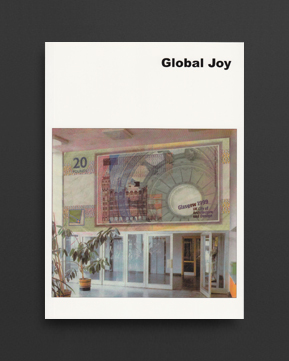
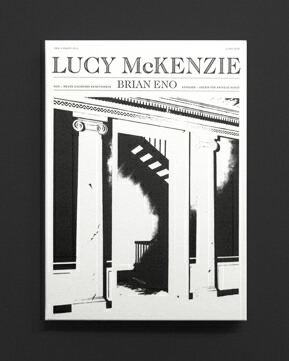
First monograph of the artist Lucy McKenzie, published on the occasion of her solo exhibit "Global Joy" at Daniel Buchholz in Cologne in 2002. With various colour reproductions of paintings/works and reference materials, foldout-pages, texts and interviews by the artist in English and German.
Lucy McKenzie is a Scottish artist, based in Brussels. She is represented by Galerie Daniel Buchholz, Cologne; Cabinet, London and Galerie Micheline Szwajcer, Brussels.
2003, English / German
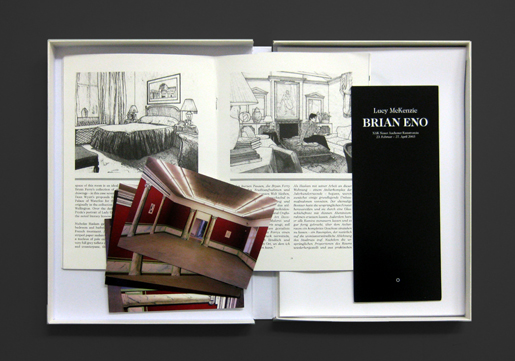
Hardcover gatefold cardboard box, 40 page Illustrated booklet, 4 offset posters, 4 postcards, paper model of exhibition space (8 cardstock sheet, full color), 21.6 x 30.5 cm (box dimensions)
Edition of 700, Out of print title / used,
Published by
Revolver Verlag / Berlin
$160.00 - Out of stock
Long out of print Lucy McKenzie box set from 2003, produced in an edition of 700 copies.
This boxed set was published on the occasion of Lucy McKenzie's first solo exhibition in a public institution. Informed by her recent roles of curator and public mural painter, McKenzie approaches the subjects of social and historical engagement. The name Brian Eno conjures up many connotations, and can be read as an emblem of sorts for dialogues around avant garde ideas, and an assimilation of these ideas into mainstream culture.
Brian Eno employs this reference to the musician and producer as a further dimension of the overall flat literalism employed by the visual elements of which it is constituted. Wilfully intended to be so, the mural installation, neon and drawings turned into posters and a paper model of the exhibition within this boxed publication, have their amateur "cottage industry" quality accentuated by their proximity to the professional, international intellectualism associated with Brian Eno.
Lucy McKenzie is a Scottish artist, based in Brussels. She is represented by Galerie Daniel Buchholz, Cologne; Cabinet, London and Galerie Micheline Szwajcer, Brussels.
English and German text.
*Condition: Very good – only light wear and bumping to box. All care is taken to provide accurate condition details of used books, photos available on request.
2015, English
Softcover, 132 pages, 11 x 18 cm
Published by
Errant Bodies / Berlin
$22.00 - Out of stock
Mobile phones have replaced design in mediating our relation to the surrounding space, writes Italian artist and composer Riccardo Benassi (born 1982). "All the tools that surrounded us were dematerialized. To stay alive – and to survive the digital – objects have become invisible, and are often processed in their own narratives." Equal parts essay, diary and critical pamphlet, 'Techno Casa' is the fifth publication in Errant Bodies' Doormats series.
2014, English
Softcover, 284 pages, 11 x 18 cm
Published by
Errant Bodies / Berlin
$28.00 - Out of stock
Drawing on two decades of interventions in politics and culture, Fred Dewey’s The School of Public Life records the author’s efforts to revive and rethink public space from Los Angeles to Berlin and beyond. From his work in neighborhood councils and directing Beyond Baroque in Los Angeles, Dewey reexamines community life, art, history and self-government against the abyss of economics, parties and constructed powerlessness. The book explores the works of thinker Hannah Arendt, the poet Charles Olson, artist Joseph Beuys' Office for Direct Democracy, experiments at Black Mountain College and Beyond Baroque, and Rosa Parks and the Montgomery bus boycott.
English, 2012
Softcover, 112 pages (colour & bw), 11 x 18 cm
Published by
Errant Bodies / Berlin
$20.00 - Out of stock
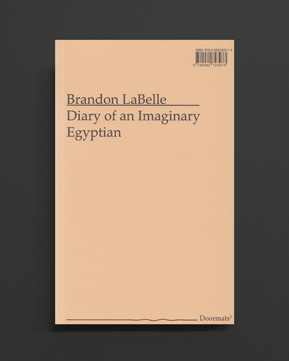
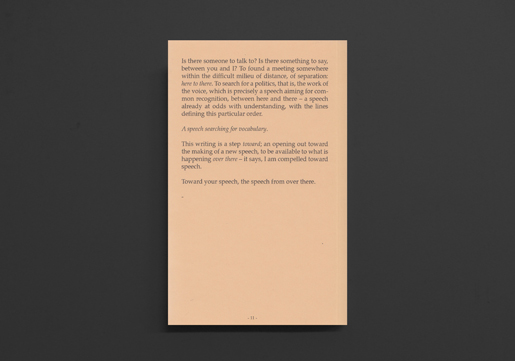
“Writing comes up from under my skin,” writes Brandon LaBelle. “It creeps into my sleep, to tense my fingers; I am plunged into it, as a space for capturing a new voice, for figuring a new body: to take an empty page and to fill it, with the day to day.” LaBelle’s work as an artist and theorist focuses on the interrelation between the sonic arts, popular culture and theory. The second volume in Errant Bodies’ Doormats series is LaBelle’s attempt to engage the events of the Arab Spring through the diary form, in which personal memories are conjoined with broader cultural reflections on American imperialism and revolution.
2012, English
Softcover, 152 pages (colour & bw ill.), 11 x 18 cm
Published by
Errant Bodies / Berlin
$23.00 - Out of stock
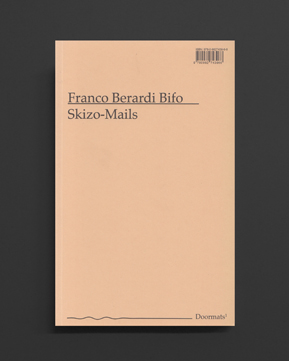
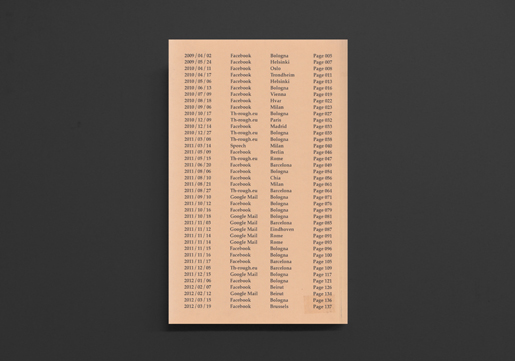
Franco Berardi Bifo (born 1949) is one of today’s most articulate and prominent anti-capitalism theorists. Like many others involved with the 1960s Autonomia movement in Italy (such as Antonio Negri and Mario Tronti), Berardi moved to Paris, where he worked and studied with the French philosopher and psychotherapist Felix Guattari, in the field of schizoanalysis. 'Skizo-Mails' is a collection of Berardi’s aphoristic and diaristic correspondence that combines the political and the poetic in its consideration of our present plight.
1982, German
Hardcover (limited ed. Laminate cover), 260 pages, 24 x 33.5 cm
1st Edition, Out of print title / Used*,
Published by
Werkbund / Bremen
$350.00 - Out of stock
Beautiful over-sized book published on the occasion of a special exhibition in Lower Saxony and Bremen in 1982 entitled "Provokationen. Design Aus Italien : Ein Mythos Geht Neue Wege".
Published more broadly as a softcover book in 1982, here is one of the very limited edition hardcover versions, produced in collaboration between the designers Andrea Branzi, Paola Navone, Mario Radice, Ettore Sottsass Jr. and Superstudio with Firma Abet Laminati in Turin, especially for the exhibition. Each of the limited hardcover copies is sandwiched between two pieces of actual laminate panels designed by the designers and produced by Abet Laminati.
This particular copy features the work of Ettore Sottsass Jr. (both front and back cover laminates).
A very collectable copy of an incredible, scarce, heavy Italian design book!
Handsomely designed and profusely illustrated throughout with large black and white examples of the work of Enzo Mari, Sergio Asti, Gae Aulenti, Andrea Branzi, Superstudio, Achille and Piergiacomo Castiglioni, Marco Zanuso, Roberto Arioli, Ettore Sottsass, Emma Schweinberger Gismondi, Angelo Mangiarotti, Mario Bellini, Gio Ponti, Martine Bendin, Daniela Puppa, Antonia Astori de Ponti, Franco Mirenzi, Joe Colombo, Ennio Lucini, Elio Martinelli, Sottsass Associates, Alessandro Mendini, Franco Raggi, Studio Alchimia, Gaetano Pesce, Franco Mello, Guido Drocco, Studio 65, UFO, Jonathan De Pas, Donato D'Urbino, Paolo Lomazzi, Aldo Rossi, Vico Magistretti, Achille Castiglioni, Sergio De Michiel, Paolo Nava, Mario Dell'Orto, Antonio Citterio, Anrea Bellosi, Richard Sapper, Bruno Munari, Anna Castelli Ferrieri, Giulietto Cacciari, Man Ray, Gigi Sabadin, Antonia Astori de Ponte, Mario Ceroli, Lucchino Oltrona Visconti, Michele De Lucchi, Michael Graves, Paolo Portoghesi, Stanley Tigerman, Oscar Tusquets, Robert Venturi, Kuzumasa Yamashita, and more.
And also the work of Gerrit T. Rietveld, Giuseppe Terragni, Alvar Aalto, Eileen Gray, Sonja Delaunay, Marcel Breuer, Karl Josef Jucker, Charles Rennie Mackintosh, Josef Hoffman in their original, influential forms, and their re-inventions by Alessandro Mendini and co.
1986, English
Softcover, 200 pages, 29.4 x 20.8
1st Edition, Out of print title / Used*,
Published by
Photography Workshop / London
$80.00 - Out of stock
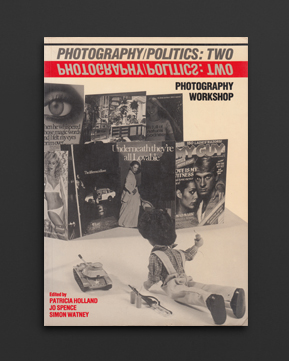
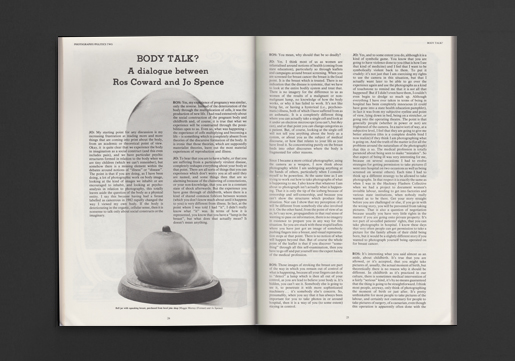
Published in London, 1986, this rare volume compiles an extensive collection of essays covering photography and politics, including sections on the body, war, practice and institutions. Co-publication of Comedia and Photography Workshop. Includes an extensive illustrated interview with Loraine Leeson and Peter Dunn and Jo Spence on John Heartfield.
2016, English
Softcover, 312 pages, 11 x 18 cm
Published by
Spector Books / Leipzig
$36.00 - Out of stock
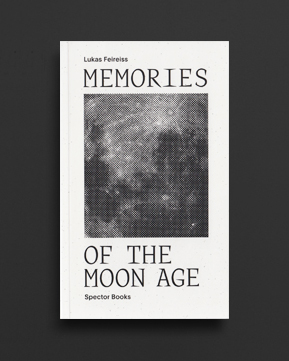
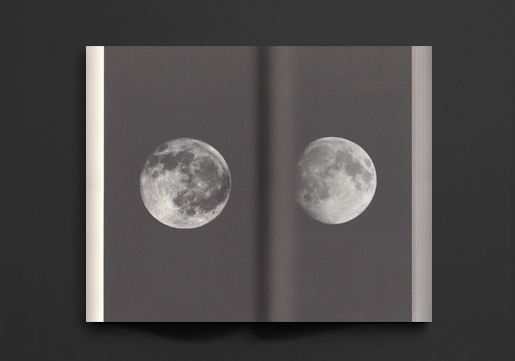
Long before scientists took the possibility of travelling to the Moon seriously, virtually all of its aspects had already been explored in art and literature. Our nearest astronomical neighbour, the Moon — just three days journey by spacecraft — still serves as an object of creative projection and speculation for visionaries across the globe. More than five decades after the first moonwalk, the book Memories of the Moon-Age traces a visual cultural history of lunar exploration in snapshots from the past, present, and future. This inspiring journey through history ranges from Ptolemy’s early calculations of the distance from the Earth to the Moon and Galilei’s invention of the telescope and his pen drawings of the lunar surface to the golden age of space travel in the mid-twentieth century with Kubrick’s 2001: A Space Odyssey and the concrete preparations for the Apollo Moon landing.
Lukas Feireiss (*1977) works as curator and writer in the international mediation of contemporary cultural reflexivity beyond disciplinary boundaries.
2016, English
Softcover, 388 pages, 10.5 x 18 cm
Published by
Spector Books / Leipzig
$50.00 - Out of stock
Edited by Anselm Franke, Stephanie Hankey, Marek Tuszynski
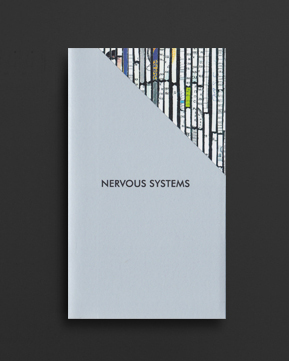
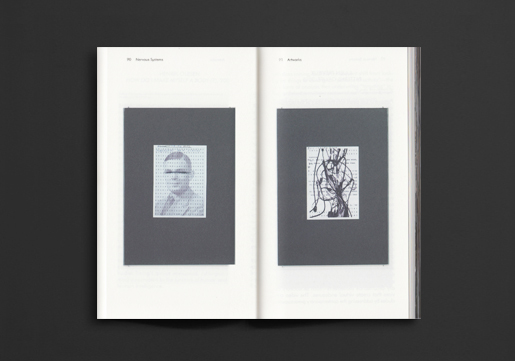
Beyond contemporary disclosures about mass surveillance by intelligence services, the promises inherent in “big data” determine discourses about future innovations and systems of classification in government and industry, which aim to increasingly transform political and systemic questions into those of technological management. The promises of participation and “digital democracy” stand in contrast to new forms of cybernetic control and modulation of social behaviour on an unprecedented scale. The countless sensors of ubiquitous digital and technological infrastructures have united the state, industry, body and technology into ever more complex “nervous systems.” This nervousness is revealed in particular where relationships of power and participation come to the fore, namely in the “social question.” The publication, which appears in conjunction with the exhibition Nervous Systems (Haus der Kulturen der Walt, Berlin, February-April 2016), assembles a combination of contemporary art – complemented by contributions by experts, theorists and researchers, presenting contextualized historical documents, artefacts and further objects.
Worldwide Tactical Tech has supported thousands of activists to creatively employ information and communication in their work towards social and political change.
Contributions and works by Vito Acconci, Timo Arnall, Mari Bastashevski, Grégoire Chamayou, Emma Charles, Mike Crane, Arthur Eisenson, Harun Farocki, Charles Gaines, Melanie Gilligan, Goldin+Senneby, Avery F. Gordon, Laurent Grasso, Orit Halpern, Lawrence Abu Hamdan, Ben Hayes, Douglas Huebler, Tung-Hui Hu, On Kawara, Korpys/Löffler, Lawrence Liang, Noortje Marres, !Mediengruppe Bitnik, Henrik Olesen, Matteo Pasquinelli, Julien Prévieux, Jon Rafman, Miljohn Ruperto, RYBN.ORG, Dierk Schmidt, Nishant Shah, Eyal Sivan & Audrey Maurion, Deborah Stratman, Alex Verhaest, Gwenola Wagon & Stéphane Degoutin, Stephen Willats, Mushon Zer-Aviv, Jacob Appelbaum & Ai Weiwei, Aram Bartholl, Tega Brain & Surya Mattu, James Bridle, Julian Oliver & Danja Vasiliev, Veridiana Zurita, Open Data City, Peng! Collective, Privacy International, Share Lab, Malte Spitz, and others.
1976, German
Hardcover (tri-fold w. 2 x inlaid books), 130 pages + 25 page chronology, 28 x 21 cm
1st German edition, Out of print title / Used*,
Published by
Adolf Wölfli-Stiftung / Bern
Kunstmuseum Bern / Bern
$50.00 - Out of stock
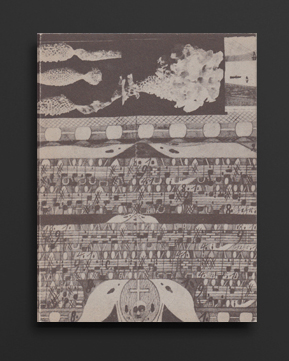
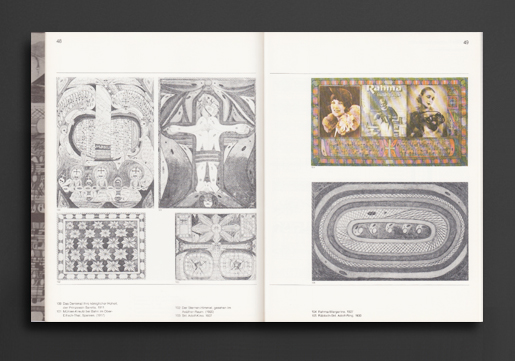
Very good copy in original illustrated boards of this handsome Adolf Wölfli catalogue published by the Fondation Adolf Wölfli, Bern, 1976.
This catalog was prepared for the major exhibition on the work of Adolf Wölfli at the Kunstmuseum Bern in 1976, organized by Elka Spoerri and a team of scholars including Harald Szeemann, Markus Ratz, Peter Bichsel, among others.
Illustrated throughout with Wölfli's drawings, writings, diagrams, music compositions, letters, etc, plus a Chronological Presentation of his life and work juxtaposed with his imaginary biographical details (adapted by Elka Spoerri and translated by Anne-Marie Thalmann); the catalogue is meticulously designed and presented in an illustrated heavy card folder which opens out into a tryptic housing both books and centred with a photograph of Wölfli. Essays by Elka Spoerri, Peter Bichsel, Jakob Wyrsch, Alfred Bader, Harald Szeemann, Theodor Spoerri and more (in German); catalogue edited by Elka Spoerri and Jurgen Glaesemer.
"Mrs. Spoerri, who sometimes jokingly referred to herself as ''Mrs. Wölfli,'' was a legend in the world of outsider art. She spent more than 20 years deciphering, transcribing, translating and indexing the often densely interwoven writing, iconography and musical scores of Wölfli, a prolific schizophrenic Swiss laborer. Consigned to Waldau, a psychiatric hospital in Bern, from the age of 30 to his death at 66 in 1930, Wölfli created thousands of drawings and 45 large illustrated books containing a total of nearly 25,000 pages. He was known in Switzerland during his lifetime but subsequently slipped into near oblivion. Mrs. Spoerri came to Wölfli's work through her husband, Theodor, a psychiatrist at Waldau who, at the invitation of the Swiss curator Harald Szeemann, helped reintroduce Wölfli's work to the art world at Documenta 5 in 1972. But Theodor, a cousin of the artist Daniel Spoerri, died in 1973, and Mrs. Spoerri became the chief guardian and interpreter of Wölfli's art". (from Spoerri's obituary, in the Times, written by Roberta Smith).
1980, English
Hardcover (w. dust jacket), 247 pages, 23 x 29 cm
1st Edition, Out of print title / Used*,
Published by
William Morrow and Co. / New York
$150.00 - Out of stock
By Egon Von Furstenberg and Karen Fischer
One of the great, unique, interior design books of the 1980s!
Edited by Prince Egon von Fürstenberg, a prominent German socialite, banker, fashion designer, and interior designer (and at one time married to fashion designer Diane von Fürstenberg), this one-of-a-kind book dawns the 1980s with an incredible collection of interiors that express a man's "style, taste, and most importantly, sense of self", from the perspective of the modern male. "This beautifully illustrated book (...) shows you the Power Looks that convey success, confidence, imagination, creativity, and effectiveness". "With outstanding photographs of his friends' apartments, Egon von Fürstenberg reveals how Marvin Hamlisch, Perry Ellis, Angelo Donghia, Georgio Sant'Angelo, and many other successful singles reflect their personalities in the way they live." It even includes decorating budgets!
A perfect interior design book to sum up the eclectic Hi-Tech, Pop, Minimal, and Cosmopolitan lofts, studios and apartments of the late 1970's/early 1980's, featuring some of the finest examples of prominent interior decorators of the period.
1976, English
Softcover (staple-bound), 60 pages, 21 x 14 cm
Out of print title / Used*,
Published by
Betty Dodson / New York
$70.00 - Out of stock
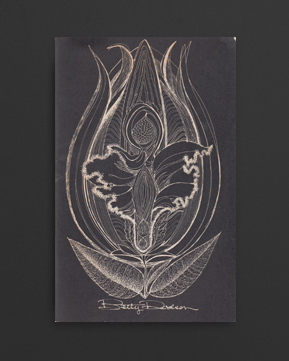
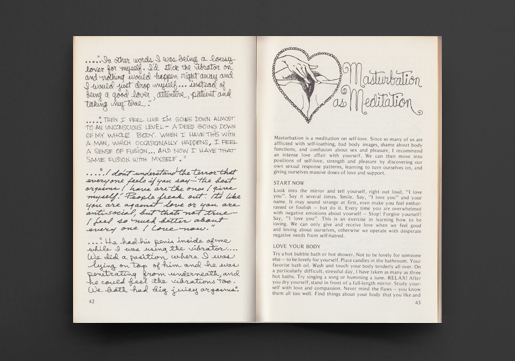
1976 edition of Betty Dodson's "Liberating Masturbation", her first self-published book on self-love that became a feminist classic. Includes the chapters: "The Romaticized Image of Sex", "Sharing Masturbation", "Going Public", "Conciousness Raising", "Becoming Cunt Positive", "Bodysex Workshops", "Masturbation as Meditation"...
Betty Dodson (born August 24, 1929) is an American sex educator. An artist by training, she exhibited erotic art in New York, before pioneering the pro-sex feminist movement, separate from mainstream feminism, which she sees as needlessly political and hostile to men. Dodson’s workshops and manuals encourage women to masturbate, often in groups. Although bisexual herself, she repudiates the labels that define sexuality.
2016, English
Hardcover, 80 pages, 16 x 23 cm
Published by
Archive Books / Berlin
$60.00 $45.00 - Out of stock
Display and its social dimensions are leitmotifs in the multiform art practice of Martin Beck. His exhibition ‘Last Night’ at Kunsthaus Glarus reflected on the relations between exhibiting and community by bringing together two bodies of works: one drawing on modern exhibition history, the other building on the history of countercultural communes in the 1960s and early ’70s United States. Summer Winter East West discusses Beck’s engagement with display not only as a tool of presentation but also as a form of communication – within and beyond the realm of the exhibition. What are the possibilities for imaging community? How can togetherness be presented (or present itself), and to what degree is exhibiting already an aspect of community building?
Edited by Christina von Rotenhan and Sabine Rusterholz Petko
Designed by Gregor Huber, Huber & Sterzinger, Zurich
2016, English
Softcover, 24 pages, 21 x 29.7 cm
Ed. of 2000,
Published by
Endless Lonely Planet / Melbourne
$0.00 - Out of stock
Endless Lonely Planet 5, published on the occasion of the 4th/5th Melbourne Artist Facilitated Biennial held at Tarrawarra Museum of Art as part of TARRAWARRA BIENNIAL 2016: ENDLESS CIRCULATION (19 August - 6 November 2016) curated with Discipline. Exhibition and publication features the work of Christopher L G Hill, Nick Selenitsch, Lou Hubbard, Lewis Fidock, Endless Lonely Planet, Liam Osborne, Lisa Radford, Elizabeth Newman, Nicholas Tammens, Kate Meakin, George Egerton-Warburton, James Deutsher, Zac Segbedzi, Aurelia Guo, Rudi Williams, Alex Vivian, Lucina Lane, Lauren Burrow, Counterfeitnessfirst, Virginia Overell, Joshua Petherick, Laurel Doody, Tahi Moore, elp3 Vine, and more...
Free in the shop.
Free on request with any order (include in your order and shipping cost will be credited back)
If ordered alone, shipping charges apply.