World Food Books' programme is largely produced on Kulin Nation land. We acknowledge the Wurundjeri people of the Kulin Nation as the first and continuing custodians of this land, and pay respect to their Elders past, present, and emerging.
World Food Books is an arts and special interests bookshop in Naarm / Melbourne. Founded in 2010, World Food Books is devoted to the presentation of a rotating, hand-selection of international art, design, literary and counterculture publications with an emphasis on the anti-traditional, the experimental, the avant-garde, the heretic, the marginal.
Presenting new titles alongside rare and out-of-print books, catalogues and journals spanning the fields of modern and contemporary art, design, photography, illustration, film, literature, poetry, cultural theory, philosophy, sexuality, popular and underground culture in its many radical forms, World Food Books wishes to encourage adventurous, thoughtful and open-minded reading, looking, writing, and exchange of publishing and ideas, both current and historical.
As well as our bookshop, located in Melbourne's historical Nicholas Building, all of our inventory is available internationally via our online mail-order service.
World Food Books semi-regularly co-ordinates "Occasions", a programme of exhibits and events at the bookshop and in partnership with other hosts (such as museums and art galleries) that develop out of the activities, relationships and content of the bookshop itself.
World Food Books
The Nicholas Building
37 Swanston Street
Room 5, Level 6
Melbourne 3000
Australia
SHOP HOURS:
Thu–Fri 12–6, Sat 12–5
WEB-SHOP OPEN 24/7
World Food Books
Postal Address:
PO Box 435
Flinders Lane
Victoria 8009
Australia
Art
Theory / Essay
Architecture / Interior
Graphic Design / Typography
Photography
Fashion
Eros
LGBTQ+
Fiction / Poetry
Weird / Speculative / Science Fiction / Horror
Transgressive / Visceral / Abject
Symbolism / Decadence / Fin de siècle
Film / Video
Painting
Sculpture / Installation
Performance / Dance / Theater
Drawing
Sound / Music
Curatorial
Group Shows / Collections
Periodicals
Out-of-print / Rare
Posters / Ephemera / Discs
Signed Books
World Food Books Gift Voucher
World Food Book Bag
Australian Art
Australian Fiction
Australian Science Fiction / Speculative Fiction
Australian Poetry
Australian Photography
Japanese Photography
Conceptual Art
Minimal Art
Dada
'Pataphysics / Oulipo
Fluxus
Concrete Poetry
Pop Art
Surrealism
Arte Povera
Arte Informale / Haute Pâte / Tachism
Nouveau Réalisme / Zero / Kinetic
Situationism / Lettrism
Collage / Mail Art / Xerox Art
Art Brut / Folk / Visionary / Fantastic
Illustration / Graphic Art / Bandes Dessinées
Furniture
Italian Radical Design / Postmodernism
Textiles
Ceramics / Glass
Counterculture
Protest / Revolt
Philosophy
Psychoanalysis
Anthropology
Anarchism
Socialism / Anarchism / Communism / Capitalism
Literary Theory / Semiotics / Language
Feminism / Women's Studies
Gender Studies / Sexuality
Anthropology
Fetishism / BDSM
Drugs / Psychedelia
Crime / Violence
Animal Rights / Veganism
Occult / Esoterica
Ecology / Earth / Alternative Living
Whole Earth / Crafts
All prices in AUD (Australian dollars)
Pick-Ups
Pick-up orders can be collected in our bookshop during opening hours after order date. Please collect any Pick-up orders within 2 weeks of ordering as we have limited storage space. Orders will be released back into stock if not collected within this time. No refunds can be made for pick-ups left un-collected. If you cannot make it in to the bookshop in this time-frame, please choose postage option.
Return Policy
All sales are final. We do accept returns (for refund or exchange) for items received in error. All our orders are packed with special care using heavy-duty padding and cardboard book-mailers or bubble mailers (for smaller books), using reinforcement where required. We cannot take responsibility for any lost, stolen or damaged parcels.
Insurance
Should you wish to insure your package, please email us directly after placing your order and we can organise this at a small extra expense. Although all standard/express tracked packages are very safe and dependable, we cannot take responsibility for any lost, stolen or damaged parcels. We recommend insurance on valuable orders.
Interested in selling your old books, catalogues, journals, magazines, comics, fanzines, ephemera? We are always looking for interesting, unusual and out-of-print books to buy. We only buy books in our fields of interest and specialty, and that we feel we can resell.
We base these prices on desirability, market value, in-print prices, condition and our current stock levels. We offer cash, store credit, and can take stock on consignment. All
about 25% of the price we expect to get when we sell them, or 30% in store credit. We base these prices on desirability, market value, in-print prices, condition and our current stock levels.
Sell your books any day of the week. You can drop them off and return later. If you have a lot of books, we can visit your Sydney home.
We buy books that we feel we can resell. We offer about 25 % of the price we expect to get when we sell them, or 30% in store credit. We base these prices on desirability, market value, in-print prices, condition and our current stock levels.
Philadelphia Wireman
03 August - 01 September, 2018
World Food Books is proud to announce our next Occasion, the first presentation of sculptures by Philadelphia Wireman in Australia.
The Philadelphia Wireman sculptures were found abandoned in an alley off Philadelphia’s South Street on trash night in 1982. Their discovery in a rapidly-changing neighbourhood undergoing extensive renovation, compounded with the failure of all attempts to locate the artist, suggests that the works may have been discarded after the maker’s death. Dubbed the "Philadelphia Wireman" during the first exhibition of this work, in 1985, the maker’s name, age, ethnicity, and even gender remain uncertain. The entire collection totals approximately 1200 pieces, all intricately bound together with tightly-wound heavy-gauge wire (along with a few small, abstract marker drawings, reminiscent both of Mark Tobey and J.B. Murry). The dense construction of the work, despite a modest range of scale and materials, is singularly obsessive and disciplined in design: a wire armature or exoskeleton firmly binds a bricolage of found objects including plastic, glass, food packaging, umbrella parts, tape, rubber, batteries, pens, leather, reflectors, nuts and bolts, nails, foil, coins, toys, watches, eyeglasses, tools, and jewellery.
Heavy with associations—anthropomorphic, zoomorphic, and socio-cultural responses to wrapped detritus—the totemic sculptures by Philadelphia Wireman have been discussed in the context of work created to fulfil the shamanistic needs of alternative religions in American culture. Curators, collectors, and critics have variously compared certain pieces to sculpture from Classical antiquity, Native American medicine bundles, African-American memory jugs, and African fetish objects. Reflecting the artist’s prolific and incredibly focused scavenging impulse, and despite—or perhaps enhanced by—their anonymity, these enigmatic objects function as urban artefacts and arbiters of power, though their origin and purpose is unknown. Philadelphia Wireman, whatever their identity, possessed an astonishing ability to isolate and communicate the concepts of power and energy through the selection and transformation of ordinary materials. Over the course of the past two decades, this collection has come to be regarded as an important discovery in the field of self-taught art and vernacular art.
Presented in collaboration with Fleisher-Ollman Gallery, Philadelphia, and Robert Heald, Wellington.
Susan Te Kahurangi King
02 February - 10 March, 2018
Susan Te Kahurangi King (24 February 1951 - ) has been a confident and prolific artist since she was a young child, drawing with readily available materials - pencils, ballpoint pens and felt-tip markers, on whatever paper is at hand. Between the ages of four and six Susan slowly ceased verbal communication. Her grandparents William and Myrtle Murphy had developed a special bond with Susan so they took on caring responsibilities for extended periods. Myrtle began informally archiving her work, carefully collecting and storing the drawings and compiling scrapbooks. No drawing was insignificant; every scrap of paper was kept. The King family are now the custodians of a vast collection containing over 7000 individual works, from tiny scraps of paper through to 5 meter long rolls.
The scrapbooks and diaries reveal Myrtle to be a woman of great patience and compassion, seeking to understand a child who was not always behaving as expected. She encouraged Susan to be observant, to explore her environment and absorb all the sights and sounds. Myrtle would show Susan’s drawings to friends and people in her community that she had dealings with, such as shopkeepers and postal workers, but this was not simply a case of a grandmother’s bias. She recognised that Susan had developed a sophisticated and unique visual language and sincerely believed that her art deserved serious attention.
This was an unorthodox attitude for the time. To provide some context, Jean Dubuffet coined the term Art Brut in 1945 to describe work created by self-taught artists – specifically residents of psychiatric institutions and those he considered to be visionaries or eccentrics. In 1972 Roger Cardinal extended this concept by adopting the term Outsider Art to describe work made by non-academically trained artists operating outside of mainstream art networks through choice or circumstance. Susan was born in Te Aroha, New Zealand in 1951, far from the artistic hubs of Paris and London that Dubuffet and Cardinal operated in. That Myrtle fêted Susan as a self-taught artist who deserved to be taken seriously shows how progressive her attitudes were.
Susan’s parents Doug and Dawn were also progressive. Over the years they had consulted numerous health practitioners about Susan’s condition, as the medical establishment could not provide an explanation as to why she had lapsed into silence. Dawn educated herself in the field of homeopathy and went on to treat all twelve of her children using these principles – basing prescriptions on her observations of their physical, mental and emotional state.
Doug was a linguist with an interest in philosophy who devoted what little spare time he had to studying Maori language and culture. To some extent their willingness to explore the fringes of the mainstream made them outsiders too but it was their commitment to living with integrity and their respect for individuality that ensured Susan’s creativity was always encouraged.
Even though Susan’s family supported her artistic pursuits, some staff in schools and hospitals saw it as an impediment to her assimilation into the community and discouraged it in a variety of ways. Her family was not always aware of this and therefore did not fully understand why Susan stopped drawing in the early 1990s. However, rather than dwell on the challenges that Susan faced in pursuit of her artistic practice, they prefer to highlight her achievements. In 2008 Susan began drawing again in earnest, after an almost 20 year interruption, and her work is now shown in galleries around the world.
Susan grew up without television and has been heavily influenced by the comics she read as a child. She is absolutely fearless in the appropriation of recognizable characters, such as Donald Duck and Mickey Mouse, in her work. She twists their limbs, contorts their faces, compresses them together, blends them into complex patterned backgrounds - always imbuing them with an incredible energy. Although Susan often used pop culture characters in her work they are not naive or childlike. These are drawings by a brilliant self-taught artist who has been creating exceptional work for decades without an audience in mind.
Mladen Stilinović
"Various Works 1986 - 1999"
02 February 16 - September 10, 2016
Various works 1986 - 1999, from two houses, from the collections of John Nixon, Sue Cramer, Kerrie Poliness, Peter Haffenden and Phoebe Haffenden.
Including: Geometry of Cakes (various shelves), 1993; Poor People’s Law (black and white plate), 1993; White Absence (glasses, ruler, set square, silver spoon, silver ladel with skin photograph and wooden cubes), 1990-1996; Exploitation of the Dead (grey and red star painting, wooden painting, black spoon with red table, red plate), 1984-1990; Money and Zeros (zero tie, paintings made for friends in Australia (Sue, John, Kerrie), numbers painting), 1991-1992; Words - Slogans (various t-shirts) - “they talk about the death of art...help! someone is trying to kill me”, “my sweet little lamb”, “work is a disease - Karl Marx”; Various artist books, catalogues, monographs, videos; Poster from exhibition Insulting Anarchy; "Circular" Croatian - Australian edition; Artist book by Vlado Martek (Dostoyevsky); more.
Thanks to Mladen Stilinović and Branka Stipančić.
Jonathan Walker
Always Will Need To Wear Winter Shirt Blue + Ochre Small Check Pattern
21 August - 21 September, 2015
Untitled
I am not a great reader of poetry but I always return to the work of Melbourne poet, Vincent Buckley (1925- 1988). Perhaps I find his most tantalising piece to be not a finished poem but a fragment left on a scrap of paper discovered on his desk after the poet’s death.
The poetry gathers like oil
In the word-core, and spreads
It has its music meet,
Its music is in movement.
This fragment is more the shell left behind from a volatile thought than a finished poem. I find the last two lines honest but awkward whereas the first two lines work like an arrow. Most likely he could not find a resolution so it was left. Still, in its present form, it remains an eloquent testimony to the ultimate failure of a medium to express mobile thought and sensation, in Buckley’s case, through verbal language. It’s an important matter because this is something all artists have to deal with regardless of the medium.
I have never written a poem, however, I am forever copying fragments from books on paper scraps in a vain effort to fix certain notions in my head. At first, they function as bookmarks that are sometimes returned to when I open the book. But before long, as they accumulate, they fall out littering the table interspersed with A4 photocopies, bills, books and medications.
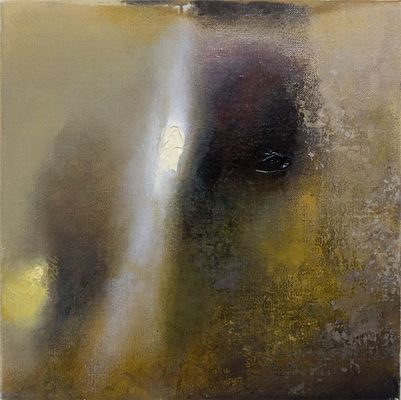
To return to Buckley’s fragment, the first two lines very much evoke how I paint nowadays. As you age, detail diminishes and patches of light become more luminous and float. I feel the most honest way of dealing with this is by smearing the oil paint on the canvas with the fingers and working close-up, blind. Only if the patches coalesce into an approaching image can the work gain a life.
-
Jonathan Walker was born in Melbourne, Australia and brought up on a dairy farm in Gippsland. In the 1970’s he studied painting at RMIT and won the Harold Wright Scholarship to the British Museum, London. During the 1980’s he exhibited at Pinacotheca Gallery, Richmond and had work shown at the NGV and Heidi City Art Gallery. Over the same period he designed the cover for the “Epigenesi” LP by Giancarlo Toniutti, Italy and conducted a mail exchange work with Achim Wollscheid, Germany. The work with artists through the post resulted in an article published in the bicentenary issue of Art and Australia 1988. He showed in artist run spaces such as WestSpace in the 90’s and 2000’s, and until 2012, taught painting at Victoria University, which is where we (Colleen Ahern and Lisa Radford) as organisers of the exhibition, among many others, had the privilege of being his student.
Walker’s knowledge was imparted to students through the careful selection of music, literature, and artists found in books that he himself had ordered for the library. Walker’s strategy was the generosity of sharing his vast knowledge with references specific to each student and their context.
Walker’s paintings share a similar focus and intimacy.
This exhibition presents a small selection of recent paintings alongside a publication that includes Walker’s writing. Observational and analytical, Walker’s work is a type of material notation — the time of day, colour and how it is blended, the both specific and fleeting location of a reflection on lino or the question of whether a chair leg should be included in a painting.
Please join us on Friday August 21 between 6-8pm to celebrate the opening of the exhibition.
Curated by Colleen Ahern and Lisa Radford.
B. Wurtz
Curated by Nic Tammens
March 26 - April 4, 2015
B.Wurtz works from a basement studio in his home on Manhattan’s Lower East Side.
This local fact is attested to by the plastic shopping bags and newsprint circulars that appear in his work. As formal objects, they don’t make loud claims about their origins but nonetheless transmit street addresses and places of business from the bottom of this long thin island. Like plenty of artists, Wurtz is affected by what is local and what is consumed. His work is underpinned by this ethic. It often speaks from a neighborhood or reads like the contents of a hamper:
“BLACK PLUMS $1.29 lb.”
“Food Bazaar”
“USDA Whole Pork Shoulder Picnic 99c lb.”
“RITE AID Pharmacy, with us it’s personal.”
“H. Brickman & Sons.”
“Sweet Yams 59c lb."
Most of the work in this exhibition was made while the artist was in residence at Dieu Donne, a workshop dedicated to paper craft in Midtown. Here Wurtz fabricated assemblages with paper and objects that are relatively lightweight, with the intention that they would be easily transportable to Australia. This consideration isn’t absolute in Wurtz’s work, but was prescriptive for making the current exhibition light and cheap. Packed in two boxes, these works were sent from a USPS post office on the Lower East Side and delivered to North Melbourne by Australia Post.
Wurtz appears courtesy of Metro Pictures, New York.
Thanks to Rob Halverson, Joshua Petherick, Sari de Mallory, Matt Hinkley, Helen Johnson, Fayen d'Evie, Ask Kilmartin, Lisa Radon, Ellena Savage, Yale Union, and "Elizabeth".
John Nixon
"Archive"
December 15 - January 20, 2014
The presentation of John Nixon's archive offered a rare showcase of this extensive collection of the artist's own publications, catalogues, posters, ephemera, editions and more, from the mid 1980s onwards, alongside a selection of his artworks.
Organized by John Nixon, Joshua Petherick and Matt Hinkley.
<a href=http://wfb.public-office.info/artist/john-nixon>All titles by John Nixon
"Habitat"
at Minerva, Sydney (organised by Joshua Petherick and Matt Hinkley)
November 15 - December 20, 2014
Lupo Borgonovo, Janet Burchill & Jennifer McCamley,
Lewis Fidock, HR Giger, Piero Gilardi, Veit Laurent Kurz,
Cinzia Ruggeri, Michael E. Smith, Lucie Stahl, Daniel Weil, Wols
Press Release:
“...It contained seven objects. The slender fluted bone, surely formed for flight, surely from the wing of some large bird. Three archaic circuitboards, faced with mazes of gold. A smooth white sphere of baked clay. An age-blackened fragment of lace. A fingerlength segment of what she assumed was bone from a human wrist, grayish white, inset smoothly with the silicon shaft of a small instrument that must once have ridden flush with the surface of the skin - but the thing’s face was seared and blackened.”
William Gibson, “Count Zero”, 1986
"Autumn Projects Archive"
Curated by Liza Vasiliou
March 6 - March 15, 2014
World Food Books, in conjunction with the Virgin Australia Melbourne Fashion Festival 2014, presented the Autumn Projects archive, consisting of a selection of early examples in Australian fashion with a particular interest in collecting designers and labels from the period beginning in the 1980’s, who significantly influenced the discourse of Australian Fashion.
Curated by Liza Vasiliou, the exhibition provided a unique opportunity to view pieces by designers Anthea Crawford, Barbara Vandenberg, Geoff Liddell and labels CR Australia, Covers, Jag along with early experimental collage pieces by Prue Acton and Sally Browne’s ‘Fragments’ collection, suspended throughout the functioning World Food Books shop in Melbourne.
H.B. Peace
presented by CENTRE FOR STYLE
November 14, 2013
"Hey Blinky, you say chic, I say same"
Anon 2013
H.B. Peace is a clothing collaboration between great friends Blake Barns and Hugh Egan Westland. Their pieces explore the divergences between 'character’ and ‘personality’ in garments....etc
Special Thanks to Joshua Petherick and Matt Hinkley of WFB and Gillian Mears
and a Very Special Thank you to Audrey Thomas Hayes for her shoe collaboration.
Janet Burchill & Jennifer McCamley
"Aesthetic Suicide"
May 10 - June 8, 2013
The first of our occasional exhibitions in the World Food Books office/shop space in Melbourne, "Aesthetic Suicide" presented a body of new and older works together by artists Janet Burchill & Jennifer McCamley, including videos, prints, a wall work, and publications.
During shop open hours videos played every hour, on the hour.
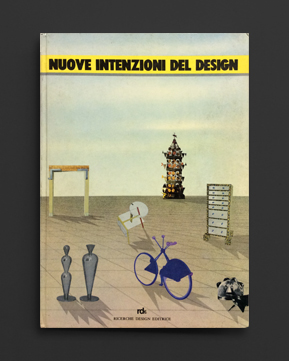
1982, Italian
Harcover, 79 pages, 17 x 24 cm
1st Edition, Out of print title / Used*,
Published by
Ricerche Design Editore / Milan
$65.00 - Out of stock
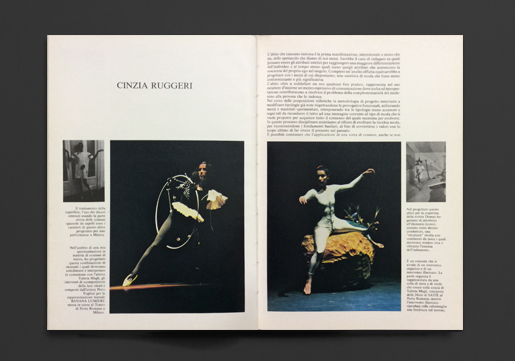
Lovely hardcover catalogue published by Ricerche Design Editore in Milan for an exhibition on radical Italian art and design held at Centro Comunicazioni Visive, sala Comunale delle Esposizioni, April - May 1982.
Features the work of Cinzia Ruggeri, Alessandro Mendini, Andrea Branzi, Riccardo Dalisi, Ugo La Pietra, Superstudio, Occhiomagico, Studio Alchimia, Franco Raggi, Adolfo Natalini, Ettore Sottsass, amongst others.
1985, English
Softcover, 208 pages, 21 x 30 cm
1st Edition, Out of print title / Used*,
Published by
Thames and Hudson / London
$160.00 - Out of stock
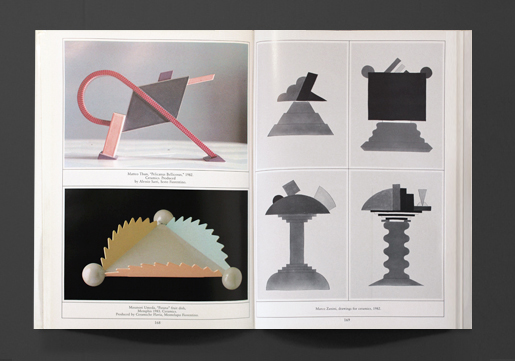
Softcover English edition of "MEMPHIS: Research, Experiences, Results, Failures and Successes of New Design", by Barbara Radice - arguably the greatest reference book on the work of the Italian Design group MEMPHIS.
Written by Radice, a founding member of the Memphis group (and author of "Ettore Sottsass: A Critical Biography"), and documenting in stunning photography and reproduction the vast array of design work that this group produced across furniture, lighting, interiors, architecture, textiles, glassware, etc., this feels almost like THE official Memphis book, embodying their spirit and design aesthetic in book form.
Founded in 1981, the international group of architects and designers, Memphis, shook the design world to its foundations. Based in Italy and led by Ettore Sottsass, it overturned and re-shaped the pre-suppositions on which the production of so-called Modern Design is based. It became the almost mythical symbol of the New Design. Laughing out loud at our culture and at itself, Memphis pulled out all stops when it came to colour, pattern, decoration and ornamentation. It sets out to contribute to the continuing dialogue on pop culture, the avant-garde and design.
This book features the work of Ettore Sottsass, George Sowden, Masanori Umeda, Shiro Kuramata, Nathalie Du Pasquier, Peter Shire, Michele de Lucchi, Matteo Thun, Alessandro Mendini, Andrea Branzi, Gerard Taylor, Michael Graves, Aldo Cibic, George James Sowden, Arquitectonica, Hans Hollein, Marco Zanini, Javier Mariscal, Thomas Bley, Martine Bedin, etc.
Contents are: Introduction; Memphis; Plastic Laminate; Materials; Decoration; Color; The Memphis Idea; The Design; Memphis and Fashion.
Highly recommended.
1984, English
Softcover (w. dust-jacket), 156 pages (260 b/w & 140 colour ill.), 28 x 23 cm
Out of print title / Used*,
Published by
Thames and Hudson / London
$70.00 - Out of stock
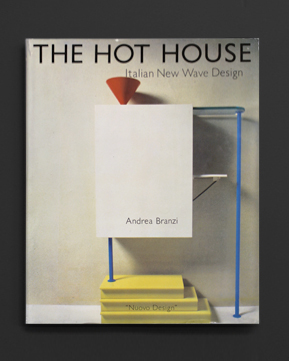
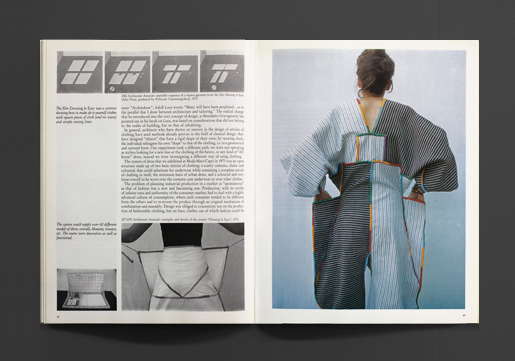
Edited by Andrea Branzi, The Hot House was one of the finest books published to trace the history of Italy's radical design studios from 1960 to the dawn of Memphis. Through academic texts and profuse visual documentation of the work of Alessandro Mendini, Gaetano Pesce, Superstudio, Ettore Sottsass, Natalie Du Pasquier, UFO Group, Enzo Mari, Alchymia, Michele De Lucchi, 9999, Archizoom Associati, Mattheo Thun, Memphis, and many others.
An essential book for anyone interested in Italian radical design!
2016, English
Softcover, 138 pages, 11.4 × 17.7 Cm
Published by
Aboriginal Humanities Project / Melbourne
Discipline / Melbourne
$10.00 - Out of stock
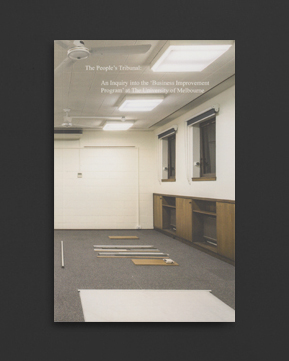
Published by Aboriginal Humanities Project, Melbourne, in association with Discipline. Edited by Marion Campbell & Philip Morrissey, with contributions by Philip Morrissey, Marion Campbell, ‘Affected Staff’, Ruth Campbell, Leo Seward, Giles Fielke, Raewyn Connell, Hans A. Baer, Adam Bartlett, Justin Clemens, Lauren Bliss, Kevin Murray, Gill H. Boehringer, Aunty Janet Turpie-Johnstone, Ted Clark, and designed by Nicholas Tammens.
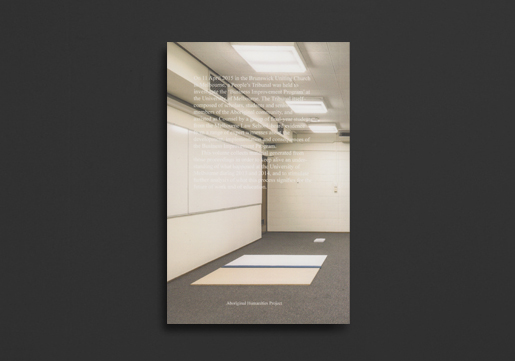
On 11 April 2015 in the Brunswick Uniting Church in Melbourne, a People’s Tribunal was held to investigate the ‘Business Improvement Program’ at the University of Melbourne.
The Tribunal itself–composed of scholars, students and senior members of the Aboriginal community, and assisted as Counsel by a group of final-year students from the Melbourne Law School–heard evidence from a range of expert witnesses about the development, implementation and consequences of the Business Improvement Program. This volume collects material generated from those proceedings in order to keep alive an under-standing of what happened at the University of Melbourne during 2013 and 2014, and to stimulate further analysis of what this process signifies for the future of work and of education.
2016, English / German
Softcover, 264 pages, 23 x 16.5 cm
Published by
Texte Zur Kunst / Berlin
$29.00 - Out of stock
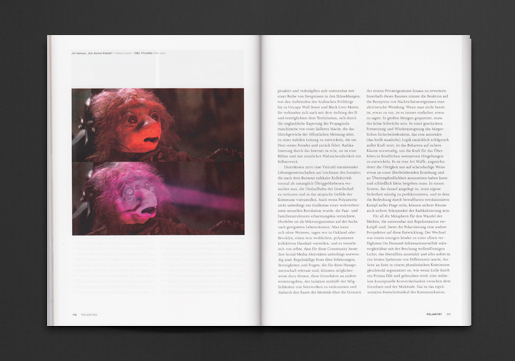
ISSUE NO. 101 / MARCH 2016 “POLARITIES”
Issue No. 101 of Texte zur Kunst takes “Polarities” as its theme – a term we associate with what’s unfolding around us right now: ideological polarization, from Pegida to Donald Trump. How do we understand the growing gap between the ideals of tech/smooth space (where the art world tends to reside, swiftly neutralizing any resistance as “content”) and the striated regions of material unrest? How do we understand “polarization” despite our dominant, and inherently continuous, neoliberal system? Given these macro conditions in which art critical and art historical discourses are currently being formed, and within which they will need to position themselves, could the image of polarization be something not to avoid but to engage; perhaps even a potentially generative model for times that are anything but ideology-free?
TABLE OF CONTENTS
PREFACE
ET SOUS LA PLAGE … ? / Philipp Felsch interviews Timothy Brennan on the state of left theory
HELMUT DRAXLER
ALWAYS POLARIZE? / Conditions and limitations of a model of argumentation
LIBERTY, EQUALITY, SECURITY / Four questions for Carolin Emcke
ENTER THE VOID / Roy Scranton and @LILINTERNET on hyperreality and reflexive narrative
DANIEL COLUCCIELLO BARBER AND DAVIS RHODES
THE TERROR WITHIN
ANTEK WALCZAK
GLOBALLY POSITIONED
GABRIELE WERNER
HEIMAT / Notes on the enduring renaissance of an idea
BILDSTRECKE
GERHARD RICHTER
"12 PHOTOGRAPHS OF ULRIKE MEINHOF" / Taken in October 1966 for "Konkret" by Inge-Maria Peters
NEW DEVELOPMENT
NATIONAL CUSTOMS / Sven Lütticken on Germany's Kulturgutschutzgesetz
ROTATION
IST DER MENSCH DOCH NOCH ZU RETTEN? / Svenja Bromberg über Nina Powers Aufsatzsammlung „Das kollektive politische Subjekt“
HEY MOTHERFUCKERS, HERE IS YOUR GENERATIONAL NOVEL / Tobias Madison über Seth Prices Roman „Fuck Seth Price“
SHORT WAVES
Hans-Jürgen Hafner über Daniel Richter in der Schirn Kunsthalle, Frankfurt/M. / Astrid Mania über Verena Pfisterer bei Exile, Berlin / Ana Teixeira Pinto on Július Koller at the Museum of Modern Art, Warsaw / Beate Söntgen über Joan Mitchell im Museum Ludwig, Köln / Daniel Keller on Peter Fend at Barbara Weiss and Oracle, Berlin / Manfred Hermes über Anne Speier bei Silberkuppe, Berlin
REVIEWS
SPERRIGE NAHEVERHÄLTNISSE / Eva Kernbauer über „to expose, to show, to demonstrate, to inform, to offer. Künstlerische Praktiken um 1990“ im Mumok, Wien
DER GESCHMACK DES PRIVATEN / Barbara Buchmaier und Christine Woditschka über die Sammlung Würth im Martin-Gropius-Bau, Berlin
BENEFITS / Sarah Lookofsky on “Collected by Thea Westreich Wagner and Ethan Wagner” at the Whitney Museum of American Art, New York
NOBODY EVER DID WHAT WE DID / David Rimanelli on Dash Snow at the Brant Foundation Art Study Center, Greenwich, Connecticut
MALEREI MALGRÉ TOUT / Maria Muhle über „Painting 2.0“ im Museum Brandhorst, München
PUNK’S NOT DEAD, JUST DIFFERENT / Gili Tal on “Rum, sodomy, and the lash” at Eden Eden, Berlin
WITHIN YOU WITHOUT YOU / Jenny Nachtigall on Carolee Schneemann at Museum der Moderne, Salzburg
FREMDE ZUNGEN / Yilmaz Dziewior über „Slip of the Tongue“ in der Punta della Dogana, Venedig
LOCAL UNION / Rhea Anastas on Union Gaucha Productions at Artists Space, New York
EDITION
THEA DJORDJADZE
DANA SCHUTZ
2015, English
Softcover, 160 pages, 18.4 x 11 cm
Published by
Bookworks / London
$33.00 - Out of stock
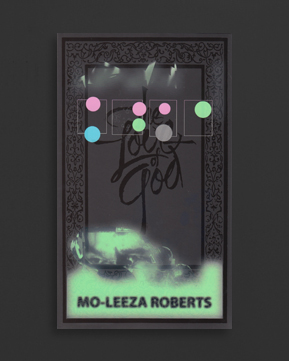
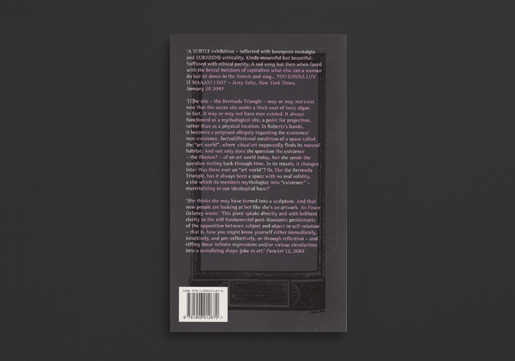
Mo-Leeza Roberts novel Head describes the desperate future that clusters around Head Gallery like cockroaches swarming over a pigs head. It is at once critical and complicit, and deluded and envious.
Jerry-rigging sacarine sci-fi, with a leavened mush of curatorial artspeak, artists, collectors, hanger-ons and other art world actors explode in ecstasy, pain, or self-induced eradication – all, according to the whims of the Head Gallery, which remains an anonymous and inviolate force, the overseer of events and a selfless accumulator of prestige and wealth. Familiar contemporary artists are reanimated for the future, giving the events described an unsettling familiarity. Any reader familiar with the art world should feel both seduced, and infected. It is like Dickens but with laughs induced by our approaching extinction, and like Salò, written, directed and starred in by Barbara Gladstone.
Head Gallery is based in New York and Shanghai. It advises collectors, appraises antiques, bankrupts sponsors, gives out MAs in curatorial practice, commissions spiritual tracts, does expert restoration where apoc-damage is concerned, plans corporate events and retreats, disappears interns, holds alcohol support group sessions, funds Scottish nationalists, and produces bestiality instruction videos. It is also dedicated to producing critical art texts and troll feeds that are split between a written textual element located on the website, expanded press releases, or exhibition description, and materialised elements installed in galleries. It operates in between a future set in 2078, and the present.
2015, English
Softcover, 176 pages, 17 x 23 cm
Published by
Witte de With / Rotterdam
$38.00 - Out of stock
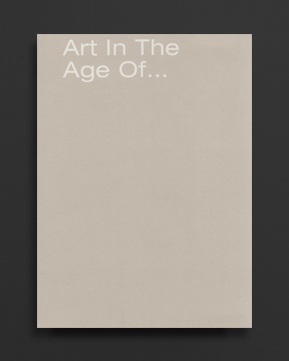
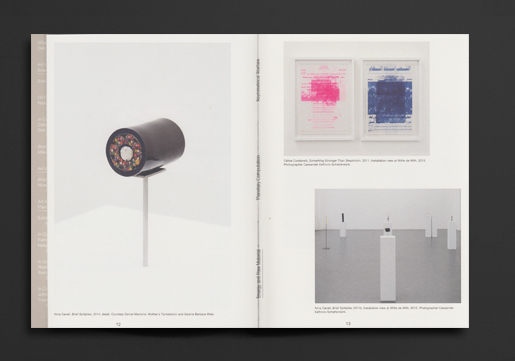
Art In The Age Of… was published on the occasion of the eponymous yearlong cycle presented at Witte de With Center for Contemporary Art, Rotterdam (23 January 2015 – 3 January 2016). This series articulated itself through three exhibitions; Art In The Age Of…Energy And Raw Material, Art In The Age Of…Planetary Computation, and Art In The Age Of…Asymmetrical Warfare, alongside a related discursive program and film screenings.
Art In The Age Of… was staged to investigate future vectors of art production in the 21st century, highlighting the circulation of art and its underlying economies rather than its territorial location, its spread and infectious expanse rather than its arrest within narrowly defined genealogies and media.
With a focus on topical areas of urgency within art’s creation and its dispersal, spanning energy and raw materials, planetary computation, and asymmetric warfare, the Art In The Age Of… publication both records and expands research feeding this year-long program through interviews and essays by key contributors, alongside specially commissioned artist interventions.
Edited by Defne Ayas (director, Witte de With), Natasha Hoare (associate curator, Witte de With), and Adam Kleinman (chief editor, WdW Review), the book features interviews with artists involved in the various exhibitions of Art In The Age Of…, including Rossella Biscotti, James Bridle, Céline Condorelli, John Gerrard, Femke Herrengraven, David Jablonowski, Navine G. Kahn-Dossos, John Menick, Trevor Paglen, Susan Schuppli, Tom Tlalim; commissioned essays by theorists, curators and cultural historians involved in its discursive program, including contributions by Alexandra Bradford, Natasha Ginwala, Mike Jay, and Mohammad Salemy; interventions by artists Nina Canell and David Jablonowski; as well as visual documentation of the three exhibitions.
2015, English
Hardcover, 92 pages, 21 x 13.5 cm
Ed. of 1,250,
Published by
Bookworks / London
$33.00 - Out of stock
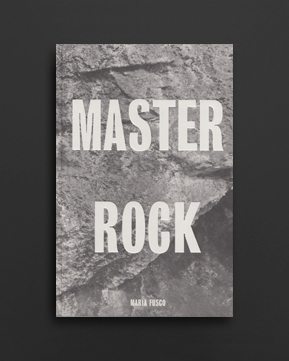
Master Rock is a repertoire for a mountain.
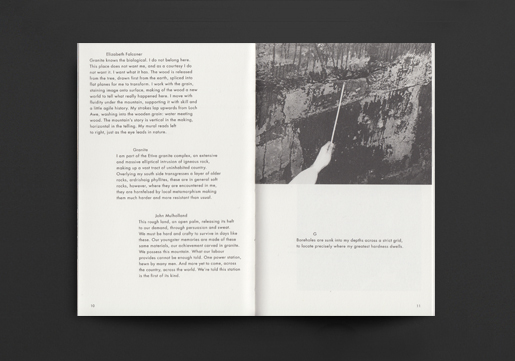
Rough land, open palm. Bodies are machines that shake. Big boned faces, big hands, big claws, ah Jesus, well-used. Bore. Blast. Smash. Force on loan. Must be hard and clever to survive in this technological age. Granite knows the biological. Gods inside the mountain, just plain men outside.
Working through the cavernous space in Ben Cruachan, the largest peak on the west coast of Scotland, Maria Fusco exhumes three fictional voices from fact: Tunnel tigers, the Irish explosives experts who emptied out the mountain to build a power station; Elizabeth Falconer, the artist who produced a mural inside that only the site’s workers ever see; and Granite, the 450 million year-old rock of Cruachan itself as a main character.
Fusco uses original writing, archival materiality and topographical reportage as her tools to compress geology, mythology and technology: to write the inside of her mountain.
Maria Fusco is a Belfast-born writer and is the founder and editorial director of The Happy Hypocrite. Her work is published internationally and translated into eight languages. She is the author of With A Bao A Qu Reading When Attitudes Become Form (New Documents, 2013), The Mechanical Copula (Sternberg Press, 2010) and wrote the screenplay for GONDA, a film by Ursula Mayer, commissioned by Film London, and published as a ciné-roman (Sternberg, 2012). Fusco has been invited writer-in-residence at Lisbon Architecture Triennale, Kadist Art Foundation, Paris, and Whitechapel Gallery, London, and, has been awarded as a Jerwood Creative Catalyst. She is a Reader at Edinburgh College of Art, University of Edinburgh and was Director of Art Writing at Goldsmiths, University of London.
Master Rock is a commission by Artangel and BBC Radio 4, with the support of Creative Scotland and co-published by Artangel and Book Works, as part of Co-series, No. 11. Designed by A Practice for Everyday Life, edition of 1,250.
2015, English
Softcover, 304 pages, 13 x 19.5 cm
Ed. of 500,
Published by
Dissect / Melbourne
$15.00 $5.00 - Out of stock
The Internet increasingly structures our experiences of the world. The web is approaching omnipresence, absorbed into the everyday, as our material lives are heavily mediated by its attendant applications, algorithms and software. Everything is in flux, including the presentation and distribution of our own selves—both online and offline.
Subversive interaction with various digital media seems both necessary and apparent within contemporary art. From the possibilities afforded photography by digital image manipulation and proliferation, to the incorporation of aspects of online experience into material objects, there is a porous border between the online and offline worlds, if there even remains a border at all.
A range of authors and artists address these concerns in the second issue of Dissect Journal, as submissions reflect on the structures and oppositions that continue to colour debates in and around digital art.
Contributions by: Rachel de Joode, Phebe Schmidt, Daniel Palmer, Travis Cox, Johanna Drucker, Sven Lütticken, David La Roche, James L Marshall, Madeleine Stack, Natasha Chuk, Sheridan Coleman, Danielle Zorbas, Amanda Starling Gould, Holly Childs, Max Trevor, Thomas Edmond, Hannah Schiefelbein, Kyle Weise, Tara Cook.
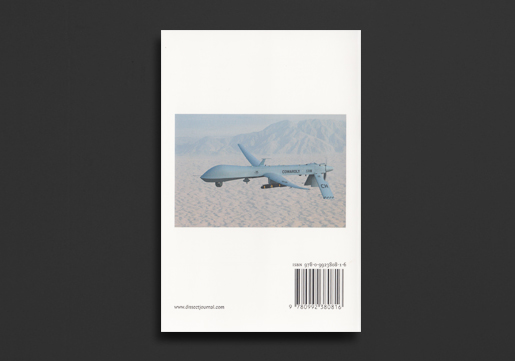
cover image:
Joseph DeLappe, 'Predator Drone - Cowardly' from 'Cowardly Drones', 2013. Digital image.
Dissect Journal is a new contemporary art publication that presents a range of longer essays, shorter reviews and artist pages.
If it is true that contemporary art both reflects and refracts an image of the world, as it is both of it and provides more of it, then attempts to address contemporary art must themselves be varied and complex. In the variety of material published within its pages, Dissect Journal seeks to reflect the manifold interconnections between contemporary art and the world.
Featuring both emerging and established contributors, the publication strives for a sustained and intelligent engagement with contemporary art. It aims to analyse and interrogate the work of contemporary artists from various vantage points, sculpting and refining multiple histories of and responses to contemporary art.
edition: 500
2016, English
Softcover, 240 pages, 11.8 x 16.5 cm
Published by
Sternberg Press / Berlin
The Serving Library / New York
Dexter Sinister / New York
$25.00 - Out of stock
Bulletins of The Serving Library #10
Winter 2015
Edited by Stuart Bertolotti-Bailey, Angie Keefer, David Reinfurt
With contributions by Stuart Bailey, Paul Elliman, Rob Giampietro, Angie Keefer, Bruno Latour, Isla Leaver-Yap, Leila Peacock, David Reinfurt, Bruce Sterling
Issue #10 of Bulletins of The Serving Library is a TEST, containing one choice bulletin from each of the previous nine issues. It is a compendium of sorts, a best-of double-album printed at 50% scale, a sample for what's next. This issue also includes 140-character summaries of every bulletin published previously. From now on, Bulletins of The Serving Library will proceed in full color and at half its former size—but will be twice as good.
Published by The Serving Library, New York
2016, English
Softcover, 36 pages, 21 x 29.7 cm
Published by
Sydney / Sydney
$30.00 - In stock -
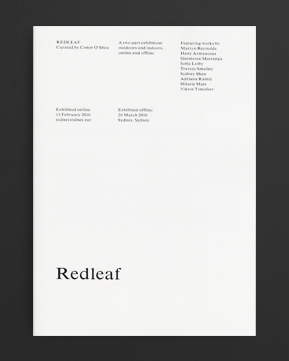
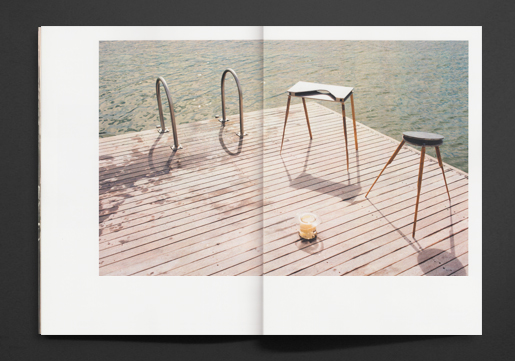
Published by Sydney on the occasion of an offsite exhibition held at Redleaf pool on Sydney harbour, 2016. Curated by Conor O'Shea featuring work by Martyn Reynolds, Hany Armanious, Quintessa Matranga, Sofia Leiby, Travess Smalley, Sydney Shen, Adriana Ramić, Hilarie Mais, Viktor Timofeev.
2015, English
Softcover, 96 pages, 16.5 x 23 cm
Ed. of 1,000,
Published by
Bookworks / London
$30.00 $10.00 - Out of stock
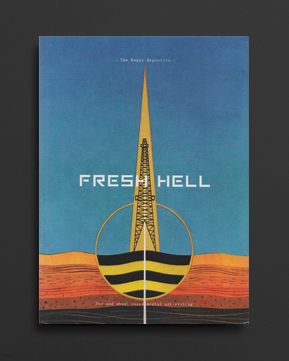
‘What fresh hell is this? There’s an inferred question in the title of this issue. But it’s a rhetorical one. Because we know exactly what fresh hell this is. Fossil Fuel – that paralytic drug – has leeched into our collective bloodstream. It’s difficult to recognize the beasts that are eating us in this very moment.’ – Sophia Al-Maria, from the Editor’s note, The Happy Hypocrite 8
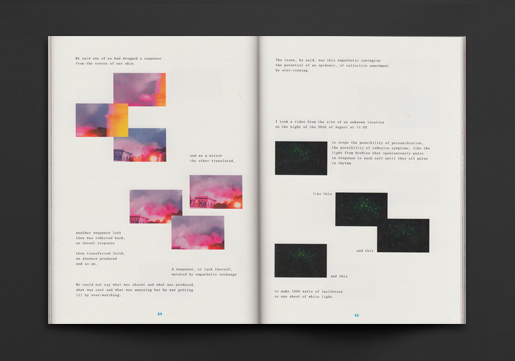
The Happy Hypocrite – Fresh Hell treats in different ways the subject of oil. Adopting an exploded methodology for intake, image and text contributions, this issue takes a hoarding, brutally accelerative approach and considers reading, too, as an unsustainable activity. Guest editor Sophia Al-Maria’s archive acts a sort of proto-Tumblr composed of school notebooks, war games and oil industry pamphlets scattered as a series of identifying clues. All windows are open, all browsers are burning: The Happy Hypocrite asks what happens when reblogged information is translated into paper-based print.
With contributions and new work by Abdullah Al-Mutairi, Monira Al Qadiri, Stephanie Bailey, Alex Borkowski, Judy Darragh, William Gibson, Navine G. Khan-Dossos, Malak Helmy, Raja’a Khalid, Omar Kholeif, McKenzie Wark, Simon Sellars, Francesco Pedraglio and Lena Tutanjian.
Sophia Al-Maria is a Qatari-American artist and writer based in London, UK. Her memoir, The Girl Who Fell to Earth (Harper
Collins, 2012), was published in Arabic by Bloomsbury Qatar in Summer 2015. In 2014, she had her first solo show, ‘Virgin with a Memory’, at Cornerhouse, Manchester, UK. She is the recipient of a 2015 Sundance Institute Fellowship and her work was included in the New Museum Triennial, New York, USA, 2015. In 2016, she will receive her first solo museum show in the USA with the premiere of a new series of videos at the Whitney.
2014, English
Softcover, 96 pages, 16.5 x 23 cm
Ed. of 1,000,
Published by
Bookworks / London
$30.00 $10.00 - Out of stock
Always subject to change, invasion, adaptation, and enhancement, the body is our most essential material, our primary limit. Touch, meanwhile, is the body’s only unmediated form of acquiring embodied knowledge, constantly experiencing the texture of the present tense.
The Happy Hypocrite – Heat Island seeks to understand how our hands (as both digital and analogous devices) and our bodies physically traverse and negotiate knowledge. This issue comprises a temporary assembly of individuals who are acutely and intelligently aware that what we choose to do with our bodies, how we express it alone or with others, can provide valuable cultural openings and resistances to bodily regulation, whether self-imposed or via external legislation.
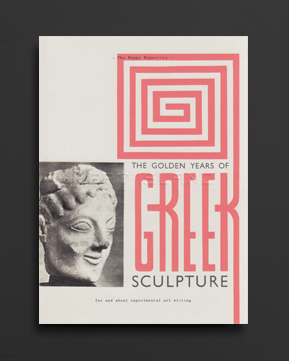
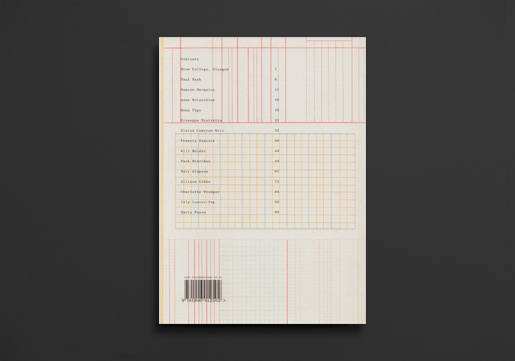
With contributions and new work by Park McArthur, Duncan Marquiss, Dena Yago, Elaine Cameron-Weir, Giuseppe Mistretta, Francis Sanzaro, Allison Gibbs, Will Holder, Mary Simpson, Charlotte Prodger, an interview concerning 'adjustment' between Anna McLauchlan and Gerry Kielty, and reprinted material by Paul Nash and Stow Print College, Glasgow.
2015, English
Softcover, 72 pages, 21 x 26 cm
Published by
Xavier Hufkens / Brussels
$53.00 - Out of stock
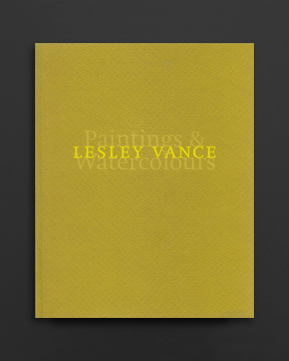
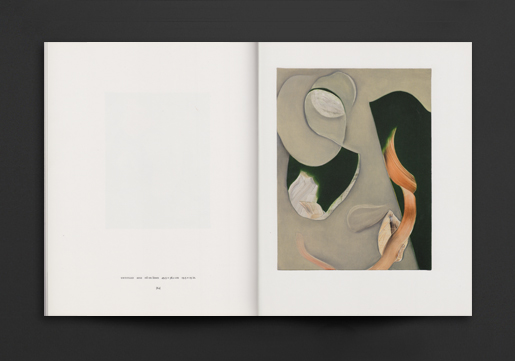
Lesley Vance’s surreal and challenging paintings of colour fields sliced or interrupted by abstract forms move well beyond the traditional still life, spatially speaking, yet retain an interest in the genre’s paradoxical notion of temporality. Published in conjunction with a solo exhibition of work by Vance at Xavier Hufkens in Brussels, this richly illustrated catalogue showcases her contemporary approach to painting in which she reproduces compositions of natural forms created in her studio. Disguising and adding information, masking figuration and opening or closing spaces are just a few of her trademarks. With a text contribution by Michael Ned Holte.
2012, Japanese/English
Hardcover (w. dust jacket), 176 pages, 19 x 24 cm
Published by
BNN / Tokyo
$60.00 - Out of stock
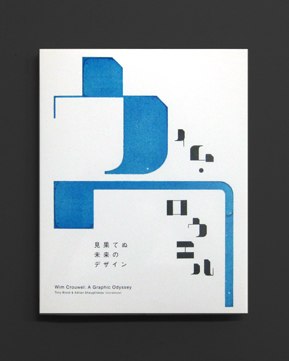
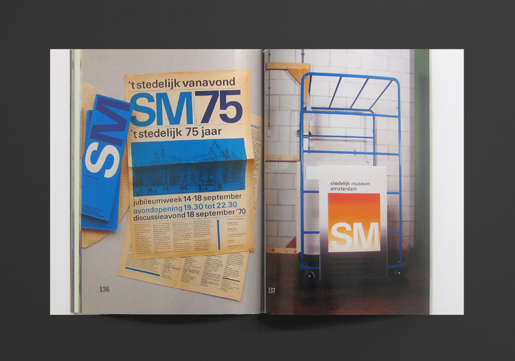
This catalogue of work by the Dutch graphic designer and typographer Wim Crouwel centres around an interview by Tony Brook, which took place in December 2010 at Crouwel’s Amsterdam flat. Besides a list of the works reproduced on its pages, the publication is otherwise fully given over to numerous full-colour images of posters, sketches, typefaces, and other documents produced by Crouwel as a commercial artist. According to Brooks, “the qualities of his work are plain to see: the distinctive use of abstract typographic forms; the relentless experimentation with the grid; the ability of his work to communicate. He seems to have achieved the perfect balance.”
1966, English / Dutch
Paperback, 56 pages, 18.5 x 27.5 cm
1st edition, Out of print title / used*,
Published by
Stedelijk Museum / Amsterdam
$80.00 - Out of stock
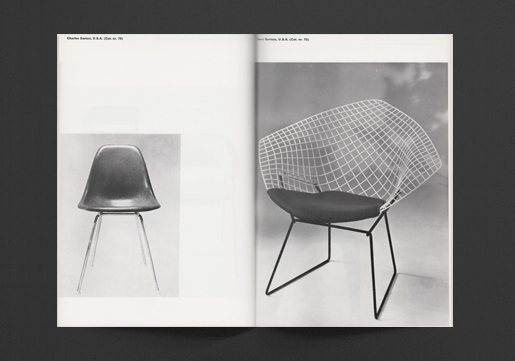
Published by Stedelijk Museum Amsterdam in 1966, this iconic Wim Crouwel designed catalogue accompanied an important thematic exhibition, on the development of seating furniture from 1915, focusing on modern European chair design, at Stedelijk Museum, 3 June - 4 September 1966.
Features: Alvar Aalto, Sem Aardewerk, Cor Alons, Gunnar Aagaard Andersen, Harry Bertoia, Max Bill, Werner Blaser, Antonio Bonet, Osvaldo Borsani, Jac. Bot, Marcel Breuer, Ebbe Clemmensen, Karen Clemmensen, Joe Colombo, Terence Conran, Robin Day, Erich Dieckmann, Nanna Ditzel, A. Dolleman, Charles & Ray Eames, Hans Eichenberger, Egon Eiermann, Gunnar Eklöf, Yngve Ekström, Hans Ell, Preben Fabricius, Alberto Ferrari, Josef Frank, Nicholas Frewing, Eugenio Gerli, Jac Haan, Geoffrey Harcourt, Jorge Ferrari Hardoy, Niels Jørgen Haugesen, René Herbst, Herbert Hirche, Josef Hoffmann, Peter Hvidt, Karl Irmler, Arne Jacobsen, Grete Jalk, J.E. Jelles, Torsten Johansson, Finn Juhl, Jørgen Kastholm, William Katavolos, Douglas Kelley, Kho Liang Ie, Poul Kjaerholm, Inger Klingenberg, Kaare Klint, Mogens Koch, Otto Kolb, Nico Kraij, Friso Kramer, Piet Kramer, Yrjö Kukkapuro, Juan Kurchan, Erwine Laverne, Le Corbusier, Georg Leowald, Ross Littell, Stig Lønngren, Robert Mallet-Stevens, Olli Mannermaa, Justa Masbeck, Bruno Matthson, David de Mayo, Ludwig Mies van der Rohe, Orla Mølgaard-Nielsen, George Nelson, Jens Nielsen, Antti Nurmesniemi, Walter Pabst, Pagani, Verner Panton, Pierre Paulin, Willem Penaat, R.J. Perreau, Charlotte Perriand, A. Philippus, Gio Ponte, H. Potter, Jean Prouvé, Roland Rainer, Bodo Rasch, Gerrit Rietveld, Wim Rietveld, Wilhelm Ritz, Eero Saarinen, Hein Salomonson, Jean Schofield, Otto Seng, Dirk van Sliedregt, Mart Stam, Rudolf Steiger, Hein Stolle, Folke Sunberg, Ilmari Tapiovaara, Theo Tempelman, Heinrich Tessenow, Giovanni Travasa, Martin Visser, Dieter Waeckerlin, Hans J. Wegner, Rudolf Wolf, John Wright, Sori Yanagi, Marco Zanuso.
Text in Dutch and English.
Design by Wim Crouwel.
Softcover, 120 pages, 14.7 x 22 cm
Published by
Bookworks / London
$33.00 - Out of stock
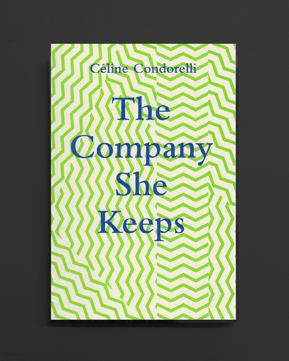
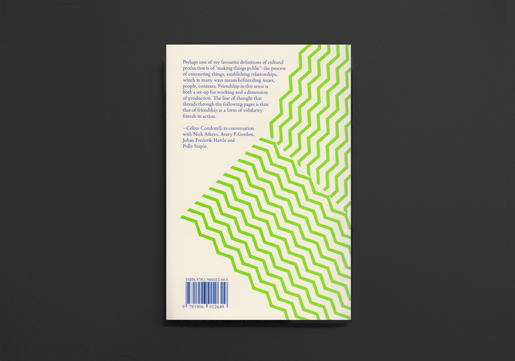
‘Perhaps one of my favourite definitions of cultural production is of “making things public”: the process of connecting things, establishing relationships, which in many ways means befriending issues, people, contexts. Friendship in this sense is both a set-up for working and a dimension of production. The line of thought that threads through the following pages is thus that of friendship as a form of solidarity: friends in action.’ — Céline Condorelli in conversation with Nick Aikens, Avery F. Gordon, Johan Frederik Hartle and Polly Staple
Conversations weave through the work of Céline Condorelli, whether in the sculptural structures of her artwork, through the writing and discourse that is embedded in her work, or in the practice of support that frames her activities. Here, five conversations with friends explore working together, the politics of the company one chooses to keep, and friendship between both people and with ideas. Condorelli’s starting point is a conversation with philosopher Johan Frederik Hartle, raising questions of why the philosophical discourse on friendship is exclusively by, and only about, men? Following this, the three part conversation with sociologist Avery F. Gordon explores the possibilities opened up by this exclusion, lead by slaves, migrants, women and pirates, to what it means to make common cause and live ‘as if free to determine one’s own terms of living’.
The final conversation with Polly Staple and Nick Aikens, the curators of her exhibitions Céline Condorelli (Chisenhale Gallery, London) and Positions (Van Abbemuseum), addresses the practice of friendship and support embedded in Condorelli’s work as an artist and how exhibition making can be understood in relation to the question of how to work together. Running alongside each conversation is a series of images reproduced from The Company We Keep.
The Company She Keeps is co-published by Book Works, Chisenhale Gallery, London, and Van Abbemuseum, Eindhoven, as part of our Co-Series, No. 7, in an edition of 1,000 copies, black and white with one colour, 20 images, 120pp, with a soft cover. Designed by An Endless Supply, 147 mm x 220 mm.
This publication accompanies the exhibitions Céline Condorelli at Chisenhale Gallery, London, and Positions at Van Abbemuseum, Eindhoven, 2014 supported by Ammodo and Stichting Promotors Van Abbemuseum.
2015, English / French
Softcover, 136 pages (colour ill.), 17 x 24 cm
Published by
Kamel Mennour / Paris
$47.00 - Out of stock
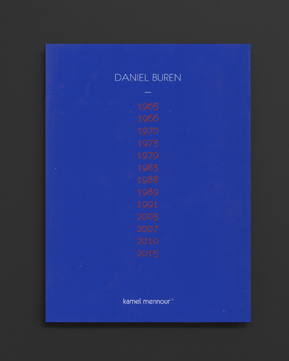
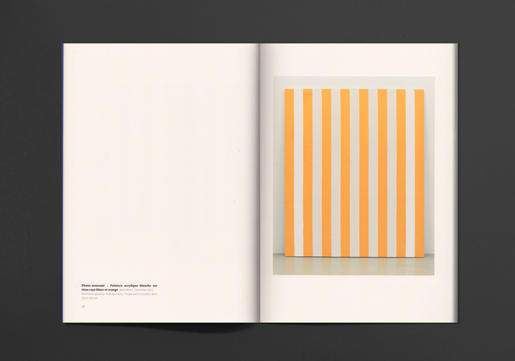
A retrospective retracing in pictures fifty years of creation.
Published on the occasion of the project “1965... 2015” by Daniel Buren for the Armory Show, New York, from March 5th to March 8th, 2015; and the exhibition “Au fur et à mesure, travaux in situ et situés” at the galerie Kamel Mennour, Paris, from January 24th to March 21st 2015.
Co-founder of the BMTP group, Daniel Buren, born 1939 in Boulogne-Billancourt, France, realizes works in situ and often transitory.
2015, English / French
Softcover, 256 pages (b&w ill.), 240 x 175 mm
Published by
May Revue / Paris
$29.00 - In stock -
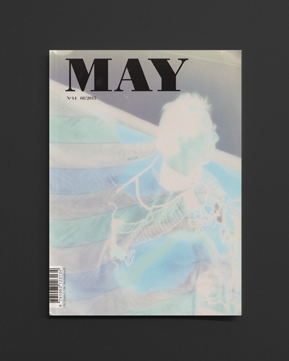
Some Partial Views:
Sigmar Polke’s Reception in the United States and Germany in the 1980s
— MAGNUS SCHAEFER
Interview with Magnus Schaefer
— CATHERINE CHEVALIER
Interview with Guy Tosatto
On Some Models of Artist/Gallery Relations
— TABLE RONDE AVEC MARIE ANGELETTI, CAMILLE BLATRIX, HÉLÈNE FAUQUET, RENAUD JEREZ, MÉLANIE MATRANGA, MODÉRÉE PAR CATHERINE CHEVALIER & EDOUARD MONTASSUT
Visual Insert
— ELLIE DE VERDIER
REVIEWS
The Desaturation of Graffiti. On Amy Lien and Enzo Camacho at Mathew, Georgie Nettell at Lars Friedrich, Berlin and Dave Miko, Ned Vena and Antek Walczak at Algus Greenspon, New York
— TANJA WIDMANN
Paris de Noche. On “Paris Noche” at Night Gallery, Los Angeles
— JAY CHUNG
Dengled Up in Blue. On Verena Dengler at Meyer Kainer in Vienna
— LILI REYNAUD DEWAR
Eternal Return. On “Call and Response” at Gavin Brown and “Forever Now” at the MoMA, New York
— KARI RITTENBACH
Between the Archer and the Target. On Daniel Pommereulle at the musée des Beaux-Arts, Valenciennes
— HÉLÈNE FAUQUET
Rain Over Water. On Hans Christian Lotz at David Lewis, New York
— SAM PULITZER
2015, English
Softcover, 294 pages, 24 x 31.7 cm
Published by
Mousse / Milan
$63.00 - Out of stock
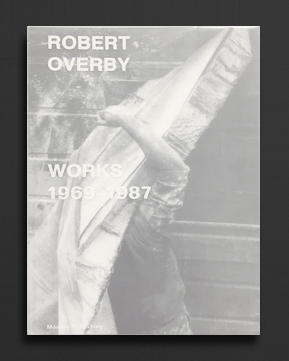
Alessandro Rabottini, Andrea Bellini, Martin Clark, eds.
Texts by Andrea Bellini, Martin Clark, Robin Clark, Alison M. Gingeras, Terry R. Myers, Alessandro Rabottini
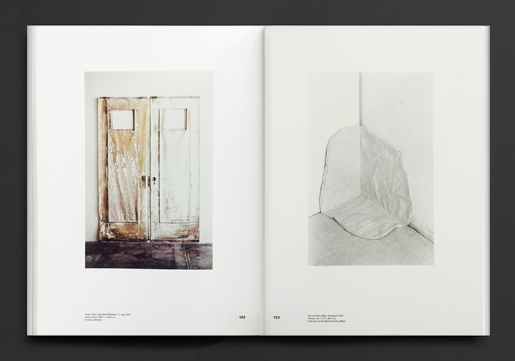
Despite a prolific and diverse practice, Robert Overby (1935–93) remains one of the best-kept secrets in post-war American art. While rarely exhibiting during his lifetime, he nonetheless built up an extraordinary, multifaceted body of work encompassing sculpture, installation, painting, photography, print and collage.
This monograph is published on the occasion of “Robert Overby: Works 1969-1987”, the first survey exhibition of the artist’s work to be organized in Europe. Edited by Alessandro Rabottini —in collaboration with Andrea Bellini and Martin Clark—it has been conceived, from the outset, as a joint project of four partner institutions: Centre d’Art Contemporain, Genève; GAMeC – Galleria d’Arte Moderna e Contemporanea, Bergamo; Bergen Kunsthall, and Le Consortium, Dijon.
1998, English / Japanese
Hardcover (w. dustjacket), 80 pages, 22.4 x 16.2 cm
1st edition / Out of print title / used*,
Published by
Korinsha Press / Japan
$130.00 - Out of stock
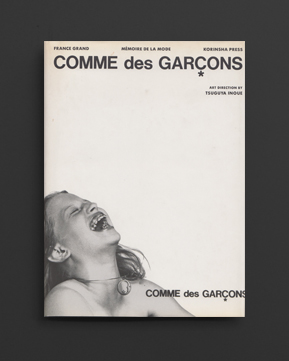
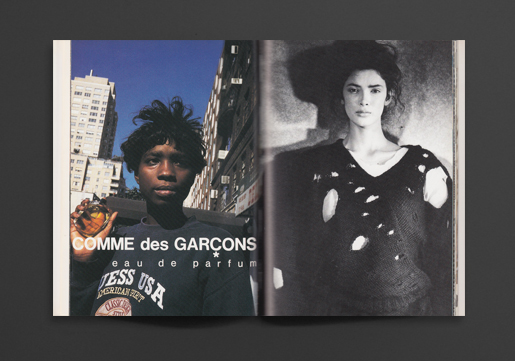
Comme des Garçons book from the late 1990s MEMOIRE DE LA MODE series. This title was printed in 1998 in England, France, Germany and Japan, all editions of which are now quite collectable. This is the first printing of the Japanese edition. An almost entirely photographic volume that collects together the advertising and publicity materials and imagery from the great Japanese fashion label Comme des Garçons in the period of 1982-1997. A graphic history of CdG, featuring the work of many acclaimed artists, designers and photographers that Rei Kawakubo collaborated with over the years. Compiled by French Grand and art direction by Inoue Tsuguya. Published by Korinsha Press.
2015, English / Portuguese
Softcover (die-cut), 300 pages, 28.5 x 22.5 cm
Published by
Serralves Museum of Contemporary Art / Porto
$58.00 $30.00 - Out of stock
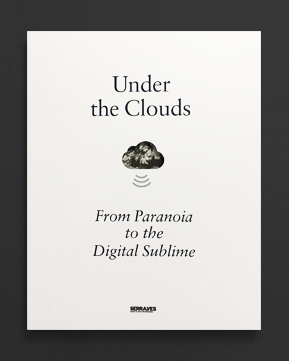
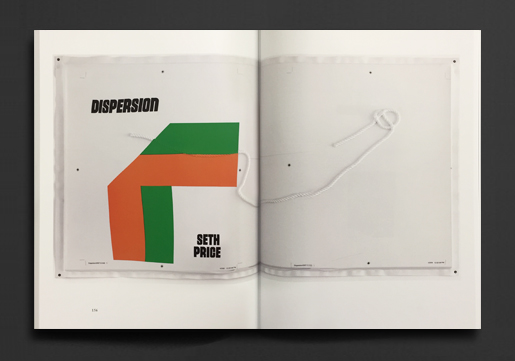
Since the second half of the 20th century, we have lived under the shadow of two clouds: the mushroom cloud of the atomic bomb, and the ‘cloud’ of distributed information networks. How did the central metaphor of cold war paranoia become the utopian metaphor of today? ‘Under the Clouds’ explores the contemporary sublime that has replaced the natural one, and the interrelated effects and affects of these two clouds on life and work, leisure and love, and on images, bodies, and minds.
The post-war technologies of the emergent third industrial revolution have now evolved to fit in the palm of our hand; we no longer merely look at images, we now touch, scroll, pinch, and drag them. Where is the border between the self and its data shadow, between information, matter, and affect? The biological, economic, aesthetic, and political effects of living under the clouds has taken the form of new relations between data and material, as well as increasing debt and abstract financialization; the changing nature of work and sex; and new relationships between screens, images, and things. As earlier forms of technologically inflected art sought to mitigate the effects of change — both on perception and society — many of today’s artistic practices confront the myriad interfaces and decentralized networks that continue to shape and transform daily life, forming new evolving connections between bits and atoms.
Texts by
Enrico Baj & Sergio Dangelo, Thomas Hirschhorn, Sean Landers, Metahaven, Seth Price, João Ribas, Frances Stark, Hito Steyerl, Stan VanDerBeek
Artists
Adel Abdessemed, Horst Ademeit, Cory Arcangel, Arte Nucleare, Darren Bader, Enrico Baj, Robert Barry, Eduardo Batarda, Thomas Bayrle, Neïl Beloufa, René Bertholo, Joseph Beuys, K.P. Brehmer, Bruce Conner, Kate Cooper, Gregory Corso, Guy Debord, Harun Farocki, Hans-Peter Feldmann, Carla Filipe, General Idea, Melanie Gilligan, Jean-Luc Godard & Anne-Marie Miéville, Peter Halley, Rachel Harrison, Mona Hatoum, Pedro Henriques, Thomas Hirschhorn, Yves Klein, Sean Landers, Elad Lassry, Mark Lombardi, Julie Mehretu, Katja Novitskova, Ken Okiishi, Trevor Paglen, Nam June Paik, Silvestre Pestana, Pratchaya Phinthong, Seth Price, Martha Rosler, Thomas Ruff, Jacolby Satterwhite, Ângelo de Sousa, Frances Stark, Haim Steinbach, Hito Steyerl, Jean Tinguely, Adelhyd van Bender, Stan VanDerBeek, Andy Warhol, Christopher Williams, Christopher Wool, Anicka Yi
2015, English
Softcover, 240 pages, 23 x 29 cm
Published by
PIN-UP MAGAZINE
$32.00 - Out of stock
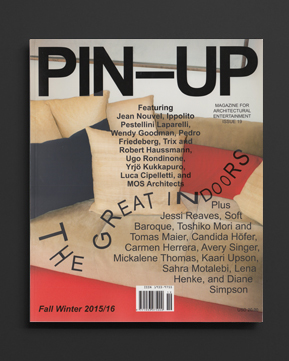
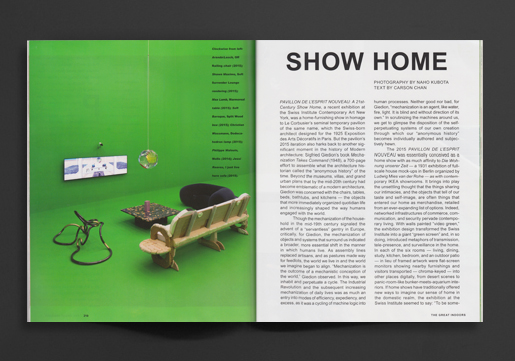
PIN-UP issue 19 : The great Indoors
Fall/Winter 2015/16
FEATURING: Jean Nouvel, Ippolito Pestellini Laparelli, Wendy Goodman, Pedro Friedeberg, Trix and Robert Haussmann, Ugo Rondinone, Yrjö Kukkapuro, Luca Cipelletti, and Mos Architects.
PLUS: Jessi Reaves, Soft Baroque, Toshiko Mori and Tomas Maier, Candida Höfer, Carmen Herrera, Avery Singer, Mickalerie Thomas, Kaari Upson, Sahra Motalebi, Lena Henke, and Diane Simpson.
2015, English / Italian
Softcover (newspaper), 334 pages, 25 x 36 cm
Published by
Mousse Publishing / Milan
$18.00 - Out of stock
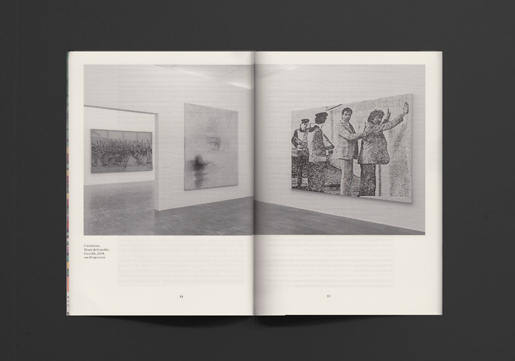
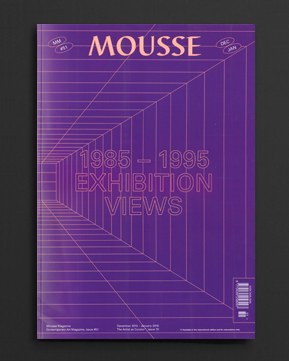
Mousse 51 is a photo issue dedicated to exhibitions from 1985 to 1995, the last ten years or so before exhibitions went online, and possibly, before the exhibition view became a requisite genre. Up to 20 years ago, galleries and museum, art magazines and schools had no websites; viewing a show would mean, quite simply, visiting it. A great number of seminal shows—from small but consequential artists’ debuts in private galleries, to the innovative biennial iterations in new territories and continents, to thematic and now historicized institutional exhibitions—were richly studied, avidly discussed, but poorly photographed, if at all. This issue is an album of recommendations, for which we are very grateful to all the writers, artists, curators, dealers, and friends who accepted to share with us their favorite shows.
The Artist as Curator
Issue #10 an insert in Mousse Magazine #51
This is the last installment of The Artist as Curator, a serial publication* examining the fundamental role artists have played as curators, from the postwar period to the present, edited by Elena Filipovic, that appeared as a special insert in Mousse over the past two years. In this issue, Natalie Musteate discusses Womanhouse (1972) by Judy Chicago, Miriam Schapiro, and the CalArts Feminist Art Program, while Ekaterina Degot addresses Avdey Ter-Oganyan’s Toward the Object from 1992. This installment is realized in partnership with the Centre d’art Contemporain Genève and Museo Marino Marini, Florence.