World Food Books' programme is largely produced on Kulin Nation land. We acknowledge the Wurundjeri people of the Kulin Nation as the first and continuing custodians of this land, and pay respect to their Elders past, present, and emerging.
World Food Books is an arts and special interests bookshop in Naarm / Melbourne. Founded in 2010, World Food Books is devoted to the presentation of a rotating, hand-selection of international art, design, literary and counterculture publications with an emphasis on the anti-traditional, the experimental, the avant-garde, the heretic, the marginal.
Presenting new titles alongside rare and out-of-print books, catalogues and journals spanning the fields of modern and contemporary art, design, photography, illustration, film, literature, poetry, cultural theory, philosophy, sexuality, popular and underground culture in its many radical forms, World Food Books wishes to encourage adventurous, thoughtful and open-minded reading, looking, writing, and exchange of publishing and ideas, both current and historical.
As well as our bookshop, located in Melbourne's historical Nicholas Building, all of our inventory is available internationally via our online mail-order service.
World Food Books semi-regularly co-ordinates "Occasions", a programme of exhibits and events at the bookshop and in partnership with other hosts (such as museums and art galleries) that develop out of the activities, relationships and content of the bookshop itself.
World Food Books
The Nicholas Building
37 Swanston Street
Room 5, Level 6
Melbourne 3000
Australia
SHOP HOURS:
Thu–Fri 12–6, Sat 12–5
WEB-SHOP OPEN 24/7
World Food Books
Postal Address:
PO Box 435
Flinders Lane
Victoria 8009
Australia
Art
Theory / Essay
Architecture / Interior
Graphic Design / Typography
Photography
Fashion
Eros
LGBTQ+
Fiction / Poetry
Weird / Speculative / Science Fiction / Horror
Transgressive / Visceral / Abject
Symbolism / Decadence / Fin de siècle
Film / Video
Painting
Sculpture / Installation
Performance / Dance / Theater
Drawing
Sound / Music
Curatorial
Group Shows / Collections
Periodicals
Out-of-print / Rare
Posters / Ephemera / Discs
Signed Books
World Food Books Gift Voucher
World Food Book Bag
Australian Art
Australian Fiction
Australian Science Fiction / Speculative Fiction
Australian Poetry
Australian Photography
Japanese Photography
Conceptual Art
Minimal Art
Dada
'Pataphysics / Oulipo
Fluxus
Concrete Poetry
Pop Art
Surrealism
Arte Povera
Arte Informale / Haute Pâte / Tachism
Nouveau Réalisme / Zero / Kinetic
Situationism / Lettrism
Collage / Mail Art / Xerox Art
Art Brut / Folk / Visionary / Fantastic
Illustration / Graphic Art / Bandes Dessinées
Furniture
Italian Radical Design / Postmodernism
Textiles
Ceramics / Glass
Counterculture
Protest / Revolt
Philosophy
Psychoanalysis
Anthropology
Anarchism
Socialism / Anarchism / Communism / Capitalism
Literary Theory / Semiotics / Language
Feminism / Women's Studies
Gender Studies / Sexuality
Anthropology
Fetishism / BDSM
Drugs / Psychedelia
Crime / Violence
Animal Rights / Veganism
Occult / Esoterica
Ecology / Earth / Alternative Living
Whole Earth / Crafts
All prices in AUD (Australian dollars)
Pick-Ups
Pick-up orders can be collected in our bookshop during opening hours after order date. Please collect any Pick-up orders within 2 weeks of ordering as we have limited storage space. Orders will be released back into stock if not collected within this time. No refunds can be made for pick-ups left un-collected. If you cannot make it in to the bookshop in this time-frame, please choose postage option.
Return Policy
All sales are final. We do accept returns (for refund or exchange) for items received in error. All our orders are packed with special care using heavy-duty padding and cardboard book-mailers or bubble mailers (for smaller books), using reinforcement where required. We cannot take responsibility for any lost, stolen or damaged parcels.
Insurance
Should you wish to insure your package, please email us directly after placing your order and we can organise this at a small extra expense. Although all standard/express tracked packages are very safe and dependable, we cannot take responsibility for any lost, stolen or damaged parcels. We recommend insurance on valuable orders.
Interested in selling your old books, catalogues, journals, magazines, comics, fanzines, ephemera? We are always looking for interesting, unusual and out-of-print books to buy. We only buy books in our fields of interest and specialty, and that we feel we can resell.
We base these prices on desirability, market value, in-print prices, condition and our current stock levels. We offer cash, store credit, and can take stock on consignment. All
about 25% of the price we expect to get when we sell them, or 30% in store credit. We base these prices on desirability, market value, in-print prices, condition and our current stock levels.
Sell your books any day of the week. You can drop them off and return later. If you have a lot of books, we can visit your Sydney home.
We buy books that we feel we can resell. We offer about 25 % of the price we expect to get when we sell them, or 30% in store credit. We base these prices on desirability, market value, in-print prices, condition and our current stock levels.
Philadelphia Wireman
03 August - 01 September, 2018
World Food Books is proud to announce our next Occasion, the first presentation of sculptures by Philadelphia Wireman in Australia.
The Philadelphia Wireman sculptures were found abandoned in an alley off Philadelphia’s South Street on trash night in 1982. Their discovery in a rapidly-changing neighbourhood undergoing extensive renovation, compounded with the failure of all attempts to locate the artist, suggests that the works may have been discarded after the maker’s death. Dubbed the "Philadelphia Wireman" during the first exhibition of this work, in 1985, the maker’s name, age, ethnicity, and even gender remain uncertain. The entire collection totals approximately 1200 pieces, all intricately bound together with tightly-wound heavy-gauge wire (along with a few small, abstract marker drawings, reminiscent both of Mark Tobey and J.B. Murry). The dense construction of the work, despite a modest range of scale and materials, is singularly obsessive and disciplined in design: a wire armature or exoskeleton firmly binds a bricolage of found objects including plastic, glass, food packaging, umbrella parts, tape, rubber, batteries, pens, leather, reflectors, nuts and bolts, nails, foil, coins, toys, watches, eyeglasses, tools, and jewellery.
Heavy with associations—anthropomorphic, zoomorphic, and socio-cultural responses to wrapped detritus—the totemic sculptures by Philadelphia Wireman have been discussed in the context of work created to fulfil the shamanistic needs of alternative religions in American culture. Curators, collectors, and critics have variously compared certain pieces to sculpture from Classical antiquity, Native American medicine bundles, African-American memory jugs, and African fetish objects. Reflecting the artist’s prolific and incredibly focused scavenging impulse, and despite—or perhaps enhanced by—their anonymity, these enigmatic objects function as urban artefacts and arbiters of power, though their origin and purpose is unknown. Philadelphia Wireman, whatever their identity, possessed an astonishing ability to isolate and communicate the concepts of power and energy through the selection and transformation of ordinary materials. Over the course of the past two decades, this collection has come to be regarded as an important discovery in the field of self-taught art and vernacular art.
Presented in collaboration with Fleisher-Ollman Gallery, Philadelphia, and Robert Heald, Wellington.
Susan Te Kahurangi King
02 February - 10 March, 2018
Susan Te Kahurangi King (24 February 1951 - ) has been a confident and prolific artist since she was a young child, drawing with readily available materials - pencils, ballpoint pens and felt-tip markers, on whatever paper is at hand. Between the ages of four and six Susan slowly ceased verbal communication. Her grandparents William and Myrtle Murphy had developed a special bond with Susan so they took on caring responsibilities for extended periods. Myrtle began informally archiving her work, carefully collecting and storing the drawings and compiling scrapbooks. No drawing was insignificant; every scrap of paper was kept. The King family are now the custodians of a vast collection containing over 7000 individual works, from tiny scraps of paper through to 5 meter long rolls.
The scrapbooks and diaries reveal Myrtle to be a woman of great patience and compassion, seeking to understand a child who was not always behaving as expected. She encouraged Susan to be observant, to explore her environment and absorb all the sights and sounds. Myrtle would show Susan’s drawings to friends and people in her community that she had dealings with, such as shopkeepers and postal workers, but this was not simply a case of a grandmother’s bias. She recognised that Susan had developed a sophisticated and unique visual language and sincerely believed that her art deserved serious attention.
This was an unorthodox attitude for the time. To provide some context, Jean Dubuffet coined the term Art Brut in 1945 to describe work created by self-taught artists – specifically residents of psychiatric institutions and those he considered to be visionaries or eccentrics. In 1972 Roger Cardinal extended this concept by adopting the term Outsider Art to describe work made by non-academically trained artists operating outside of mainstream art networks through choice or circumstance. Susan was born in Te Aroha, New Zealand in 1951, far from the artistic hubs of Paris and London that Dubuffet and Cardinal operated in. That Myrtle fêted Susan as a self-taught artist who deserved to be taken seriously shows how progressive her attitudes were.
Susan’s parents Doug and Dawn were also progressive. Over the years they had consulted numerous health practitioners about Susan’s condition, as the medical establishment could not provide an explanation as to why she had lapsed into silence. Dawn educated herself in the field of homeopathy and went on to treat all twelve of her children using these principles – basing prescriptions on her observations of their physical, mental and emotional state.
Doug was a linguist with an interest in philosophy who devoted what little spare time he had to studying Maori language and culture. To some extent their willingness to explore the fringes of the mainstream made them outsiders too but it was their commitment to living with integrity and their respect for individuality that ensured Susan’s creativity was always encouraged.
Even though Susan’s family supported her artistic pursuits, some staff in schools and hospitals saw it as an impediment to her assimilation into the community and discouraged it in a variety of ways. Her family was not always aware of this and therefore did not fully understand why Susan stopped drawing in the early 1990s. However, rather than dwell on the challenges that Susan faced in pursuit of her artistic practice, they prefer to highlight her achievements. In 2008 Susan began drawing again in earnest, after an almost 20 year interruption, and her work is now shown in galleries around the world.
Susan grew up without television and has been heavily influenced by the comics she read as a child. She is absolutely fearless in the appropriation of recognizable characters, such as Donald Duck and Mickey Mouse, in her work. She twists their limbs, contorts their faces, compresses them together, blends them into complex patterned backgrounds - always imbuing them with an incredible energy. Although Susan often used pop culture characters in her work they are not naive or childlike. These are drawings by a brilliant self-taught artist who has been creating exceptional work for decades without an audience in mind.
Mladen Stilinović
"Various Works 1986 - 1999"
02 February 16 - September 10, 2016
Various works 1986 - 1999, from two houses, from the collections of John Nixon, Sue Cramer, Kerrie Poliness, Peter Haffenden and Phoebe Haffenden.
Including: Geometry of Cakes (various shelves), 1993; Poor People’s Law (black and white plate), 1993; White Absence (glasses, ruler, set square, silver spoon, silver ladel with skin photograph and wooden cubes), 1990-1996; Exploitation of the Dead (grey and red star painting, wooden painting, black spoon with red table, red plate), 1984-1990; Money and Zeros (zero tie, paintings made for friends in Australia (Sue, John, Kerrie), numbers painting), 1991-1992; Words - Slogans (various t-shirts) - “they talk about the death of art...help! someone is trying to kill me”, “my sweet little lamb”, “work is a disease - Karl Marx”; Various artist books, catalogues, monographs, videos; Poster from exhibition Insulting Anarchy; "Circular" Croatian - Australian edition; Artist book by Vlado Martek (Dostoyevsky); more.
Thanks to Mladen Stilinović and Branka Stipančić.
Jonathan Walker
Always Will Need To Wear Winter Shirt Blue + Ochre Small Check Pattern
21 August - 21 September, 2015
Untitled
I am not a great reader of poetry but I always return to the work of Melbourne poet, Vincent Buckley (1925- 1988). Perhaps I find his most tantalising piece to be not a finished poem but a fragment left on a scrap of paper discovered on his desk after the poet’s death.
The poetry gathers like oil
In the word-core, and spreads
It has its music meet,
Its music is in movement.
This fragment is more the shell left behind from a volatile thought than a finished poem. I find the last two lines honest but awkward whereas the first two lines work like an arrow. Most likely he could not find a resolution so it was left. Still, in its present form, it remains an eloquent testimony to the ultimate failure of a medium to express mobile thought and sensation, in Buckley’s case, through verbal language. It’s an important matter because this is something all artists have to deal with regardless of the medium.
I have never written a poem, however, I am forever copying fragments from books on paper scraps in a vain effort to fix certain notions in my head. At first, they function as bookmarks that are sometimes returned to when I open the book. But before long, as they accumulate, they fall out littering the table interspersed with A4 photocopies, bills, books and medications.
To return to Buckley’s fragment, the first two lines very much evoke how I paint nowadays. As you age, detail diminishes and patches of light become more luminous and float. I feel the most honest way of dealing with this is by smearing the oil paint on the canvas with the fingers and working close-up, blind. Only if the patches coalesce into an approaching image can the work gain a life.
-
Jonathan Walker was born in Melbourne, Australia and brought up on a dairy farm in Gippsland. In the 1970’s he studied painting at RMIT and won the Harold Wright Scholarship to the British Museum, London. During the 1980’s he exhibited at Pinacotheca Gallery, Richmond and had work shown at the NGV and Heidi City Art Gallery. Over the same period he designed the cover for the “Epigenesi” LP by Giancarlo Toniutti, Italy and conducted a mail exchange work with Achim Wollscheid, Germany. The work with artists through the post resulted in an article published in the bicentenary issue of Art and Australia 1988. He showed in artist run spaces such as WestSpace in the 90’s and 2000’s, and until 2012, taught painting at Victoria University, which is where we (Colleen Ahern and Lisa Radford) as organisers of the exhibition, among many others, had the privilege of being his student.
Walker’s knowledge was imparted to students through the careful selection of music, literature, and artists found in books that he himself had ordered for the library. Walker’s strategy was the generosity of sharing his vast knowledge with references specific to each student and their context.
Walker’s paintings share a similar focus and intimacy.
This exhibition presents a small selection of recent paintings alongside a publication that includes Walker’s writing. Observational and analytical, Walker’s work is a type of material notation — the time of day, colour and how it is blended, the both specific and fleeting location of a reflection on lino or the question of whether a chair leg should be included in a painting.
Please join us on Friday August 21 between 6-8pm to celebrate the opening of the exhibition.
Curated by Colleen Ahern and Lisa Radford.
B. Wurtz
Curated by Nic Tammens
March 26 - April 4, 2015
B.Wurtz works from a basement studio in his home on Manhattan’s Lower East Side.
This local fact is attested to by the plastic shopping bags and newsprint circulars that appear in his work. As formal objects, they don’t make loud claims about their origins but nonetheless transmit street addresses and places of business from the bottom of this long thin island. Like plenty of artists, Wurtz is affected by what is local and what is consumed. His work is underpinned by this ethic. It often speaks from a neighborhood or reads like the contents of a hamper:
“BLACK PLUMS $1.29 lb.”
“Food Bazaar”
“USDA Whole Pork Shoulder Picnic 99c lb.”
“RITE AID Pharmacy, with us it’s personal.”
“H. Brickman & Sons.”
“Sweet Yams 59c lb."
Most of the work in this exhibition was made while the artist was in residence at Dieu Donne, a workshop dedicated to paper craft in Midtown. Here Wurtz fabricated assemblages with paper and objects that are relatively lightweight, with the intention that they would be easily transportable to Australia. This consideration isn’t absolute in Wurtz’s work, but was prescriptive for making the current exhibition light and cheap. Packed in two boxes, these works were sent from a USPS post office on the Lower East Side and delivered to North Melbourne by Australia Post.
Wurtz appears courtesy of Metro Pictures, New York.
Thanks to Rob Halverson, Joshua Petherick, Sari de Mallory, Matt Hinkley, Helen Johnson, Fayen d'Evie, Ask Kilmartin, Lisa Radon, Ellena Savage, Yale Union, and "Elizabeth".
John Nixon
"Archive"
December 15 - January 20, 2014
The presentation of John Nixon's archive offered a rare showcase of this extensive collection of the artist's own publications, catalogues, posters, ephemera, editions and more, from the mid 1980s onwards, alongside a selection of his artworks.
Organized by John Nixon, Joshua Petherick and Matt Hinkley.
<a href=http://wfb.public-office.info/artist/john-nixon>All titles by John Nixon
"Habitat"
at Minerva, Sydney (organised by Joshua Petherick and Matt Hinkley)
November 15 - December 20, 2014
Lupo Borgonovo, Janet Burchill & Jennifer McCamley,
Lewis Fidock, HR Giger, Piero Gilardi, Veit Laurent Kurz,
Cinzia Ruggeri, Michael E. Smith, Lucie Stahl, Daniel Weil, Wols
Press Release:
“...It contained seven objects. The slender fluted bone, surely formed for flight, surely from the wing of some large bird. Three archaic circuitboards, faced with mazes of gold. A smooth white sphere of baked clay. An age-blackened fragment of lace. A fingerlength segment of what she assumed was bone from a human wrist, grayish white, inset smoothly with the silicon shaft of a small instrument that must once have ridden flush with the surface of the skin - but the thing’s face was seared and blackened.”
William Gibson, “Count Zero”, 1986
"Autumn Projects Archive"
Curated by Liza Vasiliou
March 6 - March 15, 2014
World Food Books, in conjunction with the Virgin Australia Melbourne Fashion Festival 2014, presented the Autumn Projects archive, consisting of a selection of early examples in Australian fashion with a particular interest in collecting designers and labels from the period beginning in the 1980’s, who significantly influenced the discourse of Australian Fashion.
Curated by Liza Vasiliou, the exhibition provided a unique opportunity to view pieces by designers Anthea Crawford, Barbara Vandenberg, Geoff Liddell and labels CR Australia, Covers, Jag along with early experimental collage pieces by Prue Acton and Sally Browne’s ‘Fragments’ collection, suspended throughout the functioning World Food Books shop in Melbourne.
H.B. Peace
presented by CENTRE FOR STYLE
November 14, 2013
"Hey Blinky, you say chic, I say same"
Anon 2013
H.B. Peace is a clothing collaboration between great friends Blake Barns and Hugh Egan Westland. Their pieces explore the divergences between 'character’ and ‘personality’ in garments....etc
Special Thanks to Joshua Petherick and Matt Hinkley of WFB and Gillian Mears
and a Very Special Thank you to Audrey Thomas Hayes for her shoe collaboration.
Janet Burchill & Jennifer McCamley
"Aesthetic Suicide"
May 10 - June 8, 2013
The first of our occasional exhibitions in the World Food Books office/shop space in Melbourne, "Aesthetic Suicide" presented a body of new and older works together by artists Janet Burchill & Jennifer McCamley, including videos, prints, a wall work, and publications.
During shop open hours videos played every hour, on the hour.
2020, Japanese
Hardcover (w. dust jacket), 148 pages, 30 x 23 cm
1st Edition, Out of print title / used / fine
Published by
Fukkan / Tokyo
$200.00 - In stock -
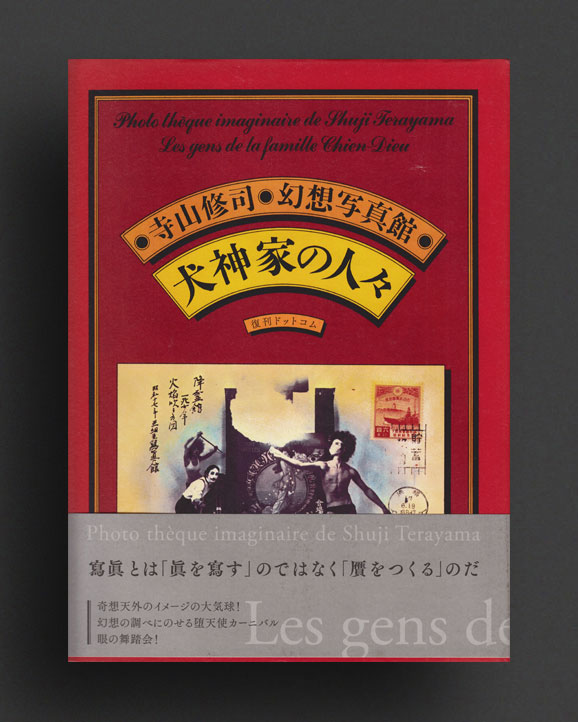
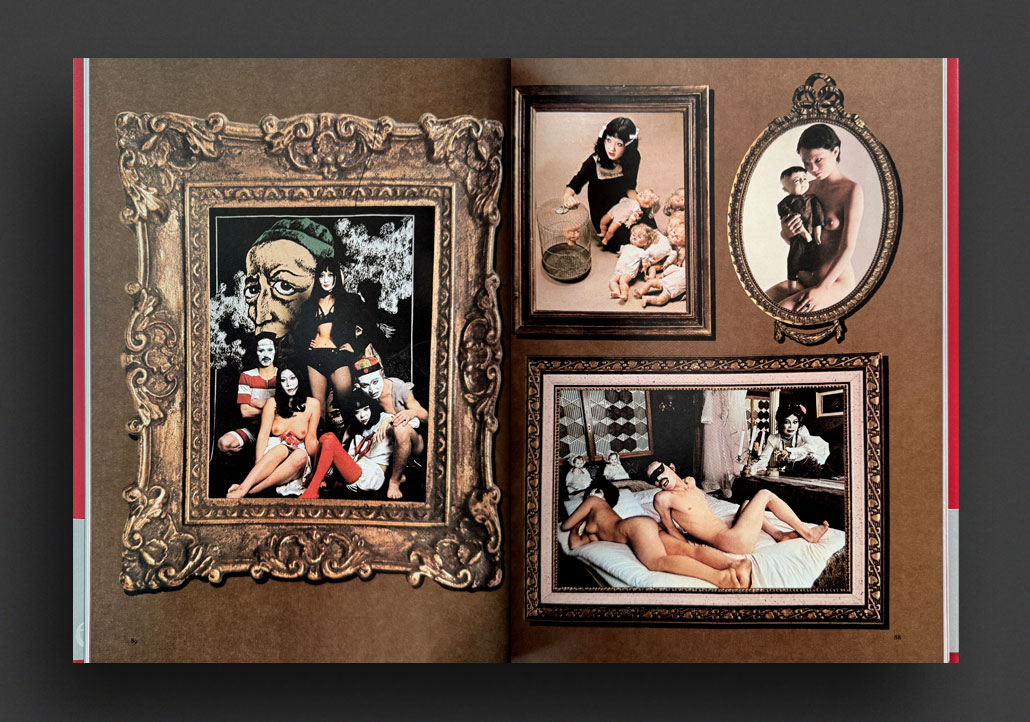
Wonderful hardcover limited re-issue (also now out-of-print) of Shuji Terayama’s extraordinary 1975 art photobook “Phototheque imaginaire de Shuji Terayama Les Gens de la Famille Chien-Dieu”, an imaginary photo collection of the prolific Japanese avant-garde writer, film maker, poet, photographer, and anarchist, and his "people of the Chien Dieu family." A stunning photomontage collection that perfectly embodies the irreverent spirit of Terayama and his experimental theatre troupe, Tenjō Sajiki, full of bizarre, surrealist, imagery and sexuality, perfectly in harmony with the radical work of his Provoke peers. Terayama’s works range from radio drama, experimental television, underground (Angura) theatre, countercultural essays, to Japanese New Wave and "expanded" cinema. Led by Terayama and active between 1967—1983, Tenjō Sajiki's members included Kohei Ando, Kujō Kyōko, Yutaka Higashi, Tadanori Yokoo, and Fumiko Takagi.
"Terayama’s eclectic work focuses on issues of sexuality, normatised values, traditions, and conventions – breaking (or ignoring) the latter in terms of form and style. This eccentric, dazzling mix of photography, written text, irony, remix, originality, narrative and subconsciousness dives into legends and memories to form its absurd scenery."
From Bertolotti’s Book of Nudes: “The photographs were reproduced in the manner of an old souvenir album…’ as framed photos of staged portraits and’ fake period postcards, with addresses and stamps in their proper place, and they were accompanied by a series of poems and handwritten annotations that emphasized the artist’s intention of mixing expressive language with sophisticated photomontages.”
Very highly recommended. As New.
1947, French
Softcover, 142 pages, 24 x 20.5 cm
1st Edition, Out of print title / used / good
Published by
Maeght Editeur / Paris
$650.00 - Out of stock
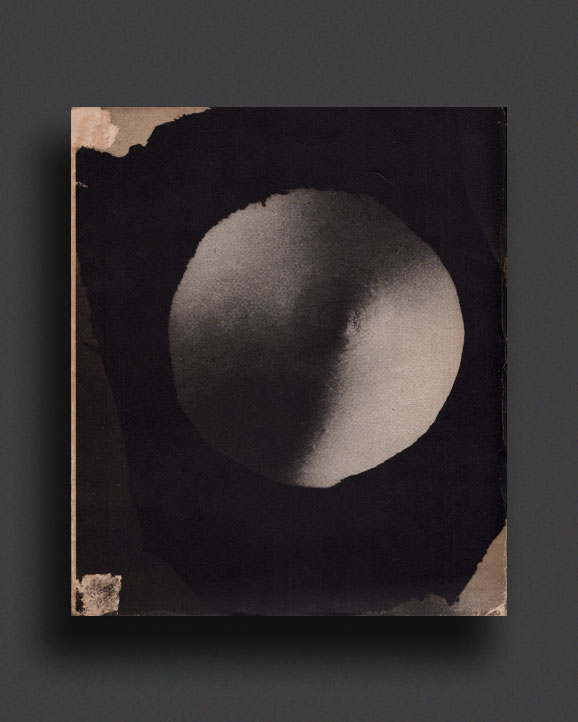
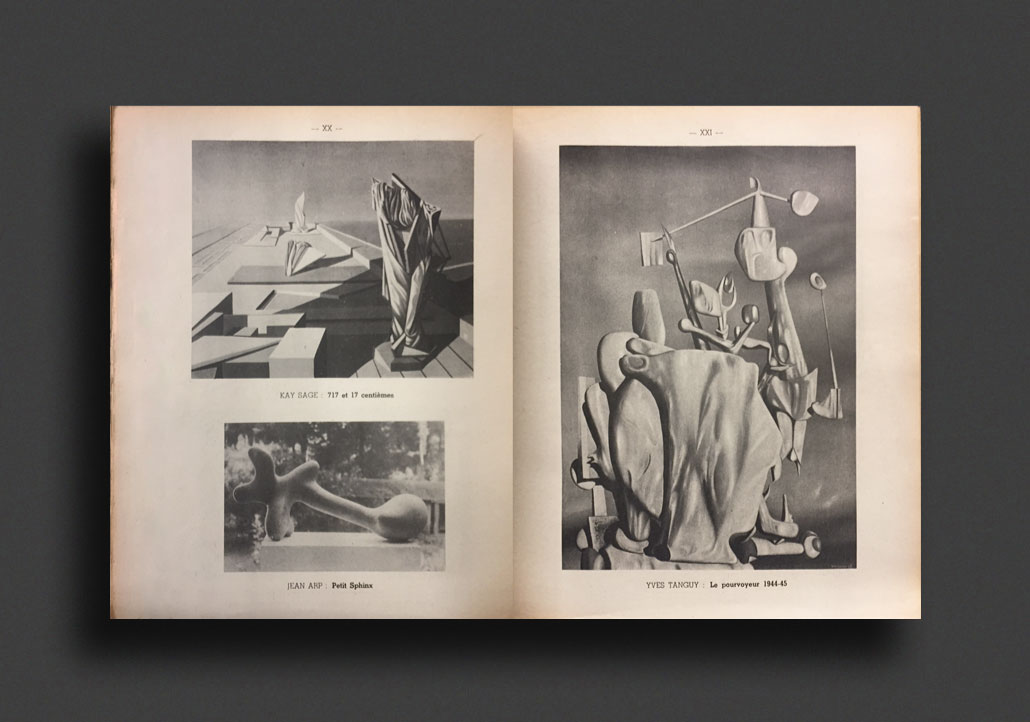
Very scarce copy of the legendary "Le Surréalisme en 1947 : Exposition Internationale de Surréalisme présentée par André Breton et Marcel Duchamp", published by Maeght Editeur, Paris, in conjunction with an important exhibition of Surrealist artists in 1947. Features the cover design by Marcel Duchamp - a photographic reproduction by Rémy Duval of "Prière de toucher (Please touch)", the famous Duchamp rubber breast edition, created with Italian-born painter Enrico Donati, that adorned the first 999 copies of the catalogue. This gorgeous catalogue features the work of artists from 24 countries including Victor Brauner, Max Ernst, Leonora Carrington, Jacqueline Lamba, Jacques Hérold, Wilfredo Lam, Joan Miró, Hans Bellmer, Marcel Jean, Maria Martins, Yves Tanguy, Dorothea Tanning, Hans Arp, Frederick Kiesler, Alberto Giacometti, Hector Hyppolite, Serge Brignoni, Alexander Calder, Bruno Capacci, Elizabeth van Damme, Jacques Halpern, Julio de Diego, Enrico Donati, Francis Bouvet, David Hare, Iaroslav Serpan, Jacqueline Lamba, Taro Okamoto, Roberto Matta, Kay Sage, Toyen, Vilhelm Bjerke-Petersen, Leonard Baskin, Jindrich Heisler, Jeanne Reynal, Isabelle Waldberg, Roger Brielle, Jindrich Styrsky, Bruno Capacci, Jean Guerin, Isamu Noguchi, Gerome Kamrowski, Frédéric Delanglade, Eugenio Granell, Francis Picabia, Remedios Varo, Hans Richter, Arshile Gorky, and many more, along with the folding sheet catalogue, and newspaper clipping about the show inserted.
Good copy considering age. Tanned edges and wear to corners, edges and spine. Some spine chipping.
1946, English / French
Hardcover (w. die-cut dust jacket), unpaginated, 23.5 by 15.9 cm
1st Edition, Out of print title / used / average
Published by
View Editions / New York
$650.00 - In stock -
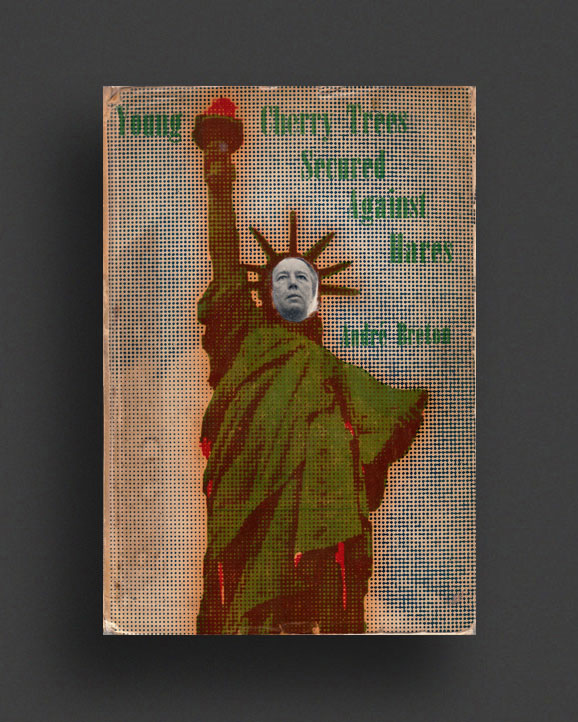
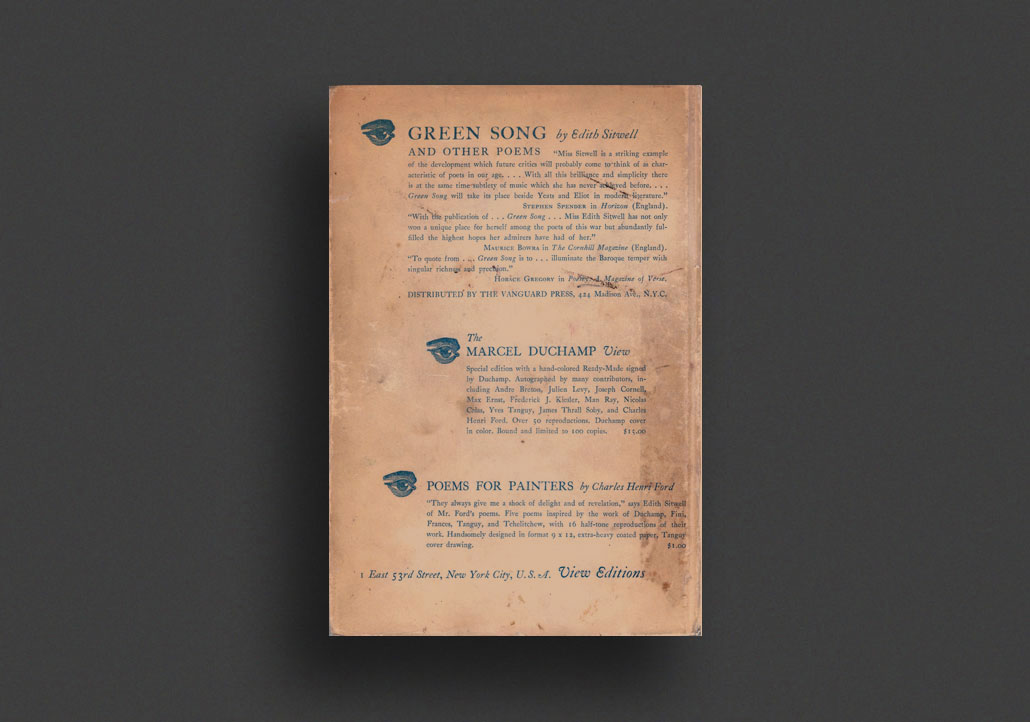
Very Rare first 1946 hardcover English edition of André Breton's poetry collection "Young Cherry Trees Secured Against Hares / Jeunes cerisiers garantis contre less lievres", with original die-cut cover art by Marcel Duchamp and internal illustrations by Arshile Gorky, published by View Editions. A beautiful publication with Breton's original French poems with facing English translations by Edouard Roditi. Breton asked Armenian-American painter Gorky, an essential bridge between European Surrealism and American Abstract Expression, to produce unique drawings in 1945. Marcel Duchamp contributed the cover design and the title was a chance find in a horticulture magazine that also contains a pun on Breton's private life, whose wife had recently left him for artist David Hare. Gorky produced drawings to accompany Breton's poems that did not so much illustrate the poems, as they applied free association mark making analogous with the poetry's evocation, similarly free from logic or narration. Gorky's “automatic drawings” were made without preconception and the creations are interpreted as subconscious thought.
Average—Good copy for a book rarely seen outside museum collections. Internally Good throughout, content pages Very Good. Ex-library of Royal College of of Art, London, with associated markings to front/back blanks (not covers), jacket laminated (die-cut free) adhered in place with wear to extremities, tanning, marking and spine damages. More images upon request.
1986, Japanese
Hardcover (w. plastic slipcase), 280 pages, 22 x 16 cm
1st Edition, Out of print title / used / very good
Published by
Libro Port Publishing Co. Ltd. / Tokyo
$70.00 - In stock -
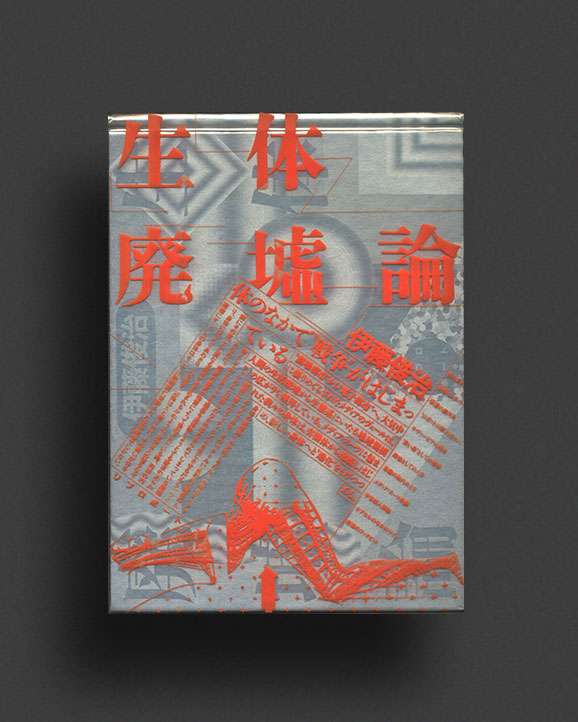
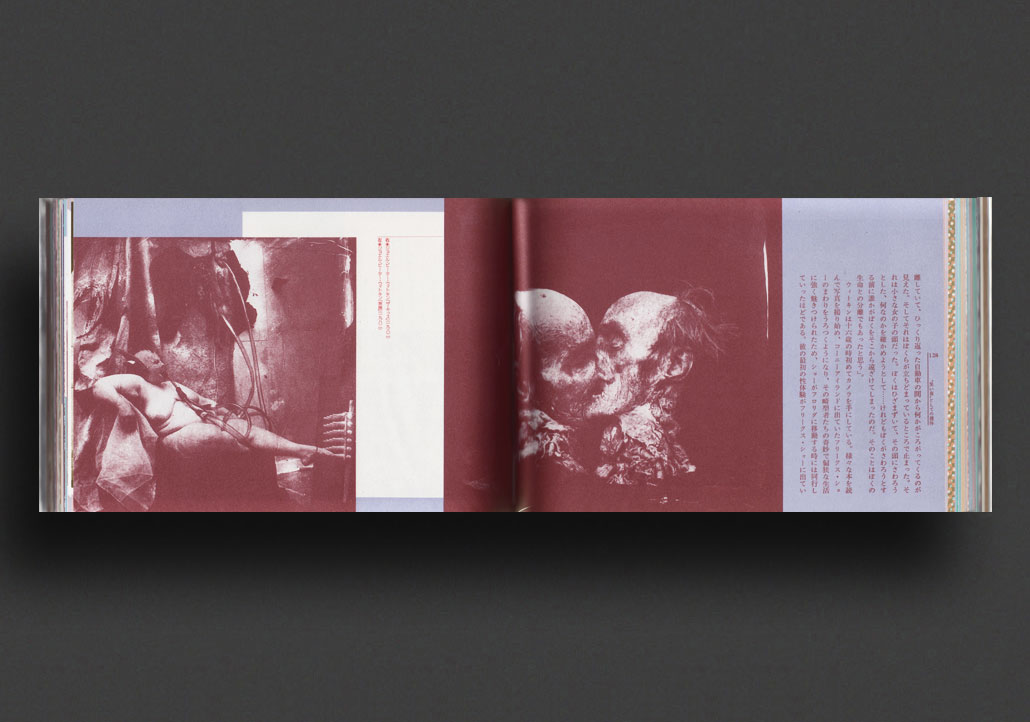
Incredible hardcover, slipcased anthology of essays, Biological Ruins Theory, by esteemed Japanese art historian and media theorist Toshiharu Ito, published in Tokyo in 1986. Housed in lavish screen-printed plastic slipcase and metallic silver engraved hardcover with various paper-stocks and films used throughout, Biological Ruins Theory collects Ito's diverse essays relating to the intersection of the biological human body and the machine — from robots to fascists to fetishists to body alchemy to freaks to abnormal electric babies to cargo cult to photographic violence and much more, lavishly illustrated and featuring Marcel Duchamp, H.R. Giger, Pierre Molinier, Hans Bellmer, Rudolf Schlichter, Cindy Sherman, Ed Paschke, Robert Longo, Lucas Samaras, Steven F. Arnold, Joel Peter Witkin, Francis Picabia, Jeffrey Silverthorne, Miron Zownir, Arnolf Rainer, Issey Miyake, and so many more. Ito wrote the introduction to Giger's Necronomicon Japanese edition, reproduced in full here with many of Giger's artworks,
Born in Tokyo, Japan, in 1953, Toshiharu Ito is an art historian, art and communication theorist and exhibition curator. He was professor at the Tama Art University of Tokyo from 1990 to 2001, and at the Tokyo National University of Fine Arts and Music since 2001. He is Artistic Director at the Intermedia Institute of Osaka since 1995, and from 1992 to 1998 curator at the Inter Communication Center of Tokyo; he worked as Artistic Director at Tokyo AAD Studio from 2000 to 2003. A selection of his published works includes the following titles: History of 20th Century Photography (Tokyo, Chikuma Shobo Pub., 1988); Machine Art (Tokyo, Iwanami Pub., 1991); Electronic Art (Tokyo, NTT Press, 1999).
VG—Near Fine copy.
1969, Japanese / French
Softcover, 228 pages, 23 x 18 cm
1st Edition, Out of print title / used / very good
Published by
Tensei Shuppan / Tokyo
$110.00 - In stock -
Revue de Érotologie, Homosexualité, Sadisme, Masochisme, Fétischisme, Narcissime, Infantilisme, Magie, Occultisme, Humour Noir, Complexe Psychisme. What more could you ask for? Le Sang Et La Rose is a masterpiece of the Japanese underground. A groundbreaking, powerful, yet short-lived Japanese arts and literary journal published in Tokyo from late 1968—mid 1969, published in a total of four luxurious, now collectible, volumes. The first three issues were edited by Tatsuhiko Shibusawa (1928—1987), a legendary, controversial Japanese novelist, art critic, translator of French writers such as Jean Cocteau, Georges Bataille and Marquis de Sade, and specialist in medieval demonology. The importance of this magazine to the Japanese avant-garde and radical culture cannot be overstated.
Born from a period of political, social and economical turmoil in Japan, Le Sang Et La Rose may be understood as a emblematic distillation and product of the late ‘60s student rebellion and anti-authoritarian underground culture. Wilfully politically subversive, the publication drew upon a vast range of perspectives - from criticism, literature, obscure esoteric sciences, art, eroticism, radical avant-garde and a historical-rooted Japanese counterculture; featuring literature, theory, art, photography, illustration and graphic design from the most innovative and subversive Japanese and international (predominately French) artists, authors and critics, spanning the themes above. As instigator, Tatsuhiko Shibusawa in effect formulated the magazine’s design to be a spiritual and political operative that would weaponize its readers minds. This stance was made clear in the 1969 manifesto text — "My 1969" — in which Shibusawa discuss' how he perceived the ‘60s as being the age of ideas, ideas as weapons, and outlined a distain towards systems of power, moralism, State oppression, sanitised and harmless liberalism, dogmatic academic sciences and an outright distrust for ideological, progressive literary scholars who advocate "freedom of expression", but have never caused friction with the judicial power. The magazine sketched out an aim to push towards a new kind of personal freedom, intellect, autonomy and moral compass. Here, the concept of ‘erotism’ — as discussed by Georges Bataille in his highly influential 1957 book "Erotism: Death and Sensuality" — acts as a critical force.
Issue no. 2 includes photographic features by Yasuhiro Yoshioka and Yoshihiro Tatsuki, the artwork of French decorator of department store mannequins and surrealist Sunday painter Clovis Trouille, Venus in Furs erotic photo shoot by Yasuhiro Ishimoto, Yokoo Tadanori, Hans Bellmer, Leonor Fini, Alberto Martini, Félicien Rops, Rene Magritte, an incredible feature "Machine for Murder" with art by Hiroshi Nakamura, Tomi Ungerer, Koichi Tanigawa, Osamu Tsukasa, Tatsuo Ikeda, Marcel Duchamp, Seiichi Horiuchi, and others, an article on the erotica of Ukiyo-e with a fold-out colour three panel poster, the fully illustrated museum supplement on Demonology by Tatsuhiko Shibusawa with artworks throughout history, texts by Apollinaire, Burroughs, Mutsuo Takahashi, articles on laws pertaining to homosexuality, Kama Sutra, shoe fetishism, and much more.
Tatsuhiko Shibusawa (1928—1987), was a well-known and controversial Japanese novelist, art critic, and translator of French writers such as Jean Cocteau, Georges Bataille and Marquis de Sade. In 1960 he and his publisher, Kyōji Ishii, were trialled for public obscenity over the publishing of Shibusawa's translation of de Sade's Juliette into the Japanese language. What was to be known as the "Sade Trial" took 9 years and although many of Japan's leading authors testified for the defense, in 1969 the Japanese Supreme Court ruled them guilty and charged. This did not deter Shibusawa, whose essays on black magic, demonology and eroticism were popular reading in Japan, and in 1981 he was awarded the 9th Izumi Kyoka Literature Prize.
Very Good copy. Light general tanning/wear.
1969, Japanese / French
Softcover, 232 pages, 23 x 18 cm
1st Edition, Out of print title / used / very good
Published by
Tensei Shuppan / Tokyo
$110.00 - In stock -
Revue de Érotologie, Homosexualité, Sadisme, Masochisme, Fétischisme, Narcissime, Infantilisme, Magie, Occultisme, Humour Noir, Complexe Psychisme. What more could you ask for? Le Sang Et La Rose is a masterpiece of the Japanese underground. A groundbreaking, powerful, yet short-lived Japanese arts and literary journal published in Tokyo from late 1968—mid 1969, published in a total of four luxurious, now collectible, volumes. The first three issues were edited by Tatsuhiko Shibusawa (1928—1987), a legendary, controversial Japanese novelist, art critic, translator of French writers such as Jean Cocteau, Georges Bataille and Marquis de Sade, and specialist in medieval demonology. The importance of this magazine to the Japanese avant-garde and radical culture cannot be overstated.
Born from a period of political, social and economical turmoil in Japan, Le Sang Et La Rose may be understood as a emblematic distillation and product of the late ‘60s student rebellion and anti-authoritarian underground culture. Wilfully politically subversive, the publication drew upon a vast range of perspectives - from criticism, literature, obscure esoteric sciences, art, eroticism, radical avant-garde and a historical-rooted Japanese counterculture; featuring literature, theory, art, photography, illustration and graphic design from the most innovative and subversive Japanese and international (predominately French) artists, authors and critics, spanning the themes above. As instigator, Tatsuhiko Shibusawa in effect formulated the magazine’s design to be a spiritual and political operative that would weaponize its readers minds. This stance was made clear in the 1969 manifesto text — "My 1969" — in which Shibusawa discuss' how he perceived the ‘60s as being the age of ideas, ideas as weapons, and outlined a distain towards systems of power, moralism, State oppression, sanitised and harmless liberalism, dogmatic academic sciences and an outright distrust for ideological, progressive literary scholars who advocate "freedom of expression", but have never caused friction with the judicial power. The magazine sketched out an aim to push towards a new kind of personal freedom, intellect, autonomy and moral compass. Here, the concept of ‘erotism’ — as discussed by Georges Bataille in his highly influential 1957 book "Erotism: Death and Sensuality" — acts as a critical force.
Issue no. 3 (with cover by Bronzino, 1554) includes full-colour photographic feature by Kishin Shinoyama ("Virgin In Uniform" featuring models/artists Angela Asaoka, Akaji Maro, Yoko Ashikawa) and beautiful Shomei Tomatsu photo feature ("Scoptophilia"), the artwork of the great French cross-dressing painter-photographer Pierre Molinier, texts by Jirō Kawamura, Yumiko Kurahashi, Taruho Inagaki ("Memories of Hemorrhoids or "New Tsurezuregusa"), Akiyuki Nosaka ("Dear Penis, Goodbye"), Minoru Minamihara ("The Mystic Thought of Love in the Case of Jakob Böhme"), Takiji Kobayashi, The Fictitious Garden of Babylon by Tatsuhiko Shibusawa, Tsunekazu Murata ("Witch's Ax : Concerning Heresy in Medieval Europe"), translation of Franz Kafka "Metamorphosis" illustrated by Franco Gentilini, recent research on homosexuality by film critic Jin'ichi Uekusa, Kama Sutra, more Gay (Danshoku) Japanese Theater history, Marquise de Blancvilliers by Koji Nakata, and much more.
Tatsuhiko Shibusawa (1928—1987), was a well-known and controversial Japanese novelist, art critic, and translator of French writers such as Jean Cocteau, Georges Bataille and Marquis de Sade. In 1960 he and his publisher, Kyōji Ishii, were trialled for public obscenity over the publishing of Shibusawa's translation of de Sade's Juliette into the Japanese language. What was to be known as the "Sade Trial" took 9 years and although many of Japan's leading authors testified for the defense, in 1969 the Japanese Supreme Court ruled them guilty and charged. This did not deter Shibusawa, whose essays on black magic, demonology and eroticism were popular reading in Japan, and in 1981 he was awarded the 9th Izumi Kyoka Literature Prize.
Very Good copy. Light general tanning/wear.
1960 / 1994, English
Softcover, 160 pages, 20.96 x 13.97 cm
Published by
Grove Press / New York
$40.00 - In stock -
"Nadja, " originally published in France in 1928, is the first and perhaps best Surrealist romance ever written, a book which defined that movement's attitude toward everyday life.
The principal narrative is an account of the author's relationship with a girl in the city of Paris, the story of an obsessional presence haunting his life. The first-person narrative is supplemented by forty-four photographs which form an integral part of the work -- pictures of various "surreal" people, places, and objects which the author visits or is haunted by in naja's presence and which inspire him to mediate on their reality or lack of it. "The Nadja of the book is a girl, but, like Bertrand Russell's definition of electricity as "not so much a thing as a way things happen, " Nadja is not so much a person as the way she makes people behave. She has been described as a state of mind, a feeling about reality, k a kind of vision, and the reader sometimes wonders whether she exists at all. yet it is Nadja who gives form and structure to the novel.
VG copy of the 1960 reprint from 1994?
1999, French
Softcover (+ audio cd), 68 pages, 30 x 24 cm
Limited edition, numbered,
1st Edition, Out of print title / used / fine
Published by
Éditions Licences / Paris
$70.00 - In stock -
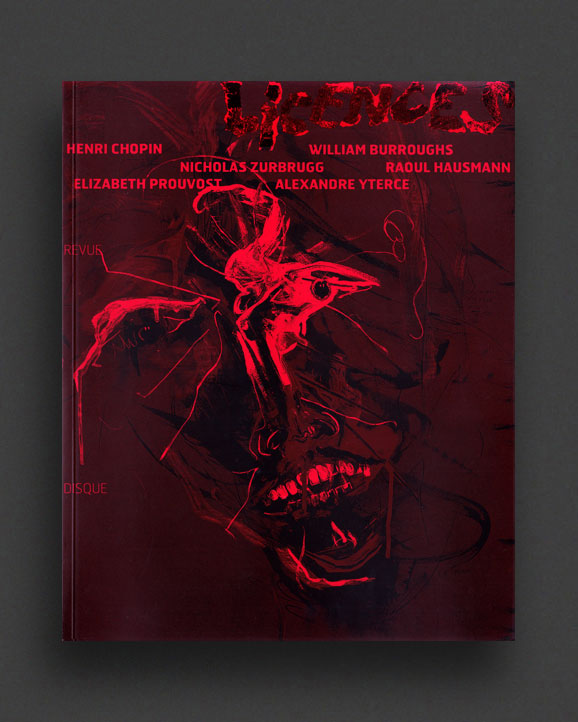
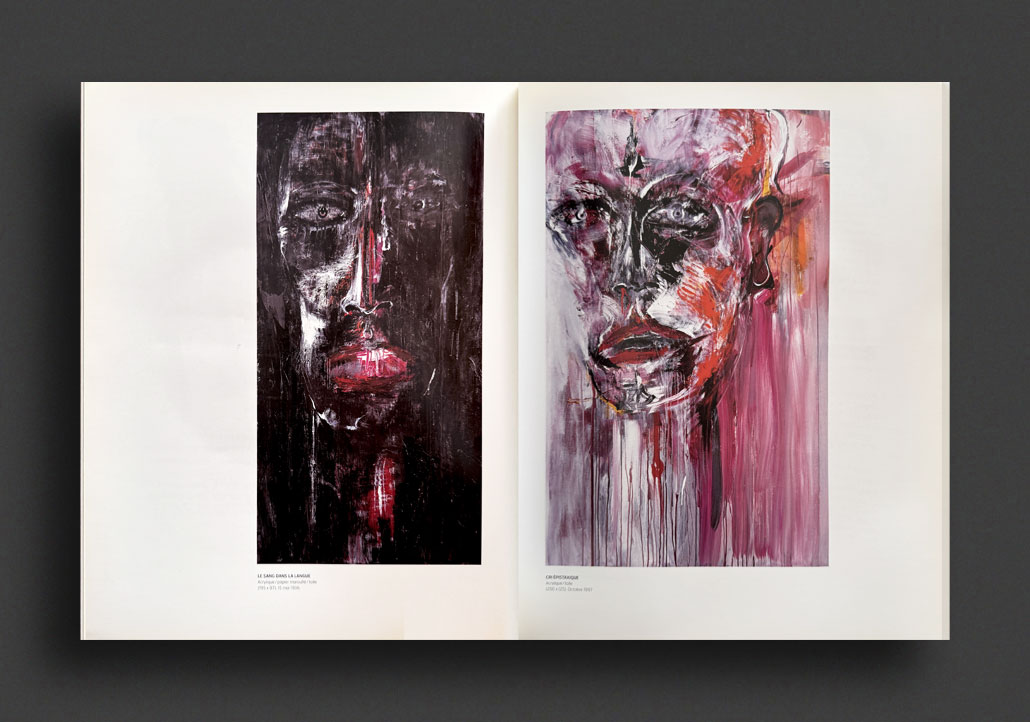
Scarce issue 0 from 1999 of the French journal/concert series/exhibition program Licences, the short-lived Revue-Disque periodical established by French composer Alexandre Yterce (b. 1959) devoted to Perversions, Voluptuousness and Sexualities, presenting unseen erotic works by artists, alongside rare interviews, texts and recorded performances and unreleased audio recordings, melding the worlds of transgressive, transformative sound, word and body. Texts, interviews photography, artworks and audio recordings by Henri Chopin, William Burroughs, Nicolas Zurrbrugg, Elisabeth Prouvost, Raoul Haussmann, Alexandre Yterce, Kenneth Gaburo, François Dufrène, and more.
Published in a limited edition, this copy hand-numbered "581". CD included. Also includes many laid-in ephemeral pieces — concert programs, promotional items for the periodical, business card, etc.
VG—NF copy.
2023, English
Softcover, 168 pages, 27 x 19.7 cm
Published by
Scheidegger und Spiess / Zürich
$95.00 - In stock -
Swiss surrealist artist HR Giger (1940-2014) achieved international fame in 1979 for designing the fantastic creatures and eerie environments that terrified moviegoers in Ridley Scott's science fiction film Alien. Yet before these iconic creations made him a celebrity and won him an Oscar for visual effects, Giger was already highly regarded in the international art world for his unique freehand painting style and biomechanical dreamscapes.
HR Giger The Oeuvre Before Alien 1961-1976, first published in 2007 and now becoming available again in a new edition, is the only book to date to document the artist's lesser known, but no less impressive, early work. This lavishly illustrated volume traces Giger's career from his education as an architect and industrial designer at the Zurich College of Art to the development of his ink drawing and oil painting technique and his eventual breakthrough as one of the foremost artists of the fantastic realism school.
Featuring many unpublished or rarely available early paintings and drawings, and accompanied by an essay by noted art historian Beat Stutzer, this volume juxtaposes Giger's paintings with works by his predecessors, including Ensor, Fuseli, Goya, and Piranesi. HR Giger The Oeuvre Before Alien illuminates the mind of a visual genius whose first artistic experiments were decades ahead of their time.
1995, English
Softcover, 338 pages, 15.2 x 22.9 cm
1st Edition, Out of print title / used / very good
Published by
University of New York Press / Albany
$45.00 - Out of stock
This book examines the significance of Bataille's contributions to various areas of investigation: philosophical inquiry in the broadest sense; economic theory relative to waste, expenditure, and the heterogeneous; the political commitment expected of the intellectual and his relationship to the whole man; the experience of a subject at its limits, in moments of alterity, or of inscription within the literary text.
Contributors include Robert Sasso, Lionel Abel, Denis Hollier, Tony Corn, Rodolphe Gasché, Pierre Klossowski, Jean Piel, Arkady Plotnitsky, Jean Borreil, Julia Kristeva, Jean-Louis Baudry, Paul Smith, Michael Halley, Mikhal Popowski, and Susan Rubin Suleiman.
First 1995 edition, Very Good copy.
1988 / 2004, Japanese
Softcover (w. dust jacket), 64 pages, 25.5 x 18 cm
Out of print title / used / fine
Published by
Shunyodo Shoten / Tokyo
$65.00 - Out of stock
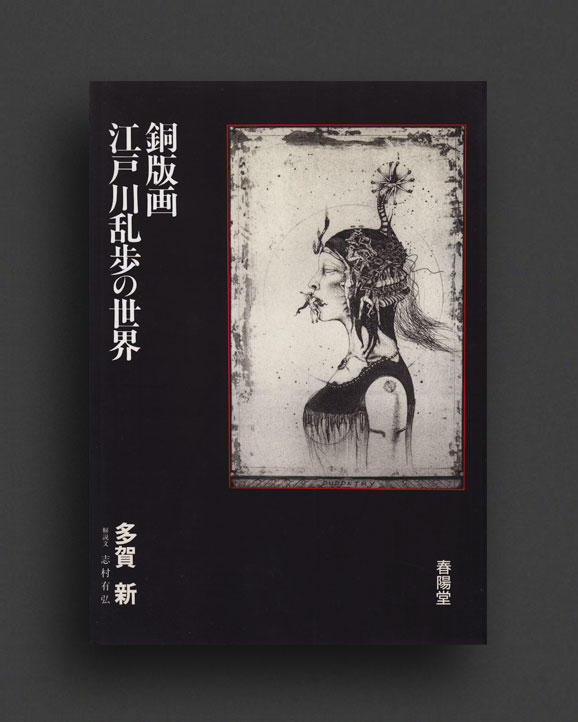
2004 edition of this famous collection of copperplate prints by self-taught Japanese artist Shin Taga, published by Shunyodo Bookstore, first issued in 1988. Shin Taga is the artist name for Arata Taga, who grew up in Hokkaido. Taga is renowned for his elaborate conceptions of strange creatures, erotic imagery, occult motifs and mythological connotations, all brought together in complex and detailed scenes of majestic horror, establishing him as one of Japan’s most talented and exciting etchers and printmakers, techniques he mastered from an early age. From 1972 onwards he exhibited at the Japan Print Association Exhibition, and was awarded his first prize there the following year, and in 1974 was awarded the Grand Prix. His first exhibition was in 1974. This important book of work reproduces over thirty of his artworks (mostly full page images) and includes Japanese text titles and descriptions of each work. The work is inspired by the work of Edogawa Ranpo, the pen name of Tarō Hirai (1894–1965), a Japanese author and critic who played a major role in the development of Japanese mystery and thriller fiction, and from whom Shin Taga gained much inspiration. Both Taga and Edogawa were great admirers of Edgar Allan Poe, Ranpo being a Japanese rendering of Poe’s name. The influence of dark imagination and horror are clearly evident in Taga’s work.
Fine—As New copy.
1981, English
Softcover, 240 pages, 23.5 x 15.5 cm
1st Edition, Out of print title / used / very good
Published by
Princeton University Press / New York
$30.00 - Out of stock
First 1981 edition. Illustrated.
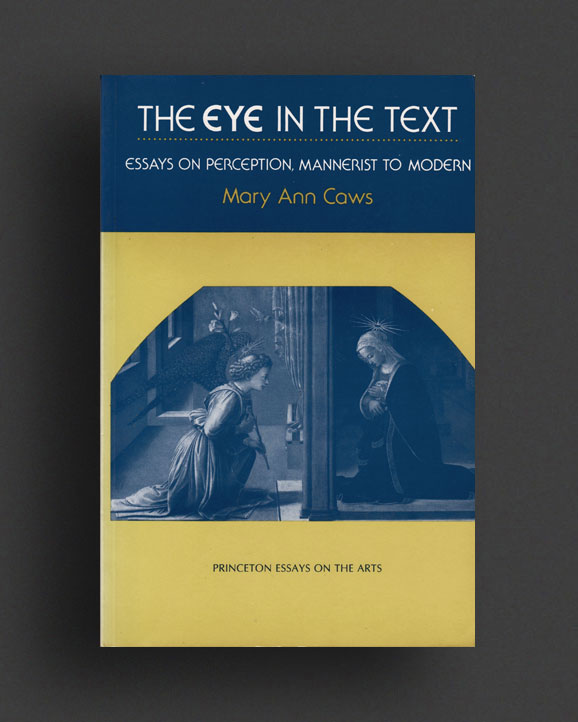
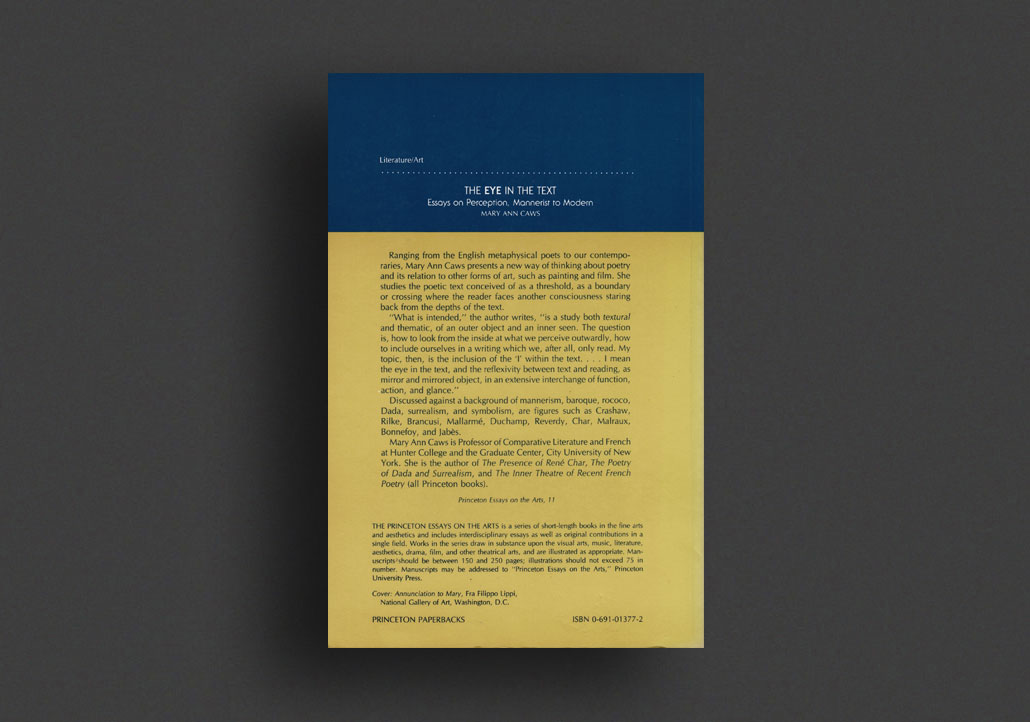
Ranging from the English metaphysical poets to our contemporaries, Mary Ann Caws presents a new way of thinking about poetry and its relation to other forms of art, such as painting and film. She studies the poetic text conceived of as a threshold, as a boundary or crossing where the reader faces another consciousness staring back from the depths of the text.
"What is intended," the author writes, "is a study both textural and thematic, of an outer object and an inner seen. The question is, how to look from the inside at what we perceive outwardly, how to include ourselves in a writing which we, after all, only read. My topic, then, is the inclusion of the 'I' within the text.. I mean the eye in the text, and the reflexivity between text and reading, as mirror and mirrored object, in an extensive interchange of function, action, and glance."
Discussed against a background of mannerism, baroque, rococo, Dada, surrealism, and symbolism, are figures such as Crashaw, Rilke, Brancusi, Mallarmé, Duchamp, Reverdy, Char, Malraux, Bonnefoy, and Jabès.
Mary Ann Caws is Professor of Comparative Literature and French at Hunter College and the Graduate Center, City University of New York. She is the author of The Presence of René Char, The Poetry of Dada and Surrealism, and The Inner Theatre of Recent French Poetry (all Princeton books).
Very Good copy.
1983, English
Softcover, 224 pages, 21 x 14 cm
1st Edition, Out of print title / used / very good
Published by
Seaver Books / US
$60.00 - Out of stock
Perhaps the single most important voice of cinema in the twentieth century, André Bazin profoundly influenced the development of the scholarship that we know now as film criticism. Bazin has acutely analyzed the cinematic values of our time, extending to his international audiences “the impact of art for the understanding and discrimination of his readers.”
The depth and logic of his commentary has elevated film criticism to new heights. The reputation of André Bazin continues to grow as his writings are published and studied by filmmakers and filmgoers alike. Often referred to as the Edmund Wilson of film, Bazin was more than a critic. “He made me see certain aspects of my work that I was unaware of,” said Luis Buñuel. “He was our conscience,” wrote Jean Renoir. “He was a logician in action,” echoed François Truffaut.
In The Cinema of Cruelty, François Truffaut, one of France’s most celebrated and versatile filmmakers, has collected Bazin’s writings on six film “greats”: Erich von Stroheim, Carl Dreyer, Preston Sturges, Luis Buñuel, Alfred Hitchcock, and Akira Kurosawa. The result is a major collection of film criticism.
André Bazin was born in Angers, France, in 1918. Critic, theorist, essayist, and teacher, Bazin is, as Truffaut notes, “the most widely published and translated film critic outside of France.” Bazin’s work and writings have attracted an international audience of filmmakers, directors, and viewers. He passed away in 1958 at the age of forty.
1965, English
Softcover, 253 pages, 13.9 x 20.3 cm
Reprint,
Out of print title / used / very good
Published by
City Lights Books / San Francisco
$40.00 - Out of stock
"I am the man," wrote Artaud, "who has best charted his inmost self."
Antonin Artaud was a great poet who, like Poe, Holderlin, and Nerval, wanted to live in the infinite and asked that the human spirit burn in absolute freedom. To society, he was a madman. Artaud, however, was not insane but in luciferian pursuit of what society keeps hidden. The man who wrote "Van Gogh the Man Suicided by Society" raged against the insanity of social institutions with insight that proves more prescient with every passing year. Today, as Artaud's vatic thunder still crashes above the "larval confusion" he despised, what is most striking in his writings is an extravagant lucidity. This collection gives us quintessential Artaud on the occult, magic, the theater, mind and body, the cosmos, rebellion, and revolution in its deepest sense.
Antoine Marie Joseph Artaud, better known as Antonine Artaud, was a French dramatist, poet, essayist, actor, and theatre director, widely recognized as one of the major figures of twentieth-century theatre and the European avant-garde.
Second 1965 edition.
Jack Hirschman (1933 – 2021) was an American poet and social activist who has written more than 50 volumes of poetry. Dismissed from teaching at UCLA for anti-war activities in 1966, he moved to San Francisco in 1973, and was the city's present poet laureate. Hirschman translated nine languages and edited The Artaud Anthology.
2024, English
Softcover, 176 pages, 20 x 14 cm
Published by
Crackers / Milan
$35.00 - Out of stock
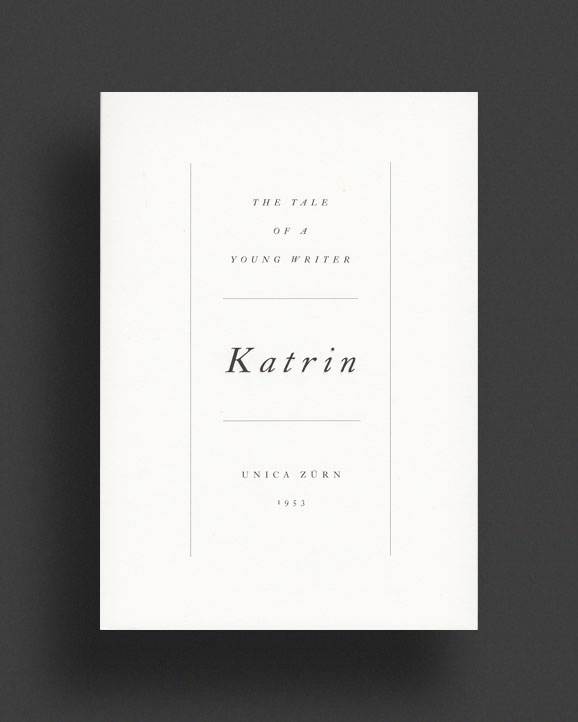
A partly autobiographical novel that the German surrealist artist and author Unica Zürn (1916-1970) wrote for her ten-year-old daughter in 1953, although it would never be published in her lifetime. This is the first translation of the tale from German into English.
Unica Zürn tells the story of fifteen-year-old motherless Katrin, an aspiring writer, who lives with her father, also a writer. The novel is set in an imaginary world, a metropolis called Linit, split into three levels: Oberstadt (Hightown), Mittelstadt (Middletown) and Unterstadt (Lowtown), overlooked by a Volcano where the artists live and crossed by the river Emil. Presented as a book for children, apparently written for her own daughter (named Katrin), Katrin also draws on the personal biography of Zürn herself, in terms of her relationship with her father and the city of Berlin after WWII, and her experience with people on the margins of a society characterised by great tensions.
Nora Berta "Unika" Ruth Zürn, originally known as Ruth, was born on 6 July 1916 in Berlin. Raised in Berlin, Zürn had a contentious relationship with her mother, while she idolized her absent father. While at school she published her first short stories in magazines for young people, and in 1933 she began to work at the UFA film studios in Berlin (acronym for Universum-Film Aktiengesellschaft, a major German film company producing and distributing motion pictures from 1917 until the end of the Nazi era). In 1942 she married and had two children, Katrin and Christian. Shortly after, she lost the custody of her children. For the next few years she survived by writing short stories for newspapers and radio plays. After the war, she became part of the Bohemian group of Berlin and began to call herself Unika (after her aunt Unika Pudor). She frequented the artistic milieu revolving around the DADA-surrealist cabaret Die Badewanne ("The Bathtub"). In 1953, Zürn met the artist Hans Bellmer, best known for his disassembled dolls in unconventional poses directed at the cult of the perfect body then prominent in Germany, and became his muse. They lived together in Paris for many years, albeit in a conflictual relationship. Zürn concentrated on producing poetic anagrams supplemented by drawings, thus developing her own multidimensional surreal style. From the late 1950s, she suffered from forms of anxiety, later diagnosed as schizophrenia, and produced a wealth of remarkable textual and visual material while in psychiatric institutions across Germany and France. From 1956 to 1964, Zürn had four solo exhibitions of her drawings, and her work was included in the Exposition Internationale du Surréalisme. The exploration of the unconscious dimension would increasingly lose its liberating, positive aspect and turn into a fixation on a narrow space, one in which the self is tormented by distressing visions. Her psychological difficulties inspired much of her writing, especially Der Mann im Jasmin (The Man of Jasmine, published in English in 1971). Other published texts by Zürn include Hexentexte (1954) and Dunkler Frühling (Dark Spring, 1967). Zürn died on 19 October 1970 in Paris, throwing herself from the sixth floor.
Afterword by Eva-Maria Thüne.
Translated from the German by Louis Bazalgette Zanetti (original title: Katrin. Die Geschichte einer kleinen Schriftstellerin, Verlag Brinkmann & Bose, Berlin, 1991).
Graphic design: Kiki Gordon.
English edition.
1971, Japanese
Softcover (staple-bound), 160 pages, 21.5 x 15 cm
1st Edition, Out of print title / used / good
Published by
Lemon Inc. / Tokyo
$90.00 - Out of stock
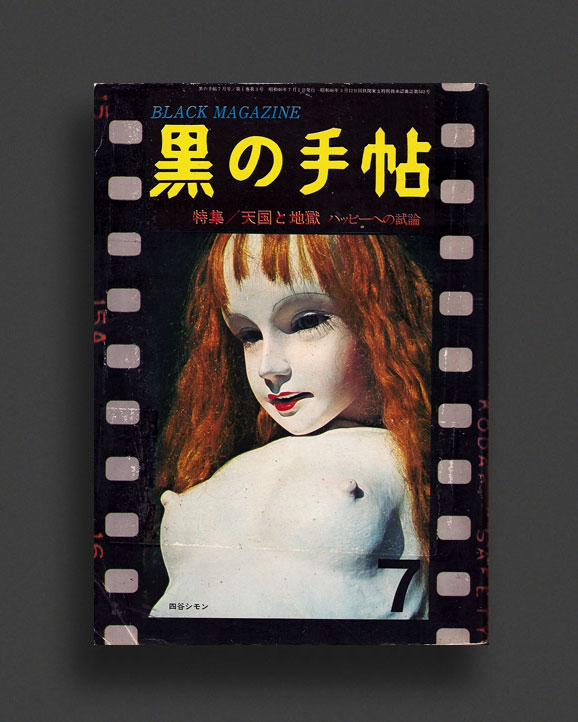
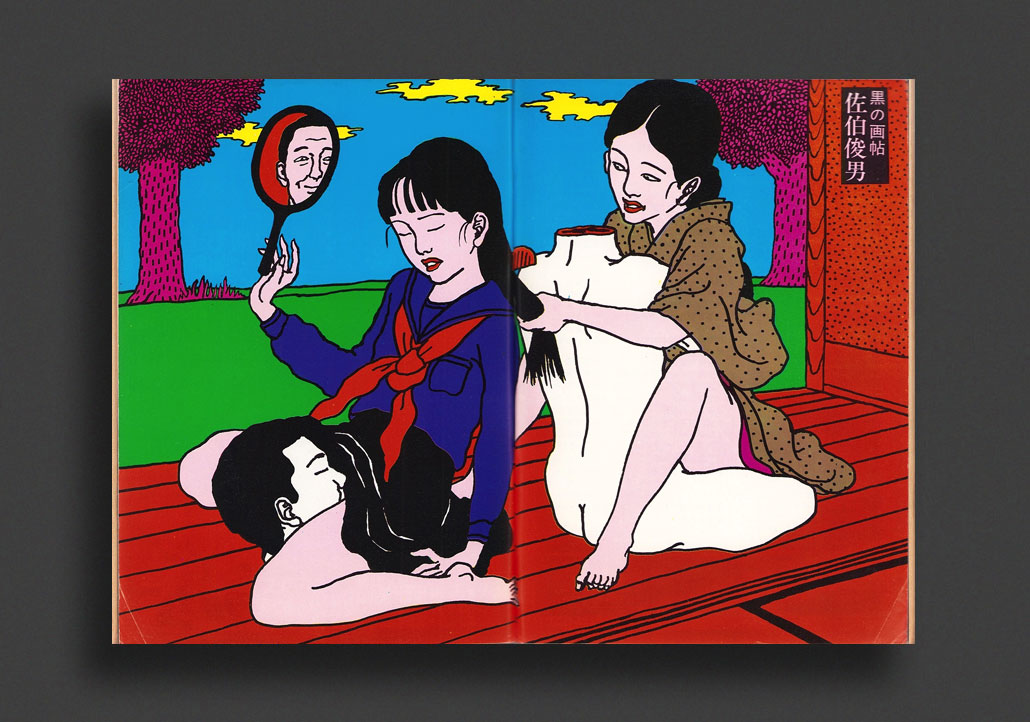
July 1971 (w. Simon Yotsuya cover) issue of legendary Japanese underground arts periodical, Black Magazine (or Black Notebook), a taboo-shattering vehicle of the 1970s subculture in Tokyo. A magazine like no-other, each issue, "a paradise of 1970's heretical culture", was a who's who of non-conformity, introducing a new wave of illustrators, painters, doll-makers and photographers, "taboo" sexuality and fetish culture, avant-garde comics, sadistic literature, radical criticism, queer poetry, activism, black humour, underground film and theatre, and all manner of transgressive, esoteric and erotic material, new and historical. Black Magazine featured the work of Yukio Mishima, Toshio Saeki, Izumi Suzuki, Simon Yotsuya, Shūji Terayama, Ken Katayama, Nobuyoshi Araki, Genpei Akasegawa, Keiichi Tanaami, Kikuji Yamashita, Aoi Fujimoto, Tadanori Yokoo, Hiroshi Nakamura, and so many others. It was also where Japanese photographer Satomi Nihongi's Tokyo Transgender photographs were first printed. Black Magazine was heavy with queer and trans content, and Nihongi's "The Most Beautifuls" was a regular photo-feature in its pages. A lot of great things started in the pages of this unique magazine. A highly recommended publication!
This third issue, themed "Heaven and Hell", features incredible cover by renowned Japanese doll artist (and female doll actor) Simon Yotsuya, and contributions by ero guro master Toshio Saeki, artist Genpei Akasegawa, art critic Junzo Ishiko, "Funeral Parade of Roses" director Toshio Matsumoto, Butoh dancer Natsu Nakajima, poet and critic Akiko Baba, photographer Masatoshi Naitō, manga artist Ryuzan Aki, literary critic Katsutarō Isogai, illustrator Akechi Goro, writer Masaki Umehara, author Utagawa Taiga, literary critic Nobuo Kasahara, essayist Shinichi Kusamori, critic Hidetomo Kanaoka, illustrator (Flower Travellin' Band) Shinobu Ishimaru, manga artist Shigeru Sugiura, scholar Aoi Suenaga, artist Takahashi Shōtei, illustrator Yosuke Inoue, and many more. A lot of great things started in the pages of this unique magazine. A highly recommended publication!
1974, French
Hardcover (w. dust jacket), 72 pages, 31 x 25 cm
1st Edition, Out of print title / used / very good
Published by
Editions Filipacchi / Paris
$120.00 - Out of stock
First hardcover edition of the first major Toyen monograph, published by Editions Filipacchi Paris, in 1974. Profusely illustrated throughout with Toyen's surrealist paintings, drawings, collages and publications in colour and b/w, this volume collects a beautiful cross-section of works by the great Czech transgender surrealist, alongside a text in French, a biography of the artist, and photographic portrait by Man Ray.
Marie Čermínová (1902 – 1980), known as Toyen, was a Czech painter, drafter and illustrator and a member of the Surrealist movement. Born in Smíchov, Bohemia, she left home at the age of 16 and worked at a soap factory in Zizkov while putting himself through school. She worked closely with fellow Surrealist poet and artist Jindřich Štyrský, both joining and exhibiting with the Devětsil group in 1923. In the 1920s they travelled to Paris and founded an artistic alternative to Abstraction and Surrealism, which they dubbed Artificialism, returning to Prague in 1928. Toyen's sketches, book illustrations, and paintings were frequently erotic, illustrating the Marquis de Sade's "Justine" under Štyrský's publishing imprint, Edice 69, as well as contributing many erotic sketches to Štyrský's Eroticka Revue (1930–33), published on strict subscription terms with a circulation of 150 copies. Toyen and Štyrský gradually grew more interested in Surrealism. After their associates Vítězslav Nezval and Jindřich Honzl met André Breton in Paris, they founded the Czech Surrealist Group along with other artists, writers, film makers and the composer Jaroslav Ježek. Toyen was one of the few female Surrealists, along with Claude Cahun, Leonora Carrington and a handful of others. While Cahun examined the fluidity of gender roles, Toyen dispensed with gender altogether. Toyen often dressed in men's clothing and preferred masculine pronouns, choosing a non-conformist position when it came to gender and sexuality, themes heavily mined in Surrealist art. Forced underground during the Nazi occupation and Second World War, he sheltered his second artistic partner, Jindřich Heisler, a poet of Jewish descent who had joined the Czech Surrealist Group in 1938. The two relocated to Paris in 1947, before the Communist takeover of Czechoslovakia in 1948. In Paris, they worked with André Breton, Benjamin Péret, and other members of the surrealist movement.
Very Good copy with Good dust jacket preserved under plastic wrap. Light waving to some end page at binding edge.
1983, Japanese
Softcover (staple-bound), 48 pages, 21 x 14 cm
1st Edition, Out of print title / used / good
Published by
Art Space Bibudju / Japan
Edition Mibuduki / Japan
$140.00 $100.00 - In stock -
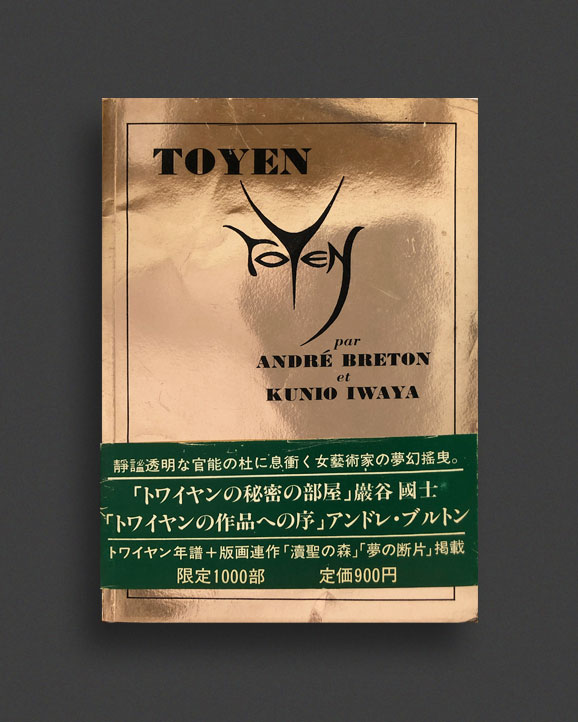
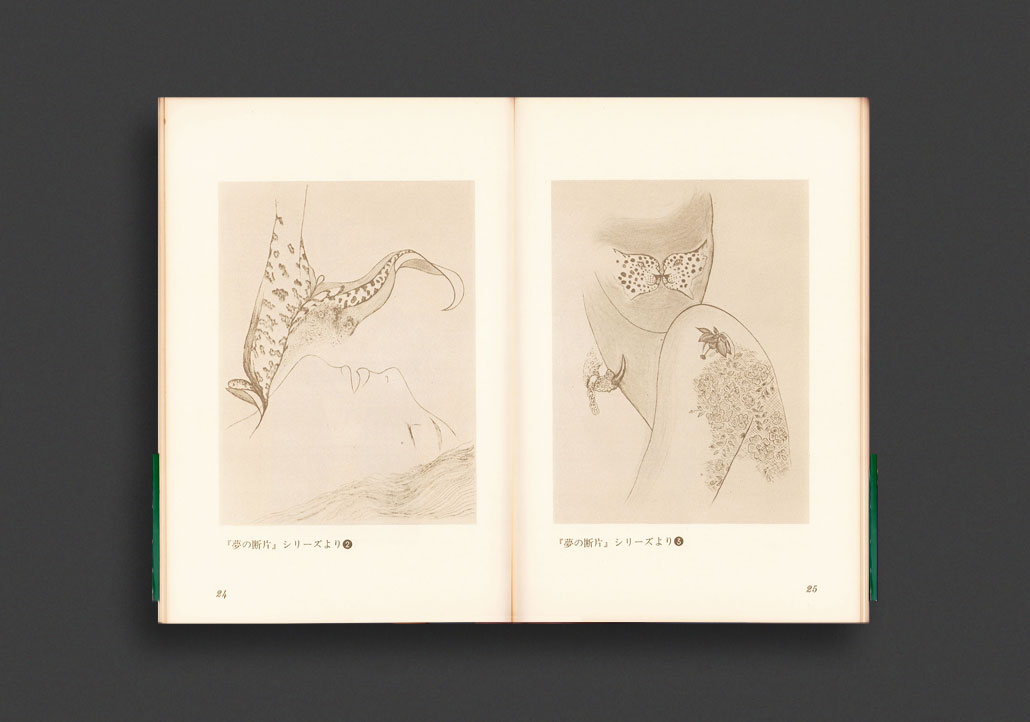
Rare Japanese book of the illustrated works by the great Czech transgender surrealist Toyen (1902—1980), issued in Japan in 1983, limited to 1000 copies, each hand-numbered. Wrapped in gold foil covers with bottle green obi-strip, this lovely publication reproduces Toyen's illustrations for the books Débris Des Rêves and Le puits dans la tour by Toyen and radical Croatian author Radovan Ivšić's Le Puits Dans La Tour & Débris Des Rêves, and her illustrations for La Forêt Sacrilège by French poet and artist Jean-Pierre Duprey, accompanied by essays by Japanese author Kunio Iwaya and André Breton, from the original French translated to Japanese. Also includes a chronology of Toyen. Texts in Japanese.
Good copy with tanning and some wear to foiled covers/obi.
1969, French
Hardcover (cloth bound), 106 pages, 21 x 21 cm
1st Edition, Out of print title / used / very good
Published by
Éditions Denoël / Paris
$100.00 - Out of stock
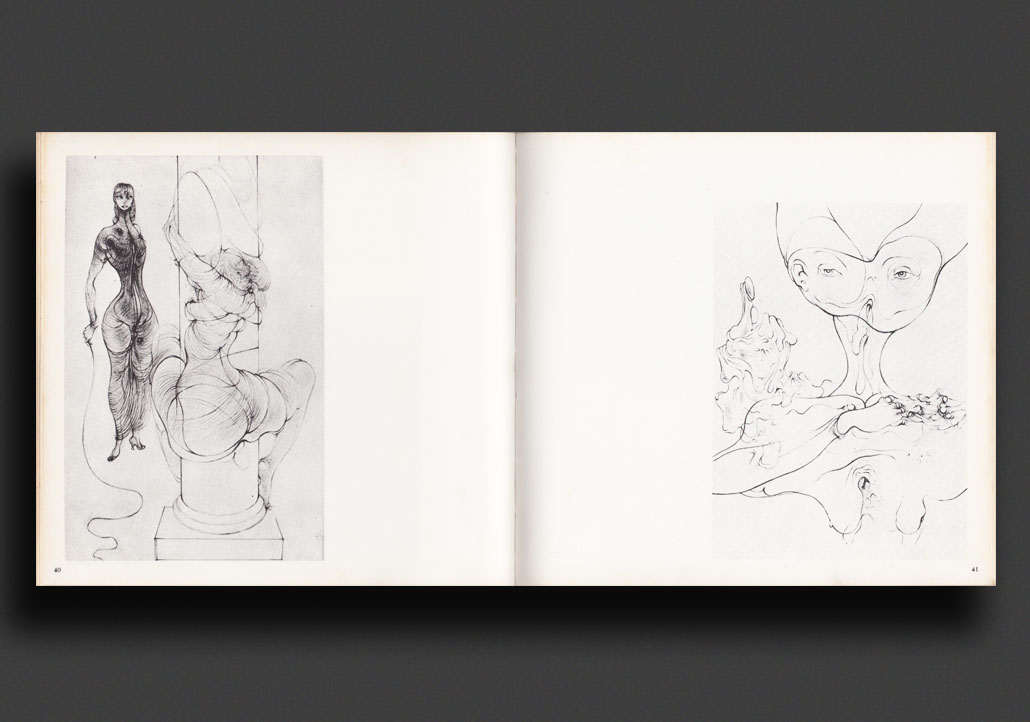
First Edition of the catalogue raisonné of the engraved work of German Surrealist Hans Bellmer, published in 1969 by Éditions Denoël, Paris. Wrapped in the publisher's debossed black covers featuring Bellmer's Céphalopode of 1965, this handsome volume opens with "Morale of Engraving", a four page introduction by author Andre Pieyre De Mandiargues (in French). The rest of the book is made up of 141 beautifully reproduced engraved works of Bellmer, including his exquisite works complimenting Georges Bataille, Marquis de Sade, Joyce Mansour, Louis Aragon, Charles Baudelaire, and others, followed by a 7 pages complete catalogue raisonné index, including work title, date, process and technique, dimensions, printing justifications, editors and other details. An essential title in any Bellmer collection and important reference.
Very Good copy, tanning to board/page edges with age.
2024, English
Softcover, 213 pages, 19.5 x 13.5 cm
Published by
Twisted Spoon Press / Prague
$44.00 - In stock -
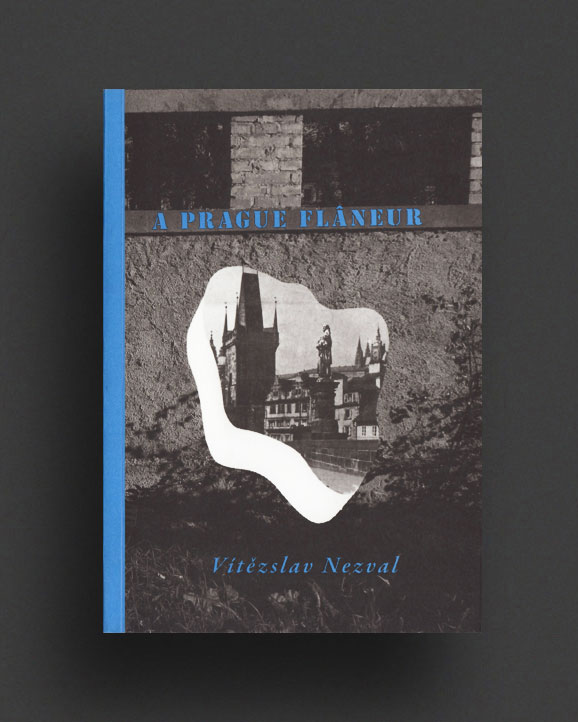
By spring 1938, Prague is a city increasingly on tenterhooks in expectation of an attack by Nazi Germany. Earlier that year the pressure of the situation produced a schism in the Surrealist Group in Czechoslovakia between Vítězslav Nezval, who wanted to continue to support the Soviet Union, and those who condemned Stalin’s show trials, purges, and executions. Nezval chronicles this tumultuous period by embedding it in a paean to Prague, wondering if the city, and everything about the city he loves, will survive the horrors that are about to be visited upon her. With Apollinaire serving as his guide, he introduces us to the cafés and pubs he would frequent, many of which no longer exist, the various neighborhoods he lived in as a destitute student, the parks where he sought solace, and the people he would meet on the street, musing on some of the figures central to his poetics, such as André Breton and Lautréamont. While at times lamenting the changing face of Prague and that Hitler might reduce it to rubble, Nezval takes us into the places that spontaneously spur him to reflect on the issues facing artists of the day and the precarious sociopolitical situation.
This translation is of the rare unabridged first edition and includes Nezval’s photographs and illustrations as well as an appendix that maps out the significant revisions made later, providing additional translations of the longer passages that were inserted as replacement for what was expunged from the original edition.
translated from the Czech by Jed Slast
photographs by the author
"The long-awaited English translation of Czech Surrealist poet Vítězslav Nezval’s seminal work of poetic prose, A Prague Flaneur is fascinating and revealing: of Nezval, Prague, interwar politics, poetry, urbane bohemianism and romance. The writing (and translation) here is often beautiful and constantly inspiring, as Nezval’s meandering sentences encapsulate his life and life in his adopted city."—Stephan Delbos, BODY
"So A Prague Flâneuris a book which provides many riches; a glimpse of Prague at a point just before catastrophe; a look at the complex personal politics which existed at the time; and an exploration of the self-censorship which took place when invasion seemed imminent. It makes for an engrossing book [...]"—Kaggsy's Bookish Ramblings
"A Prague Flâneur is a lovely document of its times and, especially, place, and an appealing personal account, Nezval a very good guide also to the feel of the place -- and parts of the artistic scene there (and beyond) as well."—The Complete Review
1962, German
Softcover, 190 pages, 21 x 16.8 cm
Numbered ed. 0688/2000,
1st Edition, Out of print title / used / fine
Published by
Gerhardt Verlag / Berlin
$400.00 - Out of stock
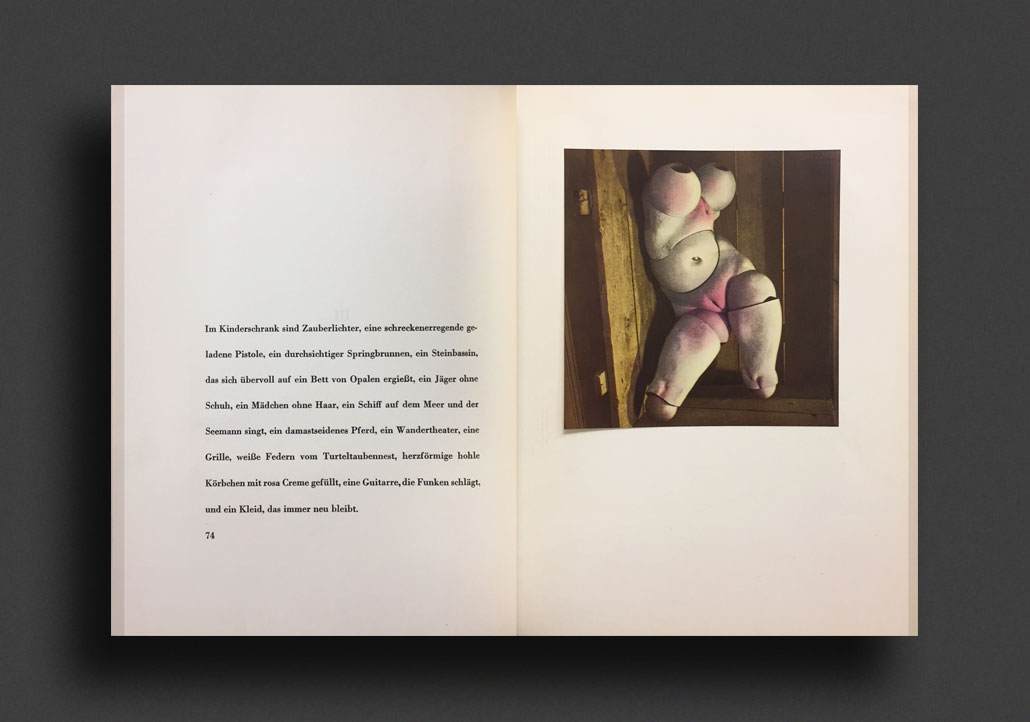
Very scarce first numbered edition of Bellmer's "Die Puppe", published by Gerhardt Verlag in Berlin in 1962. German artist Hans Bellmer (1902-1975) was one of the most subversive artists associated with Surrealism, famous--notorious, even--for his erotic engravings, objects and photographs. This collectable first edition (numbered of 2000 copies) of Die Puppe (The Doll) comprises a series of Bellmer's hand-painted photographs in the form of 10 monochrome and 15 coloured tipped-in plates accompanying his remarkable texts, here published for the first time. Bellmer's hand-coloured photographs subsequently acquired an iconic status as perhaps the purest exemplification of the Surrealist ideal of "convulsive beauty." Bellmer weaves a remarkably disparate set of concepts and intuitions--from fields as diverse as mathematics, morphology, optics and psychology--into a theory of eroticism that provides a totally unexpected rationale for his uncompromising art. His ideas are, in the words of poet Joë Bousquet, a "scandal to reason." The book also contains many b/w drawings by Bellmer along with prose poems by Paul Eluard. A book like no other!
Fine, perfectly preserved copy of this stunning edition with the die-cut decal cover.
2011, English
Softcover, 416 pages, 20.3 x 14 cm
Published by
Deep Vellum / Texas
$34.00 - Out of stock
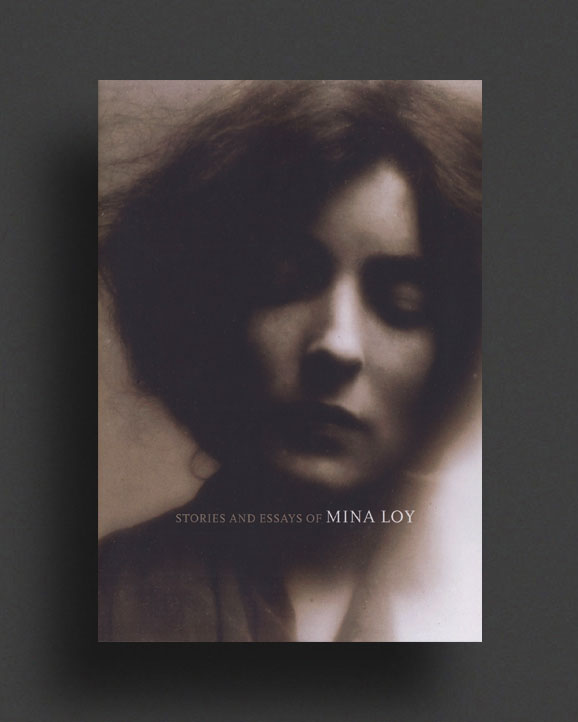
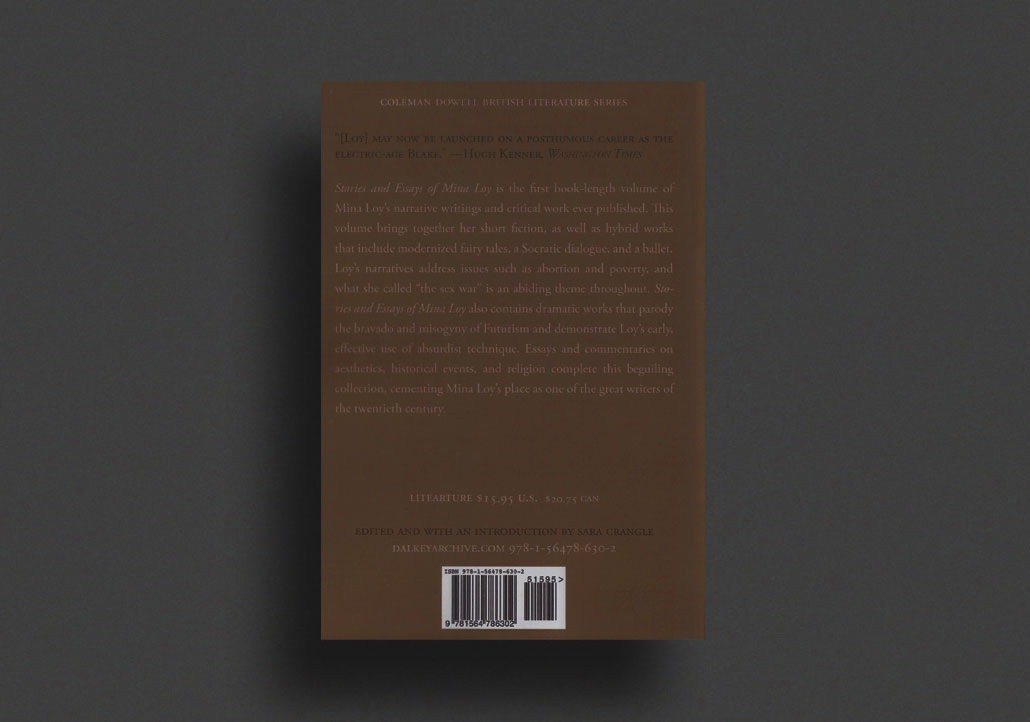
"Stories and Essays of Mina Loy" is the first book-length volume of Mina Loy's narrative writings and critical work ever published. This volume brings together her short fiction, as well as hybrid works that include modernized fairy tales, a Socratic dialogue, and a ballet. Loy's narratives address issues such as abortion and poverty, and what she called "the sex war" is an abiding theme throughout. "Stories and Essays of Mina Loy" also contains dramatic works that parody the bravado and misogyny of Futurism and demonstrate Loy's early, effective use of absurdist technique. Essays and commentaries on aesthetics, historical events, and religion complete this beguiling collection, cementing Mina Loy's place as one of the great writers of the twentieth century.
Marjorie Perloff writes: "Among the great modernist poets, Mina Loy was surely the greatest wit, the most sophisticated commentator on the vagaries of love, the one whose brittle and sardonic laughter continues... to pursue us."
2024, English
Softcover, 146 pages, 20.5 x 12.5 cm
Published by
Forgotten Press / Aotearoa—New Zealand
$30.00 - Out of stock
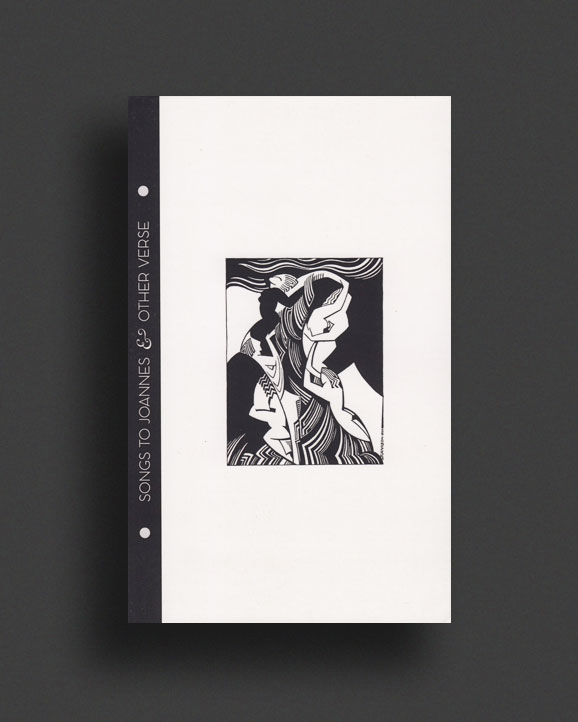
'Songs to Joannes & Other Verse' brings together a selection of poems by London poet Mina Loy, later based in Paris and New York, including the entire 34 song sequence, 'Songs to Joannes', and a generous selection of Loy's other verses (originally published 1914-1923), as well as selected short essays, manifestos, and aphorisms; with illustrations by Mina Loy, Djuna Barnes, and Clara Tice. Loy was a revolutionary poet, and a member of the Futurist and Dada groups in the mid-1910s, and a forerunner to the 'free' and 'new verse' movements of the 1920s.
The Forgotten Poets Newsletter presents: new collections of out-of-print and obscure poetry, with a focus on compressed & fragmented 'free' and 'new' verse from the late-1800s & early-1900s, & the early history of English-language tanka & haiku. Verses are carefully selected & spaciously laid-out, adorned with illustrations & ornaments from the books & magazines they originally appeared in.
1985, English
Softcover, 158 pages, 20 x 14 cm
1st Edition, Out of print title / used / very good
Published by
City Lights Books / San Francisco
$200.00 - Out of stock
Very rare first 1985 City Lights English edition of Leonora Carrington's classic "The Hearing Trumpet". Leonora Carrington (1917 – 2011), painter, playwright, and novelist, was a surrealist trickster par excellence, and The Hearing Trumpet is the witty, celebratory key to her anarchic and allusive body of work. The audacious heroine of this enchanting book is ninety-two-year old Marian Leatherby, consigned by her family to an old ladies' home which is haunted by poisonings and occult goings-on. After an unexplained murder, Marian takes destiny in hand, pursuing the secrets of the Leering Abbess and the Holy Grail with her new friends and fellow-inmates. In a series of comic and subversive adventures, they summon the old gods and goddesses to provoke a most desirable cosmic upheaval.
"Reading The Hearing Trumpet liberates us from the miserable reality of our days."—Luis Buñuel, Spanish-Mexican filmmaker.
"A truly great book ... It's delicious, mocking, ideal."—(French) Playboy
"A strange and wonderful novel ... this book is a masterpiece of surrealistic fantasy, combining rich symbolic suggestion with a gripping narrative."—Library Journal
Very Good copy, light cover edge/corner wear. Spine uncreased.