World Food Books' programme is largely produced on Kulin Nation land. We acknowledge the Wurundjeri people of the Kulin Nation as the first and continuing custodians of this land, and pay respect to their Elders past, present, and emerging.
World Food Books is an arts and special interests bookshop in Naarm / Melbourne. Founded in 2010, World Food Books is devoted to the presentation of a rotating, hand-selection of international art, design, literary and counterculture publications with an emphasis on the anti-traditional, the experimental, the avant-garde, the heretic, the marginal.
Presenting new titles alongside rare and out-of-print books, catalogues and journals spanning the fields of modern and contemporary art, design, photography, illustration, film, literature, poetry, cultural theory, philosophy, sexuality, popular and underground culture in its many radical forms, World Food Books wishes to encourage adventurous, thoughtful and open-minded reading, looking, writing, and exchange of publishing and ideas, both current and historical.
As well as our bookshop, located in Melbourne's historical Nicholas Building, all of our inventory is available internationally via our online mail-order service.
World Food Books semi-regularly co-ordinates "Occasions", a programme of exhibits and events at the bookshop and in partnership with other hosts (such as museums and art galleries) that develop out of the activities, relationships and content of the bookshop itself.
World Food Books
The Nicholas Building
37 Swanston Street
Room 5, Level 6
Melbourne 3000
Australia
SHOP HOURS:
Thu–Fri 12–6, Sat 12–5
WEB-SHOP OPEN 24/7
World Food Books
Postal Address:
PO Box 435
Flinders Lane
Victoria 8009
Australia
Art
Theory / Essay
Architecture / Interior
Graphic Design / Typography
Photography
Fashion
Eros
LGBTQ+
Fiction / Poetry
Weird / Speculative / Science Fiction / Horror
Transgressive / Visceral / Abject
Symbolism / Decadence / Fin de siècle
Film / Video
Painting
Sculpture / Installation
Performance / Dance / Theater
Drawing
Sound / Music
Curatorial
Group Shows / Collections
Periodicals
Out-of-print / Rare
Posters / Ephemera / Discs
Signed Books
World Food Books Gift Voucher
World Food Book Bag
Australian Art
Australian Fiction
Australian Science Fiction / Speculative Fiction
Australian Poetry
Australian Photography
Japanese Photography
Conceptual Art
Minimal Art
Dada
'Pataphysics / Oulipo
Fluxus
Concrete Poetry
Pop Art
Surrealism
Arte Povera
Arte Informale / Haute Pâte / Tachism
Nouveau Réalisme / Zero / Kinetic
Situationism / Lettrism
Collage / Mail Art / Xerox Art
Art Brut / Folk / Visionary / Fantastic
Illustration / Graphic Art / Bandes Dessinées
Furniture
Italian Radical Design / Postmodernism
Textiles
Ceramics / Glass
Counterculture
Protest / Revolt
Philosophy
Psychoanalysis
Anthropology
Anarchism
Socialism / Anarchism / Communism / Capitalism
Literary Theory / Semiotics / Language
Feminism / Women's Studies
Gender Studies / Sexuality
Anthropology
Fetishism / BDSM
Drugs / Psychedelia
Crime / Violence
Animal Rights / Veganism
Occult / Esoterica
Ecology / Earth / Alternative Living
Whole Earth / Crafts
All prices in AUD (Australian dollars)
Pick-Ups
Pick-up orders can be collected in our bookshop during opening hours after order date. Please collect any Pick-up orders within 2 weeks of ordering as we have limited storage space. Orders will be released back into stock if not collected within this time. No refunds can be made for pick-ups left un-collected. If you cannot make it in to the bookshop in this time-frame, please choose postage option.
Return Policy
All sales are final. We do accept returns (for refund or exchange) for items received in error. All our orders are packed with special care using heavy-duty padding and cardboard book-mailers or bubble mailers (for smaller books), using reinforcement where required. We cannot take responsibility for any lost, stolen or damaged parcels.
Insurance
Should you wish to insure your package, please email us directly after placing your order and we can organise this at a small extra expense. Although all standard/express tracked packages are very safe and dependable, we cannot take responsibility for any lost, stolen or damaged parcels. We recommend insurance on valuable orders.
Interested in selling your old books, catalogues, journals, magazines, comics, fanzines, ephemera? We are always looking for interesting, unusual and out-of-print books to buy. We only buy books in our fields of interest and specialty, and that we feel we can resell.
We base these prices on desirability, market value, in-print prices, condition and our current stock levels. We offer cash, store credit, and can take stock on consignment. All
about 25% of the price we expect to get when we sell them, or 30% in store credit. We base these prices on desirability, market value, in-print prices, condition and our current stock levels.
Sell your books any day of the week. You can drop them off and return later. If you have a lot of books, we can visit your Sydney home.
We buy books that we feel we can resell. We offer about 25 % of the price we expect to get when we sell them, or 30% in store credit. We base these prices on desirability, market value, in-print prices, condition and our current stock levels.
Philadelphia Wireman
03 August - 01 September, 2018
World Food Books is proud to announce our next Occasion, the first presentation of sculptures by Philadelphia Wireman in Australia.
The Philadelphia Wireman sculptures were found abandoned in an alley off Philadelphia’s South Street on trash night in 1982. Their discovery in a rapidly-changing neighbourhood undergoing extensive renovation, compounded with the failure of all attempts to locate the artist, suggests that the works may have been discarded after the maker’s death. Dubbed the "Philadelphia Wireman" during the first exhibition of this work, in 1985, the maker’s name, age, ethnicity, and even gender remain uncertain. The entire collection totals approximately 1200 pieces, all intricately bound together with tightly-wound heavy-gauge wire (along with a few small, abstract marker drawings, reminiscent both of Mark Tobey and J.B. Murry). The dense construction of the work, despite a modest range of scale and materials, is singularly obsessive and disciplined in design: a wire armature or exoskeleton firmly binds a bricolage of found objects including plastic, glass, food packaging, umbrella parts, tape, rubber, batteries, pens, leather, reflectors, nuts and bolts, nails, foil, coins, toys, watches, eyeglasses, tools, and jewellery.
Heavy with associations—anthropomorphic, zoomorphic, and socio-cultural responses to wrapped detritus—the totemic sculptures by Philadelphia Wireman have been discussed in the context of work created to fulfil the shamanistic needs of alternative religions in American culture. Curators, collectors, and critics have variously compared certain pieces to sculpture from Classical antiquity, Native American medicine bundles, African-American memory jugs, and African fetish objects. Reflecting the artist’s prolific and incredibly focused scavenging impulse, and despite—or perhaps enhanced by—their anonymity, these enigmatic objects function as urban artefacts and arbiters of power, though their origin and purpose is unknown. Philadelphia Wireman, whatever their identity, possessed an astonishing ability to isolate and communicate the concepts of power and energy through the selection and transformation of ordinary materials. Over the course of the past two decades, this collection has come to be regarded as an important discovery in the field of self-taught art and vernacular art.
Presented in collaboration with Fleisher-Ollman Gallery, Philadelphia, and Robert Heald, Wellington.
Susan Te Kahurangi King
02 February - 10 March, 2018
Susan Te Kahurangi King (24 February 1951 - ) has been a confident and prolific artist since she was a young child, drawing with readily available materials - pencils, ballpoint pens and felt-tip markers, on whatever paper is at hand. Between the ages of four and six Susan slowly ceased verbal communication. Her grandparents William and Myrtle Murphy had developed a special bond with Susan so they took on caring responsibilities for extended periods. Myrtle began informally archiving her work, carefully collecting and storing the drawings and compiling scrapbooks. No drawing was insignificant; every scrap of paper was kept. The King family are now the custodians of a vast collection containing over 7000 individual works, from tiny scraps of paper through to 5 meter long rolls.
The scrapbooks and diaries reveal Myrtle to be a woman of great patience and compassion, seeking to understand a child who was not always behaving as expected. She encouraged Susan to be observant, to explore her environment and absorb all the sights and sounds. Myrtle would show Susan’s drawings to friends and people in her community that she had dealings with, such as shopkeepers and postal workers, but this was not simply a case of a grandmother’s bias. She recognised that Susan had developed a sophisticated and unique visual language and sincerely believed that her art deserved serious attention.
This was an unorthodox attitude for the time. To provide some context, Jean Dubuffet coined the term Art Brut in 1945 to describe work created by self-taught artists – specifically residents of psychiatric institutions and those he considered to be visionaries or eccentrics. In 1972 Roger Cardinal extended this concept by adopting the term Outsider Art to describe work made by non-academically trained artists operating outside of mainstream art networks through choice or circumstance. Susan was born in Te Aroha, New Zealand in 1951, far from the artistic hubs of Paris and London that Dubuffet and Cardinal operated in. That Myrtle fêted Susan as a self-taught artist who deserved to be taken seriously shows how progressive her attitudes were.
Susan’s parents Doug and Dawn were also progressive. Over the years they had consulted numerous health practitioners about Susan’s condition, as the medical establishment could not provide an explanation as to why she had lapsed into silence. Dawn educated herself in the field of homeopathy and went on to treat all twelve of her children using these principles – basing prescriptions on her observations of their physical, mental and emotional state.
Doug was a linguist with an interest in philosophy who devoted what little spare time he had to studying Maori language and culture. To some extent their willingness to explore the fringes of the mainstream made them outsiders too but it was their commitment to living with integrity and their respect for individuality that ensured Susan’s creativity was always encouraged.
Even though Susan’s family supported her artistic pursuits, some staff in schools and hospitals saw it as an impediment to her assimilation into the community and discouraged it in a variety of ways. Her family was not always aware of this and therefore did not fully understand why Susan stopped drawing in the early 1990s. However, rather than dwell on the challenges that Susan faced in pursuit of her artistic practice, they prefer to highlight her achievements. In 2008 Susan began drawing again in earnest, after an almost 20 year interruption, and her work is now shown in galleries around the world.
Susan grew up without television and has been heavily influenced by the comics she read as a child. She is absolutely fearless in the appropriation of recognizable characters, such as Donald Duck and Mickey Mouse, in her work. She twists their limbs, contorts their faces, compresses them together, blends them into complex patterned backgrounds - always imbuing them with an incredible energy. Although Susan often used pop culture characters in her work they are not naive or childlike. These are drawings by a brilliant self-taught artist who has been creating exceptional work for decades without an audience in mind.
Mladen Stilinović
"Various Works 1986 - 1999"
02 February 16 - September 10, 2016
Various works 1986 - 1999, from two houses, from the collections of John Nixon, Sue Cramer, Kerrie Poliness, Peter Haffenden and Phoebe Haffenden.
Including: Geometry of Cakes (various shelves), 1993; Poor People’s Law (black and white plate), 1993; White Absence (glasses, ruler, set square, silver spoon, silver ladel with skin photograph and wooden cubes), 1990-1996; Exploitation of the Dead (grey and red star painting, wooden painting, black spoon with red table, red plate), 1984-1990; Money and Zeros (zero tie, paintings made for friends in Australia (Sue, John, Kerrie), numbers painting), 1991-1992; Words - Slogans (various t-shirts) - “they talk about the death of art...help! someone is trying to kill me”, “my sweet little lamb”, “work is a disease - Karl Marx”; Various artist books, catalogues, monographs, videos; Poster from exhibition Insulting Anarchy; "Circular" Croatian - Australian edition; Artist book by Vlado Martek (Dostoyevsky); more.
Thanks to Mladen Stilinović and Branka Stipančić.
Jonathan Walker
Always Will Need To Wear Winter Shirt Blue + Ochre Small Check Pattern
21 August - 21 September, 2015
Untitled
I am not a great reader of poetry but I always return to the work of Melbourne poet, Vincent Buckley (1925- 1988). Perhaps I find his most tantalising piece to be not a finished poem but a fragment left on a scrap of paper discovered on his desk after the poet’s death.
The poetry gathers like oil
In the word-core, and spreads
It has its music meet,
Its music is in movement.
This fragment is more the shell left behind from a volatile thought than a finished poem. I find the last two lines honest but awkward whereas the first two lines work like an arrow. Most likely he could not find a resolution so it was left. Still, in its present form, it remains an eloquent testimony to the ultimate failure of a medium to express mobile thought and sensation, in Buckley’s case, through verbal language. It’s an important matter because this is something all artists have to deal with regardless of the medium.
I have never written a poem, however, I am forever copying fragments from books on paper scraps in a vain effort to fix certain notions in my head. At first, they function as bookmarks that are sometimes returned to when I open the book. But before long, as they accumulate, they fall out littering the table interspersed with A4 photocopies, bills, books and medications.
To return to Buckley’s fragment, the first two lines very much evoke how I paint nowadays. As you age, detail diminishes and patches of light become more luminous and float. I feel the most honest way of dealing with this is by smearing the oil paint on the canvas with the fingers and working close-up, blind. Only if the patches coalesce into an approaching image can the work gain a life.
-
Jonathan Walker was born in Melbourne, Australia and brought up on a dairy farm in Gippsland. In the 1970’s he studied painting at RMIT and won the Harold Wright Scholarship to the British Museum, London. During the 1980’s he exhibited at Pinacotheca Gallery, Richmond and had work shown at the NGV and Heidi City Art Gallery. Over the same period he designed the cover for the “Epigenesi” LP by Giancarlo Toniutti, Italy and conducted a mail exchange work with Achim Wollscheid, Germany. The work with artists through the post resulted in an article published in the bicentenary issue of Art and Australia 1988. He showed in artist run spaces such as WestSpace in the 90’s and 2000’s, and until 2012, taught painting at Victoria University, which is where we (Colleen Ahern and Lisa Radford) as organisers of the exhibition, among many others, had the privilege of being his student.
Walker’s knowledge was imparted to students through the careful selection of music, literature, and artists found in books that he himself had ordered for the library. Walker’s strategy was the generosity of sharing his vast knowledge with references specific to each student and their context.
Walker’s paintings share a similar focus and intimacy.
This exhibition presents a small selection of recent paintings alongside a publication that includes Walker’s writing. Observational and analytical, Walker’s work is a type of material notation — the time of day, colour and how it is blended, the both specific and fleeting location of a reflection on lino or the question of whether a chair leg should be included in a painting.
Please join us on Friday August 21 between 6-8pm to celebrate the opening of the exhibition.
Curated by Colleen Ahern and Lisa Radford.
B. Wurtz
Curated by Nic Tammens
March 26 - April 4, 2015
B.Wurtz works from a basement studio in his home on Manhattan’s Lower East Side.
This local fact is attested to by the plastic shopping bags and newsprint circulars that appear in his work. As formal objects, they don’t make loud claims about their origins but nonetheless transmit street addresses and places of business from the bottom of this long thin island. Like plenty of artists, Wurtz is affected by what is local and what is consumed. His work is underpinned by this ethic. It often speaks from a neighborhood or reads like the contents of a hamper:
“BLACK PLUMS $1.29 lb.”
“Food Bazaar”
“USDA Whole Pork Shoulder Picnic 99c lb.”
“RITE AID Pharmacy, with us it’s personal.”
“H. Brickman & Sons.”
“Sweet Yams 59c lb."
Most of the work in this exhibition was made while the artist was in residence at Dieu Donne, a workshop dedicated to paper craft in Midtown. Here Wurtz fabricated assemblages with paper and objects that are relatively lightweight, with the intention that they would be easily transportable to Australia. This consideration isn’t absolute in Wurtz’s work, but was prescriptive for making the current exhibition light and cheap. Packed in two boxes, these works were sent from a USPS post office on the Lower East Side and delivered to North Melbourne by Australia Post.
Wurtz appears courtesy of Metro Pictures, New York.
Thanks to Rob Halverson, Joshua Petherick, Sari de Mallory, Matt Hinkley, Helen Johnson, Fayen d'Evie, Ask Kilmartin, Lisa Radon, Ellena Savage, Yale Union, and "Elizabeth".
John Nixon
"Archive"
December 15 - January 20, 2014
The presentation of John Nixon's archive offered a rare showcase of this extensive collection of the artist's own publications, catalogues, posters, ephemera, editions and more, from the mid 1980s onwards, alongside a selection of his artworks.
Organized by John Nixon, Joshua Petherick and Matt Hinkley.
<a href=http://wfb.public-office.info/artist/john-nixon>All titles by John Nixon
"Habitat"
at Minerva, Sydney (organised by Joshua Petherick and Matt Hinkley)
November 15 - December 20, 2014
Lupo Borgonovo, Janet Burchill & Jennifer McCamley,
Lewis Fidock, HR Giger, Piero Gilardi, Veit Laurent Kurz,
Cinzia Ruggeri, Michael E. Smith, Lucie Stahl, Daniel Weil, Wols
Press Release:
“...It contained seven objects. The slender fluted bone, surely formed for flight, surely from the wing of some large bird. Three archaic circuitboards, faced with mazes of gold. A smooth white sphere of baked clay. An age-blackened fragment of lace. A fingerlength segment of what she assumed was bone from a human wrist, grayish white, inset smoothly with the silicon shaft of a small instrument that must once have ridden flush with the surface of the skin - but the thing’s face was seared and blackened.”
William Gibson, “Count Zero”, 1986
"Autumn Projects Archive"
Curated by Liza Vasiliou
March 6 - March 15, 2014
World Food Books, in conjunction with the Virgin Australia Melbourne Fashion Festival 2014, presented the Autumn Projects archive, consisting of a selection of early examples in Australian fashion with a particular interest in collecting designers and labels from the period beginning in the 1980’s, who significantly influenced the discourse of Australian Fashion.
Curated by Liza Vasiliou, the exhibition provided a unique opportunity to view pieces by designers Anthea Crawford, Barbara Vandenberg, Geoff Liddell and labels CR Australia, Covers, Jag along with early experimental collage pieces by Prue Acton and Sally Browne’s ‘Fragments’ collection, suspended throughout the functioning World Food Books shop in Melbourne.
H.B. Peace
presented by CENTRE FOR STYLE
November 14, 2013
"Hey Blinky, you say chic, I say same"
Anon 2013
H.B. Peace is a clothing collaboration between great friends Blake Barns and Hugh Egan Westland. Their pieces explore the divergences between 'character’ and ‘personality’ in garments....etc
Special Thanks to Joshua Petherick and Matt Hinkley of WFB and Gillian Mears
and a Very Special Thank you to Audrey Thomas Hayes for her shoe collaboration.
Janet Burchill & Jennifer McCamley
"Aesthetic Suicide"
May 10 - June 8, 2013
The first of our occasional exhibitions in the World Food Books office/shop space in Melbourne, "Aesthetic Suicide" presented a body of new and older works together by artists Janet Burchill & Jennifer McCamley, including videos, prints, a wall work, and publications.
During shop open hours videos played every hour, on the hour.
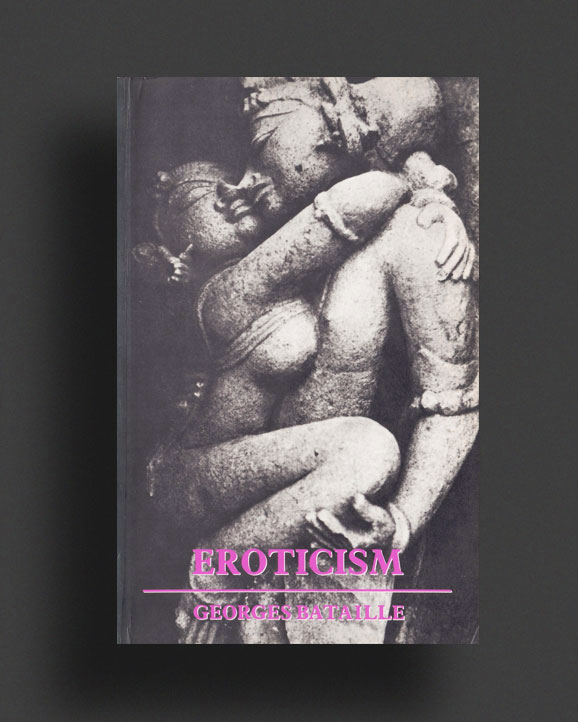
1987, English
Softcover, 276 pages, 20.5 x 13 cm
1st Edition, Out of print title / used / very good
Published by
Marion Boyars / London
$65.00 - Out of stock
1987 Marion Boyars paperback edition.
Translated by Mary Dalwood.
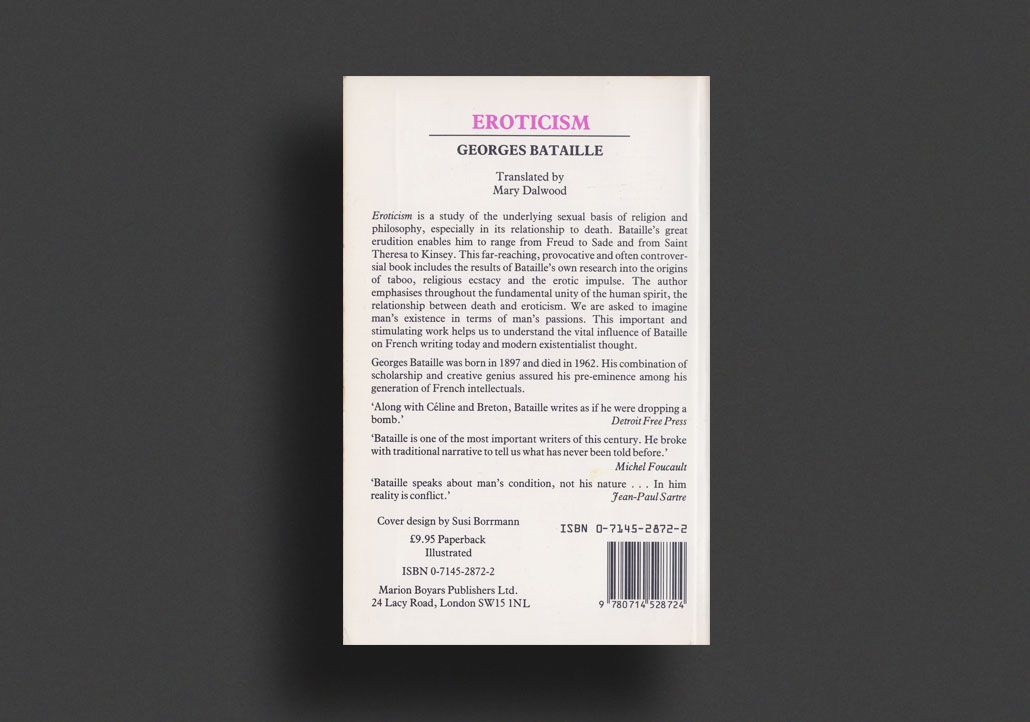
Eroticism is a study of the underlying sexual basis of religion and philosophy, especially in its relationship to death. Bataille's great erudition enables him to range from Freud to Sade and from Saint Theresa to Kinsey. This far-reaching, provocative and often controversial book includes the results of Bataille's own research into the origins of taboo, religious ecstacy and the erotic impulse. The author emphasises throughout the fundamental unity of the human spirit, the relationship between death and eroticism. We are asked to imagine man's existence in terms of man's passions. This important and stimulating work helps us to understand the vital influence of Bataille on French writing today and modern existentialist thought.
Georges Bataille was born in 1897 and died in 1962. His combination of scholarship and creative genius assured his pre-eminence among his generation of French intellectuals.
"Along with Céline and Breton, Bataille writes as if he were dropping a bomb."—Detroit Free Press
"Bataille is one of the most important writers of this century. He broke with traditional narrative to tell us what has never been told before."—Michel Foucault
"Bataille speaks about man's condition, not his nature... In him reality is conflict."—Jean-Paul Sartre
Very Good copy, tanning to page edges.
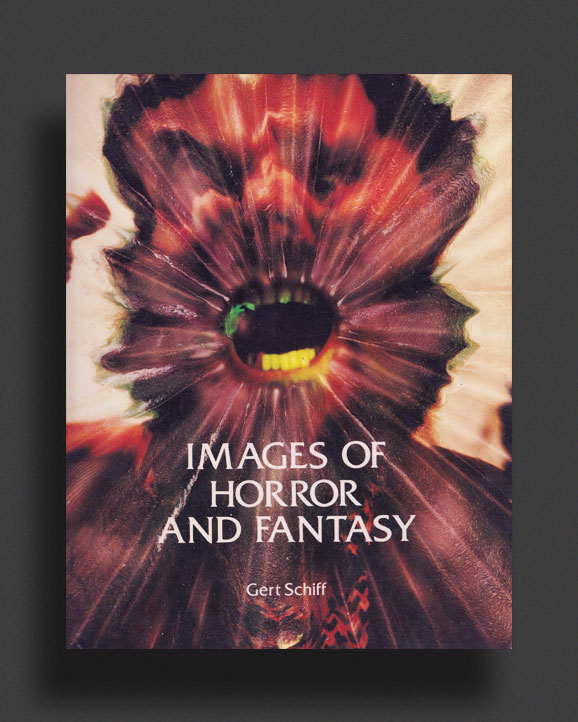
1980, English
Hardcover (w. dust jacket), 159 pages, 28 x 23 cm
1st Edition, Out of print title / used / very good
Published by
Academy Editions / London
$90.00 - Out of stock
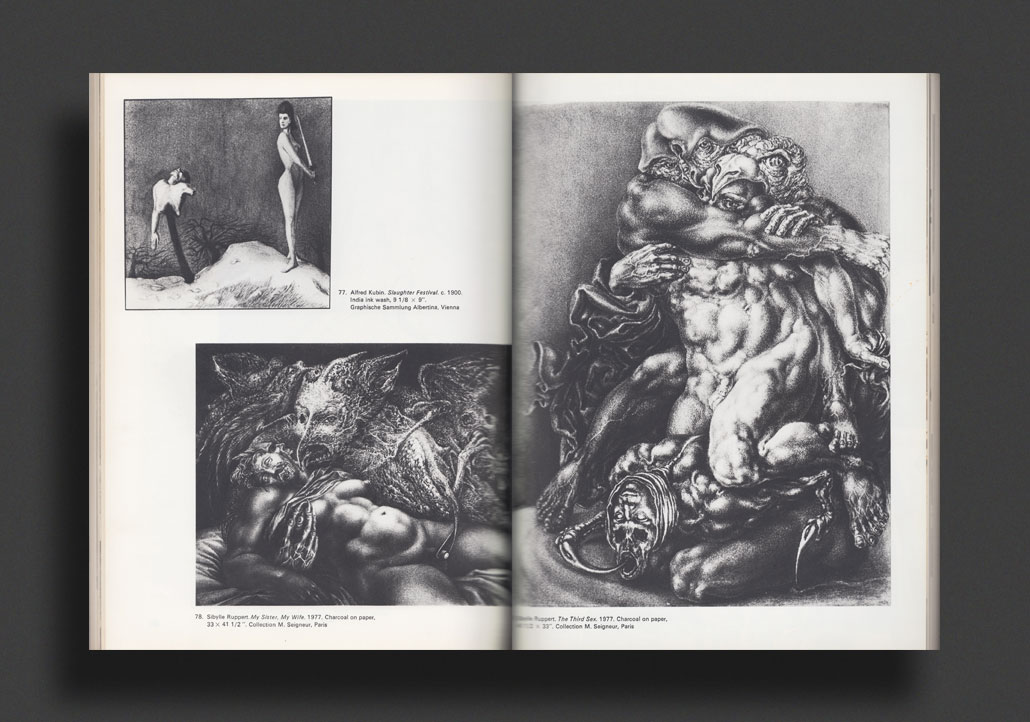
First UK hardcover edition published by Academy Editions in 1980, Images of Horror and Fantasy by art historian Gert Schiff expanded on a major group exhibition guest curated by Schiff at the Bronx Museum in 1977. The resulting publication is a perceptive critical and psychological analyses of a variety of nineteenth-and twentieth-century art that "unfolds simultaneously on the level of historical and social reality and on the level of dreams. Its purpose is to expose some of the principal anxieties of modern man and their resolution in utopian reveries and escapist fantasies."
Profusely illustrated in colour and b/w throughout with the works of Alfred Kubin, James Ensor, George Grosz, Paul Thek, Sibylle Ruppert, Henry Fuseli, Paul Delvaux, Nancy Grossman, Käthe Kollwitz, Max Beckmann, Fernand Khnopff, Rudolph von Ripper, Max Klinger, H. R. Giger, Jonah Kinigstein, Edward Keinholz, Jean Delville, Lucas Samaras, Miriam Beerman, Willem de Kooning, Man Ray, Oskar Kokoschka, Salvador Dali, Paolo Soleri, Jean Auguste Dominique Ingres, Georges Rouault, Otto Dix, Pablo Picasso, Philip Evergood, William Blake, Giorgio de Chirico, Ivan Albright, Yves Tanguy, Paul Klee, Jasper Johns, Germaine Richier, Francisco de Goya, Henri de Toulouse-Lautrec, Henri Matisse, Max Ernst, Francis Bacon, Rene Magritte, Illya Repin, Antoine Wiertz, Odilon Redon, Edward Burra, Larry Rivers, George Segal, Thomas Cole, Léon Frédéric, Matthias Grünewald, Rico Lebrun, Bruce Connor, Edvard Munch, and many more.
Gert Schiff (1926 — 1990, b. Oldenburg, Germany) was an art historian, critic, lecturer and professor at the Institute of Fine Arts of New York University. A specialist in the Romantic movement, particularly the work of Henry Fuseli and William Blake, Mr. Schiff was also very much involved with 20th-century art, organising many major exhibitions around his interests whilst authoring important studies on the arts from his dwellings at the Chelsea Hotel.
Very Good copy in VG dust jacket.
2017, English
Softcover, 256 pages, 22 x 27 cm
1st Edition, Out of print title / used / very good
Published by
The Tate Gallery / London
$80.00 - Out of stock
Alberto Giacometti (1901–1966) is one of the few artists of the last century whose work is almost more recognizable than his name. His distinctive elongated figures are well known, and appear in major museum collections worldwide. However, the story of Giacometti’s evolution, from his first professional works of art through his surrealist compositions to the emergence of his mature style, has rarely been explored fully and in depth. This comprehensive overview of his career focuses on the art, the people, and the events that influenced him, and on the original and experimental way in which he approached and developed his work. An illustrated glossary of texts on his life and art is accompanied by a plate section of strikingly beautiful illustrations of his sculptures, paintings, and drawings as well as sketchbooks, decorative works, photographs, and studio ephemera, much of which have never been published before. This accessible survey is the definitive resource for fans of the artist.
Out-of-print, first edition, Very Good copy with light cover wear.
2001, English
Softcover, 83 pages, 22 x 27.5 cm
1st Edition, Out of print title / used / very good
Published by
Skira / Milan
The Drawing Center / New York
$350.00 - In stock -
Exceptionally collectible, first-ever English translation of this Michaux classic, very quickly out-of-print and now virtually impossible to get.
One of the key works of the poet and artist Henri Michaux (1899-1984) whose original approach intertwines the written word with his visionary paintings and drawings.
First published in 1972, this English language translation of Henri Michaux’s celebrated book Émergences- Résurgences has been published on the occasion of the exhibition Untitled Passages by Henri Michaux organized by The Drawing Center in New York.
Part essay, part poem—by turns lyric, ekphrastic, didactic, gnomic, and comic—it is also one of Michaux’s most sustained self-portraits.
Very Good copy. Lightly tanned.
2001, Japanese
Softcover (w. original glassine jacket), 234 pages, 20.3 x 24.6 x 2.2 cm
1st Edition, Out of print title / used / fine
Published by
Museum of Modern Art / Toyama
$140.00 - Out of stock
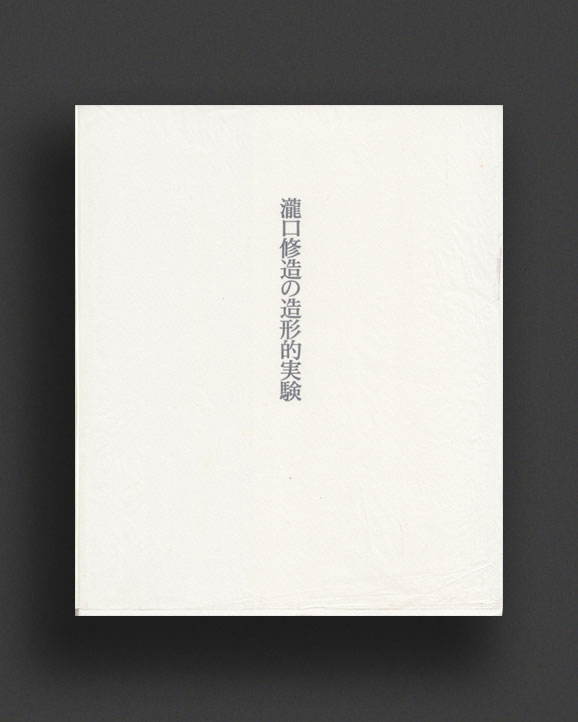
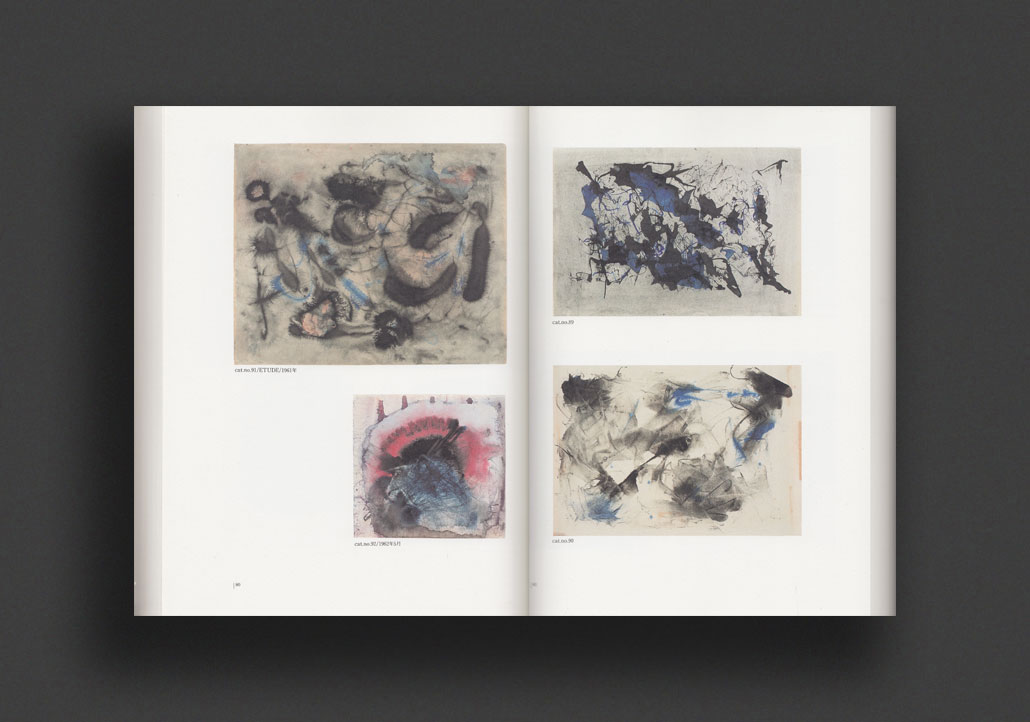
Very scarce comprehensive catalogue published on the occasion of a major survey exhibition of Japanese Surrealist Shūzō Takiguchi (1903 – 1979), held at the Museum of Modern Art, Toyama and the Shoto Museum of Art, Shibuya from 2001 to 2002. Lavishly illustrated throughout with meticulous chronological detail, this exhaustive published survey of Takiguchi's archives of paintings and drawings remains the most comprehensive study of Takiguchi's art to date. Includes many biographical and analytical texts in Japanese, alongside portraits and biography. Exhibition leaflet inserted. Book in original glassine cover to protect dust jacket.
Born in Toyama Prefecture in 1903, Shūzō Takiguchi worked extensively as a poet, art critic, and artist. He was a leading Japanese authority on surrealism, instrumental to the its introduction and proliferation in Japan, and was a pillar of theoretical and spiritual support for the Japanese avant-garde from the pre- to post-war periods. While a student at Keio University (1930), Takiguchi translated the entirety of Andre Breton's "Surrealism and Painting", and later organized the Overseas Surrealist Works Exhibition with Yamanaka Sansei (1937). He provided leadership for many avant-garde groups, but was marked as dangerous by the Special Police and was arrested and detained in 1941. After the war, he began offering new experimental outlets for young postwar avant-garde artists who lacked opportunities for presenting their work in formats other than group exhibitions. He traveled to Europe as Japanese commissioner for the Venice Biennale in 1958, where he voted for Lucio Fontana. A prolific experimental poet and correspondent with Breton and Duchamp, Takiguchi devoted his life to exemplifying the Surrealist movement in its orthodox form. Takiguchi's own artistic work illustrated the covers and pages of many important avant-garde journals in Japan, and he held five solo exhibitions, but until this important retrospective most of his visual output had not seen light outside his own personal archive. His central works were decalcomanias, immediate impressions made with paints and inks pressed between glass and paper, which he began making around 1960. Decalcomania as a technique was adopted heavily by the Surrealists to create imagery by chance rather than through conscious control. Takiguchi's unadorned, prolific use of this technique in creating direct abstractions exemplified this approach. "It represents freedom of action, no matter how small and, freedom is always necessary." - Takiguchi (1961)
Very Good copy.
1962, German
Hardcover (w. dust jacket + signed lithograph), 58 pages, 21.5 x 21.5 cm
Signed,
1st Edition, Out of print title / used / very good
Published by
Sydow-Zirkwitz / Frankfurt
$90.00 - Out of stock
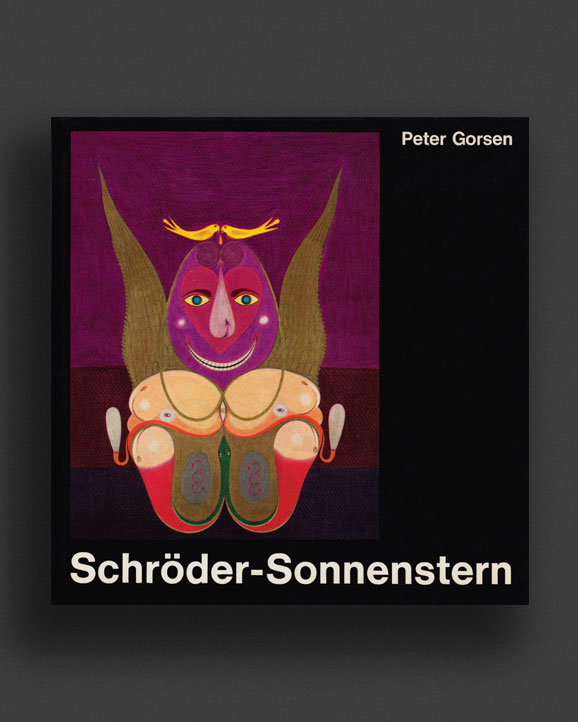
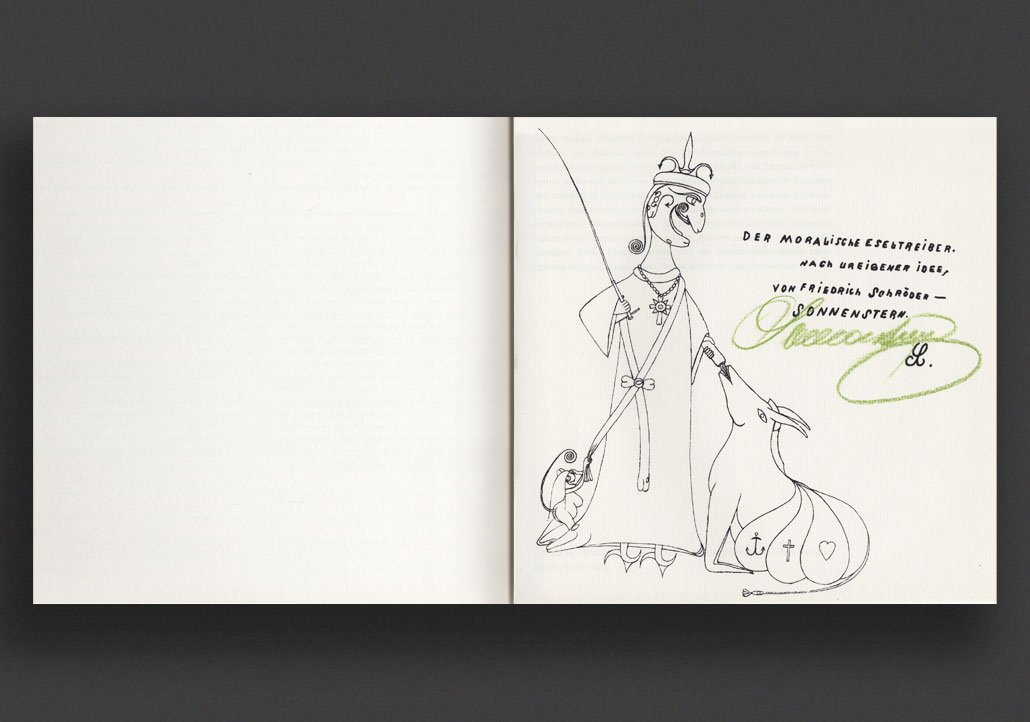
First 1962 hardcover edition of the first definitive study ("An Interpretation") of German artist Friedrich Schröder-Sonnenstern (1892—1982), considered one of the most important representatives of Art Brut or Outsider Art, by Austrian art historian Peter Gorsen (1933—2017) who studied under Theodor W. Adorno and Jürgen Habermas at the University of Frankfurt. This is one of 999 numbered copies from the limited first print edition of 1100, each with a loosely inserted original serigraph by the artist, boldly signed in green crayon. No. 750.
Friedrich Schröder-Sonnenstern was a draftsman, painter and poet-philosopher. Born in 1892 in East Prussia, one of thirteen children, all of whom apart from one other died shortly after birth. He was sent to a number of reform schools due to accusations of theft and violent behaviour and then, at the age of twenty-six, he was diagnosed with schizophrenia and committed to a sanatorium. His experiences as a child contributed to his lifelong hatred of authority. One year later he showed up in Berlin, where he occupied himself with occultism, divination and healing magnetism. He founded a sect and distributed its income in the form of bread rolls to poor children, earning him the title "Schrippenfürst of Schöneberg". He created the name Sonnenstern (English: Sun Star) for himself while working as a con-artist, posing as a Quack doctor in "natural health", calling himself Professor Dr. Eliot Gnass von Sonnenstern. This career path was cut off by the Nazis' interdiction of occult practices, and after being confined in psychiatric institutes and in a penal camp, Schröder-Sonnenstern reemerged in 1944, scavenging firewood in the bombed-out German capital. Only in his late fifties, in 1949, did he begin to draw, using coloured pencils to create allegorical grotesques stocked with a personal iconography. Although his art was rarely shown, he was championed in Surrealist and art brut circles; Jean Dubuffet and Hans Bellmer were among his admirers, and a few drawings were included in Marcel Duchamp and André Breton's 1959 "Exposition inteRnatiOnale du Surréalisme" in Paris. The demand for his pictures by collectors and gallerists rose rapidly and he resorted to employing assistants to produce his work for him. His success was short-lived when he began to paint less and less and became the victim of counterfeiting cliques by his assistants, destroying his position in the art market. He became increasingly dependent on alcohol following the death, in 1964, of his long-time companion, Martha Möller whom he called Aunt Martha. He died almost forgotten and impoverished in 1982 in Berlin.
Very Good copy in good dust jacket — back cover corner tear-off, otherwise VG.
1981, German
Softcover (staple-bound), 20 pages, 22 x 21 cm
1st Edition, Out of print title / used / very good
Published by
Nürnberg Archiv für bildende Kunst / Nürnberg
$60.00 - In stock -
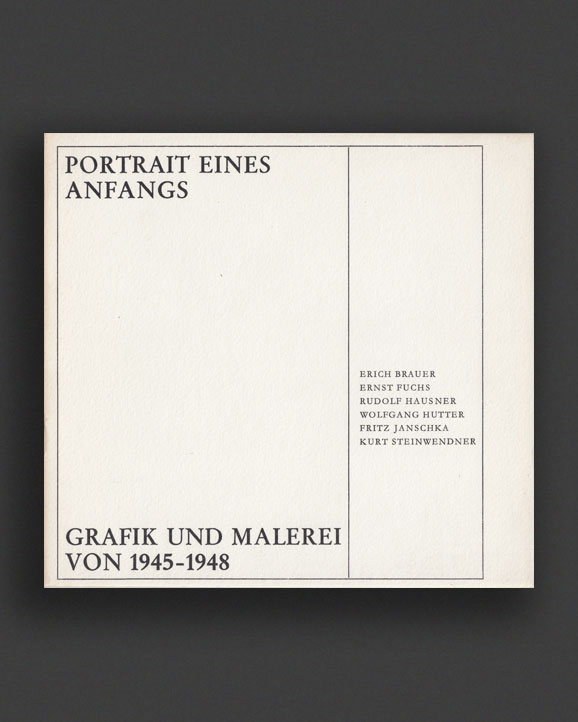
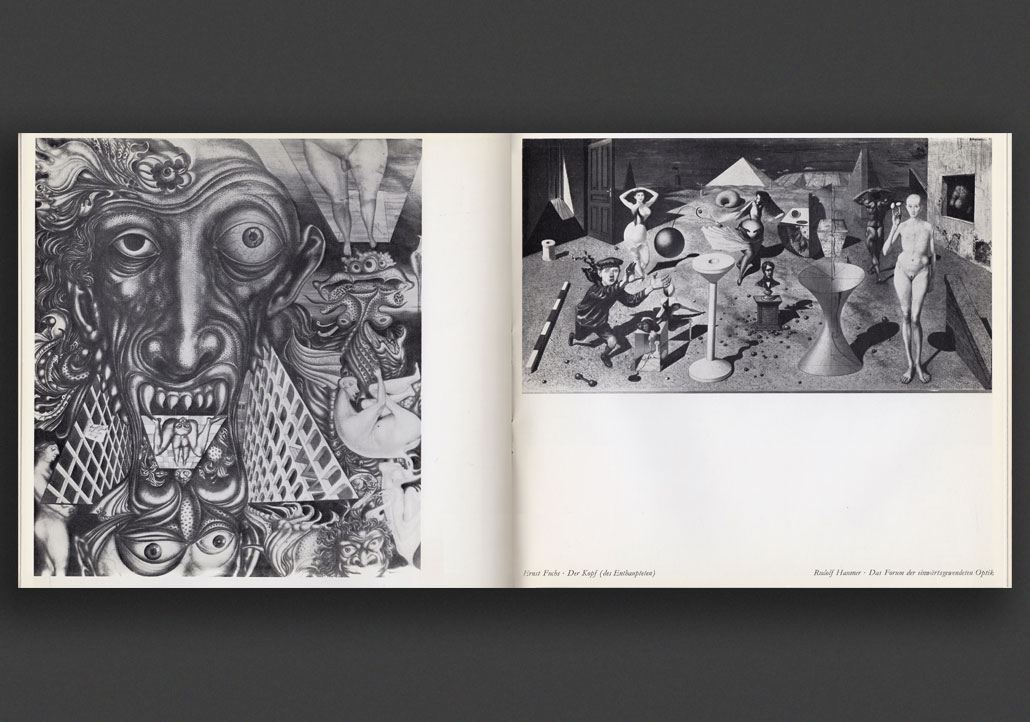
Lovely catalogue published in 1981 by Nürnberg Archiv für bildende Kunst, showcasing the early works of a number of the leading members of the Vienna School of Fantastic Realism — Erich Brauer, Ernst Fuchs, Rudolf Hausner, Wolfgang Hutter, Fritz Janschka, along with Austrian film director and avant-garde artist Kurt Steinwendner. A number of works are illustrated by the featured artists, in b/w. Includes essay by Austrian art critic Johann Muschik and full catalogue of the exhibited works by each artists.
The Vienna School of Fantastic Realism is a group of artists founded in Vienna in 1946. The group's name was coined in the 1950s by Johann Muskik, and the first exhibition was in 1959 at the Vienna Belvedere. This Austrian movement has similarities to Surrealism in its use of religious and esoteric symbolism and also the choice of a naturalistic style, countering the prevalence of abstract art movements at the time.
Artists include Ernst Fuchs, Maître Leherb (Helmut Leherb), Arik Brauer, Wolfgang Hutter, Anton Lehmden, and Israeli artist Zeev Kun, all students of Professor Albert Paris Gütersloh at the Vienna Academy of Fine Arts. Gütersloh's emphasis on the techniques of the Old Masters gave the "fantastic realist" painters a grounding in realism, similar to early Flemish artists such as Jan van Eyck.
Some older members of the group, including Rudolf Hausner, Kurt Regschek and Fritz Janschka, emigrated to the US in 1949, where Kurt Regschek helped organize the early exhibitions of the group in 1965. Hausner, Fuchs, Hutter, Brauer and Lehmden were referred to as "The Big Five" who subsequently held exhibitions internationally.
1967, Japanese
Softcover, 6 page card fold-out w. insert, 23.8 x 23.8 cm
1st Edition, Out of print title / used / very good
Published by
Tokyo Gallery / Tokyo
$100.00 - In stock -
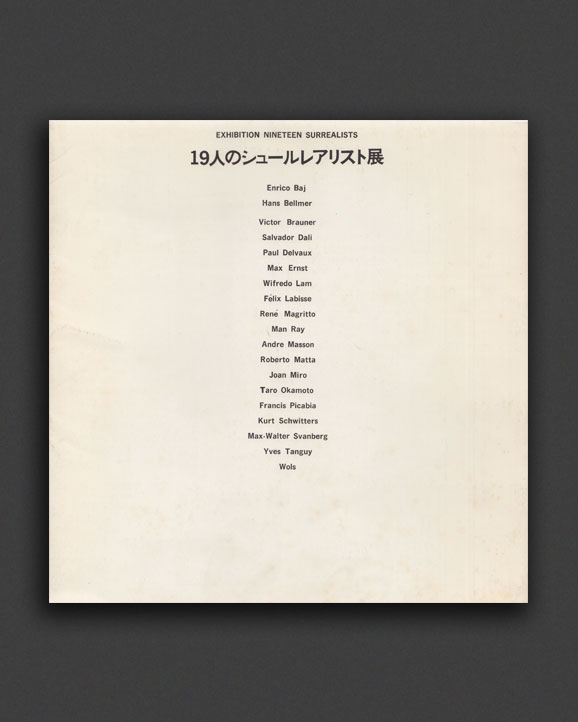
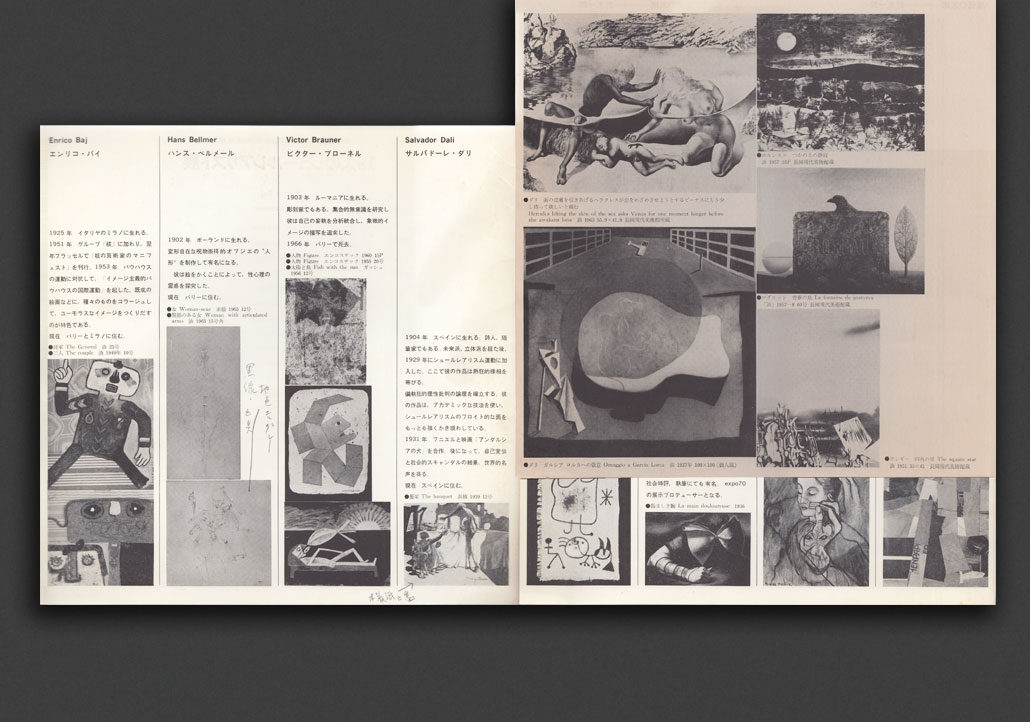
Incredibly scarce catalogue published on the occasion of the 1967 exhibition "19 Surrealists" held at Tokyo Gallery, Japan. Fold-out catalogue with insert, illustrated with the exhibited works (along with biographies in Japanese) by Enrico Baj, Hans Bellmer, Victor Brauner, Salvador Dali, Paul Delvaux, Max Ernst, Wifredo Lam, Felix Labisse, René Magritte, Man Ray, Andre Masson, Roberto Matta, Joan Miro, Taro Okamoto, Francis Picabia, Kurt Schwitters, Max-Walter Svanberg, Yves Tanguy, Wols.
Very Good with light wear and mild spotting and a couple of pencil notations in Japanese. Preserved in sleeve.
1993, Russian / English / German
Softcover, 192 pages, 29 x 24 cm
1st Edition, Out of print title / used / very good
Published by
Artograph Verlag / Düsseldorf
$90.00 - Out of stock
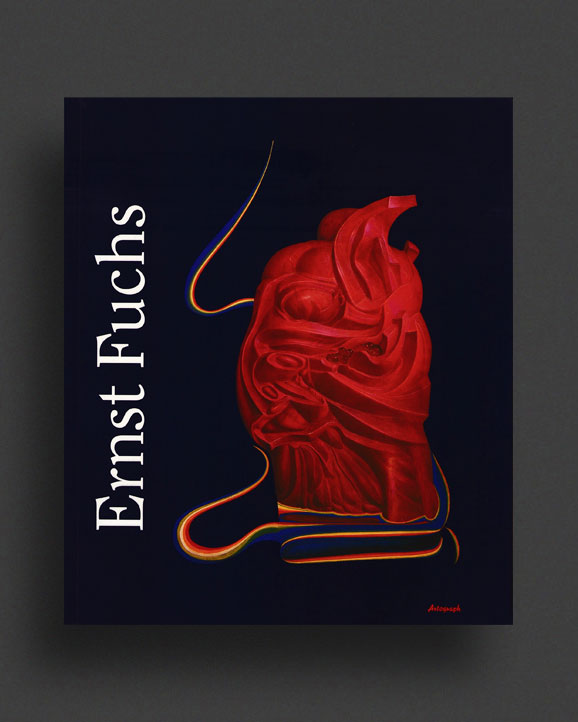
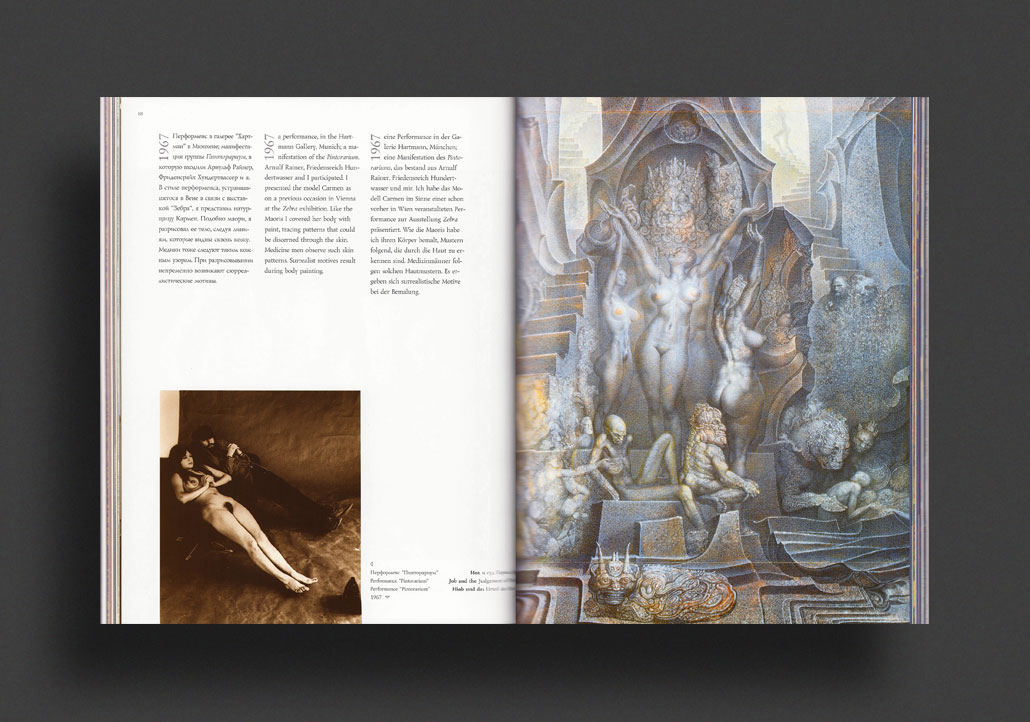
1993 monograph published on the occasion of the first Russian exhibition of works by leading representative of the "Vienna School of Fantastic Realism", the artist, poet, and philosopher Ernst Fuchs (1930 – 2015). Fantasia is lavishly illustrated throughout with bold colour examples and details of Fuchs fantastic paintings, drawings, graphics, sculptural and architectural works, surveying his entire life and career chronologically, including many photographic portraits of the artist, studio and home documentation, biography, with texts in English, Russian and German by Igor Jassenjawsky and Joseph Kiblitzky.
Ernst Fuchs (1930 – 2015) was an Austrian artist and draughtsman of Jewish descent, engraver and sculptor, architect and stage designer, master of visionary painting and book illustration, as well as a composer and poet. At the Academy of Fine Arts in Vienna (1945), he met Arik Brauer, Rudolf Hausner, Fritz Janschka, Wolfgang Hutter, and Anton Lehmden, together with whom he later founded what has become known as the Vienna School of Fantastic Realism. He was also a founding member of the Art-Club (1946), as well as the Hundsgruppe, together with Friedensreich Hundertwasser and Arnulf Rainer. Between 1950 and 1961, Fuchs lived mostly in Paris, and made a number of journeys to the United States and Israel, his work informed by the sermons of Meister Eckehart, the symbolism of the alchemists and Jung's Psychology of Alchemy, along with the paintings of the Symbolists and the Old Masters. In 1958 he founded the Galerie Fuchs-Fischoff in Vienna to promote and support the younger painters of the Fantastic Realism school. Fuchs was a important influence on younger generations of artists including his student in Paris, Australian artist Vali Myers. Painters Mati Klarwein and H.R. Giger were also devoted followers of his work, Giger once saying "If I had not seen his work when I was young, I would never have begun to paint myself."
Very Good copy with light wear.
2024, English
Softcover, 124 pages, 20 x 14 cm
Published by
Twisted Spoon Press / Prague
$38.00 - Out of stock
translated from the Polish by Ursula Phillips
collage artwork by Selena Kimball
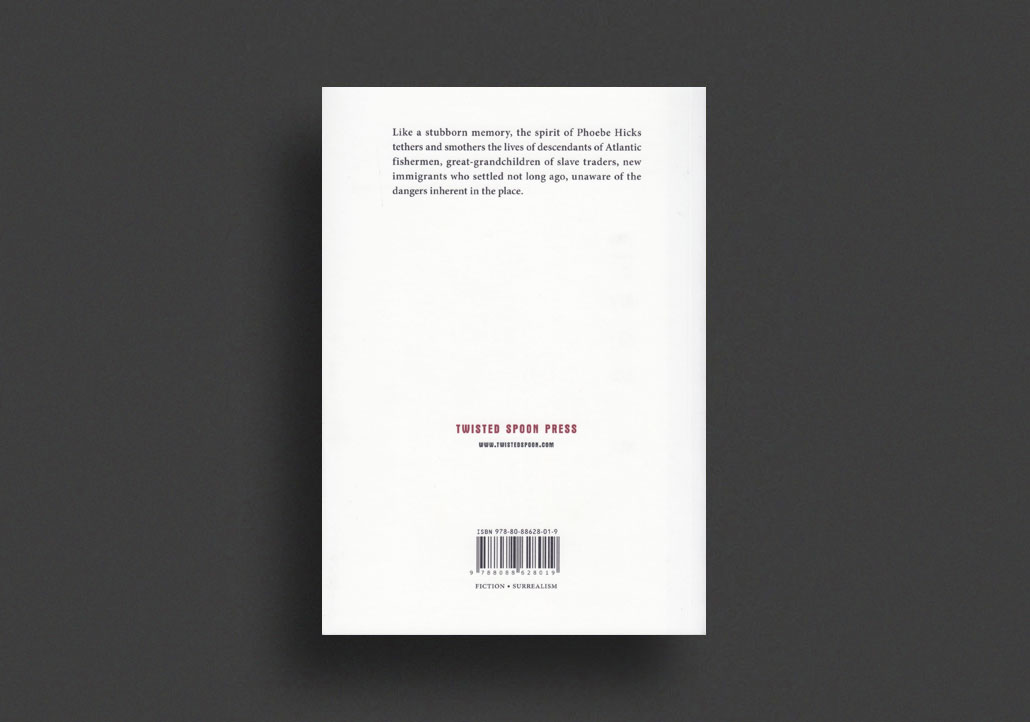
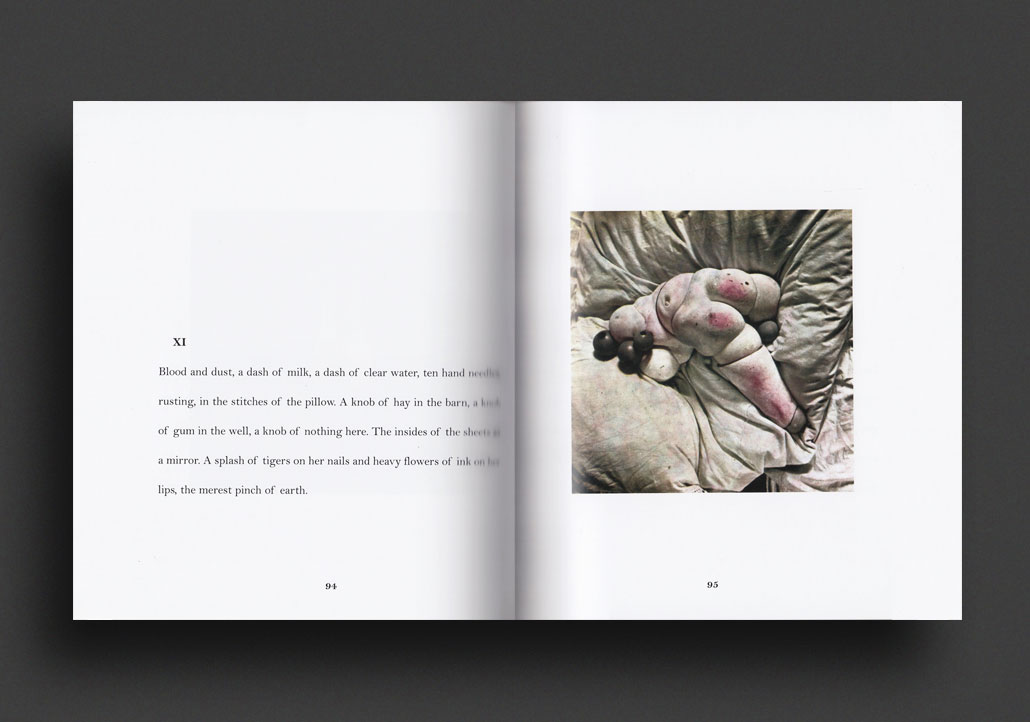
Phoebe Hicks owes her unexpected career as a spiritualist to a photograph taken of her through her bedroom window after having eaten spoiled clams. What comes out of her mouth is taken to be ectoplasm, and word spreads that she is able to commune with the dead. As the prototype for the medium, she establishes the standard for how a séance should be conducted during the sessions held in her Providence, Rhode Island, home where a growing number of curious participants witness materializations of such figures as Ivan the Terrible, Harry Houdini, Catherine the Great, Hatshepsut, Elizabeth Báthory, and a host of others. Told as a compilation of episodes conjoined with Selena Kimball’s haunting collages, The Unfinished Life of Phoebe Hicks is a feminist surrealist exploration of the rise of Spiritualism and the role of the medium in 19th-century America alongside the expectations, and constraints, imposed on women.
Frequent references to Victorian sexuality—from the corset to nocturnal emissions of ectoplasm—contribute to the work’s saucy sense of humor, as well as a larger statement about the role of Spiritualism in the history of women’s emancipation. As the narrator points out, seances and other such performances allowed women to speak publicly and subvert patriarchal social norms.—Jess Jensen Mitchell, Full Stop
This book – atmospherically interspersed with collages by Selena Kimball – stays with you long after the seance is over.—Mathilde Montpetit, The Berliner
Presented as a serious account—albeit with a healthy amount of wry humour—of the role of this somewhat mysterious medium in the early years of spiritualist practice, the portrait that emerges is of a woman for whom the boundary between the world of the spirit and the world of the flesh has become somewhat permeable.
—Joseph Schreiber, roughghosts
What is not strange, what feels contemporary about this fictionalized biography are the reasons why almost any woman without economic and social security would become a medium: In their “trance” stage, with spirits speaking through them, mediums could say things to their guests they otherwise couldn’t get away with. A woman could be “odd” and not have to worry satisfying a whole set of social conventions that otherwise would leave her destitute.—Tom Bowden, Book Beat
Surreal, funny, unnerving, thought-provoking and a wonderful read from beginning to end, The Unfinished Life of Phoebe Hicks is a marvellous book and I highly recommend it!—Kaggsy's Bookish Ramblings
Agnieszka Taborska, otherwise innocent, has, during her annual pilgrimage into “the murky back-streets of Providence,” shamelessly consorted with the spirits of such infamous locals as Poe, Lovecraft, and Hawkes, giving spiritual birth to the charmingly eerie nineteenth-century medium, Phoebe Hicks. Phoebe’s story, which, the author says, “seems to belong more to dream than reality,” is a delightful postmodernist mix of fiction and history, hovering delicately between parody and mystery. Taborska’s fictional character Leonora de la Cruz makes a guest appearance, Harry Houdini challenges Phoebe to a kind of duel, and Alain Resnais, we’re told, had intended to make Phoebe the heroine of his 20th-century film Providence, scared off perhaps by her “disturbing ambiguity.” Phoebe is by turns a genuine communicant with the spiritual world, a fraud, an artist, a feminist, a psychiatrist, a lunatic. She can also be, thanks to her ethereal deadpan humor, very funny.—Robert Coover
Agnieszka Taborska and artist Selena Kimball’s fictional heroines are clairvoyant women whose internal visions are projected externally through art and are conditioned by the scientific contexts of their eras.—New Literature from Europe
It turns out that spiritualism is not so far from surrealism as it might seem. The surrealists, using their imagination, tried to break the shackles of social order, abolish the binding rules, and get out of the roles imposed from above. This transgressive element is equally important in the case of spiritualist séances, as Taborska notes, such a séance could be for the medium "entering with impunity roles inaccessible to her in waking life."
—Sarah Nowicka, Art Papier
It is a story about women's powers, or the career paths available to women at that time. About the eroticism hidden behind Victorian morality. About our desire for the extraordinary.—Kinga Dunin, Journal of Opinions
The spirit of surreal eeriness seems to coexist quite well with the ghosts that haunt our heads as well.—Mark Zaleski, Biweekly.com
2024, English
Softcover, 174 pages, 19.5 x 13.5 cm
Published by
Twisted Spoon Press / Prague
$36.00 - Out of stock
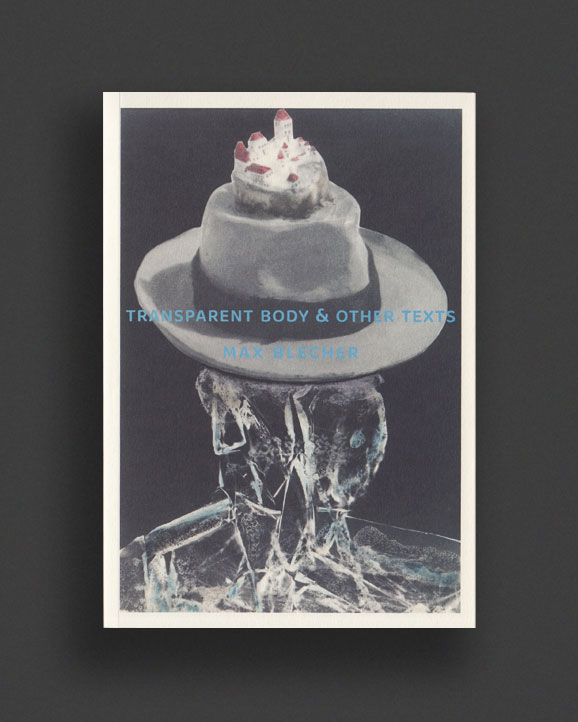
translated from the Romanian by Gabi Reigh
cover and frontispiece images by Jindřich Heisler
Blecher's very first book, the poetry collection Transparent Body, appeared in 1934, in a limited edition for bibliophiles. Yet general recognition as one of the most inventive European writers of his day came only with the publication of two of his three "novels" a few years later. And then he died, at the age of twenty-eight. But since 1930 Blecher had been publishing his poetry, short prose, essays, critiques, and other texts in the leading Romanian periodicals, some even appearing in important French publications, such as Le Surréalisme au service de la révolution. In addition, the past half century has seen the posthumous first publication of many texts in a variety of Romanian editions.
Transparent Body & Other Texts brings together Blecher's entire output of poetry and short prose, from the earliest texts published during his lifetime to those appearing for the first time only recently. They range from stories in the vein of his fantastical, hallucinatory longer work to aphorisms, reportage, and notebook fragments. The volume also includes a selection of his correspondence with such major figures of Romanian interwar modernism as Geo Bogza, Ilarie Voronca, and Saşa Pană to give a fuller picture of Blecher's engagement with the avant-garde and literary life even as his health was progressively deteriorating over the course of the 1930s.
The only thing more magical than receiving a letter from a friend is reading the letters of a writer you admire, and feeling as if they were sent to you. [...] Reading Blecher’s work 80 years after his death feels as intimate and resonant as catching up with an old friend who has suffered and cared deeply.—Amanda L. Andrei, SEEfest
1972, Japanese
Softcover, 122 pages, 21.5 x 15 cm
1st Edition, Out of print title / used / good
Published by
Lemon Inc. / Tokyo
$45.00 - In stock -
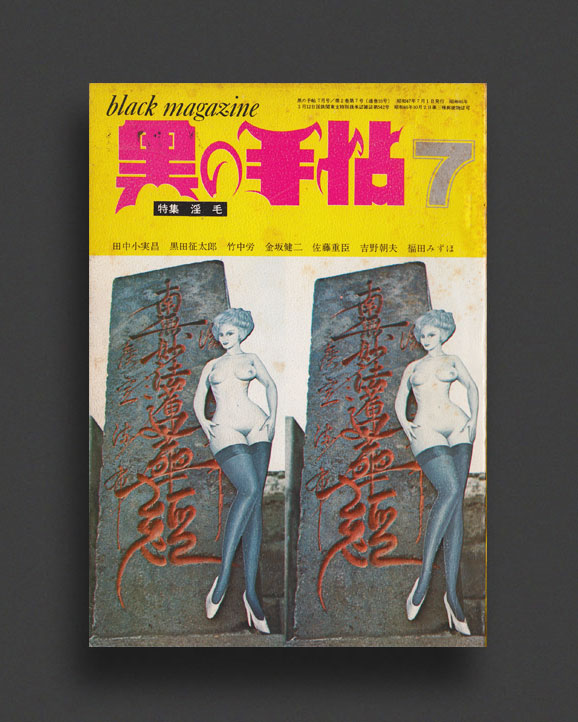
July 1972 issue of legendary Japanese underground arts periodical, Black Magazine (or Black Notebook), a taboo-shattering vehicle of the 1970s subculture in Tokyo. A magazine like no-other, each issue, "a paradise of 1970's heretical culture", was a who's who of non-conformity, introducing a new wave of illustrators, painters, doll-makers and photographers, "taboo" sexuality and fetish culture, avant-garde comics, sadistic literature, radical criticism, queer poetry, activism, black humour, underground film and theatre, and all manner of transgressive, esoteric and erotic material, new and historical. Black Magazine featured the work of Yukio Mishima, Toshio Saeki, Izumi Suzuki, Simon Yotsuya, Shūji Terayama, Ken Katayama, Nobuyoshi Araki, Genpei Akasegawa, Keiichi Tanaami, Kikuji Yamashita, Aoi Fujimoto, Tadanori Yokoo, Hiroshi Nakamura, and so many others. It was also where Japanese photographer Satomi Nihongi's Tokyo Transgender photographs were first printed. Black Magazine was heavy with queer and trans content, and Nihongi's "The Most Beautifuls" was a regular photo-feature in its pages. A lot of great things started in the pages of this unique magazine. A highly recommended publication!
2005, English
Softcover, 145 pages, 15.24 x 16.51 cm
1st Edition, Out of print title / used / very good
Published by
Archipelago Books / New York
$90.00 - Out of stock
Rare First English translation, long out-of-print.
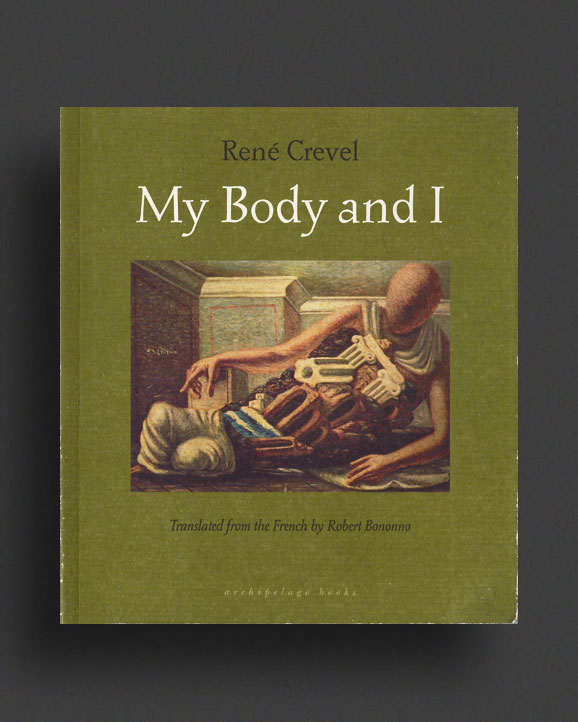
Translated from French by Robert Bononno.
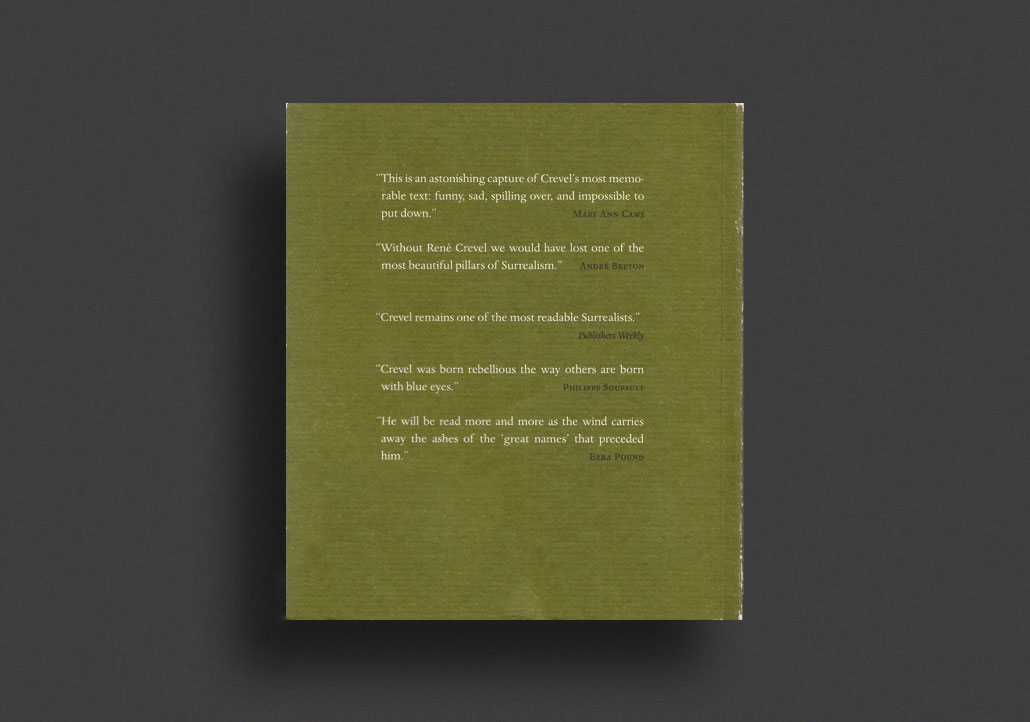
In My Body and I (Mon Corps et Moi, 1925), René Crevel attempts to trace with words the geography of a being. Exploring the tension between body and spirit, Crevel’s meditation is a vivid personal journey through illusion and disillusion, secret desire, memory, the possibility and impossibility of life, sensuality and sexuality, poetry, truth, and the wilderness of the imagination. The narrator’s Romantic mind moves from evocative tales to frank confessions, making the reader a confidant to this great soul trapped in an awkward-fitting body. A Surrealist Proust.
“Without René Crevel we would have lost one of the most beautiful pillars of surrealism.”—André Breton
“The works that Crevel left us indicate that he was one of the most original, gifted French novelists of the century.”—San Francisco Bay Guardian
“Crevel remains one of the most readable Surrealists…His liquid language tumbles along, powered by his strong descriptions, by his love of Freudian wordplay—rarely is a cigar just a cigar.”—Publishers Weekly
Very Good copy with light wear.
1968 / 1969, Japanese / French
4 Vols., softcover, approx. 1000 pages, 23 x 18 cm
1st Edition, Out of print title / used / very good
Published by
Tensei Shuppan / Tokyo
$350.00 - Out of stock
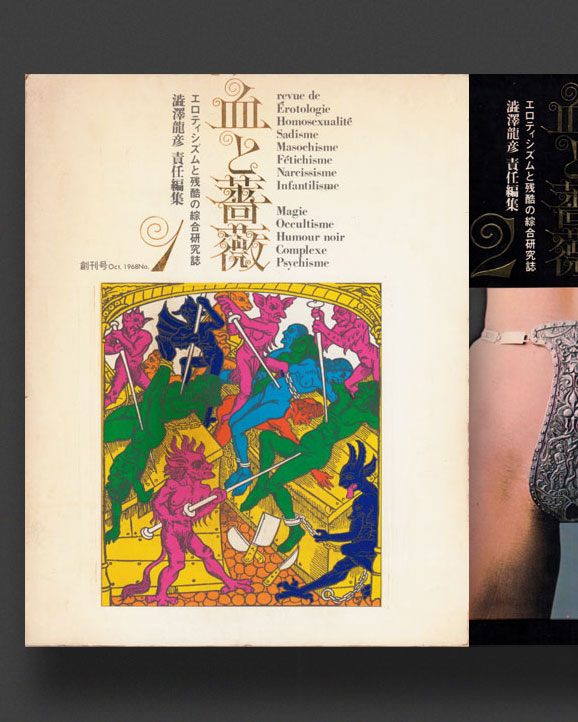
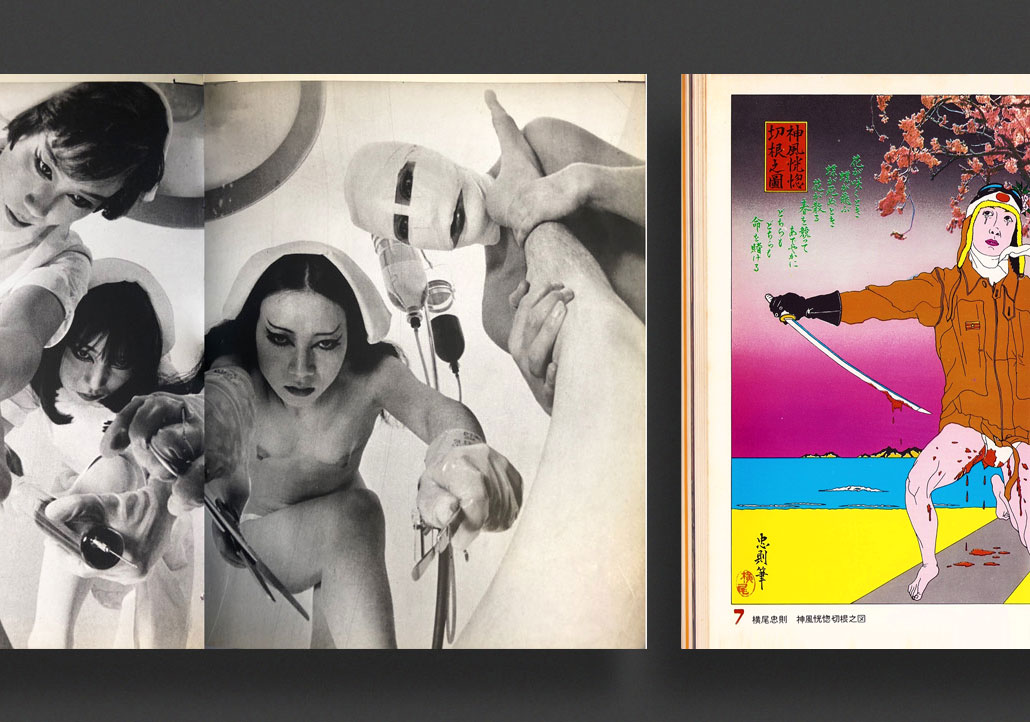
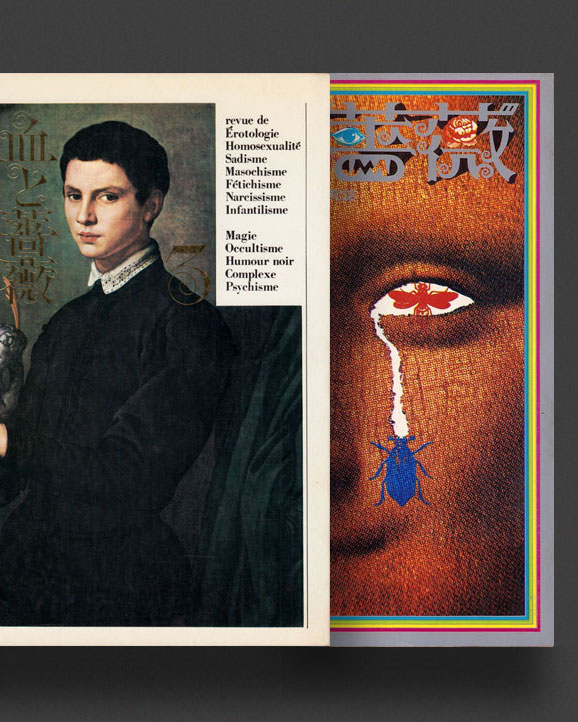
Complete 4 issue run of Le Sang Et La Rose — a masterpiece of the Japanese underground! Opening with Kishin Shinoyama's photographic portraits of Yukio Mishima depicted as Saint Sebastian and onward through one thousand pages exploring the outer limits of subversive human potential!
Revue de Érotologie, Homosexualité, Sadisme, Masochisme, Fétischisme, Narcissime, Infantilisme, Magie, Occultisme, Humour Noir, Complexe Psychisme. What more could you ask for? Le Sang Et La Rose was a groundbreaking, yet short-lived Japanese arts and literary journal published in Tokyo from late 1968—mid 1969, published in a total of four luxurious, now collectible, volumes. The first three issues were edited by Tatsuhiko Shibusawa (1928—1987), a legendary, controversial Japanese novelist, art critic, translator of French writers such as Jean Cocteau, Georges Bataille and Marquis de Sade, and specialist in medieval demonology. The fourth final issue, and rarest of the four, edited by critic Masaaki Hiraoka and designed by self-taught painter, graphic designer and political activist, Kiyoshi Awazu (!) The importance of this magazine to the Japanese avant-garde and radical culture cannot be overstated.
Born from a period of political, social and economical turmoil in Japan, Le Sang Et La Rose may be understood as a emblematic distillation and product of the late ‘60s student rebellion and anti-authoritarian underground culture. Wilfully politically subversive, the publication drew upon a vast range of perspectives - from criticism, literature, obscure esoteric sciences, art, eroticism, radical avant-garde and a historical-rooted Japanese counterculture; featuring literature, theory, art, photography, illustration and graphic design from the most innovative and subversive Japanese and international (predominately French) artists, authors and critics, spanning the themes above. As instigator, Tatsuhiko Shibusawa in effect formulated the magazine’s design to be a spiritual and political operative that would weaponize its readers minds. This stance was made clear in the 1969 manifesto text — "My 1969" — in which Shibusawa discuss' how he perceived the ‘60s as being the age of ideas, ideas as weapons, and outlined a distain towards systems of power, moralism, State oppression, sanitised and harmless liberalism, dogmatic academic sciences and an outright distrust for ideological, progressive literary scholars who advocate "freedom of expression", but have never caused friction with the judicial power. The magazine sketched out an aim to push towards a new kind of personal freedom, intellect, autonomy and moral compass. Here, the concept of ‘erotism’ — as discussed by Georges Bataille in his highly influential 1957 book "Erotism: Death and Sensuality" — acts as a critical force.
Tatsuhiko Shibusawa (1928—1987), was a well-known and controversial Japanese novelist, art critic, and translator of French writers such as Jean Cocteau, Georges Bataille and Marquis de Sade. In 1960 he and his publisher, Kyōji Ishii, were trialled for public obscenity over the publishing of Shibusawa's translation of de Sade's Juliette into the Japanese language. What was to be known as the "Sade Trial" took 9 years and although many of Japan's leading authors testified for the defense, in 1969 the Japanese Supreme Court ruled them guilty and charged. This did not deter Shibusawa, whose essays on black magic, demonology and eroticism were popular reading in Japan, and in 1981 he was awarded the 9th Izumi Kyoka Literature Prize.
All Good—VG copies with general wear and age.
Vol 1 with bumping and open chip to top of spine.
1993, Japanese
Softcover, 240 pages, 21 x 15 cm
1st Edition, Out of print title / used / very good
Published by
Atelier Peyotl / Tokyo
$65.00 - Out of stock
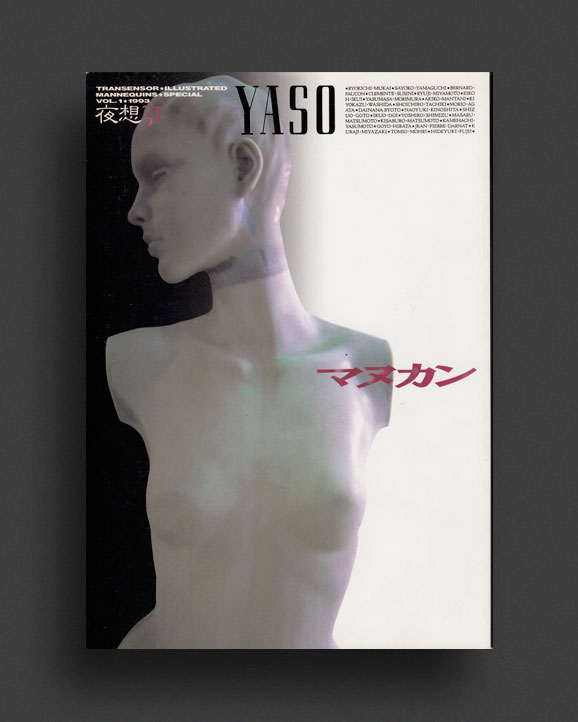
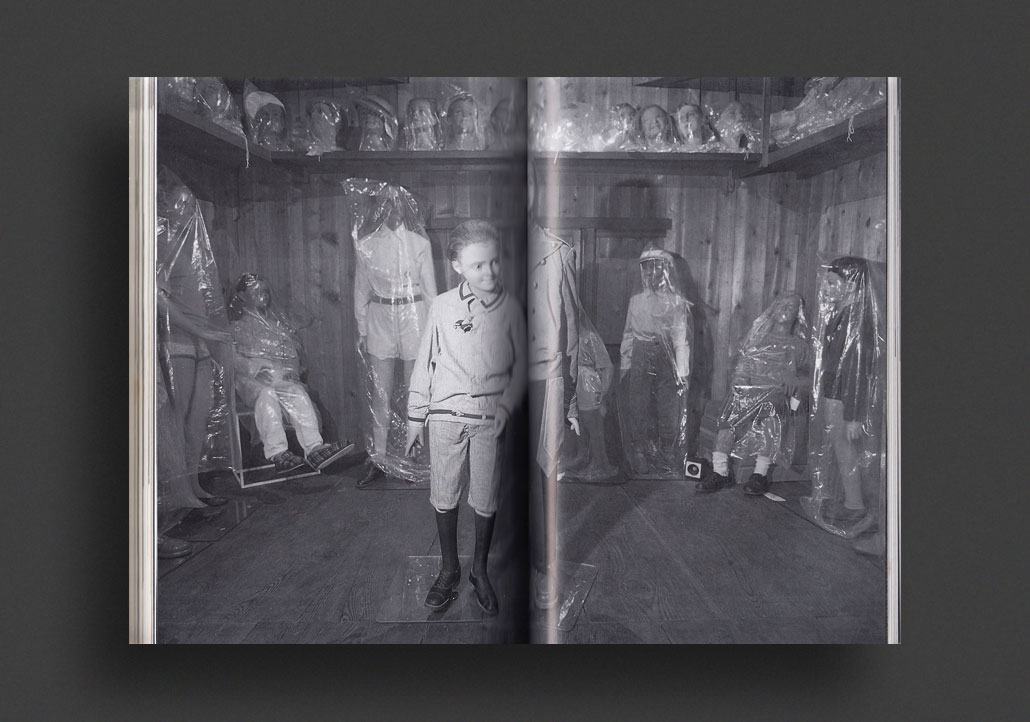
"Mannequin" Special Feature Issue of cult Japanese underground magazine Yaso, published in 1993, edited by Yuichi Konno and Atelier Peyotl (publishers of Night Vision/Yaso/Peyotl/Wave/Silvester Club...). Heavily illustrated with texts in Japanese that look at the theme of the mannequin from fashion apparatus to fetish object, automatons to living dolls, including a panoramic photographic history of mannequins, a photo feature of French photographer Bernard Faucon's boy mannequin collection, a huge illustrated article on famous Japanese costume, stage and exhibition designer, and Issey Miyake collaborator Tomio Mohri, the wax anatomical models of dissected corpses by Clemente Michelangelo Susini of Florence (1754–1814) shot by Ryuji Miyamoto, Czech animator Jirí Barta's Klub odlozenych, Japanese model and actress Sayoko Yamaguchi, the living dolls of the Japanese theatre, medical mannequins, crash-test dummies, icons, "Doll Love" and erotic dolls, plus lots more and a lot more Bernard Faucon!
Very Good—Near Fine copy.
1996, English
Softcover, 176 pages, 23 x 21 cm
1st Edition, Out of print title / used / average
Published by
Atlas Press / London
$85.00 - Out of stock
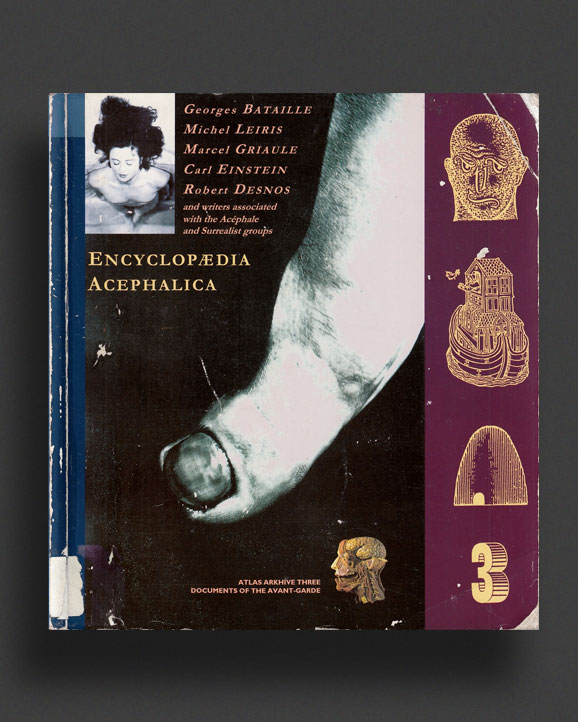
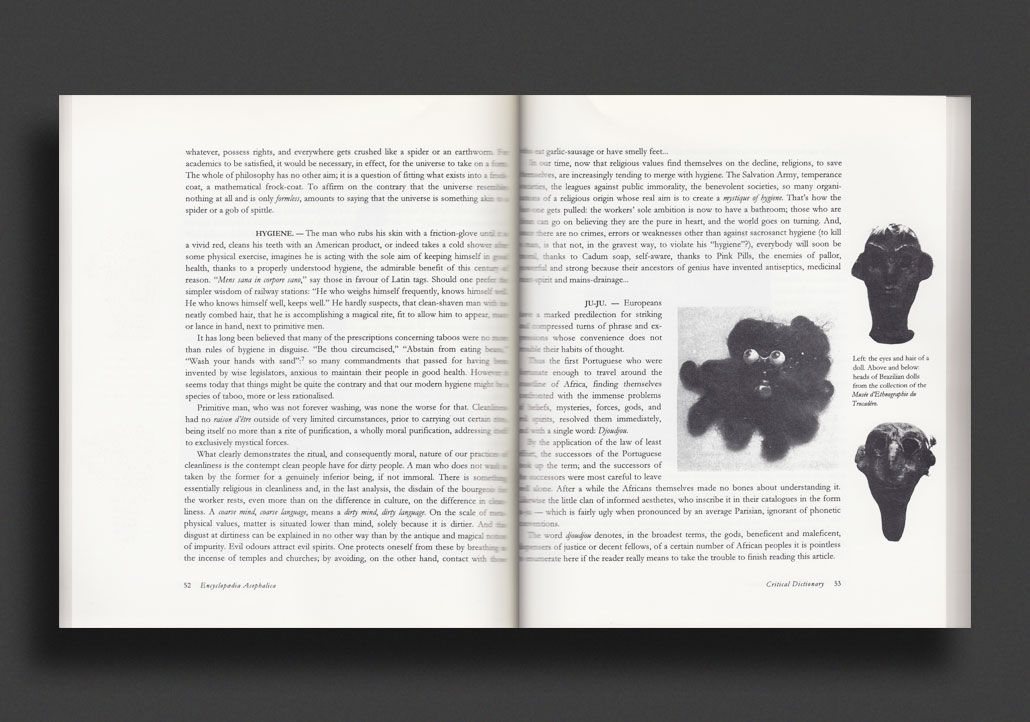
First edition of the incredible and sadly long out-of-print Encyclopedia Acephalica, published by Atlas Press in 1996 as part of their mighty Atlas Arkhive : Documents of the Avant Garde series.
Bataille’s thought is complex, and his books make few concessions to the reader. The first series of texts here, however, were written for a wider audience by Bataille and his friends, in the form of a Critical Dictionary, and they provide a witty, poetic and concise introduction to his ideas. The Dictionary appeared in the magazine edited by Bataille, Documents, in the early 1930s, and includes entries from prominent ethnologists and cultural commentators of the day. The second series of texts here, the Da Costa Encyclopédique was published anonymously after the liberation of Paris in 1947 by members of the Acéphale group and writers associated with the Surrealists. Both cover the essential concepts of Bataille and his associates: sacred sociology; scatology, death and the erotic; base materialism; the aesthetics of the formless; sacrifice, the festival and the politics of the tumult etc: a new description of the limits of being human. Humour, albeit, sardonic, is not absent from these remarkable redefinitions of the most heterogeneous objects or ideas: Camel, Church, Dust, Museum, Spittle, Skyscraper, Threshold, Work – to name but a few.
While the Documents group was celebrated for joining together artists, authors, sociologists and ethnologists (among the most important of their time) in a literary and philosophical project, the Acéphale group was more mysterious. Until recently even its membership was only vaguely known, and its activities remained secret (these are explored in detail for the first time in English in The Sacred Conspiracy, published by Atlas Press, also available at World Food Books). The origins of the Da Costa only became known in 1993, the present volume revealed for the first time its principal compilers: Robert Lebel, Isabelle Waldberg and Marcel Duchamp, but the identity of the authors of a large part of it is still unknown.
Texts by Georges Bataille, Michel Leiris, Marcel Griaule, Carl Einstein, Robert Desnos and writers associated with the Acéphale and Surrealist groups.
Introduced by Alastair Brotchie. Translated by Iain White, Dominic Faccini, Annette Michelson, John Harman, Alexis Lykiard.
Average—Good, cover with edge and corner wear and some some damages from spine sticker removal, fuzzed corners, otherwise Good pre-loved copy throughout.
1975, French / German
Softcover, 306 pages, 27 x 21 cm
1st Edition, Out of print title / used / very good
Published by
Obliques / Paris
$160.00 - Out of stock
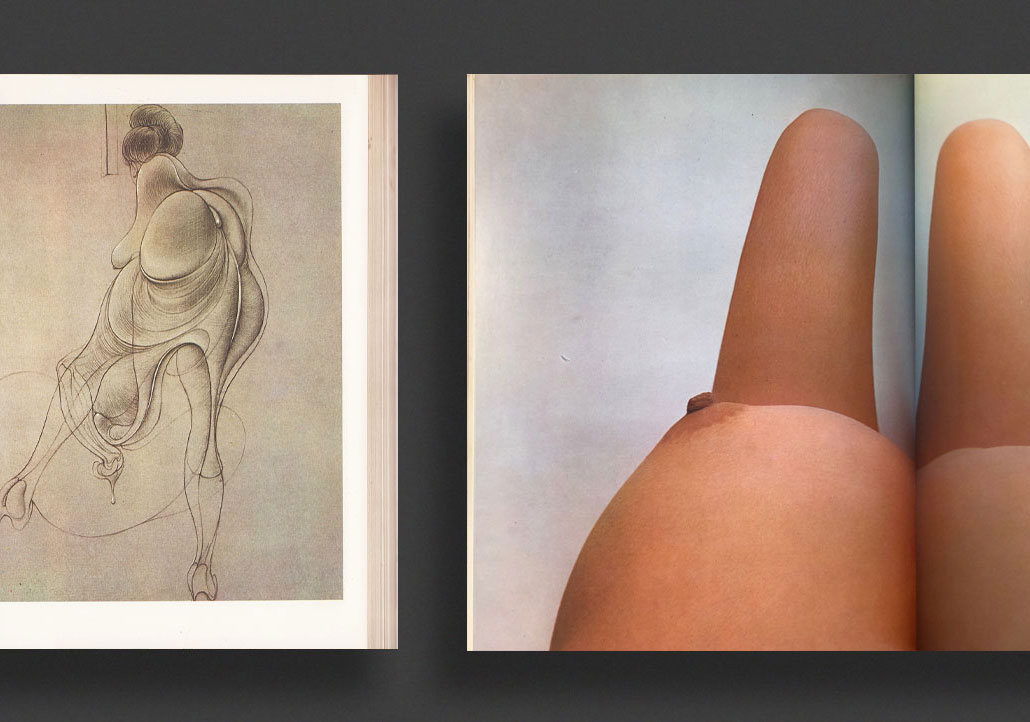
The gorgeous over-sized Hans Bellmer Obliques Special Issue, published in Paris in 1975, the year of the great artists death. Still possibly the best and most comprehensive Bellmer book, this special, beautifully printed issue of French literary journal Obliques (who also published special issues on Artaud, Kafka, Klossowski, Vian, Sartre, Robbe-Grillet, female Surrealists, Strindberg, Genet...) features over 300 pages devoted to the oeuvre of Bellmer, lavishly illustrated throughout in colour and b/w with his drawings, etchings, photographs, dolls, assemblages, portraits and other works, accompanied by biography, exhibition history, bibliography, personal life, wonderful photographs with Unica Zürn, facsimiles of Bellmer's writings and books, and many other notes. An incredible reference. Contributors include Paul Eluard, Nora Mitrani, Jean Brun, Paul Buck, Bernard Noel, Yves Bonnefoy, Michel Butor, Hans Bellmer, Georges Hugnet, Catherine Binet, Rene de Solier, Michel Camus, Jerome Peignot, and more. Also features Heinrich von Kleist's "Sur la theatre de marionnettes" and Strindberg's play, "Le Mardi-Gras de Polichinelle". Texts in French and German. Highly recommended.
German artist Hans Bellmer (1902—1975), is regarded as one of the most radical, subversive of the Surrealists, best known for the remarkable life-sized pubescent female dolls he produced in the mid-1930s. Born in the city of Kattowitz, then part of the German Empire (now Katowice, Poland), up until 1926 Bellmer worked as a skilled draftsman for his own advertising company. He initiated his doll project to oppose the fascism of the Nazi Party by declaring that he would make no work that would support the new German state. Represented by grotesque, mutated forms, twisted into unconventional sexual poses, or deformed by missing or superfluous limbs, his dolls were directed specifically at the cult of the perfect physique then prominent in Germany. Bellmer was influenced in his choice of art form by reading the published letters of Oskar Kokoschka (Der Fetisch, 1925). After the Nazis branded his work as “degenerate,” Bellmer fled to France, where he was embraced by the Surrealists. Bellmer gave up doll-making and spent the following decades creating erotic drawings, etchings, sexually explicit photographs, paintings, and prints, almost always dealing with female subjects and themes of abject sexuality and forbidden desire. In 1954, he met artist and writer Unica Zürn, who became his companion until her suicide in 1970. Bellmer died 24 February 1975 of bladder cancer. He was buried beside Zürn at Père Lachaise Cemetery with a tomb marked "Bellmer – Zürn".
Very Good copy. Only light wear, some spine, back cover tanning.
1991, English
Hardcover (w. dust jacket), 120 pages, 21.6 x 15.3 m
1st Edition, Out of print title / used / very good
Published by
University of Nebraska Press / Lincoln
$40.00 - Out of stock
First English 1991 hardcover edition.
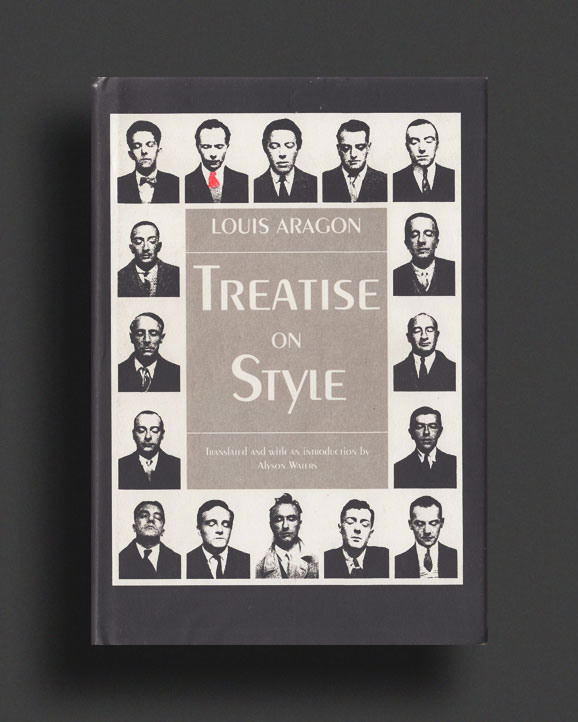
Surprising juxtapositions like goats spread across pianos and fearful optical illusions like eyeballs being sliced characterized the surrealistic movement in the arts in 1928 when Louis Aragon published Traite du Style in Paris. Aragon had become ever more contemptuous of vogues and pretensions. In the name of surrealism, he produced the first significant critique of it. Instead of merely upsetting old relationships and skewering sensibilities, Traite du Style was meant to shock with a capital S, and it did. Only now has it been completely translated into English. Although time has attenuated the scandalous nature of Aragon's language, his criticism has lost none of its edge in this translation by Alyson Waters.
From the beginning, which describes a postcard showing a little boy on a potty as representative of French humor and the French spirit, to the end, an attack in scatalogical language on the French military establishment, Aragon zeros in on one target after another. Nothing escapes his notice or venom-whether it is the masturbatory output of contemporary writers, the prostitution of culture, or the perversions of government. Still, Treatise on Style is more than a brilliant diatribe directed against what Aragon perceived as the moral, political, and intellectual failures of his time. He proposes surrealism, in art as in life, as a means to achieve a valid ethical and aesthetic "style." Surrealism, as Aragon defines it here, loses some of its mythical and mystical trappings; it becomes inspiration with rolled-up shirt-sleeves. He exercises this faculty in his own writing, which aims to shake readers out of their complacency by alternating the intensely lyrical with the borderline obscene and juxtaposing the language of the educated elite with that of the street. Whether denouncing religious fantacism or dispensing praise, Aragon remains true to his idea of the surrealist project: to reclassify certain values through the act of writing itself. Treatise on Style entertains as a portrait of a movement and of a personality who kept moving.
"This translation brings through into English just exactly the ferocious irony and acerbic wit of Aragon. Throughout it keeps up the texture of the original."—Mary Ann Caws, Hunter College and City University of New York
Alyson Waters, an adjunct lecturer in the Department of Romance Languages at Hunter College and CUNY, has translated articles for Art in America and other periodicals.
Very Good copy in VG dust jacket, only light edge wear. Probably unread.
1991, English
Softcover (cloth-bound w. dust jacket), 40 pages, 20 x 14.5 cm
1st Edition, Out of print title / used / very good
Published by
Hourglass Press / Paris
$100.00 - Out of stock
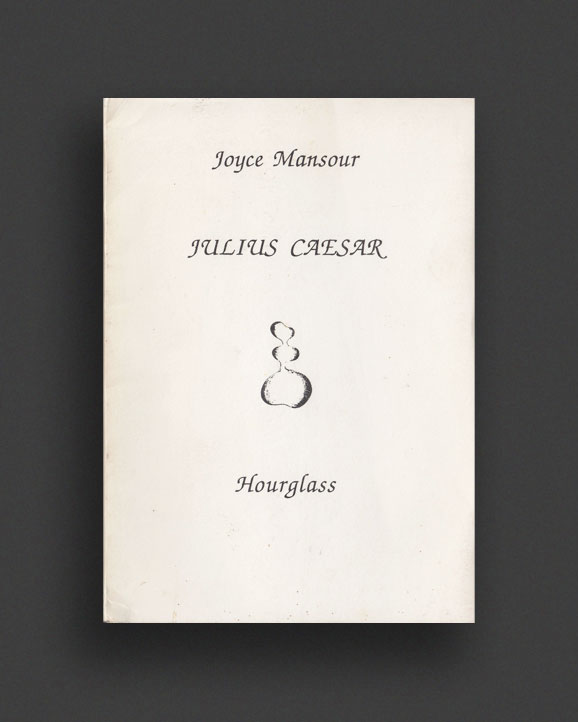
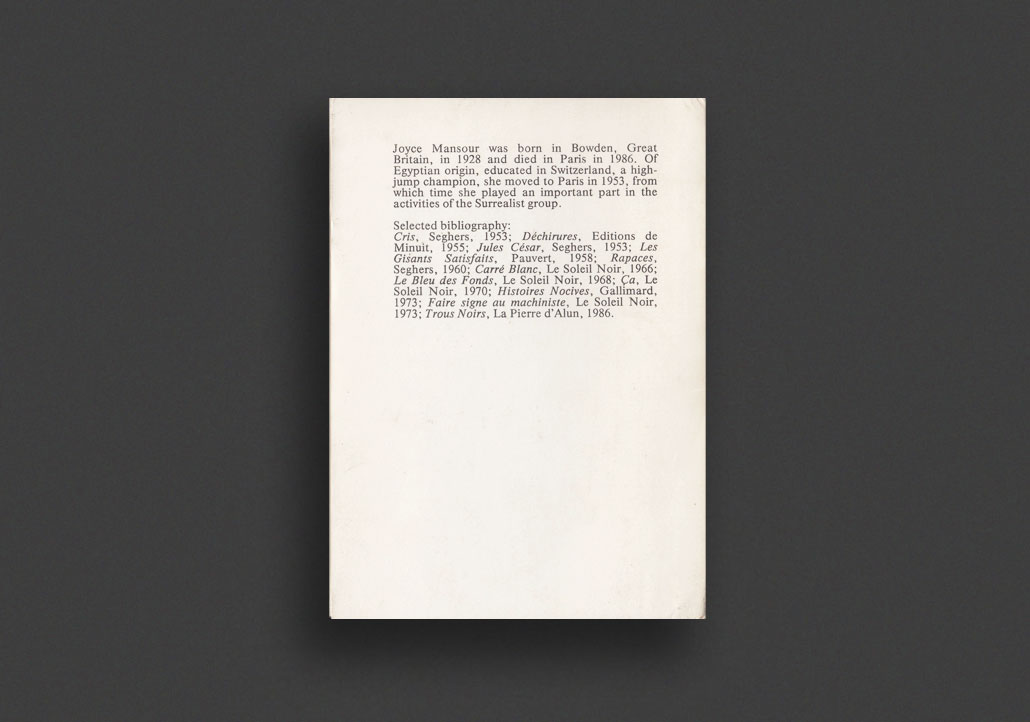
Rare, privately-issued first English edition of Joyce Mansour's dark Surrealist classic, Julius Caesar, translated, introduced and privately issued in an edition of 150 copies by Peter Webb in 1991. Illustrated by Bo Veisland. Seldom read in the English language, Julius César was first published in France by Seghers in 1953, with four illustrations by Mansour's friend Hans Bellmer.
"My intention in this foreword is not to offer any explanation concerning the contents or possible interpretation of Julius Caesar, but to present certain clues as to how the translation of this work has evolved and often harassed me - one might almost say noxiously - for over seventeen years."
"I first discovered and identified Joyce Mansour's name in Philippe Audoin's book Les Surréalistes. I say identified because, through some peculiar process of ideation, I recognized it as familiar, as though I knew (would know) the person in question. I immediately ordered the books to which my student's grant extended: Rapaces, Les Gisants Satisfaits and, later, Histoires Nocives, and found myself impressively startled by the rapid output of such violent, sultry and purely poetical images, tinged with Joyce's personal brand of cruel, black humour."—excerpt from the translator's introduction
Joyce Mansour was born in Bowden, Great Britain, in 1928 and died in Paris in 1986. Of Egyptian origin, educated in Switzerland, a high-jump champion, she moved to Paris in 1953, from which time she played an important part in the activities of the Surrealist group.
Very Good copy, with a small knock to bottom-left corner. Light tanning.
2021, English
Hardcover (w. dust jacket), 408 pages, 28 x 23 cm
Published by
University of Pittsburgh Press / Pittsburgh
$220.00 - Out of stock
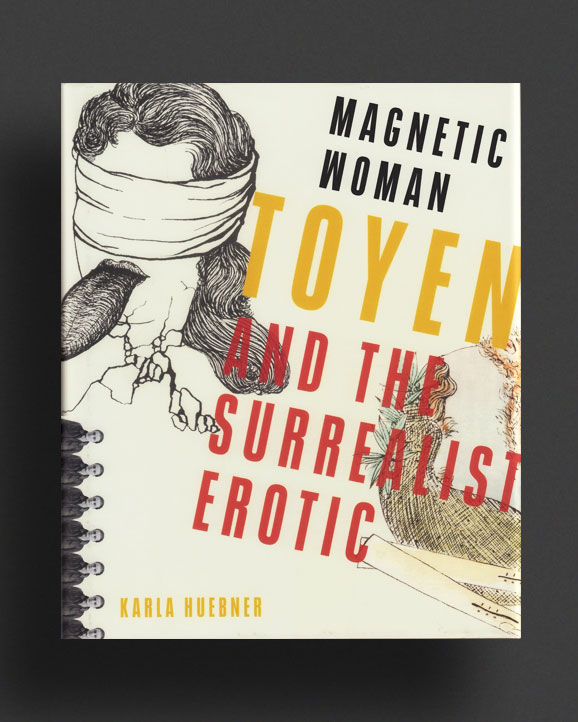
A New Interdisciplinary Study of Czech Gender-Fluid Artist Toyen.
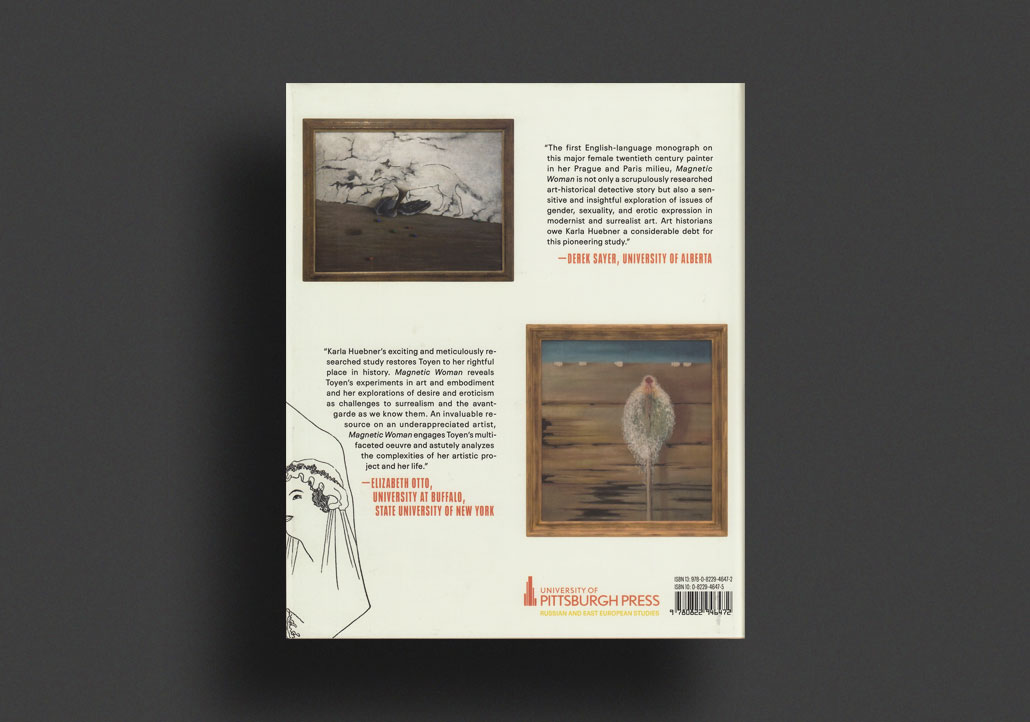
Part art book and part biography, Magnetic Woman examines the life and work of the artist Toyen (Marie Cerminova, 1902—1980), a founding member of the Prague surrealist group, and focuses on her construction of gender and eroticism. Toyen's early life in Prague enabled her to become a force in three avant-garde groups - Devetsil, Prague surrealism, and Paris surrealism — yet, unusually for a female artist of her generation, Toyen presented both her gender and sexuality as ambiguous and often emphasised erotic themes in her work. Despite her importance and ground-breaking work, Toyen has been notoriously difficult to study. Using primary sources gathered from disparate disciplines and studies of the artist's own work, Magnetic Woman is organized both chronologically and thematically, moving through Toyen's career with attention to specific historical circumstances and intellectual developments approximately as they entered her life. Karla Huebner offers a re-evaluation of surrealism, the Central European contribution to modernism, and the role of female artists in the avant-garde, along with a complex and nuanced view of women's roles in and treatment by the surrealist movement.
"The first English-language monograph on this major female twentieth century painter in her Prague and Paris milieux, Magnetic Woman is not only a scrupulously researched art-historical detective story but a sensitive and insightful exploration of issues of gender, sexuality, and erotic expression in modernist and surrealist art. Art historians owe Karla Huebner a considerable debt for this pioneering study."—Derek Sayer, University of Alberta
2005, English
Softcover (in card slipcase), 160 pages, 19 x 17 cm
1st Edition, Out of print title / used / fine
Published by
Atlas Press / London
$190.00 - Out of stock
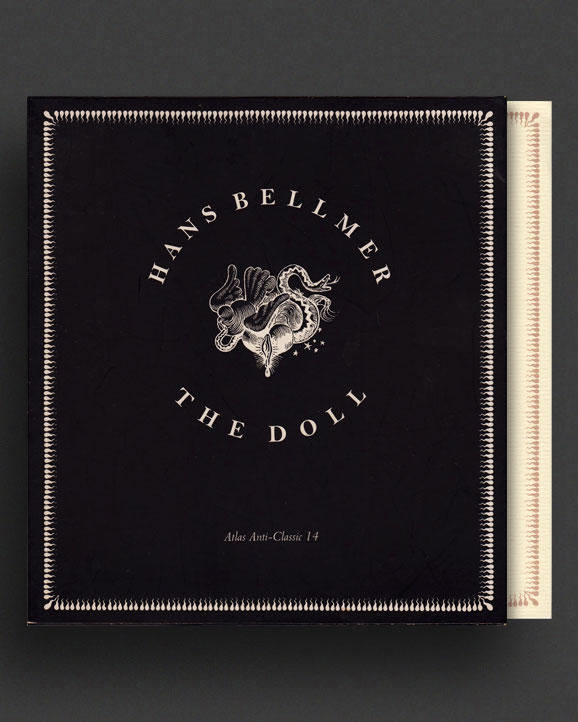
Rare first edition of this slipcased first English translation of Hans Bellmer's subversive Surrealist classic, Die Puppe (The Doll), first published in German in 1962, here translated and Introduced by Malcolm Green and published by the great Atlas Press, London.
Hans Bellmer (1902—1975) is one of the most illustrious names in the field of erotic art and Surrealism. The Doll comprises a series of photographs that have acquired iconic status and which exemplify the Surrealists’ conception of “convulsive beauty”. They are accompanied by a body of theoretical, poetic and speculative texts written between the 1930s and early 1960s which reveal Bellmer as one whose ideas are a “scandal for reason” (Joë Bousquet). But there is a lot more to Bellmer’s work than is at first apparent and the insights his writing provides into his work is crucial to its understanding, in particular those from the final edition of The Doll which are here translated in full. (The other editions widely available on the net mostly contain only the illustrations.) In these texts Bellmer weaves together a remarkably disparate set of concepts — covering such diverse fields as the body, psychology, anagrams, chance, the laws of optics and mathematics, the fourth dimension, hermaphroditism, the marvellous, intuition — into a theory of eroticism which forms the underlying rationale of his fearsome art.
Apart from the extensive texts by Bellmer it includes a suite of poems by Paul Éluard, 15 colour photographs, 10 in black and white, plus numerous line drawings. This English edition is based exactly upon the final edition overseen by Bellmer himself, the texts having been translated for the first time from the final German version rather than the preliminary French versions.
Near Fine copy.
1970, German
Softcover (staple-bound), 14 pages, 16 x 21 cm
1st Edition, Out of print title / used / very good
Published by
Studio 69 / Cologne
$100.00 - In stock -
Rare early catalogue published on the occasion of an important solo exhibition "Raymond Bertrand: dessins érotiques," held in 1970 at the great Studio 69 in Cologne. Seemingly the only catalogued exhibition of work by one of the great elusive erotic-fantasy artists from Europe, Raymond Bertrand. Beautifully printed with reproductions of his works throughout, on varying paper stocks.
Along with Leonor Fini, Raymond Bertrand became acknowledged as one of the major new artists dealing with the modern sexuality in a highly personal fashion in the late 1960s-early 1970s, a period that seemed to encapsulate the entire published work of this little-known artist. Bertrand's work became known through his incredible illustrations for French SF journals Fiction, Galaxie, illustrations for the erotic Emmanuelle novels, and Eric Losfeld published collections. Bertrand is a somewhat elusive and shadowy figure about whom it is hard to find biographical information, and it is sadly unknown whether he continued his work after this period.
Very Good copy.
1971, English
Hardcover (w. dust jacket), 325 pages, 23 x 29.5 cm
1st Edition, Out of print title / used / very good
Published by
Andre De Rache / Brussels
$200.00 - In stock -
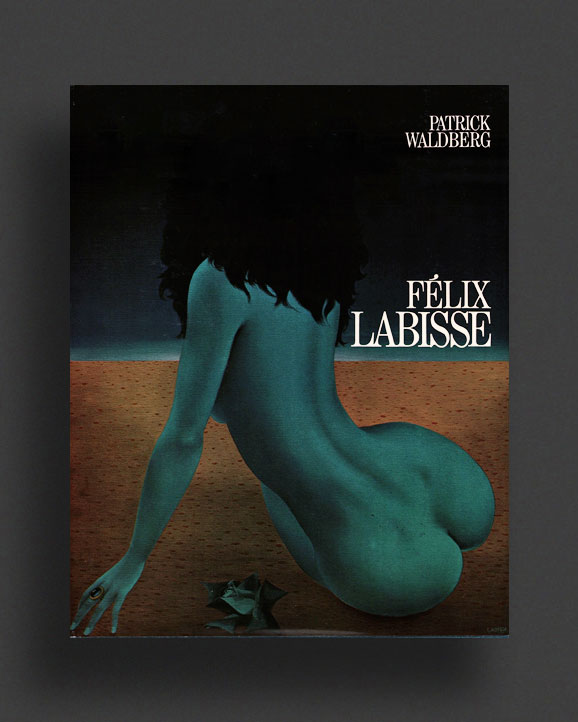
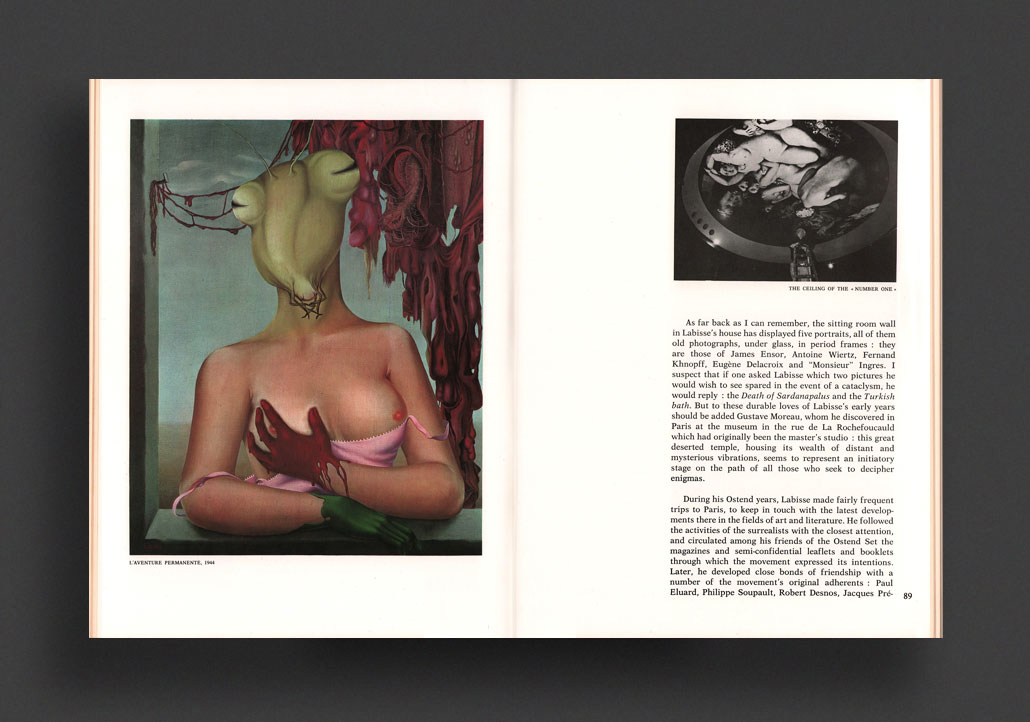
First edition of the best, most comprehensive reference book on the work of French—Belgian Surrealist artist Felix Labisse, and one of the only publications on the artist in the English language. Profusely illustrated throughout in colour and b/w, including many photographs of Labisse's life and artistic circles, with extensive accompanying essays by the great Surrealist biographer and author Patrick Walberg, including chapters: Gayant's child; The Ostend clan; The Wizard of Families; Behind the Scenes of the Party; Devil's Transvestites. Highly recommended.
Félix Labisse (1905—1982) was a self-taught French Surrealist painter, illustrator, and designer. He was born in Marchiennes. He divided his time between Paris and the Belgian coast from 1927. In Ostend he met James Ensor, with whom he became friends for life. In 1927 he set up his own studio there, influenced by his contact with the Ostend artists Ensor, Constant Permeke and Léon Spilliaert. Labisse mainly worked with oil on canvas. Beginning in 1931 he designed extensively literature and for the theater. In 1951 he staged the play Le Diable et le Bon Dieu by Jean-Paul Sartre at the Théâtre Antoine in Paris and in 1954 he staged the play Les Mystères de Paris by Albert Vidalie under the direction of Georges Vitaly at the Theater La Bruyere in Paris. Labisse's work was also influenced by Paul Delvaux and René Magritte. Describing his own work as 'libidoscaphes', his paintings depict fantastical hybrid creatures, heavy with motifs of eroticism and Freudian themes. He painted the first of a series of his iconic blue women in 1960; among them is the Bain Turquoise. He was the subject of a film by Alain Resnais, Visite à Félix Labisse (1947). In 1966 he was elected to the Académie des Beaux-Arts. In 1973 his paintings were shown in a retrospective exhibition at the Museum Boijmans Van Beuningen, Rotterdam. He died in Neuilly-sur-Seine in 1982.
Patrick Waldberg (1913—1985) was a Franco-American art critic known for his profiles of Surrealist artists. Born in Santa Monica, California, Waldberg moved to Paris as a child with his family. In 1932, and while still a student (age 19), he joined Boris Souvarine's Democratic Communist Circle. There he met Georges Bataille and his friends Michel Leiris and André Masson, and was initiated by them into a wild night life. 1937 saw him back in California to take care of "family matters", however, a letter from Georges Bataille reached him there, urging him to return to Paris in order to take part in a Nietzschean secret society Bataille was then forming, called Acéphale ("headless"). Waldberg heeded the call in September 1938, and he says this permanently changed his life. From 1938 to 1940 Waldberg would serve as the secretary of Bataille's "official" group, the College of Sacred Sociology. In 1959 he left Paris to move to the French village of Seillans, where his second wife Line Jubelin was from. Max Ernst and his own second wife Dorothea Tanning joined him there. Their houses are now a Max Ernst museum and a Maison Waldberg museum.
Very Good in VG dust jacket — copy, light wear/age only.
1979, Japanese
Hardcover (w. dust jacket), 236 pages, 20.4 x 20.3 cm
1st Edition, Out of print title / used / average
Published by
Self-published / Kobe City
$65.00 - Out of stock
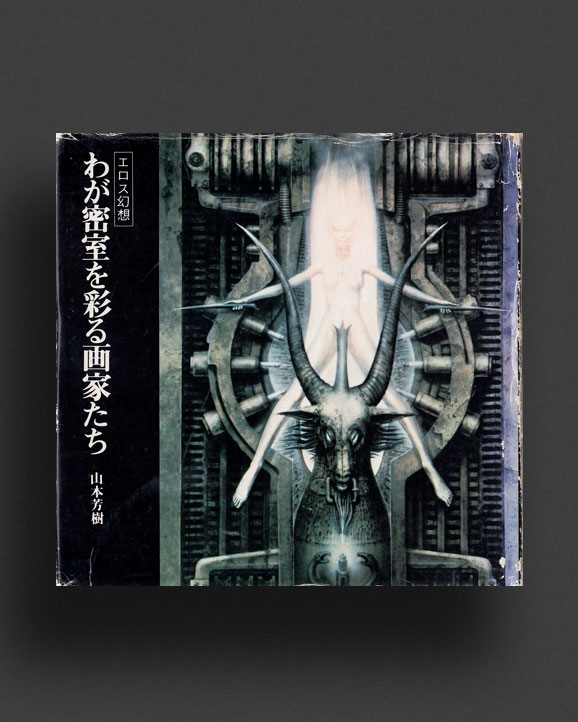
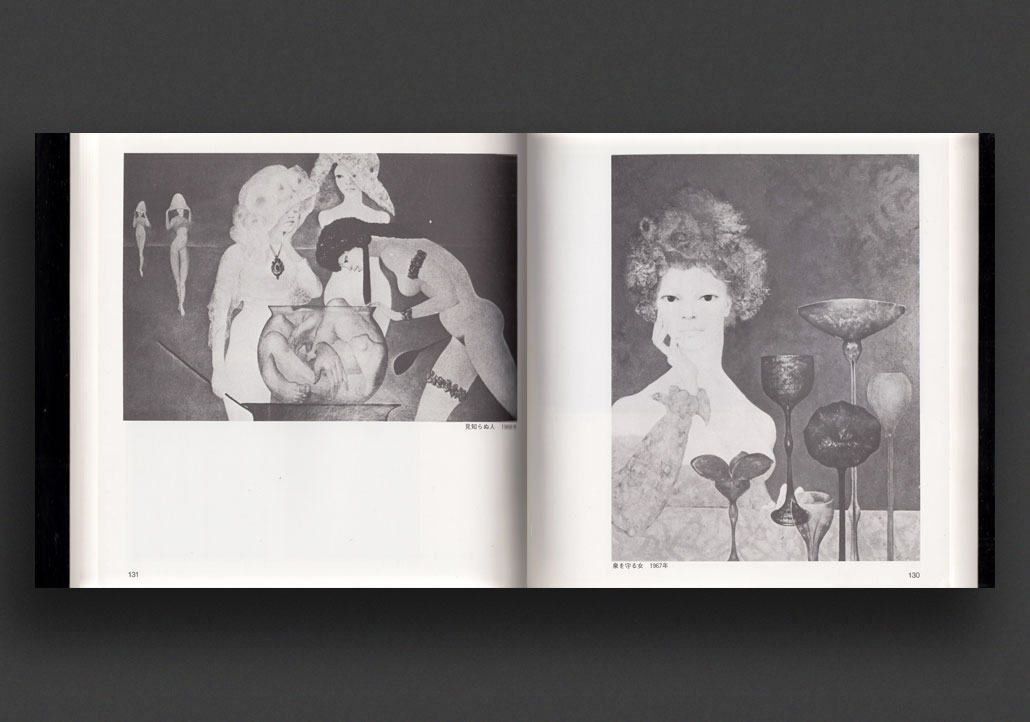
First and only edition of this stunning privately-issued 1979 Japanese hardcover collection of erotic fantasy art, edited and written by Yoshiki Yamamoto. Upon retiring from the Sanyo Electric Railway Company in 1976, Yamamoto devoted himself to the art that he loved and to complete an intimate book study that traces an important lineage of artists of "eros fantasy", focussing on 16 key artists through profusely illustrated chapters, linking artists of the fin de siècle, symbolism, surrealism, and their descendants. A total labour of love. There is no other book like it. "Artists Who Decorate My Secret Room" features profusely illustrated full chapters on Gustave Moreau, Félicien Rops, Gustav Klimt, Franz von Bayros, Egon Schiele, Paul Delvaux, Hans Bellmer, Felix Labisse, Pierre-Yves Trémois, Leonor Fini, Paul Wunderlich, Ernst Fuchs, Tomi Ungerer, H.R. Giger, Raymond Bertrand, Gilles Rimbault, including profiles, many artworks, portraits and texts by Yamamoto, closing with a chronology of further artists and authors through the centuries.
Average—Good copy due to the back hardcover board being reattached. Good dust jacket with the usual wear and tanning of this title, otherwise the book block is VG throughout — crisp and clean.