World Food Books' programme is largely produced on Kulin Nation land. We acknowledge the Wurundjeri people of the Kulin Nation as the first and continuing custodians of this land, and pay respect to their Elders past, present, and emerging.
World Food Books is an arts and special interests bookshop in Naarm / Melbourne. Founded in 2010, World Food Books is devoted to the presentation of a rotating, hand-selection of international art, design, literary and counterculture publications with an emphasis on the anti-traditional, the experimental, the avant-garde, the heretic, the marginal.
Presenting new titles alongside rare and out-of-print books, catalogues and journals spanning the fields of modern and contemporary art, design, photography, illustration, film, literature, poetry, cultural theory, philosophy, sexuality, popular and underground culture in its many radical forms, World Food Books wishes to encourage adventurous, thoughtful and open-minded reading, looking, writing, and exchange of publishing and ideas, both current and historical.
As well as our bookshop, located in Melbourne's historical Nicholas Building, all of our inventory is available internationally via our online mail-order service.
World Food Books semi-regularly co-ordinates "Occasions", a programme of exhibits and events at the bookshop and in partnership with other hosts (such as museums and art galleries) that develop out of the activities, relationships and content of the bookshop itself.
World Food Books
The Nicholas Building
37 Swanston Street
Room 5, Level 6
Melbourne 3000
Australia
SHOP HOURS:
Thu–Fri 12–6, Sat 12–5
WEB-SHOP OPEN 24/7
World Food Books
Postal Address:
PO Box 435
Flinders Lane
Victoria 8009
Australia
Art
Theory / Essay
Architecture / Interior
Graphic Design / Typography
Photography
Fashion
Eros
LGBTQ+
Fiction / Poetry
Weird / Speculative / Science Fiction / Horror
Transgressive / Visceral / Abject
Symbolism / Decadence / Fin de siècle
Film / Video
Painting
Sculpture / Installation
Performance / Dance / Theater
Drawing
Sound / Music
Curatorial
Group Shows / Collections
Periodicals
Out-of-print / Rare
Posters / Ephemera / Discs
Signed Books
World Food Books Gift Voucher
World Food Book Bag
Australian Art
Australian Fiction
Australian Science Fiction / Speculative Fiction
Australian Poetry
Australian Photography
Japanese Photography
Conceptual Art
Minimal Art
Dada
'Pataphysics / Oulipo
Fluxus
Concrete Poetry
Pop Art
Surrealism
Arte Povera
Arte Informale / Haute Pâte / Tachism
Nouveau Réalisme / Zero / Kinetic
Situationism / Lettrism
Collage / Mail Art / Xerox Art
Art Brut / Folk / Visionary / Fantastic
Illustration / Graphic Art / Bandes Dessinées
Furniture
Italian Radical Design / Postmodernism
Textiles
Ceramics / Glass
Counterculture
Protest / Revolt
Philosophy
Psychoanalysis
Anthropology
Anarchism
Socialism / Anarchism / Communism / Capitalism
Literary Theory / Semiotics / Language
Feminism / Women's Studies
Gender Studies / Sexuality
Anthropology
Fetishism / BDSM
Drugs / Psychedelia
Crime / Violence
Animal Rights / Veganism
Occult / Esoterica
Ecology / Earth / Alternative Living
Whole Earth / Crafts
All prices in AUD (Australian dollars)
Pick-Ups
Pick-up orders can be collected in our bookshop during opening hours after order date. Please collect any Pick-up orders within 2 weeks of ordering as we have limited storage space. Orders will be released back into stock if not collected within this time. No refunds can be made for pick-ups left un-collected. If you cannot make it in to the bookshop in this time-frame, please choose postage option.
Return Policy
All sales are final. We do accept returns (for refund or exchange) for items received in error. All our orders are packed with special care using heavy-duty padding and cardboard book-mailers or bubble mailers (for smaller books), using reinforcement where required. We cannot take responsibility for any lost, stolen or damaged parcels.
Insurance
Should you wish to insure your package, please email us directly after placing your order and we can organise this at a small extra expense. Although all standard/express tracked packages are very safe and dependable, we cannot take responsibility for any lost, stolen or damaged parcels. We recommend insurance on valuable orders.
Interested in selling your old books, catalogues, journals, magazines, comics, fanzines, ephemera? We are always looking for interesting, unusual and out-of-print books to buy. We only buy books in our fields of interest and specialty, and that we feel we can resell.
We base these prices on desirability, market value, in-print prices, condition and our current stock levels. We offer cash, store credit, and can take stock on consignment. All
about 25% of the price we expect to get when we sell them, or 30% in store credit. We base these prices on desirability, market value, in-print prices, condition and our current stock levels.
Sell your books any day of the week. You can drop them off and return later. If you have a lot of books, we can visit your Sydney home.
We buy books that we feel we can resell. We offer about 25 % of the price we expect to get when we sell them, or 30% in store credit. We base these prices on desirability, market value, in-print prices, condition and our current stock levels.
Philadelphia Wireman
03 August - 01 September, 2018
World Food Books is proud to announce our next Occasion, the first presentation of sculptures by Philadelphia Wireman in Australia.
The Philadelphia Wireman sculptures were found abandoned in an alley off Philadelphia’s South Street on trash night in 1982. Their discovery in a rapidly-changing neighbourhood undergoing extensive renovation, compounded with the failure of all attempts to locate the artist, suggests that the works may have been discarded after the maker’s death. Dubbed the "Philadelphia Wireman" during the first exhibition of this work, in 1985, the maker’s name, age, ethnicity, and even gender remain uncertain. The entire collection totals approximately 1200 pieces, all intricately bound together with tightly-wound heavy-gauge wire (along with a few small, abstract marker drawings, reminiscent both of Mark Tobey and J.B. Murry). The dense construction of the work, despite a modest range of scale and materials, is singularly obsessive and disciplined in design: a wire armature or exoskeleton firmly binds a bricolage of found objects including plastic, glass, food packaging, umbrella parts, tape, rubber, batteries, pens, leather, reflectors, nuts and bolts, nails, foil, coins, toys, watches, eyeglasses, tools, and jewellery.
Heavy with associations—anthropomorphic, zoomorphic, and socio-cultural responses to wrapped detritus—the totemic sculptures by Philadelphia Wireman have been discussed in the context of work created to fulfil the shamanistic needs of alternative religions in American culture. Curators, collectors, and critics have variously compared certain pieces to sculpture from Classical antiquity, Native American medicine bundles, African-American memory jugs, and African fetish objects. Reflecting the artist’s prolific and incredibly focused scavenging impulse, and despite—or perhaps enhanced by—their anonymity, these enigmatic objects function as urban artefacts and arbiters of power, though their origin and purpose is unknown. Philadelphia Wireman, whatever their identity, possessed an astonishing ability to isolate and communicate the concepts of power and energy through the selection and transformation of ordinary materials. Over the course of the past two decades, this collection has come to be regarded as an important discovery in the field of self-taught art and vernacular art.
Presented in collaboration with Fleisher-Ollman Gallery, Philadelphia, and Robert Heald, Wellington.
Susan Te Kahurangi King
02 February - 10 March, 2018
Susan Te Kahurangi King (24 February 1951 - ) has been a confident and prolific artist since she was a young child, drawing with readily available materials - pencils, ballpoint pens and felt-tip markers, on whatever paper is at hand. Between the ages of four and six Susan slowly ceased verbal communication. Her grandparents William and Myrtle Murphy had developed a special bond with Susan so they took on caring responsibilities for extended periods. Myrtle began informally archiving her work, carefully collecting and storing the drawings and compiling scrapbooks. No drawing was insignificant; every scrap of paper was kept. The King family are now the custodians of a vast collection containing over 7000 individual works, from tiny scraps of paper through to 5 meter long rolls.
The scrapbooks and diaries reveal Myrtle to be a woman of great patience and compassion, seeking to understand a child who was not always behaving as expected. She encouraged Susan to be observant, to explore her environment and absorb all the sights and sounds. Myrtle would show Susan’s drawings to friends and people in her community that she had dealings with, such as shopkeepers and postal workers, but this was not simply a case of a grandmother’s bias. She recognised that Susan had developed a sophisticated and unique visual language and sincerely believed that her art deserved serious attention.
This was an unorthodox attitude for the time. To provide some context, Jean Dubuffet coined the term Art Brut in 1945 to describe work created by self-taught artists – specifically residents of psychiatric institutions and those he considered to be visionaries or eccentrics. In 1972 Roger Cardinal extended this concept by adopting the term Outsider Art to describe work made by non-academically trained artists operating outside of mainstream art networks through choice or circumstance. Susan was born in Te Aroha, New Zealand in 1951, far from the artistic hubs of Paris and London that Dubuffet and Cardinal operated in. That Myrtle fêted Susan as a self-taught artist who deserved to be taken seriously shows how progressive her attitudes were.
Susan’s parents Doug and Dawn were also progressive. Over the years they had consulted numerous health practitioners about Susan’s condition, as the medical establishment could not provide an explanation as to why she had lapsed into silence. Dawn educated herself in the field of homeopathy and went on to treat all twelve of her children using these principles – basing prescriptions on her observations of their physical, mental and emotional state.
Doug was a linguist with an interest in philosophy who devoted what little spare time he had to studying Maori language and culture. To some extent their willingness to explore the fringes of the mainstream made them outsiders too but it was their commitment to living with integrity and their respect for individuality that ensured Susan’s creativity was always encouraged.
Even though Susan’s family supported her artistic pursuits, some staff in schools and hospitals saw it as an impediment to her assimilation into the community and discouraged it in a variety of ways. Her family was not always aware of this and therefore did not fully understand why Susan stopped drawing in the early 1990s. However, rather than dwell on the challenges that Susan faced in pursuit of her artistic practice, they prefer to highlight her achievements. In 2008 Susan began drawing again in earnest, after an almost 20 year interruption, and her work is now shown in galleries around the world.
Susan grew up without television and has been heavily influenced by the comics she read as a child. She is absolutely fearless in the appropriation of recognizable characters, such as Donald Duck and Mickey Mouse, in her work. She twists their limbs, contorts their faces, compresses them together, blends them into complex patterned backgrounds - always imbuing them with an incredible energy. Although Susan often used pop culture characters in her work they are not naive or childlike. These are drawings by a brilliant self-taught artist who has been creating exceptional work for decades without an audience in mind.
Mladen Stilinović
"Various Works 1986 - 1999"
02 February 16 - September 10, 2016
Various works 1986 - 1999, from two houses, from the collections of John Nixon, Sue Cramer, Kerrie Poliness, Peter Haffenden and Phoebe Haffenden.
Including: Geometry of Cakes (various shelves), 1993; Poor People’s Law (black and white plate), 1993; White Absence (glasses, ruler, set square, silver spoon, silver ladel with skin photograph and wooden cubes), 1990-1996; Exploitation of the Dead (grey and red star painting, wooden painting, black spoon with red table, red plate), 1984-1990; Money and Zeros (zero tie, paintings made for friends in Australia (Sue, John, Kerrie), numbers painting), 1991-1992; Words - Slogans (various t-shirts) - “they talk about the death of art...help! someone is trying to kill me”, “my sweet little lamb”, “work is a disease - Karl Marx”; Various artist books, catalogues, monographs, videos; Poster from exhibition Insulting Anarchy; "Circular" Croatian - Australian edition; Artist book by Vlado Martek (Dostoyevsky); more.
Thanks to Mladen Stilinović and Branka Stipančić.
Jonathan Walker
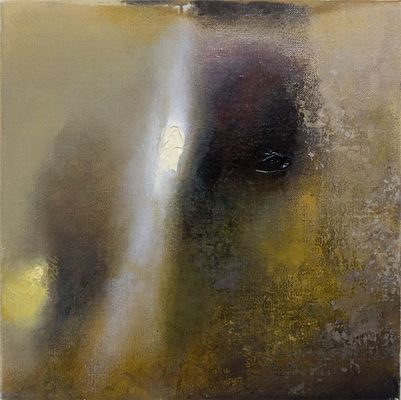
Always Will Need To Wear Winter Shirt Blue + Ochre Small Check Pattern
21 August - 21 September, 2015
Untitled
I am not a great reader of poetry but I always return to the work of Melbourne poet, Vincent Buckley (1925- 1988). Perhaps I find his most tantalising piece to be not a finished poem but a fragment left on a scrap of paper discovered on his desk after the poet’s death.
The poetry gathers like oil
In the word-core, and spreads
It has its music meet,
Its music is in movement.
This fragment is more the shell left behind from a volatile thought than a finished poem. I find the last two lines honest but awkward whereas the first two lines work like an arrow. Most likely he could not find a resolution so it was left. Still, in its present form, it remains an eloquent testimony to the ultimate failure of a medium to express mobile thought and sensation, in Buckley’s case, through verbal language. It’s an important matter because this is something all artists have to deal with regardless of the medium.
I have never written a poem, however, I am forever copying fragments from books on paper scraps in a vain effort to fix certain notions in my head. At first, they function as bookmarks that are sometimes returned to when I open the book. But before long, as they accumulate, they fall out littering the table interspersed with A4 photocopies, bills, books and medications.
To return to Buckley’s fragment, the first two lines very much evoke how I paint nowadays. As you age, detail diminishes and patches of light become more luminous and float. I feel the most honest way of dealing with this is by smearing the oil paint on the canvas with the fingers and working close-up, blind. Only if the patches coalesce into an approaching image can the work gain a life.
-
Jonathan Walker was born in Melbourne, Australia and brought up on a dairy farm in Gippsland. In the 1970’s he studied painting at RMIT and won the Harold Wright Scholarship to the British Museum, London. During the 1980’s he exhibited at Pinacotheca Gallery, Richmond and had work shown at the NGV and Heidi City Art Gallery. Over the same period he designed the cover for the “Epigenesi” LP by Giancarlo Toniutti, Italy and conducted a mail exchange work with Achim Wollscheid, Germany. The work with artists through the post resulted in an article published in the bicentenary issue of Art and Australia 1988. He showed in artist run spaces such as WestSpace in the 90’s and 2000’s, and until 2012, taught painting at Victoria University, which is where we (Colleen Ahern and Lisa Radford) as organisers of the exhibition, among many others, had the privilege of being his student.
Walker’s knowledge was imparted to students through the careful selection of music, literature, and artists found in books that he himself had ordered for the library. Walker’s strategy was the generosity of sharing his vast knowledge with references specific to each student and their context.
Walker’s paintings share a similar focus and intimacy.
This exhibition presents a small selection of recent paintings alongside a publication that includes Walker’s writing. Observational and analytical, Walker’s work is a type of material notation — the time of day, colour and how it is blended, the both specific and fleeting location of a reflection on lino or the question of whether a chair leg should be included in a painting.
Please join us on Friday August 21 between 6-8pm to celebrate the opening of the exhibition.
Curated by Colleen Ahern and Lisa Radford.
B. Wurtz
Curated by Nic Tammens
March 26 - April 4, 2015
B.Wurtz works from a basement studio in his home on Manhattan’s Lower East Side.
This local fact is attested to by the plastic shopping bags and newsprint circulars that appear in his work. As formal objects, they don’t make loud claims about their origins but nonetheless transmit street addresses and places of business from the bottom of this long thin island. Like plenty of artists, Wurtz is affected by what is local and what is consumed. His work is underpinned by this ethic. It often speaks from a neighborhood or reads like the contents of a hamper:
“BLACK PLUMS $1.29 lb.”
“Food Bazaar”
“USDA Whole Pork Shoulder Picnic 99c lb.”
“RITE AID Pharmacy, with us it’s personal.”
“H. Brickman & Sons.”
“Sweet Yams 59c lb."
Most of the work in this exhibition was made while the artist was in residence at Dieu Donne, a workshop dedicated to paper craft in Midtown. Here Wurtz fabricated assemblages with paper and objects that are relatively lightweight, with the intention that they would be easily transportable to Australia. This consideration isn’t absolute in Wurtz’s work, but was prescriptive for making the current exhibition light and cheap. Packed in two boxes, these works were sent from a USPS post office on the Lower East Side and delivered to North Melbourne by Australia Post.
Wurtz appears courtesy of Metro Pictures, New York.
Thanks to Rob Halverson, Joshua Petherick, Sari de Mallory, Matt Hinkley, Helen Johnson, Fayen d'Evie, Ask Kilmartin, Lisa Radon, Ellena Savage, Yale Union, and "Elizabeth".
John Nixon
"Archive"
December 15 - January 20, 2014
The presentation of John Nixon's archive offered a rare showcase of this extensive collection of the artist's own publications, catalogues, posters, ephemera, editions and more, from the mid 1980s onwards, alongside a selection of his artworks.
Organized by John Nixon, Joshua Petherick and Matt Hinkley.
<a href=http://wfb.public-office.info/artist/john-nixon>All titles by John Nixon
"Habitat"
at Minerva, Sydney (organised by Joshua Petherick and Matt Hinkley)
November 15 - December 20, 2014
Lupo Borgonovo, Janet Burchill & Jennifer McCamley,
Lewis Fidock, HR Giger, Piero Gilardi, Veit Laurent Kurz,
Cinzia Ruggeri, Michael E. Smith, Lucie Stahl, Daniel Weil, Wols
Press Release:
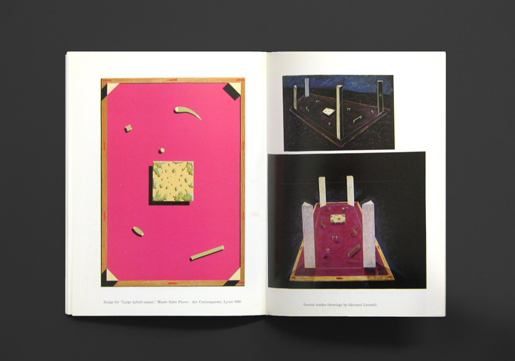
“...It contained seven objects. The slender fluted bone, surely formed for flight, surely from the wing of some large bird. Three archaic circuitboards, faced with mazes of gold. A smooth white sphere of baked clay. An age-blackened fragment of lace. A fingerlength segment of what she assumed was bone from a human wrist, grayish white, inset smoothly with the silicon shaft of a small instrument that must once have ridden flush with the surface of the skin - but the thing’s face was seared and blackened.”
William Gibson, “Count Zero”, 1986
"Autumn Projects Archive"
Curated by Liza Vasiliou
March 6 - March 15, 2014
World Food Books, in conjunction with the Virgin Australia Melbourne Fashion Festival 2014, presented the Autumn Projects archive, consisting of a selection of early examples in Australian fashion with a particular interest in collecting designers and labels from the period beginning in the 1980’s, who significantly influenced the discourse of Australian Fashion.
Curated by Liza Vasiliou, the exhibition provided a unique opportunity to view pieces by designers Anthea Crawford, Barbara Vandenberg, Geoff Liddell and labels CR Australia, Covers, Jag along with early experimental collage pieces by Prue Acton and Sally Browne’s ‘Fragments’ collection, suspended throughout the functioning World Food Books shop in Melbourne.
H.B. Peace
presented by CENTRE FOR STYLE
November 14, 2013
"Hey Blinky, you say chic, I say same"
Anon 2013
H.B. Peace is a clothing collaboration between great friends Blake Barns and Hugh Egan Westland. Their pieces explore the divergences between 'character’ and ‘personality’ in garments....etc
Special Thanks to Joshua Petherick and Matt Hinkley of WFB and Gillian Mears
and a Very Special Thank you to Audrey Thomas Hayes for her shoe collaboration.
Janet Burchill & Jennifer McCamley
"Aesthetic Suicide"
May 10 - June 8, 2013
The first of our occasional exhibitions in the World Food Books office/shop space in Melbourne, "Aesthetic Suicide" presented a body of new and older works together by artists Janet Burchill & Jennifer McCamley, including videos, prints, a wall work, and publications.
During shop open hours videos played every hour, on the hour.
2012, English
Softcover, 146 pages, 13 x 20.5 cm
Published by
Halmos / New York
$15.00 - Out of stock
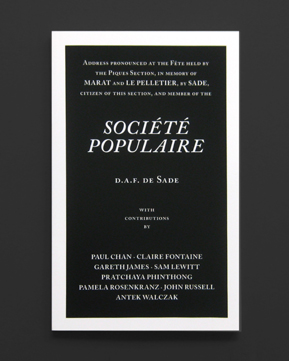
D.A.F. de Sade with contributions by Paul Chan, Claire Fontaine, Gareth James, Sam Lewitt, Pratchaya Phinthong, Pamela Rosenkranz, John Russell, and Antek Walczak.
Translation by Robin Mackay
Edited by Erik Wysocan
Weep no more, citizens; they breathe, these celebrated men for whom we cry; our patriotism reanimates them...
Presented in honor of Marat and Le Pelletier, "Citizen Sade" wrote this memorial address at the height of violence during the French Revolution, just after the start of the Reign of Terror. The text, effusive and cloyingly patriotic, brings to question Sade's own political position – a provocative impulse all the more remarkable given the addresses audience: the gathered Section des Piques, amongst the most hardline Jacobin districts of Paris. Though frequently cited and made infamous as the inspiration for Peter Weiss' influential work of avant-garde theater Marat/Sade, the text itself has remained obscure outside of France.
Presented in English for the first time, this new translation by Robin Mackay serves as the historical foundation for a collection of artists' writings. Included are Paul Chan, Claire Fontaine, Gareth James, Sam Lewitt, Pratchaya Phinthong, Pamela Rosenkranz, John Russell, and Antek Walczak.
2012, English
Softcover, 306 pages, 15.5 x 23 cm
Published by
Halmos / New York
$26.00 $5.00 - Out of stock
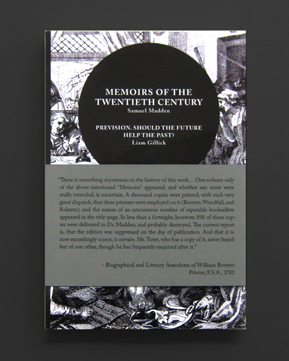
Samuel Madden, presented with Liam Gillick's "Prevision. Should the Future Help the Past?"
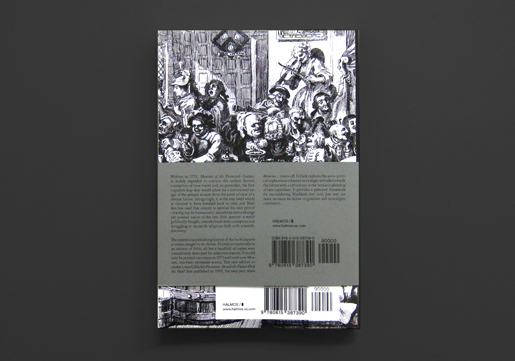
Written in 1733, Memoirs of the Twentieth Century is widely regarded to contain the earliest known conception of time-travel and, in particular, the first cognitive leap that would allow for a historicized image of the present as seen from the point of view of a distant future. Intriguingly, it is the text itself which is claimed to have traveled back in time and Madden has used this conceit to satirize his own period – tracing out its bureaucratic absurdities into a strange yet pointed vision of the late 20th century: a world politically fraught, overwhelmed with corruption and struggling to reconcile religious faith with scientific discovery.
The mysterious publishing history of the book imparts a certain weight to its claims. Printed anonymously in an edition of 1000, all but 10 copies were immediately destroyed for unknown reasons. It would only be printed once more in 1972 and until now Memoirs... has been extremely scarce – resulting in disappointingly little scholarship. This new edition includes Liam Gillick's Prevision. Should the Future Help the Past first published in 1999, the very year when Memoirs... leaves off. Gillick explores the socio-political implications inherent in strategic attitudes towards the future with a critical eye to the 'scenario planning' of late capitalism. It provides a prescient framework for reconsidering Madden's text now, just over ten years on since its fictive origination and apocalyptic conclusion.
To encourage further study, the complete text will be freely distributed electronically in conjunction with the limited edition hard-cover and a mass-market paperback.
2011, English
Softcover, 246 pages, 150 x 210 mm
Fourth edition,
Published by
JRP Ringier / Zürich
Les Presses Du Reel / Paris
$24.00 - Out of stock
11 interviews with curatorial pioneers
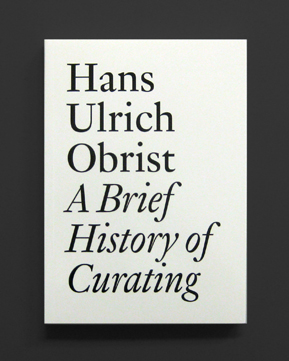
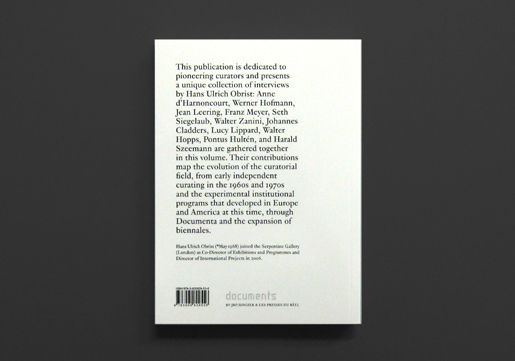
This publication is dedicated to pioneering curators and presents a unique collection of interviews by Hans Ulrich Obrist: Anne d'Harnoncourt, Werner Hofman, Jean Leering, Franz Meyer, Seth Siegelaub, Walter Zanini, Johannes Cladders, Lucy Lippard, Walter Hopps, Pontus Hultén, and Harald Szeemann are gathered together in this volume.
The contributions map the development of the curatorial field, from early independent curating in the 1960s and 1970s and the experimental institutional programs developed in Europe and in the USA at this time, through Documenta and the development of biennales.
The book is part of the Documents series, co-published with Les presses du réel and dedicated to critical writings.
2012, English
Softcover, 294 pages, 150 x 210 mm
Published by
JRP Ringier / Zürich
$29.00 - Out of stock
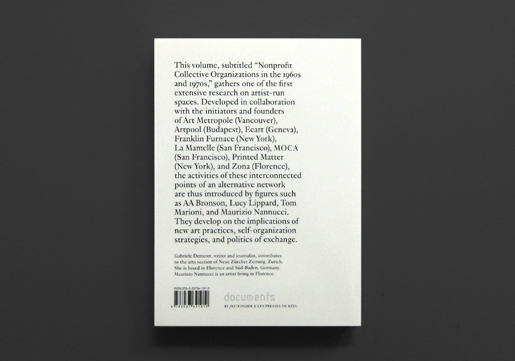
Nonprofit collective organizations in the 1960s and 1970s
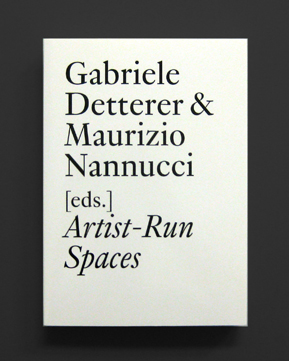
This volume was developed in collaboration with founders of important and exemplary artist-run spaces of the 1960s-1970s. It represents the first extensive research on this subject and introduces spaces such as Art Metropole in Toronto, Artpool in Budapest, Ecart in Geneva, Franklin Furnace in New York, MOCA in San Francisco, La Mamelle in San Francisco, Printed Matter in New York, Western Front in Vancouver, and Zona in Florence, whose founders include Carl Andre, John Armleder, AA Bronson, Sol LeWitt, Lucy Lippard, Tom Marioni, and Maurizio Nannucci. At a time of transition to new aesthetic approaches, these artists promoted community spirit and organizational skills, pioneering a revaluation of traditional art concepts.
The book documents not only the activities of these spaces, but also maps the artistic strategies and positions that took currency during this period. It thus shows how the inner life of collective self-organization and the exchange between like-minded artist-run spaces developed dynamically.
With contributions by Julie Ault, Fern Bayer, Lionel Bovier, AA Bronson, Christophe Cherix, Gabriele Detterer, Terry Fox, Peggy Gale, Julia Klaniczay, Lucy Lippard, Carl Loeffler, Tom Marioni, Maurizio Nannucci, Toni Sant, Darlene Tong, Michael Turner, Keith Wallace and Martha Wilson.
The book is part of the Documents series and is co-published with Zona Archives.
2008, English
Softcover, 270 pages (36 b/w ill), 150 x 210 mm
Published by
JRP Ringier / Zürich
$24.00 - Out of stock
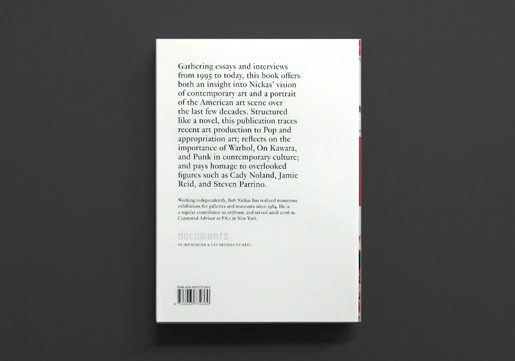
Gathering together essays and interviews from 1995 to today, this book offers both an insight into Nickas' vision on contemporary art and a portrait of the American art scene over the last few decades. Structured like a novel, this publication traces recent art production to Pop art and Appropriation art; reflects on the importance of Warhol, On Kawara, and Punk in contemporary culture; pays homage to overlooked figures such as Cady Noland, Jamie Reid, and Steven Parrino.
Working independently, Bob Nickas has realized numerous exhibitions for galleries and museums since 1984. He is a regular contributor to "Artforum," and served until 2006 as Curatorial Advisor at P.S.1 in New York.
The book is part of the Documents series, co-published with Les Presses du réel and dedicated to critical writings.
Awarded in the competition "The most beautiful Swiss books 2008."
2012, English
Softcover, 296 pages, 13 x 21 cm
Published by
Sternberg Press / Berlin
$32.00 - Out of stock
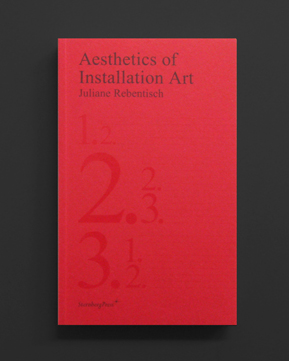
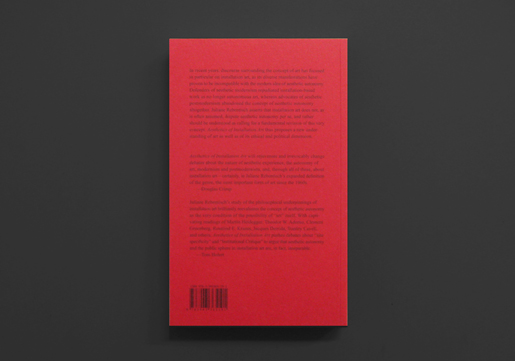
In recent years, debates surrounding the concept of art have focused in particular on installation art, as its diverse manifestations have proven to be incompatible with the modern idea of aesthetic autonomy. Defenders of aesthetic modernism repudiated installation-based work as no longer autonomous art, whereas advocates of aesthetic postmodernism abandoned the concept of aesthetic autonomy altogether. Juliane Rebentisch asserts that installation art does not, as is often assumed, dispute aesthetic autonomy per se, and rather should be understood as calling for a fundamental revision of this very concept. Aesthetics of Installation Art thus proposes a new understanding of art as well as of its ethical and political dimension.
"Aesthetics of Installation Art will rejuvenate and irrevocably change debates about the nature of aesthetic experience, the autonomy of art, modernism and postmodernism, and, through all of these, about installation art—certainly, in Juliane Rebentisch’s expanded definition of the genre, the most important form of art since the 1960s."
—Douglas Crimp
"Juliane Rebentisch’s study of the philosophical underpinnings of installation art brilliantly reevaluates the concept of aesthetic autonomy as the very condition of the possibility of 'art' itself. With captivating readings of Martin Heidegger, Theodor W. Adorno, Clement Greenberg, Rosalind E. Krauss, Jacques Derrida, Stanley Cavell, and others, Aesthetics of Installation Art pushes debates about 'site specificity' and 'Institutional Critique' to argue that aesthetic autonomy and the public sphere in installation art are, in fact, inseparable."
—Tom Holert
2012, English
Softcover, 156 pages, 25 x 17 cm
Published by
Fillip / Vancouver
$22.00 - Out of stock
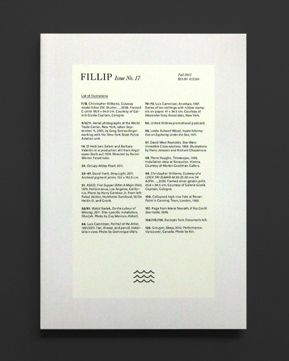
Fillip issue no.17 – Fall 2012: with contributions by: Kristina Lee Podesva, Jeff Khonsary, Caren Kaplan, Maria Muhle, James Langdon, David Geers, Miwon Kwon, Helen Molesworth, Walid Sadek, David Hartt...
2012, English / French
Softcover, 234 pages, 11.5 x 19cm
Published by
Fillip / Vancouver
$25.00 $15.00 - Out of stock
Fillip Editions - Folio Series
The collection of essays and discussions conceives of economy as a general system of exchange, speculatively investigating the role that "affective transactions" play in modes of representation and cultural production.
Texts by: Juan A. Gaitan, Melanie Gilligan, Hadley + Maxwell, Antonia Hirsch, Candice Hopkins, Olaf Nicolai, Patricia Reed, Monika Szewczyk, Jan Verwoert
2012, English / French
Softcover, 380 pages, 11.5 x 19cm
Published by
Fillip / Vancouver
$25.00 $15.00 - Out of stock
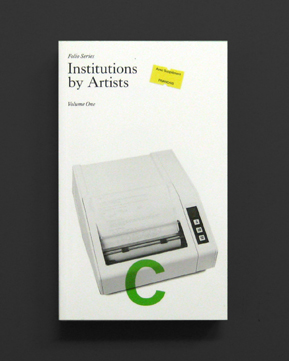
Fillip Editions - Folio Series
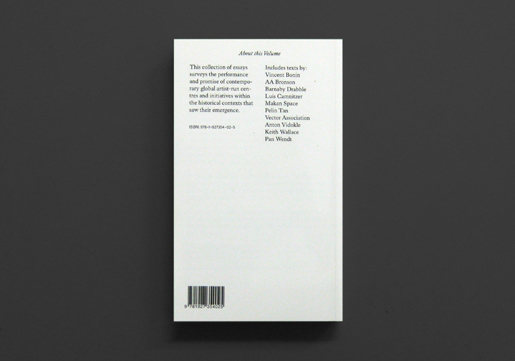
This collection of essays surveys the performance and promise of contemporary global artist-run-centres and initiatives within the historical contexts that saw their emergence.
Includes texts by: Vincent Bonin, AA Bronson, Barnaby Drabble, Luis Camnitzer, Makan Space, Pelin Tan, Vector Association, Anton Vidokle, Keith Wallace, Pan Wendt
Jeff Khonsary & Kristina Lee Podesva (Eds.)
2012, English
Softcover, 376 pages, 17 b/w ill., 14 x 21 cm
Published by
Sternberg Press / Berlin
$26.00 - Out of stock
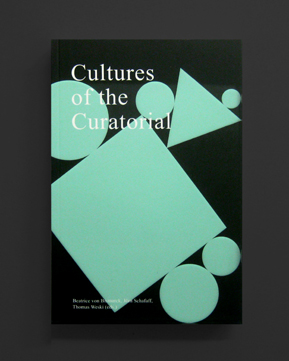
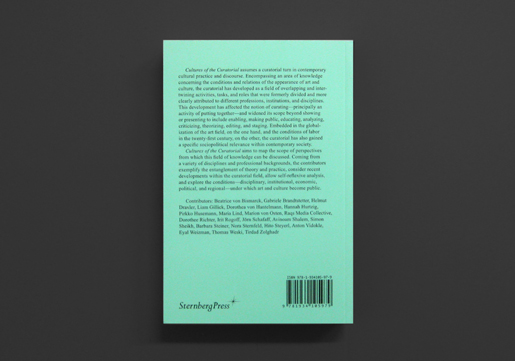
Contributions by Beatrice von Bismarck, Gabriele Brandtstetter, Helmut Draxler, Liam Gillick, Dorothea von Hantelmann, Hannah Hurtzig, Pirkko Husemann, Maria Lind, Marion von Osten, Raqs Media Collective, Dorothee Richter, Irit Rogoff, Jörn Schafaff, Avinoam Shalem, Simon Sheikh, Barbara Steiner, Nora Sternfeld, Hito Steyerl, Anton Vidokle, Eyal Weizman, Thomas Weski, Tirdad Zolghadr
Cultures of the Curatorial assumes a curatorial turn in contemporary cultural practice and discourse. Encompassing a whole field of knowledge relating to the conditions and relations of the appearance of art and culture, the curatorial has developed as a field of overlapping and intertwining activities, tasks, and roles that were formerly divided and more clearly attributed to different professions, institutions, and disciplines. This development has affected the notion of curating—principally an activity of putting together—and widened its scope beyond showing or presenting to include enabling, making public, educating, analyzing, criticizing, theorizing, editing, and staging. Embedded in the globalization of the art field, on the one hand, and the conditions of labor in the twenty-first century, on the other, the curatorial has gained a specific sociopolitical relevance within contemporary society.
The publication aims to map the scope of perspectives from which this field of knowledge can be discussed. Coming from a variety of disciplines and professional backgrounds, the contributors exemplify the entanglement of theory and practice, consider recent developments within the curatorial field, allow self-reflexive analysis, and explore the conditions—disciplinary, institutional, economic, political, and regional—under which art and culture become public.
Copublished with Kulturen des Kuratorischen, Hochschule für Grafik und Buchkunst Leipzig
Design by Surface, Frankfurt am Main / Berlin
Softcover, 304 pages (26 color and 8 b/w ill.), 14 x 23 cm
Published by
Sternberg Press / Berlin
$26.00 - Out of stock
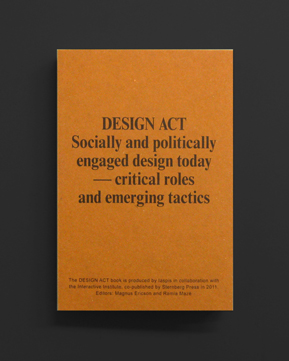
Edited by Magnus Ericson, Ramia Mazé
Contributions by Magnus Ericson, Natasha Marie Llorens, Ramia Mazé Interviews with Ana Betancour, Otto von Busch, Mauricio Corbalan, Pelin Dervis, Anthony Dunne, Joseph Grima, Peter Lang, Yanki Lee, Tor Lindstrand, Helena Mattsson, Ou Ning, Doina Petrescu, Fiona Raby, Meike Schalk, Christina Zetterlund
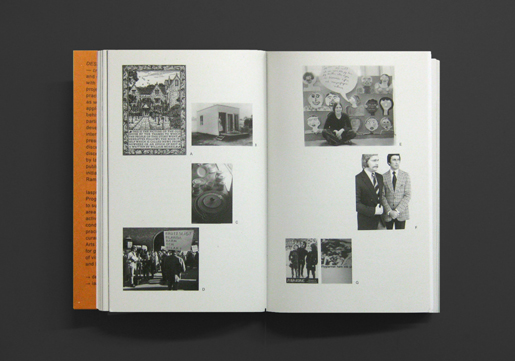
Design Act: Socially and Politically Engaged Design Today—Critical Roles and Emerging Tactics is a project that presents and discusses contemporary design practices that engage with political and societal issues. Since 2009, the Iaspis project Design Act has been highlighting and discussing practices in which designers have been engaging critically as well as practically in such issues. Itself an example of applied critical thinking and experimental tactics, the process behind the Design Act project is considered as a curatorial, participatory and open-ended activity. Design Act has developed through an online archive, public events, and an international network.
Co-published with Iaspis
Design by Johanna Lewengard
2012, English
Softcover, 192 pages, 30 b/w ill., 13.6 x 20 cm
$25.00 - Out of stock
Contributions by Ruth Buchanan, Helmut Draxler, Faculty of Invisibility, Katja Gretzinger, Rama Hamadeh, Claudia Mareis, Doreen Mende
What we perceive and think of as "true" is widely influenced by our knowledge—carrying with it implicit conceptions we are not aware of. Design, as a planned action, is necessarily both theory and practice. It brings together thinking and everyday objects and therefore ingrains itself in the contexts we are all living in. Yet, being largely unreflected on, design is likely to simply affirm societal norms instead of questioning them. If design aims at taking a critical stance, it needs to change its acquaintance with knowledge and develop its own discourse to understand the underlying conceptions that are at play.
The metaphor of the "blind spot" proposes the perspective of looking at what is implicit or unnoticed in our perception. By doing so, it seeks to open up common readings of what design is and can do. The montage of texts featured here includes diverse voices and readings, meant to create a space in which debate can unfold, a debate that considers the impossibility of an unbiased position and as such reminds us of our dependence on the other in any conception—and any project design might aspire to.
2012, English
Softcover (w. dustjacket), 148 pages, 23 color ills., 10.5 x 15 cm
Published by
Sternberg Press / Berlin
$23.00 - Out of stock
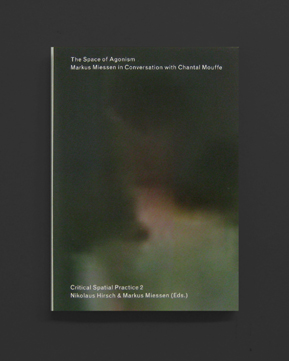
Edited by Nikolaus Hirsch and Markus Miessen
Including an artist project by Rabih Mroué
The second volume in the Critical Spatial Practice series presents a selection of conversations between Markus Miessen and political philosopher Chantal Mouffe. Taking place intermittently between December 2006 and October 2011, the dialogues attempt to unpack current dilemmas and popular mobilizations in terms of consensus-driven formats of political decision making. The conversations were alternately driven by Miessen’s specific concerns regarding his ongoing investigation into conflict-based forms of participation as an alternative (spatial) practice in democratic systems, and Mouffe’s understanding and theory of a “conflictual consensus.” Thinking in terms of agonism and “demoicracy”—a union that acknowledges the plurality and permanence of its different populations—the book proposes new approaches to countering and responding to the globalizing thrust of neoliberalism.
Design by Zak Group
2012, English
Softcover, 287 pages (52 color and 9 b/w ill.), 16.5 x 23 cm
Published by
Sternberg Press / Berlin
$28.00 - Out of stock
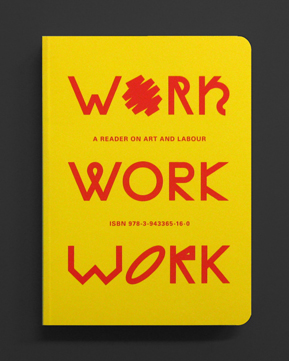
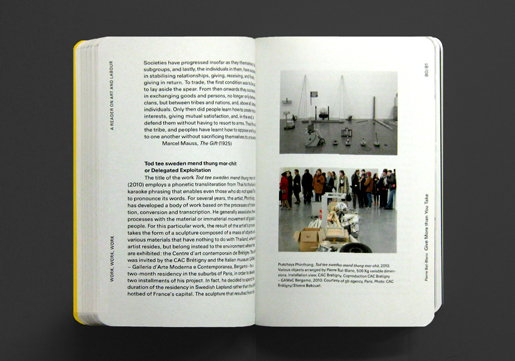
Contributions by Pierre Bal-Blanc, Franco “Bifo” Berardi, Ana Betancour, Jonatan Habib Engqvist, Annika Eriksson, Kirsten Forkert, Catharina Gabrielsson, Ingela Johansson, Lars Bang Larsen, Maria Lind, Sarat Maharaj, Making A Living (MAL), Michele Masucci, Helena Mattsson, Nina Power, OTCOP, Pratchaya Phinthong, Raqs Media Collective, Judith Revel, Lisa Rosendahl, Joanna Sokołowska, Hito Steyerl, Mladen Stilinović, Nina Svensson, Cecilia Widenheim
The relationship of art to work and the conditions of artistic production has long engaged many in the field of visual art. Work is a broad concept, the meaning of which has changed radically as a result of the social and technological transformations that have taken place over the past century. What, then, is “work” today and what is its relation to art? What is the position of the artist if “creativity” has become a commodity? How can the artist’s conditions of production be described, and what role can art and architecture play in societal change?
The texts in this reader provide perspectives on some of these questions emerging from the series of seminars conducted during the late autumn of 2010 at Iaspis in Stockholm, the Swedish Arts Grants Committee’s international program for visual art, architecture, crafts, and design. The seminars brought together visual artists, architects, theoreticians, curators, and writers with diverse backgrounds and experience. They were arranged into three themes: the relationship between art and work, the current conditions of production and the organization of work within the field of visual art, and the role of art and architecture in politics and society.
Co-published with Iaspis
Design by Medium
2011, English
softcover, 216 pages, 11 b/w ill., 10.8 x 17.8 cm
Published by
Sternberg Press / Berlin
$20.00 - Out of stock
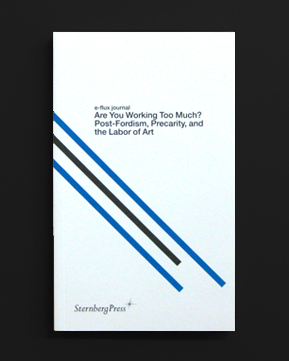
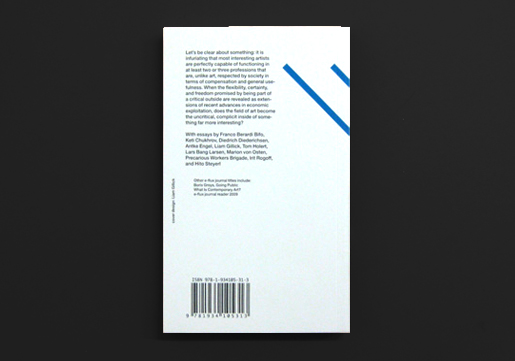
With essays by Franco Berardi Bifo, Keti Chukhrov, Diedrich Diederichsen, Antke Engel, Liam Gillick, Tom Holert, Lars Bang Larsen, Marion von Osten, Precarious Workers Brigade, Irit Rogoff, and Hito Steyerl
Let’s be clear about something: it is infuriating that most interesting artists are perfectly capable of functioning in at least two or three professions that are, unlike art, respected by society in terms of compensation and general usefulness. Furthermore, when the flexibility, certainty, and freedom promised by being part of a critical outside are considered as extensions of recent advances in economic exploitation, does the field of art then become the uncritical, complicit inside of something far more compelling?
Design by Jeff Ramsey, cover design by Liam Gillick
2010, English
Softcover, 216 pages, 24 b/w ill., 10.8 x 17.8 cm
Published by
Sternberg Press / Berlin
$20.00 - Out of stock
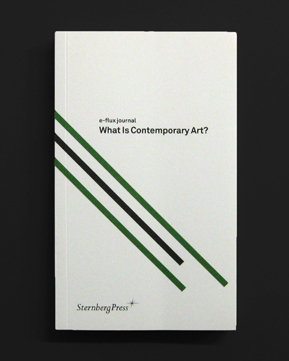
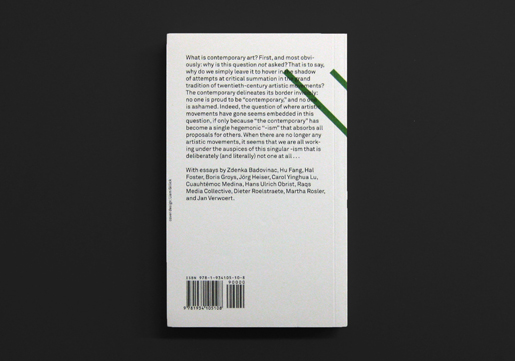
Contributions by Julieta Aranda, Brian Kuan Wood, Anton Vidokle, Cuauhtémoc Medina, Boris Groys, Raqs Media Collective, Hans Ulrich Obrist, Hu Fang, Jörg Heiser, Martha Rosler, Zdenka Badovinac, Carol Yinghua Lu, Dieter Roelstraete, and Jan Verwoert
This book began as a two-part issue of e-flux journal devoted to the question: What is contemporary art? First, and most obviously: why is this question not asked? That is to say, why do we simply leave it to hover in the shadow of attempts at critical summation in the grand tradition of twentieth-century artistic movements? A single hegemonic “ism” has replaced clearly distinguishable movements and grand narratives. But what exactly does it mean to be working under the auspices of this singular ism?
“Widespread usage of the term ‘contemporary’ seems so self-evident that to further demand a definition of ‘contemporary art’ may be taken as an anachronistic exercise in cataloguing or self-definition. At the same time, it is no coincidence that this is usually the tenor of such large, elusive questions: it is precisely through their apparent self-evidence that they cease to be problematic and begin to exert their influence in hidden ways; and their paradox, their unanswerability begins to constitute a condition of its own, a place where people work.”
E-flux journal: What Is Contemporary Art? puts the apparent simplicity and self-evident term into doubt, asking critics, curators, artists, and writers to contemplate the nature of this catchall or default category.
1987, English
Softcover, 78 pages (colour ill. throughout), 20 x 23 cm
Out of print title / Used*,
Published by
The MIT Press / Massachusetts
$25.00 - Out of stock
Andrea Branzi, one of Italy's foremost designers and critics, and Nicoletta Branzi, designer of limited edition art clothing for women, introduce the neoprimitive style under the generic title "Domestic Animals." These mysterious creature-objects are oriented to domestic settings, intended to be used or worn, but they are also fetishistic and contemplative, arousing expectations that magic or tribal rituals are about to be performed.
Uniting precision of design with natural raw materials, these objects fashioned from tree trunks, sticks of wood and animal skins joined to steel "bamboo" rods and painted in bright, totemic colors fascinate us. Taken out of their wild settings and tamed by technology, "domestic animals" establish a loving relationship with man, sharing his most private space. We have not seen anything like them in the world of interior, furniture, or fashion design before.
The ideas and creations in Domestic Animals were developed by the Branzis over several years, and can be understood as a metaphor of the relationship that links man to a number of animal and technical presences within the home. The Branzis have created clothing, furniture, and objects of decoration that challenge the conventional notions of habitation: Where living too often takes place in empty spaces marked out by couches they have introduced an environment of archetypal symbols and materials that invite a new way of inhabiting the home.
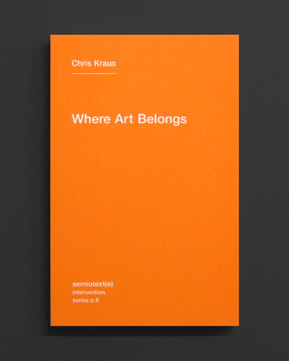
2011, English
Softcover, 160 pages, 114 x 190 mm
Published by
Semiotext(e) / Los Angeles
$30.00 - Out of stock
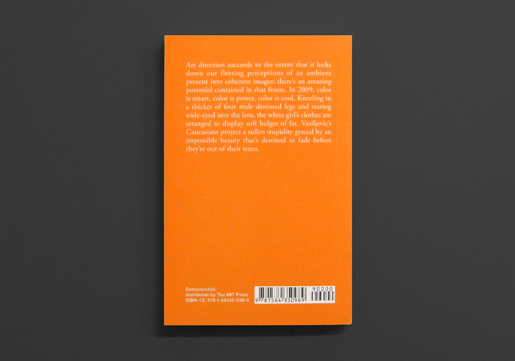
In Where Art Belongs, Chris Kraus examines artistic enterprises of the past decade that reclaim the use of lived time as a material in the creation of visual art. In four interlinked essays, Kraus expands the argument begun in her earlier book Video Green that “the art world is interesting only insofar as it reflects the larger world outside it.” Moving from New York to Berlin to Los Angeles to the Pueblo Nuevo barrio of Mexicali, Kraus addresses such subjects as the ubiquity of video, the legacy of the 1960s Amsterdam underground newspaper Suck, and the activities of the New York art collective Bernadette Corporation. She examines the uses of boredom, poetry, privatized prisons, community art, corporate philanthropy, vertically integrated manufacturing, and discarded utopias, revealing the surprising persistence of microcultures within the matrix.
Chronicling the sometimes doomed but persistently heroic efforts of small groups of artists to reclaim public space and time, Where Art Belongs describes the trend towards collectivity manifested in the visual art world during the past decade, and the small forms of resistance to digital disembodiment and the hegemony of the entertainment/media/culture industry. For all its faults, Kraus argues, the art world remains the last frontier for the desire to live differently.
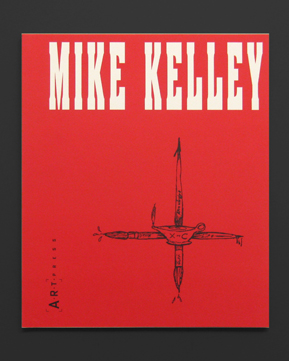
1992, English
Softcover, 64 pages, 22 x 25 cm
Published by
A.R.T. Press / New York
$30.00 - Out of stock
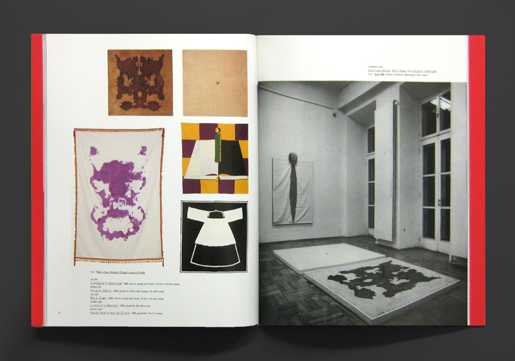
Mike Kelley interviewed by John Miller
Mike Kelley's iconoclastic artwork assails the sunshine fantasy of the "normal" family. In an extended and intelligent interview profusely illustrated with performance stills, reproductions, and installation shots, Kelley discusses the development of his work, his interest in pop culture, and the influence of crafts on his work.
Kelley: “I really hate when an artwork is open to all interpretations. I like interpretations to be limited so that the process is problematized. Not just any interpretation is good; there’s a certain range of interpretations that are allowed. Then the interpretation becomes a problem – I like that”.
2011, English
Softcover, 60 pages, 12.7 x 19 cm
Published by
A.R.T. Press / New York
$15.00 - Out of stock
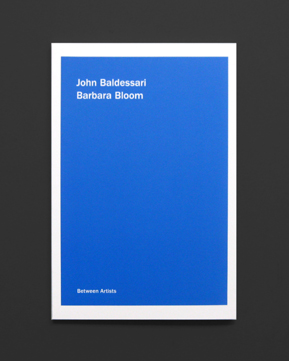
Part of A.R.T. Press' Between Artists Series.
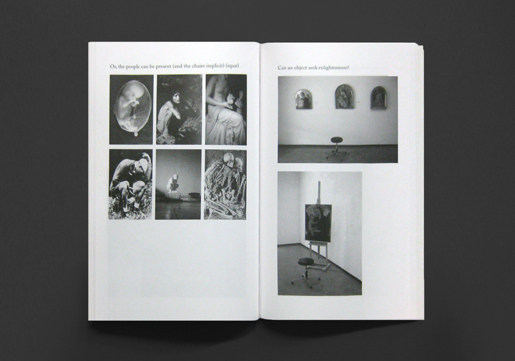
A witty and elegant visual exchange around the uses and functions of chairs doubles as an excuse to address a number of the artists’ interests and working methodologies. A conversation that has developed through years of friendship, deep admiration and understanding of each other’s work, this book presents Baldessari and Bloom at the peak of their form.
A.R.T. Press primarily publishes books based on artist to artist conversations. The conversation format permits a thorough and at the same time informal investigation of the artists’ practice and the larger social issues that inform it. By virtue of their clarity, personal focus, affordability, and innovative method of distribution, these books make possible the presentation of contemporary artists and their work to a wide readership.
2011, English
Softcover, 48 pages, 12.7 x 19 cm
Published by
A.R.T. Press / New York
$25.00 - Out of stock
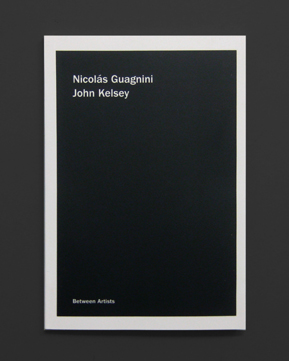
Part of A.R.T. Press' Between Artists Series.
The work of Nicolás Guagnini and John Kelsey manifests itself in distinctly different forms, yet the two share an affinity for playing with the roles and structures of the art world. The conversation includes discussions of some of their recurring topics and themes: gossip, the jeune-fille, institutional critique, the abject, humor and their participation in collaborative ventures (Orchard and Union Gaucha Productions for Guagnini and Reena Spaulings and Bernadette Corporation for Kelsey).
2012, English
Softcover, 544 pages (225 colour ill.), 18 x 23 cm
Published by
Yale University Press / New Haven
$55.00 - Out of stock
Helen Molesworth; With essays by Johanna Burton, William Horrigan, Elisabeth Lebovici, Kobena Mercer, Sarah Schulman, and Frazer Ward.
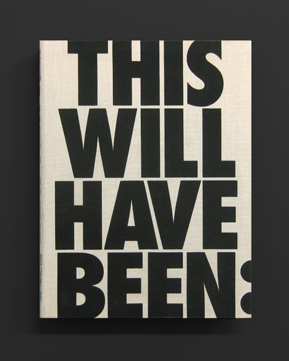
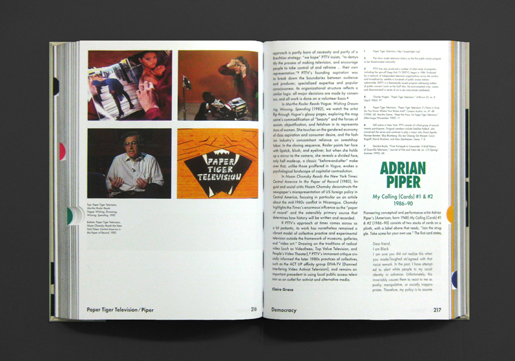
Art of the 1980s oscillated between radical and conservative, capricious and political, socially engaged and art historically aware. Published in association with the Museum of Contemporary Art, Chicago, this fascinating book chronicles canonical as well as nearly forgotten works of the 1980s, arguing that what has often been dismissed as cynical or ironic should be viewed as a struggle on the part of artists to articulate their needs and desires in an increasingly commodified world. The major developments of the decade—the rise of the commercial art market, the politicization of the AIDS crisis, the increased visibility of women and gay artists and artists of color, and the ascension of new media—are illuminated in works by Sophie Calle, Nan Goldin, Jeff Koons, Lorna Simpson, Leigh Bowery, Jimmy De Sana, Carroll Dunham, Jimmie Durham, Alex Garry, Robert Gober, Nan Goldin, Mike Kelley, Paul McCarthy, Annette Messager, Cady Noland, Albert Oehlen, Richard Prince, Cindy Sherman, Julian Schnabel, Rosemarie Trockel, Jeff Wall, Charlie Ahearn, Gretchen Bender, Black Audio Film Collective, Jennifer Bolande, Gregg Bordowitz, Eugenio Dittborn, Gran Fury, Group Material, Guerrilla Girls, Hans Haacke, David Hammons, Jenny Holzer, Alfredo Jaar, Barbara Kruger, Louise Lawler, Donald Moffett, Lorraine O’Grady, Paper Tiger Television, Adrian Piper, Lari Pittman, Tim Rollins and K.O.S., Christy Rupp, Doris Salcedo, Juan Sánchez, Tseng Kwong Chi and Keith Haring, Carrie Mae Weems, Christopher Williams, Krzystof Wodiczko, Judith Barry, Ashley Bickerton, Deborah Bright, Marlene Dumas, Felix Gonzales-Torres, Peter Hujar, G. B. Jones, Isaac Julian, Rotimi Fani Kayode, Mary Kelly, Silvia Kolbowski, Louise Lawler, Sherrie Levine, Jack Leirner, Robert Mapplethorpe, Richard Prince, Marlon Riggs, David Robbins, Laurie Simmons, Haim Steinbach, David Wojnarowicz, Dotty Attie, Robert Colescott, General Idea, Robert Gober, Jack Goldstein, Pater Halley, Mary Heilmann, Candy Jernigan, Mike Kelley, Martin Kippenberger, Louise Lawler, Sherrie Levine, Christian Marclay, Allan McCollum, Peter Nagy, Raymond Pettibon, Stephen Prina, Martin Puryear, Gerhard Richter, David Salle, Doug + Mike Starn, Tony Tasset, James Welling, and Christopher Wool, among others. Essays by leading scholars provide unique perspectives on the decade's competing factions and seemingly contradictory elements, from counterculture to the mainstream, radicalism to democracy and historical awareness, conservatism to feminist politics.
Complete with critical texts on each work, This Will Have Been brings into focus the full impact of the art, artists, and political and cultural ruptures of this paradigm-shifting decade. More than 200 full-color reproductions of works in a range of media, including drawing, painting, photography, and sculpture, illustrate this ambitious guide to a period of artistic transformation.
2012, Englsih
Softcover, 280 pages (6 b/w ill.), 13 x 20 cm
Published by
Sternberg Press / Berlin
$24.00 - Out of stock
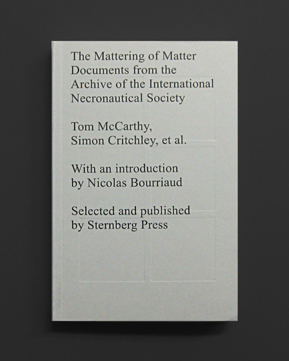
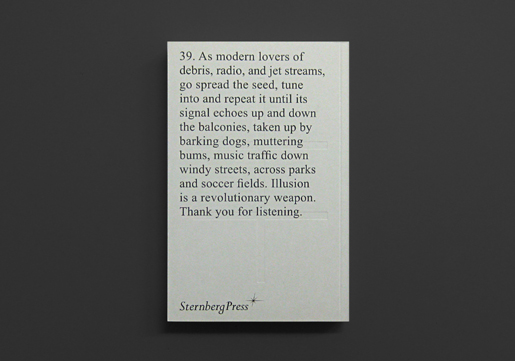
On August 7, 1999, Tom McCarthy founded the International Necronautical Society (INS) with a public presentation of the "Founding Manifesto," a touchstone that would inform the organization’s proceedings for years to come. Composed of official committee members and illicit “agents,” the INS harks back to early twentieth-century avant-gardes, producing declarations, reports, public hearings, broadcasts, and research documents, as well as orchestrating more covert media infiltrations, all governed by the objective, set out in the "Founding Manifesto," of mapping, entering, and occupying the space of death through literature, philosophy, culture, and technology.
The Mattering of Matter is a collection of INS documents produced between 1999 and 2010. This edited selection of texts reflects the INS’s development, through both internal bureaucratic changes and its ever-growing repertoire of references, all of which work towards their ultimate goal of constructing a necronautical “craft” with which to propound and escalate the overall INS project.
2012, English
Hardcover, 192 pages (20 b/w ill.), 12 x 18 cm
Published by
Piet Zwart Institute / Rotterdam
Sternberg Press / Berlin
$24.00 - Out of stock
Masters of Reality brings together the first collection of texts by Steve Rushton. Second in a series of publications on contemporary art inaugurated by the Piet Zwart Institute, the book explores the interrelations between art, anthropology, social sciences, psychology, media, politics, and economy. Central to Rushton’s research is an investigation into the conception of feedback, social control, and the culture of “self-performance.” Through his writings and collaborative work with artists, he has developed and articulated a thorough analysis of the techniques and processes of information management and subjectivization in Western society since the second half of the twentieth century.
The structure of this book articulates a clear relationship between diverse subjects and sources, drawing from archival materials produced within a broad range of discursive fields and practices: military experiments in social psychology, press statements by various politicians and governments, anthropological research data, theories of cybernetics, writings by thinkers such as Henri Bergson and Gregory Bateson, television culture, and work by artists and writers such as Ant Farm and Don DeLillo. These investigations take structural form through three strands: the first comprises texts on art and media linked to theories of cybernetics, the second thread shows texts that emerge from Rushton’s collaborative projects with Rod Dickinson and Thomson & Craighead, and the third is a collection of fictional and allegorical texts, giving narrative form to the thinking, observations, and analysis found throughout the book.
Co-published with Piet Zwart Institute, Willem de Kooning Academy