World Food Books' programme is largely produced on Kulin Nation land. We acknowledge the Wurundjeri people of the Kulin Nation as the first and continuing custodians of this land, and pay respect to their Elders past, present, and emerging.
World Food Books is an arts and special interests bookshop in Naarm / Melbourne. Founded in 2010, World Food Books is devoted to the presentation of a rotating, hand-selection of international art, design, literary and counterculture publications with an emphasis on the anti-traditional, the experimental, the avant-garde, the heretic, the marginal.
Presenting new titles alongside rare and out-of-print books, catalogues and journals spanning the fields of modern and contemporary art, design, photography, illustration, film, literature, poetry, cultural theory, philosophy, sexuality, popular and underground culture in its many radical forms, World Food Books wishes to encourage adventurous, thoughtful and open-minded reading, looking, writing, and exchange of publishing and ideas, both current and historical.
As well as our bookshop, located in Melbourne's historical Nicholas Building, all of our inventory is available internationally via our online mail-order service.
World Food Books semi-regularly co-ordinates "Occasions", a programme of exhibits and events at the bookshop and in partnership with other hosts (such as museums and art galleries) that develop out of the activities, relationships and content of the bookshop itself.
World Food Books
The Nicholas Building
37 Swanston Street
Room 5, Level 6
Melbourne 3000
Australia
SHOP HOURS:
Thu–Fri 12–6, Sat 12–5
WEB-SHOP OPEN 24/7
World Food Books
Postal Address:
PO Box 435
Flinders Lane
Victoria 8009
Australia
Art
Theory / Essay
Architecture / Interior
Graphic Design / Typography
Photography
Fashion
Eros
LGBTQ+
Fiction / Poetry
Weird / Speculative / Science Fiction / Horror
Transgressive / Visceral / Abject
Symbolism / Decadence / Fin de siècle
Film / Video
Painting
Sculpture / Installation
Performance / Dance / Theater
Drawing
Sound / Music
Curatorial
Group Shows / Collections
Periodicals
Out-of-print / Rare
Posters / Ephemera / Discs
Signed Books
World Food Books Gift Voucher
World Food Book Bag
Australian Art
Australian Fiction
Australian Science Fiction / Speculative Fiction
Australian Poetry
Australian Photography
Japanese Photography
Conceptual Art
Minimal Art
Dada
'Pataphysics / Oulipo
Fluxus
Concrete Poetry
Pop Art
Surrealism
Arte Povera
Arte Informale / Haute Pâte / Tachism
Nouveau Réalisme / Zero / Kinetic
Situationism / Lettrism
Collage / Mail Art / Xerox Art
Art Brut / Folk / Visionary / Fantastic
Illustration / Graphic Art / Bandes Dessinées
Furniture
Italian Radical Design / Postmodernism
Textiles
Ceramics / Glass
Counterculture
Protest / Revolt
Philosophy
Psychoanalysis
Anthropology
Anarchism
Socialism / Anarchism / Communism / Capitalism
Literary Theory / Semiotics / Language
Feminism / Women's Studies
Gender Studies / Sexuality
Anthropology
Fetishism / BDSM
Drugs / Psychedelia
Crime / Violence
Animal Rights / Veganism
Occult / Esoterica
Ecology / Earth / Alternative Living
Whole Earth / Crafts
All prices in AUD (Australian dollars)
Pick-Ups
Pick-up orders can be collected in our bookshop during opening hours after order date. Please collect any Pick-up orders within 2 weeks of ordering as we have limited storage space. Orders will be released back into stock if not collected within this time. No refunds can be made for pick-ups left un-collected. If you cannot make it in to the bookshop in this time-frame, please choose postage option.
Return Policy
All sales are final. We do accept returns (for refund or exchange) for items received in error. All our orders are packed with special care using heavy-duty padding and cardboard book-mailers or bubble mailers (for smaller books), using reinforcement where required. We cannot take responsibility for any lost, stolen or damaged parcels.
Insurance
Should you wish to insure your package, please email us directly after placing your order and we can organise this at a small extra expense. Although all standard/express tracked packages are very safe and dependable, we cannot take responsibility for any lost, stolen or damaged parcels. We recommend insurance on valuable orders.
Interested in selling your old books, catalogues, journals, magazines, comics, fanzines, ephemera? We are always looking for interesting, unusual and out-of-print books to buy. We only buy books in our fields of interest and specialty, and that we feel we can resell.
We base these prices on desirability, market value, in-print prices, condition and our current stock levels. We offer cash, store credit, and can take stock on consignment. All
about 25% of the price we expect to get when we sell them, or 30% in store credit. We base these prices on desirability, market value, in-print prices, condition and our current stock levels.
Sell your books any day of the week. You can drop them off and return later. If you have a lot of books, we can visit your Sydney home.
We buy books that we feel we can resell. We offer about 25 % of the price we expect to get when we sell them, or 30% in store credit. We base these prices on desirability, market value, in-print prices, condition and our current stock levels.
Philadelphia Wireman
03 August - 01 September, 2018
World Food Books is proud to announce our next Occasion, the first presentation of sculptures by Philadelphia Wireman in Australia.
The Philadelphia Wireman sculptures were found abandoned in an alley off Philadelphia’s South Street on trash night in 1982. Their discovery in a rapidly-changing neighbourhood undergoing extensive renovation, compounded with the failure of all attempts to locate the artist, suggests that the works may have been discarded after the maker’s death. Dubbed the "Philadelphia Wireman" during the first exhibition of this work, in 1985, the maker’s name, age, ethnicity, and even gender remain uncertain. The entire collection totals approximately 1200 pieces, all intricately bound together with tightly-wound heavy-gauge wire (along with a few small, abstract marker drawings, reminiscent both of Mark Tobey and J.B. Murry). The dense construction of the work, despite a modest range of scale and materials, is singularly obsessive and disciplined in design: a wire armature or exoskeleton firmly binds a bricolage of found objects including plastic, glass, food packaging, umbrella parts, tape, rubber, batteries, pens, leather, reflectors, nuts and bolts, nails, foil, coins, toys, watches, eyeglasses, tools, and jewellery.
Heavy with associations—anthropomorphic, zoomorphic, and socio-cultural responses to wrapped detritus—the totemic sculptures by Philadelphia Wireman have been discussed in the context of work created to fulfil the shamanistic needs of alternative religions in American culture. Curators, collectors, and critics have variously compared certain pieces to sculpture from Classical antiquity, Native American medicine bundles, African-American memory jugs, and African fetish objects. Reflecting the artist’s prolific and incredibly focused scavenging impulse, and despite—or perhaps enhanced by—their anonymity, these enigmatic objects function as urban artefacts and arbiters of power, though their origin and purpose is unknown. Philadelphia Wireman, whatever their identity, possessed an astonishing ability to isolate and communicate the concepts of power and energy through the selection and transformation of ordinary materials. Over the course of the past two decades, this collection has come to be regarded as an important discovery in the field of self-taught art and vernacular art.
Presented in collaboration with Fleisher-Ollman Gallery, Philadelphia, and Robert Heald, Wellington.
Susan Te Kahurangi King
02 February - 10 March, 2018
Susan Te Kahurangi King (24 February 1951 - ) has been a confident and prolific artist since she was a young child, drawing with readily available materials - pencils, ballpoint pens and felt-tip markers, on whatever paper is at hand. Between the ages of four and six Susan slowly ceased verbal communication. Her grandparents William and Myrtle Murphy had developed a special bond with Susan so they took on caring responsibilities for extended periods. Myrtle began informally archiving her work, carefully collecting and storing the drawings and compiling scrapbooks. No drawing was insignificant; every scrap of paper was kept. The King family are now the custodians of a vast collection containing over 7000 individual works, from tiny scraps of paper through to 5 meter long rolls.
The scrapbooks and diaries reveal Myrtle to be a woman of great patience and compassion, seeking to understand a child who was not always behaving as expected. She encouraged Susan to be observant, to explore her environment and absorb all the sights and sounds. Myrtle would show Susan’s drawings to friends and people in her community that she had dealings with, such as shopkeepers and postal workers, but this was not simply a case of a grandmother’s bias. She recognised that Susan had developed a sophisticated and unique visual language and sincerely believed that her art deserved serious attention.
This was an unorthodox attitude for the time. To provide some context, Jean Dubuffet coined the term Art Brut in 1945 to describe work created by self-taught artists – specifically residents of psychiatric institutions and those he considered to be visionaries or eccentrics. In 1972 Roger Cardinal extended this concept by adopting the term Outsider Art to describe work made by non-academically trained artists operating outside of mainstream art networks through choice or circumstance. Susan was born in Te Aroha, New Zealand in 1951, far from the artistic hubs of Paris and London that Dubuffet and Cardinal operated in. That Myrtle fêted Susan as a self-taught artist who deserved to be taken seriously shows how progressive her attitudes were.
Susan’s parents Doug and Dawn were also progressive. Over the years they had consulted numerous health practitioners about Susan’s condition, as the medical establishment could not provide an explanation as to why she had lapsed into silence. Dawn educated herself in the field of homeopathy and went on to treat all twelve of her children using these principles – basing prescriptions on her observations of their physical, mental and emotional state.
Doug was a linguist with an interest in philosophy who devoted what little spare time he had to studying Maori language and culture. To some extent their willingness to explore the fringes of the mainstream made them outsiders too but it was their commitment to living with integrity and their respect for individuality that ensured Susan’s creativity was always encouraged.
Even though Susan’s family supported her artistic pursuits, some staff in schools and hospitals saw it as an impediment to her assimilation into the community and discouraged it in a variety of ways. Her family was not always aware of this and therefore did not fully understand why Susan stopped drawing in the early 1990s. However, rather than dwell on the challenges that Susan faced in pursuit of her artistic practice, they prefer to highlight her achievements. In 2008 Susan began drawing again in earnest, after an almost 20 year interruption, and her work is now shown in galleries around the world.
Susan grew up without television and has been heavily influenced by the comics she read as a child. She is absolutely fearless in the appropriation of recognizable characters, such as Donald Duck and Mickey Mouse, in her work. She twists their limbs, contorts their faces, compresses them together, blends them into complex patterned backgrounds - always imbuing them with an incredible energy. Although Susan often used pop culture characters in her work they are not naive or childlike. These are drawings by a brilliant self-taught artist who has been creating exceptional work for decades without an audience in mind.
Mladen Stilinović
"Various Works 1986 - 1999"
02 February 16 - September 10, 2016
Various works 1986 - 1999, from two houses, from the collections of John Nixon, Sue Cramer, Kerrie Poliness, Peter Haffenden and Phoebe Haffenden.
Including: Geometry of Cakes (various shelves), 1993; Poor People’s Law (black and white plate), 1993; White Absence (glasses, ruler, set square, silver spoon, silver ladel with skin photograph and wooden cubes), 1990-1996; Exploitation of the Dead (grey and red star painting, wooden painting, black spoon with red table, red plate), 1984-1990; Money and Zeros (zero tie, paintings made for friends in Australia (Sue, John, Kerrie), numbers painting), 1991-1992; Words - Slogans (various t-shirts) - “they talk about the death of art...help! someone is trying to kill me”, “my sweet little lamb”, “work is a disease - Karl Marx”; Various artist books, catalogues, monographs, videos; Poster from exhibition Insulting Anarchy; "Circular" Croatian - Australian edition; Artist book by Vlado Martek (Dostoyevsky); more.
Thanks to Mladen Stilinović and Branka Stipančić.
Jonathan Walker
Always Will Need To Wear Winter Shirt Blue + Ochre Small Check Pattern
21 August - 21 September, 2015
Untitled
I am not a great reader of poetry but I always return to the work of Melbourne poet, Vincent Buckley (1925- 1988). Perhaps I find his most tantalising piece to be not a finished poem but a fragment left on a scrap of paper discovered on his desk after the poet’s death.
The poetry gathers like oil
In the word-core, and spreads
It has its music meet,
Its music is in movement.
This fragment is more the shell left behind from a volatile thought than a finished poem. I find the last two lines honest but awkward whereas the first two lines work like an arrow. Most likely he could not find a resolution so it was left. Still, in its present form, it remains an eloquent testimony to the ultimate failure of a medium to express mobile thought and sensation, in Buckley’s case, through verbal language. It’s an important matter because this is something all artists have to deal with regardless of the medium.
I have never written a poem, however, I am forever copying fragments from books on paper scraps in a vain effort to fix certain notions in my head. At first, they function as bookmarks that are sometimes returned to when I open the book. But before long, as they accumulate, they fall out littering the table interspersed with A4 photocopies, bills, books and medications.
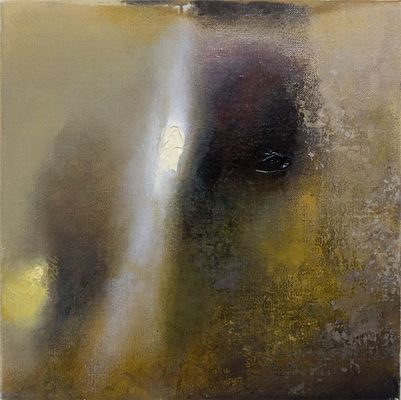
To return to Buckley’s fragment, the first two lines very much evoke how I paint nowadays. As you age, detail diminishes and patches of light become more luminous and float. I feel the most honest way of dealing with this is by smearing the oil paint on the canvas with the fingers and working close-up, blind. Only if the patches coalesce into an approaching image can the work gain a life.
-
Jonathan Walker was born in Melbourne, Australia and brought up on a dairy farm in Gippsland. In the 1970’s he studied painting at RMIT and won the Harold Wright Scholarship to the British Museum, London. During the 1980’s he exhibited at Pinacotheca Gallery, Richmond and had work shown at the NGV and Heidi City Art Gallery. Over the same period he designed the cover for the “Epigenesi” LP by Giancarlo Toniutti, Italy and conducted a mail exchange work with Achim Wollscheid, Germany. The work with artists through the post resulted in an article published in the bicentenary issue of Art and Australia 1988. He showed in artist run spaces such as WestSpace in the 90’s and 2000’s, and until 2012, taught painting at Victoria University, which is where we (Colleen Ahern and Lisa Radford) as organisers of the exhibition, among many others, had the privilege of being his student.
Walker’s knowledge was imparted to students through the careful selection of music, literature, and artists found in books that he himself had ordered for the library. Walker’s strategy was the generosity of sharing his vast knowledge with references specific to each student and their context.
Walker’s paintings share a similar focus and intimacy.
This exhibition presents a small selection of recent paintings alongside a publication that includes Walker’s writing. Observational and analytical, Walker’s work is a type of material notation — the time of day, colour and how it is blended, the both specific and fleeting location of a reflection on lino or the question of whether a chair leg should be included in a painting.
Please join us on Friday August 21 between 6-8pm to celebrate the opening of the exhibition.
Curated by Colleen Ahern and Lisa Radford.
B. Wurtz
Curated by Nic Tammens
March 26 - April 4, 2015
B.Wurtz works from a basement studio in his home on Manhattan’s Lower East Side.
This local fact is attested to by the plastic shopping bags and newsprint circulars that appear in his work. As formal objects, they don’t make loud claims about their origins but nonetheless transmit street addresses and places of business from the bottom of this long thin island. Like plenty of artists, Wurtz is affected by what is local and what is consumed. His work is underpinned by this ethic. It often speaks from a neighborhood or reads like the contents of a hamper:
“BLACK PLUMS $1.29 lb.”
“Food Bazaar”
“USDA Whole Pork Shoulder Picnic 99c lb.”
“RITE AID Pharmacy, with us it’s personal.”
“H. Brickman & Sons.”
“Sweet Yams 59c lb."
Most of the work in this exhibition was made while the artist was in residence at Dieu Donne, a workshop dedicated to paper craft in Midtown. Here Wurtz fabricated assemblages with paper and objects that are relatively lightweight, with the intention that they would be easily transportable to Australia. This consideration isn’t absolute in Wurtz’s work, but was prescriptive for making the current exhibition light and cheap. Packed in two boxes, these works were sent from a USPS post office on the Lower East Side and delivered to North Melbourne by Australia Post.
Wurtz appears courtesy of Metro Pictures, New York.
Thanks to Rob Halverson, Joshua Petherick, Sari de Mallory, Matt Hinkley, Helen Johnson, Fayen d'Evie, Ask Kilmartin, Lisa Radon, Ellena Savage, Yale Union, and "Elizabeth".
John Nixon
"Archive"
December 15 - January 20, 2014
The presentation of John Nixon's archive offered a rare showcase of this extensive collection of the artist's own publications, catalogues, posters, ephemera, editions and more, from the mid 1980s onwards, alongside a selection of his artworks.
Organized by John Nixon, Joshua Petherick and Matt Hinkley.
<a href=http://wfb.public-office.info/artist/john-nixon>All titles by John Nixon
"Habitat"
at Minerva, Sydney (organised by Joshua Petherick and Matt Hinkley)
November 15 - December 20, 2014
Lupo Borgonovo, Janet Burchill & Jennifer McCamley,
Lewis Fidock, HR Giger, Piero Gilardi, Veit Laurent Kurz,
Cinzia Ruggeri, Michael E. Smith, Lucie Stahl, Daniel Weil, Wols
Press Release:
“...It contained seven objects. The slender fluted bone, surely formed for flight, surely from the wing of some large bird. Three archaic circuitboards, faced with mazes of gold. A smooth white sphere of baked clay. An age-blackened fragment of lace. A fingerlength segment of what she assumed was bone from a human wrist, grayish white, inset smoothly with the silicon shaft of a small instrument that must once have ridden flush with the surface of the skin - but the thing’s face was seared and blackened.”
William Gibson, “Count Zero”, 1986
"Autumn Projects Archive"
Curated by Liza Vasiliou
March 6 - March 15, 2014
World Food Books, in conjunction with the Virgin Australia Melbourne Fashion Festival 2014, presented the Autumn Projects archive, consisting of a selection of early examples in Australian fashion with a particular interest in collecting designers and labels from the period beginning in the 1980’s, who significantly influenced the discourse of Australian Fashion.
Curated by Liza Vasiliou, the exhibition provided a unique opportunity to view pieces by designers Anthea Crawford, Barbara Vandenberg, Geoff Liddell and labels CR Australia, Covers, Jag along with early experimental collage pieces by Prue Acton and Sally Browne’s ‘Fragments’ collection, suspended throughout the functioning World Food Books shop in Melbourne.
H.B. Peace
presented by CENTRE FOR STYLE
November 14, 2013
"Hey Blinky, you say chic, I say same"
Anon 2013
H.B. Peace is a clothing collaboration between great friends Blake Barns and Hugh Egan Westland. Their pieces explore the divergences between 'character’ and ‘personality’ in garments....etc
Special Thanks to Joshua Petherick and Matt Hinkley of WFB and Gillian Mears
and a Very Special Thank you to Audrey Thomas Hayes for her shoe collaboration.
Janet Burchill & Jennifer McCamley
"Aesthetic Suicide"
May 10 - June 8, 2013
The first of our occasional exhibitions in the World Food Books office/shop space in Melbourne, "Aesthetic Suicide" presented a body of new and older works together by artists Janet Burchill & Jennifer McCamley, including videos, prints, a wall work, and publications.
During shop open hours videos played every hour, on the hour.
2020, English
Hardcover (w. dust jacket), 256 pages, 22.9 x 17.8 cm
Published by
The MIT Press / Massachusetts
October Books / New York
$50.00 - Out of stock
Annette Michelson's erudite and incisive readings of the revolutionary films of Sergei Eisenstein and Dziga Vertov, gathered here for the first time in this posthumous volume, giving readers the opportunity to track her sustained investigations into their work. Michelson introduced American audiences to Soviet cinema in the early 1970s, extending the interpretive paradigm she had used for American filmmakers of the mid-twentieth century—in which she emphasized phenomenological readings of their work—to films and writings by Eisenstein and Vertov. Over four decades, Michelson returned again and again to what she calls, following Eisenstein, “intellectual cinema”—the deliberate attempt to create philosophically informed analogues for consciousness.
The volume includes Michelson's major essays on Eisenstein's unrealized attempts to make movies of both Marx's Capital and Joyce's Ulysses, as well as her authoritative discussion of Vertov's 1929 masterpiece The Man with a Movie Camera. Together, the texts demonstrate Michelson's pervasive influence as a writer and thinker, and her role in the establishment of cinema studies as an academic field. This collection makes these canonical texts available for a new generation of film scholars.
Like the filmmakers with which she is engaged, Annette Michelson's intellectual project is nothing short of passionate. The analytic rigor, the discerning historical and cultural perspectives and the political resonance of these essays are confluent with Michelson's keen perception and striking associations, while the elegance of the writing also registers her intensely poetic and imaginative engagement. — Noa Steimatsky, author of Italian Locations and The Face on Film
2020, English / French
Softcover, 168 pages, 17 x 23.9 cm
Published by
Dancing Fox Press
National Gallery of Canada / Ontario
$54.00 - Out of stock
Over the past 40 years, Canadian artist Moyra Davey (born 1958) has perfected a unique synthesis of photography, film and text to critically engage with the past, present and future of the world around her. Based on Davey’s eponymous 2019 film, I Confess unites three main sources in a chronicle of late 20th-century Quebec, shaped by themes of race, poverty, language and nationalism. Using American writer James Baldwin’s 1962 novel Another Country as its point of departure, Davey’s film also focuses on the life and work of Québécois revolutionary Pierre Vallières and Ottawa-based political philosopher Dalie Giroux.
Published to accompany the exhibition Moyra Davey: The Faithful at the National Gallery of Canada, this deeply personal and highly political book seeks to examine an unresolved chapter of Québécois history from a uniquely interdisciplinary perspective that draws attention to contemporary issues of separatism, while reflecting the artist's understanding of photography and text as unique corollaries. This publication features writings by the artist, Dalie Giroux and National Gallery of Canada’s Associate Curator Andrea Kunard, and a poster insert.
2014, English
Softcover, 152 pages, 12.7 x 20.3 cm
Published by
Schism Press / World
$30.00 - In stock -
Schism Press brings you Eugene Thacker's {anti} novel, An Ideal For Living.
As today's strategies of conceptual writing have become legitimized and cliched, Thacker's text reminds us of how radical and potent these gestures once were, treading a fine line between the mechanical and the authorial. This is an important book...these pages take cues from Burroughs and Gibson, while at the same time presciently pointing to the web-based path writing would take over the next decade. It's a joy to see this back in print. — Kenneth Goldsmith, author of Day and Soliloquy, founder of Ubuweb
Eugene Thacker's An Ideal for Living in the apoptosis of hyperreal language shed a data flesh as a discourse toward death continuously from cracks in DNA...It is present in an inexplicable state of literary language and data. — Kenji Siratori, author of Blood Electric and Mad In Japan
2020, English
Softcover, 304 pages, 14 x 21 cm
Published by
Verso / London
$39.00 - Out of stock
As we face the compounded crises of late capitalism, environmental catastrophe and technological transformation, who are the thinkers and the ideas who will allow us to understand the world we live in? McKenzie Wark surveys three areas at the cutting edge of current critical thinking: media ecologies, post-colonial ethnographies, and the design of technology, and introduces us to the thinking of seventeen major writers who, combined, contribute to the common task of knowing the world. Each chapter is a concise account of an individual thinker, providing useful context and connections to the work of the others.
The authors include: Sianne Ngai, Kodwo Eshun, Lisa Nakamura, Hito Steyerl, Yves Citton, Randy Martin, Jackie Wang, Wang Hui, Anna Lowenhaupt Tsing, Achille Mbembe, Eyal Weizman, Cory Doctorow, Benjamin Bratton, Tiziana Terranova, Keller Easterling, Jussi Parikka, Deborah Danowich and Eduardo Viveiros de Castro
Wark argues that we are too often told that expertise is obtained by specialisation. Sensoria connects the themes and arguments across intellectual silos. The book is a vital and timely introduction to the future both as a warning but also as a roadmap for how we might find our way out of the current crisis.
Published by Verso, 2020
2020, English
Hardcover, 108 pages, 23 x 17 cm
Published by
Walther König / Köln
$59.00 - Out of stock
Gerhard Richter’s early period in Dresden ended in February 1961 with his escape from the DDR. The artist’s work in the West officially began at the end of 1962 with the painting listed number one in his works catalogue, “Tisch”.
The interval of one and a half years in between has remained largely ignored by art historians. It was during these months that Gerhard Richter, who still called himself “Gerd” at the time, tried to find his feet in his new surroundings in Düsseldorf.
The book presents numerous letters, photographs and documents, as well as pictures from this period and chronicles Richter’s experiences and search for a new artistic beginning.
2020, Enlgish
Softcover, 336 pages, 19.1 x 23.5 cm
Published by
Eurock Publications / Portland
$60.00 - In stock -
A collection of 'Artifacts' from the files of the legendary Eurock Magazine, "Archives" presents rare images, letters, and communiqués that help complete the intimate Eurock portrait of an era, the music and the friendships spanning 1970-2000. Haphazardly tracing Eurock founder Archie Patterson's life in music, "Archives" is at once both a visual scrapbook and idiosyncratic introduction to 1970s-80s experimental music networks around the world (Krautrock, Musique Française, Behind the Iron Curtain, Musica de Mexico, experimental music from Japan, Brazil, UK, Sweden, the labels, fanzines, distributions...), all heavily illustrated with ephemera, press images, hand-bills, letters, clippings, gig posters, zine covers, and much more.
Includes Cosmic Couriers, Klaus Schulze, Tangerine Dream, Ash Ra Tempel, Popol Vuh, Manuel Göttsching, Wallenstein, Witthüser & Westrupp, Floh de Cologne, Hoelderlin, Emtidi, Mythos, Amon Düül 2, Roedelius, Can, Konrad Schnitzler, Peter Baumann, Kraftwerk, Spacebox, Embryo, Lard Free, Guru Guru, Gilbert Artman, Urban Sax, Art Zoyd, Heldon, Etron Fou Leloublan, Patrick Gauthier, Ilitch, ZNR, Bernard Szajner, DDAA, Didier Bocquet, Wapassou, Univers Zero, Fondation, Shub Niggurath, Troll, Pascal Comelade, Eskaton, Christian Vander, Catherine Riberio + Alpes, Yochk'o Seffer, Luc Marianni, Pulsar, Pataphonie, Michail Chekalin, Patrick Vian, Plastic People of the Universe, Carlos Alvarado, Chac Mool, Decibel, Jorge Reyes, Far East Family Band, Stomu Yamash'ta, Magical Power Mako, Samla Mammas Manna, Aska Temple, Legendary Pink Dots, Michael Huygen, Vangelis, Neuronium, Klaus Schonning, Cybotron, Steve Maxwell Von Braund, Ian McFarlane, Rainbow Theatre, Kulu Hatha Mamma, Savage Rose, Metabolist, Henry Cow, Lemon Kittens, Half Japanese, Chrome, and many more...
Founded by Archie Patterson in Portland 1971 as an FM radio show in Central California, Eurock developed into the fanzine bible of European rock and electronic music, promoting space, cosmic music, krautrock, ambient, and experimental music through its pages and subsequent Intergalactic Trading Company and Paradox Music Mailorder services. Whilst releasing and distributing the "100 Points" recording by the imprisoned Czech underground band Plastic People of the Universe, consulting on film scores in LA (introducing director Michael Mann to Tangerine Dream), and teaching Rock music history classes in public high school, Archie published 45 issues of the invaluable, internationally distributed, vanguard Eurock magazine.
2007, English
Softcover, 718 pages, 17.8 x 25.4 cm
Published by
Eurock Publications / Portland
$80.00 - In stock -
"the Second Culture ... a culture that will not be dependent on the official channels of communication, social recognition, and the hierarchy of values laid down by the establishment." – Ivan Jirous, Plastic People of the Universe
"Eurock Magazine documents a particular time in the world when the limits of imagination and what was possible sonically were stretched beyond the norm. The futuristic alchemy of free-flowing ions, mind-expanding chemical substances and mega-watts of electricity resulted in an explosion of creativity unparalleled in the history of rock music." – from foreword
European Rock & the Second Culture, "The Book of Eurock", compiles all the feature articles, interviews, reviews and essays published in Eurock Magazine during its existence from 1973 - 1992. Founded by Archie Patterson in Portland 1971 as an FM radio show in Central California, Eurock developed into the fanzine bible of European rock and electronic music, promoting space, cosmic music, krautrock, ambient, and experimental music through its pages and subsequent Intergalactic Trading Company and Paradox Music Mailorder services. Whilst releasing and distributing the "100 Points" recording by the imprisoned Czech underground band Plastic People of the Universe, consulting on film scores in LA (introducing director Michael Mann to Tangerine Dream), and teaching Rock music history classes in public high school, Archie published 45 issues of the invaluable, internationally distributed vanguard Eurock magazine.
At over 700 pages, European Rock & the Second Culture contains an enormous wealth of information, illustrated and collated in chronological order, and rounded off with an extensive index of the musical artists and subjects covered over 30 years. Includes Amon Düül, Faust, Heldon, ZNR, Can, Magma, Plastic People of the Universe, Urban Sax, Henry Cow, Klaus Schulze, Tangerine Dream, Ash Ra Tempel, Popol Vuh, Art Zoyd, Univers Zero, Pascal Comelade, Floh de Cologne, Hoelderlin, Emtidi, Mythos, Amon Düül 2, Konrad Schnitzler, Peter Michel Hamel, Savage Rose, Urban Sax, Neu, Embryo, Yochk'o Seffer, Wigwam, Catherine Riberio + Alpes, Chrome, Area, Kluster, ZAO, Ange, Tolonen, Sensation's Fix, Osanna, DDAA, Le Orme, Kraan, SBB, Omega, Mark Shreeve, Cyrille Verdeaux, Holger Czukay, Pekka Pohjola, Richard Pinhas, Tasavallan Presidentti, and many many more, plus the labels, the fanzines, the politics, and above all else, the spirit of the music.
A Special Bonus is the previously unpublished tome on Krautrock from 1971 by Lester Bangs, late Editor of Creem Magazine and gonzo rock journalist extraordinaire, Amon Düül - A Science Fiction Rock Spectacle: "the combined accomplishments of American and Limey bands have been seeded in less-sung rock scenes around the world, and some of these seeds are coming to the weirdest blooms heard in the Western world with the mostest bloom in one of the seemingly unlikeliest places imaginable: Scandinavia and Germany." – Lester Bangs
A must!
2006, English
Hardcover, 220 pages, 17.8 x 25.4 cm
Published by
Semiotext(e) / Los Angeles
$60.00 - Out of stock
In February 1991, the artist David Wojnarowicz (1954-1992) and the philosopher Sylvère Lotringer met in a borrowed East Village apartment to conduct a long-awaited dialogue on Wojnarowicz's work. Wojnarowicz was then at the peak of his notoriety as the fiercest antagonist of morals crusader Senator Jesse Helms—a notoriety that Wojnarowicz alternately embraced and rejected. Already suffering the last stages of AIDS, David saw his dialogue with Lotringer as a chance to set the record straight on his aspirations, his personal history, and his political views. The two arranged to have this three-hour dialogue video-recorded by a mutual friend, the artist Marion Scemama. Lotringer held on to the tape for a long time. After Wojnarowicz's death the following year, he found the transcript enormously moving, yet somehow incomplete. David was trying, often with heartbreaking eloquence, to define not just his career but its position in time. The subject was huge, and transcended the actual dialogue. Lotringer then spent the next several years gathering additional commentary on Wojnarowicz's life and work from those who knew him best—the friends with whom he collaborated. Lotringer solicited personal testimony from Wojnarowicz's friends and other artists, including Mike Bildo, Steve Brown, Julia Scher, Richard Kern, Carlo McCormick, Ben Neill, Kiki Smith, Nan Goldin, Marguerite van Cook, and others. What emerges from these masterfully-conducted interviews is a surprising insight into something art history knows, but systematically hides: the collaborative nature of the work of any "great artist." All these respondents had, at one time, made performances, movies, sculptures, photographs, and other collaborative works with Wojnarowicz. In this sense, Wojnarowicz appears not only as a great originator, but as a great synthesizer.
2019, English
Softcover, 304 pages, 12.7 x 18 cm
Published by
Harper Perennial / New York
$35.00 - Out of stock
A new work equal parts observational micro-fiction and cultural criticism reflecting on the dailiness of life as a woman and writer, on fame and failure, aging and art, from the acclaimed author of Heroines, Green Girl, and O Fallen Angel.
In the first half of Kate Zambreno's astoundingly original collection Screen Tests, the narrator regales us with incisive and witty swatches from a life lived inside a brilliant mind, meditating on aging and vanity, fame and failure, writing and writers, along with portraits of everyone from Susan Sontag to Amal Clooney, Maurice Blanchot to Louise Brooks. The series of essays that follow, on figures central to Zambreno's thinking, including Kathy Acker, David Wojnarowicz, and Barbara Loden, are manifestoes about art, that ingeniously intersect and chime with the stories that came before them.
If Thomas Bernhard's and Fleur Jaeggy's work had a charming, slightly misanthropic baby--with Diane Arbus as nanny--it would be Screen Tests. Kate Zambreno turns her precise and meditative pen toward a series of short fictions that are anything but small. The result is a very funny, utterly original look at cultural figures and tropes and what it means to be a human looking at humans."--Amber Sparks
"In Screen Tests, a voice who both is and is not the author picks up a thread and follows it wherever it leads, leaping from one thread to another without quite letting go, creating a delicate and ephemeral and wonderful portrait of how a particular mind functions. Call them stories (after Lydia Davis), reports (after Gerald Murnane), or screen tests (inventing a new genre altogether like Antoine Volodine). These are marvelously fugitive pieces, carefully composed while giving the impression of being effortless, with a quite lovely Calvino-esque lightness, that are a joy to try to keep up with."--Brian Evenson
2020, English
Softcover, 320 pages, 15.2 x 23 cm
Published by
University of Iowa Press / Iowa
$59.00 - Out of stock
“The time has certainly come for a large-scale study of Dennis Cooper, and Wrong is a major achievement that satisfies in every respect. Cooper is a truly tireless figure who has somehow managed to thrive outside the university and nonprofit industrial complex. He’s published poetry, fiction, and hybrid genres that cross four decades of literary innovation and numerous subcultures: liberation-era militancy, anarcho-punk, AIDS writing, and digital poetics. Hester’s book makes the definitive case for Cooper as both modern day Rimbaud and Sade. Unlike Rimbaud, however, Cooper never abandoned the literary enterprise and instead, like his peer Eileen Myles, kept reinventing his project, rarely repeating the same formal decisions in any two works. Further, he has been a figurehead in Los Angeles, New York, and Amsterdam, not to mention his presence as a juggernaut of blogging. Readers will not soon forget the scenes that come hurtling at us sideways in these pages: the young Cooper bludgeoned in the head with an axe, the suburban youth baptized by punk music, the friendship with George Miles (the ‘flickering presence’ of Cooper’s cycle of novels), the literary disputes of later years, and many more. Hester’s ferocious sleuthing conveys us to whole new areas of understanding about Cooper.”—Kaplan Harris, coeditor, The Selected Letters of Robert Creeley
“Diarmuid Hester unfurls a riveting chronicle of Dennis Cooper’s intertwined life and work, without circumscribing the possibilities that remain for readers to construct a Dennis of their own. Hester interprets Cooper’s creations within their historical, relational, and political contexts, and keeps alive the interpersonal spark that makes Cooper such an inspiration for rebels and artists everywhere.”—Wayne Koestenbaum, author, Camp Marmalade
Dennis Cooper is one of the most inventive and prolific artists of our time. Working in a variety of forms and media since he first exploded onto the scene in the early 1970s, he has been a punk poet, a queercore novelist, a transgressive blogger, an indie filmmaker—each successive incarnation more ingenious and surprising than the last. Cooper’s unflinching determination to probe the obscure, often violent recesses of the human psyche have seen him compared with literary outlaws like Rimbaud, Genet, and the Marquis de Sade.
In this, the first book-length study of Cooper’s life and work, Diarmuid Hester shows that such comparisons hardly scratch the surface. A lively retrospective appraisal of Cooper’s fifty-year career, Wrong tracks the emergence of Cooper’s singular style alongside his participation in a number of American subcultural movements like New York School poetry, punk rock, and radical queercore music and zines. Using extensive archival research, close readings of texts, and new interviews with Cooper and his contemporaries, Hester weaves a complex and often thrilling biographical narrative that attests to Cooper’s status as a leading figure of the American postwar avant-garde.
2020, English
Softcover, 276 pages, 16.5 x 23.5 cm
Published by
Occasional Papers / London
$52.00 $45.00 - Out of stock
This ambitious book brings together a wide international selection of new and recent writing by educators and practitioners who question the rules and hierarchies of graphic design education today. It holds a vivid mirror up to the ways in which graphic design is imagined, taught, received and reproduced.
Edited by two designer-educators, One and many mirrors provides an urgent overview of the field of contemporary graphic design education for all those concerned with its past, present and possible futures.
Featuring contributions by Paul Bailey, Stuart Bertolotti-Bailey, Sheila Levrant de Bretteville, Richard Buchanan, Vincent Chan, Tony Credland, Europa, Katie Evans, Matthew Galloway, Rob Giampietro, Corin Gisel, Ricardo Gonçalves, Lisa Grocott, Brad Haylock, Constanze Hein, Richard Hollis, Na Kim, James Langdon, Lu Liang, Ellen Lupton, Gabriela Matuszyk, Fraser Muggeridge, Paul Mylecharane, Nina Paim, Megan Patty, Radim Peško, Joe Potts, Bryony Quinn, Carlos Romo‑Melgar, Naomi Strinati, Jon Sueda, Lucille Tenazas, Teal Triggs, Michael Twyman, Jonty Valentine, Laurene Vaughan, Noel Waite, Luke Wood, Jia Xiao, Bonne Zabolotney and Roxy Zeiher.
Supported by The Physics Room, University of Canterbury College of Arts Contestable Research Fund and RMIT University School of Design
Edited by Luke Wood and Brad Haylock
2012, English
Softcover, 304 pages, 29.7 x 21 cm
Published by
Occasional Papers / London
$65.00 - Out of stock
The first anthology of its kind, Graphic Design: History in the Writing (1984–2011) comprises some of the most influential published texts about graphic design history. The book documents the development of the relatively young field of graphic design history from 1983 to today, underscoring the aesthetic, theoretical, political and social tensions that have underpinned it from the beginning. Included in the anthology are texts by:
Jeremy Aynsley, Steve Baker, Andrew Blauvelt, Piers Carey, François Chastanet, Wen Huei Chou, Denise Gonzales Crisp, Brian Donnelly, Johanna Drucker, Steven Heller, Richard Hollis, Robin Kinross, Ellen Lupton, Victor Margolin, Ellen Mazur Thomson, Philip B. Meggs, Gérard Mermoz, Abbott Miller, Rick Poynor, Martha Scotford, Catherine de Smet, Teal Triggs, Massimo Vignelli, Bridget Wilkins
Edited by Catherine de Smet and Sara De Bondt
2019, English
Hardcover, 144 pages, 11.5 x 18 cm
Published by
Park Books / Zürich
$49.00 - Out of stock
The new revised edition of Valerio Olgiati's and Markus Breitschmid's widely acclaimed manifesto for a new approach in architecture in a world free of ideologies and, therefore, references: a must-read for anyone interested in architecture today.
More than ever, architecture is in need of provocation, a new path beyond the traditional notion that buildings must serve as vessels, or symbols of something outside themselves.
Non-Referential Architecture is nothing less than a manifesto for a new architecture. It brings together two leading thinkers, architect Valerio Olgiati and theorist Markus Breitschmid, who have grappled with this problem since meeting in 2005. In a world that itself increasingly rejects ideologies of any kind, Olgiati and Breitschmid offer non-referential architecture as a radical, new approach free from rigid ideologies. Non-referential buildings, they argue, are entities that are themselves meaningful outside a vocabulary of fixed symbols and images and their historical connotations.
For more than a decade, Olgiati and Breitschmid’s thinking has placed them at the forefront of architectural theory. Indispensable for understanding what the future might hold for architecture, Non-Referential Architecture will become a new classic.
2020, English
Softcover, 272 pages, 17 x 24 cm
Published by
Mousse / Milan
Ujazdowski Castle Centre for Contemporary Art / Warsaw
$65.00 - Out of stock
The publication is an anthology of both newly commissioned and reprinted essays, as well as interviews and fiction that reflect on performance today. It is structured around four major sections that investigate the new performance phenomenologies by looking at artistic institutions, curatorial practices, and exhibition formats, as well as the technological turn and performative fiction. Over recent decades, the definition of performance has changed. Performance Works examines changes taking place in the traditional exhibition format, which has recently taken a back seat to hybrid forms that link the visual arts with the performing arts, literature, and music. The book reflects on the changing role of the viewer, who increasingly has become a performer and active participant. Authors also analyze the role of the performer’s body and the work that is involved in extended performative exhibitions. Additionally, Performance Works presents the research outcomes linked to the performance program launched in 2016 at Ujazdowski Castle Centre for Contemporary Art in Warsaw, which examined the performative turn in visual arts and its consequences for art institutions, as well as artistic and curatorial practices.
Edited by Joanna Zielińska
Texts by Oreet Ashery, Pierre Bal-Blanc, Claire Bishop, Marie de Brugerolle, Yann Chateigné, Korina Giaxoglou, Michał Grzegorzek, Shannon Jackson, Eliel Jones, Chris Kraus, Laura Lima, David Maroto, Ingo Niermann, Kathy Noble, Johannes Paul Raether, Mark von Schlegell, Agnieszka Sosnowska, Ana Teixeira Pinto, Transformella, and Joanna Zielińska
2020, English
Softcover, 240 pages, 13 x 22 cm
Published by
Valiz / Amsterdam
$50.00 - Out of stock
In The Aesthetics of Ambiguity: Understanding and Addressing Monoculture Pascal Gielen and Nav Haq argue that multiculturalism is paradoxically based on monocultural thinking. The publication explores this paradox by exploring monoculture in a variety of contemporary contexts. The book sets out to analyse monoculture using a multifaceted approach, by bringing together historical, social, cultural and ideological perspectives, using the dual role of art as tool for reconciliation and division in societies. The Aesthetics of Ambiguity gives stage to artists, thinkers and institutional practices who dare to play with the rules of a broader society and thus generate ambiguity ‘at large’. The book represents a quest for (more) ambiguity in order to avoid rigid borders or black-and-white polarities between cultures, as well as between practices of art and scientific thinking. By doing so, the artists, activists and researchers featured in this book plea for a politics and aesthetics of ambiguity to deal with the complexity of our living together on Earth.
Contributors: Paolo S.H. Favero, Pascal Gielen, Christine Greiner, Max Haiven, Nav Haq, Hedwig Houben, Iman Issa, Bojana Piškur, Public Movement, Jonas Staal, Mi You and Tirdad Zolghadr
Design: Metahaven
Pascal Gielen is professor of sociology of culture and politics. He is based at the Antwerp Research Institute for the Arts (ARIA) of Antwerp University. There he leads the research group Culture Commons Quest Office (CCQO). He is editor of the international book series Antennae-Arts in Society, published by Valiz.
Nav Haq is Associate Director at M HKA, responsible for the development of its artistic programme. At M HKA he co-curated Don’t You Know Who I Am? Art After Identity Politics (2014). He was previously Exhibitions Curator at Arnolfini, Bristol and Curator at Gasworks, London. Haq has organized numerous monographic exhibitions and in 2012 he was the recipient of the Independent Vision Award for Curatorial Achievement, awarded by Independent Curators International, New York.
2020, English
Softcover, 242 pages, 15 x 20.2 cm
Published by
Blank Forms / New York
$44.00 - Out of stock
Edited by Lawrence Kumpf with Joe Bucciero.
Contributors and featured artists include Masayuki Takayanagi, Louise Landes Levi, Joseph Jarman, Catherine Christer Hennix, Charles Stein, Henry Orlov, Maryanne Amacher, Alan Cummings, Bill Dietz, Peter Kastakis, Art Lange, Leo Svirsky, Satoru Obara, and Tomoyuki Chida.
Aspirations of Madness, Blank Forms’ fifth collection of archival, unpublished, or newly translated texts, takes its title from a series of interviews with Japanese free jazz pioneer Masayuki Takayangi that were published in Japanese in 1975–76 and are published here in English for the first time. The interviews provide a rare look at Takayanagi’s eccentric practice and personality, both long under-recognized by audiences outside (and often, inside) of Japan. In this respect, the interviews speak to the goals of Blank Forms’ publication enterprise, that is, to expand upon our work in performance programming, record production, and archival preservation, and to foster new dialogues on vanguard art and music from the past 50-plus years.
Aspirations of Madness considers the work of Masayuki Takayanagi, the poet Louise Landes Levi, musician and writer Joseph Jarman, polymath Catherine Christer Hennix and her one-time student the poet Charles Stein, Russian musicologist Henry Orlov, and Maryanne Amacher—brilliant and overlooked artists whose work Blank Forms will continue to champion in a variety of contexts. Aspirations of Madness features additional contributions by Alan Cummings, Bill Dietz, Peter Kastakis, Art Lange, Leo Svirsky, Satoru Obara, and Tomoyuki Chida, and is edited by Lawrence Kumpf with Joe Bucciero.
1984, English
Softcover, 148 pages, 21.5 x 15 cm
1st Edition, Out of print title / used / very good
Published by
Pluto Press / London-Sydney
$100.00 - Out of stock
First Edition.
'If men make the buildings that women work in, then who are the real home makers? Are our homes fit for heroines? Is architecture women's work? These are the questions that feminist architects and builders - and home makers - ask and answer in Making Space, a stiff challenge to the great macho myths of metropolitan architecture' - Beatrix Campbell, author of Wigan Pier Revisited
Making Space shows how sexist assumptions about family life and the role of women have been built into the design of our homes and cities - and still influence modern housing. Seven women, who are architects, designers and builders, criticise the environment created by male 'professionals', and show how women designers and consumers can work together. They tell of the struggles for professional recognition; the attempts to improve working class housing design between the wars; and of experiments, such as communal restaurants during the second world war, that call in question the convention that a woman's place is in the home.
"The authors of this book belong to a group of feminist designers collectively known as Matrix. We are women who share a concern about the way buildings and cities work for women. We work as architects, teachers in higher education, researchers, mothers, a builder, a journalist and a housing manager. Working together on this book was for most of us a first chance to develop ideas about buildings with other women; and we have learnt a lot from each other.
In our paid jobs some of us have chosen to work with women; others work with men. Most of us live with men, three of us have children and about half of us live in collective households. We did not set out to be a consciousness-raising group, but have brought individual experience of the women's movement to a group whose common ground is involvement with buildings.
Many of us were members of the New Architecture Movement in the late 1970s. NAM was a mixed group of socialist architects together with some students, teachers and builders. It was concerned to make architects more accountable to those who use buildings and questioned the relationship between user and architect, and to a lesser extent (but important for some of us) that between architect and builder. A feminist discussion group emerged and organised a conference in March 1979 called 'Women and Space'. The conference attracted about 200 women, and some men from a variety of backgrounds. Though interest in the subject was evidently great, there was very little published work then available. This gave some of us the idea of meeting regularly and eventually to produce a book. [...]" (from preface)
2016, English
Softcover, 224 pages, 13.3 x 20.3 cm
Published by
University of Minnesota Press / Minnesota
$40.00 - Out of stock
Electrifying, provocative, and controversial when first published thirty years ago, Donna Haraway's "Cyborg Manifesto" is even more relevant today, when the divisions that she so eloquently challenges--of human and machine but also of gender, class, race, ethnicity, sexuality, and location--are increasingly complex. The subsequent "Companion Species Manifesto," which further questions the human-nonhuman disjunction, is no less urgently needed in our time of environmental crisis and profound polarization.
Manifestly Haraway brings together these momentous manifestos to expose the continuity and ramifying force of Haraway's thought, whose significance emerges with engaging immediacy in a sustained conversation between the author and her long-term friend and colleague Cary Wolfe. Reading cyborgs and companion species through and with each other, Haraway and Wolfe join in a wide-ranging exchange on the history and meaning of the manifestos in the context of biopolitics, feminism, Marxism, human-nonhuman relationships, making kin, literary tropes, material semiotics, the negative way of knowing, secular Catholicism, and more.
The conversation ends by revealing the early stages of Haraway's "Chthulucene Manifesto," in tension with the teleologies of the doleful Anthropocene and the exterminationist Capitalocene. Deeply dedicated to a diverse and robust earthly flourishing, Manifestly Haraway promises to reignite needed discussion in and out of the academy about biologies, technologies, histories, and still possible futures.
2020, English
Hardcover, 272 pages, 21.7 x 28 cm
Published by
Hatje Cantz / Berlin
Moderna Museet / Malmö
$100.00 - Out of stock
Rewriting the History of Abstract Painting.
Once considered an outsider artist, after her show at the Guggenheim Museum was seen by more than half a million visitors, Hilma af Klint firmly established her place in art history. She has also been the subject of documentary films and biographies. In 2013, Iris Müller-Westermann organized the first retrospective exhibition of af Klint’s work. Now she presents us with the latest information and research in an extensive survey show, which she curated together with Milena Høgsberg, at the Moderna Museet in Malmö. Of crucial importance is the issue of spirituality in af Klint’s painting—how the artist managed to translate both the material and the immaterial world into a pictorial vision. The accompanying exhibition catalogue investigates, from a variety of perspectives, the question of how this trailblazing abstract artist linked her painting to a higher consciousness. Essays by art historians, a quantum physicist, a spiritual teacher, and an historian of theosophy and esotericism, among others, provide insights into a world beyond the visible which fascinates us now even more than ever.
HILMA AF KLINT (1862–1944) studied painting at the Royal Academy of Fine Arts in Stockholm. She turned to abstraction in the wake of her profound exploration of spirituality and theosophy. She is regarded as a pioneer of abstract art.
Edited by Iris Müller-Westermann, Milena Hoegsberg, text(s) by Ernst Peter Fischer, Ylva Hillström, Milena Hoegsberg, Anne Sophie Joergensen, Caroline Levander, Hedvig Martin, Iris Müller-Westermann, Tim Rudboeg, graphic design by Patric Leo
2019, English
Softcover, 240 pages, 17 cm x 24 cm
Published by
Valiz / Amsterdam
$55.00 - Out of stock
Art is a form of thinking and dialoguing; it is an unusual source of knowledge. In this publication the reader is introduced to Art-Based Learning, a method that enables the spectator to explore these dialogues, and ‘converse’ with art works. Art-Based Learning can refer both to learning about art as a source and learning about art as a means, e.g. the way art can generate insight into the significance of learning itself. The method offers the possibility to seek fresh correlations in a dialogue with the art work.
The author uses three triptychs to demonstrate, step by step, how relevant questions can produce a different perception and understanding, and how works of art, as ‘speaking objects’, can produce new experiences or new knowledge.
In the Shadow of the Art Work is intended for students and teachers of art, art history, drama and cinema, literature, philosophy, anthropology, theology and interdisciplinary studies. The developed method is also highly suited to Artistic Research at academies of art, music, film and dance.
Jeroen Lutters is an art and culture analyst and educational designer. His critical educational theory concentrates on the central role of the arts and humanities in the contemporary curriculum, the need for artist educators as wandering teachers, the theory and practice of art-based learning, and the development of twenty-first‑century educational landscapes.
2018, English
Softcover, 222 pages, 17 x 24 cm
Published by
Valiz / Amsterdam
$55.00 - Out of stock
In the 21st century we have witnessed a significant expansion in the field of transhistorical exhibition practice. A range of curatorial efforts have emerged in which objects and artefacts from various periods and art historical and cultural contexts are combined in display, in an effort to question and expand traditional museological notions such as chronology, context, and category. Such experiments in transcending art historical boundaries can result in fresh insights into the workings of entrenched historical presumptions, providing a space to reassess interpretations of individual objects. With contributions by Mieke Bal, Hendrik Folkerts, Nicola Setari, Maria Iñigo Clavo, and others.
2015, English
Softcover, 256 pages, 17 x 24 cm
Published by
Valiz / Amsterdam
$50.00 - Out of stock
The Shape of Evidence examines the role and use of visual documents in contemporary art, looking at artworks in which the document is valued not only as a source of information but also as a distinctive visual and critical form. It contends that for artists who use film, photography or written sources, adopting formats derived from specific professional, industrial, scientific of or commercial contexts, the document offers a way to develop a critical reflection around issues of representation, knowledge production, art and its history.
It addresses several issues that are key both in art and in general culture today: the role of the museum and the archive, the role of documents and the trust that is placed in them, the circulation of such images and the historical genealogies that can be drawn in relation to images. Its uniqueness, however, also derives from its method: it is based on a close reading of a select number of works of art (e.g. Christopher Williams, Fiona Tan, Jean-Luc Moulène), which makes it approachable and engaging with the reader.
Moreover it applies an interdisciplinary perspective: while being about contemporary art it discusses objects and ideas drawn from a wide spectrum of areas including literature, history, photography history, scientific representation, surrealism, conceptual art, commercial photography and so forth.
The Shape of Evidence invites viewers to reflect upon the production and interpretation of seemingly straightforward images, and proposes that some artists can show us through their practice how to turn these deceptively simple images inside out.
Sophie Berrebi (1973) is a writer, art historian and occasional curator, born in Paris and living in Amsterdam. Her writing has appeared in frieze, Afterall, Metropolis M, and Art and Research, among other publications. She received her PhD from the Courtauld Institute of Art, University of London, and has been based at the University of Amsterdam since 2003 where she teaches art history and theory, mainly in the areas of photography and contemporary art.
2018, English
Softcover, 288 pages, 16 x 23 cm
Published by
Valiz / Amsterdam
$55.00 - Out of stock
Now out-of-print, last copies.
Artists and cultural practitioners from indigenous communities around the world are increasingly in the international spotlight. As museums and curators consider the global reach of their collections and exhibitions, this publication draws upon the challenges faced by cultural workers today, both indigenous and non-indigenous, to engage meaningfully and ethically with the histories, presents, and future of indigenous cultural practices and world views. Through sixteen indigenous voices the book charts perspectives across art and film, ethics and history, theory and museology.
Editor: Katya García-Antón
Contributors: Daniel Browning, Kabita Chakma, Megan Cope, Santosh Kumar Das, Hannah Donnelly, Léuli Māzyār Luna’i Eshrāghi, David Garneau, Biung Ismahasan, Kimberley Moulton, Máret Ánne Sara, Venkat Raman Singh Shyam, Irene Snarby, Ánde Somby, Megan Tamati-Quennell, Prashanta Tripura, Sontosh Bikash Tripura, and the OCA contributors: Liv Brissach, Katya García-Antón, Drew Snyder, Nikhil Vettukattil
1989, English
Softcover (double fold-out card), 210 x 297
1st Edition, Out of print title / used / fine
Published by
200 Gertrude Street / Melbourne
$15.00 $5.00 - In stock -
Scarce catalogue published on the occasion of the exhibition Annotations, curated by Rose Lang and Verginia Trioli, at 200 Gertrude Street in 1989. "An exhibition of visual art and writing that explores the idea of commentary and response." Introductory text by Lang and Trioli Lasica followed by texts by Butcher Joe Nangan, Stephen Muecke, Kevin Murray, Peter Lawrence, and a catalogue of exhibited works by Fiona Macdonald, Stephen Bram, Rose Lang And Stieg Persson, John Bartlett and Natasha Moszenin, Linda Marrinon and Ralph Traviato, Geoff Lowe, Jon Campbell and Kevin Murray, Brenda Ludeman and Kathy Temin, Robert Rooney.
Fine copy.