World Food Books' programme is largely produced on Kulin Nation land. We acknowledge the Wurundjeri people of the Kulin Nation as the first and continuing custodians of this land, and pay respect to their Elders past, present, and emerging.
World Food Books is an arts and special interests bookshop in Naarm / Melbourne. Founded in 2010, World Food Books is devoted to the presentation of a rotating, hand-selection of international art, design, literary and counterculture publications with an emphasis on the anti-traditional, the experimental, the avant-garde, the heretic, the marginal.
Presenting new titles alongside rare and out-of-print books, catalogues and journals spanning the fields of modern and contemporary art, design, photography, illustration, film, literature, poetry, cultural theory, philosophy, sexuality, popular and underground culture in its many radical forms, World Food Books wishes to encourage adventurous, thoughtful and open-minded reading, looking, writing, and exchange of publishing and ideas, both current and historical.
As well as our bookshop, located in Melbourne's historical Nicholas Building, all of our inventory is available internationally via our online mail-order service.
World Food Books semi-regularly co-ordinates "Occasions", a programme of exhibits and events at the bookshop and in partnership with other hosts (such as museums and art galleries) that develop out of the activities, relationships and content of the bookshop itself.
World Food Books
The Nicholas Building
37 Swanston Street
Room 5, Level 6
Melbourne 3000
Australia
SHOP HOURS:
Thu–Fri 12–6, Sat 12–5
WEB-SHOP OPEN 24/7
World Food Books
Postal Address:
PO Box 435
Flinders Lane
Victoria 8009
Australia
Art
Theory / Essay
Architecture / Interior
Graphic Design / Typography
Photography
Fashion
Eros
LGBTQ+
Fiction / Poetry
Weird / Speculative / Science Fiction / Horror
Transgressive / Visceral / Abject
Symbolism / Decadence / Fin de siècle
Film / Video
Painting
Sculpture / Installation
Performance / Dance / Theater
Drawing
Sound / Music
Curatorial
Group Shows / Collections
Periodicals
Out-of-print / Rare
Posters / Ephemera / Discs
Signed Books
World Food Books Gift Voucher
World Food Book Bag
Australian Art
Australian Fiction
Australian Science Fiction / Speculative Fiction
Australian Poetry
Australian Photography
Japanese Photography
Conceptual Art
Minimal Art
Dada
'Pataphysics / Oulipo
Fluxus
Concrete Poetry
Pop Art
Surrealism
Arte Povera
Arte Informale / Haute Pâte / Tachism
Nouveau Réalisme / Zero / Kinetic
Situationism / Lettrism
Collage / Mail Art / Xerox Art
Art Brut / Folk / Visionary / Fantastic
Illustration / Graphic Art / Bandes Dessinées
Furniture
Italian Radical Design / Postmodernism
Textiles
Ceramics / Glass
Counterculture
Protest / Revolt
Philosophy
Psychoanalysis
Anthropology
Anarchism
Socialism / Anarchism / Communism / Capitalism
Literary Theory / Semiotics / Language
Feminism / Women's Studies
Gender Studies / Sexuality
Anthropology
Fetishism / BDSM
Drugs / Psychedelia
Crime / Violence
Animal Rights / Veganism
Occult / Esoterica
Ecology / Earth / Alternative Living
Whole Earth / Crafts
All prices in AUD (Australian dollars)
Pick-Ups
Pick-up orders can be collected in our bookshop during opening hours after order date. Please collect any Pick-up orders within 2 weeks of ordering as we have limited storage space. Orders will be released back into stock if not collected within this time. No refunds can be made for pick-ups left un-collected. If you cannot make it in to the bookshop in this time-frame, please choose postage option.
Return Policy
All sales are final. We do accept returns (for refund or exchange) for items received in error. All our orders are packed with special care using heavy-duty padding and cardboard book-mailers or bubble mailers (for smaller books), using reinforcement where required. We cannot take responsibility for any lost, stolen or damaged parcels.
Insurance
Should you wish to insure your package, please email us directly after placing your order and we can organise this at a small extra expense. Although all standard/express tracked packages are very safe and dependable, we cannot take responsibility for any lost, stolen or damaged parcels. We recommend insurance on valuable orders.
Interested in selling your old books, catalogues, journals, magazines, comics, fanzines, ephemera? We are always looking for interesting, unusual and out-of-print books to buy. We only buy books in our fields of interest and specialty, and that we feel we can resell.
We base these prices on desirability, market value, in-print prices, condition and our current stock levels. We offer cash, store credit, and can take stock on consignment. All
about 25% of the price we expect to get when we sell them, or 30% in store credit. We base these prices on desirability, market value, in-print prices, condition and our current stock levels.
Sell your books any day of the week. You can drop them off and return later. If you have a lot of books, we can visit your Sydney home.
We buy books that we feel we can resell. We offer about 25 % of the price we expect to get when we sell them, or 30% in store credit. We base these prices on desirability, market value, in-print prices, condition and our current stock levels.
Philadelphia Wireman
03 August - 01 September, 2018
World Food Books is proud to announce our next Occasion, the first presentation of sculptures by Philadelphia Wireman in Australia.
The Philadelphia Wireman sculptures were found abandoned in an alley off Philadelphia’s South Street on trash night in 1982. Their discovery in a rapidly-changing neighbourhood undergoing extensive renovation, compounded with the failure of all attempts to locate the artist, suggests that the works may have been discarded after the maker’s death. Dubbed the "Philadelphia Wireman" during the first exhibition of this work, in 1985, the maker’s name, age, ethnicity, and even gender remain uncertain. The entire collection totals approximately 1200 pieces, all intricately bound together with tightly-wound heavy-gauge wire (along with a few small, abstract marker drawings, reminiscent both of Mark Tobey and J.B. Murry). The dense construction of the work, despite a modest range of scale and materials, is singularly obsessive and disciplined in design: a wire armature or exoskeleton firmly binds a bricolage of found objects including plastic, glass, food packaging, umbrella parts, tape, rubber, batteries, pens, leather, reflectors, nuts and bolts, nails, foil, coins, toys, watches, eyeglasses, tools, and jewellery.
Heavy with associations—anthropomorphic, zoomorphic, and socio-cultural responses to wrapped detritus—the totemic sculptures by Philadelphia Wireman have been discussed in the context of work created to fulfil the shamanistic needs of alternative religions in American culture. Curators, collectors, and critics have variously compared certain pieces to sculpture from Classical antiquity, Native American medicine bundles, African-American memory jugs, and African fetish objects. Reflecting the artist’s prolific and incredibly focused scavenging impulse, and despite—or perhaps enhanced by—their anonymity, these enigmatic objects function as urban artefacts and arbiters of power, though their origin and purpose is unknown. Philadelphia Wireman, whatever their identity, possessed an astonishing ability to isolate and communicate the concepts of power and energy through the selection and transformation of ordinary materials. Over the course of the past two decades, this collection has come to be regarded as an important discovery in the field of self-taught art and vernacular art.
Presented in collaboration with Fleisher-Ollman Gallery, Philadelphia, and Robert Heald, Wellington.
Susan Te Kahurangi King
02 February - 10 March, 2018
Susan Te Kahurangi King (24 February 1951 - ) has been a confident and prolific artist since she was a young child, drawing with readily available materials - pencils, ballpoint pens and felt-tip markers, on whatever paper is at hand. Between the ages of four and six Susan slowly ceased verbal communication. Her grandparents William and Myrtle Murphy had developed a special bond with Susan so they took on caring responsibilities for extended periods. Myrtle began informally archiving her work, carefully collecting and storing the drawings and compiling scrapbooks. No drawing was insignificant; every scrap of paper was kept. The King family are now the custodians of a vast collection containing over 7000 individual works, from tiny scraps of paper through to 5 meter long rolls.
The scrapbooks and diaries reveal Myrtle to be a woman of great patience and compassion, seeking to understand a child who was not always behaving as expected. She encouraged Susan to be observant, to explore her environment and absorb all the sights and sounds. Myrtle would show Susan’s drawings to friends and people in her community that she had dealings with, such as shopkeepers and postal workers, but this was not simply a case of a grandmother’s bias. She recognised that Susan had developed a sophisticated and unique visual language and sincerely believed that her art deserved serious attention.
This was an unorthodox attitude for the time. To provide some context, Jean Dubuffet coined the term Art Brut in 1945 to describe work created by self-taught artists – specifically residents of psychiatric institutions and those he considered to be visionaries or eccentrics. In 1972 Roger Cardinal extended this concept by adopting the term Outsider Art to describe work made by non-academically trained artists operating outside of mainstream art networks through choice or circumstance. Susan was born in Te Aroha, New Zealand in 1951, far from the artistic hubs of Paris and London that Dubuffet and Cardinal operated in. That Myrtle fêted Susan as a self-taught artist who deserved to be taken seriously shows how progressive her attitudes were.
Susan’s parents Doug and Dawn were also progressive. Over the years they had consulted numerous health practitioners about Susan’s condition, as the medical establishment could not provide an explanation as to why she had lapsed into silence. Dawn educated herself in the field of homeopathy and went on to treat all twelve of her children using these principles – basing prescriptions on her observations of their physical, mental and emotional state.
Doug was a linguist with an interest in philosophy who devoted what little spare time he had to studying Maori language and culture. To some extent their willingness to explore the fringes of the mainstream made them outsiders too but it was their commitment to living with integrity and their respect for individuality that ensured Susan’s creativity was always encouraged.
Even though Susan’s family supported her artistic pursuits, some staff in schools and hospitals saw it as an impediment to her assimilation into the community and discouraged it in a variety of ways. Her family was not always aware of this and therefore did not fully understand why Susan stopped drawing in the early 1990s. However, rather than dwell on the challenges that Susan faced in pursuit of her artistic practice, they prefer to highlight her achievements. In 2008 Susan began drawing again in earnest, after an almost 20 year interruption, and her work is now shown in galleries around the world.
Susan grew up without television and has been heavily influenced by the comics she read as a child. She is absolutely fearless in the appropriation of recognizable characters, such as Donald Duck and Mickey Mouse, in her work. She twists their limbs, contorts their faces, compresses them together, blends them into complex patterned backgrounds - always imbuing them with an incredible energy. Although Susan often used pop culture characters in her work they are not naive or childlike. These are drawings by a brilliant self-taught artist who has been creating exceptional work for decades without an audience in mind.
Mladen Stilinović
"Various Works 1986 - 1999"
02 February 16 - September 10, 2016
Various works 1986 - 1999, from two houses, from the collections of John Nixon, Sue Cramer, Kerrie Poliness, Peter Haffenden and Phoebe Haffenden.
Including: Geometry of Cakes (various shelves), 1993; Poor People’s Law (black and white plate), 1993; White Absence (glasses, ruler, set square, silver spoon, silver ladel with skin photograph and wooden cubes), 1990-1996; Exploitation of the Dead (grey and red star painting, wooden painting, black spoon with red table, red plate), 1984-1990; Money and Zeros (zero tie, paintings made for friends in Australia (Sue, John, Kerrie), numbers painting), 1991-1992; Words - Slogans (various t-shirts) - “they talk about the death of art...help! someone is trying to kill me”, “my sweet little lamb”, “work is a disease - Karl Marx”; Various artist books, catalogues, monographs, videos; Poster from exhibition Insulting Anarchy; "Circular" Croatian - Australian edition; Artist book by Vlado Martek (Dostoyevsky); more.
Thanks to Mladen Stilinović and Branka Stipančić.
Jonathan Walker
Always Will Need To Wear Winter Shirt Blue + Ochre Small Check Pattern
21 August - 21 September, 2015
Untitled
I am not a great reader of poetry but I always return to the work of Melbourne poet, Vincent Buckley (1925- 1988). Perhaps I find his most tantalising piece to be not a finished poem but a fragment left on a scrap of paper discovered on his desk after the poet’s death.
The poetry gathers like oil
In the word-core, and spreads
It has its music meet,
Its music is in movement.
This fragment is more the shell left behind from a volatile thought than a finished poem. I find the last two lines honest but awkward whereas the first two lines work like an arrow. Most likely he could not find a resolution so it was left. Still, in its present form, it remains an eloquent testimony to the ultimate failure of a medium to express mobile thought and sensation, in Buckley’s case, through verbal language. It’s an important matter because this is something all artists have to deal with regardless of the medium.
I have never written a poem, however, I am forever copying fragments from books on paper scraps in a vain effort to fix certain notions in my head. At first, they function as bookmarks that are sometimes returned to when I open the book. But before long, as they accumulate, they fall out littering the table interspersed with A4 photocopies, bills, books and medications.
To return to Buckley’s fragment, the first two lines very much evoke how I paint nowadays. As you age, detail diminishes and patches of light become more luminous and float. I feel the most honest way of dealing with this is by smearing the oil paint on the canvas with the fingers and working close-up, blind. Only if the patches coalesce into an approaching image can the work gain a life.
-
Jonathan Walker was born in Melbourne, Australia and brought up on a dairy farm in Gippsland. In the 1970’s he studied painting at RMIT and won the Harold Wright Scholarship to the British Museum, London. During the 1980’s he exhibited at Pinacotheca Gallery, Richmond and had work shown at the NGV and Heidi City Art Gallery. Over the same period he designed the cover for the “Epigenesi” LP by Giancarlo Toniutti, Italy and conducted a mail exchange work with Achim Wollscheid, Germany. The work with artists through the post resulted in an article published in the bicentenary issue of Art and Australia 1988. He showed in artist run spaces such as WestSpace in the 90’s and 2000’s, and until 2012, taught painting at Victoria University, which is where we (Colleen Ahern and Lisa Radford) as organisers of the exhibition, among many others, had the privilege of being his student.
Walker’s knowledge was imparted to students through the careful selection of music, literature, and artists found in books that he himself had ordered for the library. Walker’s strategy was the generosity of sharing his vast knowledge with references specific to each student and their context.
Walker’s paintings share a similar focus and intimacy.
This exhibition presents a small selection of recent paintings alongside a publication that includes Walker’s writing. Observational and analytical, Walker’s work is a type of material notation — the time of day, colour and how it is blended, the both specific and fleeting location of a reflection on lino or the question of whether a chair leg should be included in a painting.
Please join us on Friday August 21 between 6-8pm to celebrate the opening of the exhibition.
Curated by Colleen Ahern and Lisa Radford.
B. Wurtz
Curated by Nic Tammens
March 26 - April 4, 2015
B.Wurtz works from a basement studio in his home on Manhattan’s Lower East Side.
This local fact is attested to by the plastic shopping bags and newsprint circulars that appear in his work. As formal objects, they don’t make loud claims about their origins but nonetheless transmit street addresses and places of business from the bottom of this long thin island. Like plenty of artists, Wurtz is affected by what is local and what is consumed. His work is underpinned by this ethic. It often speaks from a neighborhood or reads like the contents of a hamper:
“BLACK PLUMS $1.29 lb.”
“Food Bazaar”
“USDA Whole Pork Shoulder Picnic 99c lb.”
“RITE AID Pharmacy, with us it’s personal.”
“H. Brickman & Sons.”
“Sweet Yams 59c lb."
Most of the work in this exhibition was made while the artist was in residence at Dieu Donne, a workshop dedicated to paper craft in Midtown. Here Wurtz fabricated assemblages with paper and objects that are relatively lightweight, with the intention that they would be easily transportable to Australia. This consideration isn’t absolute in Wurtz’s work, but was prescriptive for making the current exhibition light and cheap. Packed in two boxes, these works were sent from a USPS post office on the Lower East Side and delivered to North Melbourne by Australia Post.
Wurtz appears courtesy of Metro Pictures, New York.
Thanks to Rob Halverson, Joshua Petherick, Sari de Mallory, Matt Hinkley, Helen Johnson, Fayen d'Evie, Ask Kilmartin, Lisa Radon, Ellena Savage, Yale Union, and "Elizabeth".
John Nixon
"Archive"
December 15 - January 20, 2014
The presentation of John Nixon's archive offered a rare showcase of this extensive collection of the artist's own publications, catalogues, posters, ephemera, editions and more, from the mid 1980s onwards, alongside a selection of his artworks.
Organized by John Nixon, Joshua Petherick and Matt Hinkley.
<a href=http://wfb.public-office.info/artist/john-nixon>All titles by John Nixon
"Habitat"
at Minerva, Sydney (organised by Joshua Petherick and Matt Hinkley)
November 15 - December 20, 2014
Lupo Borgonovo, Janet Burchill & Jennifer McCamley,
Lewis Fidock, HR Giger, Piero Gilardi, Veit Laurent Kurz,
Cinzia Ruggeri, Michael E. Smith, Lucie Stahl, Daniel Weil, Wols
Press Release:
“...It contained seven objects. The slender fluted bone, surely formed for flight, surely from the wing of some large bird. Three archaic circuitboards, faced with mazes of gold. A smooth white sphere of baked clay. An age-blackened fragment of lace. A fingerlength segment of what she assumed was bone from a human wrist, grayish white, inset smoothly with the silicon shaft of a small instrument that must once have ridden flush with the surface of the skin - but the thing’s face was seared and blackened.”
William Gibson, “Count Zero”, 1986
"Autumn Projects Archive"
Curated by Liza Vasiliou
March 6 - March 15, 2014
World Food Books, in conjunction with the Virgin Australia Melbourne Fashion Festival 2014, presented the Autumn Projects archive, consisting of a selection of early examples in Australian fashion with a particular interest in collecting designers and labels from the period beginning in the 1980’s, who significantly influenced the discourse of Australian Fashion.
Curated by Liza Vasiliou, the exhibition provided a unique opportunity to view pieces by designers Anthea Crawford, Barbara Vandenberg, Geoff Liddell and labels CR Australia, Covers, Jag along with early experimental collage pieces by Prue Acton and Sally Browne’s ‘Fragments’ collection, suspended throughout the functioning World Food Books shop in Melbourne.
H.B. Peace
presented by CENTRE FOR STYLE
November 14, 2013
"Hey Blinky, you say chic, I say same"
Anon 2013
H.B. Peace is a clothing collaboration between great friends Blake Barns and Hugh Egan Westland. Their pieces explore the divergences between 'character’ and ‘personality’ in garments....etc
Special Thanks to Joshua Petherick and Matt Hinkley of WFB and Gillian Mears
and a Very Special Thank you to Audrey Thomas Hayes for her shoe collaboration.
Janet Burchill & Jennifer McCamley
"Aesthetic Suicide"
May 10 - June 8, 2013
The first of our occasional exhibitions in the World Food Books office/shop space in Melbourne, "Aesthetic Suicide" presented a body of new and older works together by artists Janet Burchill & Jennifer McCamley, including videos, prints, a wall work, and publications.
During shop open hours videos played every hour, on the hour.
$.00 - Out of stock
The eternal clean out! New items weekly.
https://worldfoodbooks.com/category/sale
Published by World Food Books / Melbourne
$20.00 - In stock -
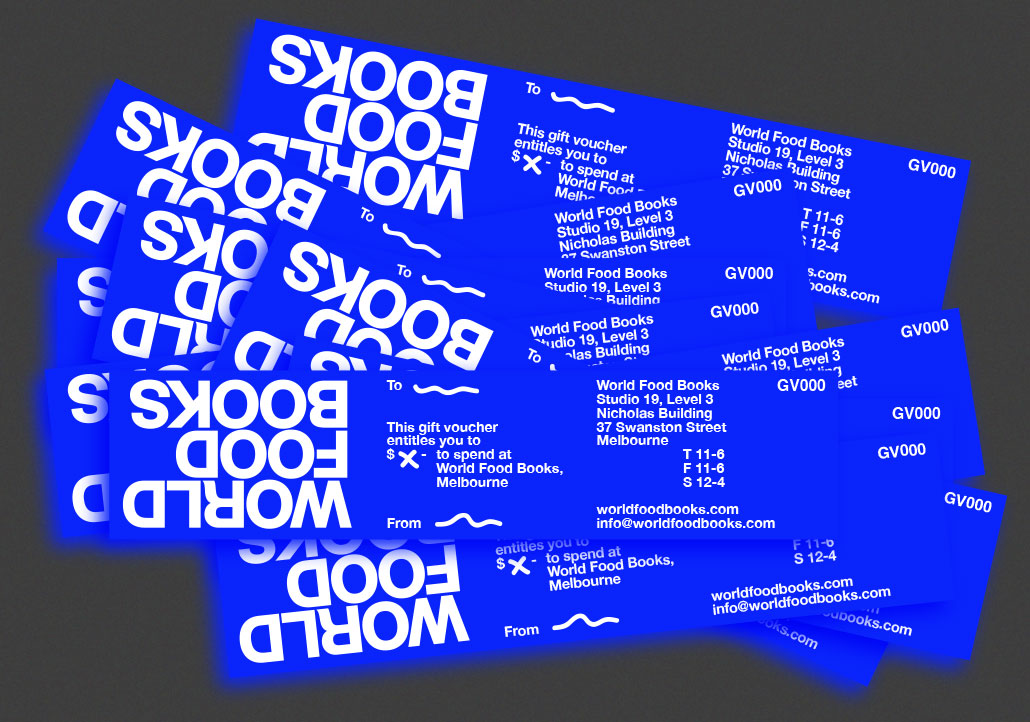
A World Food Books gift voucher is redeemable in our Melbourne bookshop or via our webshop (here). An e-voucher (printable pdf) will be sent to your purchase email address (please notify us if you wish to have the voucher sent to an alternate address and wish us to fill in the receiver's details on the card).
Gift vouchers can be purchased in increments of $20 (Australian Dollars) and the total amount can simply be added to by increasing the quantity in your shopping cart. eg. A quantity of 5 gift vouchers will result in an item total of $100 - a $100 gift voucher. Simply click "ADD TO CART" 5 times, or update your quantity in the shopping cart.
If you wish to purchase multiple, separate gift vouchers in one go, please just email us and we can personally prepare and email you a payment request.
Please note: Please select Pick-Up on gift voucher purchse to avoid any postage charges. Accidental postage charges will be refunded right away!
Thank you.
For any questions, please don't hesitate to email: [email protected]
1972, German
Softcover, 96 pages, 28 x 205 cm
1st Edition, Out of print title / used / good
Published by
Heyne Verlag / Münich
$35.00 - Out of stock
Wonderful 1972 German book of erotic art selected by Phyllis and Dr. Eberhard Kronhausen, rightly considered international experts in the field. "Their exhibition "Erotic Art," which has been shown in many countries around the world, formed the basis for this illustrated volume. Because this exhibition included loans from museums and galleries, as well as works from the Kronhausen couple's collection and other private collections, it was possible to present images that had previously been inaccessible to the public. In selecting works for this volume, care was taken, on the one hand, to depict these unknown works, and, on the other, to provide a reliable overview of the erotic work of the leading artists (painting, graphic art, and sculpture) of our century. Thus, this book is a fortunate exception; it is a precious document, but also a demonstration of the sexual and cultural revolution of our century."
Features the work of Franz von Bayros, Hans Bellmer, Marc Chagall, Lovis Corinth, Salvador Dali, Paul Delvaux, Otto Dix, J. Dubuffet, Max Ernst, Ernst Fuchs, Willi Geiger, George Grosz, Horst Janssen, Allen Jones, Gustav Klimt, Felix Labisse, Jan Lebenstein, Edward Munch, Claes Oldenburg, Pablo Picasso, Herbert Rauschenberg, George Segal, Max Walter Swanberg, Tomi Ungerer, Andy Warhol, Tom Wesselmann.
Good—VG copy with some laminate seperation to cover extremities and slight corner bump.
2025, English
Softcover, 640 pages, 24 x 16.99 cm
Published by
Intellect Ltd / US
$110.00 - In stock -
Industrial music has long been recognized for its sonic innovations, but the radical visual culture that accompanied this underground movement has remained largely unexplored. Shock Factory: The Visual Culture of Industrial Music presents the first comprehensive examination of how industrial artists created a coherent aesthetic language across multiple media—from xerox art and mail art to installation and performance—fundamentally challenging modernist utopias while prophetically anticipating contemporary discourse about media manipulation and technological control.
Emerging in mid-1970s Britain from the post-punk underground before expanding globally throughout the 1980s, artists like Throbbing Gristle, Cabaret Voltaire, SPK, Test Dept, Laibach, Einstürzende Neubauten, Nurse With Wound, Current 93, Coil, Psychic TV, Boyd Rice, Whitehouse, Merzbow, Hijokaidan, Hunting Lodge, Controlled Bleeding, Hafler Trio, Z'EV, Nocturnal Emissions, 23 Skidoo, Clock DVA, Master/Slave Relationship, and Monte Cazazza developed sophisticated visual strategies that matched their abrasive soundscapes with equally confrontational imagery.
At 640 pages, this award-winning monograph reveals how industrial artists systematically appropriated reprographic techniques—particularly xerox art and photocollage—to create disturbing visual narratives investigating mind control, criminality, occultism, pornography, psychiatry, and totalitarianism. Through détournement strategies borrowed from Situationist theory, they exposed the coercive mechanisms of mass media and technological society, creating a visual vocabulary that challenged viewers to confront uncomfortable truths about modern power structures. What emerges is a movement that perceptively anticipated contemporary concerns about surveillance, media manipulation, and collective psychological control. Industrial artists' exploration of these themes through deliberately provocative imagery served not as mere provocation but as sophisticated critique of the very media systems they inhabited. Their radical aesthetic choices—degraded reproduction quality, found imagery manipulation, shock tactics—created hybrid forms that defied traditional categorization while establishing independent networks that bypassed conventional art world structures.
Shock Factory positions industrial music's visual culture within broader art historical narratives, revealing connections to Dada, Surrealism, and conceptual art while demonstrating the movement's unique contributions to contemporary visual culture. The book arrives at a moment when questions about technology, media manipulation, and social control have never been more urgent, demonstrating how these artists' radical visual strategies continue to offer valuable insights for our digital age.
For scholars of contemporary art, music history, and media studies, this book provides essential documentation of an overlooked movement that significantly influenced subsequent artistic developments. For readers interested in underground culture and avant-garde aesthetics, Shock Factory reveals the sophisticated visual thinking that accompanied one of the most innovative musical movements of the past half-century.
"A history of industrial music needed to be written. Nicolas Ballet has accomplished this. Thoroughly. This is the book's greatest strength. It explores the significance of noise as a reflection of a world in decay and screaming as a need. And doing it so it reveals a significant connection between industrial music and contemporary art. This is also what makes it an essential book: its contribution to dismantling categories and rethinking history from mixed creative territories."—David G. Torres
Nicolas Ballet is an art historian and assistant curator at the Centre Pompidou in the New Media Department. He is the author of books and articles exploring the visual and sonic contributions of countercultures and experimental artistic practices.
2023, French
Softcover, 465 pages, 17 x 24 cm
Published by
Les Presses Du Reel / Paris
$80.00 $50.00 - In stock -
A vast study of the visual culture of industrial music during its development in Europe, the United States and Japan, from the 1970s to the 1990s, a global culture that goes beyond sound experimentation to cross different media (graphics, film, performance, video), in a close dialogue with the heritage of modernity and under the growing influence of technologies.
Industrial music appeared in the mid-1970s, and far from being a simple sound experimentation phenomenon, it quickly produced a global visual culture operating at the intersection of a multitude of media (collage, mail art, installation, film, performance, sound, video) in a close dialogue with the legacy of modernity and the growing influence of technology. Originally British, its development grew in Europe, the United States and Japan during the 1980s. The sound experiments deployed by industrial bands—designing synthesizers, manipulating and transforming recorded sounds from audio tapes recycled or conceived by the artists—were supplemented by a rich array of radical visual productions, deriving their sources from the modernist utopias of the first part of the 20th century. The saturated sounds were translated into abrasive images, altered by a détournement of reprographic techniques (Xerox art) that invested polemical themes: mental control, criminality, occultism, pornography, psychiatry and totalitarianism, among others. This book aims to introduce the visual and aesthetic elements of industrial culture to a general history of contemporary art by analyzing the different approaches taken and topics addressed by the primary protagonists of the movement, who anticipated current issues concerning the media and their coercive power.
Nicolas Ballet is an art historian and associate curator at the Centre Pompidou. He specialises in research into alternative visual cultures, experimental art, sound studies and the avant-garde. He received his PhD from the Université Paris 1 Panthéon-Sorbonne, where he teaches contemporary art history. He has written numerous texts exploring the visual and sonic contributions of counter-cultures and experimental artistic practices. He is the author of two books on Genesis P-Orridge, and has published in Les Cahiers du Musée national d'art moderne, Octopus Notes, Marges,OpticalSound, Volume !, Revue & Corrigée, Klima, in Cahiers du CAP and Histo.art (Éditions de la Sorbonne), as well as in books devoted to the work of Nigel Ayers and Zoe Dewitt. In 2023, he curated the exhibition "Who You Staring At? Visual culture of the no wave scene in the 1970s and 1980s" at the Centre Pompidou.
Foreword by Pascal Rousseau.
1992, English
Hardcover (w. dust jacket), 292 pages, 23.5 x 15.5 cm
1st Edition, Out of print title / used / fine
Published by
Penn State University / Pennsylvania
$50.00 - In stock -
First hardcover 1992 edition.
“Bernstein’s rich and provocative study examines the essentially modern attempt to distinguish a unique or autonomous realm of the aesthetic, and presents an ambitious argument designed to undermine that post-Kantian insistence on a categorical distinction among the beautiful, the true, and the good. In doing so, he offers a thoughtful account of why the fate of art has been so central to those thinkers in the European tradition worried about the implications of the European Enlightenment, and he presents a number of original, critical readings of individual thinkers. This is an important, very interesting book.”—Robert B. Pippen, University of Chicago
Aesthetic alienation may be described as the paradoxical relationship whereby art and truth have come to be divorced from one another while nonetheless remaining entwined. J. M. Bernstein not only finds the separation of art and truth problematic, but also contends that we continue to experience art as sensuous and particular, thus complicating and challenging the cultural self-understanding of modernity.
Bernstein focuses on the work of four key philosophers—Kant, Heidegger, Derrida, and Adorno—and provides powerful new interpretations of their views. Bernstein shows how each of the three post-Kantian aesthetics (its concepts of judgment, genius, and the sublime) to construct a philosophical language that can criticize and displace the categorical assumption of modernity. He also examines in detail their responses to questions concerning the relations among art, philosophy, and politics in modern societies.
Near Fine copy in Near Fine dust jacket.
1994, English
Softcover, 423 pages, 23 x 15.24 cm
1st Edition, Out of print title / used / very good
Published by
Stanford University Press / Palo Alto
$40.00 - In stock -
The epoch of representation is as old as the West. Indeed, representation is the West, understood as what at once designates and expands its own limits. But what comes after the West? What comes after representation's disclosure of its own limit?
The central problem posed in these essays, collected from over a decade of work, is how in the wake of Western ontologies to conceive the coming, the birth that characterizes being. We are now at the limit of representation, where objects as we experience them have been show to be merely objects of representation—or rather, of presentation, since there is nothing to (re)present. The first part of this book, "Existence," asks how, today, one can give sense of meaning to existence as such, arguing that existence itself, as it comes nude into the world, must now be our "sense."
In examining what this birth to presence might be, we should not ask what presence "is"; rather we should conceive presence as presence to someone, including to presence itself. This birth is not the constitution of an identity, but the endless departure of an identity from, and from within, its other, or others. Its coming is not desire but jouissance, the joy of averring oneself to be continually in the state of being born—a rejoicing of birth, a birth of rejoicing.
The second section, "Poetry," asks: What art exposes this? In writing, in the voice, in painting? And what if art is exposed to it? How does it inscribe (or rather, "exscribe," in a term the book develops) the coming existence as such? The author's trajectory in this book crosses those of Hegel, Schlegel, Baudelaire, Nietzsche, Freud, and Heidegger, in their comments on art and politics, existence and corporeality, everyday life and its modes of existence and ecstasy. An analysis that dares this crossing involves all the varied accounts of existence, political as well as philosophical, and all the realms of poverty.
Jean-Luc Nancy (b. 1940) is one of France’s foremost living philosophers. His work spans several decades, from the 1970s through to the present day. Closely associated with Jacques Derrida, his close friend and major influence, Nancy’s key philosophical engagements are with the legacy of speculative idealism, Romanticism, and existential phenomenology, taking in key figures such as Immanuel Kant, G. W. F. Hegel, Friedrich Nietzsche, Martin Heidegger, and, less explicitly perhaps, Maurice Merleau-Ponty. He also engages very closely with immediate predecessors and contemporaries such as Georges Bataille, Maurice Blanchot, Jacques Derrida, and Philippe Lacoue-Labarthe.
VG copy.
2000, English
Softcover, 286 pages, 21.6 x 14 cm
1st Edition, Out of print title / used / fine
Published by
The Atlone Press / London
$45.00 - In stock -
First 2000 edition.
This long-overdue translation brings to the English-speaking world the work that set the tone for the post-structuralist reading of Nietzsche.
The issue of style, of why Nietzsche wrote as he did, is fundamental, on any level, to reading his texts. Some Nietzsche critics (in particular, those, such as Jean Granier, indebted to Heidegger's reading), in effect translated Nietzsche's terms back into those of a philosophy of ontology. This book (which includes an appendix specifically directed against the "Heideggerian" reading) shows how such an approach fails to interrogate the precise terms, such as "Nature" or "life", that Nietzsche used in place of "being," and to ask the meaning of this substitution.
The author gives not only a reading of Nietzsche's ideas, but a method for investigating his style. She shows in great detail how it influences both Nietzsche's ideas and the way in which they are to be understood. In so doing, she exemplifies how post-structuralist methods can be used to open up classical philosophical texts to new readings. She write conceptually in the knowledge that the concept has no greater value than metaphor and is itself a condensation of metaphors, rather than writing metaphorically as a way of denigrating the concept and proposing metaphor as the norm, and thus acknowledges the specificity of philosophy, its irreducibility to any other form of expression—even when this philosophy has nothing traditional about it any longer, even when it is, like Nietzsche's an unheard-of and insolent philosophy.
Sarah Kofman (1934—1994) was a French Jewish philosopher and professor who published many books on Freud, Nietzsche, Rousseau, Derrida, Blanchot, and more.
Near Fine copy, light wear/corner crease.
1989, English
Softcover, 176 pages, 21.5 x 13 cm
1st Edition, Out of print title / used / very good
Published by
Basil Blackwell / Oxford
$60.00 - In stock -
Rare first 1989 English edition of Laplanche's New Foundations for Psychoanalysis, translated from the original French edition of 1987.
New Foundations for Psychoanalysis represents a distillation of twenty years' work by one of France's most distinguished psychoanalysts. In a provocative study of the various foundations that have been proposed for psychoanalysis Jean Laplanche demonstrates that it cannot be epistemologically grounded in either biology, phylogenesis, mechanics or linguistics. These disciplines are, rather, the background against which it emerges in an inaugural gesture which captures something of the emergence of the human being.
Returning to the founding moment of psychoanalysis, Laplanche then elaborates a general theory of seduction, in which seduction is seen as neither an encounter with a perverse father nor a surrender to an attentive mother, but as a primal encounter with an enigmatic signifier. This encounter can be reactivated in the process of analysis, allowing the enigmatic quality of the signifier to be transcended and a translation-based theory of repression to emerge.
Jean Laplanche teaches at the University of Paris where he is director of the Centre de Recherches en Psychanalyse et Psychopathologie. He is co-author, with J. B. Pontalis, of The Language of Psychoanalysis and the author of Holderlin et la question du pere and Life and Death in Psychoanalysis. David Macey, a professional translator, is also the author of Lacan in Contexts.
VG—Near Fine copy. Crisp with edge tanning.
1990, English
Softcover, 242 pages, 23 x 15 cm
1st Edition, Out of print title / used / good
Published by
Johns Hopkins University Press / Baltimore
$18.00 - In stock -
First 1990 edition.
By the end of the nineteenth century, women had become an undeniable force both in the public discussion of social life and in politics itself. Yet in art and literature women's bodies continued to be represented—and domesticated—by men. They were still more often the object of the artist's or writer's gaze than they were the subject of their own representing processes. The erotic potential of women's bodies, however, was far from a marginal concern in the elaboration of modern forms of politics, art, literature, and psychology.
In Eroticism and the Body Politic, scholars from art history, history, and literature examine the frequent intersections between the body erotic and the body politic. Focusing on eighteenth- and nineteenth-century France, they show how eroticized representations of bodies had a multitude of political and cultural meanings. The authors consider the eroticized body in a wide variety of media: from Fragonard's paintings of "erotic mothers," to political pornography attacking Marie Antoinette, to the "new woman" of fin de siècle decorative arts.
Exploring the possibilities of a multidisiplinary approach, the volume shows that eroticism had an impact far beyond the usual confines of libertine or pornographic literature—and that politics included much more than voting, meeting, or demonstrating. At a time of general methodological ferment in the "human sciences," Eroticism and the Body Politic brings fresh approaches to the developing field of cultural studies.
Good copy, knock to top of front cover edge, otherwise a VG copy throughout.
1992, English
Softcover, 494 pages, 15.2 x 22.9 cm
1st Edition, Out of print title / used / very good
Published by
University of California Press / Berkley
$40.00 - In stock -
First 1991 edition.
The Languages of Psyche traces the dualism of mind and body during the 'long eighteenth century,' from the Restoration in England to the aftermath of the French Revolution. Ten outstanding scholars investigate the complex mind-body relationship in a variety of Enlightenment contexts - science, medicine, philosophy, literature, and everyday society. No other recent book provides such an in-depth, suggestive resource for philosophers, literary critics, intellectual and social historians, and all who are interested in Enlightenment studies.
Very Good copy, light wear.
1991, English
Hardcover (w. dust jacket), 264 pages, 22.5 x 15 cm
1st Edition, Out of print title / used / fine
Published by
Stanford University Press / Palo Alto
$220.00 - In stock -
Very rare, sought after first hardcover edition of Oughourlian's "The Puppet of Desire", published in 1991 by Stanford. Translated, with an introduction, by Eugene Webb.
This study of the psychology of desire derives from a theory of imitative or 'mimetic' desire developed by the cultural critic and theorist René Girard. The theory is essentially that all human beings have an instinctive tendency, a kind of social and psychological gravitation, to imitate unwittingly not only the actions but also the attitudes and desires of others. The author, a practicing psychiatrist, extends and amplifies this theory from the viewpoint of psychopathology and applies it to the study of hysteria, possession, and hypothesis. He argues that these phenomena are best understood as expressions of mimetic behaviour, and he traces the history of the ideas concerning hysteria, possession, and hypnosis and relates them to the development of Freud's theory of neurosis. The author points out that mimetic desire is not an inherently pathological force. It may be normal and healthy, but in certain circumstances it can lead to relations of dependency and rivalry that can cause serious psychological problems. It can also take on extreme or bizarre forms without necessarily becoming unhealthy; an example of healthy but extreme unconscious identification with an other (who may be either a person or a cultural figure) is shamanistic possession. The author discusses this kind of phenomenon among African tribes and coins the term 'adorcism' (the opposite of exorcism) to refer to the process of invoking it. The theory of desire as presented in this book is other-oriented, as opposed to Freud's theory of desire, which istrictly object-oriented. The author sees Freud's theory as more in a long history of strategic misinterpretations of the psychology of desire, such as the classical theory of hysteria and the medieval theory of demonic possession. his critique of Freudian theory is radical, and in fact it would not be too much to say that he has moved toward the first new and well-developed theory of psychopathology since Freud.
Jean-Michel Oughourlian is an Armenian-French neuropsychiatrist and psychologist as well as a writer and philosopher recognized both in France and the United States for his collaboration with René Girard and his work on the mimetic theory of desire. Oughourlian is the former chief of psychiatry at the American Hospital of Paris and a former professor of clinical psychopathology at the Sorbonne. He collaborated with René Girard on Things Hidden since the Foundation of the World (1978) and has authored several books on psychiatry, neuroscience, and mimetic theory. He is a founding member of the Association Recherches Mimétiques, a French organization devoted to René Girard's thought.
Fine copy with Near Fine dust jacket preserved in archival mylar wrap.
1992, English
Hardcover (w. dust jacket), 208 pages, 22.5 x 14.5 cm
1st Edition, Out of print title / used / fine
Published by
Johns Hopkins University Press / Baltimore
$45.00 - In stock -
First 1992 edition.
To some, René Girard is best known for his views on sacred myth and ritual. To others, he is the eminent structuralist critic who offers challenging readings of major literary works. Still others know him for his analyses of the Bible.
Central to all aspects of Girard's work is his theory of mimesis, a basic hypothesis about the structures of human motivation, Yet nowhere in his writings does Girard offer a systematic presentation of the mimetic theory. In fact, key terminology shifts from work to work, resulting in considerable ambiguity in both basic concepts and explanatory claims.
In Models of Desire Paisley Livingston provides the first rigorous critical reconstruction of Girard's theory of mimesis. Drawing a careful distinction between the theory itself and Girard's often ambitious claims about it, Livingston provides a systematic presentation of Girard's ideas about the role of imitation in human motivation. He surveys responses to Girard's work and compares his theory of mimetic desire with recent work in cognitive psychology and philosophy.
The result is a salient theoretical alternative to the false choice—between psychoanalysis and anti-psychological doctrines—that currently dominates literary theory.
Fine copy.
1997, English
Hardcover (w. dust jacket), 198 pages, 33 x 27 cm
1st Edition, Out of print title / used / very good
Published by
Taschen / Cologne
$70.00 - In stock -
First 1997 over-sized hardcover edition of "Beauty Parade" by American fetish photographer, erotica historian, photojournalist, and book editor, Eric Kroll (b. 1946, New York). Beauty Parade is an incredible collection of his 1990's erotic photographs, ranking among the absolute classics of fetishistic imagery. Rising from the downtown New York art and fashion scene of the 1970s and 80s, shooting for Elle Magazine, Vogue, The New York Times and Der Spiegel, Kroll published his first book, "Sex Objects" in 1976 with a grant from the New York State Council of the Arts, a book documenting sex workers across America. "Beauty Parade" follows on from his best-seller "Fetish Girls" (1994), full of powerful women and drawing one into a world of bizarre fantasies and sadomasochistic desires while retaining a sense of irony and surreal humour. Many of Kroll's photographs refer to and pay homage to his predecessors Weegee and Bunny Yeager as well as Eric Stanton and John Willie, while being grounded in the conceptual influences of artists such as Man Ray, and Marcel Duchamp. Text in English, German and French. Wonderful introduction by Kroll.
Very Good copy in VG dust jacket, light wear.
1985, Japanese
Softcover (w. acetate dust jacket), 128 pages, 33 x 25 cm
1st Edition, Out of print title / used / good
Published by
Bijutsu Shuppan-sha / Japan
$190.00 $90.00 - In stock -
First edition of the incredible book of Japanese doll artist Simon Yotsuya, Doll Love / L'amour des Poupées, shot by Kishin Shinoyama, published in 1985 by Bijutsu Shuppan-sha, Tokyo. This stunning over-sized book is the finest photographic document of Simon's dolls created throughout his career, all dramatically shot by legendary Japanese photographer, and close friend of Yotsuya, Kishin Shinoyama, profusely illustrated in full colour gloss with each doll, including various angles, details, and display cases, accompanied by a section of Japanese texts by Tatsuhiko Shibusawa, Yoshiaki Tono, Minoruyoshioka, Shuzotakiguchi, and Kunio Iwaya, illustrated in b/w with portraits of Simon Yotsuya in his studio, his drawings and graphic works. Our favourite book on this magical artist.
Simon Yotsuya (b. 1944, Tokyo) started making dolls as a child, visiting exhibitions of dolls, and reads all the books he can find on the subject. In his mid-teens he visited Puppe Kawasaki, a doll maker and animator he greaty admired, devoting himself to the craft and becoming a poor high school student. In the early '60s, while working at a jazz coffee shop in Shinjuku, Yotsuya earned the nickname "Simon" (pronounced “Simone”), after his love for singer Nina Simone. He befriends Kuniyoshi Kaneko (painter) and Junko Koshino (fashion designer) and joins in the arts and literary scene. In 1965, he discovers the work of German Surrealist Hans Bellmer through an article authored by Tatsuhiko Shibusawa in the magazine “Shinfujin”, promptly abandoning his previous methods of doll-making to find his way as an artist, incorporating ball-joints into his dolls. Thereafter he becomes an admirer of Surrealism and immerses himself in the controversial Shibusawa's litterary works. In 1965, he also goes to see Tatsumi Hijikata's Butoh Performance for the first time. In the late 60s—early 70s Yotsuya pursued a parallel career to his doll-making as an actor and member of Juro Kara's legendary underground theater company Jokyo Gekijo, Situation Theater, regularly portraying a female doll. He appears in the movie "Diary of a Shinjuku Thief" directed by Nagisa Oshima with the actors of the Situation Theater, but by 1971 he leaves the stage to concentrate on his own work. Simon exhibited at Expo 1970 in Osaka, the Tokyo Biennale in 1974 and by the end of the decade had opened his own doll-making school in Harajuku.
Tatsuhiko Shibusawa (1928—1987), the author of the influential Bellmer article (and novelist, editor, art critic, and translator of Bataille and Marquis de Sade), become a life-long friend of Yotsuya's and his most important advocate, editing the first major book of Yotsuya's work, entitled Pygmalionisme, in 1985. Devastated by Shibusawa's death in 1987, Yotsuya found it impossible to work for nearly two years. He eventually found solace in the Eastern Orthodox Church and was inspired to make a series of angels, which he dedicated to Shibusawa, and straightforward images of Christ. Having carved out his own masterful and unique form of expression, today Yotsuya enjoys international renown as the first ball-jointed doll maker in Japan.
Good—Very Good copy with general wear to book and publisher's jacket shrinkage with age, some light foxing.
2019, English / Japanese
Hardcover, 80 pages, 31 x 23 cm
Published by
MACK / London
$115.00 - In stock -
‘My entire family, whose image I see inverted in the frosted glass, will die one day. This camera, which reflects and freezes their images, is actually a device for archiving death’. – Masahisa Fukase
For three generations the Fukase family ran a photography studio in Bifuka, a small provincial town in the northern Japanese province of Hokkaido. In August 1971, at the age of 35, Masahisa Fukase returned home from Tokyo, where he had moved in the 1950s. He realised that the Fukase Photographic Studio, which his younger brother managed, combined with the growing family members, constituted the perfect subject for a series of portraits. Between 1971 and 1989, he returned regularly and used the family studio, the large-format Anthony view camera and the changing family line-up as the basis for the series. True to his style, Fukase often introduced third-party models and humorous elements to juxtapose the ineluctable reality of time passing and the dwindling family group. He continued the series through his father’s death in 1987, up until the closure of the Fukase studio due to bankruptcy in 1989, and the consequential dispersion of the family.
Family (Kazoku) was released in 1991, and was Fukase’s last book. It begins with a photograph of the family studio and the following 31 images are family portraits made in the studio in chronological order. The book includes an extensive text written by Fukase himself and a modern essay by Tomo Kosuga.
2017, English
Hardcover (w. slipcase), 136 pages, 26.3 x 26.3 cm
Published by
MACK / London
$175.00 - In stock -
Consistently proclaimed as one of the most important photobooks in the history of the medium, Ravens by Japanese photographer Masahisa Fukase was first published in 1986 and the two subsequent editions were both short print runs that sold out immediately. This bilingual facsimile of the first edition contains a new text by founder of the Masahisa Fukase Archives, Tomo Kosuga. His essay locates Ravens in Fukase’s wider work and life, and is illustrated with numerous recently discovered photographs and drawings. Fukase’s haunting series of work was made between 1975 and 1986 in the aftermath of a divorce and was apparently triggered by a mournful train journey to his hometown. The coastal landscapes of Hokkaido serve as the backdrop for his profoundly dark and impressionistic photographs of ominous flocks of crows, which are said to serve as an allegory for postwar Japan.
Blind embossed clothbound hardback in a silkscreen printed carton slipcase.
Original afterword by Akira Hasegawa [1986] and a new text by Tomo Kosuga [both bilingual].
2015, English
Hardcover (w. dust jacket), 628 pages, 20.5 x 13 cm
Published by
Tracy R. Twyman / US
$110.00 - In stock -
For seven centuries, the enigma of Baphomet has mystified both scholars and the general public. Did the Knights Templar really worship a demonic idol of that name? If so, what does the word mean? What is the origin of this figure? What was the nature of the rituals that the Templars performed in secret? What were their covert beliefs? Why, if the Templars initially described their idol as a mummified severed head, is this figure now represented as a hermaphrodite human with the head of a goat?
Authors Tracy R. Twyman and Alexander Rivera have dived head-first into the bottomless abyss of this mystery and returned with some astounding wisdom to share. Here for the first time they reveal the genesis of these symbols, showing how they relate to the Witches' Sabbath, traditions of Sufi Islam, alchemy, Gnosticism, cabalism, the teachings of Hermes Trismegistus, and so much more.
Learn why the Templars and their beloved severed head are frequently associated with John the Baptist, and how this connects to his student, Simon Magus. Discover the real facts about things like the Chinon Parchment, The Book of the Baptism of Fire, the Templar Abraxas seals, and newly-found documents which claim that the Templars discovered the real Temple of Solomon during a secret trip to Mecca.
Join Twyman and Rivera on this exciting adventure into the unknown. Immerse yourself in this knowledge, if your heart has the strength. It is certain that your mind will never be the same.
1985, German
Hardcover, 184 pages, 27.5 x 21.5 cm
1st Edition, Out of print title / used / good
Published by
Kölnischer Kunstverein / Köln
$40.00 - In stock -
Lovely 1985 hardcover catalogue published on the occasion of the exhibition of the same name at the Kölnischer Kunstverein, March 23—June 2, 1985, curated by German art historian and curator Wulf Herzogenrath, featuring Josef Albers, Joseph Beuys, John Cage, Carl Gustav Carus, Marcel Duchamp, Jannis Kounellis, René Magritte, Kasimir Malevich, La Monte Young / Marian Zazeela, Barnett Newman, Nam June Paik, Arnulf Rainer, Odilon Redon, Mark Rothko, Reiner Ruthenbeck, and Georges Seurat. Heavily illustrated in colour and b/w with accompanying texts in German.
Good copy with some rubbing/flaking to silkscreened carbon black hardcovers, otherwise Very Good throughout. Previous owner's name to title page (that of Melbourne artist Bernhard Sachs).
2014, Japanese
Hardcase folio (w. pockets, 2 leporello booklets), unpaginated, 32 x 19.5 cm
1st Edition, Out of print title / used / very good
Published by
Amana / Japan
$130.00 - Out of stock
This beautiful limited edition Balthus photobook was produced in Japan, containing a carefully selected collection photographs from approximately 2000 Polaroid photographs discovered after the death of the last master of the 20th century, Balthus (1908-2001). The elegant hardcase bookbinding, housing two folding screen-like Orihons (Japanese-accordian style book) enveloped in rich textile hues, is like a dedication to Balthus, who loved Japanese culture. The title "room 17" comes from the name of the room in the Swiss mansion Grand Chalet, where Balthus worked and photographed a young female model for eight years in study for his much loved paintings. A lovely selection of these photographic studies are collected in this touching tribute, alongside text by Nicola Page. Translation to Japanese by Tadashi Miyagi, book design by Daishiro Mori.
Very Good copy.
1995, English
Softcover, 160 pages, 20.5 x 18 cm
1st Edition, Out of print title / used / very good
Published by
Grove Press / New York
$200.00 - In stock -
First 1995 edition of the Larry Clark's Kids book, original US edition published by Grove Press in New York to accompany the release of one of the most important movies of the decade. Profusely colour illustrated throughout with iconic full-page film stills, accompanied by the entire film script written by Harmony Korine at 19 years of age.
"If Clark never shoots another picture, he will be a cinematic immortal because of this one film"—Sight and Sound
"Well, i always wanted to make the teenage movie that I felt America never made. The great American teenage movie like the great American novel. That's why I always wanted to do. I remember back in the fifties when I was a kid, and the teenage movies were like City Across The River and Cassavetes was an actor in one and Tony Curtis was in one. And I would see these movies, and I would say, 'Those kids don't look like kids, they're all older people, they're all like grown-ups.' So right away they don't ring true. That's why some of the teenage movies that I do like — Over the Edge — the reason why I liked that movie was that they used kids the right age, they actually used kids. Real kids. I knew my film had to be from the inside, so I called this kid writer I knew through skateboarding, and he came over and I told him what I wanted, and he said, 'I've been waiting all my life to write this,' and he knocked out the screenplay in tree weeks. I think when you see the movie Kids that most of us — not all of us, but most of us — will say, 'Yeah, that's the way we were, that's the way kids are."—Larry Clark
Larry Clark is one of America's most important photographers whose 1971 photo book masterpiece, Tulsa, depicted youth culture in rural America.
Very Good copy, with discolouration to left edge of cover image from sun/storage. No spine or corner damage.
1991, Japanese
Softcover (w. dust jacket, 128 pages, 26 x 18.5 cm
1st Edition, Out of print title / used / very good
Published by
Heibonsha / Tokyo
$60.00 - In stock -
Wonderful photo-book chronology of the world of Shūji Terayama (1935—1983) and his experimental theatre troupe Tenjō Sajiki (with Kujō Kyōko, Yutaka Higashi, Tadanori Yokoo, Fumiko Takagi, ...), a major phenomenon on the Japanese Angura ("underground") theater scene of the 1960s and 70s. Terayama's activities encompass a who's-who of the Japanese avant-garde arts and literature of the time. This book visually documents it all; the filmography, performances, installations, happenings, exhibitions, posters, publications, and all else that resonated from Japan’s most revered and provocative avant-garde film-maker and his collaborators. Profusely illustrated with hundreds of illustrations in colour, duo and b/w with Japanese commentary, biographies and chronology. A wonderful, visually mind-blowing reference for anyone interested in the work of Terayama, Tenjō Sajiki, Surrealist performance, or Japanese avant-garde underground (Angura) theatre.
Shūji Terayama (1935 — 1983) was a Japanese avant-garde poet, dramatist, writer, film director, and photographer. His works range from radio drama, experimental television, underground (Angura) theatre, countercultural essays, to Japanese New Wave and "expanded" cinema. In 1967 Terayama founded Tenjō Sajiki with Kujō Kyōko, Yutaka Higashi, Tadanori Yokoo, and Fumiko Takagi, a Japanese experimental theater troupe. A major phenomenon on the Japanese Angura ("underground") theater scene, the group produced a number of stage works marked by experimentalism, folklore influences, social provocation, grotesque eroticism and the flamboyant fantasy characteristic of Terayama's oeuvre. Terayama is considered one of the most productive and provocative creative artists to come out of Japan, with a wide-reaching influence on many artists from the 1970s onward.
Very Good—Near Fine (w/o obi — image just a sample)
1999, English
Softcover, 192 pages, 28 x 21.59 cm
1st Edition, Out of print title / used / very good
Published by
Creation Books / London
Velvet Publications / London
$120.00 - In stock -
First edition of 1999's long out-of-print "Body Probe: Mutant Flesh and Cyber Primitives," by Creation Books' Velvet imprint. The Torture Garden follows up its first, club-based book with the sequel Body Probe, an anthology of interviews, features and images exploring the boundaries of the human body at the edge of the new millennium. Edited by David Wood, contents include: David Cronenberg, Hermann Nitsch, Chapman Brothers, Orlan, Stelarc, Ron Athey, Della Grace, Nick Knight, Alex Binnie, plus alien abduction, sex in space, medical fetishism, robot art, mutation in fashion, self-made freaks, the cybernetic body and S/M art.
Body Probe confirms the Torture Garden's position at the cutting edge of the fetish, body art, and cyber technology scene. It contains over 100 black and white photographs, and over 50 full-colour plates.
Very Good copy, light wear.
1990, Japanese
Softcover (w. dust jacket and obi strip), 269 pages, 13 x 21 cm
1st Edition, Out of print title / used / very good
Published by
Ota Shuppan / Tokyo
$170.00 - In stock -
Rare first Japanese edition of Nobuyoshi Araki's most controversial book, and cited by Martin Parr and Gerry Badger (in The Photobook Vol.1) as Araki's best and most famous work. Includes original publisher's obi-strip issued with the first 1990 printing. Tokyo Lucky Hole is Araki's intimate document of Japan's sex industry in full flower. Before Shinjuku's infamous red-light district was closed in 1985, the Japanese photographer made this obsessive documentation of its every aspect: the pleasure-seekers and providers, street scenes, performances, peep-shows, parlours, parks, dungeons. Tokyo Lucky Hole reveals the core of Araki's art: the desire to create a portrait of Tokyo without the niceties (and prudishness) of convention. Through mirrored walls, bed sheets, bondage and orgies, this is the last word on an age of bacchanalia, infused with moments of humor, precise poetry, and questioning interjections. Text by Nobuyoshi Araki. Design by Katsumi Komagata.
Nobuyoshi Araki was born in Tokyo in 1940. Given a camera by his father at the ripe age of twelve, Araki has been taking pictures ever since. He studied photography and film at Chiba University and went into commercial photography soon after graduating. In 1970 he created his famous Xeroxed Photo Albums, which he produced in limited editions and sent to friends, art critics, and people selected randomly from the telephone book. Over the years, his bold, unabashed photographs of his private life have been the object of a great deal of controversy and censorship (especially in his native Japan), a fact that has not fazed the artist nor diminished his influence. To date, Araki has published over 400 books of his work.
Very Good copy with VG obi-strip.