World Food Books' programme is largely produced on Kulin Nation land. We acknowledge the Wurundjeri people of the Kulin Nation as the first and continuing custodians of this land, and pay respect to their Elders past, present, and emerging.
World Food Books is an arts and special interests bookshop in Naarm / Melbourne. Founded in 2010, World Food Books is devoted to the presentation of a rotating, hand-selection of international art, design, literary and counterculture publications with an emphasis on the anti-traditional, the experimental, the avant-garde, the heretic, the marginal.
Presenting new titles alongside rare and out-of-print books, catalogues and journals spanning the fields of modern and contemporary art, design, photography, illustration, film, literature, poetry, cultural theory, philosophy, sexuality, popular and underground culture in its many radical forms, World Food Books wishes to encourage adventurous, thoughtful and open-minded reading, looking, writing, and exchange of publishing and ideas, both current and historical.
As well as our bookshop, located in Melbourne's historical Nicholas Building, all of our inventory is available internationally via our online mail-order service.
World Food Books semi-regularly co-ordinates "Occasions", a programme of exhibits and events at the bookshop and in partnership with other hosts (such as museums and art galleries) that develop out of the activities, relationships and content of the bookshop itself.
World Food Books
The Nicholas Building
37 Swanston Street
Room 5, Level 6
Melbourne 3000
Australia
SHOP HOURS:
Thu–Fri 12–6, Sat 12–5
WEB-SHOP OPEN 24/7
World Food Books
Postal Address:
PO Box 435
Flinders Lane
Victoria 8009
Australia
Art
Theory / Essay
Architecture / Interior
Graphic Design / Typography
Photography
Fashion
Eros
LGBTQ+
Fiction / Poetry
Weird / Speculative / Science Fiction / Horror
Transgressive / Visceral / Abject
Symbolism / Decadence / Fin de siècle
Film / Video
Painting
Sculpture / Installation
Performance / Dance / Theater
Drawing
Sound / Music
Curatorial
Group Shows / Collections
Periodicals
Out-of-print / Rare
Posters / Ephemera / Discs
Signed Books
World Food Books Gift Voucher
World Food Book Bag
Australian Art
Australian Fiction
Australian Science Fiction / Speculative Fiction
Australian Poetry
Australian Photography
Japanese Photography
Conceptual Art
Minimal Art
Dada
'Pataphysics / Oulipo
Fluxus
Concrete Poetry
Pop Art
Surrealism
Arte Povera
Arte Informale / Haute Pâte / Tachism
Nouveau Réalisme / Zero / Kinetic
Situationism / Lettrism
Collage / Mail Art / Xerox Art
Art Brut / Folk / Visionary / Fantastic
Illustration / Graphic Art / Bandes Dessinées
Furniture
Italian Radical Design / Postmodernism
Textiles
Ceramics / Glass
Counterculture
Protest / Revolt
Philosophy
Psychoanalysis
Anthropology
Anarchism
Socialism / Anarchism / Communism / Capitalism
Literary Theory / Semiotics / Language
Feminism / Women's Studies
Gender Studies / Sexuality
Anthropology
Fetishism / BDSM
Drugs / Psychedelia
Crime / Violence
Animal Rights / Veganism
Occult / Esoterica
Ecology / Earth / Alternative Living
Whole Earth / Crafts
All prices in AUD (Australian dollars)
Pick-Ups
Pick-up orders can be collected in our bookshop during opening hours after order date. Please collect any Pick-up orders within 2 weeks of ordering as we have limited storage space. Orders will be released back into stock if not collected within this time. No refunds can be made for pick-ups left un-collected. If you cannot make it in to the bookshop in this time-frame, please choose postage option.
Return Policy
All sales are final. We do accept returns (for refund or exchange) for items received in error. All our orders are packed with special care using heavy-duty padding and cardboard book-mailers or bubble mailers (for smaller books), using reinforcement where required. We cannot take responsibility for any lost, stolen or damaged parcels.
Insurance
Should you wish to insure your package, please email us directly after placing your order and we can organise this at a small extra expense. Although all standard/express tracked packages are very safe and dependable, we cannot take responsibility for any lost, stolen or damaged parcels. We recommend insurance on valuable orders.
Interested in selling your old books, catalogues, journals, magazines, comics, fanzines, ephemera? We are always looking for interesting, unusual and out-of-print books to buy. We only buy books in our fields of interest and specialty, and that we feel we can resell.
We base these prices on desirability, market value, in-print prices, condition and our current stock levels. We offer cash, store credit, and can take stock on consignment. All
about 25% of the price we expect to get when we sell them, or 30% in store credit. We base these prices on desirability, market value, in-print prices, condition and our current stock levels.
Sell your books any day of the week. You can drop them off and return later. If you have a lot of books, we can visit your Sydney home.
We buy books that we feel we can resell. We offer about 25 % of the price we expect to get when we sell them, or 30% in store credit. We base these prices on desirability, market value, in-print prices, condition and our current stock levels.
Philadelphia Wireman
03 August - 01 September, 2018
World Food Books is proud to announce our next Occasion, the first presentation of sculptures by Philadelphia Wireman in Australia.
The Philadelphia Wireman sculptures were found abandoned in an alley off Philadelphia’s South Street on trash night in 1982. Their discovery in a rapidly-changing neighbourhood undergoing extensive renovation, compounded with the failure of all attempts to locate the artist, suggests that the works may have been discarded after the maker’s death. Dubbed the "Philadelphia Wireman" during the first exhibition of this work, in 1985, the maker’s name, age, ethnicity, and even gender remain uncertain. The entire collection totals approximately 1200 pieces, all intricately bound together with tightly-wound heavy-gauge wire (along with a few small, abstract marker drawings, reminiscent both of Mark Tobey and J.B. Murry). The dense construction of the work, despite a modest range of scale and materials, is singularly obsessive and disciplined in design: a wire armature or exoskeleton firmly binds a bricolage of found objects including plastic, glass, food packaging, umbrella parts, tape, rubber, batteries, pens, leather, reflectors, nuts and bolts, nails, foil, coins, toys, watches, eyeglasses, tools, and jewellery.
Heavy with associations—anthropomorphic, zoomorphic, and socio-cultural responses to wrapped detritus—the totemic sculptures by Philadelphia Wireman have been discussed in the context of work created to fulfil the shamanistic needs of alternative religions in American culture. Curators, collectors, and critics have variously compared certain pieces to sculpture from Classical antiquity, Native American medicine bundles, African-American memory jugs, and African fetish objects. Reflecting the artist’s prolific and incredibly focused scavenging impulse, and despite—or perhaps enhanced by—their anonymity, these enigmatic objects function as urban artefacts and arbiters of power, though their origin and purpose is unknown. Philadelphia Wireman, whatever their identity, possessed an astonishing ability to isolate and communicate the concepts of power and energy through the selection and transformation of ordinary materials. Over the course of the past two decades, this collection has come to be regarded as an important discovery in the field of self-taught art and vernacular art.
Presented in collaboration with Fleisher-Ollman Gallery, Philadelphia, and Robert Heald, Wellington.
Susan Te Kahurangi King
02 February - 10 March, 2018
Susan Te Kahurangi King (24 February 1951 - ) has been a confident and prolific artist since she was a young child, drawing with readily available materials - pencils, ballpoint pens and felt-tip markers, on whatever paper is at hand. Between the ages of four and six Susan slowly ceased verbal communication. Her grandparents William and Myrtle Murphy had developed a special bond with Susan so they took on caring responsibilities for extended periods. Myrtle began informally archiving her work, carefully collecting and storing the drawings and compiling scrapbooks. No drawing was insignificant; every scrap of paper was kept. The King family are now the custodians of a vast collection containing over 7000 individual works, from tiny scraps of paper through to 5 meter long rolls.
The scrapbooks and diaries reveal Myrtle to be a woman of great patience and compassion, seeking to understand a child who was not always behaving as expected. She encouraged Susan to be observant, to explore her environment and absorb all the sights and sounds. Myrtle would show Susan’s drawings to friends and people in her community that she had dealings with, such as shopkeepers and postal workers, but this was not simply a case of a grandmother’s bias. She recognised that Susan had developed a sophisticated and unique visual language and sincerely believed that her art deserved serious attention.
This was an unorthodox attitude for the time. To provide some context, Jean Dubuffet coined the term Art Brut in 1945 to describe work created by self-taught artists – specifically residents of psychiatric institutions and those he considered to be visionaries or eccentrics. In 1972 Roger Cardinal extended this concept by adopting the term Outsider Art to describe work made by non-academically trained artists operating outside of mainstream art networks through choice or circumstance. Susan was born in Te Aroha, New Zealand in 1951, far from the artistic hubs of Paris and London that Dubuffet and Cardinal operated in. That Myrtle fêted Susan as a self-taught artist who deserved to be taken seriously shows how progressive her attitudes were.
Susan’s parents Doug and Dawn were also progressive. Over the years they had consulted numerous health practitioners about Susan’s condition, as the medical establishment could not provide an explanation as to why she had lapsed into silence. Dawn educated herself in the field of homeopathy and went on to treat all twelve of her children using these principles – basing prescriptions on her observations of their physical, mental and emotional state.
Doug was a linguist with an interest in philosophy who devoted what little spare time he had to studying Maori language and culture. To some extent their willingness to explore the fringes of the mainstream made them outsiders too but it was their commitment to living with integrity and their respect for individuality that ensured Susan’s creativity was always encouraged.
Even though Susan’s family supported her artistic pursuits, some staff in schools and hospitals saw it as an impediment to her assimilation into the community and discouraged it in a variety of ways. Her family was not always aware of this and therefore did not fully understand why Susan stopped drawing in the early 1990s. However, rather than dwell on the challenges that Susan faced in pursuit of her artistic practice, they prefer to highlight her achievements. In 2008 Susan began drawing again in earnest, after an almost 20 year interruption, and her work is now shown in galleries around the world.
Susan grew up without television and has been heavily influenced by the comics she read as a child. She is absolutely fearless in the appropriation of recognizable characters, such as Donald Duck and Mickey Mouse, in her work. She twists their limbs, contorts their faces, compresses them together, blends them into complex patterned backgrounds - always imbuing them with an incredible energy. Although Susan often used pop culture characters in her work they are not naive or childlike. These are drawings by a brilliant self-taught artist who has been creating exceptional work for decades without an audience in mind.
Mladen Stilinović
"Various Works 1986 - 1999"
02 February 16 - September 10, 2016
Various works 1986 - 1999, from two houses, from the collections of John Nixon, Sue Cramer, Kerrie Poliness, Peter Haffenden and Phoebe Haffenden.
Including: Geometry of Cakes (various shelves), 1993; Poor People’s Law (black and white plate), 1993; White Absence (glasses, ruler, set square, silver spoon, silver ladel with skin photograph and wooden cubes), 1990-1996; Exploitation of the Dead (grey and red star painting, wooden painting, black spoon with red table, red plate), 1984-1990; Money and Zeros (zero tie, paintings made for friends in Australia (Sue, John, Kerrie), numbers painting), 1991-1992; Words - Slogans (various t-shirts) - “they talk about the death of art...help! someone is trying to kill me”, “my sweet little lamb”, “work is a disease - Karl Marx”; Various artist books, catalogues, monographs, videos; Poster from exhibition Insulting Anarchy; "Circular" Croatian - Australian edition; Artist book by Vlado Martek (Dostoyevsky); more.
Thanks to Mladen Stilinović and Branka Stipančić.
Jonathan Walker
Always Will Need To Wear Winter Shirt Blue + Ochre Small Check Pattern
21 August - 21 September, 2015
Untitled
I am not a great reader of poetry but I always return to the work of Melbourne poet, Vincent Buckley (1925- 1988). Perhaps I find his most tantalising piece to be not a finished poem but a fragment left on a scrap of paper discovered on his desk after the poet’s death.
The poetry gathers like oil
In the word-core, and spreads
It has its music meet,
Its music is in movement.
This fragment is more the shell left behind from a volatile thought than a finished poem. I find the last two lines honest but awkward whereas the first two lines work like an arrow. Most likely he could not find a resolution so it was left. Still, in its present form, it remains an eloquent testimony to the ultimate failure of a medium to express mobile thought and sensation, in Buckley’s case, through verbal language. It’s an important matter because this is something all artists have to deal with regardless of the medium.
I have never written a poem, however, I am forever copying fragments from books on paper scraps in a vain effort to fix certain notions in my head. At first, they function as bookmarks that are sometimes returned to when I open the book. But before long, as they accumulate, they fall out littering the table interspersed with A4 photocopies, bills, books and medications.
To return to Buckley’s fragment, the first two lines very much evoke how I paint nowadays. As you age, detail diminishes and patches of light become more luminous and float. I feel the most honest way of dealing with this is by smearing the oil paint on the canvas with the fingers and working close-up, blind. Only if the patches coalesce into an approaching image can the work gain a life.
-
Jonathan Walker was born in Melbourne, Australia and brought up on a dairy farm in Gippsland. In the 1970’s he studied painting at RMIT and won the Harold Wright Scholarship to the British Museum, London. During the 1980’s he exhibited at Pinacotheca Gallery, Richmond and had work shown at the NGV and Heidi City Art Gallery. Over the same period he designed the cover for the “Epigenesi” LP by Giancarlo Toniutti, Italy and conducted a mail exchange work with Achim Wollscheid, Germany. The work with artists through the post resulted in an article published in the bicentenary issue of Art and Australia 1988. He showed in artist run spaces such as WestSpace in the 90’s and 2000’s, and until 2012, taught painting at Victoria University, which is where we (Colleen Ahern and Lisa Radford) as organisers of the exhibition, among many others, had the privilege of being his student.
Walker’s knowledge was imparted to students through the careful selection of music, literature, and artists found in books that he himself had ordered for the library. Walker’s strategy was the generosity of sharing his vast knowledge with references specific to each student and their context.
Walker’s paintings share a similar focus and intimacy.
This exhibition presents a small selection of recent paintings alongside a publication that includes Walker’s writing. Observational and analytical, Walker’s work is a type of material notation — the time of day, colour and how it is blended, the both specific and fleeting location of a reflection on lino or the question of whether a chair leg should be included in a painting.
Please join us on Friday August 21 between 6-8pm to celebrate the opening of the exhibition.
Curated by Colleen Ahern and Lisa Radford.
B. Wurtz
Curated by Nic Tammens
March 26 - April 4, 2015
B.Wurtz works from a basement studio in his home on Manhattan’s Lower East Side.
This local fact is attested to by the plastic shopping bags and newsprint circulars that appear in his work. As formal objects, they don’t make loud claims about their origins but nonetheless transmit street addresses and places of business from the bottom of this long thin island. Like plenty of artists, Wurtz is affected by what is local and what is consumed. His work is underpinned by this ethic. It often speaks from a neighborhood or reads like the contents of a hamper:
“BLACK PLUMS $1.29 lb.”
“Food Bazaar”
“USDA Whole Pork Shoulder Picnic 99c lb.”
“RITE AID Pharmacy, with us it’s personal.”
“H. Brickman & Sons.”
“Sweet Yams 59c lb."
Most of the work in this exhibition was made while the artist was in residence at Dieu Donne, a workshop dedicated to paper craft in Midtown. Here Wurtz fabricated assemblages with paper and objects that are relatively lightweight, with the intention that they would be easily transportable to Australia. This consideration isn’t absolute in Wurtz’s work, but was prescriptive for making the current exhibition light and cheap. Packed in two boxes, these works were sent from a USPS post office on the Lower East Side and delivered to North Melbourne by Australia Post.
Wurtz appears courtesy of Metro Pictures, New York.
Thanks to Rob Halverson, Joshua Petherick, Sari de Mallory, Matt Hinkley, Helen Johnson, Fayen d'Evie, Ask Kilmartin, Lisa Radon, Ellena Savage, Yale Union, and "Elizabeth".
John Nixon
"Archive"
December 15 - January 20, 2014
The presentation of John Nixon's archive offered a rare showcase of this extensive collection of the artist's own publications, catalogues, posters, ephemera, editions and more, from the mid 1980s onwards, alongside a selection of his artworks.
Organized by John Nixon, Joshua Petherick and Matt Hinkley.
<a href=http://wfb.public-office.info/artist/john-nixon>All titles by John Nixon
"Habitat"
at Minerva, Sydney (organised by Joshua Petherick and Matt Hinkley)
November 15 - December 20, 2014
Lupo Borgonovo, Janet Burchill & Jennifer McCamley,
Lewis Fidock, HR Giger, Piero Gilardi, Veit Laurent Kurz,
Cinzia Ruggeri, Michael E. Smith, Lucie Stahl, Daniel Weil, Wols
Press Release:
“...It contained seven objects. The slender fluted bone, surely formed for flight, surely from the wing of some large bird. Three archaic circuitboards, faced with mazes of gold. A smooth white sphere of baked clay. An age-blackened fragment of lace. A fingerlength segment of what she assumed was bone from a human wrist, grayish white, inset smoothly with the silicon shaft of a small instrument that must once have ridden flush with the surface of the skin - but the thing’s face was seared and blackened.”
William Gibson, “Count Zero”, 1986
"Autumn Projects Archive"
Curated by Liza Vasiliou
March 6 - March 15, 2014
World Food Books, in conjunction with the Virgin Australia Melbourne Fashion Festival 2014, presented the Autumn Projects archive, consisting of a selection of early examples in Australian fashion with a particular interest in collecting designers and labels from the period beginning in the 1980’s, who significantly influenced the discourse of Australian Fashion.
Curated by Liza Vasiliou, the exhibition provided a unique opportunity to view pieces by designers Anthea Crawford, Barbara Vandenberg, Geoff Liddell and labels CR Australia, Covers, Jag along with early experimental collage pieces by Prue Acton and Sally Browne’s ‘Fragments’ collection, suspended throughout the functioning World Food Books shop in Melbourne.
H.B. Peace
presented by CENTRE FOR STYLE
November 14, 2013
"Hey Blinky, you say chic, I say same"
Anon 2013
H.B. Peace is a clothing collaboration between great friends Blake Barns and Hugh Egan Westland. Their pieces explore the divergences between 'character’ and ‘personality’ in garments....etc
Special Thanks to Joshua Petherick and Matt Hinkley of WFB and Gillian Mears
and a Very Special Thank you to Audrey Thomas Hayes for her shoe collaboration.
Janet Burchill & Jennifer McCamley
"Aesthetic Suicide"
May 10 - June 8, 2013
The first of our occasional exhibitions in the World Food Books office/shop space in Melbourne, "Aesthetic Suicide" presented a body of new and older works together by artists Janet Burchill & Jennifer McCamley, including videos, prints, a wall work, and publications.
During shop open hours videos played every hour, on the hour.
2006, English
Softcover, 240 pages, 23 x 14 cm
Published by
The MIT Press / Massachusetts
$79.00 - Out of stock
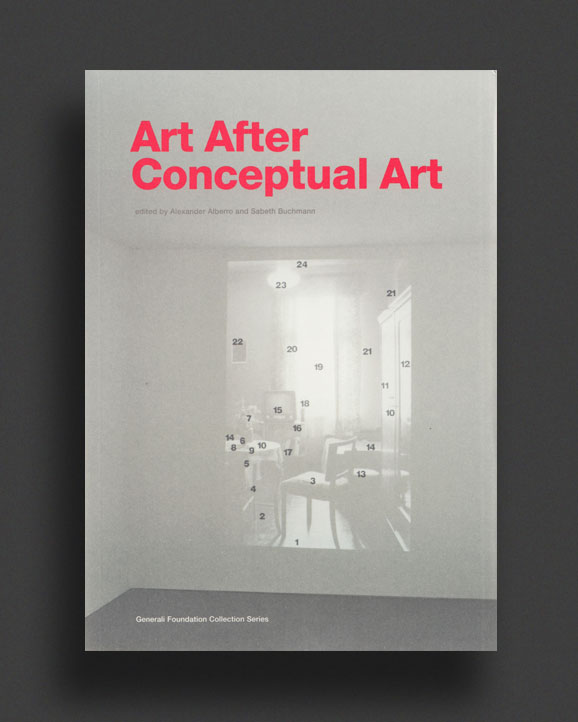
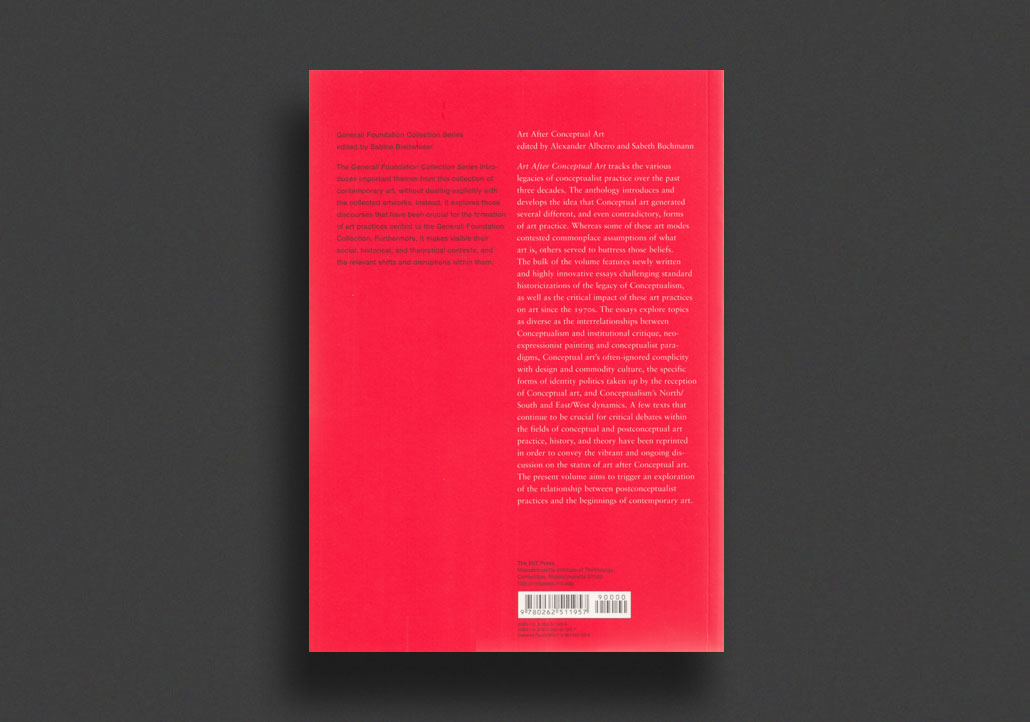
Art After Conceptual Art tracks the various legacies of conceptualist practice over the past three decades. This collection of essays by art historians and artists from Europe and the Americas (including Benjamin H. D. Buchloh, Helen Molesworth, Isabelle Graw, Thomas Crow, Helmut Draxler, Alexander Alberro, Sabeth Buchmann, Henrik Oelsen, Edit András) introduces and develops the idea that conceptual art generated several different, and even contradictory, forms of art practice. Some of these contested commonplace assumptions of what art is; others served to buttress those assumptions. The bulk of the volume features newly written and highly innovative essays challenging standard interpretations of the legacy of conceptualism and discussing the influence of conceptualism's varied practices on art since the 1970s. The essays explore topics as diverse as the interrelationships between conceptualism and institutional critique, neoexpressionist painting and conceptualist paradigms, conceptual art's often-ignored complicity with design and commodity culture, the specific forms of identity politics taken up by the reception of conceptual art, and conceptualism's North/South and East/West dynamics. A few texts that continue to be crucial for critical debates within the fields of conceptual and postconceptual art practice, history, and theory have been reprinted in order to convey the vibrant and ongoing discussion on the status of art after conceptual art. Taken together, the essays will inspire an exploration of the relationship between postconceptualist practices and the beginnings of contemporary art.
2010, Japanese / English
Softcover (w. dust jacket and dust jacket), 938 pages, 15 x 21 cm
Published by
Tokyo Kirara / Tokyo
Kawade Shobo Shinsha / Tokyo
$150.00 - Out of stock
This absolutely remarkable ECM handbook of over 900 pages, edited by Kenny Inaoka, ECM’s label manager in Japan in the 1970s and 1980s, originally conceived to accompany ECM’s 40th year celebrations, begins with a comprehensive illustrated catalogue of all of the officially released albums issued on ECM - and its subsidiary JAPO - from 1969 until 2010. Album covers are shown in colour (sometimes with alternate designs), and there is a section of Japan-only releases alongside the full international range of titles. This is followed by an individual album guide, complete with artwork, discographical information and capsule reviews for each release. All discographical information is in English, including titles, musicians, recording locations etc., making the book an extremely useful reference work for the non-Japanese reader/listener, and for collectors in general. A monumental, exhaustive document dedicated to one of the world's most innovative record labels!
The independent record label ECM – Edition of Contemporary Music – was founded by producer Manfred Eicher in Munich in 1969, and to date has issued more than 1500 albums spanning many idioms. Emphasising improvisation from the outset, ECM established its reputation with standard-setting recordings by Keith Jarrett, Paul Bley, Jan Garbarek, Chick Corea, Gary Burton, the Art Ensemble of Chicago and many more and began to include contemporary composition – including Steve Reich’s Music for 18 Musicians and Meredith Monk Dolmen Music – in its programme in the late 1970s and early 80s. To introduce Arvo Pärt’s Tabula Rasa a sister label, ECM New Series, was launched in 1984. The New Series has since become a broad platform for a spectrum of composed music from the pre-baroque era to the present day. New music, improvised or notated, builds upon the strengths of earlier models, and the concept of modern music informed by older music resonates through the improvised and composed projects heard on ECM.
2008, English
Softcover, 136 pages, 15.2 x 22.9 cm
Published by
Semiotext(e) / Los Angeles
$44.00 - Out of stock
As celebrated as it is reviled, internationally acclaimed filmmaker Catherine Breillat's novel Pornocracy viscerally enacts the dramatic confluence of mystery, desire, and shame that lies at the heart of sexuality. In Pornocracy, a beautiful woman wanders through a gay disco and engages a man, confident that he will follow her. Perversely and dispassionately, she offers her body as the ground of a ritualistic game in which, over the course of three evenings, the two will explore the numbing mechanics of sexual brutality. What follows is an exchange between a man and a woman that is both frankly sexual and deeply philosophical. Adapted and directed for film in France by Breillat as Anatomy of Hell (2004), Pornocracy leads the reader through an undulating and atmospheric exploration of the criminal and the erotic, finally climaxing in a place well beyond more familiar moral terrain. Although Breillat's films — most recently Fat Girl (2001) and Romance (1999) — are well known to international audiences, this publication marks her literary debut in America. It will demonstrate that Breillat's famous films are but one aspect of her strikingly original poetic and philosophical vision.
Catherine Breillat is a filmmaker and writer based in Paris. She is known not only for her films focusing on themes of sexuality, but also for her best-selling novels. Pornocracy is the first of her novels to be published in English.
Translated by Paul Buck and Catherine Petit
Afterword by Peter Sotos
Introduction by Chris Kraus
2021, English
Hardcover, 320 pages, 17 x 24 cm
Published by
Information Office / Vancouver
$75.00 - In stock -
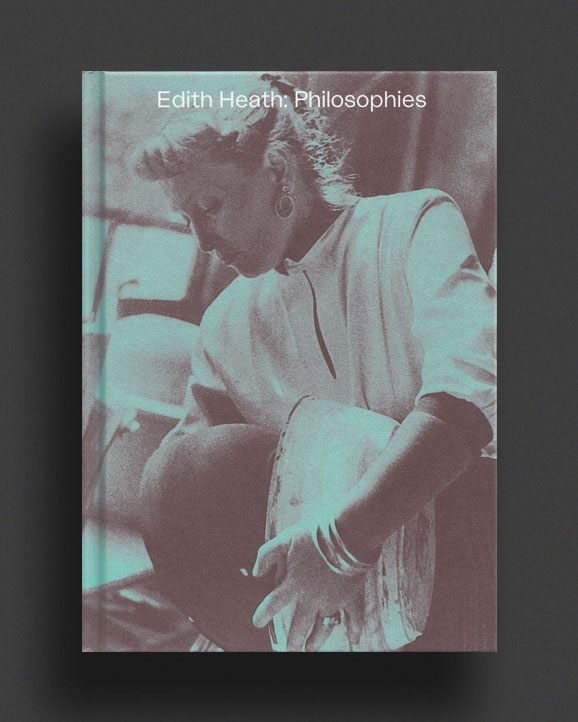
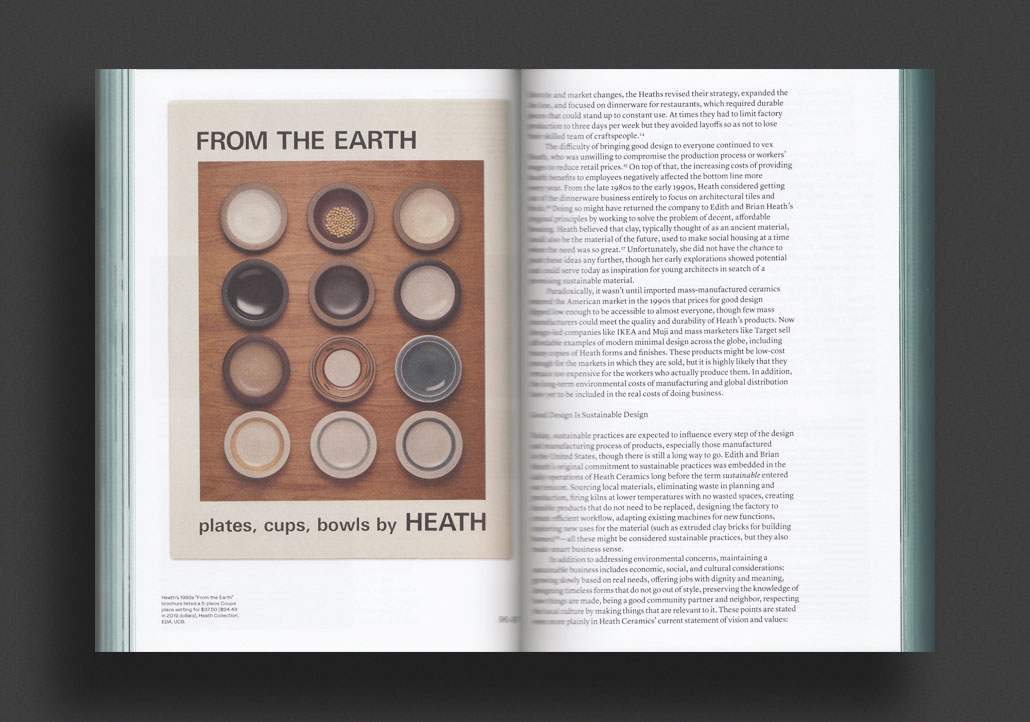
Edith Heath: Philosophies serves as the definitive resource on Edith Kiertzner Heath (1911–2005) and the history of Heath Ceramics, emphasizing the philosophical foundations and influences of one of the most significant creative forces in post-World War II America. Heath considered her dinnerware more than a collection of simple objects; rather, it was a commentary on good design and what she believed was indicative of a new and more informal lifestyle in postwar America. This book offers in-depth commentary on the many themes that shaped Heath’s ceramics practice—the environment, feminism, education, experimentation, architecture, politics, societal trends, collaborations—while also solidifying the relevance of Edith Heath’s story in contemporary life and society.
Contents include a foreword, preface, visual historical timeline, selected product and dinnerware glaze history, and a collection of essays contributed by historians and designers, all of whom have conducted specialized research in the Brian and Edith Heath/Heath Ceramics Collection at the Environmental Design Archives (EDA), UC Berkeley. Highlighting the richness of the EDA’s collection, the book utilizes rarely seen images, many of which show the character of their original archival state. The interdisciplinary nature of the content and visually engaging illustrative materials will appeal to a wide audience interested in postwar design, material culture, and California history.
Contributors include Catherine Bailey and Robin Petravic, Allan Collier, Drew Heath Johnson, Waverly B. Lowell, Chris Marino, JC Miller, Julie M. Muñiz, Rosa Novak, Ezra Shales, Mara Holt Skov, Jay Stewart, Brian Trimble, Emily Vigor, and Jennifer M. Volland.
2021, English
Hardcover, 152 pages, 23 x 27 cm
Published by
Royal Academy of The Arts / London
$70.00 - In stock -
Born in 1885 to a working-class family in Connecticut, Milton Avery left school at 16 to work in a factory. Intending to study lettering but soon transferring to painting, he attended evening school for fifteen years before moving to New York in the 1920s to pursue a career as a painter.
Although he never identified with a particular movement, Avery was a sociable member of the New York art scene. He became a figure of considerable influence for a younger generation of American artists, including Mark Rothko, Adolph Gottlieb and Barnett Newman. His talent was praised by Rothko, who said of his work 'the poetry penetrated every pore of the canvas to the last touch of the brush'.
Edith Devaney introduces Avery and his work, while Erin Monroe looks at Avery's early years in Hartford, and Marla Price examines Matisse's influence upon his art. A conversation with the artist's daughter March Avery Cavanaugh and an illustrated chronology by Isabella Boorman complete the book.
1981, French
Softcover, 70 pages, 27 x 22 cm
1st Edition, Out of print title / used / very good
Published by
Chêne-Hachette / France
$390.00 - In stock -
Beautiful and very scarce French photo book published in 1981 by two young photographers, Gilles Mimouni and Jean-Paul Dumas-Grillet (who both continued into film), presents a collection of young adolescent women shot in France during the 70s, when they were still in school. The deliberately strange title, Adorae Curieux Zamok, refers to the young heroine of the writer Nabokov "Adorae", Curieux is "curious", and the Russian term Zamok is from the word "lock", evoking the private and secret character of a universe that never reveals itself at first sight : that of adolescence.
Accompanied by a text by novelist Muriel Cerf, these "portraits de petites filles sérieuses" are a discreet and sensitive approach to an age when girls' faces are no longer entirely that of a child's and are not yet those of an adults. "Curious faces, whose black and white photographs perfectly reflect the moving gravity and allow us to read in turn the sweet melancholy, hope, boredom, candor or mischief of their age." (taken from the text on the back cover.)
Very Good copy of this collectible book. Some common light yellowing to cover and edges.
2021, English
Hardcover, 184 pages, 27 x 23 cm
Published by
MoMA / New York
$70.00 - Out of stock
How the celebrated Surrealist traversed the many movements of 20th-century art with a thrilling disregard for categories and constraints.
Over the course of her protean career, Meret Oppenheim produced witty, unconventional bodies of work that defy neat categorizations of medium, style and subject matter. “Nobody will give you freedom,” she stated in 1975, “you have to take it.” Her freewheeling, subversively humorous approach modeled a dynamic artistic practice in constant flux, yet held together by the singularity and force of her creative vision.
Published in conjunction with the first ever major transatlantic Meret Oppenheim retrospective, and the first in the United States in over 25 years, this publication surveys work from the radically open Swiss artist’s precocious debut in 1930s Paris, the period during which her notorious fur-lined Object in MoMA’s collection was made, through her post–World War II artistic development, which included engagements with international Pop, Nouveau Réalisme and Conceptual art, and up to her death in 1985. Essays by curators from the Kunstmuseum Bern, the Menil Collection and the Museum of Modern Art critically examine the artist’s wide-ranging, wildly imaginative body of work, and her active role in shaping the narrative of her life and art, providing the context for her creative production pre– and post–World War II.
About the Authors:
Nina Zimmer is the Director of the Kunstmuseum Bern. Natalie Dupêcher is Assistant Curator of Modern Art at The Menil Collection, TX. Anne Umland is The Blanchette Hooker Rockefeller Senior Curator of Painting and Sculpture at The Museum of Modern Art, New York. Lee Colón is a Curatorial Assistant in the Department of Painting and Sculpture, MoMA.
Meret Oppenheim was born in 1913 and lived in Germany and Switzerland during her childhood. At the age of 18, she moved to Paris to study art, and there exhibited alongside members of the Surrealist group. Oppenheim returned to Switzerland in 1937, where she trained as a conservator at the Basel School of Design. Already a storied member of the pre–World War II avant-garde, in the last two prolific decades of her life she was embraced by a younger generation of artists for her conceptual approach to art and progressive views on gender. Oppenheim died in 1985.
2021, English
Hardcover, 224 pages, 20 x 15.5 cm
Published by
Siglio Press / Los Angeles
$65.00 - Out of stock
A forensic conceptualist's inventory of the ordinary and extraordinary lives in a Venetian hotel.
In 1981 Sophie Calle took a job as a chambermaid for the Hotel C in Venice, Italy. Stashing her camera and tape recorder in her mop bucket, she not only cleans and tidies, but sorts through the evidence of the hotel guests' lives. Assigned 12 rooms on the fourth floor, she surveys the state of the guests' bedding, their books, newspapers and postcards, perfumes and cologne, traveling clothes and costumes for Carnival. She methodically photographs the contents of closets and suitcases, examining the detritus in the rubbish bin and the toiletries arranged on the washbasin. She discovers their birth dates and blood types, diary entries, letters from and photographs of lovers and family. She eavesdrops on arguments and love-making. She retrieves a pair of shoes from the wastebasket and takes two chocolates from a neglected box of sweets, while leaving behind stashes of money, pills and jewelry. Her thievery is the eye of the camera, observing the details that were not meant for her, or us, to see.
The Hotel now manifests as a book for the first time in English (it was previously included in the book Double Game). Collaborating with the artist on a new design that features enhanced and larger photographs, and pays specific attention to the beauty of the book as an object, Siglio is releasing its third book authored by Calle, after The Address Book (2012) and Suite Vénitienne (2015).
Sophie Calle (born 1953) is an internationally renowned artist whose controversial works often fuse conceptual art and Oulipo-like constraints, investigatory methods and the plundering of autobiography. The Whitechapel Gallery in London organized a retrospective in 2009, and her work has been shown at the Museum of Modern Art and the Whitney Museum of American Art, New York; the Carnegie Museum of Art, Pittsburgh; the Museum of Fine Arts, Boston; the Hayward Gallery and Serpentine, London; and the Museum of Contemporary Art, Chicago, among others. She lives and works in Paris.
1970, English
Softcover, 450 pages, 20 x 15 cm
1st Edition, Out of print title / used / very good
Published by
E P Dutton / New York
$55.00 - Out of stock
First edition of this seminal 1970 work by Gene Youngblood, with an Introduction by R. Buckminster Fuller, was the first to consider video as an art form. One of the most prescient books written about our modern age, Expanded Cinema was considered the Declaration of Independence for media arts. As the author writes, "The definition of cinema must be expanded to include videotronics, computer science, and atomic light." The introductory essay by R. Buckminster Fuller established an encompassing 1960s countercultural context for this new explosion of technologies. Heavily illustrated throughout, this classic original edition has been long out of print and is of such importance to this day that it has seen a re-publication in 2020.
Gene Youngblood is a well-known theorist of electronic media arts and a respected scholar in the history and theory of experimental film and video art. He has split his career between teaching and journalism and is also widely known as a pioneering voice in the Media Democracy movement.
R. Buckminster Fuller was an architect, designer, inventor, social theorist, and the author of more than thirty books, including the legendary Operating Manual for Spaceship Earth.
Very Good copy with only light age wear.
2021, English
Softcover, 230 pages, 14 x 19.1 cm
Published by
The Song Cave / New York
$58.00 - Out of stock
Introduction by Collier Schorr
Edited by Ben Estes
Unseen photos of rebels, outsiders, construction workers and more: celebrating the distinctive gay male gaze of Karlheinz Weinberger.
This landmark entry in the lifework of Zürich photographer Karlheinz Weinberger gathers more than 200 never-before-published vintage photographic prints that were rediscovered in 2017. This unique collection pairs images of Weinberger's most famous subjects, the "Halbstarke" — a loosely organized group of Swiss "rebels" in the late 1950s and early 1960s, carousing at local carnivals and on a camping trip — with a much more private side of Weinberger's oeuvre: solo portraits of men from the late 1950s through the mid-1970s, whom he invited into his makeshift studio in the rooms of the apartment he shared with his mother.
The men in these portraits — construction workers, street vendors, bicycle messengers, outsiders — span a spectrum of fully clothed, arms-crossed poses to campy and flirtatious, fully nude and reclined, while others mimic art historical postures. All of these images, though, reveal a palpable tenderness between photographer and subject, offering an expansive, uncritical take on the male form in an era when being photographed was not the casual, ubiquitous record it is today. Though not a professional photographer (he worked as a warehouse stock manager), Weinberger captured his subjects with a distinctly gay male gaze, both carnal and artistic, and this collection is certain to earn his work a larger following and appreciation.
Born in 1921, Karlheinz Weinberger was a Swiss photographer whose work predominantly explored outsider cultures. Between 1943 and 1967 Weinberger published photos of male workers, sportsmen and bikers in the gay magazine Der Kreis under the pseudonym of "Jim." In the late '50s and early '60s he concentrated on Swiss rock 'n' roll youth, whom he photographed with both tenderness and a hint of irony. Weinberger placed little emphasis on exhibiting his work; his first comprehensive show took place only in 2000, six years before his death.
2021, English
Softcover, 138 pages, 13.7 x 19.1 cm
Published by
The Song Cave / New York
$42.00 - Out of stock
The first book-length translation of works by this important Egyptian-born, Lebanese-French poet, POETRIES presents the core of Georges Schehadè's (1905-1989) úuvre. Though best known as a dramatist, Schehadè was first and foremost a poet. His lifework was the seven volumes of crystalline poems published over a span of nearly a half-century (1938-1985), each successive volume simply and enigmatically titled POETRIES. It is from these seven books that our selection has been drawn.
Translated by Austin Carder. Featuring an introduction by Adonis.
In 1986, the Acadèmie Francaise awarded Georges Schehadè the inaugural Grand Prix de la Francophonie. Despite having received wide admiration from his contemporaries--including Max Jacob, Octavio Paz, Andrè Breton, and Paul Eluard--the poetry of Georges Schehadè is virtually unknown today, with this collection being the very first translated into English. In his translator's note, Austin Carder calls this collection a lullaby or an enigmatic fairytale told before bed. Its tone is one of self-sufficient prayer--a pronouncement rather than a plea--addressed to no one in particular and to anyone. These weathered songs key into the language of music, not by approximating its effects but by innervating sparks of meaning that flash forth...Schehadè's broken-off parables convulse with the dual beauty of both hymn and elegy.
Floating up as if from the weave of the page itself, these perfectly pitched versions of Georges Schehadè's Les Poèsies convey a mysterious sense of the inevitable. One couldn't ask more of a translation, and with the gift of this one Austin Carder gives us (and English) a haunting new poet of magical clarity and uncanny quiet. This is a beautiful book. — Peter Cole
2019, English
Hardcover, 256 pages, 19.2 x 24.6 cm
Published by
The MIT Press / Massachusetts
$100.00 - In stock -
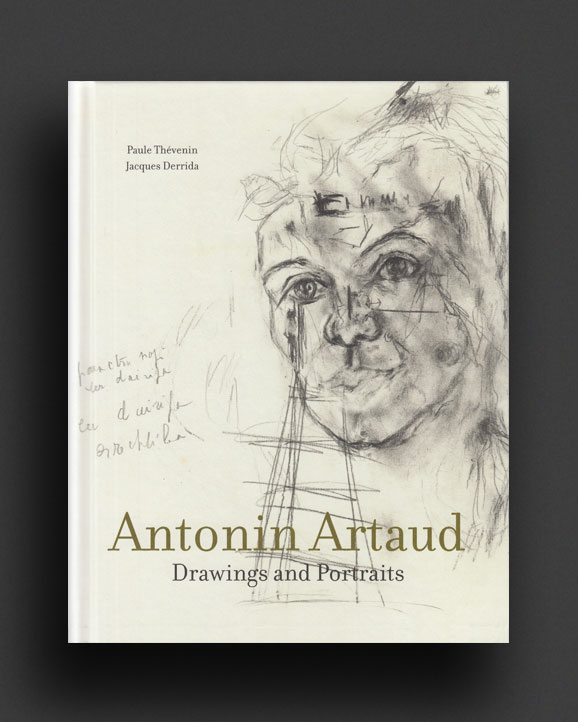
Antonin Artaud (1896–1948) - stage and film actor, director, writer, and visual artist - was a man of rage and genius. Expelled from the Surrealist movement for his refusal to renounce the theatre, he founded the Theater of Cruelty and wrote The Theater and Its Double, one of the key twentieth-century texts on the topic. Artaud spent nine years at the end of his life in asylums, undergoing electroshock treatments. Released to the care of his friends in 1946, he began to draw again. This book presents drawings and portraits from this late resurgence, in colour reproductions. Accompanying the images are texts by by Artaud's longtime friend and editor Paule Thévenin and the philosopher Jacques Derrida.
“We won't be describing any paintings,” Derrida warns the reader. Derrida struggles with Artaud's peculiar language, punctuating his text with agitated footnotes and asides (asking at one point, “How will they translate this?”). Thévenin offers a more straightforward biographical and historical account. (It was on the walls of her apartment that Derrida first saw Artaud's paintings and drawings.) These two texts were previously published by the MIT Press in The Secret Art of Antonin Artaud without the artwork that is their subject. This book brings together art and text for the first time in English.
Paule Thévenin (1918–1993) knew Antonin Artaud well and edited many his complete writings for the French publisher Éditions Gallimard.
Jacques Derrida (1930–2004), an enormously influential philosopher, theoretician, critic, and deconstructionist, is the author of Of Grammatology, The Post Card: From Socrates to Freud and Beyond, Aporias, and many other books.
1998, English
Softcover, 256 pages, 15.2 x 22.9 cm
Published by
Paragon House Publishers / US
$45.00 - Out of stock
Hailed by Martin Heidegger as "one of France's best minds," Georges Bataille has become increasingly recognized and respected in the realm of academic and popular intellectual thought. Although Bataille died in 1962, interest in his life and writings have never been as strong as they are today — Barthes, Foucault, Derrida, and Kristeva have all acknowledged their debt to him.
In his book, On Nietzsche, as translated by Bruce Boone, Bataille comes as close as he would ever come to formulating his own unique system of philosophy. One could say that reading Nietzsche was something of a revelation to Bataille, and profoundly affected his life. In 1915, in a crisis of guilt after leaving his blind father in the hands of the Germans, Bataille converted to Catholicism. It was Nietzsche's work that lead him to abandon traditional religion for an idiosyncratic form of godless mysticism.
In this volume, Bataille becomes, and goes beyond, Nietzsche, assuming Nietzsche's thought where he left off--with God's death. At the heart of this work is Bataille's exploration of how one can have a spiritual life outside religion. On Nietzsche is essentially a journal that brilliantly mixes observations with ruminations in fragments, aphorisms, poems, myths, quotations, and images against the background of World War II and the German occupation. Bataille has a unique way of moving breezily from abstraction to confession, and from theology to eroticism. He skillfully weaves together his own internal experience of anguish with the war and destruction raging outside with arguments against fascist interpretations of Nietzsche and praise for the philosopher as a prophet foretelling "the crude German fate."
With an introduction, "Furiously Nietzschean," by Sylvere Lotringer, an Appendix in which Bataille defends himself against Sartre, and an Index, this volume reconfirms Michel Foucault's assertion that Bataille, "broke with traditional narrative to tell us what has never been told before."
2021, English
Softcover, 288 pages, 13.3 x 19.7 cm
Published by
Urbanomic / Cornwall
$45.00 - Out of stock
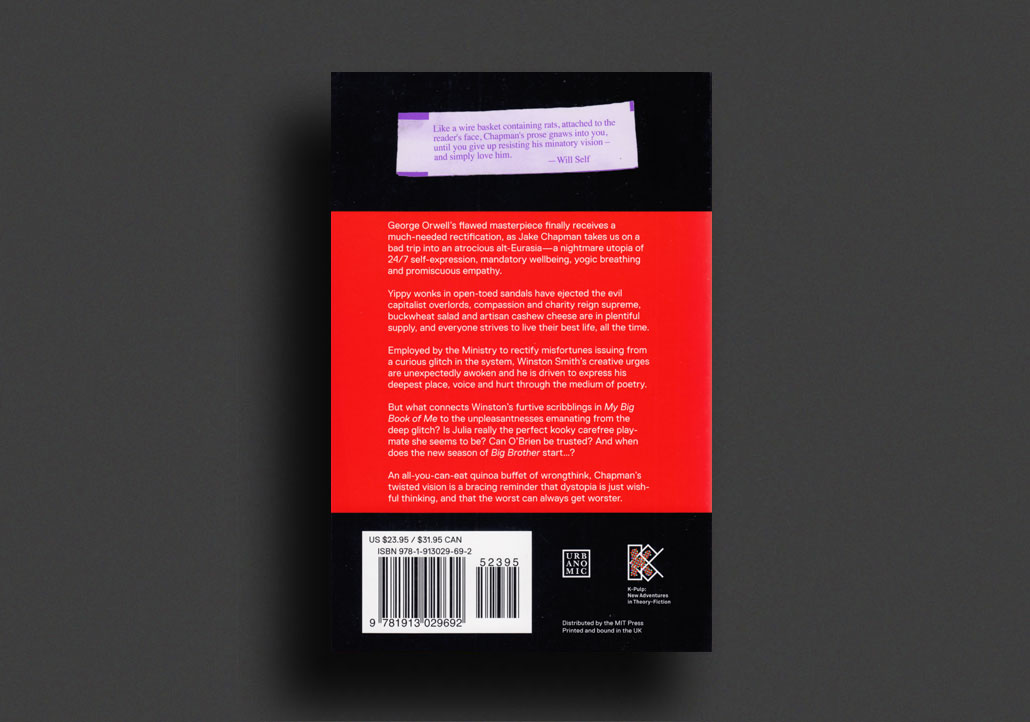
"Like a wire basket containing rats, attached to the reader's face, Chapman's prose gnaws into you, until you give up resisting his minatory vision—and simply love him." — Will Self
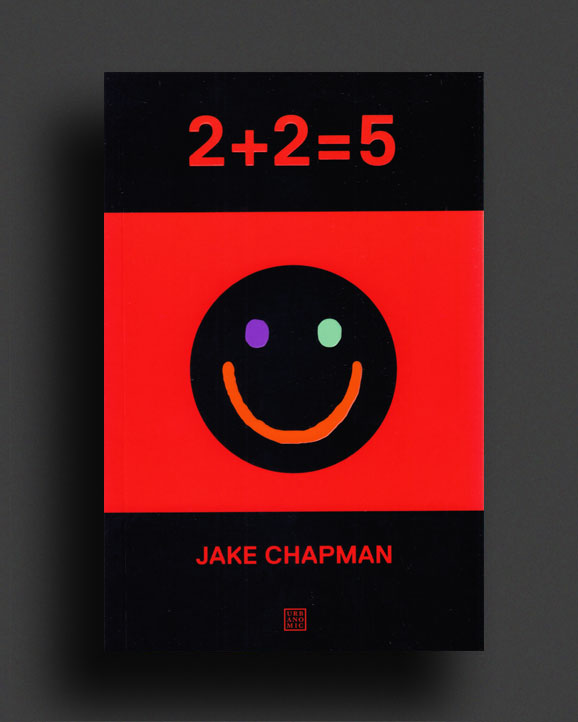
With 2+2=5, George Orwell's flawed masterpiece finally receives a much-needed rectification, as Jake Chapman takes us on a bad trip into an atrocious alt-Eurasia--a nightmare utopia of 24/7 self-expression, mandatory wellbeing, yogic breathing, and promiscuous empathy. Yippie wonks in open-toed sandals have ejected the evil capitalist overlords, compassion and charity reign supreme, buckwheat salad and artisan cashew cheese are in plentiful supply, and all strive to live their best life, all the time.
Employed by the Ministry to rectify misfortunes issuing from a curious glitch in the system, Winston Smith finds that his creative urges are unexpectedly awoken, and he is driven to express his deepest place, voice, and hurt through the medium of poetry. But what connects Winston's furtive scribblings in My Big Book of Me to the unpleasantnesses emanating from the deep glitch? Is Julia really the perfect kooky carefree soulmate she seems to be? Can O'Brien be trusted? And when does the new season of Big Brother start?
An all-you-can-eat quinoa buffet of wrongthink, Chapman's twisted vision is a bracing reminder that dystopia is just wishful thinking, and that the worst can always get worster.
Jake Chapman is a British artist known worldwide for his iconoclastic sculpture, prints and installations. Since their graduation from the Royal College of Art in 1990, he has worked together with his brother Dinos; the Chapmans first received critical acclaim in 1991 for the diorama sculpture Disasters of War, and since then they have exhibited extensively in solo and group shows. In 2015, Jake directed The Marriage of Reason and Squalor, a film based on his first novel of the same title. This book was followed by Memoirs of My Writer's Block and INTROSPASTIC: From the Blackened Beyond.
2019, English
Softcover (w. flexi-disc), 280 pages, 26 x 21 cm
Ed. of 2500,
Published by
Primary Information / New York
$65.00 - Out of stock
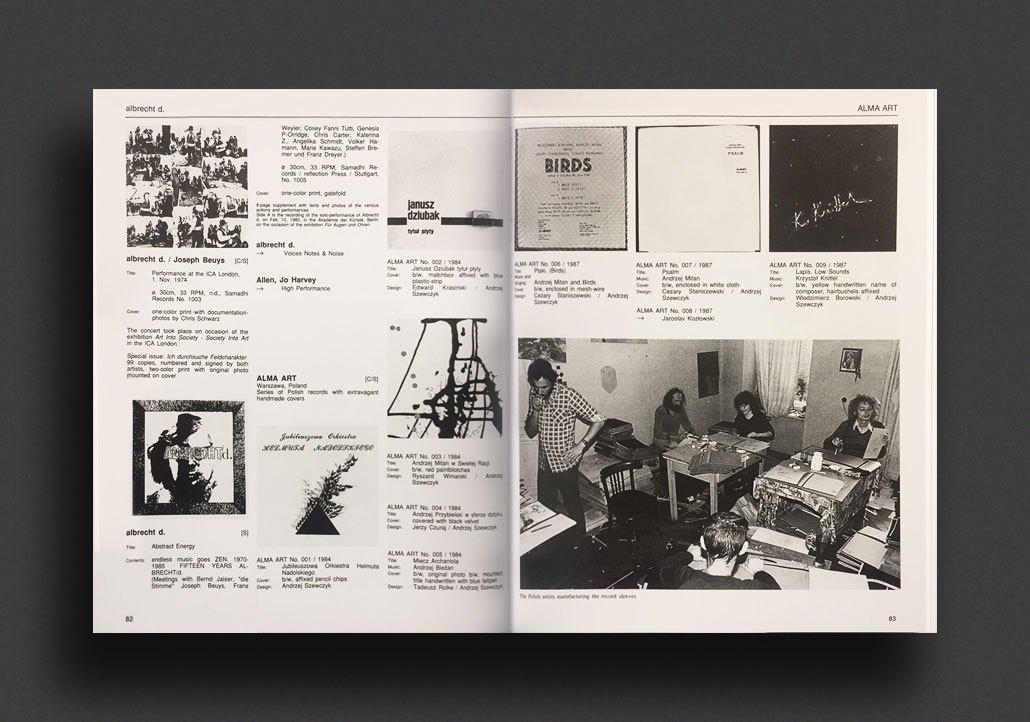
Broken Music is an essential compendium for records created by visual artists. The publication was edited by Ursula Block and Michael Glasmeier and originally published in 1989 by DAAD. Broken Music focuses on recordings, record-objects, artwork for records, and record installations made by thousands of artists between WWII and 1989.
It also includes essays by both editors as well as Theodor W. Adorno, René Block, Jean Dubuffet, Milan Knizak, László Moholy-Nagy, Christiane Seiffert, and Hans Rudolf Zeller, as well as a flexi disc of the Arditti Quartet performing Knizak’s “Broken Music.” The centerpiece of the publication is a nearly 200-page bibliography of artists’ records.
Works chosen for the publication revolved around four criteria: (1) record covers created as original work by visual artists; (2) record or sound-producing objects (multiples/editions/sculptures); (3) books and publications that contain a record or recorded-media object; and (4) records or recorded media that have sound by visual artists.
Artists documented in the volume include Vito Acconci, albrecht/d., Laurie Anderson, Guillaume Apollinaire, Karel Appel, Arman, Hans Arp, Antonin Artaud, John Baldessari, Hugo Ball, Claus van Bebber, John Bender, Harry Bertoia, Jean-Pierre Bertrand, Joseph Beuys, Mel Bochner, Claus Böhmler, Christian Boltanski, KP Brehmer, William Burroughs, John Cage, Henri Chopin, Henning Christiansen, Jean Cocteau, William Copley, Philip Corner, Merce Cunningham, Hanne Darboven, Jim Dine, Marcel Duchamp, Max Ernst, Lawrence Ferlinghetti, Fischli and Weiss, R. Buckminster Fuller, Allen Ginsberg, Philip Glass, Jack Goldstein, Peter Gordon, Hans Haacke, Richard Hamilton, Bernard Heidsieck, Holger Hiller, Richard Huelsenbeck, Isidore Isou, Marcel Janco, Servie Janssen, Jasper Johns, Joe Jones, Thomas Kapielski, Allan Kaprow, Martin Kippenberger, Per Kirkeby, Cheri Knight, Milan Knizak, Richard Kriesche, Christina Kubisch, Laibach, John Lennon, Sol Lewitt, Roy Lichtenstein, Annea Lockwood, Paul McCarthy, Meredith Monk, Josef Felix Müller, Piotr Nathan, Hermann Nitsch, Albert Oehlen, Frank O’Hara, Claes Oldenburg, Yoko Ono, Dennis Oppenheim, Nam June Paik, Charlemagne Palestine, A.R. Penck, Tom Phillips, Robert Rauschenberg, The Red Crayola, Ursula Reuter Christiansen, Gerhard Richter, Jim Rosenquist, Dieter Roth, Gerhard Rühm, Robert Rutman, Sarkis, Thomas Schmit, Conrad Schnitzler, Kurt Schwitters, Selten Gehörte Musik, Richard Serra, Robert Smithson, Michael Snow, Keith Sonnier, Strafe für Rebellion, Jean Tinguely, Moniek Toebosch, Tristan Tzara, Ben Vautier, Yoshi Wada, Emmett Walsh, Andy Warhol, William Wegman, and Lawrence Weiner.
Ursula Block is a curator living in Berlin, Germany. From 1981 until 2014, she ran gelbe Musik, a gallery and record shop in Berlin that featured work by artists at the crossroads between music and art.
Michael Glasmeier is a professor, writer, and editor living in Berlin, Germany. Since the early 1980s, he has curated dozens of shows that explore the intersection between the visual arts, music, film, and language.
1989, English
Softcover, 144 pages, 17.5 x 24 cm
1st Edition, Out of print title / used / very good
Published by
Art & Text / Prahran
$45.00 - Out of stock
ART & TEXT 32
AUTUMN 1989
Edited by Paul Foss
CONTENTS:
David Wills — Deposition: Introduction To "Right Of Inspection" [Droit De Regards]
Marie-Francoise Plissart and Jacques Derrida — Right Of Inspection
David Bennett — Art And Rubbish: Contemporary British Colour Photography
Paul Gilroy — Cruciality And The Frog's Perspective: An Agenda Of Difficulties For The Black Arts Movement In Britain
Art &c.
Allen S. Weiss — Golem In Gotham
Mark S. Roberts — Lyotard And Art "After Auschwitz"
Therese Lichtenstein — Boltanski's "Lessons Of Darkness"
Therese Lichtenstein — Aborigines, Representation, Necrophilia John Von Sturmer
Art & Text, one of the landmark contemporary art magazines of the 1980s and 1990s. Founded in Melbourne, Australia, in 1981 by Paul Taylor (1957–92), who soon moved to New York City to make his mark as an art critic, the magazine went on to become one of a handful of international art magazines that succeeded in capturing the turmoil and passing brilliance of that period of postmodernism.
1987, English
Softcover, 104 pages, 17.5 x 24 cm
1st Edition, Out of print title / used / good
Published by
Art & Text / Prahran
$45.00 - Out of stock
ART & TEXT 25
JUNE / AUGUST 1987
Edited by Paul Foss
CONTENTS:
Terry Smith — Black Swan in the City ... Detroit, first week of August, 1986
Christina Thompson — A Piece of Savage Mischief
Meaghan Morris — Tooth and Claw: Tales of Survival, and Crocodile Dundee
Merryn Gates — Transparency and Reinvention 70 in Rosslynd Piggott.
Eric Michaels — My Essay on Postmodernism
George Alexander — Get Back, Martin Sharp
Art & Text, one of the landmark contemporary art magazines of the 1980s and 1990s. Founded in Melbourne, Australia, in 1981 by Paul Taylor (1957–92), who soon moved to New York City to make his mark as an art critic, the magazine went on to become one of a handful of international art magazines that succeeded in capturing the turmoil and passing brilliance of that period of postmodernism.
2021, English
Softcover, 56 pages, 10.5 x 16.5 cm
Published by
Shelter Press / France
$24.00 - Out of stock
This is not a study. It is a manifesto for a peculiar conviction: that music remains to be discovered, that it is still hidden. That, nonetheless, it does sometimes appear, but most often incompletely and unevenly. And that what we have hitherto referred to as ‘music’ is in fact only a preliminary, a prodrome. That all musics produced up until now have been nothing but simulacra, rituals to call music forth. This may sound crazy, and indeed unwelcome. But the sole concern of the following text will be to make this statement legible, understandable, and perhaps even to some extent acceptable. Its hope is that, setting out from a few intuitions, the possibility of a music to come can be formulated. That this obscure becoming will emerge, one trait at a time; that the shape of this music to come will reveal itself, gradually, by way of a cluster of assumptions, the reading of a multiple history, and the examination of damaging paradigms that have taken music far from itself. That the subjectivity of a writing, with all of its beliefs, its errors, its biases, its injustices and its shaky certainties, may yet manage to cast a singular and inspiring light upon the idea of music—this, ultimately, is the ambition of the lines to come.
1996, English
Softcover, 136 pages, 21 x 15 cm
1st Edition, Out of print title / used / very good
Published by
Artspace / Sydney
$60.00 - Out of stock
First edition of this now very scarce volume of collected texts from Australian art critic and professor Rex Butler that resulted from five lectures by the author at Artspace Sydney in 1995: 'The 80s in Retrospect', 'Art & Text in the '90s', 'The Critics', 'The Object, Again' and 'On Michael Fried's Literary 'Impressionism'.
Very Good copy with dedicated / inscription from Rex on inside front cover.
2021, English / Dutch
Softcover, 176 pages, 24 x 17 cm
Published by
Nai010 Publishers / Rotterdam
$60.00 - Out of stock
Lucio Fontana (1899–1968) is one of the most important avant-garde artists of the 20th century and continues to inspire artists, designers and architects. He is known for his iconic monochromatic paintings with vertical cuts. Lucio Fontana: The Conquest of Space highlights the ideas of Fontana's Concetto spaziale and shows how these spatial notions took shape not only in his slashed canvases, but also in his sculpture, jewellery, and installations. With photography by Anuschka Blommers and Niels Schumm, and texts by Colin Huizing and Paulo Campiglio, this publication is an indispensable overview of Fontana's innovative spatial views on art.
1999, English
Hardcover (w. dust jacket), 400 pages, 28 x 24 cm
1st Edition, Out of print title / used / very good
Published by
Charta / Milan
$150.00 - Out of stock
First edition of one of the largest and most comprehensive English-language books on Lucio Fontana, edited by esteemed Italian art critic and leading Fontana author Enrico Crispolti and published on the occasion of a major Lucio Fontana retrospective exhibition held in Milan, 23 April—30 June, 1999. Profusely illustrated throughout in colour and black and white with a huge array of Fontana's works, accompanied by texts from Enrico Crispolti, Antonello Negri, Luciano Caramel, Paolo Biscottini, Tommaso Trini, and a conversation between art critics Guido Ballo and Tommaso Trini, together covering every dimension of this highly original and influential artist's career. Also includes an incredible photo album edited by Nini Ardemagni Laurini and Valeria Ernesti, documenting the artist's world, studio, exhibitions, social life through the lens of many photographers, including many by the great Ugo Mulas, whose photographs adorn the covers. Includes a biography, list of works, exhibitions and a selected bibliography. A rare and in-depth insight into the life and work of a rare artist.
Lucio Fontana (1899–1968) is one the most innovative artists of the 20th century. A major figure of postwar European art and a binational resident of Argentina and Italy, Fontana blurred numerous boundaries in his life and art, crossing borders both literally and figuratively. The founder of Spatialism, a movement focused on the spatial qualities of sculpture and paintings with the goal of breaking through the two-dimensionality of the traditional picture plane, he pushed the painterly into the sculptural and redefined the relationship between the arts. He was best known for his monochrome canvases known as Concetti Spaziale that he would cut or puncture, leaving distinctive gaping slash marks and holes that imbued the finished work with an almost violent energy. In his seminal writing, White Manifesto (1946), the artist traced ideas for creating a new medium that blended architecture, painting, and sculpture. “I do not want to make a painting; I want to open up space, create a new dimension, tie in the cosmos, as it endlessly expands beyond the confining plane of the picture,” he said of his work. Fontana had widespread impact on the following generation of artists, who began to use installation media more aggressively to address the dynamics of space in gallery environments and Land Art. Fontana died on September 7, 1968 in Varese, Italy at the age of 69, just two years after being awarded the Grand Prize for painting at the Venice Biennale.
Very Good copy in VG dust jacket.
2021, English / Italian
Softcover, 168 pages, 18 x 15 cm
Published by
Nero / Rome
Centro per l’arte contemporanea Luigi Pecci / Prato
$74.00 - Out of stock
Naples, late Seventies. On the city’s streets scandalous, indecent posters suddenly appeared, and then quickly disappeared, replaced by new images. They only lasted two years before being censored. The posters were taken from porn movies, with bodies of naked, obscene, tempting women. Their focus, however, was not only women’s bodies but also (and mostly) male desire and those years’ dominant macho imagery. Marialba Russo was immediately intrigued by those images and hence decided to photograph them. Her research soon became methodical. She took those pictures almost secretly, generating an obsession which became a systematic collection, a heterogeneous corpus made of different shots, poses, gazes, all kept together by an exaggerated, comical (or tragical) eroticism, by a blatantly unilateral, male representation.
But what motivated the actions of a woman who in the late Seventies photographed posters taken from porn movies? Curiosity or anger? And mostly: what does it mean to expose these pictures? Is it a way to ridicule them or to amplify their effect? Does showing these images mean to de-power the male-dominated ritual of porn movies or, rather, is exposing it a way to reinforce it, nurturing the inclination of representing women and their bodies as mere desired objects? These are some of the questions raised by Marialba Russo’s work, which the critical essays (by Goffredo Fofi and Elisa Cuter) attempt to answer in this book, pushing the reader to put into question the perception of women’s bodies, the exposition’s meaning and how it tackles and influences gender issues in our society.
2021, English
Softcover, 208 pages, 30 x 24 cm
Published by
Roma / Amsterdam
$80.00 - Out of stock
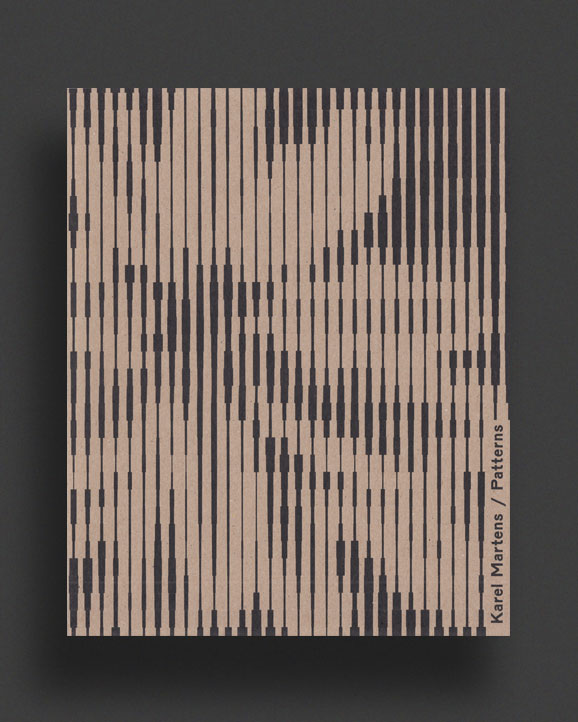
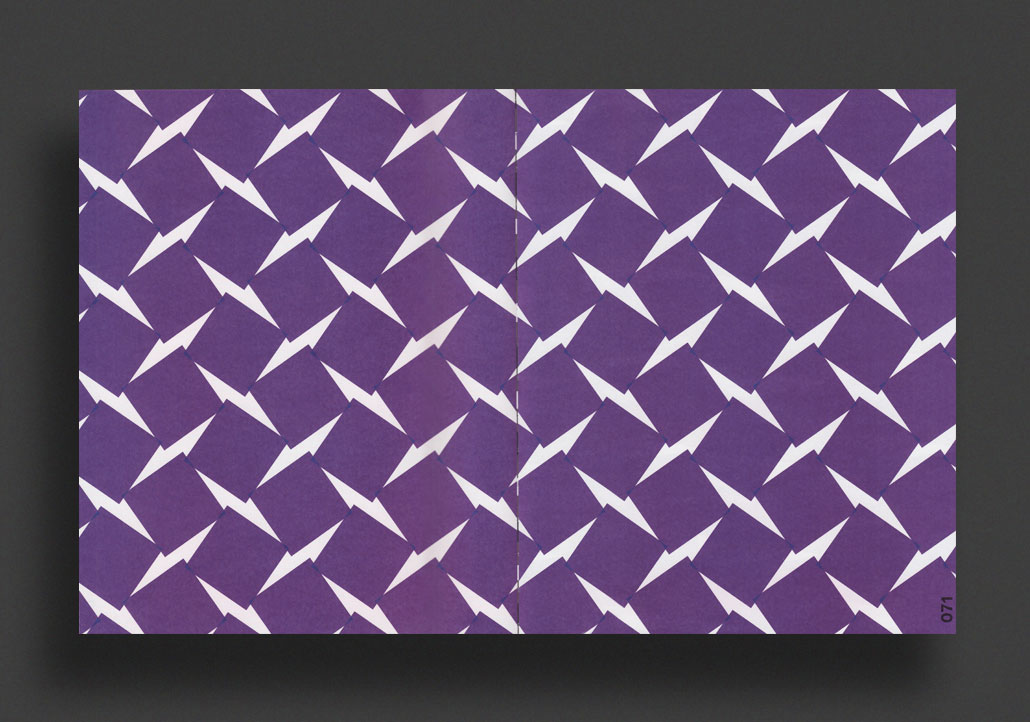
This publication contains a collection of patterns designed by Dutch graphic designer Karel Martens. Although Martens is widely recognised for his specialisation in typography, the dozens of full-page patterns shown here are devoid of any text, allowing the sequence to become a mesmerising pattern in itself. Designed by Martens & Martens.
2019, English
Softcover, 280 pages, 17 x 23 cm
Published by
Roma / Amsterdam
$80.00 - Out of stock
The work of Karel Martens occupies an intriguing place in the present European art-and-design landscape. Martens can be placed in the tradition of Dutch modernism, in the line of figures such as Piet Zwart, H.N. Werkman, Willem Sandberg. Yet he maintains some distance from the main developments of this time: from both the practices of routinized modernism and of the facile reactions against this. His work is both personal and experimental. At the same time, it is publicly answerable. Over the decades of his practice, Martens has been prolific as a designer of books. He has also made contributions in a wide range of design commissions: including stamps, coins, signs on buildings. Also a renowned teacher of graphic design, Karel Martens is co-initiator of the Werkplaats Typografie, a two-year master’s design programme related to ArtEZ, Arnhem, and guest professor at Yale University, New Haven. Intimately connected with this design work has been his practice as an artist. This started with geometric and kinetic constructions, and developed in work with the very material of paper. Over a long period he has been making monoprints. This book looks for new ways to show and discuss the work of a designer and artist, and is offered in the same spirit of experiment and dialogue that characterizes the work it presents. Its first edition was published in 1996 on the occasion of the award to Karel Martens of the Dr A.H. Heineken Prize for Art. In response to continued demand, the book has been extended to 2019 and appears now in this fourth edition presenting almost sixty years of practice.