World Food Books' programme is largely produced on Kulin Nation land. We acknowledge the Wurundjeri people of the Kulin Nation as the first and continuing custodians of this land, and pay respect to their Elders past, present, and emerging.
World Food Books is an arts and special interests bookshop in Naarm / Melbourne. Founded in 2010, World Food Books is devoted to the presentation of a rotating, hand-selection of international art, design, literary and counterculture publications with an emphasis on the anti-traditional, the experimental, the avant-garde, the heretic, the marginal.
Presenting new titles alongside rare and out-of-print books, catalogues and journals spanning the fields of modern and contemporary art, design, photography, illustration, film, literature, poetry, cultural theory, philosophy, sexuality, popular and underground culture in its many radical forms, World Food Books wishes to encourage adventurous, thoughtful and open-minded reading, looking, writing, and exchange of publishing and ideas, both current and historical.
As well as our bookshop, located in Melbourne's historical Nicholas Building, all of our inventory is available internationally via our online mail-order service.
World Food Books semi-regularly co-ordinates "Occasions", a programme of exhibits and events at the bookshop and in partnership with other hosts (such as museums and art galleries) that develop out of the activities, relationships and content of the bookshop itself.
World Food Books
The Nicholas Building
37 Swanston Street
Room 5, Level 6
Melbourne 3000
Australia
SHOP HOURS:
Thu–Fri 12–6, Sat 12–5
WEB-SHOP OPEN 24/7
World Food Books
Postal Address:
PO Box 435
Flinders Lane
Victoria 8009
Australia
Art
Theory / Essay
Architecture / Interior
Graphic Design / Typography
Photography
Fashion
Eros
LGBTQ+
Fiction / Poetry
Weird / Speculative / Science Fiction / Horror
Transgressive / Visceral / Abject
Symbolism / Decadence / Fin de siècle
Film / Video
Painting
Sculpture / Installation
Performance / Dance / Theater
Drawing
Sound / Music
Curatorial
Group Shows / Collections
Periodicals
Out-of-print / Rare
Posters / Ephemera / Discs
Signed Books
World Food Books Gift Voucher
World Food Book Bag
Australian Art
Australian Fiction
Australian Science Fiction / Speculative Fiction
Australian Poetry
Australian Photography
Japanese Photography
Conceptual Art
Minimal Art
Dada
'Pataphysics / Oulipo
Fluxus
Concrete Poetry
Pop Art
Surrealism
Arte Povera
Arte Informale / Haute Pâte / Tachism
Nouveau Réalisme / Zero / Kinetic
Situationism / Lettrism
Collage / Mail Art / Xerox Art
Art Brut / Folk / Visionary / Fantastic
Illustration / Graphic Art / Bandes Dessinées
Furniture
Italian Radical Design / Postmodernism
Textiles
Ceramics / Glass
Counterculture
Protest / Revolt
Philosophy
Psychoanalysis
Anthropology
Anarchism
Socialism / Anarchism / Communism / Capitalism
Literary Theory / Semiotics / Language
Feminism / Women's Studies
Gender Studies / Sexuality
Anthropology
Fetishism / BDSM
Drugs / Psychedelia
Crime / Violence
Animal Rights / Veganism
Occult / Esoterica
Ecology / Earth / Alternative Living
Whole Earth / Crafts
All prices in AUD (Australian dollars)
Pick-Ups
Pick-up orders can be collected in our bookshop during opening hours after order date. Please collect any Pick-up orders within 2 weeks of ordering as we have limited storage space. Orders will be released back into stock if not collected within this time. No refunds can be made for pick-ups left un-collected. If you cannot make it in to the bookshop in this time-frame, please choose postage option.
Return Policy
All sales are final. We do accept returns (for refund or exchange) for items received in error. All our orders are packed with special care using heavy-duty padding and cardboard book-mailers or bubble mailers (for smaller books), using reinforcement where required. We cannot take responsibility for any lost, stolen or damaged parcels.
Insurance
Should you wish to insure your package, please email us directly after placing your order and we can organise this at a small extra expense. Although all standard/express tracked packages are very safe and dependable, we cannot take responsibility for any lost, stolen or damaged parcels. We recommend insurance on valuable orders.
Interested in selling your old books, catalogues, journals, magazines, comics, fanzines, ephemera? We are always looking for interesting, unusual and out-of-print books to buy. We only buy books in our fields of interest and specialty, and that we feel we can resell.
We base these prices on desirability, market value, in-print prices, condition and our current stock levels. We offer cash, store credit, and can take stock on consignment. All
about 25% of the price we expect to get when we sell them, or 30% in store credit. We base these prices on desirability, market value, in-print prices, condition and our current stock levels.
Sell your books any day of the week. You can drop them off and return later. If you have a lot of books, we can visit your Sydney home.
We buy books that we feel we can resell. We offer about 25 % of the price we expect to get when we sell them, or 30% in store credit. We base these prices on desirability, market value, in-print prices, condition and our current stock levels.
Philadelphia Wireman
03 August - 01 September, 2018
World Food Books is proud to announce our next Occasion, the first presentation of sculptures by Philadelphia Wireman in Australia.
The Philadelphia Wireman sculptures were found abandoned in an alley off Philadelphia’s South Street on trash night in 1982. Their discovery in a rapidly-changing neighbourhood undergoing extensive renovation, compounded with the failure of all attempts to locate the artist, suggests that the works may have been discarded after the maker’s death. Dubbed the "Philadelphia Wireman" during the first exhibition of this work, in 1985, the maker’s name, age, ethnicity, and even gender remain uncertain. The entire collection totals approximately 1200 pieces, all intricately bound together with tightly-wound heavy-gauge wire (along with a few small, abstract marker drawings, reminiscent both of Mark Tobey and J.B. Murry). The dense construction of the work, despite a modest range of scale and materials, is singularly obsessive and disciplined in design: a wire armature or exoskeleton firmly binds a bricolage of found objects including plastic, glass, food packaging, umbrella parts, tape, rubber, batteries, pens, leather, reflectors, nuts and bolts, nails, foil, coins, toys, watches, eyeglasses, tools, and jewellery.
Heavy with associations—anthropomorphic, zoomorphic, and socio-cultural responses to wrapped detritus—the totemic sculptures by Philadelphia Wireman have been discussed in the context of work created to fulfil the shamanistic needs of alternative religions in American culture. Curators, collectors, and critics have variously compared certain pieces to sculpture from Classical antiquity, Native American medicine bundles, African-American memory jugs, and African fetish objects. Reflecting the artist’s prolific and incredibly focused scavenging impulse, and despite—or perhaps enhanced by—their anonymity, these enigmatic objects function as urban artefacts and arbiters of power, though their origin and purpose is unknown. Philadelphia Wireman, whatever their identity, possessed an astonishing ability to isolate and communicate the concepts of power and energy through the selection and transformation of ordinary materials. Over the course of the past two decades, this collection has come to be regarded as an important discovery in the field of self-taught art and vernacular art.
Presented in collaboration with Fleisher-Ollman Gallery, Philadelphia, and Robert Heald, Wellington.
Susan Te Kahurangi King
02 February - 10 March, 2018
Susan Te Kahurangi King (24 February 1951 - ) has been a confident and prolific artist since she was a young child, drawing with readily available materials - pencils, ballpoint pens and felt-tip markers, on whatever paper is at hand. Between the ages of four and six Susan slowly ceased verbal communication. Her grandparents William and Myrtle Murphy had developed a special bond with Susan so they took on caring responsibilities for extended periods. Myrtle began informally archiving her work, carefully collecting and storing the drawings and compiling scrapbooks. No drawing was insignificant; every scrap of paper was kept. The King family are now the custodians of a vast collection containing over 7000 individual works, from tiny scraps of paper through to 5 meter long rolls.
The scrapbooks and diaries reveal Myrtle to be a woman of great patience and compassion, seeking to understand a child who was not always behaving as expected. She encouraged Susan to be observant, to explore her environment and absorb all the sights and sounds. Myrtle would show Susan’s drawings to friends and people in her community that she had dealings with, such as shopkeepers and postal workers, but this was not simply a case of a grandmother’s bias. She recognised that Susan had developed a sophisticated and unique visual language and sincerely believed that her art deserved serious attention.
This was an unorthodox attitude for the time. To provide some context, Jean Dubuffet coined the term Art Brut in 1945 to describe work created by self-taught artists – specifically residents of psychiatric institutions and those he considered to be visionaries or eccentrics. In 1972 Roger Cardinal extended this concept by adopting the term Outsider Art to describe work made by non-academically trained artists operating outside of mainstream art networks through choice or circumstance. Susan was born in Te Aroha, New Zealand in 1951, far from the artistic hubs of Paris and London that Dubuffet and Cardinal operated in. That Myrtle fêted Susan as a self-taught artist who deserved to be taken seriously shows how progressive her attitudes were.
Susan’s parents Doug and Dawn were also progressive. Over the years they had consulted numerous health practitioners about Susan’s condition, as the medical establishment could not provide an explanation as to why she had lapsed into silence. Dawn educated herself in the field of homeopathy and went on to treat all twelve of her children using these principles – basing prescriptions on her observations of their physical, mental and emotional state.
Doug was a linguist with an interest in philosophy who devoted what little spare time he had to studying Maori language and culture. To some extent their willingness to explore the fringes of the mainstream made them outsiders too but it was their commitment to living with integrity and their respect for individuality that ensured Susan’s creativity was always encouraged.
Even though Susan’s family supported her artistic pursuits, some staff in schools and hospitals saw it as an impediment to her assimilation into the community and discouraged it in a variety of ways. Her family was not always aware of this and therefore did not fully understand why Susan stopped drawing in the early 1990s. However, rather than dwell on the challenges that Susan faced in pursuit of her artistic practice, they prefer to highlight her achievements. In 2008 Susan began drawing again in earnest, after an almost 20 year interruption, and her work is now shown in galleries around the world.
Susan grew up without television and has been heavily influenced by the comics she read as a child. She is absolutely fearless in the appropriation of recognizable characters, such as Donald Duck and Mickey Mouse, in her work. She twists their limbs, contorts their faces, compresses them together, blends them into complex patterned backgrounds - always imbuing them with an incredible energy. Although Susan often used pop culture characters in her work they are not naive or childlike. These are drawings by a brilliant self-taught artist who has been creating exceptional work for decades without an audience in mind.
Mladen Stilinović
"Various Works 1986 - 1999"
02 February 16 - September 10, 2016
Various works 1986 - 1999, from two houses, from the collections of John Nixon, Sue Cramer, Kerrie Poliness, Peter Haffenden and Phoebe Haffenden.
Including: Geometry of Cakes (various shelves), 1993; Poor People’s Law (black and white plate), 1993; White Absence (glasses, ruler, set square, silver spoon, silver ladel with skin photograph and wooden cubes), 1990-1996; Exploitation of the Dead (grey and red star painting, wooden painting, black spoon with red table, red plate), 1984-1990; Money and Zeros (zero tie, paintings made for friends in Australia (Sue, John, Kerrie), numbers painting), 1991-1992; Words - Slogans (various t-shirts) - “they talk about the death of art...help! someone is trying to kill me”, “my sweet little lamb”, “work is a disease - Karl Marx”; Various artist books, catalogues, monographs, videos; Poster from exhibition Insulting Anarchy; "Circular" Croatian - Australian edition; Artist book by Vlado Martek (Dostoyevsky); more.
Thanks to Mladen Stilinović and Branka Stipančić.
Jonathan Walker
Always Will Need To Wear Winter Shirt Blue + Ochre Small Check Pattern
21 August - 21 September, 2015
Untitled
I am not a great reader of poetry but I always return to the work of Melbourne poet, Vincent Buckley (1925- 1988). Perhaps I find his most tantalising piece to be not a finished poem but a fragment left on a scrap of paper discovered on his desk after the poet’s death.
The poetry gathers like oil
In the word-core, and spreads
It has its music meet,
Its music is in movement.
This fragment is more the shell left behind from a volatile thought than a finished poem. I find the last two lines honest but awkward whereas the first two lines work like an arrow. Most likely he could not find a resolution so it was left. Still, in its present form, it remains an eloquent testimony to the ultimate failure of a medium to express mobile thought and sensation, in Buckley’s case, through verbal language. It’s an important matter because this is something all artists have to deal with regardless of the medium.
I have never written a poem, however, I am forever copying fragments from books on paper scraps in a vain effort to fix certain notions in my head. At first, they function as bookmarks that are sometimes returned to when I open the book. But before long, as they accumulate, they fall out littering the table interspersed with A4 photocopies, bills, books and medications.
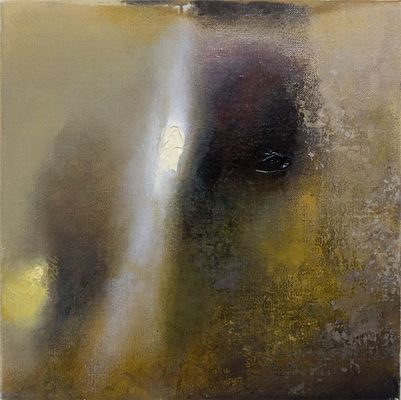
To return to Buckley’s fragment, the first two lines very much evoke how I paint nowadays. As you age, detail diminishes and patches of light become more luminous and float. I feel the most honest way of dealing with this is by smearing the oil paint on the canvas with the fingers and working close-up, blind. Only if the patches coalesce into an approaching image can the work gain a life.
-
Jonathan Walker was born in Melbourne, Australia and brought up on a dairy farm in Gippsland. In the 1970’s he studied painting at RMIT and won the Harold Wright Scholarship to the British Museum, London. During the 1980’s he exhibited at Pinacotheca Gallery, Richmond and had work shown at the NGV and Heidi City Art Gallery. Over the same period he designed the cover for the “Epigenesi” LP by Giancarlo Toniutti, Italy and conducted a mail exchange work with Achim Wollscheid, Germany. The work with artists through the post resulted in an article published in the bicentenary issue of Art and Australia 1988. He showed in artist run spaces such as WestSpace in the 90’s and 2000’s, and until 2012, taught painting at Victoria University, which is where we (Colleen Ahern and Lisa Radford) as organisers of the exhibition, among many others, had the privilege of being his student.
Walker’s knowledge was imparted to students through the careful selection of music, literature, and artists found in books that he himself had ordered for the library. Walker’s strategy was the generosity of sharing his vast knowledge with references specific to each student and their context.
Walker’s paintings share a similar focus and intimacy.
This exhibition presents a small selection of recent paintings alongside a publication that includes Walker’s writing. Observational and analytical, Walker’s work is a type of material notation — the time of day, colour and how it is blended, the both specific and fleeting location of a reflection on lino or the question of whether a chair leg should be included in a painting.
Please join us on Friday August 21 between 6-8pm to celebrate the opening of the exhibition.
Curated by Colleen Ahern and Lisa Radford.
B. Wurtz
Curated by Nic Tammens
March 26 - April 4, 2015
B.Wurtz works from a basement studio in his home on Manhattan’s Lower East Side.
This local fact is attested to by the plastic shopping bags and newsprint circulars that appear in his work. As formal objects, they don’t make loud claims about their origins but nonetheless transmit street addresses and places of business from the bottom of this long thin island. Like plenty of artists, Wurtz is affected by what is local and what is consumed. His work is underpinned by this ethic. It often speaks from a neighborhood or reads like the contents of a hamper:
“BLACK PLUMS $1.29 lb.”
“Food Bazaar”
“USDA Whole Pork Shoulder Picnic 99c lb.”
“RITE AID Pharmacy, with us it’s personal.”
“H. Brickman & Sons.”
“Sweet Yams 59c lb."
Most of the work in this exhibition was made while the artist was in residence at Dieu Donne, a workshop dedicated to paper craft in Midtown. Here Wurtz fabricated assemblages with paper and objects that are relatively lightweight, with the intention that they would be easily transportable to Australia. This consideration isn’t absolute in Wurtz’s work, but was prescriptive for making the current exhibition light and cheap. Packed in two boxes, these works were sent from a USPS post office on the Lower East Side and delivered to North Melbourne by Australia Post.
Wurtz appears courtesy of Metro Pictures, New York.
Thanks to Rob Halverson, Joshua Petherick, Sari de Mallory, Matt Hinkley, Helen Johnson, Fayen d'Evie, Ask Kilmartin, Lisa Radon, Ellena Savage, Yale Union, and "Elizabeth".
John Nixon
"Archive"
December 15 - January 20, 2014
The presentation of John Nixon's archive offered a rare showcase of this extensive collection of the artist's own publications, catalogues, posters, ephemera, editions and more, from the mid 1980s onwards, alongside a selection of his artworks.
Organized by John Nixon, Joshua Petherick and Matt Hinkley.
<a href=http://wfb.public-office.info/artist/john-nixon>All titles by John Nixon
"Habitat"
at Minerva, Sydney (organised by Joshua Petherick and Matt Hinkley)
November 15 - December 20, 2014
Lupo Borgonovo, Janet Burchill & Jennifer McCamley,
Lewis Fidock, HR Giger, Piero Gilardi, Veit Laurent Kurz,
Cinzia Ruggeri, Michael E. Smith, Lucie Stahl, Daniel Weil, Wols
Press Release:
“...It contained seven objects. The slender fluted bone, surely formed for flight, surely from the wing of some large bird. Three archaic circuitboards, faced with mazes of gold. A smooth white sphere of baked clay. An age-blackened fragment of lace. A fingerlength segment of what she assumed was bone from a human wrist, grayish white, inset smoothly with the silicon shaft of a small instrument that must once have ridden flush with the surface of the skin - but the thing’s face was seared and blackened.”
William Gibson, “Count Zero”, 1986
"Autumn Projects Archive"
Curated by Liza Vasiliou
March 6 - March 15, 2014
World Food Books, in conjunction with the Virgin Australia Melbourne Fashion Festival 2014, presented the Autumn Projects archive, consisting of a selection of early examples in Australian fashion with a particular interest in collecting designers and labels from the period beginning in the 1980’s, who significantly influenced the discourse of Australian Fashion.
Curated by Liza Vasiliou, the exhibition provided a unique opportunity to view pieces by designers Anthea Crawford, Barbara Vandenberg, Geoff Liddell and labels CR Australia, Covers, Jag along with early experimental collage pieces by Prue Acton and Sally Browne’s ‘Fragments’ collection, suspended throughout the functioning World Food Books shop in Melbourne.
H.B. Peace
presented by CENTRE FOR STYLE
November 14, 2013
"Hey Blinky, you say chic, I say same"
Anon 2013
H.B. Peace is a clothing collaboration between great friends Blake Barns and Hugh Egan Westland. Their pieces explore the divergences between 'character’ and ‘personality’ in garments....etc
Special Thanks to Joshua Petherick and Matt Hinkley of WFB and Gillian Mears
and a Very Special Thank you to Audrey Thomas Hayes for her shoe collaboration.
Janet Burchill & Jennifer McCamley
"Aesthetic Suicide"
May 10 - June 8, 2013
The first of our occasional exhibitions in the World Food Books office/shop space in Melbourne, "Aesthetic Suicide" presented a body of new and older works together by artists Janet Burchill & Jennifer McCamley, including videos, prints, a wall work, and publications.
During shop open hours videos played every hour, on the hour.
2021, English
Softcover, 128 pages, 13.8 x 20.3 cm
Published by
Semiotext(e) / Los Angeles
$32.00 - Out of stock
A love letter to Paris and a meditation on how it has changed in two decades, evolving from the twentieth century into the twenty-first, from analog to digital.
Your telephone is precious. It may be envied. We recommend vigilance when using it in public.
— Paris bus public notice
In fall 2014 Lauren Elkin began keeping a diary of her bus commutes in the Notes app on her iPhone 5c, writing down the interesting things and people she saw in a Perecquian homage to Bus Lines 91 and 92, which she took from her apartment in the 5th Arrondissement to her teaching job in the 7th.
Reading the notice, she decided to be vigilant when using her phone: she would carry out a public transport vigil, using it to take in the world around her and notice all the things she would miss if she continued using it the way she had been, the way everyone does--to surf the web, check social media, maintain her daily sense of self through digital interaction. Her goal became to observe the world through the screen of her phone, rather than using her phone to distract from the world.
During the course of that academic year, the Charlie Hebdo attacks occurred and Elkin had an ectopic pregnancy, requiring emergency surgery. At that point, her diary of dailiness became a study of the counterpoint between the everyday and the Event, mediated through early twenty-first century technology, and observed from the height of a bus seat. No. 91/92 is a love letter to Paris, and a meditation on how it has changed in the two decades the author has lived there, evolving from the twentieth century into the twenty-first, from analog to digital.
2021, English
Softcover, 256 pages, 15.2 x 22.9 cm
Published by
Semiotext(e) / Los Angeles
$37.00 - Out of stock
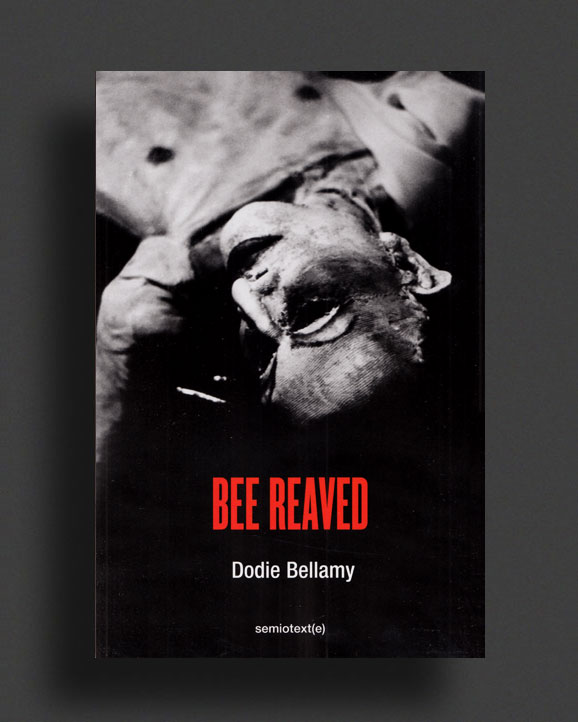
A new collection of essays from Dodie Bellamy on disenfranchisement, vulgarity, American working class life, aesthetic values, and profound embarrassment.
So. Much. Information. When does one expand? Cut back? Stop researching? When is enough enough? Like Colette's aging courtesan Lea in the Chéri books, I straddle two centuries that are drifting further and further apart.—Dodie Bellamy, “Hoarding as Ecriture”
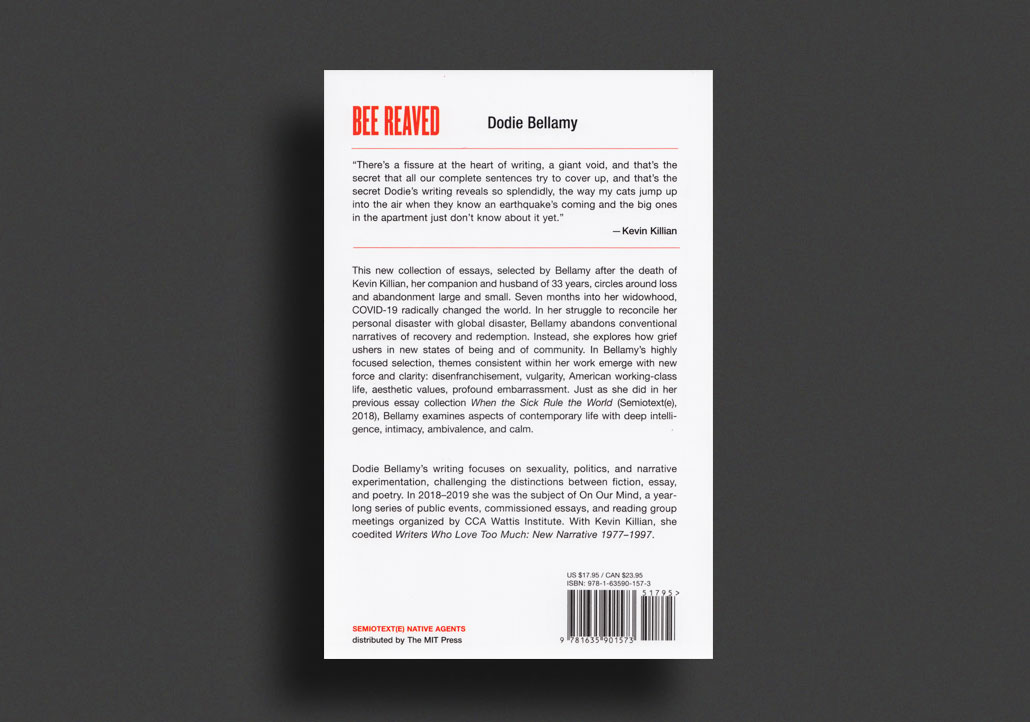
This new collection of essays, selected by Dodie Bellamy after the death of Kevin Killian, her companion and husband of thirty-three years, circles around loss and abandonment large and small. Bellamy's highly focused selection comprises pieces written over three decades, in which the themes consistent within her work emerge with new force and clarity: disenfranchisement, vulgarity, American working class life, aesthetic values, profound embarrassment. Bellamy writes with shocking, and often hilarious, candor about the experience of turning her literary archive over to the Beinecke Rare Book & Manuscript Library at Yale and about being targeted by an enraged online anti-capitalist stalker. Just as she did in her previous essay collection, When the Sick Rule the World, Bellamy examines aspects of contemporary life with deep intelligence, intimacy, ambivalence, and calm.
Dodie Bellamy's writing focuses on sexuality, politics and narrative experimentation, challenging the distinctions between fiction, the essay and poetry. In 2018–19 she was the subject of On Our Mind, a yearlong series of public events, commissioned essays and reading group meetings organized by CCA Wattis ICA. With Kevin Killian, she coedited Writers Who Love Too Much: New Narrative 1977–1997. A compendium of essays on Bellamy's work, Dodie Bellamy Is on Our Mind, was published in 2020 by Wattis ICA/Semiotext(e).
2021, English
Softcover, 240 pages, 15.2 x 22.9 cm
Published by
Semiotext(e) / Los Angeles
$34.00 - Out of stock
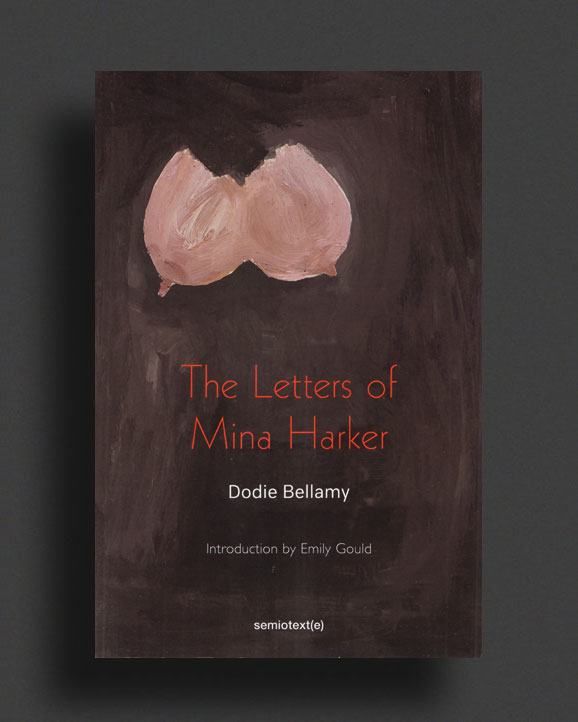
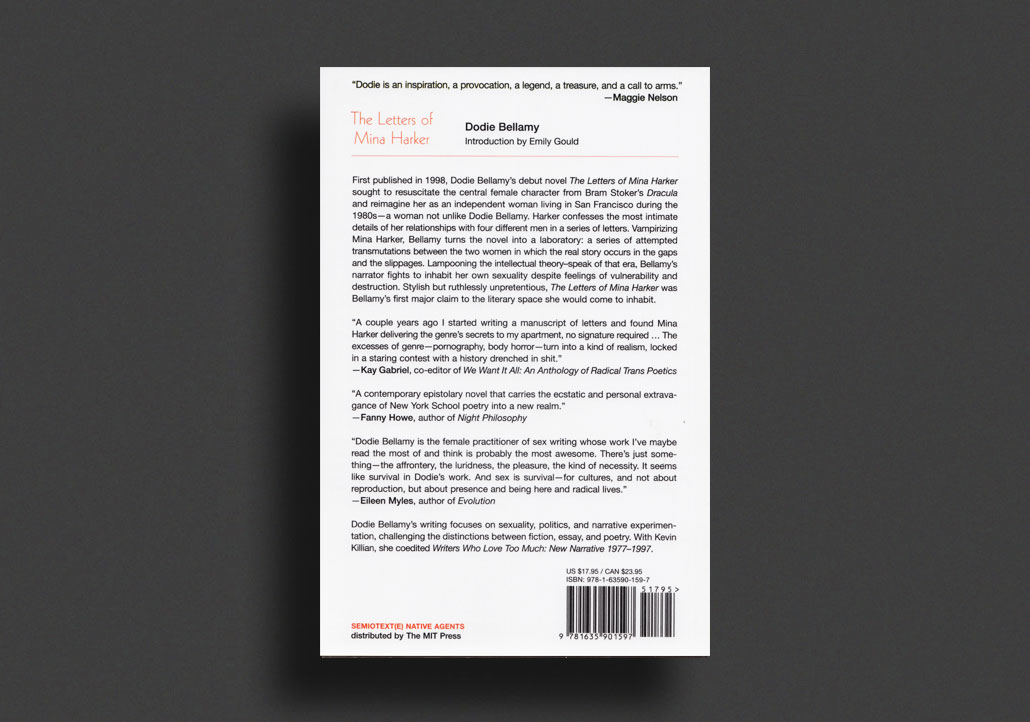
Bellamy's debut novel revives the central female character from Bram Stoker's Dracula and imagines her as an independent woman living in San Francisco during the 1980s.
"A luscious deeply fucked up extravagant work." — Eileen Myles
Hypocrisy's not the problem, I think, it's allegory the breeding ground of paranoia. The act of reading into--how does one know when to stop? KK says that Dodie has the advantage because she's physical and I'm only psychic. ... The truth is: everyone is adopted. My true mother wore a turtleneck and a long braid down her back, drove a Karmann Ghia, drank Chianti in dark corners, fucked Gregroy Corso ... — Dodie Bellamy, The Letters of Mina Harker
First published in 1998, Dodie Bellamy's debut novel The Letters of Mina Harker sought to resuscitate the central female character from Bram Stoker's Dracula and reimagine her as an independent woman living in San Francisco during the 1980s--a woman not unlike Dodie Bellamy. Harker confesses the most intimate details of her relationships with four different men in a series of letters. Vampirizing Mina Harker, Bellamy turns the novel into a laboratory: a series of attempted transmutations between the two women in which the real story occurs in the gaps and the slippages. Lampooning the intellectual theory-speak of that era, Bellamy's narrator fights to inhabit her own sexuality despite feelings of vulnerability and destruction. Stylish but ruthlessly unpretentious, The Letters of Mina Harker was Bellamy's first major claim to the literary space she would come to inhabit.
"I am … in awe of Dodie Bellamy's talent … grateful for the profound ways in which this novel has caused me to consider what the novel form is and can be when subjected to the most brilliant and original talent imaginable. The Letters of Mina Harker has continually unfolded in my imagination and increased my astonishment … its power and beauty have remained utterly mysterious." — Dennis Cooper
Introduction by Emily Gould
Dodie Bellamy's writing focuses on sexuality, politics and narrative experimentation, challenging the distinctions between fiction, the essay and poetry. In 2018–19 she was the subject of On Our Mind, a yearlong series of public events, commissioned essays and reading group meetings organized by CCA Wattis ICA. With Kevin Killian, she coedited Writers Who Love Too Much: New Narrative 1977–1997. A compendium of essays on Bellamy's work, Dodie Bellamy Is on Our Mind, was published in 2020 by Wattis ICA/Semiotext(e).
2019, English
Softcover, 106 pages, 10.8 x 17.8 cm
Published by
Queer Mojo / US
$29.00 - Out of stock
…as someone who’s reading Hey Boy right now, I can squarely and enthusiastically recommend it to all of you. So use your local time today to celebrate and read/look and ideally buy Armando’s aka A.W.W.’s novel and festively note the start of a no doubt stellar oeuvre to come. ~Dennis Cooper
BEWARE HE WHO IS THE PROTAGONIST OF THIS TALE OF THE FACT OF FICTION AND THE FICTION OF FACT AND WHOM WILL BE KNOWN AND PERHAPS OR PERHAPS NOT REMEMBERED AS A AND FOLLOWED THROUGH HIS AND EVERYONE ELSE’S EMPTY EXPERIENCES IN THIS PLACE MOST CALL THE WORLD AND IN WHICH SUCH EMPTY EXPERIENCES WILL INCLUDE IMPOSED EXISTENCE AND ALSO OF COURSE YOUTH AND BEAUTY AND SEX AND MONEY AND SUBSTANCES AND POP MUSIC AND DESTRUCTION AND SELF DESTRUCTION AND OBSESSION AND ANNIHILATION AND EXPENSIVE CLOTHES AND JEWELRY AND MC MANSIONS AND POWER AND POWERLESSNESS AND RAPE AND BLOOD AND PISS AD SHIT AND CUM AND GLORIOUS DEATH AND NECROPHILIA AND CANNIBALISM AND TORTURE AND SADISM AND MASOCHISM AND SELF IMPORTANT WANNABE ARTISTS AND OTHER SUCH DIVERSIONS DEVISED TO TRY TO MASK THE MEANINGLESSNESS ALL BATTLING TO BE EITHER TRUE OR LESS TRUE.
Beyond bestowing a sense of possession or speaking in tongues to the narration, what Bremont’s repeated relentlessness succeeds in achieving, however, is making the scenes of absolute horror blur together with the moments of the mundane, conflating the two. By interspersing sexual violence and pure violence with the dull blankness of running a bath or reading, Bremont reveals the sheer mundanity of horror… ~Filthy Dreams
Imagine the Iliad written via high postmodernism, though, structurally. If William S. Burroughs had taken a crack at The Metamorphosis instead of Ovid. Transgressive in all the best ways. For a small book, this makes a helluvan impact. I can’t wait to see more from Bremont in the future. ~J. Warren, author of Unbalanced Mercy
Hey Boy is a fever dream of a novel of a sentence. Loopy, depraved, literate in its illiteracies, fiercely cruel and facile, wonderfully unhinged. Reads like Andrew Cunanan’s lobotomized nightmares filtered through Delany’s Hogg. ~Gary J. Shipley, author of Dreams of Amputation
2021, English
Hardcover (w. dust jacket), 144 pages, 13.3 x 21 cm
Published by
Soho Press / New York
$42.00 - Out of stock
“I started writing books about and for my friend George Miles because whenever I would speak about him honestly like I am doing now I felt a complicated agony beneath my words that talking openly can’t handle.”
For most of his life, Dennis Cooper believed the person he had loved the most and would always love above all others was George Miles. In his first novel in ten years, Dennis Cooper writes about George Miles, love, loss, addiction, suicide, and how fiction can capture these things, and how it fails to capture them. Candid and powerful, I Wished is a radical work of shifting forms. It includes appearances by Santa Claus, land artist James Turrell, sentient prairie dogs, John Wayne Gacy, Nick Drake, and George, the muse for Cooper’s acclaimed novels Closer, Frisk, Try, Guide, and Period, collectively known as “The George Miles Cycle.” In revisiting the inspiration for the Cycle, Dennis has written a masterwork: the most raw, personal, and haunted book of his career.
Dennis Cooper (born 1953) is an American novelist, poet, critic, editor and performance artist who grew up in the Southern California. In 1976, he founded Little Caesar Magazine and Press, which he ran until 1982. In 1985, he moved to Amsterdam for two and a half years, where he began his ten year long project, The George Miles Cycle, an interconnected sequence of five novels that includes Closer, Frisk, Try, Guide, and Period. His post-George Miles Cycle novels include My Loose Thread, The Sluts and God, Jr. Other works include the short-story collections Wrong and Ugly Man, poetry collections The Dream Police and The Weaklings, as well as the recent Smothered in Hugs: Essays, Interviews, Feedback, and Obituaries. Dennis Cooper currently spends his time between Los Angeles and Paris.
2021, English
Softcover, 240 pages, 11.4 x 17.8 cm
Published by
Semiotext(e) / Los Angeles
$29.00 - Out of stock
How and when American-style slavery created the racial system, not just in the United States but internationally.
We see the hatred we elicit, Islamophobia, Negrophobia; we see police numbers increase, repression spread, mechanisms of control and surveillance strengthened, structures of corruption and cronyism flourish, and bodies of institutionalization, integration, and supervision develop, but we do not see the cause, or one of the causes, which is none other than the threat that we now pose to the white order.
— from The Colonial Counter-Revolution
Just as Capital produced classes and patriarchy produced genders, colonialism produced race. In The Colonial Counter-Revolution, Sadri Khiari outlines how and when American-style slavery created the racial system, not just in the United States but internationally, and why the development of relationships of equality within the white community favored the crystallization of specifically racial social relations. More than just a response to the dialogue, debate, and trauma of immigration today, this book looks beyond the right/left dichotomy of the issue in politics to the more fundamental political existence of immigrants and Blacks, who must exist politically if they are to exist whatsoever. Race is not biological: race is political. And it is the manifestation of the colonial counter-revolution. In France, that counter-revolution started with General de Gaulle, and continues today, where the anti-colonialist fight of Palestinian Arabs and the anti-racist fight of Arabs and blacks in France have the same adversary: white Western domination.
2011, English
Softcover (clear foil), 160 pages, 148 x 210mm
Edition of 5000,
Published by
Surpllus / Melbourne
$25.00 $5.00 - Out of stock
On 30 August 1999, East Timorese voted overwhelmingly to become an independent nation in a ballot sponsored by the UN. Following the announcement of the result, occupying Indonesian troops carried out systematic destruction throughout East Timor. Within two weeks, several thousand civilians were murdered (a precise number is unknown), 200,000 were forcibly transported to concentration camps in West Timor and other parts of Indonesia, and most significant infrastructure was destroyed.
Books were targeted for destruction. Libraries were systematically burned, amongst them the widely-used university library and the English library in Dili. Private collections of books were targeted, and in notable cases book collections of prominent intellectuals and independence activists were collected on the street, where they were publicly set alight. In villages, schools were systematically destroyed. Action for another library was established in Melbourne in response to these circumstances. Thousands of books were donated by bookstores, libraries, and individuals. They were shipped to Dili in containers, where they now form part of the nascent National University Library of East Timor. The title pages of some books were photographed before the books were sent to East Timor.
The artist’s book After action for another library, with text in English and German, was first produced to coincide with the exhibition of the same name at the Humboldt University, Berlin, 28 August – 3 October 2003. Subsequent editions have been produced for exhibitions in which they are presented as stacks of multiples. The second edition, in English and Italian, was produced for System Error: War is a force that gives us meaning, at Palazzo delle Papesse in Siena in 2007. The third edition (and first Surpllus edition), in English only, was published on the occasion of Art of War, at CEPA Gallery in Buffalo, New York, in 2010. The fourth edition, available here, with text in English, Portugese, Timorese and Japanese, was published on the occasion of To the Arts, Citizens!, at Museu de Serralves, Porto, Portugal, 20 November 2010 – 13 March 2011
Sample copy.
2017, English / French
Softcover, 456 pages, 15 x 21.5 cm
Published by
Sternberg Press / Berlin
$85.00 $10.00 - Out of stock
This book offers a first report on the activities of the Cercle d’art des travailleurs de plantation congolaise (CATPC), an association based in Lusanga, in the Democratic Republic of Congo. CATPC brings together a unique gathering of individuals—along with its members and partner institutions that are engaged in dialogue with it—and attempts to rethink postcolonial power relations within the global art world. Initiated in 2014 by Renzo Martens, an Amsterdam-based artist whose radical and controversial practice feeds into many current debates, and René Ngongo, a Kinshasa-based biologist and environmental activist, this cooperative continues to develop independently and to redefine the relations between art, agriculture, industry, and value creation.
The publication CATPC—Cercle d’art des travailleurs de plantation congolaise/Congolese Plantation Workers Art League is part of an artistic research project initiated by Renzo Martens, affiliated as a researcher at KASK/School of Arts of University College Ghent, from 2012 to 2016.
Edited by Eva Barois De Caevel and Els Roelandt. Texts by Ariella Azoulay, Eva Barois De Caevel, Eléonore Hellio, Ruba Katrib, Alexander Koch, J. A. Koster, Renzo Martens, René Ngongo, Els Roelandt, Charles Sikitele Gize, Charles Tumba, Françoise Vergès
Photos by Léonard Pongo
Design by Jurgen Maelfeyt, Jonas Temmerman, 6'56''
2016, English
Softcover, 224 pages, 16 x 23 cm
Published by
Spector Books / Leipzig
$69.00 $15.00 - Out of stock
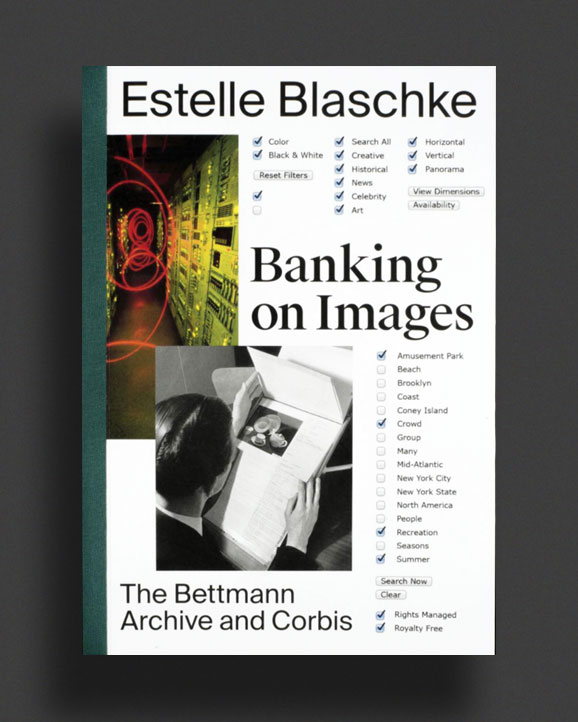
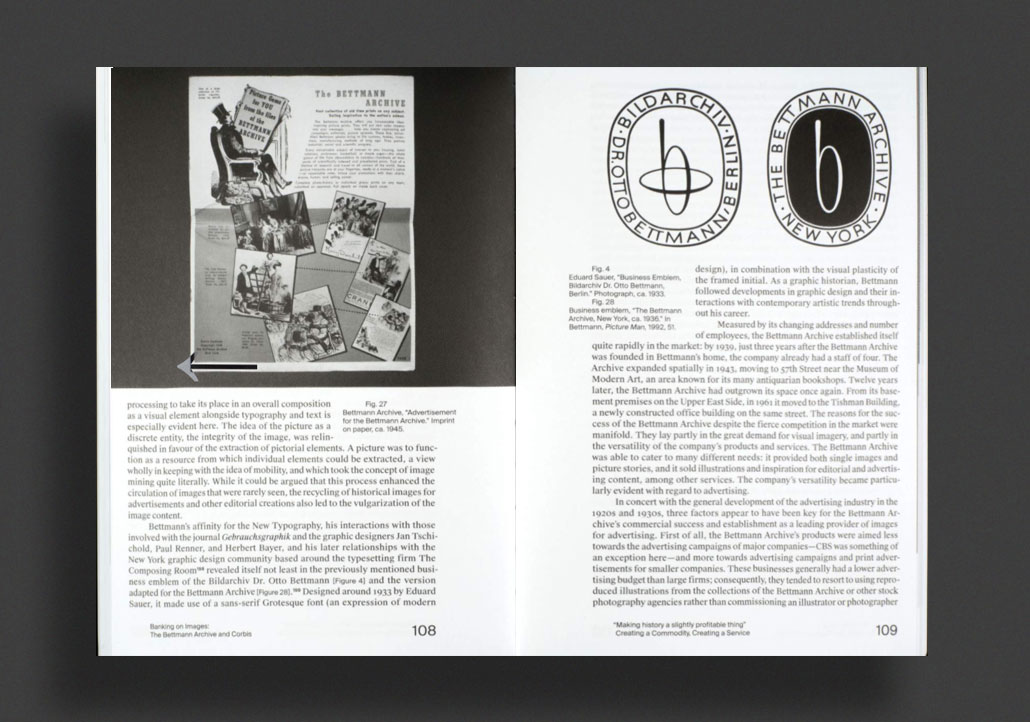
The role of photo agencies remains a blind spot in the history of photography. Emerging in the beginning of the 20th century to “satisfy the picture-hunger of modern man” (Tschichold), they transformed photography into a commodity. As catalysts for the picture market and through the creation of systematic collections, these companies shaped our western visual culture. The 1920s, 1930s and 1990s, in particular, ushered a paradigm shift in the economy of the medium, marked by major technological developments and the rise of new markets. Taking the example of the Bettmann Archive and Corbis – one of the world’s largest photo agencies, founded by Bill Gates – the book Banking on Images inquires into the criteria used in selecting these images, the way in which the value of a commercial “image bank” is determined, and the concept of photography that lies behind it.
2016, English
Softcover, 148 pages, 15.24 x 20.23 cm
Published by
Kadist Art Foundation / San Francisco
Museum of Contemporary Art Detroit / Detroit
Sternberg Press / Berlin
$65.00 $5.00 - Out of stock
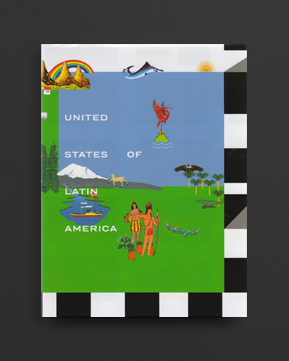
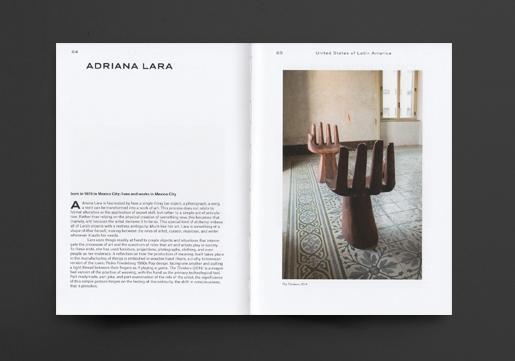
This publication documents the exhibition “United States of Latin America,” held at the Museum of Contemporary Art Detroit (MOCAD), in collaboration with the Kadist Art Foundation. Bringing together their shared and ongoing engagement with artistic practices from Latin America, Jens Hoffmann and Pablo León de la Barra have assembled one of the most significant contemporary survey’s of recent art from the region.
Hoffmann and de la Barra’s project draws attention not only to the geographic territories of Latin America itself, but also to its relation within the wider scope of the Americas, and its position in a global artistic context. This book offers a framework for critical insight into artworks dealing with crucial social, industrial, or ecological concerns, and also for interrogating the very categories and terminologies used to construct the notion of Latin America.
Edited by Jens Hoffmann. Contributions by Stefan Benchoam, Fernanda Brenner, Eduardo Carrera, Jens Hoffmann, Pablo Léon de la Barra, Camila Marambio, Heidi Rabben, Marina Reyes Franco
This catalogue includes a conversation between Stefan Benchoam, Fernanda Brenner, Eduardo Carrera, Camila Marambio, and Marina Reyes Franco (moderated by Heidi Rabben), a glossary, a reflective essay by Hoffmann “after the fact,” and images from the exhibition.
Copublished between Sternberg Press, Museum of Contemporary Art Detroit and Kadist Art Foundation
Design by Jon Sueda/Stripe SF
2010, English
Softcover (staple-bound), 20 pages
1st Edition, Out of print title / used / very good
Published by
David Findlay Jr. Fine Art / New York
$35.00 $15.00 - In stock -
Out-of-print exhibition catalogue published on the occasion of Geometry and Gesture, an exhibition of abstract expressionist painters at David Findlay Jr. Fine Art, New York, April 8 through 29, 2010. Illustrated throughout, the catalogue reproduces in colour the works of the exhibiting artists: Alcopley, Charles Cajori, Herman Cherry, Howard Daum, Hans Hofmann, Richard Hunt, Emily Mason, George Mcneil, Robert Richenburg, Nína Tryggvadóttir.
Very Good copy.
2016, English
Softcover, (w. dust jacket), 430 pages, 16 x 23 cm
Published by
Sternberg Press / Berlin
$85.00 $20.00 - Out of stock
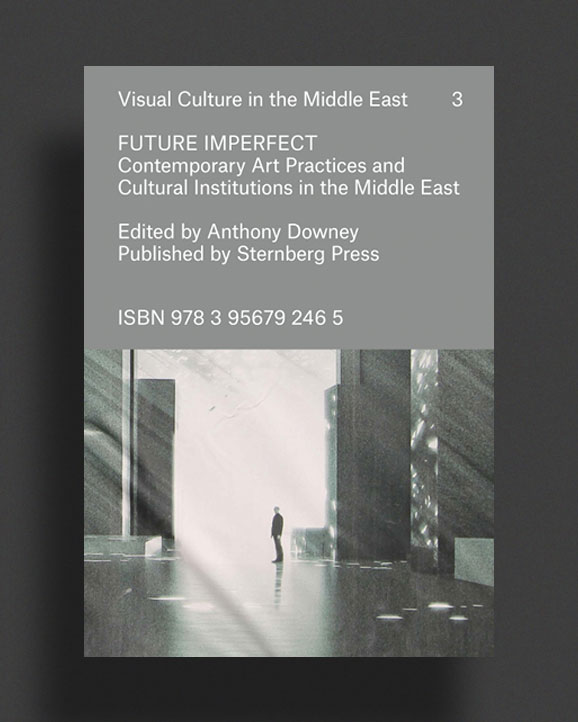
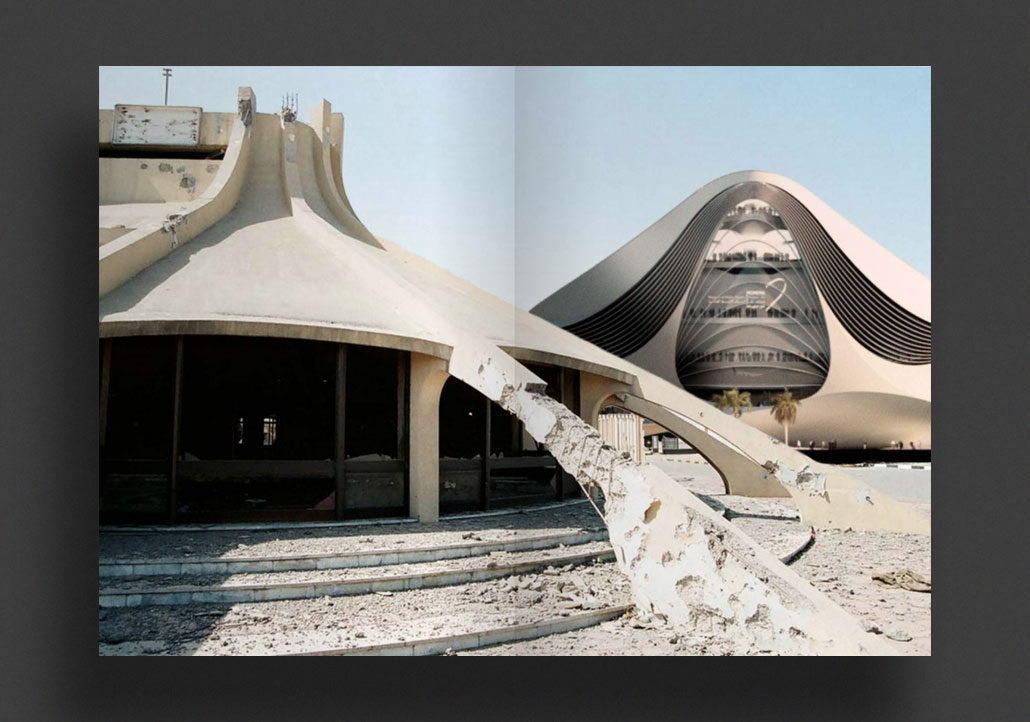
Future Imperfect critically examines the role played by cultural institutions in producing present-day and future contexts for the production, dissemination, and reception of contemporary art in the Middle East and North Africa. It offers historical contexts for discussions that have become increasingly urgent in recent years—the role of culture in a time of conflict and globalization—and an in-depth critique of the state of cultural institutions in an age of political upheaval, social unrest, exuberant cultural activity, ascendant neoliberal forms of privatization, social activism, and regional uncertainty. Based on collective input from numerous contributors and interlocutors, this volume brings together internationally renowned academics, critics, activists, filmmakers, artists, and other independent cultural practitioners to consider how new infrastructures and institutions can effectively emerge within such fraught and dynamic contexts. What is needed in terms of infrastructure for cultural production today, and how, crucially, can we speculatively propose new infrastructures and institutions in the context of present realities?
Contributions by Leila Al-Shami, Monira Al Qadiri, Hoor Al-Qasimi, Anahi Alviso-Marino, AMBS Architects, Stephanie Bailey, Eray Çaylı, Rachel Dedman, Elizabeth Derderian, Anthony Downey, Karen Exell, Reema Salha Fadda, Wafa Gabsi, Hadia Gana, Adalet R. Garmiany, Baha Jubeh, Suhair Jubeh, Amal Khalaf, Kamel Lazaar, Jens Maier-Rothe, Guy Mannes-Abbott, Doreen Mende, Lea Morin, Jack Persekian, Wided Rihana Khadraoui, Rijin Sahakian, Gregory Sholette, Tom Snow, Lois Stonock, Nile Sunset Annex, Ania Szremski, Christine Tohme, Toleen Touq, Williams Wells, Ala Younis, Yasmine Zidane
Visual Culture in the Middle East Vol. 3
Supported by the Kamel Lazaar Foundation
Design by Zak Group
2014, English
Hardcover, 528 pages (350 color and b/w ills.), 17 x 24.5 cm
1st Edition, Out of print title / as new
Published by
Sternberg Press / Berlin
$89.00 $40.00 - Out of stock
Out-of-print, now collectible.
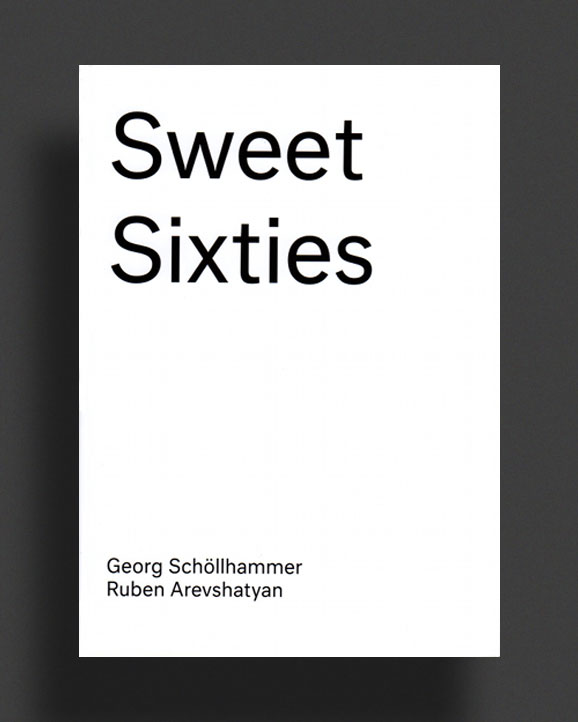
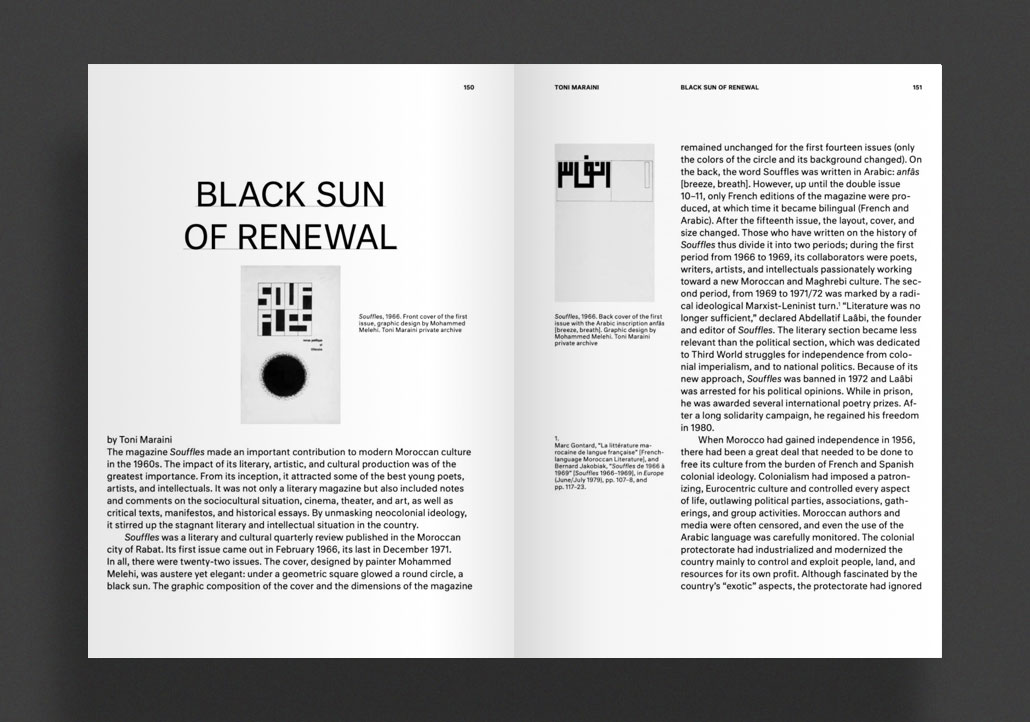
Sweet Sixties Specters and Spirits of a Parallel Avant-Garde Sweet Sixties is a long-term trans-regional research initiative working between art, research, media, and educational contexts in Europe, the Middle East, western and central Asia, Latin America, and northern Africa. Involving a particular group of experimentally oriented arts and research groups as well as individual artists, researchers, and media, Sweet Sixties investigates hidden histories or underexposed cultural junctions and exchange channels in the revolutionary period of the 1960s.
In the 1960s, the landscapes and cities of protectorates and former colonies from India to the Maghreb, from the Soviet Republics to the new states in the southern hemisphere were replete with the spirit and forms of modernity, forms that transmogrify and then dissolve into the thin air of the vernacular. The star maps that are used to survey these artificial worlds often serve to navigate the boundaries between private and public domains. The world full of eerie displacements, gestures of the uncanny, and the constellation of the real exists in a plethora of doubled forms. Question marks and meanderings are all part of this picture. Instruments of communication emerge and are locked away before they have a chance to become immaterial, disappear, and corrode in postmodernity.
The air of the 1960s echoes a spirit of emancipation. And the newly arising art-scapes are interspersed with double agents: diasporas bring their academies; the streams between Soviet, North and South American, Western European, Non-Aligned, etc., are full of interlocutions, hidden pathways, and narratives of trade routes beyond the seemingly stable hegemonies of the blocs.
The stories and spirits of a parallel avant-garde, whose silhouettes have yet to be found on the walls of the Western canon, are the theme of this publication.
As New with some general shelf wear.
2016, English
Hardcover, 105 pages, 22 x 24 cm
Ed. of 1000,
Published by
Karma / New York
$88.00 $50.00 - Out of stock
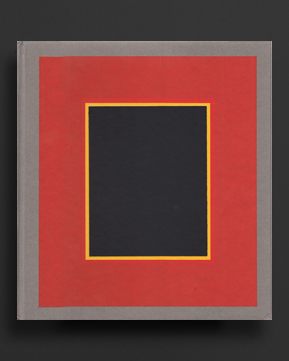
'Thirty-Four Reverse Telescopes and Three Buttons' catalogues the artist’s recent body of coloured Plexiglas works, made between 2013 and 2016, introduced obliquely with a poem by Ben Estes. Painter Matt Connors (born 1973) is known for combining a modernist visual vocabulary of grids and tense, minimal compositions with influences from design, poetry and music. Connors’ recent series of works brings this sensibility into the play of media: paintings in acrylic on paper are mounted on coloured matte board, framed behind colored Plexiglass, creating an effect of nested coloured forms in space.
2015, English
Softcover, 96 pages, 13.4 x 20.1 cm
ed. of 300,
Published by
Try Hard Editions / Sydney
$35.00 $10.00 - Out of stock
The Second Law of Thermodynamics, which states that the entropy of an isolated system will tend to increase over time, is used in physics to explain why we experience time as moving forward, why eggs once broken don’t un-break or buildings once demolished don’t spring miraculously back from the rubble and dust. It’s what is known as the arrow of time.
Atlantis by Pedro Ramos is an exercise in dismantling this simply linear notion of time. It takes as its subject the implosion of the Atlantis hotel on the island of Madeira, Ramos’ birthplace. Originally built in 1972 to capitalise on the burgeoning tourism industry, the Atlantis hotel was demolished in 2000 to make way for the expanding airport, ironically bringing in the very tourists the hotel was built to accommodate. The implosion was barely a footnote in history, however in Atlantis Ramos uses it as means to explore how the same event can take on multiple meanings depending on the perspective - the personal or the historical.
The images in Atlantis are taken from original news footage of the implosion found online, they are degraded and blurred, showing their own signs of entropy. By fracturing and re-sequencing the footage Ramos is able to summon the building back from the debris in order to watch it come crashing down again, allowing him to enliven and re-imagine his own faded memories of the event. Technology has allowed us to restructure our memories.
On an historical timescale Atlantis can be read as an allegory for the experience of modernity, a world of perpetual destruction and renewal where the same forces which bring things into being are just us quickly their undoing, as Marx would say a world in which “all that is solid melts into air.”
Text by Adam Jasper (Frieze Magazine, Cabinet Magazine)
Design by Rob Milne (Rainoff)
Edition of 300.
2011, English
Softcover, 24 pages, 27 x 24 cm
1st Edition, Out of print title / used / very good
Published by
Hazland Holland-Hibbert / London
$45.00 $10.00 - Out of stock
Now scarce catalogue published by Hazland Holland-Hibbert, London, on the occasion of the presentation of "Barbara Hepworth: Unique Sculptures / Bridget Riley: Early Paintings" at Art Basek 2011. Illustrated throughout, inc. fold-outs, with works by both artists and biographies.
Very Good copy.
2013, English
Softcover, 96pages, 16.5 x 23 cm
Published by
Book Works / London
$30.00 $10.00 - Out of stock
‘I think: Protect me from people who want to protect me; but more, save me from people who know what upsets others.’ – Lynne Tillman
Issue 6 of The Happy Hypocrite challenges the restraining notions found in art and writing about who and what can and cannot speak. What can and cannot be said or thought. In part a response to Kafka – to that which we don’t know has damaged us – freedom is presented as an important and urgent concept, and a complicated word, in which and beside which hypocrisy also resides. (Hypocrisy can be construed as a freedom). The Happy Hypocrite offers its pages to ingenious fictional, nonfictional, and visual responses to the various meanings of ‘freedom’.
There is a range of new contributions, from Gregg Bordowitz, Paul Chan, Gabriel Coxhead, Lydia Davis, Yasmine El Rashidi, Chloé Cooper Jones, James Jennings, Allison Katz, Robin Coste Lewis, the late Craig Owens, Sarah Resnick, Ranbir Singh Sidhu, Abdellah Taïa, an interview between Lynne Tillman and Thomas Keenan, a cover by Susan Hiller, and archival material from Paranoids Anonymous Newsletter.
Lynne Tillman is a novelist, short story writer and critic based in New York. Her sixth novel, Men and Apparitions, was published by Soft Skull Press 2018; Peninsula Press (UK) 2020; her previous novel, American Genius, A Comedy, was said to be, by The Millions, one of the best books of the new millennium. Other novels include Haunted Houses and No Lease on Life, a National Book Critics Circle finalist in Fiction. Her most recent collection of stories and essays, her fifth, is The Complete Madame Realism and Other Stories (Semiotexte). Her stories and essays appear frequently in magazines and artists’ books/museum catalogues, most recently: on Stephen Shore, On Kawara, Anne Collier, Andy Warhol, Susan Hiller, Laurie Simmons, Steve Locke, Amy Sillman, and Kaitlin Maxwell et al. She lives in New York.
2017, English
Softcover, 256 pages, 14 x 19 cm
Published by
True Belief / Melbourne
$50.00 $20.00 - Out of stock
A publication instigated in response to perceived inadequacies in traditional artist monography conventions. A response to the practice of Melbourne based artist collective Open Spatial Workshop (Terri Bird, Bianca Hester, Scott Mitchell), this publication began as a manipulation of the monograph form.
Adam Cruickshank
Cruickshank is an artist and designer based in Melbourne. His work examines the foundational frameworks that structure understandings of artworks. Currently this revolves around publishing and design's relationship to exhibition making and its conventions of explication and archiving. He teaches at Monash University, has a Masters of Fine Art at Monash and is a current PhD candidate at RMIT University.
2016, English / German
Softcover, 186 pages, 20 x 26 cm
Published by
Kunsthalle Wien / Vienna
Sternberg Press / Berlin
$69.00 $15.00 - Out of stock
Edited by Luca Lo Pinto, Nicolaus Schafhausen, Anne-Claire Schmitz, with contributions by Saâdane Afif, Jacques André, Marie Angeletti, Thomas Bayrle, Barbara Bloom, Herbert Brandl, Andrea Büttner, Hans-Peter Feldmann, Camille Henrot, Michaela Maria Langenstein, Pierre Leguillon, Hanne Lippard, Maurizio Nannucci, G. T. Pellizzi, Max Renkel, Michael Riedel, Hubert Scheibl, Yann Sérandour, John Stezaker, Johannes Wohnseifer; with images by Marie Angeletti
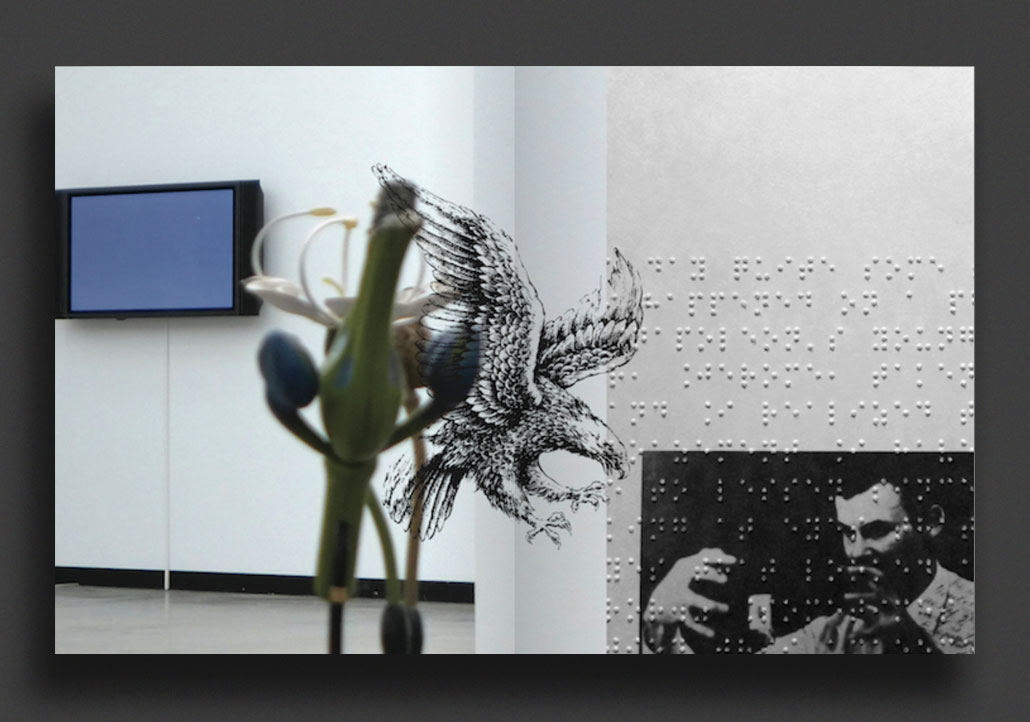
Photographs, books, and knickknacks: artists collect a variety of objects. While artists generate personal collections, which often address different formal, aesthetic, or conceptual concerns, it is difficult to separate this activity from their artistic practices. Over time, whether intended or not, such accumulations of items may become works of art.
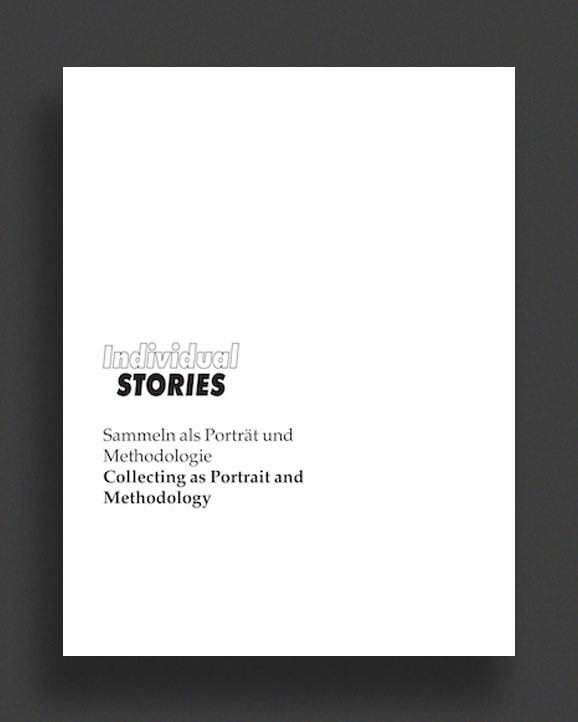
Individual Stories considers the collection as a portrait of its collector and also as an artistic method—as a process rather than an end result. The act of collecting is multifarious—it can be an expression of curiosity, a desire to transform things that have been discovered, or a systematic approach to certain objects in the world. This catalogue is a compilation of individual collections that could not be more different.
Copublished with Kunsthalle Wien to document the exhibition “Individual Stories: Collecting as Portrait and Methodology,” Kunsthalle Wien, June 26–October 11, 2015.
2017, English / Simplified Chinese
Hardcover (cloth binding), 204 pages, 16.7 x 23.4 cm
Published by
Sternberg Press / Berlin
Rockbund Art Museum (RAM) / Shanghai
$79.00 $15.00 - Out of stock
Edited by Li Qi
Texts by Larys Frogier, Heman Chong, Li Qi, Ken Liu, Xiaoyu Weng, Pauline J. Yao
The catalogue for Heman Chong’s first solo museum exhibition in mainland China, at the Rockbund Art Museum, provides an insightful and critical look into the Singaporean artist’s recent practice. To address the centrality of language, books, and the act of reading in Chong’s oeuvre, this publication features newly commissioned texts from a variety of contributors: an introduction by museum director Larys Frogier, and essays by the exhibition’s curator Li Qi, Hong Kong–based curator and critic Pauline J. Yao, and New York–based curator Weng Xiaoyu. These are rounded out with a piece of semifiction by Ken Liu, Boston-based lawyer, science-fiction writer, and translator, who played a central role in realizing Legal Bookshop (Shanghai), one of the works featured in the exhibition.
Ifs, Ands, or Buts is illustrated with images of the entirety of works included in the show at Rockbund Art Museum reproduced alongside documentation of Chong’s correspondence and collaboration with Liu, as well as a section dedicated to the humorous tabloid stories from Chong’s work Papaya Daily.
Copublished by Sternberg Press with Rockbund Art Museum (RAM), Shanghai, on the occasion of the exhibition “Heman Chong: Ifs, Ands, or Buts,” January 23–May 3, 2016.
Design by Wang Jiayi
1987, English
Softcover, 80 pages, 28 x 22 cm
1st Edition, Out of print title / used / good
Published by
A&D / London
$25.00 - Out of stock
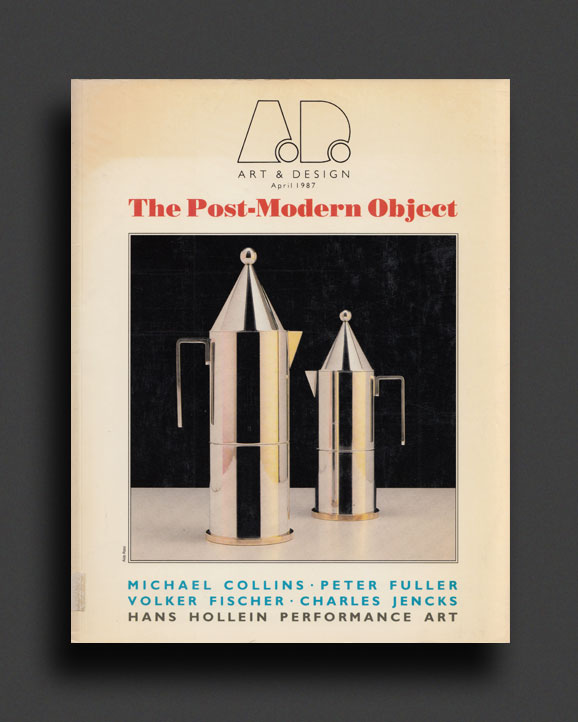
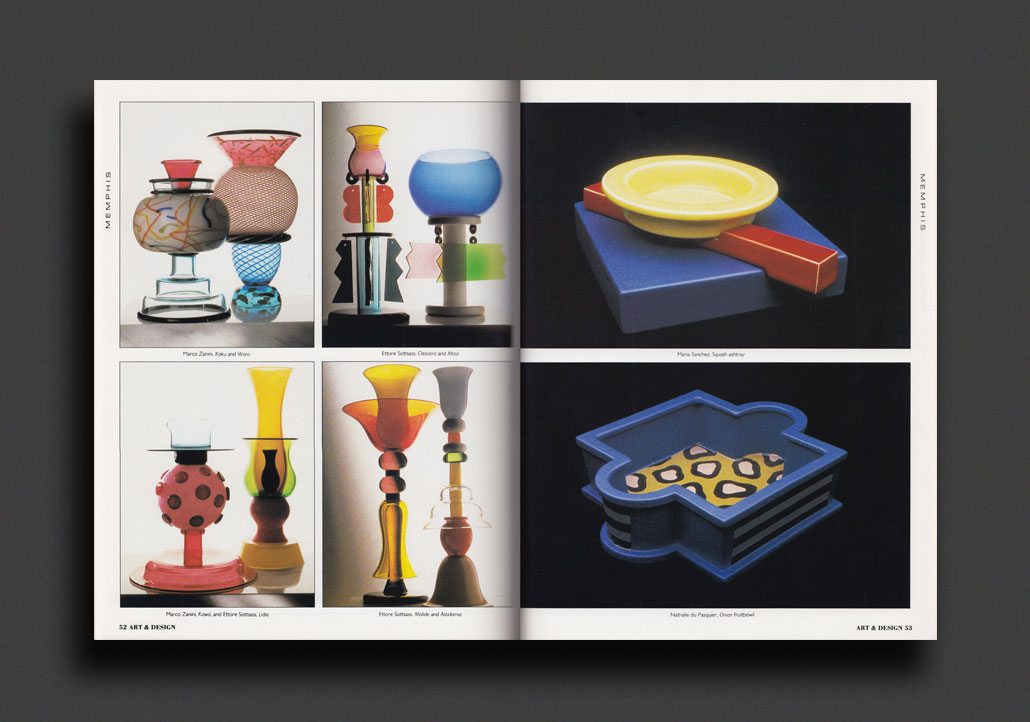
April 1987 of London's esteemed Art & Design magazine (A.D.), a special issue dedicated to "The Post Modern Object". Features include : Peter Fuller — Towards a New Nature for the Gothic; Michael Collins — Post-Modern Design; Hugh Cumming — The Designed Object: An International Survey; Charles Jencks — Symbolic Objects; Volker Fischer — Post-Modernism and Consumer Design; Geoffrey Broadbent — Functionalism versus Post-Modernism; Stuart Durant — Proto Post-Modernism; Hans Hollein — Post-Modern Performance Art; and much more. Profusely illustrated throughout with the work of Hans Hollein, Memphis, Robert Venturi, Ettore Sottsass, Aldo Rossi, Tadao Ando, Michael Graves, George Sowden, Mario Botta, Arata Isozaki, Matteo Thun, Shuji Hisada, Beppe Caturelli, Michele de Lucchi, Stanley Tigerman, SITE, Helmut Jahn, Landes and Rang, Charles Jencks, Richard Meier, Robert Stern, Alessi, Takefumi Aida, Eva Jiricna, Studio 65, Paolo Portoghesi, Oscar Tusquets, Terry Farrell, Tomas Taveira, Om Ungers, Swid Powell Ceramics, Lee Payne, and more...
"This issue of Art & Design takes a critical look at the controversial area of product design, a subject which does not often receive the same serious attention as painting or sculpture, although it probably concerns more people, on a day-to-day basis, than the fine arts. The Post-Modern Object focuses in particular on developments over the past few years by designers who have pulled away from the Modernist preoccupation with functionalism as an aesthetic and created a wide range of objects — from sofas to jewellery, cutlery to kettles — which are highly original and decorative. Included in this Profile are works by celebrated designers such as Ettore Sottsass, Michael Graves, Robert Venturi and Hans Hollein."
Good ex-libris copy with light associated markings, tanning and light wear to covers.
1990, English
Softcover, 100 pages, 8 x 22 cm
1st Edition, Out of print title / used / good
Published by
A&D / London
$25.00 - Out of stock
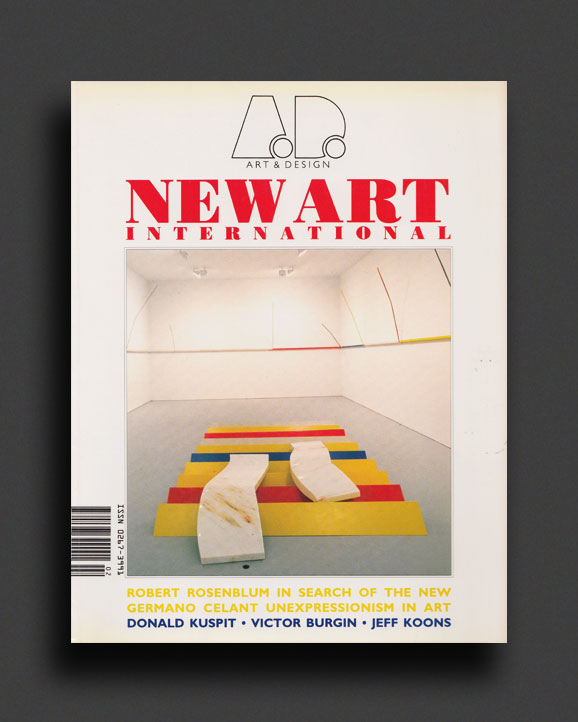
"New Art International" from 1990, a special "Art & Design Profile" edition from London's A.D. magazine. Articles/essays by Thomas Lawson, Victor Burgin, Germano Celant, Robert Rosenblum, Donald Kuspit, Jenny Holzer, Jeff Koons, and many more. Profusely illustrated throughout with the work of Haim Steinbach, Cady Noland, Zoe Leonard, Jenny Holzer, Allan McCollum, Jannis Kounellis, Cindy Sherman, Mario Merz, Barbara Kruger, Susana Solano, Ashley Bickerton, Larry Johnson, David Salle, Peter Halley, Robert Longo, John Baldessari, Barbara Bloom, Laurie Simmons, Luciano Fabro, Christian Boltanski, Thomas Schütte, Günther Förg, Annette Lemieux, Gilbert & George, Victor Burgin, Jeff Koons, Tim Rollins + KOS, Giuseppe Penone, James Lee Byars, Anselm Kiefer, Yves Klein, Thérèse Oulton, Kryzstof Wodiczko, and many more....
Very Good copy, light tanning to cover and some bumping to bottom back cover edge.
2012, English
Hardcover with dust jacket, 192 pages, 17.4 x 23.2 cm
Published by
Sternberg Press / Berlin
$74.00 $25.00 - In stock -
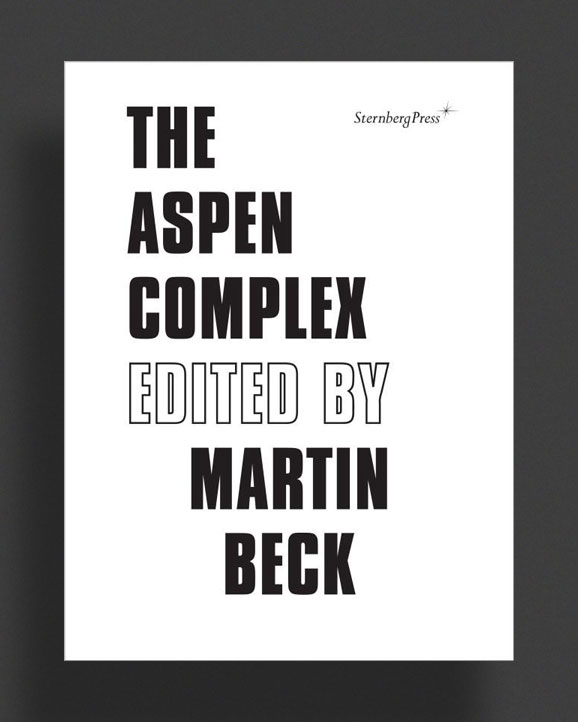
Martin Beck’s exhibition “Panel 2—‘Nothing better than a touch of ecology and catastrophe to unite the social classes…’” draws on the events of the 1970 International Design Conference in Aspen (IDCA) and the development of the Aspen Movie Map to form a visual environment that reflects the interrelations between art, architecture, design, ecology, and social movements.
The 1970 IDCA marked a turning point in design thinking. The conference’s theme, “Environment by Design,” brought together venerable figures of modern design in the United States, including Eliot Noyes, George Nelson, and Saul Bass; environmental collectives and activist architects from Berkeley such as the Environmental Action Group, Sim Van der Ryn, and Ant Farm; as well as a group of French designers and sociologists, among them Jean Aubert, Lionel Schein, and Jean Baudrillard. The conference quickly escalated into a site of unresolvable conflict about communication formats and the potential role of design for environmental practices in a rapidly changing society.
The ensuing decade heralded the development of an interactive navigation system, which used the same Colorado resort town as its test site. The Aspen Movie Map—initiated by MIT’s Architecture Machine Group (the predecessor to the Media Lab) and partially funded by the US Department of Defense—is an image-based surrogate travel system using footage filmed in Aspen. Meant to prepare users for quick orientation in places they have never been to, the Aspen Movie Map was a seminal prototype for today’s military and consumer navigation systems.
The Aspen Complexdocuments two versions of Beck’s exhibition—at London’s Gasworks and Columbia University’s Arthur Ross Architecture Gallery—and brings together yet unpublished archival material and new research on the 1970 IDCA and the Aspen Movie Map.
With essays by Sabeth Buchmann, Felicity D. Scott, and Alice Twemlow
2017, English
Softcover, 117 pages, 17 x 23cm
Ed. of 600,
Published by
MUMA / Victoria
$20.00 - In stock -
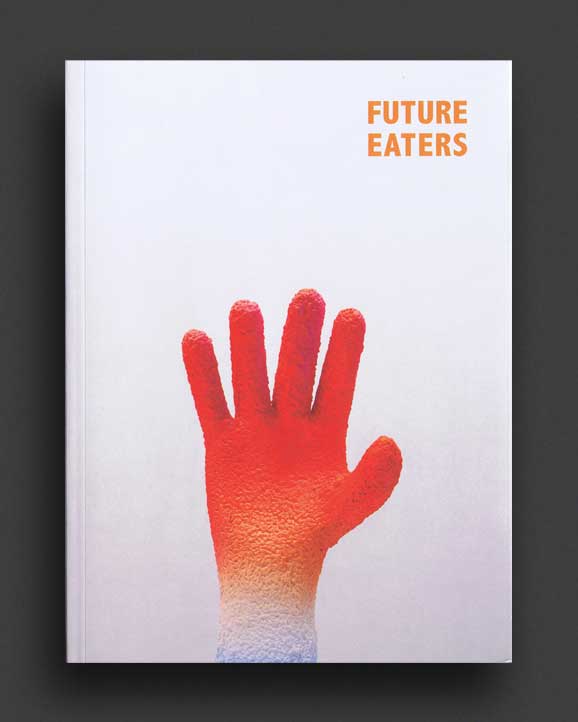
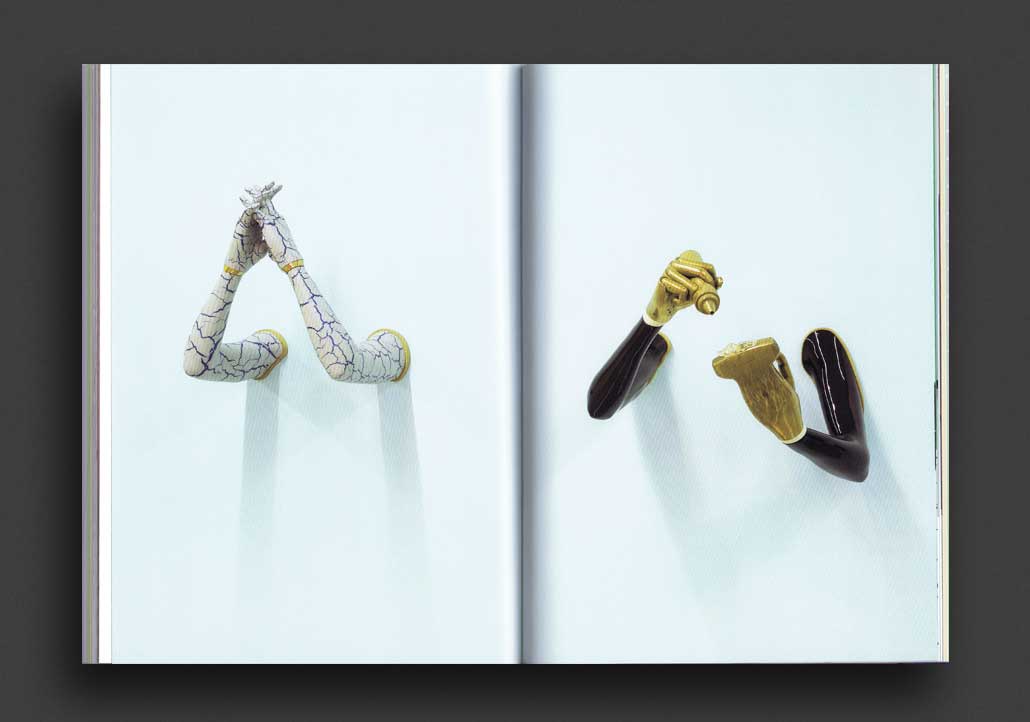
Catalogue published to accompany the exhibition "Future Eaters", curated by Charlotte Day at MUMA (Monash University Museum of Art), 22 July - 23 September, 2017.
The exhibition explored artists' approaches to three-dimensional form and materiality in the age of systems rather than artefacts, software rather than hardware, and associated processes of virtual transmission. The exhibition asked: how is sculpture evolving and responding to our increasingly technologised existence?
Artists: Hany Armanious (AUS); Benjamin Armstrong (AUS); Damiano Bertoli (AUS); Nina Cannell (SWE); Marley Dawson (AUS); Aleksandra Domanović (SVN); Hannah Donnelly (AUS); Alex Dordoy (GBR); Lewis Fidock & Joshua Petherick (AUS); Mira Gojak (AUS); Guan Xiao (CHN), Yngve Holen (NOR); Alex Israel (USA); Magali Reus (NLD); Anna Uddenberg (SWE); Anicka Yi (KOR)
Texts: Charlotte Day, Damiano Bertoli, Tara McDowell, Gail Priest, Hannah Donnelly