World Food Books' programme is largely produced on Kulin Nation land. We acknowledge the Wurundjeri people of the Kulin Nation as the first and continuing custodians of this land, and pay respect to their Elders past, present, and emerging.
World Food Books is an arts and special interests bookshop in Naarm / Melbourne. Founded in 2010, World Food Books is devoted to the presentation of a rotating, hand-selection of international art, design, literary and counterculture publications with an emphasis on the anti-traditional, the experimental, the avant-garde, the heretic, the marginal.
Presenting new titles alongside rare and out-of-print books, catalogues and journals spanning the fields of modern and contemporary art, design, photography, illustration, film, literature, poetry, cultural theory, philosophy, sexuality, popular and underground culture in its many radical forms, World Food Books wishes to encourage adventurous, thoughtful and open-minded reading, looking, writing, and exchange of publishing and ideas, both current and historical.
As well as our bookshop, located in Melbourne's historical Nicholas Building, all of our inventory is available internationally via our online mail-order service.
World Food Books semi-regularly co-ordinates "Occasions", a programme of exhibits and events at the bookshop and in partnership with other hosts (such as museums and art galleries) that develop out of the activities, relationships and content of the bookshop itself.
World Food Books
The Nicholas Building
37 Swanston Street
Room 5, Level 6
Melbourne 3000
Australia
SHOP HOURS:
Thu–Fri 12–6, Sat 12–5
WEB-SHOP OPEN 24/7
World Food Books
Postal Address:
PO Box 435
Flinders Lane
Victoria 8009
Australia
Art
Theory / Essay
Architecture / Interior
Graphic Design / Typography
Photography
Fashion
Eros
LGBTQ+
Fiction / Poetry
Weird / Speculative / Science Fiction / Horror
Transgressive / Visceral / Abject
Symbolism / Decadence / Fin de siècle
Film / Video
Painting
Sculpture / Installation
Performance / Dance / Theater
Drawing
Sound / Music
Curatorial
Group Shows / Collections
Periodicals
Out-of-print / Rare
Posters / Ephemera / Discs
Signed Books
World Food Books Gift Voucher
World Food Book Bag
Australian Art
Australian Fiction
Australian Science Fiction / Speculative Fiction
Australian Poetry
Australian Photography
Japanese Photography
Conceptual Art
Minimal Art
Dada
'Pataphysics / Oulipo
Fluxus
Concrete Poetry
Pop Art
Surrealism
Arte Povera
Arte Informale / Haute Pâte / Tachism
Nouveau Réalisme / Zero / Kinetic
Situationism / Lettrism
Collage / Mail Art / Xerox Art
Art Brut / Folk / Visionary / Fantastic
Illustration / Graphic Art / Bandes Dessinées
Furniture
Italian Radical Design / Postmodernism
Textiles
Ceramics / Glass
Counterculture
Protest / Revolt
Philosophy
Psychoanalysis
Anthropology
Anarchism
Socialism / Anarchism / Communism / Capitalism
Literary Theory / Semiotics / Language
Feminism / Women's Studies
Gender Studies / Sexuality
Anthropology
Fetishism / BDSM
Drugs / Psychedelia
Crime / Violence
Animal Rights / Veganism
Occult / Esoterica
Ecology / Earth / Alternative Living
Whole Earth / Crafts
All prices in AUD (Australian dollars)
Pick-Ups
Pick-up orders can be collected in our bookshop during opening hours after order date. Please collect any Pick-up orders within 2 weeks of ordering as we have limited storage space. Orders will be released back into stock if not collected within this time. No refunds can be made for pick-ups left un-collected. If you cannot make it in to the bookshop in this time-frame, please choose postage option.
Return Policy
All sales are final. We do accept returns (for refund or exchange) for items received in error. All our orders are packed with special care using heavy-duty padding and cardboard book-mailers or bubble mailers (for smaller books), using reinforcement where required. We cannot take responsibility for any lost, stolen or damaged parcels.
Insurance
Should you wish to insure your package, please email us directly after placing your order and we can organise this at a small extra expense. Although all standard/express tracked packages are very safe and dependable, we cannot take responsibility for any lost, stolen or damaged parcels. We recommend insurance on valuable orders.
Interested in selling your old books, catalogues, journals, magazines, comics, fanzines, ephemera? We are always looking for interesting, unusual and out-of-print books to buy. We only buy books in our fields of interest and specialty, and that we feel we can resell.
We base these prices on desirability, market value, in-print prices, condition and our current stock levels. We offer cash, store credit, and can take stock on consignment. All
about 25% of the price we expect to get when we sell them, or 30% in store credit. We base these prices on desirability, market value, in-print prices, condition and our current stock levels.
Sell your books any day of the week. You can drop them off and return later. If you have a lot of books, we can visit your Sydney home.
We buy books that we feel we can resell. We offer about 25 % of the price we expect to get when we sell them, or 30% in store credit. We base these prices on desirability, market value, in-print prices, condition and our current stock levels.
Philadelphia Wireman
03 August - 01 September, 2018
World Food Books is proud to announce our next Occasion, the first presentation of sculptures by Philadelphia Wireman in Australia.
The Philadelphia Wireman sculptures were found abandoned in an alley off Philadelphia’s South Street on trash night in 1982. Their discovery in a rapidly-changing neighbourhood undergoing extensive renovation, compounded with the failure of all attempts to locate the artist, suggests that the works may have been discarded after the maker’s death. Dubbed the "Philadelphia Wireman" during the first exhibition of this work, in 1985, the maker’s name, age, ethnicity, and even gender remain uncertain. The entire collection totals approximately 1200 pieces, all intricately bound together with tightly-wound heavy-gauge wire (along with a few small, abstract marker drawings, reminiscent both of Mark Tobey and J.B. Murry). The dense construction of the work, despite a modest range of scale and materials, is singularly obsessive and disciplined in design: a wire armature or exoskeleton firmly binds a bricolage of found objects including plastic, glass, food packaging, umbrella parts, tape, rubber, batteries, pens, leather, reflectors, nuts and bolts, nails, foil, coins, toys, watches, eyeglasses, tools, and jewellery.
Heavy with associations—anthropomorphic, zoomorphic, and socio-cultural responses to wrapped detritus—the totemic sculptures by Philadelphia Wireman have been discussed in the context of work created to fulfil the shamanistic needs of alternative religions in American culture. Curators, collectors, and critics have variously compared certain pieces to sculpture from Classical antiquity, Native American medicine bundles, African-American memory jugs, and African fetish objects. Reflecting the artist’s prolific and incredibly focused scavenging impulse, and despite—or perhaps enhanced by—their anonymity, these enigmatic objects function as urban artefacts and arbiters of power, though their origin and purpose is unknown. Philadelphia Wireman, whatever their identity, possessed an astonishing ability to isolate and communicate the concepts of power and energy through the selection and transformation of ordinary materials. Over the course of the past two decades, this collection has come to be regarded as an important discovery in the field of self-taught art and vernacular art.
Presented in collaboration with Fleisher-Ollman Gallery, Philadelphia, and Robert Heald, Wellington.
Susan Te Kahurangi King
02 February - 10 March, 2018
Susan Te Kahurangi King (24 February 1951 - ) has been a confident and prolific artist since she was a young child, drawing with readily available materials - pencils, ballpoint pens and felt-tip markers, on whatever paper is at hand. Between the ages of four and six Susan slowly ceased verbal communication. Her grandparents William and Myrtle Murphy had developed a special bond with Susan so they took on caring responsibilities for extended periods. Myrtle began informally archiving her work, carefully collecting and storing the drawings and compiling scrapbooks. No drawing was insignificant; every scrap of paper was kept. The King family are now the custodians of a vast collection containing over 7000 individual works, from tiny scraps of paper through to 5 meter long rolls.
The scrapbooks and diaries reveal Myrtle to be a woman of great patience and compassion, seeking to understand a child who was not always behaving as expected. She encouraged Susan to be observant, to explore her environment and absorb all the sights and sounds. Myrtle would show Susan’s drawings to friends and people in her community that she had dealings with, such as shopkeepers and postal workers, but this was not simply a case of a grandmother’s bias. She recognised that Susan had developed a sophisticated and unique visual language and sincerely believed that her art deserved serious attention.
This was an unorthodox attitude for the time. To provide some context, Jean Dubuffet coined the term Art Brut in 1945 to describe work created by self-taught artists – specifically residents of psychiatric institutions and those he considered to be visionaries or eccentrics. In 1972 Roger Cardinal extended this concept by adopting the term Outsider Art to describe work made by non-academically trained artists operating outside of mainstream art networks through choice or circumstance. Susan was born in Te Aroha, New Zealand in 1951, far from the artistic hubs of Paris and London that Dubuffet and Cardinal operated in. That Myrtle fêted Susan as a self-taught artist who deserved to be taken seriously shows how progressive her attitudes were.
Susan’s parents Doug and Dawn were also progressive. Over the years they had consulted numerous health practitioners about Susan’s condition, as the medical establishment could not provide an explanation as to why she had lapsed into silence. Dawn educated herself in the field of homeopathy and went on to treat all twelve of her children using these principles – basing prescriptions on her observations of their physical, mental and emotional state.
Doug was a linguist with an interest in philosophy who devoted what little spare time he had to studying Maori language and culture. To some extent their willingness to explore the fringes of the mainstream made them outsiders too but it was their commitment to living with integrity and their respect for individuality that ensured Susan’s creativity was always encouraged.
Even though Susan’s family supported her artistic pursuits, some staff in schools and hospitals saw it as an impediment to her assimilation into the community and discouraged it in a variety of ways. Her family was not always aware of this and therefore did not fully understand why Susan stopped drawing in the early 1990s. However, rather than dwell on the challenges that Susan faced in pursuit of her artistic practice, they prefer to highlight her achievements. In 2008 Susan began drawing again in earnest, after an almost 20 year interruption, and her work is now shown in galleries around the world.
Susan grew up without television and has been heavily influenced by the comics she read as a child. She is absolutely fearless in the appropriation of recognizable characters, such as Donald Duck and Mickey Mouse, in her work. She twists their limbs, contorts their faces, compresses them together, blends them into complex patterned backgrounds - always imbuing them with an incredible energy. Although Susan often used pop culture characters in her work they are not naive or childlike. These are drawings by a brilliant self-taught artist who has been creating exceptional work for decades without an audience in mind.
Mladen Stilinović
"Various Works 1986 - 1999"
02 February 16 - September 10, 2016
Various works 1986 - 1999, from two houses, from the collections of John Nixon, Sue Cramer, Kerrie Poliness, Peter Haffenden and Phoebe Haffenden.
Including: Geometry of Cakes (various shelves), 1993; Poor People’s Law (black and white plate), 1993; White Absence (glasses, ruler, set square, silver spoon, silver ladel with skin photograph and wooden cubes), 1990-1996; Exploitation of the Dead (grey and red star painting, wooden painting, black spoon with red table, red plate), 1984-1990; Money and Zeros (zero tie, paintings made for friends in Australia (Sue, John, Kerrie), numbers painting), 1991-1992; Words - Slogans (various t-shirts) - “they talk about the death of art...help! someone is trying to kill me”, “my sweet little lamb”, “work is a disease - Karl Marx”; Various artist books, catalogues, monographs, videos; Poster from exhibition Insulting Anarchy; "Circular" Croatian - Australian edition; Artist book by Vlado Martek (Dostoyevsky); more.
Thanks to Mladen Stilinović and Branka Stipančić.
Jonathan Walker
Always Will Need To Wear Winter Shirt Blue + Ochre Small Check Pattern
21 August - 21 September, 2015
Untitled
I am not a great reader of poetry but I always return to the work of Melbourne poet, Vincent Buckley (1925- 1988). Perhaps I find his most tantalising piece to be not a finished poem but a fragment left on a scrap of paper discovered on his desk after the poet’s death.
The poetry gathers like oil
In the word-core, and spreads
It has its music meet,
Its music is in movement.
This fragment is more the shell left behind from a volatile thought than a finished poem. I find the last two lines honest but awkward whereas the first two lines work like an arrow. Most likely he could not find a resolution so it was left. Still, in its present form, it remains an eloquent testimony to the ultimate failure of a medium to express mobile thought and sensation, in Buckley’s case, through verbal language. It’s an important matter because this is something all artists have to deal with regardless of the medium.
I have never written a poem, however, I am forever copying fragments from books on paper scraps in a vain effort to fix certain notions in my head. At first, they function as bookmarks that are sometimes returned to when I open the book. But before long, as they accumulate, they fall out littering the table interspersed with A4 photocopies, bills, books and medications.
To return to Buckley’s fragment, the first two lines very much evoke how I paint nowadays. As you age, detail diminishes and patches of light become more luminous and float. I feel the most honest way of dealing with this is by smearing the oil paint on the canvas with the fingers and working close-up, blind. Only if the patches coalesce into an approaching image can the work gain a life.
-
Jonathan Walker was born in Melbourne, Australia and brought up on a dairy farm in Gippsland. In the 1970’s he studied painting at RMIT and won the Harold Wright Scholarship to the British Museum, London. During the 1980’s he exhibited at Pinacotheca Gallery, Richmond and had work shown at the NGV and Heidi City Art Gallery. Over the same period he designed the cover for the “Epigenesi” LP by Giancarlo Toniutti, Italy and conducted a mail exchange work with Achim Wollscheid, Germany. The work with artists through the post resulted in an article published in the bicentenary issue of Art and Australia 1988. He showed in artist run spaces such as WestSpace in the 90’s and 2000’s, and until 2012, taught painting at Victoria University, which is where we (Colleen Ahern and Lisa Radford) as organisers of the exhibition, among many others, had the privilege of being his student.
Walker’s knowledge was imparted to students through the careful selection of music, literature, and artists found in books that he himself had ordered for the library. Walker’s strategy was the generosity of sharing his vast knowledge with references specific to each student and their context.
Walker’s paintings share a similar focus and intimacy.
This exhibition presents a small selection of recent paintings alongside a publication that includes Walker’s writing. Observational and analytical, Walker’s work is a type of material notation — the time of day, colour and how it is blended, the both specific and fleeting location of a reflection on lino or the question of whether a chair leg should be included in a painting.
Please join us on Friday August 21 between 6-8pm to celebrate the opening of the exhibition.
Curated by Colleen Ahern and Lisa Radford.
B. Wurtz
Curated by Nic Tammens
March 26 - April 4, 2015
B.Wurtz works from a basement studio in his home on Manhattan’s Lower East Side.
This local fact is attested to by the plastic shopping bags and newsprint circulars that appear in his work. As formal objects, they don’t make loud claims about their origins but nonetheless transmit street addresses and places of business from the bottom of this long thin island. Like plenty of artists, Wurtz is affected by what is local and what is consumed. His work is underpinned by this ethic. It often speaks from a neighborhood or reads like the contents of a hamper:
“BLACK PLUMS $1.29 lb.”
“Food Bazaar”
“USDA Whole Pork Shoulder Picnic 99c lb.”
“RITE AID Pharmacy, with us it’s personal.”
“H. Brickman & Sons.”
“Sweet Yams 59c lb."
Most of the work in this exhibition was made while the artist was in residence at Dieu Donne, a workshop dedicated to paper craft in Midtown. Here Wurtz fabricated assemblages with paper and objects that are relatively lightweight, with the intention that they would be easily transportable to Australia. This consideration isn’t absolute in Wurtz’s work, but was prescriptive for making the current exhibition light and cheap. Packed in two boxes, these works were sent from a USPS post office on the Lower East Side and delivered to North Melbourne by Australia Post.
Wurtz appears courtesy of Metro Pictures, New York.
Thanks to Rob Halverson, Joshua Petherick, Sari de Mallory, Matt Hinkley, Helen Johnson, Fayen d'Evie, Ask Kilmartin, Lisa Radon, Ellena Savage, Yale Union, and "Elizabeth".
John Nixon
"Archive"
December 15 - January 20, 2014
The presentation of John Nixon's archive offered a rare showcase of this extensive collection of the artist's own publications, catalogues, posters, ephemera, editions and more, from the mid 1980s onwards, alongside a selection of his artworks.
Organized by John Nixon, Joshua Petherick and Matt Hinkley.
<a href=http://wfb.public-office.info/artist/john-nixon>All titles by John Nixon
"Habitat"
at Minerva, Sydney (organised by Joshua Petherick and Matt Hinkley)
November 15 - December 20, 2014
Lupo Borgonovo, Janet Burchill & Jennifer McCamley,
Lewis Fidock, HR Giger, Piero Gilardi, Veit Laurent Kurz,
Cinzia Ruggeri, Michael E. Smith, Lucie Stahl, Daniel Weil, Wols
Press Release:
“...It contained seven objects. The slender fluted bone, surely formed for flight, surely from the wing of some large bird. Three archaic circuitboards, faced with mazes of gold. A smooth white sphere of baked clay. An age-blackened fragment of lace. A fingerlength segment of what she assumed was bone from a human wrist, grayish white, inset smoothly with the silicon shaft of a small instrument that must once have ridden flush with the surface of the skin - but the thing’s face was seared and blackened.”
William Gibson, “Count Zero”, 1986
"Autumn Projects Archive"
Curated by Liza Vasiliou
March 6 - March 15, 2014
World Food Books, in conjunction with the Virgin Australia Melbourne Fashion Festival 2014, presented the Autumn Projects archive, consisting of a selection of early examples in Australian fashion with a particular interest in collecting designers and labels from the period beginning in the 1980’s, who significantly influenced the discourse of Australian Fashion.
Curated by Liza Vasiliou, the exhibition provided a unique opportunity to view pieces by designers Anthea Crawford, Barbara Vandenberg, Geoff Liddell and labels CR Australia, Covers, Jag along with early experimental collage pieces by Prue Acton and Sally Browne’s ‘Fragments’ collection, suspended throughout the functioning World Food Books shop in Melbourne.
H.B. Peace
presented by CENTRE FOR STYLE
November 14, 2013
"Hey Blinky, you say chic, I say same"
Anon 2013
H.B. Peace is a clothing collaboration between great friends Blake Barns and Hugh Egan Westland. Their pieces explore the divergences between 'character’ and ‘personality’ in garments....etc
Special Thanks to Joshua Petherick and Matt Hinkley of WFB and Gillian Mears
and a Very Special Thank you to Audrey Thomas Hayes for her shoe collaboration.
Janet Burchill & Jennifer McCamley
"Aesthetic Suicide"
May 10 - June 8, 2013
The first of our occasional exhibitions in the World Food Books office/shop space in Melbourne, "Aesthetic Suicide" presented a body of new and older works together by artists Janet Burchill & Jennifer McCamley, including videos, prints, a wall work, and publications.
During shop open hours videos played every hour, on the hour.
2015, English
Softcover, 32 pages, 23 x 16 cm
Published by
Occasional Papers / London
$35.00 - Out of stock
This is the first authorised translation of ‘Daniel Bosser, Philippe Thomas décline son identité’, a book about modernism and modalities of display, first published by Galerie Claire Burrus, Paris, in 1987. The book was part of a performative talk given only twice by the French conceptual artist Philippe Thomas (1951–95). What audience members realised upon leaving the auditorium, and discovering the book, was that the talk they had just witnessed was minutely scripted – down to Thomas’ smallest gestures and pauses – in the book itself. Thomas thus blurred definitions of ‘artist's talk’, ‘performance’, ‘transcript’ and ‘book’, producing instead a complex play on words and speech.
Consistent with Thomas’ practice to distinguish his name from authorship, this book is attributed to Daniel Bosser, the collector who acquired the piece.
Translated by Antony Hudek
Includes a new essay on Thomas' work by Émeline Jaret
2014, English
Softcover, 496 pages, 13 x 19.8 cm
Published by
Sternberg Press / Berlin
$79.00 $25.00 - Out of stock
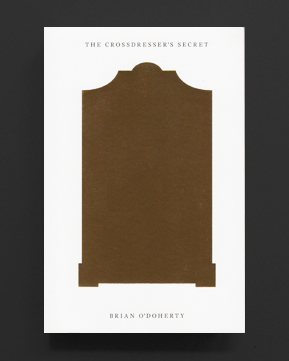
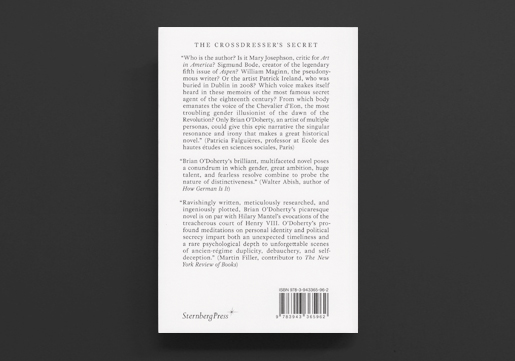
The eighteenth century was an era of violent contrasts and radical change, intellectual brilliance and war, spies and diplomatic intrigue, elegance and cruelty. One of the century’s most mysterious figures was the Chevalier d’Eon, who lived as both man and woman, French spy and European celebrity. Written from the perspective of this historical figure, the novel by Brian O’Doherty—artist and author of, among others, the critical milestone Inside the White Cube and the Booker Prize-shortlisted The Deposition of Father McGreevy—reveals d’Eon’s radical modernity, certified by his attitudes to gender and his examination of his own nature. He ponders the social determinants of sexual identity and studies the manners and conventions governing discourse between the sexes. At the same time, as diplomat and spy, he is involved in the power politics of nations. The novel holds close to historical facts and reproduces some of d’Eon’s comments as recorded in his voluminous journals. Apparently his life did not become real to him until he had rehearsed it in writing. Design by OK-RM
2014, English
Softcover, 115 pages, 17 x 24 cm
Published by
Sternberg Press / Berlin
$30.00 $10.00 - Out of stock
Texts by Mary Ceruti, Suzanne Cotter, Christiane Maria Schneider
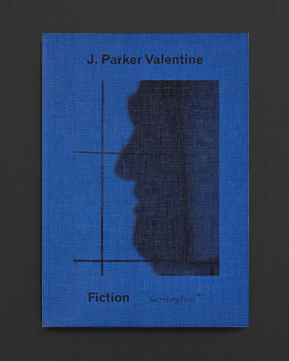
Although deeply grounded in drawing, J. Parker Valentine’s diverse practice spans film, video, photography, collage, and sculpture. By pushing the limits of mark making, the many possibilities of narrative and image are encountered and explored. The drawn line exceeds its supports and materials, extending beyond the two-dimensional edges of material to something more sculptural. In the same way that Valentine uses erasure to create an image, the negative space or ephemeral material within a space, such as shadow and light, becomes part of the work.
This artist book includes a selection of images—a documentation of exhibited works and those in process—that offer a sense of Valentine’s approach to working, which gestures toward abstraction and improvisation. For this book, many images have been adapted, reoriented, and/or manipulated. Also included are three essays that investigate Valentine’s process, considering work that has emerged from her previous projects, residencies, and exhibitions to date. Mary Ceruti’s essay describes Valentine’s lasso sculptures as oscillating between drawing and sculpture, and discusses the suggestive narratives that play out in sculptural space. Suzanne Cotter touches on Valentine’s interrogation of the integrity of the medium of drawing and its limits, as well as the transformative nature of her work, as eluding any static reading. Describing the development of Valentine’s work in situ, Christiane Maria Schneider considers how each of the works presented are affected by the relationships they enter into, continually moving between the material and immaterial.
Valentine was born in Austin, Texas, in 1980. She was artist in residence at Artpace, San Antonio, in 2013. She has had solo shows at Supportico Lopez, Berlin (2010, 2012); Galerie Max Mayer, Düsseldorf (2012); Taka Ishii, Kyoto (2010); Peep-Hole, Milan (2010); and Lisa Cooley, New York (2008, 2010). She lives and works in New York.
This book is published on the occasion of J. Parker Valentine’s exhibition “Topo” at Langen Foundation, Neuss, Germany, February 14–June 29, 2014.
Design by Kloepfer-Ramsey-Kwon
2011, English
Softcover, 96 pages (section sewn), 106 x 170mm
Edition of 500,
Published by
Surpllus / Melbourne
$22.00 $10.00 - Out of stock
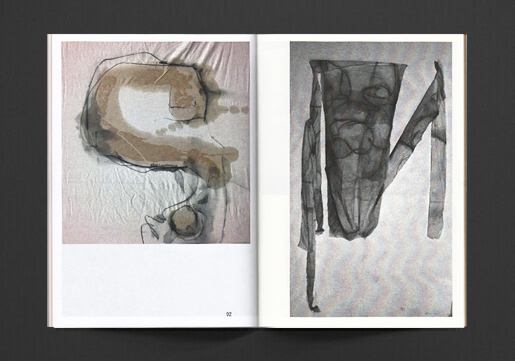
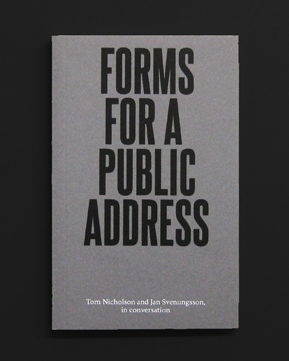
Forms for a public address presents an exchange between the Berlin-based Swedish artist Jan Svenungsson and the Melbourne-based Australian artist Tom Nicholson, written over a two-year period spanning 2008–2010. Shifting between a discussion of their own work and that of other artists, as well as art history and contemporary events as they unfold in parallel to the exchange, the book addresses the possibilities of art-making, the relationship between public forms and private processes, and the question of how artists understand their work in the face of the world around them.
Sample copy.
1984 / 1987, English
Hardcover, 48 pages, 23 x 19 cm
Out of print title / used / fine
Published by
Souvenir Press / London
$50.00 - Out of stock
UK hardback edition of this wonderful collection of Tomi Ungerer's provocative frog watercolours from the early 1980's. The amphibious "Joy of Sex", this fabulous collection of frog erotica is one of Ungerer's incredible adult books, sitting alongside such classics as The Party (1966), Fornicon (1969) and Tomi Ungerer's Compromises (1970), Totempole (1976), amongst many others.
Tomi Ungerer (born 28 November 1931) is an award winning French illustrator and a writer in three languages. He has published over 140 books ranging from much loved children's books to controversial adult work and from the fantastic to the autobiographical. He is known for sharp social satire and witty aphorisms. He is renowned for his iconic Advertising campaigns and political posters against the Vietnam War and Racial Injustice which were representative of the burgeoning political consciousness in New York in the 1960’s. His political engagement has continued to this day in campaigns against Racism and Fascism, for Nuclear disarmament, Ecology and numerous Humanitarian causes.
Fine copy of the 1987 print with red cover.
1984, English / German / French
Hardcover, 208 pages, 25 x 25 cm
Out of print title / used / very good
Published by
The Graphis Press / Zürich
$190.00 - Out of stock
The very collectable expanded hardcover edition of "Graphis Diagrams", published in 1984 by the legendary Graphis Press, Zürich. This legendary landmark volume from the Graphis "square books series", edited by Swiss graphic designer Walter Herdeg, who's interest in the scientific side of graphic design and the graphic visualization of abstract data brought about one of the most important design volumes of any library. Profusely illustrated across 208 pages, with 399 b/w and colour examples, colour overlay transparency pages, and, as per usual for Graphis publications, handsomely designed and heavily researched, with all texts in English, German and French. Includes brilliant examples of cartographic diagrams and decorative maps, graphic tables and diagrams, flows, plans, charts, computer-plotted and three-dimensional diagrams, and so much more. Even includes the data visualization that Peter Saville lifted and used on the iconic cover of Joy Division's 1979 debut album Unknown Pleasures, which has become one of the most identifiable graphics of our times.
"The purpose of this book is to show the designer how abstract facts or functions which cannot be simply depicted like natural objects may be given visual expression by suitable graphic transformation. It also reviews the means of visualizing physical and technical processes which are not perceptible to the eye. The optimum synthesis of aesthetics and information value remains the essential objective in every type of diagrammatic presentation…"
Very Good copy with some light age spotting to first and last pages and edges.
1975, English / German / French
Hardcover (w. dust-jacket), 252 pages, 24 x 30.5 cm
Out of print title / used / very good
Published by
The Graphis Press / Zürich
$65.00 - Out of stock
1985 edition of the legendary Graphis Posters book series. Published by The Graphis Press in Zürich, this profusely illustrated, cloth-bound volume continues one of the world's leading design showcases. Each Graphis Posters Annual volume profiles in colour and black and white the best poster design of that year. Profusely illustrated across 252 pages, with 848 b/w and colour examples, and, as per usual for Graphis publications, handsomely designed and heavily researched, with all texts in English, German and French. These books are a never-ending source of wonder for anyone interested in the history of illustration, graphic design, typography and commercial photography.
Edited by Swiss graphic design Walter Herdeg, with a dust jacket (present) by the great Tomi Ungerer.
Features the work of : Tomi Ungerer, Tadanori Yokoo, Vali Myers, Franciszek Starowieyski, Roman Cieslewicz, Etienne Delessert, Push Pin Studios, Les Mason, Sam Haskins, Peter Lindbergh, Sarah Moon, Jerzy Czerniawski, Jean Arp, Milton Glaser, Leo Lionni, Eiko Ishioka, Ernst Fuchs, Paul Davis, Jean Michel Folon, Ivan Chermayeff, Seymour Chwast, Shigeo Fukuda, Max Bill, Romuald Socha, Jan Lenica, Gottschalk + Ash, Michael English, Ikko Tanaka, Jiri Slalmoun, Don Ivan Punchatz, Walter Pfeiffer, Rene Mulas, Karel Vaca, Károly Schmal, Richard Linder, Massimo Vignelli, Jürgen Spohn, Kenneth Noland, Larry Rivers, Sonia Delaunay, Pet Halmen, Dusan Zdimal, Frieder Grindler, Willem De Kooning, and hundreds more.
Very Good copy with Good original jacket preserved under plastic wrap. Previous owner's name to first blank page.
1974, English / German / French
Hardcover, 120 pages, 30.5 x 24 cm
1st Edition, Out of print title / used / good
Published by
The Graphis Press / Zürich
$50.00 - Out of stock
Wonderful hardcover book edition of this Graphis special dedicated entirely to the visual language of science. Expanding into book form from the special issue #165 (1973/74), edited by Walter Herdeg, this volume is profusely illustrated with colour and b/w artworks and graphics from numerous designers and illustrators working in the field, with a cover painting by Hans Erni. Articles are featured: Editor’s Foreword, written by Walter Herdeg; Introduction, by Jerome Snyder; Pre-Twentieth-Century Scientific Art, by Adolf Portmann; Scientific Illustration in the Twentieth Century, by Paul Peck; Scientific Illustration for the General Public, by Edward A. Hamilton; Walter Linsenmaier, by Walter Robert Corti, Winterthur; and Visual Presentations in the Promotion of Pharmaceutical Companies, by Werner Reber.
"Anyone who is familiar with the various domains of the applied graphic arts will know that the present-day scientific illustrator is something of a wallflower compared with his historical predecessors and his more widely acclaimed colleagues from the fields of advertising, editorial art and book illustration. The function of scientific drawing is admittedly an essentially practical one : to inform, to explain and to instruct. But that does not prevent it from measuring up to aesthetic criteria. In fact, this area can show a wealth of artistically outstanding work which is at the same time a valuable contribution to the records of science and which certainly deserves to be brought to the notice of a wider public. The following survey sets out to show that within the confines of scientific illustration there is plenty of latitude for the exercise of the artist's talents. It is my hope that it will stimulate gifted illustrators to try their hands in this field and will encourage young artists to choose scientific illustration as a career. It would also be gratifying if as a result of this publication more opportunities were offered to qualified artists and designers to place their skills at the disposal of science. It is not by any oversight that the most famous of all the artists of science, Leonardo da Vinci, is not represented in our first section. His work is so well known to most of our readers that I found it wiser to save a little space for artists who have had less exposure. If some contemporary scientific illustrators of repute are likewise absent from this survey, this does not imply any lack of appreciation for their work but is due merely to limitations of space which are unavoidable in a publication such as this." — from introduction.
Good ex-libris copy with some wear and chipping to laminate covers and a few associated library markings not affecting the content.
2018, English
Softcover, 139 pages, 14 x 23 cm
Published by
Sternberg Press / Berlin
$54.00 $20.00 - Out of stock
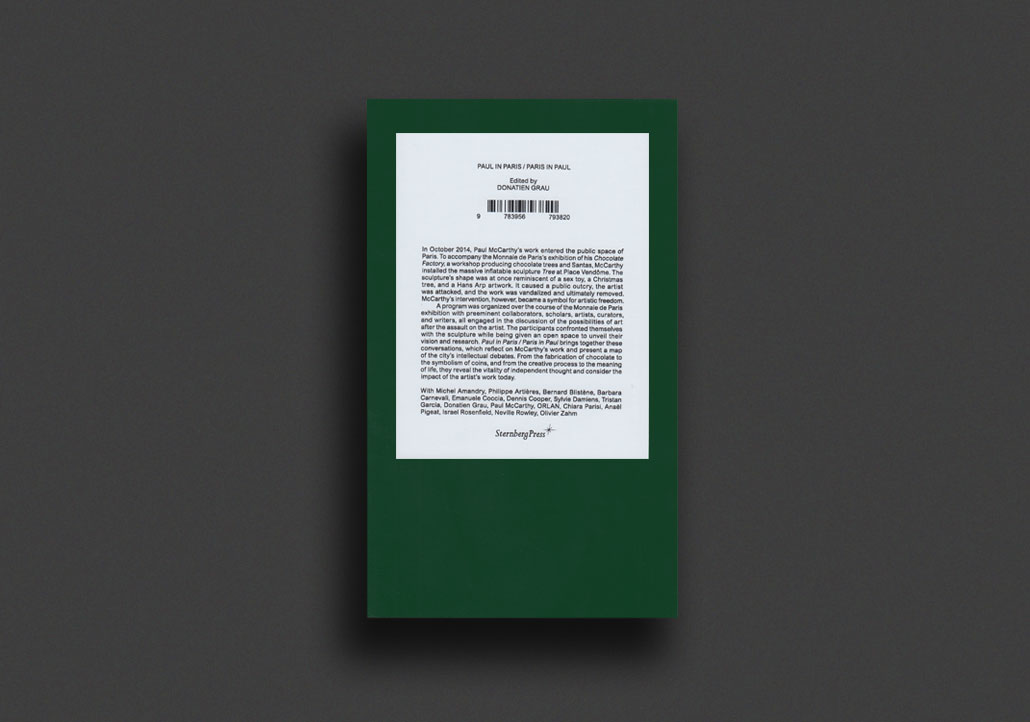
In October 2014, Paul McCarthy’s work entered the public space of Paris. To accompany the Monnaie de Paris’s exhibition of his Chocolate Factory, a workshop producing chocolate trees and Santas, McCarthy installed the massive inflatable sculpture Tree at Place Vendôme. The sculpture’s shape was at once reminiscent of a sex toy, a Christmas tree, and a Hans Arp artwork. It caused a public outcry, the artist was attacked, and the work vandalized and ultimately removed. McCarthy’s intervention, however, became a symbol for artistic freedom.
A program was organized over the course of the Monnaie de Paris exhibition with preeminent collaborators, scholars, artists, curators, and writers, all engaged in the discussion of the possibilities of art after the assault on the artist. The participants confronted themselves with the sculpture while being given an open space to unveil their vision and research. Paul in Paris / Paris in Paul brings together these conversations, which reflect on McCarthy’s work and present a map of the city’s intellectual debates. From the fabrication of chocolate to the symbolism of coins, and from the creative process to the meaning of life, they reveal the vitality of independent thought and consider the impact of the artist’s work today.
Contributions by Michel Amandry, Philippe Artières, Bernard Blistène, Barbara Carnevali, Emanuele Coccia, Dennis Cooper, Sylvie Damiens, Tristan Garcia, Donatien Grau, Paul McCarthy, ORLAN, Chiara Parisi, Anaël Pigeat, Israel Rosenfield, Neville Rowley, Olivier Zahm
2018, English
Hardcover, 560 pages, 24 x 34 cm
Published by
Phaidon / London
$210.00 $100.00 - Out of stock
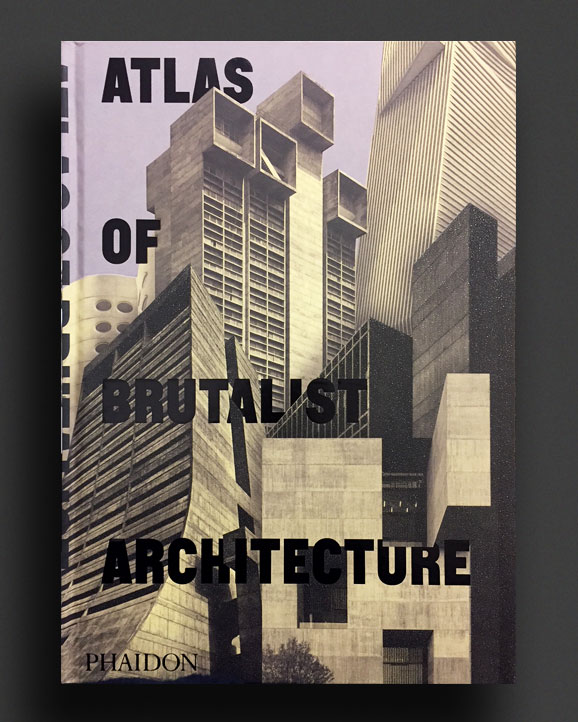
Awarded the The New York Times Best Art Book of 2018, this is the only book to thoroughly document the world's finest examples of Brutalist architecture. More than 850 buildings - existing and demolished, classic and contemporary - are organized geographically into nine continental regions.
Presented in an oversized format with a specially bound case with three-dimensional finishes, 1000 beautiful duotone photographs throughout bring the graphic strength, emotional power, and compelling architectural presence of Brutalism to life. From 20th century masters to contemporary architects, much-loved masterpieces in the UK and USA sit alongside lesser-known examples in Europe, Asia, Australia, and beyond - 102 countries in all. Twentieth-century masters included in the book: Marcel Breuer, Lina Bo Bardi, Le Corbusier, Carlo Scarpa, Ernoe Goldfinger, Frank Lloyd Wright, Louis Kahn, Oscar Niemeyer, and Paul Rudolph. Contemporary architects featured include Peter Zumthor, Alvaro Siza, Coop Himmelb(l)au, David Chipperfield, Diller and Scofidio, Herzog & de Meuron, Jean Nouvel, SANAA, OMA, Renzo Piano, Tadao Ando, and Zaha Hadid.
From the publisher of This Brutal World.
NEW COPY marked-down due to cover edge bumping.
2020, English
Softcover, 241 pages, 25 x 17.5 cm
Published by
Monash Art Projects / Victoria
$25.00 - Out of stock
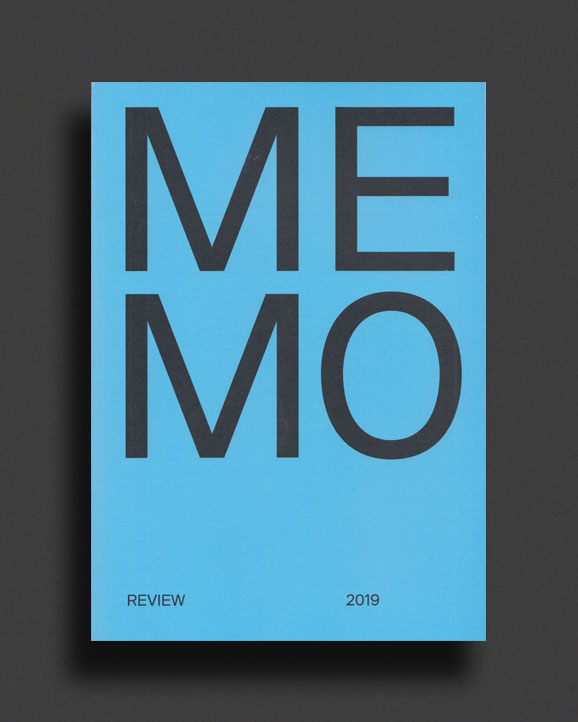
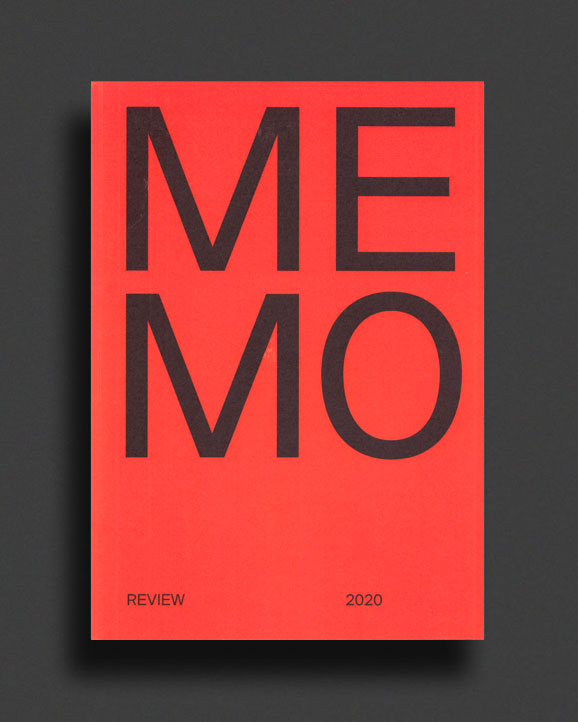
These are the reviews from 2018, the second year of Melbourne's Memo Review. Memo Review is Melbourne's only weekly art criticism, publishing reviews of "a broad variety of art exhibitions at public art museums, commercial galleries and smaller artist-run spaces in Melbourne, offering new critical perspectives from an up-and-coming younger generation of Australian art scholars, writers and artists."
As readers engage with this second year of reviews, they might see a group of art writers coming to grips with the particular limitations and opportunities of the weekly review format and even the particularities of its online delivery. Some will track the successive mentions of the same artist or gallery space, seeing what different writers make of them. Others will follow the progress of individual writers, finding and developing their own style and argument.
Contributions by Amelia Winata, Anna Parlane, Audrey Schmidt, Benison Kilby, Chelsea Hopper, David Wlazlo, Eva Birch, Francis Plagne, Giles Fielke, Helen Hughes, Hester Lyon, Jane Eckett, Kate Warren, Nicholas Tammens, Paris Lettau, Philip Brophy, Rex Butler, Shelley Mcspedden, Sophie Knezic, Tiarney Miekus, Tim Alves, Victoria Perin.
2020, English
Softcover, 241 pages, 25 x 17.5 cm
Published by
Monash Art Projects / Victoria
$25.00 - Out of stock
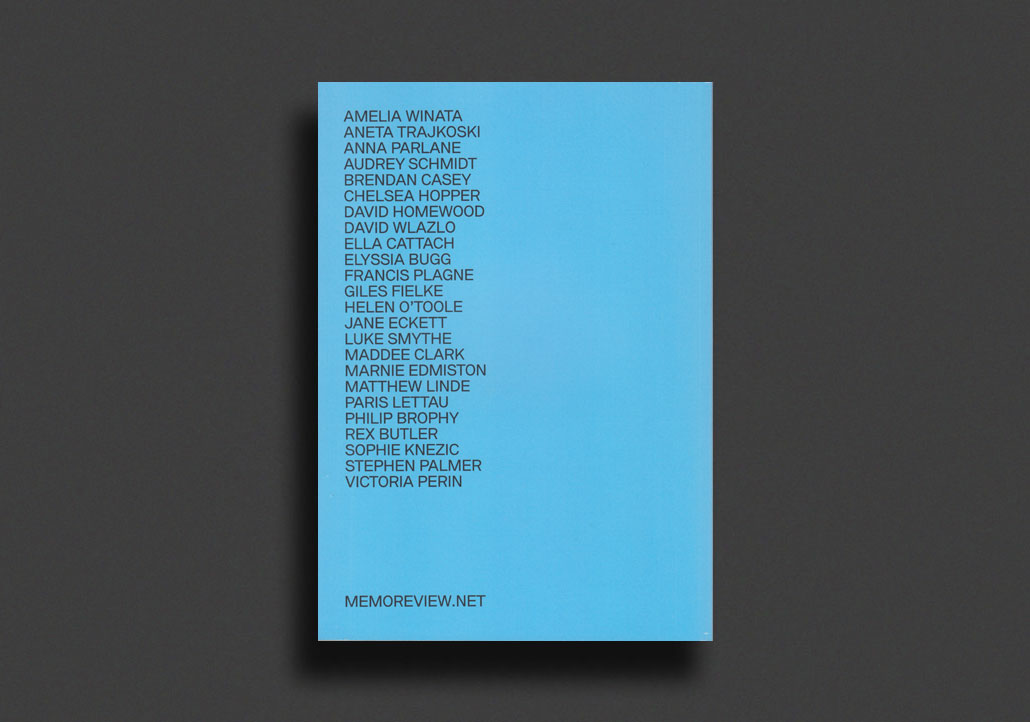
The third hardcopy Memo publication, collecting the 52 reviews from 2017 published by Melbourne's Memo Review. Memo Review is Melbourne's only weekly art criticism, publishing reviews of "a broad variety of art exhibitions at public art museums, commercial galleries and smaller artist-run spaces in Melbourne, offering new critical perspectives from an up-and-coming younger generation of Australian art scholars, writers and artists."
Contributions by Amelia Winata, Aneta Trajkoski, Anna Parlane, Audrey Schmidt, Brendan Casey, Chelsea Hopper, David Homewood, David Wlazlo, Ella Cattach, Elyssia Bugg, Francis Plagne, Giles Fielke, Helen O'toole, Jane Eckett, Luke Smythe, Maddee Clark, Marnie Edmiston, Matthew Linde, Paris Lettau, Philip Brophy, Rex Butler, Sophie Knezic, Stephen Palmer, Victoria Perin.
2020, English
Softcover, 269 pages, 25 x 17.5 cm
Published by
Monash Art Projects / Victoria
$25.00 - Out of stock
These are the reviews from 2020, the third year of Melbourne's Memo Review. Memo Review is Melbourne's only weekly art criticism, publishing reviews of "a broad variety of art exhibitions at public art museums, commercial galleries and smaller artist-run spaces in Melbourne, offering new critical perspectives from an up-and-coming younger generation of Australian art scholars, writers and artists."
"There is no getting around it: 2020 was the year of COVID. It was something that all kinds of cultural activities tried to make sense of. We could quote, to show it has all apparently happened before, Daniel Defoe’s A Journal of the Plague Year at you. Or, like everybody else, you could read some prominent philosopher or cultural theorist try to make sense of it. Slavoj Žižek wrote no fewer than two books on the subject during the year, which made us realise that at least he was doing what he usually does during lockdown."
"And we for our part at Memo Review also did what we usually do. Here are the forty-seven reviews we published during the year—a year when virtually every show we reviewed was only available online."
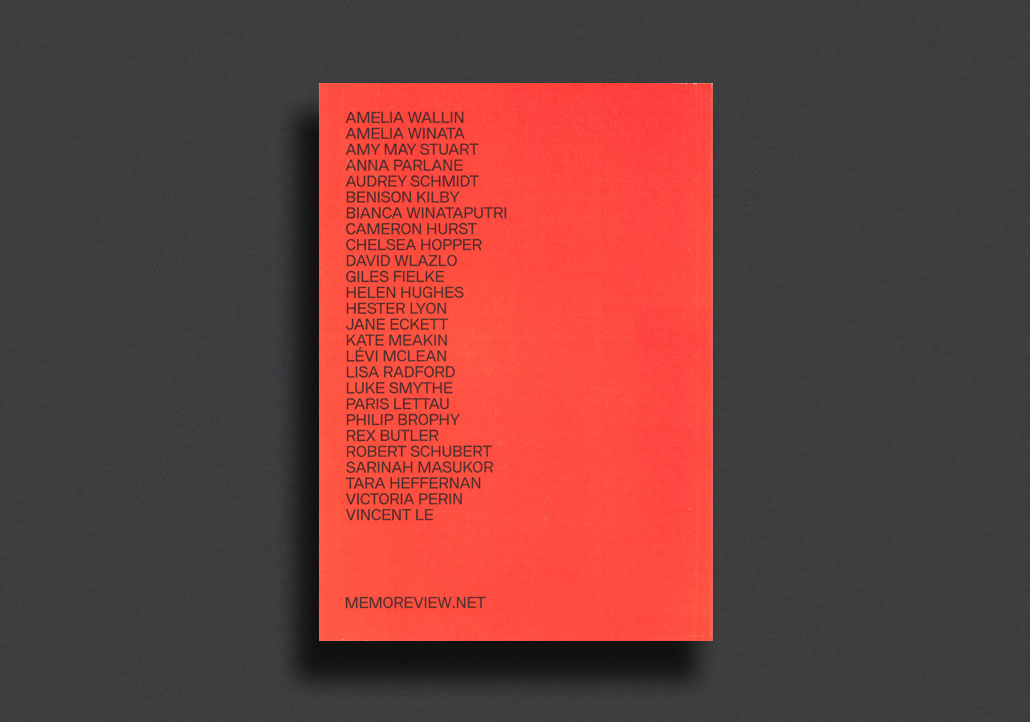
Contributions by Amelia Wallin, Amelia Winata, Amy May Stuart, Anna Parlane, Audrey Schmidt, Benison Kilby, Bianca Winataputri, Cameron Hurst, Chelsea Hopper, David Wlazlo, Giles Fielke, Helen Hughes, Hester Lyon, Jane Eckett, Kate Meakin, Levi Mclean, Lisa Radford, Luke Smythe, Paris Lettau, Philip Brophy, Rex Butler, Robert Schubert, Sarinah Masukor, Tara Heffernan, Victoria Perin, Vincent Le.
1976 / 1992, German
Hardcover (w. dust jacket), 130 pages, 31 x 24 cm
Out of print title / used / good
Published by
Schirmer & Mosel / Munich
$60.00 - Out of stock
"White Women was and still is the legendary first book by Helmut Newton, first published in 1976. His inimitable blend of aestheticism, technical perfection and luxurious, unsettling upper-middle-class decadence is today just as appealing and controversial as it was thirty-three years ago. White Women is a delicacy in visual erotic literature that connoisseurs and people in the know still consider to be Newton's best book ever."
1992 German hardcover edition of this highly original, widely acclaimed, lavish collection by Newton.
Helmut Newton (b. Helmut Neustädter; 1920 – 2004) was a German-Australian photographer. He began his career at the age of 16, working in Berlin for Yva, famous German Jewish photographer Else Ernestine Neuländer-Simon. As an 18-year-old, he emigrated to Australia, marrying actress June Browne (June Brunell), who later became a successful photographer under the ironic pseudonym Alice Springs (after Alice Springs, the central Australian town). In 1946, Newton set up a studio in fashionable Flinders Lane in Melbourne and worked on fashion, theatre and industrial photography in the affluent postwar years. He spent much of his life living between England, France, Australia and the USA, settling in Paris in 1961 where he established himself as one of the world's leading fashion photographers, his images a mainstay of French Vogue and Harper's Bazaar. His prolific, often provocative work was highly technical, marked by erotically-charged, stylised, almost cinematic scenes, often with sado-masochistic, fetishistic subtexts and dark undercurrents of middle-upperclass decadence. The first of his countless solo exhibitions took place in Paris in 1975, followed by many book publications and awards. To this day Newton is considered one of the most radical and iconic fashion photographers of the 20th Century.
Average-Good copy in Good dust jacket. A very good copy were it not for some light rippling through the pages, and a mysterious (candle smoke?) darkening to the bottom and side edges, not effecting content or jacket.
1982, German
Hardcover (w. dust jacket), 80 pages, 32 x 24 cm
1st Edition, Out of print title / used / very good
Published by
Schirmer & Mosel / Munich
$85.00 - Out of stock
First 1982 German edition of this iconic collection of photography by Helmut Newton, with introduction by Karl Lagerfeld. Simply titled "Helmut Newton", later printings added the "Big Nudes" title for which this classic photo-book has been commonly referred to ever since. "With his Big Nudes, in the 1980s Helmut Newton created a quite unprecedented long-term bestseller. Simultaneously, it provided a concentrated image of his aesthetic agenda. Powerful women were presented in all their naked truth-without fig leaves or fashion frills. This series of black-and-white photos, produced between 1979 and 1981, also marked a stylistic change in Newton's work. Elaborate layouts full of luxury and decadence gave way to an unambiguously formulated and monumental statement-'Here they come!' Dressed only in their indispensable high heels, Newton's amazons self-confidently paraded on show. They rippled their muscles and marched individually as well as in formation toward the observer. [...]" — publisher's blurb.
Helmut Newton (b. Helmut Neustädter; 1920 – 2004) was a German-Australian photographer. He began his career at the age of 16, working in Berlin for Yva, famous German Jewish photographer Else Ernestine Neuländer-Simon. As an 18-year-old, he emigrated to Australia, marrying actress June Browne (June Brunell), who later became a successful photographer under the ironic pseudonym Alice Springs (after Alice Springs, the central Australian town). In 1946, Newton set up a studio in fashionable Flinders Lane in Melbourne and worked on fashion, theatre and industrial photography in the affluent postwar years. He spent much of his life living between England, France, Australia and the USA, settling in Paris in 1961 where he established himself as one of the world's leading fashion photographers, his images a mainstay of French Vogue and Harper's Bazaar. His prolific, often provocative work was highly technical, marked by erotically-charged, stylised, almost cinematic scenes, often with sado-masochistic, fetishistic subtexts and dark undercurrents of middle-upperclass decadence. The first of his countless solo exhibitions took place in Paris in 1975, followed by many book publications and awards. To this day Newton is considered one of the most radical and iconic fashion photographers of the 20th Century.
Very Good copy.
2011, English
Softcover (unbound), 14 pages, 42 x 30 cm
Published by
Osiris / Japan
$38.00 - Out of stock
In the 1970s, Kohei Yoshiyuki (born in 1946) used an infrared camera, equipped with a filtered flash, to photograph couples having sex and capture the voyeurs watching them in the dark, in the parks of Tokyo. Yoshiyuki’s first solo exhibition abroad ‘The Park’ was held some 30 years later at the Yossi Milo Gallery in New York, 2007 and the corresponding book ‘Kohei Yoshiyuki: The Park’ was published by Hatje Cantz/Yossi Milo Gallery in the same year. Since then, Yoshiyuki’s work has attracted worldwide attention, as a social document of the megalopolis of Tokyo, raising questions related to human desire, privacy, voyeurism and ‘to see and be seen’.
This tabloid sized book ‘The Park 1971-73’ was published by Osiris on the occasion of his exhibition in Tokyo, 2011 and includes the 14 best known images from this amazing series of work.
2021, English / French
Softcover, 328 pages, 24 x 31 cm
1st Edition, Out of print title / as new
Published by
Lenz Press / Milan
Kunsthalle Zürich / Zürich
Galerie Neu / Berlin
Treize / Paris
$90.00 - Out of stock
Fast out-of-print, first, only edition of this comprehensive record of the London-based art collective BANK's notorious project from the late 1990s, a fierce critic of the language elements of the art market.
"Press releases are genuinely fascinating documents. They're usually unsigned, which is perhaps why they're so often absurdly pompous. But the really interesting thing is, who are they for? Rich collectors, who must be presumed to be stupid and talked to like children? Other gallerists, to show them that they read the backs of theory books too? Artists? Students? Just who is being addressed by these things? The endless nonsense they contained meant that we could be brutally honest about their conceits, assumptions and errors to the point of outright rudeness, under the none-too-convincing cover of offering free advice as to improvements. There was also a hopefully infuriating holier-than-thou tone to the whole project, and a hypocritical undercurrent."
—BANK
Between 1998 and 1999, BANK operated The BANK Fax-Bak Service. For the project, the group's members, Simon Bedwell, John Russell and Milly Thompson proof-read and copy-edited more than 300 press releases published by galleries in London and New York. The procedure was simple: after adding their mocking corrections, the artists faxed the promotional texts back to the respective galleries. The BANK Fax-Bak Service exposes the art market's (ongoing) sisyphean effort to legitimize itself through boasting, self-important and nonsensical language. Published in collaboration with Treize (Paris), this volume is a comprehensive record of BANK's notorious project from the late 1990s.
BANK was an artists' group fonded in London in 1991 by John Russell and Simon Bedwell, with Dino Demosthenous (who left in 1992) and joined by Milly Thompson, David Burrows and Andrew Williamson in 1993. They curated a series of group shows, often with comical, and sometimes offensive, titles. As a group they adopted an aggressive stance towards the mainstream contemporary art scene of the time. BANK also published a satirical magazine delivering tabloid-style critiques of the art world.
Edited by Tenzing Barshee, Gallien Déjean, Dan Solbach.
Graphic designed: Dan Solbach.
Out of print.
2021, English
Softcover, 216 pages, 15.2 x 22.9 cm
Published by
Duke University Press / North Carolina
$44.00 - Out of stock
It's time to recognize Kathy Acker as one of the great postwar American writers. Over the decades readers have found a punk Acker, a feminist Acker, a queer Acker, a kink Acker, and an avant-garde Acker. In Philosophy for Spiders, McKenzie Wark adds a trans Acker. Wark recounts her memories of Acker (with whom she had a passionate affair) and gives a comprehensive reading of her published and archived works. Wark finds not just an inventive writer of fiction who pressed against the boundaries of gender but a theorist whose comprehensive philosophy of life brings a conceptual intelligence to the everyday life of those usually excluded from philosophy's purview. As Wark shows, Acker's engagement with topics such as masturbation, sadism, body-building, and penetrative sex are central to her distinct phenomenology of the body that theorizes the body's relation to others, the city, and technology.
2021, English
Softcover, 200 pages, 12.6 x 20.2 cm
Published by
We Heard You Like Books / Los Angeles
$29.00 - Out of stock
I Should Have Known Better is a sequel to the sleeper hit I’m Open to Anything (2019), expanding the original’s scope and ambition. The new book has been produced entirely with the support of a crowdfunding campaign that reached five figures and 150% funding, an unprecedented accomplishment for a literary novel.
I Should Have Known Better’s first person narrator, while working at a dead-end job in Los Angeles during the mid-1990s, reconnects with his best friend Moira, recently returned from Central America, and makes a new friend, Bernie, who teaches the history of photography. The two of them convince him to pursue a master’s degree as a way of escaping the unrewarding life of a video store clerk. Once the narrator is exposed to an academic environment, he takes a dim view of the education that art school has to offer, but is happy to meet a group of talented fellow students who become close friends. He encounters a number of art world figures, ranging from the brilliant to the abject, who disabuse him of his illusions. The narrator has his most instructive experiences off campus, especially a love affair with the handsome and mercurial Temo, an insolent rich kid who leads a double life. Together they explore their sexual limits in scenes of bracing explicitness.
I Should Have Known Better bears witness to the last gasp of Los Angeles bohemia at the end of the twentieth century. The novel paints precise portraits of inspired eccentrics devoted to pursuing their dreams, "shopping artists" who believe in nothing but hedonism, and latter-day leftists who find themselves directionless after the fall of communism. Above all, the book pays tribute to the impulsive experiments and intense friendships of youth.
William E. Jones is an artist, filmmaker, and writer. He has made two feature length experimental films, Massillon (1991) and Finished (1997), the documentary Is It Really So Strange? (2004), and videos including The Fall of Communism as Seen in Gay Pornography (1998), Psychic Driving (2014), and Fall into Ruin (2017). His work has been the subject of retrospectives at Tate Modern (2005), Anthology Film Archives (2010), Austrian Film Museum, and Kurzfilmtage Oberhausen (both 2011). Jones's writing has also appeared in periodicals such as Animal Shelter, Area Sneaks, Artforum, Bidoun, Butt, Frieze, Little Joe, Mousse, Osmos, and The White Review. He is the author of the nonfiction books Killed: Rejected Images of the Farm Security Administration (2010), Halsted Plays Himself (2011), Imitation of Christ (2013), and True Homosexual Experiences: Boyd McDonald and Straight to Hell (2016); as well as the novels I’m Open to Anything (2019) and I Should Have Known Better (2021). He lives in Los Angeles.
2019, English
Softcover, 150 pages, 12.4 x 19.8 cm
Published by
We Heard You Like Books / Los Angeles
$35.00 - Out of stock
A perverse and explicit new take on the coming of age novel, William E. Jones’s I’m Open to Anything explores bohemian Southern California of the late 1980s and early 90s, before gentrification ruined everything. The book’s narrator flees a crumbling industrial wasteland in the Midwest and finds himself in sunny Los Angeles without a car, working in a neighborhood video store and spending many hours watching films. He explores his adopted city and befriends a number of men, most of them immigrants, who teach him the finer points of sex. He acquires the skill of fisting, giving his partners intense pleasure, and at the same time hearing the stories of their lives. They too have fled their hometowns: one to escape torture at the hands of a Salvadoran death squad; another to study anthropology after years of wandering and religious questioning.
Alternating between explicit scenes of kinky sex and intimate conversations about matters of life and death, I’m Open to Anything is a porno novel of rare ambition and humor. The book recalls Olympia Press’s heyday, when authors made quick money churning out dirty books, but couldn’t hide the intellectual obsessions that made them writers in the first place.
William E. Jones’s previous book, True Homosexual Experiences (also published by We Heard You Like Books), a biography of Straight to Hell’s iconoclastic editor Boyd McDonald, celebrates the frank, raunchy language of the first queer ’zine. Jones brings the same unsparing and profane attitude to I’m Open to Anything, his debut novel.
2020, English
Hardcover (clothbound in slipcase), 384 pages, 23 x 30 cm
Published by
The Shed / US
$130.00 - Out of stock
"Agnes Denes, the queen of land art, made one of New York's greatest public art projects ever in 1982. Now, the world might be catching up with her." — Karrie Jacobs, New York Times
Agnes Denes: Absolutes and Intermediates accompanies the largest exhibition of the artist's work in New York to date, held at The Shed in fall 2019 as part of the arts space's opening season. Presenting more than 130 works, this comprehensive publication, presented in an embossed slipcase, spans the 50-year career of the path-breaking artist dubbed "the queen of land art" by the New York Times, famed for her iconic Wheatfield—A Confrontation (1982), for which she planted a two-acre wheatfield in Lower Manhattan on the Battery Park Landfill, in the shadow of the then recently erected Twin Towers.
A major undertaking, this superb hardcover catalog includes a comprehensive text by the exhibition's curator, Emma Enderby, an interview with Denes by Hans Ulrich Obrist, essays by prominent scholars and curators including Caroline A. Jones, Lucy R. Lippard and Timothy Morton that examine Denes' multifaceted practice in new ways, writings by the artist and reflections by curators who have worked with Denes over the course of her career. New works by Denes commissioned by The Shed for the exhibition are presented in a special insert.
Budapest-born, New York-based artist Agnes Denes (born 1931) rose to international attention in the 1960s and 1970s as a leading figure in conceptual, environmental and ecological art. A pioneer of several art genres, she has created work in many mediums, utilizing various disciplines--such as science, philosophy, linguistics, ecology and psychology—to analyze, document and ultimately aid humanity.
"Denes's ecological artworks, which she commenced in the late 1960s, are just as prescient as this early diagnosis of climate catastrophe. Over the ensuing decades, she has been called a visionary. But such encomiums risk eliding the depth and complexity they celebrate. Denes has never been just one thing." — Lauren O'Neill-Butler, Artforum
2020, English / German
Softcover, 72 pages, 19 x 25 cm
Published by
Bom Dia Boa Tarde Boa Noite / Berlin
Staatliche Kunsthalle / Baden Baden
$48.00 - Out of stock
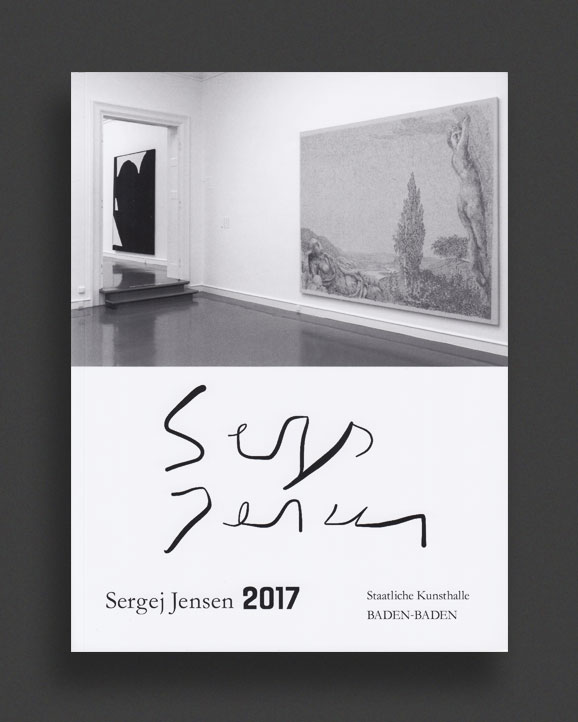
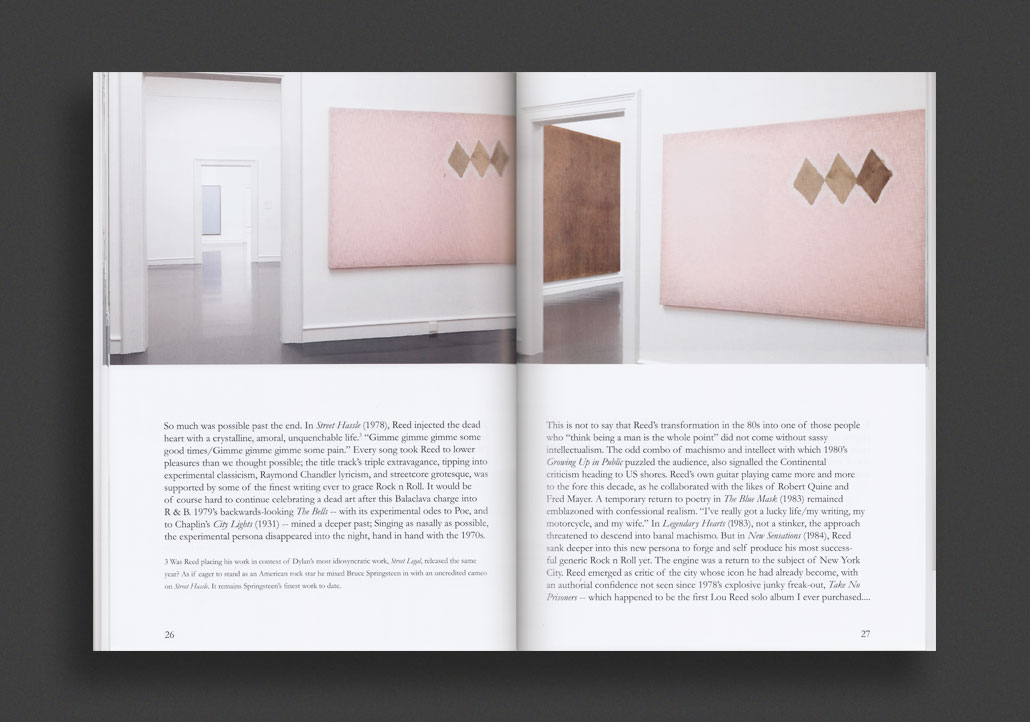
Retrospective catalogue spanning more than fifteen years of work by the conceptual textile artist known to explore the idiom of minimalist painting.
The catalogue is published on the occasion of Sergej Jensen's extensive solo exhibition at Staatliche Kunsthalle Baden-Baden in 2017. With over 40 works by the artist living in New York and Berlin, the show was presenting a selection of works from 2001 to the present. The publication contains texts by Mark von Schlegell, and Magnus Schaefer. Designed by Studio Manuel Raeder.
The practice of Sergej Jensen (born 1973 in Maglegaard, Denmark, lives and works in New York) draws on a wide range of materials and formal references. Jensen grew up in Frankfurt and studied at the local Städelschule under Prof. Thomas Bayrle. Primarily known for his textile works, his lyrical compositions incorporate a variety of fabrics, from burlap and linen to silk and wool. Working within the idiom of minimalist painting, Jensen takes its material support—the canvas—and sews, bleaches, stretches or stains the cloth to create works that waver between abstraction and representation. The principle of the readymade and recycling also suffuse his practice; off-cuts from previous works often re-appear as motifs for new paintings; hand-knitted lengths are sewn or pulled over stretchers; sections of fabric are left outside to let the weather alter its surface. His practice draws attention to seemingly incidental details such as flecks of wool or frayed edges, and his muted palette and gestural mark-making, whether applied in paint or stained with bleach, point as much to negative space as to delineated forms. Although the imagery can be hard to read, the titles given often allude to their point of origin in recognisable forms, such as Tower of Nothing made from recycled moneybags, or Eye of the maker featuring various banknotes of different currencies, which point to his unabashed relationship to the commercial market.
While the discourse of Jensen's paintings is often associated with the work of Rosemarie Trockel, Sigmar Polke, Blinky Palermo and Michael Krebber, it is the production of his own music, films and collaborative performances which bears as large an influence over his practice. In previous gallery exhibitions, Jensen has also subverted the gallery context by the arrangement of his paintings alongside additional domestic elements such as a fireplace, rugs or carpeting. For the Berlin Biennial, Jensen created a “waiting room” lined with chairs, paintings, appliquéd fabric ceiling and a monitor with a film by Jensen capturing from a window unsuspecting passers-by in a park.
2021, English / German
Softcover, 356 pages, 26 x 19.5 cm
Published by
Fridericianum / Kassel
Koenig Books / London
$100.00 - Out of stock
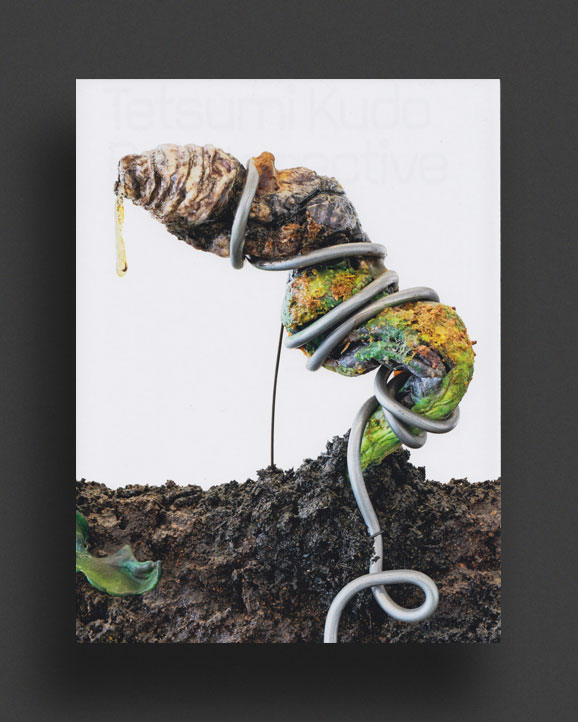
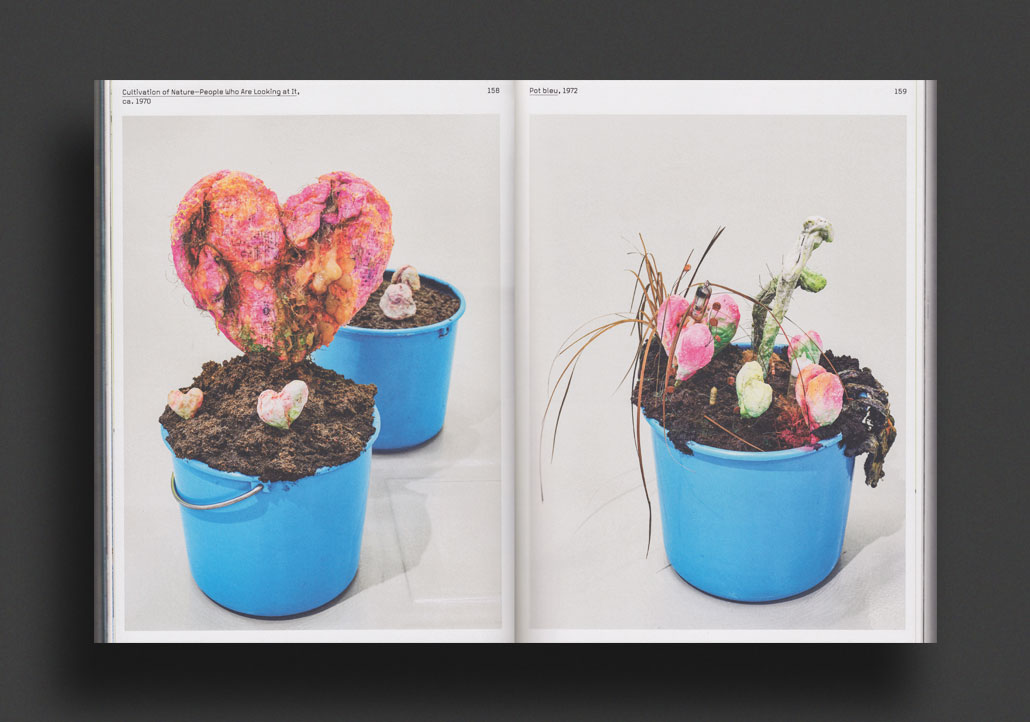
Bottled humanism, coloured neon contaminations, tattered flaps of skin, and limp penises bring humanist self-assurance crashing to the ground. What appears as poison or chemical devastation is in fact an appeal to understand metamorphosis as a state of being.
Over a period of three decades, from the mid-1950s to the late 1980s, the Japanese artist Tetsumi Kudo (1935–1990) created a consistent body of work that serves as a model for contemporary conceptual approaches of Posthumanism and the New Materialism. The artist reflects upon the ideological boundaries between mankind, nature, and technology from the distanced perspective of an unsentimental observer.
In Japan, the nuclear attacks on Hiroshima and Nagasaki produced a caesura; their devastating effects revealed the vulnerability of the human organism. Nuclear disaster is equivalent to a demonstration of both absolute power and loss of control, exposing the paradox inherent in Humanism. Consequently, it becomes necessary to transform the human being. Kudo demonstrates how body parts, plants, and electrical devices converge to form post-human structures.
This catalogue brings together contributions by artists (such as Mike Kelley) and theorists and documents Kudo’s comprehensive oeuvre in work and archive images as well as exhibition views from the retrospective.
Published after the 2016/17 retrospective exhibition at Fridericianum, Kassel.
English and German text.
2018, English
Softcover, 236 pages, 27 x 21.2 cm
Published by
Walther König / Köln
Stedelijk Museum / Amsterdam
S.M.A.K. / Gent
Pinakothek der Moderne / Munich
$98.00 - Out of stock
After his debut in 1964 the Belgian painter, Raoul De Keyser (1930-2012) developed a working method that was as obstinate as it was tactical, in which the common distinctions between abstraction and figuration dissolve in the poetic binding of the work with the everyday.
This catalogue to the first posthumous retrospective exhibition is conceived as a classic monograph on the life and work of the artist.
Alongside a detailed account of the development of Keyser’s oeuvre, the catalogue contains an comprehensive illustrated chronology as well as, for the first time, a chapter on drawing and photography.
Equally interesting are quotes by artists such as Tomma Abts, Maria Eichhorn, Thomas Scheibitz and James Welling (among others) about their influential colleague.
Published on the occasion of the exhibition, Raoul De Keyser: Oeuvre at Stedelijk Museum voor Actuele Kunst (S.M.A.K.), Gent in 2018/19, and Pinakothek der Moderne, Munich in 2019.