World Food Books' programme is largely produced on Kulin Nation land. We acknowledge the Wurundjeri people of the Kulin Nation as the first and continuing custodians of this land, and pay respect to their Elders past, present, and emerging.
World Food Books is an arts and special interests bookshop in Naarm / Melbourne. Founded in 2010, World Food Books is devoted to the presentation of a rotating, hand-selection of international art, design, literary and counterculture publications with an emphasis on the anti-traditional, the experimental, the avant-garde, the heretic, the marginal.
Presenting new titles alongside rare and out-of-print books, catalogues and journals spanning the fields of modern and contemporary art, design, photography, illustration, film, literature, poetry, cultural theory, philosophy, sexuality, popular and underground culture in its many radical forms, World Food Books wishes to encourage adventurous, thoughtful and open-minded reading, looking, writing, and exchange of publishing and ideas, both current and historical.
As well as our bookshop, located in Melbourne's historical Nicholas Building, all of our inventory is available internationally via our online mail-order service.
World Food Books semi-regularly co-ordinates "Occasions", a programme of exhibits and events at the bookshop and in partnership with other hosts (such as museums and art galleries) that develop out of the activities, relationships and content of the bookshop itself.
World Food Books
The Nicholas Building
37 Swanston Street
Room 5, Level 6
Melbourne 3000
Australia
SHOP HOURS:
Thu–Fri 12–6, Sat 12–5
WEB-SHOP OPEN 24/7
World Food Books
Postal Address:
PO Box 435
Flinders Lane
Victoria 8009
Australia
Art
Theory / Essay
Architecture / Interior
Graphic Design / Typography
Photography
Fashion
Eros
LGBTQ+
Fiction / Poetry
Weird / Speculative / Science Fiction / Horror
Transgressive / Visceral / Abject
Symbolism / Decadence / Fin de siècle
Film / Video
Painting
Sculpture / Installation
Performance / Dance / Theater
Drawing
Sound / Music
Curatorial
Group Shows / Collections
Periodicals
Out-of-print / Rare
Posters / Ephemera / Discs
Signed Books
World Food Books Gift Voucher
World Food Book Bag
Australian Art
Australian Fiction
Australian Science Fiction / Speculative Fiction
Australian Poetry
Australian Photography
Japanese Photography
Conceptual Art
Minimal Art
Dada
'Pataphysics / Oulipo
Fluxus
Concrete Poetry
Pop Art
Surrealism
Arte Povera
Arte Informale / Haute Pâte / Tachism
Nouveau Réalisme / Zero / Kinetic
Situationism / Lettrism
Collage / Mail Art / Xerox Art
Art Brut / Folk / Visionary / Fantastic
Illustration / Graphic Art / Bandes Dessinées
Furniture
Italian Radical Design / Postmodernism
Textiles
Ceramics / Glass
Counterculture
Protest / Revolt
Philosophy
Psychoanalysis
Anthropology
Anarchism
Socialism / Anarchism / Communism / Capitalism
Literary Theory / Semiotics / Language
Feminism / Women's Studies
Gender Studies / Sexuality
Anthropology
Fetishism / BDSM
Drugs / Psychedelia
Crime / Violence
Animal Rights / Veganism
Occult / Esoterica
Ecology / Earth / Alternative Living
Whole Earth / Crafts
All prices in AUD (Australian dollars)
Pick-Ups
Pick-up orders can be collected in our bookshop during opening hours after order date. Please collect any Pick-up orders within 2 weeks of ordering as we have limited storage space. Orders will be released back into stock if not collected within this time. No refunds can be made for pick-ups left un-collected. If you cannot make it in to the bookshop in this time-frame, please choose postage option.
Return Policy
All sales are final. We do accept returns (for refund or exchange) for items received in error. All our orders are packed with special care using heavy-duty padding and cardboard book-mailers or bubble mailers (for smaller books), using reinforcement where required. We cannot take responsibility for any lost, stolen or damaged parcels.
Insurance
Should you wish to insure your package, please email us directly after placing your order and we can organise this at a small extra expense. Although all standard/express tracked packages are very safe and dependable, we cannot take responsibility for any lost, stolen or damaged parcels. We recommend insurance on valuable orders.
Interested in selling your old books, catalogues, journals, magazines, comics, fanzines, ephemera? We are always looking for interesting, unusual and out-of-print books to buy. We only buy books in our fields of interest and specialty, and that we feel we can resell.
We base these prices on desirability, market value, in-print prices, condition and our current stock levels. We offer cash, store credit, and can take stock on consignment. All
about 25% of the price we expect to get when we sell them, or 30% in store credit. We base these prices on desirability, market value, in-print prices, condition and our current stock levels.
Sell your books any day of the week. You can drop them off and return later. If you have a lot of books, we can visit your Sydney home.
We buy books that we feel we can resell. We offer about 25 % of the price we expect to get when we sell them, or 30% in store credit. We base these prices on desirability, market value, in-print prices, condition and our current stock levels.
Philadelphia Wireman
03 August - 01 September, 2018
World Food Books is proud to announce our next Occasion, the first presentation of sculptures by Philadelphia Wireman in Australia.
The Philadelphia Wireman sculptures were found abandoned in an alley off Philadelphia’s South Street on trash night in 1982. Their discovery in a rapidly-changing neighbourhood undergoing extensive renovation, compounded with the failure of all attempts to locate the artist, suggests that the works may have been discarded after the maker’s death. Dubbed the "Philadelphia Wireman" during the first exhibition of this work, in 1985, the maker’s name, age, ethnicity, and even gender remain uncertain. The entire collection totals approximately 1200 pieces, all intricately bound together with tightly-wound heavy-gauge wire (along with a few small, abstract marker drawings, reminiscent both of Mark Tobey and J.B. Murry). The dense construction of the work, despite a modest range of scale and materials, is singularly obsessive and disciplined in design: a wire armature or exoskeleton firmly binds a bricolage of found objects including plastic, glass, food packaging, umbrella parts, tape, rubber, batteries, pens, leather, reflectors, nuts and bolts, nails, foil, coins, toys, watches, eyeglasses, tools, and jewellery.
Heavy with associations—anthropomorphic, zoomorphic, and socio-cultural responses to wrapped detritus—the totemic sculptures by Philadelphia Wireman have been discussed in the context of work created to fulfil the shamanistic needs of alternative religions in American culture. Curators, collectors, and critics have variously compared certain pieces to sculpture from Classical antiquity, Native American medicine bundles, African-American memory jugs, and African fetish objects. Reflecting the artist’s prolific and incredibly focused scavenging impulse, and despite—or perhaps enhanced by—their anonymity, these enigmatic objects function as urban artefacts and arbiters of power, though their origin and purpose is unknown. Philadelphia Wireman, whatever their identity, possessed an astonishing ability to isolate and communicate the concepts of power and energy through the selection and transformation of ordinary materials. Over the course of the past two decades, this collection has come to be regarded as an important discovery in the field of self-taught art and vernacular art.
Presented in collaboration with Fleisher-Ollman Gallery, Philadelphia, and Robert Heald, Wellington.
Susan Te Kahurangi King
02 February - 10 March, 2018
Susan Te Kahurangi King (24 February 1951 - ) has been a confident and prolific artist since she was a young child, drawing with readily available materials - pencils, ballpoint pens and felt-tip markers, on whatever paper is at hand. Between the ages of four and six Susan slowly ceased verbal communication. Her grandparents William and Myrtle Murphy had developed a special bond with Susan so they took on caring responsibilities for extended periods. Myrtle began informally archiving her work, carefully collecting and storing the drawings and compiling scrapbooks. No drawing was insignificant; every scrap of paper was kept. The King family are now the custodians of a vast collection containing over 7000 individual works, from tiny scraps of paper through to 5 meter long rolls.
The scrapbooks and diaries reveal Myrtle to be a woman of great patience and compassion, seeking to understand a child who was not always behaving as expected. She encouraged Susan to be observant, to explore her environment and absorb all the sights and sounds. Myrtle would show Susan’s drawings to friends and people in her community that she had dealings with, such as shopkeepers and postal workers, but this was not simply a case of a grandmother’s bias. She recognised that Susan had developed a sophisticated and unique visual language and sincerely believed that her art deserved serious attention.
This was an unorthodox attitude for the time. To provide some context, Jean Dubuffet coined the term Art Brut in 1945 to describe work created by self-taught artists – specifically residents of psychiatric institutions and those he considered to be visionaries or eccentrics. In 1972 Roger Cardinal extended this concept by adopting the term Outsider Art to describe work made by non-academically trained artists operating outside of mainstream art networks through choice or circumstance. Susan was born in Te Aroha, New Zealand in 1951, far from the artistic hubs of Paris and London that Dubuffet and Cardinal operated in. That Myrtle fêted Susan as a self-taught artist who deserved to be taken seriously shows how progressive her attitudes were.
Susan’s parents Doug and Dawn were also progressive. Over the years they had consulted numerous health practitioners about Susan’s condition, as the medical establishment could not provide an explanation as to why she had lapsed into silence. Dawn educated herself in the field of homeopathy and went on to treat all twelve of her children using these principles – basing prescriptions on her observations of their physical, mental and emotional state.
Doug was a linguist with an interest in philosophy who devoted what little spare time he had to studying Maori language and culture. To some extent their willingness to explore the fringes of the mainstream made them outsiders too but it was their commitment to living with integrity and their respect for individuality that ensured Susan’s creativity was always encouraged.
Even though Susan’s family supported her artistic pursuits, some staff in schools and hospitals saw it as an impediment to her assimilation into the community and discouraged it in a variety of ways. Her family was not always aware of this and therefore did not fully understand why Susan stopped drawing in the early 1990s. However, rather than dwell on the challenges that Susan faced in pursuit of her artistic practice, they prefer to highlight her achievements. In 2008 Susan began drawing again in earnest, after an almost 20 year interruption, and her work is now shown in galleries around the world.
Susan grew up without television and has been heavily influenced by the comics she read as a child. She is absolutely fearless in the appropriation of recognizable characters, such as Donald Duck and Mickey Mouse, in her work. She twists their limbs, contorts their faces, compresses them together, blends them into complex patterned backgrounds - always imbuing them with an incredible energy. Although Susan often used pop culture characters in her work they are not naive or childlike. These are drawings by a brilliant self-taught artist who has been creating exceptional work for decades without an audience in mind.
Mladen Stilinović
"Various Works 1986 - 1999"
02 February 16 - September 10, 2016
Various works 1986 - 1999, from two houses, from the collections of John Nixon, Sue Cramer, Kerrie Poliness, Peter Haffenden and Phoebe Haffenden.
Including: Geometry of Cakes (various shelves), 1993; Poor People’s Law (black and white plate), 1993; White Absence (glasses, ruler, set square, silver spoon, silver ladel with skin photograph and wooden cubes), 1990-1996; Exploitation of the Dead (grey and red star painting, wooden painting, black spoon with red table, red plate), 1984-1990; Money and Zeros (zero tie, paintings made for friends in Australia (Sue, John, Kerrie), numbers painting), 1991-1992; Words - Slogans (various t-shirts) - “they talk about the death of art...help! someone is trying to kill me”, “my sweet little lamb”, “work is a disease - Karl Marx”; Various artist books, catalogues, monographs, videos; Poster from exhibition Insulting Anarchy; "Circular" Croatian - Australian edition; Artist book by Vlado Martek (Dostoyevsky); more.
Thanks to Mladen Stilinović and Branka Stipančić.
Jonathan Walker
Always Will Need To Wear Winter Shirt Blue + Ochre Small Check Pattern
21 August - 21 September, 2015
Untitled
I am not a great reader of poetry but I always return to the work of Melbourne poet, Vincent Buckley (1925- 1988). Perhaps I find his most tantalising piece to be not a finished poem but a fragment left on a scrap of paper discovered on his desk after the poet’s death.
The poetry gathers like oil
In the word-core, and spreads
It has its music meet,
Its music is in movement.
This fragment is more the shell left behind from a volatile thought than a finished poem. I find the last two lines honest but awkward whereas the first two lines work like an arrow. Most likely he could not find a resolution so it was left. Still, in its present form, it remains an eloquent testimony to the ultimate failure of a medium to express mobile thought and sensation, in Buckley’s case, through verbal language. It’s an important matter because this is something all artists have to deal with regardless of the medium.
I have never written a poem, however, I am forever copying fragments from books on paper scraps in a vain effort to fix certain notions in my head. At first, they function as bookmarks that are sometimes returned to when I open the book. But before long, as they accumulate, they fall out littering the table interspersed with A4 photocopies, bills, books and medications.
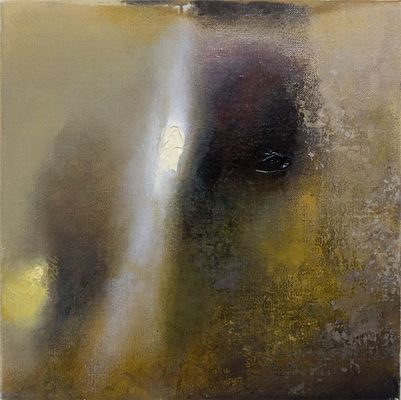
To return to Buckley’s fragment, the first two lines very much evoke how I paint nowadays. As you age, detail diminishes and patches of light become more luminous and float. I feel the most honest way of dealing with this is by smearing the oil paint on the canvas with the fingers and working close-up, blind. Only if the patches coalesce into an approaching image can the work gain a life.
-
Jonathan Walker was born in Melbourne, Australia and brought up on a dairy farm in Gippsland. In the 1970’s he studied painting at RMIT and won the Harold Wright Scholarship to the British Museum, London. During the 1980’s he exhibited at Pinacotheca Gallery, Richmond and had work shown at the NGV and Heidi City Art Gallery. Over the same period he designed the cover for the “Epigenesi” LP by Giancarlo Toniutti, Italy and conducted a mail exchange work with Achim Wollscheid, Germany. The work with artists through the post resulted in an article published in the bicentenary issue of Art and Australia 1988. He showed in artist run spaces such as WestSpace in the 90’s and 2000’s, and until 2012, taught painting at Victoria University, which is where we (Colleen Ahern and Lisa Radford) as organisers of the exhibition, among many others, had the privilege of being his student.
Walker’s knowledge was imparted to students through the careful selection of music, literature, and artists found in books that he himself had ordered for the library. Walker’s strategy was the generosity of sharing his vast knowledge with references specific to each student and their context.
Walker’s paintings share a similar focus and intimacy.
This exhibition presents a small selection of recent paintings alongside a publication that includes Walker’s writing. Observational and analytical, Walker’s work is a type of material notation — the time of day, colour and how it is blended, the both specific and fleeting location of a reflection on lino or the question of whether a chair leg should be included in a painting.
Please join us on Friday August 21 between 6-8pm to celebrate the opening of the exhibition.
Curated by Colleen Ahern and Lisa Radford.
B. Wurtz
Curated by Nic Tammens
March 26 - April 4, 2015
B.Wurtz works from a basement studio in his home on Manhattan’s Lower East Side.
This local fact is attested to by the plastic shopping bags and newsprint circulars that appear in his work. As formal objects, they don’t make loud claims about their origins but nonetheless transmit street addresses and places of business from the bottom of this long thin island. Like plenty of artists, Wurtz is affected by what is local and what is consumed. His work is underpinned by this ethic. It often speaks from a neighborhood or reads like the contents of a hamper:
“BLACK PLUMS $1.29 lb.”
“Food Bazaar”
“USDA Whole Pork Shoulder Picnic 99c lb.”
“RITE AID Pharmacy, with us it’s personal.”
“H. Brickman & Sons.”
“Sweet Yams 59c lb."
Most of the work in this exhibition was made while the artist was in residence at Dieu Donne, a workshop dedicated to paper craft in Midtown. Here Wurtz fabricated assemblages with paper and objects that are relatively lightweight, with the intention that they would be easily transportable to Australia. This consideration isn’t absolute in Wurtz’s work, but was prescriptive for making the current exhibition light and cheap. Packed in two boxes, these works were sent from a USPS post office on the Lower East Side and delivered to North Melbourne by Australia Post.
Wurtz appears courtesy of Metro Pictures, New York.
Thanks to Rob Halverson, Joshua Petherick, Sari de Mallory, Matt Hinkley, Helen Johnson, Fayen d'Evie, Ask Kilmartin, Lisa Radon, Ellena Savage, Yale Union, and "Elizabeth".
John Nixon
"Archive"
December 15 - January 20, 2014
The presentation of John Nixon's archive offered a rare showcase of this extensive collection of the artist's own publications, catalogues, posters, ephemera, editions and more, from the mid 1980s onwards, alongside a selection of his artworks.
Organized by John Nixon, Joshua Petherick and Matt Hinkley.
<a href=http://wfb.public-office.info/artist/john-nixon>All titles by John Nixon
"Habitat"
at Minerva, Sydney (organised by Joshua Petherick and Matt Hinkley)
November 15 - December 20, 2014
Lupo Borgonovo, Janet Burchill & Jennifer McCamley,
Lewis Fidock, HR Giger, Piero Gilardi, Veit Laurent Kurz,
Cinzia Ruggeri, Michael E. Smith, Lucie Stahl, Daniel Weil, Wols
Press Release:
“...It contained seven objects. The slender fluted bone, surely formed for flight, surely from the wing of some large bird. Three archaic circuitboards, faced with mazes of gold. A smooth white sphere of baked clay. An age-blackened fragment of lace. A fingerlength segment of what she assumed was bone from a human wrist, grayish white, inset smoothly with the silicon shaft of a small instrument that must once have ridden flush with the surface of the skin - but the thing’s face was seared and blackened.”
William Gibson, “Count Zero”, 1986
"Autumn Projects Archive"
Curated by Liza Vasiliou
March 6 - March 15, 2014
World Food Books, in conjunction with the Virgin Australia Melbourne Fashion Festival 2014, presented the Autumn Projects archive, consisting of a selection of early examples in Australian fashion with a particular interest in collecting designers and labels from the period beginning in the 1980’s, who significantly influenced the discourse of Australian Fashion.
Curated by Liza Vasiliou, the exhibition provided a unique opportunity to view pieces by designers Anthea Crawford, Barbara Vandenberg, Geoff Liddell and labels CR Australia, Covers, Jag along with early experimental collage pieces by Prue Acton and Sally Browne’s ‘Fragments’ collection, suspended throughout the functioning World Food Books shop in Melbourne.
H.B. Peace
presented by CENTRE FOR STYLE
November 14, 2013
"Hey Blinky, you say chic, I say same"
Anon 2013
H.B. Peace is a clothing collaboration between great friends Blake Barns and Hugh Egan Westland. Their pieces explore the divergences between 'character’ and ‘personality’ in garments....etc
Special Thanks to Joshua Petherick and Matt Hinkley of WFB and Gillian Mears
and a Very Special Thank you to Audrey Thomas Hayes for her shoe collaboration.
Janet Burchill & Jennifer McCamley
"Aesthetic Suicide"
May 10 - June 8, 2013
The first of our occasional exhibitions in the World Food Books office/shop space in Melbourne, "Aesthetic Suicide" presented a body of new and older works together by artists Janet Burchill & Jennifer McCamley, including videos, prints, a wall work, and publications.
During shop open hours videos played every hour, on the hour.
1978, French
Softcover (staple-bound), 82 pages, 28.5 x 20.5 cm
1st Edition, Out of print title / used / good
Published by
L'Echo des Savanes / Paris
$30.00 - Out of stock
Issue 44 of L'Echo des Savanes Mensuel, published in 1978. Cover art by Robert Crumb. Features comics, artwork by Crumb, Saul Steinberg, Martin Veyron, Mel Graff, John Workman, Gene Day, Jean Teulé, Barbe, an article on MAD Magazine, more stories, cartoons, and much more...
L'Echo des Savanes Mensuel was a leading Franco-Belgian comics magazine founded in 1972 by Claire Bretécher, Marcel Gotlib and Nikita Mandryka. It featured many of the best of underground comic artists from around the world, particularly France and the US, every issue packed with parody of all sorts, often cartoons playfully taking the mickie out of other "popular" cartoons, and of course endless T & A and buffoonery. They were also book publishers of some excellence.
Good copy with general wear.
2018, English
Hardcover, 112 pages, 22.5 x 24.5 cm
Published by
Sternberg Press / Berlin
CCA Wattis Institute for Contemporary Arts / San Francisco
ICA / Pennsylvania
$76.00 $30.00 - Out of stock
Contributions by Anthony Elms, Josephine Pryde, Jamie Stevens
lapses in Thinking By the person i Am presents documentation and texts from Josephine Pyde’s eponymous exhibition shown at the CCA Wattis Institute for Contemporary Arts, San Francisco, and Institute of Contemporary Art at the University of Pennsylvania. In this body of work, Pryde combines a series of color photographs of hands touching objects with a scale-model freight train and track, replete with miniaturized graffiti, that took visitors in a short ride through the exhibition. Through photography and sculpture, Pryde pays close attention to the nature of image making and the conditions display, subtly reworking codes and conventions to alter our cultural perception and understanding of each. In this book, “The Individual,” an essay by Pryde originally published in the journal Texte zur Kunst, is followed by an essay from CCA Wattis exhibition curator Jamie Stevens and a conversation between Pryde and ICA curator Anthony Elms.
Copublished with CCA Wattis Institute for Contemporary Arts, San Francisco; and Institute of Contemporary Art, University of Pennsylvania
Design by Clemens Jahn
1984, Japanese
Softcover, 224 pages, 21 x 15 cm
1st Edition, Out of print title / used / fine
Published by
Night Vision / Japan
$55.00 - Out of stock
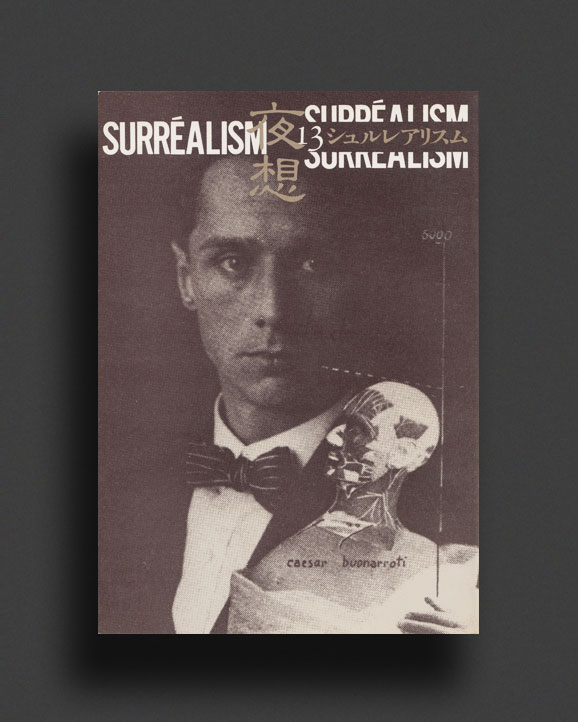
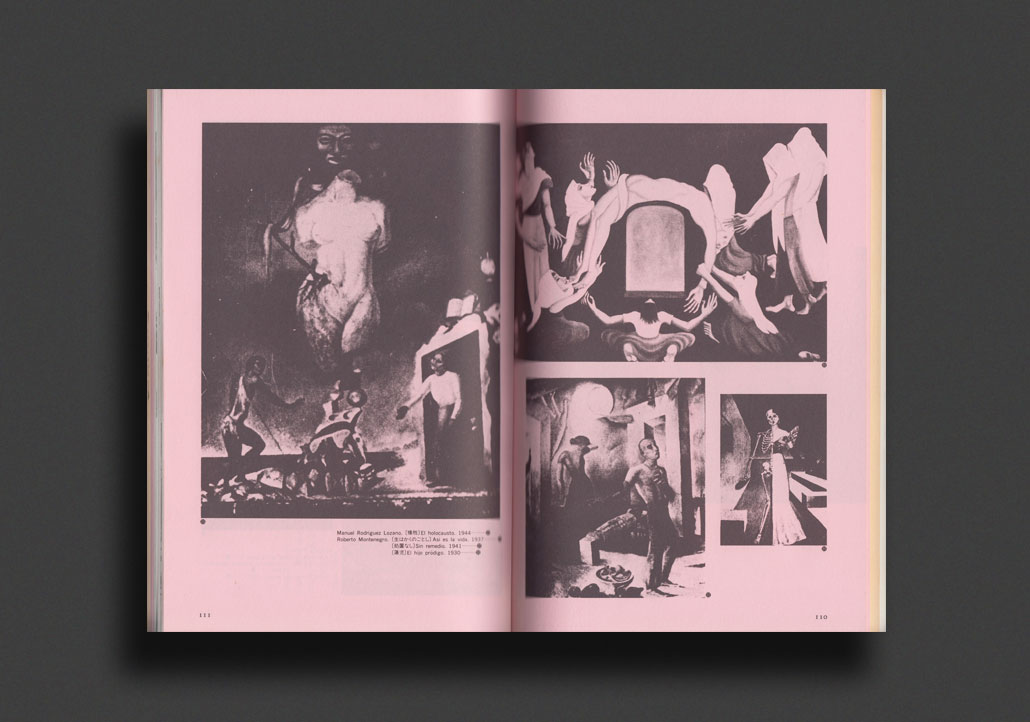
First 1984 edition of cult Japanese underground magazine Night Vision, a special edition dedicated to Surrealism. Packed with content, including many important Surrealist texts translated to Japanese, this heavily illustrated book includes features on Hans Bellmer and Unica Zürn, Yves Tanguy, Remedios Varo, Max Ernst, Belgian Surrealism, female Surrealist artists and poets (Remedios Varo, Mimi Parent, Valentine Penrose, Gisèle Prassinos, Dorothea Tanning, Bona de Mandiargues, Isabelle Walberg, Lise Deharme, Leonora Carrington, Dora Maar, Aube Elléouët, Jane Graverol, Nelly Kaplan (Belen), Joyce Mansour, Nora Mitrani, Unica Zürn, Valentine Hugo, Marianne Van Hirtum, Leonora Fini, Marie-Laure de Noailles, Kay Sage, Toyen, Annie Le Brun, Meret Oppenheim), Latin American Surrealism and Frida Kahlo-Diego Rivera, Surrealist literature and activities (Artaud, Picabia, Apollinaire, Bataille, Duchamp, Satie, Breton, etc.) plus much more, text contributions by Georges Bataille, Paul Eluard, Midori Wakakuwa, Kuniharu Akiyama, Takashi Tanyuya, Shigeo Goto, Takahiko Okada, Octavio Paz, André Breton, Kunio Iwaya, Gonzalo Cerorio, Yuichi Konno, Satoshi Takamura, and much more. Illustrated in b/w throughout (with many more artists than mentioned above) in that great Night Vision semi-fanzine/cheap reader quality.
Very Good - Fine copy.
2021, English
Softcover, 336 pages, 23 x 16 cm
Published by
Polity / US
$65.00 - Out of stock
"An examination of phobia and fetishism by the greatest psychoanalyst since Freud, first published in French as Le sâeminaire de Jacques Lacan, Livre IV. La relation d'objet, Editions du Seuil, 1994"
'The unfulfilled and unsatisfied mother around whom the child ascends the upward slope of his narcissism is someone real. She is right there, and like all other unfulfilled creatures, she is in search of what she can devour, quaerens quem devoret. What the child once found as a means of quashing the symbolic unfulfilment is what he may possibly find across from him again as a wide-open maw [...] To be devoured is a grave danger that our fantasies reveal to us. We find it at the origin, and we find it again at this turn in the path where it yields us the essential form in which phobia presents. We find it again when we look at the fears of Little Hans [...] With the support of what I have shown you today, you will better see the relationships between phobia and perversion [...] I shall go so far as to say that you will interpret the case better than did Freud himself [...]'
Extract from Chapter XI
'[...] it's no accident that what has been perceived but dimly, yet perceived nevertheless, is that castration bears just as much relation to the mother as to the father. We can see in the description of the primordial situation how maternal castration implies for the child the possibility of devoration and biting. In relation to this anteriority of maternal castration, paternal castration is a substitute [...]'
Extract from Chapter XXI
'[In the case of little Hans] The initial transformation, which will prove decisive, is [...] the transformation of the biting into the unscrewing of the bathtub, which is something utterly different, in particular for the relationship between the protagonists. Voraciously to bite the mother, as an act or an apprehension of her altogether natural signification, indeed to dread in return the notorious biting that is incarnated by the horse, is something quite different from unscrewing, from ousting, the mother, and mobilising her in this business, bringing her into the system as a whole, for this first time as a mobile element and, by like token, an element that is equivalent to all the rest.'
Extract from Chapter XXIII
Jacques Lacan (1901-81) was one of the twentieth century's most influential thinkers. His works include Écrits, The Four Fundamental Concepts of Psychoanalysis and the many other volumes of The Seminar.
2007, English
Softcover, 896 pages, 15.5 x 23.6 cm
Published by
W W Norton & Co / New York
$58.00 - In stock -
Brilliant and innovative, Jacques Lacan's work lies at the epicenter of modern thought about otherness, subjectivity, sexual difference, the drives, the law, and enjoyment. This new translation of his complete works offers welcome, readable access to Lacan's seminal thinking on diverse subjects touched upon over the course of his inimitable intellectual career.
Translated by Bruce Fink
The psychoanalyst Jacques Lacan (1901-1981) was one of the twentieth century's most influential thinkers. His many published works include Ecrits and The Seminars.
2021, English
Hardcover, 424 pages w. 16 page insert, 15.4 x 23 cm
Published by
Perimeter Editions / Melbourne
$59.00 - Out of stock
Installation View offers a significant new account of photography in Australia, told through its most important exhibitions and modes of collection and display. From colonial records to contemporary art, the book presents a chronology of rarely seen installation views from both well-known and forgotten exhibitions, along with a series of essays that tell the story of the individuals and institutions that have proved intrinsic to the public circulation of photographs. At once specific and widely contextual in its scope, this longterm research project from two of Australia’s leading academics and educators in the field enriches our understanding of the diversity of Australian photography by looking at what lies beyond the frame. Installation View speaks not only to pictures, but to the people and the places that nurture them.
2021, English
Softcover, 144 pages, 11 x 15 cm
Published by
Onomatopee / Eindhoven
$35.00 - Out of stock
Sound is ephemeral. It does not belong to anyone. It cannot be captured in words. Writing on sound art usually focuses on the same familiar figures, but this treatment will broaden the field to explore artistic practitioners like the godfather of movie sound, Walter Murch, the king of the jungle Chris Watson, naturalist and explorer Alexander von Humboldt, pioneer wildlife recordist Ludwig Karl Koch, American pioneer composer and master teacher James Fulkerson, uncompromising composer Eliane Radigue, visionary sound sculptor Edgard Varèse, offbeat composer Luc Ferrari, true maverick Maryanne Amacher, and sonic terrorist MSBR aka Koji Tano and others.
Sounding Things Out explains what it is like to work as a composer with sound and installation art. Drawing on anecdotal and personal insight as well, Esther Venrooij explores the spaces between sounds, and follows the subject through the cracks where it isn’t supposed to go, thereby making her sound art theory accessible to anyone with an interest in music and sound.
2019, English
Softcover, 352 pages, 11.4 x 17.8 cm
Published by
Urbanomic / Cornwall
$49.00 - Out of stock
Preface by Iain Hamilton Grant
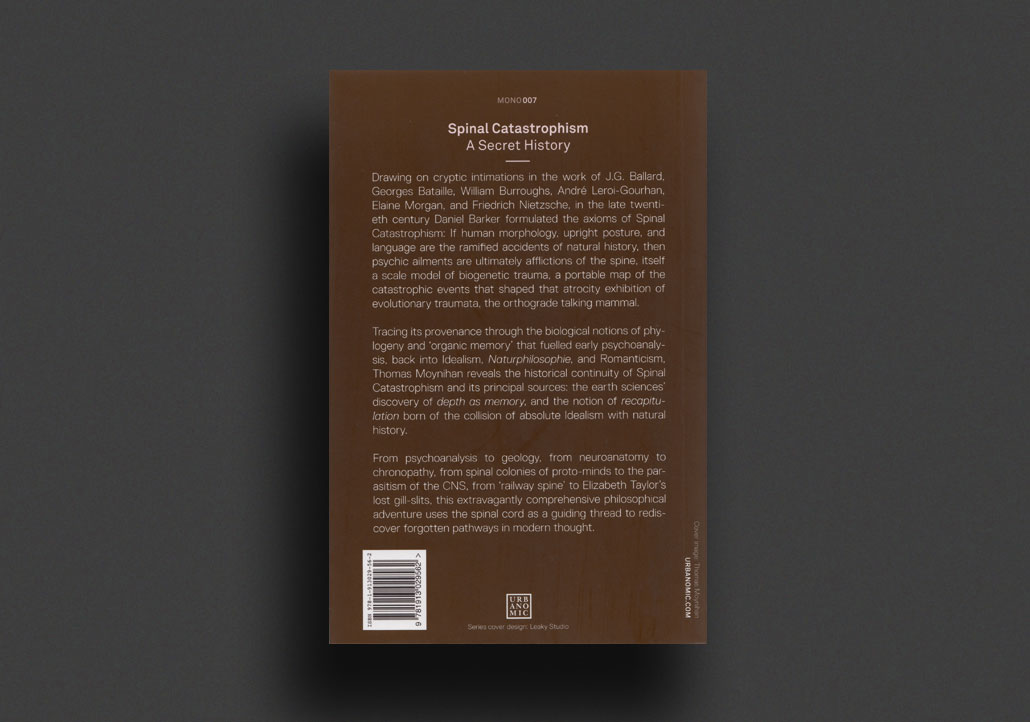
Drawing on cryptic intimations in the work of J.G. Ballard, Georges Bataille, William Burroughs, André Leroi-Gourhan, Elaine Morgan, and Friedrich Nietzsche, in the late twentieth century Dr. Daniel Barker formulated the axioms of Spinal Catastrophism: If human morphology, upright posture, and the possibility of language are the ramified accidents of natural history, then psychic ailments are ultimately afflictions of the spine, which itself is a scale model of biogenetic trauma, a portable map of the catastrophic events that shaped that atrocity exhibition of evolutionary traumata, the sick orthograde talking mammal.
Tracing its provenance through the biological notions of phylogeny and ‘organic memory’ that fuelled early psychoanalysis, back into idealism, naturephilosophy, and romanticism, and across multiform encounters between philosophy, psychology, biology, and geology, Thomas Moynihan reveals the historical continuity of Spinal Catastrophism, and analyzes its principal sources: the geological discovery of depth as memory, and the notion of recapitulation born of the collision of absolute idealism with natural history.
From psychoanalysis and myth to geology and neuroanatomy, from bioanalysis to chronopathy, from spinal colonies of proto-minds to the retroparasitism of the CNS, from ‘railway spine’ to Elizabeth Taylor’s lost gill-slits, this extravagantly comprehensive philosophical adventure uses the spinal cord as a guiding thread to rediscover forgotten pathways in modern thought.
Moynihan demonstrates that, far from being an fanciful notion rendered obsolete by advances in biology, Spinal Catastrophism dramatises fundamental philosophical problematics of time, identity, continuity, and the transcendental that remain central to any attempt to reconcile human experience with natural history.
197?, Italian
Softcover (staple-bound), 12 pages, 21 × 29.7 cm
1st Edition, Out of print title / used / good
Published by
Mobel Italia / Udine
$40.00 - In stock -
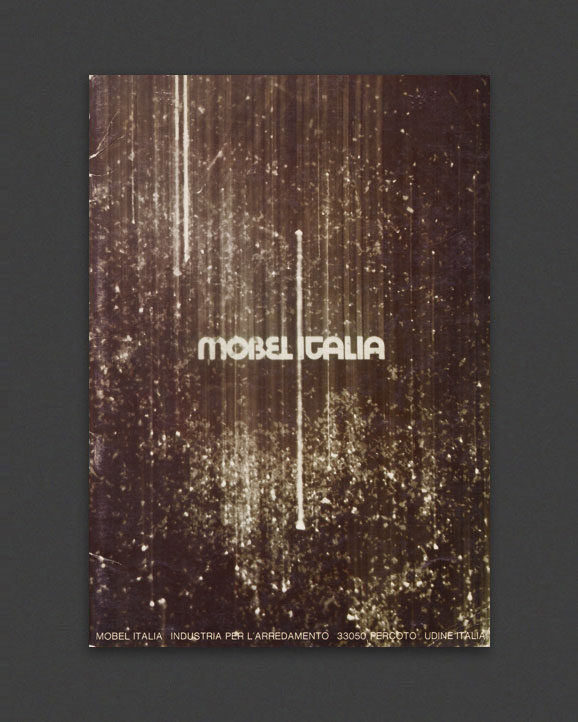
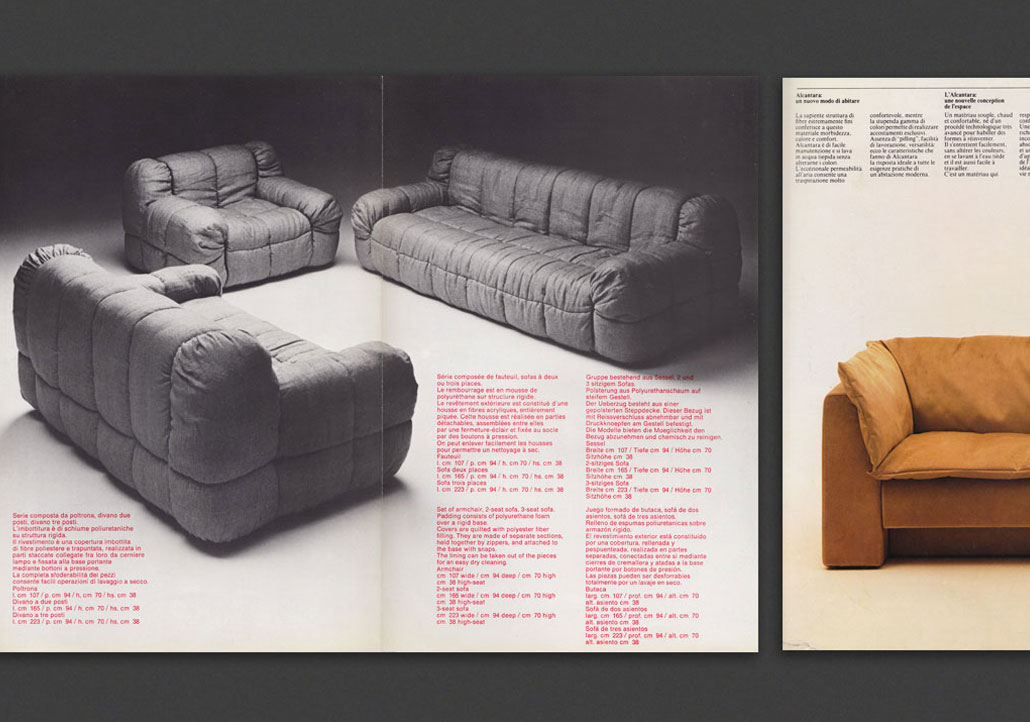
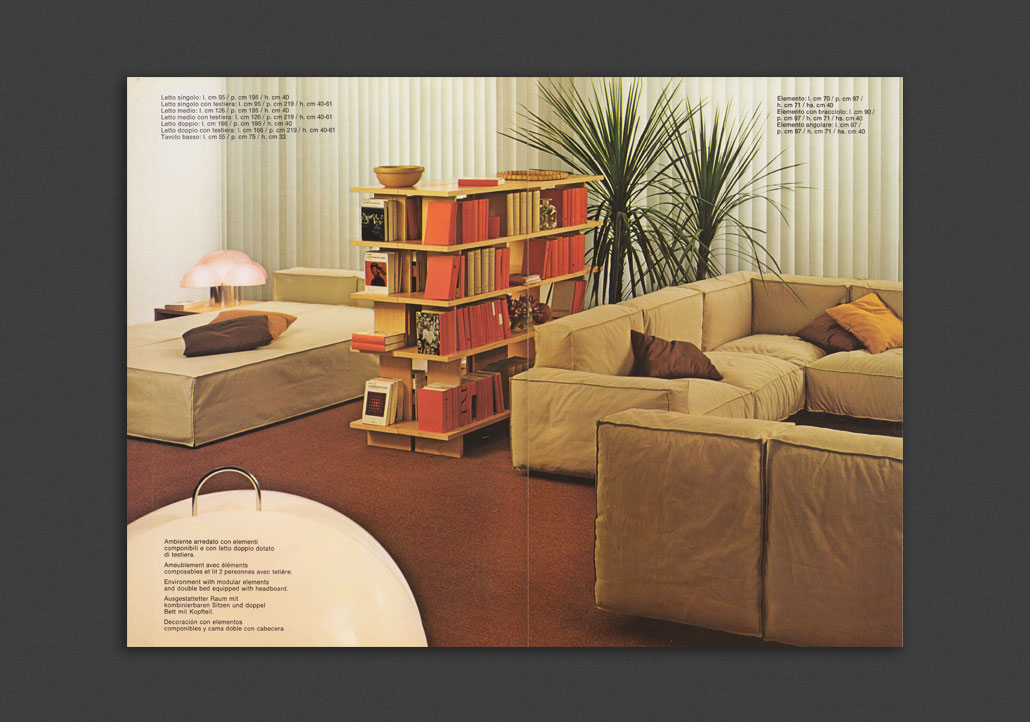
Scarce, undated Mobel Italia catalogue from roughly the beginning of the 1970s, illustrated throughout with a wonderful selection of examples of modern industrial designs from the likes of Silvio Coppola, Masayuki Matsukaze, Claude Courtecuisse, Pascal Mourgue, Kwok Hoi Chan, Eero Aarnio, Yves Christin, Werther Toffoloni and Piero Palange, and more, all with specs and details for each design. Mobel Italia were a furniture manufacturer from Italy, active in the late 1960's - early 1970's, producing the work of international designers.
Scarce. Some rubbing to covers.
2019, English
Softcover, 28 pages, 16.5 x 23.6 cm
Published by
Innen Books / Zürich
Kunsthalle Zürich / Zürich
$28.00 $10.00 - Out of stock
Norwegian artist Ida Ekblad's "Exist at All", published by Innen Books and Kunsthalle Zürich, Zürich, on the occasion of IDA EKBLAD: FRA ÅRE TIL OVN at Kunsthalle Zurich June 08 – August 18, 2019. First Edition.
Ida Ekblad's (b. 1980) artistic practice incorporates painting, sculpture, performance, filmmaking as well as poetry. Her works transmit a distinct vibrancy and spontaneity, created through the energetic movement of her compositions, the bold application of colour and the attentive use of found materials. Ekblad's expressive paintings often depict winding and twisted lines, some indicate human-like figures, others resemble landscapes. The forms and gestures found in her work derive from a wide variety of inspirations and art historical references, such as CoBrA, Situationism and Abstract Expressionism but also pop cultural aesthetics like graffiti or cartoon that indicate Ekblad's genre-crossing approach.
1970, English / Italian / French / German / Spanish
Softcover, 16 bi- and tri-fold looseleaf brochures, 29.5 x 21 cm
1st Edition, Out of print title / used / very good
Published by
Arflex / Milan
$100.00 - Out of stock
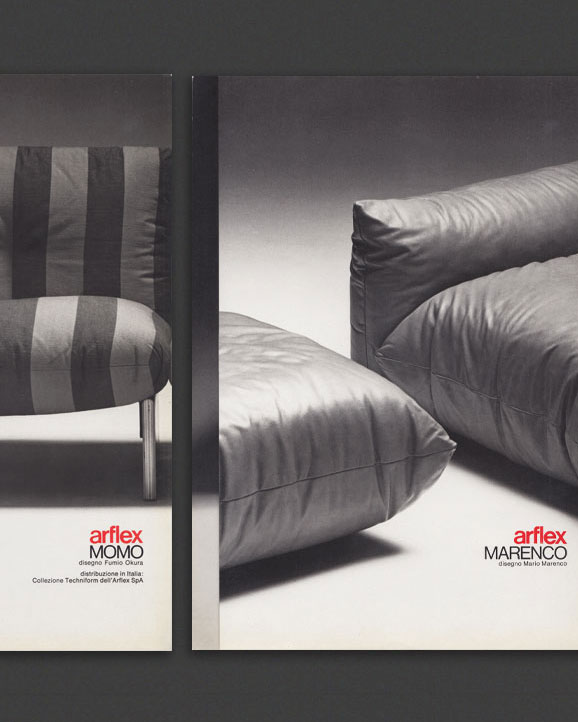
Rare original Arflex trade folio circa early 1970s. Compiles 16 fully illustrated bi- and tri-fold product brochures, featuring furniture by Cini Boeri, Marco Zanuso, Marcello Cuneo, Carlo Santi, Tito Agnoli, Fumio Okura, Mario Marenco, and more, including lavish colour and b/w full-bleed product photography, technical data/blurbs in English, Italian, French, German, Spanish. All brochures contained within brochure/folder introducing Alcantara, a new durable, synthetic microfibre textile material used in the upholstery of Arflex furniture of the period. An incredible, seldom seen lot of reference material for anyone interested in Italian furniture design from this period. Published in Mlian.
Founded in 1947, a group of technicians based in Pirelli in Italy began experimenting with new materials and technologies in the creation of cutting-edge, modern furniture. This was the beginning of the Arflex brand, established on the meeting of technology and aesthetic sensibilities, and driven by a high level of research and experimentation. Officially presented to the public in 1951, Arflex quickly gained recognition for their manufacturing philosophy and their collaboration with many of the leading figures in Italian modern design.
Very Good, with light wear, mostly to the outer Alcantara folder, other brochures very well preserved.
1975, English / Italian
Softcover, single folded brochure, 29.5 x 23 cm
1st Edition, Out of print title / used / good
Published by
B&B Italia / Italy
$25.00 - Out of stock
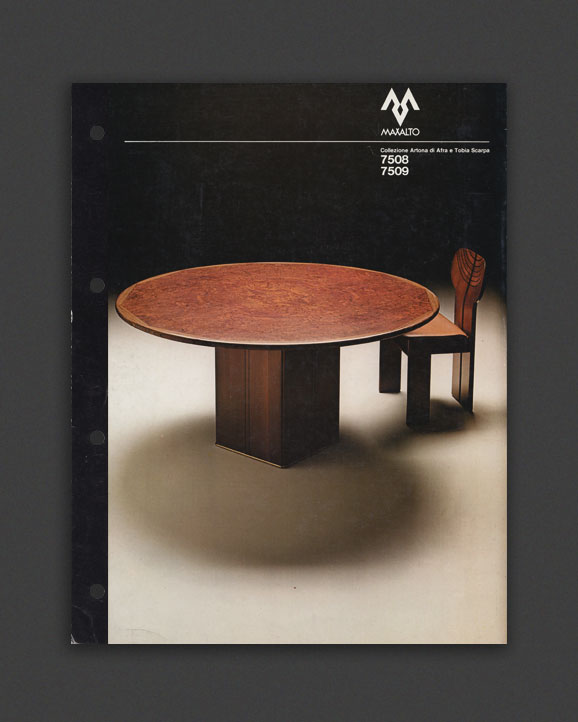
Rare original catalogue for Afra & Tobia Scarpa's Artona collection for Maxalto from 1975. This folded brochure section (with ring binding holes) includes data on the beautiful Artona table in particular, documented along with the 'Africa' dining chairs, pictured in the two model variations. The Artona line by the Scarpa duo was in fact the first line ever produced by Maxalto, the specialist division of B&B Italia. Maxalto was originally set up in 1975 as a high-end division of B&B Italia to focus exclusively on the production of artisanal, mostly wood furniture. The Artona was their first project and also functions as a counter-message against the common prevailing use of plastics in furniture design during the Postwar period.
Born in Venice in 1935, Tobia Scarpa is the son of famed architect-designer Carlo Scarpa. Alongside his wife Afra (née Bianchin, born in Montebelluna in 1937), he began working with Venini glassworks in Murano in the 1950s. In 1960, the couple established their design office in Montebelluna. Together, they created works for companies such as Flos, Cassina, B&B Italia, and Knoll. They embraced a variety of materials and expanding technologies across a wide range of designs, from glass, furniture, and lighting to interiors and architecture.
Good copy with light wear.
2021, English
Hardcover, 416 pages, 25 x 25 cm
Published by
Walther König / Köln
$80.00 - Out of stock
An opulent artist’s book of Tillmans’ photographic abstractions. Though he is best known for his portraiture and observational depictions, German photographer Wolfgang Tillmans (born 1968) has simultaneously created abstract photography over the past 30 years. Dubbed his Silver works, these photographs expand the boundaries of photographic processes, taking what others might call accidents in the photo development process—like stains from trace chemicals and the titular silver nitrate—and using them in a deliberate compositional manner. The result is a series of images that Tillmans describes as “stained, impure, bright, [and] unstable.”
In this artist’s book, Tillmans’ Silver works are brought together for the first time. In addition to high-quality reproductions of the works themselves, Saturated Light includes photographic documentation of the pieces in exhibition settings and as elements of installations.
An essay by art theorist Tom Holert discusses the philosophical, aesthetic, and material questions that Tillmans’s Silver pose on the one hand, while on the other hand the thought-provoking pictorial process itself sets in the room. A conversation between the artist and photo engineer Klaus Pollmeier delves into the innumerable photo-technical details, observations, and intentional as well as unintentional accidents that are at work in the photographs.
2006, Japanese
Hardcover (w. dust jacket and obi), 29.2 x 21.4 cm
Published by
King of Mountain / Tokyo
$65.00 $40.00 - Out of stock
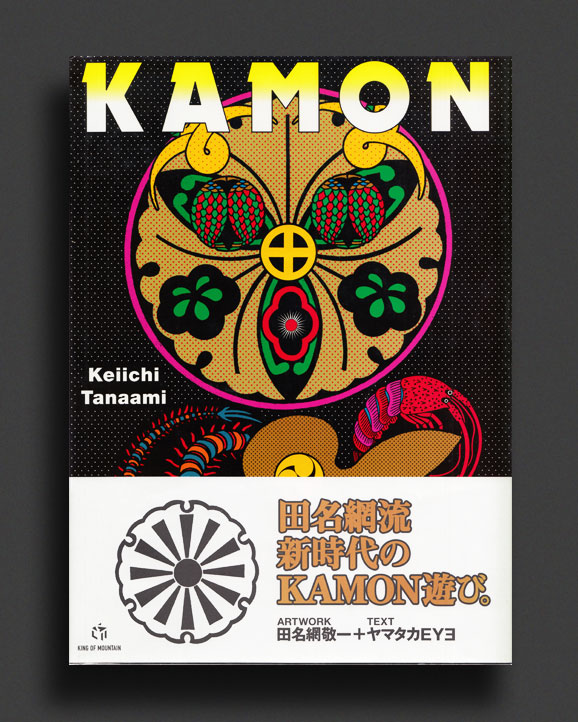
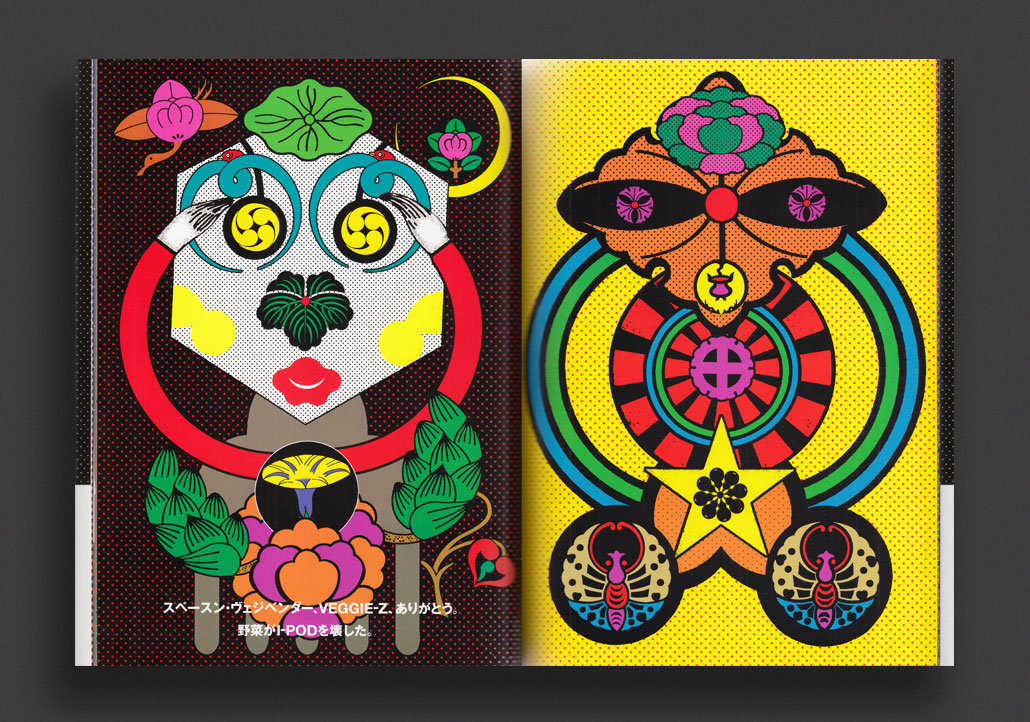
First hardcover edition of artists book "Kamon" by Keiichi Tanaami, published by King of Mountain in 2006, now out-of-print. The term "Kamon" refers to an ancient, heraldic crest used in Japan to indicate one's origins, ancestry. It is said that there are more than 20,000 distinct individual Kamon in Japan. Keiichi Tanaami has long used the Kamon as a graphic motif to synchronizes with his iconic world of psychedelia to create a new era of pop cultural heraldry. Illustrated in explosive colour throughout, with accompanying text by, most fittingly, Japanese artist and musician Yamantaka Eye (Boredoms).
Keiichi Tanaami (b. 1936 in Tokyo) is one of the leading pop artists of postwar Japan, and has been active as a multi-genre artist since the 1960s as a graphic designer, illustrator, video artist and fine artist.
1981, Japanese
Softcover (staple-bound w. poster), 106 pages, 28 x 21 cm
1st Edition, Out of print title / used / good
Published by
Starlog / Japan
$40.00 $10.00 - Out of stock
Japanese edition of Starlog magazine, September issue 1981, with cover feature in memoriam of prolific, award-winning, controversial Japanese science fiction author and actor, Tsutsui Yasutaka (1934 — 1981), whose fictional works of dark humour and satirical content, featuring elements of psychoanalysis and surrealism, have been adapted into films, anime and video games. Also SFX Wizard scrapbook with Star Wars special effects artist Joe Viskocil, Ray Harryhausen, Harlan Ellison, interview with George Lucas, Raiders of The Lost Ark, UFOs, extraterrestrials, Star Trek, hobby robots, comics, news, reviews. Comes with a 2-sided fold-out poster with "Horror World" painting by Louise Scott and Godzilla versus Mothra on verso!
Good copy, poster still bound and folded as published. Some wear to covers, light tanning.
1991, Japanese
Softcover (staple-bound), 112 pages, 28.5 x 21 cm
1st Edition, Out of print title / used / very good
Published by
Brutus / Tokyo
$40.00 - Out of stock
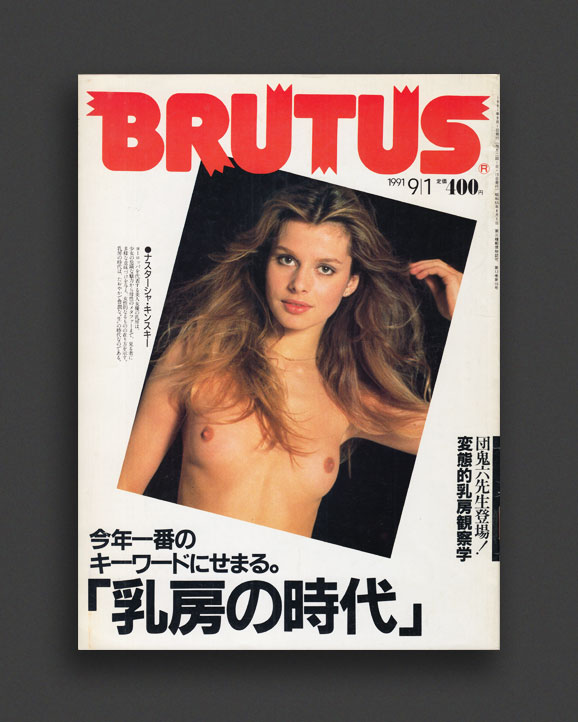
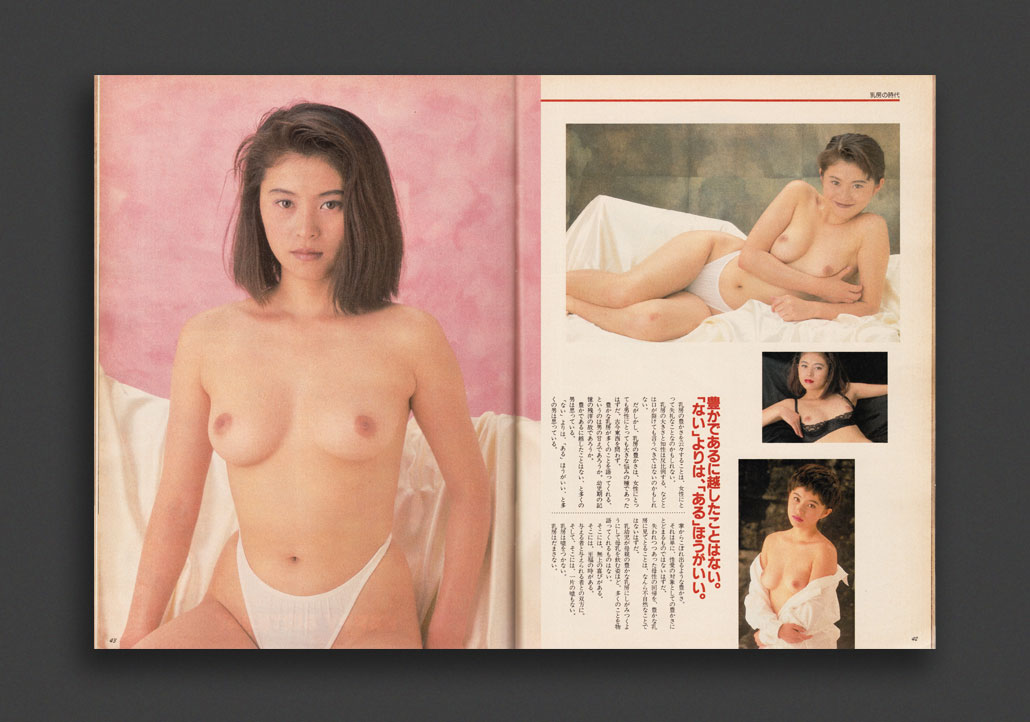
1991 special issue of Tokyo's legendary Brutus magazine (issue no. 256), "The Age of Breasts"! Features a roundtable discussion on "tits" with members of the Japanese Transgender community, photo features of Oniroku Dan ("the most celebrated writer of popular SM novels in Japan"), Japanese actress Miyuki Komatsu, American glamour photographer Ken Marcus (Penthouse, etc.), endless confusing illustrated articles on breasts, breasts in art, in cinema, in literature, in industrial design, in architecture .... naked actresses — Isabella Rossellini, Corinne Cléry, Isabelle Adjani, Charlotte Gainsbourg, Valérie Kaprisky, Carole Bouquet, Jane Birkin, Sophie Marceau, Dominique Sanda, Catherine Deneuve, Jodie Foster, Brigitte Bardot, Nastassja Kinski (who also features on the cover), and all the usual Brutus reports on cultural happenings of the day, Versace, Einstürzende Neubauten, that sort of thing.
Very Good copy.
Japanese
Softcover, 106 pages, 30 x 21 cm
1st Edition, Out of print title / used / very good
Published by
V-Zone / Japan
$90.00 - Out of stock
September 1986 issue of V-Zone, the wild, short-lived cult horror/sci-fi/fantasy movie magazine from Japan, published between 1985-1987. Profiles/reviews/articles on Alien and Aliens, the Films of Steven King, Tokyo International Fantasy Film Festival 1986, Roger Gorman Presents, Edgar Allen Poe, Dario Argento, Goblin, King Kong 2, Xtro, War of The Worlds, Crucible of Horror, The Howling 2, Mosquito der Schänder, Bloodsucking Freaks, GuZoo, Atlantis The Lost Continent, Time Machine, Conquest of Space, Death Ship, Hell Night, and so much more!
At the height of the home video revolution of the 1980s, V-Zone committed it's graphic-saturated pages to the explosion of horror, fantasy, and science fiction films that came with it. V-Zone's coverage of American horror is unparalleled in the world of Japanese magazines, but they also focused attention on historical and underground western science fiction and cult cinema, whilst also playing an important role in fostering the new wave of Japanese gore and V-Cinema (direct-to-video splatter films). Heavy with film features, interviews, stills, ads and reviews, each issue has amazing behind-the-scenes reportage from industry conventions and sfx fan parties, content you would not find anywhere but Japan, including a regular column by legendary Godzilla special effects artist Shinichi Wakasa on how to make your own SFX makeup, gore, and even craft realistic squibs with dimestore prophylactics. Needless to say, V-Zone is a must for any 1980s video collector or lover of gore.
1987, Japanese
Softcover, 98 pages, 30 x 21 cm
1st Edition, Out of print title / used / very good
Published by
V-Zone / Japan
$90.00 - Out of stock
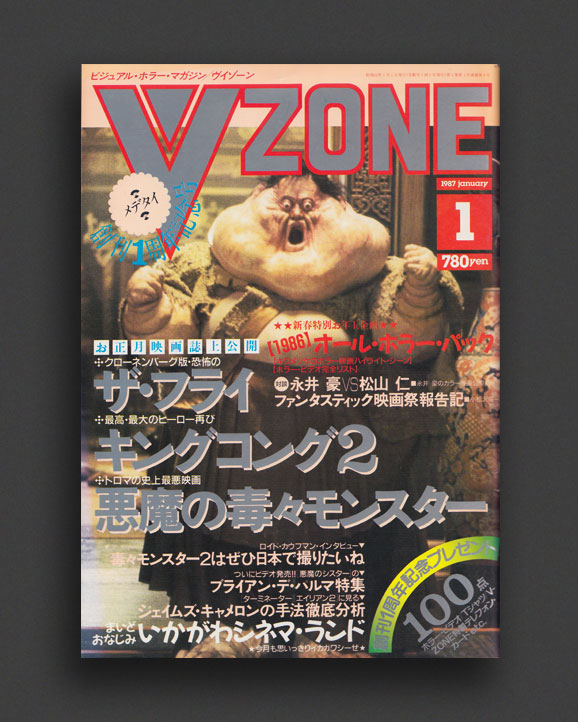
January 1987 issue of V-Zone, the wild, short-lived cult horror/sci-fi/fantasy movie magazine from Japan, published between 1985-1987. Profiles/reviews/articles on Brian de Palma, The Fly, Toxic Avenger, Alien 2, Strange House, The Mutilator, Hitchhike to Hell, Evils of The Night, The Fog, Axe, Pleasure Planet, Troll, Bloodsucking Freaks, The Oracle, Sleepaway Camp, James Cameron, Terminator, Swordkill, Crawl Space, The Horror Films of Byron Orlok, The Prey, Creature, Deadly Friend, Stalker, Deadtime Story, Nighty Night, and so much more!
At the height of the home video revolution of the 1980s, V-Zone committed it's graphic-saturated pages to the explosion of horror, fantasy, and science fiction films that came with it. V-Zone's coverage of American horror is unparalleled in the world of Japanese magazines, but they also focused attention on historical and underground western science fiction and cult cinema, whilst also playing an important role in fostering the new wave of Japanese gore and V-Cinema (direct-to-video splatter films). Heavy with film features, interviews, stills, ads and reviews, each issue has amazing behind-the-scenes reportage from industry conventions and sfx fan parties, content you would not find anywhere but Japan, including a regular column by legendary Godzilla special effects artist Shinichi Wakasa on how to make your own SFX makeup, gore, and even craft realistic squibs with dimestore prophylactics. Needless to say, V-Zone is a must for any 1980s video collector or lover of gore.
1987, Japanese
Softcover, 98 pages, 30 x 21 cm
1st Edition, Out of print title / used / very good
Published by
V-Zone / Japan
$90.00 - Out of stock
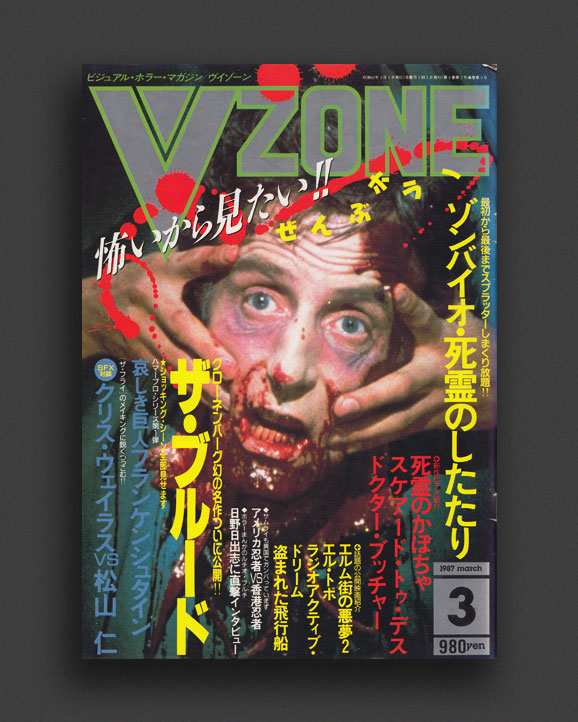
March 1987 issue of V-Zone, the wild, short-lived cult horror/sci-fi/fantasy movie magazine from Japan, published between 1985-1987. Profiles/reviews/articles on David Cronenberg, The Brood, Reanimator, The Films of Troma : Girls School Screamers, Class of Nuke'em High, Splatter University, Nightmare Weekend, Blood Hook, Combat Shoot, Igor and The Lunatics, The Darkside of Midnight, I Was a Teenage T.V. Terrorist, Ninja films, Frankenstein Films, El Topo, Dr. Jekyll and Sister Hyde, Horror Manga artist Hideshi Hino, Brain Waves, Make Them Die Slowly, Highlander, Sister, The Fly, Scared To Death, Dawn of The Mummy, Terror Vision, Poltergeist, Fiend, A Nightmare on Elm St. 2, Radioactive Dream, and so much more!
At the height of the home video revolution of the 1980s, V-Zone committed it's graphic-saturated pages to the explosion of horror, fantasy, and science fiction films that came with it. V-Zone's coverage of American horror is unparalleled in the world of Japanese magazines, but they also focused attention on historical and underground western science fiction and cult cinema, whilst also playing an important role in fostering the new wave of Japanese gore and V-Cinema (direct-to-video splatter films). Heavy with film features, interviews, stills, ads and reviews, each issue has amazing behind-the-scenes reportage from industry conventions and sfx fan parties, content you would not find anywhere but Japan, including a regular column by legendary Godzilla special effects artist Shinichi Wakasa on how to make your own SFX makeup, gore, and even craft realistic squibs with dimestore prophylactics. Needless to say, V-Zone is a must for any 1980s video collector or lover of gore.
A feature on Hideshi Hino’s Guinea Pig 2: Flower of Flesh and Blood, was sealed shut in the magazine and readers had to cut it open to see the gruesome behind-the-scenes shots.
1971, English
Softcover, 52 pages, 18 x 12 cm
1st UK Edition, Out of print title / used / very good
Published by
Olympia Press / Paris
$120.00 - Out of stock
Rare 1st Olympia Press UK edition of S.C.U.M by Valerie Solanas.
SCUM Manifesto is a legendary radical feminist manifesto by Valerie Solanas, first published in 1967 as a mimeographed edition of 2,000 copies. It argues that men have ruined the world, and that it is up to women to fix it. To achieve this goal, it suggests the formation of SCUM, an organization dedicated to overthrowing society and eliminating the male sex. The Manifesto was little-known until Solanas attempted to murder Andy Warhol by shooting him at The Factory in 1968. This event brought significant public attention to the Manifesto and Solanas herself.
This edition was published when legendary French publisher Maurice Girodias’ Olympia Press briefly relocated to Britain and came out the year Solanas’ left prison for attempted murder.
With a foreword by publisher Maurice Girodias and an introduction by radical feminist critic and essayist, Vivian Gornick.
VG, with only a piece of clear tape on back cover, otherwise wonderful copy.
1987, Japanese
Hardcover (with heavy printed slipcase),
1st UK Edition, Out of print title / used / very good
Published by
Nippon Geijutsu Shuppan (NGS) / Japan
$200.00 - Out of stock
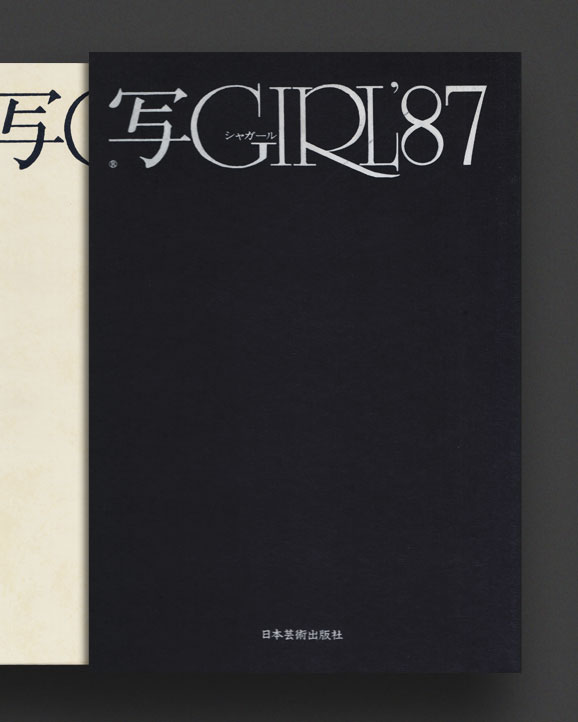
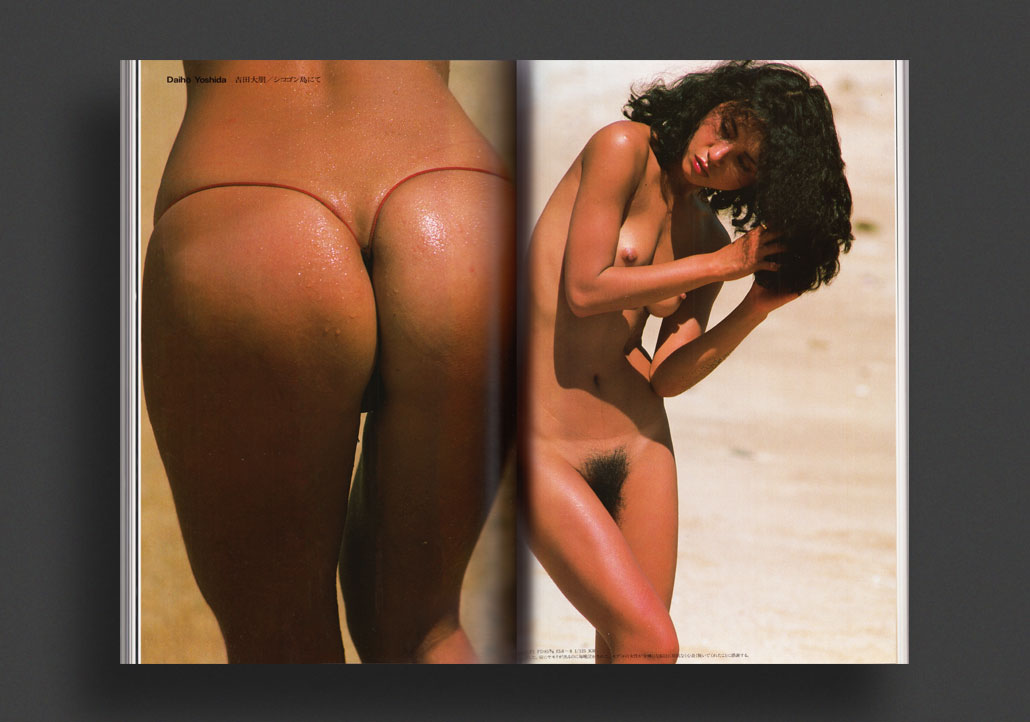
Deluxe, slipcased hardcover first edition of this stunning, compendium of photographs from Japanese and international photographers, published by Nippon Geijutsu Shuppan in 1987. This lavishly illustrated, heavy book collects the award-winning selection from a call-out to both leading professional photographers and amateurs alike on the subject of "Girl". Heavily orientated toward the nude, from the stylish, the subdued, the abstract, the erotic, one thing this diverse collection of photographs has in common is how wonderfully they capture the sensabilities of the 1980s through the chosen subject. Features the work of Hajime Sawatari, Nobuyoshi Araki, Cynthia Macadams, Jacques Bourboulon, Takeji Iwamiya, Shinpei Asai, Irina Ionesco, Hiromi Tsuchida, Masaaki Nakagawa, Mario Marnoto, Otto R. Weisser, Franco Fontana, Diminik Alterio, Shōji Ōtake, Daiho Yoshida, Daniel Barreau, Shōtarō Akiyama, Jean Yves Gougaud, Nobutsugu Sugiyama, Guido Mangold, Burt Bunger, Francis Giacobetti, Jacques Alexandre, Jean-Jacques Dicker, Ikkō Narahara, Yoji Ishikawa, Akira Satō, Takamasa Inamura, Hogara Iketani, and so many more.
Very Good, beautifully preserved copy.
1979, English
Hardcover (w. dust jacket), 96 pages, 28 x 21.5 cm
1st Edition, Out of print title / used / very good
Published by
Studio Vista / London
The Whitney Library of Design / New York
$85.00 - Out of stock
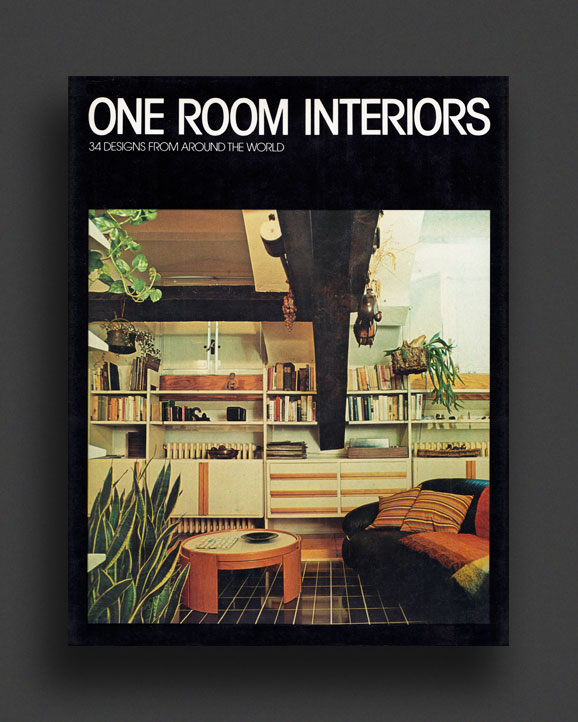
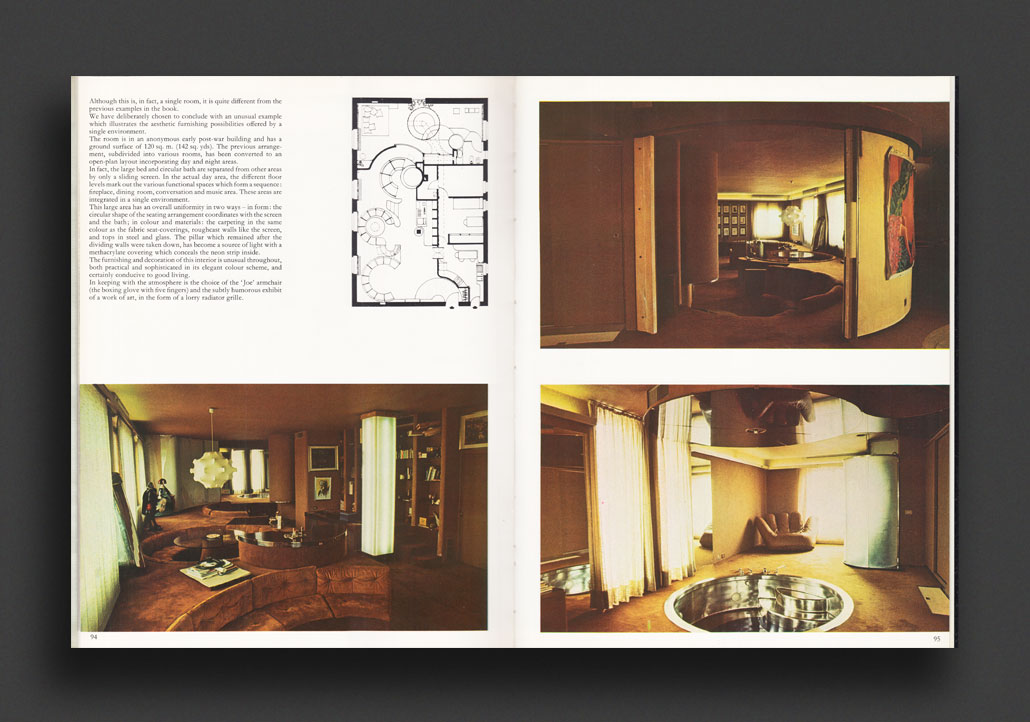
First edition from 1979 of One Room Interiors: 34 Designs from Around the World, edited by Franco Magnani and published by the great Studio Vista in London and The Whitney Library of Design in the United States and Canada. Profusely illustrated throughout with fine examples of small open-plan interiors that don't let spatial restriction impact their elegance, expression, comfort and style. Wonderful interiors, largely Italian, featuring the decor and furniture of Ponti, Munari, Colombo, SITE, and many more.
Very Good copy in VG dust jacket.
1969, English
Hardcover (w. dust jacket), 162 pages, 29.5 x 22.5 cm
1st US Edition, Out of print title / used / very good
Published by
Universe Books / New York
$140.00 - Out of stock
First 1969 English language edition of the collectable Modern Interiors by legendary Italian interiors editor Franco Magnani, originally published in Italian under the title "idee per la casa". This edition was also printed in Italy, evident from the stunning crisp, colour-saturated photographic reproductions of the contemporary home at the close of the 1960s. Almost 200 images capture that wonderful period of transition from the organic 1950s into the dynamic environments of 1960s pop and the space age, featuring the work of designers, manufacturers, architects, and artists such as Ludwig Mies Van Der Rohe, Tobia Scarpa, Vico Magistretti, Cassina, Charles Eames, Herman Miller, Arteluce, Venini, Achille Castiglione, Flos, Knoll, Artemide, Marcel Breuer, Eero Saarinen, Kartell, Marco Zanuso, Cini Boeri, Arflex, Dino Frigerio, Enrico Peressutti, Thonet, Joe Colombo, Carla Venosta, Roberto Mango, Fontana Arte, Giuseppe Ajmone, Marco Zanuso, Artemide, Paleari Arredamenti, Driade, Marco Comolli, Antonio Calderara, Carlo Graffi, Alberto Rosselli, Gavina, Claudio Dini, Marcello Grisotti, Rafaella Crespi, Emilia Sal Giorgio Madini, Giuseppe Gibelli, Lorenzo Forges, Bruno Munari, Arredamenti Pillinini, Tito Agnoti, Mario Passanti, George Coslin, and many more! Includes diagrams, plans, and identifications of all the designers and manufacturers of the furniture, fabrics, wall coverings, tiles, lamps and accessories illustrated, making it a valuable resource for anyone interested in the decorative arts of the 1960s.
Fine - Very Good copy with VG dust jacket preserved under mylar wrap.
1974, English
Hardcover (w. dust jacket), 163 pages, 26.5 x 27 cm
1st Edition, Out of print title / used / good
Published by
Studio Vista / London
Office du Livre / Fribourg
$120.00 - Out of stock
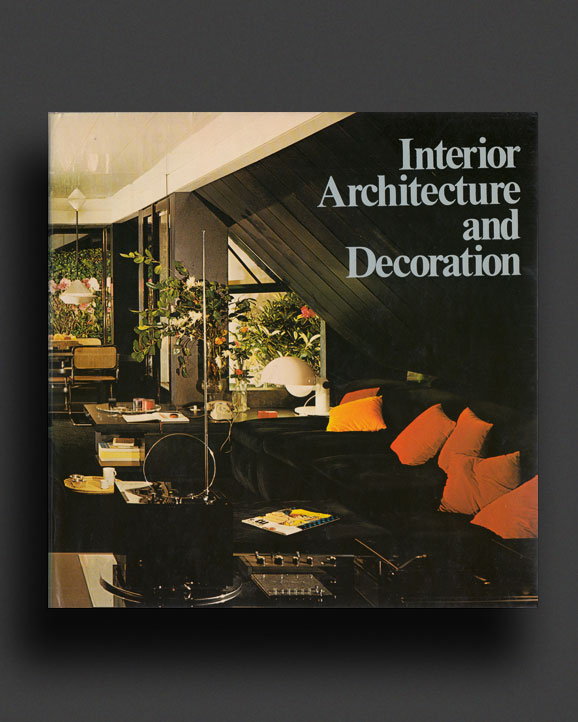
First English hardcover edition of this gorgeous French interior design volume, published by the great Studio Vista and Office du Livre in 1974.
Celebrated French interior decorator and designer Alain Demachy has edited together a stunning collection of examples of interior spaces by himself and fellow designers Gae Aulenti, David Hicks, Michel Boyer, Jacques Grange, and many more, all beautifully photographed and presented in colour and black and white alongside texts by Demachy. Features works by Charles Eames, Roger Tallon, Lucio Fontana, Gae Aulenti, Erté, Claude and Francoise-Xavier Lalanne, Andy Warhol, Mies Van der Rohe, Joe Colombo, Tom Wesselman, Cesar, Gerorge Nelson, Afra & Tobia Scarpa, and many more. Printed in Switzerland.
"Alain Demachy studied at the Ecole spéciale d'architecture. He edited the Decoration section in Marie-Claire from 1954. He numbers amongst his most famous clients the Barons Edmond, Alain and David de Rothschild, the Grand Duke of Luxembourg, Prince Albert of Liege, President Houphouet-Boigny, Brigitte Bardot and Johnny Halliday. As well as private houses and apartments, he designs many offices, department stores, restaurants and drug stores all over the world."
Good copy, preserved in original dust jacket (with tanning to spine), now under plastic wrap. Ex-libris markings, otherwise would be a Very Good copy.