World Food Books' programme is largely produced on Kulin Nation land. We acknowledge the Wurundjeri people of the Kulin Nation as the first and continuing custodians of this land, and pay respect to their Elders past, present, and emerging.
World Food Books is an arts and special interests bookshop in Naarm / Melbourne. Founded in 2010, World Food Books is devoted to the presentation of a rotating, hand-selection of international art, design, literary and counterculture publications with an emphasis on the anti-traditional, the experimental, the avant-garde, the heretic, the marginal.
Presenting new titles alongside rare and out-of-print books, catalogues and journals spanning the fields of modern and contemporary art, design, photography, illustration, film, literature, poetry, cultural theory, philosophy, sexuality, popular and underground culture in its many radical forms, World Food Books wishes to encourage adventurous, thoughtful and open-minded reading, looking, writing, and exchange of publishing and ideas, both current and historical.
As well as our bookshop, located in Melbourne's historical Nicholas Building, all of our inventory is available internationally via our online mail-order service.
World Food Books semi-regularly co-ordinates "Occasions", a programme of exhibits and events at the bookshop and in partnership with other hosts (such as museums and art galleries) that develop out of the activities, relationships and content of the bookshop itself.
World Food Books
The Nicholas Building
37 Swanston Street
Room 5, Level 6
Melbourne 3000
Australia
SHOP HOURS:
Thu–Fri 12–6, Sat 12–5
WEB-SHOP OPEN 24/7
World Food Books
Postal Address:
PO Box 435
Flinders Lane
Victoria 8009
Australia
Art
Theory / Essay
Architecture / Interior
Graphic Design / Typography
Photography
Fashion
Eros
LGBTQ+
Fiction / Poetry
Weird / Speculative / Science Fiction / Horror
Transgressive / Visceral / Abject
Symbolism / Decadence / Fin de siècle
Film / Video
Painting
Sculpture / Installation
Performance / Dance / Theater
Drawing
Sound / Music
Curatorial
Group Shows / Collections
Periodicals
Out-of-print / Rare
Posters / Ephemera / Discs
Signed Books
World Food Books Gift Voucher
World Food Book Bag
Australian Art
Australian Fiction
Australian Science Fiction / Speculative Fiction
Australian Poetry
Australian Photography
Japanese Photography
Conceptual Art
Minimal Art
Dada
'Pataphysics / Oulipo
Fluxus
Concrete Poetry
Pop Art
Surrealism
Arte Povera
Arte Informale / Haute Pâte / Tachism
Nouveau Réalisme / Zero / Kinetic
Situationism / Lettrism
Collage / Mail Art / Xerox Art
Art Brut / Folk / Visionary / Fantastic
Illustration / Graphic Art / Bandes Dessinées
Furniture
Italian Radical Design / Postmodernism
Textiles
Ceramics / Glass
Counterculture
Protest / Revolt
Philosophy
Psychoanalysis
Anthropology
Anarchism
Socialism / Anarchism / Communism / Capitalism
Literary Theory / Semiotics / Language
Feminism / Women's Studies
Gender Studies / Sexuality
Anthropology
Fetishism / BDSM
Drugs / Psychedelia
Crime / Violence
Animal Rights / Veganism
Occult / Esoterica
Ecology / Earth / Alternative Living
Whole Earth / Crafts
All prices in AUD (Australian dollars)
Pick-Ups
Pick-up orders can be collected in our bookshop during opening hours after order date. Please collect any Pick-up orders within 2 weeks of ordering as we have limited storage space. Orders will be released back into stock if not collected within this time. No refunds can be made for pick-ups left un-collected. If you cannot make it in to the bookshop in this time-frame, please choose postage option.
Return Policy
All sales are final. We do accept returns (for refund or exchange) for items received in error. All our orders are packed with special care using heavy-duty padding and cardboard book-mailers or bubble mailers (for smaller books), using reinforcement where required. We cannot take responsibility for any lost, stolen or damaged parcels.
Insurance
Should you wish to insure your package, please email us directly after placing your order and we can organise this at a small extra expense. Although all standard/express tracked packages are very safe and dependable, we cannot take responsibility for any lost, stolen or damaged parcels. We recommend insurance on valuable orders.
Interested in selling your old books, catalogues, journals, magazines, comics, fanzines, ephemera? We are always looking for interesting, unusual and out-of-print books to buy. We only buy books in our fields of interest and specialty, and that we feel we can resell.
We base these prices on desirability, market value, in-print prices, condition and our current stock levels. We offer cash, store credit, and can take stock on consignment. All
about 25% of the price we expect to get when we sell them, or 30% in store credit. We base these prices on desirability, market value, in-print prices, condition and our current stock levels.
Sell your books any day of the week. You can drop them off and return later. If you have a lot of books, we can visit your Sydney home.
We buy books that we feel we can resell. We offer about 25 % of the price we expect to get when we sell them, or 30% in store credit. We base these prices on desirability, market value, in-print prices, condition and our current stock levels.
Philadelphia Wireman
03 August - 01 September, 2018
World Food Books is proud to announce our next Occasion, the first presentation of sculptures by Philadelphia Wireman in Australia.
The Philadelphia Wireman sculptures were found abandoned in an alley off Philadelphia’s South Street on trash night in 1982. Their discovery in a rapidly-changing neighbourhood undergoing extensive renovation, compounded with the failure of all attempts to locate the artist, suggests that the works may have been discarded after the maker’s death. Dubbed the "Philadelphia Wireman" during the first exhibition of this work, in 1985, the maker’s name, age, ethnicity, and even gender remain uncertain. The entire collection totals approximately 1200 pieces, all intricately bound together with tightly-wound heavy-gauge wire (along with a few small, abstract marker drawings, reminiscent both of Mark Tobey and J.B. Murry). The dense construction of the work, despite a modest range of scale and materials, is singularly obsessive and disciplined in design: a wire armature or exoskeleton firmly binds a bricolage of found objects including plastic, glass, food packaging, umbrella parts, tape, rubber, batteries, pens, leather, reflectors, nuts and bolts, nails, foil, coins, toys, watches, eyeglasses, tools, and jewellery.
Heavy with associations—anthropomorphic, zoomorphic, and socio-cultural responses to wrapped detritus—the totemic sculptures by Philadelphia Wireman have been discussed in the context of work created to fulfil the shamanistic needs of alternative religions in American culture. Curators, collectors, and critics have variously compared certain pieces to sculpture from Classical antiquity, Native American medicine bundles, African-American memory jugs, and African fetish objects. Reflecting the artist’s prolific and incredibly focused scavenging impulse, and despite—or perhaps enhanced by—their anonymity, these enigmatic objects function as urban artefacts and arbiters of power, though their origin and purpose is unknown. Philadelphia Wireman, whatever their identity, possessed an astonishing ability to isolate and communicate the concepts of power and energy through the selection and transformation of ordinary materials. Over the course of the past two decades, this collection has come to be regarded as an important discovery in the field of self-taught art and vernacular art.
Presented in collaboration with Fleisher-Ollman Gallery, Philadelphia, and Robert Heald, Wellington.
Susan Te Kahurangi King
02 February - 10 March, 2018
Susan Te Kahurangi King (24 February 1951 - ) has been a confident and prolific artist since she was a young child, drawing with readily available materials - pencils, ballpoint pens and felt-tip markers, on whatever paper is at hand. Between the ages of four and six Susan slowly ceased verbal communication. Her grandparents William and Myrtle Murphy had developed a special bond with Susan so they took on caring responsibilities for extended periods. Myrtle began informally archiving her work, carefully collecting and storing the drawings and compiling scrapbooks. No drawing was insignificant; every scrap of paper was kept. The King family are now the custodians of a vast collection containing over 7000 individual works, from tiny scraps of paper through to 5 meter long rolls.
The scrapbooks and diaries reveal Myrtle to be a woman of great patience and compassion, seeking to understand a child who was not always behaving as expected. She encouraged Susan to be observant, to explore her environment and absorb all the sights and sounds. Myrtle would show Susan’s drawings to friends and people in her community that she had dealings with, such as shopkeepers and postal workers, but this was not simply a case of a grandmother’s bias. She recognised that Susan had developed a sophisticated and unique visual language and sincerely believed that her art deserved serious attention.
This was an unorthodox attitude for the time. To provide some context, Jean Dubuffet coined the term Art Brut in 1945 to describe work created by self-taught artists – specifically residents of psychiatric institutions and those he considered to be visionaries or eccentrics. In 1972 Roger Cardinal extended this concept by adopting the term Outsider Art to describe work made by non-academically trained artists operating outside of mainstream art networks through choice or circumstance. Susan was born in Te Aroha, New Zealand in 1951, far from the artistic hubs of Paris and London that Dubuffet and Cardinal operated in. That Myrtle fêted Susan as a self-taught artist who deserved to be taken seriously shows how progressive her attitudes were.
Susan’s parents Doug and Dawn were also progressive. Over the years they had consulted numerous health practitioners about Susan’s condition, as the medical establishment could not provide an explanation as to why she had lapsed into silence. Dawn educated herself in the field of homeopathy and went on to treat all twelve of her children using these principles – basing prescriptions on her observations of their physical, mental and emotional state.
Doug was a linguist with an interest in philosophy who devoted what little spare time he had to studying Maori language and culture. To some extent their willingness to explore the fringes of the mainstream made them outsiders too but it was their commitment to living with integrity and their respect for individuality that ensured Susan’s creativity was always encouraged.
Even though Susan’s family supported her artistic pursuits, some staff in schools and hospitals saw it as an impediment to her assimilation into the community and discouraged it in a variety of ways. Her family was not always aware of this and therefore did not fully understand why Susan stopped drawing in the early 1990s. However, rather than dwell on the challenges that Susan faced in pursuit of her artistic practice, they prefer to highlight her achievements. In 2008 Susan began drawing again in earnest, after an almost 20 year interruption, and her work is now shown in galleries around the world.
Susan grew up without television and has been heavily influenced by the comics she read as a child. She is absolutely fearless in the appropriation of recognizable characters, such as Donald Duck and Mickey Mouse, in her work. She twists their limbs, contorts their faces, compresses them together, blends them into complex patterned backgrounds - always imbuing them with an incredible energy. Although Susan often used pop culture characters in her work they are not naive or childlike. These are drawings by a brilliant self-taught artist who has been creating exceptional work for decades without an audience in mind.
Mladen Stilinović
"Various Works 1986 - 1999"
02 February 16 - September 10, 2016
Various works 1986 - 1999, from two houses, from the collections of John Nixon, Sue Cramer, Kerrie Poliness, Peter Haffenden and Phoebe Haffenden.
Including: Geometry of Cakes (various shelves), 1993; Poor People’s Law (black and white plate), 1993; White Absence (glasses, ruler, set square, silver spoon, silver ladel with skin photograph and wooden cubes), 1990-1996; Exploitation of the Dead (grey and red star painting, wooden painting, black spoon with red table, red plate), 1984-1990; Money and Zeros (zero tie, paintings made for friends in Australia (Sue, John, Kerrie), numbers painting), 1991-1992; Words - Slogans (various t-shirts) - “they talk about the death of art...help! someone is trying to kill me”, “my sweet little lamb”, “work is a disease - Karl Marx”; Various artist books, catalogues, monographs, videos; Poster from exhibition Insulting Anarchy; "Circular" Croatian - Australian edition; Artist book by Vlado Martek (Dostoyevsky); more.
Thanks to Mladen Stilinović and Branka Stipančić.
Jonathan Walker
Always Will Need To Wear Winter Shirt Blue + Ochre Small Check Pattern
21 August - 21 September, 2015
Untitled
I am not a great reader of poetry but I always return to the work of Melbourne poet, Vincent Buckley (1925- 1988). Perhaps I find his most tantalising piece to be not a finished poem but a fragment left on a scrap of paper discovered on his desk after the poet’s death.
The poetry gathers like oil
In the word-core, and spreads
It has its music meet,
Its music is in movement.
This fragment is more the shell left behind from a volatile thought than a finished poem. I find the last two lines honest but awkward whereas the first two lines work like an arrow. Most likely he could not find a resolution so it was left. Still, in its present form, it remains an eloquent testimony to the ultimate failure of a medium to express mobile thought and sensation, in Buckley’s case, through verbal language. It’s an important matter because this is something all artists have to deal with regardless of the medium.
I have never written a poem, however, I am forever copying fragments from books on paper scraps in a vain effort to fix certain notions in my head. At first, they function as bookmarks that are sometimes returned to when I open the book. But before long, as they accumulate, they fall out littering the table interspersed with A4 photocopies, bills, books and medications.
To return to Buckley’s fragment, the first two lines very much evoke how I paint nowadays. As you age, detail diminishes and patches of light become more luminous and float. I feel the most honest way of dealing with this is by smearing the oil paint on the canvas with the fingers and working close-up, blind. Only if the patches coalesce into an approaching image can the work gain a life.
-
Jonathan Walker was born in Melbourne, Australia and brought up on a dairy farm in Gippsland. In the 1970’s he studied painting at RMIT and won the Harold Wright Scholarship to the British Museum, London. During the 1980’s he exhibited at Pinacotheca Gallery, Richmond and had work shown at the NGV and Heidi City Art Gallery. Over the same period he designed the cover for the “Epigenesi” LP by Giancarlo Toniutti, Italy and conducted a mail exchange work with Achim Wollscheid, Germany. The work with artists through the post resulted in an article published in the bicentenary issue of Art and Australia 1988. He showed in artist run spaces such as WestSpace in the 90’s and 2000’s, and until 2012, taught painting at Victoria University, which is where we (Colleen Ahern and Lisa Radford) as organisers of the exhibition, among many others, had the privilege of being his student.
Walker’s knowledge was imparted to students through the careful selection of music, literature, and artists found in books that he himself had ordered for the library. Walker’s strategy was the generosity of sharing his vast knowledge with references specific to each student and their context.
Walker’s paintings share a similar focus and intimacy.
This exhibition presents a small selection of recent paintings alongside a publication that includes Walker’s writing. Observational and analytical, Walker’s work is a type of material notation — the time of day, colour and how it is blended, the both specific and fleeting location of a reflection on lino or the question of whether a chair leg should be included in a painting.
Please join us on Friday August 21 between 6-8pm to celebrate the opening of the exhibition.
Curated by Colleen Ahern and Lisa Radford.
B. Wurtz
Curated by Nic Tammens
March 26 - April 4, 2015
B.Wurtz works from a basement studio in his home on Manhattan’s Lower East Side.
This local fact is attested to by the plastic shopping bags and newsprint circulars that appear in his work. As formal objects, they don’t make loud claims about their origins but nonetheless transmit street addresses and places of business from the bottom of this long thin island. Like plenty of artists, Wurtz is affected by what is local and what is consumed. His work is underpinned by this ethic. It often speaks from a neighborhood or reads like the contents of a hamper:
“BLACK PLUMS $1.29 lb.”
“Food Bazaar”
“USDA Whole Pork Shoulder Picnic 99c lb.”
“RITE AID Pharmacy, with us it’s personal.”
“H. Brickman & Sons.”
“Sweet Yams 59c lb."
Most of the work in this exhibition was made while the artist was in residence at Dieu Donne, a workshop dedicated to paper craft in Midtown. Here Wurtz fabricated assemblages with paper and objects that are relatively lightweight, with the intention that they would be easily transportable to Australia. This consideration isn’t absolute in Wurtz’s work, but was prescriptive for making the current exhibition light and cheap. Packed in two boxes, these works were sent from a USPS post office on the Lower East Side and delivered to North Melbourne by Australia Post.
Wurtz appears courtesy of Metro Pictures, New York.
Thanks to Rob Halverson, Joshua Petherick, Sari de Mallory, Matt Hinkley, Helen Johnson, Fayen d'Evie, Ask Kilmartin, Lisa Radon, Ellena Savage, Yale Union, and "Elizabeth".
John Nixon
"Archive"
December 15 - January 20, 2014
The presentation of John Nixon's archive offered a rare showcase of this extensive collection of the artist's own publications, catalogues, posters, ephemera, editions and more, from the mid 1980s onwards, alongside a selection of his artworks.
Organized by John Nixon, Joshua Petherick and Matt Hinkley.
<a href=http://wfb.public-office.info/artist/john-nixon>All titles by John Nixon
"Habitat"
at Minerva, Sydney (organised by Joshua Petherick and Matt Hinkley)
November 15 - December 20, 2014
Lupo Borgonovo, Janet Burchill & Jennifer McCamley,
Lewis Fidock, HR Giger, Piero Gilardi, Veit Laurent Kurz,
Cinzia Ruggeri, Michael E. Smith, Lucie Stahl, Daniel Weil, Wols
Press Release:
“...It contained seven objects. The slender fluted bone, surely formed for flight, surely from the wing of some large bird. Three archaic circuitboards, faced with mazes of gold. A smooth white sphere of baked clay. An age-blackened fragment of lace. A fingerlength segment of what she assumed was bone from a human wrist, grayish white, inset smoothly with the silicon shaft of a small instrument that must once have ridden flush with the surface of the skin - but the thing’s face was seared and blackened.”
William Gibson, “Count Zero”, 1986
"Autumn Projects Archive"
Curated by Liza Vasiliou
March 6 - March 15, 2014
World Food Books, in conjunction with the Virgin Australia Melbourne Fashion Festival 2014, presented the Autumn Projects archive, consisting of a selection of early examples in Australian fashion with a particular interest in collecting designers and labels from the period beginning in the 1980’s, who significantly influenced the discourse of Australian Fashion.
Curated by Liza Vasiliou, the exhibition provided a unique opportunity to view pieces by designers Anthea Crawford, Barbara Vandenberg, Geoff Liddell and labels CR Australia, Covers, Jag along with early experimental collage pieces by Prue Acton and Sally Browne’s ‘Fragments’ collection, suspended throughout the functioning World Food Books shop in Melbourne.
H.B. Peace
presented by CENTRE FOR STYLE
November 14, 2013
"Hey Blinky, you say chic, I say same"
Anon 2013
H.B. Peace is a clothing collaboration between great friends Blake Barns and Hugh Egan Westland. Their pieces explore the divergences between 'character’ and ‘personality’ in garments....etc
Special Thanks to Joshua Petherick and Matt Hinkley of WFB and Gillian Mears
and a Very Special Thank you to Audrey Thomas Hayes for her shoe collaboration.
Janet Burchill & Jennifer McCamley
"Aesthetic Suicide"
May 10 - June 8, 2013
The first of our occasional exhibitions in the World Food Books office/shop space in Melbourne, "Aesthetic Suicide" presented a body of new and older works together by artists Janet Burchill & Jennifer McCamley, including videos, prints, a wall work, and publications.
During shop open hours videos played every hour, on the hour.
2017, English
Softcover, 448 pages, 17 x 23.5 cm
Published by
Edition Skylight / Switzerland
$95.00 - Out of stock
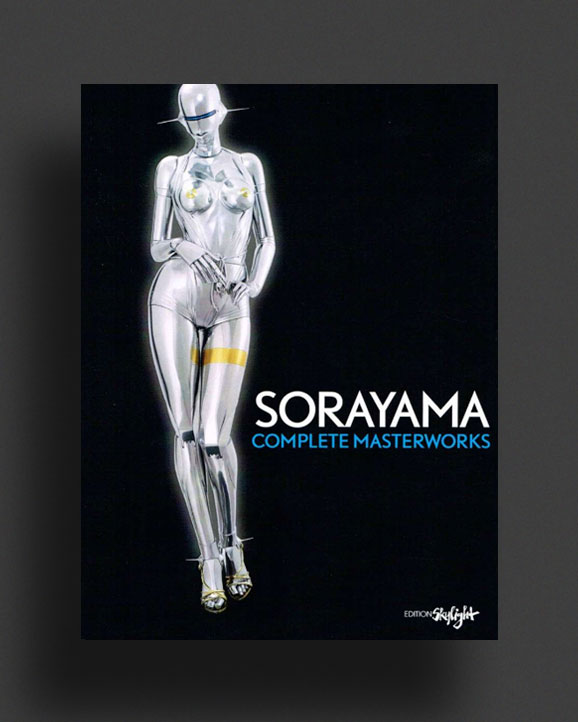
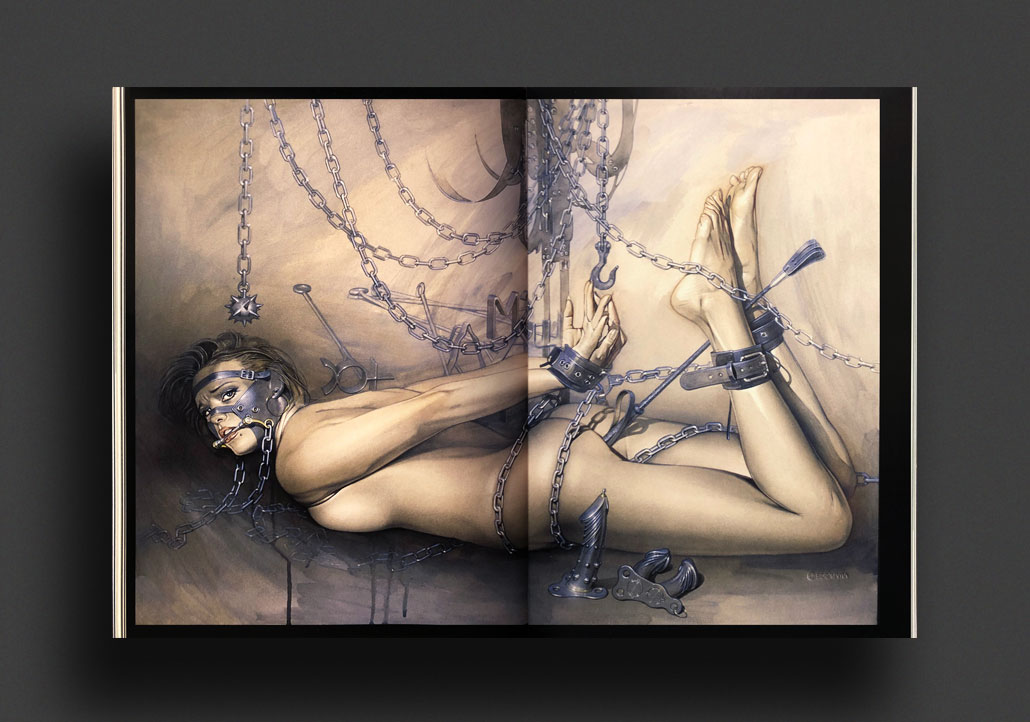
An absolute master of the airbrush, Japanese artist Hajime Sorayama's erotic, futuristic, hyper-realistic illustrations create a visual landscape that would be impossible to achieve in photography alone. Only Sorayama, equipped with boundless imagination, is able to achieve this, using pencil and brush, acrylic paint, and his airbrush. This thick tome of over 1000 illustrations is a comprehensive reference catalogue to Sorayama's rich and iconic work, including new, unpublished works. His Complete Masterworks speak of extraordinary talent, wondrous imagination, and impeccable skill.
Hajime Sorayama (b. 1947) is a Japanese illustrator known for his precisely detailed, erotic portrayals of feminine robots, along with his design work on the original Sony AIBO. He describes his highly detailed style as "superrealism", which he says "deals with the technical issue of how close one can get to one's object."
2021, English / German
Softcover, 208 pages, 23 x 16.5 cm
Published by
Texte Zur Kunst / Berlin
$32.00 - Out of stock
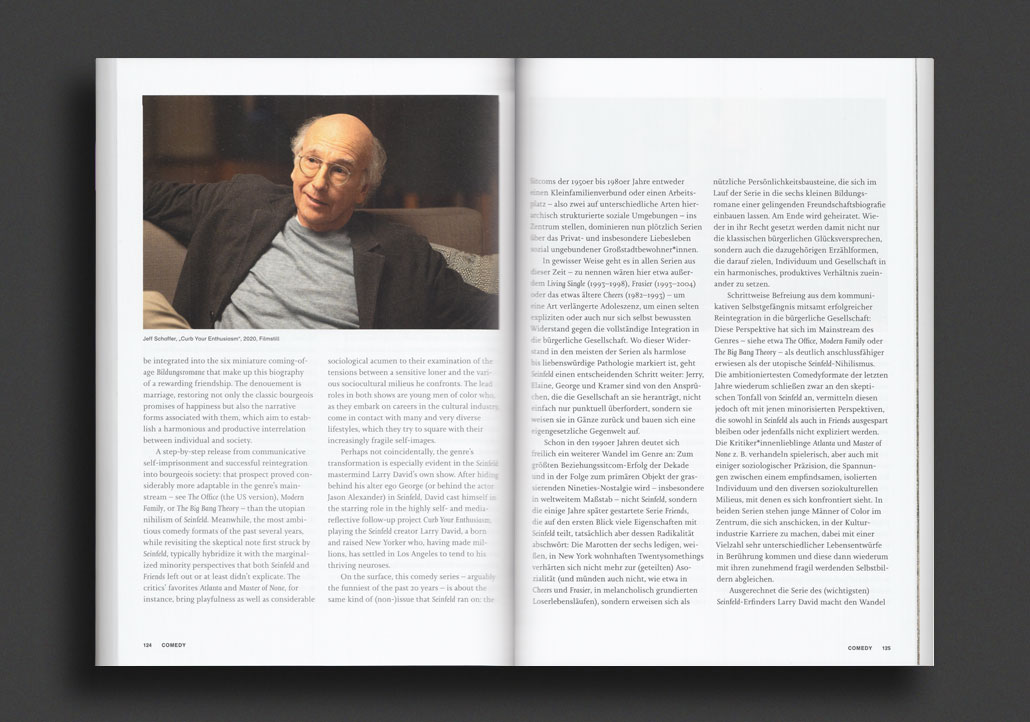
The March issue of Texte zur Kunst, titled “Comedy,” investigates the comedic in art while also examining mass-media formats such as TV series and films. Comedy not only offers consolation and comfort by making the tragic seem comic; for the repressed, it also serves as a catalyst, addressing and thematizing repression through jokes, slapstick, or the grotesque. However, at a time when audiences increasingly demand political commitment and authenticity from art, comedic speech, which is inherently disingenuous, has fallen into disrepute: ironically distanced rhetoric is accused of turning a blind eye to social inequality. Together with Bert Rebhandl, author and co-publisher of the film magazine cargo, the editors conceptualized an issue that examines the role of the joke in art, the psychoanalytic dimension of the comedic, and the limits of satire in the age of Donald Trump.
With contributions by/features on Jennifer A. Greenhill, Kevin B. Lee, Matthias Dell, Glenn Ligon, Jan Böhmermann, Lauren Berlant, Sianne Ngai, Alenka Zupančič, Lynne Tillman, Rosalind Fox Solomon, Bert Rebhandl, Gregory Williams, Andrea Fraser, Lukas Foerster, Seinfeld, Larry David, Christiane Kues, Pujan Karambeigi, Amalia Ulman, Michaela Ott, Iris Därmann, Max Heinrich, Helvetia Leal, Sofia Bempeza, Talia Kwartler, Kai Althoff, Bernard Leach, Saim Demircan, Kim Jones, Samantha Ozer, Wu Tsang, Susanne Von Falkenhausen, Aby Warburg, Daniel Sturgis, Maxwell Alexandre, Genevieve Lipinsky De Orlov, Rosemary Mayer, Akili Tommasino, Howardena Pindell, Awol Erizku, Anna Voswinckel, Marianne Wex, Sarat Maharaj, Marion Von Osten, Françoise Vergès, Madeleine Bernstorff, Ross Bleckner, Douglas Gordon, Amy Sillman …
2020, English / German
Softcover, 272 pages, 23 x 16.5 cm
Published by
Texte Zur Kunst / Berlin
$32.00 - In stock -
"Exactly three decades after the inaugural issue of TZK was published, we return to the question of where the hard-won and still-embattled rights of women* stand. With this issue, entitled ‘The Feminist’, we celebrate 30 years of controversial discussions about contemporary art and culture. We have invited 30 artists, critics, curators, and theorists of art and culture to talk about a cultural object that they believe is currently of particular interest from a feminist perspective. In highlighting feminist discourses that are especially relevant to the present moment, this issue should illustrate the plurality of thinkers who contribute to feminist projects today. A gesture to the unity and the alliances that critique grounded in solidarity can build!” —from the editorial by Isabelle Graw, Katharina Hausladen, and Genevieve Lipinsky de Orlov.
With contributions by Isabelle Graw, Jeanetta Rich, Mirjam Thomann, Amanda Schmitt, Christian Liclair, Juliane Rebentisch, Jessica Aimufua, Katharina Hausladen, Nikita Gale, Beate Söntgen, Stacey Gillian Abe, Genevieve Lipinsky de Orlov, Taylor Le Melle, Victoria Sin, Julia Heldt, Nadja Abt, Alina Astrova, Astrid Mania, Hanna Magauer, Brigitte Weingart, Paul Niedermayer, Keren Cytter, Steven Warwick, Bini Adamczak, Raphaela Vogel, Miriam Zeh, Lili Reynaud-Dewar, Violaine Huisman, Trakal …
2019, English
Softcover, 272 pages, 23 x 16.5 cm
Published by
Texte Zur Kunst / Berlin
$32.00 - Out of stock
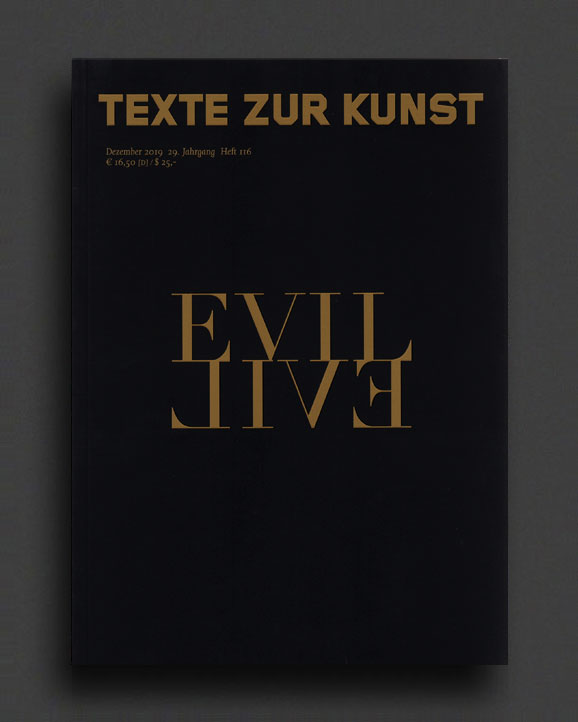
"EVIL," the theme of this latest issue of TEXTE ZUR KUNST is often understood as simply the opposite of “good,” and as pure immorality, evil is everywhere today, and somehow also nowhere. It is the “other” par excellence; something we ourselves never are, but by which one always measures one’s own distance. “Evil is over there, not here, not with me.” Given its ubiquity today, we offer texts that investigate what this thing we call “evil” is, as it so often functions as the polar opposite of that which people hold to be just and right. Indeed, who could argue that point, and yet. In this issue, we look specifically at evil’s manifestations in the art world, and in film, politics, and theory, always with an eye toward evil as something potentially playful and ironic.
TABLE OF CONTENTS
PREFACE
OLIVER PRECHT
TALKING ABOUT EVIL / Reflections on Moral Judgment
SUPERNATURE / Amanda Schmitt in Conversation with Loretta Fahrenholz, Madeline Hollander, and Monica Mirabile
MAX CZOLLEK
EVIL / Some Thoughts on the Contemporaneity of a Category
REMAIN IN DARK / Interview between Colin Lang and Stephen O’Malley
A BRIEF GLOSSARY OF SOCIAL SADISM / by Ana Teixeira Pinto and Kerstin Stakemeier
NEW DEVELOPMENT
BESEELTE GABEN IM TAUSCHSYSTEM / Überlegungen zur Malerei von Jack Whitten anlässlich der Ausstellung “Jack Whitten. Jack’s Jacks“ im Hamburger Bahnhof, Berlin
ROTATION
BEING POROUS / Alice Blackhurst on Chantal Akerman’s My Mother Laughs
IMPURITY AND ENTANGLEMENT / Adam Butler in Conversation with Ben Lerner
REVIEWS
A CHIROGRAPHIC IMAGINARY / Colin Lang on Edmund de Waal at Galerie Max Hetzler, Berlin
ANDERE ORTE / Elisa R. Linn über Ariane Müller bei Schiefe Zähne, Berlin
ARCHIVING INSPIRATION / Dave Beech on Albert Oehlen at the Serpentine Gallery, London
MYALGIE / Jessica Aimufua über Diamond Stingily im Kunstverein München
GO TELL IT ON THE ISLAND / Nadja Abt über die 16. Istanbul Biennale
INTIMATE INVESTIGATIONS / Jesi Khadivi on Sharon Hayes at Tanya Leighton Gallery, Berlin
ICH BIN ELEKTRISCH / Hans-Christian Dany über Puppies Puppies (Jade Kuriki Olivo) in der Halle für Kunst Lüneburg
HUNGRY MINDS / Rachel Haidu on Leidy Churchman at the Hessel Museum of Art, Bard College, Annandale-on-Hudson
VERFREMDEND NAH / Stephanie Holl-Trieu über „The Making of Husbands: Christina Ramberg in Dialogue“ in den KW Institute for Contemporary Art, Berlin
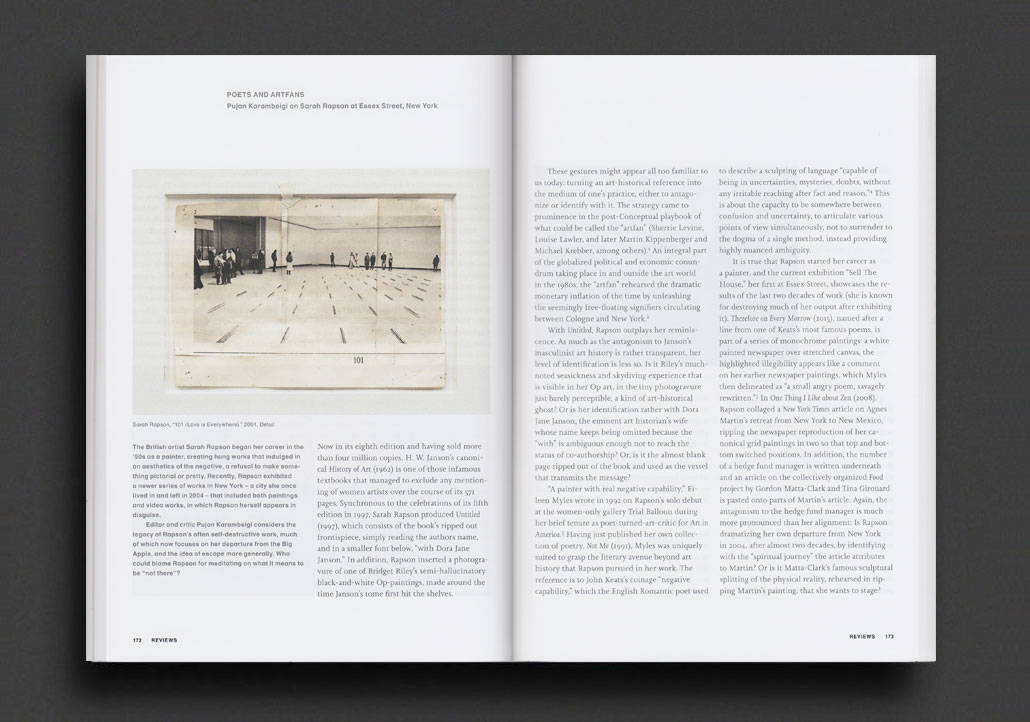
POETS AND ARTFANS / Pujan Karambeigi on Sarah Rapson at Essex Street, New York
EROSION UND WACHSTUM / Markues über „Soil Is an Inscribed Body. Über Souveränität und Agrarpoesien“ bei SAVVY Contemporary, Berlin
MATERIAL FUTURES / Adrienne Ange Rooney on Lubaina Himid at the New Museum, New York
DIES IST KEIN PHALLUS / Francesca Raimondi über „Maskulinitäten. Eine Kooperation von Bonner Kunstverein, Kölnischem Kunstverein und Kunstverein für die Rheinlande und Westfalen, Düsseldorf“
WHICH SIDE ARE YOU ON? / Chris Reitz on Latoya Ruby Frazier at the Renaissance Society, Chicago
MAGISCHE POLITIK / Fiona Geuß über Andrea Bowers in der Weserburg, Museum für moderne Kunst, Bremen
MOTHER OF PEARL / Enzo Shalom on Nicolás Guagnini at Bortolami, New York
(BE-)ZEUG DICH! / Alida Müschen über Julia Phillips im Kunstverein Braunschweig
GHOSTS NOT WELCOME / Nina Prader on Omer Fast at the Salzburger Kunstverein
CRITICAL AFFECTIONS / Sophie Goltz über „Awakenings: Art in Society in Asia 1960s–1990s“ in der National Gallery in Singapur
ZWISCHEN ALLEN STÜHLEN / Dorothea Zwirner über Senga Nengudi im Lenbachhaus, München
NACHRUFE / OBITUARIES
SARAH SCHUMANN (1933−2019) by Vojin Saša Vukadinović
DOUGLAS CRIMP (1944–2019) by Marc Siegel
DOUGLAS CRIMP (1944-2019) by Louise Lawler
DOUGLAS CRIMP (1944-2019) by Juliane Rebentisch
EDITION
JESSICA STOCKHOLDER
RAPHAELA VOGEL
JORINDE VOIGT
2012, English
Softcover, 128 pages, 15.2 x 21.6 cm
Published by
Nightboat Books / New York
$32.00 - Out of stock
These interrelated meditations explore the nature of the individual spirit and the individual spiritedness of the natural world. As skilled a philosopher as she is a poet, in Sea & Fog, Adnan weaves multiple sonic, theoretical, and syntactic pleasures at once.
Etel Adnan was born in Beirut, Lebanon in 1925. She studied philosophy at the Sorbonne, U.C. Berkeley, and at Harvard, and taught at Dominican College in San Rafael, California, from 1958–1972. In solidarity with the Algerian War of Independence (1954–1962), Adnan began to resist the political implications of writing in French and became a painter. Then, through her participation in the movement against the Vietnam War (1959–1975), she began to write poetry and became, in her words, “an American poet.” In 1972, she returned to Beirut and worked as cultural editor for two daily newspapers—first for Al Safa, then for L’Orient le Jour. Her novel Sitt Marie-Rose, published in Paris in 1977, won the France-Pays Arabes award and has been translated into more than ten languages. In 1977, Adnan re-established herself in California, making Sausalito her home, with frequent stays in Paris. Adnan is the author of more than a dozen books in English, including Journey to Mount Tamalpais (1986), The Arab Apocalypse (1989), In the Heart of the Heart of Another Country (2005), and Sea and Fog (2012), winner of the Lambda Literary Award for Lesbian Poetry and the California Book Award for Poetry. In 2014, she was awarded one of France’s highest cultural honors: l’Ordre de Chevalier des Arts et Lettres.
2016, English
Collection of chapbooks in clear plastic slipcase, 272 pages, 17.5 x 23.8 cm
Published by
Alfred Knopf / New York
$48.00 - Out of stock
From the renowned classicist and MacArthur Prize winner: a new collection that explores myth and memory, beauty and loss, all the while playing with–and pushing–the limits of language and form.
Anne Carson consistently dazzles with her inventive, shape-shifting work and the vividness of her imagination. Float reaches an even greater level of brilliance and surprise. Presented in an arrestingly original format–individual chapbooks that can be read in any order, and that float inside a transparent case–this collection conjures a mix of voices, time periods, and structures to explore what makes people, memories, and stories “maddeningly attractive” when observed in spaces that are suggestively in-between.
One can begin with Carson contemplating Proust on a frozen Icelandic plain, or on the art-saturated streets of downtown New York City. Or journey to the peak of Mount Olympus, where Zeus ponders his own afterlife. Or find a chorus of Gertrude Steins performing an essay about falling–a piece that also unearths poignant memories of Carson’s own father and great-uncle in rural Canada. And a poem called “Wildly Constant” piercingly explores the highs and lows of marriage and monogamy, distilled in a wife’s waking up her husband from the darkness of night, and asking him to make them eggs for breakfast.
Exquisite, heartbreaking, disarmingly funny, Float kaleidoscopically illuminates the uncanny magic that comes with letting go of expectations and boundaries. It is Carson’s most intellectually electrifying, emotionally engaging book to date.
ANNE CARSON was born in Canada and has been a professor of Classics for over thirty years. Her awards and honors include the Lannan Award, the Pushcart Prize, the Griffin Trust Award for Excellence in Poetry, and fellowships from the Guggenheim and MacArthur Foundations.
1981, Japanese
Hardcover (w. dust jacket and obi-strip), 80 pages, 28 x 22 cm
1st Edition, Out of print title / used / very good
Published by
Shueisha / Japan
$100.00 - Out of stock
First edition of this wonderful, very rare monograph on the artwork of Masakane Yonekura, published in 1981. Heavily illustrated throughout, spanning the artist's oeuvre in drawing, paintings and print work. Masakane Yonekura (1934 - 2014) was a Japanese stage director, actor, author and illustrator who was one of the central members of the Gekidan Mingei theatre company. He is also known for his work known for his work in the films Belladonna of Sadness (1973), Zatoichi Meets Yojimbo (1970), Harukanaru sôro (1980) and Sanada fûunroku (1963). In 1976 he won an important prize at the Bologna International Children's Book Fair. His woodblock prints mainly depict bijin-ga in his own, very personal style, often reflecting the world of theatre through the drawn line.
Very Good copy in VG dust jacket with light wear and original obi-strip (not pictured).
1972, German
Softcover, 94 pages, 20 x 24 cm
1st Edition, Out of print title / used / very good
Published by
Kunsthalle Nürnberg / Nürnberg
$45.00 - Out of stock
Wonderful catalogue from 1972 on the work of the great Joachim Bandau. Includes many fantastic photographs of Bandau's sculptural works in exhibition and behind-the-scenes, plus many reproductions of his drawings and object designs, along with texts in German. Published on the occasion of the solo exhibition : Figuren, Geräte, Monstren at Kunsthalle Nürnberg September 29 - November 19, 1972.
Joachim Bandau (b. Cologne, 1936) is a sculpture, painter and graphic artist. He belongs to an important group of German artists, together with Gerhard Richter, Joseph Beuys, and Imi Knoebel, who came out of the Kunstakademie Dusseldorf in 1961. In 1966, he was among the founders of the group of artists K66. In 1977, he is exhibited at Documenta 6 in Kassel and in 1986 he receives the Will Grohmann Award from the Berlin Academy of Arts. Joachim Bandau showed several works at Documenta 6 in Kassel in 1977, including a performance inside Kabinen-Mobil. For the first time, Joachim Bandau was “using” by himself one of his famous “mobile sculptures“, imposing polyester structures close to man-machine hybrids, which refer to the human condition and form. Bandau created a large series of these mobile sculptures made from fiberglass from the late 1960’s and throughout the 1970s. These futurist-organic figures resemble a hybrid of man, machine, and design-object, contrast a tension between confinement and spatial deployment, with his sculptures’ potential for mobility. Since the 1990s, Joachim Bandau has been painting transparent filters of light-gray watercolour to shape blocks of dark matter, reminiscent of radiographs, but also of Malevitch’s Suprematist compositions. These Black Watercolours suggest incessant motion from within to without, between withdrawal and spatial control. Shades of grey watercolour evoke photographic decomposition of movement, as if each were capturing successive movements of one block of colour. He resides in Switzerland.
Good copy of the only edition.
1993, Japanese
Hardcover (clothbound), 20 x 20 cm
1st Edition, Out of print title / used / very good
Published by
Byakuya Shobo / Tokyo
$220.00 - Out of stock
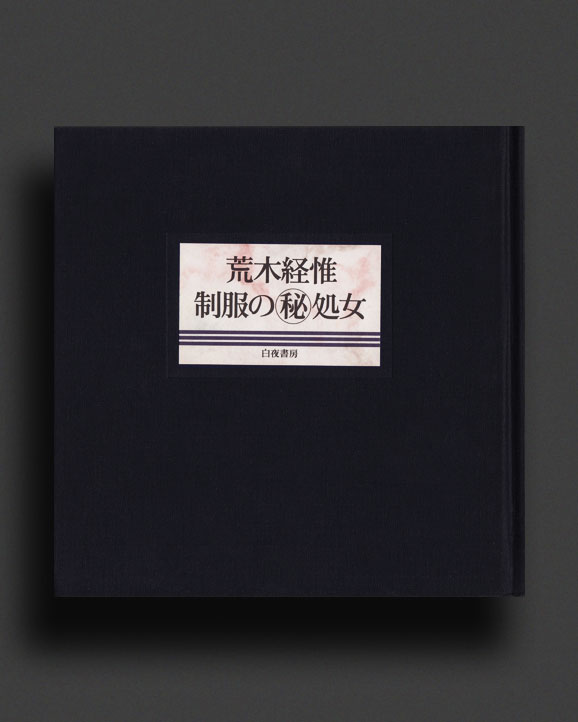
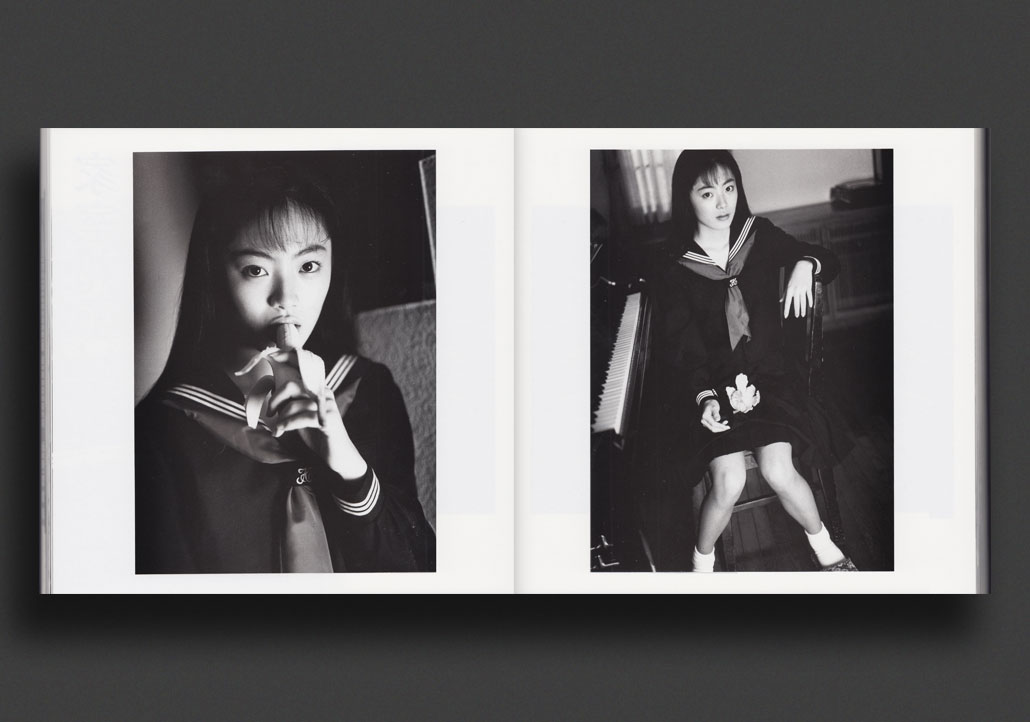
Very rare first edition of this uncommon Araki photobook from 1993. A beautiful hardcover collection of photographs by Nobuyoshi Araki, one of Japan's leading photographers. In April 1992, a photo exhibition of Araki's "Photo Maniac's Diary" saw 8 positive films seized by the Metropolitan Police Department and the Public Prosecutor's Office for showing genitals. Araki was fined for obscenity. This work, published just a year later, was accompanied by Araki's statement, "This photo book is more obscene but not seized."
Bound in black cloth with the original obi-strip simply reading - in bold double entendre - "Graduate", this collection is made entirely of photographs of 30 young women in Japanese sailor suit school uniforms. It is of course unknown whether his models are in fact high school students, but here Araki intentionally creates more eros than the exposed genitals that landed him such controversy the year before. There is no nudity, yet Araki's erotica is heightened in the viewer's reading of situations and poses, facial expressions, the distance to the subject, and visual euphemism. Araki's intimate document of staged schoolgirl truancy is simultaneously a playful thumbing of the nose to Japanese censorship and a touching series of adolescent portraits in gorgeous monochrome.
Beautifully printed in gloss by publishers Byakuya Shobo.
Very Good/Fine copy.
1977, English
Softcover, 65 pages, 22.3 x 27.6 cm
1st Edition, Out of print title / used / good
Published by
A.D. (Architectural Design) / London
$55.00 - Out of stock
Special 1977 profile edition of A.D. (Architectural Design) magazine devoted entirely to the Center Pompidou. Published around the time of the opening, this volume was the first in-depth look at the extraordinary building. Richly illustrated throughout in colour and black and white with build progress, foundries, plans, models, acoustic experiments, statements from Piano and Rogers, and much more. Texts in English.
The Centre Pompidou is a complex building in the Beaubourg area of the 4th arrondissement of Paris, near Les Halles, rue Montorgueil, and the Marais. It was designed in the style of high-tech architecture by the architectural team of Richard Rogers, Su Rogers, Renzo Piano, along with Gianfranco Franchini. It was the first major example of an 'inside-out' building with its structural system, mechanical systems, and circulation exposed on the exterior of the building. Initially, all of the functional structural elements of the building were colour-coded: green pipes are plumbing, blue ducts are for climate control, electrical wires are encased in yellow, and circulation elements and devices for safety (e.g., fire extinguishers) are red. According to Piano, the design was meant to be “not a building but a town where you find everything – lunch, great art, a library, great music”. It houses the Bibliothèque publique d'information (Public Information Library), a vast public library; the Musée National d'Art Moderne, which is the largest museum for modern art in Europe; and IRCAM, a centre for music and acoustic research.
Good copy with light wear and tanning to spine.
2017, English
Hardcover, 162 pages, 23 x 23 cm
1st Edition, Out of print title / used / very good
Published by
Heide Museum of Modern Art / Victoria
$40.00 $25.00 - Out of stock
For more than one hundred years, artists have drawn inspiration from the early twentieth-century avant-garde movement Constructivism. Its abstract forms, utopian ideals and vision of art’s vital role in constructing a new society have continued to act as a beacon for artists of successive generations in many countries. This extensive survey of over seventy artists explores how Australian artists have responded to this ground breaking modernist movement and its enduring call upon their imaginations from the 1930s to the present day.
Essay contributions by curators Sue Cramer, Lesley Harding plus additional focus texts by 24 acclaimed Australian writers and curators.
Works illustrated by Australian artists Ralph Balson, Frank Hinder, Inge King, Kerrie Poliness, Justin Andrews, Peter Cripps, Gunter Christmann, George Johnson, Robert Owen, Rose Nolan, John Nixon, Justene Williams and Zoë Croggon, among many others alongside those by key proponents of the original movement, such as Russian artists Rodchenko, Malevich, El Lissitzky and Alexandra Exter from Russia, and British artists Ben Nicholson and Barbara Hepworth.
Hardcover catalogue published to accompany the exhibition of the same name 5 July - 8 October 2017 at Heide Museum of Modern Art, Victoria.
1983, German
Softcover, 142 pages, 26.5 x 24.5 cm
1st Edition, Out of print title / used / very good
Published by
Fricke Verlag / Frankfurt
$45.00 - Out of stock
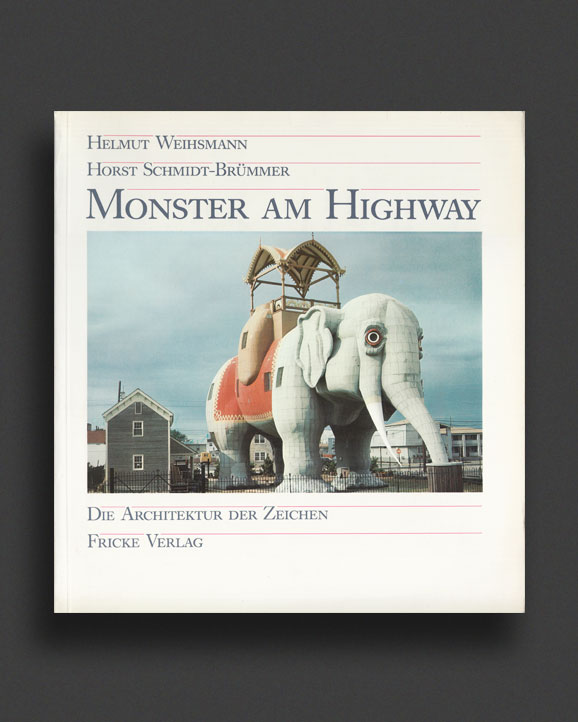
Published in Germany in 1983, Monster am Highway (Monster on the Highway) by Helmut Weihsmann and Horst Schmidt-Brummer is one of the best photographic documents of vernacular and road side architecture. From iconic postmodern architecture by Hans Hollein, Charles Moore, SITE, etc. to fantastic outsider creations, Monster am Highway compiles international examples throughout history of wild drive-through restaurants, casinos, over-sized roadside attractions, mobile sculptures, billboards, murals, shop facades, interiors, profusely illustrated in colour and black and white. Texts in German.
Very Good copy with light wear.
2021, English
Softcover, 120 pages, 11.4 x 17.8 cm
Published by
Semiotext(e) / Los Angeles
$29.00 - Out of stock
Immunodemocracy offers a stimulating and profound portrayal of the epochal event that has already left its mark on the twenty-first century. Moving from the ecological question to the rule of experts, from the state of exception to immunitarian democracy, from rule by fear to the contagion of conspiracy theory, from forced distancing to digital control, Donatella Di Cesare examines how existence is already changing—and what its future political effects may be. In her own personal style, the author reconstructs the dramatic phases of what she calls "the breathing catastrophe." Coronavirus is a sovereign virus that skirts its way around the walls of patriotism and the sovereignists' imperious frontiers. And it reveals in all its terrible crudeness the immunitarian logic that excludes the weakest and hits the poorest.
The cordon sanitaire of disengagement risks expanding beyond all proportion. The disparity between the protected and the helpless—a challenge to any idea of justice—has never been so blatant. The virus has not introduced, but merely brought out into the open the ruthlessness of the capitalism that is now wrapping us in its devastating spiral, in its compulsive, asphyxial vortex. Is it our final warning? The violent global pandemic shows that it is impossible for us to survive if we don't help each other. We will need to protect ourselves from protection and the specter of absolute immunization. When breathing can no longer be taken for granted, we need to rethink our way of living together.
Translated by David Broder
Donatella Di Cesare teaches theoretical philosophy at the Sapienza University in Rome. One of the most significant voices on the Italian intellectual scene, she is an authoritative contributor to numerous newspapers, websites and journals in Italy and elsewhere. Her books have been translated into eight languages.
2021, English
Hardcover (w. dust jacket), 224 pages, 21.6 x 13.8 cm
Published by
Faber & Faber / London
$29.00 - Out of stock
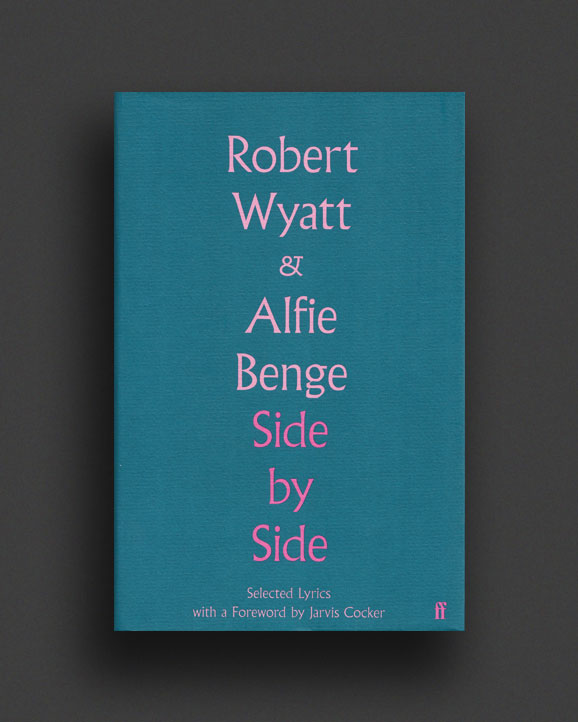
The life’s work of two of British music’s most unique and timeless artists, with an introduction by Jarvis Cocker.
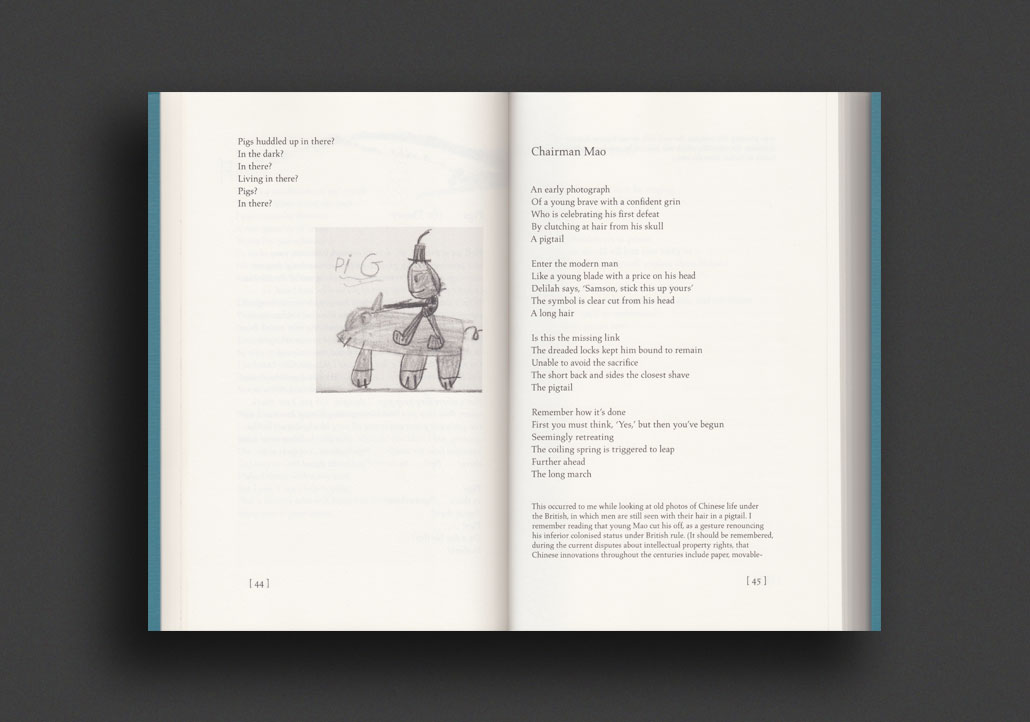
Selected and arranged by the authors themselves, Side by Side presents the lyrics, poems, writings and drawings of innovative musician Robert Wyatt and his creative partner, English painter and songwriter Alfie Benge. As a founding member of influential English rock bands Soft Machine and Matching Mole, and with a solo career which has lasted for over forty years and seen him collaborate with a diverse range of artists including Bjork, Brian Eno, Carla Bley, Paul Weller and David Gilmour, his own music remains unclassifiably personal. Alfie Benge is a visual artist, songwriter and pioneering music manager, having managed Robert’s career for fifty years. She is also married to Robert. Since 1982 they have collaborated on many of Robert’s most well-known songs. This unique volume celebrates one of the most enduring creative partnerships of the last half-century.
"Whenever an aspiring musician asks me about songwriting I point them towards Robert and Alfie. Their work is so unusual, so perceptive, so playful and so grownup. I don’t think there's anyone to compare. If you want songs that touch your mind as well as your heart, these are the best. Wide distribution of this book could improve the state of music dramatically." — Brian Eno
"Taken together Alfie & Robert’s lyrics combine to create a humanist world-view that is at once global & particular. Take it from me: that’s no mean feat." — Jarvis Cocker
2017, English
Softcover, 304 pages, 20 x 13 cm
Published by
Archive Books / Berlin
$42.00 - In stock -
Although the short-lived Brazilian cultural movement known as Tropicália is most commonly associated with music and the visual arts, its sense of playfulness and strategies of appropriation have stimulated many of the country’s filmmakers from the 1960s to the present. The term was first given to a pair of installations by Hélio Oiticica, a song by Caetano Veloso, and an LP released in 1968, featuring artists such as Gilberto Gil, Gal Costa and the psychedelic band Os Mutantes. But according to Veloso, the catalyst for the flurry of creative activity at this time was Glauber Rocha’s landmark film Terra em Transe (Land in Anguish, 1967). And, while Tropicália was cut down in its prime by Brazil’s repressive military dictatorship, its revolutionary gestures continued to make a mark on cinema in the following decades. Fifty years after its emergence, what is the legacy of Tropicália today? And what is its effect on filmmaking in Brazil? This publication brings together a range of filmmakers and scholars past and present to consider these questions, and to offer multiple perspectives on the history of a major period in Brazilian cultural history.
Contributions by Carlos Adriano, Augusto Barros, Ela Bittencourt, Ivan Cardoso, José Celso Martinez Corrêa, Max Jorge Hinderer Cruz, Albert Elduque, Helena Ignez, Scott MacDonald, Rubens Machado Jr., Pedro Neves Marques, Ricardo Miranda, Jorge O Mourão, Noilton Nunes, Arthur Omar, Eder Santos Jr., Rogério Sganzerla, Robert Stam, Ana Vaz, Caetano Veloso, Ismail Xavier, Bruce Yonemoto.
1978, English
Softcover, 48 pages, 25.5 x 20.5 cm
1st Edition, Out of print title / used / very good
Published by
Everson Museum of Art / Syracuse
$45.00 - Out of stock
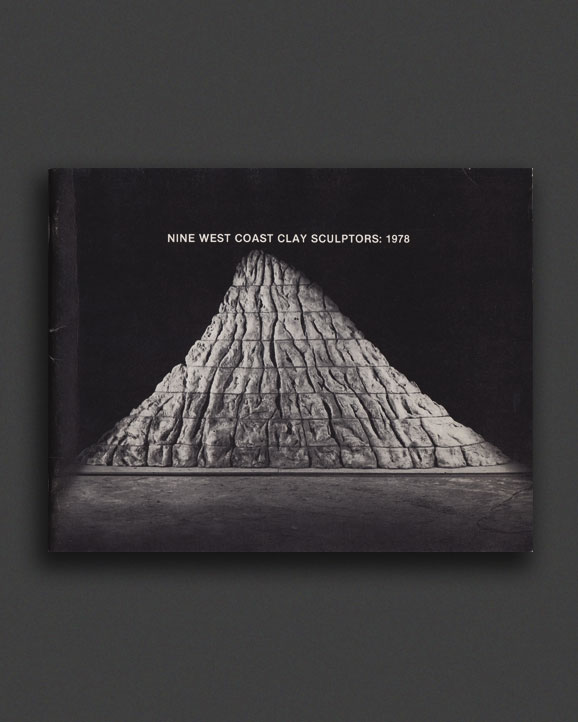
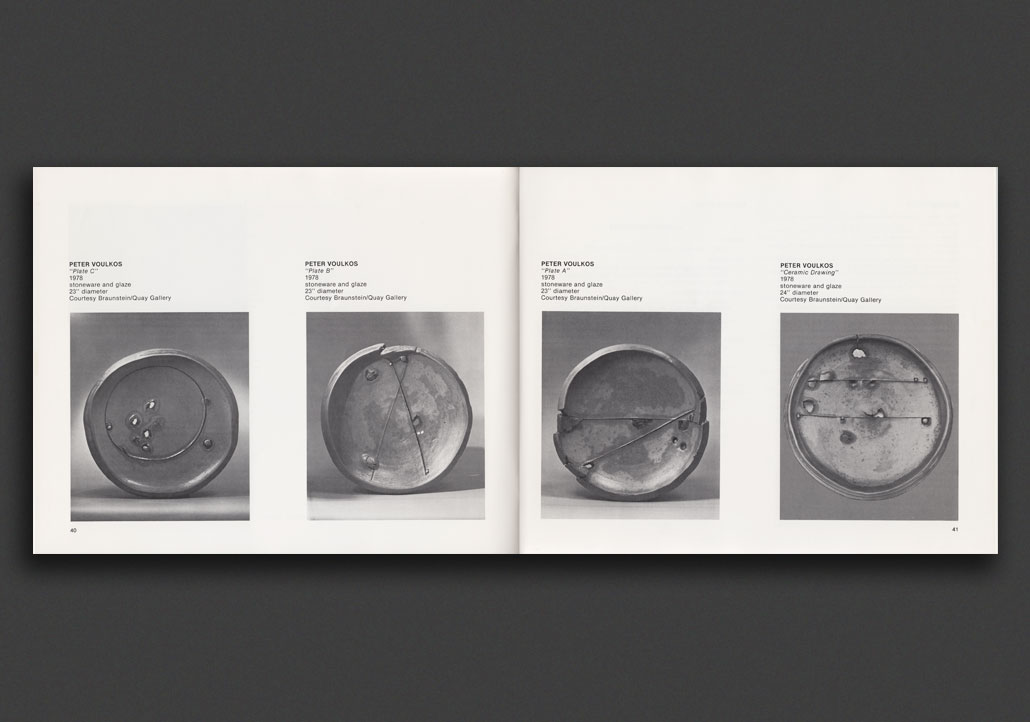
Very scarce catalogue published to accompany an exhibition curated by Margie Hughto at the Everson Museum of Art, Syracuse, New York, September 29 - December 3, 1979; Arts and Crafts Center of Pittsburgh, February 24 - March 18, 1979. Centring around The California Clay Movement (or American Clay Revolution), a school of ceramic art that emerged in California in the 1950s that was part of the larger transition in crafts from "designer-craftsman" to "artist-craftsman", the exhibition features the influential work of Peter Voulkos and Stephen de Staebler, two of the movement's driving forces, and their students and associated Funk (non-functional Bay Arena ceramic art movement) artists including Marilyn Levine, Robert Arneson, Karen Breschi, David Gilhooly, David Middlebrook, Kenneth Price, and Richard Shaw. Text by Judy S. Schwartz. Acknowledgments & Foreword by Margie Hughto, Adjunct Curator of Ceramics. Each artist with a one page write-up profile with images, notes and biographies.
Very Good with some light creasing.
1985, English
Softcover (stapled), 12 pages, 20.3 x 23.3 cm
1st Edition, Out of print title / used / very good
Published by
Wright State University / Ohio
$25.00 - In stock -
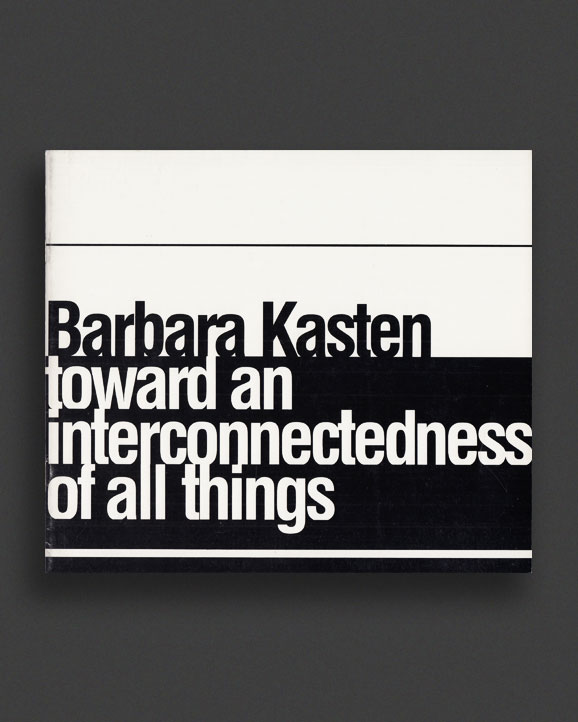
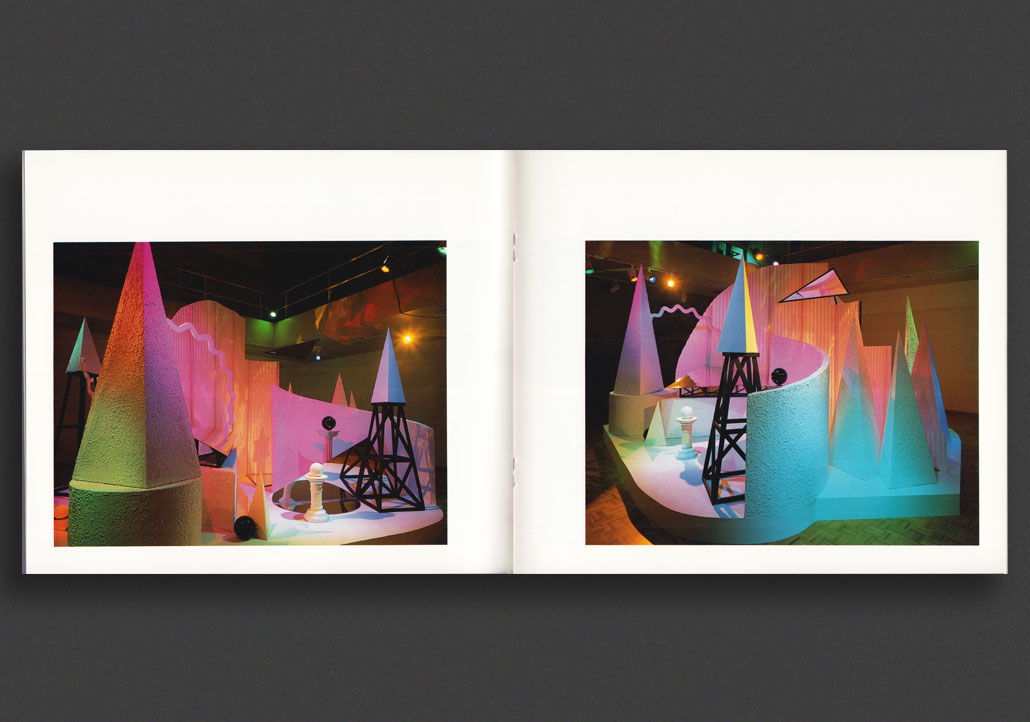
Lovely scarce catalogue produced on the occasion of Barbara Kasten: Toward an Interconnectedness of All Things at University Art Galleries, Wright State University, Dayton, Ohio, September 23 - October 24, 1985. Documents the making-of and presentation of one of Kasten's most iconic installations through colour and b/w photography.
Barbara Kasten (b. 1936) trained as a painter and textile artist, receiving her MFA from the California College of Arts and Crafts (CCAC) in Oakland in 1970. Since the 1970s Kasten has developed her expansive practice of photography through the lens of many different disciplines, including sculpture, painting, theater, textile, and installation. Spanning her nearly five-decade engagement with abstraction, light, and architectonic form, this publication situates Kasten’s practice within current conversations around sculpture and photography.
Very Good, As New old stock.
2019, English
Hardcover, 256 pages, 18.5 × 24.3 cm
Published by
MASP / São Paulo
$98.00 - Out of stock
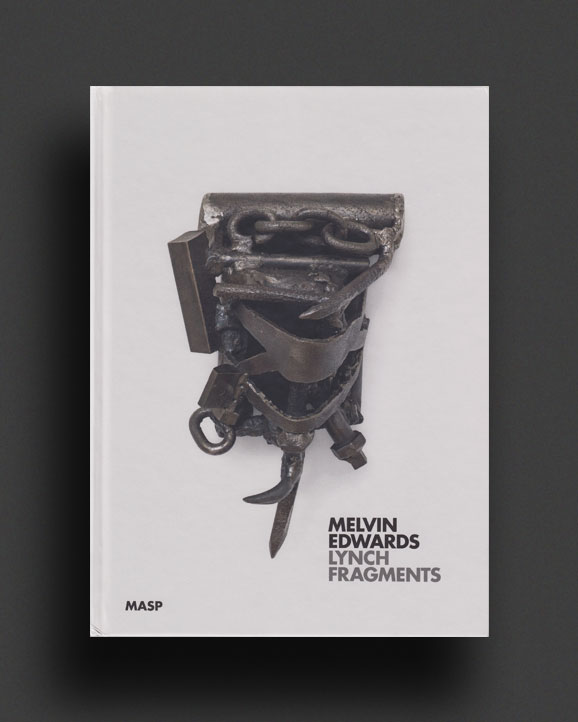
Lynch Fragments brings together a significant selection of works from the homonymous series by the American sculptor Melvin Edwards, created between 1963 and 2016, comprising more than fifty years of what is considered the artist’s central body of work.
Edwards started to produce the Fragments series when he lived in Los Angeles, at a crucial time of the civil rights movement in the United States. The works directly reference the practice of lynching after the abolition of slavery. Denouncing violence against African Americans, Edwards created these steel sculptures as forms between bodies and machines that can also be interpreted as weapons, given the sense of violence and danger suggested by their blunt, angular and protruding shapes. The selection of works in this book reflects the multiplicity of thematic interests and the formal variations across the series.
2021, English
Hardcover, 264 pages, 20.3 x 13.4 cm
Published by
Repeater Books / London
$33.00 - Out of stock
A collection of transcripts from Mark Fisher's final series of lectures at Goldsmiths, University of London, in late 2016.
Edited and with an introduction by Matt Colquhoun, this collection of lecture notes and transcriptions reveals acclaimed writer and blogger Mark Fisher in his element — the classroom — outlining a project that Fisher's death left so bittersweetly unfinished.
Beginning with that most fundamental of questions -- "Do we really want what we say we want?" — Fisher explores the relationship between desire and capitalism, and wonders what new forms of desire we might still excavate from the past, present, and future. From the emergence and failure of the counterculture in the 1970s to the continued development of his left-accelerationist line of thinking, this volume charts a tragically interrupted course for thinking about the raising of a new kind of consciousness, and the cultural and political implications of doing so.
For Fisher, this process of consciousness raising was always, fundamentally, psychedelic — just not in the way that we might think...
2014, English
Softcover, 245 pages, 14.2 x 21.4 cm
Published by
Zero Books / UK
$39.00 - Out of stock
This collection of writings by Mark Fisher, author of the acclaimed Capitalist Realism, argues that we are haunted by futures that failed to happen. Fisher searches for the traces of these lost futures in the work of David Peace, John Le Carre, Christopher Nolan, Joy Division, Burial and many others.
1975, English
Hardcover (w. dust jacket), 105 pages,
Published by
Stanton Archives / New York
$100.00 - Out of stock
Scarce first hardcover edition of Family Affair from 1975, Eric Stanton's very first self-published hardcover book, and historically significant in that it was the very first book of erotic art ever to garner a Library of Congress number and 'stamp of approval. 155 gorgeous pencil illustrations by Stanton featuring his characteristic statuesque dominant females inspired by the fantasy of "a friend from Europe". Eric Stanton (1926 – 1999) was an American underground cartoonist and fetish art pioneer, who is regarded as the greatest erotic artist that ever lived. While Stanton began his career as a bondage fantasy artist for the famous Irving Klaw, the majority of his later work depicted gender role reversal and proto-feminist female dominance scenarios. In 1975 Stanton began to self-publish with the release of three books ("Family Affair;" "The Governess" and "The Punished Publisher"), but a falling-out between the printer and Stanton over payment led to their delivery for distribution with all copies lacking their dust covers. Only a small number of these books later acquired from the printer were complete with their wonderful colour illustrated dust jackets, the distributed copies sold without. All three self-published 1975 books by Stanton are today - a third of a century later - regarded by most Stanton aficionados as his greatest works.
Good copy with tanning to jacket edges and some bumping, wear.
2019, English
Softcover, 160 pages, 12.7 x 19.8 cm
Published by
Verso / London
$29.00 - In stock -
Lauded by major contemporary artists and philosophers, Jacques Rancière’s work returns politics to its central place in understanding art.
In The Future of the Image, Jacques Rancière develops a fascinating new concept of the image in contemporary art, showing how art and politics have always been intrinsically intertwined. Covering a range of art movements, filmmakers such as Godard and Bresson, and thinkers such as Foucault, Deleuze, Adorno, Barthes, Lyotard and Greenberg, Rancière shows that contemporary theorists of the image are suffering from religious tendencies.
He argues that there is a stark political choice in art: it can either reinforce a radical democracy, or create a new reactionary mysticism. For Rancière there is never a pure art: the aesthetic revolution must always embrace egalitarian ideals.
“Much of the value of Rancière’s writings on art and aesthetics arises from his initial refusal of terms that are self-evident to the point of invisibility. ”— Frieze
1980, English
Softcover, 24 pages, 28 x 22 cm
1st Edition, Out of print title / used / good
Published by
Cassina / Italy
$120.00 - Out of stock
Wonderful and very rare original catalogue pubished by Cassina in 1980 to promote legendary Italian designer Gaetano Pesce's iconic furniture pieces "Tramonto a New York" sofa, "Sansone" table, "Dalila" chair, and "Sit Down" armchair. Illustrated across 24 colour pages, including fold-outs, including specs and details on each piece. A very collectible archival piece of ephemera from Cassina.
Gaetano Pesce was born in Italy in 1939 and studied architecture at the University of Venice. After graduating in 1965, he moved between London, Padova, Helsinki, and Paris, before settling in New York in 1980. From the beginning, Pesce’s practice has straddled the boundaries between art, design, urban planning, and architecture, always using his work as a vehicle to communicate his perspective on the world today. With resin, foam, and plastics as his signature materials, Pesce has designed for companies such as Cassina, B&B Italia, and Vitra. His architectural work includes the Organic Building of Osaka, the Children’s House for Parc de la Villette, the Gallery Mourmons in Belgium, and the TBWA\Chiat\Day office in New York. Pesce has served as a visiting lecturer and professor at many prestigious institutions in America and abroad, principally the Cooper Union in New York. He is currently a faculty member at the Institut d'Architecture et d'Etude Urbaines in Strasbourg.
Good copy with some light bending.
2011, English
Softcover, 208 pages, 20.3 x 25.4 cm
1st Edition, Out of print title / used / fine
Published by
Verlag fur moderne Kunst / Nuremberg
$100.00 - Out of stock
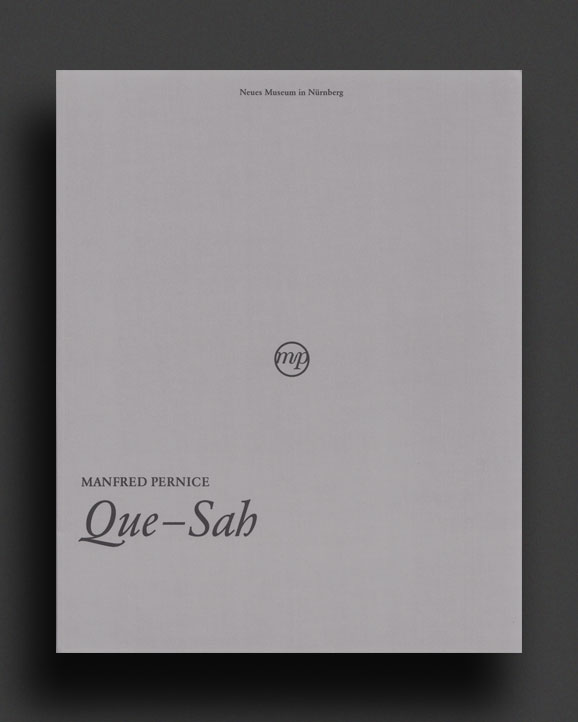
Wonderful, now out-of-print book produced on the most comprehensive survey exhibition to date of work by Berlin-based artist Manfred Pernice, held at the Neue Museum in Nuremberg in 2011, incorporating existing and new works in relation to one another. Profusely illustrated, this definitive publication documents the artist's work to date via essays and a comprehensive illustrated biography.
With his installation-based work, Manfred Pernice (born 1963) belongs to a new generation of German artists who have established international reputations. His sculptures are constructed from conventional building materials such as particle board, blockboard, iron rods and concrete. The formal vocabulary of Pernice’s works often consists of details of real architecture, ranging from tile-covered surfaces and closed structural forms to very specific architectural design solutions such as the Fiat car factory in Turin with its rooftop test track. Functional components such as containers, walled enclosures, mounts or supports also serve as models for his sculptural objects. Pernice often combines these architecturally oriented works with pieces of furniture, models, drawings, photographs or texts to create expansive and evocative installations.
The exhibition title – Que-Sah – refers to one volume of the Brockhaus encyclopaedia, where alphabetical arrangement is used to give systematic order to the extremely varied lexical contents. On this subject Pernice has commented that, “Like the first entry in this volume (Quebec conferences) and the last one (Saho, stock farmers of northern Ethiopia), all the other conceptual phenomena that lie between them are also potential areas of artistic exploration.”
Text by Angelika Nollert, Jennifer Allen, Sabeth Buchmann, Jan Verwoert, Melitta Kliege.