World Food Books' programme is largely produced on Kulin Nation land. We acknowledge the Wurundjeri people of the Kulin Nation as the first and continuing custodians of this land, and pay respect to their Elders past, present, and emerging.
World Food Books is an arts and special interests bookshop in Naarm / Melbourne. Founded in 2010, World Food Books is devoted to the presentation of a rotating, hand-selection of international art, design, literary and counterculture publications with an emphasis on the anti-traditional, the experimental, the avant-garde, the heretic, the marginal.
Presenting new titles alongside rare and out-of-print books, catalogues and journals spanning the fields of modern and contemporary art, design, photography, illustration, film, literature, poetry, cultural theory, philosophy, sexuality, popular and underground culture in its many radical forms, World Food Books wishes to encourage adventurous, thoughtful and open-minded reading, looking, writing, and exchange of publishing and ideas, both current and historical.
As well as our bookshop, located in Melbourne's historical Nicholas Building, all of our inventory is available internationally via our online mail-order service.
World Food Books semi-regularly co-ordinates "Occasions", a programme of exhibits and events at the bookshop and in partnership with other hosts (such as museums and art galleries) that develop out of the activities, relationships and content of the bookshop itself.
World Food Books
The Nicholas Building
37 Swanston Street
Room 5, Level 6
Melbourne 3000
Australia
SHOP HOURS:
Thu–Fri 12–6, Sat 12–5
WEB-SHOP OPEN 24/7
World Food Books
Postal Address:
PO Box 435
Flinders Lane
Victoria 8009
Australia
Art
Theory / Essay
Architecture / Interior
Graphic Design / Typography
Photography
Fashion
Eros
LGBTQ+
Fiction / Poetry
Weird / Speculative / Science Fiction / Horror
Transgressive / Visceral / Abject
Symbolism / Decadence / Fin de siècle
Film / Video
Painting
Sculpture / Installation
Performance / Dance / Theater
Drawing
Sound / Music
Curatorial
Group Shows / Collections
Periodicals
Out-of-print / Rare
Posters / Ephemera / Discs
Signed Books
World Food Books Gift Voucher
World Food Book Bag
Australian Art
Australian Fiction
Australian Science Fiction / Speculative Fiction
Australian Poetry
Australian Photography
Japanese Photography
Conceptual Art
Minimal Art
Dada
'Pataphysics / Oulipo
Fluxus
Concrete Poetry
Pop Art
Surrealism
Arte Povera
Arte Informale / Haute Pâte / Tachism
Nouveau Réalisme / Zero / Kinetic
Situationism / Lettrism
Collage / Mail Art / Xerox Art
Art Brut / Folk / Visionary / Fantastic
Illustration / Graphic Art / Bandes Dessinées
Furniture
Italian Radical Design / Postmodernism
Textiles
Ceramics / Glass
Counterculture
Protest / Revolt
Philosophy
Psychoanalysis
Anthropology
Anarchism
Socialism / Anarchism / Communism / Capitalism
Literary Theory / Semiotics / Language
Feminism / Women's Studies
Gender Studies / Sexuality
Anthropology
Fetishism / BDSM
Drugs / Psychedelia
Crime / Violence
Animal Rights / Veganism
Occult / Esoterica
Ecology / Earth / Alternative Living
Whole Earth / Crafts
All prices in AUD (Australian dollars)
Pick-Ups
Pick-up orders can be collected in our bookshop during opening hours after order date. Please collect any Pick-up orders within 2 weeks of ordering as we have limited storage space. Orders will be released back into stock if not collected within this time. No refunds can be made for pick-ups left un-collected. If you cannot make it in to the bookshop in this time-frame, please choose postage option.
Return Policy
All sales are final. We do accept returns (for refund or exchange) for items received in error. All our orders are packed with special care using heavy-duty padding and cardboard book-mailers or bubble mailers (for smaller books), using reinforcement where required. We cannot take responsibility for any lost, stolen or damaged parcels.
Insurance
Should you wish to insure your package, please email us directly after placing your order and we can organise this at a small extra expense. Although all standard/express tracked packages are very safe and dependable, we cannot take responsibility for any lost, stolen or damaged parcels. We recommend insurance on valuable orders.
Interested in selling your old books, catalogues, journals, magazines, comics, fanzines, ephemera? We are always looking for interesting, unusual and out-of-print books to buy. We only buy books in our fields of interest and specialty, and that we feel we can resell.
We base these prices on desirability, market value, in-print prices, condition and our current stock levels. We offer cash, store credit, and can take stock on consignment. All
about 25% of the price we expect to get when we sell them, or 30% in store credit. We base these prices on desirability, market value, in-print prices, condition and our current stock levels.
Sell your books any day of the week. You can drop them off and return later. If you have a lot of books, we can visit your Sydney home.
We buy books that we feel we can resell. We offer about 25 % of the price we expect to get when we sell them, or 30% in store credit. We base these prices on desirability, market value, in-print prices, condition and our current stock levels.
Philadelphia Wireman
03 August - 01 September, 2018
World Food Books is proud to announce our next Occasion, the first presentation of sculptures by Philadelphia Wireman in Australia.
The Philadelphia Wireman sculptures were found abandoned in an alley off Philadelphia’s South Street on trash night in 1982. Their discovery in a rapidly-changing neighbourhood undergoing extensive renovation, compounded with the failure of all attempts to locate the artist, suggests that the works may have been discarded after the maker’s death. Dubbed the "Philadelphia Wireman" during the first exhibition of this work, in 1985, the maker’s name, age, ethnicity, and even gender remain uncertain. The entire collection totals approximately 1200 pieces, all intricately bound together with tightly-wound heavy-gauge wire (along with a few small, abstract marker drawings, reminiscent both of Mark Tobey and J.B. Murry). The dense construction of the work, despite a modest range of scale and materials, is singularly obsessive and disciplined in design: a wire armature or exoskeleton firmly binds a bricolage of found objects including plastic, glass, food packaging, umbrella parts, tape, rubber, batteries, pens, leather, reflectors, nuts and bolts, nails, foil, coins, toys, watches, eyeglasses, tools, and jewellery.
Heavy with associations—anthropomorphic, zoomorphic, and socio-cultural responses to wrapped detritus—the totemic sculptures by Philadelphia Wireman have been discussed in the context of work created to fulfil the shamanistic needs of alternative religions in American culture. Curators, collectors, and critics have variously compared certain pieces to sculpture from Classical antiquity, Native American medicine bundles, African-American memory jugs, and African fetish objects. Reflecting the artist’s prolific and incredibly focused scavenging impulse, and despite—or perhaps enhanced by—their anonymity, these enigmatic objects function as urban artefacts and arbiters of power, though their origin and purpose is unknown. Philadelphia Wireman, whatever their identity, possessed an astonishing ability to isolate and communicate the concepts of power and energy through the selection and transformation of ordinary materials. Over the course of the past two decades, this collection has come to be regarded as an important discovery in the field of self-taught art and vernacular art.
Presented in collaboration with Fleisher-Ollman Gallery, Philadelphia, and Robert Heald, Wellington.
Susan Te Kahurangi King
02 February - 10 March, 2018
Susan Te Kahurangi King (24 February 1951 - ) has been a confident and prolific artist since she was a young child, drawing with readily available materials - pencils, ballpoint pens and felt-tip markers, on whatever paper is at hand. Between the ages of four and six Susan slowly ceased verbal communication. Her grandparents William and Myrtle Murphy had developed a special bond with Susan so they took on caring responsibilities for extended periods. Myrtle began informally archiving her work, carefully collecting and storing the drawings and compiling scrapbooks. No drawing was insignificant; every scrap of paper was kept. The King family are now the custodians of a vast collection containing over 7000 individual works, from tiny scraps of paper through to 5 meter long rolls.
The scrapbooks and diaries reveal Myrtle to be a woman of great patience and compassion, seeking to understand a child who was not always behaving as expected. She encouraged Susan to be observant, to explore her environment and absorb all the sights and sounds. Myrtle would show Susan’s drawings to friends and people in her community that she had dealings with, such as shopkeepers and postal workers, but this was not simply a case of a grandmother’s bias. She recognised that Susan had developed a sophisticated and unique visual language and sincerely believed that her art deserved serious attention.
This was an unorthodox attitude for the time. To provide some context, Jean Dubuffet coined the term Art Brut in 1945 to describe work created by self-taught artists – specifically residents of psychiatric institutions and those he considered to be visionaries or eccentrics. In 1972 Roger Cardinal extended this concept by adopting the term Outsider Art to describe work made by non-academically trained artists operating outside of mainstream art networks through choice or circumstance. Susan was born in Te Aroha, New Zealand in 1951, far from the artistic hubs of Paris and London that Dubuffet and Cardinal operated in. That Myrtle fêted Susan as a self-taught artist who deserved to be taken seriously shows how progressive her attitudes were.
Susan’s parents Doug and Dawn were also progressive. Over the years they had consulted numerous health practitioners about Susan’s condition, as the medical establishment could not provide an explanation as to why she had lapsed into silence. Dawn educated herself in the field of homeopathy and went on to treat all twelve of her children using these principles – basing prescriptions on her observations of their physical, mental and emotional state.
Doug was a linguist with an interest in philosophy who devoted what little spare time he had to studying Maori language and culture. To some extent their willingness to explore the fringes of the mainstream made them outsiders too but it was their commitment to living with integrity and their respect for individuality that ensured Susan’s creativity was always encouraged.
Even though Susan’s family supported her artistic pursuits, some staff in schools and hospitals saw it as an impediment to her assimilation into the community and discouraged it in a variety of ways. Her family was not always aware of this and therefore did not fully understand why Susan stopped drawing in the early 1990s. However, rather than dwell on the challenges that Susan faced in pursuit of her artistic practice, they prefer to highlight her achievements. In 2008 Susan began drawing again in earnest, after an almost 20 year interruption, and her work is now shown in galleries around the world.
Susan grew up without television and has been heavily influenced by the comics she read as a child. She is absolutely fearless in the appropriation of recognizable characters, such as Donald Duck and Mickey Mouse, in her work. She twists their limbs, contorts their faces, compresses them together, blends them into complex patterned backgrounds - always imbuing them with an incredible energy. Although Susan often used pop culture characters in her work they are not naive or childlike. These are drawings by a brilliant self-taught artist who has been creating exceptional work for decades without an audience in mind.
Mladen Stilinović
"Various Works 1986 - 1999"
02 February 16 - September 10, 2016
Various works 1986 - 1999, from two houses, from the collections of John Nixon, Sue Cramer, Kerrie Poliness, Peter Haffenden and Phoebe Haffenden.
Including: Geometry of Cakes (various shelves), 1993; Poor People’s Law (black and white plate), 1993; White Absence (glasses, ruler, set square, silver spoon, silver ladel with skin photograph and wooden cubes), 1990-1996; Exploitation of the Dead (grey and red star painting, wooden painting, black spoon with red table, red plate), 1984-1990; Money and Zeros (zero tie, paintings made for friends in Australia (Sue, John, Kerrie), numbers painting), 1991-1992; Words - Slogans (various t-shirts) - “they talk about the death of art...help! someone is trying to kill me”, “my sweet little lamb”, “work is a disease - Karl Marx”; Various artist books, catalogues, monographs, videos; Poster from exhibition Insulting Anarchy; "Circular" Croatian - Australian edition; Artist book by Vlado Martek (Dostoyevsky); more.
Thanks to Mladen Stilinović and Branka Stipančić.
Jonathan Walker
Always Will Need To Wear Winter Shirt Blue + Ochre Small Check Pattern
21 August - 21 September, 2015
Untitled
I am not a great reader of poetry but I always return to the work of Melbourne poet, Vincent Buckley (1925- 1988). Perhaps I find his most tantalising piece to be not a finished poem but a fragment left on a scrap of paper discovered on his desk after the poet’s death.
The poetry gathers like oil
In the word-core, and spreads
It has its music meet,
Its music is in movement.
This fragment is more the shell left behind from a volatile thought than a finished poem. I find the last two lines honest but awkward whereas the first two lines work like an arrow. Most likely he could not find a resolution so it was left. Still, in its present form, it remains an eloquent testimony to the ultimate failure of a medium to express mobile thought and sensation, in Buckley’s case, through verbal language. It’s an important matter because this is something all artists have to deal with regardless of the medium.
I have never written a poem, however, I am forever copying fragments from books on paper scraps in a vain effort to fix certain notions in my head. At first, they function as bookmarks that are sometimes returned to when I open the book. But before long, as they accumulate, they fall out littering the table interspersed with A4 photocopies, bills, books and medications.
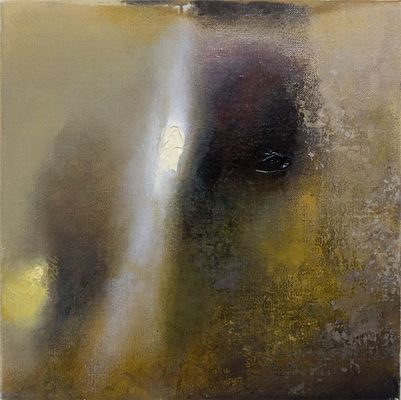
To return to Buckley’s fragment, the first two lines very much evoke how I paint nowadays. As you age, detail diminishes and patches of light become more luminous and float. I feel the most honest way of dealing with this is by smearing the oil paint on the canvas with the fingers and working close-up, blind. Only if the patches coalesce into an approaching image can the work gain a life.
-
Jonathan Walker was born in Melbourne, Australia and brought up on a dairy farm in Gippsland. In the 1970’s he studied painting at RMIT and won the Harold Wright Scholarship to the British Museum, London. During the 1980’s he exhibited at Pinacotheca Gallery, Richmond and had work shown at the NGV and Heidi City Art Gallery. Over the same period he designed the cover for the “Epigenesi” LP by Giancarlo Toniutti, Italy and conducted a mail exchange work with Achim Wollscheid, Germany. The work with artists through the post resulted in an article published in the bicentenary issue of Art and Australia 1988. He showed in artist run spaces such as WestSpace in the 90’s and 2000’s, and until 2012, taught painting at Victoria University, which is where we (Colleen Ahern and Lisa Radford) as organisers of the exhibition, among many others, had the privilege of being his student.
Walker’s knowledge was imparted to students through the careful selection of music, literature, and artists found in books that he himself had ordered for the library. Walker’s strategy was the generosity of sharing his vast knowledge with references specific to each student and their context.
Walker’s paintings share a similar focus and intimacy.
This exhibition presents a small selection of recent paintings alongside a publication that includes Walker’s writing. Observational and analytical, Walker’s work is a type of material notation — the time of day, colour and how it is blended, the both specific and fleeting location of a reflection on lino or the question of whether a chair leg should be included in a painting.
Please join us on Friday August 21 between 6-8pm to celebrate the opening of the exhibition.
Curated by Colleen Ahern and Lisa Radford.
B. Wurtz
Curated by Nic Tammens
March 26 - April 4, 2015
B.Wurtz works from a basement studio in his home on Manhattan’s Lower East Side.
This local fact is attested to by the plastic shopping bags and newsprint circulars that appear in his work. As formal objects, they don’t make loud claims about their origins but nonetheless transmit street addresses and places of business from the bottom of this long thin island. Like plenty of artists, Wurtz is affected by what is local and what is consumed. His work is underpinned by this ethic. It often speaks from a neighborhood or reads like the contents of a hamper:
“BLACK PLUMS $1.29 lb.”
“Food Bazaar”
“USDA Whole Pork Shoulder Picnic 99c lb.”
“RITE AID Pharmacy, with us it’s personal.”
“H. Brickman & Sons.”
“Sweet Yams 59c lb."
Most of the work in this exhibition was made while the artist was in residence at Dieu Donne, a workshop dedicated to paper craft in Midtown. Here Wurtz fabricated assemblages with paper and objects that are relatively lightweight, with the intention that they would be easily transportable to Australia. This consideration isn’t absolute in Wurtz’s work, but was prescriptive for making the current exhibition light and cheap. Packed in two boxes, these works were sent from a USPS post office on the Lower East Side and delivered to North Melbourne by Australia Post.
Wurtz appears courtesy of Metro Pictures, New York.
Thanks to Rob Halverson, Joshua Petherick, Sari de Mallory, Matt Hinkley, Helen Johnson, Fayen d'Evie, Ask Kilmartin, Lisa Radon, Ellena Savage, Yale Union, and "Elizabeth".
John Nixon
"Archive"
December 15 - January 20, 2014
The presentation of John Nixon's archive offered a rare showcase of this extensive collection of the artist's own publications, catalogues, posters, ephemera, editions and more, from the mid 1980s onwards, alongside a selection of his artworks.
Organized by John Nixon, Joshua Petherick and Matt Hinkley.
<a href=http://wfb.public-office.info/artist/john-nixon>All titles by John Nixon
"Habitat"
at Minerva, Sydney (organised by Joshua Petherick and Matt Hinkley)
November 15 - December 20, 2014
Lupo Borgonovo, Janet Burchill & Jennifer McCamley,
Lewis Fidock, HR Giger, Piero Gilardi, Veit Laurent Kurz,
Cinzia Ruggeri, Michael E. Smith, Lucie Stahl, Daniel Weil, Wols
Press Release:
“...It contained seven objects. The slender fluted bone, surely formed for flight, surely from the wing of some large bird. Three archaic circuitboards, faced with mazes of gold. A smooth white sphere of baked clay. An age-blackened fragment of lace. A fingerlength segment of what she assumed was bone from a human wrist, grayish white, inset smoothly with the silicon shaft of a small instrument that must once have ridden flush with the surface of the skin - but the thing’s face was seared and blackened.”
William Gibson, “Count Zero”, 1986
"Autumn Projects Archive"
Curated by Liza Vasiliou
March 6 - March 15, 2014
World Food Books, in conjunction with the Virgin Australia Melbourne Fashion Festival 2014, presented the Autumn Projects archive, consisting of a selection of early examples in Australian fashion with a particular interest in collecting designers and labels from the period beginning in the 1980’s, who significantly influenced the discourse of Australian Fashion.
Curated by Liza Vasiliou, the exhibition provided a unique opportunity to view pieces by designers Anthea Crawford, Barbara Vandenberg, Geoff Liddell and labels CR Australia, Covers, Jag along with early experimental collage pieces by Prue Acton and Sally Browne’s ‘Fragments’ collection, suspended throughout the functioning World Food Books shop in Melbourne.
H.B. Peace
presented by CENTRE FOR STYLE
November 14, 2013
"Hey Blinky, you say chic, I say same"
Anon 2013
H.B. Peace is a clothing collaboration between great friends Blake Barns and Hugh Egan Westland. Their pieces explore the divergences between 'character’ and ‘personality’ in garments....etc
Special Thanks to Joshua Petherick and Matt Hinkley of WFB and Gillian Mears
and a Very Special Thank you to Audrey Thomas Hayes for her shoe collaboration.
Janet Burchill & Jennifer McCamley
"Aesthetic Suicide"
May 10 - June 8, 2013
The first of our occasional exhibitions in the World Food Books office/shop space in Melbourne, "Aesthetic Suicide" presented a body of new and older works together by artists Janet Burchill & Jennifer McCamley, including videos, prints, a wall work, and publications.
During shop open hours videos played every hour, on the hour.
2020, English
Softcover, 150 pages, 21 x 29.7
Ed. of 100,
Published by
Endless Lonely Planet / Melbourne
$25.00 - In stock -
Melbourne Artist Facilitated Biennial publication by Melbourne artist Christopher LG Hill is both the ninth issue of his ongoing publishing imprint Endless Lonely Planet, and a major survey art book marking the end of his 12 year artist facilitated biennale project, spanning 2008-2020.
"Multiple sites and moments, artist facilitated biennials extending on structures and limitations set by Signs of life: Melbourne International Biennial 1999. Abstracting and bringing new meaning to the form of a biennial as a more casual and independent entity, the project has seen many participants and collaborators over the last 12 years. This book hopes to document some of these moments, but more so to be a catalyst for different modes and models that it may inspire." — publisher
Includes extensive photographic documentation of The (self initiated, Artist funded) second (fourth) Y2K Melbourne Biennial of Art (& Design), TCB art inc., 2008; The First & Final Y3K Second (third) Inaugural Melbourne Biennial of International Arts, Y3K, 2011 (curated by Joshua Petherick, James Deutsher, and Christopher L G Hill); Third/Fourth Melbourne Biennial, Margaret Lawrence Gallery, 2013; 4th/5th Melbourne Artist Facilitated Biennial, TarraWarra Museum of Art, 2016 (as part of TarraWarra Biennial 2016: Endless Circulation curated by Victoria Lynn and Helen Hughes/Discipline); 5th/6th final Melbourne Artist Facilitated Biennial, Dec 2018 -Dec 2020 (co-facilitated by Virginia Overell and Christopher L G Hill in their apartment/ the ex-Telecom building that was the site of the Melbourne International Biennial 1999)
Includes the work of ACW, Liz Allen, Animal Charm, Dan Arps, Sean Bailey, Liv Barrett, Matthew Brown, Ruth Buchannan, Jon Campbell, Jane Caught, Xin Cheng, Fiona Connor, Ying Lan Dann, James Deutsher, Daniel du Bern, Ida Ekblad, ffiXXed, Pat Foster & Jen Berean, Justin K Fuller, Matt Griffin, Ardi Gunawan, Hao Guo, Bianca Hester, Christopher L G Hill, Matt Hinkley, Helen Johnson, Lisa Kelly, Devin Kenny, Taree Mackenzie, Simon McGlinn, Rob Mckenzie, Nick Mangan, Scott Mitchell, Tahi Moore, Kate Newby, Geoff Newton, John Nixon, OSW, Alexander Ouchtomsky, Damon Packard, Spiros Panigriakis, Sean Peoples/ Cheese Peoples, Joshua Petherick, Kain Picken, Janneke Raaphorst, Nick Selenitsch, Christopher Schueler & Matthew Hopkins, Gregory P Sharp, Kate Smith, Sriwhana Spong, Dylan Statham, Masato Takasaka, Ben Tankard, Simon Taylor, Alex Vivian, Annie Wu, Hany Armanious, Andreas Banderas, Mikala Dwyer, Katherine Huang, Tobias Kaspar, Piotr Łakomy, Taree Mackenzie, Tahi Moore, Michael O’Connell, Ester Partegas, Natalie Rognsoy, John Spiteri, Dan Arps, Sean Bailey, Olivia Barrett, Matthew Benjamin, Jon Campbell, Trevelyan Clay, Fiona Connor and Michala Paludan, James Deutsher, DoubleFly, George Egerton-Warburton, Endless Lonely Planet, ffiXXed, Alicia Frankovich, Justin K Fuller, Marco Fusinato, Greatest Hits, Ardi Gunawan, Hao Guo, Christopher L G Hill, Matt Hinkley, David Homewood, Matthew Hopkins, Lou Hubbard, Renee Jaeger, Helen Johnson, Kenneth Biennale (curated by Kenny Pittock and Amy May Stuart: Chris Clarke, Christo Crocker, Christina Hayes, Chris L G Hill, Christine Pittock, Christopher Sciuto), Legendary Hearts (Kieran Hegarty and Andrew Cowie), S.T. Lore, Patrick Lundberg, Carrie McGrath, Rob McKenzie, Taree McKenzie, Nick Mangan, Gian Manik, Kate Meakin, Adelle Mills, Tahi Moore, Kate Newby, Elizabeth Newman, Virginia Overell, Sean Peoples, Joshua Petherick, Kain Picken, Lisa Radford and Sam George, Nick Selenitsch, Kate Smith, Studio Masatotectures, Sydney (Esther Edquist), Masato Takasaka and Madeline Kidd, Ben Tankard, Alex Vivian, Nicki Wynnychuk, y3k, Lauren Burrow, Counterfeitnessfirst, James Deutsher, Laurel Doody, George Egerton-Warburton, ELP3 Vine, Endless Lonely Planet, Lewis Fidock, Aurelia Guo, Christopher L G Hill, Lou Hubbard, Lucina Lane, Kate Meakin, Tahi Moore, Elizabeth Newman, Liam Osborne, Virginia Overell, Joshua Petherick, Lisa Radford, Zac Segbedzi, Nick Selenitsch, Nicholas Tammens, Alex Vivian, Rudi Williams, Gavin Bell, Jarrah de Kuijer and Simon McGlinn, Candida ((Gian Manik and Ricarda Bigolin) in collaboration with Agnieszka Chabros, Samuel Heatley and Jaala Jensen), Xin Cheng, Fiona Connor, Renee Cosgrave, Christo Crocker, Ying Lan Dann, Endless Lonely Planet, Richard Frater, Aurelia Guo, HB Peace, Hoggle, Lou Hubbard, Olivia Koh, Spencer Lai, Laurel Doody Library Supply, Patrick Lundberg, Kate Meakin, Olivia O’Donnell, Jason Willers, and more...
More info at http://www.christopherlghill.com
2017, English
Hardcover (w. dust jacket), 352 pages, 18 x 23 cm
Published by
October Books / New York
The MIT Press / Massachusetts
$65.00 - Out of stock
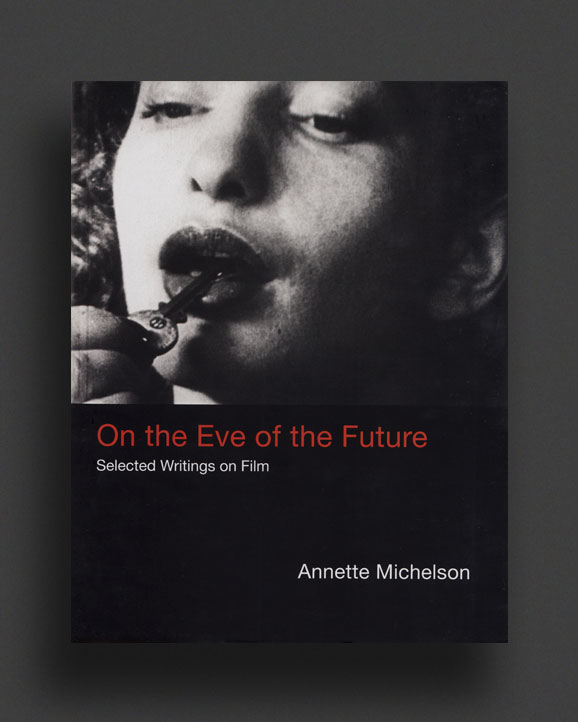
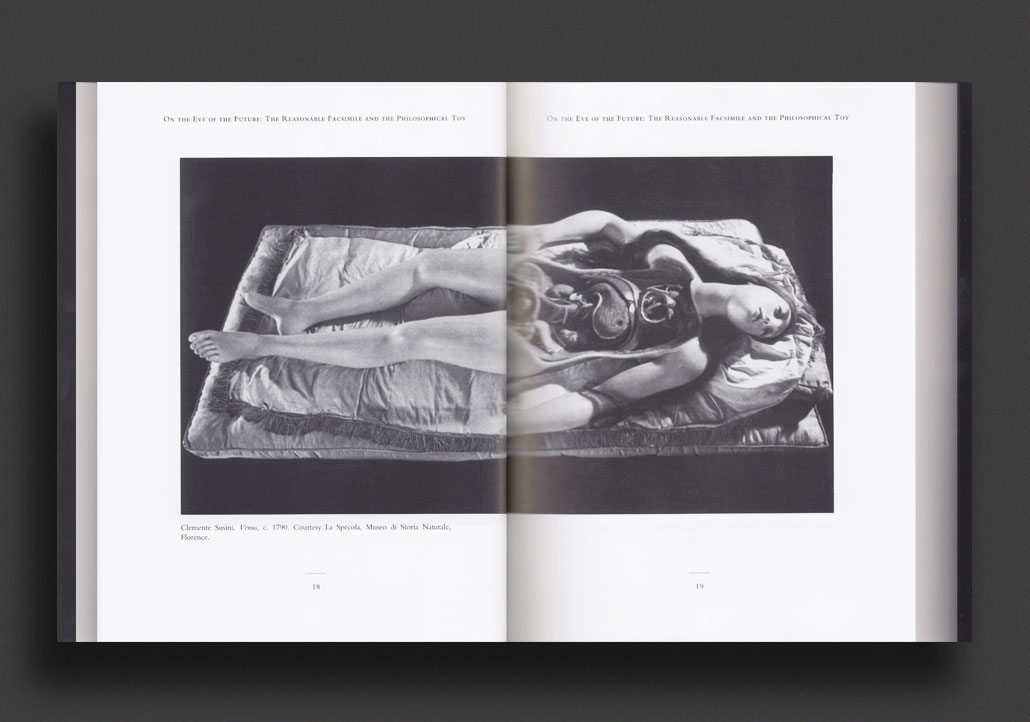
The celebrated critic and film scholar Annette Michelson saw the avant-garde filmmakers of the 1950s and 1960s as radically redefining and extending the Modernist tradition of painting and sculpture, and in essays that were as engaging as they were influential and as lucid as they were learned, she set out to demonstrate the importance of the underappreciated medium of film. On the Eve of the Future collects more than thirty years’ worth of those essays, focusing on her most relevant engagements with avant-garde production in experimental cinema, particularly with the movement known as American Independent Cinema.
This volume includes the first critical essay on Marcel Duchamp’s film Anemic Cinema, the first investigation into Joseph Cornell’s filmic practices, and the first major explorations of Michael Snow. It offers an important essay on Maya Deren, whose work was central to that era of renewal and reinvention, seminal critiques of Stan Brakhage, Hollis Frampton, and Harry Smith, and overviews of Independent Cinema. Gathered here for the first time, these texts demonstrate Michelson’s pervasive influence as a writer and thinker and her role in the establishment of cinema studies as an academic field.
The postwar generation of Independents worked to develop radically new terms, techniques, and strategies of production and distribution. Michelson shows that the fresh new forms they created from the legacy of Modernism became the basis of new forms of spectatorship and cinematic pleasure.
About the Author
Annette Michelson is Professor Emeritus in the Department of Cinema Studies at New York University. A founding editor of the journal October, she has written on art and cinema for more than five decades.
“Annette Michelson is one of the most brilliant minds that has ever turned its focus on the art of cinema. It's a blessing to have her illuminating, inspiring, and informative pieces available in this volume.”
—Jonas Mekas, filmmaker and writer
“When many of these texts first appeared, they were undergroundbreaking. Now, as history, they continue to be impressive for their subtle insights and nuanced style. Annette Michelson’s writing is as avant-garde and of-the-moment as that of a critic/historian can be.”
—Michael Snow, filmmaker, musician, visual artist
“Written with enviable precision and grace, these essays remain the most compelling chronicle of the radical impact that film would have on the other arts in the twentieth century. Through her writings, Annette Michelson defined a field of critical inquiry where others saw only boundaries.”
—Bruce Jenkins, Chair, Department of Film, Video, New Media and Animation, School of the Art Institute of Chicago
2013, English
Hardcover (w. dust jacket), 84 pages, 26 x 31 cm
1st Edition, Out of print title / used / very good
Published by
D.A.P. / New York
$400.00 $100.00 - In stock -
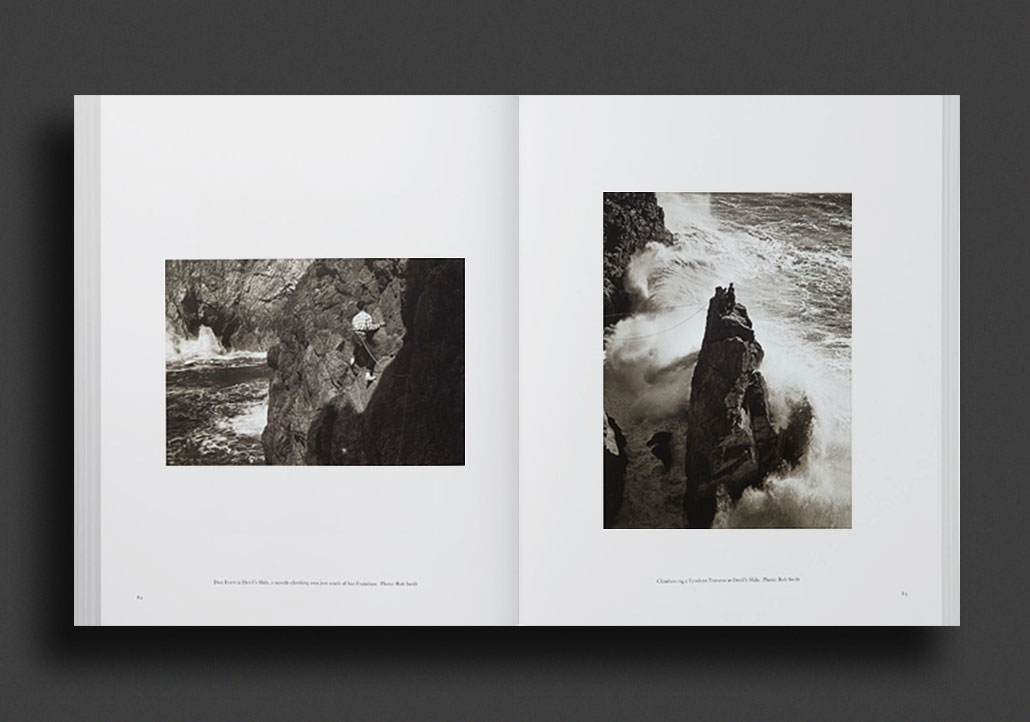
First printing of California Surfing and Climbing in the Fifties, published in 2013, immediately out of print and now highly sought after in this first edition. This title was reprinted later in the now common version, which stated as 2013 but printed years later due to demand.
Visually stunning slice of American cultural history told in (mostly) black and white photography, California Surfing and Climbing in the Fifties takes place against the backdrop of postwar America: Truman and Eisenhower, the Korean War, the Cold War and the Red Scare; Elvis Presley, Jack Kerouac, Marlon Brando et al. It traces the popularization of surfing along the California coast, as traditional, heavy balsawood boards were replaced with lightweight polyurethane foam, fiberglass, and resin; at the same time, ambitious climbers were developing equipment that would go on to set new technique and safety standards, using their own homemade gear to descend Tahquitz Rock in the south, Yosemite Valley to the north. This volume is packed with images of legendary surfers (Joe Quigg, Tom Zahn, Dale Velzy and Renny Yater) and famous climbers (Warren Harding, Royal Robbins and Wayne Merry among others), their groundbreaking adventures, photographed by legends like Bob Swift, Alan Steck, Jerry Gallwas, and Frank Hoover.
Soaked in surf, sun and adrenaline, the photographs in California Surfing and Climbing in the Fifties depict the birth of an era and an exhilarating moment in Californian history, whilst incidentally becoming a highly desired style reference.
Text by Yvon Chouinard, Steve Pezman, Steve Roper.
Fine. New copy but with some light shelf wear to the thick, original publisher-issued frosted transparent jacket.
1971, English
Softcover, 192 pages, 20 x 28 cm
Out of print title / used / good
Published by
Collier Books / New York
$70.00 - Out of stock
1971 edition of the classic photobook documentary of "Communal Life in New America", The Alternative by William Hedgepeth and photoessayist Dennis Stock, first published in 1970 and all editions long out-of-print.
"Hedgepeth and Stock offer a sensitive and astute penetration in depth into the new commune culture of the 1970s, from its roots among young dropouts in Haight-Ashbury to its current outcroppings in the form of half-hidden youth communities throughout the American countryside. The Alternative is an exploration into a thriving netherworld of revolution-minded persons who are turning tribal en masse and reverting to "primitive" conditions of survival as part of their serious search for the most viable shape that human life must take in days to come. Whether you view the new communal movement as an adventure or as a threat ultimately depends on your own personal view of the future."
William Hedgepeth is a dedicated Animalarian, veteran journalist, editor and author, who at the time of creating The Alternative was a senior editor and bureau chief for LOOK magazine. He lives deep in the forests of Appalachian Georgia with his journalist wife and a loyal battalion of beasts.
Dennis Stock was a celebrated American photographer, noted for his photo essays. His portfolio had a massive range and included many timeless pieces of work such as the free love movement of California, jazz, nature, and portrait work of icons such as James Dean and Billie Holiday. His photography has been exhibited all over the world, and his photos are part of many major museum collections. In the 1970s and 1980s he focused on color photography of nature and landscape, and returned to his urban roots in the 1990s focusing on architecture and modernism. In 2006, Stock married writer Susan Richards. They lived in Woodstock, New York, with their four dogs. Stock passed away in 2010.
Good copy but with some old water staining and edge wear/tanning.
2019, English
Softcover, 110 pages, 23 x 28 cm
Published by
Anthology Editions / Brooklyn
$69.00 - Out of stock
In 1968, Magnum photographer Dennis Stock took a five-week road trip along the California highways, documenting the height of the counterculture hippie scene. These black and white photos were compiled to create California Trip, originally published in 1970, and became an emblem of the free love movement that continued to inspire throughout the decades. In print for the first time since its 1970 publication, California Trip is a faithful reproduction of Stock’s timeless work.
Dennis Stock was a celebrated American photographer, noted for his photo essays. His portfolio had a massive range and included many timeless pieces of work such as the free love movement of California, jazz, nature, and portrait work of icons such as James Dean and Billie Holiday. His photography has been exhibited all over the world, and his photos are part of many major museum collections. He won first prize in both Life’s Young Photographers Contest in 1951 and the International Photo Competition in Poland in 1962. Stock passed away in 2010.
2009, English
Softcover, 224 pages, 22.5 x 14 cm
1st Edition, Out of print title / as new
Published by
The Everyday Press / London
$70.00 - In stock -
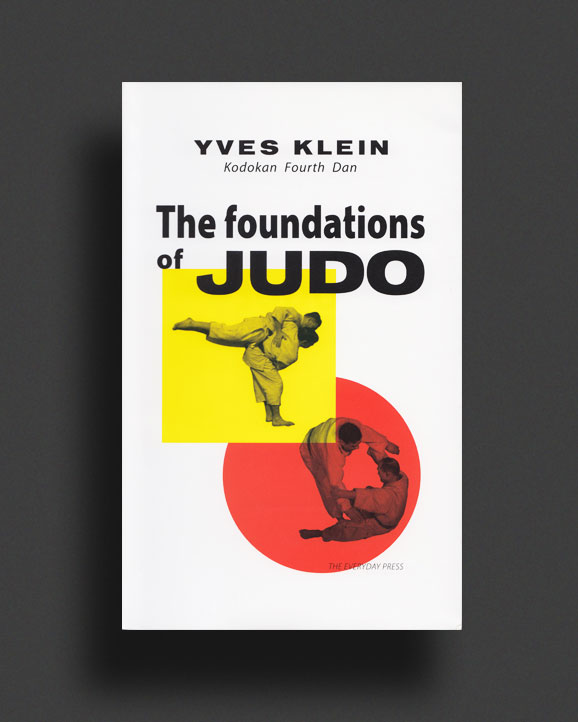
"In 1952 the 24-year-old Yves Klein left Paris for Japan to pursue his first love; not art but judo. After becoming one of very few Europeans to receive a coveted 4th dan black belt fro the Kodokan in Tokyo, Klein returned to France and opened the Judo Académie de Paris. In 1954 the prestigious firm of Grasset published his book Les Fondements du Judo, illustrated with hundreds of photographs of Klein and the leading Japanese teachers demonstrating the six major Kata of judo. Now this extraordinary work has finally been translated into English."
Yves Klein (1928 – 1962) was a French artist and an important figure in post-war European art. He was a leading member of the French artistic movement of Nouveau réalisme founded in 1960 by art critic Pierre Restany. Klein was a pioneer in the development of performance art, and is seen as an inspiration to and as a forerunner of minimal art, as well as pop art.
First and only English edition, published by The Everyday Press, now long out-of-print. Last copies.
2017, English
Softcover, 96 pages, 15.2 x 21.6 cm
Published by
Afterall / London
The MIT Press / Massachusetts
$39.00 - Out of stock
Agnes Martin’s Night Sea (1963) is a large canvas of hand-drawn rectangular grids painted in luminous blue and gold. In this illustrated study, Suzanne Hudson presents the painting as the work of an artist who was also a thinker, poet, and writer for whom self-presentation was a necessary part of making her works public. With Night Sea, Hudson argues, Martin (1912–2004) created a shimmering realization of control and loss that stands alone within her suite of classic grid paintings as an exemplary and exceptional achievement.
Hudson offers a close examination of Night Sea and its position within Martin’s long and prolific career, during which the artist destroyed many works as she sought forms of perfection within self-imposed restrictions of color and line. For Hudson, Night Sea stands as the last of Martin’s process-based works before she turned from oil to acrylic and sought to express emotions of lightness and purity unburdened by evidence of human struggle.
Drawing from a range of archival records, Hudson attempts to draw together the facts surrounding the work, which were at times obfuscated by the artist’s desire for privacy. Critical responses of the time give a sense of the impact of the work and that which followed it. Texts by peers including Lenore Tawney, Donald Judd, and Lucy Lippard are presented alongside interviews with a number of Martin’s friends and keepers of estates, such as the publisher Ronald Feldman and Kathleen Mangan of the Lenore Tawney archive, which holds correspondence between Martin and Tawney.
About the Author
Suzanne Hudson is Associate Professor of Art History and Fine Art at the University of Southern California. She is the author of Robert Ryman: Used Paint (MIT Press) and Painting Now.
Endorsements
“In her wonderful contribution to the Afterall Books One Work series, Suzanne Hudson persuasively argues that Agnes Martin’s 1963 painting Night Sea is the summa of the early grid paintings. Because, as Hudson shows, Night Sea makes Martin’s process—and indeed Martin’s struggle—so visible, we comprehend much more clearly what follows: the achieved perfection of the graphite grid paintings. That an analysis of a single work could so fully illuminate the entirety of an artist’s oeuvre is a true accomplishment. Plus, the prose is a pleasure to read.”
—Douglas Crimp, Fanny Knapp Allen Professor of Art History at the University of Rochester
Out of print title.
1986, Japanese
Softcover, 119 pages, 21 x 29.7 cm
1st Edition, Out of print title / used / very good
Published by
Kijōka-bashōfu Preservation Society / Okinawa
$120.00 - Out of stock
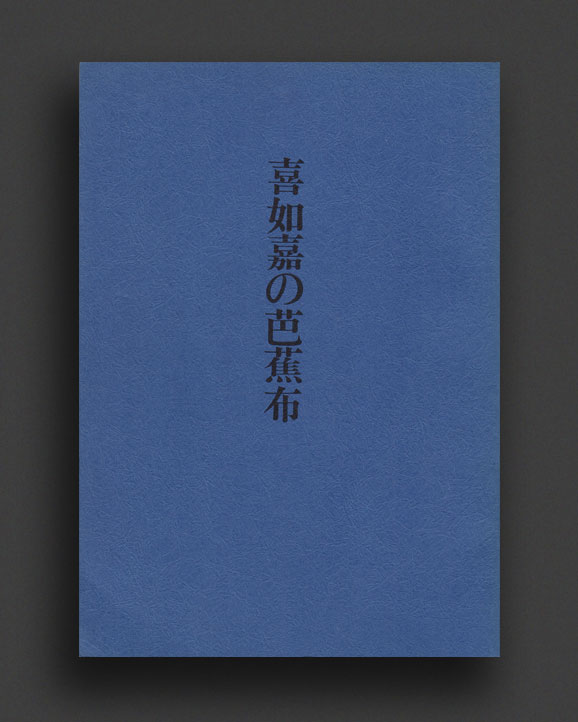
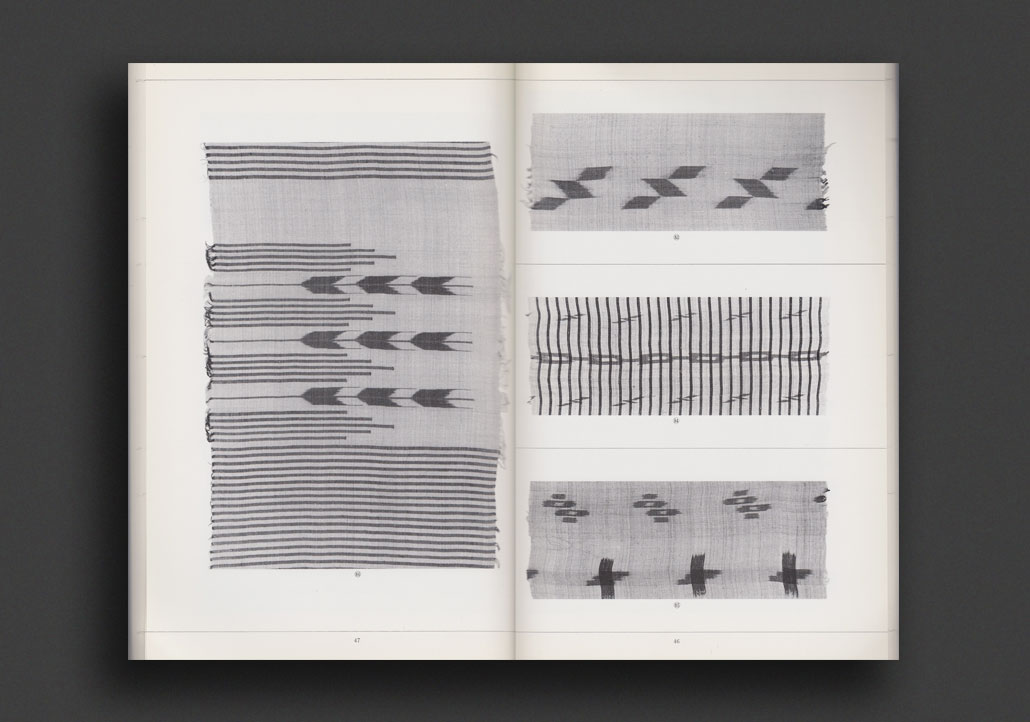
Absolutely gorgeous one-of-a-kind publication first published in 1979 by the Kijōka-bashōfu Preservation Society, documenting the seldom seen world Kijōka-bashōfu, a Japanese textile craft derived from the bashō or Japanese banana fibre as practiced in the sleepy mountainous village of Kijōka, on Okinawa island. A rare glimpse into designs and practice behind this unique textile, painstaking hand-crafted from the bashō fibre into cloth for garments, similar in quality to linen or hemp, woven in indigo and brown designs of stripes, checks, and diverse Kasuri, a Japanese word from the verb kasureru meaning “to blur”, similar to Ikat. This comprehensive, almost encyclopaedic printed study tells the history of the craft, profusely illustrating hundreds of to-scale fabric swatches of the many examples of patterned textile, illustrations of the weaving and dying tools used, its use in Kimono, and photographic documentation of every stage of its manufacture by the craftspeople in the village of Kijōka.
This lovely 1993 edition (we believe the fourth) comes wrapped in textured fibrous blue covers and includes a real swatch of the bare woven material itself, laid-in to the opening pages.
A very special book for anyone interested in traditional fibre crafts, weaving and textiles.
Very Good copy throughout.
2017, English
Softcover, 176 pages, 11 x 18 cm
Published by
Lars Müller / Zürich
$39.00 $20.00 - Out of stock
The question Are We Human? is both urgent and ancient. Beatriz Colomina and Mark Wigley offer a multi-layered exploration of the intimate relationship between human and design and rethink the philosophy of design in a multi-dimensional exploration from the very first tools and ornaments to the constant buzz of social media. The average day involves the experience of thousands of layers of design that reach to outside space but also reach deep into our bodies and brains. Even the planet itself has been completely encrusted by design as a geological layer. There is no longer an outside to the world of design.
Colomina’s and Wigley’s field notes offer an archaeology of the way design has gone viral and is now bigger than the world. They range across the last few hundred thousand years and the last few seconds to scrutinize the uniquely plastic relation between brain and artifact. A vivid portrait emerges.
Design is what makes the human. It becomes the way humans ask questions and thereby continuously redesign themselves.
Beatriz Colomina is an architecture theorist, historian, curator, and professor at the Princeton University School of Architecture. One of her research focuses are sexual fantasies in association with architecture.
Mark Wigley is professor of architecture at Columbia University. The historian and theorist explores the intersection of architecture, art, philosophy, culture, and technology. His books include: Derrida’s Haunt: The Architecture of Deconstruction; White Walls, Designer Dresses: The Fashioning of Modern Architecture; Constant’s New Babylon: The Hyper-Architecture of Desire; and Buckminster Fuller Inc.: Architecture in the Age of Radio. He is the co-author of Are We Human: Notes on an Archaeology of Design with Beatriz Colomina in association with their curation of the 3rd Istanbul Design Biennial. He has also curated exhibitions at the Museum of Modern Art and The Drawing Center in New York; the Witte de With and Het Nieuwe Instituut in Rotterdam, and the Canadian Centre for Architecture in Montreal. His latest book is Cutting Matta-Clark: The Anarchitecture Investigation (Lars Müller, 2018). He was born in New Zealand, trained there as an architect then as an architect then as a scholar, and is based in New York.
As New, corner bumped (hence price reduction)
2020, English
Hardcover, 160 pages, 23 x 28 cm
Published by
University of California Press / Berkley
$115.00 - In stock -
One of the most original artists working today, San Francisco–based Ron Nagle (born 1939)—the enfant terrible of abstract expressionist ceramics—has made stunning, colorful, entirely unique small clay sculptures since the 1950s.
In his sculpture, Nagle mixes allusions to modernism, middlebrow culture and the special pop sensibility of Northern California, making ceramic vessels no bigger than a few inches that draw on everything from Japanese tea ceremonies to Krazy Kat. Made with an overarching sense of playfulness and linguistic humor, a bodily and architectural sensibility, and Nagle’s keen attention to color, these finely tuned, pitch-perfect sculptures condense sensory pleasure into perfect packages of experience and feeling. Their miniature scale makes these odd, elegant, sensual and sometimes abject little abstract sculptures endlessly charming models for the imagination.
Lushly illustrated, Ron Nagle: Handsome Drifter is the most comprehensive and scholarly publication on the artist to date, with essays by curator Apsara DiQuinzio and Berlin-based art critic and theorist Jan Verwoert. A lively conversation about Nagle’s studio practice and unique process with curator and director Dan Byers of Harvard’s Carpenter Center for the Visual Arts rounds out this unmissable book.
2020, English
Hardcover, 328 pages, 21.3 x 28.2 cm
Published by
MASP / São Paulo
$100.00 - Out of stock
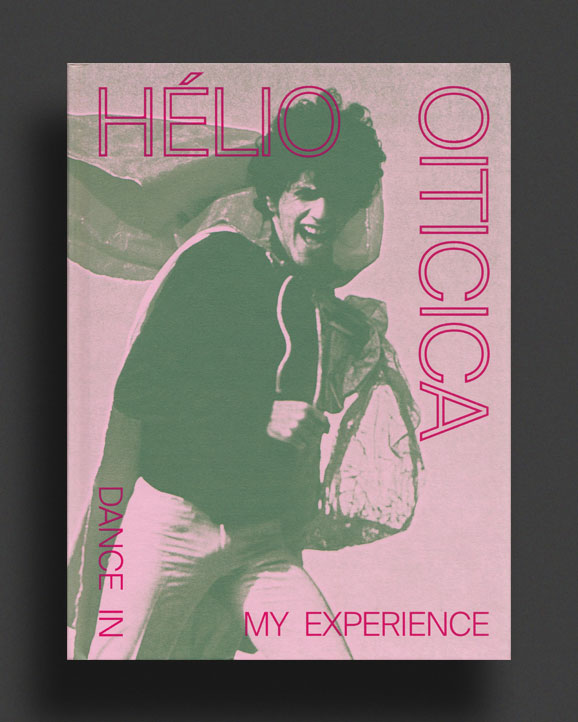
One of the most radical and joyful artists of the 20th century, Hélio Oiticica (1937-80) helped lead the charge in Brazilian art’s unique transition from abstract concrete art to performative objects and collective performance.
As MoMA’s 2019 exhibition Sur Moderno demonstrated, one of Oiticica’s most revolutionary projects was the Parangolé, wearable sculptures made from fabric, plastic or paper. The Parangolé is meant to be worn, inhabited and danced by a participant, lending a physical spontaneity to the piece that entirely blurs the boundaries between the art object and those who experience it.
Dance in My Experience traces the genealogy of this theme within the artist’s oeuvre, identifying rhythmic, choreographic and dance elements throughout his trajectory, from his first Metaesquemas through the Spatial Reliefs, Nuclei and Bólides, culminating in the Parangolés. Texts by Oiticica and numerous scholars.
Edited with text by Adriano Pedrosa, Tomás Toledo. Text by Adrian Anagnost, Cristina Ricupero, Evan Moffitt, Fernanda Lopes, Fernando Cocchiarale, Sergio Delgado Moya, Tania Rivera, Vivian A. Crockett, Hélio Oiticica.
2020, English
Hardcover, 240 pages, 18.3 x 25.4 cm
Published by
MASP / São Paulo
$85.00 - Out of stock
A comprehensive tribute to one of the central figures of postmodern dance in America. Edited with text by André Mesquita. Texts by Adriana Banana, David M. Sperling, Susan Rosenberg, Babette Mangolte, Yvonne Rainer, Trisha Brown.
A founding member of the legendary Judson Dance Theater, American choreographer and dancer Trisha Brown (1936-2017) helped build the tenets of postmodern dance and is now considered one of the most influential figures in American choreography. Trisha Brown: Choreographing Life presents a sizable archive of Brown’s career, with photographs, drawings and video stills that illustrate her lifelong contributions to the world of contemporary dance.
Brown established her own dance company in 1970 and continued to dance until 2008, during which time she created over 100 dances and six operas. One of her most famous pieces was the product of a creative partnership with artists Laurie Anderson and Robert Rauschenberg; after the 1983 premiere of Set and Reset at the Brooklyn Academy of Music’s Next Wave Festival, Brown was launched into international acclaim. Brown’s choreography demonstrates an unparalleled cognizance of space and visuality, as indicated by the artistic process apparent in the drawings and diagrams included in this publication. Her work conveys the extent to which movement is an artistic language reflective of the complex relationship between body and mind.
1986, English / Dutch / German / French / Italian
Hardcover (cloth w. dust jacket, inc. ephemera, guide/ticket, prints), 366 pages, 27 x 24 cm
1st Edition, Out of print title / used / very good
Published by
Museum van Hedendaagse Kunst / Gent
$220.00 - Out of stock
First and only edition of this very special, scarce exhibition catalogue / photo-book published to document and accompany the innovative exhibition Chambres d'Amis (‘friends’ rooms’), organised by Jan Hoet in Ghent in 1986, awarding him an international reputation as a leading artistic figure in Belgium. Chambres d'Amis featured about 50 European and American artists invited by Hoet to create works for 50 private homes in Ghent, which were then opened to the public for several weeks between June 21 - September 21, 1986. Artists included are Carla Accardi, Christian Boltanski, Raf Buedts, Daniël Buren, Michaël Buthe, Jacques Charlier, Nicola de Maria, Luciano Fabro, Günther Förg, Jef Geys, Dan Graham, Milan Grygar, François Hers, Kazuo Katase, Niek Kemps, Joseph Kosuth, Jannis Kounellis, Bertrand Lavier, Sol LeWitt, Danny Matthys, Gerhard Merz, Mario Merz, Marisa Merz, Helmut Middendorf, Juan Muñoz, Hidetoshi Nagasawa, Bruce Nauman, Maria Nordman, Oswald Oberhuber, Heike Pallanca, Panamarenko, Giulio Paolini, Royden Rabinowitch, Norbert Radermacher, Roger Raveel, Wolfgang Robbe, Claude Rutault, Reiner Ruthenbeck, Remo Salvadori, Rob Scholte, Ettore Spalletti, Paul Thek, Niele Toroni, Charles Vandenhove, Philip van Isacker, Jan Vercruysse, Jean-Luc Vilmouth, Martin Walde, Lawrence Weiner, Robin Winters, Gilberto Zorio.
The entire city-wide exhibition is comprehensively documented herein (from the domestic interior installations themselves to behind-the-scenes photography, social and working imagery of the artists installing and meeting, public events, etc.) in colour and b/w on various paper stocks with many fold-out panels and reproductions of artist's sketches, alongside extensive texts by Jan Hoet and statements accompanying the work of each artist all in Dutch, English, French, German, and Italian. Includes a list of all hosts/hostesses alongside the artists.
An incredible document of one the most important and unique contemporary art exhibitions in Belgium's history. Jan Hoet (23 June 1936 – 27 February 2014) was the Belgian founder and director of SMAK (Stedelijk Museum voor Actuele Kunst) in Ghent (director from 1975 until 2003) and subsequently managed several important exhibitions all over the world including curating Documenta IX in Kassel in 1992, presenting several hundred works by 190 artists from nearly 40 countries.
“Intriguingly titled ‘Chambres d’Amis’ –-‘guest rooms’,” or, literally, ‘friends’ rooms’-– the show places art in 58 houses belonging to everyday townspeople, carrying the work outside the separate universe, the total institution, of the museum, to bring it within the private zone of the private home, an asocial place insofar as it is removed from the public arena. (...) His [Hoet’s] project takes the exhibition structure off its hinges, goes beyond the limits of the frame and spills over, whole, into an interior. Art here no longer offers a mirror or a window, nor constitutes the privileged sign of a choice, but is an actual, provocative presence, confirming its difference both from the museum space, which has lost its sanctity, and from the contextual frame in which the object serves as a fetish.”—Pier Luigi Tazzi, “Albrecht Dürer would have come too”, Artforum, September 1986
Very Good copy w. some wear/light spine fading to Good dust jacket, now preserved under mylar wrap. This special copy comes most complete, including exhibition guide/work checklist, Ghent map of exhibit locations, and a selection of 4 loose photographic press prints of featured installations.
2020, English
Softcover, 120 pages, 12.5 x 19.7 cm
Published by
Fitzcarraldo Editions / London
$30.00 - Out of stock
From one of the most lauded artists of his generation comes a purging soliloquy: a profound nowt delivered in some spent afterwards. Scorched by senility and nostalgia, and wracked by all kinds of hunger, Ed Atkins’ Old Food lurches from allegory to listicle, from lyric to menu, fetching up a plummeting, idiomatic and crabbed tableau from the cannibalised remains of each form in turn. Written in conjunction with Atkins’ exhibition of the same name, Old Food is a hard Brexit, wadded with historicity, melancholy and a bravura kind of stupidity.
Ed Atkins is an artist who makes all kinds of convolutions of self-portraiture. He writes uncomfortably intimate, debunked prophesies; paints travesties; and makes realistic computer generated videos that often feature figures that resemble the artist in the throes of unaccountable psychical crises. Atkins’ artificial realism, whether written or animated, pastiches romanticism to get rendered down to a sentimental blubber – all the better to model those bleak feelings often so inexpressible in real life.
2019, English
Softcover, 274 pages, 11.4 x 19.7 cm
Published by
Fitzcarraldo Editions / London
$30.00 - Out of stock
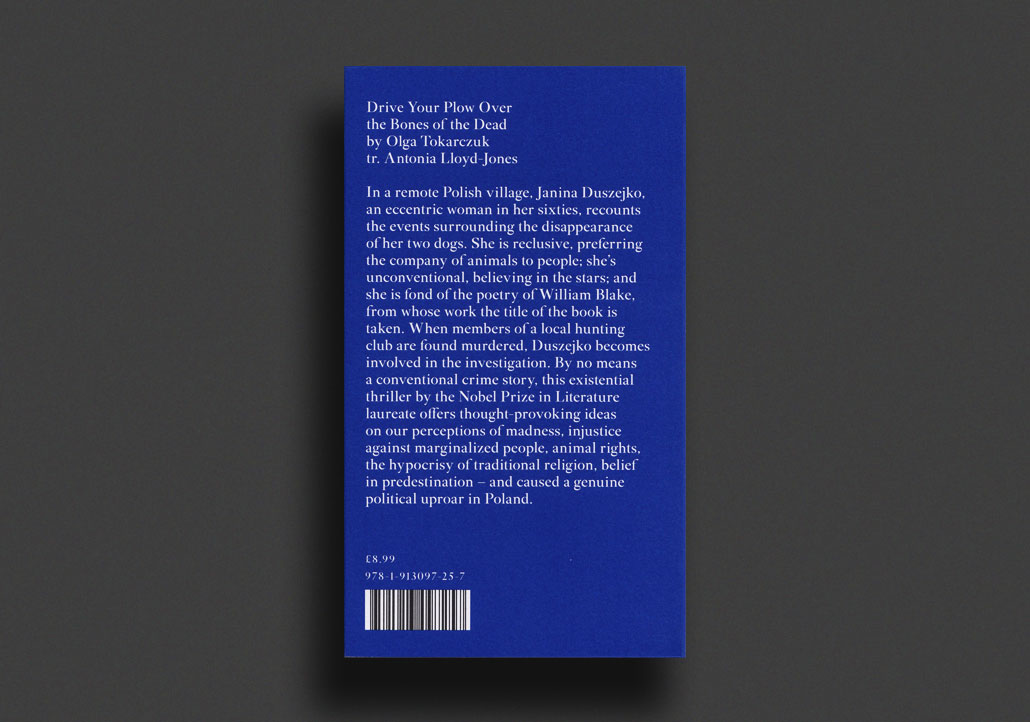
With DRIVE YOUR PLOW OVER THE BONES OF THE DEAD, Man Booker International Prize-winner Olga Tokarczuk returns with a subversive, entertaining noir novel. In a remote Polish village, Janina Duszejko, an eccentric woman in her sixties, recounts the events surrounding the disappearance of her two dogs. She is reclusive, preferring the company of animals to people; she's unconventional, believing in the stars; and she is fond of the poetry of William Blake, from whose work the title of the book is taken. When members of a local hunting club are found murdered, Duszejko becomes involved in the investigation. By no means a conventional crime story, this existential thriller by `one of Europe's major humanist writers' (GUARDIAN) offers thought-provoking ideas on our perceptions of madness, injustice against marginalized people, animal rights, the hypocrisy of traditional religion, belief in predestination - and caused a genuine political uproar in Tokarczuk's native Poland.
Translated by Antonia Lloyd-Jones
Awarded the Nobel Prize in Literature
Shortlisted for the 2019 Man Booker International Prize
2020, English
Softcover, 232 pages, 12.5 x 19.7 cm
Published by
Fitzcarraldo Editions / London
$30.00 - Out of stock
The Witch is dead. After a group of children playing near the irrigation canals discover her decomposing corpse, the village of La Matosa is rife with rumours about how and why this murder occurred. As the novel unfolds in a dazzling linguistic torrent, Fernanda Melchor paints a moving portrait of lives governed by poverty and violence, machismo and misogyny, superstition and prejudice. Written with an infernal lyricism that is as affecting as it is enthralling, Hurricane Season, Melchor’s first novel to appear in English, is a formidable portrait of Mexico and its demons, brilliantly translated by Sophie Hughes.
‘This is the Mexico of Cormac McCarthy’s Blood Meridian or Roberto Bolaño’s 2666, where the extremes of evil create a pummeling, hyper-realistic effect. But the “elemental cry” of Ms. Melchor’s writing voice, a composite of anger and anguish, is entirely her own.’
— Sam Sacks, Wall Street Journal
Translated by Sophie Hughes
2017, English
Softcover, 424 pages, 12.5 x 19.7 cm
Published by
Fitzcarraldo Editions / London
$35.00 - Out of stock
WINNER MAN BOOKER INTERNATIONAL PRIZE 2018
FLIGHTS, a novel about travel in the twenty-first century and human anatomy, is Olga Tokarczuk's most ambitious to date. It interweaves travel narratives and reflections on travel with an in-depth exploration of the human body, broaching life, death, motion, and migration. From the seventeenth century, we have the story of the Dutch anatomist Philip Verheyen, who dissected and drew pictures of his own amputated leg. From the eighteenth century, we have the story of a North African-born slave turned Austrian courtier stuffed and put on display after his death. In the nineteenth century, we follow Chopin's heart as it makes the covert journey from Paris to Warsaw. In the present we have the trials of a wife accompanying her much older husband as he teaches a course on a cruise ship in the Greek islands, and the harrowing story of a young husband whose wife and child mysteriously vanish on a holiday on a Croatian island. With her signature grace and insight, Olga Tokarczuk guides the reader beyond the surface layer of modernity and towards the core of the very nature of humankind.
2020, English
Softcover, 132 pages, 12.7 x 20.3 cm
Published by
Goldsmiths Press / London
The MIT Press / Massachusetts
$36.00 - In stock -
An analysis that traces the role of digital technology in multiplying precarity.
Precarity Lab brings together an intergenerational network of scholars and activists at the University of Michigan, Ann Arbor, to explore how digital cultures produce, reproduce, and intervene in precarity. Anna Watkins Fisher, Silvia Lindtner, Ivan Chaar-Lopez, Cengiz Salman, McKenzie Wark, Kalindi Vora, Jackie Wang, Cass Adair, Lisa Nakamura, Cindy Lin, with Meryem Kamil.
An analysis that traces the role of digital technology in multiplying precarity. Technoprecarious advances a new analytic for tracing how precarity unfolds across disparate geographical sites and cultural practices in the digital age. Digital technologies—whether apps like Uber, built on flexible labor, or platforms like Airbnb that shift accountability to users—have assisted in consolidating the wealth and influence of a small number of players. These platforms have also exacerbated increasingly insecure conditions of work and life for racial, ethnic, and sexual minorities; women; indigenous people; migrants; and peoples in the global south. At the same time, precarity has become increasingly generalized, expanding to include even the creative class and digital producers themselves.
This collaboratively authored multigraph analyzes the role of digital technology in multiplying precarity. The authors use the term precarity to characterize those populations disproportionately affected by the forms of inequality and insecurity that digital technologies have generated despite the new affordances and possibilities they offer. The book maps a broad range of digital precarity—from the placement of Palestinian Internet cables to the manufacture of electronics by Navajo women and from the production and deployment of drones on the U.S.–Mexico border to the technocultural productions of Chinese makers. This project contributes to, and helps bridge, ongoing debates on precarity and digital networks in the fields of critical computing, postcolonial studies, visual culture, and information sciences.
2013, English
Softcover, 144 pages, 12 x 16.5 cm
1st Edition, Out of print title / as new
Published by
Grazer Kunstverein / Graz
Mousse / Milan
$36.00 - Out of stock
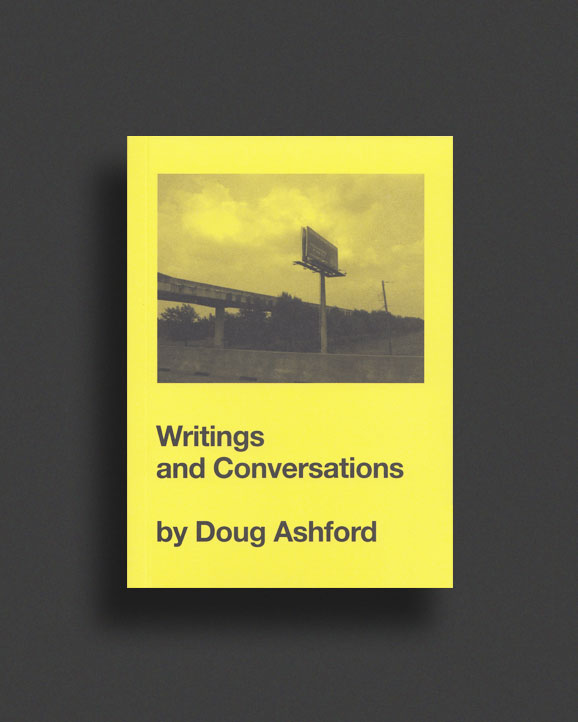
This publication represents one of the many spaces Doug Ashford's work occupies. It is the fisrt collection of his writings and conversations and attempts to encompass the changing thoughts shared by the artist over the past twenty-five years. Doug Ashford is a teacher, artist, and writer. He has taught design, sculpture, and theory at The Cooper Union, New York, since 1989. His principal art practice from 1982 to 1996 was as a member of Group Material and since that time he has gone on to make paintings, write, and produce other cross-disciplinary projects.
Co-published with Grazer Kunstverein
edited by Krist Gruijthuijsen
Last copies, out-of-print.
2020, English
Hardcover (w. dust jacket), 256 pages, 22.9 x 17.8 cm
Published by
The MIT Press / Massachusetts
October Books / New York
$50.00 - Out of stock
Annette Michelson's erudite and incisive readings of the revolutionary films of Sergei Eisenstein and Dziga Vertov, gathered here for the first time in this posthumous volume, giving readers the opportunity to track her sustained investigations into their work. Michelson introduced American audiences to Soviet cinema in the early 1970s, extending the interpretive paradigm she had used for American filmmakers of the mid-twentieth century—in which she emphasized phenomenological readings of their work—to films and writings by Eisenstein and Vertov. Over four decades, Michelson returned again and again to what she calls, following Eisenstein, “intellectual cinema”—the deliberate attempt to create philosophically informed analogues for consciousness.
The volume includes Michelson's major essays on Eisenstein's unrealized attempts to make movies of both Marx's Capital and Joyce's Ulysses, as well as her authoritative discussion of Vertov's 1929 masterpiece The Man with a Movie Camera. Together, the texts demonstrate Michelson's pervasive influence as a writer and thinker, and her role in the establishment of cinema studies as an academic field. This collection makes these canonical texts available for a new generation of film scholars.
Like the filmmakers with which she is engaged, Annette Michelson's intellectual project is nothing short of passionate. The analytic rigor, the discerning historical and cultural perspectives and the political resonance of these essays are confluent with Michelson's keen perception and striking associations, while the elegance of the writing also registers her intensely poetic and imaginative engagement. — Noa Steimatsky, author of Italian Locations and The Face on Film
1987, English / Japanese
Softcover, 177 pages, 19 x 24 cm
1st Edition, Out of print title / used / very good
Published by
National Museum of Modern Art / Tokyo
$180.00 - Out of stock
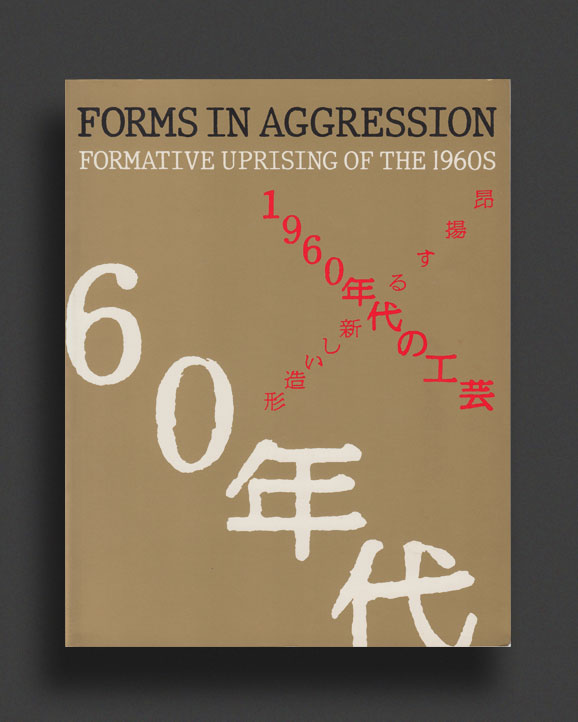
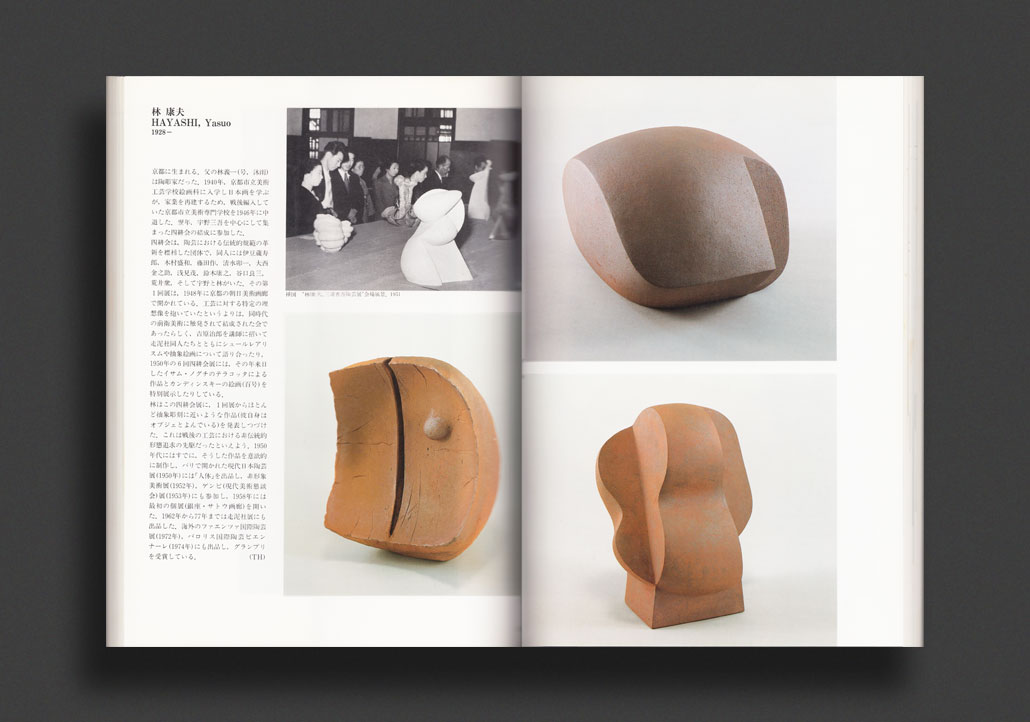
Very rare Japanese book published in 1987 to accompany a major exhibition surveying the expression of post-war Japanese craftspeople at the National Museum of Modern Art in Tokyo. Features forward and three essays in Japanese and also translated English, plus a fantastic selection of important artists profiled in vivid full colour and black and white images throughout. Also features a chronology and list of works, making this an incredible reference for anyone interested in the subject.
Features the work of Kawamoto Goro, Kato Kiyoyuki, Ochi Kenzo, Kumakura Junkichi, Koie Ryoji, Sugie Jumpei, Suzuki Osamu, Suzuki Hyosaku III, Tsuji Shindo, Nakamura Kimpei, Isamu Noguchi, Hattori Shunsho, Hayashi Yasuo, Banura Shogo, Fujihira Shin, Miura Kageo, Mitsuhashi Kunitami, Miyata Rando III, Motono Toichi, Morino Hiroaki, Yagi Kazuo, Yanagihara Mutsuo, Yamada Hikaru, working across primarily ceramic, but also textile, metal and painting.
A wonderful, rare publication of well-known and very rarely seen wonders of post-war Japanese crafts.
Very Good copy.
1998, Japanese / English
Hardcover (w. dust jacket), 79 pages, 22 x 16 cm
1st Edition, Out of print title / used / very good
Published by
Korinsha Press / Japan
$140.00 - Out of stock
First Japanese edition of this wonderful hardcover, clothbound volume that collects the printed material of Comme des Garçons between 1982 and 1997. Archiving their most iconic posters, "Six", advertisements for magazines, a poster for the opening of the flagship store in Tokyo Aoyama, invitation cards for fashion shows, and greeting cards. Includes the work of Peter Lindbergh, Cindy Sherman, Enzo Cucchi, Gilbert & George, Peter Fischli & David Weiss, Kishin Shinoyama, Paolo Roversi, Claude Cahun, André Kertesz, Weegee, James Lee Byars, Louise Nevelson, Lilo Hess, Georg Fischer, Jesus Rafael Soto, Gerhard Richter, and so many more.
Text by Art Historian France Grand (in Japanese).
Art directed by Tsuguya Inoue, known for his iconic work as art director at Comme des Garçons, Suntory, Parco and many others.
Design by Kentaro Kobayashi.
Printed and bound in Italy.
Very Good copy with dust jacket. Light tanning to spine. Signature to front end paper we cannot decipher ("... Tokyo '98").
2018, English / Japanese
Hardcover (w. dust jacket), 288 pages, 25 x 18 cm
Published by
Hehe / Tokyo
$80.00 - Out of stock
Published with an exhibition at the Tokyo Photographic Art Museum, this profoundly poignant collection of photographs by Nobuyoshi Araki focuses on a single theme from his vast oeuvre: his wife Yoko. As Araki himself has said, “It’s thanks to Yoko that I became a photographer”. From their first encounter in 1968 until her premature death from ovarian cancer in 1990, Yoko was his most important subject and muse. The book explores Araki’s relationship with the woman he most treasured, beginning with his record of their honeymoon, and continuing with numerous photos in which she is the subject, as well as many others from after her passing that give a strong sense of her presence.
2020, English
Softcover, 336 pages, 14 x 21.1 cm
Published by
Riverhead Books / New York
$45.00 - Out of stock
“A lyrical, fragmentary, and heartfelt story about the beauty and difficulty of artistic isolation.” —Kirkus Reviews (starred review)
Haunting and compulsively readable, Drifts is an intimate portrait of reading, writing, and creative obsession. At work on a novel that is overdue, spending long days walking neighborhood streets with her restless terrier, corresponding ardently with fellow writers, the narrator grows obsessed with the challenge of writing the present tense, of capturing time itself. Entranced by the work of Rainer Maria Rilke, Albrecht Dürer, Chantal Akerman, and others, she photographs the residents and strays of her neighborhood, haunts bookstores and galleries, and records her thoughts in a yellow notebook that soon subsumes her work on the novel. As winter closes in, a series of disturbances—the appearances and disappearances of enigmatic figures, the burglary of her apartment—leaves her distracted and uncertain . . . until an intense and tender disruption changes everything.
A story of artistic ambition, personal crisis, and the possibilities and failures of literature, Drifts is the work of an exhilarating and vital writer.
Kate Zambreno is the author of several acclaimed books including Screen Tests, Heroines, and Green Girl. Her writing has appeared in The Paris Review, VQR, and elsewhere. She teaches in the writing programs at Columbia University and Sarah Lawrence College.