World Food Books' programme is largely produced on Kulin Nation land. We acknowledge the Wurundjeri people of the Kulin Nation as the first and continuing custodians of this land, and pay respect to their Elders past, present, and emerging.
World Food Books is an arts and special interests bookshop in Naarm / Melbourne. Founded in 2010, World Food Books is devoted to the presentation of a rotating, hand-selection of international art, design, literary and counterculture publications with an emphasis on the anti-traditional, the experimental, the avant-garde, the heretic, the marginal.
Presenting new titles alongside rare and out-of-print books, catalogues and journals spanning the fields of modern and contemporary art, design, photography, illustration, film, literature, poetry, cultural theory, philosophy, sexuality, popular and underground culture in its many radical forms, World Food Books wishes to encourage adventurous, thoughtful and open-minded reading, looking, writing, and exchange of publishing and ideas, both current and historical.
As well as our bookshop, located in Melbourne's historical Nicholas Building, all of our inventory is available internationally via our online mail-order service.
World Food Books semi-regularly co-ordinates "Occasions", a programme of exhibits and events at the bookshop and in partnership with other hosts (such as museums and art galleries) that develop out of the activities, relationships and content of the bookshop itself.
World Food Books
The Nicholas Building
37 Swanston Street
Room 5, Level 6
Melbourne 3000
Australia
SHOP HOURS:
Thu–Fri 12–6, Sat 12–5
WEB-SHOP OPEN 24/7
World Food Books
Postal Address:
PO Box 435
Flinders Lane
Victoria 8009
Australia
Art
Theory / Essay
Architecture / Interior
Graphic Design / Typography
Photography
Fashion
Eros
LGBTQ+
Fiction / Poetry
Weird / Speculative / Science Fiction / Horror
Transgressive / Visceral / Abject
Symbolism / Decadence / Fin de siècle
Film / Video
Painting
Sculpture / Installation
Performance / Dance / Theater
Drawing
Sound / Music
Curatorial
Group Shows / Collections
Periodicals
Out-of-print / Rare
Posters / Ephemera / Discs
Signed Books
World Food Books Gift Voucher
World Food Book Bag
Australian Art
Australian Fiction
Australian Science Fiction / Speculative Fiction
Australian Poetry
Australian Photography
Japanese Photography
Conceptual Art
Minimal Art
Dada
'Pataphysics / Oulipo
Fluxus
Concrete Poetry
Pop Art
Surrealism
Arte Povera
Arte Informale / Haute Pâte / Tachism
Nouveau Réalisme / Zero / Kinetic
Situationism / Lettrism
Collage / Mail Art / Xerox Art
Art Brut / Folk / Visionary / Fantastic
Illustration / Graphic Art / Bandes Dessinées
Furniture
Italian Radical Design / Postmodernism
Textiles
Ceramics / Glass
Counterculture
Protest / Revolt
Philosophy
Psychoanalysis
Anthropology
Anarchism
Socialism / Anarchism / Communism / Capitalism
Literary Theory / Semiotics / Language
Feminism / Women's Studies
Gender Studies / Sexuality
Anthropology
Fetishism / BDSM
Drugs / Psychedelia
Crime / Violence
Animal Rights / Veganism
Occult / Esoterica
Ecology / Earth / Alternative Living
Whole Earth / Crafts
All prices in AUD (Australian dollars)
Pick-Ups
Pick-up orders can be collected in our bookshop during opening hours after order date. Please collect any Pick-up orders within 2 weeks of ordering as we have limited storage space. Orders will be released back into stock if not collected within this time. No refunds can be made for pick-ups left un-collected. If you cannot make it in to the bookshop in this time-frame, please choose postage option.
Return Policy
All sales are final. We do accept returns (for refund or exchange) for items received in error. All our orders are packed with special care using heavy-duty padding and cardboard book-mailers or bubble mailers (for smaller books), using reinforcement where required. We cannot take responsibility for any lost, stolen or damaged parcels.
Insurance
Should you wish to insure your package, please email us directly after placing your order and we can organise this at a small extra expense. Although all standard/express tracked packages are very safe and dependable, we cannot take responsibility for any lost, stolen or damaged parcels. We recommend insurance on valuable orders.
Interested in selling your old books, catalogues, journals, magazines, comics, fanzines, ephemera? We are always looking for interesting, unusual and out-of-print books to buy. We only buy books in our fields of interest and specialty, and that we feel we can resell.
We base these prices on desirability, market value, in-print prices, condition and our current stock levels. We offer cash, store credit, and can take stock on consignment. All
about 25% of the price we expect to get when we sell them, or 30% in store credit. We base these prices on desirability, market value, in-print prices, condition and our current stock levels.
Sell your books any day of the week. You can drop them off and return later. If you have a lot of books, we can visit your Sydney home.
We buy books that we feel we can resell. We offer about 25 % of the price we expect to get when we sell them, or 30% in store credit. We base these prices on desirability, market value, in-print prices, condition and our current stock levels.
Philadelphia Wireman
03 August - 01 September, 2018
World Food Books is proud to announce our next Occasion, the first presentation of sculptures by Philadelphia Wireman in Australia.
The Philadelphia Wireman sculptures were found abandoned in an alley off Philadelphia’s South Street on trash night in 1982. Their discovery in a rapidly-changing neighbourhood undergoing extensive renovation, compounded with the failure of all attempts to locate the artist, suggests that the works may have been discarded after the maker’s death. Dubbed the "Philadelphia Wireman" during the first exhibition of this work, in 1985, the maker’s name, age, ethnicity, and even gender remain uncertain. The entire collection totals approximately 1200 pieces, all intricately bound together with tightly-wound heavy-gauge wire (along with a few small, abstract marker drawings, reminiscent both of Mark Tobey and J.B. Murry). The dense construction of the work, despite a modest range of scale and materials, is singularly obsessive and disciplined in design: a wire armature or exoskeleton firmly binds a bricolage of found objects including plastic, glass, food packaging, umbrella parts, tape, rubber, batteries, pens, leather, reflectors, nuts and bolts, nails, foil, coins, toys, watches, eyeglasses, tools, and jewellery.
Heavy with associations—anthropomorphic, zoomorphic, and socio-cultural responses to wrapped detritus—the totemic sculptures by Philadelphia Wireman have been discussed in the context of work created to fulfil the shamanistic needs of alternative religions in American culture. Curators, collectors, and critics have variously compared certain pieces to sculpture from Classical antiquity, Native American medicine bundles, African-American memory jugs, and African fetish objects. Reflecting the artist’s prolific and incredibly focused scavenging impulse, and despite—or perhaps enhanced by—their anonymity, these enigmatic objects function as urban artefacts and arbiters of power, though their origin and purpose is unknown. Philadelphia Wireman, whatever their identity, possessed an astonishing ability to isolate and communicate the concepts of power and energy through the selection and transformation of ordinary materials. Over the course of the past two decades, this collection has come to be regarded as an important discovery in the field of self-taught art and vernacular art.
Presented in collaboration with Fleisher-Ollman Gallery, Philadelphia, and Robert Heald, Wellington.
Susan Te Kahurangi King
02 February - 10 March, 2018
Susan Te Kahurangi King (24 February 1951 - ) has been a confident and prolific artist since she was a young child, drawing with readily available materials - pencils, ballpoint pens and felt-tip markers, on whatever paper is at hand. Between the ages of four and six Susan slowly ceased verbal communication. Her grandparents William and Myrtle Murphy had developed a special bond with Susan so they took on caring responsibilities for extended periods. Myrtle began informally archiving her work, carefully collecting and storing the drawings and compiling scrapbooks. No drawing was insignificant; every scrap of paper was kept. The King family are now the custodians of a vast collection containing over 7000 individual works, from tiny scraps of paper through to 5 meter long rolls.
The scrapbooks and diaries reveal Myrtle to be a woman of great patience and compassion, seeking to understand a child who was not always behaving as expected. She encouraged Susan to be observant, to explore her environment and absorb all the sights and sounds. Myrtle would show Susan’s drawings to friends and people in her community that she had dealings with, such as shopkeepers and postal workers, but this was not simply a case of a grandmother’s bias. She recognised that Susan had developed a sophisticated and unique visual language and sincerely believed that her art deserved serious attention.
This was an unorthodox attitude for the time. To provide some context, Jean Dubuffet coined the term Art Brut in 1945 to describe work created by self-taught artists – specifically residents of psychiatric institutions and those he considered to be visionaries or eccentrics. In 1972 Roger Cardinal extended this concept by adopting the term Outsider Art to describe work made by non-academically trained artists operating outside of mainstream art networks through choice or circumstance. Susan was born in Te Aroha, New Zealand in 1951, far from the artistic hubs of Paris and London that Dubuffet and Cardinal operated in. That Myrtle fêted Susan as a self-taught artist who deserved to be taken seriously shows how progressive her attitudes were.
Susan’s parents Doug and Dawn were also progressive. Over the years they had consulted numerous health practitioners about Susan’s condition, as the medical establishment could not provide an explanation as to why she had lapsed into silence. Dawn educated herself in the field of homeopathy and went on to treat all twelve of her children using these principles – basing prescriptions on her observations of their physical, mental and emotional state.
Doug was a linguist with an interest in philosophy who devoted what little spare time he had to studying Maori language and culture. To some extent their willingness to explore the fringes of the mainstream made them outsiders too but it was their commitment to living with integrity and their respect for individuality that ensured Susan’s creativity was always encouraged.
Even though Susan’s family supported her artistic pursuits, some staff in schools and hospitals saw it as an impediment to her assimilation into the community and discouraged it in a variety of ways. Her family was not always aware of this and therefore did not fully understand why Susan stopped drawing in the early 1990s. However, rather than dwell on the challenges that Susan faced in pursuit of her artistic practice, they prefer to highlight her achievements. In 2008 Susan began drawing again in earnest, after an almost 20 year interruption, and her work is now shown in galleries around the world.
Susan grew up without television and has been heavily influenced by the comics she read as a child. She is absolutely fearless in the appropriation of recognizable characters, such as Donald Duck and Mickey Mouse, in her work. She twists their limbs, contorts their faces, compresses them together, blends them into complex patterned backgrounds - always imbuing them with an incredible energy. Although Susan often used pop culture characters in her work they are not naive or childlike. These are drawings by a brilliant self-taught artist who has been creating exceptional work for decades without an audience in mind.
Mladen Stilinović
"Various Works 1986 - 1999"
02 February 16 - September 10, 2016
Various works 1986 - 1999, from two houses, from the collections of John Nixon, Sue Cramer, Kerrie Poliness, Peter Haffenden and Phoebe Haffenden.
Including: Geometry of Cakes (various shelves), 1993; Poor People’s Law (black and white plate), 1993; White Absence (glasses, ruler, set square, silver spoon, silver ladel with skin photograph and wooden cubes), 1990-1996; Exploitation of the Dead (grey and red star painting, wooden painting, black spoon with red table, red plate), 1984-1990; Money and Zeros (zero tie, paintings made for friends in Australia (Sue, John, Kerrie), numbers painting), 1991-1992; Words - Slogans (various t-shirts) - “they talk about the death of art...help! someone is trying to kill me”, “my sweet little lamb”, “work is a disease - Karl Marx”; Various artist books, catalogues, monographs, videos; Poster from exhibition Insulting Anarchy; "Circular" Croatian - Australian edition; Artist book by Vlado Martek (Dostoyevsky); more.
Thanks to Mladen Stilinović and Branka Stipančić.
Jonathan Walker
Always Will Need To Wear Winter Shirt Blue + Ochre Small Check Pattern
21 August - 21 September, 2015
Untitled
I am not a great reader of poetry but I always return to the work of Melbourne poet, Vincent Buckley (1925- 1988). Perhaps I find his most tantalising piece to be not a finished poem but a fragment left on a scrap of paper discovered on his desk after the poet’s death.
The poetry gathers like oil
In the word-core, and spreads
It has its music meet,
Its music is in movement.
This fragment is more the shell left behind from a volatile thought than a finished poem. I find the last two lines honest but awkward whereas the first two lines work like an arrow. Most likely he could not find a resolution so it was left. Still, in its present form, it remains an eloquent testimony to the ultimate failure of a medium to express mobile thought and sensation, in Buckley’s case, through verbal language. It’s an important matter because this is something all artists have to deal with regardless of the medium.
I have never written a poem, however, I am forever copying fragments from books on paper scraps in a vain effort to fix certain notions in my head. At first, they function as bookmarks that are sometimes returned to when I open the book. But before long, as they accumulate, they fall out littering the table interspersed with A4 photocopies, bills, books and medications.
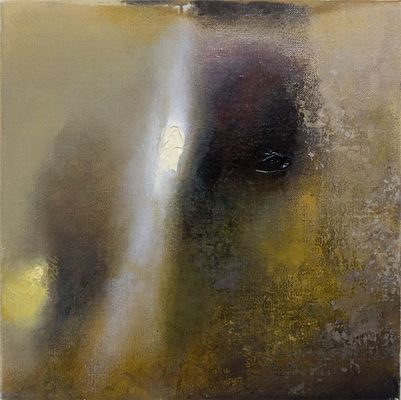
To return to Buckley’s fragment, the first two lines very much evoke how I paint nowadays. As you age, detail diminishes and patches of light become more luminous and float. I feel the most honest way of dealing with this is by smearing the oil paint on the canvas with the fingers and working close-up, blind. Only if the patches coalesce into an approaching image can the work gain a life.
-
Jonathan Walker was born in Melbourne, Australia and brought up on a dairy farm in Gippsland. In the 1970’s he studied painting at RMIT and won the Harold Wright Scholarship to the British Museum, London. During the 1980’s he exhibited at Pinacotheca Gallery, Richmond and had work shown at the NGV and Heidi City Art Gallery. Over the same period he designed the cover for the “Epigenesi” LP by Giancarlo Toniutti, Italy and conducted a mail exchange work with Achim Wollscheid, Germany. The work with artists through the post resulted in an article published in the bicentenary issue of Art and Australia 1988. He showed in artist run spaces such as WestSpace in the 90’s and 2000’s, and until 2012, taught painting at Victoria University, which is where we (Colleen Ahern and Lisa Radford) as organisers of the exhibition, among many others, had the privilege of being his student.
Walker’s knowledge was imparted to students through the careful selection of music, literature, and artists found in books that he himself had ordered for the library. Walker’s strategy was the generosity of sharing his vast knowledge with references specific to each student and their context.
Walker’s paintings share a similar focus and intimacy.
This exhibition presents a small selection of recent paintings alongside a publication that includes Walker’s writing. Observational and analytical, Walker’s work is a type of material notation — the time of day, colour and how it is blended, the both specific and fleeting location of a reflection on lino or the question of whether a chair leg should be included in a painting.
Please join us on Friday August 21 between 6-8pm to celebrate the opening of the exhibition.
Curated by Colleen Ahern and Lisa Radford.
B. Wurtz
Curated by Nic Tammens
March 26 - April 4, 2015
B.Wurtz works from a basement studio in his home on Manhattan’s Lower East Side.
This local fact is attested to by the plastic shopping bags and newsprint circulars that appear in his work. As formal objects, they don’t make loud claims about their origins but nonetheless transmit street addresses and places of business from the bottom of this long thin island. Like plenty of artists, Wurtz is affected by what is local and what is consumed. His work is underpinned by this ethic. It often speaks from a neighborhood or reads like the contents of a hamper:
“BLACK PLUMS $1.29 lb.”
“Food Bazaar”
“USDA Whole Pork Shoulder Picnic 99c lb.”
“RITE AID Pharmacy, with us it’s personal.”
“H. Brickman & Sons.”
“Sweet Yams 59c lb."
Most of the work in this exhibition was made while the artist was in residence at Dieu Donne, a workshop dedicated to paper craft in Midtown. Here Wurtz fabricated assemblages with paper and objects that are relatively lightweight, with the intention that they would be easily transportable to Australia. This consideration isn’t absolute in Wurtz’s work, but was prescriptive for making the current exhibition light and cheap. Packed in two boxes, these works were sent from a USPS post office on the Lower East Side and delivered to North Melbourne by Australia Post.
Wurtz appears courtesy of Metro Pictures, New York.
Thanks to Rob Halverson, Joshua Petherick, Sari de Mallory, Matt Hinkley, Helen Johnson, Fayen d'Evie, Ask Kilmartin, Lisa Radon, Ellena Savage, Yale Union, and "Elizabeth".
John Nixon
"Archive"
December 15 - January 20, 2014
The presentation of John Nixon's archive offered a rare showcase of this extensive collection of the artist's own publications, catalogues, posters, ephemera, editions and more, from the mid 1980s onwards, alongside a selection of his artworks.
Organized by John Nixon, Joshua Petherick and Matt Hinkley.
<a href=http://wfb.public-office.info/artist/john-nixon>All titles by John Nixon
"Habitat"
at Minerva, Sydney (organised by Joshua Petherick and Matt Hinkley)
November 15 - December 20, 2014
Lupo Borgonovo, Janet Burchill & Jennifer McCamley,
Lewis Fidock, HR Giger, Piero Gilardi, Veit Laurent Kurz,
Cinzia Ruggeri, Michael E. Smith, Lucie Stahl, Daniel Weil, Wols
Press Release:
“...It contained seven objects. The slender fluted bone, surely formed for flight, surely from the wing of some large bird. Three archaic circuitboards, faced with mazes of gold. A smooth white sphere of baked clay. An age-blackened fragment of lace. A fingerlength segment of what she assumed was bone from a human wrist, grayish white, inset smoothly with the silicon shaft of a small instrument that must once have ridden flush with the surface of the skin - but the thing’s face was seared and blackened.”
William Gibson, “Count Zero”, 1986
"Autumn Projects Archive"
Curated by Liza Vasiliou
March 6 - March 15, 2014
World Food Books, in conjunction with the Virgin Australia Melbourne Fashion Festival 2014, presented the Autumn Projects archive, consisting of a selection of early examples in Australian fashion with a particular interest in collecting designers and labels from the period beginning in the 1980’s, who significantly influenced the discourse of Australian Fashion.
Curated by Liza Vasiliou, the exhibition provided a unique opportunity to view pieces by designers Anthea Crawford, Barbara Vandenberg, Geoff Liddell and labels CR Australia, Covers, Jag along with early experimental collage pieces by Prue Acton and Sally Browne’s ‘Fragments’ collection, suspended throughout the functioning World Food Books shop in Melbourne.
H.B. Peace
presented by CENTRE FOR STYLE
November 14, 2013
"Hey Blinky, you say chic, I say same"
Anon 2013
H.B. Peace is a clothing collaboration between great friends Blake Barns and Hugh Egan Westland. Their pieces explore the divergences between 'character’ and ‘personality’ in garments....etc
Special Thanks to Joshua Petherick and Matt Hinkley of WFB and Gillian Mears
and a Very Special Thank you to Audrey Thomas Hayes for her shoe collaboration.
Janet Burchill & Jennifer McCamley
"Aesthetic Suicide"
May 10 - June 8, 2013
The first of our occasional exhibitions in the World Food Books office/shop space in Melbourne, "Aesthetic Suicide" presented a body of new and older works together by artists Janet Burchill & Jennifer McCamley, including videos, prints, a wall work, and publications.
During shop open hours videos played every hour, on the hour.
2014, English
Softcover, 192 page, 15.5 x 23.5 cm
Published by
Collaborative Enquiry / Melbourne
$28.00 - In stock -
'This book demonstrates that long-term win-win collaboration approaches work. Principals and contractors don't have to end up in conflict or litigation. I would recommend these ideas be adopted by companies eager to improve productivity.' - John Mulcahy, Chairman, Mirvac
'In an industry dominated by conflict and unproductive activity, this book offers a refreshing and practical way for all parties in the building industry to achieve more from their capital and labour inputs. Stephen Hanman and Ian George have shown through application that by introducing trust, respect and meaningful communication into relationships, results improve for all stakeholders. Moreover, the investment required to do the first job carries over to future work, resulting in improved performance with each project. I applaud the efforts of the authors in both creating the environment for their clients to 'do better' in their construction businesses and for sharing their work with the wider business and labour communities. One wonders what benefits could flow to other industries should the broader principles so successfully adopted in this book be applied more widely.' - Terry Henderson, company director and businessman
'This book provides wonderful insights into the way in which economic and social relationships associated with building and construction can be transformed. The participants involved in CGA Bryson projects have experienced considerable benefits in their working and personal lives. There is also evidence of significant economic benefits for all within the project supply chains. In the context of the broader building and construction industry, this account contains lessons which offer solutions for some of the seemingly intractable problems of conflict, waste, poor
quality work and alienation that bedevil this industry. We have a lot to learn from these two professionals who are writing about their direct experience in transforming a construction enterprise.' - Professor Tony Dalton, RMIT Australian Housing and Urban Research Institute
Research Centre, School of Global, Urban and Social Studies, RMIT University
'In our own research, we have documented in financial terms the benefits of cross-functional, cross-firm collaboration. However, for many executives, building a culture that supports collaboration is not easy. Ian and Stephen not only report on the benefits of collaboration in an industry where such behaviour has not been the norm, but they provide guidelines for building organisations with a culture of collaboration.' - Dr Douglas M Lambert, Fisher College of Business, The Ohio State University, founder of the Supply Chain Management Institute
2005, English
Softcover, 256 pages, 15.9 x 24.8cm
Published by
Anthroposophic Press / UK
$56.00 - Out of stock
This book introduces a new way for thinking about, creating, and viewing art. Rudolf Steiner saw his task as the renewal of the lost unity of science, the arts, and religion; thus, he created a new, cognitive scientific and religious art in anthroposophy. The implications of his act--recognized by such diverse artists as Wassily Kandinsky and Joseph Beuys--are only now coming fully to light.
In his thorough introduction of more than a hundred pages, Michael Howard takes readers through these thought-provoking chapters:
Is Art Dead?; To Muse or Amuse; Artistic Activity as Spiritual Activity; The Representative of Humanity; Beauty, Creativity, and Metamorphosis; New Directions in Art
Rudolf Steiner's Lectures :The Aesthetics of Goethe's Worldview; The Spiritual Being of Art; Buildings Will Speak; The Sense Organs and Aesthetic Experience; The Two Sources of Art; The Building at Dornach; The Supersensible Origin of the Arts; Truth, Beauty, and Goodness; Christ, Ahriman, and Lucifer
2012, English
Softcover, 224 pages, 120 x 170 cm
Published by
Rudolf Steiner Press / East Sussex
$20.00 - Out of stock
Rudolf Steiner's foundational handbook for spiritual and personal development has grown more modern with time, though his methods remain clearly distinguishable from many current paths of inner work. First, Steiner's method is based on the clarity of thought normally associated with scientific research. Instead of denying clear thinking, his aim is to extend it beyond its present limitations. Second, Steiner recognises--as do all genuine paths--that the way to spiritual experience is arduous and dangerous and calls for self-control in thought, word, and action. The human being comprises a unity, and we cannot develop knowledge without a corresponding development of feeling and will.
Steiner predicted that humanity would begin to experience a longing for forms of experience that transcended intellectual, materialistic thinking. More than a hundred years after the first publication of this book, countless means are offered for achieving transcendental experience, including Eastern meditation practices, channeling, remote viewing, and astral projection. Moreover, there has been a huge increase in the number of people who report various suprasensory perceptions, such as near-death experiences and meetings with angels. In this context, Steiner's key spiritual guidebook is needed more than ever, given its unique, precise instructions for inner training, its protective exercises, and its indications for staying grounded and centered. Knowledge of the Higher Worlds begins with the preconditions for personal development and guides the reader through the stages of initiation, its practical aspects, and its effects.
Translated by D. S. Osmond and C. Davy
1995, English
Softcover, 282 pages, 13.3 x 20.3 cm
Published by
Anthroposophic Press / New York
$40.00 - Out of stock
Of all of his works, Intuitive Thinking as a Spiritual Path is the one that Steiner himself believed would have the longest life and the greatest spiritual and cultural consequences. It was written as a phenomenological account of the "results of observing the human soul according to the methods of natural science.
This seminal work asserts that free spiritual activity--understood as the human ability to think and act independently of physical nature--is the suitable path for human beings today to gain true knowledge of themselves and of the universe. This is not merely a philosophical volume, but rather a warm, heart-oriented guide to the practice and experience of living thinking.
Readers will not find abstract philosophy here, but a step-by-step account of how a person may come to experience living, intuitive thinking--"the conscious experience of a purely spiritual content."
During the past hundred years since it was written, many have tried to discover this "new thinking" that could help us understand the various spiritual, ecological, social, political, and philosophical issues facing us. But only Rudolf Steiner laid out a path that leads from ordinary thinking to the level of pure spiritual activity--intuitive thinking--in which we become co-creators and co-redeemers of the world.
"When, with the help of Steiner's book, we recognize that thinking is an essentially spiritual activity, we discover that it can school us. In that sense--Steiner's sense--thinking is a spiritual path" (Gertrude Reif Hughes).
2013, English
Paperback, 92 pages, 15.2 x 22.9
Published by
Temple Lodge / Forest Row
$59.00 - In stock -
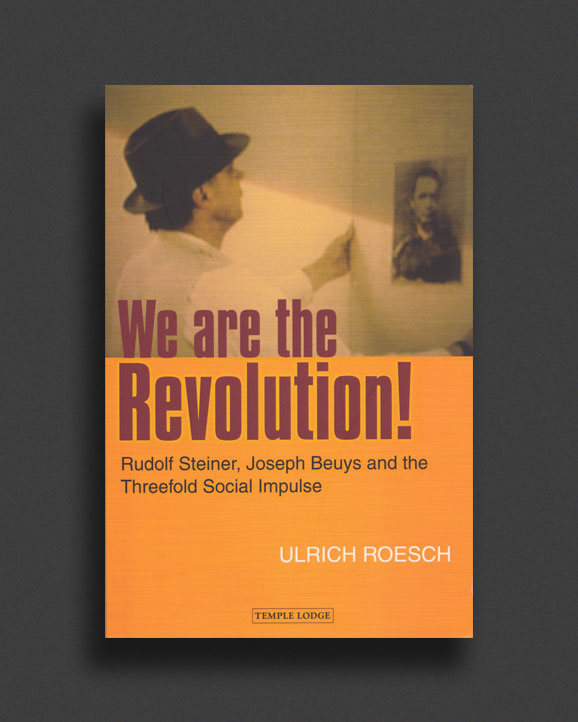
Freedom for the spiritual-cultural life, equality and democracy for human rights, initiative and solidarity for the economic sphere! Revolutions happen when society does not change and evolve. Stagnation and resistance create a situation in which a leap in development is required. In nature, living organisms suffering from inner blockages must heal or die. The same applies to the social organism--society--which occasionally requires drastic change to avoid complete collapse or violent revolution. With his often repeated phrase 'We are the Revolution!', the artist and social activist Joseph Beuys was intimating that true transformation develops from within, in an artistic or creative way. People are the source of metamorphosis in the social realm. But in modern times a "we" is also required--an agreement with others. The individual connects with fellow human beings, in active cooperation, as a solid foundation for healthy forms of coexistence.
In a series of clear and insightful essays, Ulrich Rösch builds on the "threefold" social thinking of Rudolf Steiner, Joseph Beuys and others, presenting ideas for change in the context of twenty-first-century life. Our world has become unified through the global division of labor and interdependence, which calls for fresh thinking and rejuvenated social forms. Rösch compares the spirituality and social action of Mahatma Gandhi and Rudolf Steiner; takes the living example of a biodynamic farm as a social organism; and studies the tangible situation of the production and worldwide sale of bananas as a symptom of inequitable commerce.
2013, English
Hardcover, 184 pages, 19 x 24 cm
Published by
Spurbuchverlag / Germany
$40.00 - In stock -
Few people are indifferent to Joseph Beuys and Rudolf Steiner - although it is decades since their death. One is a political clown and artistic agitator, the other an eccentric and esoteric philosopher. This is a judgement that many people still hold fast. Death Keeps Me Awake does not only show the intimate connection between Joseph Beuys' and Rudolf Steiner's thought. It also reveals the internal consistency and depth of their thinking, their determination and seriousness, and this, despite all the humour apparent in many of their works and statements. This book shows clearly that they attempt nothing less than to change the world.
2010, English
Softcover, 96 pages, 13.8 x 21.6 cm
Published by
Clairview Books / Forest Row
$28.00 - Out of stock
'If we want to achieve a different society where the principle of money operates equitably, if we want to abolish the power money has developed over people historically, and position money in relationship to freedom, equality and fraternity ...then we must elaborate a concept of culture and a concept of art where every person must be an artist...' - Joseph Beuys. The world of finance exerts a huge influence over our lives, being responsible for economic turmoil and seemingly interminable peaks and crashes. Whereas money was once a simple means of exchange, today it is a commodity in itself and as 'capital' exerts power over individuals, degrading work to tradable labour. Can we find a new way of understanding money today, so that we can begin to overcome its destructive aspects? In November 1984, a remarkable discussion took place at the Meeting House in Ulm, Germany. It featured the radical artist Joseph Beuys, two professors (of Financial Sciences and Political Economics) and a banker. Beuys would appear to be out of place among these heavyweight academics, professionals and authors.
But rather than being intimidated by his fellow panellists, Beuys - also a social and political activist - demonstrates his groundbreaking thinking on the subject, and his ability to bring fresh perspectives. Here for the first time is a transcript of this debate, together with analysis by Ulrich Rosch, which will be of equal interest to artists, economists and spiritual seekers.
2007, English
Softcover, 128 pages, 19 x 25 cm
Published by
Clairview Books / Forest Row
$43.00 - In stock -
Joseph Beuys' work continues to influence and inspire practitioners and thinkers all over the world, in areas from organisational learning, direct democracy and new money forms to new art pedagogies and ecological art practices. Here, in dialogue with Volker Harlan - a close colleague, whose own work also revolves around understandings of substance and sacrament that are central to Beuys - the deeper motivations and insights underlying 'social sculpture', Beuys' expanded conception of art, are illuminated. His profound reflections, complemented with insightful essays by Volker Harlan, give a sense of the interconnectedness between all life forms, and the foundations of a path towards an ecologically sustainable future.
1974 / 2001, German / English
Offset printed poster + English translation (41.5 x 29 cm + photocopy)
Published by
VG Bild-Kunst / Bonn
$30.00 - In stock -
Poster of Joseph Beuys' 1974 "Unbetitelt" (evolution drawing), printed in Germany in this offset edition in 2001 by VG Bild-Kunst in Bonn. This special edition comes with a photocopied English translation to accompany the original German-language work, courtesy of the Joseph Beuys Cafe, Melbourne.
Joseph Beuys sought the opportunity to make his evolutionary ideas comprehensible in a “parallel process” of exhibiting his work on the one hand and lecturing, discussing, and talking on the other. He thereby often accompanied his oral presentations with drawings and notes that he drew on blackboards or on sketch sheets. Here word and image (or character) complemented each other in such a way that they supported and explained each other and thereby became a unity that created a new type of work. The many diagram-like drawings that were created in this way essentially have – in terms of content – four directions, which often appear together with different emphasis: evolution of the earth, of the kingdoms of nature, of the human being and of the societal forms; "plastic theory"; the threefold social organism; information processes between the respective 'sender' and 'receiver'
The original drawing was sketched quietly at his home in pencil on paper measuring 42 × 29.7 cm and was signed on the back: 1.7.1974 for Volker Harlan. The drawing represents in a particularly aesthetic way the type of work that Beuys called the “work result from a cultural revolutionary activity”. Because this drawing primarily develops the aspect of evolution, it has been called 'evolution' (drawing) since its first publication in 1974 – although it was not titled by Beuys himself. (excerpt from an essay: The Threefold Social Order as a World-Principle by Volker Harlen)
Dimensions : 41.5 x 29 cm
As New.
2017, English
Hardcover (w. dust jacket), 312 pages, 18 x 23 cm
Published by
University of Chicago Press / Chicago
$87.00 $60.00 - Out of stock
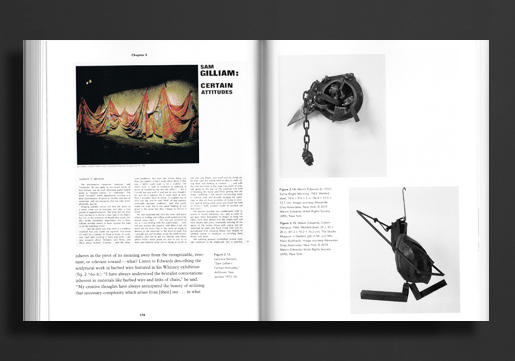
Art historian Darby English is celebrated for working against the grain and plumbing gaps in historical narratives. In this book, he explores the year 1971, when two exhibitions opened that brought modernist painting and sculpture into the burning heart of black cultural politics: Contemporary Black Artists in America, shown at the Whitney Museum of American Art, and The DeLuxe Show, an integrated abstract art exhibition presented in a renovated movie theater in a Houston ghetto.
1971 takes an insightful look at many black artists' desire to gain freedom from overt racial representation, as well as their and their advocates' efforts to further that aim through public exhibitions. Amid calls to define a "black aesthetic" or otherwise settle the race question, these experiments with modernist art favored cultural interaction and instability. Contemporary Black Artists in America highlighted abstraction as a stance against normative approaches, while The DeLuxe Show positioned abstraction in a center of urban blight.
The power and social importance of these experiments, English argues, came partly from color's special status as a racial metaphor and partly from investigations of color that were underway in formalist American art and criticism. From Frank Bowling to Virginia Jaramillo, Sam Gilliam to Peter Bradley, black modernists and their supporters rose above the demand to represent or be represented, compromising nothing in their appeals for racial reconciliation. At a time when many debates about identity sought closure, these exhibitions offered openings; when icons and slogans touted simple solutions, they chose difficulty. But above all, as English demonstrates in this provocative book, these exhibitions and artists responded with optimism rather than cynicism to the surrounding culture's preoccupation with color.
2018, English
Hardcover (clothbound), 488 pages, 19.3 x 23.6 cm
1st Edition, Out of print title / as new
Published by
Karma / New York
$300.00 - Out of stock
First edition of this incredible and very quickly out of print monograph on Gertrude Abercrombie, edited by Dan Nadel. Text by Robert Storr, Susan Weininger, Robert Cozzelino, Dinah Livingston.
Interview with Studs Terkel.
This is the most comprehensive book ever published on the Chicago surrealist Gertrude Abercrombie (1909–77), a key figure in midcentury American surrealism. From the late 1930s until her death, Abercrombie made paintings populated by objects of personal significance—moons, towers, cats, pennants, Victorian furniture, shells, snails and doors—to create allegories for her own often precarious psychological states. Often presiding over these symbols was Abercrombie herself, who appears in numerous pictures as proud observer or witchy caricature.
Abercrombie exhibited in Chicago and New York in the 1940s and ‘50s, and her salon became a center of Midwestern culture, hosting jazz musicians (such as her close friend Dizzy Gillespie), writers and artists. This book includes new scholarship by Robert Cozzolino; a memoir of Abercrombie by Robert Storr; the artist's own writing; a definitive text by art historian Susan Weininger; and a memoir by the artist's daughter, Dinah Livingston.
As New copy of this now extremely scarce book.
2011, English
Softcover, 112 pages, 15.2 x 22.9 cm
Published by
New Directions / New York
$30.00 - Out of stock
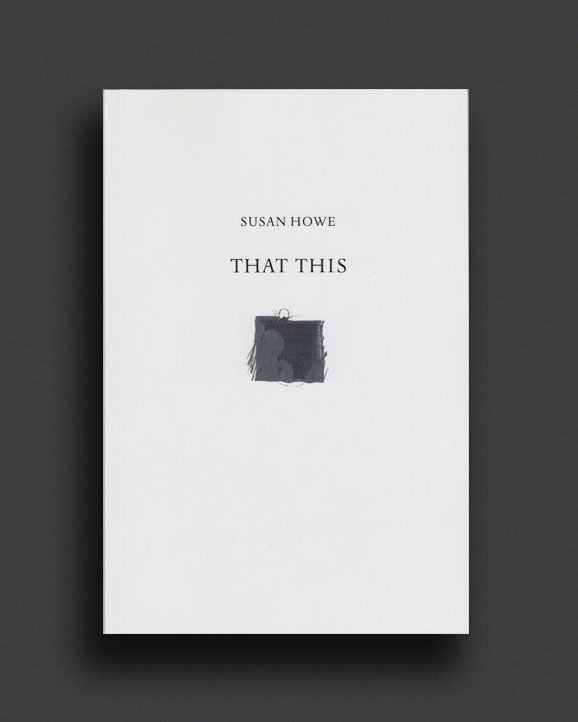
“What treasures of knowledge we cluster around.” That This is a collection in three pieces. “Disappearance Approach,” an essay about Howe's husband's sudden death—“land of darkness or darkness itself you shadow mouth”—begins the book with paintings by Poussin, an autopsy, Sarah Edwards and her sister-in-law Hannah, phantoms, and elusive remnants. “Frolic Architecture,” the second section—inspired by visits to the vast 18th-century Jonathan Edwards archives at the Beinecke and accompanied by six photograms by James Welling—presents hauntingly lovely, oblique type-collages of Hannah Edwards Wetmore's diary entries that Howe (with scissors, “invisible” Scotch Tape, and a Canon copier) has twisted, flattened, and snipped into inscapes of force.…
Susan Howe was born in Boston in 1937. Winner of the Bollingen Prize, she has been acclaimed as “the still-new century's finest metaphysical poet” (The Village Voice). Thirteen of her books are published by New Directions.
2017, English
Softcover, 244 pages, 15.2 x 22.9 cm
Published by
New Directions / New York
$34.00 - In stock -
A collection in five parts, Susan Howe's electrifying new book opens with a preface by the poet that lays out some of Debths' inspirations: the art of Paul Thek, the Isabella Stewart Gardner collection, and early American writings; and in it she also addresses memory's threads and galaxies, "the rule of remoteness," and "the luminous story surrounding all things noumenal."
Following the preface are four sections of poetry: "Titian Air Vent," "Tom Tit Tot" (her newest collage poems), "Periscope," and "Debths." As always with Howe, Debths brings "a not-being-in-the-no."
Susan Howe was born in Boston in 1937. Winner of the Bollingen Prize, she has been acclaimed as “the still-new century's finest metaphysical poet” (The Village Voice). Thirteen of her books are published by New Directions.
1983, German
Softcover, 118 pages, 18 x 11.5 cm
Out of print title / used / very good
Published by
Ullstein KunstBuch / Frankfurt
$40.00 - Out of stock
German artist Hans Bellmer (1902-1975) was one of the most subversive artists associated with Surrealism, famous--notorious, even--for his erotic engravings, objects and photographs. The first edition of Die Puppe (The Doll) comprised a series of Bellmer's photographs "illustrated" with prose poems by Paul Éluard; Bellmer's hand-colored photographs subsequently acquired an iconic status as perhaps the purest exemplification of the Surrealist ideal of "convulsive beauty." Later editions of the book were expanded to incorporate a body of theoretical, poetic and speculative texts that together comprise one of the most important expositions of Surrealist cultural theory. Bellmer weaves a remarkably disparate set of concepts and intuitions--from fields as diverse as mathematics, morphology, optics and psychology--into a theory of eroticism that provides a totally unexpected rationale for his uncompromising art. His ideas are, in the words of poet Joë Bousquet, a "scandal to reason."
This 1983 printing from Frankfurt is in the original German language, as are majority of editions of Die Puppe, and includes Die Puppe, Die Spiele der Puppe, and Die Anatomie des Bildes, and more. Illustrated throughout. Very Good copy.
2020, English
Softcover, 232 pages, 14 x 20 cm
Published by
Wakefield Press / Cambridge
$34.00 - Out of stock
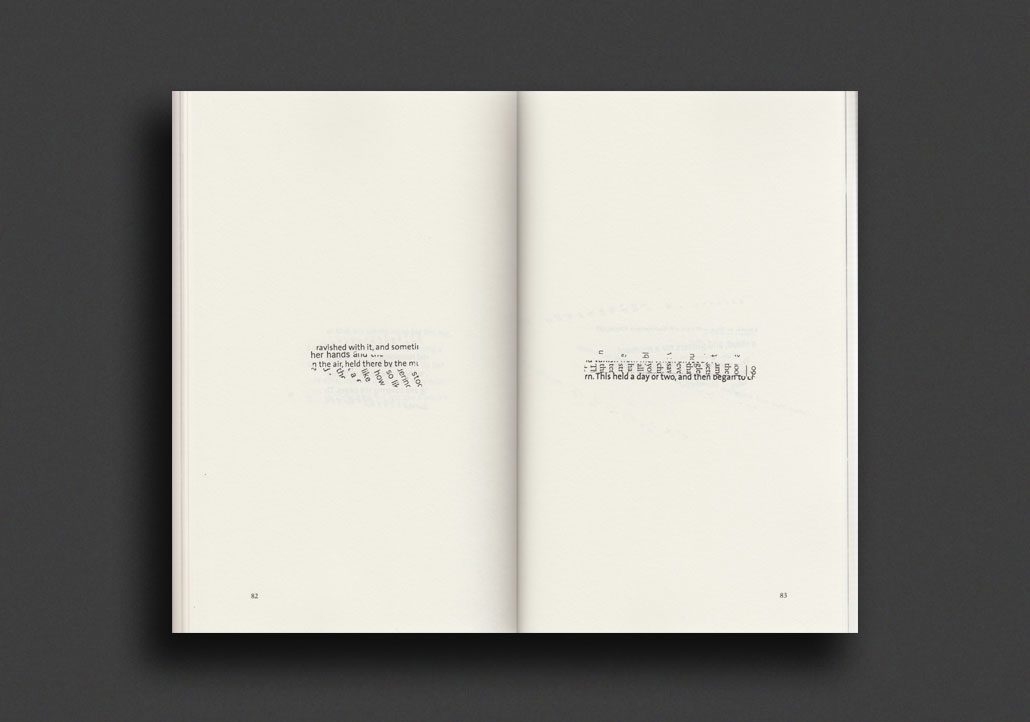
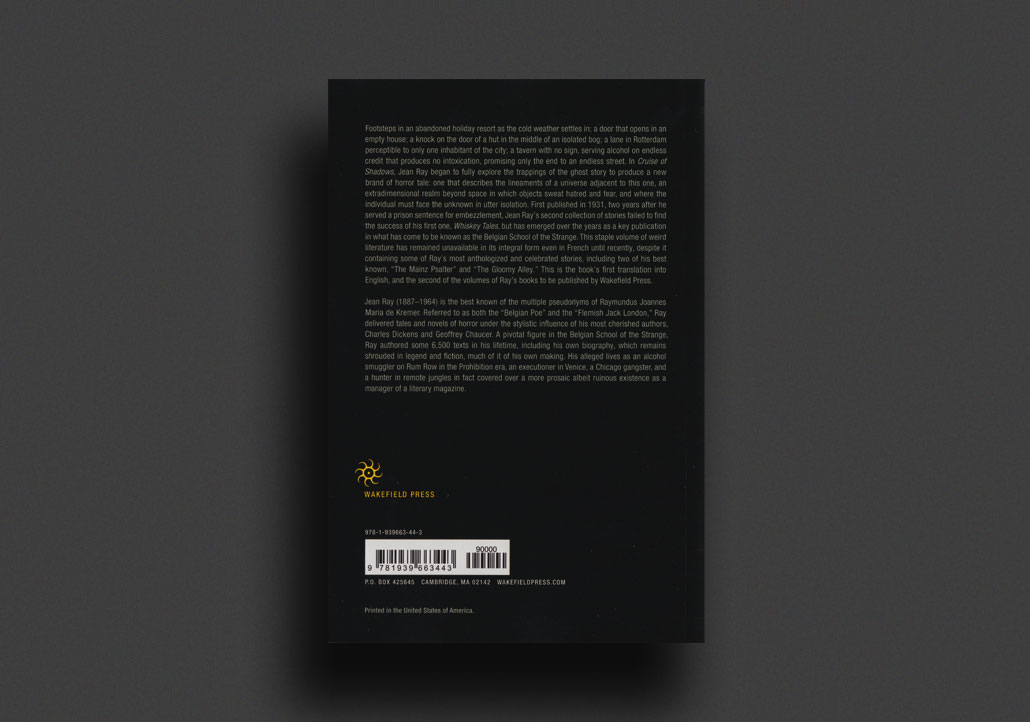
With this second short story collection, Jean Ray began to fully explore the trappings of the ghost story to produce a new brand of horror tale: one that described the lineaments of a universe adjacent to this one, in which objects sweat hatred and fear, and the individual must face the unknown in isolation. First published in 1931, it failed to find the success of his first collection, Whiskey Tales, but has emerged over the years as a key publication in the Belgian School of the Strange. Footsteps in an abandoned holiday resort as the cold weather settles in; a knock on the door of a hut in the middle of an isolated bog; a lane in Rotterdam perceptible to only one inhabitant in the city. In Cruise of Shadows, It has remained unavailable in its integral form even in French until recently, however, though it contains some of Ray’s most anthologised and celebrated stories, including two of his best known, “The Mainz Psalter” and “The Shadowy Alley.” This is the book’s first English translation, and the second of the volumes of Ray’s books to be published by Wakefield Press.Alternately referred to as the “Belgian Poe” and the “Flemish Jack London,” Jean Ray (1887–1964) delivered tales of horror under the stylistic influence of his most cherished authors, Charles Dickens and Geoffrey Chaucer. A pivotal figure in what has come to be known as the “Belgian School of the Strange,” Ray authored some 6,500 texts in his lifetime.
2019, English
Softcover, 240 pages. 13.9 x 20.3 cm
Published by
Wakefield Press / Cambridge
$30.00 - Out of stock
Translated, with an introduction, by Scott Nicolay
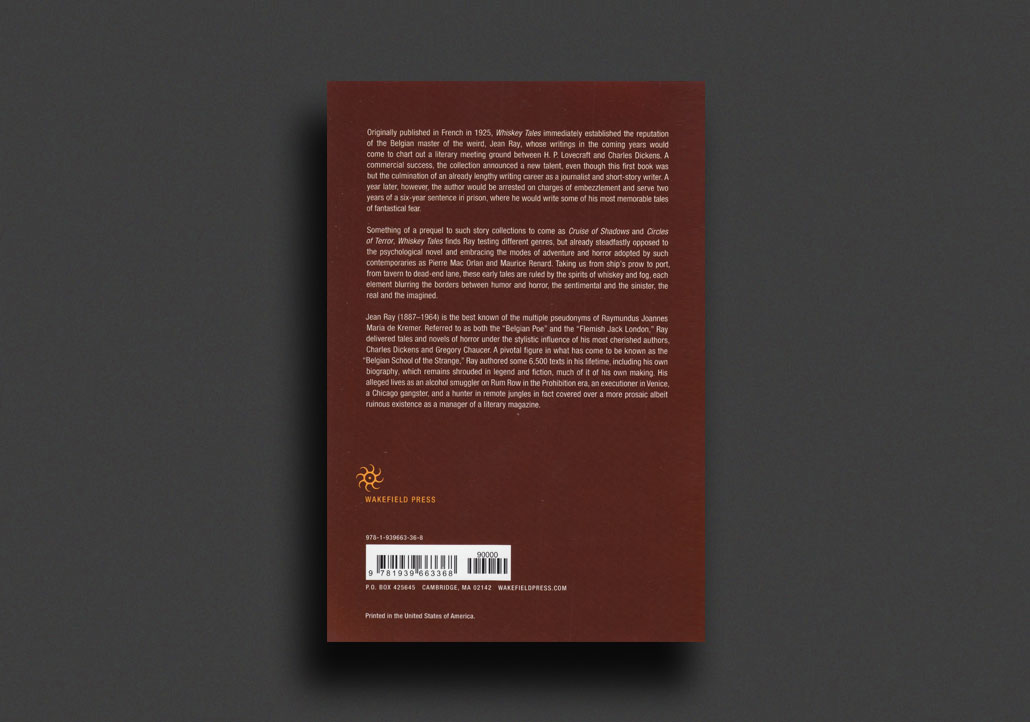
Originally published in French in 1925, Whiskey Tales immediately established the reputation of the Belgian master of the weird, Jean Ray, whose writings in the coming years would come to chart out a literary meeting ground between H. P. Lovecraft and Charles Dickens. A commercial success, the collection earned Ray the appellation of the “Belgian Poe” and announced a new talent, even though this first book had been but the culmination of an already lengthy writing career as a journalist and short-story writer. A year later, however, the author would be arrested on charges of embezzlement and serve two years of a six-year sentence in prison, where he would write some of his best stories.
Something of a prequel to such story collections to come as Cruise of Shadows or Circles of Terror (both forthcoming from Wakefield Press), Whiskey Tales finds Ray testing different genres, but already steadfastly opposed to the psychological novel and embracing the modes of adventure and horror adopted by such contemporaries as Pierre Mac Orlan and Maurice Renard. Taking us from ship’s prow to port, from tavern to dead-end lane, these early tales are ruled by the spirits of whiskey and fog, each element blurring the borders between humor and horror, the sentimental and the sinister, and the real and the imagined.
A handful of these stories first appeared in English in various issues of Weird Tales back in the 1930s, but the majority of this collection has never before been translated. This first complete English-language edition will be the first in many volumes of Jean Ray’s books that Wakefield Press will be bringing out over the coming seasons.
Jean Ray (1887–1964) is the best known of the multiple pseudonyms of Raymundus Joannes Maria de Kremer. Alternately referred to as the “Belgian Poe” and the “Flemish Jack London,” Ray delivered tales and novels of horror under the stylistic influence of his most cherished authors, Charles Dickens and Geoffrey Chaucer. A pivotal figure in what has come to be known as the “Belgian School of the Strange,” Ray authored some 6,500 texts in his lifetime, not including his own biography, which remains shrouded in legend and fiction, much of it his own making. His alleged lives as an alcohol smuggler on Rum Row in the prohibition era, an executioner in Venice, a Chicago gangster, and hunter in remote jungles in fact covered over a more prosaic, albeit ruinous, existence as a manager of a literary magazine that led to a prison sentence, during which he wrote some of his most memorable tales of fantastical fear.
2011, Japanese / French
Softcover (w. printed plastic jacket over reflective cover), 296 pages
1st Edition, Out of print title / used / very good
Published by
National Art Centre / Tokyo
$90.00 - Out of stock
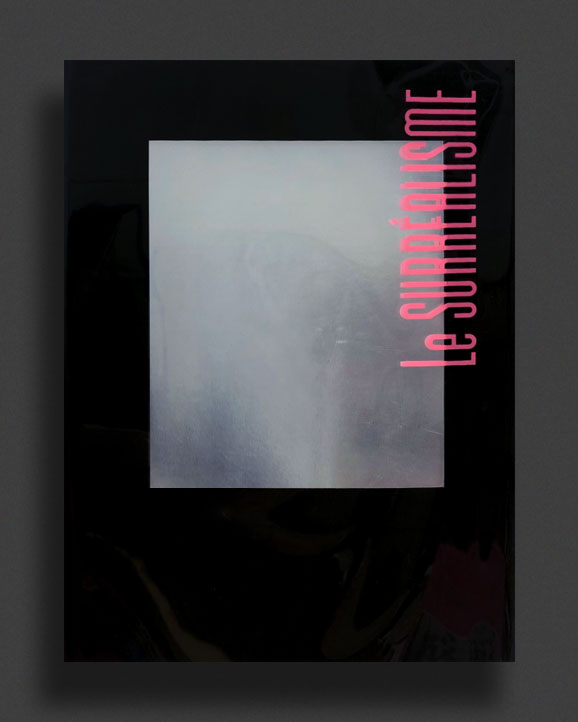
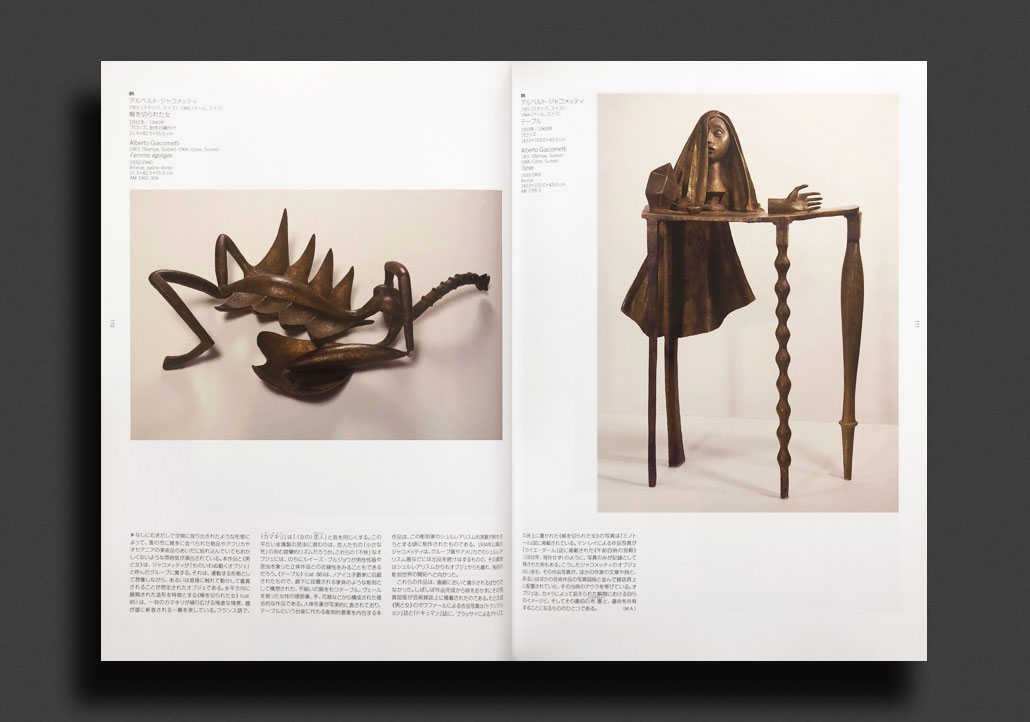
First printing of this great exhibition catalogue from the National Art Centre Tokyo via Centre Pompidou Paris, on occasion of the most comprehensive Surrealist exhibition ever staged in Japan, “Le Surrealism: Exposition organisee par Le Pompidou a partir de sa Collection” at The National Art Center, Tokyo in 2011.
Housed in mirrored cover and profusely illustrated in colour with the work of André Breton, Victor Brauner, Rene Magritte, Joan Miro, Andre Masson, Francis Picabia, Claude Cahun, Hans Bellmer, Dorothea Tanning, Max Ernst, Salvador Dali, Toyen, Guilaume Apollinaire, Meret Oppenheim, Luis Buñuel, Jindrich Heisler, Andre Masson, Yves Tanguy, Alberto Giacometti, Man Ray, Marcel Duchamp, Jean Arp, Giorgio de Chirico, Wilhelm Freddie, and many others, alongside comprehensive documentation of major historical Surrealist exhibitions and documents/publications.
Very Good copy.
1985, English
Softcover (stapled), 14 pages, 20.5 x 25.5 cm
1st Edition, Out of print title / used / good
Published by
Charles Nodrum / Melbourne
$35.00 - Out of stock
Published on the occasion of an exhibition at the Charles Nodrum Gallery in Melbourne, 1985, this scarce catalogue features the work of Robert Klippel, Danila Vassilieff, George Duncan, Alison Rehfisch, Roland Wakelin, Grace Cossington Smith, Sybil Craig, Hector Gilliland, Peggy Crombie, William Frater, Russell Drysdale, Kenneth Jack, Miriam Moxham, Dorothy Braund, John Taylor, Michael Shannon, Kenneth Rowell, Clifton Pugh, Lawrence Daws, Godrey Miller, Leonard Crawford, William Rose, Syd Ball, Alun Leach Jones, Jonas Balsaitis, John Firth Smith, Fred Cross, Paul Partos, Ron Lambert, Gunther Christmann, David Fitts, Brian Westwood, John Hopkins, Vivienne Pengilley. Illustrated throughout in black and white. Includes tipped in compliments note signed by "Charles" Nodrum.
1958, English
Softcover, 72 pages, 27 x 23 cm
1st Edition, Out of print title / used / good
Published by
Museum of Modern Art of Australia / Melbourne
$65.00 - Out of stock
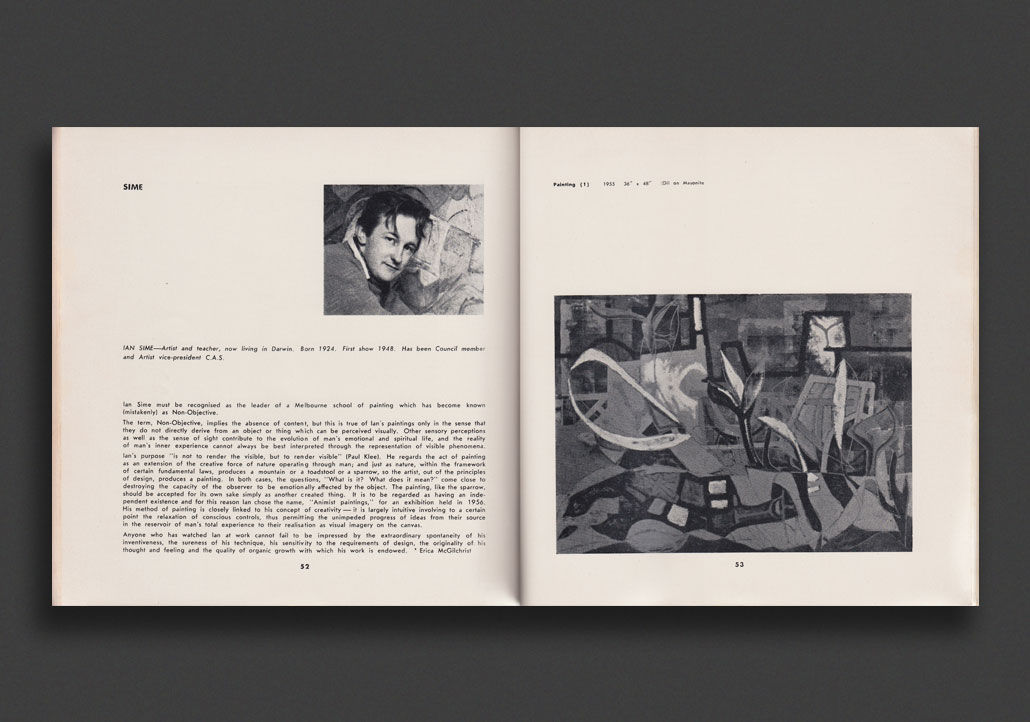
Scarce 1958 first publication of the Museum of Modern Art of Australia which closed in 1966. In 1958 John Reed founded and was first director of the Museum of Modern Art of Australia (1958-66). Modern Australian Art : A Melbourne Collection of Paintings and Drawings presented a collection of 163 works donated by John and Sunday Reed from 1930's-1950's and exhibited in from 30th September to 10th October, 1958. Illustrated throughout with work examples, portraits and biographies of each artist, this rare historical title includes the work of Adrian Lawlor, Samuel Atyeo, Moya Dyring, Ian Fairweather, Sidney Nolan, Albert Tucker, Arthur Boyd, John Perceval, Joy Hester, Mary Boyd, James Gleeson, Josl Bergner, Noel Counihan, Danila Vassilieff, H. Dearing, John Yule, Laurence Hope, Jean Langley, Charles Blackman, Robert Dickerson, Leonard Crawford, Ian Sime, Dawn Sime, Grey Smith, John Molvig, George Johnson, John Brack, Fred Williams, Mirka Mora, Peter Burns. Includes a full catalogue of the collection and statements John and Sunday Reed. Texts by editor Barrie Reid.
Good copy with general wear for age.
2001, English
Softcover, 64 pages, 22 x 27.5 cm
Published by
Self-Published / Melbourne
$20.00 - In stock -
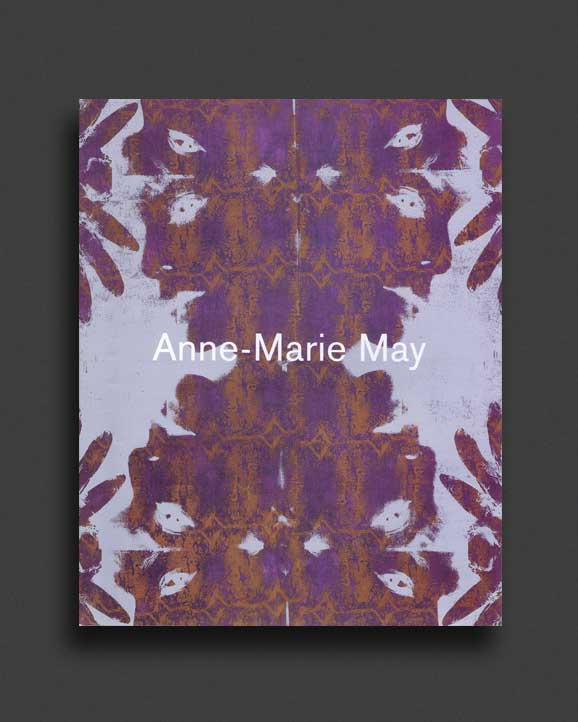
This monographic publication, published in Melbourne in 2001, survey's the work of Anne-Marie May. Profusely illustrated in colour throughout, this book covers all bodies of work from 1989-2001, including her Cutouts, Screens, Felts, Carpets...) accompanied by texts by May and Kevin Murray, an interview between the two, biography, and list of works. May's history of abstraction is directed by varying processes and techniques guided by the qualities of everyday materials such as denim, felt, carpet, and more recently, plastics.
Born 1965, Melbourne, Victoria; lives and works in Melbourne. Anne-Marie May has been exhibiting since the late 1980s, and (alongside was a member of the influential artist-run space Store 5, Melbourne. Selected solo exhibitions have been held at Heide Museum of Modern Art, Melbourne, 2004; Michael Lett Gallery, Auckland, 2004; and Murray White Room, Melbourne, 2009, 2011 and 2013. Her work was included in 21st Century Modern: 2006 Adelaide Biennial of Australian Art, Art Gallery of South Australia, and Less is More: Minimal and Post-Minimal Art in Australia at Heide in 2012.
2019, English
Softcover, 224 pages, 21.4 x 28.5 cm
Ed. of 950,
Published by
3-Ply / Victoria
$38.00 - Out of stock
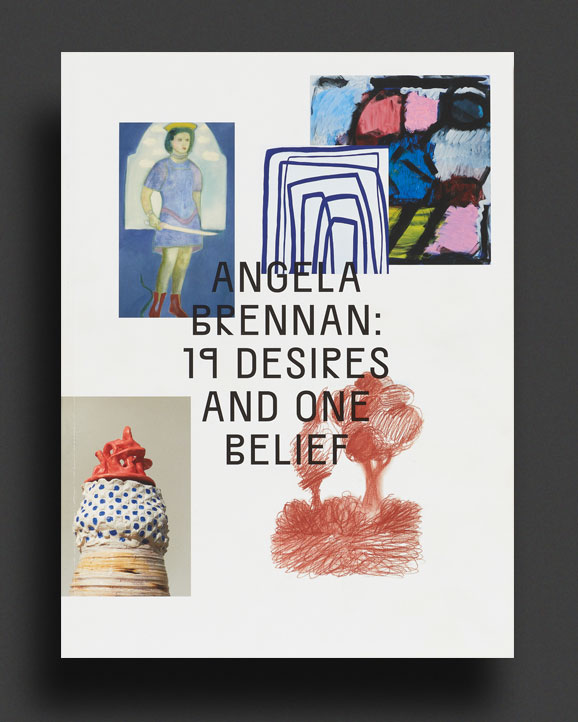
Angela Brennan: 19 Desires and One Belief is an artist-driven publication edited by Angela Brennan, a non-exhaustive slice of practice, spanning around thirty years. The monograph includes an essay by Jan Bryant, a poem by Justin Clemens and contributions by Mitch Cairns, Mel Deerson, Michael Graf, Elizabeth Newman, Lisa Radford, and Georgina Sambell. The texts have been dispersed amongst an array of images, arranged non-periodically, sequenced to reflect a circuitous approach to practice. The book decontextualizes artworks, liberating them from previous frameworks in which they have been presented, opening space for new readings and atemporal crosscurrents.
Angela Brennan: 19 Desires and One Belief continues 3-ply’s investigation of monograph-as-artist-book. Design by Lucy Russell. Published in an edition of 950 copies.
2019, English
Softcover, 248 pages, 18 x 11 cm
Published by
Endless Lonely Planet / Melbourne
$20.00 - Out of stock
ELP 7 is dedicated to the prison writing of Japanese Anarchist Nihilist Fumiko Kaneko (1903-1926).
Published in an edition of 100. Cover by JP. Layout by DHW.
2019, English
Softcover, 80 pages, 18 x 12 cm
Published by
Self-Published / Sydney
$22.00 - Out of stock
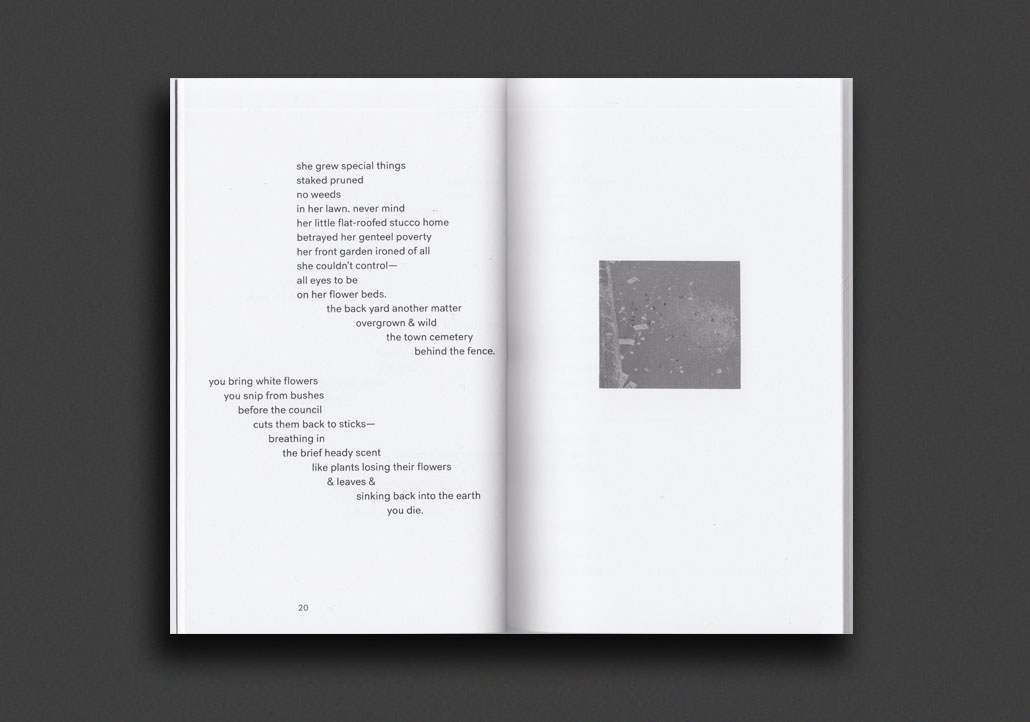
THE Ls consider writing itself
how words can move
subjectivities and their
relationships to each other
astonishment is
wonder is moving to the
unthinkable is
Judy Annear is an independent researcher and writer based in Victoria on Dja Dja Wurrung land, never ceded, and Honorary (Principal Fellow) School of Culture and Communication, University of Melbourne. Her fields of research include literary feminisms, and modern and contemporary art practice underpinned by a focus on periods of major technological change. Amongst other projects, she is currently researching Allan Sekula’s first visit to Australia in 1980, as a guest of Working Papers On Photography, Melbourne. Her recent publications include a small book of experimental texts The Ls 2019, as well as contributions to Photomedia Now/Everything is Interesting’ in Art Monthly Australasia October 2018, and an encyclopaedic history, The Photograph and Australia 2015. She has published extensively in journals such as Art Network, Art+Text (member of the editorial committee 1987–94), Photofile, Art Monthly, Art & Australia, Art Asia Pacific, LIKE, ART-iT Asia, Broadsheet, 4A Papers, eyeline. In 1980, she was a member of the collective that wrote and (largely) funded the feminist arts magazine LIP (1976–84).
1968, Japanese / German
Softcover, 80 pages, 21 x 22 cm
1st Edition, Out of print title / used / very good
Published by
Goethe-Instituts / Japan
Staalichen Museums für Moderne Kunst / Tokyo
$70.00 - Out of stock
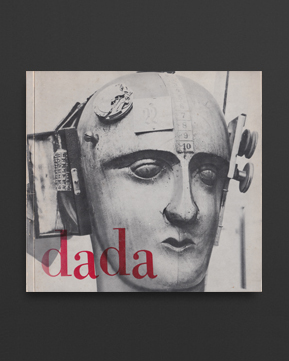
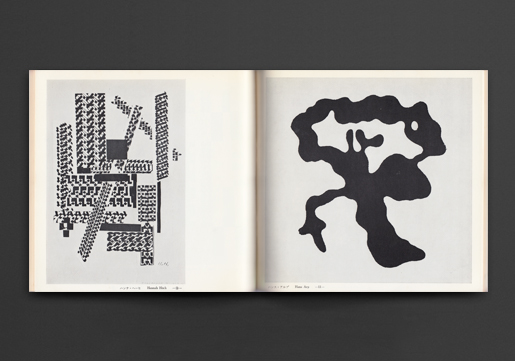
1st pinting of this publication on Dada, published in Japan in 1968. Features the work of Marcel Duchamp, Hannah Höch, Sophie Taeuber-Arp, George Grosz, Kurt Schwitters, Max Ernst, Josef Albers, Hans Richter, Hans Arp, Man Ray, Francis Picabia, Raoul Hausmann, John Heartfield, Peter Agostini, Jean Tinguely, Karl Gerstner, and more reproduced alongside a collaged history of Dada across the globe (New York, Zürich, Cologne, Italy, Paris, Berlin, Hannover) w. reproductions of texts, illustrations, publications and ephemera.
Very Good copy.