World Food Books' programme is largely produced on Kulin Nation land. We acknowledge the Wurundjeri people of the Kulin Nation as the first and continuing custodians of this land, and pay respect to their Elders past, present, and emerging.
World Food Books is an arts and special interests bookshop in Naarm / Melbourne. Founded in 2010, World Food Books is devoted to the presentation of a rotating, hand-selection of international art, design, literary and counterculture publications with an emphasis on the anti-traditional, the experimental, the avant-garde, the heretic, the marginal.
Presenting new titles alongside rare and out-of-print books, catalogues and journals spanning the fields of modern and contemporary art, design, photography, illustration, film, literature, poetry, cultural theory, philosophy, sexuality, popular and underground culture in its many radical forms, World Food Books wishes to encourage adventurous, thoughtful and open-minded reading, looking, writing, and exchange of publishing and ideas, both current and historical.
As well as our bookshop, located in Melbourne's historical Nicholas Building, all of our inventory is available internationally via our online mail-order service.
World Food Books semi-regularly co-ordinates "Occasions", a programme of exhibits and events at the bookshop and in partnership with other hosts (such as museums and art galleries) that develop out of the activities, relationships and content of the bookshop itself.
World Food Books
The Nicholas Building
37 Swanston Street
Room 5, Level 6
Melbourne 3000
Australia
SHOP HOURS:
Thu–Fri 12–6, Sat 12–5
WEB-SHOP OPEN 24/7
World Food Books
Postal Address:
PO Box 435
Flinders Lane
Victoria 8009
Australia
Art
Theory / Essay
Architecture / Interior
Graphic Design / Typography
Photography
Fashion
Eros
LGBTQ+
Fiction / Poetry
Weird / Speculative / Science Fiction / Horror
Transgressive / Visceral / Abject
Symbolism / Decadence / Fin de siècle
Film / Video
Painting
Sculpture / Installation
Performance / Dance / Theater
Drawing
Sound / Music
Curatorial
Group Shows / Collections
Periodicals
Out-of-print / Rare
Posters / Ephemera / Discs
Signed Books
World Food Books Gift Voucher
World Food Book Bag
Australian Art
Australian Fiction
Australian Science Fiction / Speculative Fiction
Australian Poetry
Australian Photography
Japanese Photography
Conceptual Art
Minimal Art
Dada
'Pataphysics / Oulipo
Fluxus
Concrete Poetry
Pop Art
Surrealism
Arte Povera
Arte Informale / Haute Pâte / Tachism
Nouveau Réalisme / Zero / Kinetic
Situationism / Lettrism
Collage / Mail Art / Xerox Art
Art Brut / Folk / Visionary / Fantastic
Illustration / Graphic Art / Bandes Dessinées
Furniture
Italian Radical Design / Postmodernism
Textiles
Ceramics / Glass
Counterculture
Protest / Revolt
Philosophy
Psychoanalysis
Anthropology
Anarchism
Socialism / Anarchism / Communism / Capitalism
Literary Theory / Semiotics / Language
Feminism / Women's Studies
Gender Studies / Sexuality
Anthropology
Fetishism / BDSM
Drugs / Psychedelia
Crime / Violence
Animal Rights / Veganism
Occult / Esoterica
Ecology / Earth / Alternative Living
Whole Earth / Crafts
All prices in AUD (Australian dollars)
Pick-Ups
Pick-up orders can be collected in our bookshop during opening hours after order date. Please collect any Pick-up orders within 2 weeks of ordering as we have limited storage space. Orders will be released back into stock if not collected within this time. No refunds can be made for pick-ups left un-collected. If you cannot make it in to the bookshop in this time-frame, please choose postage option.
Return Policy
All sales are final. We do accept returns (for refund or exchange) for items received in error. All our orders are packed with special care using heavy-duty padding and cardboard book-mailers or bubble mailers (for smaller books), using reinforcement where required. We cannot take responsibility for any lost, stolen or damaged parcels.
Insurance
Should you wish to insure your package, please email us directly after placing your order and we can organise this at a small extra expense. Although all standard/express tracked packages are very safe and dependable, we cannot take responsibility for any lost, stolen or damaged parcels. We recommend insurance on valuable orders.
Interested in selling your old books, catalogues, journals, magazines, comics, fanzines, ephemera? We are always looking for interesting, unusual and out-of-print books to buy. We only buy books in our fields of interest and specialty, and that we feel we can resell.
We base these prices on desirability, market value, in-print prices, condition and our current stock levels. We offer cash, store credit, and can take stock on consignment. All
about 25% of the price we expect to get when we sell them, or 30% in store credit. We base these prices on desirability, market value, in-print prices, condition and our current stock levels.
Sell your books any day of the week. You can drop them off and return later. If you have a lot of books, we can visit your Sydney home.
We buy books that we feel we can resell. We offer about 25 % of the price we expect to get when we sell them, or 30% in store credit. We base these prices on desirability, market value, in-print prices, condition and our current stock levels.
Philadelphia Wireman
03 August - 01 September, 2018
World Food Books is proud to announce our next Occasion, the first presentation of sculptures by Philadelphia Wireman in Australia.
The Philadelphia Wireman sculptures were found abandoned in an alley off Philadelphia’s South Street on trash night in 1982. Their discovery in a rapidly-changing neighbourhood undergoing extensive renovation, compounded with the failure of all attempts to locate the artist, suggests that the works may have been discarded after the maker’s death. Dubbed the "Philadelphia Wireman" during the first exhibition of this work, in 1985, the maker’s name, age, ethnicity, and even gender remain uncertain. The entire collection totals approximately 1200 pieces, all intricately bound together with tightly-wound heavy-gauge wire (along with a few small, abstract marker drawings, reminiscent both of Mark Tobey and J.B. Murry). The dense construction of the work, despite a modest range of scale and materials, is singularly obsessive and disciplined in design: a wire armature or exoskeleton firmly binds a bricolage of found objects including plastic, glass, food packaging, umbrella parts, tape, rubber, batteries, pens, leather, reflectors, nuts and bolts, nails, foil, coins, toys, watches, eyeglasses, tools, and jewellery.
Heavy with associations—anthropomorphic, zoomorphic, and socio-cultural responses to wrapped detritus—the totemic sculptures by Philadelphia Wireman have been discussed in the context of work created to fulfil the shamanistic needs of alternative religions in American culture. Curators, collectors, and critics have variously compared certain pieces to sculpture from Classical antiquity, Native American medicine bundles, African-American memory jugs, and African fetish objects. Reflecting the artist’s prolific and incredibly focused scavenging impulse, and despite—or perhaps enhanced by—their anonymity, these enigmatic objects function as urban artefacts and arbiters of power, though their origin and purpose is unknown. Philadelphia Wireman, whatever their identity, possessed an astonishing ability to isolate and communicate the concepts of power and energy through the selection and transformation of ordinary materials. Over the course of the past two decades, this collection has come to be regarded as an important discovery in the field of self-taught art and vernacular art.
Presented in collaboration with Fleisher-Ollman Gallery, Philadelphia, and Robert Heald, Wellington.
Susan Te Kahurangi King
02 February - 10 March, 2018
Susan Te Kahurangi King (24 February 1951 - ) has been a confident and prolific artist since she was a young child, drawing with readily available materials - pencils, ballpoint pens and felt-tip markers, on whatever paper is at hand. Between the ages of four and six Susan slowly ceased verbal communication. Her grandparents William and Myrtle Murphy had developed a special bond with Susan so they took on caring responsibilities for extended periods. Myrtle began informally archiving her work, carefully collecting and storing the drawings and compiling scrapbooks. No drawing was insignificant; every scrap of paper was kept. The King family are now the custodians of a vast collection containing over 7000 individual works, from tiny scraps of paper through to 5 meter long rolls.
The scrapbooks and diaries reveal Myrtle to be a woman of great patience and compassion, seeking to understand a child who was not always behaving as expected. She encouraged Susan to be observant, to explore her environment and absorb all the sights and sounds. Myrtle would show Susan’s drawings to friends and people in her community that she had dealings with, such as shopkeepers and postal workers, but this was not simply a case of a grandmother’s bias. She recognised that Susan had developed a sophisticated and unique visual language and sincerely believed that her art deserved serious attention.
This was an unorthodox attitude for the time. To provide some context, Jean Dubuffet coined the term Art Brut in 1945 to describe work created by self-taught artists – specifically residents of psychiatric institutions and those he considered to be visionaries or eccentrics. In 1972 Roger Cardinal extended this concept by adopting the term Outsider Art to describe work made by non-academically trained artists operating outside of mainstream art networks through choice or circumstance. Susan was born in Te Aroha, New Zealand in 1951, far from the artistic hubs of Paris and London that Dubuffet and Cardinal operated in. That Myrtle fêted Susan as a self-taught artist who deserved to be taken seriously shows how progressive her attitudes were.
Susan’s parents Doug and Dawn were also progressive. Over the years they had consulted numerous health practitioners about Susan’s condition, as the medical establishment could not provide an explanation as to why she had lapsed into silence. Dawn educated herself in the field of homeopathy and went on to treat all twelve of her children using these principles – basing prescriptions on her observations of their physical, mental and emotional state.
Doug was a linguist with an interest in philosophy who devoted what little spare time he had to studying Maori language and culture. To some extent their willingness to explore the fringes of the mainstream made them outsiders too but it was their commitment to living with integrity and their respect for individuality that ensured Susan’s creativity was always encouraged.
Even though Susan’s family supported her artistic pursuits, some staff in schools and hospitals saw it as an impediment to her assimilation into the community and discouraged it in a variety of ways. Her family was not always aware of this and therefore did not fully understand why Susan stopped drawing in the early 1990s. However, rather than dwell on the challenges that Susan faced in pursuit of her artistic practice, they prefer to highlight her achievements. In 2008 Susan began drawing again in earnest, after an almost 20 year interruption, and her work is now shown in galleries around the world.
Susan grew up without television and has been heavily influenced by the comics she read as a child. She is absolutely fearless in the appropriation of recognizable characters, such as Donald Duck and Mickey Mouse, in her work. She twists their limbs, contorts their faces, compresses them together, blends them into complex patterned backgrounds - always imbuing them with an incredible energy. Although Susan often used pop culture characters in her work they are not naive or childlike. These are drawings by a brilliant self-taught artist who has been creating exceptional work for decades without an audience in mind.
Mladen Stilinović
"Various Works 1986 - 1999"
02 February 16 - September 10, 2016
Various works 1986 - 1999, from two houses, from the collections of John Nixon, Sue Cramer, Kerrie Poliness, Peter Haffenden and Phoebe Haffenden.
Including: Geometry of Cakes (various shelves), 1993; Poor People’s Law (black and white plate), 1993; White Absence (glasses, ruler, set square, silver spoon, silver ladel with skin photograph and wooden cubes), 1990-1996; Exploitation of the Dead (grey and red star painting, wooden painting, black spoon with red table, red plate), 1984-1990; Money and Zeros (zero tie, paintings made for friends in Australia (Sue, John, Kerrie), numbers painting), 1991-1992; Words - Slogans (various t-shirts) - “they talk about the death of art...help! someone is trying to kill me”, “my sweet little lamb”, “work is a disease - Karl Marx”; Various artist books, catalogues, monographs, videos; Poster from exhibition Insulting Anarchy; "Circular" Croatian - Australian edition; Artist book by Vlado Martek (Dostoyevsky); more.
Thanks to Mladen Stilinović and Branka Stipančić.
Jonathan Walker
Always Will Need To Wear Winter Shirt Blue + Ochre Small Check Pattern
21 August - 21 September, 2015
Untitled
I am not a great reader of poetry but I always return to the work of Melbourne poet, Vincent Buckley (1925- 1988). Perhaps I find his most tantalising piece to be not a finished poem but a fragment left on a scrap of paper discovered on his desk after the poet’s death.
The poetry gathers like oil
In the word-core, and spreads
It has its music meet,
Its music is in movement.
This fragment is more the shell left behind from a volatile thought than a finished poem. I find the last two lines honest but awkward whereas the first two lines work like an arrow. Most likely he could not find a resolution so it was left. Still, in its present form, it remains an eloquent testimony to the ultimate failure of a medium to express mobile thought and sensation, in Buckley’s case, through verbal language. It’s an important matter because this is something all artists have to deal with regardless of the medium.
I have never written a poem, however, I am forever copying fragments from books on paper scraps in a vain effort to fix certain notions in my head. At first, they function as bookmarks that are sometimes returned to when I open the book. But before long, as they accumulate, they fall out littering the table interspersed with A4 photocopies, bills, books and medications.
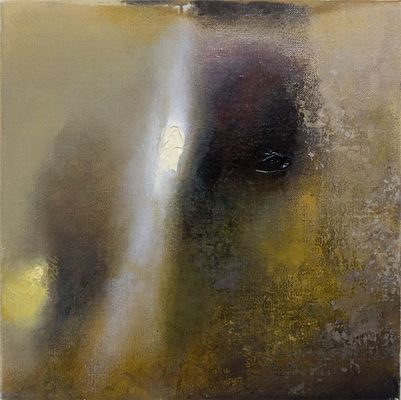
To return to Buckley’s fragment, the first two lines very much evoke how I paint nowadays. As you age, detail diminishes and patches of light become more luminous and float. I feel the most honest way of dealing with this is by smearing the oil paint on the canvas with the fingers and working close-up, blind. Only if the patches coalesce into an approaching image can the work gain a life.
-
Jonathan Walker was born in Melbourne, Australia and brought up on a dairy farm in Gippsland. In the 1970’s he studied painting at RMIT and won the Harold Wright Scholarship to the British Museum, London. During the 1980’s he exhibited at Pinacotheca Gallery, Richmond and had work shown at the NGV and Heidi City Art Gallery. Over the same period he designed the cover for the “Epigenesi” LP by Giancarlo Toniutti, Italy and conducted a mail exchange work with Achim Wollscheid, Germany. The work with artists through the post resulted in an article published in the bicentenary issue of Art and Australia 1988. He showed in artist run spaces such as WestSpace in the 90’s and 2000’s, and until 2012, taught painting at Victoria University, which is where we (Colleen Ahern and Lisa Radford) as organisers of the exhibition, among many others, had the privilege of being his student.
Walker’s knowledge was imparted to students through the careful selection of music, literature, and artists found in books that he himself had ordered for the library. Walker’s strategy was the generosity of sharing his vast knowledge with references specific to each student and their context.
Walker’s paintings share a similar focus and intimacy.
This exhibition presents a small selection of recent paintings alongside a publication that includes Walker’s writing. Observational and analytical, Walker’s work is a type of material notation — the time of day, colour and how it is blended, the both specific and fleeting location of a reflection on lino or the question of whether a chair leg should be included in a painting.
Please join us on Friday August 21 between 6-8pm to celebrate the opening of the exhibition.
Curated by Colleen Ahern and Lisa Radford.
B. Wurtz
Curated by Nic Tammens
March 26 - April 4, 2015
B.Wurtz works from a basement studio in his home on Manhattan’s Lower East Side.
This local fact is attested to by the plastic shopping bags and newsprint circulars that appear in his work. As formal objects, they don’t make loud claims about their origins but nonetheless transmit street addresses and places of business from the bottom of this long thin island. Like plenty of artists, Wurtz is affected by what is local and what is consumed. His work is underpinned by this ethic. It often speaks from a neighborhood or reads like the contents of a hamper:
“BLACK PLUMS $1.29 lb.”
“Food Bazaar”
“USDA Whole Pork Shoulder Picnic 99c lb.”
“RITE AID Pharmacy, with us it’s personal.”
“H. Brickman & Sons.”
“Sweet Yams 59c lb."
Most of the work in this exhibition was made while the artist was in residence at Dieu Donne, a workshop dedicated to paper craft in Midtown. Here Wurtz fabricated assemblages with paper and objects that are relatively lightweight, with the intention that they would be easily transportable to Australia. This consideration isn’t absolute in Wurtz’s work, but was prescriptive for making the current exhibition light and cheap. Packed in two boxes, these works were sent from a USPS post office on the Lower East Side and delivered to North Melbourne by Australia Post.
Wurtz appears courtesy of Metro Pictures, New York.
Thanks to Rob Halverson, Joshua Petherick, Sari de Mallory, Matt Hinkley, Helen Johnson, Fayen d'Evie, Ask Kilmartin, Lisa Radon, Ellena Savage, Yale Union, and "Elizabeth".
John Nixon
"Archive"
December 15 - January 20, 2014
The presentation of John Nixon's archive offered a rare showcase of this extensive collection of the artist's own publications, catalogues, posters, ephemera, editions and more, from the mid 1980s onwards, alongside a selection of his artworks.
Organized by John Nixon, Joshua Petherick and Matt Hinkley.
<a href=http://wfb.public-office.info/artist/john-nixon>All titles by John Nixon
"Habitat"
at Minerva, Sydney (organised by Joshua Petherick and Matt Hinkley)
November 15 - December 20, 2014
Lupo Borgonovo, Janet Burchill & Jennifer McCamley,
Lewis Fidock, HR Giger, Piero Gilardi, Veit Laurent Kurz,
Cinzia Ruggeri, Michael E. Smith, Lucie Stahl, Daniel Weil, Wols
Press Release:
“...It contained seven objects. The slender fluted bone, surely formed for flight, surely from the wing of some large bird. Three archaic circuitboards, faced with mazes of gold. A smooth white sphere of baked clay. An age-blackened fragment of lace. A fingerlength segment of what she assumed was bone from a human wrist, grayish white, inset smoothly with the silicon shaft of a small instrument that must once have ridden flush with the surface of the skin - but the thing’s face was seared and blackened.”
William Gibson, “Count Zero”, 1986
"Autumn Projects Archive"
Curated by Liza Vasiliou
March 6 - March 15, 2014
World Food Books, in conjunction with the Virgin Australia Melbourne Fashion Festival 2014, presented the Autumn Projects archive, consisting of a selection of early examples in Australian fashion with a particular interest in collecting designers and labels from the period beginning in the 1980’s, who significantly influenced the discourse of Australian Fashion.
Curated by Liza Vasiliou, the exhibition provided a unique opportunity to view pieces by designers Anthea Crawford, Barbara Vandenberg, Geoff Liddell and labels CR Australia, Covers, Jag along with early experimental collage pieces by Prue Acton and Sally Browne’s ‘Fragments’ collection, suspended throughout the functioning World Food Books shop in Melbourne.
H.B. Peace
presented by CENTRE FOR STYLE
November 14, 2013
"Hey Blinky, you say chic, I say same"
Anon 2013
H.B. Peace is a clothing collaboration between great friends Blake Barns and Hugh Egan Westland. Their pieces explore the divergences between 'character’ and ‘personality’ in garments....etc
Special Thanks to Joshua Petherick and Matt Hinkley of WFB and Gillian Mears
and a Very Special Thank you to Audrey Thomas Hayes for her shoe collaboration.
Janet Burchill & Jennifer McCamley
"Aesthetic Suicide"
May 10 - June 8, 2013
The first of our occasional exhibitions in the World Food Books office/shop space in Melbourne, "Aesthetic Suicide" presented a body of new and older works together by artists Janet Burchill & Jennifer McCamley, including videos, prints, a wall work, and publications.
During shop open hours videos played every hour, on the hour.
1974, German
Softcover, 169 page, 20 x 21 cm
1st Edition, Out of print title / used / very good
Published by
Städtisches Museum / Leverkusen
$65.00 $45.00 - Out of stock
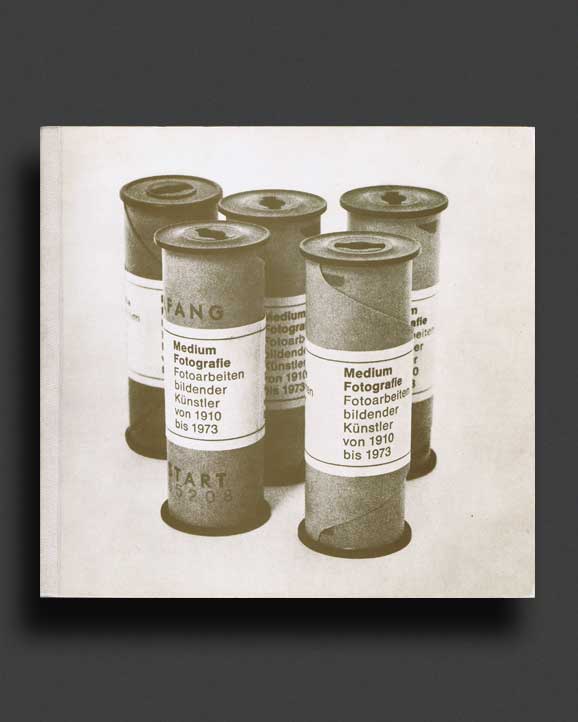
"Medium Fotografie" was published on the occasion of the exhibition of the same name held at Städtisches Museum, Leverkusen, 18 May - 5 August 1973.
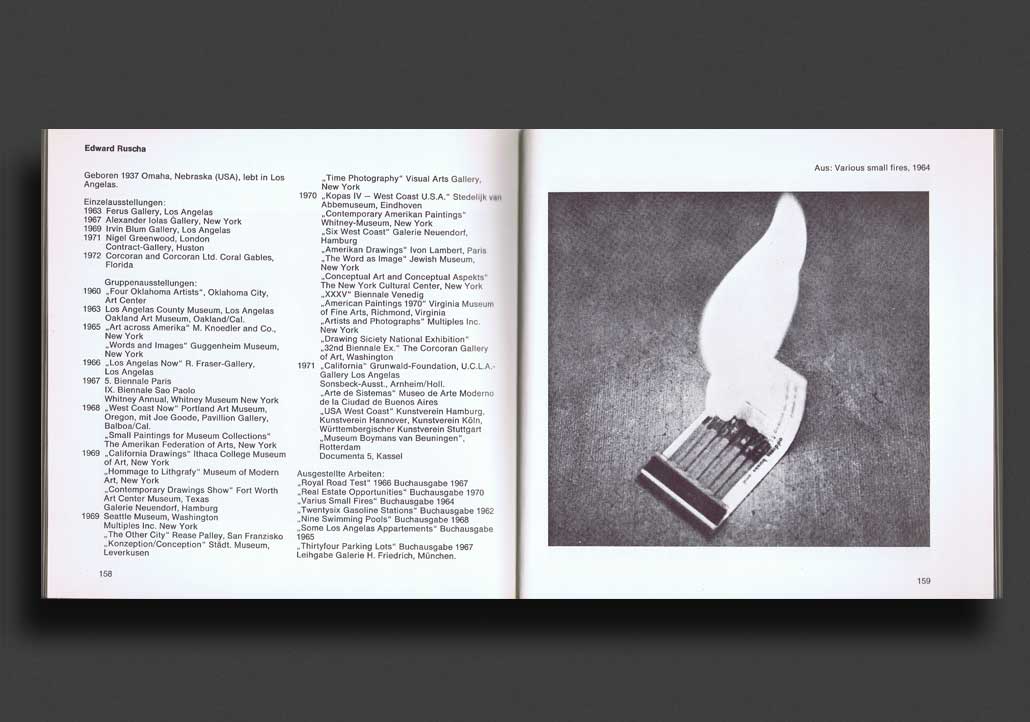
Foreword by Rolf Wedewer; Artists featured include Herbert Bayer, Hans Bellmer, Anton Giulio, Marcel Duchamp, Theodor Fraenkel, Hannah Höch, Layos Kalsas, Lazlo Moholy-Nagy, George Mucha, Man Ray, Luigi Veronesi, Stuart Wiese, Christian Boltanski, Marcel Broodthaers, Hamish Fulton, Christoph Kohlhöfer, Ingrid Kohlhöfer, Sigmar Polke, Gerhard Richter, Johannes Theodor Baargeld, Tristan Tzara, El Lissitzky, John Heartfield, Raoul Hausmann, Jörg Immendorff, A.R. Penck, Edward Ruscha, Pablo Picasso,Gilbert & George, Walter de Maria, and many more. Heavily illustrated throughout, texts in German.
1979, English
Softcover, 188 pages, 28 x 22 cm
1st Edition, Out of print title / used / good
Published by
St. Martin's Press / New York
$70.00 - Out of stock
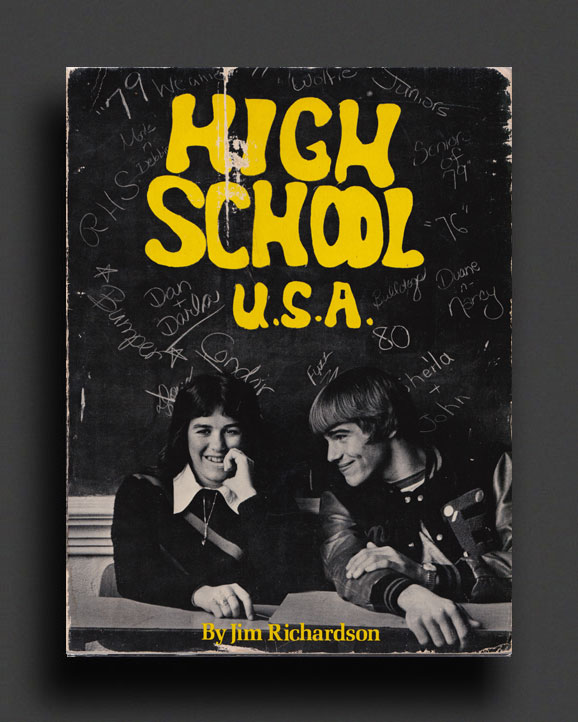
Softcover edition of the first (only) printing of cult photobook "High School U.S.A.", Jim Richardson's intimate 1979 portrait of American adolescence at Rossville High in Rossville, Kansas.
For three years in the late 1970's, Richardson photographed and documented the life of these high school teenagers, coming back every year to vicariously live through all of the life-altering events that high school presents to these young adults. Richardson's photographs of students, teachers, and coaches at Rossville High School in Rossville, Kansas, combined with the students' own words, capture the high school experience from football season to graduation and through identity struggles and romantic involvements that files perfectly alongside Joseph Szabo's great "Almost Grown".
Good Copy throughout with decent cover wear (see picture). Light wrinkling to last few pages.
2016, English
Hardcover, 240 pages, 21.6 x 26.7 cm
Published by
University of California Press / Berkley
$110.00 $80.00 - Out of stock
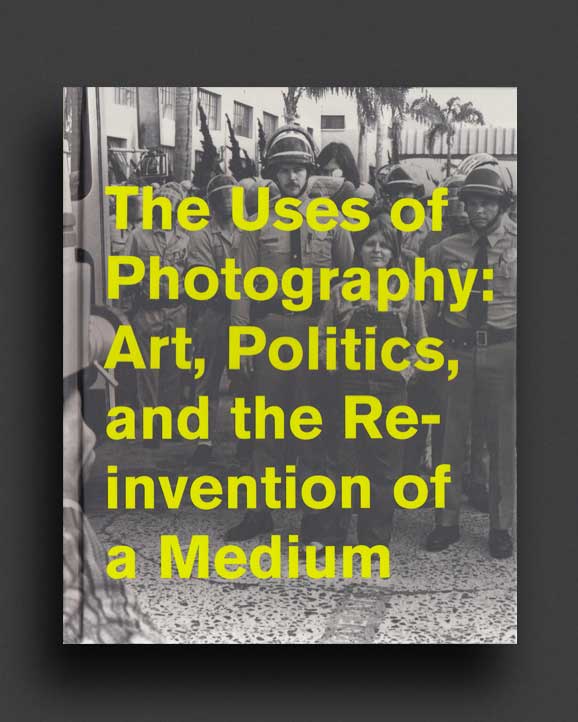
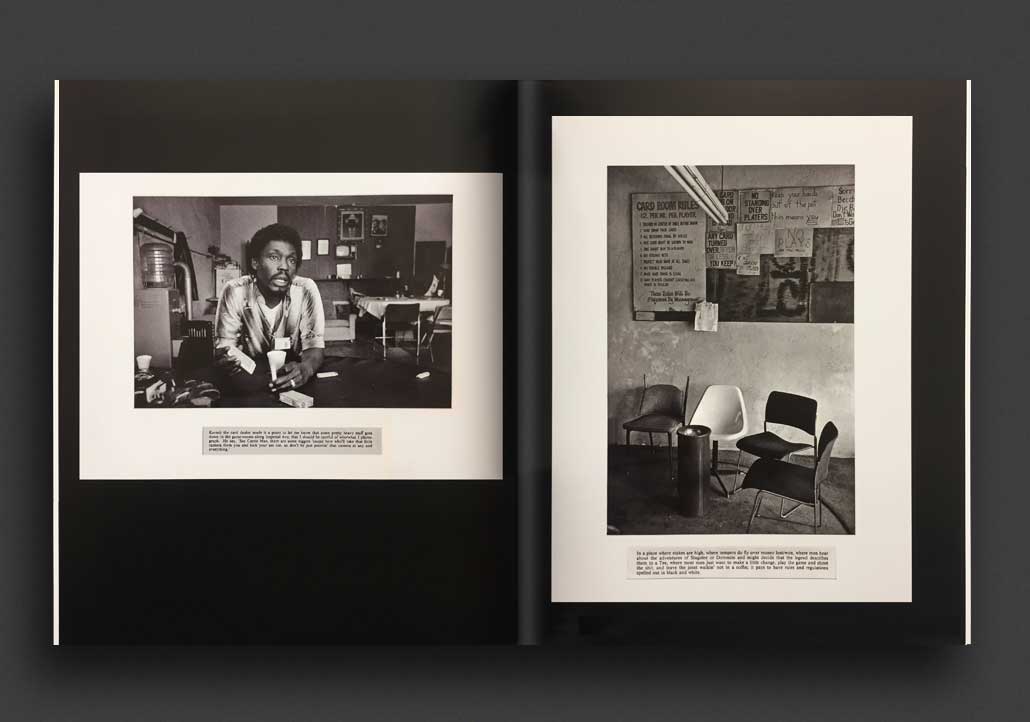
The Uses of Photography examines a network of California artists whose experiments with photography during the turbulent, transitional decade of the 1970s opened the medium to a profusion of new strategies and subjects. Working within the framework of Conceptual art, these artists introduced urgent social issues and themes of everyday life into the seemingly neutral territory of photography, producing works that took on hybrid forms, from books and postcards to video and text-and-image installations.
Tracing a crucial history of photoconceptual practice, The Uses of Photography focuses on an artistic community that formed in and around the young UC San Diego, founded in 1960, and its visual arts department, founded in 1968. Artists such as Eleanor Antin, John Baldessari, Allan Kaprow, Martha Rosler, and Allan Sekula employed photography and its expanded forms as a means to dismantle modernist autonomy, to contest notions of photographic truth, and to engage in political critique. The work of these artists shaped emergent accounts of postmodernism in the visual arts and their influence is felt throughout the global contemporary art world today. Published in association with the Museum of Contemporary Art San Diego.
Edited by Jill Dawsey
Texts by Judith Rodenbeck, Benjamin Young , David Antin, and Pamela M. Lee
Artists include David Antin, Eleanor Antin, John Baldessari, Jean-Pierre Gorin, Helen Mayer Harrison, Newton Harrison, Louis Hock, Allan Kaprow, Fred Lonidier, Babette Mangolte, Martha Rosler, Allan Sekula, Lorna Simpson, Elizabeth Sisco, Phel Steinmetz, Carrie Mae Weems.
English / German
Hardcover (linen bound with dust jacket), 324 pages, 29.5 x 23.7 cm
1st Edition, Out of print title / used / very good
Published by
Edition Galerie Bruno Bischofberger / Zürich
$340.00 - Out of stock
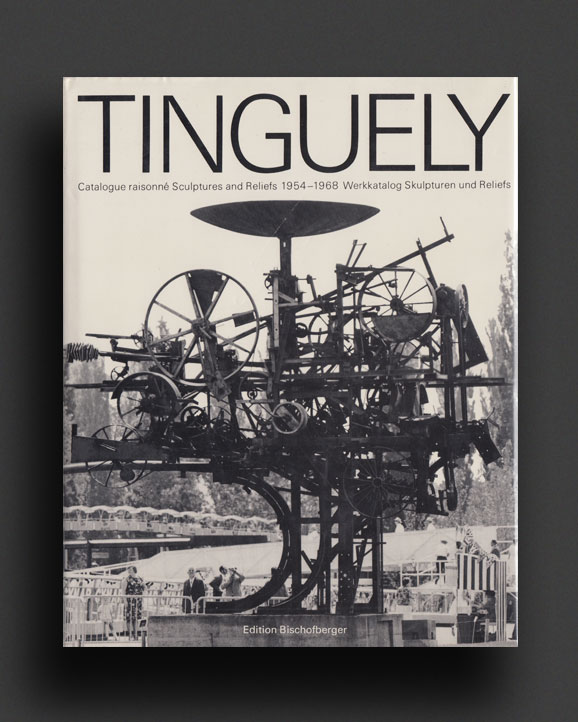
First edition of the great Jean Tinguely "Catalogue Raisonné Sculptures and Reliefs 1954-1968", published by Edition Galerie Bruno Bischofberger in Zürich in 1982.
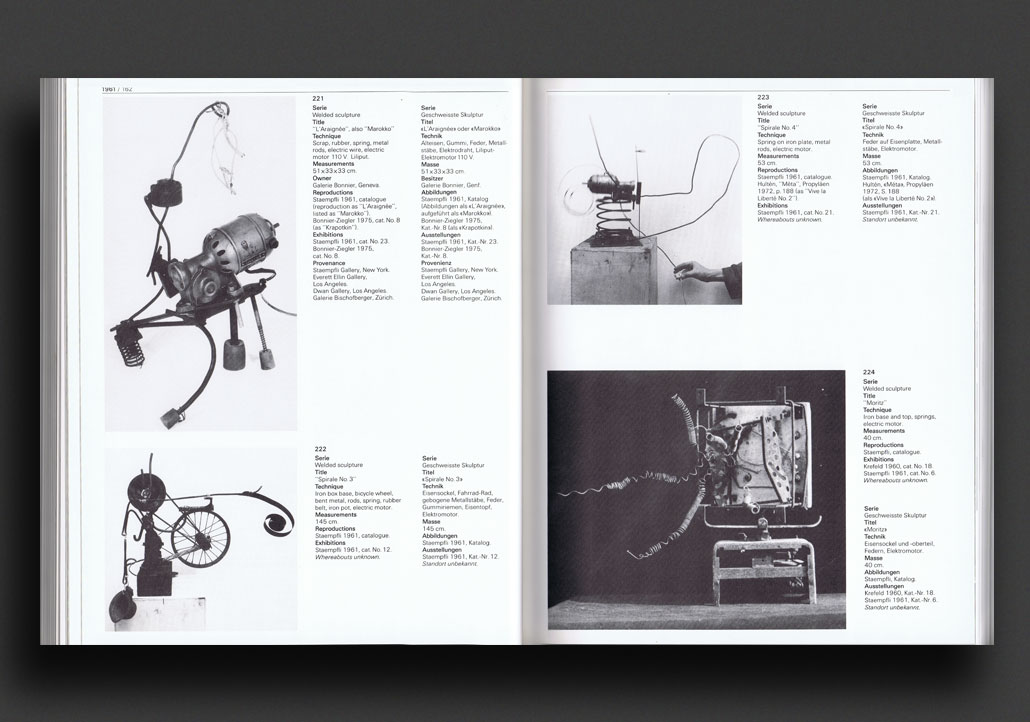
Compiled by Christina Bischofberger over eight years in very close collaboration with Tinguely, this heavy, comprehensive volume collects 448 works made between 1954 and 1968, all provided with illustrations and the appropriate legends for each piece (549 black and white plates in total). All texts in English and German, with an introduction text by Franz Meyer (Director
of the Kunstmuseum in Basel), biography of the artist, list of exhibitions, bibliography, and list of works. Bound in linen with illustrated dust jacket, this immersive book on Tinguely's work is long out of print and very collectible, instantly becoming the most important reference on his work over this crucial period.
Jean Tinguely (22 May 1925 – 30 August 1991) was a Swiss painter and sculptor. He is best known for his sculptural machines or kinetic art, in the Dada tradition; known officially as metamechanics. Tinguely's art satirized the mindless overproduction of material goods in advanced industrial society. He is associated with the Nouveau Réalisme and Zero art movements.
2010, English / German
Three hardcover volumes (in slipcase), 496 pages, 28.5 x 23 cm
Out of print title / as new
Published by
Verlag Feymedia / Berlin
$340.00 - In stock -
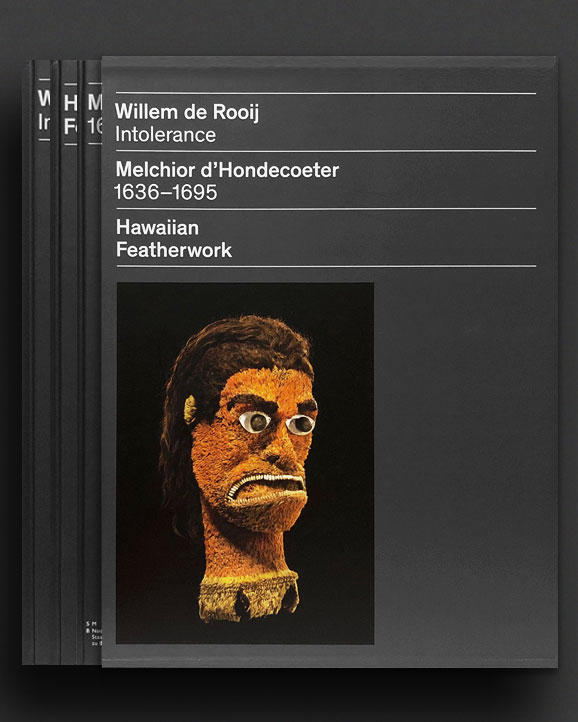
During the course of Willem de Rooij's Neue Nationalgalerie major solo exhibition "Intolerance" (18 September 2010 - 2 January 2011), a three-part in-depth catalogue, was published by Verlag Feymedia, edited by Willem de Rooij and Benjamin Meyer-Krahmer for the Staatliche Museen zu Berlin and designed by Martha Stutteregger.
Central to the exhibition itself, this long out-of-print and now very scarce catalogue comes in the form of three hardcover volumes in a heavy illustrated slipcase.
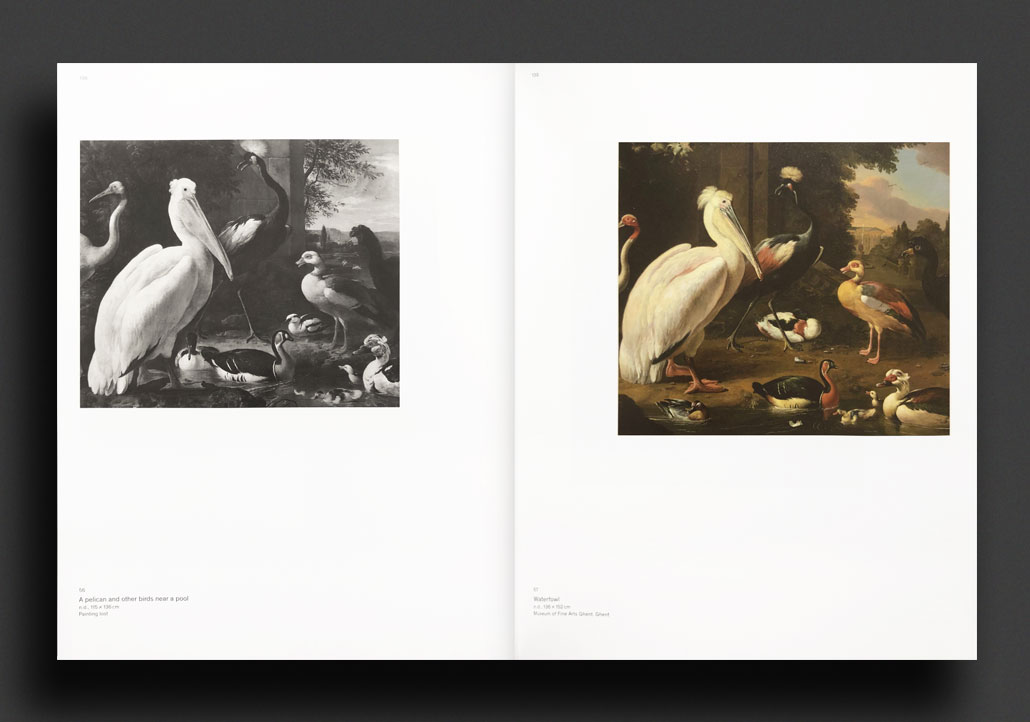
"Intolerance is a new work conceived by the Dutch artist Willem de Rooij. Developed especially for the Neue Nationalgalerie, it consists of a large, temporary installation and a three-part publication. Intolerance confronts a group of 17th century Dutch bird-paintings by Melchior d’Hondecoeter with a group of 18th and 19th century feathered objects from Hawai‘i. Open to a complex of interpretations, Intolerance can be read as a three-dimensional collage, as a reflection on the conditions of the exhibition space and of institutional practice, and as a visual study on the triangular relationship between early global trade, inter-cultural conflict and mutual attraction. Both groups of objects that form the nexus of Intolerance were originally produced to represent establishment and to decorate those in power. Through their high material and (in the case of the feather objects) religious value, these objects confirmed the prevailing power structures existing at that time."
Volume 1: Intolerance
Volume one of the catalogue documents the installation “Intolerance” in the Neue Nationalgalerie through 40 color illustrations. In a joint text, Willem de Rooij and Benjamin Meyer-Krahmer explain the social and political conditions under which both groups of objects were originally produced. In a further text, Juliane Rebentisch examines the principle of montage in this and other works by Willem de Rooij.
Juliane Rebentisch teaches philsophy at the Johann Wolfgang Goethe-Universität in Frankfurt am Main and is a member of the Cluster of Ecxcellence "Normative Orders" there. She received a PhD from the University Potsdam in 2002 and habilitated in Frankfurt in 2010. She published numerous texts and publications on contemporary art, amongst them Ästhetik der Installation (Aesthetics of Installation, Suhrkamp 2003).
Benjamin Meyer-Krahmer studied Comparative Literature and History and earned his PhD in 2006 at the Freie Universität Berlin with a thesis on the artist Dieter Roth. He works as a writer, lecturer and scholar in the field of art and esthetics.
Volume 2: Melchior d’Hondecoeter (1636-1695)
This volume offers the first comprehensive book publication on the work of the Dutch painter Melchior d’Hondecoeter. It contains more than 80 color illustrations and two texts: Marrigje Rikken represents an overview of the life and work of the painter; Lisanne Wepler explores the narrative potential of Melchior d’Hondecoeter’s paintings.
Marrigje Rikken is an art historian. While working as assistant curator Dutch 17th-century paintings at the Rijksmuseum Amsterdam, she wrote a text on Melchior d'Hondecoeter. She is currenly writing her PhD dissertation on the way artists employed newly acquired knowledge of natural history for the depictions of animals between 1550-1670.
Lisanne Wepler wrote her M.A. thesis on the significance of fables for the genre of bird paintings in Dutch baroque. Currently she is writing her doctoral thesis on the narrative potential of bird pieces from the 17th to 18th century in Dutch art at the institute of art history at the University of Bonn.
Volume 3: Hawaiian Featherwork
For the first time, this volume delivers a compilation of all the known feather objects that originated in Hawaii before 1900. It contains more than 260 illustrations of feather-god images, helmets, capes and cloaks. Adrienne Kaeppler wrote both the catalogue raisonné and the accompanying text, which consolidates what is known about production, coloration, design and meaning of these objects. It follows the introduction of Hawaiian featherwork into Europe and beyond, and it seeks to explain why and under whose authority these objects left Hawaii.
Adrienne Kaeppler has dedicated herself to material and spiritual culture of Hawai‘i since 1960. She is a social/cultural anthropologist and Curator of Oceanic Ethnology (Polynesia, Micronesia, Melanesia, New Guinea, and Australia) at the National Museum of Natural History/National Museum of Man, Smithsonian Institution in Washington, DC. She received her BA, MA, and PhD degrees from the University of Hawai‘i. Before she came to the Smithsonian she was an anthropologist on the staff of the Bishop Museum in Honolulu, Hawai‘i.
Willem de Rooij (b. 1969) works in a variety of media, including film and installation. He studied at the Gerrit Rietveld Akademie in Amsterdam from 1990-95 and at the Rijksakademie from 1997-98. He has been a tutor at De Ateliers in Amsterdam since 2002 and professor of fine arts at the Städelschule in Frankfurt am Main since 2006. The artist lives and works in Berlin. He worked in collaboration with Jeroen de Rijke (1970-2006) from 1994 to 2006, as de Rijke / de Rooij. Art historian Pamela M. Lee states that in their work they trace "the recursive economy of the image: its affective power, its capacity to seduce and organize perception, and its mediation of time and subjectivity." De Rooij received a Robert Fulton Fellowship at Harvard University in 2004 and represented the Netherlands at the Venice Biennale in 2005. Among other institutions, his works can be found in the collections of the Nationalgalerie in Hamburger Bahnhof – Museum für Gegenwart, Berlin, at the MUMOK in Vienna, and the MoMA in New York.
2017, English
Softcover, 508 pages, 22 x 28.5 cm
Published by
Walther König / Köln
$100.00 - Out of stock
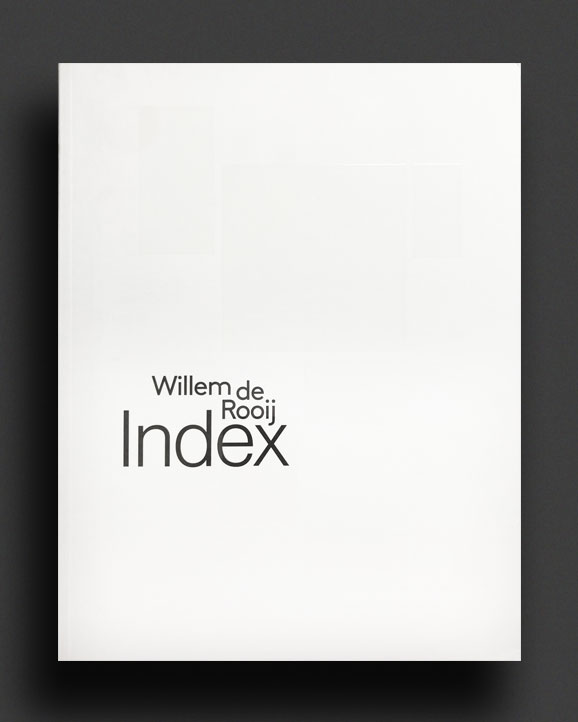
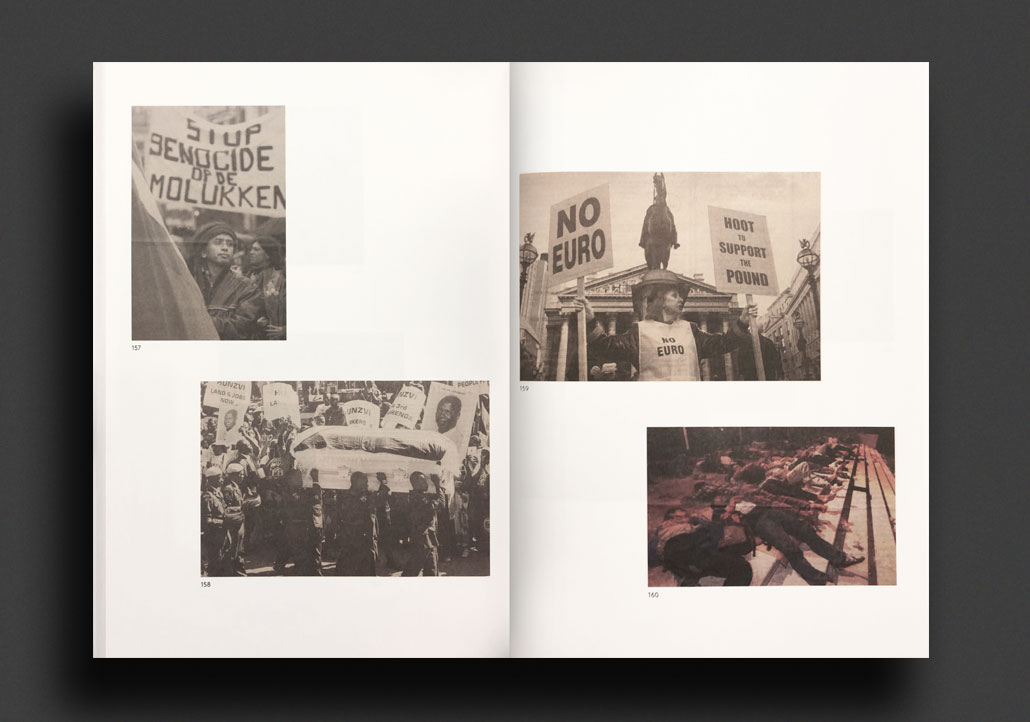
Between 1999 and 2002, Dutch artist Willem de Rooij (born 1969) collected some 500 images cut from daily newspapers, depicting protest marches and moments of collective mourning. De Rooij’s work is multifaceted and includes in many instances the work of other artists or artefacts from historical and anthropological collections, forming temporary groupings and creating new layers of meaning. This contextual gesture or act of framing draws attention to the relationship between cultural identity and memory, collecting and display. Many of de Rooij’s recent works are reduced, almost abstract, and seemingly devoid of any explicit meaning or reference. In these installations, meaning is not produced by an object or image alone, but in the relationship between the things we see, their context and our own act of reading. Index is an inquiry into the iconography of protest - an impressive selection of global political struggles, which also invites a closer look into the mechanics of representation: how do people present themselves “in protest”? And who is making a picture of them, and for whom? The work is reminiscent of the history of image collections, such as the Mnemosyne Atlas by German art historian Aby Warburg, started in 1927. But in difference to Warburg, Index avoids to suggest historical archetypes and rather to question the classification of images that the work’s title implies. This artist's book compiles and reorganizes his original series, reproduced beautifully across over 500 pages.
Edited by Willem De Rooij, Axel Wieder, Lucy Badrocke
Willem de Rooij (b. 1969) works in a variety of media, including film and installation. He studied at the Gerrit Rietveld Akademie in Amsterdam from 1990-95 and at the Rijksakademie from 1997-98. He has been a tutor at De Ateliers in Amsterdam since 2002 and professor of fine arts at the Städelschule in Frankfurt am Main since 2006. The artist lives and works in Berlin. He worked in collaboration with Jeroen de Rijke (1970-2006) from 1994 to 2006, as de Rijke / de Rooij. Art historian Pamela M. Lee states that in their work they trace "the recursive economy of the image: its affective power, its capacity to seduce and organize perception, and its mediation of time and subjectivity." De Rooij received a Robert Fulton Fellowship at Harvard University in 2004 and represented the Netherlands at the Venice Biennale in 2005. Among other institutions, his works can be found in the collections of the Nationalgalerie in Hamburger Bahnhof – Museum für Gegenwart, Berlin, at the MUMOK in Vienna, and the MoMA in New York.
2016, English
Softcover, 292 pages, 12 x 19 cm
Published by
Sternberg Press / Berlin
$54.00 - Out of stock
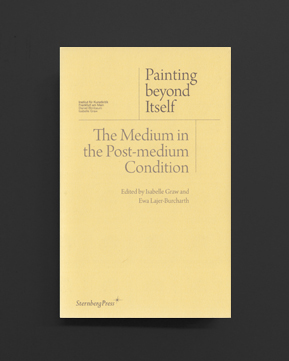
Painting beyond Itself
The Medium in the Post-medium Condition
Isabelle Graw, Ewa Lajer-Burcharth (Eds.)
Contributions by Carol Armstrong, Benjamin H. D. Buchloh, Sabeth Buchmann, René Démoris, Isabelle Graw, David Joselit, Jutta Koether, Ewa Lajer-Burcharth, Jacqueline Lichtenstein, Julie Mehretu, Matt Saunders, Amy Sillman
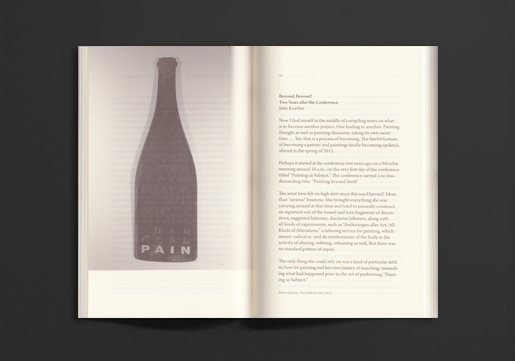
In response to recent developments in pictorial practice and critical discourse, Painting beyond Itself: The Medium in the Post-medium Condition seeks new ways to approach and historicize the question of the medium. Reaching back to the earliest theoretical and institutional definitions of painting, this book—based on a conference at Harvard University in 2013—focuses on the changing role of materiality in establishing painting as the privileged practice, discourse, and institution of modernity. Myriad conceptions of the medium and its specificity are explored by an international group of scholars, critics, and artists. Painting beyond Itself is a forum for rich historical, theoretical, and practice-grounded conversation.
Institut für Kunstkritik Series
Design by Surface
2020, English
Softcover, 300 pages, 14 x 21.1 cm
Published by
Campus Verlag / Frankfurt
$96.00 $60.00 - Out of stock
The Value of Critique casts its gaze on the two dominant modes of passing judgment in art--critique and value (or evaluation). The act of critique has long held sway in the world of art theory but has recently been increasingly abandoned in favor of evaluation, which advocates alternate modes of judgment aimed at finding the intrinsic "value" of a given work rather than picking apart its intentions and relative success. This book's contributors explore the relationship between these two practices, finding that one cannot exist with the other. As soon as a critic decides an object is worthy enough of their interest and time to critique it, they have imbued that object with a certain value. Similarly, theories of value are typically marked by a critical impetus: as much as critique takes part in the construction of evaluations, bestowing something with value can then trigger critiques. Assembling essays from an international array of authors, this book is the first to put value, critique, and artistic labor in conversation with one another, making clear just how closely all three are related.
2019, English
Hardcover, 72 pages, 30 x 25 cm
Published by
Matthew Marks / New York
$89.00 - Out of stock
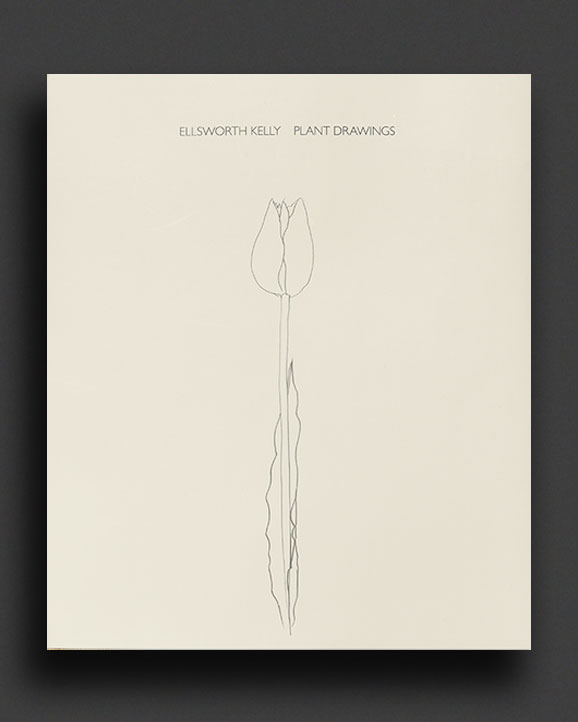
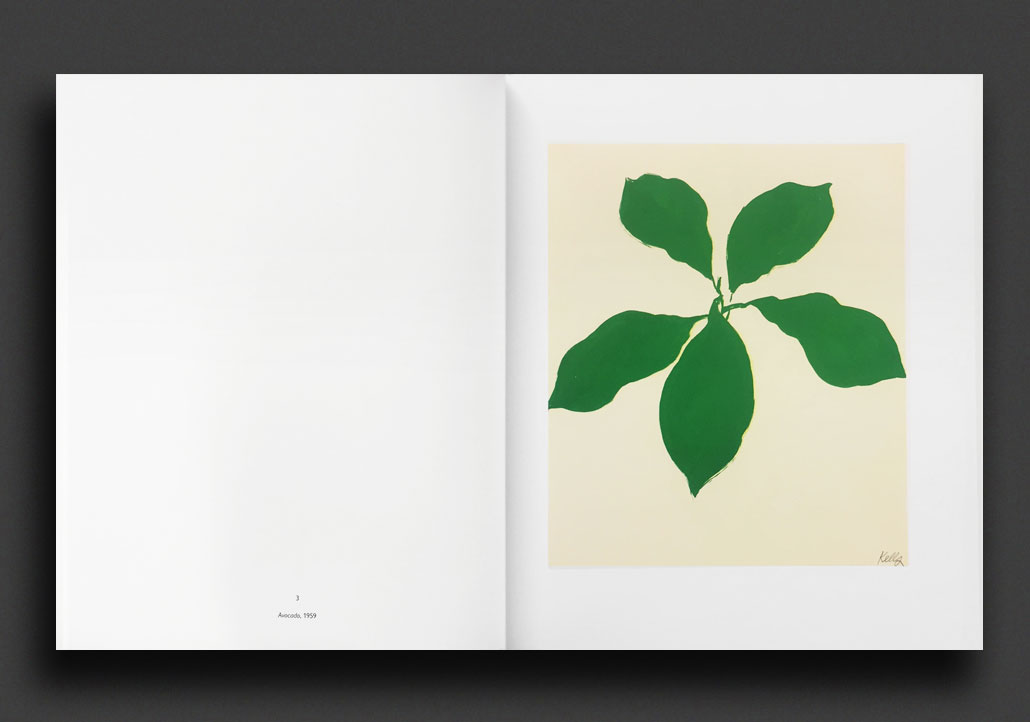
Expanding on Kelly's highly-regarded 1992 book, first published in 2017 in this expanded clothbound edition, "Ellsworth Kelly: Plant Drawings" features more than 30 drawings made by Kelly between 1949 and 2008. Kelly made these gorgeously economical line drawings from life, sometimes barely lifting the pencil as he translated each plant’s contours to paper. Focusing on direct visual impression—“nothing is changed or added,” as he put it—Kelly used the natural forms of the plants to explore some of his painterly fixations, like the effects of volume, negative space and overlapping planes. Despite the immediacy of their execution and their representational content, the most striking surprise of Kelly’s plant drawings is how much they share with his abstract paintings and sculptures.
2017, English
Softcover, 160 pages, 14.4 x 16.8 cm
Published by
Atlas Press / London
$30.00 - In stock -
Written in early 1922, this is the first prose work by Surrealist poet and exemplary practitioner of automatic writing Robert Desnos (preceding Mourning for Mourning and Liberty or Love!, also published by Atlas Press).
Its protagonists are swept into violent journeys through Paris by train and steamship; fabulous events consume their everyday lives; oracles spout nonsense or wisdom. All of Desnos' friends in the Paris Dada movement--André Breton, Louis Aragon and Benjamin Péret, among others--make an appearance, and all find a grave in the "cemetery" toward the end of the book, for the past must be buried (even though most of these now legendary names were then in their 20s and had barely made their mark).
By the time this book was written, the Dada movement seemed played out, killed off by a mixture of public success, internal dissent and boredom with the predictability of its scandals. The Punishments of Hell lies between Dada and Surrealism, harking back to the belligerent obfuscation of, say, Tristan Tzara and overwhelming it with the savage lyricism for which Desnos would become known.
Robert Desnos (1900-45) was one of the most celebrated and celebratory of the writers allied to the Paris Dada and Surrealist groups. He effortlessly combined mystery, eroticism and an irrepressible joi de vivre in a flood of poetry, prose fiction, radio plays and even children's verse. An active member of the French resistance, he died of typhoid just days after his liberation from the Terezin concentration camp.
2019, English
Hardcover, 192 pages, 17.5 x 19.5 cm
Published by
Atlas Press / London
$49.00 - Out of stock
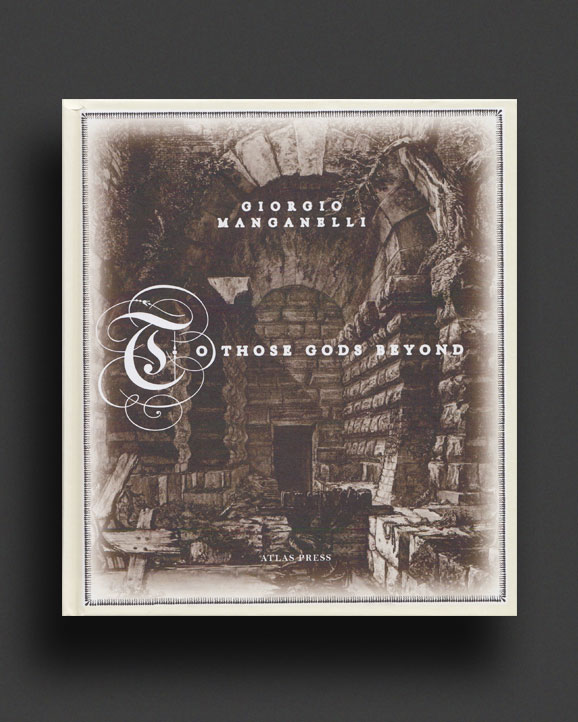
Translated and introduced by John Walker, afterword by Alastair Brotchie. Foreword by Italo Calvino, translated by Martin McLaughlin.
In Manganelli’s innumerable universes, beyond the gods we know or suspect we know is an endless array of other gods. Everything that is seemingly finite or known in our world becomes infinite and unknown. We die, we find ourselves among the other dead, and we die again, only to find ourselves somewhere even more unknown and with death still awaiting. We are both monarch and victim in a gothic simulation illuminated by sombre flashes of sardonic rhetoric that reveal only an astounding desolate wreck. Something of this landscape’s significance can be inferred from Manganelli’s manifesto “Literature as Deception” (1967), which elucidates the author’s notions of the literary “object”, whose devious nature is embodied and mirrored in the elaborate “lies” he constructs here in a style even more lush than the English Romantics he so admired. Manganelli’s paradoxically optimistic fatalism is founded upon a defiance of all the gods — in the knowledge that when they too perish, we are fated to invent others to replace them.
Giorgio Manganelli (1922-1990) is a writer almost unknown in English. He was a central member, with the likes of Eco and Sanguineti, of the Italian avant-garde Gruppo 63, named after its date of formation, and one of the editors of its collective publications. Ever the awkward member of this squad, his writing was greatly admired by Calvino. Manganelli’s theoretical and creative works are deeply intertwined and never more so than with his notorious manifesto (also translated here), which, so it seems, underpins the entire book in a wholly unexpected and original way.
2009, English
Softcover, 156 pages, 15 x 20.3 cm
Published by
Exact Change / Boston
$27.00 - Out of stock
A collection of outrageous short stories about heretics, renegade mystics and criminal religious fanatics, The Heresiarch & Co. was Apollinaire's first book, and reportedly remained his favorite. Making full use of his encyclopedic knowledge of obscure historical, ecclesiastical and geographic information, Apollinaire's stories rely neither on the dream nor on unlikely juxtaposition, but instead represent an approach that Andre Breton called a "formula" for Surrealism; its "music," Breton famously wrote, is "like gold pebbles rolled in a torrent." Apollinaire himself wrote of The Heresiarch & Co., "This is a book for those who love literature, powerful and disturbing, strange and logical... The author, amid so many fantastic, tragic and sometimes sublime inventions, intoxicates himself with a charming erudition with which he also intoxicates his readers."
Guillaume Apollinaire (26 August 1880 – 9 November 1918) was a French poet, playwright, short story writer, novelist, and art critic of Polish-Belarusian descent. Apollinaire is considered one of the foremost poets of the early 20th century, as well as one of the most impassioned defenders of Cubism and a forefather of Surrealism. He is credited with coining the term "cubism" in 1911 to describe the emerging art movement and the term "surrealism" in 1917 to describe the works of Erik Satie. The term Orphism (1912) is also his. Apollinaire wrote one of the earliest Surrealist literary works, the play The Breasts of Tiresias (1917), which became the basis for the 1947 opera Les mamelles de Tirésias. Apollinaire was active as a journalist and art critic, and in 1912 Apollinaire cofounded Les Soirées de Paris, an artistic and literary magazine. Two years after being wounded in World War I, Apollinaire died in the Spanish flu pandemic of 1918; he was 38.
Exact Change publishes books of experimental literature with an emphasis on Surrealism, Dada, Pataphysics, and other nineteenth and twentieth century avant-garde art movements. The press was founded in 1989 by Damon Krukowski and Naomi Yang, known outside publishing as musicians from the bands Damon & Naomi, and Galaxie 500.
1998, English
Softcover, 304 pages, 20.3 x 15.2cm
Published by
Exact Change / Boston
$38.00 - Out of stock
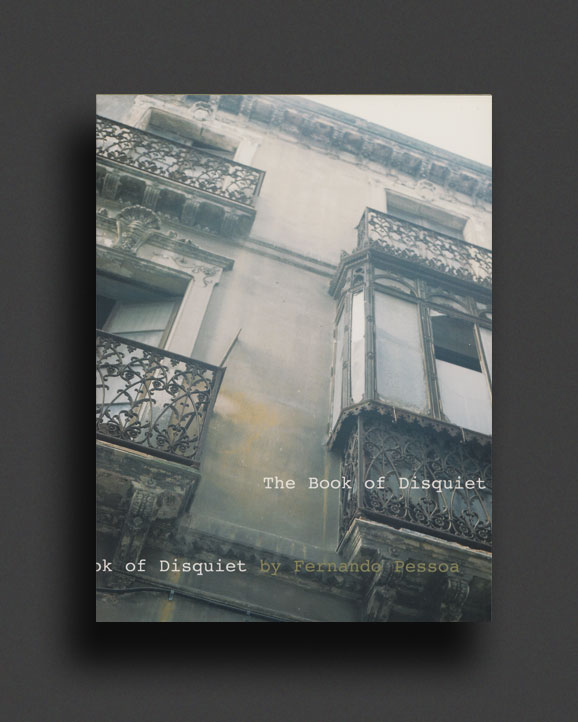
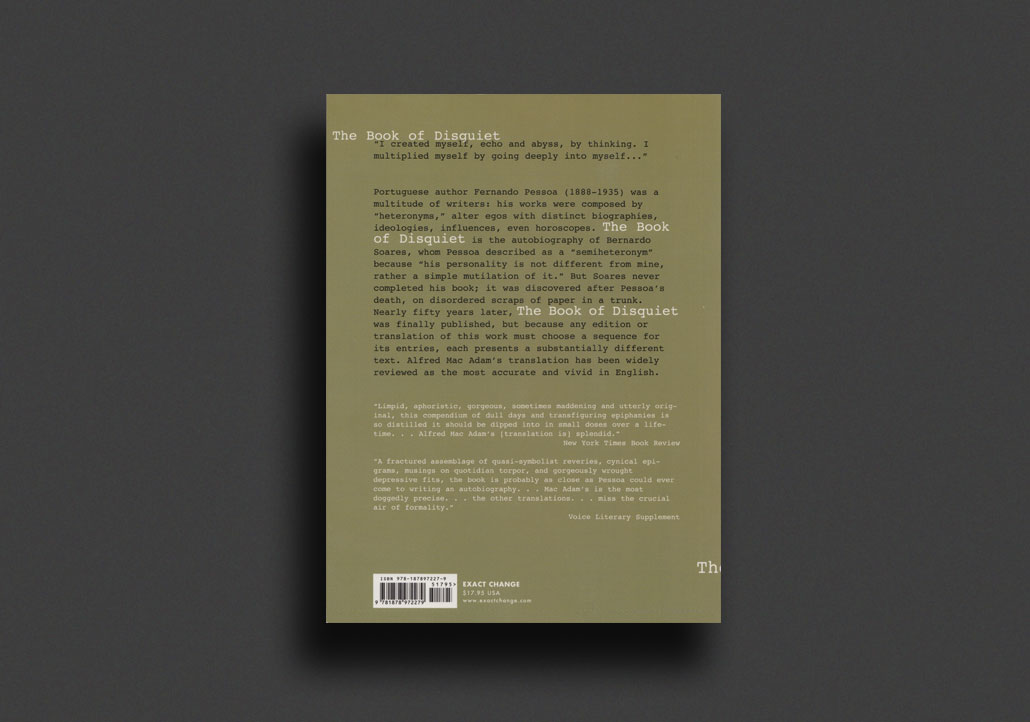
The eternal mystique of Portuguese writer Fernando Pessoa (1888-1935) stems largely from his practice of writing under "heteronyms." More than just nom de plumes, Pessoa's heteronyms came with distinct biographies, careers, life spans, even horoscopes. In The Book of Disquiet, Pessoa came as close as he ever would to autobiography. Left on disordered scraps of paper in a trunk, the fragments that make up The Book of Disquiet record in disjunct entries a vast interior landscape and daily minutiae, making for a discontinuous, gently unhinged monologue in daybook form.
“Limpid, aphoristic, gorgeous, sometimes maddening and utterly original, this compendium of dull days and transfiguring epiphanies is so distilled it should be dipped into in small doses over a lifetime.”
— New York Times Book Review
“There are in Pessoa echoes of Beckett’s exquisite boredom; the dark imaginings of Baudelaire (whom he loved); Melville’s evasive confidence man; the dreamscapes of Borges…”
— Voice Literary Supplement
2019, English
Softcover, 80 pages, 14.8 x 17 cm
Published by
Atlas Press / London
$26.00 - Out of stock
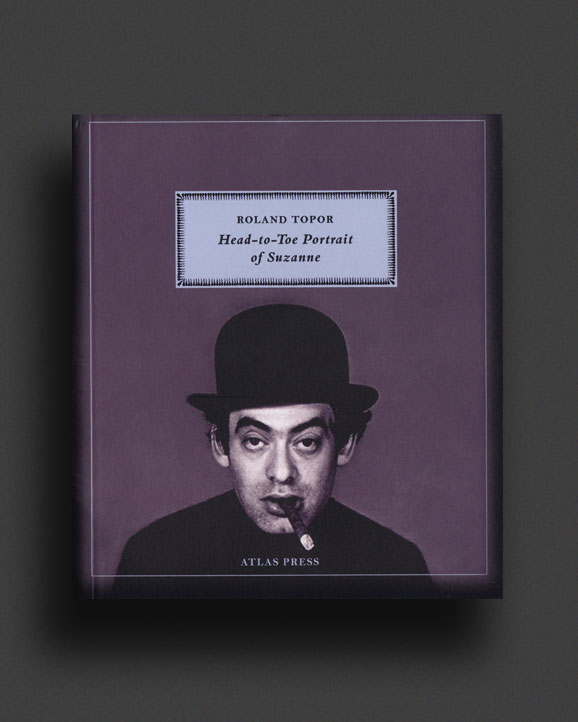
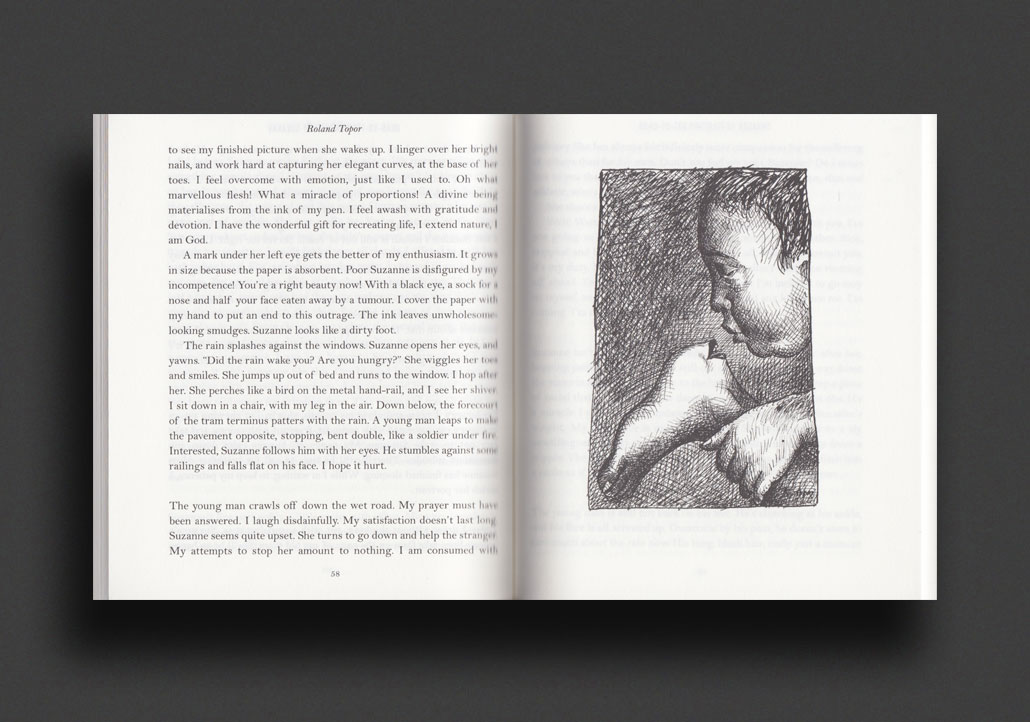
Illustrated by Roland Topor. Translated and introduced by Andrew Hodgson.
The works of the French author and artist Roland Topor, who died 20 years ago, are currently undergoing a major reassessment in his homeland. Major exhibitions have been mounted and all his books are being brought back into print. This is the first of them to be translated into English for some 50 years, and more will certainly follow. Topor was something of an all-round maverick, known for his paintings and drawings as much as for his novels (The Tenant was filmed by Polanski), plays and short stories. He was also a film-maker, actor and the co-founder, with Arrabal and Jodorowsky, of the Panic movement, whose violently orgiastic performances provoked widespread condemnation.
Topor’s works are dominated by a sense of irrational everyday menace that could be interpreted as humour, but a form of humour pushed deep into discomfort, almost to the point of total horror. The reader slowly becomes aware that, alongside preoccupations that some might think morbid, all is being orchestrated by a distinctively optimistic sensibility. From the collision of these factors, rooted in the author’s experiences and his irrepressible personality, come works increasingly seen as unique in European art and writing of the late 20th century. The present text is perhaps a fable, perhaps a love story of enormous tenderness, or it may be a sequence of ever more sinister events that culminate in horror and atrocity. It all depends on your point of view. The central event in this narrative cannot be revealed here, but its sheer implausible reality is utterly convincing and the effect is unforgettable.
2015, English
Softcover, 96 pages, 15 x 17 cm
Published by
Atlas Press / London
$35.00 - Out of stock
Illustrated by Rosa Rosa. Translated and introduced by John Walker and winner of an Italian Institute translation prize.
Sam Dunn is Dead, described by its author as a “Futurist Novel”, was first published in book form by Filippo Marinetti’s Edizioni Futuriste. However, one will search in vain for any mention of this work in anthologies or histories of Futurism. This is doubtless because it is so unlike anything else produced by Futurism (so ardent, so masculine, so positive and so absurdly serious). Sam Dunn is none of these, above all else it is a miniature masterpiece of black humour — the last thing likely to be associated with the posturings of Marinetti and his acolytes. Not only is Sam Dunn funny, despairing, cerebral and ludicrous, it also traces a history of the modern spirit. Its eponymous hero, a poet in languid 1890s mould, unleashes a thoroughly contemporary apocalypse upon the world. Subsequent chapters could be taken for Dadaist or Surrealist texts (but written a decade before their time), and then the whole edifice is fatally undermined by forces that are both banal and… unusual.
Corra later considered his novel a failure, but he was mistaken. His sensitivity to the great undertows of history that were then working their way to the surface seems alarmingly prescient — and anyway his opinion does nothing to inhibit the reader’s simple enjoyment of the book’s deliriously ebullient nihilism.
2013, English
Hardcover, 176 pages, 17 x 19 cm
Published by
Atlas Press / London
$52.00 - In stock -
Had The Tutu appeared when it was written in 1891 it would have been one of the defining works of late nineteenth-century French literature. Juan Goytisolo is among its admirers, and noted that: “The Tutu has been described as the most mysterious novel of the nineteenth century, it is probably one of the strangest, and certainly one of the most fascinating… We find in it a clear presentiment (one cannot say influence, since no one read this book) of the audacities of Jarry, Roussel, Breton, Ionesco and Queneau…”
Its author, the publisher Léon Genonceaux (1856–?), is as much of an enigma as the two legendary enfants terribles whom he was the first to publish: Arthur Rimbaud and the Comte de Lautréamont. When he brought out The Tutu he was already in trouble with the police for “immoral publishing”, and realised that sending it to bookstores would certainly land him in jail. The book disappeared for nearly 100 years, and its author likewise — after 1905 nothing is known of him. Finally republished in the 1990s, The Tutu was hailed by reviewers as the bastard child of J.-K. Huysmans and Antonin Artaud.
Genonceaux appears to have been intent on outraging just about everyone, and The Tutu is gleefully Nietzschean in its dismemberment of contemporary morality. It is simultaneously a sort of ultimate “decadent novel” and outlandishly modern; it is also repellent, infantile and deeply cynical. Yet despite all its absurdities and extravagances, in the end it somehow manages to appear compassionate, poetic, funny, and even — most absurdly of all — rational.
Translated and introduced by Iain White.
2018, English
Hardcover, 210 pages, 17.6 x 19.8 cm
Published by
Atlas Press / London
$55.00 - In stock -
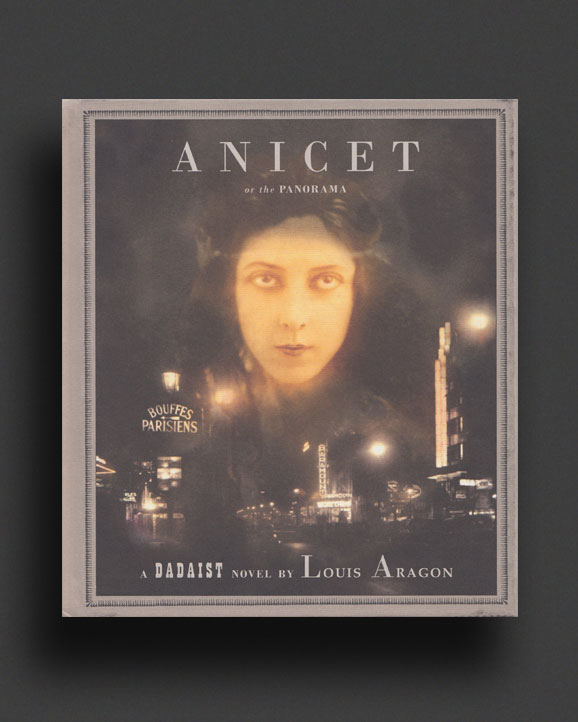
This novel, much of it written amidst the horror of the trenches when Louis Aragon was a medical orderly during the First World War, demonstrates the chasm that separates the works of the artists and writers of what would become Dadaism and those, say, of the English war poets.
In a world of moral destitution beyond any rational forbearance, what can remain? How can one write at all, let alone something as absurd as a novel? Anicet or the Panorama is both a roman à clef (Aragon’s friends, including André Breton, are recognisable) and a novel of the total liquidation of a culture that had allowed this to come to pass: even literary heroes must be confronted and superseded. As fast-paced, funny and surprising as a Hollywood silent movie, its narrative of fabulous crimes and scandals sweeps through a panorama of Parisian society as its protagonist Anicet becomes subordinated to the mysterious Mire, a woman who is the incarnation of “modern beauty”. Anicet is seduced into a life of crime, which he accepts with nonchalance and an ironic integrity that he maintains to the bitter end of his journey of self-immolation.
Aragon’s precisely crafted and sardonic prose reveals a world that is no more than a tragic puppet show, with every scene self-evidently staged. This furious tempest of a book launched Aragon’s career and is one of the cornerstones of the Paris Dada movement. Despite the fact that he went on to become one of the most prolific and influential French writers of the twentieth century, it is not at all unreasonable to consider this book to be his greatest work.
Translated and introduced by Antony Melville, and the runner-up to the 2017 Scott-Moncrieff Translation Prize.
1985, English
Softcover, 14 pages, 21.5 x 13.5 cm
1st Edition, Out of print title / used / very good
Published by
Angus & Roberston / NSW
$150.00 - Out of stock
Absolute Oz cult classic. The extremely rare "Koalas Bizarre", published in 1985 and illustrated by self taught Australian wildlife illustrator and palaeontologist, Peter Schouten. This iconic adult-themed gem presents a series of beautifully graphite-rendered scenarios depicting the private (leather-clad, cruising, bound and gagged, BDSM) life of Koalas. File alongside Gene Bilbrew, Tom of Finland, and Blinky Bill.
"Curled up in a tree-fork, your average koala looks cuddly, sleepy and soft. Don't be deceived by appearances - all that cuteness is just a publicity gimmick, a carefully cultivated media image for children's books and travel brochures. As well-known wildlife artist Peter Schouten has discovered, all is not what it seems behind the leaves of a spreading gum tree."
Very Good - light cover tanning, otherwise clean and tight, excellent copy throughout.
2016, English
Softcover, 28 pages, 13 x 19 cm
Edition of 500
Published by
Innen Books / Zürich
$14.00 - Out of stock
Special edition zine reproducing a selection of Tom of Finland's reference material, published on the occasion of Printed Matter’s LA Art Book Fair at The Geffen Contemporary at MOCA February 24 — 26, 2017.
Touko Valio Laaksonen (8 May 1920 – 7 November 1991), best known by his pseudonym Tom of Finland, was a Finnish artist known for his stylized highly masculine homoerotic fetish art, and his influence on late twentieth century gay culture. He has been called the "most influential creator of gay pornographic images" by cultural historian Joseph W. Slade. Over the course of four decades, he produced some 3500 illustrations.
Edition of 500 copies.
2019, English
Hardcover (w. plastic dust-jacket), 200 pages, 16.5 x 24 cm
Published by
Lars Müller / Zürich
$62.00 - Out of stock
X-Ray Architecture explores the enormous impact of medical discourse and imaging technologies on the formation, representation and reception of twentieth-century architecture. It challenges the normal understanding of modern architecture by proposing that it was shaped by the dominant medical obsession of its time: tuberculosis and its primary diagnostic tool, the X-ray.
Modern architecture and the X-ray were born around the same time and evolved in parallel. While the X-ray exposed the inside of the body to the public eye, the modern building unveiled its interior, dramatically inverting the relationship between private and public. Architects presented their buildings as a kind of medical instrument for protecting and enhancing the body and psyche.
Beatriz Colomina traces the psychopathologies of twentieth-century architecture—from the trauma of tuberculosis to more recent disorders such as burn-out syndrome and ADHD—and the huge transformations of privacy and publicity instigated by diagnostic tools from X-Rays to MRIs and beyond. She suggests that if we want to talk about the state of architecture today, we should look to the dominant obsessions with illness and the latest techniques of imaging the body—and ask what effects they have on the way we conceive architecture.
"After years of research, the book by Beatriz Colomina explores the impact of medical theories and diagnostic technologies on the formation, representation and reception of modern architecture." (Domus, 2019)
"A new theory of architecture is on the horizon." (Ashley Simone for Bomb Magazine, 2019)
"Beatriz Colomina is one of the most exciting voices in architecture, bringing her unfailing canny perspective to topics as broad as Playboy, domesticity, the bed, and even what it means to be human." (Archdaily, 2018)
2018, English
Softcover, 160 pages, 25 x 34 cm
Published by
Koenig Books / London
Stedelijk Museum / Amsterdam
$45.00 $20.00 - Out of stock
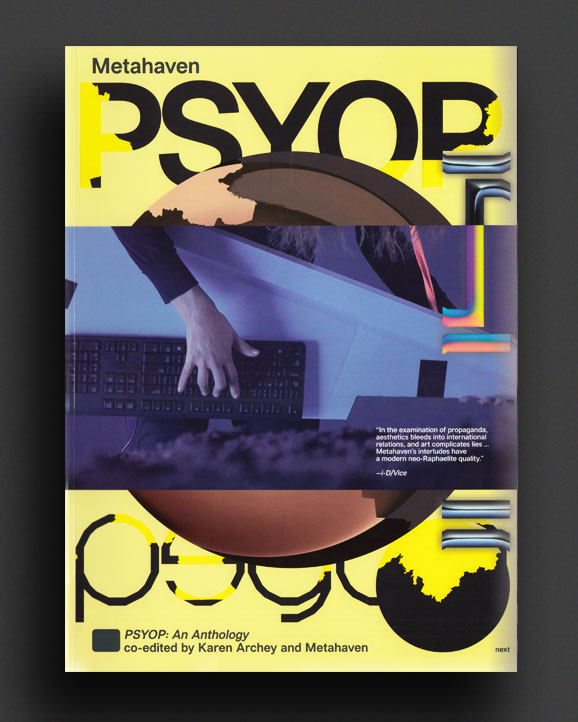
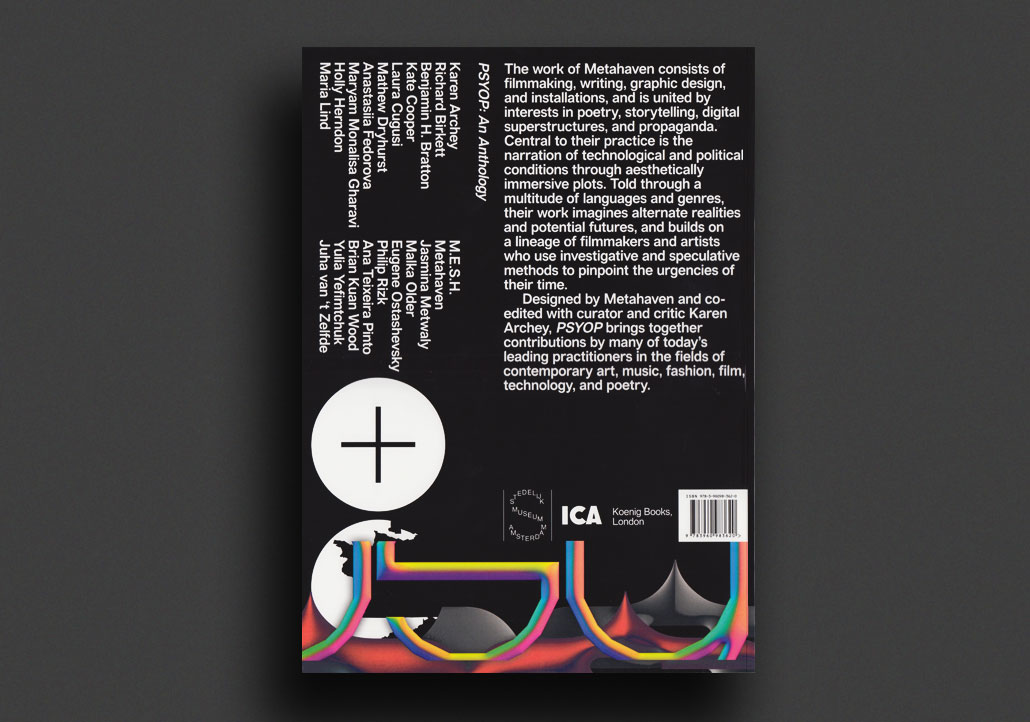
The work of Metahaven consists of filmmaking, writing, graphic design, and installations, and is united by interests in poetry, storytelling, digital superstructures, and propaganda. Central to their practice is the narration of technological and political conditions through aesthetically immersive plots. Told through a multitude of languages and genres, their work imagines alternate realities and potential filmmakers and artists who use investigative and speculative methods to pinpoint the urgencies of their time.
Designed by Metahaven and co-edited with curator and critic Karen Archey, PSYOP brings together contributions by many of today's leading practitioners in the fields of contemporary art, music, fashion, film, technology and poetry.
2018, English / Dutch
Softcover, 224 pages, 24.2 x 30.2 cm
Published by
Roma / Amsterdam
Stedelijk Museum / Amsterdam
$88.00 - Out of stock
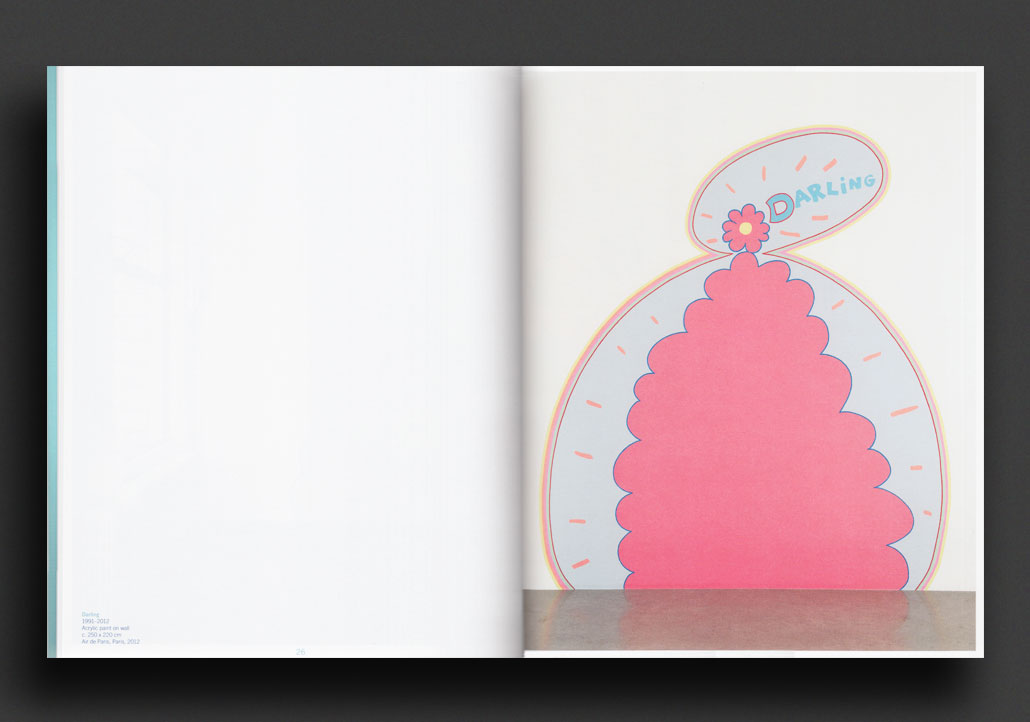
Lily van der Stokker is recognised for her exuberant and decorative murals. Her work is ostensibly about things like beauty, friendship, and kindness, or about everyday activities such as tidying up or visiting the doctor – subjects seldom encountered in contemporary art. Yet her conceptual approach gives these ordinary things an entirely new dimension. Published in conjunction with an exhibition of Van der Stokker’s work at the Stedelijk Museum Amsterdam, this book presents the themes that have typified her work since the 1990s. The close involvement of the artist in its making is apparent in its playful visual references.
Essays by the two exhibition curators offer context and background.
2019, English
Softcover (plastic dust jacket), 160 pages, 22 x 29 cm
Ed. of 400,
Published by
Revolver – Archiv für aktuelle Kunst / Frankfurt am Main
Secession / Vienna
$39.00 - In stock -
Artist's photo book by Martine Syms, published in an edition of 400 copies.
Released in conjunction with her exhibition of the same title at the Secession, BOON extends artist Martine Syms’ engagement with visual culture and the life of the image. Referencing the walls at Simpson’s Record Shop in Detroit (the subject of her exhibition at the Secession), which the owner Dorothy Simpson covered in photographs brought in by neighbours and community members, the book is composed of found photographs, many of them taken by the author’s father. The book considers the two lives of the photographs: first with the original photographer, and then with the artist, and how they form not a collection of sediments for the archive, but active, rendered thought.
The artist's book is published for the exhibition in the Secession, Vienna, April 12 - June 16, 2019
2019, English
Softcover, 256 pages, 24 x 30cm
Published by
Roma / Amsterdam
$96.00 - Out of stock
Hexamiles (Mont-Voisin) has been published on the occasion of Batia Suter's exhibition at the Mauvoisin Dam in Switzerland (built 2,000 meters above sea level, it is the highest dam in Europe). For this artist book, Suter focused on her ever-expanding archive of scanned landscape images, which had already started to play an important role in Parallel Encyclopedia #2 (Roma 284, 2016). Many of those images depict wastelands, alternating between romantic and menacing views which simultaneously create sensations of majesty and disorientation. By layering them over each other, a variety of disparate geological and biological environments merge into composite landscapes we might only recognise from dreams and fairy tales. In the books sequence, a kind of adventurous journey takes shape, pitched between an odyssey, a safari and paradise. The book's title is derived from the term Hexameter, a poetic form of writing used in Homer's Odyssey. Mont-Voisin, which also serves as the title for the exhibition, is inspired by different spellings used by 18th and 19th century travellers to describe Mauvoisin.