World Food Books' programme is largely produced on Kulin Nation land. We acknowledge the Wurundjeri people of the Kulin Nation as the first and continuing custodians of this land, and pay respect to their Elders past, present, and emerging.
World Food Books is an arts and special interests bookshop in Naarm / Melbourne. Founded in 2010, World Food Books is devoted to the presentation of a rotating, hand-selection of international art, design, literary and counterculture publications with an emphasis on the anti-traditional, the experimental, the avant-garde, the heretic, the marginal.
Presenting new titles alongside rare and out-of-print books, catalogues and journals spanning the fields of modern and contemporary art, design, photography, illustration, film, literature, poetry, cultural theory, philosophy, sexuality, popular and underground culture in its many radical forms, World Food Books wishes to encourage adventurous, thoughtful and open-minded reading, looking, writing, and exchange of publishing and ideas, both current and historical.
As well as our bookshop, located in Melbourne's historical Nicholas Building, all of our inventory is available internationally via our online mail-order service.
World Food Books semi-regularly co-ordinates "Occasions", a programme of exhibits and events at the bookshop and in partnership with other hosts (such as museums and art galleries) that develop out of the activities, relationships and content of the bookshop itself.
World Food Books
The Nicholas Building
37 Swanston Street
Room 5, Level 6
Melbourne 3000
Australia
SHOP HOURS:
Thu–Fri 12–6, Sat 12–5
WEB-SHOP OPEN 24/7
World Food Books
Postal Address:
PO Box 435
Flinders Lane
Victoria 8009
Australia
Art
Theory / Essay
Architecture / Interior
Graphic Design / Typography
Photography
Fashion
Eros
LGBTQ+
Fiction / Poetry
Weird / Speculative / Science Fiction / Horror
Transgressive / Visceral / Abject
Symbolism / Decadence / Fin de siècle
Film / Video
Painting
Sculpture / Installation
Performance / Dance / Theater
Drawing
Sound / Music
Curatorial
Group Shows / Collections
Periodicals
Out-of-print / Rare
Posters / Ephemera / Discs
Signed Books
World Food Books Gift Voucher
World Food Book Bag
Australian Art
Australian Fiction
Australian Science Fiction / Speculative Fiction
Australian Poetry
Australian Photography
Japanese Photography
Conceptual Art
Minimal Art
Dada
'Pataphysics / Oulipo
Fluxus
Concrete Poetry
Pop Art
Surrealism
Arte Povera
Arte Informale / Haute Pâte / Tachism
Nouveau Réalisme / Zero / Kinetic
Situationism / Lettrism
Collage / Mail Art / Xerox Art
Art Brut / Folk / Visionary / Fantastic
Illustration / Graphic Art / Bandes Dessinées
Furniture
Italian Radical Design / Postmodernism
Textiles
Ceramics / Glass
Counterculture
Protest / Revolt
Philosophy
Psychoanalysis
Anthropology
Anarchism
Socialism / Anarchism / Communism / Capitalism
Literary Theory / Semiotics / Language
Feminism / Women's Studies
Gender Studies / Sexuality
Anthropology
Fetishism / BDSM
Drugs / Psychedelia
Crime / Violence
Animal Rights / Veganism
Occult / Esoterica
Ecology / Earth / Alternative Living
Whole Earth / Crafts
All prices in AUD (Australian dollars)
Pick-Ups
Pick-up orders can be collected in our bookshop during opening hours after order date. Please collect any Pick-up orders within 2 weeks of ordering as we have limited storage space. Orders will be released back into stock if not collected within this time. No refunds can be made for pick-ups left un-collected. If you cannot make it in to the bookshop in this time-frame, please choose postage option.
Return Policy
All sales are final. We do accept returns (for refund or exchange) for items received in error. All our orders are packed with special care using heavy-duty padding and cardboard book-mailers or bubble mailers (for smaller books), using reinforcement where required. We cannot take responsibility for any lost, stolen or damaged parcels.
Insurance
Should you wish to insure your package, please email us directly after placing your order and we can organise this at a small extra expense. Although all standard/express tracked packages are very safe and dependable, we cannot take responsibility for any lost, stolen or damaged parcels. We recommend insurance on valuable orders.
Interested in selling your old books, catalogues, journals, magazines, comics, fanzines, ephemera? We are always looking for interesting, unusual and out-of-print books to buy. We only buy books in our fields of interest and specialty, and that we feel we can resell.
We base these prices on desirability, market value, in-print prices, condition and our current stock levels. We offer cash, store credit, and can take stock on consignment. All
about 25% of the price we expect to get when we sell them, or 30% in store credit. We base these prices on desirability, market value, in-print prices, condition and our current stock levels.
Sell your books any day of the week. You can drop them off and return later. If you have a lot of books, we can visit your Sydney home.
We buy books that we feel we can resell. We offer about 25 % of the price we expect to get when we sell them, or 30% in store credit. We base these prices on desirability, market value, in-print prices, condition and our current stock levels.
Philadelphia Wireman
03 August - 01 September, 2018
World Food Books is proud to announce our next Occasion, the first presentation of sculptures by Philadelphia Wireman in Australia.
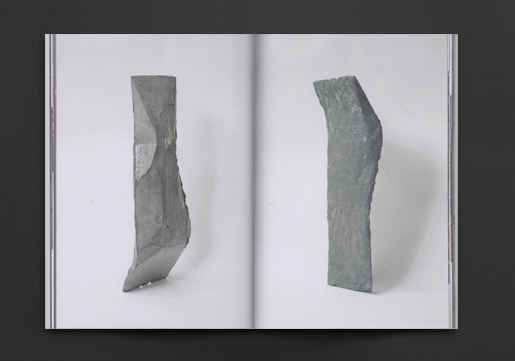
The Philadelphia Wireman sculptures were found abandoned in an alley off Philadelphia’s South Street on trash night in 1982. Their discovery in a rapidly-changing neighbourhood undergoing extensive renovation, compounded with the failure of all attempts to locate the artist, suggests that the works may have been discarded after the maker’s death. Dubbed the "Philadelphia Wireman" during the first exhibition of this work, in 1985, the maker’s name, age, ethnicity, and even gender remain uncertain. The entire collection totals approximately 1200 pieces, all intricately bound together with tightly-wound heavy-gauge wire (along with a few small, abstract marker drawings, reminiscent both of Mark Tobey and J.B. Murry). The dense construction of the work, despite a modest range of scale and materials, is singularly obsessive and disciplined in design: a wire armature or exoskeleton firmly binds a bricolage of found objects including plastic, glass, food packaging, umbrella parts, tape, rubber, batteries, pens, leather, reflectors, nuts and bolts, nails, foil, coins, toys, watches, eyeglasses, tools, and jewellery.
Heavy with associations—anthropomorphic, zoomorphic, and socio-cultural responses to wrapped detritus—the totemic sculptures by Philadelphia Wireman have been discussed in the context of work created to fulfil the shamanistic needs of alternative religions in American culture. Curators, collectors, and critics have variously compared certain pieces to sculpture from Classical antiquity, Native American medicine bundles, African-American memory jugs, and African fetish objects. Reflecting the artist’s prolific and incredibly focused scavenging impulse, and despite—or perhaps enhanced by—their anonymity, these enigmatic objects function as urban artefacts and arbiters of power, though their origin and purpose is unknown. Philadelphia Wireman, whatever their identity, possessed an astonishing ability to isolate and communicate the concepts of power and energy through the selection and transformation of ordinary materials. Over the course of the past two decades, this collection has come to be regarded as an important discovery in the field of self-taught art and vernacular art.
Presented in collaboration with Fleisher-Ollman Gallery, Philadelphia, and Robert Heald, Wellington.
Susan Te Kahurangi King
02 February - 10 March, 2018
Susan Te Kahurangi King (24 February 1951 - ) has been a confident and prolific artist since she was a young child, drawing with readily available materials - pencils, ballpoint pens and felt-tip markers, on whatever paper is at hand. Between the ages of four and six Susan slowly ceased verbal communication. Her grandparents William and Myrtle Murphy had developed a special bond with Susan so they took on caring responsibilities for extended periods. Myrtle began informally archiving her work, carefully collecting and storing the drawings and compiling scrapbooks. No drawing was insignificant; every scrap of paper was kept. The King family are now the custodians of a vast collection containing over 7000 individual works, from tiny scraps of paper through to 5 meter long rolls.
The scrapbooks and diaries reveal Myrtle to be a woman of great patience and compassion, seeking to understand a child who was not always behaving as expected. She encouraged Susan to be observant, to explore her environment and absorb all the sights and sounds. Myrtle would show Susan’s drawings to friends and people in her community that she had dealings with, such as shopkeepers and postal workers, but this was not simply a case of a grandmother’s bias. She recognised that Susan had developed a sophisticated and unique visual language and sincerely believed that her art deserved serious attention.
This was an unorthodox attitude for the time. To provide some context, Jean Dubuffet coined the term Art Brut in 1945 to describe work created by self-taught artists – specifically residents of psychiatric institutions and those he considered to be visionaries or eccentrics. In 1972 Roger Cardinal extended this concept by adopting the term Outsider Art to describe work made by non-academically trained artists operating outside of mainstream art networks through choice or circumstance. Susan was born in Te Aroha, New Zealand in 1951, far from the artistic hubs of Paris and London that Dubuffet and Cardinal operated in. That Myrtle fêted Susan as a self-taught artist who deserved to be taken seriously shows how progressive her attitudes were.
Susan’s parents Doug and Dawn were also progressive. Over the years they had consulted numerous health practitioners about Susan’s condition, as the medical establishment could not provide an explanation as to why she had lapsed into silence. Dawn educated herself in the field of homeopathy and went on to treat all twelve of her children using these principles – basing prescriptions on her observations of their physical, mental and emotional state.
Doug was a linguist with an interest in philosophy who devoted what little spare time he had to studying Maori language and culture. To some extent their willingness to explore the fringes of the mainstream made them outsiders too but it was their commitment to living with integrity and their respect for individuality that ensured Susan’s creativity was always encouraged.
Even though Susan’s family supported her artistic pursuits, some staff in schools and hospitals saw it as an impediment to her assimilation into the community and discouraged it in a variety of ways. Her family was not always aware of this and therefore did not fully understand why Susan stopped drawing in the early 1990s. However, rather than dwell on the challenges that Susan faced in pursuit of her artistic practice, they prefer to highlight her achievements. In 2008 Susan began drawing again in earnest, after an almost 20 year interruption, and her work is now shown in galleries around the world.
Susan grew up without television and has been heavily influenced by the comics she read as a child. She is absolutely fearless in the appropriation of recognizable characters, such as Donald Duck and Mickey Mouse, in her work. She twists their limbs, contorts their faces, compresses them together, blends them into complex patterned backgrounds - always imbuing them with an incredible energy. Although Susan often used pop culture characters in her work they are not naive or childlike. These are drawings by a brilliant self-taught artist who has been creating exceptional work for decades without an audience in mind.
Mladen Stilinović
"Various Works 1986 - 1999"
02 February 16 - September 10, 2016
Various works 1986 - 1999, from two houses, from the collections of John Nixon, Sue Cramer, Kerrie Poliness, Peter Haffenden and Phoebe Haffenden.
Including: Geometry of Cakes (various shelves), 1993; Poor People’s Law (black and white plate), 1993; White Absence (glasses, ruler, set square, silver spoon, silver ladel with skin photograph and wooden cubes), 1990-1996; Exploitation of the Dead (grey and red star painting, wooden painting, black spoon with red table, red plate), 1984-1990; Money and Zeros (zero tie, paintings made for friends in Australia (Sue, John, Kerrie), numbers painting), 1991-1992; Words - Slogans (various t-shirts) - “they talk about the death of art...help! someone is trying to kill me”, “my sweet little lamb”, “work is a disease - Karl Marx”; Various artist books, catalogues, monographs, videos; Poster from exhibition Insulting Anarchy; "Circular" Croatian - Australian edition; Artist book by Vlado Martek (Dostoyevsky); more.
Thanks to Mladen Stilinović and Branka Stipančić.
Jonathan Walker
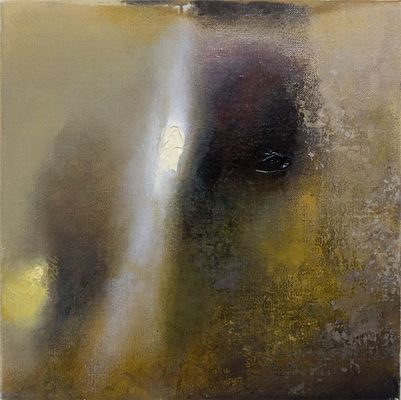
Always Will Need To Wear Winter Shirt Blue + Ochre Small Check Pattern
21 August - 21 September, 2015
Untitled
I am not a great reader of poetry but I always return to the work of Melbourne poet, Vincent Buckley (1925- 1988). Perhaps I find his most tantalising piece to be not a finished poem but a fragment left on a scrap of paper discovered on his desk after the poet’s death.
The poetry gathers like oil
In the word-core, and spreads
It has its music meet,
Its music is in movement.
This fragment is more the shell left behind from a volatile thought than a finished poem. I find the last two lines honest but awkward whereas the first two lines work like an arrow. Most likely he could not find a resolution so it was left. Still, in its present form, it remains an eloquent testimony to the ultimate failure of a medium to express mobile thought and sensation, in Buckley’s case, through verbal language. It’s an important matter because this is something all artists have to deal with regardless of the medium.
I have never written a poem, however, I am forever copying fragments from books on paper scraps in a vain effort to fix certain notions in my head. At first, they function as bookmarks that are sometimes returned to when I open the book. But before long, as they accumulate, they fall out littering the table interspersed with A4 photocopies, bills, books and medications.
To return to Buckley’s fragment, the first two lines very much evoke how I paint nowadays. As you age, detail diminishes and patches of light become more luminous and float. I feel the most honest way of dealing with this is by smearing the oil paint on the canvas with the fingers and working close-up, blind. Only if the patches coalesce into an approaching image can the work gain a life.
-
Jonathan Walker was born in Melbourne, Australia and brought up on a dairy farm in Gippsland. In the 1970’s he studied painting at RMIT and won the Harold Wright Scholarship to the British Museum, London. During the 1980’s he exhibited at Pinacotheca Gallery, Richmond and had work shown at the NGV and Heidi City Art Gallery. Over the same period he designed the cover for the “Epigenesi” LP by Giancarlo Toniutti, Italy and conducted a mail exchange work with Achim Wollscheid, Germany. The work with artists through the post resulted in an article published in the bicentenary issue of Art and Australia 1988. He showed in artist run spaces such as WestSpace in the 90’s and 2000’s, and until 2012, taught painting at Victoria University, which is where we (Colleen Ahern and Lisa Radford) as organisers of the exhibition, among many others, had the privilege of being his student.
Walker’s knowledge was imparted to students through the careful selection of music, literature, and artists found in books that he himself had ordered for the library. Walker’s strategy was the generosity of sharing his vast knowledge with references specific to each student and their context.
Walker’s paintings share a similar focus and intimacy.
This exhibition presents a small selection of recent paintings alongside a publication that includes Walker’s writing. Observational and analytical, Walker’s work is a type of material notation — the time of day, colour and how it is blended, the both specific and fleeting location of a reflection on lino or the question of whether a chair leg should be included in a painting.
Please join us on Friday August 21 between 6-8pm to celebrate the opening of the exhibition.
Curated by Colleen Ahern and Lisa Radford.
B. Wurtz
Curated by Nic Tammens
March 26 - April 4, 2015
B.Wurtz works from a basement studio in his home on Manhattan’s Lower East Side.
This local fact is attested to by the plastic shopping bags and newsprint circulars that appear in his work. As formal objects, they don’t make loud claims about their origins but nonetheless transmit street addresses and places of business from the bottom of this long thin island. Like plenty of artists, Wurtz is affected by what is local and what is consumed. His work is underpinned by this ethic. It often speaks from a neighborhood or reads like the contents of a hamper:
“BLACK PLUMS $1.29 lb.”
“Food Bazaar”
“USDA Whole Pork Shoulder Picnic 99c lb.”
“RITE AID Pharmacy, with us it’s personal.”
“H. Brickman & Sons.”
“Sweet Yams 59c lb."
Most of the work in this exhibition was made while the artist was in residence at Dieu Donne, a workshop dedicated to paper craft in Midtown. Here Wurtz fabricated assemblages with paper and objects that are relatively lightweight, with the intention that they would be easily transportable to Australia. This consideration isn’t absolute in Wurtz’s work, but was prescriptive for making the current exhibition light and cheap. Packed in two boxes, these works were sent from a USPS post office on the Lower East Side and delivered to North Melbourne by Australia Post.
Wurtz appears courtesy of Metro Pictures, New York.
Thanks to Rob Halverson, Joshua Petherick, Sari de Mallory, Matt Hinkley, Helen Johnson, Fayen d'Evie, Ask Kilmartin, Lisa Radon, Ellena Savage, Yale Union, and "Elizabeth".
John Nixon
"Archive"
December 15 - January 20, 2014
The presentation of John Nixon's archive offered a rare showcase of this extensive collection of the artist's own publications, catalogues, posters, ephemera, editions and more, from the mid 1980s onwards, alongside a selection of his artworks.
Organized by John Nixon, Joshua Petherick and Matt Hinkley.
<a href=http://wfb.public-office.info/artist/john-nixon>All titles by John Nixon
"Habitat"
at Minerva, Sydney (organised by Joshua Petherick and Matt Hinkley)
November 15 - December 20, 2014
Lupo Borgonovo, Janet Burchill & Jennifer McCamley,
Lewis Fidock, HR Giger, Piero Gilardi, Veit Laurent Kurz,
Cinzia Ruggeri, Michael E. Smith, Lucie Stahl, Daniel Weil, Wols
Press Release:
“...It contained seven objects. The slender fluted bone, surely formed for flight, surely from the wing of some large bird. Three archaic circuitboards, faced with mazes of gold. A smooth white sphere of baked clay. An age-blackened fragment of lace. A fingerlength segment of what she assumed was bone from a human wrist, grayish white, inset smoothly with the silicon shaft of a small instrument that must once have ridden flush with the surface of the skin - but the thing’s face was seared and blackened.”
William Gibson, “Count Zero”, 1986
"Autumn Projects Archive"
Curated by Liza Vasiliou
March 6 - March 15, 2014
World Food Books, in conjunction with the Virgin Australia Melbourne Fashion Festival 2014, presented the Autumn Projects archive, consisting of a selection of early examples in Australian fashion with a particular interest in collecting designers and labels from the period beginning in the 1980’s, who significantly influenced the discourse of Australian Fashion.
Curated by Liza Vasiliou, the exhibition provided a unique opportunity to view pieces by designers Anthea Crawford, Barbara Vandenberg, Geoff Liddell and labels CR Australia, Covers, Jag along with early experimental collage pieces by Prue Acton and Sally Browne’s ‘Fragments’ collection, suspended throughout the functioning World Food Books shop in Melbourne.
H.B. Peace
presented by CENTRE FOR STYLE
November 14, 2013
"Hey Blinky, you say chic, I say same"
Anon 2013
H.B. Peace is a clothing collaboration between great friends Blake Barns and Hugh Egan Westland. Their pieces explore the divergences between 'character’ and ‘personality’ in garments....etc
Special Thanks to Joshua Petherick and Matt Hinkley of WFB and Gillian Mears
and a Very Special Thank you to Audrey Thomas Hayes for her shoe collaboration.
Janet Burchill & Jennifer McCamley
"Aesthetic Suicide"
May 10 - June 8, 2013
The first of our occasional exhibitions in the World Food Books office/shop space in Melbourne, "Aesthetic Suicide" presented a body of new and older works together by artists Janet Burchill & Jennifer McCamley, including videos, prints, a wall work, and publications.
During shop open hours videos played every hour, on the hour.
2020, English
Softcover, 100 pages, 22 x 30 cm
Published by
UTS School of Architecture / Sydney
Post-Post / Sydney
$49.00 - In stock -
Melbourne, Sydney: References, Reflections and Remarks explores the decades-long architectural controversy between Melbourne and Sydney, inviting the protagonists of each city's architecture to weigh in.
Guest edited by Guillermo Fernández-Abascal and Urtzi Grau, it includes texts by AKAS, Baracco+Wright, Andrew Burns, Angelo Candalepas, Scott Colman, Edition Office, Philip Goad, Tristen Hardwood, Mike Hewson, Luisa King, Andrew Leach, Carey Lyon, Desley Luscombe, Ian Moore, Other Architects, panovscott, Andrew Power, Howard Raggatt, Gerard Reinmuth, Sibling Architecture, Richard Stampton, Naomi Stead, Luke Tipene, TRIAS, Leon Van Schaik and John Wardle.
Melbourne, Sydney; References, Reflections and Remarks is number one in a new series published by University of Technology, Sydney's School of Architecture: UTS da Waranada gunyamara bamulmara/ Architecture and Landscape at UTS and is published in collaboration with the design collective Post-Post-.
2020, English
Softcover, 60 pages, 20.5 x 30 cm
Published by
UTS School of Architecture / Sydney
Post-Post / Sydney
$32.00 - In stock -
Quality, Control examines the relationship between bureaucratic architectural practice and quality in architectural design and construction through the work of the Government Architects Office New South Wales. Conceived at the UTS School of Architecture, the publication repackages the catalogue from the exhibition held at UTS Tower in November 2019. Quality, Control is a curated set of reproduced drawings, physical models, constructed mockups, commissioned photographs and commentaries. The publication also includes texts by Charles Rice, Urtzi Grau and Guillermo Fernández-Abascal, Jack Cooper and Luka Enström-Gibb. These documents are used to reanimate archival records and bring awareness to an at risk portfolio of public architecture; an architecture built by public architects for the public.
Quality, Control is a project by Jack Cooper and Luka Enström-Gibb with Guillermo Fernández-Abascal.
Limited edition of 200 copies.
2010, English / German
Hardcover, 160 pages, 170 x 240 mm
Published by
Sternberg Press / Berlin
$79.00 $15.00 - Out of stock
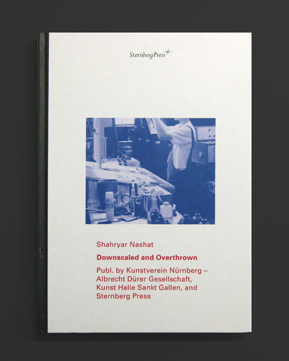
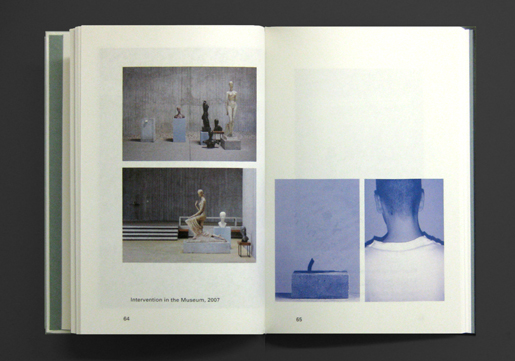
Text by Dominic Eichler A conversation with the artist by Giovanni Carmine and Kathleen Rahn “As soon as I see a male nude sculpture made between 1500 and 1700, I can’t help but chop its top off at thigh, calf, or foot-height.” Downscaled and Overthrown is the first monograph on the work of the Swiss artist Shahryar Nashat (*1975). Whether he truncates Renaissance bronze sculptures through photography, or redesigns a section of the Louvre to accommodate the baroque frescoes of Rubens while filming a well-trained athlete performing a one-armed handstand while looking at the paintings, Nashat’s works and exhibitions involve his interest in art collections, art libraries, reproduction of works of art, as well as questions relating to appropriation and artistic reuse, display issues, and apparatus. Lighting, plinths, pedestals, and the mode of projecting and positioning all play pivotal roles in Nashat’s video installations, sculpture, etchings, and photographs. Wherever he draws his source or reference material from, he consistently makes a certain artificiality or constructedness obvious in order to generate the possibility of critical reflection about the medium itself. The monograph appears on the occasion of Shahryar Nashat’s first solo exhibition in Germany at the Kunstverein Nürnberg – Albrecht Dürer Gesellschaft. Co-published with Kunstverein Nürnberg – Albrecht Dürer Gesellschaft and Kunst Halle Sankt Gallen Design by Aude Lehmann
2016, English
Hardcover, 128 pages, 18 x 28 cm
Published by
Sternberg Press / Berlin
$65.00 $15.00 - Out of stock
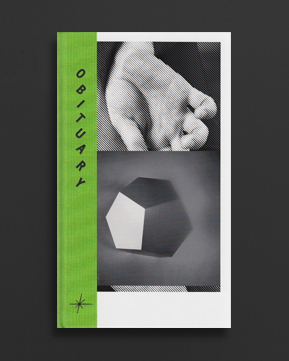
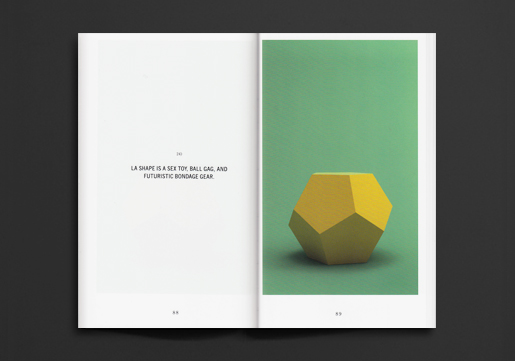
The subject of this book is a deceased prop, an object of a particular color, the green of cinematic trickery and special effects. It edged itself into Shahryar Nashat’s work in 2011, first appearing in Factor Green, an installation the artist produced for the Venice Biennale. Taking its final form a year later, the prop became properly known as La Shape and garnered critical acclaim for its sardonic personification of an unscrupulous impresario in Parade and star turn in Nashat’s video Hustle in Hand (both 2014). Earlier this year, its mysterious death at the height of its career became the occasion for Nashat and Los Angeles writer Sarah Lehrer-Graiwer to reflect upon the brief but meaningful life of a most singular figure.
Accompanied by archival images and a series of portraits that Nashat made during La Shape’s most prolific years, Obituary is a gripping read into a most mysterious icon and a timely consideration of the roles played, and agency expressed, by such a highly mediated art object.
Text by Sarah-Lehrer Graiwer
CGI by Andrea Faraguna
Design by Aude Lehmann
2012, English/German
Softcover with cloth dust jacket, 256 pages, 17 x 22.5 cm
Published by
Sternberg Press / Berlin
$84.00 $30.00 - Out of stock
Out of print.
Edited by Katja Schroeder and Caroline Eggel
With essays by Rosalyn Deutsche, Chris Kraus, Veit Loers, and Katja Schroeder; and an interview with the artist by Willem de Rooij
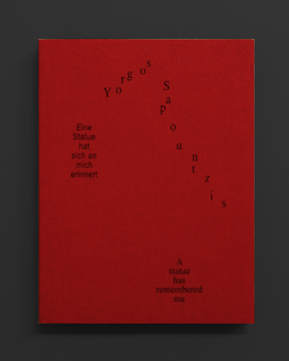
In his work, Yorgos Sapountzis appropriates public space and the statues, monuments, and memorials that inhabit it. The Athens-born artist concentrates less on their historical-political meanings and much more on their function as a medium of recollection. Sapountzis consciously tries to ignore historical information about the sculptures and instead allows them to “speak” through their gestures, poses, and ornaments.
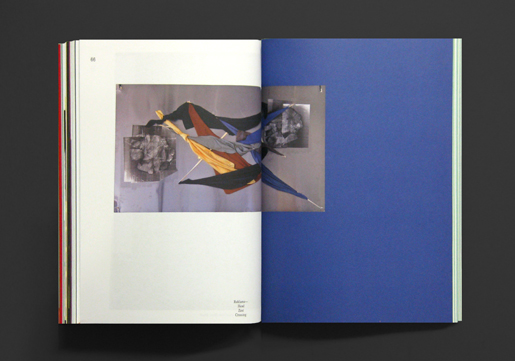
Like an anthropologist—or parasite—Sapountzis hunts the urban, figurative myths by night or sounds them out for days on end with his camera. He then stages a confrontation, a dialogue, and a “dance,” in which the preceding expedition is consolidated to form a theatrical choreography. Sapountzis drapes scarves, makes plaster casts, and builds constructions out of aluminum rods and tape, ensnaring his stone or bronze protagonists, whom he tries to involve in his seemingly futile, exhausting activities. His video camera also records this action. The performance is therefore just as much part of the artistic strategy as the video material produced during the performance.
A statue has remembered megives an in-depth survey of his work in ten chapters from 2000 to the present. It is published on the occasion of his two-part solo exhibition, “Videos and Picnic” at the Ursula Blickle Foundation (May 19–July 8, 2012) and “The Gadfly Festival” at Westfälischer Kunstverein Münster (June 16–September 2, 2012).
Copublished with Ursula Blickle Stiftung and Westfälischer Kunstverein Münster
Design by Katja Gretzinger
2019, English
Softcover, 212 pages, 25 x 20 cm
Published by
Sternberg Press / Berlin
Muzeum Sztuki / Łódź
$69.00 $40.00 - Out of stock
With contributions by Joanna Bednarek, Ines Doujak & John Barker, Zofia Łapniewska, Raqs Media Collective, Joanna Sokołowska, Marina Vishmidt, Siona Wilson
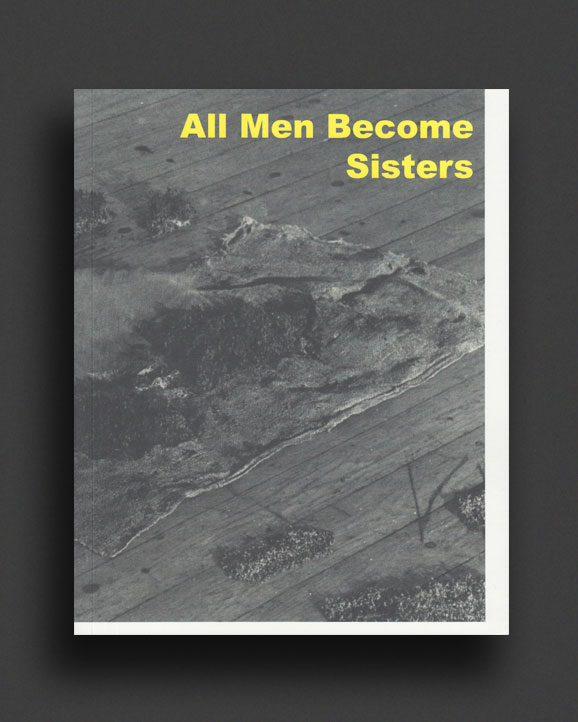
This book is both a record and a theoretical expansion of the exhibition “All Men Become Sisters” at the Muzeum Sztuki in Łódź. Dedicated to the manifestation of sisterhood in art from the 1970s until today, the exhibition and the publication focus on art that resonated with feminist perspectives on work, production, and reproduction. “Sisterhood” is a key concept and an impulse to work with imagination; built on the foundations of second-wave criticism of the patriarchal exploitation of women, it poses questions about the future from the perspective of feminist economics and ethics of care.
Artists: Berwick Street Film Collective, Pauline Boudry/Renate Lorenz, Sarah Browne, Agnieszka Brzeżańska, Jan Czapliński, Ines Doujak in cooperation with John Barker, Köken Ergun, Hackney Flashers, Krystyna Gryczełowska, Margaret Harrison, Elżbieta Jabłońska, Birgit Jürgenssen, Irena Kamieńska, Ola Kozioł/Suavas Levy, Nalini Malani, Marge Monko, Şükran Moral, Teresa Murak, Letícia Parente, Agnieszka Piksa, Marcin Polak, Aleksandra Polisiewicz, Raqs Media Collective, R.E.P., Alicja Rogalska, Daniel Rumiancew, Jadwiga Sawicka, Allan Sekula, Jo Spence, Rosemarie Trockel, Agnès Varda, Mona Vǎtǎmanu/Florin Tudor, Zorka Wollny
Curator: Joanna Sokołowska
Copublished with Muzeum Sztuki, Łódź
Design by Monika Zawadzki, Olo Jean-Claude Zawadzki
2020, English
Hardcover, 224 pages, 24.1 x 30.5 cm
Published by
Yale University Press / New Haven
$95.00 - Out of stock
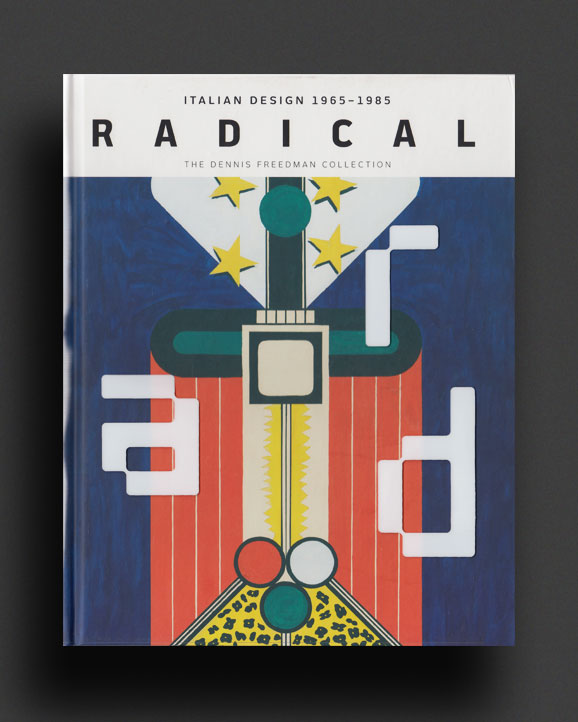
An essential new look at the design philosophy that interrogated modern living against the turbulent political landscape of 1960s Italy.
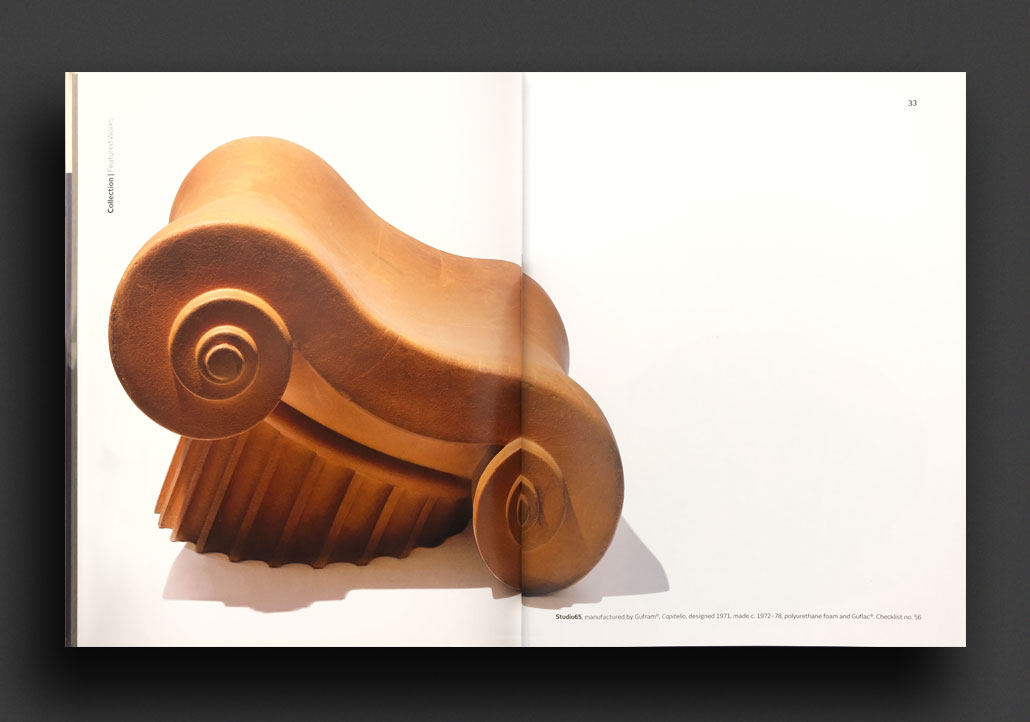
In the mid-1960s, reacting to contemporary social and political upheaval, young Italian architects and designers began developing a new style that openly challenged Modernism. Known as "Radical design," this movement probed possibilities for visually transforming the urban environment. Radical design's proponents also applied it to items such as furniture and lighting, utilizing alternative materials and an innovative formal vocabulary. Radical: Italian Design 1965-1985 surveys the work of these pioneering designers through nearly 70 objects and architectural models-including rare prototypes and limited-production pieces by architects, designers, and collectives such as Archizoom Associati, Lapo Binazzi, Ugo La Pietra, Studio 65, Alessandro Mendini, Gianni Pettena, Ettore Sottsass, Studio Alchimia, Piero Gilardi, Andrea Branzi, and Superstudio. Cindi Strauss insightfully explores the aesthetic inspiration and changing cultural mores that informed the movement, and her research is complemented by an essay from Germano Celant, the acclaimed author and curator who coined the term "Radical design." Importantly, the book includes seven interviews with Radical designers and architects, offering fresh insights into the individuals who were at the vanguard of this groundbreaking movement.
2014, English
Softcover, 108 pages, 17.5 x 10.7
Published by
Donlon Books / London
Motto / Berlin
$15.00 $10.00 - In stock -
However satisfying writing is – that mix of discipline and intuition, which leaves you in command, even when what appears on the page has emerged from regions beyond your control – it is a poor substitute for the joy and the agony of love. e industrial, Jean-Michel Wicker’s first solo exhibition in the UK, is a meditation on human-machine reconfigurations, inflation and desire.
Since the early 1990s, Wicker’s work has had an all-encompassing approach to production – spanning publishing, typography, performance and gardening. Extending a nod of appreciation to Italian Situationist Giuseppe Pinot-Gallizio and his approach to mass-production and collapse, the exhibition at Cubitt pushes this legacy into Wicker’s own symbolic registers. A total work spanning a 70-metre scroll, a newly realised publication and smoke.
2015, English
Softcover, 196 pages, 10.8 x 17.8 cm
Published by
Sternberg Press / Berlin
$39.00 $10.00 - Out of stock
With a foreword by Keller Easterling
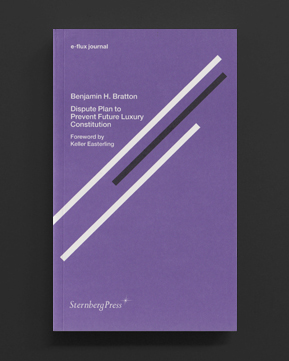
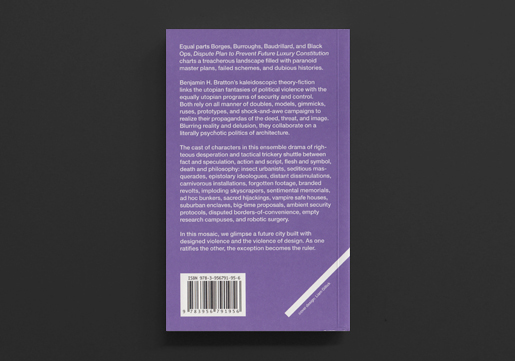
Equal parts Borges, Burroughs, Baudrillard, and Black Ops, Dispute Plan to Prevent Future Luxury Constitution charts a treacherous landscape filled with paranoid master plans, failed schemes, and dubious histories.
Benjamin H. Bratton’s kaleidoscopic theory-fiction links the utopian fantasies of political violence with the equally utopian programs of security and control. Both rely on all manner of doubles, models, gimmicks, ruses, prototypes, and shock-and-awe campaigns to realize their propagandas of the deed, threat, and image. Blurring reality and delusion, they collaborate on a literally psychotic politics of architecture.
The cast of characters in this ensemble drama of righteous desperation and tactical trickery shuttle between fact and speculation, action and script, flesh and symbol, death and philosophy: insect urbanists, seditious masquerades, epistolary ideologues, distant dissimulations, carnivorous installations, forgotten footage, branded revolts, imploding skyscrapers, sentimental memorials, ad-hoc bunkers, sacred hijackings, vampire safe-houses, suburban enclaves, big-time proposals, ambient security protocols, disputed borders-of-convenience, empty research campuses, and robotic surgery.
In this mosaic we glimpse a future city built with designed violence and the violence of design. As one ratifies the other, the exception becomes the ruler.
Design by Jeff Ramsey
2016, English
Softcover, 252 pages, 11.2 x 17.8 cm
Published by
Sternberg Press / Berlin
$62.00 $15.00 - Out of stock
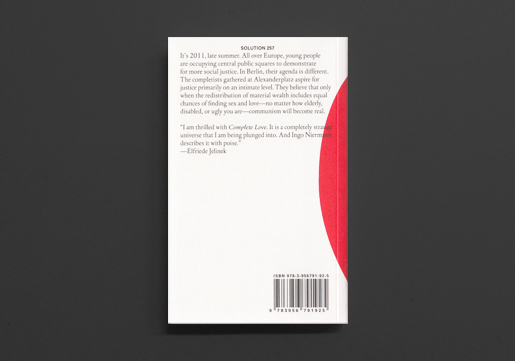
"I am being plunged into. And Ingo Niermann describes it with poise.”
—Elfriede Jelinek, author of The Piano Teacher
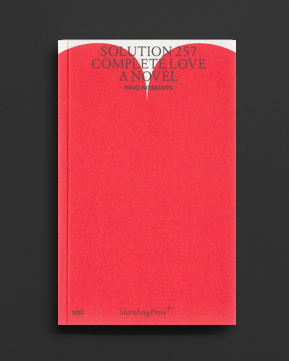
Ingo Niermann’s provocative new novel imagines a Berlin alternative to the activist occupation of public spaces in 2011. The completists, gathered at Alexanderplatz, aspire for justice through intimacy. They believe that only when the redistribution of material wealth includes equal chances of finding sex and love—no matter how elderly, disabled, or ugly you are—communism will become real. This volume of the Solution series is a revolutionary erotic fiction.
Karl, a freelance writer and young stay-at-home dad in Berlin, first dismisses the completists as a bunch of as fringe weirdos and burnouts. But over the course of one summer day, his outlook changes after a series of encounters both virtual and physical. Contacting him on Skype, an attractive and mysterious stranger tells him she has only three hours left to live. Their video chat starts a game of seduction and intrigue and turns into a vivid debate on the decorum of modern relationships and fantasies. Instead of satiating him sensually and emotionally, Ava enlightens him about the real completist challenge of justice through sex and intimacy. Karl must join ranks with disabled sex-rights activist Oskar Patzer before his day’s journey—culminating in an improvised public orgy prefaced by a choreographed group performance—can indicate the possibilities for completing love.
For further completist efforts, go to www.thearmyoflove.net.
Translated by Amy Patton
Solution Series edited by Ingo Niermann
Design by Zak Group
2015, English
Softcover, 128 pages, 11.2 x 17.8 cm
Published by
Sternberg Press / Berlin
$46.00 $10.00 - Out of stock
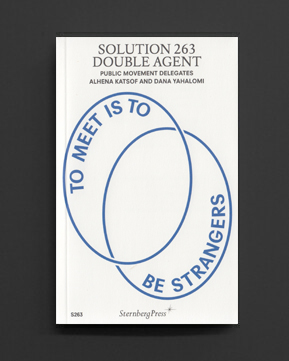
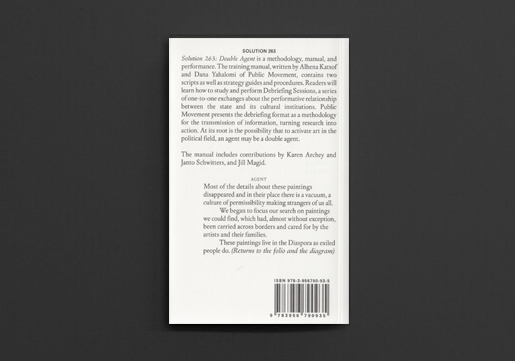
The phenomenal performative relationship between the state and its cultural institutions was perhaps best exemplified when the declaration of the State of Israel was staged at the Tel Aviv Museum of Art in 1948. This relationship has been at the heart of Public Movement’s research. Solution 263: Double Agent, authored by Alhena Katsof and Dana Yahalomi, presents a methodology, manual, and performance offered as a culmination of efforts by the Office of Strategy and Protocol. It contains the necessary tools to activate Debriefing Sessions and in doing so trains future Agents in a series of one-to-one exchanges gathered from work in the field. At its root, Debriefing Sessions explore the possibility that to activate art in the political field, an agent may be a double agent.
The manual includes contributions by Karen Archey and Janto Schwitters, and Jill Magid.
AGENT
Most of the details about these paintings disappeared and in their place there is a vacuum, a culture of permissibility making strangers of us all.
We began to focus our search on paintings we could find, which had, almost without exception, been carried across borders and cared for by the artists and their families.
These paintings live in the Diaspora as exiled people do. (Returns to the folio and the diagram)
Solution Series edited by Ingo Niermann
Design by Zak Group
2015, English / Italian
Softcover, 120 pages, 17 x 24 cm
Ed. of 1000,
Published by
Cura Books / Rome
$35.00 $15.00 - In stock -
Artists: Francesco Arena (Italy), Nina Beier (Denmark), Katinka Bock (Germany), Giorgio Calò Andreotta (Italy), Dario D'Aronco (Italy), N.Dash (USA), Michael Dean (UK), Oliver Laric (Austria), Mark Manders (Netherlands), Michael E. Smith (USA), Fernando Sánchez Castillo (Spain) and Francisco Tropa (Portugal), Oscar Tuazon (USA)
Edition of 1,000 copies
Produced by Palazzo Strozzi Foundation
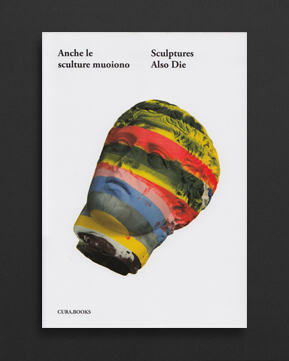
Sculptures Also Die offers a reflection on contemporary sculpture curated by Lorenzo Benedetti through new and existing work by twelve Italian and international artists who will be forging a reflection on the meaning, the potential and the New Experimental Approaches in sculpture today. Contemporary artists tend to use new forms and materials to address a broader timeSpan in on ongoing dialogue between the past and the future;yet at the sametime, the exhibition reflects on the way in Which today's artists are so Rediscovering examined material as bronze, stone or ceramic, That Appeared to have been relegated to the Purely academic sphere.These materials are rediscovered and used in a conceptual manner to reflect on themes examined: such as the monument, the fragment, the way material wear over time, and the recovery of the recent modernist past.
2012, English
Softcover, 28 pages (colour ill.), 25.5 x 18 cm
Published by
Contemporary Art Museum St Louis / Missouri
$15.00 $5.00 - In stock -
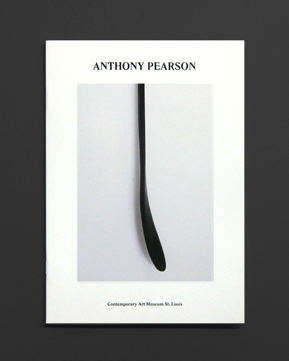
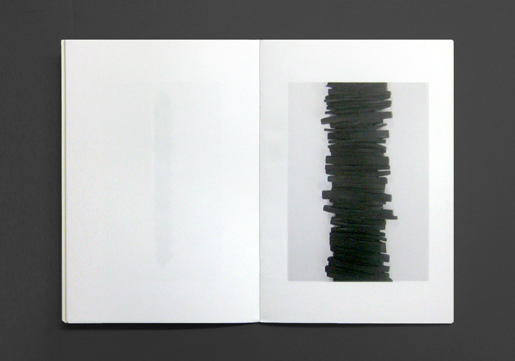
Anthony Pearson sculptures and photographs explore the subtle visual and textural nuances produced by transforming various, primarily metallic materials according to their intrinsic properties. His Front Room project features a selection of recent “tablet” sculptures created through a procedure in which an original structure is formed from clay and then cast in bronze. He uses the malleable nature of clay in a manner similar to that of drawing, in which the material is worked and reworked—just as lines are drawn, erased, and drawn again—to make marks in space. By casting the final result in bronze, Pearson conversely engages a process typically associated with permanence and solidity. His previous combinations of photographic and sculptural work, in what he refers to as “arrangements,” highlighted unexpected resonances between the examinations of light, shadow, and surface in the two different mediums. This presentation of sculptures thus represents a significant departure in his practice by emphasizing their unique status as objects—simultaneously visually streamlined yet materially dense.
Designed by Mark Owens
2010, English
Softcover, 128 pages, 112 x 178 mm
Published by
Sternberg Press / Berlin
$46.00 $10.00 - Out of stock
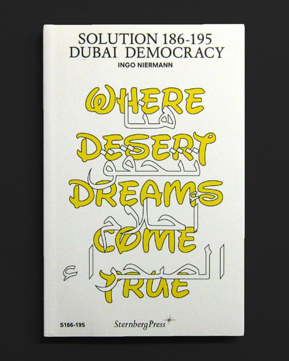
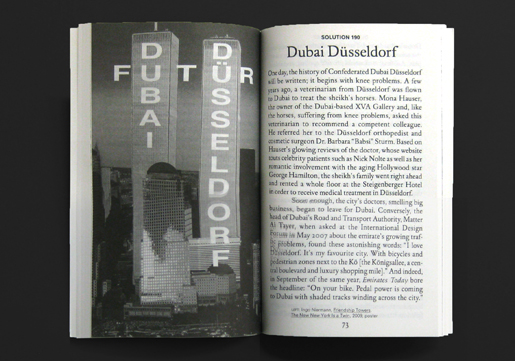
Solution 186–195: Dubai Democracy is the fifth book in the Solution series. Using Dubai as a sort of modernist blank slate for urban and social renewal, author Ingo Niermann confronts today’s most relevant cultural and technological developments with analytical elixirs that are as pertinent as they are unbelievable. Niermann’s Dubai will become as specialized as housing the global center for treating diabetes—called Sugar World—and as universal as offering non-confrontational public spaces where both a state of total advertising and compulsive kindness, or what he calls a “personal humaneness account,” co-exist.
Translation from the German by Gerrit Jackson
Design by Zak Kyes
2009, English
Softcover, 84 pages, 10 b/w ill., 11.2 x 17.8 cm
Published by
Sternberg Press / Berlin
$46.00 $10.00 - Out of stock
After the end of the Second World War, the Federal Republic of Germany wanted to avoid a national “special path” at all costs. Even those who, since reunification, have called for a new patriotism merely mean to accomplish Germany’s perfect normalization as a Western democracy. What they call for is not a profession of specifically German values but an abstract love for the country in which people happen to have been born and grown up. But now, as globalization advances and China rises to become the world’s greatest economic power, the West’s very existence is at stake. The union between democracy and prosperity has been broken; democracy is no longer the indubitably most effective evil. To remain competitive in the face of globalization, Germany needs unique and inimitable advantages of location, it needs to look for specifically German visions.
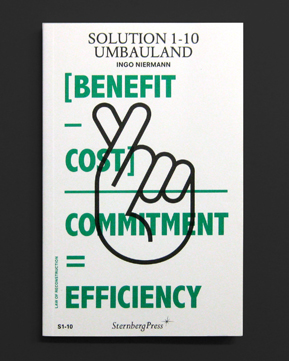
In Solution 1-10: Umbauland, Ingo Niermann devises ten provokingly simple ideas which would see Germany work it out after all, including a new grammar, a new political party, assigning allotment gardens to unemployed people and retirees, and the Great Pyramid, the tallest building of the world which would serve as a democratic tomb for millions of people (see Solution 9: The Great Pyramid, eds. Ingo Niermann and Jens Thiel).
Design by Zak Kyes
2008, English
softcover, 192 pages, 48 color ill., 11.2 x 17.8 cm
Published by
Sternberg Press / Berlin
$46.00 $10.00 - Out of stock
Contributions by Heiko Holzberger, Till Huber, Rem Koolhaas, Christian Kracht, Zak Kyes, Chus Martínez, Hans Ulrich Obrist, Madelon Vriesendorp, David Woodard. Projects by Atelier Bow-Wow (Tokyo), Fake/ Ai Weiwei (Beijing), Nikolaus Hirsch/Wolfgang Lorch/Markus Miessen (Frankfurt am Main), and MADA s.p.a.m. (Shanghai)
If the team behind it is successful, its members will be rich beyond the wildest dreams of even the most ambitious pharaoh. Sunday Telegraph
Millions of people will buy these bricks? BBC World Service
The idea could be read as a democratization of megalomania. Süddeutsche Zeitung
Mega-Pyramid set to save Germany. ORF
Solution 9: The Great Pyramid is the first in the forthcoming Solution series where authors will be asked to develop an abundance of compact and original ideas for other countries and regions, contradicting the widely held assumption that, after the end of socialism, human advancement is only possible technologically or requires a yet-to-be-established world order. This book also documents the architectural proposals for the Great Pyramid, selected by a jury composed of Rem Koolhaas, Omar Akbar, Stefano Boeri, and Miuccia Prada. It also contains critical texts and voices from the press on this exceptional project.
Design by Z.A.K.
2014, English
Softcover, 128 pages, 21 x 29 cm
Published by
The Renaissance Society / Chicago
$86.00 $55.00 - Out of stock
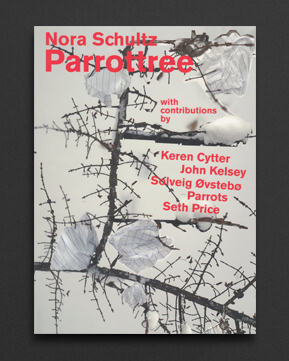
Published on the occasion of Nora Schultz's exhibition Parrottree-Building for Bigger than Real, January 12 – February 23, 2014. It was Schultz's first solo museum show in the US and the first show curated at the Renaissance Society by new Chief Curator and Executive Director, Solveig Øvstebø.
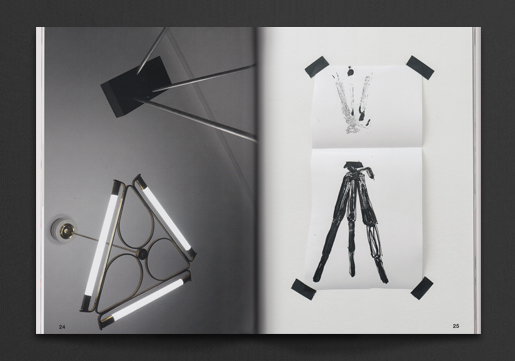
Nora Schultz: Parrottree is a unique and ambitious hybrid between exhibition catalog and artist’s book. Along with photo documentation of the Renaissance Society installation and an essay by the curator Solveig Øvstebø, the publication also includes The Parrot Magazine by Nora Schultz, a 64-page magazine "made by parrots for parrots and for all birds that need to integrate into human society under aggravated circumstances." Additionally, experimental writing pieces by Keren Cytter and Seth Price, and a visual art project by John Kelsey were all commissioned specifically for this book.
2014, English
Softcover, 100 pages, 14 x 21.6 cm
Published by
A.P.E (Art Projects Era)
Sternberg Press / Berlin
$38.00 $10.00 - Out of stock
Noon on the Moon
Poetic Series #4
Edited by Fiona Bryson, Keren Cytter
Contributions by Luna Miguel, Dafna Maimon, Pablo Larios, Bernadette Van-Huy, Mark von Schlegell, Gerry Bibby, Natalie Häusler, Josef Strau, Judith Goldman, Andrew Kerton, Robert Dewhurst, Dena Yago, Kenneth Goldsmith, Karl Holmqvist, Alejandro Cesarco, Sophie Collins, Sarah Wang, Barry Schwabsky, Dorothea Lasky, Andreas Schlaegel, Veronica Gonzalez Peña, Óscar Garcia Sierra, Matthew Dickman, Keith J Varadi, Jacob Wren, Madeline Gins, Charles Bernstein and Nora Schultz.
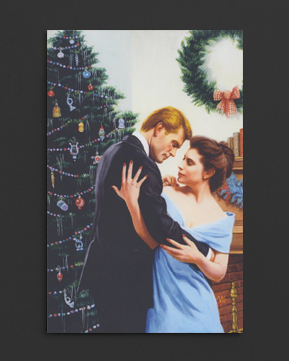
The fourth issue in the “Poetic Series” is a seasonally themed special issue, a festive anthology composed of contributions from more than twenty writers and artists. Each interpreting the theme in an unconventional and abstract sense, it is an alternative omnibus of everyone's favorite and most controversial holiday.Noon on the Moon's title comes from a poem by Barry Schwabsky, featured alongside poetry by Charles Bernstein, Judith Goldman and Dorothea Lasky, prose by Veronica Gonzalez Peña, Andreas Schlaegel and Sarah Wang, amongst others. Artwork is provided in the form of a colorful collection of romance covers illustrated by Vicki Khuzami.
The “Poetic Series” brings together works of poetry and literature in combination with visual art, introducing young as well as established writers concerned with challenging the boundaries of traditional forms of narrative. Initiated by Keren Cytter and coedited with Fiona Bryson.
Copublished with A.P.E (Art Projects Era)
Design by Keren Cytter
2014, English
Softcover, 192 pages, 11.2 x 17.8 cm
Published by
Sternberg Press / Berlin
$49.00 $10.00 - Out of stock
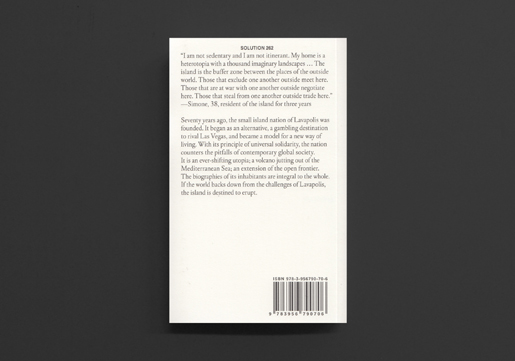
“I am not sedentary and I am not itinerant. My home is a heterotopia with a thousand imaginary landscapes. … The island is the buffer zone between the places of the outside world. Those that exclude one another outside meet here. Those that are at war with one another outside negotiate here. Those that steal from one another outside trade here.”
—Simone, 38, resident of the island for three years
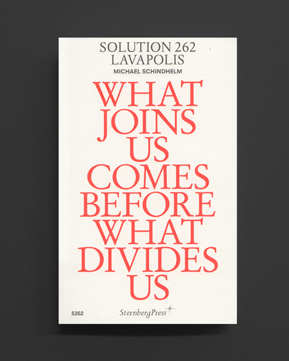
Seventy years ago, the small island nation of Lavapolis was founded. It began as an alternative, a gambling destination to rival Las Vegas, and became a model for a new way of living. With its principle of universal solidarity, the nation counters the pitfalls of contemporary global society. It is an ever-shifting utopia; a volcano jutting out of the Mediterranean Sea; an extension of the open frontier. The biographies of its inhabitants are integral to the whole. If the world backs down from the challenges of Lavapolis, the island is destined to erupt.
Solution 262: Lavapolis is the tenth volume in the Solution series edited by Ingo Niermann. The speculative novel accompanies “Friday in Venice,” a transmedia storytelling project about a possible Europe that took place at the 14th Venice Architecture Biennale, August 1–17, 2014 (www.lavapolis.com).
Translation by David Strauss
Design by Zak Group
2020, English
Hardcover (w. dust jacket), 176 pages, 23.6 x 28 cm
Published by
Matthew Marks / New York
Garth Greenan Gallery / New York
$110.00 $60.00 - Out of stock
A riotous tribute to the singular path of Hairy Who pioneer Gladys Nilsson.
Covering five decades and featuring 100 full-color plates, this beautiful volume is Chicago painter Gladys Nilsson’s (born 1940) most comprehensive monograph to date. Though Nilsson is better known for the watercolors she began exhibiting in the mid-1960s as an original member of the Hairy Who, she has dedicated much of her career to painting in acrylic.
This monograph begins with her 1960s paintings on panel and Plexiglas, then considers her 1970s paintings on canvas, including the seven-foot-high Dipped Dick: Adam and Eve after Cranach, whose title characters are surrounded by a menagerie of cavorting plants and animals. The book finishes with her vivid recent paintings, which are jam-packed with characters. As Nilsson describes her approach, “I would draw a big figure, but that figure always needed another figure, and then those two figures needed a third to interact with. And then, before I knew it, the whole place would be teeming.”
Text by Marcia Tucker. Interview by Alison M. Gingeras.
Gladys Nilsson (b. 1940) graduated from the School of the Art Institute of Chicago in 1962. With five other former students, including her husband Jim Nutt, she organized a series of exhibitions from 1966 to 1969 under the name the Hairy Who. In 1973 her work was the subject of a one-person exhibition at the Whitney Museum of American Art. Today her work is in the collections of museums across the United States, Europe, and Australia, including the Museum of Modern Art in New York, the Los Angeles County Museum of Art, and the Museum Moderner Kunst Stiftung Ludwig Wien in Vienna.
1984, English
Softcover, 169 pages, 11.4 cm x 17.8 cm
Reprint,
Published by
Semiotext(e) / Los Angeles
$29.00 - Out of stock
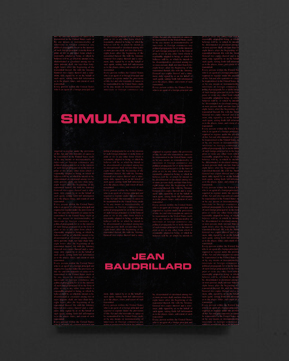
Simulations never existed as a book before it was “translated” into English. Actually it came from two different bookCovers written at different times by Jean Baudrillard. The first part of Simulations, and most provocative because it made a fiction of theory, was “The Procession of Simulacra.” It had first been published in Simulacre et Simulations (1981). The second part, written much earlier and in a more academic mode, came from L’Echange Symbolique et la Mort (1977). It was a half-earnest, half-parodical attempt to “historicize” his own conceit by providing it with some kind of genealogy of the three orders of appearance: the Counterfeit attached to the classical period; Production for the industrial era; and Simulation, controlled by the code. It was Baudrillard’s version of Foucault’s Order of Things and his ironical commentary of the history of truth. The book opens on a quote from Ecclesiastes asserting flatly that “the simulacrum is true.” It was certainly true in Baudrillard’s book, but otherwise apocryphal.
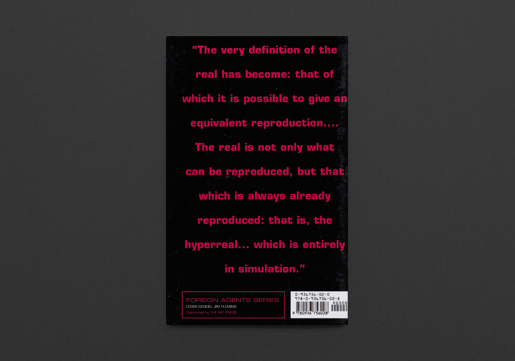
One of the most influential essays of the 20th century, Simulations was put together in 1983 in order to be published as the first little black book of Semiotext(e)’s new Foreign Agents Series. Baudrillard’s bewildering thesis, a bold extrapolation on Ferdinand de Saussure’s general theory of general linguistics, was in fact a clinical vision of contemporary consumer societies where signs don’t refer anymore to anything except themselves. They all are generated by the matrix.
In effect Baudrillard’s essay (it quickly became a must to read both in the art world and in academe) was upholding the only reality there was in a world that keeps hiding the fact that it has none. Simulacrum is its own pure simulacrum and the simulacrum is true. In his celebrated analysis of Disneyland, Baudrillard demonstrates that its childish imaginary is neither true nor false, it is there to make us believe that the rest of America is real, when in fact America is a Disneyland. It is of the order of the hyper-real and of simulation. Few people at the time realized that Baudrillard’s simulacrum itself wasn’t a thing, but a “deterrence machine,” just like Disneyland, meant to reveal the fact that the real is no longer real and illusion no longer possible. But the more impossible the illusion of reality becomes, the more impossible it is to separate true from false and the real from its artificial resurrection, the more panic-stricken the production of the real is.
Jean Baudrillard (1929-2007) was a philosopher, sociologist, cultural critic, and theorist of postmodernity who challenged all existing theories of contemporary society with humor and precision. An outsider in the French intellectual establishment, he was internationally renowned as a twenty-first century visionary, reporter, and provocateur. His Simulations (1983) instantly became a cult classic and made him a controversial voice in the world of politics and art.
2012, English
Softcover, 836 pages, 15.2 x 22.9 cm
Published by
Martino Fine Books / United Kingdom
$64.00 - Out of stock
2012 Reprint of Original Three Volume s First Published from 1905-1907. Exact facsimile of the original edition, not reproduced with Optical Recognition Software. This is a collection of Crowley's early esoteric writings and poetry and comprise the first collected edition of his writings. Aleister Crowley, born Edward Alexander Crowley, and also known as both Frater Perdurabo and The Great Beast, was an influential English occultist, mystic, ceremonial magician, poet and mountaineer, who was responsible for founding the religious philosophy of Thelema. In his role as the founder of the Thelemite philosophy, he came to see himself as the prophet who was entrusted with informing humanity that it was entering the new Aeon of Horus in the early 20th century. Born into a wealthy upper class family, as a young man he became an influential member of the esoteric Hermetic Order of the Golden Dawn after befriending the order's leader, Samuel Liddell MacGregor Mathers. Subsequently believing that he was being contacted by his Holy Guardian Angel, an entity known as Aiwass, while staying in Egypt in 1904, he "received" a text known as 'The Book of the Law' from what he believed was a divine source, and around which he would come to develop his new philosophy of Thelema. He would go on to found his own occult society and eventually rose to become a leader of Ordo Templi Orientis (O.T.O.), before founding a religious commune in Cefalu known as the Abbey of Thelema, which he led from 1920 through till 1923. After abandoning the Abbey amid widespread opposition, Crowley returned to Britain, where he continued to promote Thelema until his death. Crowley has remained an influential figure and is widely thought of as the most influential occultist of all time. Includes: Volume 1. Aceldama. The tale of Archais. Songs of the spirit. The poem. Jephithah. Mysteries. Jezebel, and other tragic poems. An appeal to the American republic. The fatal force. The mother's tragedy. The temple of the holy ghost. Carmen Saeculare. Tannhauser. Epilogue. Appendix. -- Volume 2. Oracles. Alice: An adultery. The Argonauts. Ahab and other poems. The God-eater. The sword of song. Ambrosii magi hortus rosarum. The three characteristics. An essay on ontology. Science and Buddhism. The excluede middle; or, the sceptic refuted. Time. Epilogue. Volume 3. The star and the garter. Rosa mundi, and other love-songs. The Sire de Maletroit's door. Gargoyles. Rodin in rime. Orpheus. Epilogue and dedication. Appendix A. Bibliographical note. Appendix B. Index of first lines.
1962, French
Hardcover (w. blue paper slip Légendes des photographies), 200 pages, 20 x 13.5 cm
1st Edition, Out of print title / used / very good
Published by
Editions Rencontre / Lausanne
$90.00 - Out of stock
First edition published in 1962, J' aime le Strip-Tease explores the different moral, historical, or even technical angles of the Strip-Tease. Frank Horvat’s camera observes the genre photographing movie posters in New York, red-light shop windows, stage performances, and moments backstage at the famous Paris Varieté shows such as the Folies-Bergère, the Crazy Horse or the Moulin-Rouge. This is not only a photobook – the texts of Patrik Lindenmohr compliment Horvat’s photographs perfectly. The book also contains a conversation with Alain Bernadin, founder of the Crazy Horse Varieté in Paris. Printed in wonderful deep gravure in Switzerland (like all the books in the J’aime / Eintritt frei series), and published under the supervision of Jean-Pierre Moulin and Yvan Dalain. Text by Patrik Lindenmohr.
Includes the inserted loose-leaf blue paper slip 'Légendes des photographies', identifying the various strip clubs, locations, etc.
Strip-Tease is Franks Horvat’s third book. Born in Italy in 1928, he has lived and worked in Paris since 1955. In 1957, Horvat shot fashion photographs for Jardin des Modes using a 35-mm camera and available light, which formerly had rarely been used for fashion. This innovation was welcomed by ready-to-wear designers, because it presented their creations in the context of everyday life. In the following years, Horvat was commissioned to do similar work for Elle in Paris, Vogue in London, and Harper’s Bazaar in New York.
Very Good copy. Includes the inserted loose-leaf blue paper slip 'Légendes des photographies', identifying the various strip clubs, locations, etc.
1965, English
Softcover, 84 pages / 88 pages, 15.5 x 15.5 cm
1st US Edition, Out of print title / used / good
Published by
George Wittenborn Inc. / New York
$150.00 - Out of stock
Discovery of the Circle and Discovery of the Square, first 1965 English-language editions, printed in Italy and published in New York by George Wittenborn Inc. The first two volumes (followed a decade later by the triangle) of legendary Italian artist/designer Bruno Munari's visual case studies on shapes. The square, circle, and triangle are the most basic shapes on Earth, supporting structures both synthetic and natural. In the 1960s, Italian artist Bruno Munari explored the visual history of these shapes in three iconic encyclopaedic books, which have become design classics. However, there’s a broader appreciation for this eccentric exploration of the three shapes through Munari’s omnivorous approach. Using examples from ancient Greece and Egypt, as well as works by Buckminster Fuller, Le Corbusier, and Alvar Aalto, Munari never nails down what any of the shapes are, yet looks at every aspect of what they mean, where they appear, and even their significance in language.
Bruno Munari was an Italian artist and designer, who contributed fundamentals in many fields of visual arts (paint, sculpture, film, industrial design, graphics) and non visual arts (literature, poetry, didactic) with the research on the game subject, infancy and creativity.
Both good with some cover and spine wear, general ageing.