World Food Books' programme is largely produced on Kulin Nation land. We acknowledge the Wurundjeri people of the Kulin Nation as the first and continuing custodians of this land, and pay respect to their Elders past, present, and emerging.
World Food Books is an arts and special interests bookshop in Naarm / Melbourne. Founded in 2010, World Food Books is devoted to the presentation of a rotating, hand-selection of international art, design, literary and counterculture publications with an emphasis on the anti-traditional, the experimental, the avant-garde, the heretic, the marginal.
Presenting new titles alongside rare and out-of-print books, catalogues and journals spanning the fields of modern and contemporary art, design, photography, illustration, film, literature, poetry, cultural theory, philosophy, sexuality, popular and underground culture in its many radical forms, World Food Books wishes to encourage adventurous, thoughtful and open-minded reading, looking, writing, and exchange of publishing and ideas, both current and historical.
As well as our bookshop, located in Melbourne's historical Nicholas Building, all of our inventory is available internationally via our online mail-order service.
World Food Books semi-regularly co-ordinates "Occasions", a programme of exhibits and events at the bookshop and in partnership with other hosts (such as museums and art galleries) that develop out of the activities, relationships and content of the bookshop itself.
World Food Books
The Nicholas Building
37 Swanston Street
Room 5, Level 6
Melbourne 3000
Australia
SHOP HOURS:
Thu–Fri 12–6, Sat 12–5
WEB-SHOP OPEN 24/7
World Food Books
Postal Address:
PO Box 435
Flinders Lane
Victoria 8009
Australia
Art
Theory / Essay
Architecture / Interior
Graphic Design / Typography
Photography
Fashion
Eros
LGBTQ+
Fiction / Poetry
Weird / Speculative / Science Fiction / Horror
Transgressive / Visceral / Abject
Symbolism / Decadence / Fin de siècle
Film / Video
Painting
Sculpture / Installation
Performance / Dance / Theater
Drawing
Sound / Music
Curatorial
Group Shows / Collections
Periodicals
Out-of-print / Rare
Posters / Ephemera / Discs
Signed Books
World Food Books Gift Voucher
World Food Book Bag
Australian Art
Australian Fiction
Australian Science Fiction / Speculative Fiction
Australian Poetry
Australian Photography
Japanese Photography
Conceptual Art
Minimal Art
Dada
'Pataphysics / Oulipo
Fluxus
Concrete Poetry
Pop Art
Surrealism
Arte Povera
Arte Informale / Haute Pâte / Tachism
Nouveau Réalisme / Zero / Kinetic
Situationism / Lettrism
Collage / Mail Art / Xerox Art
Art Brut / Folk / Visionary / Fantastic
Illustration / Graphic Art / Bandes Dessinées
Furniture
Italian Radical Design / Postmodernism
Textiles
Ceramics / Glass
Counterculture
Protest / Revolt
Philosophy
Psychoanalysis
Anthropology
Anarchism
Socialism / Anarchism / Communism / Capitalism
Literary Theory / Semiotics / Language
Feminism / Women's Studies
Gender Studies / Sexuality
Anthropology
Fetishism / BDSM
Drugs / Psychedelia
Crime / Violence
Animal Rights / Veganism
Occult / Esoterica
Ecology / Earth / Alternative Living
Whole Earth / Crafts
All prices in AUD (Australian dollars)
Pick-Ups
Pick-up orders can be collected in our bookshop during opening hours after order date. Please collect any Pick-up orders within 2 weeks of ordering as we have limited storage space. Orders will be released back into stock if not collected within this time. No refunds can be made for pick-ups left un-collected. If you cannot make it in to the bookshop in this time-frame, please choose postage option.
Return Policy
All sales are final. We do accept returns (for refund or exchange) for items received in error. All our orders are packed with special care using heavy-duty padding and cardboard book-mailers or bubble mailers (for smaller books), using reinforcement where required. We cannot take responsibility for any lost, stolen or damaged parcels.
Insurance
Should you wish to insure your package, please email us directly after placing your order and we can organise this at a small extra expense. Although all standard/express tracked packages are very safe and dependable, we cannot take responsibility for any lost, stolen or damaged parcels. We recommend insurance on valuable orders.
Interested in selling your old books, catalogues, journals, magazines, comics, fanzines, ephemera? We are always looking for interesting, unusual and out-of-print books to buy. We only buy books in our fields of interest and specialty, and that we feel we can resell.
We base these prices on desirability, market value, in-print prices, condition and our current stock levels. We offer cash, store credit, and can take stock on consignment. All
about 25% of the price we expect to get when we sell them, or 30% in store credit. We base these prices on desirability, market value, in-print prices, condition and our current stock levels.
Sell your books any day of the week. You can drop them off and return later. If you have a lot of books, we can visit your Sydney home.
We buy books that we feel we can resell. We offer about 25 % of the price we expect to get when we sell them, or 30% in store credit. We base these prices on desirability, market value, in-print prices, condition and our current stock levels.
Philadelphia Wireman
03 August - 01 September, 2018
World Food Books is proud to announce our next Occasion, the first presentation of sculptures by Philadelphia Wireman in Australia.
The Philadelphia Wireman sculptures were found abandoned in an alley off Philadelphia’s South Street on trash night in 1982. Their discovery in a rapidly-changing neighbourhood undergoing extensive renovation, compounded with the failure of all attempts to locate the artist, suggests that the works may have been discarded after the maker’s death. Dubbed the "Philadelphia Wireman" during the first exhibition of this work, in 1985, the maker’s name, age, ethnicity, and even gender remain uncertain. The entire collection totals approximately 1200 pieces, all intricately bound together with tightly-wound heavy-gauge wire (along with a few small, abstract marker drawings, reminiscent both of Mark Tobey and J.B. Murry). The dense construction of the work, despite a modest range of scale and materials, is singularly obsessive and disciplined in design: a wire armature or exoskeleton firmly binds a bricolage of found objects including plastic, glass, food packaging, umbrella parts, tape, rubber, batteries, pens, leather, reflectors, nuts and bolts, nails, foil, coins, toys, watches, eyeglasses, tools, and jewellery.
Heavy with associations—anthropomorphic, zoomorphic, and socio-cultural responses to wrapped detritus—the totemic sculptures by Philadelphia Wireman have been discussed in the context of work created to fulfil the shamanistic needs of alternative religions in American culture. Curators, collectors, and critics have variously compared certain pieces to sculpture from Classical antiquity, Native American medicine bundles, African-American memory jugs, and African fetish objects. Reflecting the artist’s prolific and incredibly focused scavenging impulse, and despite—or perhaps enhanced by—their anonymity, these enigmatic objects function as urban artefacts and arbiters of power, though their origin and purpose is unknown. Philadelphia Wireman, whatever their identity, possessed an astonishing ability to isolate and communicate the concepts of power and energy through the selection and transformation of ordinary materials. Over the course of the past two decades, this collection has come to be regarded as an important discovery in the field of self-taught art and vernacular art.
Presented in collaboration with Fleisher-Ollman Gallery, Philadelphia, and Robert Heald, Wellington.
Susan Te Kahurangi King
02 February - 10 March, 2018
Susan Te Kahurangi King (24 February 1951 - ) has been a confident and prolific artist since she was a young child, drawing with readily available materials - pencils, ballpoint pens and felt-tip markers, on whatever paper is at hand. Between the ages of four and six Susan slowly ceased verbal communication. Her grandparents William and Myrtle Murphy had developed a special bond with Susan so they took on caring responsibilities for extended periods. Myrtle began informally archiving her work, carefully collecting and storing the drawings and compiling scrapbooks. No drawing was insignificant; every scrap of paper was kept. The King family are now the custodians of a vast collection containing over 7000 individual works, from tiny scraps of paper through to 5 meter long rolls.
The scrapbooks and diaries reveal Myrtle to be a woman of great patience and compassion, seeking to understand a child who was not always behaving as expected. She encouraged Susan to be observant, to explore her environment and absorb all the sights and sounds. Myrtle would show Susan’s drawings to friends and people in her community that she had dealings with, such as shopkeepers and postal workers, but this was not simply a case of a grandmother’s bias. She recognised that Susan had developed a sophisticated and unique visual language and sincerely believed that her art deserved serious attention.
This was an unorthodox attitude for the time. To provide some context, Jean Dubuffet coined the term Art Brut in 1945 to describe work created by self-taught artists – specifically residents of psychiatric institutions and those he considered to be visionaries or eccentrics. In 1972 Roger Cardinal extended this concept by adopting the term Outsider Art to describe work made by non-academically trained artists operating outside of mainstream art networks through choice or circumstance. Susan was born in Te Aroha, New Zealand in 1951, far from the artistic hubs of Paris and London that Dubuffet and Cardinal operated in. That Myrtle fêted Susan as a self-taught artist who deserved to be taken seriously shows how progressive her attitudes were.
Susan’s parents Doug and Dawn were also progressive. Over the years they had consulted numerous health practitioners about Susan’s condition, as the medical establishment could not provide an explanation as to why she had lapsed into silence. Dawn educated herself in the field of homeopathy and went on to treat all twelve of her children using these principles – basing prescriptions on her observations of their physical, mental and emotional state.
Doug was a linguist with an interest in philosophy who devoted what little spare time he had to studying Maori language and culture. To some extent their willingness to explore the fringes of the mainstream made them outsiders too but it was their commitment to living with integrity and their respect for individuality that ensured Susan’s creativity was always encouraged.
Even though Susan’s family supported her artistic pursuits, some staff in schools and hospitals saw it as an impediment to her assimilation into the community and discouraged it in a variety of ways. Her family was not always aware of this and therefore did not fully understand why Susan stopped drawing in the early 1990s. However, rather than dwell on the challenges that Susan faced in pursuit of her artistic practice, they prefer to highlight her achievements. In 2008 Susan began drawing again in earnest, after an almost 20 year interruption, and her work is now shown in galleries around the world.
Susan grew up without television and has been heavily influenced by the comics she read as a child. She is absolutely fearless in the appropriation of recognizable characters, such as Donald Duck and Mickey Mouse, in her work. She twists their limbs, contorts their faces, compresses them together, blends them into complex patterned backgrounds - always imbuing them with an incredible energy. Although Susan often used pop culture characters in her work they are not naive or childlike. These are drawings by a brilliant self-taught artist who has been creating exceptional work for decades without an audience in mind.
Mladen Stilinović
"Various Works 1986 - 1999"
02 February 16 - September 10, 2016
Various works 1986 - 1999, from two houses, from the collections of John Nixon, Sue Cramer, Kerrie Poliness, Peter Haffenden and Phoebe Haffenden.
Including: Geometry of Cakes (various shelves), 1993; Poor People’s Law (black and white plate), 1993; White Absence (glasses, ruler, set square, silver spoon, silver ladel with skin photograph and wooden cubes), 1990-1996; Exploitation of the Dead (grey and red star painting, wooden painting, black spoon with red table, red plate), 1984-1990; Money and Zeros (zero tie, paintings made for friends in Australia (Sue, John, Kerrie), numbers painting), 1991-1992; Words - Slogans (various t-shirts) - “they talk about the death of art...help! someone is trying to kill me”, “my sweet little lamb”, “work is a disease - Karl Marx”; Various artist books, catalogues, monographs, videos; Poster from exhibition Insulting Anarchy; "Circular" Croatian - Australian edition; Artist book by Vlado Martek (Dostoyevsky); more.
Thanks to Mladen Stilinović and Branka Stipančić.
Jonathan Walker
Always Will Need To Wear Winter Shirt Blue + Ochre Small Check Pattern
21 August - 21 September, 2015
Untitled
I am not a great reader of poetry but I always return to the work of Melbourne poet, Vincent Buckley (1925- 1988). Perhaps I find his most tantalising piece to be not a finished poem but a fragment left on a scrap of paper discovered on his desk after the poet’s death.
The poetry gathers like oil
In the word-core, and spreads
It has its music meet,
Its music is in movement.
This fragment is more the shell left behind from a volatile thought than a finished poem. I find the last two lines honest but awkward whereas the first two lines work like an arrow. Most likely he could not find a resolution so it was left. Still, in its present form, it remains an eloquent testimony to the ultimate failure of a medium to express mobile thought and sensation, in Buckley’s case, through verbal language. It’s an important matter because this is something all artists have to deal with regardless of the medium.
I have never written a poem, however, I am forever copying fragments from books on paper scraps in a vain effort to fix certain notions in my head. At first, they function as bookmarks that are sometimes returned to when I open the book. But before long, as they accumulate, they fall out littering the table interspersed with A4 photocopies, bills, books and medications.
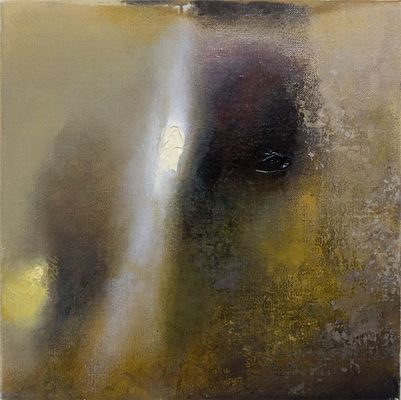
To return to Buckley’s fragment, the first two lines very much evoke how I paint nowadays. As you age, detail diminishes and patches of light become more luminous and float. I feel the most honest way of dealing with this is by smearing the oil paint on the canvas with the fingers and working close-up, blind. Only if the patches coalesce into an approaching image can the work gain a life.
-
Jonathan Walker was born in Melbourne, Australia and brought up on a dairy farm in Gippsland. In the 1970’s he studied painting at RMIT and won the Harold Wright Scholarship to the British Museum, London. During the 1980’s he exhibited at Pinacotheca Gallery, Richmond and had work shown at the NGV and Heidi City Art Gallery. Over the same period he designed the cover for the “Epigenesi” LP by Giancarlo Toniutti, Italy and conducted a mail exchange work with Achim Wollscheid, Germany. The work with artists through the post resulted in an article published in the bicentenary issue of Art and Australia 1988. He showed in artist run spaces such as WestSpace in the 90’s and 2000’s, and until 2012, taught painting at Victoria University, which is where we (Colleen Ahern and Lisa Radford) as organisers of the exhibition, among many others, had the privilege of being his student.
Walker’s knowledge was imparted to students through the careful selection of music, literature, and artists found in books that he himself had ordered for the library. Walker’s strategy was the generosity of sharing his vast knowledge with references specific to each student and their context.
Walker’s paintings share a similar focus and intimacy.
This exhibition presents a small selection of recent paintings alongside a publication that includes Walker’s writing. Observational and analytical, Walker’s work is a type of material notation — the time of day, colour and how it is blended, the both specific and fleeting location of a reflection on lino or the question of whether a chair leg should be included in a painting.
Please join us on Friday August 21 between 6-8pm to celebrate the opening of the exhibition.
Curated by Colleen Ahern and Lisa Radford.
B. Wurtz
Curated by Nic Tammens
March 26 - April 4, 2015
B.Wurtz works from a basement studio in his home on Manhattan’s Lower East Side.
This local fact is attested to by the plastic shopping bags and newsprint circulars that appear in his work. As formal objects, they don’t make loud claims about their origins but nonetheless transmit street addresses and places of business from the bottom of this long thin island. Like plenty of artists, Wurtz is affected by what is local and what is consumed. His work is underpinned by this ethic. It often speaks from a neighborhood or reads like the contents of a hamper:
“BLACK PLUMS $1.29 lb.”
“Food Bazaar”
“USDA Whole Pork Shoulder Picnic 99c lb.”
“RITE AID Pharmacy, with us it’s personal.”
“H. Brickman & Sons.”
“Sweet Yams 59c lb."
Most of the work in this exhibition was made while the artist was in residence at Dieu Donne, a workshop dedicated to paper craft in Midtown. Here Wurtz fabricated assemblages with paper and objects that are relatively lightweight, with the intention that they would be easily transportable to Australia. This consideration isn’t absolute in Wurtz’s work, but was prescriptive for making the current exhibition light and cheap. Packed in two boxes, these works were sent from a USPS post office on the Lower East Side and delivered to North Melbourne by Australia Post.
Wurtz appears courtesy of Metro Pictures, New York.
Thanks to Rob Halverson, Joshua Petherick, Sari de Mallory, Matt Hinkley, Helen Johnson, Fayen d'Evie, Ask Kilmartin, Lisa Radon, Ellena Savage, Yale Union, and "Elizabeth".
John Nixon
"Archive"
December 15 - January 20, 2014
The presentation of John Nixon's archive offered a rare showcase of this extensive collection of the artist's own publications, catalogues, posters, ephemera, editions and more, from the mid 1980s onwards, alongside a selection of his artworks.
Organized by John Nixon, Joshua Petherick and Matt Hinkley.
<a href=http://wfb.public-office.info/artist/john-nixon>All titles by John Nixon
"Habitat"
at Minerva, Sydney (organised by Joshua Petherick and Matt Hinkley)
November 15 - December 20, 2014
Lupo Borgonovo, Janet Burchill & Jennifer McCamley,
Lewis Fidock, HR Giger, Piero Gilardi, Veit Laurent Kurz,
Cinzia Ruggeri, Michael E. Smith, Lucie Stahl, Daniel Weil, Wols
Press Release:
“...It contained seven objects. The slender fluted bone, surely formed for flight, surely from the wing of some large bird. Three archaic circuitboards, faced with mazes of gold. A smooth white sphere of baked clay. An age-blackened fragment of lace. A fingerlength segment of what she assumed was bone from a human wrist, grayish white, inset smoothly with the silicon shaft of a small instrument that must once have ridden flush with the surface of the skin - but the thing’s face was seared and blackened.”
William Gibson, “Count Zero”, 1986
"Autumn Projects Archive"
Curated by Liza Vasiliou
March 6 - March 15, 2014
World Food Books, in conjunction with the Virgin Australia Melbourne Fashion Festival 2014, presented the Autumn Projects archive, consisting of a selection of early examples in Australian fashion with a particular interest in collecting designers and labels from the period beginning in the 1980’s, who significantly influenced the discourse of Australian Fashion.
Curated by Liza Vasiliou, the exhibition provided a unique opportunity to view pieces by designers Anthea Crawford, Barbara Vandenberg, Geoff Liddell and labels CR Australia, Covers, Jag along with early experimental collage pieces by Prue Acton and Sally Browne’s ‘Fragments’ collection, suspended throughout the functioning World Food Books shop in Melbourne.
H.B. Peace
presented by CENTRE FOR STYLE
November 14, 2013
"Hey Blinky, you say chic, I say same"
Anon 2013
H.B. Peace is a clothing collaboration between great friends Blake Barns and Hugh Egan Westland. Their pieces explore the divergences between 'character’ and ‘personality’ in garments....etc
Special Thanks to Joshua Petherick and Matt Hinkley of WFB and Gillian Mears
and a Very Special Thank you to Audrey Thomas Hayes for her shoe collaboration.
Janet Burchill & Jennifer McCamley
"Aesthetic Suicide"
May 10 - June 8, 2013
The first of our occasional exhibitions in the World Food Books office/shop space in Melbourne, "Aesthetic Suicide" presented a body of new and older works together by artists Janet Burchill & Jennifer McCamley, including videos, prints, a wall work, and publications.
During shop open hours videos played every hour, on the hour.
2017, English
Hardcover w. softcover supplement and obi-strip, 716 pages total, 22.5 x 27.5 cm
Published by
Park Books / Zürich
$140.00 - Out of stock
The spectacular first-ever global survey of brutalist architecture from the 1950s to the 1970s, the result of a major collaborative research undertaking by Deutsches Architektur Museum DAM and Wüstenrot Foundation. Lavishly illustrated, this heavy hardcover book (with softcover supplement) covers around 120 key buildings from the period from around the world, many of them little-known and in imminent danger of destruction, captured in print for the first time here. Case studies of hotspots such as the Macedonian capital Skopje or New Haven, Connecticut, and essays on the history and theory of brutalism round out this groundbreaking and lavishly illustrated book that is sure to become an essential classic.
Edited by Oliver Elser, Philip Kurz, Peter Cachola Schmal
2015, English
Softcover, 96 pages, 11 x 18 cm
Published by
Wakefield Press / Cambridge
$30.00 - Out of stock
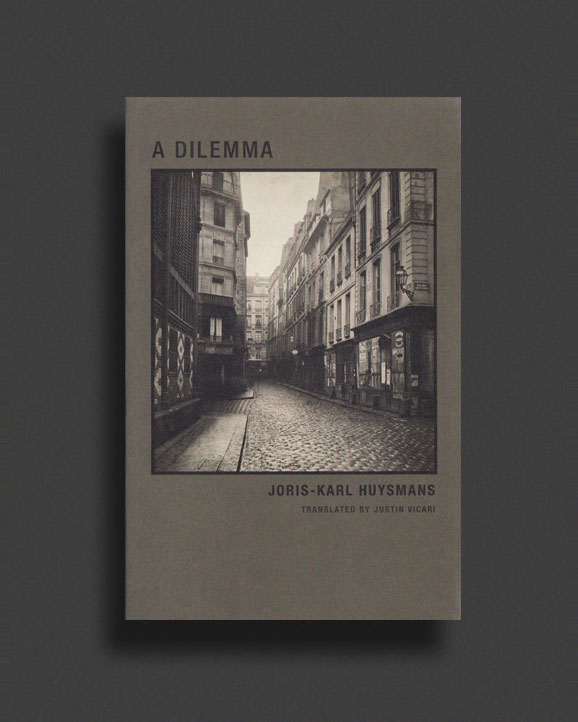
Originally published in book form in French in 1887, Joris-Karl Huysmans’s A Dilemma remains a particularly nasty little tale, a mordantly satiric and cruel account of bourgeois greed and manipulation that holds up as clear a mirror to today's neoliberalist times as it did to the French fin-de-siècle. Written in-between Huysmans’ most famous works—his 1881 Against Nature, which came to define the Decadent movement, and his 1891 exploration of Satanism, Down There—A Dilemma presents some of the author’s most memorable characters, including Madame Champagne, the self-appointed Parisian protector of women in need, and the carnal would-be sophisticate notary Le Ponsart, who wages a war of words with the bereft pregnant mistress of his deceased grandson with devastating consequences. In its unflinching portrayal of how authoritarian language can be used and abused as a weapon, this novella stands as Huysmans’s indictment of the underlying crime of the novel itself: a language apparatus employed to maintain the appetites of the ruling class.
Earning a wage through a career in the French civil service, Joris-Karl Huysmans (1848–1907) quietly explored the extremes of human nature and artifice through a series of books that influenced a number of different literary movements: from the grey and grimy Naturalism of books like Marthe and Downstream to the cornerstones of the Decadent movement, Against Nature and the Satanist classic Down There, along with the dream-ridden Surrealist favorite, Becalmed, and his Catholic novels, The Cathedral and The Oblate.
Translated, with an introduction, by Justin Vicari
“Huysmans is surrealist in pessimism.”—André Breton
2017, English
Softcover, 280 pages, 15 x 23 cm
Published by
Wakefield Press / Cambridge
$49.00 - Out of stock
“I live outside the world in a universe I myself have created, like a madman or a holy visionary.”
—Michel de Ghelderode
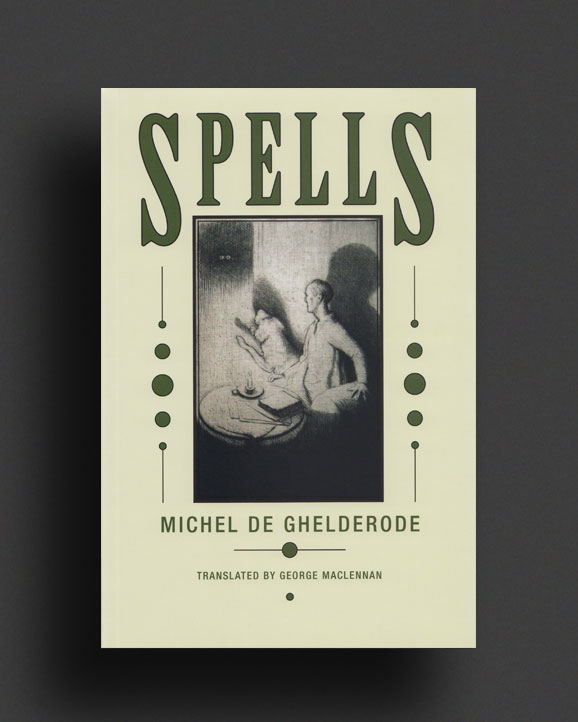
Hitherto unavailable in English, Spells, by the Belgian dramatist Michel de Ghelderode, ranks among the twentieth century’s most noteworthy collections of fantastic tales. Like Ghelderode’s plays, the stories are marked by a powerful imagination and a keen sense of the grotesque. Written at a time of illness and isolation, it was Ghelderode’s last major creative work, and he claimed it as his most personal and deeply felt one: a set of written spells through which his fears, paranoia, and nostalgia found concrete form.
By turns mystical, macabre and whimsically humorous, and set in the unsettled atmosphere of Brussels, Ostend, Bruges, and London, the stories embody a uniquely strange vision of the world, and bear witness to Ghelderode’s belief that life is saturated with the mysterious and that the present is perpetually haunted by the past. Spells conjures up an uncanny realm of angels, demons, masks, effigies, apparitions, dreams, and enigmas, a twilit, oppressed world of diseased gardens, dusty wax mannequins, sinister relics, and an all-consuming fog where, in the words of Baudelaire, “ghosts accost the passerby.”
Combining the full contents of both the 1941 and the 1947 editions, this translation of Spells is the most comprehensive edition yet published.
Michel de Ghelderode (Adhémar Adolphe Martens, 1898–1962) was born in Brussels. His strong anti-realist bent was in evidence from the start and he first attracted attention in 1918 with a one-act play written in tribute to Edgar Allan Poe. In the following years he wrote fiction, drama, literary journalism, and puppet plays. After 1936 he suffered from poor health and his involvement with the theater gradually diminished. Spells (1941) was intended as a fresh start—a collection of new stories with others to follow, but proved to be his last significant creative statement.
“Ghelderode is the black diamond that closes the necklace of poets that Belgium wears around her neck. This black diamond casts a cruel and noble fire. It wounds only those with small souls. It dazzles others.”—Jean Cocteau
Translated, with an introduction, by George MacLennan
De Ghelderode’s fiction has not been broadly available to English readers, and this edition of Spells will hopefully do its part to remedy that. The consistent execution and thought-provoking, nuanced premises in these stories are enough to render them overlooked classics (at least, to non-Belgian audiences)—there are no real low points to speak of, and it seems unsurprising that the stories are among the final efforts produced by an author with a lengthy and well-developed body of work. — Christopher Burke, Weird Fiction Review
“Spells by Michel de Ghelderode offers a collection of stories both beautiful and loathsome. He represents literature that must be wrestled with to fully appreciate . . . [it] is literature distilled from despair, nostalgia, and sickness.” — Karl Wolff, New York Journal of Books
2019, English
Softcover, 160 pages, 15.2 x 20.3 cm
Published by
Exact Change / Boston
$34.00 - Out of stock
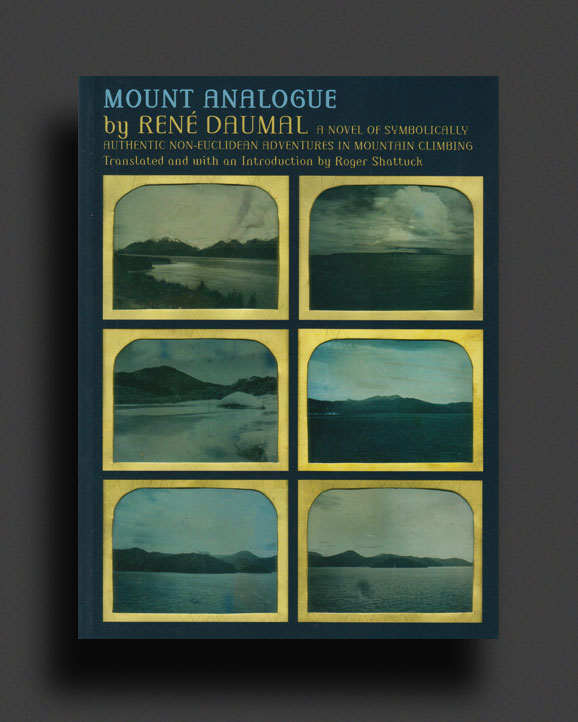
Translated and with an Introduction by Roger Shattuck
Postface by Véra Daumal
“For a mountain to play the role of Mount Analogue, I concluded, its summit must be inaccessible but its base accessible to human beings as nature has made them. It must be unique and it must exist geographically. The door to the invisible must be visible.”
A touchstone of Surrealism, Pataphysics, and Gurdjieffian mysticism, Mount Analogue tells the story of an expedition to a mountain whose existence can only be deduced, not observed. Left unfinished (mid-sentence) at the author's early death from tuberculosis in 1944 and first published posthumously in French in 1952, the book has inspired seekers of art and wisdom ever since - Alejandro Jodorowsky's 1973 film The Holy Mountain is a loose adaptation. This 1959 translation, the first made into English, remains the best and closest in spirit to the deadly serious joking of the original. Written in the form of an adventure tale, the story and language of Mount Analogue are open to layers of interpretation, an invitation that has kept generations of devoted readers returning to it again and again. Exact Change is delighted to bring this superb translation of a true 20th-century classic back into print.
René Daumal (1908-1944) was a literary prodigy in his teens, publishing writings and editing a journal (Le Grand Jeu) that attracted the attention of André Breton and the Surrealists. Rather than join the group, he turned his attention to Eastern Philosophy — first teaching himself Sanskrit to study the Hindu classics, then under the influence of G.I. Gurdjieff and his Parisian circle.
2017, English
Softcover, 240 pages, 15 x 23 cm
Published by
Wakefield Press / Cambridge
$34.00 - Out of stock
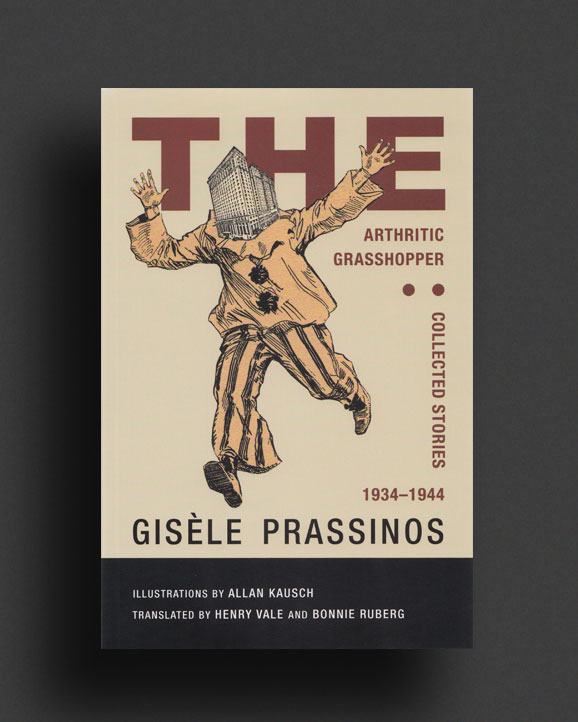
First discovered, celebrated, and published at the age of fourteen by the Surrealists (who declared her to be the “new Alice”), Gisèle Prassinos quickly established herself in the literary world as a fount of automatic tales woven through with transgressive humor, coy menace, and a pervading sense of threatened feminine identity within a hostile world. “Gisèle Prassinos’s tone is unique,” claimed André Breton, “all the poets are jealous of it. Swift lowers his eyes, Sade shuts his candy box.” The Arthritic Grasshopper: Collected Stories, 1934–1944 gathers together an assortment of anxious dream tales drawn from literary journals and plaquettes, introduced and illustrated by such admirers as Paul Éluard, Man Ray, and Hans Bellmer. These 72 stories include such longer, novella-length narratives as “Sondue,” “The Executioner,” and “The Dream.”
“She offers all comers a pure moment in exchange for centuries of boredom.”—Paul Éluard
Gisèle Prassinos (1920–2015) was born in Istanbul of a Greek father and an Italian mother. At the age of thirteen she began to compose short absurdist vignettes in a fit of boredom, filling up pages with tales of sarcastic stains, arrogant hair, liquid frogs, and blue spiders. Encouraged by her brother, who introduced her and her experiments in automatic writing to his Surrealist colleagues, she immediately found herself welcomed into the Parisian avant-garde community and her stories were published in all the significant literary journals of the time. Her first collection was published in 1935, with a preface by Paul Éluard and a frontispiece portrait by Man Ray. With World War II, Prassinos stopped publishing and began to distance herself from the Surrealists and the limitations imposed by her writing being so closely bound to the idea of automatism in its purest, “childhood” form. Writing nothing from 1944 to 1954, she then returned to literature with a series of novels and stories that, if still imbued with a Surrealist sensibility, pointed to a new direction in her writing.
Translated by Henry Vale and Bonnie Ruberg, with an introduction by Bonnie Ruberg
Illustrations by Allan Kausch
1989, English
Softcover, 96 pages, 31 x 28 cm
1st Edition, Out of print title / used / very good
Published by
Archives Szukalski / California
$500.00 - In stock -
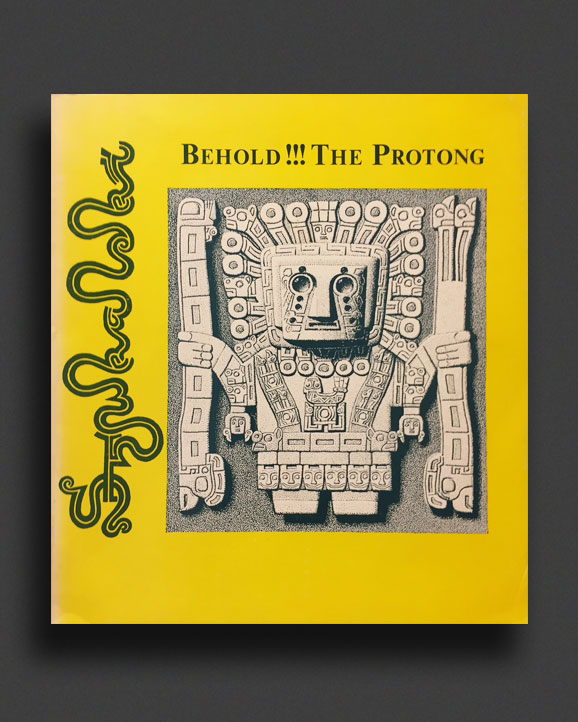
Extremely scarce first edition of the mighty "Behold!!! The Protong" by Stanislaw Szukalski, privately published in 1989 in this over-sized format by Archives Szukalski and edited by publisher Glenn Bray and Lena Zwalve.
Stanisław Szukalski (1893–1987) was a Polish-born sculptor, writer, graphic artist, and heretic. Highly regarded in both Poland and the US between the World Wars, becoming part of the Chicago Renaissance, he lapsed into obscurity, living and working in “America’s Cultural Siberia” (Southern California) until comic art collector Glenn Bray rediscovered him in 1973. For forty years, Szukalski had developed his all-encompassing science “Zermatism” about the origin of Man, laid down in 39 heavily illustrated volumes with subjects such as “Universal Pictography,” “The Flood Scumline,” and “Anthropolitical Motivations.” The work sets out to prove, among much else, that “Man-apes” make bad politicians, and that all Humanity stemmed from Easter Island, sharing a common protolanguage, “Protong” (bearing a striking resemblance to present-day Polish).
A classic and collectable Szukalski title (re-printed multiple times since this first edition), Behold!!! The Protong presents a selection from over 40,000 drawings in the Zermatism oeuvre, partially reprinted from "Troughful of Pearls; Behold!!! the Protong" which was first published in 1980 and now also highly collectible.
Good-Very Good copy.
2018, English
Hardback, 256 pages, 20.9 x 29.9 cm
Published by
Art Institute of Chicago
$110.00 - Out of stock
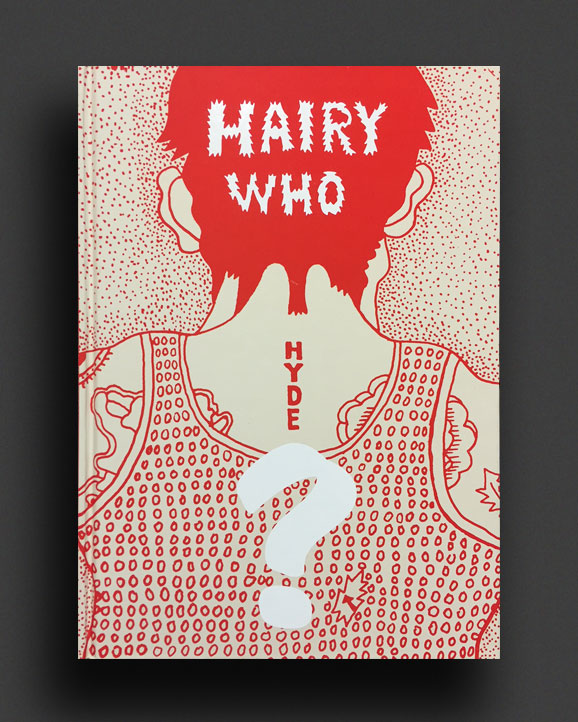
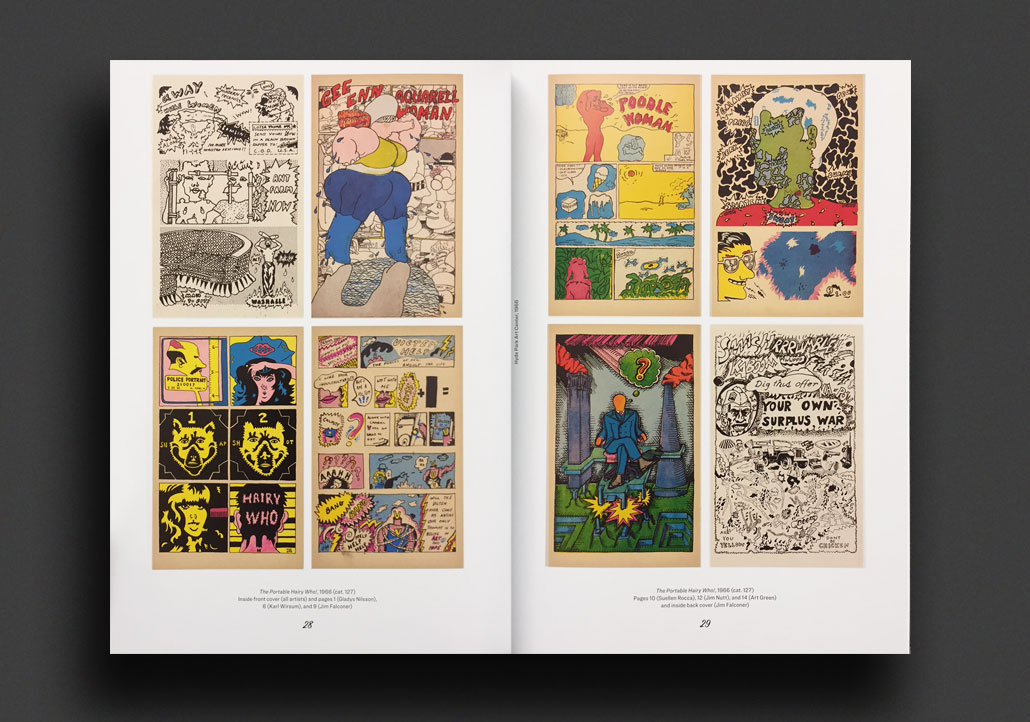
This generously illustrated catalogue explores the history and significance of the Hairy Who, a group of six Chicago artists who transformed imagery from popular culture into highly personal works of art in a variety of media. New scholarship based on documentary materials—including exhibition checklists, installation views, and artist-made ephemera—reconstructs the group’s six exhibitions, held between 1966 and 1969, and offers a reassessment of the Hairy Who’s idiosyncratic place within the cultural and political context of its time and place.
Insightful essays examine the distinctive features of the Hairy Who’s art and collaboration, explain how the group’s work diverges from contemporaneous movements such as Pop and Funk, and provide biographical information on the artists themselves. Contributions from acclaimed contemporary artists Richard Hull and Laura Owens reflect on the Hairy Who’s sources and influence, exploring how the group remains relevant in today’s art world in significant and unexpected ways.
Edited by Thea Liberty Nichols, Mark Pascale, and Ann Goldstein; With contributions by Tyler Blackwell, Ann Goldstein, Richard Hull, Lydia Mullen, Thea Liberty Nichols, Laura Owens, Mark Pascale, and Antonia Pocock
Thea Liberty Nichols is a researcher, Mark Pascale is Janet and Craig Duchossois Curator of Prints and Drawings, and Ann Goldstein is deputy director and chair and curator of modern and contemporary art, all at the Art Institute of Chicago.
2003, English
Softcover, 48 pages, 24 x 28 cm
1st Edition, Out of print title / used / very good
Published by
David Nolan Gallery / New York
$40.00 - Out of stock
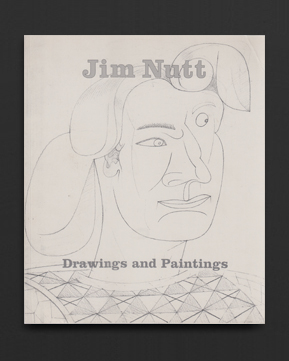
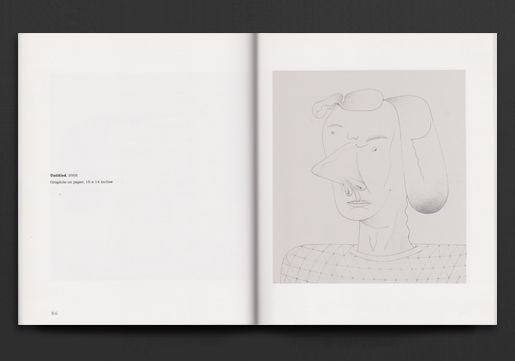
Catalogue published with the exhibition: Jim Nutt Drawings & Paintings - October 24 - November 26, 2003.
James T "Jim" Nutt (b. November 28, 1938) is an American artist who was a founding member of the Chicago surrealist art movement known as the Chicago Imagists, or the Hairy Who.
Edited by David Nolan
Conversation with Jim Nutt by Carroll Dunham
2019, English
Softcover, 248 pages, 12 x 19 cm
Published by
Sternberg Press / Berlin
$49.00 - Out of stock
In 1985, the philosopher Jean-François Lyotard curated “Les Immatériaux” at Centre Georges Pompidou. Though widely misunderstood at the time, the exhibition marked a “curatorial turn” in critical theory. Through its experimental layout and hybrid presentation of objects, technologies, and ideas, this pioneering exploration of virtuality reflected on the exhibition as a medium of communication, and anticipated a deeper engagement with immersive and digital space in both art and theory. In Spacing Philosophy, Daniel Birnbaum and Sven-Olov Wallenstein analyze the significance and logic of Lyotard’s exhibition while contextualizing it in the history of exhibition practices, the philosophical tradition, and Lyotard’s own work on aesthetics and phenomenology. “Les Immatériaux” can thus be seen as a culmination and materialization of a life’s work as well as a primer for the many thought-exhibitions produced in the following decades.
Curator, art critic and philosopher, director of the Städelschule in Frankfurt am Main and director of its Portikus Gallery until 2010, currently director of the Moderna Museet in Stockholm, Daniel Birnbaum is is also a member of the board of the Institut für Sozialforschung. A contributing editor of Artforum, he is the author of numerous texts on art and philosophy.
Sven-Olov Wallenstein is professor of Philosophy at Södertörn University. His areas of research include aesthetic theory, with a particular focus on visual arts and architecture, German Idealism, phenomenology, critical theory, and modern philosophies of desire, power, and subjectivity.
1996, English / Japanese
Softcover (w. clear plastic dust-jacket and original exhibition floor-map insert), 214 pages, 29.5 x 22.5 cm
1st Edition, Out of print title / used / very good
Published by
Hara Museum of Contemporary Art / Tokyo
$120.00 - Out of stock
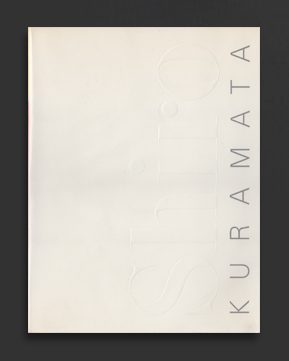
The great Japanese monograph/catalogue on Shiro Kuramata, one of Japan's most important designers of the 20th century, published to accompany the major survey exhibition held at Hara Museum of Contemporary Art Tokyo in 1996. Kuramata translated workaday industrial materials -wire steel mesh, corrugated aluminium, lucite-into poetic objects and interiors. In original plastic wrap sleeve and embossed covers, this lavishly illustrated book presents stunning photographic documentation of his furniture, glassware, interiors, lighting, and architecture (including his incredible boutique interiors for fashion designer Issey Miyake, and his work as a key member of Italian design group Memphis, which he joined at its founding in 1981). This book is certainly one of the finest volumes ever published on Kuramata. Features complete history of works plus text by Japanese architect, Arata Isozaki. This copy includes the exhibition guide/map illustrated by Kuramata himself, along with other printed ephemera.
Very Good - Fine copy.
1979, English
Softcover (staple-bound), 52 pages, 30 x 21 cm
1st Edition, Out of print title / used / very good
Published by
Working Papers on Photography (WOPOP) / Melbourne
$45.00 $30.00 - In stock -
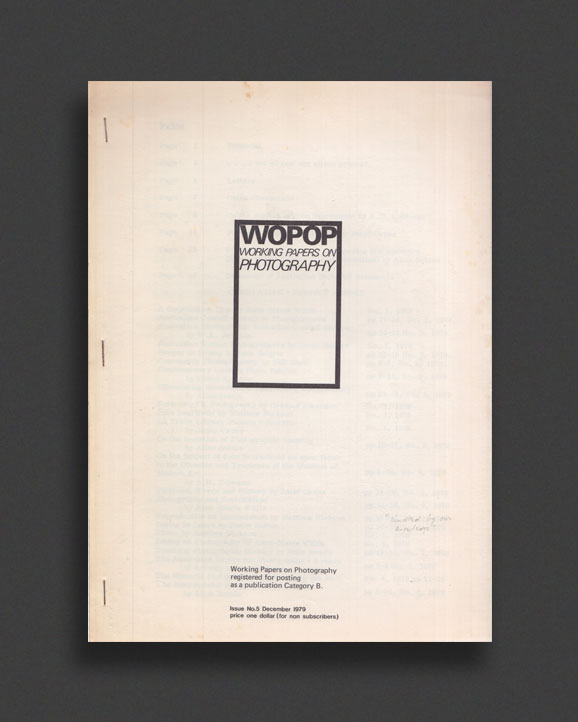
Scarce issue of Melbourne photography journal, WOPOP : Working Papers on Photography, founded in Melbourne in 1978 by Euan McGillivray, the Curator of Photography at the Science Museum of Victoria, and Matthew Nickson, from the Photography Department at RMIT. The irregular journal encouraged critical discussion of photography by a new generation of artists and critics.
This issue (WOPOP Issue No.5 December 1979) includes: Editorial by Euan McGillivray and Matthew Nickson; "...A Not So New Non Silver Process" by the Editors; "China Cheesecake"; "On the Subject of John Szarkowski" by A.D. Coleman; "Pictures, Words and History" by Jozef Gross; "Dismantling Modernism, Reinventing Documentary (Notes on the Politics of representation)" by Allan Sekula; Directory of Australian Pictorial Resources, and more.
Very Good copy. Very light toning, spotting, wear with age.
1978, English
Softcover (staple-bound), 44 pages, 34 x 20.5 cm
1st Edition, Out of print title / used / good
Published by
Working Papers on Photography (WOPOP) / Melbourne
$45.00 - Out of stock
Scarce issue of Melbourne photography journal, WOPOP : Working Papers on Photography, founded in Melbourne in 1978 by Euan McGillivray, the Curator of Photography at the Science Museum of Victoria, and Matthew Nickson, from the Photography Department at RMIT. The irregular journal encouraged critical discussion of photography by a new generation of artists and critics.
This issue (WOPOP Issue No.1 1978) includes: Editorial by Euan McGillivray and Matthew Nickson; "John Heartfield" by Matthew Nickson; "Futurology & Photography" by Graeme Johanson (Latrobe Library, State Library of Victoria); "LaTrobe Library Picture Collection" by Jenny Carew (acting Picture Librarian, Latrobe Library, State Library of Victoria); "Sontag on Photography" by Ann-Marie Willis; "Silver" by Matthew Nickson; "A Constitution Lost" by Ann-Marie Willis; "Australian Women Photographers" by Jenni Mather.
Good copy. Some toning, spotting, wear with age.
1979, English
Softcover, 86 pages, 18 x 10.5 cm
Out of print title / used / good
Published by
Vintage Books / New York
$18.00 - Out of stock
In 1978 Susan Sontag wrote Illness as Metaphor, a classic work described by Newsweek as "one of the most liberating books of its time." This is Sontag's penetrating analysis of the social attitudes toward various major illnesses - chiefly TB and cancer, and its symbolic use as a romantic tool in writing. A cancer patient herself when she was writing the book, Sontag shows how the metaphors and myths surrounding certain illnesses, especially cancer, add greatly to the suffering of patients and often inhibit them from seeking proper treatment. By demystifying the fantasies surrounding cancer, Sontag shows cancer for what it is--just a disease. Cancer, she argues, is not a curse, not a punishment, certainly not an embarrassment and, it is highly curable, if good treatment is followed. Illness as Metaphor has been translated into many languages and continues to have an enormous influence on the thinking of medical professionals and, above all, on the lives of many thousands of patients and caregivers.
1980, English
Hardcover, 156 pages, 22.5 x 23.5 cm
Out of print title / used / fine
Published by
MoMA / New York
$45.00 - Out of stock
1980 hardcover edition of The Photographer's Eye by John Szarkowski, a twentieth-century classic and an indispensable introduction to the visual language of photography. Based on a landmark exhibition at The Museum of Modern Art in 1964, and originally published in 1966, the book has long been out of print. This also out of print 1980 edition reproduces the beautiful duotone printing that closely follows the original edition. Szarkowski's compact text eloquently complements skilfully selected and sequenced groupings of 172 photographs drawn from the entire history and range of the medium. Celebrated works by such masters as Cartier-Bresson, Evans, Steichen, Strand, and Weston are juxtaposed with vernacular documents and even amateur snapshots to analyze the fundamental challenges and opportunities that all photographers have faced. Szarkowski, the legendary curator who worked at the Museum from 1962 to 1991, has published many influential books. But none more radically and succinctly demonstrates why--as U.S. News & World Report put it in 1990--"whether Americans know it or not," his thinking about photography "has become our thinking about photography."
Features the work of Lee Friedlander, Edward Weston, Elliott Erwitt, Robert Frank, Richard Avedon, Henri Lartigue, Otto Steinert, Paul Strand, Walker Evans, Garry Winograd, Minor White, Dorothea Lange, Mario Giacomelli, Henri Cartier-Bresson, Danny Lyon, Manuel Alvarez-Bravo, Eugène Atget, William Klein, René Groebli, Bill Brandt, Brassaï, Robert Frank, André Kertész, Herbert List, László Moholy-Nagy, Irving Penn, and many more.
1967, French
Softcover, 60 pages, 26 x 18 cm
1st Edition, Out of print title / used / very good
Published by
Musée des Arts Decoratifs / Paris
$80.00 - Out of stock
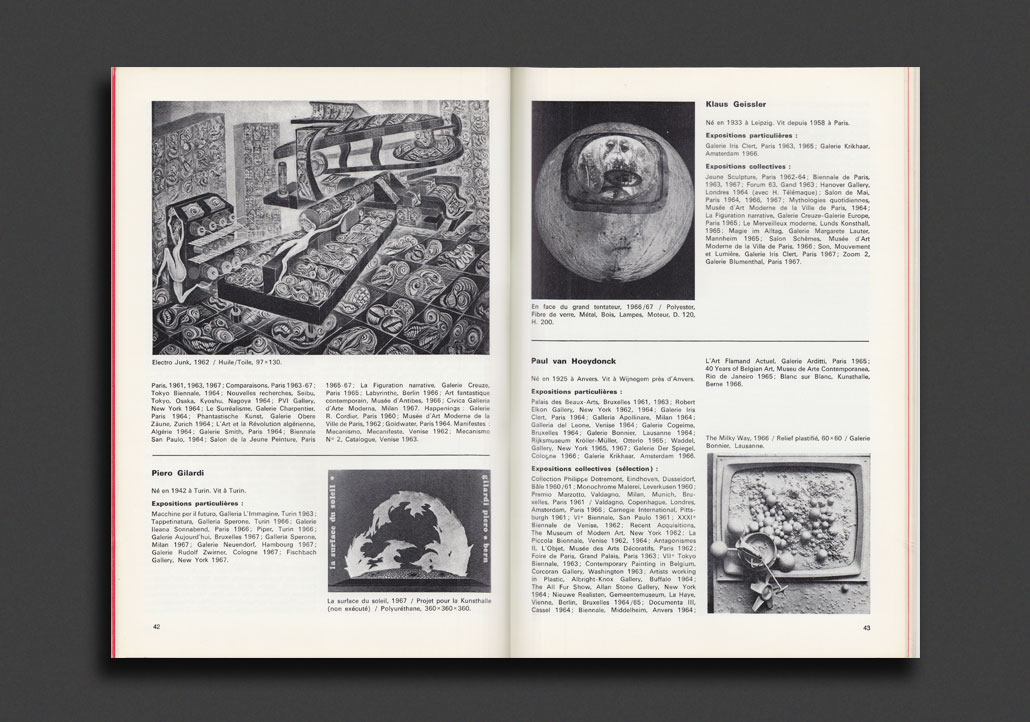
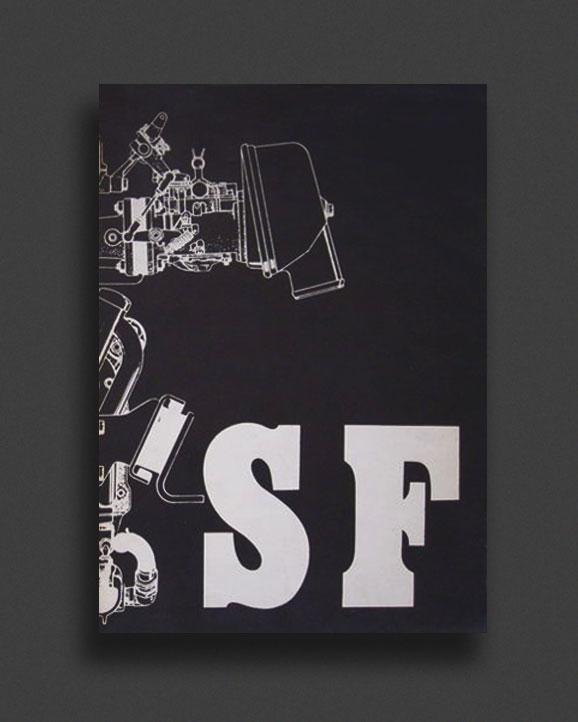
First edition of the iconic catalogue for the legendary Science-Fiction exhibition, curated by Harald Szeemann and presented as a touring show at Kunsthalle Bern, Musée des arts décoratifs Paris, and Städtische Kunsthalle Düsseldorf, 1967-1968. In the fashion of Szeemann's exhibition-making, Science-Fiction attracted record numbers of visitors whilst triggering controversial debate in the press. In institutions dedicated to the showcasing of contemporary art, Szeemann ventured to compile the unbelievable amount of around 3,000 objects from sociology, technology, science, art, comics, journalism, and literature, around the theme of Science-Fiction. The exhibits were presented in the show ordered in segments: modern spaceflight, art, film, literature, robots, UFOs, humour, toys, comics, as well as science fiction in the real world. Catalogue includes the work of Martial Raysse, Tetsumi Kudo, Roy Lichtenstein, Liliane Lijn, Robert Malaval, H. W. Muller, Bernard Rancillac, Markus Ratz, Shinkichi Tajiri, Edmund Alleyn, Piero Gilardi, Klaus Geissler, Paul van Hoeydonck, Piotr Kowalski, Yaacov Agam, Erró, Takis, Antonio Dias, Frank Franzetta, Guido Crepax, Wally Wood, Giovanni Scolari, Jean-Claude Forest, Al Williamson, and many more. Texts by Pierre Versins, Jacques Sadoul, Demètre Iokimidis, etc. in French. Includes the fold-out "Tableau chronologique de la S.F." compiled by French Science Fiction collector and scholar Pierre Versins.
Very Good copy.
1967, Dutch / English
Softcover (staple-bound), 14 pages, 29.5 × 21.5 cm
1st Edition, Out of print title / used / good
Published by
Kultureel Centrum / Venlo
$40.00 - Out of stock
Catalogue published in 1967 to accompany the international exhibition of S-F at Kultureel Centrum Venlo, 26 August - 25 September, 1967. Organised by Lei Alberigs, this high-profile exhibition presented the work of Shinkichi Tajiri and Ferdi Tajiri, Frans Zwartjes, Thomas Attridge, Karl Kleimann, Frans Peeters, Jan Slothouber, Willem Graatsma, Isamu Kanamori, Carl Mangus, Erhard Wehrmann and Robert Berlind. Illustrated throughout in b/w with works by all artists and text by Sylvia Nicolas (in Dutch).
Good with tanning to spine and some creasing to spine.
2016, English / Turkish
Hardcover (w. spiral binding), 280 pages, 26 x 22 cm
1st Edition, Out of print title / used / good
Published by
Walther König / Köln
$70.00 - Out of stock
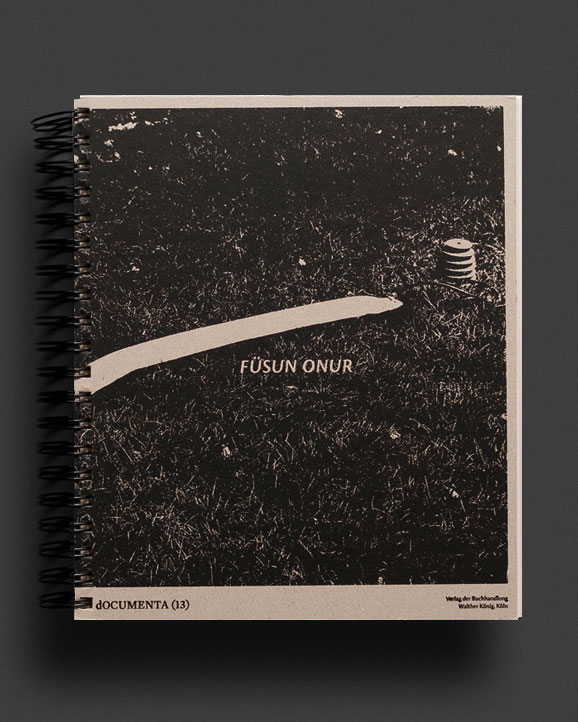
First edition of this quickly out-of-print, stunning spiral-bound, scrapbook-style hardcover book presenting the half-century artistic developments of Turkish sculptor Füsun Onur (born 1938), handled with a unique perspective and surprising privacy. It reproduces more than 200 pages of documentation from the artist’s own personal archive of photo albums and sketchbooks, tracing in detail her elegant and playful works, taken in interesting places such as the Bosporus banks or in domestic environments, as well as many exhibition installations, invitations, and other documents around her artistic career. This subjective story is accompanied by the chronology of art historian Burcu Pelvanoğlu, who provides a comprehensive overview of Füsun Onur's career. Using everyday materials in her painting and sculpture to reflect on space, time, rhythm and form, Onur’s sculptures range from minimalist abstraction to assemblage incorporating furniture and fabric.
Published on the occasion of Onur’s inclusion in dOCUMENTA (13) this heavy monograph also includes a preface by Carolyn Christov-Bakargiev, text by Defne Ayas, and a rare interview with Füsun Onur with Carolyn Christov-Bakargiev and Hans Ulrich Obrist.
Very Good with bumping to two corners. Otherwise as new.
1971, English
Hardcover, 82 pages, 29 x 21 cm
1st Edition, Out of print title / used / good
Published by
Thomas Nelson / Melbourne
$100.00 - Out of stock
First hardcover edition of this Australian photo-book classic. In 1971, photographer Rennie Ellis and co-photographer and close friend, Wesley Stacey, published Kings Cross Sydney, which, as Ellis puts it "examines the surface glitter and underground guts of the Cross". An intimate look at the height of Kings Cross, before gentrification and controversial lock-out laws had their way with it. Illustrated throughout with black and white and colour photographs alongside quotes and stories from/about local residents (inc. the "Witch of Kings Cross", Rosaleen Norton), workers, businesses, controversies, and politics of Kings Cross. Colloquially known as The Cross, The Kings Cross district was Sydney's bohemian heartland from the early decades of the 20th century, known for its music halls and grand theatres and home to a large number of artists, writers, poets and journalists. From the 1960s onwards Kings Cross came to serve as the city's red-light district and entertainment mecca.
"Between the time when work was begun on this book and its appearance in the shops, Kings Cross has continued in its haphazard state of flux. The park at the El Alamein Fountain has been paved, the 'full
reveal' has become standard in the strip clubs, several night spots have gone out of existence and others
have opened in their places, Rose the Flower Seller has died, as have Tilly Devine, Chips Rafferty and
Kenneth Slessor, Sammy Lee has grown a moustache, and many more old buildings have crumbled under
the wreckers' hammers. Yet, the book remains a valid statement about the changing society it reflects because its images freeze moments in time that will forever remain symbols of the unusual character of the Cross. With their cameras Rennie Ellis and Wesley Stacey have penetrated the slick veneer of life at Kings Cross and revealed the beauty and the pathos, as well as the seaminess, which lurk beneath the tinsel glitter. The affinity which the authors feel for the place, the people, and their attitudes, has resulted in
an honest appraisal which may sadden, amuse, shock or repel, but never fair to intrigue those who read or look at the book."
"Over a period of six months the authors made frequent forays into the Cross armed with their cameras
and tape recorder. It was only by becoming known to the locals that they were able to record some of
the remarkable scenes in this book. Nevertheless, there is much that they learned about the Cross
which can only be hinted The laws of libel and the threats of bashings ensure a diplomatic silence. As
one of the authors put it: 'When a guy pulls a pistol on you and says that he's going to shoot you, you know
that it's time to put away your camera and retire gracefully.'"
Good copy with some edge wear and light spotting.
2019, English
Softcover, 224 pages, 14 x 20 cm
Published by
Wakefield Press / Cambridge
$34.00 - Out of stock
In a Yiddish take on Notes from Underground, a dark, expressionist love affair develops in a large, unnamed Eastern European city between the young, impoverished, and violently self-loathing teacher, Shloyme—and a hungry, spiteful, and unsettlingly sensual revolver. Purchased from a friend ostensibly to protect him from the pogroms sweeping the empire, the weapon instead opens a portal to Shloyme’s innermost demons, and through it he begins his methodical mission to eradicate any remnants of life and humanity in him and pave the way for his self-destruction. A Death takes the form of a diary that follows the Jewish calendar, describing hallucinatory demons and parasitical urges as its author spends his remaining days excising all his responsibilities and acquaintances from a life now devoted to not living.
Written in Yiddish in 1905 and published with immediate success in Warsaw in 1909, A Death utilizes the influences of Dostoyevsky and Schopenhauer to depict a distinctly Jewish experience of homelessness and uprooted modernity. Zalman Shneour’s short novel presents a much lesser-known strand of Jewish decadent literature and an authorial voice that has been buried for too long. This introduction of Shneour’s inaugural novel is his first appearance in English since 1963. Its exploration of alienation, mental health, toxic masculinity, and violence is remarkably contemporary.
Born in Shklow, Zalman Shneour (1887–1959) was a major figure of Jewish modernity and one of the most popular Yiddish writer between the World Wars. He wrote poetry, prose, and plays in both Yiddish and Hebrew. Like many of his generation, his life was spent moving from city to city in search of literary community or escaping political turmoil: from Odessa to Warsaw to Vilne, and on to such Western cities as Bern, Geneva, Berlin, Paris, New York (where he died), and Tel Aviv (where he is buried). His psychological fiction brought the insights of Nietzsche and Freud into the narrative world of Eastern European Jewish life.
Introduction by Daniel Kennedy
“Atmosphere abounds in this short, bleak novel. Its narrator’s descriptions hew toward the grotesque, which heightens the stylization of the work. His sublime indifference toward the world around him makes for some chilling passages...” —Tobias Carroll, Words Without Borders
2019, English
Hardcover, 210 pages, 24 x 24 cm
Published by
M.33 / Melbourne
$70.00 - Out of stock
Suburban Baroque brings together a selection of David Wadelton’s photographs of the vanishing mid-century suburban interiors of the formerly working-class northern areas that were the destination of choice for many post-war immigrants from Europe. The once-ubiquitous terrazzo, balustrades, marble columns and lions and other manifestations of pride and nostalgia for their homelands have become increasingly rare as the years pass, generations change, and gentrification takes place. The rooms are redolent of a different era and imbued with pathos, as most are the pride and joy of a generation that is passing. The decor speaks of post-war immigration in a fascinating time capsule, where one experiences a mix of local and imported; defying current design conventions. Often the owners proudly designed the rooms to suit their preferences and to impress their friends and neighbours back in the 1970s, and they have immaculately maintained them that way ever since. Includes an essay by Patrick Pound.
1992, English
Softcover, 70 pages, 30 x 24.5 cm
1st Edition, Out of print title / used / very good
Published by
Matthew Marks / New York
$200.00 - Out of stock
First collectable edition of Ellsworth Kelly's Plant Drawings, published in 1992 to accompany Kelly's first solo exhibition at Matthew Marks Gallery, Plant Drawings, New York that year. Long out of print and re-editioned multiple times, "Ellsworth Kelly: Plant Drawings" features 30 plates of drawings made by Kelly between 1960 and 1992, this edition with the text by John Ashbery. Kelly made these gorgeously economical line drawings from life, sometimes barely lifting the pencil as he translated each plant’s contours to paper. Focusing on direct visual impression—“nothing is changed or added,” as he put it—Kelly used the natural forms of the plants to explore some of his painterly fixations, like the effects of volume, negative space and overlapping planes. Despite the immediacy of their execution and their representational content, the most striking surprise of Kelly’s plant drawings is how much they share with his abstract paintings and sculptures.
Ellsworth Kelly was an American painter, sculptor, and printmaker associated with hard-edge painting, Color Field painting and minimalism. His works demonstrate unassuming techniques emphasizing line, color and form, similar to the work of John McLaughlin and Kenneth Noland. Kelly often employed bright colors. He lived and worked in Spencertown, New York.
Very Good copy with light edge wear/toning.
2019, English
Softcover, 408 pages , 11.4 x 19 cm
Published by
Sternberg Press / Berlin
The MIT Press / Massachusetts
$68.00 - Out of stock
In Design by Accident, Alexandra Midal declares the autonomy of design, in and on its own terms. This meticulously researched work proposes not only a counterhistory but a new historiography of design, shedding light on overlooked historical landmarks and figures while reevaluating the legacies of design's established luminaries from the nineteenth century to the present. Midal rejects both linear narratives of progress and the long-held perception of design as a footnote to the histories of fine art and architecture. By weaving critical analysis of the canon of design history and theory together, with special attention to the writings of designers themselves, she draws out the nuances and radical potentials of the discipline—from William Morris's ambivalence toward industry, to Catharine Beecher's proto-feminist household appliances, to the Bauhaus's Expressionist origins, and the influence of Herbert Marcuse on Joe Colombo.
Preface by Michelle Millar Fisher
Foreword by Paola Antonelli
2009, English
Softcover, 112 pages (w. leporello foldout), 34.5 x 24.5 cm
1st Edition, Out of print title / as new
Published by
Dexter Sinister / New York
Roma / Amsterdam
$100.00 - In stock -
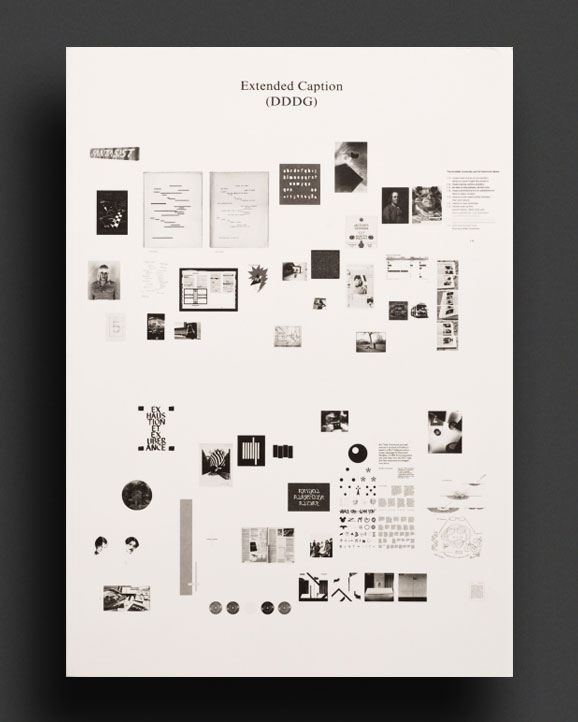
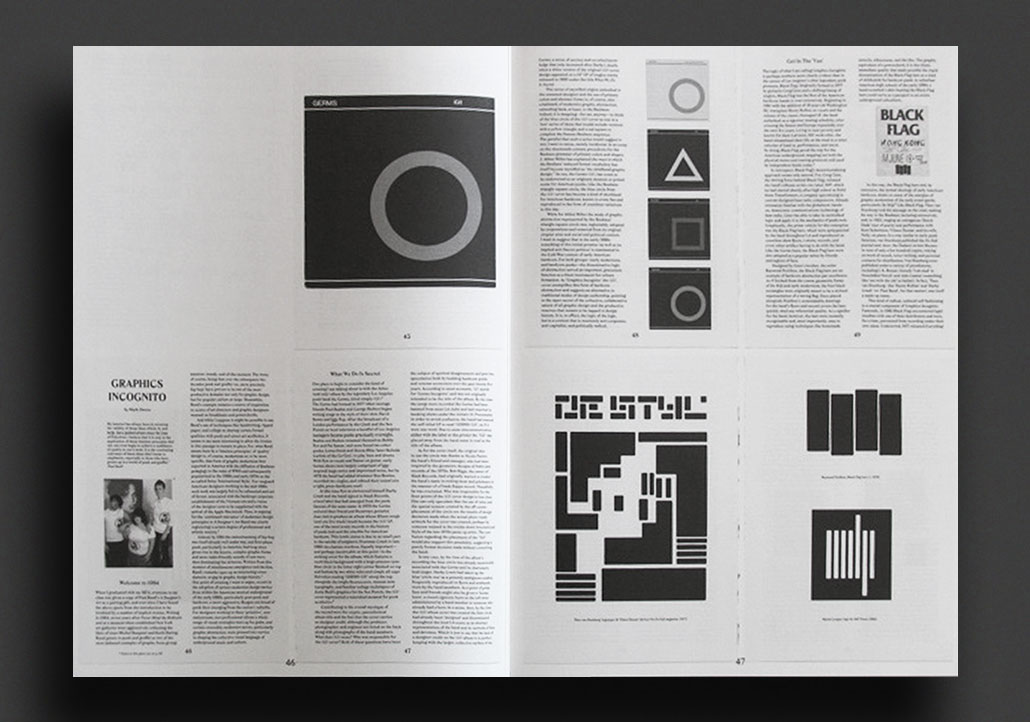
The long out-of-print, over-sized Dot Dot Dot compendium catalogue, published on the occasion of an exhibition in Culturgest, Porto. This exhibit provided the seventh occasion for Stuart Bailey to show a group of artefacts whose only shared connection was that they had appeared somewhere in the pages of Dot Dot Dot - a magazine which he has edited since its conception in 2000. The publication plays with the idea of inverting the regular hierarchy of this magazine where texts are generally treated as primary and images secondary. It contains a leporello reproduction of the exhibition wall with all the 43 artefacts, followed by subsequent reproductions of 43 previously published Dot Dot Dot articles, systematically presented as captions of these artefacts.
With texts by Stuart Bailey and Jan Verwoert.
Design: Roger Willems and Sam de Groot.
As New copy.
2006, English
Softcover, 375 pages, 35 x 25.5 cm
1st Edition, Out of print title / used / fine
Published by
CAPC / Bordeaux
Sculpture Centre / New York
$160.00 - Out of stock
Over-sized, long out-of-print Grey Flags catalogue edited by Bettina Funcke, published in conjunction with the exhibition of the same name curated by Anthony Huberman and Paul Pfeiffer. Comprised of nineteen artists with significant individual differences, Grey Flags assembles a group of works that not only resist categorical branding, but also go on in different ways to challenge the very terms of the "arts-apparatus." The exhibition featured the work of John Armleder, Lutz Bacher, Helen Chadwick, Tacita Dean, Claire Fontaine, Liam Gillick, Piero Golia, Michael Krebber, Jonathan Monk, Gabriel Orozco, The Atlas Group / Walid Raad, Allen Ruppersberg, Seth Price, Wilhelm Sasnal, Karin Schneider, Shirana Shahbazi, Kelley Walker, Apichatpong Weerasethakul, Mario Ybarra Jr. and the 375 page exhibition catalogue compiled a sort-of reader/scrap book of bootlegged pages from other catalogues and zines, artworks, text excerpts etc. contributed by all involved. A unique and fascinating catalogue.
"When you stop talking and doing, and close your eyes, what comes to mind? Voices? Images? Feelings? Like landscape seen from a plane, these phenomena hover on a sublime verge between fascinating and boring. Well, that might be true of anything viewed from a distance: the stars, the sea, mountains, the horizon. And what of social phenomena? Same. On any forgotten record, it's in the filler songs that you find the blank, thoughtless strivings laid bare, production patterns of another day, secrets of the ornaments. [...]" - Seth Price
Fine copy, with light shelf wear.