World Food Books' programme is largely produced on Kulin Nation land. We acknowledge the Wurundjeri people of the Kulin Nation as the first and continuing custodians of this land, and pay respect to their Elders past, present, and emerging.
World Food Books is an arts and special interests bookshop in Naarm / Melbourne. Founded in 2010, World Food Books is devoted to the presentation of a rotating, hand-selection of international art, design, literary and counterculture publications with an emphasis on the anti-traditional, the experimental, the avant-garde, the heretic, the marginal.
Presenting new titles alongside rare and out-of-print books, catalogues and journals spanning the fields of modern and contemporary art, design, photography, illustration, film, literature, poetry, cultural theory, philosophy, sexuality, popular and underground culture in its many radical forms, World Food Books wishes to encourage adventurous, thoughtful and open-minded reading, looking, writing, and exchange of publishing and ideas, both current and historical.
As well as our bookshop, located in Melbourne's historical Nicholas Building, all of our inventory is available internationally via our online mail-order service.
World Food Books semi-regularly co-ordinates "Occasions", a programme of exhibits and events at the bookshop and in partnership with other hosts (such as museums and art galleries) that develop out of the activities, relationships and content of the bookshop itself.
World Food Books
The Nicholas Building
37 Swanston Street
Room 5, Level 6
Melbourne 3000
Australia
SHOP HOURS:
Thu–Fri 12–6, Sat 12–5
WEB-SHOP OPEN 24/7
World Food Books
Postal Address:
PO Box 435
Flinders Lane
Victoria 8009
Australia
Art
Theory / Essay
Architecture / Interior
Graphic Design / Typography
Photography
Fashion
Eros
LGBTQ+
Fiction / Poetry
Weird / Speculative / Science Fiction / Horror
Transgressive / Visceral / Abject
Symbolism / Decadence / Fin de siècle
Film / Video
Painting
Sculpture / Installation
Performance / Dance / Theater
Drawing
Sound / Music
Curatorial
Group Shows / Collections
Periodicals
Out-of-print / Rare
Posters / Ephemera / Discs
Signed Books
World Food Books Gift Voucher
World Food Book Bag
Australian Art
Australian Fiction
Australian Science Fiction / Speculative Fiction
Australian Poetry
Australian Photography
Japanese Photography
Conceptual Art
Minimal Art
Dada
'Pataphysics / Oulipo
Fluxus
Concrete Poetry
Pop Art
Surrealism
Arte Povera
Arte Informale / Haute Pâte / Tachism
Nouveau Réalisme / Zero / Kinetic
Situationism / Lettrism
Collage / Mail Art / Xerox Art
Art Brut / Folk / Visionary / Fantastic
Illustration / Graphic Art / Bandes Dessinées
Furniture
Italian Radical Design / Postmodernism
Textiles
Ceramics / Glass
Counterculture
Protest / Revolt
Philosophy
Psychoanalysis
Anthropology
Anarchism
Socialism / Anarchism / Communism / Capitalism
Literary Theory / Semiotics / Language
Feminism / Women's Studies
Gender Studies / Sexuality
Anthropology
Fetishism / BDSM
Drugs / Psychedelia
Crime / Violence
Animal Rights / Veganism
Occult / Esoterica
Ecology / Earth / Alternative Living
Whole Earth / Crafts
All prices in AUD (Australian dollars)
Pick-Ups
Pick-up orders can be collected in our bookshop during opening hours after order date. Please collect any Pick-up orders within 2 weeks of ordering as we have limited storage space. Orders will be released back into stock if not collected within this time. No refunds can be made for pick-ups left un-collected. If you cannot make it in to the bookshop in this time-frame, please choose postage option.
Return Policy
All sales are final. We do accept returns (for refund or exchange) for items received in error. All our orders are packed with special care using heavy-duty padding and cardboard book-mailers or bubble mailers (for smaller books), using reinforcement where required. We cannot take responsibility for any lost, stolen or damaged parcels.
Insurance
Should you wish to insure your package, please email us directly after placing your order and we can organise this at a small extra expense. Although all standard/express tracked packages are very safe and dependable, we cannot take responsibility for any lost, stolen or damaged parcels. We recommend insurance on valuable orders.
Interested in selling your old books, catalogues, journals, magazines, comics, fanzines, ephemera? We are always looking for interesting, unusual and out-of-print books to buy. We only buy books in our fields of interest and specialty, and that we feel we can resell.
We base these prices on desirability, market value, in-print prices, condition and our current stock levels. We offer cash, store credit, and can take stock on consignment. All
about 25% of the price we expect to get when we sell them, or 30% in store credit. We base these prices on desirability, market value, in-print prices, condition and our current stock levels.
Sell your books any day of the week. You can drop them off and return later. If you have a lot of books, we can visit your Sydney home.
We buy books that we feel we can resell. We offer about 25 % of the price we expect to get when we sell them, or 30% in store credit. We base these prices on desirability, market value, in-print prices, condition and our current stock levels.
Philadelphia Wireman
03 August - 01 September, 2018
World Food Books is proud to announce our next Occasion, the first presentation of sculptures by Philadelphia Wireman in Australia.
The Philadelphia Wireman sculptures were found abandoned in an alley off Philadelphia’s South Street on trash night in 1982. Their discovery in a rapidly-changing neighbourhood undergoing extensive renovation, compounded with the failure of all attempts to locate the artist, suggests that the works may have been discarded after the maker’s death. Dubbed the "Philadelphia Wireman" during the first exhibition of this work, in 1985, the maker’s name, age, ethnicity, and even gender remain uncertain. The entire collection totals approximately 1200 pieces, all intricately bound together with tightly-wound heavy-gauge wire (along with a few small, abstract marker drawings, reminiscent both of Mark Tobey and J.B. Murry). The dense construction of the work, despite a modest range of scale and materials, is singularly obsessive and disciplined in design: a wire armature or exoskeleton firmly binds a bricolage of found objects including plastic, glass, food packaging, umbrella parts, tape, rubber, batteries, pens, leather, reflectors, nuts and bolts, nails, foil, coins, toys, watches, eyeglasses, tools, and jewellery.
Heavy with associations—anthropomorphic, zoomorphic, and socio-cultural responses to wrapped detritus—the totemic sculptures by Philadelphia Wireman have been discussed in the context of work created to fulfil the shamanistic needs of alternative religions in American culture. Curators, collectors, and critics have variously compared certain pieces to sculpture from Classical antiquity, Native American medicine bundles, African-American memory jugs, and African fetish objects. Reflecting the artist’s prolific and incredibly focused scavenging impulse, and despite—or perhaps enhanced by—their anonymity, these enigmatic objects function as urban artefacts and arbiters of power, though their origin and purpose is unknown. Philadelphia Wireman, whatever their identity, possessed an astonishing ability to isolate and communicate the concepts of power and energy through the selection and transformation of ordinary materials. Over the course of the past two decades, this collection has come to be regarded as an important discovery in the field of self-taught art and vernacular art.
Presented in collaboration with Fleisher-Ollman Gallery, Philadelphia, and Robert Heald, Wellington.
Susan Te Kahurangi King
02 February - 10 March, 2018
Susan Te Kahurangi King (24 February 1951 - ) has been a confident and prolific artist since she was a young child, drawing with readily available materials - pencils, ballpoint pens and felt-tip markers, on whatever paper is at hand. Between the ages of four and six Susan slowly ceased verbal communication. Her grandparents William and Myrtle Murphy had developed a special bond with Susan so they took on caring responsibilities for extended periods. Myrtle began informally archiving her work, carefully collecting and storing the drawings and compiling scrapbooks. No drawing was insignificant; every scrap of paper was kept. The King family are now the custodians of a vast collection containing over 7000 individual works, from tiny scraps of paper through to 5 meter long rolls.
The scrapbooks and diaries reveal Myrtle to be a woman of great patience and compassion, seeking to understand a child who was not always behaving as expected. She encouraged Susan to be observant, to explore her environment and absorb all the sights and sounds. Myrtle would show Susan’s drawings to friends and people in her community that she had dealings with, such as shopkeepers and postal workers, but this was not simply a case of a grandmother’s bias. She recognised that Susan had developed a sophisticated and unique visual language and sincerely believed that her art deserved serious attention.
This was an unorthodox attitude for the time. To provide some context, Jean Dubuffet coined the term Art Brut in 1945 to describe work created by self-taught artists – specifically residents of psychiatric institutions and those he considered to be visionaries or eccentrics. In 1972 Roger Cardinal extended this concept by adopting the term Outsider Art to describe work made by non-academically trained artists operating outside of mainstream art networks through choice or circumstance. Susan was born in Te Aroha, New Zealand in 1951, far from the artistic hubs of Paris and London that Dubuffet and Cardinal operated in. That Myrtle fêted Susan as a self-taught artist who deserved to be taken seriously shows how progressive her attitudes were.
Susan’s parents Doug and Dawn were also progressive. Over the years they had consulted numerous health practitioners about Susan’s condition, as the medical establishment could not provide an explanation as to why she had lapsed into silence. Dawn educated herself in the field of homeopathy and went on to treat all twelve of her children using these principles – basing prescriptions on her observations of their physical, mental and emotional state.
Doug was a linguist with an interest in philosophy who devoted what little spare time he had to studying Maori language and culture. To some extent their willingness to explore the fringes of the mainstream made them outsiders too but it was their commitment to living with integrity and their respect for individuality that ensured Susan’s creativity was always encouraged.
Even though Susan’s family supported her artistic pursuits, some staff in schools and hospitals saw it as an impediment to her assimilation into the community and discouraged it in a variety of ways. Her family was not always aware of this and therefore did not fully understand why Susan stopped drawing in the early 1990s. However, rather than dwell on the challenges that Susan faced in pursuit of her artistic practice, they prefer to highlight her achievements. In 2008 Susan began drawing again in earnest, after an almost 20 year interruption, and her work is now shown in galleries around the world.
Susan grew up without television and has been heavily influenced by the comics she read as a child. She is absolutely fearless in the appropriation of recognizable characters, such as Donald Duck and Mickey Mouse, in her work. She twists their limbs, contorts their faces, compresses them together, blends them into complex patterned backgrounds - always imbuing them with an incredible energy. Although Susan often used pop culture characters in her work they are not naive or childlike. These are drawings by a brilliant self-taught artist who has been creating exceptional work for decades without an audience in mind.
Mladen Stilinović
"Various Works 1986 - 1999"
02 February 16 - September 10, 2016
Various works 1986 - 1999, from two houses, from the collections of John Nixon, Sue Cramer, Kerrie Poliness, Peter Haffenden and Phoebe Haffenden.
Including: Geometry of Cakes (various shelves), 1993; Poor People’s Law (black and white plate), 1993; White Absence (glasses, ruler, set square, silver spoon, silver ladel with skin photograph and wooden cubes), 1990-1996; Exploitation of the Dead (grey and red star painting, wooden painting, black spoon with red table, red plate), 1984-1990; Money and Zeros (zero tie, paintings made for friends in Australia (Sue, John, Kerrie), numbers painting), 1991-1992; Words - Slogans (various t-shirts) - “they talk about the death of art...help! someone is trying to kill me”, “my sweet little lamb”, “work is a disease - Karl Marx”; Various artist books, catalogues, monographs, videos; Poster from exhibition Insulting Anarchy; "Circular" Croatian - Australian edition; Artist book by Vlado Martek (Dostoyevsky); more.
Thanks to Mladen Stilinović and Branka Stipančić.
Jonathan Walker
Always Will Need To Wear Winter Shirt Blue + Ochre Small Check Pattern
21 August - 21 September, 2015
Untitled
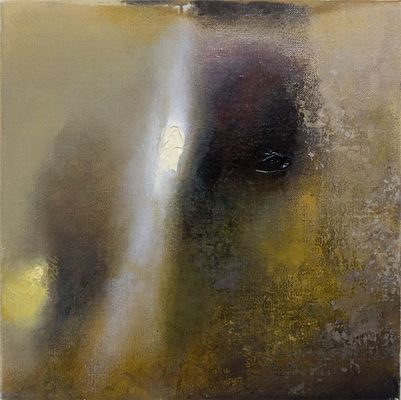
I am not a great reader of poetry but I always return to the work of Melbourne poet, Vincent Buckley (1925- 1988). Perhaps I find his most tantalising piece to be not a finished poem but a fragment left on a scrap of paper discovered on his desk after the poet’s death.
The poetry gathers like oil
In the word-core, and spreads
It has its music meet,
Its music is in movement.
This fragment is more the shell left behind from a volatile thought than a finished poem. I find the last two lines honest but awkward whereas the first two lines work like an arrow. Most likely he could not find a resolution so it was left. Still, in its present form, it remains an eloquent testimony to the ultimate failure of a medium to express mobile thought and sensation, in Buckley’s case, through verbal language. It’s an important matter because this is something all artists have to deal with regardless of the medium.
I have never written a poem, however, I am forever copying fragments from books on paper scraps in a vain effort to fix certain notions in my head. At first, they function as bookmarks that are sometimes returned to when I open the book. But before long, as they accumulate, they fall out littering the table interspersed with A4 photocopies, bills, books and medications.
To return to Buckley’s fragment, the first two lines very much evoke how I paint nowadays. As you age, detail diminishes and patches of light become more luminous and float. I feel the most honest way of dealing with this is by smearing the oil paint on the canvas with the fingers and working close-up, blind. Only if the patches coalesce into an approaching image can the work gain a life.
-
Jonathan Walker was born in Melbourne, Australia and brought up on a dairy farm in Gippsland. In the 1970’s he studied painting at RMIT and won the Harold Wright Scholarship to the British Museum, London. During the 1980’s he exhibited at Pinacotheca Gallery, Richmond and had work shown at the NGV and Heidi City Art Gallery. Over the same period he designed the cover for the “Epigenesi” LP by Giancarlo Toniutti, Italy and conducted a mail exchange work with Achim Wollscheid, Germany. The work with artists through the post resulted in an article published in the bicentenary issue of Art and Australia 1988. He showed in artist run spaces such as WestSpace in the 90’s and 2000’s, and until 2012, taught painting at Victoria University, which is where we (Colleen Ahern and Lisa Radford) as organisers of the exhibition, among many others, had the privilege of being his student.
Walker’s knowledge was imparted to students through the careful selection of music, literature, and artists found in books that he himself had ordered for the library. Walker’s strategy was the generosity of sharing his vast knowledge with references specific to each student and their context.
Walker’s paintings share a similar focus and intimacy.
This exhibition presents a small selection of recent paintings alongside a publication that includes Walker’s writing. Observational and analytical, Walker’s work is a type of material notation — the time of day, colour and how it is blended, the both specific and fleeting location of a reflection on lino or the question of whether a chair leg should be included in a painting.
Please join us on Friday August 21 between 6-8pm to celebrate the opening of the exhibition.
Curated by Colleen Ahern and Lisa Radford.
B. Wurtz
Curated by Nic Tammens
March 26 - April 4, 2015
B.Wurtz works from a basement studio in his home on Manhattan’s Lower East Side.
This local fact is attested to by the plastic shopping bags and newsprint circulars that appear in his work. As formal objects, they don’t make loud claims about their origins but nonetheless transmit street addresses and places of business from the bottom of this long thin island. Like plenty of artists, Wurtz is affected by what is local and what is consumed. His work is underpinned by this ethic. It often speaks from a neighborhood or reads like the contents of a hamper:
“BLACK PLUMS $1.29 lb.”
“Food Bazaar”
“USDA Whole Pork Shoulder Picnic 99c lb.”
“RITE AID Pharmacy, with us it’s personal.”
“H. Brickman & Sons.”
“Sweet Yams 59c lb."
Most of the work in this exhibition was made while the artist was in residence at Dieu Donne, a workshop dedicated to paper craft in Midtown. Here Wurtz fabricated assemblages with paper and objects that are relatively lightweight, with the intention that they would be easily transportable to Australia. This consideration isn’t absolute in Wurtz’s work, but was prescriptive for making the current exhibition light and cheap. Packed in two boxes, these works were sent from a USPS post office on the Lower East Side and delivered to North Melbourne by Australia Post.
Wurtz appears courtesy of Metro Pictures, New York.
Thanks to Rob Halverson, Joshua Petherick, Sari de Mallory, Matt Hinkley, Helen Johnson, Fayen d'Evie, Ask Kilmartin, Lisa Radon, Ellena Savage, Yale Union, and "Elizabeth".
John Nixon
"Archive"
December 15 - January 20, 2014
The presentation of John Nixon's archive offered a rare showcase of this extensive collection of the artist's own publications, catalogues, posters, ephemera, editions and more, from the mid 1980s onwards, alongside a selection of his artworks.
Organized by John Nixon, Joshua Petherick and Matt Hinkley.
<a href=http://wfb.public-office.info/artist/john-nixon>All titles by John Nixon
"Habitat"
at Minerva, Sydney (organised by Joshua Petherick and Matt Hinkley)
November 15 - December 20, 2014
Lupo Borgonovo, Janet Burchill & Jennifer McCamley,
Lewis Fidock, HR Giger, Piero Gilardi, Veit Laurent Kurz,
Cinzia Ruggeri, Michael E. Smith, Lucie Stahl, Daniel Weil, Wols
Press Release:
“...It contained seven objects. The slender fluted bone, surely formed for flight, surely from the wing of some large bird. Three archaic circuitboards, faced with mazes of gold. A smooth white sphere of baked clay. An age-blackened fragment of lace. A fingerlength segment of what she assumed was bone from a human wrist, grayish white, inset smoothly with the silicon shaft of a small instrument that must once have ridden flush with the surface of the skin - but the thing’s face was seared and blackened.”
William Gibson, “Count Zero”, 1986
"Autumn Projects Archive"
Curated by Liza Vasiliou
March 6 - March 15, 2014
World Food Books, in conjunction with the Virgin Australia Melbourne Fashion Festival 2014, presented the Autumn Projects archive, consisting of a selection of early examples in Australian fashion with a particular interest in collecting designers and labels from the period beginning in the 1980’s, who significantly influenced the discourse of Australian Fashion.
Curated by Liza Vasiliou, the exhibition provided a unique opportunity to view pieces by designers Anthea Crawford, Barbara Vandenberg, Geoff Liddell and labels CR Australia, Covers, Jag along with early experimental collage pieces by Prue Acton and Sally Browne’s ‘Fragments’ collection, suspended throughout the functioning World Food Books shop in Melbourne.
H.B. Peace
presented by CENTRE FOR STYLE
November 14, 2013
"Hey Blinky, you say chic, I say same"
Anon 2013
H.B. Peace is a clothing collaboration between great friends Blake Barns and Hugh Egan Westland. Their pieces explore the divergences between 'character’ and ‘personality’ in garments....etc
Special Thanks to Joshua Petherick and Matt Hinkley of WFB and Gillian Mears
and a Very Special Thank you to Audrey Thomas Hayes for her shoe collaboration.
Janet Burchill & Jennifer McCamley
"Aesthetic Suicide"
May 10 - June 8, 2013
The first of our occasional exhibitions in the World Food Books office/shop space in Melbourne, "Aesthetic Suicide" presented a body of new and older works together by artists Janet Burchill & Jennifer McCamley, including videos, prints, a wall work, and publications.
During shop open hours videos played every hour, on the hour.
1985, English
Softcover, 64 pages, 24.5 x 16.5 cm
1st Edition, Out of print title / used / good
Published by
IWD Press / Sydney
$45.00 - Out of stock
"A History of International Women's Day (in Words and Images)" by Joyce Stevens was published in Sydney in 1985 by IWD Press. This great publication documents the history of International Women's Day, tracing its origins (around 1910) and development across the world throughout the generations since, with particular focus on the 1950s-1980s and detailed information on activities in and around Sydney, Australia, where the author was based. Heavily illustrated throughout with photographs documenting IWD marches, protests, concerts, theatre, benefits, posters, ephemera, and much more. A wonderful resource.
"Over the years, International Women's Day (IWD) has taken to the streets, sparked off a revolution, met cosily at luncheons and concerts, rubbed shoulders with Premiers, Prime Ministers and Mayors, demonstrated at the doors of newspapers and welfare institutions, occupied empty houses intent on gaining shelter for homeless women and has ushered in reform legislation.
The history of IWD dates back to 1910 internationally and, in Australia, to 1928. But socialist women in the United States organised the first national Women's Day in 1908 and helped to inspire the international event.
The day has been variously seen as a time for asserting women's political and social rights, for reviewing the progress that women have made, or as a day for celebration. In keeping with its early radical traditions, Lena Lewis, U S. socialist, declared in 1910 that it was not a time for celebrating anything, but rather a day for anticipating all the struggles to come when" we may eventually and forever stamp out the last vestige of male egotism and his desire to dominate over women""
Joyce Stevens (1928–2014) was a prominent Australian activist and writer in the left, union and feminist movements. Stevens was an historian of the Women’s Movement, authoring three major publications ("A History of International Women's Day" (1985), "Taking the Revolution Home – Work Among Women in the Communist Party of Australia – 1920-1945" (1987), "Lightening the Load: Women at Work – A History of WEAC 1982-1989" (1991)) and helping to produce the first Women's Liberation newspaper in Australia, Mejane and Australia's first socialist-feminist magazine, Scarlet Woman. Her contribution, influence and impact were enormous.She helped set up the Control Abortion Referral Service which established the first two women's health centres in Sydney - at Leichhardt and Liverpool. She worked for the Women's Employment Action Centre (WEAC) on its register of women in non-traditional jobs and in their attempts to establish a comparable worth case between pay rates in traditional female and male occupations. Joyce became part of that section of the CPA which was working for a renewal of its "socialist vision" drawing on feminist, environmental, Aboriginal and multicultural aspirations. In 1991 she supported the dissolution of the CPA believing that new forces and forms of organisation were needed for the renewal of left politics.
In 1996 Joyce received an Order of Australia (AM) for "service to social justice for women as an activist and writer"
Good copy with light general wear, foxing, creasing to covers, light tanning.
1971, English
Softcover (newsprint, staple-bound), 80 pages, 27 x 21 cm
1st Edition, Out of print title / used / good
Published by
Rosy Cheeks Publishers
Inc. / San Francisco
Rosy Cheeks Publishers Inc. / San Francisco
$35.00 - Out of stock
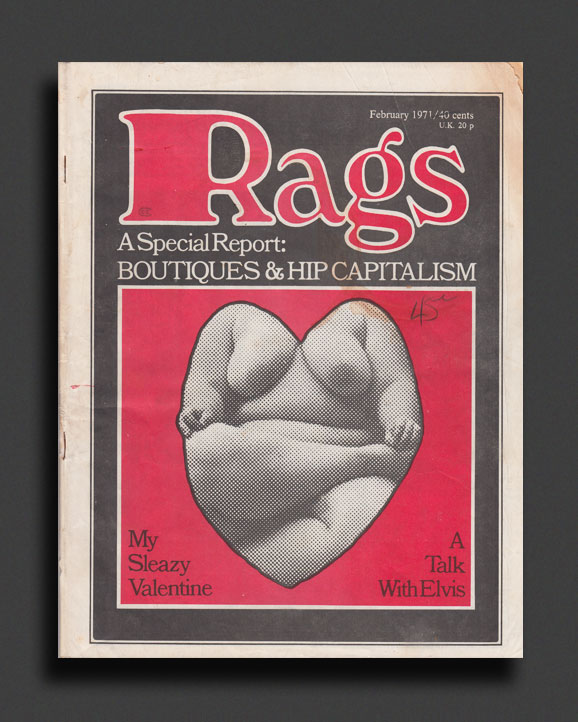
Rags Magazine was a counter-culture fashion magazine founded by Rolling Stone photographer Baron Wolman, based out of San Francisco, and associated with the underground press movement. A rotating staff included Mary Peacock and Daphne Davis as editors, and Barbara Kruger as an art director. Printed on newsprint, Rags covered counter-culture fashion in a way no other fashion magazine was doing at the time, focusing on street-style instead of big name fashion brands or trends, and emphasizing photography and art in relation to fashion. With writing that was often politically radical, the publication captured the countercultural spirit of the early 1970s underground. Despite only running for one year, it remains an influential magazine whose innovative form and content were ahead of their time.
The February 1971 issue includes "A Special Report: Boutiques & Hip Capitalism" by Jon Carroll profiling a huge array of independent American fashion boutiques around America, an article on Miss Penny Arcade with photographs by Peter Hujar, a photographic section by Jim Marshall, a Rags "Valentine's Day Portfolio" (including artwork by Ron Nagle!), an article on Frederick Mellinger (inventor of the push-up bra and well-known retailer of women's lingerie in America), a report on MacFadden-Bartell Publishing (home of True Story, the first of the confessions magazines genre), the fantastic regular Rags street fashion report, letters, columns on drugs, records, media, and all matter of things around fashion.
Good copy with wear/small chipping/marks to cover, clean throughout. Light edge tanning.
2019, English
Softcover, 400 pages, 27.8 x 20.8 cm
Published by
Surpllus / Melbourne
$50.00 - In stock -
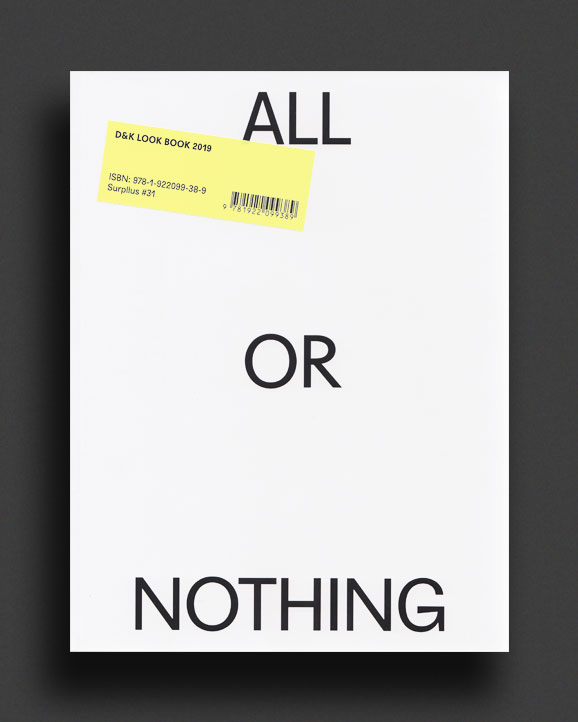
Fashion has always been expanded. Fashion practitioners have always produced things other than clothes. Fashion subsumes the fields, disciplines, movements and cultures around it, in a relentless quest for the new. In D&K LOOK BOOK 2019, the traditional fashion ‘lookbook’ is expanded from a slight and selective compendium of a collection to an extensive monograph about fashion practice. This experimental fashion publication, subsumed in the format of a glossy fashion magazine, questions the ubiquity and mass consumption of fashion images. Critical fashion practice appropriates the conventions of fashion publishing to communicate alternative narratives of fashion systems and industry practice as evident in the practice of D&K. This is explored through an obsessive and excessive documentation of the project ‘D&K All or Nothing’ (2017), with imagery by Agnieszka Chabros, Kate Meakin, Layla Cluer, Warwick Baker, Marc Morel and Christine Scott-Young. Newly commissioned texts by fashion scholars and practitioners including Clemens Thornquist, Femke de Vries, José Teunissen, Matthew Linde, Michael Beverland, Nella Themelios and Ricarda Bigolin explore such themes as the performance of fashion, branding, product languages and strategies for critical fashion practice.
Designed by Brad Haylock
2019, English
Softcover (w. silk organza dust jacket), 400 pages, 27.8 x 20.8 cm
Published by
Surpllus / Melbourne
$70.00 - Out of stock
Fashion has always been expanded. Fashion practitioners have always produced things other than clothes. Fashion subsumes the fields, disciplines, movements and cultures around it, in a relentless quest for the new. In D&K LOOK BOOK 2019, the traditional fashion ‘lookbook’ is expanded from a slight and selective compendium of a collection to an extensive monograph about fashion practice. This experimental fashion publication, subsumed in the format of a glossy fashion magazine, questions the ubiquity and mass consumption of fashion images. Critical fashion practice appropriates the conventions of fashion publishing to communicate alternative narratives of fashion systems and industry practice as evident in the practice of D&K. This is explored through an obsessive and excessive documentation of the project ‘D&K All or Nothing’ (2017), with imagery by Agnieszka Chabros, Kate Meakin, Layla Cluer, Warwick Baker, Marc Morel and Christine Scott-Young. Newly commissioned texts by fashion scholars and practitioners including Clemens Thornquist, Femke de Vries, José Teunissen, Matthew Linde, Michael Beverland, Nella Themelios and Ricarda Bigolin explore such themes as the performance of fashion, branding, product languages and strategies for critical fashion practice.
Designed by Brad Haylock
First Edition, wrapped in a special edition silk organza cover, and found aluminium charm by D&K - Ricarda Bigolin and Chantal Kirby.
2019, English
Softcover, 70 pages, 27.1 x 20.7 cm
Published by
Mode and Mode / Melbourne
$14.00 - In stock -
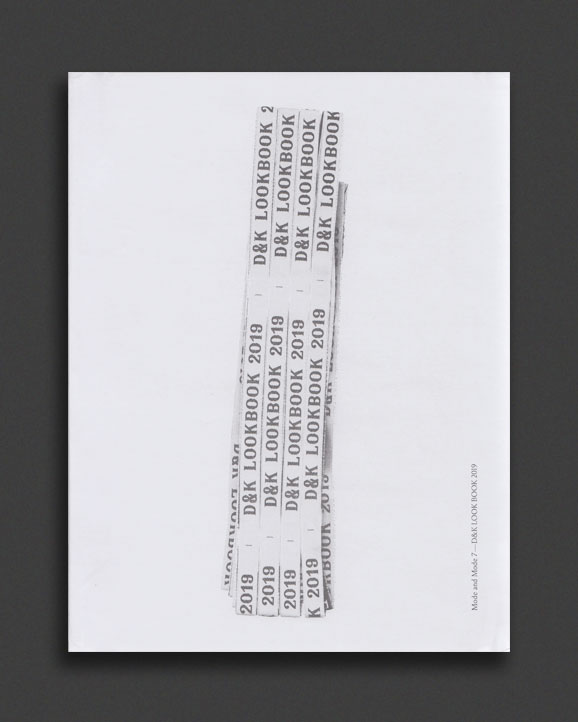
Mode and Mode seven presents an anthology of text works and biographical listings of key D&K (Ricarda Bigolin and Nella Themelios) projects from 2012 to present as a companion publication to D&K LOOK BOOK 2019. D&K produced writing—including ficto-critical prose, cut-and-paste collage, poetry, and screenwriting—to reconstitute components of fashion, such as garments, retail atmosphere and packaging ephemera. Their interrogation of fashion language in (and as) branding represents a body of experimental text works by a critical fashion practice that highlights the plasticity of words in fashion, which are always both meaningless and meaningful.
Published in an edition of 500 copies.
Mode and Mode is a periodical that addresses printed matter in fashion practice. Each issue explores experimental publishing in fashion with an interview around a print-based project — one that has critical effects to fashion as a discourse. In doing so, we reflect on the role of print and its potency to disrupt, propel and remake fashion narratives.
Editor: Laura Gardner
Designer: Karina Soraya
2019, English
Softcover, 300 pages, 17 x 24 cm
Published by
Sternberg Press / Berlin
$69.00 $40.00 - Out of stock
Contributions By Georges Didi-Huberman, Erika Fischer-Lichte, Barbara Gronau, Reinhold Görling, Adrian Heathfield, Misha Kavka, David Lapoujade, Mirjam Lewandowsky, Via Lewandowsky, Oliver Marchart, Rita Mcbride, Christoph Menke, Aernout Mik, Marcel Odenbach, Peter Osborne, Jacques Rancière, Christine Ross, Ludger Schwarte, Martin Seel
“Standstill” could be the name for the exact kind of experience that is the hiatus between social expectations and real possibilities of agency. Standstill may also be the name of an aesthetic strategy to instill a non-linear time of resistance and experience into the political protocol of progress. Finally, standstill can be the name for the temporal fissure in the midst of the subject, for the lapse between the subject of the enunciation and the subject of a statement, the limit that is the border between the inside and the outside. It can be the name for the mode of potentiality, for the moment of gesture, or, with Walter Benjamin, the medium of the dialectical image. The essays of this book transverse these dimensions of standstill as an in-between of time. The book includes essays by Georges Didi-Huberman, David Lapoujade, Peter Osborne, Jacques Rancière, Christine Ross, and others as well as conversations with Via Lewandowsky, Aernout Mik and Marcel Odenbach.
1977, Japanese
Hardcover (w. illustrated slipcase), 205 pages, 31.4 × 24.6 cm
1st Edition, Out of print title / used / very good
Published by
Kodansha Int / Tokyo
$140.00 - Out of stock
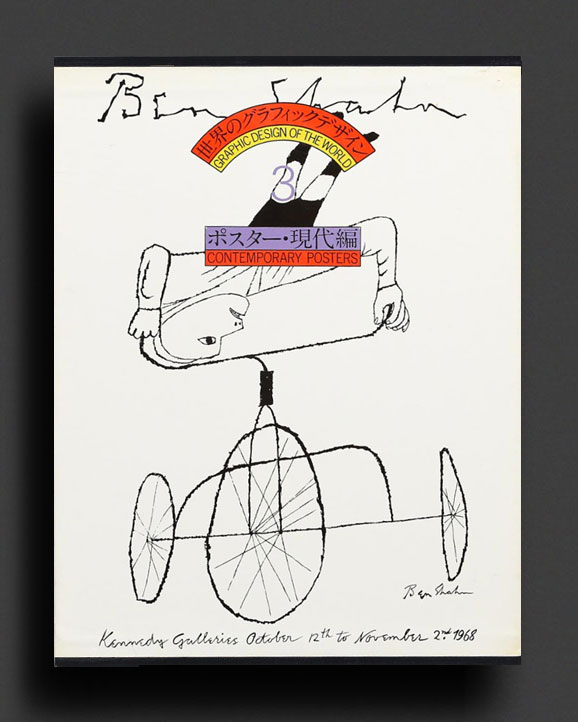
"Graphic Design of The World 3 : Contemporary Posters", was published in 1977 and edited by leading Japanese graphic designers Ikko Tanaka and Tadanori Yokoo. This, the 3rd annual volume of the great "Graphic Design of The World" series, was published in Japan by Kodansha in the 1970s. Each oversized hardcover, slipcased volume was edited by leading Japanese designers and presented a visually explosive international survey of design themes. Profusely illustrated in vivid, saturated colour, "Contemporary Posters" is one of the finest books on the subject. Bringing together the best examples of international modern posters from the end of the war to the early 1970s, including concert, theatre, film, anti-war, tourism, advertising, exhibition, and more. Includes the work of Milton Glaser, Joseph Müller-Brockman, Yoshio Hayakawa, Peter Max, Man Ray, Allen Jones, Maciej Urbaniec, Herb Lubalin, Jan Lenica, Seymour Chwast, Alan Aldridge, Roman Cieslewicz, Jean Michel Folon, Tomi Ungerer, Tadanori Yokoo, Shigeo Fukuda, Akira Uno, Massmimo Vignelli, Raymond Savignac, Push Pin Studios, Roland Topor, Ikko Tanaka, Shigeo Okamoto, Armando Testa, Franciszek Starowieyski, Saul Bass, Hans Erni, Karl Gerstner, Max Bill, Richard Avedon, Herbert Bayer, Alexander Calder, Otl Aicher, Paul Davis, Bob Gill, Hiromu Hara, Gan Hosoya, Robert Indiana, Sam Haskins, Kumi Sugai, Paul Rand, Willem Sandberg, Saul Steinberg, Andy Warhol, Ernest Trova, Pablo Picasso, James Rosenquist, Emil Ruder, Donald Brun, Herbert Leupin, Ryuichi Yamashiro, Franco Grignani, Yusaku Kamekura, Richard Lindner, Yoshitaro Isaka, Kiyoshi Awazu, and so many more! An incredible collection!
Very Good, beautifully preserved copy in Very Good slipcase.
1977, Japanese
Hardcover (w. illustrated slipcase), 205 pages, 31.4 × 24.6 cm
1st Edition, Out of print title / used / fine
Published by
Kodansha Int / Tokyo
$140.00 - Out of stock
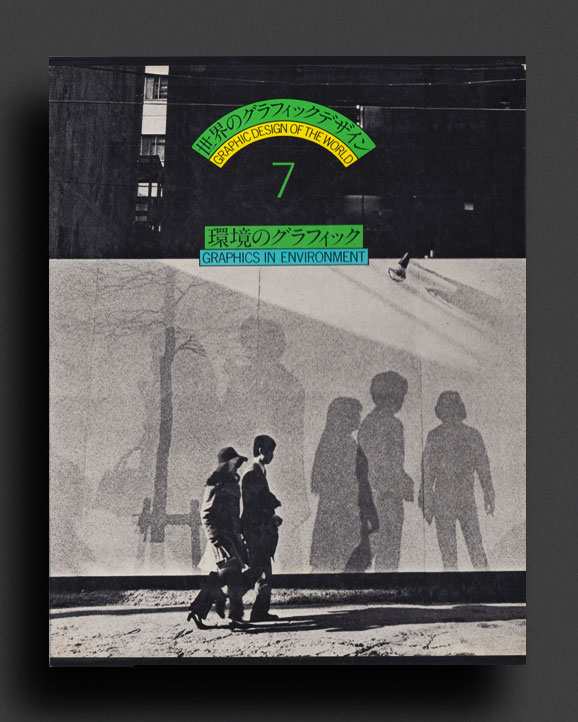
"Graphic Design of The World 7 : Graphics in Environment", was published in 1977 and edited by leading Japanese graphic designers Kiyoshi Awazu and Shigeo Fukuda, together with architect Shin Isozaki. This, the 7th (and final) annual volume of the great "Graphic Design of The World" series, was published in Japan by Kodansha in the 1970s. Each oversized hardcover, slipcased volume was edited by leading Japanese designers and presented a visually explosive international survey of design themes. Profusely illustrated in vivid, saturated colour, "Graphics in Environment" brings together examples of "Super Graphics" developed at the scale of the city and architecture, and also ceramics, textiles, playthings and other "graphics" of sizes corresponding to human systems. One of the most generous books on the subject of environmental design in the 1970s.
As new, beautifully preserved copy in Very Good slipcase.
1963, English
Hardcover (w. dust jacket), 28 x 21 cm
1st Edition, Out of print title / used / good
Published by
Arted / Paris
$65.00 - Out of stock
Wonderful first edition of this important 1963 monograph on Constantin Brancusi by Ionel Jianou, published in Paris by Arted. Long out of print, this authoritative English-language book on Brancusi includes a beautifully illustrated catalogue of his works (over 100 images of sculptures, paintings and drawings), introduction by Jean Cassou, and an in-depth essay written by Jianou, "The Brancusi Mystery", exploring the life and work of Brancusi. Also includes full chronology, exhibition history, and bibliography. Beautifully illustrated.
Constantin Brâncuși (1876 - 1957) was a Romanian sculptor, painter and photographer who made his career in France. Brâncuși is considered a pioneer of modernism and one of the most influential sculptors of the 20th-century.
Good copy with good dust jacket. Very Good throughout apart from the ex-library markings to cover and first blank pages.
1979, German
Hardcover (w. dust jacket), 198 pages, 31 x 23 cm
1st Edition, Out of print title / used / very good
Published by
Maeght Editeur / Paris
$100.00 - Out of stock
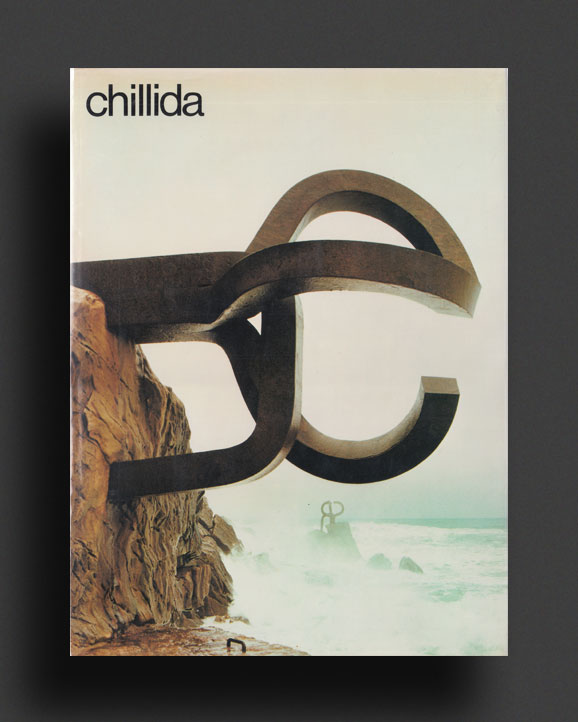
Major, comprehensive monograph on Eduardo Chillida, published by Maeght Editeur, Paris in 1979. With opening texts by Mexican poet Octavio Paz and Eduardo Chillida, this lovely linen-bound book contains a fully illustrated catalogue raisonné of Chillida's sculptures (1948-1979), with 303 works photographed in colour and b/w. Texts in German, and all captions in English, Spanish, French and German.
Eduardo Chillida (10 January 1924 – 19 August 2002) Eduardo Chillida was a Spanish Basque artist known for his colossal public installations. Working in iron, wood, marble and steel, Chillida's abstract interlocking sculptures reflected his interest in space and materiality.
Very Good copy with Very good dust jacket preserved under mylar wrap.
1995, German
Hardcover (w. spiral-binding), 180 pages, 27 x 22 cm
1st Edition, Out of print title / used / fine
Published by
Wilhelm-Lehmbruck-Museum / Duisburg
$120.00 - In stock -
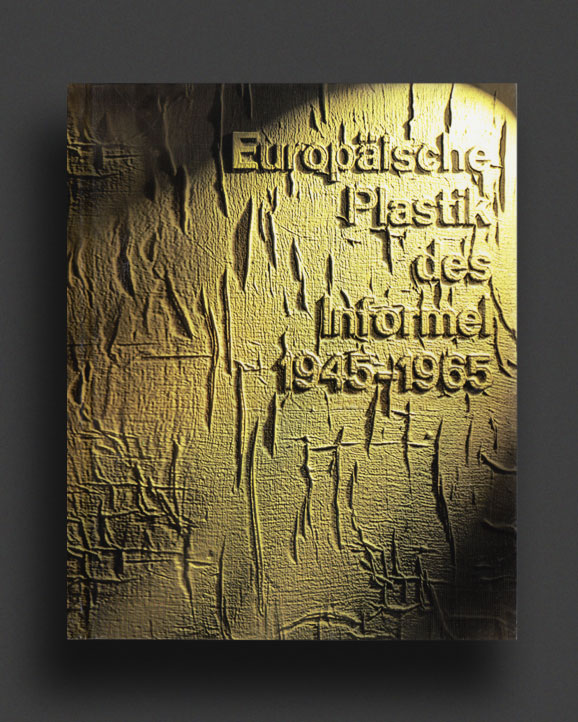
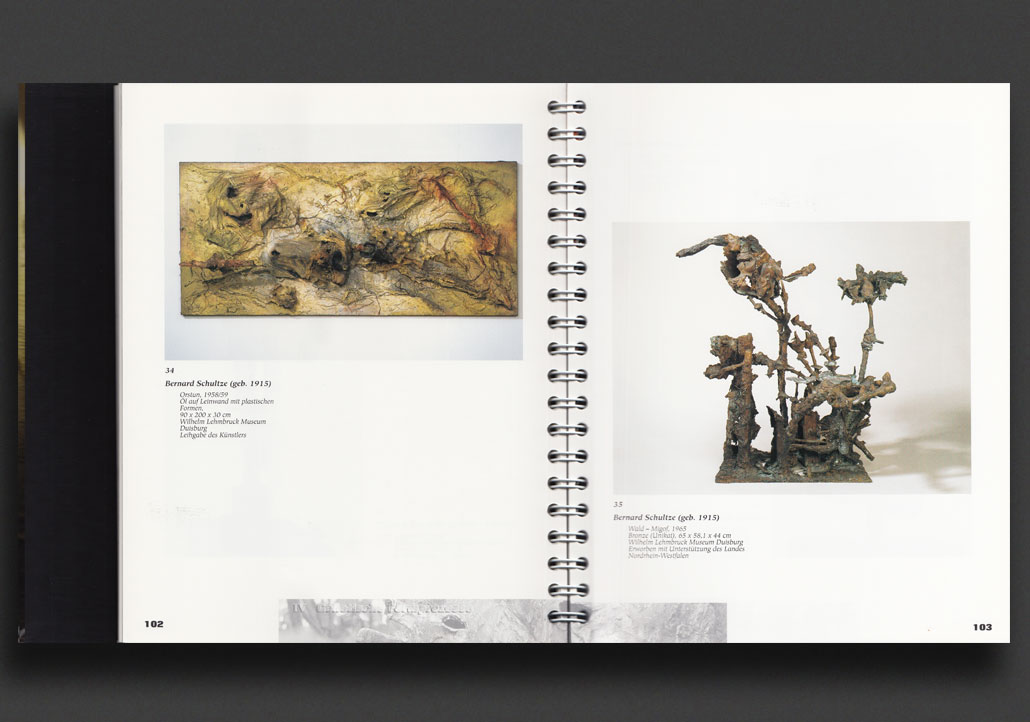
First edition of this important reference catalogue of European Informel sculpture spanning 1945-1965, published on the occasion of the exhibition of the same name at Wilhelm Lehmbruck Museum Duisburg, European Center for Modern Sculpture, September 10 - November 12, 1995. Profusely illustrated in colour and b/w throughout, this deluxe catalogue, housed in hardcover with internal coated spiral-binding, is chaptered with themes such as "Anthropomorphic Figuration", "Reliefs", "Line and Rhythm in Iron and Steel", etc. and features extensive documentation of works by Jean Fautrier, Germaine Richier, Agenore Fabbri, Karl Hartung, Lynn Chadwick, Jan Koblasa, Étienne Martin, Alicia Penalba, Antoni Tàpies, Lucio Fontana, Jean Dubuffet, Wols, Max Ernst, Pablo Picasso, Alberto Giacometti, Rudolf Hoflehner, Asger Jorn, Karel Appel, Jean Dubuffet, Henry Heerup, Eduardo Paolozzi, Emil Cimiotti, Franco Garelli, Shinkichi Tajiri, Bernhard Schultze, Ernst Hermanns, Oswald Oberhuber, Thomas Lenk, Leonardo Leoncillo, Bernhard Heiliger, Manolo Millares, Gerhard Hoehme, Jan Schoonhoven, Umberto Milani, Étienne Hajdú, Gio Pomodoro, César, Dušan Džamonja, Hans Uhlmann, Edgardo Mannucci, Harry Kramer, Brigitte Matschinsky-Denninghoff, Eduardo Chillida, Robert Müller, Pablo Serrano, Jean Tinguely, and many more. Texts by Christoph Brockhaus, Katja Blomberg, Barbara Lülf, Dieter Schadt, Gottlieb Leinz, Emil Cimiotti, Susanne Höper, alongside an extensive and invaluable bibliography on the subject, as well as on individual artists featured.
Fine copy.
2019, English
Softcover, 48 pages, 32 x 24 cm
Published by
Robert Heald Gallery / Wellington
$30.00 - In stock -
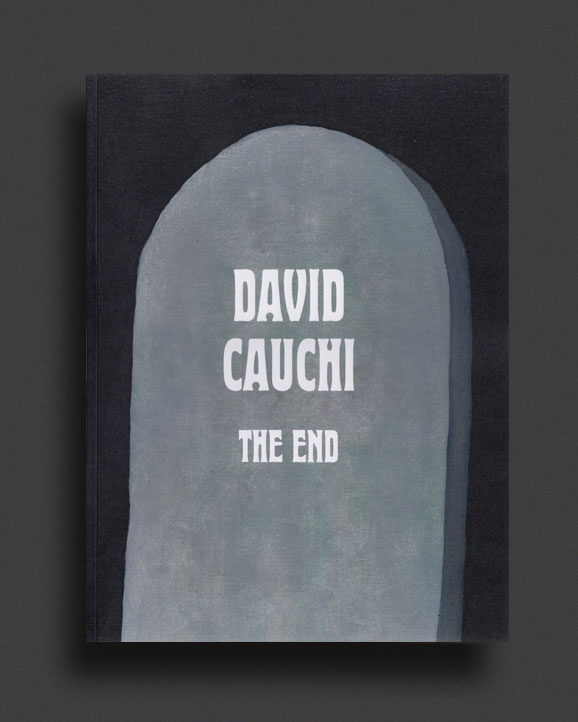
Catalogue published on the occasion of New Zealand painter David Cauchi's solo exhibition "The End", Robert Heald Gallery, Wellington, March 2019. Profusely illustrated throughout with Cauchi's exhibited paintings, details and installation views, alongside an in-depth, illustrated essay by Laurence Simmons discussing Cauchi's "Humour noir."
Designed by Rose Miller, Kraftwork.
2019, English
Softcover, 56 pages, 23 x 22 cm
Published by
Robert Heald Gallery / Wellington
$30.00 - In stock -
Catalogue published on the occasion of the two-person exhibition of Piero Gilardi (b. 1942, Turin) and Joshua Petherick (b. 1979, Adelaide) at Robert Heald Gallery, Wellington, July 18 – August 17, 2019. Profusely illustrated throughout with installation views, all exhibited works (w. details), along with a full work list. Presenting Gilardi's Nature Carpets (a central work of the artist since his catalytic involvement in the 1960s Arte Povera movement and the wake of European Pop) alongside Petherick's Condolences; both sculptural bodies of work in polyurethane foam, realistically reproducing fragments of our living environments, reflecting on the physical and psychological hyper-effects of our tenuous and increasingly artificial relationship to the natural world.
Designed by Rose Miller, Kraftwork.
2019, English
Softcover, 56 pages, 23 x 22 cm
Published by
Robert Heald Gallery / Wellington
$30.00 - Out of stock
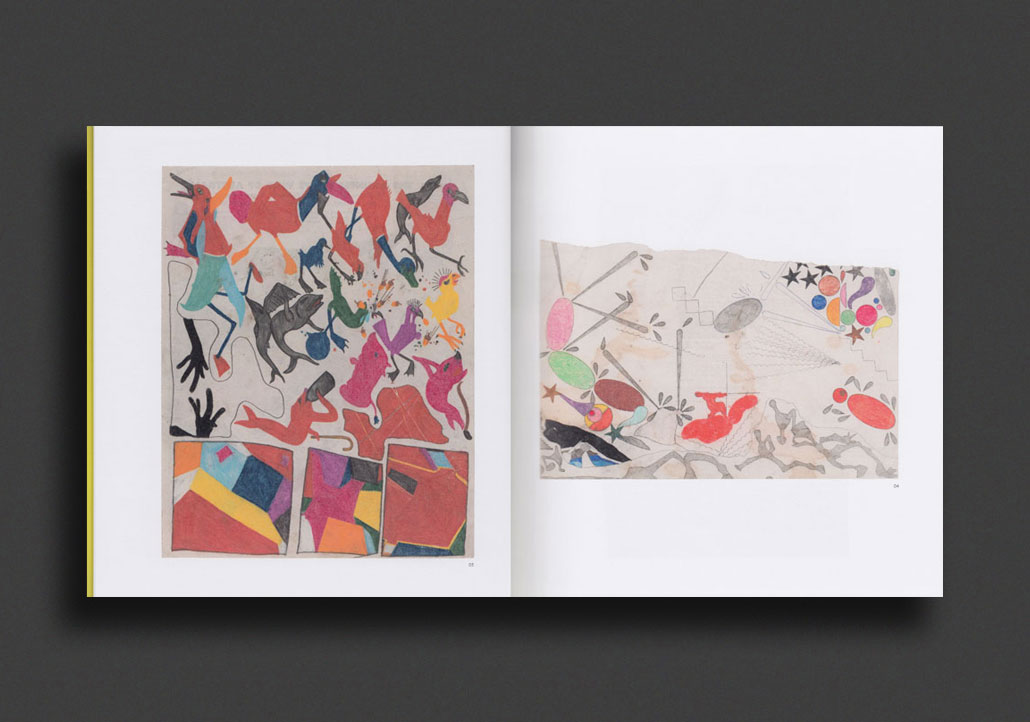
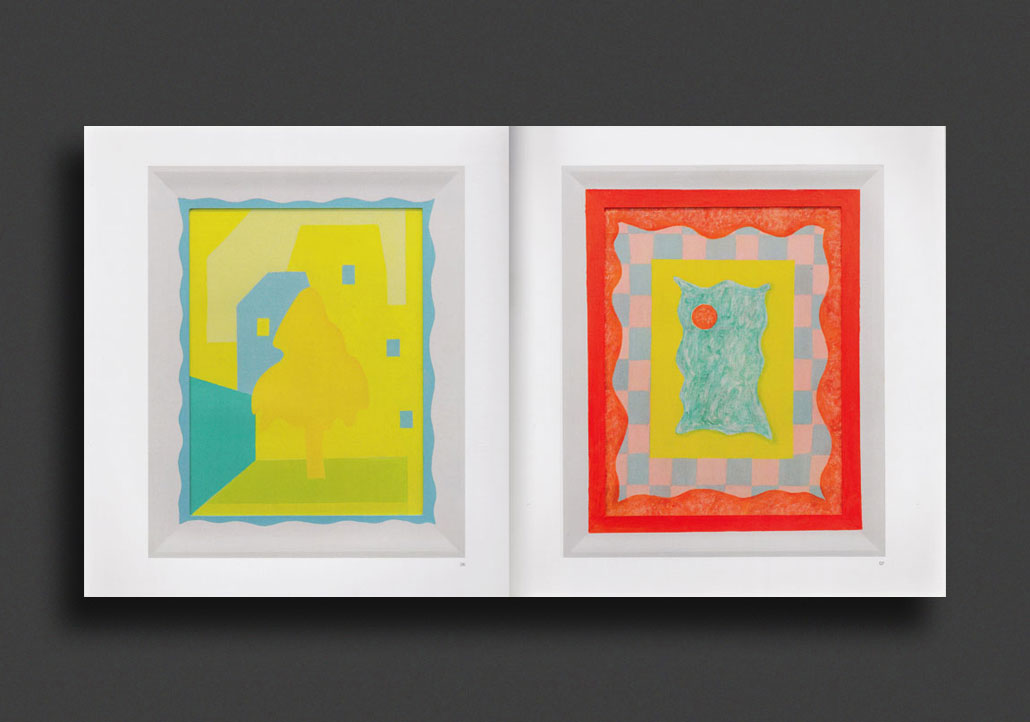
Double-catalogue published on the occasion of two solo exhibitions at Robert Heald Gallery, Wellington, in 2019. The exhibitions were Susan Te Kahurangi King 'In Colour' and Saskia Leek 'The Sun is A Circular Song', and this double-sided catalogue presents the drawings of King (dating 1966-2017) and Leek (dating 2019), respectively illustrated throughout in colour, along with a full work list for each exhibit.
Susan Te Kahurangi King (b. 1951, Te Aroha) is a New Zealand artist self-taught artist whose ability to speak declined by the age of four, and by the age of eight stopped speaking altogether. She has methodically created an entire analogous world through extraordinary drawings using pen, graphite, coloured pencil, crayon and ink.
Saskia Leek (b. 1970, Christchurch) is a New Zealand artist whose work playful questions the conventions of representation and notions of what constitutes “good” painting. The shifting meanings that one encounters from Saskia Leek’s paintings can range from the clichéd to the fantastic and the eerie, sourcing subject matter from amateur found art works and unfashionable outdated second-hand prints, creating a sense of both kitsch sentimentality and nostalgic melancholy.
Designed by Rose Miller, Kraftwork.
2019, English
Softcover (w. foldout poster), 80 pages, 15.9 x 20.9 cm
Ed. of 1000,
Published by
South Willard Press / Los Angeles
$50.00 - Out of stock
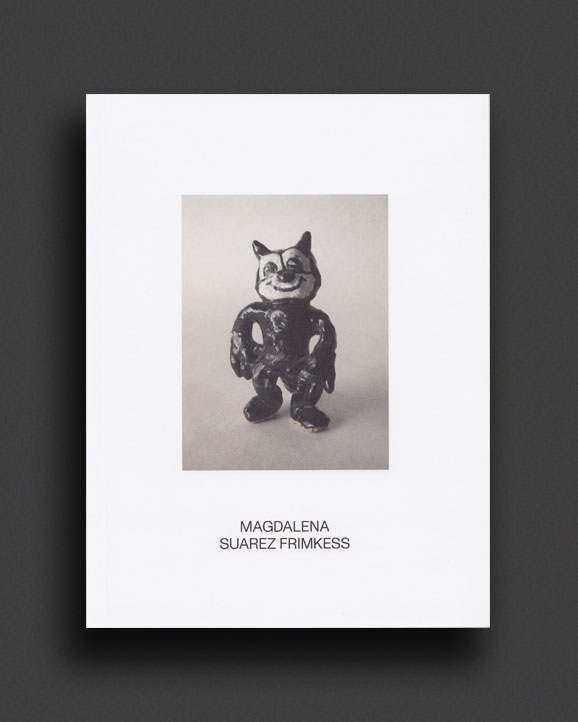
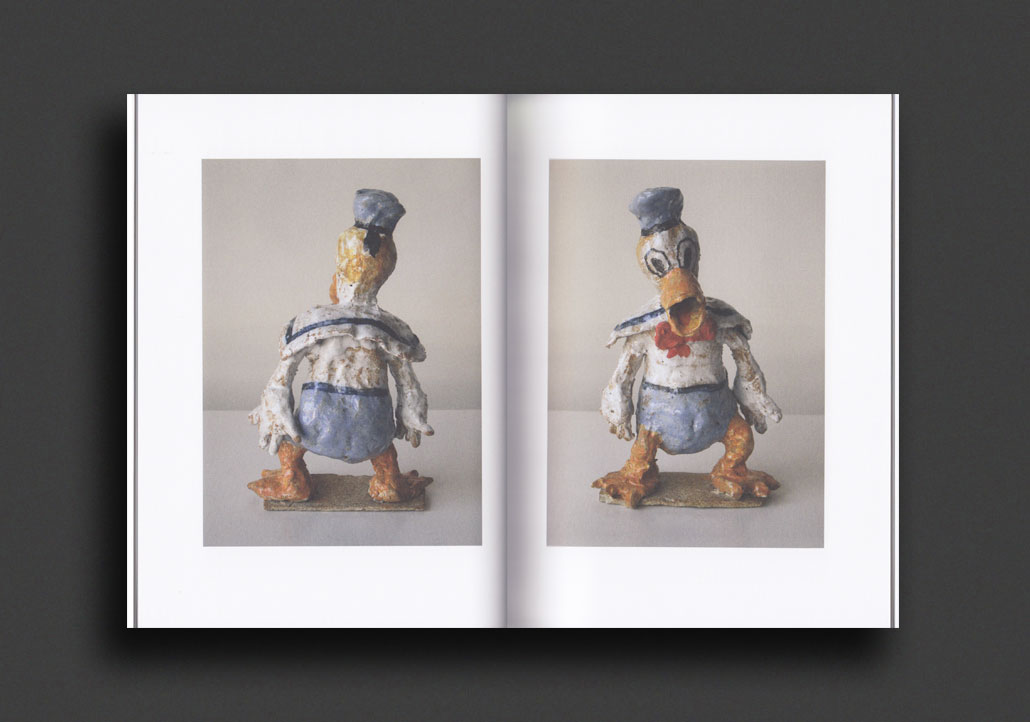
This is the first book on the Venice, California-based ceramicist Magdalena Suarez Frimkess (born 1926). Now in her 90s, the Venezuela-born artist is just now getting the recognition she deserves, with her work finding its way into the collections of LACMA and the Hammer Museum. Her unique approach to ceramics -- incorporating cartoon characters such as Felix the Cat, Popeye, Olive Oyl, Goofy and Betty Boop as well as more traditional motifs such as landscapes, birds and flowers -- has charmed a younger generation of artists such as Jonas Wood, Shio Kusaka, Mark Grotjahn, Lesley Vance and Ricky Swallow, who contributes an essay here. Illustrated extensively throughout, Magdalena Suarez Frimkess offers a broad range of the colourful autobiographical pieces she has produced over her career. This book also includes a poster of one of her characteristic cartoon works.
Ed. of 1000.
1969, Italian / English / French
Hardcover (w. dust jacket), 196 pages, 23 x 25 cm
1st Edition, Out of print title / used / good
Published by
Alfieri / Milan
$90.00 - Out of stock
Scarce copy of Metro, "The International Review Of Contemporary Art", published in Milan twice yearly, each issue in dust-jacketed hardcover format and edited by Bruno Alfieri. This 15th edition from 1969 with a wonderful illustrated cover by Pino Pascali. Like it's more widely-known architectural counterpart, Lotus, each issue of Metro features in-depth articles on a selection of artists or events in a format and style far closer to a book than a periodical. This issue also includes articles on Piero Manzoni, Leo Castelli Gallery (Robert Morris, Richard Serra, etc.), Bridget Riley, Documenta 4 in Kassel, Italian sociologist and artist Hans Glauber, and of course Pino Pascali. Also an article that looks at the work of Pascali alongside Lucio Fontana. Texts by Germano Celant, Lea Vergine, Bruno Alfieri, Giulio Carlo Argan, Peter Gorsen, Gillo Dorfles, Maurizio Dell'Arco, Giuseppe Gatt, and others. Text in Italian, English and French.
Good copy with some small closed tears to jacket and edge wear. Now preserved in mylar wrap.
2011, English / French
Softcover, 176 pages, 14 x 21.6 cm
Published by
Princeton University Press / New York
$37.00 - Out of stock
Poems Under Saturn is the first complete English translation of the collection that announced Paul Verlaine (1844-1896) as a poet of promise and originality, one who would come to be regarded as one of the greatest of nineteenth-century writers. This new translation, by respected contemporary poet Karl Kirchwey, faithfully renders the collection's heady mix of classical learning and earthy sensuality in poems whose rhythm and rhyme represent one of the supreme accomplishments of French verse. Restoring frequently anthologized poems to the context in which they originally appeared, Poems Under Saturn testifies to the blazing talents for which Verlaine is celebrated.
The poems display precocious virtuosity, mingling the attractions of the flesh with the longings of the spirit. Greek and Hindu myth give way to intimate erotic meditations and wickedly satirical society portraits, mythological landscapes alternate with gritty narratives of mid-nineteenth century Paris, visions of happiness yield to nightmarish glimpses of deep alienation, and real and imaginary characters--including Achilles, Valmiki, Charlemagne, and Spain's baleful King Philip II--all figure as the subject matter of a supremely ambitious young poet.
Poems Under Saturn presents the extraordinary devotion and intense musicality of an artist for whom poetry remained the one true passion.
1993, English
Softcover, 144 pages, 30 x 23.5 cm
1st Edition, Out of print title / used / good
Published by
Neuberger Museum of Art / New York
$100.00 - Out of stock
Long out-of-print retrospective survey catalogue, Melvin Edwards Sculpture : A Thirty Year Retrospective 1963-1993, published on the occasion of a major exhibition of the work of the prominent African-American sculptor in 1993 at Neuberger Museum of Art, New York. Includes the essay "Lynch Fragments" by Michael Brenson, and texts by Josephine Gear, Lucinda H. Gedeon, Lowery Stokes Sims, and a bibliography and chronology compiled by Lynne Kenny. Over 130 illustrations throughout of Edwards incredible sculptural works, plus 30 plus additional text illustrations, portraits, and more.
Good, ex-library copy with associated markings to cover and end/titles pages. Otherwise perfect copy internally throughout.
1981, Japanese
Hardcover (w. slipcase and dust jacket), 80 pages, 25 x 27 cm
Out of print title / used / very good
Published by
Kawade Shobo Shinsha / Tokyo
$350.00 - Out of stock
Rare 1981 edition of acclaimed Japanese photographer Hajime Sawatari's cult photo book "Alice", first published in 1973. Sawatari began working as a freelancer in 1966, photographing for many leading fashion magazines in Japan. This, his most famous work, reprinted countless times, is Sawatari's psychedelic, photographic interpretations of Lewis Carroll's literary classic Alice in Wonderland. Here Sawatari brilliantly engages and re-creates the themes, forms and symbolisms within the original narrative, focusing on the inevitable loss of the childhood innocence of a young girl confronted by the realities of adulthood. Sawatari’s ‘Wonderland’ is a world where phenomenas of the real intertwine with the unconscious, exploring a world that confronts viewers with the surreal, bending the roles between child and adult. Outside of Jan Švankmajer, this is truly one of the strangest, most risqué interpretations of the well-known story. Sawatari's photographs are complimented by the design of Seiichi Horiuchi (1932-1987) and accompanying translations and poems by Shuzo Higuchi (1903-1979) and Shuntaro Tanikawa.
Hajime Sawatari is a celebrated fashion and advertising photographer. His photobooks are part of the important cultural renaissance that took place in Japan in the 1960s and '70s and saw the promotion of provocative, avant-garde book publishing.
With some light wear to edges, otherwise Good-Very Good book and DJ, slipcase.
1990, English
Softcover, 100 pages, 28 x 21 cm
Out of print title / used / good
Published by
Berkely Books / New York
$120.00 - Out of stock
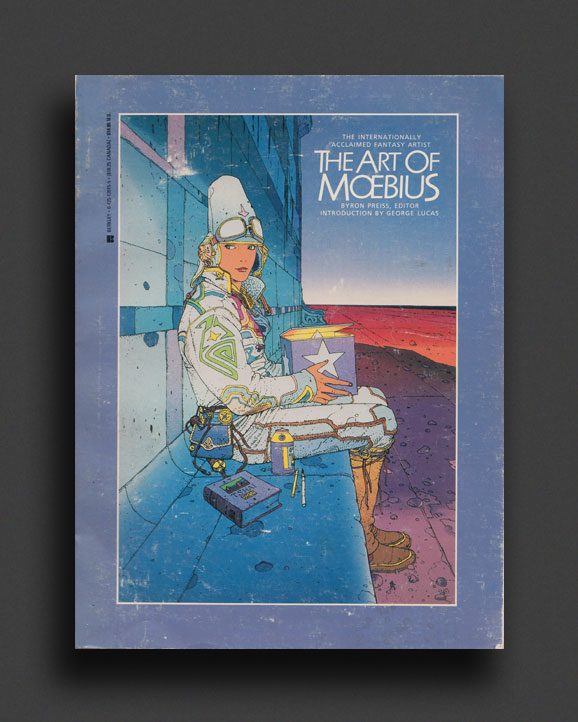
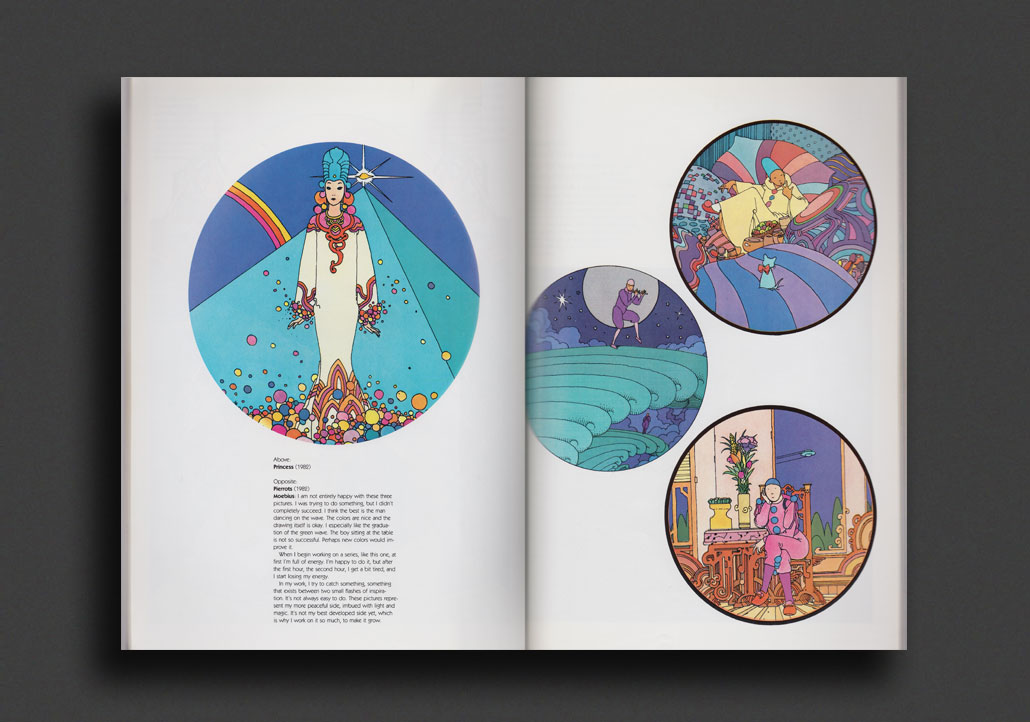
Super collectible 1990 edition of "The Art of Moebius", published by Berkely Books, New York. Edited by Byron Preiss with an introduction by George Lucas and afterword by Jean Giraud Mœbius, this is one of the first books in English showcasing the entire breadth of Jean Giraud Mœbius' extraordinary artistic work in rich colour and b/w, including his work for Arzach, Metal Hurlant/Heavy Metal, Starwatcher, The Incal, Little Nemo, Blueberry, and much more. Each illustration throughout the entire book is captioned by Moebius himself, giving an intimate introduction into his visionary universe.
Jean Henri Gaston Giraud (1938 – 2012) was a French artist, cartoonist and writer who worked in the Franco-Belgian bandes dessinées (BD) tradition. Giraud garnered worldwide acclaim under the pseudonym Moebius, esteemed by Federico Fellini, Stan Lee and Hayao Miyazaki among others, he has been described as the most influential bandes dessinées artist after Hergé. His most famous works include the series Blueberry, created with writer Jean-Michel Charlier, featuring one of the first anti-heroes in Western comics. As Mœbius he created a wide range of science fiction and fantasy comics in a highly imaginative, surreal, almost abstract style. These works include Arzach and the Airtight Garage of Jerry Cornelius. He also collaborated with avant-garde filmmaker Alejandro Jodorowsky for an unproduced adaptation of Dune and the comic book series The Incal. Mœbius also contributed storyboards and concept designs to numerous science fiction and fantasy films, such as Alien, Tron, The Fifth Element and The Abyss.
"In all his drawings, Moebius demonstrates a command of many disciplines in art. He is a master draftsman, a superb artist, and more: his vision is original and strong. Since first seeing the Moebius illustrations in "Heavy Metal" years ago, I have been impressed and affected by his keen and unusual sense of design, and the distinctive way in which he depicts the fantastic. Perhaps what strikes me most of all about his work is it's sheer beauty—a beauty that has always given me great pleasure." - George Lucas
Good copy, clean and tight throughout but with considerable shelf wear to cover and spine.
1996, Japanese
Softcover, 144 pages, 25.9 x 24.9 cm
1st Edition, Out of print title / used / fine
Published by
Asahi Shimbun / Japan
$80.00 - Out of stock
Scarce, first and only edition of this wonderful out-of-print Japanese Leo Lionni Retrospective catalogue, published on the occasion of a major survey exhibition of Lionni's work, curated by Paola Vassalli in 1996 in Japan. Famous for his "Frederick" and "Swimmy" books, this extensive and profusely illustrated book, edited by Kiyoko Matsuoka, showcases Lionni's innovative and diverse career as an artist, draftsman and designer. In addition to many illustrations from his award-winning picture books, presented here are his incredible Parallel Botany prints, illustrations, paintings, and sculptures, along with many other drawings, paintings, photographs, collages, mosaics, print graphics, along with a detailed biography and bibliography, and more. Also includes poetry by Shuntarō Tanikawa. A must for any fan.
Leo Lionni (May 5, 1910 – October 11, 1999) was an author and illustrator of children's books. Born in the Netherlands, he moved to Italy and lived there before moving to the United States in 1939, where he worked as an art director for several advertising agencies, and then for Fortune magazine. He returned to Italy in 1962 and started writing and illustrating children's books. Leo Lionni wrote and illustrated more than 40 highly acclaimed children’s books. He received the 1984 American Institute of Graphic Arts Gold Medal and was a four-time Caldecott Honor Winner.
Fine copy!
2019, English
Hardcover, 144 pages, 23 x 33 cm
Published by
Fulgur Press / UK
$115.00 - In stock -
Between 1968 and 1971, in a loft on New York's Jefferson Street, the poet, photographer and filmmaker Ira Cohen created some of the most mythic images of the late 1960s. Inspired by his friends Jack Smith and Bill Devore, Cohen’s initial experiments with black light developed into an experimental ritual space he termed the Mylar Chamber—a simple room of hinged boards hung with reflective Mylar film. Through his extended network, and with the support of artist and set designer Robert LaVigne, Cohen invited visitors to play another self within this small theater, among them Jimi Hendrix, William Burroughs, Vali Myers, Jack Smith, Angus MacLise, Alejandro Jodorowsky, Lionel Ziprin, Ching Ho Cheng, Petra Vogt, Charles Ludlam, John McLaughlin and the rock group Spirit.
In December 1969, in a summary of the past decade, Life magazine declared that “few came as close to explaining the euphoric distortions of hallucinogenics” as Cohen through his Mylar Chamber photographs, but the full story draws upon much deeper ideas surrounding identity and the power of the image.
This is the first book to explore Cohen’s iconic Mylar Chamber photographs. Published on the 50th anniversary of the Life magazine feature, and with several gatefolds, it includes more than 70 images from this intensely creative period, each digitally restored from the original negatives by Cohen’s friend and collaborator, Ira Landgarten. It also includes an interview with Cohen, excerpts from his poetry, critical writing from Allan Graubard and Ian MacFadyen and further reflections from Timothy Baum, Alice Farley and Thurston Moore.
Ira Cohen was born in the Bronx in 1935. A countercultural renaissance man, Cohen made films, photographs and poetry, edited the magazine Gnaoua and authored The Hashish Cookbook. Cohen became well known for his 1968 movie using the Mylar technique, The Invasion of Thunderbolt Pagoda, soundtracked by Angus MacLise, the original drummer of the Velvet Underground. In 2008 Nina Zivancevic, writing in NY Arts magazine, described Cohen’s life as “a sort of white magic produced by an alchemist who turned his back on the establishment in order to find God, art and poetry.” He died in 2011.
“Looking at your pictures is like looking through butterfly wings.” – Jimi Hendrix
2019, English
Softcover, 272 pages, 15.2 x 22.9 cm
Published by
Semiotext(e) / Los Angeles
$44.00 - Out of stock
Introduction by Kevin Killian
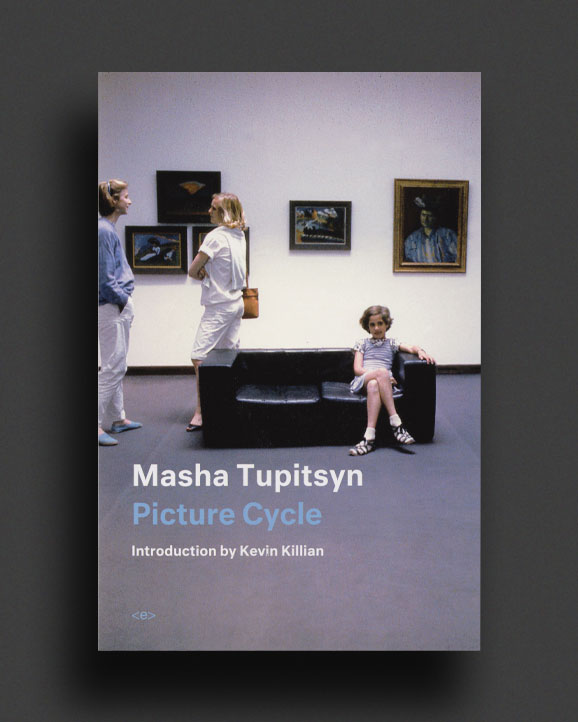
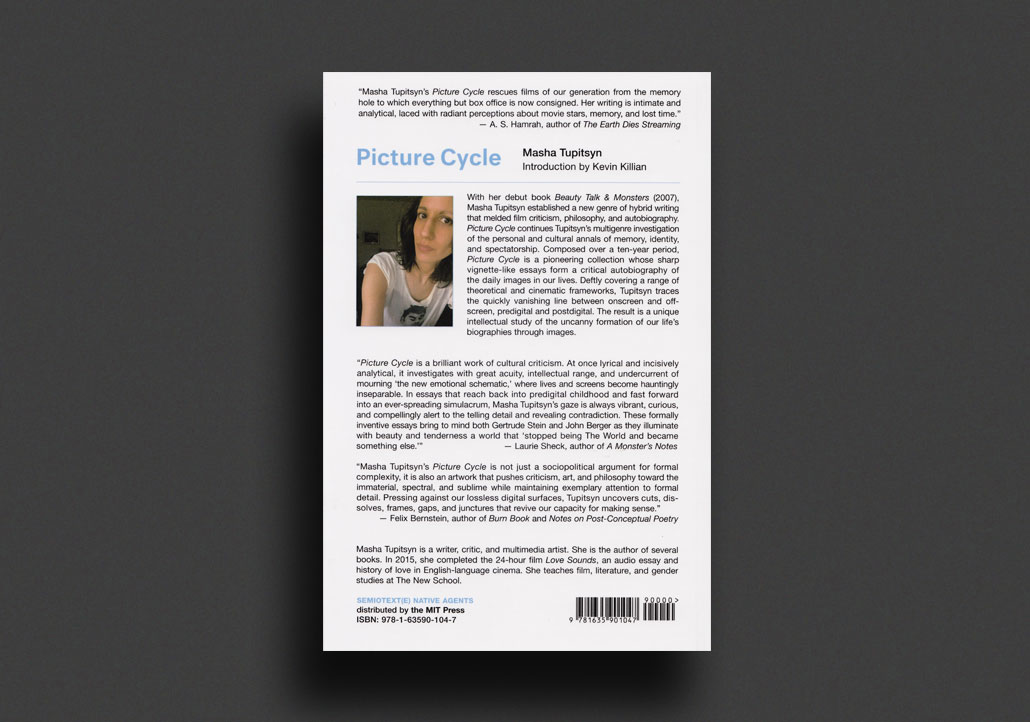
With her debut collection Beauty Talk & Monsters (2007), Masha Tupitsyn established a new genre of hybrid writing that melded film criticism, philosophy, and autobiography. Picture Cycle continues Tupitsyn's multigenre investigation of the personal and cultural annals of memory, identity, and spectatorship, both on and off the screen. Composed over a ten-year period, Picture Cycle is a pioneering collection whose sharp and knowing vignette-like essays form a critical autobiography of the daily images in our lives. Deftly covering a range of theoretical and cinematic frameworks, Tupitsyn traces here the quickly vanishing line between onscreen and offscreen, predigital and postdigital. The result is a unique intellectual study of the uncanny formation of our life's biographies through images.
In exchange for studying what each fraudulent cell looks like under a merciless commercial and commodified lens, viewers enable late-capitalism to run more smoothly by calling in with their votes, as is the case with Reality TV. From the inside, secrecy appears eradicated, as though secrets or coded transparencies comprise the totality of injustice, rather than just one part. Justice is reduced to a vantage point. We see and we see and we see ad infinitum. - from Picture Cycle
2019, English
Softcover, 328 pages, 19,7 x 13 cm
Published by
Urbanomic / Cornwall
$56.00 - Out of stock
XYZT is high-concept sci-fi. Its exploration of the limits of cross-cultural communication makes for fascinating reading. — Helen Marshall, New Scientist
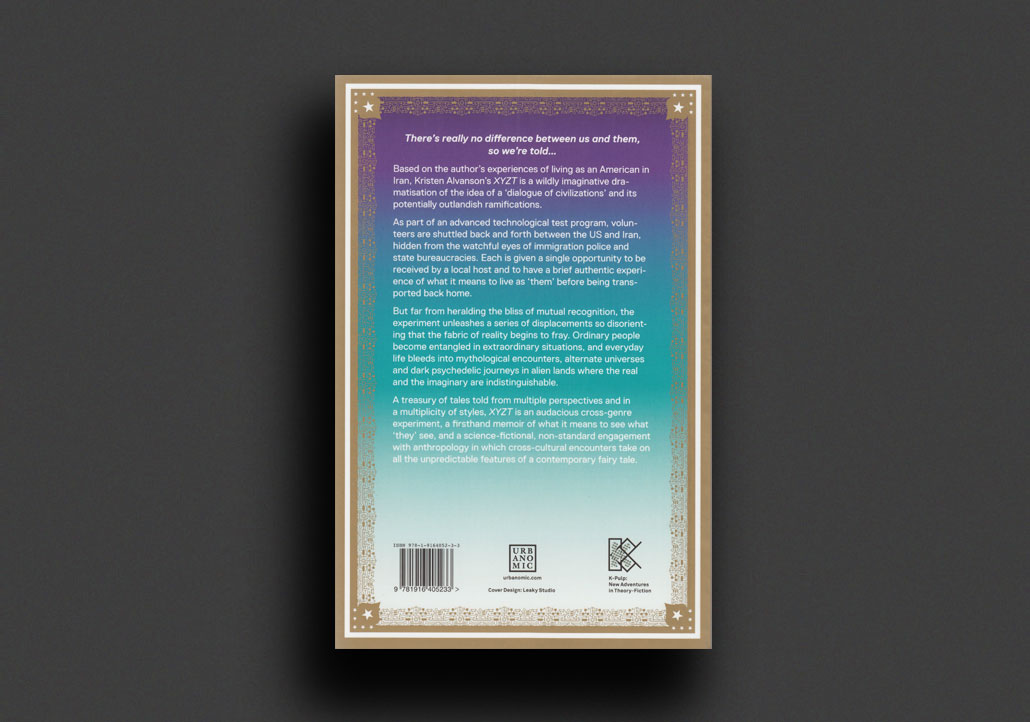
‘There’s really no difference between us and them, so we’re told….’
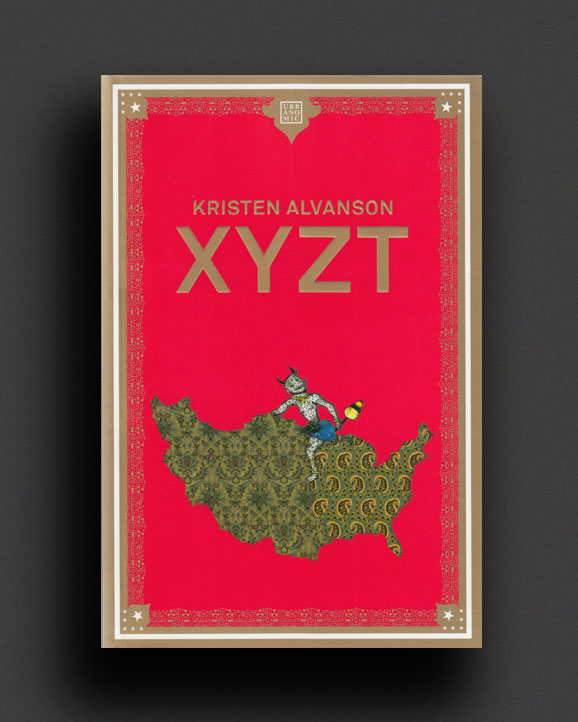
Based on the author’s experiences of living as an American in Iran, Kristen Alvanson’s XYZT is a wildly imaginative dramatisation of the idea of a ‘dialogue of civilizations’ and its potentially outlandish ramifications.
As part of an advanced technological test program, volunteers are shuttled back and forth between the US and Iran, hidden from the watchful eyes of immigration police and state bureaucracies. Each is given a single opportunity to be received by a local host and to have a brief authentic experience of what it means to live as ‘them’ before being transported back home.
But far from heralding the bliss of mutual recognition, the experiment unleashes a series of displacements so disorienting that the fabric of reality begins to fray. Ordinary people become entangled in extraordinary situations, and everyday life bleeds into mythological encounters, alternate universes and dark psychedelic journeys in alien lands where the real and the imaginary are indistinguishable.
A treasury of tales told from multiple perspectives and in a multiplicity of styles, Alvanson’s debut novel is an audacious cross-genre experiment, a firsthand memoir of what it means to see what ‘they’ see, and a science-fictional, non-standard engagement with anthropology in which cross-cultural encounters take on all the unpredictable features of a contemporary fairy tale.