World Food Books' programme is largely produced on Kulin Nation land. We acknowledge the Wurundjeri people of the Kulin Nation as the first and continuing custodians of this land, and pay respect to their Elders past, present, and emerging.
World Food Books is an arts and special interests bookshop in Naarm / Melbourne. Founded in 2010, World Food Books is devoted to the presentation of a rotating, hand-selection of international art, design, literary and counterculture publications with an emphasis on the anti-traditional, the experimental, the avant-garde, the heretic, the marginal.
Presenting new titles alongside rare and out-of-print books, catalogues and journals spanning the fields of modern and contemporary art, design, photography, illustration, film, literature, poetry, cultural theory, philosophy, sexuality, popular and underground culture in its many radical forms, World Food Books wishes to encourage adventurous, thoughtful and open-minded reading, looking, writing, and exchange of publishing and ideas, both current and historical.
As well as our bookshop, located in Melbourne's historical Nicholas Building, all of our inventory is available internationally via our online mail-order service.
World Food Books semi-regularly co-ordinates "Occasions", a programme of exhibits and events at the bookshop and in partnership with other hosts (such as museums and art galleries) that develop out of the activities, relationships and content of the bookshop itself.
World Food Books
The Nicholas Building
37 Swanston Street
Room 5, Level 6
Melbourne 3000
Australia
SHOP HOURS:
Thu–Fri 12–6, Sat 12–5
WEB-SHOP OPEN 24/7
World Food Books
Postal Address:
PO Box 435
Flinders Lane
Victoria 8009
Australia
Art
Theory / Essay
Architecture / Interior
Graphic Design / Typography
Photography
Fashion
Eros
LGBTQ+
Fiction / Poetry
Weird / Speculative / Science Fiction / Horror
Transgressive / Visceral / Abject
Symbolism / Decadence / Fin de siècle
Film / Video
Painting
Sculpture / Installation
Performance / Dance / Theater
Drawing
Sound / Music
Curatorial
Group Shows / Collections
Periodicals
Out-of-print / Rare
Posters / Ephemera / Discs
Signed Books
World Food Books Gift Voucher
World Food Book Bag
Australian Art
Australian Fiction
Australian Science Fiction / Speculative Fiction
Australian Poetry
Australian Photography
Japanese Photography
Conceptual Art
Minimal Art
Dada
'Pataphysics / Oulipo
Fluxus
Concrete Poetry
Pop Art
Surrealism
Arte Povera
Arte Informale / Haute Pâte / Tachism
Nouveau Réalisme / Zero / Kinetic
Situationism / Lettrism
Collage / Mail Art / Xerox Art
Art Brut / Folk / Visionary / Fantastic
Illustration / Graphic Art / Bandes Dessinées
Furniture
Italian Radical Design / Postmodernism
Textiles
Ceramics / Glass
Counterculture
Protest / Revolt
Philosophy
Psychoanalysis
Anthropology
Anarchism
Socialism / Anarchism / Communism / Capitalism
Literary Theory / Semiotics / Language
Feminism / Women's Studies
Gender Studies / Sexuality
Anthropology
Fetishism / BDSM
Drugs / Psychedelia
Crime / Violence
Animal Rights / Veganism
Occult / Esoterica
Ecology / Earth / Alternative Living
Whole Earth / Crafts
All prices in AUD (Australian dollars)
Pick-Ups
Pick-up orders can be collected in our bookshop during opening hours after order date. Please collect any Pick-up orders within 2 weeks of ordering as we have limited storage space. Orders will be released back into stock if not collected within this time. No refunds can be made for pick-ups left un-collected. If you cannot make it in to the bookshop in this time-frame, please choose postage option.
Return Policy
All sales are final. We do accept returns (for refund or exchange) for items received in error. All our orders are packed with special care using heavy-duty padding and cardboard book-mailers or bubble mailers (for smaller books), using reinforcement where required. We cannot take responsibility for any lost, stolen or damaged parcels.
Insurance
Should you wish to insure your package, please email us directly after placing your order and we can organise this at a small extra expense. Although all standard/express tracked packages are very safe and dependable, we cannot take responsibility for any lost, stolen or damaged parcels. We recommend insurance on valuable orders.
Interested in selling your old books, catalogues, journals, magazines, comics, fanzines, ephemera? We are always looking for interesting, unusual and out-of-print books to buy. We only buy books in our fields of interest and specialty, and that we feel we can resell.
We base these prices on desirability, market value, in-print prices, condition and our current stock levels. We offer cash, store credit, and can take stock on consignment. All
about 25% of the price we expect to get when we sell them, or 30% in store credit. We base these prices on desirability, market value, in-print prices, condition and our current stock levels.
Sell your books any day of the week. You can drop them off and return later. If you have a lot of books, we can visit your Sydney home.
We buy books that we feel we can resell. We offer about 25 % of the price we expect to get when we sell them, or 30% in store credit. We base these prices on desirability, market value, in-print prices, condition and our current stock levels.
Philadelphia Wireman
03 August - 01 September, 2018
World Food Books is proud to announce our next Occasion, the first presentation of sculptures by Philadelphia Wireman in Australia.
The Philadelphia Wireman sculptures were found abandoned in an alley off Philadelphia’s South Street on trash night in 1982. Their discovery in a rapidly-changing neighbourhood undergoing extensive renovation, compounded with the failure of all attempts to locate the artist, suggests that the works may have been discarded after the maker’s death. Dubbed the "Philadelphia Wireman" during the first exhibition of this work, in 1985, the maker’s name, age, ethnicity, and even gender remain uncertain. The entire collection totals approximately 1200 pieces, all intricately bound together with tightly-wound heavy-gauge wire (along with a few small, abstract marker drawings, reminiscent both of Mark Tobey and J.B. Murry). The dense construction of the work, despite a modest range of scale and materials, is singularly obsessive and disciplined in design: a wire armature or exoskeleton firmly binds a bricolage of found objects including plastic, glass, food packaging, umbrella parts, tape, rubber, batteries, pens, leather, reflectors, nuts and bolts, nails, foil, coins, toys, watches, eyeglasses, tools, and jewellery.
Heavy with associations—anthropomorphic, zoomorphic, and socio-cultural responses to wrapped detritus—the totemic sculptures by Philadelphia Wireman have been discussed in the context of work created to fulfil the shamanistic needs of alternative religions in American culture. Curators, collectors, and critics have variously compared certain pieces to sculpture from Classical antiquity, Native American medicine bundles, African-American memory jugs, and African fetish objects. Reflecting the artist’s prolific and incredibly focused scavenging impulse, and despite—or perhaps enhanced by—their anonymity, these enigmatic objects function as urban artefacts and arbiters of power, though their origin and purpose is unknown. Philadelphia Wireman, whatever their identity, possessed an astonishing ability to isolate and communicate the concepts of power and energy through the selection and transformation of ordinary materials. Over the course of the past two decades, this collection has come to be regarded as an important discovery in the field of self-taught art and vernacular art.
Presented in collaboration with Fleisher-Ollman Gallery, Philadelphia, and Robert Heald, Wellington.
Susan Te Kahurangi King
02 February - 10 March, 2018
Susan Te Kahurangi King (24 February 1951 - ) has been a confident and prolific artist since she was a young child, drawing with readily available materials - pencils, ballpoint pens and felt-tip markers, on whatever paper is at hand. Between the ages of four and six Susan slowly ceased verbal communication. Her grandparents William and Myrtle Murphy had developed a special bond with Susan so they took on caring responsibilities for extended periods. Myrtle began informally archiving her work, carefully collecting and storing the drawings and compiling scrapbooks. No drawing was insignificant; every scrap of paper was kept. The King family are now the custodians of a vast collection containing over 7000 individual works, from tiny scraps of paper through to 5 meter long rolls.
The scrapbooks and diaries reveal Myrtle to be a woman of great patience and compassion, seeking to understand a child who was not always behaving as expected. She encouraged Susan to be observant, to explore her environment and absorb all the sights and sounds. Myrtle would show Susan’s drawings to friends and people in her community that she had dealings with, such as shopkeepers and postal workers, but this was not simply a case of a grandmother’s bias. She recognised that Susan had developed a sophisticated and unique visual language and sincerely believed that her art deserved serious attention.
This was an unorthodox attitude for the time. To provide some context, Jean Dubuffet coined the term Art Brut in 1945 to describe work created by self-taught artists – specifically residents of psychiatric institutions and those he considered to be visionaries or eccentrics. In 1972 Roger Cardinal extended this concept by adopting the term Outsider Art to describe work made by non-academically trained artists operating outside of mainstream art networks through choice or circumstance. Susan was born in Te Aroha, New Zealand in 1951, far from the artistic hubs of Paris and London that Dubuffet and Cardinal operated in. That Myrtle fêted Susan as a self-taught artist who deserved to be taken seriously shows how progressive her attitudes were.
Susan’s parents Doug and Dawn were also progressive. Over the years they had consulted numerous health practitioners about Susan’s condition, as the medical establishment could not provide an explanation as to why she had lapsed into silence. Dawn educated herself in the field of homeopathy and went on to treat all twelve of her children using these principles – basing prescriptions on her observations of their physical, mental and emotional state.
Doug was a linguist with an interest in philosophy who devoted what little spare time he had to studying Maori language and culture. To some extent their willingness to explore the fringes of the mainstream made them outsiders too but it was their commitment to living with integrity and their respect for individuality that ensured Susan’s creativity was always encouraged.
Even though Susan’s family supported her artistic pursuits, some staff in schools and hospitals saw it as an impediment to her assimilation into the community and discouraged it in a variety of ways. Her family was not always aware of this and therefore did not fully understand why Susan stopped drawing in the early 1990s. However, rather than dwell on the challenges that Susan faced in pursuit of her artistic practice, they prefer to highlight her achievements. In 2008 Susan began drawing again in earnest, after an almost 20 year interruption, and her work is now shown in galleries around the world.
Susan grew up without television and has been heavily influenced by the comics she read as a child. She is absolutely fearless in the appropriation of recognizable characters, such as Donald Duck and Mickey Mouse, in her work. She twists their limbs, contorts their faces, compresses them together, blends them into complex patterned backgrounds - always imbuing them with an incredible energy. Although Susan often used pop culture characters in her work they are not naive or childlike. These are drawings by a brilliant self-taught artist who has been creating exceptional work for decades without an audience in mind.
Mladen Stilinović
"Various Works 1986 - 1999"
02 February 16 - September 10, 2016
Various works 1986 - 1999, from two houses, from the collections of John Nixon, Sue Cramer, Kerrie Poliness, Peter Haffenden and Phoebe Haffenden.
Including: Geometry of Cakes (various shelves), 1993; Poor People’s Law (black and white plate), 1993; White Absence (glasses, ruler, set square, silver spoon, silver ladel with skin photograph and wooden cubes), 1990-1996; Exploitation of the Dead (grey and red star painting, wooden painting, black spoon with red table, red plate), 1984-1990; Money and Zeros (zero tie, paintings made for friends in Australia (Sue, John, Kerrie), numbers painting), 1991-1992; Words - Slogans (various t-shirts) - “they talk about the death of art...help! someone is trying to kill me”, “my sweet little lamb”, “work is a disease - Karl Marx”; Various artist books, catalogues, monographs, videos; Poster from exhibition Insulting Anarchy; "Circular" Croatian - Australian edition; Artist book by Vlado Martek (Dostoyevsky); more.
Thanks to Mladen Stilinović and Branka Stipančić.
Jonathan Walker
Always Will Need To Wear Winter Shirt Blue + Ochre Small Check Pattern
21 August - 21 September, 2015
Untitled
I am not a great reader of poetry but I always return to the work of Melbourne poet, Vincent Buckley (1925- 1988). Perhaps I find his most tantalising piece to be not a finished poem but a fragment left on a scrap of paper discovered on his desk after the poet’s death.
The poetry gathers like oil
In the word-core, and spreads
It has its music meet,
Its music is in movement.
This fragment is more the shell left behind from a volatile thought than a finished poem. I find the last two lines honest but awkward whereas the first two lines work like an arrow. Most likely he could not find a resolution so it was left. Still, in its present form, it remains an eloquent testimony to the ultimate failure of a medium to express mobile thought and sensation, in Buckley’s case, through verbal language. It’s an important matter because this is something all artists have to deal with regardless of the medium.
I have never written a poem, however, I am forever copying fragments from books on paper scraps in a vain effort to fix certain notions in my head. At first, they function as bookmarks that are sometimes returned to when I open the book. But before long, as they accumulate, they fall out littering the table interspersed with A4 photocopies, bills, books and medications.
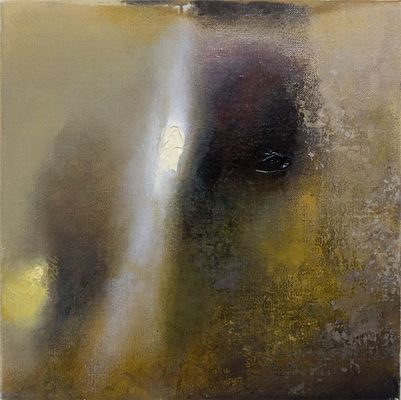
To return to Buckley’s fragment, the first two lines very much evoke how I paint nowadays. As you age, detail diminishes and patches of light become more luminous and float. I feel the most honest way of dealing with this is by smearing the oil paint on the canvas with the fingers and working close-up, blind. Only if the patches coalesce into an approaching image can the work gain a life.
-
Jonathan Walker was born in Melbourne, Australia and brought up on a dairy farm in Gippsland. In the 1970’s he studied painting at RMIT and won the Harold Wright Scholarship to the British Museum, London. During the 1980’s he exhibited at Pinacotheca Gallery, Richmond and had work shown at the NGV and Heidi City Art Gallery. Over the same period he designed the cover for the “Epigenesi” LP by Giancarlo Toniutti, Italy and conducted a mail exchange work with Achim Wollscheid, Germany. The work with artists through the post resulted in an article published in the bicentenary issue of Art and Australia 1988. He showed in artist run spaces such as WestSpace in the 90’s and 2000’s, and until 2012, taught painting at Victoria University, which is where we (Colleen Ahern and Lisa Radford) as organisers of the exhibition, among many others, had the privilege of being his student.
Walker’s knowledge was imparted to students through the careful selection of music, literature, and artists found in books that he himself had ordered for the library. Walker’s strategy was the generosity of sharing his vast knowledge with references specific to each student and their context.
Walker’s paintings share a similar focus and intimacy.
This exhibition presents a small selection of recent paintings alongside a publication that includes Walker’s writing. Observational and analytical, Walker’s work is a type of material notation — the time of day, colour and how it is blended, the both specific and fleeting location of a reflection on lino or the question of whether a chair leg should be included in a painting.
Please join us on Friday August 21 between 6-8pm to celebrate the opening of the exhibition.
Curated by Colleen Ahern and Lisa Radford.
B. Wurtz
Curated by Nic Tammens
March 26 - April 4, 2015
B.Wurtz works from a basement studio in his home on Manhattan’s Lower East Side.
This local fact is attested to by the plastic shopping bags and newsprint circulars that appear in his work. As formal objects, they don’t make loud claims about their origins but nonetheless transmit street addresses and places of business from the bottom of this long thin island. Like plenty of artists, Wurtz is affected by what is local and what is consumed. His work is underpinned by this ethic. It often speaks from a neighborhood or reads like the contents of a hamper:
“BLACK PLUMS $1.29 lb.”
“Food Bazaar”
“USDA Whole Pork Shoulder Picnic 99c lb.”
“RITE AID Pharmacy, with us it’s personal.”
“H. Brickman & Sons.”
“Sweet Yams 59c lb."
Most of the work in this exhibition was made while the artist was in residence at Dieu Donne, a workshop dedicated to paper craft in Midtown. Here Wurtz fabricated assemblages with paper and objects that are relatively lightweight, with the intention that they would be easily transportable to Australia. This consideration isn’t absolute in Wurtz’s work, but was prescriptive for making the current exhibition light and cheap. Packed in two boxes, these works were sent from a USPS post office on the Lower East Side and delivered to North Melbourne by Australia Post.
Wurtz appears courtesy of Metro Pictures, New York.
Thanks to Rob Halverson, Joshua Petherick, Sari de Mallory, Matt Hinkley, Helen Johnson, Fayen d'Evie, Ask Kilmartin, Lisa Radon, Ellena Savage, Yale Union, and "Elizabeth".
John Nixon
"Archive"
December 15 - January 20, 2014
The presentation of John Nixon's archive offered a rare showcase of this extensive collection of the artist's own publications, catalogues, posters, ephemera, editions and more, from the mid 1980s onwards, alongside a selection of his artworks.
Organized by John Nixon, Joshua Petherick and Matt Hinkley.
<a href=http://wfb.public-office.info/artist/john-nixon>All titles by John Nixon
"Habitat"
at Minerva, Sydney (organised by Joshua Petherick and Matt Hinkley)
November 15 - December 20, 2014
Lupo Borgonovo, Janet Burchill & Jennifer McCamley,
Lewis Fidock, HR Giger, Piero Gilardi, Veit Laurent Kurz,
Cinzia Ruggeri, Michael E. Smith, Lucie Stahl, Daniel Weil, Wols
Press Release:
“...It contained seven objects. The slender fluted bone, surely formed for flight, surely from the wing of some large bird. Three archaic circuitboards, faced with mazes of gold. A smooth white sphere of baked clay. An age-blackened fragment of lace. A fingerlength segment of what she assumed was bone from a human wrist, grayish white, inset smoothly with the silicon shaft of a small instrument that must once have ridden flush with the surface of the skin - but the thing’s face was seared and blackened.”
William Gibson, “Count Zero”, 1986
"Autumn Projects Archive"
Curated by Liza Vasiliou
March 6 - March 15, 2014
World Food Books, in conjunction with the Virgin Australia Melbourne Fashion Festival 2014, presented the Autumn Projects archive, consisting of a selection of early examples in Australian fashion with a particular interest in collecting designers and labels from the period beginning in the 1980’s, who significantly influenced the discourse of Australian Fashion.
Curated by Liza Vasiliou, the exhibition provided a unique opportunity to view pieces by designers Anthea Crawford, Barbara Vandenberg, Geoff Liddell and labels CR Australia, Covers, Jag along with early experimental collage pieces by Prue Acton and Sally Browne’s ‘Fragments’ collection, suspended throughout the functioning World Food Books shop in Melbourne.
H.B. Peace
presented by CENTRE FOR STYLE
November 14, 2013
"Hey Blinky, you say chic, I say same"
Anon 2013
H.B. Peace is a clothing collaboration between great friends Blake Barns and Hugh Egan Westland. Their pieces explore the divergences between 'character’ and ‘personality’ in garments....etc
Special Thanks to Joshua Petherick and Matt Hinkley of WFB and Gillian Mears
and a Very Special Thank you to Audrey Thomas Hayes for her shoe collaboration.
Janet Burchill & Jennifer McCamley
"Aesthetic Suicide"
May 10 - June 8, 2013
The first of our occasional exhibitions in the World Food Books office/shop space in Melbourne, "Aesthetic Suicide" presented a body of new and older works together by artists Janet Burchill & Jennifer McCamley, including videos, prints, a wall work, and publications.
During shop open hours videos played every hour, on the hour.
2017, English
Hardcover, 384 pages, 17.8 x 22.9 cm
Published by
The MIT Press / Massachusetts
$84.00 - Out of stock
In 1960, the renowned architect Philip Johnson championed Frederick Kiesler, calling him “the greatest non-building architect of our time.” Kiesler's ideas were difficult to construct, but as Johnson believed, “enormous” and “profound.” Kiesler (1890–1965) went against the grain of the accepted modern style, rejecting rectilinear glass and steel in favor of more organic forms and flexible structures that could respond to the ever-changing needs of the body in motion.
In Elastic Architecture, Stephen Phillips offers the first in-depth exploration of Kiesler's innovative and multidisciplinary research and design practice. Phillips argues that Kiesler established a new career trajectory for architects not as master builders, but as research practitioners whose innovative means and methods could advance alternative and speculative architecture. Indeed, Kiesler's own career was the ultimate uncompromising model of a research-based practice.
Exploring Kiesler's formative relationships with the European avant-garde, Phillips shows how Kiesler found inspiration in the plastic arts, experimental theater, early animation, and automatons to develop and refine his spatial concept of the Endless. Moving from Europe to New York in the 1920s, Kiesler applied these radical Dadaist, constructivist, and surrealist practices to his urban display projects, which included shop windows for Saks Fifth Avenue. After launching his innovative Design Correlation Laboratory at Columbia and Yale, Kiesler went on to invent new houses, theaters, and galleries that were meant to move, shift, and adapt to evolutionary changes occurring within the natural and built environment.
As Phillips demonstrates vividly, although many of Kiesler's designs remained unbuilt, his ideas proved influential to later generations of architects and speculative artists internationally, including Archigram, Greg Lynn, UNStudio, and Olafur Eliasson.
Stephen J. Phillips is Professor of Architecture at California Polytechnic State University, Founding Director of the Cal Poly Los Angeles Metropolitan Program in Architecture and Urban Design, and Principal Architect at the firm Stephen Phillips Architects (SPARCHS).
1993, English / German
Softcover, 96 pages, 21 x 26 cm
1st Edition, Out of print title / used / very good
Published by
City Gallery / Wellington
$50.00 - Out of stock
Catalogue produced to accompany the large solo institutional exhibition of German artist Rosemarie Trockel at Wellington's City Gallery, in New Zealand, 1993. Illustrated throughout in colour and black and white images, the catalogue reproduces all the sculptural, drawing, painting, video, wool, photography, collage works presented in the expansive exhibition, along with installation photography, a list of works, exhibition history, biography and accompanying texts by Jutta Koether, Gregory Burke, Robyn Gardner (all in English and German).
Very Good copy
1995, German
Softcover, 200 pages, 15.2 x 21 cm
1st Edition, Out of print title / used / fine
Published by
Walther König / Köln
$100.00 - Out of stock
First edition of this fantastic 1995 Thomas Bayrle publication from Walther König, Cologne. "Grafik" is densely illustrated with almost 200 colour and b/w images of Bayrle's early "super-forms" and animation/film works. Almost entirely a volume of images, it also includes texts by Brigitte Kölle and Kobe Matthys, in both English and German. A valuable and highly visual overview of the pioneering German pop artist.
A pioneer of German Pop Art, Thomas Bayrle is best known for his ‘super-forms’, large images composed of iterations of smaller cell-like images. Humorous, satirical, and often political, his paintings, sculptures, and digital images are commentaries on the systems of control and domination in a rapidly globalizing economy, via allegorical references to traffic patterns, mass production, and the generic designs of popular goods such as wrappers and wallpaper. Bayrle draws readily on his experience of Cold War Germany as a microcosm of broader power struggles.
2013, English
Hardcover, 224 pages, 310 x 240 mm
Published by
Walther König / Köln
$100.00 - In stock -
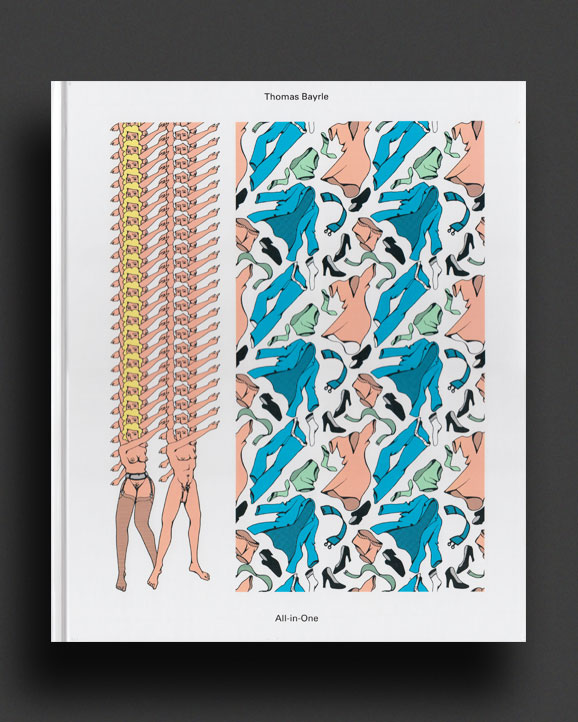
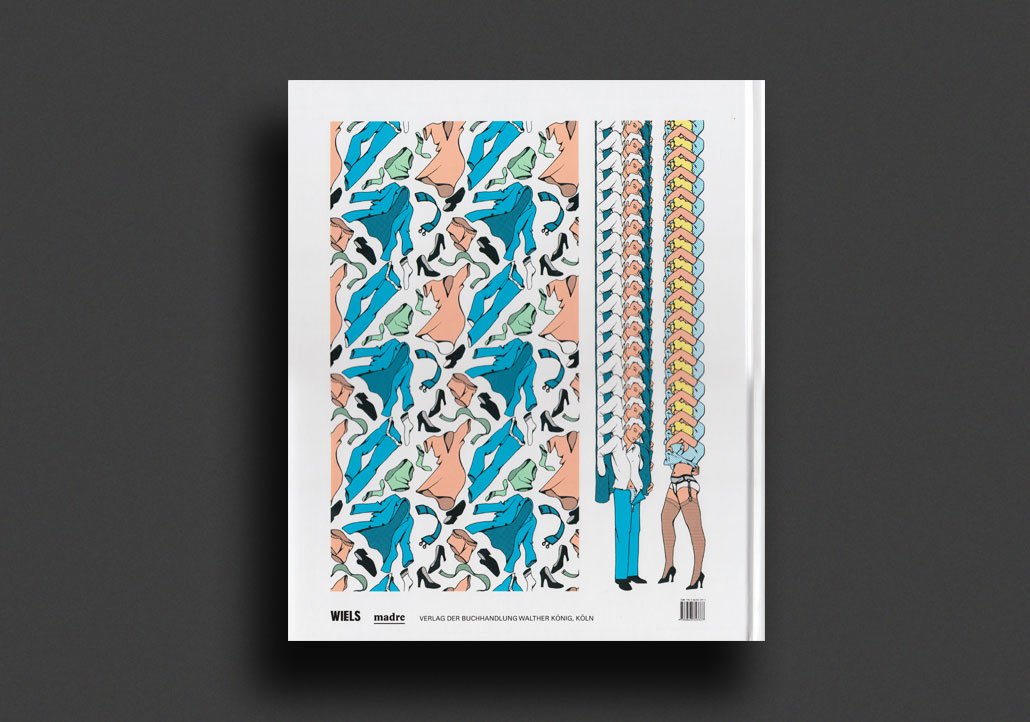
All-in-One represents a first attempt at offering an overview of Thomas Bayrle's multifaceted practice, from his first kinetic machines to the recent engine installations.
Amply illustrated, the catalogue highlights not only the serigraphies and super-images Bayrle is perhaps best known for, but also his sculptures, his early work as a graphic designer and publisher (included is an illustrated bibliography of all of Bayrle's artist books), his videos, as well as samples from his own texts (excerpts from his San Francisco Diary of 1981, reprinted here for the first time) and from his dabblings in concrete poetry.
Holding together this expansive approach are the concerns that have always animated his work: consumerism and consumer society, political propaganda, weaves and patterns, movement, sexuality, and religion.
Published on the occasion of the exhibition at WIELS Contemporary Art Centre, Brussels, 9 February – 12 May 2013.
1978, Japanese / English
Hardcover (w. dust jacket), 20.6 × 21.8 cm
1st Edition, Out of print title / used / very good
Published by
Asahi Sonorama / Tokyo
$120.00 - In stock -
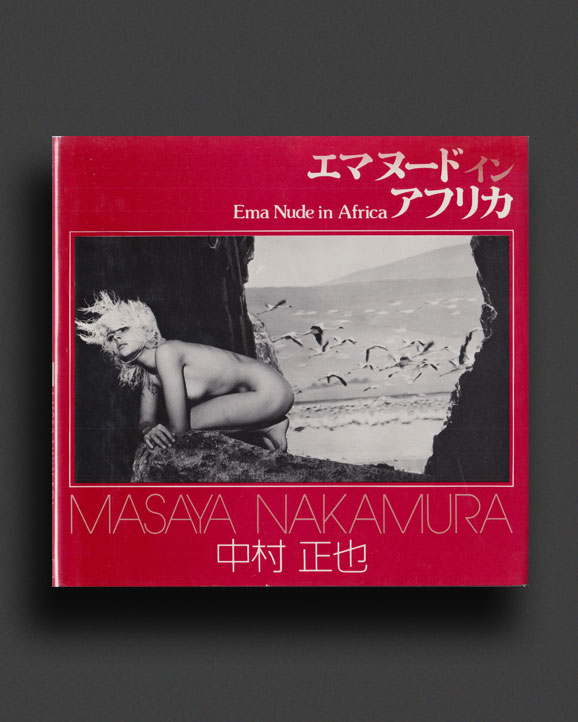
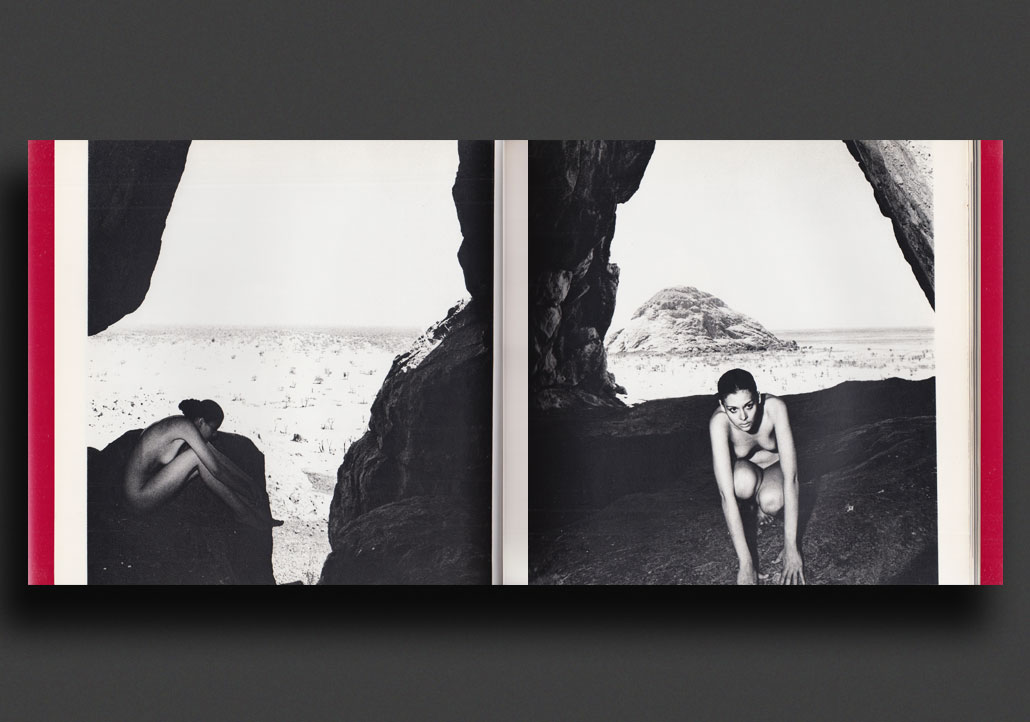
First 1978 hardcover edition of this classic work of early seventies erotica by Japanese photographer Masaya Nakamura. Ema Nude in Africa is a photobook of nude images of Emma Sugimoto, a leading model in Japan at that time (also featured in "Emma" by Shunji Okura), captured in various locations throughout the African continent at the end of the 1960s. The book includes all the photographs from a large exhibit of the same name held at the Tokyo Department Store in Shibuya in 1971. This hardcover edition was published in 1978 by Asahi Sonorama, Tokyo. Text in Japanese with short note in English by photographer Sam Haskins and an afterword by Tatsuo Shirai.
Masaya Nakamura (中村 正也 Nakamura Masaya, 1926–2001) was a japanese photographer particularly known for nude photography. Nakamura began photographing actors and doing still photography for films. He went freelance in 1951 and in 1954 joined with Yūji Hayata in setting up Hayata's studio. He was also doing work for the magazine Chūō Kōron. And from thw 1950s onwards focussed his photography on the nude.
Very Good copy in Very dust jacket. One dent to cover, otherwise fine throughout.
1973, English / German / French
Hardcover (w. dust jacket), 232 pages, 24 x 30.5 cm
1st Edition, Out of print title / used / good
Published by
The Graphis Press / Zürich
$60.00 - Out of stock
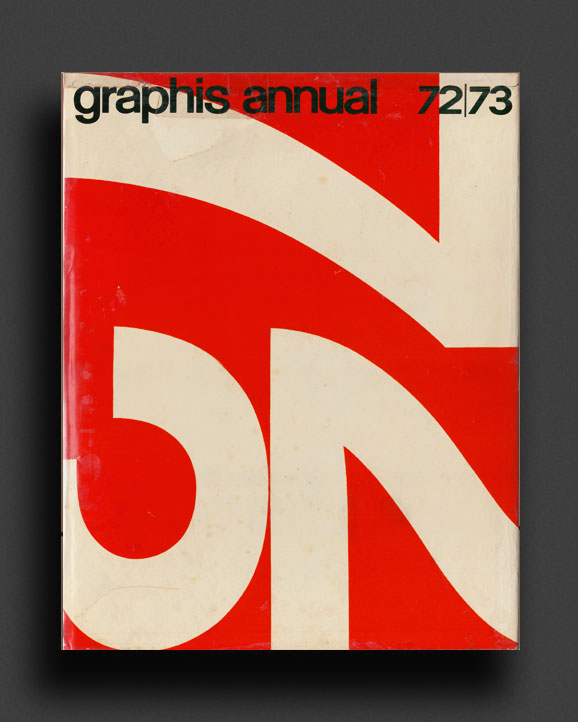
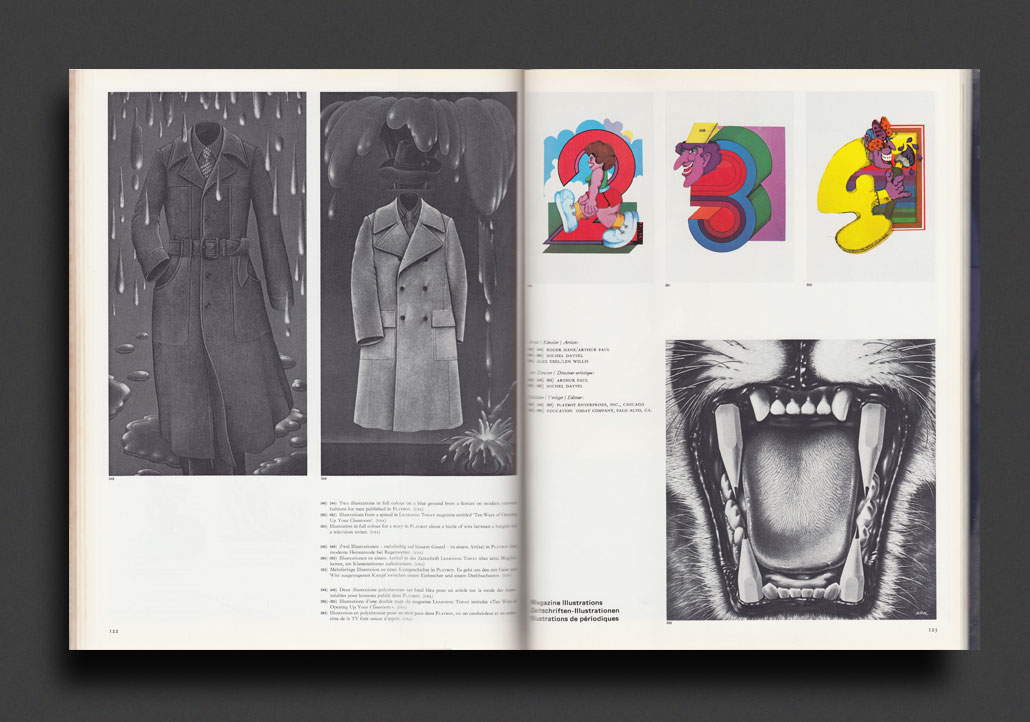
1972/1973 edition (with Massimo Vignelli cover design) of the mighty hardcover Graphis Annuals collection, published by The Graphis Press in Zürich. Designed and edited by Swiss graphic designer Walter Herdeg, this profusely illustrated volume continues one of the world's leading design showcases. Each "International Annual of Advertising Graphics" profiles in colour and black and white the best design of everything from book jackets to record covers to television commercials to trade marks and letterheads. All texts are in English, German and French. This edition features the works of Herb Lubalin, Tomi Ungerer, Domenico Gnoli, Les Mason, Ettore Sottsass, Massimo Vignelli, Edward Gorey, Jean-Michel Folon, Max Ernst, Willy Fleckhaus, Seymour Chwast, Saul Steinberg, Roman Cieslewicz, Milton Glaser, Tadashi Ohashi, Paul Davis, Mort Drucker, Paul Rand, Ernest Trova, Roland Topor, Etienne Delessert, Enzo Mari, Ronald Searle, René Magritte, Tetsuo Iwashima, Olaf Leu, Edward C. Kozlowski, Push Pin Studio, and hundreds more.
Good copy in good dust jacket (tanning and ageing). Preserved under mylar wrap.
2007 / 2008, English
2 x posters (81 x 60 ea) in silkscreened Cosmic Wonder paper bag
1st Edition, Out of print title / used / very good
Published by
Cosmic Wonder Press / Tokyo
Nieves / Zurich
$35.00 - Out of stock
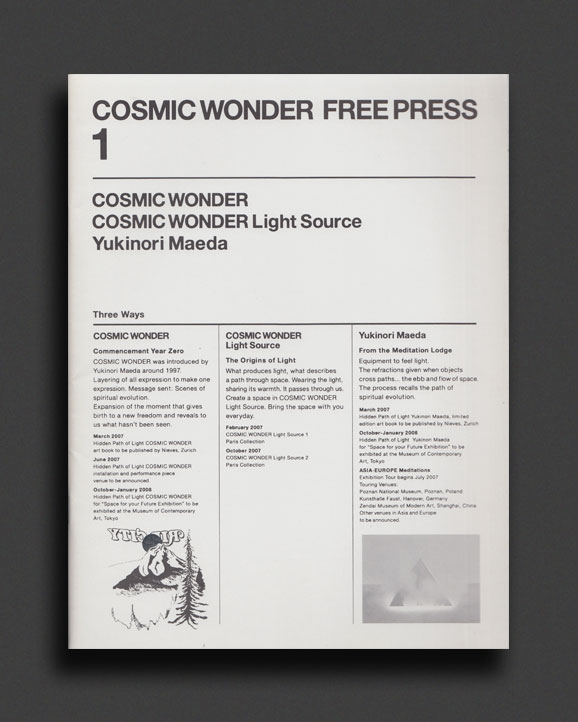
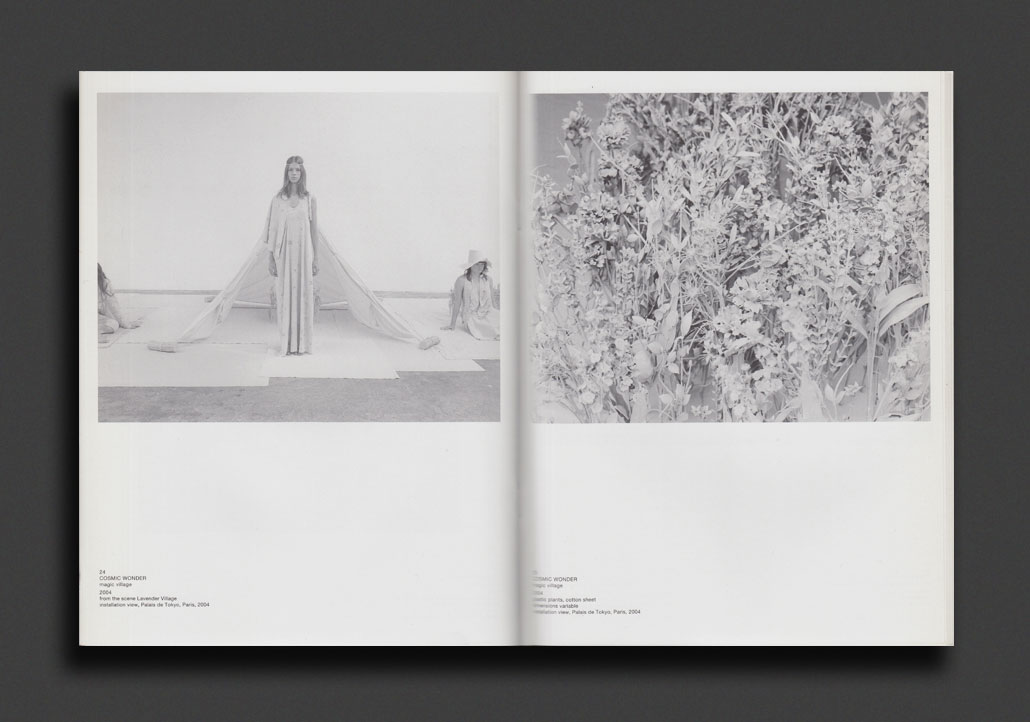
Cosmic Wonder Free Press 1 & 2 offset printed posters, issued upon publication in 2007 and 2008 and also as promotion at Cosmic Wonder's flagship stores in Tokyo and Osaka. As new, folded (as-issued), preserved in silkscreened Cosmic Wonder paper bag (some creasing and chipping to base of bag).
COSMIC WONDER Light Source Starting this year, COSMIC WONDER Light Source is on exhibit for Paris Fashion Week and at the same time it has become the sole fashion project of COSMIC WONDER. The collection is introduced to encourage people to wear these clothes in their daily life, so that they may delight in discovering anew the spirit within them.
Yukinori Maeda After studying architecture, Maeda started his creative activities as COSMIC WONDER. In recent years, he has been actively creating and exhibiting his personal artistic works in parallel with his achievements as COSMIC WONDER. For 2007, Maeda has confirmed his participation in the coming traveling exhibition starting in Poland. Also confirmed is an exhibition at Museum of Contemporary Art Tokyo, and here he will attempt to president two separate creative endeavors as COSMIC WONDER and artist Yukinori Maeda, in one exhibition.
Out of print, As new copy.
2007, English
Softcover, 48 Pages b/w, gold & silver ill.), 19.5 x 25.5 cm,
1st Edition, Out of print title / as new
Published by
Nieves / Zurich
Cosmic Wonder Press / Tokyo
$60.00 - Out of stock
With aim to further reflect and pursue the expanding expression onto each particular direction, in 2007, Cosmic Wonder is anouncing three projects with distinct processes: Cosmic Wonder, Cosmic Wonder Light Source and Yukinori Maeda.
The new unconventional periodical publication Cosmic Wonder Free Press was produced to lay out the three projects with visuals. It is the first in a series of special collaborations between Cosmic Wonder and Nieves. Cosmic Wonder Free Press will be published with free pace and free format as its title suggests.
COSMIC WONDER Since its debut Paris collection in 2000 at the Centre Pompidou, Paris Fashion Week has been the principal forum for presenting the works of COSMIC WONDER. From now on, however, COSMIC WONDER is ever widening its focus to further its exploration of installation and performance in venues around the world. Their projects later this year include an art book, ''Hidden Path of Light COSMIC WONDER," published by Nieves, and in October, a new installation and performance to be exhibited at the Museum of Contemporary Art,Tokyo.
COSMIC WONDER Light Source Starting this year, COSMIC WONDER Light Source is on exhibit for Paris Fashion Week and at the same time it has become the sole fashion project of COSMIC WONDER. The collection is introduced to encourage people to wear these clothes in their daily life, so that they may delight in discovering anew the spirit within them.
Yukinori Maeda After studying architecture, Maeda started his creative activities as COSMIC WONDER. In recent years, he has been actively creating and exhibiting his personal artistic works in parallel with his achievements as COSMIC WONDER. For 2007, Maeda has confirmed his participation in the coming traveling exhibition starting in Poland. Also confirmed is an exhibition at Museum of Contemporary Art Tokyo, and here he will attempt to president two separate creative endeavors as COSMIC WONDER and artist Yukinori Maeda, in one exhibition.
Out of print, As new copy.
2017, English
Softcover, 176 pages, 23 x 31 cm
Published by
Roma / Amsterdam
$60.00 - Out of stock
First issue of an annual magazine of photographic stories, edited and designed by Julie Peeters. Twelve contributors present new or previously unpublished work. BILL prioritizes visual reading without distraction, the images that appear in the magazine are printed without any accompanying text. Contributors to the first issue are: Jochen Lempert, Ketuta Alexi-Meskhishvili, Katja Mater, Elena Narbutaite, Rosalind Nashashibi & Vivian Suter, Arthur Ou, Scott Ponik, Adam Putnam, Johannes Schwartz, Algirdas Šeškus, Linda Van Deursen, and Stand Up Comedy.
2019, English
Softcover, 184 pages, 23 x 31 cm
Published by
Roma / Amsterdam
$50.00 - Out of stock
Out of Print.
Bill 2 is the second issue of an annual magazine of photographic stories, edited and designed by Julie Peeters. Twelve contributors present new or previously unpublished work. The images in the magazine are printed without any accompanying text: Bill prioritizes visual reading without distraction. Contributors to the second issue are: Gintaras Didziapetris, Jason Dodge, Archiv Hans Hollein, Inge Ketelers, Tadashi Kurahashi by Tadanori Yokoo - Tadanori Yokoo by Tadashi Kurahashi, Jochen Lempert, Raimundas Malasauskas, Bart Julius Peters / T L P S, Reto Schmid, Megan Francis Sullivan, Linda van Deursen, Ann Woo, and Jiajia Zhang.
1988, Japanese
Hardcover (w. dust jacket), 76 pages, 26.5 x 31 cm
1st Edition, Out of print title / used / very good
Published by
Libro Port Publishing Co. Ltd. / Tokyo
$360.00 - Out of stock
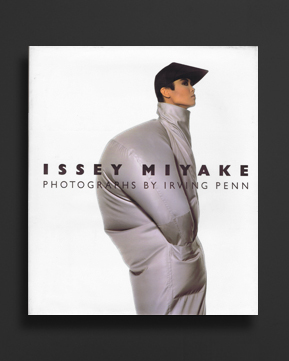
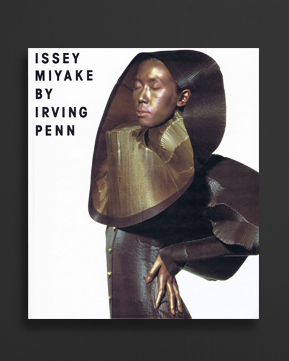
Signed copy (by Issey Miyake) of the wonderful first Japanese printing of this famous Irving Penn photography book, published by Libro Port Publishing Co. Ltd., Tokyo in 1988. It is the hardcover version with original illustrated dust-jacket.
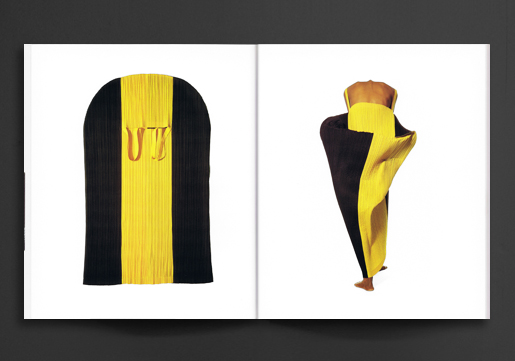
Published to coincide with the exhibition "Issey Miyake A UN," organized by Miyake Design Studio in association with the Musee des Arts Decoratifs in Paris in 1988, this heavily photographic book features stunning full-page photos by Irving Penn of Issey Miyake's 1987 line throughout the entire book. Foreword by Isamu Noguchi, and accompanying essay by Jay Cocks. Type design by Kiyoshi Kanai. Project coordinated by Midori Kitamura and June Kanai, who also modeled the clothes. Wonderful, iconic imagery of Issey Miyake's late 1980's works.
Dedication, signed and dated (1988) by Issey Miyake in bold black marker on title page!
Very Good copy - tight, clean, protected by original dust-jacket under plastic wrap, very light shelf wear / tanning to cover.
1990, English
Hardcover, 48 pages, 26.5 x 31 cm
1st edition of 3000 copies, signed / out of print title / used*,
Published by
Miyake Design Studio / Tokyo
$530.00 - Out of stock
Signed copy (by Issey Miyake) of the very scarce, collectable "Issey Miyake by Irving Penn" (1990), printed only once in a limited edition of 3,000 copies and published by the Miyake Design Studio in Tokyo, 1990.
Signed and dated (Dec. 1990) by Issey Miyake on the title page in grey lead, this beautiful volume is made up entirely of legendary photographer Irving Penn's elegant images of the great Japanese fashion designer Issey Miyake's 1990 collection, in full-colour on gloss stock. One of the greatest collaborative partnerships in fashion image history.
‘through his eyes penn-san reinterprets the clothes, gives them new breath, and presents them to me from a new vantage point — one that I may not have been aware of, but had been subconsciously trying to capture. Without penn-san’s guidance, I probably could not have continued to find new themes with which to challenge myself, nor could I have arrived at new solutions.’ – Issey Miyake (from Irving Penn: A Career in Photography, the Art Institute of Chicago, 1997)
credits:
Clothing Design by lssey Miyake
Photographs by Irving Penn
Book Design by lkko Tanaka
Face by Tyen
Hair by John Sahag
Modeled by Yuki Fujii
Printed and bound by Nissha Printing Company, Kyoto, Japan
Published by Miyake Design Studio, Tokyo, Japan
Published in a limited edition of 3,000 copies
1984, English / French / German
Hardcover, 304 pages, 24 x 30.5 cm
Out of print title / used / very good
Published by
The Graphis Press / Zürich
$45.00 - Out of stock
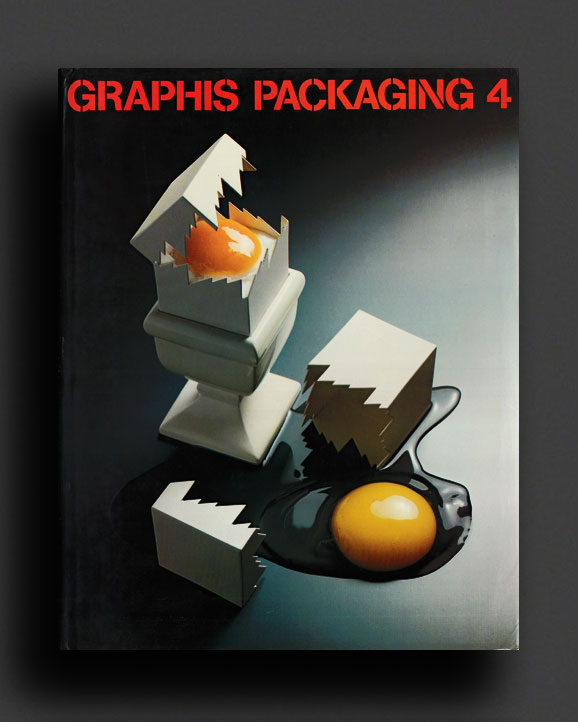
The great "GRAPHIS PACKAGING 4", published in 1984 by the legendary Graphis Press, Zürich. This hardcover volume, edited by Swiss graphic designer Walter Herdeg, presents the best packaging design in the world, circa 1984, covering : Foods, Beverages, Tobacco Products, Cosmetics, Toiletries, Textiles, Clothing and Accessories, Household Cleaning Products, Miscellaneous Stationery, Carrier Bags, Wrapping Paper, Industrial Packaging, Shipping Containers, Paints, Hardware, Sports, Pastimes, Education, Pharmaceutical Products, Professional Samples, Promotional Packaging, and much more! Profusely illustrated across 304 pages, with 918 b/w and colour examples, and, as per usual for Graphis publications, handsomely designed and heavily researched, with all texts in English, German and French. Introduction by Ralph Caplan.
Designers and artists represented in this volume include : Saul Bass, Walter Ballmer, Ivan Chermayeff, Seymour Chwast, Paul Davis, Louise Fili, Morton Goldsholl, Kenneth Grange, Stig Lindberg, George Lois, Paul Rand, Alex Steinweiss, and many others.
Very Good copy in Very Good dust jacket. Preserved under mylar wrap. Perfect copy.
2019, English / Italian
Softcover (w. plastic dust jacket), 352 pages, 17 x 23 cm
Published by
Corraini / Italy
$120.00 - Out of stock
Dieter Roth, one of the most prominent artists of the late 20th century and a key figure in the history of Artists’ Books, has poured his entire life onto countless pages. From his beginnings in the 1950s and throughout the years of his artistic practice, he produced over 230 books. Roth constantly took notes and wrote journals from which he drew the wide range of materials used in his works. Twenty years after his death, his work still represents today an endless source of inspiration for contemporary artists.
The volume Dieter Roth. Pages brings together for the first time all of his books, diaries and notebooks in one single publication—complete with images and technical descriptions—showing how, in every page, as well as in all his visual artworks, Roth followed a principle of inexhaustible variation. Starting from an original, often handwritten text, which he generally arranged in layers and complemented with writings and drawings, he developed a series of consecutive texts, each being fully shaped in a self-contained form, and yet providing the very reason and possible starting point for the following book. Roth and his series of copies and alterations narrate the journey of a 20th-century Self who, at every step, and with every development, is forced to observe his own gradual and inescapable disgregation.
The critical essay by curator Elena Volpato and the text by the artist’s son and collaborator Björn Roth on the production of the Copy Books, in which he personally took part, are accompanied by the writings of two internationally renowned artists, Lawrence Weiner and Pavel Büchler, who have paid their tribute to Dieter Roth, celebrating his revolutionary power and the founding value of his research.
2007, English
Softcover, 160 pages, 20 x 15 cm
Published by
Exact Change / Boston
$32.00 - Out of stock
Joseph Cornell is well known for the oneiric quality of his art and films. Many have tried, often in vain, to put into words the strange power of his boxes--toy-like constructions whose playfulness and humor are anchored in a profound melancholy and loneliness. "Slot machines of visions," said Octavio Paz. Cornell himself is said to have enjoyed children's responses to his work; perhaps because nothing prepares one better for viewing a Cornell box than having an unbiased mind. Catherine Corman has combed through the voluminous diaries that Cornell kept throughout his life, now in the care of the Smithsonian's Archives of American Art, in search of the artist's own dreams. What she found are brief flashes of images, and short, enigmatic narratives of illumination -- the verbal equivalent of Cornell boxes. In 1993, Mary Ann Caws edited a large portion of Cornell's diaries for publication by Thames & Hudson, an invaluable sourcebook for Cornell studies. This new, shorter volume is a poetic addition to that literature, equally indispensible to those interested in Cornell as it contains previously unpublished writings, but also because it is as intriguing and mysterious to the uninitiated as the magical boxes themselves.
Joseph Cornell (December 24, 1903 – December 29, 1972) was an American artist and film maker, one of the pioneers and most celebrated exponents of assemblage. Influenced by the Surrealists, he was also an avant-garde experimental filmmaker. He was largely self-taught in his artistic efforts, and improvised his own original style incorporating cast-off and discarded artifacts. He lived most of his life in relative physical isolation, caring for his mother and his disabled brother at home, but remained aware of and in contact with other contemporary artists.
2008, English
Softcover, 96 pages, 22 x 32 cm
Published by
JRP Ringier / Zürich
$49.00 - Out of stock
The return of an out-of-print cult classic
The book is a reprint of the original 1980 publication of the Swiss artist and photographer. With only full-bleed black and white images organized in visual sequences, the first publication suddenly brought Pfeiffer's Polaroids to the public's attention and became a sort of underground icon, flirting with gay subculture and what later became a mainstream style of magazine photography.
"In his earliest work Pfeiffer can be seen in relation to Larry Clark, as a photographer who not only captures but implicates himself in the restless '70s, and yet Pfeiffer's irreverent sense of humor sets him apart [ … ] Walter Pfeiffer's work both anticipated and paralleled that of the '80s photographers and, in so doing, looked ahead to much of what followed. So it would be possible to see his pictures laid end to end as a secret thread to the present."—Bob Nickas (Artforum)
1970, English
Softcover, 368 pages, 11 x 18 cm
Out of print title / used / good
Published by
Penguin Books / London
$18.00 $8.00 - Out of stock
English 1970 Penguin edition of Jean-Paul Sartre's "Iron in the Soul", translated by Gerard Hopkins.
June 1940 was the summer of defeat for the French soldiers, deserted by their officers, utterly demoralized, awaiting the Armistice. Day by day, hour by hour, Iron in the Soul unfolds what men thought and felt and did as France fell. Men who shrugged, men who ran, men who fought and tragic men like Mathieu, who had dedicated his life to finding personal freedom, now overwhelmed by remorse and bitterness, who must learn to kill. Iron in the Soul, the third volume of Sartre's Roads to Freedom Trilogy, is a harrowing depiction of war and what it means to lose.
Jean-Paul Charles Aymard Sartre (21 June 1905 – 15 April 1980) was a French philosopher, playwright, novelist, political activist, biographer, and literary critic. He was one of the key figures in the philosophy of existentialism and phenomenology, and one of the leading figures in 20th-century French philosophy and Marxism. His work has also influenced sociology, critical theory, post-colonial theory, and literary studies, and continues to influence these disciplines. Sartre was also noted for his open relationship with prominent feminist and fellow existentialist philosopher and writer Simone de Beauvoir. Together, Sartre and de Beauvoir challenged the cultural and social assumptions and expectations of their upbringings, which they considered bourgeois, in both lifestyle and thought. The conflict between oppressive, spiritually destructive conformity (mauvaise foi, literally, "bad faith") and an "authentic" way of "being" became the dominant theme of Sartre's early work, a theme embodied in his principal philosophical work Being and Nothingness (L'Être et le Néant, 1943). Sartre's introduction to his philosophy is his work Existentialism Is a Humanism (L'existentialisme est un humanisme, 1946), originally presented as a lecture. He was awarded the 1964 Nobel Prize in Literature despite attempting to refuse it, saying that he always declined official honours and that "a writer should not allow himself to be turned into an institution".
Good copy.
1964, English
Softcover, 308 pages, 11 x 18 cm
Out of print title / used / very good
Published by
Bantam Books / New York
$18.00 - Out of stock
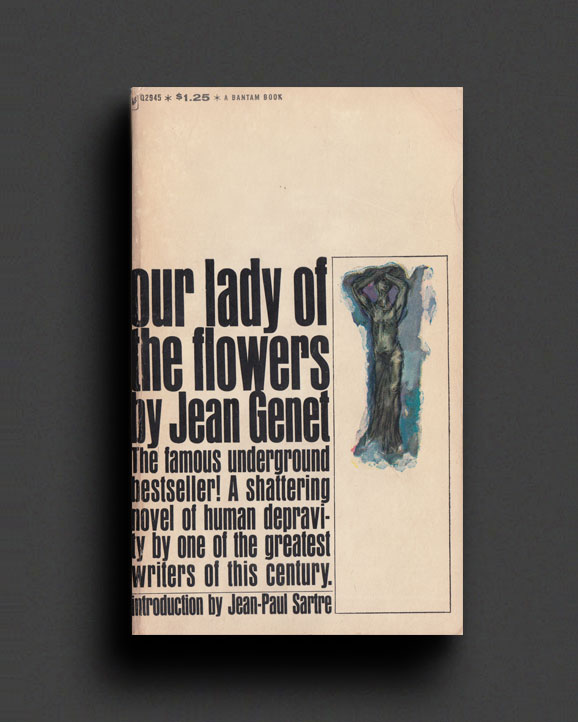
"The famous underground bestseller. A shattering novel of human depravity by one of the greatest writers of the century."
English Bantam softcover edition translated from French by Bernard Frechtman, with introduction by Jean-Paul Sartre. Our Lady of the Flowers (Notre Dame des Fleurs) was the debut novel of French writer Jean Genet, written in prison and first published anonymously in original French in 1943. The free-flowing, poetic, highly erotic, often explicitly sexual novel is a largely autobiographical account of a man's journey through the Parisian underworld, the story of Divine, a drag queen, and a murderer, dubbed Our Lady of the Flowers. Death and ecstasy accompany the acts of every character, as Genet performs a transvaluation of all values, making betrayal the highest moral value, murder an act of virtue and sexual appeal. Written to amuse himself (and to assist his masturbation) whilst he passed his sentence in prison, Genet wrote the manuscript on sheets of brown paper which prison authorities provided to prisoners to make into paper bags. Genet's "unauthorized" use of the paper, was discovered, confiscated and burned by a prison guard. Undaunted, Genet wrote it all over again. The second version survived and Genet took it with him when leaving the prison. For sale to collectors of erotica, Notre Dame des Fleurs first circulated privately and under the counter before entering the literary stream via Marc Barbezat, publisher of the French literary journal L'Arbalete, who published the book in 1944 and again in 1948. It soon became an enormous influence on the post-structuralists and beat writers alike. Our Lady of the Flowers made Genet, in Sartre's mind at least, a poster child of existentialism and most especially an embodiment of that philosophy's views on freedom.
Very Good copy.
1987, English
Softcover, 146 pages, 11.4 cm x 17.8 cm
1st Edition, Out of print title / used / good
Published by
Semiotext(e) / Los Angeles
$35.00 - Out of stock
First 1987 English edition.
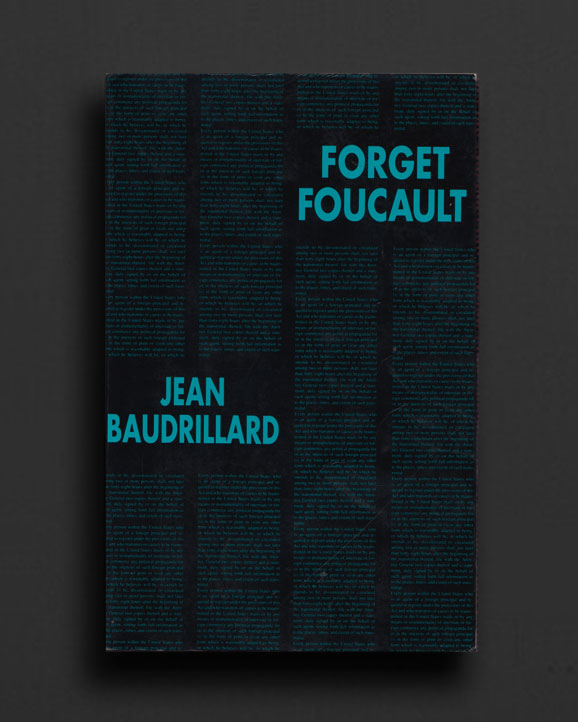
In 1976, Jean Baudrillard sent this essay to the French magazine Critique, where Michel Foucault was an editor. Foucault was asked to reply, but remained silent. Forget Foucault (1977) made Baudrillard instantly infamous in France. Characterizing it as a "mythic discourse," Jean Baudrillard proceeds, in this brilliant essay, to dismantle the powerful, seductive figure of Michel Foucault. In a torrent of haikus, which can now be seen as classically Baudrillardian, he swirls Foucault's concepts of repression, sexuality, production, consumption, and history around in an intense, and often comical, reversal of forces. Exceeding the boundaries of literary or philosophical critique, Baudrillard writes from beyond the horizon of political thought and in a space of phantasmic speculation, finally "using" Foucault's terminologies and public significance to launch his own form of occult, philosophical clarity. In the second half of the book, Baurillard meets his match in an interview with Sylvere Lotringer, who teases Baudrillard with his own ideas, in turn making commentaries on subjects as diverse as panic, ecstasy, and May '68.
Jean Baudrillard (1929-2007) was a philosopher, sociologist, cultural critic, and theorist of postmodernity who challenged all existing theories of contemporary society with humor and precision. An outsider in the French intellectual establishment, he was internationally renowned as a twenty-first century visionary, reporter, and provocateur. His Simulations (1983) instantly became a cult classic and made him a controversial voice in the world of politics and art.
1976, English
Hardcover (w. dust jacket), 62 pages, 21 x 14 cm
1st Edition, Out of print title / used / good
Published by
Holt Rinehart & Winston / Chicago
$28.00 - Out of stock
First hardcover 1976 edition of Snoopy's Collected Writings, "I Never Promised You an Apple Orchard", by the great Charles M. Schulz's. One of the fine 1960s Holt hardcover editions. As teh blurb states: "Publication of Snoopy's remarkable first book - It Was a Dark and Stormy Night - confirmed the
speculation that the novel had gone to the dogs. Such has been his continuing fame, his industry
at the typewriter, that the time has come for a new book a collection of his other no less distinguished
efforts. Their range and variety are surely unmatched in four-legged literature - staggering
puns, cautionary tales, jejune witticisms, titles original and borrowed, and, presented for the first time
in its entirety, a novel completed in defiance of the dreaded second-novel slump "Toodle-oo,
Caribou!" A Tale of the Frozen North. And there is more, for in a gesture of rare honesty Snoopy
has allowed inclusion of both his correspondence with unappreciative publishers and the critical
reactions of his well-intentioned, if less sophisticated, friends. Also notably present is the author's in-
defatigable and ruffled secretary. In all, his vast and insatiable public is sure to find enough familiar pleasures and new delights to satisfy their most extreme cravings."
Charles Monroe "Sparky" Schulz, was an American cartoonist and creator of the comic strip Peanuts. He is widely regarded as one of the most influential cartoonists of all time.
Good-Very Good copy in dust jacket. Jacket wear, some chipping otherwise a Very Good copy throughout. Preserved under mylar wrap.
1959 / 1978 Ed., English
Softcover, 138 pages, 18.5 x 11 cm
Out of print title / used / very good
Published by
Grove Press Inc. / New York
$18.00 $8.00 - Out of stock
In his most famous and perhaps most typical work, Robbe-Grillet explores his principle preoccupation: the meaning of reality. The novel is set on a tropical banana plantation, and the action is seen through the eyes of a narrator who never appears in person, never speaks and never acts. He is a point of observation, his personality only to be guessed at, watching every movement of the other characters' actions as they flash like moving pictures across the distorting screen of a jealous mind. The result is one of the most important and influential books of our time, a completely integrated masterpiece that has already become a classic.
Alain Robbe-Grillet (1922 – 2008) was a French writer and filmmaker. He was one of the figures most associated with the Nouveau Roman (new novel) trend of the 1960s, along with Nathalie Sarraute, Michel Butor and Claude Simon. Robbe-Grillet's career as a creator of fiction was not restricted to the writing of novels. For him, creating fiction in the form of films was of equal importance. His film career began when Alain Resnais chose to collaborate with him on his 1961 film Last Year at Marienbad. Robbe-Grillet then went on to launch a career as a writer-director of an award-winning series of cerebral and often sexually provocative feature films which explored similar themes to those in his literary work (e.g. Voyeurism, The Body as Text, The 'Double'), including L'Immortelle (The Immortal One) (1962); Trans-Europ-Express (1966); L'homme qui ment/Muž, ktorý luže (The Man Who Lies) (1968); L'Eden et après/Eden a potom (Eden and After) (1970); Glissements progressifs du plaisir (Progressive Slidings towards Pleasure) (1974); Le jeu avec le feu (Playing with Fire) (1975); La belle captive (The Beautiful Captive) (1983); and more.
Very Good-Fine Grove Press paperback edition from 1978.
1965, English
Softcover, 172 pages, 18 x 11 cm
Out of print title / used / very good
$28.00 - Out of stock
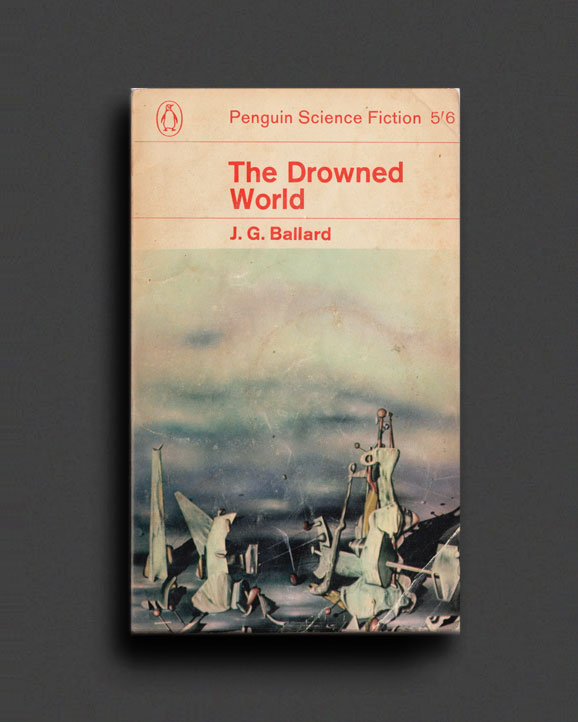
First published in 1962, British science fiction author J.G. Ballard's mesmerising and ferociously prescient novel "The Drowned World" imagines a terrifying future in which solar radiation and global warming have melted the polar ice caps and Triassic-era jungles have overrun a submerged and tropical London. Set during the year 2145, the novel follows biologist Dr. Robert Kerans and his team of scientists as they confront a surreal cityscape populated by giant iguanas, albino alligators, and endless swarms of malarial insects. "The Drowned World" is the second of a series of classic early Ballard novels dealing with scenarios of natural disaster. This is the British 1965 edition with Yves Tanguy cover art.
James Graham Ballard (15 November 1930 – 19 April 2009) was an English novelist, short story writer, and essayist who first became associated with the New Wave of science fiction for his post-apocalyptic novels such as The Wind from Nowhere (1961) and The Drowned World (1962). In the late 1960s, he produced a variety of experimental short stories (or "condensed novels"), such as those collected in the controversial The Atrocity Exhibition (1970). In the mid 1970s, Ballard published several novels, among them the highly controversial Crash (1973), a story about symphorophilia and car crash fetishism, and High-Rise (1975), a depiction of a luxury apartment building's descent into violent chaos.
1976, English
Softcover, 192 pages, 18 x 11 cm
Out of print title / used / good
Published by
Penguin Books / London
$18.00 - Out of stock
The Wind from Nowhere is British science fiction author J.G. Ballard's debut novel, first published in 1961. He had previously published only short stories. The novel was the first of a series of classic early Ballard novels dealing with scenarios of natural disaster. Here, civilization is reduced to ruins by mysterious prolonged worldwide hurricane force winds that devastate the surface of the earth. Some critics have suggested that his first four novels are based on elemental themes, showing global destruction by air, water, fire and earth. This is the 1976 paperback edition with David Pelham cover art.
James Graham Ballard (15 November 1930 – 19 April 2009) was an English novelist, short story writer, and essayist who first became associated with the New Wave of science fiction for his post-apocalyptic novels such as The Wind from Nowhere (1961) and The Drowned World (1962). In the late 1960s, he produced a variety of experimental short stories (or "condensed novels"), such as those collected in the controversial The Atrocity Exhibition (1970). In the mid 1970s, Ballard published several novels, among them the highly controversial Crash (1973), a story about symphorophilia and car crash fetishism, and High-Rise (1975), a depiction of a luxury apartment building's descent into violent chaos.
Average-Good. Worn cover, Ex-library, but still a great reading copy.
1966, English
Softcover, 224 pages, 18 x 11 cm
Out of print title / used / good
Published by
Penguin Books / London
$28.00 - Out of stock
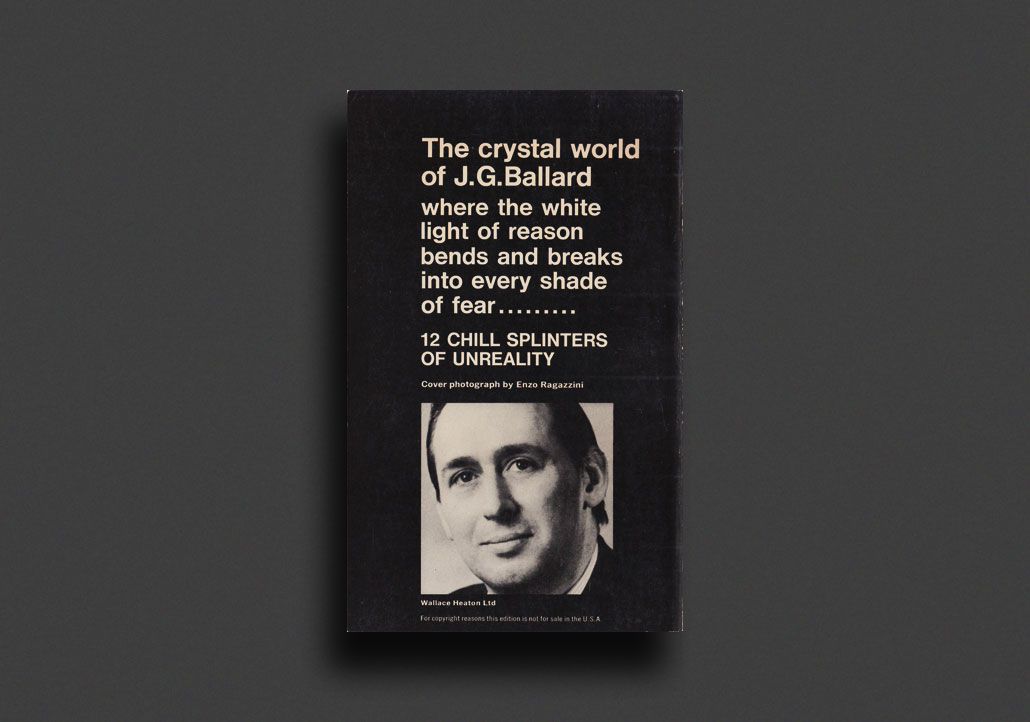
The Terminal Beach is a superb collection of science fiction short stories by British author J.G. Ballard, published in 1964, including "Billennium", "The Terminal Beach", "The Lost Leonardo" and "The Illuminated Man". This is the British 1966 edition.
James Graham Ballard (15 November 1930 – 19 April 2009) was an English novelist, short story writer, and essayist who first became associated with the New Wave of science fiction for his post-apocalyptic novels such as The Wind from Nowhere (1961) and The Drowned World (1962). In the late 1960s, he produced a variety of experimental short stories (or "condensed novels"), such as those collected in the controversial The Atrocity Exhibition (1970). In the mid 1970s, Ballard published several novels, among them the highly controversial Crash (1973), a story about symphorophilia and car crash fetishism, and High-Rise (1975), a depiction of a luxury apartment building's descent into violent chaos.