World Food Books' programme is largely produced on Kulin Nation land. We acknowledge the Wurundjeri people of the Kulin Nation as the first and continuing custodians of this land, and pay respect to their Elders past, present, and emerging.
World Food Books is an arts and special interests bookshop in Naarm / Melbourne. Founded in 2010, World Food Books is devoted to the presentation of a rotating, hand-selection of international art, design, literary and counterculture publications with an emphasis on the anti-traditional, the experimental, the avant-garde, the heretic, the marginal.
Presenting new titles alongside rare and out-of-print books, catalogues and journals spanning the fields of modern and contemporary art, design, photography, illustration, film, literature, poetry, cultural theory, philosophy, sexuality, popular and underground culture in its many radical forms, World Food Books wishes to encourage adventurous, thoughtful and open-minded reading, looking, writing, and exchange of publishing and ideas, both current and historical.
As well as our bookshop, located in Melbourne's historical Nicholas Building, all of our inventory is available internationally via our online mail-order service.
World Food Books semi-regularly co-ordinates "Occasions", a programme of exhibits and events at the bookshop and in partnership with other hosts (such as museums and art galleries) that develop out of the activities, relationships and content of the bookshop itself.
World Food Books
The Nicholas Building
37 Swanston Street
Room 5, Level 6
Melbourne 3000
Australia
SHOP HOURS:
Thu–Fri 12–6, Sat 12–5
WEB-SHOP OPEN 24/7
World Food Books
Postal Address:
PO Box 435
Flinders Lane
Victoria 8009
Australia
Art
Theory / Essay
Architecture / Interior
Graphic Design / Typography
Photography
Fashion
Eros
LGBTQ+
Fiction / Poetry
Weird / Speculative / Science Fiction / Horror
Transgressive / Visceral / Abject
Symbolism / Decadence / Fin de siècle
Film / Video
Painting
Sculpture / Installation
Performance / Dance / Theater
Drawing
Sound / Music
Curatorial
Group Shows / Collections
Periodicals
Out-of-print / Rare
Posters / Ephemera / Discs
Signed Books
World Food Books Gift Voucher
World Food Book Bag
Australian Art
Australian Fiction
Australian Science Fiction / Speculative Fiction
Australian Poetry
Australian Photography
Japanese Photography
Conceptual Art
Minimal Art
Dada
'Pataphysics / Oulipo
Fluxus
Concrete Poetry
Pop Art
Surrealism
Arte Povera
Arte Informale / Haute Pâte / Tachism
Nouveau Réalisme / Zero / Kinetic
Situationism / Lettrism
Collage / Mail Art / Xerox Art
Art Brut / Folk / Visionary / Fantastic
Illustration / Graphic Art / Bandes Dessinées
Furniture
Italian Radical Design / Postmodernism
Textiles
Ceramics / Glass
Counterculture
Protest / Revolt
Philosophy
Psychoanalysis
Anthropology
Anarchism
Socialism / Anarchism / Communism / Capitalism
Literary Theory / Semiotics / Language
Feminism / Women's Studies
Gender Studies / Sexuality
Anthropology
Fetishism / BDSM
Drugs / Psychedelia
Crime / Violence
Animal Rights / Veganism
Occult / Esoterica
Ecology / Earth / Alternative Living
Whole Earth / Crafts
All prices in AUD (Australian dollars)
Pick-Ups
Pick-up orders can be collected in our bookshop during opening hours after order date. Please collect any Pick-up orders within 2 weeks of ordering as we have limited storage space. Orders will be released back into stock if not collected within this time. No refunds can be made for pick-ups left un-collected. If you cannot make it in to the bookshop in this time-frame, please choose postage option.
Return Policy
All sales are final. We do accept returns (for refund or exchange) for items received in error. All our orders are packed with special care using heavy-duty padding and cardboard book-mailers or bubble mailers (for smaller books), using reinforcement where required. We cannot take responsibility for any lost, stolen or damaged parcels.
Insurance
Should you wish to insure your package, please email us directly after placing your order and we can organise this at a small extra expense. Although all standard/express tracked packages are very safe and dependable, we cannot take responsibility for any lost, stolen or damaged parcels. We recommend insurance on valuable orders.
Interested in selling your old books, catalogues, journals, magazines, comics, fanzines, ephemera? We are always looking for interesting, unusual and out-of-print books to buy. We only buy books in our fields of interest and specialty, and that we feel we can resell.
We base these prices on desirability, market value, in-print prices, condition and our current stock levels. We offer cash, store credit, and can take stock on consignment. All
about 25% of the price we expect to get when we sell them, or 30% in store credit. We base these prices on desirability, market value, in-print prices, condition and our current stock levels.
Sell your books any day of the week. You can drop them off and return later. If you have a lot of books, we can visit your Sydney home.
We buy books that we feel we can resell. We offer about 25 % of the price we expect to get when we sell them, or 30% in store credit. We base these prices on desirability, market value, in-print prices, condition and our current stock levels.
Philadelphia Wireman
03 August - 01 September, 2018
World Food Books is proud to announce our next Occasion, the first presentation of sculptures by Philadelphia Wireman in Australia.
The Philadelphia Wireman sculptures were found abandoned in an alley off Philadelphia’s South Street on trash night in 1982. Their discovery in a rapidly-changing neighbourhood undergoing extensive renovation, compounded with the failure of all attempts to locate the artist, suggests that the works may have been discarded after the maker’s death. Dubbed the "Philadelphia Wireman" during the first exhibition of this work, in 1985, the maker’s name, age, ethnicity, and even gender remain uncertain. The entire collection totals approximately 1200 pieces, all intricately bound together with tightly-wound heavy-gauge wire (along with a few small, abstract marker drawings, reminiscent both of Mark Tobey and J.B. Murry). The dense construction of the work, despite a modest range of scale and materials, is singularly obsessive and disciplined in design: a wire armature or exoskeleton firmly binds a bricolage of found objects including plastic, glass, food packaging, umbrella parts, tape, rubber, batteries, pens, leather, reflectors, nuts and bolts, nails, foil, coins, toys, watches, eyeglasses, tools, and jewellery.
Heavy with associations—anthropomorphic, zoomorphic, and socio-cultural responses to wrapped detritus—the totemic sculptures by Philadelphia Wireman have been discussed in the context of work created to fulfil the shamanistic needs of alternative religions in American culture. Curators, collectors, and critics have variously compared certain pieces to sculpture from Classical antiquity, Native American medicine bundles, African-American memory jugs, and African fetish objects. Reflecting the artist’s prolific and incredibly focused scavenging impulse, and despite—or perhaps enhanced by—their anonymity, these enigmatic objects function as urban artefacts and arbiters of power, though their origin and purpose is unknown. Philadelphia Wireman, whatever their identity, possessed an astonishing ability to isolate and communicate the concepts of power and energy through the selection and transformation of ordinary materials. Over the course of the past two decades, this collection has come to be regarded as an important discovery in the field of self-taught art and vernacular art.
Presented in collaboration with Fleisher-Ollman Gallery, Philadelphia, and Robert Heald, Wellington.
Susan Te Kahurangi King
02 February - 10 March, 2018
Susan Te Kahurangi King (24 February 1951 - ) has been a confident and prolific artist since she was a young child, drawing with readily available materials - pencils, ballpoint pens and felt-tip markers, on whatever paper is at hand. Between the ages of four and six Susan slowly ceased verbal communication. Her grandparents William and Myrtle Murphy had developed a special bond with Susan so they took on caring responsibilities for extended periods. Myrtle began informally archiving her work, carefully collecting and storing the drawings and compiling scrapbooks. No drawing was insignificant; every scrap of paper was kept. The King family are now the custodians of a vast collection containing over 7000 individual works, from tiny scraps of paper through to 5 meter long rolls.
The scrapbooks and diaries reveal Myrtle to be a woman of great patience and compassion, seeking to understand a child who was not always behaving as expected. She encouraged Susan to be observant, to explore her environment and absorb all the sights and sounds. Myrtle would show Susan’s drawings to friends and people in her community that she had dealings with, such as shopkeepers and postal workers, but this was not simply a case of a grandmother’s bias. She recognised that Susan had developed a sophisticated and unique visual language and sincerely believed that her art deserved serious attention.
This was an unorthodox attitude for the time. To provide some context, Jean Dubuffet coined the term Art Brut in 1945 to describe work created by self-taught artists – specifically residents of psychiatric institutions and those he considered to be visionaries or eccentrics. In 1972 Roger Cardinal extended this concept by adopting the term Outsider Art to describe work made by non-academically trained artists operating outside of mainstream art networks through choice or circumstance. Susan was born in Te Aroha, New Zealand in 1951, far from the artistic hubs of Paris and London that Dubuffet and Cardinal operated in. That Myrtle fêted Susan as a self-taught artist who deserved to be taken seriously shows how progressive her attitudes were.
Susan’s parents Doug and Dawn were also progressive. Over the years they had consulted numerous health practitioners about Susan’s condition, as the medical establishment could not provide an explanation as to why she had lapsed into silence. Dawn educated herself in the field of homeopathy and went on to treat all twelve of her children using these principles – basing prescriptions on her observations of their physical, mental and emotional state.
Doug was a linguist with an interest in philosophy who devoted what little spare time he had to studying Maori language and culture. To some extent their willingness to explore the fringes of the mainstream made them outsiders too but it was their commitment to living with integrity and their respect for individuality that ensured Susan’s creativity was always encouraged.
Even though Susan’s family supported her artistic pursuits, some staff in schools and hospitals saw it as an impediment to her assimilation into the community and discouraged it in a variety of ways. Her family was not always aware of this and therefore did not fully understand why Susan stopped drawing in the early 1990s. However, rather than dwell on the challenges that Susan faced in pursuit of her artistic practice, they prefer to highlight her achievements. In 2008 Susan began drawing again in earnest, after an almost 20 year interruption, and her work is now shown in galleries around the world.
Susan grew up without television and has been heavily influenced by the comics she read as a child. She is absolutely fearless in the appropriation of recognizable characters, such as Donald Duck and Mickey Mouse, in her work. She twists their limbs, contorts their faces, compresses them together, blends them into complex patterned backgrounds - always imbuing them with an incredible energy. Although Susan often used pop culture characters in her work they are not naive or childlike. These are drawings by a brilliant self-taught artist who has been creating exceptional work for decades without an audience in mind.
Mladen Stilinović
"Various Works 1986 - 1999"
02 February 16 - September 10, 2016
Various works 1986 - 1999, from two houses, from the collections of John Nixon, Sue Cramer, Kerrie Poliness, Peter Haffenden and Phoebe Haffenden.
Including: Geometry of Cakes (various shelves), 1993; Poor People’s Law (black and white plate), 1993; White Absence (glasses, ruler, set square, silver spoon, silver ladel with skin photograph and wooden cubes), 1990-1996; Exploitation of the Dead (grey and red star painting, wooden painting, black spoon with red table, red plate), 1984-1990; Money and Zeros (zero tie, paintings made for friends in Australia (Sue, John, Kerrie), numbers painting), 1991-1992; Words - Slogans (various t-shirts) - “they talk about the death of art...help! someone is trying to kill me”, “my sweet little lamb”, “work is a disease - Karl Marx”; Various artist books, catalogues, monographs, videos; Poster from exhibition Insulting Anarchy; "Circular" Croatian - Australian edition; Artist book by Vlado Martek (Dostoyevsky); more.
Thanks to Mladen Stilinović and Branka Stipančić.
Jonathan Walker
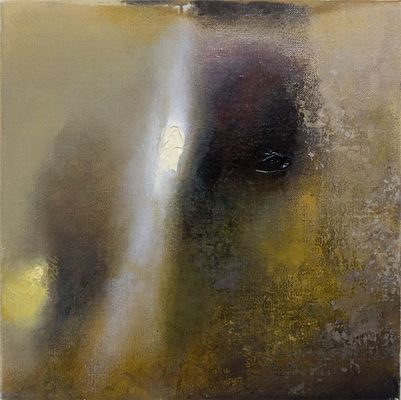
Always Will Need To Wear Winter Shirt Blue + Ochre Small Check Pattern
21 August - 21 September, 2015
Untitled
I am not a great reader of poetry but I always return to the work of Melbourne poet, Vincent Buckley (1925- 1988). Perhaps I find his most tantalising piece to be not a finished poem but a fragment left on a scrap of paper discovered on his desk after the poet’s death.
The poetry gathers like oil
In the word-core, and spreads
It has its music meet,
Its music is in movement.
This fragment is more the shell left behind from a volatile thought than a finished poem. I find the last two lines honest but awkward whereas the first two lines work like an arrow. Most likely he could not find a resolution so it was left. Still, in its present form, it remains an eloquent testimony to the ultimate failure of a medium to express mobile thought and sensation, in Buckley’s case, through verbal language. It’s an important matter because this is something all artists have to deal with regardless of the medium.
I have never written a poem, however, I am forever copying fragments from books on paper scraps in a vain effort to fix certain notions in my head. At first, they function as bookmarks that are sometimes returned to when I open the book. But before long, as they accumulate, they fall out littering the table interspersed with A4 photocopies, bills, books and medications.
To return to Buckley’s fragment, the first two lines very much evoke how I paint nowadays. As you age, detail diminishes and patches of light become more luminous and float. I feel the most honest way of dealing with this is by smearing the oil paint on the canvas with the fingers and working close-up, blind. Only if the patches coalesce into an approaching image can the work gain a life.
-
Jonathan Walker was born in Melbourne, Australia and brought up on a dairy farm in Gippsland. In the 1970’s he studied painting at RMIT and won the Harold Wright Scholarship to the British Museum, London. During the 1980’s he exhibited at Pinacotheca Gallery, Richmond and had work shown at the NGV and Heidi City Art Gallery. Over the same period he designed the cover for the “Epigenesi” LP by Giancarlo Toniutti, Italy and conducted a mail exchange work with Achim Wollscheid, Germany. The work with artists through the post resulted in an article published in the bicentenary issue of Art and Australia 1988. He showed in artist run spaces such as WestSpace in the 90’s and 2000’s, and until 2012, taught painting at Victoria University, which is where we (Colleen Ahern and Lisa Radford) as organisers of the exhibition, among many others, had the privilege of being his student.
Walker’s knowledge was imparted to students through the careful selection of music, literature, and artists found in books that he himself had ordered for the library. Walker’s strategy was the generosity of sharing his vast knowledge with references specific to each student and their context.
Walker’s paintings share a similar focus and intimacy.
This exhibition presents a small selection of recent paintings alongside a publication that includes Walker’s writing. Observational and analytical, Walker’s work is a type of material notation — the time of day, colour and how it is blended, the both specific and fleeting location of a reflection on lino or the question of whether a chair leg should be included in a painting.
Please join us on Friday August 21 between 6-8pm to celebrate the opening of the exhibition.
Curated by Colleen Ahern and Lisa Radford.
B. Wurtz
Curated by Nic Tammens
March 26 - April 4, 2015
B.Wurtz works from a basement studio in his home on Manhattan’s Lower East Side.
This local fact is attested to by the plastic shopping bags and newsprint circulars that appear in his work. As formal objects, they don’t make loud claims about their origins but nonetheless transmit street addresses and places of business from the bottom of this long thin island. Like plenty of artists, Wurtz is affected by what is local and what is consumed. His work is underpinned by this ethic. It often speaks from a neighborhood or reads like the contents of a hamper:
“BLACK PLUMS $1.29 lb.”
“Food Bazaar”
“USDA Whole Pork Shoulder Picnic 99c lb.”
“RITE AID Pharmacy, with us it’s personal.”
“H. Brickman & Sons.”
“Sweet Yams 59c lb."
Most of the work in this exhibition was made while the artist was in residence at Dieu Donne, a workshop dedicated to paper craft in Midtown. Here Wurtz fabricated assemblages with paper and objects that are relatively lightweight, with the intention that they would be easily transportable to Australia. This consideration isn’t absolute in Wurtz’s work, but was prescriptive for making the current exhibition light and cheap. Packed in two boxes, these works were sent from a USPS post office on the Lower East Side and delivered to North Melbourne by Australia Post.
Wurtz appears courtesy of Metro Pictures, New York.
Thanks to Rob Halverson, Joshua Petherick, Sari de Mallory, Matt Hinkley, Helen Johnson, Fayen d'Evie, Ask Kilmartin, Lisa Radon, Ellena Savage, Yale Union, and "Elizabeth".
John Nixon
"Archive"
December 15 - January 20, 2014
The presentation of John Nixon's archive offered a rare showcase of this extensive collection of the artist's own publications, catalogues, posters, ephemera, editions and more, from the mid 1980s onwards, alongside a selection of his artworks.
Organized by John Nixon, Joshua Petherick and Matt Hinkley.
<a href=http://wfb.public-office.info/artist/john-nixon>All titles by John Nixon
"Habitat"
at Minerva, Sydney (organised by Joshua Petherick and Matt Hinkley)
November 15 - December 20, 2014
Lupo Borgonovo, Janet Burchill & Jennifer McCamley,
Lewis Fidock, HR Giger, Piero Gilardi, Veit Laurent Kurz,
Cinzia Ruggeri, Michael E. Smith, Lucie Stahl, Daniel Weil, Wols
Press Release:
“...It contained seven objects. The slender fluted bone, surely formed for flight, surely from the wing of some large bird. Three archaic circuitboards, faced with mazes of gold. A smooth white sphere of baked clay. An age-blackened fragment of lace. A fingerlength segment of what she assumed was bone from a human wrist, grayish white, inset smoothly with the silicon shaft of a small instrument that must once have ridden flush with the surface of the skin - but the thing’s face was seared and blackened.”
William Gibson, “Count Zero”, 1986
"Autumn Projects Archive"
Curated by Liza Vasiliou
March 6 - March 15, 2014
World Food Books, in conjunction with the Virgin Australia Melbourne Fashion Festival 2014, presented the Autumn Projects archive, consisting of a selection of early examples in Australian fashion with a particular interest in collecting designers and labels from the period beginning in the 1980’s, who significantly influenced the discourse of Australian Fashion.
Curated by Liza Vasiliou, the exhibition provided a unique opportunity to view pieces by designers Anthea Crawford, Barbara Vandenberg, Geoff Liddell and labels CR Australia, Covers, Jag along with early experimental collage pieces by Prue Acton and Sally Browne’s ‘Fragments’ collection, suspended throughout the functioning World Food Books shop in Melbourne.
H.B. Peace
presented by CENTRE FOR STYLE
November 14, 2013
"Hey Blinky, you say chic, I say same"
Anon 2013
H.B. Peace is a clothing collaboration between great friends Blake Barns and Hugh Egan Westland. Their pieces explore the divergences between 'character’ and ‘personality’ in garments....etc
Special Thanks to Joshua Petherick and Matt Hinkley of WFB and Gillian Mears
and a Very Special Thank you to Audrey Thomas Hayes for her shoe collaboration.
Janet Burchill & Jennifer McCamley
"Aesthetic Suicide"
May 10 - June 8, 2013
The first of our occasional exhibitions in the World Food Books office/shop space in Melbourne, "Aesthetic Suicide" presented a body of new and older works together by artists Janet Burchill & Jennifer McCamley, including videos, prints, a wall work, and publications.
During shop open hours videos played every hour, on the hour.
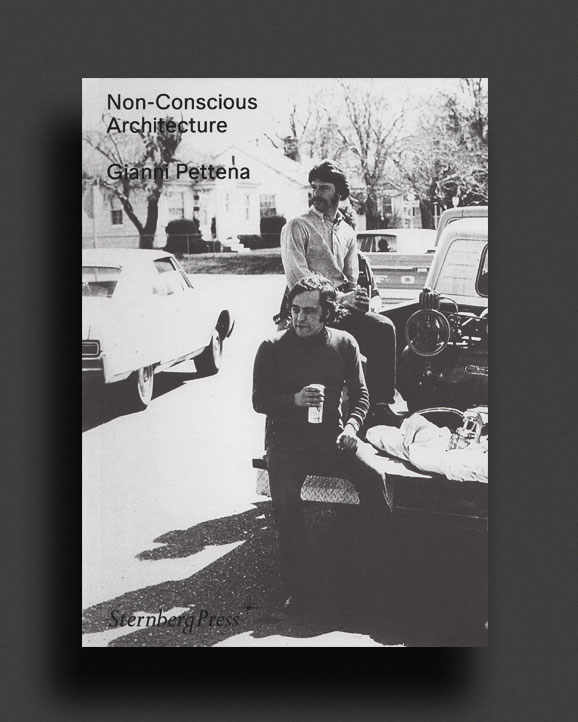
2018, English / Italian
Softcover, 236 pages, 16 x 22.5 cm
Published by
Sternberg Press / Berlin
Galleria Giovanni Bonelli / Milan
$44.00 - Out of stock
Edited by Marco Scotini in collaboration with Gabriele Sassone
Contributions by Pierre Bal-Blanc, Adam Budak, Luca Cerizza, Émile Ouroumov, Marco Scotini, Elisabetta Trincherini
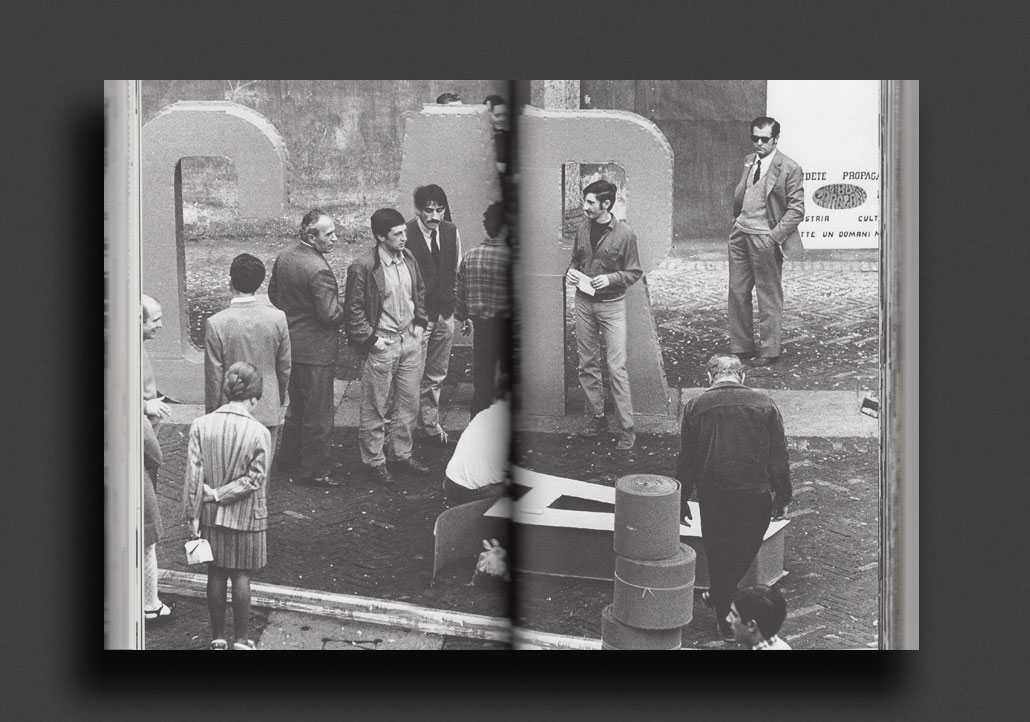
This publication surveys the work of Italian critic, architect, and visual artist Gianni Pettena. Focusing on a rich ten-year period of production that began in the mid-sixties, it brings new attention to the artistic and intellectual practice of a figure known primarily as one of the main exponents of the Radical Architecture movement. International curators and writers consider a span of projects about landscape and the built form as well as objects and works documenting Pettena’s interests in labor, temporality, action, and the event. Published on the occasion of the exhibition “About Non-Conscious Architecture” at Galleria Giovanni Bonelli, Milan, 2017, the book also contains a republished conversation between Pettena and artist Robert Smithson and an illustrated index detailing the trajectory of Pettena’s body of work and research.
Copublished with Galleria Giovanni Bonelli
Design by Dallas
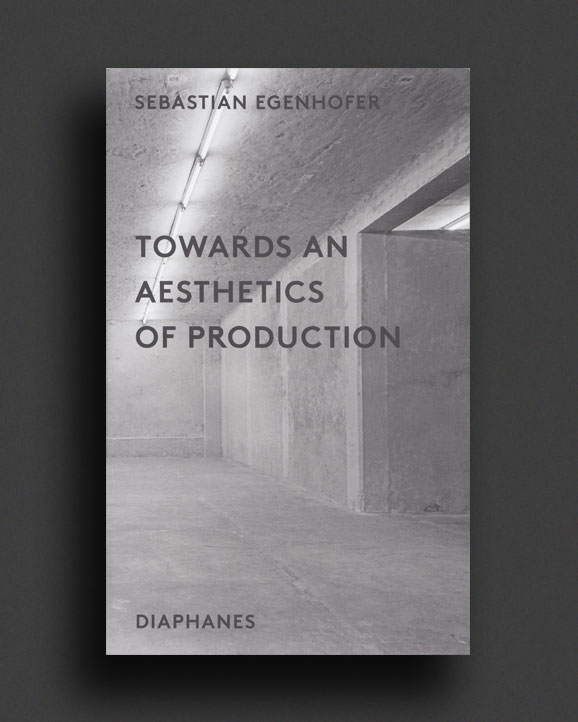
2018, English
Softcover, 208 pages, 14 x 22.5 cm
$57.00 - Out of stock
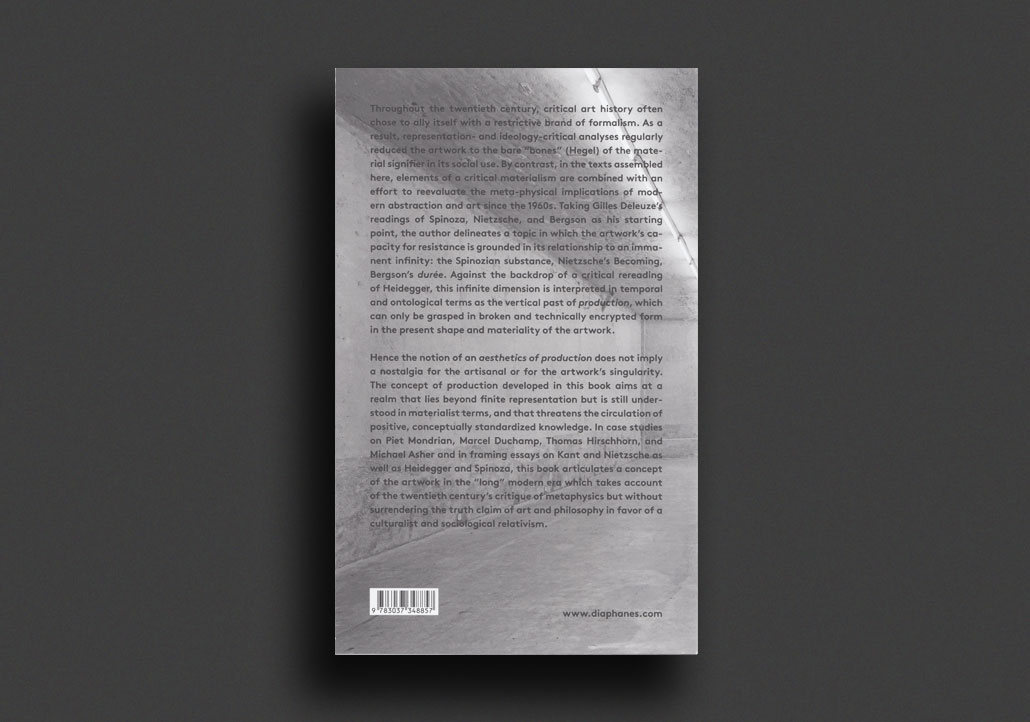
Throughout the twentieth century, art history has been too narrowly focused on formalism. As a result, analyses regularly reduced works of art to their materials, texture, and composition. By contrast, art historian Sebastian Egenhofer takes Gilles Deleuze's readings of Spinoza, Nietzsche, and Bergson as the basis for a new resistance to the overly reductive account of art history. After laying out his argument for a new aesthetics of production in introductory chapters that discuss the work of Spinoza, Nietzsche, and Bergson, as well as Heidegger and Kant, Egenhofer applies this theoretical framework to case studies on Michael Asher, Marcel Duchamp, Thomas Hirschhorn, and Piet Mondrian. An aesthetics of production does not, he argues, imply a nostalgia for the artisanal or for a work of art's singularity, but a way to bring together elements of critical materialism with a thorough reevaluation of the modern art and abstraction.
2019, English
Hardcover, 256 pages, 15.2 x 22.9 cm
Published by
The MIT Press / Massachusetts
$77.00 - Out of stock
An examination of how artists have combined performance and moving image for decades, anticipating our changing relation to images in the internet era.
In Performing Image, Isobel Harbison examines how artists have combined performance and moving image in their work since the 1960s, and how this work anticipates our changing relations to images since the advent of smart phones and the spread of online prosumerism. Over this period, artists have used a variety of DIY modes of self-imaging and circulation-from home video to social media-suggesting how and why Western subjects might seek alternative platforms for self-expression and self-representation. In the course of her argument, Harbison offers close analyses of works by such artists as Robert Rauschenberg, Yvonne Rainer, Mark Leckey, Wu Tsang, and Martine Syms.
Harbison argues that while we produce images, images also produce us-those that we take and share, those that we see and assimilate through mass media and social media, those that we encounter in museums and galleries. Although all the artists she examines express their relation to images uniquely, they also offer a vantage point on today's productive-consumptive image circuits in which billions of us are caught. This unregulated, all-encompassing image performativity, Harbison writes, puts us to work, for free, in the service of global corporate expansion. Harbison offers a three-part interpretive framework for understanding this new proximity to images as it is negotiated by these artworks, a detailed outline of a set of connected practices-and a declaration of the value of art in an economy of attention and a crisis of representation.
2013, English
Softcover, 496 pages, 178 x 218.5 cm
Published by
The MIT Press / Massachusetts
$77.00 - Out of stock
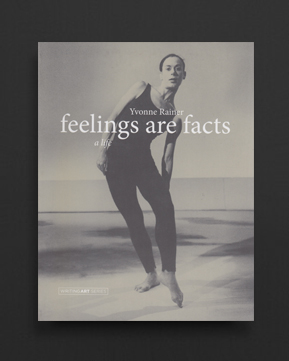
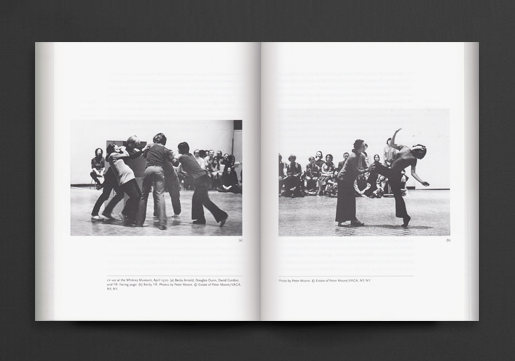
If you're interested in Plato, you're reading the wrong book. If you're interested in difficult childhoods, sexual misadventures, aesthetics, cultural history, and the reasons that a club sandwich and other meals -- including breakfast -- have remained in the memory of the present writer, keep reading. -- from Feelings Are Facts In this memoir, dancer, choreographer, and filmmaker Yvonne Rainer traces her personal and artistic coming of age. Feelings Are Facts (the title comes from a dictum by Rainer's one-time psychotherapist) uses diary entries, letters, program notes, excerpts from film scripts, snapshots, and film-frame enlargements to present a vivid portrait of an extraordinary artist and woman in postwar America. Rainer tells of a California childhood in which she was farmed out by her parents to foster families and orphanages, of sexual and intellectual initiations in San Francisco and Berkeley, and of artistic discoveries and accomplishments in the New York City dance world. Rainer studied with Martha Graham and Merce Cunningham in the late 1950s and early 1960s, cofounded the Judson Dance Theater in 1962, hobnobbed with New York artists including Robert Rauschenberg, Robert Morris (her lover and partner for several years), and Yoko Ono, and became involved with feminist and antiwar causes in the 1970s and 1980s. Rainer writes about how she constructed her dances -- including The Mind Is a Muscle and its famous section, Trio A, as well as the recent After Many a Summer Dies the Swan -- and about turning from dance to film and back to dance. And she writes about meeting her longtime partner Martha Gever and discovering the pleasures of domestic life.
2008, Japanese
Hardcover (w. obi strip), 267 pages, 23.4 x 30.4 cm
1st Edition, Out of print title / as new
Published by
Hokkaido Shinbun-Sha / Sapporo
$90.00 - In stock -
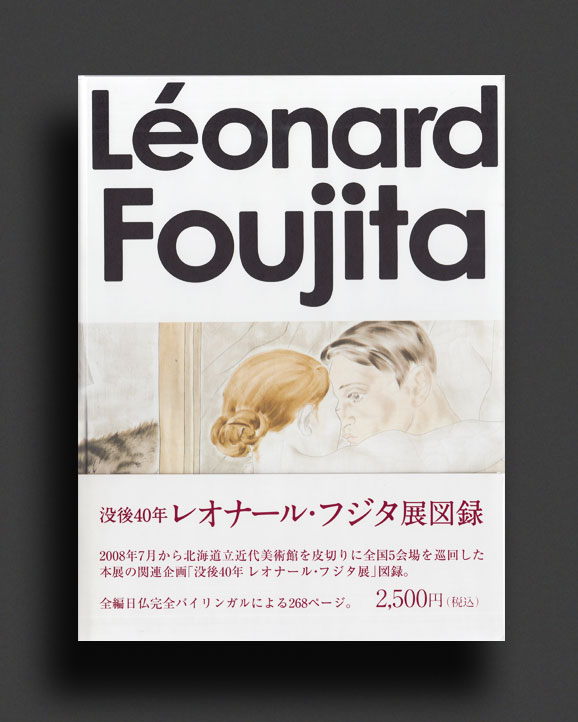
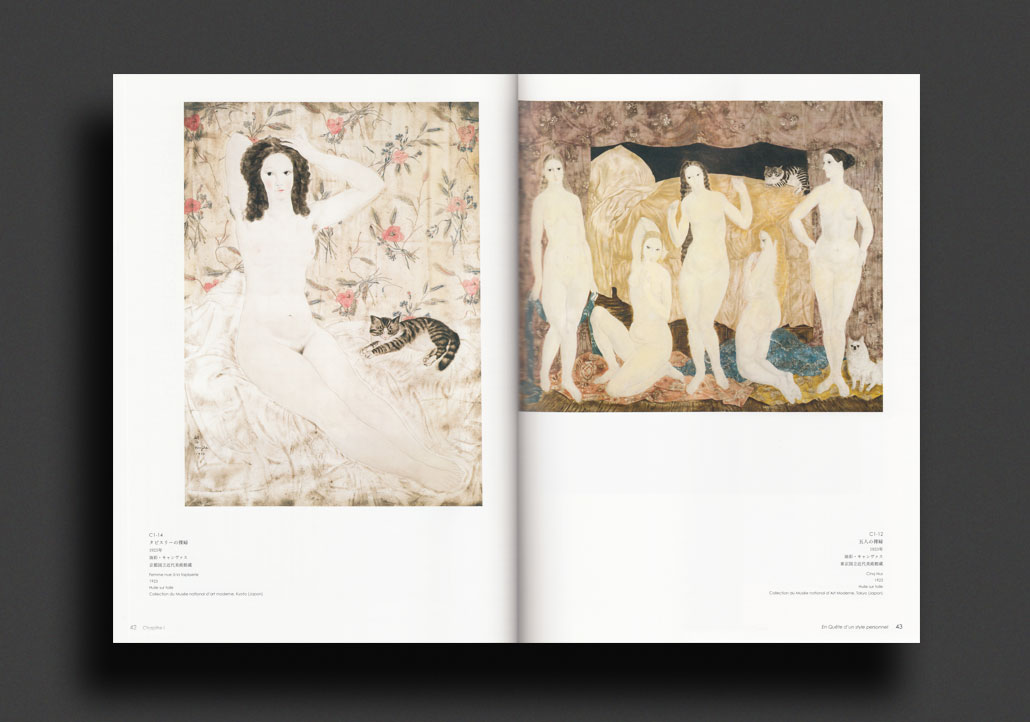
Beautiful hardcover monographic catalogue on Japanese-French artist Léonard Foujita, considered "the most important Japanese artist working in the West during the 20th century", published 40 years after his death, on the occasion of the major travelling exhibition "Léonard Foujita" that toured across Sapporo, Utsunomiya, Tokyo, Fukuoka, and Sendai, 2008-2009.
First edition and now out-of-print, this comprehensive and heavily illustrated book covers Foujita's entire life and artistic career, through his years spent in France, Latin America and Japan, illustrating his many drawings, paintings, prints, ceramics, doll houses, furnishings, objects, and other works in great detail and across fold-out spreads illustrating his largest masterpieces, alongside chronology, biography, portraits of the artist and models, his home in France, atelier, materials, tools, cats, nudes, essays in Japanese and French by Tsutomu Shiba, Anne Le Diberder and others. A wonderfully in-depth book and expertly printed in Japan.
Léonard Tsuguharu Foujita (1886 – 1968) was a Japanese–French painter and printmaker born in Tokyo, Japan, who applied Japanese ink techniques to Western style paintings. His Book of Cats, published in New York by Covici Friede, 1930, with 20 etched plate drawings by Foujita, is one of the top 500 (in price) rare books ever sold, and is ranked by rare book dealers as "the most popular and desirable book on cats ever published". He spent much of his life in France, where he met Amedeo Modigliani, Pascin, Chaim Soutine, and Fernand Léger and became friends with Juan Gris, Pablo Picasso and Henri Matisse. Foujita had his first studio at no. 5 rue Delambre in Montparnasse where he became the envy of everyone when he eventually made enough money to install a bathtub with hot running water. Many models came over to Foujita's place to enjoy this luxury, among them Man Ray's lover, Kiki, who boldly posed for Foujita in the nude in the outdoor courtyard. Within a few years, particularly after his 1918 exposition, he achieved great fame as a painter of beautiful women and cats in a very original technique. He is one of the few Montparnasse artists who made a great deal of money in his early years. By 1925, Tsuguharu Foujita had received the Belgian Order of Leopold and the French government awarded him the Legion of Honor. Throughout the 1930s-40s Foujita traveled and painted all over Latin America and returned to Japan, giving hugely successful exhibitions along the way, before returning to France to become a French citizen. His last major work, at the age of 80, was the design, building and decoration of the Foujita Chapel in the gardens of the Mumm champagne house in Reims, France, which he completed in 1966, not long before his death.
Fine copy with original printers obi-strip.
2019, English
Softcover, 20 pages, 16.5 x 23.6 cm
Published by
Innen Books / Zürich
Centre d’édition Contemporaine / Geneva
$28.00 - In stock -
Dorothy Iannone's "Eros Paintings", published by Innen Books, Zürich with Centre d’édition contemporaine, Geneva, in 2019. First edition.
Eros Paintings is a collection of full colour erotic paintings by American artist Dorothy Iannone. Named after the Greek god of love (known as Cupid in Roman mythology), Iannone’s publication centers on work created over a three-year period between 1969 and 1971, all of which seek to affirm sexual pleasure, experience, and erotic love, through both visual and integrated text elements. Influenced by cultures and religions from the Asian, African, and European continents, Iannone’s work draws on various artistic sources, influencing form, medium, and subject. In one painting, I Begin to Feel Free (1970), Iannone depicts herself and former partner Swiss artist Dieter Roth as Antony and Cleopatra.
Dorothy Iannone is an American visual artist. Her autobiographical texts, films, and paintings explicitly depict female sexuality and "ecstatic unity." She lives and works in Berlin, Germany.
"...For many years now, Dorothy Iannone has been investigating through her visual work, her books and her records, the world of love and loving-styles. In her original (re)-search, she skillfully blends imagery and text, beauty and truth. She is a freedom fighter, and a forceful and dedicated artist. Her aim is no less than human liberation." - Robert Filliou, 1975
2019, English
Softcover, 24 pages, 13 x 19 cm
Ed. of 150,
Published by
Innen Books / Zürich
$14.00 - Out of stock
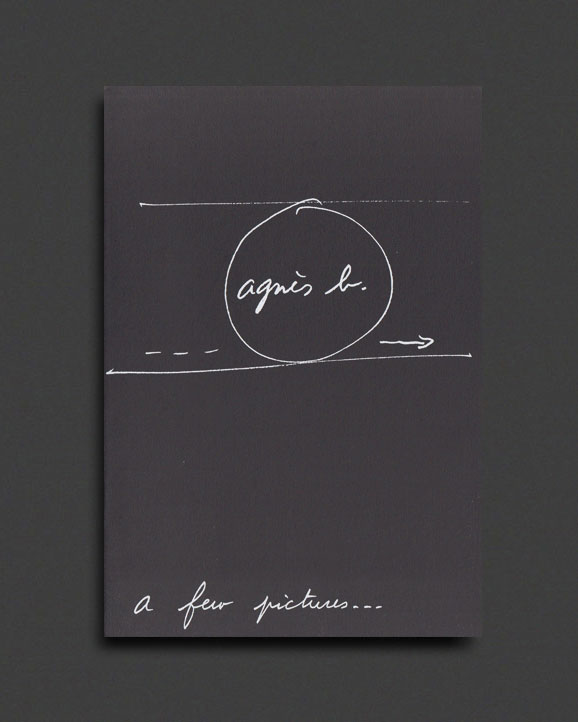
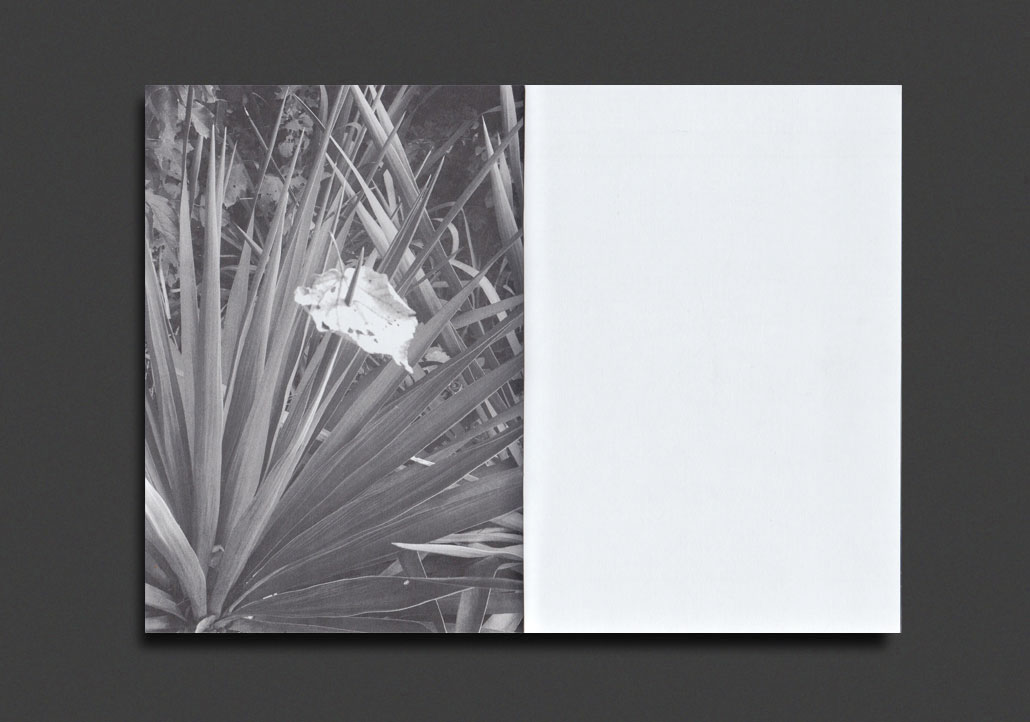
"a few pictures …" is a new publication by French fashion designer agnès b., published in 2019 by Innen Books, Zürich. Alongside selected images from agnès’ photographic archive is a text by Jonas Mekas.
First Edition of 150 copies.
agnès b. (born Agnès Andrée Marguerite Troublé, 1941 in Versailles) is a French fashion designer. She is known for her self-named brand, which includes fashion and film interests.
2019, English
Softcover (staple-bound), 24 pages, 13 x 19 cm
Ed. of 500,
Published by
Innen Books / Zürich
$14.00 $5.00 - In stock -
Bernhard Willhelm's "Willhelmtown" was published on the occasion of Printed Matter’s LA Art Book Fair at The Geffen Contemporary at MOCA April 12 — 14, 2019, in an edition of 500 copies.
Bernhard Willhelm (born 12 November 1972 in Ulm) is a German fashion designer. Willhelm studied fashion design at the Royal Academy of Fine Arts in Antwerp, during which he assisted Walter van Beirendonck, Alexander McQueen, Vivienne Westwood and Dirk Bikkembergs. In 1998, he established his namesake fashion house, together with Jutta Kraus. They debuted their first womenswear collection in 1999 and their first menswear collection was introduced in 2000. Wilhellm's clothing has been described as being typified by craftsmanship, eclecticism, and irony. His inspirations range from South German folklore, historical costume to sport and traditional Japanese dress as well as questions of diversity, the human condition, facets of culture and perceptions of reality.
2019, English
Softcover (staple-bound), 24 pages, 13 x 19 cm
Ed. of 100,
Published by
Innen Books / Zürich
$14.00 - Out of stock
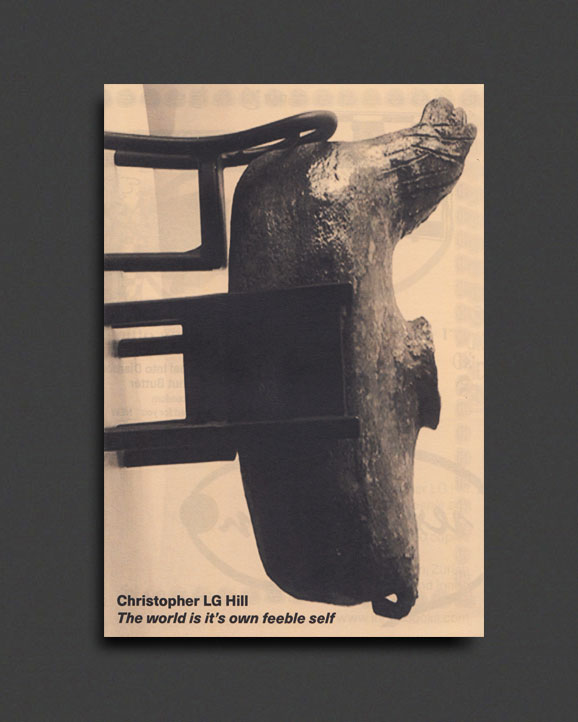
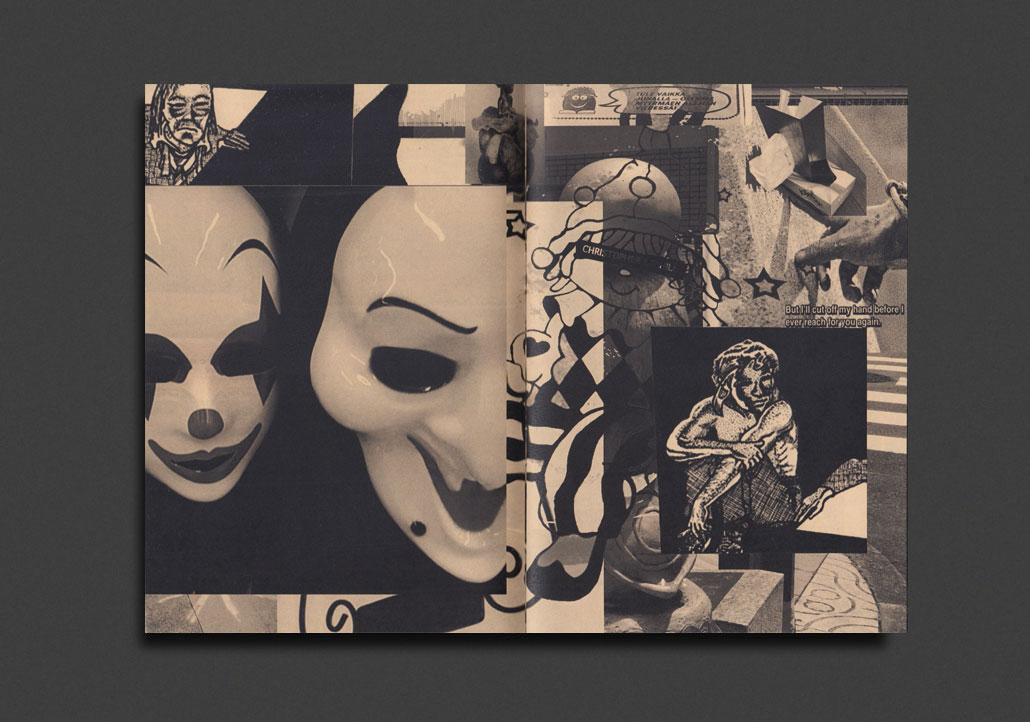
Melbourne artist Christopher LG Hill's "The world is it’s own feeble self", published in an edition of 100 copies by Innen Books, Zürich, in 2019.
Born 1980, Melbourne, Victoria; Christopher LG Hill lives and works in Melbourne. A co-founder of artist-run space Y3K, Hill has participated in, and organised, many exhibitions and music-related events and productions. Hill is editor and publisher of Endless Lonely Planet and co-founder of Bunyip Trax.
2019, English
Softcover, 24 pages, 14 x 20 cm
Published by
Innen Books / Zürich
Nieves / Zurich
$18.00 - Out of stock
Keiichi Tanaami's "Tears of dreams" is a new artist's book, published in 2019 by Innen Books and Nieves, Zürich. First edition.
The kaleidoscopically simmering works of Keiichi Tanaami interlink the American comic world, psychedelic nightmares and Japanese culture. The colourful compositions create a cosmos of their own and tell about war and disease in a surprisingly concrete way. As a child during the Second World War the artist experienced the US air attacks on Tokyo and these became important motifs in his art: roaring American bombers, Japanese searchlights, his grandfather's deformed goldfish.
Keiichi Tanaami is looked upon as the forerunner of Japanese Pop Art and is one of the country's most influential artists. Born in 1936 as the son of a textile wholesaler, he was nine years old when he experienced the bombing of Tokyo towards the end of World War II. He studied at the Musahino Art University, visited Andy Warhol in New York in 1969, worked with both Robert Rauschenberg and art critic Michel Tapié during their travels to Japan, and designed record covers for Jefferson Airplane and The Monkees. He maintained a successful career as an illustrator and a graphic designer throughout the 1960s and early '70s, and was appointed as the first artistic director of the Japanese edition of Playboy magazine in 1975. With an infinite artistic appetite, Tanaami continues working across all boundaries, embracing painting, sculpture, performance and film, as well as a professor on the Faculty of Information Design at the Kyoto University of Art and Design in Japan.
2017, English
Softcover (staple-bound), 24 pages, 13 x 19 cm
Edition of 100
Published by
Innen Books / Zürich
$14.00 - In stock -
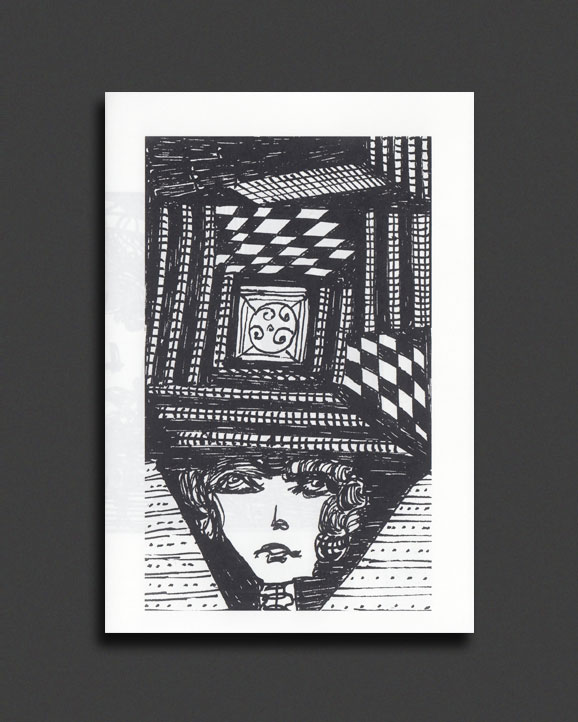
"Selected Works from 1950’s" is a limited edition publication dedicated to the work of German spiritualist/artist Margarethe Held, published in 2017 by Innen Books in Zürich in an edition of 100 copies only.
Margarethe Held (born 1894 in Mettingen, Germany; Died 1981). In 1925 Margarethe Held entered in contact with the spirits and communicated with her deceased husband and her father. In 1950, at the age of 56, she began drawing : four hundred pastel drawings in four months – all dictated by spirits. Siwa ordered her to show to other mortals, through her compositions, that the universe contained secrets, that every being had a destiny and that nothing happened without a reason. Later on, the spirits made her write a book in which she described the messages she received, her travels to Jupiter and other planets.
The faces drawn by Margarethe Held have the appearance of masks, representing the dead, gods, spirits and elves. There are the "good dead", who possess a magical protective power, but also the "bad dead" who cause calamities and disasters. There are male or female elves, whose function is to help people in their work.
2017, English
Softcover (staple-bound), 20 pages, 13 x 19 cm
Edition of 100
Published by
Innen Books / Zürich
$14.00 - Out of stock
Limited edition publication dedicated to the work of British visionary artist Magde Gill, published in 2017 by Innen Books in Zürich in an edition of 100 copies only.
Madge Gill, born Maude Ethel Eades in London, 1882, was an illegitimate child and spent much of her early years in seclusion. At the age of nine she was placed in an orphanage, and at nineteen worked as a nurse and lived with her aunt who introduced her to spiritualism. She married Thomas Gill in 1907 and had three children by him, one of whom died in infancy. Gill herself almost died while giving birth to a fourth, stillborn daughter in 1919, losing the sight in her left eye from the illness that followed.
It was in that year, at the age of thirty-seven, that she began to create art in a flurry of drawing activity that was guided by a spirit she called Myrninerest. She often worked on paper or rolled calico, unrolling only a section at a time and not viewing the composition in its entirety. Her drawings, some of which reach lengths of thirty-five feet, include patterns and designs that obsessively cover the surface. The figure of a young woman dressed in flowing robes appears thousands of times in her work, and it is unclear if it is Gill's spirit guide or perhaps her stillborn daughter. Gill exhibited her work rarely during her lifetime and never sold any of it for fear of angering Myrninerest.
2018, English
Softcover, 224 pages, 15.2 x 22.9 cm
Published by
University of Chicago Press / Chicago
$49.00 $15.00 - Out of stock
"It is the contemporary elixir from which all manner of being emerges, the metamorphic sublime, an alchemist's dream."
So begins Palma Africana, the latest attempt by anthropologist Michael Taussig to make sense of the contemporary moment. But to what elixir does he refer? Palm oil. Saturating everything from potato chips to nail polish, palm oil has made its way into half of the packaged goods in our supermarkets. By 2020, world production will be double what it was in 2000. In Colombia, palm oil plantations are covering over onetime cornucopias of animal, bird, and plant life. Over time, they threaten indigenous livelihoods and give rise to abusive labor conditions and major human rights violations. The list of entwined horrors--climatic, biological, social--is long. But Taussig takes no comfort in our usual labels: "habitat loss," "human rights abuses," "climate change." The shock of these words has passed; nowadays it is all a blur. Hence, Taussig's keen attention to words and writing throughout this work. He takes cues from precursors' ruminations: Roland Barthes' suggestion that trees form an alphabet in which the palm tree is the loveliest; William Burroughs' retort to critics that for him words are like animals--cut them and the words are let free. Steeped in a lifetime of philosophical and ethnographic exploration, Palma Africana undercuts the banality of the destruction taking place all around us and offers a penetrating vision of the global condition. Richly illustrated and written with experimental verve, this book is Taussig's Tristes Tropiques for the twenty-first century.
Michael Taussig is professor of anthropology at Columbia University and the author of several books, including Walter Benjamin's Grave and My Cocaine Museum, both published by the University of Chicago Press.
2009, English
Softcover, 304 pages, 15.2 x 22.9 cm
Published by
University of Chicago Press / Chicago
$57.00 - Out of stock
Over the past thirty years, visionary anthropologist Michael Taussig has crafted a highly distinctive body of work. Playful, enthralling, and whip-smart, his writing makes ingenious connections between ideas, thinkers, and things. An extended meditation on the mysteries of color and the fascination they provoke, What Color Is the Sacred? is the next step on Taussig’s remarkable intellectual path.
Following his interest in magic and surrealism, his earlier work on mimesis, and his recent discussion of heat, gold, and cocaine in My Cocaine Museum, this book uses color to explore further dimensions of what Taussig calls “the bodily unconscious” in an age of global warming. Drawing on classic ethnography as well as the work of Benjamin, Burroughs, and Proust, he takes up the notion that color invites the viewer into images and into the world. Yet, as Taussig makes clear, color has a history—a manifestly colonial history rooted in the West’s discomfort with color, especially bright color, and its associations with the so-called primitive. He begins by noting Goethe’s belief that Europeans are physically averse to vivid color while the uncivilized revel in it, which prompts Taussig to reconsider colonialism as a tension between chromophobes and chromophiliacs. And he ends with the strange story of coal, which, he argues, displaced colonial color by giving birth to synthetic colors, organic chemistry, and IG Farben, the giant chemical corporation behind the Third Reich.
Nietzsche once wrote, “So far, all that has given colour to existence still lacks a history.” With What Color Is the Sacred? Taussig has taken up that challenge with all the radiant intelligence and inspiration we’ve come to expect from him.
Michael Taussig is professor of anthropology at Columbia University and the author of several books, including Walter Benjamin's Grave and My Cocaine Museum, both published by the University of Chicago Press.
2014, English
Softcover, 190 pages, 11.5 x 17.5 cm
Published by
Sequence Press / New York
Urbanomic / Cornwall
$45.00 - Out of stock
English Translation by Robin Mackay
Foreword by Alain Badiou
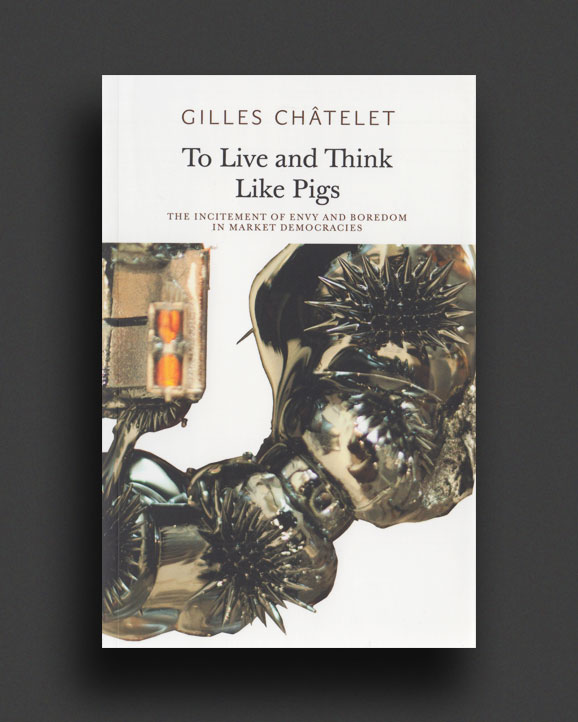
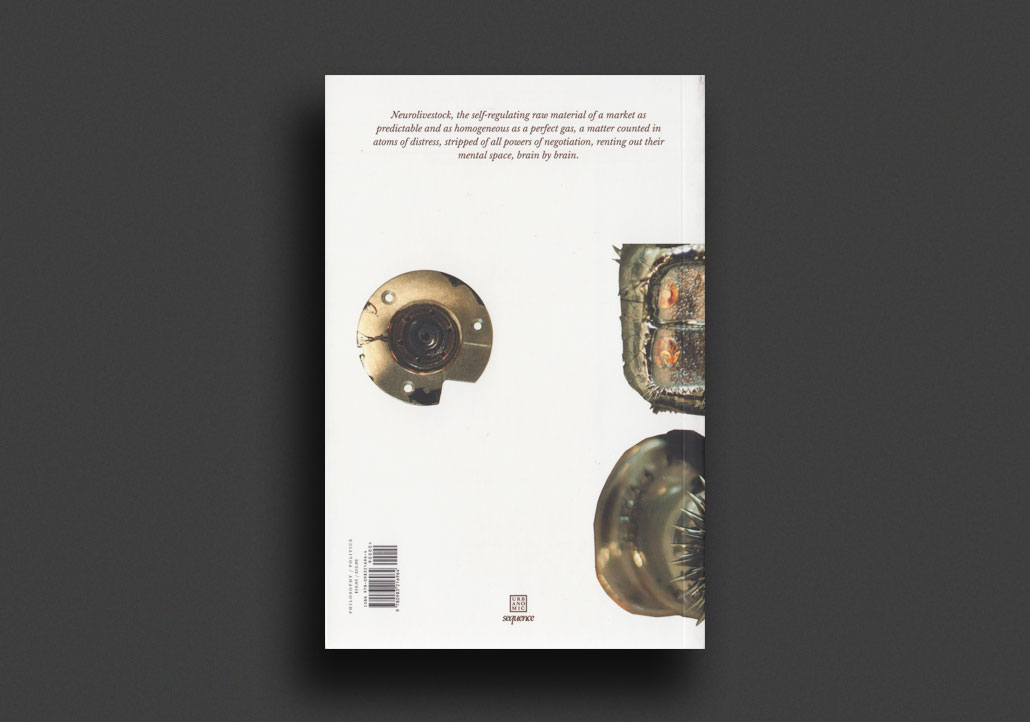
Gilles Châtelet’s scathing polemical tract opens at the end of the 70s, when the liberatory dreams of ‘68 are beginning to putrefy, giving rise to conditions more favourable to a new breed of self-deluding ‘nomads’ and voguish ‘gardeners of the creative’. Gulled by a ‘realism’ that reassures them that political struggle is for anachronistic losers, their allegiances began to slide inexorably toward the ‘revolutionary’ forces of the market’s invisible hand, and they join the celebrants of a new order governed by boredom, impotence and envy….
As might be expected of Châtelet—mathematician, philosopher, militant gay activist, political polemicist, praised by contemporaries such as Deleuze and Badiou for his singularly penetrating philosophical mind—this is no mere lament for a bygone age. To Live and Think Like Pigs is the story of how the perverted legacy of liberalism, allied with statistical control and media communication, sought to knead Marx’s ‘free peasant’ into a statistical ‘average man’—pliant raw material for the cybernetic sausage-machine of postmodernity.
Combining the incandescent wrath of the betrayed comrade with the acute discrimination of the mathematician-physicist, Châtelet proceeds to scrutinize the pseudoscientific alibis employed to naturalize ‘market democracy’. As he acerbically recounts, ‘chaos’, ‘emergence’, and the discourses of cybernetics and networks merely impart a futuristic sheen to Hobbesian ‘political arithmetic’ and nineteenth-century ‘social physics’—a tradition that places the individual at the center of its apolitical fairy-tales while stringently ignoring the inherently political process of individuation.
When first published in 1998, Châtelet’s book was a fierce revolt against the ‘winter years’ and a mordant theory-science-fiction of the future portended by the reign of Reagan-Thatcher-Mitterand. Today its diagnoses seem extraordinarily prescient: the ‘triple alliance’ between politics, economics and cybernetics; the contrast between the self-satisfied ‘nomadism’ of a global overclass and the cultivated herds of ‘neurolivestock’ whose brains labour dumbly in cybernetic pastures; the arrogance of the ‘knights of finance’; and the limitless complacency and petty envy of middle-class dupes haplessly in thrall to household gods and openly hostile to the pursuit of a freedom that might require patience or labour.
Mercantile empiricists and acrobat-intellectuals, fluid nomads and viscous losers, Robinsons on wheels, Turbo-Bécassines and Cyber-Gideons…Châtelet deploys a cast of grotesque ‘philosophical personae’ across a series of expertly-staged set-pieces: from Hobbes’s Leviathan to Wiener’s cybernetics; from the ecstasies of Parisian nightlife to the equilibrial dystopia of Singapore’s ‘yoghurt-maker’; from the mercantile empiricist for whom the state is a glorified watermelon-seller to the coy urbanite with a broken hairdryer; from the ‘petronomadic’ stasis of the traffic jam to the financier chasing the horizon of absolute volatility; from the demonization of cannabis to the fatuous celebration of ‘difference’.
To Live and Think Like Pigs is both an uproarious portrait of the evils of the new world order, and a technical manual for its innermost ideological workings. Châtelet’s diagnosis of the ‘neoliberal counter-reformation’ is a significant moment in French political philosophy worthy to stand alongside Deleuze’s ‘Control Society’ and Foucault’s ‘liberal governmentality’. His book is crucial reading for any future politics that wants to replace individualism with an understanding of individuation, libertarianism with liberation, liquidity with plasticity, and the statistical average with the singular exception. Its appearance in translation is an important new contribution to contemporary debate on neoliberalism, economics and capitalist subjectivation.
Gilles Châtelet (1944-1999) began his studies at the École Normale Supérieure de Fontenay-Saint-Cloud. During the late 1960s he was a member of an anti-Stalinist student faction of the French Communist Party. After 1968, a stay at UC Berkeley brought him into contact with key protagonists of the Beat Generation. He returned to France and joined the Front Homosexuel d’Action Révolutionnaire (FHAR), and befriended Roland Barthes, Daniel Guérin and Guy Hocquenghem. Meeting Michel Foucault was an important marker in the development of his political thinking; as was his friendship with Félix Guattari and Gilles Deleuze, who played a decisive role in renewing his passion for philosophy. He obtained his PhD in Pure Mathematics from the University of Paris XI in 1975, writing his thesis on differential topology. In 1979 he became Professor of Mathematics at the University of Paris VIII. Around this time he established a dialogue with René Thom that continued until his death. He was programme director at the Collège International de Philosophie from 1989 to 1995, during which period he published the important work Les Enjeux du Mobile: Mathématique, Physique, Philosophie. In 1994 he joined the Laboratoire Disciplinaire Pensée des Sciences, founded by Charles Alunni at the École Normale Supérieure in Paris. There, he had an active and influential role in the seminar, ‘Actuality, Potentiality and Virtuality’.
1990, English / German
Softcover (w. inserts), 244 pages, 20.5 x 14 cm
1st Edition, Out of print title / used / very good
Published by
Serpentine Gallery / London
Kunsthalle Zürich / Zürich
Wurttembergischer Kunstverein / Stuttgart
$90.00 - In stock -
First edition of this exquisite artist's guide-book and compendium by American conceptual artist Barbara Bloom, illuminating the many details of the widely traveled installation "The Reign of Narcissism" (1988-1989), a personal museum devoted to her own likeness presented as a full-scale faux-neoclassical period room.
"This book guides us through the "set" of a 19th century museum room where all aspects of what we see are covered with traces of the artists likeness. (Self) portraits which take the form of Greek style sculptures and bas-reliefs, vanity mirrors, watermark porcelain tea cups, chocolates, cameos, a tombstone, a published series of books entitled "The Complete Works of Barbara Bloom (1989)," commemorative stamps (a perforated sheet of twelve stamps bearing a photograph taken by artist Christopher Williams, of Temple Hospital in Los Angeles, where the artist was born, along with BBs birth date, signature and fingerprint), even period chairs upholstered with a cloth pattern of the artists dental X-rays. The texts delve us into the worlds of Hegel on The Greek Profile, Virginia Woolfs The Lady in the Looking Glass, Ovids myths of Echo and Narcissus, Bruce Chatwins Utz, and Wildes Picture of Dorian Gray. A parody of the monomania that can consume collectors, this work is, for the artist, "less related to Freudian narcissBooism than it is to the narcissistic aspects of art-making and collecting."
Texts in English and German.
This copy complete with all inserted ephemera and editions (stamp sheet, water-marked paper, envelope, etc.). In embossed blue cover.
Barbara Bloom lives and works in New York City. She is a conceptual artist best known for her multi-media installation works. Bloom is loosely affiliated with a group of artists referred to as The Pictures Generation. For nearly twenty years she lived in Europe, first in Amsterdam then Berlin.
Very Good copy, with common light edgewear to covers and creasing to spine.
1973, English
Hardcover, 144 pages, 22.5 x 28.5 cm
1st US Edition, Out of print title / used / good
Published by
Praeger Publishers Inc. / New York
$80.00 - Out of stock
This is the first monograph on Archigram, a chronicle of the work of a group of young British architects that became the most influential architecture movement of the 1960s, as told by the members themselves. It includes material published in the early issues of their iconic and influential journal, as well as numerous texts, poems, comics, photocollages, drawings and fantastical architecture projects. Work presented includes Instant City, pod living, the Features Monte Carlo entertainment centre, Blowout Village, and the Cushicle personalized enclosure. Opening texts from Reyner Banham, Hans Hollein, Arata Isozaki, and Peter Blake, no less. Still considered THE Archigram book.
Hardcover first US edition (1973).
The main members of Archigram were Peter Cook, Warren Chalk, Ron Herron, Dennis Crompton, Michael Webb and David Greene. Designer Theo Crosby was the “hidden hand” behind the group. Especially active between 1961 and 1974, when this book was published, the group anticipated the global inter-relatedness of culture and technology and thus had an immediate influence on architectural discussions worldwide – the significance of their work continues to be felt today. Their radical re-definitions of domestic architecture and urban planning, as well as an aesthetic that transcends practical function, had wide-felt repercussions on contemporary British art of the 1960s and the subsequent avant-garde in architecture at that time in Europe, Japan, and America. Their work inspired two like-minded Italian collectives, Archizoom and Superstudio and Renzo Piano and Richard Rogers’ Centre Pompidou (1972-76) in Paris, as well as buildings by Japanese “metabolist” architects such as Kenzo Tange’s Shizuoka Press and Broadcasting Center (1965-70) in Tokyo. Archigram responded to comic books and pop music, space travel and moon landing, science fiction and the exciting new technologies of the sixties and seventies, their inspirations came from architects and artists such as Buckminster Fuller, Bruno Taut, and Friedrich Kiesler. As a result, they created radical alternatives to cities, houses and other architectural archetypes, communicating their ideas through Archigram magazine as well as though traditional architectural renderings, gallery exhibitions, multi-media installations, and collage. Their unique style of rendering often emphasized concepts over architectural forms, and had an enormous influence on modern architectural drawing techniques as well as the conceptualization of architectural ideas.
Good ex-library copy w. associated stamps/markings. Without dust jacket.
2008, English / Spanish
Hardcover (cloth-bound), 272 pages, 15.5 x 22.5 cm
1st Edition, Out of print title / used / very good
Published by
Sternberg Press / Berlin
$90.00 $50.00 - Out of stock
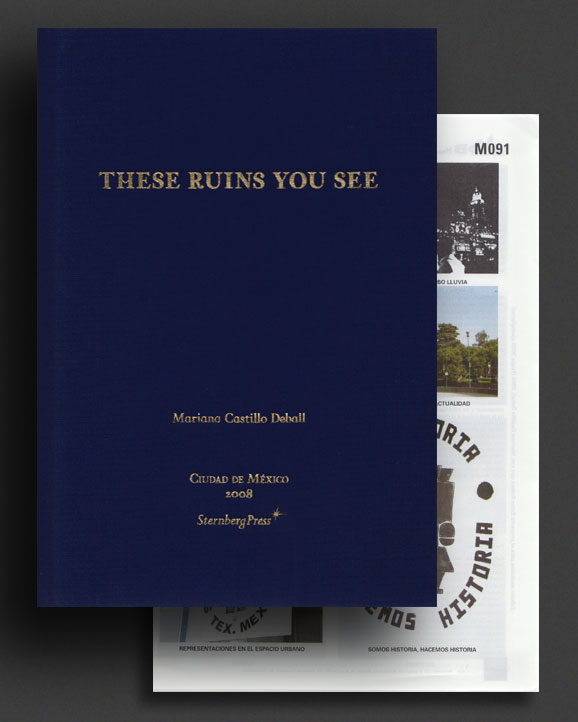
First edition of this long out-of-print artist's book by Mariana Castillo Deball (b. 1975, Mexico City), who studied in the Universidad Nacional Autónoma de México, Mexico City and the Jan Van Eyck Academie in Maastricht.
Mexico’s relationship with archaeology is a complex one. In addition to studying the distant past through its material vestiges, it is deeply engaged in more recent aspects of politics, education, national identity, and public works. The various layers of its historical past are forever present, giving rise to continual interpretations, reconstructions, demolitions, and annexations. Mexico’s archaeology is resolved in the present and its history is being modified like city landscapes, public policies, and textbooks. The project These Ruins You See shifts between politics, history, heritage, and identity in an attempt to find, in the present, the vestiges of archaeological practice.
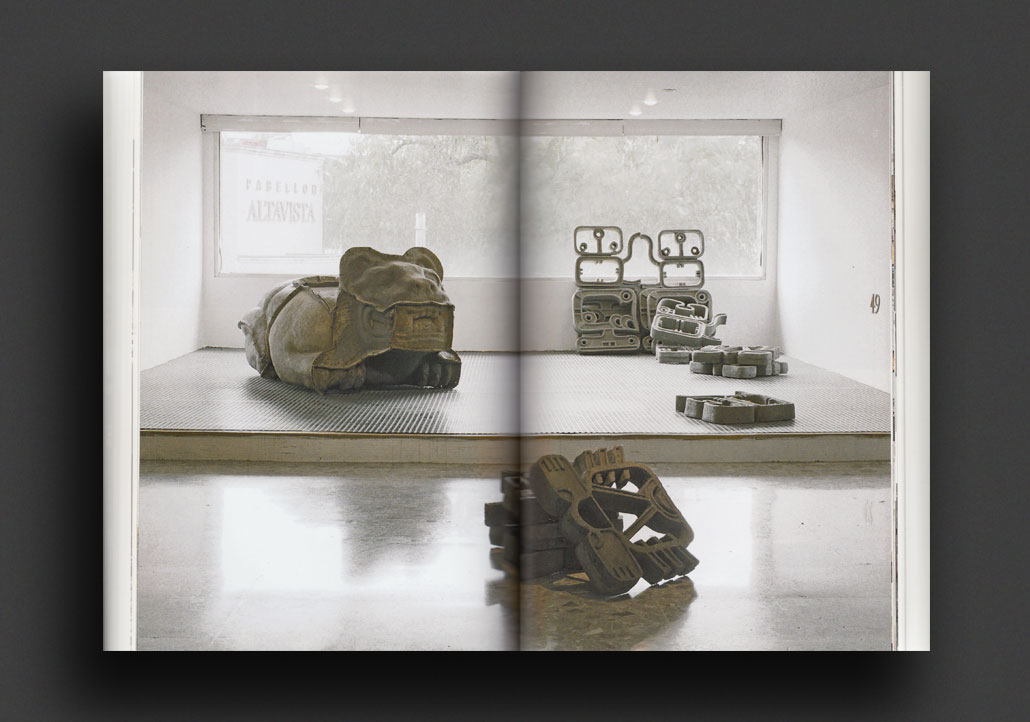
The publication contains a collection of found objects and exhumed artifacts, bringing together a number of texts and illustrations—some of them contemporary and others historical—on the history of collections and exhibitions of pre-Cortesian objects, as well as the manufacture of replicas, the shadowy world of forgers, the relocation of key objects, and related themes. The objective of all of this excavation and collecting is to bring into sharp relief the ideological baggage and the range of museographic practices that always and inevitably frame our perception of these objects.
This publication is part of the project These Ruins You See, it includes the project’s research, realization, and a series of specially commissioned essays by Mariana Castillo Deball, Guadalupe Espinosa, Jorge Ibargüengoitia, Jesse Lerner, Sonia Lombardo de Ruiz, Sandra Rozental, Adam T. Sellen, Gabriela Torres-Mazuera. The project has manifested in different exhibitions, publications, and lectures. These Ruins You See was exhibited at the Museo de Arte Carrillo Gil from November 8, 2006 to February 28, 2007.
Design by Manuel Raeder and Mariana Castillo Deball
Very Good copy.
2017, English
Softcover, 176 pages, 11.4 x 17.8 cm
Published by
Semiotext(e) / Los Angeles
The MIT Press / Massachusetts
$32.00 - In stock -
The word “corruption” is insufficient for the magnitude of this evil.
—from The Iguala 43
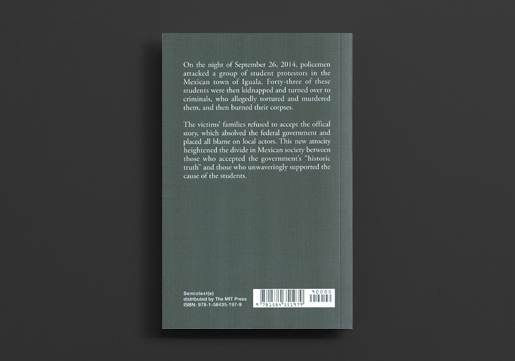
On the night of September 26th, 2014, policemen attacked a group of student protestors in the Mexican town of Iguala. Forty-three of these students were then kidnapped and turned over to criminals who allegedly tortured and murdered them, and then burned their corpses. The families of the victims refused to accept the official story, which placed all blame on local actors and absolved the federal government of any culpability. The anger provoked by this atrocity, one of the most barbaric acts in recent times, divided Mexican society in two: on one side were those who unwaveringly supported the cause of the students and on the other those who accepted the government’s “historic truth.”
Written in memory of the forty-three students, this well-researched and powerfully argued book uncovers the agents, causes, and factors responsible for this unspeakable crime. It offers an interpretation of these events that goes beyond the artificial opposition between good and evil, between rulers and insurgents, and tries instead to understand the cruelty that normalizes atrocity.
González Rodríguez warns us that “this story has been repeated around the world, but we refuse to see it. If anyone doubts or denies this, then I challenge them to finish this book. When faced with the acceptance of horror, we must recover our lucidity and exercise our freedom to transform this tragic reality.”
Translated by Joshua Neuhouser
About the Author
Sergio González Rodríguez is a writer, journalist and critic for the Mexico City newspaper Reforma. His works include Bones in the Desert, The Flight, and The Femicide Machine (Semiotext(e)).
2018, English
Softcover, 336 pages, 11.4 x 17.8 cm
Published by
The MIT Press / Massachusetts
Semiotext(e) / Los Angeles
$38.00 - Out of stock
An analysis of contemporary violence as the new commodity of today's hyper-consumerist stage of capitalism.
“Death has become the most profitable business in existence.”—from Gore Capitalism
Written by the Tijuana activist intellectual Sayak Valencia, Gore Capitalism is a crucial essay that posits a decolonial, feminist philosophical approach to the outbreak of violence in Mexico and, more broadly, across the global regions of the Third World. Valencia argues that violence itself has become a product within hyper-consumerist neoliberal capitalism, and that tortured and mutilated bodies have become commodities to be traded and utilized for profit in an age of impunity and governmental austerity.
In a lucid and transgressive voice, Valencia unravels the workings of the politics of death in the context of contemporary networks of hyper-consumption, the ups and downs of capital markets, drug trafficking, narcopower, and the impunity of the neoliberal state. She looks at the global rise of authoritarian governments, the erosion of civil society, the increasing violence against women, the deterioration of human rights, and the transformation of certain cities and regions into depopulated, ghostly settings for war. She offers a trenchant critique of masculinity and gender constructions in Mexico, linking their misogynist force to the booming trade in violence.
This book is essential reading for anyone seeking to analyze the new landscapes of war. It provides novel categories that allow us to deconstruct what is happening, while proposing vital epistemological tools developed in the convulsive Third World border space of Tijuana.
2017, English
Softcover, 160 pages, 11.4 x 17.8 cm
Published by
Semiotext(e) / Los Angeles
The MIT Press / Massachusetts
$36.00 - Out of stock
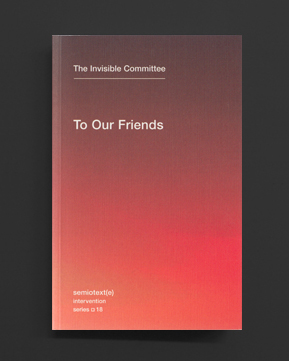
Now is the phantom chapter to the Invisible Committee's previous book, To Our Friends: a new critique from the anonymous collective that establishes their opposition to the world of capital and its law of labor, addresses current anti-terrorist rhetoric and the ferocious repression that comes with it, and clarifies the end of social democracy and the growing rumors of the need for a coming “civil war.” Now emerges at a time when the Invisible Committee’s contestation has found echoes throughout the West, with a collapse of trust in the police, an inept weariness on the part of the political system, a growing urgency for opposition, a return of the theme of the Commune, a vanishing distinction between radicals and citizens, and a widespread refusal on the part of the citizen to be governed. As farcical political elections continue to unfold worldwide like a line of tumbling dominoes, and governments increasingly struggle to reclaim a legitimacy that has already slipped out of their grasp, Now clarifies the Invisible Committee’s attitude toward all such elections and their outcome: one of utter indifference. Now proposes a “destituent process” that charts out a different path to be taken, a path of outright refusal that simply ignores elections altogether. It is a path that calls for taking over the world and not taking power, for exploring new forms of life and not a new constitution, and for desertion and silence as alternatives to proclamations and crashes. It is also a call for an unprecedented communism—a communism stronger than nation and country.
Translated by Robert Hurley
About the Author
The Invisible Committee is a collective and anonymous pen name.
2015, English
Softcover, 240 pages, 11.4 x 17.8 cm
Published by
Semiotext(e) / Los Angeles
The MIT Press / Massachusetts
$32.00 - In stock -
Translated by Robert Hurley
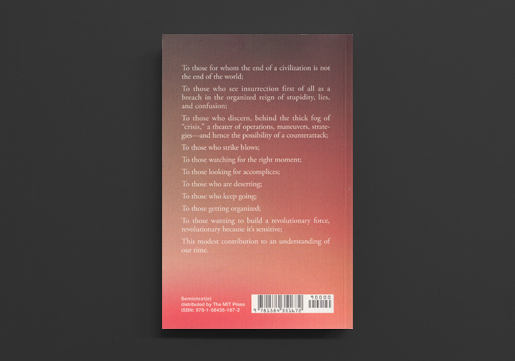
The Invisible Committee’s The Coming Insurrection was a phenomenon, celebrated in some quarters and inveighed against in others, publicized in media that ranged from campus bulletin boards to Fox News. Seven years later, The Invisible Committee follows up their premonitory manifesto with a new book, To Our Friends.
From The Invisible Committee:
In 2007 we published The Coming Insurrection in France. It must be acknowledged that a number of assertions by the Invisible Committee have since been confirmed, starting with the first and most essential: the sensational return of the insurrectionary phenomenon. Who would have bet a kopeck, seven years ago, on the overthrow of Ben Ali or Mubarak through street action, on the revolt of young people in Quebec, on the political awakening of Brazil, on the fires set French-style in the English or Swedish banlieues, on the creation of an insurrectionary commune in the very heart of Istanbul, on a movement of plaza occupations in the United States, or on the rebellion that spread throughout Greece in December of 2008?
During the seven years that separate The Coming Insurrection from To Our Friends, the agents of the Invisible Committee have continued to fight, to organize, to transport themselves to the four corners of the world, to wherever the fires were lit, and to debate with comrades of every tendency and every country. Thus To Our Friends is written at the experiential level, in connection with that general movement. Its words issue from the turmoil and are addressed to those who still believe sufficiently in life to fight as a consequence.
To Our Friends is a report on the state of the world and of the movement, a piece of writing that’s essentially strategic and openly partisan. Its political ambition is immodest: to produce a shared understanding of the epoch, in spite of the extreme confusion of the present.
About the Author
The Invisible Committee is a collective and anonymous pen name.
Reviews
“From crisis capitalism to cybernetics, and from infrastructure to political destitution and the commune, To Our Friends engages in lively and innovative ways with the contemporary situation.”—Antipode
2011, English
Softcover, 200 pages, 11.4 x 17.8 cm
Published by
Semiotext(e) / Los Angeles
The MIT Press / Massachusetts
$32.00 - Out of stock
Ours is a century of fear. Governments and mass media bombard us with words and images: desert radicals, "rogue states," jihadists, WMDs, existential enemies of freedom. We labor beneath myths that neither address nor describe the present situation, monstrous deceptions produced by a sound bite society. There is no reckoning of actuality, no understanding of the individual lives that inaugurated this echo chamber.
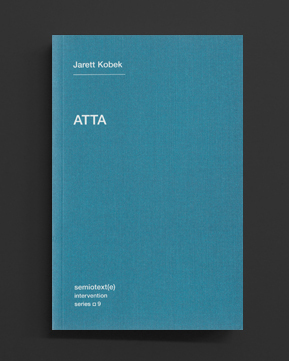
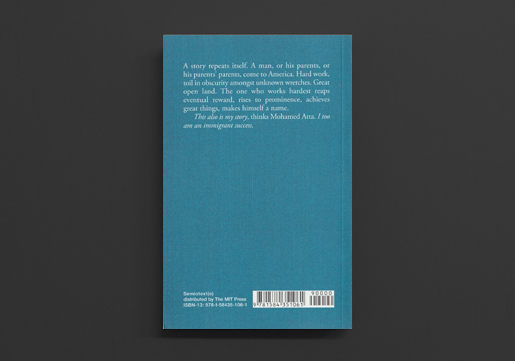
In the summer of 1999, Mohamed Atta defended a master’s thesis that critiqued the introduction of Western-style skyscrapers in the Middle East and called for the return of the "Islamic-Oriental city." Using this as a departure point, Jarett Kobek's novel ATTA offers a fictionalized psychedelic biography of Mohamed Atta that circles around a simple question: what if 9/11 was as much a matter of architectural criticism as religious terrorism? Following the development of a socially awkward boy into one of history's great villains, Kobek demonstrates the need for a new understanding of global terrorism. Joined in this volume by a second work, "The Whitman of Tikrit"--a radical reimagining of Saddam Hussein's last day before capture--ATTA is a brutal, relentless, and ultimately fearless corrective to ten years of propaganda and pandering.
About the Author
Jarett Kobek is the son of a Turkish immigrant and a graduate of New York University’s Gallatin School of Individualized Study. His Pushcart Prize-nominated fiction has been anthologized alongside Haruki Murakami and F. X. Toole. His first novel was commissioned and published by Book Works of London as part of the experimental literature Semina series. He lives in California.
1969, English
Softcover (staple-bound), 24 pages, 21 x 30 cm
1st Edition, Out of print title / used / very good
Published by
The Lakeside Press / Cambridge
$65.00 - Out of stock
Incredibly scarce issue of the little-known publication "Fantasy Art", from 1969. It is unsure if this is even a journal or a one-off publication. Entirely dedicated to the work of Raymond Bertrand, as a way of introducing the French artist to American audiences and promoting his debut book "Dessins Erotiques". Completely filled with reproductions of his drawings and paintings, some seldom seen in any other Bertrand publication, with short introductory text in French. Quite a mysterious and gorgeous publication, with stiff card covers and raw paper stock, similar to SF fanzines of the period.
Along with Leonor Fini, Raymond Bertrand became acknowledged as one of the major new artists dealing with the modern sexuality in a highly personal fashion in the late 1960s-early 1970s, a period that seemed to encapsulate the entire published work of this little-known artist. Bertrand's work became known through his incredible illustrations for French SF journals Fiction, Galaxie, illustrations for the erotic Emmanuelle novels, and Eric Losfeld published collections. Bertrand is a somewhat elusive and shadowy figure about whom it is hard to find biographical information, and it is sadly unknown whether he continued his work after this period.
Very Good copy.