World Food Books' programme is largely produced on Kulin Nation land. We acknowledge the Wurundjeri people of the Kulin Nation as the first and continuing custodians of this land, and pay respect to their Elders past, present, and emerging.
World Food Books is an arts and special interests bookshop in Naarm / Melbourne. Founded in 2010, World Food Books is devoted to the presentation of a rotating, hand-selection of international art, design, literary and counterculture publications with an emphasis on the anti-traditional, the experimental, the avant-garde, the heretic, the marginal.
Presenting new titles alongside rare and out-of-print books, catalogues and journals spanning the fields of modern and contemporary art, design, photography, illustration, film, literature, poetry, cultural theory, philosophy, sexuality, popular and underground culture in its many radical forms, World Food Books wishes to encourage adventurous, thoughtful and open-minded reading, looking, writing, and exchange of publishing and ideas, both current and historical.
As well as our bookshop, located in Melbourne's historical Nicholas Building, all of our inventory is available internationally via our online mail-order service.
World Food Books semi-regularly co-ordinates "Occasions", a programme of exhibits and events at the bookshop and in partnership with other hosts (such as museums and art galleries) that develop out of the activities, relationships and content of the bookshop itself.
World Food Books
The Nicholas Building
37 Swanston Street
Room 5, Level 6
Melbourne 3000
Australia
SHOP HOURS:
Thu–Fri 12–6, Sat 12–5
WEB-SHOP OPEN 24/7
World Food Books
Postal Address:
PO Box 435
Flinders Lane
Victoria 8009
Australia
Art
Theory / Essay
Architecture / Interior
Graphic Design / Typography
Photography
Fashion
Eros
LGBTQ+
Fiction / Poetry
Weird / Speculative / Science Fiction / Horror
Transgressive / Visceral / Abject
Symbolism / Decadence / Fin de siècle
Film / Video
Painting
Sculpture / Installation
Performance / Dance / Theater
Drawing
Sound / Music
Curatorial
Group Shows / Collections
Periodicals
Out-of-print / Rare
Posters / Ephemera / Discs
Signed Books
World Food Books Gift Voucher
World Food Book Bag
Australian Art
Australian Fiction
Australian Science Fiction / Speculative Fiction
Australian Poetry
Australian Photography
Japanese Photography
Conceptual Art
Minimal Art
Dada
'Pataphysics / Oulipo
Fluxus
Concrete Poetry
Pop Art
Surrealism
Arte Povera
Arte Informale / Haute Pâte / Tachism
Nouveau Réalisme / Zero / Kinetic
Situationism / Lettrism
Collage / Mail Art / Xerox Art
Art Brut / Folk / Visionary / Fantastic
Illustration / Graphic Art / Bandes Dessinées
Furniture
Italian Radical Design / Postmodernism
Textiles
Ceramics / Glass
Counterculture
Protest / Revolt
Philosophy
Psychoanalysis
Anthropology
Anarchism
Socialism / Anarchism / Communism / Capitalism
Literary Theory / Semiotics / Language
Feminism / Women's Studies
Gender Studies / Sexuality
Anthropology
Fetishism / BDSM
Drugs / Psychedelia
Crime / Violence
Animal Rights / Veganism
Occult / Esoterica
Ecology / Earth / Alternative Living
Whole Earth / Crafts
All prices in AUD (Australian dollars)
Pick-Ups
Pick-up orders can be collected in our bookshop during opening hours after order date. Please collect any Pick-up orders within 2 weeks of ordering as we have limited storage space. Orders will be released back into stock if not collected within this time. No refunds can be made for pick-ups left un-collected. If you cannot make it in to the bookshop in this time-frame, please choose postage option.
Return Policy
All sales are final. We do accept returns (for refund or exchange) for items received in error. All our orders are packed with special care using heavy-duty padding and cardboard book-mailers or bubble mailers (for smaller books), using reinforcement where required. We cannot take responsibility for any lost, stolen or damaged parcels.
Insurance
Should you wish to insure your package, please email us directly after placing your order and we can organise this at a small extra expense. Although all standard/express tracked packages are very safe and dependable, we cannot take responsibility for any lost, stolen or damaged parcels. We recommend insurance on valuable orders.
Interested in selling your old books, catalogues, journals, magazines, comics, fanzines, ephemera? We are always looking for interesting, unusual and out-of-print books to buy. We only buy books in our fields of interest and specialty, and that we feel we can resell.
We base these prices on desirability, market value, in-print prices, condition and our current stock levels. We offer cash, store credit, and can take stock on consignment. All
about 25% of the price we expect to get when we sell them, or 30% in store credit. We base these prices on desirability, market value, in-print prices, condition and our current stock levels.
Sell your books any day of the week. You can drop them off and return later. If you have a lot of books, we can visit your Sydney home.
We buy books that we feel we can resell. We offer about 25 % of the price we expect to get when we sell them, or 30% in store credit. We base these prices on desirability, market value, in-print prices, condition and our current stock levels.
Philadelphia Wireman
03 August - 01 September, 2018
World Food Books is proud to announce our next Occasion, the first presentation of sculptures by Philadelphia Wireman in Australia.
The Philadelphia Wireman sculptures were found abandoned in an alley off Philadelphia’s South Street on trash night in 1982. Their discovery in a rapidly-changing neighbourhood undergoing extensive renovation, compounded with the failure of all attempts to locate the artist, suggests that the works may have been discarded after the maker’s death. Dubbed the "Philadelphia Wireman" during the first exhibition of this work, in 1985, the maker’s name, age, ethnicity, and even gender remain uncertain. The entire collection totals approximately 1200 pieces, all intricately bound together with tightly-wound heavy-gauge wire (along with a few small, abstract marker drawings, reminiscent both of Mark Tobey and J.B. Murry). The dense construction of the work, despite a modest range of scale and materials, is singularly obsessive and disciplined in design: a wire armature or exoskeleton firmly binds a bricolage of found objects including plastic, glass, food packaging, umbrella parts, tape, rubber, batteries, pens, leather, reflectors, nuts and bolts, nails, foil, coins, toys, watches, eyeglasses, tools, and jewellery.
Heavy with associations—anthropomorphic, zoomorphic, and socio-cultural responses to wrapped detritus—the totemic sculptures by Philadelphia Wireman have been discussed in the context of work created to fulfil the shamanistic needs of alternative religions in American culture. Curators, collectors, and critics have variously compared certain pieces to sculpture from Classical antiquity, Native American medicine bundles, African-American memory jugs, and African fetish objects. Reflecting the artist’s prolific and incredibly focused scavenging impulse, and despite—or perhaps enhanced by—their anonymity, these enigmatic objects function as urban artefacts and arbiters of power, though their origin and purpose is unknown. Philadelphia Wireman, whatever their identity, possessed an astonishing ability to isolate and communicate the concepts of power and energy through the selection and transformation of ordinary materials. Over the course of the past two decades, this collection has come to be regarded as an important discovery in the field of self-taught art and vernacular art.
Presented in collaboration with Fleisher-Ollman Gallery, Philadelphia, and Robert Heald, Wellington.
Susan Te Kahurangi King
02 February - 10 March, 2018
Susan Te Kahurangi King (24 February 1951 - ) has been a confident and prolific artist since she was a young child, drawing with readily available materials - pencils, ballpoint pens and felt-tip markers, on whatever paper is at hand. Between the ages of four and six Susan slowly ceased verbal communication. Her grandparents William and Myrtle Murphy had developed a special bond with Susan so they took on caring responsibilities for extended periods. Myrtle began informally archiving her work, carefully collecting and storing the drawings and compiling scrapbooks. No drawing was insignificant; every scrap of paper was kept. The King family are now the custodians of a vast collection containing over 7000 individual works, from tiny scraps of paper through to 5 meter long rolls.
The scrapbooks and diaries reveal Myrtle to be a woman of great patience and compassion, seeking to understand a child who was not always behaving as expected. She encouraged Susan to be observant, to explore her environment and absorb all the sights and sounds. Myrtle would show Susan’s drawings to friends and people in her community that she had dealings with, such as shopkeepers and postal workers, but this was not simply a case of a grandmother’s bias. She recognised that Susan had developed a sophisticated and unique visual language and sincerely believed that her art deserved serious attention.
This was an unorthodox attitude for the time. To provide some context, Jean Dubuffet coined the term Art Brut in 1945 to describe work created by self-taught artists – specifically residents of psychiatric institutions and those he considered to be visionaries or eccentrics. In 1972 Roger Cardinal extended this concept by adopting the term Outsider Art to describe work made by non-academically trained artists operating outside of mainstream art networks through choice or circumstance. Susan was born in Te Aroha, New Zealand in 1951, far from the artistic hubs of Paris and London that Dubuffet and Cardinal operated in. That Myrtle fêted Susan as a self-taught artist who deserved to be taken seriously shows how progressive her attitudes were.
Susan’s parents Doug and Dawn were also progressive. Over the years they had consulted numerous health practitioners about Susan’s condition, as the medical establishment could not provide an explanation as to why she had lapsed into silence. Dawn educated herself in the field of homeopathy and went on to treat all twelve of her children using these principles – basing prescriptions on her observations of their physical, mental and emotional state.
Doug was a linguist with an interest in philosophy who devoted what little spare time he had to studying Maori language and culture. To some extent their willingness to explore the fringes of the mainstream made them outsiders too but it was their commitment to living with integrity and their respect for individuality that ensured Susan’s creativity was always encouraged.
Even though Susan’s family supported her artistic pursuits, some staff in schools and hospitals saw it as an impediment to her assimilation into the community and discouraged it in a variety of ways. Her family was not always aware of this and therefore did not fully understand why Susan stopped drawing in the early 1990s. However, rather than dwell on the challenges that Susan faced in pursuit of her artistic practice, they prefer to highlight her achievements. In 2008 Susan began drawing again in earnest, after an almost 20 year interruption, and her work is now shown in galleries around the world.
Susan grew up without television and has been heavily influenced by the comics she read as a child. She is absolutely fearless in the appropriation of recognizable characters, such as Donald Duck and Mickey Mouse, in her work. She twists their limbs, contorts their faces, compresses them together, blends them into complex patterned backgrounds - always imbuing them with an incredible energy. Although Susan often used pop culture characters in her work they are not naive or childlike. These are drawings by a brilliant self-taught artist who has been creating exceptional work for decades without an audience in mind.
Mladen Stilinović
"Various Works 1986 - 1999"
02 February 16 - September 10, 2016
Various works 1986 - 1999, from two houses, from the collections of John Nixon, Sue Cramer, Kerrie Poliness, Peter Haffenden and Phoebe Haffenden.
Including: Geometry of Cakes (various shelves), 1993; Poor People’s Law (black and white plate), 1993; White Absence (glasses, ruler, set square, silver spoon, silver ladel with skin photograph and wooden cubes), 1990-1996; Exploitation of the Dead (grey and red star painting, wooden painting, black spoon with red table, red plate), 1984-1990; Money and Zeros (zero tie, paintings made for friends in Australia (Sue, John, Kerrie), numbers painting), 1991-1992; Words - Slogans (various t-shirts) - “they talk about the death of art...help! someone is trying to kill me”, “my sweet little lamb”, “work is a disease - Karl Marx”; Various artist books, catalogues, monographs, videos; Poster from exhibition Insulting Anarchy; "Circular" Croatian - Australian edition; Artist book by Vlado Martek (Dostoyevsky); more.
Thanks to Mladen Stilinović and Branka Stipančić.
Jonathan Walker
Always Will Need To Wear Winter Shirt Blue + Ochre Small Check Pattern
21 August - 21 September, 2015
Untitled
I am not a great reader of poetry but I always return to the work of Melbourne poet, Vincent Buckley (1925- 1988). Perhaps I find his most tantalising piece to be not a finished poem but a fragment left on a scrap of paper discovered on his desk after the poet’s death.
The poetry gathers like oil
In the word-core, and spreads
It has its music meet,
Its music is in movement.
This fragment is more the shell left behind from a volatile thought than a finished poem. I find the last two lines honest but awkward whereas the first two lines work like an arrow. Most likely he could not find a resolution so it was left. Still, in its present form, it remains an eloquent testimony to the ultimate failure of a medium to express mobile thought and sensation, in Buckley’s case, through verbal language. It’s an important matter because this is something all artists have to deal with regardless of the medium.
I have never written a poem, however, I am forever copying fragments from books on paper scraps in a vain effort to fix certain notions in my head. At first, they function as bookmarks that are sometimes returned to when I open the book. But before long, as they accumulate, they fall out littering the table interspersed with A4 photocopies, bills, books and medications.
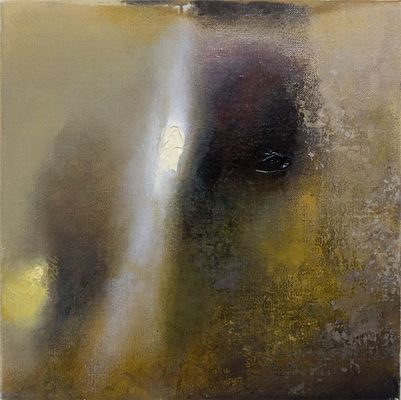
To return to Buckley’s fragment, the first two lines very much evoke how I paint nowadays. As you age, detail diminishes and patches of light become more luminous and float. I feel the most honest way of dealing with this is by smearing the oil paint on the canvas with the fingers and working close-up, blind. Only if the patches coalesce into an approaching image can the work gain a life.
-
Jonathan Walker was born in Melbourne, Australia and brought up on a dairy farm in Gippsland. In the 1970’s he studied painting at RMIT and won the Harold Wright Scholarship to the British Museum, London. During the 1980’s he exhibited at Pinacotheca Gallery, Richmond and had work shown at the NGV and Heidi City Art Gallery. Over the same period he designed the cover for the “Epigenesi” LP by Giancarlo Toniutti, Italy and conducted a mail exchange work with Achim Wollscheid, Germany. The work with artists through the post resulted in an article published in the bicentenary issue of Art and Australia 1988. He showed in artist run spaces such as WestSpace in the 90’s and 2000’s, and until 2012, taught painting at Victoria University, which is where we (Colleen Ahern and Lisa Radford) as organisers of the exhibition, among many others, had the privilege of being his student.
Walker’s knowledge was imparted to students through the careful selection of music, literature, and artists found in books that he himself had ordered for the library. Walker’s strategy was the generosity of sharing his vast knowledge with references specific to each student and their context.
Walker’s paintings share a similar focus and intimacy.
This exhibition presents a small selection of recent paintings alongside a publication that includes Walker’s writing. Observational and analytical, Walker’s work is a type of material notation — the time of day, colour and how it is blended, the both specific and fleeting location of a reflection on lino or the question of whether a chair leg should be included in a painting.
Please join us on Friday August 21 between 6-8pm to celebrate the opening of the exhibition.
Curated by Colleen Ahern and Lisa Radford.
B. Wurtz
Curated by Nic Tammens
March 26 - April 4, 2015
B.Wurtz works from a basement studio in his home on Manhattan’s Lower East Side.
This local fact is attested to by the plastic shopping bags and newsprint circulars that appear in his work. As formal objects, they don’t make loud claims about their origins but nonetheless transmit street addresses and places of business from the bottom of this long thin island. Like plenty of artists, Wurtz is affected by what is local and what is consumed. His work is underpinned by this ethic. It often speaks from a neighborhood or reads like the contents of a hamper:
“BLACK PLUMS $1.29 lb.”
“Food Bazaar”
“USDA Whole Pork Shoulder Picnic 99c lb.”
“RITE AID Pharmacy, with us it’s personal.”
“H. Brickman & Sons.”
“Sweet Yams 59c lb."
Most of the work in this exhibition was made while the artist was in residence at Dieu Donne, a workshop dedicated to paper craft in Midtown. Here Wurtz fabricated assemblages with paper and objects that are relatively lightweight, with the intention that they would be easily transportable to Australia. This consideration isn’t absolute in Wurtz’s work, but was prescriptive for making the current exhibition light and cheap. Packed in two boxes, these works were sent from a USPS post office on the Lower East Side and delivered to North Melbourne by Australia Post.
Wurtz appears courtesy of Metro Pictures, New York.
Thanks to Rob Halverson, Joshua Petherick, Sari de Mallory, Matt Hinkley, Helen Johnson, Fayen d'Evie, Ask Kilmartin, Lisa Radon, Ellena Savage, Yale Union, and "Elizabeth".
John Nixon
"Archive"
December 15 - January 20, 2014
The presentation of John Nixon's archive offered a rare showcase of this extensive collection of the artist's own publications, catalogues, posters, ephemera, editions and more, from the mid 1980s onwards, alongside a selection of his artworks.
Organized by John Nixon, Joshua Petherick and Matt Hinkley.
<a href=http://wfb.public-office.info/artist/john-nixon>All titles by John Nixon
"Habitat"
at Minerva, Sydney (organised by Joshua Petherick and Matt Hinkley)
November 15 - December 20, 2014
Lupo Borgonovo, Janet Burchill & Jennifer McCamley,
Lewis Fidock, HR Giger, Piero Gilardi, Veit Laurent Kurz,
Cinzia Ruggeri, Michael E. Smith, Lucie Stahl, Daniel Weil, Wols
Press Release:
“...It contained seven objects. The slender fluted bone, surely formed for flight, surely from the wing of some large bird. Three archaic circuitboards, faced with mazes of gold. A smooth white sphere of baked clay. An age-blackened fragment of lace. A fingerlength segment of what she assumed was bone from a human wrist, grayish white, inset smoothly with the silicon shaft of a small instrument that must once have ridden flush with the surface of the skin - but the thing’s face was seared and blackened.”
William Gibson, “Count Zero”, 1986
"Autumn Projects Archive"
Curated by Liza Vasiliou
March 6 - March 15, 2014
World Food Books, in conjunction with the Virgin Australia Melbourne Fashion Festival 2014, presented the Autumn Projects archive, consisting of a selection of early examples in Australian fashion with a particular interest in collecting designers and labels from the period beginning in the 1980’s, who significantly influenced the discourse of Australian Fashion.
Curated by Liza Vasiliou, the exhibition provided a unique opportunity to view pieces by designers Anthea Crawford, Barbara Vandenberg, Geoff Liddell and labels CR Australia, Covers, Jag along with early experimental collage pieces by Prue Acton and Sally Browne’s ‘Fragments’ collection, suspended throughout the functioning World Food Books shop in Melbourne.
H.B. Peace
presented by CENTRE FOR STYLE
November 14, 2013
"Hey Blinky, you say chic, I say same"
Anon 2013
H.B. Peace is a clothing collaboration between great friends Blake Barns and Hugh Egan Westland. Their pieces explore the divergences between 'character’ and ‘personality’ in garments....etc
Special Thanks to Joshua Petherick and Matt Hinkley of WFB and Gillian Mears
and a Very Special Thank you to Audrey Thomas Hayes for her shoe collaboration.
Janet Burchill & Jennifer McCamley
"Aesthetic Suicide"
May 10 - June 8, 2013
The first of our occasional exhibitions in the World Food Books office/shop space in Melbourne, "Aesthetic Suicide" presented a body of new and older works together by artists Janet Burchill & Jennifer McCamley, including videos, prints, a wall work, and publications.
During shop open hours videos played every hour, on the hour.
1977, English
Hardcover (w. dust-jacket), 168 pages, 23.5 x 29 cm
Out of print title / used / very good
Published by
Studio Vista / London
$50.00 - Out of stock
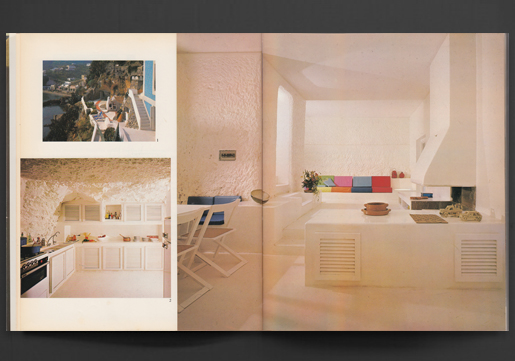
First edition of Barabara Plumb's (editor of the "Living" section of Vogue magazine in the 1970s and Senior editor of Pantheon Books) "Houses Architects Live In" from 1977, a Studio Vista book, printed and bound in Japan.
Profiles the homes of Paolo Leoni, Von Sengen, Gerolamo Gola, Carlo Santi, Giancarlo Bicocchi, Winthrop Faulkner, Antoine Predock, Allan and Barbara Anderson, Wendall Lovett, Arthur Erickson, Luis Barragan, Colin St. John Wilson and M.J. Long, Warren Cox, Georgie Wolton, Michel Sadirac, William J. Conklin, Alberto Seassaro, Nanda Vigo, Claudio Dini, Harry and Penelope Seidler, George D. Hopkins Jr., Tim Prentice, Charles W. Moore, Luigi Capriolo and Jacek Popek, Hanford Yang, Barton Choy, Romano Juvera, Gae Aulenti, Robert Sobel, William Morgan, Hugh Newell Jacobson, Ulrich Franzen, Ziona Lesham, Anne and Tony Woolner, Christopher H.L. Owen, Norman Jaffe, Peter Chermayeff, James Lambeth, Vittorio Gregotti, Franco Tartaglino Mazzucchelli.
"The author reviews the concerns that determine architects’ choices in designing their own environments, and notes how they individually deal with such matters as situation, space, scale, balance, color, light, and all the factors involved in creating a home that meets their needs and interests. The book is rich in suggestions and solutions for beautifying and improving one’s own surroundings."
2016, English
Hardcover (w. dust jacket), 288 pages, 15.2 x 24.1 cm
Published by
University of Chicago Press / Chicago
$89.00 - Out of stock
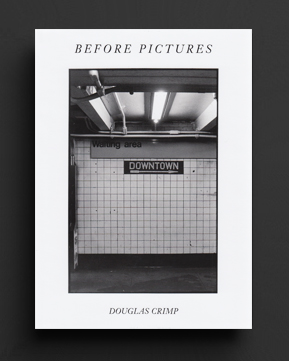
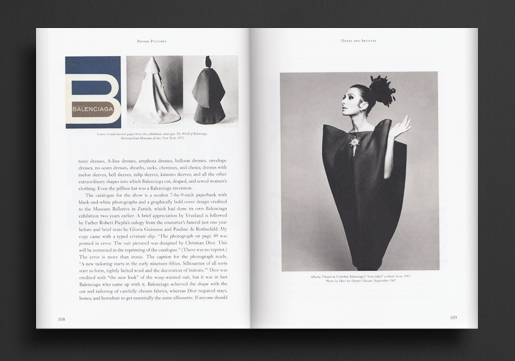
Douglas Crimp is the rare art critic whose work profoundly influenced a generation of artists. He is best known for his work with the "Pictures Generation" the very name of which Crimp coined to define the work of artists like Robert Longo and Cindy Sherman who appropriated images from mass culture to carry out a subversive critique. But while his influence is widely recognized, we know little about Crimp's own formative experiences before "Pictures."Before Pictures tells the story of Crimp's life as a young gay man and art critic in New York City during the late 1960s through the turbulent 1970s. Crimp participated in all of what made the city so stimulating in that vibrant decade. The details of his professional and personal life are interwoven with this the particularly rich history of New York City at that time, producing a vivid portrait of both the critic and his adopted city. The book begins with his escape from his hometown in Idaho, and we quickly find Crimp writing criticism for ArtNews while working at the Guggenheim where, as a young curatorial assistant, he was one of the few to see Daniel Buren's Peinture-Sculpture before it was removed amid cries of institutional censorship. We also travel to the Chelsea Hotel (where Crimp helped the down-on-his-luck couturier Charles James organize his papers) through to his days as a cinephile and balletomane to the founding of the art journal October, where he remained a central figure for many years. As he was developing his reputation as a critic, he was also partaking of the New York night life, from drugs and late nights alongside the Warhol crowd at the Max's Kansas City to discos, roller-skating, and casual sex with famous (and not-so-famous) men. As AIDS began to ravage the closely linked art and gay communities, Crimp eventually turned his attention to activism dedicated to rethinking AIDS. Part biography and part cultural history, Before Pictures is a courageous account of an exceptional period in both Crimp's life and the life of New York City. At the same time, it offers a deeply personal and engaging point of entry into important issues in contemporary art.
Includes the work of Cindy Sherman, Jack Goldstein, Daniel Buren, Charles James, Hiroshi Sugimoto, Agnes Martin, Dan Flavin, Peter Hujar, Eva Hesse, Bernardo Bertolucci, Walker Evans, Joseph Cornell, Alfred Hitchcock, Jack Tworkov, Robert Ryman, Jane Freilicher, Robert Smithson, Michael Snow, Stanley Kubrick, Cristobal Balenciaga, Christian Dior, Brice Marden, Ellsworth Kelly, Guilio Romano, Andrea Mantegna, Merce Cunningham, Joan Jonas, Yvonne Rainer, John Baldessari, Dan Graham, Vito Acconci, Alvin Baltrop, Divine, Gordon Matta-Clark, Edgar Degas, Louise Lawler, and so many others.
1997, English
Softcover, 256 pages, 20.5 x 15 cm
Published by
Exact Change / Boston
$30.00 - Out of stock
This is the first U.S. publication of two riotous novels by the Polish-born British writer Stefan Themerson (1910-1988), who with his wife Franciszka ran the Gaberbocchus Press in London. Gaberbocchus published both Kurt Schwitters and Bertrand Russell--and these extremes unite in Themerson's highly individual brand of philosophical Dadaism. Bayamus recounts the adventures of a self-proclaimed mutant with three legs (one is attached to a roller skate) and his efforts to propogate a new species; it includes an instructive visit to the Theatre of Semantic Poetry, where old rhymes mutate into new truths. Cardinal Polatuo is the biography of Apollinaire's anonymous father, who turns out to be a ecclesiast with a murderous interest in poetry, a faith based on science, and a dreamlife so frankly obscene that only a dictionary of Freudian symbols can explain its innocence.
2018, English
Hardcover, 144 pages, 24 x 28 cm
Published by
Lund Humphries / London
$89.00 - Out of stock
Etel Adnan (b.1925) is a Lebanese-American poet, essayist and visual artist. This will be the first book to present a full account of Adnan's fascinating life and work, using the drama of her biography, the complexity of her identity, and the cosmopolitan nature of her experience to illuminate the many layers and dimensions of her paintings and their progress over several crucial decades. Adnan came relatively late to painting - her first images were created in the mid-1960s in response to the Californian landscape. Her vocabulary of lines, shapes and colours has changed little since then, and yet there are huge variations in mood, texture, composition and material. Similarly, there is a balance between understanding her paintings as pure abstractions, emulating the shape of thought, and seeing them for the actual landscapes of the many places Adnan has loved, embraced and responded to. Tackling the complexities of her subject with skill and insight, Kaelen Wilson-Goldie unpacks Adnan's multi-layered career to capture the full scope of her artistic endeavours and impressive achievements through this profusely illustrated monograph.
2016, English
Softcover, 296 pages, 20.6 x 25.9 cm
Published by
Kerber Verlag / Berlin
$68.00 - Out of stock
This major monographic catalogue documents the highly conceptual work of Austrian installation artist Rudolf Polanszky (born 1951), which aims to bring abstract mathematical and scientific concepts to life. Polanszky's oeuvre is realized in processed and used materials such as acrylic glass, aluminum and cardboard. Profusely illustrated in colour throughout, with accompanying texts (in English) by Benedikt Ledebur, Dieter Buchhart, Alexandra Schantl.
2016, English
Hardcover, 280 pages, 31.6 x 3.1 x 26 cm
Published by
Prestel / Munich
$120.00 - Out of stock
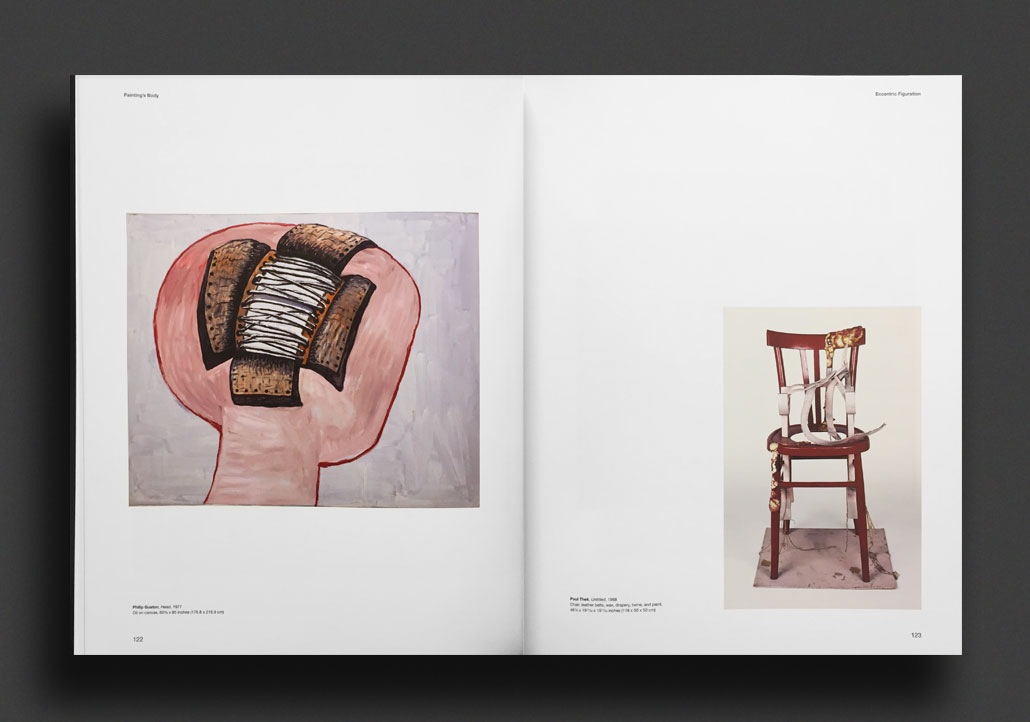
The resurgent interest in contemporary painting in recent years has coincided with an explosion of new digital media and technologies. Contrary to canonical accounts premised on medium-specificity, painting’s most advanced positions since the 1960s have developed in productive friction with contemporaneous forms of mass media and culture. From the rise of television and computers to the Internet revolution, painting has assimilated precisely those cultural and technological developments that were held responsible for its presumed “death.” Moving far beyond its technical definition as “oil on canvas,” painting during the information age has consistently offered a site for negotiating the challenges of a mediated life-world.
Featuring over 230 works by 107 artists, Painting 2.0 is one of the largest and most comprehensive exhibitions of contemporary painting in recent years.
Artists include:
Kai Althoff, Ei Arakawa/Shimon Minamikawa, Monika Baer, Nairy Baghramian, Georg Baselitz, Jean-Michel Basquiat, Lynda Benglis, Sadie Benning, Judith Bernstein, Joseph Beuys, Ashley Bickerton, Cosima von Bonin, KAYA (Debo Eilers & Kerstin Brätsch), Günter Brus, Daniel Buren, Merlin Carpenter, Leidy Churchman, William Copley, René Daniëls, Guy Debord/Asger Jorn, Carroll Dunham, Mary Beth Edelson, Thomas Eggerer, Michaela Eichwald, Nicole Eisenman, Jana Euler, Louise Fishman, Andrea Fraser, Isa Genzken, Mary Grigoriadis, Philip Guston, Wade Guyton, Guyton/Walker, Raymond Hains, Harmony Hammond, David Hammons, Keith Haring, Rachel Harrison, Mary Heilmann, Eva Hesse, Charline von Heyl, Ull Hohn, Jacqueline Humphries, Jörg Immendorff, Jasper Johns, Joan Jonas, Mike Kelley, Martin Kippenberger, Yves Klein, Jutta Koether, Michael Krebber, Manfred Kuttner, Maria Lassnig, Sherrie Levine, Glenn Ligon, Lee Lozano, Konrad Lueg, Michel Majerus, Piero Manzoni, Kerry James Marshall, Hans-Jörg Mayer, John Miller, Joan Mitchell, Ree Morton, Ulrike Müller, Matt Mullican, Elisabeth Murray, Cady Noland, Hilka Nordhausen, Albert Oehlen, Laura Owens, Steven Parrino, Ed Paschke, Howardena Pindell, Sigmar Polke, Seth Price, Stephen Prina, R.H. Quaytman, Robert Rauschenberg, David Reed, Gerhard Richter, Mimmo Rotella, Niki de Saint Phalle, Mario Schifano, Amy Sillman, Sylvia Sleigh, Josh Smith, Joan Snyder, Reena Spaulings, Nancy Spero, Gruppe SPUR, Frank Stella, Walter Swennen, Paul Thek, Rosemarie Trockel, Cy Twombly, Jacques de la Villeglé, Kelley Walker, Andy Warhol, Sue Williams, Karl Wirsum, Martin Wong, Christopher Wool, Heimo Zobernig, u.a.
2019, English
Hardcover, 138 pages, 18.5 x 26.3 cm
Published by
Sternberg Press / Berlin
Kunsthalle Wien / Vienna
$62.00 - Out of stock
Edited by Juliane Bischoff
Texts by Christina Barton, Juliane Bischoff, Chris Kraus, Nicolaus Schafhausen
Kate Newby’s works celebrate the moments in which they are created and presented; at the same time, they are open to change. Drawn from impressions collected when navigating cities and landscapes, her sculptures and interventions foreground process: traces of their making are visible, they transform over time, and active engagement is required to view their details. Her works focus on the fleeting and contingent nature of the quotidian and stay connected to the place and time of their presentation. Newby develops her work in response to a specific environment, and often intends that it only exists for a set period of time. Her installations deal with the relationship between inside and outside, and can undermine the line between the work and its surroundings.
The publication I can’t nail the days down documents Newby’s eponymous exhibition at Kunsthalle Wien and includes a photo essay by the artist as well as detailing previous projects. Working with the architecture of Kunsthalle Wien’s glass pavilion at the Karlsplatz in Vienna, Newby’s exhibition ranged beyond the physical boundaries assigned to it, and subtly challenged where and how sculpture happens. Christina Barton, Juliane Bischoff, Chris Kraus, and Nicolaus Schafhausen contribute texts to the book that explore the influences, tools, ethical aspects, and poetics of Newby’s artworks, as well as the personal relationships the artist folds into her projects.
Copublished by Sternberg Press with Kunsthalle Wien
Design by Marie Artaker
2019, English
Staple bound, 32 pages, 17 cm x 24 cm
Published by
Roma / Amsterdam
$28.00 - Out of stock
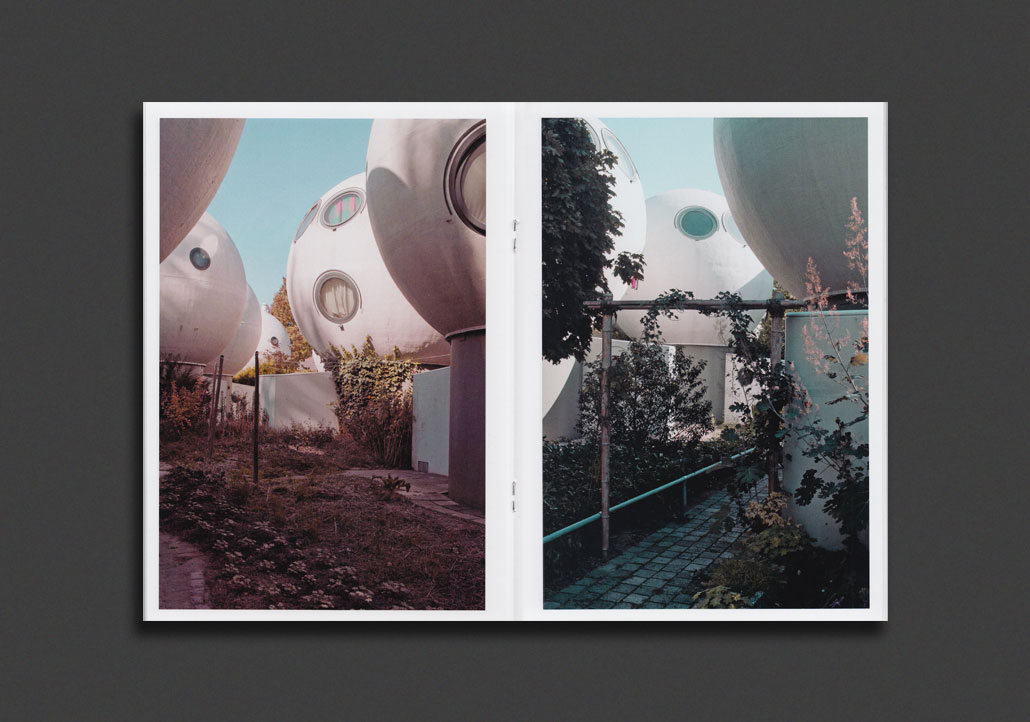
Erik van der Weijde presents a series of photographs of Bollenveld, a futuristic housing project by Dutch architect Dries Kreijkamp, situated in a residential area of 's-Hertogenbosch, the Netherlands. The 50 ‘bolwoningen’ (“ball-” or “bulb-houses”) were built in 1984 using prefabricated spheres of glass-fibre reinforced concrete. Each has a diameter of 5.5 metres and total living area of 55 square metres. They are the last examples of houses that were funded by the Dutch subsidy for experimental building, which was created in 1968.
2019, English
Softcover, 48 pages, 17 x 23cm
Published by
Herbert Foundation / Belgium
$43.00 - Out of stock
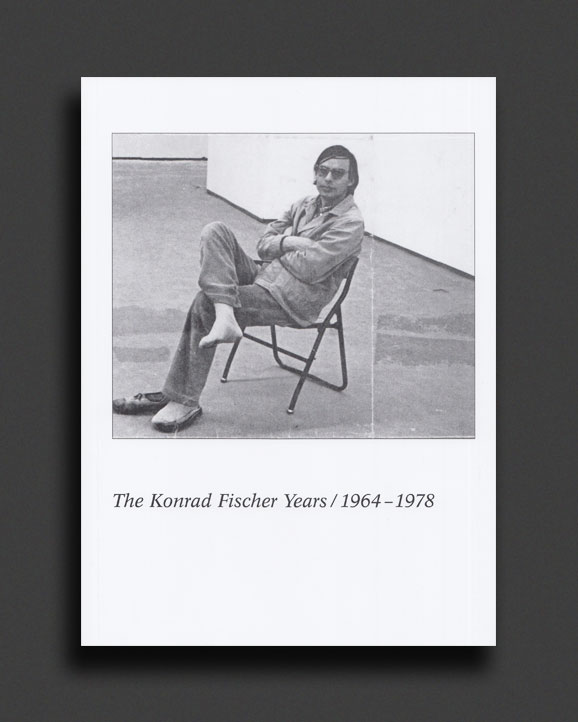
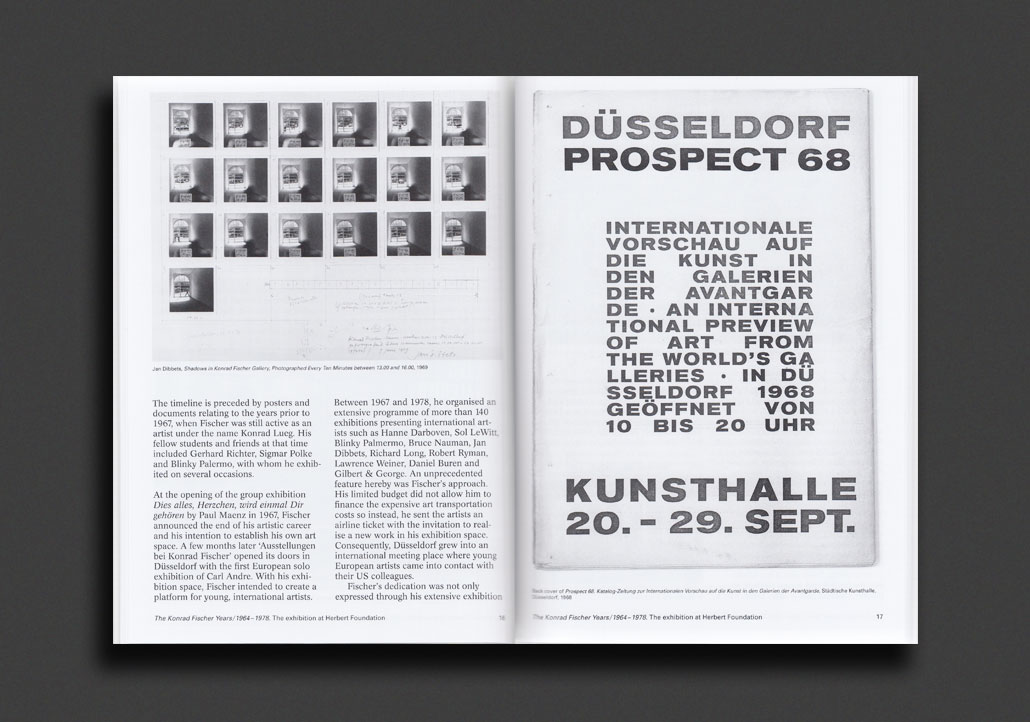
Konrad Fischer opened his exhibition space in 1967 with the first European solo presentation of Carl Andre. Located in a converted alley in Düsseldorf, the gallery offered a platform for emerging international artists. Through his exhibition programme, Fischer enabled contact between European and American artists, transforming Düsseldorf into an international hot spot. With this book, the Herbert Foundation pays homage to the atypical art dealer who left an undeniable mark on its collection. The subjective reflection on Fischer’s activities and role within the international art world of the time includes a reprint of Fischer’s first interview in 1971 and a critical essay by Lynda Morris.
2019, German & English
Softcover, 300 pages, 11cm x 18cm
Published by
Christoph Merian / Basel
Migros-Kulturprozent
$44.00 - Out of stock
Computer developers have dreamed of virtual reality since the early days of programming. With digitisation, our ambition to transcend the world of flat images, to immerse ourselves into an artificial environment, is now within reach. This book illuminates the potential of new forms of immersion in the field of culture, with examples from film, television, museums, art, gaming, education, and more. It features projects such as Birdly and Desktop: Jacob Burckhardt Digital, as well as the work of artists such as Mélodie Mousset. Wider applications in medicine, architecture, archaeology, and reconstruction are also examined. The appendix includes a glossary of relevant terms.
1961, English
Hardcover, 252 pages, 29.5 x 23 cm
1st Edition, Out of print title / used / good
Published by
Praeger Publishers Inc. / New York
$90.00 - Out of stock
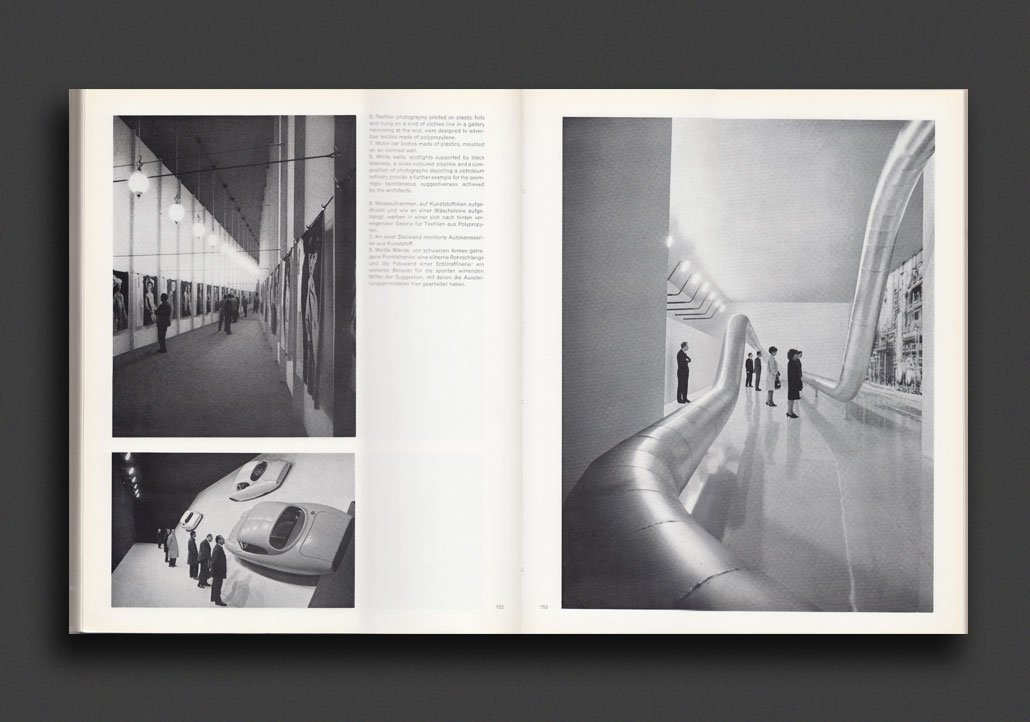
First scarce hardcover edition of EXHIBITIONS: A SURVEY OF INTERNATIONAL DESIGNS, published by Frederick A. Praeger, New York, 1961.
Wonderful collectable clothbound survey of the best (c. 1961) international exhibition design, profusely illustrated with 593 annotated photographs, scale drawings, and architectural plans, of museum exhibits, furniture fairs, world expo pavilions, and much more, with text by Klaus Franck. Discussions include construction, lighting techniques and materials. Also includes a directory of the architects and designers of the 130 presented exhibits from 16 countries, including Good Design (MoMA and The Merchandise Mart, Chicago), documenta '55 and documenta II '59, XI Triennale di Milano (Swiss section, Section of Industrial Design, Finnish section, Japanese section, Compasso d'Oro, and Exhibition of the School of Design, Ulm), San Francisco Showroom of the Herman Miller Furniture Company, San Francisco and Milan Knoll Showrooms, New York Showroom of the Olivetti Corporation, and World's Fair Brussels (Japanese Pavilion, Brazilian Pavilion, Finnish Pavilion, Yugoslav Pavilion, Swiss Pavilion, and more). Designers and architects include Oskar Blase, Max Bill, Gyorgy Kepes, Richard Hamilton, Luciano Baldessari, Vittoriano Vigano, Arnold Bode, Achille Castiglioni, Pier Giacomo Castiglioni, Timo Sarpaneva, Charles and Ray Eames, Paul Rudolph, Alexander Girard, Arthur Drexler, Tapio Wirkkala, Will Burtin, Peter Blake, Florence Knoll, Bruno Munari, Walter Kuhn, Rolf Volhard, Studio Architetti, Richard Buckminster Fuller and George Nelson and Company.
Good ex-library copy, without dust jacket.
English, 1968
Hardcover, 208 pages, 23.2 x 16.7 cm
1st US Edition, Out of print title / used / good
Published by
Praeger Publishers Inc. / New York
$60.00 - Out of stock
First US edition of "Exhibitions, Exhibits, Industrial and Trade Fairs", published in 1968 by the Architectural Press in London and Praeger in New York.
Deeply researched and profusely illustrated with exceptional black and white photography, architectural plans and diagrams, with text by author Wolfgang Clasen, this unique and inspiring book makes the point that "Architectural documentation is particularly important when dealing wit a category of works of architecture which are not built to last."
This book perfectly captures a special and most innovative period in modern design and architecture. As the jacket announces: "We are living in an Exhibition Age: Expo 67 in Montreal is scarcely over and we are already looking ahead to the next World Exhibition in Osaka in 1970. In addition to their primary function of communication, exhibitions have a secondary function of almost equal importance: for because of the temporary nature of most exhibition buildings they provide architects and designers with a testing ground where new ideas, new structures and techniques can be tried out.
This book illustrates and describes eighty examples of exhibitions of all kinds taken from thirteen countries and all five continents; the period covered is from 1960 to the present day. Particular emphasis is laid on the newest trends and on such things as nature of most exhibition buildings they provide architects and designers with a testing ground where new ideas, new structures and techniques can be tried out."
Amongst the many fine examples of cultural exhibitions, commercial and trade expos and temporary pavilions are examples of works by Gio Ponti, Buckminster Fuller, Achille and Pier Giacomo Castiglioni, Le Corbusier, Ettore Sottsass Jr., Wim Crouwel, Total Design, Vittorio Gregotti, Eero Saarinen, Angelo Mangiarotti, Will Burtin, Charles and Ray Eames, Paolo Nestler, Henri Kay Henrion, Rolf Gutbrod, Xenakis, Frei Otto, Ulf Linde, Per-Olof Ultvedt, Will Burtin, Walter Kuhn, and many more.
Separate chapters on fair stands, display units and exhibit systems round off this exhaustive treatise on exhibition architecture with a full index of architects and designers.
Text in English and German.
Good ex-library copy, without dust jacket.
1995, English
Hardcover (w. dust jacket), 120 pages, 25 x 23.5 cm
1st Edition, Out of print title / used / very good
Published by
Harry N. Abrams / New York
$65.00 - Out of stock
American painter Georgia O'Keeffe spent the last 40 years of her life in quiet isolation in New Mexico in the village of Abiquiu. In 1979 She permitted Colorado photographer Myron Wood to photograph at her properties in Abiquiu and Ghost Ranch. Over the following 2 1/2 years he made hundreds of photographs of the artist, the people close to her and of the house, gardens and surrounding landscape. Here are reproduced 79 of those photographs which evoke the spirit of the place as O'keeffe inhabited it.
First edition of this lovely, intimate hardcover photo book. Accompanying text by Christine Taylor Patten.
Very Good copy in VG dust jacket, preserved in mylar wrap.
Georgia Totto O'Keeffe (November 15, 1887 – March 6, 1986) was an American artist. She was best known for her paintings of enlarged flowers, New York skyscrapers, and New Mexico landscapes. O'Keeffe has been recognized as the "Mother of American modernism".
2017, English / German
Hardcover (w. dust jacket), 208 pages, 28 x 24 cm
Published by
The Design Museum / Munich
$95.00 - Out of stock
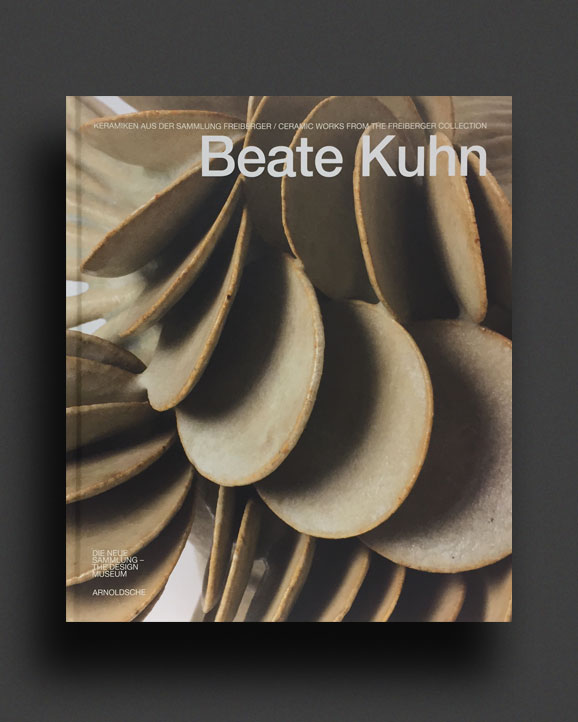
With around 190 works by the German ceramicist Beate Kuhn (1927-2015) from over five decades and all periods of creativity, the Freiberger Collection provides an outstanding review of the impressive oeuvre of this internationally renowned artist. Featuring many previously unseen ceramics in new photographs taken for this publication - Beate Kuhn's works are owned by leading museums worldwide and presented here in the most comprehensive publication ever on the artist.
With her unmistakable signature and exuberant imagination, Beate Kuhn (1927-2015) is one of the most significant German ceramicists of the post-war era. She turned to the liberal arts as early as the end of the 1950s. In linking sculptural reasoning with the possibilities of the material and inherent pottery techniques, the internationally renowned artist conquered the frontiers of ceramics and created virtuosic works that went on to form their own contribution to the history of modern sculpture. With around 190 works from all her periods of creativity, the Mannheim architect Klaus Freiberger was able to compile a collection unmatched anywhere else in the world. In honour of its foundation at the Neue Sammlung, the impressive oeuvre of Beate Kuhn is now being presented for the first time in this comprehensive publication. This book accompanies an exhibition at Die Neue Sammlung - The Design Museum, Munich (DE), 13th July - 19th November 2017.
Text in English and German.
2018, English
Softcover, 288 pages, 20.3 x 26.2 cm
Published by
JRP Ringier / Zürich
$95.00 - Out of stock
The new, expanded edition.
Edited with text by Gabriela Burkhalter. Text by Daniel Baumann, Xavier de la Salle, Vincent Romagny, Sreejata Roy.
This expanded edition of the acclaimed publication on playgrounds includes a new chapter dedicated to playgrounds created in Germany, as well as new biographies on KEKS and Cornelia Hahn Oberlander.
The Playground Project explores these exemplary initiatives, pioneering acts and adventures in designing modern childhood. Examples from Europe, the US, Japan and India are discussed in depth and illustrated with numerous images. The book includes works by artists, architects and landscape architects such as Marjory Allen, Joseph Brown, Riccardo Dalisi, Richard Dattner, Aldo van Eyck, M. Paul Friedberg, Group Ludic, Alfred Ledermann and Alfred Trachsel, Palle Nielsen, Egon Møller-Nielsen, Isamu Noguchi, Joseph Schagerl, Mitsuru Senda and Carl Theodor Sørensen.
2018, English
Softcover, 66 pages,18.4 x 25.4 cm
Published by
Lévy Gorvy / New York
$38.00 - Out of stock
Accompanying an exhibition at the Archivio Carol Rama at the Palazzo Ca' nova in Venice, this publication includes full-colour illustrations of Carol Rama's works featured in the show – an unprecedented selection representing the broad range of materials and styles that comprise her iconoclastic oeuvre. The catalogue also features newly commissioned texts by Lia Gangitano and Andrea Bajani, as well as an introduction by Maria Cristina Mundici and Raffaella Roddolo.
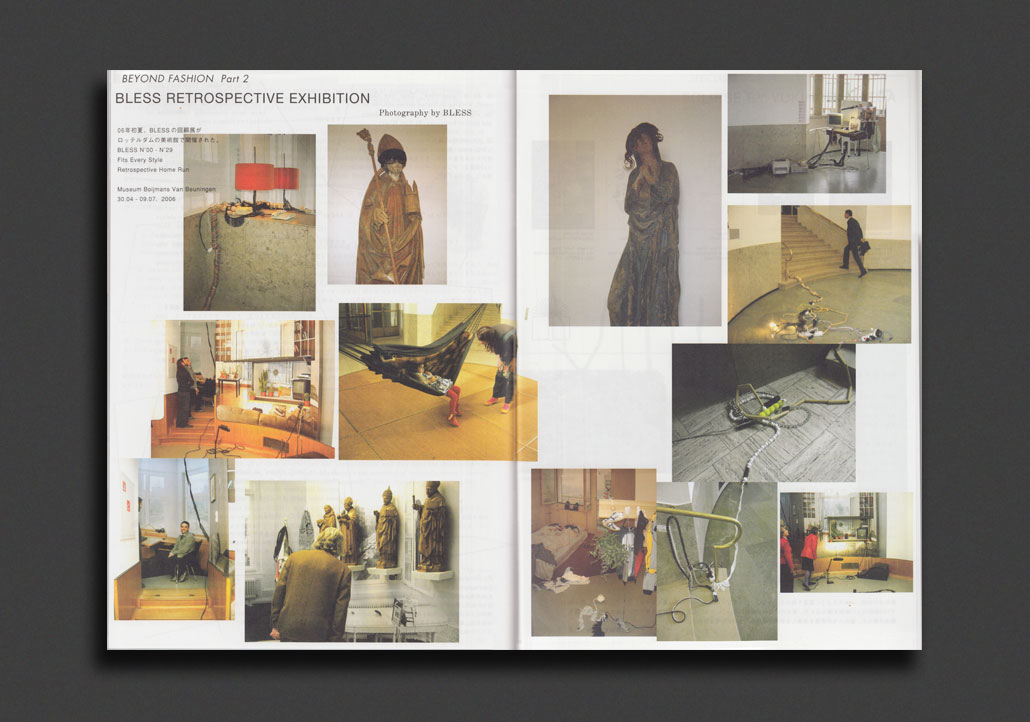
2006, English / Japanese
Softcover, 40 Pages 21 x 29.7 cm
1st Edition, Out of print title / as new
Published by
Here and There / Japan
Nieves / Zurich
$45.00 - Out of stock
Yukinori Maeda, Takashi Homma, Dominique Gonzalez-Foerster, Anne Daems, Susan Cianciolo, Els Beusen, Elein Fleiss, Yoshimi, Yayako Uchida, Takako Minekawa, Yurie Nagashima, Bless, Kazunari Hattori
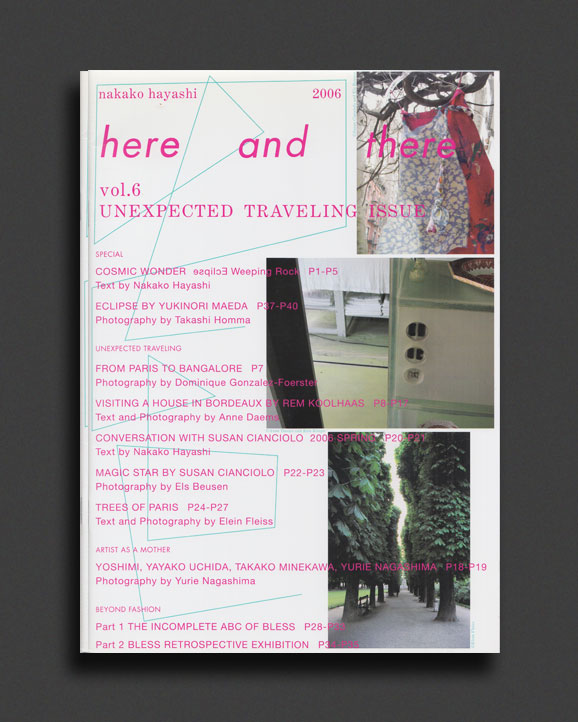
Here and There comes back, after two years of absence from the independent magazine scene, with Unexpected Travelling Issue, a sixth issue which counts already familiar but also new illustrious collaborations.
In Nakako’s own words, the vision behind the Unexpected Travelling Issue was: "One day, someone told me her ideal garden is what looks like no one is taking care of, and have so many different pretty flowers in springtime. The other day my friend told me she has an ideal image of bringing up kids even though in reality she has to deal with daily life living in crowded Tokyo. I am into those stories, and new issue must be something related to this 'ideal' world. in each people's minds. Maybe you can talk about ideal books making"
With the sixth issue, Here and There consolidates its long-standing partnership with Nieves, which from now on will be publishing and distributing the magazine internationally.
As Elein Fleiss once said, Here and There is the magazine of one person. The fact that Nakako's name is credited as the author on the cover is not an egocentric statement but reveals the spirit in which she makes it. Some people make films, others write books or make artworks, and Nakako makes a magazine. It is her personal work and in that sense she makes it in her own way, unlike most magazines on the planet. It also means she is free from capitalistic rules, from imposed trends, from the industry of fashion. Instead, she is free to follow her desire and to link the magazine with her personal life.
Nakako Hayashi was born in 1966. She became a freelance editor from 2001, after working for Hanatsubaki, the culture magazine published by Shiseido. She has been writing fashion and art articles for Ryu-ko-tsu-shin and other magazines. Her books include Baby Generation and Paris Collection Individuals (both by Little More)
Art Director Kazunari Hattori.
2007, English / Japanese
Softcover, 64 Pages, 21 x 29.7 cm
1st Edition, Out of print title / as new
Published by
Nieves / Zurich
Here and There / Japan
$45.00 - Out of stock
Susan Cianciolo, Pascale Gatzen, Mark Borthwick, Kenneth Andrew Mroczek, Ruthie Doyle, Julian Gatto, Yukinori Maeda, Takashi Homma, Anne Daems, Mike Mills, Kim Gordon, Elein Fleiss, Kenshu Shintsubo, Jeff Burch, Kasane Nagawa and Benjamin Sommerhalder
Here and There Vol.7 is dedicated to the cities of Paris and Tokyo, looking at them through the eyes of its wide contributors’ family spread around the world. We are taken into a whirlwind of overlapping stories and emotions, through the words and images of Takashi Homma, Elein Fleiss, Susan Cianciolo, Julian Gatto, Kim Gordon, Mike Mills, Benjamin Sommerhalder and most importantly Nakako Hayashi, the mind behind it all.
This issue is also filled with a few extra special interviews to Pascale Gatzen, Susan Cianciolo, Yukinori Maeda and texts by Jeff Burch, all adding up to 64 truly inspirational pages.
Art Director Kazunari Hattori.
2017, English
Softcover, 112 pages, 21 x 15 cm
1st Edition, Out of print title / used / very good
Published by
ACCA / Melbourne
$65.00 - Out of stock
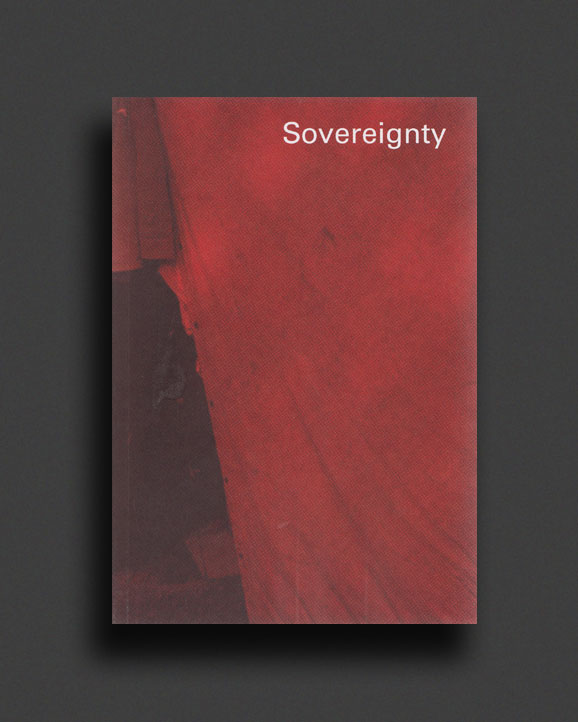
The quickly sold out catalogue published to accompany the exhibition 'Sovereignty' at the Australian Centre for Contemporary Art (ACCA), 17 December 2016 – 26 March 2017.
With a foreword by Arweet Carolyn Briggs, the Sovereignty catalogue features essays by exhibition curators Paola Balla and Max Delany, and commissioned texts by celebrated author Dr Tony Birch and Yorta Yorta curator and writer Kimberley Moulton.
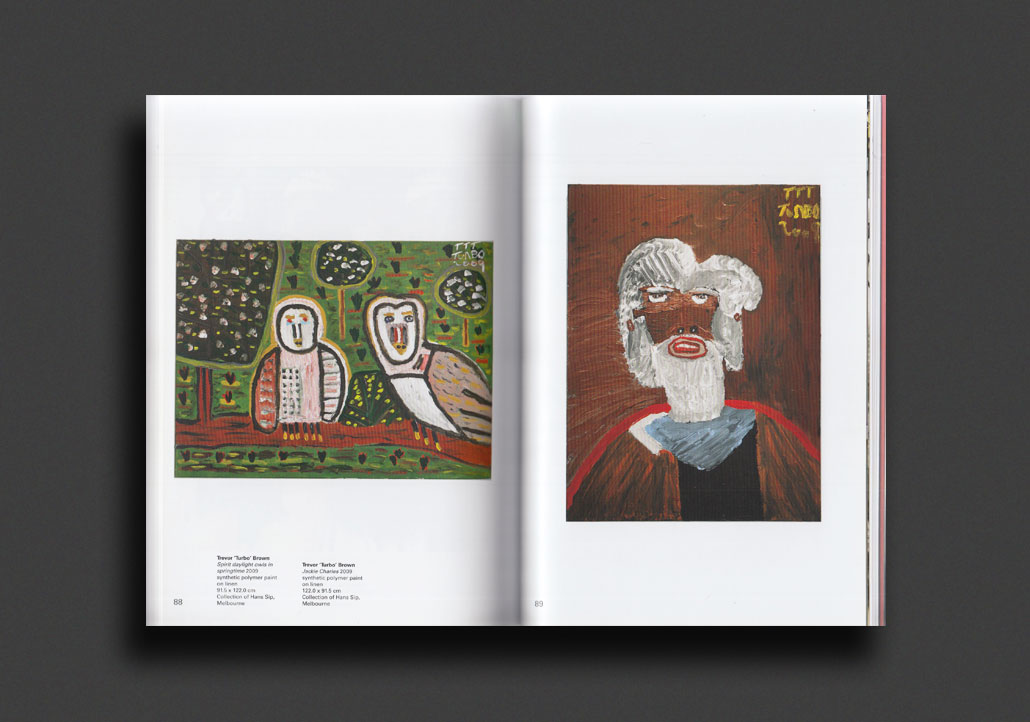
Encompassing extensive documentation of artists’ works in the exhibition printed in full colour, the publication serves as a companion to the exhibition, presenting the vibrant and diverse visual art and culture of the continuous and distinct nations, language groups and communities of Victoria’s sovereign, Indigenous peoples. Sovereignty focuses on contemporary art of First Nations peoples of South East Australia, alongside keynote historical works, to explore culturally and linguistically diverse narratives of self-determination, identity, sovereignty and resistance. Bringing together new commissions, recent and historical works by over thirty artists, Sovereignty is structured around a set of practices and relationships in which art and society, community and family, history and politics are inextricably connected. A diverse range of discursive and thematic contexts are elaborated: the celebration and assertion of cultural identity and resistance; the significance and inter-connectedness of Country, people and place; the renewal and re-inscription of cultural languages and practices; the importance of matriarchal culture and wisdom; the dynamic relations between activism and aesthetics; and a playfulness with language and signs in contemporary society.
Artists featured: Brook Andrew, William Barak, Lisa Bellear, Jim Berg, Briggs, Trevor Turbo Brown,
Amiel Courtin-Wilson / Uncle Jack Charles, Maree Clarke, Vicky Couzens, Destiny Deacon & Virginia Fraser, Marlene Gilson, Korin Gamadji Institute, Brian Martin, Kent Morris, Clinton Nain, Glenda Nicholls, Bill Onus, Steaphan Paton, Bronwyn Razem, Reko Rennie, Steven Rhall, Yhonnie Scarce, Warriors of the Aboriginal Resistance (WAR), Peter Waples-Crowe, Lucy Williams-Connelly
Out of print edition of 750 copies.
Very Good. Like New, but with light marking to cover.
1991, English
Softcover (staple-bound), 16 pages, 30 x 21 cm
1st Edition, Out of print title / used / good
Published by
ACCA / Melbourne
$20.00 - Out of stock
Catalogue published as an artist's accompaniment to the work of the exhibition Contraplex: Fiona Macdonald and Terri Bird, 21 Apr–19 May 1991, at the Australian Centre for Contemporary Art. Melbourne artist Terri Bird’s contribution to this two-artist show was Devices for the Interpretation of Nature. This installation appropriated ACCA’s old Dallas Brooks Drive Gallery 1 as part of the work, directing the viewer between a set of four pedestals placed strategically throughout the space. By crossing through the installation the viewer became part of the work, traversing the interior and exterior spaces of the gallery.
Fiona Macdonald’s work, An Untitled Illustration: Man’s Mind pt. 17, took place in Gallery 2 and 3, and involved the subdivision of these spaces into small confided areas. Layered, disjointed images were then placed into these sub-divisions, reinforcing the sense of confinement.
2016, English
Softcover, 48 pages, 42 x 30 cm
Published by
Griffith University / Brisbane
$30.00 - Out of stock
Published to accompany the exhibition Jenny Watson : Chronicles, 14 July – 3 September 2016, Griffith University Art Museum, the exhibition and catalogue take a thematic approach to Watson’s work, focusing on the prevalence of text throughout her career, and the powerful role it has played in constructing her highly personal narratives. The works included in the exhibition track Watson’s career trajectory from the earliest appearance of text in the 1970s, through the deliberate deskilling of her painterly style, to a new suite of works where text, painting and objects interact. Seminal works include the suburban house ‘double paintings’, the newspaper and magazine pages, and the An Original Oil Painting duo of works, which took Watson’s conceptual project to its most reductive point. The inclusion of text and the painted image has formed a crucial duality in Watson’s practice and its various manifestations provides the thread connecting the works in the exhibition. While the images in Watson’s more recent paintings have simplified, the relationship between the elements has become more complex.
1987, English
Softcover, 28 pages, 210 x 210 mm
1st edition, Out of print title / As new,
Published by
200 Gertrude Street / Melbourne
$25.00 - Out of stock
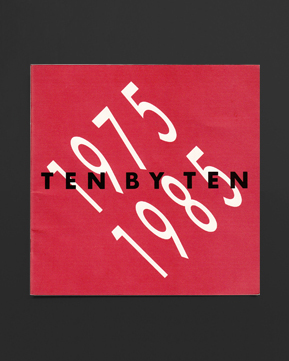
Catalogue published to accompany the exhibition "Ten by Ten: 1975-1985" (curated by Lesley Dumbrell) at 200 Gertrude Street, Melbourne, November 20 - December 12, 1987.
Features the work of Micky Allen, Howard Arkley, Rosalie Gascoigne, Elizabeth Gower, Dale Hicky, Robert Hunter, Bea Maddock, John Nixon, Peter Tyndall and Jenny Watson.
Introduction by Lesley Dumbrell.
2017, English
Softcover, 92 pages, 22.5 x 15.5 cm
Published by
Griffith University / Brisbane
$27.00 - Out of stock
Gordon Hookey’s cycle of monumental paintings MURRILAND! (2015–ongoing) re-envisions the history of his home state of Queensland, Australia, surveying pre-colonisation to the present day, unravelling received versions of history and confronting non-Indigenous narratives. This publication GORDON HOOKEY: Summoning Time, Painting & Politikill Transition in MURRILAND! compiles materials surrounding the first canvas in the series, coinciding with its presentation in documenta 14. It features Hookey’s source material; an essay by Aboriginal historian Michael Aird; a conversation between Gordon Hookey, Frontier Imaginaries curator Vivian Ziherl, and documenta 14 curator Hendrik Folkerts; and a dialogue between Gordon Hookey and anthropologist Johannes Fabian. This book is published as a collaboration between Griffith University, Frontier Imaginaries, documenta 14, and the Van Abbemuseum.
2017, English
Softcover, 174 pages, 24 x 17 cm
Published by
Griffith University / Brisbane
$30.00 - Out of stock
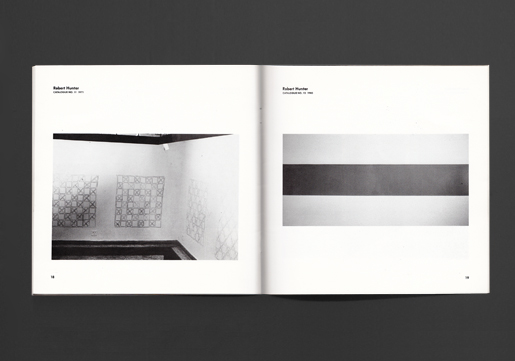
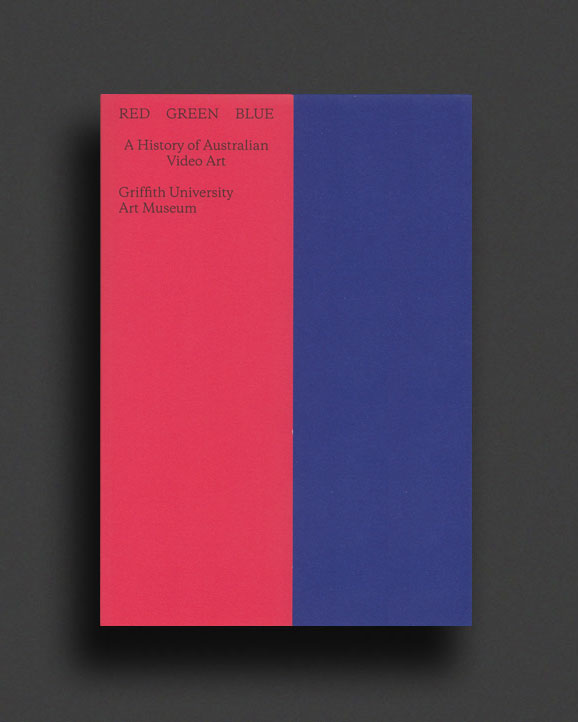
Catalogue for Red Green Blue: A History of Australian Video Art, a major three part exhibition at the Griffith University Art Museum, 2017, mapping a thematic history of video art in Australia from the 1970s until the present. The exhibition brought together more than 60 works, highlighting the many possibilities offered by the medium, in terms of form, content and interaction with other disciplines. Artworks drawn from archives, artist holdings and the Griffith University Art Collection shows a historical journey that is also a celebration of the ongoing dynamism and depth of Australian video art practice. Features texts by curator Matthew Perkins, as well as Angela Goddard, Bree Richards, Daniel Palmer; interviews with artists Peter Kennedy, Bonita Ely, Soda_Jerk, Lyndal Jones, David Rosetzky, Michael Glasheen, Michaela Gleave. Also features the work of Destiny Deacon and Virginia Fraser, VNS Matrix, Susan Norrie, Hannah Brontë, James Lynch, Masato Takasaka, Warren Burt, Tracey Moffatt, Jill Orr, Dale Frank, Mike Parr, and many more.