World Food Books' programme is largely produced on Kulin Nation land. We acknowledge the Wurundjeri people of the Kulin Nation as the first and continuing custodians of this land, and pay respect to their Elders past, present, and emerging.
World Food Books is an arts and special interests bookshop in Naarm / Melbourne. Founded in 2010, World Food Books is devoted to the presentation of a rotating, hand-selection of international art, design, literary and counterculture publications with an emphasis on the anti-traditional, the experimental, the avant-garde, the heretic, the marginal.
Presenting new titles alongside rare and out-of-print books, catalogues and journals spanning the fields of modern and contemporary art, design, photography, illustration, film, literature, poetry, cultural theory, philosophy, sexuality, popular and underground culture in its many radical forms, World Food Books wishes to encourage adventurous, thoughtful and open-minded reading, looking, writing, and exchange of publishing and ideas, both current and historical.
As well as our bookshop, located in Melbourne's historical Nicholas Building, all of our inventory is available internationally via our online mail-order service.
World Food Books semi-regularly co-ordinates "Occasions", a programme of exhibits and events at the bookshop and in partnership with other hosts (such as museums and art galleries) that develop out of the activities, relationships and content of the bookshop itself.
World Food Books
The Nicholas Building
37 Swanston Street
Room 5, Level 6
Melbourne 3000
Australia
SHOP HOURS:
Thu–Fri 12–6, Sat 12–5
WEB-SHOP OPEN 24/7
World Food Books
Postal Address:
PO Box 435
Flinders Lane
Victoria 8009
Australia
Art
Theory / Essay
Architecture / Interior
Graphic Design / Typography
Photography
Fashion
Eros
LGBTQ+
Fiction / Poetry
Weird / Speculative / Science Fiction / Horror
Transgressive / Visceral / Abject
Symbolism / Decadence / Fin de siècle
Film / Video
Painting
Sculpture / Installation
Performance / Dance / Theater
Drawing
Sound / Music
Curatorial
Group Shows / Collections
Periodicals
Out-of-print / Rare
Posters / Ephemera / Discs
Signed Books
World Food Books Gift Voucher
World Food Book Bag
Australian Art
Australian Fiction
Australian Science Fiction / Speculative Fiction
Australian Poetry
Australian Photography
Japanese Photography
Conceptual Art
Minimal Art
Dada
'Pataphysics / Oulipo
Fluxus
Concrete Poetry
Pop Art
Surrealism
Arte Povera
Arte Informale / Haute Pâte / Tachism
Nouveau Réalisme / Zero / Kinetic
Situationism / Lettrism
Collage / Mail Art / Xerox Art
Art Brut / Folk / Visionary / Fantastic
Illustration / Graphic Art / Bandes Dessinées
Furniture
Italian Radical Design / Postmodernism
Textiles
Ceramics / Glass
Counterculture
Protest / Revolt
Philosophy
Psychoanalysis
Anthropology
Anarchism
Socialism / Anarchism / Communism / Capitalism
Literary Theory / Semiotics / Language
Feminism / Women's Studies
Gender Studies / Sexuality
Anthropology
Fetishism / BDSM
Drugs / Psychedelia
Crime / Violence
Animal Rights / Veganism
Occult / Esoterica
Ecology / Earth / Alternative Living
Whole Earth / Crafts
All prices in AUD (Australian dollars)
Pick-Ups
Pick-up orders can be collected in our bookshop during opening hours after order date. Please collect any Pick-up orders within 2 weeks of ordering as we have limited storage space. Orders will be released back into stock if not collected within this time. No refunds can be made for pick-ups left un-collected. If you cannot make it in to the bookshop in this time-frame, please choose postage option.
Return Policy
All sales are final. We do accept returns (for refund or exchange) for items received in error. All our orders are packed with special care using heavy-duty padding and cardboard book-mailers or bubble mailers (for smaller books), using reinforcement where required. We cannot take responsibility for any lost, stolen or damaged parcels.
Insurance
Should you wish to insure your package, please email us directly after placing your order and we can organise this at a small extra expense. Although all standard/express tracked packages are very safe and dependable, we cannot take responsibility for any lost, stolen or damaged parcels. We recommend insurance on valuable orders.
Interested in selling your old books, catalogues, journals, magazines, comics, fanzines, ephemera? We are always looking for interesting, unusual and out-of-print books to buy. We only buy books in our fields of interest and specialty, and that we feel we can resell.
We base these prices on desirability, market value, in-print prices, condition and our current stock levels. We offer cash, store credit, and can take stock on consignment. All
about 25% of the price we expect to get when we sell them, or 30% in store credit. We base these prices on desirability, market value, in-print prices, condition and our current stock levels.
Sell your books any day of the week. You can drop them off and return later. If you have a lot of books, we can visit your Sydney home.
We buy books that we feel we can resell. We offer about 25 % of the price we expect to get when we sell them, or 30% in store credit. We base these prices on desirability, market value, in-print prices, condition and our current stock levels.
Philadelphia Wireman
03 August - 01 September, 2018
World Food Books is proud to announce our next Occasion, the first presentation of sculptures by Philadelphia Wireman in Australia.
The Philadelphia Wireman sculptures were found abandoned in an alley off Philadelphia’s South Street on trash night in 1982. Their discovery in a rapidly-changing neighbourhood undergoing extensive renovation, compounded with the failure of all attempts to locate the artist, suggests that the works may have been discarded after the maker’s death. Dubbed the "Philadelphia Wireman" during the first exhibition of this work, in 1985, the maker’s name, age, ethnicity, and even gender remain uncertain. The entire collection totals approximately 1200 pieces, all intricately bound together with tightly-wound heavy-gauge wire (along with a few small, abstract marker drawings, reminiscent both of Mark Tobey and J.B. Murry). The dense construction of the work, despite a modest range of scale and materials, is singularly obsessive and disciplined in design: a wire armature or exoskeleton firmly binds a bricolage of found objects including plastic, glass, food packaging, umbrella parts, tape, rubber, batteries, pens, leather, reflectors, nuts and bolts, nails, foil, coins, toys, watches, eyeglasses, tools, and jewellery.
Heavy with associations—anthropomorphic, zoomorphic, and socio-cultural responses to wrapped detritus—the totemic sculptures by Philadelphia Wireman have been discussed in the context of work created to fulfil the shamanistic needs of alternative religions in American culture. Curators, collectors, and critics have variously compared certain pieces to sculpture from Classical antiquity, Native American medicine bundles, African-American memory jugs, and African fetish objects. Reflecting the artist’s prolific and incredibly focused scavenging impulse, and despite—or perhaps enhanced by—their anonymity, these enigmatic objects function as urban artefacts and arbiters of power, though their origin and purpose is unknown. Philadelphia Wireman, whatever their identity, possessed an astonishing ability to isolate and communicate the concepts of power and energy through the selection and transformation of ordinary materials. Over the course of the past two decades, this collection has come to be regarded as an important discovery in the field of self-taught art and vernacular art.
Presented in collaboration with Fleisher-Ollman Gallery, Philadelphia, and Robert Heald, Wellington.
Susan Te Kahurangi King
02 February - 10 March, 2018
Susan Te Kahurangi King (24 February 1951 - ) has been a confident and prolific artist since she was a young child, drawing with readily available materials - pencils, ballpoint pens and felt-tip markers, on whatever paper is at hand. Between the ages of four and six Susan slowly ceased verbal communication. Her grandparents William and Myrtle Murphy had developed a special bond with Susan so they took on caring responsibilities for extended periods. Myrtle began informally archiving her work, carefully collecting and storing the drawings and compiling scrapbooks. No drawing was insignificant; every scrap of paper was kept. The King family are now the custodians of a vast collection containing over 7000 individual works, from tiny scraps of paper through to 5 meter long rolls.
The scrapbooks and diaries reveal Myrtle to be a woman of great patience and compassion, seeking to understand a child who was not always behaving as expected. She encouraged Susan to be observant, to explore her environment and absorb all the sights and sounds. Myrtle would show Susan’s drawings to friends and people in her community that she had dealings with, such as shopkeepers and postal workers, but this was not simply a case of a grandmother’s bias. She recognised that Susan had developed a sophisticated and unique visual language and sincerely believed that her art deserved serious attention.
This was an unorthodox attitude for the time. To provide some context, Jean Dubuffet coined the term Art Brut in 1945 to describe work created by self-taught artists – specifically residents of psychiatric institutions and those he considered to be visionaries or eccentrics. In 1972 Roger Cardinal extended this concept by adopting the term Outsider Art to describe work made by non-academically trained artists operating outside of mainstream art networks through choice or circumstance. Susan was born in Te Aroha, New Zealand in 1951, far from the artistic hubs of Paris and London that Dubuffet and Cardinal operated in. That Myrtle fêted Susan as a self-taught artist who deserved to be taken seriously shows how progressive her attitudes were.
Susan’s parents Doug and Dawn were also progressive. Over the years they had consulted numerous health practitioners about Susan’s condition, as the medical establishment could not provide an explanation as to why she had lapsed into silence. Dawn educated herself in the field of homeopathy and went on to treat all twelve of her children using these principles – basing prescriptions on her observations of their physical, mental and emotional state.
Doug was a linguist with an interest in philosophy who devoted what little spare time he had to studying Maori language and culture. To some extent their willingness to explore the fringes of the mainstream made them outsiders too but it was their commitment to living with integrity and their respect for individuality that ensured Susan’s creativity was always encouraged.
Even though Susan’s family supported her artistic pursuits, some staff in schools and hospitals saw it as an impediment to her assimilation into the community and discouraged it in a variety of ways. Her family was not always aware of this and therefore did not fully understand why Susan stopped drawing in the early 1990s. However, rather than dwell on the challenges that Susan faced in pursuit of her artistic practice, they prefer to highlight her achievements. In 2008 Susan began drawing again in earnest, after an almost 20 year interruption, and her work is now shown in galleries around the world.
Susan grew up without television and has been heavily influenced by the comics she read as a child. She is absolutely fearless in the appropriation of recognizable characters, such as Donald Duck and Mickey Mouse, in her work. She twists their limbs, contorts their faces, compresses them together, blends them into complex patterned backgrounds - always imbuing them with an incredible energy. Although Susan often used pop culture characters in her work they are not naive or childlike. These are drawings by a brilliant self-taught artist who has been creating exceptional work for decades without an audience in mind.
Mladen Stilinović
"Various Works 1986 - 1999"
02 February 16 - September 10, 2016
Various works 1986 - 1999, from two houses, from the collections of John Nixon, Sue Cramer, Kerrie Poliness, Peter Haffenden and Phoebe Haffenden.
Including: Geometry of Cakes (various shelves), 1993; Poor People’s Law (black and white plate), 1993; White Absence (glasses, ruler, set square, silver spoon, silver ladel with skin photograph and wooden cubes), 1990-1996; Exploitation of the Dead (grey and red star painting, wooden painting, black spoon with red table, red plate), 1984-1990; Money and Zeros (zero tie, paintings made for friends in Australia (Sue, John, Kerrie), numbers painting), 1991-1992; Words - Slogans (various t-shirts) - “they talk about the death of art...help! someone is trying to kill me”, “my sweet little lamb”, “work is a disease - Karl Marx”; Various artist books, catalogues, monographs, videos; Poster from exhibition Insulting Anarchy; "Circular" Croatian - Australian edition; Artist book by Vlado Martek (Dostoyevsky); more.
Thanks to Mladen Stilinović and Branka Stipančić.
Jonathan Walker
Always Will Need To Wear Winter Shirt Blue + Ochre Small Check Pattern
21 August - 21 September, 2015
Untitled
I am not a great reader of poetry but I always return to the work of Melbourne poet, Vincent Buckley (1925- 1988). Perhaps I find his most tantalising piece to be not a finished poem but a fragment left on a scrap of paper discovered on his desk after the poet’s death.
The poetry gathers like oil
In the word-core, and spreads
It has its music meet,
Its music is in movement.
This fragment is more the shell left behind from a volatile thought than a finished poem. I find the last two lines honest but awkward whereas the first two lines work like an arrow. Most likely he could not find a resolution so it was left. Still, in its present form, it remains an eloquent testimony to the ultimate failure of a medium to express mobile thought and sensation, in Buckley’s case, through verbal language. It’s an important matter because this is something all artists have to deal with regardless of the medium.
I have never written a poem, however, I am forever copying fragments from books on paper scraps in a vain effort to fix certain notions in my head. At first, they function as bookmarks that are sometimes returned to when I open the book. But before long, as they accumulate, they fall out littering the table interspersed with A4 photocopies, bills, books and medications.
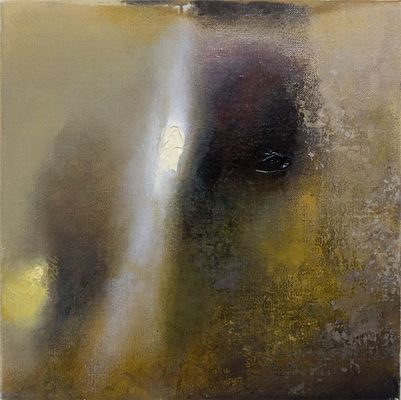
To return to Buckley’s fragment, the first two lines very much evoke how I paint nowadays. As you age, detail diminishes and patches of light become more luminous and float. I feel the most honest way of dealing with this is by smearing the oil paint on the canvas with the fingers and working close-up, blind. Only if the patches coalesce into an approaching image can the work gain a life.
-
Jonathan Walker was born in Melbourne, Australia and brought up on a dairy farm in Gippsland. In the 1970’s he studied painting at RMIT and won the Harold Wright Scholarship to the British Museum, London. During the 1980’s he exhibited at Pinacotheca Gallery, Richmond and had work shown at the NGV and Heidi City Art Gallery. Over the same period he designed the cover for the “Epigenesi” LP by Giancarlo Toniutti, Italy and conducted a mail exchange work with Achim Wollscheid, Germany. The work with artists through the post resulted in an article published in the bicentenary issue of Art and Australia 1988. He showed in artist run spaces such as WestSpace in the 90’s and 2000’s, and until 2012, taught painting at Victoria University, which is where we (Colleen Ahern and Lisa Radford) as organisers of the exhibition, among many others, had the privilege of being his student.
Walker’s knowledge was imparted to students through the careful selection of music, literature, and artists found in books that he himself had ordered for the library. Walker’s strategy was the generosity of sharing his vast knowledge with references specific to each student and their context.
Walker’s paintings share a similar focus and intimacy.
This exhibition presents a small selection of recent paintings alongside a publication that includes Walker’s writing. Observational and analytical, Walker’s work is a type of material notation — the time of day, colour and how it is blended, the both specific and fleeting location of a reflection on lino or the question of whether a chair leg should be included in a painting.
Please join us on Friday August 21 between 6-8pm to celebrate the opening of the exhibition.
Curated by Colleen Ahern and Lisa Radford.
B. Wurtz
Curated by Nic Tammens
March 26 - April 4, 2015
B.Wurtz works from a basement studio in his home on Manhattan’s Lower East Side.
This local fact is attested to by the plastic shopping bags and newsprint circulars that appear in his work. As formal objects, they don’t make loud claims about their origins but nonetheless transmit street addresses and places of business from the bottom of this long thin island. Like plenty of artists, Wurtz is affected by what is local and what is consumed. His work is underpinned by this ethic. It often speaks from a neighborhood or reads like the contents of a hamper:
“BLACK PLUMS $1.29 lb.”
“Food Bazaar”
“USDA Whole Pork Shoulder Picnic 99c lb.”
“RITE AID Pharmacy, with us it’s personal.”
“H. Brickman & Sons.”
“Sweet Yams 59c lb."
Most of the work in this exhibition was made while the artist was in residence at Dieu Donne, a workshop dedicated to paper craft in Midtown. Here Wurtz fabricated assemblages with paper and objects that are relatively lightweight, with the intention that they would be easily transportable to Australia. This consideration isn’t absolute in Wurtz’s work, but was prescriptive for making the current exhibition light and cheap. Packed in two boxes, these works were sent from a USPS post office on the Lower East Side and delivered to North Melbourne by Australia Post.
Wurtz appears courtesy of Metro Pictures, New York.
Thanks to Rob Halverson, Joshua Petherick, Sari de Mallory, Matt Hinkley, Helen Johnson, Fayen d'Evie, Ask Kilmartin, Lisa Radon, Ellena Savage, Yale Union, and "Elizabeth".
John Nixon
"Archive"
December 15 - January 20, 2014
The presentation of John Nixon's archive offered a rare showcase of this extensive collection of the artist's own publications, catalogues, posters, ephemera, editions and more, from the mid 1980s onwards, alongside a selection of his artworks.
Organized by John Nixon, Joshua Petherick and Matt Hinkley.
<a href=http://wfb.public-office.info/artist/john-nixon>All titles by John Nixon
"Habitat"
at Minerva, Sydney (organised by Joshua Petherick and Matt Hinkley)
November 15 - December 20, 2014
Lupo Borgonovo, Janet Burchill & Jennifer McCamley,
Lewis Fidock, HR Giger, Piero Gilardi, Veit Laurent Kurz,
Cinzia Ruggeri, Michael E. Smith, Lucie Stahl, Daniel Weil, Wols
Press Release:
“...It contained seven objects. The slender fluted bone, surely formed for flight, surely from the wing of some large bird. Three archaic circuitboards, faced with mazes of gold. A smooth white sphere of baked clay. An age-blackened fragment of lace. A fingerlength segment of what she assumed was bone from a human wrist, grayish white, inset smoothly with the silicon shaft of a small instrument that must once have ridden flush with the surface of the skin - but the thing’s face was seared and blackened.”
William Gibson, “Count Zero”, 1986
"Autumn Projects Archive"
Curated by Liza Vasiliou
March 6 - March 15, 2014
World Food Books, in conjunction with the Virgin Australia Melbourne Fashion Festival 2014, presented the Autumn Projects archive, consisting of a selection of early examples in Australian fashion with a particular interest in collecting designers and labels from the period beginning in the 1980’s, who significantly influenced the discourse of Australian Fashion.
Curated by Liza Vasiliou, the exhibition provided a unique opportunity to view pieces by designers Anthea Crawford, Barbara Vandenberg, Geoff Liddell and labels CR Australia, Covers, Jag along with early experimental collage pieces by Prue Acton and Sally Browne’s ‘Fragments’ collection, suspended throughout the functioning World Food Books shop in Melbourne.
H.B. Peace
presented by CENTRE FOR STYLE
November 14, 2013
"Hey Blinky, you say chic, I say same"
Anon 2013
H.B. Peace is a clothing collaboration between great friends Blake Barns and Hugh Egan Westland. Their pieces explore the divergences between 'character’ and ‘personality’ in garments....etc
Special Thanks to Joshua Petherick and Matt Hinkley of WFB and Gillian Mears
and a Very Special Thank you to Audrey Thomas Hayes for her shoe collaboration.
Janet Burchill & Jennifer McCamley
"Aesthetic Suicide"
May 10 - June 8, 2013
The first of our occasional exhibitions in the World Food Books office/shop space in Melbourne, "Aesthetic Suicide" presented a body of new and older works together by artists Janet Burchill & Jennifer McCamley, including videos, prints, a wall work, and publications.
During shop open hours videos played every hour, on the hour.
2019, English
Softcover, 160 pages, 11.5 x 18 cm
Published by
Semiotext(e) / Los Angeles
The MIT Press / Massachusetts
$33.00 - Out of stock
The increasingly chaotic rhythm of our respiration, and the sense of suffocation that grows everywhere: an essay on poetical therapy.
Since the hopeful days of the Occupy movement, many things have changed in the respiration of the world, and we have entered a cycle of spasm, despair, and chaos. Breathing is a book about the increasingly chaotic rhythm of our respiration, about the sense of suffocation that grows everywhere. “I can't breathe.” These words panted by Eric Garner before dying, strangled by a police officer on the streets of Staten Island, capture perfectly catching the overall sentiment of our time. In Breathing, Franco "Bifo" Berardi comes back to the subject that was the core of his 2011 book, The Uprising: the place of poetry in the relations between language, capital, and possibility. In The Uprising, he focuses on poetry as an anticipation of the trend toward abstraction that led to the present form of financial capitalism. In Breathing, he tries to envision poetry as the excess of the field of signification, as the premonition of a possible harmony inscribed in the present chaos.
The Uprising was a genealogical diagnosis. Breathing is an essay on poetical therapy. How we deal with chaos, as we know that those who fight against chaos will be defeated, because chaos feeds upon war? How do we deal with suffocation? Is there a way out from the corpse of financial capitalism?
2018, English
Softcover, 640 pages, 11 x 18 cm
Published by
Rollo Press / Zürich
$35.00 - Out of stock
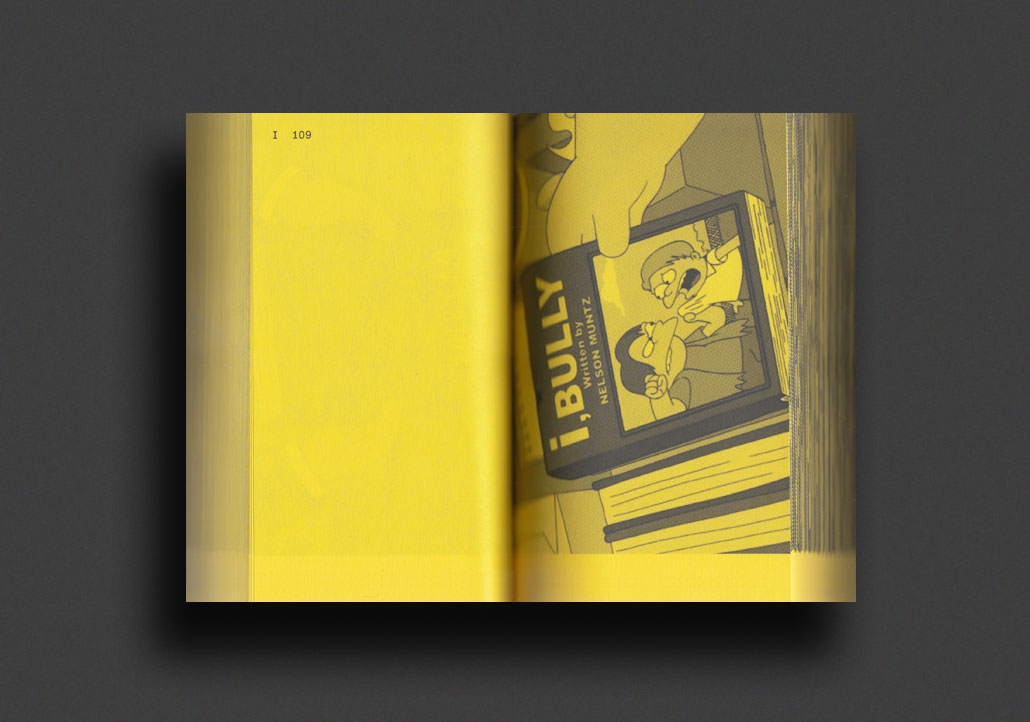
French graphic designer Olivier Lebrun follows on his previous publications documenting the books that appear in the popular cartoon television series with this anthology of more than 330 images and titles. All have been captured with a black-and-white animation screenshot and catalogued in alphabetical order. Ostensibly the final instalment of this highly personal project by Lebrun, this new, updated edition reflects countless painstaking hours spent scanning episodes, plus the contributions of a large community of fans and readers who provided tips over the years.
1973, English / German / French
Hardcover, 240 pages, 24 x 30.5 cm
Out of print title / used / very good
Published by
The Graphis Press / Zürich
$70.00 - Out of stock
The first (and best) 1973 edition of the great Graphis Posters book series. Published by The Graphis Press in Zürich, this profusely illustrated, cloth-bound volume continues one of the world's leading design showcases. Each Graphis Posters Annual volume profiles in colour and black and white the best poster design of that year. Profusely illustrated across 240 pages, with 845 b/w and colour examples, and, as per usual for Graphis publications, handsomely designed and heavily researched, with all texts in English, German and French. Edited by Swiss graphic design Walter Herdeg with an introduction by Pierre Restany.
Features the work of : Milton Glaser, Herb Lubalin, Jan Lenica, Les Mason, Sarah Moon, Seymour Chwast, Alan Aldridge, Horst Antes, Dick Bruna, Jean Widmer, Roman Cieslewicz, Ivan Chermayeff, Jean Michel Folon, Tomi Ungerer, Tadanori Yokoo, Shigeo Fukuda, Nicole Claveloux, Max Ernst, Eduardo Chillida, Hans Erni, Paul Davis, Kishin Shinoyama, Georgia O'Keefe, Karl Neubacher, Waldemar Swierzy, Hans Frei, David Hockney, Celestino Piatti, Mordillo, Akira Uno, Massmimo Vignelli, Paul Wunderlich, Victor Varsarley, Raymond Savignac, Ronald Searle, Etienne Delessert, Sam Haskins, David Hamilton, Peter Knapp, Buckminster Fuller, Frieder Grindler, Holger Matthies, Art Kane, Gunther Kieser, Roy Lichtenstein, Push Pin Studios, Paul Davis, Roland Topor, Ernest Trova, Joan Miro, Peter Max, Tadashi Masuda, Michael English, Gottschalk + Ash, Ikko Tanaka, Shigeo Okamoto, and hundreds more.
Very Good copy with only light wear, no dust jacket.
1971, English / German / French
Hardcover (w. dust jacket), 242 pages, 24 x 30.5 cm
Out of print title / used / good
Published by
The Graphis Press / Zürich
$55.00 - Out of stock
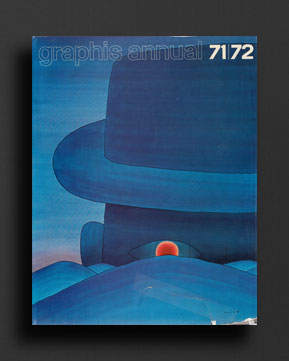
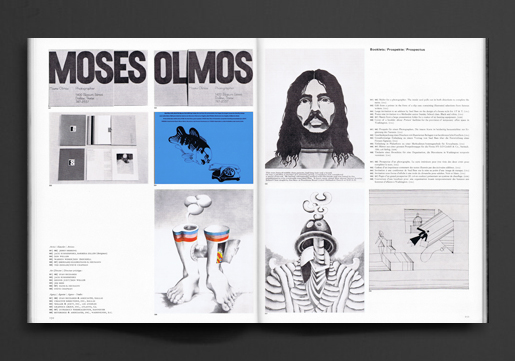
One of the best of the great Graphis Annual collection. Published in 1971/1972 by The Graphis Press in Zürich, this profusely illustrated, cloth-bound volume continues one of the world's leading design showcases. Each "International Annual of Advertising Graphics" profiles in colour and black and white the best design of everything from book jackets to record covers to television commercials to trade marks and letterheads. All texts are in English, German and French. Edited by Walter Herdeg, this edition features the works of Alan Aldridge, Saul Bass, Herb Lubalin, Push Pin Studio, Dick Bruna, Peter Bentley, Maciej Żbikowski, Raymond Bertrand, Jerzy Flisak, Salvador Dali, Jean-Michel Folon, Milton Glaser, Roy Lichtenstein, Enzo Mari, Peter Max, Pablo Picasso, Paul Rand, Raymond Savignac, Saul Steinberg, Tomi Ungerer, Tadanori Yokoo, Masamichi Oikawa, and hundreds more.
Good ex-libris copy - general wear, scuff to corner and library markings.
1981, English / German / French
Hardcover (w. dust-jacket), 192 pages, 24 x 30.5 cm
1st Edition, Out of print title / used / very good
Published by
The Graphis Press / Zürich
$65.00 - Out of stock
1981 edition of the great Graphis Posters book series. Published by The Graphis Press in Zürich, this profusely illustrated, cloth-bound volume continues one of the world's leading design showcases. Each Graphis Posters Annual volume profiles in colour and black and white the best poster design of that year. Profusely illustrated across 192 pages, with 635 b/w and colour examples, and, as per usual for Graphis publications, handsomely designed and heavily researched, with all texts in English, German and French.
Edited by Swiss graphic design Walter Herdeg, with a dust jacket (present) by the great Tomi Ungerer.
Features the work of : Milton Glaser, Herb Lubalin, Jean Michel Folon, Tomi Ungerer, Tadanori Yokoo, Roman Cieslewicz, Ivan Chermayeff, Shigeo Fukuda, Pentagram, Jan Lenica, Seymour Chwast, Paul Davis, Akihiko Tsukamoto, Celestino Piatti, Push Pin Studios, Armando Testa, Lee Lorenz, Frieder Grindler, Shig Ikeda, Jacques Richez, Allen Jones, Jasper Johns, Holger Matthies, Bruno Oldani, Armando Milani, Saul Bass, Romuald Socha, Kazumasa Nagai, Roland Topor, Helmut Brade, Gunter Rambow, Shigeo Okamoto, Gottschalk + Ash, Michael English, Ikko Tanaka, Paul Klee, Bruno Magno, Etienne Delessert, Sm Haskins, and hundreds more.
Very Good copy with Very Good original jacket preserved under plastic wrap. Ex-Reference Library markings, but generally clean, crisp copy throughout.
1998, English
Softcover, 192 pages, 25 x 29 cm
1st Edition, Out of print title / used / good
Published by
Powerhouse Publishing / Sydney
$55.00 - Out of stock
Major monographic catalogue published by Sydney's Powerhouse Museum in 1998 on the lives and work of the influential architects Marion Mahony Griffin and Walter Burley Griffin. Now a scarce title, this lavishly illustrated volume features more than 350 built and unbuilt works documented through photographs and beautiful architectural drawings, presented alongside the philosophical, spiritual, and aesthetic principles that guided the Griffins journey from the office of Frank Lloyd Wright in turn-of-the-century Chicago to Australia in their pursuit of a ‘democratic civic ideal’ and design of Canberra, Australia's capital city, and finally to a revitalised practice in India. Essays include: Chicago 1900 - the Griffins come of age; Mahony as the originator of Griffin's mature style; Mohony - a larger than life presence; spirituality & symbolism in the Griffins' work; Griffins' landscape art; dreams of equity 1911-1924; furniture & lighting; creating a modern architecture for India; Pyrmont incinerator & its precedents; looking back on the Griffins.
Marion Mahony Griffin (February 14, 1871 – August 10, 1961) was an American architect and artist. She was one of the first licensed female architects in the world, and is considered an original member of the Prairie School. Her work in the United States developed and expanded the American Prairie School. Her work in India and Australia reflected Prairie School ideals of indigenous landscape and materials in the newly formed democracies. The scholar Deborah Wood has stated that Griffin "did the drawings people think of when they think of Frank Lloyd Wright (one of her collaborating architects)." During her career, she produced some of the best architectural drawing in America and was instrumental in envisioning the design plans for then new capital city of Australia, Canberra.
Walter Burley Griffin (November 24, 1876 – February 11, 1937) was an American architect and landscape architect. He is known for designing Canberra, Australia's capital city. He has been credited with the development of the L-shaped floor plan, the carport and an innovative use of reinforced concrete.
Influenced by the Chicago-based Prairie School, Griffin developed a unique modern style. He worked in partnership with his wife Marion Mahony Griffin. In 28 years they designed over 350 buildings, landscape and urban-design projects as well as designing construction materials, interiors, furniture and other household items.
Small rear spine edge split, otherwise Very Good copy throughout with light wear.
2009, English
Softcover, 128 pages, 152 x 229 mm
Published by
Semiotext(e) / Los Angeles
$25.00 - In stock -
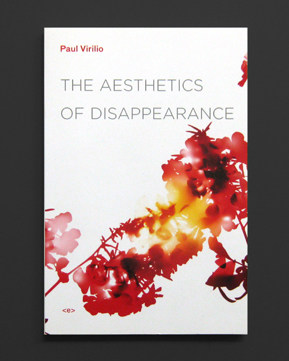
Virilio himself referred to his 1980 work The Aesthetics of Disappearance as a “juncture” in his thinking, one at which he brought his focus onto the logistics of perception—a logistics he would soon come to refer to as the “vision machine.” If Speed and Politics established Virilio as the inaugural—and still consummate—theorist of “dromology” (the theory of speed and the society it defines), The Aesthetics of Disappearance introduced his understanding of “picnolepsy”—the epileptic state of consciousness produced by speed, or rather, the consciousness invented by the subject through its very absence: the gaps, glitches, and speed bumps lacing through and defining it. Speed and Politics defined the society of speed; The Aesthetics of Disappearance defines what it feels like to live in the society of speed.
“I always write with images,” Virilio has claimed, and this statement is nowhere better illustrated than with The Aesthetics of Disappearance. Moving from the movie theater to the freeway, and from Craig Breedlove’s attainment of terrifying speed in a rocket-power car to the immobility of Howard Hughes in his dark room atop the Desert Inn, Virilio himself jump cuts from such disparate reference points as Fred Astaire, Franz Liszt, and Adolf Loos to Dostoyevsky, Paul Morand, and Aldous Huxley. In its extension of the “aesthetics of disappearance” to war, film, and politics, this book paved the way to Virilio’s follow-up: the celebrated study, War and Cinema.
This edition features a new introduction by Jonathan Crary, one of the leading theorists of modern visual culture.
Paul Virilio has published twenty-five books, including Pure War (1988) (his first in English) and The Accident of Art (2005), both written with Sylvère Lotringer, as well as Speed and Politics and Lost Dimension, all published by Semiotext(e).
2012, English
Softcover, 192 pages, 15 x 22.5 cm
Published by
Semiotext(e) / Los Angeles
$35.00 - Out of stock
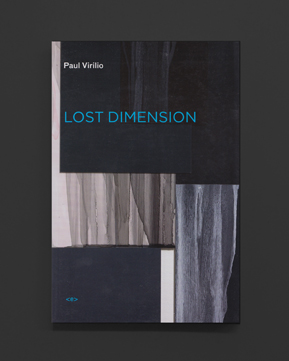
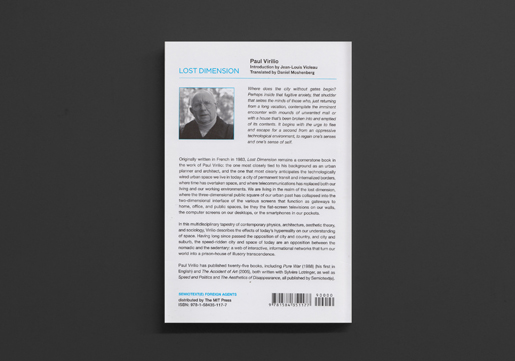
Originally written in French in 1983, Lost Dimension remains a cornerstone book in the work of Paul Virilio: the one most closely tied to his background as an urban planner and architect, and the one that most clearly anticipates the technologically wired urban space we live in today: a city of permanent transit and internalized borders, where time has overtaken space, and where telecommunications has replaced both our living and our working environments. We are living in the realm of the lost dimension, where the three-dimensional public square of our urban past has collapsed into the two-dimensional interface of the various screens that function as gateways to home, office, and public spaces, be they the flat-screen televisions on our walls, the computer screens on our desktops, or the smartphones in our pockets.
In this multidisciplinary tapestry of contemporary physics, architecture, aesthetic theory, and sociology, Virilio describes the effects of today’s hyperreality on our understanding of space. Having long since passed the opposition of city and country, and city and suburb, the speed-ridden city and space of today are an opposition between the nomadic and the sedentary: a web of interactive, informational networks that turn our world into a prison-house of illusory transcendence.
Paul Virilio was born in 1932 and has published a wide range of books, essays, and interviews grappling with the question of speed and technology, including Speed and Politics, The Aesthetics of Disappearance, and The Accident of Art, all published by Semiotext(e). Jean-Louis Violeau is a sociologist and researcher at the 'Architecture-Culture-Société' laboratory of the Ecole d'architecture de Paris-Malaquais in Paris. His most recent book is Les Architectes et Mai 68.
2005, English
Softcover, 128 pages, 15 x 22.5 cm
Published by
Semiotext(e) / Los Angeles
$28.00 - Out of stock
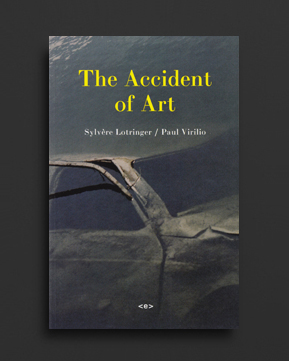
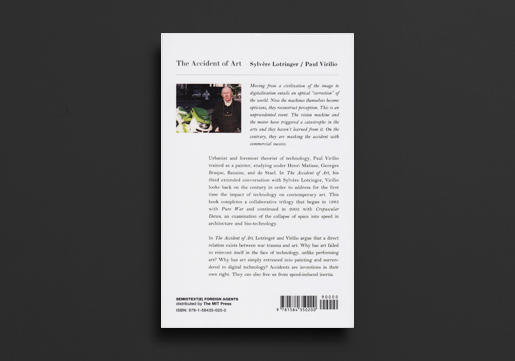
There is a catastrophe within contemporary art. What I call the "optically correct" is at stake. The vision machine and the motor have triggered it, but the visual arts haven't learned from it. Instead, they've masked this failure with commercial success. This "accident" is provoking a reversal of values. In my view, this is positive: the accident reveals something important we would not otherwise know how to perceive.-- Paul Virilio, The Accident of Art
Urbanist and technological theorist Paul Virilio trained as a painter, studying under Henri Matisse, Georges Braque, Bazaine and de Stael. In The Accident of Art, his third extended conversation with Sylvere Lotringer, Virilio addresses the situation of art within technological society for the first time. This book completes a collaborative trilogy the two began in 1982 with Pure War and continued with Crepuscular Dawn, their 2002 work on architecture and biotechnology.In The Accident of Art, Virilio and Lotringer argue that a direct relation exists between war trauma and art. Why has art failed to reinvent itself in the face of technology, unlike performing art? Why has art simply retreated into painting, or surrendered to digital technology? Accidents, Virilio claims, can free us from speed's inertia. As technological catastrophes, accidents are inventions in their own right.
2007, English
Softcover, 200 pages, 15.2 x 22.9 cm
Published by
Semiotext(e) / Los Angeles
The MIT Press / Massachusetts
$30.00 - In stock -
Ranging from reflections on the Enlightenment and revolution to a consideration of the Frankfurt School, this collection offers insight into the topics preoccupying Foucault as he worked on what would be his last body of published work, the three-volume History of Sexuality.
In 1784, the German newspaper Berlinische Monatsschrift asked its audience to reply to the question "What is Enlightenment?" Immanuel Kant took the opportunity to investigate the purported truths and assumptions of his age. Two hundred years later, Michel Foucault wrote a response to Kant's initial essay, positioning Kant as the initiator of the discourse and critique of modernity. The Politics of Truth takes this initial encounter between Foucault and Kant, as a framework for its selection of unpublished essays and transcripts of lectures Foucault gave in America and France between 1978 and 1984, the year of his death. Ranging from reflections on the Enlightenment and revolution to a consideration of the Frankfurt School, this collection offers insight into the topics preoccupying Foucault as he worked on what would be his last body of published work, the three-volume History of Sexuality. It also offers what is in a sense the most "American" moment of Foucault's thinking, for it was in America that he realized the necessity of tying his own thought to that of the Frankfurt School.
Edited by Sylvere Lotringer
Michel Foucault (1926–84) is widely considered to be one of the most influential academic voices of the twentieth century and has proven influential across disciplines.
Sylvère Lotringer is Jean Baudrillard Chair at the European Graduate School, Switzerland, and Professor Emeritus of French literature and philosophy at Columbia University.
2007, English
Softcover, 96 pages
Published by
IMA / Brisbane
City Gallery / Wellington
$15.00 - Out of stock
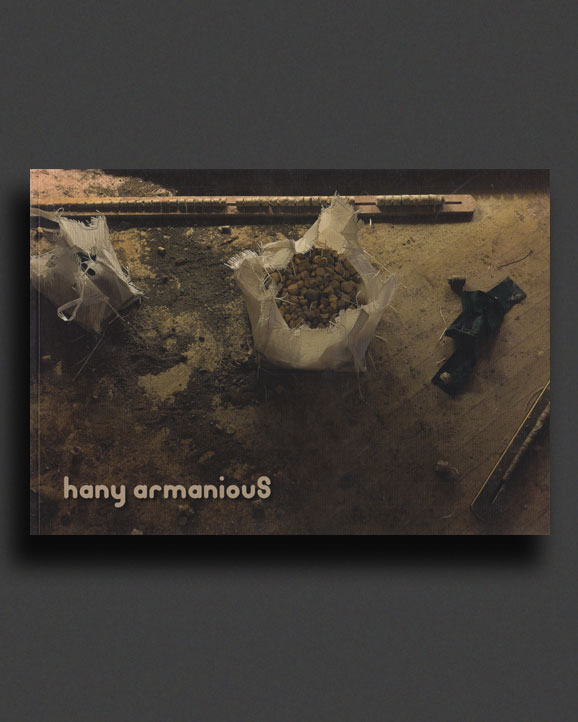
For the last twenty years Hany Armanious has been a key figure in Australian art. His formally diverse work is marked by its conflation of opposing values. He draws on images and objects from a divergent pool, morphing and overlaying styles and vocabularies to build playful, evocative and unexpected new configurations. This accumulative short-circuiting of history, influence and association is intentionally far-fetched and often comical. His work draws our attention to the prevalent imperative to seek connection, to notice sameness, to rationalise points of confluence through often bogus means. This book is a new monograph on Armanious’ work produced by City Gallery Wellington in partnership with IMA, Brisbane.
2014, English
Hardcover, 447 pages
Published by
IMA / Brisbane
$60.00 - In stock -
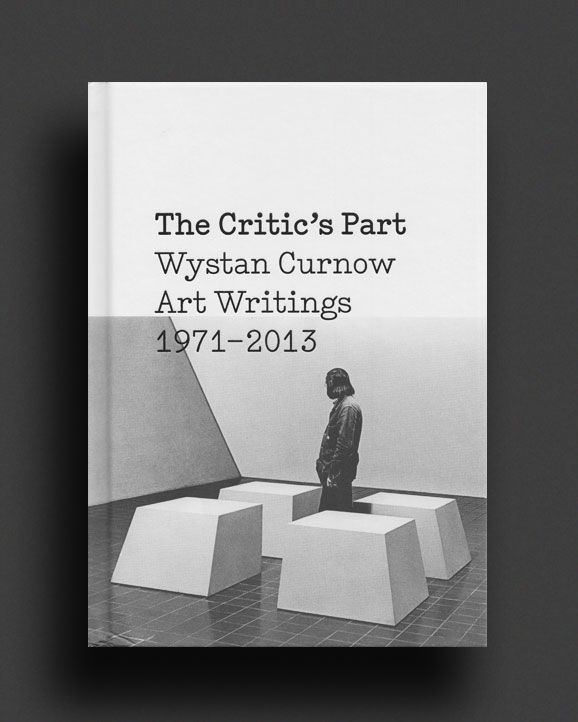
Wystan Curnow is New Zealand’s longest-serving and, arguably, most important art critic. This edited collection brings together a selection of his art writings from 1971 to 2013, to provide the first comprehensive overview of his work. It includes long-form essays that investigate the stakes for ‘high culture in a small province’, monographic essays on canonical artists (including Len Lye, Colin McCahon, Billy Apple, Stephen Bambury, Max Gimblett, and Imants Tillers), vivid reports on the contemporary art scene, catalogue essays, and short reviews.
Both a map of contemporary theory and practice and a cogent agenda for thinking through the implications and challenges of making art in the antipodes, this compilation is an essential companion for anyone interested in New Zealand art as it has unfolded since 1970. The book includes introductory essays by Robert Leonard on Curnow as an ‘antipodean internationalist’ and analysis of his approach as a writer by Christina Barton, plus a chronology and bibliography.
1989, English
Softcover (french-folds), 160 pages, 34 x 25 cm
1st Edition, Out of print title / used / good
Published by
Terrazzo / Milan
$100.00 - Out of stock
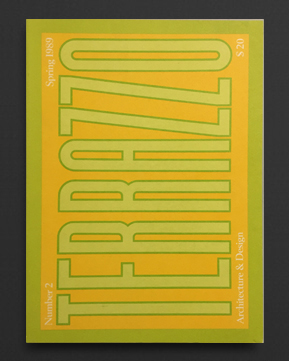
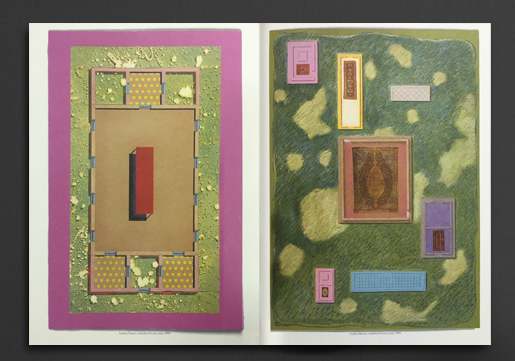
TERRAZZO was a very special biannual publication on architecture and design, edited and published between 1988–1995 by Barbara Radice, a prominent Italian author, design critic and member of the Memphis Milano design group. In conjunction with Ettore Sottsass, Christoph Radl, Anna Wagner and Santi Caleca, Radice created a unique and thoughtful periodical that focused on contemporary works of design and architecture, within Italy and abroad, touching on a vast array of disciplines in each issue, including photography, literature, poetry, history, science, philosophy, art and anthropology.
TERRAZZO 2
Spring 1989
ANDREA BRANZI
Architecture in shadow
FRANK GEHRY
Detailing by Frank Gehry
photographs by Santi Caleca
PAUL LUBOWICKI SUSAN LANIER projects
FRANCESCO CLEMENTE
on architecture
ROBERT MAPPLETHORPE
glass
DESIGN FOR HEROES
TRAVEL NOTES
by Ettore Sottsass
on light
photographs by Ettore Sottsass
GREEK TEMPLES: THE POLYCHROMY
by Joseph Rykwert
FRAN LEBOWITZ ON ARCHITECTS
interview
PLANS (No. 2)
Islamic, the Middle Ages
1989, English
Softcover (french-folds), 34 x 25 cm
1st Edition, Out of print title / used / good
Published by
Terrazzo / Milan
$100.00 - Out of stock
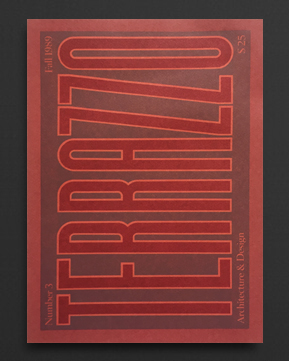
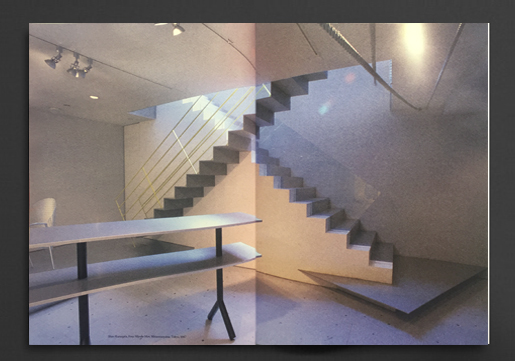
TERRAZZO was a very special biannual publication on architecture and design, edited and published between 1988–1995 by Barbara Radice, a prominent Italian author, design critic and member of the Memphis Milano design group. In conjunction with Ettore Sottsass, Christoph Radl, Anna Wagner and Santi Caleca, Radice created a unique and thoughtful periodical that focused on contemporary works of design and architecture, within Italy and abroad, touching on a vast array of disciplines in each issue, including photography, literature, poetry, history, science, philosophy, art and anthropology.
TERRAZZO 3
Fall 1989
DAN FLAVIN
ETIENNE LOUIS BOULLEE
Homage to Etienne Louis Boullée
by Aldo Rossi
A Newton by Etienne Louis Boullée
ALDO ROSSI
Excerpts from A Scientific Autobiography
by Aldo Rossi
The face of architecture by Ettore Sottsass
photogaphs by Santi Caleca
SHIRO KURAMATA
Purple shadows
by Andrea Branzi
photographs by Kishin Shinoyama
ROBERTO BALDAZZINI LORENA CANOSSA
interiors
TRAVEL NOTES
Ettore Sottsass
on walls
photographs by Ettore Sottsass
INTERACTIVE DESIGN
by Francesco Carla
on the design of video games
BEAUTY
by Herbert Muschamp
PLANS (No. 3)
Renaissance, Palladio essay by Marco Frascari
2005, English / German
Softcover, 270 pages, 19 x 27 cm
1st Edition, Out of print title / used / very good
Published by
Neues Museum Weserburg Bremen / Bremen
$150.00 - Out of stock
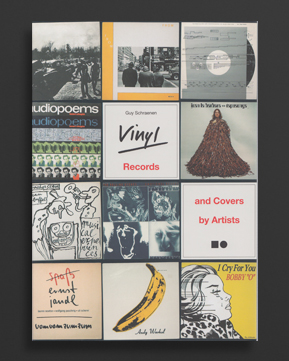
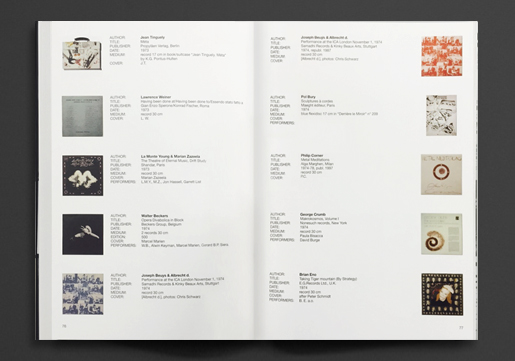
This large, detailed catalogue forms a unique and important document, which was produced to accompany an exhibition at Neues Museum Weserburg Bremen, Bremen, 21.8. - 27.11.2005 and Museu d'Art Contemporani de Barcelona, Barcelona, 16.5. - 1.10.2006 showcasing a selection of some 800 pieces from the collection of Guy Schraenen. The main of this collection comprises vinyl records and covers by artists, musicians and poets in LP, single and other formats, alongside other sound media (tapes and CDs). Posters and books are also included. The exhibition shows artists (such as Hanne Darboven, Jean Dubuffet, Dieter Roth, Joseph Beuys, Laurie Anderson, John Cage, Yoko Ono, Yves Klein, Roman Opalka, Lawrence Weiner, Mike Kelley, Öyvind Fahlström, Art & Language and Hermann Nitsch) and artistic movements of the second half of the twentieth century through this complex medium of the vinyl cover, with its dual visual and audible components. Here Guy Schraenen has edited together an extensive visual catalogue of these historical objects.
A wonderful book for anyone interested in the history of modern sound art and the artistic medium of the vinyl sleeve, especially in the fields of Avantgarde, Electro-Acoustic, Modern Classical, Musique Concrète, Sound-Poetry, Art Rock, Industrial, Power-Electronics....
Henri Chopin, A.R. Penck, Brion Gysin, George Brecht, Marcel Duchamp, Arman, Karel Appel, Öyvind Fahlström, Pierre Henry, Art & Language, Peter Brötzmann, Red Krayola, Ernst Jandl, Vito Acconci, Hanne Darboven, Jean Dubuffet, Dieter Roth, Joseph Beuys, Laurie Anderson, Yves Klein, Roman Opalka, Hermann Nitsch, Yoko Ono, Tony Conrad, Andy Warhol, John Cage, Pierre Schaeffer, Derek Bailey, Han Bennink, Jean Tinguely, Steve Reich, Meredith Monk, Terry Fox, Terry Riley, Sun Ra, Pandit Pran Nath, Albrecht/d., Robert Ashley, Bob Cobbing, Lawrence Weiner, Philip Glass, La Monte Young, Marian Zazeela, Poly Bury, Charlemagne Palestine, Carl Andre, Brian Eno, Mike Kelley, Sonic Youth, Henry Flynt, Jon Gibson, Michael Snow, Roland Topor, Michael Nyman, Harold Budd, Robert Filliou, Nam June Paik ... just the tip of the iceberg.
Very Good copy of the rare first printing from Bremen.
1994, German
Softcover, 128 pages, 18.5 x 25 cm
1st Edition, Out of print title / used / good
Published by
Diogenes / Zürich
$50.00 - Out of stock
First edition of the wonderful "Poster", a monograph dedicated entirely to the poster work of Tomi Ungerer. "Tomi Ungerer's inexorable ascent began in the fifties in New York - with commercial artwork. Since then a central element has reccurred in his multi-layered work: Tomi Ungerer, the drawer, painter, illustrator, narrative writer, author of children's books, has created hundreds of posters. This book shows a cross-section thereof: the beginnings in America, advertising work and deadly serious social criticism, posters for music and the theatre, for Strasbourg and the Alsace, for humanitarian campaigns and organisations - and posters for children over and over again."
A fantastic book, published in 1994 in Zürich. Very little text, in German.
Tomi Ungerer (born 28 November 1931) is an award winning French illustrator and a writer in three languages. He has published over 140 books ranging from much loved children's books to controversial adult work and from the fantastic to the autobiographical. He is known for sharp social satire and witty aphorisms. He is renowned for his iconic Advertising campaigns and political posters against the Vietnam War and Racial Injustice which were representative of the burgeoning political consciousness in New York in the 1960’s. His political engagement has continued to this day in campaigns against Racism and Fascism, for Nuclear disarmament, Ecology and numerous Humanitarian causes.
Good copy, with some general cover and spine wear only.
1969, English
Softcover (stapled), 20 pages, 20.5 x 26.5 cm
1st Edition, Out of print title / used / good
Published by
NGV (National Gallery of Victoria) / Victoria
$20.00 - In stock -
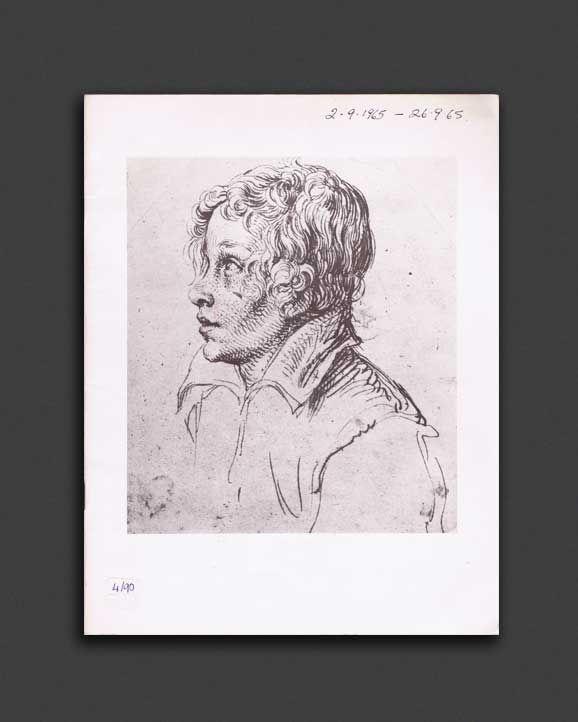
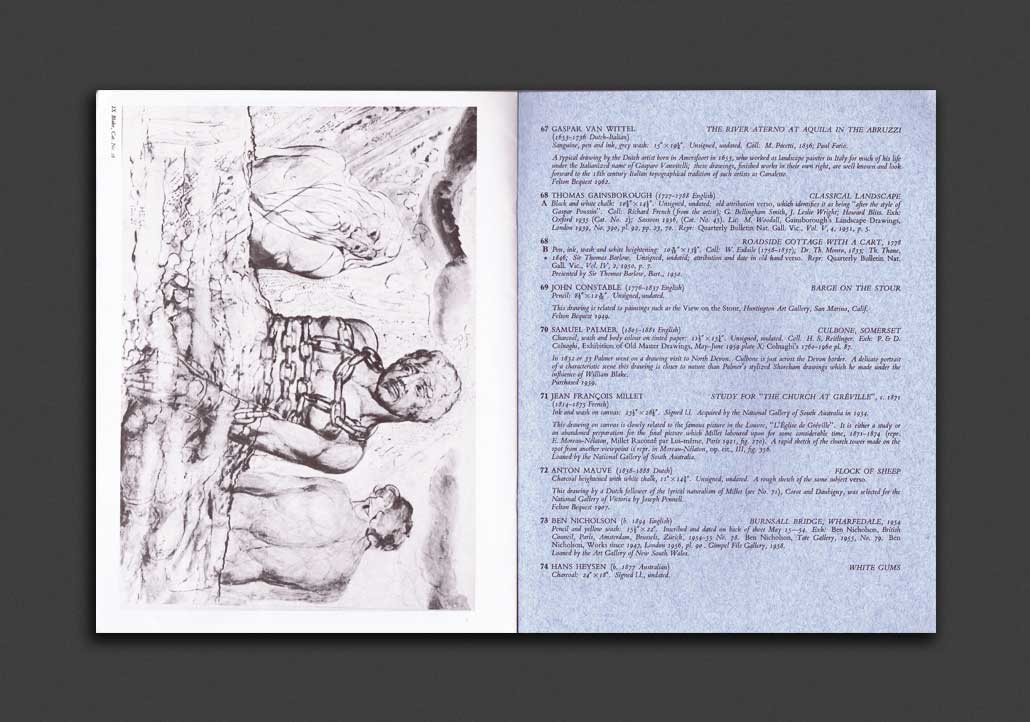
Wonderful and scarce catalogue for the exhibition "The Art of Drawing", a major survey of drawing through the centuries, held in 1969 at the National Gallery of Victoria.
Introduction by Ursula Hoff with full exhibition check-list across blue textured paperstock. Illustrated pages featuring works by William Blake, Andreas del Sarto, Parmigianino, Jacques de Gheyn, Giovanni Benedetto Castiglione, Annibale Carracci, Aert de Gelder, Rembrandt, Thomas Gainsborough, François Boucher, Pablo Picasso, William Dobell. Exhibition also included Eric Thake, Henri Matisse, Arthur Boyd, Carlo Maratta, Annibale Carracci, Russell Drysdale, Jacob Epstein, Rupert Bunny, Eduardo Paolozzi, John Brack, Percy Wyndham Lewis, Jan Brueghel The Elder, Jean Francois Millet, Hans Heysen, Ben Nicholson, Auguste Rodin, Robert Klippel, Inge King, Henry Moore, Albert Dürer, Léon Bakst, Margaret Stones, and many others.
Ursula Hoff (1909-2005) was an Australian scholar, academic, curator, writer, critic, and lecturer. She was Deputy Director of the National Gallery of Victoria, Melbourne (1968–1973).
Good-Very Good ex-Australian National Gallery reference copy.
1970, English
Hardcover (w. dust jacket), 152 pages, 31 x 24 cm
1st US Edition, Out of print title / used / very good
Published by
Britwell Books / London
World Publishing / New York
$140.00 - Out of stock
First US hardcover edition of the third volume in David Hicks' classic and collectable series of design books. Published in 1970 with the iconic Hicks cross design dust jacket.
Blurb from the dust jacket:
'The book is lavishly illustrated, illustrating historic and traditional bathrooms and ones that he and other internationally famous designers have created today which are prophetic of tomorrow. The reader will find this an authoritative, original book and it will unquestionably have a stimulating effect on the future of bathroom design.
This third book of David Hicks' shows his work in the United States, Switzerland, England, France, Holland and Nassau. Most of the illustrations were taken specially for the book and include bathrooms, cloakrooms and dressing rooms.
It also shows the work of other designers in the past and present, and rooms which were made by amateurs of taste.
Authoritative, international and original, it is redolent of the man himself - full of strong convictions. A typically uncompromising statement in visual and written terms of one of the most sought-after designers of our time. It is full of ideas and thoughts to reassure even the most unimaginative or timid reader."
David Hicks is considered to be among the foremost interior designers of the 20th century. From the decoration of his own house in London in 1956—in powerful colours that heralded an end to the drab, postwar English look—he set the pace for interior design both in Europe and America, personifying the many dramatic shifts in home decor throughout the 1960s-1980s, and achieving dynamic balance between the traditional and the contemporary. His design primer book series has become an iconic staple in any interior design library.
Very Good copy with Good Jacket (tiny, repaired tear to front and one to back), preserved under plastic wrap.
1979, English
Hardcover (w. dust jacket), 288 pages, 28.5 x 21.5 cm
1st UK Edition, Out of print title / used / good
Published by
Weidenfeld and Nicolson / London
$90.00 - Out of stock
First hardcover edition of David Hicks' iconic and influential book, Living with Design, published in 1979 by Weidenfeld and Nicolson, London.
Blurb from the dust jacket:
"Following upon the phenomenal international success of David Hicks on Decoration, this new volume by one of the world's top designers is a most exciting sequel. He demonstrates here, visually, and in words, how people of all incomes can achieve the warmth and interest provided by taste and functional detail. This lavish and elegant volume pin-points all aspects of Living with Taste and covers flower arrangements, tablescapes, wall arrangements, massing, style, lighting and general decoration. It shows how people can live with taste, regardless of their incomes, and selects and expounds on all types of accessories from door handles to lavatories...."
David Hicks is considered to be among the foremost interior designers of the 20th century. From the decoration of his own house in London in 1956—in powerful colours that heralded an end to the drab, postwar English look—he set the pace for interior design both in Europe and America, personifying the many dramatic shifts in home decor throughout the 1960s-1980s, and achieving dynamic balance between the traditional and the contemporary. His design primer book series has become an iconic staple in any interior design library.
Copy withdrawn from the London College of Fashion. Light associated stampings, otherwise Very Good copy with Good-Very Good dust jacket preserved under plastic wrap.
1964, German
Hardcover, 80 pages, 30 x 22 cm
1st Edition, Out of print title / used / good
Published by
Fravex / Kiel
$50.00 - Out of stock
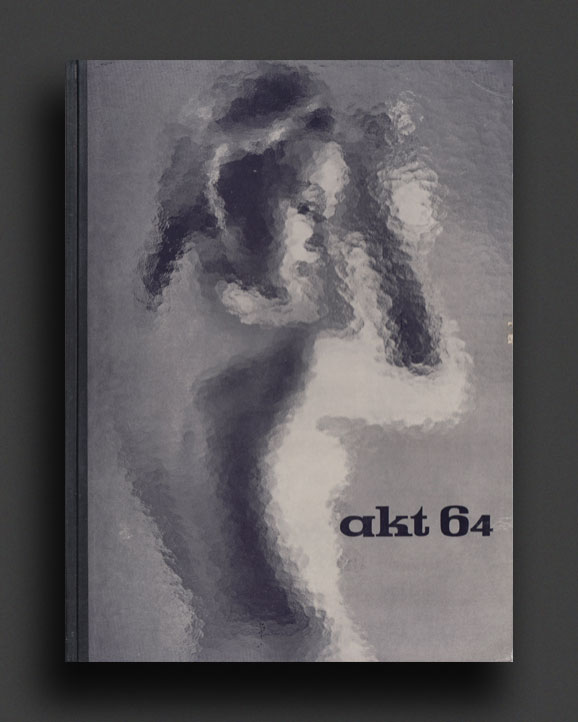
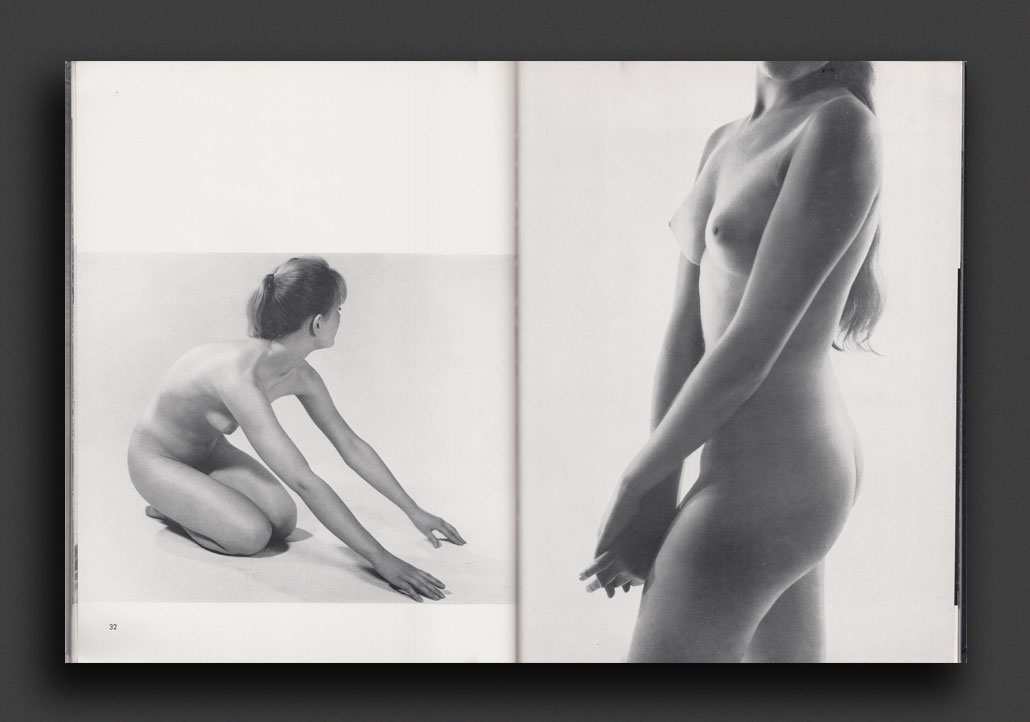
1964 first edition of this short-lived annual German hardcover book on human figure photography. Almost entirely made up of full-bleed black and white photography of female nude models in naturalist and studio settings, at times revealing the continued influence of Bauhaus' Neue Optik movement, with work by Andre de Dienes (who became famous as the first photographer of Marilyn Monroe), Lilo Gwosdz, Gerhard Vetter, Lussa Vince, Fritz Meisnitzer, and many more. Beautiful book.
Good-Very Good copy (small knocks to cover edge)
2018, English
Softcover, 448 pages, 14 x 21 cm
Published by
Valiz / Amsterdam
$49.00 - Out of stock
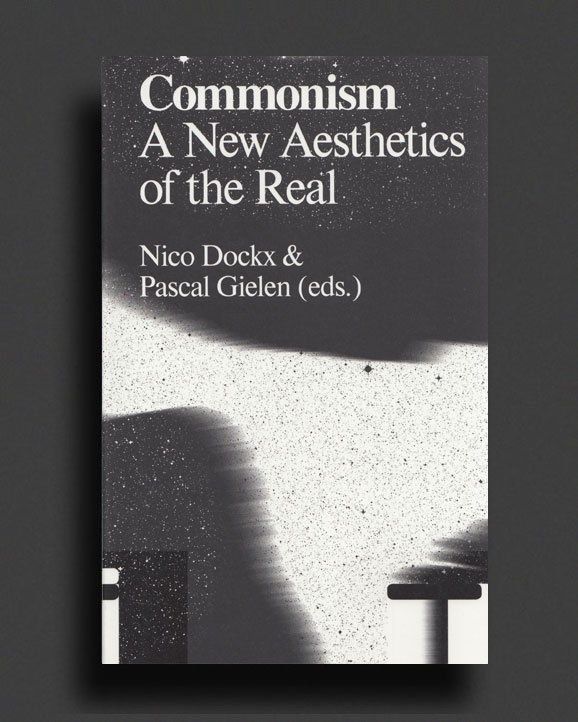
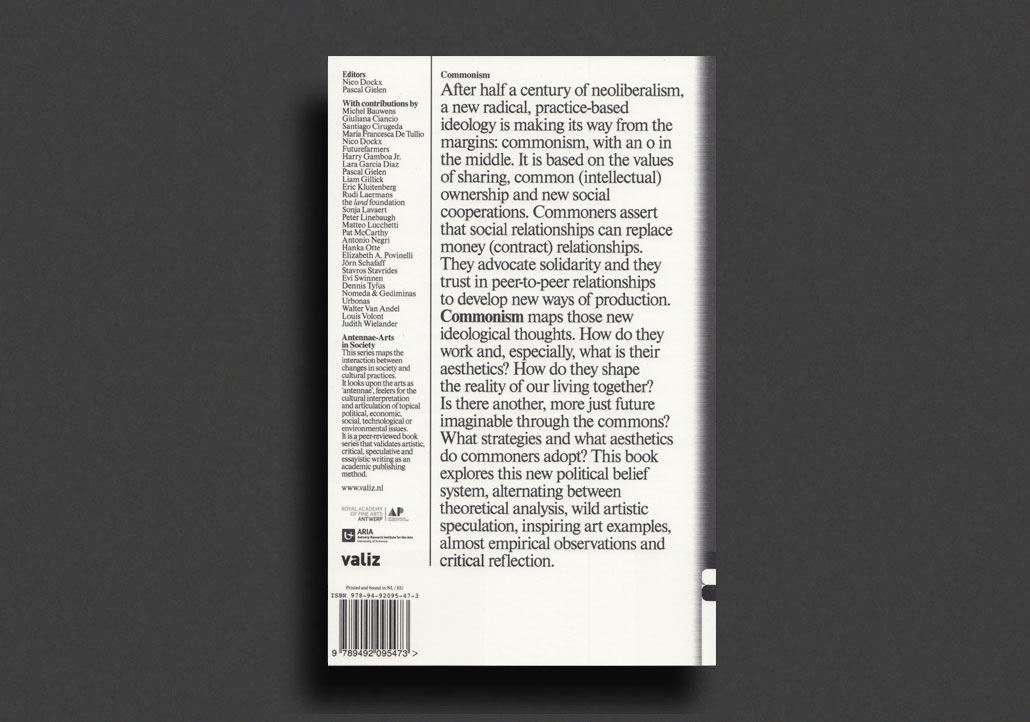
After half a century of neoliberalism, a new radical, practice-based ideology is making its way from the margins: commonism, with an o in the middle. It is based on the values of sharing, common (intellectual) ownership and new social co-operations. Commoners assert that social relationships can replace money (contract) relationships. They advocate solidarity and they trust in peer-to-peer relationships to develop new ways of production.
Commonism maps those new ideological thoughts. How do they work and, especially, what is their aesthetics? How do they shape the reality of our living together? Is there another, more just future imaginable through the commons? What strategies and what aesthetics do commoners adopt? This book explores this new political belief system, alternating between theoretical analysis, wild artistic speculation, inspiring art examples, almost empirical observations and critical reflection.
Editors: Nico Dockx & Pascal Gielen
Contributors: Walter van Andel, Michel Bauwens, Giuliana Ciancio, Maria Francesca De Tullio, Nico Dockx, Futurefarmers, Lara Garcia, Harry Gamboa Jr., Pascal Gielen, Liam Gillick, Eric Kluitenberg, Rudi Laermans, the land foundation, Sonja Lavaert, Peter Linebaugh, Matteo Lucchetti, Pat McCarthy, Antonio Negri, Hanka Otte, Recetas Urbanas, Jörn Schafaff, Stavros Stavrides, Evi Swinnen, Rirkrit Tiravanija, Nomeda & Gediminas Urbonas, Louis Volont, Judith Wielander
Design: Metahaven
Series: Antennae
2018, English
Hardcover, 112 pages, 20 x 25.5 cm
Published by
MoMA / New York
$59.00 - Out of stock
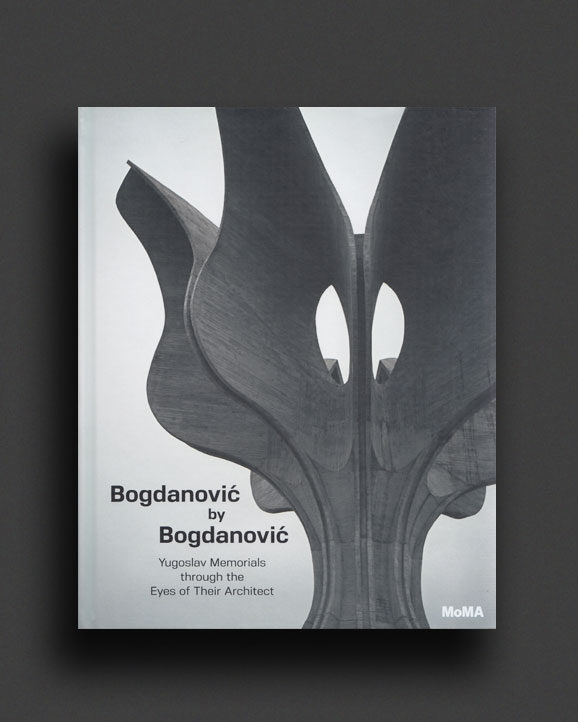
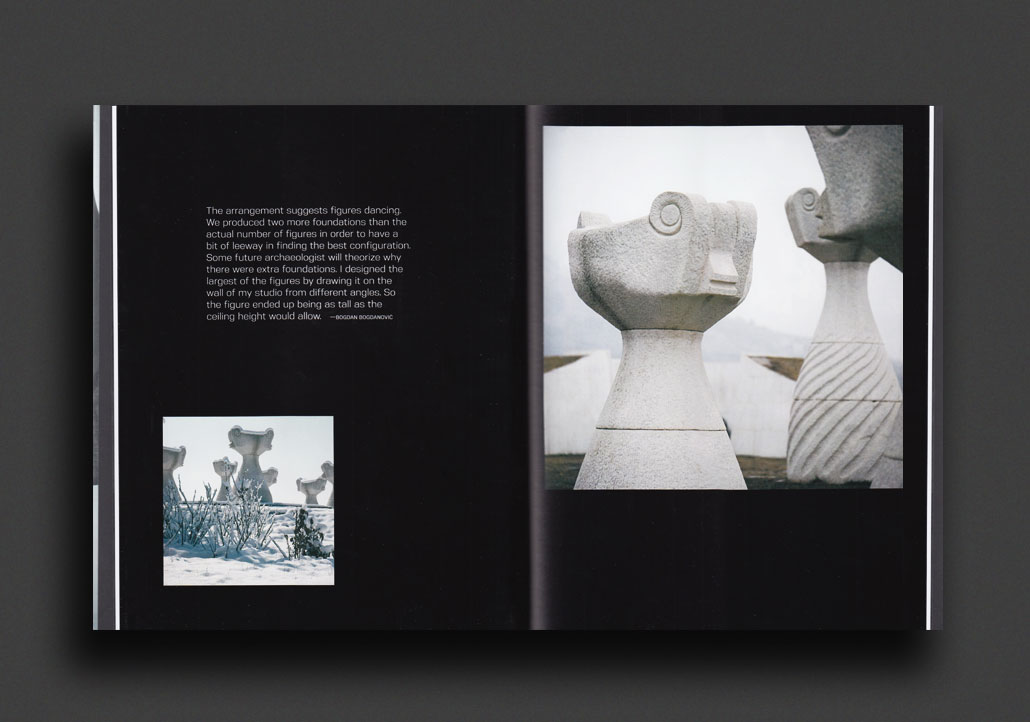
Bogdan Bogdanović (1922-2010) was a Yugoslav architect, theorist, professor and a one-time mayor of Belgrade. His idiosyncratic memorials to the victims and heroes of World War II, scattered around the former Yugoslavia, continue to attract attention today, more than 25 years after the country's collapse. The monuments, cemeteries, mausoleums, memorial parks, necropolises, cenotaphs and other sites of memory Bogdanovic designed between the early 1950s and late 1970s occupy a unique place in the history of modern architecture, redrawing the boundaries between architecture, landscape and sculpture in varied and unexpected ways.
This book presents Bogdanovic's built oeuvre through his own eyes, in a selection of nearly 50 colour photographs of his memorials, which the architect took soon after the completion of each project. Carefully staged and taken with professional medium-format cameras, these photos, many of them previously unpublished, are in themselves works of art that bespeak their author's surrealist sensibility.
The publication includes an introduction by the architectural historian Vladimir Kulic, a preface by curator Martino Stierli and a selection of Bogdanovic's own thoughts on photography, excerpted from an unpublished interview that Kulic conducted in 2005.
1973, English
Hardcover (w, dust jacket), 312 pages, 26 x 21 x 3.4 cm
1st Edition, Out of print title / used / good
Published by
Architectural Press / London
$100.00 - Out of stock
Hardcover first edition of this scarce book on military architecture in North West Europe between 1900 and 1945, written by Keith Mallory and Arvid Ottar in 1973 and published by London's Architectural Press.
Profusely illustrated throughout with photographs, diagrams and architectural plans, including projects such Maginot Line, Atlantic Wall, Autobahn and West Wall, Mulberry Harbour, plus air raid shelters, bunkers, forts, submarine pens and more spanning Germany, Britain, Belgium, France, etc. A very informative and collectible volume.
Excerpt from jacket blurb:
"Since 1914 astronomical sums have been spent on war and the preparation for war. A large part of this money has been devoted to military construction, ranging from huge concrete emplacements of almost indestructible dimensions to the flimsiest of prefabricated hutments. Yet although expenditure on various forms of military building in this century has almost certainly been greater than that on the civilian sector, the architecture associated with it has been largely ignored by historians. Its importance,
however, goes far beyond its sheer, brute use of resources, significant though that has been in itself. As this deeply researched and extraordinarily entertaining book shows, military architecture in its various manifestations reflected and influenced the course of warfare to a surprising degree...."
2018, English
Hardcover, 92 pages, 23 x 27.5 cm
Published by
Sternberg Press / Berlin
Eykyn Maclean / New York-London
$79.00 $35.00 - Out of stock
Contributions by Carl Andre, Meg O’Rourke, Caroline Weber, Lynn Zelevansky, Thea Westreich
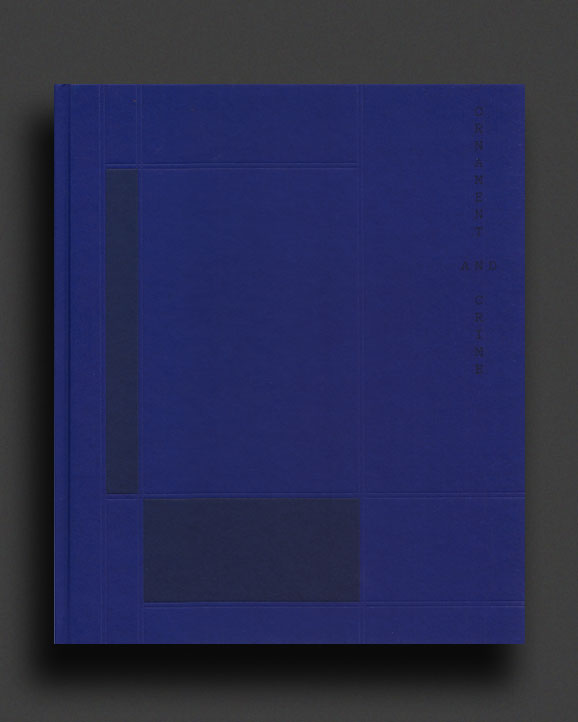
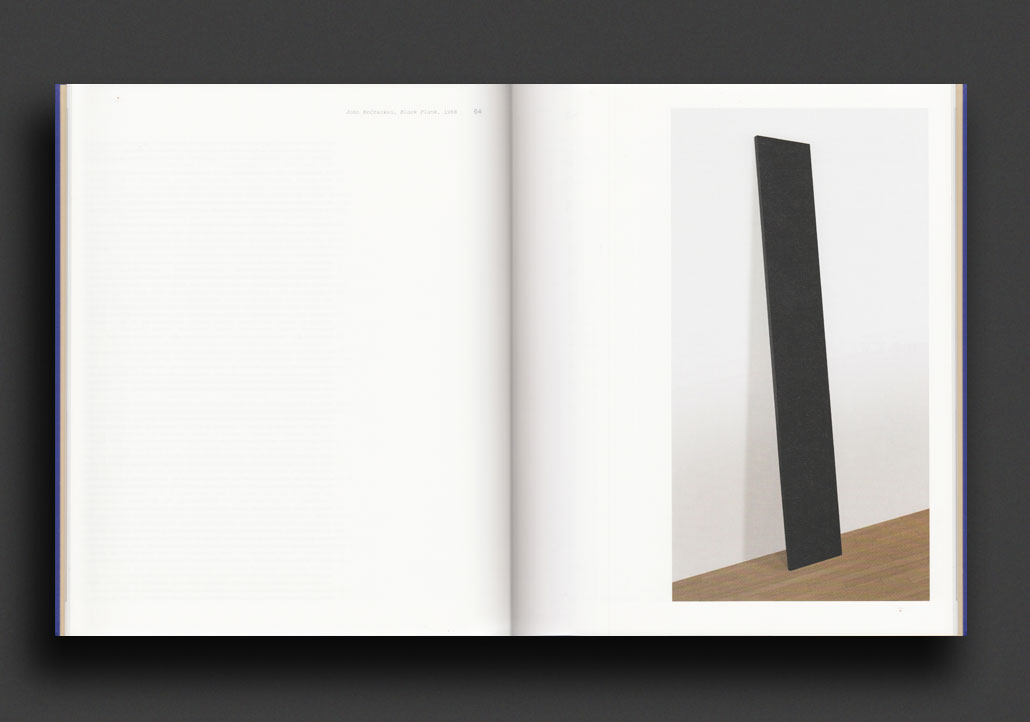
The catalogue Ornament and Crime accompanies the group exhibition curated by Meg O’Rourke at Eykyn Maclean in New York (May 2–June 15, 2018). With Adolf Loos’s eponymous 1908 diatribe against excessive ornamentation as its guide, the exhibition draws on the tenets set forth by Loos—simplicity, purity, freedom—with particular attention to their philosophical implications and their persistence into the latter twentieth century. The catalogue traces a genealogy of form from the dogmatism of Loos and Piet Mondrian; to the experimental systems of Yves Klein, the Zero group, and Ad Reinhardt; and finally, to the austere formalism of Minimalism and Arte Povera. When superficial surfaces and superfluous decorations are stripped away, the unknown is opened up—into the void, that is, what lies beyond the surface; down to the elemental, a deeper engagement with material that exceeds mere abstraction; and toward the eternal, where aesthetic asceticism points toward spiritual and psychic transcendance. The texts comprise an introduction by Meg O’Rourke, an historical essay by Lynn Zelevansky, a creative abecedarium by Caroline Weber, and an interview with Carl Andre conducted by O’Rourke and Thea Westreich. They offer historical context and draw out the resonances between the artworks represented, which are included here in full-color standalone and installation views.
Features Agnes Martin, Donald Judd, Ellsworth Kelly, Carl Andre, Piet Mondrian, Yves Klein, Otto Piene, Ad Reinhardt, John McCracken, Lucio Fontana, Frank Stella, and more.
Copublished with Eykyn Maclean, New York / London
Design by A Practice for Everyday Life